COSIMO DI GIOVANNI DE’ MEDICI
Reading edition
(1389-1464)
Of Giovanni di Bicci de’ Medici’s two sons, Cosimo was by far the most remarkable. “The father,” writes Gibbon, “of a line of princes, whose name and age are almost synonymous with the restoration of learning; his credit was ennobled into fame; his riches were dedicated to the service of mankind; he corresponded at once with Cairo and London, and a cargo of Indian spices and Greek books were often imported in the same vessel.” For even when most deeply engaged in political matters, Cosimo always found time to attend to his business, and himself conducted the correspondence with the heads of the banks which were known throughout Europe and in Asia. All had orders to buy ancient manuscripts and rare books. As a lad he served in the Pisan war, and in 1414 was sent by his father in the suite of Pope John XXIII. to represent the bank at the Council of Constance. After the flight of the Pope, Cosimo left Constance in disguise and returned to Florence, where he was elected a Prior of the city in 1415, and again in 1417.
Cosimo was forty when his father died in 1429. Ammirato describes him as of middle height, with an olive complexion, and of imposing presence. Machiavelli says that he applied himself so strenuously to increase the political power of his house that “those who had rejoiced at Giovanni’s death, now regretted it, perceiving what manner of man Cosimo was. Of consummate prudence, staid yet agreeable presence, Cosimo was liberal and humane. He never worked against his party nor against the State, was prompt in giving aid to all, and his liberality gained him many partisans among the citizens. Chief amongst those who helped to consolidate his power were Averardo de’ Medici and Puccio Pucci—Averardo by his audacity, Puccio by his prudence and sagacity, augmented his popularity and greatness. The advice and the sane judgment of Puccio were so highly esteemed and so well known by all that Cosimo’s party was not called by his name but by that of Puccio.”[4]
Much of Cosimo’s influence and popularity, no doubt, arose from his generosity to men of letters. When Niccolò de’ Niccoli, “censor of the Latin tongue,” ruined himself by buying books, Cosimo opened an unlimited credit for him at his bank. After Niccoli’s death he paid his debts on the condition of being allowed to dispose of the collection of manuscripts, amounting to six hundred volumes. Four hundred he gave to the library of S. Marco, the rest he kept or distributed among friends. Cosimo also provided Tommaso Parentucelli, Bishop of Bologna, with what money he needed; a service that was well repaid when the Bishop became Pope, and made him his banker. Parentucelli catalogued de’ Niccoli’s library, and noted for Cosimo the books that were necessary to complete it. This catalogue Vespasiano declared to be indispensable to all collectors of books. When the Badia of Fiesole, certainly designed, if not actually built by Brunelleschi at Cosimo’s expense, was finished, he summoned Vespasiano, who has recorded their conversation: “One day, when I was in his room, he said to me, ‘What plan can you suggest for the formation of this library?’ I answered that to buy the books would be impossible, since they could not be purchased. ‘What, then, do you propose?’ he added. I told him they must be copied. He then asked me if I would undertake the business, and I replied that I was willing. He bade me begin at my leisure, saying that he left all to me, and he ordered that for the money needed day by day Don Arcangelo, at that time Prior of the monastery, should draw cheques upon his bank which would be honoured. After beginning the collection, since it was his will that it should be finished with all speed possible, and money was not lacking, I soon engaged forty-five copyists, and in twenty-two months provided two hundred volumes, following the admirable list furnished by Pope Nicholas V.”[5]
Cristofano Landino, Lionardo Aretino (Bruni), whose translations from the Greek were celebrated for their pure latinity, while his speeches were compared to those of Pericles, and Carlo Aretino (Marsuppini), were friends of Cosimo, and members of the Platonic Academy. They often met in the Badia, and Pico della Mirandola, on whom, says Poliziano, “nature seems to have showered all her gifts,” passed some time there in study. In the cell of Ambrogio Traversari in the convent degl’ Angeli at Fiesole, Cosimo was wont to pass his spare hours in the company of learned men. He was quick in recognising talent, and possessed the gift said to belong to royalty of suiting his conversation to his visitors. Vespasiano tells us that “when giving audience to a scholar he discoursed concerning letters; in the company of theologians he showed his acquaintance with theology, a branch of learning always studied by him with delight. So also with regard to philosophy. Astrologers found him well versed in their science, for he somewhat lent faith to astrology, and employed it on certain private occasions. Musicians in like manner perceived his mastery of music, wherein he much delighted. The same was true about sculpture and painting; both of these arts he understood completely, and showed great favour to all worthy craftsmen. In architecture he was a consummate judge, for without his opinion and advice no building was begun or carried to completion.”[6]
While spending money in a princely manner on works of art, public libraries and buildings, Cosimo lived as simply as any other citizen. Though for twenty-five years he was practically the ruler of Florence, he remained the merchant, the plain burgher, the agriculturist. His estates were in good order; he superintended the planting, and rose early to prune his vines. Gambling he detested; the only game he played, and that but rarely, was chess. Habitually taciturn, particularly in his later years, yet he could give witty and even sharp answers; as when one of his adherents, a loquacious, not very wise man, who, on being named Podestà of a foreign (i.e. not a Tuscan) town, asked him for advice. “Dress suitably and talk little,” was the answer. To another he said there was a weed that ought not to be watered but allowed to wither, and that weed was envy.
In Cosimo’s letters one sees how well his father’s last words, “Be careful not to attract public attention,” were obeyed by him. The pity is that even those who pass their lives poring over manuscripts in the Florentine archives find the greatest difficulty in deciphering his handwriting, and there are allusions to passing events or to people which are impossible to understand, as he uses the gergo, or slang, of his day, or nicknames, the meaning of which are lost to us. The date of his marriage with Contessina, daughter of Giovanni de’ Bardi, Count of Vernio, is not recorded, but her eldest son, Piero, was born in 1416. The little we know of her, chiefly from her letters, depict her as a good, rather parsimonious housewife and a tender mother. In 1427 Cosimo was at Ferrara, and she writes:
Contessina de’ Medici to her husband Cosimo de’ Medici in Ferrara
This evening I have a letter from thee and have understood how much we are to pay for the barrels at Careggi; as soon as they arrive I will do as thou sayest. I have a letter from Antonio Martelli saying that he is sending nine bales of our linen cloth, which were at home, by now I think they must have arrived, give orders that they be put in a dry place so that the linen be not spoiled. At Careggi every one is well as usual and I am also well, may it please God that it be so in the future; one of our labourers it is true, who lives where the young partridges were, rather frightened us, but he is well again. I wrote to thee by Giovannino, so be not chary with ink and paper, so be it is not wearisome to thee. Ginevra and Pier Francesco[7] are in the Val d’Arno and Amerigo Cavalcanti is with them. They are all well as Giovannino will have told thee. Lorenzo[8] and I are here, both well. Shouldst thou want anything let me know. Above all be careful of thy health and keep a good watch on thyself. No more at present. May Christ preserve thee.—In Florence, March 4, 1427 (1428).
La Contessina who commends herself to thee.
Matteo gave me the little keys, if thou hast need of them tell me. Thy mother who put that Santelena[9] into the bag with the others thou hadst from here is much surprised that thou hast not found it, she remembers to a certainty putting it into the bag the first thing after thy departure. She wrote to-day and answered about this. Those who were in debt for their rents have paid to Piero d’Orlando according to Lorenzo’s orders.[10]
The following letter was written during the negotiations for peace with Visconti, Duke of Milan. Florence and Genoa had fared badly in the war. The former had been defeated over and over again, and the whole of the Western Riviera had been overrun by the Milanese troops. The interference of Venice had changed the state of affairs, and the Duke of Milan was desirous for peace. Averardo de’ Medici with Palla Strozzi were the ambassadors of Florence, and Cosimo discusses the difficulties attending the negotiation. The Florentines thought that Venice was too grasping, as she demanded Bergamo as well as Brescia; but the real crux of the problem was that the Duke of Milan held tenaciously to his conquests in the Riviera. Peace was finally concluded on April 28, 1428. The Cardinal di Santa Croce had been appointed by the Pope as arbiter between the parties. Part of the letter refers to Florentine internal politics, to which now we have no clue; we also see how these great Florentines mingled their private mercantile affairs with grave political matters.
Non ò tue lettere poi ti scrissi per una vostra de dì 29 currente viddi e dubj v’ erano in animo veduto le diferenze sono nella domanda et chome dite è da dubitare non tanto per le diferenze quanto perché si vede el ducha non viene schietto su questi ragionamenti, pure vorrei voi vi fossi ingiegnati sendire che diferenza è questa et maxime de fatti di Berghamo e che inporta et chosì quelle di Valchamonicha la quale a me pare picchola se altro non v’è aschosto et poi le chose sono ridotte qui non si vorebe per si picchola chosa tanto bene restasse et pero credo v’ingiegnerete a rottura non si vengha et chosì si vuole fare et vedere se di queste diferenze si potesse fare remissione nel chardinale chome de l’altre sarebe tanto magiore lo schorno se a rottura si venisse quanto per ognuno si tiene a certo pace deba seghuire fu qui jeri Franceschino da Macerata et secondo da lui ritrassi non pareva avesse nuova se di questo fatto si facesse questo dicho per tuo aviso che mi fa assai dubitare benchè jo creda pure che chostì di cò a dire chon el chardinale per suo interesso dovria farne ogni chosa posibile ✕ de fatti delli grani chome per altra ti dissi non te ne gravare troppo in confortare perchè n’aresti graveza et per ire chosì ci è chommodo Ser p. el chompare che altra volta non se ne faceva menzione e ora sta chosì forte et acordasi il chonpare e’lla chomare nonn è però che per questo si volgla laschare nulla adrieto nè qui anche si lascerebe ma stimasi sendo d’achordo de l’altre chose per questa sola non vorebe rimanesse et forse questo medesimo stima el chonpagno ora Idio ne lasci seghuire el meglio de fati de’ Bordoni che si mandi fiorini 24 per lane a le gienti di Lomb e chosì di nuovo mandi a quelli di Riviera e rimettonsi in punto tutti e chosì subito passato pasqua si manderà i resto in modo potranno scrivere e simile al marchese credo se si fosse fatto già è un mese sariano in migliore disposizione le chose non sono.
Di verso Gienova cì è la cho[sa] prospere sechondo usanza pure invero credo abino assai travaglo anno di nuovo perso uno chastello tra Gienova et Saona et chosì tutta quelle riviera di ponente è in arme et non v’è dubio se si facesse quello si potrebe quella terra se li leverebe ma meglo sarebe a non ne avere a fare prouva.
Ne piu per fretta ✕o ti ghuardi in Firenze a dì primo d’Aprile 1428.
Chosimo.[11]
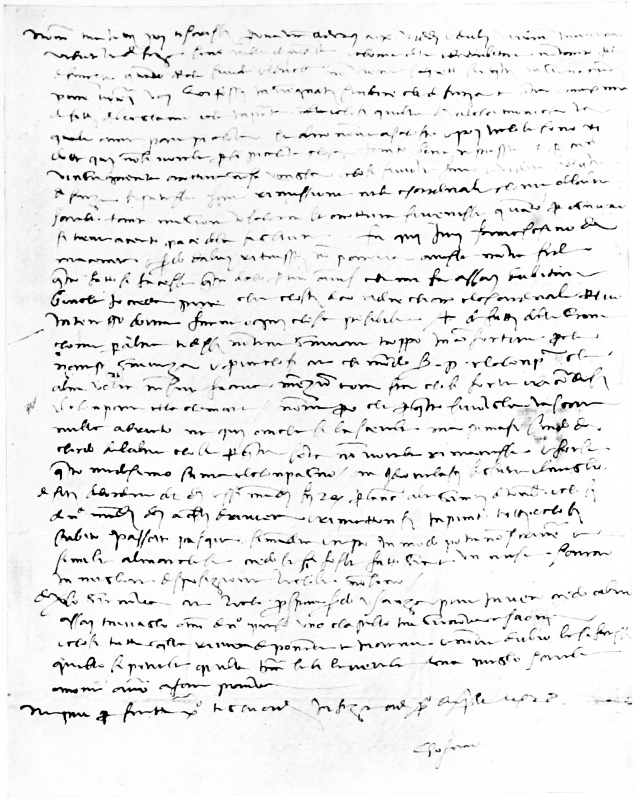
Cosimo de’ Medici to Averardo de’ Medici, Ambassador to Ferrara
I have not had any letter from you since I wrote. By yours of the 29th I saw the doubt in your mind seeing the difference in the demand, and as you say there is reason for suspicion, not so much on account of the differences as because it is evident the Duke [of Milan] is not straightforward in this matter, so I wish you to try and discover what the difference is, especially about these affairs at Bergamo and what they mean, and also those of Valcamonica, which seem to me of small account unless there is something concealed. As matters stand here, one would not desire to move for so small a thing, and so I trust you will do your utmost to prevent a rupture; we shall do the like, and see whether it is not possible to refer these differences to the Cardinal [di Santa Croce] like the others. The shame would be great to fall out just when every one expects peace to be made. Franceschino of Macerata was here yesterday, and from what I could gather had not heard what was to be done in this affair; this I tell you for your guidance, as it seems to me very suspicious, although I think the Cardinal for his own interest will do all that is possible. About the wheat business, as I said in my last, do not overburden yourself, else you will have trouble; as it is, it has been a convenience. Ser P., the godfather,[12] of whom there was no mention last time, is now in a strong position, and godfather and godmother are united. This is, however, no reason for neglecting to take precautions, and we shall take them; but as we are agreed about other matters, we do not wish to draw back on this point alone, and perhaps our companion thinks the same. Now let God lead us on the right path. As to the affairs of Bordoni, let 24 florins be sent for the wool to the people of Lombardy, and send again to those of the Riviera, thus setting all in order; and directly after Easter the rest shall be sent, so that the same can be written to the Marquess. I think if this had been done a month ago, things would be in a better condition than they are now.
Towards Genoa things go on as usual, although I think they are hard pressed; they have again lost a castle between Genoa and Savona, so that all the western Riviera is under arms, and there is no doubt that were we to do what we could do the province would rebel, but it is better not to put it to the proof. I write no more, as I am pressed for time. Christ guard you.—In Florence on the 1st day of April 1428.
Cosimo.[13]
The letters written by Cosimo de’ Medici to his cousin Averardo de’ Medici, in October and November of 1430 and February of 1431, relate to the costly and disastrous war waged against Lucca, and require a few explanatory sentences.
The war was proposed to the Commune of Florence by the impetuous young leader of the aristocratic party in the city, and Cosimo, who after the death of his father Giovanni was the recognised head of the democracy, supported the proposals of his opponent and rival, Rinaldo degl’ Albizzi. The war was popular. The Florentines believed that they had secured the acquiescence of the Duke of Milan and of the Pope. All things seemed to favour them (letter of February). The plan of the Florentine generals in the field was to starve Lucca into surrender by seizing on the districts of Camaiore and Pietrasanta, whence the Lucchesi drew their supplies. The “Ten of the Balìa” or Florentine war committee countermanded this prudent plan of campaign and their troops could effect nothing against Lucca. The Lucchesi were hard pressed, however, and appealed to the Duke of Milan. He permitted Francesco Sforza to take service under Lucca, and that great general soon reduced the Florentines to extremities. In their need they resolved to bribe Sforza, and on receiving 50,000 florins he abandoned the Lucchesi. The “tyrant” of Lucca, Paolo Guinigi, was overthrown; the city became a Republic, and sued for peace. But Florence resolved to prosecute the war, and engaged Count Guido Antonio di Montefeltro, Lord of Urbino, as their general. Thereupon the Lucchesi again appealed to the Duke of Milan, who permitted Niccolò Piccinino and his troops to take service under Lucca. The continual interference of the “Ten” with their generals in the field resulted in one defeat after another. In these circumstances Cosimo wrote his October letter. He recognises that the conduct of the war by Florence had been disastrous; sees, when too late (for the Milanese troops prevented it), that Lucca ought to have been starved into surrender; and declares that the only way out of their difficulties is for Florence to induce Venice to attack Milan from the north. As the “Ten” from their gross mismanagement of the war had occurred great opprobrium in the city, and as there was little prospect of matters improving without aid from Venice, the astute Cosimo advises that none of his prominent friends shall stand as candidate for election to the Balìa. The letter of December relates to a proposed embassy to Venice to urge the great Republic to attack Milan.
The war went on for three years longer, and though we have no more comments of Cosimo on the matter its course may be indicated. Venice did at length yield to the prayers of the Tuscan Republic, and this brought her rival Genoa into the fray. At last all parties were weary of the strife and desired peace. The Marquesses Ettore of Este and Lodovico of Saluzzo were named arbiters. The Cardinal di Santa Croce again worked for harmony. A general peace was concluded on April 26, 1433, and its publication in Florence on May 10th was celebrated with all manner of popular rejoicings.
In the midst of these wars and intrigues it is pleasant to see the good Contessina careful only that her boys should be brought up in the old Florentine fashion and that her husband should be properly clad.
Cosimo evidently continued to “be chary with ink and paper,” at all events to his wife; as when he was again absent at Ferrara with their two sons, Contessina corresponded with Giovanni, the youngest, who was barely fourteen.
Contessina de’ Medici to her son Giovanni at Ferrara
I wrote to thee a few days ago, so have but little to say. By a letter from Ser Alexo I gather you are all well, God be thanked. We are the same, thanks be to God. I hear that thou desirest to come home and dost not like the place. Thou shouldest be glad to be there, if only to be in the bank and to learn something. Besides it is not healthy here. Therefore, my son, I beg thee not to think of returning until the plague has ceased, and say the same to Piero. Let me know what clothes he has had made as I do not know what he wore when he left, and he has not asked me to send his coat lined with cloth. It has been very hot here for several days, and I suppose will have been the same there; so be careful and keep cool. I do not know why Cosimo has not told me to send his summer clothes, but I think he intends to return any day. Do thy best to please him in all things, and see that he wants for nothing; though they tell me he is quite fat, which is all that is needful. Commend me to madonna Dina and salute monna Ginevra and thank them from me; Ser Alano tells me they treat you both as though you were their brothers. I should also like much to know whether thou art working in the bank, thou or Piero, and whether Cosimo makes use of Piero. Mind and write this to me. I add no more. Christ guard thee.—At Castelluccio, 6th June 1430.
Thy Contessina.[14]
In the autumn of the same year Cosimo again left Florence, partly on account of the plague, but probably also on account of the bitter party strife in the city. He writes to his cousin from Verona and then from Ostiglia, where he heard the news of the defeat of the Florentine troops near Lucca.
Cosimo de’ Medici to Averardo de’ Medici at Pisa
During the last few days I have written thee several letters; this morning I received thine of the 18th and with it some letters received by thee from Florence; I have understood, &c. &c., and reply herewith.
I see thou hast been at Florence and understand thou hast to go there again; the death of Francesco di Tomaso is a great loss, but if the plague increases I advise thee not to think of business but of saving thy life.
The affairs of Lucca do not appear to turn out as we expected, which displeases me; and the money spent on Count Francesco [Sforza] was thrown away. Every one laughs at us because he could not remain on account of the plague, and only consumed the provisions of the people. It is clear that all that happened and is happening at Lucca has been done with the knowledge and by the orders of the Duke [of Milan], particularly as the principal fortresses are in his hands; it appears to me therefore that there is no hope of getting them by treaty or by any way save famine, and I suspect the Duke has known how to grasp fortune, and his troops being near, has provisioned Pietrasanta. The war will thus last longer than we wished, and all because we would not when we could. May God forgive those who are the cause. If some of the present Signori had not enough sense to be of the Ten of the Balia, instead of ten they should be made nine ... as I already told thee. It does not seem to me advisable to be one of the Ten of the Balia this time, partly to let others have their turn, partly because, on account of party divisions, I do not think the affairs of our city can prosper; things will go as they did before or even worse on account of events in Lombardy, for if the enemy is not attacked from there, it is useless to expect help from here. I am therefore writing to the Gonfalonier and to Antonio di Ser Tomaso to beg that neither Lorenzo[15] nor I should be nominated, and I advise thee to do the same. There are Messer Niccolò Valori and Luca di Messer Maso who would do well and be pleased.
In my last I told thee that Lorenzo and the children were going to Venice, as there are some cases of plague here; now they are gone. If it continues I suppose we must also leave.... No more at present. Christ guard thee.—Verona, 21st October 1430.[16]
Cosimo de’ Medici to Averardo de’ Medici
I arrived here late this evening and found thy letter of the 4th telling me about the affairs of Lucca; right glad was I to get it, as yesterday on the road to Venice I heard far worse news. God be thanked. We certainly seem to have shown but little prudence; we will talk of this when we meet. Our people ought to hear what is said of us and how little we are esteemed; if we go on thus we shall be treated like Jews. I just hear that I have been elected ambassador together with Francesco Tornabuoni, and have understood about future movements. I was on the point of coming back on account of our own affairs and also about this nomination, of which I have only now been told, for it will be most inconvenient if I have to go, on account of our private affairs and also because I am not properly prepared, being away from home. I have therefore determined to come back at once and try to be exonerated. I think our friends will be willing to serve us if thou bestirrest thyself. Thou writest as though my going was certain, so perhaps I shall receive orders and have to start without returning home, which would be most awkward. If it be so tell Bernardo de’ Medici to send me those suits which are at home, for as thou knowest we are in mourning and I have no clothes with me; also I shall have to provide myself with attendants and horses, I have but seven, and must have twelve at least. I write this, not because I have made up my mind to go, for this journey would be most irksome, but because if it is absolutely necessary I must go in a manner befitting the honour of the Commune.... No more. Christ guard thee.—In Ostilia [near Rimini] on the 10th day of December 1430.
P.S.—I intend taking the road by Ravenna and Faenza.[17]
Cosimo did not go, and Francesco Tornabuoni was sent alone to Venice.
Cosimo de’ Medici at Florence to Averardo de’ Medici at Pisa
I wrote to thee the other day by Pietro Chaetano, and have had no letter from thee since. This will be given to thee by Battista of Verrazano, who was it seems once employed in thy office, and is, I am told, a worthy man: he asks me to recommend him to thee, and I do so.
About the affairs of Lucca I say nothing, because where thou art thou wilt hear them sooner than I. There are those who, hoping to see injury and infamy inflicted on others, would inflict injury and infamy on the Commune, and try with all their might to bring this about; which shows an evil nature. Nevertheless I think this enterprise is generally popular, and seeing things have gone so far as to implicate the honour of the Commune, every one ought to favour it as much as possible; and this I am doing here, and advise thee, although I know there is no need, to act likewise.
Letters have come from the Duke displaying great affection for this Commune and promising every help in this affair. There are also letters from our ambassador at Rome, saying that the Pope and all the Cardinals are of the same mind, so it appears to me that they are abandoned by all, and if they are wise will submit.
From Lorenzo[18] I have a letter of the 80th, and by what he says he must now have left Venice for Milan together with Messer Andrea Contarini. They have hopes of doing good business during this year, particularly as I understand the Duke is in need. Thou shalt hear as soon as I know anything.
I hear thou hast had a few cases of plague, which grieves me: here also in the last two or three days there have been some cases, which makes one fear it may increase. The loss and damage to the city will be great. I have been thinking where to go, and as far as I can learn there are three places, either Arezzo in thy house near Anghiari, Bologna or Modena, or some distance into the Venetian territory, where it appears to be perfectly healthy. It does not seem to me wise to come there [Pisa] or to go near Siena or Perugia, for they are all suspect, as is the Romagna and the Malatesta district, where also they are preparing for war. As I said it is a serious matter, and I should like to have thy advice. No more at present. Christ guard thee.—February 1430 (1431).[19]
In April 1433 the war with Lucca came to an end, leaving things very much as they were before, and the bitter hatred between Cosimo de’ Medici and Rinaldo degl’ Albizzi grew in intensity. The nobles accused Cosimo of using his riches to buy popularity, and he withdrew almost entirely from public life and retired to Cafaggiuolo, his fortress-villa in the Mugello. What followed is best told in his own words, translated from his diary.
On the election of the new Signory (September 1433) it was rumoured that during their rule great changes were to be made. News was sent to me in the Mugello, where I had been for some months in order to escape from the contests and divisions in the city, that my presence was necessary. So on the 4th of September I returned, and on the same day visited the Gonfalonier and the others, as well as Giovanni dello Scelto who I thought was my friend, and who was under obligations to me, as were also the others. When I told them what I had heard, they denied it, and told me to be of good cheer, as they hoped to leave the city in the same condition as they found it when their time was up. On the 5th they called a council of eight citizens, saying they desired their advice on certain matters. They were Messer Giovanni Guicciardini, Bartolommeo Ridolfi, Ridolfo Peruzzi, Tommaso di Lapo Corsi, Messer Agnolo Acciaiuoli, Giovanni di Messer Rinaldo Gianfigliazzi, Messer Rinaldo degl’ Albizzi, and myself, Cosimo. So although, as has been said, it was reported that a revolution was imminent, yet, having their assurances and believing them to be my friends, I did not credit it. On the morning of the 7th, under colour of the said council, they sent for me; and when I arrived at the Palace I found most of my companions and we talked together. After some time I was told by order of the Signory to go upstairs, and by the captain of the infantry I was put into a room called the Barbaria,[20] and locked in. On hearing this the whole city rose. During the day a council was held by the citizens who had been summoned, and the Gonfalonier told them I had been detained for a good reason, which would be explained another time, and that the Signory desired no advice on this point, and so dismissed them. And the Signori banished me to Padua for a year. This decision was at once made known to my brother Lorenzo, who was in the Mugello, and to Averardo, my cousin, who was at Pisa. The news was also sent to Niccolò da Tolentino, captain of the Commune, who was my good friend. Lorenzo came to Florence that same day, and the Signori sent for him, but he being warned why they wanted him, left at once, and returned to Trebbio.[21] Averardo also left Pisa in haste, as they had given orders to seize him. Had they taken us all three, we should have been in evil plight. Niccolò da Tolentino, on hearing the news, came to Lastra with his company, intending to raise the city, so that I might be released. At the same time, when it was known in the mountains of the Romagna and in other places, great numbers of foot-soldiers went to Lorenzo. But the captain and Lorenzo were advised not to make a disturbance, or evil might befall me, so they desisted. Although this advice was given by relations and friends, and in all sincerity, yet it was not good, for had they advanced at once I should have been free, and he who was the cause of all would have been undone. We may, however, say that all was for the best, as in the end good came of it, and more honour to me, as I shall relate hereafter. My friends being averse, as I have said, to create any disturbance, the captain returned to his quarters, pretending that he had come for another reason, and Lorenzo went to Venice with my sons, taking with him all he could of money and small valuables. And the Signori banished Lorenzo to Venice for a year, myself to Padua for five years, and Averardo to Naples for five years. Then on the 9th the bell was rung for a parliament, and those who had been the cause of all assembled on the Piazza with much infantry. Twenty-three citizens were also summoned, verily a small number, and but few of the people were present, because in truth the mass of the citizens were ill-pleased.
The Oration of Cosimo de’ Medici to the Signory when sentence of exile was pronounced against him.[22]
If I thought that this my misfortune and terrible ruin might serve to bring peace to this blessed people, not only would exile be acceptable, but I should even welcome death, if I were sure that my descendants, O Signori, might pride themselves on my having been the cause of the wished-for union of your Republic. As you have decided that I am to go to Padua, I declare that I am content to go, and to stay wherever you command, not only in the Trevisian State, but should you send me to live amongst the Arabs, or any other people alien to our customs, I would go most willingly; and if your Lordships command me to discover the origin of the ill, as a beloved son is bound to obey his father’s wishes and a good servant the orders of his master, so would I obey you for the peace of your people. One thing I beg of you, O Signori, that seeing you intend to preserve my life, you take care that it should not be taken by wicked citizens, and thus you be put to shame. I do not so much fear the pain of death as the abominable infamy of undeserved assassination, for a violent death is the manifest sign and outcome of a bad life, and I have not led the life of a villain, but of an honest and good merchant. Even if I have not been faultless, I have always tried to merit the love of good men, because my actions were good. As, however, disaster comes to me by your orders, I accept it as a boon, and as a benefit to me and to my belongings. Have a care, O Signori, that those should not have their way who are in the Piazza with arms in their hands and anxiously desire my blood, without regard for my innocence. My pain would be small, because such a death being over in a short time cannot be very painful or hard to bear; nothing is so brief as death. But you would earn perpetual infamy by having made me a promise which was broken by villainous citizens: infamy is worse than an innocent death. If I go to the Trevisian State, I leave my heart and my soul with you, and shall only be happy when I can do something for the good of your people, as I pray you and every good citizen to do. Every trouble will be easy to bear as long as I know that my adversity will bring peace and happiness to the city. I know, and this is no small comfort to me, that I never permitted wrong to be done to any one. I never frequented the Palace[23] save when I was summoned; I never roused hatred of the Republic amongst your subalterns, because I never ill-treated them; I always declined to be nominated an official, which is often prejudicial to the body and hurtful to the soul; with no small pride I affirm that none can say my ill-behaviour ever caused a city to rebel or to be taken from you; on the contrary, our money bought several: ask your soldiers how many times they were paid by me for the Commune with my own money, to be returned to me when convenient to the Commune. Never have I been found wanting when the Commune could be enlarged, and although I am exiled, I shall ever be ready at the call of this people. In conclusion, O Signori, I pray God to keep you in his grace and in happiness in this fortunate Republic, and to give me patience to bear my unhappy life.
Balìa was given by the parliament to certain citizens and I was banished to Padua for ten years, Lorenzo to Venice for five, Averardo to Naples for ten, Orlando de’ Medici to Ancona for ten years, and Giovanni di Andrea di Messer Alamanno and Bernardo d’Alamanno de’ Medici to Rimini. My branch of the family were created Grandi (i.e. incapable of holding any magisterial office), with the exception of the sons of Messer Vieri, and the sons of Antonio di Giovenco de’ Medici, because Bernardetto was much beloved by the Captain of War, and in deference to the Captain, Averardo and his brothers were passed over. We were more rigorously dealt with, particularly in that I was forbidden to sell any possessions or to touch my money in the Monte, and I was kept in the Palace until the 3rd day of October.
When this was known in Venice three ambassadors were sent here, who left no means untried to procure my liberation, offering to keep me in Venice, and promising that I would do nothing against the Signory, and would obey all orders. Though they could not obtain my freedom yet their advent was most useful, for there were those who desired my death, and they secured a promise that no harm should be done to my person. In like manner the Marquess of Ferrara sent orders to the Captain of the Balìa, who was Messer Lodovico del Ronco of Modena, a subject of his, that if I were put in his hands he was to treat me as though I were Messer Lionardo his son, and that if he fled with me he was to fear nothing.
They kept me, as has been said, until the 3rd of October for two reasons; first, to obtain permission from the Balìa to rule the city according to their pleasure, threatening to kill me if it was not given; thus those of my friends and relations who were in the Balìa were fain to agree to all they wished. Secondly, they thought to ruin us by preventing me from making use of what was mine. But in this they failed, for we lost no credit, and many foreign merchants and gentlemen offered to us, and even sent to Venice, large sums of money. Finding at length that their plan of making us bankrupt did not succeed, Bernardo Guadagni (the Gonfalonier), being offered money by two persons, 500 florins by the Captain of War, and 500 by the treasurer of S. Maria Nuova, which were paid him in cash, and Mariotto Balduinetto being offered 800 florins by Baccio d’Antonio di Baccio, they took me out of the Palace and accompanied me beyond the Porta S. Gallo. They had small intelligence, for they might have had ten thousand or more for allowing me to escape from peril.
On the 4th October I arrived at Cutigliano in the mountains of Pistoja, being accompanied by two of the Eight of the guard. The mountaineers presented to me wax and grain as though I had been an ambassador. On the 5th I left and arrived at Fassano in the territory of the Marquess of Ferrara, accompanied by more than twenty of the mountaineers. On the 6th I reached Modena, and the governor met me on behalf of his lord, presented gifts, and next morning went with me as companion and guide. On the 7th I was at Bondeno and next day went by water to Francolino, where I waited two days for Antonio Uguccione de’ Contrari, who made me many offers of service from the Marquess. On the 11th I arrived at Venice, being met by many gentlemen, our friends, together with Lorenzo. I was received like an ambassador, not like an exile. Next morning I visited the Signori to thank them for all they had done for my welfare, saying that I owed my life to them. I was received with more honour and affection than I can describe; they pitied my sufferings and offered the Signoria, the city, and their treasure for my needs, and a house. Many gentlemen visited me and brought me gifts. On the 13th I left for Padua according to command, and Messer Jacopo Donato went with me and lodged me in his fine house, furnished with linen, beds, and eatables fit for the greatest personage, and he remained with me until I returned to Venice about the 20th. At Padua, by order of the Signoria of Venice, they offered to place at my disposal anything I wanted. I have recorded these honours that were paid to me in order not to seem ungrateful by not mentioning them, and also because it is incredible that, banished from home, I should yet be treated with so much honour; for generally one loses one’s friends with one’s fortune. Lorenzo was informed with what honour I had been treated by some merchants, and also by a servant of the Signoria who came to Padua with me, and who had been ordered not to speak about it.
Bartolommeo de’ Ridolfi being Gonfalonier of Justice, I asked leave of the Signori to be allowed to live at Padua, Venice, or elsewhere, in the Venetian territory, and the permission was given, but with orders not to approach within 140 miles of Florence. This was done to please the Signoria of Venice who, through their ambassador, Messer Andrea Donato, asked it. It is true that severe penalties were attached to the grace, as can be seen in the document.
After giving the names of the new Gonfalonier and Priors (who were elected every two months), Cosimo continues:
The people and all good citizens being discontented, Antonio di Ser Tommaso Nasi came to me at Venice and begged me to draw nigh to Florence, offering to escort us home in case we were attacked. Also many of our relations and friends wrote to us. We thought it better to first ascertain the intentions of the Signori, and replied we would do nothing against their wishes. For this we sent Antonio Martelli from Venice to learn what they wished. From him we got the good news that we were to come. On receiving the letter Lorenzo and I, Cosimo, left on the 29th of September; Averardo, being ill of fever, remained in Venice. On the 30th we reached Ponte a Lago and lodged in the house of the Magnificent Uguccione who, together with the Marquess, had collected at our request a large body of foot-soldiers in the mountains of Modena and Frigano, together with 200 horsemen he had in his pay, to accompany us as had been previously arranged. On the 1st October, while we were at mass, a courier arrived from Antonio Salutati with letters stating that the intentions of the Signori having become known in the city, and our arrival being expected, our enemies, that is to say Messer Rinaldo degl’ Albizzi, Ridolfo Peruzzi, and others had taken up arms on the 26th to the number of 600. But their heart failed them towards evening, and being persuaded by Messer Giovanni Vitelleschi, then Bishop of Recanati, and afterwards Archbishop of Florence and a Cardinal, who was my good friend, they went to S. Maria Novella, where dwelt the Pope.[24] Hearing that our friends were well provided with arms and with men, and being in fear for their lives, Messer Rinaldo, Ormanno his son, and Ridolfo Peruzzi remained there that night, and their companions dispersed and put away their arms. The Signori summoned a large force of infantry to come into the city, while from the Mugello, the Alps, and Romagna more than 3000 men came to our house. Niccolò da Tolentino was called with his company, and on the 29th, the day of S. Michael, a parliament was held on the Piazza, at which the people assisted fully armed. Their number was great, and good order was kept. Balìa was given to ... citizens and they annulled all that had been ordained the year before. First they decided that Cosimo and Lorenzo should be reinstated in their former positions—there were not four contrary votes—so we were pressed to come home with all speed. Having read the letter, we at once sent it to Venice, where it caused much rejoicing, and we then went to visit the Marquess, who showed even more pleasure than ourselves. After thanking him for all the favours he had shown us we left Ferrara on the 2nd and got to Modena next day. The Governor and the Podestà came out to meet us with many citizens, and we were received most honourably in the Marquess’s house. All our journey was at his expense, and everywhere we found men-at-arms who had been ordered to accompany us; but there being no need for them we dismissed them. On the 5th we reached Cutigliano and then Pistoja; and exactly at the expiration of a year, on the very same day, i.e. the 5th October, we again set foot in the Commune at exactly the same place. I record this because when we were banished some well-affected and kindly persons told us that before the year was out we should be recalled, and once more find ourselves in Florence. Many citizens came out to meet us on the road, and at Pistoja the whole population was at the gate to see us pass fully armed, for we would not enter the town. On the 6th we arrived at our own house, Careggi, to dinner, and found much people. The Signori sent to tell us not to enter the city until they told us, and this we did. At sunset they sent to bid us come and we set forth with a great following. But as the road we were expected to take was crowded with men and women, Lorenzo and I with one servant and a mace-bearer of the Commune rode round the walls. Going behind the Servi, and then behind S. Reparata and the Palazzo del Podestà, we entered the Palazzo de’ Signori without being seen, as every one was in Via Larga, waiting for us near our house. The reason why the Signori did not wish us to enter by daylight was lest we should be the cause of an uproar in the city. By the Signori we were received most graciously. We thanked them with fitting words, and they insisted on our remaining in the Palace with them and some other citizens. We did so. We found that before we arrived Messer Rinaldo and Ormanno his son, Ridolfo Peruzzi, and many other citizens had been banished. The city was quiet, though the people were always in the Piazza, and in the Palace were many armed men for security.
Cosimo gives the names of the Signory for November and December and continues:
They banished many citizens and set down (i.e. made Grandi or nobles) many disloyal families and did many things favourable to the city. During their rule the Balìa given to various citizens expired, the Squittini, or Scrutinies, came to an end, and the borse, or ballot-bags, remained for five years in the hands of the Accopiatori, that is to say, the borse of the Priors, so that they could make whomsoever they would Priors and Gonfaloniers of Justice. In January my name was the first to be drawn from the borse as Gonfalonier, and in my time no one was banished nor was ill done to any one. I caused the sentence of death passed upon Francesco Guadagni, and upon some others whom I found in the hands of the Captain of the Balìa, to be commuted to perpetual imprisonment. Also I ordered the armed men who stood at the door of the Palace to be removed and the Palace and the Piazza to be kept as they were before the revolution, and I prolonged the league with the Signory of Venice for ten years.
“Seldom has a citizen returning triumphant from a victory,” writes Machiavelli, “been received by such a concourse of people and with such demonstrations of affection as was Cosimo on his return from exile, saluted by all as the benefactor of the people and the father of his country.”[25]
It was probably while at Venice that Cosimo bought the slave girl by whom he had a son, Carlo, who was brought up for the Church and recognised as belonging to the family. He inherited his father’s tastes, and was employed by him and by Piero to buy books, manuscripts, statues, &c., in Rome. He became a Canon of the cathedral in Florence and Arciprete at Prato, where he died. The number of female slaves imported into Florence in the fourteenth and fifteenth centuries was a most disturbing element in family life and the cause of much jealousy, as can be gathered from the novelists of the time. Nearly all came from Caffa (Theodosia in the Crimea) and from the mouth of the Tana. Caffa must have been practically a Genoese settlement, as the Genoese consul levied a tax on every slave that passed through the town, and they were many. Hundreds of Circassian, Tartar, Armenian, Georgian, Arab, Turkish, Russian, and Greek girls were shipped, chiefly to Genoa and to Venice, where the trade had existed since the eighth century. In Florence the duty paid on every slave that entered the city must have brought in a considerable sum to the Commune, as owners were obliged to register every newly-acquired slave within two months and to have him or her baptized, if the rite had not been already performed. One would have thought that good Catholics might have had some qualms of conscience about keeping a Christian as a slave, but Sacchetti writes:
“May a slave being born a pagan who becomes a Christian be sold? I say yes. None may be free who do not believe that Christ will come again. Even though I buy a slave who is then baptized, he or she is baptized as a servant and a subject and is like unto one in prison, who cannot give a bond or go bail, and most of them go to baptism like oxen. Baptism does not make them Christians, and no one is obliged to set them free even if they be Christians unless they wish. I do not say that if you perceive them to be good, and that they desire to be good Christians, you should not set them free, but you would commit a sin if your slave is like most, even if he or she be a Christian, to set them free, for you take the stick from off their backs and give them full scope to do every sort of evil.”[26]
The saintly Archbishop Antonino is of the same opinion as the novelist. He declares that baptism does not free a person from slavery, quia servitus introducta est etiam de jure divino et per jus gentium et jus canonicum approbata.
By a law of 1366 the flight of a slave was declared a serious offence; any one aiding or inciting a slave to run away was fined 200 florins (piccoli), half to go to the Commune, half to the owner. The seduction of a slave was still more severely punished, and the seducer was held responsible for her price if she died in childbirth. If the father was a free man the child was also free, and the father was bound to provide for it.
From 1366 to 1397, 259 Tartars, 27 Greeks (from Constantinople or from Rhodes), 7 Turks, 3 Slavonians, 3 Circassians, 2 Bosnians, 1 Arab, 1 Saracen, and 1 Candiote, nearly all girls from nine to twenty-four years of age, and 26 little boys or lads, are carefully described in the register. They cannot have been handsome, as many were marked with small-pox, others had scars (margines) which were probably tribal marks.[27]
They were sold either sub jugo perpetue servitutis, or for a certain number of years. Thus Rucellai bought a slave for eight years, but finding that she was with child he sent her back to her former owner; many were bought, or rather hired, for two or three years as wet-nurses. Baldovinetti in his Ricordi or Memoirs notes: “On May 7, 1376, I bought a slave for thirty-five florins from Bartolommeo of Venice, named Tiratea, or Dorothea, a Tartar from Russia. She was about eighteen years of age, and Cieci the broker only put twenty-five florins into the bill of sale on account of the duty. With brokerage and duty she cost me one florin, and four florins for clothes, as she was almost naked when I bought her. I sold her in September 1379 for thirty-six florins.
“In 1380 I bought on November 28th a slave for forty-five florins, her name is Domenica, she is fair-skinned and comes from near Tartary. I bought her of Bartolommeo of Venice, who in writing declares her to be sound in all ways. With brokerage and other expenses she cost me before I got her home eleven golden florins, and as she was almost naked, altogether forty-seven florins.”[28]
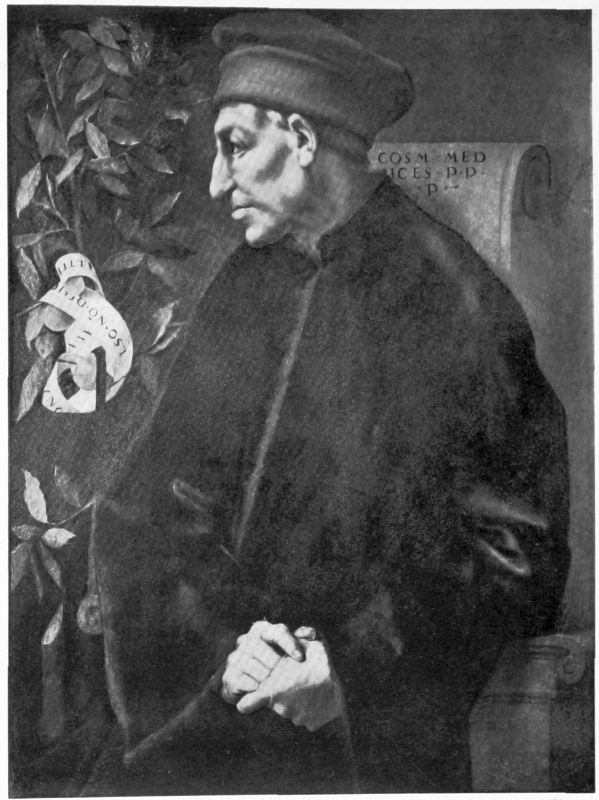
Alinari
COSIMO DI GIOVANNI DE’ MEDICI.
By Jacopo da Pontormo. In the Convent of S. Marco, Florence.
In the fifteenth century prices rose, as the Florentines insisted on having Russian or Circassian girls as being better-looking. Their reputation for honesty and morality did not stand high, and they were often brutally ill-treated and imprisoned in the dreaded prison of the Stinche for stealing, &c. Alessandra Strozzi, writing to her son Filippo at Naples in 1465, warns him about two he thought of buying.
“Thou tellest me in thy letter of the 28th that a slave is offered thee who was here with Lionardo Vernacci and that thou wouldest have taken her but for the old one thou hast in the house. I must tell thee that she is not fit for thee according to my ideas. Lionardo’s wife had her four or five years, and as she did not learn and was of a bad disposition they feared she might do some ill to herself or to others, so they got rid of her; she was also dishonest. They sold her to Antonio della Luna, with whom she remained but a short time, as he would not have her and sent her back; so she was sent down there [Naples]. Lionardo’s wife had her for sewing, but she had no aptitude for it. Had she been a good servant they would have kept her for themselves. Thou sayest thou hast one now who belonged to Filippo degl’ Albizzi; she was highly thought of and well treated, but was sold because wine began to affect her and made her extremely lively, and also she was immoral. Having a wife and children in the house he would not keep her. She is praised for loyalty and intelligence. Now do as thou wilt.... I have told thee what I know.”[29]
Towards the end of the fifteenth century the manumission of slaves begins to be mentioned in wills together with bequests to hospitals and convents. By the word este civis romana the slave became a free man or woman, could own property, buy and sell, and act in all other respects as if free-born.[30]
Cosimo de’ Medici to his son Piero de’ Medici at Venice
Send by the women who are returning the things mentioned in the list given to Ser G., and look closely yourself, as is but right, after what is sent here and what remains there.
Put the books that are in my desk into a small strong-box so that they should not be opened, and see that the others which we lent should be sent back in such a manner as not to spoiled.
It seems to me that thou shouldest remain at Venice this winter, for there is nothing doing here, and thus thou canst devote thyself to learning something of the affairs of the bank and of book-keeping. I have ordered a book which thou art to keep according to instructions which Antonio Martelli will send thee. In this way thou wilt learn book-keeping properly, and canst return here at Lent.
Be careful to conduct thyself well at home and abroad, so as not to put either me or thyself to shame. Consort with our friends according to usage; make thyself acquainted with what is doing in the company, and learn what is going on.
Try to get back that book on ethics from the son of Messer P. Corro,[31] and the Sallust and Suetonius I lent to G. Lignacci, in one volume. If they have done with them get them back before S. Lucia (13th December). Also get back a small volume of Chrysostom which they say they want to translate. Keep the books from Nicola de Servi, as is said in the minute given to Ser G., and send back twenty or twenty-five volumes of our books of each subject. Thou canst put them with the quilts, or in other bales, so that they should not be spoiled, and take care that those which remain are not gnawed or spoiled.
As I said before, for many reasons I think it would be better for thee to remain at Venice, for nothing of any good is doing here. But if thou wishest to return here, do as thou wilt. Nought else to say.—[No date.]
Cosimo.[32]
The letter of Lorenzo de’ Medici and those of Francesco Sforza to Cosimo relate to a second war with Lucca, and need some explanation. The recall of Cosimo from exile, as told in his diary, was followed by a wholesale banishment of his enemies from Florence, and left him practically master of the Republic. The exiled Florentines naturally desired to return, and according to the custom of the time were eager to invoke foreign aid. The times for long offered no opportunity. But in 1436 Genoa at last shook off the yoke of the Duke of Milan and became a republic. The sister republics of Florence and Venice at once allied themselves with the new free State, and Filippo Visconti believed himself to be seriously threatened by the new league. He had at the same time lost the services of one of his two great generals. Francesco Sforza, determined to acquire a principality for himself, had seized part of the Marches which nominally belonged to the Popes. In these circumstances the Duke of Milan resolved to attack Florence, the one of the allies which lay nearest to him. While the Florentines engaged mercenary troops (Taliano, or Tagliano, mentioned in the letters, being one of the leaders of small bands) and named Sforza the General of the Republic—a very untrustworthy general, as events proved. In the war which ensued Lucca was attacked by the Florentines and defended by the troops of Milan. In 1438 Florence was twice threatened by Visconti’s army, then in the territory of Lucca. The second time they were led by the famous condottiere Niccolò Piccinino, and Francesco Sforza had orders to oppose him and if possible to seize Lucca. The attempt failed, partly because Sforza, always hoping to obtain the hand of Madonna Bianca, Visconti’s illegitimate daughter, did not wish to offend him by fighting against his troops, partly because Venice, jealous of the possible acquisition of Lucca by Florence, laid claim to his services and refused to pay her share of his stipend unless her commands were obeyed. Cosimo went to Venice “thinking,” writes Machiavelli, “to be able to persuade her. To the Senate he pointed out the condition of Italy, the power of the Duke of Milan, his reputation and the number of his troops, and concluded by saying that if the Count (Sforza) went over to him they would together command the sea, and the liberty of Venice would be endangered. To this the Venetians replied that they well knew their own power and the power of the Italians, and believed they could defend themselves. Adding that they were not in the habit of recompensing soldiers for serving others, and that the Florentines, having made use of the Count, might pay him themselves. They considered it more necessary for the safety of their State to lower his pride than to give him money; and the ambition of men being unlimited, if he were paid now without serving them, he would eventually advance far more dishonest and dangerous demands. Thus it seemed to them desirable to curb his insolence before it became too great. But if out of fear, or for any other reason, the Florentines desired to retain his friendship, they were at liberty to pay him. Thus Cosimo returned without concluding anything.”[33]
Cosimo never forgave the Venetians for traversing his plans, and the enmity between the two Republics began from that day.
Niccolò Fortebraccio to Cosimo de’ Medici and Neri di Gino Capponi
Magnifico Domino et spectabili viro Fratibus carissimus Cosme de Medicis civitatis Flor. Vexillifero et Nero Gino de Capponibus.
Magnifice Domine ac spectabilis vir frates carissimi,—In order that you may be kept informed of what sometimes happens here I tell you that the messengers of your magnificent General Count Francesco [Sforza] had the courtesy to come rather to us than to those to whom they were sent. For your information I send you the enclosed copy of a letter from the aforesaid Count found in the bosom of one of his people, by which you will understand, &c. You will no doubt take counsel about it with your friends, so that I shall not have to call you blind Florentines,[34] as others have called you before. By my faith you ought not to be, but rather you should have a hundred eyes like Argus.—Assisi, January 5, 1436 (1437).
Nicolaus Fortebraccis.[35]
Lorenzo de’ Medici to his brother Cosimo de’ Medici, ambassador to Ferrara, in the name of the “Dieci di Balìa”
Spectabilis collega noster carissime,—Yesterday I wrote to thee by Messer Alexio. Since then we have nought from thee. Now we write because having turned over in our own minds this affair of Taliano and consulted with other citizens about it, it seems to us that it would be an excellent thing for the State of Count Francesco and for the League if some arrangement could be come to between His Holiness the Pope and the aforesaid Count as to the Marches, as thou art aware was once proposed. We therefore tell thee to employ every possible means to achieve this, which would be a most excellent thing, and as soon as thou canst learn aught about the intention of the Holy Father let us know, because until we hear from thee we shall not communicate with the Count.
To-day we have received a letter from our ambassadors to the Count, of which we enclose a copy. It appears to us a new departure, of which we know nothing, which we do not understand, nor can we judge how the Signoria of Venice will take it when they hear. Think over it well, and if it seems good to thee to tell them or to take any other steps, do so, only make them understand perfectly that we have nothing to do with this affair, which is quite outside our intentions, and above all declare that it is our desire to live in perfect brotherhood and friendship with that Signoria, and thus to cause the Count to keep on good terms with them. If this letter finds thee at Ferrara, and thou thinkest well to send or to write to Venice about this business, or if thou thinkest better neither to send or to write, do as it seemeth best to thee, for we place complete trust in thy well-known prudence. To-day Messer Giuliano Davanzati has been named ambassador to Venice by the Signori and the Colleges, and they have sent for him to Pisa.—Florence, January 29, 1437 (1438).
Decem Balie.[36]
Count Francesco Sforza to Cosimo de’ Medici
Spectabilis ac Magnifice vir tanquam pater carissime,—I have read your letter and see you suspect that Niccolò Piccinino is not following the course traced by the Illustrious Duke of Milan, and you beg me to come to a good understanding with Niccolò, lest danger to the Magnificent Commune of Florence and to myself should ensue. As to the said Niccolò, I cannot believe he would act thus. First, on account of the great honours he has received and is receiving from the Illustrious Lord Duke, who only now has with great pomp declared him Marquess and Count of the house of Visconti with the right of bearing their arms. Secondly, because being of a certain age and with so great a reputation in the past, I do not believe that he would run the risk of being reviled in the present. Also he must know that he cannot swallow the world, and that it might happen to him as it does to oxen when they leave their stables in the morning, who think they are going to pasture, but are put to the plough; to him also the contrary might happen to what he expected. Thirdly, as you know, he has published everywhere a letter declaring his allegiance to the Duke of Milan.
As to your advice about being good friends with him, I think you say well; and by the copies of my letters to Niccolò, which Lorenzo must have sent you, you will see whether it is my fault or his that this has not succeeded. It is true, and I declare to you, that I do not intend to lose my honour or my possessions for the sake of his friendship, and it would be a strange thing if in order to gain the friendship of the said Niccolò, I, who have always transacted and settled all disputes between the Duke and myself, and those arising from them, should be the first to lose what is mine, and what has been gained by my own exertions. I am certain that even should I wish to give away my possessions, or to make any sort of compromise which would indicate a doubt as to my ownership, you, whom I regard as a father, would not allow it, seeing how my reputation would suffer.
To conclude, I have agreed with the Duke of Milan and have the agreement in my house, which I quite believe he will observe. In the document there is no mention, either for good or for evil, of Niccolò Piccinino, so I have nothing to do with him, and am much astonished at the things he demands of me. Now either he does this with the knowledge and consent of the Duke or not. If with the Duke’s consent it is done with the intent that this affair should go on and that your Signoria should break the promises and contracts with me, which I do not believe; if done without the Duke’s knowledge it is most probable he will take another course. In so doing he would give us every right to oppose him, and he might in many cases be a loser, in one among others which would bring infinite loss and ignominy upon him, that is his Company, for eight out of ten of the men have wives or children, so that what would happen I know not, and do not see that Niccolò would gain either profit or honour. My opinion, which I have not breathed to man alive, is that the Duke has consented to Niccolò putting forward these demands, not seeing how to refuse him permission to make them, but not with the intention that we should come to blows. And you will see that Niccolò will eventually follow the course traced out by the Duke, and that all these intrigues and demonstrations, and loud talk, wherein Niccolò shows such valour, are rather scarecrows to frighten people; but scarecrows are good for frightening kites and such-like birds of prey, I do not heed them, being the son of a Sforza and not of a kite. Let what will happen, as long as none can say that I have been the cause of any troubles. I am not; and I believe I shall be held guiltless by God and by the world. But whoso tries to take from me what is mine will find it far harder and more thorny than to demand it, as at present. I have replied to the Marquess, so there is no more to say.—Given in my Camp near Arezzo, 28th May 1438.[37]
Count Francesco Sforza to Cosimo de’ Medici
Magnifice tanquam Pater carissime,—I have received your letter in cipher and have understood what you say about the affairs of Florence, Venice, and Macerata; I need say no more, because Messer Rinaldo will inform you of everything. I thank you for the news about Lombardy. I had heard something of the sort here, and that the Venetian troops were as though they did not exist, so little are they esteemed by those of the Duke of Milan. The arrival of the person sent by the magnificent Signoria of Florence will be most welcome to me, the sooner he comes the better I shall be pleased.
Piero Gian Paolo [Orsini] passed through here and sent to tell me that if I wished he would join me, as he is disengaged, and says he has been badly treated with regard to money, and also that others no better than himself, such as Tagliano and Luigi del Verme, have been set above him and have received more honours, so nothing will induce him to remain there, which may be useful. It would be good in every respect to have him, but you know what are my expenses, so that I cannot alone undertake to engage him. Therefore I wish the Signoria of Florence would do so at the rate of 8 ducats a month and 1 for commission, whereas the Signoria pays 12 for each man. I pray you let me know quickly as to the intentions of the Signoria, so that I may know what to do. Until I have your reply I shall keep the affair in suspense, although I am not sure whether he really means what he says or not. If he does, the thing may be arranged; if he does not, it will fall of itself, and at any rate we may discover why he came here. For it is better to be forewarned and on one’s guard against the craft of others. I have no more to say save that I am advancing into the Marches and shall be near there.—Paratus ad omnia, 11th August 1438.
Francesco Sforza Vicecomes, Comes et Marchie, &c.[38]
Count Francesco Sforza to Cosimo de’ Medici
Magnifice tanquam Pater carissime,—The honourable Alamano is going to inform the Signoria exactly how things are, and from him you will have ample information. And as I think you will discuss whether it will be better to side with the Signoria of Venice as has been suggested, or with Niccolò Piccinino, as you will see in the despatch brought by the said Alamano, I hereby give you my opinion. Seeing that the Signoria of Venice are up to their throats in water, and that their State is half ruined, and that now, when the need is great, they do nothing; and also considering that to remedy this state of things they will need much time, and will delay when quickness is necessary; and also considering that the Signoria of Florence, yourself, and others, were always advised to ally yourselves with the said Piccinino, I conceive that it is far more dangerous to steer a middle course than to side with one or the other. For these reasons it is far better to side with Niccolò Piccinino, particularly as the Duke of Milan has several times advised me to do so, and has just written me duplicate instructions, saying he will never give me Madonna Bianca, or anything else I desire from him, unless I am in perfect accord with and make an alliance with Niccolò Piccinino. This can be done to avoid all trouble. So I send Battista my secretary with my conclusions for you to see, and have taken time enough to answer for the reply to come from Florence; for whatever you decide is to be done, will be well done. In case you do not agree, take the course that seems best to that Magnificent Commune, only let me know; for what I once said I say again, that my wishes are those of that Magnificent Commune. Only I wanted to give my opinion. If the Magnificent Commune and you decide for Niccolò Piccinino, you can tell Battista to write at once without referring to me, and to follow his instructions, because the Commune is contented with what I have done. Despatch the courier to Mantua, for he knows that road, and in case he has not passed through let him wait. But if the alliance with Niccolò Piccinino does not please you do not write there, but to me here as quickly as possible. In any case negotiations with Venice must be kept open, and if you write to Battista be so good as to tell me at once, so that I may know how things go.—Given in our Camp, 22nd August 1438.
Francesco Sforza, Vicecomes et Marchio, &c.[39]
The careful, rather fussy nature of Contessina is shown in this letter to her son, who was evidently staying, together with his younger brother Giovanni, with his uncle Lorenzo, perhaps at Trebbio, the old castle on a hill above Cafaggiuolo in the Mugello.
Contessina de’ Medici to her son Piero di Cosimo de’ Medici
Most dear Son,—Thou tellest me to send thee the grey cape lined with lynx, because thou hast suffered from the cold. But why? For hadst thou asked for it before I should have sent it as I did the other. It appears to me you have all decided not to return to Careggi on Monday where, thanks be to God, we are all well. It will be a happy hour, for it seems to me a thousand years till you come home again. I am sure you are all very busy there, particularly Ginevra,[40] so help her in every way that thou knowest and canst, and keep thy things in order and don’t leave one thing here and another there, and tell the other boy to do the same. It would be well that both of you should order a pair of shoes from P. Thou hast a pair of hose with the shoes, but he has not. So I send thee a pair of his oldest hose which button on to the shoes. Tell the bearer who it was that sent thee those new shoes which do not fit, and he will inform Francesco Martelli who ordered them for thee. If thou hast aught to send in the bag of Antonio Martelli’s messenger do so, unless it is something that has to pay duty. I was going to send some cloth hose, but as thou art coming back so soon I shall not trouble about them. Let me know what thou sendest by the messenger. No more. God guard thee.—Florence, the 14th day of October 1438.[41]
The two following documents relate to the celebrated Council of the Church which met at Florence during Cosimo’s second term of office as Gonfalonier, or chief magistrate. The Œcumenical Council of Basel had actually come into conflict with Pope Eugenius, in the end deposed him, and declared the papal chair vacant. Whereupon Eugenius ordered the Council to transfer its sittings to Ferrara, excommunicated all its members who refused to obey and packed the assembly with his adherents. But a pestilence broke out at Ferrara, and proposals were made to bring the assembled ecclesiastics to Florence. The citizens were eagerly excited, for both the Patriarch and the Emperor of Constantinople were expected to attend. The Pope arrived in Florence on January 2nd, 1439-40, the Patriarch on the 12th, and the Emperor John Palæologus on the 15th February (the entry of the latter is represented in the fresco in the chapel of the Riccardi palace), and were all sumptuously lodged. The essential findings of this Council are important, for they were reproduced in the Canons of Trent. It was supposed to unite the Greek and Latin Churches, but its real result was to introduce the Italians to ancient Greek literature, and, if such things can be dated, it marks the beginning of the Italian Renaissance.
Cosimo’s brother Lorenzo de’ Medici was sent to Ferrara in December 1438 to arrange with the Pope about transferring the Œcumenic Council to Florence. The instructions given by the Signory are curious and show how burdensome the Councils were to the cities in which they were held.
Commissio Laurentii de’ Medicis, 3 Decembris 1438
Thou art to go to Ferrara and present thyself at the feet of H.H. Pope Eugenius, commending to him our city, and this Signoria and our whole people, as faithful and devout sons of Holy Church and of His Holiness, offering our city and our people to His Holiness.
To descend now to substantial matters; thou wilt say that this Signoria has heard that His Holiness is inclined to come to Florence with his Court, and the Greeks, and the other members of the Council gathered together there. Having heard this the Signoria send thee to H.H. to devoutly offer our city as the residence and the abode of H.H. and his Court and the others above mentioned; being moved thereto, as in all matters, by their special devotion towards H.H.
Should His Sanctity ask anything special for the Greeks thou wilt answer that we shall willingly provide houses for them gratis, without demanding any rent, and that we shall strive to render the houses suitable for their various degrees of nobility. If money for the maintenance of the Greeks is mentioned, which we hear amounts to 1500 florins a month, thou art to say that our Commune is very short of money on account of the long war, &c., and for this reason our Commune would be most grateful not to be burdened, but nevertheless if absolutely necessary we are ready to lend H.H. the said amount of 1500 florins, or of ducats, every month, on receipt of a promise and valid security as to repayment at a given date, to be agreed upon by both parties. For as the Greeks come on business of the Church, it is only reasonable that the Church should pay and bear the burden. It is enough if we advance the money every month, which will only be repaid after some time. Otherwise it would seem as though we had bought his visit, which would not be at all to the honour of our Commune, and we are certain His Sanctity does not desire us to do anything which would be dishonourable to our Commune.
We consent to begin the payment of 1500 florins, or ducats, per month, from the day the Greeks leave Ferrara, and to continue it while they are in Florence, but not for more than eight months.
If agreements and conventions for the Court are mentioned, such as taxes on houses, jurisdiction, immunity from excise duties in and out of the town and such things, and houses for the Lord Cardinals, &c., thou art to say we are ready to concede everything that is reasonable and just, and that the last time H.H. was at Florence with his Court, agreements and conventions were made, and the same thing can be done now. When H.H. is here we can settle, and add or correct whatever is reasonable on one side and the other.
Additio facta Commissioni Laurentii de’ Medicis
Lorenzo, thou seest the commissions we have given thee in the full instructions. Strive to carry them out. But if the Pope insists on having money for the expenses of the Greeks without giving any security or promise to repay, reduce the various amounts as much as possible, so as not to exceed 1500 ducats a month, or at the utmost 1700; to begin when the Court arrives here, or, that being impossible, when they leave Ferrara, and then only promise money for eight months and no longer.
If the Pope will not consent to the agreements about his Court mentioned in thy instructions being drawn up here, ask what he demands, and look at the conventions conceded to him when he was here last, and act upon those within certain limits, for some of them need revision. The necessary changes have been noted at the end of each article.
The Signoria think the Pope ought gladly to promise and to give security for the repayment of the money used for the expenses of the Greeks; reason and justice demand this, therefore do thy best in this matter, so shalt thou reap honour and the Republic benefit by thy intelligence and industry. Should the Pope ask for any security for his own person or that of others, see that thou understandest clearly the nature of such security and write to us here; we will then do what His Sanctity wishes.[42]
Francesco Sforza to Cosimo de’ Medici
Magnifice vir et tanquam Pater honorandissime,—If I have erred in writing my humble opinion to Your Magnificence, I beg you will not attribute it to presumption, but rather to my fidelity, and to affection for the State of our Lord the Pope and for your Commune. I do not deal in occult secrets, but speak of what I have seen in the past while weighing present events, which are by no means clear. Believe me, Cosimo, my motives are not dictated by passion, because I am the devoted and faithful servant of our Holy Father, of Holy Church, and especially of Monsignore the Florentine Cardinal, therefore I think the present opposition of His Reverence to the Lord of Foligno is, sententia mea, not only untimely but dangerous to the State of His Holiness and may be also to yours. I do not say this to excuse the errors of the said Lord, indeed if it were of any use I would blame him, but to try and ward off imminent danger. You know the position of Foligno, her Lord can do much damage with even a small number of men. The Perugians are suspicious, and suspicion is a malady one cannot doctor, so that a great disaster and much trouble may arise in the land, and it is ill fighting with desperate men. Believe me that other lords and communes are as suspicious as the Perugians, each one is intent on guarding his own State, and the discords of parties here are not good for the State of our Holy Father, for Holy Church, or for your Commune. It seems to me that for the common good Monsignore the Cardinal should rather attend to the conquest of Romagna; he could do nothing more useful, it would cut the passage of the Ducal troops, and it is no longer a good frontier for the League or for you gentlemen of Florence. If ever the possession of Romagna was necessary it is so now, considering the action of the Council towards His Sanctity; although from what I hear it will not lead to much, still it unsettles the minds of the people, and Italy is altogether in a disturbed condition, as you see. The establishment of Romagna as a barrier would be a great boon to the State of His Holiness, to the Church, and to yourselves; if we do not strike when we can, when we wish to do so it will be too late. Remember that the last time we fell out with the Lord of Foligno he obtained help from troops in Romagna; had they been in Lombardy they would not have come, indeed they could not. I pass over many things which it would be difficult to answer, but I beg of you, Cosimo, to think over this, which touches your Republic very closely, and of all the troubles which are brewing or which may brew from the Alps downwards; do your best to find a remedy, and you will be the author of peace and quiet in all Tuscany. You may rest assured, Cosimo, that I write in all sincerity and truth, without subterfuge, if you will believe me. Not only my small faculties but my life is at the service of our Holy Father and of Holy Church, and also at that of your Commune. One thing I will not conceal, and that is that I suspect this enterprise of Foligno is distasteful to the Illustrious Count, and having entered with such goodwill and liberality into the affair, great caution must be used not to do anything he would dislike. I write all this not with the desire of pleasing or of displeasing any one, but to satisfy myself, as I conceive it to be my bounden duty, seeing the affection shown me by His Holiness and by Monsignore your Cardinal, and the great benefits I have received from your Commune. I should be very glad if you would impart what I have written, if it so pleases you, to Neri di Gino and to Piero di Messer Luigi. Be assured, Cosimo, that for good reasons I do not mention many things which I well understand. Offering myself, &c.—Siena, July 20, 1439, manu propria.[43]
Contessina de’ Medici to her son Giovanni at the Baths of Petriolo [near Siena]
Most dear Son,—The reason I write is that this morning at table Cosimo told me that Maestro Mariotto had gone to spend eight days with thee, and said that when Maestro M. returns he will let me come to be with thee, so I pray thee to ask him to remain with thee as long as thou art there, as I think thou hast need of him, and also Cosimo is well pleased that he should remain, and bids thee arrange so that he may be content. Let me know, for if he comes away nothing shall prevent my coming, for on no account will I permit thee to be there without him or me, so tell me his intentions. Had I known when he left I would have saved him the trouble and come myself. Tell me whether thou hadst rain on the day of thy departure, and if thou hast need of anything write to me. I say no more. Christ protect thee.—In Florence on the 13th day of September 1443.
Mona Contessina di Cosimo.[44]
Karissimo figliuolo, la chagione di questa si è che essendo io stamane a tavola Chosimo mi disse che maestro Mariotto era venuto chostà per stare techo otto dì et Chosimo dicie che tornando qua il maestro M., ch’ elli si contenta ch’ io venghi costà a star techo Sicchè io ti priegho che ttu lo prieghi ch’ elli stia techo tanto quanto tu chè mi pare che ttu n’abbia nicissità et anche Chosimo si chontenterebbe ch’ elli stesse techo et profferali che ttu lo provederaj per modo che da sarà contento Avisambti che sse delli torna che rimosso ogni chagione io verrò costà ch’a niun modo io voglio che ttu stij chostì sanza lui et sanza me sicchè avisami di sua intenzione che ss’ io l’avessi saputo quando di qui si partì non bisogniava che delli pigliasse questa faticha che io sarei venuta chostà Avisami se avesti dell’aqua il dì che andasti et se vuoi nulla schrivimelo Altro no dicho Xpo ti guardi. In Firenze a dì XIII di settembre MCCCCXLIII.
Ma Chontessina di Chosimo.[45]
Alberto Averardo de’ Alberti, from Rome, to Giovanni de’ Medici
The condition of this city thou must have heard from others, so I shall be brief. There are many splendid palaces, houses, tombs, and temples, and other edifices in infinite number, but all are in ruins; much porphyry and marble from ancient buildings, and every day these marbles are destroyed by being burnt for lime in scandalous fashion. What is modern is poor stuff, that is to say the buildings; the beauty of Rome lies in what is in ruin. The men of the present day, who call themselves Romans, are very different in bearing and in conduct from the ancient inhabitants. Breviter loquendo, they all look like cowherds. Their women are generally handsome in face; all the rest is uncommonly dirty; the reason, they tell me, is that they all cook. They seem agreeable, but one seldom sees them. Amusements there are none, save to go to these pardons (indulgences) which are perpetual, and in these days of Lent the women frequent them, as well as those who, like me, have nothing else to do.
Ex Urbe delacerata (From the ruined City), 22nd March 1443 (1444).
Contessina de’ Medici to her son Giovanni in Rome
Since thy departure I have no news of thee save from one who saw thee when leaving Siena, and who said thou wert well. I know not how thou hast fared, as the weather has not been favourable, but by now thou must be near Rome. I trust God has guided thee in safety; this week has seemed to me like a year. Therefore I pray thee let me know how thou art, and whether the journey has fatigued thee. Remember above all to have care of thyself, and if thou needest aught from here let me know. We are all well, thanks be to God. I say no more. God protect thee.—The 21st day of February 1444 (1445).
Mona Contessina.[46]
The Same to the Same
To-day I received thy letter, and see that thou art well: please God to preserve thee so. It has been told me that fever has begun there as it did last summer; I pray thee if there be any danger come away, for Roman fevers are bad. Remember Bartolommeo di Nanni di Nettolo, he had enough of them: do not wait to fall ill, as Piero did at Ferrara.
I have a jar of excellent raisins, and will send it in a few days; when it arrives see that it is given to Monsignore di Capora.
Lucrezia is well, she is stouter and altogether improved; she bids me remind you of her salve. Shouldst thou need anything I can do for thee tell me. Pray to those holy relics and to the Pardons, especially to the Holy Face (Sudario), to give thee holiness.
Tell Riccio his people are well, and that I caused capons, spices, saffron, and comfits to be given to the women for the confinement; and Matteo, who has just come from the Mugello, says that he has sent stakes for his vineyard. No more at present: Christ guard thee.—In Florence, 20th March 1444 (1445).
Mona Contessina.[47]
Contessina de’ Medici to her son Piero
I have thy letter asking for the rose-coloured lucco[48] lined with down, a jacket, and the boots. The hat I sent thee by Benedetto Altoviti. The other things I will send next week. I have received the steaks, the hams and the salted meat thou hast sent. I write so shortly because the messenger is going off in haste. No more. God keep thee.—From Florence on the 11th day of April 1445.
La Contessina.[49]
The following is the first letter from Lucrezia, the devoted wife of Piero de’ Medici (the Gouty). She was the daughter of Cosimo de’ Medici’s intimate friend, Francesco Tornabuoni, and must have been a remarkable woman. Cosimo had a high opinion of her ability; after his death in 1464 her husband consulted her on all political questions, and when she was absent kept her minutely informed about passing events. She corresponded with many of the literary men of her time, was no mean poetess, and many of her sacred plays and lauds were very popular. Niccolò Valori praises her rare eloquence and her translations from Holy Writ into the vulgar tongue. She was also an excellent housewife, and by her tact, goodness, and kindly manners did much to preserve the pre-eminence of the Medici. The education of her children occupied her greatly, and few princes of that day were brought up like Lorenzo and Giuliano. Lucrezia’s deep religious feeling was tempered by a joyous, merry nature, which comes out in her letters, and accounts for the affection she inspired in so many and such different people. It is strange that no authentic portrait of her is known. One cannot help thinking she must be depicted in Ghirlandajo’s fresco in the choir of S. Maria Novella representing the life of S. John the Baptist, which she narrated in her poem La Vita di San Giovanni Battista. The more so that the fresco was commissioned by her brother Giovanni Tornabuoni, and contains many portraits of his family and of friends and dependants of the Medici. It is true it was painted a few years after her death, still her image cannot have faded so rapidly from recollection.
Lucrezia de’ Medici, at the Baths of Petriolo, to her husband Piero at Florence
Lord and Master mine,—Yesterday I had a letter from thee advising me what to do about the baths. I had already settled to do all thou sayest in thy letter and whatever Maestro Giovanni orders; nothing will seem fatiguing or irksome to me for regaining my health, which I believe by the grace of God will improve, so I think you will all be well pleased.
I see thou hast purged thyself and art going to the villa, of which I am glad; be careful to keep well and do not give way to melancholy, for I shall return cured and do honour to Maestro Giovanni, to whom I show much attention, for he deserves it.
If thy coming here can be done without fatigue and with pleasure to thyself it would be a great joy to me, but if troublesome and fatiguing to thee, do not come. I am glad Bianca Maria has recovered; how I pray to God that she may continue well as thou, I, and her husband desire, I leave thee to imagine. To Mona Nanna and to Filippo I have given greetings and they commend themselves to thee and to all; commend me to Cosimo, to Mona Contessina, Mona Ginevra, and Giovanni, and salute Pier Francesco and kiss Bianca Maria from me. Christ guard us.—In Petriolo, May 17, 1446.
If without trouble and it pleases thee, thou canst spare Franceschino for the remaining time I am here, I should be very glad, as he is most useful to me in this place, but whatever pleases thee pleases me.[50]