COSIMO DI GIOVANNI DE’ MEDICI (continued 2)
Reading edition
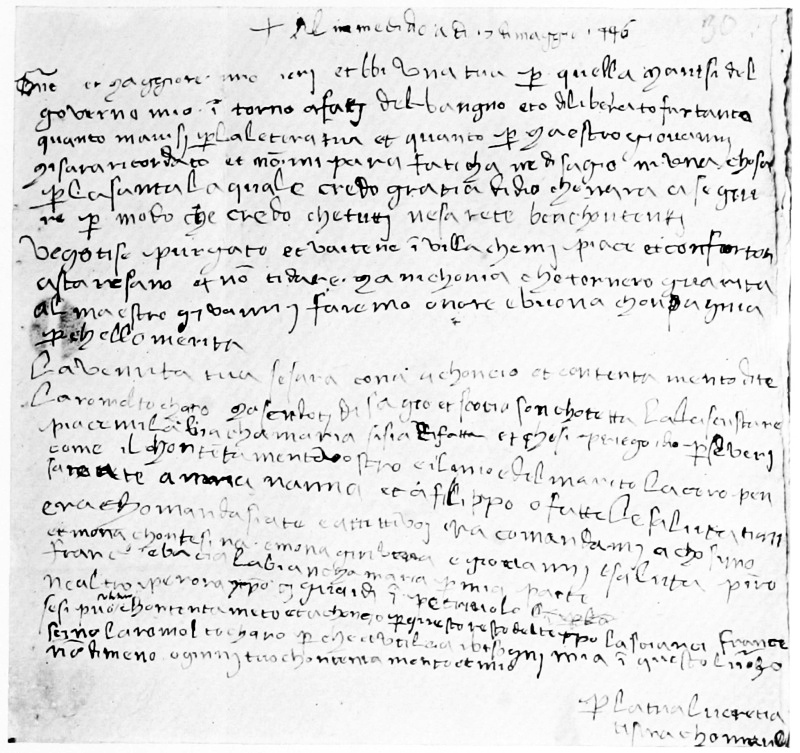
✕ Al nome di Dio.
Domine et maggiore mio, ieri ebbi una tua per quella m’avisi del governo mio intorno a fatti del bangno ero diliberato far tanto quanto m’avisi per la letera tua et quanto per maestro Giovanni mi sarà ricordato et non mi parà faticha ne disagio niuna chosa per la santa la quale credo, gratia di dio, che n’arà a seguire per modo che credo che tutti ne sarete ben chontenti.
Vego ti se’ purgato et vaitene in villa che mi piace et chonfortoti a stare sano et non ti dare manichonia che tornerò guarita. Al maestro Giovanni faremo onore e buona chonpagnia perchè ’llo merita.
La venuta tua se sarà con achoncio et chontentamento di te l’arò molto charo, ma sendoti disagio et schoncio son chontetta la lasci istare, piacemi la Bianca Maria si sia rifatta et chosì priego idio perseveri come il chontentamento vostro e il mio e del marito, lacerò pensare a te, a Maria Nanna et a Filippo ho fatte le salutatione e rachomandasi a te e a tutti voi e rachomandami a Chosimo e mona Ginevra e Giovanni e saluta Pier Francesco e bacia la Bianca Maria per mia parte. Ne’ altro per ora. Xpo ci guardi in Petriuolo.
Se si può con tuo chontentamento et achoncio per questo resto del tempo lascianci Francescino l’are molto charo perche eè utile ai bisogni mia in questo luocho nondimeno ogmni tuo chontentamento eè mio.
per la tua Lucretia, ti si rachomanda.[51]
Contessina de’ Medici to her son Piero at Trebbio
I send thee a quarter of a roe, a hare and a kid, so shall not send any veal. I understand thy letter and also trust that God will bestow this grace upon us, and I send thee capers. Giovanni[52] wanted to go at all hazards to-day to see Lucrezia and the children: he says too that he has hardly seen thee. With difficulty I prevented him so that he might not be over-tired. Tell Lucrezia that the child’s frock shall be re-lined and she shall have it on Monday, and that she must encourage the baby to suck and have a care of all the children. Cosimo is well: this morning his knee pained him a little, a touch of the gout; but it will soon pass, as it is but a slight thing. If Lucrezia or thou shouldst want anything let me know. No more. Christ guard thee.—In Florence on the 6th day of February 1449 (1450).
Mona Contessina in Florence.[53]
Contessina de’ Medici to her son Giovanni in Rome
Most dear Son,—As there was no need I have not written since thy departure. Now it seems to me necessary, because we hear the plague is causing many deaths, even among the well-to-do. I must beg thee for God’s sake and for the sake of the love I bear thee to return as soon as thou canst. Thou knowest how anxious Cosimo and I are about thy stay in Rome; thy brother also is anxious. Had Cosimo known that plague was there he would never have let thee go. Cosimo has perpetual fever as he had when thou didst leave him, and these doctors call gout fever, and have done so for some time as thou knowest, and one can never be sure what may happen from one day to another. Therefore I beseech thee to return as quickly as thou canst, for thou art well aware how much he has to do. More I will not write to-day. Piero and his family have gone to Careggi because he also has fever. Tell me how thy ailment is? I will add no more.—In Florence 24th February 1449 (1450). From thy
Mona Contessina di’ Cosimo.[54]
Cosimo de’ Medici to Giovanni his son in Rome
With my own hand I wrote thee a letter on the 21st: since then I have had two letters from thee announcing thy safe arrival, and that thou art trying to obtain the indulgences in order to come away. I advise thee to do so with all possible speed, for although thou sayest that the death of the Bishop of Volterra has not changed matters, other letters I have seen declare the contrary; a prolonged stay is therefore not advisable.
The affectionate manner in which our Holy Father received thee, and what thou sayest as to the love he bears us, is most grateful to me. I see by his reply that thou hast told him what I said, that we are not idle and will do all we can to persuade them to follow the counsels of His Holiness. But it will be difficult, because if either party thinks to gain anything he will not abide by the agreement. What the Venetians want and what the Count wants is of such importance to them that nothing else will be regarded as of any moment. We have sent Messer A. and are leaving no means untried to reconcile them, as we know how important it is to our city.
Messer Agniolo Simonetto and Messer N. Arimboldi sent to the King by the Count with powers to sign the compact will have arrived; I know not what is thought of it there, but we shall soon hear the truth.
From Lombardy letters have come from the Count of the 19th, dated from Vimercato. He reports that with his whole force he is there and at Melzi and Casciano and other places near by, and that Milan is so surrounded that no supplies can enter. The Venetian troops are encamped in the positions he held at first, and one sees that both armies are suffering much discomfort. Any attempt to revictual Milan must be made by ascending from the heights into the plain and passing by the places held by the Count, when there would be fighting. They say Milan is in dire straits. Other news there are none, and we know not what is said there. Innocenzio Cotta has taken the town and fortress of S. Calombano for the Count, which it seems is a place of importance. Nothing more is said about our peace with the King, and to my sorrow there is a coolness about sending ambassadors. Pray God it may be for the best.
I see Messer Giovanni di Nerone is to have the bishopric of Volterra; I hope he may do well. If Messer Carlo[55] gets the Parish Church[56] I do not mind. I did not wish to ask for the canonry of Messer Giovanni which is in the gift of the Consuls, as many citizens wanted it. With this I send thee a letter from Messer Giovanni Migliorati received to-day. Thou wilt see what he writes. If this be true, and it can be had for Messer Carlo, it would be well. If thou thinkest it might be of use, speak to His Holiness about it and try to obtain a conditional promise, I would then let thee know at once if the event occurs: for our Holy Father shows us such affection that it seems to me unwise not to ask if one can get anything. No more at present. Christ guard thee.—In Florence on the last day of February 1449 (1450).
Cosimo de’ Medici.[57]
Contessina de’ Medici to Giovanni her son at Volterra
In the name of God on the 18th day of December 1450.
Yesterday I had a letter from thee. The things thou wantest shall all be sent by the first man going to Volterra. Cosimo continues to improve; he has not been very ill this time, although the fever has not yet left him, but it is slight. Thy shoes were ready, but they have made them black, so others must be made, and I will send them by the first messenger. We have not yet heard of the arrival of our party, but one who met them on the road says they were well: as soon as I hear I will let thee know. Although I told thee we paid too much for the pigs, I want thee to send us a pig or a roe for Christmas, if they are offered to thee; if we have to buy them we will not have them. Messer Rosello writes that he is coming to pass Christmas with me, and has sent Cosimo a fine cloak of Polish fashion of marten and sable, a pair of gloves, and the tooth of a fish a foot and a half long. As we have to prepare for the festival of the Three Kings, they will make a little change from my cloth of gold.
The plague affects us but little. For three days out of four during the week no one mentions it, they are all people one does not know. I should be so glad to know how thou art, and whether thou art better or worse since thy departure. Thy return, when it takes place, will be a great joy to me.
Antonio degl’ Strozzi has been to see me, and pestered me much about that business: he wants to come here for Christmas, tell him what thou thinkest; and so be he says that I promised him anything do not believe it, for he could learn nothing from me: so be cautious how thou dealest with him.
Tell the women I do not write because there is a dearth of writers until Mateo returns from Rome, he ought to be here to-morrow. Salute them from me, and say many things, and caress the children and kiss them for love of me; if the women want anything I can send, tell me. No more at present. God guard thee.
Mona Contessina in Florence.[58]
Contessina de’ Medici to her son Giovanni at Volterra
In the name of God on the 3rd day of January 1450 (1451).
Most dear Son,—-I only write this because for several days I have not had a letter, and because I thought Antonio degl’ Strozzi was coming back, and from him I might have heard news of thee. But Michele has been here, and says that since Friday thou hast been expecting the party from Rome. So I write to tell thee that it is impossible they could arrive because they were expected at Siena that evening. By now they ought to be with thee; if they are do not fail to tell us how they fare, for Roberto wrote to Cosimo that they left last Friday. If they come here we shall send thee word. No more at present. Christ protect thee. Written in haste.
Mona Contessina in Florence.[59]
The Same to the Same
In the name of God on the 5th day of January 1450 (1451).
The other day I wrote to thee in haste, and have now heard of the arrival of Piero and Pier Francesco.[60] God be praised. We shall be much rejoiced if they have returned in good health: I hear Piero’s foot has given him some trouble. I know not what thou hast decided about staying or returning; if thou dost return here put all thy belongings together in one place, so that if they are wanted thou wilt not be obliged to ask those women to find them, and so drive them crazy. I think Cosimo has written to thee about the strong box he wants. Here the plague has ceased, and I am glad thou art coming back; although it might be well to stay a little longer and see how thy health goes, but thou canst always return there if necessary. Tell me thy decision. I wrote the day before yesterday to ask thee to search in the cupboard in my room there for a pair of scissors which belong to Cosimo and to bring them, or they can be put into the strong box. No more to-day. Salute Pier Francesco from me, and tell him he is welcome back, and that I long to see him. Christ guard thee.
Mona Contessina in Florence.[61]
When, after the death of Visconti, Francesco Sforza had attained the object of his ambition and become Duke of Milan in 1450, Cosimo sent his eldest son Piero with Neri Capponi, Luca Pitti, and Diotisalvi Neroni, to salute the new duke. “They proceeded in triumph,” writes Cambi, “through the Milanese territory, and all their expenses were paid. The number of horsemen was so great when they arrived within five miles of Milan that it seemed like a manœuvring ground. Then the Duke in person advanced to meet them, and embraced and kissed them. Never was greater honour paid to Florentine ambassadors.”[62]
Piero de’ Medici was also one of the citizens deputed to meet the Emperor Frederick III. on his entry into Florence in January 1451. He dismounted at the church of S. Gallo, which had been magnificently decorated with hangings of cloth of gold and silk. In his train was the poor boy-King of Hungary, Bandilagho, as Cambi writes Ladislaus, and many German princes and bishops, whose outlandish names are quite beyond the old chronicler’s powers of spelling. “The Emperor seated himself,” continues Cambi, “on a most splendid chair under the loggia of the church, and all the gentlemen stood round him while the Ten of the Balìa bent the knee before him on either side, representing the Magnificent Signori. Messer Carlo d’Arezzo made a speech, to which Monsignore Enea, Bishop of Siena [the celebrated Æneas Sylvius, afterwards Pope Pius II.], replied in the name of the Emperor. Then the Emperor mounted again, and the Ten of the Balìa took the bridle of his horse, and in that manner they proceeded to the fore-port of the Porta S. Gallo where the Magnificent Signori of Florence awaited him seated. The Colleges had a fine banner with the Emperor’s arms, and when he came under it the Signori rose and went to his bridle, which the Ten abandoned. Mariotto Benvenuti, the Gonfalonier of Justice, took the right side and Rosso Ridolfi took the left, the other Signori with all the citizens following them, and thus they accompanied the Emperor to S. Maria Novella where the Pope’s apartments had been prepared for him. The magistrates were on foot, and the others who had gone out to meet him were on horseback. It was, indeed, a splendid sight. Please God he may recognise it, and be grateful for such honours which have been so costly.”[63]
After the sack of Constantinople in 1453 Florence became the headquarters of Greek men of learning. For fifteen years John Argyropoulos “poured forth wisdom from his golden mouth,” and Demetrius Chalcondyles, Johannes Andronicus Calistus, Constantius and Johannes Lascari succeeded him. They gave a fresh impetus to the study of Platonic philosophy as opposed to that of Aristotle; even the children of the chief citizens spoke Greek with such case and purity that Poliziano exclaims, “Athens has not been destroyed by the barbarians but has migrated to Florence.” It was then that Cosimo determined to found the celebrated Platonic Academy, and selected Marsilio Ficino, the son of his physician, to preside over it, although he was little more than a boy.
The sack of Lodi gave Cosimo’s opponents an opportunity to interfere in home politics. Their first step in June 1454, on the pretext that war was over, was to abolish the Balìa, which they imagined was the mainstay of his authority. This, of course, was useless as long as the Scrutiny made by the Balìa and the Accopiatori appointed by them were still in office. In November, therefore, a new Scrutiny was made, and in January 1455 the new Signory ordered that in six months’ time the power of the Accopiatori should cease, and the Gonfalonier and the Priors be once more chosen by lot. The measure was a popular one, and it worked, not against Cosimo, but against Luca Pitti, Diotisalvi Neroni, and Agnolo Acciaiuoli, as it put an end to their power of manipulating the appointments to office. The disturbed condition of Italy after the death of Pope Nicholas the peace-lover, and the discharge by the Venetians of Jacopo Piccinino, whose standard became the rallying-point for all discontented and dissatisfied men, reacted upon Florence. A feeling of unrest was abroad. Many citizens considered the Government weak and vacillating, and were only waiting for the election of a Signory who shared their views to make an attempt to “reform” the city. But without the consent of Neri Capponi this was impossible. So things remained as they were until his death in 1457 left Cosimo with a free hand. The re-assessment of the catasto early in 1458 was a heavy blow to his opponents, the new register of property entailing upon them considerable loss. In their dismay they turned to Cosimo, and suggested the creation of a new Balìa, a new Scrutiny, and fresh Accopiatori, but he refused to listen to any proposal for the renewal of the Balìa save in the usual way through the Colleges and the Councils. When Luca Pitti became Gonfalonier of Justice in 1458 he tried in vain to induce the Council to appoint a new Balìa, and Girolamo Machiavelli, a hot-headed republican who declared against all Balìe as inimical to the freedom of the citizens, was arrested and tortured with others who shared his views. Luca Pitti made the most of this so-called conspiracy, and tried to set his authority against that of Cosimo. Losing patience, Cosimo said to him: “You strive towards the indefinite, I towards the definite. You plant your ladder in the air, I place mine on the earth so that I may not climb so high as to fall. It seems to me but just and natural that I should desire the honour and reputation of my house to surpass yours. Let us therefore do like two big dogs which sniff one at the other when they meet, and then, both having teeth, separate and go their ways; you to attend to your concerns, I to look after mine own.” Cosimo then summoned a parliament. His position can be gauged by the advice given to Duke Sforza by his Ambassador to Florence: “When you would have one thing done rather than another, write your opinion or your desire privately to Cosimo, and he will always arrange it for you. Do not waste your time in saying, I would have their opinion, &c.... Popular governments are alien to and diverse from others, and Cosimo cannot be for ever in the Palace as he once was.” Pope Pius II. also declared, “Nothing is denied to Cosimo. He is the arbiter of peace and of war, and the moderator of the laws. Not so much a private citizen as the lord of the country. The policy of the Republic is discussed in his house; he it is who gives commands to the magistrates. Nought of royalty is wanting to him save the name and the state of a king.”
Contessina de’ Medici to Ginevra, wife of her son Giovanni, at the Baths of Petriolo
Dearest Daughter,—In these days I received a letter from thee and learn thou art well, which rejoices me. I see that thou art preparing to return, it seems to me a thousand years. Piero is going there now, so leave out the things he may need, and leave Florino and Giannello and give over everything to them in case thou comest away before Piero arrives; he will need a good many days for the cure of his eczema. The curtains thou tookest away bring back to me here, for Mona Lucrezia takes mine with her, and some slaves from here, so she will need no other women. Thy boy is well and has cut two teeth, and I think will get accustomed to these wet nurses in such a way ...[64] night and day we see after him. It seems to me that having cut his teeth and the evenings being warm he will do well. I say no more. May Christ guard thee.—In Florence on the 10th day of April 1455.
Mona Contessina di Cosimo.[65]
Cosimo de’ Medici to his son Giovanni at Milan
During the last days I have written thee several letters, but have only had one from thee from Modena. We have heard of thy arrival at Milan, and of the great honours paid thee by the Duke, at which I am well pleased.
I expect to hear from thee how things passed.
As I told thee, and as I have written to thee, I do not at all desire that thou shouldest go further in order to accompany the Duke of Calabria. We should lose more here than we should gain there by this. Thou hast already done quite enough by accompanying him hitherto, without going any further, and next month thou must return here. No more at present. Christ guard thee.—Florence, July 28, 1455.
Cosimo de’ Medici.[66]
Lucrezia de’ Medici (from Careggi or Cafaggiuolo) to her husband Piero at Florence
This day I received thy letter, which is most dear to me as telling how thou art. I see that by the grace of God riding has not been too irksome to thee, of which I am glad. Mona Contessina told me the same, and that thou hast been received with great demonstrations of affection. Truly, as thou sayest, we have much to thank God for. So I beg thee to bear gladly a little discomfort, for these things are not accomplished without some fatigue. I see all the family is well, which is a great consolation to hear, and I thank thee. I beg that, as we are not coming there, thou wilt return as soon as thou canst, for it seems to us a thousand years since we saw thee, particularly to Giuliano. Lorenzo is learning the verses his master there gave him and then teaches them to Giuliano. No more at present. Commend me to Cosimo and to Mona Contessina. We are all well. Christ guard thee.—28th February 1457 (1458).
Thy Lucrezia.[67]
The entry into Florence of Galeazzo Maria, Count of Pavia, son of Francesco Sforza, Duke of Milan, is described in a curious poem written in 1459 by an unknown author.[68] Leaving Cafaggiuolo, where the lad slept, he entered Florence on 17th April 1459, and dismounted at the Medici palace. Next day Messer Galeazzo visited the Signoria, who made him sit in their midst and offered him their services. “I thank you for your greeting,” answered the young Count, “and beg you to command me and to dispose of all I possess. For you I will abandon any enterprise, and serve you against any power.” Then with a prayer to God to grant them happiness and long lives the lad of fifteen added: “I beg you to pardon my youth if, from want of knowledge, I have not spoken aright in your presence; remember I am but a boy. I commend you to Christ our Lord.” From his letters to his father we get a glimpse of the home life of Cosimo. He writes that even the ladies of the family helped to entertain him, and he was charmed with the playing of one of Piero’s daughters on the “organo di cave.” At a dinner at Careggi he notes that Giovanni, Cosimo’s second son, did not sit at table, but acted as a kind of steward, and saw that every one was properly served. After dinner a poet improvised verses in honour of the guest. “Certes, Lucian or Dante could have done no better,” he remarks. Then they danced, Piero’s wife Lucrezia Tornabuoni, Giovanni’s Maria Ginevra degl’ Alessandri, and a daughter of the Strozzi, held to be the handsomest maiden in Florence, and some peasant girls.
Two days later came Pope Pius II. on his way to the Congress he had summoned at Mantua to arrange for another crusade. He was received with great honour, and young Sforza made an oration, kneeling in the dust before the Pope. Then Pius seated himself on a gestatory chair and was borne into the city on the shoulders of the lords of Faenza, Rimini, Carpi, and Forli, instead of riding on a mule, which was the usual practice. “This,” observes Cambi, “was a proof of pride, not of holiness.” The old chronicler then describes a tournament in the Piazza S. Croce “for the temporal lords, but many ecclesiastics also went. And on 29th April there was a ball in the Mercato Nuovo, which was enclosed with a stockade surrounded by seats covered with tapestry. Sixty young Florentine gentlemen, who were expert dancers, richly adorned with pearls and jewels, and many pretty maidens and girls who were good dancers, danced; and they changed their dresses several times. All the ambassadors were there and some of the cardinals, and it was calculated that in the seats, in the houses round, and on foot, there were more than 60,000 persons. There was also a great hunt in the Piazza de’ Signori, which was closed all round with a stockade, and inside were turned loose two lions, two horses, four bulls, two young buffaloes, a cow and a calf, a wild boar, a giraffe, with twenty men and a large ball of wood, so made that a man could stand upright inside and roll it about in order to exasperate the animals. But the loud shouts of the people so frightened the lions that they were as though stupefied, many men broke into the enclosure and the lions were as lambs among them. The preparations had been great, and the expense large, but the pleasure given was small.”[69]
Contessina de’ Medici to her son Piero at Venice
Dearest Son,—This day I have received thy letter saying that thou art well and improving every day, which rejoices me. I think thou must wish for news of Cosimo. Some days ago he had a bad attack of plague. He is ill in bed, but this time he has escaped and now the fever is slight. I hear that thou hast bought the quilts and the ticking, which is well done. If thou wouldst like to send them to Careggi, I [will keep them][70] until thy return. Do as thou wilt. The other family is quite well. It seems to me a thousand years until thy return, and I hear no rumour of it; I do not know how long thy absence will last, which is a grief to me. I say no more at present. May God guard thee.—In Florence on the 21st day June 1459.
Mona Contessina.[71]
Cosimo de’ Medici to his son Giovanni at the Baths of Petriolo
The men who brought back the horses gave us thy letters, and told us of thy safe arrival, thanks be to God. We have heard nothing from thee since, nor how the baths agree with thee; we should be glad to have news often from thee to say how thou art, so do not omit to cause some one to write often. Here by the grace of God we are all very well and are preparing a fine feast at Careggi for the day of S. Cosimo. In three days we expect Guglielmo de’ Pazzi,[72] for Lorenzo has gone with his tutor to Cafaggiuolo, where he was expected. Be diligent in doing all that is necessary, and come back as soon as thou canst. Be not remiss in what thou art there for, and be careful to take thy baths properly, so that they may be beneficial. Christ guard thee.—Careggi, September 1459.
Cosimo de’ Medici.[73]
Contessina de’ Medici to her son Giovanni and his wife Ginevra at Bagno a Morba
Dearest Children,—We have received your letters, which have given us great pleasure and relief, seeing that thou art better and that the improvement continues; may it please God that it shall continue, in order to give these two old people joy and consolation whilst they still live. It has been reported to thee that Cosimo and Piero have been ill; this annoys me, for I did not wish anything to sadden thee, so that the baths might have their proper effect. Their illness was but slight. Cosimo had a cold, which was soon cured, and he is now well; Piero had some pain, which is not yet gone; but you both know what always happens, so he will soon be well also. Cosimo has put an end to the worry of being one of the Eight, and Pier Francesco has been named in his stead: this might also be done for thee. I should be glad, Ginevra, to hear from thee how the baths act and how Mona Nanna serves thee. If I can do aught for thee here, tell me. Mona Pippa has the ailment thou knowest of, the others of thy party are well.—At Careggi on the 28th day of August 1460.
Thy Contessina.[74]
The last few years of Cosimo’s life were clouded by ill-health and suffering, and the knowledge that the growing arrogance and rapacity of his party, the Palleschi, were to a great extent alienating the affection and the esteem of the citizens from his house. Then the death in 1461 of Cosimino, the only child of Giovanni and Ginevra de’ Medici, was a bitter grief to his grandparents, whose especial pet the little boy had been. Two years later Giovanni himself died, and the old man sadly exclaimed that the palace in Via Larga was now far too large for so small a family. He had always counted on the help Giovanni would give to his elder brother Piero, who was crippled with gout, and his death at the early age of forty-six was a blow from which Cosimo never rallied.
Pope Pius II. to Cosimo de’ Medici
Beloved Son,—Peace and apostolic blessing. The news we have just received of the death of your son, Giovanni of blessed memory, has grieved us deeply, not only because it is in itself untimely, but also because we fear it is likely to prove hurtful to a man of your age and infirmity. Yours is a life that should be prolonged in the sweetness of the Spirit, and you ought at all times to find comfort. Our own consolation is that you are wise, that you are well versed in the chances of fortune and able to hold your feelings in restraint. We urge you then, Cosimo, to do this, and looking towards God, to bless Him and to trust that all is for the best. We are ignorant of His secrets; He alone knows our needs and our true advantage. Let us then have faith that we and your son have been dealt with in gentleness, for neither you nor he could foresee the future. We look to your lofty nature, my son, to continue bearing God’s will in this with patience, even as we hear you do bear it, without giving way to grief. Mourning accords not with your age; it is contrary to your health, and we ourselves, your native city, and all Italy, require that your life should be as far as possible prolonged. Let good works and acts of piety be your tribute to your son’s memory. Anything else would be inconsistent with your nature; deeds of charity, devotion, and prayer are their own reward. This brief letter is written to acquaint you with our grief, and to assure you of our solicitude. Let these few words be counted for our affection.—Given at S. Peter’s, in Rome, under the ring of the Fisherman, on the 1st day of November 1463, in the 6th year of our pontificate.[75]
Cosimo de’ Medici to Pope Pius II.
Most blessed Father,—The power and wisdom of the words you wrote made me feel, while I read them, that I was veritably listening to the consoling voice of Him whose true Vicar you are. Nothing more sweet, nothing more saintly, or even divine, could have been written. And your consolation had this effect: I have always thought it expedient and praiseworthy to control (for I could not quench) my grief; but now, most blessed Father, to act contrary to your advice would seem to me positively sinful. I therefore strive to the best of my power, and so far as my weak spirit will permit, to bear this great calamity with calmness. To me it appeared a calamity; but God alone knows what is truly a misfortune, and we, as you write so wisely and devoutly, are ignorant of it. Yet I never thought it was not well with my son Giovanni, for I remembered that he had gone forth, not from life, but into life from death. For this, which we call life, is death, and that is the true life which is everlasting. And I recognised that the only suffering his death brought with it was ours, who truly must needs miss him. Yet we know not for what to pray. I trust that God in the abundance of His mercy will pity us that are left behind; for the Lord is gentle and full of mercy. But for my own life, I count it happy, because the Supreme Pontiff, the Vicar of Christ, has been thoughtful on its account. I will indeed take care of it; but not for the reasons which you, in your more than human kindness, have put forward. For what is my power now worth? What worth has it ever had? Nay, my purpose in caring for my life is that I may be found not to have despised this precious gift of God, nor to have forgotten the mercies which I have received from the divine love. I ask of you, most blessed Father, that your Holiness offer a prayer for me, your son, to God, that I may have strength to achieve this.—[1463].[76]
On 3rd November 1463 Pius II. wrote again to Cosimo, to ask him to induce Florence to aid him, by equipping two galleys for his projected crusade against the Turks. Cosimo’s answer is most respectful and very wary.
Cosimo de’ Medici to Pius II.
Cosimo greets the Supreme Pontiff.
Most blessed Father,—I received your Holiness’ letter a few days ago, a letter full of grandeur and dignity, whose wisdom, as no one can doubt, could have proceeded from none but your Holiness. Me, at any rate, it so affected that after reading it several times I became convinced that such speech was beyond the common use of men, and was indeed none other than what might seem to be written at the dictation of that truly divine Spirit which spoke in the saints of old. When you speak of the insecurity of man’s lot, who would not straightway be moved by the power of your eloquence to despise all that is human? And when you solemnly tell of our immortal life to come, can any be so dull and leaden that he would not feel exalted, as he reads, so as to gain a vision, even here, of the glory of his own immortality and be inspired by a wonderful longing to attain it? And your deeds are no less holy than your words. I say nothing of what you have achieved in the past, saintly though it is and worthy of sacred remembrance. But with regard to the enterprise which you are now preparing, is it possible, most blessed Father, to believe that you, who are Christ’s Vicar, are attempting it without the presence within you of Him whose representative you are? The task is one so novel and so marvellous, that without God’s impulse and support to your age and infirmity the undertaking would seem doomed to fail. That I suppose is the reason why some people regard it, as you say in your letter, with amazement and disapproval. But I ask you, most blessed Father, whether it is not indeed a matter for wonder that a man like you, whose years and feeble health make their own claim to a life of ease and repose, should embark on the exertions of travel and all the hardships of war. It is natural, then, that the well-wishers of the Christian Commonwealth, the friends of peace in Italy, and all who desire the true and righteous tranquillity of kingdoms and the permanence of the Christian sway, should behold these difficulties and dangers with dread. They look upon your virtue as a gift clearly sent by God for the healing of human ills; they love the Roman Church and care for the integrity and happiness of Christendom; and they regard your safety as their security for all these. It must needs be that they are alarmed by your undertaking such difficulties and your exposure to such dangers, seeing that they do not possess your wisdom nor are they supported by the divine breath which inspires you. But though they do not see that which is before the eyes of your greater wisdom, perhaps since they wish only for what may be best for you and most beneficial for your flock, they do not deserve so much blame for disapproving an enterprise which to their limited apprehension appears so great and so difficult. You, most blessed Father, whom God will guide to victory even as He has brought you thus far, will persevere in spite of it all. Nor will the faith of Peter whose seat you occupy fail you. The end of this undertaking, which you begin so splendidly, will be to the glory of God and the joy and felicity of all that are yours, even though its initial stage be difficult and laborious. Behold the faithful shepherd offers his life for his sheep.
I now come to the summons which you address to me and the invitation to join you in this beneficent and glorious enterprise. There you write to me not as a private man who is satisfied with the mediocre dignity of a citizen, but as though I were a reigning prince, and your exhortation is so kind that I find myself unable to thank you as I would wish. For though all through my life God’s kindness and bounty has showered upon me much more of human goods than I ever deserved, whereof you most eloquently adduce examples, yet by the grace of Him who is the giver of all that is good, I have never been oblivious of my humble lot. You, however, most blessed Father, in your superhuman kindness write to me in terms of moderation and in the form of a request, whereas it would be your right to urge, nay to command.
But the things you ask of me, most blessed Father, are not of the same nature; as to the first, to procure you a vote of assistance from our city, well you know how limited is the power of a private citizen in a free state under popular government. Nevertheless I am ready to exert my influence, such as it is, in this direction, and will do so to the best of my ability, even as I have done hitherto; I will try to arrange that your interests should be consulted, for your interests are ours and those of the common cause of all Christians. This city of ours has never yet remained behind in any glorious undertaking; but has often by her own choice taken upon herself enormous expenses, difficulties, and dangers, for the defence and dignity of the Roman Pontiff. Therefore I do not believe that she will now hold aloof when you summon her to take part in this enterprise which is pious and necessary and to the common interest of us all.
Personally, from my own resources I can promise you something more definite; that is to say I promise you, not indeed to equip two galleys (which would be an undertaking for a prince not for a private man), but to assist you so far as the limitations of my resources permit. I am not the man to imagine that the gifts of fortune which I possess are the deserved rewards of my business forethought, or of any virtue on my part, or that I have gained them by my human work or my industry, no, I am convinced they are but the gifts of a most bountiful God. If God, who is Himself the giver of all good things, either now or at any other time claims any part of it back, I should deserve to be deemed most ungrateful and impious if I grudged to return what He gave ungrudgingly; but especially now, when such a reward is promised me, which he, who in truth can loose and bind, puts before me.
Be bold therefore, most blessed Father, in the cause of Christendom, persevere with energy and confidence, and bring the matter to an end. Be convinced, since God inspires you, that opportune assistance will not be wanting. And at last, when you have scattered the barbarous foes of the Christian name, when your sheep are defended and their fold protected, not only will mankind ever remember to honour in you the father and the shepherd, but when in the end God recalls you to His heaven, whence you have now been sent down as His Vicar, you will live in unceasing heavenly joy, having as it were gloriously served your term of divine office.[77]
Lucrezia was as anxious about the physical well-being of her children as about their education. Some months before Cosimo died she was at Pisa with Giuliano, who was ill, and she writes to her husband:
Lucrezia de’ Medici to her husband Piero
I write thee several letters on the same day so that should one go astray thou wilt have news of Giuliano as thou desirest, by any one going there. Yesterday I wrote that as he was better I did not think the change suggested by Messer Mariotti was necessary, and last night I told thee the fever had returned as usual. My last letter was written at seven. After that he did not rest so quietly as on other nights, and he seems to me more uneasy than he should be now that the fever has diminished. I wish thee to know every small change so that thou canst the better judge what Maestro Mariotto writes; and act, not according to my ideas, but as thou thinkest best after reading our reports. His pulse is good, all functions are natural. The fever has returned almost as strong as on the fourteenth day, and has lowered but little. He is not so lively during the day as I could wish, being weakened by the strength of the fever. The Maestro says this is caused by the nature of the phlegm which is in him. I wish thee to know this.
But do not be anxious, for Giuliano is strong; he walks about the room, and, though pale, is of good complexion. I give thee all these details more for thy information than because Giuliano seems to me ill, or that the amelioration does not continue. I commend myself to thee.—The 24th November 1463 at the 16th hour.
Thy Lucrezia at Pisa.
At this moment Giuliano is awake, and the Maestro says he has never found him so free from fever, and that during convalescence people are always more uneasy. Dost thou understand?[78]
Cosimo de’ Medici to his son Piero at Pisa
Yesterday we received yours of the 19th, by which we see you are all well. This is most pleasing to us, also that the town is healthy and that you are taking good care of Giuliano who is well. Again we beg of you to see that he takes care of himself. We have also received the letters from Bruges and all my other letters which you had, all shall be answered.
I note that you will write to Niccolò in a few days, when the farm of Piero da Gagliano will be taken over. The sooner this is done the better, as the creditors have begun to get restless, that is Giovanni Rucie ...[79] to whom I have notified that he is to stop proceedings, as he will be paid before the end of the month.
The plague here has abated, and no one mentions it any longer. The cold weather with snow and ice in these last days has put an end to it, so for the present we are all well. Day by day you shall have news how things go. Yester evening it began to rain, and is much milder.
By the grace of God Contessina and I are very well, and so are Bianca and Gugliemo and the little Contessina. They come to us often to keep us company. To-morrow morning we shall get a letter from the Signori here to the Consuls [of the Sea][80] at Pisa, in order that you may cut the wood for the galleys that are to be built. This is a favourable moon for felling trees.
Ruberto is dangerously ill, there is small hope of his recovery. God help him. For this reason none of his brothers can go to help about the wood for the galleys.
Thy companions here will write and send their letters by a horseman and....[81] We do this so that you may have frequent news. Christ guard thee.—Florence, January 23, 1463 (1464).
Cosimo de’ Medici.[82]
The following document shows that Francesco Sforza realised how much he owed to Cosimo de’ Medici. When on the death of Filippo Maria Visconti in 1447 Milan declared herself a Republic, popular feeling in Florence ran high in her favour. It needed all Cosimo’s authority and influence to induce his fellow-citizens to assist Sforza in seizing supreme power. Cosimo saw that as a republic Milan would inevitably fall a prey to Venice, and thus the communications of Italy with the North would be cut off. A strong ruler who owed his crown to Florence would be an invaluable ally, and preserve the balance of power in Italy. We shall see that Piero faithfully carried out his father’s policy.
Francesco Sforza, Duke of Milan, &c. &c.
As we have always felt a particular affection for the magnificent Cosimo de’ Medici of Florence on account of his singular virtues, and as he also has loved us and all that pertains to us, we are bound and obliged to love all that belongs to him. Now here in Milan Pigello Portinaro, a Florentine citizen and merchant, the administrator and partner in the business and bank of the Magnificent Cosimo de’ Medici and of Piero and Johanni his sons in Milan, who has served us and the illustrious Madonna Bianca our consort ever since he came to inhabit this our city, about eleven years ago, with very large sums of money, with stuffs and with jewels, and with loans of divers kinds as appear by the entries in our private books. These services, subsidies, and favours given by the said Pigello according to the orders of the aforesaid Magnificent Cosimo and his sons were most pleasing and acceptable to us because they were given willingly, and the said Pigello carried them out and fulfilled them with great diligence, loyalty, and love towards us, and with admirable discretion, by which means we were enabled to arrange our affairs. Pigello made every effort to do this with the smallest possible loss to us, and we are sure he will continue to do so. Therefore we are much pleased and have been well served by the aforesaid Pigello; and all the profit, lucre, and gain that the said Pigello has made, either in their name or in his own with us and with our stewards, officials, and any other agents of ours, we for the above-named reasons approve of and are well content. By this our letter we declare that they can have and hold all without fear of contradiction or qualms of conscience, releasing and absolving the said Magnificent Cosimo, his sons and the said Pigello, and their sons and heirs in perpetuity from any claims; promising for ourselves, our sons and successors, that no question shall be raised about any profits or gains they may have made with us up to the present day for the above said reasons, or for any depending or arising therefrom. Because as has been said we have already, and by this our letter we do now make a general donation of the aforesaid privileges which is formal and binding, and is to be understood as including all those clauses and formalities which are necessary in a full and valid donation de jure; with the reservation that if any error is discovered in the books, writing, or reasons above said, they are to be corrected and amended in honest and just fashion; and this is to be understood as binding upon both parties. We command all our governors, clerks of the exchequer, and all other our officials and subjects who see the present letter, to observe it implicitly without contradiction or exception. And that all who see this letter may know that it is written by our own orders, we have signed it with our own hand, and had it sealed with the seal we always use.—Given in Milan on the 11th day of March 1463 (1464).
Francischus Sfortia, Vicecomis, &c., manu propria. Cicchus.[83]
The last months of Cosimo’s life were passed chiefly at Careggi, and his great solace was in study, as the following letter shows:
Cosimo de’ Medici to the Reverend Master Marsilio Ficino, Platonist
Yesterday I came to the villa of Careggi, not to cultivate my fields but my soul. Come to us, Marsilio, as soon as possible. Bring with thee our Plato’s book De Summo Bono. This, I suppose, you have already translated from the Greek language into Latin as you promised. I desire nothing so much as to know the best road to happiness. Farewell, and do not come without the Orphean lyre.
About twenty days before his death, whilst talking to Ficino, Cosimo bewailed the unhappy lot of humanity and exulted in the happier prospect he felt was opening out before him. Ficino replied by citing corresponding ideas from Greek authors, particularly from Zenocrates, upon which Cosimo demanded of Ficino, as a last service, to translate his treatise on Death into Latin. The end was fast approaching, and Cosimo’s calm, rather ironical nature was not changed by physical suffering or by the fear of death. When his wife asked him why he remained silent for so many hours at a time, he answered: “When we go to the villa the preparations for our departure occupy thee for fifteen days; dost thou not understand that I, who am leaving this life for the next one, have much to think on?”
A few days before Cosimo died Piero wrote to his two sons Lorenzo and Giuliano at Cafaggiuolo, where they had been sent with their mother, Lucrezia, on account of the plague which had broken out in Florence. Indeed there was a report that Cosimo’s malady was the plague, and many were afraid to visit him.
Piero de’ Medici to Lorenzo and Giuliano his sons at Cafaggiuolo
I wrote to you the day before yesterday how much worse Cosimo was. It appears to me that he is gradually sinking, and he thinks so himself. On Tuesday evening he would have no one in his room save Mona Contessina and myself. He began to recount all his past life, then he touched upon the government of the city and then on its commerce, and at last he spoke of the management of the private possessions of our family and of what concerns you two; taking comfort that you had good wits and bidding me educate you well so that you might be of help to me. Two things he deplored. First, that he had not done as much as he wished or could have accomplished; secondly, that he left me in such poor health and with much irksome business. Then he said he would make no will, not having made one whilst Giovanni was alive, seeing that we were always united in true love, amity, and esteem, and when it pleased God to so order it he desired to be buried without pomp or show, and reminded me of his often expressed desire to be buried in S. Lorenzo. All this he said with much method and prudence, and with a courage that was marvellous to behold, adding that his life had been a long one and that he was ready and content to depart whensoever it pleased God. Yester morn he left his bed and caused himself to be carefully dressed. The Priors of S. Marco, of S. Lorenzo, and of the Badia of Fiesole were present. He made his confession to the Prior of S. Lorenzo and then heard mass, and he spoke the responses as though in perfect health. Then being asked the articles of faith he repeated them word by word and made his confession and took the Holy Sacrament with more devotion than can be described, having first asked pardon of all present. These things have raised my courage and my hope in the Almighty, although according to the flesh I am sorrowful, yet seeing the greatness of his soul and how well disposed he is, I am in part content that his end should be thus. Yesterday he was pretty well, and also during the night, but on account of his great age I have small hope of his recovery. Cause prayers to be said for him by the friars of Il Bosco[84] and bestow alms as seems best to you, praying God to leave him with us for a while, if such be for the best. And you, who are young, take example and assume your share of care and trouble as God has ordained, and being boys, make up your minds to be men; your condition and the present case demanding that of you lads. Above all take heed to everything that can add to your honour and be of use to you, because the time has come when it is necessary that you should rely on yourselves. Live in the fear of God and trust that all will go well. Of what befalls Cosimo I will advise you. We are expecting a doctor from Milan, but I have more hope in Almighty God than in aught else. No more at present.—Careggi, the 26th July 1464.[85]
The following letter is undated, but as it refers chiefly to the character of Cosimo de’ Medici, and to a certain extent describes him, I have inserted it here.
Marsilio Ficino to the noble Lorenzo de’ Medici
Even as harmony delights us more at the moment it strikes our ears than when we remember tunes we have heard, and the actual sight of war moves us more than any recital thereof, thus the great deeds of noble and illustrious men animate our courage far more than the words of orators and philosophers who dispute about valour. For it is ordered by nature that things themselves should be more potent than their names, and that real events should move the soul with greater force than what is either false or may have happened. Therefore by imitating the deeds of Socrates we are taught better how to attain courage than by the art displayed by Aristotle in his writings on morality. And Christ solely by His example has done more to make us adopt a holy and virtuous way of life than all the orators and philosophers that ever existed. Therefore, my Lorenzo, whilst I applaud you for not despising the writings which teach morals, I beg you to prefer learning from reality instead of from description, as you would prefer a living thing from a dead. Particularly as you have decided to emulate that aged man on whom our Senate bestowed the title of Father of His Country. I mean the great Cosimo, your grandfather and my lord. A man prudent above all men, pious towards God, just and most charitable towards men, temperate in living, diligent in his care for his family, and still more so in the affairs of the Republic; a most honourable man who lived not only for himself, but for the good of his country and his God; whose soul was as humble as any man’s, and yet great and exalted. I, my Lorenzo, for more than twelve years gave myself up to philosophy with him. He was as acute in reasoning as he was prudent and strong in governing. Certainly I owe much to Plato, but must confess that I owe no less to Cosimo. Inasmuch as Plato only once showed me the Idea of courage, Cosimo showed it me every day. For the moment I will not mention his other qualities. Cosimo was as avaricious and careful of time as Midas of money; he spent his days parsimoniously, carefully counting every hour and avariciously saving every second; he often lamented the loss of hours. Finally, having like Solon the philosophor (even when occupied in most serious business) diligently studied philosophy, yet even till the last day when he departed from this world of shadows to go to light he devoted himself to the acquisition of knowledge. For when we had read together Plato’s book dealing with the Origin of the Universe and the Summum Bonum he, as you who were present well know, soon after quitted this life as though he was really going to enjoy that happiness which he had tasted during our conversations. Farewell, and as God fashioned Cosimo according to the Idea of the world, do you continue as you have begun to fashion yourself according to the Idea of Cosimo.
Marsilio Ficino.[86]
Brief Memorandum by Piero de’ Medici about his Father’s Death
I record that on the 1st August 1464, at the hour of 22-1/2, Cosimo di Giovanni de’ Medici quitted this life, having been a great sufferer from pains in his joints, although free from all other ills. Towards the end of his life he was afflicted with suppression of urine, which caused frequent fever. He was seventy-seven years of age, a tall, handsome man, and healthy, save for the above-mentioned ills. Of great prudence and still greater kindness, he was the most eminent and the richest citizen our city had possessed for many years, and was trusted and loved by the people above all other men. Indeed there is no record of any citizen who died at that age who was so kind and so famous, and was so universally mourned and with reason, for no man ever had to complain of him, but many have been helped, and succoured, and assisted, for his greatest pleasure lay in aiding others; not only relations and friends, but strangers; and what is more difficult to believe, and still more difficult to accomplish, those who were unfriendly. By such praiseworthy actions he made many persons his friends, who by their own fault or the fault of others had been his enemies. He was liberal, charitable, and merciful, and gave many alms during his life, not only in the city and the State, but in far distant places for things pertaining to religion, rebuilding churches, and giving for other worthy objects which had come under his notice. He was highly esteemed and believed in by all the lords and princes in and out of Italy. He filled all the greatest positions in our city, all foreign ones he declined; but he joined in the most important and honourable embassies sent by our Republic in his time. In the city his commerce enriched many men, besides procuring a large fortune to himself. He was not only a wise and cautious man of business, but a lucky one. As has been said, he died on the aforesaid day in our house at Careggi, after receiving all the sacraments of Holy Church with the utmost devotion and reverence. He would not make a will, but left everything in my hands. He was buried in the church of S. Lorenzo in the earth, in the sepulchre ordered by him, without any honours or pomp, as he would have none but the canons and priests of the said church, the friars of S. Marco, and the canons regular of the Badia of Fiesole, and neither more nor less wax torches than were used at an ordinary funeral. This he ordered with his last breath; saying that alms-giving and other good works ought to be performed while alive, as he had done, and were then of more use. Notwithstanding I, wishing to pay my filial debt to paternal piety, did what was requisite on account of those who remained, ordering alms and masses, as follows in this book.
Note of the Funeral and of the Masses that are to be said in the Church of S. Lorenzo and in other places for the Soul of Cosimo di Giovanni de’ Medici, &c.
On the morning of August 2, which was Thursday, the funeral took place in the church of S. Lorenzo; for wax we paid lire 43-1/2; for torches, 94 lbs. of candles for putting in the church, and 13 small torches to be carried by the priests, in all 190-1/2 lbs., and for 16 torches of 97 lbs. for placing round the body.
Note of the Masses and Offices celebrated for the Soul of Cosimo
To the Chapter and priests of S. Lorenzo for an office lasting eight consecutive days, beginning on August 3rd; with 30 masses for each office, which make 8 offices, with 240 masses for the octave, we paid 16 lire for 6 torches of 33 lbs. and 10 lbs. of candles.
To the Chapter and priests of S. Lorenzo for an office beginning on August 11th, and continuing for thirty consecutive days, finishing on the 11th September, we paid 60 lire per torch of wax of 170 lbs.
Then follows a long list of members of the family, friends, dependants, and slaves, each of whom had from 30 to 10 braccia each of black cloth for the funeral; the women of the family had also black veils and kerchiefs.
Besides the many offices celebrated in Florence for the soul of Cosimo, the various Companies of Rome, Venice, Milan, Bruges, Geneva, London, and Avignon celebrated a great many; and liberal alms were given, and many prisoners were pardoned and set free from divers prisons.
Memorandum of all the Men to whom was given Mourning for the said Funeral
Yds. Ins.
Pietro di Cosimo de’ Medici had dark clay cloth 8 29
Pier Francesco di Lorenzo had cloth 11 4
Lorenzo di Pietro di Cosimo had cloth and Giuliano 16 29
Messer Carlo di Cosimo, cloth 9 16
Niccodemo, Ducal Secretary, cloth 8 29
Messer Gentile di Giorgio, Florentine Canon, cloth 8 29
Maestro Mariotto di Niccolò, our doctor, cloth 8 29
Messer Bartolommeo Scala, Chancellor, cloth 8 29
Matteo di Ser Giovanni de’ Rossi, cloth 8 29
Fruosino d’Andrea da Panzano, cloth 8 29
Ser Francesco Cantansanchi, cloth 8 29
Ser Filippo di Cristofano, Piero’s Chancellor, cloth 8 29
Francesco di Giovanni Fracassini, Factor in Cafaggiuolo, cloth 6 1
Felice di Simone, Factor in Careggi, cloth 6 13
Piero di ..., Factor at Fiesole 6 13
Antonio di Meo Turco, Steward in Florence 6 13
Gugliemo di Francesco da Rovereto 6 13
Guasparri di Francesco da Vicchio 6 13
Piero di Domenico, surnamed Malerba 6 13
Prandino di Piero da Lodi 6 13
Matteo di ... da Vicchio, Barber 6 13
Giovanni di Giovanni, German 6 13
Piero d’Angiolino of Brieg, German 6 13
Donnino di Jacopo, who is in Cafaggiuolo. 6 13
Andrea di Piero from Vienna 6 13
Memorandum of all the Women who received Mourning for the said funeral
Yds. Ins.
Madonna Contessina, wife of Cosimo, had cloth, and besides eight veils and two kerchiefs 20 8
Madonna Lucrezia, wife of Piero di Cosimo, cloth, and besides two veils and one kerchief 8 29
Maria Nannina, daughter of Piero di Cosimo, cloth 8 29
Madonna Ginevra, wife of the late Giovanni di Cosimo, cloth, and besides two veils and one kerchief 8 29
Madonna Ginevra, wife of the late Lorenzo de’ Medici, cloth, and besides two veils and one kerchief 8 29
Laudomine, wife of Pier Francesco de’ Medici, cloth, and two veils and one kerchief 8 29
M. Lisabetta, wife of Sozo da Vernio, cloth, and two veils and one kerchief 8 29
M. Luisa, wife of Alexandro da Vernio, cloth, and two veils and one kerchief 8 29
M. Marta, wife of Gualtrotto da Vernio, cloth, and two veils and one kerchief 8 29
Maids
M. Marta, widow of Stefano da Villa nuova 6 13
M. Maddalena di Giovanni di Benavenni 6 13
M. Maddalena, widow of Martino da Barberino 6 13
M. Maddalena, widow of Viviano da Cafaggiuolo 6 13
M. Bartola, widow of ——. 6 13
Slaves
Caterina 6 13
Crestina 6 13
Caterina 6 13
Tita 6 13
Cosimo de’ Medici died at Careggi on August 1, 1464. His family, as has been said, respected his wish that he should be buried as a private citizen, without any public and official pomp. His fellow-citizens nevertheless resolved to commemorate in some special fashion the decease of the real head of their State. A minute setting forth his services was incorporated in the Acta of the Ten, who also passed a law declaring that he was to be afterwards known by the title of Pater Patriæ, and appointed Donato Acciaiuoli to commend its adoption to the people in a set oration. The law was adopted by acclamation, and Cosimo is always known as Cosimo Pater Patriæ.
FOOTNOTES: