THE PHILOSOPHER OF BRANTWOOD
Reading edition
JOHN RUSKIN
II.—HIS ART-TEACHING AND HIS BOOKS
'To crib, cabin, and confine in a dull array of formal propositions the rich exuberance of Mr. Ruskin's thought would be a needless injury.'—J. A. Hobson.
'IS there a gospel (of Art) according to Ruskin?' It is Mr. E. T. Cook, an art-pupil and disciple of his, who asks and answers this question. He, in 'Studies in Ruskin,' and another Oxford pupil, Mr. W. G. Collingwood, in 'The Art Teaching of John Ruskin,' agree that their great teacher did not formulate a creed, though he had definite fundamental principles to explain to the world, which—however much overlaid and obscured by eloquent language and elaborate illustration—were never lost sight of by him, but impregnated all his writings. As in the New Testament there is a revelation from God through Jesus Christ, though it contains nothing akin to a Church Catechism or Westminster Confession of Faith, so in Ruskin there is 'a complete philosophy of Art' without a concise and formulated system that can be packed into one's waistcoat pocket. We must find and arrange our canons for ourselves. The Ruskin 'Gospel of Art'—Mr. Cook's word—or his 'Philosophy of Art'—Mr. Collingwood's word—is merely an old gospel, with a new application—a philosophy of the position of Art with regard to God, and the world, and the soul. 'Truth, sincerity, and nobleness' are essentials of right living, and Art is the outcome and evidence of the right living of the artist. It is the expression of man's rational, disciplined delight in the forms and laws of the creation of which he is a part. The origin of Art is 'imitation touched with delight'—delight, that is to say, in God's work, and not in a man's own. Beauty, no less than reality, strength, and morality, is characteristic of true Art as 'an expression of the Creating Spirit of the universe,' whose handiwork is to be copied. Art is an interpreter of the Divine beauty in things seen; for the inner life of it is religion, its food is the ocular and passionate love of Nature, its health is the humility of its artists. Art looks into the innermost core and centre of phenomena. The true artist sees and makes others see. The greatest Art is that which conveys the greatest number of greatest ideas. It is the declaration of the mind of God-made great men. Fine Art is that in which hand, and head, and heart have worked equally together. In outline, colour, and shade an artist is to discipline himself, that he may become skilful in the seeing of things accurately, and representing them with absolute fidelity. What he sees accurately, however, he is to represent imaginatively, so as to arouse the faculty of imagination and a feeling of praise in others, and to cultivate their nobler instincts, and call forth and feed their souls. Beauty is of two kinds—typical and vital—the first lying in those external qualities of bodies which in some sort represent the Divine attributes; the second in 'the felicitous fulfilment of function in living things.' Ruskin agrees with Hogarth that 'all forms of acknowledged beauty are composed exclusively of curves.' Except in crystals, certain mountain forms, levels of calm water, and alluvial land, there are no lines nor surfaces of Nature without curvature. He adds that what curvature is to lines, so is gradation to shades and colours. He made himself conversant with these truths by independent study, minute investigation, inexhaustible industry in sketching.
Architecture, though subject to different rules and modes of handicraft, is governed also by the same general and spiritual principles. Its 'Seven Lamps' are Sacrifice,—the offering of all that is most costly of material, intention, execution; Truth,—which demands imagination, but will not tolerate deception; Power,—realized through observation of mountain buttresses and domes, cloistered woodland glades, and the rock-walls of the sea; Beauty,—not as mere mask or covering, but gracefully fitted to the conditions and uses of the object to be attained; Life,—expressive of the workman's love of his work, and knowledge of his ends; Memory,—which haunts the workman with shapes and colours he has once noted, and which inspires him with ever fresh ideals; Obedience,—which involves 'chastisement of the passions, discipline of the intellect, subjection of the will.'
It is in his 'Seven Lamps of Architecture' that the pæan on Giotto's Campanile occurs, wherein he tells us how, as a boy, he despised it, and how since then he lived beside it many a day and looked upon it from his window 'by sunlight and moonlight, noting the bright, smooth, sunny surface and glowing jasper, those spiral shafts and fairy traceries, so white, so faint, so crystalline, that their slight shapes are hardly traced in darkness on the eastern sky, that serene height of mountain alabaster, coloured like a morning cloud, and chased like a sea-shell.' His minute observation of form and colour in mountain gloom and mountain glory, in rushing torrents, and in feathered songster, and his unrivalled powers of description, must be an inspiration to all right-minded artists, notwithstanding his unsparing and incisive criticisms in his 'Notes on Pictures.' His scientific knowledge, too, stood him in good stead. His words on mountain sculpture, with an illustration from the Aiguilles or needle-pointed Alpine peaks, too long for full quotation, may well be cited. 'Nature gives us in these mountains a clear demonstration of her will. She is here driven to make fracture the law of being. She cannot tuft the rock-edges with moss, or round them by water, or hide them with leaves and roots. She is bound to produce a form, admirable to human beings, by continual breaking away of substances. And behold—so soon as she is compelled to do this, she changes the law of fracture itself. "Growth," she seems to say, "is not essential to my work, nor concealment, nor softness; but curvature is; and if I must produce my forms by breaking, then the fracture shall be in curves. If, instead of dew and sunshine, the only instruments I am to use are the lightning and the frost, then the forked tongues and crystal wedges shall still work out my laws of tender line. Devastation instead of nurture may be the task of all my elements, and age after age may only prolong the renovated ruin; but the appointments of typical beauty which have been made over all creatures shall not therefore be abandoned, and the rocks shall be ruled in their perpetual perishing, by the same ordinances that direct the bending of the reed, and the blushing of the rose." The cloud, the currents of trickling water, an interior knot of quartz, help the work of shaping, and the dew "with a touch more tender than a child's finger—as silent and slight as the fall of a half-checked tear on a maiden's cheek" help to fix for ever the form of peak and precipice, and hew the leagues of lifted granite, into shapes that divide the earth and its kingdoms. Then the colouring of the mountains is not done only by the chemical constituents of their rocks, but by the jewellery of the flowers—the dark bell-gentian, the light blue star-gentian, the alpine rose, the highland heather, the many-hued blossom-masses, and the golden softness of deep, warm, amber-coloured mosses.'
It is not always easy to follow Ruskin's own canons of Art in his exaltation of Turner—as, for instance, in the article of 'Truth touched with Imagination'—in such a picture as Whitby. There the painter's cliffs are unnatural and impossible, reminding us more of a straight-cut pound of cheese than anything ever seen in Nature—specially at Whitby! We are tempted to praise Turner more for revealing Ruskin than Ruskin for discovering Turner! Thus, in describing Heysham, it is Ruskin who in 'Harbours of England' gives us the true and very graphic painting, and Turner a glorified and unrecognisable one. 'A simple, north-country village on the shore of Morecambe Bay, not in the common sense a picturesque village; there are no pretty bow-windows, or red roofs, or rocky steps of entrance to the rustic doors, or quaint gables; nothing but a single street of thatched and chiefly clay-built cottages ranged in a somewhat monotonous line, the roofs so green with moss that at first we hardly discern the houses from the fields and trees. The village street is closed at the end by a wooden gate, indicating the little traffic there is on the road through it, giving it the look of a large farmstead, in which a right of way lies through the yard.' The rutty roads, the decayed fencing—haystacks and pigstyes—the parsonage—the church—the craggy limestone rocks amid the brushwood, and the pleasant turf upon their brows, the gleams of shallow water on the sandy shore, the fisher-boat on the beach—all help us to see old Heysham rather through the eyes of the prose-poet than those of the painter he is lauding.
Opening other—excluding his more voluminous—books, 'Love's Meinie' or 'Proserpina' to wit—the one of birds and the other of flowers—what exquisite passages meet us on every page! What Ruskinite does not revel in such as those contrasting the flight of the eagle and the seagull with that of the swallow, or as that speaking of 'the beauty of the bird that lives with you in your own houses, and which purifies for you, from its insect pestilence, the air that you breathe. Thus the sweet domestic thing has done, for men, at least, these four thousand years. She has been their companion, not of the home merely, but of the hearth, and the threshold; companion only endeared by departure, and showing better her loving-kindness by her faithful return.' She is a type of the stranger, or the supplicant, herald of our summer, 'who glances through our days of gladness'—and he gives us much more of the same sweet poetry about her. Then there are sentences like that outburst of joy at the discovery of the blue asphodel in the fields beyond Monte Mario—'a spire two feet high, of more than two hundred stars, the stalks of them all deep blue as well as the flowers. Heaven send all honest people the gathering of the like, in Elysian fields, some day!'
Ruskin confessed ignorance of the writings of political economists, of which he had read none but Adam Smith's—twenty years before—and his continual travesty of them as though 'buying in the cheapest market and selling in the dearest'—labour included—was their sole message to the world, makes it difficult to quote from his more philosophical or social science works. It must be remembered that Smith had forestalled Ruskin in stating that wage-earners had a right to a living wage, and that others, like Jeremy Bentham, had forestalled him in the doctrine of the 'greatest good of the greatest number' underlying his own strictures on our land system.
In his usual contradictory way he sometimes tells us the sword must still be whetted to settle international disputes. At others he calls war the mother of all evils, and writes paragraphs worthy of Carlyle on the French and English villagers from their respective Drumdrudges, pitying the peasantry upon whom the losses and cruelties fall, and denouncing the squires who officer them and lead them to death. Women he calls upon to exercise their influence in favour of peace, because they can, if they will, put an end to all wars for ever. The idleness of the upper classes, and the seeking of outlets for their capital by financial speculators are, he says, its chief causes, and ill-accumulated moneys are spent on it. In all this an ever-increasing multitude of Christians agree with him, as well as in his denunciation of the inhumanity of mere mercenary commerce uncontrolled by consideration for others, and in his pleadings for purer and happier homes, equal opportunities of education, and the glory and grace of honest labour. When a man who has done much for the good of his fellows can write of Ruskin in the second phase of his literary career, 'to him I owe the guidance of my life, all its best impulses, and its worthiest efforts,' we may be sure his later books were really great, notwithstanding their blemishes.

JOHN RUSKIN'S HANDWRITING IN ADVANCED LIFE
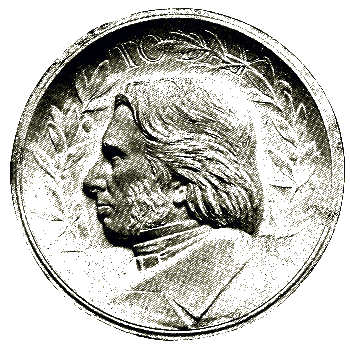
MEDALLION ON THE RUSKIN MEMORIAL, DERWENTWATER
By A.C. Lucchesi
Enlarge image
VIEWS FROM GRETA HALL
'This Greta Hall is a house on a small eminence, a furlong from Keswick, in the county of Cumberland. Yes, my dear Sir, here I am, with Skiddaw at my back—on my right hand the Bassenthwaite Water, with its majestic case of mountains, all of simplest outline. Looking slant, direct over the feather of this infamous pen, I see the sun setting. My God! what a scene! Right before me is a great camp of single mountains—each in shape resembles a giant's tent—and to the left, but closer to it far than the Bassenthwaite Water to my right, is the Lake of Keswick, with its islands and white sails, and glossy lights of evening,—crowned with green meadows; but the three remaining sides are encircled by the most fantastic mountains that ever earthquakes made in sport, as fantastic as if Nature had laughed herself into the convulsion in which they were made. Close behind me flows the Greta; I hear its murmuring distinctly. Then it curves round, almost in a semicircle, and is now catching the purple lights of the scattered clouds above it directly before me.'—A letter of Samuel Taylor Coleridge's.
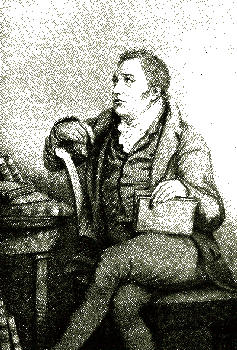
SAMUAL TAYLOR COLERIDGE.
From a Painting by G. Dage, R.A.
Enlarge image