X VICTORIA'S FIRST LAUREATE
Reading edition
WILLIAM WORDSWORTH
'The Age grew sated with her frail wit, Herself waxed weary on her loveless throne. Men felt life's tide, the sweep and surge of it, And craved a living voice, a natural tone.' From Wordsworth's Grave, by William Watson.
WORDSWORTH is, of course, the greatest poet of the English Lake school. He is also the only one born in the lake counties, educated and, with slight exception, resident all his life within them. His birthplace was Cockermouth, his school the Grammar School of Hawkshead; his residences—except what time he briefly dwelt among the southern Quantock Hills—were at Dove Cottage, Grasmere, and Rydal Mount; his burial-place was among his kinsfolk in a quiet corner of Grasmere Churchyard, beneath the sycamores and yews. Most of his compeers and friends—Coleridge, Southey, De Quincey, Charles Lloyd, John Wilson, and even Hartley Coleridge—were born elsewhere, and came to live among these northern mountains in youth or manhood.
He wrote, also, more about our district, and wrote it better, than any other. This was partly due to patriotic devotion to his native corner of our common fatherland, partly because the love of rambling was ingrained in his being, chiefly because he was intuitively a Nature-poet, looking below the grand and the lovely into the mystical heart and core of sights and sounds that conceal and yet reveal their Creator, Fashioner, and Upholder. He was the inspired interpreter of things which ordinary men have not spiritual knowledge to understand—which, indeed, the majority do not so much as behold dimly until one of God's seers lifts the enshrouding veil.
Born in 1770, he died at noon on April 23, 1850. No one now living was contemporary with his birth. Middle-aged admirers of his poems, middle-aged controverters of his claim to pre-eminence, well remember the shadow of death that fell across the nation's heart when they heard the laureate had passed away. 'Surely,' writes F. W. H. Myers, 'of him, if of anyone, we may think as a man who was so in accord with Nature, so at one with the very soul of things, that there can be no mansion of the universe which shall not be to him a home, no governor that will not accept him among his servants, and satisfy him with love and peace.' There are few events to record between his earthly birth and his birth into the upper kingdom—or shall we say his return to that kingdom?—if there is anything in his own suggestion that—
'Not in entire forgetfulness, And not in utter nakedness, But trailing clouds of glory do we come From God who is our home.'
His was a domestic life after he left Cambridge, and had done some Continental travel and some in Scotland. It was spent in cottage homes with his beloved sister Dorothy, for a short while in Dorsetshire, another short while at Alfoxden, in Somerset, and then till his marriage at Grasmere. He was married to Mary Hutchinson at Penrith in 1802. As his family grew he removed successively into two larger houses, and eventually settled at Rydal Mount. Here his life was one of attention to his small Government appointment of stamp distributor, wandering 'lonely as a cloud,' and muttering to himself so much that the peasants deemed him half crazy; meditating upon and composing his immortal poems; and, after he had become famous, receiving literary guests from all the English-speaking peoples. His biography is a biography of the mind, a history of mental processes and tendencies, a record of the gradual creation of his own anthology. There are innumerable lives of him, of less or greater length, from the old one of Paxton Hood, and the most full and capable by his own nephew, and by Professor Knight, to the latest in the 'English Men of Letters Series.' Professor Knight, too, has given the world excellent editions of his poems, excellent selections therefrom, and a charming review of his connection with the lakes. All these are accessible to ordinary readers and hero-worshippers. It will answer my purpose best in this place to note only his local Nature-verses. Yet I may, perhaps, remind this generation that Wordsworth had to win his spurs—the recognition of his right to be ranked in any degree as a poet—and still more to be considered a teacher of his race. His earlier effusions passed through a veritable fire of scornful criticism. 'Primroses,' 'Daffodils,' 'Pet Lambs,' 'Idle Shepherd Boys,' 'Alice Fells' and 'Lucy Grays,' and 'Lines to a Friend's Spade,' were altogether too trivial themes for the responsible and serious muse, while 'Peter Bell' was a special subject of scorn. 'Poems of Sentiment' were merely 'sentimental.' The sonnets and larger pieces, particularly 'The Excursion,' were too heavy, and too laboured to be readable. Pantheism was charged upon him as an objectionable creed. Time justified him largely, and Wordsworth Societies helped to do so still further, though in some respects the slashing critics may have had fair ground. No other poet of his calibre is so unequal in the quality of his output. Wordsworth's poems are by no means, it cannot be too much insisted upon, all on the same high plane of merit, and many will never pass into the world's best thought, as nearly all Tennyson's have, to say nothing of Shakespeare's or Milton's.
He was pre-eminently a revealer of the kingdom of Nature, as seen in the mountains and lakes, the birds, the flowers, the peasantry of the counties of Westmorland and Cumberland, and the over-sea portion of Lancashire. Not only did he write an admirable guide for travellers and tourists in these regions, but there is scarcely a section of this land that he has not rendered classic ground by connecting with it some incident, some allusion, some poetical idealizing. Where shall I begin? With Windermere, of course. You remember this in the Prelude?
'When summer came, Our pastime was, on bright half-holidays, To sweep along the plain of Windermere With rival oar; and the selected bourne Was now an island musical with birds That sang and ceased not; now a sister isle Beneath the oak's umbrageous covert—sown With lilies of the valley like a field; And now a third small island, where survived In solitude the ruins of a shrine Once to Our Lady dedicate, and served Daily with chanted rites.'
Better still than this is another passage from the same poem:
'There was a boy; ye knew him well, ye cliffs And islands of Winander! Many a time At evening, when the earliest stars began To move along the edges of the hills, Rising or setting, would he stand alone Beneath the trees or by the glimmering lake, And there with fingers interwoven, both hands Pressed closely palm to palm, and to his mouth Uplifted, he, as through an instrument, Blew mimic hootings to the silent owls, That they might answer him, and they would shout Across the watery vale, and shout again, Responsive to his call, with quivering peals, And long halloos and screams and echoes, long Redoubled, and redoubled—concourse wild Of jocund din; and when a lengthened pause Of silence came, and baffled his best skill, Then sometimes in that silence, while he hung Listening, a gentle shock of mild surprise Has carried far into his heart the voice Of mountain torrents; or the visible scene Would enter unawares into his mind, With all its solemn imagery, its rocks, Its woods, and that uncertain heaven, received Into the bosom of the steady lake.'
Perhaps it is merely from old associations—the love one had for skating on the flooded and frozen Severn-side meadows, when in one's 'teens'—yet I confess I like even better than either of the foregoing extracts those lines describing the scene when our poet and his schoolmates, 'all shod with steel,' 'hissed along the polished ice in games confederate,' over the wintry floor of Windermere Lake, lines which lead up to
'Ye Presences of Nature in the sky And on the earth. Ye visions of the hills! And souls of lonely places! Can I think A vulgar hope was yours when ye employed Such ministry. When ye through many a year Haunting me thus among my boyish sports, On caves and trees, upon the woods and hills, Impressed upon all forms the characters Of danger or desire; and thus did make The surface of the universal earth With triumph and delight, with hope and fear, Work like a sea?'
Wordsworth did not write much referring to Derwentwater. It was not size so much as beauty that captivated his imagination. What little there is may well be passed over for the poems connected with Ullswater—that English Lake Lucerne—and Helvellyn. Three years after his marriage he visited these regions in a stormy November. Of this short tour he has left a journal, and to its credit we place several of his descriptive verses, notably 'The Pass of Kirkstone,' omitted in some editions of his works. Therein he tells us how the mists, though they obscured the distant views, magnified even the smaller objects close at hand, so that a stone wall might be taken for a monument of ancient grandeur, and the grassy tracts in the semi-light for tarns. The rocks appeared like ruins left by the Deluge, or to altars fit for Druid service, but never carrying the sacred fire unless the glow-worm lit the nightly sacrifice. On another tour it was that his sister Dorothy, always his good genius, called his attention to the gorgeous bed of daffodils, in the woods below Gowbarrow Park—afterwards made famous by his sonnet. 'I never saw daffodils,' he records in his journal, 'so beautiful. They grew among the mossy stones about them. Some rested their heads on these stones like a pillow, the others tossed, and reeled, and danced, and seemed as if they half laughed in the wind, they looked so gay and glancing.' There is also in the journal a paragraph about a singular and magnified reflection about Lyulph's Tower in this lake, though the tower itself was hidden from him behind an eminence. It was on this second tour he wrote, near Brothers Water, verses, somewhat too like a catalogue of articles on view, that close with this happy lilt:
'There's joy in the mountains, There's life in the fountains, Small clouds are sailing, Blue sky prevailing— The rain is over and gone.'
It is among these lines the fancy occurs of which the critics made such surpassing fun—for themselves, certainly:
'The cattle are grazing, Their heads never raising, There are forty feeding like one.'
Not a bad illustration, after all, is this of the facile descent from the sublime into bathos. To the Ullswater period we owe, of course, 'The Somnambulist,' a legend of Aira Force, and a sonnet to Clarkson, the abolitionist, who lived at the foot of the lake. Helvellyn appears in many poems. Grasmere and Rydal, as is only natural, still more often, with their ancient mountains imparting to him 'dream and visionary impulses,' their 'thick umbrage' of beech-trees, their fir-trees beyond the Wishing Gate, and their 'massy ways carried across these heights by human perseverance.' Of the River Duddon he has given us a series of sonnets, some three dozen in number, of which we may hold 'The Stepping-Stones' to be the best, and 'The After-Thought' the best for me to close with, for it is representative of his subtler feelings:
'I thought of thee, my partner and my guide[A] As being past away.—Vain sympathies! For, backward, Duddon! as I cast my eyes, I see what was, and is, and will abide; Still glides the stream, and shall for ever glide; The form remains, the function never dies; While we, the brave, the mighty, and the wise, We men, who in the morn of youth, defied The elements, must vanish;—be it so! Enough, if something from our hands have power To live, and act, and serve the future hour; And if, as toward the silent tomb we go, Through love, through hope, and faith's transcendent dower, We feel that we are greater than we know.'
[A] The river.
HIS PRAYER FOR POETIC INSPIRATION
'Celestial Spirit which erewhile didst deign Our elder Milton's hallowed prayer to hear, Do thou inspire my tributary strain, Breathe thou through every word that sense severe Of Truth; and if ought eloquent appear, Let it to everyone be manifest, That it flows from that empyrian clear, Where thou beside God's throne, a heavenly guest, With vision beatific evermore art blessed!' Charles Lloyd: Stanzas.
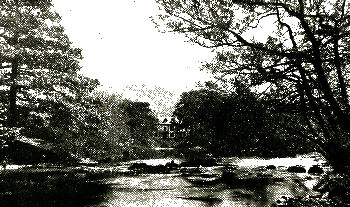
Photo by Herbert Bell, Ambleside.
OLD BRATHAY.
The Home of Charles Lloyd.
Enlarge image