A RELIGIOUS MEDIEVALIST
Reading edition
FREDERICK WILLIAM FABER
II.—HIS BOOKS
'At the evening service, after a few preliminary words, he told his people that the doctrines he had taught them, though true, were not those of the Church of England; that, as far as the Church of England had a voice, she had denounced them.'—Father Bowden's Life of Faber.
FABER'S mental output is a reflex of his character. I assumed this by using his letters and poems as the matrix of the life I sought to present my readers with. Neither I nor they found them rocks of barren quartz. They contained much gold—'yea, much fine gold'—of conscientiousness, devotion, and self-abnegation; of poetic, oratorical fervour; of rare zeal for the Church of his adoption. But with the fine gold there is also much dross. There are, for instance, not a few passages in 'Sights and Thoughts in Foreign Churches' of a startling kind to Englishmen—a book, be it remembered, written while the author was an Anglican clergyman. To him Charles I. was more than 'Charles the Martyr.' He was a King, 'conformed to the image of his Master through suffering.' Most of us will ask whether, supposing Jesus of Nazareth had been King in Charles's stead, there would have been any ship-money, any Star-Chamber, or any Civil War? Surely no man bears the image of Christ any farther than he comports himself Christly in politics and general public as in private life. Christ is a poor Master to serve if Charles was an image of Him. The admitted tyranny and licentiousness of the French Bourbons seemed to him to be condoned because they were great at building churches and convents. National struggles for liberty, and their champions, are usually presented in their worst lights, and the freer the nation the bitterer his words about her. The American Republic is thus a 'proud invalid' for whom there is no cure except by 'a multiplication of bishops, and then a monarchy.' In this book occurs his famous passage in favour of burning heretics. His attempted palliation, or modification, of the passage when challenged by Crabbe Robinson, the Diarist, on their ramble together to Eskdale Tarn, is disingenuous. The objectionable sentiment is explicitly made by 'the stranger,' who is as distinctly alleged to be Faber himself by his biographer, and virtually admitted to Robinson to be so. Here is the excerpt: 'Persecution belongs not, strictly speaking, to the Church. Her weapon, and a most dire one, is excommunication, whereby she cuts off the offender from the fountains of life in this world, and makes him over from her own judgment to that of Heaven in the world to come. But surely it is the duty of a Christian State to deprive such an excommunicate person of every social right and privilege; to lay on him such pains and penalties as may seem good to the wisdom of the law, or even, if they so judge, to sweep him from the earth; in other words, to put him to death. The least that can be done is make a civil death to follow an ecclesiastical death, and this must be done where the Church and State stand in right relation to each other.' To the ultramontane views promulgated in this book might be added others from his letters and published sermons, as, for instance, the phrase, 'the pernicious influence of Protestant ragged schools'; that in which he opposes the reading of the English Bible because its 'uncommon beauty and marvellous English' made it 'the stronghold of heresy'; those in which he elaborately argues for the 'adoration' of Mary ('surely it must be called so,' he says); the many in which he disparages the Reformation and applauds the blessings which the Church, and the Papacy in particular, had bestowed upon the nations; and those, once more, in which he declares a man has no rights as man conferred on him by the Bible, unless he be a Christian (by which he means a Churchman, for he says so), and dilating on the misery and unrest of that Protectionist period, proposes no remedies other than obedience to the Church, the keeping of saints' days and holy days, and the sweeping away of the 'indecent system of pews'! Incredible as it may seem, every one of these proposals is seriously propounded in 'A Churchman's Politics in Disturbed Times.'
One might make large quotations from the Oratory sermons full of descriptions, graphic even to gruesomeness, of the bodily agony of Jesus on the Cross, powerful enough to stir emotional women into hysterical weeping, and to bring them into a profound, if temporary and unreal, sentiment of fellowship with His sufferings, leaving Him still afar off as a risen and personal Friend, and leaving them unmoved by the bleeding figure on the crucifix in the silent recess till the next cerebral excitement. The whole of my articles might be taken up with extracts from his hymns that are simply astounding to the unprejudiced mind in their luscious sentimentality towards Mary and the saints. Of these it may be said the expressions do not necessarily mean all to a Catholic that they seem to a Protestant to imply. But is that so? Who that has watched and heard Italian or Irish worship, or studied the biographies and writings of the Romanist mystics of Italy or Spain, can possibly doubt their perfect sincerity? Is it not an entirely natural transfer of ardent love from the Redeemer to His mother happening concurrently with the priestly transfer of worship, of 'adoration,' from Him to her? Her images are bedecked with flowers and gorgeous attire, and her shrines are brilliantly lighted and are perfumed with incense. His image stands in a dark, neglected, railed-off side-chapel, in all the great cathedrals and rural churches of Romanist Europe.
Some of Faber's best prose is curiously reserved for lamentations over the decay of Paganism!—the 'beautiful births of Greek faith, most radiant legends, springing from every hard and barren spot, like unnumbered springs out of the Parnassian caverns, or the leafy sides of Citheron, or the bee-haunted slope of pale Hymettus.' 'The decline of Paganism was mournful and undignified. Faith after faith went out, like the extinguishing of lamps in a temple, or the paling of the marsh-fires before the rising sun.' Yet were the old creeds full of symbols, and the 'whole of external nature an assemblage of forms and vases capable of, and actually filled with, the Spirit,' and so Greek Paganism was the expression of a wish to 'write God's name on all things beautiful and true.' We can re-echo his dirge and acknowledge the saner, more cheerful side of the 'Paganism' that feels after God, 'if haply it may find Him'; but what a contrast between his attitude towards the non-Christian world and the fellow-Christians—not lacking in as holy teaching or living as his own—whom he had left, for an approachment towards image-worship!
Let us see, now, however, what he can do in description of places and scenery, in both prose and poetry. Here is his first impression of Venice: 'How is it to be described? What words can I use to express that vision, that thing of magic that lay before us?... Never was so wan a sunlight, never was there so pale a blue, as stood round about Venice that day. And there it was, a most visionary city, rising as if by enchantment out of the gentle-mannered Adriatic, the waveless Adriatic. One by one rose steeple, tower, and dome, street, and marble palace; they rose to our eyes slowly, as from the weedy deeps; and then they and their images wavered and floated, like a dream, upon the pale, sunny sea. As we glided onward from Fusina in our gondola, the beautiful buildings, with their strange Eastern architecture, seemed like fairy ships, to totter, to steady themselves, to come to anchor one by one, and where the shadow was, and where the palace was, you scarce could tell. And there was San Marco, and there the Ducal Palace, and there the Bridge of Sighs, and the very shades of the Balbi, Foscari, Pisani, Bembi, seemed to hover about the winged Lion of St. Mark. And all this, all, to the right and left, all was Venice; and it needed the sharp grating of the gondola against the stairs to bid us be sure it was not all a dream.'
He says of Milan Cathedral that 'In the moonlight it disarms criticism. When the moon's full splendour streams on Milan roofs, and overflows upon its lofty buttresses; when the liquid radiance trickles down the glory-cinctured heads of the marble saints, like the oil from Aaron's beard, and every fretted pinnacle, and every sculptured spout ran with light as they might have run with rain in a thunder-shower, who would dare to say there was a fault in that affecting miracle of Christian Art?' Of Corfu, the most perfect earthly Elysium I myself have seen, though I first saw it when returning from the Far East, he writes: 'What traveller does not know the delight of getting among foliage whose shape and hues are not like those of his native land? The interior of the island of Corfu was to us a sweet foretaste of Oriental foliage. We rode among strange hedges of huge cactus, fields of a blue-flowering grain, occasional palms, clouds of blue and white gum cistus, myrtle-shoots smelling in the sun, little forests of the many-branched arbutus, marshy nooks of blossoming oleander, venerable dull olives and lemon groves jewelled with pale yellow fruit. It was a dream of childhood realized, and brought with it some dreary remembrances barbed with poignant sorrows. Dreams, alas! are never realized till the freshness of the heart is gone, and their beauty has lost all that wildness which made it in imagination so desirable.'
'Sir Lancelot,' his longest and most ambitious poem, though finished at Ambleside in 1847, was issued from his Elton Vicarage two years later, and is under the guise of 'an attempt to embody and illustrate the social and ecclesiastical spirit of the thirteenth century,' avowedly an allegory of the soul seeking for that which it is represented as finding only when brought 'back to the foot of Peter's sovran chair.' To us its chief interest lies in his portraiture of our Westmorland surroundings. The hermitage to which the returned Crusader wends his way lies
'Within the Vale of Troutbeck, where towards the head There is a single woody hill, enclosed Within the mountains, yet apart and low. Amid the underwood around, it seems Like a huge animal recumbent there, Not without grace; and sweetly apt it is To catch all wandering sunbeams as they pass, Or volatile lights in transit o'er the vale.'
Who among us does not recognise it? Who does not know 'the bell-shaped mountain which the wild winds ring full mournfully'? And the beck, too, where the ouzel flits even in winter on the 'ice-rimmed stones,' and the banks, whereon Sir Lancelot might lie and watch 'the flowery troops in pageant movable'—the snowdrops 'like a flock of children purely white,' the 'deep Lent-lilies, like constellations girt with lesser orbs.' When he crosses to the western sea 'angry and purple, far and wide outspread in stormy grandeur,' we go with him, and as we wander thitherward see Scawfell 'palpitating in the haze,' feel 'the tingling of the woodlands' at night-time down the valley of the Duddon, and learn how Esk is 'suckled in sylvan places' by 'clusters of wild tarns.'
Among his minor local poems 'English Hedges'—the Saxon hedgerows—are apostrophized:
'The hedges still survive, shelters for flowers, An habitation for the singing birds, Cool banks of shadow, grateful to the herds, A charm scarce known in any land but ours.'
And in 'Mountain Tarns' he sings:
'There is a power to bless In hillside loneliness— In tarns and dreary places— A virtue in the brook, A freshness in the look Of mountains' joyless faces— And so when life is dull, Or when my heart is full Because my dreams have frowned, I wander up the rills To stones and tarns, and hills— I go there to be crowned.'
If we turn to Faber's purely devotional writings, such as 'All for Jesus,' and can forget, or slide over, the subtle insinuations of Romish doctrines, and the curious blending of saints and sacraments, popes and priests, confessions and penances, with earnest appeals on behalf of Jesus, at one time as though the soul's salvation depended solely on ceremonials and priestly absolutions, and at another time as if on 'Jesus only,' one may find much help and light in many beautiful passages—as, for example: 'Who can look into the world and not see how God's glory is lost upon the earth? It is the interests of Jesus that we should seek and find it. Apart from clear acts of great and grievous sin, how is God forgotten, clean forgotten, by the greatest part of mankind! They live as if there were no God. It is not as if they openly rebelled against Him. They pass over and ignore Him. He is an inconvenience in His own world, an impertinence in His own creation. So He has been quietly set on one side, as if He were an idol out of fashion, and in the way. Men of science, and politicians, have agreed on this, and men of business and wealth think it altogether the most decent thing to be silent about God, for it is difficult to speak of Him, or have a view of Him, without allowing too much to Him.... Half a dozen men, going about God's world, seeking nothing but God's glory—they would remove mountains. This was promised to faith—why should not we be the men to do it?'
Similarly burning words, apart from his descriptions of Calvary, might be quoted from his sermons, but, alas! these would lack the passionate personality behind them, with the flashing eye, the expressive emphasizing hands, and, above all, the voice rising like the swelling of bells in the steeple, or tender as a silver chord trembling into silence. Without the spirit to make them live, let us not try to reproduce them.
THE BLACK ANT
This fly is an inhabitant of woods and coppices, and is very abundant in the neighbourhood of the English Lakes. The nest is often of enormous size, sometimes containing more than a cart-load of sticks and small twigs. The Vale of Duddon swarms with wood ants, and is the only place where I have seen the wryneck, which is said to feed principally on these insects. Like other ants, they have the enjoyment of wings for a few weeks in each year, and often, as the proverb says, "to their sorrow," as by them they are conveyed to places where they suffer greatly from birds, as well as from fishes. They generally make their appearance in August and September. Body, a strand of peacock's herl, and one of black ostrich's herl laid on together; silk, dark brown; wing, the lightest part of a starling's quill; hackle from a black cock.'—John Beever: Practical Fly-Fishing.
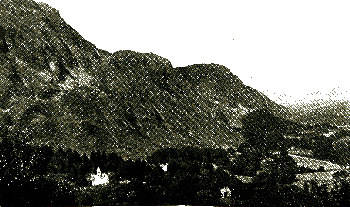
Photo by Herbert Bell, Ambleside.
YEWDALE.
The Favourite Valley of John Ruskin (see p. 64), and of the Sisters of the Thwaite.
Enlarge image