XI A FRIEND OF GREAT POETS
Reading edition
CHARLES LLOYD
'Long, long, within my aching heart, The grateful sense shall cherished be; I'll think less meanly of myself, That Lloyd will sometimes think on me.' Charles Lamb.
MANY will, no doubt, ask who this man was, and where he lived? Such a question shows small acquaintance with either the biographies or writings of the great poets of the Lake School, or of Charles Lamb or Thomas De Quincey. He was the personal and highly-valued friend of them all, and his name and residence are too frequently mentioned in their letters and publications to escape the notice of even casual readers. He was the collaborateur of S. T. Coleridge and Charles Lamb in their first joint volume of poems, published by Joseph Cottle, bookseller, of Bristol, their kind patron in early days of struggle. He became a 'celebrity' of this district when he went to reside at Low Brathay, near Ambleside, fixing his home by the rushing rivulet of the Langdales, and beneath the lofty summit of Loughrigg, the mountain beloved of Fosters, and Arnolds, and their compeers and neighbours. He was born in 1775 at Birmingham, his father being a member of the Society of Friends, one of the wealthy banking firm, and a philanthropist and man of culture. He, the elder Lloyd, was a lover and translator of Homer and Horace, and specially a student of Greek literature, thereby helping to disprove the random assertion of a recent novelist that the Quakerism of the past generation was utterly antagonistic to the culture and spirit of old Greece.
When Charles was about of age, and had declined entering his father's bank, that he might give himself up to poesy, Coleridge visited Birmingham on the profitless errand of obtaining subscriptions to his magazine. He took a great liking to the new and rising author, and followed him to Bristol. Coleridge was very poor (Wedgewood's pension had not yet been granted), and was very shiftless to boot. Lloyd provided him with a free home and with access to sorely-needed books. When Coleridge removed to Nether Stowey, on the Quantock Hills, Lloyd went too, and again kept house. Here they were near Wordsworth, then residing at Alfoxden. One result of this acquaintance was the marriage of Lloyd's sister to a younger brother of the future Laureate. A strange, unpractical company these poets and philosophers were, and their ways were erratic. The story of their inability to put a collar on their pony till shown by a servant-girl, is well known. The landlord of Alfoxden refused to renew the letting of the house to Wordsworth because of his rumoured odd manners and habits. Here, at Nether Stowey, poor Lloyd appears first to have developed the epilepsy that, increasing in intensity, at last ended in madness. He was, no doubt in consequence of these fits, liable to extreme depression, and his morbidness, a source of anxiety and irritation to his friends, may have lain at the root of a quarrel between them, which the indispensable Cottle helped to settle, relating to their joint authorship, to which Lloyd had contributed the larger quantity of MSS. and the larger share of funds, if not the more excellent material.
As a poet and novelist he is now virtually forgotten. I can find no copies of his works in any public or subscription library in this locality, nor is there one of them in the invaluable London Library among all its hundreds of thousands of volumes. Yet those that exist are worth much money. In a second-hand dealer's catalogue I see there is a copy of the poems priced at no less than fifty shillings, at least ten times its original price. His novels I have failed altogether to find. 'Edmund Oliver' embodies the account, transferred to a fictitious hero, of Coleridge's disappointment in love while at Cambridge, an event which led to his enlisting in a cavalry regiment. It tells nothing but the truth when it humorously narrates the rough-riding experiences and the torture of the unhorsemanlike student-soldier, and pictures the astonishment of a cultured officer on discovering a Latin inscription on a stable wall, and on inquiry a trooper able to converse in Greek and ready to discuss at egregious length the most abstruse questions in philosophy. This episode alone makes the book interesting to collectors.
But though neither 'Edmund Oliver,' a novel in two volumes; nor 'The Duc d'Ormond,' a tragedy; nor 'Beritola,' a tale; nor even 'Desultory Thoughts in London,' are easy to find outside the British Museum Library, yet Lloyd clearly deserves a nearer approach to immortality than he has attained. De Quincey writes of him in his 'Literary Reminiscences': 'At Brathay lived Charles Lloyd. Far as he might be below the others I have mentioned, he could not be called a common man. Common! He was a man never to be forgotten! He was somewhat too Rousseauish, but he had in conversation the most extraordinary powers for analysis of a certain kind, applied to the philosophy of manners and the most delicate nuances of social life.' He could not be a mere hanger-on to greater men to whom several poets addressed sonnets of affection and admiration. Charles Lamb, whose contributions to the early joint volume were few, while he speaks of Lloyd's as over a hundred, 'though only his choice fish,' is quite enthusiastic, exclaiming:
'Friend of my bosom, thou more than a brother, Why were't thou not born in my father's dwelling, So we might talk of the old familiar faces?'
One, and the chief, labour undertaken by Lloyd at Brathay, after his marriage and permanent settlement there, was a voluminous translation of Alfieri's poetical works from the Italian. It is spoken of as faithful to the original and full of the truest poetic insight. In the judgment of competent critics his translations were better than his own compositions, even of those of his later years, such as his 'Nugæ Canoræ,' published about the same time as Professor Wilson's 'Isle of Palms,' of which, by-the-by he received a presentation copy as a token of regard from the author, with whom he was on intimate terms. Lamb in writing to Lloyd, gives him rather a back-handed testimonial when he says, 'Your verses are as good and wholesome as prose,' while in another letter he says, 'Your lines are not to be understood on one leg! They are sinuous and to be won with wrestling.' Probably the key to this remark is contained in Talfourd's statement that Lloyd wrote 'with a facility fatal to excellence.' On the other hand, the spitefully sarcastic and foolish sentences of Byron, uttered against Wordsworth and his 'school,' inclusive of the subject of this paper, seem almost beneath contempt:
'Vulgar Wordsworth,' quoth he, 'the meanest object of the holy group, Whose verse of all but childish prattle void, Seems blessed harmony to Lambe and Lloyd.'
Lambe (whose name should have no 'e' at the end) and Lloyd, he adds in a footnote, are 'the most ignoble followers of Southey and Co.' Fancy a Byron sneering at Southey, Wordsworth, and Lamb! These, at least, are equal, if not superior, to himself, even if Lloyd is confessedly beneath him in merit. However, I can, fortunately, give my readers a specimen of one of Lloyd's sonnets, admired and preserved by Bernard Barton. It is addressed to God on behalf of his own father, the Birmingham philanthropist:
'Oh Thou who, when Thou mad'st the heart of man, Implanted'st there, as paramount to all, Immortal conscience; do Thou deign to scan With favouring eye these lays which would recall Man to his due allegiance. Nothing can Thrive without Thee; hence at Thy throne I fall And Thee implore to go forth in the van Of these my numbers, Lord of great and small! Bless Thou these lays, and, with a reverent voice, Next to Thyself would I my father place Close at Thy threshold; true to his youth's choice His deeds with conscience ever have kept pace; Great Father, bid my "earthly sire" rejoice, A white-robed Christian in Thy safe embrace.'
Bernard Barton calls it a 'noble sonnet.'
But the end was nearing. The fits and morbid impressions were followed by illusory voices and cries, and at last Wilson writes his wife: 'Poor Lloyd is in a madhouse.' He seems to have been for awhile in the well-known 'Retreat' at York, from whence he escaped, and was ultimately removed to an asylum in France, where, after some years, he died. In happier days he had married a Miss Pemberton, who is said to have been carried off by Southey on his friend's behalf. She was a capable and appreciated housewife, but her sanity did not prevent the transmission of her husband's disease to his son, the Rev. Owen Lloyd, a highly respected clergyman, with his father's poetic tastes and genius, and a close friend of 'lile' Hartley Coleridge.
Such, in brief, is the story, interesting yet melancholy, of one whose high character and culture and rare social qualities endeared him to a wide circle of men in the first literary ranks, and who was cordially esteemed by another and outer circle, in which was Leigh Hunt, who writes of him as 'a Latinist—much shaken by illness, but of an acute mind, and metaphysical.'
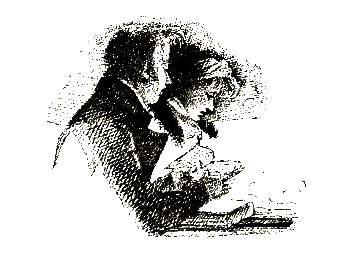
CHARLES LLOYD AND HIS WIFE.
From a rare Painting. By permission of J. M. Dent, Esq.
Enlarge image
THE COMING OF THE YACHTS TO WINDERMERE REGATTA
'Bowness Bay is the rendezvous for the Fleet. And lo! from all the airts, coming in the sunshine, flights of felicitous wide-winged creatures, whose snow-white lustre, in bright confusion hurrying to and fro, adorns, disturbs, and dazzles the broad blue bosom of the Queen of Lakes. Southwards from forest Fell-Foot beneath the Beacon Hill, gathering glory from the sylvan bays of green Graithwaite, and the templed promontory of stately Storrs, before the sea-borne wind, the wild swans, all, float up the watery vale of beauty and of peace. Out from that still haven, overshadowed by the Elm-grove, where the old parsonage sleeps, comes the Emma murmuring from the water-lilies, and as her mainsail rises to salute the sunshine, in proud impatience lets go her anchor the fair Gazelle. As if to breathe themselves before the start, cutter and schooner in amity stand across the ripple, till their gaffs seem to cut the sweet woods of Furness Fells, and they put about, each on less than her own length, ere that breezeless bay may show, among the inverted umbrage, the drooping shadows of their canvass. Lo! Swinburne the Skilful sallies from his pebbly pier, in his tiny skiff that seems all sail; and the Norway Nautilus, as the wind slackens, leads the van of the Fairy squadron which heaven might now cover with one of her small clouds, did she choose to drop it from the sky.'—John Wilson: Christopher at the Lakes.
Photo by Herbert Bell, Ambleside
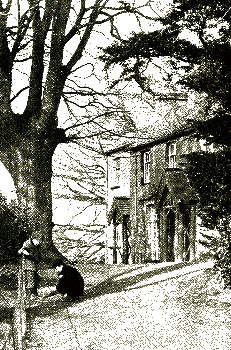
ELLERAY, WINDERMERE.
The Home of Professor John Wilson, as it then was.
Enlarge image