II A PIONEER OF POLITICAL REFORM
Reading edition
HARRIET MARTINEAU
'She was born to be a destroyer of slavery, in whatever form, in whatever place, all over the world, wherever she saw or thought of it ... in the degraded offspring of former English poor-law ... in English serfdom forty years ago ... in the fruits of any abuse—social, legislative, or administrative—or in actual slavery.'—Florence Nightingale.
PERHAPS the most instructive and reliable book ever written about the actual condition of England, and about her people's struggles for light, liberty, and better conditions of life during the first half of the nineteenth century is Miss Martineau's 'History of the Thirty Years' Peace.' It is emphatically a citizen's history as distinguished from a partizan politician's, and it ought to be read, together with her 'Introduction' to it, by every young man who desires to possess an intelligent acquaintance with the social problems of his age and country. The ignorance of the present generation of youthful electors, when compared with the knowledge of their parents at a similar time of life, often astounds me. It is probably due to two causes—first, to the fact that their fathers were, forty or fifty years ago, only just emerging from the dust and smoke of hard-fought political battles, and so had the causes of them well engrained into their minds, while they of this generation have not yet so much as 'smelt powder' in the struggle against still-existing grievances; and, secondly, that the present-day education in elementary schools practically ignores the teaching of history, while ordinary secondary schools teach English history only in 'samples,' and those seldom of the most modern periods. No other of Harriet Martineau's works will take rank with her 'Thirty Years' Peace,' yet they all had a great reputation when she was reckoned the greatest living English woman, and they nearly all had a wide sale, though, having been written for passing purposes, they naturally died out of the popular memory when their purposes were accomplished, and fresh interests had come into view. They were mostly stories—novelettes—written to illustrate such questions as the then burning ones of free trade, colonization by emigration of the pauper and the criminal, the incidence and amendment of the Poor Laws, the repression and punishment of crime, actual and ideal systems of taxation, the relationships of capital and labour, and the like. In addition to these, she wrote a few volumes of pure fiction, some reminiscences of travel in the East—through Egypt, across the Sinaitic desert, and northwards past Jerusalem to Damascus—and some others respecting her stay in the United States of America in the troublous anti-slavery times preceding the Civil War. In her earlier days she also wrote some religious and theological essays and sketches for Unitarian magazines. Of her fictions, two may be mentioned—'Deerbrook,' which she considered her masterpiece, and 'Feats on the Fjord.' The latter was favourite reading of my own boyhood. I took it to Norway with me in later days, and found it in every way a most accurate description of Scandinavian farm life, as well as of coast and mountain scenery—in fact, quite as much so as the stories of Björnstjerne Björnson himself. The extraordinary thing about this is that the authoress had never been in Norway, and took all the settings of her hero's adventures from narratives of other people's travels.
Her autobiography—written when, in advancing age, heart-disease had marked her for its victim at no distant date—with the appendix thereto, compiled by her devoted friend, Mrs. Chapman—furnishes us with all the available materials for a sketch of her life; and, indeed, it is the most valuable of all her multitudinous productions, with the exception already noted. It is the story of a noble and unceasing struggle, successfully carried through, against internal difficulties, both mental and physical of no ordinary character, and against external ones that would have beaten any commonplace person. It is, however, also a revelation of spiritual processes and of gradual abandonment of once-cherished beliefs that does not fascinate us, and leaves us with grave doubts as to the acuteness of her philosophical insight, and of her grasp of real Christian teaching. Perhaps, too, it was natural that her independence of character, and her constant overwork and overstrain, should lead her into impatience of the frailties of others, and quicken her contempt for many of the celebrities she knew personally.
Born in 1802 of Unitarian parents, in Norwich, she grew to be a shy, sensitive, but quietly-observant and clever girl. Her upbringing was on the repressive lines of a conscientious but narrow-minded mother, who was without sympathy for, or knowledge of, her 'ugly duckling's' yearnings or capacity. The last thing the mother dreamed of was that the 'ugly duckling' was in truth a cygnet, whose swan-plumage the world would one day recognise. The daughter longed inexpressibly for words and deeds of parental love which never came to her, and so she grew silent, introspective, and morbid. In mature age she became morbidly ashamed of her childhood's, perhaps inevitable, morbidness. When her literary instincts were bound to find a vent, her first venture in magazine articles had to be made in secret, and, when they were discovered, efforts were made to repress any continuation of them, and she was sternly told to stick to her sewing-needle. She was fortunate in being sent to a good day-school, which counteracted by its learned and genial atmosphere the influences of home. It was, too, a blessing in disguise when, her never robust health failing, her parents sent her to relatives in Bristol, whose joyous spirits and cultured tastes were an inspiration to her. A tendency to deafness, which became chronic, and at last compelled the habitual use of an ear-trumpet, did not, till she conquered the disadvantage by her brave fortitude, make her desirous of company or help her to make much way in it.
The one trusted friend of her youth was her beloved younger brother James, afterwards the eminent Unitarian minister and theologian. To him she confided her secret aspirations, and he encouraged her finally to proceed to London and try and find a publisher for the series of political economy stories she projected writing. Her heroic efforts to find someone who would risk putting them on the market is one of the romances of literary biography.
Her father was dead. The manufacturing firm in which her mother's monies were invested had failed. She was alone in London, and without knowledge or influence. How she 'trudged many miles through the clay of the streets, and the fog of the gloomiest December,' only to be rejected, sometimes politely, and sometimes rudely, by everyone to whom she showed her MSS. and explained her scheme; and how at last she despairingly accepted what seemed almost impossible, and certainly were unreasonable, terms, offered by a young bookseller without business connections; how a wealthy relative unexpectedly stepped in to guarantee a portion of her personal risk; and how she suddenly sprang into fame—are not all these things faithfully set forth in her autobiographical chapter headed 'Aged Twenty-nine'? From depths of discouragement that would have effectually damped most aspiring authors she at once became a 'society lion,' or rather, to retain our former metaphor, she was hailed as one of the swans of literature, and, as was said of the royal bird in Andersen's parable, 'the most beautiful of them all.' She endured a long and terrible strain, while for several years producing a story a month, which broke down her health seriously, yet she attended nearly every evening some social function, which brought her into intimacy with the most celebrated men and women of her generation.
It is in her records of this period that the most unpleasant traits in her disposition become apparent. Almost every page betokens a spirit of captious criticism of her acquaintances, and almost every one is belittled by her.
About this time, too, Unitarianism lost altogether its slackening hold of her. She saw that its dogmas were entirely contrary to Scripture revelation and teaching, but instead of rectifying her faith to the Christian standard, she abandoned the standard itself, and became an avowed Positivist. She writes herself down as a convinced 'Necessitarian,' though if anyone's life and conduct effectually belied such a creed it was hers. No one ever gave stronger proofs of a self-determined will, free from all external or internal compulsion, than she.
Money as well as fame became now her well-earned portion, and she found herself able to purchase an annuity, spend some time abroad, and buy land and build a house thereon at Ambleside, by the shores of beautiful Winander. In this charming home she spent her declining years, following her favourite pursuits, advocating mesmerism, which she considered had raised her up from a long-endured nervous prostration, and playing with success the part of the Lady Bountiful to the neighbourhood. It was whilst at this place that she translated the works of Comte, and lost thereby, what she valued most in the world—the intimacy of her beloved brother James, who, like herself, a model of conscientiousness, publicly reviewed her introductions and comments with some severity. Both brother and sister had opinions, held them tenaciously, and expressed them fearlessly. On her side no sign of change from Positivism was ever given. The same dauntless spirit which bore her through the anti-slavery campaign, when in America she was threatened by the slave-owners with personal violence, upheld her now in her championship of the philosophy of altruism without a Divine Fatherhood. We believe her mistaken, but admire her unflinching adhesion to what she deemed the truth.
It was in her beautiful house, The Knoll, that she passed behind the veil, and entered into the clear seeing of eternity. She died, says her closest friend and biographer, 'in the summer sunset of her home amid the Westmorland mountains, on June 27, 1876, after twenty-one years of diligent, devoted, suffering, joyful years there, attended by the family friends she most loved, and in possession of all her mental powers up till the last expiring day, aged seventy-four years.' She lies among her kindred, descendants of French refugees, in the old cemetery at Birmingham.
In her maidenhood she had once loved, and been beloved by one of the other sex, but events occurred to prevent the consummation of her love by marriage, and it proved a happy escape. Thenceforward she lived only to endure
'Many a lofty struggle for the sake Of duties, sternly, faithfully fulfilled, For which the anxious mind must watch and wake, And the strong feelings of the heart be stilled.'
THE TRUE POET
'Who wears a singing-robe is richly dight; The Poet, he is richer than a King. He plucks the veil from hidden loveliness; His gusts of music stir the shadowing boughs, To let in glory on the darkened soul. Upon the hills of light he plants his feet To lure the people up with heart and voice; At humblest human hearths drops dews divine To feed the violet virtues nestling there. His hands adorn the poorest house of life With rare abiding shapes of loveliness. All things obey his soul's creative eye; For him earth ripens fruit-like in the light; Green April comes to him with smiling tears, Like some sweet maiden who transfigured stands In dewy light of first love's rosy dawn, And yields all secret preciousness, his Bride. He reaps the Autumn without scythe or sickle; And in the sweet low singing of the corn Hears Plenty hush the pining Poor.' Gerald Massey.
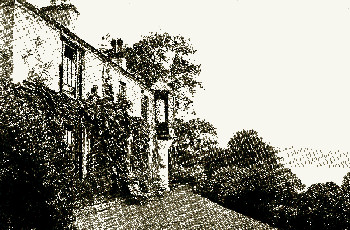
BRANTWOOD, CONISTON LAKE The Home of Harriet Martineau (1855-1876).
Enlarge image