VIII A LIFE TO PITY
Reading edition
HARTLEY COLERIDGE
'Hartley Coleridge has come much nearer us, and probably you might see as much of him as you liked. Of genius he has not a little, and talent enough for fifty.'—Wordsworth.
'Dined at Mrs. Fletcher's. H. Coleridge behaved very well. He read some verses on Dr. Arnold which I could not comprehend, he read them so unpleasantly; and he sang a comic song that kept me very grave. He left us quite early.'—Crabbe Robinson's Diary.
POOR 'Lile Hartley'—little Hartley, as the neighbours called him—is one of the most pathetic figures in English literature. Undersized in body, of promising intellect from childhood, of child-like simplicity in character, devoid of self-control, and overmastered by the alcoholic habit, as his father was by the opium habit, he is at once pitiable, excusable, and lovable. As you ride from Ambleside to Grasmere you pass a low cottage on your right, just beneath Nab Scarr, where the young farmer and his wife lived who cared so unselfishly for him and for his comfort and welfare. It is locally known as 'Coleridge's Cottage.' Here he lived in later manhood, followed and brought home tenderly, when he had wandered away, by his kind-hearted caretakers, and writing prose essays and sweet sonnets in hours of freedom from his besetment.
By birth Hartley Coleridge belongs to the West Country, having come into the world while his parents lived on Redcliffe Hill, Bristol, shortly after their return from their little flower-covered, poverty-stricken Clevedon Cottage. The National Dictionary of Biography is in error in giving Rose Cottage as his birthplace. It was beyond all doubt Bristol, and he was born during the autumn of 1796. 'A pretty and engaging child,' his brother Derwent says he was. There must have been something attractive about the babe, for it is given to few to be apostrophized by two poets at so early an age, especially by two such as his own father and his father's friend, William Wordsworth. Great things were anticipated for him in the future by both the seers. He was taken to London for a visit when three years old, and, after being mystified by the street lamps, he suddenly exclaimed: 'Oh! now I know what the stars are: they are lamps that have been good upon earth, and have gone up into heaven!' At six years of age he was removed with the family to Keswick. Here for a season the two households of Coleridge and Southey dwelt at Greta Hall, an occurrence which seems in many ways to have remarkably influenced his career. Those who came in contact with him at this place speak of him as pouring forth, with flashing eyes, strange speculations far beyond his years, and weaving wild inventions. His dreamy boyhood was varied by another stay in London and a visit to Bristol, in both which places further mundane knowledge was acquired, only to be forthwith transmuted into the visions which filled his mental life. His very play related to the history of a kind of Utopia, its populations, its geography, its constitution, its wars, its politics. 'Ejuxria' was the name he gave his island kingdom, and he prolonged the existence of it for himself and his playmates beyond the length of the famous thousand and one nights of the Eastern story-teller. Everything he saw, everything he read, became forthwith 'Ejuxrian.' This habit of introversion and lack of practicality changed its forms as he grew older, but never left him. When at length he went to a boarding-school at Ambleside—or, rather, was placed in a clergyman's house near it with a few other boys for private tuition—his power of improvization was encouraged by his companions demanding long-drawn-out romances from him, while his morbid tendencies and consciousness of his small stature induced the habit of lonely wanderings and musing.
Desultory reading and frequent intercourse with his father's friends—Southey, Wordsworth, Professor Wilson, De Quincey, and Charles Lloyd—formed the chief part of his early education. He seems to have been as a schoolboy truthful, dutiful, and thoughtful, but with great infirmity of will and subject to paroxysms of passion and heartbroken repentance. From school to Oxford University was a natural and proper advance. Unfortunately, his rare conversational qualities made him much sought after for students' wine parties. The result of this was that, although he passed his exams. creditably, and won an Oriel Fellowship, he was judged to have forfeited this Fellowship by his intemperance. The authorities were inexorable. No expostulation or influence could save him. It is probable some freedom of speech offensive to the narrow-minded dons of his day had something to do with their hardness. Sympathy and kindly common-sense might have recovered him just then from his snare. As it was, he tried for literary employment in London with little success, though his tarriance there resulted in a further development of his alcoholic tendency. Thence he drifted back to Ambleside, where he tried school-keeping, but in vain. He had no disciplinary power, and one by one his pupils were removed, till the school collapsed. From there he went to the Grasmere Cottage, already spoken of, facing the lovely little lake of Rydal, a blue island-dotted gem framed in with lofty green mountains. Everybody loved the lonely, affectionate man—a keen observer of Nature, an inspired writer of poetry—and everybody grieved when the end came one winter's day of 1849, and his remains were buried in Grasmere Churchyard. There a little group of us stood but a while ago, reverently uncovered, beneath the yews that overshadow his grave and the graves of the Wordsworth family. That he knew his weakness and lamented it, and at seasons valiantly struggled to overcome it, is certain, and one cannot help wondering whether he would not have triumphed ultimately had he lived in a teetotal age, when he could have been surrounded by abstaining companions, who would have sheltered him and kept him out of perpetually recurrent temptations. Some of his more personal verses are sadly suggestive both of his struggle and his need:
'A woeful thing it is to find No trust secure in weak mankind, But tenfold woe betide the elf Who knows not how to trust himself.'
And again he writes:
'Oh woeful impotence of weak resolve, Recorded rashly to the writer's shame, Days pass away, and Time's large orbs revolve, And every day behold me still the same, Till oft-neglected purpose loses aim, And hope becomes a flat, unheeded lie, And conscience, weary with the work of blame, In seeming slumber droops her wistful eye, As if she would resign her unregarded ministry.'
Passing lightly over his 'Northern Worthies,' some dozen or so of biographic sketches, good and capable 'pot-boilers'—yet 'pot-boilers' essentially—one comes to his essays, written for Blackwood and other magazines and papers, and his marginalia written in his books and published after his death. We cannot but be struck with the immense variety of subjects dealt with in his essays. Many of them are signed by a pseudonym, such as 'Thersites' if on 'Heathen Mythology'—or 'Tom Thumb the Great' if 'Brief Observations upon Brevity'—or 'Ignoramus' if a series on the 'Fine Arts'—and very few were issued in his own name. Some are full of quaint humour, such as 'Thoughts on Horsemanship, by a Pedestrian,' 'A Nursery Lecture delivered by an Old Bachelor.' Others have a fine literary flavour, as, for example, 'Shakespeare, a Tory and a Gentleman,' or 'On the Character of Hamlet.' It is, however, as a sonnetteer he will be longest remembered, and as a writer of miscellaneous verses. When rowing round Grasmere Lake the other day we recalled his lines, beginning:
'Within the compass of a little vale There lies a lake unknown in fairy tale, Which not a poet knew in ancient days, When all the world believed in ghosts and fays; Yet on that lake I have beheld a boat That seemed a fairy pinnace all afloat, On some blest mission to a distant isle To do meet worship in some ruined pile, Where long of yore the Fairies used to meet And haply hallow with their last retreat.'
Sometimes, too, when religious controversies grow warm around the good old revelation those verses of his come to remembrance, called 'The Word of God':
'In holy books we read how God hath spoken To holy men in many different ways; But hath the present work'd no sign or token? Is God quite silent in these latter days? 'And hath our Heavenly Sire departed quite, And left His poor babes in this world alone, And only left for blind belief—not sight— Some quaint old riddles in a tongue unknown?'
Hartley Coleridge's longer and more ambitious pieces do not commend themselves to the public as do his shorter ones. His forte was in—
'Singing of the little rills That trickle down the yellow hills To drive the Fairies' water-mills;'
of children whom he doted upon,—of 'the merry lark that bids a blithe good-morrow,'—of 'summer rain'—of 'rose, and violet, and pansy, each with its tale of love'—of poor Mary Magdalene. From his own soul, as from Mary's, it may be the Lord has 'wiped off the soiling of despair.' May we find it has been so when we ourselves reach the great hereafter.
KESWICK IN WINTER
'Summer is not the season for this country. Coleridge says, and says well, that then it is like a theatre at noon. There are no goings on under a clear sky.... The very snow, which you would perhaps think must monotonize the mountains, gives new varieties; it brings out their recesses and designates all their inequalities, it impresses a better feeling of their height, and it reflects such tints of saffron, or fawn, or rose-colour to the evening sun. O Maria Santissima! Mount Horeb with the glory upon its summit might have been more glorious, but not more beautiful than Skiddaw in his pelisse of ermine. I will not quarrel with frost, though the fellow has the impudence to take me by the nose. The lakeside has such ten thousand charms; a fleece of snow or of the hoar-frost lies on the fallen trees or large stones; the grass-points, that just peer above the water, are powdered with diamonds; the ice on the margin with chains of crystal, and such veins and wavy lines of beauty as mock all art; and, to crown all, Coleridge and I have found out that stones thrown upon the lake, when frozen, made a noise like singing birds, and when you whirl on it a large flake of ice, away the shivers slide, chirping and warbling like a flight of finches.'—A letter of Robert Southey's.
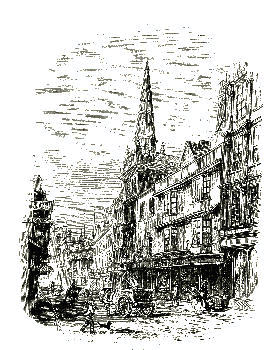
WINE STREET, BRISTOL.
The Birthplace of Robert Southey.
Enlarge image