Front matter
Reading edition
Transcriber’s note: A few typographical errors have been corrected. They appear in the text like this, and the explanation will appear when the mouse pointer is moved over the marked passage.
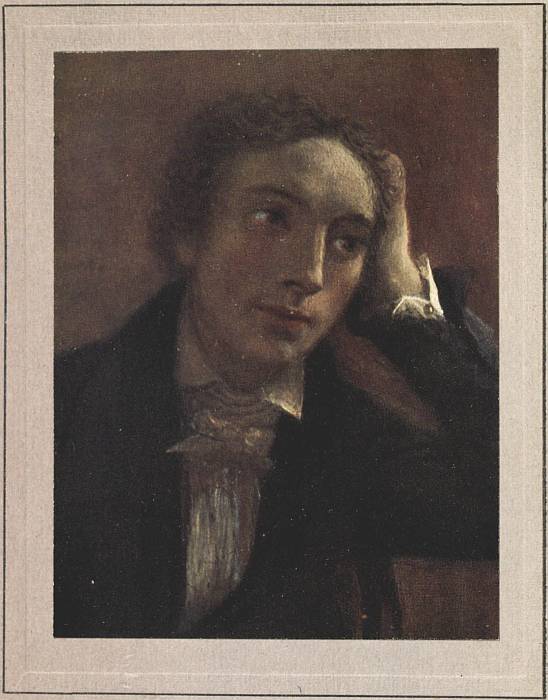
JOHN KEATS
HIS LIFE AND POETRY HIS FRIENDS CRITICS AND AFTER-FAME
BY
SIDNEY COLVIN
MACMILLAN AND CO., LIMITED ST. MARTIN’S STREET, LONDON 1917
COPYRIGHT
GLASGOW: PRINTED AT THE UNIVERSITY PRESS BY ROBERT MACLEHOSE AND CO. LTD.
S. C.
TO
F. C.
PREFACE
To the name and work of Keats our best critics and scholars have in recent years paid ever closer attention and warmer homage. But their studies have for the most part been specialized and scattered, and there does not yet exist any one book giving a full and connected account of his life and poetry together in the light of our present knowledge and with help of all the available material. Ever since it was my part, some thirty years ago, to contribute the volume on Keats to the series of short studies edited by Lord Morley, (the English Men of Letters series), I have hoped one day to return to the subject and do my best to supply this want. Once released from official duties, I began to prepare for the task, and through the last soul-shaking years, being over age for any effectual war-service, have found solace and occupation in carrying it through.
The following pages, timed to appear in the hundredth year after the publication of Keats’s first volume, are the result. I have sought in them to combine two aims not always easy to be reconciled, those of holding the interest of the general reader and at the same time of satisfying, and perhaps on some points even informing, the special student. I have tried to set forth consecutively and fully the history of a life outwardly remarkable for nothing but its tragic brevity, but inwardly as crowded with imaginative and emotional experience as any on record, and moreover, owing to the open-heartedness of the man and to the preservation and unreserved publication of his letters, lying bare almost more than any other to our knowledge. Further, considering for how much friendship counted in Keats’s life, I have tried to call up the group of his friends about him in their human lineaments and relations, so far as these can be recovered, more fully than has been attempted before. I believe also that I have been able to trace more closely than has yet been done some of the chief sources, both in literature and in works of art, of his inspiration. I have endeavoured at the same time to make felt the critical and poetical atmosphere, with its various and strongly conflicting currents, amid which he lived, and to show how his genius, almost ignored in its own day beyond the circle of his private friends, was a focus in which many vital streams of poetic tendency from the past centred and from which many radiated into the future. To illustrate this last point it has been necessary, by way of epilogue, to sketch, however briefly, the story of his posthumous fame, his after life in the minds and hearts of English writers and readers until to-day. By English I mean all those whose mother language is English. To follow the extension of Keats’s fame to the Continent is outside my aim. He has not yet, by means of translation and comment in foreign languages, become in any full sense a world-poet. But during the last thirty years the process has begun, and there would be a good deal to say, did my scheme admit it, of work upon Keats done abroad, especially in France, where our literature has during the last generation been studied with such admirable intelligence and care.
In an attempt of this scope, I have necessarily had to repeat matters of common knowledge and to say again things that others have said well and sufficiently already. But working from materials hitherto in part untouched, and taking notice of such new lights as have appeared while my task was in progress, I have drawn from them some conclusions, both biographical and critical, which I believe to be my own and which I hope may stand. I have not shrunk from quoting in full poems and portions of poems which everybody knows, in cases where I wanted the reader to have their text not merely in memory but actually before him, for re-studying with a fresh comment or in some new connexion. I have also quoted very largely from the poet’s letters, even now not nearly as much read as things so full of genius should be, both in order that some of his story may be told in his own words and for the sake of that part of his mind—a great and most interesting part—which is expressed in them but has not found its way into his poems. It must be added that when I found things in my former small book which I did not see my way to better and which seemed to fit into the expanded scale of this one, I have not hesitated sometimes to incorporate them—to the amount perhaps of forty or fifty pages in all.
I wish I could hope that my work will be found such as to justify the amount and variety of friendly help I have had in its preparation. Thanks for such help are due in more quarters than I can well call to mind. First and foremost, to Lord Crewe for letting me have free and constant access to his unrivalled collection of original documents connected with the subject, both those inherited from his father (referred to in the notes as ‘Houghton MSS.’) and those acquired in recent years by himself (referred to as ‘Crewe MSS.’). Speaking generally, it may be assumed that new matter for which no authority is quoted is taken from these sources. To Miss Henrietta Woodhouse of Weston Lea, Albury, I am indebted for valuable documentary and other information concerning her uncle Richard Woodhouse. Next in importance among collections of Keats documents to that of Lord Crewe is that of Mr J. P. Morgan in New York, the chief contents of which have by his leave been transcribed for me with the kindliest diligence by his librarian Miss Greene. For other illustrative documents existing in America, I believe of value, I should like to be able to thank their owners, Mr Day and Mr Louis Holman of Boston: but these gentlemen made a condition of their help the issue of a limited edition de luxe of the book specially illustrated from their material, a condition the publishers judged it impossible to carry out, at any rate in war-time.
Foremost among my scholarly helpers at home has been my friend Professor W. P. Ker. For information and suggestions in answer to enquiries of one kind or another I am indebted to Professor Israel Gollancz and Mr Henry Bradley; to Professor Ernest Weekley, the best living authority on surnames; to Mr A. H. Bullen; to Mr Falconer Madan and Mr J. W. Mackail; to Mr Thomas J. Wise; to Mr H. C. Shelley; to Mr J. D. Milner, Director of the National Portrait Gallery; and to my former colleague Mr A. H. Smith, Keeper of Greek and Roman Antiquities at the British Museum. Mr George Whale supplied me with full copies of and comments on the entries concerning Keats in the books of Guy’s Hospital. Dr Hambley Rowe of Bradford put at my disposal the results, unfortunately not yet conclusive, of the researches made by him as a zealous Cornishman on Keats’s possible Cornish descent. I must not omit thanks to Mr Emery Walker for his skill and pains in preparing the illustrations for my book. With reference to these, I may note that the head from the portrait painted by Severn in 1859 and now in Lord Crewe’s possession was chosen for colour reproduction as frontispiece because it is the fullest in colouring and, though done from memory so long after the poet’s death, to my mind the most satisfying and convincing in general air of any of the extant portraits. Of the miniature done by Severn from life in 1818, copied and recopied by himself, Charles Brown and others, and made familiar by numberless reproductions in black and white, the original, now deposited by the Dilke Trustees in the National Portrait Gallery, has the character of a monochrome touched with sharp notes or suggestions of colour in the hair, lips, hands, book, etc. I have preferred not to repeat either this or the equally well known—nay, hackneyed—and very distressing death-bed drawing made by Severn at Rome. The profile from Haydon’s life-mask of the poet is taken, not, like most versions of the same mask, from the plaster, but from an electrotype made many years ago when the cast was fresh and showing the structure and modellings of the head more subtly, in my judgment, than the original cast itself in its present state. Both cast and electrotype are in the National Portrait Gallery. So is the oil-painting of Keats seated reading, begun by Severn soon after the poet’s death and finished apparently two years later, which I have reproduced, well known though it is, partly for its appositeness to a phrase in one of his letters to his sister. Besides the portraits of Keats, I have added from characteristic sources those of the two men who most influenced him at the outset of his career, Leigh Hunt and Haydon. A new feature in my book is provided by the reproductions of certain works of art, both pictures and antiques, which can be proved or surmised to have struck and stimulated his imagination. The reproductions of autographs, one of his own and one of Haydon’s, speak for themselves.

CONTENTS
CHAPTER I
PAGE
1795-1815: Birth and Parentage: Schooldays and Apprenticeship 1
CHAPTER II
October 1815-March 1817: Hospital Studies: Poetical Ambitions: Leigh Hunt 27
CHAPTER III
Winter 1816-1817: Haydon: Other New Friendships: The Die Cast for Poetry 59
CHAPTER IV
The ‘Poems’ of 1817 85
CHAPTER V
April-December 1817: Work on Endymion 130
CHAPTER VI
Endymion.—I. The Story: Its Sources, Plan, And Symbolism 164
CHAPTER VII
Endymion.—II. The Poetry: Its Qualities and Affinities 206
CHAPTER VIII
December 1817-June 1818: Hampstead and Teignmouth: Emigration of George Keats 242
CHAPTER IX
June-August 1818: the Scottish Tour 272
CHAPTER X
September-December 1818: Blackwood and the Quarterly: Death of Tom Keats 297
CHAPTER XI
December 1818-June 1819: Keats and Brown House-mates: Fanny Brawne: Work and Idleness 321
CHAPTER XII
June 1819-January 1820: Shanklin, Winchester, Hampstead: Trouble and Health Failure 358
CHAPTER XIII
Work of 1818, 1819.—I. The Achievements 385
CHAPTER XIV
Work of 1818, 1819.—II. The Fragments and Experiments 424
CHAPTER XV
February-August 1820: Hampstead and Kentish Town: Publication of Lamia Volume 455
CHAPTER XVI
August 1820-February 1821: Voyage to Italy: Last Days and Death at Rome 485
CHAPTER XVII
Epilogue 513
Appendix 551
Index 559
LIST OF ILLUSTRATIONS
PLATE PAGE
I. Head of Keats Frontispiece
From a posthumous oil painting by Joseph Severn in the possession of the Marquis of Crewe, K.G.
II. Portrait of James Henry Leigh Hunt 46
From an engraving by Mayer after a drawing by J. Hayter.
III. Portrait of Benjamin Robert Haydon 62
From an engraving by Thomson after Haydon.
IV. Life-Mask of Keats 144
From an electrotype in the National Portrait Gallery.
V. ’Onward the Tiger and the Leopard Pants, With Asian Elephants’ 230
From an engraving after a sarcophagus relief at Woburn Abbey.
VI. A Sacrifice to Apollo 264
From an engraving by Vivares and Woollett after Claude.
VII. The Enchanted Castle 266
From an engraving by Vivares and Woollett after Claude.
VIII. ’And There I’d Sit and read all Day like a Picture of Somebody Reading’ 338
From an oil painting by Joseph Severn in the National Portrait Gallery
IX. ’Figures on a Greek Vase—A Man and Two Women’ 342
From an etching in Piranesi’s Vasi e Candelabri.
X. Page from Isabella; or, the Pot of Basil 394
From an autograph by Keats in the British Museum.
XI. The Sosibios Vase: Profile and Frieze 416
From an engraving in the Musée Napoléon.
XII. ’What Pipes and Timbrels? what wild Ecstasy?’ 418
Bacchanalian friezes, (A) from the Townley Vase in the British Museum, (B) from the Borghese Vase in the Louvre.
XIII. Page from a Letter of Haydon to Elizabeth Barrett, 1834 532
CHAPTER I
1795-1815: BIRTH AND PARENTAGE: SCHOOLDAYS AND APPRENTICESHIP
Obscure family history—The Finsbury livery stable—The surname Keats—Origin probably Cornish—Character of parents—Traits of childhood—The Enfield School—The Edmonton home—The Pymmes Brook—Testimonies of schoolmates—Edward Holmes—Charles Cowden Clarke—New passion for reading—Left an orphan—Apprenticed to a surgeon—Relations with his master—Readings in the poets—The Faerie Queene—The Spenser fever—Other poetic influences—Influences of nature—Early attempts in verse—Early sympathizers—George Felton Mathew—Move to London.
For all the study and research, that have lately been spent on the life and work of Keats, there is one point as to which we remain as much in the dark as ever, and that is his family history. He was born at an hour when the gradually re-awakened genius of poetry in our race, I mean of impassioned and imaginative poetry, was ready to offer new forms of spiritual sustenance, and a range of emotions both widened and deepened, to a generation as yet only half prepared to receive them. If we consider the other chief poets who bore their part in that great revival, we can commonly recognize either some strain of power in their blood or some strong inspiring quality in the scenery and traditions of their home, or both together. Granting that the scenic and legendary romance of the Scottish border wilds were to be made live anew for the delight of the latter-day world, we seem to see in Walter Scott a man predestined for the task alike by origin, association, and opportunity. Had the indwelling spirit of the Cumbrian lakes and mountains, and their power upon the souls and lives of those living among them, to be newly revealed and interpreted to the general mind of man, where should we look for its spokesman but in one of Wordsworth’s birth and training? What, then, it may be asked, of Byron and Shelley, the two great contrasted poets of revolution, or rather of revolt against the counter-revolution, in the younger generation,—the one worldly, mocking, half theatrically rebellious and Satanic, the other unworldly even to unearthliness, a loving alien among men, more than half truly angelic? These we are perhaps rightly used to count as offspring of their age, with its forces and ferments, its violent actions and reactions, rather than of their ancestry or upbringing. And yet, if we will, we may fancy Byron inspired in literature by demons of the same froward brood that had urged others of his lineage on lives of adventure or of crime, and may conceive that Shelley drew some of his instincts for headlong, peremptory self-guidance, though in directions most opposite to the traditional, from the stubborn and wayward stock of colonial and county aristocracy whence he sprang.
Keats, more purely and exclusively a poet than any of these, and responding more intuitively than any to the spell alike of ancient Greece, of mediæval romance, and of the English woods and fields, was born in a dull and middling walk of London city life, and ‘if by traduction came his mind’,—to quote Dryden with a difference,—it was through channels hidden from our search. From his case less even than from Shakespeare’s can we draw any argument as to the influence of heredity or environment on the birth and growth of genius. His origin, in spite of much diligent inquiry, has not been traced beyond one generation on the father’s side and two on the mother’s. His father, Thomas Keats, was a west-country lad who came young to London, and while still under twenty held the place of head ostler in a livery-stable kept by a Mr John Jennings in Finsbury. Seven or eight years later, about the beginning of 1795, he married his employer’s daughter, Frances Jennings, then in her twentieth year. Mr Jennings, who had carried on a large business in north-eastern London and the neighbouring suburbs, and was a man of substance, retired about the same time to live in the country, at Ponder’s End near Edmonton, leaving the management of the business in the hands of his son-in-law. At first the young couple lived at the stable, at the sign of the Swan and Hoop, Finsbury Pavement, facing the then open space of Lower Moorfields. Here their eldest child, the poet John Keats, was born prematurely on either the 29th or 31st of October, 1795. A second son, named George, followed on February 28, 1797; a third, Tom, on November 18, 1799; a fourth, Edward, who died in infancy, on April 28, 1801; and on the 3rd of June, 1803, a daughter, Frances Mary. In the meantime the family had moved from the stable to a house in Craven Street, City Road, half a mile farther north.
The Keats brothers as they grew up were remarked for their intense fraternal feeling and strong vein of family pride. But it was a pride that looked forward and not back: they were bent on raising the family name and credit, but seem to have taken no interest at all in its history, and have left no record or tradition concerning their forbears. Some of their friends believed their father to have been a Devonshire man: their sister, who long survived them, said she remembered hearing as a child that he came from Cornwall, near the Land’s End.
There is no positive evidence enabling us to decide the question. The derivation of English surnames is apt to be complicated and obscure, and ‘Keats’ is no exception to the rule. It is a name widely distributed in various counties of England, though not very frequent in any. It may in some cases be a possessive form derived from the female Christian name Kate, on the analogy of Jeans from Jane, or Maggs from Margaret: but the source accepted as generally probable for it and its several variants is the Middle-English adjective ‘kete’, a word of Scandinavian origin meaning bold, gallant. In the form ‘Keyte’ the name prevails principally in Warwickshire: in the variants Keat (or Keate) and Keats (or Keates1) it occurs in many of the midland, home, and southern, especially the south-western, counties.
Mr Thomas Hardy tells me of a Keats family sprung from a horsedealer of Broadmayne, Dorsetshire, members of which lived within his own memory as farmers and publicans in and near Dorchester, one or two of them bearing, as he thought, a striking likeness to the portrait of the poet. One Keats family of good standing was established by the mid-eighteenth century in Devon, in the person of a well-known headmaster of Blundell’s school, Tiverton, afterwards rector of Bideford. His son was one of Nelson’s bravest and most famous captains, Sir Richard Godwin Keats of the ‘Superb’, and from the same stock sprang in our own day the lady whose tales of tragic and comic west-country life, published under the pseudonym ‘Zack’, gave promise of a literary career which has been unhappily cut short. But with this Bideford stock the Keats brothers can have claimed no connexion, or as schoolboys they would assuredly have made the prowess of their namesake of the ‘Superb’ their pride and boast, whereas in fact their ideal naval hero was a much less famous person, their mother’s brother Midgley John Jennings, a tall lieutenant of marines who served with some credit on Duncan’s flagship at Camperdown and by reason of his stature was said to have been a special mark for the enemy’s musketry. In the form Keat or Keate the name is common enough both in Devon, particularly near Tiverton, and in Cornwall, especially in the parishes of St Teath and Lanteglos,—that is round about Camelford,—and also as far eastward as Callington and westward as St Columb Major: the last named parish having been the seat of a family of the name entitled to bear arms and said to have come originally from Berkshire.
But neither the records of the Dorsetshire family, nor search in the parish registers of Devon and Cornwall, have as yet yielded the name of any Thomas Keat or Keats as born in 1768, the birth-year of our poet’s father according to our information. A ‘Thomas Keast’, however, is registered as having been born in that year in the parish of St Agnes, between New Quay and Redruth. Now Keast is a purely Cornish name, limited to those parts, and it is quite possible that, borne by a Cornishman coming to London, it would get changed into the far commoner Keats (a somewhat similar phonetic change is that of Crisp into Cripps). So the identification of this Thomas Keast of St Agnes as the father of our Keats is not to be excluded. The Jennings connexion is of itself a circumstance which may be held to add to the likelihood of a Cornish origin for the poet, Jennings being a name frequent in the Falmouth district and occurring as far westward as Lelant. Children are registered as born in and after 1770 of the marriage of a John Jennings to a Catherine Keate at Penryn; and it is a plausible conjecture (always remembering it to be a conjecture and no more) that the prosperous London stable-keeper Jonn Jennings was himself of Cornish origin, and that between him and the lad Thomas Keats, whom he took so young first as head stableman and then as son-in-law, there existed some previous family connexion or acquaintance. These, however, are matters purely conjectural, and all we really know about the poet’s parents are the dates above mentioned, and the fact that they were certainly people somewhat out of the ordinary. Thomas Keats was noticed in his life-time as a man of sense, spirit, and conduct: ‘of so remarkably fine a commonsense and native respectability,’ writes Cowden Clarke, in whose father’s school the poet and his brother were brought up, ‘that I perfectly remember the warm terms in which his demeanour used to be canvassed by my parents after he had been to visit his boys.’ And again:—‘I have a clear recollection of his lively and energetic countenance, particularly when seated on his gig and preparing to drive his wife home after visiting his sons at school. In feature, stature, and manner John resembled his father.’ Of Frances Keats, the poet’s mother, we learn more vaguely that she was ‘tall, of good figure, with large oval face, and sensible deportment’: and again that she was a lively, clever, impulsive woman, passionately fond of amusement, and supposed to have hastened the birth of her eldest child by some imprudence. Her second son, George, wrote in after life of her and of her family as follows:—‘my grandfather Mr Jennings was very well off, as his will shows, and but that he was extremely generous and gullible would have been affluent. I have heard my grandmother speak with enthusiasm of his excellencies, and Mr Abbey used to say that he never saw a woman of the talents and sense of my grandmother, except my mother.’
As to the grandmother and her estimable qualities all accounts are agreed, but of the mother the witness quoted himself tells a very different tale. This Mr Richard Abbey was a wholesale tea-dealer in Saint Pancras Lane and a trusted friend of Mr and Mrs Jennings. In a memorandum written long after their death he declares that both as girl and woman their daughter, the poet’s mother, was a person of unbridled temperament, and that in her later years she fell into loose ways and was no credit to her family.2 Whatever truth there may be in these charges, it is certain that she lived to the end under her mother’s roof and was in no way cut off from her children. The eldest boy John in particular she is said to have held in passionate affection, by him passionately returned. Once as a young child, when she was ordered to be left quiet during an illness, he is said to have insisted on keeping watch at her door with an old sword, and allowing no one to go in. Haydon, an artist who loved to lay his colours thick, gives this anecdote of the sword a different turn:—‘He was when an infant a most violent and ungovernable child. At five years of age or thereabouts, he once got hold of a naked sword and shutting the door swore nobody should go out. His mother wanted to do so, but he threatened her so furiously she began to cry, and was obliged to wait till somebody through the window saw her position and came to the rescue.’ Another trait of the poet’s childhood, mentioned also by Haydon, on the authority of a gammer who had known him from his birth, is that when he was first learning to speak, instead of answering sensibly, he had a trick of making a rime to the last word people said and then laughing.
The parents were ambitious for their boys, and would have liked to send them to Harrow, but thinking this beyond their means, chose the school kept by a Mr John Clarke at Enfield. The brothers of Mrs Keats, including the boys’ admired uncle, the lieutenant of marines, had been educated here, and the school was one of good repute, and of exceptionally pleasant aspect and surroundings. The school-house had been originally built for a rich West India merchant, in the finest style of early Georgian classic architecture, and stood in a spacious garden at the lower end of the town. When years afterwards the site was used for a railway station, the old house was for some time allowed to stand: but later it was taken down, and the central part of the façade, with its fine proportions and rich ornaments in moulded brick, was transported to the South Kensington (now Victoria and Albert) Museum, and is still preserved there as a choice example of the style. It is evident that Mr Clarke was a kind and excellent schoolmaster, much above the standards of his time, and that lads with any bent for literature or scholarship had their full chance under him. Still more was this the case when his son Charles Cowden Clarke, a genial youth with an ardent and trained love of books and music, grew old enough to help him as usher in the school-work. The brothers John and George Keats were mere children when they were put under Mr Clarke’s care, John not much over and George a good deal under eight years old, both still dressed, we are told, in the childish frilled suits which give such a grace to groups of young boys in the drawings of Stothard and his contemporaries.
Not long after Keats had been put to school he lost his father, whose horse fell and threw him in the City Road as he rode home late one night after dining at Southgate, perhaps on his way home from the Enfield School. His skull was fractured: he was picked up unconscious about one o’clock and died at eight in the morning. This was on the 16th of April, 1804. Within twelve months his widow had taken a second husband—one William Rawlings, described as ‘of Moorgate in the city of London, stable-keeper,’ presumably therefore the successor of her first husband in the management of her father’s business. (It may be noted incidentally that Rawlings, like Jennings, is a name common in Cornwall, especially in and about the parish of Madron). This marriage must have turned out unhappily, for it was soon followed by a separation, under what circumstances or through whose fault we are not told. In the correspondence of the Keats brothers after they were grown up no mention is ever made of their stepfather, of whom the family seem soon to have lost all knowledge. Mrs Rawlings went with her children to live at Edmonton, in the house of her mother, Mrs Jennings, who was just about this time left a widow. The family was well enough provided for, Mr Jennings (who died March 8, 1805) having left a fortune of over £13,000, of which, in addition to other legacies, he bequeathed a capital yielding £200 a year to his widow absolutely; one yielding £50 a year to his daughter Frances Rawlings, with reversion to her Keats children after her death; and £1000 to be separately held in trust for the said children and divided among them on the coming of age of the youngest.
Between the home, then, in Church Street, Edmonton, and the neighbouring Enfield school, where the two elder brothers were in due time joined by the youngest, the next five years of Keats’s boyhood (1806-1811) were passed in sufficient comfort and pleasantness. He did not live to attain the years, or the success, of men who write their reminiscences; and almost the only recollections he has left of his own early days refer to holiday times in his grandmother’s house at Edmonton. They are conveyed in some rimes which he wrote years afterwards by way of foolishness to amuse his young sister, and testify to a partiality, common also to little boys not of genius, for dabbling by the brookside and keeping small fishes in tubs,—
There was a naughty boy Tittlebat
And a naughty boy was he Not over fat,
He kept little fishes Minnow small
In washing tubs three As the stal
In spite Of a glove
Of the might Not above
Of the Maid, The size
Nor afraid Of a nice
Of his Granny-good Little Baby’s
He often would Little finger—
Hurly burly O he made
Get up early ’Twas his trade
And go Of Fish a pretty kettle
By hook or crook A kettle—
To the brook A kettle—
And bring home Of Fish a pretty kettle
Miller’s thumb, A kettle!
In a later letter to his sister he makes much the same confession in a different key, when he bids her ask him for any kind of present she fancies, only not for live stock to be kept in captivity, ‘though I will not now be very severe on it, remembering how fond I used to be of Goldfinches, Tomtits, Minnows, Mice, Ticklebacks, Dace, Cock salmons and all the whole tribe of the Bushes and the Brooks.’ Despite the changes which have overbuilt and squalidly or sprucely suburbanized all those parts of Middlesex, the Pymmes brook still holds its course across half the county, is still bridged by the main street of Edmonton, and runs countrywise, clear and open, for some distance along a side street on its way to join the Lea. Other memories of it, and of his childish playings and musings beside it, find expression in Keats’s poetry where he makes the shepherd-prince Endymion tell his sister Peona how one of his love-sick vagaries has been to sit on a stone and bubble up the water through a reed,—
So reaching back to boy-hood: make me ships Of moulted feathers, touchwood, alder chips, With leaves stuck in them; and the Neptune be Of their petty ocean.
If we learn little of Keats’s early days from his own lips, we have sufficient testimony as to the impression which he made on his school companions; which was that of a fiery, generous little fellow, handsome and passionate, vehement both in tears and laughter, and as placable and loveable as he was pugnacious. But beneath this bright and mettlesome outside there lay deep in his nature, even from the first, a strain of painful sensibility making him subject to moods of unreasonable suspicion and self-tormenting melancholy. These he was accustomed to conceal from all except his brothers, to whom he was attached by the very closest of fraternal ties. George, the second brother, had all John’s spirit of manliness and honour, with a less impulsive disposition and a cooler blood. From a boy he was the bigger and stronger of the two: and at school found himself continually involved in fights for, and not unfrequently with, his small, indomitably fiery senior. Tom, the youngest, was always delicate, and an object of protecting care as well as the warmest affection to the other two.
Here are some of George Keats’s recollections, written after the death of his elder brother, and referring partly to their school days and partly to John’s character after he was grown up:
I loved him from boyhood even when he wronged me, for the goodness of his heart and the nobleness of his spirit, before we left school we quarrelled often and fought fiercely, and I can safely say and my schoolfellows will bear witness that John’s temper was the cause of all, still we were more attached than brothers ever are.
From the time we were boys at school, where we loved, jangled, and fought alternately, until we separated in 1818, I in a great measure relieved him by continual sympathy, explanation, and inexhaustible spirits and good humour, from many a bitter fit of hypochondriasm. He avoided teazing any one with his miseries but Tom and myself, and often asked our forgiveness; venting and discussing them gave him relief.
Let us turn now from these honest and warm brotherly reminiscences to their confirmation in the words of two of Keats’s school friends; and first in those of his junior Edward Holmes, afterwards a musical critic of note and author of a well-known Life of Mozart:—
Keats was in childhood not attached to books. His penchant was for fighting. He would fight any one—morning, noon, and night, his brother among the rest. It was meat and drink to him. Jennings their sailor relation was always in the thoughts of the brothers, and they determined to keep up the family reputation for courage; George in a passive manner; John and Tom more fiercely. The favourites of John were few; after they were known to fight readily he seemed to prefer them for a sort of grotesque and buffoon humour. I recollect at this moment his delight at the extraordinary gesticulations and pranks of a boy named Wade who was celebrated for this.... He was a boy whom any one from his extraordinary vivacity and personal beauty might easily fancy would become great—but rather in some military capacity than in literature. You will remark that this taste came out rather suddenly and unexpectedly. Some books of his I remember reading were Robinson Crusoe and something about Montezuma and the Incas of Peru. He must have read Shakespeare as he thought that ‘no one would care to read Macbeth alone in a house at two o’clock in the morning.’ This seems to me a boyish trait of the poet. His sensibility was as remarkable as his indifference to be thought well of by the master as a ‘good boy’ and to his tasks in general.... He was in every way the creature of passion.... The point to be chiefly insisted on is that he was not literary—his love of books and poetry manifested itself chiefly about a year before he left school. In all active exercises he excelled. The generosity and daring of his character with the extreme beauty and animation of his face made I remember an impression on me—and being some years his junior I was obliged to woo his friendship—in which I succeeded, but not till I had fought several battles. This violence and vehemence—this pugnacity and generosity of disposition—in passions of tears or outrageous fits of laughter—always in extremes—will help to paint Keats in his boyhood. Associated as they were with an extraordinary beauty of person and expression, these qualities captivated the boys, and no one was more popular.3
Entirely to the same effect is the account of Keats given by a school friend seven or eight years older than himself, to whose appreciation and encouragement the world most likely owes it that he first became aware of his own vocation for poetry. This was the aforementioned Charles Cowden Clarke, the son of the head master, who towards the close of a long life, during which he had deserved well of literature and of his generation in more ways than one, wrote retrospectively of Keats:—
He was a favourite with all. Not the less beloved was he for having a highly pugnacious spirit, which when roused was one of the most picturesque exhibitions—off the stage—I ever saw. One of the transports of that marvellous actor, Edmund Kean—whom, by the way, he idolized—was its nearest resemblance; and the two were not very dissimilar in face and figure. Upon one occasion when an usher, on account of some impertinent behaviour, had boxed his brother Tom’s ears, John rushed up, put himself into the received posture of offence, and, it was said, struck the usher—who could, so to say, have put him in his pocket. His passion at times was almost ungovernable; and his brother George, being considerably the taller and stronger, used frequently to hold him down by main force, laughing when John was ‘in one of his moods,’ and was endeavouring to beat him. It was all, however, a wisp-of-straw conflagration; for he had an intensely tender affection for his brothers, and proved it upon the most trying occasions. He was not merely the favourite of all, like a pet prize-fighter, for his terrier courage; but his highmindedness, his utter unconsciousness of a mean motive, his placability, his generosity, wrought so general a feeling in his behalf, that I never heard a word of disapproval from any one, superior or equal, who had known him.4
The same excellent witness records in agreement with the last that in his earlier school days Keats showed no particular signs of an intellectual bent, though always orderly and methodical in what he did. But during his last few terms, that is in his fifteenth and sixteenth years, he suddenly became a passionate student and a very glutton of books. Let us turn again to Cowden Clarke’s words:—
My father was in the habit, at each half-year’s vacation, of bestowing prizes upon those pupils who had performed the greatest quantity of voluntary work; and such was Keats’s indefatigable energy for the last two or three successive half-years of his remaining at school, that, upon each occasion, he took the first prize by a considerable distance. He was at work before the first school-hour began, and that was at seven o’clock; almost all the intervening times of recreation were so devoted; and during the afternoon holidays, when all were at play, he would be in the school—almost the only one—at his Latin or French translation; and so unconscious and regardless was he of the consequences of so close and persevering an application, that he never would have taken the necessary exercise had he not been sometimes driven out for the purpose by one of the masters....
One of the silver medals awarded to Keats as a school prize in these days exists in confirmation of this account and was lately in the market. Cowden Clarke continues:—
In the latter part of the time—perhaps eighteen months—that he remained at school, he occupied the hours during meals in reading. Thus, his whole time was engrossed. He had a tolerably retentive memory, and the quantity that he read was surprising. He must in those last months have exhausted the school library, which consisted principally of abridgements of all the voyages and travels of any note; Mavor’s collection, also his Universal History; Robertson’s histories of Scotland, America, and Charles the Fifth; all Miss Edgeworth’s productions, together with many other books equally well calculated for youth. The books, however, that were his constantly recurrent sources of attraction were Tooke’s Pantheon, Lemprière’s Classical Dictionary, which he appeared to learn, and Spence’s Polymetis. This was the store whence he acquired his intimacy with the Greek mythology; here was he ‘suckled in that creed outworn;’ for his amount of classical attainment extended no farther than the Æneid, with which epic, indeed, he was so fascinated that before leaving school he had voluntarily translated in writing a considerable portion....
He must have gone through all the better publications in the school library, for he asked me to lend him some of my own books; and, in my ‘mind’s eye,’ I now see him at supper (we had our meals in the schoolroom), sitting back on the form, from the table, holding the folio volume of Burnet’s History of his Own Time between himself and the table, eating his meal from beyond it. This work, and Leigh Hunt’s Examiner—which my father took in, and I used to lend to Keats—no doubt laid the foundation of his love of civil and religious liberty.
In the midst of these ardent studies of Keats’s latter school days befell the death of his mother, who had been for some time in failing health. First she was disabled by chronic rheumatism, and at last fell into a rapid consumption, which carried her off at the age of thirty-five in February 1810. We are told with what devotion her eldest boy attended her sick-bed,—‘he sat up whole nights with her in a great chair, would suffer nobody to give her medicine, or even cook her food, but himself, and read novels to her in her intervals of ease,’—and how bitterly he mourned for her when she was gone,—‘he gave way to such impassioned and prolonged grief (hiding himself in a nook under the master’s desk) as awakened the liveliest pity and sympathy in all who saw him.’
From her, no doubt, came that predisposition to consumption which showed itself in her youngest son from adolescence and carried him off at nineteen, and with the help of ill luck, over-exertion, and distress of mind, wrecked also before twenty-five the robust-seeming frame and constitution of her eldest, the poet. Were the accounts of her character less ambiguous, or were the strands of human heredity less inveterately entangled than they are, it would be tempting, when we consider the deep duality of Keats’s nature, the trenchant contrast between the two selves that were in him, to trace to the mother the seeds of one of those selves, the feverishly over-sensitive and morbidly passionate one, and to his father the seeds of the other, the self that was all manly good sense and good feeling and undisturbed clear vision and judgment. In the sequel we shall see this fine virile self in Keats continually and consciously battling against the other, trying to hold it down, and succeeding almost always in keeping control over his ways and dealings with his fellow-men, though not over the inward frettings of his spirit.
In the July following her daughter’s death, Mrs Jennings, being desirous to make the best provision she could for her orphan grand-children, ‘in consideration of the natural love and affection which she had for them,’ executed a deed putting them under the care of two guardians, to whom she made over, to be held in trust for their benefit from the date of the instrument, the chief part of the property which she derived from her late husband under his will.5 The guardians were Mr Rowland Sandell, merchant, who presently renounced the trust, and the aforesaid Mr Richard Abbey, tea-dealer. Mrs Jennings survived the execution of this deed more than four years,6 but Mr Abbey seems at once to have taken up all the responsibilities of the trust. Under his authority John Keats was withdrawn from school at the end of the summer term, 1811, when he was some months short of sixteen, and made to put on harness for the practical work of life. With no opposition, so far as we learn, on his own part, he was bound apprentice to a Mr Thomas Hammond, a surgeon and apothecary of good repute at Edmonton, for the customary term of five years.7
The years between the sixteenth and twentieth of his age are the most critical of a young man’s life, and in these years, during which our other chief London-born poets, Spenser, Milton, Gray, were profiting by the discipline of Cambridge and the Muses, Keats had no better or more helpful regular training than that of an ordinary apprentice, apparently one of several, in a suburban surgery. But he had the one advantage, to him inestimable, of proximity to his old school, which meant free access to the school library and continued encouragement and advice in reading from his affectionate senior, the head master’s son. The fact that it was only two miles’ walk from Edmonton to Enfield helped much, says Cowden Clarke, to reconcile him to his new way of life, and his duties at the surgery were not onerous. As laid down in the ordinary indentures of apprenticeship in those times, they were indeed chiefly negative, the apprentice binding himself ‘not to haunt taverns or playhouses, not to play at dice or cards, nor absent himself from his said master’s service day or night unlawfully, but in all things as a faithful apprentice he shall behave himself towards the said master and all his during the said term.’
Keats himself, it is recorded, did not love talking of his apprentice days, and has left no single written reference to them except the much-quoted phrase in a letter of 1819, in which, speaking of the continual processes of change in the human tissues, he says, ‘this is not the same hand which seven years ago clenched itself at Hammond.’ It was natural that the same fiery temper which made him as a small boy square up against an usher on behalf of his brother,—an offence which the headmaster, according to his son Cowden Clarke, ‘felt he could not severely punish,’—it was natural that this same temper should on occasion flame out against his employer the surgeon. If Keats’s words are to be taken literally, this happened in the second year of his apprenticeship. Probably it was but the affair of a moment: there is no evidence of any habitual disagreement or final breach between them, and Keats was able to put in the necessary testimonial from Mr Hammond when he presented himself in due course for examination before the Court of Apothecaries. A fellow-apprentice in after years remembered him as ‘an idle loafing fellow, always writing poetry.’ This, seeing that he did not begin to write till he was near eighteen, must refer to the last two years of his apprenticeship and probably represents an unlettered view of his way of employing his leisure, rather (judging by his general character) than any slackness in the performance of actual duty. One of the very few glimpses we have of him from outside is from Robert Hengist Horne (‘Orion’ Horne), another alumnus of the Enfield school who lived to make his mark in literature. Horne remembered Mr Hammond driving on a professional visit to the school one winter day and leaving Keats to take care of the gig. While Keats sat in a brown study holding the reins, young Horne, remembering his school reputation as a boxer, in bravado threw a snowball at him and hit, but made off into safety before Keats could get at him to inflict punishment. The story suggests a picture to the eye but tells nothing to the mind.
Our only real witness for this time of Keats’s life is Cowden Clarke. He tells us how the lad’s newly awakened passion for the pleasures of literature and the imagination was not to be stifled, and how at Edmonton he plunged back into his school occupations of reading and translating whenever he could spare the time. He finished at this time his prose version of the Aeneid, and on free afternoons and evenings, five or six times a month or oftener, was in the habit of walking over to Enfield,—by that field path where Lamb found the stiles so many and so hard to tackle,—to see his friend Cowden Clarke and bring away or return borrowed books. Young Clarke was an ardent liberal and disciple of Leigh Hunt both in political opinions and literary taste. In summer weather he and Keats would sit in a shady arbour in the old school garden, the elder reading poetry to the younger, and enjoying his looks and exclamations of delight. From the nature of Keats’s imitative first flights in verse, it is clear that though he hated the whole ‘Augustan’ and post-Augustan tribe of social and moral essayists in verse, and Pope, their illustrious master, most of all, yet his mind and ear had become familiar, in the course of his school and after-school reading, with Thomson, Collins, Gray, and all the more romantically minded poets of the middle and later eighteenth century. But the essential service Clarke did him was in pressing upon his attention the poetry of the great Elizabethan and Jacobean age, from The Shepheard’s Calendar down to Comus and Lycidas,—‘our older and nobler poetry,’ as a few had always held it to be even through the Age of Reason and the reign of Pope and his followers, and as it was now loudly proclaimed to be by all the innovating critics, with Leigh Hunt and Hazlitt among the foremost.
On a momentous day for Keats, Cowden Clarke introduced him for the first time to Spenser, reading him the Epithalamion in the afternoon and at his own eager request lending him the Faerie Queene to take away the same evening. With Spenser’s later imitators, playful or serious, as Shenstone and Thomson, Beattie and the more recent Mrs Tighe, Keats, we know, was already familiar; indeed he owned later to a passing phase of boyish delight in Beattie’s Minstrel and Tighe’s languorously romantic Psyche. But now he found himself taken to the fountain head, and was enraptured. It has been said, and truly, that no one who has not had the good fortune to be attracted to the Faerie Queene in boyhood can ever quite wholeheartedly and to the full enjoy it. The maturer student, appreciate as he may its innumerable beauties and noble ethical temper, can hardly fail to be critically conscious also of its arbitrary forms of rime and language, and sated by its melodious redundance: he will perceive its faults now of scholastic pedantry and now of flagging inspiration, the perplexity and discontinuousness of the allegory, and the absence of real and breathing humanity amidst all that luxuriance of symbolic and decorative invention, and prodigality of romantic incident and detail. It is otherwise with the greedy and indiscriminate imaginative appetite of boyhood. I speak as one of the fortunate who know by experience that for a boy there is no poetical revelation like the Faerie Queene, no pleasure equal to the pleasure of being rapt for the first time along that ever-buoyant stream of verse, by those rivers and forests of enchantment, glades and wildernesses alive with glancing figures of knight and lady, oppressor and champion, mage and Saracen,—with masque and combat, pursuit and rescue, the chivalrous shapes and hazards of the woodland, and beauty triumphant or in distress. Through the new world thus opened to him Keats went ranging with delight: ‘ramping’ is Cowden Clarke’s word: he showed moreover his own instinct for the poetical art by fastening with critical enthusiasm on epithets of special felicity or power. For instance, says his friend, ‘he hoisted himself up, and looked burly and dominant, as he said, “What an image that is—sea-shouldering whales!”’
Spenser has been often proved not only a great awakener of the love of poetry in youth, but a great fertilizer of the germs of original poetical power where they exist; and Charles Brown, Keats’s most intimate companion during the two last years of his life, states positively that it was to the inspiration of the Faerie Queene that his first notion of attempting to write was due. ‘Though born to be a poet, he was ignorant of his birthright until he had completed his eighteenth year. It was the Faerie Queene that awakened his genius. In Spenser’s fairy-land he was enchanted, breathed in a new world, and became another being; till enamoured of the stanza, he attempted to imitate it, and succeeded. This account of the sudden development of his poetic powers I first received from his brothers and afterwards from himself. This, his earliest attempt, the Imitation of Spenser, is in his first volume of poems, and it is peculiarly interesting to those acquainted with his history.’ Cowden Clarke places the attempt two years earlier, but his memory for dates was, as he owns, the vaguest. We may fairly take Brown to be on this point the better informed of the two, and may assume that it was some time in the second year after he left school that the Spenser fever took hold on Keats, and with it the longing to be himself a poet. But it was not with Spenser alone, it was with other allegoric and narrative poets as well, his followers or contemporaries, that Keats was in these days gaining acquaintance. Not quite in his earliest, but still in his very early, attempts, we find clear traces of familiarity with the work both of William Browne of Tavistock and of Michael Drayton, and we can conceive how in that charming ingenuous retrospect of Drayton’s on his boyish vocation to poetry, addressed to his friend Henry Reynolds, Keats will have smiled to find an utterance of the same passion that had just awakened in his own not very much maturer self.
Let it be remembered moreover that the years of Keats’s school days and apprenticeship were also those of the richest and most stimulating outburst of the new poetry in England. To name only their chief products,—the Lyrical Ballads of Coleridge and Wordsworth had come while he was only a child: during his school days had appeared Wordsworth’s still richer and not less challenging volumes of 1807, and the succession of Scott’s romantic lays (but these last, in spite of their enormous public success, it was in circles influenced by Leigh Hunt not much the fashion to admire): during his apprentice years at Edmonton, the two first cantos of Byron’s Childe Harold and the still more overwhelmingly successful series of his Eastern tales: and finally Wordsworth’s Excursion, with which almost from the first Keats was profoundly impressed. But it was not, of course, only by reading poetry that he was learning to be a poet. Nature was quite as much his teacher as books; and the nature within easy reach of him, tame indeed and unimpressive in comparison with Wordsworth’s lakes and mountains, had quite enough of vital English beauty to afford fair seed-time to his soul. Across the levels of the Lea valley, not then disfigured as they are now by factories and reservoir works and the squalor of sprawling suburbs, rose the softly shagged undulations of Epping forest, a region which no amount of Cockney frequentation or prosaic vicinity can ever quite strip of its primitive romance. Westward over Hornsey to the Highgate and Hampstead heights, north-westward through Southgate towards the Barnets, and thence in a sweep by the remains of Enfield Chase, was a rich tract of typically English country, a country of winding elm-shadowed lanes, of bosky hedge and thicket and undulating pasture-land charmingly diversified with parks and pleasaunces. Nearly such I can myself remember it some sixty years ago, and even now, off the tram-frequented highways and between the devastating encroachments of bricks and mortar, forlorn patches of its ancient pastoral self are still to be found lurking.
It was in his rambles afield in these directions and in his habitual afternoon and evening strolls to Enfield and back, that a delighted sense of the myriad activities of nature’s life in wood and field and brook and croft and hedgerow began to possess Keats’s mind, and to blend with the beautiful images that already peopled it from his readings in Greek mythology, and to be enhanced into a strange supernatural thrill by the recurring magic of moonlight. It is only in adolescence that such delights can be drunk in, not with conscious study and observation but passively and half unaware through all the pores of being, and no youth ever drank them in more deeply than Keats. Not till later came for him, or comes for any man, the time when the images so absorbed, and the emotions and sympathies so awakened, define and develop themselves in consciousness and discover with effort and practice the secret of rightly expressing themselves in words.
After Keats, under the stimulus of Spenser, had taken his first plunge into verse, he went on writing occasional sonnets and other pieces: secretly and shyly at first like all other young poets: at least it was not until some two years later, in the spring of 1815, that he showed anything that he had written to his friend and confidant Cowden Clarke. This was a sonnet on the release of Leigh Hunt after serving a two years’ sentence of imprisonment for a political offence. Clarke relates how he was walking in to London from Enfield to call on and congratulate the ex-prisoner, whom he not only revered as a martyr in the cause of liberty but knew and admired personally, when Keats met him and turned back to accompany him part of the way. ‘At the last field-gate, when taking leave, he gave me the sonnet entitled Written on the day that Mr Leigh Hunt left prison. This I feel to be the first proof I had received of his having committed himself in verse; and how clearly do I remember the conscious look and hesitation with which he offered it! There are some momentary glances by beloved friends that fade only with life.’ About a score of the pieces which Keats had written and kept secret during the preceding two years are preserved, and like the work of almost all beginners are quite imitative and conventional, failing to express anything original or personal to himself. They include the aforesaid Spenserian stanzas, which in fact echo the cadences of Thomson’s Castle of Indolence much more than those of Spenser himself; an ode to Hope, quite in the square-toed manner of eighteenth century didactic verse, and another to Apollo, in which style and expression owe everything to Gray; a set of octosyllabics recording, this time with some touch of freshness, a momentary impression of a woman’s beauty received one night at Vauxhall, and so intense that it continued to haunt his memory for years; two sets of verses addressed in a vein of polite parlour compliment to lady friends at the seaside; and several quite feeble sonnets in the Wordsworthian form, among them one on the peace of Paris in 1814, one on Chatterton and one on Byron.
Of Keats’s outward ways and doings during these days when he was growing to manhood we know nothing directly except from Cowden Clarke, and can only gather a little more by inference. It is clear that he enjoyed a certain amount of liberty and holiday, more, perhaps, than would have fallen to the lot of a more zealous apprentice, and that he spent part of his free time in London in the society of his brother George, at this time a clerk in Mr Abbey’s counting-house, and of friends to whom George made him known. Among these were the family of an officer of marines named Wylie, to whose charming daughter, Georgiana, George Keats a little later became engaged, and another family of prosperous tradespeople named Mathew. Here too there were daughters, Caroline and Ann, who made themselves pleasant to the Keats brothers, and to whom were addressed the pair of complimentary jingles already mentioned. One of the sisters, asked in later life for her recollections of the time, replied in a weariful strain of evangelical penitence for the frivolities of those days, and found nothing more to the purpose to say of Keats than this:—‘I cannot go further than say I always thought he had a very beautiful countenance and was very warm and enthusiastic in his character. He wrote a great deal of poetry at our house but I do not recollect whether I ever had any of it, I certainly have none now; Ann had many pieces of his.’ A cousin of this family, one George Felton Mathew, was a youth of sensibility and poetical leanings, and became for a time an intimate friend of Keats, and next to his brothers and Cowden Clarke the closest confidant of his studies and ambitions. Their intimacy began in the Edmonton days and lasted through the earlier months of his student life in London. Looking back upon their relations after some thirty years, Mr Felton Mathew, then a supernumerary official of the Poor Law Board, struggling meekly under the combined strain of a precarious income, a family of twelve children, and a turn for the interpretation of prophecy, wrote as follows:—
Keats and I though about the same age, and both inclined to literature, were in many respects as different as two individuals could be. He enjoyed good health—a fine flow of animal spirits—was fond of company—could amuse himself admirably with the frivolities of life—and had great confidence in himself. I, on the other hand was languid and melancholy—fond of repose—thoughtful beyond my years—and diffident to the last degree. But I always delighted in administering to the happiness of others: and being one of a large family, it pleased me much to see him and his brother George enjoy themselves so much at our little domestic concerts and dances.... He was of the sceptical and republican school. An advocate for the innovations which were making progress in his time. A faultfinder with everything established. I, on the contrary, hated controversy and dispute—dreaded discord and disorder—loved the institutions of my country.... But I respected Keats’ opinions, because they were sincere—refrained from subjects on which we differed, and only asked him to concede with me the imperfection of human knowledge, and the fallibility of human judgment: while he, on his part, would often express regret on finding that he had given pain or annoyance by opposing with ridicule or asperity the opinions of others.
Of Keats’s physical appearance and poetical preferences the same witness writes further:—
A painter or a sculptor might have taken him for a study after the Greek masters, and have given him ‘a station like the herald Mercury, new lighted on some heaven-kissing hill.’ His eye admired more the external decorations than felt the deep emotions of the Muse. He delighted in leading you through the mazes of elaborate description, but was less conscious of the sublime and the pathetic. He used to spend many evenings in reading to me, but I never observed the tears in his eyes nor the broken voice which are indicative of extreme sensibility. These indeed were not the parts of poetry which he took pleasure in pointing out.
This last, it should be noted, seems in pretty direct contradiction with one of Cowden Clarke’s liveliest recollections as follows:—‘It was a treat to see as well as hear him read a pathetic passage. Once when reading Cymbeline aloud, I saw his eyes fill with tears, and his voice faltered when he came to the departure of Posthumus, and Imogen saying she would have watched him—
Till the diminution Of space had pointed him sharp as my needle; Nay follow’d him till he had melted from The smallness of a gnat to air; and then Have turn’d mine eye and wept.’
Early in the autumn of 1815, a few weeks before his twentieth birthday, Keats left the service of Mr Hammond, his indentures having apparently been cancelled by consent, and went to live in London as a student at the hospitals, then for teaching purposes united, of Guy’s and St Thomas’s. What befell him during the eighteen months that followed, and how his career as a student came to an end, will be told in the next two chapters.8
1 Between the forms with and without the final ‘s’ there is no hard and fast line to be drawn, one getting changed into the other either regularly, by the normal addition of the possessive or patronymic suffix, or casually, through our mere English habit of phonetic carelessness and slipshod pronunciation. I learn from a correspondent belonging to the very numerous St Teath stock, and signing and known only as Keat, that other members of his family call themselves Keats. And my friend Mr F. B. Keate, working-man poet and politician of Bristol, whose forbears came from Tiverton and earlier probably from St Teath, assures me that he is addressed Keates in speech and writing as often as not. There are several families in Bristol, most of them coming from Wilts or (as the famous flogging headmaster of Eton came) from Somerset, whose names are spelt and spoken Keat or Keats and Keate or Keates indifferently.
2 This document, a memorandum written for the information of Keats’s friend and publisher, John Taylor, was sold in London in 1907. I saw and took rough note of it before the sale, meaning to follow it up afterwards: but circumstances kept me otherwise fully occupied, and later I found that the buyer, a well known and friendly bookseller, had unfortunately mislaid it: neither has he since been able to recover it from among the chronic congestion of his shelves.
3 Houghton MSS.
4 Charles Cowden Clarke, Recollection of Writers, 1878.
5 Rawlings v. Jennings.
6 She was buried at St Stephen’s, Colman Street, Decr. 19, 1814, aged 78.
7 Mistakes have crept into the received statements (my own included) as to the dates when Keats’s apprenticeship began and ended. The witnesses on whom we have chiefly to depend wrote from thirty to fifty years after the events they were trying to recall, and some of them, Cowden Clarke especially, had avowedly no memory for dates. The accepted date of Keats’s leaving school and going as apprentice to Mr Hammond at Edmonton has hitherto been the autumn of 1810, the end of his fifteenth year. It should have been the late summer of 1811, well on in his sixteenth, as is proved by the discovery of a copy of Bonnycastle’s Astronomy given him as a prize at the end of the midsummer term that year (see Bulletin of the Keats-Shelley Memorial, Rome, 1913, p. 23). On the other hand we have material evidence of his having left by the following year, in the shape of an Ovid presented to him from the school and inscribed with a fine writing-master’s flourish, ‘John Keats, emer: 1812;’ emer, added in a fainter ink, is of course for emeritus, a boy who has left school. This book is in the Dilke collection of Keats relics at Hampstead, and the inscription has been supposed to be Keats’s own, which it manifestly is not. Another school-book of Keats’s, of five years’ earlier date, has lately been presented to the same collection: this is the French-English grammar of Duverger,—inscribed in much the same calligraphy with his name and the date 1807. He must have studied it to some purpose, if we may judge by the good reading knowledge of French which he clearly possessed when he was grown up.
8 Surmise, partly founded on the vague recollections of former fellow-students, has hitherto dated this step a year earlier, in the autumn of 1814. But the publication of the documents relating to Keats from the books of the hospital show that this is an error. He was not entered as a student at Guy’s till October 1, 1815. If he had moved to London, as has been supposed, a year earlier, he would have had nothing to do there, nor is it the least likely that his guardian would have permitted such removal. That he came straight from Mr Hammond’s to Guy’s, without any intermediate period of study elsewhere, is certain both from a note to that effect against the entry of his name in the hospital books, and from the explicit statement of his fellow-student and sometime housemate, Mr Henry Stephens. It results that the period of his life as hospital student in a succession of London lodgings must be cut down from the supposed two years and a half, October 1814-April 1817, to one year and a half, Oct. 1815-April 1817. There is no difficulty about this, and I think that both as to his leaving school and his going to London the facts and dates set forth in the present chapter may be taken as well established.
CHAPTER II
OCTOBER 1815-MARCH 1817: HOSPITAL STUDIES: POETICAL AMBITIONS: LEIGH HUNT
Hospital days: summary—Aptitudes and ambitions—Teachers—Testimony of Henry Stephens—Pride and other characteristics—Evidences of a wandering mind—Services of Cowden Clarke—Introduction to Leigh Hunt—Summer walks at Hampstead—Holiday epistles from Margate—Return to London—First reading of Chapman’s Homer—Date of the Chapman sonnet—Intimacy with Leigh Hunt—The Examiner: Hunt’s imprisonment—His visitors in captivity—His occupations—The Feast of the poets—Hunt’s personality and charm—His ideas of poetical reform—The story of Rimini—Its popularity—Dante and namby-pamby—Hunt’s life at Hampstead—Hunt and Keats compared—Keats at Hunt’s cottage—Prints in the library—The intercoronation scene—Sonnets of Hunt to Keats—Sonnets of Keats to Hunt—Keats’s penitence.
The external and technical facts of Keats’s life as a medical student are these. His name, as we have said, was entered at Guy’s as a six months’ student (surgeon’s pupil) on October 1, 1815, a month before his twentieth birthday. Four weeks later he was appointed dresser to one of the hospital surgeons, Mr Lucas. At the close of his first six months’ term, March 3, 1816, he entered for a further term of twelve months. On July 25, 1816, he presented himself for examination before the Court of Apothecaries and obtained their licence to practise. He continued to attend lectures and live the regular life of a student; but early in the spring of 1817, being now of age and on the eve of publishing his first volume of verse, he determined to abandon the pursuit of medicine for that of poetry, declared his intention to his guardian, and ceased attending the hospitals without seeking or receiving the usual certificate of proficiency. For the first two or three months of this period, from the beginning of October 1815 till about the new year of 1816, Keats lodged alone at 8 Dean Street, Borough, and then for half a year or more with several other students over the shop of a tallow chandler named Markham1 in St Thomas’s Street. Thence, in the summer or early autumn of 1816, leaving the near neighbourhood of the hospitals, he went to join his brothers in rooms in The Poultry, over a passage leading to the Queen’s Head Tavern. Finally, early in 1817, they all three moved for a short time to 76 Cheapside. For filling up this skeleton record, we have some traditions of the hospital concerning Keats’s teachers, some recollections of fellow students,—of one, Mr Henry Stephens, in particular,—together with further reminiscences by Cowden Clarke and impressions recorded in after years by one and another of a circle of acquaintances which fast expanded. Moreover Keats begins during this period to tell something of his own story, in the form of a few poems of a personal tenor and a very few letters written to and preserved by his friends.
As to his hospital work, it is clear that though his heart was not in it and his thoughts were prone to wander, and though he held and declared that poetry was the only thing worth living for, yet when he chose he could bend his mind and will to the tasks before him. The operations which as dresser he performed or assisted in are said to have proved him no fumbler. When he went up for examination before the Court of Apothecaries he passed with ease and credit, somewhat to the surprise of his fellow students, who put his success down to his knowledge of Latin rather than of medicine. Later, after he had abandoned the profession, he was always ready to speak or act with a certain authority in cases of illness or emergency, and though hating the notion of practice evidently did not feel himself unqualified for it so far as knowledge went. He could not find in the scientific part of the study a satisfying occupation for his thoughts; and though a few years later, when he had realized that there is no kind of knowledge but may help to nourish a poet’s mind, he felt unwilling to lose hold of what he had learned as apprentice and student, he was never caught by that special passion of philosophical curiosity which laid hold for a season on Coleridge and Shelley successively, and drew them powerfully towards the study of the mechanism and mysteries of the human frame. The practical responsibilities of the profession at the same time weighed upon him, and he was conscious of a kind of absent uneasy wonder at his own skill. Once when Cowden Clarke asked him about his prospects and feelings in regard to his profession, he frankly declared his own sense of his unfitness for it; with reasons such as this, that ‘the other day, during the lecture, there came a sunbeam into the room, and with it a whole troop of creatures floating in the ray; and I was off with them to Oberon and fairy-land.’ ‘My last operation,’ he once told another friend, ‘was the opening of a man’s temporal artery. I did it with the utmost nicety, but reflecting on what passed through my mind at the time, my dexterity seemed a miracle, and I never took up the lancet again.’
The surgeon to whom he was specially assigned as pupil, Mr Lucas, seems to have had few qualifications as a teacher. We have the following lively character of him from a man afterwards highly honoured in the profession, John Flint South, who walked the hospitals at the same time as Keats:—‘A tall ungainly awkward man, with stooping shoulders and a shuffling walk, as deaf as a post, not overburdened with brains, but very good natured and easy, and liked by everyone. His surgical acquirements were very small, his operations generally very badly performed, and accompanied with much bungling, if not worse.’ But the teacher from whom Keats will really, as all witnesses agree, have learnt the best of what he knew was the great dissector and anatomist, Astley Cooper, then almost in the zenith of his power as a lecturer and of his popular fame and practice. He is described as one of the handsomest and most ingratiating of men, as well as one of the most indefatigable and energetic, with an admirable gift of exposition made racy by a strong East Anglian accent; and it is on record that he took an interest in young Keats, and recommended him to the special care of his own dresser and namesake, George Cooper. It was in consequence of this recommendation that Keats left his solitary lodging in Dean Street and went to live as housemate in St Thomas’s Street with three other students, the aforesaid George Cooper, one George Wilson Mackereth, and Henry Stephens, the last-named afterwards a surgeon in good repute as well as a dabbler in dramatic literature. It is from Stephens that we get much the fullest picture of Keats in these student days. I give the pith of his reminiscences, partly as quoted from his conversation by an intimate friend in the same profession, Sir Benjamin Ward Richardson,2 partly as written down by himself for Lord Houghton’s information in 1847.3
Whether it was in the latter part of the year 1815 or the early part of the year 1816 that my acquaintance with John Keats commenced I cannot say. We were both students at the united hospitals of St Thomas’s and Guy’s, and we had apartments in a house in St Thomas’s Street, kept by a decent respectable woman of the name of Mitchell I think. [After naming his other fellow students, the witness goes on]—John Keats being alone, and to avoid the expense of having a sitting room to himself, asked to join us, which we readily acceded to. We were therefore constant companions, and the following is what I recollect of his previous history from conversation with him. Of his parentage I know nothing, for upon that subject I never remember his speaking, I think he was an orphan. He had been apprenticed to a Mr Hammond surgeon of Southgate from whence he came on the completion of his time to the hospitals. His passion, if I may so call it, for poetry was soon manifested. He attended lectures and went through the usual routine but he had no desire to excel in that pursuit.... He was called by his fellow students ‘little Keats,’ being at his full growth no more than five feet high.... In a room, he was always at the window, peering into space, so that the window-seat was spoken of by his comrades as Keats’s place.... In the lecture room he seemed to sit apart and to be absorbed in something else, as if the subject suggested thoughts to him which were not practically connected with it. He was often in the subject and out of it, in a dreamy way.
He never attached much consequence to his own studies in medicine, and indeed looked upon the medical career as the career by which to live in a workaday world, without being certain that he could keep up the strain of it. He nevertheless had a consciousness of his own powers, and even of his own greatness, though it might never be recognised.... Poetry was to his mind the zenith of all his aspirations: the only thing worthy the attention of superior minds: so he thought: all other pursuits were mean and tame. He had no idea of fame or greatness but as it was connected with the pursuits of poetry, or the attainment of poetical excellence. The greatest men in the world were the poets and to rank among them was the chief object of his ambition. It may readily be imagined that this feeling was accompanied with a good deal of pride and conceit, and that amongst mere medical students he would walk and talk as one of the Gods might be supposed to do when mingling with mortals. This pride exposed him, as may be readily imagined, to occasional ridicule, and some mortification.
Having a taste and liking for poetry myself, though at that time but little cultivated, he regarded me as something a little superior to the rest, and would gratify himself frequently by showing me some lines of his writing, or some new idea which he had struck out. We had frequent conversation on the merits of particular poets, but our tastes did not agree. He was a great admirer of Spenser, his Faerie Queene was a great favourite with him. Byron was also in favour, Pope he maintained was no poet, only a versifier. He was fond of imagery, the most trifling similes appeared to please him. Sometimes I ventured to show him some lines which I had written, but I always had the mortification of hearing them condemned, indeed he seemed to think it presumption in me to attempt to tread along the same pathway as himself at however humble a distance.
He had two brothers, who visited him frequently, and they worshipped him. They seemed to think their brother John was to be exalted, and to exalt the family name. I remember a student from St Bartholomew’s Hospital who came often to see him, as they had formerly been intimate, but though old friends they did not cordially agree. Newmarsh or Newmarch (I forget which was his name) was a classical scholar, as was Keats, and therefore they scanned freely the respective merits of the Poets of Greece and Rome. Whenever Keats showed Newmarch any of his poetry it was sure to be ridiculed and severely handled.
Newmarch was a light-hearted and merry fellow, but I thought he was rather too fond of mortifying Keats, but more particularly his brothers, as their praise of their brother John amounted almost to idolatry, and Newmarch and they frequently quarrelled. Whilst attending lectures he would sit and instead of copying out the lecture, would often scribble some doggrel rhymes among the notes of Lecture, particularly if he got hold of another student’s syllabus. In my syllabus of chemical lectures he scribbled many lines on the paper cover. This cover has been long torn off, except one small piece on which is the following fragment of doggrel rhyme:—
Give me women, wine and snuff Until I cry out, ‘hold! enough’ You may do so, sans objection Until the day of resurrection.
This is all that remains, and is the only piece of his writing which is now in my possession. He was gentlemanly in his manners and when he condescended to talk upon other subjects he was agreeable and intelligent. He was quick and apt at learning, when he chose to give his attention to any subject. He was a steady quiet and well behaved person, never inclined to pursuits of a low or vicious character.
The last words need to be read in the light of the convivial snatch of verse quoted just above. Keats in these days was no rake, indeed, but neither was he a puritan: his passions were strong in proportion to the general intensity of his being: and his ardent absorption in poetry and study did not save him from the risks and slips incident to appetite and hot blood.
Another fellow student relates:—‘even in the lecture room of St Thomas’s I have seen Keats in a deep poetic dream; his mind was on Parnassus with the Muses. And here is a quaint fragment which he one evening scribbled in our presence, while the precepts of Sir Astley Cooper fell unheeded on his ear.’ The fragment tells how Alexander the Great saw and loved a lady of surpassing beauty on his march through India, and reads like the beginning of an attempt to tell the story of the old French Lai d’Aristote in the style and spelling of an early-printed English prose romance,—possibly the Morte d’Arthure. Into his would-be archaic prose, luxuriantly describing the lady’s beauty, Keats works in tags taken direct from Spenser and Shakespeare and Milton, all three. He no doubt knew this favourite mediæval tale—that of the Indian damsel whose charms enslaved first Alexander in the midst of his conquests and then his tutor Aristotle—either in the eighteenth-century prose version of Le Grand or the recent English verse translation by G. L. Way, who turns the tale in couplets of this style:—
At the first glance all dreams of conquest fade And his first thought is of his Indian maid.
I cannot but think the Indian maiden of this story must have been still lingering in Keats’s imagination when he devised the episode of that other Indian maiden in the fourth book of Endymion.4
Besides these records, we have an actual tangible relic to show how Keats’s attention in the lecture room was now fixed and now wandered, in the shape of a notebook in which some other student has begun to put down anatomy notes and Keats has followed. Beginning from both ends, he has made notes of an anatomical and also of a surgical course, which are not those of a lax or inaccurate student, but full and close as far as they go; only squeezed into the margins of one or two pages there are signs of flagging attention in the shape of sketches, rather prettily touched, of a pansy and other flowers.5
After the first weeks of autumn gloom spent in solitary lodgings in the dingiest part of London, Keats expresses, in a rimed epistle to Felton Mathew, the fear lest his present studies and surroundings should stifle the poetic faculty in him altogether. About the same time he takes pains to get into touch again with Cowden Clarke, who had by this time left Enfield and was living with a brother-in-law in Clerkenwell. In a letter unluckily not dated, but certainly belonging to these first autumn weeks in London, Keats writes to Clarke:—‘Although the Borough is a beastly place in dirt, turnings, and windings, yet No 8, Dean Street, is not difficult to find; and if you would run the gauntlet over London Bridge, take the first turning to the right, and, moreover, knock at my door, which is nearly opposite a meeting, you would do me a charity, which, as St Paul saith, is the father of all the virtues. At all events, let me hear from you soon: I say, at all events, not excepting the gout in your fingers.’ Clarke seems to have complied promptly with this petition, and before many months their renewed intercourse had momentous consequences. Keats’s fear that the springs of poetry would dry up in him was not fulfilled, and he kept trying his prentice hand in various modes of verse. Some of the sonnets recorded to have belonged to the year 1815, as Woman, when I behold thee, Happy is England, may have been written in London at the close of that year: a number of others, showing a gradually strengthening touch, belong, we know, to the spring and early summer of the next. For his brother George to send to his fiancée, Miss Georgiana Wylie, on Valentine’s day, Feb. 14, 1816, he wrote the pleasant set of heptasyllabics beginning ‘Hadst thou lived in days of old.’ In the same month was published Leigh Hunt’s poem The Story of Rimini, and by this, working together with his rooted enthusiasm for Spenser, Keats was immediately inspired to begin an attempt at a chivalrous romance of his own, Calidore; which went no farther than an Induction and some hundred and fifty opening lines.
Cowden Clarke had kept up his acquaintance with Leigh Hunt, and was in the habit of going up to visit him at the cottage where he was now living at Hampstead, in the Vale of Health. Some time in the late spring of 1816 Clarke made known to Hunt first some of Keats’s efforts in poetry and then Keats himself. Both Clarke and Hunt have told the story, both writing at a considerable, and Clarke at a very long, interval after the event. In their main substance the two accounts agree, but both are in some points confused, telescoping together, as memory is apt to do, circumstances really separated by an interval of months. One firm fact we have to start with,—that Hunt printed in his paper, the Examiner, for May 5th, 1816, Keats’s sonnet, O Solitude, if I with thee must dwell. This was Keats’s first appearance in print, and a decisive circumstance in his life. Clarke, it appears, had taken up the ‘Solitude’ sonnet and a few other manuscript verses of Keats to submit to Leigh Hunt for his opinion,6 and had every reason to be gratified at the result. Here is his story of what happened.
I took with me two or three of the poems I had received from Keats. I could not but anticipate that Hunt would speak encouragingly, and indeed approvingly, of the compositions—written, too, by a youth under age; but my partial spirit was not prepared for the unhesitating and prompt admiration which broke forth before he had read twenty lines of the first poem. Horace Smith happened to be there on the occasion, and he was not less demonstrative in his appreciation of their merits.... After making numerous and eager inquiries about him personally, and with reference to any peculiarities of mind and manner, the visit ended in my being requested to bring him over to the Vale of Health.
That was a ‘red-letter day’ in the young poet’s life, and one which will never fade with me while memory lasts. The character and expression of Keats’s features would arrest even the casual passenger in the street; and now they were wrought to a tone of animation that I could not but watch with interest, knowing what was in store for him from the bland encouragement, and Spartan deference in attention, with fascinating conversational eloquence, that he was to encounter and receive. As we approached the Heath, there was the rising and accelerated step, with the gradual subsidence of all talk. The interview, which stretched into three ‘morning calls,’ was the prelude to many after-scenes and saunterings about Caen Wood and its neighbourhood; for Keats was suddenly made a familiar of the household, and was always welcomed.
In connexion with this, take Hunt’s own account of the matter, as given about ten years after the event in his volume, Lord Byron and his Contemporaries:
To Mr Clarke I was indebted for my acquaintance with him. I shall never forget the impression made upon me by the exuberant specimens of genuine though young poetry that were laid before me, and the promise of which was seconded by the fine fervid countenance of the writer. We became intimate on the spot, and I found the young poet’s heart as warm as his imagination. We read and walked together, and used to write verses of an evening on a given subject. No imaginative pleasure was left unnoticed by us, or unenjoyed, from the recollections of the bards and patriots of old to the luxury of a summer’s rain at our window or the clicking of the coal in winter-time.
Some inquirers, in interpreting these accounts, have judged that the personal introduction did not take place in the spring or early summer at all, but only after Keats’s return from his holiday at the end of September. I think it is quite clear, on the contrary, that Clarke had taken Keats up to Hampstead by the end of May or some time in June. Unmistakeable impressions of summer strolls there occur in his poetry of the next few months. The ‘happy fields’ where he had been rambling when he wrote the sonnet to Charles Wells on June the 29th were almost certainly the fields of Hampstead, and there is no reason to doubt Hunt’s statement that the ‘little hill’ from which Keats drank the summer view and air, as told at the opening of his poem I stood tiptoe, was one of the swells of ground towards the Caen wood side of the Heath. At the same time it would seem that their intercourse in these first weeks did not extend beyond a few walks and talks, and that it was not until after Keats’s return from his summer holiday that the acquaintance ripened into the close and delighted intimacy which we find subsisting by the autumn.
For part of August and September he had been away at Margate, apparently alone. A couple of rimed epistles addressed during this holiday to his brother George and to Cowden Clarke breathe just such a heightened joy of life and happiness of anticipation as would be natural in one who had lately felt the first glow of new and inspiriting personal sympathies. To George, besides the epistle, he addressed a pleasant sonnet on the wonders he has seen, the sea, the sunsets, and the world of poetic glories and mysteries vaguely evoked by them in his mind. The epistle to George is dated August: that to Cowden Clarke followed in September. In it he explains, in a well-conditioned and affectionate spirit of youthful modesty, why he has hitherto been shy of addressing any of his own attempts in verse to a friend so familiar with the work of the masters; and takes occasion, in a heartfelt passage of autobiography, to declare all he has owed to that friend’s guidance and encouragement.
Thus have I thought; and days on days have flown Slowly, or rapidly—unwilling still For you to try my dull, unlearned quill. Nor should I now, but that I’ve known you long; That you first taught me all the sweets of song: The grand, the sweet, the terse, the free, the fine; What swell’d with pathos, and what right divine: Spenserian vowels that elope with ease, And float along like birds o’er summer seas; Miltonian storms, and more, Miltonian tenderness, Michael in arms, and more, meek Eve’s fair slenderness. Who read for me the sonnet swelling loudly Up to its climax and then dying proudly? Who found for me the grandeur of the ode, Growing, like Atlas, stronger from its load? Who let me taste that more than cordial dram, The sharp, the rapier-pointed epigram? Show’d me that epic was of all the king, Round, vast, and spanning all like Saturn’s ring? You too upheld the veil from Clio’s beauty, And pointed out the patriot’s stern duty; The might of Alfred, and the shaft of Tell; The hand of Brutus, that so grandly fell Upon a tyrant’s head. Ah! had I never seen, Or known your kindness, what might I have been? What my enjoyments in my youthful years, Bereft of all that now my life endears? And can I e’er these benefits forget? And can I e’er repay the friendly debt? No doubly no;—yet should these rhymings please, I shall roll on the grass with two-fold ease: For I have long time been my fancy feeding With hopes that you would one day think the reading Of my rough verses not an hour misspent; Should it e’er be so, what a rich content!
Some of these lines are merely feeble and boyish, but some show a fast ripening, nay an almost fully ripened, critical feeling for the poetry of the past. The couplet about Spenser’s vowels could scarcely be happier, and the next on Milton anticipates, though without at all approaching in craftsmanship, the ‘Me rather all that bowery loneliness’ of Tennyson’s famous alcaic stanzas to the same effect.
Coming back from the seaside about the end of September to take up his quarters with his brothers in their lodging in the Poultry, Keats was soon to be indebted to Clarke for another and invaluable literary stimulus: I mean his first knowledge of Chapman’s translation of Homer. This experience, as every reader knows, was instantly celebrated by him in a sonnet, classical now almost to triteness, which is his first high achievement, and one of the masterpieces of our language in this form. The question of its exact date has been much discussed: needlessly, seeing that Keats himself signed and dated it in full, when it was printed in the Examiner for the first of December following, ‘Oct^r 1816, John Keats.’ The doubts expressed have been due partly to the overlooking of this fact and partly to a mistake in Cowden Clarke’s account of the matter written many years later. After quoting Keats’s invitation of October 1815 to come and find him at his lodging in the Borough, Clarke goes on:—
This letter having no date but the week’s day, and no postmark, preceded our first symposium; and a memorable night it was in my life’s career. A beautiful copy of the folio edition of Chapman’s translation of Homer had been lent me. It was the property of Mr. Alsager, the gentleman who for years had contributed no small share of celebrity to the great reputation of the Times newspaper by the masterly manner in which he conducted the money-market department of that journal....