Front matter (continued 12)
Reading edition
That night, (September 28) adds Keats, they expected to put into Portland Roads; but calms again held them up, and again they were allowed to land, having made only some few miles’ headway down the Dorsetshire coast. The day of this landing was for Keats one of transitory calm and lightening of the spirit. The weather was fine, and ‘for a moment,’ says Severn, ‘he became like his former self. He was in a part that he already knew, and showed me the splendid caverns and grottoes with a poet’s pride, as though they had been his birthright.’ These are vivid phrases, that about the caverns and grottoes certainly a little over-coloured for the scene, which was Lulworth Cove and the remarkable, but scarcely splendid, rock tunnels and fissures of Stair Hole and Durdle Door. When Severn says that Keats knew the ground, one half wonders whether the Dorsetshire Keatses may really have been kindred of his to whom he had at some time paid an unrecorded visit: or otherwise, whether in travelling to and from Teignmouth in 1818, taking, as we know he did, the southern route from Salisbury by Bridport and Axminster, he may have broken the journey at Dorchester and visited the curiosities of the coast. But in truth, to understand and possess beauties of nature as a birthright, Keats needed not to have seen them before. On board ship the same night Keats borrowed the copy of Shakespeare’s Poems which he had given Severn a few days before, and wrote out fair and neatly for him, on the blank page opposite the heading A Lover’s Complaint, the beautiful sonnet which every lover of English knows so well:—
Bright star, would I were stedfast as thou art, Not in lone splendour hung aloft the night And watching, with eternal lids apart, Like nature’s patient, sleepless Eremite, The moving waters at their priestlike task Of pure ablution round earth’s human shores, Or gazing on the new soft-fallen mask Of snow upon the mountains and the moors— No—yet still stedfast, still unchangeable, Pillow’d upon my fair love’s ripening breast, To feel for ever its soft fall and swell, Awake for ever in a sweet unrest, Still, still to hear her tender-taken breath, And so live ever—or else swoon to death.
Severn in later life clearly cherished the impression that the sonnet had been actually composed for him on the day of the Dorsetshire landing. Lord Houghton in his Life and Literary Remains distinctly asserts as much, and it had seemed to us all a beautiful and consolatory circumstance, in the tragedy of Keats’s closing days, that his last inspiration in poetry should have come in a strain of such unfevered beauty and tenderness, and with images of such a refreshing and solemn purity. But in point of fact the sonnet was work of an earlier date, and the autograph given to Severn is on the face of it no draught but a fair copy. Its original form had been this—
Bright star! would I were stedfast as thou art! Not in lone splendour hung amid the night; Not watching, with eternal lids apart, Like Nature’s devout sleepless Eremite, The morning waters at their priestlike task Of pure ablution round earth’s human shores; Or, gazing on the new soft fallen mask Of snow upon the mountains and the moors:— No;—yet still steadfast, still unchangeable, Cheek-pillow’d on my Love’s white ripening breast, To touch, for ever, its warm sink and swell, Awake, for ever, in a sweet unrest; To hear, to feel her tender-taken breath, Half passionless, and so swoon on to death.
The sonnet is copied in this form by Charles Brown, under date 1819, in the collection of transcripts from Keats’s fugitive verses which from the spring of that year he regularly made as soon after they were written as he could lay hands on them. His dates I have found always trustworthy, and I have shown reason (above, p. 334) for holding the sonnet to have been written in the last week of February, 1819, and the first days of Keats’s engagement to Fanny Brawne. All that Keats can actually have done during that evening of tranquillity off Lulworth was to return to it in thought and recopy it for Severn with changes which in the second line heightened the remoteness of the star; in the fourth made an inverted metrical stress normal by substituting ‘patient’ for ‘devout’; in the fifth changed the word ‘morning’ into ‘moving,’2 in the tenth cancelled one of his defining and arresting compound participles in favour of a simpler phrase; and in the four concluding lines varied a little the mood and temperature of the longing expressed, calling for death not as the sequel to his longing’s fulfilment, but as the alternative for it. In Severn’s first mention of the subject, which is in a letter written from Rome a few weeks after Keats’s death, he shows himself aware that Brown might be in possession already of a version of the sonnet, which of course could only have been the case if it had been composed before Keats left Hampstead. ‘Do you know,’ he writes, ‘the sonnet beginning Bright Star etc., he wrote this down in the ship—it is one of his most beautiful things. I will send it, if you have it not.’
The rest of the voyage, after getting clear of the English Channel, was quick but uncomfortable, the weather variable and often squally. Signs of improvement in Keats’s health alternated with alarming returns of hæmorrhage, and the painful symptoms of his fellow-traveller Miss Cotterell preyed sometimes severely on his nerves and spirits. At other times his thoughts ran pleasantly on poems yet to be written, and especially on one he had planned on the story of Sabrina. ‘He mentioned to me many times in our voyage’, writes Severn within a few weeks of the poet’s death, ‘his desire to write this story and to connect it with some points in the English history and character. He would sometimes brood over it with immense enthusiasm, and recite the story from Milton’s Comus in a manner that I will remember to the end of my days.’ It is good to think of Keats being thus able to occupy and soothe his fevered spirit with the lovely cadences that tell how Nereus pitied the rescued nymph,
And gave her to his daughters to imbathe In nectar’d lavers strew’d with Asphodel,
or with those that invoke her in the prayer,—
Listen where thou art sitting Under the glassie, cool, translucent wave, In twisted braids of lilies knitting The loose train of thy amber-dropping hair,—
it is good to think of this and to try and conceive what Keats while he was in health might have made of this English theme which haunted his imagination now and afterwards at Rome, when the power to shape and almost the power to live and breathe had left him.
Severn took during the voyage an opportunity to make a new drawing of Keats as he lay propped and resting on his berth. Such a drawing would have been an invaluable addition to our memorials of the poet: it remained long in the possession first of one and then of another of Severn’s sons, but has of late years unluckily disappeared: stolen, thinks its latest owner, Mr Arthur Severn: let us hope that this mention may perhaps lead to its recognition and recovery. During some rough weather in the Bay of Biscay Keats began to read the shipwreck canto of Don Juan, but presently found its reckless and cynic brilliancy intolerable, and flung the volume from him in disgust. Perhaps something of his real feelings, but certainly nothing of his way of expressing them, is preserved in Severn’s account of the matter written five-and-twenty years later:—
Keats threw down the book and exclaimed: ‘this gives me the most horrid idea of human nature, that a man like Byron should have exhausted all the pleasures of the world so completely that there was nothing left for him but to laugh and gloat over the most solemn and heart-rending scenes of human misery, this storm of his is one of the most diabolical attempts ever made upon our sympathies, and I have no doubt it will fascinate thousands into extreme obduracy of heart—the tendency of Bryon’s poetry is based on a paltry originality, that of being new by making solemn things gay and gay things solemn.’
In a calm off Cape St Vincent, Keats was delighted with the play of silken colours on the sea, and interested in watching the movement of a whale. The next day there came an alarm: a shot was fired over the bows of the ‘Maria Crowther’ from one of two Portuguese men of war becalmed close by; but drifting within hail one of the Portuguese captains explained that there were supposed to be privateers in those waters and that he only wanted to learn whether the Englishman had sighted any such.
On October 21, thirty-four days out from London, the ‘Maria Crowther’ reached Naples harbour and was promptly put in quarantine. In that predicament her passengers sweltered and fumed for ten full days, their number having been increased by the addition of a lieutenant and six seamen, who were despatched from an English man-of-war in the harbour to enquire as to the vessel’s name and status, and having thoughtlessly gone on board her were forbidden by the port authorities to go off again. The friends found some alleviation from the tedium of the time through the kindness of Miss Cotterell’s brother, a banker in Naples, who kept them supplied with all manner of dainties and luxuries, and especially with abundance of fruit and flowers. ‘Keats’, says Severn, ‘was never tired of admiring (not to speak of eating) the beautiful clusters of grapes and other fruits, and was scarce less enthusiastic over the autumn flowers, though I remember his saying once that he would gladly give them all for a wayside dog-rose bush covered with pink blooms.’ The time of detention passed with a good deal of merriment, songs from the man-of-war’s men on board, songs, laughter, and gibes from the Neapolitan boatmen swarming round. In all this Keats would join, feverishly enough it is evident, and declared afterwards that he had made more puns in the course of those ten days than in any whole year of his life beside. Once he flashed into a characteristic heat of righteous wrath, when the seamen took to trolling obscene catches in full hearing of the ladies. On the fourth day of their detention he wrote to Mrs Brawne, (to Fanny he dared not write, nor suffer his thoughts to dwell on her at all), saying what he thought of his own state:—
We have to remain in the vessel ten days and are at present shut in a tier of ships. The sea air has been beneficial to me about to as great extent as squally weather and bad accommodations and provisions has done harm. So I am about as I was. Give my love to Fanny and tell her, if I were well there is enough in this Port of Naples to fill a quire of Paper—but it looks like a dream—every man who can row his boat and walk and talk seems a different being from myself. I do not feel in the world.
It is impossible to describe exactly in what state of health I am—at this moment I am suffering from indigestion very much, which makes such stuff of this Letter. I would always wish you to think me a little worse than I really am; not being of a sanguine disposition I am likely to succeed. If I do not recover your regret will be softened—if I do your pleasure will be doubled. I dare not fix my Mind upon Fanny, I have not dared to think of her. The only comfort I have had that way has been in thinking for hours together of having the knife she gave me put in a silver-case—the hair in a Locket—and the Pocket Book in a gold net. Show her this. I dare say no more. Yet you must not believe I am so ill as this Letter may look, for if ever there was a person born without the faculty of hoping I am he. Severn is writing to Haslam, and I have just asked him to request Haslam to send you his account of my health. O what an account I could give you of the Bay of Naples if I could once more feel myself a Citizen of this world—I feel a spirit in my Brain would lay it forth pleasantly—O what a misery it is to have an intellect in splints!
Once released from quarantine and landed at Naples Severn wrote to Haslam fully his impressions of the voyage and of its effects on his friend.
Naples, Nov. 1 1820.
My dear Haslam,
We are just released from the loathsome misery of quarantine—foul weather and foul air for the whole 10 days kept us to the small cabin—surrounded by about 2,000 ships in a wretched hole not sufficient for half the number, yet Keats is still living—may I not have hopes of him? He has passed what I must have thought would kill myself. Now that we are on shore and feel the fresh air, I am horror struck at his sufferings on this voyage, all that could be fatal to him in air and diet—with the want of medicine and conveniences he has weather’d it, if I may call his poor shattered frame and broken heart weathering it. For myself I have stood it firmly until this morning when in a moment my spirits dropt at the sight of his suffering—a plentiful shower of tears (which he did not see) has relieved me somewhat—what he passed still unnerves me. But now we are breathing in a large room with Vesuvius in our view—Keats has become calm and thinks favourably of this place for we are meeting with much kind treatment on every side—more particularly from an English gentleman here (brother to Miss Cottrell one of our lady passengers) who has shown unusually humane treatment to Keats—unasked—these with very good accommodation at our Inn (Villa de Londra) have kept him up through dinner—but on the other hand Dr Milner is at Rome (whither Keats is proposing to go) the weather is now cold wet and foggy, and we find ourselves on the wrong side for his hope for recovery (for the present I will talk to him—he is disposed to it. I will talk him to sleep for he has suffered much fatigue).
Nov. 2.
Keats went to bed much recovered—I took every means to remove from him a heavy grief that may tend more than anything to be fatal—he told me much—very much—and I don’t know whether it was more painful for me or himself—but it had the effect of much relieving him—he went very calm to bed.
Poor fellow! he is still sleeping at half past nine, if I can but ease his mind I will bring him back to England well—but I fear it never can be done in this world—the grand scenery here affects him a little—but he is too infirm to enjoy it—his gloom deadens his sight to everything—and but for intervals of something like ease he must soon end it—
You will like to know how I have managed in respect to self. I have had a most severe task full of contrarieties what I did one way was undone another. The lady passenger though in the same state as Keats—yet differing in constitution required almost everything the opposite to him—for instance if the cabin windows were not open she would faint and remain entirely insensible 5 or 6 hours together—if the windows were open poor Keats would be taken with a cough (a violent one—caught from this cause) and sometimes spitting of blood, now I had this to manage continually for our other passenger is a most consumate brute—she would see Miss Cottrell stiffened like a corpse—I have sometimes thought her dead—nor ever lend the least aid—full a dozen times I have recovered this lady and put her to bed—sometimes she would faint 4 times in a day yet at intervals would seem quite well—and was full of spirits—she is both young and lively—and but for her we should have had more heaviness—though much less trouble. She has benefited by Keats’s advice—I used to act under him—and reduced the fainting each time—she has recovered very much and gratefully ascribes it to us—her brother the same.
The Captain has behaved with great kindness to us all—but more particularly Keats—everything that could be got or done—was at his service without asking—he is a good-natured man to his own injury—strange for a captain I won’t say so much for his ship—it’s a black hole—5 sleeping in one cabin—the one you saw—the only one—during the voyage I have been frequently sea-sick—sometimes severely—2 days together. We have had only one real fright on the seas—not to mention continued squalls—and a storm. ‘All’s well that ends well,’ and these ended well. Our fright was from two Portugese ships of war—they brought us to with a shot—which passed close under our stern—this was not pleasant for us you will allow—nor was it decreased when they came up—for a more infernal set I never could imagine—after some trifling questions they allowed us to go on to our no small delight—our captain was afraid they would plunder the ship—this was in the Bay of Biscay—over which we were carried by a good wind.
Keats has written to Brown—and in quarantine another to Mrs Brawne—he requests you will tell Mrs Brawne what I think of him—for he is too bad to judge of himself—this morning he is still very much better. We are in good spirits and I may say hopeful fellows—at least I may say as much for Keats—he made an Italian pun to-day—the rain is coming down in torrents.
The confession Keats had made to Severn was of course that of the effects of the passion which had so long been racking and wasting him, and the violence of which he had shrunk till now from disclosing to friend or brother. Writing on the same day to Brown, he could not control or disguise the anguish of his heart.
Naples, 1 November 1820.
My dear Brown,
Yesterday we were let out of Quarantine, during which my health suffered more from bad air and the stifled cabin than it had done the whole voyage. The fresh air revived me a little, and I hope I am well enough this morning to write to you a short calm letter;—if that can be called one, in which I am afraid to speak of what I would fainest dwell upon. As I have gone thus far into it, I must go on a little; perhaps it may relieve the load of WRETCHEDNESS which presses upon me. The persuasion that I will see her no more will kill me. My dear Brown, I should have had her when I was in health, and I should have remained well. I can bear to die—I cannot bear to leave her. O, God! God! God! Everything I have in my trunks that reminds me of her goes through me like a spear. The silk lining she put in my travelling cap scalds my head. My imagination is horribly vivid about her—I see her—I hear her. There is nothing in the world of sufficient interest to divert me from her a moment. This was the case when I was in England; I cannot recollect, without shuddering, the time that I was a prisoner at Hunt’s, and used to keep my eyes fixed on Hampstead all day. Then there was a good hope of seeing her again—Now!—O that I could be buried near where she lives! I am afraid to write to her—to receive a letter from her—to see her handwriting would break my heart—even to hear of her anyhow, to see her name written, would be more than I can bear. My dear Brown, what am I to do? Where can I look for consolation or ease?
I cannot say a word about Naples; I do not feel at all concerned in the thousand novelties around me. I am afraid to write to her—I should like her to know that I do not forget her. Oh, Brown, I have coals of fire in my breast. It surprises me that the human heart is capable of containing and bearing so much misery. Was I born for this end? God bless her, and her mother, and my sister, and George, and his wife, and you, and all!
During the four days they remained at Naples Keats received a second invitation in the kindest possible terms from Shelley to come and settle near him in Pisa, but determined to carry out his original plan of wintering at Rome, where he was to place Taylor’s bill to his credit at Torlonia’s and whither he carried a special introduction to Dr (afterwards Sir James) Clark. Severn was also the bearer of one from Sir Thomas Lawrence to Canova. Keats attempted to amuse himself reading Clarissa Harlowe, and also seeing some of the sights of Naples. After almost a century there has lately come to light a record, set down at second-hand and probably touched up in the telling, of some things noticed and words spoken by the stricken poet in drives about the city and suburbs in the friendly company of Mr Charles Cotterell, the brother of his invalid fellow-passenger. Keats was driving, says the narrator, Mr Charles Macfarlane,—
—he was driving with Charles Cottrell from the Bourbon Museum, up the beautiful open road which leads up to Capo di Monte and the Ponte Rossi. On the way, in front of a villa or cottage, he was struck and moved by the sight of some rose trees in full bearing. Thinking to gratify the invalid, Cottrell, a ci-devant officer in the British Navy, jumped out of the carriage, spoke to somebody about the house or garden, and was back in a trice with a bouquet of roses. ‘How late in the year! What an exquisite climate!’ said the Poet; but on putting them to his nose, he threw the flowers down on the opposite seat, and exclaimed: ‘Humbugs! they have no scent! What is a rose without its fragrance? I hate and abhor all humbug, whether in a flower or in a man or woman!’ And having worked himself strongly up in the anti-humbug humour, he cast the bouquet out on the road. I suppose that the flowers were China roses, which have little odour at any time, and hardly any at the approach of winter.
Returning from that drive, he had intense enjoyment in halting close to the Capuan Gate, and in watching a group of lazzaroni or labouring men, as, at a stall with fire and cauldron by the roadside in the open air, they were disposing of an incredible quantity of macaroni, introducing it in long unbroken strings into their capacious mouths, without the intermediary of anything but their hands. ‘I like this,’ said he; ‘these hearty fellows scorn the humbug of knives and forks. Fingers were invented first. Give them some carlini that they may eat more! Glorious sight! How they take it in!’3
But the political state and servile temper of the Neapolitan people—though they were living just then under the constitutional forms imposed on the Bourbon monarchy by the revolution of the previous summer—grated on Keats’s liberal instincts, and misinterpreting at the theatre the sight of a couple of armed sentries posted (as was the custom of the time and country) on the stage, he broke into a fit of anger and determined suddenly to leave the place. Accordingly on the 4th or 5th of November the friends set out for Rome in a small hired carriage, which jogged so loiteringly on the road that Severn was able to walk beside it almost all the way. Keats suffered seriously at the stopping-places from bad quarters and bad food, and was for the most part listless and dispirited, but would become animated ‘when an unusually fine prospect opened before us, or the breeze bore to us exquisite hill fragrances or breaths from the distant blue seas, and particularly when I literally filled the little carriage with flowers. He never tired of these, and they gave him a singular and almost fantastic pleasure which was at times almost akin to a strange joy.’ Entering Rome by the Lateran gate they settled at once in lodgings which Dr Clark, to whom Keats had written from Naples, had already secured for them, in the first house on the right going up the steps from the Piazza di Spagna to Sta Trinità dei Monti. Here, according to the manner of those days in Italy, they were left pretty much to shift for themselves. Neither could speak Italian, and at first they were ill served by the trattorìa from which they got their meals, until Keats, having bidden Severn see how he would mend matters, one day coolly emptied all the dishes out of the window, and handed them back to the porter: a hint, says Severn, which was quickly taken. For a while the patient seemed better. Dr Clark wished him to avoid the excitement of seeing the famous monuments of the city, so he left Severn to visit these alone, and contented himself with quiet strolls, chiefly on the Pincian close by.
The season was fine, and the freshness and brightness of the air, says Severn, invariably made him pleasant and witty. Clark gave Severn an introduction to Gibson, the then famous American sculptor, and Keats insisted on his delivering it at once and losing no opportunity of making acquaintances in Rome that might be useful to him, and no time in getting to work on his projected competition picture, ‘The Death of Alcibiades.’ In Severn’s absence Keats had a companion he liked in an invalid Lieutenant Elton. In their walks on the Pincian these two often met the famous beauty Pauline Bonaparte, Princess Borghese. Her charms were by this time failing—but not for lack of exercise; and her melting glances at his companion, who was tall and handsome, presently affected Keats’s nerves, and made them change the direction of their walks. Sometimes, instead of walking, they would take short invalid rides, on hired mounts suited to their respective statures, about the Pincian or outside the Porta del Popolo, while Severn was working among the ruins.
The mitigation of Keats’s sufferings lasted for some five weeks, and filled the anxious heart of Severn with hope. Nevertheless he could not but be aware of the deep-seated dejection in his friend which found expression now and again in word or act, as when he began reading a volume of Alfieri, but dropped it at the lines, too sadly applicable to himself:—
Misera me! sollievo a me non resta Altro che ‘l pianto, ed il pianto è delitto.
Notwithstanding signs like this, his mood was on the whole more placid. Severn had hired a piano for their lodgings, and the patient often allowed himself to be soothed with music. His thoughts even turned towards verse, and he again meditated and spoke of his proposed poem on the subject of Sabrina. Severn began to believe he would get well, and on November 30 Keats himself wrote to Brown in a strain far from cheerful, indeed, but much less desperate than before.
I have an habitual feeling of my real life having passed, and that I am leading a posthumous existence. God knows how it would have been—but it appears to me—however, I will not speak of that subject. I must have been at Bedhampton nearly at the time you were writing to me from Chichester—how unfortunate—and to pass on the river too! There was my star predominant! I cannot answer anything in your letter, which followed me from Naples to Rome, because I am afraid to look it over again. I am so weak (in mind) that I cannot bear the sight of any handwriting of a friend I love so much as I do you. Yet I ride the little horse, and, at my worst, even in quarantine, summoned up more puns, in a sort of desperation, in one week than in any year of my life. There is one thought enough to kill me; I have been well, healthy, alert, etc., walking with her, and now the knowledge of contrast, feeling for light and shade, all that information (primitive sense) necessary for a poem, are great enemies to the recovery of the stomach. There, you rogue, I put you to the torture; but you must bring your philosophy to bear, as I do mine, really, or how should I be able to live? Dr Clark is very attentive to me; he says there is very little the matter with my lungs, but my stomach, he says, is very bad. I am well disappointed in hearing good news from George, for it runs in my head we shall all die young. I have not written to Reynolds yet, which he must think neglectful; being anxious to send him a good account of my health, I have delayed it from week to week. If I recover, I will do all in my power to correct the mistakes made during sickness; and if I should not, all my faults will be forgiven. Severn is very well, though he leads so dull a life with me. Remember me to all friends, and tell Haslam I should not have left London without taking leave of him, but from being so low in body and mind. Write to George as soon as you receive this, and tell him how I am, as far as you can guess; and also a note to my sister—who walks about my imagination like a ghost—she is so like Tom. I can scarcely bid you good-bye, even in a letter. I always make an awkward bow.
God bless you!
But on the glimmering hopes of these first weeks at Rome there suddenly followed despair. On Dec. 10, ‘when he was going on in good spirits, quite merrily,’ says Severn, came a relapse which left no doubt of the issue. Hæmorrhage followed hæmorrhage on successive days, and then came a period of violent fever, with scenes the most piteous and distressing. To put an end to his misery, Keats with agonies of entreaty begged to have the bottle of laudanum which Severn had by his desire bought at Gravesend: and on Severn’s refusal, ‘his tender appeal turned to despair, with all the power of his ardent imagination and bursting heart.’ It was no unmanly fear of pain in Keats, Severn again and again insists, that prompted this appeal, but above all his acute sympathetic sense of the trials which the sequel would bring upon his friend. ‘He explained to me the exact procedure of his gradual dissolution, enumerated my deprivations and toils, and dwelt upon the danger to my life and certainly to my fortune of my continued attendance on him.’ Severn gently holding firm, Keats for a while fiercely refused his friend’s ministrations, until presently the example of that friend’s patience and his own better mind made him ashamed.
From these relapses until the end Severn had no respite from his devoted ministrations. Writing to Mrs Brawne a week after the crisis, he says ‘Not a moment can I be from him. I sit by his bed and read all day, and at night I humour him in all his wanderings. He has just fallen asleep, the first sleep for eight nights, and now from mere exhaustion.’ By degrees the tumult of his soul abated. His sufferings were very great, partly from the nature of the disease itself, partly from the effect of the disastrous lowering and starving treatment at that day employed to combat it. His diet was at one time reduced to one anchovy and a small piece of toast a day, so that he endured cruel pangs of actual hunger. Shunned and neglected as the sick and their companions then were in Italy, the friends had no succour except from the assiduous kindness of Dr and Mrs Clark, with occasional aid from a stranger, Mr Ewing. The devotion and resource of Severn were infinite, and had their reward. Occasionally there came times of delirium or half-delirium, when the dying man would rave wildly of his miseries and his ruined hopes, and of all that he would have done in poetry had life and the fruition of his love been granted him, till his companion was almost exhausted with ‘beating about in the tempest of his mind’; and once and again some fresh remembrance of his betrothed, or the sight of her handwriting in a letter, would pierce him with too intolerable a pang. But generally, after the first days of storm, he lay quiet, with his hand clasped on a white cornelian, one of the little tokens she had given him at starting, while his companion soothed him with reading or music. The virulence of the reviewers, which most of his friends supposed to be what was killing him, was a matter, Severn declares, scarcely ever on his lips or in his mind at all. Gradually he seemed to mend and gather a little strength again, till Severn actually began to dream that he might even yet recover, though he himself would admit no such hope. ‘He says the continued stretch of his imagination has already killed him. He will not hear of his good friends in England, except for what they have done; and this is another load; but of their high hopes of him, his certain success, his experience, he will not hear a word. Then the want of some kind of hope to feed his voracious imagination’—This is from a letter to Mr Taylor which Severn began on Christmas Eve and never finished. On the 11th January, in one conveying to Mrs Brawne the reviving hopes he was beginning on the slenderest grounds to cherish, Severn writes:—
Now he has changed to calmness and quietude, as singular as productive of good, for his mind was most certainly killing him. He has now given up all thoughts, hopes, or even wish for recovery. His mind is in a state of peace from the final leave he has taken of this world and all its future hopes; this has been an immense weight for him to rise from. He remains quiet and submissive under his heavy fate. Now, if anything will recover him, it is this absence of himself. I have perceived for the last three days symptoms of recovery. Dr Clark even thinks so. Nature again revives in him—I mean where art was used before; yesterday he permitted me to carry him from his bedroom to our sitting-room—to put clean things on him—and to talk about my painting to him. This is my good news—don’t think it otherwise, my dear madam, for I have been in such a state of anxiety and discomfiture in this barbarous place, that the least hope of my friend’s recovery is a heaven to me.
For three weeks I have never left him—I have sat up all night—I have read to him nearly all day, and even in the night—I light the fire—make his breakfast, and sometimes am obliged to cook—make his bed, and even sweep the room. I can have these things done, but never at the time when they must and ought to be done—so that you will see my alternative; what enrages me most is making a fire—I blow—blow for an hour—the smoke comes fuming out—my kettle falls over on the burning sticks—no stove—Keats calling me to be with him—the fire catching my hands and the door-bell ringing: all these to one quite unused and not at all capable—with the want of even proper material—come not a little galling. But to my great surprise I am not ill—or even restless—nor have I been all the time; there is nothing but what I will do for him—there is no alternative but what I think and provide myself against—except his death—not the loss of him—I am prepared to bear that—but the inhumanity, the barbarism of these Italians....
O! I would my unfortunate friend had never left your Wentworth Place—for the hopeless advantages of this comfortless Italy. He has many, many times talked over ‘the few happy days at your house, the only time when his mind was at ease.’ I hope still to see him with you again. Farewell, my dear madam. One more thing I must say—poor Keats cannot see any letters, at least he will not—they affect him so much and increase his danger. The two last I repented giving, he made me put them into his box—unread.
The complaint about the barbarity of Rome and of Italian law was due to a warning Severn had received that on the death of his friend every stick and shred of furniture in the house would have to be burnt. Within a few days the last thread of hope was snapped by fresh returns of hæmorrhage and utter prostration, with renewed feverish agitations of the tortured spirit. Writing to Haslam on January the 15th, Severn shows himself almost broken down by the imminence of money difficulties about to add themselves to his other cares:—
Poor Keats has just fallen asleep—I have watched him and read to him—to his very last wink—he has been saying to me ‘Severn I can see under your quiet look—immense twisting and contending—you don’t know what you are reading—you are enduring for me more than I’d have you—O that my last hour was come—what is it puzzles you now—what is it happens—‘I tell him that ‘nothing happens—nothing worries me beyond his seeing—that it has been the dull day.’ Getting from myself to his recovery—and then my painting—and then England—and then—but they are all lies—my heart almost leaps to deny them—for I have the veriest load of care—that ever came upon these shoulders of mine. For Keats is sinking daily—perhaps another three weeks may lose me him for ever—this alone would break down the most gallant spirit—I had made sure of his recovery when I set out. I was selfish and thought of his value to me—and made a point of my future success depend on his candor to me—this is not all—I have prepared myself to bear this now—now that I must and should have seen it before—but Torlonias the bankers have refused any more money—the bill is returned unaccepted—‘no effects’ and I tomorrow must—aye must—pay the last solitary crown for this cursed lodging place—yet more should our unfortunate friend die—all the furniture will be burnt—bed sheets—curtains and even the walls must be scraped—and these devils will come upon me for £100 or £150—the making good—but above all this noble fellow lying on the bed is dying in horror—no kind hope smoothing down his suffering—no philosophy—no religion to support him—yet with all the most gnawing desire for it—yet without the possibility of receiving it....
Now Haslam what do you think of my situation—for I know not what may come with tomorrow—I am hedg’d in every way that you look at me—if I could leave Keats for a while every day I could soon raise money by my face painting—but he will not let me out of his sight—he cannot bear the face of a stranger—he has made me go out twice and leave him solus. I’d rather cut my tongue out than tell him that money I must get—that would kill him at a word—I will not do anything that may add to his misery—for I have tried on every point to leave for a few hours in the day but he wont unless he is left alone—this won’t do—nor shall not for another minute whilst he is John Keats.
Yet will I not bend down under these—I will not give myself a jot of credit unless I stand firm—and will too—you’d be rejoiced to see how I am kept up—not a flinch yet—I read, cook, make the beds—and do all the menial offices—for no soul comes near Keats except the doctor and myself—yet I do all this with a cheerful heart—for I thank God my little but honest religion stays me up all through these trials. I’ll pray to God tonight that He may look down with mercy on my poor friend and myself. I feel no dread of what more I am to bear but look to it with confidence.
In religion Keats had been neither a believer nor by any means (except in the earliest days of his enthusiasm for Leigh Hunt) a scoffer; respecting Christianity without calling himself a Christian, and by turns clinging to and drifting from the doctrine of human immortality. Now, on his death-bed, says Severn, among the most haunting and embittering of his distresses was the thought that not for him were those ready consolations of orthodoxy which were within the reach of every knave and fool. After a time, contrasting the steadfast behaviour of the believer Severn with his own, he acknowledged anew the power of the Christian teaching and example, and bidding Severn read to him from Jeremy Taylor’s Holy Dying and Holy Living, strove to pass the remainder of his days in a temper of more peace and constancy.
The danger of money trouble must have been due to a pure misunderstanding, as the credit at Torlonia’s was in fact not exhausted, and a fresh communication from Mr Taylor removed all anxiety on that score. One day Keats was seized with a desire for books and was able for a time to take pleasure in reading those which Severn procured for him. Another and continual pleasure was Severn’s playing on the piano, and especially his playing of Haydn’s sonatas. ‘With all his suffering and consciousness of approaching death,’ wrote Severn in after years, ‘he never quite lost the play of his cheerful and elastic mind, yet these happier moments were but slight snatches from his misery, like the flickering rays of the sun in a smothering storm. Real rays of sunshine they were, all the same, such as would have done honour to the brightest health and the happiest mind: yet the storm of sickness and death was always going on, and I have often thought that these bursts of wit and cheerfulness were called up of set purpose—were, in fact, a great effort on my account.’
Neither patient nor watcher thought any more of recovery. For a few days Severn had the help of an English nurse. It was doubtless then that Keats made his friend go and see the place chosen for his burial. ‘He expressed pleasure at my description of the locality of the Pyramid of Caius Cestius, about the grass and the many flowers, particularly the innumerable violets—also about a flock of goats and sheep and a young shepherd—all these intensely interested him. Violets were his favourite flowers, and he joyed to hear how they overspread the graves. He assured me that he seemed already to feel the flowers growing over him’: and it seems to have been gently and without bitterness that he gave for his epitaph the words, partly taken from a phrase in Beaumont and Fletcher’s Philaster,4—‘here lies one whose name was writ in water.’ Ever since his first attack at Wentworth Place he had been used to speak of himself as living a posthumous life, and now his habitual question to the doctor when he came in was, ‘Doctor, when will this posthumous life of mine come to an end?’. As he turned to ask it neither physician nor friend could bear the pathetic expression of his eyes, at all times of extraordinary power, and now burning with a sad and piercing unearthly brightness in his wasted cheeks. Once or twice he was torn again by too sharp a reminder of vanished joys and hopes. Severn handed him a letter which he supposed to be from Mrs Brawne, but which was really from her daughter. ‘The glance of that letter tore him to pieces. The effects were on him for many days—he did not read it—he could not, but requested me to place it in his coffin together with a purse and a letter (unopened) of his sister’s—since which time he has requested me not to place that letter, but only his sister’s purse and letter with some hair.’ Loveable and considerate to the last, ‘his generous concern for me,’ reiterates Severn, ‘in my isolated position at Rome was one of his greatest cares.’ His response to kindness was irresistibly winning, and the spirit of poetry and pleasantness was with him to the end. Severn tells how in watching Keats he used sometimes to fall asleep, and awakening, find they were in the dark. ‘To remedy this one night I tried the experiment of fixing a thread from the bottom of a lighted candle to the wick of an unlighted one, that the flame might be conducted, all which I did without telling Keats. When he awoke and found the first candle nearly out, he was reluctant to wake me and while doubting suddenly cried out, “Severn, Severn, here’s a little fairy lamp-lighter actually lit up the other candle.”’ And again: ‘Poor Keats has me ever by him, and shadows out the form of one solitary friend: he opens his eyes in great doubt and horror, but when they fall on me they close gently, open quietly and close again, till he sinks to sleep.’
Life held out for six weeks after the second relapse, but from the first days of February the end was visibly drawing near. On one of his nights of vigil Severn occupied himself in making that infinitely touching death-bed drawing in black and white of his friend with which all readers are familiar. Between the 14th and 22nd of February Severn wrote letters to Brown, to Mrs Brawne, and to Haslam to prepare them for the worst and to tell them of the reconciled and tranquil state into which the dying man had fallen. Death came very peacefully at last. On the 23rd of that month, writes Severn, ‘about four, the approaches of death came on. ‘Severn—I—lift me up—I am dying—I shall die easy; don’t be frightened—be firm, and thank God it has come.’ I lifted him up in my arms. The phlegm seemed boiling in his throat, and increased until eleven, when he gradually sank into death, so quiet, that I still thought he slept.’ Three days later his body was carried, attended by several of the English in Rome who had heard his story, to its grave in that retired and verdant cemetery which for his sake and Shelley’s has become a place of pilgrimage to the English-speaking world for ever.
1 A long-popular song from Arne’s opera Artaxerxes.
2 Unless Brown had transcribed ‘morning’ for ‘moving’ in error; and this was probably the case, though there is a tempting sonority in the juxtaposition of the nearly identical broad vowel sounds in his version.
3 Reminiscences of a Literary Life, by Charles Macfarlane: London, John Murray, 1917, pp. 12-15.—Keats in his letters is apt enough to talk of cant and flummery, but not of humbug, and I suspect the word, though not the thought, is put into his mouth. With reference to Mr Macfarlane’s account of Keats generally as ‘one of the most cheery and plucky little fellows I ever knew,’ and as a man to have stood with composure a whole broadside of Blackwood and Quarterly articles, and to have faced a battery by the side of any friend, it is difficult to conjecture at what date the writer can have seen enough of Keats to form these impressions. From January 1816, when he was in his seventeenth year, to 1827, young Macfarlane seems to have lived entirely at Naples, except for some excursions to the Levant and a short visit to England in 1820, when Keats was a consumptive patient already starting or started for Italy.
4 Act v, Sc. iii. See Harrison S. Morris in Bulletin and Review of the Keats-Shelley Memorial, 1913, p. 30.

CHAPTER XVII
EPILOGUE
Hopes and fears at home—Fanny Brawne: Leigh Hunt—Supposed effect of reviews—Shelley misled and inspired—Adonais—A Blackwood Parody—False impressions confirmed—Death of Shelley—Hazlitt and Severn—Brown at Florence—Inscription for Keats’s grave—Severn and Walter Scott—Slow growth of Keats’s fame—Its beginnings at Cambridge—Opinion in the early ‘forties—Would-be biographers at odds—Taylor and Brown: Brown and Dilke—A solution: Monckton Milnes—The old circle: Hunt and Haydon—John Hamilton Reynolds—Haslam, Severn, Bailey—Flaws and slips in Milnes’s work—Its merit and timeliness—Its reception—The Pre-Raphaelites—Rossetti and Morris—The battle won: Later critics—Keats and Shelley—Pitfalls and prejudices—Arnold and Palgrave—Mr. Buxton Forman and others—Latest eulogists—Risks to permanence of fame—His will conquer—Youth and its storms—The might-have-been—Guesses and a certainty.
The friends of Keats at home had in their love for him tried hard after his departure to nurse some sparks of hope for his recovery. John Hamilton Reynolds, answering from Exmouth a letter in which Taylor told him of the poet’s having sailed, wrote, ‘I am very much pleased at what you tell me. I cannot now but hold a hope of his refreshed health, which I confess his residence in England greatly discouraged.... Keats, then, by this is at sea fairly—with England and one or two sincere friends behind him,—and with a warm clime before his face! If ever I wished well to Man, I wish well to him!’ Haslam in a like strain of feeling wrote in December to Severn at Rome:—‘The climate, however, will, I trust, avail him. Keep him quiet, get the winter through; an opening year in Italy will perfect everything. Ere this reaches you, I trust Doctor Clark will have confirmed the most sanguine hopes of his friends in England; and to you, my friend, I hope he will have given what you stand much in need of—a confidence amounting to a faith.... Keats must get himself well again, Severn, if but for us. I, for one, cannot afford to lose him. If I know what it is to love, I truly love John Keats.’ The letters written by Severn to this faithful friend during the voyage and from beside the sick-bed were handed round and eagerly scanned among the circle. Brown, when they came into his hands, used to read passages from them at his discretion to the Brawne ladies next door, keeping the darkest from the daughter by her mother’s wish. Mrs Brawne, evidently believing her child’s heart to be deeply engaged, dealt in the same manner with Severn’s letters to herself. The girl seems to have divined none the less that her lover’s condition was past hope, and her demeanour, according to Brown’s account as follows, to have been human and natural. Keats, writes Brown in a broken style,—
Keats is present to me everywhere and at all times—he now seems sitting by my side and looking hard in my face, though I have taken the opportunity of writing this in company—for I scarcely believe I could do it alone. Much as I have loved him, I never knew how closely he was wound about my heart. Mrs Brawne was greatly agitated when I told her of—and her daughter—I don’t know how—for I was not present—yet she bears it with great firmness, mournfully but without affectation. I understand she says to her mother, ‘I believe he must soon die, and when you hear of his death, tell me immediately. I am not a fool!’
As the news grew worse, it seems to have been more and more kept back from her, injudiciously as Brown thought, and in a mutilated letter he gives glimpses of moods in her, apparently hysterical, of alternate forced gaiety and frozen silence. A letter or two which she had written to her dying lover were withheld from him, as we have seen, by reason of the terrible agitation into which the mere sight of her handwriting threw him. We hear in the meantime of her being in close correspondence with his young sister at Walthamstow. When the news of the end came, Brown writes,—‘I felt at the moment utterly unprepared for it. Then she—she was to have it told her, and the worst had been concealed from her knowledge ever since your December letter. It is now five days since she heard it. I shall not speak of the first shock, nor of the following days,—it is enough she is now pretty well,—and thro’out she has shown a firmness of mind which I little expected from one so young, and under such a load of grief.’
Leigh Hunt had written in these days a letter to Severn which did not reach Rome until after Keats’s death. I must quote it as showing yet again the strength of the hold which Keats had on the hearts of his friends, and how he, in a second degree only to Shelley, had struck on something much deeper in Hunt’s nature than the sunny, kindly, easy-going affectionateness which was all that in most relations he had to bestow:—
Judge how often I thought of Keats, and with what feelings. Mr Brown tells me he is comparatively calm now. If he can bear to hear of us, pray tell him; but he knows it all already, and can put it in better language than any man. I hear he does not like to be told that he may get better, nor is it to be wondered at, considering his firm persuasion that he shall not thrive. But if this persuasion should happen no longer to be so strong upon him, or if he can now put up with such attempts to console him, remind him of what I have said a thousand times, and what I still (upon my honour I swear) think always, that I have seen too many cases of recovery from apparently desperate cases of consumption, not to indulge in hope to the very last. If he still cannot bear this, tell him—tell that great poet and noble-hearted man that we shall all bear his memory in the most precious part of our hearts, and that the world shall bow their heads to it as our loves do. Or if this will trouble his spirit, tell him that we shall never cease to remember and love him, and that Christian or Infidel, the most sceptical of us has faith enough in the high things that nature puts into our heads, to think that all who are of one accord in mind or heart are journeying to one and the same place, and shall meet somehow or other again, face to face, mutually conscious, mutually delighted. Tell him he is only before us on the road, as he was in everything else; or whether you tell him the latter or no, tell him the former, and add, that we shall never forget that he was so, and that we are coming after him. The tears are again in my eyes, and I must not afford to shed them.
During Keats’s year of illness and dejection at home, and until the end and after it, the general impression among his friends and acquaintances was that the cause of all his troubles was the agony of mind into which the hostile reviews had thrown him. Severn in the course of his tendance discovered, as we have seen, that this was not so, and learnt the full share which was due to the pangs of unsatisfied, and in a worldly sense hopeless, passion in a consumptive constitution. Brown on his part, although he knew the secret of the heart which Keats so jealously guarded, yet attributed the chief part of his friend’s distress to the fear of impending poverty—truly another contributing cause—and conceived a fierce and obstinate indignation against George for having, as he quite falsely imagined, deliberately fleeced his brother, as well as against other friends who had borrowed money from the poet and failed to pay it back. But most of those who knew Keats less intimately, seeing his sudden fall from robustness and high spirits,—having never thought of him as a possible consumptive subject,—and being themselves white-hot with anger against Blackwood and the Quarterly,—inferred the poet’s feelings from their own, and at the same time added fuel to their wrath against the critics, by taking it for granted that it was their cruelty which was killing him.
To no one was this impression conveyed in a more extravagant form than to Shelley, presumably through his friends the Gisbornes. In that letter of remonstrance to Gifford, as editor of the Quarterly, which he drafted in the autumn of 1820 but never sent, Shelley writes:—
Poor Keats was thrown into a dreadful state of mind by this review, which I am, persuaded, was not written with any intention of producing the effect, to which it has, at least, greatly contributed, of embittering his existence, and inducing a disease from which there are now but faint hopes of his recovery. The first effects are described to me to have resembled insanity, and it was by assiduous watching that he was restrained from effecting purposes of suicide. The agony of his sufferings at length produced the rupture of a blood-vessel in the lungs, and the usual process of consumption appears to have begun.
In the preface to Adonais, composed at San Giuliano, near Pisa, in the June following Keats’s death in the next year, Shelley repeats the same delusion in different words, adding the still less justified statement,—probably founded by his informant, Colonel Finch, on expressions used by Brown to Severn about George Keats and other borrowers,—that Keats’s misery had been ‘exasperated by the bitter sense of unrequited benefits:—the poor fellow seems to have been hooted from the stage of life, no less by those on whom he had wasted the promise of his genius, than those on whom he had lavished his fortune and his care.’ Of the critical attacks upon Keats, Shelley seems not to have known the Blackwood lampoons, and to have put down all the mischief (as did Byron following him) to the Quarterly alone. With his heart and soul full of passionate poetic regret for what the world had lost in the death of the author of Hyperion, and of passionate human indignation against the supposed agents of his undoing, Shelley wrote that lament for Keats which is the best of his longer poems and next to Lycidas the noblest of its class in the language. Like Milton, Shelley chose to conform to a consecrated convention and link his work to a long tradition by going back to the precedent of the Sicilian pastoral elegies, those beautiful examples of a form even in its own day conventional and literary. He took two masterpieces of that school, the dirge or ritual chant of Bion on the death of Adonis and the elegy of Moschus on the death of Bion, and into strains directly caught and blended from both of these wove inseparably a new strain of imagery and emotion entirely personal and his own.
The human characteristics of the lamented person, the flesh and blood realities of life, are not touched or thought upon. A rushing train of abstractions, such as were at all times to Shelley more inspiring and more intensely realized than persons and things,—a rushing train of beautiful and sorrowful abstractions sweeps by, in Adonais, to a strain of music so entrancing that at a first, or even at a twentieth, reading it is perhaps more to the music of the poem than to its imagery that the spiritual sense of the reader attends. Nevertheless he will find at last that the imagery, all unsubstantial as it is, has been floated along the music into his mental being to haunt and live with him: he will be conscious of a possession for ever in that invocation of the celestial Muse to awake and weep for the youngest of her sons,—that pageant of the dead poet’s own dreams and imaginations conceived as gathering ‘like mist over an autumnal stream’ to attend upon his corpse,—the voice of Echo silenced (again a direct adaptation from the Greek) since she has no longer words of his to repeat and awaken the spring withal,—the vision of the coming of Urania to the death chamber,—her lament, with its side-shafts of indignation against the wolves and ravens who have made her youngest-born their prey—the approach and homage of the other ‘mountain shepherds,’ Byron, Shelley himself, Moore, Leigh Hunt, all figured, especially Shelley, in a guise purely abstract and mythologic and yet after its own fashion passionately true,—the bitter ironic application to the reviewers of the verses from Moschus used as a motto to the poem,—
Our Adonais has drunk poison—oh! What deaf and viperous murderer could crown Life’s early cup with such a draught of woe?—
the swift change to a consolatory strain exhorting the mourners to cease their grief and recognise that the lost poet is made one with Nature and that it is Death who is dead, not he,—the invitation to the beautiful burial-place at Rome,—the high strain of Platonic meditation on the transcendental permanence of the One while the Many change and pass,—the final vision by the rapt spirit of Shelley of the soul of his brother poet beckoning like a star from the abode of the Eternals.
Looking upon his own work in his modest and unsanguine way, Shelley could not suppress the hope that this time he had written something that should not be utterly neglected. He had the poem printed at Pisa, whence a small number of copies only were sent to England. One immediate effect was to instigate the last and silliest—happily, perhaps, also the least remembered—of the Blackwood blackguardries. Not even the tragic experiences of the preceding winter had cured the conductors of that journal of their taste for savage ribaldry. John Scott, the keen-witted and warm-hearted editor, formerly of the Champion and latterly of Taylor’s and Hessey’s London Magazine, had denounced the ‘Z’ papers, and demanded a disclosure of Lockhart’s share in them and in the management of the magazine, in terms so peremptory and scathing that the threat of a challenge from Lockhart followed as an inevitable consequence. The clumsy, well meant intromission of third parties had only the effect of substituting Lockhart’s friend Christie in the broil for Lockhart himself. The duel was fought on January 16, 1821, exactly a week before Keats’s death, and Scott was killed. None the less, when late in the summer of the same year copies of Adonais reached England, remarks on it outdoing all previous outbreaks in folly and insolence were contributed to Blackwood by a comparatively new recruit, the learned and drunken young Dublin scholar William Maginn. Professing absurdly to regard the cockney school as a continuation of the ‘Della Cruscan’ school laughed out of existence by Gifford some five-and-twenty years earlier, the writer includes Shelley of all men (forgetting former laudations of him) among the cockneys, flings up a heel at the memory of Keats as ‘a young man who had left a decent calling for the melancholy trade of cockney-poetry and has lately died of a consumption after having written two or three little books of verse much neglected by the public’; and proceeds to give a comic analysis of Adonais, with some specimens of parody upon it, which were afterwards re-published without shame under Maginn’s name.
Eight years later, as we shall see, it was on the enthusiasm of a band of young Cambridge men for Adonais that the fame of Keats began to be spread abroad among our younger generation in England. In the meantime the chief effect of the poem was to confirm in the minds of the few readers whom it reached the sentimental view of Keats as an over-sensitive weakling whom the breath of hostile criticism had withered up. And when two years later Byron printed in the eleventh canto of Don Juan his patronizing semi-palinode, part laudatory part contemptuous, on Keats, his closing couplet,
Strange that the mind, that very fiery particle, Should let itself be snuffed out by an article,
stamped that impression for good on the minds of men in far wider circles, until the publication of Monckton Milnes’s memoir after five-and-twenty years brought evidence to modify if not to efface it.
None of Keats’s friends at home did anything in the days following his death to counteract such impression. Some of them, as we have said, fully shared and helped to propagate it. Haydon, writing to Miss Mitford soon after the news of the death reached England, says ‘Keats was a victim of personal abuse and want of nerve to bear it. Ought he to have sunk in that way because a few quizzers told him he was an apothecary’s apprentice?... Fiery, impetuous, ungovernable and undecided, he expected the world to bow at once to his talents as his friends had done, and he had not patience to bear the natural irritation of envy at the undoubted proof he gave of strength.’ In his private journal Haydon treats the events in the same spirit, not forgetting to imply a contrast between Keats’s weakness and his own power of stubbornly presenting his prickles to his enemies. Reynolds, it would seem, had more excuse than others for adopting the same view, inasmuch as Keats had said to him on his sick-bed, in one of his extremely rare allusions to the subject,—‘If I die, you must ruin Lockhart.’ In the summer following Keats’s death, Reynolds published a little volume of verse dedicated to the young bride at whose bidding he was abandoning literature for law, and included in it the two versified tales from Boccaccio which he had originally planned for printing together with Keats’s Isabella: as to which pieces he says,—
They were to have been associated with tales from the same source, intended to have been written by a friend, but illness on his part, and distracting engagements on mine, prevented us from accomplishing our plan at the time; and Death now, to my deep sorrow, has frustrated it for ever! He, who is gone, was one of the very kindest friends I possessed, and yet he was not kinder perhaps to me, than to others. His intense mind and powerful feeling would, I truly believe, have done the world some service, had his life been spared—but he was of too sensitive a nature—and thus he was destroyed!
Later in the same summer, 1822, befell the tragedy of Shelley’s own death, such a tragedy of a poet’s death as a poet might have loved to invent with all its circumstances,—the disappearance of the boat in a squall; the recovery of the body with the volume of Keats’s poems in the coat-pocket; its consumption on a funeral pyre by the Tuscan shore in the presence of Leigh Hunt, newly come to Italy on Shelley’s invitation, of Byron, and of the Cornish sea-rover and social rebel Trelawny, a personage who might well have been a creation of Byron’s brain; the snatching of the heart from the flames; the removal of the ashes to Rome, and their deposit in a new Protestant burial-ground adjacent to the old, where the remains of Trelawny were to be laid beside them after the lapse of nearly sixty years.
Two years later again, when Byron had himself died during the struggle for the liberation of Greece, Hazlitt took occasion to criticize Shelley’s posthumous poems in the Edinburgh Review, and having his own bitter grounds of quarrel with the Blackwood gang, strained the bonds of prose in an outburst of half-lyric indignation on behalf of Keats as follows:—
Mr Shelley died, it seems, with a volume of Mr Keats’s poetry grasped with one hand in his bosom! These are two out of four poets, patriots and friends, who have visited Italy within a few years, both of whom have been soon hurried to a more distant shore. Keats died young; and ‘yet his infelicity had years too many.’ A canker had blighted the tender bloom that o’erspread a face in which youth and genius strove with beauty; the shaft was sped—venal, vulgar, venomous, that drove him from his country, with sickness and penury for companions, and followed him to his grave. And yet there are those who could trample on the faded flower—men to whom breaking hearts are a subject of merriment—who laugh loud over the silent urn of Genius, and play out their game of venality and infamy with the crumbling bones of their victims!
Severn, living on at Rome in the halo of sympathy and regard with which the story of his friend’s death and his own devotion had justly surrounded him, seems to have done nothing to remove from the minds of the English colony through successive years an impression which he knew to have been only in a very partial measure true. And even Brown, when in the year after Keats’s death he came out with his natural son, a child of a few years, to make his home in Italy, in his turn let himself fall in with the view of Keats’s sufferings and of their origin which had taken such strong hold on the minds of most persons interested and commended itself so naturally to the tender-hearted and the righteously indignant. Brown did not come to Rome, but established himself first at Pisa and afterwards at Florence. At Pisa he saw something both of Trelawny and of Byron, who took to him kindly; and made several contributions to the Liberal during the brief period while Hunt continued to conduct that journal at Pisa after Shelley’s death and before his final rupture with Byron and departure from Italy. The Greek adventure having in 1823 carried off Trelawny for a season and Byron never to return, Brown settled at Florence and became for some years a popular member of the lettered English colony in Tuscany, living in intimacy with Seymour Kirkup, the artist and man of fortune who was for many years the centre of that circle, and before long admitted to the regard and hospitality of Walter Savage Landor in his beautiful Fiesolan villa. Landor, as readers will hardly need to be reminded, was an early, firm, and just admirer of Keats’s poetry.
It was not until some five years after Byron’s death in Greece that Trelawny came back to settle for a while again in Tuscany. Then, in 1829, he and Brown being at the time housemates, Brown helped him in preparing for the press his autobiographical romance, The Adventures of a Younger Son, and especially by supplying mottoes in verse for its chapter-headings, chiefly from the unpublished poems of Keats in his possession. One day Trelawny said to him that ‘Brown’ was no right distinguishing name for a man, or even for a family, but merely the name of a tribe: whereupon and whenceforward, adding to his own Christian name one that had been borne by a deceased brother, he took to styling himself, not always in familiar but regularly in formal signatures, Charles Armitage Brown. It is both anachronism and pedantry to give him these names, as is often done, in writing of him in connexion with Keats, to whom he was never anything but plain Charles Brown.
Of Keats Brown’s thoughts had in the meantime remained full. From his first arrival in Italy he had been in close communication with Severn as to the memorial stone and inscription to be placed over the poet’s grave at Rome and as to the biography to be written of him. He let the wish expressed by Keats that his epitaph should be ‘here lies one whose name was writ in water’ stand for him as an absolute command, and studied how to combine those words with others explaining their choice as due to the poet’s sense of neglect by his countrymen. In the end the result agreed on between him and Severn was that which, despite much after-regret on Severn’s and some on Brown’s part and many proposals of change, still stands, having been carefully re-cut and put in order more than half a century after the poet’s death:—namely a design of a lyre with only two of its strings strung, and an inscription perpetuating the idea of the poet having been a victim to the malice of his enemies:—
THIS GRAVE CONTAINS ALL THAT WAS MORTAL OF A YOUNG ENGLISH POET WHO ON HIS DEATH BED, IN THE BITTERNESS OF HIS HEART, AT THE MALICIOUS POWER OF HIS ENEMIES, DESIRED THESE WORDS TO BE ENGRAVEN ON HIS TOMB STONE “HERE LIES ONE WHOSE NAME WAS WRIT IN WATER.”
February 24th, 1821.
Severn in his correspondence with Brown at Florence, and with Haslam and other friends at home, shows himself always loyally anxious to attribute to his connexion with Keats the social acceptance and artistic success which he found himself enjoying from the first at Rome, and to which in fact his own actively amiable nature, his winning manners and facile, suave pictorial talent, in a great measure contributed. Though the general feeling towards the memory of Keats among English residents and visitors was sympathetic, there were not lacking voices to repeat the stock gibe,—‘”his name was writ in water”; yes, and his poetry in milk and water.’ Severn eagerly notes any signs of increasing appreciation of his friend’s poetry, or of changed opinion on the part of scoffers, that came under his notice. One touching incident he recorded in later life as having happened in the spring of 1832, the eleventh year after Keats’s death. Sir Walter Scott, stricken with premature decrepitude from the labour and strain of mind undergone in his six years’ colossal effort to clear himself of debt after the Constable crash, had come abroad with his daughter Anne in the hope of regaining some measure of health and strength from rest and southern air.1 He spent a spring month at Rome, surrounded with attentions and capable of some sight-seeing, but could not shake off his grief for what he had lost in the death there two years earlier of his beloved Lady Northampton, whose beauty and charm and gift for verse and song (her singing portrait by Raeburn is one of the most beautiful in the world) had endeared her to him from childhood in her island home in Mull. Scott’s distress in thinking of her was pitiable, and he found some relief in pouring himself out to the sympathetic Severn, who had known her well.
By Scott’s desire Severn went every morning to see him, generally bringing some picture or sketch to amuse him. One morning Severn having innocently shown him the portrait of Keats reproduced at page 338 of this book, and said something about his genius and fate, observed Anne Scott turn away flushed and embarrassed, while Scott took Severn’s hand to close the interview, and said falteringly, ‘yes, yes, the world finds out these things for itself at last.’ The story has been commonly, but without reason, scouted as though it implied a guilty conscience in Scott himself as to the Blackwood lampoons. It implies nothing of the kind. Scott had indeed had nothing to do with these matters: but one of his nearest and dearest had. The current belief that the death of Keats had been caused or hastened by Lockhart’s attack in Blackwood, with the tragic circumstances of the Christie-Scott duel, however little he may have said about them, will assuredly have left in a heart so great and tender an abiding regret and pain, and his manner and words on being reminded of them, as recorded by Severn, are perfectly in character.
By degrees the signs of admiration for Keats’s work noted by Severn become more frequent. Young Mr Gladstone, coming fresh from Oxford to Rome in this same year 1832, seeks him out because of his friendship for the poet. Another year a group of gentlemen and ladies in the English colony propose to give an amateur performance of the unpublished Otto the Great, a proposal never, it would seem, carried out. But despite the loyal enthusiasm of special English circles abroad and the untiring tributes of Leigh Hunt and other friends and admirers at home, his repute among the reading public in general was of extraordinarily slow growth. In the interval of some score of years between the death of Byron and the establishment—itself slow and contested—of Tennyson’s position, Byron and Scott held with most even of open-minded judges an uncontested sovereignty among recent English poets; while among a growing minority the fame of Wordsworth steadily grew, and the popular and sentimental suffrage was given to writers of the calibre of Felicia Hemans and Letitia Landon, feminine talents and temperaments truly not to be despised, however ephemeral has proved their fame.
So small was the demand for Keats’s poetry that the remaining stock of his original three volumes sufficed throughout nearly this score of years to supply it. The yeast was nevertheless working. We know of one famous instance, so far back as 1825, when a gift of the original volumes of Keats and Shelley inspired the recipient—the lad Robert Browning, then aged fourteen—with a fervent and wholly new conception, as he used afterwards to declare, of the scope and power of poetry. Young John Sterling, writing in 1828 in the Athenaeum, of which his friend and senior Frederick Denison Maurice was for the time being editor, showed which way the wind was beginning to blow at Cambridge when he said, ‘Keats, whose memory they (the Blackwood group) persevered only a few months back in spitting upon, was, as everyone knows who has read him, among the most intense and delightful English poets of our day.’2 But no reprint of Keats’s poems was published until 1829, and then only by the Paris house of Galignani, who printed for the continental market, in a single tall volume with double columns, a collective edition of the poems of Shelley, Coleridge, and Keats.3 The same year saw the reprint of Adonais on the initiative of Arthur Hallam and his group of undergraduate friends at Cambridge, and the visit of three of the group, Hallam himself, Monckton Milnes, and Sunderland, to uphold in debate at Oxford the opinion that Shelley was a greater poet than Byron. Their enthusiasm for Adonais implied enthusiasm for its subject, Keats, as a matter of course.
Alfred Tennyson was a close associate of this group; and from the first, among recent influences, it was that of Keats which did most to colour his style in poetry and make him strive to ‘load every rift of a subject with ore.’ His friend Edward FitzGerald shared the same admiration to the full. But these young pioneer spirits still stood, except for the surviving band of Keats’s early friends, almost alone. Wilson, it is true, with whom consistency counted for nothing, had by this time shown signs of wavering, and in his character as Christopher North speaks of Keats’s ‘genius’ being shown to best advantage in Lamia and Isabella,—but does so, we feel, less for the sake of praising Keats than of getting in a dig at Jeffrey for having praised him tardily and indiscriminately.4 The Quarterly remained quite impenitent, and in a review of Tennyson’s second volume of 1832 writes of him with viciously laboured irony as ‘a new prodigy of genius—another and brighter star of a galaxy or milky way of poetry, of which the lamented Keats was the harbinger’; and then follows a gibing testimony, to be read in the same inverted sense, of the vast popularity which Endymion has notoriously attained.5 So far as popularity was concerned, the Quarterly gibe remained justified. It was not until 1840 that there appeared in England the first separate reprint of Keats’s collected poems:6 what is sad to relate is that even this edition found a scanty sale, and that before long ‘remainder’ copies of it were being bound up by the booksellers with the ‘remainders’ of another unsuccessful issue of the day, the series of Bells and Pomegranates by Robert Browning.
After an interval of thirteen years, John Sterling must still, in 1841, write to Julius Hare as follows:—
Lately I have been reading again some of Alfred Tennyson’s second volumes, and with profound admiration of his truly lyric and idyllic genius. There seems to me to have been more epic power in Keats, that fiery beautiful meteor; but they are two most true and great poets. When one thinks of the amount of recognition they have received, one may well bless God that poetry is in itself strength and joy, whether it be crowned by all mankind or left alone in its own magic hermitage.7
So late as 1844, Jeffrey, who in spite of the justice he had been induced to do to Keats in his lifetime, had no real belief in the new poetry and was an instinctive partisan of the conventional eighteenth-century style, could write that the ‘rich melodies’ of Keats and Shelley were passing out of public memory, and that the poets of their age destined to enduring fame were Campbell and Rogers. De Quincey in 1845 could grotesquely insult the memory and belittle the work of Keats in a passage pouring scorn on Endymion, treating Hyperion as his only achievement that counted, and ending,—‘Upon this mother tongue, upon this English language has Keats trampled as with the hoofs of a buffalo. With its syntax, with its prosody, with its idiom, he has played such fantastic tricks as could only enter the heart of a barbarian, and for which only the anarchy of Chaos could furnish a forgiving audience. Verily it required Hyperion to weigh against the deep treason of these unparalleled offences.’8
In the meantime none of Keats’s friends had succeeded in doing anything to strengthen his reputation or make his true character known by the publication either of a personal memoir or of his poetry that remained in manuscript. Several of them had fully desired and intended to do both these things. But mutual jealousies and dislikes, such as are but too apt to break out among the surviving intimates of a man of genius, had prevented any such purpose taking effect. Taylor and Woodhouse had been first in the field, collecting what material for a memorial volume they could, including the transcripts zealously made by Woodhouse from Keats’s papers while he was alive, and others, both verse and correspondence, which they had borrowed from Reynolds. But help both from Brown and from George Keats would have been necessary to give anything like completeness to their work; and Brown, who himself desired to be his friend’s biographer, looked askance at them and their project. As for information or material from George Keats, Brown on his part was debarred from seeking it by his obstinate conviction, reiterated in all companies and on all occasions and naturally resented by its subject, that George was a traitor, cheat, and villain. When Fanny Keats came of age in 1824, the duty devolved on Dilke of going into the family accounts and putting pressure on Abbey, who had proved a muddler both of his wards’ affairs and of his own, to make over the residue of the estate which he held in trust. In the discharge of this duty Dilke satisfied himself, as a practical man of business, that George’s conduct had been strictly upright and his motives honourable. But Brown refused to let his prejudices be shaken; and he and Dilke, though they met both in Italy and later in England, were never again on their old terms of friendship and mutual regard. Brown, criticizing Dilke in his influential position as editor of the Athenaeum after 1830 and as a learned and recognized authority on various problems of literary history, declares that he has become dogmatic and arrogant from success. Dilke, writing confidentially of Brown, scouts the notion which had got abroad of his having been a ‘generous benefactor’ to Keats, and insists that he had always expected to profit by a literary partnership with the poet, and after his death had demanded and received from the estate payment in full, with interest, of all advances made by him.
So much—and the reader may hold it more than enough—in order to explain why no sufficient memoir of Keats or collection of his remains could be published by his surviving friends. Brown, indeed, wrote some ten years after Keats’s death the brief memoir of which I have freely made use in these pages, and tried some editors with it, but in vain. Destiny had provided otherwise and better. One of the Cambridge group of Shelley-Keats enthusiasts of 1830, Richard Monckton Milnes, being in Italy with his family not long after his degree, visited Rome and Florence in 1833 and 1834, and with his genius for knowing, liking, and being liked by everybody, made immediate friends with Severn at Rome, and at Florence soon found his way to Landor’s home at the Villa Gherardesca, and there met and was quickly on good terms with Brown. Some two or three years later Brown left Tuscany for good and established himself at Laira Green, near Plymouth, where he lived the life of amateur in letters, a busy local lecturer and contributor to local journals, and published his very ingenious interpretation of Shakespeare’s sonnets as a cryptic autobiography of the poet, continuing the while to nurse the hope and desire of being Keats’s biographer. He had all but concluded an arrangement for the publication of his memoir in the Monthly Chronicle, when one day near the end of 1840, having heard a lecture on the prospects of the then young colony of New Zealand, he determined suddenly to emigrate thither with his son, who had been in training as a civil engineer; and before he left designated Monckton Milnes, with whom he had not ceased to keep in touch, as the fit man to do justice to Keats’s memory, and handed to him all his own cherished material.
Within a year Brown had died in New Zealand of an apoplectic stroke. Monckton Milnes was faithful to his trust, but not swift or prompt in fulfilling it. That was more than could well have been expected of a man of so many interests and pursuits and so eager in them all,—poet, politician, orator, wit, entertainer, athirst and full of relish for every varied cup of experience and every social or intellectual pleasure or activity, or opportunity for help or kindness, that life had to offer him. It was not until the fifth year after Brown’s departure that he buckled to his task. He began by collecting, with some measure of secretarial help from Coventry Patmore, further information and material from all the surviving friends of Keats whom he could hear of. George Keats had died at Louisville, Kentucky, in 1842, leaving an honoured memory among his fellow citizens; and his widow had taken a second husband, a Mr Jeffrey, who on Milnes’s request sent him among other material copies, unluckily very imperfect, of Keats’s incomparable journal-letters to George and to herself. From Cowden Clarke, the happiest of all Keats’s friends in after-life, happy in a perfect marriage, the sunniest of dispositions, and a sustained success in the congenial occupation of a public reader in and lecturer on Shakespeare and other poets,—from Cowden Clarke and from Keats’s younger school friend Edward Holmes, Milnes drew the information about Keats’s school days which I have quoted above almost in full. Leigh Hunt, the friend whom Keats owed to Clarke and who had had the most decisive influence on his life, had passed with advancing years, not indeed out of his lifelong, lightly borne condition of debt and poverty and embarrassment and household worry, but out of the old atmosphere of obloquy and contention into one of peace, and of affectionate regard all but universal as the most genial and companionable, the most versatile, industrious and sweet-natured of literary veterans, praised and admired, to a pitch almost of generous passion, even by the growler Carlyle, who had nothing but a gibe of contempt to bestow upon the weaknesses of a Lamb or a Keats. In regard to Keats, Hunt had said his say, personal and critical, long ago, in the unwise but in its day grossly over-reviled book Lord Byron and some of his Contemporaries (1828), as well as in many incidental notes and observations through thirty years, and especially in that masterpiece in his own vein of criticism, Imagination and Fancy (1844). Accordingly he had now little that was fresh to tell the biographer. As for Haydon, the destiny he had in the old days been used to prophesy for Hunt,—even such a destiny, and worse, had in the irony of things befallen himself. That tragic gulf which existed in him between ambition and endowment, between temperament and faculty, had led him through ever fiercer contentions and deeper and more desperate difficulties to the goal of suicide. This had happened in the days when the biographer of Keats was just setting hand to his task; hence such accounts of the poet as I have quoted from Haydon were not at Milnes’s disposal, but are drawn from later posthumous publications of the painter’s journals and correspondence. By way of farewell to this ill-starred overweening half-genius, I add here the facsimile of a page from a letter he wrote to Elizabeth Barrett in 1834, describing a scene of rather squalid tragi-comedy which he and Keats had witnessed at Hunt’s Hampstead cottage seventeen years before, and adding from memory a sketch of Keats’s profile, with an answer to his correspondent’s conjecture that the poet’s expression had been ‘too subtle for the brush.’
Pl. XIII
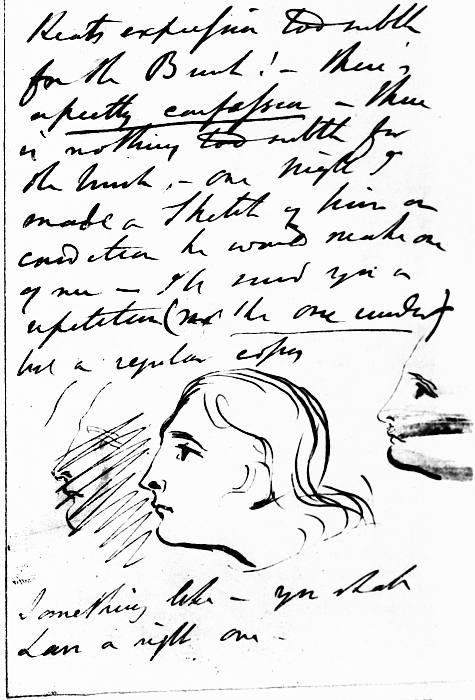
PAGE FROM A LETTER OF BENJAMIN ROBERT HAYDON TO ELIZABETH BARRETT, 1834
Among Keats’s other intimate friends and associates, Mr Taylor let Monckton Milnes have the loan of the notes and transcripts bequeathed him by Woodhouse, who had died in 1834. Reynolds heard by accident of the intended biography, and never having quite abandoned his own purpose in the matter, wrote at first complainingly, resenting that use should be made of those letters of Keats to himself which he had allowed Woodhouse to copy. But a gracious answer quickly won him over, and he made the new biographer welcome to all his material. His own career had been a rather melancholy failure. He had never quite given up literature in accordance with the purpose he had declared on marriage. Indeed it was not until six years after that declaration, in 1825, that his best piece of work was done, in collaboration with his brother-in-law, Thomas Hood: I mean the anonymous volume of humorous poems, not inferior to Rejected Addresses, called Odes and Addresses to Great People, which Coleridge confidently declared to be the work of Lamb. In later years Reynolds was a not infrequent contributor to the Edinburgh Review and to the Athenaeum under the editorship of Dilke. For some unspecified reason he did not prosper in the place which his friend Rice had found for him with the eminent firm of solicitors, the Fladgates; and in later life he was glad to accept a small piece of patronage as deputy clerk of the County Court at Newport in the Isle of Wight. Here, if the latest mention of him is to be trusted, he fell into self-neglecting habits and consequent disrepute.9 In one of his letters to Milnes he speaks about ‘that poor, obscure, baffled thing, myself’: in another he declares his entire confidence in his correspondent, and his unfading admiration and affection for his lost friend, as follows:—
All the papers I possess—all the information I can render—whatever I can do to aid your kind and judiciously intended work—are at your service! But a word or two on the great subject of our correspondence. He was hunted in his youth, before he had strength to escape his ban-dogs. He had the greatest power of poetry in him, of any one since Shakespeare! He was the sincerest friend, the most lovable associate, the deepest listener to the griefs and disappointments of all around him ‘that ever lived in the tide of times.’ Your expressed intentions as to the Life are so clear and good; that I seem to have the weight of an undone work taken from me.
Haslam in like manner lends all the help he can, and from his office as a solicitor in Copthall Court writes somewhat dispiritedly about himself, and declares that this correspondence ‘has been a clean taking me back to a separate state of existence that I had more than thirty years ago, a state that has long appeared to me almost as a dream. The realities of life have intervened, but God be praised they have but been laid upon the surface—have but hidden, not effaced those happy happy days.’ He sends a number of letters from Severn, including those written on the voyage to Naples and quoted in full above. But as to letters from Keats himself says he has found none,—‘they probably were so well or intended to be so well taken care of, that every endeavour to lay my hands on them has proved unavailing.’ One wonders whether they may not be lurking yet, a forgotten bundle, in the dust of some unexplored corner of a safe in that same office. Severn was at this time living in London, and some correspondence passed between him and Milnes about the biography, Severn’s chief point being to insist that not the malice of the critics, but the ‘death-stricken’ marriage project, was the trouble preying upon Keats in his dying days, and that the outcries of his delirium ran constantly upon his unfulfilled love and unwritten poems together.
As to yet another of Keats’s closest friends, Benjamin Bailey, Milnes had somehow been misinformed, and believed and positively stated him to be dead. He had in fact risen to colonial preferment in the Church, and was alive and well as archdeacon of Colombo in Ceylon. Thence on the appearance of Milnes’s book he wrote to declare his survival, and forwarded to the biographer, for use in future editions, those memoranda of old days spent in Keats’s company upon which I have above (in Chapter V) so fully drawn.
There are a few other points upon which Milnes’s information was less accurate than might have been expected. He assumes that the fiancée of Keats’s tragic passion was identical with the rich-complexioned Charmian described in his autumn letters of 1819, and ignores the existence of Fanny Brawne and of her family. One would have supposed that he must have heard the real story both from Brown and from Dilke, whom Mrs Brawne had appointed trustee for her children, and who had not since lost sight of them. That kind lady herself met an unhappy fate, burned to death upon her own doorstep. Her daughter Fanny, ten years after her poet-lover’s death, married a Mr Lindo, who afterwards changed his name to Lindon, and of whom we know little except that he was at one time drawn into the meshes of Spanish politics and was afterwards one of the Commissioners for the Great Exhibition of 1851. Not long before her marriage, Mrs Lindon is recorded to have said of Keats that the kindest thing to his memory would be to let it die. Little wonder, perhaps, that she should have felt thus, when she remembered the tortured, the terrifying vehemence of his passion for herself and when, being probably incapable of independent literary judgment, she saw his name and work still made customary objects of critical derision. It is harder to forgive her when some time later we find her parting with her lover’s miniature, under pressure of some momentary money difficulty, to Dilke.