Front matter (continued 4)
Reading edition
Relations of business or friendship with Taylor necessarily involved relations with Richard Woodhouse, a lettered and accomplished young solicitor of twenty-nine who was an intimate friend of Taylor’s and at this time apparently the regular reader and adviser to the firm. Woodhouse was sprung from an old landed stock in Herefordshire, some of whose members were now in the wine-trade (his father, it seems, was owner or part owner of the White Hart at Bath). He had been educated at Eton but not at the university: his extant correspondence, as well as notes and version-books in his hand, show him to have been a good linguist in Spanish and Italian and a man of remarkably fine literary taste and judgment. He afterwards held a high position as a solicitor and was one of the founders of the Law Life Insurance Society.
These three new friendships, with Benjamin Bailey, John Taylor, and Richard Woodhouse, formed during the six weeks between the publication of his book (March 3) and the mid-April following, turned out to be among the most valuable of Keats’s life, and were the best immediate results the issue of his first volume brought him. During this interval he and his brothers were lodging at 17 Cheapside, having left their old quarters in the Poultry. Some time in March it was decided, partly on Haydon’s urging, that John should for the sake of quiet and self-improvement go and spend some time by himself in the country, and try to get to work upon his great meditated Endymion poem. He writes as much to Reynolds, concluding with an adaptation from Falstaff expressive of anxiety for the health of some of those dear to him—probably his brother Tom and James Rice:—
My brothers are anxious that I should go by myself into the country—they have always been extremely fond of me, and now that Haydon has pointed out how necessary it is that I should be alone to improve myself, they give up the temporary pleasure of living with me continually for a great good which I hope will follow. So I shall soon be out of Town. You must soon bring all your present troubles to a close, and so must I, but we must, like the Fox, prepare for a fresh swarm of flies. Banish money—Banish sofas—Banish Wine—Banish Music; but right Jack Health, honest Jack Health, true Jack Health—Banish Health and banish all the world.
On the 14th of April Keats took the night mail for Southampton, whence he writes next day a lively letter to his brothers. By the 17th, having looked at Shanklin and decided against it, he was installed in a lodging at Carisbrooke. Writing to Reynolds he gives the reasons for his choice, mentioning at the same time that he is feeling rather nervous from want of sleep, and enclosing the admirable sonnet On the Sea which he has just composed—
It keeps eternal whisperings around Desolate shores, etc.—
It was the intense haunting of the lines in the scene on Dover Cliff in King Lear beginning ‘Do you not hear the sea,’ which moved him, he says, to this effort. He was reading and re-reading his Shakespeare with passion, and phrases from the plays come up continually in his letters, not only, as in the following extract, in the form of set quotations, but currently, as though they were part of his own mind and being. Having found in the lodging-house passage an engraved head of Shakespeare which pleased him and hung it up in his room (his landlady afterwards made him a present of it), he bethinks him of the approaching anniversary, April 23:—
I’ll tell you what—on the 23d was Shakespeare born. Now if I should receive a letter from you, and another from my Brothers on that day ‘twould be a parlous good thing. Whenever you write say a word or two on some Passage in Shakespeare that may have come rather new to you, which must be continually happening, notwithstanding that we read the same Play forty times—for instance, the following from the Tempest never struck me so forcibly as at present,
Urchins Shall, for the vast of night that they may work, All exercise on thee—
How can I help bringing to your mind the line—
In the dark backward and abysm of time.
I find I cannot exist without Poetry—without eternal Poetry—half the day will not do—the whole of it—I began with a little, but habit has made me a Leviathan I had become all in a Tremble from not having written anything of late—the Sonnet over-leaf did me good. I slept the better last night for it—this Morning, however, I am nearly as bad again. Just now I opened Spenser, and the first Lines I saw were these—
The noble heart that harbours virtuous thought, And is with child of glorious great intent, Can never rest until it forth have brought Th’ eternal brood of glory excellent.
‘I shall forthwith begin my Endymion,’ he adds, and looks forward to reading some of it out, when his correspondent comes to visit him, in a nook near the castle which he has already marked for the purpose.
But Haydon’s prescription of solitude turned out the worst Keats could well have followed in the then state of his mind, fermenting with a thousand restless thoughts and inchoate imaginations and with the feverish conflict between ambition and self-distrust. The result at any rate was that he passed the time, to use his own words, ‘in continual burning of thought, as an only resource,’ and what with that and lack of proper food felt himself after a week or ten days ‘not over capable in his upper stories’ and in need of change and companionship. He made straight for his last year’s lodging at Margate and got Tom to join him there. Thence in the second week of May he writes a long letter to Hunt and another to Haydon. To Hunt he criticizes some points in the last number of the Examiner, and especially, in his kind-hearted, well-conditioned way, deprecates a certain vicious allusion to grey hairs in an attack of Hazlitt upon Southey. Later on we shall have to tell of the critical savagery of Blackwood and the Quarterly, now long since branded and proverbial. But it should be borne in mind, as it by no means always is, that the Tories were far from having the savagery to themselves. When Hazlitt, for one, chose to strike on the liberal side, he could match Gifford or Lockhart or Wilson or Maginn with their own weapons. To realize the controversial atmosphere of the time, here is a passage, and not the fiercest, from the Hazlitt article in which Keats found too venomous a sting. Southey’s first love, rails Hazlitt, had been the Republic, his second was Legitimacy, ‘her more fortunate and wealthy rival’:—
He is becoming uxorious in his second matrimonial connection; and though his false Duessa has turned out a very witch, a murderess, a sorceress, perjured, and a harlot, drunk with insolence, mad with power, a griping rapacious wretch, bloody, luxurious, wanton, malicious, not sparing steel, or poison, or gold, to gain her ends—bringing famine, pestilence, and death in her train—infecting the air with her thoughts, killing the beholders with her looks, claiming mankind as her property, and using them as her slaves—driving every thing before her, and playing the devil wherever she comes, Mr Southey sticks to her in spite of everything, and for very shame lays his head in her lap, paddles with the palms of her hands, inhales her hateful breath, leers in her eyes and whispers in her ears, calls her little fondling names, Religion, Morality, and Social Order, takes for his motto,
Be to her faults a little blind, Be to her virtues very kind—
sticks close to his filthy bargain, and will not give her up, because she keeps him, and he is down in her will. Faugh!
It is fair to note that the mistress thus depicted as Southey’s is an allegorical being, while the Blackwood scurrilities were often directly personal.
After asking how Hunt’s own new poem, The Nymphs, is getting on, Keats tells how he has been writing some of Endymion every day the last fortnight, except travelling days, and how thoughts of the greatness of his ambition and the uncertainty of his powers have thrown him into a fit of gloom; hinting at such moods of bleak and blank despondency as we shall find now and again figuratively described in the text of Endymion itself.
I have asked myself so often why I should be a poet more than other men, seeing how great a thing it is,... that at last the idea has grown so monstrously beyond my seeming power of attainment that the other day I nearly consented with myself to drop into a Phaeton ... I see nothing but continual uphill journeying. Now is there anything more unpleasant than to be so journeying and to miss the goal at last? But I intend to whistle all those cogitations into the sea, where I hope they will breed storms enough to block up all exit from Russia. Does Shelley go on telling strange stories of the deaths of kings?1 Tell him there are strange stories of the deaths of poets. Some have died before they were conceived.
The same evening Keats begins to answer a letter of encouragement and advice he had just had from Haydon. This is the letter of Haydon’s from which I have already quoted the passage about the efficacy of prayer as Haydon had experienced it. Perfectly sincere and genuinely moved, he can never for a minute continuously steer clear of rant and fustian and self-praise at another’s expense.
Never despair, he goes on, while the path is open to you. By habitual exercise you will have habitual intercourse and constant companionship; and at every want turn to the Great Star of your hopes with a delightful confidence that will never be disappointed. I love you like my own brother: Beware, for God’s sake, of the delusions and sophistications that are ripping up the talents and morality of our friend.2 He will go out of the world the victim of his own weakness and the dupe of his own self-delusions, with the contempt of his enemies and the sorrow of his friends, and the cause he undertook to support injured by his own neglect of character. I wish you would come up to town for a day or two that I may put your head in my picture. I have rubbed in Wordsworth’s, and advanced the whole. God bless you, my dear Keats! do not despair; collect incident, study character, read Shakespeare, and trust in Providence, and you will do, you must.
Keats in answer quotes the opening speech of the King in Love’s Labour’s Lost,—
Let Fame, that all pant after in their lives Live registered upon our brazen tombs, etc.,
saying that he could not bear to think he had not the right to couple his own name with Haydon’s in such a forecast, and acknowledging the occasional moods of depression which have put him into such a state of mind as to read over his own lines and hate them, though he has picked up heart again when he found some from Pope’s Homer which Tom read out to him seem ‘like Mice’ to his own. He takes encouragement also from the notion that has visited him lately of some good genius—can it be Shakespeare?—presiding over him. Continuing the next day, he is downhearted again at hearing from George of money difficulties actual and prospective. ‘You tell me never to despair—I wish it was as easy for me to deserve the saying—truth is I have a horrid morbidity of Temperament which has shown itself at intervals it is I have no doubt the greatest Enemy and stumbling block I have to fear—I may even say it is likely to be the cause of my disappointment.’ Then referring to Haydon’s warning in regard to Hunt, he goes half way in agreement and declares he would die rather than be deceived about his own achievements as Hunt is. ‘There is no greater sin after the seven deadly,’ he says, ‘than to flatter oneself into the idea of being a great poet: the comfort is, such a crime must bring its own penalty, and if one is a self-deluder indeed accounts must one day be balanced.’
In the same week, moved no doubt by the difficulties George had mentioned about touching the funds due from their grandmother’s estate, Keats writes to Taylor and Hessey, in a lively and familiar strain showing the terms of confidence on which he already stood with them, asking them to advance him an instalment of the agreed price for Endymion. He mentions in this letter that he is tired of Margate (he had already to another correspondent called it a ‘treeless affair’) and means to move to Canterbury. At this point there occurs an unlucky gap in Keats’s correspondence. We know that he and Tom went to Canterbury from Margate as planned, but we do not know exactly when, nor how long he stayed there, nor what work he did (except that he was certainly going on with the first book of Endymion), nor what impressions he received. It was his first visit to a cathedral city, and few in the world, none in England, are more fitted to impress. Chichester and Winchester he came afterwards to know, Winchester well and with affection; but it was with thoughts of Canterbury in his mind that he planned, some two years later, first a serious and then a frivolous verse romance having an English cathedral town for scene (The Eve of St Mark, The Cap and Bells). The heroine of both was to have been a maiden of Canterbury called Bertha; not, of course, the historic Frankish princess Bertha, daughter of Haribert and wife of Ethelbert king of Kent, who converted her husband and prepared his people for Christianity before the landing of Saint Augustin, and who sleeps in the ancient church of Saint Martin outside the walls: not she, but some damsel of the city, named after her in later days, whom Keats had heard or read of or invented,—I would fain know which; but I have found no external evidence of his studies or doings during this spring stay at Canterbury, and his correspondence is, as I have said, a blank.
Some time in June he returned and the three brothers were together again: not now in City lodgings but in new quarters to which they had migrated in Well Walk, Hampstead. Their landlord was one Bentley the postman, with whom they seem to have got on well except that Keats occasionally complains of the ‘young carrots,’ his children, now for making a ‘horrid row,’ now for smelling of damp worsted stockings. The lack of letters continues through these first summer months at Hampstead. The only exception is a laughingly apologetic appeal to his new publishers for a further advance of money, dated June 10th and ending with the words,—‘I am sure you are confident of my responsibility, and of the sense of squareness that is always in me.’ For the rest, indirect evidence allows us to picture Keats in these months as working regularly at Endymion, having now reached the second book, and as living socially, not without a certain amount of convivial claret-drinking and racket, in the company of his brothers and of his friends and theirs. Leigh Hunt was still close by in the Vale of Health, and both in his circle and in Haydon’s London studio Keats was as welcome as ever. Reynolds and Rice were still his close intimates, and Reynolds’s sisters in Lamb’s Conduit Street almost like sisters of his own. He was scarcely less at home in the family of his sister-in-law that was to be, Georgiana Wylie. The faithful Severn and the faithful Haslam came up eagerly whenever they could to join the Hampstead party. An acquaintance he had already formed at Hunt’s with the Charles Dilkes and their friend Charles Brown, who lived as next-door neighbours at Wentworth Place, a double block of houses of their own building in a garden at the foot of the Heath, now ripened into friendship: that with Dilke rapidly, that with Brown, a Scotsman who by his own account held cannily aloof from Keats at first for fear of being thought to push, more slowly.
Charles Wentworth Dilke, by profession a clerk in the Navy Pay Office, by predilection a keen and painstaking literary critic and antiquary, had been stimulated by the charm of Lamb’s famous volume of Specimens to work at the old English dramatic poets, and had recently (being now twenty-seven) brought out a set of volumes in continuation of Dodsley’s Old Plays. In matters political and social he was something of a radical doctrinaire and ‘Godwin-perfectibility man’ (the label is Keats’s), loving decision and positiveness in all things and being therein the very opposite of Keats, who by rooted instinct as well as choice allowed his mind to cherish uncertainties and to be a thoroughfare for all thoughts (the phrase is again his own). There were many but always friendly discussions between Keats and Dilke, and their mutual regard never failed. Charles Brown, Dilke’s contemporary, schoolfellow, and close friend, was a man of Scottish descent born in Lambeth, who had in early youth joined a business set up by an elder brother in Petersburg. The business quickly failing, he had returned to London and after some years of struggle inherited a modest competence from another brother. A lively, cultivated, moderately successful amateur in literature, journalism, and drama, he was in person bald and spectacled, and portly beyond his years though active and robust; in habits much of a trencher-man (‘a huge eater’ according to the abstemious Trelawny) and something of a viveur within his means; exactly strict in money matters, but otherwise far from a precisian in life or conversation; an ardent friend and genial companion, though cherishing some fixed unreasonable aversions: in a word, a truly Scottish blend of glowing warm-heartedness and ‘thrawn’ prejudice, of frank joviality and cautious dealing.
It was in these same weeks of June or July 1817, soon after the beginning of the Oxford vacation, that Benjamin Bailey again came to town and sought after and learned to delight in Keats’s company. He meant to go back and read at Oxford for the latter part of the vacation, and invited Keats to spend some weeks with him there. Keats accepted, and the visit, lasting from soon after mid August until the end of September, proved a happiness alike to host and guest. At this point our dearth of documents ceases. Bailey’s memoranda, though not put on paper till thirty years later, are vivid and informing, and Keats’s own correspondence during the visit is fairly full. I will take Bailey’s recollections first, and give them in his own words, seeing that they paint the writer almost as well as his subject; omitting only passages that seem to drag or interrupt. First comes the impression Keats made on him at the time of their introduction in the spring, and then his account of the days they spent together in Oxford.
I was delighted with the naturalness and simplicity of his character, and was at once drawn to him by his winning and indeed affectionate manner towards those with whom he was himself pleased. Nor was his personal appearance the least charm of a first acquaintance with the young poet. He bore, along with the strong impress of genius, much beauty of feature and countenance. His hair was beautiful—a fine brown, rather than auburn, I think, and if you placed your hand upon his head, the silken curls felt like the rich plumage of a bird. The eye was full and fine, and softened into tenderness, or beamed with a fiery brightness, according to the current of his thoughts and conversation. Indeed the form of his head was like that of a fine Greek statue:—and he realized to my mind the youthful Apollo, more than any head of a living man whom I have known.
At the commencement of the long vacation I was again in London, on my way to another part of the country: and it was my intention to return to Oxford early in the vacation for the purpose of reading. I saw much of Keats. And I invited him to return with me to Oxford, and spend as much time as he could afford with me in the silence and solitude of that beautiful place during the absence of the numerous members and students of the University. He accepted my offer, and we returned together. I think in August 1817. It was during this visit, and in my room, that he wrote the third book of Endymion.... His mode of composition is best described by recounting our habits of study for one day during the month he visited me at Oxford. He wrote, and I read, sometimes at the same table, and sometimes at separate desks or tables, from breakfast to the time of our going out for exercise,—generally two or three o’clock. He sat down to his task,—which was about 50 lines a day,—with his paper before him, and wrote with as much regularity, and apparently as much ease, as he wrote his letters.... Sometimes he fell short of his allotted task, but not often: and he would make it up another day. But he never forced himself. When he had finished his writing for the day, he usually read it over to me: and he read or wrote letters until we went for a walk. This was our habit day by day. The rough manuscript was written off daily, and with few erasures.
I remember very distinctly, though at this distance of time, his reading of a few passages; and I almost think I hear his voice, and see his countenance. Most vivid is my recollection of the following passage of the finest affecting story of the old man, Glaucus, which he read to me immediately after its composition:—
The old man raised his hoary head and saw The wildered stranger—seeming not to see, The features were so lifeless. Suddenly He woke as from a trance; his snow white brows Went arching up, and like two magic ploughs Furrowed deep wrinkles in his forehead large, Which kept as fixedly as rocky marge, Till round his withered lips had gone a smile.
The lines I have italicised, are those which then forcibly struck me as peculiarly fine, and to my memory have ‘kept as fixedly as rocky marge.’ I remember his upward look when he read of the ‘magic ploughs,’ which in his hands have turned up so much of the rich soil of Fairyland.
When we had finished our studies for the day we took our walk, and sometimes boated on the Isis.... Once we took a longer excursion of a day or two, to Stratford upon Avon, to visit the birthplace of Shakespeare. We went of course to the house visited by so many thousands of all nations of Europe, and inscribed our names in addition to the ‘numbers numberless’ of those which literally blackened the walls. We also visited the Church, and were pestered with a commonplace showman of the place.... He was struck, I remember, with the simple statue there, which, though rudely executed, we agreed was most probably the best likeness of the many extant, but none very authentic, of Shakespeare.
His enjoyment was of that genuine, quiet kind which was a part of his gentle nature; deeply feeling what he truly enjoyed, but saying little. On our return to Oxford we renewed our quiet mode of life, until he finished the third Book of Endymion, and the time came that we must part; and I never parted with one whom I had known so short a time, with so much real regret and personal affection, as I did with John Keats, when he left Oxford for London at the end of September or the beginning of October 1817.
Pl. IV
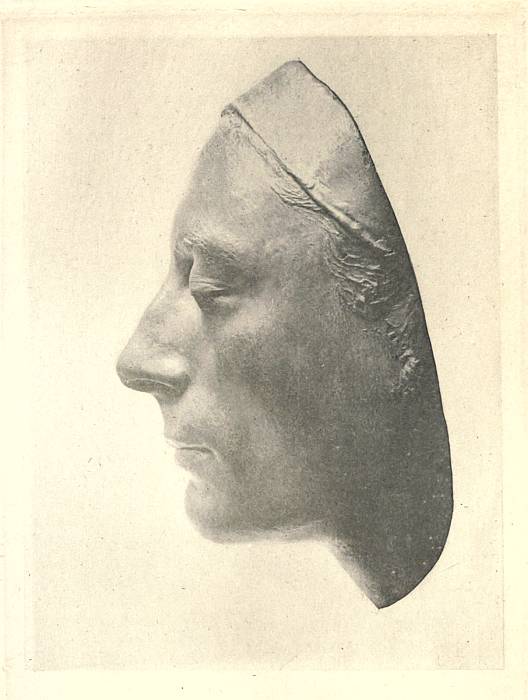
Life-mask of Keats From an electrotype in the National Portrait Gallery
Living as we did for a month or six weeks together (for I do not remember exactly how long) I knew him at that period of his life, perhaps as well as any one of his friends. There was no reserve of any kind between us.... His brother George says of him that to his brothers his temper was uncertain; and he himself confirms this judgment of him in a beautiful passage of a letter to myself. But with his friends, a sweeter tempered man I never knew. Gentleness was indeed his proper characteristic, without one particle of dullness, or insipidity, or want of spirit. Quite the contrary. ‘He was gentle but not fearful,’ in the chivalric and moral sense of the term ‘gentle.’ He was pleased with every thing that occurred in the ordinary mode of life, and a cloud never passed over his face, except of indignation at the wrongs of others.
His conversation was very engaging. He had a sweet toned voice, ‘an excellent thing’ in man as well as ‘in woman....’ In his letters he talks of suspecting everybody. It appeared not in his conversation. On the contrary, he was uniformly the apologist for poor, frail human nature, and allowed for people’s faults more than any man I ever knew, especially for the faults of his friends. But if any act of wrong or oppression, of fraud or falsehood, was the topic, he rose into sudden and animated indignation. He had a truly poetic feeling for women; and he often spoke to me of his sister, who was somehow withholden from him, with great delicacy and tenderness of affection. He had a soul of noble integrity: and his common sense was a conspicuous part of his character. Indeed his character was in the best sense manly.
Our conversation rarely or never flagged, during our walks, or boatings, or in the evening. And I have retained a few of his opinions on Literature and criticism which I will detail. The following passage from Wordsworth’s Ode on Immortality was deeply felt by Keats, who however at this time seemed to me to value this great Poet rather in particular passages than in the full-length portrait, as it were, of the great imaginative and philosophic Christian Poet, which he really is, and which Keats obviously, not long afterwards, felt him to be.
Not for these I raise The song of thanks and praise; But for those obstinate questionings Of sense and outward things, Fallings from us, vanishings; Blank misgivings of a creature Moving about in worlds not realized, High instincts, before which our mortal nature Did tremble like a guilty thing surprized.
The last lines he thought were quite awful in their application to a guilty finite creature, like man, in the appalling nature of the feeling which they suggested to a thoughtful mind. Again, we often talked of that noble passage in the lines on Tintern Abbey:—
That blessed mood, In which the burthen of the mystery, In which the heavy and the weary weight Of all this unintelligible world Is lightened.
And his references to this passage are frequent in his letters.—But in those exquisite stanzas,
She dwelt among the untrodden ways, Beside the springs of Dove,
ending,—
She lived unknown and few could know When Lucy ceased to be; But she is in her grave, and oh, The difference to me.
The simplicity of the last line he declared to be the most perfect pathos.
Among the qualities of high poetic promise in Keats was, even at this time, his correct taste. I remember to have been struck with this by his remarks on that well known and often quoted passage of the Excursion upon the Greek Mythology—where it is said that
Fancy fetched Even from the blazing chariot of the Sun A beardless youth who touched a golden lute, And filled the illumined groves with ravishment.
Keats said this description of Apollo should have ended at the ‘golden lute,’ and have left it to the imagination to complete the picture, how he ‘filled the illumined groves.’ I think every man of taste will feel the justice of the remark.
Every one now knows what was then known to his friends that Keats was an ardent admirer of Chatterton. The melody of the verses of the marvellous Boy who perished in his pride, enchanted the author of Endymion. Methinks I now hear him recite, or chant, in his peculiar manner, the following stanza of the Roundelay sung by the minstrels of Ella:—
Come with acorn cup and thorn Drain my hertys blood away; Life and all its good I scorn; Dance by night or feast by day.
The first line to his ear possessed the great charm. Indeed his sense of melody was quite exquisite, as is apparent in his own verses; and in none more than in numerous passages of his Endymion.
Another object of his enthusiastic admiration was the Homeric character of Achilles—especially when he is described as ‘shouting in the trenches.’ One of his favourite topics of discourse was the principle of melody in verse, upon which he had his own notions, particularly in the management of open and close vowels. I think I have seen a somewhat similar theory attributed to Mr Wordsworth. But I do not remember his laying it down in writing. Be this as it may, Keats’s theory was worked out by himself. It was, that the vowels should be so managed as not to clash one with another, so as to hear the melody,—and yet that they should be interchanged, like differing notes of music to prevent monotony....3
Bailey here tries to reconstruct and illustrate from memory Keats’s theory of vowel sounds, but his attempt falters and breaks down.
Keats’s own first account of himself from Oxford is in a letter of September 5th to the Reynolds sisters, then on holiday at Littlehampton: a piece of mere lively foolery and rattle meant to amuse, in a taste which is not that of to-day. Five days later he writes the first of that series of letters to his young sister Fanny which acquaints us with perhaps the most loveable and admirable parts of his character. She was now just fourteen, and living under the close guardianship of the Abbeys, who had put her to a boarding school at Walthamstow. Keats shows a tender and considerate elder-brotherly anxiety to get into touch with her and know her feelings and likings:—
Let us now begin a regular question and answer—a little pro and con; letting it interfere as a pleasant method of my coming at your favourite little wants and enjoyments, that I may meet them in a way befitting a brother.
We have been so little together since you have been able to reflect on things that I know not whether you prefer the History of King Pepin to Bunyan’s Pilgrim’s Progress—or Cinderella and her glass slipper to Moor’s Almanack. However in a few Letters I hope I shall be able to come at that and adapt my scribblings to your Pleasure. You must tell me about all you read if it be only six Pages in a Week and this transmitted to me every now and then will procure full sheets of Writing from me pretty frequently.—This I feel as a necessity for we ought to become intimately acquainted, in order that I may not only, as you grow up love you as my only Sister, but confide in you as my dearest friend. When I saw you last I told you of my intention of going to Oxford and ’tis now a Week since I disembark’d from his Whipship’s Coach the Defiance in this place. I am living in Magdalen Hall on a visit to a young Man with whom I have not been long acquainted, but whom I like very much—we lead very industrious lives—he in general Studies and I in proceeding at a pretty good rate with a Poem which I hope you will see early in the next year.—Perhaps you might like to know what I am writing about. I will tell you. Many Years ago there was a young handsome Shepherd who fed his flocks on a Mountain’s Side called Latmus he was a very contemplative sort of a Person and lived solitary among the trees and Plains little thinking that such a beautiful Creature as the Moon was growing mad in Love with him.—However so it was; and when he was asleep on the Grass she used to come down from heaven and admire him excessively for a long time; and at last could not refrain from carrying him away in her arms to the top of that high Mountain Latmus while he was a dreaming—but I dare say you have read this and all the other beautiful Tales which have come down from the ancient times of that beautiful Greece. If you have not let me know and I will tell you more at large of others quite as delightful. This Oxford I have no doubt is the finest City in the world—it is full of old Gothic buildings—Spires—towers—Quadrangles—Cloisters—Groves etc and is surrounded with more clear streams than ever I saw together. I take a Walk by the Side of one of them every Evening and, thank God, we have not had a drop of rain these days.
He goes on to tell her (herein echoing Hunt’s opinion) how much better it would be if Italian instead of French were taught everywhere in schools, and winds up:—
Now Fanny you must write soon—and write all you think about, never mind what—only let me have a good deal of your writing—You need not do it all at once—be two or three or four days about it, and let it be a diary of your Life. You will preserve all my Letters and I will secure yours—and thus in the course of time we shall each of us have a good Bundle—which, hereafter, when things may have strangely altered and God knows what happened, we may read over together and look with pleasure on times past—that now are to come.
Next follows another letter to Jane Reynolds; partly making fun, much better fun than in the last, about Dilke’s shooting and about the rare havoc he would like to make in Mrs Dilke’s garden were he at Hampstead: partly grave in the high style into which he is apt at any moment to change from nonsense:—
Now let us turn to the sea-shore. Believe me, my dear Jane, it is a great happiness to see that you are, in this finest part of the year, winning a little enjoyment from the hard world. In truth, the great Elements we know of, are no means comforters: the open sky sits upon our senses like a sapphire crown—the Air is our robe of state—the Earth is our throne and the Sea a mighty minstrel playing before it—able, like David’s harp, to make such a one as you forget almost the tempest cares of life. I have found in the ocean’s music,—varying (tho’ self-same) more than the passion of Timotheus, an enjoyment not to be put into words; and, ‘though inland far I be,’ I now hear the voice most audibly while pleasing myself in the idea of your sensations.
To Reynolds Keats writes on September the 21st:—
For these last five or six days, we have had regularly a Boat on the Isis, and explored all the streams about, which are more in number than your eye-lashes. We sometimes skim into a Bed of rushes, and there become naturalized river-folks,—there is one particularly nice nest, which we have christened ‘Reynolds’s Cove,’ in which we have read Wordsworth, and talked as may be; I think I see you and Hunt meeting in the Pit.—What a very pleasant fellow he is, if he would give up the sovereignty of a room pro bono. What evenings we might pass with him, could we have him from Mrs H. Failings I am always rather rejoiced to find in a man than sorry for; they bring us to a level.
Then follows a diatribe against the literary and intellectual pretensions of certain sets of ladies, from which he has felt an agreeable relief in some verses he has found on taking down from Bailey’s shelves the poems of Katherine Philips, ‘the matchless Orinda.’ The verses which pleased him, truly of her best, are those To M. A. at parting, and Keats goes on to copy them in full. Had Orinda been a contemporary, he might not, indeed, have failed to recognize in her a true woman of letters: but would he not also have found something to laugh and chafe at in the poses of that high-flying coterie of mutual admirers, Silvander and Poliarchus, Lucasia and Rosania and Palæmon, of which she was the centre? This is one of the very few instances to be found in Keats’s work or correspondence of interest in the poetry of the Caroline age.
Quite in the last days of his visit Keats, whose mind and critical power had been growing while he worked upon Endymion, and whom moreover the long effort of composition was clearly beginning to fatigue, confides to Haydon his dissatisfaction with what he has done:—‘You will be glad to hear that within these last three weeks I have written 1000 lines—which are the third Book of my Poem. My Ideas with respect to it I assure you are very low—and I would write the subject thoroughly again—but I am tired of it and think the time would be better spent in writing a new Romance which I have in my eye for next summer—Rome was not built in a day—and all the good I expect from my employment this summer is the fruit of Experience which I hope to gather in my next Poem.’
Coming back in the first week of October to Hampstead, whither his brothers had by this time also returned from a trip to Paris, Keats was presently made uncomfortable by evidences of discord among his friends and reports of what seemed like disloyalty on the part of one of them, Leigh Hunt, to himself. Haydon had now left the studio in Great Marlborough Street for one in Lisson Grove, and the Hunts, having come away from Hampstead and paid a long late-summer visit to the Shelleys at Marlow, were lodging near him in the same street. ‘Everybody seems at loggerheads,’ Keats writes to Bailey. ‘There’s Hunt infatuated—there’s Haydon’s picture in statu quo—There’s Hunt walks up and down his painting-room—criticizing every head most unmercifully.’ Both Haydon and Reynolds, he goes on, keep telling him tales of Hunt: How Hunt has been talking flippantly and patronizingly of Endymion, saying that if it is four thousand lines long now it would have been seven thousand but for him, and giving the impression that Keats stood to him in the relation of a pupil needing and taking advice. He declares in consequence that he is quite disgusted with literary men and will never know another except Wordsworth; and then, more coolly and sensibly, ‘now, is not this a most paltry thing to think about?... This is, to be sure, the vexation of a day, nor would I say so many words about it to any but those whom I know to have my welfare and reputation at heart.’
During the six or seven autumn weeks spent at Hampstead after his return from Oxford Keats was getting on, a little flaggingly, with the fourth book of Endymion, besides writing an occasional lyric or two. Fresh from the steadying and sympathetic companionship of Bailey, he keeps up their intimacy by affectionate letters in which he discloses much of that which lay deepest and was best in him. Writing in the first days of November he congratulates Bailey on having got a curacy in Cumberland and promises some day to visit him there; says he is in a fair way to have finished Endymion in three weeks; mentions an idea he has of shipping his brother Tom, who has been looking worse, off to Lisbon for the winter and perhaps going with him; and gets in by a side wind a masterly criticism of Wordsworth’s poem The Gipsies and also of Hazlitt’s criticism of it in the Round Table. A fragment of another letter, dated November the 5th, alludes with annoyance, not for the first time, to some failure of Haydon’s to keep his word or take trouble about a young man from Oxford named Cripps whom he had promised to receive as pupil and in whom Bailey and Keats were interested. The same fragment records the appearance in Blackwood (the Endinburgh Magazine, as Keats calls it) of the famous first article of the Cockney School series, attacking Hunt with a virulence far beyond even the accustomed licence of the time, and seeming by the motto prefixed to it (verses of Cornelius Webb coupling the names of Hunt and Keats) to threaten a similar handling of Keats later on. ‘I don’t mind the thing much,’ says Keats, ‘but if he should go to such lengths with me as he has done with Hunt, I must infallibly call him to an Account if he be a human being, and appears in Squares and Theatres, where we might possibly meet—I don’t relish his abuse.’
Some time about mid-November Keats, his health and strength being steadier than in the spring, felt himself in the mood for a few weeks of solitude and went to spend them at Burford Bridge Inn, in the beautiful vale of Mickleham between Leatherhead and Dorking. The outing, he wrote, was intended ‘to change the scene—change the air—and give me a spur to wind up my poem, of which there are wanting 500 lines.’ Keats dearly loved a valley: he loved even the sound of the names denoting one. In his marginal notes to a copy of Paradise Lost he gave a friend we find the following:—
‘Or have ye chosen this place After the toil of battle to repose Your wearied virtue, for the ease you find To slumber here, as in the vales of Heaven?’
There is cool pleasure in the very sound of vale. The English word is of the happiest chance. Milton has put vales in heaven and hell with the very utter affection and yearning of a great Poet. It is a sort of Delphic Abstraction—a beautiful thing made more beautiful by being reflected and put in a Mist. The next mention of Vale is one of the most pathetic in the whole range of Poetry:—
‘Others, more mild, Retreated in a silent valley, sing With notes angelical to many a harp Their own heroic deeds and hapless fall By doom of battle.’
How much of the charm is in the valley!
There, from his inmost self, speaks a poet of another poet, and as if to and for poets, deep calling unto deep. But in his every-day vein of speech or writing Keats was always reticent in regard to the scenery of places he visited, disliking nothing more than the glib ecstasies of the tourist in search of the picturesque. When he has looked round him in his new quarters at Burford Bridge he says simply, writing to Reynolds on November the 22nd, ‘I like this place very much. There is Hill and Dale and a little river. I went up Box Hill this evening after the moon—“you a’ seen the Moon”—came down and wrote some lines.’ ‘Whenever I am separated from you,’ he continues, ‘and not engaged in a continuous Poem, every letter shall bring you a lyric—but I am too anxious for you to enjoy the whole to send you a particle:’ the whole, that is, of Endymion. The sequel shows him to be just as deep and ardent in the study of Shakespeare as when he was beginning his poem at Carisbrooke in the spring. ‘I never found so many beauties in the Sonnets—they seem to be full of fine things said unintentionally—in the intensity of working out conceits:’ and he goes on to quote passages and phrases both from them and from Venus and Adonis. Next, with a sudden change of mind about letting Reynolds see a sample of Endymion, ‘By the Whim-King! I’ll give you a stanza, because it is not material in connexion, and when I wrote it I wanted you to give your vote, pro or con.’—The stanza he gives is from the song of the Constellations in the fourth book, certainly one of the weakest things in the poem: pity Reynolds had not been there indeed, to give his vote contra.
On the same day, November 22, Keats writes to Bailey a letter even richer in contents and more self-revealing than this to Reynolds. It gives the indispensable key both to much in his own character and much of the deeper speculative and symbolic meanings underlying his work, from Endymion to the Ode on a Grecian Urn. Beginning with a wise and tolerant reference to the Haydon trouble, and throwing out a passing hint of the distinction between men of Genius, who have not, and men of Power, who have, a proper individual self or determined character of their own, Keats passes at the close to an illuminating self-confession which is also a contrast between himself and his correspondent:—
You perhaps at one time thought there was such a thing as worldly happiness to be arrived at, at certain periods of time marked out,—you have of necessity from your disposition been thus led away—I scarcely remember counting upon any happiness—I look not for it if it be not in the present hour,—nothing startles me beyond the moment. The Setting Sun will always set me to rights, or if a Sparrow come before my Window, I take part in its existence and pick about the gravel. The first thing that strikes me on hearing a misfortune having befallen another is this—‘Well, it cannot be helped: he will have the pleasure of trying the resources of his Spirit’—and I beg now, my dear Bailey, that hereafter should you observe anything cold in me not to put it to the account of heartlessness, but abstraction—for I assure you I sometimes feel not the influence of a passion or affection during a whole Week—and so long this sometimes continues, I begin to suspect myself, and the genuineness of my feelings at other times—thinking them a few barren Tragedy Tears.
Readers of Endymion will recognize a symbolic embodiment of a mood akin to this in the Cave of Quietude in the fourth book. But the great value of the letter, especially great as a help to the study of Endymion in general, is in the long central passage setting forth his speculations as to the relation of imagination to truth, meaning truth ultimate or transcendental. He finds his clue in the eighth book of Paradise Lost, where Adam, recounting to Raphael his first experiences as new-created man, tells how twice over he fell into a dream and awoke to find it true: his first dream thus confirmed in the result being how ‘One of shape divine’ took him by the hand and led him into the garden of Paradise:4 his second, how the same glorious shape came to him and opened his side and from his rib fashioned a creature:
Manlike, but different sex, so lovely fair, That what seem’d fair in all the World, seem’d now Mean, or in her sum’d up, in her contain’d And in her looks, which from that time infus’d Sweetness into my heart, unfelt before, And into all things from her Air inspir’d The spirit of love and amorous delight. She disappear’d, and left me dark, I wak’d To find her, or for ever to deplore Her loss, and other pleasures all abjure: When out of hope, behold her, not far off, Such as I saw her in my dream, adorn’d With what all Earth or Heaven could bestow To make her amiable.5
It was no doubt this second of Adam’s dreams that was chiefly in Keats’s mind. His way of explaining his speculations to his friend is quite unstudied and inconsecutive; he is, as he says, ‘continually running away from the subject,’ or shall we say letting the stream of his ideas branch out into side channels from which he finds it difficult to come back? But yet their main current and purport will be found not difficult to follow, if only the reader will bear one thing well in mind: that when Keats in this and similar passages speaks of ‘Sensations’ as opposed to ‘Thoughts’ he does not limit the word to sensations of the body, of what intensity or exquisiteness soever or howsoever instantaneously transforming themselves from sensation into emotion: what he means are intuitions of the mind and spirit as immediate as these, as thrillingly convincing and indisputable, as independent of all consecutive stages and formal processes of thinking: almost the same things, indeed, as in a later passage of the same letter he calls ‘ethereal musings.’ And now let the poet speak for himself:—
O! I wish I was as certain of the end of all your troubles as that of your momentary start about the authenticity of the Imagination. I am certain of nothing but of the holiness of the Heart’s affections, and the truth of Imagination. What the Imagination seizes as Beauty must be Truth—whether it existed before or not,—for I have the same idea of all our passions as of Love: they are all, in their sublime, creative of essential Beauty. In a Word you may know my favourite speculation by my first Book, and the little Song I sent in my last, which is a representation from the fancy of the probable mode of operating in these Matters. The Imagination may be compared to Adam’s dream, he awoke and found it truth:—I am more zealous in this affair, because I have never yet been able to perceive how anything can be known for truth by consecutive reasoning—and yet it must be. Can it be that even the greatest Philosopher ever arrived at his Goal without putting aside numerous objections? However it may be, O for a life of Sensations rather than of Thoughts! It is ‘a Vision in the form of Youth,’ a shadow of reality to come—and this consideration has further convinced me,—for it has come as auxiliary to another favourite speculation of mine,—that we shall enjoy ourselves hereafter by having what we called happiness on Earth repeated in a finer tone. And yet such a fate can only befall those who delight in Sensation, rather than hunger as you do after Truth. Adam’s dream will do here, and seems to be a Conviction that Imagination and its empyreal reflexion, is the same as human life and its spiritual repetition. But, as I was saying, the simple imaginative Mind may have its rewards in the repetition of its own silent Working coming continually on the Spirit with a fine Suddenness. To compare great things with small, have you never, by being surprised with an old Melody, in a delicious place by a delicious voice, felt over again your very speculations and surmises at the time it first operated on your soul? Do you not remember forming to yourself the Singer’s face—more beautiful than it was possible, and yet, with the elevation of the Moment, you did not think so? Even then you were mounted on the Wings of Imagination, so high that the prototype must be hereafter—that delicious face you will see.
There is one sentence in the above which gives us special matter for regret. Keats speaks of ‘the little Song I sent in my last, which is a representation from the fancy of the probable mode of operating in these matters.’ Such a song, if we had it, would doubtless put forth clearly and melodiously in concrete imagery the ideas which Keats in his letter tries to expound in the abstract language of which he is by nature so much less a master. Of ‘my last,’ that is of his preceding letter to Bailey, unhappily but a fragment is preserved, and the song must have been lost with the sheet or sheets which went astray, seeing that none of Keats’s preserved lyrics can be held to answer to his account of this one. His words have a further interest as proving that now in these days of approaching winter, with his long poem almost finished, he allowed himself to digress into some lyric experiments, as in its earlier stages he had not done. External testimony and reasonable inference enable us to identify some of these experiments. Two or three lightish love-lyrics, whether impersonal or inspired by passing adventures of his own, are among the number. That beginning ‘Think not of it, sweet one, so,’ dates definitely from November 11, before he left Hampstead. To nearly about the same time belongs almost certainly the very daintily finished stanzas ‘Unfelt, unheard, unseen,’ which one at least of Keats’s subtlest critics6 considers (I cannot agree with her) the first of his technically faultless achievements. So also, I am convinced, does that much less happily wrought thing, the little love-plaint discovered only two years ago and beginning—
You say you love, but with a voice Chaster than a nun’s who singeth The soft vespers to herself When the chime-bell ringeth— O love me truly! You say you love; but with a smile Cold as sunrise in September, As you were St Cupid’s nun, And kept his week of Ember. O love me truly!—
and so forth. Here again, it seems evident, we have an instance of an echo from one of the old Elizabethan poets (this time an anonymous song-writer) lingering like a chime in Keats’s memory. Listen to the first three stanzas of A Proper Wooing Song, written to the tune of the Merchant’s Daughter and printed in Clement Robinson’s Handful of Pleasant Delites, 1584:—
Maide will ye loue me yea or no? tell me the trothe and let me go. It can be no lesse than a sinful deed, trust me truly, To linger a Louer that lookes to speede, in due time duly. You maides that thinke yourselves as fine, as Venus and all the Muses nine: The Father Himselfe when He first made man, trust me truly, Made you for his helpe when the world began, in due time duly. Then sith God’s will was even so why should you disdaine your Louer tho? But rather with a willing heart, loue him truly; For in so doing you do your part let reason rule ye.
The metrical form of Keats’s verses is not, indeed, the same as that of the Elizabethan song, but I think he must certainly have had the cadence of its refrains more or less consciously in his mind’s ear.7
A definite and dated case of a lyrical experiment suggested to Keats at this time by an older model is the famous little ‘drear-nighted December’ song in which he re-embodies, with new and seasonable imagery, the ancient moral of the misery added to misery by the remembrance of past happiness. This was composed, as Woodhouse on the express testimony of Jane Reynolds informs us, in the beginning of this same December, 1817, when Keats was finishing Endymion at Burford Bridge. Any reader familiar with the aspect of the spot at that season, when the overhanging trees have shed their last gold, and spars of ice have begun to fringe the sluggish meanderings of the Mole, will realize how deeply the sentiment of the scene and season has sunk into Keats’s verse. Well as the piece is known, I shall quote it entire, not in the form in which it is printed in the editions, but in that in which alone it exists in his own hand-writing and in the transcripts by his friends Woodhouse and Brown8:—
In drear-nighted December, Too happy, happy tree, Thy branches ne’er remember Their green felicity: The north cannot undo them, With a sleety whistle through them; Nor frozen thawings glue them From budding at the prime. In drear-nighted December, Too happy, happy brook, Thy bubblings ne’er remember Apollo’s summer look; But with a sweet forgetting, They stay their crystal fretting, Never, never petting About the frozen time. Ah! would ‘twere so with many A gentle girl and boy! But were there ever any Writh’d not at passed joy? The feel of not to feel it, When there is none to heal it, Nor numbed sense to steel it, Was never said in rhyme.9
Keats’s model in this instance is a song from Dryden’s Spanish Fryar, a thing rather beside his ordinary course of reading: can he perhaps have taken the volume containing it from Bailey’s shelves, as he took the poems of Orinda? Here is a verse to show the tune as set by Dryden:—
Farewell ungrateful Traitor, Farewell my perjured swain, Let never injured creature Believe a man again. The pleasure of possessing Surpasses all expressing, But ’tis too short a blessing, And Love too long a pain.
Do readers recall what the greatest of metrical magicians, who would be so very great a poet if metrical magic were the whole of poetry, or if the body of thought and imagination in his work had commonly half as much vitality as the verbal music which is its vesture,—do readers recall what Mr Swinburne made of this same measure when he took it up half a century later in the Garden of Proserpine?
But in attending to these incidental lyrics we risk losing sight of what was Keats’s main business in these weeks, namely the bringing to a close his eight months’ task upon Endymion. In finishing the poem he was only a little behind the date he had fixed when he wrote its opening lines at Carisbrooke:—
Many and many a verse I hope to write, Before the daisies, vermeil rimm’d and white, Hide in deep herbage; and ere yet the bees Hum about globes of clover and sweet peas, I must be near the middle of my story. O may no wintry season, bare and hoary, See it half finish’d: but let Autumn bold, With universal tinge of sober gold, Be all about me when I make an end.
The gold had almost all fallen: in the passage in which Keats makes Endymion bid what he supposes to be his last farewell to his mortal love it is the season itself, the season and the autumnal scene, which speak, just as they spoke in the ‘drear-nighted December’ lyric:—
The Carian No word return’d: both lovelorn, silent, wan, Into the vallies green together went. Far wandering, they were perforce content To sit beneath a fair lone beechen tree; Nor at each other gaz’d, but heavily Por’d on its hazle cirque of shedded leaves.
and again:—
At this he press’d His hands against his face, and then did rest His head upon a mossy hillock green, And so remain’d as he a corpse had been All the long day; save when he scantly lifted His eyes abroad, to see how shadows shifted With the slow move of time,—sluggish and weary Until the poplar tops, in journey dreary, Had reach’d the river’s brim. Then up he rose, And slowly as that very river flows, Walk’d towards the temple grove with this lament: ‘Why such a golden eve? The breeze is sent Careful and soft, that not a leaf may fall Before the serene father of them all Bows down his summer head below the west. Now am I of breath, speech, and speed possest, But at the setting I must bid adieu To her for the last time. Night will strew On the damp grass myriads of lingering leaves, And with them shall I die; nor much it grieves To die, when summer dies on the cold sward.’
That point about making, as it were, a dial-hand of a certain group of poplars with their moving shadows would have a special local interest if one could find the place which suggested it. The sun sets early in this valley in the winter. I know not if there is any group of trees still standing that could be watched thus lengthening out its afternoon shadow to the river’s edge.
Opposite the last line in the manuscript of Endymion Keats wrote the date November 28, whence it would appear that it had taken him some ten days at most to complete the required five hundred lines. He did not immediately leave Burford Bridge, but stayed on through the first week or ten days of December, setting to work at once, it would appear, on the revision of his long poem, and composing, we know, the ‘drear-nighted December’ lyric, and perhaps one or two others, before he returned to the fraternal lodgings at Hampstead. The scheme of a winter flight to Lisbon for the suffering Tom had been given up, and it had been arranged instead that George should take him to spend some months at Teignmouth. They were to be there by Christmas, and Keats timed his return so as to be with them for a week or two at Hampstead before they started. Endymion was not published until the following April, but inasmuch as with its completion there ends the first, the uncertain, experimental, now rapturously and now despondently expectant phase of Keats’s mind and art, let us make this our opportunity for studying it.
1 ‘Sad stories’ in the original text of Richard II. The allusion is to the well-known incident of Shelley alarming an old lady in a stage coach by suddenly breaking out with this quotation. Whether Keats had been in his company at the time we do not know.
2 ‘Our friend’ of course is Leigh Hunt.
3 Houghton MSS.
4 Paradise Lost, viii, 288-311.
5 Ibid. viii, 452-490.
6 The late precociously gifted and prematurely lost Mary Suddard, in Essays and Studies (Cambridge, 1912).
7 If it is objected that The Handful of Pleasant Delites is an excessively rare book, which Keats is not likely to have known, the answer is that it had been reprinted three years earlier in Heliconia, the great three-volume collection edited by Thomas Park; and moreover that Park, one of the most zealous and learned of researchers in the field of old English literature, had long been living in Church Row, Hampstead, and both as neighbour and elder fellow-worker can hardly fail to have been known to Dilke and his circle.
8 Crewe MSS.
9 This poem was first printed posthumously in 1829: both in The Gem, a periodical of the Keepsake type then edited by Thomas Hood, and in Galignani’s collective edition of the poems of Coleridge, Shelley, and Keats published the same year in Paris. In these and all versions subsequently printed the first lines of stanzas I and II are altered and read ‘In a drear-nighted December,’ and the fifth line is made to run, ‘To know the change and feel it.’ The first line thus gets two light syllables instead of one before the first stress, giving a faint suggestion of a triple-time movement which certainly does not hurt the metre. The new fifth line is to modern ears more elegant than the original, as getting rid of the vulgar substantive form ‘feel’ for feeling. But ‘feel,’ which after all had been good enough for Horace Walpole and Fanny Burney, was to Keats and the Leigh Hunt circle no vulgarism at all, it was a thing of every day usage both in verse and prose. And does not the correction somewhat blunt the point of Keats’s meaning? To be emphatically aware of no longer feeling a joy once felt is a pain that may indeed call for steeling or healing, while to steel or heal a ‘change’ seems neither so easy nor so needful: at all events the phrase is more lax. It may be doubted whether the alterations are due to Keats at all and not to someone (conceivably, in the case of The Gem, Thomas Hood) editing him after his death. I should add, however, that I have found what must perhaps be regarded as evidence that Keats did try various versions of this final stanza, in the shape of another transcript made in 1827 by a brother of his friend Woodhouse. In this version the poem is headed Pain of Memory, an apt title, and while the first and second stanzas keep their original form, the third runs quite differently, as follows:—
But in the Soul’s December The fancy backward strays, And darkly doth remember The hue of golden days, In woe the thought appalling Of bliss gone past recalling Brings o’er the heart a falling Not to be told in rhyme.
This can hardly be other than an alternative version tried by Keats himself. The ‘Fallings from us, vanishings’ of Wordsworth’s Ode on Intimations of Immortality, may be responsible for the ‘falling’ in the seventh line, and though ‘the thought appalling’ is a common-place phrase little in Keats’s manner, it is worth noting that the word occurs in Bailey’s report of his spoken comment on this very passage of Wordsworth (see above, p. 146).

CHAPTER VI
ENDYMION.—I. THE STORY: ITS SOURCES, PLAN, AND SYMBOLISM
Invention and imagination—What the moon meant to Keats—Elizabethan Precedents—Fletcher and Drayton—Drayton’s two versions—Debt of Keats to Drayton—Strain of allegory—The Soul’s quest for beauty—Phantasmagoric adventures—The four elements theory—Its error—Book I. The exordium—The forest scene—Confession to Peona—Her expostulation—Endymion’s defence—The ascending scale—The highest hope—Book II. The praise of love—Underworld marvels—The awakening of Adonis—Embraces in the Jasmine Bower—The quest renewed—New sympathies awakened—Book III. Exordium—Encounter with Glaucus—Glaucus relates his doom—The predestined deliverer—The deliverance—Meaning of the Parable—Its machinery explained—The happy sequel—Book IV. Address to the Muse—The Indian damsel—An ethereal flight—Olympian visions—Descent and renunciation—Distressful farewells—The mystery solved—A chastened victory—Above analysis justified.
Keats had long been in love with the Endymion story. The very music of the name, he avers, had gone into his being. We have seen how in the poem beginning ‘I stood tiptoe,’ finished at the end of 1816, he tried a kind of prelude or induction to the theme, and how, laying this aside, he determined to start fresh on a ‘poetical romance’ of Endymion on a great scale. When in April 1817, six weeks after the publication of the volume of Poems, he went off to the Isle of Wight to get firmly to work on his new task, it is clear that he had its main outlines and dimensions settled in his mind, but nothing more. He wrote to George soon after his departure:—
As to what you say about my being a Poet, I can return no Answer but by saying that the high Idea I have of poetical fame makes me think I see it towering too high above me. At any rate, I have no right to talk until Endymion is finished, it will be a test, a trial of my Powers of Imagination, and chiefly of my invention which is a rare thing indeed—by which I must make 4000 lines of one bare circumstance, and fill them with poetry—and when I consider that this is a great task, and that when done it will take me but a dozen paces towards the temple of fame—it makes me say—God forbid that I should be without such a task! I have Heard Hunt say, and I may be asked—why endeavour after a long Poem? To which I should answer, Do not the Lovers of Poetry like to have a little Region to wander in, where they may pick and choose, and in which the images are so numerous that many are forgotten and found new in a second Reading.... Besides, a long Poem is a test of invention, which I take to be the Polar Star of Poetry, as Fancy is the Sails—and Imagination the rudder.—Did our great Poets ever write Short Pieces? I mean in the shape of Tales. This same invention seems indeed of late years to have been forgotten as a Poetical excellence—But enough of this, I put on no Laurels till I shall have finished Endymion, and I hope Apollo is not angered at my having made a Mockery at Hunt’s—
In his reiterated insistence on Invention and Imagination as the prime endowments of a poet, Keats closely echoes Joseph Warton’s protest uttered seventy years before: is this because he had read and remembered it, or only because the same words came naturally to him in pleading the same cause? When his task was finished he confessed, in the draft of a preface afterwards cancelled,—‘Before I began I had no inward feel of being able to finish; and as I proceeded my steps were all uncertain.’ But so far as the scale of the poem was concerned he adhered almost exactly to his original purpose, dividing it into four books and finding in himself resources enough to draw them out, all except the first, to a little over a thousand lines each.
Throughout Keats’s work, the sources of his inspiration in his finest passages can almost always be recognized as dual, some special joy in the delights or sympathy with the doings of nature working together in him with some special stimulus derived from books. Of such a dual kind is the whole inspiration of Endymion. The poem is a joint outcome of his intense, his abnormal susceptibility to the spell of moonlight and of his pleasure in the ancient myth of the loves of the moon-goddess Cynthia and the shepherd-prince Endymion1 as made known to him through the earlier English poets.
The moon was to Keats a power very different from what she has always been to popular astrology and tradition. Traditionally and popularly she was the governess of floods, the presiding planet of those that ply their trade by sea, river, or canal, also of wanderers and vagabonds generally: the disturber and bewilderer withal of mortal brains and faculties, sending down upon men under her sway that affliction of lunacy whose very name was derived from her. For Keats it was her transmuting and glorifying power that counted, not her pallor but her splendour, the magic alchemy exercised by her light upon the things of earth, the heightened mystery, poetry, and withal unity of aspect which she sheds upon them. He can never keep her praises long out of his early poetry, and we have seen, in ‘I stood tiptoe,’ what a range of beneficent activities he attributes to her. Now, as he settles down to work on Endymion, we shall find her, by reason of that special glorifying and unifying magic of her light, become for him, at first perhaps instinctively and unaware, but more and more consciously as he goes on, a definite symbol of Beauty itself—what he calls in a letter ‘the principle of Beauty in all things,’ the principle which binds in a divine community all such otherwise unrelated matters as those we shall find him naming together as things of beauty in the exordium of his poem. Hence the tale of the loves of the Greek shepherd-prince and the moon-goddess turns under his hand into a parable of the adventures of the poetic soul striving after full communion with this spirit of essential Beauty.
As to the literary associations which drew Keats to the Endymion story, there is scarce one of our Elizabethan poets but touches on it briefly or at length. Keats was no doubt acquainted with the Endimion of John Lyly, an allegorical court comedy in sprightly prose which had been among the plays edited, as it happened, by one of his new Hampstead friends, Charles Dilke: but in it he could have found nothing to his purpose. Marlowe is likely to have been in his mind, with
—that night-wandering, pale, and watery star, When yawning dragons draw her thirling car From Latmus’ mount up to the gloomy sky, Where, crowned with blazing light and majesty, She proudly sits.
So will Shakespeare have been certainly, with the call—
Peace, ho! the moon sleeps with Endymion, And would not be awaked,
uttered by Portia at the close of the most enchanting moonlight scene in all literature. Scarcely less familiar to Keats will have been the invocation near the end of Spenser’s Epithalamion, or the reference to ‘pale-changeful Cynthia’ and her Endymion in Browne’s Britannia’s Pastorals;2 or those that recur once and again in the sonnets of Drummond of Hawthornden, or those he would have remembered from the masque in the Maid’s Tragedy of Beaumont and Fletcher, or in translations of the love-elegies and heroical epistles of Ovid. But the two Elizabethans, I think, who were chiefly in his conscious or unconscious recollection when he meditated his theme are Fletcher and Michael Drayton. Here is the fine Endymion passage, delightfully paraphrased from Theocritus, and put into the mouth of the wanton Cloe, by Fletcher in the Faithful Shepherdess, that tedious, absurd, exquisitely written pastoral of which the measures caught and charmed Keats’s ear in youth as they had caught and charmed the ear of Milton before him.
Shepherd, I pray thee stay, where hast thou been? Or whither go’st thou? Here be Woods as green As any, air likewise as fresh and sweet, As where smooth Zephyrus plays on the fleet Face of the curled Streams, with Flowers as many As the young Spring gives, and as choise as any; Here be all new Delights, cool Streams and Wells, Arbors o’rgrown with Woodbinds, Caves, and Dells, Chuse where thou wilt, whilst I sit by, and sing, Or gather Rushes to make many a Ring For thy long fingers; tell thee tales of Love, How the pale Phoebe hunting in a Grove, First saw the Boy Endymion, from whose Eyes She took eternal fire that never dyes: How she convey’d him softly in a sleep, His temples bound with poppy, to the steep Head of old Latmus, where she stoops each night, Gilding the Mountain with her Brothers light, To kiss her sweetest.
In regard to Drayton’s handling of the story there is more to note. In early life he wrote a poem in heroic couplets called Endimion and Phoebe. This he never reprinted, but introduced passages from it into a later piece in the same metre called the Man in the Moone. The volume containing Drayton’s earlier Endimion and Phoebe became so rare that when Payne Collier reprinted it in 1856 only two copies were known to exist. It is unlikely that Keats should have seen either of these. But he possessed of his own a copy of Drayton’s poems in Smethwick’s edition of 1636 (one of the prettiest of seventeenth century books). The Man in the Moone is included in that volume, and that Keats was familiar with it is evident. In it, as in the earlier version, but with a difference, the poet, having enthroned his shepherd-prince beside Cynthia in her kingdom of the moon, weaves round him a web of mystical disquisition and allegory, in which popular fancies and superstitions are queerly jumbled up with the then current conceptions of the science of astronomy and the traditions of mediæval theology as to the number and order of the celestial hierarchies. In Drayton’s earlier poem all this is highly serious and written in a rich and decorated vein of poetry intended, it might seem, to rival Marlowe’s Hero and Leander: in his later, where the tale is told by a shepherd to his mates at the feast of Pan, the narrator lets down his theme with a satiric close in the vein of Lucian, recounting the human delinquencies nightly espied by Cynthia and her lover from their sphere.
The particular points in Keats’s Endymion where I seem to find suggestions from Drayton’s Man in the Moone are these. First the idea of introducing the story with the feast of Pan,—but as against this it may be said with truth that feasts of Pan are stock incidents in Elizabethan masques and pastorals generally. Second, his sending his hero on journeys beside or in pursuit of his goddess through manifold bewildering regions of the earth and air: for this antiquity affords no warrant, and the hint may have been partly due to the following passage in Drayton (which is also interesting for its exceptionally breathless and trailing treatment of the verse):—
Endymion now forsakes All the delights that shepherds do prefer, And sets his mind so gen’rally on her That, all neglected, to the groves and springs, He follows Phoebe, that him safely brings (As their great queen) unto the nymphish bowers, Where in clear rivers beautified with flowers The silver Naides bathe them in the brack. Sometime with her the sea-horse he doth back, Amongst the blue Nereides; and when, Weary of waters, goddess-like again She the high mountains actively assays, And there amongst the light Oriades, That ride the swift roes, Phoebe doth resort; Sometimes amongst those that with them comport, The Hamadriades, doth the woods frequent; And there she stays not; but incontinent Calls down the dragons that her chariot draw, And with Endymion pleased that she saw, Mounteth thereon, in twinkling of an eye, Stripping the winds, beholding from the sky The Earth in roundness of a perfect ball,—
the sequel is irrelevant, and the passage so loose in grammar and construction that it matters not where it is broken off.
Thirdly, we have the curious invention of the magic robe of Glaucus in Keats’s third book. In it, we are told, all the rulers and all the denizens of ocean are figured and indued with magic power to dwindle and dilate before the beholder’s eyes. Keats describes this mystic garment in a dozen lines3 which can scarcely be other than a summary and generalized recollection of a long passage of eighty in which Drayton describes the mantle of Cynthia herself, inwoven with figures of sea and storm and shipwreck and sea-birds and of men fishing and fowling (crafts supposed to be subject to the planetary influence of the moon) in tidal or inland waters. And lastly, Keats in his second book has taken a manifest hint from Drayton where he makes Venus say archly how she has been guessing in vain which among the Olympian goddesses is Endymion’s lover.4
Not merely by delight in particular poets and familiarity with favourite passages, but by rooted instinct and by his entire self-training, Keats was beyond all his contemporaries,—and it is the cardinal fact to be borne in mind about him,—the lineal descendant and direct heir of the Elizabethans. The spirit of Elizabethan poetry was born again in him with its excesses and defects as well as its virtues. One general characteristic of this poetry is its prodigality and confusion of incidental, irrelevant, and superfluous beauties, its lack, however much it may revel in classical ideas and associations, of the classical instinct for clarity, simplicity, and selection. Another (I speak especially of narrative poetry) is its habitual wedding of allegory and romance, its love of turning into parable every theme, other than mere chronicle, which it touches. All the masters with whom Keats was at this time most familiar—Spenser of course first and foremost, William Browne and practically all the Spenserians,—were men apt to conceive alike of Grecian myth and mediæval romance as necessarily holding moral and symbolic under-meanings in solution. Again, it was from Ovid’s Metamorphoses, as Englished by that excellent Jacobean translator, George Sandys, that Keats, more than from any other source, made himself familiar with the details of classic fable; and Sandys, in the fine Oxford folio edition of his book which we know Keats used, must needs conform to a fixed mediæval and Renaissance tradition by ‘mythologizing’ his text, as he calls it, with a commentary full not only of illustrative parallel passages but of interpretations half rationalist, half ethical, which Ovid never dreamt of. Neither must it be forgotten that among Keats’s own contemporaries Shelley had in his first important poem, Alastor, set the example of embarking on an allegoric theme, and one shadowing forth, as we shall find that Endymion shadows forth though on different lines, the adventures and experiences of the poetic soul in man.
The bewildering redundance and intricacy of detail in Endymion are obvious, the presence of an underlying strain of allegoric or symbolic meaning harder to detect. Keats’s letters referring to his poem contain only the slightest and rarest hints of the presence of such ideas in it, and in the execution they are so little obtruded or even made clear that they were wholly missed by two generations of his earlier readers. It is only of late years that they have yielded themselves, and even now none too definitely, to the scrutiny of students reading and re-reading the poem by the light of incidental utterances in his earlier and later poetry and in his miscellaneous letters. But the ideas are certainly there: they account for and give interest to much that, taken as mere narrative, is confusing or unpalatable: and the best way of finding a clue through the mazes of the poem is by laying and keeping hold upon them wherever we can.
For such a clue to serve the reader, he must have it in his hand from the beginning. Let it be borne in mind, then, that besides the fundamental idea of treating the passion of Endymion for Cynthia as a type of the passion of the poetic soul for essential Beauty, Keats wrote under the influence of two secondary moral ideas or convictions, inchoate probably in his mind when he began but gaining definiteness as he went on. One was that the soul enamoured of and pursuing Beauty cannot achieve its quest in selfishness and isolation, but to succeed must first be taken out of itself and purified by active sympathy with the lives and sufferings of others: the other, that a passion for the manifold separate and dividual beauties of things and beings upon earth is in its nature identical with the passion for that transcendental and essential Beauty: hence the various human love-adventures which befall the hero in dreams or in reality, and seem to distract him from his divine quest, are shown in the end to be in truth no infidelities but only attractions exercised by his celestial mistress in disguise.
In devising the adventures of his hero in accordance with these leading ideas, Keats works in part from his own mental experience. He weaves into his tale, in terms always of concrete imagery, all the complex fluctuations of joy and despondency, gleams of confident spiritual illumination alternating with faltering hours of darkness and self-doubt, which he had himself been undergoing since the ambition to be a great poet seized him. He cannot refrain from also weaving in a thousand and one irrelevant matters which the activity and ferment of his young imagination suggest, thus continually confusing the main current of his narrative and breaking the coherence of its symbolism. He draws out ‘the one bare circumstance,’ to use his own phrase, of the story into an endless chain of intricate and flowery narrative, leading us on phantasmagoric journeyings under the bowels of the earth and over the floor of ocean and through the fields of air. The scenery, indeed, is often not merely of a Gothic vastness and intricacy: there is something of Oriental bewilderment—an Arabian Night’s jugglery with space and time—in the vague suddenness with which its changes are effected.
Critics so justly esteemed as Mr Robert Bridges and Professor de Sélincourt have sought a key to the organic structure of the poem in the supposition that each of its four books is intended to relate the hero’s probationary adventures in one of the four elements, the first book being assigned to Earth, the second to Fire, the third to Water, the fourth to Air. I am convinced that this view is mistaken. The action of the first book passes on earth, no doubt, and that of the second beneath the earth. Now it is true that according to ancient belief there existed certain subterranean abodes or focuses of fire,—the stithy of Vulcan, the roots of Etna where the giants lay writhing, the river of bale rolling in flames around the city of the damned. But such things did not make the under-world, as the theory of these critics assumes, the recognized region of the element fire. According to the cosmology fully set forth by Ovid at the beginning of his first book, and therefore thoroughly familiar to Keats, the proper region or sphere of fire was placed above and outside that of air and farthest of all from earth.5 Not only had Keats therefore no ancient authority for thinking of the under-world as the special region of fire, he had explicit authority to the contrary. Moreover, if he had meant fire he would have given us fire, whereas in his under-world there is never a gleam of it, not a flicker of the flames of Phlegethon nor so much as a spark from the anvil of Vulcan; but instead, endless shadowy temple corridors, magical cascades spouting among prodigious precipices, and the gardens and bower of Adonis in their spring herbage and freshness. It is true, again, that the third book takes us and keeps us under sea. But the reason is the general one that Endymion, typifying the poetic soul of man in love with the principle of essential Beauty, has to leave habitual things behind him and
wander far In other regions, past the scanty bar To mortal steps,
in order to learn secrets of life, death, and destiny necessary to his enlightenment and discipline. Where else should he learn such secrets if not in the mysterious hollows of the earth and on the untrodden floor of ocean? ‘Our friend Keats,’ Endymion is made to say in one of the poet’s letters from Oxford, ‘has been hauling me through the earth and sea with unrelenting perseverance’: and in like manner in the poem itself the hero asks,
Why am I not as are the dead, Since to a woe like this I have been led Through the dark earth, and through the wondrous sea?
But never a word to suggest any thought of the element fire—an element from which Keats’s too often fevered spirit seems even to have shrunk, for except in telling of the blazing omens of Hyperion’s downfall it is scarce mentioned in his poetry at all. Lastly, it is again true that in the fourth book Endymion and his earthly love are carried by winged horses on an ethereal excursion among the stars (though only for two hundred and seventy lines out of a thousand, the rest of the action passing, like that of the first book, on the soil of Caria). But this flight has nothing to do with the element air as such; it is the flight of the soul on the coursers of imagination through a region of dreams and visions destined afterwards to come true. Hints for such submarine and ethereal wanderings will no doubt have come into Keats’s mind from various sources in his reading,—from the passage of Drayton above quoted,—from the Arabian Nights,—it may be from like incidents in the mediæval Alexander romances (in which the hero’s crowning exploits are always a flight to heaven with two griffins and a plunge under-sea in a glass case), or possibly even from the Endimion of Gombauld, a very wild and withal tiresome French seventeenth-century prose romance on Keats’s own theme.6
Book I. This book is entirely introductory, and carries us no farther than the exposition by the hero of the trouble in which he finds himself. For its exordium Keats uses a line, and probably a whole passage, which he had written many months before and kept by him. One day in 1816, while he was still walking the hospitals and sharing rooms in St Thomas’s Street with his fellow students Mackereth and Henry Stephens, Keats called out to Stephens from his window-seat to listen to a new line he had just written,—‘A thing of beauty is a constant joy,’—and asked him how he liked it. Stephens indicating that he was not quite satisfied, Keats thought again and came out with the amended line, now familiar and proverbial even to triteness, ‘A thing of beauty is a joy for ever.’7 Using this for the first line of his new poem, Keats runs on from it into a passage, which may or may not have been written at the same time, declaring the virtues of those things of beauty—sun, moon, trees, rivulets, flowers, tales of beauty and heroism indiscriminately—which make for health and quietude amidst the gloom and distemper of the world. Then he tells of his own happiness in setting about his cherished task in the prime of spring, and his hopes of finishing it before winter. He takes us to a Pan-haunted forest on Mount Latmos, with many paths leading to an open glade. The hour is dawn, the scene in part manifestly modelled on a similar one in the Chaucerian poem, The Floure and Lefe, in which he took so much pleasure. First a group of little children come in from the forest paths and gather round the altar, then a bevy of damsels, then a company of shepherds; priests and people follow, and last of all the young shepherd-prince and hero Endymion, now wan and pining from a new, unexplained soul-sickness.
The festival opens with a speech of thanksgiving and exhortation from the priest, followed by a choral hymn in honour of the god: then come dances and games and story-telling. Meantime Endymion and the priest sit apart among the elder shepherds, who pass the time imagining what happy tasks and ministrations it will be theirs to ply in their ‘homes ethereal’ after death. In the midst of such conversation Endymion goes off into a distressful trance, during which there comes to him his sister Peona (this personage and her name are inventions of Keats, the name perhaps suggested by that of Paeana in the fourth book of the Faerie Queene, or by the Paeon mentioned in Lemprière as a son of Endymion in the Elean version of the tale, or by Paeon the physician of the gods in the Iliad, whom she resembles in her quality of healer and comforter; or very probably by all three together). Peona wakes her brother from his trance, and takes him in a shallop to an arbour of her own on a little island in a lake. Here she lulls him to rest, the poet first pausing to utter a fine invocation to Sleep—his second, the first having been at the beginning of Sleep and Poetry. Endymion awakens refreshed, and promises to be of better cheer in future. She sings soothingly to the lute, and then questions him concerning his troubles:—
Brother,’tis vain to hide That thou dost know of things mysterious, Immortal, starry; such alone could thus Weigh down thy nature.
When she has guessed in vain, he determines to confide in her: tells her how he fell asleep on a bed of poppies and other flowers which he had found magically new-blown on a place where there had been none before; how he dreamed that he was gazing fixedly at the stars shining in the zenith with preternatural glory, until they began to swim and fade, and then, dropping his eyes to the horizon, he saw the moon in equal glory emerging from the clouds; how on her disappearance he again looked up and there came down to him a female apparition of incomparable beauty (in whom it does not yet occur to him to recognize the moon-goddess); how she took him by the hand, and they were lifted together through mystic altitudes
Where falling stars dart their artillery forth And eagles struggle with the buffeting north That balances the heavy meteor stone;
how thence they swooped downwards in eddies of the mountain wind, and finally how, clinging to and embracing his willing companion in a delirium of happiness, he alighted beside her on a flowery alp, and there fell into a dream-sleep within his sleep; from which awakening to reality, he found himself alone on the bed of poppies, with the breeze at intervals bringing him ‘Faint fare-thee-wells and sigh-shrilled adieus,’ and with disenchantment fallen upon everything about him:—
All the pleasant hues Of heaven and earth had faded: deepest shades Were deepest dungeons: heaths and sunny shades Were full of pestilent light; and taintless rills Seem’d sooty, and o’erspread with upturn’d gills Of dying fish; the vermeil rose had blown In frightful scarlet, and its thorns outgrown Like spikèd aloe.
Here we have the first of those mystic dream-flights of Endymion and his celestial visitant in company, prefiguring the union of the soul with the spirit of essential Beauty, which have to come true before the end but of which the immediate result is that all other delights lose their savour and turn to ashes. The spirit of man, so the interpretation would seem to run, having once caught the vision of transcendental Beauty and been allowed to embrace it, must pine after it evermore and in its absence can take no delight in nature or mankind. Another way would have been to make his hero find in every such momentary vision or revelation a fresh encouragement, a source of joy and inspiration until the next: but this was not Keats’s way. Peona listens with sisterly sympathy, but her powers of help, being purely human, cannot in this case avail. She can only try to rouse him by contrasting his present forlorn and languid state with his former virility and ambition:—
Yet it is strange and sad, alas! That one who through this middle earth should pass Most like a sojourning demi-god, and leave His name upon the harp-string, should achieve No higher bard than simple maidenhood, Sighing alone, and fearfully,—how the blood Left his young cheek; and how he used to stray He knew not where; and how he would say, Nay, If any said ’twas love: and yet ’twas love; What could it be but love? How a ring-dove Let fall a sprig of yew-tree in his path; And how he died: and then, that love doth scathe The gentle heart, as Northern blasts do roses. And then the ballad of his sad life closes With sighs, and an alas! Endymion!
His reply in his own defence is long and much of it beautiful: but we follow the chain of thought and argument with difficulty, so hidden is it in flowers of poetry and so little are its vital links made obvious. A letter of Keats, containing one of his very few explanatory comments on work of his own, shows that he attached great importance to the passage and felt that its sequence and significance might easily be missed. Sending a correction of the proof to Mr Taylor, the publisher, he says—‘The whole thing must, I think, have appeared to you, who are a consecutive man, as a thing almost of mere words, but I assure you that when I wrote it, it was a regular stepping of the Imagination towards a truth. My having written that argument will perhaps be of the greatest service to me of anything I ever did. It set before me the gradations of happiness, even like a kind of pleasure thermometer, and is my first step towards the chief attempt in the drama.’ The first ten lines offer little difficulty:—