Front matter (continued 9)
Reading edition
10 καὶ φεύγει φιλέοντα καὶ οὐ φιλέοντα διώκει. Theocr. Idyll. vi. 27.
11 I use the foot nomenclature for convenience, because to count by stresses seems to make the point less immediately clear, while to count by syllables would involve pointing out that in the last lines of stanzas ii, iv, ix and xi the movement is varied by resolving the light first syllable into two that take the time of one.
12 Brown, writing many years after the events, must be a little out here, seeing that already on April 30th Keats tells his brother that Brown is busy ‘rummaging out his Keats’s old sins, that is to say sonnets.’ (Note that Keats mentions no odes). Brown is in like manner wrong in remembering the draft of the Nightingale ode as written on ‘four or five scraps’ when it was in fact written on two, as became apparent when it appeared in the market thirteen years ago (see Monthly Review, March 1903). It is now in the collection of Lord Crewe.
13 When in 1823-4 their existence was disclosed and they were divided on the order of the Court of Chancery between George Keats and his sister, they amounted with accumulations of interest to a little over £4500.

CHAPTER XII
JUNE 1819-JANUARY 1820: SHANKLIN, WINCHESTER, HAMPSTEAD: TROUBLE AND HEALTH FAILURE
Work on Otho and Lamia—Letters to Fanny Brawne—Keats as lover—An imagined future—Change to Winchester—Work and fine weather—Ill news from George—A run to town—A talk with Woodhouse—Woodhouse as critic—Alone at Winchester—Spirited letters: to his brother—To Reynolds, Brown, and Dilke—Hopes and resolutions—Will work for the press—Attempt and breakdown—Return to Wentworth Place—Morning and evening tasks—Cries of passion—Signs of despondency—Testimony of Brown—Haydon’s exaggerations—Schemes and doings—Visit of George Keats—Pleasantry and bitterness—Beginning of the end.
By the last days of June Keats was settled with Rice in the village of Shanklin, in a lodging above the cliff and a little way back from the sea,1 and forthwith got to work upon a new poetical romance, Lamia, at which he seems to have made some beginning before he left Hampstead. He found the subject, that of the enchantress of Corinth who under her woman’s guise was really a serpent, in Burton’s Anatomy of Melancholy, a book in these days often in his hands, and for the form of his narrative chose rimed heroics, only this time leaning on Dryden as his model instead of the Elizabethans.
Rice’s health was at this time worse than ever, and Keats himself was far from well; his throat chronically sore, his nerves unstrung, his heart, in despite of distance, knowing little rest from agitation between the pains and joys of love. As long as Rice and he were alone together at Shanklin, the two ailing and anxious men, fast friends as they were, depressed and did each other harm. Things went better when Brown with his settled good health and good spirits came to join them. Soon afterwards Rice left, and Brown and Keats then got to work diligently at the joint task they had set themselves, that of writing a tragedy suitable for the stage. What struggling man or woman of letters has not at one time or another shared the hope which animated them, that this way lay the road to success and competence? Brown, whose opera Narensky had made a hit in its day, and brought him in a sum variously stated at £300 or £500, was supposed to possess the requisite stage experience. To him were assigned the plot and construction of the play, for which he was to receive half profits in the event of success, while Keats undertook to compose the dialogue. The subject was one taken from the history of the Emperor Otho the Great. The two friends sat opposite each other at the same table, and Keats wrote scene after scene as Brown sketched it out to him, in each case without enquiring what was to come next. The collaboration of genius and mediocrity rarely succeeds, and it seems hard to conceive a more unpromising mode of it than this. Besides the work by means of which Keats thus hoped, at least in sanguine hours, to find an escape from material difficulties, he was busily engaged working by himself on Lamia. But a cloud of depression continued to hang over him. The climate of Shanklin was against him: the quarter where they lodged lay screened by hills except from the south-east, whence, as he afterwards wrote, ‘came the damps of the sea, which having no egress, the air would for days together take on an unhealthy idiosyncrasy altogether enervating and weakening as a city smoke.’ After a stay of some six weeks, Keats consequently made up his mind to move with Brown to the more bracing air of Winchester.
From these weeks at Shanklin date the earliest of the preserved series of Keats’s love-letters to Fanny Brawne. More than any man, more certainly than any other unripe youth fretting in the high fever of an unhopeful love, Keats has had to pay the penalty of genius in the loss of posthumous privacy for the most sacred and secret of his emotions. He thought his name would be forgotten, but posterity in an excess of remembrance has suffered no corner of his soul to escape the searchlight. Once preserved and printed, these love-letters of his cannot be ignored. Unselfish through and through, and naturally well-conditioned in all thoughts and feelings over which he had control, he strives hard in them to keep to a vein of considerate tenderness, and the earlier letters of the series contain charming passages. But often, more often indeed than not even from the first, they show him a prey, despite his best efforts to master himself and be reasonable, to an uncontrollable intensity and fretfulness of passion. Now that experience of love had come to him, it belied instead of confirming the view he had expressed in Isabella that too much pity has been spent on the sorrows of lovers, and that
—for the general award of love The little sweet doth kill much bitterness.
In his own passion there was from the first, and increasingly as time went on, at least as much of bitterness as of sweet. An enraptured but an untrustful lover, alternately rejoicing and chafing at his bondage and passing through a hundred conflicting extremes of feeling in an hour, he finds in the fever of work and composition his only antidote against the fever of his love-sickness. This is written soon after his arrival at Shanklin:—
I am glad I had not an opportunity of sending off a Letter which I wrote for you on Tuesday night—’twas too much like one out of Rousseau’s Heloise. I am more reasonable this morning. The morning is the only proper time for me to write to a beautiful Girl whom I love so much: for at night, when the lonely day has closed, and the lonely, silent, unmusical Chamber is waiting to receive me as into a Sepulchre, then believe me my passion gets entirely the sway, then I would not have you see those Rhapsodies which I once thought it impossible I should ever give way to, and which I have often laughed at in another, for fear you should think me either too unhappy or perhaps a little mad. I am now at a very pleasant Cottage window, looking onto a beautiful hilly country, with a glimpse of the sea; the morning is very fine. I do not know how elastic my spirit might be, what pleasure I might have in living here and breathing and wandering as free as a stag about this beautiful Coast if the remembrance of you did not weigh so upon me. I have never known any unalloy’d Happiness for many days together: the death or sickness of some one has always spoilt my hours—and now when none such troubles oppress me, it is you must confess very hard that another sort of pain should haunt me. Ask yourself my love whether you are not very cruel to have so entrammelled me, so destroyed my freedom.
A fortnight later he manages to write a little more at ease of himself, his moods, and his doings:—
Do not call it folly, when I tell you I took your letter last night to bed with me. In the morning I found your name on the sealing wax obliterated. I was startled at the bad omen till I recollected that it must have happened in my dreams, and they you know fall out by contraries. You must have found out by this time I am a little given to bode ill like the raven; it is my misfortune not my fault; it has proceeded from the general tenor of the circumstances of my life, and rendered every event suspicious. However I will no more trouble either you or myself with sad Prophecies; though so far I am pleased at it as it has given me opportunity to love your disinterestedness towards me. I cannot say when I shall get a volume ready. I have three or four stories half done, but as I cannot write for the mere sake of the press, I am obliged to let them progress or lie still as my fancy chooses. By Christmas perhaps they may appear, but I am not yet sure they ever will. ‘Twill be no matter, for Poems are as common as newspapers and I do not see why it is a greater crime in me than in another to let the verses of an half-fledged brain tumble into the reading-rooms and drawing-room windows.... To-morrow I shall, if my health continues to improve during the night, take a look farther about the country, and spy at the parties about here who come hunting after the picturesque like beagles. It is astonishing how they raven down scenery like children do sweetmeats. The wondrous Chine here is a very great Lion: I wish I had as many guineas as there have been spy-glasses in it.
Yet another fortnight, and we find him uttering aloud the same yearning to attain the double goal of love and death together as he had often uttered to himself in secret since he came under the spell. On another day, letting his imagination comply with the longing for Alpine travel and seclusion which since Rousseau had been one of the romantic fashions of the time, he draws her a picture of an imagined future for herself and him which, judging at least by her choice of pleasures until now, would ill have stood the test of reality:—
You would delight very greatly in the walks about here; the Cliffs, woods, hills, sands, rocks, etc., about here. They are however not so fine but I shall give them a hearty goodbye to exchange them for my Cathedral.—Yet again I am not so tired of Scenery as to hate Switzerland. We might spend a pleasant year at Berne or Zurich—if it should please Venus to hear my ‘Beseech thee to hear us O Goddess.’ And if she should hear, God forbid we should what people call, settle—turn into a pond, a stagnant Lethe—a vile crescent, row or buildings. Better be imprudent moveables than prudent fixtures. Open my Mouth at the Street door like the Lion’s head at Venice to receive hateful cards, letters, messages. Go out and wither at tea parties; freeze at dinners; bake at dances; simmer at routs. No my love, trust yourself to me and I will find you nobler amusements, fortune favouring.
The most sanely self-revealing and pleasant passages in the correspondence occur in a letter written in the second week after Keats and Brown had settled at Winchester:—
I see you through a Mist: as I daresay you do me by this time. Believe me in the first Letters I wrote you: I assure you I felt as I wrote—I could not write so now. The thousand images I have had pass through my brain—my uneasy spirits—my unguess’d fate—all spread as a veil between me and you. Remember I have had no idle leisure to brood over you.—’tis well perhaps I have not. I could not have endured the throng of jealousies that used to haunt me before I had plunged so deeply into imaginary interests. I would fain, as my sails are set, sail on without an interruption for a Brace of Months longer—I am in complete cue—in the fever; and shall in these four Months do an immense deal. This Page as my eye skims over it I see is excessively unloverlike and ungallant—I cannot help it—I am no officer in yawning quarters; no Parson-romeo.... ’Tis harsh, harsh, I know it. My heart seems now made of iron—I could not write a proper answer to an invitation to Idalia.... This Winchester is a fine place: a beautiful Cathedral and many other ancient buildings in the Environs. The little coffin of a room at Shanklin is changed for a large room, where I can promenade at my pleasure.... One of the pleasantest things I have seen lately was at Cowes. The Regent in his Yatch (I think they spell it) was anchored opposite—a beautiful vessel—and all the Yatchs and boats on the coast were passing and repassing it; and circuiting and tacking about it in every direction—I never beheld anything so silent, light, and graceful.—As we pass’d over to Southampton, there was nearly an accident. There came by a Boat, well mann’d, with two naval officers at the stern. Our Bow-lines took the top of their little mast and snapped it off close by the board. Had the mast been a little stouter they would have been upset. In so trifling an event I could not help admiring our seamen—neither officer nor man in the whole Boat mov’d a muscle—they scarcely notic’d it even with words. Forgive me for this flint-worded Letter, and believe and see that I cannot think of you without some sort of energy—though mal à propos. Even as I leave off it seems to me that a few more moments’ thought of you would uncrystallize and dissolve me. I must not give way to it—but turn to my writing again—if I fail I shall die hard. O my love, your lips are growing sweet again to my fancy—I must forget them.
The old cathedral city of Winchester, with its peaceful closes breathing antiquity, its hurrying limpid chalk-streams and beautiful elm-shadowed meadow walks, and the tonic climate of its surrounding downs, ‘where the air,’ he writes, ‘is worth sixpence a pint,’ exactly suited Keats, and he quickly improved both in health and spirits. The days he spent here, from the middle of August to the second week of October, were the last good days of his life. Working with a steady intensity of application, he managed, as the last extract shows, to steel himself for the time being against the importunity of his passion, although never without a certain feverishness in the effort, and to keep the thought of money troubles at bay by buoying himself up with the firm hope of a stage success. His work continued to be chiefly on Lamia, with the concluding part of Otho, and the beginning of a new tragedy on the story of King Stephen. In the last act of Otho and the opening scenes (which are all he did) of King Stephen he laboured alone, without accepting help from Brown. On the 25th of August he writes to Reynolds, as usual more gravely and openly than to any other correspondent, of his present feelings in regard to life and literature.
The more I know what my diligence may in time probably effect, the more does my heart distend with Pride and Obstinacy2—I feel it in my power to become a popular writer—I feel it in my power to refuse the poisonous suffrage of a public. My own being which I know to be becomes of more consequence to me than the crowds of Shadows in the shape of men and women that inhabit a kingdom. The soul is a world of itself, and has enough to do in its own home. Those whom I know already, and who have grown as it were a part of myself, I could not do without: but for the rest of mankind, they are as much a dream to me as Milton’s Hierarchies. I think if I had a free and healthy and lasting organization of heart, and lungs as strong as an ox’s, so as to be able to bear unhurt the shock of extreme thought and sensation without weariness, I could pass my life very nearly alone though it should last eighty years. But I feel my body too weak to support me to the height, I am obliged continually to check myself, and be nothing.
A letter to his young sister of three days later is in quite another key, but one of wholesome and unforced high spirits:—
The delightful Weather we have had for two Months is the highest gratification I could receive—no chill’d red noses—no shivering—but fair atmosphere to think in—a clean towel mark’d with the mangle and a basin of clear Water to drench one’s face with ten times a day: no need of much exercise—a Mile a day being quite sufficient. My greatest regret is that I have not been well enough to bathe though I have been two Months by the sea side and live now close to delicious bathing—Still I enjoy the Weather—I adore fine Weather as the greatest blessing I can have.... I should like now to promenade round your Gardens—apple-tasting—pear-tasting—plum-judging—apricot nibbling—peach-scrunching—nectarine-sucking and Melon-carving. I have also a great feeling for antiquated cherries full of sugar cracks—and a white currant tree kept for company. I admire lolling on a lawn by a water lillied pond to eat white currants and see gold fish: and go to the Fair in the Evening if I’m good. There is not hope for that—one is sure to get into some mess before evening.
A week later (September 5) he discourses pleasantly to Taylor on the virtues and drawbacks of different kinds of country air and on the effects of field labour on the character; and by way of a specimen of his work sends a passage of thirty lines from Lamia. By this time Brown had gone off to visit friends at Bedhampton and elsewhere, and Keats was left alone at Winchester. Presently came a disturbing letter from George, established by this time at the then remote trading settlement of Louisville, Ohio, and in difficulties from a heavy loss incurred through a venture into which he had been led, dishonestly as he believed, by the naturalist Audubon. He asks in consequence that Abbey should be pressed to send him the share due to him from their brother Tom’s estate. This could only be done if their aunt Jennings could be persuaded to free Abbey’s hands by dropping her threatened Chancery suit. Hurrying to London to try and put this business through, Keats stayed there three days (Septr. 10-13), but dared not break his serenity by sight or touch of his enchantress. In a note to her he writes, ‘I love you too much to venture to Hampstead, I feel it is not paying a visit, but venturing into a fire.... I am a Coward, I cannot bear the pain of being happy, ’tis out of the question; I must admit no thought of it.’ He found few of his friends in town; dined with the Wylies, the family of his sister-in-law; and had much talk with Mr Abbey, who seemed inclined to dangle before him some prospect of employment in the hatter’s business which he combined with his tea-dealing, and read to him with approval a passage from Don Juan (‘Lord Byron’s last flash poem,’ says Keats) against literary ambition. He went to see his sister Fanny at Walthamstow, passed some time with Rice, and had a long six hours’ talk with Woodhouse: of this Keats’s own letters make no mention, but Woodhouse’s account of it, written a week later to Taylor, has been preserved and is curiously interesting.3
Keats, warm from the composition of Lamia, had had an impulse to publish it immediately, together with the Eve of St Agnes, but the publishers had thought the time inopportune. Woodhouse asked why not Isabella too? and Keats answered that he could not bear that poem now and thought it mawkish. Whereupon Woodhouse makes the judicious comment: ‘this certainly cannot be so, the feeling is very likely to come across an author on review of a former work of his own, particularly when the object of his present meditations is of a more sober and unimpassioned character. The feeling of mawkishness seems to me that which comes upon us when anything of great tenderness and simplicity is met with when we are not in a sufficiently tender and simple frame of mind to hear it: when we experience a sort of revulsion or resiliency (if there be such a word) from the sentiment or expression.’ Keats, full of Lamia, read it out to his friend, who comments: ‘I am much pleased with it. I can use no other terms for you know how badly he reads his own poetry.’ (Other witnesses on the contrary tell of the thrilling effect of Keats’s reading—a reading which was half chanting, ‘in a low, tremulous undertone’—of his own work.) ‘And you know,’ continues Woodhouse, ‘how slow I am to catch the effect of poetry read by the best reader for the first time.’ Nevertheless he is able to give his correspondent a quite accurate sketch of the plot, and adds, ‘you may suppose all these events have given K. scope for some beautiful poetry, which even in this cursory hearing of it, came every now and then upon me and made me “start, as tho’ a sea-nymph quired.”’
The talk turning to the Eve of St Agnes, Keats showed Woodhouse some changes he had just made in recopying it. One of these introduced a slight but disfiguring note of cynical realism or ‘pettish disgust’ into the concluding lines telling of the deaths of old Angela and the beadsman, and is the first sign we find of that inclination to mix a worldly would-be Don Juanish vein with romance which was soon to appear so disastrously in the Cap and Bells. The other change was to make it clear that the melting of Porphyro into Madeline’s dream, at the enchanted climax of the poem, implied love’s full fruition between them then and there. At this point Woodhouse’s prudery took alarm. He pleaded against the change vehemently, and Keats to tease him still more vehemently defended it, vowing that his own and his hero’s character for virility required the new reading, and that he did not write for misses. The correct and excellent Woodhouse, scandalized though he somewhat was by what he calls his friend’s ‘rhodomontade,’ declares that they had a delightful time together. He was leaving London the same afternoon for Weymouth, and Keats came to the coach-office to see him off. At parting they each promised to mend their ways in the matter of letter-writing, Keats holding out the hope, which was not fulfilled, of a rimed epistle to follow. Woodhouse tells how, being the only inside passenger in the coach, he ‘amused himself by diving into a deep reverie, and recalling all that had passed during the six hours we were tête à tête.’
Such touches of over-sensitive prudery set aside, the more light we get on this friend of Keats, Richard Woodhouse, the higher grows our esteem both for his character and judgment. In other extant letters to Taylor of this date, he comments with fine insight on Keats’s own confessions of secret pride and obstinacy, and on his vice (‘for a vice in a poor man it is’) of lending more than he could afford to friends in need. And what can be more sagacious than the following, from a letter of Woodhouse to a lady cousin of his own?—
You were so flattered as to say the other day, you wished I had been in a company where you were, to defend Keats.—In all places, and at all times, and before all persons, I would express and as far as I am able, support, my high opinion of his poetical merits—such a genius, I verily believe, has not appeared since Shakspeare and Milton.... But in our common conversation upon his merits, we should always bear in mind that his fame may be more hurt by indiscriminate praise than by wholesale censure. I would at once admit that he has great faults—enough indeed to sink another writer. But they are more than counter-balanced by his beauties: and this is the proper mode of appreciating an original genius. His faults will wear away—his fire will be chastened—and then eyes will do homage to his brilliancy. But genius is wayward, trembling, easily daunted. And shall we not excuse the errors, the luxuriancy of youth? Are we to expect that poets are to be given to the world, as our first parents were, in a state of maturity? Are they to have no season of childhood? are they to have no room to try their wings before the steadiness and strength of their flight are to be finally judged of?... Now, while Keats is unknown, unheeded, despised of one of our arch-critics, neglected by the rest—in the teeth of the world, and in the face of ‘these curious days,’ I express my conviction, that Keats, during his life (if it please God to spare him to the usual age of man, and the critics not to drive him from the free air of the Poetic heaven before his Wings are fully fledged) will rank on a level with the best of the last or of the present generation: and after his death will take his place at their head. But, while I think thus, I would make persons respect my judgment by the discrimination of my praise, and by the freedom of my censure where his writings are open to it. These are the Elements of true criticism. It is easy, like Momus, to find fault with the clattering of the slipper worn by the Goddess of beauty; but ‘the serious Gods’ found better employment in admiration of her unapproachable loveliness. A Poet ought to write for Posterity. But a critic ought to do so too.
By September 14 Keats was back at Winchester, where during the next three weeks he had a chance of testing his capacity for solitude. He seems to have looked at Hyperion again, but made up his mind to go no farther with it, having got to feel its style too latinized and Miltonic. A very few weeks before, in August, he had written to two different correspondents that Paradise Lost was becoming every day a greater wonder to him. Now, in the third week of September he had come to regard it, ‘though so fine itself,’ as a ‘corruption of our language,’ a case of ‘a northern dialect accommodating itself to Greek and Latin inversions and intonations;’ and had convinced himself, paradoxically, that the purest English was Chatterton’s,—which is in truth no right English at all, but the attempt of a brilliant self-taught boy to forge himself a fifteenth-century style by gathering miscellaneous half-understood archaisms out of dictionaries and stringing them in fluent stanzas of Spenserian, or post-Spenserian, rhythm and syntax. But it was probably not of Chatterton’s vocabulary that Keats was thinking, but rather of the unartificial, straightforward flow of his verse in contrast with Milton’s. The apparent suddenness of Keats’s change of mind on this matter is characteristic, like his quite unjust return upon himself in regard to Isabella, of what Haydon calls his lack of decisions and fixity of aim:—‘One day he was full of an epic poem; the next day epic poems were splendid impositions on the world. Never for two days did he know his own intentions.’ By these words, to be taken with the usual discount, Haydon means the same thing as Keats means himself when he speaks of his ‘unsteady and vagarish disposition’; let us rather say his sensitive and receptive openness of mind to contradictory impressions, even on questions of that art of which he had become so fine a master, and withal his habit of complete surrender to whatever was the dominant impression of the moment.
With reference to his other occupations of the hour,—Lamia he had finished, and for the present he did no more to King Stephen. Realizing the low repute into which critical derision had brought him as a member of the Cockney School, he proposed to withhold his next volume of poems in hope that the production of Otho the Great at Drury Lane in the autumn might, if successful, create a more favourable atmosphere for its reception; and was in consequence seriously dashed when he learnt that Kean was on the point of starting for America. One of his chief present pursuits was studying Italian in the pages of Ariosto. The wholesome brightness of an unusually fine season continuing to sustain and soothe him, he wrote the last, most unclouded and serenely accomplished of his meditative odes, that To Autumn. A sudden return of the epistolary mood came upon him, and between September 17th and 27th he poured himself out to his brother and sister-in-law in a new long journal-letter, full of confidences on every subject that dwelt in or flitted through his mind except the one master-subject of the passion he was striving to keep subdued by absence. ‘I am inclined,’ he says, ‘to write a good deal; for there can be nothing so remembrancing and enchaining as a good long letter, be it composed of what it may.’
Accordingly he ranges as usual over all manner of miscellaneous themes, discussing his own and his brother’s situation and future; telling of Haydon and his inconsiderate behaviour about the loan, and of Dilke’s political dogmatism and over-anxiety about his boy; giving accounts of the several members of the Hampstead circle, mixed up with playful messages to his sister-in-law, whom he represents as caring nothing for these tiresome people and interrupting her husband’s reading of the letter to insist on prattling about her baby. He adds anecdotes of his visit to her family in London, and à propos of babies tells of a thing he had heard Charles Lamb say. ‘A child in arms was passing by his chair toward its mother, in the nurse’s arms. Lamb took hold of the long clothes, saying: “Where, God bless me, where does it leave off?”’ With an unexpressed shaft of inward mockery at his own plight, he describes the ridiculous figure cut by a man in love, the victim in this case being his friend Haslam; relates jokes practical and other which had lately passed between Brown, Dilke, and himself, and after a very sensible excursion into history and current politics, to which he was never at all so indifferent as is commonly said, he dwells with a kindly, humorous enjoyment on the sedate maiden-ladylike ways and aspects of the cathedral town where he found the autumn quietude so comforting. This sets him thinking of his fragment of a poem written seven months earlier and breathing a similar spirit, the Eve of St Mark; so he transcribes it for their benefit, and also, in odd contrast, a long passage from Burton’s Anatomy which had tickled some queer corner of his brain by its cumulative effect of exuberant and grotesque disgustfulness, and which he declares he would love to hear delivered by an actor across the footlights.
During the same days at Winchester Keats also wrote intimately and purposefully to Reynolds, Brown, and Dilke. In all these letters we see the well conditioned, wise and admirable Keats, the sane and healthy partner in his so dual and divided nature, for the time being holding firmly, or at any rate hopeful and confident of being able to hold firmly, the upper hand. He resolves manfully to rally his moral powers, to banish over-passionate and fretful feelings and to put himself on a right footing with the world. Imaginary troubles, he declares, are what prey upon a man: real troubles spur him to exertion, and exert himself and fight against morbid imaginings he will. In reference to George’s money troubles, ‘Rest in the confidence,’ he says, ‘that I will not omit any exertion to benefit you by some means or other: if I cannot remit you hundreds, I will tens, and if not that, ones:’ a promise which we shall find George taking only too literally later on. Of his brothers and his own immediate prospect he writes with seriousness, nevertheless more encouragingly than the occasion well warranted. He will not let himself seem too much depressed even by the heavy check which his and Brown’s hopes about Otho the Great had just received from the news of Kean’s intended departure for America.
We are certainly in a very low estate—I say we, for I am in such a situation, that were it not for the assistance of Brown and Taylor, I must be as badly off as a man can be. I could not raise any sum by the promise of any poem, no, not by the mortgage of my intellect. We must wait a little while. I really have hopes of success. I have finished a tragedy, which if it succeeds will enable me to sell what I may have in manuscript to a good advantage. I have passed my time in reading, writing, and fretting, the last I intend to give up, and stick to the other two. They are the only chances of benefit to us. Your wants will be a fresh spur to me. I assure you you shall more than share what I can get whilst I am still young. The time may come when age will make me more selfish. I have not been well treated by the world, and yet I have, capitally well. I do not know a person to whom so many purse-strings would fly open as to me, if I could possibly take advantage of them, which I cannot do, for none of the owners of these purses are rich.... Mine, I am sure, is a tolerable tragedy; it would have been a bank to me, if just as I had finished it, I had not heard of Kean’s resolution to go to America. That was the worst news I could have had.... But be not cast down any more than I am; I feel I can bear real ills better than imaginary ones. Whenever I find myself growing vapourish, I rouse myself, wash, and put on a clean shirt, brush my hair and clothes, tie my shoestrings neatly, and in fact adonize as if I were going out. Then, all clean and comfortable, I sit down to write. This I find the greatest relief.
And again, in still better heart:—
With my inconstant disposition it is no wonder that this morning, amid all our bad times and misfortunes, I should feel so alert and well-spirited. At this moment you are perhaps in a very different state of mind. It is because my hopes are ever paramount to my despair. I have been reading over a part of a short poem I have composed lately, called Lamia, and I am certain there is that sort of fire in it which must take hold of people in some way. Give them either pleasant or unpleasant sensation—what they want is a sensation of some sort. I wish I could pitch the key of your spirits as high as mine is; but your organ-loft is beyond the reach of my voice.
To Dilke and Brown he writes at the same time of his own immediate plans, telling them that he is determined to give up trusting to mere hopes of ultimate success, whether from plays or poems, and to turn to the natural resource of a man fit for nothing but literature and needing to support himself by his pen; the resource, that is, of journalism and reviewing. These are some of his words to Dilke:—
Wait for the issue of this Tragedy? No—there cannot be greater uncertainties east, west, north, and south than concerning dramatic composition. How many months must I wait! Had I not better begin to look about me now? If better events supersede this necessity what harm will be done? I have no trust whatever on Poetry. I don’t wonder at it—the marvel is to me how people read so much of it. I think you will see the reasonableness of my plan. To forward it I purpose living in a cheap Lodging in Town, that I may be in the reach of books and information of which there is here a plentiful lack. If I can find any place tolerably comfortable I will settle myself and fag till I can afford to buy Pleasure—which if I never can afford I must go without.
He had been living since May on an advance from Taylor and a loan from Brown to be repaid out of the eventual profits of their play, and was uneasy at putting Brown to a present sacrifice. He writes to him accordingly:—
I have not known yet what it is to be diligent. I purpose living in town in a cheap lodging, and endeavouring, for a beginning, to get the theatricals of some paper. When I can afford to compose deliberate poems, I will.... I had got into a habit of mind of looking towards you as a help in all difficulties. You will see it as a duty I owe myself to break the neck of it. I do nothing for my subsistence—make no exertion. At the end of another year you shall applaud me, not for verses, but for conduct.
Brown, returning to Winchester a few days later, found his friend unshaken in the same healthy resolutions, and however loth to lose him for housemate and doubtful of his power to live the life he proposed, respected his motives too much to contend against them. It was accordingly settled that the two friends, after travelling up to London together, should part company, Brown returning to his home at Hampstead, while Keats went to live by himself and look out for employment on the press. The Dilkes, who were living in Great Smith Street, Westminster, at his desire engaged a lodging for him close by, at the corner of College Street (no. 25), and thither he betook himself, it would seem on the 7th or 8th of October.
College Street, as all Londoners or visitors to London know, is one of sedately picturesque Queen Anne or early Georgian houses overlooking the Abbey gardens. No corner of the town could have been more fitted to soothe him with a sense of cathedral quietude resembling that which he had just left. But the wise and purposeful Keats had reckoned without his other self, the Keats distracted by uncontrollable love-cravings. His blood proved traitor to his will, and the plan of life and literary hackwork in London broke down at once on trial, or even before trial. On the 10th he went up to Hampstead, and in a moment all his strength, to borrow words of his own, was uncrystallized and dissolved. It was the first time he had seen his mistress since June. He found her kind, and from that hour was utterly passion’s slave again. In the solitude of his London lodging he found that he could not work nor rest nor fix his thoughts. He writes to her three days later:—
This moment I have set myself to copy some verses out fair. I cannot proceed with any degree of content. I must write you a line or two and see if that will assist in dismissing you from my Mind for ever so short a time. Upon my Soul I can think of nothing else. The time is passed when I had power to advise and warn you against the unpromising morning of my Life. My love has made me selfish. I cannot exist without you. I am forgetful of everything but seeing you again—my Life seems to stop there—I see no further. You have absorb’d me.
He seems to have spent the next week going backwards and forwards between Hampstead and London, staying for three nights as a guest at her mother’s house (‘my three days’ dream,’ he calls the visit) and for one or two at the Dilkes’ in Westminster, and finally about the 20th settling back into his old quarters with Brown at Wentworth Place next door to her. ‘I shall be able to do nothing,’ he writes.—and again there comes the cry, ‘I should like to cast the die for Love or death.’
It was for death that the die was cast, and three months later came the seizure which made manifest the certainty of the issue. In the meantime he lived outwardly through the autumn and early winter much the same life as before among his own friends and Brown’s. Some of them noticed in him at times a loss of natural gaiety and an unaccustomed strain of recklessness and moodiness. Severn, who had spent with him part of one of his days at the College Street lodgings, hearing him read Lamia and tell of the change of mind about Hyperion (to Severn as an ardent Miltonian a sore disappointment), called there again a few days later only to find him flown; and going to see him the next Sunday at Hampstead was perturbed by the change in him. ‘He seemed well neither in mind nor in body, with little of the happy confidence and resolute bearing of a week earlier: while alternating moods of apathetic dejection and spasmodic gaiety rendered him a companion somewhat difficult to humour.’ His correspondence at the same time falls off, and from mid-October until past Christmas we get only one letter to Severn, one to Rice, one to Taylor the publisher, and three or four to his sister Fanny. For other evidence we have the recollections, fairly full but somewhat enigmatical withal, of his housemate Brown; some blatancies, little to be trusted, of Haydon; and what is more revealing, the tenor of his own attempts at new poetical work, as well as a few private utterances in verse which the stress of passion forced from him.
For some weeks he was able to ply at Wentworth Place a double daily task: one, that of writing each morning in the same sitting-room with Brown, who copied as he wrote, some stanzas of a comic fairy poem which they had devised together, to be called The Cap and Bells, or The Jealousies, and to come out under the pseudonym of ‘Lucy Vaughan Lloyd’: the other, carried on each evening in the seclusion of his own room, that of remodelling Hyperion into the form of a Dream or Vision, in which parts of the poem as begun a year before should be incorporated with certain changes of style and diction. At the former scheme Keats worked with great fluency but little felicity: the mere, almost mechanical act of spinning the verses of The Cap and Bells seems to have come all the easier to him in that they sprang from no vital or inward part of his imaginative being, and the result is as nearly worthless as anything written by such a man can be conceived to be. In his solitary work on the recast of Hyperion Keats wrote, on the other hand, out of the truest—which had come, alas! also to be the saddest—depths of himself; and the fragment needs to be studied with as much care as the best of his earlier work by those who would understand the ripening thoughts of this great, now stricken, spirit on the destinies of poets and the relation of poetry to human life. To that study we shall come by and by. For the present let it be only noted that these twofold occupations seem to have been kept up by Keats through November, and broken off soon afterwards ‘owing to a circumstance which,’ says Brown, mysteriously, ‘it is needless to mention.’ But judging by the rest of Brown’s narrative, as well as by some of Keats’s own private outpourings, no special or external circumstance can have been needed,—his inward sufferings were quite enough of themselves,—to put a stop to his writing. The wasting of his vital powers by latent disease was turning all his sensations and emotions into pain: at once darkening the shadow of impending poverty, increasing the natural importunity of ill-boding instincts at his heart, and exasperating into agony the unsatisfied cravings of his passion. During his ‘three days’ dream’ under the same roof with his betrothed in October he had been able to write peaceably at nightfall:—
Faded the flower and all its budded charms, Faded the sight of beauty from my eyes, Faded the shape of beauty from my arms, Faded the voice, warmth, whiteness, paradise— Vanish’d unseasonably at shut of eve, When the dusk holiday—or holinight Of fragrant-curtain’d love begins to weave The woof of darkness thick, for hid delight; But, as I’ve read love’s missal through to-day, He’ll let me sleep, seeing I fast and pray.
But now the hunger is uncontrollable:—
Yourself—your soul—in pity give me all, Withold no atom’s atom or I die, Or living on perhaps, your wretched thrall. Forget, in the mist of idle misery, Life’s purposes,—the palate of my mind Losing its gust, and my ambition blind!
And again he cries, what can he do to recover his old liberty?—
When every fair one that I saw was fair, Enough to catch me in but half a snare, Not keep me there: When, howe’er poor or particolour’d things, My muse had wings, And ever ready was to take her course Whither I bent her force, Unintellectual, yet divine to me;— Divine, I say!—What sea-bird o’er the sea Is a philosopher the while he goes Winging along where the great water throes? How shall I do To get anew Those moulted feathers, and so mount once more Above, above The reach of fluttering Love, And make him cower lowly while I soar? Shall I gulp wine? No, that is vulgarism, A heresy and schism, Foisted into the canon law of love;— No,—wine is only sweet to happy men; More dismal cares Seize on me unawares,— Where shall I learn to get my peace again? To banish thoughts of that most hateful land, Dungeoner of my friends, that wicked strand Where they were wreck’d and live a wrecked life; That monstrous region, whose dull rivers pour, Ever from their sordid urns unto the shore, Unown’d of any weedy-haired gods, Whose winds, all zephyrless, hold scourging rods, Ic’d in the great lakes, to afflict mankind; Whose rank-grown forests, frosted, black, and blind, Would fright a Dryad; whose harsh herbag’d meads Make lean and lank the starv’d ox while he feeds; There bad flowers have no scent, birds no sweet song, And great unerring Nature once seems wrong.
With that image of the sea-bird winging untroubled its chosen way over the waves, and as free as they, the poet sheds a real light on his own psychology in happier days, while the later lines figure direfully the obsession that now seems to make him think of even his friendships as wrecked and darkened, and of love as a ghastly error in nature, no joy but a scourge that blights and devastates. That he might win peace by marriage with the object of his passion does not seem to have occurred to Keats as possible at the present ebb-tide of his fortune. ‘However selfishly I feel,’ he had written to her some months earlier, ‘I am sure I could never act selfishly.’ The Brawnes on their part were comfortably off, but what his instincts of honour and independence forbade him to ask, hers of tenderness could perhaps hardly be expected to offer. As the autumn wore into winter, he was not able to disguise his plight from his affectionate companion Brown, though he shrank from speaking of its causes. Looking back upon the time after ten years Brown records the impression it left upon him thus:—
It was evident from the letters he had sent me, even in his self-deceived assurance that he was ‘as far from being unhappy as possible,’ that he was unhappy. I quickly perceived he was more so than I had feared; his abstraction, his occasional lassitude of mind, and, frequently, his assumed tranquillity of countenance gave me great uneasiness. He was unwilling to speak on the subject; and I could do no more than attempt, indirectly, to cheer him with hope, avoiding that word however.
Brown then tells of his morning and evening work on The Cap and Bells and the revised Hyperion and, in the vague terms I have quoted, of its cessation. And then, seeming to assign to money troubles an even greater part than they really bore in causing Keats’s distress of mind, Brown goes on—
He could not resume his employment, and he became dreadfully unhappy. His hopes of fame, and other more tender hopes were blighted. His patrimony, though much consumed in a profession he was compelled to relinquish, might have upheld him through the storm, had he not imprudently lost a part of it in generous loans.... He possessed the noble virtues of friendship and generosity to excess; and they, in this world, may chance to spoil a man of independent feeling, till he is destitute. Even the ‘immediate cash,’ of which he spoke in the extracts I have given from his letters, was lent, with no hope of its speedy repayment, and he was left worse than pennyless. All that a friend could say, or offer, or urge was not enough to heal his many wounds. He listened, and, in kindness, or soothed by kindness, showed tranquillity, but nothing from a friend could relieve him, except on a matter of inferior trouble. He was too thoughtful, or too unquiet; and he began to be reckless of health. Among other proofs of recklessness, he was secretly taking, at times, a few drops of laudanum to keep up his spirits. It was discovered by accident, and, without delay, revealed to me. He needed not to be warned of the danger of such a habit; but I rejoiced at his promise never to take another drop without my knowledge; for nothing could induce him to break his word, when once given,—which was a difficulty. Still, at the very moment of my being rejoiced, this was an additional proof of his rooted misery.
Where Brown hints of his being ‘careless of health,’ Haydon, referring apparently to this time of his life in particular, declares roundly and crudely as follows:—
Unable to bear the sneers of ignorance or the attacks of envy, not having strength of mind enough to buckle himself together like a porcupine, and present nothing but his prickles to his enemies, he began to despond, and flew to dissipation as a relief, which after a temporary elevation of spirits plunged him into deeper despondency than ever. For six weeks he was scarcely sober, and—to show what a man does to gratify his appetites, when once they get the better of him—once covered his tongue and throat as far as he could reach with Cayenne pepper, in order to appreciate the ‘delicious coldness of claret in all its glory,’—his own expression.
If Keats really told Haydon that silly, and I should suppose impossible, story about the claret and cayenne it was probably only a piece of such ‘rhodomontade’ as his friends describe, invented on the spur of the moment to scandalize Haydon or under the provocation of one of his preachments. That he may at moments during these unhappy months have sought relief in dissipation of one kind or another, as Brown tells us he did in drug-taking, is likely: that he was now or at any time habitually given to drink is disproved by the explicit testimony of all his friends as well as of Brown, his closest intimate. In his few letters of the time his secret misery is betrayed only by a single phrase. Early in December he writes arranging to go with Severn to see the picture with which Severn was competing for, and eventually won, the annual gold medal of the Academy for historical painting. The subject was ‘The Cave of Despair’ from Spenser. Keats in making the appointment adds parenthetically from his troubled heart, ‘you had best put me into your Cave of Despair.’ A little later we hear of him flinging out in a fit of angered loyalty from a company of elder artists, Hilton, De Wint and others, where the deserts of the winner were disparaged and his success put down to favouritism.
It would seem that as late as November 17th he was still, or had quite lately been, going on with The Cap and Bells. He writes on that date to Taylor depreciating what he has recently been about and indicating in what direction his thoughts, when he could bend them seriously upon work at all, were inclined to turn:—
As the marvellous is the most enticing and the surest guarantee of harmonious numbers I have been endeavouring to persuade myself to untether Fancy and to let her manage for herself. I and myself cannot agree about this at all. Wonders are no wonders to me. I am more at home amongst Men and women. I would rather read Chaucer than Ariosto. The little dramatic skill I may as yet have however badly it might show in a Drama would I think be sufficient for a Poem. I wish to diffuse the colouring of St Agnes eve throughout a poem in which Character and Sentiment would be the figures to such drapery. Two or three such Poems, if God should spare me, written in the course of the next six years, would be a famous gradus ad Parnassum altissimum. I mean they would nerve me up to the writing of a few fine Plays—my greatest ambition—when I do feel ambitious. I am sorry to say that is very seldom. The subject we have once or twice talked of appears a promising one, The Earl of Leicester’s history. I am this morning reading Holingshed’s Elizabeth.
It does not seem clear whether his idea about Leicester was to use the subject for a narrative poem or for a play. Scott’s Kenilworth, be it remembered, had not yet been written.
In December he writes to his sister Fanny of the trouble his throat keeps giving him or threatening him with on exertion or cold, and says that he has been ordering a thick great coat and thick shoes on the advice of his doctor. He also mentions that he has begun to prepare a volume of poems to come out in the spring, and that he is touching up his and Brown’s tragedy in order to brighten its interest. It had been accepted, he tells her, by Drury Lane, but only with the promise of coming out next season, and as that is not soon enough they intend either to insist on its being brought out this season or else to transfer it to Covent Gardens. He has been anxiously expecting, and has just now received, news of George; and has promised to dine with Mrs Dilke in London on Christmas day. Whether he was able to keep this engagement we do not learn; but Brown at any rate was there, and between him and Dilke there arose a challenge on which Keats among others was called to adjudicate. The conversation, writes Mrs Dilke, ‘turned on fairy tales—Brown’s forte—Dilke not liking them. Brown said he was sure he could beat Dilke, and to let him try they betted a beefsteak supper, and an allotted time was given. They had been read by the persons fixed on—Keats, Reynolds, Rice, and Taylor—and the wager was decided the night before last in favour of Dilke. Next Saturday night the supper is to be given,—Beefsteaks and punch—the food of the “Cockney School.”’
So life went on for the friends, on the surface, pretty much as usual, into the new year (1820). Early in January George Keats came for a short visit to England to try and advance his affairs and get possession of more capital for his business. He seems not to have realized at all fully the true state of his brother’s health or heart. He noticed, indeed, a change, and looking back on the time some years afterwards writes, ‘he was not the same being; although his reception of me was as warm as heart could wish, he did not speak with former openness and unreserve, he had lost the reviving custom of venting his griefs.’ George was probably too full of his own affairs to enquire very closely into John’s, or he would never have allowed John, as he did, to strip himself practically bare of future means of subsistence in fulfilment of the brotherly promises of help conveyed, as we have seen, in his letter from Winchester the previous September. ‘It was not fair of him, was it?’ John is recorded to have said a little later from his sick-bed, referring to George’s action in so taking him at his word; and Brown from this circumstance conceived of George a bitter bad opinion which nothing afterwards would shake. Nevertheless there is ample evidence of George’s honourable and affectionate character, and it seems clear that in striving for commercial success he had his brother’s ultimate benefit in view as much as his own, and that in the meantime he believed he had reason to take for granted the willingness and ability of John’s many friends to keep him afloat.
On January 13th, a week after George’s arrival, John took up his pen to try and write to his sister-in-law a journal letter in the old chatty affectionate style. If he had the means, he says, he would like to come and pay them a visit in America for a few months. ‘I should not think much of the time, or my absence from my books; or I have no right to think, for I am very idle. But then I ought to be diligent, or at least to keep myself within reach of the materials for diligence. Diligence, that I do not mean to say; I should say dreaming over my books, or rather over other people’s books.’ He gossips about friends and acquaintances, less good-naturedly than usual, as he seems to be aware when he says, ‘any third person would think I was addressing myself to a lover of scandal. But we know we do not love scandal, but fun; and if scandal happens to be fun, that is no fault of ours.’ He tells how George is making copies of his verses, including the ode to the Nightingale; lets his inward embitterment show through for an instant when he says, ‘If you should have a boy, do not christen him John, and persuade George not to let his partiality for me come across: ’tis a bad name, and goes against a man;’ describes a dance he has been to at the Dilkes, and among a good deal of rather irritable and wry-mouthed social satire, to which he tries to give a colour of pleasantry and playfulness, strikes into sharp definition with the fewest possible words the characters of some of his friends and acquaintances:—
I know three witty people, all distinct in their excellence—Rice, Reynolds, and Richards. Rice is the wisest, Reynolds the playfullest, Richards the out-o’-the-wayest. The first makes you laugh and think, the second makes you laugh and not think, the third puzzles your head. I admire the first, I enjoy the second, I stare at the third.... I know three people of no wit at all, each distinct in his excellence—A, B, and C. A is the foolishest, B the sulkiest, C is a negative. A makes you yawn, B makes you hate, as for C you never see him at all though he were six feet high.—I bear the first, I forbear the second, I am not certain that the third is. The first is gruel, the second ditch-water, the third is spilt—he ought to be wiped up.
This was written on January 17th. Ten days later George started on his return journey, and John, having forgotten to hand him for delivery at home the budget he had been writing, was obliged to send it after him by post. A week later again, on February 3rd, came the crash towards which, as we can now see, Keats’s physical constitution had been hastening ever since the over exertion of his Scottish tour twenty months before. The weather had been very variable, almost sultry in mid-January, then bitter cold with frost and sleet, then a thaw, whereby Keats was tempted to leave off his greatcoat. Coming from London to Hampstead outside the stage coach on the night of Thursday February 3rd, the chill of the thaw caught him. Everyone knows the words in which Brown relates the sequel:—
At eleven o’clock, he came into the house in a state that looked like fierce intoxication. Such a state in him, I knew, was impossible; it therefore was the more fearful. I asked hurriedly, ‘What is the matter? you are fevered?’ ‘Yes, yes,’ he answered, ‘I was on the outside of the stage this bitter day till I was severely chilled,—but now I don’t feel it. Fevered!—of course, a little.’ He mildly and instantly yielded, a property in his nature towards any friend, to my request that he should go to bed. I entered his chamber as he leapt into bed. On entering the cold sheets, before his head was on the pillow, he slightly coughed, and I heard him say,—‘That is blood from my mouth.’ I went towards him; he was examining a single drop of blood upon the sheet. ‘Bring me the candle, Brown, and let me see this blood.’ After regarding it steadfastly he looked up in my face, with a calmness of countenance that I can never forget, and said,—‘I know the colour of that blood;—it is arterial blood;—I cannot be deceived in that colour;—that drop of blood is my death-warrant;—I must die.’ I ran for a surgeon; my friend was bled; and, at five in the morning, I left him after he had been some time in a quiet sleep.
Keats lived for twelve months longer, but it was only, in his own words, a life in death. Before narrating the end, let us pause and consider his work of the two preceding years, 1818 and 1819, on which his fame as a great English poet is chiefly founded.
1 Local tradition, I am informed, used to identify the house as one called Eglantine Villa, now demolished. The existing ‘Keats Crescent’ was so named, not as indicating the special neighbourhood where the poet lodged, but only by way of general commemoration of his sojourn.
2
—and now his heart Distends with pride, and hardening in his strength Glories—.
Milton, Par. Lost, i. 581.
3 Morgan MSS.
CHAPTER XIII
WORK OF 1818, 1819.—I. THE ACHIEVEMENTS
Minor achievements—Bards of Passion and of Mirth—Fancy—The tales—Isabella—Story and metre—Influence of Chaucer—Apostrophes and invocations—Horror turned to beauty—The digging scene—Its quality—The Eve of St Agnes—Variety of sources—Boccaccio’s Filocolo—Poetic scope and method—Examples—The unrobing scene—The feast of fruits—A rounded close—Lamia—Sources: and a comparison—Metre and quality—Beauties and faults—Perplexing moral—The sage denounced: why?—Comments of Leigh Hunt—The odes: To Psyche—Sources: Burton and Apuleius—Qualities: A questionable claim—On Indolence—On a Grecian Urn—Sources: a composite—Spheres of art and life contrasted—Play between the two spheres—The Nightingale ode—Ode on Melancholy—A grand close—The last of the odes—To Autumn.
The work of Keats’s two mature years (if any poet or man in his twenty-third and twenty-fourth years can be called mature) seems to divide itself naturally into two main groups or classes. One class consists of his finished achievements, things successfully carried through in accordance with his first intention; the other of his fragments and experiments, things begun and broken off either from external causes or because in the execution the poet changed his mind or his inspiration failed to sustain itself. I shall ask the reader to consider the two classes separately, the achievements first: not because there may not be even finer work in some of the fragments, but because a thing incomplete, a torso, however splendid in power and promise, cannot be judged on the same terms or with the same approach to finality as a thing of which the whole is before us. One finished thing only, the play of Otho the Great, I shall turn over to the second or experimental class, seeing that an experiment it essentially was, and one tried under conditions which made it impossible for Keats to be his true self.
The class of achievements will include, then, besides a score of sonnets and a few minor pieces of various form, the three completed tales in verse, Isabella or the Pot of Basil, The Eve of St Agnes, and Lamia; with the six odes, To Psyche, On Indolence (not published in Keats’s lifetime), On a Grecian Urn, To a Nightingale, To Melancholy, and To Autumn. Beginning with the minor things,—the sonnets, being mostly occasional and autobiographical, have been sufficiently touched on in our narrative chapters, and so have several of the shorter lyrics, In drear-nighted December, Meg Merrilies, and La Belle Dame Sans Merci. There remains chiefly the batch of pieces in the seven-syllable couplet metre printed in the Lamia volume between the odes To Psyche and To Autumn. Two of these, Lines on the Mermaid Tavern and Robin Hood, were written, as we have seen, at the beginning of 1818, in the months when Keats was living alone in Well Walk and resting after his labour on Endymion. Both are easy, spirited, and intensely English in feeling; both, for all their gay lightness of touch, are marked with that vivid imaginative life in single phrases which almost from the first, amidst all the rawnesses of his youth, stamps Keats for a poet of the great lineage. Already two years earlier, in the valentine ‘Hadst thou liv’d in days of old,’ he had shown a fair command of this metre, and now we can feel that he has an ear well trained in its cadences by familiarity with the finest early models, from Fletcher (in the Faithful Shepherdess) and Ben Jonson (in the masque of The Satyr, the songs To Celia, and the Charis lyrics) down to L’Allegro and Il Penseroso.
The other two pieces in the same form, Bards of Passion and of Mirth and Fancy, date from nearly a year later, when Keats had settled under Brown’s roof after Tom’s death, and were copied by him for his brother in a letter dated January 2nd 1819. In the Mermaid Tavern lines he had followed in fancy the poet-guests of that hostelry to the Elysian fields and asked them if they found there any finer entertainment than in their old haunt. In Bards of Passion and of Mirth, which he wrote on a blank page in Dilke’s copy of Beaumont and Fletcher, Keats singles out this particular pair of poet-partners to follow beyond the grave, and in a strain somewhat more serious tells of the double lives they lead,—their souls left here on earth in their writings, and themselves—
Seated on Elysian lawns Brows’d by none but Dian’s fawns ... Where the nightingale doth sing Not a senseless, trancèd thing, But divine, melodious truth; Philosophic numbers smooth; Tales and golden histories Of heaven and its mysteries.
In the affirmation with which the piece concludes,—
Bards of Passion and of Mirth, Ye have left your souls on Earth! Ye have souls in heaven too, Double-liv’d in regions new!—
in this affirmation it seems, as Mr Buxton Forman has pointed out, as though Keats were gaily countering the view of Wordsworth in the well-known stanzas where, declaring how the power of Burns survives ‘deep in the general heart of men,’ he goes on to ask what need has the poet for any other kind of Elysian after-life.1
Following an eighteenth-century practice, Keats calls this set of heptasyllabics an ode, a form which in strictness it no way resembles. A higher place is taken in his work by the longest poem he sends his brother in the same metre, Fancy. He calls it a rondeau, again rather at random; but he had already called the Bacchus lyric in Endymion a roundelay, and seems to have thought that the name might apply to any set of verses returning upon itself at the end with a repetition of its beginning. In the present case he both opens and closes his poem with the same idea as has been condensed by a later writer in the two-line refrain—
But every poet, born to stray, Still feeds upon the far-away.
The opening lines run,—
Ever let the Fancy roam, Pleasure never is at home: At a touch sweet Pleasure melteth, Like to bubbles when rain pelteth; Then let winged Fancy wander Through the thought still spread beyond her: Open wide the mind’s cage-door, She’ll dart forth, and cloudward soar. O sweet Fancy! let her loose; Summer’s joys are spoilt by use, And the enjoying of the Spring Fades as does its blossoming; Autumn’s red-lipp’d fruitage too, Blushing through the mist and dew, Cloys with tasting: What do then?
The answer is that the thing to do is to sit by the chimney corner while Fancy goes ranging abroad to find and bring home a harvest of incompatible and contradictory delights; and after the evocation of a number of such the poem comes round at the end to a slightly altered repetition of its opening couplet,—
Let the winged Fancy roam Pleasure never is at home.
I like to think that Keats may have drawn his impulse to writing this poem from the fine passage in Fuller’s Holy State quoted by Lamb in his brief ‘Specimens’ of that author2:—
Fancy.—It is the most boundless and restless faculty of the soul ... it digs without spade, sails without ship, flies without wings, builds without charges, fights without bloodshed; in a moment striding from the centre to the circumference of the world; by a kind of omnipotency creating and annihilating things in an instant; and things divorced in Nature are married in Fancy as in a lawless place.
At any rate Keats’s poem, in its best and central part, is a delightful embroidery on the ideas here expressed. The notion, or vision, of a lawless place where all manner of things divorced in nature abide together and happily jostle, was one that often haunted him, as witness his verse-epistle to Reynolds from Teignmouth, the fragment he calls The Castle Builder, and again the piece beginning ‘Welcome joy and welcome sorrow,’ to which there has been posthumously given the title A Song of Opposites. The lines evoking such a vision in this poem, Fancy, are almost his happiest in his lighter vein, and are written in the true Elizabethan tradition: the predominant influence in the handling of the measure being, to my ear, that of Ben Jonson, who is wont to give it a certain weight and slowness of movement by the free use of long syllables in the unaccented places; even so Keats, in the passage quoted above, puts in such places words like ‘sweet,’ ‘rain,’ ‘still,’ ‘cage,’ ‘dart,’ ‘lipp’d.’
Passing from the minor to the major achievements of the time, the earliest, and to my mind the finest, of these is Isabella or the Pot of Basil. During the writing of Endymion, Keats had intended his next effort to be on the lofty classic and symbolic theme of the dethronement of Hyperion and the Titans and the accession of Apollo and the Olympians. But certain reading and talk in the Hunt circle having diverted him from this purpose for a while, and made him take up the idea of a volume of metrical tales from Boccaccio to be written jointly by himself and Reynolds, he chose the tale of the Pot of Basil (the fifth of the fourth day in the Decameron), made a sudden beginning at it before he left Hampstead at the end of February, (1819), and finished it at Teignmouth in the course of April. As an appropriate vehicle for an Italian story he took the Italian ottava rima or stanza of eight. Several of the earlier English poets had used this metre: Keats’s main model for it was doubtless Edward Fairfax, who, following other Elizabethan translators, had in his fine version from Tasso, Godfrey of Bulloigne, done much more than any of his predecessors towards suppling and perfecting its treatment in English. Since then it had been little employed in our serious poetry, but had lately been brilliantly revived for flippant and satiric uses, after later Italian models, by Hookham Frere and Byron. Keats goes over the heads of these direct to Fairfax, and in certain points at least, in variety of pause and cadence and subtle adaptation of verbal music to emotional effect, by a good deal outdoes even that excellent master.3 Of course it is of the essence of his treatment to avoid, in the closing couplet of the stanza, the special effect of witty snap and suddenness which fits it so well for the purpose of satire.
Every one knows the story: how a maiden of Messina (Keats chooses to transfer the scene to Florence), living in the house of her merchant brothers, in secret loves one of their clerks: how her brothers, discovering her secret, take out her lover to the forest and there slay and bury him: how his ghost appearing to her in a dream reveals his fate and burial place: how she hastens thither with her nurse, digs till she finds the corpse and having found it carries home the head and sets it in a pot of basil, or sweet marjoram, which she cherishes and waters with her tears until her brothers take it from her, whereupon she pines away and dies.
Boccaccio tells this story with that admirable combination of straightforward conciseness and finished grace which characterizes his mature prose. Keats in his poem romantically amplifies and embroiders it. In his way of doing so we can trace the influence of Chaucer, with whose Troilus and Criseyde, that miracle of detailed, long-drawn, yet ever human and rarely tedious narrative, he was by this time familiar. Keats, while avoiding Chaucer’s prolixity, diversifies his tale with invocations to Love and to the Muses, with apostrophes to the reader and ejaculatory comments on the events, entirely in Chaucer’s manner: only whereas Chaucer relegates the more part of such matter to the ‘proems’ of his several books, Keats, having plunged into the thick of the story in his first line, finds room for his apostrophes and invocations in the course of the narrative itself. Most critics have taken the view that this is evidence of weak or immature art. To my mind this is not so: the pauses thus introduced are never long enough to hold up the flow and interest of the narrative, while they afford welcome rests to the attention, pleasant changes from a too sustained narrative construction, with consequent beautiful and happy modulations in the movement of the verse.
One of these invocations—invocation and apology together—is to Boccaccio himself, disowning all idea of improving the tale and defining the poet’s attempt as made but to honour him,—
To stead thee as a verse in English tongue, An echo of thee in the north-wind sung.
The definition is exact. The revived spirit of English romantic poetry breathes in every line of the verse, and as in Endymion, so here, the southern setting is conceived as though it were English. ‘So the two brothers and their murder’d man’ (the force of the anticipatory epithet has been celebrated by every critic since Lamb)—
So the two brothers and their murder’d man Rode past fair Florence, to where Arno’s stream Gurgles through straiten’d banks, and still doth fan Itself with dancing bulrush, and the bream Keep head against the freshets.
Another such criticized ‘digression’ tells of the toilers yoked in all quarters of the world to the service of these avaricious merchant brothers. In calling up their sufferings Keats for a moment strikes an unexpected verbal echo from the Annus Mirabilis of Dryden.4 Dryden, telling of the monopolies of the Dutch in the East India trade, had written,—
For them alone the Heav’ns had kindly heat, In eastern quarries ripening precious dew: For them the Idumean balm did sweat, And in hot Ceilon spicy forests grew.
Keats writes of Isabella’s brothers,—
For them the Ceylon diver held his breath, And went all naked to the hungry shark, For them his ears gush’d blood—
with more in the same strain, very vividly and humanly imagined, but somewhat unevenly written. On the other hand the last of the rests or interruptions in this poem is to my thinking one of its most original and admirable beauties: I mean the invocation beginning ‘O Melancholy, linger here awhile,’ repeated with lovely modulations in stanzas lv, lvi, and lxi; the poet deliberately pausing to heighten his effect as it were by an accompaniment of words chosen purely for their pathetic melody and more musical than music itself.
Keats’s way of imagining and telling the story is not less delicate than it is intense. Flaws and false notes there are: phrases, as in Endymion, too dulcet and cloying, like that which tells how the lover’s lips grew bold, ‘And poesied with hers in dewy rhyme:’ a flat line where it is most out of place—‘And Isabella did not stamp or rave:’ a far-fetched rime, as where ‘love’ and ‘grove’ draw in after them the alien idea of Lorenzo not being embalmed in ‘Indian clove.’ But such flaws, abundant in Endymion, are in Isabella rare and need to be searched for. If we want an example of the staple tissue of the poem we shall rather find it in a stanza like this:—
Parting they seem’d to tread upon the air, Twin roses by the zephyr blown apart Only to meet again more close, and share The inward fragrance of each other’s heart. She, to her chamber gone, a ditty fair Sang of delicious love and honey’d dart; He with light steps went up a western hill, And bade the sun farewell, and joy’d his fill.
The image of love-happiness in the last couplet is as jocund and uplifting as some radiant symbolic drawing by Blake, and poetry has few things more perfect or easier in their perfection.
In a far more difficult kind, where Keats has to deal with the features of the story that might easily make for the repulsive or the macabre, he triumphs not by shirking but by sheer force of passionate imagination. ‘The excellence of every art is its intensity, capable of making all disagreeables evaporate from their being in close relationship with beauty and truth.’ This dictum of Keats can scarcely be better illustrated than by his own handling of the Isabella story. Take the vision of the murdered man appearing to the girl at night:—
Strange sound it was, when the pale shadow spake; For there was striving, in its piteous tongue, To speak as when on earth it was awake, And Isabella on its music hung: Languor there was in it, and tremulous shake, As in a palsied Druid’s harp unstrung; And through it moan’d a ghostly under-song, Like hoarse night-gusts sepulchral briars among. Its eyes, though wild, were still all dewy bright With love, and kept all phantom fear aloof From the poor girl by magic of their light.
How wonderfully, in these touches, do we feel love prevailing over horror and purging the apparition of all its charnel ghastliness. When we come to the discovery and digging up of the body, Boccaccio turns the difficulty which must inhere in any realistic treatment of the theme by simply saying that it was uncorrupted; as though some kind of miracle had kept it fresh. Keats on the other hand confronts the difficulty and overcomes it. First he acknowledges how the imagination in dwelling on the dead is prone to call up images of corruptibility:—
Who hath not loiter’d in a green church-yard, And let his spirit, like a demon-mole, Work through the clayey soil and gravel hard, To see scull, coffin’d bones, and funeral stole; Pitying each form that hungry Death hath marr’d, And filling it once more with human soul? Ah! this is holiday to what was felt When Isabella by Lorenzo knelt.
Then he compulsively leads away the mind from such images to think only of the passionate absorption with which Isabella flings herself upon her task:—
She gaz’d into the fresh-thrown mould, as though One glance did fully all its secrets tell; Clearly she saw, as other eyes would know Pale limbs at bottom of a crystal well; Upon the murderous spot she seem’d to grow, Like to a native lilly of the dell: Then with her knife, all sudden, she began To dig more fervently than misers can. Soon she turn’d up a soiled glove, whereon Her silk had play’d in purple phantasies, She kiss’d it with a lip more chill than stone, And put it in her bosom, where it dries And freezes utterly unto the bone Those dainties made to still an infant’s cries: Then ‘gan she work again; nor stay’d her care, But to throw back at times her veiling hair.
Pl. X
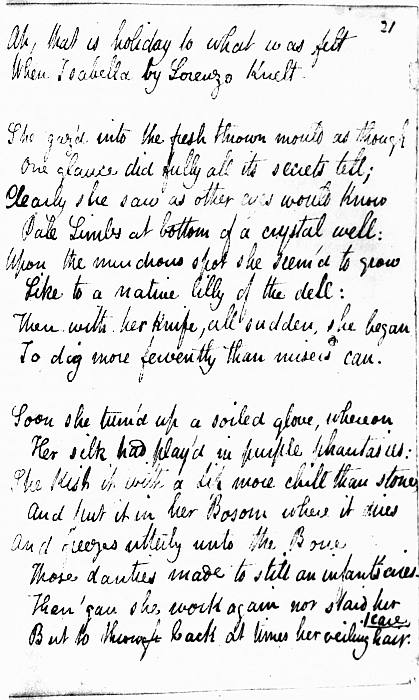
PAGE FROM ISABELLA; OR, THE POT OF BASIL FROM AN AUTOGRAPH BY KEATS IN THE BRITISH MUSEUM
Is any scene in poetry written with more piercing, more unerring, vision? The swift despairing gaze of the girl, anticipating with too dire a certainty the realization of her dream: the simile in the third and fourth lines, emphasizing the clearness of that certainty, and at the same time relieving its terror by an image of beauty: the new simile of the lily, again striking the note of beauty, while it intensifies the impression of her rooted fixity of posture and purpose: the sudden solution of that fixity, with the final couplet, into vehement action, as she begins (with a fine implied commentary on the relative strength of passions) to dig ‘more fervently than misers can’:—then the first reward of her toil, in the shape of a relic not ghastly, but beautiful both in itself and for the tenderness of which it is a token: her womanly action in kissing it and putting it in her bosom, while all the woman and mother in her is in the same words revealed to us as blighted by the tragedy of her life: then the resumption and continuance of her labours, with gestures once more of vital dramatic truth as well as grace:—to imagine and to write like this is the privilege of the best poets only, and even the best have not often combined such concentrated force and beauty of conception with such a limpid and flowing ease of narrative.5 Poetry had always come to Keats as naturally as leaves to a tree. So he considered it ought to come, and now that it came of a quality like this, he had fairly earned the right, which his rash youth had too soon arrogated, to look down on the fine artificers of the school of Pope. In comparison with the illuminating power of true imaginative poetry, the closest rhetorical condensations of that school seem thin, their most glittering points and aphorisms mechanical: nay, those who admire them most justly will know better than to think the two kinds of writing comparable.
The final consignment by Isabella of her treasure to its casket is told with the same genius for turning horror into beauty: note the third and fourth lines of the following, with the magically cooling and soothing effect of their open-vowelled sonority;—
Then in a silken scarf,—sweet with the dews Of precious flowers pluck’d in Araby, And divine liquids come with odorous ooze Through the cold serpent-pipe refreshfully,— She wrapp’d it up; and for its tomb did choose A garden-pot, wherein she laid it by, And cover’d it with mould, and o’er it set Sweet Basil, which her tears kept ever wet. And she forgot the stars, the moon, and sun, And she forgot the blue above the trees, And she forgot the dells where waters run, And she forgot the chilly autumn breeze; She had no knowledge when the day was done, And the new morn she saw not: but in peace Hung over her sweet Basil evermore, And moisten’d it with tears unto the core.
In passages like these of Isabella Keats, for one reader at least, reaches his high-water mark in human feeling, and in felicity both imaginative and executive. The next of his three poetic tales, The Eve of St Agnes, does not strike so deep, though it is more nearly faultless and lives as the most complete and enchanting English pure romance-poem of its time. Little or none of the effect is due in this case to elements of magic weirdness or supernatural terror such as counted for so much in the general romantic poetry of the day, and had been of the very essence of achievements so diverse as The Ancient Mariner, Christabel, The Lay of the Last Minstrel, and Isabella itself. The tale hinges on the popular belief that on St Agnes’s Eve (January the 20th) a maiden might win sight of her future husband in a dream by going to bed supperless, silent and without looking behind her, and sleeping on her back with her hands on the pillow above her head. This belief is mentioned by two writers at least with whom Keats was very familiar: by Ben Jonson in his masque The Satyr and Robert Burton in the Anatomy of Melancholy. An eighteenth century book of reference which he may well have known also, Brand’s Popular Antiquities, cites the superstition and adds from a current chapbook a fuller account of it, mentioning other and alternative rites. But one feature of the promised vision which in Keats’s mind was evidently essential, that the lover should regale his mistress after her fasting dream with exquisite viands and music, is not noted in any of these sources: Keats must either have invented it or drawn it from some other authority which criticism has not yet recognized.
It was an obvious and easy idea for Keats to weave into the St Agnes’ Eve motive the motive of a love-passion between the son and daughter of hostile houses, and to bring the youth to a festival in the halls of his enemies in a manner which reminds one both of Romeo and Juliet and of the young Lochinvar in Scott’s ballad. A remoter source has lately been pointed out as probable for the subsequent incidents of the lover’s concealment by the old nurse in a closet next the maiden’s chamber, his coming in to her while she sleeps, the melting of his real self into her dream of him, her momentary disenchantment and alarm on awakening, her re-assurance and surrender and their ensuing happy union and flight. All these circumstances, it has been shown, except the immediate flight of the lovers, are closely paralleled in Boccaccio’s early novel Il Filocolo, and look as though they must have been derived from it. The Filocolo is an excessively tedious and occasionally coarse amplification in prose, made by Boccaccio when his style was still unformed, of the old French metrical romance, long popular throughout Europe, of Floire et Blancheflor. The question is, how should Keats have come to be acquainted with it? At this time he knew very little Italian. He was accustomed to read his Decameron in a translation,6 and eight months later we find him with difficulty making out Ariosto at the rate of ten or a dozen stanzas a day. A French seventeenth-century version of the Filocolo indeed existed, but none in English. Can it be that Hunt had told Keats the story, or at least those parts of it which would serve him, in the course of talk about Boccaccio? One would not have expected even Hunt’s love of Italian reading to sustain him through the tedium of this early and little known novel by the master: moreover in criticizing The Eve of St Agnes he gives no hint that Keats was indebted to him for any of its incidents. But there the resemblances are, too close to be easily explained as coincidences. The part played by the old nurse Angela in Keats’s poem echoes pretty closely the part played by Glorizia in the Filocolo; the drama, dreaming and awake, played between Madeline and Porphyro, repeats, though in a far finer strain, that between Biancofiore and Florio; so that Keats’s narrative reads truly like a magically refined and enriched quintessence distilled from the corresponding chapter in Boccaccio’s tale.7
But the question of sources is one for the special student, and its discussion may easily tire the lay reader. Passing to the poem and its qualities, we have to note first that, fresh from treading, in his Hyperion attempt, in the path of Milton, Keats in The Eve of St Agnes went back, so far as his manner is derivative at all, to the example of his first master, Spenser. He shows as perfect a command of the Spenserian stanza, with its ‘sweet-slipping movement,’ as Spenser himself, and as subtle a sense as his of the leisurely meditative pace imposed upon the metre by the lingering Alexandrine at the close. Narrating at this pace and in this mood, he is able at any moment with the lightest of touches to launch the imagination to music on a voyage beyond the beyonds, and to charge every line, every word almost, with a richness and fullness of far-away suggestion that yet never clogs the easy harmonious flow of the verse. At the same time he does not, in this new poem, attempt anything like the depth of human passion and pathos which he had touched in Isabella, and his personages appeal to us in the manner strictly defined as ‘romantic,’ that is to say not so much humanly and in themselves as by the circumstances, scenery, and atmosphere amidst which they move.
In handling these Keats’s method is the reverse of that by which some writers vainly endeavour to rival in literature the effects of the painter and sculptor. He never writes for the eye merely, but vivifies everything he touches, telling even of dead and senseless things in terms of life, movement, and feeling. From the opening stanza, which makes us feel the chill of the season to our bones,—telling us first of its effect on the wild and tame creatures of wood and field, and next how the frozen breath of the old beadsman in the chapel aisle ‘seem’d taking flight for heaven, without a death,’—from thence to the close, where the lovers disappear into the night, the poetry throbs in every line with the life of imagination and beauty. The monuments in the aisle are brought before us, not by any effort of description, but solely through our sympathy with the shivering fancy of the beadsman:—
Knights, ladies, praying in dumb orat’ries, He passeth by; and his weak spirit fails To think how they may ache in icy hoods and mails.
Even into the sculptured heads of the corbels supporting the banquet-hall roof the poet strikes life:—
The carved angels, ever eager-eyed, Stared, where upon their heads the cornice rests, With wings blown back, and hands put cross-wise on their breasts.8
The painted panes in the chamber window, instead of trying to pick out their beauties in detail, he calls—
Innumerable of stains and splendid dyes As are the tiger-moth’s deep-damask’d wings,—
a gorgeous phrase which leaves the widest range to the colour-imagination of the reader, giving it at the same time a sufficient clue by the simile drawn from a particular specimen of nature’s blazonry.9 In the last line of the same stanza—
A shielded scutcheon blush’d with blood of queens and kings,
—the word ‘blush’ makes the colour seem to come and go, while the mind is at the same time sent travelling from the maiden’s chamber on thoughts of her lineage and ancestral fame. Observation, I believe, shows that moonlight has not the power to transmit the separate hues of painted glass as Keats in this celebrated passage represents it, but fuses them into a kind of neutral or indiscriminate opaline shimmer. Let us be grateful for the error, if error it is, which has led him to heighten, by these saintly splendours of colour, the sentiment of a scene wherein a voluptuous glow is so exquisitely attempered with chivalrous chastity and awe. If any reader wishes to realise how the genius of Elizabethan romantic poetry re-awoke in Keats, and how much enriched and enhanced, after two hundred years, let him compare all this scene of Madeline’s unrobing with the passage from Brown’s Britannia’s Pastorals which was probably in his memory when he wrote it (see above, p. 98).
When Madeline unclasps her jewels, a weaker poet would have dwelt on their lustre or other visible qualities: Keats puts those aside, and speaks straight to our spirits in an epithet breathing with the very life of the wearer,—‘Her warmèd jewels.’ When Porphyro spreads the feast of dainties beside his sleeping mistress, we are made to feel how those ideal and rare sweets of sense surround and minister to her, not only with their own natural richness, but with the associations and the homage of all far countries whence they have been gathered—
From silken Samarcand to cedar’d Lebanon.
Concerning this sumptuous passage of the spread feast of fruits, not unequally rivalling the famous one in Milton,10 Leigh Hunt has some interesting things to say in his Autobiography11:—
I remember Keats reading to me, with great relish and particularity, conscious of what he had set forth, the lines describing the supper and ending with the words,
And lucent syrups tinct with cinnamon.
Mr Wordsworth would have said the vowels were not varied enough; but Keats knew where his vowels were not to be varied. On the occasion above alluded to, Wordsworth found fault with the repetition of the concluding sound of the participles in Shakespeare’s line about bees:—
The singing masons building roofs of gold.
This, he said, was a line which Milton would never have written. Keats thought, on the other hand, that the repetition was in harmony with the continued note of the singers, and that Shakespeare’s negligence, if negligence it was, had instinctively felt the thing in the best manner.
The reader will remember how Bailey records this subject of the musical and emotional effect of vowel sounds, open and close, varied or iterated as the case might be, as one on which Keats’s talk had often run at Oxford. Whatever his theories, he was by this time showing himself as fine a master of such effects as any, even the greatest, of our poets. This same passage, or interlude, of the feast of fruits has despite its beauty been sometimes blamed as a ‘digression.’ A stanza which in Keats’s original draft stood near the beginning of the poem shows that in his mind it was no mere ornament and no digression at all, but an essential part of his scheme. In revision he dropped out this stanza, doubtless as being not up to the mark poetically: pity that he did not rather perfect it and let it keep its place: but even as it is the provision of the dainties made beforehand by the old nurse at Porphyro’s request (stanza xx) proves the feast essential to the story.