Front matter (continued 10)
Reading edition
While the unique charm of The Eve of St Agnes lies thus in the richness and vitality of the accessory and decorative images, the actions and emotions of the personages are not less happily conceived as far as they go. What can be better touched than the figures of the beadsman and the old nurse Angela? How admirable in particular is the debate held by Angela with Porphyro in her
little moonlight room Pale, lattic’d, chill, and silent as a tomb.
Madeline, a figure necessarily in the main passive, is none the less exquisite, whether in her gentle dealing with the nurse on the staircase, or when closing her chamber door she pants with quenched taper in the moonlight, and most of all when awakening she finds her lover beside her, and contrasts his bodily presence with her dream:—
‘Ah, Porphyro!’ said she, ‘but even now Thy voice was at sweet tremble in mine ear, Made tuneable with every sweetest vow; And those sad eyes were spiritual and clear: How chang’d thou art! how pallid, chill, and drear! Give me that voice again, my Porphyro, Those looks immortal, those complainings dear!’12
In all the doings and circumstances attending the departure of the lovers for a destination left thrillingly vague in the words, ‘For o’er the southern moors I have a home for thee,’13—in the elfin storm sent to cover their flight (the only touch of the supernatural in the story), their darkling grope down the stairway, the hush that holds the house and guest-chambers, the wind-shaken arras, the porter sprawling asleep beside his empty flagon, the awakened bloodhound who recognizes his mistress and is quiet—in Keats’s telling of all these things a like unflagging richness and felicity of imagination holds us spell-bound: and with the deaths of the old nurse and beadsman, once the house has lost its spirit of life and light in Madeline, the poet brings round the tale, after all its glow of passionate colour and music, of trembling anticipation and love-worship enraptured or in suspense, to a chill and wintry close in subtlest harmony with its beginning:—
They glide, like phantoms, into the wide hall; Like phantoms, to the iron porch, they glide; Where lay the Porter, in uneasy sprawl, With a huge empty flaggon by his side: The wakeful bloodhound rose, and shook his hide, But his sagacious eye an inmate owns: By one, and one, the bolts full easy slide: The chains lie silent on the footworn stones; The key turns, and the door upon its hinges groans. And they are gone: aye, ages long ago These lovers fled away into the storm. That night the Baron dreamt of many a woe, And all his warrior-guests, with shade and form Of witch, and demon, and large coffin-worm, Were long be-nightmar’d. Angela the old Died palsy-twitch’d, with meagre face deform; The Beadsman, after thousand aves told, For aye unsought for slept among his ashes cold.14
The last of the trio of Keats’s tales in verse, Lamia, owed its origin, and perhaps part of its temper, to his readings in Burton’s Anatomy of Melancholy. His own experiences under the stings of love and jealousy had led him, during those spring months of 1819 when he could write nothing, to pore much over the treatise of that prodigiously read, satiric old commentator on the maladies of the human mind and body, and especially over those sections of it which deal with the cause and cure of love-melancholy. Entertainment in abundance, information in cartloads, Keats could draw from the matter accumulated and glossed by Burton, but little or nothing to gladden or soothe or fortify him. One story, however, he found which struck his imagination so much that he was moved to write upon it, and that was the old Greek story, quoted by Burton from Philostratus, of Lamia the serpent-lady, at once witch and victim of witchcraft, who loved a youth of Corinth and lived with him in a palace of delights built by her magic, until their happiness was shattered by the scrutiny of intrusive and coldblooded wisdom.
In June 1819, soon after the inspiration which produced the Odes had passed away, and before he left Hampstead for the Isle of Wight, Keats made a beginning on this new task; continued it at intervals, concurrently with his attempts in drama, at Shanklin and Winchester; and finished it by the first week in September. It happened that Thomas Love Peacock had published the year before a tale in verse on a nearly similar theme,—that of the beautiful Thessalian enchantress Rhododaphne: one wonders whether Keats may not have felt in Peacock’s attempt a challenge and stimulus to his own. Peacock’s work, now unduly neglected, is that of an accomplished scholar and craftsman sitting down to tell an old Greek tale of magic in the form of narrative verse then most fashionable, the mixed four-stressed couplet and ballad measure of Scott and Byron, and telling it, for a poet not of genius, gracefully and well. Whether Keats’s Lamia is a work of genius there is no need to ask. No one can deny the truth of his own criticism of it when he says, ‘I am certain there is that sort of fire in it which must take hold of people in some way—give them either pleasant or unpleasant sensation.’ But personally I cannot agree with the opinion of the late Francis Turner Palgrave and other critics—I think they are the majority—who give it the first place among the tales. On the contrary, if an order of merit among them there must be, I should put it third and lowest, for several reasons of detail as well as for one reason affecting the whole design and composition.
As to the technical qualities of the poetry, let it be granted that Keats’s handling of the heroic couplet, modelled this time on the example of Dryden and not of the Elizabethans, though retaining pleasant traces of the Elizabethan usages of the over-run or enjambement and the varied pause,—let it be granted that his handling of this mode of the metre is masterly. Let it be admitted also that there are passages in the narrative imagined as intensely as any in Isabella or The Eve of St Agnes and told quite as vividly in a style more rapid and condensed. Such is the passage, in the introductory episode which fills so large a relative place in the poem, where Mercury woos and wins his wood-nymph after Lamia has lifted from her the spell of invisibility. Such is the gorgeous, agonized transformation act of Lamia herself from serpent to woman: such again the scene of her waylaying and ensnaring of the youth on his way to Corinth. And such above all would be the whole final scene of the banquet and its break-up, from ‘Soft went the music with soft air along’ to the end, but for the perplexing apostrophe, presently to be considered, which interrupts it. Still counting up the things in the poem to be most praised, here is an example where the poetry of Greek mythology is very eloquently woven into the rhetoric of love:—
Leave thee alone! Look back! Ah! goddess, see Whether my eyes can ever turn from thee! For pity do not this sad heart belie— Even as thou vanishest so I shall die. Stay! though a Naiad of the rivers, stay! To thy far wishes will thy streams obey: Stay! though the greenest woods be thy domain, Alone they can drink up the morning rain: Though a descended Pleiad, will not one Of thine harmonious sisters keep in tune Thy spheres, and as thy silver proxy shine?
And here a beautiful instance of power and justness in scenic imagination:—
As men talk in a dream, so Corinth all, Throughout her palaces imperial, And all her populous streets and temples lewd, Mutter’d, like tempest in the distance brew’d, To the wide-spreaded night above her towers. Men, women, rich and poor, in the cool hours, Shuffled their sandals o’er the pavement white, Companion’d or alone; while many a light Flar’d here and there, from wealthy festivals, And threw their moving shadows on the walls, Or found them cluster’d in the cornic’d shade Of some arch’d temple door, or dusty colonnade.
Turning now to the other side of the account: for one thing, we find jarring and disappointing notes, such as had disappeared from Keats’s works since Endymion, of the old tasteless manner of the Hunt-taught days: for instance the unpalatable passage in the first book beginning ‘Let the mad poets say whate’er they please,’ and worse still, with a new note of idle cynicism added, the lines about love which open the second book. Misplaced archaisms also reappear, such as ‘unshent’ and the participle ‘daft,’ from the obsolete verb ‘daff,’ used as though it meant to puzzle or daze; with bad verbal coinages like ‘piazzian,’ ‘psalterian.’ Moreover, though many things in the poem are potently conceived, others are not so. The description of the magical palace-hall is surely a failure, except for the one fine note in the lines,—
A haunting music, sole perhaps and lone Supporters of the faery-roof, made moan Throughout, as fearful the whole charm might fade.
The details of the structure, with its pairs of palms and plantains carved in cedar-wood, its walls lined with mirrors, its panels which change magically from plain marble to jasper, its fifty censers and ‘Twelve sphered tables, by twelve seats insphered,’—all this seems feebly and even tastelessly invented in comparison with the impressive dream-architecture in some of Keats’s other poems: I will even go farther, and say that it scarce holds its own against the not much dissimilar magic hall in the sixth canto of Rhododaphne.
But the one fundamental flaw in Lamia concerns its moral. The word is crude: what I mean is the bewilderment in which it leaves us as to the effect intended to be made on our imaginative sympathies. Lamia is a serpent-woman, baleful and a witch, whose love for Lycius fills him with momentary happiness but must, we are made aware, be fatal to him. Apollonius is a philosopher who sees through her and by one steadfast look withers up her magic semblance and destroys her, but in doing so fails to save his pupil, who dies the moment his illusion vanishes. Are these things a bitter parable, meaning that all love-joys are but deception, and that at the touch of wisdom and experience they melt away? If so, the tale might have been told either tragically or satirically, in either case leaving the reader impartial as between the sage and his victim. But Keats in this apostrophe, which I wish he had left out, deliberately points a moral and expressly invites us to take sides:—
What wreath for Lamia? What for Lycius? What for the sage, old Apollonius? Upon her aching forehead be there hung The leaves of willow and of adder’s tongue; And for the youth, quick, let us strip for him The thyrsus, that his watching eyes may swim Into forgetfulness; and, for the sage, Let spear-grass and the spiteful thistle wage War on his temples. Do not all charms fly At the mere touch of cold philosophy? There was an awful rainbow once in heaven: We know her woof, her texture; she is given In the dull catalogue of common things. Philosophy will clip an Angel’s wings, Conquer all mysteries by rule and line, Empty the haunted air, and gnomed mine— Unweave a rainbow, as it erewhile made The tender-person’d Lamia melt into a shade.
These lines to my mind have not only the fault of breaking the story at a critical point and anticipating its issue, but challenge the mind to untimely questionings and reflections. The wreaths of ominous growth distributed to each of the three personages may symbolize the general tragedy: but why are we asked to take sides with the enchantress, ignoring everything about her except her charm, and against the sage? If she were indeed a thing of bale under a mask of beauty, was not the friend and tutor bound to unmask her? and if the pupil could not survive the loss of his illusion,—if he could not confront the facts of life and build up for himself a new happiness on a surer foundation,—was it not better that he should be let perish? Is there not in all this a slackening of imaginative and intellectual grasp? And especially as to the last lines, do we not feel that they are but a cheap and unilluminating repetition of a rather superficial idea, the idea phrased shortly in Campbell’s Rainbow and at length in several well-known passages of Wordsworth’s Excursion, particularly that in the fifth book beginning—
Ambitious spirits!— Whom earth, at this late season, hath produced To regulate the moving spheres, and weigh The planets in the hollow of their hand; And they who rather dive than soar, whose pains Have solved the elements, or analysed The thinking principle—shall they in fact Prove a degraded Race?
Wordsworth had fifteen years earlier written more wisely, ‘Poetry is the impassioned expression in the countenance of all science.’ The latter-day Wordsworth, and Keats after him, should have realised that the discoveries of ‘philosophy,’ meaning science, create new mysteries while they solve the old, and leave the world as full of poetry as they found it: poetry, it may be, with its point of view shifted, poetry of a new kind, but none the less poetical. Leigh Hunt, in his review of Lamia published on the appearance of the volume, has some remarks partly justifying and partly impugning Keats’s treatment of the story in this respect:—
Mr Keats has departed as much from common-place in the character and moral of this story, as he has in the poetry of it. He would see fair play to the serpent, and makes the power of the philosopher an ill-natured and disturbing thing. Lamia though liable to be turned into painful shapes had a soul of humanity; and the poet does not see why she should not have her pleasures accordingly, merely because a philosopher saw that she was not a mathematical truth. This is fine and good. It is vindicating the greater philosophy of poetry.
So far, this is a manifest piece of special pleading by Hunt on Lamia’s behalf. If she is nothing worse than a being with a soul of humanity liable to be turned into painful shapes, why must Apollonius feel it his duty to wither and destroy her for the safeguarding of his pupil, even at the cost of that pupil’s life? Her witchcraft must consist in something much worse than not being a mathematical truth, else why is he her so bitter enemy? Hunt proceeds, more to the purpose, to protest against the poet’s implication—
that modern experiment has done a deadly thing to poetry by discovering the nature of the rainbow, the air, etc., that is to say, that the knowledge of natural history and physics, by shewing us the nature of things, does away with the imaginations that once adorned them. This is a condescension to a learned vulgarism, which so excellent a poet as Mr Keats ought not to have made. The world will always have fine poetry, so long as it has events, passions, affections, and a philosophy that sees deeper than this philosophy. There will be a poetry of the heart, so long as there are tears and smiles: there will be a poetry of the imagination, as long as the first causes of things remain a mystery. A man who is no poet, may think he is none, as soon as he finds out the physical cause of the rainbow; but he need not alarm himself:—he was none before. The true poet will go deeper. He will ask himself what is the cause of that physical cause; whether truths to the senses are after all to be taken as truths to the imagination; and whether there is not room and mystery enough in the universe for the creation of infinite things, when the poor matter-of-fact philosopher has come to the end of his own vision.
In Endymion Keats had impeded and confused his narrative by working into it much incident and imagery symbolic of the cogitations and aspirations, the upliftings and misgivings, of his own unripe spirit. Three years later, writing to Shelley from his sickbed, he contrasts that former state of his mind with its present state, saying that it was then like a scattered pack of cards but is now sorted to a pip. The three tales just discussed, written in the interval, show how quickly the power of sorting and controlling his imaginations had matured itself in him. In them he is already an artist standing outside of his own conceptions, certain of his own aim in dealing with them (subject perhaps to some reservation in the case of Lamia), and scarcely letting his personal self intrude upon his narrative at all to complicate or distract it.
For the expression of his private moods and meditations he had perfected during the same interval a new and beautiful vehicle in the ode. He had been accustomed to try his hand at odes, or what he called such, from his earliest riming days: and odes also, to all intents and purposes, are the two great lyrics in Endymion, the choral hymn to Pan and the song of the Indian maiden to Sorrow. But those which he composed in quick succession, as we have seen, in the late spring of 1819 are of a reflective and meditative type, new in his work and highly personal.
That which I have shown reason for believing to be the earliest of the group, the Ode to Psyche written in the last days of April, differs somewhat from the rest both in form and spirit. Its strophes are longer and more irregular: its strain less inward and brooding, with more of lyric ardour and exaltation. It tells of the poet’s delight in that late, exquisitely and spiritually symbolic product of the mythologic spirit of expiring paganism, the story of Cupid and Psyche. What may have especially turned his attention to this fable at that moment we cannot tell. Possibly the mention of it in Burton’s Anatomy may have set him on to reading the original source, the Golden Ass of Apuleius, in Adlington’s translation: there are passages in Lamia which suggest such a reading,15 and the noble, rhythmical English of that Elizabethan version, loose as it may be in point of scholarship, could not fail to charm his ear. Or possibly recent study of the plates in the Musée Napoléon (as to which more by and by) may have brought freshly to his memory the sculptured group in which the story is embodied. But that he had always loved the story we know from the passage ‘I stood tip-toe’ beginning—
So felt he, who first told how Psyche went On the smooth wind to realms of wonderment,
as well as from his confession that in boyhood he used to admire its languid and long-drawn romantic treatment in the poem of Mrs Tighe.
Cloying touches of languor, such as often disfigure his own earlier work, are not wanting in the opening lines in which he tells how he came upon the fabled couple in a dream, but are more than compensated by the charm of the scene where he finds them reposing, ‘Mid hush’d, cool-rooted flowers fragrant-eyed.’ What other poet has compressed into a single line so much of the essential virtue of flowers, of their power to minister to the spirit of man through all his senses at once? Such felicity in compound epithets is by this time habitual with Keats; and of Spenser with his ‘sea-shouldering whales’ he is now more than the equal. The ‘azure-lidded sleep’ of the maiden in St Agnes’ Eve is matched in this ode by the ‘soft-conchèd ear’ of Psyche,—though the compound is perhaps a little forced and odd, like the ‘cirque-couchant’ snake in Lamia. The invocation in the third and fourth stanzas expresses, with the fullest reach of Keats’s felicity in style and a singular freshness and fire of music in the verse, both his sense of the meaning of Greek nature-religion and his delight in imagining the beauty of its shrines and ritual. For the rest, there seems at first something strained in the turn of thought and expression whereby the poet offers himself and the homage of his own mind to the divinity he addresses, in lieu of the worship of antiquity for which she came too late; and especially in the terms of the metaphor which opens the famous fourth stanza:—
Yes, I will be thy priest, and build a fane In some untrodden region of my mind, Where branched thoughts, new-blown with pleasant pain, Instead of pines shall murmur in the wind.
But in a moment we are carried beyond criticism by that incomparable distillation of one, or many, of his impressions among the Lakes or in Scotland,—
Far, far around shall those dark-cluster’d trees Fledge the wild-ridged mountains steep by steep.
For such a master-stroke of concentrated imaginative description no praise, much as has been showered on it by Ruskin and lesser critics, can be too great.
Keats declares to his brother that this is the first of his poems with which he has taken even moderate pains. That being so, it is remarkable that he should have let stand in it as many as three unrimed line-endings: and what the poem truly bears in upon the reader is a sense less of special care and finish than of special glow and ardour, till he is left breathless and delighted at the threshold of the sanctuary prepared by the ‘gardener Fancy,’ his mind enthralled by the imagery and his ear by the verse, with its swift, mounting music and rich, vehemently iterated assonances towards the close:—
A rosy sanctuary will I dress With the wreath’d trellis of a working brain, With buds, and bells, and stars without a name, With all the gardener Fancy e’er could feign, With breeding flowers, will never breed the same; And thither will I bring all soft delights That shadowy thought can win, A bright torch, and a casement ope at nights, To let the warm Love in!
The four remaining spring odes are slower-paced, as becomes their more musing tenour, and are all written in a succession of stanzas repeated uniformly or with slight variations. Throughout them all each stanza is of ten lines and five rimes, the first and second rimes arranged in a quatrain, the third, fourth and fifth in a sestet: the order of rimes in the sestet varying in the different odes, and in one, the nightingale ode, the third line from the end being shortened so as to have three stresses instead of five.
Let us take first the two in which the imagery has been suggested to the poet by works of Greek sculpture whether seen or imagined. In the Ode on Indolence Keats merely revives his memory of a special type of Greek marble urn where draped figures of women, Seasons, it may be, or priestesses, walk with joined hands behind a solemn Bacchus, or priest in the god’s guise (see Plate viii, p. 342),—he merely evokes this memory in order to describe the way in which certain symbolic personages have seemed in a day-dream to pass before him and re-pass and again re-pass, appearing and disappearing as the embossed figures on such an urn may be made to do by turning it round. From the ‘man and two women’ of the March letter they are changed to three women, whom at first he does not recognize; but seeing presently who they are, namely Love, Ambition, and that ‘maiden most unmeek,’ his ‘demon Poesy,’ he for a moment longs for wings to follow and overtake them. The longing passes, and in his relaxed mood he feels that none of the three holds any joy for him—
so sweet as drowsy noons, And evenings steep’d in honey’d indolence.
They come by once more, and again, barely aroused from the sweets of outdoor slumber and the spring afternoon, he will not so much as lift his head from where he lies, but bids them farewell and sees them depart without a tear.
Keats did not print this ode, thinking it perhaps not good enough or else too intimately personal. But writing to Miss Jeffrey a few weeks after it was composed, he tells her it is the thing he has most enjoyed writing this year. It is indeed a pleasant, lovingly meditated revival and casting into verse of the imagery which had come freshly into his mind when he wrote to his brother of his fit of languor in the previous March. It contains some powerful and many exquisite lines, but only one perfect stanza, the fifth: and there are slacknesses—shall we say lazinesses—in the execution, as where the need for rimes to ‘noons’ and ‘indolence’ prompts the all-too commonplace prayer—
That I may never know how change the moons, Or hear the voice of busy common-sense;
or where, thinking contemptuously of the old ‘intercoronation’ days with Leigh Hunt, he declines, in truly Cockney rime, to raise his head from the flowery grass in order to be fed with praise and become ‘a pet-lamb in a sentimental farce.’
In bidding the phantoms of this day-dream adieu, Keats avows that there are others yet haunting him, and while imagery drawn from the sculptures on Greek vases was still floating through his mind, he was able to rouse himself to a stronger effort and produce a true masterpiece in his famous Ode on a Grecian Urn. It is no single or actually existing specimen of Attic handicraft that he celebrates in this ode, but a composite conjured up instinctively in his mind out of several such known to him in reality or from engravings. During and after those hour-long silent reveries among the museum marbles of which Severn tells us, the creative spirit within him will have been busy almost unaware combining such images and re-combining them. Cricitism can plausibly analyse this creation into its several elements. In calling the scene a ‘leaf-fringed legend’ Keats will have remembered that the necks and shoulders of this kind of urn are regularly encircled by bands of leaf-pattern ornament. The idea of a sacrifice and a Bacchic dance being figured together in one frieze, a thing scarcely elsewhere to be found, will have come to him from the well known vase of Sosibios (so called from the name of the sculptor inscribed upon it), from the print of which in the Musée Napoléon there actually exists a tracing by his hand.16 But this is a serene and ceremonial composition: for the tumult and ‘wild ecstasy’ of his imagined frieze, the ‘pipes and timbrels,’ the ‘mad pursuit,’ he will have had store of visions ready in his mind, from the Bacchanal pictures of Poussin, no doubt also from Bacchic vases like that fine one in the Townley collection at the British Museum and the nearly allied Borghese vase: while for the
—heifer lowing at the skies And all her silken flanks in garlands drest,
as well as for the thought of the pious morn and the little town emptied of its folk that old deep impression received from Claude’s ‘Sacrifice to Apollo’ will have been reinforced by others from works of sculpture easy to guess at: most of all, naturally, from the sacrificial processions in the Parthenon frieze.
Pl. XI
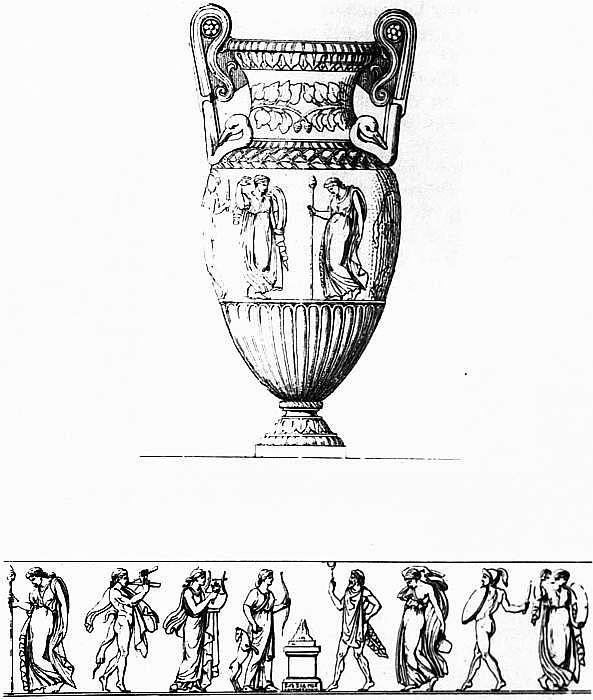
THE SOSIBIOS VASE PROFILE AND FRIEZE: FROM ENGRAVINGS IN THE MUSÉE NAPOLEON
In the ode we read how the sculptured forms of such an imaginary antique, visualized in full intensity before his mind’s eye, have set his thoughts to work, on the one hand asking himself what living, human scenes of ancient custom and worship lay behind them, and on the other hand speculating upon the abstract relations of plastic art to life. The opening invocation is followed by a string of questions which flash their own answer upon us—interrogatories which are at the same time pictures,—‘What men or gods are these, what maidens loth?’ etc. The second and third stanzas express with full felicity and insight the differences between life, which pays for its unique prerogative of reality by satiety and decay, and art, which in forfeiting reality gains in exchange permanence of beauty, and the power to charm by imagined experiences even richer than the real. The thought thrown by Leonardo da Vinci into a single line—‘Cosa bella mortal passa e non d’arte’—and expanded by Wordsworth in his later days into the sonnet, ‘Praised be the art,’ etc., finds here its most perfect utterance.
Ah, happy, happy boughs! that cannot shed Your leaves, nor ever bid the Spring adieu; And, happy melodist, unwearied, For ever piping songs for ever new; More happy love! more happy, happy love! For ever warm and still to be enjoy’d, For ever panting, and for ever young; All breathing human passion far above, That leaves a heart high-sorrowful and cloy’d, A burning forehead, and a parching tongue.
Then the questioning begins again, and again conjures up a choice of pictures,—
What little town by river or sea shore, Or mountain built with peaceful citadel, Is emptied of its folk, this pious morn?
In the answering lines of the sestet—
And, little town, thy streets for evermore Will silent be; and not a soul to tell Why thou art desolate, can e’er return,—
in these lines we find that the poet’s imagination has suddenly and lightly shifted its ground, and chooses to view the arrest of life as though it were an infliction in the sphere of reality, and not merely, like the instances of such arrest given farther back, a necessary condition in the sphere of art, having in that sphere its own compensations. Finally, dropping such airy play of the mind backward and forward between the two spheres, he consigns the work of ancient skill to the future, to remain,—
in midst of other woe Than ours, a friend to man, to whom thou say’st, Beauty is truth, truth beauty,—
thus re-asserting his old doctrine, ‘What the imagination seizes as beauty must be truth’; a doctrine which amidst the gropings of reason and the flux of things is to the poet and artist—at least to one of Keats’s temper—the one anchorage to which his soul can and needs must cleave.
Pl. XII
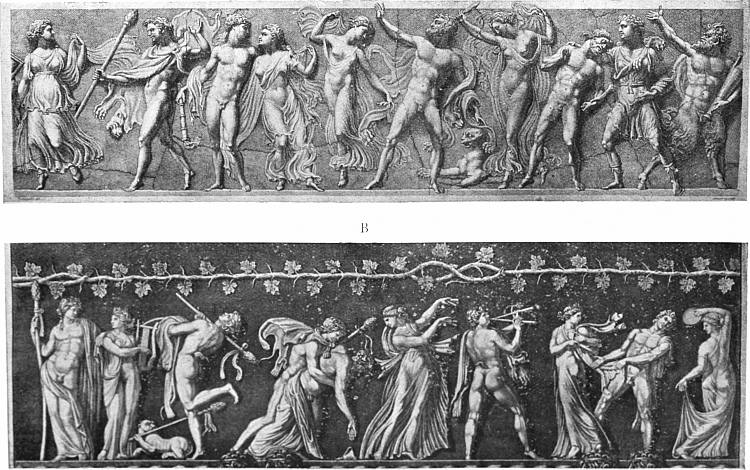
‘What pipes and timbrels? What wild ecstasy’ A. FROM THE TOWNLY VASE IN THE BRITISH MUSEUM B. FROM THE BORGHESE VASE IN THE LOUVRE
Let us turn now to the second pair—for as such I regard them—of odes written in May-time, those To a Nightingale and On Melancholy. Like the Ode on Indolence, the nightingale ode begins with the confession of a mood of ‘drowsy numbness,’ but this time one deeper and nearer to pain and heartache. Then invoking the nightingale, the poet attributes his mood not to envy of her song (perhaps, as Mr Bridges has suggested, there may be here an under-reminiscence from William Browne17), but to excess of happiness in it. Just as his Grecian urn was no single specimen of antiquity that he had seen, so it is not the particular nightingale he had heard singing in the Hampstead garden that Keats thus invokes, but a type of the race imagined as singing in some far-off scene of woodland mystery and beauty. Thither he sighs to follow her: first by aid of the spell of some southern vintage—a spell which he makes us realize in lines redolent, as are none others in our language, of the southern richness and joy which he had never known save in dreams. Then follows a contrasted vision of all his own and mankind’s tribulations which he will leave behind him. Nay, he needs not the aid of Bacchus,—Poetry alone shall transport him. For a moment he mistrusts her power, but the next moment finds himself where he would be, listening to the imagined song in the imagined woodland, and divining in the darkness all the secrets of the season and the night. While thus rapt he remembers how often the thought of death has seemed welcome to him, and feels that it would be more richly welcome now than ever. The nightingale would not cease to sing—and by this time, though he calls her ‘immortal bird,’ what he has truly in mind is not the song-bird at all, but the bird-song, thought of as though it were a thing self-existing and apart, imperishable through the ages. So thinking, he contrasts its permanence with the transitoriness of human life, meaning the life of the generations of individual men and women who have listened to it. This last thought leads him off into the ages, whence he brings back those memorable touches of far-off Bible and legendary romance in the stanza closing with the words ‘in faery lands forlorn’: and then, catching up his own last word, ‘forlorn,’ with an abrupt change of mood and meaning, he returns to daily consciousness, and with the fading away of his forest dream the poem closes.
Throughout this ode Keats’s genius is at its height. Imagination cannot be more rich and satisfying, felicity of phrase and cadence cannot be more absolute, than in the several contrasted stanzas calling for the draft of southern vintage, picturing the frailty and wretchedness of man’s estate on earth, and conjecturing in the ‘embalmed darkness’ the divers odours of spring. To praise the art of a passage like that in the fourth stanza where with a light, lingering pause the mind is carried instantaneously away from the miseries of the world into the heart of the imagined forest,—to praise or comment on a stroke of art like this is to throw doubt on the reader’s power to perceive it for himself. Let him be trusted to cherish and know the poem, as every lover of English poetry should, ‘to its depths,’ and let us go on to the last product, as I take it to be, of this spring month of inspiration, and that is the Ode on Melancholy.
The music of the word—its hundred associations derived from the early seventeenth-century poetry in which his soul was steeped—foremost among them no doubt Milton’s L’Allegro and Il Penseroso, with the beautiful song from Fletcher’s Nice Valour which inspired them—his recent familiarity with Burton’s Anatomy, including those pithy stanzas of alternate praise and repudiation which preface it—all these things will have worked together with Keats’s own haunting and deepest mood throughout these days to set him composing on this theme, Melancholy. He had dallied with an idea of doing so as far back as early in March, when being kept from writing both by physical disinclination and a temporary phase of self-criticism, he had written to Haydon, ‘I will not spoil my gloom by writing an ode to Darkness.’ Now that in May the springs of inspiration were again unlocked in him, such negative purpose fails to hold, and he adds this ode to the rest, throwing into it some of his most splendid imagery and diction. Its temper is nearly akin on the one hand to some of the gloomier passages in his letters to Miss Jeffrey of May 31 and June 9, and on the other to the tragic third stanza of the nightingale ode. Its main purport is to proclaim the spiritual nearness, the all but inseparableness, of joy and pain in human experience when either is present in its intensity. One of the attributes, it will be remembered, which he assigns to his enchantress Lamia is—
a sciential brain To unperplex bliss from its neighbour pain.
In no nature have the sources of the two lain deeper or closer together than in his own, and it is from the fullness of impassioned experience that he writes. The real melancholy, he insists, is not that which belongs to things sad or direful in themselves. Having written two stanzas piling up gruesome images of such things, and discarded on reflection the former and more gruesome of the two, he lets the second stand, and goes on, evoking contrasted images of opulent beauty, to show how the true, the utter melancholy is that which is inextricably coupled with every joy and resides at the heart of every pleasure: ending magnificently—
Ay, in the very temple of Delight Veiled Melancholy has her sovereign shrine, Though seen of none save him whose strenuous tongue Can burst Joy’s grape against his palate fine; His soul shall taste the sadness of her might, And be among her cloudy trophies hung.
One more ode remains, written in a different key and after a lapse of some four months, during which Keats had been away in the country, quieted by absence from the object of his passion and working diligently at Otho the Great and Lamia. This is the ode To Autumn. He was alone at Winchester, rejoicing in perfect September weather and in a mood more serene and contented than he had known for long or was ever to know again. ‘How beautiful the season is now,’ he writes to Reynolds, ‘how fine the air—a temperate sharpness about it. Really, without joking, chaste weather—Dian skies. I never liked stubble fields so much as now—aye, better than the chilly green of the spring. Somehow, a stubble plain looks warm, in the same way that some pictures look warm. This struck me so much in my Sunday’s walk that I composed upon it.’ The vein in which he composed is one of simple objectivity, very different from the passionate and complex phases of introspective thought and feeling which inspired the spring odes. The result is the most Greek thing, except the fragment To Maia, which Keats ever wrote. It opens up no such far-reaching avenues to the mind and soul of the reader as the odes To a Grecian Urn, To a Nightingale, or To Melancholy, but in execution is more complete and faultless than any of them. In the first stanza the bounty, in the last the pensiveness, of the time are expressed in words so transparent and direct that we almost forget they are words at all, and nature herself and the season seem speaking to us: while in the middle stanza the touches of literary art and Greek personification have an exquisite congruity and ease. Keats himself has hardly anywhere else written with so fine a subtlety of nature-observation. Students of form will notice a slight deviation from that of the spring odes, by which the second member of the stanza is now a septet instead of a sestet, one of its rimes being repeated three times instead of twice.
Season of mists and mellow fruitfulness, Close bosom-friend of the maturing sun; Conspiring with him how to load and bless With fruit the vines that round the thatch-eaves run; To bend with apples the moss’d cottage trees, And fill all fruit with ripeness to the core; To swell the gourd, and plump the hazel shells With a sweet kernel; to set budding more, And still more, later flowers for the bees, Until they think warm days will never cease, For Summer has o’er-brimm’d their clammy cells. Who hath not seen thee oft amid thy store? Sometimes whoever seeks abroad may find Thee sitting careless on a granary floor, Thy hair soft-lifted by the winnowing wind; Or on a half-reap’d furrow sound asleep, Drows’d with the fume of poppies, while thy hook Spares the next swath and all its twined flowers: And sometimes like a gleaner thou dost keep Steady thy laden head across a brook; Or by a cider-press, with patient look, Thou watchest the last oozings hours by hours. Where are the songs of Spring? Ay, where are they? Think not of them, thou hast thy music too,— While barred clouds bloom the soft-dying day, And touch the stubble-plains with rosy hue; Then in a wailful choir the small gnats mourn Among the river sallows, borne aloft Or sinking as the light wind lives or dies; And full-grown lambs loud bleat from hilly bourn; Hedge-crickets sing; and now with treble soft The red-breast whistles from a garden-croft; And gathering swallows twitter in the skies.
Had Keats been destined to know health and peace of mind, who can guess how much more work in this vein and of this quality the world might have owed to him?
1 Thoughts suggested on the banks of Nith, near the poet’s residence: the third poem in Memorials of a Tour in Scotland.
2 First printed in Hunt’s Reflector and reprinted in the two-volume edition of Lamb’s works published in 1818.
3 A copy of Fairfax’s Tasso appears in the list of books left by Keats at his death.
4 This point has been made by Mr Buxton Forman, Complete Works of J.K., ii. p. 41, footnote.
5 I let this paragraph, somewhat officious and over-explanatory though it now seems to me, stand as I wrote it thirty years ago, for the sake of the pleasure I have since had in learning that the identical passage was singled out by Charles Lamb, in a notice which has only lately come to light, (see below, p. 471) as the pick of the whole Lamia volume.
6 That published by Allen Awnmarsh, 5th ed. 1684, notes Woodhouse; and a copy of the same is noted in the list of Keats’s books.
7 See article by H. Noble M’Cracken in Philological Journal of the Chicago University, 1908. The romance of Floire and Blancheflor, which Boccaccio in the Filocolo expands with additions and inventions of his own, tells the story of a Moorish prince in Spain and a Christian damsel, brought up together and loving each other as children and thrown apart in maturity by adverse influences and ill fortune. After many chivalric and fantastic adventures both in West and East, of the kind usual in such romances, judicial combats, captures by corsairs, warnings by a magic ring and the like, Floire learns that Blancheflor is immured with other ladies in an impregnable tower by the ‘Admiral of Babylon,’ who desires to marry her. To Babylon Floire follows, cajoles the guardian of the tower and one of her damsels to admit him to her chamber concealed in a basket of roses: whence issuing, he and she are brought to one another’s arms in happiness; various other adventures ensuing before they can be finally free and united. There exists a fragmentary English medieval version of this romance, which might easily have been known to Keats from the abstract and quotations given by George Ellis in his Specimens of Early English Metrical Romance (1806). But unluckily neither this nor, apparently, any version of the original French romance poem contains those incidents recounted in the Filocolo to which Keats’s poem runs most closely parallel. These we must accordingly suppose to be Boccaccio’s own invention and to have been known to Keats, directly or indirectly, from the Filocolo itself.
8 In both the chapel monuments and the banquet-hall corbels there may be a memory of the following passage from Cary’s Dante (quoted by Mr Buxton Forman and Prof. de Sélincourt):—
As to support incumbent floor or roof, For corbel is a figure sometimes seen That crumples up its knees into its breast; With the feign’d posture, stirring ruth unfeign’d In the beholder’s fancy; so I saw These fashion’d—.
9 It may be noted that in the corresponding scene in the Filocolo a single special colour effect is got by describing the room as lit up by two great pendent self-luminous carbuncles.
10 Paradise Lost, v. 341-347.
11 Ed. 1860, pp. 269, 270.
12 The final couplet of this stanza, as Keats wrote it after several attempts, is weak. Madeline continues,—
Oh leave me not in this eternal woe, For if thou diest, my love, I know not where to go.
In the alternative version, intended to leave no doubt of what had happened, which he read to Woodhouse and Woodhouse disapproved, Madeline’s speech breaks off and the poet in his own name adds,—
See while she speaks his arms encroaching slow Have zon’d her, heart to heart,—loud, loud, the dark winds blow.
13 Keats, mentally placing his story in England and writing it at Teignmouth, had at first turned this line otherwise,—‘For o’er the bleak Dartmoor I have a home for thee.’
14 A critic, not often so in error, has contended that the death of the beadsman and Angela in the concluding stanza are due to the exigencies of rime. On the contrary, they are foreseen from the first: that of the beadsman in the lines,
But no—already had his death-bell rung; The joys of all his life were said and sung;
that of Angela where she calls herself
A poor, weak, palsy-stricken, churchyard thing, Whose passing bell may ere the midnight toll.
The touch of flippant realism which Keats had, again to Woodhouse’s distress, proposed to throw into his story at this point was as follows. For the four last lines of the last stanza Keats had proposed to write,—
Angela went off Twitch’d with the palsy: and with face deform The beadsman stiffen’d, ‘twixt a sigh and laugh Ta’en sudden from his beads by one weak little cough.
In printing the poem Keats, probably at the instance of Taylor and Woodhouse, reverted to the earlier and better version.
15 May the following be counted evidence to the same effect? The old woman in Apuleius, chap. xxi, just as she is about to tell her daughter the story of Cupid and Psyche, says, ‘as the visions of the day are accounted false and untrue, so the visions of the night do often chance contrary.’ Compare Keats at the end of the Ode on Indolence:—
Farewell! I yet have visions for the night, And for the day faint visions there is store.
16 The Musée Napoléon is a set of four volumes illustrating with outline engravings the works of classic art collected by Napoleon Bonaparte as spoils of war and brought to Paris. Keats’s original tracing from the Sosibios vase was in the collection of Sir Charles Dilke and is reproduced on the frontispiece of the Clarendon Press edition of Keats’s poems, 1906. The subject has been much discussed, but only from the point of view of the classical archaeologist, which ignores the part played by paintings as well as antiques in stimulating Keats’s imagination. From that point of view the nearest approach, as I hold, to a right solution is set out in a paper by Paul Wolters, in Archiv für das Studium der neueren Sprachen, Band xx, Heft 1/2: Braunschweig; though I think he is too positive in ruling out Roman representations of the Suovetaurilia such as the fine urn at Holland House suggested as Keats’s source by the late Mr A. S. Murray and reproduced in The Odes of Keats, by A. C. Downer, M.A. (Oxford, 1897).
17
Sweet Philomela (then he heard her sing) I do not envy thy sweet carolling, But do admire thee each even and morrow Canst carelessly thus sing away thy sorrow.

CHAPTER XIV
WORK OF 1818, 1819.—II. THE FRAGMENTS AND EXPERIMENTS
Snatches expressive of moods—Ode to Maia—Hyperion: its scheme and scale—Sources: Homer and Hesiod—Pierre Ronsard—Miltonisms—Voices of the Titans—A match and no match for Milton—A great beginning—Question as to sequel—Difficulties and a suggestion—The scheme abandoned—The Eve of St Mark—Chaucer and Morris—Judgement of Rossetti—Dissent of W. B. Scott—The solution—Keats as dramatist—Otho and King Stephen—The Cap and Bells—Why a failure—Flashes of Beauty—Recast of Hyperion—Its leading ideas—Their history in Keats’s mind—Preamble: another feast of fruits—The sanctuary—The admonition—The monitress—The attempt breaks off.
Much of our clearest insight into Keats’s mind and genius is gained from the class of his fragments which do not represent any definite poetical purpose or plan, and were never meant to be more than mere snatches and momentary outpourings. Such, though they only express a passing mood, are the lines in his letter to Reynolds of February 1818, translating the early song of the thrush into a warning not to fret after knowledge. Such is the contrasted passage of shifting, perplexed meditation on the problems of life, and the failure of the imagination to solve them alone, in the rimed epistle to the same friend six weeks later. Such, very especially, is the cry declaring that the true poet is the soul sympathetic with every form and mode of life and ready to merge its identity in that of any and every sentient creature: compare the passage in one of his letters where he tells how his own can enter into that of a sparrow picking about the gravel:—
Where’s the Poet? show him! show him, Muses nine! that I may know him. ’Tis the man who with a man Is an equal, be he King, Or poorest of the beggar-clan, Or any other wondrous thing A man may be’twixt ape and Plato; ’Tis the man who with a bird, Wren, or Eagle, finds his way to All its instincts; he hath heard The Lion’s roaring, and can tell What his horny throat expresseth, And to him the Tiger’s yell Comes articulate and presseth On his ear like mother-tongue.
Such again are the several passages in which he expressed a mood that frequently beset him, that of being rapt in spirit too high above earth to breathe, too far above his body not to feel an awful intoxication and fear of coming madness:—
It is an awful mission, A terrible division; And leaves a gulph austere To be fill’d with worldly fear. Aye, when the soul is fled Too high above our head, Affrighted do we gaze After its airy maze, As doth a mother wild, When her young infant child Is in eagle’s claws— And is not this the cause Of madness?—God of Song, Thou bearest me along Through sights I scarce can bear; O let me, let me share With the hot lyre and thee, The staid Philosophy. Temper my lonely hours, And let me see thy bowers More unalarm’d!
But our main business in this chapter must be not with illuminating snatches such as these, but with things begun of set purpose and not carried through.
When Keats, drawing near the end of his work on Endymion, was meditating what he meant to be his second long and arduous poem, Hyperion, he still thought and spoke of it as a ‘romance.’ But a phrase he uses elsewhere shows him conscious that its style would have to be more ‘naked and Grecian’ than that of Endymion. Was he trying an experiment in the naked and Grecian style when on May day 1818 he wrote at Teignmouth the beginning of an ode on Maia? He never went on with it, and the fragment as it stands is of fourteen lines only; but these are in a more truly Greek manner than anything else he wrote, not even excepting, as I have just said, the Ode to Autumn. The words figuring what Greek poets were and did for Greek communities, and expressing the aspiration to be even as they, bear the true, the classic, mint-mark of absolute economy and simplicity in absolute rightness. Considering how meagre are the hints antiquity has left us concerning Maia, the eldest of the Pleiades and mother of Hermes, and her late identification with the Roman divinity to whom sacrifice was paid on the first of May, and hence how little material for development the theme seems to offer,—considering these things, perhaps it is as well that Keats, despite his promise to finish it ‘all in good time,’ should have tantalized posterity by breaking off this beautiful thing where he did.
The next fragment we come to is colossal,—it is Hyperion itself. From the poem as far as it was written no reader could guess either that it was taken up as a ‘feverous relief’ from tendance on his dying brother, or that in continuing it later under Brown’s roof he had to put force upon himself against the intrusion of private cares and affections upon his thoughts, as well as against a reaction from his own mode of conceiving and handling the task itself. The impression Hyperion makes is one, as Woodhouse on first reading it justly noted, of serene mastery by the poet both over himself and over his art:—‘It has an air of calm grandeur about it which is indicative of true power’: and again,—‘the above lines give but a faint idea of the sustained grandeur and quiet power which characterize the poem.’ Woodhouse goes on to tell what he knew of the scheme of the work as Keats had first conceived it:—
The poem, if completed, would have treated of the dethronement of Hyperion, the former God of the Sun, by Apollo,—and incidentally of those of Oceanus by Neptune, of Saturn by Jupiter, etc., and of the war of the giants for Saturn’s reestablishment— with other events, of which we have but very dark hints in the mythological poets of Greece and Rome. In fact the incidents would have been pure creations of the Poet’s brain.
The statement inserted by the publishers at the head of the volume in which the poem appeared in 1820, that Hyperion was intended to be as long as Endymion, is probably also due to Woodhouse, their right-hand man (Keats, we know, had nothing to do with it), and may represent what he had gathered in conversation to have been the poet’s original idea. Mr de Sélincourt has shown grounds for inferring that when Keats came to actual grips with the subject he decided to treat it much more briefly and partially. Clearly the essential meaning of the story was for him symbolical; it meant the dethronement of an older and ruder worship by one more advanced and humane, in which ideas of ethics and of arts held a larger place beside ideas of nature and her brute powers. Into this story the poet plunges, not even in the middle but near the close. When his poem opens, the younger gods, the Olympians, have won their victory, and the Titans, all except Hyperion, are already overthrown. In their debate whether to fight again general despondency prevails, and only one of the fallen, Enceladus, strikes a note of defiance; so that it seems as if there were nothing left to tell except the coming defeat or abdication of Hyperion in favour of Apollo. Hyperion, it is true, has not yet spoken when we are called away from the council, and Keats might have made him side with Enceladus and rouse his brethren to a temporary renewal of the strife. Or leaving the Titans conquered, he might, as Woodhouse suggests, have gone on to narrate the second warfare, that waged against the Olympians not by them but later by the Giants in revolt. In either case we should have seen the poet try his hand, hitherto untested in such themes, on scenes of superhuman battle and violence.
Woodhouse is right at any rate in saying that the hints for handling the theme to be found in the ancient poets are few and uncertain, leaving a modern writer free to invent most of his incidents for himself. Beyond the bald notices in his classical dictionaries, Chapman’s Iliad would have given Keats a picture of the dethroned Saturn: Chapman’s Homer’s hymn to Apollo might have filled his imagination, even to overflowing, with visions of the youth of that god in Delos,—‘Chief isle of the embowered Cyclades’: Hesiod’s Theogony (which he had doubtless read in the translation of Pope’s butt and enemy, Thomas Cooke) would have taught him more, but very confusedly, about the warfare of Gods, Titans, and Giants in general, besides inspiring his vision of the den where the Titans lie vanquished; while he would have gleaned other stray matters from Sandys’s notes on certain passages of Ovid. As far as his beloved English poets are concerned, brief allusions occur in the Faerie Queene and in Paradise Lost, where Milton includes the fallen Titans among the rebel hosts that flock to the standard of Satan in hell. But I think the source freshest in his mind at the moment when he began to write is one which has not hitherto been suggested, the ode of the famous French Renaissance poet Ronsard to his friend Michel de l’Hôpital. We know by his translation of the sonnet Nature ornant Cassandre that Keats had the works of Ronsard in his hands—lent, it would seem, by Mr Taylor—exactly about this time. The ode in question, partly founded on Hesiod, partly on Horace,1 but largely on Ronsard’s own invention, relates the birth of the Muses, their training by their mother Mémoire (= Mnemosyne), their desire as young girls to visit their father Jupiter, their mother’s consent, their undersea journey to the palace of Oceanus where Jupiter is present at a high festival, their choral singing before him, first of the strife of Neptune and Pallas for the soil of Attica, and then of the battle of the gods and giants:—
Après sur la plus grosse corde D’un bruit qui tonnait jusqu’aux cieux, Le pouce des Muses accorde L’assaut des Géants et des Dieux.
Keats, although he writes of the battle of the Gods not against the Giants but against the earlier Titans, yet when he rolls out rebel names like this,—
Cœus, and Gyges, and Briareus; Typhon, and Dolor, and Porphyrion Were pent in regions of laborious breath Dungeon’d in opaque elements,—
Keats, when he rolls out these rebel names, has surely been haunted by the strophes of Ronsard:—
Styx d’un noir halecret rempare Ses bras, ses jambes, et son sein, Sa fille amenant par la main Contre Cotte, Gyge, et Briare.2 ······ Neptune à la fourche estofée De trois crampons vint se mesler Par la troupe contre Typhée Qui rouoit une fonde en l’air: Ici Phoebus d’un trait qu’il jette Fit Encelade trébucher, Là Porphyre lui fit broncher Hors des poings l’arc et la sagette.
For such an epic theme Keats felt instinctively, when he set to work, that an epic and not a romance treatment was necessary; and for an English poet the obvious epic model is Milton. Ever since his visit to Bailey at Oxford, and especially during his stay at Teignmouth the next year, Keats had been absorbing Milton and taking him into his being, as formerly he had taken Shakespeare and the Elizabethans, and now he can utter his own thoughts and imaginations almost with Milton’s voice. Speaking generally of the blank verse of Hyperion, its rhythms are almost as full and sonorous as Milton’s own, but simpler; its march more straightforward, with less of what De Quincey calls ‘solemn planetary wheelings’; its periods do not sweep through such complex evolutions to so stately and far foreseen a close. The Miltonisms in Hyperion are rather matters of diction and construction—construction almost always derived from the Latin—than of rhythm: sometimes also they are matters of direct verbal echo and reminiscence. To take a single instance out of many:—
For as among us mortals omens drear Fright and perplex, so also shuddered he.
It is only in Hyperion that Keats habitually thus puts the noun Latin-wise before the adjective: and the omens that ‘perplex’ are derived from the eclipse which in Paradise Lost ‘with fear of change Perplexes monarchs.’ Throughout the fragment Keats uses frequently and with fine effect the Miltonic figure of the ‘turn’ or rhetorical iteration of identical words to a fresh purport, as in that noble phrase which seems to have inspired one of the finest passages in Shelley’s Defence of Poesy3:
How beautiful, if Sorrow had not made Sorrow more beautiful than Beauty’s self.
It has been said, and justly, that Keats has done nothing greater than the debate of the fallen Titans in their cave of exile, modelled frankly in its main outlines on that of the rebel angels in Paradise Lost, but with the personages and utterances nevertheless entirely his own. In creating and animating these colossal figures between the elemental and the human, what masterly imaginative instinct does he show—to take one point only—in the choice of similitudes, drawn from the vast inarticulate sounds of nature, by which he seeks to make us realise their voices. Thus of the murmuring of the assembled gods when Saturn is about to speak:—
There is a roaring in the bleak-grown pines When Winter lifts his voice; there is a noise Among immortals when a God gives sign, With hushing finger, how he means to load His tongue with the full weight of utterless thought, With thunder, and with music, and with pomp: Such noise is like the roar of bleak-grown pines.
This is not a whit the less Keats for his use of the Miltonic ‘turn’ in rounding the period by a repetition in the last line of the ‘bleak-grown pines’ from the first. Again, of Oceanus answering his fallen chief:—
So ended Saturn; and the God of the Sea, Sophist and sage, from no Athenian grove, But cogitation in his watery shades, Arose, with locks not oozy, and began, In murmurs, which his first-endeavouring tongue Caught infant-like from the far-foamed sands.
Here the affirmation by negation in the second and fourth lines is a Latin usage already employed by Keats in the Pot of Basil4: the ‘locks not oozy’ are a reminiscence from Lycidas and the ‘first-endeavouring tongue’ from The Vacation Exercise. But into what a vitally apt and beautiful new music of his own has Keats moulded and converted all such echoes. Once more, of Clymene following Enceladus in debate:—
So far her voice flow’d on, like timorous brook That, lingering along a pebbled coast, Doth fear to meet the sea: but sea it met, And shudder’d; for the overwhelming voice Of huge Enceladus swallow’d it in wrath: The ponderous syllables, like sullen waves In the half-glutted hollows of reef-rocks, Came booming thus.
In this last example the sublimity owes nothing to Milton except in the single case of the repetition in the third line. Even the scoffing Byron recognized after Keats’s death the authentic ‘large utterance of the early gods’ in passages like these, though Keats in his modesty had himself refused to recognize it.
Further to compare Keats with Milton,—the poet of Hyperion is naturally no match for Milton in passages where the elder master has been inspired by life-long impassioned meditation on his readings of history and romance, like that famous one ending with
What resounds In fable or romance of Uther’s son. Begirt with British and Armoric knights Or all who since, baptized or infidel Jousted in Aspramont or Montalban, Damasco, or Marocco, or Trebizond, Or whom Biserta sent from Afric shore When Charlemain with all his peerage fell By Fontarrabia—
On the other hand Milton, even in the sweetness and the nearness to nature of Comus and his other early work, is scarce a match for Keats when it comes to the evocation, even in a mode relatively simple, of nature’s secret sources of delight,—as thus:
throughout all the isle There was no covert, no retired cave Unhaunted by the murmurous noise of waves Though scarcely heard in many a green recess:
while comparison is scarcely possible in the case of the nature images most characteristically Keats’s own, for instance:—
As when, upon a tranced summer night, Those green-robed senators of mighty woods, Tall oaks, branch-charmed by the earnest stars, Dream, and so dream all night without a stir—.
Neither to the Greek nor the Miltonic, but essentially to the modern, the romantic, sentiment of nature does it belong to try and express, by such a concourse of metaphors and epithets, every effect at once, to the most fugitive, which a forest scene by starlight can have upon the mind: the pre-eminence of the oaks among the other trees—their quasi-human venerableness—their verdure, unseen in the darkness—the sense of their preternatural stillness and suspended life in an atmosphere that seems to vibrate with mysterious influences communicated between earth and sky.
All good poems, it has been said, begin well. None begins better than Hyperion, with its ‘Deep in the shady sadness of a vale,’ and its grand mournful dialogue between the discrowned Saturn and the Titaness Thea, his would-be comforter. Then, with a rich contrast from this scene of despondency, comes the scene, dazzling and resplendent for all its ominousness, of the mingled wrath and terror of the threatened sun-god in his flaming palace. The second book, relating the council of the dethroned Titans, has neither the contrasted sublimities of the first nor the intensity, rising almost to fever-point, of the unfinished third, where we leave Apollo undergoing a convulsive change under the afflatus of Mnemosyne, and about to put on the full powers of his godhead. But it has a rightness and controlled power of its own which place it, to my mind, fully on a level with the other two. And it is in this book, in the speech of Oceanus, that Keats sets forth the whole symbolical purport and meaning of the myth as he had conceived it:—
Now comes the pain of truth, to whom ’tis pain; O folly! for to bear all naked truths, And to envisage circumstance, all calm, That is the top of sovereignty. Mark well! As Heaven and Earth are fairer, fairer far Than Chaos and blank Darkness, though once chiefs; And as we show beyond that Heaven and Earth In form and shape compact and beautiful, In will, in action free, companionship, And thousand other signs of purer life; So on our heels a fresh perfection treads, A power more strong in beauty, born of us And fated to excel us, as we pass In glory that old Darkness: nor are we Thereby more conquer’d, than by us the rule Of shapeless Chaos. Say, doth the dull soil Quarrel with the proud forests it hath fed, And feedeth still, more comely than itself? Can it deny the chiefdom of green groves? Or shall the tree be envious of the dove Because it cooeth, and hath snowy wings To wander wherewithal and find its joys? We are such forest-trees, and our fair boughs Have bred forth, not pale solitary doves, But eagles golden-feather’d, who do tower Above us in their beauty, and must reign In right thereof; for ’tis the eternal law That first in beauty should be first in might:
That difficulty, to which we have referred, of surmising how there could have remained material to fill out a poem on the Titanomachia which had begun with the Titans, all but one, dethroned already, seems to increase when we consider the above speech of Oceanus, setting forth with resigned prophetic wisdom the fated necessity of their fall. It increases still further when Clymene, following on the same side as Oceanus, tells how she has heard the strains of a new and ravishing music from the lyre of Apollo which have made her cast away in despair the instrument of her own formless music, the sea-shell; and still further again when in the next book we witness the meeting of Apollo with the Titaness Mnemosyne, mother of the Muses, who for his sake has ‘forsaken old and sacred thrones,’ and when we hear him proclaim how in the inspiration of her presence,
Knowledge enormous makes a God of me. Names, deeds, grey legends, dire events, rebellions, Majesties, sovran voices, agonies, Creations and destroyings, all at once Pour into the wide hollows of my brain, And deify me, as if some blithe wine Or bright elixir peerless I had drunk, And so become immortal.
Before the glory of this new-deified Apollo, what could long have delayed the defeat or abdication of the elder sun-god Hyperion?—what could have remained for Keats to invent that should have much enriched or lengthened out his poem? The sense of the difficulty of sustaining the battle of the primeval powers against these new and nobler successors may well have been one of the things (even had he not had Milton’s comparative failure with the warfare in heaven to warn him) that hindered his going on with his poem. To the reader there occurs another and even greater difficulty: and that is that Keats had already given to his fallen elder gods or Titans so much not only of majesty but of nobleness and goodness that it is hard to see wherein he could have shown their successors excelling them. He had represented Saturn as wroth, indeed, at his downfall, but chiefly because it leaves him
—smother’d up, And buried from all godlike exercise Of influence benign on planets pale, Of admonition to the winds and seas, Of peaceful sway above man’s harvesting, And all those acts which Deity supreme Doth ease its heart of love in.
Increase of knowledge, of skill in the arts of life and of beauty, the gods of the new dynasty might indeed extend to mankind, but what increase of love and beneficence? Even the relations of Saturn to his father Coelus (the Greek Uranus), which in the ancient cosmogony are of the crudest barbarity, Keats in Hyperion makes benignant and sympathetic.
Such inherent difficulties as these might well have made Keats diffident of his power to complete his poem as a rounded or satisfying whole had its intended scope been what we are told. But I am sometimes tempted to conjecture that his root idea had been other than what his friends attributed to him,—that battle, and the victory of the Olympians over the Titans or Giants or both, would not in fact have been his main theme, but that he intended to present to us Apollo, enthroned after the abdication of Hyperion, in the character of a prophet and to have put into his mouth revelations of things to come, a great monitory vision of the world’s future. To such a supposition some colour is surely lent by the speech of Apollo above quoted on the ‘knowledge enormous’ just poured into his brain by Mnemosyne. On the other hand it has to be remembered that Keats himself, in a forecast of his work made ten months before it was written, shows clearly that he then meant his Apollo to be above all things a god of action.
Keats himself, writing some eight months later, when he had finally decided to give up his epic attempt, cites as his chief reason a re-action of his critical judgment against the Miltonic style, at least as a style suitable for him, Keats, to work in:—
I have given up Hyperion—there were too many Miltonic inversions in it—Miltonic verse cannot be written but in an artful, or rather, artist’s humour. I wish to give myself up to other sensations. English ought to be kept up. It may be interesting to you to pick out some lines from Hyperion, and put a mark * to the false beauty proceeding from art, and one to the true voice of feeling. Upon my soul ’twas imagination—I cannot make the distinction—Every now and then there is a Miltonic intonation—But I cannot make the division properly.
And again: ‘I have but lately stood on my guard against Milton. Life to him would be death to me. Miltonic verse cannot be written, but is the verse of art. I wish to devote myself to another verse alone.’ This re-action was certainly not fully conscious or formulated in Keats’s mind by the previous winter. But it would seem none the less to have been working in him instinctively: for the moment he had turned, in The Eve of St Agnes, to a romance in the flowing, straightforward, Spenserian-Chattertonian manner of narration, he had been able to carry his task through with felicity and ease.
This was on his excursion to Hampshire in the latter half of January. Within three weeks of his return he was at work again on a kindred theme of popular and traditional belief, The Eve of St Mark. The belief was that a person standing in the church porch of any town or village on the evening before St Mark’s day (April 24th) might thereby gain a vision of all the inhabitants fated to die or fall grievously sick within the year. Those destined to die would be seen passing in but not returning, those who were to be in peril and recover would go in and after a while come out. The heroine of the poem, to whom this vision would appear, was to be a maiden of Canterbury named Bertha, no doubt after the first Christian queen of Kent, the Frankish wife of Ethelbert; the scene, Canterbury itself, memories of the poet’s stay there in 1817 mingling apparently with impressions of his recent visit to Chichester. Keats never got on with this poem after his first three or four days’ work (February 14th-17th 1819), and it remains a mere fragment, tantalizing and singular, of a hundred and twenty lines’ length. Why? Perhaps merely because it was begun almost at the very hour when he became the accepted lover of Fanny Brawne. We have seen how various causes, but chiefly the obsession of that passion, paralysed his power of work for the next two months, and what were the thoughts and tasks that held him fully occupied afterwards. It has been suggested by the late Dante Gabriel Rossetti that Keats meant to give the story a turn applicable to himself and his mistress, and that the present fragment would have served as the opening of a poem which afterwards, in sickness, he mentioned to her as being in his mind:—‘I would show some one in love, as I am, with a person living in such Liberty as you do.’ I can find no sure evidence, internal or external, either to refute the suggestion or confirm it.
The fragment of The Eve of St Mark is Keats’s only attempt at narrative writing in the eight-syllabled four-stress couplet. Its pace and movement are nearer to Chaucer in The Romaunt of the Rose or The House of Fame than to Coleridge or Scott or any other model of Keats’s own time. That he was writing with Chaucer in his mind is proved by some lines in which he tries in Rowley fashion to reproduce Chaucer’s actual style and vocabulary, thus:—
Gif ye wol stonden hardie wight— Amiddes of the blacke night— Righte in the churche porch, pardie Ye wol behold a companie Approchen thee full dolourouse For sooth to sain from everich house Be it in city or village Wol come the Phantom and image Of ilka gent and ilka carle Who coldè Deathè hath in parle And wol some day that very year Touchen with foulè venime spear And sadly do them all to die— Hem all shalt thou see verilie— And everichon shall by thee pass All who must die that year, Alas.
These lines give us a sure key to the main motive of the story which was to follow. With some others in the same style, they are quoted by the poet as composing a gloss written in minute script on the margin of a wonderful illuminated book over which the damsel is found poring and which is to have some mysterious influence on her destiny. More noticeable and interesting than their somewhat random Rowleyism is the way in which some of the descriptive lines in the body of the poem anticipate the very cadences of Chaucer’s great latter-day disciple, William Morris. The first eight or ten lines of the following might have come straight from The Man born to be King or The Land East of the Sun, and provide, as it were, in the history of our poetry a direct stepping-stone between Chaucer and Morris:—
The city streets were clean and fair From wholesome drench of April rains; And, on the western window panes, The chilly sunset faintly told Of unmatur’d green vallies cold, Of the green thorny bloomless hedge, Of rivers new with spring-tide sedge, Of primroses by shelter’d rills, And daisies on the aguish hills. Twice holy was the Sabbath-bell: The silent streets were crowded well With staid and pious companies, Warm from their fire-side orat’ries; And moving, with demurest air, To even-song, and vesper prayer. Each arched porch, and entry low, Was fill’d with patient folk and slow, With whispers hush, and shuffling feet, While play’d the organ loud and sweet.
The relation of this fragment to the Pre-Raphaelites of the mid nineteenth century and their work is altogether curious and interesting. It was natural that it should appeal to them by the pure and living freshness of English nature-description with which it opens, by the perfectly imagined scene of hushed movement in the twilight streets that follows, perhaps most of all by the insistent delight in vivid colour, and in minuteness of animated and suggestive detail, which marks the final indoor scene of the maiden Bertha over her book by firelight. But what is strange is that Rossetti should not only have coupled the fragment with La Belle Dame sans Merci as ‘the chastest and choicest example of Keats’s maturing manner,’ an opinion which may well pass, but that he should have claimed it as showing ‘astonishingly real mediævalism for one not bred an artist,’ and even as the finest picture of the Middle Age period ever done. The truth is that the description of the Sabbath streets and the maiden’s chamber are not mediæval at all and probably not intended to be, while the one thing so intended, the illuminated manuscript from which she reads, is a quite impossible invention jumbling fantastically together things that never could have figured in the same manuscript, things from the Golden Legend, from the book of Exodus, the book of Revelation, with others from no possible manuscript source at all. Keats evidently took some interest in mediæval illuminations, for in speculating on the old skulls of supposed monks at Beauly Abbey he had apostrophized one of them,—
Poor Skull, thy fingers set ablaze With silver saint in golden rays, The holy Missal: thou didst craze Mid bead and spangle, While others pass’d their idle days In coil and wrangle.
But he can have seen few and made no study of them, and his imagined mystically illuminated book in The Eve of St Mark is invented with no such fine instinctive tact or likelihood as his imagined Grecian urn of the ode.
An elder member of the Rossetti circle, that shrewd and caustic, very originally minded if only half accomplished Scottish poet and painter, William Bell Scott, was much exercised over his friend’s misconception in this matter. I will give his comment, certainly in some points just, as written to me in 1885. ‘On reading the fragment it seems to me impossible to resist the conclusion that the scene represented is of the present day. The dull and quiet Sunday evening represented is of our time in any cathedral town in England, not the Sunday evening of old when morning Mass was the religious observance, and the evening was spent in long-bow and popinjay games and practice. The weary girl sits at a coal fire with a screen behind her, a Japanese screen apparently,’ [Japanese or old English lacquer imitating Oriental the screen certainly is]. ‘Every item of the description is modern. But alas! what shall we say to the ancient illuminated MS. she has in hand, with the pictures of early martyrs dying by fire, the Inquisition punishment of heretics, and the writing annotated, the notes referred to modern printers’ signs? As he describes a mediæval MS. book so badly, it may be said he intended the scene of the poem to be mediæval, but did the description also so badly. But no, the description of the dreariness of Sunday evening, utterly silent but for the passing of the people going to evening sermon, is admirable.’ By ‘badly’ my old friend meant inexactly. But Keats never was nor tried to be exact in his antiquarianism. If we take The Eve of St Agnes as intended to be a faithful picture from the Middle Ages, it simply goes to pieces in the line—
And the long carpets rose along the gusty floor.
Probably neither The Eve of St Agnes nor St Mark’s Eve were dated with any definiteness in the poet’s mind at all. A reference he makes to the last-named piece in a letter from Winchester the following autumn lends no definite support either to the modern or the mediæval interpretation:—‘Some time since I began a poem called The Eve of St Mark, quite in the spirit of town quietude. I think it will give you the sensation of walking about an old country town on a coolish evening.’ The impression of mediævalism which the two poems convey is not by any evidence of antiquarian knowledge or accuracy but by the intense spirit of romance that is in them,—by that impassioned delight in vivid colour and beautiful, imaginative detail which we have noted.
After his four days’ start on this poem in February came the spell of two months’ idleness which towards its close yielded La Belle Dame sans Merci and came to an end with the Ode to Psyche, followed in the course of May by the four other odes. The choral Song of the Four Fairies, for some inchoate opera, sent by Keats to his brother together with La Belle Dame, is not worth pausing upon, and we may pass to Keats’s main work of the ensuing July and August, Otho the Great. This is no fragment, having been duly finished to the last scene of the last act; but it is very much of an experiment. The question whether Keats, had he lived, might have become a great dramatic poet and creator is one of the most interesting possible. His intense and growing interest in humankind, together with his recorded and avowed liability to receive (‘like putty,’ as modern criticism has conjectured of Shakespeare) the impression of any character he might come in contact with, has led many students to believe that he had in him the stuff of a great creative playwright. Otho the Great does nothing to solve the question. The plot and construction, as we have said, were entirely Brown’s, building with quite arbitrary freedom on certain bald historical facts of the rebellion raised against Otho, in the course of his Hungarian wars, by his son Ludolf and the Red Duke Conrad of Lorraine, whom the emperor subsequently forgave. Creation demands fore-knowledge, premeditation on the characters you desire to create and the situations in which they are to be placed, and Keats, Brown tells us, only foreknew what was coming in any scene after they had sat down at the table to work on it. His business was to supply the words, and what the result shows is only the surprising facility with which he could by this time improvise poetry to order. The speeches in Otho are much more than passably poetical, they are often quite brilliant and touched with Keats’s unique genius for felicity in lines and phrases. But they affect us as put into the mouths of puppet speakers, not as coming out of the hearts and passions of men and women.
In rhythm they are vital and varied enough, in style extremely high-pitched, and they resemble much Elizabethan work of the second order in smothering action and passion under a redundance and feverish excess of poetry. There is violence amounting to hysteria alike in the villainy of Conrad and of his sister Auranthe, the remorse of Albert, and the mixture of filial devotion and lover’s blindness in Ludolf, with his vengeful frenzy when he finds how he has been gulled. Keats, it is recorded, had in his eye the special gift of Edmund Kean for enacting frantic extremes and long-drawn agonies of passion; and it is possible that as played by him the last act, of which Keats took the conduct as well as the writing into his own hands, might have proved effective on the stage. It shows the maddened Conrad bent on executing vengeance on the traitress Auranthe, and insanely stabbing empty air while he imagines he is stabbing his victim, until curtains drawn aside disclose an inner apartment where she has at the very moment fallen self-slain. But it is doubtful whether any acting could carry off a plot so ultra-romantically extravagant and in places so obscure, or characters so incommensurably more eloquent than they are alive. Nor do lovers of Keats commonly care to read the play twice, for all its bursts and coruscations of fine poetry, feeling that these do not spring from the poet’s own inner self and imagination, but are rather as fireworks fitted by a man of genius on to a frame which another man, barely of talent, has put together.
The case is different when we come to King Stephen, the brief dramatic fragment on which Keats wrought alone after Otho the Great was finished. This teaches us one thing at any rate about Keats, that he could at will call away his imagination from matters luxurious or refreshing to the spirit, from themes broodingly meditative or tragically tender, to deal in a manner of fiery energy with the clash of war. He is still enough a child of the Renaissance to make his twelfth-century knights and princes quote Homer in their taunts and counter-taunts; but in the three-and-a-half scenes which he wrote he makes us feel his Stephen, defiant in defeat, a real elemental force and not a mere mouther of valiant rhetoric, fine and concentrated as the rhetoric sometimes is, as for instance when an enemy taunts him with being disarmed and helpless and he cries back, ‘What weapons has the lion but himself?’
In persuading Keats to work with him on a tragedy for the stage, Brown had had the entirely laudable motive of putting his friend in the way of earning money for them both. But what would we not have given that the time and labour thus, as it turned out, thrown away should have yielded us from Keats’s self another Isabella or Eve of St Agnes, or a finished Eve of St Mark, or even another Lamia? Brown’s next piece of suggestion and would-be help was far more unfortunate still. We have seen how in the unhappy weeks after Keats’s return from Winchester in October, he spent his mornings in Brown’s company spinning the verses of a comic and satiric fairy tale the scheme of which they had concocted together,—The Cap and Bells or The Jealousies. The idea of the friends in this was no doubt to throw a challenge to Byron, the first cantos of whose Don Juan had lately been launched upon a dazzled and scandalized world. Byron’s genius, the spirit, that is, of brilliant devilry and worldly mockery which was the sincerest part of his genius, with his rich experiences of life, travel and society, of passion and dissipation and the extremes of fame and obloquy, and his incomparable address and versatility in playing tricks of legerdemain with ideas and language, had here all found their perfect opportunity for display. Attempts at worldly banter and satire by the tender-hearted, intensely loving and imagining Keats, with his narrow and in the main rather second-rate social experience, were never more than wry-mouthed as I have called them, ineffectual, and essentially against the grain.
His collaborator Brown imagined he had a gift for satiric fairy tales, but his recorded efforts in that kind are silly and dull as well as inclining to coarseness. What happier result could be expected from their new joint work than that which posterity deplores in The Cap and Bells? The story is of an Indian Faery emperor Elfinan,—a name suggested by Spenser,—enamoured of an English maiden Bertha Pearl,—the very Bertha of The Eve of St Mark, resuscitated to our amazement,—but having for political reasons to seek in marriage a Faery princess Bellanaine, who herself is in love with an English youth named Hubert. The eighty-eight stanzas which Keats wrote on those autumn mornings in Brown’s room carry the tale no farther than Elfinan’s despatching his chancellor Crafticanto on an embassy to fetch Bellanaine on an aerial journey from her home in Imaus, his consultation with his magician Hum as to the means of escaping the marriage and conveying himself secretly to England, his departure, and the arrival of Bellanaine and her escort to find the palace empty and the emperor flown. How the seriously, perhaps tragically, conceived Bertha of St Mark’s Eve, with the mystic book fated to have influence on her life, could have been worked, as they were evidently meant to be worked, into this new ridiculous narrative, we cannot guess, nor how the relations of Bellanaine with her mortal lover would have been managed.
Before Keats’s deepening despondency and recklessness caused him to drop writing altogether, which apparently happened early in December, he was evidently out of conceit with The Cap and Bells.5 One of the most unfortunate things about the attempt is the choice of the Spenserian stanza for its metre. Keats had probably wished to avoid seeming merely to imitate Byron, as he might have seemed to do had he written in the ottava rima of Don Juan, the one perfectly fit measure for such a blend of fantasy and satire as he was attempting. But not even Keats’s power over the Spenserian stanza could make it a fit vehicle for his purpose. Thomson and Shenstone had used it in work of mild and leisurely playfulness, but to bite in satire or sting in epigram it cannot effectively be bent. To my sense the precedent most in Keats’s mind was not these, but the before-mentioned translation of Wieland’s Oberon by Sotheby. Sotheby had invented a modified form of the Spenserian stanza riming abbaccddc instead of abcbbdbdd and keeping the final alexandrine. Much of the machinery and spirit of The Cap and Bells—the magic journeys through the air—the comic atmosphere and adventures of the courts—are closely akin to the jocular parts of this Oberon. Some of the passages of mere fun and playfulness are pleasant enough, like that description of a dilapidated hackney coach (much resembling the four-wheeler of our youth) which Hunt selected to publish in the Indicator while Keats was lying sick in his house the next year: but the attempts at social satire are almost always feeble and tiresome, and still more so those at political satire, turning for the most part rather obscurely on the scandals, then at their height, attending the relations of the Prince and Princess of Wales. In the faery narrative itself there break forth momentary flashes from the true genius of the poet, such as might delight the reader if he could lose his sense of irritation at the rubbish from amidst which they gleam. As thus, of the princess’s flight through the air (was Keats thinking, in the first line, of the children carried heavenward by angels in Orcagna’s Triumph of Death?)
As in old pictures tender cherubim A child’s soul thro’ the sapphir’d canvas bear, So, thro’ a real heaven, on they swim With the sweet princess on her plumag’d lair, Speed giving to the winds her lustrous hair.
Or this, telling how Bertha of Canterbury, in Keats’s queer new conception of her, was really a changeling born in the jungle:—
She is a changeling of my management; She was born at midnight in an Indian wild; Her mother’s screams with the striped tiger’s blent, While the torch-bearing slaves a halloo sent Into the jungles.
Or again, some of the stanzas describing the welcome prepared in Elfinan’s capital for the faery princess after her flight: note in the last the persistence with which Keats carries into these incongruous climates his passion for the English spring flowers:—
The morn is full of holiday; loud bells With rival clamours ring from every spire; Cunningly-station’d music dies and swells In echoing places; when the winds respire, Light flags stream out like gauzy tongues of fire; A metropolitan murmur, lifeful, warm, Comes from the northern suburbs; rich attire Freckles with red and gold the moving swarm; While here and there clear trumpets blow a keen alarm.
And again:—
As flowers turn their faces to the sun, So on our flight with hungry eyes they gaze, And, as we shap’d our course, this, that way run, With mad-cap pleasure, or hand-clasp’d amaze; Sweet in the air a mild-ton’d music plays, And progresses through its own labyrinth; Buds gather’d from the green spring’s middle-days, They scatter’d,—daisy, primrose, hyacinth,— Or round white columns wreath’d from capital to plinth.
After his mornings spent in Brown’s company over the strained frivolities of The Cap and Bells, Keats was in the same weeks striving, alone with himself of an evening, to utter the new thoughts on life and poetry which he found taking shape in the depths of his being. He took up again the abandoned Hyperion, and began rewriting it no longer as a direct narrative, but as a vision shewn and interpreted by a supernatural monitress acting to him somewhat the same part as Virgil acts to Dante. In altering the form and structure of the poem Keats also takes pains to alter its style, de-Miltonizing and de-latinizing, sometimes terribly to their disadvantage, the passages which he takes over from the earlier version. It is not in these, it is in the two hundred and seventy lines of its wholly new pre-amble or introduction that the value of the altered poem lies.
The reader remembers how Keats had broken off his work on the original Hyperion at the point where Mnemosyne, goddess of Memory and mother of the Muses, is enkindling the brain of Apollo by mysteriously imparting to him her ancient wisdom and all-embracing knowledge. Following a clue which he had found in a Latin book of mythology he had lately bought,6 he now identifies this Greek Mnemosyne with the Roman Moneta, goddess of warning or admonition; and being possibly also aware that the temple of Juno Moneta on the Capitol at Rome was not far from that of Saturn, makes his Mnemosyne-Moneta the priestess and guardian of Saturn’s temple. His vision takes him first into a grove or garden of trees and flowers and fountains, with a feast of summer fruits spread on the moss before an embowered arbour. The events that follow, and the converse held between the poet and the priestess, are in their ethical and allegoric meanings at many points obscure, and capable, like all symbols that are truly symbolic, of various interpretations. But the leading ideas they embody can be recognised clearly enough.
They are primarily the same ideas, developed in a deeper and more sombre spirit, as had been present in Keats’s mind almost from the beginning: the idea that in the simple delights of nature and of art as unreflectingly felt in youth there is no abiding place for the poetic spirit, that from the enjoyment of such delights it must rise to thoughts higher and more austere and prompting to more arduous tasks: the further idea that to fit it for such tasks two things above all are necessary, growth in human sympathy through the putting down of self, and growth in knowledge and wisdom through strenuous study and meditation. Such ideas had already been thrown out by Keats in Sleep and Poetry; they had been developed with much more fullness, though in a manner made obscure from redundance of imagery, in Endymion, especially in the third book: they had been expressed with a difference under the new and clearer symbolism of the Two Chambers of Thought in Keats’s letter to Reynolds from Teignmouth. About the same hour, the hour, as I think, of the finest achievement of Keats’s genius as well as of its highest promise,—there had appeared in his letters and some of his verses the quite new idea, which would have been inconceivable to him a year earlier, of questioning whether poetry was a worthy pursuit at all in a world full of pain and destruction. Musing beside the sea on a calm evening of April, he anticipates the Tennysonian vision of ‘nature, red in tooth and claw With ravine.’ In letters written during the next few weeks he insists over and over again alike upon the acuteness of his new sense that the world is ‘full of Misery and Heartbreak, Pain, Sickness and Oppression,’ and upon the poet’s need of knowledge, and again knowledge, and ever more knowledge, to take away the heat and fever and ease ‘the Burden of the Mystery.’ The first passage that shows the dawn of a desire in his mind to do good to a suffering world by means possibly other than his art is that well-known and deeply significant one:—