Front matter (continued 2)
Reading edition
Well then, we were put in possession of the Homer of Chapman, and to work we went, turning to some of the ‘famousest’ passages, as we had scrappily known them in Pope’s version. There was, for instance, that perfect scene of the conversation on Troy wall of the old Senators with Helen, who is pointing out to them the several Greek Captains; with the Senator Antenor’s vivid portrait of an orator in Ulysses, beginning at the 237th line of the third book:—
But when the prudent Ithacus did to his counsels rise, He stood a little still, and fix’d upon the earth his eyes, His sceptre moving neither way, but held it formally, Like one that vainly doth affect. Of wrathful quality, And frantic (rashly judging), you would have said he was; But when out of his ample breast he gave his great voice pass, And words that flew about our ears like drifts of winter’s snow, None thenceforth might contend with him, though naught admired for show.
The shield and helmet of Diomed, with the accompanying simile, in the opening of the third book; and the prodigious description of Neptune’s passage to the Argive ships, in the thirteenth book:—
The woods and all the great hills near trembled beneath the weight Of his immortal-moving feet. Three steps he only took, Before he far-off Ægas reach’d, but with the fourth, it shook With his dread entry.
One scene I could not fail to introduce to him—the shipwreck of Ulysses, in the fifth book of the Odysseis, and I had the reward of one of his delighted stares, upon reading the following lines:—
Then forth he came, his both knees falt’ring, both His strong hands hanging down, and all with froth His cheeks and nostrils flowing, voice and breath Spent to all use, and down he sank to death. The sea had soak’d his heart through; all his veins His toils had rack’d t’a labouring woman’s pains. Dead-weary was he.
On an after-occasion I showed him the couplet, in Pope’s translation, upon the same passage:—
From mouth and nose the briny torrent ran, And lost in lassitude lay all the man. (!!!)
Chapman supplied us with many an after-treat; but it was in the teeming wonderment of this his first introduction, that, when I came down to breakfast the next morning, I found upon my table a letter with no other enclosure than his famous sonnet, On First Looking into Chapman’s Homer. We had parted, as I have already said, at day-spring, yet he contrived that I should receive the poem from a distance of, may be, two miles by ten o’clock.
The whole of the above is a typical case of what I have called the telescoping action of memory. Recollections not of one, but of many, Homer readings are here compressed into a couple of paragraphs. They will have been readings carried on at intervals through the autumn and winter of 1816-17: an inspiring addition to the other intellectual gains and pleasures which fell to Keats’s lot during those months. There is no reason to doubt the exactness of Clarke’s account of the first night the friends spent together over Chapman and its result in the shape of the sonnet which lay on his table the next morning. His error is in remembering these circumstances as having happened when he and Keats first foregathered in London in the autumn of 1815, whereas Keats’s positive evidence above quoted shows that they did not really happen until a year later, after his return from his summer holiday in 1816.7 Before printing the Chapman sonnet, Leigh Hunt had the satisfaction of hearing his own opinion of it and of some other manuscript poems of Keats confirmed by good judges. I quote his words for the sake of the excellent concluding phrase. ‘Not long afterwards, having the pleasure of entertaining at dinner Mr Godwin, Mr Hazlitt, and Mr Basil Montague, I showed them the verses of my young friend, and they were pronounced to be as extraordinary as I thought them. One of them was that noble sonnet on first reading Chapman’s Homer, which terminates with so energetic a calmness, and which completely announced the new poet taking possession.’ But by this time Keats had become an established intimate in the Leigh Hunt household, and was constantly backwards and forwards between London and the Hampstead cottage.
This intimacy was really the opening of a new chapter both in his intellectual and social life. At first it was a source of unmixed encouragement and pleasure, but seeing that it carried with it in the sequel disadvantages and penalties which gravely affected Keats’s career, it is necessary that we should fix clearly in our mind Hunt’s previous history and the place held by him in the literary and political life of the time. He was Keats’s senior by eleven years: the son of an eloquent and elegant, self-indulgent and thriftless fashionable preacher, sprung from a family long settled in Barbadoes, who having married a lady from Philadelphia had migrated to England and exercised his vocation in the northern suburbs of London. Brought up at Christ’s Hospital about a dozen years later than Lamb and Coleridge, Leigh Hunt gained at sixteen a measure of precocious literary reputation with a volume of juvenile poems which gave evidence of great fluency and, for a boy, of wide and eager reading. A few years later he came into notice as a theatrical critic, being then a clerk in the War Office: an occupation which he abandoned at twenty-four (in 1808) in order to take part in the conduct of the Examiner newspaper, then just founded by his brother John Hunt. For nearly five years the brothers Hunt, as manager and editor of that journal, helped to fight the losing battle of liberalism, in those days of tense grapple with the Corsican ogre abroad and stiff re-action and repression at home, with a dexterous brisk audacity and an unflinching sincerity of conviction. So far they had escaped the usual penalty of such courage. Several prosecutions directed against them failed, but at last, late in 1812, they were caught tripping. To go as far as was safely possible in satire of the follies and vices of the Prince Regent was a tempting exercise to the reforming spirits of the time. Provoked by the grovelling excesses of some of the Prince’s flatterers, the Examiner at last broke bounds and denounced him as ‘a violator of his word, a libertine over head and ears in disgrace, a despiser of domestic ties, the companion of gamblers and demireps, a man who had just closed half a century without one single claim on the gratitude of his country or the respect of posterity.’ This attack followed within a few weeks of another almost as stinging contributed anonymously by Charles Lamb. Under the circumstances the result of a prosecution could not be doubtful: and the two Hunts were condemned to a fine of £500 each and two years imprisonment in separate jails. Leigh Hunt bore himself in his captivity with cheerful fortitude, suffering severely in health but flagging little in spirits or industry. He decorated his apartment in Horsemonger Lane Gaol with a rose-trellis paper and a ceiling to imitate a summer sky, so that it looked, said Charles Lamb, like a room in a fairy tale, and spent money which he had not got in converting its backyard into a garden of shrubs and flowers.
Very early in life Hunt had been received into a family called Kent at the instance of an elder daughter who greatly admired him. Not long afterwards he engaged himself to her younger sister, then almost a child, and married her soon after the Examiner was started. She proved a prolific, thriftless woman and ill housekeeper, but through all the rubs and pinches of his after years he was ever an affectionate husband and father. His wife was allowed to be with him in prison, and there they received the visits of many friends old and new. Liberal statesmen, philosophers, and writers, including characters so divers as Bentham and Byron, Brougham and Hazlitt, James Mill and Miss Edgeworth, Tom Moore and Wilkie the painter, pressed to offer this victim of political persecution their sympathy and society. Charles Lamb and his sister were the most constant of all his visitors. Tom Moore, who both before and after the sentence on the brothers Hunt managed in his series of verse skits, The Twopenny Post Bag, to go on playing with impunity the game of Prince-Regent-baiting,—the light-hearted Tom Moore joined in deepest earnest the chorus of sympathy with the prisoners:—
Yet go—for thoughts as blessed as the air Of Spring or Summer flowers await you there: Thoughts such as He, who feasts his courtly crew In rich conservatories, never knew; Pure self-esteem—the smiles that light within— The Zeal, whose circling charities begin With the few lov’d ones Heaven has plac’d it near, And spread, till all Mankind are in its sphere; The Pride, that suffers without vaunt or plea, And the fresh Spirit, that can warble free, Through prison-bars, its hymn to Liberty!
Among ardent young men who brought their tributes was Cowden Clarke with a basket of fruit and flowers from his father’s garden; and this was followed up by a weekly offering in the same kind. ‘Libertas, the loved Libertas,’ was the name found for Hunt by such fond young spirits and adopted by Keats.
During his captivity Hunt was allowed the full use of his library, and his chief reading was in the fifty volumes of the Parnaso Italiano. As a result he acquired and retained for life a really wide and familiar knowledge of Italian poetry. He continued to edit the Examiner from prison and occupied himself moreover with three small volumes in verse. One of these was The Descent of Liberty, A Mask, celebrating the downfall of Napoleon in 1814, and embodying gracefully enough the Liberal’s hope against hope that with that catastrophe there might return to Europe not only peace but freedom. (We have told already how Keats at Edmonton tried his boyish hand at a sonnet on the same occasion and to the same purpose.) Another of his prison tasks was the writing of his poem, The Story of Rimini; a third, the recasting and annotating of his Feast of the Poets, an airily presumptuous trifle in verse first printed two years before and modelled on the precedent of several rimed skits of the Caroline age such as Suckling’s Session of the Poets and the Duke of Buckinghamshire’s Election of a Poet Laureate. It represented Apollo as convoking the contemporary British poets, or pretenders to the poetical title, to a session, or rather to a supper. Some of those who present themselves the god rejects with scorn, others he cordially welcomes, others he admits with reserve and admonition. In revising this skit while he was in prison, Hunt modified some of his earlier verdicts, but in the main he let them stand. Moore and Campbell fare the best; Southey and Scott are accepted but with reproof; Coleridge and Wordsworth admonished (but Wordsworth in much more lenient terms than in the first edition) and dismissed. Hunt’s notes are of still living interest as setting forth, at that pregnant moment of our literary history, the considered judgments of a kindly and accomplished critic on his contemporaries. Seen at a distance of a hundred years they look short-sighted enough, as almost all contemporary judgments must, and are coloured as a matter of course with party feeling, though not so grossly as was the habit of the hour. Since Coleridge, Southey and Wordsworth had been transformed, first by the Terror and then by the aggressions of Bonaparte, from ardent revolutionary idealists into vehement partisans of reaction both at home and abroad, the bitterness of the ‘Lost Leader’ feeling, common to all liberals, accounts for much of Hunt’s disparagement of them; while besides sharing the prejudice of his party in general against Scott as a known high Tory and friend to kings, he had ignorantly and peevishly conceived a special grudge against that great generous and chivalrous spirit on account of his lenient handling of Charles II in his Life of Dryden. Hunt in his new notes fully acknowledged the genius, while he condemned the defection and also what he thought the poetical perversities, of Wordsworth; but his treatment of Scott, as little more than a mere money-making manufacturer of pinchbeck northern lays in a sham antique ballad dialect, is idly flippant and patronizing. The point is of importance in Keats’s history, for hence, as we shall see in the sequel, came probably a part at least of the peculiar and as it might seem paradoxical rancour with which the genial Hunt, and Keats as his friend and supposed follower, were by-and-by to be persecuted in Blackwood.
When Hunt’s ordeal was over in the first days of February 1815, he issued from it a butt for savage and vindictive obloquy to the reactionary half of the lettered world, but little less than a hero and martyr to the reforming half. He retained the private friendship of many of those who had sought him out from public sympathy. Tall, straight, slender, charmingly courteous and vivacious, with glossy black hair, bright jet-black eyes, full, relishing nether lip, and ‘nose of taste,’ Leigh Hunt was one of the most winning of companions, full of kindly smiles and jests, of reading, gaiety, and ideas, with an infinity of pleasant things to say of his own and a beautiful caressing voice to say them in, yet the most sympathetic and deferential of listeners. To the misfortune of himself and his friends, he had no notion of even attempting to balance income and expenditure, and was perfectly light-hearted in the matter of money obligations, which he shrank neither from receiving nor conferring,—only circumstances made him almost invariably a receiver. But men of sterner fibre and better able to order their affairs have often been much more ready than he was to sacrifice conviction to advantage, and his friends found more to admire in his smiling steadfastness under obloquy and persecution than to blame in his chronic incapacity to pay his way. Hardly anyone had warmer well-wishers or requited them, so far as the depth of his nature went, with truer loyalty and kindness. His industry as a writer was incessant, hardly less than that of Southey himself. The titles he gave to the several journals he conducted, The Examiner, The Reflector, The Indicator, define accurately enough his true vocation as a guide to the pleasures of literature. His manner in criticism has at its best an easy penetration, and flowing unobtrusive felicity, most remote from those faults to which De Quincey and even the illustrious Coleridge, with their more philosophic powers and method, were subject, the faults of roundaboutness and over-laboured profundity.
Pl. II
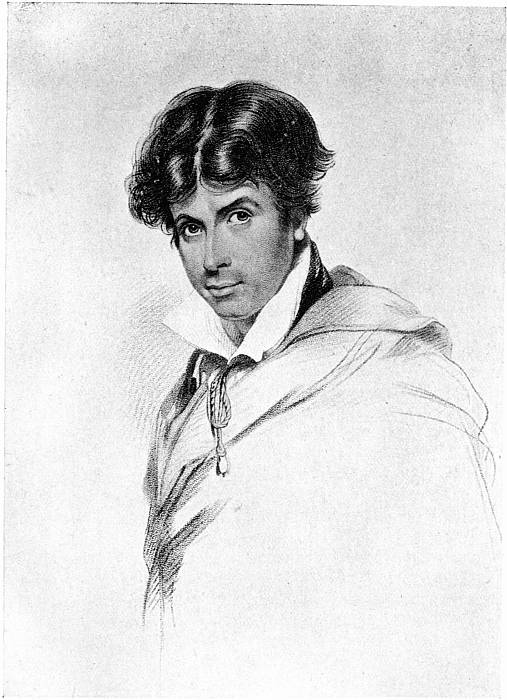
JAMES HENRY LEIGH HUNT FROM AN ENGRAVING BY MAYER AFTER J. HAYTER
The weakness of Leigh Hunt’s style is of an opposite kind. ‘Matchless,’ according to Lamb’s well-known phrase, ‘as a fire-side companion,’ it was his misfortune to carry too much of a fire-side or parlour tone, and sometimes, it must be owned, a very second-rate parlour tone, into literature. He could not walk by the advice of Polonius, and in aiming at the familiar was apt, rarely in prose but sadly often in verse, to slip into an underbred strain of airy and genteel vulgarity, hard to reconcile with what we are told of his acceptable social qualities in real life.8 He was as enthusiastic a student of our sixteenth and seventeenth century literature as Coleridge or Lamb, and though he had more appreciation than they of the characteristic excellencies of what he always persists in calling the ‘French school,’ the school of polished artifice and convention which came in after Dryden and swore by the precepts of Boileau, he was not less bent on seeing it overthrown. In English poetry his predilection was for the older writers from Chaucer to Dryden, and above all others for Spenser: in Italian for Boiardo, Ariosto, Pulci and the later writers of the chivalrous-fanciful epic style. He insisted that such writers were much better models for English poets to follow than the French, and fought as hard as anyone for the return of English poetry from the urbane conventions of the eighteenth century to the paths of nature and of freedom. But he had his own conception of the manner in which this return should be effected. He did not admit that Wordsworth with his rustic simplicities and his recluse philosophy had solved the problem. ‘It was his intention,’ he wrote in prison, ‘by the beginning of next year to bring out a piece of some length ... in which he would attempt to reduce to practice his own ideas of what is natural in style, and of the various and legitimate harmony of the English heroic.’ The result of this intention was the Story of Rimini, begun before his prosecution and published a year after his release, in February or March, 1816. ‘With the endeavour,’ so he repeated himself in the preface, ‘to recur to a freer spirit of versification, I have joined one of still greater importance,—that of having a free and idiomatic cast of language.’
We shall have to consider Hunt’s effort to revive the old freedom of the English heroic metre when we come to the study of Keats’s first volume, written much under Hunt’s influence. As to his success with his ‘ideas of what is natural in style,’ and his free and idiomatic—or as he elsewhere says ‘unaffected, contemporaneous’—cast of language to supersede the styles alike of Pope and Wordsworth, let us take a sample of Rimini at its best and worst. Relating the gradual obsession of Paolo’s thoughts by the charm of his sister-in-law,—
And she became companion of his thought; Silence her gentleness before him brought, Society her sense, reading her books, Music her voice, every sweet thing her looks, Which sometimes seemed, when he sat fixed awhile, To steal beneath his eyes with upward smile; And did he stroll into some lonely place, Under the trees, upon the thick soft grass, How charming, would he think, to see her here! How heightened then, and perfect would appear The two divinest things this world has got, A lovely woman in a rural spot!
The first few lines are skilfully modulated, and in an ordinary domestic theme might be palatable enough; but what a couplet, good heavens! for the last. At the climax, Hunt’s version of Dante is an example of milk-and-water in conditions where milk-and-water is sheer poison:—
As thus they sat, and felt with leaps of heart Their colour change, they came upon the part Where fond Genevra, with her flame long nurst, Smiled upon Launcelot when he kissed her first:— That touch, at last, through every fibre slid; And Paulo turned, scarce knowing what he did, Only he felt he could no more dissemble, And kissed her, mouth to mouth, all in a tremble.
The taste, we see, which guided Hunt so well in appreciating the work of others could betray him terribly in original composition. The passages of light narrative in Rimini are often vivacious and pleasant enough, those of nature description genuinely if not profoundly felt, and written with an eye on the object: but they are the only tolerable things in the poem. Hunt’s idea of a true poetical style was to avoid everything strained, stilted, and conventional, and to lighten the stress of his theme with familiar graces and pleasantries in the manner of his beloved Ariosto. But he did not realize that while any style, from that of the Book of Job to that of Wordsworth’s Idiot Boy, may become poetical if only there is strength and intensity of feeling behind it, nothing but the finest social instinct and tradition can impart the tact for such light conversational graces as he attempted, and that to treat a theme of high tragic passion in the tone and vocabulary of a suburban tea-party is intolerable. Contemporaries, welcoming as a relief any change from the stale conventions and tarnished glitter of eighteenth century poetic rhythm and diction, and perhaps sated for the moment with the rush and thrill of new romantic and exotic sensation they had owed in recent years, first to Scott’s metrical tales of the Border and the Highlands, then to Byron’s of Greece and the Levant,—contemporaries found something fresh and homefelt in Leigh Hunt’s Rimini, and sentimental ladies and gentlemen wept over the sorrows of the hero and heroine as though they had been their own. No less a person than Byron, to whom the poem was dedicated, writes to Moore:—‘Leigh Hunt’s poem is a devilish good one—quaint here and there, but with the substratum of originality, and with poetry about it that will stand the test. I do not say this because he has inscribed it to me.’ And to Leigh Hunt himself Byron reports praise of the poem from Sir Henry Englefield the dilettante, ‘a mighty man in the blue circles, and a very clever man anywhere,’ from Hookham Frere ‘and all the arch literati,’ and says how he had left his own sister and cousin ‘in fixed and delighted perusal of it.’ Byron’s admiration cooled greatly in the sequel, with or even before the cooling of his regard for the author. But it is an instructive comment on standards of taste and their instability that cultivated readers should at any time have endured to hear the story of Paolo and Francesca—Dante’s Paolo and Francesca—diluted through four cantos in a style like that of the above quotations. When Keats and Shelley, with their immeasurably finer poetical gifts and instincts, successively followed Leigh Hunt in the attempt to add a familiar ease of manner to variety of movement in this metre, Shelley, it need not be said, was in no danger of falling into Hunt’s faults of triviality and under-breeding: but Keats was only too apt to be betrayed into them.
Hunt had spent the first months after his release in London, but by the end of 1815, some time before the publication of Rimini, had settled at Hampstead, where he soon made himself a sort of self-crowned laureate of the beauties of the place, and continued to vary his critical and political labours with gossiping complimentary verses to his friends in the form both of sonnet and epistle. The gravest of the epistles is one addressed in a spirit of good-hearted loyalty to Byron in that disastrous April when, after four years spent in the full blaze of popularity and fashion, he was leaving England under the storm of obloquy aroused by the scandals attending his separation from his wife. This is in Hunt’s reformed heroic couplet: the rest are in a chirruping and gossiping anapaestic sing-song which is perhaps the writer’s most congenial vein. Here is a summer picture of Hampstead from a letter to Tom Moore:—
And yet how can I touch, and not linger a while, On the spot that has haunted my youth like a smile? On its fine breathing prospects, its clump-wooded glades, Dark pines, and white houses, and long-allied shades, With fields going down, where the bard lies and sees The hills up above him with roofs in the trees? Now too, while the season,—half summer, half spring,— Brown elms and green oaks—makes one loiter and sing; And the bee’s weighty murmur comes by us at noon, And the cuckoo repeats his short indolent tune, And little white clouds lie about in the sun, And the wind’s in the west, and hay-making begun?—
and here an autumn night-sketch, from a letter expressing surprise that the wet weather has not brought a visit from Charles Lamb, that inveterate lover of walking in the rain:—
We hadn’t much thunder and lightning, I own; But the rains might have led you to walk out of town; And what made us think your desertion still stranger, The roads were so bad, there was really no danger; At least where I live; for the nights were so groping, The rains made such wet, and the paths are so sloping, That few, unemboldened by youth or by drinking, Came down without lanthorns,—nor then without shrinking. And really, to see the bright spots come and go, As the path rose or fell, was a fanciful shew. Like fairies they seemed, pitching up from their nooks, And twinkling upon us their bright little looks.
Such were Leigh Hunt’s antecedents, and such his literary performances and reputation, when Keats at the age of twenty-one became his intimate. So far as opinions and public sympathies were concerned, those of Keats had already, as we have seen, been largely formed in boyhood by familiarity, under the lead of Cowden Clarke, with Leigh Hunt’s writings in the Examiner. Hunt was a confirmed Voltairian and sceptic as to revealed religion, and supplied its place with a private gospel of cheerfulness, or system of sentimental optimism, inspired partly by his own invincibly sunny temperament and partly by the hopeful doctrines of eighteenth-century philosophy in France. Keats shared the natural sympathy of generous youth for Hunt’s liberal and kind-hearted view of things, and he had a mind naturally unapt for dogma: ready to entertain and appreciate any set of ideas according as his imagination recognized their beauty or power, he could never wed himself to any as representing ultimate truth. In matters of poetic feeling and fancy the two men had up to a certain point not a little in common. Like Hunt, Keats at this time was given to ‘luxuriating’ too effusively and fondly over the ‘deliciousness’ of whatever he liked in art, books, or nature. To the every-day pleasures of summer and the English fields Hunt brought in a lower degree the same alertness of perception and acuteness of enjoyment which in Keats were intense beyond parallel. In his lighter and shallower way Hunt also truly felt with Keats the perennial charm and vitality of classic fable, and was scholar enough to produce about this time some agreeable translations of the Sicilian pastorals, and some, less adequate, of Homer. But behind such pleasant faculties in Hunt nothing deeper or more potent lay hidden. Whereas with Keats, as time went on, delighted sensation became more and more surely and instantaneously transmuted and spiritualized into imaginative emotion; his words and cadences came every day from deeper sources within him and more fully charged with the power of far-reaching and symbolic suggestion. Hence, as this profound and passionate young genius grew, he could not but be aware of what was shallow in the talent of his senior and cloying and distasteful in his ever-voluble geniality. But for many months the harmony of their relations was complete.
The ‘little cottage’ in the Vale of Health must have been fairly overcrowded, one would suppose, with Hunt’s fast-growing family of young children, but a bed was made up for Keats on a sofa, ‘in a parlour no bigger than an old mansion’s closet,’ says Hunt, which nevertheless served him for a library and had prints after Stothard hung on the walls and casts of the heads of poets and heroes crowning the bookshelves. Here the young poet was made always welcome. The sonnet beginning ‘Keen, fitful gusts are whispering here and there’ records a night of October or November 1816, when, instead of staying to sleep, he preferred to walk home under the stars, his head full of talk about Petrarch and the youth of Milton, to the city lodgings where he lived with his brothers the life affectionately described in that other pleasant sonnet written on Tom’s birthday, November 18, beginning ‘Small, busy flames play through the fresh-laid coals.’ The well-known fifty lines at the end of Sleep and Poetry, a poem on which Keats put forth the best of his half-fledged strength this winter, give the fullest and most engaging account of the pleasure and inspiration he drew from Hunt’s hospitality:—
The chimes Of friendly voices had just given place To as sweet a silence, when I ‘gan retrace The pleasant day, upon a couch at ease. It was a poet’s house who keeps the keys Of pleasure’s temple. Round about were hung The glorious features of the bards who sung In other ages—cold and sacred busts Smiled at each other. Happy he who trusts To clear Futurity his darling fame! Then there were fauns and satyrs taking aim At swelling apples with a frisky leap And reaching fingers, ‘mid a luscious heap Of vine-leaves. Then there rose to view a fane Of liny marble, and thereto a train Of nymphs approaching fairly o’er the sward: One, loveliest, holding her white hand toward The dazzling sun-rise: two sisters sweet Bending their graceful figures till they meet Over the trippings of a little child: And some are hearing, eagerly, the wild Thrilling liquidity of dewy piping. See, in another picture, nymphs are wiping Cherishingly Diana’s timorous limbs;— A fold of lawny mantle dabbling swims At the bath’s edge, and keeps a gentle motion With the subsiding crystal: as when ocean Heaves calmly its broad swelling smoothness o’er Its rocky marge, and balances once more The patient weeds; that now unshent by foam Feel all about their undulating home... Petrarch, outstepping from the shady green, Starts at the sight of Laura; nor can wean His eyes from her sweet face. Most happy they! For over them was seen a free display Of out-spread wings, and from between them shone The face of Poesy: from off her throne She overlook’d things that I scarce could tell.
It is easy from the above and from some of Keats’s later work to guess at most of the prints which had caught his attention on Hunt’s walls and in his portfolios and worked on his imagination afterwards:—Poussin’s ‘Empire of Flora’ for certain: several, probably, of his various ‘Bacchanals,’ with the god and his leopard-drawn car, and groups of nymphs dancing with fauns or strewn upon the foreground to right or left: the same artist’s ‘Venus and Adonis’: Stothard’s ‘Bathers’ and ‘Vintage,’ his small print of Petrarch as a youth first meeting Laura and her friend; Raphael’s ‘Poetry’ from the Vatican; and so forth. These things are not without importance in the study of Keats, for he was quicker and more apt than any of our other poets to draw inspiration from works of art,—prints, pictures, or marbles,—that came under his notice, and it is not for nothing that he alludes in this same poem to
—the pleasant flow Of words on opening a portfolio.
A whole treatise might be written on matters which I shall have to mention briefly or not at all,—how such and such a descriptive phrase in Keats has been suggested by this or that figure in a picture; how pictures by or prints after old masters have been partly responsible for his vision alike of the Indian maiden and the blind Orion; what various originals, paintings or antiques or both, we can recognize as blending themselves into his evocation of the triumph of Bacchus or his creation of the Grecian Urn.
On December the 1st, 1816, Hunt, as has been said, did Keats the new service of printing the Chapman sonnet as a specimen of his work in an essay in the Examiner on ‘Young Poets,’ in which the names of Shelley and Reynolds were bracketed with his as poetical beginners of high promise. With reference to the custom mentioned by Hunt of Keats and himself sitting down of an evening to write verses on a given subject, Cowden Clarke pleasantly describes one such occasion on December 30 of the same year, when the chosen theme was The Grasshopper and the Cricket:—‘The event of the after scrutiny was one of many such occurrences which have riveted the memory of Leigh Hunt in my affectionate regard and admiration for unaffected generosity and perfectly unpretentious encouragement. His sincere look of pleasure at the first line:—
The poetry of earth is never dead.
“Such a prosperous opening!” he said; and when he came to the tenth and eleventh lines:—
On a lone winter morning, when the frost Hath wrought a silence—
“Ah that’s perfect! Bravo Keats!” And then he went on in a dilatation on the dumbness of Nature during the season’s suspension and torpidity.’ The affectionate enthusiasm of the younger and the older man (himself, be it remembered, little over thirty) for one another’s company and verses sometimes took forms which to the mind of the younger and wiser of the two soon came to seem ridiculous. One day in early spring (1817) the whim seized them over their wine to crown themselves ‘after the manner of the elder bards.’ Keats crowned Hunt with a wreath of ivy, Hunt crowned Keats with a wreath of laurel, and each while sitting so adorned wrote a pair of sonnets expressive of his feelings. While they were in the act of composition, it seems, three lady callers came in—conceivably the three Misses Reynolds, of whom we shall hear more anon, Jane, afterwards Mrs Thomas Hood, Marianne, and their young sister Charlotte. When visitors were announced Hunt took off his wreath and suggested that Keats should do the same: he, however, ‘in his enthusiastic way, declared he would not take off his crown for any human being,’ and accordingly wore it as long as the visit lasted.9 Here are Hunt’s pair of sonnets, which are about as good as any he ever wrote, and which he not long afterwards printed:—
A crown of ivy! I submit my head To the young hand that gives it,—young, ’tis true, But with a right, for ’tis a poet’s too. How pleasant the leaves feel! and how they spread With their broad angles, like a nodding shed Over both eyes! and how complete and new, As on my hand I lean, to feel them strew My sense with freshness,—Fancy’s rustling bed! Tress-tossing girls, with smell of flowers and grapes Come dancing by, and downward piping cheeks, And up-thrown cymbals, and Silenus old Lumpishly borne, and many trampling shapes,— And lastly, with his bright eyes on her bent, Bacchus,—whose bride has of his hand fast hold. It is a lofty feeling, yet a kind, Thus to be topped with leaves;—to have a sense Of honour-shaded thought,—an influence As from great Nature’s fingers, and be twined With her old, sacred, verdurous ivy-bind, As though she hallowed with that sylvan fence A head that bows to her benevolence, Midst pomp of fancied trumpets in the wind. ’Tis what’s within us crowned. And kind and great Are all the conquering wishes it inspires,— Love of things lasting, love of the tall woods, Love of love’s self, and ardour for a state Of natural good befitting such desires, Towns without gain, and haunted solitudes.
Keats had the good sense not to print his efforts of the day; they are of slight account poetically, but have a real biographical interest:—
ON RECEIVING A LAUREL CROWN FROM LEIGH HUNT
Minutes are flying swiftly, and as yet Nothing unearthly has enticed my brain Into a delphic labyrinth—I would fain Catch an immortal thought to pay the debt I owe to the kind poet who has set Upon my ambitious head a glorious gain. Two bending laurel sprigs—’tis nearly pain To be conscious of such a coronet. Still time is fleeting, and no dream arises Gorgeous as I would have it—only I see A trampling down of what the world most prizes, Turbans and crowns and blank regality; And then I run into most wild surmises Of all the many glories that may be.
TO THE LADIES WHO SAW ME CROWNED
What is there in the universal earth More lovely than a wreath from the bay tree? Haply a halo round the moon—a glee Circling from three sweet pair of lips in mirth; And haply you will say the dewy birth Of morning roses—ripplings tenderly Spread by the halcyon’s breast upon the sea— But these comparisons are nothing worth. Then there is nothing in the world so fair? The silvery tears of April? Youth of May? Or June that breathes out life for butterflies? No, none of these can from my favourite bear Away the palm—yet shall it ever pay Due reverence to your most sovereign eyes.
Here we have expressed in the first sonnet the same mood as in some of the holiday rimes of the previous summer, the mood of ardent expectancy for an inspiration that declines (and no wonder considering the circumstances) to come. It was natural that the call for an impromptu should bring up phrases already lying formed or half formed in Keats’s mind, and the sestet of this sonnet is interesting as containing in its first four lines the germs of the well-known passage at the beginning of the third book of Endymion,—
There are who lord it o’er their fellow-men With most prevailing tinsel—
and in its fifth a repetition of the ‘wild surmise’ phrase of the Chapman sonnet. The second sonnet has a happy line or two in its list of delights, and its opening is noticeable as repeating the interrogative formula of the opening lines of Sleep and Poetry, Keats’s chief venture in verse this winter.
Very soon after the date of this scene of intercoronation (the word is Hunt’s, used on a different occasion) Keats became heartily ashamed of it, and expressed his penitence in a strain of ranting verse (his own name for compositions in this vein) under the form of a hymn or palinode to Apollo:—
God of the golden bow, And of the golden lyre, And of the golden hair, And of the golden fire, Charioteer Of the patient year, Where—where slept thine ire, When like a blank idiot I put on thy wreath, Thy laurel, thy glory, The light of thy story, Or was I a worm—too low crawling, for death? O Delphic Apollo!
And so forth: the same half-amused spirit of penitence is expressed in a letter of a few weeks later to his brother George: and later still he came to look back, with a smile of manly self-derision, on those days as a time when he had been content to play the part of ‘A pet-lamb in a sentimental farce.’
1 Another account says Mitchell.
2 In The Asclepiad, April 1884.
3 Houghton MSS.
4 Le Grand: Fabliaux ou Contes, 1781. G. L. Way: Fabliaux or Tales, London, 1800; 2nd ed. 1815. See Appendix I.
5 This note-book is in the collection bequeathed by the late Sir Charles Dilke to the public library at Hampstead.
6 In a review of Keats’s first book written the next year (Examiner, July 9, 1817) Hunt says that when he printed the ‘Solitude’ sonnet he knew no more of Keats than of any other anonymous correspondent: but this probably only means that he had not yet met Keats personally.
7 Putting day-break in early October at a little before six, there would have been fully time enough for Keats to walk to the Poultry, composing as he went, and to commit his draft to paper and send it to Clerkenwell by ten o’clock. The longer walk to and from the Borough, had the date been a year earlier, would have made the feat more difficult. Moreover the feat itself becomes less of a miracle when we recognize it as performed not at the end of the poet’s twentieth year but at the end of his twenty first. But in view of Keats’s own explicit dating of the piece, the point seems to need no labouring: or else it might be pointed out that if Clarke had really introduced him to Chapman in October 1815 Chapman would assuredly not have been left out of the list of masters whom he quotes as having known through Clarke in his epistle of the following August quoted above (pp. 37, 38).
8 Both Byron and Barry Cornwall have expressed their sense of contrast between certain vulgarities of Hunt’s diction and his personal good breeding. Byron before their quarrel declared emphatically that he was ‘not a vulgar man’; and Barry Cornwall, admitting that he ‘indulged himself occasionally in pet words, some of which struck me as almost approaching to the vulgar,’ goes on to say that ‘he was essentially a gentleman in conduct, in demeanour, in manner, in his consideration for others,’ and to praise him for his ‘great fund of positive active kindness,’ his freedom from all irritable vanity, his pleasure and liberality in praising (Bryan Walter Procter, An Autobiographical Fragment, 1877, pp. 197-200).
9 This reconstruction of the scene is founded on a comparison of the sonnets themselves with Woodhouse’s note on Keats’s subsequent palinode, A Hymn to Apollo. Woodhouse says the friends were both crowned with laurel, but it seems more likely that he should have made this mistake than that a similar performance should have been twice repeated (Houghton MSS.).

CHAPTER III
WINTER 1816-1817: HAYDON: OTHER NEW FRIENDSHIPS: THE DIE CAST FOR POETRY
Haydon and the Elgin marbles—Haydon as painter and writer—Vanity, pugnacity, and piety—Haydon on Leigh Hunt—Keats and Haydon meet—An enthusiastic friendship—Keats and the Elgin marbles—Sonnets and protestations—Hazlitt and Lamb—Friendship of Hunt and Shelley—Lamb and Hazlitt on Shelley—Haydon and Shelley: a battle royal—Keats and Shelley—A cool relation—John Hamilton Reynolds—His devotion to Keats—The Reynolds sisters—James Rice—Charles Wells—William Haslam—Joseph Severn—Keats judged by his circle—Described by Severn—His range of sympathies—His poetic ambition—The die is cast—First volume goes to press.
So much for the relations of Keats with Hunt himself in these first six months of their intimacy. Next of the other intimacies which he formed with friends to whom Hunt introduced him. One of the first of these, and for a while the most stimulating and engrossing, was with the painter Haydon. This remarkable man, now just thirty, had lately been victorious in one of the two great objects of his ambition, and had achieved a temporary semblance of victory in the other. For the last eight years he had fought and laboured to win national recognition for the deserts of Lord Elgin in his great work of salvage—for such under the conditions of the time it was—in bringing away the remains of the Parthenon sculptures from Athens. By dint of sheer justice of conviction and power of fight, and then only when he had been reinforced in the campaign by foreigners of indisputable authority like the archaeologist Visconti and the sculptor Canova, he had succeeded in getting the pre-eminence of these marbles among all works of the sculptor’s art acknowledged, and their acquisition for the nation secured, in the teeth of powerful and bitterly hostile cliques. His opponents included both the sentimentalists who took their cue from Byron’s Curse of Minerva in shrieking at Elgin as a vandal, and the dilettanti who, blinded to the true Greek touch by familiarity with smoothed and pumiced Roman copies, had declared the Parthenon sculptures to be works of the age of Hadrian.
Haydon’s victory over these antagonists is his chief title, and a title both sound and strong, to the regard of posterity. His other and life-long, half insane endeavour was to persuade the world to take him at his own estimate, as the man chosen by Providence to add the crown of heroic painting to the other glories of his country. His high-flaming energy and industry, his eloquence, vehemence, and social gifts, the clamour of his indomitable self-assertion and of his ceaseless conflict with the academic powers, even his unabashed claims for pecuniary support on friends, patrons, and society at large, had won for him much convinced or half convinced attention and encouragement, both in the world of art and letters and in that of dilettantism and fashion. His first and second great pictures, ‘Dentatus’ and ‘Macbeth,’ had been dubiously received; his third, the ‘Judgment of Solomon,’ with acclamation. This had been finished after his victory in the matter of the Elgin marbles. He was now busy on one larger and more ambitious than all, ‘Christ’s Entry into Jerusalem,’ in which it was his purpose to include among the crowd of lookers-on portraits of many famous men both historical and contemporary. While as usual sunk deep in debt, he was perfectly confident of glory. Vain confidence—for he was in truth a man whom nature had endowed, as if maliciously, with one part of the gifts of genius and not the other. Its energy and voluntary power he possessed completely, and no man has ever lived at a more genuinely exalted pitch of feeling and aspiration. ‘Never,’ wrote he about this time, ‘have I had such irresistible and perpetual urgings of future greatness. I have been like a man with air-balloons under his armpits, and ether in his soul. While I was painting, walking, or thinking, beaming flashes of energy followed and impressed me.... They came over me, and shot across me, and shook me, till I lifted up my heart and thanked God.’ But for all his sensations and conviction of power, the other half of genius, the half which resides not in energy and will, but in faculties which it is the business of energy and will to apply, was denied to Haydon. Its vision and originality, its gift of ‘heavenly alchemy’ for transmuting and new-creating the materials offered it by experience, its sovereign inability to see with any eyes or create to any pattern but its own, were not in him. Except for a stray note here and there, an occasional bold conception, a trick of colour or craftsmanship not too obviously caught from greater men, the pictures with which he exultingly laid siege to immortality belong, as posterity has justly felt, to the kingdom not of true great art but of imitative pictorial posturing and empty pictorial bombast.
As a draughtsman especially, Haydon’s touch is surprisingly loose, empty, and inexpressive. Even in drawing from the Elgin marbles, as he did with passionate industry, covering reams, he fails almost wholly to render the qualities which he so ardently perceived, and loses every distinction and every subtlety of the original.1 Infinitely better is his account of them in words: for in truth Haydon’s chief intellectual power was as an observer, and his best instrument the pen. Readers of his journals and correspondence know how vividly and tellingly he can relate an experience or touch off a character. In this gift of striking out a human portrait in words he stood second in his age, if second, to Hazlitt alone, and in our later literature there has been no one to beat him except Carlyle. But passion and pugnacity, vanity and the spirit of self-exaltation, at the same time as they intensify vision, are bound to discolour and distort it; and the reader must always bear in mind that Haydon’s pen portraits of his contemporaries are apt to be not less untrustworthy than they are unforgettable. Moreover in this, the literary, form of expression also, where he aims higher, leaving description and trying to become imaginative and impressive, we find only the same self-satisfied void turgidity, and proof of spiritual hollowness disguised by temperamental fervour, as in his paintings.
But it was the gifts and faculties which Haydon possessed, and not those he lacked, it was the ardour and enthusiasm of his character, and not his essential commonness of gift and faculty, that impressed his associates as they impressed himself. Sturdy, loud-voiced, eloquent, high of colour, with a bald perpendicular forehead surmounting a set of squarely compressed, pugnacious features,—eyes, lips and jaw all prominent and aggressive together,—he was a dominating, and yet a welcome, presence in some of the choicest circles of his day. Wordsworth and Wordsworth’s firm ally, the painter-baronet Sir George Beaumont, Hazlitt, Horace Smith, Charles Lamb, Coleridge, Walter Scott, Mary Mitford, were among his friends. Some of them, like Wordsworth, held by him always, while his imperious and importunate egotism wore out others after a while. He was justly proud of his industry and strength of purpose: proud also of his religious faith and piety, and in the habit of thanking his maker effusively in set terms for special acts of favour and protection, for this or that happy inspiration in a picture, for deliverance from ‘pecuniary emergencies,’ and the like. ‘I always rose up from my knees,’ he says strikingly in a letter to Keats, ‘with a refreshed fury, an iron-clenched firmness, a crystal piety of feeling that sent me streaming on with a repulsive power against the troubles of life.’ And he was prone to hold himself up as a model to his friends in both particulars, lecturing them loftily on faith and conduct while he was living without scruple on their bounty.
Pl. III
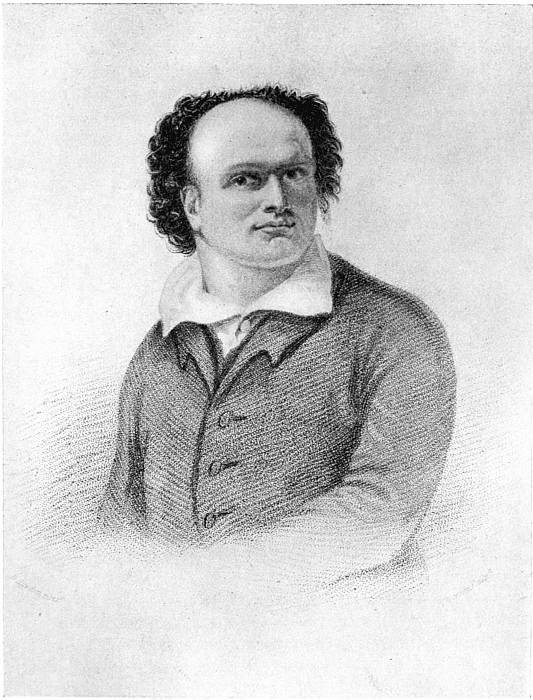
BENJAMIN ROBERT HAYDON FROM AN ENGRAVING BY THOMSON AFTER HAYDON
In October 1816, the first month of Keats’s intimacy with Hunt, Haydon also made a short stay at Hampstead. He and Hunt were already acquainted, and Hunt had published in the Examiner the very able, cogent and pungent letter with which Haydon a few months before had clenched the Elgin marble controversy and practically brought it to an end. Hunt had congratulated Haydon in a sonnet on the occasion, closing with a gentle hint that, fine as such a victory was, he was himself devoted to a mission finer still, as
One of the spirits chosen by heaven to turn The sunny side of things to human eyes.
Their intercourse was now warmly resumed, though never without latent risk of antagonism and discord. The following letter of Haydon to Wilkie, more just and temperate than usual, is good for filling in our picture both of Hunt and of Haydon himself, as well as for adding another to the number of bewildering contemporary estimates of Rimini.
27 October, 1816.
I have been at Hampstead this fortnight for my eyes, and shall return with my body much stronger for application. The greater part of my time has been spent in Leigh Hunt’s society, who is certainly one of the most delightful companions. Full of poetry and art, and amiable humour, we argue always with full hearts on everything but religion and Buonaparte, and we have resolved never to talk of these, particularly as I have been recently examining Voltaire’s opinions concerning Christianity, and turmoiling my head to ascertain fully my right to put him into my picture!
Though Leigh Hunt is not deep in knowledge, moral, metaphysical, or classical, yet he is intense in feeling, and has an intellect for ever on the alert. He is like one of those instruments on three legs, which, throw it how you will, always pitches on two, and has a spike sticking for ever up and ever ready for you. He ‘sets’ at a subject with a scent like a pointer. He is a remarkable man, and created a sensation by his independence, his courage, his disinterestedness in public matters, and by the truth, acuteness, and taste of his dramatic criticisms he raised the rank of newspapers, and gave by his example a literary feeling to the weekly ones more especially.
As a poet, I think him full of the genuine feeling. His third canto in Rimini is equal to anything in any language of that sweet sort. Perhaps in his wishing to avoid the monotony of the Pope school, he may have shot into the other extreme, and his invention of obscure words to express obscure feelings borders sometimes on affectation. But these are trifles compared with the beauty of the poem, the intense painting of the scenery, and the deep burning in of the passion which trembles in every line. Thus far as a critic, an editor, and a poet. As a man, I know none with such an affectionate heart, if never opposed in his opinions. He has defects of course: one of his great defects is getting inferior people about him to listen, too fond of shining at any expense in society, and a love of approbation from the darling sex bordering on weakness; though to women he is delightfully pleasant, yet they seem more to dandle him as a delicate plant. I don’t know if they do not put a confidence in him which to me would be mortifying.
He is a man of sensibility tinged with morbidity, and of such sensitive organisation of body that the plant is not more alive to touch than he. I remember once, walking in a field, we came to a muddy place concealed by grass. The moment Hunt touched it, he shrank back, saying, ‘It’s muddy!’ as if he meaned that it was full of adders.... He is a composition, as we all are, of defects and delightful qualities, indolently averse to worldly exertion, because it harasses the musings of his fancy, existing only by the common duties of life, yet ignorant of them, and often suffering from their neglect.
A few days later, on October 31, we find Keats writing to Cowden Clarke of his pleasure at ‘the thought of seeing so soon this glorious Haydon and all his creations.’ The introduction was arranged to take place at Leigh Hunt’s cottage, where they met for dinner. Haydon, the sublime egoist, could be rapturously sympathetic and genuinely kind to those who took him at his own valuation, and there was much to attract the spirits of eager youth about him as a leader. Keats and he were mutually delighted at first sight: each struck fire from the other, and they quickly became close friends and comrades. After an evening of high talk at the beginning of their acquaintance, on the 19th of November, 1816, the young poet wrote to Haydon as follows, joining his name with those of Wordsworth and Leigh Hunt:—
Last evening wrought me up, and I cannot forbear sending you the following:—
Great spirits now on earth are sojourning: He of the cloud, the cataract, the lake, Who on Helvellyn’s summit, wide awake, Catches his freshness from Archangel’s wing: He of the rose, the violet, the spring, The social smile, the chain for Freedom’s sake, And lo! whose steadfastness would never take A meaner sound than Raphael’s whispering. And other spirits there are standing apart Upon the forehead of the age to come; These, these will give the world another heart, And other pulses. Hear ye not the hum Of mighty workings in some distant mart? Listen awhile, ye nations, and be dumb.
Haydon was at no time of his life unused to compliments of this kind. About the same time as Keats another young member of Hunt’s circle, John Hamilton Reynolds, also wrote him a sonnet of eager sympathy and admiration; and the three addressed to him some years later by Wordsworth are well known. In his reply to Keats he proposed to hand on the above piece to Wordsworth—a proposal which ‘puts me,’ answers Keats, ‘out of breath—you know with what reverence I would send my well-wishes to him.’ Haydon suggested moreover the needless, and as it seems to me regrettable, mutilation of the sonnet by leaving out the words after ‘workings’ in the last line but one. The poet, however, accepted the suggestion, and his editors have respected his decision.
Some time after the turn of the year we find Keats presented with a copy of Goldsmith’s Greek History ‘from his ardent friend, B. R. Haydon.’ All the winter and early spring the two met frequently, sometimes at Haydon’s studio in Great Marlborough Street, sometimes in the rooms of the Keats brothers in the Poultry or in those of their common acquaintance, and discussed with passionate eagerness most things in heaven and earth, and especially poetry and painting. ‘I have enjoyed Shakespeare,’ declares Haydon, ‘with John Keats more than with any other human being.’ Both he and Keats’s other painter friend, Joseph Severn, have testified that Keats had a fine natural sense for the excellencies of painting and sculpture. Both loved to take him to the British Museum and expatiate to him on the glories of the antique; and it would seem that through Haydon he must have had access also to the collection of one at least of the great dilettanti noblemen of the day. After a first visit to the newly acquired Parthenon marbles with Haydon at the beginning of March 1817, Keats tried to embody his impressions in a couple of sonnets, which Hunt promptly printed in the Examiner. It is characteristic of his unfailing sincerity with his art and with himself that he allows himself to break into no stock raptures, but strives faithfully to get into words the confused sensations of spiritual infirmity and awe that have overpowered him:—
My spirit is too weak—mortality Weighs heavily on me like unwilling sleep. And each imagin’d pinnacle and steep Of godlike hardship, tells me I must die Like a sick Eagle looking at the sky. Yet ’tis a gentle luxury to weep That I have not the cloudy winds to keep, Fresh for the opening of the morning’s eye. Such dim-conceived glories of the brain Bring round the heart an undescribable feud; So do these wonders a most dizzy pain, That mingles Grecian grandeur with the rude Wasting of old Time—with a billowy main— A sun—a shadow of a magnitude.
He sends this with a covering sonnet to Haydon asking pardon for its immaturity and justly praising the part played by Haydon in forcing the acceptance of the marbles upon the nation:—
Haydon! forgive me that I cannot speak Definitely on these mighty things; Forgive me that I have not Eagle’s wings— That what I want I know not where to seek; And think that I would not be over meek In rolling out upfollow’d thunderings, Even to the steep of Heliconian springs, Were I of ample strength for such a freak— Think too, that all those numbers should be thine; Whose else? In this who touch thy vesture’s hem? For when men star’d at what was most divine With browless idiotism—o’erwise phlegm— Thou hadst beheld the Hesperian shine Of their star in the East, and gone to worship them.
Haydon’s acknowledgment is of course enthusiastic, but betrays his unfortunate gift for fustian in the following precious expansion of Keats’s image of the sick eagle:—
Many thanks, my dear fellow, for your two noble sonnets. I know not a finer image than the comparison of a poet unable to express his high feelings to a sick eagle looking at the sky, where he must have remembered his former towerings amid the blaze of dazzling sunbeams, in the pure expanse of glittering clouds; now and then passing angels, on heavenly errands, lying at the will of the wind with moveless wings, or pitching downward with a fiery rush, eager and intent on objects of their seeking....
In Haydon’s journal about the same date there is an entry which reads with ironical pathos in the light of after events:—‘Keats is a man after my own heart. He sympathises with me, and comprehends me. We saw through each other, and I hope are friends for ever. I only know that, if I sell my picture, Keats shall never want till another is done, that he may have leisure for his effusions: in short he shall never want all his life.’ To Keats himself, more hyperbolically still, and in terms still more suited to draw the pitying smile of the ironic gods, Haydon writes a little later:—
Consider this letter a sacred secret.—Often have I sat by my fire after a day’s effort, as the dusk approached and a gauzy veil seemed dimming all things—and mused on what I had done, and with a burning glow on what I would do till filled with fury I have seen the faces of the mighty dead crowd into my room, and I have sunk down and prayed the great Spirit that I might be worthy to accompany these immortal beings in their immortal glories, and then I have seen each smile as it passes over me, and each shake his hand in awful encouragement. My dear Keats, the Friends who surrounded me were sensible to what talent I had,—but no one reflected my enthusiasm with that burning ripeness of soul, my heart yearned for sympathy,—believe me from my soul, in you I have found one,—you add fire, when I am exhausted, and excite fury afresh—I offer my heart and intellect and experience—at first I feared your ardor might lead you to disregard the accumulated wisdom of ages in moral points—but the feelings put forth lately have delighted my soul. God bless you! Let our hearts be buried on each other.
Familiar visitors at this time of Haydon in the Marlborough Street studio and of Hunt in the Hampstead cottage were two men of finer gift than either, William Hazlitt and Charles Lamb. With both of these seniors (Lamb was forty-one and Hazlitt thirty-eight) Keats now became acquainted without becoming intimate. Unluckily neither of them has left any but the slightest personal impression of the young poet, whose modesty probably kept him somewhat in the background when they were by. Haydon used to complain that it was only after Keats’s death that he could get Hazlitt to acknowledge his genius; but Lamb, as we shall see, with his unerring critical touch, paid to Keats’s best work while he was still living a tribute as splendid as it was just. Keats on his part, after the publication of Hazlitt’s lectures on the characters of Shakespeare in 1817, reckoned his ‘depth of taste’ one of the things most to rejoice at in his age, and was a diligent attendant at his next course on the English poets. But he never frequented, presumably for lack of invitation, those Wednesday and Thursday evening parties at the Lambs of which Talfourd and B. W. Procter have left us such vivid pictures; and when he met some of the same company at the Novello’s, the friends of his friend Cowden Clarke, he enjoyed it, as will appear later, less than one would have hoped. He has left no personal impression of Hazlitt, and of Lamb only the slightest and most casual. Fortunately we know them both so well from other sources that we can almost see and hear them: Hazlitt with his unkempt black hair and restless grey eyes, lean, slouching, splenetic, an Ishmaelite full of mistrust and suspicion, his habitual action of the hand within the waistcoat apt in his scowling moments to suggest a hidden dagger; but capable withal, in company where he felt secure, of throwing into his talk much the same fine mixture as distinguishes his writing of impetuous fullness and variety with incisive point and critical lucidity: Lamb noticeable in contrast by his neat, sombrely clad small figure on its spindle legs and his handsome romantic head; by his hurried, stammering utterance and too often, alas! his vinous flush and step almost as titubant as his tongue; but most of all by that airy genius of insight and caprice, of deep tenderness and freakish wisdom, quick to break from him in sudden, illuminating phrases at any moment and in any manner save the expected.
Yet another acquaintance brought about by Hunt in these days was that between Keats and Shelley, who was Keats’s senior by only three years and with whom Hunt himself was now first becoming intimate. When Hunt was sentenced for sedition four years earlier, Shelley, then barely twenty, had been eager to befriend him and had sent him an offer of money help; which for once, not being then in immediate need, Hunt had honourably declined. Since then they had held only slight communication; but when Hunt included Shelley on the strength of his poem Alastor, among the young poets praised in his Examiner essay (December 1, 1816), a glowing correspondence immediately followed, and a few days later Shelley came up from Bath to stay at the Hampstead cottage. The result of a week’s visit was an immediate intimacy and enthusiastic mutual regard, with a prompt determination on Shelley’s part to rescue Hunt from the slough of debt (something like £1400) into which during and since his imprisonment he had cheerfully muddled himself.
It was the eve of the most harrowing crisis in Shelley’s life, when his principle of love a law to itself entailed in action so dire a consequence, and his obedience to his own morality brought him into such harsh collision with the world’s. First came the news of the suicide of his deserted wife Harriet (December 14) and three months later the sentence of Lord Eldon which deprived him of the custody of his and Harriet’s children. On the day of the first tragic news he writes to Mary Godwin, whom he had left at Bath, ‘Leigh Hunt has been with me all day, and his delicate and tender attentions to me, his kind speeches of you, have sustained me against the weight of horror of this event.’ In the interval between the shock of Harriet’s death and that of the judgment sequestering his children Shelley was a frequent guest in the Vale of Health, sometimes alone and sometimes with Mary, now legally his wife. Neither in these first days nor later could Hunt persuade his old intimates Hazlitt and Lamb to take kindly to his new friend Shelley either as man or poet. Lamb, who seems only to have seen him once, said after his death, ‘his voice was the most obnoxious squeak I ever was tormented with’; of his poetry, that it was ‘thin sown with profit or delight’; and of his ‘theories and nostrums,’ that ‘they are oracular enough, but I either comprehend ‘em not, or there is miching malice and mischief in ‘em.’ Hazlitt, opening the most studied of his several attacks on Shelley’s poetry and doctrine, gives one of his vivid portraits, saying ‘he has a fire in his eye, a fever in his blood, a maggot in his brain, a hectic flutter in his speech.... He is sanguine-complexioned, and shrill-voiced.... His bending, flexible form appears to take no strong hold of things, does not grapple with the world about him, but flows from it like a river.’ Still less was a good understanding possible between Shelley and Haydon, who met him more than once in these early days at the Vale of Health. He tells how, on the evening of their first meeting, Shelley, looking hectically frail and girlish, opened the conversation at dinner with the words, ‘as to that detestable religion, the Christian,’—and how he, Haydon, a man at all times stoutly and vociferously orthodox, waited till the meal was over and then, ‘like a stag at bay and resolved to gore without mercy,’ struck his hardest on behalf of the established faith, while Hunt in his airily complacent way kept skirmishing in on Shelley’s side, until the contention grew hot and stormy. The heat and noise, Haydon owns, were chiefly on his side, and we might guess as much without his admission, for we have abundant evidence of the unfailing courtesy and sweetness of manner with which Shelley would in that high-pitched feminine voice of his advance the most staggering propositions and patiently encounter the arguments of his adversaries.
Such contentions, victorious as he always held himself to be in them, annoyed Haydon. The queer blend, in the atmosphere of the Hampstead cottage, of eager kindness and hospitality and a graceful, voluble enthusiasm for the ‘luxuries’ of poetry, art, and nature with slatternly housekeeping and a spirit of fervent or flippant anti-Christianity, became distasteful to him, and he afterwards dated from these days his gradual estrangement from Hunt and his circle. At the same time he began to try and draw away Keats from Hunt’s influence.
Keats, we are told, though much inclining in these days towards the Voltairian views of his host, would take little part in such debates as that above narrated, and once even supported another young member of the circle, Joseph Severn, in a defence of Christianity against Hunt and Shelley. To Shelley himself, his senior by three years, his relation was from the first and remained to the end one of friendly civility and little more. He did not take to Shelley as kindly as Shelley did to him, says Hunt, and adds the comment: ‘Keats, being a little too sensitive on the score of his origin, felt inclined to see in every man of birth a sort of natural enemy.’ ‘He was haughty, and had a fierce hatred of rank,’ says Haydon in his unqualified way. Where his pride had not been aroused by anticipation, Keats, as we have seen, was eagerly open-hearted to new friendships, and it may well be that the reserve he maintained towards Shelley was assumed at first by way of defence against the possibility of social patronage on the other’s part. But he must soon have perceived that from Shelley, a gentleman of gentlemen, such an attitude was the last thing to be apprehended, and the cause of his standing off was much more likely his knowledge that nearly all Shelley’s literary friends were his pensioners,—from Godwin, the greediest, to Leigh Hunt, the lightest-hearted,—and a fear that he too might be supposed to expect a similar bounty. It would seem that in his spirit of independence he gave Shelley the impression of being much better off than he was,—or possibly instances of his only too ready generosity in lending from his modest means to his intimates when they were hard pressed may have come to Shelley’s knowledge: at all events a few months later we find Shelley casting about for persons able to help him in helping Hunt, and writing under a false impression, ‘Keats certainly can.’
These two young poets, equally and conjointly beloved by posterity, were in truth at many points the most opposite-natured of men. Pride and sensitiveness apart, we can imagine that a full understanding was not easy between them. Keats, with the rich elements of earthly clay in his composition, his lively vein of every-day common-sense and humour, his keen, tolerant delight and interest in the aspects and activities of nature and human nature as he found them, may well have been as much repelled as attracted by Shelley, Shelley the ‘Elfin knight,’ the spirit all air and fire, with his passionate repudiation of the world’s ways and the world’s law, his passionate absorption in his vision of a happier scheme of things, a vision engendered in humanitarian dreams from his readings of Rousseau and Godwin and Plato,—or was it rather one brought with him from some ante-natal sojourn among the radiances and serenities of the sunset clouds? Leigh Hunt’s way of putting it is this:—‘Keats, notwithstanding his unbounded sympathies with ordinary flesh and blood, and even the transcendental cosmopolitics of Hyperion, was so far inferior in universality to his great acquaintance, that he could not accompany him in his daedal rounds with nature, and his Archimedean endeavours to move the globe with his own hands.’ Of the incidents and results of their intercourse at Hampstead we know little more than that Shelley, wisely enough in the light of his own headlong early experiments, tried to dissuade Keats from premature publication; and that Keats on his part declined, ‘in order that he might have his own unfettered scope,’ a cordial invitation from Shelley to come and stay with him at Great Marlow. Keats, though he must have known that he could learn much from Shelley’s trained scholarship and fine literary sense, was doubtless right in feeling that whatever power of poetry might be in him must work its own way to maturity in freedom and not in leading-strings. To these scanty facts Shelley’s cousin Medwin adds the statement that the two agreed to write in friendly rivalry the long poems each was severally meditating for his summer’s work, Shelley Laon and Cythna, afterwards called The Revolt of Islam, and Keats Endymion. This may very well have been the case, but Medwin was a man so lax of memory, tongue, and pen that his evidence, unconfirmed, counts for little. Of the influence possibly exercised on Keats by Shelley’s first important poem, Alastor, or by his Hymn to Intellectual Beauty printed in the Examiner during the January of their intercourse at Hunt’s, it will be time to speak later on.
A much closer intimacy sprang up between Keats and the other young poetic aspirant whom Hunt in his December essay in the Examiner had bracketed with him and Shelley. This was John Hamilton Reynolds, of whom we have as yet heard only the name. He was a handsome, witty, enthusiastic youth a year younger than Keats, having been born at Shrewsbury in September 1796. Part of his boyhood was spent in Devonshire near Sidmouth, a countryside to which he remained always deeply attached; but he was still quite young when his father came and settled in London as mathematical master and head writing master at Christ’s Hospital. The elder Reynolds and his wife were people of literary leanings and literary acquaintance, and seem to have been characters in their way: both Charles Lamb and Leigh Hunt were frequenters of their house in Little Britain, and Mrs Reynolds is reported as holding her own well among the talkers at Lamb’s evenings. Their son John was educated at St Paul’s school and showed talent and inclinations which drew him precociously into the literary movement of the time. At eighteen he wrote an Eastern tale in verse in the Byronic manner, Safie, of which Byron acknowledged the presentation copy in a kind and careful letter several pages long. Two years later, just about the time of his first introduction to Keats at Leigh Hunt’s, the youngster had the honour of receiving a similar attention from Wordsworth in reply to a presentation of another poem, The Naiad (November 1816). Neither of these two youthful volumes, nor yet a third, The Eden of Imagination, showed much more than a quick susceptibility to nature and romance, and a gift of falling in readily and gracefully now with one and now with another of the poetic fashions of the hour. Byron, Scott, Wordsworth, and Leigh Hunt were alternately his models.
The same gift of adaptiveness which Reynolds showed in serious work made him when he chose a deft, sometimes even a masterly, parodist in the humourous vein, and his work done in this vein a few years later in collaboration with Thomas Hood holds its own well beside that of his associate. Partly owing to the persuasions of the lady to whom he was engaged, Reynolds early gave up the hope of a literary career and went into business as a solicitor. In 1818 he inscribed a farewell sonnet to the Muses in a copy of Shakespeare which he gave to Keats, and in 1821 he writes again
As time increases I give up drawling verse for drawing leases.
In point of fact he continued to write occasionally for some years, and in the end failed somewhat tragically to prosper in the profession of law. During these early years he was not only one of the warmest friends Keats had but one of the wisest, to whom Keats could open his innermost mind with the certainty of being understood, and who once at least saved him from a serious mistake. A sonnet written by him within three months of their first meeting proves with what warmth of affection as well as with what generosity of admiration the one young aspirant from the first regarded the other. Keats one day, calling on Cowden Clarke and finding him asleep over Chaucer, passed the time by writing on the blank space at the end of The Floure and the Lefe, a poem with which he was already familiar, the sonnet beginning ‘This pleasant tale is like a little copse.’2 Reynolds’s comment after reading it is as follows:—
Thy thoughts, dear Keats, are like fresh-gathered leaves, Or white flowers pluck’d from some sweet lily bed; They set the heart a-breathing, and they shed The glow of meadows, mornings, and spring eyes, O’er the excited soul.—Thy genius weaves Songs that shall make the age be nature-led, And win that coronal for thy young head Which time’s strange hand of freshness ne’er bereaves. Go on! and keep thee to thine own green way, Singing in that same key which Chaucer sung; Be thou companion of the summer day, Roaming the fields and older woods among:— So shall thy muse be ever in her May And thy luxuriant spirit ever young.
Reynolds had two sisters, Marianne and Jane, older than himself, and a third, Charlotte, several years younger. With the elder two Keats was soon on terms of almost brotherly intimacy and affection, seeing them often at the family home in Little Britain, exchanging lively letters with them in absence, and contributing to Jane’s album sets of verses some of which have only through this means been preserved. A little later the piano-playing of the youngest sister, Charlotte, was often a source of great pleasure to him.
Outside his own family Reynolds had an inseparable friend with whom Keats also became quickly intimate: this was James Rice, a young solicitor of literary tastes and infinite jest, chronically ailing or worse in health, but always, in Keats’s words, ‘coming on his legs again like a cat’; ever cheerful and willing in spite of his sufferings, and indefatigable in good offices to those about him: ‘dear noble generous James Rice,’ records Dilke,—‘the best, and in his quaint way one of the wittiest and wisest men I ever knew.’ It was through Rice that there presently came to Reynolds that uncongenial business opening which in worldly wisdom he held himself bound to accept. Besides Reynolds, another and more insignificant young versifying member, or satellite, of Hunt’s set when Keats first joined it was one Cornelius Webb, remembered now, if remembered at all, by the derisory quotation in Blackwood’s Magazine of his rimes on Byron and Keats, as well as by a disparaging allusion in one of Keats’s own later letters. He disappeared early from the circle, but not before he had caught enough of its spirit to write sonnets and poetical addresses which might almost be taken for the work of Hunt, or even for that of Keats himself in his weak moments; and for some years afterwards served as press-reader in the printing-office of Messrs. Clowes, being charged especially with the revision of the Quarterly proofs.
To turn to other close associates of Keats during the same period, known to him not through Hunt but through his brothers,—a word may suffice for Charles Wells, to whom we find him addressing in the summer of 1816 a sonnet of thanks for a gift of roses. Wells had been a schoolmate of Tom Keats and R.H. Horne, and is described as in those days a small, red-headed, snub-nosed, blue-eyed youth of irrepressible animal spirits. Now or somewhat later he formed an intimacy, never afterwards broken, with Hazlitt. Keats’s own regard for Wells was short-lived, being changed a year or so later into fierce indignation when Wells played off a heartless practical joke upon the consumptive Tom in the shape of a batch of pretended love-letters from an imaginary ‘Amena.’ It was after Keats’s death that Wells earned a place of his own in literature with the poetic drama Joseph and his Brethren, dead-born in its first anonymous form and re-animated after many years, but still during the life-time of its author, through the enthusiasm which its qualities of intellect and passion inspired in Rossetti and Swinburne.
Of far different importance were two other acquaintanceships, which Keats owed to his brother George and which in the same months were ripening into affection, one of them into an affection priceless in the sequel. The first was with a young solicitor called William Haslam (it is odd how high a proportion of Keats’s intimates were of this profession). Of him no personal picture has come down to us, but in the coming days we find him, of all the set, the most prompt and serviceable on occasions of practical need or urgency: ‘our oak friend’ he is called in one such crisis by Joseph Severn. It was as the friend of Haslam, and through Haslam of his brother George, that Keats first knew Joseph Severn, whose name is now inseparable from his own. He was two years Keats’s senior, the son of a music-master sprung from an old Gloucestershire stock and having a good connexion in the northern suburbs of London. The elder Severn seems to have been much of a domestic tyrant, and in all things headstrong and hot-headed, but blessed with an admirable wife whom he appreciated and who contrived to make the household run endurably if not comfortably. Joseph, the son, showing a precocious talent for drawing, was apprenticed to a stipple engraver, but the perpetual task of ‘stabbing copper’ irked him too sorely: his ambition was to be a painter, and against the angry opposition of his father he contrived to attend the Royal Academy schools, picking up meanwhile for himself what education in letters he could. He had a hereditary talent for music, an untrained love for books and poetry, and doubtless some touch already of that engaging social charm which Ruskin noted in him when they first met five and twenty years later in Rome. He was beginning to get a little practice as a miniature painter and to make private attempts in history-painting when he met the brilliant young poet-student of Guy’s, with whom he was shy and timid at first, as with a sort of superior being. But before long he became used to drinking in with delight all that Keats, in communicative hours, was moved to pour out from the play of his imagination or the stores—infinite as to the innocent Severn they appeared—of his reading in poetry and history. What especially, he recorded in after life, used to enrapture him was Keats’s talk on the meaning and beauty of the Greek polytheism as a ‘religion of joy.’ On his own part he was proud to act as cicerone to Keats in the British Museum or the British Institution (the National Gallery as yet was not), and deferentially to point out to him the glories of the antique or of Titian and Claude and Poussin.
Thus our obscurely-born and half-schooled young medical student, the orphan son of a Finsbury stable-keeper, found himself at twenty-one, before the end of his second winter in London, fairly launched in a world of art, letters, and liberal aspirations and living in familiar intimacy with some, and friendly acquaintance with others, of the most gifted spirits of his time. The power and charm of genius already shone from him, and impressed alike his older and his younger companions. Portraits of him verbal and other exist in abundance. A small, compact, well-turned figure, broad-chested for its height, which was barely an inch over five feet; a shapely head set off by thickly clustering gold-brown hair and carried with an eager upward and forward thrust from the shoulders; the features powerful, finished, and mobile, with an expression at once bold and sensitive; the forehead sloping and not high, but broad and strong: the brows well arched above hazel-brown, liquid flashing eyes, ‘like the eyes of a wild gypsy maid in colour, set in the face of a young god,’ Severn calls them. To the same effect Haydon,—‘an eye that had an inward look, perfectly divine, like a Delphian priestess who saw visions’: and again Leigh Hunt,—‘the eyes mellow and glowing, large, dark, and sensitive. At the recital of a noble action or a beautiful thought, they would suffuse with tears and his mouth tremble.’ In like manner George Keats,—‘John’s eyes moistened and his lip quivered at the relation of any tale of generosity or benevolence or noble daring, or at sights of loveliness or distress.’ And once more Haydon,—‘Keats was the only man I ever met who seemed and looked conscious of a high calling, except Wordsworth.... He was in his glory in the fields. The humming of a bee, the sight of a flower, the glitter of the sun, seemed to make his nature tremble, then his eyes flashed, his cheek glowed and his mouth quivered.’ ‘Nothing seemed to escape him,’—I now quote paragraphs compiled by the late Mr William Sharp from many jotted reminiscences of Severn’s,—
Nothing seemed to escape him, the song of a bird and the undernote of response from covert or hedge, the rustle of some animal, the changing of the green and brown lights and furtive shadows, the motions of the wind—just how it took certain tall flowers and plants—and the wayfaring of the clouds: even the features and gestures of passing tramps, the colour of one woman’s hair, the smile on one child’s face, the furtive animalism below the deceptive humanity in many of the vagrants, even the hats, clothes, shoes, wherever these conveyed the remotest hint as to the real self of the wearer. Withal, even when in a mood of joyous observance, with flow of happy spirits, he would suddenly become taciturn, not because he was tired, not even because his mind was suddenly wrought to some bewitching vision, but from a profound disquiet which he could not or would not explain.
Certain things affected him extremely, particularly when ‘a wave was billowing through a tree,’ as he described the uplifting surge of air among swaying masses of chestnut or oak foliage, or when, afar off, he heard the wind coming across woodlands. ‘The tide! the tide!’ he would cry delightedly, and spring on to some stile, or upon the low bough of a wayside tree, and watch the passage of the wind upon the meadow grasses or young corn, not stirring till the flow of air was all around him, while an expression of rapture made his eyes gleam and his face glow till he ‘would look sometimes like a wild fawn waiting for some cry from the forest depths,’ or like ‘a young eagle staring with proud joy before taking flight.’...
Though small of stature, not more than three-quarters of an inch over five feet, he seemed taller, partly from the perfect symmetry of his frame, partly from his erect attitude and a characteristic backward poise (sometimes a toss) of the head, and, perhaps more than anything else, from a peculiarly dauntless expression, such as may be seen on the face of some seamen....
The only time he appeared as small of stature was when he was reading, or when he was walking rapt in some deep reverie; when the chest fell in, the head bent forward as though weightily overburdened, and the eyes seemed almost to throw a light before his face....
The only thing that would bring Keats out of one of his fits of seeming gloomful reverie—the only thing, during those country-rambles, that would bring the poet ‘to himself again’ was the motion ‘of the inland sea’ he loved so well, particularly the violent passage of wind across a great field of barley. From fields of oats or barley it was almost impossible to allure him; he would stand, leaning forward, listening intently, watching with a bright serene look in his eyes and sometimes with a slight smile, the tumultuous passage of the wind above the grain. The sea, or thought-compelling images of the sea, always seemed to restore him to a happy calm.
In regard to Keats’s social qualities, he is said, and owns himself, to have been not always quite well conditioned or at his ease in the presence of women, but in that of men all accounts agree that he was pleasantness itself: quiet and abstracted or brilliant and voluble by turns, according to his mood and company, but thoroughly amiable and unaffected. His voice was rich and low, and when he joined in discussion, it was usually with an eager but gentle animation, while his occasional bursts of fierce indignation at wrong or meanness bore no undue air of assumption, and failed not to command respect. ‘In my knowledge of my fellow beings,’ says Cowden Clarke, ‘I never knew one who so thoroughly combined the sweetness with the power of gentleness, and the irresistible sway of anger, as Keats. His indignation would have made the boldest grave; and they who had seen him under the influence of injustice and meanness of soul would not forget the expression of his features—“the form of his visage was changed.”’
In lighter moods his powers of mimicry and dramatic recital are described as great and never used unkindly. He loved the exhibition of any kind of energy, and was as almost as keen a spectator of the rough and violent as of the tender and joyous aspects and doings of life and nature. ‘Though a quarrel in the streets,’ he says, ‘is a thing to be hated the energies displayed in it are fine; the commonest man shows a grace in his quarrel.’ His yearning love for the old polytheism and instinctive affinity with the Greek spirit did not at all blunt his relish of actualities. To complete our picture and illustrate the wide and unfastidious range of his contact with life and interest in things, let us take Cowden Clarke’s account of the way he could enjoy and re-enact such a scene of brutal sport and human low-life as our refinement no longer tolerates:—
His perception of humour, with the power of transmitting it by imitation, was both vivid and irresistibly amusing. He once described to me having gone to see a bear-baiting. The performance not having begun, Keats was near to, and watched, a young aspirant, who had brought a younger under his wing to witness the solemnity, and whom he oppressively patronized, instructing him in the names and qualities of all the magnates present. Now and then, in his zeal to manifest and impart his knowledge, he would forget himself, and stray beyond the prescribed bounds into the ring, to the lashing resentment of its comptroller, Mr William Soames, who, after some hints of a practical nature to ‘keep back’ began laying about him with indiscriminate and unmitigable vivacity, the Peripatetic signifying to his pupil. ‘My eyes! Bill Soames giv’ me sich a licker!’ evidently grateful, and considering himself complimented upon being included in the general dispensation. Keats’s entertainment with and appreciation of this minor scene of low life has often recurred to me. But his concurrent personification of the baiting, with his position,—his legs and arms bent and shortened till he looked like Bruin on his hind legs, dabbing his fore paws hither and thither, as the dogs snapped at him, and now and then acting the gasp of one that had been suddenly caught and hugged—his own capacious mouth adding force to the personation, was a remarkable and as memorable a display.
Thus stamped by nature, and moving in such a circle as we have described, Keats found among those with whom he lived nothing to check, but rather everything to foster, his hourly growing, still diffident and half awe-stricken, passion for the poetic life. Poetry and the love of poetry were at this period in the air. It was a time when even people of business and people of fashion read: a time of literary excitement, expectancy, discussion, and disputation such as England has not known since. Fortunes, even, had been made or were being made in poetry; by Scott, by Byron, by Moore, whose Irish Melodies were an income to him and who was known to have just received a cheque of £3000 in advance for Lalla Rookh. In such an atmosphere Keats, having enough of his inheritance left after payment of his school and hospital expenses to live on for at least a year or two, soon found himself induced to try his luck and his powers with the rest. The backing of his friends was indeed only too ready and enthusiastic. His brothers, including the business member of the family, the sensible and practical George, were as eager that John should become a famous poet as he was himself. So encouraged, he made up his mind to give up the pursuit of surgery for that of literature, and declared his decision, being now of age, firmly to his guardian; who naturally but in vain opposed it to the best of his power. The consequence was a quarrel, which Mr Abbey afterwards related, in a livelier manner than we should have expected from him, in the same document, now unfortunately gone astray, to which I have already referred as containing his character of the poet’s mother. The die was cast. In the Marlborough Street studio, in the Hampstead cottage, in the City lodgings of the three brothers and the social gatherings of their friends, it was determined that John Keats (or according to his convivial alias ‘Junkets’) should put forth a volume of his poems. Leigh Hunt brought on the scene a firm of publishers supposed to be sympathetic, the brothers Charles and James Ollier, who had already published for Shelley and who readily undertook the issue. The volume was printed, and the last proof-sheets were brought one evening to the author amid a jovial company, with the intimation that if a dedication was to be added the copy must be furnished at once. Keats going to one side quickly produced the sonnet To Leigh Hunt Esqr, with its excellent opening and its weak conclusion:—
Glory and Loveliness have pass’d away; For if we wander out in early morn, No wreathed incense do we see upborne Into the East to meet the smiling day: No crowd of nymphs soft-voiced and young and gay, In woven baskets bringing ears of corn, Roses and pinks, and violets, to adorn The shrine of Flora in her early May. But there are left delights as high as these, And I shall ever bless my destiny, That in a time when under pleasant trees Pan is no longer sought, I feel a free, A leafy luxury, seeing I could please, With these poor offerings, a man like thee.
With this confession of a longing retrospect towards the beauty of the old pagan world and of gratitude for present friendship, the young poet’s first venture was sent forth, amid the applauding expectations of all his circle, in the first days of March 1817.
1 These drawings are preserved in the Department of Prints and Drawings at the British Museum.
2 Cowden Clarke, writing many years later, suggests that this was Keats’s first acquaintance with Chaucer. He is certainly mistaken. It was on Feb. 27, 1817, that Keats called and found him asleep as related in the text. Within a week was published the volume of Poems, with the principal piece, Sleep and Poetry, partly modelled on the Floure and the Lefe itself and headed with a quotation from it. It is needless to add that later criticism does not admit The Floure and Lefe into the canon of Chaucer’s works.
CHAPTER IV
THE ‘POEMS’ OF 1817
Spirit and chief contents of the volume—Sonnets and rimed heroics—The Chapman sonnet—The ‘How many bards’ sonnet—The sex-chivalry group—The Leigh Hunt group—The Haydon pair—The Leander sonnet—Epistles—History of the ‘heroic’ couplet—The closed and free systems—Marlowe—Drayton—William Browne—Chapman and Sandys—Decay of the free system—William Chamberlayne—Milton and Marvell—Waller—Katherine Philips—Dryden—Pope and his ascendency—Reaction: The Brothers Warton—Symptoms of Emancipation—Coleridge, Wordsworth and Scott—Leigh Hunt and couplet reform—Keats to Mathew: influence of Browne—Calidore: influence of Hunt—Epistle to George Keats—Epistle to Cowden Clarke—Sleep and Poetry and I stood tiptoe—Analysis of Sleep and Poetry—Double invocation—Vision of the Charioteer—Battle-cry of the new poetry—Its strength and weakness—Challenge and congratulation—Encouragements acknowledged—Analysis of I stood tiptoe—Intended induction to Endymion—Relation to Elizabethans—Relation to contemporaries—Wordsworth and Greek Mythology—Tintern Abbey and the three stages—Contrasts of method—Evocation versus Exposition.