Volume 9 — THE LITERATURE OF CHINA
Reading edition
BY ROBERT K. DOUGLAS
he distinguishing feature and the crowning glory of the Chinese nation is its literature. It is true that the Chinese can boast of an ancient empire, of a time-honored civilization, of conquests in the fields of science, and, in spite of recent events, in the field of battle; but in the mind of every true Son of Han these titles to fame sink into insignificance before that of the possession of a literature which dates back to a time when the Western world was yet in a state of barbarism, and which as centuries have rolled by has been worthily supplemented in every branch of knowledge.
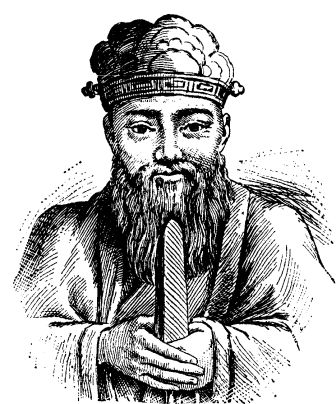
Confucius
It may now be accepted as beyond dispute that the Chinese migrated into China from southwestern Asia about B.C. 2300, bringing with them a knowledge of writing, and in all probability the beginnings of a literature. In the records of that distant past, history and fable are so closely intermingled that it is difficult to pronounce definitely upon any subject treated in them, and we are compelled to seek in comparative philology for reasonable explanations of many points which Chinese chroniclers are content to leave, not from want of assertion, in the mists of uncertainty.
By common consent it is acknowledged that the 'Yi King,' Book of Changes, is the oldest work extant in Chinese literature; though other works, the names of which only have come down to us, were contemporaneously current in the country. A peculiar veneration is naturally felt by the Chinese for this sole surviving waif from a past literature; and from the time of Confucius downward, scholars of every age have attempted to explain its mystic pages. The basis of the work is popularly believed to be eight diagrams, which are said to have been designed by Fuh-hi (B.C. 2852), and which by subdivision have become multiplied into sixty-four. One of these stands at the head of each of the sixty-four chapters into which the work is now divided. Following these diagrams is in each case an initial character, with short phrases which have been held by Confucius and every subsequent native commentator to explain the meaning of the diagrams. But the key to the puzzle was denied to these scholars, who made confusion worse confounded by their attempts to make sense of that which was unintelligible to them. So mysterious a text was naturally believed to be a work on divination; and accepting this cue, the commentators devoted their energies to forcing into the Procrustean bed of divination the disjointed phrases which follow the diagrams. The solution of the mystery, which had escaped the keen study of five-and-twenty centuries of native scholars, was discovered by the late Professor Terrieu de la Couperie, who by many irrefragable proofs demonstrated that the 'Yi King' consists "of old fragments of early times in China, mostly of a lexical character." With this explanation the futility of the attempts of the native scholars to translate it as a connected text at once becomes apparent. A large proportion of the chapters are merely syllabaries, similar to those of Chaldea. The initial character represents the word to be explained, and the phrases following express its various meanings.
An excellent translation of the 'Yi King' as it is understood by native scholars was published by Professor Legge in 'The Sacred Books of the East' (1882); and a comparison of his translation of the seventh chapter with Professor T. de la Couperie's rendering of the same passage must be enough to convince the most skeptical that even if he is not absolutely correct, the native scholars must undoubtedly be wrong. The chapter is headed by a diagram consisting of five divided lines and one undivided; and the initial character is Sze, which is described in modern dictionaries as meaning "a teacher," "instructor," "model," "an army," "a poet," "a multitude," "the people," "all," "laws," "an elder." Of the phrases which follow, Professor Legge gives the following rendering:—
"Sze indicates how, in the case which it supposes, with firmness and correctness, and [a leader of] age and experience, there will be good fortune and no error.
"The first line, divided, shows the host going forward according to the rules [for such a movement]. If these be not good, there will be evil.
"The second line, undivided, shows [the leader] in the midst of his host. There will be good fortune and no error. The king has thrice conveyed to him the orders [of his favor].
"The third line, divided, shows how the host may possibly have many inefficient leaders. There will be evil.
"The fourth line, divided, shows the host in retreat. There is no error.
"The fifth line, divided, shows birds in the fields, which it will be advantageous to seize and destroy. In that case there will be no error. If the oldest son leads the host, and younger men [idly occupy offices assigned to them], however firm and correct he may be, there will be evil.
"The topmost line, divided, shows the great ruler delivering his charges [appointing some], to be rulers of States, and others to undertake the headship of clans; but small men should not be employed [in such positions]."
OLDEST CHINESE LETTERS.
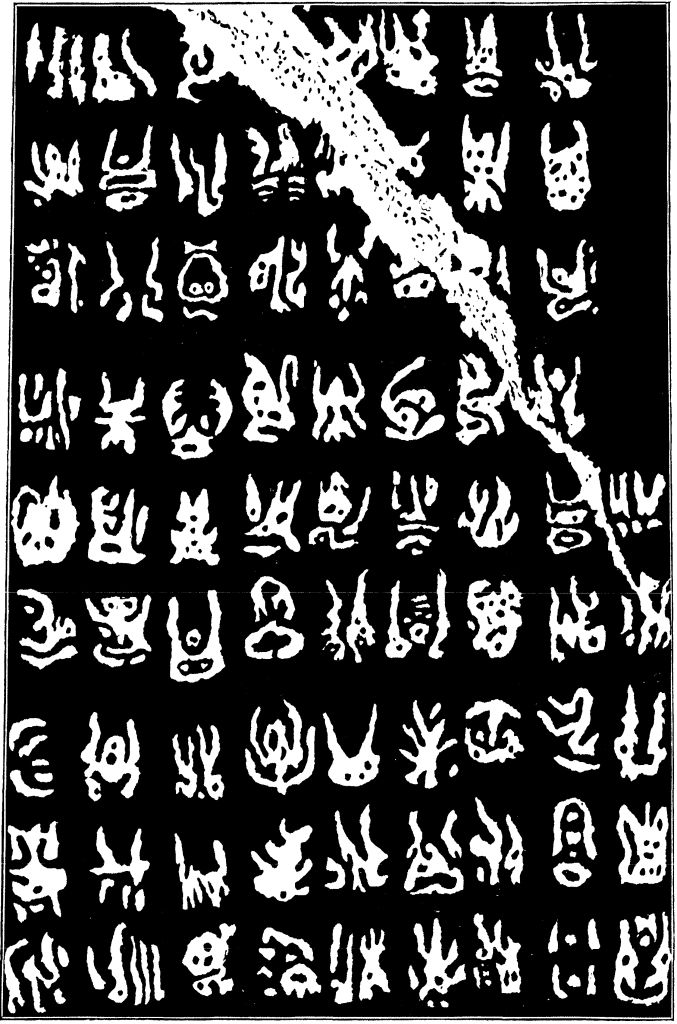
From an inscription attributed to the Emperor Yao, 2350 B.C. The most ancient historical books of the Chinese date from the time of Yao. The events of his reign were chronicled by contemporaneous writers; tradition being the foundation of all previous Chinese history.
It is impossible to read such an extract as the above without being convinced that the explanation was not that which was intended by the author or authors; and on the doctrine of probabilities, a perusal of the following version by Professor T. de la Couperie would incline us to accept his conclusions. But his theory does not rest on probabilities alone; he is able to support it with many substantial proofs: and though exception may possibly be taken to some of his renderings of individual phrases, his general views may be held to be firmly established. This is his version of the chapter quoted above, with the exception of the words of good or ill omen:—
"Sze [is] a righteous great man. The Sze defines laws not biased. The centre of the army. The three conveying orders [officers] of the Sovereign. Sze [is] also corpse-like. Sze [is] an assistant officer. In the fields are birds [so called]; many take the name [?] The elder sons [are] the leaders of the army. The younger [are] the passive multitude [?] Great Princes instructing. The group of men who have helped in the organization of the kingdom. People gathered by the Wu flag [?]."
From what has been said, as well as from the above extracts, it will be observed that to all except the native scholars who imagine that they see in its pages deep divinatory lore, the chief interest of the 'Yi King' lies in the linguistic and ethnographical indications which it contains, and which at present we can but dimly discern. It is difficult to assign a date to it, but it is certain that it existed before the time of King Wên (B.C. 1143), who with his son the Duke of Chow edited the text and added a commentary to it. That parts of it are very much earlier than this period there can be no doubt; and it is safe to assume that in the oldest portion of the work we have one of the first literary efforts of the Chinese. It was not, however, until the time of Confucius that the foundations of the national literature may be said to have been laid.
From constant references in the early histories it is obvious that before that period a literature of a certain kind existed. The Chinese have an instinctive love of letters, and we know from the records that to the courts of the various princes were attached historians whose duty it was to collect the folk-lore songs of the people of the various States. "If a man were permitted to make all the ballads of a nation, he need not care who should make its laws," said Sir Andrew Fletcher of Saltoun. So thought the Chinese legislators, who designed their enactments with direct regard to the dispositions of the people as displayed in their songs. At the time of Confucius (B.C. 551-479) a large collection of these ballads existed in the archives of the sovereign State of Chow; and as is generally believed, the sage revised the collection, and omitting those he considered unworthy of preservation, formed an edition containing three hundred and five pieces. This work has come down to us under the title of the 'Shih King' or Book of Odes. The ballads are just such as we should expect to find under the circumstances. They are plainly the utterances of the people in a primitive state of civilization, who nevertheless enjoyed considerable freedom; and though they occasionally had to lament the tyranny of individual princes, they cannot be described as having been among the down-trodden nations of the earth. The domesticity which is still a distinctive feature of Chinese life figures largely in them, and the filial piety which to the present day is so highly esteemed finds constant expression. The measure in which the odes have been handed down to us makes it difficult to understand how any rhythm could be found in them. With few exceptions they are all written in lines of four characters each, and as read at the present day, consist therefore of only four syllables. This seems to be so stunted and unnatural a metre that one is inclined to accept Professor T. de la Couperie's suggestion, for which he had much to say,—that at the time at which they were sung, the characters which now represent a syllable each were polysyllabic. It would seem probable that certainly in some cases compound characters were pronounced as compounded of syllables in accordance with their component parts, as certain of them are read by the Japanese at the present time. Numerous translations of the odes into European languages have been made, and the following extracts from Professor Legge's rendering of the second ode, celebrating the industry and filial piety of the reigning queen, give a good idea of the general tone of the pieces.
"Sweet was the scene. The spreading dolichos Extended far, down to the valley's depths, With leaves luxuriant. The orioles Fluttered around, and on the bushy trees In throngs collected,—whence their pleasant notes Resounded far in richest melody.... Now back to my old home, my parents dear To see, I go. The matron I have told, Who will announcement make. Meanwhile my clothes, My private clothes, I wash, and rinse my robes. Which of them need be rinsed? and which need not? My parents dear to visit back I go."
Such were the odes which Confucius found collected ready to his hand; and faithful to his character of transmitter of the wisdom of the ancients, he made them the common property of his countrymen. But these were not the only records at the court of Chow which attracted his attention. He found there historical documents, containing the leading events in the history of the Chinese States from the middle of the twenty-third century B.C. to 721. These curious records of a past time possessed an irresistible attraction for him. By constant study he made them his own, and with loving care collated and edited the texts. These fragments are, from a historical point of view, of great value; and they incidentally furnish evidence of the fact that China was not always the stage on which the Chinese people have played their parts. There is no sign in these records of the first steps in ethics and science which one would expect to find in the primitive history of a race. The utterances of the sovereigns and sages, with which they abound, are marked by a comparatively matured knowledge and an advanced ethical condition. The knowledge of astronomy displayed, though not profound, is considerable, and the directions given by the Emperor Yao to his astronomers royal are quite such as may have been given by any Emperor of China until the advent of the Jesuit missionaries in the seventeenth century; and the moral utterances of the sovereigns and their ministers are on a par with the sentiments expressed in the Peking Gazette at the present time. "Virtue," said the minister Yi addressing his Emperor Yü, "is the basis of good government; and this consists first in procuring for the people the things necessary for their sustenance, such as water, fire, metals, wood, and grain. The ruler must also think of rendering them virtuous, and of preserving them from whatever can injure life and health. When you would caution them, use gentle words; when you would correct, employ authority." "Do not be ashamed of mistakes, and thus make them crimes," was another piece of advice uttered forty centuries ago, which has a peculiarly modern ring about it.
According to the system in vogue at the Chinese courts, the duty of recording historical events was confided to historians of the right hand and of the left. To the latter was given the duty of recording the speeches and edicts of the sovereigns and their ministers, and to the first that of compiling chronicles of events. The historians who had placed on record the documents which Confucius edited in the 'Shu King' or Book of History were historians of the left hand, and in the only original work which we have by the Sage—'The Spring and Autumn Annals'—he constituted himself a historian of the right. In this work he traces the history of his native State of Lu from the year B.C. 722 to B.C. 484, and in the baldest and most calendar-like style enumerates, without any comment or expression of opinion, the facts which he considers of sufficient importance to report. However faulty we may consider his manner of treatment, any criticism should be leveled against the system rather than against the author. But in other respects Confucius cannot shelter himself under the plea of usage. As a historian, it was his bounden duty above all things to tell the truth, and to distribute praise and blame without fear or favor. In this elementary duty Confucius failed, and has left us a record in which he has obviously made events to chime in with his preconceived ideas and opinions. Considering the assumption of virtue with which Confucius always clothed himself, this is the more noticeable; and still more is it remarkable that his disciples should be so overcome by the glamour which attached to his name, that his obvious lapses from the truth are not only left unnoted, but the general tone and influence of the work are described in the most eulogistic terms. "The world," said Mencius, "had fallen into decay and right principles had dwindled away. Perverse discourses and oppressive deeds had again waxen rife. Cases had occurred of ministers who had murdered their rulers, and of sons who had murdered their fathers. Confucius was afraid and made the 'Ch'un ch'iu.'" So great, we are told, was the effect of the appearance of this work that "rebellious ministers quaked with fear, and undutiful sons were overcome with terror." Love of truth is not a characteristic of the Chinese people; and unhappily their greatest men, Confucius among them, have shown their countrymen a lamentable example in this respect.
So great is the admiration of the people for this work of Confucius that by universal consent the 'Ch'un ch'iu' has through all ages been included among the Five Classics of the country. Three others have already been spoken of, and there remains only one more, the Book of Rites, to mention. This work is the embodiment of, and authority for, the ceremonial which influences the national policy of the country, and directs the individual destinies of the people. We are informed on the highest authority that there are three hundred rules of ceremony and three thousand rules of behavior. Under a code so overwhelmingly oppressive, it is difficult to imagine how the race can continue to exist; but five-and-twenty centuries of close attention to the Book of Rites have so molded the nation within the lines of the ceremonial which it prescribes, that acquiescence with its rules has become a second nature with the people, and requires no more guiding effort on their part than does the automatic action of the nerves and limbs at the bidding of the brain. Within its voluminous pages every act which one man should perform to another is carefully and fully provided for; and this applies not only to the daily life of the people, but also to the official acts of the whole hierarchy of power from the Emperor downward. No court ceremony is undertaken without its guidance, and no official deed is done throughout the length and breadth of the eighteen Provinces of the Empire without its sanction. Its spirit penetrates every Yamên and permeates every household. It regulates the sacrifices which should be offered to the gods, it prescribes the forms to be observed by the Son of Heaven in his intercourse with his ministers, it lays down the behavior proper to officials of all ranks, and it directs the conduct of the people in every relation of life. It supplements in a practical form the teachings of Confucius and others, and forms the most important link in the chain which binds the people to the chariot wheels of the "Sages."
Of canonical authority equal to the Five Classics if not greater, are the 'Four Books' in which are recorded the ipsissima verba of Confucius. These are the 'Lunyü' or Sayings of Confucius, twenty books, which contains a detailed description of the Sage's system of philosophy; the 'Ta Hsio,' the Great Learning, ten chapters; the 'Chung yung,' or the Doctrine of the Mean, thirty-three chapters; and the development of Confucianism as enunciated by his great follower Mencius in the 'Mêng tzŭ,' seven books. These works cover the whole field of Confucianism; and as such, their contents claim the allegiance and demand the obedience of ninety-nine out of every hundred Chinamen. To the European student their contents are somewhat disappointing. The system they enunciate wants completeness and life, although the sentiments they express are unexceptionable; as for example when Confucius said: "Hold faithfulness and sincerity as first principles. Have no friends not equal to yourself. When you have faults, do not fear to abandon them." Admirable maxims such as these flowed from his lips in abundance, but he could offer no reason why a man should rather obey the advice thus presented than his own inclination. He had no reward to offer for virtue, and no terrors with which to threaten the doers of evil. In no sense do his teachings as they came from his lips constitute a religion. He inculcated no worship of the Deity, and he refrained altogether from declaring his belief or disbelief in a future existence.
The author of the 'Great Learning,' commonly said to be the disciple Tsêng, describes the object of his work to be "to illustrate illustrious virtue; to renovate the people; and to rest in the highest excellence." And following on the lines indicated by his great master, he lays down the ethical means by which these admirable ends may in his opinion be attained. The 'Doctrine of the Mean' takes for its text the injunction, "Let the states of equilibrium and harmony exist in perfection, and a happy order will prevail throughout heaven and earth, and all things will be nourished and flourish." The author of this work, Tzŭssŭ, goes deeper into the motives of human conduct than Confucius himself. "First he shows clearly how the path of duty is to be traced to its origin in Heaven, and is unchangeable, while the substance of it is provided in ourselves, and may not be departed from. Next he speaks of the importance of preserving and nourishing this, and of exercising a watchful self-scrutiny with reference to it. Finally he speaks of the meritorious achievements and transforming influence of sage and spiritual men in their highest extent."
In the teachings of Mencius (B.C. 372-289) we see a distinct advance on the doctrines of Confucius. He was a man of a far more practical frame of mind than his great predecessor, and possessed the courage necessary to speak plainly in the presence of kings and rulers. His knowledge of political economy was considerable, and he brought to the test of experience many of the opinions and doctrines which Confucius was willing to express only in the abstract. Filial piety was his constant theme. "The richest fruit of benevolence is this," he said,—"the service of one's parents. The richest fruit of righteousness is this,—the obeying of one's elder brothers. The richest fruit of wisdom is this,—the knowing of these two things, and not departing from them."
These Five Classics and Four Books may be said to be the foundations on which all Chinese literature has been based. The period when Confucius and Mencius taught and wrote was one of great mental activity all over the world. While the wise men of China were proclaiming their system of philosophy, the Seven Sages of Greece were pouring out words of wisdom in the schools at Athens, and the sound of the voice of Buddha (died 480 B.C.) had hardly ceased to be heard under the bôdhi tree in Central India. From such beginnings arose the literatures which have since added fame and splendor to the three countries in Asia and Europe. In China the impetus given by these pioneers of learning was at once felt, and called into existence a succession of brilliant writers who were as distinguished for the boldness of their views as for the freedom with which they gave them utterance.
The main subject discussed by these men was the principle underlying the Confucian system; namely, that man's nature is in its origin perfectly good, and that so long as each one remains uncontaminated by the world and the things of the world, the path of virtue is to him the path of least resistance. While therefore a man is able to remain unenticed by the temptations which necessarily surround him, he advances in spotless purity towards perfection, until virtue becomes in him so confirmed a habit that neither the stings of conscience nor the exertion of intellectual effort is required to maintain him in his position of perfect goodness and of perfect peace.
These are still the opinions of orthodox Confucianists, but at different times scholars have arisen, who from their own experiences in the world, have come to conclusions diametrically opposed to those taught by the Sage. In their opinion the Psalmist was right when he said, "The heart of man is deceitful above all things and desperately wicked." Scarcely had Confucius been gathered to his fathers when the Philosopher Hsün enunciated this view, and since then the doctrine has formed the chief ground of contention among all schools of philosophy down to the present day. By certain writers it has been held that in man's nature there is a mixture of good and evil, and by no one was this view more ably expounded than by the philosopher Chu Hi (A.D. 1130-1200). In season and out of season this great writer, who has done more than any one else to elucidate the dark pages of the classics, "taught that good and evil were present in the heart of every man, and that just as in nature a duality of powers is necessary to the existence of nature itself, so good and evil are inseparably present in the heart of every human being."
But there were others who felt that the bald and conventional system proclaimed by Confucius was insufficient to satisfy the desire for the supernatural which is implanted in men of every race and of every clime, and then at once a school arose, headed by Laotzŭ (sixth century B.C.), the Old Philosopher; which, adopting the spirit of Brahminism, taught its sectaries to seek by self-abnegation freedom from the entanglements of the world, and a final absorption into the Deity. The minds of most Chinamen are not attuned to the apprehension of philosophical subtleties, and the wisdom imparted by Laotzŭ to his countrymen in the pages of his 'Taotê King' (The Book of Reason and Virtue), soon became debased into a superstitious system by a succession of charlatans, who, adopting Laotzŭ's doctrine that death was only another form of life, taught their followers to seek to prolong the pleasures of the present state of existence by searching in the mazes of alchemy for the elixir of life and the philosopher's stone. Before the faith reached this degraded position, however, several writers supplemented and enlarged on the doctrines advanced by Laotzŭ. Foremost among these were Litzŭ and Chwangtzŭ, who were both men of great metaphysical ability, and whose speculations, though not always in harmony with those of their great master, help to some extent to elucidate his system and certainly add considerable interest to it.
Around the systems of Confucius and Laotzŭ a considerable literature grew up, which was cherished, copied, and discussed by all those scholars who had time to spare from the contemplation of the records of the various States into which the country was divided. These records had assumed a permanent place in the literature of the land, and were bound up with the feudal system which then existed. The time came, however, when this feudal system was destined to come to an end. In the third century before Christ a leader arose who proclaimed the States an Empire and himself as Emperor. To so conservatively minded a people as the Chinese the revolution was difficult of acceptance, and Shi Hwangti, seeking to facilitate the transfer of their allegiance, ordered the destruction of all books which might preserve the memory of a bygone constitution. With ruthless severity the ukase was put into force, and all works, with the exception of those on medicine and alchemy, were thrown to the flames. Happily no tyrant, however powerful, can enforce the complete fulfillment of such an edict; and in spite of threats and persecutions, events showed that through all that fiery time manuscripts had been carefully preserved, and that men had been found ready to risk their lives in the sacred cause of learning.
Fortunately the Dynasty founded by Shi Hwangti was short-lived, and in 202 B.C. a revolution placed Kao ti, the founder of the Han Dynasty, on the throne. With commendable wisdom Kao ti placed himself at once in complete harmony with the national mind, and had no sooner assumed the imperial yellow than he notified his desire to restore the national literature to its former status. Under his fostering care, manuscripts which had lain hidden were brought out from their places of concealment; and to these works were added others, which were dictated by scholars who had treasured them in their memories. That the works thus again brought out were numerous, is proved by the fact that in the catalogue of the Imperial Library of the Han Dynasty (B.C. 202 to A.D. 25), mention is made of 11,312 works, consisting of volumes on the classics, philosophy, poetry, military tactics, mathematics and medicine.
It was during this dynasty that the national history and poetry took their rise in the shapes with which we are now familiar. After the night of turmoil and darkness which had just passed away, men, as though invigorated by the time of sterility, devoted themselves to the production of cultured prose and original though pedantic poetry. It was then that Ssŭma Ch'ien, who has been called the Herodotus of China, wrote his 'Shichi' (Historical Records), which embraces a period of between two and three thousand years; namely, from the reign of Hwang ti (B.C. 2697) to the reign of Wu ti of the Han Dynasty (B.C. 140-86). Following the example of this great chronicler, Pan ku compiled the records of the Han Dynasty in a hundred and twenty books, and it is on the model thus laid down that all succeeding dynastic histories of China have been written. Almost without variation the materials of these vast depositories of information are arranged in the following order:—1. Imperial records, consisting of the purely political events which occurred in each reign. 2. Memoirs, including treatises on mathematical chronology, rites, music, jurisprudence, political economy, State sacrifices, astronomy, elemental influences, geography, literature, biographies, and records of the neighboring countries.
Tempora non animi mutant, and in the poetry of this period we see a close resemblance to the spirit which breathes in the odes collected by Confucius. The measure shows signs of some elasticity, five characters to a line taking the place of the older four-syllabled metre; but the ideas which permeate it are the same. Like all Chinese poetry, it is rather quaint than powerful, and is rather noticeable for romantic sweetness than for the expression of strong passions. There is for the most part a somewhat melancholy ring about it. The authors love to lament their absence from home or the oppressed condition of the people, or to enlarge on the depressing effect of rain or snow, and find sadness in the strange beauty of the surrounding scenery or the loveliness of a flower. The diction is smooth and the fancy wandering, but its lines do not much stir the imagination or arouse the passions. These are criticisms which apply to Chinese poetry of all ages. During the T'ang and Sung Dynasties (A.D. 618-1127), periods which have been described as forming the Augustan ages of Chinese literature, poets flourished abundantly, and for the better expression of their ideas they adopted a metre of seven characters or syllables, instead of the earlier and more restricted measures. Tu Fu, Li T'aipai, and a host of others, enriched the national poetry at the time, and varied the subjects which had been the common themes of earlier poets by singing the praises of wine. To be a poet it was considered necessary by them that a man should be a wine-bibber, and their verses describe with enthusiasm the pleasures of the cup and the joys of intoxication. The following is a specimen of such an ode, taken from the works of Li T'aipai:—
If life be nothing but an empty dream, Why vex one's self about the things of time? My part shall be to drain the flowing cup And sleep away the fumes of drowsy wine. When roused to life again, I straightway ask The Bird which sings in yonder leafy trees, What season of the year had come its round. "The Spring," he says, "When every breath of air suggests a song." Sad and disturbed, I heave a gentle sigh, And turn again to brightening, cheering wine, And sing until the moon shines, and until Sleep and oblivion close my eyes again.
But before the time of the T'ang Dynasty a new element had been introduced into the national literature. With the introduction of Buddhism the Chinese became acquainted with religious doctrines and philosophical ideas, of which until then they had only been faintly conscious from their contact with the debased form of Brahminical teaching which under the name of Taoism had long existed in the land. A complete knowledge of the teachings of Sakyamuni was however imparted to them by the arrival, at the beginning of the first century of our era, of two Shamans from India who settled at Loyang in the province of Honan, and who translated the Sanskrit Sutra in forty-two sections into Chinese. From this time onward a constant succession of Buddhist missionaries visited China and labored with indefatigable industry, both by oral teaching and by the translation of Sanskrit works into Chinese, to convert the people to their faith.
The knowledge thus acquired was of great advantage to the literature of the country. It enriched it with new ideas, and added wider knowledge to its pages. The history and geography of India, with which scholars had previously been scarcely acquainted, became, though indistinctly, matters of knowledge to them. Already Fahsien, the great forerunner of Chinese Buddhist pilgrims (B.C. 399), had visited India and had described in his 'Fuh kwo chi' (The Records of Buddhist Countries) the wonders which he had seen in Hindustan. With the spread of Buddhism in China, a desire to follow in his footsteps prompted others to undertake the long and arduous journey across the Mongolian steppes and over the passes of the Himalayas into the plains of India. Sung yun in the sixth century and Hüan Ts'ang in the seventh are conspicuous among those who undertook this toilsome pilgrimage in the interest of the faith.
Notwithstanding the occasional influx of new sentiments, however, the circumscribed circle of knowledge which was within the reach of Chinese scholars, and the poverty of their vocabulary, have always necessarily limited the wealth of their ideas; and at an early period of the history of the country we see symptoms of sterility creeping over the national mind. It is always easier to remember than to think; and it cannot but be looked upon as a sign of decadence in a literature when collections of ready-made knowledge take the place of original compositions, and when scholars devote themselves to the production of anthologies and encyclopædias instead of seeking out new thoughts and fresh branches of learning. In the sixth century, a period which coincides with the invention of printing, there was first shown that disposition to collect extracts from works of merit into anthologies, which have ever since been such a marked peculiarity of Chinese literature.
That the effect of these works, and of the encyclopædias which are in a sense allied to them, has been detrimental to the national mind, there cannot be a doubt. Scholars are no longer required to search for themselves for the golden nuggets of knowledge in the mines of learning. They have but to turn to the great depositories of carefully extracted information, and they find ready to their hand the opinions and thoughts of all those who are considered to be authorities on the subject with which they desire to acquaint themselves. For the purposes of cram for students at the competitive examinations, these treasuries of knowledge are of inestimable value: and by their help, "scholars" who have neither depth of knowledge nor power of thought are able to make a show of erudition which is as hollow as it is valueless.
During the Ming Dynasty (1368-1644) this class of literature may be said to have reached its highest development. In the reign of the Emperor Yunglo (1403-1425) was compiled the largest encyclopædia which has ever seen the light. This gigantic work, which was entitled 'Yunglo ta tien,' consisted of no fewer than 22,877 books, and covered every branch of knowledge possessed by the Chinese. Possibly owing to its immense extent, it was never published; and such volumes as still survive the destroying influences of neglect and decay are yet to be found in manuscript on the shelves of the Imperial Library. Inspired perhaps by the example thus set, the Emperor K'anghi of the present dynasty appointed a commission of scholars to compile a similar work; and after forty years had been consumed in extracting from the past literatures every passage bearing on the 6109 headings which it was the will of K'anghi should be illustrated, the compilers were able to lay before their sovereign a work consisting of 5020 volumes, which they entitled 'Kin L'ing ku kin t'u shu chi ch'êng.' Unlike Yunglo's great work, this one was printed; and though only, as it is said, a hundred copies were issued, some still remain of the original edition. One such copy, complete in every particular, is to be seen at the British Museum. For completeness from a Chinese point of view this work stands out pre-eminently above all others; but owing to the very limited number of copies, it has never superseded the 'Wên hsien t'ung k'ao' by Ma Twanlin, which, though published four hundred years earlier, still holds its own in popular estimation.
Much has been written by Chinese authors on scientific subjects, but the substance is remarkable for its extent rather than for its value. In each branch of knowledge they have advanced under foreign influence up to a certain point, and beyond that they have been unable to go. Their knowledge of astronomy, which is of Chaldean origin, is sufficient to enable them to calculate eclipses and to recognize the precession of the equinoxes, but it has left them with confused notions on subjects which are matters of common knowledge among Western people. It is the same in the case of medicine. They understand certain general principles of therapeutics and the use of certain herbs; but their knowledge is purely empirical, and their acquaintance with surgery is of the most elementary kind.
It is perhaps in their novels and plays, however, that the most marked defects in the national mind become apparent. The systems of education and the consequent mental habit in vogue are the outcomes of that lack of imagination which distinguishes the people, and which finds its reflection in all those branches of literature which are more directly dependent on the flow of new and striking ideas. There is little delineation of character either in their novels or their plays. The personages portrayed are all either models of virtue and learning, or shocking examples of ignorance and turpitude. Their actions are mechanical, and the incidents described have little or no connection with one another. The stories are in fact arranged much as a clever child might be expected to arrange them, and they are by no means free from the weary iterations in which untutored minds are apt to indulge. Chinese scholars are conscious of these defects, and attempt to explain them by describing novel-writing as being beneath the serious attention of all those who are interested in learning. This view is commonly accepted by their learned world, who divide literature into four classes, viz., Classics, History, Philosophy, and Belles-lettres. The last of these does not include either romances or plays; and with the exception of two or three standard works of fiction and the 'Hundred Plays of the Yüan Dynasty' (A.D. 1280-1368), no specimens of either of these two classes of literature would ever be found in a library of standing. But this contempt for works of imagination is probably less the cause of their inferiority than the result of it. The Providence which has given Chinamen untiring diligence, inexhaustible memories, and a love of learning, has not vouchsafed to touch their tongues with the live coal of imagination. They are plodding students, and though quite capable of narrating events and of producing endless dissertations on the interpretation of the classics and the true meaning of the philosophy on which they are based, are entirely unprovided with that power of fancy which is able to bring before the eye, as in a living picture, the phantoms of the brain.
SELECTED MAXIMS On Morals, Philosophy of Life, Character, Circumstances, etc.
From the Chinese Moralists
Filial piety and fraternal submission, are they not the root of all benevolent actions?—Confucian An., Heo Urh (ch. ii.).
The path of duty lies in what is near, and men seek for it in what is remote. The work of duty lies in what is easy, and men seek for it in what is difficult. If each man would love his parents and show due respect to his elders, the whole empire would enjoy tranquillity.—Mencius, Le Low (pt. i., ch. xi.).
Hold faithfulness and sincerity as first principles.—Confucian An., Heo Urh (ch. viii.).
If what we see is doubtful, how can we believe what is spoken behind the back?—Inscription in "Celestial Influence Temple."
Words which are simple, while their meaning is far-reaching, are good words. Principles which are held as compendious, while their application is extensive, are good principles. The words of the superior man are not necessarily high-sounding, but great principles are contained in them.—Mencius, Tsin Sin (ch. xxxii.).
The superior man is correctly firm, and not firm merely.—Confucian An., Wei Ling Kung (ch. xxxvi.).
For one word a man is often deemed to be wise; and for one word he is often deemed to be foolish. We ought to be careful indeed in what we say.—Confucian An., Observations of Tsze Kung.
In archery we have something like the way of the superior man. When the archer misses the centre of the target, he turns round and seeks for the cause of his failure in himself.—Doctrine of the Mean (ch. xiv.).
God leads men to tranquil security.—Shoo King, ii., Numerous Officers (ch. ii.).
The glory and tranquillity of a State may arise from the excellence of one man.—Shoo King, ii., Speech of the Duke of Tsin (ch. viii.).
Mencius said, The superior man has two things in which he delights, and to be ruler over the empire is not one of them.
That his father and mother are both alive, and that the condition of his brothers affords no cause for anxiety; this is one delight.
Then when looking up he has no occasion for shame before heaven, and below he has no occasion to blush before men; this is a second delight.—Mencius, Tsin Sin (pt. i., ch. xx.).
Fine words and an insinuating appearance are seldom associated with virtue.—Confucian An., Yang Ho (ch. xvii.).
I am pleased with your intelligent virtue, not loudly proclaimed nor portrayed, without extravagance or changeableness, without consciousness of effort on your part, in accordance with the pattern of God.—She King, ii., Major Odes, Hwang I.
Learning without thought is labor lost; thought without learning is perilous.—Confucian An., Wei Ching (ch. xv.).
Without recognizing the ordinances of Heaven it is impossible to be a superior man.—Confucian An., Yaou Yue (ch. iii.).
Be tremblingly fearful, Be careful night and day; Men trip not on mountains, They trip on ant-hills. Yaou's Warning, Poem from Hwae Nan.
The ways of God are not invariable; on the good doer he sends down all blessings, and on the evil doer he sends down all miseries.—Shoo King, Instructions of E (ch. iv.).
In the way of superior man there are four things, not one of which have I as yet attained:—To serve my father as I would require my son to serve me; to serve my Prince as I would require my minister to serve me; to serve my elder brother as I would require my younger brother to serve me; to set the example in behaving to a friend as I would require him to behave to me.—Doctrine of the Mean (ch. xiii.).
Virtue has no invariable model. A supreme regard to what is good gives the model of it. What is good has no invariable characteristic to be supremely regarded; it is found where there is conformity to the uniform decision of the mind.—Shoo King, Both Possessed Pure Virtue (ch. iii.).
This King Wan Watchfully and reverently With entire intelligence served God, And so secured the great blessing.— She King, Decade of King Wan II.
Man's nature to good is like the tendency of water to flow downwards. There are none but have this tendency to good, just as all water flows downwards.—Mencius, Kaou Tsze (pt. i., ch. ii).
Virtue is the root; wealth the result.—The Great Learning (ch. x.).
Its sovereigns on their part were humbly careful not to lose the favor of God.—Shoo King, ii., Numerous Officers (ch. viii.).
He who loves his parents will not dare to incur the risk of being hated by any man, and he who reveres his parents will not dare to incur the risk of being condemned by any man.—Hsiao King, Filial Piety (ch. ii.).
Do not speak lightly; your words are your own. Do not say, This is of little importance; no one can hold my tongue for me; words are not to be cast away. Every word finds its answer; every good deed has its recompense.—She King, ii., Major Odes, the Yi.
Looked at in friendly intercourse with superior men, you make your countenance harmonious and mild, anxious not to do anything wrong. Looked at in your chamber, you ought to be equally free from shame before the light which shines in. Do not say, This place is not public; no one can see me here: the approaches of spiritual beings cannot be calculated beforehand, but the more should they not be slighted.—She King, ii., Major Odes, the Yi.
Let me not say that Heaven is high aloft above me. It ascends and descends about our doings; it daily inspects us wherever we are.—She King, i., Sacrificial Odes of Kau, Ode, King Kih.
What future misery have they and ought they to endure who talk of what is not good in others?—Mencius, Le Low (pt. ii., ch. ix.).
Above all, sternly keep yourself from drink.—Shoo King, Announcement about Drunkenness (ch. xiii.).
Of ten thousand evils, lewdness is the head. Of one hundred virtues, filial piety is the first. Confucian Proverb.
There are three thousand offenses against which the five punishments are directed, and there is not one of them greater than being unfilial.—The Hsiao King, The Five Punishments.
Benevolence is man's mind and righteousness is man's path.
How lamentable is it to neglect the path and not pursue it, to lose the mind and not know to seek it again.—Mencius, Kaou Tsze (pt. i., ch. xi.).
Tsze Kung asked, saying, "What do you say of a man who is loved by all the people of his village?" The Master replied, "We may not for that accord our approval of him." "And what do you say of him who is hated by all the people of his village?" The Master said, "We may not for that conclude that he is bad. It is better than either of these cases that the good in the village love him and the bad hate him."—Confucian An., Tsze Loo (ch. xxiv.).
Men must be decided on what they will not do, and then they are able to act with vigor in which they ought.—Mencius, Le Low (pt. ii., ch. viii.).
Learn as if you could not reach your object and were always fearing also lest you should lose it.—Confucian An., T'ae Pih (ch. xvii.).
King Wan looked on the people as he would on a man who was wounded, and he looked toward the right path as if he could not see it.—Mencius, Le Low (pt. ii., ch. xx.).
To nourish the heart there is nothing better than to make the desires few.—Mencius, Tsin Sin (ch. xxxv.).
When Heaven is about to confer a great office on any man, it first exercises his mind with suffering, and his sinews and bones with toil. It exposes his body to hunger, and subjects him to extreme poverty. It confounds his undertakings. By all these methods it stimulates his mind, hardens his nature, and supplies his incompetencies.—Mencius, Kaou Tsze (pt. ii. ch. xv.).
You should ever stand in awe of the punishment of Heaven.—Shoo King, ii.; Prince of Leu on Punishments.
Great Heaven is intelligent and is with you in all your doings. Great Heaven is clear-seeing, and is with you in all your wanderings and indulgences.—She King, ii., Major Odes, the Pan.
Ke Loo asked about serving the spirits of the dead. The Master said, "While you are not able to serve men, how can you serve their spirits?" Ke Loo added, "I venture to ask about death." He was answered, "While you do not know life, how can you know about death?"—Confucian An., Seen Tsin (ch. xi.).
For all affairs let there be adequate preparation. With preparation there will be no calamities.—Shoo King, Charge of Yue (ch. i.).
As to what the superior man would feel to be a calamity, there is no such thing. He does nothing which is not according to propriety. If there should befall him one morning's calamity, the superior man does not account it a calamity.—Mencius, Le Low (pt. ii., ch. xxviii.).
God is with you, have no doubts in your heart.—She King, Decade of King Wan II.
Beware. What proceeds from you will return to you again.—Mencius, King Hwuy (pt. ii., ch. xii.).
Show reverence for the weak.—Shoo King, Timber of the Tsze Tree (ch. iii.).
When the year becomes cold, then we know how the pine and the cypress are the last to lose their leaves; i.e., men are not known save in times of adversity.—Confucian An., Tsze Han (ch. xxvii.).
By nature men are nearly alike; by practice they get to be wide apart.—Confucian An., Yang Ho (ch. ii.).
All are good at first, but few prove themselves to be so at the last.—She King, ii., Major Odes, the Tang.
In serving his parents a son may remonstrate with them, but gently; when he sees that they do not incline to follow his advice he shows an increased degree of reverence, but does not abandon his purpose; and should they punish him he does not allow himself to murmur.—Confucian An., Le Yin (ch. xviii.).
The Great God has conferred on the inferior people a moral sense, compliance with which would show their nature invariably right.—Shoo King, Announcement of T'ang (ch. ii.).
Confucius said:—"There are three things which the superior man guards against. In youth when the physical powers are not yet settled, he guards against lust. When he is strong and the physical powers are full of vigor, he guards against quarrelsomeness. When he is old and the animal powers are decayed, he guards against covetousness."—Confucian An., Ke She (ch. vii.).
He who stops short where stopping short is not allowable, will stop short in everything. He who behaves shabbily to those whom he ought to treat well, will behave shabbily to all.—Mencius, Tsin Sin (pt. i., ch. xliv.).
Men are partial where they feel affection and love; partial where they despise and dislike; partial where they stand in awe and reverence; partial where they feel sorrow and compassion; partial where they are arrogant and rude. Thus it is that there are few men in the world who love and at the same time know the bad qualities of the object of their love, or who hate and yet know the excellences of the object of their hatred.—The Great Learning (ch. viii.).
Heaven's plan in the production of mankind is this: that they who are first informed should instruct those who are later in being informed, and they who first apprehend principles should instruct those who are slower to do so. I am one of Heaven's people who first apprehended. I will take these principles and instruct this people in them.—Mencius, Wan Chang (pt. i., ch. vii.).
From 'The Proverbial Philosophy of Confucius': copyrighted 1895, by Forster H. Jennings; G. P. Putnam's Sons, Publishers