Volume 9 — SAMUEL LANGHORNE CLEMENS (MARK TWAIN)
Reading edition
(1835-)

amuel L. Clemens has made the name he assumed in his earliest "sketches" for newspapers so completely to usurp his own in public and private, that until recently the world knew him by no other; his world of admirers rarely use any other in referring to the great author, and even to his intimate friends the borrowed name seems the more real. The pseudonym so lightly picked up has nearly universal recognition, and it is safe to say that the name "Mark Twain" is known to more people of all conditions, the world over, than any other in this century, except that of some reigning sovereign or great war captain. The term is one used by the Mississippi River pilots to indicate the depth of water (two fathoms) when throwing the lead. It was first employed by a river correspondent in reporting the state of the river to a New Orleans newspaper. This reporter died just about the time Mr. Clemens began to write, and he "jumped" the name.
Mr. Clemens was born in Hannibal, Missouri, a small town on the west bank of the Mississippi, in 1835. He got the rudiments of an education at a village school, learned boy-life and human nature in a frontier community, entered a printing office and became an expert compositor, traveled and worked as a journeyman printer, and at length reached the summit of a river boy's ambition in a Mississippi steamboat in learning the business of a pilot. It is to this experience that the world is indebted for some of the most amusing, the most real and valuable, and the most imaginative writing of this century, which gives the character and interest and individuality to this great Western river that history has given to the Nile. If he had no other title to fame, he could rest securely on his reputation as the prose poet of the Mississippi. Upon the breaking out of the war the river business was suspended. Mr. Clemens tried the occupation of war for a few weeks, on the Confederate side, in a volunteer squad which does not seem to have come into collision with anything but scant rations and imaginary alarms; and then he went to Nevada with his brother, who had been appointed secretary of that Territory. Here he became connected with the Territorial Enterprise, a Virginia City newspaper, as a reporter and sketch-writer, and immediately opened a battery of good-natured and exaggerated and complimentary description that was vastly amusing to those who were not its targets. Afterwards he drifted to the Coast, tried mining, and then joined that group of young writers who illustrated the early history of California. A short voyage in the Sandwich Islands gave him new material for his pen, and he made a successful début in San Francisco as a humorous lecturer.
The first writing to attract general attention was 'The Jumping Frog of Calaveras,' which was republished with several other sketches in book form in New York. Shortly after this he joined the excursion of the Quaker City steamship to the Orient, wrote letters about it to American newspapers, and advertised it quite beyond the expectations of its projectors. These letters, collected and revised, became 'The Innocents Abroad,' which instantly gave him a world-wide reputation. This was followed by 'Roughing It,' most amusing episodes of frontier life. His pen became immediately in great demand, and innumerable sketches flowed from it, many of them recklessly exaggerated for the effect he wished to produce; always laughter-provoking, and nearly always having a wholesome element of satire of some sham or pretense or folly. For some time he had charge of a humorous department in the Galaxy Magazine. These sketches and others that followed were from time to time collected into volumes which had a great sale. About this time he married, and permanently settled in Hartford, where he began the collection of a library, set himself to biographical and historical study, made incursions into German and French, and prepared himself for the more serious work that was before him.
A second sojourn in Europe produced 'A Tramp Abroad,' full of stories and adventures, much in the spirit of his original effort. But with more reading, reflection, and search into his own experiences, came 'Old Times on the Mississippi,' 'Tom Sawyer,' and 'Huckleberry Finn,' in which the author wrote out of his own heart. To interest in social problems must be attributed the beautiful idyl of 'The Prince and the Pauper,' and 'The Yankee at the Court of King Arthur,' which latter the English thought lacked reverence for the traditions of chivalry.
During all this period Mr. Clemens was in great demand as a lecturer and an after-dinner speaker. His remarks about New England weather, at a New England dinner in New York, are a favorite example of his humor and his power of poetic description. As a lecturer, a teller of stories, and delineator of character, he had scarcely a rival in his ability to draw and entertain vast audiences. He made a large income from his lectures in America and in England, and from his books, which always had a phenomenally large sale. Very remunerative also was the play of 'Colonel Sellers,' constructed out of a novel called 'The Gilded Age.'
S. L. CLEMENS.
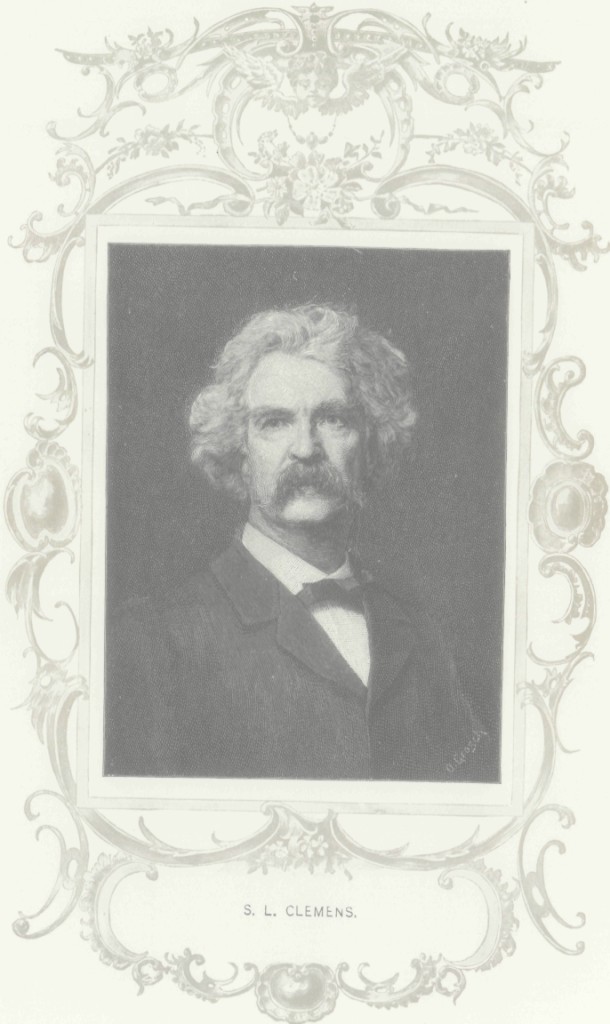
Since 1890 Mr. Clemens and his family have lived most of the time in Europe. For some time before he had written little, but since that his pen has again become active. He has produced many magazine papers, a story called 'Pudd'nhead Wilson,' and the most serious and imaginative work of his life in 'The Personal Recollections of Joan of Arc,' feigned to be translated from a contemporary memoir left by her private secretary. In it the writer strikes the universal chords of sympathy and pathos and heroic elevation. In 1895-6 he made a lecturing tour of the globe, speaking in Australia, New Zealand, South Africa, and India, and everywhere received an ovation due to his commanding reputation. He is understood to be making this journey the subject of another book.
Mr. Clemens is universally recognized as the first of living humorists; but if the fashion of humor changes, as change it may, he will remain for other qualities—certain primordial qualities such as are exhibited in his work on the Mississippi—a force to be reckoned with in the literature of this century. Mr. Clemens's humor has the stamp of universality, which is the one indispensable thing in all enduring literary productions, and his books have been translated and very widely diffused and read in German, French, and other languages. This is a prophecy of his lasting place in the world of letters.
THE CHILD OF CALAMITY
From 'Life on the Mississippi': copyright 1883, by James R. Osgood and Company
By way of illustrating keelboat talk and manners, and that now departed and hardly remembered raft life, I will throw in, in this place, a chapter from a book which I have been working at by fits and starts during the past five or six years, and may possibly finish in the course of five or six more. The book is a story which details some passages in the life of an ignorant village boy, Huck Finn, son of the town drunkard of my time out West there. He has run away from his persecuting father, and from a persecuting good widow who wishes to make a nice truth-telling respectable boy of him; and with him a slave of the widow's has also escaped. They have found a fragment of a lumber raft (it is high water and dead summer-time), and are floating down the river by night and hiding in the willows by day,—bound for Cairo,—whence the negro will seek freedom in the heart of the free States. But in a fog, they pass Cairo without knowing it. By-and-by they begin to suspect the truth, and Huck Finn is persuaded to end the dismal suspense by swimming down to a huge raft which they have seen in the distance ahead of them, creeping aboard under cover of the darkness, and gathering the needed information by eavesdropping:—
But you know a young person can't wait very well when he is impatient to find a thing out. We talked it over, and by-and-by Jim said it was such a black night now that it wouldn't be no risk to swim down to the big raft and crawl aboard and listen,—they would talk about Cairo, because they would be calculating to go ashore there for a spree, maybe, or anyway they would send boats ashore to buy whisky or fresh meat or something. Jim had a wonderful level head, for a nigger: he could 'most always start a good plan when you wanted one.
I stood up and shook my rags off and jumped into the river, and struck out for the raft's light. By-and-by, when I got down nearly to her, I eased up and went slow and cautious. But everything was all right—nobody at the sweeps. So I swum down along the raft till I was 'most abreast the camp fire in the middle, then I crawled aboard and inched along and got in amongst some bundles of shingles on the weather side of the fire. There was thirteen men there—they was the watch on deck, of course. And a mighty rough-looking lot too. They had a jug, and tin cups, and they kept the jug moving. One man was singing—roaring, you may say; and it wasn't a nice song—for a parlor anyway. He roared through his nose, and strung out the last word of every line very long. When he was done they all fetched a kind of Injun war-whoop, and then another was sung. It begun:—
"There was a woman in our towdn. In our towdn did dwed'l (dwell), She loved her husband dear-i-lee, But another man twyste as wed'l. "Singing too, riloo, riloo, riloo, Ri-loo, riloo, rilay—-e, She loved her husband dear-i-lee, But another man twyste as wed'l."
And so on—fourteen verses. It was kind of poor, and when he was going to start on the next verse one of them said it was the tune the old cow died on; and another one said, "Oh, give us a rest." And another one told him to take a walk. They made fun of him till he got mad and jumped up and begun to cuss the crowd, and said he could lam any thief in the lot.
They was all about to make a break for him, but the biggest man there jumped up and says:—
"Set whar you are, gentlemen. Leave him to me; he's my meat."
Then he jumped up in the air three times and cracked his heels together every time. He flung off a buckskin coat that was all hung with fringes, and says, "You lay thar tell the chawin-up's done;" and flung his hat down, which was all over ribbons, and says, "You lay thar tell his sufferins is over."
Then he jumped up in the air and cracked his heels together again and shouted out:—
"Whoo-oop! I'm the old original iron-jawed, brass-mounted, copper-bellied corpse-maker from the wilds of Arkansaw!—Look at me! I'm the man they call Sudden Death and General Desolation! Sired by a hurricane, dam'd by an earthquake, half-brother to the cholera, nearly related to the small-pox on the mother's side! Look at me! I take nineteen alligators and a bar'l of whisky for breakfast when I'm in robust health, and a bushel of rattlesnakes and a dead body when I'm ailing! I split the everlasting rocks with my glance, and I squench the thunder when I speak! Whoo-oop! Stand back and give me room according to my strength! Blood's my natural drink, and the wails of the dying is music to my ear! Cast your eye on me, gentlemen!—and lay low and hold your breath, for I'm 'bout to turn myself loose!"
All the time he was getting this off, he was shaking his head and looking fierce and kind of swelling around in a little circle, tucking up his wrist-bands and now and then straightening up and beating his breast with his fist, saying "Look at me, gentlemen!" When he got through he jumped up and cracked his heels together three times, and let off a roaring "Whoo-oop! I'm the bloodiest son of a wildcat that lives!"
Then the man that had started the row tilted his old slouch hat down over his right eye; then he bent stooping forward, with his back sagged and his south end sticking out far, and his fists a-shoving out and drawing in in front of him, and so went around in a little circle about three times, swelling himself up and breathing hard. Then he straightened, and jumped up and cracked his heels together three times before he lit again (that made them cheer), and he begun to shout like this:—"Whoo-oop! bow your neck and spread, for the kingdom of sorrow's a-coming! Hold me down to the earth, for I feel my powers a-working! whoo-oop! I'm a child of sin; don't let me get a start! Smoked glass, here, for all! Don't attempt to look at me with the naked eye, gentlemen! When I'm playful I use the meridians of longitude and parallels of latitude for a seine, and drag the Atlantic Ocean for whales! I scratch my head with the lightning and purr myself to sleep with the thunder! When I'm cold I bile the Gulf of Mexico and bathe in it; when I'm hot I fan myself with an equinoctial storm; when I'm thirsty I reach up and suck a cloud dry like a sponge; when I range the earth hungry, famine follows in my tracks! Whoo-oop! Bow your neck and spread! I put my hand on the sun's face and make it night in the earth; I bite a piece out of the moon and hurry the seasons; I shake myself and crumble the mountains! Contemplate me through leather—don't use the naked eye! I'm the man with a petrified heart and biler-iron bowels! The massacre of isolated communities is the pastime of my idle moments, the destruction of nationalities the serious business of my life! The boundless vastness of the great American desert is my inclosed property, and I bury my dead on my own premises!" He jumped up and cracked his heels together three times before he lit (they cheered him again), and as he came down he shouted out: "Whoo-oop! bow your neck and spread, for the pet child of calamity's a-coming!"
Then the other one went to swelling around and blowing again—the first one—the one they called Bob; next, the Child of Calamity chipped in again, bigger than ever; then they both got at it at the same time, swelling round and round each other and punching their fists 'most into each other's faces, and whooping and jawing like Injuns; then Bob called the Child names, and the Child called him names back again: next, Bob called him a heap rougher names, and the Child come back at him with the very worst kind of language; next, Bob knocked the Child's hat off, and the Child picked it up and kicked Bob's ribbony hat about six foot; Bob went and got it and said never mind, this warn't going to be the last of this thing, because he was a man that never forgot and never forgive, and so the Child better look out; for there was a time a-coming, just as sure as he was a living man, that he would have to answer to him with the best blood in his body. The Child said no man was willinger than he was for that time to come, and he would give Bob fair warning, now, never to cross his path again, for he could never rest till he had waded in his blood; for such was his nature, though he was sparing him now on account of his family, if he had one.
Both of them was edging away in different directions, growling and shaking their heads and going on about what they was going to do; but a little black-whiskered chap skipped up and says:—
"Come back here, you couple of chicken-livered cowards, and I'll thrash the two of ye!"
And he done it, too. He snatched them, he jerked them this way and that, he booted them around, he knocked them sprawling faster than they could get up. Why, it warn't two minutes till they begged like dogs—and how the other lot did yell and laugh and clap their hands all the way through, and shout "Sail in, Corpse-Maker!" "Hi! at him again, Child of Calamity!" "Bully for you, little Davy!" Well, it was a perfect pow-wow for a while. Bob and the Child had red noses and black eyes when they got through. Little Davy made them own up that they was sneaks and cowards, and not fit to eat with a dog or drink with a nigger; then Bob and the Child shook hands with each other very solemn, and said they had always respected each other and was willing to let bygones be bygones. So then they washed their faces in the river; and just then there was a loud order to stand by for a crossing, and some of them went forward to man the sweeps there, and the rest went aft to handle the after-sweeps.
A STEAMBOAT LANDING AT A SMALL TOWN
From 'Life on the Mississippi': copyright 1883, by James R. Osgood and Company
Once a day a cheap gaudy packet arrived upward from St. Louis, and another downward from Keokuk. Before these events, the day was glorious with expectancy; after them, the day was a dead and empty thing. Not only the boys but the whole village felt this. After all these years I can picture that old time to myself now, just as it was then: the white town drowsing in the sunshine of a summer's morning; the streets empty, or pretty nearly so; one or two clerks sitting in front of the Water Street stores, with their splint-bottomed chairs tilted back against the wall, chins on breasts, hats slouched over their faces, asleep—with shingle-shavings enough around to show what broke them down; a sow and a litter of pigs loafing along the sidewalk, doing a good business in watermelon rinds and seeds; two or three lonely little freight piles scattered about the "levee"; a pile of "skids" on the slope of the stone-paved wharf, and the fragrant town drunkard asleep in the shadow of them; two or three wood flats at the head of the wharf, but nobody to listen to the peaceful lapping of the wavelets against them; the great Mississippi, the majestic, the magnificent Mississippi, rolling its mile-wide tide along, shining in the sun; the dense forest away on the other side; the "point" above the town and the "point" below, bounding the river-glimpse and turning it into a sort of sea, and withal a very still and brilliant and lonely one. Presently a film of dark smoke appears above one of those remote "points"; instantly a negro drayman, famous for his quick eye and prodigious voice, lifts up the cry, "S-t-e-a-m-boat a-comin'!" and the scene changes! The town drunkard stirs, the clerks wake up, a furious clatter of drays follows, every house and store pours out a human contribution, and all in a twinkling the dead town is alive and moving. Drays, carts, men, boys, all go hurrying from many quarters to a common centre, the wharf. Assembled there, the people fasten their eyes upon the coming boat, as upon a wonder they are seeing for the first time. And the boat is rather a handsome sight too. She is long and sharp and trim and pretty; she has two tall fancy-topped chimneys, with a gilded device of some kind swung between them; a fanciful pilot-house, all glass and "gingerbread," perched on top of the "texas" deck behind them; the paddle-boxes are gorgeous with a picture or with gilded rays above the boat's name; the boiler deck, the hurricane deck, and the texas deck are fenced and ornamented with clean white railings; there is a flag gallantly flying from the jack-staff; the furnace doors are open and the fires glaring bravely; the upper decks are black with passengers; the captain stands by the big bell, calm, imposing, the envy of all; great volumes of the blackest smoke are rolling and tumbling out of the chimneys—a husbanded grandeur created with a bit of pitch-pine just before arriving at a town; the crew are grouped on the forecastle; the broad stage is run far out over the port bow, and an envied deck hand stands picturesquely on the end of it with a coil of rope in his hand; the pent steam is screaming through the gauge-cocks; the captain lifts his hand, a bell rings, the wheels stop; then they turn back, churning the water to a foam, and the steamer is at rest. Then such a scramble as there is to get aboard, and to get ashore, and to take in freight and to discharge freight, all at one and the same time; and such a yelling and cursing as the mates facilitate it all with! Ten minutes later the steamer is under way again, with no flag on the jack-staff and no black smoke issuing from the chimneys. After ten more minutes the town is dead again, and the town drunkard asleep by the skids once more.
THE HIGH RIVER: AND A PHANTOM PILOT
From 'Life on the Mississippi': copyright 1883, by James R. Osgood and Company
During this big rise these small-fry craft were an intolerable nuisance. We were running chute after chute,—a new world to me,—and if there was a particularly cramped place in a chute, we would be pretty sure to meet a broad-horn there; and if he failed to be there, we would find him in a still worse locality, namely, the head of the chute, on the shoal water. And then there would be no end of profane cordialities exchanged.
Sometimes, in the big river, when we would be feeling our way cautiously along through a fog, the deep hush would suddenly be broken by yells and a clamor of tin pans, and all in an instant a log raft would appear vaguely through the webby veil, close upon us; and then we did not wait to swap knives, but snatched our engine bells out by the roots and piled on all the steam we had, to scramble out of the way! One doesn't hit a rock or a solid log raft with a steamboat when he can get excused.
You will hardly believe it, but many steamboat clerks always carried a large assortment of religious tracts with them in those old departed steamboating days. Indeed they did. Twenty times a day we would be cramping up around a bar, while a string of these small-fry rascals were drifting down into the head of the bend away above and beyond us a couple of miles. Now a skiff would dart away from one of them, and come fighting its laborious way across the desert of water. It would "ease all," in the shadow of our forecastle, and the panting oarsmen would shout, "Gimme a pa-a-per!" as the skiff drifted swiftly astern. The clerk would throw over a file of New Orleans journals. If these were picked up without comment, you might notice that now a dozen other skiffs had been drifting down upon us without saying anything. You understand, they had been waiting to see how No. 1 was going to fare. No. 1 making no comment, all the rest would bend to their oars and come on now; and as fast as they came the clerk would heave over neat bundles of religious tracts, tied to shingles. The amount of hard swearing which twelve packages of religious literature will command when impartially divided up among twelve raftsmen's crews, who have pulled a heavy skiff two miles on a hot day to get them, is simply incredible.
As I have said, the big rise brought a new world under my vision. By the time the river was over its banks we had forsaken our old paths and were hourly climbing over bars that had stood ten feet out of water before; we were shaving stumpy shores, like that at the foot of Madrid Bend, which I had always seen avoided before; we were clattering through chutes like that of 82, where the opening at the foot was an unbroken wall of timber till our nose was almost at the very spot. Some of these chutes were utter solitudes. The dense untouched forest over-hung both banks of the crooked little crack, and one could believe that human creatures had never intruded there before. The swinging grapevines, the grassy nooks and vistas, glimpsed as we swept by, the flowering creepers waving their red blossoms from the tops of dead trunks, and all the spendthrift richness of the forest foliage, were wasted and thrown away there. The chutes were lovely places to steer in; they were deep, except at the head; the current was gentle; under the "points" the water was absolutely dead, and the invisible banks so bluff that where the tender willow thickets projected you could bury your boat's broadside in them as you tore along, and then you seemed fairly to fly.
Behind other islands we found wretched little farms and wretcheder little log cabins; there were crazy rail fences sticking a foot or two above the water, with one or two jeans-clad, chills-racked, yellow-faced male miserables roosting on the top rail, elbows on knees, jaws in hands, grinding tobacco and discharging the result at floating chips through crevices left by lost teeth; while the rest of the family and the few farm animals were huddled together in an empty wood flat riding at her moorings close at hand. In this flatboat the family would have to cook and eat and sleep for a lesser or greater number of days (or possibly weeks), until the river should fall two or three feet and let them get back to their log cabin and their chills again—chills being a merciful provision of an all-wise Providence to enable them to take exercise without exertion. And this sort of watery camping out was a thing which these people were rather liable to be treated to a couple of times a year: by the December rise out of the Ohio, and the June rise out of the Mississippi. And yet these were kindly dispensations, for they at least enabled the poor things to rise from the dead now and then, and look upon life when a steamboat went by. They appreciated the blessing too, for they spread their mouths and eyes wide open and made the most of these occasions. Now what could these banished creatures find to do to keep from dying of the blues during the low-water season!
Once in one of these lovely island chutes we found our course completely bridged by a great fallen tree. This will serve to show how narrow some of the chutes were. The passengers had an hour's recreation in a virgin wilderness while the boat hands chopped the bridge away; for there was no such thing as turning back, you comprehend.
From Cairo to Baton Rouge, when the river is over its banks, you have no particular trouble in the night, for the thousand-mile wall of dense forest that guards the two banks all the way is only gapped with a farm or wood-yard opening at intervals, and so you can't "get out of the river" much easier than you could get out of a fenced lane; but from Baton Rouge to New Orleans it is a different matter. The river is more than a mile wide, and very deep—as much as two hundred feet, in places. Both banks, for a good deal over a hundred miles, are shorn of their timber and bordered by continuous sugar plantations, with only here and there a scattering sapling or row of ornamental China-trees. The timber is shorn off clear to the rear of the plantations, from two to four miles. When the first frost threatens to come, the planters snatch off their crops in a hurry. When they have finished grinding the cane, they form the refuse of the stalks (which they call bagasse) into great piles and set fire to them, though in other sugar countries the bagasse is used for fuel in the furnaces of the sugar-mills. Now the piles of damp bagasse burn slowly, and smoke like Satan's own kitchen.
An embankment ten or fifteen feet high guards both banks of the Mississippi all the way down that lower end of the river, and this embankment is set back from the edge of the shore from ten to perhaps a hundred feet, according to circumstances; say thirty or forty feet as a general thing. Fill that whole region with an impenetrable gloom of smoke from a hundred miles of burning bagasse piles, when the river is over the banks, and turn a steamboat loose along there at midnight and see how she will feel. And see how you will feel too! You find yourself away out in the midst of a vague dim sea that is shoreless, that fades out and loses itself in the murky distances; for you cannot discern the thin rib of embankment, and you are always imagining you see a straggling tree when you don't. The plantations themselves are transformed by the smoke and look like a part of the sea. All through your watch you are tortured with the exquisite misery of uncertainty. You hope you are keeping in the river, but you do not know. All that you are sure about is that you are likely to be within six feet of the bank and destruction, when you think you are a good half-mile from shore. And you are sure also that if you chance suddenly to fetch up against the embankment and topple your chimneys overboard, you will have the small comfort of knowing that it is about what you were expecting to do. One of the great Vicksburg packets darted out into a sugar plantation one night, at such a time, and had to stay there a week. But there was no novelty about it: it had often been done before.
I thought I had finished this chapter, but I wish to add a curious thing while it is in my mind. It is only relevant in that it is connected with piloting. There used to be an excellent pilot on the river, a Mr. X., who was a somnambulist. It was said that if his mind was troubled about a bad piece of river, he was pretty sure to get up and walk in his sleep and do strange things. He was once fellow pilot for a trip or two with George Ealer, on a great New Orleans passenger packet. During a considerable part of the first trip George was uneasy, but got over it by-and-by, as X. seemed content to stay in his bed when asleep. Late one night the boat was approaching Helena, Arkansas; the water was low, and the crossing above the town in a very blind and tangled condition. X. had seen the crossing since Ealer had, and as the night was particularly drizzly, sullen, and dark, Ealer was considering whether he had not better have X. called to assist in running the place, when the door opened and X. walked in. Now on very dark nights, light is a deadly enemy to piloting; you are aware that if you stand in a lighted room on such a night, you cannot see things in the street to any purpose; but if you put out the lights and stand in the gloom you can make out objects in the street pretty well. So on very dark nights pilots do not smoke; they allow no fire in the pilot-house stove if there is a crack which can allow the least ray to escape; they order the furnaces to be curtained with huge tarpaulins and the skylights to be closely blinded. Then no light whatever issues from the boat. The undefinable shape that now entered the pilot-house had Mr. X.'s voice. This said:—
"Let me take her, George; I've seen this place since you have, and it is so crooked that I reckon I can run it myself easier than I could tell you how to do it."
"It is kind of you, and I swear I am willing. I haven't got another drop of perspiration left in me. I have been spinning around and around the wheel like a squirrel. It is so dark I can't tell which way she is swinging till she is coming around like a whirligig."
So Ealer took a seat on the bench, panting and breathless. The black phantom assumed the wheel without saying anything, steadied the waltzing steamer with a turn or two, and then stood at ease, coaxing her a little to this side and then to that, as gently and as sweetly as if the time had been noonday. When Ealer observed this marvel of steering, he wished he had not confessed! He stared and wondered, and finally said:—
"Well, I thought I knew how to steer a steamboat, but that was another mistake of mine."
X. said nothing, but went serenely on with his work. He rang for the leads; he rang to slow down the steam; he worked the boat carefully and neatly into invisible marks, then stood at the centre of the wheel and peered blandly out into the blackness, fore and aft, to verify his position; as the leads shoaled more and more, he stopped the engines entirely, and the dead silence and suspense of "drifting" followed; when the shoalest water was struck, he cracked on the steam, carried her handsomely over, and then began to work her warily into the next system of shoal marks; the same patient, heedful use of leads and engines followed, the boat slipped through without touching bottom, and entered upon the third and last intricacy of the crossing; imperceptibly she moved through the gloom, crept by inches into her marks, drifted tediously till the shoalest water was cried, and then, under a tremendous head of steam, went swinging over the reef and away into deep water and safety!
Ealer let his long-pent breath pour out in a great relieving sigh, and said:—
"That's the sweetest piece of piloting that was ever done on the Mississippi River! I wouldn't believed it could be done, if I hadn't seen it."
There was no reply, and he added:—
"Just hold her five minutes longer, partner, and let me run down and get a cup of coffee."
A minute later Ealer was biting into a pie, down in the "texas," and comforting himself with coffee. Just then the night watchman happened in, and was about to happen out again, when he noticed Ealer and exclaimed:—
"Who is at the wheel, sir?"
"X."
"Dart for the pilot-house, quicker than lightning!"
The next moment both men were flying up the pilot-house companion-way, three steps at a jump! Nobody there! The great steamer was whistling down the middle of the river at her own sweet will! The watchman shot out of the place again; Ealer seized the wheel, set the engine back with power, and held his breath while the boat reluctantly swung away from a "towhead" which she was about to knock into the middle of the Gulf of Mexico!
By-and-by the watchman came back and said:—
"Didn't that lunatic tell you he was asleep when he first came up here?"
"No."
"Well, he was. I found him walking along on top of the railings, just as unconcerned as another man would walk a pavement; and I put him to bed; now just this minute there he was again, away astern, going through that sort of tightrope deviltry the same as before."
"Well, I think I'll stay by, next time he has one of those fits. But I hope he'll have them often. You just ought to have seen him take this boat through Helena crossing. I never saw anything so gaudy before. And if he can do such gold-leaf, kid-glove, diamond-breastpin piloting when he is sound asleep, what couldn't he do if he was dead!"
AN ENCHANTING RIVER SCENE
From 'Life on the Mississippi': copyright 1883, by James R. Osgood and Company
The face of the water in time became a wonderful book—a book that was a dead language to the uneducated passenger, but which told its mind to me without reserve, delivering its most cherished secrets as clearly as if it uttered them with a voice. And it was not a book to be read once and thrown aside, for it had a new story to tell every day. Throughout the long twelve hundred miles there was never a page that was void of interest, never one that you could leave unread without loss, never one that you would want to skip, thinking you could find higher enjoyment in some other thing. There never was so wonderful a book written by man; never one whose interest was so absorbing, so unflagging, so sparklingly renewed with every re-perusal. The passenger who could not read it was charmed with a peculiar sort of faint dimple on its surface (on the rare occasions when he did not overlook it altogether); but to the pilot that was an italicized passage; indeed it was more than that,—it was a legend of the largest capitals, with a string of shouting exclamation-points at the end of it; for it meant that a wreck or a rock was buried there, that could tear the life out of the strongest vessel that ever floated. It is the faintest and simplest expression the water ever makes, and the most hideous to a pilot's eye. In truth, the passenger who could not read this book saw nothing but all manner of pretty pictures in it, painted by the sun and shaded by the clouds; whereas to the trained eye these were not pictures at all, but the grimmest and most dead-earnest of reading matter.
Now when I had mastered the language of this water and had come to know every trifling feature that bordered the great river as familiarly as I knew the letters of the alphabet, I had made a valuable acquisition. But I had lost something too. I had lost something which could never be restored to me while I lived. All the grace, the beauty, the poetry had gone out of the majestic river! I still kept in mind a certain wonderful sunset which I witnessed when steamboating was new to me. A broad expanse of the river was turned to blood; in the middle distance the red hue brightened into gold, through which a solitary log came floating, black and conspicuous; in one place a long slanting mark lay sparkling upon the water; in another the surface was broken by boiling tumbling rings that were as many-tinted as an opal; where the ruddy flush was faintest, was a smooth spot that was covered with graceful circles and radiating lines, ever so delicately traced; the shore on our left was densely wooded, and the sombre shadow that fell from this forest was broken in one place by a long ruffled trail that shone like silver; and high above the forest wall a clean-stemmed dead tree waved a single leafy bough, that glowed like a flame in the unobstructed splendor that was flowing from the sun. There were graceful curves, reflected images, woody heights, soft distances; and over the whole scene, far and near, the dissolving lights drifted steadily, enriching it every passing moment with new marvels of coloring.
I stood like one bewitched. I drank it in, in a speechless rapture. The world was new to me, and I had never seen anything like this at home. But as I have said, a day came when I began to cease from noting the glories and the charms which the moon and the sun and the twilight wrought upon the river's face; another day came when I ceased altogether to note them. Then, if that sunset scene had been repeated, I should have looked upon it without rapture and should have commented upon it inwardly after this fashion: This sun means that we are going to have wind to-morrow; that floating log means that the river is rising, small thanks to it; that slanting mark on the water refers to a bluff reef which is going to kill somebody's steamboat one of these nights, if it keeps on stretching out like that; those tumbling "boils" show a dissolving bar and a changing channel there; the lines and circles in the slick water over yonder are a warning that that troublesome place is shoaling up dangerously; that silver streak in the shadow of the forest is the "break" from a new snag, and he has located himself in the very best place he could have found to fish for steamboats; that tall dead tree, with a single living branch, is not going to last long, and then how is a body ever going to get through this blind place at night without the friendly old landmark?
No, the romance and the beauty were all gone from the river. All the value any feature of it had for me now was the amount of usefulness it could furnish toward compassing the safe piloting of a steamboat. Since those days I have pitied doctors from my heart. What does the lovely flush in a beauty's cheek mean to a doctor but a "break" that ripples above some deadly disease? Are not all her visible charms sown thick with what are to him the signs and symbols of hidden decay? Does he ever see her beauty at all, or doesn't he simply view her professionally and comment upon her unwholesome condition all to himself? And doesn't he sometimes wonder whether he has gained most or lost most by learning his trade?
THE LIGHTNING PILOT
From 'Life on the Mississippi': copyright 1883, by James R. Osgood and Company
Next morning I felt pretty rusty and low-spirited. We went booming along, taking a good many chances, for we were anxious to "get out of the river" (as getting out to Cairo was called) before night should overtake us. But Mr. Bixby's partner, the other pilot, presently grounded the boat, and we lost so much time getting her off that it was plain the darkness would overtake us a good long way above the mouth. This was a great misfortune; especially to certain of our visiting pilots, whose boats would have to wait for their return, no matter how long that might be. It sobered the pilot-house talk a good deal. Coming up-stream, pilots did not mind low water or any kind of darkness; nothing stopped them but fog. But down-stream work was different; a boat was too nearly helpless, with a stiff current pushing behind her; so it was not customary to run down-stream at night in low water.
There seemed to be one small hope, however: if we could get through the intricate and dangerous Hat Island crossing before night, we could venture the rest, for we would have plainer sailing and better water. But it would be insanity to attempt Hat Island at night. So there was a deal of looking at watches all the rest of the day, and a constant ciphering upon the speed we were making; Hat Island was the eternal subject; sometimes hope was high, and sometimes we were delayed in a bad crossing, and down it went again. For hours all hands lay under the burden of this suppressed excitement; it was even communicated to me, and I got to feeling so solicitous about Hat Island, and under such an awful pressure of responsibility, that I wished I might have five minutes on shore to draw a good full relieving breath, and start over again. We were standing no regular watches. Each of our pilots ran such portions of the river as he had run when coming up-stream, because of his greater familiarity with it; but both remained in the pilot-house constantly.
An hour before sunset, Mr. Bixby took the wheel and Mr. W—— stepped aside. For the next thirty minutes every man held his watch in his hand and was restless, silent, and uneasy. At last somebody said with a doomful sigh:—
"Well, yonder's Hat Island—and we can't make it."
All the watches closed with a snap, everybody sighed and muttered something about its being "too bad, too bad—ah, if we could only have got here half an hour sooner!" and the place was thick with the atmosphere of disappointment. Some started to go out, but loitered, hearing no bell-tap to land. The sun dipped behind the horizon, the boat went on. Inquiring looks passed from one guest to another; and one who had his hand on the door-knob and had turned it, waited, then presently took away his hand and let the knob turn back again. We bore steadily down the bend. More looks were exchanged, and nods of surprised admiration—but no words. Insensibly the men drew together behind Mr. Bixby, as the sky darkened and one or two dim stars came out. The dead silence and sense of waiting became oppressive. Mr. Bixby pulled the cord, and two deep mellow notes from the big bell floated off on the night. Then a pause, and one more note was struck. The watchman's voice followed, from the hurricane deck:—
"Labboard lead, there! Stabboard lead!"
The cries of the leadsmen began to rise out of the distance, and were gruffly repeated by the word-passers on the hurricane deck.
"M-a-r-k three!... M-a-r-k three!... Quarter-less-three!... Half twain!... Quarter twain!... M-a-r-k twain!... Quarter-less—"
Mr. Bixby pulled two bell-ropes, and was answered by faint jinglings far below in the engine-room, and our speed slackened. The steam began to whistle through the gauge-cocks. The cries of the leadsmen went on—and it is a weird sound always in the night. Every pilot in the lot was watching now, with fixed eyes, and talking under his breath. Nobody was calm and easy but Mr. Bixby. He would put his wheel down and stand on a spoke, and as the steamer swung into her (to me) utterly invisible marks—for we seemed to be in the midst of a wide and gloomy sea—he would meet and fasten her there. Out of the murmur of half-audible talk one caught a coherent sentence now and then, such as:—
"There; she's over the first reef all right!"
After a pause, another subdued voice:—
"Her stern's coming down just exactly right, by George!"
"Now she's in the marks; over she goes!"
Somebody else muttered:—
"Oh, it was done beautiful—beautiful!"
Now the engines were stopped altogether, and we drifted with the current. Not that I could see the boat drift, for I could not, the stars being all gone by this time. This drifting was the dismalest work; it held one's heart still. Presently I discovered a blacker gloom than that which surrounded us. It was the head of the island. We were closing right down upon it. We entered its deeper shadow, and so imminent seemed the peril that I was likely to suffocate; and I had the strongest impulse to do something, anything, to save the vessel. But still Mr. Bixby stood by his wheel, silent, intent as a cat, and all the pilots stood shoulder to shoulder at his back.
"She'll not make it!" somebody whispered.
The water grew shoaler and shoaler, by the leadsman's cries, till it was down to—
"Eight-and-a-half!... E-i-g-h-t feet!... E-i-g-h-t feet!... Seven-and—"
Mr. Bixby said warningly through his speaking-tube to the engineer:—
"Stand by, now!"
"Ay-ay, sir!"
"Seven-and-a-half! Seven feet! Six-and—"
We touched bottom! Instantly Mr. Bixby set a lot of bells ringing, shouted through the tube, "Now let her have it—every ounce you've got!" then to his partner, "Put her hard down! snatch her! snatch her!" The boat rasped and ground her way through the sand, hung upon the apex of disaster a single tremendous instant, and then over she went! And such a shout as went up at Mr. Bixby's back never loosened the roof of a pilot-house before!
There was no more trouble after that. Mr. Bixby was a hero that night; and it was some little time, too, before his exploit ceased to be talked about by river men.
AN EXPEDITION AGAINST OGRES
From 'A Connecticut Yankee in King Arthur's Court': copyright 1889, by Charles L. Webster and Company
My expedition was all the talk that day and that night, and the boys were very good to me, and made much of me, and seemed to have forgotten their vexation and disappointment, and come to be as anxious for me to hive those ogres and set those ripe old virgins loose as if it were themselves that had the contract. Well, they were good children—but just children, that is all. And they gave me no end of points about how to scout for giants, and how to scoop them in; and they told me all sorts of charms against enchantments, and gave me salves and other rubbish to put on my wounds. But it never occurred to one of them to reflect that if I was such a wonderful necromancer as I was pretending to be, I ought not to need salves, or instructions, or charms against enchantments, and least of all arms and armor, on a foray of any kind—even against fire-spouting dragons and devils hot from perdition, let alone such poor adversaries as these I was after, these commonplace ogres of the back settlements.
I was to have an early breakfast, and start at dawn, for that was the usual way; but I had the demon's own time with my armor, and this delayed me a little. It is troublesome to get into, and there is so much detail. First you wrap a layer or two of blanket around your body for a sort of cushion, and to keep off the cold iron; then you put on your sleeves and shirt of chain-mail—these are made of small steel links woven together, and they form a fabric so flexible that if you toss your shirt on to the floor it slumps into a pile like a peck of wet fish-net; it is very heavy and is nearly the uncomfortablest material in the world for a night shirt, yet plenty used it for that—tax collectors and reformers, and one-horse kings with a defective title, and those sorts of people; then you put on your shoes—flatboats roofed over with interleaving bands of steel—and screw your clumsy spurs into the heels. Next you buckle your greaves on your legs and your cuisses on your thighs; then come your backplate and your breastplate, and you begin to feel crowded; then you hitch on to the breastplate the half-petticoat of broad overlapping bands of steel which hangs down in front but is scolloped out behind so you can sit down, and isn't any real improvement on an inverted coal-scuttle, either for looks, or for wear, or to wipe your hands on; next you belt on your sword; then you put your stove-pipe joints on to your arms, your iron gauntlets on to your hands, your iron rat-trap on to your head, with a rag of steel web hitched on to it to hang over the back of your neck—and there you are, snug as a candle in a candle-mold. This is no time to dance. Well, a man that is packed away like that is a nut that isn't worth the cracking, there is so little of the meat, when you get down to it, by comparison with the shell.
The boys helped me, or I never could have got in. Just as we finished, Sir Bedivere happened in, and I saw that as like as not I hadn't chosen the most convenient outfit for a long trip. How stately he looked; and tall and broad and grand. He had on his head a conical steel casque that only came down to his ears, and for visor had only a narrow steel bar that extended down to his upper lip and protected his nose; and all the rest of him, from neck to heel, was flexible chain-mail, trousers and all. But pretty much all of him was hidden under his outside garment, which of course was of chain-mail, as I said, and hung straight from his shoulders to his ankles; and from his middle to the bottom, both before and behind, was divided, so that he could ride and let the skirts hang down on each side. He was going grailing, and it was just the outfit for it, too. I would have given a good deal for that ulster, but it was too late now to be fooling around. The sun was just up; the king and the court were all on hand to see me off and wish me luck; so it wouldn't be etiquette for me to tarry. You don't get on your horse yourself; no, if you tried it you would get disappointed. They carry you out, just as they carry a sun-struck man to the drug-store, and put you on, and help get you to rights, and fix your feet in the stirrups; and all the while you do feel so strange and stuffy and like somebody else—like somebody that has been married on a sudden, or struck by lightning, or something like that, and hasn't quite fetched around yet, and is sort of numb, and can't just get his bearings. Then they stood up the mast they called a spear in its socket by my left foot, and I gripped it with my hand; lastly they hung my shield around my neck, and I was all complete and ready to up anchor and get to sea. Everybody was as good to me as they could be, and a maid of honor gave me the stirrup-cup her own self. There was nothing more to do now but for that damsel to get up behind me on a pillion, which she did, and put an arm or so around me to hold on.
And so we started; and everybody gave us a good-by and waved their handkerchiefs or helmets. And everybody we met, going down the hill and through the village, was respectful to us except some shabby little boys on the outskirts. They said:—
"Oh, what a guy!" and hove clods at us.
In my experience boys are the same in all ages. They don't respect anything, they don't care for anything or anybody. They say "Go up, bald-head!" to the prophet going his unoffending way in the gray of antiquity; they sass me in the holy gloom of the Middle Ages; and I had seen them act the same way in Buchanan's administration; I remember, because I was there and helped. The prophet had his bears and settled with his boys; and I wanted to get down and settle with mine, but it wouldn't answer, because I couldn't have got up again. I hate a country without a derrick.
Straight off, we were in the country. It was most lovely and pleasant in those sylvan solitudes in the early cool morning in the first freshness of autumn. From hilltops we saw fair green valleys lying spread out below, with streams winding through them, and island groves of trees here and there, and huge lonely oaks scattered about and casting black blots of shade; and beyond the valleys we saw the ranges of hills, blue with haze, stretching away in billowy perspective to the horizon, with at wide intervals a dim fleck of white or gray on a wave-summit, which we knew was a castle. We crossed broad natural lawns sparkling with dew, and we moved like spirits, the cushioned turf giving out no sound of footfall; we dreamed along through glades in a mist of green light that got its tint from the sun-drenched roof of leaves overhead, and by our feet the clearest and coldest of runlets went frisking and gossiping over its reefs and making a sort of whispering music comfortable to hear; and at times we left the world behind and entered into the solemn great deeps and rich gloom of the forest, where furtive wild things whisked and scurried by and were gone before you could even get your eye on the place where the noise was; and where only the earliest birds were turning out and getting to business, with a song here and a quarrel yonder and a mysterious far-off hammering and drumming for worms on a tree-trunk away somewhere in the impenetrable remoteness of the woods. And by-and-by out we would swing again into the glare.
About the third or fourth or fifth time that we swung out into the glare—it was along there somewhere, a couple of hours or so after sun-up—it wasn't as pleasant as it had been. It was beginning to get hot. This was quite noticeable. We had a very long pull, after that, without any shade. Now it is curious how progressively little frets grow and multiply after they once get a start. Things which I didn't mind at all at first, I began to mind now—and more and more, too, all the time. The first ten or fifteen times I wanted my handkerchief I didn't seem to care; I got along, and said never mind, it isn't any matter, and dropped it out of my mind. But now it was different: I wanted it all the time; it was nag, nag, nag, right along, and no rest; I couldn't get it out of my mind; and so at last I lost my temper, and said hang a man that would make a suit of armor without any pockets in it. You see I had my handkerchief in my helmet, and some other things; but it was that kind of a helmet that you can't take off by yourself. That hadn't occurred to me when I put it there; and in fact I didn't know it. I supposed it would be particularly convenient there. And so now the thought of its being there, so handy and close by, and yet not get-at-able, made it all the worse and the harder to bear. Yes, the thing that you can't get is the thing that you want, mainly; every one has noticed that. Well, it took my mind off from everything else; took it clear off and centred it in my helmet; and mile after mile there it stayed, imagining the handkerchief, picturing the handkerchief; and it was bitter and aggravating to have the salt sweat keep trickling down into my eyes, and I couldn't get at it. It seems like a little thing on paper, but it was not a little thing at all; it was the most real kind of misery. I would not say it if it was not so. I made up my mind that I would carry along a reticule next time, let it look how it might and people say what they would. Of course these iron dudes of the Round Table would think it was scandalous, and maybe raise sheol about it, but as for me, give me comfort first and style afterwards. So we jogged along, and now and then we struck a stretch of dust, and it would tumble up in clouds and get into my nose and make me sneeze and cry; and of course I said things I oughtn't to have said,—I don't deny that. I am not better than others. We couldn't seem to meet anybody in this lonesome Britain, not even an ogre; and in the mood I was in then, it was well for the ogre; that is, an ogre with a handkerchief. Most knights would have thought of nothing but getting his armor; but so I got his bandana, he could keep his hardware for all me.
Meantime it was getting hotter and hotter in there. You see the sun was beating down and warming up the iron more and more all the time. Well, when you are hot, that way, every little thing irritates you. When I trotted I rattled like a crate of dishes, and that annoyed me; and moreover I couldn't seem to stand that shield slatting and banging, now about my breast, now around my back; and if I dropped into a walk my joints creaked and screeched in that wearisome way that a wheelbarrow does, and as we didn't create any breeze at that gait, I was like to get fried in that stove; and besides, the quieter you went the heavier the iron settled down on you, and the more and more tons you seemed to weigh every minute. And you had to be always changing hands and passing your spear over to the other foot, it got so irksome for one hand to hold it long at a time.
Well, you know when you perspire that way, in rivers, there comes a time when you—when you—well, when you itch. You are inside, your hands are outside: so there you are; nothing but iron between. It is not a light thing, let it sound as it may. First it is one place; then another; then some more; and it goes on spreading and spreading, and at last the territory is all occupied, and nobody can imagine what you feel like, nor how unpleasant it is. And when it had got to the worst, and it seemed to me that I could not stand anything more, a fly got in through the bars and settled on my nose, and the bars were stuck and wouldn't work, and I couldn't get the visor up; and I could only shake my head, which was baking hot by this time, and the fly—well, you know how a fly acts when he has got a certainty: he only minded the shaking enough to change from nose to lip, and lip to ear, and buzz and buzz all around in there, and keep on lighting and biting in a way that a person already so distressed as I was simply could not stand. So I gave in, and got Alisande to unship the helmet and relieve me of it. Then she emptied the conveniences out of it and fetched it full of water, and I drank and then stood up and she poured the rest down inside the armor. One cannot think how refreshing it was. She continued to fetch and pour until I was well soaked and thoroughly comfortable.
It was good to have a rest—and peace. But nothing is quite perfect in this life at any time. I had made a pipe a while back, and also some pretty fair tobacco; not the real thing, but what some of the Indians use: the inside bark of the willow, dried. These comforts had been in the helmet, and now I had them again, but no matches.
Gradually, as the time wore along, one annoying fact was borne in upon my understanding—that we were weather-bound. An armed novice cannot mount his horse without help and plenty of it. Sandy was not enough; not enough for me, anyway. We had to wait until somebody should come along. Waiting in silence would have been agreeable enough, for I was full of matter for reflection, and wanted to give it a chance to work. I wanted to try and think out how it was that rational or even half-rational men could ever have learned to wear armor, considering its inconveniences; and how they had managed to keep up such a fashion for generations when it was plain that what I had suffered to-day they had had to suffer all the days of their lives. I wanted to think that out; and moreover I wanted to think out some way to reform this evil and persuade the people to let the foolish fashion die out: but thinking was out of the question in the circumstances. You couldn't think where Sandy was. She was a quite biddable creature and good-hearted, but she had a flow of talk that was as steady as a mill and made your head sore like the drays and wagons in a city. If she had had a cork she would have been a comfort. But you can't cork that kind; they would die. Her clack was going all day, and you would think something would surely happen to her works by-and-by; but no, they never got out of order; and she never had to slack up for words. She could grind and pump and churn and buzz by the week, and never stop to oil up or blow out. And yet the result was just nothing but wind. She never had any ideas, any more than a fog has. She was a perfect blatherskite; I mean for jaw, jaw, jaw, talk, talk, talk, jabber, jabber, jabber;—but just as good as she could be. I hadn't minded her mill that morning, on account of having that hornet's nest of other troubles; but more than once in the afternoon I had to say:—
"Take a rest, child; the way you are using up all the domestic air, the kingdom will have to go to importing it by to-morrow, and it's a low enough treasury without that."
By permission of S. L. Clemens and his publishers.
THE TRUE PRINCE AND THE FEIGNED ONE
From 'The Prince and the Pauper': copyright 1889, by Charles L. Webster and Company
At last the final act was at hand. The Archbishop of Canterbury lifted up the crown of England from its cushion and held it out over the trembling mock king's head. In the same instant a rainbow radiance flashed along the spacious transept; for with one impulse every individual in the great concourse of nobles lifted a coronet and poised it over his or her head—and paused in that attitude.
A deep hush pervaded the Abbey. At this impressive moment a startling apparition intruded upon the scene—an apparition observed by none in the absorbed multitude, until it suddenly appeared, moving up the great central isle. It was a boy, bare-headed, ill shod, and clothed in coarse plebeian garments that were falling to rags. He raised his hand with a solemnity which ill comported with his soiled and sorry aspect, and delivered this note of warning:—
"I forbid you to set the crown of England upon that forfeited head. I am the king!"
In an instant several indignant hands were laid upon the boy, but in the same instant Tom Canty, in his regal vestments, made a swift step forward and cried out in a ringing voice:—
"Loose him and forbear! He is the king!"
A sort of panic of astonishment swept the assemblage, and they partly rose in their places and stared in a bewildered way at one another and at the chief figures in this scene, like persons who wondered whether they were awake and in their senses or asleep and dreaming. The Lord Protector was as amazed as the rest, but quickly recovered himself and exclaimed in a voice of authority:—
"Mind not his Majesty, his malady is upon him again—seize the vagabond!"
He would have been obeyed, but the mock king stamped his foot and cried out:—
"On your peril! Touch him not, he is the king!"
The hands were withheld; a paralysis fell upon the house; no one moved, no one spoke; indeed no one knew how to act or what to say, in so strange and surprising an emergency. While all minds were struggling to right themselves, the boy still moved steadily forward, with high port and confident mien; he had never halted from the beginning; and while the tangled minds still floundered helplessly, he stepped upon the platform, and the mock king ran with a glad face to meet him, and fell on his knees before him and said:—
"O my lord the king, let poor Tom Canty be first to swear fealty to thee, and say, 'Put on thy crown and enter into thine own again!'"
The Lord Protector's eye fell sternly upon the new-comer's face; but straightway the sternness vanished away, and gave place to an expression of wondering surprise. This thing happened also to the other great officers. They glanced at each other, and retreated a step by a common and unconscious impulse. The thought in each mind was the same: "What a strange resemblance!"
The Lord Protector reflected a moment or two in perplexity; then he said, with grave respectfulness:—
"By your favor, sir, I desire to ask certain questions which—"
"I will answer them, my lord."
The duke asked him many questions about the court, the late king, the prince, the princesses,—the boy answered them correctly and without hesitating. He described the rooms of state in the palace, the late king's apartments, and those of the Prince of Wales.
It was strange; it was wonderful; yes, it was unaccountable—so all said that heard it. The tide was beginning to turn, and Tom Canty's hopes to run high, when the Lord Protector shook his head and said:—
"It is true it is most wonderful—but it is no more than our lord the king likewise can do." This remark, and this reference to himself as still the king, saddened Tom Canty, and he felt his hopes crumbling under him. "These are not proofs," added the Protector.
The tide was turning very fast now, very fast indeed—but in the wrong direction; it was leaving poor Tom Canty stranded on the throne, and sweeping the other out to sea. The Lord Protector communed with himself—shook his head; the thought forced itself upon him, "It is perilous to the State and to us all, to entertain so fateful a riddle as this; it could divide the nation and undermine the throne." He turned and said:—
"Sir Thomas, arrest this—No, hold!" His face lighted, and he confronted the ragged candidate with this question:—
"Where lieth the Great Seal? Answer me this truly, and the riddle is unriddled; for only he that was Prince of Wales can so answer! On so trivial a thing hang a throne and a dynasty!"
It was a lucky thought, a happy thought. That it was so considered by the great officials was manifested by the silent applause that shot from eye to eye around their circle in the form of bright approving glances. Yes, none but the true prince could dissolve the stubborn mystery of the vanished Great Seal—this forlorn little impostor had been taught his lesson well, but here his teachings must fail, for his teacher himself could not answer that question—ah, very good, very good indeed; now we shall be rid of this troublesome and perilous business in short order! And so they nodded invisibly and smiled inwardly with satisfaction, and looked to see this foolish lad stricken with a palsy of guilty confusion. How surprised they were, then, to see nothing of the sort happen—how they marveled to hear him answer up promptly in a confident and untroubled voice and say:—
"There is naught in this riddle that is difficult." Then, without so much as a by-your-leave to anybody, he turned and gave this command with the easy manner of one accustomed to doing such things: "My lord St. John, go you to my private cabinet in the palace,—for none knoweth the place better than you,—and close down to the floor, in the left corner, remotest from the door that opens from the ante-chamber, you shall find in the wall a brazen nail-head; press upon it and a little jewel-closet will fly open, which not even you do know of—no, nor any soul else in all the world but me and the trusty artisan that did contrive it for me. The first thing that falleth under your eye will be the Great Seal—fetch it hither."
All the company wondered at this speech, and wondered still more to see the little mendicant pick out this peer without hesitancy or apparent fear of mistake, and call him by name with such a placidly convincing air of having known him all his life. The peer was almost surprised into obeying. He even made a movement as if to go, but quickly recovered his tranquil attitude and confessed his blunder with a blush. Tom Canty turned upon him and said sharply:—
"Why dost thou hesitate? Hast not heard the king's command? Go!"
The lord St. John made a deep obeisance—and it was observed that it was a significantly cautious and non-committal one, it not being delivered at either of the kings, but at the neutral ground about half-way between the two—and took his leave.
Now began a movement of the gorgeous particles of that official group which was slow, scarcely perceptible, and yet steady and persistent,—a movement such as is observed in a kaleidoscope that is turned slowly, whereby the components of one splendid cluster fall away and join themselves to another—a movement which little by little, in the present case, dissolved the glittering crowd that stood about Tom Canty and clustered it together again in the neighborhood of the new-comer. Tom Canty stood almost alone. Now ensued a brief season of deep suspense and waiting—during which even the few faint-hearts still remaining near Tom Canty gradually scraped together courage enough to glide, one by one, over to the majority. So at last Tom Canty, in his royal robes and jewels, stood wholly alone and isolated from the world, a conspicuous figure, occupying an elegant vacancy.
Now the lord St. John was seen returning. As he advanced up the mid-aisle, the interest was so intense that the low murmur of conversation in the great assemblage died out and was succeeded by a profound hush, a breathless stillness, through which his footfalls pulsed with a dull and distant sound. Every eye was fastened upon him as he moved along. He reached the platform, paused a moment, then moved toward Tom Canty with a deep obeisance, and said:—
"Sire, the Seal is not there!"
A mob does not melt away from the presence of a plague-patient with more haste than the band of pallid and terrified courtiers melted away from the presence of the shabby little claimant of the crown. In a moment he stood all alone, without friend or supporter, a target upon which was concentrated a bitter fire of scornful and angry looks. The Lord Protector called out fiercely:—
"Cast the beggar into the street, and scourge him through the town—the paltry knave is worth no more consideration!"
Officers of the guard sprang forward to obey, but Tom Canty waved them off and said:—
"Back! Whoso touches him perils his life!"
The Lord Protector was perplexed in the last degree. He said to the lord St. John:—
"Searched you well?—but it boots not to ask that. It doth seem passing strange. Little things, trifles, slip out of one's ken, and one does not think it matter for surprise; but how so bulky a thing as the Seal of England can vanish away and no man be able to get track of it again—a massy golden disk—"
Tom Canty, with beaming eyes, sprang forward and shouted:
"Hold, that is enough! Was it round?—and thick?—and had it letters and devices graved upon it?—Yes? Oh, now I know what this Great Seal is, that there's been such worry and pother about! An ye had described it to me, ye could have had it three weeks ago. Right well I know where it lies; but it was not I that put it there—first."
"Who then, my liege?" asked the Lord Protector.
"He that stands there—the rightful king of England. And he shall tell you himself where it lies—then you will believe he knew it of his own knowledge. Bethink thee, my king—spur thy memory—it was the last, the very last thing thou didst that day before thou didst rush forth from the palace, clothed in my rags, to punish the soldier that insulted me."
A silence ensued, undisturbed by a movement or a whisper, and all eyes were fixed upon the new-comer, who stood with bent head and corrugated brow, groping in his memory among a thronging multitude of valueless recollections for one single little elusive fact, which, found, would seat him upon a throne—unfound, would leave him as he was for good and all—a pauper and an outcast. Moment after moment passed—the moments built themselves into minutes—still the boy struggled silently on, and gave no sign. But at last he heaved a sigh, shook his head slowly, and said, with a trembling lip and in a despondent voice:—
"I call the scene back—all of it—but the Seal hath no place in it." He paused, then looked up, and said with gentle dignity, "My lords and gentlemen, if ye will rob your rightful sovereign of his own for lack of this evidence which he is not able to furnish, I may not stay ye, being powerless. But—"
"Oh folly, oh madness, my king!" cried Tom Canty in a panic; "wait!—think! Do not give up!—the cause is not lost! nor shall be, neither! List to what I say—follow every word—I am going to bring that morning back again, every hap just as it happened. We talked—I told you of my sisters, Nan and Bet—ah yes, you remember that; and about my old grandam—and the rough games of the lads of Offal Court—yes, you remember these things also; very well, follow me still, you shall recall everything. You gave me food and drink, and did with princely courtesy send away the servants, so that my low breeding might not shame me before them—ah yes, this also you remember."
As Tom checked off his details, and the other boy nodded his head in recognition of them, the great audience and the officials stared in puzzled wonderment; the tale sounded like true history, yet how could this impossible conjunction between a prince and a beggar boy have come about? Never was a company of people so perplexed, so interested, and so stupefied before.
"For a jest, my prince, we did exchange garments. Then we stood before a mirror; and so alike were we that both said it seemed as if there had been no change made—yes, you remember that. Then you noticed that the soldier had hurt my hand—look! here it is, I cannot yet even write with it, the fingers are so stiff. At this your Highness sprang up, vowing vengeance upon that soldier, and ran toward the door—you passed a table—that thing you call the Seal lay on that table—you snatched it up and looked eagerly about, as if for a place to hide it—your eye caught sight of—"
"There, 'tis sufficient!—and the dear God be thanked!" exclaimed the ragged claimant, in a mighty excitement. "Go, my good St. John,—in an arm-piece of the Milanese armor that hangs on the wall, thou'lt find the Seal!"
"Right, my king! right!" cried Tom Canty; "now the sceptre of England is thine own; and it were better for him that would dispute it that he had been born dumb! Go, my lord St. John, give thy feet wings!"
The whole assemblage was on its feet now, and well-nigh out of its mind with uneasiness, apprehension, and consuming excitement. On the floor and on the platform a deafening buzz of frantic conversation burst forth, and for some time nobody knew anything or heard anything or was interested in anything but what his neighbor was shouting into his ear, or he was shouting into his neighbor's ear. Time—nobody knew how much of it—swept by unheeded and unnoted.—At last a sudden hush fell upon the house, and in the same moment St. John appeared upon the platform and held the Great Seal aloft in his hand. Then such a shout went up!
"Long live the true king!"
For five minutes the air quaked with shouts and the crash of musical instruments, and was white with a storm of waving handkerchiefs; and through it all a ragged lad, the most conspicuous figure in England, stood, flushed and happy and proud, in the centre of the spacious platform, with the great vassals of the kingdom kneeling around him.
Then all rose, and Tom Canty cried out:—
"Now, O my king, take these regal garments back, and give poor Tom thy servant his shreds and remnants again."
The Lord Protector spoke up:—
"Let the small varlet be stripped and flung into the Tower."
But the new king, the true king, said:—
"I will not have it so. But for him I had not got my crown again—none shall lay a hand upon him to harm him. And as for thee, my good uncle, my Lord Protector, this conduct of thine is not grateful toward this poor lad, for I hear he hath made thee a duke"—the Protector blushed—"yet he was not a king; wherefore, what is thy fine title worth now? To-morrow you shall sue to me, through him, for its confirmation, else no duke, but a simple earl, shalt thou remain."
Under this rebuke his Grace the Duke of Somerset retired a little from the front for the moment. The king turned to Tom, and said kindly:—
"My poor boy, how was it that you could remember where I hid the Seal, when I could not remember it myself?"
"Ah, my king, that was easy, since I used it divers days."
"Used it,—yet could not explain where it was?"
"I did not know it was that they wanted. They did not describe it, your Majesty."
"Then how used you it?"
The red blood began to steal up into Tom's cheeks, and he dropped his eyes and was silent.
"Speak up, good lad, and fear nothing," said the king. "How used you the Great Seal of England?"
Tom stammered a moment in a pathetic confusion, then got it out:—
"To crack nuts with!"
Poor child, the avalanche of laughter that greeted this nearly swept him off his feet. But if a doubt remained in any mind that Tom Canty was not the king of England and familiar with the august appurtenances of royalty, this reply disposed of it utterly.
Meantime the sumptuous robe of state had been removed from Tom's shoulders to the king's, whose rags were effectually hidden from sight under it. Then the coronation ceremonies were resumed; the true king was anointed and the crown set upon his head, whilst cannon thundered the news to the city, and all London seemed to rock with applause.
By permission of S.L. Clemens and his publishers.