Volume 9 — MARCUS TULLIUS CICERO
Reading edition
(106-43 B.C.)
BY WILLIAM CRANSTON LAWTON

he outward life, the political career, of Marcus Tullius Cicero, is to nearly all students of history a tragic and pathetic story. He seems peculiarly unfitted to the people and the time in which his lot was cast. His enlightened love for the traditions of the past, his passionate sentiment of patriotism, his forceful eloquence as a debater in the Senate or as an orator in the Forum,—these qualities of a Burke or a Webster stand out violently dissevered from the lurid history of his time. This humane scholarly life was flung into the midst of the wildest century in all Rome's grim annals; the hundred years of civic turmoil and bloodshed, from the elder Gracchus's murder to the death of Cleopatra.
And yet such was the marvelous activity, the all-sided productiveness, of the Ciceronian intellect, that perhaps no human mind has ever so fully exploited all its powers. Moreover, in each intellectual field which he entered, the chances of time have removed nearly every Roman rival, leaving us no choice save to accept Cicero's guidance. There was many another orator, and history of eloquence. There were other practical treatises on rhetoric. Many a notable correspondence was actually preserved and published, though now lost. Even his free transcriptions from Greek philosophical treatises—hastily conned and perhaps imperfectly understood—have acquired, through the disappearance of the Greek scrolls themselves, an ill-deserved authority as to the tenets of the Epicurean and other schools.
Before and above all else, Cicero was a pleader. Out of that activity grew his ill-starred political activity, while his other literary tastes were essentially but a solace in times of enforced retirement. With the discussion of his oratory, therefore, we may best combine a rapid outline of his life.
By their common birthplace, Arpinum, and by a slight tie of kinship, Cicero was associated with Marius; and he began life, like Disraeli, with radical sympathies. He was the elder son of a wealthy Roman citizen, but no ancestor had ennobled the family by attaining curule office. After a most thorough course of training in Latin and Greek, Cicero began to "practice law." The pleader in ancient Rome was supposed to receive no fee, and even more than with us, found his profession the natural stepping-stone to political honors.
At the age of twenty-six, Cicero (in 80 B.C.) defended his first important client in a criminal case. In the closing days of the Sullan proscriptions, young Roscius, of Ameria in Umbria, was charged with murdering his own father in Rome. A pair of Roscius's kinsmen were probably the real culprits, and had arranged with Chrysogonus, a wealthy freedman and favorite of the Dictator, to insert the dead man's name among the outlawed victims and to divide the confiscated estate. The son was persecuted because he resisted this second outrage. Cicero says he is himself protected by his obscurity, though no other advocate has dared to plead for the unlucky youth. In our present text there are some audacious words aimed at Sulla's own measures: they were probably sharpened in a later revision. The case was won, against general expectation. Cicero may have played the hero that day: certainly the brief remainder of Sulla's life was spent by the young democratic pleader traveling in the East,—"for his health," as Plutarch adds, truly enough. At this time his style was chastened and his manner moderated by the teachers of Athens, and especially by Molo in Rhodes.
Cicero's quæstorship was passed in Sicily, 75-4 B.C. Here he knit close friendships with many Greek provincials, and did a creditable piece of archæological work by rediscovering Archimedes's tomb. His impeachment of Verres for misgovernment in Sicily was in 70 B.C. This time the orator runs a less desperate risk. Since Sulla's death the old constitution has languidly revived. Speech was comparatively free and safe. The "knights" or wealthy middle class,—Cicero's own,—deprived by Sulla of the right to sit as the jurors in impeachment trials like Verres's, partially regain the privilege in this very year. The overwhelming mass of evidence made Verres flee into exile, and Hortensius, till then leader of the Roman bar, threw up the case in despair. Nevertheless Cicero published the stately series of orations he had prepared. They form the most vivid picture, and the deadliest indictments ever drawn, of Roman provincial government,—and of a ruthless art-collector. Cicero instantly became the foremost among lawyers. Moreover, this success made Cicero a leader in the time of reaction after Sulla, and hastened his elevation to posts where only men of sterner nature could be fully and permanently successful.
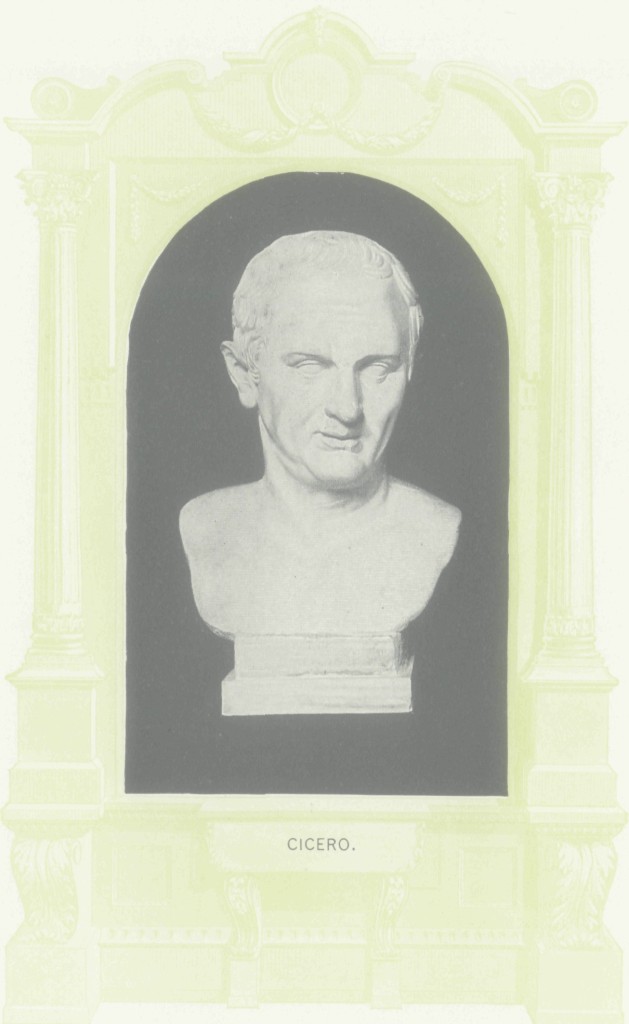
CICERO.
Pompey, born in the same year, was at this time leading the revolt against Sulla's measures. The attachment now formed, the warmer hearted Cicero never wholly threw off. The young general's later foreign victories are nowhere so generously set forth as in Cicero's too-rhetorical plea "for the Manilian Law," in 66 B.C. Pompey was then wintering in the East, after sweeping piracy in a single summer from the Mediterranean. This plea gave him the larger command against Mithridates. Despite the most extravagant laudation, however, Pompey remains, here as elsewhere, one of those large but vague and misty figures that stalk across the stage of history without ever once turning upon us a fully human face. Far more distinct than he, there looms above him the splendid triumphal pageant of Roman imperialism itself.
Cicero's unrivaled eloquence won him not only a golden shower of gifts and legacies, but also the prætorship and consulship at the earliest legal age. Perhaps some of the old nobles foresaw and prudently avoided the Catilinarian storm of 63 B.C. The common dangers of that year, and the pride of assured position, may have hastened the full transfer of Cicero's allegiance to the old senatorial faction. Tiberius Gracchus, boldly praised in January, has become for Cicero a notorious demagogue; his slayers instead are the undoubted patriots, in the famous harangues of November. These latter, by the way, were certainly under the file three years afterward,—and it is not likely that we read any Ciceronian speech just as it was delivered. If there be any thread of consistency in Cicero's public career, it must be sought in his long but vain hope to unite the nobility and the equites, in order to resist the growing proletariat.
The eager vanity with which Cicero seized the proud title "Father of the fatherland" is truly pathetic. The summary execution of the traitors may have been prompted by that physical timidity so often associated with the scholarly temperament. Whether needless or not, the act returned to plague him.
The happiest effort of the orator in his consular year was the famous plea for Murena. This consul-elect for 62 was a successful soldier. Catiline must be met in the spring "in the jaws of Etruria." Cicero's dearest friend, Servius Sulpicius Rufus, a defeated candidate, accused Murena of bribery. The conditions of Roman politics, the character of Sulpicius, the tone of Cicero himself, bid us adjudge Murena probably guilty. Cicero had supported Sulpicius, but now feels it is no time to "go behind the returns," or to replace a bold soldier by a scholarly lawyer.
To win his case Cicero must heap ridicule upon his own profession in his friend's person, and upon Stoic philosophy, represented by Cato, Sulpicius's chief advocate. This he did so successfully that Cato himself exclaimed with a grim smile, "What a jester our consul is!" Cicero won his case—and kept his friends. This speech is cited sixteen times by Quintilian, and is a model of forensic ingenuity, wit, and grace. Its patriotism may be plausibly defended, but hardly its moral standards.
The next year produced the famous and successful defense of Cluentius,—probably guilty of poisoning,—and also the most delightful of all Cicero's speeches, the oration for the poet Archias. Whether the old Greek's claim to Roman citizenship was beyond cavil we neither know nor greatly care. The legal argument is suspiciously brief. The praise of literature and the scholarly life, however, has re-echoed ever since, and still reaches all hearts. Brother Quintus, sitting in judgment as prætor, is pleasantly greeted.
This is the culmination in Cicero's career of success. Some boastful words uttered in these days make us doubt if he remembered Solon's and Sophocles's maxim, "Count no life happy before its close." The fast-growing power of Cæsar presently made the two successful generals Pompey and Crassus his political tools. Cicero refused to enter, on similar conditions, the cabal later known as the "First Triumvirate." Cæsar, about to depart for his long absence in Gaul, might well regard the patriotic and impulsive orator as the most serious source of possible opposition in his absence. Marcus refused, himself, to go along to Gaul a-soldiering, though Brother Quintus accepted a commission and served creditably. At last, reluctantly, Cæsar suffered Cicero's personal enemy Clodius to bring forward a decree outlawing "those who had put Roman citizens to death without trial" (March, 58 B.C.). Cicero meekly withdrew from Rome, was condemned by name in absence, and his town house and villas pillaged.
As to the cowardice of this hasty retreat, none need use severer words than did the exile himself. It is the decisive event in his career. His uninterrupted success was ended. His pride could never recover fully from the hurt. Worst of all, he could never again pose, even before his own eyes, as the fearless hero-patriot. In short, Cæsar, the consummate master of action and of men, had humanely but decisively crippled the erratic yet patriotic rhetorician.
In little more than a year the bad conduct of Clodius, the personal good-will of the "triumvirs," and the whirligig of politics, brought round Cicero's return from Greece. His wings were however effectively clipped. After a brief and slight flutter of independence, he made full, even abject, submission to the dominant Cæsarian faction. This was in 56 B.C. The next five years, inglorious politically, were however full of activity in legal oratory and other literary work. In his eloquent defense of Cælius Rufus, charged with an attempt to poison Clodia, Cicero perforce whitewashes, or at least paints in far milder colors than of old, Catiline, Cælius's lifelong friend! A still less pleasing feature is the abusive attack on the famous and beautiful Clodia, probably the "Lesbia" of Catullus. (The unhappy young poet seems to have preceded Cælius in the fickle matron's favor.)
The events of the year 52 well illustrate the unfitness of Cicero for politics in such an age. Rome was full of street brawls, which Pompey could not check. The orator's old enemy Clodius, at the head of his bravos, was slain by a fellow ruffian Milo in January. At Milo's trial in April Cicero defended him, or attempted to do so. A court-room encircled by a yelling mob and guarded by Pompey's legions caused him to break down altogether. As afterward written out at leisure, the speech is a masterpiece of special pleading. The exiled Milo's criticism on it is well known: "I'm glad you never delivered it: I should not now be enjoying the mullets of Marseilles."
The year 51-50 Cicero spent, most unwillingly, as proconsular governor in far-off Cilicia. Though really humane and relatively honest, he accumulated in these few months a handsome sum in "gifts" from provincials and other perquisites. Even Cicero was a Roman.
Meantime the civil war had all but broken out at home. Cicero hesitated long, and the correspondence with Atticus contains exhaustive analyses of his motives and temptations. His naïve selfishness and vanity at times in these letters seem even like self-caricature. Yet through it all glimmers a vein of real though bewildered patriotism. Still the craving for a triumph—he had fought some savage mountain clans in Asia Minor!—was hardly less dominant.
Repairing late and with many misgivings to Pompey's camp in Epirus, Cicero seems to have been there a "not unfeared, half-welcome" and critical guest. Illness is his excuse for absence from the decisive battle. He himself tells us little of these days. As Plutarch relates the tale, after Pompey's flight to Egypt Cicero refused the supreme command, and was thereupon threatened with death by young Gneius Pompey; but his life was saved by Cato.
One thing at least is undisputed. The last man to decide for Pompey's cause, he was the first to hurry back to Italy and crave Cæsar's grace! For many months he waited in ignoble retirement, fearing the success of his deserted comrades even more than Cæsar's victory. It is this action that gives the coup de grace to Cicero's character as a hero. With whatever misgivings, he had chosen his side. Whatever disturbing threats of violent revenge after victory he heard in Pompey's camp, he awaited the decisive battle. Then there remained, for any brave man, only constancy in defeat—or a fall upon his sword.
Throughout Cæsar's brief reign,—or long dictatorship,—from 48 to 44, Cicero is the most stately and the most obsequious of courtiers. For him who would plead for clemency, or return thanks for mercy accorded, at a despot's footstool, there are no more graceful models than the 'Pro Ligario' and the 'Pro Marcello.' Cæsar himself realized, and wittily remarked, how irksome and hateful such a part must be to the older, vainer, more self-conscious man of the twain.
Midway in this period Cicero divorced his wife after thirty years of wedlock, seemingly from some dissatisfaction over her financial management, and soon after married a wealthy young ward. This is the least pleasing chapter of his private life, but perhaps the mortification and suffering it entailed were a sufficient penalty. His only daughter Tullia's death in 45 B.C. nearly broke the father's heart.
Whatever the reason, Cicero was certainly not in the secret of Cæsar's assassination. Twice in letters to members of the conspiracy in later months he begins: "How I wish you had invited me to your glorious banquet on the Ides of March." "There would have been no remnants," he once adds. That is, Antony would not have been left alive.
We have now reached the last two years—perhaps the most creditable time—in Cicero's eventful life. This period runs from March 15th, 44 B.C., to December 7th, 43 B.C. It was one long struggle, first covert, then open, between Antony and the slayers of Cæsar. Cicero's energy and eloquence soon made him the foremost voice in the Senate once more. For the first time since his exile, he is now speaking out courageously his own real sentiments. His public action is in harmony with his own convictions. The cause was not hopeless by any means, so far as the destruction of Antony would have been a final triumph. Indeed, that wild career seemed near its end, when Octavian's duplicity again threw the game into his rival's reckless hands. However, few students of history imagine that any effective restoration of senatorial government was possible. The peculiar pathos of Cicero's end, patriot as he was, is this: it removed one of the last great obstacles to the only stable and peaceful rule Rome could receive—the imperial throne of Augustus.
This last period is however among the most creditable, perhaps the most heroic, in Cicero's career. Its chief memorials are the fourteen extant orations against Antony. The comparative sincerity of these 'Philippics,' and the lack of private letters for much of this time, make them important historical documents. The only one which ranks among his greatest productions—perhaps the classic masterpiece of invective—is the 'Second Philippic.' This was never delivered at all, but published as a pamphlet. This unquestioned fact throws a curious light on passages like—"He is agitated, he perspires, he turns pale!" describing Antony at the (imaginary) delivery of the oration. The details of the behavior of Catiline and others may be hardly more authentic. The 'Ninth Philippic' is a heartfelt funeral eulogy on that same Sulpicius whom he had ridiculed in the 'Pro Murena.'
"The milestones into headstones turn, And under each a friend."
A fragment from one of Livy's lost books says, "Cicero bore with becoming spirit none of the ills of life save death itself." He indeed perished not only bravely but generously, dissuading his devoted slaves from useless resistance, and extending his neck to Antony's assassins. Verres lived to exult at the news, and then shared his enemy's fate, rather than give up his Greek vases to Antony! Nearly every Roman, save Nero, dies well.
Upon Cicero's political career our judgment is already indicated. He was always a patriot at heart, though often a bewildered one. His vanity, and yet more his physical cowardice, caused some grievous blots upon the record. His last days, and death, may atone for all—save one. The precipitate desertion of the Pompeians is not to be condoned.
The best English life of Cicero is by Forsyth; but quaint, dogged, prejudiced old Middleton should not be forgotten. Plutarch's Cicero "needs no bush."
Cicero's oratory was splendidly effective upon his emotional Italian hearers. It would not be so patiently accepted by any Teutonic folk. His very copiousness, however, makes him as a rule wonderfully clear and easy reading. Quintilian well says: "From Demosthenes's periods not a word can be spared, to Cicero's not one could be added."
Despite the rout of Verres and of Catiline, the merciless dissection of Clodia, and the statelier thunders of the 'Philippics,' Cicero was most successful and happiest when "defending the interests of his friends." Perhaps the greatest success against justice was the 'Pro Cluentio,' which throws so lurid a light on ante-Borgian Italian criminology. This speech is especially recommended by Niebuhr to young philologues as a nut worthy of the strongest teeth. There is a helpful edition by Ramsay, but Hertland's 'Murena' will be a pleasanter variation for students wearying of the beaten track followed by the school editions. Both the failure of the 'Pro Milone' and the world-wide success of the 'Pro Archia' bid us repeat the vain wish, that this humane and essentially modern nature might have fallen on a gentler age. Regarding his whole political life as an uncongenial rôle forced on him by fate, we return devout thanks for fifty-eight orations, nearly all in revised and finished literary form! Fragments of seventeen, and titles of still thirty more, yet remain. From all his rivals, predecessors, pupils, not one authentic speech survives.
The best complete edition of the orations with English notes is by George Long, in the Bibliotheca Classica. The 'Philippics' alone are better edited by J.R. King in the Clarendon Press series. School editions of select speeches are superabundant. They regularly include the four Catilinarians, the Manilian, and the pleas before the dictator, sometimes a selection from the 'Philippics' or Verrine orations.
There is no masterly translation comparable with the fine work done by Kennedy for Demosthenes. The Bohn version is respectable in quality.
Among Cicero's numerous works on rhetoric the chief is the 'De Oratore.' Actually composed in 55 B.C., it is a dialogue, the scene set in 91 B.C., the characters being the chief Roman orators of that day. L. Crassus, who plays the host gracefully at his Tusculan country-seat, is also the chief speaker. These men were all known to Cicero in his boyhood, but most of them perished soon after in the Marian proscriptions. Of real character-drawing there is little, and all alike speak in graceful Ciceronian periods. The exposition of the technical parts of rhetoric goes on in leisurely wise, with copious illustrations and digressions. There is much pleasant repetition of commonplaces. Wilkins's edition of the 'De Oratore' is a good but not an ideal one. The introductions are most helpful. Countless discussions on etymology, etc., in the notes, should be relegated to the dictionaries. Instead, we crave adequate cross-references to passages in this and other works. The notes seem to be written too largely piecemeal, each with the single passage in mind.
In Cicero's 'Brutus,' written in 46 B.C., Cicero, Brutus, and Atticus carry on the conversation, but it is mostly a monologue of Cicero and a historical sketch of Roman oratory. The affected modesty of the autobiographic parts is diverting. Brutus was the chief exponent of a terse, simple, direct, oratory,—far nearer, we judge, to English taste than the Ciceronian; and the opposition between them already appears. A convenient American edition is that by Kellogg (Ginn).
The opposition just mentioned comes out more clearly in the 'Orator.' This portrays the ideal public speaker. His chief accomplishments are summed up in versatility,—the power to adapt himself to any case and audience. An interesting passage discusses the rhythms of prose. This book has been elaborately edited by J.E. Sandys. In these three dialogues Cicero says everything of importance, at least once; and the other rhetorical works in the Corpus may be neglected here, the more as the most practical working rhetoric among them all, the 'Auctor ad Herennium,' is certainly not Cicero's. It is probably by Cornificius, and is especially important as the first complete prose work transmitted to us in authentic Latin form. (Cato's 'De Re Rustica' has been "modernized.")
The later history of the Ciceronian correspondence is a dark and much contested field. (The most recent discussion, with bibliography, is by Schanz, in Iwan Müller's Handbuch, Vol. viii., pp. 238-243.) Probably Cicero's devoted freedman Tiro laid the foundations of our collections. The part of Petrarch in recovering the letters during the "Revival of Learning" was much less than has been supposed.
The letters themselves are in wild confusion. There are four collections, entitled 'To Atticus,' 'To Friends,' 'To Brother Marcus,' 'To Brutus': altogether over eight hundred epistles, of which a relatively small number are written to Cicero by his correspondents. The order is not chronological, and the dates can in many cases only be conjectured. Yet these letters afford us our chief sources for the history of this great epoch,—and the best insight we can ever hope to have into the private life of Roman gentlemen.
The style of the cynical, witty Cælius, or of the learned lawyer Sulpicius, differs perceptibly in detail from Cicero's own; yet it is remarkable that all seem able to write clearly if not gracefully. Cicero's own style varies very widely. The letters to Atticus are usually colloquial, full of unexplained allusions, sometimes made intentionally obscure and pieced out with a Greek phrase, for fear of the carrier's treachery! Other letters again, notably a long 'Apologia' addressed to Lentulus after Cicero's return from exile, are as plainly addressed in reality to the public or to posterity as are any of the orations.
Prof. R. Y. Tyrrell has long been engaged upon an annotated edition of all the letters in chronological order. This will be of the utmost value. An excellent selection, illustrating the orator's public life chiefly, has been published by Professor Albert Watson. This volume contains also very full tables of dates, bibliography of all Cicero's works, and in general is indispensable for the advanced Latin student. The same letters annotated by Professor Watson have been delightfully translated by G. E. Jeans. To this volume, rather than to Forsyth's biography, the English reader should turn to form his impressions of Cicero at first hand. It is a model of scholarly—and also literary—translation.
The "New Academy," to which Cicero inclined in philosophy, was skeptical in its tendencies, and regarded absolute truth as unattainable. This made it easier for Cicero to cast his transcriptions in the form of dialogues, revealing the beliefs of the various schools through the lips of the several interlocutors. Thus the 'De Finibus Bonorum et Malorum' sets forth in three successive conversations the ideas of Epicureans, of Stoics, and of the Academy, on the Highest Good. It is perhaps the chief of these treatises,—though we would still prefer to have even those later compendiums of the Greek schools through which Cicero probably cited the chief philosophers at second hand! J. S. Reid, an eminent English scholar, has spent many years upon this dialogue, and his work includes a masterly translation.
With a somewhat similar plan, the three books of the 'De Natura Deorum' contain the views of the three schools on the Divine Beings. The speakers are Cicero's Roman contemporaries. This rather sketchy work has been annotated by J. B. Mayor in his usual exhaustive manner. The now fragmentary dialogue entitled 'The Republic,' and its unfinished supplement 'The Laws,' were composed and named in avowed rivalry with Plato's two largest works, but fail to approach the master. The Roman Constitution is defended as the ideal mingling of monarchy, aristocracy, and democracy. The student of pure literature can for the most part neglect these, and others among the hastily written philosophic works, with the explicit approval of so indefatigable a student as Professor B. L. Gildersleeve.
The chief fragment preserved of the 'Republic' is the 'Dream of Scipio.' Its dependence on the vision at the close of Plato's 'Republic' should be carefully observed. It may be fairly described as a free translation and enlargement from Greek originals, of which Plato's passage is the chief. Plagiarism was surely viewed quite otherwise then than now. Still, the Roman additions and modifications are interesting also,—and even as a translator Cicero is no ordinary cicerone! Moreover, in this as in so many other examples, the Latin paraphrase had a wider and more direct influence than the original. It has been accepted with justice ever since, as the final and most hopeful pagan word in favor of the soul's immortality. The lover of Chaucer will recall the genial paraphrase of 'Scipio's Dream' in the 'Parlament of Foules' (stanzas 5-12). We give below, entire, in our quotations from Cicero, the masterly version of the 'Dream,' prepared by Prof. T. R. Lounsbury for his edition of Chaucer's poems. The speaker is the younger Scipio Africanus, and his visit to Africa as a subaltern here described was in 149 B.C., three years previous to his own decisive campaign against Carthage which ended in the destruction of the city.
Cicero shared in full the Roman tendency to give a practical, an ethical turn to all metaphysical discussion. This is prominent in the popular favorite among his larger volumes, the 'Tusculan Disputations.' In each of the five related books a thesis is stated negatively, to be triumphantly reversed later on:—
(1) "Death seems to me an evil."
(2) "I think pain the greatest of all evils."
(3) "Misery seems to me to befall the wise man."
(4) "It does not appear to me that the wise man can be secure from distress of mind."
(5) "Character does not seem to me sufficient for happiness in life."
The original portion of this work is relatively large, and many Roman illustrations occur. Dr. Peabody has included the Tusculans, the two brief essays next mentioned, and the 'De Officiis,' in his excellent series of versions (Little, Brown and Company).
The little dialogue on 'Old Age' is perhaps most read of all Cicero's works. Its best thoughts, it must be confessed, are freely borrowed from the opening pages of Plato's 'Republic.' Still, on this theme of universal human interest, the Roman also offers much pleasant food for thought. The moderation of the Greek is forgotten by Cicero, the professional advocate and special pleader, who almost cries out to us at last:—
"Grow old along with me: The best is yet to be. The last of life, for which the first was made!"
It was written in 45-4 B.C. The other little essay 'On Friendship' does not deserve to be bound up in such good company, though it usually is so edited. Bacon's very brief essay has more meat in it. Cicero had many good friends, but fully trusted hardly any one of them—not even Atticus. It was an age which put friendship to fearful trial, and the typical Roman seems to us rather selfish and cold. Certainly this essay is in a frigid tone. Professor Gildersleeve, I believe, has likened it to a treatise of Xenophon on hunting, so systematically is the pursuit of friends discussed.
Perhaps the most practical among Roman Manuals of Morals is the treatise on Duties ('De Officiis'), in three books. Here the personal experience of sixty years is drawn upon, avowedly for the edification of young Marcus, the author's unworthy son. This sole Ciceronian survivor of Antony's massacres lived to be famous for his capacity in wine-drinking, and to receive officially, as consul under Augustus, the news of Antony's final defeat and death—a dramatic revenge.
Most of these philosophic treatises were composed near the end of Cicero's life, largely in one marvelously productive year, 45-4 B.C., just previous to the slaying of Cæsar. Not all even of the extant works have been catalogued here. The 'Academica' and 'De Divinatione' should at least be mentioned.
Such were Cicero's distractions, when cut off from political life and oratory, and above all when bereft by Tullia's death. The especial 'Consolatio,' composed to regain his courage after this blow, must head the list of lost works. It took a most pessimistic view of human life, for which it was reproved by Lactantius. Another perished essay, the 'Hortensius,' introducing the whole philosophic series, upheld Milton's thesis, "How charming is divine philosophy," and first turned the thoughts of Augustine to serious study.
Cicero's poems, chiefly translations, are extant in copious fragments. They show metrical facility, a little taste, no creative imagination at all. A final proof of his unresting activity is his attempt to write history. Few, even among professional advocates, could have less of the temper for mere narration and truth. Indeed, reasonable disregard for the latter trammel is frankly urged upon a friend who was to write upon the illustrious moments of Cicero's own career!
We said at first that the caprice of fate had exaggerated some sides of Cicero's activity, by removing all competitors. In any case, however, his supremacy among Italian orators, and in the ornate discursive school of eloquence generally, could not have been questioned.
Yet more: As a stylist, he lifted a language hitherto poor in vocabulary, and stiff in phrase, to a level it never afterward surpassed. Many words he successfully coined, chiefly either by translation or free imitation of Greek originals. His clear, copious, rhythmical phrase was even more fully his own creation. Indeed, at the present moment, four or five great forms of living speech testify to Cicero's amazing mastery over both word and phrase. The eloquence of Castelar, Crispi, and Gambetta, of Gladstone and of Everett, is shot through and through, in all its warp and woof, with golden Ciceronian threads. The 'Archias' speaks to any appreciative student of Western Europe, as it were, in a mother tongue which dominates his vernacular speech. Human language, then, has become a statelier memorial of Cicero than even his vanity can ever have imagined.
(After writing the substance of this paragraph, I was glad to find myself in close agreement with Mackail's words in his masterly little 'Latin Literature,' page 62.)
Resumé of General Bibliography
The chief encyclopædia of facts and citations for this period is the cumbrous old 'Geschichte Roms, oder Pompeius Cæsar Cicero und ihre Zeitgenossen' of W. Drumann (Königsberg: 1834-44). The plan is ideally bad, being a series of family chronicles, while these three men are more completely isolated from their families and kin than any other great trio in all Roman history! The book is however an exhaustive, inexhaustible, little acknowledged, but still worked quarry of erudition. The best single book in English is Watson's edition of the (selected) letters (or Jeans's translation), until it shall be superseded by the complete annotated edition of the correspondence, by Tyrrell.
Mommsen's severe judgment on Cicero is well known. The other standard historians are less severe. Forsyth's life is not the final word on the subject by any means, but gives a good general view. The stately Ciceronian Lexicon by Merguet, already complete for the orations, will eventually provide a complete concordance and copious elucidation for all the works. The most accessible complete edition of Cicero's writings in Latin is by Baiter and Kayser, in eleven volumes. The Index Nominum alone fills four hundred closely printed pages of Vol. xi. The great critical edition is that of Orelli (Zurich: 1826-38).
On Cicero as an author, and indeed in the whole field of Latin literature, the 'Geschichte der Römischen Literatur' of Martin Schanz (in I. Müller's 'Handbuch') is most helpful, and even readable.

OF THE OFFICES OF LITERATURE AND POETRY
From the 'Oration for the Poet Archias'
You ask us, O Gratius, why we are so exceedingly attached to this man. Because he supplies us with food whereby our mind is refreshed after this noise in the Forum, and with rest for our ears after they have been wearied with bad language. Do you think it possible that we could find a supply for our daily speeches, when discussing such a variety of matters, unless we were to cultivate our minds by the study of literature? or that our minds could bear being kept so constantly on the stretch if we did not relax them by that same study? But I confess that I am devoted to those studies; let others be ashamed of them if they have buried themselves in books without being able to produce anything out of them for the common advantage, or anything which may bear the eyes of men and the light. But why need I be ashamed, who for many years have lived in such a manner as never to allow my own love of tranquillity to deny me to the necessity or advantage of another, or my fondness for pleasure to distract, or even sleep to delay, my attention to such claims? Who then can reproach me, or who has any right to be angry with me, if I allow myself as much time for the cultivation of these studies as some take for the performance of their own business; or for celebrating days of festival and games; or for other pleasures; or even for the rest and refreshment of mind and body; or as others devote to early banquets, to playing at dice, or at ball? And this ought to be permitted to me, because by these studies my power of speaking and those faculties are improved, which as far as they do exist in me have never been denied to my friends when they have been in peril. And if that ability appears to any one to be but moderate, at all events I know whence I derive those principles which are of the greatest value. For if I had not persuaded myself from my youth upwards, both by the precepts of many masters and by much reading, that there is nothing in life greatly to be desired except praise and honor, and that while pursuing those things all tortures of the body, all dangers of death and banishment are to be considered but of small importance, I should never have exposed myself in defense of your safety to such numerous and arduous contests, and to these daily attacks of profligate men. But all books are full of such precepts, and all the sayings of philosophers, and all antiquity, are full of precedents teaching the same lesson; but all these things would lie buried in darkness if the light of literature and learning were not applied to them. How many images of the bravest men, carefully elaborated, have both the Greek and Latin writers bequeathed to us, not merely for us to look at and gaze upon, but also for our imitation! And I, always keeping them before my eyes as examples for my own public conduct, have endeavored to model my mind and views by continually thinking of those excellent men.
Some one will ask "What! were those identical great men, whose virtues have been recorded in books, accomplished in all that learning which you are extolling so highly?" It is difficult to assert this of all of them; but still I know what answer I can make to that question: I admit that many men have existed of admirable disposition and virtue, who without learning, by the almost divine instinct of their own mere nature, have been, of their own accord as it were, moderate and wise men. I even add this, that very often nature without learning has had more to do with leading men to credit and to virtue, than learning when not assisted by a good natural disposition. And I also contend that when to an excellent and admirable natural disposition there is added a certain system and training of education, then from that combination arises an extraordinary perfection of character: such as is seen in that godlike man whom our fathers saw in their time—Africanus; and in Caius Lælius and Lucius Furius, most virtuous and moderate men; and in that most excellent man, the most learned man of his time, Marcus Cato the elder: and all these men, if they had been to derive no assistance from literature in the cultivation and practice of virtue, would never have applied themselves to the study of it. Though even if there were no such great advantage to be reaped from it, and if it were only pleasure that is sought from these studies, still I imagine you would consider it a most reasonable and liberal employment of the mind: for other occupations are not suited to every time, nor to every age or place; but these studies are the food of youth, the delight of old age; the ornament of prosperity, the refuge and comfort of adversity; a delight at home, and no hindrance abroad; they are companions by night, and in travel, and in the country.
And if we ourselves were not able to arrive at these advantages, nor even taste them with our senses, still we ought to admire them even when we saw them in others.... And indeed, we have constantly heard from men of the greatest eminence and learning that the study of other sciences was made up of learning, and rules, and regular method; but that a poet was such by the unassisted work of nature, and was moved by the vigor of his own mind, and was inspired as it were by some divine wrath. Wherefore rightly does our own great Ennius call poets holy; because they seem to be recommended to us by some especial gift, as it were, and liberality of the gods. Let then, judges, this name of poet, this name which no barbarians even have ever disregarded, be holy in your eyes, men of cultivated minds as you all are. Rocks and deserts reply to the poet's voice; savage beasts are often moved and arrested by song; and shall we who have been trained in the pursuit of the most virtuous acts refuse to be swayed by the voice of poets? The Colophonians say that Homer was their citizen; the Chians claim him as theirs; the Salaminians assert their right to him; but the men of Smyrna loudly assert him to be a citizen of Smyrna, and they have even raised a temple to him in their city. Many other places also fight with one another for the honor of being his birthplace.
They then claim a stranger, even after his death, because he was a poet: shall we reject this man while he is alive, a man who by his own inclination and by our laws does actually belong to us? especially when Archias has employed all his genius with the utmost zeal in celebrating the glory and renown of the Roman people? For when a young man, he touched on our wars against the Cimbri and gained the favor even of Caius Marius himself, a man who was tolerably proof against this sort of study. For there was no one so disinclined to the Muses as not willingly to endure that the praise of his labors should be made immortal by means of verse. They say that the great Themistocles, the greatest man that Athens produced, said when some one asked him what sound or whose voice he took the greatest delight in hearing, "The voice of that by whom his own exploits were best celebrated." Therefore, the great Marius was also exceedingly attached to Lucius Plotius, because he thought that the achievement which he had performed could be celebrated by his genius. And the whole Mithridatic war, great and difficult as it was, and carried on with so much diversity of fortune by land and sea, has been related at length by him; and the books in which that is sung of, not only make illustrious Lucius Lucullus, that most gallant and celebrated man, but they do honor also to the Roman people. For while Lucullus was general, the Roman people opened Pontus, though it was defended both by the resources of the king and by the character of the country itself. Under the same general the army of the Roman people, with no very great numbers, routed the countless hosts of the Armenians. It is the glory of the Roman people that by the wisdom of that same general, the city of the Cyzicenes, most friendly to us, was delivered and preserved from all the attacks of the kind, and from the very jaws as it were of the whole war. Ours is the glory which will be for ever celebrated, which is derived from the fleet of the enemy which was sunk after its admirals had been slain, and from the marvelous naval battle off Tenedos: those trophies belong to us, those monuments are ours, those triumphs are ours. Therefore I say that the men by whose genius these exploits are celebrated make illustrious at the same time the glory of the Roman people. Our countryman Ennius was dear to the elder Africanus; and even on the tomb of the Scipios his effigy is believed to be visible, carved in the marble. But undoubtedly it is not only the men who are themselves praised who are done honor to by those praises, but the name of the Roman people also is adorned by them. Cato, the ancestor of this Cato, is extolled to the skies. Great honor is paid to the exploits of the Roman people. Lastly, all those great men, the Maximi, the Marcelli, and the Fulvii, are done honor to, not without all of us having also a share in the panegyric....
Certainly, if the mind had no anticipations of posterity, and if it were to confine all its thoughts within the same limits as those by which the space of our lives is bounded, it would neither break itself with such severe labors, nor would it be tormented with such cares and sleepless anxiety, nor would it so often have to fight for its very life. At present there is a certain virtue in every good man, which night and day stirs up the mind with the stimulus of glory, and reminds it that all mention of our name will not cease at the same time with our lives, but that our fame will endure to all posterity.
Do we all who are occupied in the affairs of the State, and who are surrounded by such perils and dangers in life, appear to be so narrow-minded as, though to the last moment of our lives we have never passed one tranquil or easy moment, to think that everything will perish at the same time as ourselves? Ought we not, when many most illustrious men have with great care collected and left behind them statues and images, representations not of their minds but of their bodies, much more to desire to leave behind us a copy of our counsels and of our virtues, wrought and elaborated by the greatest genius? I thought, at the very moment of performing them, that I was scattering and disseminating all the deeds which I was performing, all over the world for the eternal recollection of nations. And whether that delight is to be denied to my soul after death, or whether, as the wisest men have thought, it will affect some portion of my spirit, at all events I am at present delighted with some such idea and hope.
HONORS PROPOSED FOR THE DEAD STATESMAN SULPICIUS
From the 'Ninth Philippic'
Our ancestors indeed decreed statues to many men; public sepulchres to few. But statues perish by weather, by violence, by lapse of time; the sanctity of the sepulchres is in the soil itself, which can neither be moved nor destroyed by any violence; and while other things are extinguished, so sepulchres become holier by age.
Let then this man be distinguished by that honor also, a man to whom no honor can be given which is not deserved. Let us be grateful in paying respect in death to him to whom we can now show no other gratitude. And by that same step let the audacity of Marcus Antonius, waging a nefarious war, be branded with infamy. For when these honors have been paid to Servius Sulpicius, the evidence of his embassy having been insulted and rejected by Antonius will remain for everlasting.
On which account I give my vote for a decree in this form: "As Servius Sulpicius Rufus, the son of Quintus, of the Lemonian tribe, at a most critical period of the republic, and being ill with a very serious and dangerous disease, preferred the authority of the Senate and the safety of the republic to his own life; and struggled against the violence and severity of his illness, in order to arrive at the camp of Antonius, to which the Senate had sent him; and as he, when he had almost arrived at the camp, being overwhelmed by the violence of the disease, has lost his life in discharging a most important office of the republic; and as his death has been in strict correspondence to a life passed with the greatest integrity and honor, during which he, Servius Sulpicius, has often been of great service to the republic, both as a private individual and in the discharge of various magistracies: and as he, being such a man, has encountered death on behalf of the republic while employed on an embassy; the Senate decrees that a brazen pedestrian statue of Servius Sulpicius be erected in the rostra in compliance with the resolution of this order, and that his children and posterity shall have a place round this statue of five feet in every direction, from which to behold the games and gladiatorial combats, because he died in the cause of the republic; and that this reason be inscribed on the pedestal of the statue; and that Caius Pansa and Aulus Hirtius the consuls, one or both of them, if it seem good to them, shall command the quæstors of the city to let out a contract for making that pedestal and that statue, and erecting them in the rostra; and that whatever price they contract for, they shall take care the amount is given and paid to the contractor; and as in old times the Senate has exerted its authority with respect to the obsequies of, and honors paid to, brave men, it now decrees that he shall be carried to the tomb on the day of his funeral with the greatest possible solemnity. And as Servius Sulpicius Rufus, the son of Quintus of the Lemonian tribe, has deserved so well of the republic as to be entitled to be complimented with all those distinctions; the Senate is of opinion, and thinks it for the advantage of the republic, that the curule ædile should suspend the edict which usually prevails with respect to funerals, in the case of the funeral of Servius Sulpicius Rufus, the son of Quintus of the Lemonian tribe; and that Caius Pansa the consul shall assign him a place for a tomb in the Esquiline plain, or in whatever place shall seem good to him, extending thirty feet in every direction, where Servius Sulpicius may be buried; and that that shall be his tomb, and that of his children and posterity, as having been a tomb most deservedly given to them by the public authority."
OLD FRIENDS BETTER THAN NEW
From the 'Dialogue on Friendship'
But there arises on this subject a somewhat difficult question: Whether ever new friends, if deserving friendship, are to be preferred to old ones, just as we are wont to prefer young colts to old horses?—a perplexity unworthy of a man; for there ought to be no satiety of friendship as of other things: everything which is oldest (as those wines which bear age well) ought to be sweetest; and that is true which is sometimes said, "Many bushels of salt must be eaten together," before the duty of friendship can be fulfilled. But new friendships, if they afford a hope that, as in the case of plants which never disappoint, fruits shall appear, such are not to be rejected; yet the old one must be preserved in its proper place, for the power of age and custom is exceedingly great; besides, in the very case of the horse, which I just mentioned, if there is no impediment, there is no one who does not more pleasurably use that to which he is accustomed than one unbroken and strange to him; and habit asserts its power, and habit prevails, not only in the case of this, which is animate, but also in the cases of those things which are inanimate; since we take delight in the very mountainous or woody scenery among which we have long dwelt.
HONORED OLD AGE
From the 'Dialogue on Old Age'
But in my whole discourse remember that I am praising that old age which is established on the foundations of youth: from which this is effected which I once asserted with the great approbation of all present,—that wretched was the old age which had to defend itself by speaking. Neither gray hairs nor wrinkles can suddenly catch respect; but the former part of life honorably spent, reaps the fruits of authority at the close. For these very observances which seem light and common are marks of honor—to be saluted, to be sought after, to receive precedence, to have persons rising up to you, to be attended on the way, to be escorted home, to be consulted; points which, both among us and in other States, in proportion as they are the most excellent in their morals, are the most scrupulously observed. They say that Lysander the Lacedæmonian, whom I mentioned a little above, was accustomed to remark that Lacedæmon was the most honorable abode for old age; for nowhere is so much conceded to that time of life, nowhere is old age more respected. Nay, further: it is recorded that when at Athens during the games a certain elderly person had entered the theatre, a place was nowhere offered him in that large assembly by his own townsmen; but when he had approached the Lacedæmonians, who, as they were ambassadors, had taken their seats together in a particular place, they all rose up and invited the old man to a seat; and when reiterated applause had been bestowed upon them by the whole assembly, one of them remarked that the Athenians knew what was right, but were unwilling to do it. There are many excellent rules in our college, but this of which I am treating especially, that in proportion as each man has the advantage in age, so he takes precedence in giving his opinion; and older augurs are preferred not only to those who are higher in office, but even to such as are in actual command. What pleasures, then, of the body can be compared with the privileges of authority? which they who have nobly employed seem to me to have consummated the drama of life, and not like inexpert performers to have broken down in the last act. Still, old men are peevish, and fretful, and passionate, and unmanageable,—nay, if we seek for such, also covetous: but these are the faults of their characters, not of their old age. And yet that peevishness and those faults which I have mentioned have some excuse, not quite satisfactory indeed, but such as may be admitted. They fancy that they are neglected, despised, made a jest of; besides, in a weak state of body every offense is irritating. All which defects however are extenuated by good dispositions and qualities; and this may be discovered not only in real life, but on the stage, from the two brothers that are represented in 'The Brothers'; how much austerity in the one, and how much gentleness in the other! Such is the fact: for as it is not every wine, so it is not every man's life, that grows sour from old age. I approve of gravity in old age, but this in a moderate degree, like everything else; harshness by no means. What avarice in an old man can propose to itself I cannot conceive: for can anything be more absurd than, in proportion as less of our journey remains, to seek a greater supply of provisions?
DEATH IS WELCOME TO THE OLD
From the 'Dialogue on Old Age'
An old man indeed has nothing to hope for; yet he is in so much the happier state than a young one, since he has already attained what the other is only hoping for. The one is wishing to live long, the other has lived long. And yet, good gods! what is there in man's life that can be called long? For allow the latest period: let us anticipate the age of the kings of the Tartessii. For there dwelt, as I find it recorded, a man named Arganthonius at Gades, who reigned for eighty years, and lived one hundred and twenty. But to my mind nothing whatever seems of long duration, in which there is any end. For when that arrives, then the time which has passed has flowed away; that only remains which you have secured by virtue and right conduct. Hours indeed depart from us, and days and months and years; nor does past time ever return, nor can it be discovered what is to follow. Whatever time is assigned to each to live, with that he ought to be content: for neither need the drama be performed entire by the actor, in order to give satisfaction, provided he be approved in whatever act he may be; nor need the wise man live till the plaudite. For the short period of life is long enough for living well and honorably; and if you should advance further, you need no more grieve than farmers do when the loveliness of springtime hath passed, that summer and autumn have come. For spring represents the time of youth and gives promise of the future fruits; the remaining seasons are intended for plucking and gathering in those fruits. Now the harvest of old age, as I have often said, is the recollection and abundance of blessings previously secured. In truth, everything that happens agreeably to nature is to be reckoned among blessings. What, however, is so agreeable to nature as for an old man to die? which even is the lot of the young, though nature opposes and resists. And thus it is that young men seem to me to die just as when the violence of flame is extinguished by a flood of water; whereas old men die as the exhausted fire goes out, spontaneously, without the exertion of any force: and as fruits when they are green are plucked by force from the trees, but when ripe and mellow drop off, so violence takes away their lives from youths, maturity from old men; a state which to me indeed is so delightful, that the nearer I approach to death, I seem as it were to be getting sight of land, and at length after a long voyage to be just coming into harbor.
GREAT ORATORS AND THEIR TRAINING
From the 'Dialogue on Oratory'
For who can suppose that amid the great multitude of students, the utmost abundance of masters, the most eminent geniuses among men, the infinite variety of causes, the most ample rewards offered to eloquence, there is any other reason to be found for the small number of orators than the incredible magnitude and difficulty of the art? A knowledge of a vast number of things is necessary, without which volubility of words is empty and ridiculous; speech itself is to be formed, not merely by choice, but by careful construction of words; and all the emotions of the mind which nature has given to man, must be intimately known; for all the force and art of speaking must be employed in allaying or exciting the feelings of those who listen. To this must be added a certain portion of grace and wit, learning worthy of a well-bred man, and quickness and brevity in replying as well as attacking, accompanied with a refined decorum and urbanity. Besides, the whole of antiquity and a multitude of examples is to be kept in the memory; nor is the knowledge of laws in general, or of the civil law in particular, to be neglected. And why need I add any remarks on delivery itself, which is to be ordered by action of body, by gesture, by look, and by modulation and variation of the voice, the great power of which, alone and in itself, the comparatively trivial art of actors and the stage proves; on which though all bestow their utmost labor to form their look, voice, and gesture, who knows not how few there are, and have ever been, to whom we can attend with patience? What can I say of that repository for all things, the memory; which, unless it be made the keeper of the matter and words that are the fruits of thought and invention, all the talents of the orator, we see, though they be of the highest degree of excellence, will be of no avail? Let us then cease to wonder what is the cause of the scarcity of good speakers, since eloquence results from all those qualifications, in each of which singly it is a great merit to labor successfully; and let us rather exhort our children, and others whose glory and honor is dear to us, to contemplate in their minds the full magnitude of the object, and not to trust that they can reach the height at which they aim by the aid of the precepts, masters, and exercises that they are all now following, but to understand that they must adopt others of a different character.
In my opinion, indeed, no man can be an orator possessed of every praiseworthy accomplishment unless he has attained the knowledge of everything important, and of all liberal arts; for his language must be ornate and copious from knowledge, since unless there be beneath the surface matter understood and felt by the speaker, oratory becomes an empty and almost puerile flow of words....
"I am then of opinion," said Crassus, "that nature and genius in the first place contribute most aid to speaking; and that to those writers on the art to whom Antonius just now alluded, it was not skill and method in speaking, but natural talent that was wanting; for there ought to be certain lively powers in the mind and understanding, which may be acute to invent, fertile to explain and adorn, and strong and retentive to remember; and if any one imagines that these powers may be acquired by art (which is false, for it is very well if they can be animated and excited by art; but they certainly cannot by art be ingrafted or instilled, since they are all the gifts of nature), what will he say of those qualities which are certainly born with the man himself—volubility of tongue, tone of voice, strength of lungs, and a peculiar conformation and aspect of the whole countenance and body? I do not say that art cannot improve in these particulars (for I am not ignorant that what is good may be made better by education, and what is not very good may be in some degree polished and amended); but there are some persons so hesitating in their speech, so inharmonious in their tone of voice, or so unwieldy and rude in the air and movements of their bodies, that whatever power they possess either from genius or art, they can never be reckoned in the number of accomplished speakers; while there are others so happily qualified in these respects, so eminently adorned with the gifts of nature, that they seem not to have been born like other men, but molded by some divinity. It is indeed a great task and enterprise for a person to undertake and profess that while every one else is silent, he alone must be heard on the most important subjects, and in a large assembly of men; for there is scarcely any one present who is not sharper and quicker to discover defects in the speaker than merits; and thus whatever offends the hearer effaces the recollection of what is worthy of praise. I do not make these observations for the purpose of altogether deterring young men from the study of oratory, even if they be deficient in some natural endowments. For who does not perceive that to C. Cælius, my contemporary, a new man, the mere mediocrity in speaking which he was enabled to attain was a great honor? Who does not know that Q. Varius, your equal in age, a clumsy uncouth man, has obtained his great popularity by the cultivation of such faculties as he has?
"But as our inquiry regards the complete orator, we must imagine in our discussion an orator from whom every kind of fault is abstracted, and who is adorned with every kind of merit. For if the multitude of suits, if the variety of causes, if the rabble and barbarism of the forum, afford room for even the most wretched speakers, we must not for that reason take our eyes from the object of our inquiry. In those arts in which it is not indispensable usefulness that is sought, but liberal amusement for the mind, how nicely, how almost fastidiously, do we judge! For there are no suits or controversies which can force men, though they may tolerate indifferent orators in the forum, to endure also bad actors upon the stage. The orator therefore must take the most studious precaution not merely to satisfy those whom he necessarily must satisfy, but to seem worthy of admiration to those who are at liberty to judge disinterestedly. If you would know what I myself think, I will express to you, my intimate friends, what I have hitherto never mentioned, and thought that I never should mention. To me, those who speak best and speak with the utmost ease and grace, appear, if they do not commence their speeches with some timidity, and show some confusion in the exordium, to have almost lost the sense of shame; though it is impossible that such should not be the case: for the better qualified a man is to speak, the more he fears the difficulties of speaking, the uncertain success of a speech, and the expectation of the audience. But he who can produce and deliver nothing worthy of his subject, nothing worthy of the name of an orator, nothing worthy the attention of his audience, seems to me, though he be ever so confused while he is speaking, to be downright shameless; for we ought to avoid a character for shamelessness, not by testifying shame, but by not doing that which does not become us. But the speaker who has no shame (as I see to be the case with many) I regard as deserving not only of rebuke but of personal castigation. Indeed, what I often observe in you I very frequently experience in myself; that I turn pale in the outset of my speech, and feel a tremor through my whole thoughts, as it were, and limbs. When I was a young man, I was on one occasion so timid in commencing an accusation, that I owed to Q. Maximus the greatest of obligations for immediately dismissing the assembly as soon as he saw me absolutely disheartened and incapacitated through fear." Here, they all signified assent, looked significantly at one another, and began to talk together; for there was a wonderful modesty in Crassus, which however was not only no disadvantage to his oratory, but even an assistance to it, by giving it the recommendation of probity.
CICERO TO TIRO
[The following epistles are taken by permission from Jeans's 'Letters of Cicero.' This letter gives a vivid glimpse of Cicero's tenderness to his slaves and freedmen. Tiro was probably the first editor of his former master's letters.]
Ægypta arrived here on the 12th of April. Although he reported that you were now quite rid of your fever and going on very well, he nevertheless caused me some anxiety by his report that you were not able to write to me, the more so because Hermia, who ought to have been here on the same day, has not yet come. I am more anxious than you can believe about your health. Only free me from this anxiety and I will free you from all duties. I would write you more if I thought you could now read more with pleasure. Use all the talents you possess, of which I have no small opinion, to keep yourself safe for my sake as well as your own. Again and again I repeat, take every precaution about your health. Good-by.
P. S.—Hermia is just come. I have your note with its poor weak handwriting—no wonder, too, after so severe an illness. I send out Ægypta to stay with you because he is not a bad companion, and appeared to me to be fond of you; and with him a cook, for you to make use of his services. Good-by.
CICERO TO ATTICUS
[The family affection of Cicero might be illustrated by many such letters as the following:]
It being now eleven days since I left you, I am scrawling this little bit of a note just as I am leaving my country-house before it is light. I think of being at my place at Anagnia to-day, and Tusculum to-morrow; only one day there, so that I shall come up all right to time on the 28th; and oh, if I could but run on at once to embrace my Tullia and give Attica a kiss! Talking of this, by-the-by, do please write and let me know while I am stopping at Tusculum what her prattle is like, or if she is away in the country, what her letters to you are about. Meanwhile either send or give her my love, and Pilia too. And even though we shall meet immediately, yet will you write to me anything you can find to say?
P. S.—I was just fastening up this letter, but your courier has arrived here after a long night journey with your letter. I was very sorry, you may be sure, to find on reading it that Attica is feverish. Everything else that I was waiting for I now know from your note; but when you tell me that to have a little fire in the morning "sent le vieillard," I retort il le sent plus for one's poor old memory to begin to totter: because it was the 29th I had promised to Axius; the 30th to you; and the day of my arrival, the 31st, to Quintus. So take that for yourself—you shall have no news. Then what on earth is the good of writing? And what good is it when we are together and chatter whatever comes to our tongues? Surely there is something in causerie after all; even if there is nothing under it, there is always at least the delicious feeling that we are talking with one another.
SULPICIUS CONSOLES CICERO AFTER HIS DAUGHTER TULLIA'S DEATH
For some time after I had received the information of the death of your daughter Tullia, you may be sure that I bore it sadly and heavily, as much indeed as was right for me. I felt that I shared that terrible loss with you; and that had I but been where you are, you on your part would not have found me neglectful, and I on mine should not have failed to come to you and tell you myself how deeply grieved I am. And though it is true that consolations of this nature are painful and distressing, because those [dear friends and relations] upon whom the task naturally devolves are themselves afflicted with a similar burden, and incapable even of attempting it without many tears, so that one would rather suppose them in need of the consolations of others for themselves than capable of doing this kind office to others, yet nevertheless I have decided to write to you briefly such reflections as have occurred to me on the present occasion; not that I imagine them to be ignored by you, but because it is possible that you may be hindered by your sorrow from seeing them as clearly as usual.
What reason is there why you should allow the private grief which has befallen you to distress you so terribly? Recollect how fortune has hitherto dealt with us: how we have been bereft of all that ought to be no less dear to men than their own children—of country, position, rank, and every honorable office. If one more burden has now been laid upon you, could any addition be made to your pain? Or is there any heart that having been trained in the school of such events, ought not now to be steeled by use against emotion, and think everything after them to be comparatively light?
Or it is for her sake, I suppose, that you are grieving? How many times must you have arrived at the same conclusion as that into which I too have frequently fallen, that in these days theirs is not the hardest lot who are permitted painlessly to exchange their life for the grave! Now what was there at the present time that could attach her very strongly to life? what hope? what fruition? what consolation for the soul? The prospect of a wedded life with a husband chosen from our young men of rank? Truly, one would think it was always in your power to choose a son-in-law of a position suitable to your rank out of our young men, one to whose keeping you would feel you could safely intrust the happiness of a child. Or that of being a joyful mother of children, who would be happy in seeing them succeeding in life; able by their own exertions to maintain in its integrity all that was bequeathed them by their father; intending gradually to rise to all the highest offices of the State; and to use that liberty to which they were born for the good of their country and the service of their friends. Is there any one of these things that has not been taken away before it was given? But surely it is hard to give up one's children? It is hard; but this is harder still—that they should bear and suffer what we are doing.
A circumstance which was such as to afford me no light consolation I cannot but mention to you, in the hope that it may be allowed to contribute equally towards mitigating your grief. As I was returning from Asia, when sailing from Ægina in the direction of Megara, I began to look around me at the various places by which I was surrounded. Behind me was Ægina, in front Megara; on the right the Piræus, on the left Corinth; all of them towns that in former days were most magnificent, but are now lying prostrate and in ruins before one's eyes. "Ah me," I began to reflect to myself, "we poor feeble mortals, who can claim but a short life in comparison, complain as though a wrong was done us if one of our number dies in the course of nature, or has met his death by violence; and here in one spot are lying stretched out before me the corpses of so many cities! Servius, be master of yourself, and remember that it is the lot of man to which you have been born." Believe me, I found myself in no small degree strengthened by these reflections. Let me advise you too, if you think good, to keep this reflection before your eyes. How lately at one and the same time have many of our most illustrious men fallen! how grave an encroachment has been made on the rights of the sovereign people of Rome! every province in the world has been convulsed with the shock: if the frail life of a tender woman has gone too, who being born to the common lot of man must needs have died in a few short years, even if the time had not come for her now, are you thus utterly stricken down?
Do you then also recall your feelings and your thoughts from dwelling on this subject, and as beseems your character bethink yourself rather of this: that she has lived as long as life was of value to her; that she has passed away only together with her country's freedom; that she lived to see her father elected Prætor, Consul, Augur; that she had been the wife of young men of the first rank; that after enjoying well-nigh every blessing that life can offer, she left it only when the Republic itself was falling. The account is closed, and what have you, what has she, to charge of injustice against Fate? In a word, forget not that you are Cicero—that you are he who was always wont to guide others and give them good advice; and be not like those quack physicians who when others are sick boast that they hold the key of the knowledge of medicine, to heal themselves are never able; but rather minister to yourself with your own hand the remedies which you are in the habit of prescribing for others, and put them plainly before your own soul. There is no pain so great but the lapse of time will lessen and assuage it: it is not like yourself to wait until this time comes, instead of stepping forward by your philosophy to anticipate that result. And if even those who are low in the grave have any consciousness at all, such was her love for you and her tenderness for all around her that surely she does not wish to see this in you. Make this a tribute then to her who is dead; to all your friends and relations who are mourning in your grief; and make it to your country also, that if in anything the need should arise she may be able to trust to your energy and guidance. Finally, since such is the condition we have come to, that even this consideration must perforce be obeyed, do not let your conduct induce any one to believe that it is not so much your daughter as the circumstances of the Republic and the victory of others which you are deploring.
I shrink from writing to you at greater length upon this subject, lest I should seem to be doubtful of your own good sense; allow me therefore to put before you one more consideration, and then I will bring my letter to a close. We have seen you not once but many times bearing prosperity most gracefully, and gaining yourself great reputation thereby: let us see at last that you are capable also of bearing adversity equally well, and that it is not in your eyes a heavier burden than it ought to seem; lest we should think that of all the virtues this is the only one in which you are wanting.
As for myself, when I find you are more composed in mind I will send you information about all that is being done in these parts, and the state in which the province finds itself at present. Farewell.
CICERO'S REPLY TO SULPICIUS
Yes, my dear Servius, I could indeed wish you had been with me, as you say, at the time of my terrible trial. How much it was in your power to help me if you had been here, by sympathizing with, and I may almost say, sharing equally in my grief, I readily perceive from the fact that after reading your letter I now feel myself considerably more composed; for not only was all that you wrote just what is best calculated to soothe affliction, but you yourself in comforting me showed that you too had no little pain at heart. Your son Servius however has made it clear, by every kindly attention which such an occasion would permit of, both how great his respect was for myself and also how much pleasure his kind feeling for me was likely to give you; and you may be sure that, while such attentions from him have often been more pleasant to me, they have never made me more grateful.
It is not however only your arguments and your equal share,—I may almost call it,—in this affliction which comforts me, but also your authority; because I hold it shame in me not to be bearing my trouble in a way that you, a man endowed with such wisdom, think it ought to be borne. But at times I do feel broken down, and I scarcely make any struggle against my grief, because those consolations fail me which under similar calamities were never wanting to any of those other people whom I put before myself as models for imitation. Both Fabius Maximus, for example, when he lost a son who had held the consulship, the hero of many a famous exploit; and Lucius Paulus, from whom two were taken in one week; and your own kinsman Gallus; and Marcus Cato, who was deprived of a son of the rarest talents and the rarest virtue,—all these lived in times when their individual affliction was capable of finding a solace in the distinctions they used to earn from their country. For me, however, after being stripped of all those distinctions which you yourself recall to me, and which I had won for myself by unparalleled exertions, only that one solace remained which has been torn away. My thoughts were not diverted by work for my friends, or by the administration of affairs of state; there was no pleasure in pleading in the courts; I could not bear the very sight of the Senate House; I felt, as was indeed too true, that I had lost all the harvest of both my industry and my success. But whenever I wanted to recollect that all this was shared with you and other friends I could name, and whenever I was breaking myself in and forcing my spirit to bear these things with patience, I always had a refuge to go to where I might find peace, and in whose words of comfort and sweet society I could rid me of all my pains and griefs. Whereas now, under this terrible blow, even those old wounds which seemed to have healed up are bleeding afresh; for it is impossible for me now to find such a refuge from my sorrows at home in the business of the State, as in those days I did in that consolation of home, which was always in store whenever I came away sad from thoughts of State to seek for peace in her happiness. And so I stay away both from home and from public life; because home now is no more able to make up for the sorrow I feel when I think of our country, than our country is for my sorrow at home. I am therefore looking forward all the more eagerly to your coming, and long to see you as early as that may possibly be; no greater alleviation can be offered me than a meeting between us for friendly intercourse and conversation. I hope however that your return is to take place, as I hear it is, very shortly. As for myself, while there are abundant reasons for wanting to see you as soon as possible, my principal one is in order that we may discuss together beforehand the best method of conduct for present circumstances, which must entirely be adapted to the wishes of one man only, a man nevertheless who is far-seeing and generous, and also, as I think I have thoroughly ascertained, to me not at all ill-disposed and to you extremely friendly. But admitting this, it is still a matter for much deliberation what is the line,—I do not say of action, but of keeping quiet,—that we ought by his good leave and favor to adopt. Farewell.
A HOMESICK EXILE
I send this with love, my dearest Terentia, hoping that you and my little Tullia and my Marcus are all well.
From the letters of several people and the talk of everybody I hear that your courage and endurance are simply wonderful, and that no troubles of body or mind can exhaust your energy. How unhappy I am to think that with all your courage and devotion, your virtues and gentleness, you should have fallen into such misfortunes for me! And my sweet Tullia too,—that she who was once so proud of her father should have to undergo such troubles owing to him! And what shall I say about my boy Marcus, who ever since his faculties of perception awoke has felt the sharpest pangs of sorrow and misery? Now could I but think, as you tell me, that all this comes in the natural course of things, I could bear it a little easier. But it has been brought about entirely by my own fault, for thinking myself loved by those who were jealous of me, and turning from those who wanted to win me.... I have thanked the people you wanted me to, and mentioned that my information came from you. As to the block of houses which you tell me you mean to sell—why, good heavens! my dear Terentia, what is to be done! Oh, what troubles I have to bear! And if misfortune continues to persecute us, what will become of our poor boy? I cannot continue to write—my tears are too much for me; nor would I wish to betray you into the same emotion. All I can say is that if our friends act up to their bounden duty we shall not want for money; if they do not, you will not be able to succeed only with your own. Let our unhappy fortunes, I entreat you, be a warning to us not to ruin our boy, who is ruined enough already. If he only has something to save him from absolute want, a fair share of talent and a fair share of luck will be all that is necessary to win anything else. Do not neglect your health; and send me messengers with letters to let me know what goes on, and how you yourselves are faring. My suspense in any case cannot now be long. Give my love to my little Tullia and my Marcus.
Dyrrachium, Nov. 26.
P.S.—I have moved to Dyrrachium because it is not only a free city, but very much in my interest, and quite near to Italy; but if the bustle of the place proves an annoyance I shall betake myself elsewhere and give you notice.
CICERO'S VACILLATION IN THE CIVIL WAR
Being in extreme agitation about these great and terrible events, and having no means of discussing matters with you in person, I want at any rate to avail myself of your judgment. Now the question about which I am in doubt is simply this: If Pompeius should fly from Italy (which I suspect he will do), how do you think I ought to act? To make it easier for you to advise me, I will briefly set forth the arguments that occur to me on both sides of the question.
The obligations that Pompeius laid me under in the matter of my restoration, my own intimacy with him, and also my patriotism, incline me to think that I ought to make my decision as his decision, or in other words, my fortunes as his fortunes. There is this reason also: If I stay behind and desert my post among that band of true and illustrious patriots, I must perforce fall completely under the yoke of one man. Now although he frequently takes occasion to show himself friendly to me—indeed, as you well know, anticipating this storm that is now hanging over our heads, I took good care that he should be so long ago—still I have to consider two different questions: first, how far can I trust him; and secondly,—assuming it to be absolutely certain that he is friendly disposed to me,—would it show the brave man or the honest citizen to remain in a city where one has filled the highest offices of peace and war, achieved immortal deeds, and been crowned with the honors of her most dignified priesthood, only to become an empty name and undergo some risk, attended also very likely with considerable disgrace, should Pompeius ever again grasp the helm? So much for this side; see now what may be said on the other.
Pompeius has in our cause done nothing wisely, nothing strongly; nothing, I may add, that has not been contrary to my opinion and advice. I pass over those old complaints, that it was he who himself nourished this enemy of the republic, gave him his honors, put the sword into his hand—that it was he who advised him to force laws through by violence, trampling on the warnings of religion—that it was he who made the addition of Transalpine Gaul, he who is his son-in-law, he who as Augur allowed the adoption of Clodius; who showed more activity in recalling me than in preventing my exile; who took it on him to extend Cæsar's term of government; who supported all his proceedings while he was away; that he too even in his third consulship, after he had begun to pose as a defender of the constitution, actually exerted himself to get the ten tribunes to propose that absence should not invalidate the election; nay more, he expressly sanctioned this by one of his own acts, and opposed the consul Marcus Marcellus, who proposed that the tenure of the Gallic provinces should come to an end on the 1st of March—but anyhow, to pass over all this, what could be more discreditable, what more blundering, than this evacuation of the city, or I had better say, this ignominious flight? What terms ought not to have been accepted sooner than abandon our country? The terms were bad? That I allow; but is anything worse than this? But he will win back the constitution? When? What preparations have been made to warrant such a hope? Have we not lost all Picenum? have we not left open the road to the capital? have we not abandoned the whole of our treasure, public and private, to the foe? In a word, there is no common cause, no strength, no centre, to draw such people together as might yet care to show fight for the Republic. Apulia has been chosen—the most thinly populated part of Italy, and the most remote from the line of movement of this war: it would seem that in despair they were looking for flight, with some easy access to the coast. I took the charge of Capua much against my will—not that I would evade that duty, but in a cause which evoked no sympathy from any class as a whole, nor any openly even from individuals (there was some of course among the good citizens, but as languid as usual), and where I saw for myself that the mass of the people, and all the lowest stratum, were more and more inclined to the other side, many even longing for a revolution, I told him to his face I would undertake to do nothing without forces and without money. Consequently I have had no responsibility at all, because I saw from the very first that nothing was really intended but flight. Say that I now follow this; then whither? Not with him; I had already set out to join him when I found that Cæsar was in those parts, so that I could not safely reach Luceria. I must sail by the western sea, in the depth of winter, not knowing where to steer for. And again, what about being with my brother, or leaving him and taking my son? How then must I act, since either alternative will involve the greatest difficulty, the greatest mental anxiety? And then, too, what a raid he will make on me and my fortunes when I am out of the way—fiercer than on other people, because he will think perhaps that in outrages on me he holds a means of popularity. Again, these fetters, remember,—I mean these laurels on my attendants' staves,—how inconvenient it is to take them out of Italy! What place indeed will be safe for me, supposing I now find the sea calm enough, before I have actually joined him? though where that will be and how to get there, I have no notion.
On the other hand, say that I stop where I am and find some place on this side of the water, then my conduct will precisely resemble that of Philippus, or Lucius Flaccus, or Quintus Mucius under Cinna's reign of terror. And however this decision ended for the last-named, yet still he at any rate used to say that he saw what really did happen would occur, but that it was his deliberate choice in preference to marching sword in hand against the homes of the very city that gave him birth. With Thrasybulus it was otherwise, and perhaps better; but still there is a sound basis for the policy and sentiments of Mucius; as there is also for this [which Philippus did]: to wait for your opportunity when you must, just as much as not to lose your opportunity when it is given. But even in this case, those staves again of my attendants still involve some awkwardness; for say that his feelings are friendly to me (I am not sure that this is so, but let us assume it), then he will offer me a triumph. I fear that to decline may be perilous—[to accept] an offense with all good citizens. Ah, you exclaim, what a difficult, what an insoluble problem! Yet the solution must be found; for what can one do? And lest you should have formed the idea that I am rather inclined towards staying because I have argued more on that side of the question, it is quite possible, as is so frequently the case in debates, that one side has more words, the other more worth. Therefore I should be glad if when you give me your opinion you would look upon me as making up my mind quite dispassionately on a most important question. I have a ship both at Caieta and at Brundisium.
But lo and behold, while I am writing you these very lines by night in my house at Cales, in come the couriers, and here is a letter to say that Cæsar is before Corfinium, and that in Corfinium is Domitius, with an army resolute and even eager for battle. I do not think our chief will go so far as to be guilty of abandoning Domitius, though it is true he had already sent Scipio on before with two cohorts to Brundisium, and written a dispatch to the consuls ordering that the legion enrolled by Faustus should go under the command of one consul to Sicily: but it is a scandal that Domitius should be left to his fate when he is imploring him for help. There is some hope, not in my opinion a very good one, but strong in these parts, that there has been a battle in the Pyrenees between Afranius and Trebonius; that Trebonius has been beaten off; that your friend Fabius also has come over to us with all his troops; and to crown it all, that Afranius is advancing with a strong force. If this be so, we shall perhaps make a stand in Italy. As for me, since Cæsar's route is uncertain—he is expected about equally by way of Capua and of Luceria—I have sent Lepta to Pompeius with a letter, while I myself, for fear of falling in with him anywhere, have started again for Formiæ. I thought it best to let you know this, and am writing with more composure than I have written of late; not inserting any opinion of my own, but trying to elicit yours.
CICERO'S CORRESPONDENTS
It seems desirable to add a few letters by other hands than Cicero's, to indicate the manifold side-lights thrown on the inner history of this intensely interesting period. Sulpicius's famous attempt at consolation has already been given above. Two brief letters by Cæsar will illustrate the dictator's marvelous ability to comprehend and control other men. Pompey's gruff rudeness forms a contrast which is hardly accidental on the editor's part. Cælius's wit is biting as ever; and lastly, Matius's protest against being persecuted merely because he, who loved Cæsar, openly mourned for his dead friend, has an unconscious tone of simple heroism unequaled in the entire correspondence.
W. C. L.
CÆSAR TO CICERO
You know me too well not to keep up your character as an Augur by divining that nothing is more entirely alien from my nature than cruelty: I will add that while my decision is in itself a great source of pleasure to me, to find my conduct approved by you is a triumph of gratification. Nor does the fact at all disturb me that those people whom I have set at liberty are reported to have gone their ways only to renew the attack upon me; because there is nothing I wish more than that I may ever be as true to my own character as they to theirs.
May I hope that you will be near town when I am there, so that I may as usual avail myself in everything of your advice and means of assistance? Let me assure you that I am charmed beyond everything with your relation Dolabella, to whom I shall acknowledge myself indeed indebted for this obligation; for his kindliness is so great, and his feeling and affection for me are such, that he cannot possibly do otherwise.
CÆSAR TO CICERO
Though I had fully made up my mind that you would do nothing rashly, nothing imprudently, still I was so far impressed by the rumors in some quarters as to think it my duty to write to you, and ask it as a favor due to our mutual regard that you will not take any step, now that the scale is so decisively turned, which you would not have thought it necessary to take even though the balance still stood firm. For it will really be both a heavier blow to our friendship, and a step on your part still less judicious for yourself, if you are to be thought not even to have bowed the knee to success—for things seem to have fallen out as entirely favorably for us as disastrously for them; nor yet to have been drawn by attachment to a particular cause—for that has undergone no change since you decided to remain aloof from their counsels;—but to have passed a stern judgment on some act of mine, than which, from you, no more painful thing could befall me; and I claim the right of our friendship to entreat that you will not take this course.