Volume 9 — RUFUS CHOATE
Reading edition
(1799-1859)
BY ALBERT STICKNEY

ufus Choate, one of the greatest, if not the greatest, of advocates who have appeared at the English or American bar, was one of the most remarkable products of what is ordinarily considered hard, prosaic, matter-of-fact New England. He was a man quite apart from the ordinary race of lawyers or New-Englanders. He was as different from the typical New-Englander as was Hawthorne or Emerson. He had the imagination of a poet; and to his imagination, singular as it may seem, was largely due his success in handling questions of fact before juries.
Rufus Choate
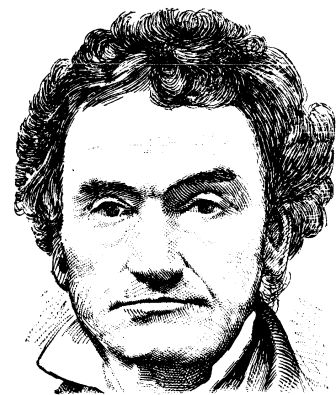
He was born of good old English stock, in the southeastern part of the town of Ipswich, in the county of Essex and State of Massachusetts, on the first day of October, 1799. His ancestors had lived in Essex County from a very early date in its history and had filled important public positions. He was born and bred in sight of the sea, and his love for it stayed with him through life. One of his most eloquent addresses was on 'The Romance of the Sea.' And in his last illness at Halifax, his keenest pleasure was to watch the ships sailing in front of his windows. Dropping into sleep on one occasion, a few days before his death, he said to his attendant, "If a schooner or sloop goes by, don't disturb me; but if there is a square-rigged vessel, wake me."
Mr. Choate had the ordinary education then given in New England to young men who had a love of learning. He began with the district school; from there he went to the academy at Hampton, New Hampshire; and later he entered Dartmouth College, where he graduated the first scholar in his class, in 1819. It is hard to find an accurate standard of comparison between the scholarship of that period and that of the present. No doubt, in our New England colleges of to-day there is a larger number of young men who have a considerable store of knowledge on many subjects of classical learning. But it is very doubtful if the graduates of Harvard and Yale of to-day are able to read the standard classic authors at the day of their graduation, with the ease and accuracy of Mr. Choate at the end of his active professional career in the year 1859. His continued devotion to the classics is shown by the following extract from his journal in the year 1844, while he was a member of Congress:—
"1. Some professional work must be done every day.... Recent experiences suggest that I ought to be more familiar with evidence and Cowen's Phillips; therefore, daily for half an hour, I will thumb conscientiously. When I come home again, in the intervals of actual employment, my recent methods of reading, accompanying the reports with the composition of arguments upon the points adjudged, may be properly resumed.
"2. In my Greek, Latin, and French readings—Odyssey, Thucydides, Tacitus, Juvenal, and some French orator or critic—I need make no change. So, too, Milton, Johnson, Burke—semper in manu—ut mos est. To my Greek I ought to add a page a day of Crosby's Grammar, and the practice of parsing every word in my few lines of Homer. On Sunday, the Greek Testament, and Septuagint, and French. This, and the oration of the Crown, which I will completely master, translate, annotate, and commit, will be enough in this kind. If not, I will add a translation of a sentence or two from Tacitus."
A similar extract from his journal under the date of December 15th, 1844, reads:—
"I begin a great work,—Thucydides, in Bloomfield's new edition,—with the intention of understanding a difficult and learning something from an instructive writer,—something for the more and more complicated, interior, inter-State American politics.
"With Thucydides, I shall read Wachsmuth, with historical references and verifications. Schomann on the Assemblies of the Athenians, especially, I am to meditate, and master Danier's Horace, Ode 1, 11th to 14th line, translation and notes,—a pocket edition to be always in pocket."
Throughout his life Mr. Choate kept up his classical studies. Few of the graduates of our leading colleges to-day carry from Commencement a training which makes the study of the Greek and Latin authors either easy or pleasant. Mr. Choate, like nearly every lawyer who has ever distinguished himself at the English bar, was a monument to the value of the study of the classics as a mere means of training for the active practical work of a lawyer.
Mr. Choate studied law at Cambridge in the Harvard Law School. Nearly a year he spent at Washington in the office of Mr. Wirt, then Attorney-General of the United States. This was in 1821. Thereafter he was admitted to the bar, in September, 1823. He opened his office in Salem, but soon removed to Danvers, where he practiced for four or five years.
During these earliest years of his professional life he had the fortune which many other brilliant men in his profession have experienced,—that of waiting and hoping. During his first two or three years, it is said, he was so despondent as to his chances of professional success that he seriously contemplated abandoning the law. In time he got his opportunity to show the stuff of which he was made. His first professional efforts were in petty cases before justices of the peace. Very soon however his great ability, with his untiring industry and his intense devotion to any cause in his hands, brought the reputation which he deserved, and reputation brought clients.
In 1828 he removed to Salem. The Essex bar was one of great ability. Mr. Choate at once became a leader. Among his contemporaries at that bar was Caleb Cushing. Mr. Choate at first had many criminal cases. In the year 1830 he was, with Mr. Webster, one of the counsel for the prosecution in the celebrated White murder case.
In 1830 he was elected to Congress as a member of the House of Representatives, at the age of thirty-one years. At once he laid out a course of study which was to fit him for the duties of his public life. An extract from it reads as follows:—
"Nov. 4, 1830.
"Facienda ad munus nuper impositum.
"i. Pers. quals. [personal qualities], Memory, Daily Food, and Cowper dum ambulo. Voice, Manner, Exercitationes diurnæ.
"2. Current politics in papers. 1. Cum Notulis, daily,—Geog., &c. 2. Annual Reg., Past Intelligencers, &c.
"4. Civil History of U. States—in Pitkin and original sources.
"5. Exam. of Pending Questions: Tariff, Pub. Lands, Indians, Nullifications.
"6. Am. and Brit. Eloquence,—Writing, Practice."
Then follow in his manuscript upwards of twenty pages of close writing, consisting of memoranda and statements, drawn from a multitude of sources, on the subjects laid down by him at the beginning as the ones to be investigated.
In Congress he found himself in competition with many men of marked ability. Among the members of Congress then from Massachusetts were Mr. Webster in the Senate; and in the House, John Quincy Adams, Edward Everett, Nathan Appleton, George N. Briggs, and John Davis. In the Senate, from other States, were Peleg Sprague from Maine,—one of the ablest jurists this country has produced; Samuel Prentiss, Mr. Marcy, Mr. Dallas, Mr. Clayton, Mr. Clay, and Mr. Benton. In the House were James M. Wayne, Mr. McDuffie, Mr. Polk, Mr. Corwin, and Mr. Verplanck.
Among men of this calibre Mr. Choate at once, with ease, took rank as one of the first. He made but two speeches during the session; but these gave him a position which he ever afterwards held among the most eloquent and convincing speakers in public life.
In April 1833 Mr. Choate was re-elected to Congress. At this session he made a speech on the removal of the public deposits by President Jackson from the Bank of the United States. The following incident shows his power as an orator:—
Benjamin Hardin was then a member from Kentucky, of the House of Representatives; and was himself intending to speak on the same side of the question with Mr. Choate. In such cases, Mr. Hardin's rule was to listen to no other speaker before speaking himself. Consequently when Mr. Choate began speaking, Mr. Hardin started to leave the House. He waited however for a moment to listen to a few sentences from Mr. Choate, and with this result, as told in his own words:—"The member from Massachusetts rose to speak, and in accordance with my custom I took my hat to leave, lingering a moment just to notice the tone of his voice and the manner of his speech. But that moment was fatal to my resolution. I became charmed by the music of his voice, and was captivated by the power of his eloquence, and found myself wholly unable to move until the last word of his beautiful speech had been uttered."
At the close of this session Mr. Choate resigned his seat in Congress and went to Boston, there to follow the practice of his profession. At the Boston bar he met a remarkably brilliant group of men. There were Jeremiah Mason, whom Mr. Webster is said to have considered the strongest man that he ever met in any legal contest; Franklin Dexter; Chief Justice Shaw (then at the bar); Judges Wilde, Hoar, and Thomas, afterwards of the Massachusetts Supreme Court; Mr. Fletcher, Judge Benjamin R. Curtis, Sidney Bartlett, Richard H. Dana, William D. Sohier, Henry W. Paine, Edward D. Sohier, with others whose names are now almost forgotten. These men formed a bar the like of which has seldom if ever been assembled in any one jurisdiction. Here too Mr. Choate at once came to the front. With every talent which could make a man a great advocate,—with a marvelous memory, a keen logical intellect, a sound legal judgment,—he had now acquired a large professional experience and a very complete professional training. As has been seen, he had a thorough classical training,—that is, of the kind best fitted to his needs. His professional studies before beginning his professional practice had been the best then attainable; very possibly, for him, they were quite as good as can be had at any of the law schools of to-day. His range of reading and information was extremely wide. He had had several years of experience at Washington in Congress. And ever since leaving the law school his mere professional studies had been most severe. It is hard to see how any man could be better equipped for professional practice than Mr. Choate was at this time.
His success at the Boston bar was phenomenal. He was in a contest with giants. Mr. Webster alone could be deemed to dispute with Mr. Choate the place of supremacy. The general verdict has been that for pure intellectual power Mr. Webster was the superior. But it may well be doubted whether as an all-round advocate Mr. Choate did not carry off the palm. The common idea of Mr. Choate has been that his marvelous eloquence was his great source of strength and success in his forensic contests. This is an error. Eloquent he undoubtedly was; few men have ever been more so. But unless in frontier communities, eloquence alone has never commanded great success at the bar—if indeed it has ever existed—without strong logical power and sound judgment. The power of convincing intelligent men always depends largely and mainly on soundness of judgment in the selection of positions. Especially is this so in the profession of the law. There have been, no doubt, many instances where men of eloquence have captivated juries by appeals to passion or prejudice. But in the vast majority of cases, success as an advocate cannot be had without sound judgment in the selection of positions, coupled with the power of clear logical statement. Mr. Choate was no exception to this rule. Mr. Henry W. Paine, one of the leaders of the Boston bar in Mr. Choate's time,—himself one of the most logical of men,—once said that he did not care to hear Mr. Choate address a jury, but to hear him argue a bill of exceptions before the full bench of the Supreme Court was one of the greatest intellectual treats. With the ordinary twelve men in a jury-box Mr. Choate was a wizard. His knowledge of human nature, his wide and deep sympathies, his imagination, his power of statement, with his rich musical voice and his wonderful fascination of manner, made him a charmer of men and a master in the great art of winning verdicts. So far as the writer is able to form an opinion, there has never been at the English or American bar a man who has been his equal in his sway over juries. Comparisons are often condemned, but they are at times useful. Comparing Mr. Choate with Mr. Webster, it must be conceded that Mr. Webster might at times carry a jury against Mr. Choate by his force of intellect and the tremendous power of his personal presence. Mr. O'Conor once said that he did not consider Mr. Webster an eloquent man. "Mr. Webster," he said, "was an intellectual giant. But he never impressed me as being an eloquent man." The general judgment is that Mr. Webster had eloquence of a very high order. But Mr. Choate was a magician. With any opponent of his time except Mr. Webster, he was irresistible before juries. Mr. Justice Catron of the United States Court is reported to have said of Mr. Choate, "I have heard the most eminent advocates, but he surpasses them all." His success came from a rare combination of eloquence, sound logical judgment, and great powers of personal fascination.
In another respect the common opinion of Mr. Choate must be corrected. His great powers of persuasion and conviction undoubtedly gave him some victories which were not deserved by the mere merits of his cases. From this fact there went abroad the impression that he was a man without principle, and that his ethical standards were not high in his selection and conduct of cases. This impression is quite contrary to the judgment of the competent. The impression was due largely to his success in the celebrated defense of Tirrell. Tirrell was indicted for the murder of a woman named Bickford, with whom Tirrell had long associated, who was found dead in a house of ill-repute. At about the hour when the woman lost her life, either by her own hand or by that of Tirrell, the house caught fire. The cause of the fire was not proved. Tirrell had been in her company the preceding evening, and articles of clothing belonging to him were found in the morning in her room. Many circumstances seemed to indicate that the woman had been killed by Tirrell. He was also indicted for arson in setting fire to the house. In addition to other facts proved by the defense, it was shown by reputable witnesses that Tirrell had from his youth been subject to somnambulism; and one of the positions taken by Mr. Choate for the defense was that the killing, if done by Tirrell at all, was done by him while unconscious, in a condition of somnambulism. Tirrell was tried under both indictments and was acquitted on both. The indictment for murder was tried before Justices Wilde, Dewey, and Hubbard. The indictment for arson was tried before Chief Justice Shaw and Justices Wilde and Dewey. The foreman of the jury stated that the defense of somnambulism received no weight in the deliberations of the jury. The judgment of the profession has been that the verdicts were the only ones which could properly have been rendered on the evidence. In the arson case the charge to the jury was by Chief Justice Shaw, and was strongly in favor of the defense. No doubt the defense was extremely able and ingenious. But the criticisms against Mr. Choate for his conduct of those cases, in the opinion of those members of the profession best qualified to judge, have been held to be without good foundation. Lawyers—that is, reputable ones—do not manufacture evidence, nor are they the witnesses who testify to facts. The severe tests of cross-examination usually elicit the truth. No one ever charged Mr. Choate with manufacturing evidence. And no lawyer of good judgment, so far as the writer is aware, has ever charged him with practices which were not in keeping with the very highest professional standards.
In the space here allotted, any attempt to give an adequate idea of Mr. Choate's professional and public work is quite out of the question. In addition to the conduct of an unusually large professional practice he did a large amount of literary work, mainly in the delivery of lectures, which at that time in New England were almost a part of the public system of education. Throughout his life he took an active part in politics. He attended the Whig convention at Baltimore in 1852, where General Scott received his nomination for the Presidency, and where Mr. Choate made one of the most eloquent speeches of his life in his effort to secure the nomination for Mr. Webster.
Mr. Choate finally killed himself by overwork. Though a man of great physical strength and remarkable vitality, no constitution could stand the strain of his intense labors in the different lines of law, literature, and politics. His magnificent physique finally broke down. He died on July 13th, 1859, being not quite sixty years. His death was an important public event. In the public press, at many public meetings throughout the country, and by public men of the highest distinction, his death was treated as a public misfortune. In his day he rendered distinguished public services. He had the capacities and the interests which fitted him to be a great statesman. Had it not been for our system of short terms, and rotation in office, Mr. Choate would probably have remained in public life from the time of his entry into Congress, would have been a most valuable public servant, and would have left a great reputation as a statesman. As it was, he left, so far as now appears, only the ephemeral reputation of a great advocate.
This scanty sketch can best be closed by a quotation from the address of Richard H. Dana at the meeting of the Boston bar held just after Mr. Choate's death. That extract will show the judgment of Mr. Choate which was held by the giants among whom he lived and of whom he was the leader:—
"'The wine of life is drawn.' 'The golden bowl is broken.' The age of miracles has passed. The day of inspiration is over. The Great Conqueror, unseen and irresistible, has broken into our temple and has carried off the vessels of gold, the vessels of silver, the precious stones, the jewels, and the ivory; and like the priests of the temple of Jerusalem after the invasion from Babylon, we must content ourselves as we can with vessels of wood and of stone and of iron.
"With such broken phrases as these, Mr. Chairman, perhaps not altogether just to the living, we endeavor to express the emotions natural to this hour of our bereavement. Talent, industry, eloquence, and learning, there are still, and always will be, at the bar of Boston. But if I say that the age of miracles has passed, that the day of inspiration is over,—if I cannot realize that in this place where we now are, the cloth of gold was spread, and a banquet set fit for the gods,—I know, sir, you will excuse it. Any one who has lived with him and now survives him, will excuse it;—any one who like the youth in Wordsworth's Ode,—
'—by the vision splendid Is on his way attended, At length ... perceives it die away, And fade into the light of common day.'"
It will also tend to secure justice to Mr. Choate's memory, if there be here recorded the statement by Judge Benjamin R. Curtis of the judgment of the men of Mr. Choate's own profession, as to the moral standards by which Mr. Choate was governed in his practice. Judge Curtis said in his address at the same meeting of the Boston Bar:—
"I desire, therefore, on this occasion and in this presence, to declare our appreciation of the injustice which would be done to this great and eloquent advocate by attributing to him any want of loyalty to truth, or any deference to wrong, because he employed all his great powers and attainments, and used to the utmost his consummate skill and eloquence, in exhibiting and enforcing the comparative merits of one side of the cases in which he acted. In doing so he but did his duty. If other people did theirs, the administration of justice was secured."
All the citations are from 'Addresses and Orations of Rufus Choate': copyrighted 1878, by Little, Brown and Company
THE PURITAN IN SECULAR AND RELIGIOUS LIFE
From Address Delivered at the Ipswich Centennial, 1834
Turn first now for a moment to the old English Puritans, the fathers of our fathers, of whom came, of whom were, planters of Ipswich, of Massachusetts, of New England,—of whom came, of whom were, our own Ward, Parker, and Saltonstall, and Wise, Norton, and Rogers, and Appleton, and Cobbet, and Winthrop,—and see whether they were likely to be the founders of a race of freemen or slaves. Remember then, the true, noblest, the least questioned, least questionable, praise of these men is this: that for a hundred years they were the sole depositaries of the sacred fire of liberty in England after it had gone out in every other bosom,—that they saved at its last gasp the English Constitution,—which the Tudors and the first two Stuarts were rapidly changing into just such a gloomy despotism as they saw in France and Spain,—and wrought into it every particle of freedom which it now possesses,—that when they first took their seats in the House of Commons, in the early part of the reign of Elizabeth, they found it the cringing and ready tool of the throne, and that they reanimated it, remodeled it, reasserted its privileges, restored it to its constitutional rank, drew back to it the old power of making laws, redressing wrongs, and imposing taxes, and thus again rebuilt and opened what an Englishman called "the chosen temple of liberty," an English House of Commons,—that they abridged the tremendous power of the crown and defined it,—and when at last Charles Stuart resorted to arms to restore the despotism they had partially overthrown, that they met him on a hundred fields of battle, and buried, after a sharp and long struggle, crown and mitre and the headless trunk of the king himself beneath the foundations of a civil and religious commonwealth. This praise all the historians of England—Whig and Tory, Protestant and Catholic, Hume, Hallam, Lingard, and all—award to the Puritans. By what causes this spirit of liberty had been breathed into the masculine, enthusiastic, austere, resolute character of this extraordinary body of men, in such intensity as to mark them off from all the rest of the people of England, I cannot here and now particularly consider. It is a thrilling and awful history of the Puritans in England, from their first emerging above the general level of Protestants, in the time of Henry VIII. and Edward VI., until they were driven by hundreds and thousands to these shores; but I must pass it over. It was just when the nobler and grander traits—the enthusiasm and piety and hardihood and energy—of Puritanism had attained the highest point of exaltation to which, in England, it ever mounted up, and the love of liberty had grown to be the great master-passion that fired and guided all the rest,—it was just then that our portion of its disciples, filled with the undiluted spirit, glowing with the intensest fervors of Protestantism and republicanism together, came hither, and in that elevated and holy and resolved frame began to build the civil and religious structures which you see around you.
Trace now their story a little farther onward through the Colonial period to the War of Independence, to admire with me the providential agreement of circumstances by which that spirit of liberty which brought them hither was strengthened and reinforced; until at length, instructed by wisdom, tempered by virtue, and influenced by injuries, by anger and grief and conscious worth and the sense of violated right, it burst forth here and wrought the wonders of the Revolution. I have thought that if one had the power to place a youthful and forming people like the Northern colonists, in whom the love of freedom was already vehement and healthful, in a situation the most propitious for the growth and perfection of that sacred sentiment, he could hardly select a fairer field for so interesting an experiment than the actual condition of our fathers for the hundred and fifty years after their arrival, to the War of the Revolution.
They had freedom enough to teach them its value and to refresh and elevate their spirits, wearied, not despondent, from the contentions and trials of England. They were just so far short of perfect freedom that instead of reposing for a moment in the mere fruition of what they had, they were kept emulous and eager for more, looking all the while up and aspiring to rise to a loftier height, to breathe a purer air, and bask in a brighter beam. Compared with the condition of England down to 1688,—compared with that of the larger part of the continent of Europe down to our Revolution,—theirs was a privileged and liberal condition. The necessaries of freedom, if I may say so,—its plainer food and homelier garments and humbler habitations,—were theirs. Its luxuries and refinements, its festivals, its lettered and social glory, its loftier port and prouder look and richer graces, were the growth of a later day; these came in with independence. Here was liberty enough to make them love it for itself, and to fill them with those lofty and kindred sentiments which are at once its fruit and its nutriment and safeguard in the soul of man. But their liberty was still incomplete, and it was constantly in danger from England; and these two circumstances had a powerful effect in increasing that love and confirming those sentiments. It was a condition precisely adapted to keep liberty, as a subject of thought and feeling and desire, every moment in mind. Every moment they were comparing what they had possessed with what they wanted and had a right to; they calculated by the rule of three, if a fractional part of freedom came to so much, what would express the power and value of the whole number! They were restive and impatient and ill at ease; a galling wakefulness possessed their faculties like a spell. Had they been wholly slaves, they had lain still and slept. Had they been wholly free, that eager hope, that fond desire, that longing after a great, distant, yet practicable good, would have given way to the placidity and luxury and carelessness of complete enjoyment; and that energy and wholesome agitation of mind would have gone down like an ebb-tide. As it was, the whole vast body of waters all over its surface, down to its sunless, utmost depths, was heaved and shaken and purified by a spirit that moved above it and through it and gave it no rest, though the moon waned and the winds were in their caves; they were like the disciples of the old and bitter philosophy of paganism, who had been initiated into one stage of the greater mysteries, and who had come to the door, closed, and written over with strange characters, which led up to another. They had tasted of truth, and they burned for a fuller draught; a partial revelation of that which shall be hereafter had dawned; and their hearts throbbed eager, yet not without apprehension, to look upon the glories of the perfect day. Some of the mystery of God, of Nature, of Man, of the Universe, had been unfolded; might they by prayer, by abstinence, by virtue, by retirement, by contemplation, entitle themselves to read another page in the clasped and awful volume?
THE NEW-ENGLANDER'S CHARACTER
From Address Delivered at the Ipswich Centennial, 1834
I hold it to have been a great thing, in the first place, that we had among us, at that awful moment when the public mind was meditating the question of submission to the tea tax, or resistance by arms, and at the more awful moment of the first appeal to arms,—that we had some among us who personally knew what war was. Washington, Putnam, Stark, Gates, Prescott, Montgomery, were soldiers already. So were hundreds of others of humbler rank, but not yet forgotten by the people whom they helped to save, who mustered to the camp of our first Revolutionary armies. These all had tasted a soldier's life. They had seen fire, they had felt the thrilling sensations, the quickened flow of blood to and from the heart, the mingled apprehension and hope, the hot haste, the burning thirst, the feverish rapture of battle, which he who has not felt is unconscious of one-half of the capacities and energies of his nature; which he who has felt, I am told, never forgets. They had slept in the woods on the withered leaves or the snow, and awoke to breakfast upon birch-bark and the tender tops of willow-trees. They had kept guard on the outposts on many a stormy night, knowing perfectly that the thicket half a pistol-shot off was full of French and Indian riflemen.
I say it was something that we had such men among us. They helped discipline our raw first levies. They knew what an army is, and what it needs, and how to provide for it. They could take that young volunteer of sixteen by the hand, sent by an Ipswich mother, who after looking upon her son equipped for battle from which he might not return, Spartan-like, bid him go and behave like a man—and many, many such shouldered a musket for Lexington and Bunker Hill—and assure him from their own personal knowledge that after the first fire he never would know fear again, even that of the last onset. But the long and peculiar wars of New England had done more than to furnish a few such officers and soldiers as these. They had formed that public sentiment upon the subject of war which re-united all the armies, fought all the battles, and won all the glory of the Revolution. The truth is that war in some form or another had been, from the first, one of the usages, one of the habits, of colonial life. It had been felt from the first to be just as necessary as planting or reaping—to be as likely to break out every day and every night as a thunder-shower in summer, and to break out as suddenly. There have been nations who boasted that their rivers or mountains never saw the smoke of an enemy's camp. Here the war-whoop awoke the sleep of the cradle; it startled the dying man on his pillow; it summoned young and old from the meeting-house, from the burial, and from the bridal ceremony, to the strife of death. The consequence was that the steady, composed, and reflecting courage which belongs to all the English race grew into a leading characteristic of New England; and a public sentiment was formed, pervading young and old and both sexes, which declared it lawful, necessary, and honorable to risk life and to shed blood for a great cause,—for our family, for our fires, for our God, for our country, for our religion. In such a cause it declared that the voice of God himself commanded to the field. The courage of New England was the "courage of conscience." It did not rise to that insane and awful passion, the love of war for itself. It would not have hurried her sons to the Nile, or the foot of the Pyramids, or across the great raging sea of snows which rolled from Smolensko to Moscow, to set the stars of glory upon the glowing brow of ambition. But it was a courage which at Lexington, at Bunker Hill, at Bennington, and at Saratoga, had power to brace the spirit for the patriot's fight, and gloriously roll back the tide of menaced war from their homes, the soil of their birth, the graves of their fathers, and the everlasting hills of their freedom.
OF THE AMERICAN BAR
From the Address before the Cambridge Law School, 1845
Something such has, in all the past periods of our history, been one of the functions of the American bar. To vindicate the true interpretation of the charters of the colonies, to advise what forms of polity, what systems of jurisprudence, what degree and what mode of liberty these charters permitted,—to detect and expose that long succession of infringement which grew at last to the Stamp Act and Tea Tax, and compelled us to turn from broken charters to national independence,—to conduct the transcendent controversy which preceded the Revolution, that grand appeal to the reason of civilization,—this was the work of our first generation of lawyers: to construct the American constitutions: the higher praise of the second generation. I claim it in part for the sobriety and learning of the American bar; for the professional instinct towards the past; for the professional appreciation of order, forms, obedience, restraints; for the more than professional, the profound and wide intimacy with the history of all liberty, classical, mediæval, and above all, of English liberty,—I claim it in part for the American bar that, springing into existence by revolution,—revolution, which more than anything and all things lacerates and discomposes the popular mind,—justifying that revolution only on a strong principle of natural right, with not one single element or agent of monarchy or aristocracy on our soil or in our blood,—I claim it for the bar that the constitutions of America so nobly closed the series of our victories! These constitutions owe to the bar more than their terse and exact expression and systematic arrangements: they owe to it in part, too, their elements of permanence; their felicitous reconciliation of universal and intense liberty with forms to enshrine and regulations to restrain it; their Anglo-Saxon sobriety and gravity conveyed in the genuine idiom, suggestive of the grandest civil achievements of that unequaled race. To interpret these constitutions, to administer and maintain them, this is the office of our age of the profession. Herein have we somewhat wherein to glory; hereby we come into the class and share in the dignity of founders of States, of restorers of States, of preservers of States.
I said and I repeat that while lawyers, and because we are lawyers, we are statesmen. We are by profession statesmen. And who may measure the value of this department of public duty? Doubtless in statesmanship there are many mansions, and large variety of conspicuous service. Doubtless to have wisely decided the question of war or peace,—to have adjusted by a skillful negotiation a thousand miles of unsettled boundary-line,—to have laid the corner-stone of some vast policy whereby the currency is corrected, the finances enriched, the measure of industrial fame filled,—are large achievements. And yet I do not know that I can point to one achievement of this department of American statesmanship which can take rank for its consequences of good above that single decision of the Supreme Court which adjudged that an act of legislature contrary to the Constitution is void, and that the judicial department is clothed with the power to ascertain the repugnancy and to pronounce the legal conclusion. That the framers of the Constitution intended this should be so is certain; but to have asserted it against the Congress and the Executive,—to have vindicated it by that easy yet adamantine demonstration than which the reasonings of the mathematics show nothing surer,—to have inscribed this vast truth of conservatism on the public mind, so that no demagogue, not in the last stage of intoxication, denies it,—this is an achievement of statesmanship of which a thousand years may not exhaust or reveal all the good.
DANIEL WEBSTER
From Eulogy delivered at Dartmouth College, 1853
Sometimes it has seemed to me that to enable one to appreciate with accuracy, as a psychological speculation, the intrinsic and absolute volume and texture of that brain,—the real rate and measure of those abilities,—it was better not to see or hear him, unless you could see or hear him frequently, and in various modes of exhibition; for undoubtedly there was something in his countenance and bearing so expressive of command,—something even in his conversational language when saying "Parva summisse et modica temperate," so exquisitely plausible, embodying the likeness at least of a rich truth, the forms at least of a large generalization, in an epithet,—an antithesis,—a pointed phrase,—a broad and peremptory thesis,—and something in his grander forthputting, when roused by a great subject or occasion exciting his reason and touching his moral sentiments and his heart, so difficult to be resisted, approaching so near, going so far beyond, the higher style of man, that although it left you a very good witness of his power of influencing others, you were not in the best condition immediately to pronounce on the quality or the source of the influence. You saw the flash and heard the peal, and felt the admiration and fear; but from what region it was launched, and by what divinity, and from what Olympian seat, you could not certainly yet tell. To do that you must, if you saw him at all, see him many times; compare him with himself and with others; follow his dazzling career from his father's house; observe from what competitors he won those laurels; study his discourses,—study them by the side of those of other great men of this country and time, and of other countries and times, conspicuous in the same fields of mental achievement,—look through the crystal water of the style down to the golden sands of the thought; analyze and contrast intellectual power somewhat; consider what kind and what quantity of it has been held by students of mind needful in order to great eminence in the higher mathematics, or metaphysics, or reason of the law; what capacity to analyze, through and through, to the primordial elements of the truths of that science; yet what wisdom and sobriety, in order to control the wantonness and shun the absurdities of a mere scholastic logic, by systematizing ideas, and combining them, and repressing one by another, thus producing, not a collection of intense and conflicting paradoxes, but a code, scientifically coherent and practically useful,—consider what description and what quantity of mind have been held needful by students of mind in order to conspicuous eminence—long maintained—in statesmanship; that great practical science, that great philosophical art, whose ends are the existence, happiness, and honor of a nation; whose truths are to be drawn from the widest survey of man,—of social man,—of the particular race and particular community for which a government is to be made or kept, or a policy to be provided; "philosophy in action," demanding at once or affording place for the highest speculative genius and the most skillful conduct of men and of affairs; and finally consider what degree and kind of mental power has been found to be required in order to influence the reason of an audience and a nation by speech,—not magnetizing the mere nervous or emotional nature by an effort of that nature, but operating on reason by reason—a great reputation in forensic and deliberative eloquence, maintained and advancing for a lifetime,—it is thus that we come to be sure that his intellectual power was as real and as uniform as its very happiest particular display had been imposing and remarkable.