Volume 9 — GEOFFREY CHAUCER
Reading edition
(13—?-1400)
BY THOMAS R. LOUNSBURY
nglish literature, in the strict sense of the word, dates its beginning from the latter half of the fourteenth century. Not but an English literature had existed long previous to that period. Furthermore, it reckoned among its possessions works of value, and a few which in the opinion of some display genius. But though the name was the same, the thing was essentially different. A special course of study is required for any comprehension whatever of the productions of that earliest literature; and for the easy understanding of those written even but a half-century or so before the period indicated, a mastery of many peculiar syntactical constructions is demanded and an acquaintance with a vocabulary differing in a large number of words from that now in use.
But by the middle of the fourteenth century this state of things can hardly be said to exist any longer for us. Everything by that time had become ripe for the creation of a literature of a far higher type than had yet been produced. Furthermore, conditions prevailed which, though their results could not then be foreseen, were almost certain to render the literature thus created comparatively easy of comprehension to the modern reader. The Teutonic and Romanic elements that form the groundwork of our present vocabulary had at last become completely fused. Of the various dialects prevailing, the one spoken in the vicinity of the capital had gradually lifted itself up to a pre-eminence it was never afterwards to lose. In this parent of the present literary speech, writers found for the first time at their command a widely accepted and comparatively flexible instrument of expression. As a consequence, the literature then produced fixed definitely for all time the main lines upon which both the grammar and the vocabulary of the English speech were to develop. The result is that it now presents few difficulties for its full comprehension and appreciation that are not easily surmounted. The most effective deterrent to its wide study is one formidable only in appearance. This is the unfamiliar way in which its words are spelled; for orthography then sought to represent pronunciation, and had not in consequence crystallized into fixed forms with constant disregard of any special value to be attached to the signs by which sounds are denoted.
Of the creators of this literature—Wycliffe, Langland, Chaucer, and Gower—Chaucer was altogether the greatest as a man of letters. This is no mere opinion of the present time: there has never been a period since he flourished in which it has not been fully conceded. In his own day, his fame swept beyond the narrow limits of country and became known to the outside world. At home his reputation was firmly established, and seems to have been established early. All the references to him by his contemporaries and immediate successors bear witness to his universally recognized position as the greatest of English poets, though we are not left by him in doubt that he had even then met detractors. Still the general feeling of the men of his time is expressed by his disciple Occleve, who terms him
"The firste finder[1] of our fair langage."
Yet not a single incident of his life has come down to us from the men who admired his personality, who enrolled themselves as his disciples, and who celebrated his praises. With the exception of a few slight references to himself in his writings, all the knowledge we possess of the events of his career is due to the mention made of him in official documents of various kinds and of different degrees of importance. In these it is taken for granted that whenever Geoffrey Chaucer is spoken of, it is the poet who is meant, and not another person of the same name. The assumption almost approaches absolute certainty; it does not quite attain to it. In those days it is clear that there were numerous Chaucers. Still, no one has yet risen to dispute his being the very person spoken of in these official papers. From these documents we discover that Chaucer, besides being a poet, was also a man of affairs. He was a soldier, a negotiator, a diplomatist. He was early employed in the personal service of the king. He held various positions in the civil service. It was a consequence that his name should appear frequently in the records. It is upon them, and the references to him in documents covering transactions in which he bore a part, that the story of his life, so far as it exists for us at all, has been mainly built. It was by them also that the series of fictitious events which for so long a time did duty as the biography of the poet had their impossibility as well as their absurdity exposed.
GEOFFREY CHAUCER.
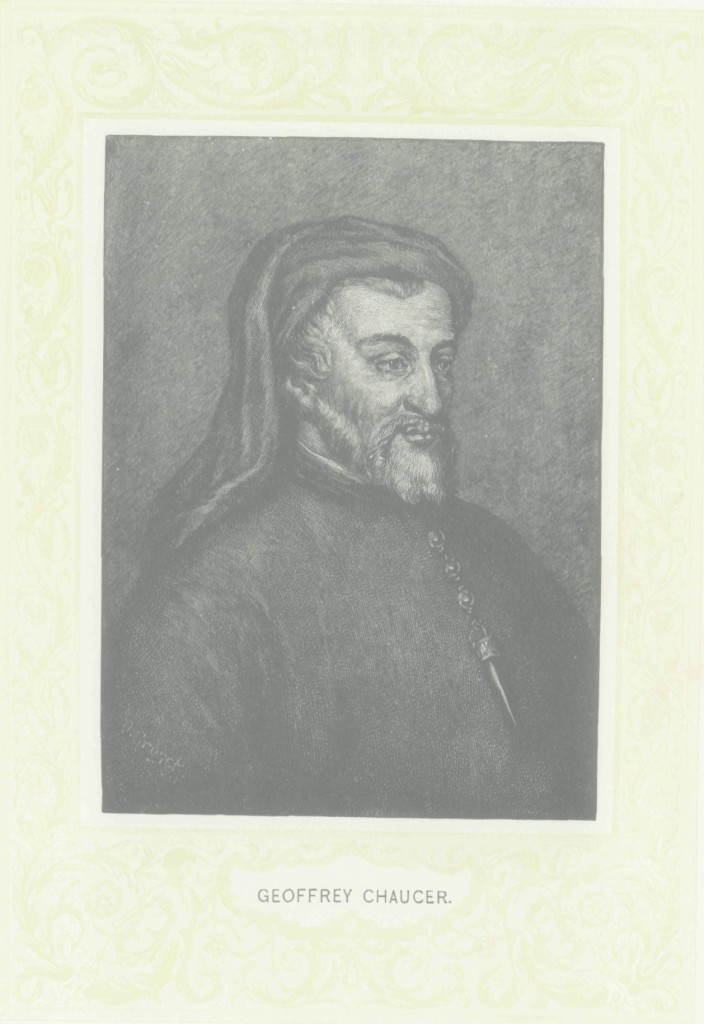
The exact date of Chaucer's birth we do not know. The most that can be said is that it must have been somewhere in the early years of the reign of Edward III. (1327-77). The place of his birth was in all probability London. His father, John Chaucer, was a vintner of that city, and there is evidence to indicate that he was to some extent connected with the court. In a deed dated June 19th, 1380, the poet released his right to his father's former house, which is described as being in Thames Street. The spot, however unsuitable for a dwelling-place now, was then in the very heart of urban life, and in that very neighborhood it is reasonable to suppose that Chaucer's earliest years were spent.
The first positive information we have, however, about the poet himself belongs to 1356. In that year we find him attached to the household of Lionel, Duke of Clarence, the third son of Edward III. He is there in the service of the wife of that prince, but in what position we do not know. It may have been that of a page. He naturally was in attendance upon his mistress during her various journeyings; but most of her time was passed at her residence in Hatfield, Yorkshire. Chaucer next appears as having joined the army of Edward III. in his last invasion of France. This expedition was undertaken in the autumn of 1359, and continued until the peace of Bretigny, concluded in May, 1360. During this campaign he was captured somewhere and somehow—we have no knowledge of anything beyond the bare fact. It took place, however, before the first of March, 1360; for on that date the records show that the King personally contributed sixteen pounds towards his ransom.
From this last-mentioned date Chaucer drops entirely out of our knowledge till June, 1367, when he is mentioned as one of the valets of the King's chamber. In the document stating this fact he is granted a pension—the first of several he received—for services already rendered or to be rendered. It is a natural inference from the language employed, that during these years of which no record exists he was in some situation about the person of Edward III. After this time his name occurs with considerable frequency in the rolls, often in connection with duties to which he was assigned. His services were varied; in some instances certainly they were of importance. From 1370 to 1380 he was sent several times abroad to share in the conduct of negotiations. These missions led him to Flanders, to France, and to Italy. The subjects were very diverse. One of the negotiations in which he was concerned was in reference to the selection of an English port for a Genoese commercial establishment; another was concerning the marriage of the young monarch of England with the daughter of the king of France. It is on his first journey to Italy of which we have any record—the mission of 1372-73 to Genoa and Florence—that everybody hopes and some succeed in having an undoubting belief that Chaucer visited Petrarch at Padua, and there heard from him the story of Griselda, which the Clerk of Oxford in the 'Canterbury Tales' states that he learned from the Italian poet.
But Chaucer's activity was not confined to foreign missions or to diplomacy; he was as constantly employed in the civil service. In 1374 he was made controller of the great customs—that is, of wool, skins, and leather—of the port of London. In 1382 he received also the post in the same port of controller of the petty customs—that is, of wines, candles, and other articles. The regulations of the office required him to write the records with his own hand; and it is this to which Chaucer is supposed to refer in the statement he makes about his official duties in the 'House of Fame.' In that poem the messenger of Jupiter tells him that though he has done so much in the service of the God of Love, yet he has never received for it any compensation. He then goes on to add the following lines, which give a graphic picture of the poet and of his studious life:—
"Wherfore, as I said ywis,[2] Jupiter considereth this, And also, beau sir, other things; That is, that thou hast no tidings Of Lovès folk, if they be glad, Ne of nought ellès, that God made; And nought only from far countree That there no tiding cometh to thee, But of the very neighèboúrs, That dwellen almost at thy doors, Thou hearest neither that nor this; But when thy labor all done is, And hast made all thy reckonings, Instead of rest and newè things, Thou goest home to thine house anon, And also[3] dumb as any stone, Thou sittest at another book, Till fully dazèd is thy look. And livest thus as an eremite, Although thine abstinence is lyte.[4]"
In 1386 Chaucer was elected to Parliament as knight of the shire for the county of Kent. In that same year he lost or gave up both his positions in the customs. The cause we do not know. It may have been due to mismanagement on his own part: it is far more likely that he fell a victim to one of the fierce factional disputes that were going on during the minority of Richard II. At any rate, from this time he again disappears for two years from our knowledge. But in 1389 he is mentioned as having been appointed clerk of the King's works at Westminster and various other places; in 1390 clerk of the works for St. George's chapel at Windsor. Both of these places he held until the middle of 1391. In that last year he was made one of the commissioners to repair the roadway along the Thames, and at about the same time was appointed forester of North Petherton Park in Somerset, a post which he held till his death. After 1386 he seems at times to have been in pecuniary difficulties. To what cause they were owing, or how severe they were, it is the emptiest of speculations to form any conjectures in the obscurity that envelops this portion of his life. Whatever may have been his situation, on the accession of Henry IV. in September, 1399, his fortunes revived. The father of that monarch was John of Gaunt, the fourth son of Edward III. That nobleman had pretty certainly been from the outset the patron of Chaucer; it is possible—as the evidence fails on one side, it cannot be regarded as proved—that by his marriage with Katharine Swynford he became the poet's brother-in-law. Whatever may have been the relationship, if any at all, it is a fact that one of the very first things the new king did was to confer upon Chaucer an additional pension. But the poet did not live long to enjoy the favor of the monarch. On the 24th of December, 1399, he leased for fifty-three years or during the term of his life a tenement in the garden of St. Mary's Chapel, Westminster. But after the 5th of June, 1400, his name appears no longer on any rolls. There is accordingly no reason to question the accuracy of the inscription on his tombstone which represents him as having died October 25th, 1400. He was buried in Westminster Abbey. He was the first, and still remains perhaps the greatest, of the English poets whose bones have there found their last resting-place.
This comprises all the facts of importance we know of Chaucer's life. Before leaving this branch of the subject, however, it may be well to say that many fuller details about his career can be found in all older accounts of the poet, and in spite of the repeated exposure of their falsity still crop up occasionally in modern books of reference. Some are objectionable only upon the ground of being untrue. Of these are such statements as that he was born in 1328; that he was a student of Oxford, to which Cambridge is sometimes added; that he was created poet-laureate; and that he was knighted. But others are objectionable not only on the ground of being false, but of being slanderous besides. Of these the most offensive is the widely circulated and circumstantial story that he was concerned in the conflict that went on in 1382 between the city of London and the court in regard to the election of John of Northampton to the mayoralty; that in consequence of his participation in this contest he was compelled to seek refuge in the island of Zealand; that there he remained for some time, but on his return to England was arrested and thrown into the Tower; and that after having been imprisoned for two or three years he was released at last on the condition of betraying his associates, which he accordingly did. All these details are fictitious. They were made up from inferences drawn from obscure passages in a prose work entitled 'The Testament of Love.' This was once attributed to the poet, but is now known not to have been written by him. Even had it been his, the statements derived from it and applied to the life of the poet would have been entirely unwarranted, as they come into constant conflict with the official records. Not being his, this piece of spurious biography has the additional discredit of constituting an unnecessary libel upon his character.
From Chaucer the man, and the man of affairs, we proceed now to the consideration of Chaucer the writer. He has left behind a body of verse consisting of more than thirty-two thousand lines, and a smaller but still far from inconsiderable quantity of prose. The latter consists mainly if not wholly of translations—one a version of that favorite work of the Middle Ages, the treatise of Boëtius on the 'Consolation of Philosophy'; another the tale of Melibeus in the 'Canterbury Tales,' which is taken directly from the French; thirdly, the Parson's Tale, derived probably from the same quarter, though its original has not as yet been discovered with certainty; and fourthly, an unfinished treatise on the Astrolabe, undertaken for the instruction of his son Lewis. The prose of any literature always lags behind, and sometimes centuries behind, its poetry. It is therefore not surprising to find Chaucer displaying in the former but little of the peculiar excellence which distinguishes his verse. In the latter but little room is found for hostile criticism. In the more than thirty thousand lines of which it is composed there occur of course inferior passages, and some positively weak; but taking it all in all, there is comparatively little in it, considered as a whole, which the lover of literature as literature finds it advisable or necessary to skip. In this respect the poet holds a peculiar position, which makes the task of representation difficult. As Southey remarked, Chaucer with the exception of Shakespeare is the most various of all English authors. He appeals to the most diversified tastes. He wrote love poems, religious poems, allegorical poems, occasional poems, tales of common life, tales of chivalry. His range is so wide that any limited selection from his works can at best give but an inadequate idea of the variety and extent of his powers.
The canon of Chaucer's writings has now been settled with a reasonable degree of certainty. For a long time the fashion existed of imputing to him the composition of any English poem of the century following his death which was floating about without having attached to it the name of any author. The consequence is that the older editions contain a mass of matter which it would have been distinctly discreditable for any one to have produced, let alone a great poet. This has now been gradually dropped, much to the advantage of Chaucer's reputation; though modern scholarship also refuses to admit the production by him of two or three pieces, such as 'The Court of Love,' 'The Flower and the Leaf,' 'The Cuckoo and the Nightingale,' none of which was unworthy of his powers. It is possible indeed that the poet himself may have had some dread of being saddled with the responsibility of having produced pieces which he did not care to father. It is certainly suggestive that he himself took the pains on one occasion to furnish what it seems must have been at the time a fairly complete list of his writings. In the prologue to the 'Legend of Good Women' he gave an idea of the work which up to that period he had accomplished. The God of Love, in the interview which is there described as having taken place, inveighs against the poet for having driven men away from the service due to his deity, by the character of what he had written. He says:—
"Thou mayst it not deny: For in plain text, withouten need of glose,[5] Thou hast translated the Romance of the Rose; That is an heresy agains my law, And makest wisè folk fro me withdraw. And of Cressid thou hast said as thee list; That makest men to women lessè trist,[6] That be as true as ever was any steel."
Against this charge the queen Alcestis is represented as interposing to the god a defense of the poet, in which occurs the following account of Chaucer's writings:—
"Albeit that he cannot well endite, Yet hath he makèd lewèd[7] folk delight To servè you, in praising of your name. He made the book that hight[8] the House of Fame, And eke the Death of Blanche the Duchess, And the Parliament of Fowlès, as I guess, And all the love of Palamon and Arcite Of Thebes, though the story is knowen lyte[9]; And many an hymnè for your holy days That highten[10] ballades, roundels, virelays; And for to speak of other holiness, He hath in prosè translatéd Boece, And made the Life also of Saint Cecile; He made also, gone sithen a great while,[11] Origenes upon the Maudelain[12]: Him oughtè now to have the lessè pain; He hath made many a lay and many a thing."
This prologue is generally conceded to have been written between 1382 and 1385. Though it does not profess to furnish a complete list of Chaucer's writings, it can fairly be assumed that it included all which he then regarded as of importance either on account of their merit or their length. If so, the titles given above would embrace the productions of what may be called the first half of his literary career. In fact, his disciple Lydgate leads us to believe that 'Troilus and Cressida' was a comparatively early production, though it may have undergone and probably did undergo revision before assuming its present form. The 'Legend of Good Women'—in distinction from its prologue—would naturally occupy the time of the poet during the opening period of what is here termed the second half of his literary career. The prologue is the only portion of it, however, that is of distinctly high merit. The work was never completed, and Chaucer pretty certainly came soon to the conclusion that it was not worth completing. It was in the taste of the times; but it did not take him long to perceive that an extended work dealing exclusively with the sorrows of particular individuals was as untrue to art as it was to life. It fell under the ban of that criticism which in the 'Canterbury Tales' he puts into the mouth of the Knight, who interrupts the doleful recital of the tragical tales told by the Monk with these words:—
"'Ho,' quoth the knight, 'good sir, no more of this: That ye have said is right enow, ywis,[13] And muchel[14] more; for little heaviness Is right enow to muchel folk, I guess. I say for me it is a great disease,[15] Where-as men have been in great wealth and ease, To hearen of hir sudden fall, alas! And the contráry is joy and great solas,[16] As when a man hath been in poor estate, And climbeth up and waxeth fortunate, And there abideth in prosperity. Such thing is gladsome, as it thinketh[17] me, And of such thing were goodly for to tell.'"
Accordingly, from the composition of pieces of the one-sided and unsatisfactory character of those contained in the 'Legend of Good Women,' Chaucer turned to the preparation of his great work, the 'Canterbury Tales.' This gave him the fullest opportunity to display all his powers, and must have constituted the main literary occupation of his later life.
It will be noticed that two of the works mentioned in the prologue to the 'Legend of Good Women' are translations, and are so avowed. One is of the 'Roman de la Rose,' and the other of the philosophical treatise of Boëtius. In regard to the version of the former which has come down, it is sufficient to say that there was not long ago a disposition to deny the genuineness of all of it. This now contents itself with denying the genuineness of part of it. The question cannot be considered here: it is enough to say that in the opinion of the present writer, while the subject is attended with certain difficulties, the evidence is strongly in favor of Chaucer's composition of the whole. But setting aside any discussion of this point, there can scarcely be any doubt that Chaucer began his career as a translator. At the period he flourished he could hardly have done otherwise. It was an almost inevitable method of procedure on the part of a man who found neither writers nor writings in his own tongue worthy of imitation, and who could not fail to be struck not merely by the excellence of the Latin classic poets but also by the superior culture of the Continent. In the course of his literary development he would naturally pass from direct translation to adaptation. To the latter practice he assuredly resorted often. He took the work of the foreign author as a basis, discarded what he did not need or care for, and added as little or as much as suited his own convenience. In this way the 5704 lines of the 'Filostrato' of Boccaccio became 8246 in the 'Troilus and Cressida' of Chaucer; but even of the 5704 of the Italian poet, 2974 were not used by the English poet at all, and the 2730 that were used underwent considerable compression. In a similar way he composed the 'Knight's Tale,' probably the most perfect narrative poem in our tongue. It was based upon the 'Theseide' of Boccaccio. But the latter has 9896 lines, while the former comprises but 2250; and of these 2250 fully two-thirds are entirely independent of the Italian poem.
With such free treatment of his material, Chaucer's next step would be to direct composition, independent of any sources, save in that general way in which every author is under obligation to what has been previously produced. This finds its crowning achievement in the 'Canterbury Tales'; though several earlier pieces—such as the 'House of Fame,' the 'Parliament of Fowls,' and the prologue to the 'Legend of Good Women,'—attest that long before he had shown his ability to produce work essentially original. But though in his literary development Chaucer worked himself out of this exact reproduction of his models, through a partial working over of them till he finally attained complete independence, the habits of a translator clung to him to the very end. Even after he had fully justified his claim to being a great original poet, passages occur in his writings which are nothing but the reproduction of passages found in some foreign poem in Latin, or French, or Italian, the three languages with which he was conversant. His translation of them was due to the fact that they had struck his fancy; his insertion of them into his own work was to please others with what had previously pleased himself. Numerous passages of this kind have been pointed out; and doubtless there are others which remain to be pointed out.
There is another important thing to be marked in the history of Chaucer's artistic development. Not only was poetic material lacking in the tongue at the time of his appearance, but also poetic form. The measures in use, while not inadequate for literary expression, were incapable of embodying it in its highest flights. Consequently what Chaucer did not find, he had either to borrow or to invent. He did both. In the lines which have been quoted he speaks of the "ballades, roundels, and virelayes" which he had composed. These were all favorite poetical forms in that Continental country with whose literature Chaucer was mainly conversant. There can be little question that he tried all manner of verse which the ingenuity of the poets of Northern France had devised. As many of his shorter pieces have very certainly disappeared, his success in these various attempts cannot be asserted with positiveness. Still, what have survived show that he was a great literary artist as well as a great poet. His feats of rhyming, in particular in a tongue so little fitted for it as is ours, can be seen in his unfinished poem of 'Queen Anelida and False Arcite,' in the 'Complaint to Venus,' and in the envoy which follows the Clerk's Tale. In this last piece, though there are thirty-six lines, the rhymes are only three; and two of these belong to fifteen lines respectively.
But far more important than such attempts, which prove interest in versification rather than great poetic achievement, are the two measures which he introduced into our tongue. The first was the seven-line stanza. The rhyming lines in it are respectively the first and third; the second, fourth, and fifth; and the sixth and seventh. At a later period this was frequently called "rhyme royal," because the 'Kingis Quair' was written in it. For fully two centuries it was one of the most popular measures in English poetry. Since the sixteenth century, however, it has been but little employed. Far different has been the fate of the line of ten syllables, or rather of five accents. On account of its frequent use in the 'Canterbury Tales' it was called for a long period "riding rhyme"; but it now bears the title of "heroic verse." As employed by Chaucer it varies in slight particulars from the way it is now generally used. With him the couplet character was never made prominent. The sense was not apt to end at the second line, but constantly tended to run over into the line following. There was also frequently with him an unaccented eleventh syllable; and this, though not unknown to modern verse, is not common. Still, the difference between the early and the later form are mere differences of detail, and of comparatively unimportant detail. The introduction of this measure into English may be considered Chaucer's greatest achievement in the matter of versification. The heroic verse may have existed in the tongue before he himself used it. If so, it lurked unseen and uninfluential. He was the first to employ it on a grand scale, if not to employ it at all, and to develop its capabilities. Much the largest proportion of his greatest work is written in that measure. Yet in spite of his example, it found for two centuries comparatively few imitators. It was not till the end of the sixteenth century that the measure started on a new course of life, and entered upon the great part it has since played in English versification.
The most important of what are sometimes called the minor works of Chaucer are the 'Parliament of Fowls,' the 'House of Fame,' 'Troilus and Cressida,' and the 'Legend of Good Women.' These are all favorable examples of his genius. But however good they may be in particular portions and in particular respects, in general excellence they yield place unquestionably to the 'Canterbury Tales.' It seems to have been very clearly the intention of the poet to embody in this crowning achievement of his literary life everything in the shape of a story he had already composed or was purposing to compose. Two of the pieces, the love of Palamon and Arcite and the Life of St. Cecilia, as we know from the words of his already quoted, had appeared long before. The plan of the work itself was most happily conceived; and in spite of most painstaking efforts to find an original for it or suggestion of it somewhere else, there seems no sufficient reason for doubting that the poet himself was equal to the task of having devised it. No one certainly can question the felicity with which the framework for embodying the tales was constructed. All ranks and classes of society are brought together in the company of pilgrims who assemble at the Tabard Inn at Southwark to ride to the shrine of the saint at Canterbury. The military class is represented by the Knight, belonging to the highest order of the nobility, his son the Squire, and his retainer the Yeoman; the church by the Abbot, the Friar, the Parson, the Prioress with her attendant Nun, and the three accompanying Priests, and less distinctly by the Scholar, the Clerk of Oxford, and by the Pardoner and the Summoner. For the other professions are the Doctor of Physic and the Serjeant of Law; for the middle-class landholders the Franklin; and for the various crafts and occupations the Haberdasher, the Carpenter, the Weaver, the Dyer, the Upholsterer, the Cook, the Ploughman, the Sailor, the Reeve, the Manciple, and (joining the party in the course of the pilgrimage) the assistant of the alchemist, who is called the Canon's Yeoman. Into the mouths of these various personages were to be put tales befitting their character and condition. Consequently there was ample space for stories of chivalry, of religion, of love, of magic, and in truth of every aspect of social life in all its highest and lowest manifestations. Between the tales themselves were connecting links, in which the poet had the opportunity to give an account of the incidents that took place on the pilgrimage, the critical opinions expressed by the hearers of what had been told, and the disputes and quarrels that went on between the various members of the party. So far as this portion of his plan was finished, these connecting links furnish some of the most striking passages in the work. In one of them—the prologue to the Wife of Bath's Tale—the genius of the poet reaches along certain lines its highest development; while the general prologue describing the various personages of the party, though not containing the highest poetry of the work as poetry, is the most acute, discriminating, and brilliant picture of men and manners that can be found in our literature.
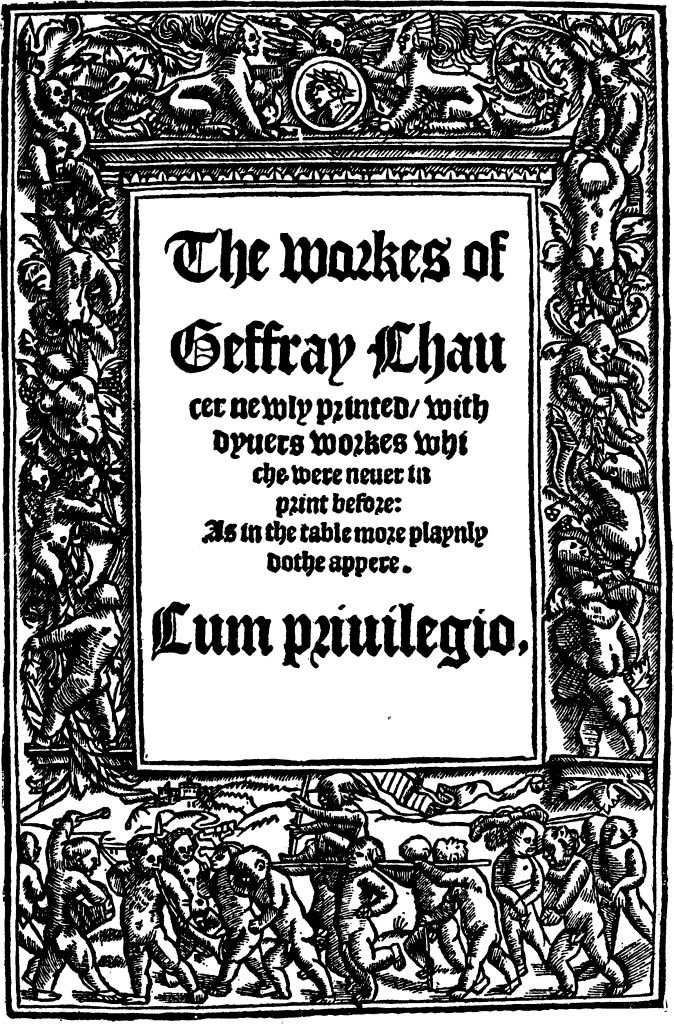
CHAUCER.
Title-page of the first attempt to collect his works into one volume. The imprint reads: Imprinted at London by Thomas Godfray, The yeare of our lorde M.D.XXXII. Title: The Workes of Geffray Chaucer newly printed, with dyuers workes whiche were neuer in print before: As in the table more playnly dothe appere. Cum priuilegio.
Such was the plan of the work. It was laid out on an extensive scale, perhaps on too extensive a scale ever to have been completed. Certain it is that it was very far from ever reaching even remotely that result. According to the scheme set forth in the prologue, the work when finished should have included over one hundred and twenty tales. It actually comprises but twenty-four. Even of these, two are incomplete: the Cook's Tale, which is little more than begun, and the romantic Eastern tale of the Squire, which, in Milton's words, is "left half told." To those that are finished, the connecting links have not been supplied in many cases. Accordingly the work exists not as a perfect whole, but in eight or nine fragmentary parts, each complete in itself, but lacking a close connection with the others, though all are bound together by the unity of a common central interest. The value of what has been done makes doubly keen the regret that so much has been left undone. Politics, religion, literature, manners, are all touched upon in this wide-embracing view, which still never misses what is really essential; and added to this is a skill of portrayal by which the actors, whether narrating the tales themselves, or themselves forming the heroes of the narration, fairly live and breathe before our eyes. Had the work been completed on the scale upon which it was begun, we should have had a picture of life and opinion in the fourteenth century more vivid and exact than has been drawn of any century before or since.
The selections given are partly of extracts and partly of complete pieces. To the former class belong the lines taken from the opening of the 'Canterbury Tales,' with the description of a few of the characters; the description of the temples of Mars, of Venus, and of Diana in the Knight's Tale; and the account of the disappearance of the fairies at the opening of the Wife of Bath's Tale. The complete pieces are the tales of the Pardoner, and of the Nun's Priest. From the first, however, has been dropped the discourse on drunkenness, profanity, and gambling, which, though in keeping with the character of the narrator, has no connection with the development of the story. The second, the tale of the Nun's Priest, was modernized by Dryden under the title of the 'Cock and the Fox.' All of these are in heroic verse. The final selection is the ballade now usually entitled 'Truth.' In it the peculiar ballade construction can be studied—that is, the formation in three stanzas, either with or without an envoy; the same rhymes running through the three stanzas; and the final line of each stanza precisely the same. One of Chaucer's religious poems—the so-called 'A B C'—can be found under Deguileville, from whose 'Pèlerinage la de Vie Humaine' it is translated.
Chaucer's style, like that of all great early writers, is marked by perfect simplicity, and his language is therefore comparatively easy to understand. In the extracts here given the spelling has been modernized, save occasionally at the end of the line, when the rhyme has required the retention of an earlier form. The words themselves and grammatical forms have of course undergone no change. There are two marks used to indicate the pronunciation: first, the acute accent to indicate that a heavier stress than ordinary is to be placed on the syllable over which it stands; and secondly, the grave accent to indicate that the letter or syllable over which it appears, though silent in modern pronunciation, was then sounded. Thus landès, grovès, friendès, knavès, would have the final syllable sounded; and in a similar way timè, Romè, and others ending in e, when the next word begins with a vowel or h mute. The acute accent can be exemplified in words like couráge, reasón, honoúr, translatéd, where the accent would show that the final syllable would either receive the main stress or a heavier stress than is now given it. Again, a word like cre-a-ture consists, in the pronunciation here given, of three syllables and not of two, and is accordingly represented by a grave accent over the a to signify that this vowel forms a separate syllable, and by the acute accent over the ture to indicate that this final syllable should receive more weight of pronunciation than usual. It accordingly appears as creàtúre. In a similar way con-dit-i-on would be a word of four syllables, and its pronunciation would be indicated by this method conditìón. It is never to be forgotten that Chaucer had no superior in the English tongue as a master of melody; and if a verse of his sounds inharmonious, it is either because the line is corrupt or because the reader has not succeeded in pronouncing it correctly.
The explanation of obsolete words or meanings is given in the foot-notes. In addition to these the following variations from modern English that occur constantly, and are therefore not defined, should be noted. Hir and hem stand for 'their' and 'them.' The affix y- is frequently prefixed to the past participle, which itself sometimes omits the final en or -n, as 'ydrawe,' 'yshake.' The imperative plural ends in -th, as 'dreadeth.' The general negative ne is sometimes to be defined by 'not,' sometimes by 'nor'; and connected with forms of the verb 'be' gives us nis, 'is not'; nas, 'was not.' As is often an expletive, and cannot be rendered at all; that before 'one' and 'other' is usually the definite article; there is frequently to be rendered by 'where'; mo always means 'more'; thilke means 'that' or 'that same'; del is 'deal' in the sense of 'bit,' 'whit'; and the comparatives of 'long' and 'strong' are lenger and strenger. Finally it should be borne in mind that the double negative invariably strengthens the negation.

PROLOGUE TO THE 'CANTERBURY TALES'
When that Aprílè with his showers swoot[18] The drought of March hath piercèd to the root, And bathèd every vein in such liqoúr Of which virtue engendered is the flower; When Zephyrús eke with his sweetè breath Inspirèd hath in every holt and heath The tender croppès, and the youngè sun Hath in the Ram his halfè course yrun, And smallè fowlès maken melody, That sleepen all the night with open eye,— So pricketh hem natúre in hir couráges[19]— Then longen folk to go on pilgrimáges, And palmers for to seeken strangè strands, To fernè hallows[20] couth[21] in sundry lands; And specially, from every shirès end Of Engèland, to Canterbury they wend, The holy blissful martyr for to seek, That hem hath holpen when that they were sick. Befell that in that season on a day, In Southwark at the Tabard[22] as I lay, Ready to wenden on my pilgrimáge To Canterbury with full devout couráge, At night were come into that hostelry Well nine and twenty in a company Of sundry folk, by áventúre[23] yfalle In fellowship, and pilgrims were they all, That toward Canterbury woulden ride. The chambers and the stables weren wide, And well we weren easèd[24] at the best. And shortly, when the sunnè was to rest, So had I spoken with hem evereach-one,[25] That I was of hir fellowship anon, And madè forward[26] early for to rise To take our way there-as I you devise.[27] But nathèless, while I have time and space, Ere that I further in this talè pace, Me thinketh it accordant to reasón, To tellen you all the conditìón Of each of hem, so as it seemèd me, And which they weren, and of what degree, And eke in what array that they were in: And at a knight then will I first begin. The Knight A knight there was, and that a worthy[28] man, That[29] from the timè that he first began To riden out, he[29] lovèd chivalry, Truth and honoúr, freedom[30] and courtesy. Full worthy was he in his Lordès war, And thereto had he ridden, no man farre,[31] As well in Christendom as in Heatheness, And ever honoured for his worthiness. At Alexandr' he was when it was won; Full oftè time he had the board begun[32] Aboven allè natìóns in Prusse; In Lettowe[33] had he reyséd[34] and in Russe, No Christian man so oft of his degree; In Gernade[35] at the siegè had he be Of Algezir,[36] and ridden in Belmarié.[37] At Lieys[38] was he, and at Satalié,[39] When they were won; and in the Greatè Sea[40] At many a noble army[41] had he be. At mortal battles had he been fifteen, And foughten for our faith at Tramassene[42] In listès thriès, and aye slain his foe. This ilkè[43] worthy knight had been also Sometimè with the lord of Palatié,[44] Again another heathen in Turkéy: And evermore he had a sovereign pris.[45] And though that he were worthy[46] he was wise, And of his port as meek as is a maid. He never yet no villainy[47] ne said In all his life unto no manner wight.[48] He was a very perfect gentle knight. But for to tellen you of his array, His horse were good, but he ne was not gay[49]; Of fustìán he wearèd a gipon,[50] All besmuterèd[51] with his habergeón, For he was late ycome from his viáge.[52] And wentè for to do his pilgrimáge. The Prioress There was also a Nun, a Prioress, That of her smiling was full simple and coy; Her greatest oath was but by Sáìnt Loy; And she was clepèd[53] Madame Eglentine. Full well she sang the servicè divine, Entunéd[54] in her nose full seemèly; And French she spake full fair and fetisly[55] After the school of Stratford-at-the-Bow, For French of Paris was to her unknowe. At meatè well ytaught was she withal; She let no morsel from her lippès fall, Ne wet her fingers in her saucè deep. Well could she carry a morsel, and well keep, That no dropè ne fell upon her breast. In courtesy was set full much her lest.[56] Her over-lippè wipèd she so clean, That in her cup there was no farthing[57] seen Of greasè, when she drunken had her draught; Full seemèly after her meat she raught[58]: And sickerly[59] she was of great disport, And full pleasánt and amiable of port, And painèd[60] her to counterfeiten[61] cheer Of court, and to be stately of manére, And to be holden digne[62] of revérence. But for to speaken of her consciénce,[63] She was so charitable and so pitoús, She wouldè weep if that she saw a mouse Caught in a trap, if it were dead or bled; Of smallè houndès had she, that she fed With roasted flesh, or milk and wastel-bread[64]; But soré wept sh' if one of hem were dead,[65] Or if men[66] smote it with a yardè[67] smarte[68]: And all was conscìénce and tender heart. Full seemèly her wimple[69] pinchèd[70] was; Her nosè tretys, her eyen gray as glass, Her mouth full small and thereto soft and red; But sickerly[71] she had a fair forehéad; It was almost a spannè broad, I trow; For hardily[72] she was not undergrowe.[73] Full fetis[74] was her cloak, as I was ware. Of small corál about her arm she bare A pair[75] of beadès gauded all with green[76]; And thereon hung a brooch of gold full sheen, On which ther was first writ a crownèd A, And after, Amor vincit omnia. Another Nunnè with her haddè she, That was her chapèlain,[77] and Priestès three. The Friar A Frere there was, a wanton and a merry, A limitoúr,[78] a full solemnè[79] man. In all the orders four is none that can[80] So much of dalliance and fair languáge. He haddè made full many a marrìáge Of youngè women at his owen cost. Unto his order he was a noble post; Full well beloved and fámiliár was he With franklins over-all[81] in his country, And eke with worthy[82] women of the town: For he had powèr of confessìón, As saidè hímself, more than a curáte, For of his order he was licentiáte. Full sweetèly heard he confessìón, And pleasant was his absolutìón. He was an easy man to give penánce, There-as he wist to have[83] a good pittánce; For unto a poor order for to give Is signè that a man is well yshrive; For if he gave, he durstè make avaunt,[84] He wistè that a man was répentánt. For many a man so hard is of his heart, He may not weep although him sorè smart; Therefore instead of weeping and prayérs, Men mote give silver to the poorè freres. His tippet was aye farsèd[85] full of knives And pinnès, for to given fairè wives; And certainly he had a merry note: Well could he sing and playen on a rote[86]; Of yeddings[87] he bare utterly the pris.[88] His neckè white was as the fleur-de-lis. Thereto he strong was as a champión. He knew the taverns well in every town, And every hostèlér[89] and tapèstér, Bet than a lazár[90] or a beggestér[91]; For unto such a worthy man as he Accorded nought, as by his faculty, To have with sickè lazárs ácquaintánce; It is not honest, it may not advance For to dealen with no such poraille,[92] But all with rich and sellers[93] of vitaille.[94] And o'er-all,[95] there-as profit should arise, Courteous he was and lowly of servíce. There was no man nowhere so virtuous[96]; He was the bestè beggar in his house: [And gave a certain farmè[97] for the grant, None of his brethren came there in his haunt.] For though a widow haddè not a shoe, So pleasant was his In principio,[98] Yet would he have a farthing ere he went; His purchase[99] was well better than his rent.[100] And rage[101] he could as it were right a whelp: In lovèdays[102] there could he muchel help; For there he was not like a cloisterér With a threadbare cope, as is a poor scholér; But he was like a master or a pope, Of double worsted was his semicope,[103] That rounded as a bell out of the press. Somewhat he lispèd for his wantonness, To make his English sweet upon his tongue; And in his harping, when that he had sung, His eyen twinkled in his head aright, As do the starrès in the frosty night. This worthy limitour was cleped[104] Hubérd. The Clerk of Oxford A Clerk there was of Oxenford[105] also, That unto logic haddè long ygo.[106] As leanè was his horse as is a rake, And he was not right fat, I undertake,[107] But lookèd hollow, and thereto soberly. Full threadbare was his overest[108] courtepy,[109] For he had geten[110] him yet no benefice, Ne was so worldly for to have office. For him was liefer[111] have at his bed's head Twenty bookès clad in black or red, Of Aristotle, and his philosophy, Than robes rich, or fiddle, or gay psaltery. But albe that he was a philosópher, Yet haddè he but little gold in coffer, But all that he might of his friendès hent,[112] On bookès and his learning he it spent, And busily[113] gan for the soulès pray Of hem, that gave him wherewith to scolay[114]; Of study took he most cure and most heed. Not one word spake he morè than was need; And that was said in form and reverence, And short and quick, and full of high senténce.[115] Sounding in moral virtue was his speech, And gladly would he learn and gladly teach. The Lawyer A sergeant of the Lawè, ware and wise, That often had ybeen at the Parvys,[116] There was also, full rich of excellence. Discreet he was and of great reverence; He seemèd such, his wordès were so wise; Justice he was full often in assize, By patent and by plein[117] commissìón. For his sciénce, and for his high renown, Of fees and robès had he many one; So great a purchaser[118] was nowhere none; All was fee simple to him in effect, His purchasíng mightè not be infect.[119] Nowhere so busy a man as he there nas, And yet he seemèd busier than he was. In termès had he case and doomès[120] all, That from the time of King Williám were fall. Thereto he could indite, and make a thing, There couldè no wight pinch[121] at his writíng; And every statute could[122] he plein[123] by rote. He rode but homely in a medley[124] coat, Girt with a ceint[125] of silk, with barrès smale[126]; Of his array tell I no lenger tale. The Shipman A shipman was there, woning[127] far by West: For aught I wot, he was of Dartèmouth. He rode upon a rouncy,[128] as he couth,[129] In a gown of falding[130] to the knee. A dagger hanging on a lace had he About his neck under his arm adown; The hotè summer had made his hue all brown; And certainly he was a good felláw. Full many a draught of wine had he ydrawe From Bourdeaux-ward, while that the chapman[131] sleep[132]; Of nicè conscìénce took he no keep.[133] If that he fought, and had the higher hand, By water he sent hem home to every land. But of his craft to reckon well his tides, His streamès and his dangers him besides, His harbour and his moon, his lodemanáge,[134] There was none such from Hullè to Cartháge. Hardy he was, and wise to undertake; With many a tempest had his beard been shake. He knew well all the havens, as they were, From Gothland to the Cape of Finisterre, And every creek in Bretagne and in Spain: His barge yelepèd was the Maudelaine.
THE TEMPLES OF VENUS, MARS, AND DIANA
From the Knight's Tale
First in the temple of Venus mayst thou see Wrought on the wall, full piteous to behold, The broken sleepès, and the sighès cold, The sacred tearès, and the waimentíng,[135] The fiery strokès of the désiríng That lovès servants in this life enduren; The oathès, that hir covenánts assuren. Pleasance and hope, desire, foolhardiness, Beauty and youthè, bawdry and richesse, Charmès and force, leasíngs[136] and flattery, Dispencè,[137] business,[138] and jealousy That weared of yellow goldès[139] a garlánd, And a cuckoo sitting on her hand; Feastès, instruments, carólès, dances, Lust and array, and all the circumstances Of love, which that I reckoned have and reckon shall, By order weren painted on the wall, And mo than I can make of mentìón. For soothly all the mount of Citheron, There Venus hath her principal dwellíng, Was showèd on the wall in portrayíng, With all the garden and the lustiness. Nought was forgot the porter Idleness, Ne Narcissus the fair of yore agone, Ne yet the folly of King Solomon, Ne yet the greatè strength of Hercules, The enchantèments of Medea and Circes, N'of Turnús with the hardy fierce couráge, The richè Crœsus caitiff[140] in serváge[141]. Thus may ye see, that wisdom ne richesse, Beauty ne sleightè, strengthè, hardiness, Ne may with Venus holden champarty[142], For as her list the world then may she gye[143]. Lo, all these folk so caught were in her las[144] Till they for woe full often said, "Alas!" Sufficeth here ensamples one or two, And though I couldè reckon a thousand mo. The statue of Venus, glorious for to see, Was naked fleting[145] in the largè sea, And from the navel down all covered was With wavès green, and bright as any glass, A citole[146] in her right hand haddé she, And on her head, full seemly for to see, A rosé garland fresh and well smellíng, Above her head her dovès flickeríng[147]. Before her stood her sonè Cupido, Upon his shoulders wingès had he two; And blind he was, as it is often seen; A bow he bare and arrows bright and keen. Why should I not as well eke tell you all The portraitúre, that was upon the wall Within the temple of mighty Mars the red? All painted was the wall in length and brede[148] Like to the estres[149] of the grisly place, That hight the greatè temple of Mars in Thrace, In thilkè coldè frosty regìón, There-as Mars hath his sovereign mansìón. First on the wall was painted a forést, In which there dwelleth neither man ne beast, With knotty gnarry barren treès old Of stubbès[150] sharp and hideous to behold, In which there ran a rumble and a sough, As though a storm should bresten[151] every bough: And downward from an hill, under a bent,[152] There stood the temple of Mars armipotent, Wrought all of burnèd[153] steel, of which th' entry Was long and strait[154] and ghastly for to see. And thereout came a rage and such a vese,[155] That it made all the gatès for to rese.[156] The northern light in at the doorès shone, For window on the wall ne was there none Through which men mighten any light discern; The doors were all of adamant eterne, Yclenchèd overthwart and endèlong[157] With iron tough, and for to make it strong, Every pillár the temple to sustene Was tunnè-great,[158] of iron bright and sheen. There saw I first the dark imagining Of felony, and all the compassing; The cruel irè, red as any gleed,[159] The pickèpurse, and eke the palè drede[160]; The smiler with the knife under the cloak; The shepen[161] brenning[162] with the blackè smoke; The treason of the murdering in the bed, The open war, with woundès all bebled; Contek[163] with bloody knife and sharp menáce. All full of chirking[164] was that sorry place. The slayer of himself yet saw I there, His heartè-blood hath bathèd all his hair: The nail ydriven in the shode[165] anight; The coldè death, with mouth gapíng upright.[166] Amiddès of the temple sat mischance, With díscomfórt and sorry countenance, Yet saw I woodness[167] laughing in his rage, Armèd complaint, outhees,[168] and fierce outrage; The carrion[169] in the bush, with throat ycorven,[170] A thousand slain, and not of qualm[171] ystorven[172]; The tyrant with the prey by force yreft; The town destroyed, there was nothing left. Yet saw I brent[173] the shippès hoppèsteres,[174] The huntè[175] strangled with the wildè bears: The sowè freten[176] the child right in the cradle; The cook yscalded, for all his longè ladle. Nought was forgotten by th' infortúne of Marte; The carter overridden with his cart; Under the wheel full low he lay adown. There were also of Mars' divisìón, The barber, and the butcher, and the smith That forgeth sharpè swordès on his stith.[177] And all above depainted in a tower Saw I Conquést, sitting in great honóur, With the sharpè sword over his head Hanging by a subtle[178] twinès thread. Depainted was the slaughter of Juliús, Of great Neró, and of Antoniús: Albe that thilkè time they were unborn, Yet was hir death depainted therebeforn, By ménacíng of Mars, right by figúre, So was it showèd in that portraitúre, As is depainted in the stars above, Who shall be slain or ellès dead for love. Sufficeth one ensample in stories old, I may not reckon them allè though I wold. The statue of Mars upon a cartè stood Armèd, and lookèd grim as he were wood,[179] And over his head there shinen two figúres Of starrès, that be clepèd in scriptúres,[180] That one Puella, that other Rubeus.[181] This god of armès was arrayèd thus: A wolf there stood before him at his feet With eyen red, and of a man he eat: With subtle pencil depainted was this story, In redoubting[182] of Mars and of his glory. Now to the temple of Dián the chaste As shortly as I can I will me haste, To tellen you all the descriptìón: Depainted be the wallès up and down Of hunting and of shamefast chastity. There saw I how wofúl Calistope,[183] When that Dian aggrievèd was with her, Was turnèd from a woman to a bear, And after was she made the lodèstar[184]: Thus was it painted, I can say no farre[185]; Her son is eke a star as men may see. There saw I Danè yturnèd till[186] a tree, I meanè not the goddesse Diánè, But Peneus' daughter, which that hightè Danè. There saw I Acteon an hart ymakèd,[187] For vengeance that he saw Dian all naked: I saw how that his houndès have him caught, And freten[188] him for that they knew him naught. Yet painted was a little furthermore, How Atalanta hunted the wild boar, And Meleager, and many another mo, For which Diana wrought him care and woe. There saw I many another wonder story, The which me list not drawen to memóry. This goddess on an hart full highè seet,[189] With smallè houndès all about her feet, And underneath her feet she had a moon, Waxing it was, and shouldè wanen soon. In gaudy-green[190] her statue clothèd was, With bow in hand and arrows in a case. Her eyen castè she full low adown There Pluto hath his darkè regìón. A woman travailing was her beforn, But for her child so longè was unborn Full piteously Lucina[191] gan she call, And saidè, "Help, for thou mayst best of all." Well could he painten lifely[192] that it[193] wrought, With many a florin he the huès bought.
THE PASSING OF THE FAIRIES
From the Wife of Bath's Tale
In th' oldè dayès of the king Arthúr Of which that Britons speaken great honóur, All was this land fulfilled of faèrié; The Elf-queen, with her jolly company, Dancèd full oft in many a greenè mead; This was the old opinion as I read: I speak of many hundred years ago; But now can no man see none elvès mo, For now the greatè charity and prayérs Of limitours[194] and other holy freres, That searchen every land and every stream, As thick as motès in the sunnè-beam, Blessing halles, chambers, kitchenès, bowers, Cities, boroughs, castles, highè towers, Thorpès, barnès, shepens,[195] daìriés, This maketh that there be no faèriés: For there as wont to walken was an elf, There walketh now the limitour himself, In undermelès[196] and in morwènings, And saith his matins and his holy things, As he goeth in his limitatìón,[197] Women may go now safely up and down, In every bush, and under every tree; There is none other incubus but he.
THE PARDONER'S TALE
In Flanders whilom was a company Of youngè folk, that haunteden folly, As riot, hazard, stewès, and tavérns; Whereas with harpès, lutès, and gittérns,[198] They dance and play at dice both day and night, And eat also, and drinken o'er hir might; Through which they do the devil sacrifice Within the devil's temple, in cursed wise, By superfluity abomináble. Hir oathès be so great and so damnáble, That it is grisly[199] for to hear hem swear. Our blessèd Lordès body they to-tear[200]; Hem thoughte[201] Jewès rent him not enough; And each of hem at otherès sinnè lough.[202] And right anon then comen tombesteres[203] Fetis[204] and small, and youngè fruitesteres,[205] Singers with harpès, bawdès, waferérs,[206] Which be the very devil's officérs, To kindle and blow the fire of lechery, That is annexèd unto gluttony.
These riotourès three, of which I tell, Long erst ere[207] primè rung of any bell, Were set hem in a tavern for to drink: And as they sat, they heard a bellè clink Before a corpse, was carried to his grave: That one of hem gan callen to his knave,[208] "Go bet,"[209] quoth he, "and askè readily, What corpse is this, that passeth here forby: And look that thou report his namè well." "Sir," quoth this boy, "it needeth never a del; It was me told ere ye came here two hours: He was pardie an old fellów of yours, And suddenly he was yslain to-night, Fordrunk[210] as he sat on his bench upright: There came a privy thief, men clepeth[211] Death, That in this country all the people slayéth, And with his spear he smote his heart atwo, And went his way withouten wordès mo. He hath a thousand slain this pestilénce: And, master, ere ye come in his presénce, Methinketh that it werè necessary, For to be ware of such an adversary; Be ready for to meet him evermore: Thus taughtè me my dame; I say no more." "By Saintè Mary," said this tavernér,[212] "The child saith sooth, for he hath slain this year Hence over a mile, within a great villáge, Both man and woman, child, and hine,[213] and page; I trow his habitatìón be there: To be avisèd[214] great wisdóm it were, Ere that he did a man a dishonóur." "Yea, Godès armès," quoth this riotóur, "Is it such peril with him for to meet? I shall him seek by way and eke by street, I make avow to Godès digne[215] bonès. Hearkeneth, fellówès, we three be all onès[216]: Let each of us hold up his hand till other, And each of us becomen otherès brother, And we will slay this falsè traitor Death: He shall be slain, which that so many slayeth, By Godès dignity, ere it be night." Together have these three hir truthès plight To live and dien each of hem for other, As though he were his own yborèn[217] brother. And up they start all drunken, in this rage, And forth they go towárdès that villáge. Of which the taverner had spoke beforn, And many a grisly[218] oath then have they sworn, And Christès blessed body they to-rent;[219] Death shall be dead,[220] if that they may him hent.[221] When they have gone not fully half a mile, Right as they would have trodden o'er a stile, An old man and a poorè with hem met. This oldè man full meekèly hem gret,[222] And saidè thus: "Now, lordès, God you see."[223] The proudest of these riotourès three Answéred again: "What, carl,[224] with sorry grace, Why art thou all forwrappèd[225] save thy face? Why livest thou so long in so great age?" This oldè man gan look on his viságe, And saidè thus: "For I ne cannot find A man, though that I walkèd into Ind, Neither in city, nor in no villáge, That wouldè change his youthè for mine age; And therefore mote I have mine agè still As longè time as it is Godès will. Ne death, alas! ne will not have my life; Thus walk I like a restèless cáìtiff, And on the ground, which is my mother's gate, I knockè with my staff, both early and late, And sayen, 'Liefè[226] mother, let me in. Lo, how I vanish, flesh, and blood, and skin; Alas! when shall my bonès be at rest? Mother, with you would I changen my chest, That in my chamber longè time hath be, Yea, for an hairè clout to wrappè me.' But yet to me she will not do that grace, For which full pale and welkèd[227] is my face. "But, sirs, to you it is no courtesy To speaken to an old man villainy, But[228] he trespass in word or else in deed. In holy writ ye may yourself well read; 'Against[229] an old man, hoar upon his head, Ye should arise:' wherefore I give you rede,[230] Ne do unto an old man none harm now, No morè than ye would men did to you In agè, if that ye so long abide. And God be with you, where ye go or ride; I mote go thither as I have to go." "Nay, oldè churl, by God, thou shalt not so," Saidè this other hazardour anon; "Thou partest not so lightly, by Saint John. Thou spake right now of thilkè traitor Death, That in this country all our friendès slayeth; Have here my truth, as thou art his espy; Tell where he is, or thou shalt it aby,[231] By God and by the holy sacrament; For soothly thou art one of his assent To slay us youngè folk, thou falsè thief." "Now, sirs," quoth he, "if that you be so lief[232] To finden Death, turn up this crooked way, For in that grove I left him, by my fay, Under a tree, and there he will abide; Not for your boast he will him nothing hide. See ye that oak? right there ye shall him find. God savè you, that bought again mankind, And you amend!" thus said this oldè man. And evereach[233] of these riotourès ran, Till he came to that tree, and there they found Of florins fine of gold ycoinèd round, Well nigh an eightè bushels, as hem thought. No lenger then after Death they sought, But each of hem so glad was of that sight, For that the florins be so fair and bright, That down they set hem by this precious hoard. The worst of hem he spake the firstè word. "Brethren," quoth he, "take keepè[234] what I say; My wit is great, though that I bourd[235] and play. This treasure hath fortúne unto us given In mirth and jollity our life to liven, And lightly as it cometh, so will we spend. Hey! Godès precious dignity! who wend[236] To-day, that we should have so fair a grace? But might this gold be carried from this place Home to mine house, or ellès unto yours, For well ye wot that all this gold is ours, Then werè we in high felicity. But trúèly by day it may not be; Men woulden say that we were thievès strong, And for our owen treasure do us hong.[237] This treasure must ycarried be by night As wisely and as slily as it might. Wherefore I rede,[238] that cut[239] among us all Be draw, and let see where the cut will fall: And he that hath the cut, with heartè blithè Shall rennè[240] to the town, and that full swith,[241] And bring us bread and wine full privily; And two of us shall keepen subtlely This treasure well; and if he will not tarry, When it is night, we will this treasure carry By one assent, where as us thinketh best." That one of hem the cut brought in his fist, And bade hem draw and look where it will fall, And it fell on the youngest of hem all: And forth towárd the town he went anon. And also[242] soon as that he was agone, That one of hem spake thus unto that other; "Thou knowest well thou art my sworen brother; Thy profit will I tellen thee anon. Thou wost[243] well that our fellow is agone, And here is gold, and that full great plenty, That shall departed be among us three. But nathèless, if I can shape it so, That it departed were among us two, Had I not done a friendès turn to thee?" That other answered, "I not[244] how that may be: He wot how that the gold is with us tway.[245] What shall we do? what shall we to him say?" "Shall it be counsel?" said the firstè shrew; "And I shall tellen thee in wordès few What we shall do, and bring it well about." "I grantè," quoth that other, "out of doubt, That by my truth I shall thee not bewray." "Now," quoth the first, "thou wost well we be tway, And two of us shall strenger be than one. Look, when that he is set, thou right anon Arise, as though thou wouldest with him play; And I shall rive him through the sidès tway, While that thou strugglest with him as in game, And with thy dagger look thou do the same; And then shall all this gold departed be, My dearè friend, betwixen me and thee: Then may we both our lustès all fulfill, And play at dice right at our owen will." And thus accorded be these shrewès tway To slay the third, as ye have heard me say. This youngest, which that went unto the town, Full oft in heart he rolleth up and down The beauty of these florins new and bright. "O Lord!" quoth he, "if so were that I might Have all this treasure to myself alone, There is no man that liveth under the throne Of God, that shouldè live so merry as I." And the last the fiend, our enemy, Put in his thought that he should poison bey,[246] With which he mightè slay his fellows twaye. Forwhy[247] the fiend found him in such livíng, That he had leavè him to sorrow bring. For this was utterly his full intent To slay hem both, and never to repent. And forth he goeth, no lenger would he tarry, Into the town unto a 'pothecary, And prayèd him that he him wouldè sell Some poison, that he might his rattès quell, And eke there was a polecat in his haw[248] That, as he said, his capons had yslawe[249]; And fain he wouldè wreak[250] him if he might, On vermin, that destroyèd him by night. The 'pothecary answéred, "And thou shalt have A thing that, also[251] God my soulè save, In all this world there nis no créàtúre, That eaten or drunk hath of this cónfectúre, Naught but the mountance[252] of a corn of wheat, That he ne shall his life anon forlete[253]; Yea, sterve[254] he shall, and that in lessè while, Than thou wilt go a pace[255] not but a mile: This poison is so strong and violent." This cursèd man hath in his hand yhent[256] This poison in a box, and sith he ran Into the nextè street unto a man, And borrowed of him largè bottles three; And in the two his poison pourèd he; The third he kept clean for his owen drink, For all the night he shope[257] him for to swink[258] In carrying the gold out of that place. And when this riotour, with sorry grace, Had filled with wine his greatè bottles three, To his fellóws again repaireth he. What needeth it to sermon of it more? For right as they had cast his death before, Right so they have him slain, and that anon. And when that this was done, thus spake that one: "Now let us sit and drink, and make us merry, And afterward we will his body bury." And with that word it happèd him par cas,[259] To take the bottle there the poison was, And drank, and gave his fellow drink also, For which anon they storven[260] bothè two. But certes I suppose that Avicen Wrote never in no canon, n' in no fen,[261] Mo wonder signès of empoisoning, Than had these wretches two ere hir endíng. Thus ended be these homicidès two, And eke the false empoisoner also.
THE NUN'S PRIESTS TALE
A poorè widow somedeal stope[262] in age, Was whilom dwelling in a narrow cottàge, Beside a grovè, standing in a dale. This widow, of which I tellè you my tale, Since thilkè day that she was last a wife, In patience led a full simple life. For little was her cattel[263] and her rent[264]: By husbandry[265] of such as God her sent She found[266] herself, and eke her daughtren two. Three largè sowès had she, and no mo; Three kine, and eke a sheep that hightè[267] Mall. Full sooty was her bower, and eke her hall, In which she ate full many a slender meal. Of poignant sauce her needed never a deal.[268] No dainty morsel passèd through her throat; Her diet was accordant to her cote.[269] Repletìón ne made her never sick; Attemper[270] diet was all her physíc, And exercise, and heartès suffisánce.[271] The goutè let[272] her nothing for to dance, N' apoplexy ne shentè[273] not her head. No wine ne drank she, neither white ne red: Her board was servèd most with white and black, Milk and brown bread, in which she found no lack, Seind[274] bacon, and sometime an egg or twey; For she was as it were a manner dey.[275] A yard she had, enclosed all about With stickès, and a dryè ditch without, In which she had a cock hight Chanticleer, In all the land of crowing was none his peer. His voice was merrier than the merry orgón, On massè days that in the churchè gon. Well sikerer[276] was his crowing in his lodge Than is a clock, or an abbéy horloge.[277] By nature he knew each ascensìón Of the equinoctiál in thilké town; For when degrees fifteenè were ascended, Then crew he, that it might not be amended. His comb was redder than the fine corál, And battled,[278] as it were a castle wall. His bill was black, and as the jet it shone; Like azure were his leggès and his ton[279]; His nailès whiter than the lily flower, And like the burned[280] gold was his colóur. This gentle cock had in his governánce Seven hennès, for to do all his pleasánce, Which were his sisters and his paramours, And wonder like to him, as of coloúrs; Of which the fairest huèd on her throat Was clepèd fairè Damosel Partelote. Courteous she was, discreet, and debonair, And cómpanáble,[281] and bare herself so fair, Sin[282] thilkè day that she was sevennight old, That truèly she hath the heart in hold[283] Of Chanticleer, locken[284] in every lith[285]; He loved her so, that well was him therewith. But such a joy was it to hear hem sing, When that the brightè sunnè gan to spring, In sweet accord, 'My lief is faren on land.'[286] For thilkè time, as I have understande, Beastès and birdès couldè speak and sing. And so befell, that in a dawèning, As Chanticleer among his wivès all Sat on his perchè, that was in the hall, And next him sat this fairè Partèlote, This Chanticleer gan groanen in his throat, As man that in his dream is drecchèd[287] sore, And when that Partèlote thus heard him roar, She was aghast, and said, "O heartè dear, What aileth you to groan in this mannére? Ye be a very sleeper, fie, for shame!" And he answéred and saidè thus: "Madáme, I pray you that ye take it not agrief[288]; By God, me met[289] I was in such mischiéf[290] Right now, that yet mine heart is sore affright. Now God," quoth he, "my sweven[291] read[292] aright, And keep my body out of foul prisón. Me met how that I roamèd up and down Within our yard, where-as I saw a beast Was like an hound, and would have made arrest Upon my body, and have had me dead. His colour was betwixè yellow and red; And tippèd was his tail, and both his ears With black, unlike the remnant of his hairs. His snoutè small, with glowing eyen twey; Yet of his look for fear almost I dey[293]: This causèd me my groaning doubteless." "Avoy!" quoth she, "fie on you heartèless! Alas!" quoth she, "for by that God above Now have ye lost mine heart and all my love; I cannot love a coward, by my faith. For certes, what so any woman saith, We all desiren, if it mightè be, To have husbándès, hardy, wise, and free, And secre,[294] and no niggard ne no fool, Ne him that is aghast of every tool, Ne none avantour[295] by that God above. How durst ye say for shame unto your love, That anything might maken you afeard? Have ye no mannès heart, and have a beard? Alas! and can ye be aghast of swevenès[296]? Nothing but vanity, God wot, in sweven is, Swevens engender of repletions, And oft of fume, and of complexións,[297] When humours be too abundant in a wight. Certes this dream, which ye have met[298] to-night, Cometh of the greatè superfluity Of yourè redè colera,[299] pardié, Which causeth folk to dreamen in hir dreams Of arrows, and of fire with redè leames,[300] Of greatè beastes, that they will hem bite, Of contek[301] and of whelpès great and lite[302]; Right as the humour of meláncholy Causeth full many a man in sleep to cry, For fear of blackè beares or bullès blake, Or ellès blackè devils will hem take. Of other humours could I tell also, That worken many a man in sleep full woe: But I will pass as lightly[303] as I can. Lo Cato, which that was so wise a man, Said he not thus? 'Ne do no force[304] of dreams.'" "Now, Sir," quoth she, "when ye fly from the beams, For Godès love, as take some laxative: Up[305] peril of my soul, and of my live, I counsel you the best, I will not lie, That both of choler, and of meláncholy Ye purgè you; and for ye shall not tarry, Though in this town is none apothecary, I shall myself to herbès teachen you, That shall be for your heal[306] and for your prow[307]; And in our yard tho[308] herbès shall I find, The which have of hir property by kind[309] To purgen you beneath, and eke above. Forget not this for Godès owen love; Ye be full choleric of complexìón; Ware the sun in his ascensìón Ne find you not replete of humours hot: And if it do, I dare well lay a groat, That ye shall have a fever tertìán, Or an agúe, that may be yourè bane. A day or two ye shall have dígestives Of wormès, ere ye take your laxatíves, Of lauriol, centaury, and fumetere,[310] Or else of hellebore, that growreth there, Of catapucè,[311] or of gaitres-berríès,[312] Of herb ivy growing in our yard, that merry is: Pick hem up right as they grow, and eat hem in. Be merry, husband, for your father kin Dreadeth no dream; I can say you no more." "Madame," quoth he, "grand mercy of" your lore. But nathèless, as touching Dan Caton, That hath of wisdom such a great renown, Though that he bade no dreamès for to drede, By God, men may in oldè bookès read,[313] Of many a man, more of authority Than ever Cato was, so mote I the,[314] That all the réverse say of this senténce, And have well founden by experiénce, That dreamès be significatìóns As well of joy, as of tribulatìóns, That folk enduren in this life présent. There needeth make of this none argument; The very prevè[315] sheweth it indeed. "One of the greatest authors that men read, Saith thus, that whilom two fellówès went On pilgrimage in a full good intent; And happèd so, they came into a town, Where-as there was such congregatìón Of people, and eke so strait of herbergage,[316] That they ne found as much as one cottáge, In which they bothè might ylodgèd be: Wherefore they musten of necessity, As for that night, departen[317] company; And each of hem goeth to his hostelry, And took his lodging as it wouldè fall. That one of hem was lodgèd in a stall, Far in a yard, with oxen of the plow; That other man was lodgèd well enow, As was his áventúre, or his fortúne, That us govérneth all, as in commúne. And so befell, that, long ere it were day, This man met[318] in his bed, there-as he lay, How that his fellow gan upon him call, And said, 'Alas! for in an oxès stall This night I shall be murdered, there I lie. Now help me, dearè brother, or I die; In allè hastè come to me,' he said. This man out of his sleep for fear abraid[319]; But when that he was wakened of his sleep, He turnèd him, and took of this no keep[320]; Him thought his dream nas but a vanity. Thus twiès in his sleeping dreamèd he. And at the thirdè time yet his felláw Came, as him thought, and said, 'I am now slawe.[321] Behold my bloody woundès, deep and wide. Arise up early, in the morrow tide, And at the west gate of the town,' quoth he, 'A cartè full of dung there shalt thou see, In which my body is hid full privily. Do thilkè cart arresten boldèly. My gold causèd my murder, sooth to sayn.' And told him every point how he was slain With a full piteous facè, pale of hue. And trusteth well, his dream he found full true; For on the morrow, as soon as it was day, To his fellówès inn he took his way: And when that he came to this oxès stall, After his fellow he began to call. The hostèler answérèd him anon, And saidè, 'Sir, your fellow is agone, As soon as day he went out of the town.' "This man gan fallen in suspicìón Remembering on his dreamès that he met,[322] And forth he goeth, no lenger would he let,[323] Unto the west gate of the town, and found A dung cart, as it were to dungè lond, That was arrayèd in that samè wise As ye have heard the deadè man devise: And with an hardy heart he gan to cry, 'Vengeance and justice of this felony: My fellow murdered is this samè night, And in this cart he lieth, gaping upright.[324] I cry out on the ministers,' quoth he, 'That shouldè keep and rulen this city: Harow! alas! here lieth my fellow slain.' What should I more unto this talè sayn? The people out start,[325] and cast the cart to ground, And in the middle of the dung they found The deadè man, that murdered was all new. O blissful God! that art so just and true, Lo, how that thou bewrayest[326] murder alway. Murder will out, that see we day by day. Murder is so wlatsom[327] and abomináble To God, that is so just and reasonáble, That he ne will not suffer it helèd[328] be, Though it abide a year, or two, or three; Murder will out, this is my conclusìón. "And right anon, minísters of that town Have hent[329] the carter, and so sore him pined,[330] And eke the hostèler so sore engíned,[331] That they beknew[332] hir wickedness anon, And were anhangèd by the neckè bone. "Here may men see that dreamès be to dread. And certes in the samè book I read, Right in the nextè chapter after this, (I gabbè[333] not, so have I joy and bliss,) Two men that would have passèd over sea For certain cause into a far country, If that the wind ne haddè been contráry, That made hem in a city for to tarry, That stood full merry upon an haven side. But on a day, again[334] the even tide, The wind gan change, and blew right as hem lest.[335] Jolly and glad they went unto hir rest, And casten hem full early for to sail; But to that one man fell a great marvail. That one of them in sleeping as he lay, He met29999 a wonder dream, again the day: Him thought a man stood by his beddès side, And him commanded that he should abide, And said him thus: 'If thou to-morrow wend, Thou shalt be dreynt[337]; my tale is at an end.' He woke, and told his fellow what he met,[336] And prayed him his voyagè to let[338]; As for that day, he prayed him for to abide. His fellow, that lay by his beddès side, Gan for to laugh, and scorned him full fast. 'No dream,' quoth he, 'may so my heart aghast, That I will letten for to do my things. I settè not a straw by thy dreamíngs, For swevens[339] be but vanities and japes.[340] Men dream all day of owlès or of apes, And eke of many a masè[341] therewithal; Men dream of thing that never was, ne shall. But sith I see that thou wilt here abide, And thus forslothen[342] wilfully thy tide, God wot it rueth[343] me, and have good day.' And thus he took his leave, and went his way. But ere that he had half his course ysailed, Nought I not[344] why, ne what mischance it ailed, But casually the shippès bottom rent, And ship and man under the water went In sight of other shippès there beside, That with hem sailèd at the samè tide. "And therefore, fairè Partèlote so dear, By such ensamples old yet mayst thou lere.[345] That no man shouldè be too reckèless Of dreamès, for I say thee doubtèless, That many a dream full sore is for to dread. "Lo, in the life of Saint Kenelm I read, That was Kenulphus son, the noble king Of Mercenrike,[346] how Kenelm met[347] a thing. A little ere he was murdered, on a day, His murder in his ávisión[348] he say.[349] His norice[350] him expounded every del His sweven, and bade him for to keep him well For[351] treason; but he nas but seven year old, And therefore little tale hath he told[352] Of any dream, so holy was his heart. By God, I haddè liefer than my shirt, That ye had read his legend, as have I. "Dame Partèlote, I say you truèly, Macrobius, that writ the ávisión[353] In Afric of the worthy Scipion, Affirmeth dreamès, and saith that they be Warning of thingès that men after see. And furthermore, I pray you looketh well In the Oldè Testament, of Daniél, If he held dreamès any vanity. Read eke of Joseph, and there shall ye see Where[354] dreamès be sometime (I say not all) Warning of thingès that shall after fall. Look of Egypt the king, Dan Pharao, His baker and his butèler also, Whether they ne felten none effect in dreams. Whoso will seeken acts of sundry remes,[355] May read of dreamès many a wonder thing. Lo Crœsus, which that was of Lydia king, Met[356] he not that he sat upon a tree, Which signified he should anhangèd be? "Lo here, Andromache, Hectórès wife, That day that Hector shouldè lese[357] his life, She dreamèd on the samè night beforn, How that the life of Hector should be lorn,[358] If thilkè day he went into battáil: She warnèd him, but it might not avail; He wentè for to fighten nathèless, And he was slain anon of Achillés. But thilkè tale is all too long to tell, And eke it is nigh day, I may not dwell. "Shortly I say, as for conclusìón, That I shall have of this avisìón Adversity: and I say furthermore, That I ne tell[359] of laxatives no store, For they be venomous, I wot it well: I hem defy, I love hem never a del. "Now let us speak of mirth, and stint all this; Madamè Partèlote, so have I bliss, Of one thing God hath sent me largè grace: For when I see the beauty of your face, Ye be so scarlet red about your eyen, It maketh all my dreadè for to dien, For, also[360] sicker[361] as In principio, Mulier est hominis confusio,— Madam, the sentence[362] of this Latin is, Woman is mannès joy and all his bliss— For when I feel a-night your softè side,
I am so full of joy and of soláce, That I defyè bothè sweven[363] and dream." And with that word he flew down from the beam, For it was day, and eke his hennès all; And with a chuck he gan hem for to call, For he had found a corn, lay in the yard. Royal he was, he was no more afeard;
He looketh as it were a grim lión; And on his toes he roameth up and down, Him deignèd not to set his feet to ground: He chucketh, when he hath a corn yfound, And to him rennen then his wivès all. Thus royal, as a prince is in his hall, Leave I this Chanticleer in his pastúre; And after will I tell his áventúre. When that the month in which the world began, That hightè March, when God first makèd man, Was cómplete, and ypassèd were also, Sithen[364] March began, thirty dayès and two, Befell that Chanticleer in all his pride, His seven wivès walking by his side, Cast up his eyen to the brightè sun, That in the sign of Taurus had yrun Twenty degrees and one, and somewhat more: He knew by kind,[365] and by none other lore, That it was prime, and crew with blissful steven,[366] "The sun," he said, "is clomben up on heaven Forty degrees and one, and more ywis.[367] Madamè Partèlote, my worldès bliss, Hearkeneth these blissful birdès how they sing, And see the freshè flowers how they spring; Full is mine heart of revel and soláce." But suddenly him fell a sorrowful case; For ever the latter end of joy is woe: God wot that worldly joy is soon ago; And if a rethor[368] couldè fair indite, He in a chronique safely might it write, As for a sovereign notability. Now every wise man, let him hearken me: This story is also[369] true, I undertake, As is the book of Launcelot de Lake, That women hold in full great reverénce. Now will I turn again to my senténce. A col fox,[370] full of sly iniquity, That in the grove had wonèd[371] yearès three, By high imaginatìón forncast,[372] The samè night throughout the hedges brast[373] Into the yard, there Chanticleer the fair Was wont, and eke his wivès, to repair; And in a bed of wortès[374] still he lay, Till it was passèd undern[375] of the day, Waiting his time on Chanticleer to fall: As gladly do these homicidès all, That in awaitè lie to murder men. O falsè murderer! lurking in thy den! O newè 'Scariot, newè Genelon! Falsè dissimulour, O Greek Sinon. That broughtest Troy all utterly to sorrow! O Chanticleer! accursèd be that morrow, That thou into that yard flew from the beams, Thou were full well ywarnèd by thy dreams, That thilkè day was perilous to thee. But what that God forewot[376] mote needès be, After the opinìón of certain clerkès. Witness on him that any perfect clerk is, That in school is great altercatìón In this mattér, and great disputison, And hath been of an hundred thousand men. But I ne cannot bolt[377] it to the bren,[378] As can the holy doctor Augustin, Or Boece, or the bishop Bradwardin, Whether that Godès worthy forewïtíng[379] Straineth me needly for to do a thing,— Needly clepe I simple necessity— Or ellès if free choice be granted me To do that samè thing, or do it nought, Though God forewot it ere that it was wrought; Or if his witing[380] straineth never a del, But by necessity conditionèl. I will not have to do of such mattère; My tale is of a cock, as ye may hear, That took his counsel of his wife with sorrow To walken in the yard upon that morrow That he had met[381] the dream, that I of told. Womenès counsels be full often cold; Womanès counsel brought us first to woe, And made Adám from Paradise to go, There as he was full merry, and well at ease. But for I not,[382] to whom it might displease, If I counsél of women wouldè blame, Pass over, for I said it in my game. Read authors, where they treat of such mattére, And what they say of women ye may hear. These be the cockès wordès, and not mine; I can none harm of no woman divine.[383] Fair in the sand, to bathe her merrily, Lieth Partelote, and all her sisters by, Again the sun; and Chanticleer so free Sang merrier than the mermaid in the sea; For Physiologus saith sikerly,[384] How that they singen well and merrily. And so befell that as he cast his eye Among the wortès on a butterfly, He was ware of this fox that lay full low. Nothing ne list him thennè for to crow, But cried anon "Cock! cock!" and up he start,[385] As man that was affrayèd in his heart. For naturally a beast desireth flee From his contráry, if he may it see, Though he ne'er erst[386] had seen it with his eye. This Chanticleer, when he gan him espy, He would have fled, but that the fox anon Said, "Gentle Sir, alas! why will ye gon? Be ye afraid of me that am your friend? Now certes, I were worsè than a fiend, If I to you would harm or villainy. I am not come your counsel for to espy, But truèly the cause of my comíng Was only for to hearken how that ye sing: For truèly ye have as merry a steven,[387] As any angel hath that is in heaven; Therewith ye have in music more feelíng, Than had Boece, or any that can sing. My lord your father! God his soulè bless And eke your mother of her gentillesse, Have in mine house ybeen, to my great ease: And certes, sir, full fain would I you please. But for men speak of singing, I will say, So mote I brooken[388] well my eyen tway, Save you, I heardè never man so sing, As did your father in the morwening. Certes it was of heart all that he sung. And for to make his voice the morè strong, He would so pain him, that with both his eyen He mustè wink, so loud he wouldè crien, And standen on his tipton therewithal, And stretchen forth his neckè long and small. And eke he was of such discretìón, That there nas no man in no regìón, That him in song or wisdom mightè pass. I have well read in Dan Burnel the ass Among his verse, how that there was a cock, For that a priestès son gave him a knock Upon his leg, while he was young and nice,[389] He made him for to lese his benefice. But certain there nis no comparisón Betwix the wisdom and discretìón Of your fathèr, and of his subtilty. Now singeth, sir, for saintè Charity, Let see, can ye your father counterfeit?" This Chanticleer his wingès gan to beat, As man that could his treason not espy, So was he ravished with his flattery. Alas! ye lordès, many a false flatour[390] Is in your courts, and many a losengeour,[390] That pleasen you well morè, by my faith, Than he that soothfastness[391] unto you saith. Readeth Ecclesiast of flattèry, Beware, ye lordès, of hir treachery. This Chanticleer stood high upon his toes Stretching his neck, and held his eyen close, And gan to crowen loudè for the nonce: And Dan Russèl the fox start up at once, And by the garget[392] hentè[393] Chanticleer, And on his back toward the wood him bare. For yet ne was there no man that him sued.[394] O destiny, that mayst not be eschewed! Alas, that Chanticleer flew from the beams! Alas, his wife ne raughtè[395] not of dreams! And on a Friday fell all this mischance. O Venus, that art goddess of pleasánce. Sin that thy servant was this Chanticleer, And in thy service did all his powér, More for delight, than world to multiply, Why wouldst thou suffer him on thy day to die? O Gaufrid, dearè master sovèreígn, That, when thy worthy king Richárd was slain With shot, complainedest his death so sore, Why nad[396] I now thy sentence and thy lore, The Friday for to chide, as diden ye?— For on a Friday soothly slain was he,— Then would I shew you how that I could plain For Chanticleerès dread, and for his pain. Certes such cry, ne lamentatìón Was ne'er of ladies made, when Ilión Was won, and Pyrrhus with his streitè[397] swerd, When he had hent king Priam by the beard, And slain him, as saith us Ænéidós, As maden all the hennès in the close, When they had seen of Chanticleer the sight. But sovereignly Dame Partèlotè shright,[398] Full louder than did Hasdrubalès wife, When that her husband haddè lost his life, And that the Romans haddè burnt Cartháge. She was so full of torment and of rage, That willfully into the fire she start, And brent[399] herselven with a steadfast heart. O woful hennès! right so crieden ye, As when that Nero brentè[399] the city Of Romè, crieden senatorès wives For that their husbands losten all hir lives; Withouten guilt this Nero hath hem slain. Now will I turnè to my tale again; This sely[400] widow, and eke her daughters two, Hearden these hennès cry and maken woe, And out at doorès starten they anon, And saw the fox toward the grovè gon, And bare upon his back the cock away: They crieden, "Out! harow and welawa! Ha, ha! the fox!" and after him they ran, And eke with stavès many another man; Ran Coll our dog, and Talbot, and Garland, And Malkin with a distaff in her hand; Ran cow and calf, and eke the very hoggès, So were they feared for barking of the doggès, And shouting of the men and women eke, They rannen so, hem thought hir heartè breke.[401] They yellèden as fiendès do in hell: The duckès crieden as men would hem quell: The geese for fearè flewen o'er the trees, Out of the hivè came the swarm of bees, So hideous was the noise, a! ben'cite! Certes he Jackè Straw, and his meyné,[402] Ne maden never shoutès half so shrill, When that they woulden any Fleming kill, As thilkè day was made upon the fox. Of brass they broughten beamès[403] and of box, Of horn and bone, in which they blew and poopèd,[404] And therewithal they shriekèd and they hoopèd[405], It seemèd as that heaven shouldè fall. Now, goodè men, I pray you hearkeneth all; Lo, how Fortunè turneth suddenly The hope and pride eke of her enemy. This cock that lay upon the fox's back, In all his dread, unto the fox he spake, And saidè, "Sir, if that I were as ye, Yet would I say, as wis[406] God helpè me, 'Turneth again, ye proudè churlès all; A very pestilence upon you fall! Now am I come unto the woodès side, Maugre your head, the cock shall here abide: I will him eat in faith, and that anon.'" The fox answéred, "In faith, it shall be done:" And as he spake that word, all suddenly This cock brake from his mouth deliverly,[407] And high upon a tree he flew anon. And when the fox saw that he was ygone, "Alas!" quoth he, "O Chanticleer, alas! I have to you," quoth he, "ydone trespáss, Inasmuch as I makèd you afeard, When I you hent,[408] and brought out of the yard; But, sir, I did it of no wicke[409] intent: Come down, and I shall tell you what I meant. I shall say sooth to you, God help me so." "Nay then," quoth he, "I shrew[410] us bothè two. And first I shrew myself, both blood and bonès, If thou beguile me any ofter than onès. Thou shalt no morè through thy flattery Do[411] me to sing and winken with mine eye. For he that winketh when he shouldè see, All willfully, God let him never the[412]!" "Nay," quoth the fox, "but God give him mischance, That is so indiscreet of governánce, That jangleth[413] when he shouldè hold his peace." Lo, such it is for to be reckèless And negligent, and trust on flattery. But ye that holden this tale a folly, As of a fox, or of a cock and hen, Take the morality thereof, good men. For Saint Paul saith, That all that written is, To our doctríne it is ywrit ywis,[414] Taketh the fruit, and let the chaff be still. Now goode God, if that it be thy will, As saith my lord, so make us all good men; And bring us to his highè bliss.—Amen.