Volume 3 — WALTER BAGEHOT
Reading edition
(1826-1877)
BY FORREST MORGAN

alter Bagehot was born February 3d, 1826, at Langport, Somersetshire, England; and died there March 24th, 1877. He sprang on both sides from, and was reared in, a nest of wealthy bankers and ardent Liberals, steeped in political history and with London country houses where leaders of thought and politics resorted; and his mother's brother-in-law was Dr. Prichard the ethnologist. This heredity, progressive by disposition and conservative by trade, and this entourage, produced naturally enough a mind at once rapid of insight and cautious of judgment, devoted almost equally to business action and intellectual speculation, and on its speculative side turned toward the fields of political history and sociology.
WALTER BAGEHOT
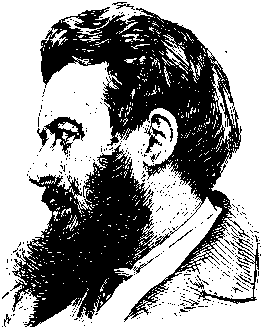
But there were equally important elements not traceable. His freshness of mental vision, the strikingly novel points of view from which he looked at every subject, was marvelous even in a century so fertile of varied independences: he complained that "the most galling of yokes is the tyranny of your next-door neighbor," the obligation of thinking as he thinks. He had a keen, almost reckless wit and delicious buoyant humor, whose utterances never pall by repetition; few authors so abound in tenaciously quotable phrases and passages of humorous intellectuality. What is rarely found in connection with much humor, he had a sensitive dreaminess of nature, strongly poetic in feeling, whence resulted a large appreciation of the subtler classes of poetry; of which he was an acute and sympathizing critic. As part of this temperament, he had a strong bent toward mysticism,--in one essay he says flatly that "mysticism is true,"--which gave him a rare insight into the religious nature and some obscure problems of religious history; though he was too cool, scientific, and humorous to be a great theologian.
Above all, he had that instinct of selective art, in felicity of words and salience of ideas, which elevates writing into literature; which long after a thought has merged its being and use in those of wider scope, keeps it in separate remembrance and retains for its creator his due of credit through the artistic charm of the shape he gave it.
The result of a mixture of traits popularly thought incompatible, and usually so in reality,--a great relish for the driest business facts and a creative literary gift,--was absolutely unique. Bagehot explains the general sterility of literature as a guide to life by the fact that "so few people who can write know anything;" and began a reform in his own person, by applying all his highest faculties--the best not only of his thought but of his imagination and his literary skill--to the theme of his daily work, banking and business affairs and political economy. There have been many men of letters who were excellent business men and hard bargainers, sometimes indeed merchants or bankers, but they have held their literature as far as possible off the plane of their bread-winning; they have not used it to explain and decorate the latter and made that the motive of art. Bagehot loved business not alone as the born trader loves it, for its profit and its gratification of innate likings,--"business is really pleasanter than pleasure, though it does not look so," he says in substance,--but as an artist loves a picturesque situation or a journalist a murder; it pleased his literary sense as material for analysis and composition. He had in a high degree that union of the practical and the musing faculties which in its (as yet) highest degree made Shakespeare; but even Shakespeare did not write dramas on how to make theatres pay, or sonnets on real-estate speculation.
Bagehot's career was determined, as usual, partly by character and partly by circumstances. He graduated at London University in 1848, and studied for and was called to the bar; but his father owned an interest in a rich old provincial bank and a good shipping-business, and instead of the law he joined in their conduct. He had just before, however, passed a few months in France, including the time of Louis Napoleon's coup d'état in December, 1851; and from Paris he wrote to the London Inquirer (a Unitarian weekly) a remarkable series of letters on that event and its immediate sequents, defending the usurpation vigorously and outlining his political creed, from whose main lines he swerved but little in after life. Waiving the question whether the defense was valid,--and like all first-rate minds, Bagehot is even more instructive when he is wrong than when he is right, because the wrong is sure to be almost right and the truth on its side neglected,--the letters are full of fresh, acute, and even profound ideas, sharp exposition of those primary objects of government which demagogues and buncombe legislators ignore, racy wit, sarcasm, and description (in one passage he rises for a moment into really blood-stirring rhetoric), and proofs of his capacity thus early for reducing the confused cross-currents of daily life to the operation of great embracing laws. No other writing of a youth of twenty-five on such subjects--or almost none--is worth remembering at all for its matter; while this is perennially wholesome and educative, as well as capital reading.
From this on he devoted most of his spare time to literature: that he found so much spare time, and produced so much of a high grade while winning respect as a business manager, proves the excellent quality of his business brain. He was one of the editors of the National Review, a very able and readable English quarterly, from its foundation in 1854 to its death in 1863, and wrote for it twenty literary, biographical, and theological papers, which are among his best titles to enduring remembrance, and are full of his choicest flavors, his wealth of thought, fun, poetic sensitiveness, and deep religious feeling of the needs of human nature. Previous to this, he had written some good articles for the Prospective Review, and he wrote some afterwards for the Fortnightly Review (including the series afterwards gathered into 'Physics and Politics'), and other periodicals.
But his chief industry and most peculiar work was determined by his marriage in 1858 to the daughter of James Wilson, an ex-merchant who had founded the Economist as a journal of trade, banking, and investment, and made it prosperous and rather influential. Mr. Wilson was engaging in politics, where he rose to high office and would probably have ended in the Cabinet; but being sent to India to regulate its finances, died there in 1860. Bagehot thereupon took control of the paper, and was the paper until his death in 1877; and the position he gave it was as unique as his own. On banking, finance, taxation, and political economy in general his utterances had such weight that Chancellors of the Exchequer consulted him as to the revenues, and the London business world eagerly studied the paper for guidance. But he went far beyond this, and made it an unexampled force in politics and governmental science, personal to himself. For the first time a great political thinker applied his mind week by week to discussing the problems presented by passing politics, and expounding the drift and meaning of current events in his nation and the others which bore closest on it, as France and America. That he gained such a hearing was due not alone to his immense ability, and to a style carefully modeled on the conversation of business men with each other, but to his cool moderation and evident aloofness from party as party. He dissected each like a man of science: party was to him a tool and not a religion. He gibed at the Tories; but the Tories forgave him because he was half a Tory at heart,--he utterly distrusted popular instincts and was afraid of popular ignorance. He was rarely warm for the actual measures of the Liberals; but the Liberals knew that he intensely despised the pig-headed obstructiveness of the typical Tory, and had no kinship with the blind worshipers of the status quo. To natives and foreigners alike for many years the paper was single and invaluable: in it one could find set forth acutely and dispassionately the broad facts and the real purport of all great legislative proposals, free from the rant and mendacity, the fury and distortion, the prejudice and counter-prejudice of the party press.
An outgrowth of his treble position as banker, economic writer, and general littérateur, was his charming book 'Lombard Street.' Most writers know nothing about business, he sets forth, most business men cannot write, therefore most writing about business is either unreadable or untrue: he put all his literary gifts at its service, and produced a book as instructive as a trade manual and more delightful than most novels. Its luminous, easy, half-playful "business talk" is irresistibly captivating. It is a description and analysis of the London money market and its component parts,--the Bank of England, the joint-stock banks, the private banks, and the bill-brokers. It will live, however, as literature and as a picture, not as a banker's guide; as the vividest outline of business London, of the "great commerce" and the fabric of credit which is the basis of modern civilization and of which London is the centre, that the world has ever known.
Previous to this, the most widely known of his works--'The English Constitution,' much used as a text-book--had made a new epoch in political analysis, and placed him among the foremost thinkers and writers of his time. Not only did it revolutionize the accepted mode of viewing that governmental structure, but as a treatise on government in general its novel types of classification are now admitted commonplaces. Besides its main themes, the book is a great store of thought and suggestion on government, society, and human nature,--for as in all his works, he pours on his nominal subject a flood of illumination and analogy from the unlikeliest sources; and a piece of eminently pleasurable reading from end to end. Its basic novelty lay in what seems the most natural of inquiries, but which in fact was left for Bagehot's original mind even to think of,--the actual working of the governmental system in practice, as distinguished from legal theory. The result of this novel analysis was startling: old powers and checks went to the rubbish heap, and a wholly new set of machinery and even new springs of force and life were substituted. He argued that the actual use of the English monarchy is not to do the work of government, but through its roots in the past to gain popular loyalty and support for the real government, which the masses would not obey if they realized its genuine nature; that "it raises the army though it does not win the battle." He showed that the function of the House of Peers is not as a co-ordinate power with the Commons (which is the real government), but as a revising body and an index of the strength of popular feeling. Constitutional governments he divides into Cabinet, where the people can change the government at any time, and therefore follow its acts and debates eagerly and instructedly; and Presidential, where they can only change it at fixed terms, and are therefore apathetic and ill-informed and care little for speeches which can effect nothing.
Just before 'Lombard Street' came his scientific masterpiece, 'Physics and Politics'; a work which does for human society what the 'Origin of Species' does for organic life, expounding its method of progress from very low if not the lowest forms to higher ones. Indeed, one of its main lines is only a special application of Darwin's "natural selection" to societies, noting the survival of the strongest (which implies in the long run the best developed in all virtues that make for social cohesion) through conflict; but the book is so much more than that, in spite of its heavy debt to all scientific and institutional research, that it remains a first-rate feat of original constructive thought. It is the more striking from its almost ludicrous brevity compared with the novelty, variety, and pregnancy of its ideas. It is scarcely more than a pamphlet; one can read it through in an evening: yet there is hardly any book which is a master-key to so many historical locks, so useful a standard for referring scattered sociological facts to, so clarifying to the mind in the study of early history. The work is strewn with fertile and suggestive observations from many branches of knowledge. Its leading idea of the needs and difficulties of early societies is given in one of the citations.
The unfinished 'Economic Studies' are partially a re-survey of the same ground on a more limited scale, and contain in addition a mass of the nicest and shrewdest observations on modern trade and society, full of truth and suggestiveness. All the other books printed under his name are collections either from the Economist or from outside publications.
As a thinker, Bagehot's leading positions may be roughly summarized thus: in history, that reasoning from the present to the past is generally wrong and frequently nonsense; in politics, that abstract systems are foolish, that a government which does not benefit its subjects has no rights against one that will, that the masses had much better let the upper ranks do the governing than meddle with it themselves, that all classes are too eager to act without thinking and ought not to attempt so much; in society, that democracy is an evil because it leaves no specially trained upper class to furnish models for refinement. But there is vastly more besides this, and his value lies much more in the mental clarification afforded by his details than in the new principles of action afforded by his generalizations. He leaves men saner, soberer, juster, with a clearer sense of perspective, of real issues, that more than makes up for a slight diminution of zeal.
As pure literature, the most individual trait in his writings sprang from his scorn of mere word-mongering divorced from actual life. "A man ought to have the right of being a Philistine if he chooses," he tells us: "there is a sickly incompleteness in men too fine for the world and too nice to work their way through it." A great man of letters, no one has ever mocked his craft so persistently. A great thinker, he never tired of humorously magnifying the active and belittling the intellectual temperament. Of course it was only half-serious: he admits the force and utility of colossal visionaries like Shelley, constructive scholars like Gibbon, ascetic artists like Milton, even light dreamers like Hartley Coleridge; indeed, intellectually he appreciates all intellectual force, and scorns feeble thought which has the effrontery to show itself, and those who are "cross with the agony of a new idea." But his heart goes out to the unscholarly Cavalier with his dash and his loyalty, to the county member who "hardly reads two books per existence," and even to the rustic who sticks to his old ideas and whom "it takes seven weeks to comprehend an atom of a new one." A petty surface consistency must not be exacted from the miscellaneous utterances of a humorist: all sorts of complementary half-truths are part of his service. His own quite just conception of humor, as meaning merely full vision and balanced judgment, is his best defense: "when a man has attained the deep conception that there is such a thing as nonsense," he says, "you may be sure of him for ever after." At bottom he is thoroughly consistent: holding that the masses should work in contented deference to their intellectual guides, but those guides should qualify themselves by practical experience of life, that poetry is not an amusement for lazy sybarites but the most elevating of spiritual influences, that religions cut the roots of their power by trying to avoid supernaturalism and cultivate intelligibility, and that the animal basis of human life is a screen expressly devised to shut off direct knowledge of God and make character possible.
To make his acquaintance first is to enter upon a store of high and fine enjoyment, and of strong and vivifying thought, which one must be either very rich of attainment or very feeble of grasp to find unprofitable or pleasureless.
THE VIRTUES OF STUPIDITY
From 'Letters on the French Coup d'État'
I fear you will laugh when I tell you what I conceive to be about the most essential mental quality for a free people whose liberty is to be progressive, permanent, and on a large scale: it is much stupidity. Not to begin by wounding any present susceptibilities, let me take the Roman character; for with one great exception,--I need not say to whom I allude,--they are the great political people of history. Now, is not a certain dullness their most visible characteristic? What is the history of their speculative mind? a blank; what their literature? a copy. They have left not a single discovery in any abstract science, not a single perfect or well-formed work of high imagination. The Greeks, the perfection of human and accomplished genius, bequeathed to mankind the ideal forms of self-idolizing art, the Romans imitated and admired; the Greeks explained the laws of nature, the Romans wondered and despised; the Greeks invented a system of numerals second only to that now in use, the Romans counted to the end of their days with the clumsy apparatus which we still call by their name; the Greeks made a capital and scientific calendar, the Romans began their month when the Pontifex Maximus happened to spy out the new moon. Throughout Latin literature, this is the perpetual puzzle:--Why are we free and they slaves, we praetors and they barbers? why do the stupid people always win and the clever people always lose? I need not say that in real sound stupidity the English are unrivaled: you'll hear more wit and better wit in an Irish street row than would keep Westminster Hall in humor for five weeks.
In fact, what we opprobriously call "stupidity," though not an enlivening quality in common society, is nature's favorite resource for preserving steadiness of conduct and consistency of opinion; it enforces concentration: people who learn slowly, learn only what they must. The best security for people's doing their duty is, that they should not know anything else to do; the best security for fixedness of opinion is, that people should be incapable of comprehending what is to be said on the other side. These valuable truths are no discoveries of mine: they are familiar enough to people whose business it is to know them. Hear what a douce and aged attorney says of your peculiarly promising barrister:--"Sharp? Oh, yes! he's too sharp by half. He is not safe, not a minute, isn't that young man." I extend this, and advisedly maintain that nations, just as individuals, may be too clever to be practical and not dull enough to be free....
And what I call a proper stupidity keeps a man from all the defects of this character: it chains the gifted possessor mainly to his old ideas, it takes him seven weeks to comprehend an atom of a new one; it keeps him from being led away by new theories, for there is nothing which bores him so much; it restrains him within his old pursuits, his well-known habits, his tried expedients, his verified conclusions, his traditional beliefs. He is not tempted to levity or impatience, for he does not see the joke and is thick-skinned to present evils. Inconsistency puts him out: "What I says is this here, as I was a-saying yesterday," is his notion of historical eloquence and habitual discretion. He is very slow indeed to be excited,--his passions, his feelings, and his affections are dull and tardy strong things, falling in a certain known direction, fixed on certain known objects, and for the most part acting in a moderate degree and at a sluggish pace. You always know where to find his mind. Now, this is exactly what (in politics at least) you do not know about a Frenchman.
REVIEW WRITING
From 'The First Edinburgh Reviewers'
Review writing exemplifies the casual character of modern literature: everything about it is temporary and fragmentary. Look at a railway stall: you see books of every color,--blue, yellow, crimson, "ring-streaked, speckled, and spotted,"--on every subject, in every style, of every opinion, with every conceivable difference, celestial or sublunary, maleficent, beneficent--but all small. People take their literature in morsels, as they take sandwiches on a journey....
And the change in appearance of books has been accompanied--has been caused--by a similar change in readers. What a transition from the student of former ages! from a grave man with grave cheeks and a considerate eye, who spends his life in study, has no interest in the outward world, hears nothing of its din and cares nothing for its honors, who would gladly learn and gladly teach, whose whole soul is taken up with a few books of 'Aristotle and his Philosophy,'--to the merchant in the railway, with a head full of sums, an idea that tallow is "up," a conviction that teas are "lively," and a mind reverting perpetually from the little volume which he reads to these mundane topics, to the railway, to the shares, to the buying and bargaining universe. We must not wonder that the outside of books is so different, when the inner nature of those for whom they are written is so changed.
In this transition from ancient writing to modern, the review-like essay and the essay-like review fill a large space. Their small bulk, their slight pretension to systematic completeness,--their avowal, it might be said, of necessary incompleteness,--the facility of changing the subject, of selecting points to attack, of exposing only the best corner for defense, are great temptations. Still greater is the advantage of "our limits." A real reviewer always spends his first and best pages on the parts of a subject on which he wishes to write, the easy comfortable parts which he knows. The formidable difficulties which he acknowledges, you foresee by a strange fatality that he will only reach two pages before the end; to his great grief, there is no opportunity for discussing them. As a young gentleman at the India House examination wrote "Time up" on nine unfinished papers in succession, so you may occasionally read a whole review, in every article of which the principal difficulty of each successive question is about to be reached at the conclusion. Nor can any one deny that this is the suitable skill, the judicious custom of the craft.
LORD ELDON
From 'The First Edinburgh Reviewers'
As for Lord Eldon, it is the most difficult thing in the world to believe that there ever was such a man; it only shows how intense historical evidence is, that no one really doubts it. He believed in everything which it is impossible to believe in,--in the danger of Parliamentary Reform, the danger of Catholic Emancipation, the danger of altering the Court of Chancery, the danger of altering the courts of law, the danger of abolishing capital punishment for trivial thefts, the danger of making land-owners pay their debts, the danger of making anything more, the danger of making anything less. It seems as if he maturely thought, "Now, I know the present state of things to be consistent with the existence of John Lord Eldon; but if we begin altering that state, I am sure I do not know that it will be consistent." As Sir Robert Walpole was against all committees of inquiry on the simple ground, "If they once begin that sort of thing, who knows who will be safe?" so that great Chancellor (still remembered in his own scene) looked pleasantly down from the woolsack, and seemed to observe, "Well, it is a queer thing that I should be here, and here I mean to stay."
TASTE
From 'Wordsworth, Tennyson, and Browning'
There is a most formidable and estimable insane taste. The will has great though indirect power over the taste, just as it has over the belief. There are some horrid beliefs from which human nature revolts, from which at first it shrinks, to which at first no effort can force it. But if we fix the mind upon them, they have a power over us, just because of their natural offensiveness. They are like the sight of human blood. Experienced soldiers tell us that at first, men are sickened by the smell and newness of blood, almost to death and fainting; but that as soon as they harden their hearts and stiffen their minds, as soon as they will bear it, then comes an appetite for slaughter, a tendency to gloat on carnage, to love blood (at least for the moment) with a deep, eager love. It is a principle that if we put down a healthy instinctive aversion, nature avenges herself by creating an unhealthy insane attraction. For this reason, the most earnest truth-seeking men fall into the worst delusions. They will not let their mind alone; they force it toward some ugly thing, which a crotchet of argument, a conceit of intellect recommends: and nature punishes their disregard of her warning by subjection to the ugly one, by belief in it. Just so, the most industrious critics get the most admiration. They think it unjust to rest in their instinctive natural horror; they overcome it, and angry nature gives them over to ugly poems and marries them to detestable stanzas.
CAUSES OF THE STERILITY OF LITERATURE
From 'Shakespeare, the Man,' etc.
The reason why so few good books are written is, that so few people that can write know anything. In general, an author has always lived in a room, has read books, has cultivated science, is acquainted with the style and sentiments of the best authors, but he is out of the way of employing his own eyes and ears. He has nothing to hear and nothing to see. His life is a vacuum. The mental habits of Robert Southey, which about a year ago were so extensively praised in the public journals, are the type of literary existence, just as the praise bestowed on them shows the admiration excited by them among literary people. He wrote poetry (as if anybody could) before breakfast; he read during breakfast. He wrote history until dinner; he corrected proof-sheets between dinner and tea; he wrote an essay for the Quarterly afterwards; and after supper, by way of relaxation, composed 'The Doctor'--a lengthy and elaborate jest. Now, what can any one think of such a life?--except how clearly it shows that the habits best fitted for communicating information, formed with the best care, and daily regulated by the best motives, are exactly the habits which are likely to afford a man the least information to communicate. Southey had no events, no experiences. His wife kept house and allowed him pocket-money, just as if he had been a German professor devoted to accents, tobacco, and the dates of Horace's amours....
The critic in the 'Vicar of Wakefield' lays down that you should always say that the picture would have been better if the painter had taken more pains; but in the case of the practiced literary man, you should often enough say that the writings would have been much better if the writer had taken less pains. He says he has devoted his life to the subject; the reply is, "Then you have taken the best way to prevent your making anything of it. Instead of reading studiously what Burgersdicius and Aenesidemus said men were, you should have gone out yourself and seen (if you can see) what they are." But there is a whole class of minds which prefer the literary delineation of objects to the actual eyesight of them. Such a man would naturally think literature more instructive than life. Hazlitt said of Mackintosh, "He might like to read an account of India; but India itself, with its burning, shining face, would be a mere blank, an endless waste to him. Persons of this class have no more to say to a matter of fact staring them in the face, without a label in its mouth, than they would to a hippopotamus."...
After all, the original way of writing books may turn out to be the best. The first author, it is plain, could not have taken anything from books, since there were no books for him to copy from; he looked at things for himself. Anyhow the modern system fails, for where are the amusing books from voracious students and habitual writers?
Moreover, in general, it will perhaps be found that persons devoted to mere literature commonly become devoted to mere idleness. They wish to produce a great work, but they find they cannot. Having relinquished everything to devote themselves to this, they conclude on trial that this is impossible; they wish to write, but nothing occurs to them: therefore they write nothing and they do nothing. As has been said, they have nothing to do; their life has no events, unless they are very poor; with any decent means of subsistence, they have nothing to rouse them from an indolent and musing dream. A merchant must meet his bills, or he is civilly dead and uncivilly remembered; but a student may know nothing of time, and be too lazy to wind lip his watch.
THE SEARCH FOR HAPPINESS
From 'William Cowper'
If there be any truly painful fact about the world now tolerably well established by ample experience and ample records, it is that an intellectual and indolent happiness is wholly denied to the children of men. That most valuable author, Lucretius, who has supplied us and others with an almost inexhaustible supply of metaphors on this topic, ever dwells on the life of his gods with a sad and melancholy feeling that no such life was possible on a crude and cumbersome earth. In general, the two opposing agencies are marriage and lack of money; either of these breaks the lot of literary and refined inaction at once and forever. The first of these, as we have seen, Cowper had escaped; his reserved and negligent reveries were still free, at least from the invasion of affection. To this invasion, indeed, there is commonly requisite the acquiescence or connivance of mortality; but all men are born--not free and equal, as the Americans maintain, but, in the Old World at least--basely subjected to the yoke of coin. It is in vain that in this hemisphere we endeavor after impecuniary fancies. In bold and eager youth we go out on our travels: we visit Baalbec and Paphos and Tadmor and Cythera,--ancient shrines and ancient empires, seats of eager love or gentle inspiration; we wander far and long; we have nothing to do with our fellow-men,--what are we, indeed, to diggers and counters? we wander far, we dream to wander forever--but we dream in vain. A surer force than the subtlest fascination of fancy is in operation; the purse-strings tie us to our kind. Our travel coin runs low, and we must return, away from Tadmor and Baalbec, back to our steady, tedious industry and dull work, to "la vieille Europe" (as Napoleon said), "qui m'ennuie." It is the same in thought: in vain we seclude ourselves in elegant chambers, in fascinating fancies, in refined reflections.
ON EARLY READING
From 'Edward Gibbon'
In school work Gibbon had uncommon difficulties and unusual deficiencies; but these were much more than counterbalanced by a habit which often accompanies a sickly childhood, and is the commencement of a studious life,--the habit of desultory reading. The instructiveness of this is sometimes not comprehended. S.T. Coleridge used to say that he felt a great superiority over those who had not read--and fondly read--fairy tales in their childhood: he thought they wanted a sense which he possessed, the perception, or apperception--we do not know which he used to say it was--of the unity and wholeness of the universe. As to fairy tales, this is a hard saying; but as to desultory reading, it is certainly true. Some people have known a time in life when there was no book they could not read. The fact of its being a book went immensely in its favor. In early life there is an opinion that the obvious thing to do with a horse is to ride it; with a cake, to eat it; with sixpence, to spend it. A few boys carry this further, and think the natural thing to do with a book is to read it. There is an argument from design in the subject: if the book was not meant for that purpose, for what purpose was it meant? Of course, of any understanding of the works so perused there is no question or idea. There is a legend of Bentham, in his earliest childhood, climbing to the height of a huge stool, and sitting there evening after evening, with two candles, engaged in the perusal of Rapin's history; it might as well have been any other book. The doctrine of utility had not then dawned on its immortal teacher; cui bono was an idea unknown to him. He would have been ready to read about Egypt, about Spain, about coals in Borneo, the teak-wood in India, the current in the River Mississippi, on natural history or human history, on theology or morals, on the state of the Dark Ages or the state of the Light Ages, on Augustulus or Lord Chatham, on the first century or the seventeenth, on the moon, the millennium, or the whole duty of man. Just then, reading is an end in itself. At that time of life you no more think of a future consequence--of the remote, the very remote possibility of deriving knowledge from the perusal of a book, than you expect so great a result from spinning a peg-top. You spin the top, and you read the book; and these scenes of life are exhausted. In such studies, of all prose, perhaps the best is history: one page is so like another, battle No. 1 is so much on a par with battle No. 2. Truth may be, as they say, stranger than fiction, abstractedly; but in actual books, novels are certainly odder and more astounding than correct history.
It will be said, What is the use of this? why not leave the reading of great books till a great age? why plague and perplex childhood with complex facts remote from its experience and inapprehensible by its imagination? The reply is, that though in all great and combined facts there is much which childhood cannot thoroughly imagine, there is also in very many a great deal which can only be truly apprehended for the first time at that age. Youth has a principle of consolidation; we begin with the whole. Small sciences are the labors of our manhood; but the round universe is the plaything of the boy. His fresh mind shoots out vaguely and crudely into the infinite and eternal. Nothing is hid from the depth of it; there are no boundaries to its vague and wandering vision. Early science, it has been said, begins in utter nonsense; it would be truer to say that it starts with boyish fancies. How absurd seem the notions of the first Greeks! Who could believe now that air or water was the principle, the pervading substance, the eternal material of all things? Such affairs will never explain a thick rock. And what a white original for a green and sky-blue world! Yet people disputed in these ages not whether it was either of those substances, but which of them it was. And doubtless there was a great deal, at least in quantity, to be said on both sides. Boys are improved; but some in our own day have asked, "Mamma, I say, what did God make the world of?" and several, who did not venture on speech, have had an idea of some one gray primitive thing, felt a difficulty as to how the red came, and wondered that marble could ever have been the same as moonshine. This is in truth the picture of life. We begin with the infinite and eternal, which we shall never apprehend; and these form a framework, a schedule, a set of co-ordinates to which we refer all which we learn later. At first, like the old Greek, "We look up to the whole sky, and are lost in the one and the all;" in the end we classify and enumerate, learn each star, calculate distances, draw cramped diagrams on the unbounded sky, write a paper on a Cygni and a treatise on e Draconis, map special facts upon the indefinite void, and engrave precise details on the infinite and everlasting. So in history: somehow the whole comes in boyhood, the details later and in manhood. The wonderful series, going far back to the times of old patriarchs with their flocks and herds, the keen-eyed Greek, the stately Roman, the watching Jew, the uncouth Goth, the horrid Hun, the settled picture of the unchanging East, the restless shifting of the rapid West, the rise of the cold and classical civilization, its fall, the rough impetuous Middle Ages, the vague warm picture of ourselves and home,--when did we learn these? Not yesterday nor to-day: but long ago, in the first dawn of reason, in the original flow of fancy. What we learn afterwards are but the accurate littlenesses of the great topic, the dates and tedious facts. Those who begin late learn only these; but the happy first feel the mystic associations and the progress of the whole.
However exalted may seem the praises which we have given to loose and unplanned reading, we are not saying that it is the sole ingredient of a good education. Besides this sort of education, which some boys will voluntarily and naturally give themselves, there needs, of course, another and more rigorous kind, which must be impressed upon them from without. The terrible difficulty of early life--the use of pastors and masters really is, that they compel boys to a distinct mastery of that which they do not wish to learn. There is nothing to be said for a preceptor who is not dry. Mr. Carlyle describes, with bitter satire, the fate of one of his heroes who was obliged to acquire whole systems of information in which he, the hero, saw no use, and which he kept, as far as might be, in a vacant corner of his mind. And this is the very point: dry language, tedious mathematics, a thumbed grammar, a detested slate form gradually an interior separate intellect, exact in its information, rigid in its requirements, disciplined in its exercises. The two grow together; the early natural fancy touching the far extremities of the universe, lightly playing with the scheme of all things; the precise, compacted memory slowly accumulating special facts, exact habits, clear and painful conceptions. At last, as it were in a moment, the cloud breaks up, the division sweeps away; we find that in fact these exercises which puzzled us, these languages which we hated, these details which we despised, are the instruments of true thought; are the very keys and openings, the exclusive access to the knowledge which we loved.
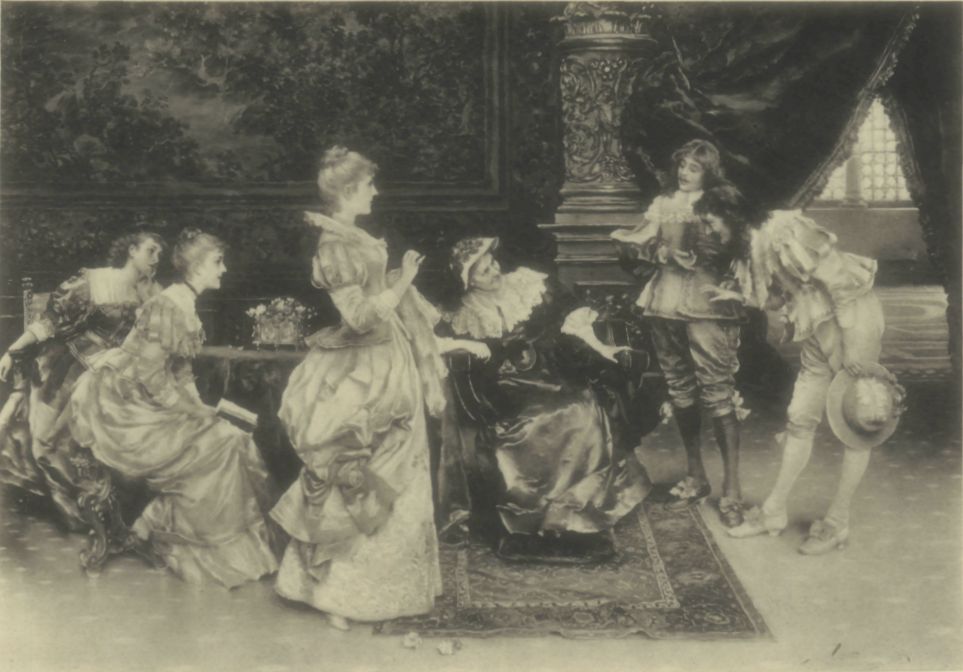
THE CAVALIERS. Photogravure from a Painting by F. Vinea.
THE CAVALIERS
From 'Thomas Babington Macaulay'
What historian has ever estimated the Cavalier character? There is Clarendon, the grave, rhetorical, decorous lawyer, piling words, congealing arguments; very stately, a little grim. There is Hume, the Scotch metaphysician, who has made out the best case for such people as never were, for a Charles who never died, for a Strafford who would never have been attainted; a saving, calculating North-country man, fat, impassive, who lived on eightpence a day. What have these people to do with an enjoying English gentleman? It is easy for a doctrinaire to bear a post-mortem examination,--it is much the same whether he be alive or dead; but not so with those who live during their life, whose essence is existence, whose being is in animation. There seem to be some characters who are not made for history, as there are some who are not made for old age. A Cavalier is always young. The buoyant life arises before us, rich in hope, strong in vigor, irregular in action; men young and ardent, "framed in the prodigality of nature"; open to every enjoyment, alive to every passion, eager, impulsive; brave without discipline, noble without principle; prizing luxury, despising danger; capable of high sentiment, but in each of whom the
"Addiction was to courses vain, His companies unlettered, rude, and shallow, His hours filled up with riots, banquets, sports, And never noted in him any study, Any retirement, any sequestration From open haunts and popularity."
We see these men setting forth or assembling to defend their king or church, and we see it without surprise; a rich daring loves danger, a deep excitability likes excitement. If we look around us, we may see what is analogous: some say that the battle of the Alma was won by the "uneducated gentry"; the "uneducated gentry" would be Cavaliers now. The political sentiment is part of the character; the essence of Toryism is enjoyment. Talk of the ways of spreading a wholesome conservatism throughout this country! Give painful lectures, distribute weary tracts (and perhaps this is as well,--you may be able to give an argumentative answer to a few objections, you may diffuse a distinct notion of the dignified dullness of politics); but as far as communicating and establishing your creed are concerned, try a little pleasure. The way to keep up old customs is to enjoy old customs; the way to be satisfied with the present state of things is to enjoy that state of things. Over the "Cavalier" mind this world passes with a thrill of delight; there is an exaltation in a daily event, zest in the "regular thing," joy at an old feast.
MORALITY AND FEAR
From 'Bishop Butler'
The moral principle (whatever may be said to the contrary by complacent thinkers) is really and to most men a principle of fear. The delights of a good conscience may be reserved for better things, but few men who know themselves will say that they have often felt them by vivid and actual experience; a sensation of shame, of reproach, of remorse, of sin (to use the word we instinctively shrink from because it expresses the meaning), is what the moral principle really and practically thrusts on most men. Conscience is the condemnation of ourselves; we expect a penalty. As the Greek proverb teaches, "where there is shame there is fear"; where there is the deep and intimate anxiety of guilt,--the feeling which has driven murderers and other than murderers forth to wastes and rocks and stones and tempests,--we see, as it were, in a single complex and indivisible sensation, the pain and sense of guilt and the painful anticipation of its punishment. How to be free from this, is the question; how to get loose from this; how to be rid of the secret tie which binds the strong man and cramps his pride, and makes him angry at the beauty of the universe,--which will not let him go forth like a great animal, like the king of the forest, in the glory of his might, but restrains him with an inner fear and a secret foreboding that if he do but exalt himself he shall be abased, if he do but set forth his own dignity he will offend ONE who will deprive him of it. This, as has often been pointed out, is the source of the bloody rites of heathendom. You are going to battle, you are going out in the bright sun with dancing plumes and glittering spear; your shield shines, and your feathers wave, and your limbs are glad with the consciousness of strength, and your mind is warm with glory and renown; with coming glory and unobtained renown: for who are you to hope for these; who are you to go forth proudly against the pride of the sun, with your secret sin and your haunting shame and your real fear? First lie down and abase yourself; strike your back with hard stripes; cut deep with a sharp knife, as if you would eradicate the consciousness; cry aloud; put ashes on your head; bruise yourself with stones,--then perhaps God may pardon you. Or, better still (so runs the incoherent feeling), give him something--your ox, your ass, whole hecatombs if you are rich enough; anything, it is but a chance,--you do not know what will please him; at any rate, what you love best yourself,--that is, most likely, your first-born son. Then, after such gifts and such humiliation, he may be appeased, he may let you off; he may without anger let you go forth, Achilles-like, in the glory of your shield; he may not send you home as he would else, the victim of rout and treachery, with broken arms and foul limbs, in weariness and humiliation. Of course, it is not this kind of fanaticism that we impute to a prelate of the English Church; human sacrifices are not respectable, and Achilles was not rector of Stanhope. But though the costume and circumstances of life change, the human heart does not; its feelings remain. The same anxiety, the same consciousness of personal sin which led in barbarous times to what has been described, show themselves in civilized life as well. In this quieter period, their great manifestation is scrupulosity: a care about the ritual of life; an attention to meats and drinks, and "cups and washings." Being so unworthy as we are, feeling what we feel, abased as we are abased, who shall say that those are beneath us? In ardent, imaginative youth they may seem so; but let a few years come, let them dull the will or contract the heart or stain the mind; then the consequent feeling will be, as all experience shows, not that a ritual is too mean, too low, too degrading for human nature, but that it is a mercy we have to do no more,--that we have only to wash in Jordan, that we have not even to go out into the unknown distance to seek for Abana and Pharpar, rivers of Damascus. We have no right to judge; we cannot decide; we must do what is laid down for us,--we fail daily even in this; we must never cease for a moment in our scrupulous anxiety to omit by no tittle and to exceed by no iota.
THE TYRANNY OF CONVENTION
From 'Sir Robert Peel'
It might be said that this [necessity for newspapers and statesmen of following the crowd] is only one of the results of that tyranny of commonplace which seems to accompany civilization. You may talk of the tyranny of Nero and Tiberius; but the real tyranny is the tyranny of your next-door neighbor. What law is so cruel as the law of doing what he does? What yoke is so galling as the necessity of being like him? What espionage of despotism comes to your door so effectually as the eye of the man who lives at your door? Public opinion is a permeating influence, and it exacts obedience to itself; it requires us to think other men's thoughts, to speak other men's words, to follow other men's habits. Of course, if we do not, no formal ban issues; no corporeal pain, no coarse penalty of a barbarous society is inflicted on the offender; but we are called "eccentric"; there is a gentle murmur of "most unfortunate ideas," "singular young man," "well-intentioned, I dare say; but unsafe, sir, quite unsafe."
Whatever truth there may be in these splenetic observations might be expected to show itself more particularly in the world of politics: people dread to be thought unsafe in proportion as they get their living by being thought to be safe. Those who desire a public career must look to the views of the living public; an immediate exterior influence is essential to the exertion of their faculties. The confidence of others is your fulcrum: you cannot--many people wish you could--go into Parliament to represent yourself; you must conform to the opinions of the electors, and they, depend on it, will not be original. In a word, as has been most wisely observed, "under free institutions it is necessary occasionally to defer to the opinions of other people; and as other people are obviously in the wrong, this is a great hindrance to the improvement of our political system and the progress of our species."
HOW TO BE AN INFLUENTIAL POLITICIAN
From 'Bolingbroke'
It is very natural that brilliant and vehement men should depreciate Harley; for he had nothing which they possess, but had everything which they commonly do not possess. He was by nature a moderate man. In that age they called such a man a "trimmer," but they called him ill: such a man does not consciously shift or purposely trim his course,--he firmly believes that he is substantially consistent. "I do not wish in this House," he would say in our age, "to be a party to any extreme course. Mr. Gladstone brings forward a great many things which I cannot understand; I assure you he does. There is more in that bill of his about tobacco than he thinks; I am confident there is. Money is a serious thing, a very serious thing. And I am sorry to say Mr. Disraeli commits the party very much: he avows sentiments which are injudicious; I cannot go along with him, nor can Sir John. He was not taught the catechism; I know he was not. There is a want in him of sound and sober religion,--and Sir John agrees with me,--which would keep him from distressing the clergy, who are very important. Great orators are very well; but as I said, how is the revenue? And the point is, not be led away, and to be moderate, and not to go to an extreme. As soon as it seems very clear, then I begin to doubt. I have been many years in Parliament, and that is my experience." We may laugh at such speeches, but there have been plenty of them in every English Parliament. A great English divine has been described as always leaving out the principle upon which his arguments rested; even if it was stated to him, he regarded it as far-fetched and extravagant. Any politician who has this temper of mind will always have many followers; and he may be nearly sure that all great measures will be passed more nearly as he wishes them to be passed than as great orators wish. Nine-tenths of mankind are more afraid of violence than of anything else; and inconsistent moderation is always popular, because of all qualities it is most opposite to violence,--most likely to preserve the present safe existence.
CONDITIONS OF CABINET GOVERNMENT
From 'The English Constitution'
The conditions of fitness are two: first, you must get a good legislature; and next, you must keep it good. And these are by no means so nearly connected as might be thought at first sight. To keep a legislature efficient, it must have a sufficient supply of substantial business: if you employ the best set of men to do nearly nothing, they will quarrel with each other about that nothing; where great questions end, little parties begin. And a very happy community, with few new laws to make, few old bad laws to repeal, and but simple foreign relations to adjust, has great difficulty in employing a legislature,--there is nothing for it to enact and nothing for it to settle. Accordingly, there is great danger that the legislature, being debarred from all other kinds of business, may take to quarreling about its elective business; that controversies as to ministries may occupy all its time, and yet that time be perniciously employed; that a constant succession of feeble administrations, unable to govern and unfit to govern, may be substituted for the proper result of cabinet government, a sufficient body of men long enough in power to evince their sufficiency. The exact amount of non-elective business necessary for a parliament which is to elect the executive cannot, of course, be formally stated,--there are no numbers and no statistics in the theory of constitutions; all we can say is, that a parliament with little business, which is to be as efficient as a parliament with much business, must be in all other respects much better. An indifferent parliament may be much improved by the steadying effect of grave affairs; but a parliament which has no such affairs must be intrinsically excellent, or it will fail utterly.
But the difficulty of keeping a good legislature is evidently secondary to the difficulty of first getting it. There are two kinds of nations which can elect a good parliament. The first is a nation in which the mass of the people are intelligent, and in which they are comfortable. Where there is no honest poverty, where education is diffused and political intelligence is common, it is easy for the mass of the people to elect a fair legislature. The ideal is roughly realized in the North American colonies of England, and in the whole free States of the Union: in these countries there is no such thing as honest poverty,--physical comfort, such as the poor cannot imagine here, is there easily attainable by healthy industry; education is diffused much, and is fast spreading,--ignorant emigrants from the Old World often prize the intellectual advantages of which they are themselves destitute, and are annoyed at their inferiority in a place where rudimentary culture is so common. The greatest difficulty of such new communities is commonly geographical: the population is mostly scattered; and where population is sparse, discussion is difficult. But in a country very large as we reckon in Europe, a people really intelligent, really educated, really comfortable, would soon form a good opinion. No one can doubt that the New England States, if they were a separate community, would have an education, a political capacity, and an intelligence such as the numerical majority of no people equally numerous has ever possessed: in a State of this sort, where all the community is fit to choose a sufficient legislature, it is possible, it is almost easy, to create that legislature. If the New England States possessed a cabinet government as a separate nation, they would be as renowned in the world for political sagacity as they now are for diffused happiness.
WHY EARLY SOCIETIES COULD NOT BE FREE
From 'Physics and Politics'
I believe the general description in which Sir John Lubbock sums up his estimate of the savage mind suits the patriarchal mind: "Savages," he says, "have the character of children with the passions and strength of men."...
And this is precisely what we should expect. "An inherited drill," science says, "makes modern nations what they are; their born structure bears the trace of the laws of their fathers:" but the ancient nations came into no such inheritance,--they were the descendants of people who did what was right in their own eyes; they were born to no tutored habits, no preservative bonds, and therefore they were at the mercy of every impulse and blown by every passion....
Again, I at least cannot call up to myself the loose conceptions (as they must have been) of morals which then existed. If we set aside all the element derived from law and polity which runs through our current moral notions, I hardly know what we shall have left. The residuum was somehow and in some vague way intelligible to the ante-political man; but it must have been uncertain, wavering, and unfit to be depended upon. In the best cases it existed much as the vague feeling of beauty now exists in minds sensitive but untaught,--a still small voice of uncertain meaning, an unknown something modifying everything else and higher than anything else, yet in form so indistinct that when you looked for it, it was gone; or if this be thought the delicate fiction of a later fancy, then morality was at least to be found in the wild spasms of "wild justice," half punishment, half outrage: but anyhow, being unfixed by steady law, it was intermittent, vague, and hard for us to imagine....
To sum up:--Law--rigid, definite, concise law--is the primary want of early mankind; that which they need above anything else, that which is requisite before they can gain anything else. But it is their greatest difficulty as well as their first requisite; the thing most out of their reach as well as that most beneficial to them if they reach it. In later ages, many races have gained much of this discipline quickly though painfully,--a loose set of scattered clans has been often and often forced to substantial settlement by a rigid conqueror; the Romans did half the work for above half Europe. But where could the first ages find Romans or a conqueror? men conquer by the power of government, and it was exactly government which then was not. The first ascent of civilization was at a steep gradient, though when now we look down upon it, it seems almost nothing.
How the step from no polity to polity was made, distinct history does not record.... But when once polities were begun, there is no difficulty in explaining why they lasted. Whatever may be said against the principle of "natural selection" in other departments, there is no doubt of its predominance in early human history: the strongest killed out the weakest as they could. And I need not pause to prove that any form of polity is more efficient than none; that an aggregate of families owning even a slippery allegiance to a single head would be sure to have the better of a set of families acknowledging no obedience to any one, but scattering loose about the world and fighting where they stood. Homer's Cyclops would be powerless against the feeblest band; so far from its being singular that we find no other record of that state of man, so unstable and sure to perish was it that we should rather wonder at even a single vestige lasting down to the age when for picturesqueness it became valuable in poetry.
But though the origin of polity is dubious, we are upon the terra firma of actual records when we speak of the preservation of polities. Perhaps every young Englishman who comes nowadays to Aristotle or Plato is struck with their conservatism: fresh from the liberal doctrines of the present age, he wonders at finding in those recognized teachers so much contrary teaching. They both, unlike as they are, hold with Xenophon so unlike both, that man is "the hardest of all animals to govern." Of Plato it might indeed be plausibly said that the adherents of an intuitive philosophy, being "the Tories of speculation," have commonly been prone to conservatism in government; but Aristotle, the founder of the experience philosophy, ought according to that doctrine to have been a Liberal if any one ever was a Liberal. In fact, both of these men lived when men "had not had time to forget" the difficulties of government: we have forgotten them altogether. We reckon as the basis of our culture upon an amount of order, of tacit obedience, of prescriptive governability, which these philosophers hoped to get as a principal result of their culture; we take without thought as a datum what they hunted as a quaesitum.
In early times the quantity of government is much more important than its quality. What you want is a comprehensive rule binding men together, making them do much the same things, telling them what to expect of each other,--fashioning them alike and keeping them so: what this rule is, does not matter so much. A good rule is better than a bad one, but any rule is better than none; while, for reasons which a jurist will appreciate, none can be very good. But to gain that rule, what may be called the "impressive" elements of a polity are incomparably more important than its useful elements. How to get the obedience of men, is the hard problem; what you do with that obedience is less critical.
To gain that obedience, the primary condition is the identity--not the union, but the sameness--of what we now call "church" and "state."... No division of power is then endurable without danger, probably without destruction: the priest must not teach one thing and the king another; king must be priest and prophet king,--the two must say the same because they are the same. The idea of difference between spiritual penalties and legal penalties must never be awakened,--indeed, early Greek thought or early Roman thought would never have comprehended it; there was a kind of rough public opinion, and there were rough--very rough--hands which acted on it. We now talk of "political penalties" and "ecclesiastical prohibition" and "the social censure"; but they were all one then. Nothing is very like those old communities now, but perhaps a trades-union is as near as most things: to work cheap is thought to be a "wicked" thing, and so some Broadhead puts it down.
The object of such organizations is to create what may be called a cake of custom. All the actions of life are to be submitted to a single rule for a single object,--that gradually created "hereditary drill" which science teaches to be essential, and which the early instinct of men saw to be essential too. That this régime forbids free thought is not an evil,--or rather, though an evil, it is the necessary basis for the greatest good; it is necessary for making the mold of civilization and hardening the soft fibre of early man.
BENEFITS OF FREE DISCUSSION IN MODERN TIMES
From 'Physics and Politics'
In this manner polities of discussion broke up the old bonds of custom which were now strangling mankind, though they had once aided and helped it; but this is only one of the many gifts which those polities have conferred, are conferring, and will confer on mankind. I am not going to write a eulogium on liberty, but I wish to set down three points which have not been sufficiently noticed.
Civilized ages inherit the human nature which was victorious in barbarous ages, and that nature is in many respects not at all suited to civilized circumstances. A main and principal excellence in the early times of the human races is the impulse to action. The problems before men are then plain and simple: the man who works hardest, the man who kills the most deer, the man who catches the most fish--even later on, the man who tends the largest herds or the man who tills the largest field--is the man who succeeds; the nation which is quickest to kill its enemies or which kills most of its enemies is the nation which succeeds. All the inducements of early society tend to foster immediate action, all its penalties fall on the man who pauses; the traditional wisdom of those times was never weary of inculcating that "delays are dangerous," and that the sluggish man--the man "who roasteth not that which he took in hunting"--will not prosper on the earth, and indeed will very soon perish out of it: and in consequence an inability to stay quiet, an irritable desire to act directly, is one of the most conspicuous failings of mankind.
Pascal said that most of the evils of life arose from "man's being unable to sit still in a room"; and though I do not go that length, it is certain that we should have been a far wiser race than we are if we had been readier to sit quiet,--we should have known much better the way in which it was best to act when we came to act. The rise of physical science, the first great body of practical truth provable to all men, exemplifies this in the plainest way: if it had not been for quiet people who sat still and studied the sections of the cone, if other quiet people had not sat still and studied the theory of infinitesimals, or other quiet people had not sat still and worked out the doctrine of chances (the most "dreamy moonshine," as the purely practical mind would consider, of all human pursuits), if "idle star-gazers" had not watched long and carefully the motions of the heavenly bodies,--our modern astronomy would have been impossible, and without our astronomy "our ships, our colonies, our seamen," all which makes modern life modern life, could not have existed. Ages of sedentary, quiet, thinking people were required before that noisy existence began, and without those pale preliminary students it never could have been brought into being. And nine-tenths of modern science is in this respect the same: it is the produce of men whom their contemporaries thought dreamers, who were laughed at for caring for what did not concern them, who as the proverb went "walked into a well from looking at the stars," who were believed to be useless if any one could be such. And the conclusion is plain that if there had been more such people, if the world had not laughed at those there were, if rather it had encouraged them, there would have been a great accumulation of proved science ages before there was. It was the irritable activity, the "wish to be doing something," that prevented it,--most men inherited a nature too eager and too restless to be quiet and find out things: and even worse, with their idle clamor they "disturbed the brooding hen"; they would not let those be quiet who wished to be so, and out of whose calm thought much good might have come forth.
If we consider how much science has done and how much it is doing for mankind, and if the over-activity of men is proved to be the cause why science came so late into the world and is so small and scanty still, that will convince most people that our over-activity is a very great evil; but this is only part and perhaps not the greatest part, of the harm that over-activity does. As I have said, it is inherited from times when life was simple, objects were plain, and quick action generally led to desirable ends: if A kills B before B kills A, then A survives, and the human race is a race of A's. But the issues of life are plain no longer: to act rightly in modern society requires a great deal of previous study, a great deal of assimilated information, a great deal of sharpened imagination; and these prerequisites of sound action require much time, and I was going to say much "lying in the sun," a long period of "mere passiveness."
[Argument to show that the same vice of impatience damages war, philanthropy, commerce, and even speculation.]
But it will be said, What has government by discussion to do with these things? will it prevent them, or even mitigate them? It can and does do both, in the very plainest way. If you want to stop instant and immediate action, always make it a condition that the action shall not begin till a considerable number of persons have talked over it and have agreed on it. If those persons be people of different temperaments, different ideas, and different educations, you have an almost infallible security that nothing or almost nothing will be done with excessive rapidity. Each kind of persons will have their spokesman; each spokesman will have his characteristic objection and each his characteristic counter-proposition: and so in the end nothing will probably be done, or at least only the minimum which is plainly urgent. In many cases this delay may be dangerous, in many cases quick action will be preferable; a campaign, as Macaulay well says, cannot be directed by a "debating society," and many other kinds of action also require a single and absolute general: but for the purpose now in hand--that of preventing hasty action and insuring elaborate consideration--there is no device like a polity of discussion.
The enemies of this object--the people who want to act quickly--see this very distinctly: they are forever explaining that the present is "an age of committees," that the committees do nothing, that all evaporates in talk. Their great enemy is parliamentary government: they call it, after Mr. Carlyle, the "national palaver"; they add up the hours that are consumed in it and the speeches which are made in it, and they sigh for a time when England might again be ruled, as it once was, by a Cromwell,--that is, when an eager absolute man might do exactly what other eager men wished, and do it immediately. All these invectives are perpetual and many-sided; they come from philosophers each of whom wants some new scheme tried, from philanthropists who want some evil abated, from revolutionists who want some old institution destroyed, from new-eraists who want their new era started forthwith: and they all are distinct admissions that a polity of discussion is the greatest hindrance to the inherited mistake of human nature,--to the desire to act promptly, which in a simple age is so excellent, but which in a later and complex time leads to so much evil.
The same accusation against our age sometimes takes a more general form: it is alleged that our energies are diminishing, that ordinary and average men have not the quick determination nowadays which they used to have when the world was younger, that not only do not committees and parliaments act with rapid decisiveness, but that no one now so acts; and I hope that in fact this is true, for according to me it proves that the hereditary barbaric impulse is decaying and dying out. So far from thinking the quality attributed to us a defect, I wish that those who complain of it were far more right than I much fear they are. Still, certainly, eager and violent action is somewhat diminished, though only by a small fraction of what it ought to be; and I believe that this is in great part due, in England at least, to our government by discussion, which has fostered a general intellectual tone, a diffused disposition to weigh evidence, a conviction that much may be said on every side of everything which the elder and more fanatic ages of the world wanted. This is the real reason why our energies seem so much less than those of our fathers. When we have a definite end in view, which we know we want and which we think we know how to obtain, we can act well enough: the campaigns of our soldiers are as energetic as any campaigns ever were; the speculations of our merchants have greater promptitude, greater audacity, greater vigor than any such speculations ever had before. In old times a few ideas got possession of men and communities, but this is happily now possible no longer: we see how incomplete these old ideas were; how almost by chance one seized on one nation and another on another; how often one set of men have persecuted another set for opinions on subjects of which neither, we now perceive, knew anything. It might be well if a greater number of effectual demonstrations existed among mankind: but while no such demonstrations exist, and while the evidence which completely convinces one man seems to another trifling and insufficient, let us recognize the plain position of inevitable doubt; let us not be bigots with a doubt and persecutors without a creed. We are beginning to see this, and we are railed at for so beginning: but it is a great benefit, and it is to the incessant prevalence of detective discussion that our doubts are due; and much of that discussion is due to the long existence of a government requiring constant debates, written and oral.
ORIGIN OF DEPOSIT BANKING
From 'Lombard Street'
In the last century, a favorite subject of literary ingenuity was "conjectural history," as it was then called: upon grounds of probability, a fictitious sketch was made of the possible origin of things existing. If this kind of speculation were now applied to banking, the natural and first idea would be that large systems of deposit banking grew up in the early world just as they grow up now in any large English colony. As soon as any such community becomes rich enough to have much money, and compact enough to be able to lodge its money in single banks, it at once begins so to do. English colonists do not like the risk of keeping their money, and they wish to make an interest on it; they carry from home the idea and the habit of banking, and they take to it as soon as they can in their new world. Conjectural history would be inclined to say that all banking began thus; but such history is rarely of any value,--the basis of it is false. It assumes that what works most easily when established is that which it would be the most easy to establish, and that what seems simplest when familiar would be most easily appreciated by the mind though unfamiliar; but exactly the contrary is true,--many things which seem simple, and which work well when firmly established, are very hard to establish among new people and not very easy to explain to them. Deposit banking is of this sort. Its essence is, that a very large number of persons agree to trust a very few persons, or some one person: banking would not be a profitable trade if bankers were not a small number, and depositors in comparison an immense number. But to get a great number of persons to do exactly the same thing is always very difficult, and nothing but a very palpable necessity will make them on a sudden begin to do it; and there is no such palpable necessity in banking.
If you take a country town in France, even now, you will not find any such system of banking as ours: check-books are unknown, and money kept on running account by bankers is rare: people store their money in a caisse at their houses. Steady savings, which are waiting for investment and which are sure not to be soon wanted, may be lodged with bankers; but the common floating cash of the community is kept by the community themselves at home,--they prefer to keep it so, and it would not answer a banker's purpose to make expensive arrangements for keeping it otherwise. If a "branch," such as the National Provincial Bank opens in an English country town, were opened in a corresponding French one, it would not pay its expenses: you could not get any sufficient number of Frenchmen to agree to put their money there.
And so it is in all countries not of British descent, though in various degrees. Deposit banking is a very difficult thing to begin, because people do not like to let their money out of their sight; especially, do not like to let it out of sight without security; still more, cannot all at once agree on any single person to whom they are content to trust it unseen and unsecured. Hypothetical history, which explains the past by what is simplest and commonest in the present, is in banking, as in most things, quite untrue.
The real history is very different. New wants are mostly supplied by adaptation, not by creation or foundation; something having been created to satisfy an extreme want, it is used to satisfy less pressing wants or to supply additional conveniences. On this account, political government, the oldest institution in the world, has been the hardest worked: at the beginning of history, we find it doing everything which society wants done and forbidding everything which society does not wish done. In trade, at present, the first commerce in a new place is a general shop, which, beginning with articles of real necessity, comes shortly to supply the oddest accumulation of petty comforts. And the history of banking has been the same: the first banks were not founded for our system of deposit banking, or for anything like it; they were founded for much more pressing reasons, and having been founded, they or copies from them were applied to our modern uses.
[Gives a sketch of banks started as finance companies to make or float government loans, and to give good coin; and sketches their function of remitting money.]
These are all uses other than those of deposit banking, which banks supplied that afterwards became in our English sense deposit banks: by supplying these uses, they gained the credit that afterwards enabled them to gain a living as deposit banks; being trusted for one purpose, they came to be trusted for a purpose quite different,--ultimately far more important, though at first less keenly pressing. But these wants only affect a few persons, and therefore bring the bank under the notice of a few only. The real introductory function which deposit banks at first perform is much more popular; and it is only when they can perform this most popular kind of business that deposit banking ever spreads quickly and extensively.
This function is the supply of the paper circulation to the country; and it will be observed that I am not about to overstep my limits and discuss this as a question of currency. In what form the best paper currency can be supplied to a country is a question of economical theory with which I do not meddle here: I am only narrating unquestionable history, not dealing with an argument where every step is disputed; and part of this certain history is, that the best way to diffuse banking in a community is to allow the banker to issue bank notes of small amount that can supersede the metal currency. This amounts to a subsidy to each banker to enable him to keep open a bank till depositors choose to come to it....
The reason why the use of bank paper commonly precedes the habit of making deposits in banks is very plain: it is a far easier habit to establish. In the issue of notes the banker, the person to be most benefited, can do something,--he can pay away his own "promises" in loans, in wages, or in payment of debts,--but in the getting of deposits he is passive; his issues depend on himself, his deposits on the favor of others. And to the public the change is far easier too: to collect a great mass of deposits with the same banker, a great number of persons must agree to do something; but to establish a note circulation, a large number of persons need only do nothing,--they receive the banker's notes in the common course of their business, and they have only not to take those notes to the banker for payment. If the public refrain from taking trouble, a paper circulation is immediately in existence. A paper circulation is begun by the banker, and requires no effort on the part of the public,--on the contrary, it needs an effort of the public to be rid of notes once issued; but deposit banking cannot be begun by the banker, and requires a spontaneous and consistent effort in the community: and therefore paper issue is the natural prelude to deposit banking.