Volume 3 — GEORGE BANCROFT
Reading edition
(1800-1891)
BY AUSTIN SCOTT

he life of George Bancroft was nearly conterminous with the nineteenth century. He was born at Worcester, Mass., October 3d, 1800, and died at Washington, D.C., January 17th, 1891. But it was not merely the stretch of his years that identified him with this century. In some respects he represented his time as no other of its men. He came into touch with many widely differing elements which made up its life and character. He spent most of his life in cities, but never lost the sense for country sights and sounds which central Massachusetts gave him in Worcester, his birthplace, and in Northampton, where he taught school. The home into which he was born offered him from his infancy a rich possession. His father was a Unitarian clergyman who wrote a 'Life of Washington' that was received with favor; thus things concerning God and country were his patrimony. Not without significance was a word of his mother which he recalled in his latest years, "My son, I do not wish you to become a rich man, but I would have you be an affluent man: ad fluo, always a little more coming in than going out."
To the advantages of his boyhood home and of Harvard College, to which he went as a lad of thirteen, the eager young student added the opportunity, then uncommon, of a systematic course of study in German, and won the degree of Doctor of Philosophy at Göttingen in 1820. He had in a marked degree the characteristics of his countrymen, versatility and adaptability. Giving up an early purpose of fitting himself for the pulpit, he taught in Harvard, and helped to found a school of an advanced type at Northampton. Meantime he published a volume of verse, and found out that the passionate love of poetry which lasted through his life was not creative. At Northampton he published in 1828 a translation in two volumes of Heeren's 'History of the Political System of Europe,' and also edited two editions of a Latin Reader; but the duties of a schoolmaster's life were early thrown aside, and he could not be persuaded to resume them later when the headship of an important educational institution was offered to him. Together with the one great pursuit of his life, to which he remained true for sixty years, he delighted in the activities of a politician, the duties of a statesman, and the occupations of a man of affairs and of the world.
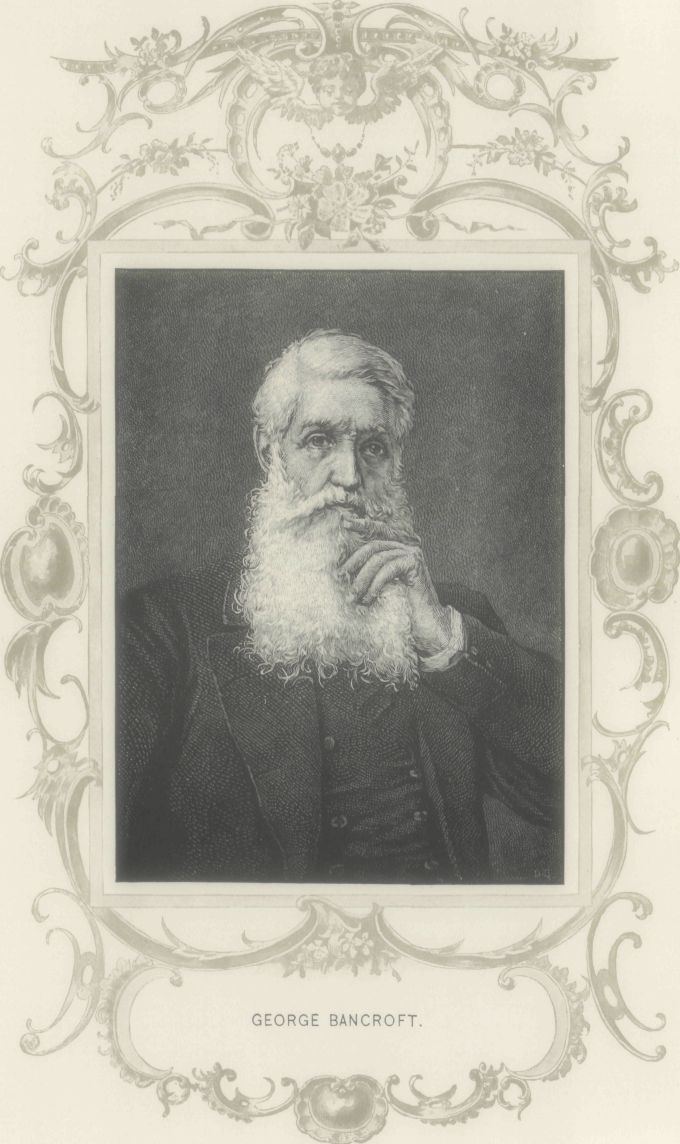
Bancroft received a large but insufficient vote as the Democratic candidate for the Governorship of Massachusetts, and for a time he held the office of Collector of the port of Boston. As Secretary of the Navy in the Cabinet of Polk, he rendered to his country two distinct services of great value: he founded the Naval School at Annapolis, and by his prompt orders to the American commander in the Pacific waters he secured the acquisition of California for the United States. The special abilities he displayed in the Cabinet were such, so Polk thought, as to lead to his appointment as Minister to England in 1846. He was a diplomat of no mean order. President Johnson appointed him Minister to Germany in 1867, and Grant retained him at that post until 1874, as long as Bancroft desired it. During his stay there he concluded just naturalization treaties with Germany, and in a masterly way won from the Emperor, William I., as arbitrator, judgment in favor of the United States's claim over that of Great Britain in the Northwestern boundary dispute.
Always holding fast his one cherished object,--that of worthily writing the history of the United States,--Bancroft did not deny himself the pleasure of roaming in other fields. He wrote frequently on current topics, on literary, historical, and political subjects. His eulogies of Jackson and of Lincoln, pronounced before Congress, entitle him to the rank of an orator. He was very fond of studies in metaphysics, and Trendelenburg, the eminent German philosopher, said of him, "Bancroft knows Kant through and through."
His home--whether in Boston, or in New York where he spent the middle portion of his life, or in Washington his abode for the last sixteen years, or during his residence abroad--was the scene of the occupations and delights which the highest culture craves. He was gladly welcomed to the inner circle of the finest minds of Germany, and the tribute of the German men of learning was unfeigned and universal when he quitted the country in 1874. Many of the best men of England and of France were among his warm friends. At his table were gathered from time to time some of the world's greatest thinkers,--men of science, soldiers, statesmen and men of affairs. Fond as he was of social joys, it was his daily pleasure to mount his horse and alone, or with a single companion, to ride where nature in her shy or in her exuberant mood inspired. One day, after he was eighty years old, he rode on his young, blooded Kentucky horse along the Virginia bank of the Potomac for more than thirty-six miles. He could be seen every day among the perfect roses of his garden at "Roseclyffe," his Newport summer-home, often full of thought, at other times in wellnigh boisterous glee, always giving unstinted care and expense to the queen of flowers. The books in which he kept the record of the rose garden were almost as elaborate as those in which were entered the facts and fancies out of which his History grew. His home life was charming. By a careful use of opportunities and of his means he became an "affluent" man. He was twice married: both times a new source of refined domestic happiness long blessed his home, and new means for enlarged comfort and hospitality were added to his own. Two sons, children of his first wife, survived him.
Some of Bancroft's characteristics were not unlike those of Jefferson. A constant tendency to idealize called up in him at times a feeling verging on impatience with the facts or the men that stood in the way of a theory or the accomplishment of a personal desire. He had a keen perception of an underlying or a final truth and professed warm love for it, whether in the large range of history or in the nexus of current politics: any one taking a different point of view at times was led to think that his facts, as he stated them, lay crosswise, and might therefore find the perspective out of drawing, but could not rightly impugn his good faith.
Although a genuine lover of his race and a believer in Democracy, he was not always ready to put implicit trust in the individual as being capable of exercising a wise judgment and the power of true self-direction. For man he avowed a perfect respect; among men his bearing showed now and then a trace of condescension. In controversies over disputed points of history--and he had many such--he meant to be fair and to anticipate the final verdict of truth, but overwhelming evidence was necessary to convince him that his judgment, formed after painstaking research, could be wrong. His ample love of justice, however, is proved by his passionate appreciation of the character of Washington, by his unswerving devotion to the conception of our national unity, both in its historical development and at the moment when it was imperiled by civil war, and by his hatred of slavery and of false financial policies. He took pleasure in giving generously, but always judiciously and without ostentation. On one occasion he, with a few of his friends, paid off the debt from the house of an eminent scholar; on another, he helped to rebuild for a great thinker the home which had been burned. At Harvard, more than fifty years after his graduation, he founded a traveling scholarship and named it in honor of the president of his college days.
As to the manner of his work, Bancroft laid large plans and gave to the details of their execution unwearied zeal. The scope of the 'History of the United States' as he planned it was admirable. In carrying it out he was persistent in acquiring materials, sparing no pains in his research at home and abroad, and no cost in securing original papers or exact copies and transcripts from the archives of England and France, Spain and Holland and Germany, from public libraries and from individuals; he fished in all waters and drew fish of all sorts into his net. He took great pains, and the secretaries whom he employed to aid him in his work were instructed likewise to take great pains, not only to enter facts in the reference books in their chronological order, but to make all possible cross-references to related facts. The books of his library, which was large and rich in treasures, he used as tools, and many of them were filled with cross references. In the fly-leaves of the books he read he made note with a word and the cited page of what the printed pages contained of interest to him or of value in his work.
His mind was one of quick perceptions within a wide range, and always alert to grasp an idea in its manifold relations. It is remarkable, therefore, that he was very laborious in his method of work. He often struggled long with a thought for intellectual mastery. In giving it expression, his habit was to dictate rapidly and with enthusiasm and at great length, but he usually selected the final form after repeated efforts. His first draft of a chapter was revised again and again and condensed. One of his early volumes in its first manuscript form was eight times as long as when finally published. He had another striking habit, that of writing by topics rather than in strict chronological order, so that a chapter which was to find its place late in the volume was often completed before one which was to precede it. Partly by nature and perhaps partly by this practice, he had the power to carry on simultaneously several trains of thought. When preparing one of his public orations, it was remarked by one of his household that after an evening spent over a trifling game of bezique, the next morning found him well advanced beyond the point where the work had been seemingly laid down. He had the faculty of buoying a thought, knowing just where to take it up after an interruption and deftly splicing it in continuous line, sometimes after a long interval. When about to begin the preparation of the argument which was to sustain triumphantly the claim of the United States in the boundary question, he wrote from Berlin for copies of documents filed in the office of the Navy Department, which he remembered were there five-and-twenty years before.
The 'History of the United States from the Discovery of America to the Inauguration of Washington' is treated by Bancroft in three parts. The first, Colonial History from 1492 to 1748, occupies more than one fourth of his pages. The second part, the American Revolution, 1748 to 1782, claims more than one half of the entire work, and is divided into four epochs:--the first, 1748-1763, is entitled 'The Overthrow of the European Colonial System'; the second, 1763-1774, 'How Great Britain Estranged America'; the third, 1774-1776, 'America Declares Itself Independent'; the fourth, 1776-1782, 'The Independence of America is Acknowledged.' The last part, 'The History of the Formation of the Constitution,' 1782-1789, though published as a separate work, is essentially a continuation of the History proper, of which it forms in bulk rather more than one tenth.
If his services as a historian are to be judged by any one portion of his work rather than by another, the history of the formation of the Constitution affords the best test. In that the preceding work comes to fruition; the time of its writing, after the Civil War and the consequent settling of the one vexing question by the abolition of sectionalism, and when he was in the fullness of the experience of his own ripe years, was most opportune. Bancroft was equal to his opportunity. He does not teach us that the Constitution is the result of superhuman wisdom, nor on the other hand does he admit, as John Adams asserted, that however excellent, the Constitution was wrung "from the grinding necessity of a reluctant people." He does not fail to point out the critical nature of the four years prior to the meeting of the Federal Convention; but he discerns that whatever occasions, whether transitory or for the time of "steady and commanding influence," may help or hinder the formation of the now perfect union, its true cause was "an indwelling necessity" in the people to "form above the States a common constitution for the whole."
Recognizing the fact that the primary cause for the true union was remote in origin and deep and persistent, Bancroft gives a retrospect of the steps toward union from the founding of the colonies to the close of the war for independence. Thenceforward, suggestions as to method or form of amending the Articles of Confederation, whether made by individuals, or State Legislatures, or by Congress, were in his view helps indeed to promote the movement; but they were first of all so many proofs that despite all the contrary wayward surface indications, the strong current was flowing independently toward the just and perfect union. Having acknowledged this fundamental fact of the critical years between Yorktown and the Constitution, the historian is free to give just and discriminating praise to all who shared at that time in redeeming the political hope of mankind, to give due but not exclusive honor to Washington and Thomas Paine, to Madison and Hamilton and their co-worthies.
The many attempts, isolated or systematic, during the period from 1781-1786, to reform the Articles of Confederation, were happily futile; but they were essential in the training of the people in the consciousness of the nature of the work for which they are responsible. The balances must come slowly to a poise. Not merely union strong and for a time effective, was needed, but union of a certain and unprecedented sort: one in which the true pledge of permanency for a continental republic was to be found in the federative principle, by which the highest activities of nation and of State were conditioned each by the welfare of the other. The people rightly felt, too, that a Congress of one house would be inadequate and dangerous. They waited in the midst of risks for the proper hour, and then, not reluctantly but resolutely, adopted the Constitution as a promising experiment in government.
Bancroft's treatment of the evolution of the second great organic act of this time--the Northwestern ordinance--is no less just and true to the facts. For two generations men had snatched at the laurels due to the creator of that matchless piece of legislation; to award them now to Jefferson, now to Nathan Dane, now to Rufus King, now to Manasseh Cutler. Bancroft calmly and clearly shows how the great law grew with the kindly aid and watchful care of these men and of others.
The deliberations of the Federal Constitution are adequately recorded; and he gives fair relative recognition to the work and words of individuals, and the actions of State delegations in making the great adjustments between nation and States, between large and small and slave and free States. From his account we infer that the New Jersey plan was intended by its authors only for temporary use in securing equality for the States in one essential part of the government, while the men from Connecticut receive credit for the compromise which reconciled nationality with true State rights. Further to be noticed are the results of the exhaustive study which Bancroft gave to the matter of paper money, and to the meaning of the clause prohibiting the States from impairing the obligation of contracts. He devotes nearly one hundred pages to 'The People of the States in Judgment on the Constitution,' and rightly; for it is the final act of the separate States, and by it their individual wills are merged in the will of the people, which is one, though still politically distributed and active within State lines. His summary of the main principles of the Constitution is excellent; and he concludes with a worthy sketch of the organization of the first Congress under the Constitution, and of the inauguration of Washington as President.
In this last portion of the 'History,' while all of his merits as a historian are not conspicuous, neither are some of his chief defects. Here the tendency to philosophize, to marshal stately sentences, and to be discursive, is not so marked.
The first volume of Bancroft's 'History of the United States' was published in 1834, when the democratic spirit was finding its first full expression under Jackson, and when John Marshall was finishing his mighty task of revealing to the people of the United States the strength that lay in their organic law. As he put forth volume after volume at irregular intervals for fifty years, he in a measure continued this work of bringing to the exultant consciousness of the people the value of their possession of a continent of liberty and the realization of their responsibility. In the course of another generation, portions of this 'History of the United States' may begin to grow antiquated, though the most brilliant of contemporary journalists quite recently placed it among the ten books indispensable to every American; but time cannot take away Bancroft's good part in producing influences, which, however they may vary in form and force, will last throughout the nation's life.

THE BEGINNINGS OF VIRGINIA
From 'History of the United States'
The period of success in planting Virginia had arrived; yet not till changes in European politics and society had molded the forms of colonization. The Reformation had broken the harmony of religious opinion; and differences in the Church began to constitute the basis of political parties. After the East Indies had been reached by doubling the southern promontory of Africa, the great commerce of the world was carried upon the ocean. The art of printing had been perfected and diffused; and the press spread intelligence and multiplied the facilities of instruction. The feudal institutions, which had been reared in the middle ages, were already undermined by the current of time and events, and, swaying from their base, threatened to fall. Productive industry had built up the fortunes and extended the influence of the active classes; while habits of indolence and expense had impaired the estates and diminished the power of the nobility. These changes produced corresponding results in the institutions which were to rise in America.
A revolution had equally occurred in the purposes for which voyages were undertaken. The hope of Columbus, as he sailed to the west, had been the discovery of a new passage to the East Indies. The passion for gold next became the prevailing motive. Then the islands and countries near the equator were made the tropical gardens of the Europeans. At last, the higher design was matured: to plant permanent Christian colonies; to establish for the oppressed and the enterprising places of refuge and abode; to found states in a temperate clime, with all the elements of independent existence.
In the imperfect condition of industry, a redundant population had existed in England even before the peace with Spain, which threw out of employment the gallant men who had served under Elizabeth by sea and land, and left them no option but to engage as mercenaries in the quarrels of strangers, or incur the hazards of "seeking a New World." The minds of many persons of intelligence and rank were directed to Virginia. The brave and ingenious Gosnold, who had himself witnessed the fertility of the western soil, long solicited the concurrence of his friends for the establishment of a colony, and at last prevailed with Edward Maria Wingfield, a merchant of the west of England, Robert Hunt, a clergyman of fortitude and modest worth, and John Smith, an adventurer of rarest qualities, to risk their lives and hopes of fortune in an expedition. For more than a year this little company revolved the project of a plantation. At the same time Sir Ferdinando Gorges was gathering information of the native Americans, whom he had received from Waymouth, and whose descriptions of the country, joined to the favorable views which he had already imbibed, filled him with the strongest desire of becoming a proprietary of domains beyond the Atlantic. Gorges was a man of wealth, rank and influence; he readily persuaded Sir John Popham, Lord Chief Justice of England, to share his intentions. Nor had the assigns of Raleigh become indifferent to "western planting"; which the most distinguished of them all, "industrious Hakluyt," the historian of maritime enterprise, still promoted by his personal exertions, his weight of character, and his invincible zeal. Possessed of whatever information could be derived from foreign sources and a correspondence with eminent navigators of his times, and anxiously watching the progress of Englishmen in the West, his extensive knowledge made him a counselor in every colonial enterprise.
The King of England, too timid to be active, yet too vain to be indifferent, favored the design of enlarging his dominions. He had attempted in Scotland the introduction of the arts of life among the Highlanders and the Western Isles, by the establishment of colonies; and the Scottish plantations which he founded in the northern counties of Ireland contributed to the affluence and the security of that island. When, therefore, a company of men of business and men of rank, formed by the experience of Gosnold, the enthusiasm of Smith, the perseverance of Hakluyt, the influence of Popham and Gorges, applied to James I. for leave "to deduce a colony into Virginia," the monarch, on the tenth of April, 1606, readily set his seal to an ample patent.
The first colonial charter, under which the English were planted in America, deserves careful consideration.
D. Appleton and Company, New York.
MEN AND GOVERNMENT IN EARLY MASSACHUSETTS
From 'History of the United States'
These better auspices, and the invitations of Winthrop, won new emigrants from Europe. During the long summer voyage of the two hundred passengers who freighted the Griffin, three sermons a day beguiled their weariness. Among them was Haynes, a man of very large estate, and larger affections; of a "heavenly" mind, and a spotless life; of rare sagacity, and accurate but unassuming judgment; by nature tolerant, ever a friend to freedom, ever conciliating peace; an able legislator; dear to the people by his benevolent virtues and his disinterested conduct. Then also came the most revered spiritual teachers of two commonwealths: the acute and subtle Cotton, the son of a Puritan lawyer; eminent in Cambridge as a scholar; quick in the nice perception of distinctions, and pliant in dialects; in manner persuasive rather than commanding; skilled in the fathers and the schoolmen, but finding all their wisdom compactly stored in Calvin; deeply devout by nature as well as habit from childhood; hating heresy and still precipitately eager to prevent evil actions by suppressing ill opinions, yet verging toward a progress in truth and in religious freedom; an avowed enemy to democracy, which he feared as the blind despotism of animal instincts in the multitude, yet opposing hereditary power in all its forms; desiring a government of moral opinion, according to the laws of universal equity, and claiming "the ultimate resolution for the whole body of the people:" and Hooker, of vast endowments, a strong will and an energetic mind; ingenuous in his temper, and open in his professions; trained to benevolence by the discipline of affliction; versed in tolerance by his refuge in Holland; choleric, yet gentle in his affections; firm in his faith, yet readily yielding to the power of reason; the peer of the reformers, without their harshness; the devoted apostle to the humble and the poor, severe toward the proud, mild in his soothings of a wounded spirit, glowing with the raptures of devotion, and kindling with the messages of redeeming love; his eye, voice, gesture, and whole frame animate with the living vigor of heart-felt religion; public-spirited and lavishly charitable; and, "though persecutions and banishments had awaited him as one wave follows another," ever serenely blessed with "a glorious peace of soul"; fixed in his trust in Providence, and in his adhesion to that cause of advancing civilization, which he cherished always, even while it remained to him a mystery. This was he whom, for his abilities and services, his contemporaries placed "in the first rank" of men; praising him as "the one rich pearl, with which Europe more than repaid America for the treasures from her coast." The people to whom Hooker ministered had preceded him; as he landed they crowded about him with their welcome. "Now I live," exclaimed he, as with open arms he embraced them, "now I live if ye stand fast in the Lord."
Thus recruited, the little band in Massachusetts grew more jealous of its liberties. "The prophets in exile see the true forms of the house." By a common impulse, the freemen of the towns chose deputies to consider in advance the duties of the general court. The charter plainly gave legislative power to the whole body of the freemen; if it allowed representatives, thought Winthrop, it was only by inference; and, as the whole people could not always assemble, the chief power, it was argued, lay necessarily with the assistants.
Far different was the reasoning of the people. To check the democratic tendency, Cotton, on the election day, preached to the assembled freemen against rotation in office. The right of an honest magistrate to his place was like that of a proprietor to his freehold. But the electors, now between three and four hundred in number, were bent on exercising "their absolute power," and, reversing the decision of the pulpit, chose a new governor and deputy. The mode of taking the votes was at the same time reformed; and, instead of the erection of hands, the ballot-box was introduced. Thus "the people established a reformation of such things as they judged to be amiss in the government."
It was further decreed that the whole body of the freemen should be convened only for the election of the magistrates: to these, with deputies to be chosen by the several towns, the powers of legislation and appointment were henceforward intrusted. The trading corporation was unconsciously become a representative democracy.
The law against arbitrary taxation followed. None but the immediate representatives of the people might dispose of lands or raise money. Thus early did Massachusetts echo the voice of Virginia, like deep calling unto deep. The state was filled with the hum of village politicians; "the freemen of every town in the Bay were busy in inquiring into their liberties and privileges." With the exception of the principle of universal suffrage, now so happily established, the representative democracy was as perfect two centuries ago as it is to-day. Even the magistrates, who acted as judges, held their office by the annual popular choice. "Elections cannot be safe there long," said the lawyer Lechford. The same prediction has been made these two hundred years. The public mind, ever in perpetual agitation, is still easily shaken, even by slight and transient impulses; but, after all vibrations, it follows the laws of the moral world, and safely recovers its balance.
D. Appleton and Company, New York.
KING PHILIP'S WAR
From 'History of the United States'
Thus was Philip hurried into "his rebellion"; and he is reported to have wept as he heard that a white man's blood had been shed. He had kept his men about him in arms, and had welcomed every stranger; and yet, against his judgment and his will, he was involved in war. For what prospect had he of success? The English were united; the Indians had no alliance: the English made a common cause; half the Indians were allies of the English, or were quiet spectators of the fight: the English had guns enough; but few of the Indians were well armed, and they could get no new supplies: the English had towns for their shelter and safe retreat; the miserable wigwams of the natives were defenseless: the English had sure supplies of food; the Indians might easily lose their precarious stores. Frenzy prompted their rising. They rose without hope, and they fought without mercy. For them as a nation, there was no to-morrow.
The minds of the English were appalled by the horrors of the impending conflict, and superstition indulged in its wild inventions. At the time of the eclipse of the moon, you might have seen the figure of an Indian scalp imprinted on the centre of its disk. The perfect form of an Indian bow appeared in the sky. The sighing of the wind was like the whistling of bullets. Some heard invisible troops of horses gallop through the air, while others found the prophecy of calamities in the howling of the wolves.
At the very beginning of danger the colonists exerted their wonted energy. Volunteers from Massachusetts joined the troops from Plymouth; and, within a week from the commencement of hostilities, the insulated Pokanokets were driven from Mount Hope, and in less than a month Philip was a fugitive among the Nipmucks, the interior tribes of Massachusetts. The little army of the colonists then entered the territory of the Narragansetts, and from the reluctant tribe extorted a treaty of neutrality, with a promise to deliver up every hostile Indian. Victory seemed promptly assured. But it was only the commencement of horrors. Canonchet, the chief sachem of the Narragansetts, was the son of Miantonomoh; and could he forget his father's wrongs? Desolation extended along the whole frontier. Banished from his patrimony, where the pilgrims found a friend, and from his cabin, which had sheltered the exiles, Philip, with his warriors, spread through the country, awakening their brethren to a warfare of extermination.
The war, on the part of the Indians, was one of ambuscades and surprises. They never once met the English in open field; but always, even if eightfold in numbers, fled timorously before infantry. They were secret as beasts of prey, skillful marksmen, and in part provided with firearms, fleet of foot, conversant with all the paths of the forest, patient of fatigue, and mad with a passion for rapine, vengeance, and destruction, retreating into swamps for their fastnesses, or hiding in the greenwood thickets, where the leaves muffled the eyes of the pursuer. By the rapidity of their descent, they seemed omnipresent among the scattered villages, which they ravished like a passing storm; and for a full year they kept all New England in a state of terror and excitement. The exploring party was waylaid and cut off, and the mangled carcasses and disjointed limbs of the dead were hung upon the trees. The laborer in the field, the reapers as they sallied forth to the harvest, men as they went to mill, the shepherd's boy among the sheep, were shot down by skulking foes, whose approach was invisible. Who can tell the heavy hours of woman? The mother, if left alone in the house, feared the tomahawk for herself and children; on the sudden attack, the husband would fly with one child, the wife with another, and, perhaps, one only escape; the village cavalcade, making its way to meeting on Sunday in files on horseback, the farmer holding the bridle in one hand and a child in the other, his wife seated on a pillion behind him, it may be with a child in her lap, as was the fashion in those days, could not proceed safely; but, at the moment when least expected, bullets would whizz among them, sent from an unseen enemy by the wayside. The forest that protected the ambush of the Indians secured their retreat.
D. Appleton and Company, New York.
THE NEW NETHERLAND
From 'History of the United States'
During the absence of Stuyvesant from Manhattan, the warriors of the neighboring Algonkin tribes, never reposing confidence in the Dutch, made a desperate assault on the colony. In sixty-four canoes they appeared before the town, and ravaged the adjacent country. The return of the expedition restored confidence. The captives were ransomed, and industry repaired its losses. The Dutch seemed to have firmly established their power, and promised themselves happier years. New Netherland consoled them for the loss of Brazil. They exulted in the possession of an admirable territory, that needed no embankments against the ocean. They were proud of its vast extent,--from New England to Maryland, from the sea to the Great River of Canada, and the remote Northwestern wilderness. They sounded with exultation the channel of the deep stream, which was no longer shared with the Swedes; they counted with delight its many lovely runs of water, on which the beavers built their villages; and the great travelers who had visited every continent, as they ascended the Delaware, declared it one of the noblest rivers in the world, with banks more inviting than the lands on the Amazon.
Meantime, the country near the Hudson gained by increasing emigration. Manhattan was already the chosen abode of merchants; and the policy of the government invited them by its good-will. If Stuyvesant sometimes displayed the rash despotism of a soldier, he was sure to be reproved by his employers. Did he change the rate of duties arbitrarily, the directors, sensitive to commercial honor, charged him "to keep every contract inviolate." Did he tamper with the currency by raising the nominal value of foreign coin, the measure was rebuked as dishonest. Did he attempt to fix the price of labor by arbitrary rules, this also was condemned as unwise and impracticable. Did he interfere with the merchants by inspecting their accounts, the deed was censured as without precedent "in Christendom"; and he was ordered to "treat the merchants with kindness, lest they return, and the country be depopulated." Did his zeal for Calvinism lead him to persecute Lutherans, he was chid for his bigotry. Did his hatred of "the abominable sect of Quakers" imprison and afterward exile the blameless Bowne, "let every peaceful citizen," wrote the directors, "enjoy freedom of conscience; this maxim has made our city the asylum for fugitives from every land; tread in its steps, and you shall be blessed."
Private worship was therefore allowed to every religion. Opinion, if not yet enfranchised, was already tolerated. The people of Palestine, from the destruction of their temple an outcast and a wandering race, were allured by the traffic and the condition of the New World; and not the Saxon and Celtic races only, the children of the bondmen that broke from slavery in Egypt, the posterity of those who had wandered in Arabia, and worshiped near Calvary, found a home, liberty, and a burial place on the island of Manhattan.
The emigrants from Holland were themselves of the most various lineage; for Holland had long been the gathering-place of the unfortunate. Could we trace the descent of the emigrants from the Low Countries to New Netherland, we should be carried not only to the banks of the Rhine and the borders of the German Sea, but to the Protestants who escaped from France after the massacre of Bartholomew's Eve, and to those earlier inquirers who were swayed by the voice of Huss in the heart of Bohemia. New York was always a city of the world. Its settlers were relics of the first fruits of the Reformation, chosen from the Belgic provinces and England, from France and Bohemia, from Germany and Switzerland, from Piedmont and the Italian Alps.
The religious sects, which, in the middle ages, had been fostered by the municipal liberties of the south of France, were the harbingers of modern freedom, and had therefore been sacrificed to the inexorable feudalism of the north. After a bloody conflict, the plebeian reformers, crushed by the merciless leaders of the military aristocracy, escaped to the highlands that divide France and Italy. Preserving the discipline of a benevolent, ascetic morality, with the simplicity of a spiritual worship,
"When all our fathers worshiped stocks and stones,"
it was found, on the progress of the Reformation, that they had by three centuries anticipated Luther and Calvin. The hurricane of persecution, which was to have swept Protestantism from the earth, did not spare their seclusion; mothers with infants were rolled down the rocks, and the bones of martyrs scattered on the Alpine mountains. The city of Amsterdam offered the fugitive Waldenses a free passage to America, and a welcome was prepared in New Netherland for the few who were willing to emigrate.
The persecuted of every creed and every clime were invited to the colony. When the Protestant churches in Rochelle were razed, the Calvinists of that city were gladly admitted; and the French Protestants came in such numbers that the public documents were sometimes issued in French as well as in Dutch and English. Troops of orphans were shipped for the milder destinies of the New World; a free passage was offered to mechanics; for "population was known to be the bulwark of every State." The government of New Netherland had formed just ideas of the fit materials for building a commonwealth; they desired "farmers and laborers, foreigners and exiles, men inured to toil and penury." The colony increased; children swarmed in every village; the advent of the year and the month of May were welcomed with noisy frolics; new modes of activity were devised; lumber was shipped to France; the whale pursued off the coast; the vine, the mulberry, planted; flocks of sheep as well as cattle were multiplied; and tile, so long imported from Holland, began to be manufactured near Fort Orange. New Amsterdam could, in a few years, boast of stately buildings, and almost vied with Boston. "This happily situated province," said its inhabitants, "may become the granary of our fatherland; should our Netherlands be wasted by grievous wars, it will offer our countrymen a safe retreat; by God's blessing, we shall in a few years become a mighty people."
Thus did various nations of the Caucasian race assist in colonizing our central states.
D. Appleton and Company, New York.
FRANKLIN
From 'History of the United States'
Franklin looked quietly and deeply into the secrets of nature. His clear understanding was never perverted by passion, nor corrupted by the pride of theory. The son of a rigid Calvinist, the grandson of a tolerant Quaker, he had from boyhood been familiar not only with theological subtilities, but with a catholic respect for freedom of mind. Skeptical of tradition as the basis of faith, he respected reason rather than authority; and, after a momentary lapse into fatalism, he gained with increasing years an increasing trust in the overruling providence of God. Adhering to none of all the religions in the colonies, he yet devoutly, though without form, adhered to religion. But though famous as a disputant, and having a natural aptitude for metaphysics, he obeyed the tendency of his age, and sought by observation to win an insight into the mysteries of being. The best observers praise his method most. He so sincerely loved truth, that in his pursuit of her she met him half-way. Without prejudice and without bias, he discerned intuitively the identity of the laws of nature with those of which humanity is conscious; so that his mind was like a mirror, in which the universe, as it reflected itself, revealed her laws. His morality, repudiating ascetic severities and the system which enjoins them, was indulgent to appetites of which he abhorred the sway; but his affections were of a calm intensity: in all his career, the love of man held the mastery over personal interest. He had not the imagination which inspires the bard or kindles the orator; but an exquisite propriety, parsimonious of ornament, gave ease, correctness, and graceful simplicity even to his most careless writings. In life, also, his tastes were delicate. Indifferent to the pleasures of the table, he relished the delights of music and harmony, of which he enlarged the instruments. His blandness of temper, his modesty, the benignity of his manners, made him the favorite of intelligent society; and, with healthy cheerfulness, he derived pleasure from books, from philosophy, from conversation,--now administering consolation to the sorrower, now indulging in light-hearted gayety. In his intercourse, the universality of his perceptions bore, perhaps, the character of humor; but, while he clearly discerned the contrast between the grandeur of the universe and the feebleness of man, a serene benevolence saved him from contempt of his race or disgust at its toils. To superficial observers, he might have seemed as an alien from speculative truth, limiting himself to the world of the senses; and yet, in study, and among men, his mind always sought to discover and apply the general principles by which nature and affairs are controlled,--now deducing from the theory of caloric improvements in fireplaces and lanterns, and now advancing human freedom by firm inductions from the inalienable rights of man. Never professing enthusiasm, never making a parade of sentiment, his practical wisdom was sometimes mistaken for the offspring of selfish prudence; yet his hope was steadfast, like that hope which rests on the Rock of Ages, and his conduct was as unerring as though the light that led him was a light from heaven. He never anticipated action by theories of self-sacrificing virtue; and yet, in the moments of intense activity, he from the abodes of ideal truth brought down and applied to the affairs of life the principles of goodness, as unostentatiously as became the man who with a kite and hempen string drew lightning from the skies. He separated himself so little from his age that he has been called the representative of materialism; and yet, when he thought on religion, his mind passed beyond reliance on sects to faith in God; when he wrote on politics, he founded freedom on principles that know no change; when he turned an observing eye on nature, he passed from the effect to the cause, from individual appearances to universal laws; when he reflected on history, his philosophic mind found gladness and repose in the clear anticipation of the progress of humanity.