Volume 3 — ST. AUGUSTINE OF HIPPO
Reading edition
(354-430)
BY SAMUEL HART

t. Augustine of Hippo (Aurelius Augustinus) was born at Tagaste in Numidia, November 13th, 354. The story of his life has been told by himself in that wonderful book addressed to God which he called the 'Confessions'. He gained but little from his father Patricius; he owed almost everything to his loving and saintly mother Monica. Though she was a Christian, she did not venture to bring her son to baptism; and he went away from home with only the echo of the name of Jesus Christ in his soul, as it had been spoken by his mother's lips. He fell deeply into the sins of youth, but found no satisfaction in them, nor was he satisfied by the studies of literature to which for a while he devoted himself. The reading of Cicero's 'Hortensius' partly called him back to himself; but before he was twenty years old he was carried away into Manichæism, a strange system of belief which united traces of Christian teaching with Persian doctrines of two antagonistic principles, practically two gods, a good god of the spiritual world and an evil god of the material world. From this he passed after a while into less gross forms of philosophical speculation, and presently began to lecture on rhetoric at Tagaste and at Carthage. When nearly thirty years of age he went to Rome, only to be disappointed in his hopes for glory as a rhetorician; and after two years his mother joined him at Milan.
St. Augustine and His Mother Photogravure from a Painting by Ary Scheffer
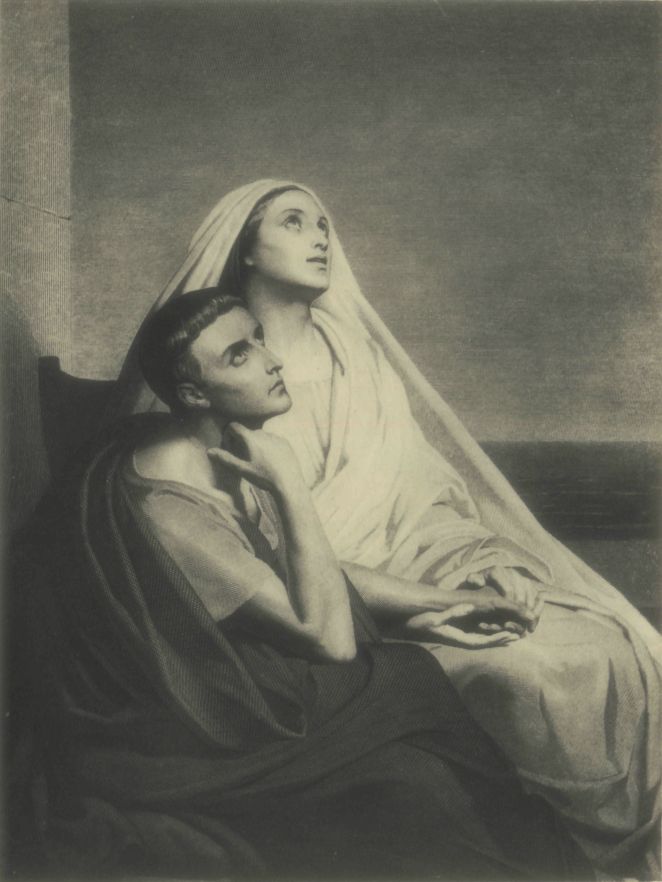
The great Ambrose had been called from the magistrate's chair to be bishop of this important city; and his character and ability made a great impression on Augustine. But Augustine was kept from acknowledging and submitting to the truth, not by the intellectual difficulties which he propounded as an excuse, but by his unwillingness to submit to the moral demands which Christianity made upon him. At last there came one great struggle, described in a passage from the 'Confessions' which is given below; and Monica's hopes and prayers were answered in the conversion of her son to the faith and obedience of Jesus Christ. On Easter Day, 387, in the thirty-third year of his life, he was baptized, an unsubstantiated tradition assigning to this occasion the composition and first use of the Te Deum. His mother died at Ostia as they were setting out for Africa; and he returned to his native land, with the hope that he might there live a life of retirement and of simple Christian obedience. But this might not be: on the occasion of Augustine's visit to Hippo in 391, the bishop of that city persuaded him to receive ordination to the priesthood and to remain with him as an adviser; and four years later he was consecrated as colleague or coadjutor in the episcopate. Thus he entered on a busy public life of thirty-five years, which called for the exercise of all his powers as a Christian, a metaphysician, a man of letters, a theologian, an ecclesiastic, and an administrator.
Into the details of that life it is impossible to enter here; it must suffice to indicate some of the ways in which as a writer he gained and still holds a high place in Western Christendom, having had an influence which can be paralleled, from among uninspired men, only by that of Aristotle. He maintained the unity of the Church, and its true breadth, against the Donatists; he argued, as he so well could argue, against the irreligion of the Manichaeans; when the great Pelagian heresy arose, he defended the truth of the doctrine of divine grace as no one could have done who had not learned by experience its power in the regeneration and conversion of his own soul; he brought out from the treasures of Holy Scripture ample lessons of truth and duty, in simple exposition and exhortation; and in full treatises he stated and enforced the great doctrines of Christianity.
Augustine was not alone or chiefly the stern theologian whom men picture to themselves when they are told that he was the Calvin of those early days, or when they read from his voluminous and often illogical writings quotations which have a hard sound. If he taught a stern doctrine of predestinarianism, he taught also the great power of sacramental grace; if he dwelt at times on the awfulness of the divine justice, he spoke also from the depths of his experience of the power of the divine love; and his influence on the ages has been rather that of the 'Confessions'--taking their key-note from the words of the first chapter, "Thou, O Lord, hast made us for Thy-*self, and our heart is unquiet until it find rest in Thee"--than that of the writings which have earned for their author the foremost place among the Doctors of the Western Church. But his greatest work, without any doubt, is the treatise on the 'City of God.' The Roman empire, as Augustine's life passed on, was hastening to its end. Moral and political declension had doubtless been arrested by the good influence which had been brought to bear upon it; but it was impossible to avert its fall. "Men's hearts," as well among the heathen as among the Christians, were "failing them for fear and for looking after those things that were coming on the earth." And Christianity was called to meet the argument drawn from the fact that the visible declension seemed to date from the time when the new religion was introduced into the Roman world, and that the most rapid decline had been from the time when it had been accepted as the religion of the State. It fell to the Bishop of Hippo to write in reply one of the greatest works ever written by a Christian. Eloquence and learning, argument and irony, appeals to history and earnest entreaties, are united to move enemies to acknowledge the truth and to strengthen the faithful in maintaining it. The writer sets over against each other the city of the world and the city of God, and in varied ways draws the contrast between them; and while mourning over the ruin that is coming upon the great city that had become a world-empire, he tells of the holy beauty and enduring strength of "the city that hath the foundations."
Apart from the interest attaching to the great subjects handled by St. Augustine in his many works, and from the literary attractions of writings which unite high moral earnestness and the use of a cultivated rhetorical style, his works formed a model for Latin theologians as long as that language continued to be habitually used by Western scholars; and to-day both the spirit and the style of the great man have a wide influence on the devotional and the controversial style of writers on sacred subjects.
He died at Hippo, August 28th, 430.
The selections are from the 'Library of Nicene and Post-Nicene Fathers,' by permission of the Christian Literature Company.
THE GODLY SORROW THAT WORKETH REPENTANCE
From the 'Confessions'
Such was the story of Pontitianus: but thou, O Lord, while he was speaking, didst turn me round towards myself, taking me from behind my back, when I had placed myself, unwilling to observe myself; and setting me before my face, that I might see how foul I was, how crooked and defiled, bespotted and ulcerous. And I beheld and stood aghast; and whither to flee from myself I found not. And if I sought to turn mine eye from off myself, he went on with his relation, and thou didst again set me over against myself, and thrusted me before my eyes, that I might find out mine iniquity and hate it. I had known it, but made as though I saw it not, winked at it, and forgot it.
But now, the more ardently I loved those whose healthful affections I heard of, that they had resigned themselves wholly to thee to be cured, the more did I abhor myself when compared with them. For many of my years (some twelve) had now run out with me since my nineteenth, when, upon the reading of Cicero's 'Hortensius,' I was stirred to an earnest love of wisdom; and still I was deferring to reject mere earthly felicity and to give myself to search out that, whereof not the finding only, but the very search, was to be preferred to the treasures and kingdoms of the world, though already found, and to the pleasures of the body, though spread around me at my will. But I, wretched, most wretched, in the very beginning of my early youth, had begged chastity of thee, and said, "Give me chastity and continency, only not yet." For I feared lest thou shouldest hear me soon, and soon cure me of the disease of concupiscence, which I wished to have satisfied, rather than extinguished. And I had wandered through crooked ways in a sacrilegious superstition, not indeed assured thereof, but as preferring it to the others which I did not seek religiously, but opposed maliciously.
But when a deep consideration had, from the secret bottom of my soul, drawn together and heaped up all my misery in the sight of my heart, there arose a mighty storm, bringing a mighty shower of tears. And that I might pour it forth wholly in its natural expressions, I rose from Alypius: solitude was suggested to me as fitter for the business of weeping; and I retired so far that even his presence could not be a burden to me. Thus was it then with me, and he perceived something of it; for something I suppose he had spoken, wherein the tones of my voice appeared choked with weeping, and so had risen up. He then remained where we were sitting, most extremely astonished. I cast myself down I know not how, under a fig-tree, giving full vent to my tears; and the floods of mine eyes gushed out, an acceptable sacrifice to thee. And, not indeed in these words, yet to this purpose, spake I much unto thee:--"And thou, O Lord, how long? how long, Lord, wilt thou be angry--forever? Remember not our former iniquities," for I felt that I was held by them. I sent up these sorrowful words: "How long? how long? To-morrow and to-morrow? Why not now? why is there not this hour an end to my uncleanness?"
CONSOLATION
From the 'Confessions'
So was I speaking, and weeping, in the most bitter contrition of my heart, when lo! I heard from a neighboring house a voice, as of boy or girl (I could not tell which), chanting and oft repeating, "Take up and read; take up and read." Instantly my countenance altered, and I began to think most intently whether any were wont in any kind of play to sing such words, nor could I remember ever to have heard the like. So, checking the torrent of my tears, I arose; interpreting it to be no other than a command from God, to open the book and read the first chapter I should find. Eagerly then I returned to the place where Alypius was sitting; for there had I laid the volume of the Epistles when I arose thence. I seized, opened, and in silence read that section on which my eyes first fell:--"Not in rioting and drunkenness, not in chambering and wantonness, not in strife and envying; but put ye on the Lord Jesus Christ, and make not provision for the flesh, to fulfill the lusts thereof." No further would I read; nor heeded I, for instantly at the end of this sentence, by a light, as it were, of serenity infused into my heart, all the darkness of doubt vanished away.
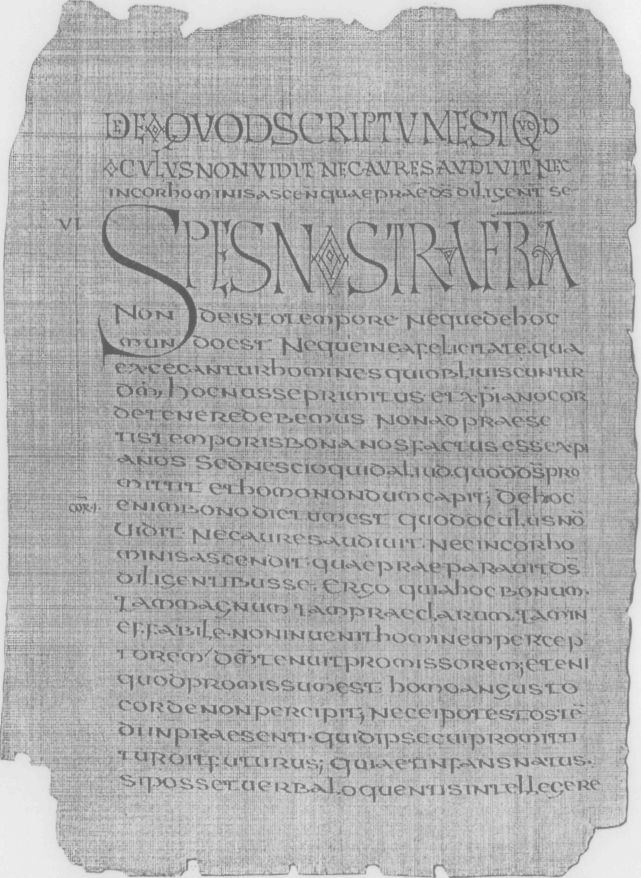
PAPYRUS. Reduced facsimile of a Latin manuscript containing the SERMONS OF ST. AUGUSTINE. Sixth Century. In the National Library at Paris. A fine specimen of sixth-century writing upon sheets formed of two thin layers of longitudinal strips of the stem or pith of the papyrus plant pressed together at right angles to each other.
Then putting my finger between (or some other mark), I shut the volume, and with a calmed countenance, made it known to Alypius. And what was wrought in him, which I know not, he thus shewed me. He asked to see what I had read; I shewed him, and he looked even farther than I had read, and I knew not what followed. This followed: "Him that is weak in the faith, receive ye"; which he applied to himself and disclosed to me. And by this admonition was he strengthened; and by a good resolution and purpose, and most corresponding to his character, wherein he did always far differ from me for the better, without any turbulent delay he joined me. Thence we go to my mother: we tell her; she rejoiceth: we relate in order how it took place; she leapeth for joy, and triumpheth and blesseth thee, "who art able to do above all that we ask or think": for she perceived that thou hadst given her more for me than she was wont to beg by her pitiful and most sorrowful groanings.
THE FOES OF THE CITY
From 'The City of God'
Let these and similar answers (if any fuller and fitter answers can be found) be given to their enemies by the redeemed family of the Lord Christ, and by the pilgrim city of the King Christ. But let this city bear in mind that among her enemies lie hid those who are destined to be fellow-citizens, that she may not think it a fruitless labor to bear what they inflict as enemies, till they become confessors of the faith. So also, as long as she is a stranger in the world, the city of God has in her communion, and bound to her by the sacraments, some who shall not eternally dwell in the lot of the saints. Of these, some are not now recognized; others declare themselves, and do not hesitate to make common cause with our enemies in murmuring against God, whose sacramental badge they wear. These men you may see to-day thronging the churches with us, to-morrow crowding the theatres with the godless. But we have the less reason to despair of the reclamation of even such persons, if among our most declared enemies there are now some, unknown to themselves, who are destined to become our friends. In truth, these two cities are entangled together in this world, and intermingled until the last judgment shall effect their separation. I now proceed to speak, as God shall help me, of the rise and progress and end of these two cities; and what I write, I write for the glory of the city of God, that being placed in comparison with the other, it may shine with a brighter lustre.
THE PRAISE OF GOD
From 'The City of God'
Wherefore it may very well be, and it is perfectly credible, that we shall in the future world see the material forms of the new heavens and the new earth, in such a way that we shall most distinctly recognize God everywhere present, and governing all things, material as well as spiritual; and shall see Him, not as we now understand the invisible things of God, by the things that are made, and see Him darkly as in a mirror and in part, and rather by faith than by bodily vision of material appearances, but by means of the bodies which we shall wear and which we shall see wherever we turn our eyes. As we do not believe, but see, that the living men around us who are exercising the functions of life are alive, although we cannot see their life without their bodies, but see it most distinctly by means of their bodies, so, wherever we shall look with the spiritual eyes of our future bodies, we shall also, by means of bodily substances, behold God, though a spirit, ruling all things. Either, therefore, the eyes shall possess some quality similar to that of the mind, by which they shall be able to discern spiritual things, and among them God,--a supposition for which it is difficult or even impossible to find any support in Scripture,--or what is more easy to comprehend, God will be so known by us, and so much before us, that we shall see Him by the spirit in ourselves, in one another, in Himself, in the new heavens and the new earth, in every created thing that shall then exist; and that also by the body we shall see Him in every bodily thing which the keen vision of the eye of the spiritual body shall reach. Our thoughts also shall be visible to all, for then shall be fulfilled the words of the Apostle, "Judge nothing before the time, until the Lord come, who both will bring to light the hidden things of darkness, and will make manifest the counsels of the hearts; and then shall every man have praise of God." How great shall be that felicity, which shall be tainted with no evil, which shall lack no good, and which shall afford leisure for the praises of God, who shall be all in all! For I know not what other employment there can be where no weariness shall slacken activity, nor any want stimulate to labor. I am admonished also by the sacred song, in which I read or hear the words, "Blessed are they that dwell in Thy house; they will be alway praising Thee."
A PRAYER
From 'The Trinity'
O Lord our God, directing my purpose by the rule of faith, so far as I have been able, so far as Thou hast made me able, I have sought Thee, and have desired to see with my understanding what I have believed; and I have argued and labored much. O Lord my God, my only hope, hearken to me, lest through weariness I be unwilling to seek Thee, but that I may always ardently seek Thy face. Do Thou give me strength to seek, who hast led me to find Thee, and hast given the hope of finding Thee more and more. My strength and my weakness are in Thy sight; preserve my strength and heal my weakness. My knowledge and my ignorance are in Thy sight; when Thou hast opened to me, receive me as I enter; when Thou hast closed, open to me as I knock. May I remember Thee, understand Thee, love Thee. Increase these things in me, until Thou renew me wholly. But oh, that I might speak only in preaching Thy word and in praising Thee. But many are my thoughts, such as Thou knowest, "thoughts of man, that are vain." Let them not so prevail in me, that anything in my acts should proceed from them; but at least that my judgment and my conscience be safe from them under Thy protection. When the wise man spake of Thee in his book, which is now called by the special name of Ecclesiasticus, "We speak," he says, "much, and yet come short; and in sum of words, He is all." When therefore we shall have come to Thee, these very many things that we speak, and yet come short, shall cease; and Thou, as One, shalt remain "all in all." And we shall say one thing without end, in praising Thee as One, ourselves also made one in Thee. O Lord, the one God, God the Trinity, whatever I have said in these books that is of Thine, may they acknowledge who are Thine; if I have said anything of my own, may it be pardoned both by Thee and by those who are Thine. Amen.
The three immediately preceding citations, from 'A Select Library of the Nicene and Post-Nicene Fathers of the Christian Church, First Series,' are reprinted by permission of the Christian Literature Company, New York.