Volume 3 — THE AVESTA
Reading edition
(From about B.C. Sixth Century)
BY A.V. WILLIAMS JACKSON

vesta, or Zend-Avesta, an interesting monument of antiquity, is the Bible of Zoroaster, the sacred book of ancient Iran, and holy scripture of the modern Parsis. The exact meaning of the name "Avesta" is not certain; it may perhaps signify "law," "text," or, more doubtfully, "wisdom," "revelation." The modern familiar designation of the book as Zend-Avesta is not strictly accurate; if used at all, it should rather be Avesta-Zend, like "Bible and Commentary," as zand signifies "explanation," "commentary," and Avesta u Zand is employed in some Persian allusions to the Zoroastrian scriptures as a designation denoting the text of the Avesta accompanied by the Pahlavi version or interpretation.
The story of the recovery of the Avesta, or rather the discovery of the Avesta, by the enthusiastic young French scholar Anquetil du Perron, who was the first to open to the western world the ancient records of Zoroastrianism, reads almost like a romance. Du Perron's own account of his departure for India in 1754, of his experiences with the dasturs (or priests) during a seven years' residence among them, of his various difficulties and annoyances, setbacks and successes, is entertainingly presented in the introductory volume of his work 'Zend-Avesta, Ouvrage de Zoroastre' (3 Vols., Paris, 1771). This was the first translation of the ancient Persian books published in a European language. Its appearance formed one of those epochs which are marked by an addition to the literary, religious, or philosophical wealth of our time; a new contribution was added to the riches of the West from the treasures of the East. The field thus thrown open, although worked imperfectly at first, has yielded abundant harvests to the hands of later gleaners.
THE ZEND-AVESTA. Facsimile of a Page of the AVESTA; from the oldest preserved manuscript containing the YAÇNA. A.D. 1325. In the Royal Library at Copenhagen. The Zend-Avesta--more properly the Avesta-Zend, i.e., "Text and Commentary" is the "Bible" of the Persians. The four parts into which it is divided are called Yaçna, Vispered, Vendidad, and Khordah-Avesta.
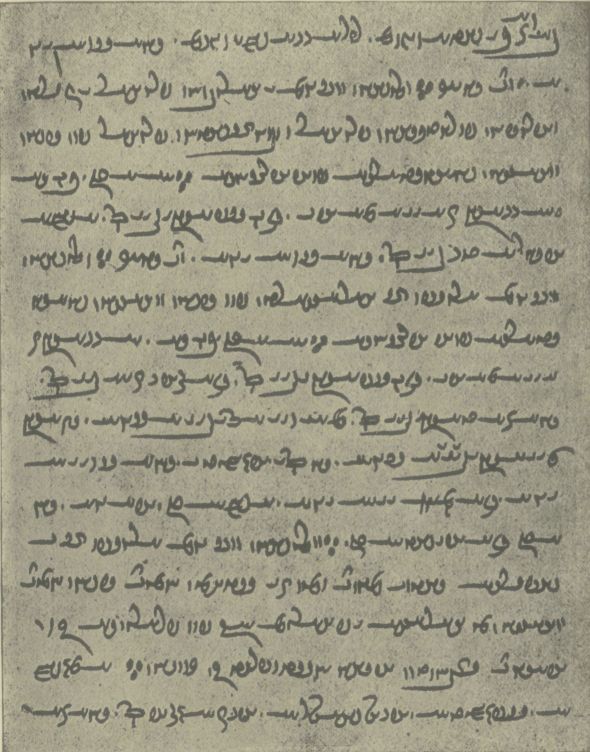
With the growth of our knowledge of the language of the sacred texts, we have now a clear idea also of the history of Zoroastrian literature and of the changes and chances through which with varying fortunes the scriptures have passed. The original Zoroastrian Avesta, according to tradition, was in itself a literature of vast dimensions. Pliny, in his 'Natural History,' speaks of two million verses of Zoroaster; to which may be added the Persian assertion that the original copy of the scriptures was written upon twelve thousand parchments, with gold illuminated letters, and was deposited in the library at Persepolis. But what was the fate of this archetype? Parsi tradition has an answer. Alexander the Great--"the accursed Iskander," as he is called--is responsible for its destruction. At the request of the beautiful Thais, as the story goes, he allowed the palace of Persepolis to be burned, and the precious treasure perished in the flames. Whatever view we may take of the different sides of this story, one thing cannot be denied: the invasion of Alexander and the subjugation of Iran was indirectly or directly the cause of a certain religious decadence which followed upon the disruption of the Persian Empire, and was answerable for the fact that a great part of the scriptures was forgotten or fell into disuse. Persian tradition lays at the doors of the Greeks the loss of another copy of the original ancient texts, but does not explain in what manner this happened; nor has it any account to give of copies of the prophet's works which Semitic writers say were translated into nearly a dozen different languages. One of these versions was perhaps Greek, for it is generally acknowledged that in the fourth century B.C. the philosopher Theopompus spent much time in giving in his own tongue the contents of the sacred Magian books.
Tradition is unanimous on one point at least: it is that the original Avesta comprised twenty-one Nasks, or books, a statement which there is no good reason to doubt. The same tradition which was acquainted with the general character of these Nasks professes also to tell exactly how many of them survived the inroad of Alexander; for although the sacred text itself was destroyed, its contents were lost only in part, the priests preserving large portions of the precious scriptures. These met with many vicissitudes in the five centuries that intervened between the conquest of Alexander and the great restoration of Zoroastrianism in the third century of our era, under the Sassanian dynasty. At this period all obtainable Zoroastrian scriptures were collected, the compilation was codified, and a detailed notice made of the contents of each of the original Nasks compared with the portions then surviving. The original Avesta was, it would appear, a sort of encyclopaedic work; not of religion alone, but of useful knowledge relating to law, to the arts, science, the professions, and to every-day life. If we may judge from the existing table of contents of these Nasks, the zealous Sassanians, even in the time of the collecting (A. D. 226-380), were able to restore but a fragment of the archetype, perhaps a fourth part of the original Avesta. Nor was this remnant destined to escape misfortune. The Mohammedan invasion, in the seventh century of our era added a final and crushing blow. Much of the religion that might otherwise have been handed down to us, despite "the accursed Iskander's" conquest, now perished through the sword and the Koran. Its loss, we must remember, is in part compensated by the Pahlavi religious literature of Sassanian days.
Fragmentary and disjointed as are the remnants of the Avesta, we are fortunate in possessing even this moiety of the Bible of Zoroaster, whose compass is about one tenth that of our own sacred book. A grouping of the existing texts is here presented:--1. Yasna (including Gathas). 2. Visperad. 3. Yashts. 4. Minor Texts. 5. Vendidad. 6. Fragments.
Even these texts no single manuscript in our time contains complete. The present collection is made by combining various Avestan codexes. In spite of the great antiquity of the literature, all the existing manuscripts are comparatively young. None is older than the thirteenth century of our own era, while the direct history of only one or two can be followed back to about the tenth century. This mere external circumstance has of course no bearing on the actual early age of the Zoroastrian scriptures. It must be kept in mind that Zoroaster lived at least six centuries before the birth of Christ.
Among the six divisions of our present Avesta, the Yasna, Visperad, and Vendidad are closely connected. They are employed in the daily ritual, and they are also accompanied by a version or interpretation in the Pahlavi language, which serves at the same time as a sort of commentary. The three divisions are often found combined into a sort of prayer-book, called Vendidad-Sadah (Vendidad Pure); i.e., Avesta text without the Pahlavi rendering. The chapters in this case are arranged with special reference to liturgical usage.
Some idea of the character of the Avesta as it now exists may be derived from the following sketch of its contents and from the illustrative selections presented:--
1. Yasna (sacrifice, worship), the chief liturgical work of the sacred canon. It consists mainly of ascriptions of praise and of prayer, and corresponds nearly to our idea of a prayer-book. The Yasna comprises seventy-two chapters; these fall into three nearly equal parts. The middle, or oldest part, is the section of Gathas below described.
The meaning of the word yasna as above gives at once some conception of the nature of the texts. The Yasna chapters were recited at the sacrifice: a sacrifice that consisted not in blood-offerings, but in an offering of praise and thanksgiving, accompanied by ritual observances. The white-robed priest, girt with the sacred cord and wearing a veil, the paitidana, before his lips in the presence of the holy fire, begins the service by an invocation of Ahura Mazda (Ormazd) and the heavenly hierarchy; he then consecrates the zaothra water, the myazda or oblation, and the baresma or bundle of sacred twigs. He and his assistant now prepare the haoma (the soma of the Hindus), or juice of a sacred plant, the drinking of which formed part of the religious rite. At the ninth chapter of the book, the rhythmical chanting of the praises of Haoma is begun. This deified being, a personification of the consecrated drink, is supposed to have appeared before the prophet himself, and to have described to him the blessings which the haoma bestows upon its pious worshiper. The lines are metrical, as in fact they commonly are in the older parts of the Avesta, and the rhythm somewhat recalls the Kalevala verse of Longfellow's 'Hiawatha.' A specimen is here presented in translation:--
At the time of morning-worship Haoma came to Zoroaster, Who was serving at the Fire And the holy Psalms intoning. "What man art thou (asked the Prophet), Who of all the world material Art the fairest I have e'er seen In my life, bright and immortal?"
The image of the sacred plant responds, and bids the priest prepare the holy extract.
Haoma then to me gave answer, Haoma righteous, death-destroying:-- "Zoroaster, I am Haoma, Righteous Haoma, death-destroying. Do thou gather me, Spitama, And prepare me as a potion; Praise me, aye as shall hereafter In their praise the Saviors praise me."
Zoroaster again inquires, wishing to know of the pious men of old who worshiped Haoma and obtained blessings for their religious zeal. Among these, as is learned from Haoma, one was King Yima, whose reign was the time of the Golden Age; those were the happy days when a father looked as young as his children.
In the reign of princely Yima, Heat there was not, cold there was not, Neither age nor death existed, Nor disease the work of Demons; Son and father walked together Fifteen years old, each in figure, Long as Vivanghvat's son Yima, The good Shepherd, ruled as sovereign.
For two chapters more, Haoma is extolled. Then follows the Avestan Creed (Yasna 12), a prose chapter that was repeated by those who joined in the early Zoroastrian faith, forsook the old marauding and nomadic habits that still characterize the modern Kurds, and adopted an agricultural habit of life, devoting themselves peaceably to cattle-raising, irrigation, and cultivation of the fields. The greater part of the Yasna book is of a liturgic or ritualistic nature, and need not here be further described. Special mention, however, must be made of the middle section of the Yasna, which is constituted by "the Five Gathas" (hymns, psalms), a division containing the seventeen sacred psalms, sayings, sermons, or teachings of Zoroaster himself. These Gathas form the oldest part of the entire canon of the Avesta. In them we see before our eyes the prophet of the new faith speaking with the fervor of the Psalmist of the Bible. In them we feel the thrill of ardor that characterizes a new and struggling religious band; we are warmed by the burning zeal of the preacher of a church militant. Now, however, comes a cry of despondency, a moment of faint-heartedness at the present triumph of evil, at the success of the wicked and the misery of the righteous; but this gives way to a clarion burst of hopefulness, the trumpet note of a prophet filled with the promise of ultimate victory, the triumph of good over evil. The end of the world cannot be far away; the final overthrow of Ahriman (Anra Mainyu) by Ormazd (Ahura Mazda) is assured; the establishment of a new order of things is certain; at the founding of this "kingdom" the resurrection of the dead will take place and the life eternal will be entered upon.
The third Gatha, Yasna 30, may be chosen by way of illustration. This is a sort of Mazdian Sermon on the Mount. Zoroaster preaches the doctrine of dualism, the warfare of good and evil in the world, and exhorts the faithful to choose aright and to combat Satan. The archangels Good Thought (Vohu Manah), Righteousness (Asha), Kingdom (Khshathra), appear as the helpers of Man (Maretan); for whose soul, as in the old English morality play, the Demons (Dævas) are contending. Allusions to the resurrection and final judgment, and to the new dispensation, are easily recognized in the spirited words of the prophet. A prose rendering of this metrical psalm is here attempted; the verse order, however, is preserved, though without rhythm.
A PSALM OF ZOROASTER: YASNA 30 Now shall I speak of things which ye who seek them shall bear in mind, Namely, the praises of Ahura Mazda and the worship of Good Thought, And the joy of [lit. through] Righteousness which is manifested through Light. 2 Hearken with your ears to what is best; with clear understanding perceive it. Awakening to our advising every man, personally, of the distinction Between the two creeds, before the Great Event [i.e., the Resurrection]. 3 Now, Two Spirits primeval there were twins which became known through their activity, To wit, the Good and the Evil, in thought, word, and deed. The wise have rightly distinguished between these two; not so the unwise. 4 And, now, when these Two Spirits first came together, they established Life and destruction, and ordained how the world hereafter shall be, To wit, the Worst World [Hell] for the wicked, but the Best Thought [Heaven] for the righteous. 5 The Wicked One [Ahriman] of these Two Spirits chose to do evil, The Holiest Spirit [Ormazd]--who wears the solid heavens as a robe--chose Righteousness [Asha], And [so also those] who zealously gratified Ormazd by virtuous deeds. 6 Not rightly did the Demons distinguish these Two Spirits; for Delusion came Upon them, as they were deliberating, so that they chose the Worst Thought [Hell]. And away they rushed to Wrath [the Fiend] in order to corrupt the life of Man [Maretan]. 7 And to him [i.e., to Gaya Maretan] came Khshathra [Kingdom], Vohu Manah [Good Thought] and Asha [Righteousness], And Armaiti [Archangel of Earth] gave [to him] bodily endurance unceasingly; Of these, Thy [creatures], when Thou earnest with Thy creations, he [i.e., Gaya Maretan] was the first. 8 But when the retribution of the sinful shall come to pass, Then shall Good Thought distribute Thy Kingdom, Shall fulfill it for those who shall deliver Satan [Druj] into the hand of Righteousness [Asha]. 9 And so may we be such as make the world renewed, And may Ahura Mazda and Righteousness lend their aid, That our thoughts may there be [set] where Faith is abiding. 10 For at the [final] Dispensation, the blow of annihilation to Satan shall come to pass; But those who participate in a good report [in the Life Record] shall meet together In the happy home of Good Thought, and of Mazda, and of Righteousness. 11 If, O ye men, ye mark these doctrines which Mazda gave, And [mark] the weal and the woe--namely, the long torment of the wicked, And the welfare of the righteous--then in accordance with these [doctrines] there will be happiness hereafter.
The Visperad (all the masters) is a short collection of prosaic invocations and laudations of sacred things. Its twenty-four sections form a supplement to the Yasna. Whatever interest this division of the Avesta possesses lies entirely on the side of the ritual, and not in the field of literature. In this respect it differs widely from the book of the Yashts, which is next to be mentioned.
The Yashts (praises of worship) form a poetical book of twenty-one hymns in which the angels of the religion, "the worshipful ones" (Yazatas, Izads), are glorified, and the heroes of former days. Much of the material of the Yashts is evidently drawn from pre-Zoroastrian sagas which have been remodeled and adopted, worked over and modified, and incorporated into the canon of the new-founded religion. There is a mythological and legendary atmosphere about the Yashts, and Firdausi's 'Shah Nameh' serves to throw light on many of the events portrayed in them, or allusions that would otherwise be obscure. All the longer Yashts are in verse, and some of them have poetic merit. Chiefly to be mentioned among the longer ones are: first, the one in praise of Ardvi Sura Anahita, or the stream celestial (Yt. 5); second, the Yasht which exalts the star Tishtrya and his victory over the demon of drought (Yt. 8); then the one devoted to the Fravashis or glorified souls of the righteous (Yt. 13) as well as the Yasht in honor of Verethraghna, the incarnation of Victory (Yt. 14). Selections from the others, Yt. 10 and Yt. 19, which are among the noblest, are here given.
The first of the two chosen (Yt. 10) is dedicated to the great divinity Mithra, the genius who presides over light, truth, and the sun (Yt. 10, 13).
Foremost he, the celestial angel, Mounts above Mount Hara (Alborz) In advance of the sun immortal Which is drawn by fleeting horses; He it is, in gold adornment First ascends the beauteous summits Thence beneficent he glances Over all the abode of Aryans.
As the god of light and of truth and as one of the judges of the dead, he rides out in lordly array to the battle and takes an active part in the conflict, wreaking vengeance upon those who at any time in their life have spoken falsely, belied their oath, or broken their pledge. His war-chariot and panoply are described in mingled lines of verse and prose, which may thus be rendered (Yt. 10, 128-132):--
By the side of Mithra's chariot, Mithra, lord of the wide pastures, Stand a thousand bows well-fashioned (The bow has a string of cowgut).
By his chariot also are standing a thousand vulture-feathered, gold-notched, lead-poised, well-fashioned arrows (the barb is of iron); likewise a thousand spears well-fashioned and sharp-piercing, and a thousand steel battle-axes, two-edged and well-fashioned; also a thousand bronze clubs well-fashioned.
And by Mithra's chariot also Stands a mace, fair and well-striking, With a hundred knobs and edges, Dashing forward, felling heroes; Out of golden bronze 'tis molded.
The second illustrative extract will be taken from Yasht 19, which magnifies in glowing strains the praises of the Kingly Glory. This "kingly glory" (kavaem hvareno) is a sort of halo, radiance, or mark of divine right, which was believed to be possessed by the kings and heroes of Iran in the long line of its early history. One hero who bore the glory was the mighty warrior Thraetaona (Feridun), the vanquisher of the serpent-monster Azhi Dahaka (Zohak), who was depopulating the world by his fearful daily banquet of the brains of two children. The victory was a glorious triumph for Thraetaona (Yt. 19, 37):--
He who slew Azhi Dahaka, Three-jawed monster, triple-headed, With six eyes and myriad senses, Fiend demoniac, full of power, Evil to the world, and wicked. This fiend full of power, the Devil Anra Mainyu had created, Fatal to the world material, Deadly to the world of Righteousness.
Of equal puissance was another noble champion, the valiant Keresaspa, who dispatched a raging demon who, though not yet grown to man's estate, was threatening the world. The monster's thrasonical boasting is thus given (Yt. 19, 43):--
I am yet only a stripling, But if ever I come to manhood I shall make the earth my chariot And shall make a wheel of heaven. I shall drive the Holy Spirit Down from out the shining heaven, I shall rout the Evil Spirit Up from out the dark abysm; They as steeds shall draw my chariot, God and Devil yoked together.
Passing over a collection of shorter petitions, praises, and blessings which may conveniently be grouped together as 'Minor Prayers,' for they answer somewhat to our idea of a daily manual of morning devotion, we may turn to the Vendidad (law against the demons), the Iranian Pentateuch. Tradition asserts that in the Vendidad we have preserved a specimen of one of the original Nasks. This may be true, but even the superficial student will see that it is in any case a fragmentary remnant. Interesting as the Vendidad is to the student of early rites, observances, manners, and customs, it is nevertheless a barren field for the student of literature, who will find in it little more than wearisome prescriptions like certain chapters of Leviticus, Numbers, and Deuteronomy. It need only be added that at the close of the colloquy between Zoroaster and Ormazd given in Vend. 6, he will find the origin of the modern Parsi "Towers of Silence."
Among the Avestan Fragments, attention might finally be called to one which we must be glad has not been lost. It is an old metrical bit (Frag. 4, 1-3) in praise of the Airyama Ishya Prayer (Yt. 54, 1). This is the prayer that shall be intoned by the Savior and his companions at the end of the world, when the resurrection will take place; and it will serve as a sort of last trump, at the sound of which the dead rise from their graves and evil is banished from the world. Ormazd himself says to Zoroaster (Frag. 4, 1-3):--
The Airyama Ishya prayer, I tell thee, Upright, holy Zoroaster, Is the greatest of all prayers. Verily among all prayers It is this one which I gifted With revivifying powers. This prayer shall the Saoshyants, Saviors, Chant, and at the chanting of it I shall rule over my creatures, I who am Ahura Mazda. Not shall Ahriman have power, Anra Mainyu, o'er my creatures, He (the fiend) of foul religion. In the earth shall Ahriman hide, In the earth the demons hide. Up the dead again shall rise, And within their lifeless bodies Incorporate life shall be restored.
Inadequate as brief extracts must be to represent the sacred books of a people, the citations here given will serve to show that the Avesta which is still recited in solemn tones by the white-robed priests of Bombay, the modern representatives of Zoroaster, the Prophet of ancient days, is a survival not without value to those who appreciate whatever has been preserved for us of the world's earlier literature. For readers who are interested in the subject there are several translations of the Avesta. The best (except for the Gathas, where the translation is weak) is the French version by Darmesteter, 'Le Zend Avesta,' published in the 'Annales du Musée Guimet' (Paris, 1892-93). An English rendering by Darmesteter and Mills is contained in the 'Sacred Books of the East,' Vols. iv., xxiii., xxxi.

A PRAYER FOR KNOWLEDGE
This I ask Thee, O Ahura! tell me aright: when praise is to be offered, how shall I complete the praise of the One like You, O Mazda? Let the One like Thee declare it earnestly to the friend who is such as I, thus through Thy Righteousness within us to offer friendly help to us, so that the One like Thee may draw near us through Thy Good Mind within the Soul.
2. This I ask Thee, O Ahura! tell me aright how, in pleasing Him, may we serve the Supreme One of the better world; yea, how to serve that chief who may grant us those blessings of his grace and who will seek for grateful requitals at our hands; for He, bountiful as He is through the Righteous Order, will hold off ruin from us all, guardian as He is for both the worlds, O Spirit Mazda! and a friend.
3. This I ask Thee, O Ahura! tell me aright: Who by generation is the first father of the Righteous Order within the world? Who gave the recurring sun and stars their undeviating way? Who established that whereby the moon waxes, and whereby she wanes, save Thee? These things, O Great Creator! would I know, and others likewise still.
4. This I ask Thee, O Ahura! tell me aright: Who from beneath hath sustained the earth and the clouds above that they do not fall? Who made the waters and the plants? Who to the wind has yoked on the storm-clouds the swift and fleetest two? Who, O Great Creator! is the inspirer of the good thoughts within our souls?
5. This I ask Thee, O Ahura! tell me aright: Who, as a skillful artisan, hath made the lights and the darkness? Who, as thus skillful, hath made sleep and the zest of waking hours? Who spread the Auroras, the noontides and midnight, monitors to discerning man, duty's true guides?
6. This I ask Thee, O Ahura! tell me aright these things which I shall speak forth, if they are truly thus. Doth the Piety which we cherish in reality increase the sacred orderliness within our actions? To these Thy true saints hath she given the Realm through the Good Mind? For whom hast thou made the Mother-kine, the produce of joy?
7. This I ask Thee, O Ahura! tell me aright: Who fashioned Aramaiti (our piety) the beloved, together with Thy Sovereign Power? Who, through his guiding wisdom, hath made the son revering the father? Who made him beloved? With questions such as these, so abundant, O Mazda! I press Thee, O bountiful Spirit, Thou maker of all!
Yasna xliv.: Translation of L.H. Mills.
THE ANGEL OF DIVINE OBEDIENCE
We worship Sraosha [Obedience] the blessed, whom four racers draw in harness, white and shining, beautiful and (27) powerful, quick to learn and fleet, obeying before speech, heeding orders from the mind, with their hoofs of horn gold-covered, (28) fleeter than [our] horses, swifter than the winds, more rapid than the rain [drops as they fall]; yea, fleeter than the clouds, or well-winged birds, or the well-shot arrow as it flies, (29) which overtake these swift ones all, as they fly after them pursuing, but which are never overtaken when they flee, which plunge away from both the weapons [hurled on this side and on that] and draw Sraosha with them, the good Sraosha and the blessed; which from both the weapons [those on this side and on that] bear the good Obedience the blessed, plunging forward in their zeal, when he takes his course from India on the East and when he lights down in the West.
Yasna lvii. 27-29: Translation of L.H. Mills.
TO THE FIRE
I offer my sacrifice and homage to thee, the Fire, as a good offering, and an offering with our hail of salvation, even as an offering of praise with benedictions, to thee, the Fire, O Ahura, Mazda's son! Meet for sacrifice art thou, and worthy of [our] homage. And as meet for sacrifice, and thus worthy of our homage, may'st thou be in the houses of men [who worship Mazda]. Salvation be to this man who worships thee in verity and truth, with wood in hand and baresma [sacred twigs] ready, with flesh in hand and holding too the mortar. 2. And mayst thou be [ever] fed with wood as the prescription orders. Yea, mayst thou have thy perfume justly, and thy sacred butter without fail, and thine andirons regularly placed. Be of full age as to thy nourishment, of the canon's age as to the measure of thy food. O Fire, Ahura, Mazda's son! 3. Be now aflame within this house; be ever without fail in flame; be all ashine within this house: for long time be thou thus to the furtherance of the heroic [renovation], to the completion of [all] progress, yea, even till the good heroic [millennial] time when that renovation shall have become complete. 4. Give me, O Fire, Ahura, Mazda's son! a speedy glory, speedy nourishment and speedy booty and abundant glory, abundant nourishment, abundant booty, an expanded mind, and nimbleness of tongue and soul and understanding, even an understanding continually growing in its largeness, and that never wanders.
Yasna lxii. 1-4: Translation of L.H. Mills.
THE GODDESS OF THE WATERS
Offer up a sacrifice unto this spring of mine, Ardvi Sura Anahita (the exalted, mighty, and undefiled, image of the (128) stream celestial), who stands carried forth in the shape of a maid, fair of body, most strong, tall-formed, high-girded, pure, nobly born of a glorious race, wearing a mantle fully embroidered with gold. 129. Ever holding the baresma in her hand, according to the rules; she wears square golden ear-rings on her ears bored, and a golden necklace around her beautiful neck, she, the nobly born Ardvi Sura Anahita; and she girded her waist tightly, so that her breasts may be well shaped, that they may be tightly pressed. 128. Upon her head Ardvi Sura Anahita bound a golden crown, with a hundred stars, with eight rays, a fine well-made crown, with fillets streaming down. 129. She is clothed with garments of beaver, Ardvi Sura Anahita; with the skin of thirty beavers, of those that bear four young ones, that are the finest kind of beavers; for the skin of the beaver that lives in water is the finest colored of all skins, and when worked at the right time it shines to the eye with full sheen of silver and gold.
Yasht v. 126-129: Translation of J. Darmesteter.
GUARDIAN SPIRITS
We worship the good, strong, beneficent Fravashis [guardian spirits] of the faithful; with helms of brass, with weapons (45) of brass, with armor of brass; who struggle in the fights for victory in garments of light, arraying the battles and bringing them forwards, to kill thousands of Dævas [demons]. 46. When the wind blows from behind them and brings their breath unto men, then men know where blows the breath of victory: and they pay pious homage unto the good, strong, beneficent Fravashis of the faithful, with their hearts prepared and their arms uplifted. 47. Whichever side they have been first worshiped in the fulness of faith of a devoted heart, to that side turn the awful Fravashis of the faithful along with Mithra [angel of truth and light] and Rashnu [Justice] and the awful cursing thought of the wise and the victorious wind.
Yasht xiii. 45-47: Translation of J. Darmesteter.
AN ANCIENT SINDBAD
The manly-hearted Keresaspa was the sturdiest of the men of strength, for Manly Courage clave unto him. We worship [this] Manly Courage, firm of foot, unsleeping, quick to rise, and fully awake, that clave unto Keresaspa [the hero], who killed the snake Srvara, the horse-devouring, man-devouring, yellow poisonous snake, over which yellow poison flowed a thumb's breadth thick. Upon him Kerasaspa was cooking his food in a brass vessel, at the time of noon. The fiend felt the heat and darted away; he rushed from under the brass vessel and upset the boiling water: the manly-hearted Keresaspa fell back affrighted.
Yasht xix. 38-40: Translation of J. Darmesteter.
THE WISE MAN
Verily I say it unto thee, O Spitama Zoroaster! the man who has a wife is far above him who lives in continence; he who keeps a house is far above him who has none; he who has children is far above the childless man; he who has riches is far above him who has none.
And of two men, he who fills himself with meat receives in him good spirit [Vohu Mano] much more than he who does not do so; the latter is all but dead; the former is above him by the worth of a sheep, by the worth of an ox, by the worth of a man.
It is this man that can strive against the onsets of death; that can strive against the well-darted arrow; that can strive against the winter fiend with thinnest garment on; that can strive against the wicked tyrant and smite him on the head; it is this man that can strive against the ungodly fasting Ashemaogha [the fiends and heretics who do not eat].
Vendidad iv. 47-49: Translation of J. Darmesteter.
INVOCATION TO RAIN
"Come on, O clouds, along the sky, through the air, down on the earth, by thousands of drops, by myriads of drops," thus say, O holy Zoroaster! "to destroy sickness altogether, to destroy death altogether, to destroy altogether the sickness made by the Gaini, to destroy altogether the death made by Gaini, to destroy altogether Gadha and Apagadha.
"If death come at eve, may healing come at daybreak!
"If death come at daybreak, may healing come at night!
"If death come at night, may healing come at dawn!
"Let showers shower down new waters, new earth, new trees, new health, and new healing powers."
Vendidad xxi. 2: Translation of J. Darmesteter.
A PRAYER FOR HEALING
Ahura Mazda spake unto Spitama Zoroaster, saying, "I, Ahura Mazda, the Maker of all good things, when I made this mansion, the beautiful, the shining, seen afar (there may I go up, there may I arrive)!"
Then the ruffian looked at me; the ruffian Anra Mainyu, the deadly, wrought against me nine diseases and ninety, and nine hundred, and nine thousand, and nine times ten thousand diseases. So mayest thou heal me, O Holy Word, thou most glorious one!
Unto thee will I give in return a thousand fleet, swift-running steeds; I offer thee up a sacrifice, O good Saoka, made by Mazda and holy.
Unto thee will I give in return a thousand fleet, high-humped camels; I offer thee up a sacrifice, O good Saoka, made by Mazda and holy.
Unto thee will I give in return a thousand brown faultless oxen; I offer thee up a sacrifice, O good Saoka, made by Mazda and holy.
Unto thee will I give in return a thousand young of all species of small cattle; I offer thee up a sacrifice, O good Saoka, made by Mazda and holy.
And I will bless thee with the fair blessing-spell of the righteous, the friendly blessing-spell of the righteous, that makes the empty swell to fullness and the full to overflowing, that comes to help him who was sickening, and makes the sick man sound again. Vendidad xxii. 1-5: Translation of J. Darmesteter.
FRAGMENT
All good thoughts, and all good words, and all good deeds are thought and spoken and done with intelligence; and all evil thoughts and words and deeds are thought and spoken and done with folly.
2. And let [the men who think and speak and do] all good thoughts and words and deeds inhabit Heaven [as their home]. And let those who think and speak and do evil thoughts and words and deeds abide in Hell. For to all who think good thoughts, speak good words, and do good deeds, Heaven, the best world, belongs. And this is evident and as of course. Avesta, Fragment iii.: Translation of L.H. Mills.