Volume 3 — FRANCIS BACON
Reading edition
(1561-1626)
BY CHARLTON T. LEWIS

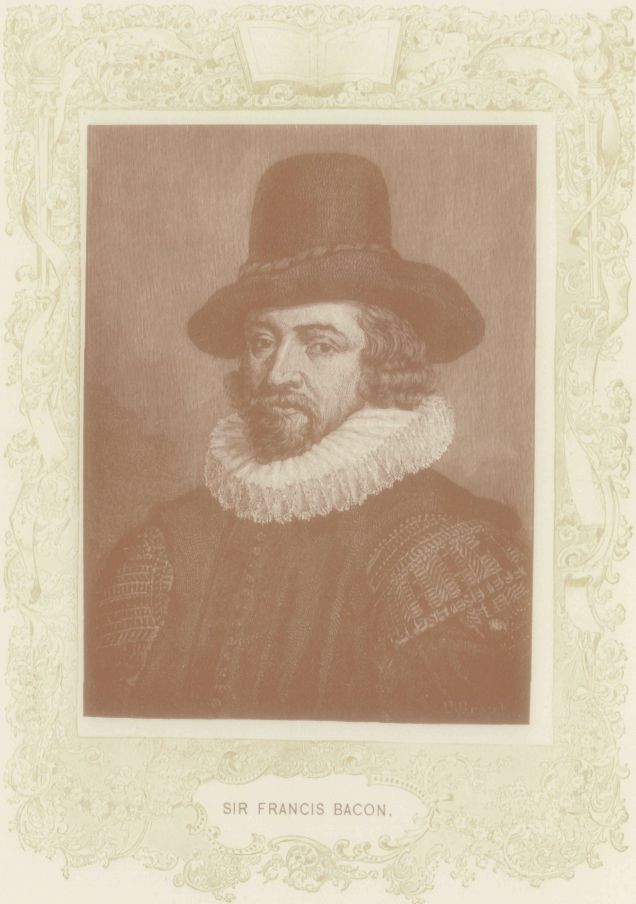
he startling contrasts of splendor and humiliation which marked the life of Bacon, and the seemingly incredible inconsistencies which hasty observers find in his character, have been the themes of much rhetorical declamation, and even of serious and learned debate. From Ben Jonson in his own day, to James Spedding the friend of Tennyson, he has not lacked eminent eulogists, who look up to him as not only the greatest and wisest, but as among the noblest and most worthy of mankind: while the famous epigram of Pope, expanded by Macaulay into a stately and eloquent essay, has impressed on the popular mind the lowest estimate of his moral nature; and even such careful scholars as Charles de Rémusat and Dean Church, who have devoted careful and instructive volumes to the survey of Bacon's career and works, insist that with all his intellectual supremacy, he was a servile courtier, a false friend, and a corrupt judge. Yet there are few important names in human history of men who have left us so complete materials for a just judgment of their conduct; and it is only a lover of paradox who can read these and still regard Bacon's character as an unsolved problem.
Mr. Spedding has given a long life of intelligent labor to the collection of every fact and document throwing light upon the motives, aims, and thoughts of the great "Chancellor of Nature," from the cradle to the grave. The results are before us in the seven volumes of 'The Letters and the Life of Francis Bacon,' which form perhaps the most complete biography ever written. It is a book of absolute candor as well as infinite research, giving with equal distinctness all the evidence which makes for its hero's dishonor and that which tends to justify the writer's reverence for him. Another work by Mr. Spedding, 'Evenings with a Reviewer,' in two volumes, is an elaborate refutation, from the original and authentic records, of the most damning charges brought by Lord Macaulay against Bacon's good fame. It is a complete and overwhelming exposure of false coloring, of rhetorical artifices, and of the abuse of evidence, in the famous essay. As one of the most entertaining and instructive pieces of controversy in our literature, it deserves to be widely read. The unbiased reader cannot accept the special pleading by which, in his comments, Spedding makes every failing of Bacon "lean to virtue's side"; but will form upon the unquestioned facts presented a clear conception of him, will come to know him as no other man of an age so remote is known, and will find in his many-sided and magnificent nature a full explanation of the impressions which partial views of it have made upon his worshipers and his detractors.
It is only in his maturity, indeed, that we are privileged to enter into his mind and read his heart. But enough is known of the formative period of his life to show us the sources of his weaknesses and of his strength. The child whom high authorities have regarded as endowed with the mightiest intellect of the human race was born at York House, on the Strand, in the third year of Elizabeth's reign, January 22d, 1561. He was the son of the Queen's Lord Keeper of the Seals, Sir Nicholas Bacon, and his second wife Anne, daughter of Sir Anthony Cook, formerly tutor of King Edward VI. Mildred, an elder daughter of the same scholar, was the wife of William Cecil, Lord Burghley, who for the first forty years of her reign was Elizabeth's chief minister. As a child Bacon was a favorite at court, and tradition represents him as something of a pet of the Queen, who called him "my young Lord Keeper." His mother was among the most learned women of an age when, among women of rank, great learning was as common and as highly prized as great beauty; and her influence was a potent intellectual stimulus to the boy, although he revolted in early youth from the narrow creed which her fierce Puritan zeal strove to impose on her household. Outside of the nursery, the atmosphere of his world was that of craft, all directed to one end; for the Queen was the source of honor, power, and wealth, and advancement in life meant only a share in the grace distributed through her ministers and favorites. Apart from the harsh and forbidding religious teachings of his mother, young Francis had before him neither precept nor example of an ambition more worthy than that of courting the smiles of power.
At the age of twelve he entered Trinity College, Cambridge (April, 1573), and left it before he was fifteen (Christmas, 1575); the institution meanwhile having been broken up for more than half a year (August, 1574, to March, 1575) by the plague, so that his intermittent university career summed up less than fourteen months. There is no record of his studies, and the names of his teachers are unknown; for though Bacon in later years called himself a pupil of Whitgift, and his biographers assumed that the relation was direct and personal, yet that great master of Trinity had certainly ended his teaching days before Bacon went to Cambridge, and had entered as Dean of Lincoln on his splendid ecclesiastical career. University life was very different from that of our times. The statutes of Cambridge forbade a student, under penalties, to use in conversation with another any language but Latin, Greek, or Hebrew, unless in his private apartments and in hours of leisure. It was a regular custom at Trinity to bring before the assembled undergraduates every Thursday evening at seven o'clock such junior students as had been detected in breaches of the rules during the week, and to flog them. It would be interesting to know in what languages young Bacon conversed, and what experiences of discipline befell him; but his subsequent achievements at least suggest that Cambridge in the sixteenth century may have afforded more efficient educational influences than our knowledge of its resources and methods can explain. For it is certain that, at an age when our most promising youths are beginning serious study, Bacon's mind was already formed, his habits and modes of research were fixed, the universe of knowledge was an open field before him. Thenceforth he was no man's pupil, but in intellectual independence and solitude he rapidly matured into the supreme scholar of his age.
After registering as a student of law at Gray's Inn, apparently for the purpose of a nominal connection with a profession which might aid his patrons in promoting him at court, Bacon was sent in June, 1576, to France in the train of the British Ambassador, Sir Amyas Paulet; and for nearly three years followed the roving embassy around the great cities of that kingdom. The massacre of St. Bartholomew had taken place four years before, and the boy's recorded observations on the troubled society of France and of Europe show remarkable insight into the character of princes and the sources of political movements. Sir Nicholas had hitherto directed his son's education and associations with the purpose of making him an ornament of the court, and had set aside a fund to provide Francis at the proper time with a handsome estate. But he died suddenly, February 20th, 1579, without giving legal effect to this provision, and the sum designed for the young student was divided equally among the five children, while Francis was excluded from a share in the rest of the family fortune; and was thus called home to England to find himself a poor man.
He made himself a bachelor's home at Gray's Inn, and devoted his energies to the law, with such success that he was soon recognized as one of the most promising members of the profession. In 1584 he entered Parliament for Melcombe Regis in Somersetshire, and two years later sat for Liverpool. During these years the schism between his inner and his outer life continued to widen. Drawing his first breath in the atmosphere of the court, bred in the faith that honor and greatness come from princes' favor, with a native taste for luxury and magnificence which was fostered by delicate health, he steadily looked for advancement through the influence of Burghley and the smiles of the Queen. But Burghley had no sympathy with speculative thought, and distrusted him for his confidences concerning his higher studies, while he probably feared in Bacon a dangerous rival of his own son; so that with expressions of kind interest, he refrained from giving his nephew practical aid. Elizabeth, too, suspected that a young man who knew so many things could not be trusted to know his own business well, and preferred for important professional work others who were lawyers and nothing besides. Thus Bacon appeared to the world as a disappointed and uneasy courtier, struggling to keep up a certain splendor of appearance and associations under a growing load of debt, and servile to a Queen on whose caprice his prospects of a career must depend. His unquestioned power at the bar was exercised only in minor causes; his eloquence and political dexterity found slow recognition in Parliament, where they represented only themselves; and the question whether he would ever be a man of note in the kingdom seemed for twenty-five years to turn upon what the Crown might do for its humble suitor.
Meanwhile this laborious advocate and indefatigable courtier, whose labors at the bar and in attendance upon his great friends were enough to fill the days of two ordinary men, led his real life in secret, unknown to the world, and uncomprehended even by the few in whom he had divined a capacity for great thought, and whom he had selected for his confidants. From his childhood at the university, where he felt the emptiness of the Aristotelian logic, the instrument for attaining truth which traditional learning had consecrated, he had gradually formed the conception of a more fruitful process. He had become convinced that the learning of all past ages was but a poor result of the intellectual capacities and labors which had been employed upon it; that the human mind had never yet been properly used; that the methods hitherto adopted in research were but treadmill work, returning upon itself, or at best could produce but fragmentary and accidental additions to the sum of knowledge. All nature is crammed with truth, he believed, which it concerns man to discover; the intellect of man is constructed for its discovery, and needs but to be purged of errors of every kind, and directed in the most efficient employment of its faculties, to make sure that all the secrets of nature will be revealed, and its powers made tributary to the health, comfort, enjoyment, and progressive improvement of mankind.
This stupendous conception, of a revolution which should transform the world, seems to have taken definite form in Bacon's mind as early as his twenty-fifth year, when he embodied the outline of it in a Latin treatise; which he destroyed in later life, unpublished, as immature, and partly no doubt because he came to recognize in it an unbecoming arrogance of tone, for its title was 'Temporis Partus Maximus' (The Greatest Birth of Time.) But six years later he defines these "vast contemplative ends" in his famous letter to Burghley, asking for preferment which will enable him to prosecute his grand scheme and to employ other minds in aid of it. "For I have taken all knowledge to be my province," he says, "and if I could purge it of two sorts of rovers, whereof the one with frivolous disputations, confutations, and verbosities, the other with blind experiments and auricular traditions and impostures, hath committed so many spoils, I hope I should bring in industrious observations, grounded conclusions, and profitable inventions and discoveries: the best state of that province. This, whether it be curiosity or vain glory, or nature, or (if one take it favorably) philanthropia is so fixed in my mind as it cannot be removed."
This letter reveals the secret of Bacon's life, and all that we know of him, read in the light of it, forms a consistent and harmonious whole. He was possessed by his vast scheme, for a reformation of the intellectual world, and through it, of the world of human experience, as fully as was ever apostle by his faith. Implicitly believing in his own ability to accomplish it, at least in its grand outlines, and to leave at his death the community of mind at work, by the method and for the purposes which he had defined, with the perfection of all science in full view, he subordinated every other ambition to this; and in seeking and enjoying place, power, and wealth, still regarded them mainly as aids in prosecuting his master purpose, and in introducing it to the world. With this clearly in mind, it is easy to understand his subsequent career. Its external details may be read in any of the score of biographies which writers of all grades of merit and demerit have devoted to him, and there is no space for them here. For our purpose it is necessary to refer only to the principal crises in his public life.
Until the death of Elizabeth, Bacon had no place in the royal service worthy of his abilities as a lawyer. Many who, even in the narrowest professional sense, were far inferior to him, were preferred before him. Yet he obtained a position recognized by all, and second only in legal learning to his lifelong rival and constant adversary, Sir Edward Coke. To-day, it is probable that if the two greatest names in the history of the common law were to be selected by the suffrages of the profession, the great majority would be cast for Coke and Bacon. As a master of the intricacies of precedent and an authority upon the detailed formulas of "the perfection of reason," the former is unrivaled still; but in the comprehensive grasp of the law as a system for the maintenance of social order and the protection of individual rights, Bacon rose far above him. The cherished aim of his professional career was to survey the whole body of the laws of England, to produce a digest of them which should result in a harmonious code, to do away with all that was found obsolete or inconsistent with the principles of the system, and thus to adapt the living, progressive body of the law to the wants of the growing nation. This magnificent plan was beyond the power of any one man, had his life no other task, but he suggested the method and the aim; and while for six generations after these legal giants passed away, the minute, accurate, and profound learning of Coke remained the acknowledged chief storehouse of British traditional jurisprudence, the seventh generation took up the work of revision and reform, and from the time of Bentham and Austin the progress of legal science has been toward codification. The contest between the aggregation of empirical rules and formulated customs which Coke taught as the common law, and the broad, harmonious application of scientific reason to the definition and enforcement of rights, still goes on; but with constant gains on the side of the reformers, all of whom with one consent confess that no general and complete reconstruction of legal doctrine as a science is possible, except upon the lines laid down by Bacon.
The most memorable case in which Bacon was employed to represent the Crown during Elizabeth's life was the prosecution of the Earl of Essex for treason. Essex had been Bacon's friend, patron, and benefactor; and as long as the earl remained faithful to the Queen and retained her favor, Bacon served him with ready zeal and splendid efficiency, and showed himself the wisest and most sincere of counselors. When Essex rejected his advice, forfeited the Queen's confidence by the follies from which Bacon had earnestly striven to deter him, and finally plunged into wanton and reckless rebellion, Bacon, with whom loyalty to his sovereign had always been the supreme duty, accepted a retainer from the Crown, and assisted Coke in the prosecution. The crime of Essex was the greatest of which a subject was capable; it lacked no circumstance of aggravation; if the most astounding instance of ingratitude and disloyalty to friendship ever known is to be sought in that age, it will be found in the conduct of Essex to Bacon's royal mistress. Yet writers of eloquence have exhausted their rhetorical powers in denouncing Bacon's faithlessness to his friend. But no impartial reader of the full story in the documents of the time can doubt that throughout these events Bacon did his duty and no more, and that in doing it he not merely made a voluntary sacrifice of his popularity, but a far more painful sacrifice of his personal feelings.
In 1603 James I. came to the throne, and in spite of the efforts of his most trusted ministers to keep Bacon in obscurity, soon discovered in him a man whom he needed. In 1607 he was made Solicitor-General; in 1613 Attorney-General; in March 1617, on the death of Lord Ellesmere, he received the seals as Lord Keeper; and in January following was made Lord Chancellor of England. In July 1618 he was raised to the permanent peerage as Baron Verulam, and in January 1621 received the title of Viscount St. Albans. During these three years he was the first subject in the kingdom in dignity, and ought to have been the first in influence. His advice to the King, and to the Duke of Buckingham who was the King's king, was always judicious. In certain cardinal points of policy, it was of the highest statesmanship; and had it been followed, the history of the Stuart dynasty would have been different, and the Crown and the Parliament would have wrought together for the good and the honor of the nation, at least through a generation to come. But the upstart Buckingham was supreme. He had studied Bacon's strength and weakness, had laid him under great obligations, had at the same time attached him by the strongest tie of friendship to his person, and impressed upon his consciousness the fact that the fate of Bacon was at all times in his hands. The new Chancellor had entered on his great office with a fixed purpose to reform its abuses, to speed and cheapen justice, to free its administration from every influence of wealth and power. In the first three months of service he brought up the large arrears of business, tried every cause, heard every petition, and acquired a splendid reputation as an upright and diligent judge. But Buckingham was his evil angel. He was without sense of the sanctity of the judicial character; and regarded the bench, like every other public office, as an instrument of his own interests and will. On the other hand, to Bacon the voice of Buckingham was the voice of the King, and he had been taught from infancy as the beginning of his political creed that the king can do no wrong. Buckingham began at once to solicit from Bacon favors for his friends and dependants, and the Chancellor was weak enough to listen and to answer him. There is no evidence that in any one instance the favorite asked for the violation of law or the perversion of justice; much less that Bacon would or did accede to such a request. But the Duke demanded for one suitor a speedy hearing, for another a consideration of facts which might not be in evidence, for a third all the favor consistent with law; and Bacon reported to him the result, and how far he had been able to oblige him. This persistent tampering with the source of justice was a disturbing influence in the Chancellor's court, and unquestionably lowered the dignity of his attitude and weakened his judicial conscience.
Notwithstanding this, when the Lord Chancellor opened the Parliament in January, 1621, with a speech in praise of his King and in honor of the nation, he seemed to be at the summit of earthly prosperity. No voice had been lifted to question his purity and worth. He was the friend of the King, one of the chief supports of the throne, a champion indeed of high prerogative, but an orator of power, a writer of fame, whose advancement to the highest dignities had been welcomed by public opinion. Four months later he was a convicted criminal, sentenced for judicial corruption to imprisonment at the King's pleasure, to a fine of £40,000, and to perpetual incapacity for any public employment. Vicissitudes of fortune are commonplaces of history. Many a man once seemingly pinnacled on the top of greatness has "shot from the zenith like a falling star," and become a proverb of the fickleness of fate. Some are torn down by the very traits of mind, passion, or temper, which have raised them: ambition which overleaps itself, rashness which hazards all on chances it cannot control, vast abilities not great enough to achieve the impossible. The plunge of Icarus into the sea, the murder of Caesar, the imprisonment of Coeur de Lion, the abdication of Napoleon, the apprehension as a criminal of Jefferson Davis, each was a startling and impressive contrast to the glory which it followed, yet each was the natural result of causes which lay in the character and life of the sufferer, and made his story a consistent whole. But the pathos of Bacon's fall is the sudden moral ruin of a life which had been built up in honor for sixty years. An intellect of the first rank, which from boyhood to old age had been steadfast in the pursuit of truth and in the noblest services to mankind, which in a feeble body had been sustained in vigor by all the virtues of prudence and self-reverence; a genial nature, winning the affection and admiration of associates, hardly paralleled in the industry with which its energies were devoted to useful work, a soul exceptional among its contemporaries for piety and philanthropy--this man is represented to us by popular writers as having habitually sold justice for money, and as having become in office "the meanest of mankind."
But this picture, as so often drawn, and as seemingly fixed in the popular mind, is not only impossible, but is demonstrably false. To review all the facts which correct it in detail would lead us far beyond our limits. It must suffice to refer to the great work of Spedding, in which the entire records of the case are found, and which would long ago have made the world just to Bacon's fame, but that the author's comment on his own complete and fair record is itself partial and extravagant. But the materials for a final judgment are accessible to all in Spedding's volumes, and a candid reading of them solves the enigma. Bacon was condemned without a trial, on his own confession, and this confession was consistent with the tenor of his life. Its substance was that he had failed to put a stop effectually to the immemorial custom in his court of receiving presents from suitors, but that he had never deviated from justice in his decrees. There was no instance in which he was accused of yielding to the influence of gifts, or passing judgment for a bribe. No act of his as Chancellor was impeached as illegal, or reversed as corrupt. Suitors complained that they had sent sums of money or valuable presents to his court, and had been disappointed in the result; but no one complained of injustice in a decision. Bacon was a conspicuous member of the royal party; and when the storm of popular fury broke in Parliament upon the court, the King and the ministry abandoned him. He had stood all his life upon the royal favor as the basis of his strength and hope; and when it was gone from under him, he sank helplessly, and refused to attempt a defense. But he still in his humiliation found comfort in the reflection that his ruin would put an end to "anything that is in the likeness of corruption" among the judges. And he wrote, in the hour of his deepest distress, that he had been "the justest Chancellor that hath been in the five changes that have been since Sir Nicholas Bacon's time." Nor did any man of his time venture to contradict him, when in later years he summed up his case in the words, "I was the justest judge that was in England these fifty years. But it was the justest censure in Parliament that was these two hundred years."
No revolution of modern times has been more complete than that which the last two centuries have silently wrought in the customary morality of British public life, and in the standards by which it is judged. Under James I. every office of state was held as the private property of its occupant. The highest places in the government were conferred only on condition of large payments to the King. He openly sold the honors and dignities of which he was the source. "The making of a baron," that is, the right to sell to some rich plebeian a patent of nobility, was a common grant to favorites, and was actually bestowed on Bacon, to aid him in maintaining the state of his office. We have the testimony of James himself that all the lawyers, of whom the judges of the realm were made, were "so bred and nursed in corruption that they cannot leave it." But the line between what the King called corruption and that which he and all his ministers practiced openly and habitually, as part of the regular work of government, is dim and hard to define. The mind of the community had not yet firmly grasped the conception of public office as a trust for the public good, and the general opinion which stimulates and sustains the official conscience in holding this trust sacred was still unformed. The courts of justice were the first branch of the government to feel the pressure of public opinion, and to respond to the demand for impersonal and impartial right. But this process had only begun when Bacon, who had never before served as judge, was called to preside in Chancery. The Chancellor's office was a gradual development: originally political and administrative rather than judicial, and with no salary or reward for hearing causes, save the voluntary presents of suitors who asked its interference with the ordinary courts, it step by step became the highest tribunal of the equity which limits and corrects the routine of law, and still the custom of gifts was unchecked. A careful study of Bacon's career shows that in this, as every other branch of thought, his theoretic convictions were in advance of his age; and in his advice to the King and in his inaugural promises as Chancellor, he foreshadows all the principles on which the wisest reformers of the public service now insist. But he failed to apply them with that heroic self-sacrifice which alone would have availed him, and the forces of custom and example continually encroached upon his views of duty. Having through a long life sought advancement and wealth for the purpose of using leisure and independence to carry out his beneficent plans on the largest scale, he eagerly accepted the traditional emoluments of his new position, in the conviction that they would become in his hands the means of vast good to mankind. It was only the public exposure which fully awakened him to a sense of the inconsistency and wrong of his conduct; and then he was himself his severest judge, and made every reparation in his power, by the most unreserved confession, by pointing out the danger to society of such weakness as his own in language to whose effectiveness nothing could be added, and by devoting the remainder of his life to the noblest work for humanity.
During the years of Bacon's splendor as a member of the government and as spokesman for the throne, his real life as a thinker, inspired by the loftiest ambition which ever entered the mind of man, that of creating a new and better civilization, was not interrupted. It was probably in 1603 that he wrote his fragmentary 'Prooemium de Interpretatione Naturae,' or 'Preface to a Treatise on Interpreting Nature,' which is the only piece of autobiography he has left us. It was found among his papers after his death; and its candor, dignity, and enthusiasm of tone are in harmony with the imaginative grasp and magnificent suggestiveness of its thought. Commending the original Latin to all who can appreciate its eloquence, we cite the first sentences of it in English:--
"Believing that I was born for the service of mankind, and regarding the care of the Commonwealth as a kind of common property which, like the air and water, belongs to everybody, I set myself to consider in what way mankind might be best served, and what service I was myself best fitted by nature to perform. "Now, among all the benefits that could be conferred upon mankind, I found none so great as the discovery of new arts for the bettering of human life. For I saw that among the rude people of early times, inventors and discoverers were reckoned as gods. It was seen that the works of founders of States, law-givers, tyrant-destroyers, and heroes cover but narrow spaces and endure but for a time; while the work of the inventor, though of less pomp, is felt everywhere and lasts forever. But above all, if a man could, I do not say devise some invention, however useful, but kindle a light in nature--a light which, even in rising, should touch and illuminate the borders of existing knowledge, and spreading further on should bring to light all that is most secret--that man, in my view, would be indeed the benefactor of mankind, the extender of man's empire over nature, the champion of freedom, the conqueror of fate. "For myself, I found that I was fitted for nothing so well as for the study of Truth: as having a mind nimble and versatile enough to discern resemblances in things (the main point), and yet steady enough to distinguish the subtle differences in them; as being endowed with zeal to seek, patience to doubt, love of meditation, slowness of assertion, readiness to reconsider, carefulness to arrange and set in order; and as being a man that affects not the new nor admires the old, but hates all imposture. So I thought my nature had a certain familiarity and kindred with Truth."
During the next two years he applied himself to the composition of the treatise on the 'Advancement of Learning,' the greatest of his English writings, and one which contains the seed-thoughts and outline principles of all his philosophy. From the time of its publication in 1605 to his fall in 1621, he continued to frame the plan of his 'Great Instauration' of human knowledge, and to write out chapters, books, passages, sketches, designed to take their places in it as essential parts. It was to include six great divisions: first, a general survey of existing knowledge; second, a guide to the use of the intellect in research, purging it of sources of error, and furnishing it with the new instrument of inductive logic by which all the laws of nature might be ascertained; third, a structure of the phenomena of nature, included in one hundred and thirty particular branches of natural history, as the materials for the new logic; fourth, a series of types and models of the entire mental process of discovering truth, "selecting various and remarkable instances"; fifth, specimens of the new philosophy, or anticipations of its results, in fragmentary contributions to the sixth and crowning division, which was to set forth the new philosophy in its completeness, comprehending the truths to be discovered by a perfected instrument of reasoning, in interpreting all the phenomena of the world. Well aware that the scheme, especially in its concluding part, was far beyond the power and time of any one man, he yet hoped to be the architect of the final edifice of science, by drawing its plans and making them intelligible, leaving their perfect execution to an intellectual world which could not fail to be moved to its supreme effort by a comprehension of the work before it. The 'Novum Organum,' itself but a fragment of the second division of the 'Instauration,' the key to the use of the intellect in the discovery of truth, was published in Latin at the height of his splendor as Lord Chancellor, in 1620, and is his most memorable achievement in philosophy. It contains a multitude of suggestive thoughts on the whole field of science, but is mainly the exposition of the fallacies by which the intellect is deceived and misled, and from which it must be purged in order to attain final truth, and of the new doctrine of "prerogative instances," or crucial observations and experiments in the work of discovery.
In short, Bacon's entire achievement in science is a plan for an impossible universe of knowledge. As far as he attempted to advance particular sciences by applying his method to their detailed phenomena, he wrought with imperfect knowledge of what had been done, and with cumbrous and usually misdirected efforts to fill the gaps he recognized. In a few instances, by what seems an almost superhuman instinct for truth, rather than the laborious process of investigation which he taught, he anticipated brilliant discoveries of later centuries. For example, he clearly pointed out the necessity of regarding heat as a form of motion in the molecules of matter, and thus foreshadowed, without any conception of the means of proving it, that which, for investigators of the nineteenth century, has proved the most direct way to the secrets of nature. But the testimony of the great teachers of science is unanimous, that Bacon was not a skilled observer of phenomena, nor a discoverer of scientific inductions; that he contributed no important new truth, in the sense of an established law, to any department of knowledge; and that his method of research and reasoning is not, in its essential features, that which is fruitfully pursued by them in extending the boundaries of science, nor was his mind wholly purged of those "idols of the cave," or forms of personal bias, whose varying forms as hindrances to the "dry light" of sound reason he was the first to expose. He never appreciated the mathematics as the basis of physics, but valued their elements mainly as a mental discipline. Astronomy meant little to him, since he failed to connect it directly with human well-being and improvement; to the system of Copernicus, the beginning of our insight into the heavens, he was hostile, or at least indifferent; and the splendid discoveries successively made by Tycho Brahe, Galileo, and Kepler, and brought to his ears while the 'Great Instauration' filled his mind and heart, met with but a feeble welcome with him, or none. Why is it, then, that Bacon's is the foremost name in the history of English, and perhaps, as many insist, of all modern thought? Why is it that "the Baconian philosophy" is another phrase, in all the languages of Europe, for that splendid development of the study and knowledge of the visible universe which since his time has changed the life of mankind?
A candid answer to these questions will expose an error as wide in the popular estimate of Bacon's intellectual greatness as that which has prevailed so generally regarding his character. He is called the inventor of inductive reasoning, the reformer of logic, the lawgiver of the world of thought; but he was no one of these. His grasp of the inductive method was defective; his logic was clumsy and impractical; his plan for registering all phenomena and selecting and generalizing from them, making the discovery of truth almost a mechanical process, was worthless. In short, it is not as a philosopher nor as a man of science that Bacon has carved his name in the high places of enduring fame, but rather as a man of letters; as on the whole the greatest writer of the modern world, outside of the province of imaginative art; as the Shakespeare of English prose. Does this seem a paradox to the reader who remembers that Bacon distrusted all modern languages, and thought to make his 'Advancement of Learning' "live, and be a citizen of the world," by giving it a Latin form? That his lifelong ambition was to reconstruct methods of thought, and guide intellect in the way of work serviceable to comfort and happiness? That the books in which his English style appears in its perfection, the 'History of Henry VII.,' the 'Essays,' and the papers on public affairs, were but incidents and avocations of a life absorbed by a master purpose?
But what is literature? It is creative mind, addressing itself in worthy expression to the common receptive mind of mankind. Its note is universality, as distinguished from all that is technical, limited, and narrow. Thought whose interest is as broad as humanity, suitably clothed in the language of real life, and thus fitted for access to the general intelligence, constitutes true literature, to the exclusion of that which, by its nature or by its expression, appeals only to a special class or school. The 'Opus Anglicanum' of Duns Scotus, Newton's 'Principia,' Lavoisier's treatise 'Sur la Combustion,' Kant's 'Kritik der Reinen Vernunft' (Critique of Pure Reason), each made an epoch in some vast domain of knowledge or belief; but none of them is literature. Yet the thoughts they, through a limited and specially trained class of students, introduced to the world, were gradually taken up into the common stock of mankind, and found their broad, effective, complete expression in the literature of after generations. If we apply this test to Bacon's life work, we shall find sufficient justification for honoring him above all special workers in narrower fields, as next to Shakespeare the greatest name in the greatest period of English literature.
It was not as an experimenter, investigator, or technical teacher, but as a thinker and a writer, that he rendered his great service to the world. This consisted essentially in the contribution of two magnificent ideas to the common stock of thought: the idea of the utility of science, as able to subjugate the forces of nature to the use of man; and the idea of continued and boundless progress in the comfort and happiness of the individual life, and in the order and dignity of human society. It has been shown how, from early manhood, he was inspired by the conception of infinite resources in the material world, for the discovery and employment of which the human mind is adapted. He never wearied of pointing out the imperfection and fruitlessness of the methods of inquiry and of invention hitherto in use, and the splendid results which could be rapidly attained if a combined and systematic effort were made to enlarge the boundaries of knowledge. This led him directly to the conception of an improved and advancing civilization; to the utterance, in a thousand varied, impressive, and fascinating forms, of that idea of human progress which is the inspiration, the characteristic, and the hope of the modern world. Bacon was the first of men to grasp these ideas in all their comprehensiveness as feasible purposes, as practical aims; to teach the development of them as the supreme duty and ambition of his contemporaries, and to look forward instead of behind him for the Golden Age. Enforcing and applying these thoughts with a wealth of learning, a keenness of wit, a soundness of judgment, and a suggestiveness of illustration unequaled by any writer before him, he became the greatest literary power of modern times to stimulate minds in every department of life to their noblest efforts and their worthiest achievements.
Literature has a twofold aspect: its ideal is pure truth, which is the noblest thought embodied in perfect beauty of form. It is the union of science and art, the final wedding in which are merged the knowledge worthy to be known and the highest imagination presenting it. There is a school calling itself that of pure art, to which substance is nothing and form is everything. Its measure of merit is applied to the manner only; and the meanest of subjects, the most trivial and even the most degraded of ideas or facts, is welcomed to its high places if clothed in a satisfying garb. But this school, though arrogant in the other arts of expression, has not yet been welcomed to the judgment-seat in literature, where indeed it is passing even now to contempt and oblivion. Bacon's instinct was for substance. His strongest passion was for utility. The artistic side of his nature was receptive rather than creative. Splendid passages in the 'Advancement' and 'De Augmentis' show his profound appreciation of all the arts of expression, but show likewise his inability to glorify them above that which they express. In his mind, language is subordinate to thought, and the painting to the picture, just as the frame is to the painting or the binding to the book. He writes always in the grand style. He reminds us of "the large utterance of the early gods." His sentences are weighted with thought, as suggestive as Plato, as condensed as Thucydides. Full of wit, keen in discerning analogies, rich in intellectual ornament, he is yet too concentrated in his attention to the idea to care for the melody of language. He decorates with fruits, not with flowers. For metrical movement, for rhythmic harmony, he has no ear nor sense. Inconceivable as it is that Shakespeare could have written one aphorism of the 'Novum Organum,' it would be far more absurd to imagine Bacon writing a line of the Sonnets. With the loftiest imagination, the liveliest fancy, the keenest sense of precision and appropriateness in words, he lacks the special gift of poetic form, the faculty divine which finds new inspiration in the very limitations of measured language, and whose natural expression is music alike to the ear and to the mind. His powers were cramped by the fetters of metre, and his attempts to versify even rich thought and deep feeling were puerile. But his prose is by far the weightiest, the most lucid, effective, and pleasing of his day. The poet Sprat justly says:--
"He was a man of strong, clear, and powerful imaginations; his genius was searching and inimitable; and of this I need give no other proof than his style itself, which as for the most part it describes men's minds as well as pictures do their bodies, so it did his above all men living."
And Ben Jonson, who knew him well, describes his eloquence in terms which are confirmed by all we know of his Parliamentary career:--
"One, though he be excellent and the chief, is not to be imitated alone; for no imitator ever grew up to his author: likeness is always on this side truth. Yet there happened in my time one noble speaker, who was full of gravity in his speaking. His language (when he could spare or pass by a jest) was nobly censorious. No man ever spake more neatly, more rightly, more weightily, or suffered less emptiness, less idleness in what he uttered. No member of his speech but consisted of his own graces. His hearers could not cough or look aside from him without loss. He commanded when he spoke, and had his judges angry and pleased at his devotion. No man had their affections more in his power. The fear of every man that heard him was lest he should make an end."
The speeches of Bacon are almost wholly lost, his philosophy is an undeciphered heap of fragments, the ambitions of his life lay in ruins about his dishonored old age; yet his intellect is one of the great moving and still vital forces of the modern world, and he remains, for all ages to come, in the literature which is the final storehouse of the chief treasures of mankind, one of
"The dead yet sceptered sovereigns who still rule
Our spirits from their urns."

OF TRUTH
From the 'Essays'
What is Truth? said jesting Pilate; and would not stay for an answer. Certainly there be that delight in giddiness; and count it a bondage to fix a belief; affecting free-will in thinking, as well as in acting. And though the sects of philosophers of that kind be gone, yet there remain certain discoursing wits, which are of the same veins, though there be not so much blood in them as was in those of the ancients. But it is not only the difficulty and labor which men take in finding out of truth, nor again, that when it is found it imposeth upon men's thoughts, that doth bring lies in favor: but a natural though corrupt love of the lie itself. One of the later school of the Grecians examineth the matter, and is at a stand to think what should be in it, that men should love lies, where neither they make for pleasure as with poets, nor for advantage as with the merchant; but for the lie's sake. But I cannot tell: this same truth is a naked and open daylight, that doth not show the masks and mummeries and triumphs of the world half so stately and daintily as candle-lights. Truth may perhaps come to the price of a pearl, that showeth best by day; but it will not rise to the price of a diamond or carbuncle, that showeth best in varied lights. A mixture of a lie doth ever add pleasure. Doth any man doubt, that if there were taken out of men's minds vain opinions, flattering hopes, false valuations, imaginations as one would, and the like, but it would leave the minds of a number of men poor shrunken things, full of melancholy and indisposition, and unpleasing to themselves? One of the fathers, in great severity, called poesy vinum doemonum, because it filleth the imagination, and yet it is but with the shadow of a lie. But it is not the lie that passeth through the mind, but the lie that sinketh in and settleth in it, that doth the hurt; such as we spake of before. But howsoever these things are thus in men's depraved judgments and affections, yet truth, which only doth judge itself, teacheth that the inquiry of truth, which is the love-making or wooing of it, the knowledge of truth, which is the presence of it, and the belief of truth, which is the enjoying of it, is the sovereign good of human nature. The first creature of God, in the works of the days, was the light of the sense; the last was the light of reason; and his Sabbath work ever since is the illumination of his Spirit.... The poet that beautified the sect that was otherwise inferior to the rest, saith yet excellently well:--"It is a pleasure to stand upon the shore, and to see ships tossed upon the sea; a pleasure to stand in the window of a castle, and to see a battle and the adventures thereof below; but no pleasure is comparable to the standing upon the vantage ground of Truth" (a hill not to be commanded, and where the air is always clear and serene). "and to see the errors, and wanderings, and mists, and tempests, in the vale below:" so always that this prospect be with pity, and not with swelling or pride. Certainly, it is heaven upon earth, to have a man's mind move in charity, rest in providence, and turn upon the poles of truth.
To pass from theological and philosophical truth to the truth of civil business: it will be acknowledged even by those that practice it not, that clear and round dealing is the honor of man's nature, and that mixture of falsehood is like alloy in coin of gold and silver, which may make the metal work the better, but it embaseth it. For these winding and crooked courses are the goings of the serpent; which goeth basely upon the belly, and not upon the feet. There is no vice that doth so cover a man with shame as to be found false and perfidious; and therefore Montaigne saith prettily, when he inquired the reason why the word of the lie should be such a disgrace and such an odious charge. Saith he, "If it be well weighed, to say that a man lieth, is as much as to say that he is brave toward God and a coward toward men." For a lie faces God, and shrinks from man. Surely the wickedness of falsehood and breach of faith cannot possibly be so highly expressed, as in that it shall be the last peal to call the judgments of God upon the generations of men; it being foretold, that when Christ cometh, "he shall not find faith upon the earth."
OF REVENGE
From the 'Essays'
Revenge is a kind of wild justice; which the more man's nature runs to, the more ought law to weed it out. For as for the first wrong, it doth but offend the law; but the revenge of that wrong putteth the law out of office. Certainly, in taking revenge, a man is but even with his enemy; but in passing it over, he is superior: for it is a prince's part to pardon, and Solomon, I am sure, saith, "It is the glory of a man to pass by an offense." That which is past is gone and irrevocable, and wise men have enough to do with things present and to come; therefore, they do but trifle with themselves that labor in past matters. There is no man doth a wrong for the wrong's sake; but thereby to purchase himself profit, or pleasure, or honor, or the like. Therefore, why should I be angry with a man for loving himself better than me? And if any man should do wrong merely out of ill-nature, why yet it is but like the thorn or brier, which prick and scratch because they can do no other. The most tolerable sort of revenge is for those wrongs which there is no law to remedy; but then, let a man take heed the revenge be such as there is no law to punish, else a man's enemy is still beforehand, and it is two for one. Some, when they take revenge, are desirous the party should know whence it cometh. This is the more generous; for the delight seemeth to be not so much in doing the hurt as in making the party repent. But base and crafty cowards are like the arrow that flieth in the dark. Cosmus, Duke of Florence, had a desperate saying against perfidious or neglecting friends, as if those wrongs were unpardonable. "You shall read," saith he, "that we are commanded to forgive our enemies; but you never read that we are commanded to forgive our friends." But yet the spirit of Job was in a better tune: "Shall we," saith he, "take good at God's hands, and not be content to take evil also?" And so of friends in a proportion. This is certain, that a man that studieth revenge keeps his own wounds green, which otherwise would heal and do well. Public revenges are for the most part fortunate: as that for the death of Caesar; for the death of Pertinax; for the death of Henry the Third of France; and many more. But in private revenges it is not so. Nay, rather vindictive persons live the life of witches; who, as they are mischievous, so end they infortunate.
OF SIMULATION AND DISSIMULATION
From the 'Essays'
Dissimulation is but a faint kind of policy or wisdom; for it asketh a strong wit and a strong heart to know when to tell truth, and to do it. Therefore it is the weaker sort of politicians that are the great dissemblers.
Tacitus saith, "Livia sorted well with the arts of her husband and dissimulation of her son;" attributing arts of policy to Augustus, and dissimulation to Tiberius. And again, when Mucianus encourageth Vespasian to take arms against Vitellius, he saith, "We rise not against the piercing judgment of Augustus, nor the extreme caution or closeness of Tiberius." These properties of arts or policy, and dissimulation or closeness, are indeed habits and faculties several, and to be distinguished. For if a man have that penetration of judgment as he can discern what things are to be laid open, and what to be secreted, and what to be showed at half-lights, and to whom and when, (which indeed are arts of state and arts of life, as Tacitus well calleth them,) to him a habit of dissimulation is a hindrance and a poorness. But if a man cannot obtain to that judgment, then it is left to him generally to be close, and a dissembler. For where a man cannot choose or vary in particulars, there it is good to take the safest and wariest way in general; like the going softly, by one that cannot well see. Certainly the ablest men that ever were, have had all an openness and frankness of dealing, and a name of certainty and veracity: but then they were like horses well managed, for they could tell passing well when to stop or turn; and at such times when they thought the case indeed required dissimulation, if then they used it, it came to pass that the former opinion spread abroad of their good faith and clearness of dealing made them almost invisible.
There be three degrees of this hiding and veiling of a man's self. The first, Closeness, Reservation, and Secrecy; when a man leaveth himself without observation, or without hold to be taken, what he is. The second, Dissimulation, in the negative; when a man lets fall signs and arguments, that he is not that he is. And the third, Simulation, in the affirmative; when a man industriously and expressly feigns and pretends to be that he is not.
For the first of these, Secrecy: it is indeed the virtue of a confessor. And assuredly the secret man heareth many confessions; for who will open himself to a blab or a babbler? But if a man be thought secret, it inviteth discovery, as the more close air sucketh in the more open; and as in confession the revealing is not for worldly use, but for the ease of a man's heart, so secret men come to the knowledge of many things in that kind: while men rather discharge their minds than impart their minds. In few words, mysteries are due to secrecy. Besides (to say truth), nakedness is uncomely, as well in mind as body; and it addeth no small reverence to men's manners and actions, if they be not altogether open. As for talkers and futile persons, they are commonly vain and credulous withal; for he that talketh what he knoweth, will also talk what he knoweth not. Therefore set it down, that a habit of secrecy is both politic and moral. And in this part it is good that a man's face give his tongue leave to speak; for the discovery of a man's self by the tracts of his countenance is a great weakness and betraying, by how much it is many times more marked and believed than a man's words.
For the second, which is Dissimulation: it followeth many times upon secrecy by a necessity; so that he that will be secret must be a dissembler in some degree. For men are too cunning to suffer a man to keep an indifferent carriage between both, and to be secret, without swaying the balance on either side. They will so beset a man with questions, and draw him on, and pick it out of him, that without an absurd silence, he must show an inclination one way; or if he do not, they will gather as much by his silence as by his speech. As for equivocations, or oraculous speeches, they cannot hold out long. So that no man can be secret, except he give himself a little scope of dissimulation; which is, as it were, but the skirts or train of secrecy.
But for the third degree, which is Simulation and false profession: that I hold more culpable and less politic, except it be in great and rare matters. And therefore a general custom of simulation (which is this last degree) is a vice rising either of a natural falseness or fearfulness, or of a mind that hath some main faults; which because a man must needs disguise, it maketh him practice simulation in other things, lest his hand should be out of use.
The great advantages of simulation and dissimulation are three. First, to lay asleep opposition, and to surprise; for where a man's intentions are published, it is an alarum to call up all that are against them. The second is, to reserve to a man's self a fair retreat; for if a man engage himself by a manifest declaration, he must go through or take a fall. The third is, the better to discover the mind of another; for to him that opens himself men will hardly show themselves adverse, but will fair let him go on, and turn their freedom of speech to freedom of thought. And therefore it is a good shrewd proverb of the Spaniard, "Tell a lie and find a troth;" as if there were no way of discovery but by simulation. There be also three disadvantages to set it even. The first, that simulation and dissimulation commonly carry with them a show of fearfulness; which in any business doth spoil the feathers of round flying up to the mark. The second, that it puzzleth and perplexeth the conceits of many that perhaps would otherwise co-operate with him, and makes a man walk almost alone to his own ends. The third and greatest is, that it depriveth a man of one of the most principal instruments for action; which is trust and belief. The best composition and temperature is, to have openness in fame and opinion; secrecy in habit; dissimulation in seasonable use; and a power to feign if there be no remedy.
OF TRAVEL
From the 'Essays'
Travel, in the younger sort, is a part of education; in the elder, a part of experience. He that traveleth into a country before he hath some entrance into the language, goeth to school, and not to travel. That young men travel under some tutor or grave servant, I allow well: so that he be such a one that hath the language, and hath been in the country before; whereby he may be able to tell them what things are worthy to be seen in the country where they go, what acquaintances they are to seek, what exercises or discipline the place yielded. For else young men shall go hooded, and look abroad little. It is a strange thing, that in sea voyages, where there is nothing to be seen but sky and sea, men should make diaries; but in land travel, wherein so much is to be observed, for the most part they omit it; as if chance were fitter to be registered than observation. Let diaries therefore be brought in use. The things to be seen and observed are, the courts of princes, specially when they give audience to ambassadors; the courts of justice, while they sit and hear causes; and so of consistories ecclesiastic; the churches and monasteries, with the monuments which are therein extant; the walls and fortifications of cities and towns, and so the havens and harbors; antiquities and ruins; libraries; colleges, disputations, and lectures, where any are; shipping and navies; houses and gardens of state and pleasure, near great cities; armories; arsenals; magazines; exchanges; burses; warehouses; exercises of horsemanship, fencing, training of soldiers, and the like; comedies, such whereunto the better sort of persons do resort; treasuries of jewels and robes; cabinets and rarities: and, to conclude, whatsoever is memorable in the places where they go. After all which the tutors or servants ought to make diligent inquiry. As for triumphs, masks, feasts, weddings, funerals, capital executions, and such shows, men need not to be put in mind of them: yet are they not to be neglected. If you will have a young man to put his travel into a little room, and in short time to gather much, this you must do. First, as was said, he must have some entrance into the language before he goeth. Then he must have such a servant or tutor as knoweth the country, as was likewise said. Let him carry with him also some card or book, describing the country where he traveleth, which will be a good key to his inquiry. Let him keep also a diary. Let him not stay long in one city or town; more or less as the place deserveth, but not long: nay, when he stayeth in one city or town, let him change his lodging from one end and part of the town to another; which is a great adamant of acquaintance. Let him sequester himself from the company of his countrymen, and diet in such places where there is good company of the nation where he traveleth. Let him upon his removes from one place to another, procure recommendation to some person of quality residing in the place whither he removeth; that he may use his favor in those things he desireth to see or know. Thus he may abridge his travel with much profit.
As for the acquaintance which is to be sought in travel: that which is most of all profitable, is acquaintance with the secretaries and employed men of ambassadors; for so in traveling in one country he shall suck the experience of many. Let him also see and visit eminent persons in all kinds, which are of great name abroad; that he may be able to tell how the life agreeth with the fame. For quarrels, they are with care and discretion to be avoided. They are commonly for mistresses, healths, place, and words. And let a man beware how he keepeth company with choleric and quarrelsome persons; for they will engage him into their own quarrels. When a traveler returneth home, let him not leave the countries where he hath traveled altogether behind him, but maintain a correspondence by letters with those of his acquaintance which are of most worth. And let his travel appear rather in his discourse than in his apparel or gesture; and in his discourse let him be rather advised in his answers, than forward to tell stories; and let it appear that he doth not change his country manners for those of foreign parts; but only prick in some flowers of that he hath learned abroad into the customs of his own country.
OF FRIENDSHIP
From the 'Essays'
It had been hard for him that spake it to have put more truth and untruth together in few words than in that speech, "Whosoever is delighted in solitude is either a wild beast or a god." For it is most true that a natural and secret hatred and aversion toward society in any man hath somewhat of the savage beast; but it is most untrue that it should have any character at all of the divine nature, except it proceed, not out of a pleasure in solitude, but out of a love and desire to sequester a man's self for a higher conversation: such as is found to have been falsely and feignedly in some of the heathen, as Epimenides the Candian, Numa the Roman, Empedocles the Sicilian, and Apollonius of Tyana; and truly and really in divers of the ancient hermits and holy fathers of the Church. But little do men perceive what solitude is, and how far it extendeth. For a crowd is not company; and faces are but a gallery of pictures; and talk but a tinkling cymbal, where there is no love. The Latin adage meeteth with it a little: "Magna civitas, magna solitudo;" because in a great town friends are scattered, so that there is not that fellowship, for the most part, which is in less neighborhoods. But we may go further, and affirm most truly that it is a mere and miserable solitude to want true friends, without which the world is but a wilderness; and even in this sense also of solitude, whosoever in the frame of his nature and affections is unfit for friendship, he taketh it of the beast, and not from humanity.
A principal fruit of friendship is the ease and discharge of the fullness and swellings of the heart, which passions of all kinds do cause and induce. We know diseases of stoppings and suffocations are the most dangerous in the body; and it is not much otherwise in the mind. You may take sarza to open the liver, steel to open the spleen, flower of sulphur for the lungs, castoreum for the brain: but no receipt openeth the heart but a true friend; to whom you may impart griefs, joys, fears, hopes, suspicions, counsels, and whatsoever lieth upon the heart to oppress it, in a kind of civil shrift or confession.
It is a strange thing to observe how high a rate great kings and monarchs do set upon this fruit of friendship whereof we speak; so great, as they purchase it many times at the hazard of their own safety and greatness. For princes, in regard of the distance of their fortune from that of their subjects and servants, cannot gather this fruit, except (to make themselves capable thereof) they raise some persons to be as it were companions and almost equals to themselves; which many times sorteth to inconvenience. The modern languages give unto such persons the name of favorites, or privadoes; as if it were matter of grace or conversation. But the Roman name attaineth the true use and cause thereof, naming them "participes curarum"; for it is that which tieth the knot. And we see plainly that this hath been done, not by weak and passionate princes only, but by the wisest and most politic that ever reigned; who have oftentimes joined to themselves some of their servants, whom both themselves have called friends, and allowed others likewise to call them in the same manner, using the word which is received between private men.
L. Sylla, when he commanded Rome, raised Pompey (after surnamed the Great) to that height that Pompey vaunted himself for Sylla's overmatch. For when he had carried the consulship for a friend of his against the pursuit of Sylla, and that Sylla did a little resent thereat, and began to speak great, Pompey turned upon him again, and in effect bade him be quiet; "for that more men adored the sun rising than the sun setting." With Julius Caesar, Decimus Brutus had obtained that interest, as he set him down in his testament for heir in remainder after his nephew; and this was the man that had power with him to draw him forth to his death. For when Caesar would have discharged the Senate in regard of some ill presages, and specially a dream of Calpurnia, this man lifted him gently by the arm out of his chair, telling him he hoped he would not dismiss the Senate till his wife had dreamt a better dream. And it seemeth his favor was so great as Antonius, in a letter which is recited verbatim in one of Cicero's Philippics, calleth him "venefica"--"witch"; as if he had enchanted Caesar. Augustus raised Agrippa (though of mean birth) to that height as, when he consulted with Maecenas about the marriage of his daughter Julia, Maecenas took the liberty to tell him, "that he must either marry his daughter to Agrippa or take away his life: there was no third way, he had made him so great." With Tiberius Caesar, Sejanus had ascended to that height as they two were termed and reckoned as a pair of friends. Tiberius in a letter to him saith, "Haec pro amicitia nostra non occultavi" [these things, from our friendship, I have not concealed from you]; and the whole Senate dedicated an altar to Friendship, as to a goddess, in respect of the great dearness of friendship between them two. The like, or more, was between Septimius Severus and Plautianus. For he forced his eldest son to marry the daughter of Plautianus; and would often maintain Plautianus in doing affronts to his son; and did write also, in a letter to the Senate, by these words: "I love the man so well, as I wish he may over-live me." Now, if these princes had been as a Trajan or a Marcus Aurelius, a man might have thought that this had proceeded of an abundant goodness of nature; but being men so wise, of such strength and severity of mind, and so extreme lovers of themselves, as all these were, it proveth most plainly that they found their own felicity (though as great as ever happened to mortal men) but as an half-piece, except they might have a friend to make it entire: and yet, which is more, they were princes that had wives, sons, nephews; and yet all these could not supply the comfort of friendship.
It is not to be forgotten what Comineus observeth of his first master, Duke Charles the Hardy; namely, that he would communicate his secrets with none, and least of all those secrets which troubled him most. Whereupon he goeth on and saith, that toward his latter time "that closeness did impair and a little perish his understanding." Surely Comineus mought have made the same judgment also, if it had pleased him, of his second master Louis the Eleventh, whose closeness was indeed his tormentor. The parable of Pythagoras is dark, but true: "Cor ne edito,"--"Eat not the heart." Certainly, if a man would give it a hard phrase, those that want friends to open themselves unto are cannibals of their own hearts. But one thing is most admirable (wherewith I will conclude this first fruit of friendship), which is, that this communicating of a man's self to his friend works two contrary effects; for it redoubleth joys, and cutteth griefs in halves. For there is no man that imparteth his joys to his friend, but he joyeth the more; and no man that imparteth his griefs to his friend, but he grieveth the less. So that it is, in truth, of operation upon a man's mind of like virtue as the alchymists use to attribute to their stone for man's body; that it worketh all contrary effects, but still to the good and benefit of nature. But yet without praying in aid of alchymists, there is a manifest image of this in the ordinary course of nature: for in bodies, union strengtheneth and cherisheth any natural action, and on the other side, weakeneth and dulleth any violent impression; and even so it is of minds.
The second fruit of friendship is healthful and sovereign for the understanding, as the first is for the affections. For friendship maketh indeed a fair day in the affections, from storm and tempests, but it maketh daylight in the understanding, out of darkness and confusion of thoughts. Neither is this to be understood only of faithful counsel, which a man receiveth from his friend; but before you come to that, certain it is that whosoever hath his mind fraught with many thoughts, his wits and understanding do clarify and break up in the communicating and discoursing with another; he tosseth his thoughts more easily; he marshaleth them more orderly; he seeth how they look when they are turned into words; finally, he waxeth wiser than himself; and that more by an hour's discourse than by a day's meditation. It was well said by Themistocles to the King of Persia, "That speech was like cloth of Arras, opened and put abroad; whereby the imagery doth appear in figure: whereas in thoughts they lie but as in packs." Neither is this second fruit of friendship, in opening the understanding, restrained only to such friends as are able to give a man counsel (they indeed are best); but even without that, a man learneth of himself, and bringeth his own thoughts to light, and whetteth his wits as against a stone, which itself cuts not. In a word, a man were better relate himself to a statue or picture, than to suffer his thoughts to pass in smother.
Add now, to make this second fruit of friendship complete, that other point which lieth more open, and falleth within vulgar observation; which is faithful counsel from a friend. Heraclitus saith well in one of his enigmas, "Dry light is ever the best;" and certain it is, that the light that a man receiveth by counsel from another, is drier and purer than that which cometh from his own understanding and judgment; which is ever infused and drenched in his affections and customs. So as there is as much difference between the counsel that a friend giveth, and that a man giveth himself, as there is between the counsel of a friend and of a flatterer; for there is no such flatterer as is a man's self, and there is no such remedy against flattery of a man's self as the liberty of a friend. Counsel is of two sorts: the one concerning manners, the other concerning business. For the first, the best preservative to keep the mind in health is the faithful admonition of a friend. The calling of a man's self to a strict account is a medicine sometimes too piercing and corrosive; reading good books of morality is a little flat and dead; observing our faults in others is sometimes improper for our case: but the best receipt (best I say to work and best to take) is the admonition of a friend. It is a strange thing to behold what gross errors and extreme absurdities many (especially of the greater sort) do commit for want of a friend to tell them of them, to the great damage both of their fame and fortune: for, as St. James saith, they are as men "that look sometimes into a glass, and presently forget their own shape and favor." As for business, a man may think, if he will, that two eyes see no more than one; or, that a gamester seeth always more than a looker-on; or, that a man in anger is as wise as he that hath said over the four-and-twenty letters; or, that a musket may be shot off as well upon the arm as upon a rest; and such other fond and high imaginations, to think himself all in all: but when all is done, the help of good counsel is that which setteth business straight: and if any man think that he will take counsel, but it shall be by pieces; asking counsel in one business of one man, and in another business of another man, it is well (that is to say, better, perhaps, than if he asked none at all); but he runneth two dangers: one, that he shall not be faithfully counseled; for it is a rare thing, except it be from a perfect and entire friend, to have counsel given, but such as shall be bowed and crooked to some ends which he hath that giveth it: the other, that he shall have counsel given, hurtful and unsafe (though with good meaning), and mixed partly of mischief, and partly of remedy; even as if you would call a physician, that is thought good for the cure of the disease you complain of, but is unacquainted with your body; and therefore may put you in a way for a present cure, but overthroweth your health in some other kind, and so cure the disease and kill the patient: but a friend that is wholly acquainted with a man's estate will beware, by furthering any present business, how he dasheth upon the other inconvenience. And therefore, rest not upon scattered counsels: they will rather distract and mislead, than settle and direct.
After these two noble fruits of friendship (peace in the affections, and support of the judgment), followeth the last fruit, which is like the pomegranate, full of many kernels; I mean aid, and bearing a part in all actions and occasions. Here the best way to represent to life the manifold use of friendship, is to cast and see how many things there are which a man cannot do himself: and then it will appear that it was a sparing speech of the ancients to say, "that a friend is another himself;" for that a friend is far more than himself. Men have their time, and die many times in desire of some things which they principally take to heart; the bestowing of a child, the finishing of a work, or the like. If a man have a true friend, he may rest almost secure that the care of those things will continue after him; so that a man hath, as it were, two lives in his desires. A man hath a body, and that body is confined to a place; but where friendship is, all offices of life are, as it were, granted to him and his deputy; for he may exercise them by his friend. How many things are there, which a man cannot, with any face or comeliness, say or do himself; A man can scarce allege his own merits with modesty, much less extol them; a man cannot sometimes brook to supplicate, or beg, and a number of the like: but all these things are graceful in a friend's mouth, which are blushing in a man's own. So again, a man's person hath many proper relations which he cannot put off. A man cannot speak to his son but as a father; to his wife but as a husband; to his enemy but upon terms: whereas a friend may speak as the case requires, and not as it sorteth with the person: but to enumerate these things were endless; I have given the rule, where a man cannot fitly play his own part, if he have not a friend he may quit the stage.
DEFECTS OF THE UNIVERSITIES
From 'The Advancement of Learning' (Book ii.)
Amongst so many great foundations of colleges in Europe, I find it strange that they are all dedicated to professions, and none left free to arts and sciences at large. For if men judge that learning should be referred to action, they judge well: but in this they fall into the error described in the ancient fable, in which the other parts of the body did suppose the stomach had been idle, because it neither performed the office of motion, as the limbs do, nor of sense, as the head doth; but yet notwithstanding it is the stomach that digesteth and distributeth to all the rest. So if any man think philosophy and universality to be idle studies, he doth not consider that all professions are from thence served and supplied. And this I take to be a great cause that hath hindered the progression of learning, because these fundamental knowledges have been studied but in passage. For if you will have a tree bear more fruit than it hath used to do, it is not anything you can do to the boughs, but it is the stirring of the earth and putting new mold about the roots that must work it. Neither is it to be forgotten, that this dedicating of foundations and dotations to professory learning hath not only had a malign aspect and influence upon the growth of sciences, but hath also been prejudicial to States and governments. For hence it proceedeth that princes find a solitude in regard of able men to serve them in causes of estate, because there is no education collegiate which is free; where such as were so disposed mought give themselves to histories, modern languages, books of policy and civil discourse, and other the like enablements unto service of estate.
And because founders of colleges do plant, and founders of lectures do water, it followeth well in order to speak of the defect which is in public lectures; namely, in the smallness and meanness of the salary or reward which in most places is assigned unto them; whether they be lectures of arts, or of professions For it is necessary to the progression of sciences that readers be of the most able and sufficient men; as those which are ordained for generating and propagating of sciences, and not for transitory use. This cannot be, except their condition and endowment be such as may content the ablest man to appropriate his whole labor and continue his whole age in that function and attendance; and therefore must have a proportion answerable to that mediocrity or competency of advancement, which may be expected from a profession or the practice of a profession. So as, if you will have sciences flourish, you must observe David's military law, which was, "That those which staid with the carriage should have equal part with those which were in the action"; else will the carriages be ill attended. So readers in sciences are indeed the guardians of the stores and provisions of sciences whence men in active courses are furnished, and therefore ought to have equal entertainment with them; otherwise if the fathers in sciences be of the weakest sort or be ill maintained,
"Et patrum invalidi referent jejunia nati:"
[Weakness of parents will show in feebleness of offspring.]
Another defect I note, wherein I shall need some alchemist to help me, who call upon men to sell their books and to build furnaces; quitting and forsaking Minerva and the Muses as barren virgins, and relying upon Vulcan. But certain it is, that unto the deep, fruitful, and operative study of many sciences, specially natural philosophy and physic, books be not only the instrumentals; wherein also the beneficence of men hath not been altogether wanting. For we see spheres, globes, astrolabes, maps, and the like, have been provided as appurtenances to astronomy and cosmography, as well as books. We see likewise that some places instituted for physic have annexed the commodity of gardens for simples of all sorts, and do likewise command the use of dead bodies for anatomies. But these do respect but a few things. In general, there will hardly be any main proficience in the disclosing of nature, except there be some allowance for expenses about experiments; whether they be experiments appertaining to Vulcanus or Daedalus, furnace or engine, or any other kind. And therefore, as secretaries and spials of princes and states bring in bills for intelligence, so you must allow the spials and intelligencers of nature to bring in their bills; or else you shall be ill advertised.
And if Alexander made such a liberal assignation to Aristotle of treasure for the allowance of hunters, fowlers, fishers, and the like, that he mought compile an history of nature, much better do they deserve it that travail in arts of nature.
Another defect which I note, is an intermission or neglect in those which are governors in universities of consultation, and in princes or superior persons of visitation; to enter into account and consideration, whether the readings, exercises, and other customs appertaining unto learning, anciently begun and since continued, be well instituted or no; and thereupon to ground an amendment or reformation in that which shall be found inconvenient. For it is one of your Majesty's own most wise and princely maxims, "that in all usages and precedents, the times be considered wherein they first began; which if they were weak or ignorant, it derogateth from the authority of the usage, and leaveth it for suspect." And therefore inasmuch as most of the usages and orders of the universities were derived from more obscure times, it is the more requisite they be re-examined. In this kind I will give an instance or two, for example's sake, of things that are the most obvious and familiar. The one is a matter, which, though it be ancient and general, yet I hold to be an error; which is, that scholars in universities come too soon and too unripe to logic and rhetoric, arts fitter for graduates than children and novices. For these two, rightly taken, are the gravest of sciences, being the arts of arts; the one for judgment, the other for ornament. And they be the rules and directions how to set forth and dispose matter: and therefore for minds empty and unfraught with matter, and which have not gathered that which Cicero calleth sylva and supellex, stuff and variety, to begin with those arts (as if one should learn to weigh or to measure or to paint the wind) doth work but this effect, that the wisdom of those arts, which is great and universal, is almost made contemptible, and is degenerate into childish sophistry and ridiculous affectation. And further, the untimely learning of them hath drawn on by consequence the superficial and unprofitable teaching and writing of them, as fitteth indeed to the capacity of children. Another is a lack I find in the exercises used in the universities, which do make too great a divorce between invention and memory. For their speeches are either premeditate, in verbis conceptis, where nothing is left to invention, or merely extemporal, where little is left to memory; whereas in life and action there is least use of either of these, but rather of intermixtures of premeditation and invention, notes and memory. So as the exercise fitteth not the practice, nor the image the life; and it is ever a true rule in exercises, that they be framed as near as may be to the life of practice; for otherwise they do pervert the motions and faculties of the mind, and not prepare them. The truth whereof is not obscure, when scholars come to the practices of professions, or other actions of civil life; which when they set into, this want is soon found by themselves, and sooner by others. But this part, touching the amendment of the institutions and orders of universities, I will conclude with the clause of Caesar's letter to Oppius and Balbus, "Hoc quem admodum fieri possit, nonnulla mihi in mentem veniunt, et multa reperiri possunt: de iis rebus rogo vos ut cogitationem suscipiatis." [How this may be done, some ways come to my mind and many may be devised; I ask you to take these things into consideration.]
Another defect which I note ascendeth a little higher than the precedent. For as the proficience of learning consisteth much in the orders and institutions of universities in the same States and kingdoms, so it would be yet more advanced, if there were more intelligence mutual between the universities of Europe than now there is. We see there be many orders and foundations, which though they be divided under several sovereignties and territories, yet they take themselves to have a kind of contract, fraternity, and correspondence one with the other, insomuch as they have Provincials and Generals. And surely as nature createth brotherhood in families, and arts mechanical contract brotherhoods in communalties, and the anointment of God superinduceth a brotherhood in kings and bishops; so in like manner there cannot but be a fraternity in learning and illumination, relating to that paternity which is attributed to God, who is called the Father of illuminations or lights.
The last defect which I will note is, that there hath not been, or very rarely been, any public designation of writers or inquirers concerning such parts of knowledge as may appear not to have been already sufficiently labored or undertaken; unto which point it is an inducement to enter into a view and examination what parts of learning have been prosecuted, and what omitted. For the opinion of plenty is amongst the causes of want, and the great quantity of books maketh a show rather of superfluity than lack; which surcharge nevertheless is not to be remedied by making no more books, but by making more good books, which, as the serpent of Moses, mought devour the serpents of the enchanters.
The removing of all the defects formerly enumerated, except the last, and of the active part also of the last (which is the designation of writers), are opera basilica [kings' works]; towards which the endeavors of a private man may be but as an image in a cross-way, that may point at the way, but cannot go it. But the inducing part of the latter (which is the survey of learning) may be set forward by private travail. Wherefore I will now attempt to make a general and faithful perambulation of learning, with an inquiry what parts thereof lie fresh and waste, and not improved and converted by the industry of man; to the end that such a plot made and recorded to memory, may both minister light to any public designation, and also serve to excite voluntary endeavors. Wherein nevertheless my purpose is at this time to note only omissions and deficiencies, and not to make any redargution of errors or incomplete prosecutions. For it is one thing to set forth what ground lieth unmanured, and another thing to correct ill husbandry in that which is manured.
In the handling and undertaking of which work I am not ignorant what it is that I do now move and attempt, nor insensible of mine own weakness to sustain my purpose. But my hope is, that if my extreme love to learning carry me too far, I may obtain the excuse of affection; for that "it is not granted to man to love and to be wise." But I know well I can use no other liberty of judgment than I must leave to others; and I, for my part, shall be indifferently glad either to perform myself, or accept from another, that duty of humanity, "Nam qui erranti comiter monstrat viam," etc. [To kindly show the wanderer the path.] I do foresee likewise that of those things which I shall enter and register as deficiencies and omissions, many will conceive and censure that some of them are already done and extant; others to be but curiosities, and things of no great use; and others to be of too great difficulty and almost impossibility to be compassed and effected. But for the two first, I refer myself to the particulars For the last, touching impossibility, I take it those things are to be held possible which may be done by some person, though not by every one; and which may be done by many, though not by any one; and which may be done in the succession of ages, though not within the hour-glass of one man's life; and which may be done by public designation, though not by private endeavor. But notwithstanding, if any man will take to himself rather that of Solomon, "Dicit piger, Leo est in via" [the sluggard says there is a lion in the path], than that of Virgil, "Possunt quia posse videntur" [they can, because they think they can], I shall be content that my labors be esteemed but as the better sort of wishes, for as it asketh some knowledge to demand a question not impertinent, so it requireth some sense to make a wish not absurd.
TO MY LORD TREASURER BURGHLEY
From 'Letters and Life,' by James Spedding
My Lord:
With as much confidence as mine own honest and faithful devotion unto your service and your honorable correspondence unto me and my poor estate can breed in a man, do I commend myself unto your Lordship. I wax now somewhat ancient; one and thirty years is a great deal of sand in the hour-glass. My health, I thank God, I find confirmed; and I do not fear that action shall impair it, because I account my ordinary course of study and meditation to be more painful than most parts of action are. I ever bare a mind (in some middle place that I could discharge) to serve her Majesty; not as a man born under Sol, that loveth honor; nor under Jupiter, that loveth business (for the contemplative planet carrieth me away wholly); but as a man born under an excellent Sovereign, that deserveth the dedication of all men's abilities. Besides, I do not find in myself so much self-love, but that the greater parts of my thoughts are to deserve well (if I were able) of my friends, and namely of your Lordship; who being the Atlas of this commonwealth, the honor of my house, and the second founder of my poor estate, I am tied by all duties, both of a good patriot and of an unworthy kinsman, and of an obliged servant, to employ whatsoever I am to do you service. Again, the meanness of my estate does somewhat move me; for though I cannot excuse myself that I am either prodigal or slothful, yet my health is not to spend, nor my course to get. Lastly, I confess that I have as vast contemplative ends as I have moderate civil ends: for I have taken all knowledge to be my province; and if I could purge it of two sorts of rovers, whereof the one with frivolous disputations, confutations, and verbosities, the other with blind experiments and auricular traditions and impostures, hath committed so many spoils, I hope I should bring in industrious observations, grounded conclusions, and profitable inventions and discoveries; the best state of that province. This, whether it be curiosity, or vain glory, or nature, or (if one take it favorably) philanthropia, is so fixed in my mind as it cannot be removed. And I do easily see, that place of any reasonable countenance doth bring commandment of more wits than of a man's own; which is the thing I greatly affect. And for your Lordship, perhaps you shall not find more strength and less encounter in any other. And if your Lordship shall find now, or at any time, that I do seek or affect any place whereunto any that is nearer unto your Lordship shall be concurrent, say then that I am a most dishonest man. And if your Lordship will not carry me on, I will not do as Anaxagoras did, who reduced himself with contemplation unto voluntary poverty: but this I will do; I will sell the inheritance that I have, and purchase some lease of quick revenue, or some office of gain that shall be executed by deputy, and so give over all care of service, and become some sorry book-maker, or a true pioneer in that mine of truth, which (he said) lay so deep. This which I have writ unto your Lordship is rather thoughts than words, being set down without all art, disguising, or reservation. Wherein I have done honor both to your Lordship's wisdom, in judging that that will be best believed of your Lordship which is truest, and to your Lordship's good nature, in retaining nothing from you. And even so I wish your Lordship all happiness, and to myself means and occasion to be added to my faithful desire to do you service. From my lodging at Gray's Inn.