Volume 3 — JENS BAGGESEN
Reading edition
(1764-1826)

ens Baggesen was born in the little Danish town Korsör in 1764, and died in exile in the year 1826. Thus he belonged to two centuries and to two literary periods. He had reached manhood when the French Revolution broke out; he witnessed Napoleon's rise, his victories, and his fall. He was a full contemporary of Goethe, who survived him only six years; he saw English literature glory in men like Byron and Moore, and lived to hear of Byron's death in Greece. In his first works he stood a true representative of the culture and literature of the eighteenth century, and was hailed as its exponent by the Danish poet Herman Wessel; towards the end of the century he was acknowledged to be the greatest of living Danish poets. Then with the new age came the Norwegian, Henrik Steffens, with his enthusiastic lectures on German romanticism, calling out the genius of Oehlenschläger, and the eighteenth century was doomed; Baggesen nevertheless greeted Oehlenschläger with sincere admiration, and when the 'Aladdin' of that poet appeared, Baggesen sent him his rhymed letter 'From Nureddin-Baggesen to Aladdin-Oehlenschläger.'
JENS BAGGESEN.
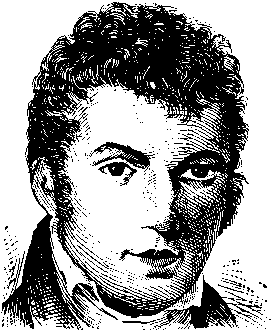
Baggesen was the son of poor people, and strangers helped him to his scientific education. When his first works were recognized he became the friend and protégé of the Duke of Augustenborg, who provided him with the means for an extended journey through the Continent, during which he met the greatest men of his time. The Duke of Augustenborg meanwhile secured him several positions, which could not hold him for any length of time, nor keep him at home in Denmark. He went abroad a second time to study pedagogics, literature, and philosophy, came home again, wandered forth once more, returned a widower, was for some time director of the National Theatre in Copenhagen; but found no rest, married again, and in 1800 went to France to live. Eleven years later he was professor in Kiel, returning thence to Copenhagen, where meanwhile his fame had been eclipsed by the genius of Oehlenschläger. Secure in the knowledge of his powers, Oehlenschläger had carelessly published two or three dramatic poems not worthy of his pen, and Baggesen entered on a violent controversy with him in which he stood practically by himself against the entire reading public, whose sympathies were with Oehlenschläger. Alone and misunderstood, restless and unhappy, he left Denmark in 1820, never to return. Six years later he died, longing to see his country again, but unable to reach it.
His first poetry was published in 1785, a volume of 'Comic Tales,' which made its mark at once. The following year appeared in quick succession satires, rhymed epistles, and elegies, which, adding to his fame, added also to the purposeless ferment and unrest which had taken possession of him. He considered tragedy his proper field, yet had allowed himself to appear as humorist and satirist.
When the great historic events of the time took place, and over-threw all existing conditions, this inner restlessness drove him to and fro without purpose or will. One day he was enthusiastic over Voss's idyls, the next he was carried away by Robespierre's wildest speeches. One year he adopted Kant's Christian name Immanuel in transport over his works, the next he called the great philosopher "an empty nut, and moreover hard to crack." The romanticism in Denmark as well as in Germany reduced him to a state of utter confusion; but in spite of this he continued a child of the old order, which was already doomed. And with all his unrest and discord he remained nevertheless the champion of "form," "the poet of the graces," as he has been called.
This gift of form has given him his literary importance. He built a bridge from the eighteenth to the nineteenth century; and when the new romantic school overstepped its privileges, it was he who called it to order. The most conspicuous act of his literary life was the controversy with Oehlenschläger, and the wittiest product of his pen is the reckless criticism of Oehlenschläger's opera 'Ludlam's Cave.' Johann Ludvig Heiberg, the greatest analytical critic of whom Denmark can boast, remained Baggesen's ardent admirer; and Heiberg's influential although not always just criticism of Oehlenschläger as a poet was no doubt called forth by Baggesen's attack. Some years later Henrik Hertz made Baggesen his subject. In 1830 appeared 'Letters from Ghosts,' poetic epistles from Paradise. Nobody knew that Hertz was the author. It was Baggesen's voice from beyond the grave, Baggesen's criticism upon the literature of 1830. It was one of the wittiest, and in versification one of the best, books in Danish literature.
Baggesen's most important prose work is 'The Labyrinth,' afterwards called 'The Wanderings of a Poet.' It is a poetic description of his journeys, unique in its way, rich in impressions and full of striking remarks, written in a piquant, graceful, and easy style.
As long as Danish literature remains, Baggesen's name will be known; though his writings are not now widely read, and are important chiefly because of their influence on the literary spirit of his own time. His familiar poem 'There was a time when I was very little,' during the controversy with Oehlenschläger, was seized upon by Paul Möller, parodied, and changed into 'There was a time when Jens was much bigger.' Equally well known is his 'Ode to My Country,' with the familiar lines:--
"Alas, in no place is the thorn as tiny, Alas, in no place blooms as red a rose, Alas, in no place is there couch as downy As where we little children found repose."
A COSMOPOLITAN
From 'The Labyrinth'
Forster, a little nervous, alert, and piquant man, with gravity written on his forehead, perspicacity in his eye, and love around his lips, conquered me completely. I spoke to him of everything except his journeys; but the traveler showed himself full of unmistakable humanity. He seemed to me the cosmopolitan spirit personified. It was as if the world were present when I was alone with him.
We talked about his friend Jacobi, about the late King of Prussia, about the literature of Germany, and about the present Pole-high standard of taste. I was much pleased to find in him the art critic I sought. He said that we must admire everything which is good and beautiful, whether it originates West, East, South, or North. The taste of the bee is the true one. Difference in language and climate, difference of nationality, must not affect my interest in fair and noble things. The unknown repels the animal, but should not repel the human creature. Suppose you say that Voltaire is animal in comparison with Shakespeare or Klopstock, or that they are animal in comparison with him: it is a blunder to demand pears of an apple-tree, as it is ridiculous to throw away the apple because it is not a pear. The entire world of nature teaches us this aesthetic tolerance, and yet we have as little acquired it as we have freedom of conscience. We plant white and red roses in the same bed, but who puts the 'Messiah' and the 'Henriade' on the same shelf? He only who reads neither the one nor the other. True religion worships God; true taste worships the beautiful without regard of person or nation. German? French? Italian? or English? All the same! But nothing mediocre.
I was flushed with pleasure; I gave him my hand. "That may be said of other things than poetry!" I said.--"Of all art!" he answered.--"Of all that is human!" we both concluded.
Deplorable indolence which clothes our mind in the first heavy cloak ready to hand, so that all the sunbeams of the world cannot persuade us to throw it off, much less to assume another! The man who is exclusively a nationalist is a snail forever chained to his house. Psyche had wings given her for a never-ending, eternal flight. We may not imprison her, be the cage ever so large.
He considered that Lessing had wronged the great representative of the French language; and the remark of Claudius, "Voltaire says he weeps, and Shakespeare does weep," appeared to him like the saying, "Much that is new and beautiful has M. Arouet said; but it is a pity that the beautiful is not new and the new not beautiful,"--more witty than true. The English think that Shakespeare, as the Germans think that Lessing, really weeps; the French think the same of Voltaire. But the first weeps for the whole world, it is said, the last only for his own people. What the French call "Le Nord" is, to be sure, rather a large territory, but not the entire world! France calls "whimpering" in one case and "blubbering" in another what we call weeping. The general mistake is that we do not understand the nature of the people and the language, in which and for whom the weeping is done.
We must be English when we read Shakespeare, German when we read Klopstock, French when we read Voltaire. The man whose soul cannot shed its national costume and don that of other nations ought not to read, much less to judge, their masterpieces. He will be looking at the moon by day and at the sun by night, and see the first without lustre and the last not at all.
PHILOSOPHY ON THE HEATH
From 'The Labyrinth'
Caillard was a man of experience, taste, and knowledge. He told me the story of his life from beginning to end, he confided to me his principles and his affairs, and I took him to be the happiest man in the world. "I have everything," he said, "all that I have wished for or can wish for: health, riches, domestic peace (being unmarried), a tolerably good conscience, books--and as much sense as I need to enjoy them. I experience only one single want, lack only one single pleasure in this world; but that one is enough to embitter my life and class me with other unfortunates."
I could not guess what might yet be wanting to such a man under such conditions, "It cannot be liberty," I said, "for how can a rich merchant in a free town lack this?"
"No! Heaven save me--I neither would nor could live one single day without liberty."
"You do not happen to be in love with some cruel or unhappy princess?"
"That is still less the case."
"Ah!--now I have it, no doubt--your soul is consumed with a thirst for truth, for a satisfactory answer to the many questions which are but philosophic riddles. You are seeking what so many brave men from Anaxagoras to Spinoza have sought in vain--the corner-stone of philosophy, the foundation of the structure of our ideas."
He assured me that in this respect he was quite at ease. "Then, in spite of your good health, you must be subject to that miserable thing, a cold in the head?" I said.
"Uno minor--Jove, dives Liber, honoratus, pulcher rex denique regum, Praecipue sanus--nisi cum pituita molesta est." --HORACE.
When he denied this too, I gave up trying to solve the meaning of his dark words.
O happiness! of all earthly chimeras thou art the most chimerical! I would rather seek dry figs on the bottom of the sea and fresh ones on this heath,--I would rather seek liberty, or truth itself, or the philosopher's stone, than to run after thee, most deceitful of lights, will-o'-the-wisp of our human life!
I thought that at last I had found a perfectly happy, an enviable man; and now--behold! though I have not the ten-thousandth part of his wealth, though I have not the tenth part of his health, though I may not have a third of his intellect, although I have all the wants which he has not and the one want under which he suffers, yet I would not change places with him!
From this moment he was the object of my sincerest pity. But what did this awful curse prove to be? Listen and tremble!
"Of what use is it all to me?" he said: "coffee, which I love more than all the wines of this earth and more than all the women of this earth, coffee which I love madly--coffee is forbidden me!"
Laugh who lists! Inasmuch as everything in this world, viewed in a certain light, is tragic, it would be excusable to weep: but inasmuch as everything viewed in another light is comic, a little laughter could not be taken amiss; only beware of laughing at the sigh with which my happy man pronounced these words, for it might be that in laughing at him you laugh at yourself, your father, your grandfather, your great-grandfather, your great-great-grandfather, and so on, including your entire family as far back as Adam.
If, in laughing at such discontent, you laugh in advance at your son, your son's son's son, and so forth to the last descendant of your entire family, this is a matter which I do not decide. It will depend upon the road humanity chooses to take. If it continues as it is going, some coffee-want or other will forever strew it with thorns.
Had he said, "Chocolate is forbidden me," or tea, or English ale, or madeira, or strawberries, you would have found his misery equally absurd.
The great Alexander is said to have wept because he found no more worlds to conquer. The man who bemoans the loss of a world and the man who bemoans the loss of coffee are to my mind equally unbalanced and equally in need of forgiveness. The desire for a cup of coffee and the desire for a crown, the hankering after the flavor or even the fragrance of the drink and the hankering after fame, are equally mad and equally--human.
If history is to be believed, Adam possessed all the advantages and comforts, all the necessities and luxuries a first man could reasonably demand.... Lord of all living things, and sharing his dominion with his beloved, what did he lack?
Among ten thousand pleasures, the fruit of one single tree was forbidden him. Good-by content and peace! Good-by forever all his bliss!
I acknowledge that I should have yielded to the same temptation; and he who does not see that this fate would have overtaken his entire family, past and to come, may have studied all things from the Milky Way in the sky to the milky way in his kitchen, may have studied all stones, plants, and animals, and all folios and quartos dealing therewith, but never himself or man.
As we do not know the nature of the fruit which Adam could not do without, it may as well have been coffee as any other. That it was pleasant to the eyes means no more than that it was forbidden. Every forbidden thing is pleasant to the eyes.
"Of what use is it all to me?" said Adam, looking around him in Eden, at the rising sun, the blushing hills, the light-green forest, the glorious waterfall, the laden fruit-trees, and, most beautiful of all, the smiling woman--"of what use is it all to me, when I dare not taste this--coffee bean?"
"And of what use is it all to me?" said Mr. Caillard, and looked around him on the Lüneburg heath: "coffee is forbidden me; one single cup of coffee would kill me."
"If it will be any comfort to you," I said, "I may tell you that I am in the same case." "And you do not despair at times?"--"No," I replied, "for it is not my only want. If like you I had everything else in life, I also might despair."
THERE WAS A TIME WHEN I WAS VERY LITTLE There was a time, when I, an urchin slender, Could hardly boast of having any height. Oft I recall those days with feelings tender; With smiles, and yet the tear-drops dim my sight. Within my tender mother's arms I sported, I played at horse upon my grandsire's knee; Sorrow and care and anger, ill-reported, As little known as gold or Greek, to me. The world was little to my childish thinking, And innocent of sin and sinful things; I saw the stars above me flashing, winking-- To fly and catch them, how I longed for wings! I saw the moon behind the hills declining, And thought, O were I on yon lofty ground, I'd learn the truth; for here there's no divining How large it is, how beautiful, how round! In wonder, too, I saw God's sun pursuing His westward course, to ocean's lap of gold; And yet at morn the East he was renewing With wide-spread, rosy tints, this artist old. Then turned my thoughts to God the Father gracious, Who fashioned me and that great orb on high, And the night's jewels, decking heaven spacious; From pole to pole its arch to glorify. With childish piety my lips repeated The prayer learned at my pious mother's knee: Help me remember, Jesus, I entreated, That I must grow up good and true to Thee! Then for the household did I make petition, For kindred, friends, and for the town's folk, last; The unknown King, the outcast, whose condition Darkened my childish joy, as he slunk past. All lost, all vanished, childhood's days so eager! My peace, my joy with them have fled away; I've only memory left: possession meagre; Oh, never may that leave me, Lord, I pray.