Part II THE REHABILITATION (continued 4)
Reading edition
Moreover, that, the next day, in the morning, the Maid sent to fetch all the lords and captains before the captured fort, to consult as to what more should be 316done; by the advice of whom it was concluded and resolved to attack this day a great Boulevard, which the English had made, before the Fort of Tourelles, and that it was expedient to gain it before doing anything else. To do and put this into execution, the Maid, the captain, and their people, on this day, very early in the morning, went from one place to the other, before the Boulevard, and on this they made the assault from all sides, making every effort to take it, in such manner that they were before the Boulevard from morning till sunset without being able to take it or gain it. And the lords and captains who were with her, seeing that they could not well gain it this day, considering the hour, which was late, and that all were very tired and worn out, it was agreed amongst them to sound the retreat for the army; which was done; and, at sound of the trumpet-call, each one retreated for that day. In making this retreat, because the Deponent, who was carrying the standard of the Maid, and holding it upright before the Boulevard, became fatigued and worn-out, he gave the standard to one named La Basque, who was of the following of De Villars; and because the Deponent knew La Basque to be a valiant man, and feared that, by reason of the retreat, evil would ensue, and that the fort and Boulevard would remain in the hands of the enemy, he had an idea that, if the standard were pushed to the front,—from the great affection which he knew the soldiers had for it—they might for this reason gain the Boulevard. Then the Deponent asked La Basque, if he were to enter and go to the foot of the Boulevard, would he follow him; who said and promised that he would; then the Deponent entered the trench, and went up to the foot of the sides of the Boulevard, covering himself with his shield for fear of the stones, and left his companion on the other side, believing he would follow him step by step. But when the Maid saw 317her standard in the hand of La Basque, and because she believed she had lost it, as he who bore it had gone into the trench, the Maid came and took the standard by the end in such wise that he could not hold it, crying, “Ha! my standard! my standard!” and shook the standard in such wise that the Deponent thought that, in so doing, the others might imagine she was making some sign to them; then the Deponent cried: “La Basque, is this what thou didst promise me?” Then La Basque so pulled at the standard that he dragged it from the hand of the Maid; and, this being done, he went to the Deponent and brought the standard. On this account all the army of the Maid assembled together and rallied again, and, with great fierceness, assailed the Boulevard, so that, shortly after, the Boulevard and the fort were taken by them, and abandoned by the enemy, the French [on their return] entering the city of Orleans by the bridge;
And the Deponent saith that, on this very day, he had heard it spoken by the Maid: “In God’s Name, we shall enter the town this night by the bridge.” This done, the Maid and her followers returned into the town of Orleans, in which the Deponent had her [wound] dressed, for she had been wounded by an arrow in the assault;
Also that, next day, all the English still remaining before the town on the other side of the Fort of Tourelles, raised the siege and retreated, being discomfited and in confusion. Thus, by the help of God and the Maid, was the city delivered from the hands of the enemy;
Moreover, that, some time after the return from the consecration of the King, he [the King] was advised by his Council—then at Meung-sur-Yèvre—that it was most necessary to recover the town of La Charité, which was held by the enemy; but that first must be taken 318the town of Saint Pierre le Moustier, which likewise was held by the enemy;
That, to do this and to collect men, the Maid went to the town of Bourges, in which she assembled her forces; and from thence, with a certain number of men-at-arms, of whom Lord d’Elbret was the head, she went to besiege the town of Saint Pierre le Moustier;
That, after the Maid and her followers had made siege against the town for some time, an assault was ordered to be made against the town; and so it was done, and those who were there did their best to take it; but, on account of the great number of people in the town, the great strength thereof and also the great resistance made by those within, the French were compelled and forced to retreat, for the reasons aforesaid; and at that time, the Deponent was wounded by a shot in the heel, so that without crutches he could neither keep up nor walk: he noticed that the Maid was left accompanied by very few of her own people and others; and the Deponent, fearing that trouble would follow therefrom, mounted a horse, and went immediately to her aid, asking her what she was doing there alone and why she did not retreat like the others. She, after taking her helmet [“salade”] from her head, replied that she was not alone, and that she had yet in her company fifty thousand of her people, and that she would not leave until she had taken the town;
And the Deponent saith that, at that time—whatever she might say—she had not with her more than four or five men, and this he knows most certainly, and many others also, who in like manner saw her; for which cause he told her again that she must leave that place, and retire as the others did. And then she told him to have faggots and hurdles brought to make a bridge over the trenches of the town, in order that they might approach it the better. And as she said these words to him, 319she cried in a loud voice: “Every one to the faggots and hurdles, to make the bridge!” which was immediately after done and prepared, at which the Deponent did much marvel, for immediately the town was taken by assault, without very great resistance;
That, all the deeds of the Maid seemed to him to be more divine and miraculous than otherwise, and that it was not possible for so young a Maid to do such things without the Will and Guidance of Our Lord;
Also that, for the space of a whole year, by command of our Lord the King, he remained in the company of the Maid, during which time he neither saw nor knew of anything in her which should not be in a good Christian; and he has always seen and known her to be of very good life and modest conversation in all and every one of her acts;
Also that, he knew the Maid to be most devout; that she shewed herself very reverent in hearing the Divine Service of our Lord, which she would constantly hear, that is to say, High Mass, on solemn days, wherever she was, with the Hours following; and on other days Low Mass; and that she was accustomed to hear Mass daily if it were possible;
That, many times he saw and knew that she confessed herself and received Our Lord, and did all that belongs to a good Christian to do, and that, never when he was conversing with her, did he hear her swear, blaspheme, or perjure the Name of Our Lord, nor the Saints, for whatever cause or occasion it might be;
And that, in his opinion, she was a good Christian, and must have been inspired; for she loved everything that a good Christian ought to love, and especially she loved a good honest man [“bon prudhomme”] whom she knew to be of chaste life; ... Also that, when the Maid had anything to do for the conduct of war, she told 320the Deponent that her Counsel had advised her what she ought to do;
That, he asked her who was the Counsel, and that she replied there were three Counsellors, of whom one always remained with her; another went away, but came often, to visit her; and the third was he with whom the two others consulted. And it happened that, one time, among others, the Deponent prayed and besought her that she would shew him the Counsel; to whom she replied that he was not worthy, nor of sufficient virtue to see them: and upon this the Deponent desisted from speaking or asking her further about them;
And the Deponent firmly believes as aforesaid, that, considering the deeds, actions and great leadership of the Maid, she was full of all the virtue which might or should be in a good Christian;
And thus he hath deposed, as is above written, without love, favour, hate, or suborning, but for the truth, and as he knew it to be in the Maid.
321
SENTENCE OF REHABILITATION.
In the name of the Holy and Undivided Trinity, Father, Son, and Holy Ghost, Amen!
The Providence of the Eternal Majesty, the Saviour Christ, Lord God and Man, hath instituted, for the rule of His Church Militant, the Blessed Peter, and his Apostolic Successors; He hath made them His principal representatives, and charged them, by the light of truth, which He hath manifested to them, to teach men how to walk in the paths of justice, protecting the good, relieving the oppressed in the whole universe, and, by a reasonable judgment, bringing back into the right road those who have turned therefrom:
Invested with this Apostolic authority for the matter in question, we Jean of Rheims, Guillaume of Paris, and Richard of Coutances, by the Grace of God Archbishop and Bishops, and Jean Bréhal, of the Order of Saint Dominic, Professor of Sacred Theology, one of the two Inquisitors of the Heretical Evil for the Realm of France, all four Judges specially delegated by our most Holy Lord the Pope actually reigning:
Having seen the solemn Process brought before us, by virtue of the Apostolic Mandate addressed to us, and by us respectfully accepted:
In the Case concerning the honest woman, Widow Isabelle d’Arc, mother, Pierre and Jean d’Arc, brothers 322german, natural and legal, of the deceased Jeanne d’Arc, of good memory, commonly called the Maid:
The said Case brought in their name,
Against the Sub-Inquisitor of the Heretical Evil for the Diocese of Beauvais, the Promoter of the Officiality of the said Diocese of Beauvais, and also the Reverend Father in Christ and Lord Guillaume de Hellande, Bishop of Beauvais, and against all others and each in particular who might be thought to be therein interested, all together respectively Defendants, as well conjointly as separately:
Having seen, in the first place, the peremptory citation and the execution of this citation made against the said Defendants, at the request not only of the said Plaintiffs but of the Promoter of our Office appointed by us, sworn and created, to the end that the said Defendants might see the carrying out of the said Rescript, hear the conclusions against them, and answer themselves; and to proceed, in one word, according to right:
Having seen the request of the said Plaintiffs, their deeds, reasons, and conclusion set down in writing under the form of Articles, putting forward a declaration of nullity, of iniquity, and of cozenage against a certain Process in a pretended Trial for the Faith, formerly done and executed in this city against the above-named woman, now deceased, by the late Lord Pierre Cauchon, then Bishop of Beauvais, Jean Lemaître, then Vice-Inquisitor of the said Diocese of Beauvais, and Jean d’Estivet, Promoter, or having at least acted in this capacity; the said request putting forward and inferring further the breaking down and annulling of the Process in question and of all which followed it, to the justification of the said Deceased, and to all the other ends therein enumerated:
Having seen, read, re-read and examined the 323original books, instruments, means, acts, notes and protocols of the said Process, shewn and sent to us, in virtue of the compulsory letters, by the Registrars and others whose signatures and writings have been, as a preliminary, acknowledged in our presence:
After having studied at length all these documents, not only with the said Registrars and other officials appointed in the said Process, but also with those of the Counsellors who were called to the same Process, those, at least, whom we have been able to bring before us:
And after having ourselves collated and compared the final text, with the Minute itself of the said Process:
Having considered also the Preparatory Enquiries,—first, those which were conducted by the Most Reverend Father in Christ the Lord Guillaume, Cardinal Priest under the title of Saint-Martin-les-Monts,[210] then Legate of the Holy Apostolic See in the Kingdom of France, assisted by the Inquisitor, after the examination which had been made by the said Cardinal-Legate of the books and instruments then presented:
Having afterwards considered the Preparatory Enquiry conducted at the beginning of the actual Process by us or our Commissaries:
Having considered also divers treatises[211] which had come from the Prelates, Doctors, and men of learning, the most celebrated and the most authorized, who, after having studied at length the books and instruments of the said Process, have separated from these books and instruments the doubtful points which they would have to elucidate in their said treatises composed afterwards and brought to light, whether by the order of the most Reverend Father aforesaid or of us:
Having considered the Articles and Interrogations to be submitted to the witnesses, presented to us in the 324name of the Plaintiffs and of our Promoter, and after many citations admitted in proof by us:
Having considered the depositions and attestations of the witnesses heard on the subject of the said Articles and Interrogations on the life of the said Deceased in the place of her birth;—on her departure; on her examination before several Prelates, Doctors, and others having knowledge thereof, in presence notably of the Most Reverend Father Reginald, then Archbishop of Rheims and Metropolitan of the said Bishop of Beauvais: an examination made at Poitiers and elsewhere, on several occasions; on the marvellous deliverance of the city of Orleans; on the journey to the city of Rheims and the coronation of the King; and the divers circumstances of the Trial, the qualifications, the judges, and the manner of proceeding:
Having considered also letters, instruments, and measures, besides the letters, depositions and attestations just mentioned, sent to us and produced in the course of law:
Having afterwards heard our Promoter, who, considering these productions and these sayings, declares himself fully joined with the Plaintiffs:
Having heard the other requests and reserves made by our Promoter, in his own name as well as in that of the Plaintiffs, the said requests and reserves admitted by us and received at the same time as certain reasons of law briefly formulated, of a nature also to impress our minds:
After the Case had been concluded, in the Name of Christ, and this day had been assigned by us to give sentence:
After having, with great matureness, weighed, examined, all and each one of the aforesaid things, as well as certain Articles beginning with these words “A certain Woman, &c.,”[212] which the Judges in the first 325Process did pretend to have extracted from the confessions of the said Deceased, and which have been submitted by us to a great number of staid persons for their opinion; Articles which our Promoter, as well as the Plaintiffs aforesaid, attacked as iniquitous, false, prepared without reference to the confessions of Jeanne, and in a lying manner:
That our present Judgment may come as from the Face of God Himself, Who weigheth the spirits, Who alone infallibly knoweth His revelations, and doth hold them always at their true value, Who bloweth where He listeth, and doth often choose the weak to confound the strong, never forsaking those who trust in Him, but being their Support in their sorrows and their tribulations:
After having had ripe deliberation, as much on the subject of the Preparatory Enquiries as on the decision itself, with persons at the same time expert, authorized, and prudent:
Having considered their solemn decisions, formulated in the treatises written out in a compendious manner, and in numerous consultations:
Having considered their opinion, written or verbal, furnished and given, not only on the form but also on the basis of the Process, and according to which the actions of the said Deceased, being worthy of admiration rather than of condemnation, the judgment given against her should, in form as well as in basis, be reprehended and detested:
And because on the question of revelations it is most difficult to furnish a certain judgment, the Blessed Paul having, on the subject of his own revelations, said that he knew not if they came to him in body or in spirit, and having on this point referred himself to God:
In the first place, we say, and, because Justice requires it, we declare, that the Articles beginning with the words “A woman,” which are found inserted in the pretended 326Process and Instrument of the pretended sentences, lodged against the said Deceased, ought to have been, have been, and are, extracted from the said pretended Process and the said pretended confessions of the said Deceased, with corruption, cozenage, calumny, fraud and malice:
We declare, that on certain points the truth of her confessions has been passed over in silence; that on other points her confessions have been falsely translated—a double unfaithfulness, by which, had it been prevented, the mind of the Doctors consulted and the Judges might have been led to a different opinion:
We declare, that in these Articles there have been added without right many aggravating circumstances, which are not in the aforesaid Confessions, and many circumstances both relevant and justifying have been passed over in silence:
We declare, that even the form of certain words has been altered, in such manner as to change the substance:
For the which, these same Articles, as falsely, calumniously, and deceitfully extracted, and as contrary even to the Confessions of the Accused, we break, annihilate, and annul; and, after they shall have been detached from the Process we ordain, by this present judgment, that they be torn up:
In the second place, after having examined with great care the other parts of the same said Process—particularly the two sentences which the Process contained, designated by the Judges as “Lapse” and “Relapse”—and after having also for a long time weighed the qualifications of the Judges and of all those under whom and in whose keeping the said Jeanne was detained:
We say, pronounce, decree, and declare, the said Processes and Sentences full of cozenage, iniquity, inconsequences, and manifest errors, in fact as well as in law; We say that they have been, are, and shall be—as well 327as the aforesaid Abjuration, their execution, and all that followed—null, non-existent, without value or effect.
Nevertheless, in so far as is necessary, and as reason doth command us, we break them, annihilate them, annul them, and declare them void of effect; and we declare that the said Jeanne and her relatives, Plaintiffs in the actual Process, have not, on account of the said Trial, contracted nor incurred any mark or stigma of infamy; we declare them quit and purged of all the consequences of these same Processes; we declare them, in so far as is necessary, entirely purged thereof by this present:
We ordain that the execution and solemn publication of our present Sentence shall take place immediately in this city, in two different places, to wit,
To-day in the Square of Saint Ouen, after a General Procession and a public Sermon:
To-morrow, at the Old Market-Place, in the same place where the said Jeanne was suffocated by a cruel and horrible fire, also with a General Preaching and with the placing of a handsome cross for the perpetual memory of the Deceased and for her salvation and that of other deceased persons:
We declare that we reserve to ourselves [the power] later on to execute, publish, and for the honour of her memory to signify with acclaim, our said sentence in the cities and other well-known places of the kingdom wherever we shall find it well [so to do], under the reserves, finally, of all other formalities which may yet remain to be done.
This present Sentence hath been brought out, read and promulgated by the Lords Judges, in presence of the Reverend Father in Christ the Lord Bishop of Démétriade, of Hector de Coquerel, Nicolas du Boys, Alain Olivier, Jean du Bec, Jean de Gouys, Guillaume 328Roussel, Laurent Surreau, Canons; of Martin Ladvenu, Jean Roussel, and Thomas de Fanouillères.
Maître Simon Chapitault, Promoter; Jean d’Arc and Prevosteau for the other Plaintiffs.
Done at Rouen in the Archiepiscopal Palace, in the year of our Lord 1456, the 7th day of the month of June.
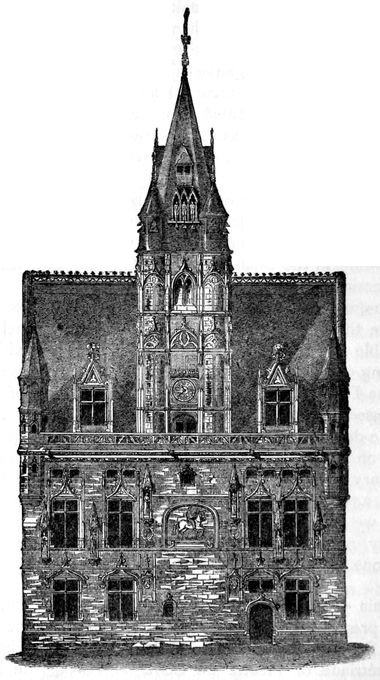
THE HÔTEL DE VILLE: COMPIÈGNE.
331