Part II THE REHABILITATION (continued 2)
Reading edition
I was present at the final preaching but not at the execution, for very pity of the deed. Many of those present wept, among others the Cardinal de Luxembourg, then Bishop of Thérouanne.
I know nothing about her devotions; but she said, “Rouen, Rouen, must I die here?”
I can well believe that some of the English acted from hate and fear, but of the more notable ecclesiastics I do not think this. A chaplain of the Cardinal of England, present at the first preaching, said to the Bishop of Beauvais, that he was showing too much 209favour to Jeanne; but the Bishop said to him, “You lie! For in such a case I would show favour to no one.” The Cardinal of England reproved his chaplain and told him to be silent.
Maître Richard Grouchet, Priest, Master of Arts, Bachelor of Theology, Canon of the Cathedral Church of La Saussaye in the diocese of Evreux: Examined, May 9th, 1452.
Maîtres Jean Pigache, Pierre Minier, and I myself, who was with them, gave our opinion only under terror of threats. We stayed to the Trial, but had thoughts of flight. I many times heard from Pierre Maurice that, after the sermon at Saint-Ouen, he had warned Jeanne to hold to her good purpose; and the English, much displeased, threatened to strike him.
I think the notaries wrote with fidelity. I saw and heard that the Bishop of Beauvais bitterly upbraided them when they did not do as he wished: the whole affair, so far as I saw and heard, was carried on tumultuously. So far as I saw, no one was permitted to instruct or counsel Jeanne, nor did I see that she either asked for or was offered Counsel: but I am not sure of this. I do not know whether any one was in danger of losing his life by defending her, but I know well that when difficult questions were put to Jeanne, whoever wished to direct her was harshly reproved and accused of partiality, sometimes by the Bishop of Beauvais and sometimes by Maître Jean Beaupère, who said to those who wished to advise, that they should leave her to speak and that the business of interrogation was theirs.
Jeanne was in prison, in the Castle of Rouen, where she was guarded and brought backwards and forwards by the English; but as to fetters and chains I know 210nothing, though I have often heard that she was harshly and straitly bound.
I saw and heard at the Trial that when Jeanne was asked if she would submit to the Bishop of Beauvais and others of the Assessors then named, she replied that she would not, but she would submit to the Pope and the Catholic Church, praying that she might be conducted to the Pope. When she was told that the Process would be sent to the Pope for him to judge, she replied that she did not wish this, because she did not know what might be put in this Process, but that she wished to be taken herself and interrogated by the Pope.
I did not know, nor did I ever hear, that there was ever any secular sentence pronounced against Jeanne. I was not present, but the public voice and rumour said that she had been violently and unjustly done to death.
Messire Jean Lefevre, Bishop of Démétriade, of the Order of Saint Augustin in the Convent at Rouen, S.T.P.: Examined, May 9th, 1452.
When Jeanne was asked if she were in the Grace of God, I, who was present, said it was not a suitable question for such a girl. Then the Bishop of Beauvais said to me, “It will be better for you if you keep silent.”
Jeanne answered with great prudence the questions put to her, with the exception of the subject of her revelations from God: for the space of three weeks I believed her to be inspired. She was asked very profound questions, as to which she showed herself quite capable; sometimes they interrupted the enquiry, going from one subject to another, that they might make her change her purpose. The Examinations were very long, lasting sometimes two or three hours, so that the Doctors present were much fatigued.
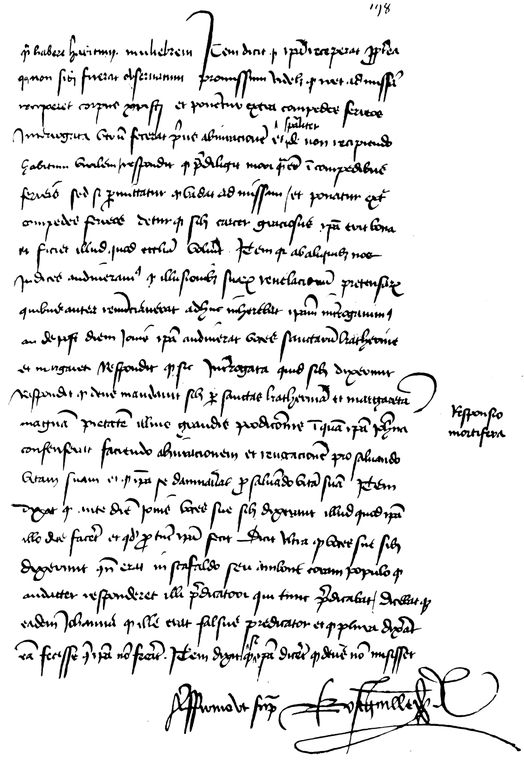
FACSIMILE OF A PAGE OF THE PROCESS OF JEANNE D’ARC.
211Messire Thomas Marie, Priest, Bachelor in Theology, Prior of Saint Michael, near Rouen, of the Order of Saint Benedict: Examined, May 7th, 1452.
Jeanne had done marvels in war: and, as the English are commonly superstitious, they thought there was a fate with her. Therefore, in my opinion, they, in all their counsels and elsewhere, desired her death.
[When asked how he knew the English were superstitious, he answered that it was commonly so reported, and was a popular proverb.]
I heard from a certain locksmith that he had made an iron cage high enough to allow her to stand upright. [When asked if she were ever put into it:] I believe so; I knew nothing of her keepers.
I have heard, that after the first preaching, when she was taken back to the prison of the Castle, she was the victim of so many oppressions that she said she would rather die than remain with these English.
Where the judgment is not free, neither Process nor sentence is of value; but whether in this Case the Judges and Assessors were free, I know not beyond what I have before stated.
I heard from many that they saw the name Jesus written in the flames of the fire in which she was burnt.
I can well believe that if the English had had such a woman, they would have honoured her much and not have treated her in this manner.
Maître Jean de Fave, Master of Arts, Licentiate in Law; living at Rouen; Commissary: Examined, May 9th, 1452.
After the first preaching, when she was taken back to prison, some of the soldiers insulted her, and their chiefs allowed them to do so. Some of the leaders of the 212English—as I heard—were angry with the Bishop of Beauvais, the Doctors, and the other Assessors in the Trial, because she had not been convicted and condemned and taken to execution; and I heard it said that some of the English, in their indignation against the Bishop and the Doctors, would have drawn their swords to attack them, if not to slay them, saying that the King was wasting his money on such as they. I also heard that when the Earl of Warwick, after this first sermon, complained to the Bishop and the Doctors, saying that the King was in a bad way, for Jeanne had escaped them, one of them replied: “Take no heed to it, my lord; we shall soon have her again.”
The English were discontented with Maître Guillaume Manchon, the notary: they held him in suspicion as favourable to Jeanne, because he had not been willing to come to the Trial, and did not conduct himself to their liking.
Maître Jean Ricquier, Priest, Curé of Hendicourt [testimony of no importance].
213
DEPOSITIONS AT DOMREMY: 1455.
Twelve questions were prepared for information to be taken in the country of the late Jeanne, commonly called the Maid.
Examination of Witnesses.
Jean Morel, of Greux, labourer.
Jeanne was born at Domremy and was baptised at the Parish Church of Saint Remy, in that place. Her father was named Jacques d’Arc, her mother Isabelle—both labourers living together at Domremy. They were, as I saw and knew, good and faithful Catholics, labourers of good repute and honest life. I lived much with them, I was one of the godfathers of Jeannette. She had three godmothers—the wife of Etienne Thévenin, Beatrix, Widow Estellin, both living at Domremy; and Jeannette, widow of Thiesselin of Viteaux, living at Neufchâteau. From her early youth, Jeannette was brought up with care in the Faith, and in good morals; she was so good that all the village of Domremy loved her. Jeannette knew her Belief and her Pater and Ave as well as any of her companions. She had modest ways, as beseemed one whose parents were not rich. Up to the time she left her parents she followed the plough and sometimes minded the cattle in the fields. Also she did the usual 214duties of women, such as spinning, and other things. I know she liked to go often to the Hermitage of the Blessed Marie of Bermont, near Domremy; I often saw her go there. She was there when her parents thought her with the plough or in the fields; and when she heard the Mass-bell, if she were in the fields, she would go back to the village and to the Church, in order to hear Mass. I have been witness of this many times. I have seen her confess at Easter-tide and other solemn Feasts. I saw her confess to Messire Guillaume Fronte, who was then Curé of the Parish of Saint Remy.
On the subject of the Fairies’ tree, I have heard that the Fairies came there long ago to dance; but, since the Gospel of Saint John has been read under the tree, they come no more. At the present day, on the Sunday when in the Holy Church of God the Introit to the Mass ‘Laetare Jerusalem’ is sung, called with us ‘the Sunday of the Wells,’ the young maidens and youths of Domremy are accustomed to go there, and also in the spring and summer and on festival days; they dance there and have a feast. On their return, they go dancing and playing to the Well of the Thorn, where they drink and amuse themselves, gathering flowers. Jeanne the Maid went there, like all the other girls at those times, and did as they did; but I never heard say that she went there alone, either to the tree or to the well—which is nearer to the village than the tree—or that she went for any other purpose than to walk about and play like her companions. When Jeanne left her father’s house, she went two or three times to Vaucouleurs to speak to the Bailly. I heard it said that the Lord Charles, then Duke of Lorraine, wished to see her, and gave her a black horse.
I have no more to say, except that in the month of July I was at Chalons, at the time when it was said that 215the King was going to Rheims to be anointed.[119] I found Jeanne at Chalons and she made me a present of a red dress she had been wearing. I know nothing of the enquiry made at Domremy. When Jeanne went to Neufchâteau on account of the soldiers, she was always in the company of her father and mother, who stayed there four days, and then returned to Domremy. I am sure of what I say, because I went with the rest to Neufchâteau and I saw Jeannette there with her parents.
Messire Dominique Jacob, Curé of the Parish Church of Montier-sur-Saulx.
Jeanne was older than I. I knew her and remember her for the three or four years before her departure from home. She was a well-brought-up girl, and well-behaved; and she often attended Church. Sometimes, when the village bell rang for service, I saw her kneel down and pray with great devotion.
Beatrix, widow of Estellin, labourer, of Domremy.
Jeannette was born, at Domremy, of Jacques d’Arc and Isabelle, his wife, labourers, good and true Catholics, honest folk and worthy, according to their ability, but not rich. She was baptised at the Church of Saint Remy. She had as god-fathers, Jean Morel, Jean de Laxart, and the late Jean Raiguesson; and as god-mothers, Jeannette, widow Thiesselin, Jeannette Thévenin, and myself. Jeanne was suitably instructed in the Catholic Faith, like other young girls of her age. 216Up to her departure, she was properly brought up; she was a chaste maiden, and of modest habits. She frequented with great devotion, churches and holy places; and, after the village of Domremy was burned, she went on Feast Days to attend Mass at Greux. She confessed willingly at festivals, principally at the Feast of the most Holy Easter, the Resurrection of our Lord Jesus Christ. I do not think there was any one better than she in our two villages. She employed herself at home with many duties in the house, spinning hemp or wool, following the plough, or going to harvest, according to the season. When it was her father’s turn, she sometimes kept the cattle and the flocks of the village for him. When Jeannette went to Neufchâteau, all the village had fled. I saw her there, always with her father and mother. Up to her going into France, Jeannette had never obeyed any one or worked for any one but her father.
Jeannette, wife of Thévenin, cartwright [gave evidence similar to the preceding, as did] Jean Moen, of Domremy, cartwright, living at Coussey, near Neufchâteau, [and] Jacquier of Saint Amance, near Nancy.
Messire Etienne of Sionne, Curé of the Parish Church of Roncessey-sous-Neufchâteau.
Many times I heard Messire Guillaume Fronte, in his lifetime Curé of Domremy, say that Jeanne the Maid was a simple and good girl, pious, well-brought-up, and God-fearing, and without her like in the whole village. Often did she confess her sins; and, if she had had money, she would have given it to him, he told me, to say Masses. Every day, when he celebrated Mass, she was there. I heard it said by a great number of persons that Jeannette, when 217she went to Neufchâteau, lived with a worthy woman named La Rousse; and that she always remained in the company of her father and the other inhabitants of Domremy, who had fled there.
Jeannette, widow of Thiesselin of Viteaux, formerly clerk at Neufchâteau.
I often saw her confess to Messire Guillaume Fronte, the Curé of the parish. She never swore, and, to affirm strongly, contented herself with saying, “Without fail!” She was no dancer; and, sometimes, when the others were singing and dancing, she went to prayer. Jeannette was fond of work, spinning, looking after the house, and, when necessary, taking her turn at minding her father’s cattle. There is a tree by us called the Ladies’ Tree, because, in ancient days, the Sieur Pierre Granier, Seigneur de Bourlement, and a lady called Fée met under this tree and conversed together: I have heard it read in a romance. The Seigneurs of Domremy and their ladies—at least, the Lady Beatrix, wife of Pierre de Bourlement, and the said Pierre—accompanied by their daughters, came sometimes to walk round this tree. In the same way, every year the young girls and youths of Domremy came to walk there, on the Laetare Sunday—called ‘the Sunday of the Wells’: they ate and danced there, and went to drink at the Well of the Thorn. But I do not remember if Jeanne were ever under this tree. I never heard anything evil said about her on account of this tree.
Louis de Martigny, Squire, living at Martigny-les-Gerbonveaux, near Neufchâteau.
I heard that Jeanne, when she wanted to go into France, went first to the Bailly of Chaumont, and afterwards 218to the Lord Duke de Lorraine, who gave her a horse and some money. Bertrand de Poulengey, Jean de Metz, Jean Dieu-le-Ward, and Colet de Vienne afterwards conducted her to the King.
Thévenin Le Royer, Cartwright, a native of Chermisey, near Neufchâteau, residing at Domremy, husband of one of Jeanne’s God-mothers [evidence similar to the preceding].
Bertrand Lacloppe, thatcher, of Domremy.
One day, a man[120] of Burey-le-Petit came to seek Jeanne at Domremy, and took her to speak with the Bailly of Vaucouleurs: I heard say that it was this Bailly who sent her to the King. The soldiers having come to Domremy, all the people of the village went to take refuge at Neufchâteau. Jeannette and her parents did as the others did: she stayed there about four days, always in their company.
Perrin Le Drapier, of Domremy, Churchwarden of the Parish Church and Bell-ringer.
From her earliest years till her departure, Jeannette the Maid was a good girl, chaste, simple, modest, never blaspheming God nor the Saints, fearing God. She loved to go to Church and confessed often. I can attest what I say, for I was then attached to the Church of Saint Remy, and often I saw Jeanne come there to Mass and other Offices. When I forgot to ring for Service, Jeanne scolded me, saying I had done wrong; and she promised to give me some of the wool of her flock if I would ring more diligently. Often she went with her sister and others to the Church and Hermitage of Bermont. She was very charitable, and 219very industrious, employed herself in spinning and divers other works in her father’s house; sometimes she went to the plough, or took care of the flock when it was her turn. When Jeanne left her father’s house, she went with her uncle Durand Laxart to Vaucouleurs, to seek Robert de Baudricourt, who was then captain there.
Gerard Guillemette, labourer, of Greux.
When Jeanne left her father’s house, I saw her pass before my father’s house, with her uncle Durand Laxart. “Adieu,” she said to my father, “I am going to Vaucouleurs.” I heard afterwards that she had gone to France. I was at Neufchâteau with Jeanne and her parents. I saw her always with them, excepting that, for three or four days, she did, under their eyes, help the hostess at whose house they were lodging,—an honest woman named La Rousse. I know well that they only remained at Neufchâteau four or five days. When the soldiers had gone, Jeanne returned to Domremy with her parents.
Hauviette, wife of Gerard of Syonne, near Neufchâteau.
She was a good girl, simple and gentle; she went willingly and often to Church, and Holy places. Often she was bashful when others reproached her with going too devotedly to Church. There was a tree in the neighbourhood that, from ancient days, had been called the Ladies’ Tree. It was said formerly that ladies, called Fairies, came under this tree; but I never heard any one say they had been seen there. The young people of the village were accustomed to go to this tree, taking food with them, and to the Well of the Thorn[121]
220[Ad fontem Rannorum, or, “ad Rannos”] on the Sunday of ‘Laetare Jerusalem,’[122] called the Sunday of the Wells. I often went there with Jeanne, who was my friend, and with other young girls on the said Sunday of the Wells. We ate there, ran about, and played. Also, we took nuts to this tree and well. I did not know of Jeanne’s departure: I wept much; I loved her dearly for her goodness and because she was my friend. Jeanne was always with her father and mother at Neufchâteau. I also was at Neufchâteau, and saw her there all the time.
Jean Waterin, labourer, of Greux.
I saw Jeannette very often. In our childhood, we often followed together her father’s plough, and we went together with the other children of the village to the meadows or pastures. Often, when we were all at play, Jeannette would retire alone to “talk with God.” I and the others laughed at her for this. She was simple and good, frequenting the Church and Holy places. Often, when she was in the fields and heard the bells ring, she would drop on her knees.
Gerardin, labourer, of Epinal.
Of her departure for Vaucouleurs I know nothing. But, at the time when she was thinking of leaving the village, she said to me, one day: “Gossip, if you were not a Burgundian, I would tell you something.” I thought it was on the subject of some marriage which she might have in her head. After her departure, I saw her at Chalons,—I and four other inhabitants of this place. She told us she feared nothing but treason.
221Simonin Musnier, labourer, of Domremy.
I was brought up with Jeannette, close to her house. I know that she was good, simple and pious, and that she feared God and the Saints. She loved Church and Holy places; she was very charitable, and liked to take care of the sick. I know this of a surety, for, in my childhood, I fell ill, and it was she who nursed me. When the Church bells rang, I have seen her kneel down and make the sign of the Cross.
Isabellette, wife of Gerardin, labourer, of Epinal.
From my childhood I knew the parents of Jeannette; as to Jeannette, herself, I knew her in my youth and as long as she remained with her parents. She was very hospitable to the poor, and would even sleep on the hearth in order that the poor might lie in her bed. She was not fond of playing, at which we, her companions, complained. She liked work; and would spin, labour with her father, look after the house, and sometimes mind the sheep. She was never seen idling in the roads; she was more often in Church at prayer.
I often saw her at confession, for she was my gossip, and god-mother to my son Nicolas. I was often with her, and saw her go to confession to Messire Guillaume, who was then our Curé. When all was well at the château, the Seigneurs and their ladies often came to walk beneath the Ladies’ Tree, on the Sunday of Laetare, which we call ‘the Sunday of the Wells’; and on certain other days, in fine weather, they brought with them the village boys and girls. The Seigneur Pierre de Bourlement and his lady, who was from France, took me there on the said Sunday of the Wells many times in my childhood, with other children. It was the custom to go every year, on this Sunday, to play and walk round this tree. Jeannette went 222with us, we each brought provisions, and, the meal ended, went to refresh ourselves at the Well. The same thing takes place now, with our children.
Mengette, wife of Jean Joyart, labourer.
My father’s house joined the house of Jacques d’Arc: so I knew her well. We often spun together, and together worked at the ordinary house-duties, whether by day or night. She was a good Christian, of good manners and well brought up. She loved the Church, and went there often, and gave alms from the goods of her father. She was a good girl, simple and pious—so much so that I and her companions told her she was too pious.
Messire Jean Colin, Curé of the Parish Church at Domremy and Canon of the Collegiate Church of Saint-Nicolas de Brixey, near Vaucouleurs.
While Jeanne was at Vaucouleurs, she confessed to me two or three times. It seemed to me, to my knowledge, that she was an excellent girl, with all the signs of a perfect Christian and of a true Catholic; she was fond of going to Church. I saw her at Vaucouleurs, when she wanted to go into France, and saw her mount on horseback; with her were Bertrand de Poulengey, Jean de Metz, Colet de Vienne, horse-soldiers and servants of Robert de Baudricourt.
Colin, son of Jean Colin, labourer.
I heard Durand Laxart say, that she told him he must conduct her to Vaucouleurs, that she wished to go into France, and that she would tell her father she was going to the house of the said Durand to nurse his wife. And this, Durand told me, was done; and then, with the consent of her father, she went to Vaucouleurs to seek Robert de Baudricourt.
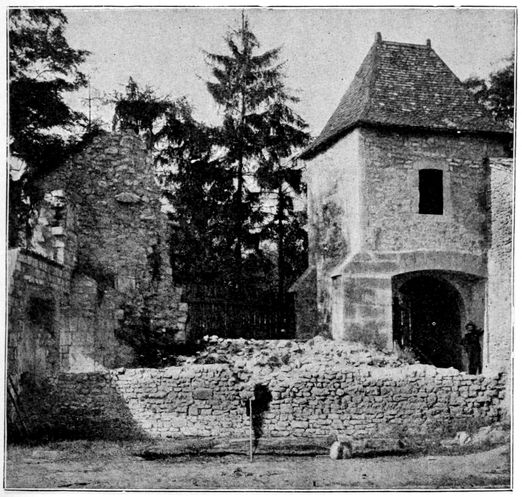
CHÂTEAU DE VAUCOULEURS, Porte de France.
223Jean de Novelemport, Knight, called Jean de Metz.
When Jeannette was at Vaucouleurs, I saw her dressed in a red dress, poor and worn; she lived at the house of one named Henri Leroyer. “What are you doing here, my friend?” I said to her. “Must the King be driven from the kingdom; and are we to be English?” “I am come here,” she answered me, “to this royal town,[123] to speak to Robert de Baudricourt, to the end that he may conduct me or have me conducted to the King: but Robert cares neither for me nor for my words. Nevertheless, before the middle of Lent, I must be with the King—even if I have to wear down my feet to the knees! No one in the world—neither kings, nor dukes, nor the daughter of the King of Scotland,[124] nor any others—can recover the kingdom of France; there is no succour to be expected save from me; but, nevertheless, I would rather spin with my poor mother—for this is not my proper estate: it is, however, necessary that I should go, and do this, because my Lord wills that I should do it.” And when I asked her who this Lord was, she told me it was God. Then I pledged my faith to her, touching her hand, and promised that, with God’s guidance, I would conduct her to the King. I asked her when she wished to start. “Sooner at once than to-morrow, and sooner to-morrow than later,” she said. I asked her if she could make this journey, dressed as she was. She replied that she would willingly take a man’s dress. Then I gave her the dress and equipment of one of my men. Afterwards, the inhabitants of Vaucouleurs had a man’s dress made for her, with all the necessary requisites; I also procured for her a horse at the price of about sixteen francs. Thus dressed and mounted, and furnished with a safe-conduct from the 224Sieur Charles, Duke de Lorraine, she went to visit the said Lord Duke. I accompanied her as far as Toul. On the return to Vaucouleurs, the first Sunday in Lent,[125] which is called ‘Dimanche des Bures’—and it will be, if I mistake not, twenty-seven years from that day to the coming Lent[126]—I and Bertrand de Poulengey, with two of my men, Colet de Vienne, the King’s Messenger, and the Archer Richard, conducted the Maid to the King, who was then at Chinon. The journey was made at the expense of Bertrand de Poulengey and myself. We travelled for the most part at night, for fear of the Burgundians and the English, who were masters of the roads. We journeyed eleven days, always riding towards the said town of Chinon. On the way, I asked her many times if she would really do all she said. “Have no fear,” she answered us, “what I am commanded to do, I will do; my brothers in Paradise have told me how to act: it is four or five years since my brothers in Paradise and my Lord—that is, God—told me that I must go and fight in order to regain the kingdom of France.” On the way, Bertrand and I slept every night by her—Jeanne being at my side, fully dressed. She inspired me with such respect that for nothing in the world would I have dared to molest her; also, never did I feel towards her—I say it on oath—any carnal desire. On the way she always wished to hear Mass. She said to us: “If we can, we shall do well to hear Mass.” But, for fear of being recognized, we were only able to hear it twice. I had absolute faith in her. Her words and her ardent faith in God inflamed me. I believe she was sent from God; she never swore, she loved to attend Mass, she confessed often, and was zealous in giving alms. Many times was I obliged to hand out to her the money she gave for the love of God. While we were with her, we found her always good, simple, pious, 225an excellent Christian, well-behaved, and God-fearing. When we arrived at Chinon,[127] we presented ourselves to the King’s Court and Council. I know she had there to submit to long enquiries.
Michael Lebuin, labourer, of Domremy.
I knew Jeannette from my earliest youth. Of Jeanne’s departure for Vaucouleurs I knew nothing. But, one day—the Eve of Saint John the Baptist[128]—she said to me: “Between Coussy and Vaucouleurs there is a young girl, who, before the year is gone, will have the King of France consecrated.” And, in truth, the following year the King was crowned at Rheims.[129] When Jeanne was a prisoner I saw Nicolas Bailly, Notary of Andelot, coming to Domremy, one day, with several other persons. At the request of Jean de Torcenay, Bailly of Chaumont for the pretended King of France and England, he proceeded to make enquiries into the conduct and life of Jeanne. But he could not induce the inhabitants of Vaucouleurs to depose. I believe that they questioned Jean Begot, at whose house they were staying. Their enquiry revealed nothing against Jeanne.
Geoffroy de Fay.
I saw Jeanne the Maid when she came to Maxey-sur-Vays.[130] When Jeanne came to Maxey, she came sometimes to my house. I always thought her a good girl, simple and pious. Many times I heard her speak; she said that she wished to go into France.
Durand Laxart, of Burey-le-Petit.
Jeanne was of the family of Jeanne, my wife. I knew Jacques d’Arc and Isabelle, his wife, the parents of Jeanne the Maid: they were good and faithful 226Catholics, and of good repute. She was a girl of good disposition, devout, patient, loving the Church, going often to confession, and giving to the poor all that she could. I can attest this, having been witness thereof, both at Domremy and at my own house at Burey, where she passed six weeks.[131] I went to fetch her from her father’s and brought her to my house; she told me she wished to go into France, to the Dauphin, to have him crowned. “Was it not foretold formerly,” she said to me, “that France should be desolated[132] by a woman, and should be restored by a maid?” She told me she wished to go, herself, and seek Robert de Baudricourt, in order that he might have her conducted to the place where the Dauphin was. But many times Robert told me to take her back to her father and to box her ears. When she saw that Robert would not do as she asked, she took some of my garments and said she would start. She departed, and I took her to Vaucouleurs [i.e. Saint-Nicolas[133]].—Thence she returned, and went with a safe-conduct to the Sieur Charles de Lorraine. The Duke saw her, spoke to her, and gave her four francs,[134] which Jeanne showed to me. She came back to Vaucouleurs; and the inhabitants bought for her a man’s garments and a complete warlike equipment. Alain de Vaucouleurs and I bought her a horse for the price of twelve francs, which we paid, and which was repaid to us later by the Sieur Robert de Baudricourt. This done, Jean de Metz, Bertrand de Poulengey, Colet de Vienne, together with Richard the Archer and two men of the suite of Jean de Metz and 227Bertrand, conducted Jeanne to the place where the Dauphin was.
All this, as I now say it, I told to the King. I know no more, except that I saw her at Rheims at the King’s crowning.
Catherine, wife of Leroyer.
Jeanne, when she had left her parents, was brought to our house at Vaucouleurs by Durand Laxart, her uncle; she wished to go to the place where the Dauphin was. I had occasion to know her well; she was an excellent girl, simple, gentle, respectful, well-conducted, loving to go to Church.
She lived with us at Vaucouleurs, at different times about three weeks. She spoke to the Sieur Robert de Baudricourt, that he might have her conducted to the Dauphin, but Sieur Robert would not listen to her. One day, I saw Robert de Baudricourt—then captain of Vaucouleurs—and Messire Jean Fournier, our Curé, come in to our house to visit her. After they were gone, she told me that the Priest had his stole, and that, in presence of the said captain, he adjured her, saying: “If you are an evil spirit, avaunt! If you are a good spirit, approach!” Then Jeanne drew near the Priest and threw herself at his knees: she said he was wrong to act so, for he had heard her in confession. When she saw that Robert refused to conduct her to the King, she said to me that, nevertheless, she would go and seek the Dauphin. “Do you not know,” she said, “the prophecy which says that France, lost by a woman, shall be saved by a maiden from the Marches of Lorraine?” I did indeed remember the prophecy, and remained stupefied. Jacques Alain and Durand Laxart took her to Saint-Nicolas,[135] then came back with her to Vaucouleurs.
228Henri Leroyer, cartwright, formerly of Vaucouleurs.
Jeanne, when she came to Vaucouleurs, lodged in our house. She said to us, “It is necessary that I should go to the noble Dauphin; my Lord the King of Heaven wills that I should go; I go in the name of the King of Heaven; even if I have to drag myself thither on my knees, I shall go!” When she arrived at our house, she was wearing a woman’s dress, of a red colour. At Vaucouleurs she received the gift of a man’s dress and a complete equipment; then, mounted on a horse, she was conducted to the place where the Dauphin was, by Jean de Metz, Bertrand de Poulengey, and two of their servants—Colet de Vienne, and Richard the Archer. I saw them depart, all six, and Jeanne with them. When she spoke of leaving, she was asked how she thought she could effect such a journey and escape the enemy. “I fear them not,” she answered, “I have a sure road: if the enemy are on my road, I have God with me, Who knows how to prepare the way to the Lord Dauphin. I was born to do this.”
Albert d’Ourches, Seigneur of Ourches, near Commerey.
I saw Jeanne at Vaucouleurs when she arrived to be taken to the King. Many times I heard her then say that she wished to go to the King, and that some one would conduct her to him, for it would be to the great benefit of the Dauphin.
This maiden always seemed to me very well behaved. I should have been well pleased to have had a daughter as good as she.
229Nicolas Bailly, Tabellion (Notary) and Deputy Royal at Andelot.
As Tabellion I was appointed by the Sieur Jean de Torcenay, Knight, then Bailly of Chaumont, by the authority of the pretended King of France and England, and, with me, the late Gerard Petit—then Provost of the said Andelot[136]—to proceed to an enquiry on the subject of Jeanne, at that time detained in prison at Rouen. Many times, in her youth, I saw Jeanne before she left her father’s house: she was a good girl, of pure life and good manners, a good Catholic who loved the Church and went often on pilgrimage to the Church of Bermont, and confessed nearly every month—as I learned from a number of the inhabitants of Domremy, whom I had to question on the subject at the time of the enquiry that I made with the Provost of Andelot. When I and the late Gerard made this enquiry, we examined twelve or fifteen witnesses. Afterwards, we certified the information before Simon de Thermes, Squire, Lieutenant of the Captain of Montclair.
Guillot Jacquier, of Andelot, King’s Sergeant; [evidence similar to the preceding.]
Bertrand de Poulengey, Squire.
After her departure from her father’s roof, I often saw Jeanne at Vaucouleurs and during the war. I remember often to have heard this Ladies’ Tree spoken of. I have even sat beneath it, but that was a dozen years before I saw Jeanne. Jeanne came to Vaucouleurs, I think, about Ascension Day.[137] I saw her speaking to the Captain, Robert de Baudricourt. She told him that “she came to him 230in the name of her Lord; that the Dauphin must be compelled to persevere and to give battle to his enemies, that the Lord would give him succour before the middle of Lent; that the kingdom belonged not to him, the Dauphin, but to her Lord; that her Lord would have the Dauphin King and hold the kingdom in trust; that she would make him King, in spite of his enemies, and would conduct him to his coronation.” “But who is this Lord of whom you speak?” asked Robert of her. “The King of Heaven,” she replied. That time she went back to her father’s house, accompanied by one of her uncles, named Durand Laxart. Later, towards the commencement of Lent, she came back to Vaucouleurs to seek companions, so as to go to the Dauphin. Then Jean de Metz and I offered to conduct her to the King—at that time Dauphin. After a pilgrimage to Saint-Nicolas, she went to seek the Lord Duke de Lorraine, who had sent her a safe-conduct and asked to see her. She then returned to Vaucouleurs and lodged in the house of Henry Leroyer. Then Jean de Metz and I, aided by many others of Vaucouleurs, so wrought that she put off her woman’s dress, which was of a red colour;[138] we procured for her a tunic and man’s dress—spurs, leggings, sword, and such-like—and a horse. Then we started with her to seek the Dauphin, together with Julian, my servant, Jean de Honecourt, servant of Jean de Metz, Colet de Vienne, and Richard the Archer. On starting, the first day, fearing to be taken by the Burgundians and the English, we travelled all night. Jeanne said to me and to Jean de Metz, while we were journeying, that it would be well for us to hear Mass; but while we were in the enemy’s country, we could not, for fear of being recognized. At night, Jeanne slept beside John de Metz and myself, fully dressed and armed. I was young then; nevertheless I never 231felt towards her any desire: I should never have dared to molest her, because of the great goodness which I saw in her. We were eleven days on the road, during which we had many anxieties. But Jeanne told us always that we had nothing to fear, and that, once arrived at Chinon, the noble Dauphin would show us good countenance. She entirely abstained from swearing. I felt myself inspired by her words, for I saw she was indeed a messenger of God; never did I see in her any evil, but always she was as good as if she had been a saint. We took our road thus, and, without many obstacles, gained Chinon, where the King—then Dauphin—was staying. There the said maid was presented to the nobles in the King’s suite, to whom I refer for the actions of the said Jeanne.
Messire Henri Arnolin, of Gontrecourt-le-Château, near Commercy, Priest; [testimony of no importance].
Messire Jean Lefumeux, of Vaucouleurs, Canon of the Chapel of Saint Mary at Vaucouleurs, and Curé of the Parish Church of Ugny.
I know that Jeanne came to Vaucouleurs, and said that she wished to go to the Dauphin. I was then young, and attached to the Chapel of the Blessed Mary at Vaucouleurs. I often saw Jeanne in this Chapel; she behaved with great piety, attended Mass in the morning, and remained a long time in prayer. I have also seen her[139] in the crypt of the Chapel on her knees before the Blessed Mary, her face sometimes bent to the ground, sometimes raised to heaven. She was a good and holy maiden.
Jean Jacquard, labourer, of Greux; son of Jean, called Guillemette; [evidence similar to the preceding].
232
DEPOSITIONS AT ORLEANS: 1455.
Jean,[140] Bastard of Orleans, Count de Dunois.
I think that Jeanne was sent by God, and that her behaviour in war was a fact divine rather than human. Many reasons make me think so.
I was at Orleans, then besieged by the English, when the report spread that a young girl, commonly called the Maid, had just passed through Gien, going to the noble Dauphin, with the avowed intention of raising the siege of Orleans and conducting the Dauphin to Rheims for his anointing. I was then entrusted with the care of the town of Orleans and was Lieutenant-General of the King in affairs of war. In order to be better informed on the subject of this young girl, I sent to the King the Sieur de Villars, Seneschal of Beaucaire, and Janet de Tilly,[141] who was afterwards Bailly of Vermandois.
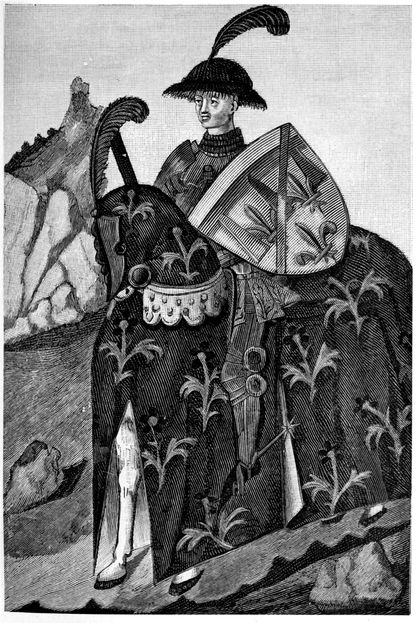
COUNT DE DUNOIS, Bastard of Orleans.
They returned from the King, and reported to me publicly, in presence of all the people of Orleans [assembled] to know the truth, that they had seen the Maid arrive at Chinon. They said that the King at first had no wish to listen to her: she even remained two 233days, waiting, until she was permitted to present herself before him, although she persisted in saying that she was come to raise the siege of Orleans, and to conduct the Dauphin to Rheims, in order that he might be consecrated; she at once asked for men, arms and horses.
Three weeks or a month elapsed, during which the King had her examined by Clergy, Prelates, and Doctors in Theology, as to her words and deeds, in order to know if he might receive her with safety. Then the King assembled an army to conduct to Orleans a convoy of supplies.
Hearing the opinion of the Clergy and Prelates that there was no evil in this Maid, the King sent her with the Lord Archbishop of Rheims,[142] then Chancellor of France, and the Sieur de Gaucourt, then Grand Steward, to Blois, where those were who had the charge of escorting the convoy—that is, the Sieurs de Rais[143] and de Boussac, Marshals of France; de Coulent, Admiral of France; La Hire; and Ambroise de Loré, who was afterwards Governor of Paris. All, at the head of the army transporting the convoy, came, with Jeanne, in good order, by way of the Sologne, to the Loire, facing the Church of Saint Loup. But the English were there in great number: and the army escorting the convoy did not appear to me, nor to the other captains, in sufficient force to resist them and to ensure the entrance of the convoy on that side. It was necessary to load the convoy on boats, which were procured with difficulty. But to reach Orleans it was necessary to sail against the stream, and the wind was altogether contrary.
Then Jeanne said to me: “Are you the Bastard of Orleans?” “Yes,” I answered; “and I am very glad 234of your coming!” “Is it you who said I was to come on this side [of the river], and that I should not go direct to the side where Talbot and the English are?” “Yes, and those more wise than I are of the same opinion, for our greater success and safety.” “In God’s Name,” she then said, “the counsel of My Lord is safer and wiser than yours. You thought to deceive me, and it is yourselves who are deceived, for I bring you better succour than has ever come to any general or town whatsoever—the succour of the King of Heaven. This succour does not come from me, but from God Himself, Who, at the prayers of Saint Louis and Saint Charlemagne, has had compassion on the town of Orleans, and will not suffer the enemy to hold at the same time the Duke[144] and his town!”
At that moment, the wind, being contrary, and thereby preventing the boats going up the river and reaching Orleans, turned all at once and became favourable. They stretched the sails; and I ordered the boats to the town, which I entered with Brother Nicolas de Geresme, then Grand Prior in France of the Order of Rhodes. We passed before the Church of Saint Loup in spite of the English. From that time I put good hope in her, even more than before. I had begged her to cross the river and to enter the town, where many were longing for her. She had made a difficulty about it, not wishing, she said, to abandon her army or her followers who were duly confessed, penitent, and of good will; and on their account she refused to come. Thereupon, I went in search of the captains who had charge of the convoy and the army, and besought them, for the welfare of the King, to allow Jeanne to enter Orleans at once, and that they should go up the river—they and the army—to Blois, where they should cross the Loire so as to return to Orleans, for there was 235no nearer place of crossing. They consented; and Jeanne then came with me. She had in her hand a banner, white in colour, on which was an image of Our Lord holding in His Hand a lily. La Hire crossed the Loire at the same time as she, and entered the city with her and ourselves. All this was much more the work of God than of man: the sudden change of wind immediately Jeanne had announced it; the bringing in of the convoy of supplies in spite of the English, who were in much greater force than all the King’s army; and the statement of Jeanne that she had seen Saint Louis and Saint Charles the Great praying God for the safety of the King and of the City.
Another circumstance made me think these deeds were the work of God. I wished to go towards the army which had turned back on Blois and which was marching to the relief of Orleans; Jeanne would not wait for them nor consent that I should go to meet them: she wished to summon the English to raise the siege at once on pain of being themselves attacked. She did, in fact, summon them by a letter which she wrote to them in French, in which she told them, in very simple terms, that they were to retire from the siege and return to England, or else she would bring against them a great attack, which would force them to retreat. Her letter was sent to Lord Talbot. From that hour, the English—who, up to that time, could, I affirm, with two hundred of their men, have put to rout 800 or 1,000 of ours—were unable, with all their power, to resist 400 or 500 French; they had to be driven into their forts, where they took refuge, and from whence they dared not come forth.
There is another fact which made me believe she was from God. The 27th of May,[145] very early in the morning, 236we began the attack on the Boulevard[146] of the bridge. Jeanne was there wounded by an arrow which penetrated half-a-foot between the neck and the shoulder; but she continued none the less to fight, taking no remedy for her wound. The attack lasted throughout, from the morning until 8 o’clock in the evening, without hope of success for us: for which reason I was anxious that the army should retire into the town. The Maid then came to me, praying me to wait yet a little longer. Thereupon she mounted her horse, retired to a vineyard, all alone by herself, remained in prayer about half an hour, then, returning and seizing her banner by both hands, she placed herself on the edge of the trench. At sight of her the English trembled, and were seized with sudden fear; our people, on the contrary, took courage and began to mount and assail the Boulevard, not meeting any resistance. Thus was the Boulevard taken and the English therein put to flight: all were killed, among them Classidas[147] and the other principal English captains of the Bastille, who, thinking to gain the Bridge Tower, fell into the river, where they were drowned. This Classidas was he who had spoken of the Maid with the greatest contempt and insult.
The Bastille taken, we re-entered the town of Orleans—the Maid and all the army—where we were received with enthusiasm. Jeanne was taken to her house, to receive the care which her wound required. When the surgeon had dressed it, she began to eat, contenting 237herself with four or five slices of bread dipped in wine and water, without, on that day, having eaten or drunk anything else.
The next day, early in the morning, the English came out of their camp and placed themselves in order of battle. At this sight, Jeanne got up and put on a light coat of mail; she forbade the English to be attacked or in any way molested but [gave orders] that they should be allowed to depart, which they did, without any pursuit. From that moment the town was delivered.
After the deliverance of Orleans, the Maid, with myself and the other captains, went to seek the King at the Castle of Loches, praying him to attack immediately the towns and the camps on the Loire, Mehun, Beaugency, Jargeau, in order to make his consecration at Rheims more free and sure. This she besought the King often, in the most urgent manner, to hasten, without longer delay. The King used the greatest haste possible, and sent, for this purpose, the Duke d’Alençon, myself and other captains, as well as Jeanne, to reduce these towns and camps. All were reduced in a few days—thanks alone, as I believe, to the intervention of the Maid.
After the deliverance of Orleans, the English assembled together a numerous army, to defend the aforesaid towns, which they occupied. When we had invested the camp and bridge of Beaugency, the English army arrived at the camp of Meung-sur-Loire, which was still under their control. But this army could not come to the help of the English besieged in the camp of Beaugency. At the news of the taking of this camp, all the English divisions joined together into one complete army; and we thought they would offer us battle: we made our dispositions accordingly. In presence of the Constable, myself, and the other captains, the Duke 238d’Alençon asked Jeanne what was to be done. She answered thus, in a loud voice: “Have all of you good spurs?” “What do you mean?” asked those present of her; “are we, then, to turn our backs?” “Nay,” she replied, “it is the English who will not defend themselves, and will be beaten; and you must have good spurs to pursue them.” And it fell out thus, as she had predicted: the English took to flight, and of killed and prisoners there were more than 4,000.
At Loches, after the raising of the siege of Orleans, I remember that, one day, the King, being in his private room with the Sieur Christopher d’Harcourt, the Bishop of Castres,[148] his Confessor, and the Sieur de Trèves, who was formerly Chancellor of France,[149] Jeanne and I went to seek him. Before entering, she knocked at the door; as soon as she had entered, she knelt before the King, and, embracing his knees, said these words: “Noble Dauphin! hold no longer these many and long councils, but come quickly to Rheims to take the crown for which you are worthy!” “Is it your Counsel who told you this?” said Christopher d’Harcourt. “Yes,” she answered, “and my Counsel urges me to this most of all.” “Will you not say, here, in presence of the King,” added the Bishop, “what manner of Counsel it is which thus speaks to you?” “I think I understand,” she said, colouring, “what you want to know; and I will tell you willingly.” Then said the King: “Jeanne, will it please you to say, in presence of the persons who are listening to us, what has been asked you?” “Yes, Sire,” she answered. And then she said this, or something approaching it: “When I am vexed that faith 239is not readily placed in what I wish to say in God’s Name, I retire alone, and pray to God. I complain to Him that those whom I address do not believe me more readily; and, my prayer ended, I hear a Voice which says to me: ‘Daughter of God! go on! go on! go on! I will be thy Help: go on!’ And when I hear this Voice, I have great joy. I would I could always hear it thus.” And, in repeating to us this language of her Voice, she was—strange to say!—in a marvellous rapture, raising her eyes to Heaven.
After the victories of which I have just spoken, the nobles of the Blood Royal and the captains wished the King to go into Normandy, and not to Rheims. But the Maid was always of opinion that it was necessary to go to Rheims, that the King should be consecrated, giving as a reason that, if once the King were consecrated and crowned, the power of his adversaries would decline, and that in the end they would be past the power of doing any injury, either to him or to his kingdom. And all consented to her opinion. The place where the King first halted, with his army, was under the town of Troyes; he there took counsel with the nobles of the Blood, and the other captains, to decide whether they should remain before this town, in order to lay siege to it, or whether it would not better avail to pass on and march straight to Rheims, leaving Troyes alone. The Council were divided in opinion, and no one knew which course to pursue, when Jeanne suddenly arrived, and appeared in the Council. “Noble Dauphin,” she said, “order your people to come and besiege the town of Troyes, and lose no more time in such long councils. In God’s Name, before three days are gone, I will bring you into this town by favour or force, and greatly will the false Burgundy be astounded.” Then Jeanne, putting herself at the head of the army, had the tents placed right against the trenches of the town, and executed 240many marvellous manœuvres which had not been thought of by two or three accomplished generals working together. And so well did she work during the night, that, the next day, the Bishop[150] and citizens came all trembling and quaking to place their submission in the King’s hands. Afterwards, it was known that, at the moment when she had told the King’s Council not to pass by the town, the inhabitants had suddenly lost heart, and had occupied themselves only in seeking refuge in the Churches. The town of Troyes once reduced, the King went to Rheims, where he found complete submission, and where he was consecrated and crowned.
Jeanne was accustomed to repair daily to Church at the time of Vespers, or towards evening; she had the bells rung for half-an-hour, and collected together all the Mendicant Friars who were following the army. Then she began to pray, and had an anthem in honour of the Blessed Mary, Mother of God, sung by the Mendicant Friars.
When the King came to La Ferté and to Crespy-en-Valois, the people ran about him, crying “Noel!” The Maid was then riding between the Archbishop of Rheims and myself: “This is a good people,” she said to us; “I have seen none elsewhere who rejoiced as much at the coming of so noble a King. How happy should I be if, when my days are done, I might be buried here!” “Jeanne,” then said the Archbishop to her, “in what place do you hope to die?” “Where it shall please God,” she answered; “for I am not certain of either the time or the place, any more than you are yourself. Would it might please God, my Creator, that I might retire now, abandon arms and return to serve my father and mother and to take care of their sheep with my sister and my brothers, who would be so happy to see me again!”
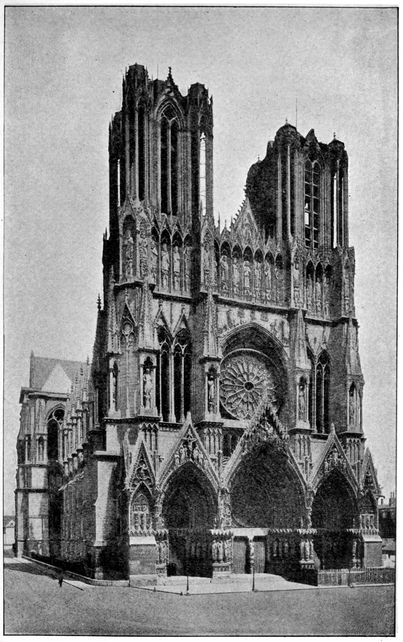
RHEIMS CATHEDRAL.
241There was never any one more sober. I often heard it said by the Sieur Jean d’Aulon, Knight, now Seneschal of Beaucaire, who had been appointed by the King to watch over her, as being the wisest and most worthy in the army, that he did not think there had ever been a more chaste woman. Neither I nor others, when we were with her, had ever an evil thought: there was in her something divine.
Fifteen days after the Earl of Suffolk[151] had been made prisoner at the taking of Jargeau, a writing was sent to him containing four lines, in which it was said that a Maid should come from the Oak-wood who would ride on the backs of the archers and against them.[152]
Although Jeanne sometimes spoke in jest of the affairs of war, and although, to encourage the soldiers, she may have foretold events which were not realized, nevertheless, when she spoke seriously of the war, and of her deeds and her mission, she only affirmed earnestly that she was sent to raise the siege of Orleans, and to succour the oppressed people of that town and the neighbouring places, and to conduct the King to Rheims that he might be consecrated.
Sieur de Gaucourt.[153]
I was at the Castle of the town of Chinon when Jeanne arrived there, and I saw her when she presented 242herself before the King’s Majesty with great lowliness and simplicity; a poor little shepherdess! I heard her say these words: “Most noble Lord Dauphin, I am come and am sent to you from God to give succour to the kingdom and to you.”
After having seen and heard her, the King, so as to be better instructed about her, put her under the protection of Guillaume Bellier, his Major-Domo, my Lieutenant at Chinon, afterwards Bailly of Troyes,[154] whose wife was most devout and of the best reputation. Then he had her visited by the Clergy, by Doctors, and by Prelates, to know if he could lawfully put faith in her. Her deeds and words were examined during three weeks, not only at Chinon, but at Poitiers. The Examinations finished, the Clergy decided that there was nothing evil in her deeds nor in her words. After numerous interrogations, they ended by asking her what sign she could furnish, that her words might be believed? “The sign I have to shew,” she replied, “is to raise the siege of Orleans!” Afterwards, she took leave of the King, and came to Blois, where she armed herself for the first time, to conduct a convoy of supplies to Orleans and to succour the inhabitants.
[On the subject of the sudden change of wind and of the way in which the convoy of supplies was brought into Orleans, the witness deposed as the Sieur de Dunois. He added only this: Jeanne had expressly predicted that, before long, the weather and the wind 243would change; and it happened as she had foretold. She had, in like manner, stated that the convoy would enter freely into the town.
The declaration of the witness agrees equally with that of the Sieur de Dunois as to the taking of the Bastille, the raising of the siege, and the expulsion of the English.
On all the other points the Sieur de Gaucourt is also in perfect agreement, in matter and form, with the said Sieur de Dunois, as to all that concerns the setting free of Orleans, the taking of the camps and the towns on the borders of the Loire.
He agrees equally on all points with what concerns the journey of the King for the ceremony of his consecration at Rheims.
Jeanne, he adds, was abstemious in food and drink; nothing came from her lips but excellent words, which could serve only for edification and good example. No one could be more chaste, ... she had always at night a woman in her room. She confessed herself frequently, being often in prayer, hearing Mass every day, and constantly receiving the Sacrament of the Eucharist; she would not suffer any to use in her presence shameful or blasphemous words, and by her speech and actions she shewed how much she held such things in horror.]
Maître François Garivel, Councillor-General to the King.
I remember that, at the time of the coming of Jeanne the Maid, the King sent her to Poitiers, where she lodged with Maître Jean Rabateau, then King’s Advocate in Parliament. In this town of Poitiers were deputed [to examine Jeanne], by the King’s Order, certain venerable Doctors and Masters,—to wit, Pierre de Versailles, then Abbot of Talmont, afterwards Bishop of 244Meaux; Jean Lambert; Guillaume Aimery, of the Order of Saint Dominic; Pierre Séguin, of the Carmelite Order, Doctors in Theology; Mathieu Message, and Guillaume Le Marie, Bachelors in Theology, with many others of the King’s Councillors, licentiates in Canon and Civil Laws. Many times and often, during the space of three weeks, they examined Jeanne, studying and considering her deeds and words; and finally, taking into consideration her condition and her answers, they said that she was a simple girl, who, when interrogated, persisted in her answer, that she was sent from the God of Heaven in favour of the noble Dauphin, to replace him in his kingdom, to raise the siege of Orleans, and to conduct the King to Rheims for his consecration; and that first she must write to the English and command them to retire, for such was the Will of God.
When I asked Jeanne why she called the King Dauphin, and not King, she replied that she should not call him King till he had been crowned and anointed at Rheims, to which city she meant to conduct him.
Afterwards, the Clergy told Jeanne she ought to shew them a sign by which it might be believed that she was sent from God; but she replied: “The sign given to me from God is to raise the siege of Orleans; I have no fear that it will be done, if the King will give me soldiers, as few as he may like.”
She was a simple shepherd-maiden, who confessed often; she was entirely devoted to God, and frequently received the Sacrament of the Eucharist.
At last, after long examinations made at great length by clerics of various faculties, all decided and concluded that the King might lawfully receive her, and might send a body of soldiers to the siege of Orleans, for that there was nothing found in her which was not Catholic and reasonable.
245Guillaume de Ricarville,[155] Seigneur de Ricarville, Steward to the King.
I was in Orleans—then besieged by the English—with the Count de Dunois and many other captains, when news came that there had passed through the town of Gien a shepherdess, called the Maid, conducted by two or three gentlemen of Lorraine, from which country she came; that this Maid said she was come to raise the siege of Orleans, and that afterwards she would lead the King to his anointing; for thus had she been commanded by God.
Notwithstanding this, she was not readily received by the King, who desired that she should first be examined, and that he should know something of her life and estate, and if it were lawful for him to receive her. Therefore, the Maid, by the King’s order, was examined by many Prelates, Doctors, and Clergy, who found evidence in her of good life, honest estate, and praiseworthy repute; nor was there aught in her which should cause her to be repelled.
She lived honourably, most soberly as to food and drink, was chaste and devout, hearing Mass daily, and confessing often, communicating with fervent devotion every week. She reproved the soldiers when they blasphemed or took God’s Name in vain; also when they did any evil or violence. I never observed in her aught deserving reproof, and from her manner of life and actions I believe she was inspired by God.
Maître Reginald Thierry, Dean of the Church of Meung-sur-Yèvre; Surgeon to the King.
I saw Jeanne with the King at Chinon, and heard 246what she said; to wit, that she was sent from God to the noble Dauphin, to raise the Siege of Orleans, and to conduct the King to his anointing and coronation.
When the town of Saint-Pierre-le-Moustier was taken,[156] by assault, Jeanne being there, the soldiers wanted to pillage the Church and to seize the sacred vessels and other treasure there hidden; but Jeanne prohibited and forbade them with great energy, so that nothing was taken away.
Jean Luillier, Burgher of Orleans.
Many of the inhabitants of Orleans desired the coming of the Maid, for they had heard the current rumour that she had told the King how she was sent from God to raise the siege then held against the town; the inhabitants were then in such straits, on account of the English, that they knew not where to turn, except to God.
I was in the town when Jeanne reached it. She was received with as much rejoicing and acclamation from old and young, of both sexes, as if she had been an Angel of God; because we hoped through her to be delivered from our enemies, which indeed was done later.
When Jeanne was come into the City, she exhorted us all to hope in God; saying that, if we had good hope and trust in God, we should escape from our enemies. She said, moreover, she would summon the English to leave the town, and drive them away before she permitted any attack to be made; and this she did, summoning the English by letter, in which she told them to retire from the siege and return to England, or else she would make them retreat by force. From that time the English were terrified, nor had they power to resist as 247before; so that a few of our people might often fight with a great number of the English, and in such manner that they no longer dared to come out of their forts.
On the 27th May,[157] 1429, I remember well that an assault was made on the enemy in the Fort of the Bridge, in which Jeanne was wounded by an arrow; the attack lasted from morning till evening, and in such manner that our men wished to retreat into the town. Then Jeanne appeared, her standard in her hand, and placed it on the edge of the trench; and immediately the English began to quake, and were seized with fear. The army of the King took courage, and once more began to assail the Boulevard; and thus was the Boulevard taken, and the English therein were all put to flight or slain. Classidas and the principal English captains, thinking to retreat into the Tower of the Bridge, fell into the river, and were drowned; and the fort being taken, all the King’s army retired into the city.
On the next day, very early in the morning, the English came out of their tents and ranged themselves in order of battle, as it seemed. Hearing this, the Maid rose from her bed and armed herself; but she would not allow any one to attack the English, nor to ask anything of them, but that they should be permitted to depart: and so, indeed, they did, no one pursuing them; and from that hour the town was free from the enemy.
I believed, like all in the town, that, had the Maid not come in God’s Name to our help, we should soon have been, both town and people, in the hands of the enemy: we did not believe it possible for the army then in the town to resist the power of the enemy who were in such force against us.
Jean Hilaire and Gilles de Saint Mesnin, [Evidence of no importance].
248Jacques L’Esbahy.
I remember that two heralds were sent on the part of the Maid to Saint-Laurent, one named Ambeville, and the other Guienne, to Talbot, the Earl of Suffolk, and Lord Scales, telling the English in God’s name to return to England, or evil would come to them. The English detained one of these heralds, named Guienne, and sent back the other—Ambeville—to the Maid, who told her that the English were keeping back his companion Guienne to burn him. Then Jeanne answered Ambeville and assured him in God’s Name that no harm should happen to Guienne, and told him to return boldly to the English, that no evil should happen to him, but that he should bring back his comrade safe and sound. And so it was.
When Jeanne first entered Orleans, she went, before all else, to the Great Church, to do reverence to God, her Creator.
Guillaume le Charron, Burgher of Orleans [testified to the same effect].
Cosma de Commy, Burgher of Orleans.
I heard Maître Jean Maçon, a famous Doctor in Civil and Canon Law, say that he had many times examined Jeanne as to her deeds and words, and he had no doubt she was sent from God; that it was a wondrous thing to hear her speak and answer; and that he had found nothing in her life but what was holy and good.
Martin de Mauboudet, Jean Volant, Guillaume Postiau, Denis Roger, Jacques de Thou,[158] Jean Carrelier, Amian de Saint-Mesmin,[159] all burghers of Orleans, gave witness to the same effect.
249Jean de Champeaux.
On a certain Sunday I saw those of Orleans preparing for a great conflict against the English, who were drawn up in order of battle. Seeing this, Jeanne went out to the soldiers; and then she was asked, if it were well to fight against the English on that day, being Sunday; to which she answered that she must hear Mass; and then she sent to fetch a table, and had the ornaments of the Church brought, and two Masses were celebrated, which she and the whole army heard with great devotion. Mass being ended, Jeanne asked if the English had their faces turned toward us; she was told no, that their faces were turned towards Meung. Hearing this, she said: “In God’s Name, they are going; let them depart; and let us give thanks to God and pursue them no further, because it is Sunday.”
This story is confirmed by Pierre Jongault, Pierre Hue, Jean Aubert, Guillaume Rouillart, Gentian Cabu, Pierre Vaillant, and Jean Coulon, all burghers of Orleans.
All agreed that they never perceived anything by which they could conjecture that Jeanne attributed to herself the glory of her wonderful deeds; but she ascribed all to God, and, so far as she could, resisted when the people sought to honour her or give her the glory; she preferred to be alone rather than in others’ society, except when she was engaged in warfare.
Jean Beauharnays.[160]
I often saw Jeanne while in Orleans; there was nothing 250in her which could merit reproof; she was humble, simple, chaste, and devoted to God and the Church. I was always much comforted in talking with her.
Maître Robert de Farciaux, Priest, Licentiate in Law, Canon and Sub-Dean of the Church of Saint-Aignan at Orleans; testified to the same effect.
Maître Pierre Compaing, Priest, Licentiate in Law, Canon of Saint-Aignan.
I have seen Jeanne, at the Elevation of the Host, weeping many tears. I remember well that she induced the soldiers to confess their sins; and I indeed saw that, by her instigation and advice, La Hire and many of his company came to confession.
The Sieurs Pierre de La Censure, Priest, Canon and Warden of Saint-Aignan; Raoul Godart, Priest, Licentiate in Decrees, Prior of Saint Samson, and Canon of Saint-Aignan at Orleans; Hervé Bonart, Prior of Saint-Magloire, of the Order of Saint-Augustine; The Sieur André Bordes, Canon of Saint-Aignan; and Jeanne, wife of Gilles de Saint-Mesmin. All agreed with the preceding as to Jeanne’s life and morals.
Jeanne, wife of Guy Boyleaud; Guillemette, wife of Jean de Coulons; Jeanne, widow of Jean de Mouchy, gave similar testimony.
Charlotte,[161] wife of Guillaume Havet.
At night I slept alone with Jeanne; I never saw anything evil in her, either in word or deed, but always simplicity, humility and chastity. She was in the habit of confessing frequently and hearing Mass daily. She often told my mother, in whose house she lodged, that 251she must put trust in God, and that God would help the town of Orleans, and drive away the enemy.
She was accustomed, before going to an assault, to take account of her conscience, and to receive the Sacrament after hearing Mass.
Reginalde, widow of Jean Huré.
I remember well to have seen and heard, one day, a great lord, walking along the street, begin to swear and blaspheme God; which, when Jeanne saw and heard, she was much perturbed, and went up to the lord who was swearing, and, taking him by the neck, said, “Ah! master, do you deny Our Lord and Master? In God’s Name, you shall unsay your words before I leave you.” And then, as I saw, the said lord repented and amended his ways, at the exhortation of the said Maid.
Petronille, wife of Jean Beauharnais; and Massea, wife of Henri Fagone; testified to the same effect.
252
DEPOSITIONS IN PARIS: 1455–6.
[No questions for the Examinations at Paris and Rouen appear in the Rehabilitation Reports, but, as M. Jules Fabre was the first to point out, the numbers appended to the answers correspond with the first thirty-three of the hundred and one Articles of the Act of Accusation.]
Examination of Witnesses.
Maître Jean Tiphaine, Priest, Master in Arts and Medicine, Canon of the Sainte Chapelle, Paris.
On the first four Articles, I declare that I knew nothing of Jeanne until she was brought to the town of Rouen for her trial. I was summoned to take part. At first I would not go; but I was commanded a second time, and was present and heard the enquiry and her answers: she made many beautiful answers. When I was present at this Trial, the Judges and the Assessors were in the small hall behind the Great Hall of the Castle; and she answered with much prudence and wisdom and with great bravery.
On the occasion when I was present, Maître Beaupère was the principal questioner; and Jacques de Touraine, of the Order of Friars Minor, also questioned her. I well remember that this Maître Jacques once asked her, if she was ever in a place in which the English were overcome; to which she answered: “In God’s name, surely. How mildly you put it! Why, have many not 253fled from France and gone back to their own country?”[162] And there was a great lord of England, whose name I do not remember, who said, hearing this: “Truly this is a brave woman! Would she were English!” And this he said to me and to Maître Guillaume Desjardins. No Doctor, however great and subtle he might be, had he been questioned by so many Doctors and before so great an assembly as was this Jeanne, but would have been perplexed and upset. With regard to the illness of Jeanne during the Trial, I was summoned by the Lords Judges to visit her, and was brought to her by one named d’Estivet; in presence of this d’Estivet, Maître Delachambre, and several others, I felt her pulse in order to know the cause of the malady, and asked what ailed her and from what she suffered. She replied that some carp had been sent her by the Bishop of Beauvais, and that she doubted this was the cause of her illness. Upon this, d’Estivet, who was present, found fault with her, saying she had spoken ill, and called her “paillarde,” saying: “Thou paillarde! thou hast been eating sprats and other unwholesomeness.” She answered that she had not; and then they—Jeanne and d’Estivet—exchanged many abusive words. Afterwards, I wished to know further as to the malady of Jeanne, and learnt that she had had severe vomiting. Except as to her malady, I gave no opinion.[163]
Maître Guillaume Delachambre, Master in Arts and Medicine.
I gave no opinion during the Trial, but allowed myself to affix my signature, under compulsion from the Bishop of Beauvais. I made excuses to him that in these matters it did not belong to my profession to give 254an opinion: however, finally, the Bishop forced me to subscribe as others had done, saying that otherwise some ill would befall me for having come to Rouen. I say, too, that threats were also used against Maître Jean Lohier and Maître Nicolas de Houppeville, who, not wishing to take part in the Trial, were threatened with the penalty of drowning.
Sometimes it was the Abbot of Fécamp who interrogated Jeanne. Once, I saw the Abbot of Fécamp interrogating Jeanne, and Maître Jean Beaupère interrupted with many and divers questions. Jeanne would not reply to them both at once, saying that they did her much harm by thus vexing her, and that she would reply presently. As to her illness, one day the Cardinal of England and the Earl of Warwick having sent for me, I found myself associated with Guillaume Desjardins and other doctors. The Earl of Warwick told us that Jeanne had been ill and that we had been sent for to give her all our attention, for the King would not, for anything, that she should die a natural death: he had bought her too dear for that, and he intended that she should die at the hands of justice, and should be burnt. For this, I and Guillaume Desjardins and others visited her. Desjardins and I felt her pulse on the right side, and found fever, from which we recommended she should be bled. “Away with your bleeding!” said Warwick, “she is artful, and might kill herself.” Nevertheless, we did bleed her, and she recovered. One day, after she had recovered, there arrived a certain Maître Guillaume d’Estivet, who used evil words against Jeanne, calling her ... and a paillarde. This abuse upset her to such a point that the fever returned, and she had a relapse. And this being brought to the notice of the Earl, he forbade d’Estivet to abuse Jeanne from that day forth.
I was present at a sermon of Maître Guillaume Érard. I do not remember the sermon, but I remember 255well the Abjuration made by Jeanne. She was long in doing this. Maître Guillaume Érard decided her by saying that, if she did what he advised her, she would be delivered from prison. She abjured on this condition and no other, and immediately read a small schedule containing six or seven lines on a piece of paper folded in two. I was so near her that, in all truth, I could see the lines and their form.
For the rest, I can only say that I was present at the last discourse made in the Old Market-Place of Rouen by Maître Nicolas Midi. As soon as the sermon was over, Jeanne was burnt, the stake being already prepared. Her pious lamentations and ejaculations made many weep; only some English were laughing. I heard her say these or like words: “Alas! Rouen, I fear me that thou wilt have to suffer for my death.” Shortly after she began to cry “Jesus” and to invoke St. Michael; and then she perished in the flame.
The Reverend Father in God, the Lord Jean de Mailly, Bishop of Noyon.
I knew nothing of Jeanne before she came to Rouen; and I saw her only two or three times. I do not remember either being present at the Trial or giving my opinion.
I remember that, the day before the discourse at St. Ouen, I was present at an Exhortation addressed to Jeanne; but what was said or done I do not remember. I was present also on the day after, when a sermon was given at St. Ouen by Maître Guillaume Érard. There were two galleries or scaffolds: on one were the Bishop of Beauvais, myself and others; and on the other the preacher, Maître Guillaume Érard, and Jeanne. The words of the preacher I do not remember; but I remember well that, either then or on the preceding day, 256Jeanne said that, if there had been aught evil in her words or deeds, whatever of either good or ill had been in her speech or action came from herself alone, and not from her King. After the sermon, I perceived that Jeanne was ordered to do or say something. I believe it was to abjure; they said to her: “Jeanne, do what you are advised. Would you cause your own death?” These words verily moved her to make her Abjuration. After this Abjuration, many said that it was a mere trick, and that she had acted only in derision.
I remember to have heard—from whom I cannot recall—that the man’s dress was returned to her by the window.
For the rest, I was present at the last sermon on the day she was burnt. There were three galleries or scaffolds: one where sat the Judges, one where many Bishops sat, myself among them, and one where wood was prepared for the burning of Jeanne. At the end of the sermon the sentence was pronounced which delivered Jeanne to secular justice. After this sentence was pronounced, Jeanne began to make many pious exclamations and lamentations; and among other things she said that nothing she had done, either good or ill had been suggested by the King. Thereupon I left, not wishing to see the burning of Jeanne. I saw many of the bystanders weeping.
As to certain letters of guarantee which the King of England gave to the Bishop of Beauvais and others concerned in this Trial, in which I, the Bishop of Noyon, am mentioned as having been present, I can well believe that it was so, though I do not remember much about it.
Maître Thomas de Courcelles, S.T.P., Canon of Paris.
I believe that the Bishop of Beauvais undertook the Trial brought against Jeanne in the matter of the Faith 257because he was a Counsellor of the King of England, and also Bishop of Beauvais, in which territory Jeanne had been taken captive.
I have heard it said that money was given to the Inquisitor by a certain Surreau, receiver-general, for his participation in the said Trial; but I never heard that the Bishop received anything.
At the time when Jeanne was brought to Rouen, I, being in Paris, was summoned by the Bishop of Beauvais aforesaid to proceed to Rouen for the Trial. I went in the company of Maîtres Nicolas Midi, Jacques de Touraine, Jean de Rouel,[164] and others whom I do not remember, to the town of Rouen, at the expense of those who took us, among whom was Maître Jean de Reynel.[165]
About that time Maître Jean Lohier came to the town of Rouen, and order was given to put him in possession of the details of the Action. And when the said Lohier had seen the evidence, he told me that evidently they ought not to proceed against Jeanne in a matter of Faith without previous information as to the charges of guilt, and that the law required such information.
I remember well that in the first deliberation, I never held Jeanne to be a heretic, except in that she obstinately maintained she ought not to submit to the Church; and finally—as my conscience can bear me witness, before God—it seems to me that my words were: “Jeanne is now what she was. If she was heretic then, she is so now.” Yet I never positively gave an opinion that she was a heretic. I may add that in the first deliberations there was much discussion and difficulty among those consulted as to whether Jeanne should be reputed a heretic. I never gave an opinion as to her being put to the torture.[166]
258Many of the Assessors were of opinion and advised that Jeanne should be put in the hands of the Church, into an ecclesiastical prison; but I do not remember that this subject formed a part of our discussions.
Certain Articles, to the number of twelve, were made and extracted from the confessions and answers of the said Jeanne. They were drawn up, I verily believe, by the late Maître Nicolas Midi. It was on these Twelve Articles, thus extracted, that all deliberations and opinions were made and given. I do not know if there was ever any question of correcting them, or if they were corrected.
I often heard from Maître Nicolas Loiseleur that he many times visited Jeanne in an assumed dress; but what he said I know not: and I always counselled him that he should reveal himself to Jeanne, and let her know that he was a priest. I believe he heard Jeanne in confession.
After the first preaching came word that Jeanne had resumed a man’s attire; and immediately the Bishop went to the prison, accompanied by myself, and questioned her as to her reasons for resuming this dress. She replied that she had resumed it because it seemed to her more suitable to wear man’s clothing, being with men, than a woman’s dress.
I was present at the last preaching made in the Old Market-Place, on the day of her death. I did not see her burnt, for, after the sermon and the reading of the sentence, I went away.
Maître Jean Monnet, S.T.P., Canon of Paris.
Three or four times I went to the Trial and wrote out the questions put to Jeanne and her answers, not as notary but as clerk and servant to Maître Jean Beaupère. Among other things, I remember hearing Jeanne say to 259me and to the other notaries, that we were not writing properly; and often did she correct us. Often, in these questions and answers, when questioned on something which I could see she ought not to answer, she said that she would refer to the conscience of the questioner as to whether she ought to answer or not.
I was present at the preaching at Saint-Ouen, seated on the platform at the feet of Maître Jean Beaupère, my master. When the preaching was finished, and while the sentence was being read, Jeanne said that if she were advised by the clerics and if their consciences approved, she would willingly do as they recommended. Hearing this, the Bishop of Beauvais asked the Cardinal of England what he ought to do in face of this submission of Jeanne. To which the Cardinal answered the Bishop, that he should receive Jeanne to penitence. And therefore he laid on one side the sentence which he had begun to read, and admitted Jeanne to penitence. I saw the Schedule of Abjuration, which was then read; it was a short schedule, hardly six or seven lines in length. I remember well that Jeanne referred to the consciences of the Judges as to whether she ought to abjure or not. It was said that the executioner was already on the spot, expecting that she would be handed over to the secular power. I left Rouen on the Monday or Sunday before the death of Jeanne.
Louis de Contes.[167]
The year that Jeanne came to Chinon I was fourteen or fifteen years old. I was page to the Sieur de Gaucourt, Captain of the Castle. Jeanne arrived at Chinon in the company of two gentlemen, who conducted her to the King. I saw her many times going and coming to the 260King; there was given her for residence the Tower of Coudray, at Chinon. I resided and lived with her all the time that she stayed there, passing all the time with her, except at night, when she always had women with her. I remember well that while she was living at Coudray persons of great estate came many days to visit her there. I do not know what they did or said, because when I saw them coming I retired; nor do I know who they were. Very often while she lived in this town I saw her on her knees praying; but I did not understand what she was saying; sometimes also I saw her weep.
Shortly afterwards she was taken to Poitiers; then to Tours, where she resided with a woman called Lapau. In this place the Duke d’Alençon made her a present of a horse, which I saw at the house of the woman Lapau. At Tours I became her page; with me also was one named Raymond. From that time I remained with her, and was always with her as her page, at Blois, as well as at Orleans, and until she reached the walls of Paris.
While she was at Tours the King gave her a complete suit of armour and an entire military household. From Tours she went to Blois with the army, who had great faith in her. Jeanne remained some time with the army at Blois; how long I do not remember. Then it was decided that she should go to Orleans by the Sologne. She started fully armed, accompanied by her men-at-arms, to whom she said without ceasing that they were to put all their confidence in Our Lord and to confess their sins. On the way I saw her during this journey receive the Sacrament of the Eucharist.
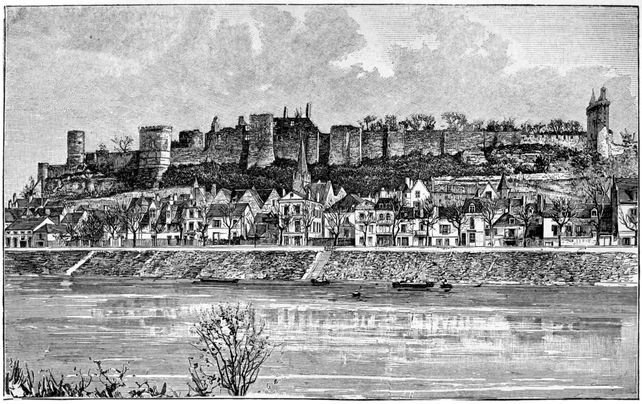
CHINON.
Having arrived near Orleans on the side of the Sologne, Jeanne with many others and myself were conducted to the opposite side of the Loire, on which side is the city of Orleans; and from thence we entered the said town. In her journey from Blois to Orleans, Jeanne 261had been all bruised, because on the night of the start from Blois she had slept fully armed. At Orleans she lived at the house of the Treasurer[168] of the Town, facing the Bannier Gate; and in this house she received the Sacrament. The day after her arrival she went to seek the Sieur Bastard of Orleans, with whom she had an interview. On her return I saw she was quite vexed that, as she told me, the captains had decided not to attack the English on that day. She went nevertheless to a Boulevard which the French were occupying, opposite to one garrisoned by the English, and there she spoke with them, telling them to retire in God’s Name, or otherwise she would drive them away. One of them, called the Bastard of Granville, assailed her with many insults: “Do you wish us,” he said, “to surrender to a woman?” At the same time, he called the Frenchmen who were with her “maquereaux mescreans.” Then Jeanne returned to her lodging, and went up into her chamber: I thought she was going to sleep: shortly afterwards, there she was, coming down from her chamber; “Ah! bloodthirsty boy,” she said to me, “you did not tell me that the blood of France was being shed!”[169] And she ordered me to go and look for her horse. At the same time she was being armed by the lady of the house and her daughter. When I returned with her horse I found her already armed: she told me to go and seek her banner, which had been left in her chamber: I passed it to her through the window. Immediately she rode hastily towards the Burgundy gate, whither the lady with whom she lodged told me to follow her, which I did. The attack took place against the Fort of Saint Loup; and in this attack the Boulevard was taken. On the way Jeanne met several of the 262French wounded, at which she was much disturbed. The English were preparing to resist when Jeanne advanced against them in all haste. As soon as the French saw her they began to shout aloud; and thus was the Fort of Saint Loup taken. I heard it said that the English ecclesiastics had taken their ornaments, and had thus come before her; that Jeanne had received them without allowing any harm to be done them, and had had them conducted to her lodging; but that the other English had been killed by the people of Orleans.
In the evening Jeanne returned to supper in her lodging. She had always most sober habits: many times I saw her eat nothing during a whole day but a morsel of bread. I was astonished that she ate so little. When she was in her lodging she ate only twice a day.
The next day, towards 3 o’clock, the soldiers of the King crossed the Loire to attack the Fort of Saint-Jean-le-Blanc, which they took, as also the Fort of the Augustins.[170] Jeanne crossed the river with them, and I accompanied her: then she re-entered Orleans, and went back to sleep at her lodging with some women, as she was in the habit of doing: for every night, as far as possible, she had a woman to sleep by her, and when she could not find one in war, or in camp, she slept fully dressed.
The following day, in spite of many Lords pretending that it was exposing the King’s followers to too great a danger, she had the Burgundy gate opened, and a small gate near the great tower: she then crossed the water with some of her followers to attack the Fort of the Bridge, which the English still held. The King’s troops remained there from morning to night, and Jeanne was wounded: it was necessary to take off her armour to dress the wound; but hardly was it dressed when she 263armed herself afresh and went to rejoin her followers at the attack and the assault, which had gone on from morning without ceasing. And when the Boulevard was taken Jeanne still continued the assault with her men, exhorting them to have a good heart and not to retire, because the fort would very soon be theirs. “When,” she told them, “you see the wind drive the banner towards the fort, it will be yours!” But the evening was drawing on, and her followers, seeing they made no way, despaired of success; yet Jeanne persisted always, assuring them they would take the fort that day. Then they prepared to attempt a last assault; and when the English saw this they made no resistance, but were seized with panic, and nearly all were drowned; nor did they during this attack even defend themselves. Those who survived retreated the next day to Beaugency and Meung. The King’s army followed them, Jeanne accompanying it. The English offered to surrender Beaugency by agreement, or to fight; but on the day of combat they retired again; and the army began afresh to pursue them. On this day La Hire commanded the vanguard, at which Jeanne was much vexed, for she liked much to have the command of the vanguard. La Hire threw himself on the English, and the King’s army was victorious: nearly all the English were slain.
Jeanne, who was very humane, had great compassion at such butchery. Seeing a Frenchman, who was charged with the convoy of certain English prisoners, strike one of them on the head in such manner that he was left for dead on the ground, she got down from her horse, had him confessed, supporting his head herself, and comforting him to the best of her power.