Part I THE TRIAL (continued 3)
Reading edition
To which Jeanne replied in this manner:
“Truly if you were to tear me limb from limb, and separate soul and body, I will tell you nothing more; and, if I were to say anything else, I should always afterwards declare that you made me say it by force. Last 118Thursday[91] I received comfort from Saint Gabriel; I believe it was Saint Gabriel: I knew by my Voices it was he. I asked counsel of my Voices if I ought to submit to the Church, because the Clergy were pressing me hard to submit, and they said to me: ‘If thou willest that God should come to thy help, wait on Him for all thy doings.’ I know that Our Lord hath always been the Master of all my doings, and that the Devil hath never had power over them. I asked of my Voices if I should be burned, and my Voices answered me: ‘Wait on Our Lord, He will help thee.’”
“On the subject of the crown which you say was given to the Archbishop of Rheims, will you defer to him?”
“Make him come here, and I will hear him speak, and then I will answer you. Nevertheless, he dare not say the contrary to what I have said thereon.”
Seeing the hardness of her heart, and her manner of replying, We, the Judges, fearing that the punishment of the torture would profit her little, decided that it was expedient to delay it, at least for the present, and until We have had thereupon more complete advice.
Saturday, May 12th, in the abode of Us, the Bishop,[92] We, the Judges, having taken our seats, assisted by the venerable Doctors and Masters whose names follow:—Raoul Roussell, Nicolas de Venderès, André Marguerie, Guillaume Erard, Robert Barbier, Denis Gastinel, Jean Ledoux, Aubert Morel, Thomas de Courcelles, Nicolas Coppequesne, Nicolas Loyseleur, Brother Ysambard de la Pierre.
We, the Bishop, did make known to the Assessors what had taken place on the previous Wednesday, and 119ask their counsel on what should be now done; We did in particular consult them on the question of submitting Jeanne to the torture.
[Here follow the deliberations of the fourteen Assessors consulted, only two of whom, Aubert Morel and Thomas de Courcelles, recommended recourse to the torture. Nicolas Loyseleur considered it “a salutary medicine for her soul,” but nevertheless agreed that it should not be adopted.]
We, the Judges, after having gathered the opinion of each, taking into consideration the answers made by Jeanne at the Sitting on Wednesday last, taking into consideration also the disposition of her mind, her will so energetically manifested, and all the other circumstances of the Case, decide that it is neither profitable nor expedient to submit her to the torture; and for the rest, We will proceed later.
[The Twelve Articles of the Indictment, or Accusation, were sent to the University of Paris, for their consideration and report, by the hands of Maîtres Jean Beaupère, Nicolas Midi, Jacques de Touraine, and Gerard Feuillet, who left Rouen for this purpose on April 19th. On April 29th, the University was solemnly convoked at Saint-Bernard to consider the question; on May 14th, the deliberation of the Faculty of Theology and the Faculty of Decrees was submitted to all the Faculties, solemnly assembled for that purpose, and adopted by the University as its own. Letters from the University of Paris were sent to the Bishop of Beauvais and to King Henry VI. on the same day, by the messengers then returning to Rouen.]
The Bishop communicates the Resolutions of the University of Paris [approving of the Twelve Articles], and asks the advice of all the Doctors present.
120Saturday, May 19th, in the Chapel of the Archiepiscopal Manor of Rouen.—Present: the Judges, assisted by 51 Assessors.
In presence of the above named, We, the Bishop, said:
For a long time, We have been receiving a very considerable number of Resolutions and opinions, coming from notable Doctors and Masters, on the subject of the assertions made and confessed by Jeanne. We might awhile since have proceeded to the conclusion of the Process, basing Ourselves on these Resolutions, because these Resolutions were assuredly quite sufficient. But in order to testify all honour and all respect towards our Mother, the University of Paris; to have on the matter a more full and complete elucidation; to give to consciences more guarantee and surety: We did decide to send the assertions in question to Our Mother the University of Paris, and principally to the Faculties of Theology and of Decrees; and to beseech the deliberation of the Doctors and Masters of the said University, principally of the said two Faculties of Theology and Decrees. The University—in particular, the said two Faculties—being ardently enflamed with zeal for the Faith—have maturely and solemnly given their opinion upon each of the assertions, and have sent them to Us in the form of a Public Instrument.
This statement ended, We gave orders that the Resolutions contained in the said Instrument should be read.
Afterwards, upon the reading of the Resolutions of the said two Faculties and the said University, each of the Doctors and Masters present did give and explain his opinion: and this, in addition to the opinion already given for the most part in the deliberations reported above.
The opinion of all is in conformity with the Resolutions 121of the University and of the two Faculties; and it doth bear not only on the qualifications to be given to the assertions comprised in the Twelve Articles, but also on the manner of proceeding which shall be followed finally.
Here follow the deliberations of the Doctors and Masters; [agreeing with the Resolutions of the University, and advising that Jeanne should be again charitably admonished and warned before a final sentence be pronounced.]
For all which, We, the Judges, thanked the reverend Fathers, Lords, and Masters.
We decided that Jeanne should be again warned to return into the way of truth and salvation of soul and body.
Besides, and in accordance with the excellent deliberations which had just taken place, and with the counsels full of sense just enunciated, We decided that We will, after this last monition, pronounce the closing of the Process and give a day for the announcement of the sentence.
FINAL SESSION AND SENTENCE. RECANTATION.
Wednesday, May 23rd, We, the Judges, assisted by the reverend Fathers and Lords the Bishops of Thérouanne and de Noyon; and the Doctors and Masters Jean de Châtillon, Jean Beaupère, Nicolas Midi, Guillaume Erard, Pierre Maurice, André Marguerie and Nicolas de Venderès, seated ourselves in tribunal in a room in the Castle of Rouen, situated near the place which serves Jeanne as prison.
We did cause the said Jeanne to be brought before Us, because We judged it profitable to shew her the points on which the Faculties of Theology and Decrees of the 122University of Paris have declared that she hath erred and fallen short; We have judged it profitable also to make known to her the omissions, crimes and errors which, in the terms of the Resolutions of each of these Faculties, exist on each of these same points; and afterwards, to warn her, or cause her to be warned, to abandon these errors and shortcomings: to correct and submit herself, in fine, to the censure and judgment of Our Holy Mother the Church.
Maître Pierre Maurice, Canon of the Church of Rouen, a celebrated Doctor in Theology, hath been charged by us with this mission, and he hath fulfilled it by addressing to Jeanne the words written by him in French in a schedule thus expressed.
[Here follows a recapitulation of the Twelve Articles, with the opinion, adverse to Jeanne, given upon them by the Clerics consulted.]
After these assertions had been thus shewn to her, and the decision of the University of Paris upon each of them had been made known to her, Jeanne was admonished, in the French language, by the said Doctor Pierre Maurice to pay great attention to the character given to her sayings and deeds by this decision of the University of Paris. Above all he did exhort her to reflect well on the gravity of the error contained in her refusal to submit to the Church Militant.
And he concluded by thus speaking to her:
“Jeanne, my very dear friend, it is now time, at the end of your Trial, to reflect well on all that has been said to you. This is the fourth time[93] that the Lord Bishop of Beauvais, the Lord Vicar of the Inquisition, and other Doctors who have been thereto appointed, have, either in public or in private, in honour and reverence for God, for the Faith, and the Law of Jesus 123Christ, for the tranquillity of their own consciences and for the alleviation of so great a scandal, admonished you with the greatest zeal—so great is their care for the salvation of your soul and body! Four times have been made known to you the perils which endanger your soul and body, if you do not at last consent to correct yourself and your sayings by submitting to the Church, yourself and your deeds, and by accepting her judgment.
“Up to this time you have obstinately refused. And although many others might long since have declared the Case heard and have given judgment upon you, nevertheless my Lords your Judges, enflamed with zeal for the salvation of your soul and body, desired, in order to have their advice, to send your sayings and deeds to the University, that light of all Science, that extirpator of all error. The resolutions of the University of Paris have come to your Judges. They have then decided, always in the hope of your salvation, to admonish you once again, to again call your attention to your errors, your scandals and all the faults that you have committed in such great number.
“They exhort you, your Judges, they beseech you, they admonish you by the bowels of Our Lord Jesus Christ, Who hath suffered a cruel death for the redemption of man, they beseech you to correct your words, to submit them to the judgment of the Church, as all the faithful are bound and obliged to do. Do not allow yourself to be separated from Our Lord Jesus Christ, Who hath created you to be a sharer in His glory; do not choose the way of eternal damnation with the enemies of God, who daily set their wits to work to find means to trouble mankind, transforming themselves often, to this end, into the likeness of Our Lord, of Angels and of Saints, as is seen but too often in the lives of the Fathers and in the Scriptures.
“Therefore, if such things have appeared to you, do 124not believe them. The belief which you may have had in such illusions, put it away from you. Believe rather in the words and opinions of the University of Paris and other Doctors, who, knowing the law of God and Holy Scripture, decide that no faith should be placed in such apparitions, nor should faith be placed in any extraordinary apparitions, in any novelty which is not supported by Holy Scripture, by a sign, or by a miracle.
“You have very lightly believed in such things, you who have not turned to God in earnest prayer that He would grant you certainty; you who, to enlighten yourself, have not applied to a prelate or a learned ecclesiastic. This you ought to have done: it was your duty, considering your estate and the simplicity of your knowledge.
“Let us take an example: If your King had given you a treasure to guard, forbidding you to receive any one, whoever it might be, should you not refuse to receive one who presented himself to you, saying he came by order of the King, unless he brought you a letter or some certain sign? For the Church it is the same thing: when Our Lord Jesus Christ, ascending into Heaven, confided the government of His Church to the blessed Apostle Peter and his successors, He forbade us to accept anything from others who might come in His Name, who should have for the support of their mission only their own sayings. You ought not to have put faith in those whom you say came to you; and we also, we ought not to believe in you, since Our Lord hath expressly commanded the contrary.
“Reflect, Jeanne, upon this: if, when you were in your King’s realm, a soldier or another, born in his kingdom and placed under his dominion, had suddenly risen and said, ‘I will not obey the King, I will not submit either to him or his officers,’ would you not have said yourself 125that this man should be condemned? But what will you say of yourself, you, brought up in the Faith of Christ, if you do not obey the officers of Christ—that is to say, the Prelates of the Church? What judgment will you give on yourself? Cease, therefore, to hold this damnable speech, if you love God, your Creator, your Spouse, and your Salvation: obey the Church, consent to submit to its judgment; know well that, if you do not, if you persevere in your error, your soul will be condemned to eternal punishment; and, for your body, I fear much that it will come to perdition. [Anima vestra damnabitur supplicio perpetuo crucianda, et de corpore plurimum dubito ne in perditionem veniat.]
“Let not fear of the world hold you back; do not give way to the fear of losing, by doing as I ask you, the great honours you have received. The honour of God and the salvation of your body and soul must be preferred before all. All is perishable, save only what I tell you to do. If you do it not, you separate yourself from the Church and from the Faith to which you have sworn in Holy Baptism; you detach yourself from the authority of the Church, from the Church which is led, ruled, and governed by the authority of the Spirit of God. Did not God say to the chiefs of the Church: ‘He that heareth you heareth Me, he that despiseth you despiseth Me’? If you will not submit to the Church, you separate yourself in deed, and you refuse at the same time to submit yourself to God; you are in error on this article of the Faith, ‘the Church, One, Holy, and Catholic.’ What this Church and her authority is, hath been sufficiently explained to you in former monitions.
“Thus have my Lords the Bishop of Beauvais and the Vicar of the Inquisition, your Judges, charged me to tell you.
126“And now, I admonish, I beseech, I exhort you, in the name of your devotion to the Passion of your Creator, and of the affection you should bear to the salvation of your body and soul, I admonish, I beseech you, amend yourself, return into the way of truth, obey the Church, submit to her judgment and decision.
“In thus acting you will save your soul; you will redeem—so I believe—your body from death. But if you do not, if you persist, know that your soul will be overwhelmed by damnation, and I fear for the destruction of your body.
“May Our Saviour Jesus Christ preserve you from all these evils!”
After being thus admonished and exhorted, Jeanne did reply:
“As to my words and deeds, such as I have declared them in the Trial, I refer to them and will maintain them.”
“Do you not, then,” We asked her, “think yourself bound to submit your words and deeds to the Church Militant, or to any other but God?”
She replied: “What I have always said in the Trial, and held, I wish still to say and maintain. If I were condemned, if I saw the fire lighted, the faggots prepared, and the executioner ready to kindle the fire, and if I myself were in the fire, I would not say otherwise, and would maintain to the death all I have said.”[94]
Then, We, the Judges, asked of the Promoter and of Jeanne herself if they had anything else to say. They replied, No. In consequence, We did proceed to close the Process, following the formula contained in a schedule 127which We, the Bishop, held in Our hands, and which was thus expressed:
We, the Judges, competent in this Process, declare anew our competence in so far as is necessary;
Considering the declaration just made by the Promoter and the Accused that they have no more to say;
We declare the Process concluded;[95] and, this conclusion pronounced, We summon you both to-morrow to hear the law which will be laid down by Us, and the sentence which shall be pronounced by Us, to be afterwards carried out and proceeded with according to law and right.
On Thursday after Whitsuntide, the 24th day of May in the morning, We, the Judges, did repair to a solemn Assembly, publicly held in the Cemetery of the Abbey of Saint-Ouen, at Rouen.[96] We did have with us:—The most reverend Father in Christ, Henry, by Divine Permission Priest of the Holy Roman Church, under the title of Saint Eusebius, usually called the Cardinal of England; the reverend Fathers in Christ, the Lords Bishops of Thérouanne, Noyon, and Norwich; the Lords Abbot of Saint Trinité de Fécamp, of Saint Ouen of Rouen, of Jumièges, Bec, Cormeilles, Saint-Michel au Peril-de-la-Mer, Mortemer, and Preaux; the Priors of Longueville-la-Giffard, and Saint Lo of Rouen; and many others.
Jeanne was placed opposite to Us on a scaffold or platform prepared for this purpose.
128First of all, We did charge Maître Guillaume Érard, Doctor in Theology, a preacher of great renown, to pronounce a solemn sermon for the salutary admonition of Jeanne and the great crowd which surrounded us.
This Doctor began by taking for text that Word of God in St. John, Chapter XV., “A branch cannot bear fruit of itself except it abide in the vine.” Then he explained solemnly that all Catholics should abide in the true vine of the Holy Mother Church which Christ had planted: he shewed how Jeanne, by many errors and grave crimes, had separated herself from Holy Mother Church, to the great scandal of Christian people. Finally, he admonished and exhorted her and all the people by the most edifying teaching.
In concluding, he spoke to her in these terms:
“Jeanne, behold my Lords your Judges, who, at divers times, have summoned and required you to submit yourself, your words and deeds, to Our Holy Church, shewing you that there doth exist in your words and deeds many things which, as it doth seem to the Clergy, are not good either to say or maintain.”
To which Jeanne replied:
“I will answer you. As to my submission to the Church, I have answered the Clergy on this point. I have answered them also on the subject of all the things I have said and done. Let them be sent to Rome to our Holy Father the Pope, to whom after God I refer me as to my words and deeds: I did them by God’s order; I charge no one with them, neither my King nor any one else. If there be any fault found in them, the blame is on me, and no one else.”
“Will you revoke all your words and deeds which are disapproved by the Clergy?”
“I refer me to God and to our Holy Father the Pope.”
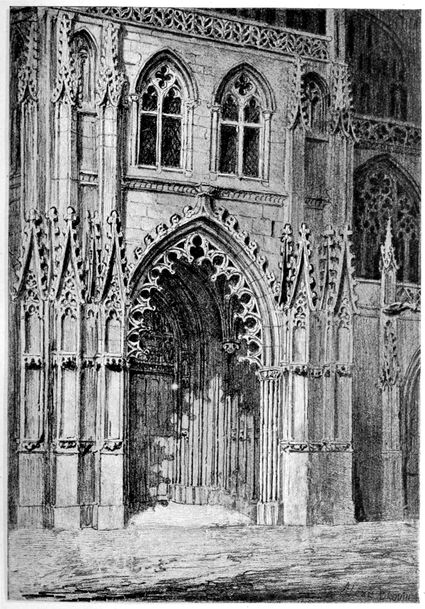
SOUTH DOOR OF ST. OUEN AT ROUEN.
Then she was told that this answer would not suffice; 129that it was not possible to send to seek the Pope from such a distance; that the Ordinaries are Judges, each in their own diocese; that it was necessary she should refer to our Holy Mother the Church; and that she should hold as true all that the Clergy and other people cognizant thereof have said and decided on the subject of her words and deeds.
She was admonished on this to the third monition.
But as this woman would say no more, We, the Bishop, did then begin the reading of Our sentence as follows:
THE SENTENCE
In the Name of the Lord, Amen.
All the pastors of the Church who have it in their hearts to watch faithfully over their flock, should, when the perfidious Sower of Errors works by his machinations and deceits to infest the Flock of Christ, strive with great care to resist his pernicious efforts with the greatest vigilance and the most lively solicitude, and above all in these perilous times, when so many false prophets are come into the world with their sects of error and perdition, according to the prediction thereof made by the Apostle. Their diverse and strange doctrines might cause the faithful in Christ to stray, if Holy Mother Church, with the aid of wholesome doctrine and canonical sanction, did not study with great zeal to refute their inventions and errors.
Therefore, because that before Us, Pierre by the Divine Mercy Bishop of Beauvais, and before Us, Brother Jean Lemaître, Deputy in this City and Diocese for Maître Jean Graverend, renowned Doctor Inquisitor in France for the Evil of Heresy, specially appointed for this in this Case; because, before Us, competent Judges, thou, Jeanne, commonly called the Maid, hast 130been indicted and cited in a Case of Faith, on account of thy pernicious errors; after having seen and examined with great attention the whole series of thy Trial[97]....
Our sentence had thus been already read, in great part, when Jeanne did begin to speak and said:
“I will hold[98] all that the Church ordains, all that you, the Judges, wish to say and decree—in all I will refer me to your orders!”
Then many times did she say:
“Inasmuch as the Clergy decide that the apparitions and revelations which I have had are not to be maintained or believed, I will not believe nor maintain them; in all I refer me to you and to our Holy Mother Church!”
Abjuration.
Then, in the presence of all the aforenamed, in presence of an immense number of people and Clergy, she did make and utter her recantation and abjuration, following a formula written in French, which was read to her; a formula which she did pronounce herself, and the schedule of which she did sign with her own hand, and of which the tenour follows:
“All who have erred and been mistaken in the Christian Faith and, by the grace of God, have since returned into the light of truth and the unity of Our Holy Mother Church, should well guard themselves that the Evil One doth not drive them back and cause them to relapse into error and damnation. For this cause, I, Jeanne, commonly called the Maid, a miserable sinner, 131after that I had recognized the snares of error in the which I was held, and [after] that, by the grace of God, I had returned to our Holy Mother Church, in order that it may be seen that, not feigningly but with a good heart and good will, I have returned thereto; I confess that I have most grievously sinned, in pretending untruthfully to have had revelations and apparitions from God, from the Angels, and Saint Catherine and Saint Margaret; in seducing others; in believing foolishly and lightly; in making superstitious divinations; in blaspheming God and His Saints; in breaking the Divine Law, Holy Scripture, and the lawful Canons; in wearing a dissolute habit, mis-shapen and immodest and against the propriety of nature, and hair clipped ‘en ronde’ in the style of a man, against all the modesty of the feminine sex; also, in bearing arms in great presumption; in cruelly desiring the effusion of human blood; in saying that all these things I did by the command of God, the Angels, and the aforesaid Saints, and that in these things I did well and was not mistaken; in despising God and His Sacraments; in making seditions; and in being idolatrous, by adoring evil spirits and invoking them. I confess also that I have been schismatic and in many ways have erred from the Faith. The which crimes and errors, from my heart and without lying, I—by the grace of Our Lord, returned into the way of truth, by the holy doctrine and good counsel of you and the Doctors and Masters who have conveyed it to me—abjure as blasphemy and renounce them all, and depart therefrom. And upon all these things aforesaid I submit to the correction, disposal, amendment, and entire decision of our Holy Mother Church and of your good justice. Also I swear and promise to you, to my Lord Saint Peter, Prince of the Apostles, to our Holy Father the Pope of Rome, his Vicar, and his successors, and to you, my Lords, the reverend Father 132in God my Lord the Bishop of Beauvais, the religious person, Brother Jean Lemaître, Deputy of my Lord the Inquisitor of the Faith, as my Judges, that never, by any exhortation or other manner, will I return to the aforesaid errors, from which it hath pleased Our Lord to deliver and take me; but always I will remain in union with our Holy Mother Church and in the obedience of our Holy Father the Pope of Rome. And this I say, affirm, and swear, by God Almighty and by the Holy Gospels.
“And in sign of this, I have signed this schedule with my signature. (Signed thus): Jehanne +.”
After her revocation and her abjuration had been, as has just been said, received by us, the Judges, We, the Bishop, did finally deliver our sentence in these terms:
[The sentence then follows as given above up to the words “thy Trial,” and then proceeds:]
... all that therein occurred, principally thine answers, thine avowals, and thine affirmations; after having seen the most renowned decision of the faculties of Theology and Decrees of the University of Paris; after having also seen the decision of the entire University and the numerous Resolutions of so many Prelates, Doctors, and other Masters, who at Rouen or elsewhere have sent in such great numbers their assertions as to thy sayings and deeds; after having had, upon this, advice and mature deliberation of so many Doctors zealous for the Christian Faith; after having weighed and considered all that there is to weigh and consider of what is in the nature of enlightenment; having before our eyes Christ and the honour of the Orthodox Faith, so that our judgment may emanate even from the face of Our Lord: we, the Judges, say and decree: that thou, Jeanne, hast deeply sinned in pretending untruthfully that thy revelations and apparitions 133are of God; in seducing others; in believing lightly and rashly; in making superstitious divinations; in blaspheming God and the Saints; in prevaricating as to the law, Holy Scripture, and the Canonical sanctions; in despising God in His Sacraments; in fomenting seditions and revolts; in apostatizing; in encouraging the crime of heresy; in erring on numerous points in the Catholic Faith.
But because that, after being many times charitably admonished and long waited for, thou hast at last, with the help of God, returned into the bosom of the Church, thy Holy Mother, with contrite heart, and hast openly revoked thy errors; because, having solemnly and publicly cast these far from thee, thou hast abjured them by the words of thine own mouth, together with the heresy with which thou wast charged: We declare thee set free by these presents, according to the form appointed by Ecclesiastical sanction, from the bonds of excommunications which held thee enchained, charging thee to return to the Church with a true heart and sincere faith, and to observe what hath been already enjoined thee and what shall yet be enjoined thee by us.
But because thou hast sinned rashly against God and Holy Church, We condemn thee, finally, definitely and for salutary penance, saving Our grace and moderation, to perpetual imprisonment, with the bread of sorrow and the water of affliction, in order that thou mayest bewail thy faults, and that thou mayest no more commit [acts] which thou shalt have to bewail hereafter.
Exhortation made to Jeanne by the Deputy Inquisitor, in Prison.
And the same day, Thursday, May 24th, in the afternoon, We, Brother Jean Lemaître, the aforesaid Deputy, 134assisted by the Lords and Masters N. Midi, N. Loyseleur, Thomas de Courcelles, Brother Ysambard de la Pierre, and several others,
We did repair to the place in the prison where Jeanne was to be found.
We, and the persons assisting us, did set forth before her how God had on this day had mercy on her, and how the Clergy had shewn themselves merciful in receiving her to the Grace and pardon of Holy Mother Church. In return, it was right that she, Jeanne, should obey with humility the sentence and orders of the Judges and the Ecclesiastics; that she should wholly give up her errors and all her inventions, never to return to them: because, in case she should return to them, the Church could no longer admit her to pardon, and must abandon her altogether. We told her to leave off her man’s dress and to take a woman’s garments, as the Church had ordered her.
In all our observations Jeanne did reply that she would willingly take woman’s garments, and that in all things she would obey the Church.
Woman’s garments having been offered to her, she at once dressed herself in them, after having taken off the man’s dress she was wearing; and her hair, which up to this time had been cut “en ronde” above her ears, she desired and permitted them to shave and take away.
Here ends the First Part of the Trial, called “The Lapse.”
135
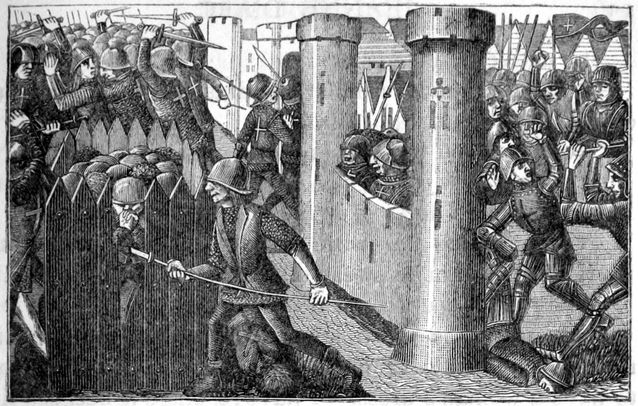
BATTLE OUTSIDE ORLEANS.
II SECOND PROCESS: THE RELAPSE
Monday, May 28th, the day following Trinity Sunday.
We, the aforesaid Judges, repaired to the place of Jeanne’s prison, to learn the state and disposition of her soul. There were found with us the Lords and Masters Nicolas de Venderès, Guillaume Haiton, Thomas de Courcelles, Brother Ysambard de la Pierre; witnesses, Jacques Cannes, Nicolas Bertin, Julien Floquet and John Gris.
And because Jeanne was dressed in the dress of a man—that is to say, a short mantle, a hood, a doublet and other effects used by men—although, by our orders, she had, several days before, consented to give up these garments, we asked her when and for what reason she had resumed this dress.[99]
136She answered us:
“I have but now resumed the dress of a man and put off the woman’s dress.”
“Why did you take it, and who made you take it?”
“I took it of my own free will, and with no constraint: I prefer a man’s dress to a woman’s dress.”
“You promised and swore not to resume a man’s dress.”
“I never meant to swear that I would not resume it.”
“Why have you resumed it?”
“Because it is more lawful and suitable for me to resume it and to wear man’s dress, being with men, than to have a woman’s dress. I have resumed it because the promise made to me has not been kept; that is to say, that I should go to Mass and should receive my Saviour and that I should be taken out of irons.”
“Did you not abjure and promise not to resume this dress?”
“I would rather die than be in irons! but if I am allowed to go to Mass, and am taken out of irons and put into a gracious prison, and [may have a woman for companion[100]] I will be good, and do as the Church wills.”
And as We, the Judges, heard from several persons that she had returned to her old illusions on the subject of her pretended revelations, We put to her this question:
137“Since last Thursday [the day of her abjuration] have you heard your Voices at all?”
“Yes, I have heard them.”
“What did they say to you?”
“They said to me:[101] ‘God had sent me word by St. Catherine and St. Margaret of the great pity it is, this treason to which I have consented, to abjure and recant in order to save my life! I have damned myself to save my life!’ Before last Thursday, my Voices did indeed tell me what I should do and what I did on that day. When I was on the scaffold on Thursday, my Voices said to me, while the preacher was speaking: ‘Answer him boldly, this preacher!’ And in truth he is a false preacher; he reproached me with many things I never did. If I said that God had not sent me, I should damn myself, for it is true that God has sent me; my Voices have said to me since Thursday: ‘Thou hast done a great evil in declaring that what thou hast done was wrong.’ All I said and revoked, I said for fear of the fire.”
“Do you believe that your Voices are Saint Catherine and Saint Margaret?”
“Yes, I believe it, and that they come from God.”
“Tell us the truth on the subject of this crown which is mentioned in your Trial.”
“In everything, I told you the truth about it in my Trial, as well as I know.”
“On the scaffold, at the moment of your abjuration, you did admit before us, your Judges, and before many others, in presence of all the people, that you had untruthfully boasted your Voices to be Saint Catherine and Saint Margaret.”
“I did not intend so to do or say. I did not intend to deny my apparitions—that is to say, that they were 138Saint Catherine and Saint Margaret; what I said was from fear of the fire: I revoked nothing that was not against the truth. I would rather do penance once for all—that is die—than endure any longer the suffering of a prison. I have done nothing against God or the Faith, in spite of all they have made me revoke. What was in the schedule of abjuration I did not understand. I did not intend to revoke anything except according to God’s good pleasure. If the Judges wish, I will resume a woman’s dress; for the rest, I can do no more.”
After hearing this, We retired from her, to act and proceed later according to law and reason.
Final Adjudication.
The next day, Tuesday, May 29th, in the Chapel of the Archiepiscopal Manor of Rouen, the Judges and 40 Assessors present.
We, the Bishop, did, in presence of all the above-named, set forth that, after the Sitting held by Us in this same place, on Saturday, May 19th, the Eve of Whitsunday, We had, by the advice of the Assessors, caused Jeanne to be admonished on the following Wednesday, and had made known to her in detail the divers points on which, according to the decision of the University of Paris, she must be considered to have fallen short and erred; We caused her to be exhorted in the most lively manner to abandon her errors, and to return into the way of truth; up to the last moment she refused to agree to these admonitions and these exhortations, and would say nothing more; the Promoter, on his side, asserted that he had nothing more to bring forward against her. We then pronounced the closing of the Case, and summoned the parties on the following day, Thursday, 24th May next, to hear the law pronounced, 139all whereof is proved by the documents of the Procès Verbal transcribed above.
Afterwards, We did recall what had passed on Thursday, May 24th; how Jeanne, after having on that day received a solemn preachment and numerous admonitions, did end by signing with her own hand her revocation and abjuration; the whole whereof is at greater length recounted in the preceding document. We did add that, in the afternoon of the same day, the Deputy Inquisitor, Our Coadjutor, did go to seek her in her prison, and did charitably admonish her to persist in her good purpose and to guard herself well against any relapse. Obeying the orders of the Church, Jeanne did then put off the dress she was wearing, and take that of a woman; all whereof hath been likewise set forth at greater length as to time and place.
But since that day, driven by the Devil, behold! she hath, in the presence of many persons, declared anew that her Voices and the spirits that appeared to her have returned to her, and have said many things to her; and, casting away her woman’s dress she hath again taken male garments. As soon as We, the Judges, did receive information of this lapse, We were eager to return to her and to question her.
And then, in presence of all the above-named, in the said Chapel of the Archiepiscopal Manor of Rouen, We, the Bishop, did order to be read the declarations and affirmations which Jeanne pronounced yesterday before us, and which are reproduced above.
After this reading had been made, We asked advice and counsel thereon from the Assessors. Each one hath given his opinion, as follows:—
Maître Nicolas de Venderès: Jeanne should be considered a heretic: the sentence declaring her to be so, once given by Us, the Judges, she should be abandoned to the secular authority, which should be 140prayed to act towards her with gentleness. [“Rogando eam ut cum velit mite agere,” the usual formula for victims sent to the stake.]
The Reverend Father in Christ, the Lord Gilles, Abbot of the Monastery of the Holy Trinity at Fécamp: Jeanne is relapsed. Nevertheless, it would be well that the schedule containing her last answers, which hath just been read, should be read anew and set forth to her, reminding her once more of the Word of God; afterwards, We, the Judges, should declare her a heretic and abandon her to the secular authority, praying this authority to deal gently with her.
[The remainder of the Assessors agreed in general with this opinion of the Abbot of Fécamp; some added that she should be again charitably admonished, in regard to the salvation of her soul, and should be told that she had nothing further to expect as to her earthly life.]
After having gathered this advice, We, the Judges, did thank the Assessors, and gave orders that Jeanne should be afterwards proceeded against, as relapsed, according to law and reason.
Mandate citing Jeanne to appear on Wednesday, May 30th.
“Pierre, by the Divine Mercy Bishop of Beauvais, and Jean Lemaître, Deputy of Maître Jean Graverend, renowned Doctor, appointed by the Holy See Inquisitor of the Evil of Heresy in the Kingdom of France; to all public Priests, to all Curés of this town and of any other place wherever it be in the Diocese of Rouen, to each of them in particular, according as it shall be required: Greeting in Our Saviour. For the causes and reasons to be elsewhere deduced at greater length, a certain woman of the name of Jeanne, commonly called the Maid, having fallen into errors against the Orthodox Faith—errors which she hath publicly abjured before 141the Church, and to which she hath returned—as is established and proved by her avowals and assertions: We command to all of you and to each in particular, by this requisition, without the one waiting for the other, or excusing himself by another, that you cite the said Jeanne to appear before Us in person to-morrow, at the hour of 8 o’clock in the morning, at Rouen, in the place called the Old Market, in order that she may be declared by us relapsed, excommunicate, and heretic, with the intimation that it shall be done to her as is customary in such cases.
“Given in the Chapel of the Archiepiscopal Manor of Rouen, Tuesday, May 29th, the year of Our Lord, 1431.”
On the following day, Wednesday, 30th of May, Jeanne, by virtue of the preceding mandate from Us, was cited for the same day, in order to hear the law pronounced, as is proved at greater length by the tenour of the following relation, done for us by the Executor of our mandates:
“To the reverend Father and Lord in Christ, the Lord Pierre, by the Divine Mercy Bishop of Beauvais, and to the venerable and religious person Brother Jean Lemaître, Deputy of Maître Jean Graverend, renowned Doctor, by order of the Holy Apostolic See Inquisitor of the Faith and of the Evil of Heresy in the Kingdom of France: your humble Jean Massieu, Priest, Dean of the Christendom of Rouen[102] sends earnest Greeting, with all protestations of obedience and respect. This is to inform your Reverend Paternities, that I, Massieu, in virtue of your mandate sent to me, to which these presents will be annexed, have cited, speaking to her in person, this woman, commonly called the Maid, to appear before you this day, Wednesday, May 30th, at the hour of eight in the morning, at Rouen, in the place 142of the Old Market, according to the form and tenour of your said mandate, and to that which I have been ordered to do. All the which, thus done by me, I signify to your Reverend Paternities by these presents, signed by my seal.
“Given in the year of Our Lord 1431, on the aforesaid Wednesday, at 7 o’clock in the morning.
“Massieu.”
SENTENCE OF DEATH
Final Sentence given before the People.
Wednesday, May 30th, towards 9 o’clock in the morning,
We, the Judges, repaired to the place of the Old Market, in Rouen, near the Church of Saint Sauveur.
We were assisted by the reverend Fathers in Christ the Lords Bishops of Thérouanne and Noyon; and by a number of other Lords, Masters, and ecclesiastical personages.
Before Us was brought the said Jeanne, in presence of the people, assembled in this place in an immense multitude.
She was placed upon a scaffold or platform.
For her wholesome admonition and for the edification of the whole multitude, a solemn address was made by the renowned Doctor, Nicolas Midi, who took for his text those words of the Apostle in the first Epistle to the Corinthians, Chapter xii., “If one member suffer, all the members suffer with it.”
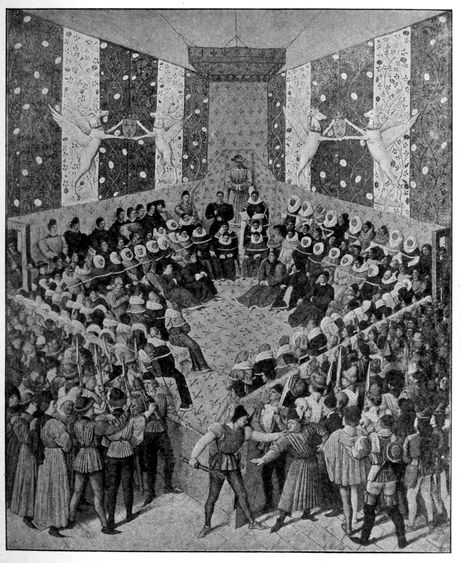
COURT OF JUSTICE. From a Miniature by Jean Fouquet.
This address ended, We, the Bishop, did once more admonish Jeanne to look to her salvation, to reflect on her misdeeds, to repent of them, to have a true contrition for them. We exhorted her to believe hereon the opinion of the Clergy, of the notable persons who have taught and instructed her on all that treats of her 143salvation. We did particularly exhort her to believe the good advice of the two venerable Dominicans[103] who were at that moment beside her, and whom we had sent to her to converse with her up to the last moment and to furnish her in all surety with wholesome admonitions and counsels profitable to her salvation.
Afterwards, We, the Bishop and Vicar aforesaid, having regard to all that has gone before, in which it is shewn that this woman hath never truly abandoned her errors, her obstinate temerity, nor her unheard-of crimes; that she hath even shewn the malice of her diabolical obstinacy in this deceitful semblance of contrition, penitence, and amendment; malice rendered still more damnable by perjury of the Holy Name of God and blasphemy of His ineffable Majesty; considering her on all these grounds obstinate, incorrigible, heretic, relapsed into heresy, and altogether unworthy of the grace and of the Communion which, by our former sentence, We did mercifully accord to her; all of which being seen and considered, after mature deliberation and counsel of a great number of Doctors, We have at last proceeded to the Final Sentence in these terms:
In the Name of the Lord: Amen.
At all times when the poisoned virus of heresy attaches itself with persistence to a member of the Church and transforms him into a member of Satan, extreme care should be taken to watch that the horrible contagion of this pernicious leprosy do not gain other parts of the mystic Body of Christ. The decisions of the holy Fathers have willed that hardened heretics should be separated from the midst of the Just, so that to the great peril of others this homicidal viper should not be warmed in the bosom of pious Mother Church. It is for this that We, Pierre, by the Divine Mercy, Bishop of Beauvais, and We, Brother Jean Lemaître, 144Deputy of the renowned Doctor, Jean Graverend, Inquisitor of the Evil of Heresy, specially delegated by him for this Process, both Judges competent in this Trial, already, by a just judgment, have declared this woman fallen into divers errors and divers crimes of schism, idolatry, invocation of demons and many others. But because the Church closes not her bosom to the child who returns to her, we did think that, with a pure spirit and a faith unfeigned, thou hadst put far from thee thy errors and thy crimes, considering that on a certain day thou didst renounce them and didst publicly swear, vow, and promise never to return to thy errors and heresies, to resist all temptations, and to remain faithfully attached to the unity of the Catholic Church and the communion of the Roman Pontiff, as is proved at greater length in a writing signed by thine own hand. But after this abjuration of thine errors, the Author of Schism and Heresy hath arisen in thine heart, which he hath once more seduced, and it hath become manifest by thy spontaneous confessions and assertions—O, shame!—that, as the dog returns again to his vomit, so hast thou returned to thine errors and crimes; and it hath been proved to us in a most certain manner that thou hast renounced thy guilty inventions and thy errors only in a lying manner, not in a sincere and faithful spirit. For these causes, declaring thee fallen again into thine old errors, and under the sentence of excommunication which thou hast formerly incurred, We decree that thou art a relapsed heretic, by our present sentence which, seated in tribunal, we utter and pronounce in this writing; we denounce thee as a rotten member, and that thou mayest not vitiate others, as cast out from the unity of the Church, separate from her Body, abandoned to the secular power as, indeed, by these presents, we do cast thee off, separate and abandon thee;—praying this same secular power, so far as concerns death and the 145mutilation of the limbs, to moderate its judgment towards thee, and, if true signs of penitence should appear in thee, [to permit] that the Sacrament of Penance be administered to thee.
Here follows the Sentence of Excommunication, [the introductory part being word for word the same as the previous sentence, read on May 24th, up to the words “We, the Judges, say and decree”; after which follows:]
... that thou hast been on the subject of thy pretended divine revelations and apparitions lying, seducing, pernicious, presumptuous, lightly believing, rash, superstitious, a divineress and blasphemer towards God and the Saints, a despiser of God Himself in His Sacraments; a prevaricator of the Divine Law, of sacred doctrine and of ecclesiastical sanctions; seditious, cruel, apostate, schismatic, erring on many points of our Faith, and by all these means rashly guilty towards God and Holy Church. And also, because that often, very often, not only by Us on Our part but by Doctors and Masters learned and expert, full of zeal for the salvation of thy soul, thou hast been duly and sufficiently warned to amend, to correct thyself and to submit to the disposal, decision, and correction of Holy Mother Church, which thou hast not willed, and hast always obstinately refused to do, having even expressly and many times refused to submit thyself to our lord the Pope and to the General Council; for these causes, as hardened and obstinate in thy crimes, excesses and errors, We declare thee of right excommunicate and heretic; and after thine errors have been destroyed in a public preaching, We declare that thou must be abandoned and that We do abandon thee to the secular authority, as a member of Satan, separate from the Church, infected with the leprosy of heresy, in order that thou mayst not corrupt also the other members of 146Christ; praying this same power, that, as concerns death and the mutilation of the limbs, it may be pleased to moderate its judgment; and if true signs of penitence should appear in thee, that the Sacrament of Penance may be administered to thee.
Attestations by the Registrars.
“I, Boisguillaume, Priest, Registrar above qualified, affirm that I have duly collated the foregoing document with the original Minute of the Process; for which reason I have marked this present copy with my sign manual, the which will be done after me by the two other Registrars, I signing in this place with my own hand.
(Signed) “Boisguillaume.”
“And I, Guillaume Manchon, Priest, of the Diocese of Rouen, Apostolic and Imperial Notary, I affirm that I assisted in the collation made of the aforesaid Process, with the Registrars signed above and below; I affirm that this collation of the present copy with the original Minute of the Process hath been duly made. For which, in the same way as the two other Registrars, I have subscribed the present copy with my own hand, affixing thereto my sign-manual, to this required.
(Signed) “G. Manchon.”
“And I, Nicholas Taquel, Priest of the Diocese of Rouen, sworn Imperial Public Notary and of the Archiepiscopal Court of Rouen, called as Registrar to a part of the foregoing Process, I affirm that I have seen and heard the present copy collated with the original register of the said Process; I affirm that this collation hath been duly made. For which, with the two other Registrars preceding, I have subscribed with my own hand the present Process, affixing thereto, here, my sign-manual, to this required.
(Signed) “N. Taquel.”
[Here follow the seals of the two Judges, marked in red wax on the original copies of the Process, prepared to the number of five.]
147
SUBSEQUENT EXAMINATIONS[104] AND PROCEEDINGS AFTER THE RELAPSE.
Information given after the Execution on many things said by Jeanne, at the end of her life and in articulo mortis.
Thursday, 7th day of June, 1431, We, the Judges, did ex-officio take information upon certain things which the late Jeanne had said before persons worthy of credit when she was still in prison and before being brought to judgment.
Examination of Witnesses.
1. The venerable and circumspect Maître Nicolas de Venderès, licentiate in Canon Law, Archdeacon of Eu, hath declared upon oath as follows:
Wednesday, 30th day of May, Eve of the Feast of Corpus Christi, Jeanne, being still in the prison of the Castle of Rouen where she was detained, did say that considering the Voices which came to her had promised she should be delivered from prison, and that she now saw the contrary, she realized and knew she had been, and still was, deceived by them. Jeanne did, besides, say and confess that she had seen with her own eyes and heard with her own ears the apparitions and Voices mentioned in the Case.
At this were present, you, the Judges aforesaid, and 148besides Maître Pierre Maurice, Thomas de Courcelles, Nicolas Loyseleur, Brother Martin Ladvenu, Jean Toutmouillé, Jacques Lecamus, and several others.
Brother Martin Ladvenu, Priest of the Order of Saint Dominic, did say and depose, upon oath, as follows:
On the morning of the day on which sentence was delivered and before she was brought to judgment, Jeanne, in presence of Maître Pierre Maurice, Nicolas Loyseleur, and Brother Jean Toutmouillé, who were with me, did say and confess that she knew and recognized that the Voices and apparitions which had come to her, mentioned in the Case, had deceived her, because they had promised she should be delivered and freed from prison; and that she certainly now saw clearly the contrary.
Asked by the Bishop: Who induced Jeanne so to speak?
Replied: Pierre Maurice, Nicolas Loyseleur, and I exhorted her to save her soul, and asked her if it were true that she had these Voices and apparitions? She replied that it was indeed true, and she continued so to tell us up to the end, but without stating decidedly, at least, so far as I understood, under what form the apparitions came to her. All I remember is that she said they came to her in great multitude and in the smallest size [in magnâ multitudine et quantitate minimâ]. Besides, I did at this time hear Jeanne say and confess that, inasmuch as the Clergy held and believed that if they were spirits who came to her they proceeded from evil spirits, she also held and believed as did the Clergy, and would no longer put faith in these spirits. And as it appeared to me, Jeanne was then of a sound mind.
Brother Martin Ladvenu did add this: The same day 149I heard Jeanne say that, although she had stated in her avowals and confessions, and had affirmed above in the course of the Case, that an Angel from God had brought a crown to him whom she called her King, with all other details connected with this fact in the interrogatories, nevertheless, of her free-will and without being constrained thereto, she did this day confess as follows: that in spite of all she had affirmed on the subject of this Angel, no Angel had brought the crown; it was she, Jeanne, who had been the Angel, and who said and promised to him whom she called her King, that, if he would set her to the work, she would have him crowned at Rheims. There was no other crown sent from God, in spite of all she might have affirmed in the course of the Case on the subject of the crown and the sign given to him whom she called her King.
The venerable and discreet Maître Pierre Maurice, Professor in Theology, Canon of Rouen, deposed, upon oath, as follows:
The day of the sentence, Jeanne being still in the prison, I repaired to her in the morning to exhort her to save her soul. In so exhorting her, I asked her what was the Angel mentioned in the Trial, who, according to her, had brought a crown to him whom she called her King?
She replied that it was herself who was the Angel.
Having questioned her afterwards on the subject of the crown which she had promised to her King, of the multitude of Angels who at that time accompanied her, she replied that it was true that Angels appeared to her under the form of very minute things. Finally, I asked her if this apparition were real? “Yes,” she replied, “the spirits did really appear to me—be they good or be they evil spirits—they did appear to me.” She also said that 150she had in particular heard her Voices at the hour of Compline, when the bells rang, and in the morning also, when the bells rang. And when I told her that they were evil spirits—in this, that they had promised her deliverance and had deceived her—“It is true,” she replied, “they have deceived me.” I also heard her declare that to know whether they were good or evil spirits, she referred to the Clergy. When she thus spoke, Jeanne, so far as it seemed to me, was sound in mind and understanding.
Brother Jean Toutmouillé, Priest, of the Order of Saint Dominic, did say and declare upon oath as follows:
The day that sentence was given upon Jeanne, Wednesday, Eve of the Feast of Corpus Christi, I accompanied Brother Martin Ladvenu, who, early in the morning, repaired to her to exhort her to save her soul. I first heard Maître Pierre Maurice, who had gone earlier to her, declare she had confessed that all which concerned the crown was fiction: that it was she who was the Angel. The said Master reported all this to us in Latin. Afterwards, Jeanne was questioned on the subject of the Voices and apparitions which had come to her. She replied that she had really heard voices, chiefly when the bells rang Compline or Matins; and she persisted in saying this, although Maître Pierre Maurice told her that, sometimes when the bells rang, one thought one could hear and catch the sounds of human voices. Jeanne did also say and confess that she had had apparitions which came to her in great multitude and in minute quantity—that is to say, under small forms;—she did not perfectly explain the form, or kind, of her apparitions. The same day, after you, the Bishop, had come in with the Lord Deputy Inquisitor into the room where she was detained, you said to 151Jeanne in French, “Now then, Jeanne, you always told us that your Voices assured you that you would be delivered: you see now how they have deceived you; tell us the truth now.” “Truly,” Jeanne replied to you, “I see indeed that they have deceived me!” I did not hear her say more, save only that, early in the same day, before you were come to the prison, Jeanne, being asked if her Voices and apparitions proceeded from good or evil spirits, did reply: “I know not—I wait on my Mother, the Church,” or “I wait on you, who are of the Church.” And, so far as it seemed to me, Jeanne was at this time of sound mind; I heard Jeanne herself then declare that she was of sound mind.
Messire Jacques Lecamus, Priest, Canon of Rheims, did say and declare upon oath as follows:
Wednesday, Eve of the Feast of Corpus Christi, I went with you, the Bishop, into the room of the Castle of Rouen where Jeanne was detained, and there I heard Jeanne say and confess, publicly and in a voice loud enough to be heard by all those present, that she had had apparitions and had also heard Voices; that these apparitions and Voices had promised her that she should be delivered from prison; but now she saw in truth that they had deceived her, and, for having thus deceived her, she believed they could not be good Voices nor good things. A little while after, she confessed her sins to Brother Martin, of the Order of Saint Dominic. After the Sacrament of Confession and Penitence, when the same Brother was about to administer the Sacrament of the Eucharist to her, and already held in his hands the Consecrated Host, “Do you believe,” he asked her, “that this is the Body of Christ?” “Yes,” she replied, “and I believe that He 152alone can deliver me; I ask that It may be administered to me.” After the Communion, the same Brother said to her: “Do you still believe in your Voices?” “I believe in God only,” she answered, “and will no more put faith in my Voices, for having deceived me on this point.”
Maître Thomas de Courcelles, Master of Arts, Bachelor of Theology, did say and depose, upon oath, as follows:
Wednesday, Vigil of the Feast of Corpus Christi, being in the presence of you, the Bishop, in the room of the Castle of Rouen where Jeanne was detained, I heard and understood that you asked Jeanne if it were not true that her Voices had promised to deliver her? She replied that her Voices had truly promised this, and had told her to keep a good countenance; and, “as it seems to me,” she added, “I see indeed that I have been deceived.” And then you, the Bishop, said to Jeanne, that now she could certainly see her Voices to be only evil spirits and that they did not come from God; for, had they been of such a nature, they would never have said a false thing and thus have lied.
Maître Nicolas Loyseleur, Master of Arts, Canon of Rouen and Chartres, said and declared, upon oath, as follows:
Wednesday, the Vigil of the Feast of Corpus Christi, I repaired in the morning with the venerable Maître Pierre Maurice, to the place where Jeanne, commonly called the Maid, was detained, to exhort and admonish her on the subject of the salvation of her soul. She was besought to speak truth on the subject of that Angel who, she had declared, had brought to him she 153called her King a crown, very precious, and of the purest gold: she was pledged not to hide the truth, inasmuch as nothing more remained to her but to think of her own salvation. Then I heard her declare that it was she herself who had brought him she called her King the crown in question; that it was she who was the Angel of whom she had spoken; and that there had been no other Angel but herself. Asked if she had really sent a crown to him whom she called her King, she replied that he had no other crown but the promise of his coronation—a promise she had made in giving to her King the assurance that he would be crowned. In the presence of Maître Pierre Maurice, of the two Dominicans, of you, the Bishop, and of several others, I heard her many times declare that “she had really had revelations and apparitions of spirits; that these revelations had deceived her; that she recognized it in this, that they had promised her deliverance, and that she now saw the contrary; that she was willing to refer to the Clergy to know if these spirits were good or evil; that she did not put, and would no more put, faith in them.” I exhorted her, to destroy the error that she had sown among the people, to declare publicly that she had herself been deceived, and that through her fault she had deceived the people by putting faith in these revelations and in counselling the people to believe in them; and I told her it was necessary that she should humbly ask pardon. She told me she would do it willingly, but that she did not think she would be able to remember, when the proper moment came—that is to say, when she found herself in the presence of the people; she prayed her Confessor to remind her of this point and of all else which might tend to her salvation. From all this, and from many other indications, I conclude that Jeanne was then of sound mind. She shewed great penitence and great contrition 154for her crimes. I heard her, in the prison, in presence of a great number of witnesses, and subsequently after sentence, ask, with much contrition of heart, pardon of the English and Burgundians for having caused to be slain, beaten, and damned, a great number of them, as she recognized.
155