Part I THE TRIAL (continued 2)
Reading edition
“I did not have him cited; it was he, on the contrary, who had me cited; and then I swore before the Judge to speak the truth. And besides, I had promised 63nothing to this man. From the first time I heard my Voices, I dedicated my virginity for so long as it should please God; and I was then about thirteen years of age. My Voices told me I should win my case in this town of Toul.”
“As to your visions, did you speak of them to your Curé or to any other Churchman?”
“No; only to Robert de Baudricourt and to my King. It was not my Voices who compelled me to keep them secret; but I feared to reveal them, in dread that the Burgundians might put some hindrance in the way of my journey; and, in particular, I was afraid that my father would hinder it.”
“Do you think that you did right to go without leave from your father or mother, when you should ‘honour your father and mother’?”
“In all things I obeyed them well, except in that of the journey: but afterwards I wrote to them, and they forgave me.”
“When you left your father and mother, do you think you sinned?”
“If God commanded, it was right to obey. If God commanded it, had I had a hundred fathers and mothers, and had I been a king’s daughter, I should have gone.”
“Did you ask your Voices if you should announce your departure to your father and mother?”
“As to my father and mother, my Voices would have been quite willing I should tell them, had it not been for the trouble I should have caused them in speaking of this. As for myself, I would not have told them at any price. My Voices agreed that I might either speak to my father and mother or be silent.”
“Did you do reverence to Saint Michael and the Angels when you saw them?”
“Yes; and, after they were gone I kissed the earth where they had been.”
64“Were they long with you?”
“Very often they came among the faithful [i.e., in church] without being seen; and often I saw them among the faithful.”
“Had you had any letters from Saint Michael or from your Voices?”
“I have not permission to tell you. Eight days from this, I will tell you willingly what I know.”
“Did not your Voices call you ‘Daughter of God, daughter of the Church, great-hearted daughter’?”
“Before the raising of the Siege of Orleans and every day since, when they speak to me, they call me often, ‘Jeanne the Maid, Daughter of God.’”
“Since you call yourself a daughter of God, why do you not willingly say ‘Our Father’?”
“I do say it willingly. Last time, when I refused, it was because I meant that my Lord of Beauvais should hear me in confession.”
The same day, Monday, in the afternoon, in the same place.—Present: Jean Delafontaine, Commissary; Nicolas Midi; Gerard Feuillet; Thomas Fiefvet; Pasquier de Vaux; and Nicolas de Houbent.
The said Jeanne was interrogated as follows by Our order by the said Jean Delafontaine:
“Did not your father have dreams about you before your departure?”
“When I was still with my father and mother, my mother told me many times that my father had spoken of having dreamed that I, Jeannette, his daughter, went away with the men-at-arms. My father and mother took great care to keep me safe, and held me much in subjection. I obeyed them in everything, except in the case at Toul—the action for marriage. I have heard my mother say that my father told my brothers: ‘Truly, 65if I thought this thing would happen that I have dreamed about my daughter, I would wish you to drown her; and, if you would not do it, I would drown her myself!’ He nearly lost his senses when I went to Vaucouleurs.”
“Did these thoughts and dreams come to your father after you had your visions?”
“Yes, more than two years after I had had my first Voice.”
“Was it at the request of Robert de Baudricourt or of yourself that you took man’s dress?”
“It was of myself, and at the request of no living man.”
“Did your Voices command you to take man’s dress?”
“All that I have done of good, I have done by the command of my Voices. As to the dress, I will answer about it another time: at present I am not advised, but to-morrow I will answer.”
“In taking man’s dress, did you think you were doing wrong?”
“No; even now if I were with those of my own side and in this man’s dress, it seems to me it would be a great good for France to do as I did before I was taken.”
“How would you have delivered the Duke d’Orléans?”
“I should have taken enough English prisoners in France to have exchanged him back; if I had not taken enough in France, I should have crossed the sea to seek him in England, by force.”
“Did Saint Catherine and Saint Margaret tell you absolutely and without condition that you would take enough English to get the Duke d’Orléans, who is in England, or that otherwise you would cross the sea to seek him?”[67]
66“Yes, and I said so to my King: and he allowed me to treat with the English lords who were then prisoners.[68] If I had continued three years without hindrance, I should have delivered him. To do this, it needed less time than three years and more than one. But I do not remember about it.”
“What was the sign you gave to the King?”
“I shall take counsel regarding that from Saint Catherine.”
Monday, March 12th, assembled in Our dwelling, summoned by Us, the religious and discreet person, Brother Jean Lemaître, of the Order of Saint Dominic, Deputy of the Inquisitor of the Evil of Heresy in the Kingdom of France, in presence of the Venerable and discreet persons the Lords and Masters, Thomas Fiefvet, Pasquier de Vaux, Nicolas de Houbent, Brother Ysambard de la Pierre.
We, the Bishop, did shew to the said Deputy, that, at the outset of the Action for Heresy brought by us against the woman, commonly called Jeanne the Maid, We had summoned and required him, the said Deputy, to join with us; and that we had offered to communicate to him the acts, documents and, in one word, all we possess bearing on the matter of the Process. He had then made a difficulty, not being, he told Us, commissioned except for the City and Diocese of Rouen; and the Action in question being deduced by Us; by right of our jurisdiction of Beauvais, on territory conceded to Us for this purpose. For this cause, in order to give all security to this matter and by an excess of precaution, We have, by the advice of the Masters, decided to write about it to the Chief Inquisitor, requesting him to come himself without delay to Rouen, or specially to appoint a Deputy to whom, for the deduction 67and completion of the Process, he might wish to give full powers. The said Inquisitor hath received Our letter, and acceding with kindness to Our request, for the honour and exaltation of the Orthodox Faith, he hath specially commissioned and appointed for this Action the said Brother Jean Lemaître, as doth appear in the letters patent furnished and attested with the seal of the Inquisition.
In consequence of this letter, We, the Bishop, summon and require the said Brother Jean Lemaître, here present, in the terms of the said letter, to join with us in this said Action.
To which the said Brother answered: that he would examine the Commission addressed to him, the Process signed by the registrars, and all that it should please Us to communicate to him; and that, all being seen and examined by him, he will give Us an answer and will do for the Holy Inquisition that which is right.
We, the Bishop, added: that the said Deputy had been present at a great part of the Process; that he had, in consequence, been able to hear a great part of Jeanne’s answers; that nevertheless We held ourselves satisfied by what he had just said, and would certainly communicate to him the Process and all that had already been done, that he may take fuller cognizance of everything.
The Deputy Inquisitor joins the Court.
Tuesday, March 13th, in the prison. Present: The Bishop and Brother Jean Lemaître, assisted by Jean Delafontaine, Nicolas Midi, and Gerard Feuillet; witnesses, Nicolas de Houbent and Ysambard de la Pierre.
The said Brother Jean Lemaître declared to Us that seeing the letter addressed to him which we had yesterday communicated, together with the other circumstances 68of the Process, and all being well considered, he joins himself to Us and is ready to proceed with Us according to law and right.
We, the Bishop, then made known with gentleness to Jeanne this intervention, exhorting and warning her, for the salvation of her soul, to speak the truth on all which should be asked of her.
The Deputy Inquisitor appoints his Officers.
And then, the Deputy of the Chief Inquisitor, wishing to proceed regularly in the Process, hath declared his choice of the Officers whose names follow:
1. As Promoter from the Holy Inquisition, Messire Jean d’Estivet, Canon of the Churches of Bayeux and Beauvais.
2. As Registrar of his office, Messire Nicolas Taquel, Priest of the Diocese of Rouen, Notary Public and Registrar of the Archiepiscopal Court of Rouen.
3. As Executor of his Orders and Citations, Messire Jean Massieu, Priest.
4. As keepers of the prison, the noble man, John Gris, Squire of the Body Guard of Our Lord the King, and John Berwoist. These, We, the Bishop, had, with the exception of Messire Nicolas Taquel, but only in that which concerns Our office, already appointed to the same functions, as confirmed for Our part in the letters above quoted, and as confirmed by the said Inquisitor by his letters, of which mention follows. The said officers did then take oath, between the hands of the said Deputy, to faithfully fulfil their functions.
[Here follow the three letters of Nomination of the Promoter, d’Estivet; the Registrar, Taquel; and the Usher, Massieu: dated Tuesday, March 13th: signed Boisguillaume, Manchon: the nomination of Taquel, Registrar, is dated March 14th.]
69All which precedes having already taken place, as has been said up to the present time, We, the Bishop, and Brother Jean Lemaître, Deputy of the Inquisitor, have from this moment proceeded together to all the remainder of the Process, and have questioned or caused questions to be made as it had begun.
Tuesday, March 13th.—Present: The Bishop, and Brother Jean Lemaître, Jean Delafontaine, Nicolas Midi, Gerard Feuillet; in the presence of Nicolas de Houbent and of Brother Ysambard de la Pierre.
By Our order, Jeanne was asked as follows:
“What was the sign you gave your King?”
“Will you be satisfied that I should perjure myself?”
“Have you promised and sworn to Saint Catherine that you will not tell this sign?”
“I promised and swore not to tell this sign, and for my own sake, because I was pressed too much to tell it, and then I said to myself: ‘I promise not to speak of it to any one in the world.’ The sign was that an Angel assured my King, in bringing him the crown, that he should have the whole realm of France, by the means of God’s help and my labours; that he was to start me on the work—that is to say, to give me men-at-arms; and that otherwise he would not be so soon crowned and consecrated.”
“Have you spoken to Saint Catherine since yesterday?”
“I have heard her since yesterday, and she has several times told me to reply boldly to the Judges on what they shall ask me touching my Case.”
“How did the Angel carry the crown? and did he place it himself on your King’s head?”
“The crown was given to an Archbishop—that is, to the Archbishop of Rheims—so it seems to me, in the 70presence of my King. The Archbishop received it, and gave it to the King. I was myself present. The crown was afterwards put among my King’s treasures.”
“To what place was the crown brought?”
“To the King’s Chamber, in the Castle of Chinon.”
“What day and what time?”
“The day, I do not know; of the time, it was full day. I have no further recollection of it. Of the month it was March or April, it seems to me. In this present month of March or next April it will be two years since. It was after Easter.”[69]
“Was it the first day that you saw the sign when the King saw it?”
“Yes, he had it the same day.”
“Of what material was the said crown?”
“It is well to know it was of fine gold; it was so rich that I do not know how to count its riches or to appreciate its beauty. The crown signified that my King should possess the Kingdom of France.”
“Were there stones in it?”
“I have told you what I know about it.”
“Did you touch or kiss it?”
“No.”
“Did the Angel who brought this crown come from Heaven or earth?”
“He came from above, and I presume that he came by Our Lord’s command; he came in by the door of the room. When he came before my King, he did him reverence by bowing before him, and pronouncing the words I have already said; and at the same time the Angel put him in mind of the great patience he had had in presence of so many tribulations. From the door, the Angel walked, and touched the earth, in coming to the King.”
71“What space was there between the door and the King?”
“My opinion is that there was quite the space of a lance-length [about 10 feet]; and he returned the way he came. When the Angel came, I accompanied him and went with him by the staircase to the King’s Chamber. The Angel went in first, then myself, and I said to the King: ‘Sire, there is your sign; take it.’”
“Where did the Angel appear to you?”
“I was nearly always at prayer that God might send the sign to the King; and I was at my lodging, at the house of a worthy woman,[70] near the Castle of Chinon, when he came; afterwards, we went together to the King. He was accompanied by other Angels whom no one saw. Had it not been for love of me, and to free me of trouble from those that accused me, I think that many who saw the Angel would not have seen him.”
“Did all those who were with the King see the Angel?”
“I believe that the Archbishop of Rheims saw him, and so did the Lords d’Alençon, la Trémouille, and Charles de Bourbon. As to the crown, many Clergy and others saw it who did not see the Angel.”
“Of what appearance, what height, was this Angel?”
“I have not permission to say; to-morrow I will answer about it.”
“All the Angels who accompanied him, had they the same appearance?”
“Some resembled him well enough, others not: at least, so far as I saw. Some had wings, others were crowned. In company with them were Saint Catherine and Saint Margaret, who were with the Angel aforesaid, 72and the other Angels also, right up to the King’s Chamber.”
“How did the Angel leave you?”
“He left me in that little Chapel. I was much vexed at his going; I wept; willingly would I have gone with him—that is to say, my soul.”
“After the departure of the Angel, did you remain happy [or[71] were you in great fear?”]
“He did not leave me in either fear or terror; but I was grieved at his going.”
“Is it for any merit of yours that God sent you this Angel?”
“He came for a great purpose: I was in hopes that the King would believe the sign, and that they would cease to argue with me, and would aid the good people of Orleans. The Angel came for the merits of the King and of the good Duke d’Orléans.”[72]
“Why to you rather than to another?”
“It has pleased God so to do by a simple maiden, in order to drive back the enemies of the King.”
“Was it told you whence the Angel had taken this crown?”
“It was brought from God; no goldsmith in the world would know how to fashion it so rich and fair.”
“Whence did he take it?”
“I refer me to God; and know nothing more of whence it was taken.”
“This crown, did it smell well and had it a good odour? did it glitter?”
“I do not remember about it; I will think it over.” [Remembering:] “Yes, it smelt good, and will smell good always, if it be well guarded, as it should be. It was in the form of a crown.”
73“Did the Angel write you a letter?”
“No.”
“What sign had your King and the people who were with him and yourself, to believe that it was an Angel?”
“The King believed it by the teaching of the Clergy who were there, and by the sign of the crown.”
“But how did the Clergy know it was an Angel?”
“By their knowledge and because they were clerks.”
“What have you to say about a married priest and a lost cup that you were to have pointed out?”[73]
“Of all this I know nothing, nor have I ever heard of it.”
“When you came before Paris, had you revelations from your Voices to go there?”
“No, I went at the request of the gentlemen who wished to make an attack or assault-at-arms; I intended to go there and break through the trenches.”
“Had you any revelation to attack La Charité?”
“No, I went there at the request of the men-at-arms, as I said elsewhere.”
“Did you have any revelation to go to Pont l’Evêque?”[74]
“After I had had, in the trenches of Melun,[75] revelation that I should be taken, I consulted more often with the Captains of the army; but I did not tell them I had had any revelation that I should be taken.”
“Was it well to attack the town of Paris on the day of the Festival of the Nativity of Our Lady?”
“It is well done to observe the Festival of the Blessed Mary, and on my conscience it seems to me that it was, and ever will be, well to observe these festivals, from one end to the other.”
“Did you not say before Paris, ‘Surrender this town by order of Jesus’?”
“No, but I said, ‘Surrender it to the King of France.’”
74Wednesday, March 14th.—Jean Delafontaine, Commissary, assisted by Nicolas Midi and Gerard Feuillet. Witnesses: Nicolas de Houbent and Ysambard de la Pierre.
Jeanne was interrogated as follows:
“Why did you throw yourself from the top of the Tower at Beaurevoir?”
“I had heard that the people of Compiègne, all, to the age of seven years, were to be put to fire and sword; and I would rather have died than live after such a destruction of good people. That was one of the reasons. The other was that I knew I was sold to the English; and I had rather die than be in the hands of my enemies, the English.”
“Did your Saints counsel you about it?”
“Saint Catherine told me almost every day not to leap, that God would help me, and also those at Compiègne. I said to Saint Catherine: ‘Since God will help those at Compiègne, I wish to be there.’ Saint Catherine said to me, ‘Be resigned, and do not falter: you will not be delivered before seeing the King of England.’ I answered her: ‘Truly I do not wish to see him; I would rather die than fall into the hands of the English.’”
“Is it true that you said to Saint Catherine and Saint Margaret: ‘Will God leave these good people of Compiègne to die so horribly’?”
“I did not say ‘so horribly,’ but, ‘How can God leave these good people of Compiègne, who have been, and are, so loyal to their lord, to die?’ After having fallen, I was two or three days without eating.[76] By the leap I 75was so injured that I could neither eat nor drink; and all the time I was consoled by Saint Catherine, who told me to confess, and to beg pardon of God; and without fail, those at Compiègne would have help before Saint Martin’s Day in the winter. Then I began to recover and to eat, and was soon cured.”
“When you made this leap, did you think you would kill yourself?”
“No; but, in leaping, I commended myself to God. I hoped by means of this leap to escape, and to avoid being delivered up to the English.”
“When speech returned to you, did you not blaspheme and curse God and His Saints? This is proved by allegation.”
“I have no memory of having ever blasphemed and cursed God and His Saints, in that place or elsewhere.”
“Will you refer this to the enquiry made or to be made?”
“I refer me to God and not to any other, and to a good confession.”
“Do your Voices ask delay to answer you?”
“Sometimes Saint Catherine answers me, but I fail to understand because of the great disturbance in the prison and the noise made by my guards. When I make a request to Saint Catherine, both my Saints make request to Our Lord; then, by order of Our Lord, they give answer to me.”
“When your Saints come to you, have they a light with them? Did you not see the light on a certain occasion when you heard the Voices in the Castle, without knowing if the Voice were in your room?”
“There is never a day that my Saints do not come to the Castle; and they never come without light. And as to this Voice of which you speak, I do not remember if on that occasion I saw the light or even Saint Catherine. I asked three things of my Voices:—1. My 76deliverance; 2. That God would come to the help of the French, and protect the towns under their control; 3. The salvation of my soul. [Addressing herself to the Judges:] If it should be that I am taken to Paris, grant, I pray you, that I may have a copy of my questions and answers, so that I may lend them to those at Paris, and that I may be able to say to them: ‘Thus was I questioned at Rouen; and here are my answers’: in this way, I shall not have to trouble again over so many questions.”
“You said that my Lord of Beauvais puts himself in great danger by bringing you to trial; of what danger were you speaking? In what peril or danger do we place ourselves, your Judges and the others?”
“I said to my Lord of Beauvais, ‘You say that you are my Judge; I do not know if you are, but take heed not to judge wrongly, because you would put yourself in great danger; and I warn you of it, so that, if Our Lord should punish you for it, I shall have done my duty in telling you.’”
“But what is this peril or danger?”
“Saint Catherine has told me that I shall have help; I do not know if this will be to be delivered from prison, or if, whilst I am being tried, some disturbance may happen, by which I shall be delivered. The help will come to me, I think, in one way or the other. Besides this, my Voices have told me that I shall be delivered by a great victory; and they add: ‘Be resigned; have no care for thy martyrdom; thou wilt come in the end to the Kingdom of Paradise.’ They have told me this simply, absolutely, and without fail. What is meant by my martyrdom is the pain and adversity that I suffer in prison; I do not know if I shall have still greater suffering to bear; for that I refer me to God.”
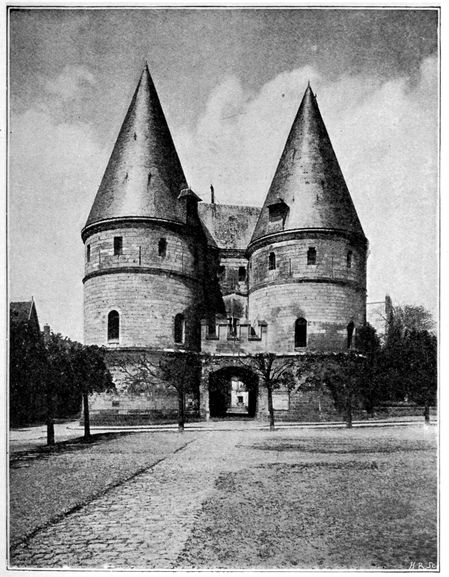
GATE TO THE PALACE OF CAUCHON, BISHOP OF BEAUVAIS.
“Since your Voices told you that you would come in 77the end to the Kingdom of Paradise, have you felt assured of being saved and of not being damned in Hell?”
“I believe firmly what my Voices have told me, that I shall be saved; I believe it as firmly as if I were already there.”
“After this revelation, do you believe that you cannot commit mortal sin?”[77]
“I do not know, and in all things I wait on Our Lord.”
“That is an answer of great weight!”
“Yes, and one which I hold for a great treasure.”
The same day, Wednesday, March 14th, in the afternoon. Present: Jean Delafontaine, Commissary, assisted by Nicolas Midi and Gerard Feuillet. Witnesses: Brother Ysambard de la Pierre and Jean Manchon.
And in the first place, Jeanne expressed herself thus:
“On the subject of the answer that I made to you this morning on the certainty of my salvation, I mean the answer thus: provided that I keep the promise made to Our Lord, to keep safe the virginity of my body and soul.”
“Have you any need to confess, as you believe by the revelations of your Voices that you will be saved?”
“I do not know of having committed mortal sin; but, if I were in mortal sin, I think that Saint Catherine and Saint Margaret would abandon me at once. I do not think one can cleanse one’s conscience too much.”
“Since you have been in the prison, have you never blasphemed or cursed God?”
“No; sometimes I said: ‘bon gré Dieu,’ or ‘Saint Jean,’ or ‘Notre Dame’: those who have reported otherwise may have misunderstood.”
78“To take a man at ransom, and to put him to death, while a prisoner, is not that mortal sin?”
“I never did it.”
“What did you do to Franquet d’Arras, who was put to death, at Lagny?”
“I consented that he should die if he had merited it, because he had confessed to being a murderer, thief, and traitor; his trial lasted fifteen days; he had for Judge the Bailly of Senlis and the people of the Court at Lagny. I had given orders to exchange this Franquet against a man of Paris, landlord of the Hôtel de l’Ours. When I learnt the death of the latter, and the Bailly told me that I should do great wrong to justice by giving up Franquet, I said to the Bailly, ‘As my man is dead, do with the other what you should do, for justice.’”
“Did you give, or cause to be given, money to him who took Franquet?”
“I am not Master of the Mint or Treasurer of France to pay out money so.”
“We recall to you:—1. That you attacked Paris on a Feast Day; 2. That you had the horse of my Lord the Bishop of Senlis; 3. That you threw yourself down from the Tower of Beaurevoir; 4. That you wear a man’s dress; 5. That you consented to the death of Franquet d’Arras: do you not think you have committed mortal sin in these?”
“For what concerns the attack on Paris, I do not think myself to be in mortal sin; if I have so done, it is for God to know it, and the Priest in confession. As to the horse of my Lord the Bishop of Senlis, I firmly believe I have not sinned against Our Lord: the horse was valued at 200 gold crowns, of which he received assignment; nevertheless, this horse was sent back to the Sire de la Trémouille, to restore it to my Lord of Senlis; it was no good for me to ride; besides, it was not I who took it; and, moreover, I did not wish to 79keep it, having heard that the Bishop was displeased that it had been taken from him, and, beyond all this, the horse was of no use for warfare. I do not know if the Bishop was paid, nor if his horse was restored to him; I think not. As to my fall from the Tower at Beaurevoir, I did not do it in despair, but thinking to save myself and to go to the help of all those brave folk who were in danger. After my fall, I confessed myself and asked pardon. God has forgiven me, not for any good in me: I did wrong, but I know by revelation from Saint Catherine that, after the confession I made, I was forgiven. It was by the counsel of Saint Catherine that I confessed myself.”
“Did you do penance for it?”
“Yes, and my penance came to me in great part from the harm I did myself in falling. You ask me if I believe this wrong which I did in leaping to be mortal sin? I know nothing about it, but refer me to God. As to my dress, since I bear it by command of God and for His service, I do not think I have done wrong at all; so soon as it shall please God to prescribe it, I will take it off.”
The following Thursday, March 15th, in the morning. Present: Jean Delafontaine, Commissary, assisted by Nicolas Midi and Gerard Feuillet. Witnesses: Nicolas de Houbent and Brother Ysambard de la Pierre.
First of all, Jeanne was charitably exhorted, warned, and required, if she had done anything which might be against our Faith, that she should refer it to the decision of Holy Mother Church.
“Let my answers,” she said, “be seen and examined by the Clergy: then let them tell me if there be anything against the Christian Faith. I shall know surely by my counsel what it is, and will say afterwards what shall be 80judged and decided. And, moreover, if there be anything wrong against the Christian Faith which Our Lord commanded, I should not wish to maintain it, and should be very sorry to be in opposition.”
Then we explained to her about the Church Triumphant and the Church Militant, and the difference between them. Required to submit to the decision of the Church Militant what she had said or done, whether of good or ill:
“I will not answer you anything more about it now,” she said.
“Upon the oath that you have taken, tell us, how did you think to escape from the Castle of Beaulieu between two planks of wood?”[78]
“Never was I prisoner in such a place that I would not willingly have escaped. Being in that Castle, I should have shut my keepers in the tower, if it had not been that the porter espied me and encountered me. It did not please God that I should escape this time: it was necessary for me to see the English King,[79] as my Voices had told me, as has been already said.”
“Have you had permission from God or your Voices to leave prison when it shall please you?”
“I have asked it many times, but I have not yet had it.”
“Would you go now, if you saw your starting-point?”
“If I saw the door open, I should go: that would be leave from Our Lord. If I saw the door open, and my 81keepers and the other English beyond power of resistance, truly I should see in it my leave and help sent me by Our Lord. But without this leave, I shall not go, unless I make a forcible attempt to go,[80] and so learn if Our Lord would be pleased: this on the strength of the proverb, ‘Help thyself, and God will help thee’: I say this in order that, if I do escape, no one may say I did so without God’s leave.”
“When you asked to hear Mass, did it not seem to you that it would be more proper to be in female dress? Which would you like best, to have a woman’s dress to hear Mass, or to remain in a man’s dress and not hear it?”
“Give me assurance beforehand that I shall hear Mass if I am in female attire, and I will answer you this.”
“Very well, I give you assurance of it: you shall hear Mass if you put on female attire.”
“And what say you, if I have sworn and promised to our King my Master, not to put off this dress? Well, I will answer you this: Have made for me a long dress down to the ground, without a train; give it to me to go to Mass, and then on my return I will put on again the dress I have.”
“I say it to you once again, do you consent to wear female attire to go and hear Mass?”
“I will take counsel on this, and then I will answer you: but I beseech you, for the honour of God and Our Lady permit me to hear Mass in this good town.”
“You consent simply and absolutely to take female attire?”
“Send me a dress like a daughter of your citizens—that is to say, a long ‘houppeland.’[81] I will wear it to go and hear Mass. I beseech you as earnestly as I 82can, permit me to hear it in the dress I wear at this moment and without changing anything!”
“Will you submit your actions and words to the decision of the Church?”
“My words and deeds are all in God’s Hands: in all, I wait upon Him. I assure you, I would say or do nothing against the Christian Faith: in case I have done or said anything which might be on my soul and which the clergy could say was contrary to the Christian Faith established by Our Lord, I would not maintain it, and would put it away.”
“Are you not willing to submit yourself in this to the order of the Church?”
“I will not answer you anything more about it now. Send me a cleric on Saturday; and, if you do not wish to come yourself, I will answer him on this, with God’s help; and it shall be put in writing.”
“When your Voices come, do you make obeisance to them as to a Saint?”
“Yes; and if perchance I have not done so, I have afterwards asked of them grace and pardon. I should not know how to do them such great reverence as belongs to them, for I believe firmly they are Saint Catherine and Saint Margaret. I believe the same of Saint Michael.”
“For those who are Saints of Paradise, offerings are voluntarily made of candles, etc.: have you never made an offering of lighted candles, or other things, to the Saints who come to you, in the Church or elsewhere, or had Masses said?”
“No, unless it be in the offering of the Mass, in the hands of the Priest, in honour of Saint Catherine, one of the Saints who appeared to me. I have never lighted as many candles as I wish to Saint Catherine and Saint Margaret, who are in Paradise; and I firmly believe it is they who come to me.”
83“When you place lights before the image of Saint Catherine, do you place them in honour of the one who appears to you?”
“I do it in honour of God, of Our Lady, and of Saint Catherine who is in Heaven, and of her who appears to me.”
“Do you place these lights in honour of Saint Catherine, who has shewn herself to you, who has appeared to you?”
“Yes, I make no difference between the one who has appeared to me, and the one who is in heaven.”[82]
“Do you always do, always accomplish, what your Voices command you?”
“With all my power I accomplish the command that Our Lord sends me through my Voices, in so far as I understand them. My Voices command nothing but by the good pleasure of Our Lord.”
“In warfare, have you done nothing without counsel of your Voices?”
“I have already answered you thereon: read your book again well, and you will find it. At the request of the men-at-arms, there was an assault made before Paris, and, at the request of the King himself, one also before La Charité. These were neither against nor by the order of my Voices.”
“Have you never done anything against their command and will?”
“All that I could and knew how to do, I have done and accomplished to the best of my power. As to the matter of the fall from the keep of Beaurevoir, I did it against their command; but I could not control myself. When my Voices saw my need, and that I neither knew how, nor was able, to control myself, they saved my life and kept me from killing myself. Whatever things I 84did in my greatest undertakings, they always helped me; and that is a sign they are good spirits.”
“Have you no other sign that they are good spirits?”
“Saint Michael assured me of it before the Voices came to me.”
“How did you know it was Saint Michael?”
“By the speech and language of the Angels. I believe firmly that they were Angels.”
“But how did you know it was the language of Angels?”
“I believed it at once, and I had the will to believe it. When Saint Michael came to me, he said to me: ‘Saint Catherine and Saint Margaret will come to thee; follow their counsel; they have been chosen to guide thee and counsel thee in all that thou hast to do: believe what they shall tell thee, it is the order of Our Lord.’”
“If the devil were to put himself in the form or likeness of an angel, how would you know if it were a good or an evil angel?”
“I should know quite well if it were Saint Michael or a counterfeit. The first time I was in great doubt if it were Saint Michael; and I was much afraid. I had seen him many times before I knew it was Saint Michael.”
“Why did you recognize him sooner that time, when you say you believed it was he, than the first time he appeared to you?”
“The first time I was a young child, and I was much afraid; afterwards, he had taught me so well, and it was so clear to me, that I believed firmly it was he.”[83]
“What doctrine did he teach you?”
“Above all things he told me to be a good child, and that God would help me,—to come to the help of the 85King of France, among other things. The greater part of what he taught me is already in the book in which you are writing: he told me of the great misery there was in the Kingdom of France.”
“What was the height and stature of this Angel?”
“On Saturday I will reply, with other things which I should answer, as it shall please God.”
“Do you not think it a great sin, and one which offends Saint Catherine and Saint Margaret who appeared to you, to act against their commands?”
“Yes, certainly; and the greatest I have ever committed, in my opinion, has been the leap from the Tower of Beaurevoir; for the which I have besought their mercy, and for all other offences I may have done against them.”
“Will Saint Catherine and Saint Margaret take bodily vengeance for this offence?”
“I do not know, and did not ask them.”
“You have asserted that, for speaking the truth, men were sometimes hanged: do you, then, know any crime or fault in yourself for which you should die, if you confessed it?”
“I know of none.”
The following Saturday, March 17th:—Present: Jean Delafontaine, Commissary, assisted by Nicolas Midi, and Gerard Feuillet, in the presence of Ysambard de la Pierre and of Jean Massieu.
The said Jeanne was required to take the oath already made by her. Afterwards, she was again interrogated:
“In what form, kind, size, and dress did Saint Michael come to you?”
“In the form of a true honest man [‘prud homme’]; of his dress and the rest I will say nothing more. As to the Angels, I saw them with my eyes; you will hear naught else about it. I believe the deeds and words of 86Saint Michael, who appeared to me, as firmly as I believe that Our Saviour Jesus Christ suffered Death and Passion for us. And that which makes me believe it, is the good counsel, comfort, and good doctrine which he has given me.”
“Will you, in respect of all your words and deeds, whether good or bad, submit yourself to the decision of our Holy Mother the Church?”
“The Church! I love it, and would wish to maintain it with all my power, for our Christian Faith; it is not I who should be prevented from going to Church and hearing Mass! As to the good deeds I have done and my coming to the King, I must wait on the King of Heaven, who sent me to Charles, King of France, son of Charles, who was King of France. You will see that the French will soon gain a great victory, that God will send such great doings that nearly all the Kingdom of France will be shaken by them. I say it, so that, when it shall come to pass, it may be remembered that I said it.”
“When will this happen?”
“I wait on Our Lord.”
“Will you refer yourself to the decision of the Church?”
“I refer myself to God Who sent me, to Our Lady, and to all the Saints in Paradise. And in my opinion it is all one, God and the Church; and one should make no difficulty about it. Why do you make a difficulty?”
“There is a Church Triumphant in which are God and the Saints, the Angels, and the Souls of the Saved. There is another Church, the Church Militant, in which are the Pope, the Vicar of God on earth, the Cardinals, Prelates of the Church, the Clergy and all good Christians and Catholics: this Church, regularly assembled, cannot err, being ruled by the Holy Spirit. Will you refer 87yourself to this Church which we have thus just defined to you?”
“I came to the King of France from God, from the Blessed Virgin Mary, from all the Saints of Paradise, and the Church Victorious above, and by their command. To this Church I submit all my good deeds, all that I have done or will do. As to saying whether I will submit myself to the Church Militant, I will not now answer anything more.”
“What do you say on the subject of the female attire which is offered to you, to go and hear Mass?”
“I will not take it yet, until it shall please Our Lord. And if it should happen that I should be brought to judgment, [and that I have to divest myself in Court,][84] I beseech the lords of the Church to do me the grace to allow me a woman’s smock and a hood for my head; I would rather die than revoke what God has made me do; and I believe firmly that God will not allow it to come to pass that I should be brought so low that I may not soon have succour from Him, and by miracle.”
“As you say that you bear a man’s dress by the command of God, why do you ask for a woman’s smock at the point of death?”
“It will be enough for me if it be long.”
“Did your Godmother who saw the fairies pass as a wise woman?”
“She was held and considered a good and honest woman, neither divineress nor sorceress.”
“You said you would take a woman’s dress, that you might be let go: would this please God?”
“If I had leave to go in woman’s dress, I should soon put myself back in man’s dress and do what God has commanded me: I have already told you so. For nothing in the world will I swear not to arm myself and put on a man’s dress; I must obey the orders of Our Lord.”
88“What age and what dress had Saint Catherine and Saint Margaret?”
“You have had such answers as you will have from me, and none others shall you have: I have told you what I know of it for certain.”
“Before to-day, did you believe fairies were evil spirits?”
“I know nothing about it.”
“Do you know if Saint Catherine and Saint Margaret hate the English?”
“They love what God loves: they hate what God hates.”
“Does God hate the English?”
“Of the love or hate God may have for the English, or of what He will do for their souls, I know nothing; but I know quite well that they will be put out of France, except those who shall die there, and that God will send victory to the French against the English.”
“Was God for the English when they were prospering in France?”
“I do not know if God hated the French; but I believe that He wished them to be defeated for their sins, if they were in sin.”
“What warrant and what help do you expect to have from Our Lord for wearing this man’s dress?”
“For this dress and for other things that I have done, I wish to have no other recompense than the salvation of my soul.”
“What arms did you offer at Saint Denis?”
“My whole suit of white armour [‘album harnesium suum;’ Gallicè, ‘un blanc harnoys,’] as beseems a soldier, with a sword I had won before Paris.”
“Why did you make this offering?”
“In devotion, and as is the custom of soldiers when they have been wounded. Having been wounded before 89Paris, I offered them at Saint Denis, because that is the war-cry of France.”
“Did you do it that these arms might be worshipped?”
“No.”
“What was the purpose of these five crosses which were on the sword that you found at Saint Catherine of Fierbois?”
“I know nothing about it.”
“Who prompted you to have painted on your standard Angels with arms, feet, legs, and clothing?”
“I have already answered you.”
“Did you have them painted as they came to see you?”
“No, I had them painted in the way they are painted in the Churches.”
“Did you ever see them in the manner they are painted?”
“I will tell you nothing more.”
“Why did you not have painted the brightness that comes to you with the Angels and the Voices?”
“It was not commanded me.”
The same day, March 17th, afternoon. Present: The Bishop and the Deputy Inquisitor, assisted by Jean Beaupère, Jacques de Touraine, Nicolas Midi, Pierre Maurice, Gerard Feuillet, Thomas de Courcelles, Jean Delafontaine; in presence of Brother Ysambard de la Pierre and John Gris.
We interrogated the said Jeanne, as follows:
“Did the two Angels painted on your standard represent Saint Michael and Saint Gabriel?”
“They were there only for the honour of Our Lord, Who was painted on the standard. I only had these two Angels represented to honour Our Lord, Who was there represented holding the world.”
90“Were the two Angels represented on your standard those who guard the world? Why were there not more of them, seeing that you had been commanded by God to take this standard?”
“The standard was commanded by Our Lord, by the Voices of Saint Catherine and Saint Margaret, which said to me: ‘Take the standard in the name of the King of Heaven’; and because they had said to me ‘Take the standard in the name of the King of Heaven,’ I had this figure of God and of two Angels done; I did all by their command.”
“Did you ask them if, by virtue of this standard, you would gain all the battles wherever you might find yourself, and if you would be victorious?”
“They told me to take it boldly, and that God would help me.”
“Which gave most help, you to your standard, or your standard to you?”
“The victory either to my standard or myself, it was all from Our Lord.”
“The hope of being victorious, was it founded on your standard or on yourself?”
“It was founded on Our Lord and nought else.”
“If any one but you had borne this standard, would he have been as fortunate as you in bearing it?”
“I know nothing about it: I wait on Our Lord.”
“If one of the people of your party had sent you his standard to carry, would you have had as much confidence in it as in that which had been sent to you by God? Even the standard of your King, if it had been sent to you, would you have had as much confidence in it as in your own?”
“I bore most willingly that which had been ordained for me by Our Lord; and, meanwhile, in all I waited upon Our Lord.”
91“For what purpose was the sign you put on your letters and these words: ‘Jhesus Maria’?”
“The clerks who wrote my letters put it; some told me that it was suitable for me to put these two words: ‘Jhesus Maria.’”
“Was it never revealed to you that if you lost your virginity, you would lose your happiness, and that your Voices would come to you no more?”
“That has never been revealed to me.”[85]
“If you were married, do you think your Voices would come?”
“I do not know; I wait on Our Lord.”
“Do you think, and do you firmly believe, that your King did right in killing, or causing to be killed, my Lord the Duke of Burgundy?”
“It was a great injury to the Kingdom of France; and, whatever there may have been between them, God sent me to the help of the King of France.”
“As you have declared to my lord of Beauvais that you will reply to him and his Commissioners as you would before our most holy Lord the Pope, and as there are many questions which you will not answer, would you reply before the Pope more fully than before us?”
“I have answered you all the truth that I know; and if I know anything which comes to my memory that I have left unsaid, I will tell it willingly.”
“Does it not seem to you that you are bound to reply more fully to our Lord the Pope, the Vicar of God, on all that might be asked you touching the Faith and the matter of your conscience, than you should to us?”
“Very well; let me be taken before him, and I will answer before him all I ought to answer.”
“Of what material was one of your rings, on which was written ‘Jhesus Maria’?”
92“I do not exactly know; if it were of gold, it was not fine gold; I do not know if it were of gold or of brass; there were three crosses on it, and no other mark that I know of, except ‘Jhesus Maria.’”
“Why was it that you generally looked at this ring when you were going into battle?”
“For pleasure, and in honour of my father and mother; I had that ring in my hand and on my finger when I touched Saint Catherine as she appeared to me.”
“What part of Saint Catherine?”
“You will have no more about it.”
“Did you ever kiss or embrace Saint Catherine or Saint Margaret?”
“I have embraced them both.”
“Did they smell good?”
“It is well to know, they smelled good.”
“In embracing them, did you feel any heat or anything else?”
“I could not have embraced them without feeling and touching them.”
“What part did you kiss—face or feet?”
“It is more proper and respectful to kiss their feet.”
“Did you not give them crowns?”
“In their honour, I often put crowns on their images in the Churches. As to those who appeared to me, I never gave any to them that I can remember.”
“When you placed crowns of flowers on the tree of which you spoke before, did you put them in honour of those who appeared to you?”
“No.”
“When these Saints came to you, did you do them no reverence? did you bend the knee before them? did you bow?”
“Yes: and, so far as I could do them reverence, I did; I know it is they who are in the Kingdom of Paradise.”
93“Do you know nothing of those who came in the air with the fairies?”
“I have never done or known anything about them; but I have heard of them, and that they came on Thursdays; but I do not believe it; I think it is sorcery.”
“Did not they wave your standard round the head of your King when he was consecrated at Rheims?”
“No, not that I know of.”
“Why was it taken to the Church of Rheims for the consecration more than those of other captains?”
“It had shared the pain, it was only right it should share the honour.”
Meeting at the Bishop’s house of the Doctors and Assessors to consider the Case. Sunday of the Passion of our Saviour, 18th day of the month of March. The Bishop and Jean Lemaître, assisted by twelve Assessors, present.
We, the said Bishop, shewed that Jeanne had lately been questioned during eight days, and that a great number of her replies had been put in writing; to-day we have need of the opinion of the Assessors as to the mode of procedure.
Then We caused to be read a great number of assertions which, by Our order, have been extracted by several Masters from the answers of Jeanne: so that, by means of these assertions, they, the said Assessors, will be able the better to take up the Process as a whole, and thus decide more certainly on what remains to be done.
After this shewing, the said Lords and Masters did deliberate with great solemnity and maturity; and each of them did give us his opinion.
We, the Judges, did then conclude and give order as follows:
Each of the Doctors and Masters shall have the matter to examine and study for his own part in all diligence, 94and to make research in authentic books for the opinion of the Doctors on each of the said assertions. On Thursday next, We will re-assemble anew to confer upon them. On that day, each one shall submit to Us his opinion.
Besides this, we have given orders that between this and then shall be extracted from the questions and answers of Jeanne certain Articles, which shall be moved against her in the Court before Us, the Judges.
[The Seventy Articles prepared by the Promoter, which form the Act of Accusation for the Trial in Ordinary, were read to Jeanne by Thomas de Courcelles, on Tuesday, March 27th. These Articles will be found, with Jeanne’s replies to them, in the Appendix. The Seventy Articles were afterwards reduced to Twelve by Maître Nicolas Midi. These are given in the Appendix, p. 341.]
Another Meeting in the Bishop’s house, in which it is decided to compile Articles from the said Extracts.
And the following Thursday, 22nd March, under the presidence of Us, the Bishop, and Maître Jean Lemaître, assisted by 23 Assessors.
In presence of the above, have been reported sundry assertions gathered and considered in the matter, in a notable and scientific manner, by many Doctors and Masters. In view of these assertions, after having the opinions conferred thereon at length with each of the Assessors, We, the Judges, did conclude and give order that the assertions thus extracted from the register of the declarations of Jeanne shall be drawn up in a very small number of Articles under the form of propositions; that the Articles thus prepared shall be communicated at once to all and each of the Doctors and Masters, who can thus the more easily pronounce their opinion.
On the question of whether Jeanne ought to be 95again interrogated and examined later on, We will proceed in such sort, with the help of Our Lord, that Our case may be conducted to the praise of God and the exaltation of the Faith, being affected by no blemish.
The questions are read to Jeanne in prison.
On the following Saturday, March 24th, in the prison of Jeanne; Maître Jean Delafontaine, Commissioner for Us, the Bishop, and Brother Jean Lemaître; assisted by J. Beaupère, N. Midi, P. Maurice, G. Feuillet, Thomas de Courcelles, Enguerrand de Champrond.
In presence of the above-named, We caused to be read to Jeanne the Register which contained the questions made to her and her answers. This reading was made in the presence of the said Jeanne by G. Manchon, Registrar, and in the French language.
But before proceeding to this reading, Our Promoter, Messire d’Estivet, offered to prove, in case Jeanne should not recognize some of her answers, that all the contents of the said Register, questions and answers, had been pronounced as they were there written. And on her side, Jeanne made oath that, during the reading, which was about to be made, she would add or change nothing in her answers that was not the truth.
The Register was then read. In one place during the reading, Jeanne said:
“I have as surname d’Arc or Rommée: in my country the girls take the name of their mother.”
Further on, she said:
“Let the questions and answers, all that has to be read, be read without stopping: if I do not contradict at all, I hold it true and acknowledged.”
On the subject of the passage relative to her dress, she said in addition:
“Give me a woman’s dress to go and rejoin my mother; 96I will take it that I may get out of prison, because when I am outside I will consider as to what I should do.”
The reading of the contents of the said Register being finished, she said:
“I believe certainly to have so spoken as it is written in the Register, and as has been read; I do not contradict on any point.”
Exhortation to Jeanne.
Palm Sunday, 25th day of March, in the morning, in the prison of Jeanne, in the Castle of Rouen, We, the Bishop, did make an address to Jeanne, in the presence of the venerable Lords and Masters, J. Beaupère, N. Midi, P. Maurice, Thomas de Courcelles.
We told her, that many times already and notably yesterday, she had requested, because of the solemnity of these days and the time, that she might be permitted to hear Mass to-day, Palm Sunday; in consequence, We were come to ask her if, supposing this favour were accorded to her, she would consent to put off her man’s dress, and to take the dress of a woman, as formerly she had been accustomed to wear it in her birth-place, and as worn by all the women of her country?
The said Jeanne answered by again asking of Us permission to hear Mass in the dress she now wears, and in the same dress to receive the Eucharist on Easter Day.
“Reply,” We said to her, “to what we ask you; tell us, in the event of your being permitted to hear Mass, if you will consent to abandon the dress you wear.”
“I have not consulted thereon,” she said, “and cannot yet take a woman’s dress.”
“Do you wish to have counsel of your Saints to know if you ought to take woman’s garments?”
“May I not then,” she said, “be permitted to hear 97Mass in the state in which I am? I desire it ardently! As to changing my dress, I cannot: it is not in my power.”
All the Assessors then joined themselves with Us, and each exhorted her, for so great a benefit, and to satisfy the feeling of devotion with which she seemed animated, to consent to take the only garment which was suitable to her sex.
“That,” she declared, “is not in my power: if it were, it would soon be done!”
“Speak of it to your Voices,” said the Assessors, “to know if you may again take your woman’s dress, in order that at Easter you may receive the Viaticum.”
“I cannot change my dress: I cannot therefore receive the Viaticum. I beg of you, my Lords, permit me to hear Mass in man’s dress; this dress does not weigh upon my soul, and is not contrary to the laws of the Church.”
Of all the preceding, Master Jean d’Estivet, Promoter, hath asked that there may be delivered to him a Public Instrument, in the presence of the Lords and Masters, Adam Hillet, William Brolbster, and Pierre Orient, of the Clergy of Rouen, London and Châlons, respectively.
98
THE TRIAL IN ORDINARY
Here begins the Trial in Ordinary, after the Trial Ex-Officio.
Monday after Palm Sunday, 26th day of March, in Bishop’s House. Present: The Bishop and Brother Jean Lemaître, assisted by 12 Assessors.
In presence of the above, We caused to be read certain Articles comprising that one which the Promoter intendeth to produce against Jeanne.
After the reading of these Articles, it was decided that, following the preliminary trial until now conducted from our Office, as We, the Bishop, and subsequently We, the Deputy, have decreed and concluded, it will be expedient to proceed henceforward by an action in Ordinary.
It was also decided that the Articles just read have been well put together; that Jeanne should be questioned and heard upon each of them; that these Articles shall be proposed, in the name of the Promoter, by some grave advocate, or by the Promoter himself; that if Jeanne should refuse to answer after a Canonical monition shall have been addressed to her, as a preliminary, the said Articles shall be held as acknowledged.
Following on this decision, We, the Judges, gave order that the Articles of which we treat shall, from to-morrow 99be proposed by our Promoter; and that Jeanne should be, in like manner, interrogated upon each of them and heard in answer.
The Promoter presents his petition.
The next day, Tuesday after Palm Sunday, 27th day of March, in the room near the Great Hall of the Castle of Rouen. The Promoter opened the case. Present: The Bishop and Brother Jean Lemaître, assisted by 38 Assessors.
He then shewed the text of the accusation drawn up by him against Jeanne, in the which are found stated the Articles just spoken of, and of which the tenour shall be written below.
This done, We, the Judges, did request the Lords and Masters here present to deliberate and to give Us their opinion.
This deliberation[86] took place in presence of Jeanne, as follows:
And first, Maître Nicolas de Venderès said: that Jeanne should in the first place be compelled to swear what the Promoter hath rightly demanded; that should Jeanne refuse to swear, she be accounted contumacious and excommunicate, and be proceeded against according to law.
Maître Jean Pinchon: That the Articles should first be read to her.
Maître Jean Basset: That the Articles should be read to her before she be excommunicated.
Maître Jean Guerin: Agrees with preceding.
Maître Jean Delafontaine: Of the same opinion as M. Venderès.
Maître Geoffrey de Crotay: That she should be given at least three days before being declared excommunicate 100and convicted; in civil matters there is always a three days’ delay for taking the oath.
Maître Jean Ledoux: Agrees with preceding.
Maître Gilles Deschamps: That the Articles should be read to her, and that a day should be assigned for her to answer.
Maître Robert Barbier: Agrees with preceding.
The Lord Abbot of Fécamp: She is bound to speak the truth on what touches the Case; that, if she has not already been summoned to that effect, she be so summoned with the due legal interval.
Maître Jean de Châtillon: She is bound to speak the truth, her own affairs being in question.
Maître Erard Ermengard: Agrees with the Abbot of Fécamp.
Maître Guillaume Lebouchier: Agrees with the preceding.
The Lord Prior of Longueville: For those things to which she does not know how to answer, it seems to be exacting too much to wish her to reply by “I believe” or “I do not believe.”
Maître Jean Beaupère: To questions of fact on which she has certain knowledge she should reply at once; to others, on which she has not certain knowledge or which relate to law, delay should be granted if she asks for it.
Maître Jacques de Touraine: Agrees with the preceding.
Maître Nicolas Midi: The same, with this addition: That the Jurists should be consulted in order to decide if she should be constrained to swear from the present time.
Maître Maurice Duguesnay: The same as the Abbot of Fécamp.
Maître Jean de Nibat: As to the Articles he would refer to the Jurists; as to the oath, she is bound to swear regarding such things as touch on the Trial or the 101Faith; if on other subjects she should ask delay, let it be granted to her.
Maître Jean Lefevre: Refers to the Jurists.
Maître Pierre Maurice: She should answer to what she knows.
Maître Gerard: She is bound to reply on oath.
Maître Jacques Guesdon: Agrees with preceding.
Maître Thomas de Courcelles: She should answer; each Article should be read to her, and she should answer them in order. As to delay, it should be granted to her on such points of the subject as she should request it.
Maître André Marguerie: She ought to swear on what touches the Case: as to doubtful points she should be allowed delay.
Maître Denis Gastinel: She ought to swear; the Promoter is right to demand her oath; as to what action should be taken in case she should refuse, it would be necessary for him to consult his books.
Maître Aubert Morel, and Maître Jean Duchemin: She ought to swear.
The opinion of the others is lacking.
Then We, the Judges, considering the request of the Promoter, by the advice of each of the Assessors, gave order, and do give order, that the Articles just produced by the Promoter shall at once be read and shewn in French to the said Jeanne, who, on each of them, shall answer according to knowledge; and if there are any points on which she asks delay, delay of right shall be granted to her.
Then the Promoter did abjure all calumny—that is to say, affirmed upon oath, that he was not led to bring these Articles against the said Jeanne by favour, rancour, hate or fear, but was solely animated by zeal for the Faith.
These preliminaries being completed, We, the Bishop 102did address to Jeanne a Canonical Admonition. We told her that all the Assessors were ecclesiastical persons of consummate knowledge, experts in law, human and divine, who desired and intended to proceed against her, as they had already done up to this time, with kindness and piety, and that, far from seeking vengeance or punishment, they desired, on the contrary, only her instruction and return into the way of truth and salvation. “But because you are neither well enough taught nor instructed in these arduous matters, by yourself, to provide what you should do or say, We offer you to choose for counsel such of the Assessors as you shall be pleased to point out; if you do not of yourself know how to make this choice, We offer to do it for you, and to point out to you some who will counsel you on what you have to answer or do, on the condition always, that in matters of pure faith you will answer yourself, and charging you to swear to speak the truth on those things which are personal to yourself.”
To Our exhortation, Jeanne replied in these terms:
“First, as to that on which you admonish me for my good and for our Faith, I thank you and all the company also; as to the counsel which you offer me, also I thank you; but I have no intention of desisting from the counsel of Our Lord. As to the oath that you wish me to make, I am ready to speak the truth on all that touches the Case.”
And thus did she swear, her hands on the Holy Gospels.
After this, by Our order were read the Articles contained in the document which the Promoter hath just deposited. Each of these Articles was read to Jeanne in the French language by Thomas de Courcelles; and she was called upon to reply in succession to each of these Articles: which she did. The completion of this 103formality hath filled up the end of the Sitting for this day, and all the Sitting of the next day.
Jeanne is interrogated in prison on submission to the Church.
And the following Saturday, the last day of the month of March, Easter Eve, under the presidency of Us, the aforesaid Judges, in Jeanne’s prison, being assisted by the Lords and Masters, Jean Beaupère, J. de Touraine, N. Midi, P. Maurice, G. Feuillet, G. Haiton, and T. de Courcelles; Guillaume Muton and John Gris, witnesses:
Jeanne hath been questioned as follows, touching sundry points on which she did, as hath been seen, ask delay for reply:
“Will you refer yourself to the judgment of the Church on earth for all you have said or done, be it good or bad? Especially will you refer to the Church the cases, crimes, and offences which are imputed to you and everything which touches on this Trial?”
“On all that I am asked I will refer to the Church Militant, provided they do not command anything impossible. And I hold as a thing impossible to declare that my actions and my words and all that I have answered on the subject of my visions and revelations I have not done and said by the order of God: this, I will not declare for anything in the world. And that which God hath made me do, hath commanded or shall command, I will not fail to do for any man alive. It would be impossible for me to revoke it. And in case the Church should wish me to do anything contrary to the command which has been given me of God, I will not consent to it, whatever it may be.”
“If the Church Militant tells you that your revelations are illusions, or diabolical things, will you defer to the Church?”
104“I will defer to God, Whose Commandment I always do. I know well that that which is contained in my Case has come to me by the Commandment of God; what I affirm in the Case is, that I have acted by the order of God: it is impossible for me to say otherwise. In case the Church should prescribe the contrary, I should not refer to any one in the world, but to God alone, Whose Commandment I always follow.”
“Do you not then believe you are subject to the Church of God which is on earth, that is to say to our Lord the Pope, to the Cardinals, the Archbishops, Bishops, and other prelates of the Church?”
“Yes, I believe myself to be subject to them; but God must be served first.”
“Have you then command from your Voices not to submit yourself to the Church Militant, which is on earth, nor to its decision?”
“I answer nothing from my own head; what I answer is by command of my Voices; they do not order me to disobey the Church, but God must be served first.”
“At the Castle of Beaurevoir, at Arras or elsewhere, had you any files?”
“If any were found upon me, I have nothing to say.”
This done we did retire, postponing to another day the continuation of this present Trial for Belief.
Choice is made of assertions on which the deliberation should bear, and these assertions are drawn up in Twelve Articles.
The Monday, Tuesday, and Wednesday after Easter, the 2nd, 3rd, and 4th of April, in the year of Our Lord, 1431.
We, the Judges, have convoked sundry Doctors and Masters with whom we have carefully examined the Seventy Articles which have been recently transcribed, 105together with the questions and answers of Jeanne, attached to each of these Seventy Articles.
This examination carried out, We did decide that it is expedient to extract from this collection certain assertions and propositions, and to embody these assertions and propositions in Twelve Articles only, which shall thus comprehend, in a summary and succinct manner, the greater part of the sayings of the Accused.
These Twelve Articles having been prepared, We, the Judges, did decree that it is expedient to transmit these Articles to the Doctors, and others, expert in laws Divine and human, in order to have from them, for the benefit of the Faith, advice and counsel on the character of the assertions therein contained. [The Twelve Articles of Accusation will be found in the Appendix, p. 366.]
The Twelve Articles are sent to the Committee.
The following Thursday, April 5th, We, the Judges, sent the Articles in question to each of the Doctors and Masters having knowledge thereof, whom we knew were to be found in this town. We accompanied our missive with a letter of requisition for each of them, couched in these terms:
“We, Pierre, by the Divine mercy Bishop of Beauvais, and Brother Jean Lemaître, Vicar of the Inquisition, To you, such an one [here followeth the name, surname, and quality of the Doctor or Master], we pray you, and for the good of the Faith, require you, that before Tuesday next you will give us in writing and under your seal wholesome counsel on the subject of the assertions borne in the Twelve Articles hereto annexed, in order to know if, the said assertions being by you maturely weighed, considered, and compared, all or any of them seem to you contrary to the Orthodox Faith, or, on any point contrary to Holy Writ, to the decisions 106of the Holy Roman Church, to the decisions of Doctors approved by the Church, or to the Canonical sanction; and if all or any seem to you scandalous, audacious, disturbing to the Commonwealth, injurious, criminal, contrary to good manners, or culpable in any other manner whatsoever; and in effect for you to say what appears to you should be enacted with regard to them in a matter of Faith. Written at Rouen, Thursday after Easter, April 5th, the year of our Lord, 1431.”
Exhortations and Admonitions.
Private Exhortation by the Bishop.
Wednesday, 18th day of April, We, the Judges, having cognizance already by the deliberations and opinions of a great number of Doctors in Theology and in Canon Law, of Licentiates and other Graduates, of the many and considerable errors brought out in the replies and assertions of the said Jeanne, and knowing that she doth expose herself, if she doth not correct herself, to serious dangers:
For this reason, We did decide to exhort her charitably, to admonish her gently, and to cause her to be gently admonished by many men of knowledge and probity, Doctors and others, in order to lead her back into the way of truth and to a sincere profession of our Faith.
To this end, We did to-day repair to the place of her prison, having with us Guillaume Lebouchier, Jacques de Touraine, Maurice de Quesnay, Nicolas Midi, Guillaume Adelie, Gerard Feuillet, and Guillaume Haiton.
In their presence We, the Bishop, did begin to speak to Jeanne, who declared herself ill.[87] We told her that 107the Doctors and Masters who accompanied Us were come to see her in a friendly and charitable way, to visit her in her suffering and to bring her consolation and comfort. Then, We recalled to her, that she had been during many days, and at divers times, and in presence of many ecclesiastics full of wisdom, questioned on points, grave and difficult, concerning the Faith; that she had made answers, varied and diverse, which wise and lettered men have examined with the most scrupulous attention; that they have noted many of her words and avowals which, from the point of view of the Faith, have appeared to them perilous; but that she is only a poor illiterate woman, who knoweth not the Scriptures. We come to her and We offer her learned and wise men, watchful and honest, who will give her, as is their duty, the knowledge which she hath not. And at the same time We did exhort the Doctors and Masters here present to give to Jeanne, counsel profitable to the salvation of her body and soul, and this in virtue of the duty which binds them to the doctrine of the true Faith. If Jeanne should know others who appear to her more apt than the Doctors here present, We offer to send them to her to counsel and instruct her on what she should do, maintain, and believe. We added that we are all Clergy, always disposed by vocation, will and inclination, to seek by all means the salvation of body and soul, absolutely, as we should do it for our nearest and for ourselves. We shall be happy to furnish her each day with such men to procure her the instruction that We owe her, and to do towards her all that the Church is accustomed to do in such circumstances, she who shutteth not the fold against the repentant lamb. 108Finally We told her to take into great consideration this admonition which We address to her for her salvation, and to follow it up efficiently: for, if she should act in opposition to Our words, if she should be obstinate in her own mind in consulting only her inexperienced brain, we must abandon her; and she can see to what peril she doth expose herself in this case. It is this peril which We seek to avoid for her with all the power of Our affection.
To which Jeanne hath answered:
“I thank you for what you say to me for my salvation. It seems to me, seeing how ill I am, that I am in great danger of death: if it be that God may do His pleasure on me, I ask of you that I may have confession, and my Saviour also, and that I may be put in holy ground.”
“If you will have the rights [droits] and Sacraments of the Church,” We said to her, “you must do as good Catholics do, and submit yourself to the Church. If you persevere in your intention of not submitting to the Church, you cannot have the Sacraments you ask administered to you, except the Sacrament of Penance, which We are always ready to give you.”
“I have for the moment nothing else to say to you.”
“The more you fear for your life, on account of the illness that you have, the more should you amend; you will not have the rights of a Catholic if you do not submit to the Church.”
“If my body dies in prison, I trust that you will have it put in holy ground; if you do not have it put there, I place my trust in God!”
“You said in your Trial that if you had said or done anything against the Christian Faith established by Our Lord, you would not maintain it.”
“I refer to the answer that I have made to that, and to Our Lord.”
109“You say you have had many revelations from God by Saint Michael, Saint Catherine and Saint Margaret: if any good person were to come affirming that he had revelations from God touching your mission, would you believe him?”
“There is no Christian in this world who could come to me and say he had had a revelation but that I should know if he were speaking truly or not; I should know it by Saint Catherine and Saint Margaret.”
“You imagine then that God can reveal nothing to any one which is unknown to you?”
“I know well that He can; but for me, I should not believe in this case any man or woman if I had not some sign.”
“Do you believe that the Holy Scriptures have been revealed by God?”
“You know it well; I know it well!”
“We summon you, We exhort you, We beseech you to take counsel of the Clerks and notable Masters here present, and to believe in the counsel that they will give you for the salvation of your soul. And once more We ask you if you will submit to the Church Militant your sayings and your doings?”
“Whatever may happen to me, I will do and say no other thing than what I have already said in the Trial.”
Here the venerable Doctors who were assisting Us did exhort her with the most lively instance and did strive to obtain from her that she would submit herself and her acts to the Church Militant. They cited to her a number of authorities taken from Holy Scripture, and shewed her numerous examples. They enlarged upon these authorities and these examples. One of the Doctors,[88] in his exhortation, brought forward this passage of Matthew, chapter xviii.: “If thy brother 110sin against thee, go and tell him his fault between thee and him alone”; and this other, “If he will not hear the Church, let him be unto thee as a heathen-man and a publican.” He shewed to Jeanne these truths in French, and said to her at the end, that if she would not submit to the Church and obey it, the Church must abandon her as an Infidel [sarrazine].
“I am a good Christian,” she answered, “I have been baptized; I shall die a good Christian!”
“As you ask that the Church should administer the Eucharist to you, why will you not submit to the Church? It would be administered to you at once.”
“Of this submission I will say no more than I have said: I love God, I serve Him; I am a good Christian; I wish to help and maintain the Church with all my power.”
“Do you not wish that a good and notable procession might be ordained to restore you to a good estate if you are not therein?”
“I desire that the Church and the Catholics should pray for me.”
Public Admonition by the Judges.
Wednesday, the 2nd day of May, the Judges held a sitting in the room of the Castle of Rouen near the Great Hall of the same Castle; assisted by 63 Assessors.
We, the Bishop, did first address to the above-named the following words:
“After having been thoroughly questioned, this woman hath had to reply to the Articles judicially prepared against her by the Promoter; then We have had a summary made of her avowals and declarations in a succinct and abridged form of assertions in Twelve Articles, which We have addressed to the Doctors and 111other persons consummate in knowledge of Theology, of Civil Law and of Canon Law, in order to have their advice. By the answers which many amongst them have for some time past been sending, We have been able to recognize that, in their eyes, this woman hath fallen short in many things: but nothing as regards this has as yet been decided by Us; and before We come to a final decision, many honest men, conscientious and wise, have thought it would be well to seek by all means to instruct her on the points in which she seems to be lacking, and to reinstate her in the way and knowledge of the truth. This result We have always desired, and We ardently desire it still. For We ought all to bend ourselves thereto, We who live in the Church, and in the ministration of holy things; We ought to strive to shew to this woman with all gentleness that she is, by her words and by her actions, outside the Faith, the truth, and religion, and to warn her charitably to think of her salvation.
“We were indeed penetrated with this idea when We attempted to convince her, in sending to her, divers times and privately, eminent Doctors, sometimes one, sometimes another. These Doctors have responded to our call with the greatest zeal, and have occupied themselves with her with the greatest gentleness, abstaining in every way from coercion. But the cunning of the Devil has continued to prevail, and their efforts have been able to produce nothing.
“Now that it has become certain to Us that private admonitions are of no effect with her, it appears to Us opportune to assemble you together in a solemn manner, in order that this woman should be admonished before you with gentleness and charity on the necessity of her return [to truth]. Perchance your presence and the exhortations of some among you will better induce her to humility and obedience, and turn her back from 112continuing obstinate in her own ideas; perchance she will believe the counsels of worthy men, of the wise, versed in the science of the laws, divine and human; she will cease to expose herself to the gravest dangers into which body and soul can fall.
“In order to address to her this solemn admonition, We have chosen an ancient Master in Theology, very learned and singularly well versed in these matters, Maître Jean de Châtillon, Archdeacon of Evreux, who, if it so please him, will shortly accept this charge of demonstrating clearly to this woman sundry points on the which her error is evident, according to what we have already gathered from the opinions which have reached Us, and who will persuade her to leave the criminal path where she now is, to return again to that of truth.
“It is for this purpose that this woman will be brought before you presently; she will, therefore, receive in your presence a solemn admonition. Now, if there be any one among you who thinketh that he hath anything to say or do which may facilitate her return, or instruct her in a manner profitable to the salvation of her body and soul, we beseech him not to hesitate to open himself to Us or to state his views publicly.”
Jeanne was then brought, and placed before the assembly.
We, the Bishop, in our name and in the name of the other Judge, did give her counsel to attend to the monitions about to be made to her by the aforesaid Lord Archdeacon, Professor in Sacred Theology, who was about to say many things profitable to the salvation of her body and soul, and that she ought to agree, for if she did not, she would expose herself to great dangers both soul and body.
Then we, the said Judges, did invite the said Lord Archdeacon to proceed with charity to the performance 113of the said monitions. Obeying our order, the said Lord Archdeacon did begin to instruct the said Jeanne, by shewing her a great number of things contained in a schedule whose tenour will be presently transcribed. He first shewed her that all the faithful in Christ are bound and obliged to believe the Christian Faith, and certain Articles of this Faith; and he did warn and beseech her, by means of a general monition, to correct and amend both herself and her deeds; he reminded her that this was the advice of the venerable Doctors and Masters of consummate experience and skill.
To this general monition, Jeanne replied:
“Read your book” [speaking of the writing which the Lord Archdeacon held in his hand], “read your book, then I will answer. I rely upon God, my Creator, for everything. I love Him with all my heart.”
Asked if she had anything more to say to this general monition, she replied:
“I rely on my Judge: He is the King of Heaven and earth.”
Afterwards the Lord Archdeacon, proceeding to special monitions, did, in conformity with a writing which he had under his eyes, speak as follows:
[Here follows, in the Original Documents, an Exhortation in Six Articles, addressed to Jeanne in the French language by the Archdeacon, on her submission to the Church, her dress, her Visions and Revelations.]
Jeanne replies to the Six Articles.
On the 1st and 2nd Article, she said:
“Thereupon I answer to-day as I have done before.”
On the subject of the Church Militant, she said:
“I believe indeed in the Church which is here below; but for my words and deeds, as I have said elsewhere, I rely on and refer me to the only God. I believe 114that the Church Militant cannot err or fail; but as to my words and deeds, I submit them and refer all to God, Who caused me to do what I have done. I submit me to God, my Creator, Who caused me to do all these things; I refer me to God thereupon and to my own self.”
“Do you mean by this to say that you have no judge on earth? Is not our Holy Father, the Pope, your judge?”
“I will say nothing else to you. I have a good Master, that is God; it is to Him I look in everything and to none other.”
“If you will not believe in the Church, if you will not believe that Article of the Creed, ‘the Church, One, Holy, Catholic,’ you will be declared a heretic and, by other judges, punished with the pains of fire.”
“I will say no more to you, and, if I saw the fire, I should say all that I am saying to you, and naught else.”[89]
“If a General Council—that is to say, our Holy Father the Pope, the Cardinals, Bishops and others—were here, would you not then refer and submit yourself to this Holy Council?”
“You shall drag nothing else from me upon this.”
“Will you submit to our Holy Father the Pope?”
“Take me to him, I will reply to him.” [She would answer no more.]
On the subject of the 3rd Article, she replied:
“As to my garments, I will indeed take a long dress and a woman’s hood to go to Church and to receive there the Sacrament of the Eucharist—as I said elsewhere—provided that, directly after, I may put off that dress and take again what I bear at this moment.” And when it was suggested to her that she had taken this dress without necessity, especially while in prison, 115she said: “When I have done that for which I am sent by God, I will resume woman’s dress.”
“Do you think you do well to wear a man’s dress?”
“I refer me to Our Lord.”
“Will you leave off wearing this dress and the believing that you do right in wearing it? Will you resume a woman’s dress?”
“I will do nothing different.”
On the subject of the 4th Article she replied:
“I have blasphemed neither God nor His Saints.”
“When Saint Catherine and Saint Margaret came to you, did you make the sign of the Cross?”
“Sometimes I made it, sometimes not.”
On the subject of the 5th Article she answered:
“As to my revelations, I refer me to my Judge—that is to say, to God. My revelations came to me from God direct.”
“On the subject of the sign given to your King, will you refer to the Archbishop of Rheims, to the Sire de Boussac,[90] to Charles de Bourbon, to the Seigneur de la Trémouille, and to Etienne, called La Hire, to whom or to some of whom you say that you shewed the crown, these being present when the Angel brought it to the King, who afterwards gave it to the Archbishop? or will you consent to refer to some of your party who may write under their seal about it?”
“Give me a messenger and I will write to them about this Trial.” [She would not believe in, or refer otherwise to them.]
On the subject of the 6th Article, she answered:
“I refer to my Judge—that is to say, to Our Lord—and to what I have before answered, which is written in the book.”
“If three or four Clergy of your party are sent to you, 116coming under a safe conduct, will you refer yourself to them on the subject of your apparitions and of all that is contained in your trial?”
“Let them come; I will answer.” [She would not refer nor otherwise submit to them on the subject of the trial.]
“Will you refer or submit yourself to the Church of Poitiers, where you were examined?”
“Do you think you will take me in that way, and draw me to you by it?”
Afterwards, to conclude, she was anew and in full, generally warned by the Lord Archdeacon to submit to the Church under pain of being abandoned by the Church. He said, and repeated to her, that, if the Church abandoned her, she would be in great peril both of body and soul, and would fall into danger of the pains of eternal fire as to her soul and, by sentence of other Judges, into danger of temporal fire for her body.
To which she answered:
“You will not do what you say against me without evil overtaking you, body and soul!”
“Tell us a reason, one only, why you should refuse to refer yourself to the Church.”
[But she would make Us no other answer.]
Afterwards, many Doctors and competent people of divers estates and faculties, set themselves to admonish and to counsel her with gentleness. They exhorted her to submit to the Church Universal, to our Holy Father the Pope, and to the Sacred General Council. They explained to her the peril to which she exposed both soul and body in refusing to submit herself and her deeds to the judgment of the Church Militant.
[She answered as before.]
And then We, the Bishop, told Jeanne to think well over it, to take good heed to the monitions, counsels, and exhortations which had just been made to her, and to reflect on them most seriously.
117Jeanne expressed herself thus:
“What time will you give me to think over it?”
We told her that she could think over it at once, and answer as she wished. But, as she would reply no more, we retired, and Jeanne was conducted back to prison.
Wednesday, May 9th, We, the Judges, being in the great Tower of the Castle of Rouen, assisted by the reverend Fathers, Doctors and Masters whose names follow: the Reverend Father Abbot of Corneille de Compiègne, Jean de Chatillon, Guillaume Erard, André Marguerie, Nicolas de Venderès, Guillaume Haiton, Aubert Morel, Nicolas Loyseleur, Jean Massieu: did cause Jeanne to be brought before us.
We did require and warn her:
To speak the truth to Us on divers and numerous points on which she hath hitherto refused to reply or hath replied untruthfully, the which are established in the highest degree by informations, proofs, and grave presumptions. A great number of these points were read and shewn to her. Then she was told that, if she would not tell the truth, she would immediately be put to the torture, the instruments of which were here, in this same tower, under her eyes. There also were present the executioners, who by Our order had made all the necessary preparations for torturing her, in order to bring her back by this means into the way and knowledge of the truth, and thus to procure for her salvation both of body and soul, which she doth expose to such grave peril by her lying inventions.