Part 2 — APPENDIX (continued 2)
Reading edition
ARTICLE VIII.
The same woman doth say and affirm that she, of herself, no one compelling her, did throw herself down from a very high tower, wishing rather to die than to be placed in the hands of her enemies and to live after the destruction of the town of Compiègne. She saith also that she was not able to avoid this fall, 370although Saint Catherine and Saint Margaret had forbidden it to her. To offend them is, she herself saith, a great sin. But she knoweth that this sin was remitted to her after she had confessed it; she saith she received revelation of this.
ARTICLE IX.
The same woman saith that Saint Catherine and Saint Margaret have promised to conduct her to Paradise, if she doth preserve with care the virginity of body and soul which she vowed to them. Of this she saith she is as assured as if she were already in the glory of the blessed. She doth not think she hath committed mortal sin; for, if she were in a state of mortal sin, she saith it seemeth to her that Saint Catherine and Saint Margaret would not visit her each day as they do.
ARTICLE X.
The same woman doth say and affirm that God doth love sundry persons still living, designated by her and named, more than He doth this woman: this, she knoweth by revelation from Saint Catherine and Saint Margaret, who speak frequently to her, but in French and not in English, because these Saints are not on the side of the English. Since she hath known by revelation that their Voices were for the Prince aforesaid she hath ceased to love the Burgundians.
ARTICLE XI.
The same woman doth say and confess that to the Voices and the Spirits now under consideration, whom she calls Michael, Gabriel, Catherine and Margaret, she doth often do reverence, uncovering, bending the knee, kissing the earth on which they walk, vowing to them her virginity, at times kissing and embracing Saint Catherine and Saint Margaret; she hath touched them with her own hands, corporeally and physically; she hath asked of them counsel and help; at times she doth call them, and they even come to her without being called; she accedes to and obeys their counsels and their commands; she hath always obeyed them, without having asked counsel thereon from whomsoever it be—father, mother, curé, prelate, or any ecclesiastic whatsoever. She doth believe no less firmly that the Voices and the revelations she receives by the medium of the Saints of whom she speaks come from God and by His order: she believes it as firmly as she believes the Christian Faith and that Our Lord Jesus Christ suffered for us Death and Passion. She doth add that, if it were an evil spirit who had come to her 371under the appearance and mask of Saint Michael she would quite well have known how to distinguish that it was not Saint Michael. Finally she saith, that of her own wish and without any one pressing her thereto, she hath sworn to Saint Catherine and Saint Margaret, who appeared to her, to reveal to no one the sign of the crown given to the Prince to whom she was sent, until she should have permission from God to reveal it.
ARTICLE XII.
The same woman doth say and confess that if the Church wished that she should do anything contrary to the order she doth pretend to have received from God, she would not consent, whatsoever it might be. She doth affirm that she knows well, that all contained in her Trial has come to her by the order of God, and it would be impossible for her to do contrary to what she doth. Thereupon she doth not wish to refer to the decision of the Church Militant, nor to any one, whoever it be in the world, but to God alone, Our Lord, Whose commands she doth always execute, above all in what doth concern her revelations, and in what she doth in consequence. This answer and all the others are not from her own head, she saith, but she hath made and given them by order of her Voices and revelations: she doth persist [in this], although by the Judges and others of the Assessors, the Article of Faith, ‘The Church, One, Holy, Catholic,’ hath often been recalled to her, and it hath often been shewn to her that all the faithful are bound to obey the Church Militant and to submit to it their words and actions—above all in matters of faith and in all which concerns sacred Doctrine and Ecclesiastical sanction.
INTRODUCTORY NOTE TO THE REHABILITATION.
It was not until nearly twenty years after the death of Jeanne d’Arc that any attempt was made by those in authority to vindicate her memory or even to acknowledge the services she had rendered to the kingdom of France.
In 1450, however, after the occupation of Normandy and the submission of the town of Rouen, the idea appeared to have occurred to Charles VII. that to suffer the stigma of heresy and witchcraft to rest on the name of the Maid of Orleans, who had “led him to his anointing,” was to throw a doubt upon his own orthodoxy, and to justify the taunt of his enemies that he had been the mere tool of “a lyme of the Fiend.” On February 13th, 1450, therefore, he issued a Declaration empowering one 372of his Counsellors, Guillaume Bouillé, to enquire into the conduct of the Trial undertaken against Jeanne by “our ancient enemies the English,” who, “against reason, had cruelly put her to death,” and to report the result of his investigations to the Council.
Bouillé was Rector of the University of Paris, Dean of the Theological Faculty, Dean of Noyon, a Member of the Great Council, and at one time Ambassador to Rome. It is very probable that he was the author of the first memorial issued in favour of Jeanne, throwing doubts upon the validity of the Rouen sentence—a memorial which, according to some, was prior to the Enquiry of 1450 with which we are now dealing.
It was to an able and competent person therefore, that Charles committed the Enquiry, which was held at Rouen on March 4th and 5th, less than three weeks after the issue of the Royal Mandate.
Seven witnesses were heard; namely, Toutmouillé, de la Pierre, Ladvenu, and Duval,—all Dominicans of Saint Jacques, Rouen; the Notary Manchon, the Usher Massieu, and Beaupère, one of the chief Examiners. But the Court took no further interest in the matter; and, although in the opinion of several legal authorities consulted by De Bouillé, the Process of Condemnation was held as null and void, the proceedings were carried no further: the Enquiry was forwarded to the King and Council, and the whole question once more fell into abeyance.
Two years later, the Cardinal-Bishop of Digne, Guillaume d’Estouteville, Legate in France for Pope Nicholas V. took up the Enquiry, at the formal request of Isabel d’Arc, mother of the Maid, who claimed, on Civil as well as on Ecclesiastical authority, the rehabilitation of her daughter, and the restoration of the family to the position they had lost by the imputation of heresy cast on them in the person of one of their number.
The failure of the former Enquiry was due, in great part, to the fear of arousing the hostility of the English, and also of meeting with opposition from the Ecclesiastical authorities, by bringing forward an action instituted by the Sovereign against proceedings which had received the unquestioned sanction of the Holy Office and the University of Paris, and which were also guaranteed by the protection of the English King. The expedient of shifting the entire responsibility on to the shoulders of the d’Arc family obviated these difficulties, and enabled the Case to be taken as a purely private one, an appeal against a judgment given on false premisses. The reversal of this verdict could offend no one, as the action was brought against Defendants none of whom were living to meet the charge, and who could therefore be represented only by their titular legal successors. Their innocence in the whole matter made the case a perfectly 373harmless one—a legal fiction which might satisfy many and could injure none.
The first act of the Cardinal d’Estouteville was to associate with himself the Prior of the Convent of the Jacobins at Paris, Jean Bréhal, Inquisitor of France; and, together, they proceeded to an Enquiry at Rouen in April, 1452, at which witnesses to the number of twenty-one, including some of those heard in 1450, gave their evidence. The Cardinal being obliged by his duties to leave Rouen, the Enquiry was left in the hands of Bréhal and of Philippe la Rose, the Treasurer of the Cathedral. There were still difficulties in the way. The Pope feared to wound English susceptibilities; and, in spite of the efforts of the Cardinal and of the petition presented to Rome by Isabel d’Arc and her two sons, the proceeding languished; and three more years passed without any definite step being taken.
In 1455, however, the Pope Nicholas V. died, and his successor Calixtus III. [Borgia], less timorous, acceded to the request of the d’Arc family, granting a Rescript authorizing the process of revision, and appointing as delegates for the Trial the Archbishop of Rheims (Jean Jouvenal des Ursins), the Bishop of Paris (Guillaume Chartier), and the Bishop of Coutances (Richard de Longueil), who afterwards associated with themselves the Inquisitor, Jean Bréhal.
The Case was solemnly opened on November 7th, 1455, in the Church of Notre Dame at Paris, when the mother and brothers of the Maid came before the Court to present their humble petition for a revision of her sentence, demanding only “the triumph of truth and justice.” The Court heard the request with some emotion. When Isabel d’Arc threw herself at the feet of the Commissioners, shewing the Papal Rescript and weeping aloud, while her Advocate, Pierre Maugier, and his assistants prayed for justice for her and for the memory of her martyred daughter, so many of those present joined aloud in the petition, that at last, we are told, it seemed that one great cry for justice broke from the multitude.
The Commissioners formally received the petition, and appointed November 17th, ten days later, for its consideration, warning the Petitioners of the possible danger of a confirmation of the previous Trial, instead of the reversal they looked for, but promising careful consideration of the Case should they persist in their appeal.
On November 17th the Court met a second time at Notre Dame; the Papal Rescript was solemnly read, and the Advocate for the Petitioners brought his formal accusation against the Judges and Promoter of the late Trial—none of whom, as has been said, were then alive—carefully excluding the Assessors concerned in the case, who, he said, were led to wrong conclusions 374by false deductions. At the close of the Advocate’s address, the Archbishop of Rheims and the Bishop of Paris declared themselves ready to act as Judges in the Appeal Case, in conjunction with the Inquisitor Bréhal, appointing the following December 12th for the inaugural sitting, and citing all those concerned in this Case to appear before them on that day.
The Trial opened on December 12th. The family of d’Arc were represented by the Procurator, Guillaume Prévosteau, who had formerly been appointed Promoter in the case instituted by Cardinal d’Estouteville: but the Plaintiffs alone were represented, no one appearing to answer for either of the accused Judges nor for the Promoter d’Estivet. The Case was adjourned until December 15th, in order that Advocates for the Defendants might be summoned to appear.
The Court met accordingly on the 15th December; but, in spite of mandates and citations placed on Church-doors and other public places, no one was found to come forward as representatives of the accused; and a further delay of five days was therefore granted. At the same time, the Commissioners formally constituted the Tribunal and appointed their Officers: Simon Chapitault as Promoter or Advocate-General, Ferrebouc and Lecomte as Registrars for the Court. The Registrars of the former Trial, being present, were asked if they wished in any way to defend the Process in which they had been concerned; but, on their replying in the negative, they were requested to lay before the Court any documents relating to the previous Trial which they might have in their possession. By this means the Commissioners were enabled to have before them the actual Minute of the Trial of 1431, written in Manchon’s own hand and presented by him, and also to obtain his formal attestation of the authenticity of the Official Procès-Verbal, upon which their further enquiries were to be based.
The “Preliminary Enquiry” made in 1452, by command of the Cardinal d’Estouteville and his delegates, was formally annexed, by request of the Promoter, to the official documents of the Trial of Rehabilitation; but the earlier Enquiry of 1450, having been made under secular authority, was unfortunately treated as of no value, and not included in the authorized Case.
On December 18th the Promoter lodged his request on the part of the family of d’Arc, and prayed for a Judgment of Nullity on the previous sentence, on the ground that, both in form and substantiation, it was null and void, and that it should therefore be publicly and legally so declared.
On December 20th—the last day appointed for the appearance of any representatives of the accused—only the Advocate for the family of Cauchon presented himself. He made a 375declaration to the effect that the heirs of the late Bishop had no desire to maintain the validity of a Trial with which they had no concern, and which took place either before they were born or when they were very little children; that Jeanne had been the victim of the hatred of the English, and that therefore the responsibility fell rather upon them; finally they begged that the Rehabilitation of Jeanne might not be to their prejudice, invoking for themselves the benefits of the King’s amnesty granted after the conquest of Normandy.
The Procurator having declared his willingness to agree, the heirs of Cauchon were put out of the question; and the other Defendants, not having appeared, were declared contumacious, and cited once more to appear on February 16th following. On the same day [Dec. 20th] the Promoter formulated his Accusation, and brought before the notice of the Court certain special points in the previous Trial which tended to vitiate the whole: 1st, the intervention of the hidden registrars and the alterations, additions, and omissions made in the Twelve Articles; 2nd, the suppression of the Preliminary Enquiry, and the obvious predisposition of the Judges; 3rd, the incompetence of the Court, and the unfairness of the treatment received throughout by the Accused, culminating in an illegal sentence and an irregular execution.
The Promoter then asked that enquiries might be instituted into the life and conduct of the Maid, and as to the manner in which she had undertaken the reconquest of the country. Orders were accordingly given, that information should at once be taken at Domremy and Vaucouleurs, under the direction of Reginald de Chichery, Dean of Vaucouleurs, and of Wautrin Thierry, Canon of Toul.
While these enquiries were being made, a document containing 101 Articles was drawn up,[295] setting forth the case of the Plaintiffs for the consideration of the still-absent Defendants, and stating at great length the grounds, both in fact and reason, for the demand of a revision of sentence.
On the day fixed for the final citation of the Defendants—Feb. 16th, 1456,—the Court again assembled; and on this occasion the accused were represented by their legal successors: the Promoter of the Diocese of Beauvais, Brédouille, as representative of the authority of the Bishop, Guillaume de Hellande; and Chaussetier, the Prior of the Convent of Evreux, as representing the Dominicans of Beauvais, to whose Order Jean Lemaître, the other Judge of the Maid, belonged. Both of these disclaimed any responsibility for the former Trial, but submitted themselves to the mandate of the Court; and, no objection being 376offered to the 101 Articles, these were accepted by the Judges, and the case was proceeded with.
The Enquiry of 1456 extended over several months. Thirty-four witnesses were heard, in January and February, at Domremy and Vaucouleurs; forty-one, in February and March, at Orleans; twenty at Paris, in April and May; nineteen at Rouen, in December and May; and on May 28th, at Lyons, the Vice-Inquisitor of the province received the deposition of Jean d’Aulon, whose evidence is specially important, as being that of the Steward of the Maid’s household, and the most devoted of her followers.
After the close of these Enquiries and their formal reception as part of the Process, the Advocate of the d’Arc family petitioned the Judges to give their attention to certain Memorials drawn up on the Case by learned men, which documents he prayed might also be inserted among the formal proceedings of the Trial. The request being granted, Eight Memorials were presented and formally annexed to the Authentic Documents of the Process. The whole case was then admirably summed up, for the guidance of the Judges, in the ‘Recollectio’ of the Inquisitor, Jean Bréhal, and on this document the final Sentence of Rehabilitation was subsequently based.
On the 18th of June, Jean d’Arc and the Promoter, Chapitault in the name of the Plaintiffs, appeared at the Palace of the Bishop of Paris, and prayed that a day might be fixed for the conclusion of the Case. In answer to this request the following 1st of July was appointed for the purpose, and an announcement to that effect was ordered to be placed on all the doors of the Cathedral at Rouen.
On July 2nd the Pontifical Delegates met and appointed the following Wednesday, July 7th, for the pronouncement of the final Sentence; and on that day, at 8 a.m., the Court assembled in the Hall of the Archiepiscopal Palace, and the formal Sentence of Rehabilitation was solemnly read by the Archbishop of Rheims. This was followed by a procession and sermon on the same day in the Place St. Ouen, and by a second sermon on the day following in the Old Market Place, where a Cross to perpetuate the memory of the martyrdom was then erected, “for the salvation of her soul.” This Cross remained until the end of the following century, when it was replaced by a fountain, with a statue of the Maid under an arcade surmounted by a Cross; the fountain now standing was erected in 1756.
377
CHRONOLOGICAL TABLE OF PRINCIPAL EVENTS IN THE LIFE OF JEANNE D’ARC.
1411–12. January 6th Birth at Domremy.
1424 (?). Summer First visions.
Sojourn at Neufchâteau.
1428. Call to mission in France.
May Visit to Vaucouleurs (?), May 13th; Ascension Day.
1428–9. February Second visit to Vaucouleurs.
Visit to Duke of Lorraine.
Pilgrimage to Saint Nicolas.
February 12th Battle of the Herrings.
February 13th (First Sunday in Lent) Return to Vaucouleurs.
February 23rd, Wednesday Departure from Vaucouleurs, with Jean de Metz and others.
March 5th, Saturday Fierbois.
March 6th, Sunday Arrival at Chinon.
March 8th, Tuesday Interview with the King.
March 22nd, Tuesday in Holy Week. First letter to the English.
1429. March 27th, Easter Day.
Note.—The year, in the fifteenth century, is computed from Easter.
April Stay at Tours. Household appointed. Banner painted.
Joins the army at Blois.
April 27th, Wednesday (?) Start for Orleans.
April 29th, Friday Arrival at Orleans.
May 4th, Wednesday Fort of Saint Loup taken.
May 5th, Ascension Day Third letter to the English.
May 6th, Friday Fort of the Augustins taken.
May 7th, Saturday Jeanne wounded.
May 8th, Sunday Siege of Orleans raised.
May 10th, Tuesday Leaves for Blois.
May 12th, Thursday Tours.
May 13th, Friday Meeting with King Charles.
May 23rd, Monday Loches.
June 2nd, Thursday Selles: grant of arms to Jeanne and her family.
[June 6th, Monday Selles: Incident of the horse.]
June 9th, Thursday Return to Orleans.
June 11–12th Siege of Jargeau.
June 14th Attack on Meung.
3781429. June 16th Siege of Beaugency.
June 17th, Friday Arrival of the Constable of France.
June 18th, Saturday Battle of Patay.
June 19th, Sunday Return to Orleans.
June 24th, Friday Jeanne encamps at Gien.
June 29th, Wednesday Start for Rheims.
July 1st, Friday Arrival before Auxerre.
July 5th, Tuesday Arrival before Troyes.
July Meeting with Brother Richard.
July 9th, Saturday Surrender of Troyes.
July 10th, Sunday Entry into Troyes.
July 12th, Tuesday Departure from Troyes.
July 14th, Thursday Chalons.
July 15th, Friday Departure from Chalons.
July 16th, Saturday Charles enters Rheims.
July 17th, Sunday Coronation of Charles.
July 21st, Thursday Charles touches for “the Evil” at Saint Marcoul.
July 22nd, Friday Charles receives keys of Soissons and Laon at Vailly,
July 23rd, Saturday and of four other towns.
July 29th, Friday Skirmish at Château Thierry.
August 4th, Thursday Charles signs fifteen days’ truce with the Duke of Burgundy.
August 13th, Saturday Skirmish at Dammartin.
August 18th, Thursday Compiègne entered.
August Senlis and Beauvais surrender; flight of Bishop.
August 23rd, Tuesday Jeanne leaves Compiègne for Saint Denis; letter from the Count of Armagnac received when starting.
August 26th, Friday Jeanne at Saint Denis.
August 28th, Sunday Secret treaty of Charles VII. with the Duke of Burgundy, to Christmas.
September 8th, Thursday (Nativity B.V.M.) Attack on Paris. Jeanne wounded.
September 10th, Saturday Retreat ordered by Charles.
September Jeanne’s armour hung up in the church at Saint Denis.
September 13th, Tuesday Charles leaves Saint Denis.
September 18th, Sunday Second treaty of Charles VII. With the Duke of Burgundy.
October Jeanne at Bourges.
November Saint Pierre-le-Moustier assailed and taken.
November 9th, Wednesday Siege of La Charité.
November Truce with Burgundy till Easter.
1429–30. December January February Passed in visiting the towns she had freed. Orleans visited for the last time on January 19th.
March 3rd At Sully with the King.
Leaves Sully, accompanied by D’Aulon and Pasquerel, and goes to Lagny.
April Franquet d’Arras taken and executed at Lagny.
Alleged miracle.
3791430. April 16th, Easter day
April Easter-tide Melun—warning of capture.
April 23rd, Sunday Henry VI. lands at Calais.
May 13th, Saturday Jeanne at Compiègne (Archbishop of Rheims then in the city). During this month she visits Senlis, Soissons, and other towns.
May Jeanne repulsed on the Oise whilst trying to relieve Choisy, then besieged by the Duke of Burgundy.
Jeanne in Compiègne; prediction in the church of Saint Jacques.
May 22nd, Monday. Jeanne goes to Crespy for reinforcements.
May 23rd, Tuesday Jeanne’s return to Compiègne, and capture. Letter of Duke of Burgundy to the people of Saint-Quentin, announcing the capture.
May 25th, Ascension Day News of capture reaches Paris.
May Jeanne a prisoner for several days at Marigny.
May In prison at Beaulieu.
1430. June 6th At Noyon.
July 14th, Friday Cauchon’s mission to the Duke of Burgundy.
July 29th, Saturday Henry VI. arrives at Rouen.
August In prison at Beaurevoir.
October Leap from the Tower of Beaurevoir.
Prophecy of the relief of Compiègne “before Martinmas.”
October 25th Relief of Compiègne.
Nov. (about the middle) Jeanne sold by Jean de Luxembourg.
Jeanne taken to Arras, then Crotoy.
December (late) Brought to Rouen.
1430–1. January 3rd, Wednesday Order of surrender of Jeanne as “suspect of heresy,” from Henry VI. To the Judges.
I. Cause de Lapse.
Trial Ex Officio.
January 9th, Tuesday First day of the Trial. Preliminary meeting in the Bishop’s house. Appointment of officers.
January 13th, Saturday First consultation of the Bishop with the Doctors; the result of the Domremy enquiry discussed (?) Articles of Accusation to be prepared.
January 23rd, Tuesday Second consultation with the six Doctors. Articles approved. Delafontaine appointed to make further enquiries.
February 13th–17th, Tuesday-Saturday Officers make oath of fidelity.
3801430–1. February 19th, Monday Consultation of the Bishop with twelve Doctors. Decision that the Case shall be proceeded with, and the Inquisitor or his Deputy invited to attend. The Deputy Inquisitor, being summoned, pleads inability.
February 20th, Tuesday The Deputy Inquisitor again appears, but still refuses to act as Judge without Commission from his Superior. It is decided to write to the Chief Inquisitor. Jeanne is cited to appear the next day.
February 21st, Wednesday First Public Examination, in the Chapel-Royal. Jeanne’s guardians appointed from the King’s Body Guard. (42 Assessors.)
February 22nd, Thursday Second Public Examination, in the Ornament Room. The Deputy Inquisitor declares his assent to the Trial. Beaupère charged with the examination. (48 Assessors.)
February 24th, Saturday Third Public Examination, in the Ornament Room. (52 Assessors.)
February 27th, Tuesday Fourth Public Examination, in the Ornament Room. (54 Assessors.)
March 1st, Thursday Fifth Public Examination, in the Ornament Room. (58 Assessors.)
March 3rd, Saturday Sixth Public Examination, in the Ornament Room. (41 Assessors.)
The Bishop decides to continue the Examination privately.
March 4th–9th, Sunday-Friday The Examinations are considered by the Bishop and some of the Doctors, and it is decided to question Jeanne on sundry doubtful points.
March 10th, Saturday First Private Examination, in prison, conducted by Delafontaine, assisted by two Assessors and two witnesses.
March 12th, Monday Second Private Examination, in prison, in the morning.
Third Private Examination, in prison, in the afternoon, the Bishop not present.
In the Bishop’s house, on the same day, the letter from the Inquisitor, appointing his Vicar to act as his Deputy, is read; and the Vicar is appointed to act as Judge.
March 13th, Tuesday The Vicar joins with the Bishop and appoints his officers.
Fourth Private Examination,—the first at which the Inquisitor is present as Judge.
March 14th, Wednesday. Fifth Private Examination, in prison, in the morning.
Sixth Private Examination, in prison, in the afternoon.
3811430–1. March 15th, Thursday Seventh Private Examination in prison.
March 17th, Saturday Eighth Private Examination, in prison, in the morning.
Ninth Private Examination, in prison, in the afternoon.
March 18th, Passion Sunday Consultation of the Bishop with twelve Assessors, in the Bishop’s house. They adjourn till March 22nd, to deliberate over the examinations already held.
March 22nd, Thursday Consultation at the Bishop’s house. Résumé of the answers of Jeanne read to twenty-two Assessors.
March 24th, Saturday The Judges, Delafontaine, and six Assessors visit Jeanne in prison, and the examinations are read over to her in French by Manchon.
March 25th, Palm Sunday The Bishop and four Assessors visit Jeanne in prison.
The complete papers of the Process ex officio are given to the Promoter that he may prepare the Articles of Accusation for the Trial in Ordinary.
March 26th, Monday At a meeting at the Bishop’s house, twelve Assessors and the two Judges being present, it is decided to proceed on the following day to the Trial in Ordinary, to be conducted by the Promoter.
Trial in Ordinary.
1430–1. March 27th, Tuesday Solemn sitting in the Great Hall of the Castle; the two Judges and 38 Assessors present. The Act of Accusation, in Seventy Articles, is produced by the Promoter, and read to Jeanne by Thomas de Courcelles. Questions are put to her on each Article.
March 28th, Wednesday. The same continued—35 Assessors present.
March 31st, Easter Eve. The Judges and 9 Assessors visit Jeanne in prison, to question her on sundry points upon which she had asked for delay.
1431. April 1st, Easter Day.
April 2nd–4th, Monday-Wednesday The Judges and certain of the Assessors employ themselves in reducing the Seventy Articles to Twelve; these are finally drawn up by Nicholas Midi.
April 5th, Thursday The Twelve Articles are sent to the Assessors for their opinion, which they are asked to send in by April 10th.
382 April 12th, Thursday Consultation of 22 Assessors, who decide that Jeanne must be condemned.
During the following week many other opinions, all more or less in accordance with this, are sent in.
April 18th, Wednesday Jeanne is ill. The two Judges and 7 Assessors visit her in prison; and the Bishop addresses to her a charitable exhortation.
April 19th, Thursday The Twelve Articles are sent to the University of Paris.
(May 14th) These are discussed in full assembly on April 29th; then by the Faculties of Theology and Decrees, separately; and finally, the Resolutions of these Faculties are adopted by the University and forwarded to Rouen.
May 2nd, Wednesday Solemn assembly in the Ornament Room; the two Judges and 63 Assessors present. Jeanne is summoned and admonished by the Bishop; and a solemn preachment is made to her by the Archdeacon of Eu.
May 9th, Wednesday The Judges and 9 Assessors summon Jeanne to the Torture Chamber in the Great Tower, and threaten her with torture.
May 10th, Ascension Day.
May 12th, Saturday Consultation in the Bishop’s house; the Judges and 12 Assessors present. It is decided not to torture Jeanne.
May 19th, Saturday Solemn assembly in the Chapel of the Archiepiscopal Manor—51 Assessors present. The Resolutions of the University of Paris are read, and the opinions of the Assessors taken.
May 23rd, Wednesday Solemn meeting in a room near the prison. The Judges and 7 Assessors are accompanied by the Bishops of Noyon and Thérouanne. Jeanne is summoned, and solemnly admonished by Pierre Maurice. The Final Sentence is appointed for the next day.
May 24th, Thursday Public assembly in the Cemetery of St. Ouen; the Cardinal of England and the Bishop of Norwich present. Exhortation from Érard. Abjuration of Jeanne. Sentence of perpetual imprisonment. In the afternoon, the Deputy Inquisitor and sundry Assessors visit Jeanne in prison.
383II. Cause de Relapse.
May 28th, Monday The Judges and 4 Assessors visit Jeanne in prison, having been informed of her relapse.
May 29th, Tuesday Solemn meeting in the Chapel of the Archiepiscopal Manor, 40 Assessors present. Consultation on the relapse of Jeanne. Decision of the Assessors that she must be delivered up to the secular arm as a relapsed heretic.
May 30th, Wednesday Massieu delivers the order of execution to Jeanne. Visit of sundry Assessors and of the Bishop to the prison.
Jeanne receives the Holy Communion. Final Exhortation from Nicholas Midi at the public assembly in the Old Market Place. Sentence pronounced against Jeanne. Her Death.
June 7th, Wednesday Information taken after the death of Jeanne by certain persons who visited her in prison on May 30th.
June 8th, Thursday (1) Letter from the King, Henry VI., to the Emperor, announcing the trial, sentence, and execution of Jeanne.
June 12th, Monday Letter of Guarantee for those concerned in the Trial, from Henry VI.
June 28th. (2) Letter from Henry VI. to the same effect as (1), to prelates and nobles.
Letter of the University of Paris to the Pope.
August 8th Sentence pronounced against a monk who had spoken ill of the Judges.
384
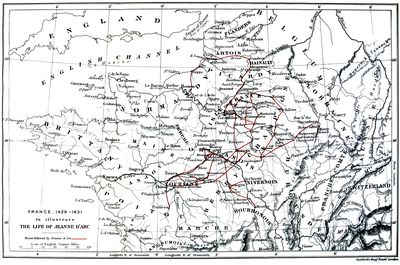
FRANCE, 1429–1431 to illustrate THE LIFE OF JEANNE D’ARC Route followed by Jeanne d’Arc—— Stanford’s Geogl Estabt. London.
385