Part II THE REHABILITATION (continued 3)
Reading edition
Afterwards she went with the army to Jargeau, which was taken by assault, with many English, among whom were Suffolk and de la Pole[171]. After the deliverance of 264Orleans, and all these victories, Jeanne went with the army to Tours, where the King was. There it was decided that the King should go to Rheims for his consecration. The King left with the army, accompanied by Jeanne, and marched first to Troyes, which submitted; then to Chalons, which did the same; and last to Rheims, where our King was crowned and anointed in my presence—for I was, as I have already said, page to Jeanne, and never left her. I remained with her until she arrived before Paris.
She was a good and modest woman, living as a Catholic, very pious, and, when she could, never failing to be present at the Mass. To hear blasphemies upon the Name of Our Lord vexed her. Many times when the Duke d’Alençon swore[172] or blasphemed before her, I heard her reprove him. As a rule, no one in the army dared swear or blaspheme before her, for fear of being reprimanded.
She would have no women in her army. One day, near Château-Thierry, seeing the mistress of one of her followers riding on horseback, she pursued her with her sword, without striking her at all; but with gentleness and charity she told her she must no longer be found amongst the soldiers, otherwise she would suffer for it.
I know nothing more, not having seen her after Paris.
Gobert Thibaut, Squire to the King of France.
I was at Chinon when Jeanne came to seek the King, who was then residing in that city. Before this, I knew nothing of her; but henceforward I had 265more acquaintance with her, for, when I went with the King to the town of Poitiers, Jeanne was also taken thither and lodged in the house of Jean Rabateau. I know that Jeanne was questioned and examined in the town of Poitiers by the late Maître Pierre de Versailles, S.T.P.,—then Abbot of Talmont and, at the time of his death, Bishop of Meaux,—and by Maître Jean Erault, S.T.P. I went with them by the command of the late Lord Bishop of Castres. As I have said, she was living in the house of Rabateau, in which house de Versailles and Erault talked with her in my presence. When we arrived at her house, Jeanne came to meet us, and striking me on the shoulder said to me that she would gladly have many men of such good-will as I. Then Maître Pierre de Versailles told Jeanne that he had been sent to her from the King. She replied: “I well believe that you have been sent to question me,” adding, “I know neither A nor B.”
Then she was asked by them for what she had come. She replied; “I am come from the King of Heaven to raise the siege of Orleans and to conduct the King to Rheims for his crowning and anointing.” And then she asked if they had paper and ink, saying to Maître Jean Erault: “Write what I say to you. You, Suffolk, Classidas, and La Poule, I summon you by order of the King of Heaven to go back to England.” Versailles and Erault did nothing more on this occasion, so far as I remember. Jeanne remained in the town of Poitiers as long as the King did.
Jeanne said that her Counsel had told her she should have gone more quickly to the King. I saw those who had brought her—Jean de Metz, Jean Coulon, and Bertrand Pollichon,[173] with whom I was very friendly and familiar. I was present one day when they told the late Bishop of Castres—then Confessor to the King—that 266they had travelled through Burgundy and places occupied by the enemy, yet had they always travelled without hindrance, at which they much marvelled.
I heard the aforesaid Confessor say that he had discovered in a writing that there should come a maiden who would aid the Kingdom of France.
I do not know whether Jeanne was examined otherwise than as aforesaid. I heard the said Lord Confessor and other Doctors say that they believed Jeanne to be sent from God, and that they believed it was she of whom the prophecies spoke; because, seeing her actions, her simplicity, and conduct, they thought the King might be delivered through her; for they had neither found nor perceived aught but good in her, nor could they see anything contrary to the Catholic faith.
On the day that the Lord Talbot, who had been taken at Patay, was brought to the town of Beaugency, I arrived at that town; and from thence Jeanne went with the men-at-arms to Jargeau, which was taken by assault, and the English were put to flight.
Jeanne assembled an army between Troyes and Auxerre, and found large numbers there, for every one followed her. The King and his people came without hindrance to Rheims. Nowhere was the King turned back, for the gates of all cities and towns opened themselves to him.
Simon Baucroix, Squire.
It was Jeanne’s intention that the army should go towards the Fort or Bastille of Saint-Jean-le-Blanc: but this was not done; and they went to a place between Orleans and Jargeau, whither the inhabitants of Orleans sent boats to receive the provisions and to take them into the town; and the said provisions were put into the boats and brought into the town. And because 267the army was not able to cross the Loire, it was decided to return and cross the river at Blois: for there was no bridge nearer within the King’s jurisdiction. At this Jeanne was very indignant, fearing they would not be willing to fall back, and so would leave the work unfinished. Neither could she go with them to Blois; but she crossed the river with about 200 lances in boats to the other bank, and entered Orleans by land. The Marshal de Boussac went that night to seek the King’s army which had gone to Blois; and I remember that shortly before the arrival of the said Marshal at Orleans, Jeanne said to Sieur Jean d’Aulon that the Marshal would arrive, and that she knew well he would come to no harm.
When Jeanne was in her lodging, she, being led by the Spirit, cried out: “In God’s Name! our people are hard pressed.” Then she sent for a horse; and, arming herself, she went to the Fort of Saint Loup, where there was an assault being made by the King’s people on the English: and no sooner had Jeanne joined in the attack, than the fort was taken.
The next day the French in company with Jeanne went to attack the Fort of Saint-Jean-le-Blanc, and drew near to the island; and when the English saw that the King’s army had crossed the water, they quitted the Fort of Saint-Jean-le-Blanc, and retreated to another fort near the Augustins. And there I saw the King’s army in great peril. “Let us advance boldly in God’s Name,” said Jeanne: and they advanced on the English, who, now in much danger, held their three forts.[174] At once, without much difficulty, this fort of the Augustins was taken; and the captains then advised Jeanne to re-enter Orleans; but this she would not do, saying, “Shall we leave our men?” The next day they 268attacked the fort at the end of the bridge, which was very strong and almost impregnable, so that the King’s army had much to do; and the attack lasted the whole day, up to nightfall. I saw the Seneschal of Beaucaire break up the bridge with a bombard. When evening came and they despaired of gaining the fort, orders were given that Jeanne’s standard should be brought to the fort; and this being done another attack was made on the fort, and thereupon without much difficulty the King’s army entered with the standard; and the English fled, in such manner that when they reached the end of the bridge it broke down beneath them, and many were drowned.
The next day the King’s army sallied out to give battle to the English; but they, on seeing the French, fled. When Jeanne saw them in flight and the French following after, she said to the French: “Let the English go, and slay them not; let them go; it is enough for me that they have retreated.” On that day, they escaped from the city of Orleans and turned back on Blois, which they reached the same day.
Jeanne stayed there two or three days; and from thence she went to Tours, and to Loches, where the King’s army was preparing to go to Jargeau; and from thence they went to attack that town.
In war time, she would not permit any of those in her company to steal anything; nor would she ever eat of food which she knew to be stolen. Once, a Scot told her that he had eaten of a stolen calf: she was very angry, and wanted to strike the Scot for so doing.
She would never permit women of ill-fame to follow the army; none of them dared to come into her presence; but, if any of them appeared, she made them depart unless the soldiers were willing to marry them.
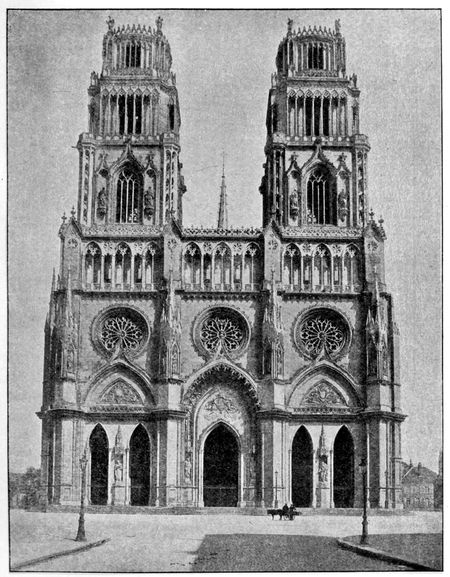
ORLEANS CATHEDRAL.
She was good not only to the French, but also to the enemy. All this I know of a surety, for I was for 269a long time with her, and many times assisted in arming her.
Jeanne lamented much, and was displeased when certain good women came to her, wishing to salute her: it seemed to her like adoration, at which she was angered.
Maître Jean Barbin, Doctor of Laws, King’s Advocate.
I was sent to Poitiers, where I saw Jeanne for the first time. When she arrived at the town she was lodged in the house of Maître Jean Rabateau; and while there I have heard the wife of Rabateau say that every day after dinner she was for a long time on her knees, and also at night; and that she often went into a little oratory in the house and there prayed for a long time. Many clergy came to visit her,—to wit, Maître Pierre de Versailles, S.T.P., sometime Bishop of Meaux, and Maître Guillaume Aimery, S.T.P. There were also other graduates in theology, whose names I do not remember, who questioned her in like manner at their will.
I heard from these said Doctors that they had examined her and put many questions, to which she replied with much prudence, as if she had been a trained divine; that they marvelled at her answers, and believed that, taking into account her life and conversation, there must have been in her something divine.
In the course of these deliberations Maître Jean Erault stated that he had heard it said by Marie d’Avignon,[175] who had formerly come to the King, that she had told him that the kingdom of France had much to suffer and many calamities to bear: saying moreover that she had had many visions touching the desolation 270of the kingdom of France, and amongst others that she had seen much armour which had been presented to her; and that she was alarmed, greatly fearing that she should be forced to take it; but it had been said to her that she need fear nothing, that this armour was not for her, but that a maiden who should come afterwards should bear these arms and deliver the kingdom of France from the enemy. And he believed firmly that Jeanne was the maiden of whom Marie d’Avignon thus spoke.
All the soldiers held her as sacred. So well did she bear herself in warfare, in words and in deeds, as a follower of God, that no evil could be said of her. I heard Maître Pierre de Versailles say that he was once in the town of Loches in company with Jeanne, when the people, throwing themselves before the feet of her horse, kissed her hands and feet; and he said to Jeanne that she did wrong to allow what was not due to her, and that she ought to protect herself from it lest men should become idolatrous; to which she answered: “In truth, I know not how to protect myself, if God does not protect me.”
Dame Marguerite La Touroulde, widow of the late Réné de Bouligny, Councillor to the King.
I was at Bourges when Jeanne arrived at Chinon, where the Queen was. In those days there was in the kingdom—especially in that part still obedient to the King—such great calamity and penury as was sad to see; so that the followers of the King were almost in despair: and this I know, because my husband was then Receiver-General, and at that time neither of the King’s money nor of his own had he four crowns.
The town of Orleans was in the hands of the King, and there was no way of help. And in this calamity 271came Jeanne, and I firmly believe that she came from God and was sent for the relief of the King and his faithful subjects, who then were without hope save in God.
I did not see Jeanne until the time when the King came from Rheims, where he was consecrated. He came to Bourges, where was the Queen, and I with her. When the King approached, the Queen went to meet him as far as the town of Selles-en-Berry, and I accompanied her. While the Queen was on the way, Jeanne encountered and saluted her, and was then taken on to Bourges, and by command of my Lord d’Albret lodged in my house, although my husband had said that she was to be lodged with a certain Jean Duchesne.
She remained with me for the space of three weeks—sleeping, drinking, and eating [in the house]. Nearly every night I slept with her, nor did I ever perceive aught of evil in her, but she comported herself as a worthy and Catholic woman, often confessing herself, willingly hearing Mass, and many times asking me to accompany her to matins, which at her request I often did. We often talked together, and I would say to her: “If you do not fear to go to the attack, it is because you know that you will not be killed”: to which she would reply that she had no greater security than other soldiers. Sometimes Jeanne would tell me how she had been examined by the Clergy, and that she had made them the answer: “There are books of Our Lord’s besides what you have.”
I heard from those that brought her to the King that at first they thought she was mad, and intended to put her away in some ditch, but while on the way they felt moved to do everything according to her good pleasure. They were as impatient to present her to the King, as she was to meet him, nor could they resist her wishes.
272They testified as others did to the purity of her conduct and influence.
Jeanne told me that the Duke de Lorraine who was ill, wished to see her, that she talked with him, and told him that he was not living well, and that he would never be cured unless he amended; also she exhorted him to take back his good wife.[176]
Jeanne had great horror of dice.
I remember that many women came to my house while Jeanne was living there, and brought pater nosters and other religious objects that she might touch them; but Jeanne laughed, saying: “Touch them yourselves. Your touch will do them as much good as mine.”
Jeanne was very liberal in almsgiving, and willingly succoured the poor and indigent, saying that she had been sent for their consolation.
... I have no doubt that she was virgin. According to my knowledge she was quite innocent, unless it be in warfare. She rode on horseback and handled the lance like the best of the knights, and the soldiers marvelled.
Jean Marçel, Burgess of Paris.
Maître Jean Sauvage, of the Order of Saint Dominic, who often talked with me of Jeanne, has told me that he was engaged in the Process against her; but it was difficult to make him speak of it. He did once say, that he had never seen a woman of such years give so much trouble to her examiners, and he marvelled much at her answers and at her memory. Once the notary reporting what he had written, she declared that she had not said what they had made her say, and referred it to those present, who all recognized that Jeanne was right, and the answer was corrected.
273I was present at the sermon at Saint-Ouen; and there for the first time I saw Jeanne. I remember that Maître Guillaume Érard preached in presence of the said Jeanne, who was in a man’s dress. But what was said or done in the sermon I know not. I was at some distance from the Preacher. I heard it said that Maître Laurence Calot said to Maître Pierre Cauchon, that he was too slow in pronouncing judgment, and that he was not judging rightly; to which Maître Pierre Cauchon replied that he lied.
I was also at the second preaching, on the day that Jeanne was burnt, and saw her in the flames calling out in a loud voice many times “Jesus!” I believe firmly that she died a Catholic and ended her days well in good Christian estate; and this I know from what I had from the monks who were with her in her last hours. I saw many—the greater part of those present—weeping and bewailing for pity, and saying that Jeanne had been unjustly condemned.
The Duke d’Alençon.[177]
When Jeanne arrived at Chinon, I was at Saint Florent. One day, when I was hunting quails, a messenger came to inform me that there had come to the King a young girl, who said she was sent from God to conquer the English and to raise the siege then undertaken by them against Orleans. It was for this reason that I went on the following day to Chinon, where I found Jeanne talking with the King. Having approached them, she asked me who I was. “It is the Duke d’Alençon,” replied the King. “You are welcome,” she then said to me, “the more that come together of the blood of France the better it will be.” The next day she went to the King’s Mass; and when 274she perceived him she made a profound salutation. After Mass the King took her into his private room, where he kept me with him, as well as the Sieur de la Tremouille, after having sent away all the others. Jeanne then made several requests to the King—amongst others that he would make a gift of his kingdom to the King of Heaven, because the King of Heaven, after this gift, would do for him as He had done for his predecessor, and reinstate him in all his rights. Many other things were said, up to the hour of dinner, which I do not remember. After dinner the King went for a walk; Jeanne coursed before him, lance in hand. Seeing her manage her lance so well I gave her a horse.
Following on this the King caused her to be examined by the Clergy. Choice was made of the Bishop of Chartres, the King’s Confessor; the Bishop of Senlis[178], Mende and Poitiers; Maître Pierre de Versailles, since Bishop of Meaux; Maître Jourdin Morin, and many others whose names I do not recall. They questioned her in my presence and asked why she had come, and who had caused her to come to the King? She replied that she had come from the King of Heaven, that she had voices and a Counsel which told her what she was to do; but I do not remember if she made known what those voices told her.
One day when dining with me she told me that the clergy had examined her well, but that she knew and could do more than she had told them. The King, when he had heard the report of his commissioners, wished that she should still go to Poitiers, in order to submit to another examination. I did not assist at this examination; I only knew it to be afterwards reported to the Council, that the examiners at Poitiers 275held the opinion that there was nothing in her contrary to the Faith, and that the King, considering his extreme necessity, might make use of her assistance.
On receiving this news the King sent me to the Queen of Sicily[179] to prepare a convoy of supplies for the army, which was then being directed against Orleans. I found with the Queen the Sieur Ambroise de Loré,[180] and the Sieur Louis—his other name I do not remember—who prepared the convoy: but money was lacking, and in order to obtain it I returned to the King, to whom I made known that the supplies were prepared, and that it only remained to procure the necessary money to pay for them and for the army. The King then sent people who delivered the necessary sums; so that in the end soldiers and supplies were ready, and there was nothing more to be done but to gain Orleans, and try to raise the siege.
With this army Jeanne was sent. The King had caused armour to be made for her.[181]
The King’s army started with Jeanne. What happened on the way, and afterwards in Orleans, I know only by hearsay—for I was not present, not having then gone to Orleans—but I went there shortly after, and saw the works which had been raised by the English before the town. I was able to study the strength of these works; and I think that, to have made 276themselves masters of these—above all, the Fort of the Tourelles at the end of the Bridge, and the Fort of the Augustins—the French needed a real miracle. If I had been in either one or the other, with only a few men, I should have ventured to defy the power of a whole army for six or seven days: and they would not have been able, I think, to have mastered it. For the rest, I heard from the captains and soldiers who took part in the siege, that what had happened was miraculous; and that it was beyond man’s power.
I did not see Jeanne from the time she left the King until after the raising of the siege of Orleans. After this siege, we succeeded in assembling as many as 600 lances, with which we decided to march on Jargeau, then occupied by the English. That night we slept in a wood. On the following morning we were joined by another division, under the guidance of the Sieur Bastard of Orleans, the Sieur Florent d’Illiers,[182] and many other captains. When we were all joined together, we found ourselves to number about 1,200 lances. There was then contention among the captains: some were of opinion that the attack should be made; and others opposed it, seeing the great strength of the English and their large numbers. Jeanne, seeing us thus divided, said: “No, do not fear their numbers; do not hesitate to make the attack; God will conduct your enterprise; if I were not sure that it is God Who guides us, I would rather take care of the sheep than expose myself to such great perils!” On these words we marched to Jargeau, counting on gaining the suburbs that day and passing the night there. But on the news of our approach, the English came to meet us and at first drove us back. Seeing this Jeanne seized her standard and began the attack, telling the soldiers to have good courage. We 277succeeded so well that we were able that night to camp in the suburbs. I think truly it was God Who was leading us; for, in the night that followed, we kept no guard; so that, had the English made a sally, we must have been in great danger. The next morning we prepared artillery and had the machines and bombards placed in position. Then we consulted for some time as to what should be done against the English in Jargeau in order to take the town. While we were deliberating, we were told that La Hire was in conference with the English Lord Suffolk. I and the other captains were much provoked at this, and sent for La Hire, who came at once. The attack being resolved upon, the Heralds-at-Arms began to sound, “To the Assault!” “Forward, gentle Duke, to the assault!” cried Jeanne to me. And when I told her it was premature to attack so quickly: “Have no fear,” she said to me, “it is the right time when it pleases God; we must work when it is His Will: act, and God will act!” “Ah! gentle Duke,” she said to me, later, “art thou afraid? dost thou not know that I promised thy wife[183] to bring thee back, safe and sound?”
And indeed when I left my wife to come with Jeanne to the head-quarters of the army, my wife had told me that she feared much for me, that I had but just left prison[184] and much had been spent on my ransom, and she would gladly have asked that I might remain with her. To this Jeanne had replied: “Lady, have no fear; I will give him back to you whole, or even in better case than he is now.”
During the assault on Jargeau Jeanne said to me: “Go back from this place, or that engine”—pointing out 278an engine of war in the city—“will kill you.” I retired, and shortly after that very engine did indeed kill the Sieur de Lude in that very place from which she told me to go away. On this account I had great fear, and wondered much at Jeanne’s words and how true they came. Afterwards, Jeanne made the attack; in which I followed her. As our men were invading the place, the Earl of Suffolk made proclamation that he wished to speak with me, but we did not listen, and the attack continued. Jeanne was on a ladder, her standard in her hand, when her standard was struck and she herself was hit on the head by a stone which was partly spent, and which struck her calotte.[185] She was thrown to the ground; but, raising herself, she cried: “Friends! friends! come on! come on! Our Lord hath doomed the English! They are ours! keep a good heart.” At that moment the town was carried; and the English retired to the bridges, where the French pursued them and killed more than 1,100 men.
The town taken,[186] Jeanne and the army went to Orleans; then from Orleans to Meung-sur-Loire, where were the English under the command of ‘the child of Warwick’ and Scales. Beneath the walls of Meung, I passed the night in a Church with a few soldiers, and was in great peril. The day after the taking of Meung, we went to Beaugency; and in the neighbourhood of this town we rallied to us a part of the army with which we attacked the English who were in Beaugency. In consequence of our attack the English abandoned the town and retired into a camp which we had watched during the night for fear they should beat a retreat. We were there when the news reached us that the Constable was coming to join us: Jeanne, the other 279Captains, and I myself were much troubled by this news, and wished to retire, because we had orders from the King not to receive the said Constable into our company. I told Jeanne that if the Constable came I should retire. The next day, before his arrival, we learned that the English were marching upon us in great number, under the command of Talbot.[187] Our men immediately called “To arms!” and, seeing that I wished to retire because of the arrival of the Constable, Jeanne told me that we must help one another. The English surrendered their camp by agreement, and retreated by a safe-conduct which I gave them: for I was then Lieutenant to the King, and thus in command of the army. We thought they had retired, when a man of La Hire’s company told us they were marching upon us, and that in a moment we should have them before us, to the number of a thousand men-at-arms. Jéanne asked what this messenger had stated; and when she knew what was going on she said to the Lord Constable,[188] “Ah! fair Constable, you have not come by my will, but now you are here you are welcome.” Many were in fear and said it would be well to await the arrival of the cavalry. “In God’s Name!” exclaimed Jeanne, “we must fight them at once: even if they were hanging from the clouds we should have them, because God has sent us to chastise them.” She assured us she was 280certain of obtaining the victory, saying in French: “The gentle King shall have to-day the greatest victory he has ever had. My Counsel has told me they are all ours.” Without great difficulty the English were beaten and slain, and Talbot made prisoner. There was a great slaughter. Then the army went to Patay, where Talbot was brought before me and the Constable in the presence of Jeanne. I said to Talbot that in the morning I had never expected what had happened. “It is the fortune of war,”[189] he replied. Afterwards we returned to the King, and it was decided to direct our way towards Rheims for his coronation and consecration.
Many times in my presence Jeanne told the King she would last but one year and no more; and that he should consider how best to employ this year. She had, she said, four duties to accomplish: to beat the English; to have the King crowned and consecrated at Rheims; to deliver the Duke d’Orléans from the hands of the English;[190] and to raise the siege of Orleans.
Jeanne was a chaste maiden; she hated the women who follow in the train of armies. I saw her one day at Saint Denis on the return from the coronation, pursuing one of them sword in hand: her sword was broken on this occasion. She was very vexed if she heard any of the soldiers swear. She reproved me much and strongly when I sometimes swore; and when I saw her I refrained from swearing.
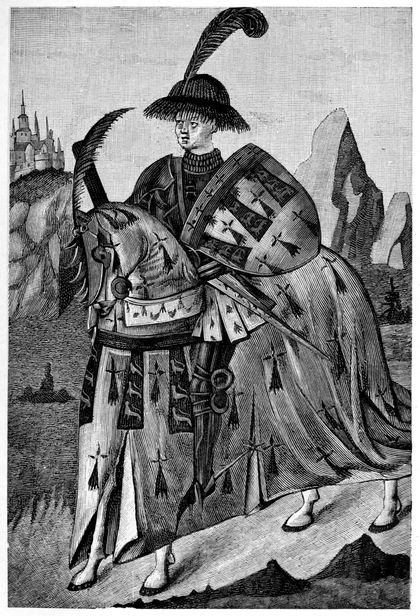
THE COUNT DE RICHEMONT, Constable of France.
So far as I could judge, I always held her for an excellent Catholic, and a modest woman: she communicated often, and, at sight of the Body of Christ, 281shed many tears. In all she did, except in affairs of war, she was a very simple young girl; but for warlike things—bearing the lance, assembling an army, ordering military operations, directing artillery—she was most skilful. Every one wondered that she could act with as much wisdom and foresight as a captain who had fought for twenty or thirty years. It was above all in making use of artillery that she was so wonderful.
Brother Jean Pasquerel.[191]
The first time I heard of Jeanne, and that she had come to find the King, I was at Anche,[192] in which town was her mother[193] and some of those who had accompanied her thither. One day, they invited me to go with them and see her, and told me they would not leave me till I had seen her. I came then with them to Chinon; then to Tours, in which town I was at that time Reader in a Convent; and there we found her lodging in the house of a citizen named Jean Dupuy,[194] a burgher of Tours. My companions addressed Jeanne in these terms: “Jeanne, we bring you this good father; when you know him you will love him much.” “I am very glad to see you,” she said to me; “I have already heard of you; I should like to-morrow to confess myself to you.”
282The next day, indeed, I heard her in confession, and recited Mass before her. From that day onward, I always followed her and was always with her as her Chaplain, until Compiègne, where she was taken prisoner.
On her arrival at Chinon, I heard that she had been visited on two occasions by women. The Lady de Gaucourt and the Lady de Trèves, it is said, were those who visited her.
Afterwards, she was taken to Poitiers, to be examined there by the Clergy of that University as to what should be done with regard to her. Maître Jourdin Morin, Maître Pierre de Versailles, since deceased as Bishop of Meaux, and many others, after having questioned her, came to the conclusion that, in view of the necessity which weighed upon the Kingdom, the King might make use of her aid, and that they had found nothing in her contrary to the Catholic Faith. She then returned to Chinon, and thought she would be allowed to speak with the King; but it was not yet to be. At last, by the advice of the Council, she was permitted an interview with the King. The day on which this interview was to take place, just as she entered the Castle, a man, mounted on horseback, said, “Is that the Maid?” He insulted her, and swore with horrid blasphemy. “Oh! in God’s Name,” she said to him, “dost thou blaspheme God, thou who art so near thy death!” And, an hour after, this man fell into the water and was drowned. I report this fact as I gathered it from Jeanne and from many others, who said they had been witnesses of it.
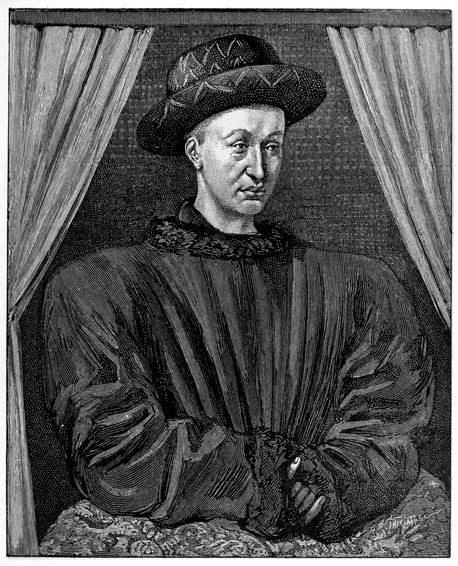
CHARLES VII. (Gallery of the Louvre.)
It was the Sieur Count de Vendôme who brought her into the King’s apartment. When he perceived her, the King asked her her name. “Gentle Dauphin,” she replied, “I am called Jeanne the Maid; and the King of Heaven sends you word by me that you will be consecrated and crowned at Rheims, and that you will be the 283lieutenant of the King of Heaven, who is King of France.” After the King had asked her a number of questions, she said to him, “On the part of My Lord, I tell thee thou art true heir of France and son of the King[195]; and He sends me to lead thee to Rheims to the end thou mayst receive thy crowning and thy consecration, if thou wilt.” At the close of this interview, the King said that Jeanne had confided to him secrets which were not known and could not be known except by God, which gave him great confidence in her. All this I heard from Jeanne, but without having been witness of it.
She told me she was not pleased at so many examinations; that they prevented her carrying out the work for which she was sent, and that it was quite time for her to act. She told me she had asked from the Messengers of her Lord—that is to say, God—who appeared to her, what she ought to do; and they had told her to take the banner of her Lord. It was for this she had her banner made, on which was painted the image of Our Saviour seated in judgment on the clouds of Heaven, with an Angel holding in his hand a fleur-de-lys which Christ was blessing. I was at Tours with her when this banner was painted.[196]
A short time after Jeanne departed with the army to the succour of the town of Orleans, which was then besieged; I went with her, and did not leave her until the day when she was taken at Compiègne. I acted as her Chaplain, confessed her, and sang Mass for her. She was, indeed, very pious towards God and the Blessed Mary, confessing nearly every day and communicating 284frequently. When she was in a neighbourhood where there was a Convent of Mendicant Friars, she told me to remind her of the day when the children of the poor received the Eucharist, so that she might receive it with them; and this she did often: when she confessed herself she wept.
When Jeanne left Tours to go to Orleans, she prayed me not to forsake her, and to remain always with her as her Confessor; this I promised to do. We were at Blois about two or three days, waiting for the supplies with which the boats were to be loaded. At Blois she told me to have a banner made, round which the Priests might assemble, and to have painted thereon the Image of Our Saviour crucified. I had it done, as she required of me. As soon as this banner was made, Jeanne, twice a day, morning and evening, charged me to assemble the Priests around this banner: they then sang anthems and hymns to the Blessed Mary. Jeanne was with them, permitting only the soldiers who had that day confessed themselves to join her; she told her people to make confession, if they wished to come to this assemblage. There were Priests always ready to confess those in the army who wished to apply to them.
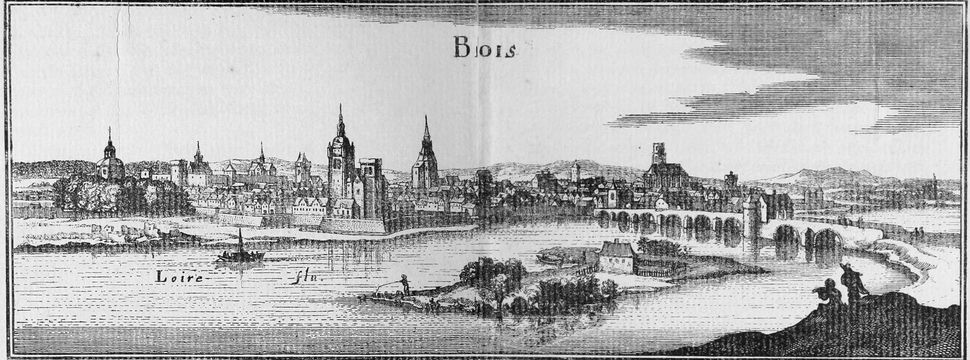
Reproduced from an engraving of the XVIIth Century.
On leaving Blois to march to Orleans, Jeanne made all the Priests assemble round this banner; and in this wise they marched at the head of the army. They departed, thus assembled, from the side of the Sologne, singing the “Veni Creator Spiritus” and many other anthems. On that and the two following days, we slept in the fields. On the third day, we arrived at Orleans, where the English held their siege right up to the bank of the Loire: we approached so close to them that French and English could almost touch one another. The French had with them a convoy of supplies; but the water was so shallow that the boats could not move up-stream, nor could they land where the English 285were. Suddenly the waters rose, and the boats were then able to land on the shore where the [French] army was. Jeanne entered the boats, with some of her followers, and thus came to Orleans. As for myself I returned to Blois, by Jeanne’s command, with the Priests and the banner. Then, some days after, accompanied by the whole army, I came to Orleans by way of the Beauce—always with this same banner surrounded by Priests—meeting no obstacle. When Jeanne knew of our approach, she came to meet us; and together we entered Orleans without difficulty, bringing in the provisions in sight of the English. This was a marvellous thing; for the English were in great number and strength, all prepared for fight. They had opposite them our army, very inferior to theirs: they saw us; they heard our Priests singing; I was in the midst of the Priests bearing the banner. The English remained immovable, never attempting to attack either the Priests or the army which followed them.
As soon as we entered Orleans, the French sallied from the town at Jeanne’s urgent entreaties, and went to attack the English, who were shut up in the Fort of Saint Loup. After dinner the other Priests went with me to seek Jeanne at her residence. When we arrived, we heard her calling out: “Where are those who should arm me? The blood of our people is falling to the ground!” And, so soon as she was armed, she sallied from the town and made for the Fort of Saint Loup, where the attack was taking place. On the road she met many wounded soldiers; the sight of them distressed her much. She went to the assault, and did so well, that by force and violence the fort was at last taken, and all the English who were there were taken prisoners. I remember that this took place on the Eve of the Ascension of Our Saviour.
When the Fort of Saint Loup was taken, the English 286died there in great numbers. Jeanne was much afflicted when she heard that they had died without confession, and pitied them much. On the spot she made her confession. She ordered me to invite the whole army to do likewise, and to give thanks to God for the victory just gained. Otherwise, she said, she would help them no more, but would abandon them. On this day, the Eve of the Ascension, she predicted that within five days the siege would be raised, and that not a single Englishman would be left within the walls of Orleans.[197] And so it was: for on this Wednesday, as I have already said, the Fort of Saint Loup was taken, which formerly had been a convent.[198] More than one hundred men of distinction were found there, all well armed, not one escaping. In the evening, when Jeanne returned to her lodging, she told me that on the following day, the Ascension of Our Saviour, she would not fight, nor even put on her armour; and that she wished, out of respect for the Festival, to confess and to receive the Sacrament of the Eucharist. And this was done.
On Ascension Day, she ordered that no one should go out of the town to the attack on the same day without first making confession, and forbade women of bad reputation to follow her, lest, on account of sin, God should cause us to lose the battle. All these orders were carried out. It was on Ascension Day that she wrote to the English, entrenched in their forts, a letter thus couched:
“You, men of England, who have no right in this kingdom of France, the King of Heaven orders and commands you by me, Jeanne the Maid, that you quit your strong places, and return to your own country; if you do not I will cause you such an overthrow as shall 287be remembered for all time. I write to you for the third[199] and last time, and shall write to you no more.
Signed thus—
“Jhésus Maria, Jehanne la Pucelle.”
And lower:
“I would have sent you this letter in a more suitable manner, but you keep back my heralds: you have kept my herald Guyenne; I pray you to send him back, and I will send you some of your people who have been taken at the Fort of Saint Loup,—for all were not killed there.”
As soon as this letter was written, Jeanne took an arrow, on the point of which she fastened this letter with a thread, and ordered an archer to shoot this arrow towards the English, crying out, “Read! here is news!” The English received the arrow with this letter, which they read. After having read it they began to cry out with all their power: “It is news sent to us from the ... of the Armagnacs!” At these words Jeanne began to cry, shedding many tears, and prayed the God of Heaven to come to her aid. Soon she appeared to be consoled, having had, as she said, news from her Lord. In the evening after supper, she ordered me to rise earlier than I had done on Ascension Day, because she wished to confess very early in the morning: and this she did.
The next day, Friday, I rose very early; confessed her, and sang Mass before her and all her followers: she then started with them at once for the attack, which lasted from morning to evening. On this day the Fort of the Augustins was taken, after a great assault. Jeanne, who was accustomed to fast every Friday, could not do so on that day because she was too troubled, and she took 288supper. After this supper there came to her a noble and valiant captain, whose name I do not remember. He told her that all the captains were assembled in Council; that they had taken into consideration the small number of their forces in comparison with the large forces of the English, and the abundant grace which God had granted them in the success already obtained: “The town is full of supplies; we could keep it well while we await fresh succour, which the King could send us; it does not seem,” he ended by saying, “expedient to the Council that the army should go forth to-morrow.” “You have been to your Counsel,” Jeanne answered him, “and I have been to mine; and believe me the Counsel of God will be accomplished and will succeed; yours on the contrary will perish.” And addressing herself to me who was near her: “Rise to-morrow morning even earlier than you did to-day; do your best; keep always near me; for to-morrow I shall have yet more to do, and much greater things; to-morrow blood shall flow from my body, above the breast.”

THE BRIDGE OF ORLEANS ON THE LAST DAY OF THE ENGLISH SIEGE, SUNDAY, MAY 8, 1429.

THE BRIDGE SHORTLY BEFORE ITS DEMOLITION IN 1760.
Reproduced by kind permission of M. Herluison,
Vice-President of the Archæological Society Of Orleans.
On the Saturday, therefore, very early in the morning I rose and celebrated Mass; then Jeanne went to the attack of the Bridge Fort, in which was the Englishman, Clasdas.[200] The attack lasted from morning to sunset without interruption. At this assault, after dinner, Jeanne, as she had predicted, was struck by an arrow above the breast. When she felt herself wounded, she was afraid, and wept; but she was soon comforted, as she said. Some of the soldiers seeing her severely wounded wished to “charm” her; but she would not, saying: “I would rather die than do a thing which I know to be a sin; I know well that I must die one day, but I know not when, nor in what manner, nor on what day; if my wound may be healed without sin, I shall be glad enough to be cured.” Oil of olive and lard were applied 289to the wound. After the dressing, she confessed herself to me, weeping and lamenting. Then she returned in all haste to the attack, crying: “Clasdas! Clasdas! yield thee, yield thee to the King of Heaven! Thou hast called me ... I have a great pity for thy soul, and for thy people.” At this moment Clasdas, fully armed from head to foot, fell into the Loire, where he was drowned. Jeanne, moved to pity at this sight, began to weep for the soul of Clasdas, and for all the others who, in great number, were drowned, at the same time as he. On this day, all the English who were on the other side of the bridge were taken and killed. The next day—which was a Sunday—before sunrise all the English who were still in the plains around Orleans grouped themselves together, and came to the foot of the trenches of the town. From thence they departed for Meung-sur-Loire, where they remained for several days. On this Sunday[201] there was in Orleans a solemn procession and a sermon. It was then decided to go and seek the King; and Jeanne went thither. The English entrenched themselves in Jargeau, which was soon taken by assault. Finally, they were entirely defeated at Patay.
I often heard her say of her work that it was her mission; and when people said to her: “Never have such things been seen as these deeds of yours. In no book can one read of such things,” she answered: “My Lord has a book in which no Clerk has ever read, how perfect soever he may be in clerkship!”
In war and in camp, when there was not enough provision, she would never eat stolen food. I firmly believe she was sent from God on account of her good works, and her many virtues; even on the poor English 290soldiers she had so much compassion that, when she saw them dying or wounded, she had them confessed. So much did she fear God, that for nothing in the world would she displease Him. When she was wounded in the shoulder by an arrow—which went through from one side to the other—some spoke of “charming” her, promising in this manner to cure her on the spot. She replied that it would be a sin, and that she would rather die than offend God by such enchantments.
I marvel much that such great Clerks as those who caused her death at Rouen should have dared such a crime as to put to death so poor and simple a Christian, cruelly and without cause—sufficient at least for [the penalty of] death: they might have kept her in prison or elsewhere; but she had so displeased them that they were her mortal enemies; and thus, it seems, they assumed the responsibility of an unjust court. Her actions and her deeds are all perfectly known to our Lord the King and to the Duke d’Alençon, who knew certain secrets which they might declare if they would.
As for me I know no more than what I have said, unless it be that many times Jeanne expressed to me a desire that, if she were to die, the King would build a Chapel, where the souls of those who had died in defence of the kingdom might be prayed for.
Maître Jean de Lenozolles, Priest, of the Order of St. Pierre Celestin.
At the time when Jeanne was at Rouen, I was in the service of Maître Guillaume Érard, with whom I came from Burgundy. After we had arrived, I heard talk of this Trial; but of what was done therein I know nothing, for I left Rouen and went to Caen, and stayed there until the feast of Pentecost; at this feast I returned to Rouen to meet my master, who told me that he had a 291heavy task—to preach a sermon for this Jeanne, which much displeased him. He said he would he were in Flanders: this business disturbed him much.
I saw Jeanne at the second sermon; and in the morning before the sermon I saw the Body of Christ carried to the said Jeanne with much solemnity, and the singing of Litanies and intercession “Orate pro eâ,” and with a great multitude of candles; but who decided or ordered this, I know not. I was not present at the reception, but I afterwards heard it said that she received It with great devotion and abundance of tears.
Simon Charles, President of the Council.
The year in which Jeanne came to seek the King was the very year in which the King sent me as ambassador to Venice. I returned about the month of March, at which time I heard from Jean de Metz, who had conducted her, that she had visited the King. When Jeanne came to Chinon, there was discussion in the Council as to whether the King should hear her or not. And first she was questioned as to why and to what end she had come; and she began by replying that she would answer nothing except to the King. She was compelled, by order of the King, to state the cause of her mission.
She said she had two commands from the King of Heaven: the one to raise the siege of Orleans, the other to conduct the King to Rheims for his coronation and anointing.
Hearing this, some of the King’s Council said that the King ought not to put faith in this Jeanne; others said that, as she declared she was sent from God and commanded to speak to the King, the King ought at least to hear her. The King desired that she should first be examined by the Clergy and Ecclesiastics, 292and this was done; after many difficulties it was arranged that the King should hear her. I have heard the Seigneur de Gaucourt relate that, when she was at Orleans, the King’s people had decided it was not well to make the attack. This happened on the day when the Fort of the Augustins was taken and he, de Gaucourt, had been commissioned to guard the gates of the town that none should go out. Jeanne, discontented with the orders of the generals, was of opinion that the King’s soldiers with the people of the town should go out and attack the fort; and many of the soldiers and people of the city agreed with her. Jeanne told de Gaucourt that he was a bad man, saying to him: “Whether you will or no, the soldiers shall come; and they will succeed this time as they have succeeded before.” And, against the will of the said Lord de Gaucourt, the soldiers left the city and marched to the assault of the bastille of the Augustins, which was taken by force. My Lord de Gaucourt added that he had come that day into great peril.
The King made a treaty with the people of Troyes, and entered the town of Troyes in great array, Jeanne carrying her banner by his side. Shortly after, the King left Troyes and went with his army to Chalons, and thence to Rheims. When the King feared to find resistance at Rheims, Jeanne said to him: “Have no fear! for the burghers of the city will come out to meet you;” and she said that, before he got near the city of Rheims, the burgesses would meet him. The King feared their resistance because he had no artillery or engines for carrying on a siege, in case they should prove rebellious. Jeanne told him that he must go forward boldly and fear nothing, for if he would go forward like a man he would soon obtain all his kingdom.
293Thibauld d’Armagnac, Knight, Seigneur de Termes, bailiff of Chartres.
I knew nothing of Jeanne until she came to Orleans to raise the siege made by the English, in the defence of which town I was in the company of my lord of Dunois.
I afterwards saw her at the assault of the Forts of Saint Loup, the Augustins, Saint-Jean-le-Blanc, and at the Bridge. In all these assaults she was so valorous and comported herself in such manner as would not have been possible to any man, however well versed in war; and all the captains marvelled at her valour and activity and at her endurance.
I believe that she was good and worthy, and that the things she did were divine rather than human. She often reproved the vices of the soldiers; and I heard from a certain Maître Robert Baignart, S.T.P., of the Order of Saint Dominic, who often heard her in confession, that Jeanne was a godly woman, that all she did came from God, that she had a good soul and tender conscience.
After the raising of the siege of Orleans, I with many others of the army went with Jeanne to Beaugency, where the English were. The day that the English lost the battle of Patay, I and the late La Hire, knowing that the English were assembled and prepared for battle, told Jeanne that the English were coming and were all ready to fight. She replied, speaking to the captains: “Attack them boldly, and they will fly; nor will they long withstand us.” At these words, the captains prepared to attack: and the English were overthrown and fled. Jeanne had predicted to the French that few or none of them should be slain or suffer loss: which also befell, for of all our men there perished but one gentleman of my company.
294Apart from affairs of war, she was simple and innocent; but in the conduct and disposition of troops and in actual warfare, in the ordering of battle and in animating the soldiers, she behaved as the most skilled captain in the world who all his life had been trained in the art of war.
Raimond, Sieur de Macy, Knight.
I knew nothing of Jeanne until I saw her in prison, in the Castle of Beaurevoir, where she was detained for and in the name of the Count de Ligny; then I saw her often and many times talked with her: she would allow no familiarity, but repelled such with all her power; she was indeed of modest bearing, both in words and deeds.
She was taken to the Castle of Rouen, where she was placed in a prison facing the fields. Whilst she was there, in this prison, came the Count de Ligny, on whom I was in attendance. The Count de Ligny desired to see Jeanne, and came to visit her, in company of the Earls of Warwick and Stafford, the present Chancellor of England, then Bishop of Thérouanne, the brother[202] of the Count de Ligny, and myself. He said to her: “Jeanne, I have come to ransom you, if you will promise never again to bear arms against us.” She answered: “In God’s Name, you mock me, for I know well that you have neither the will nor the power;” this she repeated often, because the Count persisted in his statement. “I know well,” she ended by saying, “that the English will do me to death, thinking after my death to gain the kingdom of France; but if they were a hundred thousand more ‘godons’[203] than they are at present, they would not have the kingdom.” Indignant at these words, the Earl of Stafford half drew his dagger 295to kill her, but the Earl of Warwick withheld him. After this, while I was still at Rouen, Jeanne was taken to the Place St. Ouen, where a sermon was preached to her by Maître Nicolas Midi,[204] who, amongst other things, said, in my hearing: “Jeanne, we have great compassion for thee; it behoves thee to revoke what thou hast said, or we must give thee up to the secular judges.” She answered, that she had done no evil, that she believed in the Twelve Articles of the Faith and in the Ten Commandments of the Decalogue; adding, that she referred herself to the Court of Rome, and that she wished to believe all things in which Holy Church believed. Notwithstanding this, they pressed her much to recant, to which she answered: “You take much pains to seduce me;” and, to escape danger, she said at last that she was content to do all they required. Then a Secretary of the King of England there present, named Laurence Calot, drew from his pocket a little written schedule, which he handed to Jeanne to sign. She replied that she could neither read nor write. Notwithstanding this Laurence Calot, the Secretary, handed Jeanne the schedule and a pen to sign it; and by way of derision Jeanne made some sort of round mark. Then Laurence Calot took her hand with the pen and caused her to make some sort of signature,—what, I cannot remember.
I believe her to be in Paradise.
Colette, wife of Pierre Milet.
I first knew of Jeanne when she came to Orleans; she was lodged in the house of one Jacques Bouchier, where I went to visit her. Jeanne continually spoke of God, saying, “My Lord hath sent me to succour the good town of Orleans.” I often saw her attend Mass with great devotion, as a good Christian and Catholic. During 296the time she was at Orleans, for the raising of the siege, Jeanne was sleeping in the house of her host, Jacques le Bouchier; on the Vigil of the Ascension, she suddenly awoke, and, calling her page, Mugot,[205] said to him: “In God’s Name! This is ill done. Why was I not sooner awakened? Our people have much to do.” Then she asked for her armour, and armed herself, her page bringing round her horse; then, all armed, she mounted, lance in rest, and began to ride along the main street so rapidly that the stones struck fire. She made straight for Saint Loup; and gave order, by sound of trumpet, that nothing should be taken from the Church.
On the morning of the day that the Fort of the Bridge was taken, Jeanne was still in the house of her host when a fish was brought to her: on seeing it she said to her host, “Take care of it till the evening, because I will bring you back a ‘godon’ and I shall return by the bridge.”
Jeanne was very frugal in eating and drinking. There was nothing but modesty in her conduct, in her actions, and in all her manner of life. I believe firmly that her deeds and actions were rather the works of God than of man.
Pierre Milet, Clerk to the Electors of Paris.
Soon after she came to Orleans, she sent to the English, who were besieging the town, and summoned them in a kind of simple schedule written in her mother-tongue, which I read myself, notifying that it was the will of God that they should depart:
[“Messire vous mande que vous en aliez en vostre pays, car c’est son plaisir, ou sinon je vous feray ung tel hahay....”[206]]
297Maître Aignan Viole, Licentiate in Law, Advocate of the Court of Parliament.
On the Sunday after the taking of the Forts of the Bridge and of Saint Loup, the English were drawn up in order of battle before the town of Orleans, at which the greater part of [our] soldiers wished to give combat, and sallied from the town. Jeanne, who was wounded, was with the soldiers, dressed in her light surcoat. She put the men in array, but forbade them to attack the English, because, she said, if it pleased God and it were His will that they wished to retire, they should be allowed to go. And at that the men-at-arms returned into Orleans.
It was said that Jeanne was as expert as possible in the art of ordering an army in battle, and that even a captain bred and instructed in war could not have shown more skill; at this the captains marvelled exceedingly.
She frequently confessed, often received the Holy Sacrament, and, in all her deeds and conversation, bore herself most worthily, and in everything save in warfare she was marvellously simple.
298
DEPOSITIONS AT ROUEN: 1455–6.
Guillaume Colles, or Boisguillaume, Priest, Notary Public.
I knew nothing of Jeanne till she was brought to Rouen for her trial, at which I was one of the notaries. In the copy of the Process shown to me, I recognize my own signature at the end. It is the true Process made against Jeanne, and is one of five similar copies made. In the said Process were associated with me Maître Guillaume Manchon and Maître Pierre Taquel. In the morning we registered the notes and answers, and in the afternoon we collected them together. For nothing in the world would we have failed in anything that should have been done.
I remember well that Jeanne answered more prudently when questioned a second time upon a point whereon she had been already questioned; she failed not to say that she had elsewhere replied, and she told the notaries to read what she had already said.
Maître Nicolas Loyseleur, feigning to be a cobbler—a captive on the part of the King of France, and from Lorraine—obtained entrance to Jeanne’s prison, to whom he said that she should not believe the Churchmen, “because,” he added, “if you believe them, you will be destroyed.” I believe the Bishop of Beauvais knew this well, otherwise Loyseleur would not have 299done as he did. Many of the Assessors in the Process murmured against him. It is said that Loyseleur died suddenly at Bâle; and I have heard that, when he saw Jeanne condemned to death, he was seized with compunction and climbed into the cart, earnestly desiring her pardon; at which many of the English were indignant; and that, had it not been for the Earl of Warwick, Loyseleur would have been killed; the said Earl enjoined him to leave Rouen as soon as he possibly could, if he wished to save his life.
In the same way, Maître Guillaume d’Estivet got into the prison, feigning to be a prisoner—as Loyseleur had done. This d’Estivet was Promoter, and in this matter was much affected towards the English, whom he desired to please. He was a bad man, and often during the Process spoke ill of the notaries and of those who, as he saw, wished to act justly; and he often cruelly insulted Jeanne, calling her foul names. I think that, in the end of his days, he was punished by God; for he died miserably. He was found dead in a drain outside the gates of Rouen.
Jeanne was often disconcerted by questions which were subtle and not pertinent. I remember that, on one occasion, she was asked if she were in a state of grace. She replied, that it was a serious matter to answer such a question, and at last said: “If I am, may God so keep me. If I am not, may God so place me. I would rather die than not be in the love of God.” At this reply the questioners were much confounded, and broke up the sitting; nor was she further interrogated on that occasion.
On the Sunday following the first sentence, I was summoned to the Castle with the other notaries to see Jeanne dressed in man’s dress; we went to the Castle, entered the prison, and there saw her. Questioned as to why she had resumed it, she made excuses, as appears 300in the Process. I think, perhaps, that she was induced to act thus, for I saw many of those concerned in the Process applauding and rejoicing that she had resumed her old dress; yet some lamented, among whom I saw Pierre Maurice grieving much.
On the following Wednesday, Jeanne was taken to the Old Market of Rouen, where a sermon was preached by Maître Nicolas Midi upon the Sentence of Relapse pronounced by the Bishop of Beauvais. After this sentence was read, she was taken by the civil authorities, and, without further trial or sentence, was led to the executioner, to be burnt. And I know, of a truth, that the Judges and their adherents were henceforward notorious to the population: after Jeanne was burnt, they were pointed at by the people and hated; and I have heard it maintained that all who were guilty of her death came to a shameful end. Maître Nicolas Midi died of leprosy a few days later; and the Bishop died suddenly while he was being shaved.
Jean Lemaire, Priest, Curé of the Church of St. Vincent at Rouen; [evidence of no special value.]
Maugier Leparmentier, Clerk, Apparitor of the Archiepiscopal Court of Rouen.
I knew nothing of Jeanne until she came to Rouen. I was summoned to the Castle of Rouen, with my assistants, to submit Jeanne to torture. On this occasion, she was questioned on various subjects and answered with such prudence that all present marvelled. Then I and my associates retired without doing anything.
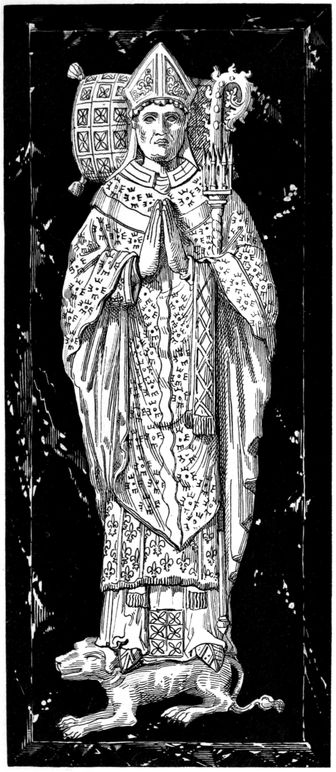
Pierre Cauchon, Bishop of Beauvais. Died Bishop of Lisieux 1442. Tomb formerly in the Cathedral of Lisieux.
She was a prisoner in the Castle, in a great tower. I saw her when I was summoned to the torture, as aforesaid. I was present at the first preaching at St. Ouen, and also at the last at the Old Market, on the day when Jeanne was burnt. Wood was prepared for 301the burning before the preaching was finished or the sentence pronounced; and as soon as the sentence was read by the Bishop, without any interval, she was taken to the fire. I did not notice that any sentence by the civil authorities was read. When she was in the fire she cried, more than six times, “Jesus!” And with the last breath she cried with a loud voice, so that all present might hear, “Jesus!” Nearly all wept for pity. I have heard it said that, after the burning, her ashes were collected and thrown into the Seine.
Laurence Guesdon, Burgher of Rouen, and Advocate in the Civil Courts.
I knew nothing of Jeanne till she was brought to Rouen; but I was so anxious to see her that I went to the Castle, and there saw her for the first time. I did not see her again until the time of the preaching at Saint Ouen.
I was at the final sermon in the Old Market Place, at Rouen; I went as Bailly, for whom I was then acting as deputy. The sentence by which Jeanne was handed over to the civil authorities was read; and, as soon as it was pronounced,—at once, without any interval of handing her over to the Bailly, without more ado, and before either the Bailly or myself, whose office it was, had given sentence,—the executioner seized her and took her to the place where the stake was already prepared: and she was burned. And this I hold was not a right proceeding: for soon after, a malefactor named George Folenfont was in like manner handed over, by sentence, from the ecclesiastical to the civil authorities; and, after the sentence, the said George was conducted to the Cohue,[207] and there condemned by the secular justice, instead of being immediately conducted to execution.
302I think Jeanne died as a Catholic, for, in dying, she cried on the name of the Lord Jesus. She was very devout, and nearly all present were moved to tears. After she was dead, the ashes that remained were collected by the executioner and thrown into the Seine.
Jean Ricquier, Priest, Chaplain in the Cathedral of Rouen, and Curé of the Church at Hendicourt.
I first saw Jeanne at the sermon at Saint Ouen, and again at the Old Market. I was then about twenty.
At the time when Jeanne was brought to Rouen, I was in the choir of the Cathedral, and sometimes heard of the Trial from the Clergy of the Cathedral.
I was present at the sermon in the Old Market, on the day Jeanne died. I know she was handed over by the ecclesiastical authorities. I saw the English followers and soldiers seize her, and lead her immediately to the place of execution; nor did I see any sentence read by the secular authorities.
On that morning, before the sermon, Maître Pierre Maurice came to visit her; to whom she said, “Maître Pierre, where shall I be this evening?” Maître Pierre replied, “Have you not a good hope in God?” She answered that she had; and that, God willing, she would be in Paradise. This I heard from the aforesaid Maître Pierre. When Jeanne saw that they were setting fire to the pile, she began to say, with a loud voice, “Jesus!” and constantly, to the end, she cried, “Jesus!”
And after she was dead, because the English feared that people would say she had escaped, they ordered the executioner to part the flames a little, in order that those present might see she was dead. I was near to Maître Jean Alépée, at that time Canon of Rouen, and heard him say these words, weeping greatly: “God grant that my soul may be in the place where I believe this woman’s to be!”
303Jean Moreau, Visitor in the city of Rouen.
I live at Rouen; but I came from Viville, in Bassigny,—not far from Domremy, where Jeanne was born.
At the time when Jeanne was at Rouen, and during the Trial against her, a man of note from Lorraine came to the town. We soon made acquaintance, being of the same country. He told me that he came from the Marches of Lorraine, and that he had been called to Rouen, having been commissioned to get information in the native country of the said Jeanne, and to hear what was said about her. This he had done, and had brought it to the Bishop of Beauvais, expecting to have satisfaction for his labour and expense. But the Bishop blamed him for a traitor and a bad man, and said he had not done in this as he had been told. My compatriot complained that he could not get any wage from the Bishop, who found his information of no use: he told me that in this information he had learnt nothing of Jeanne which he would not willingly know of his own sister, although he had made enquiries in five or six parishes near Domremy as well as in the village itself. I remember it was said that she had committed the crime of lèse majesté,[208] and had led the people away.
Husson Le Maître, of Viville, in Bassigny, Coal Merchant.
I knew nothing of Jeanne until she came to Rheims, for the King’s coronation, in which town I was then living. Thither came also her father and her brother Pierre, both of whom were friendly with me and my wife, as we were compatriots; and they called my wife “neighbour.”
I was in my own neighbourhood when Jeanne went to 304Vaucouleurs, to Robert de Baudricourt, that she might get an escort to go to the King. I then said it was by the grace of God, and that Jeanne was led by the Spirit of God. Jeanne requested the said Robert to give her an escort to conduct her to my lord the Dauphin.
I heard, at the time when she was taken from Vaucouleurs to the King, that some of the soldiers who conducted her feigned to be on the other side, and, when those who were with her pretended to fly, she said to them: “Fly not, in God’s Name! they will do us no harm.” When she came to the King, she recognized him, though she had never seen him before; and afterwards she took the King without hindrance to Rheims, where I saw her; and from Rheims the King went to Corbignac, and afterwards to Château Thierry, which was surrendered to the King. And there arrived news that the English were come to fight against the King; but Jeanne told the King’s people not to fear, for the English would not come.
Pierre Daron, Locum Tenens, Deputy to the Bailiff of Rouen.
I knew nothing of Jeanne until she was brought to Rouen, where, at that time, I was Procurator of the town. Having much curiosity to see the said Jeanne, I enquired the best means to accomplish this: and a certain Pierre Manuel, Advocate of the King of England, who was also anxious to see her, came, and together we went to see her.
We found her in the Castle, in a certain turret, in shackles, with a great piece of wood chained to her feet, and having many English guards. And Manuel said to her, in my presence, jokingly, that she would never have come there if she had not been brought: and he asked her if she knew, before she was captured, that she 305would be taken; to which she replied that she had feared it. When he asked her, afterwards, why, if she feared to be taken prisoner, she did not guard herself on the day that she was captured, she replied that she did not know either the day or hour when she was to be taken.
I saw her once again during the Trial, when she was being brought from the prison to the great hall of the Castle.
I heard from several, during the Trial, that Jeanne was quite wonderful in her answers, and that she had a remarkable memory; for, on one occasion, when questioned as to a point on which she had answered eight days before, she replied: “I was asked about this eight days ago, and thus replied.” Boisguillaume, the other notary, said she had not answered; and, when some of those present declared that what Jeanne said was true, the answers of that day were read: and it was found that Jeanne had spoken right. At this she rejoiced, saying to Boisguillaume that, if he made mistakes again, she would pull his ears!
I was present at the sermon at the Old Market on the day that Jeanne died. Among other things, I heard her say: “Ah! Rouen, Rouen, wilt thou be my last dwelling?” She inspired in all the greatest pity, and many were moved to tears; many, too, were much displeased that Jeanne had been executed in the town of Rouen. At the close of her life, she continually cried “Jesus!” Her ashes and remains were afterwards collected and thrown into the Seine.
Brother Séguin de Séguin, Dominican, Professor of Theology, Dean of the Faculty of Theology of Poitiers.
I saw Jeanne for the first time at Poitiers. The King’s Council was assembled in the house of the Lady La Macée, the Archbishop of Rheims, then 306Chancellor of France, being of their number. I was summoned, as also were Jean Lombart, Professor of Theology of the University of Paris; Maître Guillaume le Maire, Canon of Poitiers and Bachelor in Theology; Maître Guillaume Aymerie, Professor of Theology, of the Order of Saint Dominic; Brother Pierre Turrelure; Maître Jacques Maledon; and many others whose names I do not remember. The Members of the Council told us that we were summoned, in the King’s name, to question Jeanne and to give our opinion upon her. We were sent to question her at the house of Maître Jean Rabateau, where she was lodging. We repaired thither and interrogated her.
Among other questions, Maître Jean Lombart asked her why she had come; that the King wished to know what had induced her to come to him. She answered, in a grand manner, that “there had come to her, while she was minding the cattle, a Voice, which told her that God had great compassion for the people of France, and that she must go into France.” On hearing this, she began to weep; the Voice then told her to go to Vaucouleurs, where she would find a Captain who would conduct her safely into France and to the King, and that she must not be afraid. She had done what the Voice had ordered, and had come to the King without meeting any obstacle.
Thereupon, Guillaume Aymerie put to her this question: “You assert that a Voice told you, God willed to deliver the people of France from the calamity in which they now are; but, if God wills to deliver them, it is not necessary to have soldiers.” “In God’s Name!” Jeanne replied, “the soldiers will fight, and God will give the victory.” With which answer Maître Guillaume was pleased.
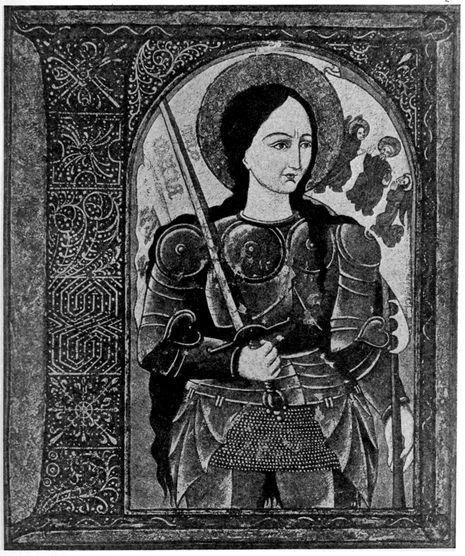
JEANNE D’ARC. From a Miniature of the XVth Century.
I, in my turn, asked Jeanne what dialect the Voice spoke? “A better one than yours,” she replied. I 307speak the Limousin dialect. “Do you believe in God?” I asked her. “In truth, more than yourself!” she answered. “But God wills that you should not be believed unless there appear some sign to prove that you ought to be believed; and we shall not advise the King to trust in you, and to risk an army on your simple statement.” “In God’s Name!” she replied, “I am not come to Poitiers to shew signs: but send me to Orleans, where I shall shew you the signs by which I am sent:” and she added: “Send me men in such numbers as may seem good, and I will go to Orleans.”
And then she foretold to us—to me and to all the others who were with me—these four things which should happen, and which did afterwards come to pass: first, that the English would be destroyed, the siege of Orleans raised, and the town delivered from the English; secondly, that the King would be crowned at Rheims; thirdly, that Paris would be restored to his dominion; and fourthly, that the Duke d’Orléans should be brought back from England. And I who speak, I have in truth seen these four things accomplished.
We reported all this to the Council of the King; and we were of opinion that, considering the extreme necessity and the great peril of the town, the King might make use of her help and send her to Orleans.
Besides this, we enquired into her life and morals; and found that she was a good Christian, living as a Catholic, never idle. In order that her manner of living might be better known, women were placed with her who were commissioned to report to the Council her actions and ways.
As for me, I believed she was sent from God, because, at the time when she appeared, the King and all the French people with him had lost hope: no one thought of aught but to save himself.
I remember that Jeanne was asked why she always 308marched with a banner in her hand? “Because,” she answered, “I do not wish to use my sword, nor to kill any one.”
When she heard any one taking in vain the Name of God, she was very angry; she held such blasphemies in horror: and Jeanne told La Hire, who used many oaths and swore by God, that he must swear no more, and that, when he wanted to swear by God, he should swear by his staff. And afterwards, indeed, when he was with her, La Hire never swore but by his staff.
Testimony of d’Aulon:[209] 1456.
And first, Deponent saith that, twenty years ago or thereabouts, the King being in the town of Poitiers, he [d’Aulon] was told that the said Maid, who was from the country of Lorraine, had been brought to the said Lord by two gentlemen, the same being of the company of Messire Robert de Baudricourt, Knight—the one named Bertrand; the other Jean de Metz—and presented [to the King]; to see whom (the said Maid) the Deponent visited the said town of Poitiers;
That, after the presentation, the Maid spoke privately to our Lord the King, and told him several secret things—what, he [the Deponent] knew not: saving that, shortly after, the King sent to fetch some of the people of his Council, among whom was the Deponent. He [the King] then informed them that the Maid had told him she was sent from God to help him to recover his kingdom, which at that time was for the most part occupied by his ancient enemies, the English;
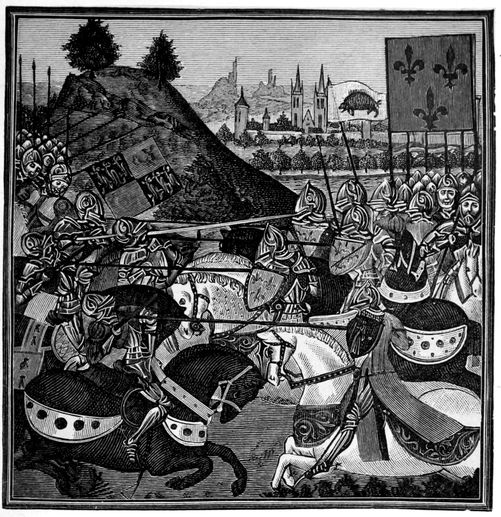
THE BATTLE OF PATAY.

LA HIRE AND XANTRAILLES.
That, after these words had been declared to the people of his Council by the King, it was agreed 309to interrogate the Maid—who, at that time, was of the age of sixteen years or thereabouts—upon sundry points touching the Faith;
That, to do this, the King sent for certain Masters in Theology, Jurists, and other expert people, who should well and diligently examine her on these points;
That he was present at the said Council when the Masters made their report on what they had found in the Maid; at which it was publicly said by one of them, that they did not see, know, or recognize in the Maid anything, excepting only whatever should be in a good Christian and true Catholic: and for such they held her, and it was their opinion that she was very worthy;
Also that, the report being made to the said King by the Masters, the Maid was then handed over to the Queen of Sicily, the mother of our Sovereign Lady the Queen, and to certain ladies with her, by whom the Maid was seen, visited, and privately looked at and examined; and after examination made by these matrons, the lady stated to the King that she and the other ladies found most surely that this was indeed a true Maid ...;
That he was present when the lady made her report;
That, these things being heard, and considering the great goodness in the Maid, and that God had sent her to him, as she had said, it was by the King concluded in his Council that henceforward he would make use of her help in his wars, inasmuch as for this she had been sent;
That, it was then decided she should be sent to the city of Orleans, at that time besieged by the enemy;
That, for this end people were given for her own service, and others to conduct her;
That, the guard and conduct of the same was appointed by our Lord the King;
310Also that, for the safety of her body the King caused to be made armour fit for the Maid’s body, and, this done, appointed a certain number of men-at-arms for the same [Maid] and for those of her company, to lead and conduct them safely to the City of Orleans;
That, immediately afterwards, he [the Deponent] took the road with them, following in this direction;
That, as soon as it came to the knowledge of my Lord Dunois—then called the Bastard of Orleans, who was in the city of Orleans in order to keep and guard it from the enemy—that the Maid was coming that way, he assembled together a certain number of men of war to meet her, such as La Hire and others. And to do this, and more safely to lead and conduct her to the city, this Lord and his followers placed themselves in a boat, and went to meet her by the river Loire, about a quarter of a league distant, and there found her;
That, the Maid and the Deponent immediately entered the boat, while the remainder of her soldiers turned back toward Blois. And, with the Lord Dunois and his followers, they entered the city sure and safe; in which [city] the Lord Dunois lodged her well and comfortably in the house of one of the principal burghers of the city, who had married one of the principal women thereof;
That, after the said Lord Dunois, La Hire, and certain other captains of the party of our Lord the King, had conferred with the Maid as to what was expedient to do for the guardianship, keeping, and defence of the city, and also by what means the enemy could be best harassed, it was between them agreed and concluded to be necessary that a certain number of men-at-arms of their party, then near Blois, should be sent for and brought. To put this into execution, and to fetch them to the city, were appointed the Lord Dunois and the Deponent, and certain other captains, with their 311followers, who sent to the country of Blois to bring the same;
That, as soon as they were ready to depart and bring those who were in the country of Blois, and that this came to the notice of the Maid, immediately she mounted her horse, and, together with La Hire and a certain number of her followers, she went out into the fields to keep the enemy from doing them injury. And, in order to do this, the Maid placed herself with her followers between the army of the enemy and the city of Orleans; and so wrought, that,—thanks to God!—notwithstanding the great power and number of the soldiers in the army of the enemy, the Lord Dunois and the Deponent, with all their followers, passed through, and safely went their way: and in the same way returned the Maid and her followers to the city;
That, as soon as she knew of the coming of the aforesaid, and that they brought with them those whom they had gone to fetch for the reinforcement of the city, immediately the Maid mounted her horse and, with a party of her followers, went to meet them, to support and succour them, if there were need of it;
That, in the sight and knowledge of the enemies, the Maid, Dunois, Maréchal La Hire, and the Deponent, with their followers, entered the city without any opposition whatsoever;
Moreover, that, the same day, after dinner, came the said Lord Dunois to the lodging of the Maid, where she and the Deponent had dined together. And, in speaking to her, Dunois told her that he knew, of a truth, from people of worth, that one named Fastolf, captain of the enemy, would shortly join the enemy at the siege, not only to give them help and reinforce them, but also to victual them, and that he was then at Vinville. At which words the Maid much rejoiced—so it seemed to the Deponent—and said to my Lord 312Dunois these or such-like words: “Bastard, Bastard, in the Name of God I command thee that, so soon as thou knowest of the coming of the said Fastolf, thou dost let me know; for, if he pass without my knowing, I promise thee I will have thy head.” To which replied the Lord Dunois, that of this he had no fear, for he would certainly let her know;
That, after these words, the Deponent being tired and overdone, placed himself on a couch in the chamber of the Maid, to rest himself a little, and also the Maid placed herself with her hostess on another bed in the same way, to sleep and rest; but, as the Deponent was beginning to take his rest, suddenly the Maid, though asleep, arose from her bed and, making a great noise, awoke him. And then the Deponent asked of her what she wanted; to which she answered: “En Nom Dè! my Counsel hath told me that I should attack the English; but I know not if I should attack their bastilles or go against Fastolf, who would victual them”; on which the Deponent immediately rose, and, as soon as he could, armed the Maid;
That, as soon as he had armed her, they heard a great noise and cry made by those of the city, saying that the enemy were doing much harm to the French. Then the Deponent armed himself, and, while he was so doing, without his knowledge, the Maid left the room, and went forth into the street. Here she found a page, on horseback, who at once dismounted from the horse; and immediately she mounted thereon, and, as straight and as speedily as she could, she took her way direct to the Burgundy Gate, where was the greatest noise;
That, the Deponent immediately followed the Maid; but, go as quickly as he might, she was already at the gate;
That, as they were coming to the gate, they saw being carried away one of the people of the city, who 313was terribly wounded; and then the Maid asked of those carrying him who this man was. They replied that he was a Frenchman. Then she said she had never seen French blood without feeling her hair stand on end;
That, at the same time, the Maid, the Deponent, and many other men of war of their company, went out from the city to help the French, and to harass the enemy to the best of their power; but, as soon as they were outside the city, the Deponent was told that never had there been seen so many men-at-arms of their side as were now there;
That, after this passage, they took their road towards a very strong fort of the enemy, called the Fort of Saint Loup, which was at once attacked by the French, and, with very little loss to them, was taken by assault; and all the enemy within were killed or taken: and the fort remained in the hands of the French;
That, this being done, the Maid and those of her company returned into the city of Orleans, where they refreshed themselves and rested that day;
That, next day, the Maid and her people, considering the great victory obtained by them the day before over their enemies, sallied from the town in good order, to attack another fort in front of the city, called the Fort of Saint-Jean-le-Blanc: for which purpose, seeing that they could not get there by land—because their enemies had made another very strong fort, at the foot of the bridge of the city, so that it was impossible for them to cross [the bridge]—it was decided among them to pass over to a certain island in the river Loire, and there to assemble their entire army: and, in order to take the Fort of Saint-Jean-le-Blanc and to cross to the other arm of the river Loire, two boats were brought, of which a bridge was made, for the attack of the fort;
That, this done, they went to the fort, which they 314found quite deserted; for the English who were therein, so soon as they perceived the coming of the French, went away, retreating to another stronger and greater fort, called the Fort of the Augustins;
That, seeing the French were not powerful enough to take the fort, it was decided they should return without doing anything further;
That, in order to return and cross more safely, the most notable and valiant of the party of the French were ordered to remain behind, in order to keep the enemy from troubling them on their return; and for this were appointed Messires de Gaucourt, de Villars, then Seneschal of Beaucaire, and the Deponent;
That, while the French were returning from the Fort of Saint-Jean-le-Blanc to the island, the Maid and La Hire both crossed over, each with a horse, in a boat from the other side of the island; and on these horses they mounted as soon as they had crossed, each with lance in hand. As soon as they saw that the enemy was making a sally from the fort to rush upon their people, immediately the Maid and La Hire, who were always in the front to protect them, couched their lances and were the first to attack the enemy; others then followed and began to attack the English, in such wise that they forcibly constrained them to retreat and enter the Fort of the Augustins;
And, while this was going on, the Deponent, being in guard of a passage with others appointed and ordered thereto—among whom was a very valiant man-at-arms of the country of Spain, named Alphonse de Partada—saw passing before them another man-at-arms of their company, a tall man, big and well armed, to whom, because he was about to pass on, the Deponent remarked that he ought to remain there for a time, with the others, and make resistance to the enemy, should need arise; and he immediately replied that he would do nothing 315[of the kind]. Then Alphonse said he also would remain with the others, and that there were many as valiant men as he who would remain willingly; who answered Alphonse, that it would not be he. Upon which there were between them certain proud words, so much that they decided to go, both of them, the one and the other, against the enemy; and then it would be seen which was the more valiant, and which of the two would best do his duty. And, taking one another by the hand, at the greatest pace they could, they went towards the fort of the enemy, and so to the foot of the palisade;
That, as they reached the palisade of the fort, the Deponent saw within the palisade a tall, strong and powerful Englishman, armed at all points, who so resisted them that they could not enter. Then the Deponent shewed the Englishman to a man named Maître Jean the Cannoneer, telling him to shoot at the Englishman; for he was doing much harm and injury to those who wished to approach the fort. This Maître Jean did; for, as soon as he saw him, he aimed a shot at him, so that he fell dead to the ground; then the two men-at-arms won the passage, by which all the others of their company crossed, and entered the fort, which most fiercely and with great persistence they assailed on all sides, so that within a short time they won it and took it by assault. There were killed or taken the greater part of the enemy; and those who were able to save themselves retreated into the Fort of Tourelles, at the foot of the bridge. Thus, the Maid and those who were with her obtained victory over the enemy that day. And the great battle was won; and the Lords and their people with the Maid remained before the same [fort] all that night;