PART III PREVENTIVE MEASURES AGAINST INDUSTRIAL POISONING (continued 2)
Thomas Morison Legge translation
2. Precautions must be taken to prevent the gases from the generator passing into the coolers and purifiers when the engine is at rest.
3. Care is to be taken when the apparatus is at rest to prevent any possible subsequent escape of gas into the room where the apparatus is installed.
4. The return of explosive gas out of the gas engine into the gas pipe by failure to ignite or other accident, must be made impossible.
5. The apparatus through which the generator is charged must possess a tightly fitting double valve to prevent escape of gas into the room during charging.
6. The pipes for conducting away the unpleasantly smelling bituminous constituents in the water mixed with sulphuretted hydrogen from the scrubbers must not communicate with the workroom.
7. Precautions must be taken to minimise the danger during the cleaning of the generator (removal of ashes and slag).
8. All stop-cocks and valves are to be so arranged that their position at any time (open or shut) is clearly visible from outside.
9. Purifiers with a capacity greater than two cubic meters must be provided with appliances which make possible thorough removal of the gas before they are opened.
10. The gas washing and cleaning apparatus and pipes are to be fitted with gauges indicating the pressure existing in them at any moment.
11. When a suction gas plant is first installed and also at times when there is no gas in the pipes and plant between the generator and the engine, gas must be blown in until all air is expelled before the engine is set going.
12. During the cleaning of apparatus and pipes which, when in action, contain gas, the rooms must be thoroughly ventilated.
13. Rooms in which suction gas plant is installed must be of such a height that all the plant and its connections can be easily reached for cleaning, &c., and be capable of such free ventilation as to render impossible an accumulation of gas.
14. These rooms must be separated from living rooms by a wall without any openings in it. Emanations also must be prevented as far as possible from entering into living or working rooms situated over the gas engine.
15. Erection of apparatus for generating and purifying suction gas in cellars shall only be allowed if specially effective ventilation is provided by natural or mechanical means.
Other Regulations are those of the Prussian Ministerial Decree, dated June 20, 1904, as to the arrangement and management of suction gas premises.
Acetylene Gas Installations
(See also pp. 85-7)
The following regulations for the protection of workers in acetylene gas installations are taken from the Prussian Ministerial Decree, dated 2 November, 1897:
1. Preparation and condensation of acetylene on the one hand, and liquefaction on the other, must be carried on in separate buildings.
2. If the pressure employed for condensation of the gas exceeds eight atmospheres, this work must take place in a room set apart for the purpose.
3. Rooms in which acetylene is prepared, condensed, or liquefied shall not be used as, nor be in direct connection with, living rooms. They must be well lighted and ventilated.
4. The carbide must be kept in closed watertight vessels, so as to ensure perfect dryness and only such quantities shall be taken out as are needed. The vessels must be kept in dry, light, well-ventilated rooms; cellar rooms may not be used for storage purposes.
5. Crushing of carbide must be done with the greatest possible avoidance of dust. Workers are to be provided with respirators and goggles.
6. Acetylene gasometers must be fitted up in the open air or in a well-ventilated room, separated from the gas generator. Every gas receiver must have a water gauge showing the pressure in the receiver.
7. Between the gasometer and receiver a gas purifier must be provided so as to remove impurities (phosphoretted hydrogen, arseniuretted hydrogen, carbon bisulphide, ammonia, &c.).
8. Condensation of acetylene gas at a pressure exceeding ten atmospheres shall only be done in combination with cooling.
Distribution and Use of Power and Illuminating Gas
The Austrian Gas Regulations (of July 18, 1906) contain general provisions as to impermeability and security of the gas pipes and the precautions to be observed in their installation. Special directions follow as to main flues, material, dimensions, branches, and connections, valve arrangements, testing of the pipes against leakage, directions for discovering leaks, and other defects; also the nature of the branch pipes (dimensions and material), valves, cocks, syphons, water seals, and pressure gauges. In addition there are directions as to testing pipes and how to deal with escape of gas, freezing of pipes, and other mishaps.
Ammonia
(See also pp. 90-3 and 175)
In the production of ammonia and ammonium salts (ammonium sulphate) combination of the ammoniacal vapour with the sulphuric acid is accompanied with the formation of volatile dangerous gases containing sulphuretted hydrogen and cyanogen compounds, which produce marked oppression and sometimes endanger the health of the workers. Drawing-off these fumes into the furnace (practised sometimes in small industries) is not advisable, as the sulphuretted hydrogen is burnt to sulphur dioxide; if it is burnt absorption of the sulphur dioxide should follow, or working it up into sulphuric acid (Leymann). Often these gases are freed from cyanogen compounds and sulphuretted hydrogen by means of gas purifying materials, such as are used in gas works. The whole apparatus must be impervious. Where liquids containing ammonia are used exhaust ventilation is necessary.
Cyanogen, Cyanogen Compounds
(See also pp. 93-5 and 195-7)
Processes in which cyanogen gas can develop, require to be done under a powerful exhaust draught.
In the production of cyanogen compounds possibility of the escape of hydrocyanic acid (prussic acid) has to be borne in mind. Such escape is possible in its production from raw animal products.
The most careful cleanliness and observance of general measures for personal hygiene are necessary in factories in which cyanogen compounds are manufactured or handled. In crushing cyanide of potassium the workers should wear indiarubber gloves and respirators. The products should be stored in closed vessels in dry store rooms set apart for the purpose.
Modern cyanide of potassium factories which work up molasses, from which the sugar has been removed, and also residuary distillery liquors, so far conform with hygienic requirements that all the apparatus is under negative pressure, so that poisonous gases cannot escape into the workrooms.
Coal Tar, Tar Products
(See also pp. 96-119)
Care must be taken for the removal of injurious gases developed in the manipulation and use of tar (tar distillation) and in the processes of cleaning connected therewith. This can be most effectively done by carrying on the processes in closed apparatus. Hofmann describes such a factory where all mixing vessels in which the distillation products are further treated are completely closed in, so that even in mixing and running off, no contact is possible with the material.
The vessels for holding tar, tar-water, &c., must be impervious and kept covered. Only the cold pitch and asphalt should be stored in open pits. The cooling of the distillation products and residues, so long as they give off poisonous and strongly-smelling fumes, should be carried out in metal or bricked receivers. Such directions find a place in the ‘Technical Instructions’ appended to the German Factory Code. Without doubt, tar is, because of its smell and for other reasons, unpleasant to handle, and the danger to health from contact with it is not a matter of indifference. Spilling of small quantities of tar during transport and other manipulations can hardly be avoided. Careful cleanliness, therefore, on the part of workers is strongly urged. It may be mentioned that if tar is covered with a layer of tar-water, treatment with acid fluids develops sulphur and cyanogen compounds, which may affect the workers. Tar water should, therefore, be separated carefully from the tar and used for the preparation of ammonia.
The same remarks as to cleanliness, &c., apply in the manufacture of felt, lamp-black, and briquettes, with use of tar. Saturation of felt, and manufacture of tar plaster should be done in closed apparatus. In the production of lamp-black, even with a great number of soot chambers, there is escape of soot causing nuisance to workers and the neighbourhood. Complete avoidance of this seems to be difficult, so that measures for personal hygiene must be assured. In briquette factories it has been found useful to heat the tar by means of steam instead of by direct fire, which renders possible the use of a closed apparatus and mechanical stirring.
In the distillation of tar, during the first distillation period (first runnings) unpleasant and injurious gases containing ammonia and sulphur escape from the stills. These should (according to Leymann) be carried away through closed pipes branching off from the lower end of the running-off pipe, either into the furnace (in doing which a possible back flash of flame is to be guarded against) or be subjected to purification by lime or oxide of iron (similar to that in the case of illuminating gas) with a view to recovery of ammonia and sulphur. The lower end of the distillation pipes should be U-shaped so as to form a liquid seal—the pipes for the drawing off of the gases branching off before the curve. In the later stages of distillation risk can be checked by careful cooling and imperviousness of the apparatus.
Very unpleasant yellow fumes develop in great quantity when pitch is run off from the hot still. Hence hot pitch should not be run off into open pitch receptacles, but be cooled first in closed receptacles.
The crude products obtained by distillation (light oil, creosote oil) are subjected to purification consisting in treatment on the one hand with alkali and on the other with acid and followed by fractional distillation. In these processes injurious fumes may develop, therefore they must—as already mentioned—be carried on in closed vessels provided with means of escape for fumes and appliances for mechanical stirring; the fumes drawn off must be led into the chimney stack.
In the distillation of brown coal, of tar, and of resin, it is necessary, as in the distillation of coal tar, to insist above all on careful cooling and condensation, and thorough absorption of uncondensed gases in washing towers. Special precautionary rules are necessary to guard against the danger of entering tar stills for cleaning purposes. Such directions were approved in Great Britain in 1904 in view of accidents which occurred in this way:
Tar Distilling
The following directions[I] are approved by the Home Office and are applicable to factories in which is carried on the distillation of tar for the production of naphtha, light oil, creosote oil, and pitch.
1. During the process of cleaning, every tar still should be completely isolated from adjoining tar stills either by disconnecting the pipe leading from the swan neck to the condenser worm, or by disconnecting the waste gas pipe fixed to the worm end or receiver. Blank flanges should be inserted between the disconnections. In addition, the pit discharge pipe or cock at the bottom of the still should be disconnected.
2. Every tar still should be ventilated and allowed to cool before persons are allowed to enter.
3. Every tar still should be inspected by the foreman or other responsible person before any workman is allowed to enter.
4. The inspecting foreman on first entering any tar still or tank, and all persons employed in tar stills or tanks in which there are no cross stays or obstructions likely to cause entanglement, should be provided with a belt securely fastened round the body with a rope attached, the free end being left with two men outside whose sole duty should be to watch and draw out any person appearing to be affected by gas. The belt and rope should be adjusted and worn in such a manner that the wearer can be drawn up head foremost and through the manhole and not across it.
5. A bottle of compressed oxygen, with mouthpiece, should be kept at all times ready for use; and printed instructions as to the use of this bottle, and the method to be employed for resuscitation by means of artificial respiration should be kept constantly affixed. A draft of such instructions is appended.
6. A supply of suitable chemical respirators properly charged and in good condition should be kept ready for use in case of emergency arising from sulphuretted hydrogen or certain poisonous gases. (Granules of carbon saturated with a solution of caustic soda readily absorb sulphuretted hydrogen and may be used for charging respirators.)
7. The use of naked lights should be strictly prohibited in any portion of the works where gas of an inflammable nature is liable to be given off.
8. Each still should be provided with a proper safety valve, which should at all times be kept in efficient working condition.
Gassing
Symptoms.—The first symptoms are giddiness, weakness in the legs, and palpitation of the heart. If a man feels these he should at once move into fresh warm air, when he will quickly recover if slightly affected. He should avoid exposure to cold. He should not walk home too soon after recovery; any exertion is harmful.
First Aid.—Remove the patient into fresh warm air. Send for the oxygen apparatus. Send for a doctor. Begin artificial breathing at once if the patient is insensible and continue it for at least half-an-hour, or until natural breathing returns. Give oxygen[J] at the same time and continue it after natural breathing returns.
Artificial Breathing (Schäfer Method).—Place the patient face downwards as shown in the diagrams.
Kneel at the side of the patient and place your hands flat in the small of his back with thumbs nearly touching, and the fingers spread out on each side of the body over the lowest ribs (see Diagram 1).
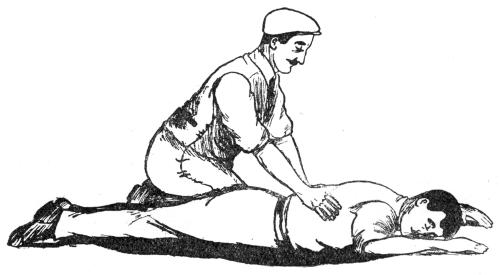
Diagram 1
Then promote artificial breathing by leaning forward over the patient and, without violence, produce a firm, steady, downward pressure (see Diagram 2). Next release all pressure by swinging your body backwards without lifting your hands from the patient (see Diagram 1).
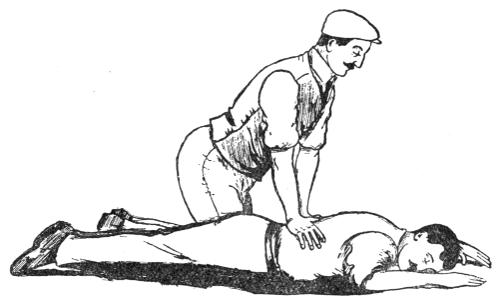
Diagram 2
Repeat this pressure and relaxation of pressure without any marked pause between the movements, about 15 times a minute, until breathing is established.
In my opinion as expressed in the general discussion, use of breathing apparatus (smoke helmets) with oxygen is strongly advisable; these implements must be put on before entering the still.
In creosoting wood, opening the apparatus and taking out the steeped wood should only be done when the apparatus is sufficiently cooled, as otherwise injurious fumes escape.
In heating asphalt unpleasant fumes arise which should be drawn off into a furnace, or absorbed by a condenser charged with oil (Leymann); open pans should be avoided, as injurious to workers.
Organic Dye-stuffs, Coal-Tar Colours.
(See also pp. 107-19 and 204-15)
The hygienic measures to be adopted for the prevention of industrial poisoning in coal-tar colour factories are chiefly concerned with the poisonous nature on the one hand of the raw material (benzene, toluene, &c.) and on the other of the intermediate products (nitrobenzene, aniline, toluidine, &c.) and the subsidiary substances (chlorine, acids, especially nitric acid, &c.,) used.
The most important measures are as follows:
In purifying the raw materials (benzene, &c.) the distillation requires to be done under effective cooling and in impervious apparatus. If injurious solvents are employed (such as pyridine in the production of anthracene) the manipulations should be performed in closed apparatus if possible, under negative pressure. The fumes exhausted should be carefully condensed by cooling or absorbed by a spray of water or oil.
In view of the poisonous nature of benzene, the apparatus, stills, receivers, tanks, tank waggons, &c., should only be entered for the purpose of cleaning or repairing after preliminary thorough removal of all residue of benzene, complete isolation from all similar apparatus near, and thorough ventilation. Workers entering the stills, &c., should always be equipped with breathing apparatus (smoke helmets) and with a supply of oxygen. Other aids, such as safety belts which are held by helpers, are not here advocated in view of the often sudden fatal poisoning, especially as the rescuer is easily induced to spring to the assistance of his unfortunate mate without the necessary equipment. The frequency of such accidents calls urgently for the use of breathing apparatus.
In the manufacture of diazo- and nitroso-compounds and generally in nitrating operations poisonous nitrous fumes are developed. By reduction in an acid solution, acid fumes and singularly pungent-smelling compounds can be given off. If reduction by means of tin is practised, the arsenic in the tin can cause evolution of the extremely poisonous arseniuretted hydrogen gas. In sulphonating, sulphur dioxide can develop; and sulphuretted hydrogen gas on heating with sulphur or sulphide of sodium.
All manipulations should take place in tightly closed-in apparatus provided with exhaust, and the gases drawn off should be absorbed or effectively carried away. In the case of many injurious gases it is not sufficient merely to conduct them into the flue; they ought to be condensed and got rid of. Thus acid fumes (nitrous fumes, sulphur dioxide, hydrochloric acid vapour, chlorine gas) are neutralised by water or milk of lime, or a solution of soda; ammonia or alcohol by water; sulphuretted hydrogen and arseniuretted hydrogen by lime and oxide of iron; aniline, &c., by dilute acids.
Production of nitrobenzene, by nitrating benzene requires to be done in closed apparatus, provided with mechanical agitators. In the subsequent separation of the nitrating acids from the resulting nitro-compounds, escape of vapourised nitro-compounds can scarcely be avoided even if closed apparatus is used. Provision, therefore, must be made for abundant ventilation of the workrooms. The reduction of the nitro-compounds (nitrobenzene, nitrotoluene) to aniline (toluidine) must similarly take place in closed agitating vessels. Introduction of the iron filings and sulphuric or hydrochloric acids, also the subsequent saturation with lime, and driving over of the aniline, &c., with steam, and collection of the distillate, must take place in completely closed apparatus. Nevertheless, escape of small quantities of aniline is very difficult to prevent unless ample ventilation is provided.
In the production of fuchsin by heating aniline hydrochloride (toluidine, red oil) with nitrobenzene (formerly arsenic acid) in closed vessels, furnished with mechanical stirring apparatus the aniline remaining unconverted after the melting escapes in the form of steam carrying aniline fumes, even with careful condensation, so that thorough ventilation and the other general measures for the protection of workers set forth on pp. 242 et seq. are required.
Marked injury to health and distress to workers through acid fumes are sometimes caused by the denitration of the waste mixture of sulphuric and nitric acids in the nitrating process, that is, by the separation of nitric acid from the acid mixture. This denitration takes place usually in the Glover towers of the lead chamber system which is often associated with the manufacture of aniline. The mixed nitro-compounds of the waste acids, however, are often not completely condensed, but pass through the chambers and Gay-Lussac towers and escape into the air, whence arises the constant smell of nitrobenzene in aniline factories (Leymann). In the production of naphthylamine and recovery of chlorinated products, escaping chlorine should be led into chloride of lime chambers, hydrochloric acid fumes into towers to be absorbed by water and milk of lime or a solution of soda.
In aniline factories danger can scarcely be wholly avoided, as the workers, on the one hand, come into contact with poisonous substances, nitrobenzene, aniline, &c., and on the other hand, in spite of all technical hygienic measures, can hardly help breathing in some of the aniline. Apart from the technical regulations, therefore, there must be insistence on cleanliness of the workrooms, personal cleanliness on the part of the workers (washing, baths, working suits, cloak-rooms, &c.). Besides this, contact with aniline, nitrobenzene, &c., wetting of the body and clothes with these substances, and, especially spilling, splashing, and scattering these fluids must be carefully avoided. The workers require to be suitably instructed as to the symptoms of nitrobenzene and aniline poisoning, and the right steps to take, if poisoned. The oxygen apparatus must always be at hand, ready for use; the workers must be instructed how to use it. Further, workers, especially those newly employed, must be under supervision in order that assistance may be rendered them on the first signs of poisoning; medical assistance ought to be within easy reach. Workers also should know of the tendency of aniline to cause cancer of the bladder.
Precautions against the poisonous nitro-derivatives of benzene (nitrophenol, picric acid, &c.), which are in the form of poisonous dust, must take the form of entirely closed-in grinding and packing apparatus, or, at all events, removal of the dust at its source.
Among official regulations may be mentioned the Prussian Ministerial Edict, dated December 18, 1908, as to purification and storage of benzene, and further the Regulations dated December 13, 1907, and December 30, 1908, in force in Great Britain for the manufacture of nitro- and amido-derivatives of benzene, and the manufacture of explosives with use of dinitrobenzene or dinitrotoluene.
VI PREVENTIVE REGULATIONS—THE EXTRACTION OF METALS (SMELTING WORK IN GENERAL)
Danger is incurred when the furnace leaks, a condition which generally occurs in the course of time, or if gases escape during the necessary manipulations through the working doors. This can be avoided by maintaining the walls in as air-tight a state as possible; but as very small leakages are almost unavoidable the best course is to so regulate the draught in the furnace (by means of fans) that a slight negative pressure always exists in it. Naturally, poisonous gases escaping from the furnace such as sulphur dioxide, carbonic oxide, carbon dioxide, and hydrocarbons require to be drawn away and rendered harmless. This can often be done by merely conducting them into the main flue. Gases containing carbonic oxide possess high heating capacity, and their escape can usually be prevented by suitable cupola bells. They can be led away in impervious conduits and utilised for heating purposes or for driving gas engines. Entering the flues for cleaning or repairing purposes is especially dangerous; and as it is difficult to isolate one portion entirely from another, such operations might well be carried on by persons equipped with breathing apparatus (smoke helmets or oxygen apparatus).
In roasting operations handwork can be largely replaced by furnaces worked mechanically. If the gases generated are rich in sulphur dioxide they can be utilised for the manufacture of sulphuric acid or for the production of liquid sulphur dioxide either directly or after concentration; if not, they must be rendered harmless by treatment with milk of lime in absorption towers. Other methods of rendering the sulphur dioxide (unsuited for manufacture of sulphuric acid) harmless depend on treatment with minerals containing calcium carbonate, or magnesium or aluminium hydrate, sodium sulphide, &c. Sometimes the sulphurous gases are led into blast furnaces containing oxide of iron and coal (so as to form sulphide of iron) or are absorbed by means of moist scraps of sheet iron or brown coal or peat briquettes.
Use of chlorine compounds in the extraction of metals from ores (silver, copper) causes evolution of chlorine and hydrochloric acid vapour. These should be dealt with in absorption towers. Metallic fumes are collected by suitable condensing arrangements. Flue dust is retained in flue dust chambers, but in the cleaning of such condensing flues and chambers danger to the workers is considerable and they should be equipped with respirators, working suits, &c. Personal hygiene must be insisted on.
Iron
(See also pp. 146-51)
In blast furnace work, industrial poisoning occurs mainly from escaping gases rich in carbonic oxide. They may also contain sulphur dioxide and cyanogen compounds. The high proportion of carbonic oxide, however, makes these gases valuable and serviceable, because of their great heating value. They are, therefore, now led away and utilised, the furnace being closed by a cupola bell only opened by means of a mechanical contrivance when charging is necessary; while this is being done the ignited blast furnace gases pour out, and the workers retire from the opening, so that danger to them is avoided. The construction of a blast furnace with a cupola bell can be seen in fig. 29. The blast furnace gases are conducted away by an opening in the side, and pass along special pipes to be utilised, after having gone through a purifying process mainly for the removal of flue dust, &c. The gases serve partly for the heating of the blast for the furnace itself, and partly for driving the gas engines which serve the electrical power apparatus, electric lighting, &c., in the works. Through the rational utilisation of the blast furnace gases, the workers are protected from their injurious action during the working of the furnace. Serious gas poisoning, however, occurs not infrequently to workers who have to enter the gas mains for cleaning purposes. Workers, therefore, should only be permitted to enter the flues, &c., a considerable time after the process has been stopped and after as complete and thorough a ventilation of the system as is possible.
Any portion of the gas system which is to undergo cleaning must be completely isolated. Ventilation is best effected by the introduction of compressed air. Thus a foundry (in the Duisburg district) has provided all its cellars and passages, through which gas pipes pass, and which must be entered during repairs, with compressed air pipes. It is, however, advisable that gas conduits should only be entered by workers equipped with breathing apparatus and oxygen supply. Naturally adequate instruction of workers and training in first aid are necessary, as well as a sufficient supply of oxygen in constant readiness.
Injurious gases can escape from the furnace during tapping and slag running; poisonous gases with a disagreeable odour, from presence of sulphuretted hydrogen, also arise in granulating the slag, that is, when the fluid slag is led into water for subsequent use in preparation of cement. These gases should be collected by hoods, and be carried away as far as possible.
In the manufacture of steel by the Bessemer or Thomas-Gilchrist process, the dark smoke arising out of the converter during the blowing operation should be drawn off (led into flues), as it is injurious to health. In the Martin furnaces poisoning may occur, especially when the gas flues are entered after cessation of work. In letting out the gas in order to stop the furnaces, the gas and air valves must first be closed and the outlet valves for gas be opened only after the pipes have been filled with steam. Steam is to be driven through until the pipes are quite free from gas, and the system only entered after it has become thoroughly cooled. If need arises for entering portions of the system while neighbouring parts are still filled with gas, the workers employed require to be provided with breathing apparatus and smoke helmets.
In the transport of ferro-silicon several cases of poisoning have occurred. Cautionary regulations, therefore, relating to this work have been found necessary.
Such directions are contained in the police regulations of the Prussian Minister of Trade and Industry respecting the transport on the Rhine of corrosive and poisonous substances (dated September 29, 1910).
It is prescribed: (1) that ferro-silicon be packed in strong watertight cases of wood or metal; (2) that on the cases be inscribed, legibly and indelibly, the notice ‘Ferro-silicon. To be kept dry! With care!’ (3) that the substance be delivered dry and in dry cases; (4) that the cases be stored in airy places on the deck of the ship in such a manner that they are protected from wet.
Further, care is to be taken that the storage on ships is done in such a way that possible damage to the material in which it is packed entails no risk. The harbour authorities where loading or landing takes place can deal with special cases as they think fit.
International regulation as to transport of ferro-silicon in the spirit of the above regulations would be most desirable in view of the oversea trade in this substance.[K]
Lead
(See also pp. 120-40 and 177-82)
For protection against lead poisoning, the most widely spread of the slow industrial poisonings, all those measures are of moment which we have described in our general discussion on protection against danger from poison in industries, both personal and general.
Personal hygiene, especially careful washing after work, prohibition of eating in workrooms, suitable working clothes, provision of cloak rooms, meal rooms, baths, &c., are important and effective measures for the protection of workers against industrial lead poisoning.
The worker should naturally be adequately instructed as to the risk. Appropriate printed notices are especially adapted for this purpose.
Further, selection of workers should be made under medical supervision. Workers who suffer from specific disease which, if associated with lead poisoning, may prove dangerous, should be excluded from all contact with lead. Among such illnesses must be reckoned tuberculosis in all its forms, alcoholism, epilepsy, tendency to mental disease (nervous disposition, hysteria, neurasthenia, &c.), rheumatism, and disease of the kidneys.
Overtime work undoubtedly increases risk; therefore working hours should be shortened as much as possible, and handwork replaced by machine work where possible. Young persons and women especially should be excluded from work in lead. Alternation of employment also is beneficial and essential in very dangerous lead work, because the poison accumulates in the body and only during intervals wherein absolutely no poison can be absorbed has it time to be eliminated.
Periodical medical examination by a surgeon is of great value with systematic entry of the results of examination in a health register. As bearing on this, early diagnosis is of the greatest importance, so that workers in whom the first signs of lead poisoning appear may at once be suspended or transferred to other work.
Lead workers should take suitable nourishing food and avoid particularly alcoholic excess.
When the danger is due to fumes or dust in the air the measures prescribed on pages 242-55 apply, particularly those which aim at keeping the workrooms and the air in the factories free of them by locally applied exhaust ventilation.
In order to replace or reduce the use of lead we strongly advocate the use of non-poisonous, or at any rate less poisonous, substances, where this can be done without technical difficulties, as, for instance, carborundum discs instead of lead in polishing of precious stones, leadless glaze in pottery for lead glaze (so far as this is possible, as to which see page 319), beds free of lead (in different industries) for lead beds. In a number of cases, however, such substitution is impracticable on technical grounds or can only partially be carried out, as, for example, in letterpress printing and in the paint and colour industry, in which the prohibition of lead has often been repeatedly urged. So far, unfortunately, it must be admitted that repeated attempts to find a non-poisonous substitute for lead colours, especially for white lead, of equal value technically, have not succeeded. Endeavours have been made to substitute for lead, zinc preparations (zinc white, lithopone, &c.), but hitherto (in regard to durability, opacity, &c.) with incomplete success.
Mention must be made of the measures based upon the relatively non-poisonous nature of lead sulphide. Lead sulphide is, in spite of various assertions to the contrary, practically non-poisonous; a fact attributable to its insolubility in water and weak acids. As lead sulphide is the only non-poisonous lead compound it is a duty to take advantage of this fact for purposes of lead prophylaxis.
Attempts with this end in view were made by the introduction of sulphur soaps in lead factories. Soaps containing in large quantity soluble alkaline sulphides convert lead compounds adhering to the skin into black lead sulphide. The lead compounds are in this way made harmless, and besides this the worker is impelled to remove the staining by washing. Such a sulphur soap has been brought into the market under the name of akremnin soap, but does not enjoy special popularity with the workmen on account of its unpleasant smell.
The struggle against the risks of lead employment has been going on ever since efforts for the protection of workers were commenced.
The International Association for Labour Legislation has made valuable inquiries in this direction. The question of lead poisoning had been repeatedly discussed by this Association and its branches in various countries. The International Labour Bureau also took up the issue and in 1906—supported by the Institute for General Welfare in Frankfurt a-M.—offered a prize for the best treatise on the prevention of industrial lead poisoning. The outcome of this competition was the volume compiled by Leymann, ‘Die Bekämpfung der Bleigefahr in der Industrie’ (published by Fischer, Jena, 1908).
In connection with the resolution adopted at the third Congress of the International Association for Labour Legislation the Union of Social Reform (as the German branch is called) addressed the Federal Council on the white lead question, the chief points insisted upon being the need for: (1) regulations for the house painting industry in pursuance of Section 120 of the Factory Code; (2) report by the Imperial Health Office on the practicability of substitutes for lead; (3) exclusion of lead colours from use in the painting of public buildings; and (4) treatment of lead poisoning by the State Insurance Office as an accident entitling to compensation.
These demands were supported by the central office of the Society for Promoting the Welfare of Workers, which had as far back as its seventh conference in 1898 occupied itself with the question of dangerous trades and especially, at its conference in 1905, taken up the subject of the protection of workers against industrial poisoning.
In Germany these efforts resulted in the passage of a number of Imperial Regulations for separate lead industries.
In other countries similar action was set on foot. In Austria, where the subject is of special importance in view of the part played by lead in the home industries, the Government undertook to improve the conditions in industries attended with risk of lead poisoning. For this purpose the Statistical Office of the Ministry of Commerce and Labour has, since 1904, carried out extensive inquiries into lead and zinc smelting works, paint and colour factories, the painting and varnishing trades, letterpress printing, and the ceramic industry. The results are contained in the volume ‘Lead Poisoning in Smelting Works and Industries Generally’ (published by Hölder, Vienna).
As in Germany and Austria, so also in Great Britain, France, Switzerland, Belgium, and the Netherlands, regulations in various lead industries were enforced after previous official inquiry and report.
A general code, however, affecting all lead industries has only been published in one or two states. And yet this would, in my opinion, be of very great practical value as it is hardly possible to regulate each single branch of industry.
In Germany the Regulations dated May 26, 1903, dealing with lead colours are certainly comprehensive, but relate primarily to paint factories, and are not, therefore, a general Order in the sense indicated. In Saxony the decree of June 27, 1901, made notification of lead poisoning compulsory, and in the subsequent decree of April 16, 1909, prescribed general measures against lead poisoning. In Switzerland single cantons have made general regulations. In France, by a decree dated April 23, 1908 (in pursuance of the general law of June 12, 1893), all industries attended with risk of lead poisoning were brought under Regulation.
We give the provisions of this interesting decree, as it is a good example of the kind of Regulations we have in mind.
Decree of the President of the French Republic (April 23, 1908) relating to certain industries in which lead is used
1. In the lead industries hereinafter mentioned, viz.: smelting, cupellation of argentiferous lead, manufacture of accumulators, glass-making, manufacture and use of lead enamels, manufacture of pottery, decoration of porcelain or faience, ceramic chromo-lithography, manufacture of lead alloys, oxides, salts and colours—employers, directors or managers are required, apart from the general measures prescribed by the Decree of 29 November, 1904, to take special measures for protection and health as set forth in the following sections.
2. Lead melting pots shall be erected in an airy place separated from the other workrooms.
Hoods or other means for the effectual removal of fumes shall be provided:—
(a) Over the openings for the run of lead and slag in lead smelting.
(b) Before the furnace doors in the manufacture of lead oxides.
(c) Above the pots for melting lead or its alloys, in the other industries enumerated in Section 1.
3. All work with oxides and other compounds of lead capable of producing dust shall be done as far as possible when in a damp condition.
When this work cannot be done in the presence of water or other liquid, it shall be carried out by mechanical means, in covered air-tight apparatus.
If it is impossible to conform to the requirements of either of the first two paragraphs of this section, the work shall be done under a strong draught so arranged that the harmful products may be intercepted by apparatus suitably placed.
Finally, if none of these systems is possible the workmen shall be supplied with respirators.
4. Oxides and other compounds of lead, whether dry or damp, in suspension or solution, shall not be handled with the bare hand. The employer shall at his own expense provide the workers in these operations with either gloves made of impervious material such as indiarubber, or suitable appliances, and shall cause them to be kept in good repair and frequently cleaned.
5. Tables on which these products are handled shall be covered with some impervious material, kept in a perfectly water-tight condition.
The same requirement applies to the floors of the workrooms, which shall also be kept damp.
The floor shall be slightly sloped towards a water-tight receptacle for collecting the lead substances which are washed down.
The work shall be so arranged that there shall be no splashing. The tables, floors and walls shall be washed at least once a week.
6. Without prejudice to the requirements of section 3, the grinding and mixing of lead products, and the use of them in dusting shall be effected in special places with active ventilation.
If the materials cannot be damped, the workers shall be provided with respirators.
7. Pottery shall not be dipped with bare hands in solutions containing litharge, red lead, galena or white lead in suspension.
8. No food or drink shall be brought into the works.
9. Employers shall, at their own expense, provide and maintain for the use of the workers, overalls or clothing for use during work only, in addition to gloves and respirators.
10. In a part of the building separated from the workrooms, there shall be provided for the use of the workers exposed to lead dust or fumes, a cloak room and lavatory kept in good order, provided with basins or taps in sufficient number, a plentiful supply of water, soap and a towel for each worker replaced at least once a week.
The cloak rooms shall be provided with cupboards or drawers with locks or padlocks, the ordinary clothing being kept apart from the working clothes.
11. A warm bath or shower bath shall be provided each week for the workers exposed to lead dust or fumes.
A warm bath or shower bath shall be provided every day after work, for each worker employed, either in emptying or cleaning the condensing chambers and flues, in repairing furnaces in lead works, in carrying lead corrosions from the beds in white lead factories, in packing red lead, in grinding lead enamels and in dry dusting.
12. Employers are required to exhibit, in a conspicuous position in the works, regulations imposing on the workers the following obligations:—
To use the appliances, gloves, respirators, and working clothes placed at their disposal.
Not to bring into the works either food or drink.
To pay great care, before each meal, to the cleanliness of the mouth, nose, and hands.
To take the baths weekly or daily as provided in section 11.
13. The Minister of Labour may, by Order made with the advice of the Consultative Committee for Arts and Manufactures, exempt an establishment for a specified period, from all or part of the requirements of Regs. 2ᵃ, 2ᵇ, 2ᶜ, 5² and 6¹ in any case where it is found that observance of these requirements is practically impossible, and that the health and safety of the workers are assured by conditions at least equivalent to those prescribed in the present Order.
14. Subject to additional postponements which may be granted by the Minister in pursuance of Section 6 of the Act of 12th June, 1893 (as amended by that of 11th July, 1903), the delay required for the carrying out of the alterations necessitated by the present Decree is limited to one year from the date of its publication.
15. The Ministry of Labour is charged with the administration of this Decree.
This decree was supplemented by further noteworthy additions requiring medical supervision in lead industries as follows:
Decree of December 28, 1909, Organising Medical Service in Industries Exposing the Workers to Risk of Lead Poisoning
1. In premises in which the processes enumerated in Regulation 1 of the Decree of April 23, 1908, are carried on medical attendance as prescribed below shall be provided.
2. A surgeon appointed by the occupier shall examine the workers and enter the results of examination required in Regulations 3 and 4. The examinations shall be paid for by the occupier.
3. No person shall be employed in work mentioned in Regulation 1 of the Decree of April 23, 1908, without a certificate from the surgeon stating that he is free from symptoms of lead poisoning and of illness which might render him specially susceptible.
4. No worker shall remain at the same employment unless the certificate is renewed one month after commencement of employment and subsequently at quarterly intervals.
In addition to the periodical examination the occupier shall give an order on the surgeon to every workman declaring himself to be ill from his employment or who desires to undergo medical examination.
5. A special Register open to the Factory Inspector shall be kept containing the following particulars of each worker:
(1) Dates and duration of absence on account of illness of any kind;
(2) Dates of medical certificates for such illness, the notes made by the surgeon and the name of the surgeon furnishing them;
(3) Instructions given by the appointed surgeon in pursuance of Regulations 3 and 4 above.
Lead Smelting Works
(See also pp. 122-31)
As the fumes in lead smelting works contain a high proportion of lead, all apparatus, especially furnaces and working doors, should be provided with efficient exhaust ventilation and all flues, furnaces, and other apparatus be as airtight as possible. Where lead dust is created exhaust ventilation locally applied is necessary. Two of the most important preventive measures are personal cleanliness and alternation of employment. Dust arising in the furnaces and borne along by the furnace gases together with arsenical fumes and dust must be deposited in flues or chambers.
In view of the importance of proper instruction of smelters as regards the danger we quote the warning note prepared by the Institute for Industrial Hygiene, Frankfurt a.-M., which deserves wide circulation.
Lead Leaflet for Smelters
How does Lead Poisoning arise?
The danger of lead poisoning in lead, spelter and other smelting premises can be avoided if due care is observed.
Lead poisoning occurs when lead enters the system. This takes place by breathing dust and fume containing lead, or by eating and drinking, smoking, snuff taking and tobacco chewing if food or tobacco is taken into the mouth with dirty hands and dirty face and beard.
No one is immune from lead. Lead accumulates in the body of careless persons and he who is not sick to-day can be so to-morrow or after weeks or months.
How can Plumbism be avoided?
All smelters must observe cleanliness. In this respect they should see to the following points:
1. It is to their interest to see that the exhaust ventilation is kept in order and that the Special Rules or Regulations are exactly followed. Further, special clothing should be worn, the mouth and nose should be covered, and the floors sprinkled.
2. It is especially important that in intervals and at the close of work the mouth, face, beard, and hands should be carefully cleaned. Food should not be eaten or the premises left without putting on fresh clothes and thoroughly washing or, still better, bathing. When drinking, the edge of the drinking glass should not be fingered with dirty hands. Especially important is it that the teeth should be cleaned and the mouth washed out.
3. During work smoking, snuff taking, and tobacco chewing, which invariably convey lead into the mouth, should be given up, as it is impossible to prevent the hands getting contaminated with lead. Lighting the pipe with glowing lead ashes is in the highest degree dangerous from the risk of inhaling lead fume. The body must be strengthened to withstand the action of lead. Moderation in drinking, especially avoidance of spirits, should be observed. Alcoholic subjects succumb to lead poisoning much more readily than the temperate.
Food should be abundant and rich in fat, for example milk and bacon. Thick soups are excellent before work. Work should never be begun on an empty stomach. And lastly as much fresh air as possible. Walking, athletics, work in the garden and field will help to keep off many an attack. If anyone thinks that he is suffering from lead poisoning he should at once in his own and his family’s interest see the doctor of his sick club.
The following are the
German Imperial Regulations for Lead Smelting Works, dated June 16, 1905
General Regulations
1. Workrooms in which lead ores are roasted, sintered, or smelted, pig lead produced and submitted to further treatment, distillation of rich lead (bullion cupellation) litharge, red lead, or other oxides of lead prepared, ground or sieved, stored or packed, or zinc skimmings distilled, shall be roomy, high, and so arranged that a sufficient constant exchange of air takes place. They shall be provided with a level and solid floor to allow of easy removal of dust by a moist method.
The walls shall be smooth so as to prevent collection of dust; they shall be either washed down or lime washed at least once a year.
Provided that this shall not apply in the case of calcining sheds with wooden walls.
2. An abundant supply of good drinking water, protected against contamination from dust, shall be provided for the workers on the furnaces and smelting pots, and in such close proximity to them, that they can obtain it at any time without having to go into the open air.
Arrangements for sprinkling the floors shall be provided near the furnaces. The floors of the rooms mentioned in paragraph 1 shall be wet cleansed at least once daily.
3. Prepared (i.e. concentrated) lead ores and leady smelting products, unless moist, shall not be crushed except in an apparatus so arranged as to prevent as far as possible penetration of dust into the workrooms.
Provided that this shall not apply to calcined material from converters.
Sacks in which lead ores and materials containing lead have been packed shall not be freed from dust and cleaned except in a dust-proof apparatus or by washing.
4. Materials containing lead for charging the blast-furnaces, if they are oxides and form dust, shall be damped before they are mixed with other materials, stocked on the feeding floor, or charged into the blast-furnaces.
Provided that this shall not apply in the case of calcined material from converters.
5. Dust, gases, and lead fumes, escaping from furnaces, and converters, tapping spouts, tapping pots, drain sump, slag pots, slag cars, or slag channels, and from glowing residues taken from the furnaces, shall be caught as near as possible to the point of origin and removed harmlessly.
Dust collecting chambers, flues, as well as furnaces which have been ‘blown down,’ shall not be entered by workmen unless sufficiently cooled and ventilated.
Special Regulations for such parts of a factory where lead colours are prepared
6. In grinding, sieving and packing dry leady materials, in charging, and emptying litharge and red lead furnaces, in collecting the red lead and similar operations in which leady dust is developed, exhaust arrangements shall be provided for preventing the entrance of dust into the workrooms.
7. Apparatus producing leady dust, if their construction and manner of use does not effectually prevent evolution of dust, shall have all cracks protected by thick layers of felt or woollen material, or by similar means, so as to prevent the entrance of dust into the workrooms.
Apparatus of this character shall be provided with arrangements for preventing compression of air in them. They shall only be opened when the dust in them shall have completely settled, and they are absolutely cool.
Special arrangements in force for the distillation of zinc skimmings
8. Proposed new furnaces for the distillation of zinc skimmings (for which according to pars. 16 and 25 of the Industrial Code a special permission is required) shall be so arranged that (1) there shall be at least a clear space of 10 feet in front of the charging opening; (2) any passages under the distillation rooms shall be roomy, at least 11½ feet high in the centre, light and airy.
9. Dust, gases, and fumes arising from the zinc skimmings distillation furnaces shall be collected as near as possible to the point of origin, and carried outside the smelting room.
The entrance of gases from the fires into the smelting room shall be prevented as far as possible by suitable arrangements for drawing them off.
10. Sieving and packing of by-products obtained in the distillation of zinc skimmings (poussière, flue dust) shall not be done except in a special room separated from the other workrooms, and complying with the requirements of Reg. 1.
Sieving shall only be done in an apparatus so constructed that dust shall not escape.
Employment of workers.
11. Women and young persons shall not be employed or permitted in rooms mentioned in Reg. 1, in flue dust chambers, or dust flues, or in the removal of flue dust.
12. No person shall be newly employed in rooms mentioned in Reg. 1, in flue dust chambers, or dust flues, or in the transport of flue dust, without a certificate of fitness from the surgeon appointed by the higher authorities.
These certificates shall be collected and shown to the Factory Inspector and Appointed Surgeon on request.
13. No person shall be employed in charging blast furnaces, apart from mere labouring work on the floors, for more than eight hours daily. The same shall apply in the case of workmen employed in the inside of furnaces when cool, or in emptying flue dust chambers, or dust flues which contain wet flue dust.
No person shall be employed in cleaning out, from inside, flue dust chambers, or dust flues containing dry flue dust for more than four hours daily; and including emptying and work of transport of this kind altogether no longer than eight hours daily.
Other workers in rooms specified in Reg. 1 shall not work more than 10 hours in 24, exclusive of mealtimes.
Exception to this is allowed in the case of those workers who are employed for the purpose of a weekly change of shift, and for whom exception as to Sunday employment is permitted by Imperial Decree.
Clothing, overalls, lavatory accommodation, &c.
14. The occupier shall provide for all persons employed in cleaning out flue dust chambers, dust flues, repairing of cooled furnaces, grinding, sieving and packing of litharge, red lead, or other lead colours, complete suits of working clothes, including caps and respirators.
15. Work with lead salts in solution shall not be done except by workers who either grease their hands or are provided with impermeable gloves.
16. The suit of clothes, or overalls, provided in Regs. 14 and 15, respirators and gloves, shall be provided in sufficient amount and in proper condition. The occupier shall see that they are always suitable for their purpose, and are not worn except by those workers for whom they are intended; and that they, at stated intervals (the overalls at least once a week, the respirators and gloves prior to use), are cleaned, and during the time that they are not in use are kept in a place specially reserved for each article.
17. A lavatory and cloak room shall be provided for the use of the workmen in a part of the building free from dust. Separate from it there shall be a dining-room. These rooms must be kept free from dust and be warmed during the winter.
In a suitable place provision shall be made for warming the workers’ food.
Water, soap, and towels, and arrangements for keeping separate the overalls from other clothing taken off before the commencement of work shall be provided in sufficient amount in the lavatory and cloak room.
The occupier shall afford opportunity for persons engaged in cleaning out flue dust chambers, dust flues, and the cooled furnaces, to take a bath daily after the end of the work, and for those handling oxides of lead, at least once a week, during working hours inside the works. The bathroom shall be warmed during the winter.
18. The occupier shall place the supervision of the health of the workers in the hands of a surgeon, appointed by the higher authorities for this purpose, whose name shall be sent to the Inspector of Factories. The surgeon shall examine the workers at least once a month in the factory, with a view to the detection of symptoms of lead poisoning.
The occupier shall not employ persons suspected by the surgeon of having contracted lead poisoning in the processes mentioned in Reg. 1 or in cleaning out flue dust chambers, dust flues, or furnaces when cold, or transport of the flue dust, until they are quite well. Those who appear peculiarly susceptible shall be permanently suspended from working in these processes.
19. The Health Register shall be shown to the Factory Inspector and Appointed Surgeon on demand. (Similar to Reg. 15 of Spelter Regulations.)
20. The occupier shall require the workers to subscribe to the following conditions:—
(1) Food must not be taken into the workrooms. Meals may only be taken outside the workrooms.
(2) Workmen must only enter the meal room to take their meals or leave the factory, after they have taken off their overalls and carefully washed their face and hands.
(3) Workmen must use the overalls, respirators and gloves in those workrooms and for the particular processes for which they are given them.
(4) Cigar and cigarette smoking during work is forbidden.
(5) A bath in the factory must be taken every day at the close of their work by those engaged in the emptying and cleaning of flue dust chambers, flues, and furnaces when cold, and by those employed on oxides of lead once a week.
Provided that this shall not apply in the case of workmen exempted by the appointed surgeon.
Workers contravening these orders will be liable to dismissal without further notice.
21. In every workroom, as well as in the cloak room and meal room, there shall be posted up by the occupier, in a conspicuous place and in clear characters, a notice of these regulations.
The occupier is responsible for seeing that the requirement of Reg. 20 (1) is obeyed. He shall make a manager or foreman responsible for the precise carrying out of Reg. 20 (1) (2) and (5). The person thus made responsible shall see to the carrying out of the regulations and for the exercise of necessary care as prescribed in par. 151 of the Factory Act.
22. No work in a lead smelting works shall be commenced until notice of its erection has been sent to the Factory Inspector. After receipt of the notice he shall personally visit to see whether the arrangements are in accordance with these regulations.
23. These regulations come into force on 1st January, 1906. Where structural alterations are necessary for the carrying out of Regs. 1, 5 (1), 6, 9, 10 and 17, the higher authorities may allow an extension of time to a date not later than January 1st, 1908.
If it seems necessary on strong grounds of public interest, the Council (Bundesrath) may extend the time in particular works until 1st January, 1913, and until then allow exceptions from the regulations as regards Reg. 13 (1) and (2).
Accumulator Factories
[Dr. Rambousek gives a very brief synopsis of the German Imperial Regulations in force for this industry and mentions that in Great Britain the Regulations of the Secretary of State dated 1903 are similar. We have printed these, as the code is fairly representative of the English Regulations for (1) smelting of metals; (2) paints and colours; (3) tinning of hollow ware; (4) yarn dyed with chromate of lead; (5) vitreous enamelling; and the special rules for (6) white lead and (7) earthenware:
Regulations dated November 21, 1903, made by the Secretary of State for the Manufacture of Electric Accumulators
Whereas the manufacture of electric accumulators has been certified in pursuance of Section 79 of the Factory and Workshop Act, 1901, to be dangerous;
I hereby, in pursuance of the powers conferred on me by that Act, make the following regulations, and direct that they shall apply to all factories and workshops or parts thereof in which electric accumulators are manufactured.
Definitions.—In these Regulations ‘lead process’ means pasting, casting, lead burning, or any work involving contact with dry compounds of lead.
Any approval given by the Chief Inspector of Factories in pursuance of these Regulations shall be given in writing, and may at any time be revoked by notice in writing signed by him.
Duties of Occupier
1. Ventilation.—Every room in which casting, pasting or lead burning is carried on shall contain at least 500 cubic feet of air space for each person employed therein, and in computing this air space, no height above 14 feet shall be taken into account.
These rooms and that in which the plates are formed shall be capable of through ventilation. They shall be provided with windows made to open.
2. Separation of processes.—Each of the following processes shall be carried on in such manner and under such conditions as to secure effectual separation from one another and from any other process:
(a) Manipulation of dry compounds of lead;
(b) Pasting;
(c) Formation, and lead burning necessarily carried on therewith;
(d.) Melting down of old plates.
Provided that manipulation of dry compounds of lead carried on as in Regulation 5 (b) need not be separated from pasting.
3. Floors.—The floors of the rooms in which manipulation of dry compounds of lead or pasting is carried on shall be of cement or similar impervious material, and shall be kept constantly moist while work is being done.
The floors of these rooms shall be washed with a hose pipe daily.
4. Melting pots.—Every melting pot shall be covered with a hood and shaft so arranged as to remove the fumes and hot air from the workrooms.
Lead ashes and old plates shall be kept in receptacles especially provided for the purpose.
5. Manipulation of dry compounds of lead.—Manipulation of dry compounds of lead in the mixing of the paste or other processes, shall not be done except (a) in an apparatus so closed, or so arranged with an exhaust draught, as to prevent the escape of dust into the work room: or (b) at a bench provided with (1) efficient exhaust draught and air guide so arranged as to draw the dust away from the worker, and (2) a grating on which each receptacle of the compound of lead in use at the time shall stand.
6. Covering of benches.—The benches at which pasting is done shall be covered with sheet lead or other impervious material, and shall have raised edges.
7. Prohibition of employment.—No woman, young person, or child shall be employed in the manipulation of dry compounds of lead or in pasting.
8. (a) Appointed Surgeon.—A duly qualified medical practitioner (in these Regulations referred to as the ‘Appointed Surgeon’) who may be the Certifying Surgeon, shall be appointed by the occupier, such appointment unless held by the Certifying Surgeon to be subject to the approval of the Chief Inspector of Factories.
(b) Medical examination.—Every person employed in a lead process shall be examined once a month by the Appointed Surgeon, who shall have power to suspend from employment in any lead process.
(c) No person after such suspension shall be employed in a lead process without written sanction entered in the Health Register by the Appointed Surgeon. It shall be sufficient compliance with this regulation for a written certificate to be given by the Appointed Surgeon and attached to the Health Register, such certificate to be replaced by a proper entry in the Health Register at the Appointed Surgeon’s next visit.
(d) Health Register.—A Health Register in a form approved by the Chief Inspector of Factories shall be kept, and shall contain a list of all persons employed in lead processes. The Appointed Surgeon will enter in the Health Register the dates and results of his examinations of the persons employed and particulars of any directions given by him. He shall on a prescribed form furnish to the Chief Inspector of Factories on the 1st day of January in each year a list of the persons suspended by him during the previous year, the cause and duration of such suspension, and the number of examinations made.
The Health Register shall be produced at any time when required by H.M. Inspectors of Factories or by the Certifying Surgeon or by the Appointed Surgeon.
9. Overalls.—Overalls shall be provided for all persons employed in manipulating dry compounds of lead or in pasting.
The overalls shall be washed or renewed once every week.
10. Cloak and dining rooms.—The occupier shall provide and maintain:
(a) a cloak room in which workers can deposit clothing put off during working hours. Separate and suitable arrangements shall be made for the storage of the overalls required in Regulation 9.
(b) a dining room unless the factory is closed during meal hours.
11. Food, &c.—No person shall be allowed to introduce, keep, prepare or partake of any food, drink, or tobacco, in any room in which a lead process is carried on. Suitable provision shall be made for the deposit of food brought by the workers.
This regulation shall not apply to any sanitary drink provided by the occupier and approved by the Appointed Surgeon.
12. Washing.—The occupier shall provide and maintain for the use of the persons employed in lead processes a lavatory, with soap, nail brushes, towels, and at least one lavatory basin for every five such persons. Each such basin shall be provided with a waste pipe, or the basins shall be placed on a trough fitted with a waste pipe. There shall be a constant supply of hot and cold water laid on to each basin.
Or, in the place of basins the occupier shall provide and maintain troughs of enamel or similar smooth impervious material, in good repair, of a total length of two feet for every five persons employed, fitted with waste pipes, and without plugs, with a sufficient supply of warm water constantly available.
The lavatory shall be kept thoroughly cleansed and shall be supplied with a sufficient quantity of clean towels once every day.
13. Before each meal and before the end of the day’s work, at least ten minutes, in addition to the regular meal times, shall be allowed for washing to each person who has been employed in the manipulation of dry compounds of lead or in pasting.
Provided that if the lavatory accommodation specially reserved for such persons exceeds that required by Regulation 12, the time allowance may be proportionately reduced, and that if there be one basin or two feet of trough for each such person this Regulation shall not apply.
14. Baths.—Sufficient bath accommodation shall be provided for all persons engaged in the manipulation of dry compounds of lead or in pasting, with hot and cold water laid on, and a sufficient supply of soap and towels.
This rule shall not apply if in consideration of the special circumstances of any particular case, the Chief Inspector of Factories approves the use of local public baths when conveniently near, under the conditions (if any) named in such approval.
15. Cleaning.—The floors and benches of each workroom shall be thoroughly cleansed daily, at a time when no other work is being carried on in the room.
Duties of Persons Employed
16. Medical examination.—All persons employed in lead processes shall present themselves at the appointed times for examination by the Appointed Surgeon as provided in Regulation 8.
No person after suspension shall work in a lead process, in any factory or workshop in which electric accumulators are manufactured, without written sanction entered in the Health Register by the Appointed Surgeon.
17. Overalls.—Every person employed in the manipulation of dry compounds of lead or in pasting shall wear the overalls provided under Regulation 9. The overalls, when not being worn, and clothing put off during working hours, shall be deposited in the places provided under Regulation 10.
18. Food, &c.—No person shall introduce, keep, prepare, or partake of any food, drink (other than any sanitary drink provided by the occupier and approved by the Appointed Surgeon), or tobacco in any room in which a lead process is carried on.
19. Washing.—No person employed in a lead process shall leave the premises or partake of meals without previously and carefully cleaning and washing the hands.
20. Baths.—Every person employed in the manipulation of dry compounds of lead or in pasting shall take a bath at least once a week.
21. Interference with safety appliances.—No person shall in any way interfere, without the concurrence of the occupier or manager, with the means and appliances provided for the removal of the dust or fumes, and for the carrying out of these Regulations.
These Regulations shall come into force on the 1st day of January, 1904.
White Lead
(See also pp. 131 and 132)
In the manufacture of white lead processes which create dust are specially dangerous, namely, emptying the corrosion chambers, drying and grinding, transport of the material in the form of powder, and packing. The following measures are called for: emptying the chambers should only be done by men wearing respirators or equipped with breathing helmets after preliminary damping of the corrosions by means of a spray. Use of a vacuum cleaning apparatus suggests itself. Drying should be done as far as possible in stoves charged mechanically, the temperature in which can be watched from the outside; grinding must be done in closed and ventilated mills; transport of the dried material should be effected by mechanical means or vacuum apparatus, and packing should be done in mechanical packing machines. Further, cleanliness and strict discipline are essential. Alternation of employment is advisable. The question of substitutes for white lead is referred to on p. 293.
Manufacture of red lead calls for precisely similar preventive measures. Charging and emptying the oxidising furnaces should be done under efficient exhaust ventilation. Conveyance, sifting, and grinding of the cooled material requires to be done in the same way as has been described for white lead.
In the production of chrome colours (lead chromates) besides the danger from lead the injurious action of chrome has to be borne in mind.
Regulations for white lead factories have been made in Germany, Belgium, and Great Britain. We give below the German Imperial Regulations dated May 26, 1903.
Regulations for Manufacture of Lead Colours and Lead Products
(1) The following regulations apply to all premises in which lead colours or other chemical lead products (white lead, chromate of lead, masicot, litharge, minium, peroxide of lead, Cassel yellow, English yellow, Naples yellow, lead iodide, lead acetate, &c., are manufactured), or in which mixtures of lead are prepared as the principal or as a subsidiary business. They shall not apply to lead smelting works, even though processes named in paragraph (1) are carried on.
Neither shall they apply to workplaces in which manufactured colours are intimately mixed or ground in oil or varnish in connection with another industry.
(2) The workrooms in which the materials mentioned in paragraph 1 are prepared or packed shall be roomy, lofty, and so arranged that sufficient and constant exchange of air can take place.
They shall be provided with a solid and smooth floor permitting of easy removal of dust by a moist method. The floor, unless for purposes of manufacture, shall be kept constantly wet, and shall be wet cleansed at least once daily.
The walls, when not of a smooth washable surface or painted with oil, shall be whitewashed at least once a year.
(3) The entrance of lead dust, or fumes, into the workrooms shall be prevented by suitable means as far as possible. Rooms which cannot be thus protected must be so separated from other rooms that neither dust nor fumes can enter them.
(4) Lead melting pots shall be covered with a hood and shaft communicating directly or by a chimney with the open air.
(8)[L] Grinding, sieving, and packing dry lead compounds, emptying litharge and minium furnaces, and other operations in which lead dust is generated, shall not be done except under an exhaust draught, or other efficient means for preventing the entrance of dust into the workrooms.
In the packing of colours containing only a little lead, in small amounts, or in small packages for retail purposes, exception to these regulations can be allowed by the higher authorities.
(9) Machines generating lead dust and not efficiently protected by their construction or method of use against the escape of dust, shall have all cracks occluded by means of thick layers of felt or similar material, so as to prevent the entrance of dust into the workrooms.
Machines of this kind shall be provided with arrangements preventing pressure of the air inside. They shall not be opened until they are cool, and until the dust generated has settled.
(10) Women shall not be employed in factories in which the colours specified in paragraph (1) are prepared except in work which does not expose them to the action of lead dust or fumes. Young persons shall not be employed nor be allowed on the premises in factories concerned exclusively or in great part with the preparation of lead colours or other lead compounds.
(11) No person shall be employed in rooms where the processes specified in paragraph (1) are carried on who is not provided with a certificate from a qualified surgeon stating that he is physically fit and free from disease of the lungs, kidneys, and stomach, and that he is not addicted to alcohol. This certificate shall be kept and produced on demand to the Factory Inspector or Appointed Surgeon.
(12) No person shall be employed in packing lead colours or mixtures containing lead or other lead compounds in a dry state, or with the coopering of the filled casks for more than eight hours daily. This regulation shall not apply where the packing machines are provided with effectual exhaust arrangements, or so constructed and used as effectually to prevent the escape of dust.
No person under 18 years of age shall be employed in the process mentioned in the above paragraph, but exception can be allowed in the packing of colours containing lead in small amount, or in small packages for retail purposes, on application to the higher authorities.
For the rest, no person coming into contact with lead or lead compounds shall be employed for more than 10 hours within the space of 24 hours.
(13) The occupier shall provide overalls and head-coverings for all persons coming into contact with lead or lead compounds, and suitable footwear for those emptying the oxidising chambers.
(14) The occupier shall not allow work involving exposure to dust to be performed except by workers provided with respirators or moist sponges covering the nose and mouth.
(15) The occupier shall not allow work involving contact with soluble salts of lead to be done except by workers provided with waterproof gloves or by those whose hands have previously been smeared with vaseline.
(16) The occupier shall provide the overalls, respirators, &c., mentioned in paragraphs (13) (14) and (15) for each one of the workers in sufficient number and in good condition. He shall take care that they are used only by the workers to whom they are severally assigned, and that in the intervals of work and during the time when they are not in use they shall be kept in their appointed place. Overalls shall be washed every week, and the respirators, sponges, and gloves before each time that they are used.
(17) Lavatories and cloak rooms, and, separate from these, a mess room, shall be provided for the workers coming into contact with lead or lead compounds in a part of the works free from dust. These rooms shall be kept in a cleanly condition, free from dust, and shall be heated during the cold seasons. In the meal room or in some other suitable place there shall be means for warming food. The lavatories and cloak rooms shall be provided with water, vessels for rinsing the mouth, nail brushes for cleaning the hands and nails, soap, and towels. Arrangements shall also be made for keeping separate clothes worn during work from these taken off before the commencement of work. The occupier shall give facilities for all persons employed in emptying the oxidizing chambers to have a warm bath daily after the end of the work, and for those persons coming into contact with lead or lead compounds, twice weekly. The time for this shall be during the hours of work, and in the cold season the bath room, which must be on the factory premises, shall be heated.
(18) The occupier shall appoint a duly qualified medical practitioner, whose name shall be sent to the Inspector of Factories and to the Health Authority. He shall examine the workers at least twice every month with a view to the detection of symptoms of lead poisoning. The occupier shall not employ workers suspected of symptoms of lead poisoning in occupations exposing them to lead or lead compounds until they have completely recovered. Those who appear peculiarly susceptible shall be suspended permanently from work.
(19) The occupier shall keep a book, or make some official responsible for its keeping, recording any change in the personnel employed in lead or lead compounds and as to their state of health. He shall be responsible for the completeness and correctness of the entries except those made by the surgeon.
The remaining regulations as to entries in the Health Register, &c., are similar to those already given in the Regulations for lead smelting works on p. 300.
Use of Lead Colours
(See also pp. 132-4)
As explained on pp. 132-134 use of lead in the painting and varnishing trades frequently causes lead poisoning. This has led to regulations in various countries having for their object partly hygienic measures and partly also limitation of colours containing lead, such as prohibition of the use of lead paints in the interior of buildings or in the painting of public buildings and of ships, &c.
The details of such regulations are seen in the German Imperial Regulations dated June 27, 1905:
Order of the Imperial Chancellor relating to the Processes of Painting, Distempering, Whitewashing, Plastering, or Varnishing. June 27, 1906
I.—Regulations for carrying on the Industries of Painting, Distempering, Whitewashing, Plastering, or Varnishing.
Regulation 1.—In the processes of crushing, blending, mixing, and otherwise preparing white lead, other lead colours, or mixtures thereof with other substances in a dry state, the workers shall not directly handle pigment containing lead, and shall be adequately protected against the dust arising therefrom.
Regulation 2.—The process of grinding white lead with oil or varnish shall not be done by hand, but entirely by mechanical means, and in vessels so constructed that even in the process of charging them with white lead no dust shall escape into places where work is carried on.
This provision shall apply to other lead colours. Provided that such lead colours may be ground by hand by male workers over 18 years of age, if not more than one kilogram of red lead and 100 grains of other lead colours are ground by any one worker on one day.
Regulation 3.—The processes of rubbing-down and pumice-stoning dry coats of oil-colour or stopping not clearly free from lead shall not be done except after damping.
All débris produced by rubbing down and pumice-stoning shall be removed before it becomes dry.
Regulation 4.—The employer shall see that every worker who handles lead colours or mixtures thereof is provided with, and wears, during working hours, a painter’s overall or other complete suit of working clothes.
Regulation 5.—There shall be provided for all workers engaged in processes of painting, distempering, whitewashing, plastering, or varnishing, in which lead colours are used, washing utensils, nail brushes, soap and towels. If such processes are carried on in a new building or in a workshop, provision shall be made for the workers to wash in a place protected from frost, and to store their clothing in a clean place.
Regulation 6.—The employer shall inform workers, who handle lead colours or mixtures thereof, of the danger to health to which they are exposed, and shall hand them, at the commencement of employment, a copy of the accompanying leaflet (not printed with this edition), if they are not already provided with it, and also a copy of these Regulations.
II.—Regulations for the Processes of Painting, Distempering, Whitewashing, Plastering, or Varnishing when carried on in connection with another Industry.
Regulation 7.—The provisions of paragraph 6 shall apply to the employment of workers connected with another industry who are constantly or principally employed in the processes of painting, distempering, whitewashing, plastering, or varnishing, and who use, otherwise than occasionally, lead colours or mixtures thereof. The provisions of paragraphs 8-11 shall also apply if such employment is carried on in a factory or shipbuilding yard.
Regulation 8.—Special accommodation for washing and for dressing shall be provided for the workers, which accommodation shall be kept clean, heated in cold weather, and furnished with conveniences for the storage of clothing.
Regulation 9.—The employer shall issue regulations which shall be binding on the workers, and shall contain the following provisions for such workers as handle lead colour and mixtures thereof:
1. Workers shall not consume spirits in any place where work is carried on.
2. Workers shall not partake of food or drink, or leave the place of employment until they have put off their working clothes and carefully washed their hands.
3. Workers, when engaged in processes specified by the employer, shall wear working clothes.
4. Smoking cigars and cigarettes is prohibited during work.
Furthermore, it shall be set forth in the regulations that workers who, in spite of reiterated warning, contravene the foregoing provisions may be dismissed before the expiration of their contract without notice. If a code of regulations has been issued for the industry (par. 134a of the G.O.) the above indicated provisions shall be incorporated in the said code.
Regulation 10.—The employer shall entrust the supervision of the workers’ health to a duly qualified medical man approved of by the public authority, and notified to the factory inspector (par. 139b of the G.O.), and the said medical man shall examine the workers once at least in every six months for symptoms indicative of plumbism.
The employer shall not permit any worker who is suffering from plumbism or who, in the opinion of the doctor, is suspected of plumbism, to be employed in any work in which he has to handle lead colours or mixtures thereof, until he has completely recovered.
Regulation 11.—The employer shall keep or shall cause to be kept a register in which shall be recorded the state of health of the workers, and also the constitution of and changes in the staff; and he shall be responsible for the entries being complete and accurate, except in so far as they are affected by the medical man.
Then follow the regulations as to entries in the Register, as to which see the Regulations as to lead smelting works, p. 300.
Type Founding and Compositors’ Work
(See also pp. 138 and 139)
Fumes which may carry up lead dust are generated in the casting of letters. Dust arises also in setting the type. General hygienic measures are especially called for such as healthy conditions in the workrooms. Much can be done by exhaust ventilation locally applied to the type cases and to letter (mono- and linotype) casting machines. Vacuum cleaning of printing workshops and type cases is strongly advised.
As some lead poisoning in printing works is attributable to lead colours or bronze powder containing lead their use should be limited as much as possible.
The German Imperial Regulations for printing works and type foundries are as follows:
Order of the Federal Council of July 31st, 1897, regulating Letterpress Printing Works and Type Foundries, in pursuance of Section 120e of the Industrial Code
I. In rooms in which persons are employed in setting up type or manufacture of type or stereotype plates the following provisions apply:
1. The floor of workrooms shall not be more than a half a meter (1·64 feet) below the ground. Exceptions may only be granted by the higher administrative authority where hygienic conditions are secured by a dry area, and ample means of lighting and ventilating the rooms.
Attics may only be used as workrooms if the roof is provided with a lathe and plaster ceiling.
2. In workrooms in which the manufacture of type or stereotype plates is carried on, the number of persons shall not exceed such as would allow at least fifteen cubic meters of air space (529·5 cubic feet) to each. In the rooms in which persons are employed only in other processes, there shall be at least twelve cubic meters of air space (423·5 cubic feet) to each person.
In cases of exceptional temporary pressure the higher administrative authority may, on the application of the employer, permit a larger number in the workrooms, for at the most 30 days in the year, but not more than will allow ten cubic meters of air space (353 cubic feet) for each person.
3. The rooms shall be at least 2·60 meters (8· feet) in height where a minimum of fifteen cubic meters are allowed for each person, in other cases at least 3 meters (9·84 feet) in height.
The rooms shall be provided with windows which are sufficient in number and size to let in ample light for every part of the work. The windows shall be so constructed that they will open and admit of complete renewal of air in workrooms. Workrooms with sloping roof shall have an average height equal to the measurements given in the first paragraph of this section.
4. The rooms shall be laid with close fitting impervious floor, which can be cleared of dust by moist methods. Wooden floors shall be smoothly planed, and boards fitted to prevent penetration of moisture. All walls and ceilings shall, if they are not of a smooth washable surface or painted in oil, be limewashed once at least a year. If the walls and ceilings are of a smooth washable surface or painted in oil, they shall be washed at least once a year, and the oil paint must, if varnished, be renewed once in ten years, and if not varnished once in five years.
The compositors’ shelves and stands for type boxes shall be either closely ranged round the room on the floor, so that no dust can collect underneath, or be fitted with legs, so that the floor can be easily cleaned of dust underneath.
5. The workrooms shall be cleared and thoroughly aired once at least a day, and during the working hours means shall be taken to secure constant ventilation.
6. The melting vessel for type or stereotype metal shall be covered with a hood connected to an exhaust ventilator or chimney with sufficient draught to draw the fumes to the outer air.
Type founding and melting may only be carried on in rooms separate from other processes.
7. The rooms and fittings, particularly the walls, cornices, and stands for type, shall be thoroughly cleansed twice a year at least. The floors shall be washed or rubbed over with a damp cloth, so as to remove dust once a day at least.
8. The type boxes shall be cleansed before they are put in use, and again as often as necessary, but not less than twice at least in the year.
The boxes may only be dusted out with a bellows in the open air, and this work may not be done by young persons.
9. In every workroom spittoons filled with water and one at least for every five persons shall be provided. Workers are forbidden to spit upon the floor.
10. Sufficient washing appliances, with soap and at least one towel a week for each worker, shall be provided as near as possible to the work for compositors, cutters, and polishers.
One wash-hand basin shall be provided for every five workers, fitted with an ample supply of water.
The employer shall make strict provision for the use of the washing appliances by workers before every meal and before leaving the works.
11. Clothes put off during working hours shall either be kept outside the workroom or hung up in cupboards with closely fitting doors or curtains, which are so shut or drawn as to prevent penetration of dust.
12. Artificial means of lighting which tend to raise the temperature of the rooms shall be so arranged or such counteracting measures taken that the heat of the workrooms shall not be unduly raised.
13. The employer shall draw up rules binding on the workers which will ensure the full observance of the provisions in sections 8, 9, 10, and 11.
II. A notice shall be affixed and a copy sent to the local police authority shewing:
(a) The length, height, and breadth of the rooms.
(b) The air space in cubic measure.
(c) The number of workers permitted in each room.
A copy of Rules 1 to 13 must be affixed where it can be easily read by all persons affected.
III. Provides for the method of permitting the exceptions named above in sections 2 and 3, and makes it a condition of reduction in cubic air space for each person employed as type founder or compositor that there shall be adequate mechanical ventilation for regulating temperature and carrying off products of combustion from workrooms.
Ceramic Industry
(See also pp. 135-8.)
A complete substitute for lead in glazes seems as yet impossible on technical grounds, as glaze containing lead has qualities which cannot be obtained without its use. In small works the technique necessary for the production of leadless glazes (special kinds of stoves) cannot be expected, especially as those carrying on a small industry lack the necessary knowledge of how to be able to dispense with the use of lead glazes and substitute leadless materials without complete alteration in their methods of manufacture. And yet discontinuance or the utmost possible limitation of the use of lead glazes and colours is most urgently needed in all small ceramic workshops, as they are not in a position to put in localised exhaust ventilation, &c., which is possible in large factories. Observance of even the simplest hygienic measures can scarcely be obtained. Consequently very severe cases of lead poisoning are met with in small works. An effort in the direction of discontinuance of lead glazes was made in Bohemia, where (at the cost of the State) technical instruction was given by an expert on the preparation of leadless glazes especially in districts where the industry was carried on in the homes of the workers. This procedure, extension of which is expected, had good results.
Many have demanded, in view of the possibility of substituting leadless for lead glazes, the total prohibition of lead. Such is the view of the Dutch inspector De Vooys; Teleky and Chyzer share the view expressed so far as the small industry is concerned, since the practicability of the change has been demonstrated.
English authorities (Thorpe, Oliver) propose diminution of the lead in the glaze in such a way that on shaking with weak acid not more than a specified small quantity shall be dissolved (Thorpe test). In my opinion such a measure is hardly enough for the small industry. I do not expect much good from obligatory use of fritted glazes.
In addition to earthenware, manufacture of tiles and bricks leads not infrequently to cases of lead poisoning from use of lead glaze.
The following measures apply to the larger ceramic works. Since risk is considerable, not only in glost placing but also in grinding, ware-cleaning, &c., closed ball mills in grinding and locally applied exhaust ventilation in ware-cleaning operations, &c., must be arranged. Personal cleanliness and proper equipment of a factory in all the essentials insisted on on pp. 226-9 are important, but nothing can take the place of efficient locally applied ventilation.
Vitreous enamelling of household utensils, baths, gas stoves, signs, &c., is an analogous process as enamels containing lead may be used. Sieving on the dry powder and brushing off superfluous glaze often cause poisoning. Here generally the same preventive measures apply.
[In Great Britain the china and earthenware industry is placed under Regulations dated January 2, 1913, which supersede the previous Special Rules. These Regulations—thirty-six in number—provide, among other usual provisions, (1) for efficient exhaust ventilation in (a) processes giving rise to injurious mineral dust (fettling and pressing of tiles, bedding, and flinting, brushing and scouring of biscuit) and (b) dusty lead processes (ware cleaning, aerographing, colour dusting, litho-transfer making, &c.); and (2) monthly periodical medical examination of workers in scheduled lead processes.]
In the Netherlands, in consequence of lead poisoning in porcelain works, committees were appointed to inquire into the subject in 1901, 1902, and 1903.
File Cutting
(See also p. 140)
In file cutting the file is cut on a lead bed or a bed of an alloy of zinc and lead. The same source of poisoning occurs in other industries such as amber working. Lead poisoning among file cutters is pronounced. The best preventive measure is substitution of a bed of pure zinc for lead. The German Imperial Health Office have issued a ‘Warning notice’ for file-cutters.
Leaflet for File-cutters
The use of lead beds or of alloys of lead with other metals has repeatedly brought about lead poisoning in file-cutters. The beds also supposed to be made of zinc usually contain a considerable proportion of lead, and are thus dangerous to health.
Among file-cutters lead poisoning arises from absorption of the metal in small quantities by means of dirty hands, eating, drinking, smoking or chewing of tobacco. The consequences of this absorption are not at once noticeable. They appear only after weeks, months, or even years, according to the extent to which the lead has accumulated in the system.
How does lead poisoning show itself?—The first sign is usually a bluish-grey line on the gums called the blue line, associated with anæmia or pallor. Later symptoms are very varied. Most frequently lead colic comes on, the affected person suffering from violent cramplike pains starting from the navel; the stomach is hard and contracted; very often vomiting and constipation ensue, or, very occasionally, diarrhœa. In some cases paralysis shows itself—generally in those muscles which extend the fingers, usually affecting both arms. In exceptional cases other muscles of the arms and legs are affected. Sometimes lead poisoning manifests itself in violent pains in the joints—generally the knee, more rarely in the shoulder and elbow. In specially severe cases brain trouble supervenes—violent headache, convulsions, unconsciousness or blindness. Finally lead poisoning may set up disease of the kidneys—Bright’s disease and gout.
Women suffering from lead poisoning frequently miscarry. Children born alive may, in consequence of lead poisoning, die in their first year. Children fed at the breast are poisoned through the milk.
Apart from severe cases complicated with brain trouble, which are often fatal, persons suffering from lead poisoning generally recover if they withdraw from further contact. Recovery takes place after a few weeks, but in severe cases only after months.
The most effective preventive measures are cleanliness and temperance. Persons who, without being drunkards, are accustomed to take spirits in quantity are more likely to succumb than the abstemious. Spirits should not be taken during working hours. In regard to cleanliness, file-cutters using lead beds should be especially careful and observe the following rules:
1. Since soiling the hands with lead cannot be entirely avoided, smoking and chewing tobacco during work should be given up.
2. Workers should only take food and drink or leave the works after thoroughly washing the hands with soap—if possible with pumice stone; if drinking during work cannot be wholly given up the edges of the drinking vessels ought not to be touched by the hands.
If a file-cutter falls ill in spite of precautions with symptoms pointing to lead poisoning he should, in his own and his family’s interest, at once consult a doctor, telling him that he has been working with a lead bed.
Other Industries in which Lead is used
In cutting precious stones with use of lead discs lead poisoning frequently occurs, especially where this trade, as in some parts of Bohemia, is carried on as a home industry. The authorities have required substitution of carborundum (silicon carbide) for lead discs. As, therefore, an efficient substitute is possible, use of lead should be prohibited. Similarly, use of lead in the making of musical instruments should, if possible, be discontinued. Brass pipes in musical instrument making are filled with lead to facilitate hammering and bending, and in this way poisoning has occurred. In numerous other industries where the use of lead cannot be avoided, and where consequently the danger must be present, as, for instance, in lead melting, soldering, lead rolling, stamping, pressing, &c., in the manufacture of lead piping, shot, wire, bottle capsules, foil, toys, and many other articles, general preventive measures should be carefully carried out. Melting of lead and lead alloys should be carried out only under efficient exhaust ventilation. In larger works where dust is generated this should be drawn away at the point where it is produced. This applies also to processes in the chemical industries where lead or lead compounds are used, seeing that no substitute is possible.
Zinc, Brass-casting, Metal Pickling, Galvanising
(See also pp. 151 and 182)
In zinc smelting account has to be taken of fumes which may contain lead, zinc, arsenic, sulphur dioxide, and carbonic oxide. Metallic fumes require to be condensed—a procedure in harmony with economic interests. This is effected in a technically arranged condensing system, consisting of a condenser and prolong, in which the fumes are given as large a space as possible in which to condense and cool. In order to prevent the entry of fumes into the shed when removing distillation residues, hoods should be arranged over the front of the furnace through which the gases can be conducted into the main chimney stack or be drawn away by a fan; in addition the residue should fall into trolleys which must either be covered at once or placed under a closely fitting hood until the fuming contents are cool. As the mixing of the materials for charging and the sifting and packing of the zinc dust (poussière) may cause risk, these processes require to be carried out mechanically with application of local exhaust. Such an arrangement is shown in fig. 59 below. The material which is fed in is carried by the elevator to the sifting machine, falls into the collecting bin, and is then packed. The points at which dust can come off are connected with the exhaust and carried to the dust collector; fans carry the filtered air to the outside atmosphere.