PART I DESCRIPTION OF THE INDUSTRIES AND PROCESSES ATTENDED WITH RISK OF POISONING; INCIDENCE OF SUCH POISONING (continued 2)
Thomas Morison Legge translation
In England among 4000 lucifer match workers there were thirteen cases in the years 1900 to 1907 inclusive. Diminution in the number was due to improved methods of manufacture and periodical dental examination prescribed under Special Rules.
Phosphorus necrosis is not the only sign of industrial phosphorus poisoning, as the condition of fragilitas ossium is recognised.3 From what has been said it is evident that preventive measures against phosphorus poisoning, although they diminish the number, are not able to get rid of phosphorus necrosis, and so civilised States have gradually been driven to prohibit the use of white phosphorus (for the history of this see Part III).
Use of chrome salts (especially potassium bichromate) in the preparation of the paste causes risk of poisoning in premises where ‘Swedish’ matches are made. Attention has been called to the frequency of chrome ulceration.4 The paste used consists of 3-6 per cent. chrome salt, so that each match head contains about ½ mg. Wodtke found among eighty-four workers early perforation of the septum in thirteen. Severe eczema also has been noted.
It is even alleged that red phosphorus is not entirely free from danger. Such cachexia as has been noted may be referable to the absorption of potassium chlorate.
Other Uses of Phosphorus and Compounds of Phosphorus
Isolated cases of phosphorus poisoning have been observed in the manufacture of phosphor-bronze. This consists of 90 parts copper, 9 parts tin, and 0·5 to 0·75 phosphorus.
Sulphides of phosphorus (P₂S₅, P₄S₃, P₂S₃) are made by melting together red phosphorus and sulphur. They make a satisfactory substitute for the poisonous yellow phosphorus and are considered non-poisonous, but the fact remains that they give off annoying sulphuretted hydrogen gas.
Phosphoretted hydrogen gas (PH₃) rarely gives rise to industrial poisoning. It may come off in small amounts in the preparation of acetylene and in the preparation of, and manipulations with, white phosphorus. It is stated that in acetylene made of American calcium carbide 0·04 per cent. of phosphoretted hydrogen is present, and in acetylene from Swedish calcium carbide 0·02 per cent.; Lunge and Cederkreutz found an acetylene containing 0·06 per cent. These amounts might cause poisoning if the gas were diffused in confined spaces. Poisoning, in part attributable to phosphoretted hydrogen gas, is brought about through ferro-silicon (see under Ferro-silicon).
Superphosphate and Artificial Manure
Superphosphate, an artificial manure, is prepared from various raw materials having a high proportion of insoluble basic calcium phosphate (tricalcium phosphate), which by treatment with sulphuric acid are converted into the soluble acid calcium phosphate (monocalcium phosphate) and calcium sulphate. Mineral substances such as phosphorites, coprolites, guano, bone ash, &c., serve as the starting-point. Chamber acid, or sometimes the waste acid from the preparation of nitro-benzene or purification of petroleum, are used in the conversion. The raw materials are ground in closed-in apparatus, under negative pressure, and mixed with the sulphuric acid in wooden lead-lined boxes or walled receptacles. The product is then stored until the completion of the reaction in ‘dens,’ dried, and pulverised in disintegrators.
In the manufacture of bone meal extraction of the fat from the bones with benzine precedes treatment with acid.
A further source of artificial manure is basic slag—the slag left in the manufacture of steel by the Gilchrist-Thomas method—which contains 10-25 per cent. of readily soluble phosphoric acid. It requires, therefore, only to be ground into a very fine powder to serve as a suitable manure.
Owing to the considerable heat generated by the action of the sulphuric acid when mixed with the pulverised raw materials (especially in the conversion of the phosphorites) hydrofluoric and silicofluoric acid vapours are evolved in appreciable amount, and also carbonic and hydrochloric acid vapours, sulphur dioxide, and sulphuretted hydrogen gas. These gases—notably such as contain fluorine—if not effectually dealt with by air-tight apparatus and exhaust ventilation—may lead to serious annoyance and injury to the persons employed. Further, there is risk of erosion of the skin from contact with the acid, &c.
A case is described of pustular eczema on the scrotum of a worker engaged in drying sodium silicofluoride, due probably to conveyance of irritating matter by the hands. After the precaution of wearing gloves was adopted the affection disappeared.
A marked case of poisoning by nitrous fumes even is recorded in the manufacture of artificial manure from mixing Chili saltpetre with a very acid superphosphate.
Injurious fumes can be given off in the rooms where bones are stored and, in the absence of efficient ventilation, carbonic acid gas can accumulate to an amount that may be dangerous.
The fine dust produced in the grinding of basic slag has, if inhaled, a markedly corrosive action on the respiratory mucous membrane attributed by some to the high proportion (about 50 per cent.) in it of quicklime. As a matter of fact numerous small ulcers are found on the mucous membranes of basic slag grinders and ulceration of the lung tissue has been observed. The opinion is expressed that this is due to corrosive action of the dust itself, and not merely to the sharp, jagged edged particles of dust inhaled. And in support of this view is cited the frequency with which epidemics of pneumonia have been noted among persons employed in basic slag works. Thus in Nantes thirteen cases of severe pneumonia followed one another in quick succession. And similar association has been noted in Middlesbrough, where the action of the basic slag dust was believed to injure the lung tissue and therefore to provide a favourable soil for the development of the pneumonia bacillus. Statistics collected by the Imperial Health Office showed that in the three years 1892, 1893, and 1894, 91·1 per cent., 108·9 per cent., and 91·3 per cent. respectively of the workers became ill, the proportion of respiratory diseases being 56·4 per cent., 54·4 per cent., and 54·3 per cent. respectively. A case of severe inflammation of the lungs is described in a labourer scattering basic slag in a high wind which drove some of it back in his face.
Lewin has described a case in which a worker scattering a mixture of basic slag and ammonium superphosphate suffered from an eczematous ulceration which, on being scratched by the patient, became infected and led to death from general blood poisoning. Lewin regarded the fatal issue as the sequela of the scattering of the manure.
Inflammation of the conjunctiva and of the eyelids has been recorded.
CHROMIUM COMPOUNDS AND THEIR USES
Chrome ironstone, lime, and soda are ground and intimately mixed. They are next roasted in reverberatory furnaces, neutral sodium chromate being formed. This is lixiviated and converted into sodium bichromate (Na₂Cr₂O₇) by treatment with sulphuric acid. Concentration by evaporation follows; the concentrated liquor is crystallised in cast-iron tanks. The crystals are centrifugalised, dried, and packed. Potassium bichromate may be made in the same way, or, as is usually the case, out of sodium bichromate and potassium chloride.
The bichromates are used in the preparation and oxidation of chrome colours, but their principal use is in dyeing and calico printing, bleaching palm oil, purifying wood spirit and brandy, in the preparation of ‘Swedish’ matches, in the manufacture of glass, in photography, in dyeing, in tanning, and in oxidation of anthracene to anthraquinone.
Lead Chromate and Chrome Colours
Chrome yellow is neutral lead chromate (PbCrO₄). It is obtained by precipitating a solution of potassium bichromate with lead acetate or lead nitrate, or by digesting the bichromate solution with lead sulphate, and is used as a paint and in calico and cloth printing. With Paris or Berlin blue it forms a chrome green. Chrome orange, i.e. basic lead chromate (PbCrO₄Pb(OH)₂) is made by adding milk of lime to lead chromate and boiling.
Chromium and chromic acid salts are widely used in dyeing and printing, both as mordants and oxidising agents and as dyes (chrome yellow, chrome orange). In mordanting wool with potassium chromate the wool is boiled in a potassium chromate solution to which acids such as sulphuric, lactic, oxalic, or acetic are added.
In dyeing with chrome yellow, for instance, the following is the process. Cotton wool is saturated with nitrate or acetate of lead and dried, passed through lime water, ammonia, or sodium sulphate, and soaked in a warm solution of potassium bichromate. The yellow is converted into the orange colour by subsequent passage through milk of lime.
Chrome tanning.—This method of producing chrome leather, first patented in America, is carried out by either the single or two bath process.
In the two bath process the material is first soaked in a saturated solution of bichromate and then treated with an acid solution of thiosulphate (sodium hyposulphite) so as to reduce completely the chromic acid. The process is completed even with the hardest skins in from two to three days.
In the single bath method basic chrome salts are used in highly concentrated form. The skins are passed from dilute into strong solutions. In this process also tanning is quickly effected.
Effects on Health.—Among the persons employed in the bichromate factory of which Leymann has furnished detailed particulars, the number of sick days was greater than that among other workers.
Further, erosion of the skin (chrome holes) is characteristic of the manufacture of bichromates. These are sluggish ulcers taking a long time to heal. This is the main cause of the increased general morbidity that has been observed. The well-known perforation of the septum of the nose without, however, causing ulterior effects, was observed by Leymann in all the workers in the factory. This coincides with the opinion of others who have found the occurrence of chrome holes, and especially perforation of the septum, as an extraordinarily frequent occurrence. Many such observations are recorded,1 and also in workers manufacturing ‘Swedish’ matches. Thus of 237 bichromate workers, ulcers were present in 107 and perforation in 87. According to Lewin, who has paid special attention to the poisonous nature of chromium compounds, they can act in two ways: first, on the skin and mucous membrane, where the dust alights, on the alimentary tract by swallowing, and on the pharynx by inhalation. Secondly, by absorption into the blood, kidney disease may result.
The opinion that chromium, in addition to local, can have constitutional effect is supported by other authorities. Leymann describes a case of severe industrial chrome poisoning accompanied by nephritis in a worker who had inhaled and swallowed much chromate dust in cleaning out a vessel. Regulations for the manufacture of bichromates (see Part III) have no doubt improved the condition, but reports still show that perforation of the septum generally takes place.
It must be borne in mind that practically all chromium compounds are not alike poisonous. Chrome ironstone is non-poisonous, and the potassium and sodium salts are by far the most poisonous, while the neutral chromate salts and chromic oxide are only slightly so. Pander found that bichromates were 100 times as poisonous as the soluble chromium oxide compounds, and Kunkel is of opinion that poisonous effect shown by the oxides is attributable to traces of oxidation into chromic acid.
Lewin, on the other hand, declares in a cautionary notice for chrome workers generally that all chromium compounds are poisonous, and therefore all the dyes made from them.2
In the manufacture of bichromates, chance of injury to health arises partly from the dust, and partly from the steam, generated in pouring water over the molten mass. The steam carries particles of chromium compounds with it into the air. In evaporating the chromate solutions, preparation of the bichromate, breaking the crystals, drying and packing, the workers come into contact with the substance and the liquors. Chrome ulceration is, therefore, most frequently found among those employed in the crystal room and less among the furnace hands.
From 3·30 to 6·30 mg. of bichromate dust have been found in 1 c.m. of air at breathing level in the room where chromate was crushed, and 1·57 mg. where it was packed. Further, presence of chromium in the steam escaping from the hot chrome liquors has been proved.3
Poisoning from use of chrome colours is partly attributable to lead, as, for example, in making yellow coloured tape measures, yellow stamps, and from the use of coloured thread. Gazaneuve4 found 10 per cent. of lead chromate in such thread, in wool 18 per cent., and in the dust of rooms where such yarn was worked up 44 per cent.
Use of chrome colours and mordants is accompanied by illness which certainly is referable to the poisonous nature of the chrome. In France use of chromic and phosphoric acid in etching zinc plates has caused severe ulceration.
Bichromate poisoning has been described among photographers in Edinburgh in the process of carbon printing, in which a bichromate developer is used.5
There is much evidence as to occurrence of skin eruptions and development of pustular eczema of the hands and forearms of workers in chrome tanneries.6 In a large leather factory where 300 workers were constantly employed in chrome tanning nineteen cases of chrome ulceration were noted within a year. Injury to health was noted in a chrome tannery in the district of Treves, where the two bath process was used, from steam developed in dissolving the chromate in hot water.
Finally, I have found several records in 1907 and 1908 of perforation of the septum in Bohemian glass workers.
MANGANESE COMPOUNDS
The raw material of the manganese industry is hausmannite (manganese dioxide, MnO₂). This is subjected to a crushing process, sorted, sieved, finely ground, washed, and dried. The pure finely ground manganese dioxide is much used in the chemical industry, especially in the recovery of chlorine in the Weldon process and in the production of potassium permanganate, which is obtained by melting manganese dioxide with caustic soda and potassium chlorate or nitre, lixiviation and introduction of carbonic acid, or better by treatment with ozone.
Manganese is also used in the production of colours: the natural and artificial umbers contain it; in glass works it is used to decolourise glass, and also in the production of coloured glass and glazes; in the manufacture of stove tiles, and in the production of driers for the varnish and oil industry. Manganese and compounds of manganese are dangerous when absorbed into the system as dust.
Already in 1837 nervous disorders had been described in workmen who ground manganese dioxide.1 The malady was forgotten, until Jaksch2 in Prague in 1901 demonstrated several such cases in persons employed in a large chemical factory in Bohemia, from the drying of Weldon mud. In the same year three similar cases were also described in Hamburg.3 In 1902 Jaksch observed a fresh case of poisoning, and in the factory in question described a condition of manganophobia among the workers, obviously hysterical, in which symptoms of real manganese poisoning were simulated. In all some twenty cases are known. Jaksch is of opinion that it is manganese dust rich in manganese protoxide that is alone dangerous, since, if the mud has been previously treated with hydrochloric acid, by which the lower oxides are removed, no illness can be found. The most dangerous compounds are MnO and Mn₃O₄.
PETROLEUM
Occurrence and Uses.—Crude petroleum flows spontaneously from wells in consequence of high internal pressure of gas or is pumped up. In America and Russia also it is conveyed hundreds of miles in conduits to the ports to be led into tank steamers.
The crude oil is a dark-coloured liquid which, in the case of Pennsylvanian mineral oil, consists mainly of a mixture of hydrocarbons of the paraffin series, or, in Baku oil, of those of the naphtha series. There are in addition sulphur compounds, olefines, pyridin, &c. The crude oil is unsuitable for illuminating purposes and is subjected to a distillation process. It is split up into three fractions by a single distillation, namely, (a) benzines (boiling-point 150° C.), (b) lighting oil (boiling-point 150°-300° C.); at a temperature of 300° C. the distillation is stopped so that (c) the residuum boiling above 300° C. remains. Distillation is effected (in America) in large stills, in which periodically benzine and lighting oil up to 300° C. is distilled and the residuum run off. In Baku continuously working batteries of so-called cylindrical boilers are used, into which the crude oil streams. In the first set of boilers, the temperature in which rises to 150° C., the benzine is distilled off, and in the succeeding ones, heated to 300° C., the illuminating petroleum oils (kerosine), the residuum flowing continually away.
The mineral oil residues are used as fuel. Heating by this means, tried first only in Russia, is spreading, especially for the heating of boilers, in which case the liquid fuel is blown in generally as a spray. The combustion if rightly planned is economical and almost smokeless.
The American oil residuum, rich in paraffin, is distilled, the distillate is cooled and separated by pressure into solid paraffin and liquid oil. The latter and the Russian mineral oil residues which are free from paraffin are widely used as lubricants. In the production of lubricants the residues are distilled at low temperature (in vacuo or by aid of superheated steam) and separated into various qualities by fractional cooling, are then purified with sulphuric acid, and finally washed with caustic soda solution.
In the preparation of vaseline the residum is not distilled, but purified only with fuming sulphuric acid and decolourised with animal charcoal.
The illuminating oil is next subjected to a purifying process (refining); it is first treated with sulphuric acid and well agitated by means of compressed air. The acid laden with the impurities is drawn off below, and the oil freed from acid by washing first with caustic soda and subsequently with water. It is then bleached in the sun. For specially fine and high flash point petroleum the oil undergoes a further distillation and purification with acid.
The fractions of crude petroleum with low boiling-point (under 150° C.) are known commercially as raw benzine or petrol naphtha. It is used for cleaning, in extraction of fats and oils, and for benzine motors.
Frequently raw benzine is subjected to a purifying process and to fractional distillation. Purification is carried out by means of sulphuric acid and soda liquor and subsequent separation into three fractions and a residue which remains in the retort—(a) petroleum ether (called gasoline, canadol, and rhigoline), which comes over between 40° and 70° C., and serves for carburetting water gas and other similar gases, as a solvent for resin, oil, rubber, &c.; (b) purified benzine (70°-120° C.) is used as motor spirit and in chemical cleaning; (c) ligroine (120°-135° C.), used for illuminating purposes; and (d) the residual oil (above 135° C.) serves for cleaning machinery and, especially, as a solvent for lubricating oil, and instead of turpentine in the production of lacquers, varnishes, and oil colours.
In chemical cleaning works benzine is used in closed-in washing apparatus, after which the clothes are centrifugalised and dried. In view of the risk of fire in these manipulations, originating mainly from frictional electricity, various substances are recommended to be added to the benzine, of which the best known is that recommended by Richter, consisting of a watery solution of oleate of sodium or magnesium.
Effects on Health.—Industrial poisoning in the petroleum industry is attributable to the gases given off from crude petroleum or its products and to inhalation of naphtha dust. Poisoning occurs principally in the recovery of petroleum and naphtha from the wells, in storage and transport (in badly ventilated tanks on board ship, and in entering petroleum tanks), in the refinery in cleaning out petroleum stills and mixing vessels, and in emptying out the residues. Further cases occur occasionally from use of benzine in chemical cleaning.
In addition to poisoning the injurious effect of petroleum and its constituents on the skin must be borne in mind. Opinion is unanimous that this injurious action of mineral oil is limited to the petroleum fractions with high boiling-point and especially petroleum residues.
Statistics officially collected in Prussia show the general health of petroleum workers to be favourable. These statistics related to 1380 persons, of whom forty-three were suffering from symptoms attributable to their occupation. Of these forty-three, nine only were cases of poisoning, the remainder being all cases of petroleum acne.
The conditions also in French refineries from statistics collected in the years 1890-1903 seem satisfactory. Eighteen cases of petroleum acne were reported, eleven of which occurred at the paraffin presses, five in cleaning out the still residues, and two were persons filling vessels.
The conditions are clearly less favourable in the Russian petroleum industry.1
The workers at the naphtha wells suffer from acute and chronic affections of the respiratory organs. Those suffer most who cover the wells with cast iron plates to enable the flow of naphtha to be regulated and led into the reservoirs. In doing this they inhale naphtha spray.
Lewin2 describes cases of severe poisoning with fatal issue among American workers employed in petroleum tanks. One man who wished to examine an outlet pipe showed symptoms after only two minutes. Weinberger describes severe poisoning of two workers engaged in cleaning out a vessel containing petroleum residue.
Interesting particulars are given of the effect of petroleum emanations on the health of the men employed in the petroleum mines of Carpathia, among whom respiratory affections were rarely found, but poisoning symptoms involving unconsciousness and cerebral symptoms frequently. These experiences undoubtedly point to differing physiological effects of different kinds of naphtha.
This is supported by the view expressed by Sharp in America that different kinds of American petroleum have different effects on the health of the workers, which can be easily credited from the different chemical composition of crude naphthas. Thus in Western Virginia, where a natural heavy oil is obtained, asphyxia from the gas is unknown, although transient attacks of headache and giddiness may occur, whereas in Ohio, where light oils are obtained, suffocative attacks are not infrequent. And it is definitely stated that some naphtha products irritate the respiratory passages, while others affect the central nervous system.3
The authors mentioned refer to occurrence of cases of poisoning in the refining of naphtha from inhalation of the vapour of the light oils benzine and gasoline. Fatal cases have been recorded in badly ventilated workrooms in which the products of distillation are collected. Workers constantly employed in these rooms develop chronic poisoning, which is reported also in the case of women employed with benzine. Intoxication is frequently observed, it is stated, among the workmen employed in cleaning out the railway tank waggons in which the mineral oils and petroleum are carried.
Foulerton4 describes severe poisoning in a workman who had climbed into a petroleum reservoir, and two similar cases from entering naphtha tanks are given in the Report of the Chief Inspector of Factories for 1908. Two fatal cases are reported by the Union of Chemical Industry in Germany in 1905 in connection with naphtha stills. Such accidents are hardly possible, except when, through insufficient disconnection of the still from the further system of pipes, irrespirable distillation gases pass backwards into the opened still where persons are working. Ordinary cocks and valves, therefore, do not afford sufficient security. Thus, several workers engaged in repairing a still were rendered unconscious by gases drawn in from a neighbouring still, and were only brought round after oxygen inhalation.
Gowers describes a case of chronic poisoning following on frequent inhalation of gases given off from a petroleum motor, the symptoms being slurring speech, difficulty of swallowing, and weakness of the orbicularis and facial muscles. Gowers believed this to be petroleum gas poisoning (from incomplete combustion), especially as the symptoms disappeared on giving up the work, only to return on resuming it again.5
Girls employed in glove cleaning and rubber factories are described as having been poisoned by benzine.6 Poisoning of chauffeurs is described by several writers.7
Recent literature8 tends to show marked increase in the number of cases of poisoning from greater demand for benzine as a motive power for vehicles. Such cases have been observed in automobile factories, and are attributable to the hydrocarbons of low boiling-point which are present as impurities in benzine.
A worker in a paraffin factory had entered an open benzine still to scrape the walls free of crusts containing benzine. He was found unconscious and died some hours later. It appeared that he had been in the still several hours, having probably been overcome to such an extent by the fumes as to be unable to effect his escape.
Attempt to wipe up benzine spilt in the storage cellar of a large chemical cleaning works resulted in poisoning.
A night worker in a bone extracting works having turned on the steam, instead of watching the process fell asleep on a bench. In consequence the apparatus became so hot that the solder of a stop valve melted, allowing fumes to escape. The man was found dead in the morning. In a carpet cleaning establishment three workers lost consciousness and were found senseless on the floor. They recovered on inhalation of oxygen.
One further case reported from the instances of benzine poisoning collected recently9 is worth quoting. A worker in a chemical factory was put to clean a still capable of distilling 2500 litres of benzine. It contained remains of a previous filling. As soon as he had entered the narrow opening he became affected and fell into the benzine; he was carried unconscious to the hospital, his symptoms being vomiting, spastic contraction of the extremities, cyanosis, weak pulse, and loss of reflexes, which disappeared an hour and a half later.
The occurrence of skin affections in the naphtha industry has been noted by several observers, especially among those employed on the unpurified mineral oils. Eruptions on the skin from pressing out the paraffin and papillomata (warty growths) in workers cleaning out the stills are referred to by many writers,10 Ogston in particular.
Recent literature refers to the occurrence of petroleum eczema in a firebrick and cement factory. The workers affected had to remove the bricks from moulds on to which petroleum oil dropped. An eczematous condition was produced on the inner surface of the hands, necessitating abstention from work. The pustular eczema in those employed only a short time in pressing paraffin in the refineries of naphtha factories is referred to as a frequent occurrence. Practically all the workers in three refineries in the district of Czernowitz were affected. The view that it is due to insufficient care in washing is supported by the report of the factory inspector in Rouen, that with greater attention in this matter on the part of the workers marked diminution in its occurrence followed.
SULPHUR
Recovery and Use.—Sulphur, which is found principally in Sicily (also in Spain, America, and Japan), is obtained by melting. In Sicily this is carried out in primitive fashion by piling the rock in heaps, covering them with turf, and setting fire to them. About a third of the sulphur burns and escapes as sulphur dioxide, while the remainder is melted and collects in a hole in the ground.
The crude sulphur thus wastefully produced is purified by distillation in cast-iron retorts directly fired. It comes on the market as stick or roll sulphur or as flowers of sulphur.
Further sources for recovery of sulphur are the Leblanc soda residues (see Soda Production), from which the sulphur is recovered by the Chance-Claus process, and the gas purifying material (containing up to 40 per cent.), from which the sulphur can be recovered by carbon bisulphide (see Illuminating Gas Industry).
The health conditions of the Sicilian sulphur workers are very unsatisfactory, due, however, less to the injurious effect of the escaping gases (noxious alike to the surrounding vegetation) than to the wretched social conditions, over exertion, and under feeding of these workers.
Of importance is the risk to health from sulphuretted hydrogen gas, from sulphur dioxide in the recovery of sulphur from the soda residues, and from carbon bisulphide in the extraction of sulphur from the gas purifying material.
SULPHURETTED HYDROGEN GAS
Sulphuretted hydrogen gas is used in the chemical industry especially for the precipitation of copper in the nickel and cobalt industry, in de-arsenicating acid (see Hydrochloric and Sulphuric Acids), to reduce chrome salts in the leather industry, &c. In addition it arises as a product of decomposition in various industries, such as the Leblanc soda process, in the preparation of chloride of antimony, in the decomposition of barium sulphide (by exposure to moist air), in the treatment of gas liquors, and in the preparation of carbon bisulphide: it is present in blast furnace gas, is generated in mines (especially in deep seams containing pyrites), arises in tar distillation, from use of gas lime in tanning, and in the preparation and use of sodium sulphide: large quantities of the gas are generated in the putrefactive processes connected with organic sulphur-containing matter such as glue making, bone stores, storage of green hides, in the decomposition of waste water in sugar manufacture and brewing, in the retting of flax, and especially in sewers and middens.
Both acute and chronic poisoning are described.
The following case is reported by the Union of Chemical Industry in 1907: Three plumbers who were employed on the night shift in a chemical factory and had gone to sleep in a workroom were found in a dying condition two hours later. In the factory barium sulphide solution in a series of large saturating vessels was being converted into barium carbonate by forcing in carbonic acid gas; the sulphuretted hydrogen gas evolved was collected in a gasometer, burnt, and utilised for manufacture of sulphuric acid. In the saturating vessels were test cocks, the smell from which enabled the workers to know whether all the sulphuretted hydrogen gas had been driven out. If this was so the contents of the retort were driven by means of carbonic acid gas into a subsidiary vessel, and the vessel again filled with barium sulphide liquor. From these intermediate vessels the baryta was pumped into filter presses, the last remains of sulphuretted hydrogen gas being carried away by a fan into a ventilating shaft. The subsidiary vessel and ventilating shaft were situated in front of the windows of the repairing shop. On the night in question a worker had thoughtlessly driven the contents out of one saturating vessel before the sulphuretted hydrogen gas had been completely removed, and the driving belt of the fan was broken. Consequently, the sulphuretted hydrogen gas escaping from the subsidiary vessel entered through the windows of the workshop and collected over the floor where the victims of the unusual combination of circumstances slept.
In another chemical works two workers suffered from severe poisoning in the barium chloride department. The plant consisted of a closed vat which, in addition to the openings for admitting the barium sulphide liquor and sulphuric acid, had a duct with steam injector connected with the chimney for taking away the sulphuretted hydrogen gas. Owing to a breakdown the plant was at a standstill, as a result of which the ventilating duct became blocked by ice. When the plant was set in motion again the sulphuretted hydrogen gas escaped through the sulphuric acid opening. One of the workers affected remained for two days unconscious.1
The report of the Union of Chemical Industry for 1905 cites a case where an agitating vessel, in which, by action of acid on caustic liquor, sulphuretted hydrogen gas was given off and drawn away by a fan, had to be stopped to repair one of the paddles. The flow of acid and liquor was stopped, and the cover half removed. The deposit which had been precipitated had to be got rid of next in order to liberate the agitator. The upper portion of the vessel was washed out with water, and since no further evolution of sulphuretted hydrogen was possible from any manufacturing process, the work of removing the deposit was proceeded with. After several bucketfuls had been emptied the man inside became unconscious and died. The casualty was no doubt due to small nests of free caustic and acid which the spading brought into contact and subsequent developement of sulphuretted hydrogen afresh. A case is reported of sulphuretted hydrogen poisoning in a man attending to the drains in a factory tanning leather by a quick process. Here, when sulphurous acid acts on sodium sulphide, sulphuretted hydrogen is given off. In cleaning out a trap close to the discharge outlet of a tannery two persons were rendered unconscious, and the presence of sulphuretted hydrogen was shown by the blackening of the white lead paint on a house opposite and by the odour.2
In the preparation of ammonium salts Eulenberg3 cites several cases where the workers fell as though struck down, although the processes were carried on in the open air. They quickly recovered when removed from the spot.
Oliver cites the case where, in excavating soil for a dock, four men succumbed in six weeks; the water contained 12 vols. per cent. of sulphuretted hydrogen.
Not unfrequently acute poisoning symptoms result to sewer men. Probably sulphuretted hydrogen gas is not wholly responsible for them, nor for the chronic symptoms complained of by such workers (inflammation of the conjunctiva, bronchial catarrh, pallor, depression).
In the distillation processes connected with the paraffin industry fatalities have been reported.
CARBON BISULPHIDE
Manufacture.—Carbon bisulphide is prepared by passing sulphur vapour over pure coal brought to a red heat in cast-iron retorts into which pieces of sulphur are introduced. The crude carbon bisulphide requires purification from sulphur, sulphuretted hydrogen, and volatile organic sulphur compounds by washing with lime water and subsequent distillation.
Use is made of it principally in the extraction of fat and oil from bones and oleaginous seeds (cocoanut, olives, &c.), for vulcanising, and as a solvent of rubber. It is used also to extract sulphur from gas purifying material and for the preparation of various chemical substances (ammonium sulphocyanide, &c.), as well as for the destruction of pests (phylloxera and rats).
Fat and oil are extracted from seeds, bones, &c., by carbon bisulphide, benzine, or ether, and, to avoid evaporation, the vessels are as airtight as possible and arranged, as a rule, for continuous working.
Vulcanisation is the rendering of rubber permanently elastic by its combination with sulphur. It is effected by means of chloride of sulphur, sulphide of barium, calcium, or antimony, and other sulphur-containing compounds, heat and pressure, or by a cold method consisting in the dipping of the formed objects in a mixture of carbon bisulphide and chloride of sulphur. The process of manufacture is briefly as follows: The raw material is first softened and washed by hot water and kneading in rolls. The washed and dried rubber is then mixed on callender rolls with various ingredients, such as zinc white, chalk, white lead, litharge, cinnabar, graphite, rubber substitutes (prepared by boiling vegetable oils, to which sulphur has been added, with chloride of sulphur). In vulcanising by aid of heat the necessary sulphur or sulphur compound is added. Vulcanisation with sulphur alone is only possible with aid of steam and mechanical pressure in various kinds of apparatus according to the nature of the article produced. In the cold vulcanisation process the previously shaped articles are dipped for a few seconds or minutes in the mixture of carbon bisulphide and chloride of sulphur and subsequently dried in warm air as quickly as possible.
In view of the poisonous nature of carbon bisulphide, benzine is much used now. In the cold method use of chloride of sulphur in benzine can replace it altogether.
Instead of benzine other solvents are available—chlorine substitution products of methane (dichlormethane, carbon tetrachloride). In other processes rubber solvents are largely used, for instance, acetone, oil of turpentine, petroleum benzine, ether, and benzene. Rubber solutions are used for waterproofing cloth and other materials.
Similar to the preparation and use of rubber is that of guttapercha. But vulcanisation is easier by the lead and zinc thiosulphate process than by the methods used in the case of rubber.
Effects on Health of CS₂ and Other Dangers to Health in the Rubber Industry.—In the manufacture of carbon bisulphide little or no danger is run either to health or from fire.
In the rubber trade the poisonous nature of benzine and chloride of sulphur have to be borne in mind, and also the considerable risk of lead poisoning in mixing. Cases of plumbism, especially in earlier years, are referred to.1
Benzine poisoning plays only a secondary part in the rubber industry. No severe cases are recorded, only slight cases following an inhalation of fumes.
Cases of poisoning are recorded in a motor tyre factory in Upsala.2 Nine women were affected, of whom four died. Whether these cases were due to benzene or petroleum benzine is not stated. It is remarkable that two such very different substances as benzene and benzine should be so easily confused.
But that in the rubber industry cases of benzene poisoning do actually occur is proved by the following recent cases: Rubber dissolved in benzol was being laid on a spreading machine in the usual way. Of three men employed one was rendered unconscious and died.3
In a rubber recovery process a worker was rendered unconscious after entering a benzol still, also two others who sought to rescue him. Only one was saved.
Cases of aniline poisoning are reported where aniline is used for extracting rubber.4
Chloride of sulphur, by reason of its properties and the readiness with which it decomposes (see Chloride of Sulphur), causes annoyance to rubber workers, but rarely poisoning.
Much importance attaches to chronic carbon bisulphide poisoning in the rubber industry. Many scientists have experimented as to its poisonous nature (see especially on this Part II, p. 194).
Lehmann’s5 experiments show that a proportion of 0·50-0·7 mg. of CS₂ per litre of air causes hardly any symptoms; 1·0-1·2 mg. slight effects which become more marked on continued exposure; 1·5 mg. produces severe symptoms. About 1·0 mg. per litre of air is the amount which may set up chronic effects. In vulcanising rooms this limit may easily be exceeded unless special preventive measures are adopted.
Laudenheimer6 has made several analyses of the proportion of CS₂ in workrooms. Thus 0·9-1·8 mg. per litre of air were found in a room where pouches were vulcanised; 0·5-2·4 mg. were aspirated one-half metre distant from the dipping vessels; and 0·18-0·27 mg. in the room for making ‘baby comforters.’
In analyses made some years ago proportions of 2·9-5·6 mg. were obtained.
Although literature contains many references to CS₂ poisoning, too much importance ought not to be attached to them now in view of the arrangements in modern well-equipped vulcanising premises. Laudenheimer has collected particulars of 31 cases of brain, and 19 of nervous, diseases among 219 persons coming into contact with CS₂ between 1874 and 1908, all of whom had been medically attended. In the last ten years, however, the psychical symptoms were seven times less than in the preceding period. Between 1896 and 1898 the average proportion of brain disease in the vulcanising department was 1·95 per cent., and of nervous diseases 0·22 per cent., as compared with 0·92 per cent. and 0·03 per cent. in the textile. Moreover, he maintains that practically all workers who come at all into contact with CS₂ must be to some extent affected injuriously by it.
Studies on the injurious nature of CS₂ date from the years 1851-60, when the French writers Pazen, Duchenne, Beaugrand, Piorry, &c., came across cases from the Parkes’ process (cold vulcanisation by means of CS₂ and SCl₂). Delpech7 published in 1860 and 1863 details of twenty-four severe cases in rubber workers, some of which were fatal, and at the same time described the pitiable conditions under which the work was carried on.
In Germany Hermann, Hirt and Lewin, and Eulenberg dealt with the subject, but their work is more theoretical in character; and in Laudenheimer’s work referred to the histories of several cases are given in detail.
Mention should be made of the injury caused to the skin by the fluids used in extraction of fat and in vulcanising—especially by benzine and carbon bisulphide. Perrin considers the effect due partly to the withdrawal of heat and partly to the solvent action on the natural grease, producing an unpleasant feeling of dryness and contraction of the skin.
ILLUMINATING GAS
Illuminating gas is obtained by the dry distillation of coal. The products of distillation are subjected on the gasworks to several purifying processes, such as condensation in coolers, moist and dry purifying, from which valuable bye-products (such as tar, ammonia, cyanogen compounds) are obtained. The purified gas is stored in gas holders containing on an average 49 per cent. hydrogen, 34 per cent. methane, 8 per cent. carbonic oxide, 1 per cent. carbon dioxide, 4 per cent. nitrogen, and about 4 per cent. of the heavy hydrocarbons (ethylene, benzene vapour, acetylene, and their homologues) to which the illuminating properties are almost exclusively due.
The most important stages in its preparation will be shortly described. Distillation is effected in cylindrical, usually horizontal, fireclay retorts placed in a group or setting (fig. 11), which formerly were heated by coke but in modern works always by gas. Charging with coal and removal of the coke takes place about every four hours, often by means of mechanical contrivances.
Iron pipes conduct the products of distillation to the hydraulic main. This is a long covered channel extending the entire length of the stack and receiving the gas and distillate from each retort. In it the greater part of the tar and of the ammoniacal water condense and collect under the water which is kept in the main to act as a seal to the ends of the dip pipes, to prevent the gas from passing back into the retort when the latter is opened. While the liquid flows from the hydraulic main into cisterns, the gas passes into coolers or condensers, tall iron cylinders, in which, as the result of air and water cooling, further portions of the tar and ammoniacal liquor are condensed. To free it still more from particles of tar the gas passes through the tar separator.
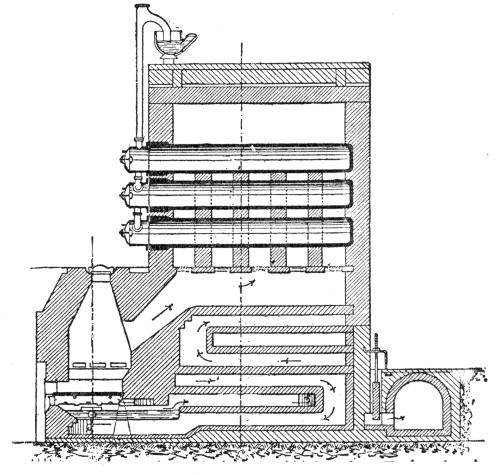
Fig. 11.—Manufacture of Illuminating Gas. Horizontal fireclay retorts placed in a setting and heated by gas(after Ost)
The tar which remains behind flows through a tube to the cistern. From the tar separator the gas goes through scrubbers (fig. 12), where the gas is washed free of ammonia and part of the sulphuretted hydrogen and carbon dioxide with water. The scrubbers are tower-like vessels filled with coke or charcoal through which the gas passes from below upwards, encountering a spray of water. Several scrubbers in series are used, so that the water constantly becomes richer in ammonia. Mechanical scrubbers are much used, so-called standard washers; they are rotating, horizontal cylinders having several chambers filled with staves of wood half dipping in water. In them the same principle of making the gas meet an opposing stream of water is employed, so that the last traces of ammonia are removed from the gas.
The various purifying apparatus through which the gas has to pass cause considerable resistance to its flow. Escape in various ways would occur had the gas to overcome it by its own pressure, and too long contact of the gas with the hot walls of the retorts would be detrimental. Hence an exhauster is applied to the system which keeps the pressure to the right proportion in the retorts and drives on the gas.
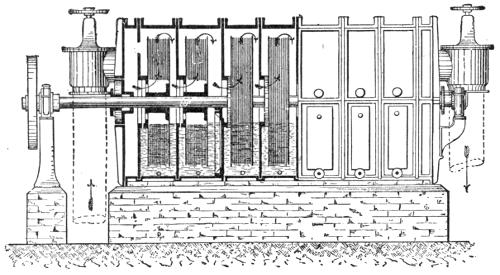
Fig. 12.—Washer or Scrubber
After purification in the scrubbers dry purification follows, having for its object especially removal of compounds of sulphur and cyanogen and carbon dioxide. To effect this several shallow receptacles are used, each having a false bottom upon which the purifying material is spread out. The boxes are so arranged that the gas first passes through purifying material which is almost saturated and finally through fresh material, so that the material becomes richer in sulphur and cyanogen compounds. The gas purifying material formerly used was slaked lime, and it is still frequently used, but more generally bog iron ore or artificially prepared mixtures are used consisting mostly of oxide of iron. The saturated purifying material is regenerated by oxidation on spreading it out in the air and turning it frequently. After having been thus treated some ten times the mass contains 50 per cent. sulphur, and 13 to 14 per cent. ferrocyanide.
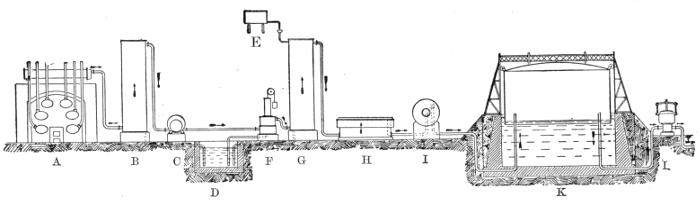
Fig. 13.—Manufacture of Illuminating Gas. Diagrammatic view (after Lueger) A Retort setting and hydraulic main; B Condensers and coolers; C Exhauster; D Well; E Water tank; F Tar extractor; G Scrubber; H Purifier; I Station meter; K Gas holder; L Pressure regulator.
The naphthalene in illuminating gas does not separate in the condenser, and therefore is generally treated in special apparatus by washing the gas with heavy coal tar.
The gas purified, as has been described, is measured by a meter and stored in gasometers. These are bells made up of sheet iron which hang down into walled receptacles filled with water to act as a water seal, and are raised by the pressure of the gas which streams into them. The gas passes to the network of mains by pressure of the weight of the gasometer, after having passed through a pressure regulating apparatus.
As to recovery of bye-products in the illuminating gas industry, see the sections on Ammonia, Cyanogen Compounds, Tar, Benzene, &c.
Effect on Health.—Opinions differ as to the effect on health which employment in gas works exerts. This is true of old as well as of modern literature.
Hirt1 maintains that gas workers suffer no increase in illness because of their employment. They reach, he says, a relatively high age and their mortality he puts down at from 0·5 to 1 per cent. (my own observations make me conclude that the average mortality among persons insured in sick societies in Bohemia is 1 per cent., so that Hirt’s figure is not high).
Layet2 agreed with Hirt, but was of opinion that gas workers suffered from anæmia and gastro-intestinal symptoms attributable to inhalation of injurious gases. The sudden symptoms of intoxication, ‘exhaustion and sinking suddenly into a comatose condition,’ which he attributes to the effect of hydrocarbons and sulphuretted hydrogen gas, may well have been the symptoms of carbonic oxide poisoning.
Goldschmidt3 in recent literature considers manufacture of illuminating gas by no means dangerous or unhealthy, and speaks of no specific maladies as having been observed by him. Nevertheless, he admits with Layet that the men employed in the condensing and purifying processes are constantly in an atmosphere contaminated by gas, and that the cleaning and regeneration of the purifying mass is associated with inflammation of the eyes, violent catarrh, and inflammation of the respiratory passages, since, on contact of the purifying mass with the air, hydrocyanic acid gas, sulphocyanic acid gas, and fumes containing carbolic, butyric, and valerianic acids are generated.
Other writers4 refer to the injurious effects from manipulating the purifying material. In general, though, they accept the view, without however producing any figures, that work in gas works is unattended with serious injury to health and that poisonings, especially from carbonic oxide, are rare. Such cases are described,5 but the authors are not quite at one as to the healthiness or otherwise of the industry. The one opinion is based on study of the sick club reports for several years of a large gas works employing some 2400 workers (probably Vienna).6 The average frequency of sickness (sickness percentage), excluding accidents, was 48·7 per cent. The conclusion is drawn that the health conditions of gas workers is favourable. It is pointed out, however, that diseases of the respiratory and digestive organs (12·8 and 10·16 per cent. of the persons employed) are relatively high, and that the mortality (1·56 per cent.) of gas-workers is higher than that of other workers. This is attributed to the constant inhalation of air charged with injurious gases. Work at the retorts, coke quenching, and attending to the purifying plant are considered especially unhealthy.
The other figures relate to the Magdeburg gas works; they are higher than those quoted. The morbidity of the gas workers was found to be 68·5 per cent., of which 18 per cent. was due to disease of the digestive system, 20·5 per cent. to disease of the respiratory organs, and 1 per cent. to poisoning. No details of the cases of poisoning are given. Carbonic oxide poisoning is said to be not infrequent, the injurious effect of cleaning the purifiers is referred to, and poisoning by inhalation of ammonia is reported as possible.
Still, no very unfavourable opinion is drawn as to the nature of the work. The sickness frequency in sick clubs is about 50 per cent., and even in well-managed chemical works Leymann has shown it to be from 65 to 80 per cent. The recently published elaborate statistics of sickness and mortality of the Leipzig local sickness clubs7 contain the following figures for gas workers: Among 3028 gas workers there were on an average yearly 2046 cases of sickness, twenty deaths, and four cases of poisoning. The total morbidity, therefore, was 67·57 per cent., mortality 0·66 per cent., and the morbidity from poisoning 0·13 per cent. Diseases of the respiratory tract equalled 10·63 per cent., of the digestive tract 10·87 per cent., of the muscular system 13·10 per cent., and from rheumatism 11·10 per cent. These figures, therefore, are not abnormally high and the poisoning is very low.
Still, industrial cases of poisoning in gas works are recorded. Of these the most important will be mentioned. Six persons were employed in a sub-station in introducing a new sliding shutter into a gas main, with the object of deviating the gas for the filling of balloons. A regulating valve broke, and the gas escaped from a pipe 40 cm. in diameter. Five of the men were rendered unconscious, and resuscitation by means of oxygen inhalation failed in one case. In repairing the damage done two other cases occurred.8 In emptying a purifier a worker was killed from failure to shut off the valve.
Besides poisoning from illuminating gas, industrial poisoning in gas works is described attributable, in part at least, to ammonia. Thus the report of the factory inspectors of Prussia for 1904 narrates how a worker became unconscious while superintending the ammonia water well, fell in, and was drowned.
A further case is described in the report of the Union of Chemical Industry for 1904. In the department for concentrating the gas liquor the foreman and an assistant on the night shift were getting rid of the residues from a washer by means of hot water. The cover had been removed, but, contrary to instructions, the steam had not been shut off. Ammonia fumes rushed out and rendered both unconscious, in which condition there were found by the workmen coming in the morning.9
In the preparation of ammonium sulphate, probably in consequence of too much steam pressure, gas liquor was driven into the sulphuric acid receiver instead of ammonia gas. The receiver overflowed, and ammonia gas escaped in such quantity as to render unconscious the foreman and two men who went to his assistance.10
The use of illuminating gas in industrial premises can give rise to poisoning. Thus the women employed in a scent factory, where so-called quick gas heaters were used, suffered from general gas poisoning.11
In Great Britain in 1907 sixteen cases of carbonic oxide poisoning from use of gas in industrial premises were reported.
COKE OVENS
Coke is obtained partly as a residue in the retorts after the production of illuminating gas. Such gas coke is unsuitable for metallurgical purposes, as in the blast furnace. Far larger quantities of coal are subjected to dry distillation for metallurgical purposes in coke ovens than in gas works. Hence their erection close to blast furnaces. In the older form of coke oven the bye-products were lost. Those generally used now consist of closed chambers heated from the outside, and they can be divided into coke ovens which do, and those which do not, recover the bye-products. These are the same as those which have been considered under manufacture of illuminating-gas—tar, ammonia, benzene and its homologues, cyanogen, &c. In the coke ovens in which the bye-products are not recovered the gases and tarry vapours escaping on coking pass into the heating flues, where, brought into contact with the air blast, they burn and help to heat the oven, while what is unused goes to the main chimney stack.
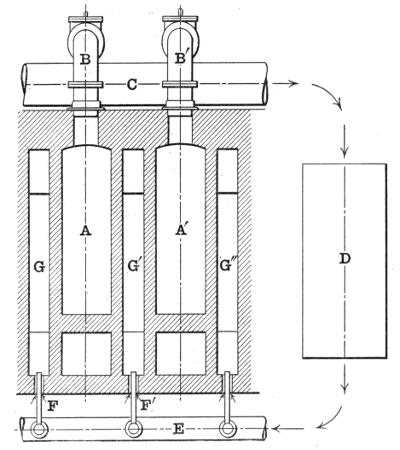
Fig. 14.—Distillation Coke Oven (after Lueger)
A, A´ Coal to be coked; B, B´ Standpipes; C Hydraulic main; D Condensing apparatus; E Purified gas: F, F´ Air inlets; G G,´ G´´ Combustion chambers.
In the modern distillation ovens with recovery of the bye-products the gases escaping from the coal are led (air being cut off as completely as possible) through ascending pipes into the main collector, where they are cooled, and the tarry ingredients as well as a part of the ammonia are absorbed by water; subsequently the gases pass through washing apparatus with a view to as complete a recovery of the ammonia and benzene as possible. The purified gases are now again led to the ovens and burnt with access of air in the combustion chambers between two ovens. Generally these ovens are so constructed as to act as non-recovery ovens also (especially in starting the process).
The coal is charged into the ovens through charge holes on the top and brought to a level in the chambers either by hand or mechanically. Removal of the coke block after completion of the coking operation is done by a shield attached to a rack and pinion jack. Afterwards the coke is quenched with water.
Recovery of the bye-products of coke distillation ovens is similar to the method described for illuminating gas, i.e. first by condensation with aid of air or water cooling, then direct washing with water (generally in scrubbers), whereby tar and ammonia water are recovered. Recovery of benzene and its homologues (see Benzene later) depends on the fact that the coke oven gases freed from tar and ammonia are brought into the closest possible contact with the so-called wash oils, i.e. coal tar oils with high boiling-point (250-300° C.). For this purpose several washing towers are employed. The waste oil enriched with benzene is recovered in stills intermittently or continuously and used again.
Effects on Health.—Injury to health from work at coke ovens is similar to that in the manufacture of illuminating gas. There is the possibility of carbonic oxide poisoning from escape of gas from leakage in the apparatus. As further possible sources of danger ammonia, cyanogen and sulpho-cyanogen compounds, and benzene have to be borne in mind.
In the distillation of the wash oil severe poisoning can arise, as in a case described, where two men were fatally poisoned in distilling tar with wash oil.1
The details of the case are not without interest. The poisoning occurred in the lavatory. The gases had escaped from the drain through the ventilating shaft next to the closet. The gases came from distillation of the mixture of tar and wash oil, and were driven by means of air pumps in such a way that normally the uncondensed gases made their way to the chimney stack. On the day of the accident the pumps were out of use, and the gases were driven by steam injectors into the drain. Analysis showed the gases to contain much sulphuretted hydrogen. When this was absorbed, a gas which could be condensed was obtained containing carbon bisulphide and hydrocarbons of unknown composition (? benzene). Only traces of cyanogen and sulpho-cyanogen compounds were present. Physiological experiment showed that poisoning was attributable mainly to sulphuretted hydrogen gas, but that after this was removed by absorption a further poisonous gas remained.
Other Kinds of Power and Illuminating Gas
Producer gas or generator gas.—Manufacture of producer gas consists in dealing separately with the generation of the gas and the combustion of the gases which arise. This is effected by admitting only so much air (primary air supply) to the fuel as is necessary to cause the gases to come off, and then admitting further air (secondary supply) at the point where the combustion is to take place; this secondary supply and the gas formed in the gas producer are heated in regenerators before combustion by bringing the gases to be burnt into contact with Siemens’s heaters, of which there are four. Two of these are always heated and serve to heat the producer gas and secondary air supply.
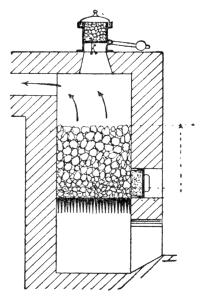
Fig. 15.—Horizontal Regenerative Grate (after Lueger)
A producer gas furnace, therefore, consists of a gas producer, a gas main leading to the furnace hearth, the heater, and the chimney.
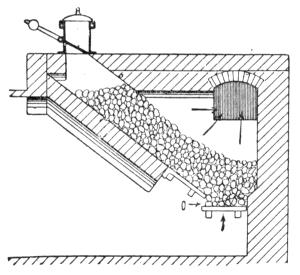
Fig. 16.—Step Regenerative Grate (after Lueger)
The gas producer is a combustion chamber filled with coal in which the coal in the upper layer is burnt. Generators may have horizontal or sloping grate (see figs. 15 and 16). The Siemens’s heaters or regenerators are chambers built of, and filled loosely with, fireclay bricks and arranged in couples. Should the gas producers become too hot, instead of the chambers subdivided air heaters are used, whereby the hot furnace gases are brought into contact with a system of thin-walled, gastight fireclay pipes, to which they give up their heat, while the secondary air supply for the furnace is led beside these pipes and so becomes heated indirectly. Previous heating of the producer gas is here not necessary; no valves are needed because the three streams of gas all pass in the same direction.
Fig. 17a.—Siemens’s Regenerative Furnace
L Air; G Gas
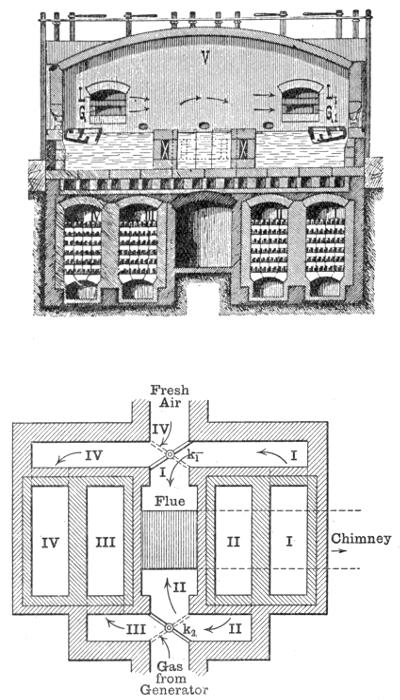
Fig. 17b.—Siemens’s Regenerative Furnace
Such air heating arrangements are used for heating the retorts in gas works, for melting the ‘metal’ in glass works, and very generally in other industries, as they offer many technical and hygienic advantages. Generator gas from coke contains 34 per cent. carbonic oxide, 0·1 per cent. hydrogen, 1·9 per cent. carbon dioxide, and 64 per cent. nitrogen.
Blast furnace gas.—Blast furnace gas is formed under the same conditions as have been described for generator gas; it contains more carbon dioxide (about 10 per cent.). (Further details are given in the section on Iron—Blast Furnaces.)
Water gas.—Water gas is made by the passage of steam through incandescent coal, according to the equation:
C + H₂O = CO + 2H.
The iron gas producer, lined with firebrick, is filled with anthracite or coke and heated by blowing hot air through it. This causes producer gas to escape, after which steam is blown through, causing water gas to escape—containing hydrogen and carbonic oxide to the extent of 45-50 per cent., carbon dioxide and nitrogen 2-6 per cent., and a little methane.
The blowing of hot air and steam is done alternately, and both kinds of gas are led away and collected separately, the water gas being previously purified in scrubbers, condensers, and purifiers. It serves for the production of high temperatures (in smelting of metals). Further, when carburetted and also when carefully purified in an uncarburetted state, it serves as an illuminant. The producer gas generated at the same time is used for heating purposes (generally for heating boilers).
Dowson gas.—Dowson gas is obtained by collecting and storing together the gases produced in the manner described for water gas. Under the grating of the wrought-iron gas producer (lined with firebrick and similarly filled with coke or anthracite) a mixture of air and steam, produced in a special small boiler, is blown through by means of a Körting’s injector.
Before storage the gas is subjected to a purifying process similar to that in the case of water gas. The mixed gas consists of 1 vol. water gas and 2-3 vols. producer gas, with about 10-15 vols. per cent. H, 22-27 vols. per cent. CO, 3-6 per cent. CO₂, and 50-55 per cent. N. It is an admirable power gas for driving gas motors (fig. 18).
Mond gas similarly is a mixed gas obtained by blowing much superheated steam into coal at low temperature. Ammonia is produced at the same time.
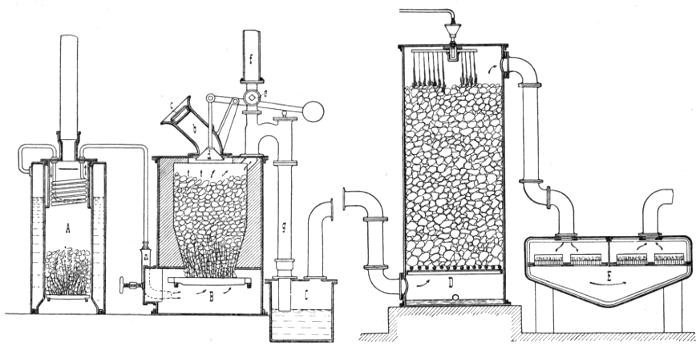
Fig. 18.—Power Gas Installation (after Lueger)
A Steam boiler
a Steam injector
B Furnace
b Charging hopper
c Cover g
d Valve C
e Cock D
f Vent pipe
g Steam Pipe
C Washer
D Coke tower
E Sawdust purifier
Suction gas.—In contradistinction to the Dowson system, in which air mixed with steam is forced into the producer by a steam injector, in the suction gas plant the air and steam are drawn into the generator by the apparatus itself. The whole apparatus while in action is under slight negative pressure. A special steam boiler is unnecessary because the necessary steam is got up in a water container surrounding or connected with the cover of the generator. The plant is set in motion by setting the fire in action by a fan.
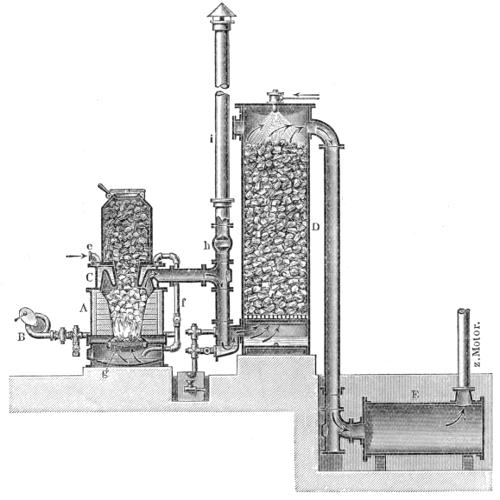
Fig. 19.—Suction Gas Plant (after Meyer)
Fig. 19 shows a suction gas plant. B is the fan. Above the generator A and at the lower part of the feed hopper is an annular vessel for generating steam, over the surface of which air is drawn across from the pipe e, passing then through the pipe f into the ash box g, and then through the incandescent fuel. The gas produced is purified in the scrubber D, and passes then through a pipe to the purifier containing sawdust and to the motor.
Carburetted gas.—Gas intended for illuminating purposes is carburetted to increase its illuminating power, i.e. enriched with heavy hydrocarbons. Carburetting is effected either by a hot method—adding the gases distilled from mineral or other oils—or by a cold method—allowing the gas to come into contact with cold benzol or benzine. Coal gas as well as water gas is subjected to the carburetting process, but it has not the same importance now in relation to illuminating power, as reliance is more and more being placed on the use of mantles.
ACETYLENE
Calcium carbide.—Acetylene is prepared from calcium carbide, which on contact with water gives off acetylene.
Calcium carbide is prepared electro-chemically. A mixture of burnt lime and coke is ground and melted up together at very high temperature in an electric furnace, in doing which there is considerable disengagement of carbonic oxide according to the equation:
CaO + 3C = CaC₂ + CO.
The furnaces used in the production of calcium carbide are of different construction. Generally the furnace is of the nature of an electric arc, and is arranged either as a crucible furnace for intermittent work or like a blast furnace for continuous work.
Besides these there are resistance furnaces in which the heat is created by the resistance offered to the passage of the current by the molten calcium carbide.
The carbonic oxide given off in the process causes difficulty. In many furnaces it is burnt and so utilised for heating purposes. The calcium carbide produced contains as impurities silicon carbide, ferro-silicon, calcium sulphide, and calcium phosphide.
Acetylene (C₂H₂), formed by the decomposition of calcium carbide by means of water (CaC₂ + 2H₂O = Ca(OH)₂ + C₂H₂), furnishes when pure an illuminating gas of great brilliancy and whiteness. Its production is relatively easy. Used for the purpose are (1) apparatus in which water is made to drop on the carbide, (2) apparatus in which the carbide dips into water and is removed automatically on generation of the gas, (3) apparatus in which the carbide is completely immersed in water, and (4) apparatus in which the carbide in tiny lumps is thrown on to water. These are diagrammatically represented in figs. 20a to 20d .
Fig. 20a. Fig. 20b.
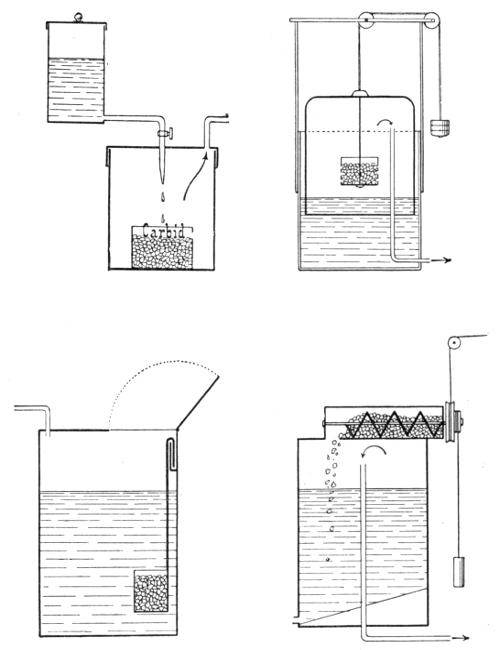
Fig. 20c. Fig. 20d.
Acetylene Apparatus—diagrammatic (after Lueger) A Dripping; B Dipping; C Submerging; D Throwing in
The most important impurities of acetylene are ammonia, sulphuretted hydrogen gas, and phosphoretted hydrogen. Before use, therefore, it is subjected to purification in various ways. In Wolf’s method the gas is passed through a washer (with the object of removing ammonia and sulphuretted hydrogen gas) and a purifying material consisting of chloride of lime and bichromate salts. In Frank’s method the gas passes though a system of vessels containing an acid solution of copper chloride, and also through a washer. Chloride of lime with sawdust is used as a purifying agent. Finally, the gas is stored and thence sent to the consumer (see fig. 21).
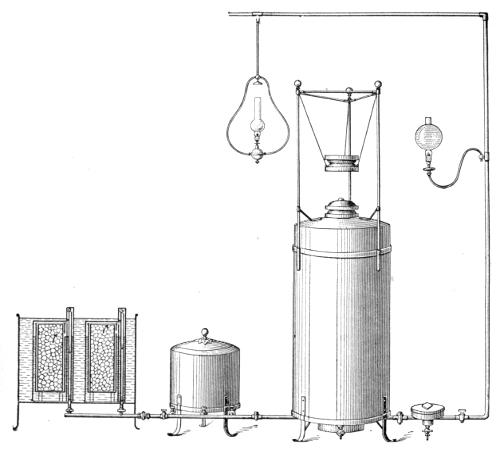
Fig. 21.—Acetylene Gas Apparatus (after Lueger)
Effects on Health.—Almost all the poisoning caused in the industries in question is due to carbonic oxide gas, of which water gas contains 41 per cent., generator gas 35 per cent., and suction and Dowson gas 25 per cent.
That industrial carbonic oxide poisoning is not rare the reports of the certifying surgeons in Great Britain sufficiently show. In the year 1906 fifty-five persons are referred to as having suffered, with fatal issue in four. In 1907 there were eighty-one, of which ten were fatal. Of the 1906 cases twenty resulted from inhalation of producer, Mond, or suction gas, sixteen from coal gas (in several instances containing carburetted water gas), seventeen from blast furnace gas, and one each from charcoal fumes from a brazier, and from the cleaning out of an oil gas holder.
As causes of the poisoning from suction gas were (1) improper situation of gas plant in cellar or basement, allowing gas to collect or pass upward; (2) defective fittings; (3) starting the suction gas plant by the fan with chimney valve closed; (4) cleaning out ‘scrubbers’ or repairing valves, &c.; (5) defective gasometer. In the seventeen cases due to blast furnace gas six were due to conveyance of the gas by the wind from a flue left open for cleaning purposes into an engineering shed, two to charging the cupola furnace, two to entering the furnace, and four to cleaning the flues.
The following are instances taken from recent literature on gas poisoning1 : Several cases of poisoning by water gas occurred in a smelting works. The poisoning originated when a blowing machine driven by water gas was started. Owing to premature opening of the gas valve two men employed in a well underneath the machine were overcome. The attendant who had opened the valve succeeded in lifting both from the well; but as he was trying to lift a third man who had come to his assistance and fallen into the well he himself fell in and was overcome. The same fate befell the engineer and his assistant who came to the rescue. All efforts to recover the four men by others roped together failed, as all of them to the number of eight were rendered unconscious. With the aid of rescue appliances (helmets, &c.) the bodies were recovered, but efforts at artificial respiration failed.
A workman was killed by suction gas while in the water-closet. It appeared that some time previously when the plant was installed the ventilating pipe between the purifier and motor, instead of being led through the roof, had been led out sideways on a level with the floor immediately above the closet.
In another case the suction gas attendant had taken out the three-way cock between the generator and motor for repairs and had not reinserted it properly, so that when effort was made to start the motor this failed, as gas only and no air was drawn in. The motor was thought to be at fault, and the fan was worked so vigorously that the gas forced its way out through the packing of the flange connections and produced symptoms of poisoning in the persons employed.
More dangerous than suction gas plants, in which normally no escape takes place, are installations depending on gas under pressure. Such an installation was used for heating gas irons in a Berlin laundry. The arrangements were considered excellent. The gas jets were in stoves from which the fumes were exhausted. The gas was made from charcoal and contained 13 per cent. of hydrogen. No trace of carbonic oxide was found in the ironing room on examination of the air. After having been in use for months the mechanical ventilation got out of order, with the result that twelve women suffered severely from symptoms of carbonic oxide poisoning, from which they were brought round by oxygen inhalation. The laundry reverted to the use of illuminating gas. The conclusion to be drawn is that installations for gas heating are to be used with caution.2
Industrial poisoning from blast furnace gas is frequent. Two fatal cases were reported3 in men employed in the gas washing apparatus. They met their death at the manhole leading to the waste-water outlet. In another case a workman entered the gas main three hours after the gas had been cut off to clear it of the dust which had collected. He succumbed, showing that such accumulations can retain gas for a long time. Steps had been taken three hours previously to ventilate the portion of gas main in question.
A fatal case occurred in the cleaning out of a blast furnace flue which had been ventilated for 1½ hours by opening all manholes, headplates, &c. The foreman found the deceased with his face lying in the flue dust; both he and a helper were temporarily rendered unconscious.
Cases of poisoning by generator gas are described.4 A workman who had entered a gasometer containing the gas died in ten minutes, and another remained unconscious for ten days and for another ten days suffered from mental disturbance, showing itself in hebetude and weakness of memory.
Acetylene is poisonous to only a slight extent. Impurities in it, such as carbon bisulphide, carbonic oxide (present to the extent of 1-2 per cent.), and especially phosphoretted hydrogen gas, must be borne in mind.
American calcium carbide5 yields acetylene containing 0·04 per cent. of phosphoretted hydrogen; Lunge and Cederkreutz have found as much as 0·06 per cent. in acetylene.
AMMONIA AND AMMONIUM COMPOUNDS
Preparation.—Ammonia and ammonium salts are now exclusively obtained as a bye-product in the dry distillation of coal, from the ammonia water in gas works, and as a bye-product from coke ovens.
The ammonia water of gas works contains from 2-3 per cent. of ammonia, some of which can be recovered on boiling, but some is in a non-volatile form, and to be recovered the compound must be decomposed. The volatile compounds are principally ammonium carbonate and, to a less extent, ammonium sulphide and cyanide; the non-volatile compounds are ammonium sulphocyanide, ammonium chloride, sulphate, thiosulphate, &c. Other noteworthy substances in ammonia water are pyridine, pyrrol, phenols, hydrocarbons, and tarry compounds.
Decomposition of the non-volatile compounds is effected by lime. Hence the ammonia water is distilled first alone, and then with lime. The distillate is passed into sulphuric acid, ammonium sulphate being formed. Distillation apparatus constructed on the principle usual in rectifying spirit is used, so that continuous action is secured; the ammonia water flows into the apparatus continuously and is freed of the volatile compounds by the steam. At a later stage milk of lime is added, which liberates the ammonia from the nonvolatile compounds.
Of the ammonium salts there require mention:
Ammonium sulphate ((NH₄)₂SO₄), which serves for the production of other ammonium salts. It is usually centrifugalised out from the sulphuric acid tank previously described.
Ammonium chloride (sal-ammoniac, NH₄Cl) is formed by bringing the ammonia fumes given off in the process described in contact with hydrochloric acid vapour. The crude salt so obtained is recrystallised or sublimed.
Ammonium phosphate ((NH₄)₂HPO₄) is made in an analogous manner by leading ammonia into phosphoric acid. It is useful as an artificial manure.
Ammonium carbonate is made either by bringing together ammonia vapour and carbonic acid or by subliming ammonium sulphate with calcium carbonate. It is very volatile. The thick vapour is collected and purified in leaden chambers.
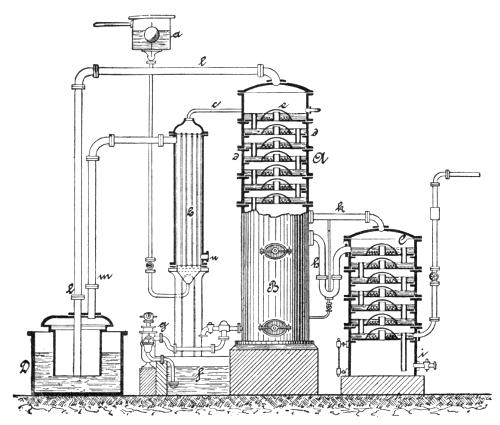
Fig. 22.—Preparation of Ammonia. Column Apparatus of Feldman (after Ost)
A, B, C Columns; D Saturator; (a) Settling tank and regulator for flow of ammonia; (b) Economiser; (f) Milk of lime; (g) Pump
Caustic ammonia is prepared either from gas liquor or, more usually, from ammonium sulphate by distillation with caustic alkali in a continuous apparatus.
Use of Ammonia.—Ammonia is used in laundries and bleaching works in dyeing and wool washing. It is used especially in making ammonium salts, in the preparation of soda by the Solvay process (see Soda Manufacture), and in making ice artificially.
It is used also in the preparation of indigo, in lacquers and colours, and the extraction of chloride of silver, &c.
Effects on Health.—Industrial ammonia poisoning is rare. It occurs most frequently in gas works and occasionally in its use, especially the manufacture of ammonium salts. Those engaged in subliming ammonium carbonate incur special risk, but often it is not the ammonia vapour so much as the escaping evil-smelling gases containing carbon bisulphide and cyanogen compounds which are the source of trouble.
Occasionally in the production of ice through leakage or by the breaking of carboys of ammonia accidental poisoning has occurred.
Some cases are cited from recent literature:
A worker was rendered unconscious and drowned in an ammonia water well.1 Two workers were poisoned (one fatally) in the concentration of gas liquor. Three workers were gassed (one fatally) in the preparation of ammonium sulphate in a gas works. Probably as the result of excessive steam pressure gas water was driven over with the ammonia into the sulphuric acid vessel.2
Eulenberg3 reports the occurrence of sulphuretted hydrogen gas poisoning in the production of ammonium salts. The workers succumbed as though shot, although work was being carried on in the open air. They recovered when removed from the poisonous atmosphere.
In a large room of a chemical factory phosphoric acid was being saturated with ammonia gas water in an iron lead-lined vessel. Carbonic acid gas and hydrogen gas were evolved, but not to such extent as to be noticeable in the large room. A worker not employed in the room had to do something close to the vessel, and inhaled some of the fumes given off. A few yards from the vessel he was found lying unconscious, and although removed into the open air failed to respond to the efforts at artificial respiration.4
Lewin, in an opinion delivered to the Imperial Insurance Office, describes poisoning in a man who during two days had been employed repairing two ammonia retorts in a chemical factory. On the evening of the second day he suffered from severe symptoms of catarrh, from which he died five days later. Lewin considered the case to be one of acute ammonia poisoning.5
Ammonia is frequently used in fulling cloth, the fumes of which collect on the surface after addition of sulphuric acid to the settling vats. This is especially liable to occur on a Monday, owing to the standing of the factory over the Sunday, so that entrance into the vats without suitable precautions is strictly forbidden. Despite this, a worker did go in to fetch out something that had fallen in, becoming immediately unconscious. A rescuer succumbed also and lost his life. The first worker recovered, but was for long incapacitated by paralytic symptoms.
Cases of poisoning in ice factories and refrigerator rooms from defective apparatus are reported.
Acute and chronic poisoning among sewer men are due mainly to sulphuretted hydrogen gas and only partly to ammonia. The more ammonia and the less sulphuretted hydrogen sewer gases contain the less poisonous are they.
CYANOGEN COMPOUNDS
Treatment of the Materials used in Gas purifying.—Cyanogen compounds are still sometimes prepared by the original method of heating to redness nitrogenous animal refuse (blood, leather, horn, hair, &c.) with potash and iron filings; potassium cyanide is formed from the nitrogen, carbon, and alkali, and this with the sulphur and iron present is easily converted into potassium ferrocyanide (yellow prussiate of potash, K₄FeC₆N₆) by lixiviation of the molten mass. It crystallises out on evaporation.
Cyanogen compounds are obtained in large quantity from the material used in purifying the gas in gas works. This saturated spent material contains, in addition to 30-40 per cent. of sulphur, 8-15 per cent. of cyanogen compounds and 1-4 per cent. of sulphocyanogen compounds.
By lixiviation with water the soluble ammonium salts are extracted from the purifying material. This solution furnishes sulphocyanide of ammonium, from which the remaining unimportant sulphocyanide compounds are obtained (used in cloth printing). The further treatment of the purifying material for potassium ferrocyanide is rendered difficult because of the sulphur, which is either removed by carbon bisulphide and the ferrocyanide obtained by treatment with quicklime and potassium chloride, or the mass is mixed with quicklime, steamed in closed vessels, lixiviated with water, and decomposed by potassium chloride; ferrocyanide of potassium and calcium separates out in crystals, and this, treated with potash, yields potassium ferrocyanide.
The well-known non-poisonous pigment Prussian blue is obtained by decomposing ferrocyanide of potash with chloride or oxide of iron in solution.
Potassium cyanide (KCN) is prepared from potassium ferrocyanide by heating in absence of air, but it is difficult to separate it entirely from the mixture of iron and carbon which remains. All the cyanogen is more easily obtained in the form of potassium and sodium cyanide from potassium ferrocyanide by melting it with potash and adding metallic sodium.
The very poisonous hydrocyanic acid (prussic acid, HCN) is formed by the action of acids on potassium or sodium cyanide; small quantities indeed come off on mere exposure of these substances to the air. The increasing demand for potassium cyanide has led to experimental processes for producing it synthetically.
One method consists in the production of potassium cyanide from potash and carbon in a current of ammonia gas. Small pieces of charcoal are freed from air, saturated with a solution of potash, dried in the absence of air, and heated in upright iron cylinders to 100° C., while a stream of ammonia gas is passed through.
Again, sodium cyanide is prepared from ammonia, sodium, and carbon by introducing a definite amount of sodium and coal dust into melted sodium cyanide and passing ammonia through. The solution is then concentrated in vacuo and sodium cyanide crystallises out on cooling.
Use of Cyanides.—Potassium cyanide is principally used in the recovery of gold, in gold and silver electroplating, in photography, for soldering (it reduces oxides and makes metallic surfaces clean), for the production of other cyanogen compounds, for the removal of silver nitrate stains, &c. Hydrocyanic acid gas is given off in electroplating, photography, in smelting fumes, in tanning (removing hair by gas lime), &c.
Effects on Health.—Industrial cyanogen poisoning is rare. Weyl1 states that he could find no case in any of the German factory inspectors’ reports for the twenty years prior to 1897, nor in some twenty-five volumes of foreign factory inspectors’ reports. I have found practically the same in my search through the modern literature.
Of the very few references to the subject I quote the most important.
A case of (presumably) chronic hydrocyanic acid poisoning is described in a worker engaged for thirteen years in silver electroplating of copper plates.2 The plates were dipped in a silver cyanide solution and then brushed. After two years he began to show signs of vomiting, nausea, palpitation, and fatigue, which progressed and led to his death.
A case of sudden death is described3 occurring to a worker in a sodium cyanide factory who inhaled air mixed with hydrocyanic acid gas from a leaky pipe situated in a cellar. The factory made sodium cyanide and ammonium sulphate from the residue after removal of the sugar from molasses. This is the only definite case of acute cyanogen poisoning in a factory known to me. I believe that under modern conditions, in which the whole process is carried on under negative pressure, chance of escape of cyanogen gases is practically excluded.
It should be mentioned that hydrocyanic acid vapour is given off in the burning of celluloid. In this way eight persons were killed at a fire in a celluloid factory.4
Skin affections are said to be caused by contact with fluids containing cyanogen compounds, especially in electroplating. It is stated that workers coming into contact with solutions containing cyanides may absorb amounts sufficient to cause symptoms, especially if the skin has abrasions. Such cases are described.5 In electroplating, further, in consequence of the strong soda solutions used, deep ulceration and fissures of the skin of the hand can be caused.
COAL TAR AND TAR PRODUCTS
Of the products of the illuminating gas industry tar has considerably the most importance. Coal tar as such has varied use in industry, but far greater use is made of the products obtained by fractional distillation from it such as benzene, toluene, naphthalene, anthracene, carbolic acid, pyridine, and the other constituents of tar, a number of which form the starting-point in the production of the enormous coal-tar dye industry. Especially increasing is the consumption of benzene. In Germany alone this has increased in ten years from 20 to 70 million kilos. This is partly due to the need of finding some cheap substitute for benzine, the consumption and cost of which has increased, and it has in many respects been found in benzene.
Besides benzene and its homologues, toluene, anthracene, and naphthalene are valuable. Anthracene is used in the manufacture of alizarine and naphthalene in that of artificial indigo and of the azo-colours. Carbolic acid (phenol) and the homologous cresols serve not only as disinfectants but also in the manufacture of numerous colours and in the preparation of picric acid and salicylic acid. Further, a number of pharmaceutical preparations and saccharin are made from the constituents of tar.
The important constituents of tar are:
1. Hydrocarbons of the methane series: paraffins, olefines; hydrocarbons of the aromatic series: benzene and its homologues, naphthalene, anthracene, phenanthrene, &c.
2. Phenols (cresols, naphthols).
3. Sulphides: sulphuretted hydrogen, carbon bisulphide, mercaptan, thiophene.
4. Nitrogen compounds: ammonia, methylamine, aniline, pyridine, &c.
5. Fifty to sixty per cent. of tar consists of pitch constituting a mixture of many different substances which cannot be distilled without decomposition.
Crude tar, i.e. tar which separates in the dry distillation of coal, is employed as such for preserving all kinds of building materials, for tarring streets, as plastic cement, as a disinfectant, in the preparation of roofing paper or felt, lampblack, briquettes, &c.
Brattice cloth and roofing felt are made by passing the materials through hot tar and incorporating sand with them; in doing this heavy fumes are given off.
Lampblack is made by the imperfect combustion of tar or tar oil by letting them drop on to heated iron plates with as limited an air supply as possible; the burnt gases laden with carbon particles are drawn through several chambers or sacks in which the soot collects.
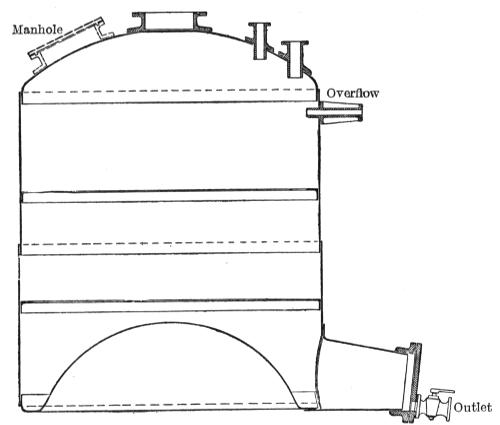
Fig. 23.—Tar Still (after Krämer)
Briquettes (patent fuel) are made by mixing small coal (coal dust) with tar or pitch and then pressing them in moulds.
The separation and recovery of the valuable ingredients is effected by fractional distillation. This is carried out by heating the tar at gradually increasing temperature in a wrought-iron still, the bottom of which is arched and having a cast-iron still head, or in horizontal boilers by direct fire. Before commencing the distillation the tar is freed as far as possible of water by storage. On gradual increase of temperature the volatile constituents, the so-called ‘light oil,’ and later the heavier volatile constituents come over. The constituents are liberated in a gaseous state and are collected in fractions. The pitch remains behind in the still. Considerable quantities of coal tar are not distilled for pitch. Often the light oils and a portion of the heavy oils are collected, when soft pitch remains, or, if the light oils and only a very small portion of the heavy oils are collected, asphalt remains behind, this residue being used as a basis for the manufacture of roofing felt. The vapours are condensed in iron coils round which cold water circulates. The receivers in which the distillate is caught are changed at definite times as the temperature gradually rises. If five fractions have come over they are called (1) first runnings, (2) light oil to 170° C., (3) middle oil (carbolic oil to 230° C.), (4) heavy oil to 270° C., and lastly (5) anthracene oil, which distills at over 270° C.; the pitch remaining behind is let out of the still by an opening at the bottom.
We will briefly sketch the further treatment and use of these fractions, so far as a knowledge of the most important processes is necessary for our purpose.
1. The light oils (including first runnings) coming over up to 170° C. are again distilled and then purified with sulphuric acid in lead-lined cast-iron or lead-lined wooden tanks. The dark-coloured acid used for purifying after dilution with water, which precipitates tarry matters, is treated for ammonium sulphate; the basic constituents of the light oils extracted with sulphuric acid and again liberated by lime yield pyridine (C₅H₅N) and the homologous pyridine bases, a mixture of which is used for denaturing spirit. After the light oils have been washed with dilute caustic soda liquor, whereby the phenols are removed, they are separated by another fractional distillation into (a) crude benzol (70°-130° C.) and (b) solvent naphtha (boiling-point 130°-170° C.).
Crude benzol (70°-140° C.) consists chiefly of benzene and toluene and is separated into its several constituents in special rectifying apparatus. For this production of pure benzene (boiling-point 80°-82° C.) and pure toluene (boiling-point 110° C.) fractionating apparatus is used (fig. 24).
The commercial products in use which are obtained from the fractional distillation of the light oil are:
(a) Ninety per cent. benzol, so called because in the distillation 90 per cent, should come over at a temperature of 100° C. It is made up of 80-85 per cent. benzene, 13-15 per cent. toluene, 2-3 per cent. xylene, and contains, as impurities, traces of olefines, paraffins, sulphuretted hydrogen, and other bodies.
(b) Fifty per cent. benzol contains 50 per cent. of constituents distilling at 100° C. and 90 per cent. at 120° C.; it is a very mixed product, with only 40-50 per cent. of benzene.
(c) Solvent naphtha, so called because it is largely used for dissolving rubber, is free from benzene, but contains xylene and its homologues and other unknown hydrocarbons.
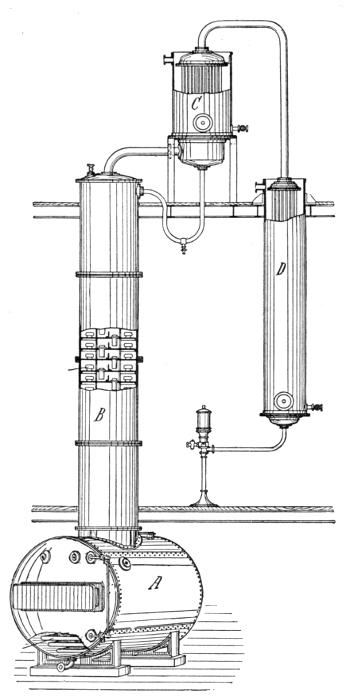
Fig. 24.—Column Apparatus of Hickman for Distillation of Benzene (after Ost)
A Still body; B Analysing column; C Cooler; D Condenser for pure distillate.
Benzol is widely used. Ninety per cent. benzol is largely used in the chemical industry, serving for the preparation of dye stuffs, pharmaceutical preparations, scents, &c. In other industries it took the place of benzine and also of turpentine oil, especially in the paint industry, since it evaporates quickly and readily dissolves resins. Hence it is used in the preparation of quick drying ship’s paints, as a protection against rust, and as an isolating lacquer (acid proof colours) for electrical apparatus, in the production of deck varnishes, and as a solvent of resins.
This use of benzol in the paint industry is by no means unattended with danger, as benzol is poisonous. Far less harmful, if not altogether without risk, is use of benzol free solvent naphtha—but this evaporates only slowly and hence cannot take the place of benzol.
Benzol serves further for fat extraction from bones in manure factories and of caffein from coffee beans.
Again, it is used as a motive power in motor vehicles.
The solvent naphtha above mentioned with boiling-point above 140° C. and all the light oils are employed in chemical cleaning and for dissolving indiarubber (see Indiarubber).
These are known in the trade erroneously as ‘benzine,’ which unfortunately often leads to confusion with petroleum benzine (see Petroleum) and to mistakes in toxicological accounts of poisoning.
2. Between 150° and 200° C. the middle oil comes over, from which on cooling naphthalene (C₁₀H₈) crystallises out, and is subsequently washed with caustic soda liquor and with acid; it is re-distilled and hot pressed. The remaining liquor yields, when extracted with caustic soda, phenol (carbolic acid, C₆H₅OH), which, on addition of sulphuric acid or carbonic acid, separates from the solution and then—generally in special factories—is obtained pure by distillation and special purifying processes.
From the sodium salt of carbolic acid (sodium phenolate) salicylic acid (C₆H₄OH.COOH) is obtained by combination with compressed CO₂ at a temperature of 150° C. Picric acid (trinitrophenol, C₆H₂OH.(NO₂)₃) is obtained by treating phenol with a mixture of sulphuric and nitric acids (nitration). The yellow crystals of this explosive which separate are carefully washed, recrystallised, centrifugalised, and dried.
3. The heavy oils which come over between 200° and 300° C. containing cresols, naphthols, naphthaline, quinoline bases, fluid paraffins, &c., are seldom separated further. The disinfectants lysol, sapocarbolic, &c., are obtained from such fractions.
The heavy oils are much in use for impregnating wood (piles, railway sleepers, &c.), to prevent rotting. This is done in special creosoting installations. The wood is first freed from moisture under vacuum and lastly the heavy oil forced in. This is a better means of preserving timber than the analogous method by means of chloride of zinc.
4. Anthracene oil or ‘green oil’ comes over between 300° and 400° C. and contains the valuable anthracene which crystallises out, is separated from the oil in filter presses, or dried in centrifugal machines. Alizarin dyes are made from it. Raw anthracene oil further is used commercially as a paint under the name of carbolineum for preserving wood.
5. The pitch remaining behind in the still serves (like tar) for making varnishes, patent fuel, &c. For our purpose use of pitch in the preparation of iron varnishes which adhere to metals and protect them from oxidation have interest. Pitch and the heavy oils are melted together or, if for thin varnishes, dissolved in solvent naphtha. The volatile constituents evaporate after the coat has been applied.
Effects on Health.—Severe injury to health or poisoning cases scarcely arise through manipulations with or use of tar. Inhalation, however, of large quantities of tar vapour is without doubt unpleasant, as a number of poisonous substances are contained in the fumes. And the ammonia water which separates on standing can give off unpleasantly smelling odours from the sulphur compounds in it, especially if it comes into contact with waste acids, with consequent development of sulphuretted hydrogen gas.
I could not find in the literature of the subject references to any clearly proved case of poisoning from tar emanations. But deserving of mention in this connection are the effects on the skin caused by tar.
Workers coming into contact with tar suffer from an inflammatory affection of the skin, so-called tar eczema, which occasionally takes on a cancerous (epithelioma) nature similar to chimney-sweep’s cancer, having its seat predominantly on the scrotum. In lampblack workers who tread down the soot in receptacles the malady has been observed to affect the lower extremities and especially the toes.
In tar distillation and in the production and use of benzene industrial poisoning frequently occurs. Many cases are recorded, but in several the immediate exciting cause is doubtful, and consequently it is often difficult to classify the cases.
Most frequently the manufacture and use of benzene come in question. Besides this, in tar distillation poisoning may be caused by other substances, such as sulphuretted hydrogen gas, carbonic oxide gas, &c. In the production of antipyrin, aspirin, &c., and in the preparation and use of anthracene injury to health is recognised.
From the list of recognised cases of these forms of poisoning the most characteristic are chosen from the recent literature on the subject.
The Prussian factory inspectors’ reports for 1904 describe the following: In cleaning out a tar still two workers were killed by inhalation of gas. The nature of the gas was not ascertained. But what probably happened was that the cock on the foul gas pipe collecting the gases from the stills leaked and allowed fumes to pass over from one still to another.
A foreman and worker were rendered unconscious on entering a receiver for heavy oil for cleaning purposes. On treatment with oxygen gas they speedily recovered.
Industrial benzene poisoning is especially frequent now in view of the increasing use to which it is put. Several cases have proved fatal.
A worker, for instance, forgot to open the cock for the water to cool the condenser, so that some of the benzene vapour remained uncondensed. The case proved fatal.
The Report of the Union of Chemical Industry for 1905 stated that a worker on night duty, whose duty it was to regulate the introduction of steam and the cooling of the benzol plant, was found lying dead in front of the building. Inquiry showed that he had not opened the valve for running the distillate into the appropriate receiver. Eight thousand litres overflowed.
In an indiarubber extracting factory a worker was rendered unconscious while inspecting a benzol still; before entering he had omitted to observe the instructions to drive steam through and have a mate on watch at the manhole. Two other workmen were similarly affected who went to the rescue without adoption of precautions. Only one survived.
In a further accident (already mentioned under ‘Coke Furnaces’) two workmen were killed. In the factory in question the thick tar from the coke ovens was being distilled under slight pressure. The air pumps, however, were out of order, and temporary use was being made of Körting’s injectors, whereby the steam and tar constituents were cooled and led into the drain in front of the closet, near to which was a ventilating shaft. Probably, in addition to benzene and its homologues, sulphuretted hydrogen and cyanogen compounds were present in the poisonous gases.
In cleaning out a benzene extracting apparatus a workman was killed by the stagnant fumes in it.
A similar case of benzene poisoning occurred in a naphthalamine works through inspecting an extracting vessel which had contained benzene and naphthalamine and had to be cleaned. The vessel had been empty for twenty-two hours and had been washed and ventilated, but through a leaking pipe benzene had dropped down into it. The workman engaged was rendered unconscious inside the retort, but was rescued by an engineer equipped with a breathing helmet. Others who without such apparatus tried to effect a rescue were overcome, and one who had entered the retort succumbed.1
Benzene poisoning has often occurred in the cleaning of tanks, &c., for the transport and storage of the substance. The following examples are taken from the Reports of the Union of Chemical Industry.
A worker during the pause for breakfast had, unknown to his employer, cleaned out an empty truck for crude benzol. Later he was with difficulty removed unconscious through the manhole and could not be resuscitated. Only a short time previously a similar occurrence had taken place in the same factory.
Two further fatal cases were reported in 1908 in the cleaning out of railway tank waggons. The tank had previously been thoroughly sprayed with water. The partition plates which are required in such tanks increase the difficulty of cleaning from the manhole. After the foreman had tested the air by putting his head inside and considered it free from danger, a man entered to clean out the deposit; another man on watch outside had evidently gone in for rescue purposes. Resuscitation in both cases failed.
A worker died and several were affected in the cleaning out of a benzol storage tank in a tar distillery. The tank had had air blown through it several weeks before, and had been thoroughly cleaned by steam and water. Also in the inspection the greatest care was taken in only permitting work for short spells. This shows that, notwithstanding great care, the last traces of benzol cannot be entirely removed and that quite small quantities are sufficient to cause severe and even fatal poisoning. Workers should only clean out tanks, therefore, when properly equipped with helmets.