PART I DESCRIPTION OF THE INDUSTRIES AND PROCESSES ATTENDED WITH RISK OF POISONING; INCIDENCE OF SUCH POISONING (continued 3)
Thomas Morison Legge translation
In the German factory inspectors’ reports for 1902 a case of intoxication is described in a man who was engaged painting the inside of an iron reservoir with an asphalt paint dissolved in benzol.
Of special interest is a fatal case from inhalation of benzol fumes in a rubber factory. Rubber dissolved in benzol was being rubbed into the cloth on a spreading machine in the usual way. The cloth then passes under the cleaning doctor along the long heated plate to the end rolls. Of the three men employed at the process one was found to be unconscious and could not be brought round again.
The cases described2 of poisoning with impure benzol in a pneumatic tyre factory in Upsala are, perhaps, analogous. Here nine young women had severe symptoms, four of whom died.
In reference to the cases which occurred in rubber factories it is conceivable that carbon bisulphide played a part, since in such factories not only are mixtures of benzol and carbon bisulphide used, but also frequently the ‘first runnings’ of benzol, which, on account of the high proportion (sometimes 50 per cent.) of carbon bisulphide in them, make an excellent solvent for rubber.
From some coke ovens crude benzol was collected in two large iron receivers. They were sunk in a pit projecting very little above the ground. To control the valves the workmen had to mount on the receiver, the manholes of which were kept open during filling. The pit was roofed over and two wooden shafts served both for ventilation and as approaches to the valves. One summer day benzol had been blown in the usual way into a railway truck and a worker had entered the space to control the valves. Some time afterwards he was found in a doubled-up position on the receiver, grasping the valves, from which later he fell off down to the bottom of the pit. Three rescuers entered, but had to retire as they became affected. A fourth worker, in the presence of the manager, was let down by a rope, but succumbed immediately and was dragged up a corpse. Finally, equipped with a smoke helmet, a rescuer brought up the lifeless body of the first man. It was believed that the benzol had distilled over warm and had evaporated to such an extent as to fill with fumes the unsuitably arranged and inadequately ventilated space. Possibly other volatile compounds were responsible for the poisoning.3
A similar though less serious accident occurred to a foreman who forgot to set the cooling apparatus at work at the commencement of distillation, and became unconscious from the escaping fumes, as also did a rescuer. The latter was brought round by oxygen inhalation, but the former, although alive when recovered, succumbed despite efforts at artificial respiration.
A fatal case occurred in an aniline factory where benzol fumes had escaped owing to faulty arrangement of the valves. The worker, although ordered at once to leave the room, was found there ten minutes later dead.
Interesting are the following cases of accidents due to use of paints containing benzol.
In painting a retort with an anti-corrosive paint called ‘Original Anti-corrosive,’ unconsciousness followed on completion of the painting, but by prompt rescue and medical assistance life was saved. The accident was attributed to benzol fumes from the paint insufficiently diluted by the air coming in at the open manhole. A similar case arose from use of a rust-preventing paint—‘Preolith’—and only with difficulty was the man using it pulled out from the inside of the steam boiler. Although resuscitated by oxygen inhalation, he was incapacitated for eight days. Crude benzol was a constituent of ‘Preolith.’ Obviously use of such paints in closely confined spaces is very risky.
The frequency of such poisonings caused Schaefer,4 Inspector of Factories in Hamburg, to go fully into the question. He lays stress on the dangerous nature of paints containing a high proportion of benzol, but considers use of unpurified constituents with boiling-point between 130°-170° C., such as solvent naphtha, as free from risk (cf. in Part II the experiments on benzene and the commercial kinds of benzol). Schaefer mentions that in 1903 and 1904 cases of unconsciousness from painting the inside of boilers were numerous. The proportion of benzol in the paints was 20-30 per cent. In 1905 and 1906 the cases were attributable rather to inhalation of hydrocarbons in cleaning of apparatus. Use of ‘Dermatin’ affected two painters. One case in 1906 happened to a man painting the double bottom of a ship in Hamburg harbour with ‘Black Varnish Oil’ through the manhole, in doing which he inhaled much of the fumes. This paint consisted of coal-tar pitch in light coal-tar oil, the latter constituent (distilling at 170° C.) amounting to 31-33 per cent. Investigation showed further that the bulk of the tar oil volatilised at ordinary temperatures and so quickly dried. Sulphuretted hydrogen gas was given off on slight warming. The person after using it for some time felt poorly, and then became ill with severe inflammation of the respiratory passages, which proved fatal after twenty-four days.
Several similar cases occurred in 1908 and 1909. Painting the inside of a boiler with ‘Auxulin’ caused unconsciousness in four persons, of whom three were rescuers. A fatal case was due to use of a patent colour containing 30-40 per cent. benzol in an entirely closed-in space (chain-well), although the worker was allowed out into fresh air at frequent intervals.
A case of chronic industrial xylene poisoning is described in a worker using it for impregnating indiarubber goods. The symptoms were nervous, resembling neurasthenia.
Some of the cases of poisoning, especially when severe and fatal, in the production of distillation constituents of coal tar are doubtless attributable to sulphuretted hydrogen gas. Thus in England, in the years 1901-3, there were eleven fatal and as many other severe cases reported from tar distilleries, of which the majority were due to sulphuretted hydrogen gas.
One case of carbonic oxide poisoning in coal-tar distillation is described.5 In cleaning out pitch from a still fourteen days after the last distillation a workman succumbed to carbonic oxide poisoning. This is at all events a rare eventuality, since no other case is to be found in the literature of the subject, but it is a proof that in the last stage of coal-tar distillation carbonic oxide plays a part.
Mention must be made of the frequent occurrence of severe skin affections in anthracene workers; they take the form of an eruption on the hands, arms, feet, knees, &c., and sometimes develop into cancer.
Observations in a chemical factory since 1892 showed that of thirty thus affected in the course of ten years twenty-two came into contact with paraffin.
Artificial Organic Dye Stuffs (Coal-tar Colours)
Manufacture.—The starting-points for the preparation of artificial coal-tar dyes are mainly those aromatic compounds (hydrocarbons) described in the preceding section. Besides these, however, there are the derivatives of the fatty series such as methyl alcohol (wood spirit), ethyl alcohol, phosgene, and, latterly, formaldehyde.
The hydrocarbons of the benzene series from tar distillation are delivered almost pure to the colour factory. Of these benzene, toluene, xylene, naphthalene, anthracene, and the phenols, cresols, &c., have to be considered.
Further treatment is as follows:
1. Nitration, i.e. introduction of a nitro-group by means of nitric acid.
2. Reduction of the nitrated products to amines.
3. Sulphonation, i.e. conversion to sulphonic acids by means of concentrated sulphuric acid.
4. The sulphonic acids are converted into phenols by fusing with caustic soda.
5. Introduction of chlorine and bromine.
Nitro-derivatives are technically obtained by the action of a mixture of nitric and concentrated sulphuric acids on the aromatic body in question. The most important example is nitrobenzene.
Benzene is treated for several hours in cylindrical cast-iron pans with nitric and concentrated sulphuric acids. The vessel is cooled externally and well agitated. A temperature of 25° C. should not be exceeded.
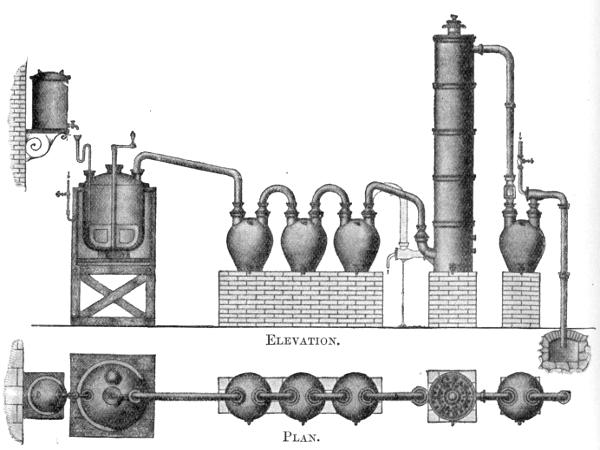
Fig. 25.—Preparation of Intermediate Products in the Aniline Colour Industry (Closed Apparatus), showing Arrangement for Condensation (after Leymann)
On standing the fluid separates into two layers: the lower consists of dilute sulphuric acid in which there is still some nitric acid, and the upper of nitrobenzene. The latter is freed of remains of acid by washing and of water by distillation. Toluene and xylene are nitrated in the same way. Dinitro products (such as metadinitrobenzene) are obtained by further action of the nitro-sulphuric acid mixture on the mononitro-compound at higher temperature.
For conversion of phenol into picric acid (trinitrophenol) the use of a nitro-sulphuric acid mixture is necessary.
The aromatic bases (aniline, toluidine, xylidine) are obtained by reduction of the corresponding nitro-compound by means of iron filings and acid (hydrochloric, sulphuric, or acetic). Thus in the case of aniline pure nitrobenzene is decomposed in an iron cylindrical apparatus, provided with agitators and a condenser, and avoidance of a too violent reaction, by means of fine iron filings and about 5 per cent. hydrochloric acid. After completion of the reaction the contents are rendered alkaline by addition of lime and the aniline distilled over. Manufacture of toluidine and xylidine is analogous.
Dimethylaniline is obtained by heating aniline, aniline hydrochloride, and methyl alcohol.
Diethylaniline is prepared in an analogous way with the use of ethyl alcohol.
By the action of nitrous acid (sodium nitrite and hydrochloric acid) on the acid solution of the last-named compound the nitroso compounds are formed.
Sulphonic acids arise by the action of concentrated or fuming sulphuric acid on the corresponding bodies of the aromatic series: benzene disulphonic acid from benzene and fuming sulphuric acid, &c.
Phenols and cresols are obtained pure from tar distillation. The remaining hydroxyl derivatives (resorcin, α- and β-naphthol, &c.), are generally obtained by the action of concentrated caustic soda on aromatic sulphonic acids.
The most important aromatic aldehyde, benzaldehyde, is obtained from toluene; on introducing chlorine at boiling temperature benzyl chloride is first formed, then benzal-chloride and finally benzo-trichloride. In heating benzal-chloride with milk of lime (under pressure) benzaldehyde is formed (C₆H₅COH).
Picric acid and naphthol yellow belong to the nitro dyestuffs; the last named is obtained by sulphonating α-naphthol with fuming sulphuric acid and by the action of nitric acid on the sulphonated mixture.
Nitroso derivatives of aromatic phenols yield (with metal oxides) the material for production of nitroso dyestuffs. To these belong naphthol green, &c.
The most important azo dyestuffs technically are produced in principle by the action of nitrous acid on the aromatic amines. The amido compound is converted into the diazo salt by treatment with sodium nitrite in acid solution. Thus diazo-benzene is made from aniline. Diazo compounds are not usually isolated but immediately coupled with other suitable compounds—amido derivatives, phenols—i.e. converted into azo compounds.
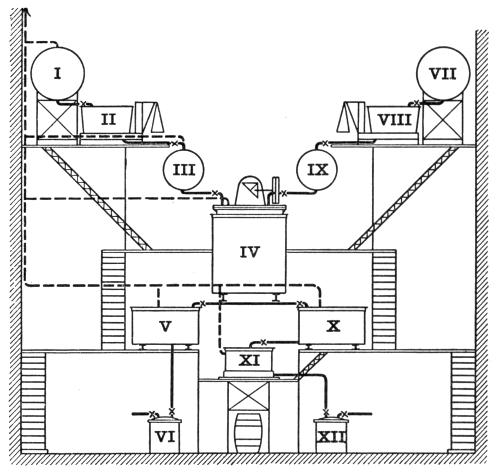
Fig. 26.—Nitrating Plant (after Leymann)
I Nitric acid
II Balance
III Storage tank
IV Nitrating pan
V Waste acid tank
VI Acid egg
VII Hydrocarbon
VIII Balance
IX Storage tank
X Washing vessel
XI Centrifugal machine
XII Egg
- - - Exhaust ventilation pipe.
The combination of the two constituents takes place at once and quantitatively. The colour is separated from the aqueous solution by salting-out, and is then put through a filter press. The reactions are carried out generally in wooden vats arranged in stages. Besides a second, a third constituent can be introduced, and in this way naphthol—and naphthylamine sulphonic acids yield a large number of colouring matters. A very large number of azo dyestuffs can thus be produced by the variation of the first component (the primary base) with the second and again with the third component, but it would carry us too far to deal further with their preparation.
Anthracene colours—yielding so-called direct dyes—are prepared from anthracene, which is converted into anthraquinone by the action of bichromate and dilute sulphuric acid when heated; the crude ‘quinone’ is purified with concentrated sulphuric acid and converted into anthraquinone monosulphonic acid to serve in the preparation of alizarin, which is made from it by heating for several days with concentrated caustic soda to which sodium chlorate is added. The process is carried on in cast-iron pans provided with agitators.
Alizarin is the starting-point for the alizarin dyes, but of their production we will not speak further, as they, and indeed most of the coal-tar dyes, are non-poisonous.
Indigo to-day is generally obtained by synthesis. It is prepared from phenylglycine or phenylglycine ortho-carboxylic acid, which on heating with sodamide becomes converted into indoxyl or indoxyl carboxylic acid. These in presence of an alkali in watery solution and exposure to the oxygen of the air immediately form indigo. The necessary glycine derivatives are obtained by the action of monochloracetic acid on aniline or anthranilic acid, which again are derived from naphthalene (by oxidation to phthalic acid and treatment of phthalimide with bleaching powder and soda liquor).
Fuchsin belongs to the group of triphenylmethane dyestuffs, with the production of which the epoch of coal-tar colour manufacture began, from the observation that impure aniline on oxidation gave a red colour. The original method of manufacture with arsenic acid is practically given up in consequence of the unpleasant effects which use and recovery of large quantities of arsenic acid gave rise to. The method consisted in heating a mixture of aniline and toluidine with a solution of arsenic acid under agitation in cast-iron cylinders. The cooled and solidified mass from the retorts was boiled, and from the hot solution, after filtration, the raw fuchsin was precipitated with salt and purified by crystallisation.
Now by the usual nitrobenzene process, aniline, toluidine, nitrobenzene, and nitrotoluene are heated with admixture of hydrochloric acid and some iron protochloride or zinc chloride. Further treatment resembles the arsenic process.
By alkylation, i.e. substitution of several hydrogen atoms of the amido-groups by ethyl, &c., through the action of alkyl halogens and others, it was found possible to convert fuchsin into other triphenylmethane colours. But it was soon found simpler to transfer already alkylated amines into the colours in question. Thus, for example, to prepare methyl violet dimethyl aniline was heated for a long time with salt, copper chloride, and phenol containing cresol in iron mixing drums. The product is freed from salt and phenol by water and calcium hydrate, subsequently treated with sulphuretted hydrogen or sodium sulphide, and the colour separated from copper sulphide by dissolving in dilute acid.
Mention must be made, finally, of the sulphur dyes obtained by heating organic compounds with sulphur or sodium sulphide. For the purpose derivatives of diphenylamine, nitro- and amido-phenols, &c., serve as the starting-point.
Effects on Health.—From what has been said of the manufacture of coal-tar dyes it is evident that poisoning can arise from the initial substances used (benzene, toluene, &c.), from the elements or compounds employed in carrying out the reactions (such as chlorine, nitric acid, sulphuric acid, arsenious acid, sodium sulphide, and sulphuretted hydrogen gas), from the intermediate bodies formed (nitro and amido compounds, such as nitrobenzene, dinitrobenzene, aniline, &c.), and that, finally, the end products (the dyes themselves) can act as poisons. It has already been said that most of the dyes are quite harmless unless contaminated with the poisonous substances used in their manufacture.
We have seen that many of the raw substances used in the manufacture of coal-tar dyes are poisonous, and we shall learn that several of the intermediate products (especially the nitro and amido compounds) are so also.
According to Grandhomme,1 of the raw materials benzene is the one responsible for most poisoning. He describes two fatal cases of benzene poisoning. In one case the worker was employed for a short time in a room charged with benzene fumes, dashed suddenly out of it, and died shortly after. In the other, the workman was employed cleaning out a vessel in which lixiviation with benzene had taken place. Although the vessel had been steamed and properly cooled, so much benzene fume came off in emptying the residue as to overcome the workman and cause death in a short time.
Grandhomme describes no injurious effect from naphthalene nor, indeed, from anthracene, which he considered was without effect on the workers.
Similarly, his report as to nitrobenzene was favourable. No reported case of poisoning occurred among twenty-one men employed, in some of whom duration of employment was from ten to twenty years. Aniline poisoning, however, was frequent among them. In the three years there was a total of forty-two cases of anilism, involving 193 sick days—an average of fourteen cases a year and sixty-four sick days. None was fatal and some were quite transient attacks.
In the fuchsin department no cases occurred, and any evil effects in the manufacture were attributable to arsenic in the now obsolete arsenic process. Nor was poisoning observed in the preparation of the dyes in the remaining departments—blues, dahlias, greens, resorcin, or eosin. In the manufacture of methylene blue Grandhomme points out the possibility of evolution of arseniuretted hydrogen gas from use of hydrochloric acid and zinc containing arsenic. Poisoning was absent also in the departments where alizarine colours and pharmaceutical preparations were made.
Among the 2500-2700 workers Grandhomme records 122 cases of industrial sickness in the three years 1893-5, involving 724 sick days. In addition to forty-two cases of anilism there were seventy-six cases of lead poisoning with 533 sick days. Most of these were not lead burners, but workers newly employed in the nitrating department who neglected the prescribed precautionary measures. Lastly, he mentions the occurrence of chrome ulceration.
The frequency of sickness in the Höchst factory in each of the years 1893-5 was remarkably high: 126 per cent., 91 per cent., and 95 per cent. Much less was the morbidity in the years 1899-1906—about 66 per cent.—recorded by Leymann2 —probably the same Höchst factory with 2000 to 2200 employed. And the cases of industrial poisoning also were less. He cites only twenty-one in the whole of the period 1899-1906. Of these twelve were due to aniline, involving thirty sick days, only five to lead poisoning, with fifty-four sick days, one to chrome ulceration, one to arseniuretted hydrogen gas (nine sick days), and one fatal case each from sulphuretted hydrogen gas and from dimethyl sulphate. In 1899, of three slight cases of aniline poisoning one was attributable to paranitraniline (inhalation of dust), and the two others to spurting of aniline oil on to the clothing, which was not at once changed. Of the four cases in 1900, one was a plumber repairing pipes conveying aniline and the others persons whose clothes had been splashed.
In 1903 a worker employed for eleven and a half years in the aniline department died of cancer of the bladder. Such cancerous tumours have for some years been not infrequently observed in aniline workers, and operations for their removal performed. Leymann thinks it very probable that the affection is set up, or its origin favoured, by aniline. This view must be accepted, and the disease regarded as of industrial origin. Three slight cases in 1904 and 1905 were due partly to contamination of clothing and partly to inhalation of fumes. Of the five cases of lead poisoning three were referable to previous lead employment. Perforation of the septum of the nose by bichromate dust was reported once only. A fatal case from sulphuretted hydrogen gas and a case of poisoning by arseniuretted hydrogen gas occurred in 1906, but their origin could not be traced.
In large modern aniline dye factories, therefore, the health of the workers is, on the whole, good and industrial poisoning rare. Comparison of the two sets of statistics show that improvement in health has followed on improved methods of manufacture. Such cases of aniline poisoning as are reported are usually slight, and often accounted for by carelessness on the part of the workers.
Data as to the health of workers in factories manufacturing or using nitro compounds are given in the English factory inspectors’ reports for 1905. Even with fortnightly medical examination in them, more than half the workers showed signs of anæmia and slight cyanosis. Two men in a factory employing twelve men in the manufacture of nitro compounds were treated in hospital for cyanosis, distress of breathing, and general weakness. One had only worked in the factory for nine days. In another badly ventilated factory, of twenty persons examined fourteen showed bluish-grey coloration of the lips and face, ten were distinctly anæmic, and six showed tremor and weakness of grasp.
Nitrobenzene poisoning arises from the fumes present in aniline and roburite factories. Acute and chronic poisoning by nitro compounds of the benzene series are described, brought about by accident (fracture of transport vessels) and by carelessness (splashing on to clothes). Cases of optic neuritis (inflammation of the optic nerve) as a result of chronic nitrobenzene poisoning are described.
Dinitrobenzene and other nitro and dinitro compounds are present in safety explosives. Thus roburite and bellite consist of metadinitrobenzene and ammonium nitrate; ammonite of nitronaphthalene and ammonium nitrate; securite of the materials in roburite with ammonium oxalate in addition. In roburite there may be also chlorinated nitro compounds.
Leymann,3 describing accidents in the preparation of nitrophenol and nitrochloro compounds, mentions four fatal cases occurring in the manufacture of black dyes from mono- and di-nitrophenols as well as mono- and di-nitrochlorobenzene and toluene. In three of the cases dinitrophenol was the compound at fault owing to insufficient care in the preparation,—the result of ignorance until then of risk of poisoning from mono- and tri-nitrophenol. One of the men had had to empty a washing trough containing moist dinitrophenol. He suddenly became collapsed, with pain in the chest, vomiting, fever, and convulsions, and died within five hours. Another suffered from great difficulty of breathing, fever, rapid pulse, dilatation of the pupils, and died within a few hours in convulsions. Two further cases of nitrochlorobenzene poisoning are referred to, one of which was fatal. Four chlorobenzene workers after a bout of drinking were found unconscious in the street, and only recovered after eight to ten hours in hospital. The symptoms were grey-blue colour of the skin, pallor of mucous membranes, lips, nose, and conjunctivæ, and peculiar chocolate-coloured blood.
Many cases of poisoning from roburite are recorded.4 In the Witten roburite factory it is stated that during the years 1890-7 almost all the workers had been ill.5 Only three looked healthy—all the others suffered from more or less pallor, blue lips, and yellowish conjunctivæ.
A case of chlorobenzene poisoning was reported with symptoms of headache, cyanosis, fainting attacks, difficulty of breathing, &c., in a man who had worked only three weeks with the substance.6
In the nitrotoluene department of an explosives factory a number of the workmen suffered from symptoms of distress in breathing, headache, &c., of whom two, employed only a short time, died. The poisoning was attributed, partly to nitrotoluene and partly to nitrous fumes. As a contributing cause it was alleged that in view of shortage of hands unsuitable persons were engaged who neglected precautions.7
Nitronaphthalene is said to cause inflammation and opacity of the cornea,8 attributable either to long-continued exposure (four to eight months) to nitronaphthalene vapour or to spurting of the liquid into the eye.
I could not find reference in literature to actual cases of poisoning by picric acid. They are referred to in a general way only as causing skin affections.
Aniline poisoning arises generally from inhalation, but absorption through the skin and less frequently inhalation of dust of aniline compounds cause it. We have already laid stress on the frequently severe cases resulting from carelessness in spilling on to or splashing of, clothes without at once changing them, breaking of vessels containing it, and entering vessels filled with the vapour. In literature of old date many such cases have been described, and it was stated that workers were especially affected on hot days, when almost all showed cyanosis. Such observations do not state fairly the conditions to-day in view of the improvements which Grandhomme and Leymann’s observations show have taken place in aniline factories. Still, cases are fairly frequent. Thus in a factory with 251 persons employed, thirty-three cases involving 500 days of sickness were reported.
The Report of the Union of Chemical Industry for 1907 cites the case of a worker who was tightening up the leaky wooden bung of a vessel containing aniline at a temperature of 200° C. He was splashed on the face and arms, and although the burns were not in themselves severe he died the next day from aniline absorption.
Cases of anilism are not infrequent among dyers. The reports of the Swiss factory inspectors for 1905 describe a case where a workman worked for five hours in clothes on to which aniline had spurted when opening an iron drum. Similar cases are described in the report of the English factory inspectors for the same year. Aniline black dyeing frequently gives rise to poisoning, and to this Dearden9 of Manchester especially has called attention.
Typical aniline poisoning occurred in Bohemia in 1908 in a cloth presser working with black dyes. While crushing aniline hydrochloride with one hand, he ate his food with the other. That the health of persons employed in aniline black dyeing must be affected by their work is shown by medical examination. For instance, the English medical inspector of factories in the summer months of 1905 found among sixty persons employed in mixing, preparing, and ageing 47 per cent. with greyish coloration of lips and 57 per cent. characteristically anæmic. Further, of eighty-two persons employed in padding, washing, and drying, 34 per cent. had grey lips, 20 per cent. were anæmic, and 14 per cent. with signs of acute or old effects of chrome ulceration. Gastric symptoms were not infrequently complained of. The symptoms were worse in hot weather.
Use of aniline in other industries may lead to poisoning. Thus in the extraction of foreign resins with aniline seventeen workers suffered (eleven severely). Interesting cases of poisoning in a laundry from use of a writing ink containing aniline have been recorded.10
Reference is necessary to tumours of the bladder observed in aniline workers. The first observations on the subject were made by Rehn of Frankfurt, who operated in three cases. Bachfeld of Offenbach noticed in sixty-three cases of aniline poisoning bladder affections in sixteen. Seyberth described five cases of tumours of the bladder in workers with long duration of employment in aniline factories.11 In the Höchst factory (and credit is due to the management for the step) every suspicious case is examined with the cystoscope. In 1904 this firm collected information from eighteen aniline factories which brought to light thirty-eight cases, of which eighteen ended fatally. Seventeen were operated on, and of these eleven were still alive although in three there had been recurrence.
Tumours were found mostly in persons employed with aniline, naphthylamine, and their homologues, but seven were in men employed with benzidine.
Cases of benzene and toluidine poisoning in persons superintending tanks and stills have been described.
Industrial paranitraniline poisoning has been described, and a fatal case in the Höchst dye works was attributed by Lewin (as medical referee) to inhalation of dust. Before his death the workman had been engaged for five hours in hydro-extracting paranitraniline.
Paraphenylene diamine leads not unfrequently to industrial poisoning from use of ursol as a dye. It produces skin eruptions and inflammation of the mucous membrane of the respiratory passages.12 No doubt the intermediate body produced (diimine) acts as a powerful poison.
A case of metaphenylene diamine poisoning is quoted in the Report of the Union of Chemical Industry for 1906. A worker had brought his coffee and bread, contrary to the rules, into the workroom and hidden them under a vessel containing the substance. Immediately after drinking his coffee he was seized with poisoning symptoms, and died a few days later. Some of the poison must have dropped into his coffee.
Few instances of poisoning from pure aniline colours are recorded.
At first all tar colours were looked upon as poisonous, but as they were mostly triphenylmethane colours they would contain arsenious acid. When the arsenic process was given up people fell into the other extreme of regarding not only the triphenylmethane colours but all others as non-poisonous, until experience showed that production and use of some of the tar colours might affect the skin.
Finally, mention must be made of inflammation of the cornea caused by methyl violet dust. The basic aniline dyes are said to damage the eye. As opposed to this view is the fact that methyl violet and auramine are used as anti-bactericidal agents, for treatment of malignant tumours, and especially in ophthalmic practice.
II. SMELTING OF METALS
LEAD (ZINC, SILVER)
OCCURRENCE OF INDUSTRIAL LEAD POISONING IN GENERAL
Chronic lead poisoning plays the most important rôle in industrial metallic poisoning, and indeed in industrial poisoning generally. The result everywhere where inquiry into industrial poisoning has been instituted has been to place the number of cases of lead poisoning at the top of the list; for one case of other forms of industrial poisoning there are twenty of lead.
In the last few years a very extensive literature and one not easily to be surveyed has grown up on the subject of chronic industrial lead poisoning. I cannot attempt as I have done with other forms of poisoning to do justice to all sources of literature on this subject.
As there is no obligation to notify industrial lead poisoning[B]—or indeed any form of industrial poisoning—in many countries, the most important source of information is wanting. Nevertheless more or less comprehensive inquiries as to the extent of the disease in general have been made in different countries and large cities which furnish valuable data.
An idea of the yearly number of cases of lead poisoning occurring in Prussia is given in the following statistics of cases treated in Prussian hospitals for the years 1895-1901:
Year. Males. Females. Total.
1895 1120 43 1163
1899 1601 23 1624
1900 1509 14 1523
1901 1359 24 1383
The occupation of these cases was as follows:
Year. Metallic Lead. White Lead. Painters.
1895 364 312 347
1899 551 310 460
1900 516 360 378
1901 498 282 339
About half the cases, therefore, are caused by use of white lead. The report of the sick insurance societies of the Berlin painters gives information as to the proportion treated in hospital to those treated at home, which was as 1:4.
The industries may be classified according to risk as follows1 :
White lead workers, 33 per cent.; red lead workers, 32 per cent.; shot and lead pipe workers, 20 per cent.; painters, 7-10 per cent.; lead and zinc smelters, 8-9 per cent.; printers, 0·5 per cent.
In Austria through the Labour Statistical Bureau comprehensive information is being collected as to the occurrence of lead poisoning in the most dangerous trades, but is not yet published. The reports of the factory inspectors give a very incomplete picture; for example, in 1905 only fifteen cases are referred to. In the most recent report (1909) information of lead poisoning is only given for thirty works. Teleky has made a general survey of the occurrence of lead poisoning from the reports of the Austrian sick insurance societies.2 From this we gather that in Vienna, with an average membership of 200,000, there were, in the five year period 1902-6, 634, 656, 765, 718, 772 cases of illness involving incapacity from mineral poisons, which Teleky assumes were practically all cases of lead poisoning. By circularising Austrian sick insurance societies outside Vienna with a membership of about 400,000, Teleky obtained information of 189 cases, which he considers too few.
In 1906-1908 inquiry was made by the sick insurance societies in Bohemia as to the extent of lead poisoning. With an average number employed of from 700,000 to 850,000 information was obtained of 91, 147, and 132 cases in the three years in question. The increase in 1907 was probably accounted for by the greater attention paid to the subject.3 The number of ascertained cases of lead poisoning treated by the societies of Hungary was 225 in 1901 and 161 in 1902. Teleky again considers these figures too low, which is proved by Toth’s publications as to lead poisoning in Hungarian lead smelting works, and especially Chyzer’s on lead poisoning among Hungarian potters. Legge has reported fully in the second International Congress for Industrial Diseases in Brussels (September 1910) on occurrence of industrial lead poisoning in Great Britain in the years 1900 to 1909. During that period 6762 cases with 245 deaths occurred. The number of cases in the course of the ten years had diminished by 50 per cent. These figures appear remarkably small, but it has to be borne in mind that the statistics referred to related only to cases occurring in factories and workshops, and do not include cases among house painters and plumbers. The number of such cases which came to the knowledge of the Factory Department in 1909 was 241 (with 47 deaths) and 239 in 1908 (with 44 deaths).
LEAD, SILVER, AND ZINC SMELTING
Lead is obtained almost entirely from galena by three different processes. In the roast and reaction process galena is first roasted at 500°-600° C. and partially converted into lead oxide and lead sulphate: on shutting off the air supply and increase of temperature the sulphur of the undecomposed galena unites with the oxygen of the lead oxide and sulphate to form sulphur dioxide, while the reduced metallic lead is tapped. In the roast and reduction process the ore is completely calcined so as to get rid of sulphur, arsenic, and antimony. The oxides (and sulphates) formed are reduced by means of coke in a blast furnace. This process is generally applicable and is, therefore, that most in use. The precipitation process consists chiefly in melting galena with coke and iron flux, whereby the lead is partly freed from the sulphur, and, in addition to lead, iron sulphide is formed, which acts on the remaining lead sulphide, producing a lead matte which can be further treated.
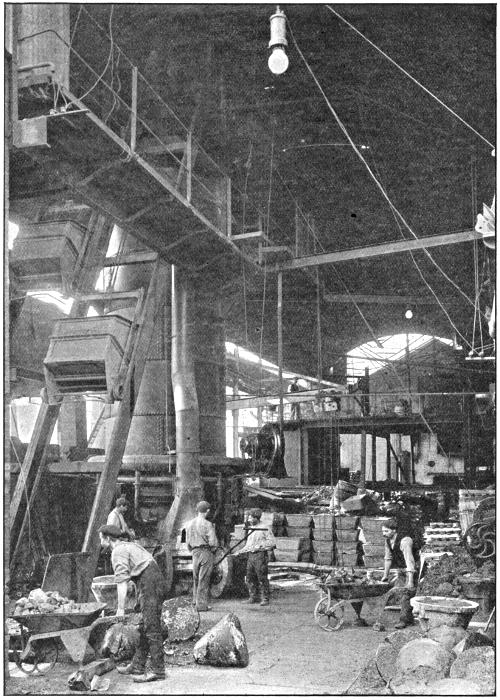
Fig. 27.—Smelting Furnace, showing mechanical charging and exhaust ventilation applied to slag runs, &c. (Locke, Lancaster & W. W. & R. Johnson & Sons, Ltd. By permission of the Controller of H.M. Stationery Office.)
The roast and reaction process is carried out in specially constructed reverberatory furnaces; small furnaces with small amounts of ore and at as low a temperature as possible are the rule in the Kärntner process. In the English process large amounts of ore are melted in large furnaces at high temperatures so as to oxidise the material. The so-called Tarnowitz process combines these two—large amounts of ore are roasted in large furnaces at a moderate temperature. In the roast and reduction process it depends on the nature of the ore whether the roasting is done in reverberatory or blast furnaces. Generally the ore is in the form of powder—less often in pieces. Pyritic ore (ore with much sulphur) is almost always roasted in blast furnaces, and the sulphur dioxide evolved can be used in the manufacture of sulphuric acid. Open-hearth furnaces are rarely used now. Reverberatory furnaces are employed most frequently.
The lead thus obtained contains several other metals, especially silver, copper, arsenic, antimony, iron, zinc, bismuth, and tin. Lead containing silver (work-lead) is next de-silverised, after which follows refining to get rid of the other impurities. For de-silverising work-lead rich in silver (containing about 10 per cent.) cupellation is practised, in which the silver lead is melted and oxidised so that the lead is converted into litharge, metallic silver remaining behind. In a cupellation furnace the flame strikes on the top of the lead bath, and at the same time air under slight pressure is driven in; the litharge which forms is removed through suitable openings. The litharge that is first formed contains silver and is treated again; the remainder is ready for market. After the litharge has run off silver appears, containing still 5-10 per cent. of lead, and it is again submitted to an analogous refining process. Work-lead which does not contain enough silver to be cupelled at once is generally treated first by either the Pattinson or the Parkes’ process.
In the Pattinson crystallising process work-lead is melted in open semi-circular pots: as the pots cool crystals of lead poor in silver form on the surface and are transferred by a perforated ladle into the next pot: the silver collects in the small amount of molten lead remaining behind. Lead that has become enriched by repeated crystallisation contains a high percentage of silver and is cupelled. The Parkes’ process or zinc de-silverisation depends on the formation of a lead-zinc alloy which is less fusible than lead. Work-lead is melted and agitated with addition of pure zinc. The crust which first rises on cooling contains gold, copper, zinc, and lead, and is removed. Further addition of zinc is then made: the rich silver crust which separates is subsequently freed from lead by gradual heating in a reverberatory furnace, and from zinc, in a zinc distilling retort. Other impurities are got rid of by oxidising in reverberatory or other furnaces. Small quantities of antimony and arsenic are removed by stirring with fresh green sticks.
Zinc is obtained principally from blende (sulphide of zinc) and from calamine (carbonate of zinc). The process of zinc recovery depends on the production of zinc oxide and reduction of this by carbon to metallic zinc.
Conversion of the ore to zinc oxide is effected by roasting. Since the temperature at which reduction takes place is higher than the melting-point of zinc the latter is volatilised (distilled) and must be condensed in suitable condensers.
Calamine is calcined in a blast furnace. Blende was formerly roasted in reverberatory furnaces, but such nuisance arose to the neighbourhood from sulphur dioxide vapour that now Hasenclever-Helbig calcining furnaces are used. These furnaces furnish a gas so rich in sulphur dioxide that they serve at once for the production of sulphuric acid. The Hasenclever furnaces consist of muffles placed one above another: the finely ground ore is charged through hoppers above and then raked down from muffle to muffle.
Reduction is carried out in the Belgian or Silesian process by strongly heating calcined matte with coal in retorts. The zinc as it distils is caught in special condensing receptacles (prolongs). After distillation is complete the residue is raked out of the muffle and the furnace charged afresh. As zinc ores generally contain much lead, the work-zinc is therefore refined by remelting in a reverberatory furnace, during which process the impurities collect on the zinc as dross and are removed by agitation with sal-ammoniac or magnesium chloride.
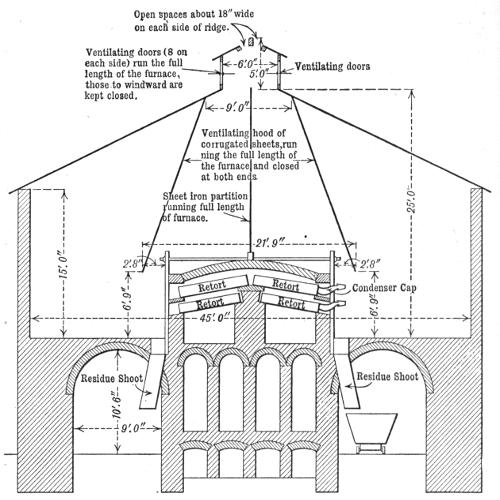
Fig. 28.—Arrangement of Spelter Furnace showing Ventilating Hood.
Risk of Poisoning in Lead, Silver, and Zinc Smelting.—As the description of the manipulations in smelting processes shows, all involve risk of lead poisoning. As a matter of fact in lead smelting much lead passes into the atmosphere. In the smelting works at Tarnowitz yearly some 36,000 kilos of oxidised lead escape.
Estimations4 of the amount of lead in air samples collected in lead smelting works have been made. Thus in a cubic metre of air immediately over the slag run from 0·0029 to 0·0056 g. of lead were found, so that a worker in a ten-hour day would inhale from 0·013 to 0·025 g. of lead. In a cubic metre of air immediately above the Parkes’ melting-pot from 0·0056 to 0·0090 g. were found, so that a worker would inhale daily from 0·0252 to 0·0405 g. if he kept constantly close to the pot. On the handles of a de-silveriser 0·112 g. were found. In Hungarian lead-smelting works the water in which the hands had been washed was found to contain 1·27 g. of lead per litre. The hands of litharge grinders and sifters showed the highest amounts.
Work carried on in lead-smelting works may be divided into five classes according to risk. Those most exposed to risk are the smelters at lead hearths and reverberatory furnaces, persons employed at the lead and slag runs, flue cleaners, and in crushing and packing flake litharge. Next come those employed at the refining furnaces, those breaking up the roasted ore, blast furnace workers, and those employed at the cupellation process. Attended with danger also is the removal of lead ashes and distillation of the zinc crust. Less dangerous are transport of material, crushing and mixing the ore, refining the work-lead and zinc crust, and work at the Pattinson and Parkes’ processes.
In zinc smelting risk of lead poisoning is great, no matter which process is in question, because of the high proportion of lead in the ore and work-zinc. Swedish blende contains as much as 9 per cent. of lead, and Upper Silesian 2½ per cent. or less. There is risk in calcination, but it is much less than in the distillation process.5
There are no quite satisfactory statistics as to the number of cases of lead poisoning in smelting works. Nevertheless, a number of recent publications give valuable data for certain smelting works in Germany, Austria, and Hungary.
From details6 of lead poisoning at Tarnowitz it would appear that the conditions have materially improved since 1884, the cases having declined from 32·7 per 100 employed in 1884 to 6·2 in 1894 and 1895. The following figures show the proportion affected in the different processes in the years 1901 and 1902:
Process. Year. No. Employed. Cases. Per Cent.
Reverberatory Furnace { 1901 131 11 8·3
{ 1902 111 4 3·6
Blast Furnace { 1901 152 47 30·9
{ 1902 187 21 11·1
Cupelling Furnace { 1901 12 1 8·3
{ 1902 12 1 8·3
De-silverising { 1901 32 10 31·2
{ 1902 34 7 20·6
Other Employment { 1901 300 7 2·3
{ 1902 350 2 0·6
In one smelting works the percentage attack rate was 17·8 in 1901, and 27·1 in 1902. Here the number of workers had increased from 73 in 1901 to 129 in 1902, and the absolute and relative increase probably has relation to the well-known fact that newly employed untrained workers become affected. Similar incidence according to process can be given for the Friedrich’s smelting works during the years 1903-1905:
Process. Year. No. Employed. Cases. Per Cent.
Reverberatory Furnace { 1903 86 12 13·9
{ 1904 87 8 9·2
{ 1905 83 11 13·3
Blast Furnace { 1903 267 59 22·1
{ 1904 232 24 10·3
{ 1905 247 27 10·9
De-silverising { 1903 56 12 21·4
{ 1904 73 4 5·5
{ 1905 75 4 5·3
Cupelling { 1903 16 4 25·0
{ 1904 15 1 6·7
{ 1905 14 1 7·1
Other Employment { 1903 330 5 1·5
{ 1904 309 4 1·3
{ 1905 347 7 2·0
Among 3028 cases of lead poisoning treated between 1853 and 1882 in smelting works near Freiberg (Saxony) gastric symptoms were present in 1541, rheumatic pains in 215, cerebral symptoms in 144, paralysis in 58, and lead colic in 426.
The recent reports of the German factory inspectors point still to rather high incidence in many lead smelting works. Thus in the district of Aix la Chapelle in 1909 there were sixty cases involving 1047 sick days, as compared with 58 and 878 in 1908.
In a well-arranged smelting works near Wiesbaden fifty-two and forty-two cases were reported in 1908 and 1909 respectively, among about 400 persons employed. This relatively high number was believed to be closely connected with frequent change in the personnel. Introduction of the Huntingdon-Heberlein method is thought to have exercised an unfavourable influence.
Other smelting works in Germany appear to have a relatively small number of reported cases. Thus in 1909 among 550 workers employed in four smelting works in the Hildesheim district only four cases were reported, and in the district of Potsdam among 600 smelters only five were found affected on medical examination. There is no doubt that many of the cases described as gastric catarrh are attributable to lead. Full information as to the conditions in Austria is contained in the publication of the Imperial Labour Statistical Bureau. In this comprehensive work the conditions in smelting works are described. In the lead smelting works at Przibram the cases had dropped from an average of 38·2 among the 4000-5000 persons employed to twenty-two in 1894 and to six in 1903, but only the severer cases are included. No single case has occurred among the 350-450 persons engaged in mining the ore, as galena (lead sulphide) is practically non-poisonous. It was found, for example, that 50 per cent. of the furnace men had (according to their statement) suffered from lead colic. Of eight employed in the Pattinson process, seven stated they had suffered from colic. The lead smelting works in Gailitz showed marked frequency of lead poisoning—here the appointed surgeon attributed anæmia and gastric and intestinal catarrh to lead:
Year. No. Employed. Lead Colic. Illness of Saturnine Origin. Total Lead Sickness. Total Sickness. Per Cent. due to Lead.
Anæmia. Gastric Catarrh. Intestinal Catarrh.
1899 61 14 2 76 16 108 178 60·0
1900 57 6 2 16 5 29 80 36·2
1901 48 4 2 17 1 24 60 40·0
1902 47 — — 24 6 30 56 53·5
1903 49 — 3 11 4 18 57 31·6
The diminution in the number of cases, especially of colic, is attributable to the efforts of the appointed surgeon.
At Selmeczbanya a diminution from 196 cases in 1899 (50·7 per cent.) to six (2·2 per cent.) in 1905 had taken place. These figures point clearly to the success of the hygienic measures adopted in the last few years.
In the large spelter works of Upper Silesia during the years 1896-1901, among 3780 persons employed, there were eighty-three cases of lead colic and paralysis, that is, about 2·2 per cent. each year. The following tables show the incidence among spelter workers in the works in question from 1902 to 1905:
Illness among Zinc Smelters
Year. Lead Colic and Lead Paralysis. Kidney Disease. Gastric Catarrh. Anæmia. Rheumatism. No. Employed.
1902 29 18 137 18 448 4417
1903 28 21 151 24 470 4578
1904 44 23 181 35 596 4677
1905 50 18 223 40 612 4789
Average 0·8% 0·5% 3·7% 0·6% 11·5% 4615
Illness among Calciners
Year. Lead Colic and Lead Paralysis. Kidney Disease. Gastric Catarrh. Anæmia. Rheumatism. No. Employed.
1902 — — 5 1 78 1149
1903 — — 9 — 112 1087
1904 2 — 68 1 136 1140
1905 1 2 47 2 134 1159
Average 0·08% 0·05% 2·6% 0·1% 10·2% 1134
In thirty-two spelter works in the district of Oppeln in the year 1905, among 4789 spelter workers proper, there were 50 cases of colic, 18 of kidney disease, 223 of gastric and intestinal catarrh, 40 of anæmia, and 612 of rheumatism, and among 1159 calciners 1 case of colic, 2 of kidney disease, 47 of gastric catarrh, 2 of anæmia, and 134 of rheumatism. Cases are much more numerous in spelter works where Swedish blende containing lead is worked. It is remarkable, however, that in large spelter works in Upper Silesia, where for years no cases of lead poisoning were reported, medical examination showed that 20·5 per cent. had signs of lead absorption.
White Lead and Lead Colours
Manufacture.—The primitive Dutch process consisted in placing lead grids in earthenware pots containing dilute acetic acid and covering them with tan bark. Fermentation ensued with evolution of carbonic acid gas and increase in temperature. The acetic acid vapour forms, with aid of atmospheric oxygen, first basic lead acetate, which, by the action of the carbonic acid gas, becomes converted into white lead and neutral lead acetate. The product is crushed, sieved, and dried. In the German or Austrian process thin sheets of metallic lead are hung saddle-wise in chambers. Acetic acid vapour and carbonic acid gas (produced by burning coke) are led in from below. The chamber is then sealed and kept so for a considerable time. When the chamber is ‘ripe’ the white lead that has formed is taken out, freed from uncorroded lead by spraying, dried, finely ground, and packed. White lead comes on the market either as a powder or incorporated with oil. Of the remaining lead colours, red lead (Pb₃O₄) is much used. It is produced by heating lead oxide in reverberatory furnaces with access of air and stirring.
Lead Poisoning in the Manufacture of White Lead and Lead Colours
The manufacture by the German process may be divided into three categories according to the degree of risk run:
1. The most dangerous processes are hanging the plates in the chambers, work at the filter press, drying, pulverising, and packing by hand.
2. Less dangerous are transport to the washer, washing, and grinding.
3. Relatively the least dangerous are casting the plates, transport of them to the chambers, drying, mechanical packing, and mixing with oil.
The number of cases of lead poisoning in white lead factories is often relatively great despite regulations. Casual labourers especially run the greatest risk. This is frequently brought out in the reports of the German factory inspectors, who connect the high proportion of cases directly with the large number of unskilled workers. Regulations are really only successful in factories with regular employment.
This has been found also in Great Britain, where the Medical Inspector of Factories showed that the cases among regular workers numbered 6 per cent. and among casual workers 39 per cent.
The following table gives particulars as to the occurrence of lead poisoning in the white lead factories in the district of Cologne in 1904, some of which have admirable hygienic arrangements:
Place. Manufacture. No. Employed. Cases of Lead Poisoning. No. of Cases of Gastric Catarrh.
Regular Casual Average Regular Casual Total
Cologne I. White lead { 46 59 32 9 16 25 16
{ 173 95 127 13 17 30 22
” I. Litharge and red lead { 46 4 38 5 1 6 7
{ 76 62 49 3 4 7 15
Chromate { 14 2 11 — — — 5
{ 43 72 33 — — — 7
Cologne II. White lead, litharge, and red lead { 107 332 91 6 34 40 30
{ 102 332 76 9 19 28 38
It is worth noting that cases of lead poisoning have been reported in the manufacture of zinc white, as, for example, in Bohemia in 1907 and 1908.
USE OF LEAD COLOURS AND PAINTS (HOUSE PAINTERS, DECORATORS, ETC.)
Use of lead colours, especially by painters and decorators, causes relatively much lead poisoning. Apart from ignorance of danger on the part of the worker, and lack of personal cleanliness, unsuitable methods of working add to the danger, especially dry rubbing of painted surfaces, which gives rise to much dust containing lead. Again, the crushing and mixing of lumps of white lead and rubbing lead colours with the hand are very dangerous.
The following German and Austrian figures enable conclusions to be drawn as to the frequency of lead poisoning among painters. In the sick insurance societies of Frankfurt-a-M. in 1903 of every 100 painters 11·6 suffered from an attack of lead poisoning. The similar sick insurance society of painters in Berlin has kept useful statistics which are given in the following table for the ten years 1900-9:
Year. No. of Members. No. of Cases of Lead Poisoning. Cases per 100 Members.
1900 3889 357 9·18
1901 3616 335 9·26
1902 3815 308 8·07
1903 4397 470 10·69
1904 5029 516 10·26
1905 5328 471 8·84
1906 5355 347 6·48
1907 5173 379 7·32
1908 4992 298 5·97
1909 4781 285 5·96
Average 4637 376·6 8·11
This shows that lead poisoning among the painters of Berlin is happily diminishing, which may be attributed to recent regulations. The society, however, complains in its reports that not all cases of lead appear as such in their statistics, and believes that all diseases entered as rheumatism, gastric catarrh, nervous complaints, heart and kidney disease, should be regarded as associated with lead. The kinds of work in which painters suffer most are painting iron girders and machines, sheet metal and iron furniture, railway waggons, agricultural implements, coach painting, cabinet-making, shipbuilding, and the use of red and white lead. The use of lead colours, lead acetate, and lead chromate often give rise to lead poisoning. Colours containing lead are not infrequently used in the textile industry in dyeing, printing, and finishing. White lead has been used for weighting the weft.
Teleky has described cases of lead poisoning in which silk thread was weighted with acetate of lead. As a consequence a number of women engaged in sewing on fringes with the thread suffered. The English factory inspectors’ reports describe cases from manipulating yarn dyed with chromate of lead.7
Chromate of lead and white lead are used in colouring oil-cloth, artificial flowers, paper, rubber goods, pencils, penholders, socks, sealing-wax, candles, and stamps.
USE OF LEAD IN THE CHEMICAL INDUSTRY
Lead poisoning has been frequently observed in such branches of the chemical industry as require large leaden or lead-lined vessels and pipes: the persons affected are principally those engaged in lead burning.
Risk is considerable in manufacture of lead acetate. The most dangerous processes are drying and packing the crystals.
MANUFACTURE OF ELECTRIC ACCUMULATORS
The manufacture of accumulators begins with the casting of lead plates, which are then polished and dressed. Next follows ‘pasting,’ that is, smearing the negative plate with a paste of litharge, the positive plate being ‘formed’ by having an electric current passed through so that the lead is converted into spongy peroxide. The wooden boxes in which the plates are assembled are lead-lined.
The most dangerous processes are casting, wire-brushing, and pasting—the latter especially when done by hand.
In the years 1908 and 1909 among about 761 workers employed in the accumulator factories of Cologne there were fifty-six cases of lead colic and seventy-nine of gastric and intestinal catarrh. Further figures for German accumulator works show that in the two largest accumulator factories in the district of Potsdam employing 142 workers there were fifteen cases in 1904. In Great Britain, in the ten years 1900-1909, 285 cases were reported—an average of about thirty a year.
THE CERAMIC INDUSTRY
Risk is present in several branches of the ceramic industry. It is greatest in glazing earthenware, but not infrequent also in the porcelain and glass industries. It is impossible to deal with the extensive literature on this subject exhaustively. A comprehensive and detailed survey of lead poisoning in the ceramic industry on the Continent is that by Kaup. Distinction is made between leadless glazes which melt at high temperature and lead glazes which have the advantage of a low melting-point. Galena and litharge are used in the preparation of glazes for common earthenware and red and white lead for ware of better quality. Distinction has to be made between a lead silicious glaze for pottery ware, a lead and boric acid glaze for stoneware, and a lead and zinc oxide glaze for ordinary faience and stoneware. Seegar, the celebrated expert, praises the advantage of lead glaze and the use of lead in the ceramic industry—it is indeed practically indispensable—and speaks of the poisonous nature of lead as its only fault. The components of the glaze must have definite relation to the hardness or softness of the body. The higher the proportion of silicic acid in the glaze the harder the firing it will stand; the more the flux materials are in excess the lower will the melting point be.
The most important flux materials are, arranged in order of decreasing fusibility, lead oxide, baryta, potash, soda, zinc oxide, chalk, magnesia, and clay.
The glaze is made by first mixing the ingredients dry, and then either fritting them by fluxing in a reverberatory furnace and finally grinding them very finely in water or using the raw material direct. In the fritting process in the case of the lead glazes the soluble lead compounds become converted into less soluble lead silicates and double silicates.
The glaze is applied in different ways—dipping, pouring, dusting, blowing, and volatilising. Air-dried and biscuited objects are dipped; pouring the glaze on is practised in coarse ware, roofing-tiles, &c.; dusting (with dry finely ground glaze, litharge, or red lead) also in common ware; glaze-blowing (aerographing) and glaze dusting on porcelain. In these processes machines can be used. Bricks are only occasionally glazed with glazes of felspar, kaolin, and quartz, to which lead oxide is often added in very large quantity. Lead poisoning in brick works in view of the infrequent use of lead is not common, but when lead is used cases are frequent. Kaup quotes several cases from the factory inspectors’ reports: thus in three roof-tiling works examination by the district physician showed that almost all the workers were affected.
Coarse ware pottery is made of pervious non-transparent clay with earthy fracture—only a portion of this class of ware (stoneware) is made of raw materials which fire white. Such ware generally receives a colourless glaze. The clay is shaped on the potter’s wheel, and is then fired once or, in the better qualities, twice.
Grinding the ingredients of the glaze is still often done in primitive fashion in mortars. The glaze is usually composed of lead oxide and sand, often with addition of other lead compounds as, for example, in quite common ware, of equal parts of litharge, clay, and coarse sand. Sometimes, instead of litharge, galena (lead sulphide) or, with better qualities of ware, red lead or ‘lead ashes’ are used.
The grinding of the glazes in open mills or even in mortars constitutes a great danger which can be prevented almost entirely by grinding in ball mills. The glaze material is next mixed with water, and the articles are either dipped into the creamy mass or this is poured over them. In doing this the hands, clothes, and floors are splashed. The more dangerous dusting-on of glaze is rarely practised. Occasionally mechanical appliances take the place of hand dipping. Placing the ware in the glost oven is done without placing it first in saggars.
In the better qualities of pottery cooking utensils, which are fired twice, a less fusible fritted lead glaze is generally used. Coloured glaze contains, besides the colouring metallic oxides, 30-40 per cent. of litharge or red lead.
As Kaup shows, Continental factory inspectors’ reports make only isolated references to occurrence of lead poisoning in potteries. Insight into the conditions in small potteries is obtained only from the Bavarian reports. In Upper Bavaria ninety-three potteries employ 157 persons who come into contact with lead glaze. Eleven cases were known to have occurred in the last four years. Teleky found thirty-six cases of lead poisoning (mostly among glostplacers) in the records of the Potters’ Sick Insurance Society of Vienna.
Chyzer has described the striking conditions in Hungary. There there are about 4000 potters, of whom 500 come into contact with lead glaze. Chronic lead poisoning is rife among those carrying on the occupation as a home industry. Members of the family contract the disease from the dust in the living rooms. This dust was found to contain from 0·5 to 8·7 per cent. of lead.
In the china and earthenware factories in Great Britain, in the ten years 1900-9, 1065 cases with fifty-seven deaths were reported.
Manufacture of stove tiles.—The application of glaze to stove tiles is done in different ways. The two most important kinds are (1) fired tiles and (2) slipped tiles. In the production of fired tiles a lead-tin alloy consisting of 100 parts lead and 30-36 parts tin—so-called ‘calcine’—are melted together in fireclay reverberatory or muffle furnaces and raked about when at a dull red heat so as to effect complete oxidation. The material when cool is mixed with the same quantity of sand and some salt, melted in the frit kiln, subsequently crushed, ground, mixed with water, and applied to the previously fired tiles. In this process risk is considerable. Presence of lead in the air has been demonstrated even in well-appointed ‘calcine’ rooms. In unsuitably arranged rooms it was estimated that in a twelve-hour day a worker would inhale 0·6 gramme of lead oxide and that 3-8 grammes would collect on the clothes.
Slipped tiles are made in Meissen, Silesia, Bavaria, and Austria by first applying to them a mixture of clay and china clay. The glaze applied is very rich in lead, containing 50-60 parts of red lead or litharge. Generally the glaze is applied direct to the unfired tiles and fired once. Figures as to occurrence of poisoning in Germany are quoted by Kaup from the towns of Velten and Meissen. Among from 1748 to 2500 persons employed thirty-four cases were reported in the five years 1901-5. Thirteen cases were reported as occurring in the three largest factories in Meissen in 1906.
From other districts similar occurrence of poisoning is reported. In Bohemia in a single factory in 1906 there were fourteen cases with one death, in another in 1907 there were fourteen, and in 1908 twelve cases; eight further cases occurred among majolica painters in 1908.
Stoneware and porcelain.—Hard stoneware on a base of clay, limestone, and felspar has usually a transparent lead glaze of double earth silicates of lead and alkalis, with generally boric acid to lower the fusing-point; the lead is nearly always added in the form of red lead or litharge. The portion of the glaze soluble in water is fritted, and forms, when mixed with the insoluble portion, the glaze ready for use. The frit according to Kaup contains from 16 to 18 per cent. of red lead, and the added material (the mill mixing) 8-26 parts of white lead; the glaze contains from 13 to 28 parts of lead oxide. The ware is dipped or the glaze is sometimes aerographed on. Ware-cleaning by hand (smoothing or levelling the surface with brushes, knives, &c.) is very dangerous work unless carried out under an efficient exhaust. Colouring the body itself is done with coloured metal oxides or by applying clay (slipping) or by the direct application of colours either under or over the glaze. Some of the under-glaze colours (by addition of chrome yellow or nitrate of lead or red lead) contain lead and are applied with the brush or aerograph or in the form of transfers.
Plain earthenware is either not glazed or salt glazed; only when decorated does it sometimes receive an acid lead glaze.
Porcelain receives a leadless glaze of difficultly fusible silicate (quartz sand, china clay, felspar). Risk is here confined to painting with lead fluxes (enamel colours) containing lead. These fluxes are readily fusible glasses made of silicic acid, boric acid, lead oxide, and alkalis, and contain much lead (60-80 per cent. of red lead).
In the glass industry lead poisoning may occur from use of red lead as one of the essential ingredients. In Great Britain, in the years 1900-9, forty-eight cases were reported in glass polishing from use of putty powder.
LETTERPRESS PRINTING, ETC.
Type metal consists of about 67 per cent. lead, 27 per cent. antimony, and 6 per cent. tin, but sometimes of 75 per cent. lead, 23 per cent. antimony, and 2 per cent. tin.
The actual printer comes least of all in contact with lead. Use of lead colours (white lead, chromate of lead, &c.) may be a source of danger, especially in the preparation of printing inks from them and in cleaning the printing rolls. A further, if slight, danger arises from the use of bronze powder consisting of copper, zinc, and tin. The two last-named metals contain from 0·1 to 0·5 per cent. of lead, and in the application and brushing off of the bronze there is a slight risk.
The compositor is exposed to constant danger from handling the type and disturbing the dust in the cases. This dust may contain from 15 to 38 per cent. of lead. Blowing the dust out of the cases with bellows is especially dangerous, and want of cleanliness (eating and smoking in the workroom) contributes to the risk.
Type founders and persons engaged in rubbing and preparing the type suffer. Introduction of type-casting machines (linotype, monotype) has lessened the danger considerably.
No lead fumes are developed, as a temperature sufficiently high to produce them is never reached. In all the processes, therefore, it is lead dust which has to be considered.
The following figures of the Imperial Statistical Office as to occurrence of lead poisoning among printers in Vienna indicate the relative danger:
Occupation. Average No. of Members, 1901-1906. Average No. of Cases, 1901-1906. Percentage of Cases, 1901-1906.
Compositors 3182 90·3 2·8
Printers 809 20·3 2·4
Casters and Stereotypers 241 15·8 6·6
Females employed in casting 74 8·17 10·8
In Bohemia there is reference to thirty-eight cases in letterpress printing in 1907 and twenty-seven in 1908.
Among 5693 persons treated for lead poisoning between the years 1898 and 1901 in hospitals in Prussia, 222 were letterpress printers.
Between 1900 and 1909 in Great Britain 200 cases of lead poisoning were reported.
VARIOUS BRANCHES OF INDUSTRY
The number of industries using lead is very large. Layet as long ago as 1876 enumerated 111. We, however, limit ourselves to those in which the risk is considerable.
Use of lead beds in file-cutting has given rise to many cases. Further, to harden the file it is dipped into a bath of molten lead. From 3 to 6 per cent. of lead has been found in the dust in rooms where hardening is done.
Of 7000 persons employed in file-cutting in the German Empire in the years 1901-5 on an average 30·5 or 0·43 per cent. were affected yearly. In Great Britain 211 cases were reported in the years 1900-9.
In polishing precious stones formerly many cases of lead poisoning occurred, the reason being that the polishers come into contact with particles of lead and fix the diamonds to be polished in a vice composed of an alloy of lead and tin. Danger is increased when the stones are actually polished on revolving leaden discs. In Bohemia granite polishing used to be done in this way, but is now replaced in many factories by carborundum (silicon carbide).
Musical instrument making in Bohemia in the years 1906-8 was found regularly to give rise to cases of lead poisoning from use of molten lead in filling them with a view to shaping and bending. In lead pipe and organ pipe works, lead burning, plumbing, &c., considerable risk is run.
Often the causes of lead poisoning are difficult to discover, and, when found, surprising. Thus shoemakers have suffered from holding leaden nails in the mouth. Again, cases in women have been reported from cutting out artificial flowers or paper articles with aid of lead patterns, or counting stamps printed in lead colours.8
MERCURY
As metallic mercury gives off vapour even at ordinary temperatures, poisoning can occur not only in the recovery of the metal from the ore, but also in all processes in which it is used.
Chronic industrial poisoning occurs principally in the preparation and use of mercury salts, in recovery of the metal itself and of other metals with use of an amalgam, in water gilding, from use of nitrate of mercury in the preparation of rabbit fur for felt hat making, from use of mercury pumps in producing the vacuum in electric filament lamps, and in making barometers and thermometers.
Preparation.—Mercury is obtained by roasting cinnabar (sulphide of mercury). When cinnabar is heated with access of air the sulphide burns to sulphur dioxide and the mercury volatilises and is subsequently condensed. Formerly the process was carried on in open hearths; now it is done usually in blast furnaces. The mercury is condensed in Idria in large chambers cooled with water, while at Almaden in Spain it is collected in a series of small earthenware receptacles (aludels), from small openings in which the mercury flows in gutters and collects. The mercury so recovered is usually redistilled.
On the walls of the condensers a deposit of sulphide and oxide of mercury collects, removal of which is one of the operations most attended with risk.
Recovery of silver or gold by amalgamation with mercury is carried on only in America. The metallic silver or gold is taken up by the mercury, from which it is recovered by distillation.
The conditions in the quicksilver mines of Idria in Austria have improved of late years. Thus in the five years prior to 1886 of 500 cases of illness more than 11 per cent. were due to chronic mercurial poisoning. In 1906, 209 persons were employed, of whom only one-third were permanent hands. Among these the sickness rate was very high (95-104 per cent.). Of 741 cases of illness among the miners there were six of mercury poisoning, and of 179 among persons employed in recovery of the metal, twelve cases.1
The conditions of employment in the cinnabar mines of Monte Amiata in Italy have recently been described in detail.2 Here, although the recovery of the metal is carried out in modern furnaces, thus greatly reducing the danger, nevertheless nearly all the furnace workers suffer from chronic poisoning.
In silvering of mirrors the leaf of tinfoil was spread out on an inclined table; mercury was poured over it and the sheet of glass laid on the top with weights. The superfluous mercury was squeezed out and ran away owing to the sloping position of the table. Now this process, even in Fürth, is almost entirely replaced by the nitrate of silver and ammonia process. Years ago the number of cases of poisoning was very serious in places where, as in Fürth, the work was carried on as a home industry.
In the production of incandescent electric bulbs danger arises from breaking of the glass pipes of the pumps and scattering of mercury on the floor of the workrooms. Since there is a growing tendency to replace mercury pumps by air pumps such cases ought to become rare.
In water gilding—a process little employed now—the metal objects (military buttons, &c.) to be gilded, after treatment with a flux, are brushed over with the mercury amalgam, and subsequently fired to drive off the mercury. Unless careful provision is made to carry away the vapour chronic poisoning cannot fail to occur. Even sweeps have been affected after cleaning the chimneys of water gilders’ workshops. In Great Britain, between 1899 and 1905, six cases were reported among water gilders.
In the manufacture of barometers and thermometers mercury poisoning is not infrequent. Between 1899 and 1905 sixteen such cases were reported in England; during the same period there were seventeen cases among those putting together electrical meters.
Risk of mercurial poisoning is constantly present in hatters’ furriers’ processes and in subsequent processes in felt hat factories. The risk from use of nitrate of mercury is considerable to those brushing the rabbit skins with the solution (carotting), and subsequently drying, brushing, cutting, locking, and packing them. According to Hencke in 100 kilos of the carotting liquid there are 20 kilos of mercury. In England, in the years 1899-1905, thirteen cases of mercurial poisoning were reported in hatters’ furriers’ processes. Among eighty-one persons so employed the medical inspector found twenty-seven with very defective teeth as the result of the employment, and seventeen with marked tremor.
In the manufacture of mercurial salts poisoning occurs chiefly when they are made by sublimation, as in the manufacture of vermilion, of corrosive sublimate (when mercurous sulphate is sublimed with salt), and in the preparation of calomel (when sublimate ground with mercury or mercurous sulphate mixed with mercury and salt is sublimed). Between 1899 and 1905 in England seven cases were reported from chemical works. As to occurrence of mercury poisoning from fulminate of mercury, see the chapter on Explosives.
ARSENIC
Chronic industrial arsenical poisoning, both as to origin and course, is markedly different from the acute form.
The chronic form arises mainly from inhalation of minute quantities of metallic arsenic or its compounds in recovery from the ore, or from the use of arsenic compounds in the manufacture of colours, in tanyards, and in glass making. Acute industrial arseniuretted hydrogen poisoning is especially likely to occur where metals and acids react on one another and either the metal or the acid contains arsenic in appreciable amount. Further, arseniuretted hydrogen may be contained in gases given off in smelting operations and in chemical processes.
Recovery of Arsenic and White Arsenic.—Pure arsenic is obtained from native cobalt and arsenical pyrites by volatilisation on roasting the ore in the absence of air. After the furnace has been charged sheet iron condensing tubes are affixed to the mouths of the retorts, which project out of the furnace, and to these again iron or earthenware prolongs. Arsenic condenses on the sides of the sheet metal tubes and amorphous arsenic, oxides, and sulphides in the prolongs. After sublimation has been completed the contents of the prolongs are removed and used for production of other arsenic compounds; the (generally) argentiferous residues in the retorts are removed and further treated in silver smelting works; finally, the crusts of crystalline arsenic (artificial fly powder) are knocked out from the carefully unrolled sheet iron tubes.
As can be readily understood from the description opportunity of poisoning from volatilisation of arsenic and of arsenic compounds is considerable. Metallic arsenic is used for making hard shot, and for increasing the brilliancy and hardness of metal alloys (type metal, &c.).
White arsenic (arsenic trioxide) is obtained by roasting with access of air in reverberatory furnaces arsenical ores and smelting residues. The vapours of white arsenic sublime and are condensed as a powder in long walled channels or in chambers, and are resublimed in iron cylinders. White arsenic is used in making colours, in glass (for decolourising purposes), as an insecticide in the stuffing of animals, &c.
Industrial Arsenic Poisoning.—In the extraction of arsenic and preparation of arsenious acid danger is present. But reliable accounts in literature of poisoning among those engaged in arsenic works are wanting.
Those engaged in roasting operations and packing suffer much from skin affections. Similar poisoning is reported in the smelting of other arsenical ores—nickel, cobalt, lead, copper, iron, and silver, from arsenic compounds present in the fumes. This is especially the case in the smelting of tin, which generally contains arsenical pyrites.
Danger is present also in unhairing (i.e. removing the wool from sheep skins), since the skins imported from Buenos Aires and Monte Video are treated with a preservative which, in addition to sodium nitrate, soda, and potash, contains generally arsenious acid.
In tanneries a mixture of arsenic sulphide (realgar) and lime is used for unhairing. Arsenic is used also for preserving and stuffing animal furs; but although affections of the skin are described I cannot find reference to arsenical poisoning.
The inspector for East London in 1905 refers to severe eczematous eruptions on face, neck, and hands, affecting workers in a sheep dip works—mainly in the packing of the light powder in packets.
Formerly the use of arsenic in the manufacture of colours was great, especially of emerald (Schweinfurter) green. This is made by dissolving arsenious acid in potash with addition of acetate of copper. Drying and grinding the material constitute the main danger. Scheele’s green is another arsenical colour.
Use of arsenic colours is becoming less and less. But in colour printing of paper and colouring of chalk they are still employed. They are used, too, as mordants in dyeing, but cases of poisoning from these sources in recent years are not to be found.
The dust in many glass works contains, it is stated, as much as 1·5 per cent of white arsenic.
Despite the numerous opportunities for arsenical poisoning in industries it is rare or, at any rate, is only rarely reported.
Arseniuretted Hydrogen Poisoning.—Industrial poisoning from arseniuretted hydrogen is caused mostly by inhalation of the gases developed by the action on one another of acids and metals which contain arsenic. Hydrogen gas as usually prepared for filling balloons gives occasion for poisoning.
In Breslau in 1902 five workmen became affected, of whom three died from inhalation of arseniuretted hydrogen gas in filling toy balloons.1
Further, use of hydrogen in lead burning may expose to risk, and also preparation of zinc chloride flux.
Of thirty-nine recorded cases of arseniuretted hydrogen poisoning twelve were chemists, eleven workers filling toy balloons, seven aniline workers, five lead smelters, three balloonists, and in one the origin could not be traced. Nineteen of these proved fatal within from three to twenty-four days.2
Cases are recorded (1) in the reduction of nitroso-methylaniline with zinc and hydrochloric acid; (2) in the preparation of zinc chloride from zinc ashes and hydrochloric acid; (3) from manufacture of zinc sulphate from crude sulphuric acid and zinc dust; (4) in spelter works in the refining of silver from the zinc crust with impure hydrochloric acid; and (5) in the formation room of accumulator factories.
The English factory inspectors’ report describes in 1906 occurrence of three cases in an electrolytic process for the recovery of copper in which the copper dissolved in sulphuric acid was deposited at the cathode, and hydrogen at the lead anode. In the 1907 report mention is made of two cases, one affecting a chemist separating bismuth from a solution of bismuth chloride in hydrochloric acid, and the other (which proved fatal) a man who had cleaned a vitriol tank.
The poisoning resulting from ferro-silicon is in part referable to development of arseniuretted hydrogen gas.
ANTIMONY
It seems doubtful if industrial poisoning can really be traced to antimony or its compounds; generally the arsenic present with the antimony is at fault. Erben1 considers that industrial antimony poisoning occurs among workmen employed in smelting antimony alloys in making tartar emetic through inhalation of fumes of oxide of antimony.
A case is cited of a workman in Hamburg engaged in pulverising pure antimony who was attacked with vomiting which lasted for several days, and the inspector of factories noted epistaxis (nose bleeding) and vomiting as following on the crushing of antimony ore.
Compositors in addition to chronic lead poisoning may suffer, it is alleged, from chronic antimony poisoning, showing itself in diminution in the number of white blood corpuscles and marked eosinophilia. These changes in the blood could be brought about experimentally in rabbits. Antimony was found by the Marsh test in the stools of those affected.
IRON
Pig iron is obtained by smelting iron ores in blast furnaces (fig. 29), through the upper opening of which charges of ore, limestone or similar material to act as a flux, and coke are fed in succession. The furnaces are worked continuously, using a blast of heated air; carbon monoxide is produced and effects the reduction of the ore to molten iron. The latter accumulates in the hearth and is covered with molten slag; this flows constantly away through an opening and is collected in slag bogies for removal, or is sometimes cooled in water.
The crude iron is tapped from time to time, and is led in a fluid condition into moulds called ‘pigs,’ in which it solidifies. Cast iron is occasionally used direct from the blast furnace for the purpose of making rough castings, but generally it is further refined before being used in a foundry by remelting with cast iron scrap in a cupola furnace.
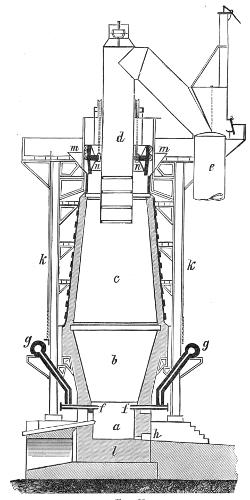
Fig. 29.
a Hearth; b Bosh; c Shaft; d Gas uptake; e Down-comer; f Tuyères with water cooling arrangement; g Blast pipes; h Tapping hole; k Supporting columns; l Furnace bottom; m Charging hopper; n Bell with raising and lowering arrangement.
Wrought iron is made by treating pig iron in refinery and puddling furnaces; in these much of the carbon is removed as carbon monoxide, and from the puddling furnace the iron is obtained as a pasty mass which can be worked into bars, rods, or plates.
Steel is made in various ways. The Acid Bessemer process consists in forcing compressed air in numerous small streams through molten cast iron, in iron vessels (converters) which are lined with ganister, a silicious sandstone. These can be rotated on trunnions. Basic Bessemer steel is made in similar converters by the Thomas-Gilchrist or basic process, which can be applied to pig irons containing phosphorus. The latter is removed by giving the converter a basic lining of calcined magnesium limestone mixed with tar.
In the Martin process steel is obtained by melting together pig iron with steel scrap, wrought iron scrap, &c., on the hearth of a Siemens regenerative furnace with a silicious lining.
In iron smelting the most important danger is from blast furnace gas rich in carbonic oxide. Sulphur dioxide, hydrocyanic acid, and arseniuretted hydrogen gas may possibly be present.
When work was carried out in blast furnaces with open tops the workers engaged in charging ran considerable risk. But as the blast furnace gas is rich in carbonic oxide and has high heating capacity these gases are now always led off and utilised; the charging point is closed by a cup (Parry’s cup and cone charger) and only opened from time to time mechanically, when the workers retire so far from the opening as to be unaffected by the escaping gas. The gas is led away (fig. 29) through a side opening into special gas mains, is subjected to a purifying process in order to rid it of flue dust, and then used to heat the blast, fire the boilers, or drive gas engines.
Severe blast furnace gas poisoning, however, does occur in entering the mains for cleaning purposes. Numerous cases of the kind are quoted in the section on Carbonic oxide poisoning.
The gases evolved on tapping and slag running can also act injuriously, and unpleasant emanations be given off in granulating the slag (by receiving the fluid slag in water).
In the puddling process much carbonic oxide is present. Other processes, however, can scarcely give rise to poisoning.
The basic slag produced in the Thomas-Gilchrist process is a valuable manure on account of the phosphorus it contains; it is ground in edge runners, and then reduced to a very fine dust in mills and disintegrators. This dust has a corrosive action already referred to in the chapter on Phosphorus and Artificial Manures.
The poisoning caused by ferro-silicon is of interest. Iron with high proportion of silicon has been made in recent years on a large scale for production of steel. Some 4000 tons of ferro-silicon are annually exported to Great Britain from France and Germany. It is made by melting together iron ore, quartz, coke, and lime (as flux) at very high temperature in electrical furnaces. The coke reduces the quartz and ore to silicon and metal with the production of ferro-silicon. Certain grades, namely those with about 50 per cent. silicon, have the property of decomposing or disintegrating into powder on exposure for any length of time to the air, with production of very poisonous gases containing phosphoretted and arseniuretted hydrogen. The iron and quartz often contain phosphates, which in presence of carbon and at the high temperature of the electrical furnace would no doubt be converted into phosphides combining with the lime to form calcium phosphide; similarly any arsenic present would yield calcium arsenide. These would be decomposed in presence of water and evolve phosphoretted and arseniuretted hydrogen gas. In addition to its poisonous properties it has also given rise to explosions.
[In January 1905 fifty steerage passengers were made seriously ill and eleven of them died. In 1907 five passengers died on a Swedish steamer as the result of poisonous gases given off from ferro-silicon, and more recently five lives were lost on the steamer Aston carrying the material from Antwerp to Grimsby.[C] This accident led to full investigation of the subject by Dr. Copeman, F.R.S., one of the Medical Inspectors of the Local Government Board, Mr. S. R. Bennett, one of H.M. Inspectors of Factories, and Dr. Wilson Hake, Ph.D., F.I.C., in which the conclusions arrived at are summarised as follows:
1. Numerous accidents, fatal and otherwise, have been caused within the last few years by the escape of poisonous and explosive gases from consignments of ferro-silicon, which, in every instance, have been found to consist of so-called high-grade ferro-silicon, produced in the electric furnace.
2. These accidents, for the most part, have occurred during transport of the ferro-silicon by water, whether in sea-going vessels or in barges and canal-boats plying on inland waters.
3. These accidents have occurred in various countries and on vessels of different nationalities, while the ferro-silicon carried has, in almost every instance, been the product of a different manufactory.
4. Ferro-silicon, especially of grades containing from 40 per cent. to 60 per cent. of silicon, is invariably found to evolve considerable quantities of phosphoretted hydrogen gas, and, in less amount, of arseniuretted hydrogen, both of which are of a highly poisonous nature. A certain amount of the gas evolved is present, as such, in the alloy, being ‘occluded’ in minute spaces with which its substance is often permeated.
5. As the result of careful investigation, it has been shown that certain grades of ferro-silicon—notably such as contain about 33 per cent., 50 per cent., and 60 per cent. of silicon—even when manufactured from fairly pure constituents, are both brittle and liable to disintegrate spontaneously, this latter characteristic being apt to be specially marked in the case of the 50 per cent. grade.
All these grades are commonly employed at the present time.
6. In the event of disintegration occurring, the amount of surface exposed will, obviously, be greater than if the mass were solid.
7. Evolution of poisonous gases is greatly increased by the action of moisture, or of moist air, under the influence of which phosphoretted hydrogen is generated from calcium phosphide, which, in turn, is formed, in large part, at any rate, from the calcium phosphate present in anthracite and quartz, at the high temperature of the electric furnace. If spontaneous disintegration of the alloy also occurs, much larger quantities of gas would be given off from such friable and unstable material, other conditions being equal. The greater or less tendency of a given sample to evolve poisonous gases, and even a rough estimate of their probable amount may be arrived at by the use of test-papers prepared with silver nitrate.
8. There is no evidence that low-grade ferro-silicon (10 to 15 per cent.), produced in the blast-furnace, has ever given rise to accidents of similar character to those known to have been caused by the high-grade electrically produced alloy. Blast-furnace ferro-silicon does not evolve poisonous gases even in presence of moisture.
9. As regards ferro-silicon produced in the electric furnace, the evidence available goes to show that certain percentage grades are practically quite innocuous. This statement applies to grades of alloy of a silicon content up to and including 30 per cent., and probably also, though in considerably less degree, to those of 70 per cent. and over.
10. In view of the fact that the use of ferro-silicon of grades ranging between 30 per cent. and 70 per cent. apparently is not essential in metallurgical operations, with the possible exception of basic steel manufacture, it will be advisable that the production of this alloy of grades ranging between these percentages should be discontinued in the future.
11. The proprietors of iron and steel works making use of ferro-silicon will assist in the protection of their workpeople, and at the same time act for the public benefit by restricting their orders to grades of this material, either not exceeding 30 per cent., or of 70 per cent. and upwards, according to the special nature of their requirements.
12. But as, pending international agreement on the question, intermediate percentages of ferro-silicon will doubtless continue to be manufactured and sold, the issue, by the Board of Trade, of special regulations will be necessary in order to obviate, so far as may be possible, chance of further accidents during the transport of this substance.
Inter alia, these regulations should require a declaration of the nature, percentage, date of manufacture, and place of origin of any such consignment.
The suggested regulations are printed on p. 291.]
ZINC
Industrial poisoning from zinc is unknown. The chronic zinc poisoning among spelter workers described by Schlockow with nervous symptoms is undoubtedly to be attributed to lead.
COPPER: BRASS
Occurrence of brass-founder’s ague.—Opinion is divided as to whether pure copper is poisonous or not. Lehmann has at any rate shown experimentally that as an industrial poison it is without importance.
Occurrence, however, of brass-founder’s ague is undoubtedly frequent. Although neither pure zinc nor pure copper give rise to poisoning, yet the pouring of brass (an alloy of zinc and copper) sets up a peculiar train of symptoms. As the symptoms are transient, and medical attendance is only very rarely sought after, knowledge of its frequency is difficult to obtain.
Sigel,1 who has experimented on himself, believes that the symptoms result from inhalation of superheated zinc fumes. In large well-appointed brass casting shops (as in those of Zeiss in Jena) incidence is rare.
Lehmann2 very recently has expressed his decided opinion that brass-founder’s ague is a zinc poisoning due to inhalation of zinc oxide and not zinc fumes. This conclusion he came to as the result of experiments on a workman predisposed to attacks of brass-founder’s ague. Lehmann’s surmise is that the symptoms are due to an auto-intoxication from absorption of dead epithelial cells lining the respiratory tract, the cells having been destroyed by inhalation of the zinc oxide. He found that he could produce typical symptoms in a worker by inhalation of the fumes given off in burning pure zinc.
Metal pickling.—The object of metal dipping is to give metal objects, especially of brass (buckles, lamps, electric fittings, candlesticks, &c.), a clean or mat surface and is effected by dipping in baths of nitric, hydrochloric, or sulphuric acid. Generally after dipping in the dilute bath the articles go for one or two minutes into strong acid, from which injurious fumes, especially nitrous fumes, develop with occasionally fatal effect (see the chapter on Nitric Acid). Unfortunately, there are no references in the literature of the subject as to the frequency of such attacks.
Recovery of gold and silver has been already referred to in the chapters on Mercury, Lead, and Cyanogen.
Mention must be made of argyria. This is not poisoning in the proper sense of the word, as injury to health is hardly caused. Argyria results from absorption of small doses of silver salts which, excreted in the form of reduced metallic silver, give the skin a shiny black colour. Cases are most frequently seen in silverers of glass pearls who do the work by suction. Local argyria has been described by Lewin in silvering of mirrors and in photographers.
III. OCCURRENCE OF INDUSTRIAL POISONING IN VARIOUS INDUSTRIES
The most important facts have now been stated as to the occurrence of poisoning in industry, and there remain only a few gaps to fill in and to survey briefly the risks in certain important groups of industry.
TREATMENT OF STONE AND EARTHS
Lime Burning: Glass Industry
Lead poisoning in the ceramic industry (earthenware, porcelain, glass, polishing of precious stones, &c.) has been dealt with in detail in the chapter on Lead. There is further the possibility of chrome-ulceration, of arsenic poisoning, and conceivably also of manganese. Further, poisoning by carbonic oxide and carbon dioxide may occur from the escape of furnace gases where hygienic conditions are bad. In charging lime kilns poisoning by carbonic oxide has occurred. The report of the Union of Chemical Industry in 1906 describes the case of a workman who was assisting in filling the kiln with limestone. As the furnace door was opened for the purpose gas escaped in such amount as to render him unconscious. He was picked up thirty minutes later, but efforts at resuscitation failed.
Carbonic oxide poisoning, again, may arise from the use of Siemens regenerative furnaces, especially glass furnaces: details are given in the chapter on Illuminating Gas.
Hydrofluoric acid is present as an industrial poison in glass etching (see Fluorine Compounds). Persons employed in this process suffer from inflammation of the respiratory tract and ulceration of the skin of the hands. I could not find any precise statement as to the frequency of the occurrence of such injuries. Use of sand-blasting to roughen the surface of glass has to some extent taken the place of etching by hydrofluoric acid.
TREATMENT OF ANIMAL PRODUCTS
In tanning use of arsenic compounds for detaching the wool from skins and of gas lime for getting rid of hair may cause injury to health. With the latter there is possibility of the action of cyanogen compounds (see the chapters on Arsenic and Cyanogen).
PREPARATION OF VEGETABLE FOOD STUFFS AND THE LIKE
In fermentation processes as in breweries and the sugar industry accumulations of carbonic acid gas occur, and suffocation from this source has been repeatedly described. Mention in this connection should be made of the use of salufer containing some 2 per cent. of silicofluoric acid as a preservative and antiseptic in beer brewing. In the sulphuring of hops, wine, &c., the workers may run risk from the injurious action of sulphur dioxide. Arsenic in the sulphuric acid used for the production of dextrine may set up industrial poisoning. Poisoning from ammonia gas can occur in cold storage premises. Industrial poisoning from tobacco is not proved, but the injurious effect of the aroma and dust of tobacco—especially in women—in badly arranged tobacco factories is probable.
WOOD WORKING
Injurious woods.—In recent literature there are several interesting references to injury to health from certain poisonous kinds of wood—skin affections in workers manipulating satinwood, and affections of the heart and general health in workers making shuttles of African boxwood. Details of these forms of poisoning are reported from England and Bavaria. The wood used for making the shuttles was West African boxwood (Gonioma Kamassi). It appears that the wood contains an alkaloidal poison which affects the heart’s action. The workers suffered from headache, feeling of sleepiness, lachrymation, coryza, difficulty of breathing, nausea, and weakness. Four workers had to give up the work because of the difficulty in breathing. Inquiry was made by Dr. John Hay of Liverpool in 1908 and by the medical inspector of factories in 1905. The following table shows the symptoms found:
Symptoms. (1) Persons Examined.
1905. 1907-1908.
Number. (2) Per cent. (3) Number. (4) Per Cent. (5)
Headache 27 24·1 18 22·8
Feeling of somnolence 10 9·0 17 21·5
Running of eyes 13 11·6 9 11·3
Running of nose 28 25·0 20 28·0
Breathing affected 34 30·4 13 16·4
Nausea or sickness 13 11·6 3 3·8
Faintness or weakness 11 9·6 1 1·2
The later inquiry shows considerable diminution in the amount of complaint as to respiratory trouble. This may have been due to the improved conditions of working, freely acknowledged by the men. Men were examined who had complained of the effects of the wood in 1905, and had continued uninterruptedly at the same kind of work during the interval without any obvious further injury to their health, although they preferred working on other woods.
East Indian boxwood had to be discarded in the shuttle trade owing to its irritant action on the eyes. Sabicu wood from Cuba was stated to give off ‘a snuffy dust under the machine and hand planes, the effect of which upon the worker is to cause a running at the eyes and nose, and a general feeling of cold in the head. The symptoms pass off in an hour or so after discontinuance of work.’ Reference was made in the report for 1906 to eczematous eruptions produced by so-called Borneo rosewood, a wood used owing to its brilliant colour and exquisite grain in fret-saw work. The Director of the Imperial Institute experimented with this wood, but failed to discover injurious properties in it. At the same time experiments with the wood and sawdust of East and West Indian satinwood were undertaken, but also without result.