Front matter
Reading edition
Cover art
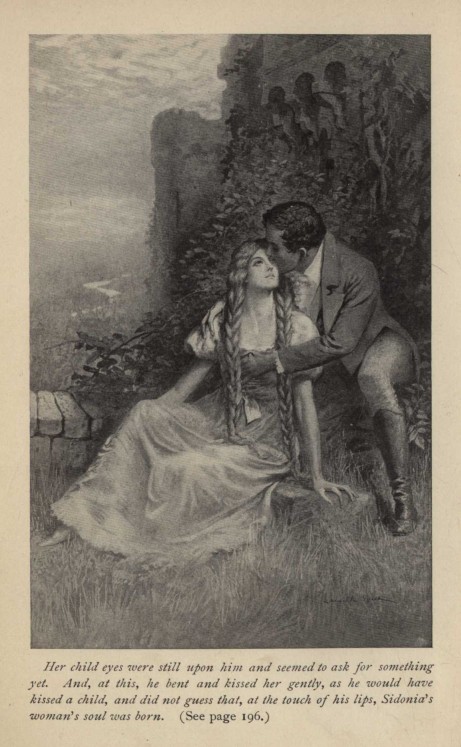
Her child eyes were still upon him and seemed to ask for something yet. And, at this, he bent and kissed her gently, as he would have kissed a child, and did not guess that, at the touch of his lips, Sidonia's woman's soul was born. (See page 196.)
"IF YOUTH BUT KNEW!"
BY
AGNES & EGERTON CASTLE
AUTHORS OF "ROSE OF THE WORLD," "FRENCH NAN," ETC., ETC.
"Si jeunesse savait...
Si vieillesse pouvait!"
(Old French Song)
WITH ILLUSTRATIONS BY LANCELOT SPEED
New York THE MACMILLAN COMPANY 1906
All rights reserved
COPYRIGHT, 1906, BY THE MACMILLAN COMPANY.
Set up and electrotyped. Published April, 1906.
Norwood Press J. S. Cushing & Co.—Berwick & Smith Co. Norwood, Mass., U.S.A.
CONTENTS
CHAPTER
The Vagabond
The Forest House
Green Adventure
Parting of the Ways
The Invitation of the Road
The Burg
Guests of Chance
Roses of Trianon
Home-Coming
The Burgrave's Welcome
Tangled Tales
The Burgrave's Farewell
The *Oubliette*
Love among the Ruins
*Furens quid Femina Possit*
'Twixt Cup and Lip
The Skirt of War
The Raid
The Melody in the Violets
The True Reading of a Letter
At the Mock Versailles
The *Cabinet Noir*
The King's Mail
Portents
The Perverseness of Words
The Ways of Little Courts
The Song of the Woods
A Treacherous Haven
The Homing Bird
Dawn Music
LIST OF ILLUSTRATIONS
Her child eyes were still upon him and seemed to ask for something yet. And, at this, he bent and kissed her gently, as he would have kissed a child . . . Frontispiece
"The something that lived on, the miserable carcass, the old man—call it myself, if you will"
But, as the oncomer drew nearer, the glimmer of hope died in the discontented gentleman's heart
As she bent, offering him the green goblet of wine, her heavy plait fell against his shoulder
Wellenshausen
"Look, look, do you see? ... There are two men coming up the road with a pack-horse!"
"The high-born, my mistress, had not expected you before to-morrow," said the butler with a deep bow
Meanwhile, up in his chamber, the Burgrave sat in sodden brooding
Steven almost called aloud, as he heard their heavy plunge into the ambushed waters
Sidonia stood, shaking and pruning herself like a bird, her hair glinting in the light
"Spread your dark wings, obscene birds! ... the scent of Death is in the air. In a little while you may gorge! ... caw—caw!"
"Hurl down the Guard, and the field is ours! ... Hurl down the Guard, aha!"
"She always loved violets. These have no scent, ... but hers—oh, they were sweet!"
They spread him beside the Jurist in the moonlight—with a certain effect of symmetry
... the great bag on his back, undiminished, save for two warrants and one private missive
What she was saying was sufficiently remarkable: "Your Majesty mistakes"
"Positively, a bird from the tyrant's aviary," he cried. "A foreign, French bird!"
His child-wife! ... The watchman was chanting the tale of the first morning hour
The End
TO "MARIE-LOUISE"
FOREWORD
"Is it not," remarks Fiddler Hans the wanderer, somewhere in these pages, "instructive to see how the ruler of Westphalia passes his time while the best manhood of his country is warring for the Empire—burnt in Spain, frozen in Russia?"
Few people have cared, it would seem, to study that little chapter of history, the rule of Jerome in Westphalia; yet it is curious enough—as a record of human folly, if for no other reason.
That incredible Westphalia of Napoleon's making! Harlequin's coat contrived out of Hesse, Brunswick, and a score of smaller principalities, hemmed with a shred or two of Prussian province; incongruous rag torn from the map of the old Germanic Empire and flung by the conqueror, between two victories, to his "little brother Jerome"!
A strangely pusillanimous character was the amiable Jerome. His annals include, in the days of his youth, flight from his ship, within sight of an English blockading squadron (not through cowardice, be it said: there was pluck enough in the little man, but because of his thirst for the pleasures of land), and, in more mature years, desertion from the Grand Army at a crucial moment, upon the mere impulse of wounded vanity. How so grotesque a potentate was allowed, for seven years, to lord over, to plunder and demoralize, some three millions of sturdy Germans, to discredit the name of Bonaparte and weaken the fabric of the new Empire, remains one of the enigmas of history.
But, then, the new Emperor must ever be a maker of kings; carve new kingdoms out of old. For his "Beau Sabreur," Murat, there is Naples and the Two Sicilies; for his infant son, nothing less than Rome; for his younger brothers, Holland, Spain, ... Westphalia! What is there to restrain great Cæsar? Hark to his mighty insolence:
"The Emperor of the French" (so M. Walckenaer, in his official work, La Géographic Moderne, brings to a conclusion the chapter on la France allemande), "possesses likewise in Germany the principality of Erfurth and the county of Katzenellenbogen: mais Sa Majesté n'a pas encore décidé sur leur sort."
His Majesty has not yet decided upon their fate!
About the fate of Westphalia there had been no indecision. From one day to another, "little brother Jerome" acknowledged failure in every other career, naval, civil, or military, found himself seated upon a German throne. And thus we have him, inconceivable fop, strutting and ogling, upon the scene.—A king whose life energies, when the cracking of his brother's empire may be heard on every side, are divided between the devising of new costumes, the planning of revels, and the discovery of fresh favourites. A scamp, fascinating enough, but incapable of a single strong or noble thought. A cynic and a libertine; withal a gull, in his way. A man who could repudiate without a pang of regret the fair young Virginian wife of his youth, to marry without love a "suitable German princess." A man who flaunted his debauchery and his barefaced improbity, yet could be scared to distraction by the imaginary threat of a little haunting tune; the tune which, with its twang of mockery and warning, was as ill an omen to his superstitious fancy as the shadow of "the little red man," or the date of Christmas, to his great Imperial brother.
And under him, that hasty patchwork of old German lands: his incongruous kingdom. His people, grave religious dwellers of the mountain and of the wood, unconvinced subjects of the godless Welsch, dumbly chafing under his insensate taxation. His new-fangled court, aping the vanished Versailles of Louis XV., yet combining with the reckless frivolity of the Old Order all the ill-breeding of revolutionary parvenus. Over all, a government so incompetent, so corrupt, as to stupefy or demoralize all that had dealings with it—friend or foe, high or low, French official or German landowner; the magistrates, the very students; the old rulers of the soil themselves, nervously awaiting the inevitable débâcle, stretching, the while, both hands towards the plunder.
In these topsy-turvy days no man rightly knows whether he belong to ancient Teutonic duchy or to French département; whether the accepted rule be code Napoléon or hoary feudal law. And thus, up in his ancestral Burg, an old lord of the land (such an one as the Burgrave of Wellenshausen) may well assume that he still holds the right of "high and low justice" on his own territory; whereas, down at Cassel, the mock Versailles, this same out-of-date character would naturally fall in with the new views of marriage and divorce, or "annulment by decree," brought so conclusively into fashion by the Bonapartes, royal or Imperial.
Above all this confusion, the cloud of war, gathering heavier and heavier. And from the mines of the Harz, from the deeps of the Thuringian forests, from the lanes of the old town, up into the very anterooms of the palace, conspiracy busy at work: conspiracy in the barracks, conspiracy in the universities, exploding on all sides, futile squibs as yet, but ominous. The King closes his eyes, seals his ears to all but sights and sounds of pleasure. So dancing, the harlequin kingdom goes to its death.
And it is through the mazes of this carnival, unique in the lenten gravity of nations, that wander the footsteps of the singer of youth, and of the lovers of this story.
O hear me sing:—If youth but knew
The glory of his April day,
Would he not cast the year away
For one more dawn of dream and dew?
Would he the fevered moons pursue,
Not rather with the spring delay,
Crowned with its leaf? If youth but knew
The glory of his April day!
For what shall unto age accrue,
If youth from joyance turn and stray?
Autumn is but the Spring grown grey,
Its harvest roses mixed with rue....
If youth but knew—if youth but knew!
(The Singer of Youth)
ELINOR SWEETMAN
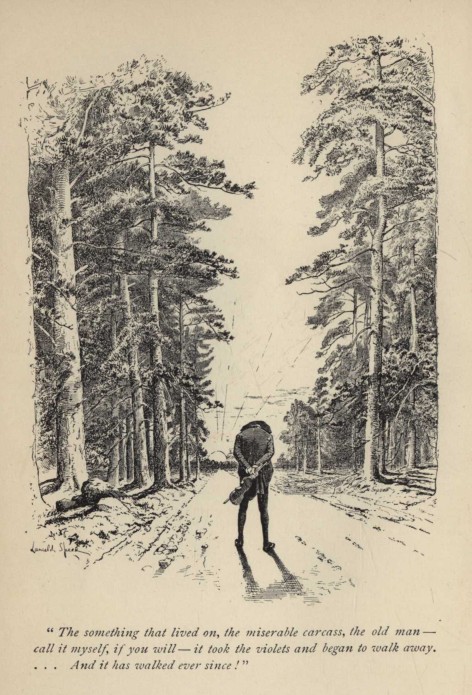
"The something that lived on, the miserable carcass, the old man—call it myself, if you will—it took the violets and began to walk away.... And it has walked ever since!"
IF YOUTH BUT KNEW
CHAPTER I
THE VAGABOND
"Wealth I seek not, hope nor love,
Nor a friend to know me;
All I seek, the heaven above
And the road below me."
R. L. STEVENSON.
The traveller sat upon the milestone just where the road, skirting the brow of the hill, branched off into the forest. At his feet lay the detached wheel; further away, in pathetic attitude, the remainder of the chaise itself. A stout bay, seemingly unconscious of as handsome a pair of broken knees as ever horse displayed, was tethered to a stump of tree, browsing such tender grass or leafage as grew within his reach. The situation spoke for itself; and the young traveller's face spoke for the situation as eloquently as Nature (who had bestowed upon him a markedly disdainful and somewhat impassive set of features) would permit.
Behind him rose the cool gloom of the forest. Below lay the plain, gold-powdered by the level rays of a sinking sun. Between the edge of the road and the forest margin ran a stream. A robin sang to the glowing west from the topmost branch of a fir tree. But he on the milestone was blind to the gold of the valley, deaf to the gold of the song. "Now, here's a pretty kettle of fish!" was the burden of his thoughts.
To have been stuck a whole hour upon a stone, while a postilion ranged the country on horseback in one direction, and a valet a-foot in the other, and no help as yet forthcoming; not to have had himself within hail, all those weary minutes, one single human being—between intervals of drowsiness he cursed the peaceful valley land, with its fair fields and orchards, as the most God-forsaken of countries!
Presently his moody eye quickened. On the road below a moving object was approaching. Only a pedestrian, alas! Nevertheless, he might prove of use for succour or advice.
But, as the oncomer drew nearer and began to foot the ascent, the glimmer of hope died in the discontented gentleman's heart. Here was no sturdy native, likely guide to smithy or village inn. 'Twas a mere ambulant musician, as strange, doubtless, to the country as himself: the sun-rays were even now glinting back, roseate, from the varnish of a fiddle.—The traveller relapsed into moodiness.
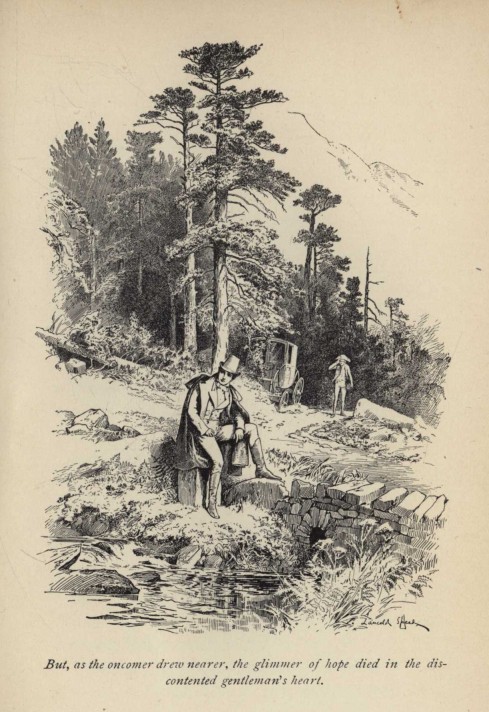
But, as the oncomer drew nearer, the glimmer of hope died in the discontented gentleman's heart.
At the steep curve of the hillside, man and fiddle vanished from view. Nevertheless, that he was still climbing, the advance (in interrupted measure) of a singular little tune, half sourdine, half pizzicato, soon proclaimed. It seemed at first so woven in with the babble of the brook, the deep choiring of the forest and the song of the robin, that the youth on the milestone hardly realized its separate existence. But, as it hovered ever closer, he was forced to listen and even to follow. It seemed the very song of the rover; of the rover on foot, humble and yet proud; without a penny, without a bond; glad of the free water to drink and the hunk of bread by the roadside—a song of the nodding grass and the bird in the hedge, of the dancing leaf, the darting swallow, the wide kindly skies. Oh, the road is full of gay things, and tender things, of sweetness and refreshment, of wholesome fatigue and glorious sleep, for those that know its secrets!
"Good evening to you, young sir."
The little tune had stopped. A man's figure, exaggeratedly thin, black against the sunset, had emerged over the knuckle of the hill and, with a wide sweep of the arm, was saluting.
The gesture of the black silhouette seemed so courtly, the voice that came from it so refined, that the young gentleman almost rose to return the salutation: but, in time, he caught sight of the violin curves.... Pooh, it was the fiddling vagabond! Ashamed of his impulse, he drew forth a florin and flung it.
The musician skipped nimbly on one side; the coin fell, flashing in the red sun-shafts. He looked from it to the imperious donor, whose face he scanned keenly for a moment, then smiled; and his teeth shone as white as a wolf's in the deep tan of his face. Then off went his battered hat again and out was stretched a sinewy leg in dusty blue stocking, to accompany a bow such as twenty years ago might have roused the envy of your finest Versailles marquis.
"I greet you! I salute you, my young lord!" The fiddler rose from his inclination and burst out laughing. "Oh, cease fondling those pistols in your pocket, worthy sir," cried he, "for by Calliope, daughter of Jove and Mnemosyne, 'tis not your money-bags I covet just now, but, oh! your golden youth!"
"The fellow has a wild eye," thought the gentleman. Now, it is a question whether even a highway robber were not more agreeable to encounter on a lonely road than a madman.
"If it be madness to honour in you such a gift of the gods," said the singular vagrant, reading the thought, "why then, yes, I am mad, sir—stark, staring."
He fell back on one foot and bent the advanced knee, tucked his instrument under his chin, where it settled like a bird to its nest, and drew his bow across the strings with a long plaint.
"O youth!" he intoned between two sighs of the catgut. "O spring! O wings of the soul! O virginity of the heart, expectation, unknown mysteries of life! O wealth of strength and yearning!—See, now, how you sit," he cried, dropping into speech again, "on the fringe of the forest, in a strange land, with the sunset valley at your feet, and the stream running you know not where beside you, and the bird over your head singing the desires of your soul. Why, by Apollo, young man, here are you in your youth, in the spring of your world, in the very middle of an adventure, and——"
Again limber fingers moved along the strings; and, with a sense of wonder, the traveller felt within his being some answering outcry. But he stiffened himself against it.
"Harkee, my man," said he, trying to frown, "I am in no mood for fooling. Take up your florin, and begone.—Or, stay, earn another by telling me, if you can, where I am, and how far lies the nearest village?"
"Sir," replied the other, urbanely, "fellow-travellers should assist each other without any sordid consideration. (Ah, had you offered me of your youth, now!) You are, an it please you, just between the border of that old, steady-going principality of Schwarzburg and the new-fangled, patchwork kingdom which appertaineth to his Majesty King Jerome—himself one of the crowning products of the Great Revolution!"
"Faugh!" said the gentleman.
The fiddler's restless eye lighted.
"My lord is an Englishman? In verity and beyond doubt, none but an Englishman could wear so lofty a front. I need scarce have asked."
The young man stared haughtily. The other considered him awhile in silence with a sort of grave mockery, and pursued then reflectively—
"This English aloofness, 'tis an excellent prescription for pride and disdain and such-like high essences. Only be careful, my brother-wayfarer, that you be not above your own fair youth, and contemn not its splendid opportunities.
'Singula de nobis annipraedantur euntes'
O young man! ...
'Eripuere jocos, Venerem, convivia, ludum'
think of it!"
So saying, he shouldered his instrument, and with a valedictory wave of his bow seemed about to take his departure; but, as if upon a second thought, stood still, and once again observed the young man.
Now it struck the stranded traveller that there was a dignity in the vagrant's gaze, a refinement about his person, which scarce accorded with the gipsy appearance, the shabby clothes; that it was not usual for beggars to quote Horace with delicate accents of culture; that his salutation had been a pattern of courtliness; above all, that he was not the least impressed by a young nobleman's most noble demeanour. And he, on his milestone, began to feel slightly foolish—an ingenuous blush, indeed, crept to his cheeks.
The player hitched round his fiddle till it lay across his breast, and pinched a couple of strings as a man might pinch the cheek of the wench he loved.
"Pardi," he said, speaking into its curved ear, "that flag of crimson would proclaim that there's hope for the youth yet.—Sir," proceeded he then, gaily, "I think I can be of use to you. I place myself at your service. May I crave to know whom I have the honour of addressing?"
"You address," responded the other, "Steven Lee, Graf zu Waldorff-Kielmansegg, an Austrian gentleman (if you must know) travelling towards his estate in the south." He had an irrepressible satisfaction in the recital.
"Austrian?" echoed the listener, with a cock of one of his expressive eyebrows. "'Tis a safer nationality to proclaim than the English, for travellers in great Cæsar's dominions nowadays. Oh, you are right, quite right! 'Twould be the height of rashness to proclaim even a drop of English blood, these days, where Monsieur Buonaparte rules!"
The taunt struck home. Red mantled again on the gentleman's smooth cheek.
"Despite an Austrian father, I have by my dead mother enough English blood in these veins," cried he, hotly, "to hate the usurper and despite his upstart brothers—if that is what you mean; and I care not who knows it!"
The fiddler's smile grew broader. "Youth," whispered he to his violin, "may pretend to abjure itself, but it will out. The stripling has spirit, though it be but the spirit of scorn.—But the ceremony is not complete," pursued he. "I have now to return your compliment. Above all things, let us be polite. Here, then, comrade, you see before you an individual known all over the country as the crazy musician, sometimes more tersely as Geiger-Hans—what in your English you might call Fiddle-John. Some call me the Scholar Vagabond, and some, the children (bless them), Onkel. Like your own, my nationality is a matter of indecision. Some say I am French, some German, some from over the Alps—take your choice; your choice, too, of my title: Geiger-Hans, Fiddle-John, or Geiger-Onkel. Or you may dub me, if you please, the Singer of Youth."
But by this time, Steven Lee, Count Kielmansegg, was disgusted with himself for having betrayed so much of his feelings to a beggar vagrant.
"Doubtless," remarked he, with infinite arrogance, "it may prove more convenient for you, at times, to hide your name, good fellow. Reassure yourself, I have no curiosity to learn it."
Whereupon Geiger-Hans gathered his brows into so deep a frown that the whole hillside seemed to grow black. He struck the strings of his instrument, and they called out as with anger.
"My name," he said under his breath, "my name, boy, is dead—as dead as my youth." Then he grew calm as suddenly as he had stormed. "Some happy ones there are who die and whose names live: I live, and my name is dead. Let that suffice to you. Why, see," he cried next, with another swift change of tone, while Count Steven stared at him, his slow Austrian blood, his deliberate English wits, unable to keep pace with such vivacity of mood, "it is getting dark ... the sun has dropped behind the valley line ... the forest is full of night already! Do not the lights of unknown shelter beckon you—the chimney-corner, the strange hospitality? Why, Heaven knows what sweet hostess may not greet your youthship to-night! And if your soul cries not out for fair adventure in forest depth, there, at least, is a poor dumb thing that craves stable and corn." As he spoke, he stepped nimbly to the injured horse and unhitched the reins from the tree. "Might you not have bathed those cut knees?" he exclaimed, shooting a look of rebuke over the animal's meek head. "And the kindly brook running charity at your elbow!"
He led the creature to the stream; and the deed of compassion accomplished, again turned to his companion with a smile, which seemed to show knowledge of all the latter's vacillating thoughts of vexation and shame.
"Lend me a hand with the wheel, comrade, and let us see if we cannot improvise a linchpin. And then, if you push behind, this forgiving beast will do his best to draw your goods into safety."
But it was the musician who mended the wheel, while the traveller watched in wonder the work of the brown hands. And then, in the falling dusk, they set upon their slow way: Steven Lee, Graf zu Waldorff-Kielmansegg, pushing behind even as bid, the fiddler marching ahead with the reins slung over his arm and humming a hunting song under his breath.
Leaving the stones and dust of the high-road, he led the way along a wide path that seemed to cut the forest in two and run downhill into the horizon. Beneath their feet was now an elastic carpet of pine-needles. On each side of them the serried ranks of trees held the night already in a thousand arms and murmured to it with a voice as of the sea. Before them, at the end of the nave, and set like a cathedral window, shone a span of sky, primrose and green, with one faint star. And presently Steven saw, to one side far ahead, an orange square of light, and knew it for the unknown forest shelter beckoning to him.
"But what," cried he, struck by a sudden thought, "of my postilion and my valet?"
Geiger-Hans looked back at him over his shoulder and grinned. He slid the reins above his elbow and grasped his violin.
"To the devil," it sang mockingly, through the glade, "to the devil with postilions and valets! to the devil with prudence and forethought! O youth, enjoy your youth! O youth, be young!"
CHAPTER II
THE FOREST HOUSE
"Diesen liebenswürd'gen Jüngling
Kann man nicht genug verehren..."
HEINE.
"Heaven knows," had said the musician, "what sweet hostess may not greet your youthship to-night."
To their knock the door was opened by a slip of a peasant girl. The light from within shone on her long yellow plaits of hair and her small brown face.
Steven was conscious of a distinct shock of disappointment. What folly had this fantastic chance companion fiddled into his mind that he should have found himself expecting something meet for his high-born fancy in this lonely forest house?
"Geiger-Onkel!" cried the girl, in surprise.
And "Geiger-Onkel!" was echoed joyfully indoors. An old peasant woman came waddling forward, hands outstretched.
"Be kind to my comrade, Forest-mother," said the player, "while I see to this brother beast."
He led the horse towards the back yard. And Steven stepped into the great kitchen, glad at least of its prosaic aroma of pot-herbs, since romance had fallen silent with the fiddle.
It was a long room, panelled with age-polished oak which reflected the light of the hanging brass lamp and of the ruddy hearth as jonquil flamelets and poppy glow. A black oaken table, running nearly from end to end, was covered half-way with a snowy cloth, red-hemmed and flowered. There were presses, laden with crockery and pewter. There was a tall clock, with a merry painted face and a solemn tick. There were stags' horns and grinning boars' heads above the presses. Not that Steven had any interest to bestow on these things: he was glad that the place was clean. He thought the oaken chair hard sitting for his noble person, but it was better than the milestone. The Forest-mother seemed a decent sort of body; with a due sense, too, of the quality of her guest. As for the peasant child, he did not notice her at all—not even the pretty foot in buckled shoe and scarlet stocking, of which the short peasant skirt gave such a generous display.
Yet it was to her that Geiger-Hans made his courtly bow as he entered in his turn.
"Mamzell Sidonia!" said he, his old hat clapped over his heart.
She gave him a smile, half tender, half mischievous. And her teeth were as white as his own in her sunburnt face. There was a whole host of dimples, too, which a young man might have remarked. But what mattered the dimples of a peasant girl?
Then the fiddler took the old woman round the neck and kissed her plump, wholesome cheek with a smack.
"Supper, supper!" cried he. "And if it's good, you shall have such music that your hearts shall sing."
The girl laughed out loud, and ran to the hearth, where she seized a pot.
"In Heaven's name," cried the woman, "leave that, child! 'Tis not fit for you."
"Oh, please," urged Sidonia of the yellow plaits, "please, little foster-mother!"
Forest-mother to the fiddler, foster-mother to the girl. Steven had supposed her grandmother. Bah! As if, indeed, it were worth a thought!
"Get the wine, then," said the matron, with a jolly, unctuous chuckle.
And while, swinging long tails of hair and scarlet ankles flashing, the girl darted round the table, what must this fantastic fellow Geiger-Hans do but introduce guest and hostess with one of his absurd flourishes.
"Here, dear comrade, is Dame Friedel, mother of the great King Jerome's own Head Forester. And here, mother, is a most noble Austrian count, whom the accidents of travel have forced to condescend to the shelter of your humble roof this evening."
Deep curtsied Dame Friedel. Steven inclined his head; and, feeling the fiddler mock him behind his back, grew red and angry.
"A glass in welcome, gracious sir!" tittered Sidonia, at his elbow.
She was so close to him that his cheek was fanned by her breath of clover and the fragrance of a little bunch of violets in her white kerchief rose to his nostrils. As she bent, offering him the green goblet of wine, her heavy plait fell against his shoulder. He drew back haughtily.
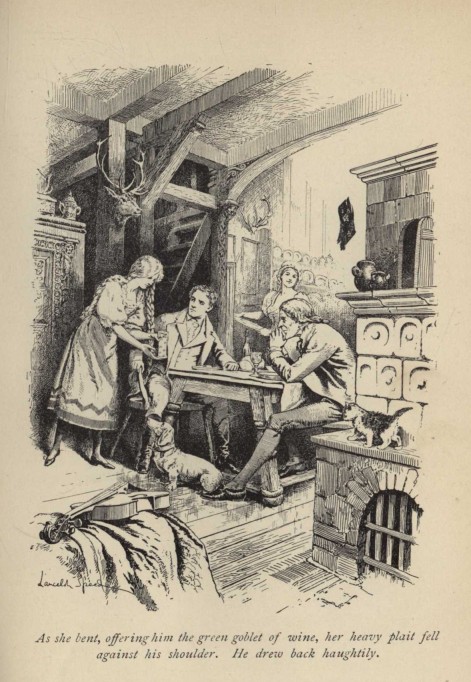
As she bent, offering him the green goblet of wine, her heavy plait fell against his shoulder. He drew back haughtily.
"Peste!" cried Geiger-Hans, "how my fingers itch for the strings. But never mind, you shall lose nothing by waiting. Tarteifel! mother, as I live, venison stew! What feasts you good people make in your forest house!"
"My son is hungry when he comes home of nights, and so are his lads.—My little love, will you sit and entertain the gentlemen?"
Sidonia, pouting, drew her chair with great clatter round by that of Geiger-Hans and turned a shoulder on the count, who thus remained isolated, as became his rank. The fiddler drank to her and she filled his glass again. And, as she stretched across him to do so, the violets at her breast fell upon his hand.
"Violets!" cried he, and sat as if turned to stone. His brown face grew ashen. Then he pushed his plate away, took up the flowers and pressed them against his lips, inhaling the scent of them with long deep breaths. Presently the tears ran down his cheeks; his slow-drawn sighs were cut short by a kind of sob. The girl started to the old woman's side and stood, flushed and downcast, while the Forest-mother beat her omelet with a grave countenance. Neither of them looked at the fiddler. Steven, who had stared, suddenly dropped his glance, too, ashamed and uncomfortable. Geiger-Hans got up from his seat.
"I can eat no more to-night," he said, in a broken voice. He walked over to the bench where he had left his fiddle, and, hugging it, went out into the forest.
"Have you ever seen him like that before?" whispered Sidonia of mother Friedel.
"Once," said she, "and it was over the violet-bed in the garden. I doubt he has seen trouble, poor soul! Who has not?"
Sidonia returned to her seat, propped her chin on her hands and fixed the young count absently. Her eyes were not black as he had thought: they were grey and green, green and golden brown, like the waters of the brook in the shadow of the trees.
"Heavens, sir, how you stare!" she said after a while, pettishly.
The young aristocrat, whose thoughts had been all engrossed by this new eccentricity of his road acquaintance, raised his disdainful eyebrows. He stare at a country wench? Then into their sullen silence mother Friedel exclaimed joyfully.
"Hark!" cried she, "here comes my son!"
From far away stole the faint blast of hunting-horns; a dog bayed answer from the kennels, then the call of the horns arose again in the whispering forest depths, closer and louder.
"Yes, yes, it's the 'return home' they're winding," said the old woman, bending her ear.
Without, there now rose a fine clamour: barking and yelping of hounds, tramping of horses, blasting of horns, cheerful shouting of men. The head forester shot half his stalwart figure in at the door and nodded with some mystery to his mother. What could be seen of his green uniform was very grand indeed, with vast display of gilt buttons and royal crowns, frogs and braid. His square, freckled face, made for jollity, was puckered into anxious lines; his eyes roamed uneasily from Sidonia to the stranger. He strode to his mother's side and whispered in her ear.
"Be good to us!" she ejaculated, clapping her hands, all dismay.
"Hush, mother!" warned the forester, finger on lip, and turned towards the door.
Count Steven had finished his plate of venison stew, and was condescending to enjoy a crust of bread with a glass of the tart wine. The sense of expectation about him made him now likewise turn round in his chair—languidly, for the high-born are never openly curious.
Outside, in the night, against a background of flickering leaves and under the glare of a couple of torches, he saw a picturesque group of hounds and huntsmen; two of these last laden each with a murdered roebuck, whose pretty, innocent head hung trailing on the ground. Suddenly the scene dissolved. A man came from the midst of the foresters into the kitchen. The rest disappeared with their booty; hounds and horses were led away towards the distant kennel premises; the woodland glade resumed its peace.
As the new-comer passed him, the head forester made a spasmodic movement, arrested midway, of hand to forehead. His mother swept a dignified curtsey. The peasant girl, her hands clasped at the back of her neck, stared with frank curiosity, her mouth open so that all who cared to look might wonder upon the doubled splendour of her young teeth.
He stood and glanced round upon them all: a slight young man of somewhat low stature and dark, fine-cut face, with hair cropped short at back and side to come down in a curly wave in the middle of his forehead. He had large eyes under thick, straight eyebrows; and his forester's uniform, though ostensibly of the same cut as Friedel's, was of finer cloth and obviously brand new. The collar of the coat rose very high on each side of his chin, which in the centre rested on folds of delicate cambric.
"Positively," thought Steven Lee, Count Waldorff-Kielmansegg, etc., "a gentleman like myself!"
But the hunter's first word dispelled the illusion.
"My friend," said the new-comer to the old dame—he spoke German with a strong foreign accent—"my fellow-forester there, Friedel, has assured me that you would give his brother woodsman hospitality to-night."
Now, as he smiled, his handsome face assumed a trivial, almost inane, expression, which destroyed its look of breeding and caused Count Steven to return to his bread and wine with a mental shrug.
"Any friend of my son is welcome here," said the old lady, smiling doubtfully.
Friedel himself grew suddenly scarlet, gulped, blinked and looked as uncomfortable as any fish out of water.
"I see I must introduce myself," cried the little man, laughing heartily and clapping him on the shoulder. "I am Mr. Forester—ahem!—Meyer, at your service, madame."
"I wish," said Steven, "that you would shut the door behind my back, good people."
"Hey la!" said Mr. Forester Meyer, with a sudden imperious note in his voice, "whom have we here?"
"A guest, sir, like yourself," said the hostess somewhat dryly, hieing to her pans; while the young nobleman in question turned his heavy chair round again to supplement her inadequate description.
"An Austrian gentleman, my man, if it imports you to know," said he. "You are yourself, perhaps," he went on with more friendliness, struck by an obvious explanation of certain signs about the new-comer that had puzzled him, "the inspector of these forests on your rounds. I notice you speak with authority, and your accent is not of the country—a countryman of this King Jerome?"
Mr. Forester Meyer broke again into loud laughter.
"Hey! what perspicacity has the gentleman!" cried he, jovially. "(Friend Friedel, shut the door!) Nay, truly, sir, you are perfectly right. I see it would be quite hopeless to maintain an incognito before you. It is true, sir, I do inspect for this King Jerome occasionally. Ha, ha!"
"Ha, ha!" echoed Sidonia, catching the infection of mirth, as a child will, without reason.
"Hey la! And whom have we there?"
Mr. Forest-Inspector repeated the phrase in very different tones. There came a curious flicker into his eye as he ran it up and down the girl's figure, from crown of yellow head to scarlet ankle and back again, with appreciative pauses on the way.
"Eh, eh!" said he, meaningly. He took her chin between his finger and thumb, and chuckled as he raised the crimsoning face to the light.
"We do not hold with French ways here," said Dame Friedel, rebukingly, over her pan.
Steven, catching the gesture of warning which her son instantly addressed to her, felt a vast contempt for the fellow's slavish fear of his little superior.
The wine, thin and fragrant, must have gone somewhat fantastically to the young nobleman's brain. He began to feel defiant, in a humorous sort of way, and to wish the fiddler back with his music. With his violin to accompany the song of the amber drink, it seemed as if that youthship of his (on which yonder fantastic rogue laid such stress) might find some zest in a quarrel with Master Forester Meyer, whose eyes danced so unpleasantly as they looked at this peasant child; who had so irritating a French shrug and so mean a smile.
Now, if he had an eye to a pretty girl, the inspector seemed to have also an ear for a poacher. The distant crack of shots, reverberating from the forest, now made him start and listen acutely. Yet as Friedel, with a frowning countenance, made a lurch for his gun in the corner, Mr. Meyer smiled and restrained him. Then he himself went to the door, set it ajar and hearkened. His smile widened as he closed it again and returned to the table.
"Doubtless he has plans of his own for trapping the trespassers," thought Steven. It was the obvious explanation. And yet he felt a kind of mystery brooding around him, almost as if that adventure which the fiddler's music had boded were about to take place. And, in the long silence which succeeded, the impression deepened. The Frenchman seemed overcome by an uncontrollable restlessness. He paced the room from end to end, compared the merry-faced clock with his watch, stared out of the window and drummed on the pane. He was evidently keenly on the alert for something: and, as Steven vainly cudgelled his not very quick wits to conjecture, behold, it was at hand!
Shouts without, steps ... a tremendous rat-tat at the door!...
"'Tis not possible," cried mother Friedel, with some distress, "that Heaven has sent us more guests?"
This was, in truth, precisely what Heaven was doing, if, indeed, it were fair to hold Heaven responsible. Two new visitors walked into the forest home without so much as a word of parley. A hulking man, also in forester's uniform ("By Saint Hubert," said Steven Lee to himself, "his Westphalian Majesty's rangers seem thick as leaves hereabouts!"), and a lady clinging to his arm.... Yes, a lady, and a fair! Steven rose to his feet.
The inspector and the burly new-comer interchanged a rapid glance. Then, cracking the whip he held in his hand, the latter burst into the most execrable German, interspersed by volleys of French oaths. It was evident that King Jerome held to servants of his own nationality.
Morbleu! quoth he, it was a mercy to see decent shelter! Devil take all, he had thought that he and the lady would have had to spend the night in the forest!
Here the lady, in spite of very pink cheeks and bright eyes, became so faint that she had to be assisted to a chair by mother Friedel and her foster-child. Steven darted to present a glass of water, but was arrogantly forestalled by Mr. Meyer.
"Such a scandal on his Majesty's high-road!" went on he of the whip: "this lady's coach attacked by ruffians!"
"His Majesty will be exceedingly displeased," said Mr. Meyer, gravely, sitting down by the side of the distressed one and stripping off her glove to consult a delicate wrist.
"Her escort shot at—— By all the devils!"
"Monstrous," quoth the inspector, in quiet indignation. "A little wine, madam?"
"The escort—sacred swine, confound them!—took flight and basely abandoned their charge."
"Shocking—shocking!" said Mr. Meyer, relinquishing one pretty hand to receive the empty glass from the other.
"If I had not happened to hear the shots and rush to the spot, what might not have happened?"
"It makes me shiver to contemplate it," asserted the inspector.
"My brave deliverer," murmured the lady, in a dulcet voice. "Single-handed, he——"
She suddenly buried her face in her hands and quivered from head to foot.
The inspector looked up at mother Friedel with an air of grave compassion.
"Hysterical," said he; "ah, no wonder!"
Dame Friedel began to loosen the lady's handsome claret-coloured travelling-mantle, whilst Sidonia drew a velvet, white-plumed hat from the loveliest dark head in all the world.
"Well ... ah!—Schmidt," said Inspector Meyer, "his Majesty will hear of your conduct."
"Thank you, Mr.—ah!—Meyer," rejoined the burly Schmidt, with an unaccountably waggish grin.
"Ah, ha, ha!" cried the lady. She flung back her head and flung down her hands; the tears were streaming upon her uncovered cheeks. It might be hysterics, but Steven thought it was the most becoming combination of emotions he had ever beheld.
She wiped her eyes and sprang up as lightly as a bird. Emerging from the folds of her cloak, she displayed a clinging robe of pale blue, fastened under the bust by a belt of amethysts set in gold. She had an exquisite roundness of form; an open, smiling mouth. Her eyes were innocent and dark and deep. She was (Steven felt) a revelation. And withal, what a great lady! What an air of breeding! What elegance! An Austrian gentleman knows the value of jewels. Heavens, what rings on her fingers! What pearls in her ears!
"Ah, Dio mio!" she cried, "but I am hungry!"
Italian, then. There was a strange medley of nationalities in this German forest corner.
The fixity of the young man's gaze suddenly drew the lady's attention. She looked at him: surprise, interest, then an adorable smile appeared on her countenance. It was almost an invitation. Besides, was it not meet that the only gentleman of the party should entertain the only lady? With his heart beating in his throat, he took two steps forward. The three foresters had drawn apart and were whispering together with furtive glances in his direction; but he was not likely to notice this when such lovely eyes were upon him. She dropped her handkerchief. He rushed to pick it up. As she took it from his fingers, he gave them ever so slight a pressure.
(Oh, Geiger-Hans, Singer of Youth, hadst thou foreseen this rapturous moment?)
"A thousand graces," murmured she. The graces! they were all her own.
"Permit me to introduce myself," he stammered.
But the inspector cut him short with a strident voice.
"The gentleman must be fatigued," he cried.
Steven started angrily. To one side of him stood Forester Schmidt, to the other, Forester Friedel.
"I will show the gracious gentleman the way to his repose," said the latter in his ear, with subdued, yet warning tone.
"And I will give you my help to the door, tonnerre de Brest!" exclaimed the other, and caught the Count's arm under his with a grip of iron.
Steven wrenched himself free. Yet a man has not sober English blood in him for nothing. Humiliating as was the position, a moment's reflection convinced him that resistance and futile struggle would but render him ridiculous. Ridiculous, in the light of those dark eyes!
"Lead, then, fellow," said he to Friedel; and, after bowing low to the lady, followed his escort with what dignity he could muster towards the door opening on the forest.
There was such a seething of rage in his brain, such an itching in his palm to feel it against yonder insolent Schmidt's full cheek, that it was not till he found himself on the threshold of a dimly lighted wooden building, gazing blankly in upon heaps of straw, that he realized that a barn was considered good enough for the night's lodging of a Count Waldorff-Kielmansegg.
"May you rest you sweetly, sir," said Friedel, and tramped away.
CHAPTER III
GREEN ADVENTURE
"Non ego hoc ferrem, calidus juventa,
Consule Planco."
HORACE.
"Comrades again!"
Turning round with a start, Steven beheld the crazy musician at his elbow.
"Comrades on the straw—eh! What a bed for his lordship. Misérables! they have no conception of the importance of rank, these benighted forest folk. Yet give me the clean, yellow straw, smelling in the dark of sunshine and whispering of the fields, rather than your stuffy German mountains of feathers."
"Geiger-Onkel! Geiger-Onkel!" came a shrill cry into the night.
The fiddler turned with a bound and ran into the middle of the moonlit yard, staring up at the house that stood outlined against the pale sky. From some distant regions, where Friedel's underlings kennelled near their hounds, rose shouts of boorish laughter and the chorus of a drinking song.
A yellow tongue of flame appeared in a wooden balcony, hanging under the roof. Sidonia bent over, shielding her candle from the forest airs.
"Are you there, Geiger-Onkel?"
"Yes, child."
"Oh, I am glad.... Geiger-Onkel"—she leaned over still further; her tresses hung down, one shone ruddy with the candle-gleam and one silver in the moonlight; her voice was broken with angry tremors—"he tried to kiss me!"
"Mort de ma vie—who?"
"The big man with the whip. He caught me by the waist. I had nothing to hit him with but my plaits. I lashed him in the face. They caught him across the eyes——"
"Caught him across the eyes," cried the fiddler, clapping his hands. "Ah, brava, little mamzell!"
"They whistled like a rope"—the girl was laughing and crying together—"I think I have half-blinded him. Mayn't I come down to you, Onkel? I want to talk ... and I want music."
"Better not," said fiddler Hans, after a moment's reflection; and then from the shadow Steven stepped out beside him. (It was terrible to think of the dark-eyed lady in the company of such ruffians!) Sidonia, with a cry, drew back at sight of the new shadow.
"Nay, never be afraid of him. It is my comrade. As for the others—why, go in, child; bolt your door," said the fiddler. "Go to bed and sleep in peace. I shall watch."
"But you will play for me?" she asked over her shoulder.
"Presently, I may," said he; "such a tune, little mamzell, that will make some people dance! But to you it shall give sweet sleep."
As the girl disappeared, Geiger-Hans turned upon Steven. He laughed as he addressed the young man, but his eyes were fierce as some wild beast's in the dim light.
"Did you hear?" said he. "The maid struck him; but you—oh you—you let yourself be turned out! Oh, to see you trot away like a lamb. Steven Lee, Graf zu Waldorff-Kielmansegg, turned out of doors by two low-bred foresters! What, then, runs in your veins? What, turnip-juice instead of blood? The fellow, Schmidt so-called, laid hands on you, did he not? And you a youth! By the blood of my fathers, had the creature touched me, old man as I am, he had felt the weight of his own whip! But the fellow has muscles. Nay, you were right, sir, right. Let us be prudent, by all means. Only that mask of yours lies, that smooth cheek, that crisp curl—all lies. Young, yes. Only your heart is not young. 'Tis like the kernel of a blind nut—dry dust. While I—there is more of God's youth left in my worn and waning body——"
"Confusion!" interrupted Steven, trembling in every limb, hurt to the marrow of his pride; "it was before the lady."
"Oh, the lady...!" echoed the other, with a mocking trail of laughter.
During the vehemence of his speech the musician had advanced on the lad, who had unconsciously drawn back until he stood against the wall of the house. Now a window close to him was unlatched; and the sound of a sigh, rather than a voice, was breathed forth into the night.
"Ah, Dio!"
"Your cue!" mocked the fiddler into his ear, and melted away into the darkness.
The window was that of a room on the ground floor; the lady leaned out, her elbows on the sill; her face caught a slanting ray of moonlight. Was it possible for anything mortal to be so beautiful?
"Madam!" cried Steven, and that heart of his which was supposed to be but dry dust began to thump in hitherto unknown fashion.
"Hush, hush!" she whispered, a taper finger on her lip. "Ah, is it you, sir?"
He advanced into the ray that held her. He was not aware that he also looked goodly and romantic. Somewhere, in the darkness close by, the fiddler's bow crept over the strings. It was a sound so attenuated that it seemed to have no more substance than the light of the moon itself; it stole upon their ears so gently that it was as if they heard it not. His hand met her warm fingers—the fragrance from her curls mounted to his nostrils; she looked up at him and her eyes glistened.
Oh, fiddler, what bewitching music is this? What sweetness does it insinuate, what mysterious audacity counsel? There were those parted lips of hers, with white teeth gleaming through, and here was this youth who had never touched a woman's lips in love. Such a little way between his bent head and her upturned face...!
A door crashed behind her. She started from his timid hand. The thread of the music was broken like a floating gossamer.
Steven thought that the fiddler laughed. There was a faint exclamation. Heavens! did she also laugh? He saw—yes, he saw the inspector's hated outline over hers. She was drawn from the window by the shoulders, the shutters were clapped to in his face and bolted noisily. The yard billowed under his feet. All went red before his eyes. That was her room, and the man had followed her to it! Had he no youth in him, no blood in his veins? ... Why, he could taste it on his tongue! He pivoted round upon himself, made a blind rush for the entrance door, and dashed headlong against Ranger Schmidt's broad chest.
A French oath rang out. Then broken German: "Can the kerl not see where he is going?" Then, in the dark, the fiddler laughed again. Or was it his music? or were there lurking devils taunting, jeering, inciting? The young man never knew exactly what happened till a crack like a pistol-shot sprang upon the night, and he realized that his hand had found the broad, insolent face at last. The sound of that slap cleared the confusion in his own brain as a puff of wind clears a hanging mist. Schmidt gave a roar like a furious bull, but Steven met the onslaught of the uplifted whip with the science learned in London of Gentleman Jackson and there was a grip on either side which began for him in glorious defiance and ended in a struggle of life and death.
The fiddler worked his bow like one possessed. It was a fierce song of fight that now rose, ever shriller, louder, and faster, up towards the placid sky. The air was thick with the curses, blue with the profanity, of Forester Schmidt. But Steven fought like a gentleman, in silence. To his dying day he maintained that he was getting the better of the hulking bully, when his heel caught in an upstanding root, and he fell with a crash, his opponent over him. There was a moment's agony of suffocation, then the gleam before his eyes of a bared blade, gilt-blue in the moonlight, two echoing shouts, a woman's scream. And then Count Waldorff-Kielmansegg lost consciousness, his wits marching away at double-quick time to the lilt of an extraordinarily joyous vulgar little tune.
* * * * *
"Oh, Geiger-Onkel, is he dead?"
The girl with the yellow plaits stood in the light of the lantern; her wide eyes seemed to devour her face, white even in that uncertain glimmer; her parted lips quivered. From the forest house came the sound of loud wrangling voices, dominated presently by rhythmic feminine screams. In the kennels the dogs were barking furiously: it was a distracting clamour.
Yet the stillness of the young man's comely figure, relaxed at its length on the straw, the pallor of his head, thrown back like a sleeping child's against the fiddler's knee, seemed to make its own circle of silence.
"Dead?" echoed the vagrant. "Dead for a crack on the skull!" His tone was contemptuous. Yet his lean hands shook as they busied themselves in loosening Count Steven's very fine stock; and there was concern in his attitude as he bent over the youth's face, cruelly beautiful in its white unconsciousness.
Now Sidonia, the forest-mother's foster-child, remembered Geiger-Hans as far back as she could remember anything, and knew every shade of that sardonic visage. Dark she had often seen it, with a far-away melancholy—a melancholy, it seemed, beyond anything that life could touch. She had known it alight with mockery, softened into a wonderful tenderness that was for her alone, of all human beings, and for all sick or helpless animals. But moved to anxiousness as now, never before. She clasped her hands across the fluttering of her heart. Geiger-Hans glanced at her again and laughed gently. The traveller's befrogged coat was loose at last, the column of his young throat bare, and the musician had slipped a hand between the folds of a shirt finer than the girl's own snowy bodice.
"Why, little Sidonia," said he, as if she was once again the child, "you look as scared as a rabbit in a trap. Dead, this lad? Nay, his English mother, whoever she was, has built him too well for that. Why, here's a heart for you! With decent luck, it should make him swing into his nineties as steadily as the drums of the Old Guard."
As he spoke, he shifted the burden of the languid head to a convenient pile of straw, sprang to his feet and stood laughing again.
"Our wits are not the strongest part of us," he mocked. "They're always like to be the first things we lose." His lips twisted as he glanced downward. "A knock on our pate, and it is all away with them."
"For shame, Geiger-Onkel!" cried the girl. The colour flamed into her face: upon the reaction of her relief, she was glad to find anger, else she must have burst into tears. She knelt down by her ungracious guest, and, on a nearer view, misgiving once more crept upon her. Her little hands hovered. "Oh, Onkel," she cried, "yet he looks like death!"
"Nay, satisfy yourself, then," said the fiddler, encouragingly; "women are all cousins, even to Mamzell Sidonia."
His tone seemed scornful, but there was something genial, something almost of hope and pleasure, in his eyes as he watched the maid bend over the comely youth, watched her lay a timid touch over his heart.
"It beats," said Sidonia, in a whisper, "it beats." She spoke as of a wonderful thing. A smile came like a dream across her face. Her touch lingered. "How strong!" she said.
"The heart of a young man should be strong," quoth the fiddler.
"And how steady," went on the girl.
And the fiddler answered: "Strength is waste without steadiness."
She crouched, looking up at him, the smile of wonder on her lips. Then she looked down again at the pale face.
"His heart beats beautifully, but when will he wake again?"
"It is to be hoped, not till to-morrow morning. And," added the other more gravely, "he must not be awaked. Nature knows what she is about, and she is rocking her young friend to the tune of her own remedy. Nay, never fear, little mamzell, the lad is but stunned. He will sleep till morning, and wake scarce the worse. Leave him, child, he lies well enough."
"He lies very ill," flashed she. "You were kinder to the old white horse. A pillow he shall have," she scolded, and was gone on her light foot.
The wrangling sounds were now stilled within and without the forest house. The cries of the hounds had fallen into silence. As for the rhythmic hysterics of the travelling lady, they had given place to soft gurgles of laughter. These punctuated the more continuous rumble of a bass undertone; her window was evidently once more open to the night. The musician gazed down at the youth's upturned face.
"What dreams you could have had, you dog, had your foolish wits not taken leave of absence," he murmured. With an unconscious gesture he reached for his fiddle, as if to clothe the thought in its own tune. But he paused before touching a string. "No, sweet friend," he muttered, "thou must be put to baser uses before dawn. And till then thy fancies and mine must sleep."
A twig cracked sharply. With heavy tread, yet noiselessly, in her list slippers, the forest-mother waddled into the barn. There was the gleam of a white basin in her hand, whence arose a sour pungency.
"The good God and His holy mother preserve us this night!" she ejaculated in a creaking whisper. "I have brought a compress for the poor young gentleman's head. Eh, but the gracious one was haughty, and pride will have a fall! But there, my heart goes out to lads, be they high or low. Hey, jeminy," she clacked her tongue, "it's enough to give one a turn to see him lying there!"
Though the words were rueful the tone was almost cheery. She had been witness of many hard knocks in her day; and she knew—none better—the stuff of which solid Kerls are made.
"Keep your vinegar for little gherkins, mother," said the musician, gaily. "We want no more pickle here to-night."
Further gibing was silenced on his lips, for Sidonia came back upon them like a small whirlwind, clasping her pillow by the middle, heedless that one corner of it should knock off the fiddler's hat, the other all but upset the vinegar lotion. But her impetuosity gave place to fairy gentleness as she knelt beside Steven and drew his head into her lap, spreading meanwhile the pillow into its proper place.
"Save us and bless us!" exclaimed the forest-mother. "Sidonia! Here, Geiger-Onkel, take the vinegar!" And, quite flustered, she thrust her basin upon him.
"Foster-mother," said Sidonia, looking up rebukingly, "he must not be awakened." She laid her hand protectingly upon the crisp brown curls.
"But, child," groaned the forest-mother, "this is no work for a—no work for you. Himmel! the strange gentleman's head on your lap; and you—what you are! It is not fitting. It is not maidenly!"
"Tscha!" said the fiddler, testily, and forced back the bowl upon the irate old woman. "Good mother, leave the child alone. See, she has laid the young gentleman's head quite prettily on the pillow, and now she is going straight to bed. It is late, for good children."
Sidonia had leaped to her feet. She came slowly towards the two who were watching her, tossing her head. But, with all her pride, she could not conceal that she was blushing to tears. Suddenly she darted past them into the night, and her feet could be heard pattering up the outside wooden stairs that led to her gable room.
CHAPTER IV
PARTING OF THE WAYS
"Come like shadows, so depart."
{Macbeth}.
"Forest-mother," said the fiddler, dryly, "you know a great deal about sturdy forest lads, and you make the best pickles in the country: but you know nothing at all about little maids."
And, as the honest woman stared at him open-mouthed, he took her genially by the shoulders and turned her towards the door.
"Everything the child has done to-night has been right and becoming," he went on, half regretfully, half smilingly, "even because she was a child. But, mark me, from to-night she is child no longer. And all that her heart prompts her to do now will be wrong. Go to bed, mother," he added in a different tone; "and if you hear my fiddle speaking by-and-by and a rumble of carriage-wheels thereafter, why, turn you over on the other ear and think you have dreamed a strange dream."
On her limp slippers the forest-mother trotted a few steps forward, obediently; then she halted, hesitated, and turned back. Her shrewd, kindly face was all puckered in the moonlight.
"Geiger-Hans," she called solemnly. Her tone was so full of mystery and import that he came to her in two steps. She jerked her thumb over her shoulder in the direction of the open window, whence the voice and the soft laughter still crept out upon the forest stillness. "Yonder—in there"—she whispered—"him!"
He interrupted her. "I know: I saw him come, little mother; and I have spoken with Friedel."
"He looked at her a great deal," she insisted.
"At whom? At little Sidonia?"
"Ay; and he took her by the chin."
"Did he so?" said Geiger-Hans. His low voice had a tremor of anger. Then he was silent; and the forest-mother stood waiting, her eyes confidently on him. A fantastic figure in the moonshine, yet this solid peasant woman seemed to leave her anxieties with confidence in his hands.
"I can rid you of your unexpected honours for to-night," said the vagrant musician at last. "But who can guard the fawn in the forest from the cunning hunter? Fritz must take back Mamzell Sidonia home before he goes his rounds to-morrow."
"And she only just come, and so happy, poor lamb!"
But she made no further protest, and went with her vinegar softly back to the house.
* * * * *
The fiddler returned to the barn, and cast once more a look at him who slept so deeply. Thence his light, long, striding step brought him to the shed where the patched coach stood. From its recesses he took the traveller's cloak, and, returning, cast it over the inanimate figure. And, having shifted the shade of the lantern, his restlessness took him back into the night. He was nursing his fiddle as he went.
"What things," he said, addressing it as the court fool of old his bauble (after that singular fashion which led people to call him crazy)—"what things, beloved, could we not converse upon to-night, were we not constrained by sinners? What a song of the call of the spring to last year's fawn—of the dream that comes to the dreamer but once in his life's day, and that before the dawn! Chaste and still as the night, and yet tremulous; shadows, mere shadows, and yet afire—voiceless, formless, impalpable, and yet something more lovely than all the sunshine can show, than all the beauty arms can hold hereafter, than all the music ears shall hear. A prescience not yet a presence, a yearning not yet a desire.... O youth! O love!" sighed the fiddler, and drew from his fiddle a long echo to the sigh. "But when we deal with rascals we must play rascally tunes."
The rapscallion air, to which poor Steven's wits had danced away from him, broke shrilly, almost indecently, upon the beautiful calmness of the midnight hour.
Big Mr. Forester Schmidt, seated comfortably in mother Friedel's elbow-chair, his feet upon the table and a long glass of the straw-coloured wine at his elbow, was aroused from an agreeable somnolence by the sudden screech. Friedel, frankly asleep in a corner, woke with a start, and muttered a not ill-natured curse on the mad fiddler.
At the same time the door leading from the kitchen to the lady's parlour was quickly opened, and the head of Herr Inspector Meyer was thrust through the aperture. This gentleman's good-looking countenance seemed sadly discomfited, his airs of blatant importance shaken.
"Diavolo! ... Do you hear that?" he cried to his burly friend. "There it is again! I tell you it means something. It always means something! Remember Brest ... and remember Smolensk!"
"It means that I'll go and throttle him with his own catgut," cried Schmidt, letting his heavy-booted feet fall upon the floor with a stamp. "Look here, you fellow, you Friedel, here, with your gun, and let us see how you Germans can shoot! Down with that caterwauler ... and his Majesty will make you a present of the hide."
Friedel had gathered his sleepy carcase together upon the appearance of the inspector. He now stood very respectfully at attention. But there was nothing respectful in the small, fierce blue eyes he fixed upon Mr. Schmidt.
"May it please your Excellency," he began. But Mr. Meyer, interrupting him irritably, came down into the room, snapping his fingers, stamping his little feet.
"Hark, hark! Do you hear that?" he cried, and seized Schmidt by the arm. "I tell you, man, you are a fool. Will you say now that this is no warning, no menace? Hark!"
He flung up his head, and his own intentness of listening, something also of his mysterious agitation, seemed to communicate itself to his irate lieutenant. They stood holding their breath; and bewildered Friedel hearkened too.
The fiddler's mocking tune had merged into another theme. The night was vibrating to a deeper sonority, a more noble rhythm. Friedel thought he must be still dreaming, for he seemed suddenly to see serried ranks of soldiers marching down a dusty road, tall fellows, with hollow, tanned cheeks and towering bearskins, their long white legs swinging by him as they tramped. It was not the thin sound of strings that was in his ears, but the bugle's call and the rattle of drums.
"Thunder! It is the chaunt of the Old Guard!" He was scarce aware he had spoken aloud, until the inspector caught up his words in a high key of excitement.
"There," he cried, turning with a sort of feminine frenzy upon his friend, "even that blockhead hears it! I tell you, General, we must out of this. And the woman must go too. 'Tis his will, the big tyrant."
He paused for a moment; and then resumed, well-nigh dancing in his exasperation:
"The carriage, the carriage at once! D'Albignac! Leave that gun alone!" he shrieked. "I won't have the fellow touched. Last time, last time——" he paused again and shook his head.
"I dare not," he said in a low voice. "It is not wholesome!"
* * * * *
Steven opened heavy eyes and stared vacantly at the creeping light, indigo between the wisps of yellow straw; at the large square of shimmering mists and flickering leaves where the barn door stood open to the dawn. He turned his head and found that it lay on a fragrant linen pillow, and also that it ached vaguely in spite of this luxury.
A vulgar, absurd tune was still dancing in his brain. Then he caught within his range of vision the figure of a man sitting cross-legged, putting a fresh string to a fiddle. And memory came back slowly.
"It was the fault of the music, you know," he said.
Geiger-Hans shot a look at him from under his quizzical eyebrows.
"You never got that kiss in after all."
"Ah, but I got in my slap!"
The young man sat up, quite inspirited by the recollection, and discovered that, with the exception of some dizziness and stiffness, there was nothing much amiss with him.
"But some one very nearly got his hunting-knife into you," said Geiger-Hans, dryly, "and there would have been an end of your learning to be young. Nevertheless, you have capabilities—yes, some capabilities." He wound up his string, twanged it, and nodded over it.
A cock crew in the forest farmyard. A robin was singing somewhere amid a babel of chirping birds. The breeze, balm-scented, flew straight in from the pines and fanned Stephen's head and throat. He lifted his hand to his open shirt and looked inquiringly at the musician, who nodded again.
"You were stunned by the fall," said Geiger-Hans, "with that brute on the top of you. Fortunate for you that I caught his hand at the right moment! And thereupon the little man, the Herr Inspector, you know, ran out screaming, 'No bloodshed, d'Albignac!' ... It is his one good point: he is merciful of life."
"The little man? ... D'Albignac?" Steven echoed the words in wonder.
"You measured his cheek charmingly—I mean d'Albignac's," said the fiddler. "We two might do great things together yet. Ay, that was the d'Albignac. I dare say you have heard the name, in Cassel. Chouan once, then renegade, now Grand-Veneur (and Great Pandar) to his Majesty of Westphalia. Such is d'Albignac."
"Majesty? ... King Jerome?"
"Did you think," said Geiger-Hans, compassionately, "that Meyer and Schmidt were usual names for Frenchmen? Why, the precious incognito would not have deceived a cat."
The dawn was growing softly outside, but there was sudden vivid light in Steven's brain.
"Then—then," he stammered, struggling to his feet—"the lady——"
"The lady, my poor young friend, is naught but a dancing girl from Genoa, whom that wise and powerful man, the Emperor Napoleon, sent two emissaries to remove—it is not the first time he has had to attend to such matters—from her charming apartments in 'Napoleonshöhe,' where her presence conduced neither to the King's dignity, nor to the Queen's. The great Napoleon is mighty particular about her Westphalian Majesty's dignity. Our ardent little sovereign, however, determined to snatch a last meeting; hence the romantic attack and rescue—the casual meeting!"
"O Lord!" said Steven, and passed his hand across his mouth, as if the shadow of the yearned-for kiss polluted it.
"And so that Meyer fellow is——"
"Our brother Jerome—yes."
The fiddler lifted a sweet, worn voice, while his bow danced lightly on the strings and chanted to the absurd lilt—
"Nous allons chercher un royaume
Pour not' p'tit frère Jérome."
"'Twas the song of the soldiers before Jena," he explained. "Pardi! a taking ragamuffin tune! When our friends last night heard it, comrade, they took to their heels."
And as Steven stared with ever-increasing wonder, Geiger-Hans proceeded, in his mocking voice:
"'The wicked flee when none pursueth!' If there is one person the kinglet here is afraid of, 'tis of the great Emperor. Many a merry prank have I played on King Jerome's nerves! He holds to his high gilt throne, and knows that the mighty hand that placed him on it can pick him off it again. Big brother, on his side, knows how to punish too, when little brother passes the bounds. And the small man thinks the big man has spies on him at every corner. He has his own way of knowing things, has Cæsar ... if not the ways yonder gingerbread monarch fancies."
"And he thought you were the Emperor's spy?" hazarded Steven, and looked with some doubt at his companion. A mystery the man certainly was!
"Many things have I been, comrade," said the fiddler, answering the look, "but never in any man's pay, be assured of that. Nevertheless, the Kingmaker keeps an eye on his puppets from the midst of victory—many eyes on him, indeed. And Jerome has taken into his head that your humble servant is the most cunning of Napoleon's eyes. The mistake is amusing enough, and I make it serve my own use at times. I had but to play such a simple air, you see, and his Majesty of Westphalia—his choice circle——" He made a wide gesture and a sound mimicking a flutter of wings: "Phew! Gone, scared like frightened sparrows!"
"Gone?" echoed Steven; and though she was but a dancing-girl from Genoa, and a baggage at that, his heart sank.
"Gone," said the fiddler—"gone before the dawn. So is Sidonia! Aha, Sir Count, short skirts, it seems to you, make the peasant, and fine jewels, no doubt, the great lady! Ha, ha! to see your lordship draw away from the touch of her tresses! She brought you her own pillow last night, and wept over you and thought you were dead—till I bid her put her hand over your heart and feel its solid beating. 'Tis a noble child—and a greater race you will never meet in your travels. Why, 'tis the heiress of the country. Oh, there were no lies about her! The girl visits her foster-mother for a holiday and a treat now and then. You never looked at her foot or her delicate eyebrow: she was but a peasant girl, pardi! Jerome has a keener eye——"
"Jerome!" echoed Steven, and, he knew not why, the fiercest spasm of anger he had yet felt seized him then.
"Jerome pinched her chin, as you saw," said the fiddler, "and, therefore, back we packed her, Friedel and I, to her own castle, for safety.... Meanwhile you slept. Come, come, never look so downcast," he went on with sudden change of tone. "Is it not instructive to know how the ruler of Westphalia passes his time while all the best manhood of his country is warring for the Empire—burnt in Spain, frozen in Russia? And, at any rate, have you not had a night you will remember out of all your dull, regulated youth? Come forth and I will show you something I warrant me you have never seen before—sunrise in the forest."
The yard seemed very silent and empty. They were all gone—gone like a dream!
"Come," said the musician, "look up. Have you ever seen so limpid a blue? Look at the trees enveloped in mystery; see the silver shine of the dew over every blade; hark to it as it drips from leaf to leaf. 'Tis every day a new creation! Oh, I could make you Dawn-music, if there were not such music already for you to hear! Hark to the whispering, the lisping, the murmurs! Do you mark the birds—that is your last night's robin at the top of the larch tree; he is singing under his breath now, watching the horizon; he will pipe when the sun leaps up. Do you hear the humming of the bees? There is thyme in mother Friedel's garden; and that is the sharp tinkle of the brook over the stones. Eh, my soul, what a symphony! The breath of the forest—do you feel it?—cool and living; the savour of the crushed, dew-drenched moss under your feet—do you taste it? And the smell of the beech leaves and the incense of the pines? And now watch. Behold how the forest is lit up as with some inner fire! Dark and colourless stand the trees nearest to us. Look within, how the flame grows, how it spreads—live gold, live emerald! And see there—oh, the scarlet on those fir trunks! The sun has risen!..."
The fiddler stopped speaking. Looking back upon it, Steven afterwards wondered if he had spoken at all, or had only made his thoughts felt. But here his strange companion came to a standstill in their slow wandering and took off his battered old hat and waved it.
"Farewell!" said he. "Mother Friedel will give you breakfast, and son Friedel is already on the look-out for your lost retinue. Farewell, noble Count ... remember to be young!"
"Shall I never meet you again?" cried Steven, suddenly. His heart sank unaccountably, and he added with hesitation: "Comrade?"
Geiger-Hans, moving away into the forest with light, fantastic step, paused and smiled mysteriously.
"Who knows?" said he, over his shoulder. "If you know how to seek—why—who knows?"
He plunged down an opening in the trees, where the sun made a golden path before him through the yellowing oak trees; and the larches on either side were on fire with green flame.
CHAPTER V
THE INVITATION OF THE ROAD
"A vagrant's morning wide and blue,
In early fall, when the wind walks, too;
A lengthening highway, cool and brown,
Alluring up and enticing down...."
BLISS CARMAN.
There never yet had been question of a maiden in the life of Steven Lee, up to this September day. With his Austrian tradition, Austrian pride of race and estate, he had some very clear notions of the noble blood and the territorial importance that would have to be hers who should be honoured some day as the choice of Waldorff-Kielmansegg.
Yet your young patrician, as a rule, is not chary of granting himself that interlude of amusement, dissipation—experience of life before marriage—commonly known as "sowing his wild oats." It was, perhaps, because of his English education, hearty, wholesome, sporting; by reason too, no doubt, of the English deliberation inherited from his mother, joined to his own fastidious self-sufficiency, that he had never felt the want of a woman's share in his life. The pretty chin of a peasant girl had never tempted his fingers. Little Sidonia of the forest house, had she been ten times more beautiful, had never needed to wield her plaits as flails to beat down his enterprise. Had not the fiddler's music got into his veins, that strange night; had not the insidious white wine mounted to his head, he had surely never succumbed so rapidly to the fascination of the young Italian. Yet her chief attraction, in his eyes, had been, not the parted, dewy lips, not the violet gaze of her eyes, but the false attribution to her of birth and breeding, born of his own imagination. The moonlight kiss he had suddenly yearned for was to have been snatched from a great lady—faugh! not from a ballerina! Here had, indeed, been a lesson, a humiliation—all the more deep-felt because the punishment seemed disproportionate to the single lapse. His mind went back to it sullenly, once and again. There were men, he knew, to whom the true character of the fair traveller would have been an additional allurement. He was not of them.
His fastidiousness revolted, almost as a woman's might, no less from the thought of any inferiority of status, than from the knowledge that where he condescended to favour, others had already carried their easy victories.
Yet, although the image of the dancer lingered no more pleasantly in his fancy than did that of the little patrician—disdainfully unnoticed in her peasant garb—that night of adventure in the forest had left a deep stamp upon the young man; but the chief memory for him, the one personality towards which his thoughts constantly reverted, was that of the grey-haired roadside fiddler. He had met a king yonder night, but it was the vagrant he longed to see again. He had fought for his life with one of the most notorious rufflers in Europe, but the scenes he re-lived, with the fond dalliance of a slow-thinking youth, was the meeting on the road in the rosy sunset and the parting in the green forest dawn. He was haunted by the man's smile, by his voice, by the way of his hands—above all, his music.
The taunting music, with its yearning, its suggestion, ever alluring and ever elusive, played to him by night and day. It seemed as if he should come to his old self again, could he but encounter that strange companion once more and test the emptiness of his fascination, the folly and absurdity of it! At least, this was what he told himself, to excuse his own inconceivable action. For here was he actually ranging the country, in search of what? A sort of fiddling vagabond. A fellow, moreover, who had rated his nobility at such insolent cheapness; had slighted him; had mocked, chided; had treated him as no one, since childhood, had presumed to treat the important young nobleman.
But it was an obsession: idle to try and reason it away. No, he would never rest till his desire was accomplished.
So he wandered along the Thuringian ways, making stealthy inquiries here and there; fruitlessly, but always lured on from village to village, round and about the great forest district, where, he was credibly informed, the fiddler was wont to roam about this time of year; constantly met with the tidings that, but the day before, but last night, but two hours ago, the wanderer had been seen to pass along that very road. The gracious gentleman would surely catch him on the highway to Helmstadt; at the farmhouse of Grönfeld, where he always lingered; at the fair in the next hamlet, where he was absolutely promised! Sometimes it seemed as if the very trail of his music hung in the air; there was something fantastic in the constant presence, always escaping him.
Steven, fully conscious of the absurdity of the situation, set his teeth in still more dogged determination, as the days went by. And the pursuit, started at first half idly, now became a thing of earnestness, a chase almost passionate.
"I told Geiger-Hans about the fine young nobleman that was always looking for him," called out a sunburnt girl one morning, as he passed for the second time through her green-embowered village.
Steven halted. He was on foot, after his fashion, tired with his fruitless tramp, out of temper.
"That was very kind of you," retorted he, sarcastically. "And what said the fellow?"
The girl's teeth flashed in her tanned face. She poised her bucket on the rim of the well, and shrugged her shoulder archly.
"Geiger-Hans said to me," she giggled: "'If one wants to be followed, one must first retire—remember that, Mädel,' he said. He said that to me," she went on, "because of the lad I'm after."
Steven turned away with a "pish!" of scorn for such low dallying, and an uneasy sense of doubt that the fiddler's avoidance of him was deliberate. As he swung away from her, the girl called after him good-naturedly:
"If the gracious gentleman will go to Wellenshausen, he will surely find Geiger-Hans sooner or later. He is never far from the Burg, this time of year."
"Pah!" thought Steven, "shall I waste more time in running down this beggar? The folk here-abouts must think me as crazy as himself! They are all in league to make me tramp. I vow this is some trick of the vagabond. I think I see myself squatting at a wretched village, humbly waiting Master Fiddler's pleasure."
And yet, to Wellenshausen, he next day found his way.
Thus Steven Lee, Count Waldorff-Kielmansegg, a young man of usually epicurean tastes, chose to linger in God-forsaken, out-of-the-way corners of Westphalia, this September in the year of wars, 1813.
In the eyes of his valet this was incomprehensible; seriously annoying; indeed, a matter for much head-shaking. Instead of making for the gay capital of King Jerome and enjoying himself "like a gentleman," he hung about the outskirts of the Thuringian Forest and haunted the inns of half-deserted townships, of poverty-stricken villages on the high imperial road. While the postilions and the above-mentioned valet cursed the thin wine and the gross fare, while the horses of the travelling-chaise fretted the hours away in unworthy stables, their lord and master took solitary rambles on foot, as if in search of no one knew what, only to return, haughty as usual, weary and discontented.
When a halt was ordered for the night in the hamlet of Wellenshausen, instead of pushing on to the decent town of Halberstadt, as he had expected, valet Franz felt the situation more than his lively Viennese spirit could endure and vowed he would resign. He tapped his forehead significantly as his master strolled out of the vine-grown guest-house, looking up and down the street in his singular, expectant fashion.
"There's question of a maiden," said postilion Peter, grimacing over his mug, "or else the devil's in it."
Further than this their diagnosis of the master's state of mind could not go.
* * * * *
Albeit on the skirt of the low lands, the village of Wellenshausen was yet still of the mountain. It rode, so to speak, a bold buttress of the distant wooded range, and was sheltered to the north by an imposing crag, that rose, pinnacle-like, so detached and huge that it would have seemed inaccessible but for the testimony of the castle perched on its summit—the far-famed Burg of Wellenshausen. From the flank of this mount, a torrent of black waters, strangely cold at all times, born in some mysterious and dreaded cavern of the rocks, rushed, foaming brown; and, on its way to the plain, cut the village in two.
Steven Lee gazed upwards at the old Burg, frowning of aspect at most times, but just now, as it caught on its narrow windows the rays of a sinking sun, shining rosily upon the valleys. His fancy was wafted up for a moment to the height on a wing of airy romance, when a clamour of children's voices turned his attention in a new direction. A string of ragged urchins was rushing in the direction of the torrent. Over the bridge a man's figure was approaching at a swinging pace. It stopped for a moment on the summit of the rough stone arch; and the notes of a fiddle, in lively measure, rose above the children's shouts and the roar of the waters. Dancing, singing, leaping, catching at his coattails, they surrounded the musician and followed him. He advanced like the magic piper of the legend.
Steven stood still in the middle of the way; a gleam in his eye, the sunset radiance on his smiling face. The player came up to him and greeted him with a bow, his fiddle still at his chin the while he finished his stave.
"Good evening, my lord Count. We have met before," said he. His tone was placidly courteous, if his glance mocked.
"And I well-nigh despaired of our meeting again," returned the young man, with some show of emotion. "Your music has been running in my head—implacably—all these days. I think you must have bewitched me!"
There was a note almost of reproach in his voice; and yet he blushed as he spoke, ashamed of his own eagerness in such a quarter.
"Why," said the other, cruelly, "I fear you're but a dull lad. Great Apollo, could we change places, I would need no old man's company!—Nay, now, children, let a gentleman speak to a gentleman." He paused in a moment's meditation, looked through the inn gateway, then glanced up swiftly at the distant towering strong house. "Is it possible your lordship has chosen this barren village for a stage? I see your attendants supping—right sadly—in the arbour yonder. Will you bid me to supper also, comrade?"
He looped his threadbare sleeve into Steven's fine broadcloth. The urchins shouted with laughter.
The young aristocrat frowned, started; then, with sudden sweetness, submitted, and presently found himself sitting in front of his guest in the darkening bin room, to the respectful astonishment of mine host of "The Three Storks." Had the grinding struggle for existence, in such precarious war times, left a spark of imagination in the few plain wits with which Nature had gifted this honest man, he might have found something beyond mere amazement in the contrast between his two patrons—something of the old romance of which the German roads had once been full, before the cruel realities of foreign subjection, the flat prose of poverty, had driven legend and fancy from the land.
The fiddler's attire had more pretensions to neatness than on that other sunset hour when Steven had first met him, bare-breasted to the evening airs and powdered with the dust of the long way. His garments were distinctive enough, for all their poverty, and set off the fine line, the close muscle, of a figure lean to emaciation yet a model of alert strength. Breeches of home-spun clung to thigh and knee; thick knitted hose and brass-buckled shoes of country make could not conceal the elegance of leg and foot. The shirt-collar carelessly open, the abundant grey hair, quaintly tied up in the cue of twenty years bygone, emphasized a symmetry of head and throat which, in a higher walk of life, would doubtless have been termed noble. The tan of the clear-cut, ascetic face was singular against the silver of the hair. The whole personality was indeed made of anomalies:—the wild fire of the eyes under brows melancholy and philosophic; the air at once of recklessness and of self-command, of indifference and fierceness; the geniality and the illimitable scorn; the weariness of all things, the utter worn distaste which was written in every line of his countenance and might have belonged to the pitiless disillusion of old age; the swift energy of the delicate impulsive hands, the quick turn of the head and the flashing glance which made him half as young again at times than that middle-age which yet was unmistakably his. Here was a creature who seemed to know too much and to despise everything; who read the yet unspoken thought, and did not hide his scorn of it; who yet drew confidence as a woman might, and could lay his touch on the sources of tears and laughter. If angels or demons walked in human guise, this Geiger-Hans might have passed for one or the other, according to the mood of his company or according, rather, to the candour of their souls.
Against so strange a being the personality of his young entertainer stood clear as light of day. No mystery there! Four words could sum it up: pride, youth, strength, and comeliness.
The innocence of his youth looked out through his full grey eyes; the pride of his birth sat on his eyebrow, drooped in his eyelid, quivered in his nostrils; the joy of his untried strength smiled unconsciously in his red lips; there was life in the very wave of his brown hair. The healthy pallor of the cheek only emphasized how generous was the quick blood, and how ingenuous the nature that sent it rushing with every passing emotion. Scarcely conscious yet of the value of the power he wielded, the young man nevertheless gave his orders in careless tones, as one to whom wealth had always been an attribute of existence. The sober richness of his garb, the sable of the travelling cloak that hung over his chair, became his youthful nobility. And there he sat and pressed the vagrant musician to sour wine and harsh fare with the airs of a magnate at his own luxurious table.
The fiddler was unwontedly silent. He had assumed, in his sardonic way, an attitude of exceeding propriety. He addressed mine host and his unkempt daughter mincingly; so that, between laughter, wonder, and a little fear, their service became complicated. And Steven, feeling himself subtly mocked, felt the scarlet burn in his cheeks, but became only the grander and the more high-born, because of his own embarrassment.
Yet, now and again, the musician's gaze would rest upon his entertainer not unkindly. Nay, more, there was pleasure, almost caress, in the look with which the bright eyes would sweep from Count Steven's blushing face down the long limbs that still held the grace and something of the delicacy of adolescence in spite of their unmistakable vigour.
The slattern girl put a dish of hard green pears between the two, with a slam. The fiddler raised melancholy orbs upon Steven:
"Well, sir," he said, "I cannot congratulate you. The bread is sour. Sour is not the word for the wine. It is scarcely of such stuff that our Ovid sang in his 'Art of Love'—
"'Vina parant animos, faciuntque caloribus aptos.'
I have good teeth, but truly this sausage baffled them. I am unappeased." He struck his lean middle. "I shall have no spirit to play another note to-night. (Keep your curses for better uses, friend; they will not sweeten the cup.) Now," said he, luxuriously stretching out his legs and gazing at them with a musing air, "I could have done with a capon, methinks, and a beaker of ripe old Burgundy. What say you? Have you supped? Nay? Neither have I. Come, Sir Count, I invite your High Seriousness to an entertainment where nothing short of the best cellar and the fairest lady of the countryside will satisfy us." Then, regarding Steven's bewildered face for a while in silence, he went on with sudden earnestness. "The highborn English lady and the estimable Austrian nobleman, who are jointly responsible (as I understand) for your existence, have spoilt the dish for want of a little spice. Heavens, sir! have you never a smile in you, never a spark for the humorous side of things? Why, youth should itself be the laughter of life. Come with me—you have much to learn."
And leaving the pears further unheeded, he took the young man by the arm and led him to the door. The village was now steeped in grey shadow, but the strong house on the height still glowed like a ruby. Pointing to it:
"I brought you once," said the vagrant, "into somewhat low company. That was the story of our first meeting. To-night, if you will, I shall bring you into high."
"O Jemine!" exclaimed the landlord, who had been hanging open-mouthed, ready for the roar at Geiger-Hans' humour. "Yonder, where the Lord Burgrave locks up his lady?"
"Even so," said the hungry fiddler, imperturbably. "And you must lend your donkey and little Georgi, and see that this gentleman's valise is safely conveyed upwards. For yonder we spend the night."
Yonder, where the sullen lord of the district reigned in traditional terror, even in absence; where (it was whispered) he had immured a six-months' bride—jealous as any Bluebeard. Yonder in the old Burg, where ancient horrible legends of fierce dogs to devour unwelcome guests, of bottomless oubliettes, of rayless dungeons, of torture chambers (no doubt based on truth enough in bygone centuries), still lived in significance with tenants and vassals. Nay, was it not well known that none were allowed ingress or egress to the castle but the Baroness Sidonia, the Burgrave's niece, who had lived all her life with him and, being of his own blood, and little better than a child, could not be said to count? The innkeeper looked doubtfully at Geiger-Hans, compassionately at his guest. Vague memories flitted through his mind of some fantastic tale, heard to the murmurous accompaniment of his mother's spinning wheel, wherein the devil met ingenuous youths on their wanderings and tempted them to their doom.
All knew, of course, that the musician was a man of humour; still, the freak seemed beyond a joke. And yet, on an imperial gesture, the host of "The Three Storks" withdrew without further parley to carry out the crazy vagrant's order.
"Don't make a fool of me," whispered Steven, in his singular adviser's ear.
"Why, it is the wisdom of youth to be foolish and it is its privilege to be foolish with grace.—O, could you but learn that!" interrupted the other, impatiently. "No, not to-night, dear children, but to-morrow ... to-morrow you shalt dance your feet off. I am a great person to-night: I am supping in the old Burg."
"Oh!" said the children, who had gathered like sparrows on their fiddler's reappearance. "Oh!" And awestruck they scattered.
"That Geiger-Hans...!" said the landlord, as by-and-by he watched his guests depart. "He bewitches all, great and small. But this is a strong one.... There they go. Maybe they'll never come back!" He had to the utmost the village terror of the menace of the Burg, inherited through centuries of high and low justice dispensed by Burgraves of Wellenshausen. "Dungeons, up there, and trapdoors, and none ever the wiser. Herr Jemine!"
Wellenshausen
CHAPTER VI
THE BURG
"I will be master of what is my own;
She is my goods, my chattels, she is my house;
And here she stands, touch her whoever dare!"
(Taming of the Shrew).
"Sidonia," said the lady up in the turret-room, "I will not endure it!"
As this remark was made at least five times a day, the hearer was less impressed than the desperate air of the speaker demanded.
"I will throw myself from the window," continued the Burgravine, carefully propping her plump elbows on the stone sill to gaze down with safety.