Front matter (continued 6)
Reading edition
The old man nodded two or three times comprehendingly. He knew the Chancellor, as small people know the great; knew Wellenshausen, as who did not know the noble name on the marches of Thuringia; knew that a Thuringian lady was wise to leave that place yonder—with a jerk of his lantern. But why came she apart from her husband at all—how had he left her there?
"It was against his will; but I was angry with him," said Sidonia, ingenuously. She looked up at the old face, like a child, and tears welled into her eyes.
The good man gave a chuckle. A great lady was the daughter of Wellenshausen, the greatest lady in his own country; but to him, in very truth, to-night only a foolish child under his guardianship. He shook his head at her and began to chide in homely fashion.
Aye, aye, it was very wrong for a woman to disobey her husband. All good German women were submissive to their lords. Now she saw what dangers surrounded rebellious wives! She was right to go back to him. She must be humble and ask forgiveness. Aye, aye, he would guide her to the hotel door. Certainly! Was it likely indeed that he would leave her till he had seen her safe within?
He shifted his lantern into the hand that held the halbert, and gladly Sidonia felt his rough fingers close on her wrist. She went beside him, weak now and shaken, and listened in meekness to his homily. By-and-by, finding her in such good disposition, he endeavoured to beguile the way with more general topics. The Thuringian dialect became broader and broader as he foretold the clean-out of honest Germany from the Welsch intruders; the downfall of the monkey tyrant, and the approaching good days when true-minded folk would come by their own again in Westphalia. Eh, it would not be long, he added mysteriously. Na, he knew what he knew. It was a good thing she was out of the French palace, for more reasons than one—aye, aye.
Sidonia could have cried for joy when, emerging upon the little round Koenig's Platz, she saw the gilt eagle, illumined by a red lamp, shine out in sanguinary grandeur from the front of the old German house. On the doorstep she once again offered both her hands to the watchman; he shook them cordially.
"Thank you, thank you!" she said. "Oh, I wish I had something to give you to remember me by! ... I have not any money." She made a hesitating gesture towards a ring on her finger. He interrupted her:
"Let that alone, child—I shall not forget you. Good night ... and be good!"
He knocked for her; stood firmly planted on the pavement, watching her entrance and smiling into his whiskers.
* * * * *
"I am the Countess Kielmansegg," said Sidonia to the sleepy porter. "Show me to the count's room."
Her tone was imperious. The man stared sullenly a moment, then swallowed a yawn; he had but just been roused from a comfortable nap to take up the night work, and the only perception awake in him was an acute sense of injury. Without a word, he turned and led the way up the square, dark stairs to the second floor. Before Steven's door his slouch came to a halt; he lifted a hand to knock, but she arrested him.
"Is that the room? You may go," she said.
She waited till his heavy foot had tramped the whole downward way, then, with a sudden overwhelming feeling that if she hesitated now her courage would after all fail her, she turned the handle of the door and went quickly in.
The room was deserted. As she realized this, Sidonia's heart seemed to empty itself of the hopes, the yearnings, even the terror, which had so filled it these last hours. All became a blank, a void. Never for a moment had she contemplated the possibility of Steven's absence. She closed the door and sank dully on the first chair. Presently the sense of shelter, the warmth about her, the serenity of the silence and solitude, began to soothe her into comfort. She lifted her head and looked around. The room was lighted by an oil lamp on the table; fire was lapping in the china stove; sundry chattels of Steven's were scattered about; his valise gaped, still open, in a corner. No fear, then, but that he would return to-night.
The vague fragrance of the lavender scent he liked brought his presence suddenly and vividly to her. The little bride melted into tears. She was worn out; her aching feet stung her as she held them against the warm porcelain of the stove. Her whole being seemed melted, her spirit broken; but there was a balm sweeter than triumph in this hour of her woman's surrender. All Betty's words, her gibes and threats, even what had seemed to be actual proofs of Steven's deceit, passed from her mind, as if washed away by these healing tears. There are moments when the soul can see beyond facts.
Presently, in the general relaxation of mind and body, the exhaustion consequent on the fatigues and emotions of the day overcame her. She sank into vague brief sleeps, to awake, her heart beating in her throat with reminiscences of past alarms. Thus she started at length from a vivid dream that the Burgrave, Betty, d'Albignac and Jerome had tracked her and were carrying her back to the palace. She came to full consciousness of solitude, but could not still the wild fear at her heart.... Betty's cunning was as a sleuth-hound's—Betty would well know where to trace her.... Sidonia had given her name to the porter. It would be bootless to lock the door, for one thrust of the Burgrave's shoulder would dispose of sounder defences. They would be dragging her away; Steven would return and never know! ... She rose, shaking in every limb, and looked desperately round.
Then a thought sprang into her brain, quaint and childish, yet to her an inspiration of angels. The great old German bed in the alcove was hung with curtains; she would creep into its shelter and draw the yellow damask folds close around her. There would she be safe as a bird in her nest in the leaves—in a room within a room. And, hidden, she could listen for her husband's step.
CHAPTER XXX
DAWN MUSIC
"Wir fuhren allein im dunkeln
Postwagen die ganze nacht;
Wir ruhten einander am Herzen,
Wir haben gescherzt und gelacht...
Doch als es morgen tagte,
Mein kind, wie staunten wir!
Denn zwischen uns sass Amor,
Der blinde Passagier...."
HEINE.
The previous day, after his interview with Sidonia, Steven had spent most of his time searching for the fiddler. At first he had hunted for him, on the impulse of his anger, more for the mere relief of upbraiding him and of railing to some one upon the perversity of his bride, than for the sake of counsel. But later, as temper gave place to more serious thought, and the young man's better nature asserted itself, he longed for his friend that he might discuss with him the means of meeting this most untoward trick of fate, of safeguarding the headstrong child they both loved from the danger of her surroundings.
It was chiefly the old quarters of the town that saw his disconsolate roaming. There was not a homely wine-garden, not a poor beer-house, where he did not stop and inquire. Had he been in the mood to notice such things, he might have been struck by the strange atmosphere of ferment brooding everywhere, especially in the purlieus beyond the river. There was a buzz about Cassel, like the hum of the swarming hive; as yet inarticulate, but ominous of wrath. It was perhaps, however, this very unconsciousness that preserved him from some danger on his vain quest. Once or twice he was followed; in most places he was looked at askance. One truculent host met his question with another: what did he want of Geiger-Hans? But the simplicity of the answer disarmed suspicion:
"He is my friend; I want his help."
The master of "The Great Tun" became immediately pleasant and conversational.—No, Geiger-Hans had not been about here for many weeks, more was the pity; he was wanted.
Disheartened and tired out, at last Steven returned to his hotel; but not to rest. He indited a letter to the Burgrave, demanding his wife in the name of the law of every country, and ending up with a scarcely veiled threat as to his power of making himself unpleasant to the Lord of Wellenshausen. Then, after having devoted some special attention to his attire, he again sought the palace gates. When he had left his letter with the porter, together with a gratuity so noble that it could not fail to buy the promptitude of delivery he desired, he demanded audience of one of the chamberlains.
On receipt of the fine coroneted card, the distinguished traveller was courteously entertained by Jerome's official, who volunteered to send him a formal invitation to the court concert on the morrow. Steven accepted with alacrity, and the urbane chamberlain further promised personally to introduce Count Waldorff-Kielmansegg to his royal master on the occasion. They parted with civilities on both sides, and Steven, feeling that the way was unexpectedly smoothed before him, passed the evening in more cheerful mood. Some instinct, rather than any set reason, had kept him from mentioning his connection with the Lord of Wellenshausen.
The next day he had the trivial, yet by no means easy, task to accomplish of procuring fitting garments for a court function. A misgiving at the non-appearance of the promised invitation began to press upon him as the day waned; and though he rated himself for being as nervous as a woman, and found a thousand good reasons to explain away the omission, it was with a boding heart that he set out, full early, for the palace. The Burgrave had treated his letter with contemptuous silence. Was it possible that there was a connection here with the non-fulfilment of the chamberlain's offered civility? If so, Steven had mightily blundered.
The uninvited guest had planned to march boldly into the palace without further ado. But, somewhat to his surprise, and much to his discomfiture, there was an unusual and severe watch at Jerome's doors to-night. He was checked, questioned, his card was demanded of him, and on the representation that he had been verbally invited by the chamberlain, he was sent from pillar to post, and finally landed in a small ante-room, at the door of which a couple of lackeys presently stationed themselves as if to keep watch upon him. With burning indignation and an inexpressible sense of helplessness, he heard the music strike up far away; heard the gay passage of luckier guests without; in the intervals, the whispers and muffled laughter of the servants.
After prolonged delay, a majestic individual, with a gilt chain round his neck, entered and informed M. le Comte that his excellency the chamberlain deeply regretted his error of the previous day, but that the lists had already been closed. It had been deemed that, not receiving the card, M. le Comte would have fully understood.
Steven rose to his feet, turned a white face and blazing eyes on the official; the amazing slight to himself, conveyed by the flimsy and improbable excuse, sank into insignificance before the sense of the trickery that must have prompted it.
"Fetch me ink and paper," he demanded; "the matter does not end here."
With that suavity which, opposed to passion, becomes impertinence, the old man bowed and disappeared. Shortly afterwards the same porter whom Steven had interviewed the day before sidled into the room, bearing the required writing materials. As he bent across the young man, he whispered in friendly tones, one eye warily upon the watchers at the door:
"The gracious one would do well to be gone at his best speed. Should he give more trouble he may be arrested; odd orders are given at the palace to-night, please his graciousness."
It did not need long reflection to show Steven the wisdom of taking the hint. He had a sudden maddening vision of himself imprisoned, helpless, and Sidonia unprotected here. No one attempted to stop him; he passed out, unmolested, into the wet night. Long and restlessly he roamed the park, and then the streets, revolving endless and impossible plans of action. No plan, no solution, reached, he at last took his moody way back to the Friedrich's Platz.
Perhaps Geiger-Hans might have been inspired of their need! Perhaps, faint hope, he might find him waiting at the Aigle Imperial.
A very different personality sat in expectation of his return, feeding patience with cognac in the public room. It was General d'Albignac, the King's Master of the Horse.
At sight of Steven this worthy sprang to his feet and saluted with a great air of cordiality, running over the Austrian's name and title, and announcing his own in French, all glib affability.
"We have met before, sir," sternly said Steven, who was in fine humour for destruction.
"I think not," answered the equerry. His eyes had a red glitter which denied his smile. "I think not, M. le Comte. Nay, I am positive it is the first time I have had the pleasure of addressing you."
Steven shrugged his shoulders.
"Have it so," he said contemptuously, and glanced at the cheek against which his hand had once exulted. "After all, it is you who had the more striking cause to remember.—What do you want with me?" he added, with British bluntness.
D'Albignac's smile was stiff over his white teeth; his fingers twitched upon the bundle of papers he had pulled out of his sabretasche. But the Master of the Horse had no illusions as to the length of Jerome's power; and, on the other hand, that document, once properly endorsed, meant his own future prosperity. It was worth a minute's urbanity towards one whom otherwise it would have been relief to hew down.
"I have business with you—business of delicacy, sir; I trust, easily despatched. A short private conversation between us." He cast a meaning look at the French officers playing piquet and tric-trac in their proximity.
"I can conceive no business," said Steven, "between us, sir, but one. Nevertheless, come to my room. I can promise you that my answer will be of quick despatch."
So he walked up the ill-lit stairs, with d'Albignac clanking at his heels, and pushed his way into his bed chamber before him—the creature should not be treated otherwise than as the dog he was.
"Shut the door," said he, "and say your say."
Again d'Albignac successfully fought his own fury.
"A matter of delicacy, as I said, my dear sir.... Mademoiselle de Wellenshausen is, you are aware, now at the palace?"
"Are you speaking of Countess Waldorff-Kielmansegg?" put in Steven, threatening.
"Immaterial, now!" deprecated the other. "The marriage, I understand, is regretted on both sides. Your signature here, and we see to the rest."
Steven listened with outward calmness.
"We?" echoed he. "What have you to say to this, Colonel d'Albignac?"
It is not always by weight of hand or stroke of sword that man can have his sweetest vengeance upon man. D'Albignac, as he replied, knew that he was at last paying off scores:
"The King," he said—"my King, His Majesty Jerome, takes an interest in the lady."
Jerome...! This then explained all, explained the non-appearance of the card, the hostile reception at the palace. Sidonia, the child who had lain in his arms, and Jerome! Steven felt suddenly as if the clasps of his cloak were strangling him. He tore them apart, falling back two or three steps, that he might fling the burden on the bed. After that first flaming revelation there came to him a deadly calmness. He did not in the least know what he was about to do; it was quite possible that he might have to execute justice upon Jerome's dog before reaching Jerome himself; in any case, he must have his limbs free. The grating voice went on:
"It is my sovereign's desire that the young heiress of Wellenshausen should espouse a member of his own household. And his Majesty's choice has fallen upon your servant here. I may say the charming creature herself is not unwilling."
In that dangerous white mood of passion which can simulate highest composure, Steven heard without wincing.—Mechanically he gathered his cloak into a bundle and laid his hand on the curtain of his bed.—Then he stood silent, as if stricken, staring through the narrow opening of the damask folds, his back turned to his enemy.
D'Albignac rubbed his hands and chuckled. Was not all this better than the most sounding return slap in the face? Better even than feeling the easy steel run through flesh, grate against bone?
"And when my royal master," he pursued, "has a notion in his head, mille tonnerres, he is no more to be kept back than his Imperial brother from victory. Oh, he is of an impetuosity; d'une fougue, d'une verve! ... more eager even than myself, the lucky bridegroom, to have these papers executed. 'If you wait till to-morrow, d'Albignac, my friend,' he said to me, 'the count may be gone, and that may mean delay.... Intolerable!' Hence, M. le Comte, my unceremonious visit, and at this undue hour—already excused, no doubt! Your signature, please, here. I can be witness. One stroke of the pen, and you make three people happy ... not to speak of yourself!"
The cloak glided from Count Kielmansegg's arm on to the floor. He closed the curtains delicately and faced his visitor.
"If you will leave the deed, General," said he, "I will peruse it to-night, and you can have it back in the morning."
He took the paper with marked courtesy from d'Albignac's hand. His face was paler than before, but there was a singular smile upon it, a singular light in the eyes. The youth's composure completely deceived and imposed upon d'Albignac, who, indeed, was none of the subtle-witted.
"An annulment is easier to secure than a divorce, and makes less of a scandal, does it not?" he said, with an insufferable air of intelligence.
"I am quite of your opinion," answered Steven.
"Sacrebleu, and the girl is the greatest heiress in Westphalia! What a morgue these Austrians have! ... The merest hint, it is enough with them!" thought the General as he drew a noisy breath of laughter and relief. "Enchanted," he went on aloud, "enchanted, my young friend, to find you so reasonable. I see you take me—— Ah, yes; these are sad times; and the soldier of fortune (such as I am) cannot afford to be squeamish. Hey! the King sups with Countess Kielmansegg.... Nay, shall we not say ... Mademoiselle de Wellenshausen? ... to-night, at this very moment!"
Steven's smile flashed broadly a second. "He would grin on the rack," thought d'Albignac.
"A demain, General," said Steven, "but not before noon, please."
His tone was quiet, even soft. He advanced without hurry towards his visitor, tapped him lightly on the shoulder and pointed to the door.
The two stood looking, eye into eye; and the fighting brute rose again clamouring in d'Albignac's huge body. But something inscrutable in Steven's glance, its fire, almost its gaiety, made him quail. He felt that here he was more than matched, and broke ground with a clumsy bow—failure for irony. His great boots resounded down the wooden stairs.
* * * * *
Steven parted the curtains and stood looking down upon the sleeping figure.
So the bird had come home, after all! Sidonia lay like the weary child she was, wrapped in so profound a slumber, the slumber of exhaustion, that even d'Albignac's noisy presence had failed to disturb her. Her slender arms were outflung, her hands faintly curled in an attitude of utter relaxation. Through parted lips her breath came as placidly as an infant's. The yellow hair sprang in tangled masses round the little pale face. Never had her extreme youth so utterly betrayed itself. But how wan she seemed; how worn out through all the placidity of her repose! The narrow satin skirts were frayed and sodden; one little silk-clad foot out-thrust, shoeless, was stained with mud—aye, and streaked with blood.
His child-wife...!
Over what rough ways had she come to him? Skirting what chasm, blacker, deeper, more relentless than the Burgrave's oubliette! Slowly, hardly wotting what he did, Steven went down on his knees beside her, unconsciously still clutching d'Albignac's paper. Over and above the old protective tenderness, an infinite tide of love flooded his whole being.—His child-wife!
The watchman was chanting the tale of the first morning hour, when, close upon a peremptory knock at the door, Geiger-Hans broke hurriedly into the room. He halted, though his mission was urgent, at sight of Steven's countenance.
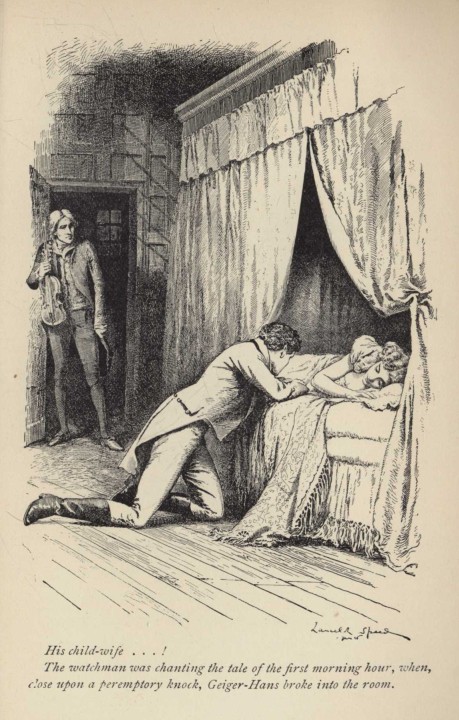
His child-wife...! The watchman was chanting the tale of the first morning hour, when, close upon a peremptory knock, Geiger-Hans broke into the room.
"Aha, all is well, then," he cried sharply, as the young man rose from his knees and came forward to meet him, and his own haggard features were suddenly illumined as by a reflection of the joy marked in the other's eyes. And then, it was no surprise to him that Sidonia, waking, should presently thrust out her rosy face between the curtains: he had already known, through Steven's eyes, that the children he loved were together.
"Steven!" cried Sidonia.
"Ah, Sidonia...!"
He ran to her. And, regardless of Geiger-Hans, they clasped each other, the deed of annulment dropping between them.
* * * * *
"Now, children!" said Geiger-Hans, briskly—he was laughing, but the tears, which few had ever seen before in them, glittered in his eyes—"you will have plenty of time by and by; now it is haste, haste, haste! I have a carriage for you waiting below. Ha, little Madame Sidonia, laugh with me! It is the Burgravine's own carriage—nothing less! Nay, German wives do not so easily escape their husbands, even at Jerome's court. My Lady Burgravine makes no journeying to-night, or ever, if I may prophesy, away from her lord! A berline and four good posthorses ... 'twere pity to waste them! Quick, children! For I tell you night may not be over ere the storm break on this town!"
Sidonia had little preparation to make. She put on her cloak. From the depths of her hood, her happy eyes looked inquiringly at the fiddler.
"Where are we going?" she asked.
"Where?" replied the wanderer, "where, but to the forest, to the green arms that will hold your love so safely, so discreetly? To the quiet and peace of the forest, before you shape your way together, children, into the great noisy world. To the simplicity of the forest, you, young magnate, that you may for ever afterwards have a memory of love as the breath of nature itself to haunt you in your grandeur. To the Forest House, you, little madam, whither I once brought a youth who was missing his springtime and had lost his way, that he might find them both."
* * * * *
The fiddler sat on the box, and the horses went roundly. The rain had given place to a heavy autumnal mist, soaking, all encompassing. It muffled every sound, the drumming of the hoofs in the mud, the roll of the wheels, the very clack of the whip. But he drove with extraordinary sureness and speed in spite of the gloom, and the lamps of the berline soon cast their flashes out upon the flying ghosts of the poplars on the desert country road. It seemed as if the night, the whole world, connived at the lovers' flight, gathered round them in screening mystery and silence.
Sidonia lay on her husband's shoulder, half dreaming again in happy weariness, lulled by the monotonous movement and rhythm. It was from a profound sleep that she started suddenly with a faint cry:
"What was that?"—A dull boom was still droning in her ears.
"That was cannon," said Steven.
At this moment the carriage drew up, and they could hear the fiddler calling to them. Steven put his head out of the window and saw the dark face with its sardonic smile, lit up by the carriage-lamp, looking down at him.
"Did you mark that, comrade?—and again! Ha, there goes little brother Jerome's little throne! Hey, what a scuttle there be yonder now! My children, you have not run away together one hour too soon. That will no doubt be Csernischeff and his Cossacks; they have made good use of the first autumn fog. It is in with them by the Leipzig gate, no doubt—of ill omen! And few of our honest Westphalians will care to turn out to-night and be spitted or shot for the sweet eyes of Jerome. It is the end this time—meet that it should be our friends the Huns that do the scavenging.... You remember them, Count Steven, the carrion crows on the trail...?"
Sidonia pulled her husband back that she might look out in her turn. The red glow of some distant conflagration was beginning to be faintly perceptible behind them in the pall of fog. She had heard the fiddler's explanation, and rejoiced in her young, unforgiving heart. Yet already Cassel and its terrors were fading from her mind. She sniffed the wet air as a doe might; and while the fiddler gazed down at her, an air of tender amusement driving the scorn from his face, she strained her ear as though to catch some secret sounds.
"Yes, child," said he, nodding at her; "yes, it is the woods you smell, the trees you hear. Yonder is the inn of The Three Ways, and presently we shall turn into the forest road."
Sidonia sank back beside Steven, a smile upon her lips. Then they both became aware that they could see each other in a strange glimmer that was scarcely yet light. Without, the mist was now white, torn ever and anon by swaying streaks of faint blue.
"It is the new day," said she under her breath.
"The day that is ours," said Steven. And as they kissed, the horses' hoofs struck upon the ascent and the great trees sprang up about them.
By sunset they reached the Forest House.
And when the Forest-Mother beheld them, she clapped her hands and laughed, and called on heaven and all the saints, and then kissed them all three—a freedom she never could recall afterwards without amazement—and, finally, she flung her blue embroidered apron over her head and wept aloud in gladness.
But nothing could hamper the preparation of the finest supper that ever the Forest House had seen; and about it there drew together such a happy company as even its happy walls had never held before.
By and by they sat round the great hearth. Some one asked Geiger-Hans for music. But he shook his head. And spells of silence ever more frequent and prolonged began to fall between the talking and laughing; the great peace of the forest was drawing about the lovers and holding them close even as he had prophesied. As the light of the fire played upon the musician's face it showed a great serenity. It was a blessed evening.
"You will always live with us, dear Geiger-Hans," said Sidonia over and over again. And each time he made no answer, but smiled as if content.
* * * * *
Now, in the wonderful dawn of the forest, Steven awoke; and though his heart was as a bird's in spring for happiness, yet was there a sense of trouble, of anxiety, upon him which had seemed woven into his dreams.
They had left their window open to the moonlight, and it had flooded in upon them, but the dawn mystery without held aloof, veiled from sight like an Eastern bride. Thin grey vapours hung as a curtain before the open casement. Steven sat up, his pulses beating fast. He strained his ear; heard flutter of leaves, drip of dew, chirp of awakening birds ... then a faint strain of music that seemed as if it passed through a dream. The melody grew more distinct, though still subdued; it rose, softly plaintive; it was joyous and yet sad, secret and yet an appeal. And through it all there was a rhythm as of restless feet:—it was a melody of love, of farewell, of wandering. Fainter it grew, and was lost once more in the whispers of the woods. At last it was silent, yet still it seemed to sing.
A sudden pain gripped Steven's heart. He knew that Geiger-Hans had gone out of their lives for ever.
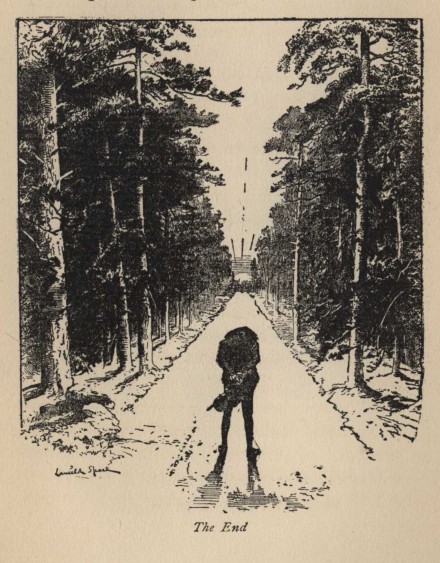
The End
The End
* * * * * * * *
THE PRIDE OF JENNICO
Being a Memoir of Captain Basil Jennico
By AGNES and EGERTON CASTLE
YOUNG APRIL
By EGERTON CASTLE
Author of "The Pride of Jennico"
Illustrated by A. B. Wenzell
HEART'S DESIRE
THE STORY OF A CONTENTED TOWN, CERTAIN PECULIAR CITIZENS, AND TWO FORTUNATE LOVERS
By EMERSON HOUGH
Author of "The Mississippi Bubble," etc., etc.
With Illustrations by F. B. Masters
YOLANDA
MAID OF BURGUNDY
By CHARLES MAJOR
Author of "Dorothy Vernon of Haddon Hall," "When Knighthood was in Flower," etc.
Illustrated by Charlotte Weber Ditzler
LADY BALTIMORE
By OWEN WISTER
Author of "The Virginian," etc., etc.
With Numerous Illustrations
FAIR MARGARET
A PORTRAIT
By F. MARION CRAWFORD
Author of "Saracinesca," "Whosoever Shall Offend," "In the Palace of the King," etc., etc.
With six full-page Illustrations by Horace T. Carpenter
THE MACMILLAN COMPANY
64-66 FIFTH AVENUE, NEW YORK
By Agnes & Egerton Castle
ROSE OF THE WORLD FRENCH NAN THE STAR DREAMER THE PRIDE OF JENNICO THE SECRET ORCHARD THE BATH COMEDY INCOMPARABLE BELLAIRS THE HOUSE OF ROMANCE
By Egerton Castle
YOUNG APRIL THE LIGHT OF SCARTHEY CONSEQUENCES MARSH FIELD the OBSERVER LA BELLA AND OTHERS
SCHOOLS AND MASTERS OF FENCE ENGLISH BOOK-PLATES THE JERNINGHAM LETTERS LE ROMAN DU PRINCE OTHON