Front matter (continued 3)
Reading edition
"Zu Befehl." Then he added, the insolence of the servant who feels superior to his employer in coolness and clear-headedness piercing through his well-drilled air of subordination: "May it please your Excellency, the folk about here believe the fiddler to be some great person in disguise."
The Burgrave's eyes were bloodshot this evening; the Jäger was minded of the glare of an old boar at bay.
"It is quite likely," he proceeded jauntily, "that the gentleman was similarly deceived."
"The gentleman—the gentleman? What gentleman, you rascal?"
"The gracious young gentleman, the cousin of her Excellency."
The Burgrave gave a savage growl:
"Out of my sight!"
With some additional briskness of gait, Kurtz drew the solid oak door between himself and the Chancellor.
Alone, Betty's husband yielded himself to a convulsion of rage. Again he beat the table with his hands, anon tore at his bristling hair; suffocating, he wrenched the stock from his throat; broken words, curses, threats, ejaculations of self-pity escaped him. When at length he recovered his senses in some fashion, he was shaking as if from an ague. He caught up the last glassful of wine and drained it at a draught. Then he subsided heavily into his chair, and drawing unmeaning signs with his fingers through the spilt wine upon the polished oak, began slowly to repeat, half aloud, the words of the letter Kurtz had brought him.
"The entrance of the east tower, at nine o'clock."
Suddenly a shout of laughter escaped him.
"The entrance of the east tower. You have chosen well, my turtle doves!"
He let his head drop between his hands and sat in sodden brooding.
CHAPTER XII
THE BURGRAVE'S FAREWELL
"—What means this, my lord?
—Marry, this is miching mallecho; it means mischief."
(Hamlet).
Countess Betty had the megrims and declined to appear at supper. For a sufferer, however, she had a bright eye, and she moved about her room with the alacrity of a busy bird. She was alone, some belated notion of prudence having bade her dismiss her handmaiden during the final preparation. Her eyes were taking in wistfully the dimensions of the small travelling-bag (which was all that, in conscience, she could allow herself, since Cousin Kielmansegg would have to carry it himself down the precipitous roads) and the numberless objects which, at the last moment, seemed to her indispensable, when there came a tap at her window. She started—and only the sense of unacknowledged guilt weighing on her soul kept her from screaming aloud for help—when she perceived, pressed against the uncurtained pane, a man's face. The next instant, however, she had recognized the wandering fiddler. She hurried towards him.
"A message?" she cried eagerly, as she opened the casement.
The man swung himself in and sat on the deep window-seat. His face was wet with rain. He gazed upon her for a second, quizzically, and when he spoke it was not in reply.
"Here I come," said he, "by the ivy, at the risk of my neck, I, whom your worthy lord and master threatened to have flogged and thrown to the dogs, if he caught me up here again! What a foolish plight should I be in, had I counted upon your tender heart sparing a tremor for my perils! It is enough to make a man desire to walk in by the door for the rest of his life!"
"But, in heaven's name," she exclaimed, having but a matter-of-fact spirit, in spite of its dainty envelope, "you did climb up all the way to tell me something. Was it not a message?"
He bowed.
"From him?"
He laid his hand on his heart. "From myself," he answered.
She glanced at him and then at her bolted door in renewed alarm. He read her thought.
"God forbid!" quoth he, smiling with an air that put him, in his poor raiment, at an extraordinary distance above her. "I should not so presume, madam.—Are you aware," he pursued in another tone, "that your husband's confidential Jäger was in intimate conversation with Count Kielmansegg's postilion in the village to-day?"
"Mercy!" she cried, reading the portent.
"After which, my dear madam, he climbed the hill in a company that lightened the way for him, having, in fact, his arm round the trim waist of your own handmaiden."
Countess Betty sank on a couch, white to her lips.
"Your trusted handmaiden," repeated the fiddler, emphatically.
"Alas! if I had hesitated," said the lady, piously turning up her eyes to the vaulted ceiling, "this would decide it; I dare not risk another night in this castle."
"Taking risk for risk," said the musician, carelessly, "if I were timid, I should prefer the waiting hazard."
"You mean?" she panted, round-eyed, in quick apprehension.
"I mean," said he, "that it is raining exceedingly hard, and that between this and the foot of the crag you will get wet, madam; so wet as to extinguish for ever the most ardent flame."
The Burgravine rose with dignity. "I will have you know, sir, that I am merely accepting Count Kielmansegg's protection back to my own family, because I know I can trust to his honour."
"Quite so," said Geiger-Hans, in a soothing voice. "And it is, of course, infinitely preferable to set forth by night in secret, with a handsome young man, than to summon any more aged or nearer relative to your help! A father, maybe—or a brother? But it is raining, as I say, madam, very hard. So much for the start. And I am afraid when you arrive in Austria your noble family may consider your journey ill-managed."
Her bosom heaved.
"It is very unjust," she moaned, "that you men can do everything, whereas we poor women——" She paused on the brink of tears.
"Ah!" he retorted, "you women are the crystal cups that hold the honour of the house! That is why we must set you in a shrine, madam. To-night it is still sanctuary in your presence, and I can still kneel before you. To-morrow——?"
The colour rushed into her face. She tried to speak with haughtiness, but her voice faltered.
"To-morrow—what then?"
"It is inconceivable how much wiser it would be for you to remain under a husband's roof on such a night!"
There came a knock at the door. With squirrel nimbleness the fiddler twisted round and vanished. The Burgravine took a rapid survey of the room, whisked the bag into a cupboard, the jewel-cases on the top of it, and went to the window to close it.
"One moment, one moment!" she called, as the knocking was discreetly repeated, and paused with her hand on the casement. Certainly it was most uncomfortable weather! Then she opened the door. Sidonia entered.
"Little aunt, is your head better?"
"Yes, child, yes. You have supped? Is it so late?" Before the girl could answer, the bell of the castle clock began to boom nine strokes. "Nine o'clock!" shrieked the Burgravine. "What's to be done?" She struck her forehead with a distraught air. "I dare not trust that false Eliza," she murmured in her mind. Then her eye met Sidonia's candid gaze, and she caught her hand. "Listen, child; you shall do something for me. Count Kielmansegg is going away to-night."
The girl's pupils widened, her face grew paler, but she did not speak.
"'Twas I bade him leave. Your uncle's causeless jealousy ..."
The girl nodded. The Burgrave, in truth, had been no pleasant companion that night. He had drunk heavily, and alternated between glowering spells of silence and loud and almost offensive pleasantries aimed at his guest, both of which had, not unnaturally, considerably embarrassed Count Kielmansegg.
"'Twas my duty!" (Oh, how virtuous felt the Burgravine of Wellenshausen!) "I had promised him (poor youth, he is my cousin!) that I would bid him 'Good-bye.' But now"—(positively Countess Betty thought her niece must perceive the halo growing round her head)—"now it has struck me that if your uncle heard of it, he might misconstrue—— My dear, you must go and tell Count Steven from me——"
"I?" cried Sidonia, and started.
"You must," insisted the lady, harshly. "He is waiting in the east tower. Tell him this: 'My aunt has sent me to say "Good-bye" for her; it is better so.... It is better so.' Do not forget to say that. What are you waiting for, girl? Go! Perhaps you are afraid of the rain!" cried the Burgravine, scornfully, and seized the travelling-cloak that was lying ready on the bed. "Here, put this on; wrap the hood over your head. Now run, there is not a moment to be lost."
There was, perhaps, more urgency, more fear, in her voice and manner than she had been aware of, for Sidonia, after a quick look at her, gathered the folds of the cloak about her and fled upon her errand. The Burgravine drew a long sigh of relief, then rang her hand-bell sharply.
"Eliza," said she to the responsive damsel, and, on the spot, froze her with a glance for the impertinent air of confederacy with which she had entered, "light up a fire and serve supper to me. My head is better. Trim the candles and give me 'La Nouvelle Héloise? How you stare, wench! Have you fallen in love, perhaps, that you do your work so ill to-day?"
Steven's reflections, as he waited in the best-sheltered corner of the deserted tower, listening to the beat and gurgle of the rain, were of an unsatisfactory description. The folly of weakness is the worst of follies, the realization of it the most galling. He was about—no use in trying to blink the fact—he was about to ruin his own life; to take upon himself an intolerable burden; to commit, technically at least, a crime against hospitality; to put a stain upon his ancient name; and all without receiving in return the slightest gratification or being able to proffer, even to himself, the exoneration of any approach to passion. The mere thought of the long, intimate drive was a bore; the prospect of a possible life-long companionship with the Burgravine intolerable.
Geiger-Hans, mysterious wretch that he was, had much to answer for. And yet, had Steven followed his advice (he had, in honesty, to admit this) things would not be at this pass.
* * * * *
She came in upon him with a rapid step and a rustle of wet garments, stopped at the mouth of the passage, and said in a loud whisper:
"Are you there, Herr Graf?"
As he went forward, she clutched his wrist with a cold hand.
"Hush," she cried, "I think I heard steps behind me!"
Both listened, not daring to breathe. Oh, what a situation for a youth whose pride it had been to hold his head high in the world!
Nothing was heard, however, save the wild, dismal murmur of the rain over the land, and the nearer drip and patter.
"No, there is nothing," he said, and reluctantly passed a limp arm round her shoulders. To his surprise, they were jerked from his touch with resentment. The next moment, however, by a mutual movement, they caught at each other; for there came an unaccountable grinding about their ears, and almost immediately the solid ground gave way under their feet.
"Gracious Powers! is the tower falling?" cried he.
Even as he clasped the figure beside him, with the instinctive, protecting action of man for woman, he was aware that the slender thing in his arms could not be the Burgravine. But at the same instant they were sliding; and before he could do aught but throw himself backwards to avoid crushing her, they were shot with giddy swiftness down a steep incline. With a shock, his feet struck level ground; he lay dazed and breathless, her weight across his breast. Stars danced before his eyes. Vaguely, as from a great distance, he heard overhead the echo of a laugh; then a thud, and once more the grinding sound, as of heavy, rusty bars. It was the laugh that brought him to his senses; too often, lately, had that laugh rung in his ears!
She raised herself in his arms.
"Are you hurt?" he cried as he lay.
"No," she answered quickly. "Don't get up!" He knew by the sudden change in her voice that she had flung the muffling hood from her head. "Don't get up! don't stir! I must find out where we are."
He recognized now the young, clear tones. It was Sidonia, but he was past surprise. One thing alone stood clear out of his confusion: whatever it might be that had brought this about, he was glad, to the heart of him he was glad, it was not Countess Betty.
He felt the girl struggle to her feet, heard her grope with her hands above his head. There came a moment of great stillness: he knew she was listening. Unconsciously he hearkened too, and then there grew upon them, out of the solid darkness, the cry of waters, rising up with a sort of cavernous echo as from a great depth. And, with a flash, his mind leaped back to that fearsome race of brown river that swirled so strangely from the foot of the Burg-crag, just above the village bridge. He felt his hair bristle. But when she spoke again, the sound of her voice, with its extraordinary accent of decision, roused him like a stimulant.
"We are safe if we but keep where we are," she said. "You may sit up if you like, but do not attempt to stand." And then she added: "You do not know the place; I do."
She sat down beside him, and in the dark he felt her close presence once more with gladness.
"What is this place, then?" he asked, unconsciously whispering.
She answered him with a simplicity which almost made him laugh:
"It is the old oubliette."
Vague cruel memories of mediæval romance awoke in his brain. Oubliette! The word itself was suggestive, and not agreeably so.
"An oubliette is——?" he asked.
"The secret trap by which the castellan of old quietly got rid of enemies or of inconvenient prisoners. You see," she proceeded, with her astounding composure, "through this tower, in former days, was the sally-port—there used to be no other way; and were any one whose existence interfered with the views of the Lord of Wellenshausen, passing out or in, it was easy to set the machinery in motion, with the result——" She broke off.
"Of landing him in our enviable situation," he finished pettishly.
"Not at all," retorted she. "It is the mercy of heaven for us that time and storm have been at work in these forgotten regions and provided us with so opportune a ledge——"
"What would have happened else?" he asked in a tone that strove to emulate her coolness.
"Sit quietly and listen."
He felt her reach for a stone, felt the tension of her vigorous young body as she flung it. He heard the missile strike the rock sharply, rebound and then rebound again. Then, after a silence, rose a faint sound, the ghost of a splash, the gulp of greedy, far-off waters, infinitely sinister. He shuddered.
"No one knows how deep it is," said she, "nor what lies hidden there. I can tell you, when I first discovered this pit, it terrified me. Old Martin had told me of its legends, but I had laughed at him. One day, some months ago, I scrambled in from the outside, for the old tower is falling in ruin, and explored the place. But I had no notion the old trap-stone in the sally-port still worked. Now I remember," she cried with sudden sharpness, "seeing Uncle Ludo wandering about the place this evening——" She stopped suddenly, struck by a new thought.
"But," exclaimed the young man, "in heaven's name, what have I done, to...?" And then his uneasy conscience whipped him silent.
"It is a horrible trick," resumed the girl, now with a passionate ring in her voice, "you, his guest——"
An indignant sob caught her in the throat. "You his guest!" she repeated. "Oh, whatever he thought of you, he should have remembered that! I can never forgive him."
The guest who had meditated, however unwillingly, the betrayal of his host, blushed painfully under the cloak of blackness. He heard her swallow her tears and knew that she clenched her hands. After a while she went on more quietly:
"How wise it was of Aunt Betty to tell you to go away! And, oh, how glad I am that she sent me instead of coming herself to bid you 'Good-bye.'"
Steven opened his mouth, and then closed it again dumbly.
"You would both have been killed," she went on, sinking her voice. "Uncle Ludovic must be mad—mad with his ridiculous jealousy ... and he's been drinking overmuch. Ah, dear Lord! If I had not been with you——"
She gave a shudder. He, on his side, had no words. He was silent in shame before the exquisite innocence; silent in admiration before the self-forgetting courage of this slip of a creature, who thought nothing of her own danger. "Here, indeed, is good blood—here is the spirit of race!" he thought, touched in his most sensitive chord.
Presently, however, the humour of the grim situation struck him, and he laughed. There was Thistledown Betty, incapable even of acting up to her own unfaithfulness, snug in her bower, doubtless; and there was the outraged husband, gloating over his mediæval vengeance: Steven wished he could be present at their next conjugal meeting! Sidonia, childlike, echoed his laugh softly beside him in the dark. It struck him serious on the instant. The morrow seemed a terribly long way off.
"And now," said he, "what are we to do?"
"Hey, good sir!" said she, "nothing but wait. We shall not die this time, Herr von Kielmansegg; for my poor uncle"—she laughed in scorn and triumph—"he does not know, I warrant, that there is a way out of this old death-trap, since there is a way in. A way other than by the hidden lake and the barque of ancient Charon. But, till the daylight comes, sir——"
"Daylight!" he exclaimed, and knew not whether he were glad or sorry at the whole night's prospect.
"Till daylight comes, we must take patience here. For one false step would send our bodies to join the bones of the forgotten enemies of Wellenshausen."
"So, then——"
"Then, I should say, the best thing we can do is ... to go to sleep."
Again he was mute, pierced to the innermost fibre of his manliness. It was as if her child-heart had been suddenly revealed to him—its trustfulness, its simplicity, its courage.
"If you move a little to the right, carefully," she said, after a pause, "you will find it softer, I think. The earth has grown up there, and there are, I remember, ferns. You will really not be too uncomfortable."
The girl was positively doing the honours of the family oubliette! There came a tender smile to his lips, and almost a mist of tenderness to his eyes.
"But you," said he, "good fairy, guardian angel, do you never think of yourself?—Will you lean against me?" he went on, timidly.
He gathered her to him. What a slight, warm thing she was! She trembled as he passed his arms round her, and he instantly desisted. "Would you rather not?"
"I don't know," she whispered. He thought there was a quaver as of tears catching her breath.
All the chivalry in him leaped to her service. He drew back. With some difficulty he unwound his heavy cloak from himself. He was stiff and bruised, and the uncertainty of his balance in the blackness gave him an eerie sensation as of precipices yawning for him on every side.
"What are you doing?" she cried severely.
"Let me put this over you," he pleaded. "And then you can roll up your own mantle and make a pillow of it—against me, thus."
"But you—but you——"
She struggled against his covering hands so impetuously that he caught her with a grip of alarm. And the sound of the rock crumbling away and leaping into the gulf gave its significant warning.
"You must keep quiet," said he, for the first time asserting the leadership. "And you must let me hold you and cover you. It is my duty to serve you, Mademoiselle Sidonia, my right to protect you. Sleep if you can. You will be safe, for I shall watch."
She remained motionless a minute and then submitted without a word. He placed his arm about her; her head drooped to his shoulder; there fell silence. In time he felt her rigidity relax, heard her quick breath grow calm and regular.
"You are afraid no more," he said gently.
"I don't think I was afraid," she answered him. Her voice had grown lazy; and, subtly, by the tone of it, he knew that she smiled. He felt ineffably proud of her confidence, ineffably protective towards her.
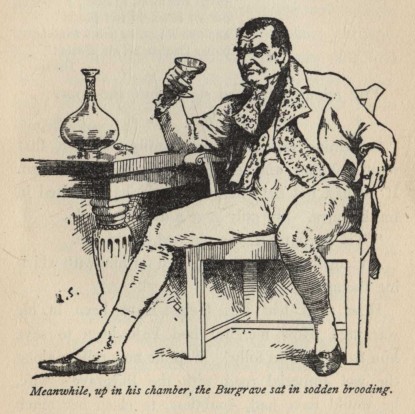
Meanwhile, up in his chamber, the Burgrave sat in sodden brooding.
CHAPTER XIII
THE OUBLIETTE
"Furcht bich nicht, du liebes Kindchen,
Bor der bösen Geister Macht!
Tag und Nacht, du liebes Kindchen,
Halten Englein bei dir Wacht!"
HEINE.
The minutes dropped slowly into the hour.
* * * * *
Something raised a blood-curdling screech that went sobbing and echoing through the cavern. If he had not held her, he would have started in frank alarm. She only gave a drowsy laugh.
"'Tis Barbarossa, the old owl," said she.
And again fell the silence, filled for him with whirling thoughts.
How right had this Geiger-Hans been in his warning! How merciful had Fate been to save him from his own folly! Were he now rolling along the wet Imperial road with the Burgrave's wife, he would have had, doubtless, to clasp her much as he clasped Sidonia. Precarious as it was, his present situation was infinitely preferable. He felt like a father, holding his pretty child, all warm with tenderness; not like a dishonest, cold lover with the woman he cannot love.
Sidonia's light breathing grew fainter and more rhythmic. She was asleep. He had longed, but hardly dared to hope, that she could sleep. In his heart he went down on his knees to her and thanked her, stirred by the eternal parent instinct, perhaps, but also by another emotion, tenderer still and more vital—a reverent bending of his whole manhood before the purity and trustfulness that lay in his embrace.
* * * * *
The night progressed with lengthening hours. He had begun to make out some kind of bearings for himself in the dark; to find, by the cold airs that occasionally blew in upon him from one direction, by the guidance of the sounds that grew in the night's stillness—the gusty increases, the placid subsidence of the rain, the rustle of leaves and twigs—in which quarter of their prison lay that opening to the outer world by which they should escape.
Sometimes his mind wandered far away. Now and again he almost lost himself in a vague dream; but ever he came back with a shock to the present peril and his responsibility.
And the child still slept!
He began to grow weary and cold. His arm became stiff, then numb. The burden that had seemed so light upon it grew almost intolerable. Sometimes drowsiness pressed upon him, he thought himself in a nightmare, from which he must wake to find himself huddled in a corner of his travelling chaise. But he would have died sooner than disturb the sleeper.
Then, at the moment when the tension of enforced immobility brought such a feeling of exasperation and oppression that he almost felt as if his wits were leaving him, he turned his head instinctively in the direction of the air current, and relief came. The rain was over. The clouds had cleared away and a patch of sapphire sky looked in upon him, framed by jagged rocks: it held two or three faint stars. He could see a branch outlined dimly against the translucence, and leaves trembling in outer freedom.
Nothing more than this, and yet it was balm. The torture that gripped him subsided. He gazed and forgot the cramping of his limbs. The first stars passed slowly and vanished; others swam into his vision and formed new shapes in the peep of sky. Some were brighter, some more dim; some twinkled, one burned with a steady glow. They varied in colour, too. He had had no idea that, even through such a miserable hole, the heavens had a pageant to offer of such absorbing interest. And the passing of this pageant gave him a comforting sense of the flow of night towards morn.
Once Sidonia woke with a start and a cry.
"I am here," he quickly said.
She reared herself from his arm. It was numbed to uselessness; he caught her with the other fiercely. That pit, gaping so close by in the night, had come, during the long hours, to be to him as an unknown monster, watching, waiting for its prey. She, but half awake, gropingly passed her soft hands over his face and breast. "I dreamed you had fallen," she murmured. And then, so secure in his hold, stretched herself like a weary child, and slid a little further from him so that her head rested on his knee.
His eyes had grown more accustomed to the darkness; or, perhaps, there was already a raising of the deepest veils of night, for he could almost distinguish her form as she lay. He bent over her. She was speaking dreamily: "When you were hurt in the forest, this was how your head rested on my lap." In another moment she was asleep again. His arms were free—the sense of constraint was gone. And now the time went by almost as quickly as before it had lagged. He saw with surprise that the stars were extinguished, that his patch of sky had grown pearl-grey. Rapid stirrings in the leafage without spoke of an awakening world. A bird piped. The walls of their prison began to take shape.... He saw the white glimmer of her hand in the folds of the cloak.... And then he must, after all, have slept at his post; for the next thing he knew was coming to himself, with a great spasm and seeing, in a shaft of yellow sunlight, grey rock, brown earth, and Sidonia's golden head upon his knee. And, but a yard from her little sandalled foot, the horrible black chasm. Oh, shame! he had slept, and death lurking for her! The sweat started on his forehead.
* * * * *
A sigh of music was blown into the cavern. Sidonia turned her head and gazed up in his face with wide, bewildered eyes.
"It is Geiger-Hans," she murmured, and rubbed her eyes, as though she thought she were still dreaming. Then she sat up, looked round, and memory leaped back. She smiled, yawned, and drew herself together. "Well," she said, with a sidelong glance at the pit-mouth, "we have had luck, you and I! Don't you want to get out of this, Herr von Kielmansegg?" she asked briskly, as he sat wondering at her. "Or do you think it would be a nice place to turn hermit in? See, this is the way," said she, and pointed to a narrow and most insecure ledge skirting the deep; "we shall have to crawl on hands and knees. And, sir, I think our cloaks must be sacrificed."
As she spoke, she gathered them together and pushed them from her. They rolled down, and Steven almost called aloud as he heard their heavy plunge into the ambushed waters: it sounded as if some living thing had gone to its death.
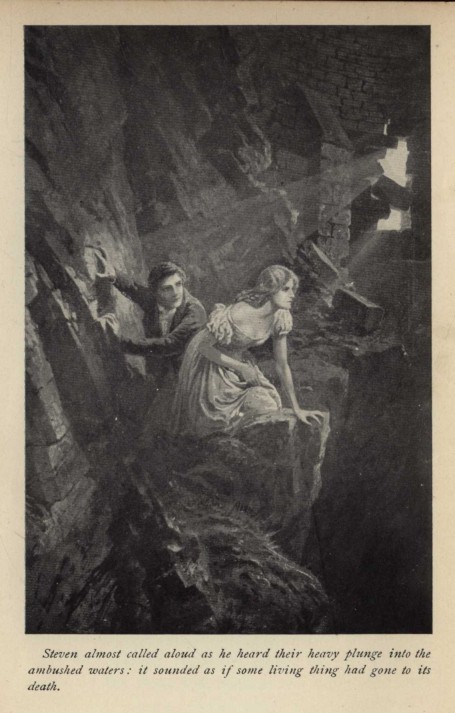
Steven almost called aloud as he heard their heavy plunge into the ambushed waters: it sounded as if some living thing had gone to its death.
"I will lead," said she.
Sunshine, sky, grass, wide airs! Till that moment Steven had never known what these things could mean to man. He sat on a sun-warmed rock by the side of the precipitous, all but obliterated pathway that led zigzag upwards to the broken rampart. Sidonia stood shaking and pruning herself like a bird, her hair glinting in the light. By tacit consent both paused upon this moment of physical relief before considering their next course. From above, the plaintive strain they had heard within their prison was again borne down towards them on the breeze. Sidonia's fingers, busy in her tresses, stopped. She bent her ear.
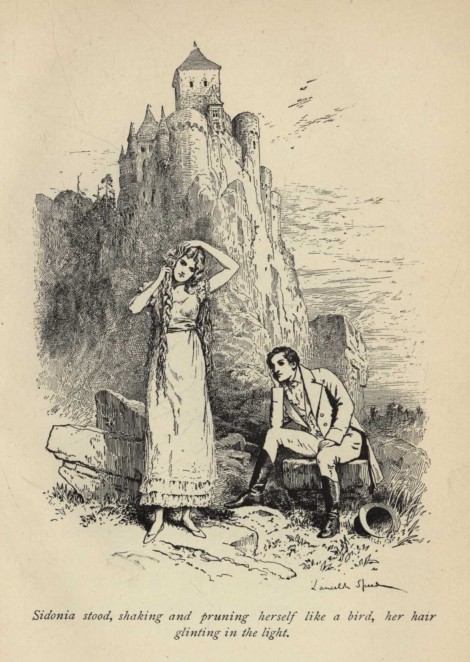
Sidonia stood, shaking and pruning herself like a bird, her hair glinting in the light.
"It is Geiger-Hans. And that is my tune. He is seeking me!"
She curved her hands round her mouth and gave a long mountain cry. It rang clear and sweet, cleaving the pure morning air like the call of a bird. Instantly the restless melody stopped; and, as they stood looking up in expectation, they saw the figure of Geiger-Hans emerge on the rocks over their heads. Holding his fiddle high in the air, he came clambering down to them with the agility of a goat.
"Thank God!" he exclaimed, as, breathless, he drew near. "Cruel children, what a fright you have given me!"
His cheek was pale under its bronze. Yet, in spite of its severity, his haggard eye was quick to note that these two were torn and dishevelled, that their smiles had the pallor which has faced death.
"What has happened?" cried he, in changed accents.
Sidonia broke into passionate complaint. A great lassitude was upon Steven; he did not wish to stir or speak; he listened in silence, as she poured forth the story tersely, yet with the vividness of her passion.
"And it was Uncle Ludo did it!" she ended, with a fresh gust of anger. "We heard him laugh as we fell. And Count Kielmansegg his guest!" Her pride could not stomach the thought; it was less to her, evidently, that her relative should have endeavoured to compass the death of wife as well as guest, for her anger dropped into mere shuddering pity as she added: "Poor Aunt Betty! Just think, if she had not sent me!"
Many expressions passed over Geiger-Hans' countenance as the drama unrolled itself before his quick mental vision. Thunder of anger, clouds of fear and doubt, tender admiration. He shot one lightning glance of inquiry at Steven; his brow cleared before the frank answering look.
As the girl finished, the two men sought silent intercourse with each other. The eyes of both had grown soft. For herself, the little fearless creature still had no thought, far less words.
"Well, friends," said the fiddler at last, sitting down on the slope and wiping his forehead with his sleeve, "you may flatter yourselves that you've given me no better night than your own. First, Sir Count, having a word to say to you, I made so bold as to take a seat in your carriage, as it waited down yonder. A moist time I had of it, in company with your lordship's horses and postilion. (By the way, this same postilion hath a varied choice of oaths.) Towards the small hours our relations became strained, and we parted; he back to the Silver Stork, and I—I will not conceal it—to wandering once more in the purlieus of this hospitable strong-house. For, although nothing was more natural than that a guest should have altered his intention of departing at the last moment, my mind misgave me."
"Poor Geiger-Onkel!" said Sidonia. "How wet you must be!"
"Nay, the night had turned fine then; it was the least of my hardships. But at dawn this restless spirit of mine set me to rousing the castle—and a fine time of it I have given them! His Excellency, however, was found dead drunk in his hall, so that I could get little out of him. The lady is convinced that you, comrade, have eloped with her niece, by some devious road——"
"Devious enough," said Steven, with a short laugh.
But Sidonia had become grave. "I am glad, at least, that he was drunk," she said, with judicial air.
"I left my Lady Burgravine planning hysterics. But I have given orders in the household, as if I were master of all. No flogging of Geiger-Hans now, nor setting of dogs upon him! 'Tis I command this morning. I have marshalled his Excellency's servants: there are some half-dozen fellows searching the rocks already. And here, by the way, comes one bright youth. Observe how he looks under the brambles and the bushes. He will not leave a mouse-hole unprodded for your corpses."
"Shall we not bid him get breakfast for us all?" cried Sidonia, gaily. "'Tis the least Wellenshausen can do for you this morning, Herr Graf!"
She sprang upwards lightly, her small face, wan with fatigue, laughing back at them over her shoulder. The fiddler and Steven stood side by side watching her.
"Well," said the former, after a pause, "are you inclined to go and break bread again in the house whose stones plotted your death? Or will you take the safe way down the mountain to the cushions of your berline, and cry: 'Drive on, postilion'?"
Steven regarded the speaker a moment or two before replying. It seemed to the young man as if that long, black night had cut him off from his own purblind youth. He felt himself years older, weighted with life.
"I am going back to the Burg," he said, and set off climbing.
"Hey, comrade, hey, what haste?" panted the other at his ear. "What is your purpose up there? You've been there once too often." There was a certain anxiety under the speaker's mocking air.
"My purpose——" began Steven, coldly. He was about to add, "concerns you not," but on second thought he wheeled round, and all that had been gathering in his heart this night escaped in words of fire. "Why do you ask?" he cried. "You know! What! are you the man to whom the souls of others lie bare? Are you a man like myself, and do you think I can leave that child now? With her little hand she held me from death. She lay in my arms and slept and trusted me. Do you think I could endure myself if I thought I had left her unprotected here? If I give my whole life to the mere guardianship of her, shall I do more than my duty? Man!" cried Steven, catching the fiddler's sunburnt wrist and shaking him, "I tell you, the child lay in my arms all night."
"She is indeed a child," said the musician, quietly.
"And it is even for that!" exclaimed Steven. "Oh, I thought you would have understood!"
"Let us go up to the heights, then," said the fiddler.
"What, no music?" cried Sidonia, gaily, as she watched them coming, from the doorstep. "I expected to hear your fiddle chanting the song of delivery!"
"I have enough music in my soul this morning," replied the wanderer.
* * * * *
The Burgrave was a sorry spectacle. A man may play the mediæval avenger overnight, but in the morning he belongs to his own age and the sense of proportion reasserts itself. The Burgrave's awakening to sobriety, his realization of his own deed, were depressing to the direst degree. Paradoxically, no less terrible was the discovery that his suspicions had been unfounded; that his wife was both virtuous and still of the living; that it was an innocent niece and an innocent guest whom he had precipitated to an awful doom. He almost betrayed himself on meeting the Burgravine.
"It was Sidonia, then—it was not you, the youth was after, all the time!" he exclaimed, bewildered.
"Me? After me?" cried the lady, in a virtuous fury. "How dared you think such a thing!"
She paused, panting, to measure the whole humiliation of her position.
Sidonia was gone—gone with the pretty Austrian boy whom she, Betty, had so determinedly marked as her own. It was an infamous trick, and for Sidonia to play it ... Sidonia! Bah! She, who knew herself so well, should not have placed faith in any woman.
"The minx was in love with him all the time," she babbled, "and he—he, oh, he well knew, no doubt, that no richer heiress would ever pass his way! I trust, Herr von Wellenshausen, that you have sent widely in pursuit." Her mind was working at a tremendous rate. "You have not let yourself be taken in by this cunning wretch's story—Geiger-Hans, or whatever his name is? Oh, I can tell you something of him, sir. There's an intriguer for you, and in Kielmansegg's confidence from the beginning! God alone knows what infamous bargains they may have made together! It has all been a plot."
The Burgrave stood looking at her, an abject mass of bilious misery.
"I am afraid there may have been an accident," he murmured, moistening his dry lips.
"Accident?" screamed she, and withered him. "You fool!" Then she turned on him, snarling like an angry little cat. "It is all your fault! Why did you ask him back here, to spy and pry? Yes, if the girl has disgraced us, it is your fault—the fault of your evil mind! You drove them to elope, old jealous fool!"
The Burgrave clenched his hands and shook them above his head, fell into a chair, and wept aloud. Elope? If she but knew! Alack, poor Sidonia! Poor little Sidonia! He had always loved the child.
"I trust you will come to soberness presently," said Betty, with a disgusted look at the row of empty bottles.
And it was at this moment that shouts from the courtyard proclaimed the return of the lost ones.
The Burgrave's ecstasy of relief, when he heard that his oubliette, had miscarried, could only be measured by his previous state of misery. He could have leaped and sung. He caught his wife to his breast with fresh tears. Repulsed with scorn, he tottered forth to the great hall, still reeling in his joy, to meet the two so miraculously preserved and restored.
The girl faced him, severe as a young Daniel, with pointed finger and flashing eye.
"You weep now, uncle: you laughed last night! That was your farewell to us; you laughed as you tumbled us down the oubliette!"
The Burgrave had stepped back, dismayed afresh. She knew, then, that no mere accident had betrayed them! The wretched lord of the castle flung a look around; met the eyes of Steven, scornful—he knew! Met the fiddler's eyes, horribly mocking—he knew! Met his Betty's gaze, deeply suspicious. In a moment she, too, would know!
Out rang Sidonia's clarion tongue. And then the Burgravine did know.
Promptly he was delivered into her hands. She threatened him with King and Emperor, with family and justice, prison, madhouse, duel. The Emperor had put divorce in fashion, she reminded her lord. She would divorce him, resoundingly! The last taunt was—since, after all, he loved her in his own fashion—the blow that hit him hardest.
Natheless, even under the shock of the discovery that her own precious life had been in danger, and her husband (Bluebeard too well named!) had been her would-be murderer, her wits did not desert her.
She intercepted the gaze wherewith Steven followed Sidonia, and was quick to feel that for herself he had now scarce a thought; nay, that she but represented to him three days of intense discomfort and a disagreeable episode ending in death-peril. She must not act in a hurry. She must play what cards she had left in her hand to best purpose. She had a vision of a tamed Bluebeard—and compensation; her turn yet to come in gay Cassel.
"Herr Graf," said the Burgrave, not without some kind of dignity, though tears still swam in the pale, swollen eyes, and his great hands trembled, a pathetic spectacle, "I stand at your mercy. I have absolutely no excuse to offer you."
"Nay, sir," said Steven, "what misfortune Wellenshausen brought on me, Wellenshausen has repaired. Whenever I think," he added, and raised Sidonia's hand to kiss it, "of the night when you planned, and well-nigh encompassed, my death, I will also remember that to the courage of a daughter of this same house I owe my life. Before I take leave of your hospitable door" (he was too young to refrain from the gibe), "may I crave a few words in private?"
The Chancellor bowed. Steven pressed Sidonia's hand and followed his host as he shambled across the hall.
Had any one told the young man on the previous day that he would be willing—nay, anxious—to bind himself for all the years of his life to the little sunburnt Sidonia, he would have thought the absurdity scarce worth a laugh. And yet, here he was, a suitor for her hand. Her guardian dared not refuse her to him, even if a Count Waldorff-Kielmansegg had not been a match such as hardly could be found for her twice in a lifetime. He was bent on his purpose with all the obstinacy of a nature somewhat slow to move, but firmly set once a resolution taken. It was perhaps hardly love so much that urged him as a kind of passionate chivalry. He had expressed the state of affairs very accurately to Geiger-Hans. He had guarded her in his arms a whole night; now he felt driven by all his manliness to guard her for the rest of her life. Yet, with all this sentimental fervour, there was mixed a shrewd common-sense. In race she was his equal. She had good blood in her veins; and, by heaven, the little creature had shown it! Her courage and pride appealed to his innermost fastidiousness of breeding. And, child as she was, wild creature, free of the wood, sisterly with the people of the soil, he had the intuition that she would bear her new honours not only loyally, but royally. To her fortune he actually gave not a thought. Once or twice, in his hearing, she had been mentioned as a great heiress, but the statement had made no impression. With all his faults, Steven was nothing so little as mercenary—rare enough a virtue with the rich man, even in youth.
With his blood-red stare fixed upon him, the Burgrave was uncomfortably and confusedly revolving certain questions connected with his ward's fortune. He had his own reasons for preferring to keep Sidonia unmarried for some years to come. But circumstances had passed out of his control. He could have but one answer for the curt, haughty, well-nigh insolent demand:
"Wellenshausen was honoured—they were honoured, honoured——"
"With the briefest possible delay!" supplemented the lordly youth.
And again the Burgrave bowed acquiescence; for there was a threat in Steven's eye, merciless to any hesitation.
"Of course," cried Wellenshausen, suddenly catching at a straw, "this is subject to my niece's consent."
A faint smile came to Steven's lips; not fatuous, but mightily confident.
"That, your Excellency, is a matter between her and me," he said.
The other glowered. This smacked of England, and he disliked English customs. But, again, his helplessness overcame him. With a turn of the head, scarcely a bow, Steven then withdrew. His host, lately so arrogant, looked after him, gnashing his teeth, helpless and furious in his humiliation. The wooer had not approached the subject of the girl's portion, even when he had mentioned his own lordly rentals; an omission so strange that it but added to the Burgrave's general sense of discomfiture.
CHAPTER XIV
LOVE AMONG THE RUINS
"Well—if I bide, lo! This wild flower for me!"
(Lancelot and Elaine).
It was a glorious day, after a night of rain; and a blazing sun poured its rays down upon the rocks. Some instinct led Steven (he was perhaps already more of a lover than he believed) to the place where Sidonia sat, a ledge on the steep grassy slope which lay just outside the bramble-hidden opening of the cave—the cave that had yielded them back, in the dawn, to a new life.
She was alone, seated under the wall, in a child-like attitude, her chin in her hand, wrapt, it seemed, in profound cogitation. The sunshine brought a golden fire about her uncovered hair. Steven flung himself beside her. She did not move her head, merely turned her grave eyes upon him; and, for a while, there was silence between them.
The air was full of the humming of busy insects, sweet with the spices of the thousand thymy herbs that flourished in the dry, rocky soil. Above them the ruinous wing of the castle towered into the nebulous blue. Below, far away, the brown roofs of the village lay in shadow. Faint cries rose up from it; and from some unseen pasture, the tinkle of cow-bells—dim little sound, homely, yet so strangely in harmony with the solitudes of nature. The calls of the mountain birds came fitfully; and underlying all was the distant roar of the torrent seeking its issue far away from the secret well. Sidonia spoke at last.
"You have finished with them all, up there?" she asked.
"With them all, up there; yes," he answered her; and a joyousness was upon him, for which he could have given no reasons. It was born, perhaps, of his sudden entrance into the power of manhood—for protection, for conquest, for ownership. She, however, saw nothing of the flash in his eye, of the eager trembling of his lip.
"You could have Uncle Ludo put in prison, of course, but you will not do that. And that is the worst punishment of all. You leave him just with contempt.—It is a great humiliation for Wellenshausen!" she said.
For some moments he made no answer. He was considering with pleasure the delicate ear under the waving sweep of hair, the colour, weight and length of the plaits that, divided, hung on either side of her neck and tipped the ground. He was noticing the shape of the nails in the slight brown hands, the shadow of the eyelashes on the cheek, the arch of the foot, the slender beauty of which even the country shoe could not conceal. How blind he had been on their first meeting! Geiger-Hans had, indeed, been justified in chiding him.... "She? a peasant girl! Then you never looked at her feet, nor at her delicate eyebrow. It is a noble child!"
Those eyes of hers that he had, even at their first meeting, compared to a mountain stream in their depth, their varying colour, were still fixed with gravity upon him.
"You looked for me to say good-bye?" she said simply.
"No," said Steven.
He drew himself a little closer to her, as he lay his length on the ground. The scent of the crushed weeds, the small aromatic nameless growths beneath him, sprang to his nostrils. He propped himself on his elbows and leaned his chin on his clasped hands, returning her gaze masterfully.
"Mademoiselle Sidonia, it is true that I am going soon, but I do not mean to go away alone. I have told your uncle how unfit I consider him to be your guardian. He cannot dispute the point with me, and he has owned that you ought to have another. Will you trust me to take care of you?" The eyes fixed upon him widened, questioning, innocent, yet profound. "I should call you my wife," he went on in a low voice, all astonished himself that his heart should suddenly beat so fast. Her glance never wavered, but he could see the scarlet dye her cheek. "Sidonia, will you come with me?" he cried. And now he was on his knees, quite close to her.
"I will go with you," she replied.
Her child eyes were still upon him and seemed to ask for something yet. And at this, he bent and kissed her, gently, as he would have kissed a child, and did not guess that, at the touch of his lips, Sidonia's woman's soul was born.
The autumn month was kind to the short, bewildering time of Steven and Sidonia's betrothal, and gave them, day after day, a fair sky and joyous sunshine.
It was something of a strange business. Steven ascended the crag at least twice in the twelve hours to meet his little bride, up in the blue, among the rocks or the ruins. He had decided not to break bread again with the Burgrave, not even to enter the Burg until the wedding morning; and Sidonia approved this stern decision. And so their wooing had for its setting the barren crags, the scanty verdure, the keen airs of Wellenshausen heights; its only witnesses the great ravens, and occasionally some soaring hawk, cruising watchful and keen, pirate of the high seas of blue. Thus Sidonia became associated in Steven's mind with the pungent scents of all mountain herbs, the briskness of all mountain breezes. He could have sworn that about her small person itself there was a myrtle fragrance.
Her presence became as grateful as the wild nature about him, and made as few demands upon him. Of love-making, in the accepted sense, there was none between them. He touched her still as reverently as he had touched the sleeper in the oubliette. He could not disabuse himself of the feeling that she was under his protection; that he must guard her, innocent, confident, maiden, sprite, child; guard her even from himself, from his man's knowledge, his man's power. It was instinct, not calculation, that kept him within such idyllic bounds. But, as it was, he felt mightily pleased with himself and consequently with her. Through some vein of idealism—richest treasure of youth as yet unrealized—his whole nature was flattered with the sense of his own chivalry, with the delicacy of the poem. Never for an instant did he repent his impulsive bargain.
So long as there was such content in his eyes, there was content deep and full in Sidonia's heart. Her confidence in him was unlimited. He had asked her to be his wife: therefore he loved her, and his way of love was perfect in her mind. His parting and meeting kiss—often enough laid fugitively upon her eyelids—was to her the utmost and happiest expression of tenderness.
* * * * *
So passed these odd, quiet, yet all-important hours of courtship. And then the day came, eve of the morrow when they were to be united up in yonder bare stone chapel of the Burg, that was never used save for the baptism, the burial, or the wedding of a Wellenshausen.
Again Sidonia sat among the rocks and the wild herbs, but alone: Steven was engaged in conclave with the ruddy-faced pastor of the hamlet, who was to ride up on his mule in the morning and conduct the ceremony. She smiled happily, as she pictured the interview in her mind. Presently she became aware that she was no longer by herself. From the black shadow of the rock, across the patch of sward opposite to her, eyes were watching her from a lean, sharp-featured face. She gave a small, low laugh.
"I see you," she said.
And Geiger-Hans came forward with a kind of leap from the rocky gloom. He sat cross-legged in the full sunshine before her, his arms folded. His fiddle was slung at his back; his garments were powdered with dust; he looked tired and travel-worn, as if he had come from a long distance. But he was smiling at her.
"Truly, it is a curious thing," he said, as if taking up the thread of some interrupted conversation, "that the first time we ever met, little Mamzell Sidonia, you addressed me in just these very words."
"That must have been very long ago, Onkel," said Sidonia, "for I always remember you."
"Nay, it was an epoch to me. You see, mamzell, I was not then Geiger-Onkel to the country-side, the Geiger-Onkel whom the children run up to, whom the silly maids and youths consult, and the old wives like to gossip with—the old, crazy fellow, who makes merry music and does nobody any harm. I had black misery in my heart in those days, and black misery on my face. And I can well believe," said the fiddler, after a pause, "that I seemed to shed a black curse about me as I passed. I was a restless mortal, and went about, hither, thither, at a terrible pace. The people took me for a wandering devil! And, upon my soul, I don't blame them." He gave a laugh, and the sound of it hurt Sidonia. She had always known, of course, that it was some fearful sorrow that had driven her old friend to his life of wandering.
"Oh, poor Geiger-Onkel!" she cried; the caress of her eyes was infinitely soft.
"Yes, the women crossed themselves when they saw me!" He laughed again. "The men jeered—the children ran screaming from my path.... That day when I saw you first, mamzell, I was tired and angry. A stone had been flung at me and caught me on the ankle, and I went lame. The day was very hot; I had been a long way; I could go no further, and I was hungry. I sat outside the forest-house, waiting to ask for a crust. I had heard you laughing and calling behind the garden hedges, and I was afraid of frightening you.... Aye, it was weary work, going through the world making the children cry! I knew that, when the sun sank, somebody would put you to bed. 'And then I shall knock,' I said to myself.... But, all at once, little Mamzell Sidonia, as I sat, oh, so glum, so black-hearted, so forlorn a wretch, I heard you call me. You had popped your head out of the garden gate, and were peeping at me, gurgling with laughter. 'I see you,' you said." His voice broke. He twisted himself and lay out-stretched, supporting himself on one arm, his face turned towards the ground, idly picking at the small herbs. "Your little head was all over golden curls ... some one I had known had hair of that colour ... and you looked at me, it seemed, with eyes I had known also. You were not in the least frightened; you thought, I believe, that I was a very good game. But to me, to me, Mamzell Sidonia—you see I was even madder then than I am now—you were a something sent to me from one I loved once."
Sidonia held her breath. She did not dare speak. This was not the Geiger-Onkel she had known. His very voice was changed utterly. She could not see his face as he lay, but instinctively she turned her eyes away from the prone figure.
"If we had had a child," said the fiddler, in a sort of whisper, "she would have looked like you ... she would have looked like you!"
It seemed to Sidonia that the lean figure was shaken, and she had a terror lest he should be weeping. But, all at once, with those singular, quick movements of his, so startling to those who did not know him, he was sitting once more cross-legged; and the eyes that fixed her were dry and wildly brilliant.
"Now, if only the Burgrave was here, and could have heard me," he cried, mocking, "would he not be justified in calling for those whips and dogs with which I have been threatened? The Baroness Sidonia von Wellenshausen compared with the brat of a crazy beggarman!"
Sidonia exclaimed indignantly: "Whips and dogs! He would never dare!"
"Well, hardly just now," said the other, whimsically. "His Excellency will dare very little for some time to come. Hey, what a game have the Fates played with him; aye, and with us all, mamzell, even with me, who thought to guide them! But they played my game in the end," he added, edging a little closer to her. "Well, little sleeping beauty with the golden hair, did I not do well to bring you to your forest bower this gallant young prince? You had to be awakened, Princesse Sidonie au bois dormant; for the end of the spell was near at hand. And if you had been awakened by the wrong knight? Heaven preserve us, what a catastrophe!"
"Oh, Geiger-Onkel, I am not a child any more to be talked to in fairy tales. I am going to be married to-morrow!" Then, with a sudden change of tone, the girl cried inconsequently, "It is true, you did bring him to me. Perhaps you're a kind of wizard uncle, after all!"
"Why—and have you ever doubted it?" said he, menacing her with his finger. "Have I not watched you all these years? When you wanted me for anything—for the white doe that was lost, or for Liserl in the village, when she had no news of her lad, or when Aunt Hedwige kept you too close—had not you but to wish for me?"
"It is true," she pondered, and looked at him doubtfully, unable to make out if he were in jest or in earnest.
"And so, when I met this fine young Prince Errant on the roadway, I knew he was meant for you."
But suddenly she accused him, shaking her little finger in mimicry of his own gesture.
"But you vanished very quickly, the other morning, after you played us out of the oubliette, Geiger-Onkel. And my prince had to face the wicked guardian all by himself, and you were not even there to tell the princess what she was to say. You have not been near us all these days."
"But, did you want me?" cried the fiddler, and gave a screech of laughter. It rang harshly. "Did you want me? That is the question."
She found nothing to answer. Truthfully, she had, these days, forgotten his very existence. He chuckled to himself, and hitched his violin round.
"Listen," said he, and began to play a dainty measure—so exquisitely tender-gay a measure that it made Sidonia, all in her young happiness, feel quite sad. "Listen; this is the first tune you ever danced to, little mamzell. That was how your steps went, and how you clapped your hands.... Oh, I have something better for you still to play to you.... But you must wait for it. It is the song of your bridal morning!"
The sun fell full on his face as he played. How weary he looked, how aged, how haunted, and yet how gentle—poor Geiger-Hans!
CHAPTER XV
FURENS QUID FEMINA POSSIT
"Et, dans leurs jalousies, vous trouverez toujours
Leurs vanités blessées plutôt que leurs amours."
DESTOUCHES.
The mind of Burgravine Betty was a weather-vane, gilt and fantastically wrought, that veered in ever contrary directions, as blew the wind of her mood. Of constant purposes she knew but one, that of her own pleasure. But what course of action would best minister to this was a matter of perpetual indecision. She had amused herself with rare gusto, after months of enraging dulness, with the handsome stranger who had so impertinently sought the hospitality of Wellenshausen. And though a sermon from that crazy person the fiddler—no doubt a gentleman in masquerade, or Betty was no judge of such point—had left her momentarily abashed, sentimental over rocking cradles and wifely duty and such-like unprofitable conventions, the next morning the little shining vane was setting straight for the soft west of dalliance, and she fully meant to cheat her Bluebeard by as complete an affaire de coeur as circumstances would permit. Nay, while apparently taking virtuous farewell over night of the unexpected kinsman, she had already planned heaven knows what secret assignations, palpitating meetings in the shadow of the ruins, descents into the forest-land and green picnics in discreet glades, yea, even excursions into the deepest of the woods. But the secret departure of the degenerate Kielmansegg and the unwelcome appearance of a tactless husband had shattered these agreeable projects. And Betty's vane had flown to north again: cold virtue in an injured wife, most wrongfully suspected. Next, by her husband's odious tricks of suspicion, thrown once again into the company of good looks and young manhood, what a succession of small hot and cold breezes kept the weather-cock shifting east, south-east and south, back to west again! Positively driven to elope, by sheer dread of the fate of Desdemona under her own cushions, what better choice could be made than this Steven von Waldorff-Kielmansegg—rich, high-born, and so vastly personable? And in Vienna, these times, people scarcely could look askance at a divorcée.
Yet, a rainy night, and some more of that ubiquitous fantastic musician's nonsense, and hey for a new quarter of the compass again! She could scarcely, however, regret the chill wind of reason that had shifted her purpose at the last hour—a night in the oubliette, even with a charming companion, coincided by no means with Betty's ideas of enjoyment. And then, not having the knowledge of the murderous locality acquired by that climbing kid Sidonia, she and Count Steven might well be swirling, this sunny moment, in undesired comradeship under the black waters of the pit. Betty shuddered in every fibre of her ease-loving body.
Now, during these days of Sidonia's brief betrothal, the Burgravine was in a more than usually undecided and dissatisfied frame of mind. Nevertheless, her mood pointed steadily for Cassel. As a Bluebeard, there could be no doubt of it, the Burgrave's occupation was gone. He was abject under his Betty's sandal. And Betty's foot, for so little a one, could stamp curiously hard. Henceforth the husband who would have compassed her murder had (the Burgravine fondly believed) no choice but to be his wife's slave. Dared he but thwart the smallest of her wishes, she knew well now how to reduce him to obedience. Cassel it was to be. Cassel, so soon as this absurd wedding was over.
A very sulky shoulder did the Burgravine turn upon the whole ridiculous affair. An errant squire of dames, dull, undiscriminating, ill-mannered youth, who, when a Betty was within the same horizon, could have the poor taste even to look at a Sidonia; to take up a hoyden, sun-burnt as a peasant child, and with as much idea of the refinements of life as the village chits with whom she was wont to make so free! A pretty show would she make of herself in Vienna!
The Burgravine had a curious glitter in those eyes of hers, that generally astonished the stranger by their flower-blue in her olive face; yet, withal, she was full of smiles. Was it not the wedding-day of the Baroness Sidonia, her husband's niece?
Never had the Burg, on its dominating height, seen a bride go forth from its "honour gate" to the ancestral chapel with so little ceremony. Great carouse had there been at the castle on similar occasion, loud ringing of joy bells, and belching of powder smoke from the ramparts, wide flaunting of the old blue and yellow banner over the belfry. High folk, thickly gathered in Wellenshausen's Burg, had drunk deep on the height; low folk in Wellenshausen Dorf, on the plain, had vied successfully with their betters. The glories of the weddings at Wellenshausen had been retailed from father to son. Yet this last bride of the house, heiress as she was to most of its honours, slipped from her chamber to the altar-steps with scarce the tinkling of the chapel-bell to mark her passage, and only the cries of one or two village children, hot from their scramble up the crag, to acclaim her, the smiles, tearful, motherly and portentous, of the forest-mother to brace her for the great plunge into the unknown. Such was the haste and privacy with which the compact was carried out. The imperious bridegroom had willed it so. Nevertheless, if ungraced by pomp and unwitnessed by honoured guests, the ceremony was impressive enough in the simplicity and earnestness of the two chiefly concerned.
So thought the musician, who knelt hidden, all in the dust, between the tomb of the greatest of the old Wellenshausens and the chapel wall. He had refused the post of honoured guest, the prominent seat prepared by Sidonia herself, the proffer of Steven's dark suit and purple stockings.
"I shall be with you all the same, my children," he had promised them. And from his place of concealment nothing escaped his watchful anxiety. It did his heart good to catch a glimpse of the bridegroom's face as it was turned upon the bride. Never, it seemed to him, had Sidonia looked more completely the child. She went through the ordeal with a blithe serenity; he knew that the music he had made for her that morning, at the misty dawn, was singing in her heart.
At the sight of her golden head under the bridal veil, the vagabond closed his restless eyes for a minute. An inner vision of poignant tenderness rose upon him. "O Love, O Death, how the wheel turns with us!"
To the bowing snuff-coloured notary from Helmstadt, the Burgrave in his glittering Chancellor's uniform was a very awe-inspiring person: he quailed under the unblinking gaze of His Excellency, beneath the jealous eyebrows. Far indeed was he from suspecting that the merest glint of the Burgravine's blue orbs—so youthful, so affable an apparition to the dusty man of law—sufficed to make Wellenshausen, the terrible, quail in his tall boots.
Kurtz the Jäger whistled between his teeth, with an impudent eye on the wedding procession, as, in company with Mademoiselle Eliza, he beheld it pass out.
"It is your mistress whose little game has fallen through," said he, tauntingly, to the French girl.
"Ah, no, par exemple," retorted she. "It is your master, mon bel oiseau, who wears the fool's cap this time. Oh!"—she clapped her sallow hands together—"how we shall amuse ourselves at Cassel!"
It could hardly be said that the wedding repast was a convivial event. Steven took upon himself a great air of condescension over this first breaking of bread at the table of his would-be executioner. His politeness was something quite overpowering. The Burgrave, after a bumper of Sillery to the health of the happy pair, essayed to carry matters with a high-handed joviality; the effect of it, against Steven's glacial indulgence, was ghastly. But, when bridegroom and bride conferred together, were it upon the merest trifle, the irresponsible youth and joy of them was not to be hidden. And Burgravine Betty watched with a glance that grew ever more steely.
She had sat down to the board in a fairly good humour, for her amber gown was becoming, and the water gardens, the statued alleys of Cassel Palace, were growing into nearer perspective. But Cousin Kielmansegg positively treated her in much the same high-horse manner as he treated his host. The most alluring twists of her shoulder, the most killing ogles, were received with odious civility; nay—and her vanity was pierced to the core—she actually caught in him a look of boredom, when he had perforce to turn and give his attention to a delicate whisper, reminiscent innuendo, sigh for the might-have-been.
Fury rose in her, sudden as a mountain whirlwind. She gripped her wineglass: the sweetness turned acid on her lips. Loud rang her laugh; and the Burgrave, glancing at her, felt a satisfaction in the ever-doubtful growling depth of his heart that his Betty should be so merry at her Beau Cousin's wedding. But Sidonia flung her aunt a startled look. The Burgravine sprang to her feet with a peremptory gesture:
"Come with me," she said.
She was in a prodigious hurry, all at once, to get the new Countess Kielmansegg away from the table into the privacy of her own turret apartment, ostensibly to robe her for the journey. The bridegroom followed his bride with a long glance; noting which, the Burgravine tossed her head.
"You must have a little patience," she cried to him insolently. "She will be ready in an hour."
Once alone with the girl, she whisked the bridal veil from her head with such feverish and ungentle hands that Sidonia turned round to look upon her in amazement, only to meet a positive glare.
"Why, Aunt Betty!"
"Why, Sidonia!—forgive, I should say: Most High Lady Countess!"
"What is the matter with you?" cried Sidonia.
She was never one to take hostility in meekness. The colour sprang to her cheek.
"Why do you look at me like that? What has vexed you?" she insisted.
"Vexed?—I?" quoth the lady. Here they were interrupted by Eliza, all flounce and bounce and smile, with pink bows to her apron and a jaunty new cap. Her mistress turned upon her fiercely. "Get out of this! When you are wanted you shall be called," she cried. Then: "Nay, my love," she proceeded, once more addressing her niece, now in a biting tone of sweetness (a diabolic inspiration had come to her: if Satan can never unmake, he can at least mar) "nay, wherefore should I be vexed? I may be ashamed for my sex; I am still, I must confess, under the shock of the recent scandal, which has rendered necessary this humiliating marriage, but——"
Sidonia went white to the lips. "I don't understand——" she cried boldly; but there was horror gathering in her eyes.
"Do you need to be told, then," asked the other, clapping her plump hands together in exasperation, "that if a young girl spends a night in a cave alone with a young man, her reputation is not worth a silver groat?"
The blood raced back to the bride's cheeks. "Do you taunt me for having saved your life, Aunt Betty? What say I?—saved your reputation.... But what does it matter; how does this concern me now? My husband loves me; he has my faith."
The Burgravine broke into shrill laughter. Then, with a sudden change of tactics, she folded her niece to her heart with hysterical tenderness.
"Nay, my poor lamb, I am wrong! Go, go in your touching confidence; I will say no further word. It would be cruel to enlighten you a day sooner than necessary, and——"
"I think you're mad," interrupted the bride. "I cannot imagine what you mean." With steady fingers she removed the myrtle wreath from her head, then approached her aunt with a countenance singularly altered. "You must explain yourself, Aunt Betty," she said.
The Burgravine rushed again into passion. "Were you the innocent you pretend to be," retorted she, panting, "it would be no kindness to let you depart in ignorance of the true state of your affairs. But, for all your baby pose, you cannot make me believe, my love, that you are blind to the fact that this poor, chivalrous young man has only wedded you, all said and done, to save your name, your honour. A—ah, he has vowed, and you believe him, that he loves you?" (It is well to lash oneself into blind anger when it is difficult to strike in cold blood.) "Ten days ago, on that very turret platform," she dramatically pointed through the window to the silhouette of the east tower, "only ten days ago he held me to his heart—this devoted lover of yours—and consecrated his life to me!"
"I do not believe you," said Sidonia, again. But her soft, young face seemed suddenly turned to marble. "If he loves you, what does he want with me?" The girl spoke slowly. She had been shaken, but she was not convinced. "I don't believe it, Aunt Betty," she resumed. "Nobody would have said any harm of me. Every one knows me here! Wellenshausen," cried the child, in angry common-sense, "is not Vienna, nor yet Cassel!"
Betty, who possessed the faculty of changing her mind with ease, had no bashfulness at all in eating her own words when occasion offered. Indeed, so accommodating was her disposition that she was quite ready to believe her own hasty concoctions, however contradictory, at a moment's notice. Shrewish blew the gusts of the jealous temper.
"Well, mon coeur, is it not better to think him an excellent chivalrous person than to try and seek for less noble motives? 'Tis granted, isn't it, that since he loved me at nine o'clock in the evening, loved me to the point of elopement, he could hardly be ready to love you very devotedly at eight the next morning? We will not think that my Bluebeard dropped him a hint of your money bags.... The situation was delicate, you see, and if the Burgrave, who is fond of you after all, my dear, and who, no doubt, wanted to repair the damage he had wrought, failed to move the young gentleman by one plea, he may have succeeded in another. There are compensations about you: that is a fact. It was after their private conversation, remember, my little angel, that Beau Cousin proposed...."
Sidonia set her teeth in her trembling lip. Every word was a dagger wound to pride and love and maidenliness. Then all her loyalty revolted. Her knight of the forest, so base? Never! And if the Burgravine was false in the one instance, why not in all?
"Aunt Betty," she said deliberately, "this is all a lie."
"Fool," snapped Betty. She ran from the room like a fury, to return with incredible quickness. She shook a crumpled note before the bride's eyes, then spread it with frenzied fingers upon the table.
"See here! Read! read what he writes to me—to me! Ah, you know his handwriting by this time! Read, read! He asks me to meet him among the ruins. 'All will be ready!' What does that mean, think you? Why, that his coach was waiting ready for us at the foot of the hill, to whirl us two to our own land, to safety, to happiness!"
The girl reeled and pressed her hands to her eyes.
"Why, my dear," cried the other, pursuing her advantage mercilessly, "did he ever blink at you, I ask, before that disgraceful night in the dark? And indeed, how could fine young men such as he, I should like to know, find anything to fall in love with in you, you poor little country, weather-beaten thing? No, my poor child, no, you had best take it that he's just doing the recognized high-born, gentlemanly thing by you; but it will do you no harm to remember that it was me, me, that he wanted to take away from Wellenshausen, not you!"
"Then why did you not go—why did you send me to him, with your good-bye?" asked Sidonia at last, almost voiceless.
"Because I was a fool," exploded the Burgravine, in all the inconsequence of her envy.
At this particular moment it seemed to her that in her virtuous decision she had indeed missed the opportunity of her life. And she set her teeth upon such savage accents of truth that, at last, Sidonia believed.
She took the crumpled bit of paper from the table. Stunned amid the ruins of her fair edifice of happiness, she had as yet hardly realized her aunt's position, even though so shamelessly trumpeted. Now, with this proof of Steven's real feelings in her hand, Betty's guilt suddenly leaped, hideous, into shape before her.... The Burgravine von Wellenshausen, a married woman, ready to break her marriage vows, listening to words of love from the guest under her husband's roof! The bride was very innocent, but innocence is perhaps the severest judge of all. She turned eyes of horror upon her uncle's wife.
"It is well," she said, after a pause. "Leave me; I must think out what I have to do."
As she spoke she thrust the note into the bosom of her bridal frock.
To be thoroughly successful in revenge is always slightly alarming. So thought the Burgravine as she closed the door upon this unknown, this strange Sidonia. But, having gone too far to retreat, spite now resolved to reap the final gratification.
CHAPTER XVI
'TWIXT CUP AND LIP
"Warum sind benn die Rosen so blass?
* * * * *
Mein liebes Liebchen, sprich,
D sprich, mein herzallerliebstes Lieb,
Warum verliessert du mich?"
HEINE.
Steven and his host sat opposite each other, equally mute. After his spurt of hilarity, the Burgrave had gradually fallen into a moodiness fostered by draughts of an alarming variety of wines. Sunk into himself, his heavy chin upon his chest, he glared straight before him with suffused eyes, blood-injected—a sodden mass of helpless resentment.
Fastidious Steven, ever more wrapt in disdain and aloofness, had perforce to avert his gaze from the degraded spectacle. How came such a flower as his Sidonia grafted upon so coarse a stock? He rejoiced, with a glow of intimate self-approbation, that he was carrying her away to fitter surroundings. To whom might they not have wedded her? To some sproutling, no doubt, chosen by the Burgrave—by yonder sot! Into what brutal arms might they not have cast her—the pure child of the cave night?
Something called him from his musings: it was the measure of an odd little tune, played half-sourdine, half-pizzicato. Suddenly the image of a rosy mountain-side, a gold-dusted plain spreading away towards sunset, the gloom of a forest background, sprang before his mind. He saw in the midst of that scene a gloomy youth seated on a milestone, a disabled chaise, a grey horse ... and up the hill, advancing towards him, the vagabond fiddler. A broken sun ray flashed back from the yellow varnish of his instrument ... a robin sang ... the white horse cropped the leaves of young grass, with contented munching sound. The stream ran tinkling like secret laughter. Oh, what strange things had been brought into this traveller's life through the breaking of a linchpin on the Thuringian highway! He sprang to his feet. Surely Geiger-Hans was calling him!—The Burgrave never even shifted his eyes to watch his new nephew go.
Steven found the fiddler at the head of the downward path; and though he was seated, there was an air of travel about him. He was alone. The charm of his music had no power that day at Wellenshausen; fleshpots and drinking cans filled the household mind. The young man's heart contracted; he had learned to feel strange attachment for his strange comrade.
"I knew you were playing a good-bye," he cried. "Will you not wait and see us go?"
The fiddler's eyes flung his glance, uneasily, to where the white road cleared the shadowy green of the fields below and dipped into the dark bluish lap of the forest.
"No, no; I must go!" he answered, wildly, Steven thought.
"Without seeing Sidonia again?" exclaimed the young man.
The fiddler laughed inconsequently. He was now playing a kind of jig, almost on one string, a restless hopping measure which suddenly made Steven long to be gone likewise.
"Two fine mules are waiting for you," said the musician, with a quick look. "They have hung Sidonia's with flower-wreaths. And you have red trappings on yours. Hark! you can hear them jingle their bells. They are impatient, they are waiting for you. Hey, bridegroom, why do you delay? You should have been gone as soon as you had made her yours."
"She is dressing for the journey," said Steven.
"Look," said Geiger-Hans, pointing with his bow, "yonder, by the torrent bridge stands your carriage. You can see the sun gleam on the harness. If you had my ears, you would hear your horses stamp. They, too, are impatient. But the bride will cling to the old stones at the last ... and, fie, who would hurry a lady? I shall be far, far away before you two set out. Nay, keep me not back, I am more impatient for the road than even your horses down there, fiery with the week's oats ... than even you, comrade, on your wedding day!"
"Certainly," thought Steven, uneasily, "if ever I doubted it before, the poor fellow is not as other men. How his eyes burn in their deep sockets—I fear our Geiger-Hans is mad."
At this the other nodded to him, with his fantastic intuition.
"You are right, I am mad," he said, "and I thank God—for it is a dull world for wise fools. And your sanity and wisdom and dulness, Sir Count, have learned something worth the learning of my madness. Aye, and received something better than knowledge too: you will grant that." And as Steven stared, half-offended, half-startled, the fiddler, with his smile upon him and his brilliant eyes, fell to playing again that tune of the road with which he had first greeted him.
"Here is a dull lad seated upon a mile-stone," he half chanted to the cadence, "and he has nothing better to do with his youth than to jog along the plain's highway, the dusty common road that all may tread ... while behind him runs the green path of the forest, and dear adventure lies in hidden glade for him who cares to seek it—so goodly a youth to waste his golden minutes! ... And here comes a wandering music-maker, and a crazy one into the bargain. And this is his freak: to see if he cannot knock a spark out of the high-born block. Within the youth of this goodly body lurks there no soul to fire? And, behold, it proves a good scholar—a very honest lad! Sparks are struck out of his block head. And there is a soul too, and it can burn with a very brave flame.... And in the forest glade trembles a Wind-Flower; let him pluck it if he can and wear it in his breast, for his is a steady hand and a clean, and it will gather the flower tenderly."
The fiddler clapped his hand on the strings and they were mute.
"Farewell, little comrade," he said, changing his tone, and Steven thought that if the man's eyes had had tears in them, the sadness of them would have been less intolerable. "Haste back to your bride, impatient heart!" added the musician gravely then. "A little impatience is good. But, oh, hear me:—hurry not her virginal dawn, that the sunrise be full golden for you both! If love is to have its exquisite hour, love must be both patient and fierce." He slung his violin over his shoulder, and took a sudden nimble step on the downward rocky way.
The half-hour struck, echoing from the gateway clock. A dreary quarter still to wait, according to the Burgravine's warning.
"Oh, comrade, stay a little yet!" cried the bridegroom.
The fiddler merely waved his hand. He was scrambling down the steep way in crazy haste.
"I have a thousand things to say still," cried Steven again. He curled his hand round his mouth and called: "When shall we meet?"
The fiddler halted suddenly. He was already far on his way, for he had gone with incredible speed. But he waved his hat above his head with a fantastic flourish; then he shot behind a big rock and was lost to sight.
It seemed to Steven that it was an uncompromising good-bye, and it was with an odd sense of oppression that he turned his own steps back towards the gateway. He would have struck any other man to the earth who had dared once to insult, browbeat, or command him as this poor wanderer had so often done. Where lay the spell? He had power over all that came in contact with him; and—it was true—what marvellous things had he had to give! The young man's heart began to throb as he thought of his bride, and he quickened his step.... The Wind-Flower, that was his at last, his Fair Dawn!
The bridegroom entered with eager yet reverent step; but, upon sight of the bride, checked his advance, startled, amazed. Sidonia sat on a high-backed chair as on a judgment-seat, with face coldly set, yet with eyes blazing reproach.
"I sent for you, Herr Graf," she said, with great distinctness of enunciation, "to tell you that I decline to go away with you."
The blood rushed to Steven's brain. "I do not understand," he said, even as she but a little while before; and his tone was that of sudden anger. The revulsion of feeling was too strong, too sudden; his first emotion was overwhelming wrath. "What do you mean?" he demanded.
Steel cannot strike steel but the sparks must fly. A fierce pride had they both. Perhaps Sidonia, in her child-heart, had looked for consternation on her bridegroom's face, had pictured him thunderstruck, protesting, falling at her feet; her wounded vanity now was reinforced by a host of unknown feelings which rushed almost for hatred. Under this arrogant eye, to this haughty bidding, she would not stoop to explanation, still less to complaint.
"It is sufficient that you should understand," she told him, "that now we part. I do not go with you. Go you and forget me!"
"Sidonia!" he ejaculated, stupefaction for the moment sweeping all other feelings away.
Strangely enough, it never dawned upon him to guess at the truth. Men, especially young men who have had practically no dealings with the opposite sex, are very slow to grasp woman's spitefulness, woman's deceit. He had felt shame at his own weakness of compliance in the matter of the Burgravine, but no sense of guilt could remain where he knew all desire to sin to have been so conspicuously absent. He stood staring at Sidonia's little face convulsed with frowns.
"Oh, sir," she cried, with a disdainful laugh, "you have done all that honour required of you. It is quite enough. We need make no fine phrases for each other's benefit. The situation is very clear, and thereupon we may separate!"
At these inconceivable words a horrible suspicion sprang upon him; he did not pause to measure the probabilities, to contrast what he knew with what he did not understand. Was it possible that this young creature had but played a part with him? Had she feigned sweet maiden love and wedded him, virginally tender, only to save the threatened honour of her name? Nay; more monstrous thought still! Was the whole business a hideous conspiracy? He was shaken as by a storm. Crimson rushed to his face. In two strides he was beside her menacing.
"You are my wife!" he cried. "You are mine—mine! You belong to me! You must do as I order—as I order!"
His look filled her with terror. Child-woman, she shrank instinctively from something to her nameless, yet infinitely offending. Clasping her hands upon her breast to still the throbbing of her heart, she heard, beneath her fingers, the whisper of Aunt Betty's billet.
Stung afresh to scorn, she reared her head and measured him with her glance. In silence she stood, trying to reason out the tangled problem for herself. With her ignorance of life, her inborn pride, with her passionate woman's heart and her childish mind, she was bound to go far and wide astray.
If the marriage on his part was not a mere piece of chivalrous self-sacrifice, an idea unbearably insulting in itself, why should he now wish to keep her against her will, since the conventions were satisfied? What gain could she be to him, since he did not love her? And how could he love her, he who was in love with Betty? As in a vision of red flame, she recalled how he and Betty had danced and coquetted together that first night of all; he had not had even a glance wherewith to recognize the little Sidonia who had waited on him in the forest house. Oh, it was true, he had loved Betty from the beginning. And she, Sidonia, who had let herself be won by a few careless words, was at the best only a sacrifice to the world's idea of high-born, gentlemanly decorum. The memory of these last days, so exquisite to her, was blighted. She had never been anything to him, that was clear. He had been kind to her, indulgent, but he had never once, she remembered now, told her that he loved her. And she, fool! had never realized, even with Betty's example before her, that people could seek to wed each other without love. Out of her own mad abundance she had lent to him. And the poor little coin he had doled out in return to her, she had taken for gold. But now, why should he look at her with those fierce, greedy eyes? Why should this "poor, chivalrous young man," as Betty called him, claim her as his bargain, and in these brutal tones?
Once more Betty's voice, with its devilish suggestion, rang in her ears: Of course, my love, there are compensations about you!
"You can have my money if you will—and I am very rich, as you know—so that you only go. Go!" she cried suddenly.
Sidonia shook from head to foot as she spoke at last. But her eyes and her voice were indomitable in their determination. As if her slender sunburnt hand had struck him a deadly blow, Steven Lee, Count Kielmansegg, stepped back a couple of paces, and the blood, ebbing from his face, left it grey. He paused for a while, then made a bow, turned on his heel, and went to the door. On the threshold he looked back at her for a second again. It was a farewell look, and bore in it a pride as high and bleeding as her own, a reproach as keen. She saw that his lip trembled. Then the door was closed, very gently, between them, and she heard his steps die away down the winding stone stairs.
She glanced at her new wedding-ring and thought her heart must break, but yet she sat and made no effort to recall him.
CHAPTER XVII
THE SKIRT OF WAR
"And there was mounting, in hot haste, the steed.
The mustering squadron and the clattering car
Went pouring forward with impetuous speed..."
BYRON.
It was a day of scurrying breezes and dappled skies. Long pools reflected blue and white in the ruts of his Majesty King Jerome of Westphalia's neglected highway. Wide and deep ruts they were, tracks of the "Grand Army" that had been; and even a village child could have told that great guns and waggons had passed that way before the sweeping by of the last spring storm.
But the rider, on his big-boned, iron-grey horse, splashed through the mud at reckless speed. He had no thought for the story of the wounded country road. Its tragic significance would have left him unmoved had he understood. Such experience as he had just been through changes the whole world in a man's eyes: he becomes as one who, a moment before in perfect health, finds himself shattered by some disabling accident—nothing in life can ever look, ever feel the same again. He had wrenched himself free of love's snare as the wild thing of the woods from the teeth of the springe; but at what vital hurt, how maimed, how bruised, how deeply marked! What was it to him that the west wind, dashing against his face, was balmy with the breath of the black pinewoods on the rising slopes to his right; that the rank meadows that fell away to the left were colour alive, gold-green in the sunlight; that shadows swept across them like spirit messages? His ears were deaf to the organ chant of the pines, to the shrill call of the bird echoing back from the blue vault. Unmoved, he trotted through the poverty-stricken villages, by the deserted homesteads, once flourishing, beside the wasted cornfields. One whom life was treating as evilly as himself could not be expected to bestow even the alms of a pitying thought to the peasant soldiers, stiff in the snows of Russia, or plodding, vanquished at last, in Spanish rocky deserts, nor to the starving families to whom the breadwinner would never return. He did not even care whither he was hurrying, so long as he crossed the nearest frontier of a country to him accursed. To this goal all the passions of his mind were pointed.
* * * * *
With head bent towards the wind, and fiddle slung on his shoulder, a wandering musician was breasting the hill, where the high Imperial road skirting the Thuringian forest bends towards that fertile valley watered by the Fulda. The sinews of Steven's steed faltered before the steepness of the ascent, and the mounted traveller, curbing his impatience to suit the way, found himself level with the humble wayfarer at a pace that made companionship inevitable. Yet, on the instant that he had recognized him, the rider would fain have passed unnoticed. It seemed hard, a perversity of fate, that in this wide, empty country, he should stumble upon the one man whom he would of all others avoid; the man who had had so much influence—he now thought for disaster—upon his life.
Geiger-Hans, the friend, the comrade, had become, in his eyes, the enemy. To his meddling he owed his present misfortune, the humiliation that was eating into his soul, the disillusion which made even the soft west wind bitter to his taste.
The wanderer started as he beheld the young face looking down at him from over the horseman's cloak.
"You!" he exclaimed.
"I!" said Steven.
The man on foot halted. He on horseback unconsciously reined in. The two remained gazing at each other, and in the eyes of both was hot reproach.
Slowly the blood crept back crimson to the countenance of Geiger-Hans, which had grown livid under its tan.
"And whither set you off alone, bridegroom, on your grey horse?" asked he at length, in that tone of irony under which he hid most of emotions.
"Anywhere," answered the bridegroom with a pale smile, "so long as I put space between myself and my bride."
Geiger-Hans drew his brows together into a dark frown. His nostrils dilated, the corners of his mouth twitched.
"Peste!" said he under his voice. Then: "Is it not a little premature? The joy bells can hardly be silent yet. Had it been a few months later—but now!"
His tone was cynical, but his eye was stern and anxious.
"Months?" echoed the rider with a laugh. "It took her but the measure of minutes to decide on my worth."
"Her?" commented the musician with inquiring emphasis.
"Did you think," answered Steven—and, though he strove to be cool, the passion of his wrath wrote itself on every line of his face and vibrated in his voice like the first mutterings of thunder—"did you think I went through the marriage ceremony for the pure amusement of making a nine days' scandal and deserting my hour-old wife? That would have been a brilliant jest indeed! No; if you must know, the situation is of her making. She took her woman's privilege ... and changed her mind."