Front matter (continued 4)
Reading edition
"She was a child yesterday," said Geiger-Hans.
There was pain in Steven's smile as he returned:
"She was no child this morning."
"But, heavens!" cried the other impatiently, "even so. Did she play the woman, was it not the more reason for you to play the man? You left her, you left her ... is it possible? For a few sharp words, perhaps, some silly misunderstanding! Why, she was yours, man; and you should have carried her with you, were it on the crupper of that high-boned grey."
"Aye," replied Steven. "Even so, as you say. It also dawned upon me, deficient as I am in wits, that the time had come for me to play the man. I actually announced my intention of carrying her away with me by main force—not on this brute, but in the coach prepared for our bridal journey. She reminded me that I took her fortune with her."
"Ah, bah!" said the fiddler, and winced as if he had been struck.
"It seems she is an heiress," continued the bridegroom's voice over his head. "She offered me half her fortune—her whole fortune—if I would go without her! Hey! what answer would you have a man make to that?"
It seemed as if the fiddler could not say; even his ready tongue had no reply.
Steven had meant to take a more dignified attitude with the vagrant; to assume as gentlemanly a mask of indifference as possible. The unexpected meeting (and Steven had no intention but that it should be the last) should be conducted with a rational regard to the distance between them. His heart was no longer on his sleeve for this wayside jackdaw to peck at. But the old power of the fellow's presence, and also his own youthful pain, were too strong for him. Into the silence he dropped a desperate cry:
"Oh, curse you, Geiger-Hans; why could you not have passed me by on the road that evening, and left me to my own life!"
The fiddler looked up at him, still mute; but there was something in his look that went straight to the core of Steven's wounded soul, and brought a sense of comfort and of strength. And yet—strange! it actually seemed as if Steven's sorrow were nothing to the sorrow of Geiger-Hans, this hour. They were enemies no more—they were comrades, struck by the same misfortune. But Geiger-Hans was brave; he knew how to bear his share. Steven felt suddenly ashamed.
"And so you rode away?" said the musician then, laying his hand on the horse's shoulder.
It was to Steven as if that lean hand had kindly touched himself.
"Aye—I got the first nag to be had for money, and rode away, leaving her my carriage and horses and servants. For a Countess Waldorff-Kielmansegg must have her equipage! That episode is closed!"
The rider chucked his reins and set the rested horse to his labour up the hill once more.
Geiger-Hans had remained a second, gazing at the stones in the road; then he roused himself, and caught up the rider in a couple of quick strides. His shoulders were rounded as beneath a burden. Yet Fate had played him too many scurvy tricks for him to indulge in the astounded rebellion of youth. After a while he looked up and spoke again.
"These women," he said, "these children—they insult a man because they do not understand. Mischief has been made—mischief is always alert somewhere when marriage-bells are ringing. Go back to her!"
"I!" cried Steven Lee.
"Go back to her!" said the fiddler again, as he trudged the stony way. "Be generous——"
Steven laughed out loud; and Geiger-Hans knew that the wound had gone deeper even than he suspected.
"I am for Vienna," said the bridegroom briefly. "But I shall make fit settlements upon her, never fear, and such provisions as may safeguard her honour ... and my own. And as——"
"Nay, comrade," interrupted the other, sharply, "such a union as yours—why, 'twould be the easiest contract to annul that ever two young fools repented of."
Steven's hands contracted over the leather.
"Do you think so?" said he, and grew darkly crimson. "Oh, of course," he said, and laughed, "that would be much the best. Aha! Annul! Well, she has only to wish it."
The musician, observing him, showed now a lighter countenance, and presently smiled to himself. Then he shifted his instrument from his back to his breast and began to twang the strings, as if in deep reflection.
"We shall part at the top of the hill," said the rider.
"Shall we?" said the wayfarer. "I think not. Listen, my lord."
The rousing autumn wind brought indeed a strange distant rumour on its wings, and the fiddler imposed silence on his restless fingers and stood still himself, leaning his ear.
Once more Steven arrested his horse. There is nothing so infectious as the curiosity of the ear. The flapping gust fell as they halted; and then the sounds which it had carried over the crest of the knoll seemed to be repeated with much greater distinctness from the vale in their rear.
"What is it?" asked he.
It was a sound like the beat of giant storm-rain upon forest leaves, only that it was measured at repeated intervals by rhythmic jingle and clink. Even as he spoke, Steven heard a crisp drumming of hoofs separate itself from the confusion; then, upon the ring of a commanding voice, the thunder-wave of advance broke itself into silence. And in the midst of this silence a succession of cracking shots suddenly pattered close on one another, as beads dropping from a string.
"Stand back!" cried the fiddler. And, suiting the action to the word, he seized the horse by the bit and forced it backwards into the ditch that girt the road on the side of the fields.
"But what is it?" asked Steven once more, as clamour within the woods rose again: a hideous medley of human voices wrangling like angry beasts, of plunging and neighing of horses, crackling of boughs and thud of iron hoofs. The fiddler dilated his nostrils. He stood leaning against the flank of the grey, his right hand still firmly on the bit. A fine blue vapour, pungent of smell, was oozing between the dark firs.
"Have you never smelt it before, you innocent?" said he, looking up at the rider, and his sunburnt face was kindled by stern fires. "Yet there's scarce a square rood of Europe, these twelve years, that has not known the smoke of this holocaust. It is war, man!"
The words were still on his lips when the placid front of the forest before them was shaken and pierced and rent in a hundred places. Red-coated hussars, with flying blue dolmans—bareheaded most, but some with huge shako and plume at a dishevelled angle—broke covert along the whole line, crashing through the underwood, leaping, it seemed, one upon the other, each man inclining in his saddle and spurring towards the downward slope at a mad gallop.
Steven's horse shivered under him. It had, no doubt, in its youth been a charger: it was now seized with martial ardour, and flinging up its head to shake off the fiddler's grip, displayed such a strong intention to join in the race—which no doubt it conceived to be a glorious charge—that a less practised rider would have found it hard to keep the saddle.
As it was, Steven could gather but a confused impression of the flying troop as it thundered past—of a whirl, bucketing, straining, pumping, clanking, splashing; of men's faces, crimson, distorted, open-mouthed; of bridles slavered with blood and foam; of craning horses' necks, and nostrils afire!
Geiger-Hans gave a shrill laugh:
"The most gallant the Hussars of the Guard of His Majesty Jerome the First (and last!) in full rout! And, oh, shadow of Moscow! who are the pursuers?"
CHAPTER XVIII
THE RAID
"List his discourse of war, and you shall hear
A fearful battle rendered you in music."
(King Henry V.).
The forest was now alive with hoarse, guttural cries, as if the wooded depths had released some giant brood of ravens. And then, helter-skelter, even as the last belated hussar, blood streaming from a black gash in his forehead, clattered heavily rearmost of his comrades, reins loose, clinging to the saddle—they came! Squat riders on squat horses—cattle and man as shaggy and unkempt one as the other—with long tags of hair bobbing round wild-bearded faces, pointed fur caps drawn down to the eyes, sheepskin-clad knees up almost to the chin, stirruped with rope, brandishing rough spears; miscellaneous booty—a goose, a sucking-pig, a frying-pan, maybe a cottage clock—swinging at the saddle-bow! They came, shouting their crow-call, exulting, squealing, grunting! They came, filled the road with clamour and clatter, and stench ... and were gone before Steven could draw, it seemed to him, the full breath of his amazement!
Like the second gust of the hurricane, they had gathered, broken past them, and were lost; the clamour of their tempest way rising loud, then growing swiftly faint in the distance, as the valley received them.
"Now," said Geiger-Hans, looking up, "here is an experience for your English-bred youth. Fate has annihilated the centuries; you have beheld the passage of the Huns! Pouah! what a wild-beast trail they have left behind them! To think that Napoleon should have gone to seek these wolves and jackals in their steppes, and spread the Cossack over the face of Europe!"
He sprang out of the ditch; and the grey, much injured in feeling, snorting and sullenly upheaving its haunches, was induced to follow. A roll of far-off musketry crepitated up to them from the plain.
"Do you hear?" said Geiger-Hans. "And do you know what that means?"
"They are fighting on the other side of the hill," said Steven, spurring towards the crest.
"Yes, it is perhaps worth your youthship's attention. Do not, however, flatter yourself that you are viewing a battle. A mere skirmish, un combat, nothing more; one of the hundred or so that takes place now, week in, week out, on the marches of the mighty conqueror's lands. For a small kingdom, little brother Jerome can flatter himself to have gathered to it, from without and within, a considerable collection of enemies—Cossacks hanging like jackals on the flanks of the great army; Prussians from the north, Saxons from the east, peasants and students from his own villages and cities. This raid is scarce like to appear in the Gazette, but it is enough, for the combatants! The dead yonder are as dead as though they had fallen at Austerlitz or the Moskowa. Hark, at the snap of the musket—that is the sound of the Empire cracking! 'Tis the Empire cracking," repeated the musician, running alongside, his hand at the stirrup-leather. "And the little House of Westphalia is doomed to fall, as the cottage falls on the hillside from the earthquake that has wrecked the city.... A back-wave from Moscow have we here to-day."
They had halted on the crest, and their gaze plunged into the open valley. A canopy of blue smoke hung over the fields that spread between their knoll and a little town, some half-mile distant. The mist was pierced with slow-moving lines of bayonets which flashed back the sunshine; it was traversed with colour.
Geiger-Hans ran a knowing eye over the scene:
"Aha! What did I tell you? Those are Prussians, holding the townlet," said he. "Contrast their sober uniform with Jerome's scarlets and greens, his plumes and gold lace. There go our runaways! See them draw up behind yonder crimson platoon—Brother Jerome's Grenadiers of the Guard, for he must ape big brother Napoleon.... Look, our friends the Cossacks roll back together like a swarm of hornets at the foot of the hill; they find themselves cut off from their Prussian allies—and if the Hussars but rally in time, we may see the rôles of the drama reversed in a minute."
He fell abruptly silent: something had flown between his head and Steven's as the latter bent towards him from his saddle—something that droned a strange song as it passed and puffed a cold breath on their cheeks.
"What was that?" asked Steven, starting.
"That was a stray Death," said the musician, placidly. "What say you—shall we seek cover?"
"Let us see the thing out!" cried Steven.
"There will be more lead loose," said Geiger-Hans, glancing up with an odd expression. "Death flies on a capricious wing when this sort of game is played."
"Why, then," answered the bridegroom, with his smile of bitterness, "that might be the simplest solution of all; at least, I should not be deeply mourned."
"If that be your mind towards bullets," said the fiddler, with a shadow of sarcasm, "for once your youth and my age are in harmony. But what if you were to tie your horse behind some forest trees? There is no need of offering him up also to our altar of despair—and he might be of use to one of us, when the day is over."
Steven admitted the suggestion without a word. Presently both men sat upon a high bank, their legs dangling into space.
"How inspiring!" said the fiddler. He unslung his instrument. "Did you hear that volley? It came from troops trained under Bonaparte, I'll wager my fiddle-bow. Here the insurgents respond. See those puffs of white smoke in and out of the line under the village wall! Not a gun together. Loose shooting ... but good hatred! I'll back it in the long run! Drums! shouts! The bayonet charge. What did I tell you? here come our Huns back again ... what's left of them. I am inspired! Hark you, this is the song of the fight.... First come the Grenadiers, cool and scornful, musket on breast, arms folded; they march like one man. 'I have served, under the Eagle; I have been of the Guard of the Great Emperor. To Moscow I have been ... and back: to-day it is sunshine: it is child's play, but I would rather be back on the ice with my Emperor. To me he is the Little Corporal: I am one of the old lot. It is I and mine who put the crown on his head. To Jena we went singing:
"'"We'll go and bring a kingdom home,
To give little brother Jerome."
He said little brother should have a little kingdom of his own—well, what is this rabble that would undo his work? ... It was warm work at Jena, comrade—oh, and it was cold at Moscow!'...
"'Aim at the Old Guards, kerls' (says the Prussian to his gunners). 'Hurl down the Guard, and the field is ours! ... Hurl down the Guard, aha!'
"'I have to come out to fight for the Fatherland' (says the peasant lad); 'my mother put a green sprig in my hat. I shall put a notch on my musket-stock for every Frenchman I have killed, and shall show it to my children when Gretel and I marry.' ... Oh, but the Old Guard shoots steady! Green sprig is down on the meadow; his comrades jump over him, one steps on his hand, but he feels nothing. Poor little Patriot; he has not even struck one blow for the Fatherland, but his red blood is sinking into the soil! How bright will bloom the flower of liberty in the land thus watered!"
The fiddler wielded his bow with a kind of frenzy, and his battle music rose above the clamour of the distant combat, the scramble and clatter of the Cossacks up the hills, their defiant calls and grunts.
The remnant of the wild horde had reached the summit again in mad disorder, seeking the forest shelter at the first available point. A flight of bullets came singing through the air among them: the company of grenadiers, marking the routed enemy against the sky-line, had flung a last contemptuous volley after them. The savages squealed and ducked, clinging to their shaggy steeds in fantastic attitudes; a few were struck; one fell; his nearest comrade caught up the reins of his mount and, with exultant yell, led it away with him. The dead man was dragged a few yards till his inert foot fell loose of the hempen stirrup and he lay, a heap of discoloured rags, among the stones. Fear was on no man's face, but grins of defiance undaunted. Their war-cry was still of triumph.
Geiger-Hans sprang to his feet on the bank. He waved his bow, then drove it across the strings to a new song, shrill and mocking—a song of scorn for the fugitive:
"Spread your dark wings and fly, obscene birds! Yet exult as you go: the scent of Death is in the air. In a little while you may gorge—but to-day the stricken Eagle can still beat back the carrion crows. Fly, flap your wings—caw—caw!"
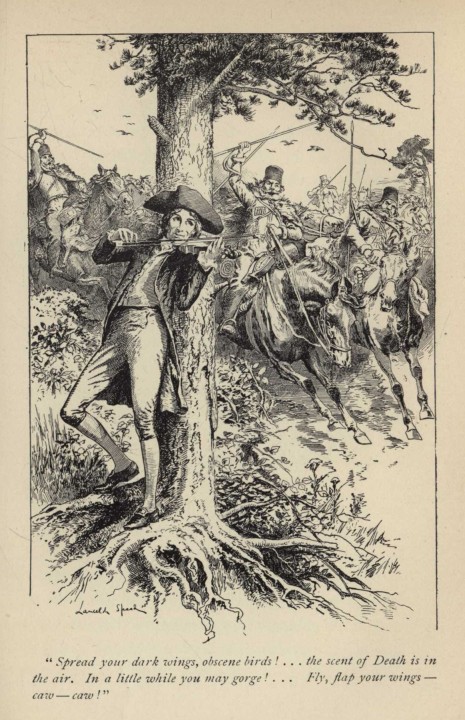
"Spread your dark wings, obscene birds! ... the scent of Death is in the air. In a little while you may gorge! ... Fly, flap your wings—caw—caw!"
Steven stared amazed at his companion, and listened spellbound. The musician was like a man possessed. His grizzled locks seemed to stand out from his face, his left hand danced along the strings, his right arm worked with fury. If ever catgut and wood mocked and insulted, that possessed instrument of Geiger-Hans' did so that day of the combat of Heiligenstadt, in the teeth of the defeated Kalmuck. "Caw, caw!" it shrieked, catching the very guttural of the last belated Cossack, who struggled in rear of his comrades on a wounded horse. The man turned back in his sheepskin saddle, fury in his bloodshot eyes, poised his weapon over his head, measuring his distance.
"Take care!" cried Steven, leaping from the bank. But louder and shriller played Geiger-Hans. The savage hurled the lance; and Steven, flinging himself forward, with arms extended, caught the blow. He rolled back upon the player and both came to the ground together. The music fell mute. Shouting victory, the Cossack forced his bleeding nag into the brushwood.
* * * * *
"If Madame Sidonia were here," said the fiddler, with emphasis on the married title, "what a hero you would be to her!"
He had bound Steven's shoulder—the wound was an ugly gash enough—ministered to him with the wine of the country from a flask of his own, and water from the brook. The contest for the village, between King Jerome's troops and the raiders, was yet undecided, and fitful sounds of battle were still growling in the valley.
The winds blustered in the tree-tops; they had swept the sky from west to east more blue than there is colour to describe. There was a wonderful pulse of growing things about them. Every grass-blade shook in lusty individual life. The leafage was full of bright-eyed, feathered broods, planning the autumn flitting. The whole forest hummed with the minute creatures of Nature's fecundity.... In the plain, openly and with tumult, the masters of earth were strewing its fair face with Death.
"If Madame Sidonia were here!" repeated the fiddler, and cast a sly look at the young man's face over the last knot of his bandage.
Steven frowned and was silent.
"They will go on tearing each other to pieces down there till night. What say you? Shall not grey steed retrace his steps and carry Master Bridegroom back where he should be?"
"No!" cried the other, scarlet leaping to his livid face. "A thousand times no! I am not yet the base thing she deems me."
The musician subdued a sigh.
"What a noble thing is true pride!" quoth he, picked up his fiddle and began to examine it carefully.—"Heavens!" he cried, "if you had broken it! Can a man fling himself upon another in such inconsiderate fashion when there's a Stradivarius between them!"
"Had it not been for my want of consideration," said Steven, with some pique, "I think the precious instrument would hardly have known the touch of your fingers again."
The fiddler laughed out loud, as if the boyish outcry had pleased him; then, as suddenly, grew grave.
"My friend," said he, "the steel has not been tempered, I fear, the lead has not been cast, that will reach this heart.... Ah, Lord!"
It was an exclamation of uttermost weariness. He picked at his strings and tightened them with absent fingers. Then he flashed a smile at his companion:
"You are amazed, are you not, at my ingratitude? What! Here have I, Count Waldorff-Kielmansegg, preserved the existence of this wretched tramp at the risk of my noble, valuable one—here have I shed my blue blood to save his muddy fluid, and the creature has not even a 'Thank you'! ... Comrade," went on the musician, and his eye dilated, his countenance assumed a lofty mien, "I would not shame myself and you by such a word as 'Thanks'! The creature that would not give himself to save his fellow-creature when he can is not worth the name of man."
Steven, abashed that he had indeed thought himself heroic, blushed again and, looking down, began idly plucking with his unhurt right hand the wood-violets that grew in patches on the bank. The fiddler followed his movements, then his eye suddenly grew fixed, his jaw dropped. Slowly the healthy colour ebbed from his cheek and left it ashen. Steven, looking at him, was astonished and alarmed.
"For heaven's sake!" he cried, "are you ill?"
The fiddler stretched out his hand and culled the posy from the other's grasp. The touch of his fingers was as cold as death.
"Violets!" said he, in a sort of whisper. "There is blood on them!" He shuddered from head to foot.
"Perhaps all the mystery is but that he is a poor mad gentleman," thought Steven, It was an idea which could not fail to recur to him in the company of this fantastic being; but never had it seemed so justified.
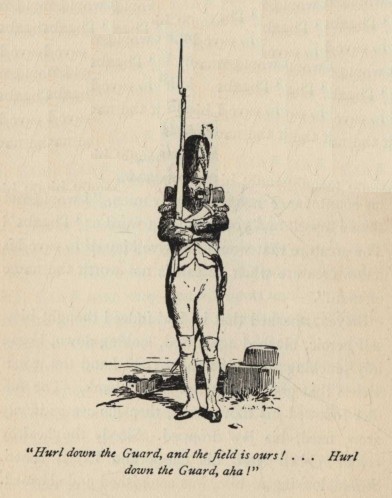
"Hurl down the Guard, and the field is ours! ... Hurl down the Guard, aha!"
CHAPTER XIX
THE MELODY IN THE VIOLETS
"What of the heart without her? Nay, poor heart,
Of thee what word remains ere speech be still?
A wayfarer by barren ways and chill
Steep ways and weary, without her thou art...."
ROSSETTI.
Geiger-Hans laid the flowers on his knee and, still staring at them with the eyes of mingled horror and grief, gathered his instrument to his embrace and drew from it a strain the like of which Steven had never heard. Low and simple it was, with even a delicate lilt, as of the shadow-dance of bygone joys, yet so heart-rending that, after a moment or two, the listener felt tears rising to his eyes and a catch at his throat, and cried on his companion to stop.
The musician laid down his fiddle and turned his drawn countenance upon his companion.
"That is the melody in the violets, the melody that is never silent in my soul, night or day. You cannot hear it? Why, then, you must listen to the story.—I was once as youthful as you and had also a very noble pride—I had nearly as much reason," said Geiger-Hans, his pale lips writhing in a smile of scorn; "but, as men differ, their same passions vary in motive. It was of little moment to me that I came of an ancient house. (Ah! it pleases you to know so much! You have always guessed it, else had you not frequented me. Let it pass, friend, lest I should blush for you.) No, my pride was the pride of intellect. I knew a vast amount! I learned to lisp English that I might study Bacon and Locke, and to chew German that I might wrangle over Kant. I was the friend of Helvetius and Diderot, the rival of Holbach. We worshipped Voltaire. Reason was our God! In short, I was one of those they called the Encyclopædists; we dreamed of doing away with old Abuses and replacing all established things by brand-new Perfections. 'Humanity and Freedom!' was our war-cry. With sweet-oil and rose-water our revolution was to be accomplished. You know what we did for France and the world? We set the first stone rolling, a half-century ago, and"—with a tragic gesture he pointed to the valley—"you can hear the echo of it still reverberating down yonder! Freedom we preached: and the whole world is enslaved as never it was before! Reason was our lodestar: and the State was handed over to the lowest intellects to guide it according to their brute passions! Humanity was our watchword: and France was drenched in blood from end to end, and her sons have brought blood and fire to every land in Europe! The blood of that wretched son of the steppes blackening yonder on the road, the blood shed in yonder bullet-riddled village by that very volley that shakes us as we sit, is all offered to the honour of that same trinity of our invention: Freedom, Humanity ... and Reason! Oh, glorious was the path we opened! Had we not just cause for pride?"
He fell silent a second; and Steven dared not speak, so corrosive was the bitterness of his every word, so poignant the emotion written on every furrow of his countenance.
"Oh, it was a golden time!" he resumed. "We philosophized up to the steps of Versailles. Louis made beautiful locks; Marie Antoinette tended snowy sheep; the roses bloomed at Trianon ... and not the wisest of us ever saw the precipice yawn! As for me—even the greatest minds are subject to the everyday passions of humanity—" his lips parted upon an ironic smile—"I fell in love, neither more nor less than the most elementary youngster of the land. She——" He hesitated; then, steadying his voice, proceeded in tones which betrayed the effort of speech: "she was of an old-fashioned Breton stock, and her ideas and mine were as the poles asunder. But upon one common ground, and a fair pasture it was to me, we met and were equal: we loved."
He paused, his breath came quick. "Heaven!" he said, and it seemed as if he knew not that he spoke, "how I loved her!"
He picked up a violet from the heap on his knees, and passed his fingers over it caressingly; his countenance softened. When he began again, it was in gentler accents than Steven had ever heard him use:
"When two people love each other, young man, and when each believes the other to be mistaken in some cardinal point of judgment, the dearest thought they cherish is to bring the Beloved to the truth. I had no doubt but that I could open her mind; she, but that she would redeem my perverted soul. I have told you what a fine pride I had. So noble it was that I was proud of my pride. And being an apostle of Liberty, the idea that a woman should resist her husband, that the weaker vessel should not give way to the stronger, never dawned on my emancipated mind! Well, well—we quarrelled! The fault was mine. Could I not have been content to worship her in her sweet faith! She had a high spirit. I wounded her in a thousand ways. Women have susceptibilities that we, thick-hided, thick-witted, dream not of. Even when we touch them to caress, we bruise. And then, when their pain is intolerable and they turn and strike at us, our wound is that of the most innocent, the most injured! Oh, when my measure was full against her, she insulted me, if you like—much as your little bride this morning insulted your Highmindedness. She said words that my exquisite pride could not endure. Of course, you will well understand (being even such a self-respecting youth as I was then) that I had no choice but to leave her. That was right, was it not?"
Steven, under that terrible gaze, ironic even in its haunting agony, was at a loss how to reply. He muttered something of a woman's duty and wifely submission. The fiddler caught up the words fiercely.
"Ay," cried he. "A woman's duty—wifely submission. Oh, strange how men prate of chivalry, in the exercise of their bodily strength, because of a woman's weakness, and yet never see that, because also of a woman's sensitiveness of soul, a man should take shame to parade the superior strength of his will—that he should spare the delicate spirit as well as the delicate frame. Listen:—my strength of mind was such that it left me no choice but to desert the woman whom I had vowed to protect, to make parade of my manhood by leaving her to live her own life alone, to cast the frail and lovely thing I had held in my arms away from my love and guardianship. No doubt, no doubt, I made some very generous dispositions as regards my fortune—even as you now propose towards Madame Sidonia, and she had her people to go to, even as your wife has: those whom she had given up to come to me. But when the day dawned that I had to look into my heart and read the truth, what did I see? Look into your heart now, and learn the baseness of your own motives. Why do you leave your bride? Why did I leave mine? For what reason, but that she might weep and mourn for me; that she might learn how precious was the jewel she had not appreciated! ... To be revenged ... revenged on the Beloved!"
He flung himself back against the bole of the fir that rose behind him and closed his eyes.
"I left her," he went on, "left France, left Europe. I went to America, the new home of Freedom, the only country on the face of the earth where the goddess was worshipped as she should be. I had vowed not to return till recalled: I was summoned by a voice terribly different from hers. It took three months before the noise of the storm reached me on that far-off shore, and I knew that it must take me at least a month more ere I could reach her. And she was in danger! ... I think it was then I began to go mad—for it is understood that I am mad, is it not?"
He opened his bright eyes and fixed them on Steven, who became so extremely embarrassed that the fiddler broke into unmirthful laughter.
"Mad!" he repeated. His gaze flickered; and, if truth be told, he looked none too sane. Then he sank his head between his hands with a groan. "If only I were a little madder!" he cried. "The story is nearly finished," he went on presently, in a new, toneless voice. "When I landed in France, all the powers of the Hell my superior intellect denied were let loose in the land—Danton, Marat and Robespierre represented the trilogy of Liberty, Reason and Humanity! The prisons were full, the guillotine everywhere restless.... Our Golden Age! ... A fortnight I looked for her. Have you ever sought in vain one you had loved, even for an hour? Dante never devised a more exquisite torture for his deepest circle. My house in Paris had been confiscated for the nation's soldiers; her father's castle in Lorraine had been burnt to the ground. At my old home at Nancy at last I found a trace. She had refused, it seemed, to join in the flight of her people across the Rhine; but, when trouble became threatening, had taken up her post on my estate. That was like her. She had been arrested—so dangerous an enemy of the people! She was in the infamous prison at Nancy. She——" He flung his battered old hat from his head, dashed back his hair, loosened the wide collar at his throat. Breath seemed to fail him. A dark wave of blood rushed to his forehead. "All, all had abandoned her, save one poor girl—a peasant from our farm, whose people were of the local patriots.... This girl was allowed access to the cells. I met her at the prison gates, whither my frenzied search brought me at length. She knew me, though I was a tramp already. At sight of my face, she clapped her hands and broke into wild sobs. I was too late! That morning.... Why do you look at me like that? Do you wonder that I am still alive? That is where the God I denied has His vengeance of me, you see. I cannot die. Oh, I could kill myself, of course! But, mark how deep has the Encyclopædist fallen.... I dare not, dare not, lest I lose my chance of meeting her again! ... Ah! there is great pity in your eyes.... Her little delicate head—she held it like a queen's. Under the powder, her hair was gold. (I have not even one lock of her hair.) I used to clasp her slender throat between both my hands.... The peasant girl had kept by her to the end. She had stood at the foot of the scaffold, that a last friendly glance might speed that lovely soul. 'She smiled to me,' said the poor creature, sobbing. My eyes were dry.... Then she drew from her bosom a bunch of violets, and said, 'Madame, les avail à son corsage.'..."
Geiger-Hans gathered up the flowers scattered on his knees, and crushed them against his face.
"She always loved violets," he murmured. "These have no scent," he went on dreamily; "but hers, hers—oh, they were sweet!"
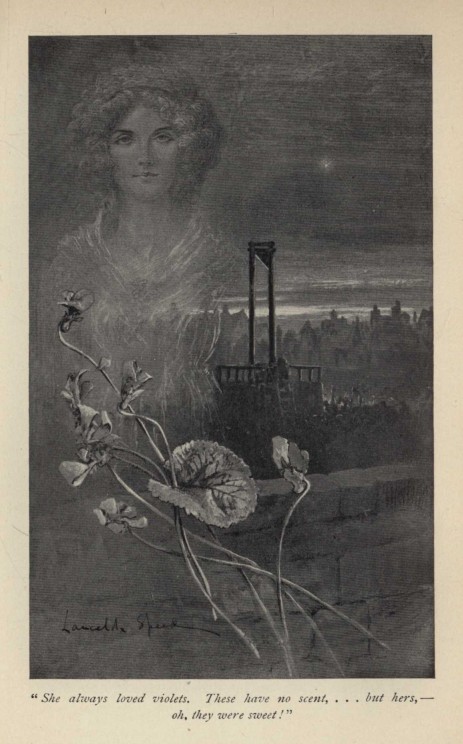
"She always loved violets. These have no scent, ... but hers,—oh, they were sweet!"
"Ah! friend!" cried Steven, and had no further word. Infinite pity indeed was in the look he turned upon the musician. It seemed as if the latter wandered as he spoke again.
"There was blood on the violets," said he, dropping his hands, "her blood and mine—for the man that was I died too, then, murdered in his youth, even as she." His face had grown ashen again, his eyes were restless in their orbits. "The something that lived on, the miserable carcass, the old man—call it myself, if you will—this self that is before you now—it took the violets and began to walk away.... And it has walked ever since!" He gave a laugh, and the sound of it was mad. "No place could be home to me again—no land could be country, France least of all. But the skies and the trees are kind; they understand my sorrow, they take it into themselves. And sometimes they give me back peace. And then there's the music.... I was always a musician. One, a village priest, found out by accident that the crazy tramp he had sheltered played better on his old Strad than he did himself. The fiddle was to him as his child, but he gave it to me, for he had compassion on me.... And so was born Geiger-Hans. And Fiddler Hans and his fiddle will walk until one day he can walk no more. And then he will lie down on the kind, brown earth, and turn his face to the skies ... perhaps!"
He thrust the flowers into his breast. Then he leaned forward, his elbow on his knees, sheltering his eyes in his hands: and there was silence. The valley below had sunk into stillness.
While Steven had listened to the story of one man's defeat in life, a combat where the fate of hundreds had been decided had been fought and won. And now they were picking up the dead yonder, in the evening calm of the plain. The wind had fallen with the fall of the day, and only the topmost branches of the pines swayed and whispered in scarcely perceptible airs. The light was growing golden mellow, the shadows were lengthening. Steven remembered his wound.
The fiddler turned and spoke. It was with composure.
"Well," said he, "which way shall it be; back or forward?"
"I do not know," said Steven, in a low voice, and dropped his eyelids as if ashamed.
The fiddler stretched out his hand and helped the other to rise, with a vigorous grasp. As they stood side by side, he suddenly cast his arm round the young man's shoulders.
"The child," said he, "Sidonia! ... Oh, I want her to be happy. The first day I ever saw her, I thought that if we had had a child, the woman I loved and I, it would have been like her. And, to my madness, she has gradually become even as my own. I have haunted her ways. However imperiously the roaming fit may come upon me, there is always something that draws me back to watch, to guard, to care. I gave her to you. Aye, Count Steven, it was I gave her to you. And if again I have failed with the happiness of what is dearest to me on earth ... then indeed it is that I am cursed!" His voice failed, broken; his eyes implored. After a while he went on: "When her soul looks out of her clear eyes, when she moves her head with its golden burden ... she has a trick of speech, a laugh ... Oh, it is like a refrain of old music to me, a sighing strain from a lost life! Her little, slender throat—I could hold it in both my hands.... Go back to her.... If I knew her happy, my restless spirit would, I believe, find some kind of peace. Ah! you think it will be hard? I tell you it will not. You do not know a woman's heart. Forget that your pride is hurt. Remember that you are young. Oh, if you but knew! Life has one unsurpassable flower for youth—take it now, lest a breath from heaven scatter its bloom. Its scent is for you! The love of your youth, go, gather it! Go back to little Sidonia!"
"I will go back," said Steven, and his lips trembled.
Silently Geiger-Hans loosened the grey horse, helped the wounded man to mount, and led the way down the hill.
CHAPTER XX
THE TRUE READING OF A LETTER
"Give sorrow words: the grief that does not speak
Whispers the e'er-fraught heart, and bids it break."
(Macbeth).
Steven, in his turn, had a tale to tell; and, as they retraced their way back towards the Burg through the gathering shadows, he narrated to the fiddler, with great simplicity, the episode with the Burgravine which had led him, first into the oubliette, and ultimately to the quarrel with Sidonia.
Geiger-Hans made small comment. The facts he knew already, the motives he had shrewdly surmised. Sometimes he smiled, unseen in the thick, moist gloom; the bright day had turned to a moody night, heavy clouded. The young man's ingenuousness pleased him; also the manliness that refrained from any self-righteous assertion of innocence. But sometimes he sighed; it was a tangled story!
When they reached Wellenshausen village, it was evident that there could be no question of making the ascent to the Burg till the next morning. Rain had begun to fall. Geiger-Hans might have faced the break-neck road—doubly hazardous in the wet and the dark—but he flatly refused to aid the wounded man in any such mad undertaking, and Steven's impatience had to submit to the inevitable.
Steven had thought to have measured ere this all the possibilities of the Silver Stork in the matter of discomfort. But in a house now thoroughly disorganized by the incursions of a stray detachment of Jerome's cavalry, the claims, even of a fastidious traveller, not to speak of an itinerant musician, were the least of concerns to-night.
In the dismal, rat-haunted attic which he shared with the bridegroom, Geiger-Hans heard his comrade groan and toss through the long hours of his wedding-night. If sleep fell upon the young man at all, it was broken by nightmare. And the fiddler, lying flat on his back with his hands under his head, resignedly facing the insomnia which his restless spirit knew but too familiarly, could foretell almost to a breath the span of troubled unconsciousness, the start, the half-groan of awakening. And he was as glad, almost, as Steven himself when the white face of dawn began stealthily to peer through the dormer window.
* * * * *
Geiger-Hans glanced two or three times sharply at the youth's face as once again he found himself trudging beside him. Steven had submitted almost sullenly to all the musician's arrangements; in silence had mounted the mule prepared for him; in silence had they started on their upward way. The vagrant breasted the rugged path with his usual activity; but his countenance was dark with concern. He did not like the glassy stare of Steven's eyes, the alternate pallor and flush on his cheek, the blackened, cracked look of the lips.
"Madame Sidonia will have some nursing to do, I think," he said once.
Steven gave a wan smile, quite a long time after the words had been spoken. He was beginning to lose his original frenzy of intention in this early morning start; to think only of the rapture of lying between cool sheets in some dark place, with Sidonia's flower touch upon his throbbing temples.
After the wet night had broken a gay morning—the rain-beaten earth was fragrant; fragrant every tiny sprig of herb and spicy rock-clinging bush. As they ascended, the pleasant wood-smoke from the village hearths gradually gave place to the more subtle pungencies of the heights. All this, however, was wasted upon Steven. And wasted, too, the gaunt picturesqueness of their first view of the castle, with the golden early sunshine upon the grimness of its walls, caressing the ruin, gleaming back from the defiant granite of the keep.
The dogs bayed, a flock of rooks rose, beating the air at their approach; a brown donkey, heavily saddled, hitched by the bridle to a bar of the open gate, flapped his ears and turned his patient countenance, mildly surprised, upon them.
The door to the hall, barred and nail-studded, so inhospitable as a rule, stood open. It was a vastly different scene from that of the evening of their first visit—when they stood, a pair of adventurers wrapped in mist, before the castle, seeking admittance to walls apparently as impenetrable as any in fairy-lore. Steven was here, now, by his right, to claim his own, and all lay in the sunshine, strangely peaceful, the open door seeming to forestall a welcome. But the fiddler was seized with boding. There are grim visages upon which the sight of a smile strikes misgivings: such was now the face of the Burg.
The voice of a woman singing lustily within some distant chamber smote his ear, as he lifted a hand for the bell chain; and he shook his head. Even before Martin, the doorman, put in an appearance, shuffling out of the kind of kennel where he lurked upon that watch which had been his for thirty years, Geiger-Hans knew what had occurred. Martin, with red waistcoat unbuttoned, a china pipe hanging from his jeering lip, slippers on his feet, and the froth of bridal beer running down his chin, stared in amazement at the sight of the travellers; then welcomed them with the heartiness of the slightly elevated.
"The noble family have all departed," he cried quickly; and presently chuckled, leering at the bridegroom who sat stiffly on the mule, as if he neither heard nor saw.
Some one came trotting into the hall, softly on list soles, in a great bustle. It was the Forest-Mother. Her pleasant face wore an unwonted air of seriousness, and her lips were pursed as upon solemn thought. But never had she been to Geiger-Hans a more comfortable spectacle.
At sight of him her hands were flung up in wonder; and, at further glimpse of the rider without, they hovered in mid-air, as if paralyzed.
"Alas, Onkel—too late! All away, yesterday—and the child's heart bursting. Aye, it is all mighty queer and sad. I little thought I should be making for home again this morning, with everything so criss-cross and wrong and strange!"
Geiger-Hans made a sudden stride out of the hall back to the side of the mule.
"Down with you, comrade," he said, with that note of gentleness in his voice which, so far, only Sidonia had known. Steven, after a pause for comprehension, turned towards the speaker with his feeble smile, and suddenly swayed.
"Nay, mother," the fiddler called out as he caught the lad in his arms, "you mistake; there will be no going home for you for some time to come."
* * * * *
"Ach! the poor young gentleman," sighed the Forest-Mother, when she had heard the tale. And that was not until Steven's fever-dream had been realized, and he lay between cool sheets in a dark room; though, indeed, for Sidonia's flower touch he had to put up with Mrs. Forester's large plump hand. Not that it made much difference either just then, for he was somewhat rambling in his mind. "Ach, the poor young gentleman, it is a real talent he has for coming in the way of blows!"
"He has a talent for mending, too, remember," said the fiddler, shortly. His dry tone concealed a real anxiety. Young things, as he knew, took blows of body and soul hard. A poisoned wound is bad enough in itself, without a sore heart and a mind ill at rest.... He could not leave the lad—that was clear. "Where have they taken the child?" he asked.
"Sidonia? Ach—she kept her lips close as wax and never told me a word—not even me, the old mother! But that French minx of the Lady Burgravine did nought but chatter of Cassel."
The word fell like a stone on Geiger-Hans' heart. It was almost with impatience that he glanced at the long, helpless figure in the bed. The young man ought to be up and doing! ... Cassel, seething pot of intrigue and low manoeuvre, paradise of spendthrifts, adventurers, scoundrels, it was the last place on earth for the guileless fugitive bride—and Betty the born schemer. But, if life had taught this wanderer anything, it was submission to the inevitable.
For the moment nothing could be done but to nurse the sick man. Some vague thought of sending a message to Sidonia, to tell her of her bridegroom's pass, flashed into his mind, only to be dismissed. The chances of any communication reaching her were remote. He could not go himself. And, could he have done so, some inner conviction told him that here he had best not interfere. Between the tree and the bark let none put his finger. The lovers must win back to each other without any further meddling. He was not certain that the separation, the very anger, misunderstanding and soreness, might not be working for the best. They all had gone too fast, they had made too sure. Steven had been an over-confident wooer: little Sidonia too ready to be won.
Geiger-Hans and the Forest-Mother made a tolerable existence for themselves within those sullen walls that had certainly never before beheld such free humours as the wanderer's, such cosiness and comfort as the Frau Ober-Forsterin's. Truth to say, from the instant the sick man was put into her care, the old dame became possessed of excellent spirits. Every one has a special ideal of happiness. Nursing chanced to be hers: nursing of men, be it understood, preferably young men—no harm if they were good-looking—and wounds her speciality. She had salves that would, she was proud to say, make the bark grow on a lopped tree. As for poisoned hurts, had she not, she alone, brought her Friedel round after he had been gored and trampled upon by the stag? And as for febrifuges and herb-teas, if she had been willing to sell her secrets, she had not a doubt about it, she now might be a rich woman.
On the fifth morning, a tan-faced boy, with wild eyes looking from side to side, like a bird's, came pattering up into the Burg, having defied the crags with hardened bare feet. He brought a letter which had reached the Forest-House the night before, addressed to its mistress.
The Forest-Mother took it from the fiddler's hand, with many winks and pointings towards the great bed whereon her charge lay asleep. She betook herself to the window and began to peruse, with some labour, forming each word with her lips as she went on.
The fiddler had recognized Sidonia's characteristic hand, upright and painstaking. Presently the good woman, shaking her head, folded the sheet and, coming over to the fiddler with her noiseless yet ponderous tread, placed the missive back into his hand.
The fiddler read:
"BELOVED LITTLE FOREST-MOTHER,
"I promised to write. I am very well, but I wish I were back with you in the dear green forest. Greet good Friedel for me. Tell him not to forget to give the white doe a piece of rye bread from me every day. And it would be kind of him to take old Belthazar out with him now and again, if only for a short round. I know he is old and stiff; but the dear old fellow breaks his heart to be left behind when all the young dogs are taken out. And, dear Forest-Mother, when you go by the kennels, will you give him a pat for me? And you might just tell him that he is worth all the silly young things put together, and that the kennels had never such a fine dog as he. I am sure he understands, and it will hearten him up. And, when you see Geiger-Onkel, tell him I think of him, and that his airs keep playing in my head. But always the sad ones. And tell him, too, that I never was a fairy princess, but only a silly country girl. This is a place all streets and houses, and it is very noisy. Everybody seems running about, but I do not know what they do. I don't like it, but it is better for me to be here than at the Burg. Of course we are at the Palace. Aunt Betty did not like Uncle Ludo's apartment on the ground floor, so we have a great suite of rooms to ourselves in a wing. It is all gold and silk, and very grand. But, oh, I would rather have the old Forest-House kitchen, with the rafters and the little windows, and all the wood presses smelling so good of bees-wax!
"Aunt Betty says it is very dull at Cassel just now, because the king is still away. Next week, she says, it will be very different when he returns. But it seems to me that she is always out at parties. I have no dresses yet. I am very glad to be left at home. So I am quiet here, but oh, it is not the quiet of the forest. Thou Forest-Mother, I wish I could kiss thee.
"SIDONIA.
"I hope the old jackdaw is well."
"Na," said the old lady, who had watched him reading, her arms folded over her deep bosom, "what manner of letter is this at all for a bride who has run away from her man? That is verily but a foolish child. She was too young to be wed, eh, Geiger-Onkel?"
"That is the letter of a suffering woman," quoth Geiger-Hans, softly, "and the whole letter, Mother Friedel, is one cry towards him."
"Jeminy, and where do you see that?" whispered the dame with a shrug for the poor loony. "Well," she added, in her cheerful undertone, "we've had a splendid night, our skin is as cool as a little frog's, and we are healing as quick as a sapling. I wouldn't say but that in another couple of weeks we might be quite able to travel."
Geiger-Hans looked at the bed, at the fine sleeping face, placidly and wholesomely pale, at the charming languid hand flung in abandonment on the purple coverlet.
"Mother Friedel," he said, and his voice was none the less decided because so low pitched, "three days must see us on the road again."
Heedless of her scandalized protest he folded the letter and, thrusting it into his breast, gave himself up to reflection. A smile, half-bitter, half-tender, hovered upon his lips. The child ... she had remembered him—after her old hound.
CHAPTER XXI
AT THE MOCK VERSAILLES
"You are just a porcelain trifle, Belle Marquise!
Just a thing of puffs and patches,
Made for madrigals and catches,
Not for heart-wounds, but for scratches..."
AUSTIN DOBSON.
Viennese Betty was in Cassel; and if ever the right person was in the right place, it was Betty in Cassel, the Frenchified Cassel at least of King Jerome. She breathed in its irresponsible, exciting, immoral atmosphere with rapture. Its tinfoil splendour was utterly satisfying to her eyes; its jests provoked her charmed laughter; its aims measured her utmost ambitions. To shine among these doubtful stars; to take the lead in frivolities, without fear of losing caste—nay, with every prospect of being lifted upon giddy triumph as the newest and most influential "pompadourette"—even in her dreams Betty had never devised for herself a more enchanting prospect! To make the thing complete, her Bluebeard was tame, absolutely at her mercy ... and held relentlessly at a distance.
At the first sight of a scowl, at the first rumple of that brow that used to strike terror, at the first threat of breaking through her imposed barriers, Betty had but to prattle airily of "oubliettes" (strangely inappropriate term for dark doings that never could be forgotten), or yet to fall into alarming pamoisons, into fits of shuddering, artistically simulated, accompanied by apparently wandering yet exceedingly suggestive speech—and the Burgrave was forthwith reduced to a jelly.
The Burgrave was indeed an altered being, went moodily, found his cup bitter and his food savourless, while the Burgravine, tasting all the delights of freedom, fluttered through her first week in Cassel like a butterfly through a flower garden under full sunshine. A butterfly she was, upon one side of her nature; but, upon another, capable of determination and deep-seated resentments. True, she had other and, to her mind, better quarry to pursue now than Beau Cousin Kielmansegg—a mere rich young nobleman; yet it added not a little to the fulness of her gratification to know that she had successfully parted him from Sidonia.
The evening after her visit to Napoleonshöhe found her in the most delicate of rose-powdered wrappers, seated at her writing-table in the window of her boudoir, so prodigiously content with herself and existence that little snatches of song, little trills of laughter, escaped her, as she pondered over her correspondence.
It was towards the hour of seven, and the gardens beneath her windows (so satisfying to Betty's taste) with their mock Versailles elaboration, were bathed in mellow light. The statues took golden hues and flung a long fantastic shadow. The fountains flashed and tinkled. Some one was practising French airs on the clarinet in a room below. A gust of mingled flower-scents rose up to her nostrils: the pungency of clove pink, the coarser incense of white lilies, and the nearer breath of the climbing rose-tree that aspired towards her window.
Betty was the last person in the world to be consciously grateful for any offering of nature; she was merely aware of a general flattering of the senses which added to her content.
A few days ago, at Napoleonshöhe, she had met Jerome of Westphalia for the first time. And what a truly charming man! Not a hint of the plebeian Corsican about him. No—they maligned who said so. What manners, what courtesy and dash combined! What a delightful smile! What an eye! It was rumoured that strong men shivered under the glance of his great imperial brother. If you had asked her, Betty would have told you that, from all accounts, Napoleon seemed to her a distinctly overrated individual—a boor, who would chuck a lady under the chin or take her by the ear, as though she were a grenadier. Bah!—Nay, give her the agreeable thrill of coming beneath Jerome's meaning gaze. A delicious recurrence of the sensation crept through her frame as, with closed eyes, she recalled the moment ... Jerome's first sight of her, his start, his stare, his flickering smile.
On the table lay the very rose he had presented to her with such a curve of slender olive fingers; with so happy a phrase, so graceful an inclination. Betty had handled the flower a good deal since, had sniffed and caressed it a vast number of times; the pretty leaves were blighted, but never did flower excite such admiration in the Burgravine's regard.
She had met the King but a day or two ago; they had exchanged but a glance, a word, a courtesy—and behold! Betty's morning courier had brought her a letter from the monarch. A love letter, if you please, neither more nor less. A request, a demand, for a rendezvous. Peste! he lost no time, the little King! But were there not royal privileges? Had he not the same blood as the Conqueror in his veins? Moreover, was not this very haste the best compliment that could be paid a woman? Not, indeed, that Betty had any notion of allowing herself to go too cheaply. Perhaps, indeed, she had no very clear idea of letting herself go at all; but to dally with an exciting situation, to tantalize, to reign, to fire, and then dash cold water.... Stay, such coarse expressions ill applied to the Burgravine's delicate methods: to spray, very gently, with cold rose-water; not sufficiently to drown the lover's ardour, but just enough to produce a little fizz and splutter—to reign, in fact, chief of the many sultanas by reason, perhaps, of her very refusal to qualify for the post! And only to yield at last when ... But here Betty was glad to allow the prospect to be veiled in a kind of luminous mist. The immediate programme was quite sufficiently absorbing.
No wonder she nibbled the feathers of her pen. Her answer to the kingly missive must be a work of art. The "rendezvous" itself must not be denied, whatever else it might deny. Betty had the instinct of her species, the born coquette. Too much virtue, at the beginning, is fatal. Many twigs are required for the lighting of a proper fire.
It stood complete at last, a most dainty little note, indited on pink paper, duly folded and enclosed in a French envelope, wafered with mauve—Betty was of the last mode, these days, even to her writing paper.
The congenial task concluded, she had another to perform. The courier from Heiligenstadt, whither the King had repaired on a tour of military inspection, had brought her a second letter—also a love cry, or it might better be described as a love-bellow. The Burgrave, away on duty with his sovereign, appealed from a distance to his obdurate wife.
He was filled with amorous longing, jealousy, despair. How long was he to be exiled from her favour? The situation was past endurance! He implored, groaned, rebelled, threatened, and was abject again—all in a few frenzied lines. The gist of the whole was in the last phrase: "When am I to be forgiven? Am I not your husband?"
The answer to this effusion required but a flourish of the pen. Yet, as the lady planted a green wafer upon the second envelope, there was a triumphant smile upon her lip, a vindictive gleam of pleasure in her eye. The despatching of her morning budget had been altogether pleasurable.
* * * * *
Close by, in the little chamber allotted to her, Sidonia, behind locked doors, was engaged upon a similar task; for to her the courier had also brought a letter demanding instant acknowledgment. It was a very short one, and by no means so loverlike as either of Betty's billets.
"I have been slightly indisposed" (wrote Steven) "and unable to travel for a few days; but I trust to be in Cassel within the week, and shall seek you in the Palace. It must be clear to you that you owe me at least an explanation. It is impossible that we can part for ever thus.
"STEVEN."
Not a word of love! Not a hint of despair! Not even reproach! It was all cold, cruel business. As Sidonia wrote her reply, the tears dripped so quickly that she could scarce see the paper.
Eliza, very brisk and tripping, who had the charge of posting the three letters, studied the superscriptions very carefully before committing them to the royal mail. Her eyes grew round at sight of the pink-wafered note. Diable! If the mistress had such correspondence, it might become a question whether Jäger Kurtz would continue to be good enough for the maid. She smiled vindictively at sight of the green wafer. If she knew her lady, the Chancellor was far from being fully paid out yet. "And serve him right," said she, who would herself be long before she forgave Burg-Wellenshausen for the horrors of its tedium.
The old-fashioned sheet that bore Sidonia's childish scrawl she weighed awhile reflectively in her hand. Madame la Burgravine would doubtless give something to see the contents of that letter.... Then, with a shrug of her shoulders, she sent it on its voyage with the rest. The service of her lady had its advantages; and Eliza, pining in the Burg, had stuck to it with unerring prescience of better days. But it did not follow that she held no opinions of her own. And she had even a kind of good-nature that did quite as well as a conscience, as far as her neighbours were concerned, and was far more agreeable for herself.
"I am not hard-hearted like madame, look you," said the maid to herself. "The child is a nice child, as young ladies go, and she should have her chance."
* * * * *
The spirits of spring and autumn are akin, although the one journeys towards the fulness of life, and the other to the cold sleep, death. Across the dividing months they seem to meet each other, to serve you smiles and tears, skies of a tenderness unknown to summer, gales of wind, soft as milk, mighty as love. These come chanting with the voices of the ocean, the mountain and the forest, great songs of glory; seize you by the way in resistless arms, tell you wondrous things, and set your blood leaping as they pass. They set, if autumn it be, the yellow leaves awhirl in a death dance; or, if spring, every baby bud rocking on its sappy spray.
The travellers, one riding, the other afoot, went side by side along the road towards Cassel. It was a south-west wind that buffeted them. Even in the heart of the inland it seemed to sing of distant seas; to bear on its pinions airs at once untamable and mild, balmy and salt. The forest trees roared under it as with the voice of waters. It gathered from them drifts of yellowing leaves, even as, leagues behind, it had churned spray from Mediterranean waves. In the young traveller's heart storm answered to storm; its breath in his nostrils maddened him, for he had fever in his veins, and he was balked in love.
But to the other traveller, whose hair was grey, who tramped along with the even measure of him who has learned to ignore fatigue, the autumn lament was charged with the hopelessness of the grave. It told him how all that is born must die, and how the beautiful die first. In the choiring of the forest he heard the dirge of waning life. In each gust of pungent fragrance he could smell the bitter graves of yesteryear.
The horseman was clothed in fine and fashionable garments. He who trudged was but a vagrant player, who made music for his daily bread and rarely knew in the morning where he would lay his head at night.
They went in silence. Steven's heart was heavy. Robbed of his bride well-nigh on the altar-steps, he was now seeking her, in an impatience which repeated disappointment had fed to frenzy. And Geiger-Hans was his guide.
At a certain spot the forest began to press closer upon the imperial road. The overarching boughs flung a swaying, premature night upon them; and, as the woodland enfolded them, it seemed to draw them into a great sanctuary. Let the gale rage without, here was protection and an inner stillness all the deeper in contrast to the outer turmoil. Instinctively the travellers drew closer to each other, and their tongues were loosened.
The rider struck his saddle-bow with a passionate hand, at which the plodding grey faintly started.
"To think of her, at Cassel, under the devil flicker of that imperial puppet's glance! Sidonia, my wife, at the Court of Jerome!"
"A waterlily may defy the ooze," observed Geiger-Hans, sententiously.
But the simile was hateful to the youth—a water-lily, a flower that flourishes, in atrocious beauty, upon the very slime! Then he cursed his wound for its slow healing, and his blood for its ill-timed fever, and the length of the road, and the perversity of women.
"And the wrong-headedness of young men!" added the musician, drily.
But thereafter, in tones of consolation, for dudgeon reigned on the saddle above him, he pointed to a light far off through the dark flicker of leaf and shadowy march of trees.
"See, yonder shall we sup and sleep, and thence, rested, start in the brisk dawn. And to-morrow——"
"To-morrow!" interrupted the bridegroom, impatiently. "No; I shall be in Cassel to-night."
"You forget the times we live in, comrade," came the fiddler's answer. "Why, here is my nobility afoot; and yours, all wounded, upon a sorry steed, because any less notable progression were to court suspicion, putting aside the fact that your worship's carriage and horses (Sidonia would have none of them, and if you were not otherwise matched you two would be one by pride, comrade) have been requisitioned for the use of the State. And Frantz fled with his master's dressing set, his English pistols, and his second portmanteau! Court suits I make no doubt, tut, tut. The fellow was a rogue. I saw it at half a blink. And worthy Peter, our postilion, bitten with the war fever and passed over to the Prussians! Nay, but 'tis a riddance that suits me. And here we go as I love, at our own free will, save, indeed, that we enter not Cassel to-night. Have you already forgotten that we are at war, in Westphalia? Not, I grant you, that it signifies much to our pretty monarch—so long as it does not interfere with his amusements at home. He has thought it wise, nevertheless, to make a little fortress of his capital—breastworks and glacis where lay the orchards and cottage gardens; posterns and corps de garde at all road entrances, and everything closed at the setting of the watch, an hour after sundown!"
Steven the lover had, in his mind's eye, seen his pilgrimage ended before the fall of the day; seen himself dashed or crowned. Crowned! Upon the vision the surge rose in his heart till it overpowered him well-nigh to swooning.
Geiger-Hans, with his diabolic insight, chose this moment to draw from his fiddle a sudden strain.
"Oh, stop!" panted the young man. "I cannot bear it."
And the player fell silent, musing upon the ways of men and women and of love. Let a bride but elude her lover's embrace, what surer road shall she find to a revealing of his ardour?
CHAPTER XXII
THE CABINET NOIR
"Good even, sir,
But what, in faith, make you from Wittenberg?"
(Hamlet).
Night had completely fallen. A full moon was forging up the sky, like some superb ship beating up the wind, all sail spread and defying the tumultuous seas of cloud, when the comrades emerged from the woodland and halted before the inn.
"The Three Ways," for a poor roadside house, held unwontedly merry company to-night, to judge by the medley of shout and song that rang out from its upper windows.
The fiddler, mounting the steps that led to the door, gave a few knocks with special emphasis. To this there was no response. Laughing silently, he waited awhile, then suddenly betook himself to his violin, at its highest pitch. Too much engrossed with their own music, unhearing, perhaps, through the rolling of the wind, the first-floor revellers paid no heed to knocks or notes; but below there was immediate stirring. The bolts screeched under a hasty hand.
"Ach! you, Geiger-Onkel!" cried the hostess, as she stood revealed on the threshold. "You will have your joke! ... We thought it was the police commissary's rap! Ah, heavens, what times these are! One's heart is in one's throat all day, all night."
She clasped her hands upon her flat bosom, but suddenly catching sight of the rider, forgot to pant that she might the better stare.
"'Tis but a new brother of mine," said the fiddler, carelessly. "Send the kerl for his horse.—So you have some of the boys here? Well, I bring news for them. Come, comrade, you must be weary."
In the kitchen, amid otherwise pleasing surroundings, their nostrils were offended by an extraordinary reek of stale wine, presently traceable, it seemed, to a postilion in dilapidated uniform, who was ensconced within the glow of the hearth.
The man's high collar and braided jacket were open for the freer intercourse of throat and can; he winked impudently at Geiger-Hans, and had a truculent roll of the eyes for Steven.
"Interception of the King's mail—lèse majesté—crime of the first category—punishment capital," observed he, with some pride, in answer to the young man's astonished look.
"The punishment includes all accessory to the act," suggested Geiger-Hans, pleasantly.
"Not the victim of coercion," stated the postilion, with indifference.
He turned his tankard upside down as a hint to the hostess. She, poor thing, seemed to regard these doings as a hare may the trap that clutches her pad.
"The gentlemen are upstairs," she said, and wiped the dampness from her lip with the corner of her apron.
The gentlemen upstairs continued to make their presence uproariously patent.
"The Brotherhood are apparently having a little argument," quoth Geiger-Hans, with a slight smile.
"For heaven's sake, Onkel, go up and quiet them, if you can! We shall have the patrol upon us!" groaned the hostess.
"Now, comrade," said the fiddler to Steven, one foot upon the narrow stairs, "I will now introduce you into nobler company than ever! I have made you known to one of the newest kings and to one of the oldest Burgraves in the land. To-night you shall become acquainted with the offspring of a nation in chains—heroes, my little count, no less. Patriots of the first water!"
Count Kielmansegg was conscious that the corners of his highborn lips drooped. The patriotism of Westphalia—convulsions of a tin kettle on a mere corner of the vast Napoleonic fire, pot-house heroes that roared their enthusiasm into the night to the clink of the can.... Bah!
There was a twinkle in the musician's eye that mocked his words. He went nimbly up the stair, and his companion followed with the heavy foot of fatigue.
A drunken shout greeted the entrance of Geiger-Hans. Steven stood on the threshold, his lip curling into ever more open scorn at the sight which greeted them: three dishevelled youths, in different humours of intoxication, extravagantly costumed according to the taste of the militant Studiosus: tunics of velvet, shabby but much befrogged; jack-boots, gigantic spurs that had, doubtless, never pressed horse's sides; poetically open collars; uncut hair; tobacco-pouch and rapier on belt; china pipes in hand, six feet long, tasselled with Fatherland colours. A squat individual, exuberantly bearded, sprawled at the head of the table and was expostulating with vehemence. He had embraced the can of wine and was defending it with drawn spadroon against the other two, who—the one with uproarious laughter, the other with tipsy solemnity—were making futile attempts to wrest it from his possession. The table was strewn with letters and papers.
No sooner did this same hirsute Bursch perceive Geiger-Hans than he abandoned both sword and can and, staggering to his feet, opened wide his arms.
"Welcome, brother—master—friend!" exclaimed he, dithyrambically.
"Salve!" then cried the laughing student, pounced upon the abandoned can and buried his impertinent sandy face in its depths. Whereupon the melancholy third, whose long black hair fell about a cadaverous countenance, sank into his chair.
"Vilis est hominis natura," lamented he; then suddenly broke into the vernacular and shook his fist at the drinker: "Thou rag!"
"Salve, fratres!" responded the fiddler, by no means surprised, it seemed, at his reception, but neatly avoiding the threatened embrace. "How beautiful it is," he went on, "thus to see the saviours of their country at work upon her interests, even when the rest of the world sleeps!" He pointed to the letters as he spoke.
An inflamed but exceedingly alert eye was here fixed upon Steven over the rim of the can.
"Prudentia!" cried the drinker, flung down the vessel and ran forward, "a stranger among us!"
With a bellow the bearded one lurched for his weapon.
"A stranger? ... Pix intrantibus!"
The weeper profited of the excitement to seize, in his turn, upon the abandoned vessel.
"Nay," said Geiger-Hans, arresting the double onslaught with outstretched arms. "Pax intrantibus be it: we are friends!"
Steven stood in the doorway, sneering. He would have found a pungent satisfaction in laying flat the drunken couple—and no doubt, with the science cultivated in Jackson's London rooms, would, despite his wound, easily have put the thought into execution. He made a movement forward. But the fiddler held him at arm's length.
"Peace, brother Peter—peace, most learned doctor in herbâ. I bring a friend, I say, a new brother, my comrade, a noble Austrian who, by the way, is half an Englishman, and as bitter a foe to the tyrant as your most Germanic selves. I introduce:—Count Waldorff-Kielmansegg—Herr Paul Oster, 'Mossy-Head,' emeritus swordsman, Senior of the Great Westphalic conspiracy. Behold, count, the true German garb, the type of manly beauty! Behold this Barbarossa head! Behold the sword, in short (if I may so express myself), of a great patriotic movement. And here," turning with a fresh gesture of ceremony, "we have the brain, the tongue, the acute eye: in other words, Herr Theophilus Schmeling, legal doctor, jurist, fresh from all his honours at Goettingen—and the third...?" He looked interrogation at the black-haired student.
The jurist, surprisingly alive to the situation, answered briskly for his melancholy comrade, who was still absorbed and absorbing:
"Johannis Stempel, Sanctæ Theologiæ Studiosus. An 'Ancient House,' also a faithful heart—a good labourer in the vineyard—but," he added chuckling, "apt to be weinerisch im Wein, whiny over the wine."
He perpetrated his atrocious quip with a wink of little red eyes.
Count Waldorff-Kielmansegg found some pleasure in bowing three times with ironical ceremony.
But Geiger-Hans took up the tale again with a dry disregard of any possibility of humour.
"Here we are, I repeat, in the heart of a great conspiracy ... and not one of us but risks his neck by so much as merely looking on! The Sword, the Law, the Church. 'Tis a conspiracy well headed!"
As he waved his hand, Steven's eyes were directed towards the table, and he suddenly realized that the papers lying in such disorder were the contents of the mail-bag that hung on the arm of the theologian's chair. His thoughts went back to the dilapidated courier downstairs: "Crime of the first category," had said that official.
"Bah!" cried the Jurist, "Jerome does not kill; he but fleeces his little flock, as all the world knows."
"Your pardon, doctor," retorted the fiddler, with a fine inciseness in his tone. "The most paternal government makes an example now and again. And the head of one Carl Schill is this moment affixed, minus its body, on the toll-gate of Helmstadt. But reassure yourselves, the odious French invention of Dr. Guillotin has not yet superseded your old Germanic square-sword; your heads would be hacked off in the true heroic style. 'Tis a consolation."
"Augh!" groaned Barbarossa, and sank into his seat at the head of the table, clasping his middle as if a sober sickness had fallen upon him. His very beard seemed to turn pale. But presently it flamed again with a revulsion of anger:
"What the hangman! How is one to manage these fools? They sit, and soak, and sop, and suck, and enough to snick twenty necks on the table before them. I told them so, just now, when I wished to put the wine away."
"The can is empty," here intoned the theologic Studiosus, after the manner of one giving out a psalm. "Nunc est bibendum—Aut bibe aut abi!"
From behind his beard the Senior growled like a dog. But the Jurist intervened.
"Content ye," he said softly. "I'll to the letters; and here's a cool head will help me. Will you not, Geiger-Hans—good Geiger-Hans? And we shall but crack a bottle between us, just to clear our brains. Shall we not, musician of my heart?"
"Yes; aut bibe aut abi—sauf oder lauf—drink or slink," chanted the divine, afresh.
"Doctorlein," said the musician, suavely, "I am with you. And the devil's own head you must have," he pursued, looking at the Jurist with a kind of admiration; "for I'll be sworn you've drunk as much as the other two put together—but I pray you, a word first: wherefore the King's mail?"
"Your question is reasonable," responded the other with renewed verbosity. "Providus, homo sagax.... The defendant's request is allowable, worthy Senior.... Are you defendant, by the way, or pursuer?"
"Accomplice," said the fiddler, sitting down and gathering a sheaf of letters into his hand. "To the point again, brother: why the King's mail?"
"Two warrants, we are informed, are out against the Brotherhood. And here"—the student slapped his greasy tunic—"you behold equity contravening judgments: legal sagacity tripping up edicts; the true principle—for if your lawyer is not the antidote to the law, what is he? Answer me that! Ah, here comes the wine! No more cans, but bottles! Our landlady knows how to treat gentlemen. Nay, nay, Pastorlein, get you to sleep again, and dream of your first sermon. There is work to be accomplished here. Mrs. Hostess, give him small-beer in the can—he will never know the difference!"
Geiger-Hans, who had rapidly sorted the letters in his hand, raised his eyes and cast a look about him. The Senior, sunk in a heap upon his chair, was staring straight before him with a glowering eye, unmistakably in the first stage of drunken stupefaction. The aspirant divine was whimpering over the strangely inferior taste of his tipple. Steven, leaning against the whitewashed walls with folded arms, stood looking upon the scene, weary, arrogant, detached.
"Hey, Sir Count," said the fiddler then to him with one of his rare sweet smiles, "what say you—a glass of wine? No? Why, then, what will your lordship do while we manipulate affairs of State ... in this Cabinet Noir?"
For the life of him, Steven could not display haughtiness to Geiger-Hans, however dubious might seem his proceedings. Too much he knew of him by this time, yet too little.
"Nay," said he, giving him back a faint smile. "I see a couch yonder. I will try a sleep, till the State of Westphalia is secured, or undone, for I am woefully tired."
"The couch? Right," said the fiddler, nodding. "Yes, go to sleep, comrade, and dream.—Here with that heap, brother conspirer. And now, listen: the wise commit no unnecessary crimes. We have no business with the private correspondence of the good folks of Cassel. But here is a document with an official seal, addressed to the Commissary of Police, Goettingen."
He tossed the letter across the table. There was a shout of triumph from the Jurist.
The horsehair couch was hard enough, but Steven had flung himself on it with a whole-souled desire to shut out a sordid, unsatisfactory world. Sleep, however, the jade, is not to be had for the wooing. The whines of the Theologian, the stertorous breathing of Barbarossa, the Jurist's flow of rhetoric, the crackling of the papers, the fiddler's very mutism, were all so many goads to drive him into ever more feverish wakefulness. Against the rigid bolster his heart-beats resounded in his brain. "Sidonia, Sidonia!" they said, in maddening persistence. And then, as in a sort of vision, he would see the paltry Don Juan, King Jerome, with his flickering eyes, and start, with a spasm of anger, back to a glaring consciousness of the mean room, the guttering lights, the reek of wine and smoke, the insufferable company.
"Herr Jurist, halt, halt!" came the fiddler's voice suddenly. "Leave that alone, if you please. That is, beyond any doubt, private."
"'Tis addressed to the Arch-Enemy, and no correspondence with tyrants is private," retorted the lawyer. "Besides"—with a grin—"it's one of those new-fashioned French envelopes, and everything French is damned and doomed! See, the wafer has come unsealed in my very hand. The wise man—hic—neglects no hint of Providence. Hey da! what have we here? ... O thou little son of Venus, what a sweet slip of rosy paper! What a darling little claw of a hand! ... (The King has a fine taste in doves, I'll grant him that!) Bah, Sardanapalus! It is enough to turn any man republican. I am for the rights of man. Tyrants shall have no monopoly of dovecotes. Hum! neither date nor place: a cautious dove! Chirp, chirp!" The creature pressed the sheet to his tipsy lips with disgusting lushness. "Would I held the pretty flutterer here! Hark! what does she say? 'Sir' (A cold beginning: her feathers seem ruffled), 'I ought to be very angry with you; but, alas! anger is not to be commanded any more than love. How well it would be for us women were it otherwise!' (Pretty dear! Ambiguous as any lawyer's statement!) 'Yet I feel that you must be forgiven, if but for the sake of duty—for I should be indeed disloyal to persist in rebellion against one who is my lawful lord.—Betty! P.S.' (Aha! now we shall come to the true meaning, to the kernel, medulla, medululla esculenta, of the rosy note.) 'Understand: I promise nothing. But understand also: you may come and receive your pardon—if no more!'"
The reader's mouth was opened upon fresh dithyrambics when the fiddler's voice rose peremptorily: "Pass me that letter!"
There fell a silence between the two. Geiger-Hans, his lean jaws propped upon his hands, sat staring at the pink sheet. The lawyer fell upon a new pile of letters with monkey-like mischief and activity. The supposed director of the Cabinet Noir was now snoring lustily. Its religious guide and philosopher was still pondering over the perversity of his liquor.
"Ha!" cried the Jurist, with a sudden shout, "another missive from the pink dove—same hand, same paper and cover, and addressed to no less a person than the great Chancellor Wellenshausen! Also at Heiligenstadt. Never draw such angry brows upon me, Minnesinger mine. I tell you, this woman positively cannot seal a letter!"
Steven lifted his head from the pillow. He heard the rustle of the opening sheet in the student's hands; then came another crow:
"Excellent, upon my cerevies, excellent! Listen, man. Whatever your faults are, you can laugh:
"'Palais de Bellevue,
'"Cassel.
"'NEVER!
"'Betty, Burgravine of Wellenshausen.'
"Thunder! 'Tis his wife! It is a whole story à la Kotzebue. Do you hear, Geiger-Hans? 'Tis his wife. 'Never!' she writes to him. Oh, the dove has claws and beak, and she can peck!"
Without betraying any of the exuberant mirth expected of him, Geiger-Hans leaned over and, with neat decision, plucked the letter from the other's hands. And as the Jurist stared, wavering confusedly upon offence: "Go on with your work, friend," said the musician, smiling. "That second warrant has not yet been discovered. The night is waning. It may be well to be fairly on your road to Goettingen before the hue and cry."
CHAPTER XXIII
THE KING'S MAIL
"Ei! Kennt ihr noch das alte Lieb
Das einst so wild die Brust burchglüht,
Ihr Saiten, dumpf und trübe?
Die Engel, die nennen es Himmelsfreud;
Die Teufel, die nennen es Höllenleid;
Die Menschen, die nennen es—Liebe!"
HEINE.
Steven, whose mind had become keenly on the alert at the first mention of Betty's name, turned on his hard couch with a general relaxation of mind and body. The consoling news that it was Betty who occupied Jerome's attention fell on his jealous anguish like balm. His thoughts began to wander, rocked on the tide of the ebbing tempest. He must then have fallen into slumber, for he was suddenly back in the old Burg of Wellenshausen, with Sidonia, his little bride. She was sitting in the high-backed chair, in all her wedding finery, even as he had last seen her. But she was smiling upon him.... "I have your letter. It was all a mistake, a great mistake," she was saying to him. Then, as he sprang forward to take her in his arms, suddenly, with the fantastic horror of dreams, her face changed, became red, distorted, even as the face of the student. Her voice changed, too; grew raucous, broken with insupportable laughter. "You never loved me," it said; "that is now clear to me. You meant well with me, I know; but it is not right—such a union as ours cannot be right, either before God or man. Had I understood before, I should have died rather than consent. But it is not yet too late. Aunt Betty says our marriage is no marriage, and she knows all about your Austrian law. Uncle Ludo has taken advice of lawyers for me; and very soon we may both be free. No—I will not see you. I will never see you again."
Steven sat up straight, and even at that moment there was an uproar. Geiger-Hans, creeping round the table like a cat, had fallen silently upon the student and was paralyzing, with a grasp of steel, the hand that held the letter.
The Jurist bellowed as if the executioner were already upon him, and Mossy-Head, waking up, shouted: "Treachery!" while, as if the clamour had given the finishing touch to his instability, the Theologian and the once more empty can fell in a heap on the floor. The Senior flung his drunken bulk blindly against the fiddler. Steven leaped from the couch.
Even with one hand (his left arm was still weak), anything so intoxicated was easily disposed of. He picked the "Sword of the conspiracy" off Geiger-Hans, who thereupon, finding himself free to deal with "the Brain," possessed himself at once of the letter. The musician's thin cheeks were faintly touched with scarlet, and his nostrils worked with quick breathing; otherwise he seemed unmoved. Steven, therefore, was all the more astonished to hear him exclaim with utmost disgust, utmost scorn and anger:
"Palsambleu! but I am weary of this! Drunken swine! Out with them to some sty! Roll your fellow forth, count, and down the stairs. If your shoulder smarts, you have sound legs at least ... and riding-boots!"
The wine, which had seemed so long merely to stimulate him, here suddenly took melting effect upon the student of law. He twisted in the fiddler's grasp, flung both his arms round his neck, and, embracing him with the ejaculation: "O thou dear, ancient one!" showed an instant inclination to slumber on his shoulder.
"Pah!" exclaimed Geiger-Hans, and disengaged himself with what seemed to Steven surprising vindictiveness. He then trundled his man into the passage. The door of an empty bedroom, flooded with moonlight, stood suggestively open; here he cast the creature from him; threw sword, scabbard and pipe on top of the grunting body.
Steven, in perfect gravity, followed his friend's example; but, with more mercy, deposited his burden on the billows of the feather bed.
"There is yet another," quoth the fiddler, dusting his hands. Disgust was upon him. He was Geiger-Hans no longer, but a grand seigneur with a vengeance, offended in all his Versailles refinement. He led Steven back into the room. "We shall have to carry the hog. Take you his feet, while I his greasy poll."
The Theologian had not even a grunt. They spread him beside the Jurist in the moonlight—with a certain effect of symmetry, like fish on a slab.
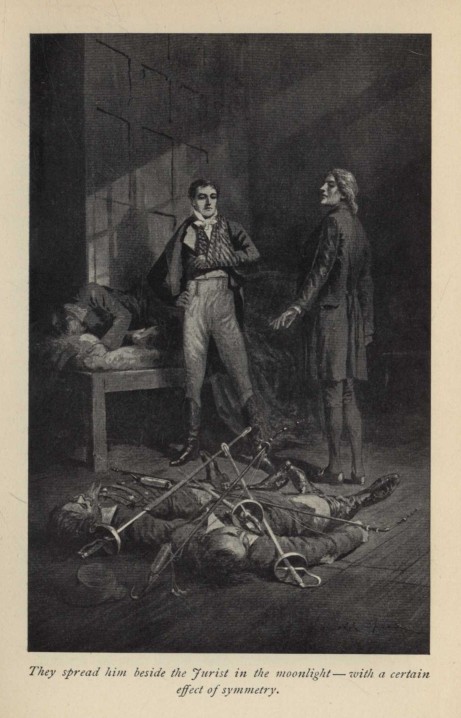
They spread him beside the Jurist in the moonlight—with a certain effect of symmetry.
Geiger-Hans locked the door on the outside and pocketed the key. A second, then he and Steven stood together in the darkness of the landing. Except for the snores from within the room and for similar sounds rising from the kitchen below, the inn of The Three Ways was wrapped in stillness.
Outside, the gale, which had long been waning, had now fallen.
"That is the courier, I take it," said the wanderer. "Did I not say, my noble friend, that I would bring you into the company of heroes? Listen to them! Thus do we conspire in Westphalia!"
When they re-entered the room, the musician went instantly to the window and, opening it wide, stood inhaling in deep draughts the clean airs of the woods. It was that most silent, most mysterious hour of the whole circle—the hour before dawn. More silent and more mysterious, this night, it seemed because of the storm that had passed. Nature was exhausted after her passion, merely shaken by a faint reminiscent sigh that came stealing with scarce the quiver of a leaf, as from a tired heart.
The night sky held a strange depth of blue against the garish yellow lamplight within; the stars were paling. With head, thrown back, the wanderer stood gazing upwards. There were moods of his strange comrade that Steven had learned to respect. He therefore neither spoke nor approached; but, after completing the purification of the room by the simple process of turning out all the cans and bottles, he sat down and waited, absorbed in his own painful reflections. At last Geiger-Hans drew a deep breath, and, leaving the window open, sat down facing his companion. The contents of the rifled mail-bag lay between them.
The musician's face looked pale and severe. Still in silence, he began to toss such packets as had escaped violation back into the bag.
"Will you give me my letter, please?" said Steven, dully. Then his youth and hot blood betrayed him into a cry: "Oh, I am miserable!"
The older man glanced at him from under his eyebrows. It was an odd thing—for what was he, after all, but a poor, half-crazed, broken gentleman? yet there was a certain smile of this Geiger-Hans which made the world seem warm to the rich and highborn Steven.
"O blessed unhappiness of youth!" cried the musician in his old manner, mocking yet passionate. "Did you but know it, these pangs, these sighs, will be sweeter to the memory of your old age than your youth's most satisfied ecstasies! Here is your letter, boy. Go, weep and rage upon it, if you will, with all the fury of your checked aspiration.... What, you open your arms, and she is not ready forthwith to fall into them? You condescend to run after her, and she does not instantly stand still to be caught! You thought that to-morrow's sun would see you with your bride in your embrace, and behold! you have yet to woo her? Bewail your hard fate, you are indeed to be pitied!"
"Would you not like your fiddle?" cried Steven, as he caught the half-folded sheet that the musician tossed towards him, "that you may set my folly to a tune? When you want to sermonize, I had rather you did it on the strings, if you don't mind."
For a second Geiger Hans seemed about to resent the pettish speech as an impertinence. A frown gathered; but, with a short laugh, broken by a deep sigh, he resumed his air of sad serenity.
"Nay," said he, stroking the strings of the instrument that Steven pushed towards him, and then laying his hand flat upon them to still their wailing, "did I make music to-night, it would not be music for your youth. Fool!" said Geiger-Hans, fixing his mad, brilliant eyes upon Steven, "is she not living, she whom you love? and you prate to me—to me, of unhappiness!"
Though the words were harsh, his tone was strangely gentle. Had Steven dared, he would have put out his hand to touch the speaker.
The wind was rustling through the trees; there came a stir and a murmur from the woods; the purple-blue depth of the sky seemed to quiver with pallid changes.
"It is the dawn," said the fiddler, in a worn voice. "Get you to that couch again, for you must sleep, and we have a day of action before us. Aye, take that letter with you and lay it under your cheek. If it seem cruel, have not her fingers touched it? Ah, if you but knew from what a wounded heart, perhaps, sprang those reproachful words! Why, if she has pride, man, will she not be the fitter mate for you? And if she will have naught of a loveless marriage, is it not because she would have love? Poor little Sidonia ... who only yesterday was a child! You have awakened a woman's heart in her; see that you know how to meet that heart's measure."
Steven stood by the couch, palpitating to the words, to the golden visions they opened before his fevered eyes.... Sidonia, the child, with her yellow plaits of hair, with her eyes brown and green, clear yet deep, like the brook under the trees.... Sidonia, whose lips he had kissed; who had smiled at him under her bridal veil!
Geiger-Hans had said he would make no music; but it was the music of the gods his words had evoked in the dawn. Presently the older man looked up from his dreary abstraction: Steven, stretched on the sofa in all the abandonment of young fatigue, was sleeping like a child. The watcher's features relaxed.
"O bella Gioventu...!" he murmured. Then he looked down at the scattered sheets before him, and his lips twisted in bitter mockery. Here had been a night's work of petty crime under the fine-sounding title of patriotism and national conspiracy. But might not now some good be brought out of it after all? How sound the fellow slept! Not that he, the wanderer, envied any sleeper but him that would never wake.—Well, to work!