Front matter (continued 2)
Reading edition
"If you'd only come out sometimes, and walk with me!" said little Sidonia, smiling.
"Walk, child? Your uncle knew well what he was doing when he stuck me up on this diabolic crag. I have not a pair of shoes that would last me half-way down. And merely to look at the road that leads to this place! Oh!"—she covered her eyes with her hand and shuddered—"it makes me reel with giddiness!"
"It was very lovely in the forest," said Sidonia. "The wild raspberries are nearly ripe, and——"
"Raspberries! Alas! is that what you ought to think of at your age? You, too—'tis monstrous cruelty!"
"The fawns are growing and are so sweet——"
"Fawns! Fawns? 'Tis a lover should be sweet to you. As for me—oh woe!"
Sidonia, slight, slim, and sun-kissed as a young woodland thing herself, grew crimson behind her aunt's dejected head.
"Why—why, then, does Uncle Ludovic keep us here?" she queried.
Uncle Ludovic's lady flounced round in her chair, her eyes darting flames, a flood of words rising to her cherry lips—
"Why? Because, my love, the creature is a Barbe-Bleue. And to be a Bluebeard, child, means that if a wretched woman has been fool enough to trust you, you think you have a right to chop her head off if she disobeys; and meanwhile to shut her up to prevent her having so much as a chance."
"I wonder why you married Uncle Ludo?" mused the girl. Her eyes were dreaming, across the fair plain-land, into the distance. To give your life to some one quite old and quite stout, with a grizzled double chin and veins that swell on a red forehead (ran the fleeting thought), when, about the ways of the forest, a young knight might be met wandering ... a knight with hair that crisped back from forehead of ivory, with eyes that were scornful and full of fire!
"Why did I marry him?" returned the Burgravine, sharply. "Ah, he was very different then, my dear! The monster! how he deceived me! Do you think I should ever have consented if I had not known that he was King Jerome's minister; if he had not promised me that we should live at Cassel; if I had not been told that one was more gay at Cassel now than at Paris itself? And honourably I was served, was I not? Ten days at Cassel, while there was scarce a cat stirring, the King called away by the Emperor, then snatched off to this place, this bald, hateful eagle's crag, at the first hint of any gaiety. Men talk of their honour, my love—a big word behind which they can play any trick upon us poor women their humour may prompt." Her voice broke shrilly. Then she added, with sudden calmness: "And if I had had a silver groschen to my name, you may imagine 'tis not old Wellenshausen's second wife that I should be—but some fine young man's first one. Sidonia, how unfair is fate!" She looked enviously at the girl. "There are you, with all your money, who will never have a suitable notion of what to do with it, while I—I——" She snapped two taper fingers together sharply and twisted a dear little plump shoulder well-nigh free of the fashionable Viennese robe, which looked so oddly out of place in the mediæval severity of the tower room.
There was silence, while Sidonia reflected. The Burgravine had a way of opening strange perspectives before the young mind that had hitherto known but the simplest and straightest outlook on life. Wonderful customs had the new mistress brought to the old Burg—odd fads of fashion, new hours of meals, new liveries and unknown demands on the servants' attention. A prisoner, she assumed supreme authority within the limits of her prison. It sometimes seemed as if the very stones in the old wall were echoing surprise. Sidonia, who had run wild within them, near seventeen years of happy unexacting childhood, found herself frequently marvelling at a code of morality so startling in its novelty as to range beyond her judgment. She felt that she could as little fit herself to this new aunt's view of existence, as her modest country limbs to one of those outrageous garments of Viennese mode, over which the Burgravine could sigh a whole morning through in rapture and regret—lamenting, with the voluble aid of Mademoiselle Eliza, her French maid, the opportunities lost in this God-forsaken corner of the world.
"And pray," said Bluebeard's wife, after a pause (never a very long one with her, for, if Sidonia had the gift of silence which belongs to all creatures who have lived much with nature, her Aunt Betty possessed it not at all), "and pray, how many days is it since your uncle took the road for Cassel, a-bursting with hypocritical sighs of farewell?"
"I don't know," said Sidonia, starting from her dream. "Ten days?"
"Ten days!" The words were echoed in a high pitch of indignation.
"Three weeks, then," amended the girl, hastily. "I really don't know; time goes so fast."
"Time goes so fast! Oh, you—you...!" Cherry lips of scorn babbled vainly in search of fitting epithet. "You—you're his own niece!"
Yet as life would have been distinctly duller were she to quarrel outright with Sidonia, the Burgravine quickly turned the batteries of her wrath to the old direction.
"Little did I think on that day, when my father, away in our dear Austrian home, bade me hasten to the great salon and pour out coffee for the gentleman from Hanover who had come to buy our horses—little did I think what lay in store for me! 'You must smile on him, child,' said my mother; 'he is an old nobleman, very rich; and if your father sells well, it may mean a month in Vienna for you!' Ach, heavens!" said the Burgravine, "think of me, my Sidonia, smiling, in my innocence, on him—on him! And who was bought and sold? It was poor Betty!"
"I think it is very wrong of Uncle Ludo," asserted Sidonia, severely, a flush rising to her sunburnt cheek. "Why, since he has married you, will he not trust you?"
"Why? Because, having spent most of his life studying our sex, the man now flatters himself upon a wide experience of our frailties. Because, having so often proved how easy it is to break the marriage vow, he can put no confidence in another's keeping it. Because," and her bosom heaved with indignation, "Cassel is the most amusing spot at this moment in the whole of Europe—they say it is gayer than Paris itself—and no husband who respects himself can take his pleasure with any comfort, if he does not feel that his wife is correspondingly bored."
"But uncle has his Chancellor's duty," resumed Sidonia, after pondering upon these enlightening remarks.
"Chancellor's duties!" The lady drummed on the diamond panes. "Oh, yes, my love, King Jerome requires onerous duties of his ministers, and I've no doubt that Ludovic performs his con amore.—How soon will you be eighteen?" she cried suddenly.
"In four months," said Sidonia.
"Four months—an eternity! Alas, my love, long before that I shall have been laid in that hateful chapel of yours; in that very vault, no doubt, where lies my predecessor—that fool of a woman who resisted such a life as this for twenty years, and yet had the inconceivable want of tact to die at the very moment when I was ripe to fall a prey to the monster."
"Poor Aunt Hedwige!" said Sidonia, reflectively; "she was very fat and never unkind, and I don't think she was unhappy."
"Ha!" muttered the Burgravine, vindictively, "I'll warrant he might have brought her to Cassel with impunity."
"He didn't, though," said Sidonia.
"No, child," pursued the other, with much rancour, "woman's place is at home, you see, while the man is abroad—aha!" She set her teeth and growled behind them like an angry Persian kitten. Then she snapped at her niece: "And you haven't even the intelligence to be eighteen yet, and be of some use for once in your life! Yes, never look so astonished; you're not a fool, child; you know that when you are eighteen, you will be free, and the richest woman in Thuringia—owner of half the wretched little province; free, girl, free to do as you like, to live where you like, to have your own establishment, to spend your own money—and then there'd be a chance for me! Ah, but you would not give it to me. You would let dear uncle manage as he's always managed, and dole you out a thaler here and a louis there, and let him choose you a nice husband ... who would not look too much into the accounts, I'll warrant."
"Aunt Betty!" panted Sidonia. The Burgravine stopped, slightly abashed by the fire that flashed in the child's glance. "If you can't forgive Uncle Ludo for being your husband, don't forget that he is a man of honour...."
"Oh, patatata!" said the lady, with a shrug, "here's mighty fine talk! Manage your own affairs, my dear. I'll say no more."
She leaned her plump arms on the window-sill again and turned her back on her niece with an air of determined sullenness.
Sidonia was very angry. She sat down on the high-backed chair and set the ancient spinning wheel whirring with a hand that trembled.
"One thing is certain," she resumed in a choked voice, "if I ever do marry, Aunt Betty, I shall choose my own husband."
"Of course, among the crowds that besiege the gay Burg of Wellenshausen, up in the clouds, my sweet creature," said the Burgravine, without turning her head, "you will have only l'embarras du choix and then——" But here she interrupted herself with a sharp ejaculation. Her fingers ceased their angry tune. She swung back the window a trifle wider and leaned out further than she had ventured upon her threat of suicide. "Look, look!" she cried in altered tones. "Do you see? There are two men coming up the road with a pack-horse. No, 'tis a donkey!"
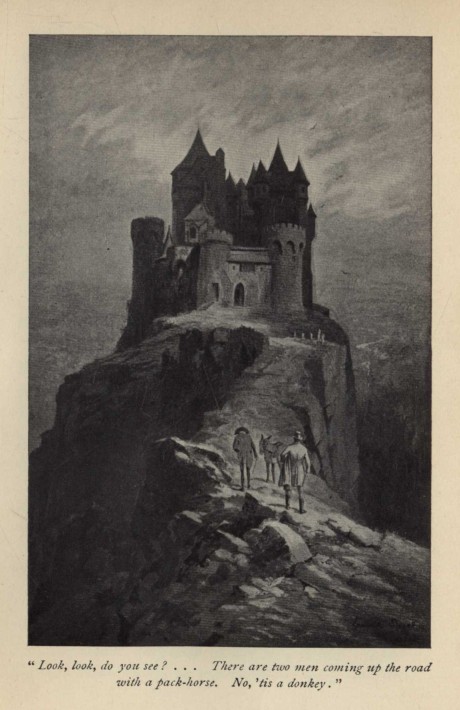
"Look, look, do you see? ... There are two men coming up the road with a pack-horse. No, 'tis a donkey."
Sidonia sprang up and leaned out eagerly across her aunt's shoulder. They were but a pair of children of different ages, when all was said and done.
"It can only be the miller's boy and the gardener ... or the shepherd," opined she.
"Oh, yes, the very outline of humpback John and the swing of bandy Peperl!" (This was sarcastic.) "To the hangman with these evening mists! Now, now, see! a gentleman, or I'm a goose-girl ... a young man, or I'm a grandmother! Poor things, how they toil!"
"Why, 'tis Geiger-Hans!" exclaimed the lady's niece, in amazement. But it was not, surely, the sight of Geiger-Hans which brought such crimson to her cheek.
"And who may Geiger-Hans be?" cried the Burgravine.
"My dear friend, everybody's friend, Geiger-Hans the roadside player," said the girl. "Why, you have heard me speak of him many a time. If he were young and wore a plume and a dagger, people would call him a minnesinger. And his music—ah! it moves the heart like——"
"Why, the creature's a beggar, child!" interrupted the lady, peering down. "But the other——"
She drew back from the window in great fluster. "It's quite clear that you and I have company at last. Oh, for once I will be mistress here! They shall be admitted, maugré my ogre! Call Eliza! Get you into a decent gown, for Heaven's sake! My rose taffeta—it shall be my rose taffeta. And you?—Wear anything but white at your peril!"
CHAPTER VII
GUESTS OF CHANCE
"'Twould be a wildish destiny
If we, who thus together roam
In a strange land and far from home,
Were in this place the Guests of Chance!
Yet who would stop or fear to advance...?"
WORDSWORTH.
"The Lord Burgrave is not at the castle. The gracious Lady Burgravine never receives visitors."—Thus Martin the gatekeeper, thrusting his ugly head out of the vasistas of the great nail-studded door.
The last of the sunlight had faded. Grey and sheer rose the Burg walls and turrets above the visitors' heads; sheer and grey fell the mountainside away at their feet.
"Mark now, comrade, for here are we back in the Middle Ages," whispered Geiger-Hans to his companion. Aloud he cried to the porter, who was slowly withdrawing his countenance: "Half a minute, friend, and let us examine your statement. That the Lord Burgrave is away, I am aware; but that your lady does not receive has still to be proved. How if we two come upon the invitation of His Excellency himself? Consider me that."
Through the gathering gloom Steven peered at the musician's mocking features. Martin the doorward stared in silence for a moment; then, with a great groaning of bars and grinding of keys, set the heavy door ajar—not to admit them, indeed, but that he might stare the closer.
"Martin," pursued the fiddler, gravely, "your name had better have been Thomas: you were born an unbeliever."
"My orders are," said Martin, in surly tones, "to admit no one."
"Fellow," said the fiddler, "a servant's orders, I take it, are not like the Ten Commandments, but subject to variations according to another's pleasure. What if I tell you that, knowing your master——"
"You? Know my master!" The doorward's teeth showed like an old dog's in a grin, half scorn, half doubt.
"Aye, we have but recently parted. By the same token, friend, he is now at Halberstadt and may be here to-morrow. Meanwhile, as it is damp and night falls, admit us to your stone hall and let us sit, for you will be wise to gaze at us a while longer before you take upon yourself to drive off the lord Burgrave's friend and the lady Burgravine's kinsman from doors to which they have been invited. Look at that gentleman. There is a gentleman for you, from the crown of his noble head to the sole of his high-born foot! And look at me! Ah, you know me! Geiger-Hans, am I not? Beware, Martin, great people have their disguises."
Martin showed signs of agitation and yielding. Geiger-Hans, keeping him under the raillery of his glance, pursued his argumentative advantage:
"Now, cease scratching that grey stubble, and I will tell thee what to do to save thee from a false step. Go thou to the gracious lady, and ask her if her lord has not advised her of the probable visit of two travellers, and request of her whether (these two gentlemen having presented themselves) it is not her wish, in obedience to her lord, that they should be admitted. Meanwhile, we shall sit on this bench, and I shall beguile my noble companion's weariness with a little air of music."
The porter withdrew slowly, without another word, but not without casting backward glances of doubt upon the new-comers.
"How do you dare?" asked Steven, fixing almost awestruck eyes upon Geiger-Hans, who, nursing his instrument upon one knee, was coolly winding up the strings.
"Dare, I?" He twanged the cord, shook his head, and fell to screwing again. "Why should I not dare? What have I to fear? What have I to lose? We are sure of a welcome, I tell you—of a supper, and of a good joke."
"Your magnificent audacity!" said Steven, sitting gingerly down at the end of the bench, and looking at the other's lean figure as if it had been that of the Prince of Lies himself. "Positively, I myself could hardly believe you were not speaking the truth."
"And so I was," said the other, composedly. "Not one word but was solemn verity."
"Oh, but stay! How come I to be kinsman to the Burgravine?"
"You are Austrian," quoth the musician. "So is she, as I happen to know. Both the finest flower of the Empire's aristocracy. If you're not related somewhere ... I'll eat my fiddle."
"Upon my word!" ejaculated Steven, opening his eyes very wide. "I suppose it is on the same kind of plea that you have your acquaintance with the Burgrave. An intimate acquaintance?"
"Intimate. I have said so. The Burgrave of Wellenshausen is a type that is true to itself."
"And he has invited us to visit the Burg?" Steven's tones broke into mirth.
"Indubitably." The player raised his fiddle and drew a long note from it that was a musical mockery of the young man's high key. "The husband who locks up a light-hearted wife alone in a solitary tower invites in terms most positive every gentleman of heart and spirit in the country to come and console her. M. de Wellenshausen is at Halberstadt, on the King's business—I was playing at the Crown Hotel. He will be here to-morrow. And he said to me: 'Friend'—mark you, friend (the Burgrave had dined satisfactorily; the wine is excellent at the Crown), 'you must come and play that tune at my castle.' He's fond of music, you see. 'Twas a promise. And the only person who will lie in the whole matter to-day is the noble lady Burgravine. She is dying by inches of ennui, and she will—be quite certain of it!—she will assure the porter that our visit has indeed been announced to her. 'Tis to be regretted, but such is the way of women who eat their hearts away in lonely strong houses."
He caught his fiddle to his breast: liquid melody flowed out into the empty hall, and went echoing down long passages and up into vaulted roofs. Like rabbits from a warren, now a scullion popped a head out of some dark corner, now a rosy wench half opened a side door and peeped, smiling. There awoke all about the sleepy castle a sound of skirmishing and tittering; now a patter of bare feet; now the tramp of boots that no precautions could hush. At length the majestic form of the major-domo himself appeared before the vagrants, magnificent in his silver chain and silk stockings and buckle shoes. Geiger-Hans hushed his music and leaned over to Steven to whisper in his ear:
"See, he has been putting on his grand garb of ceremony to deliver his lady's little lie."
"The high-born, my mistress, had not expected you before to-morrow," said the butler, with a deep bow to Steven. He cast a fish-like eye of astonishment upon the fiddler, but, nevertheless, pursued: "Will your honour follow me to your apartment?" Again he stared at the musician, who nimbly rose and bowed.
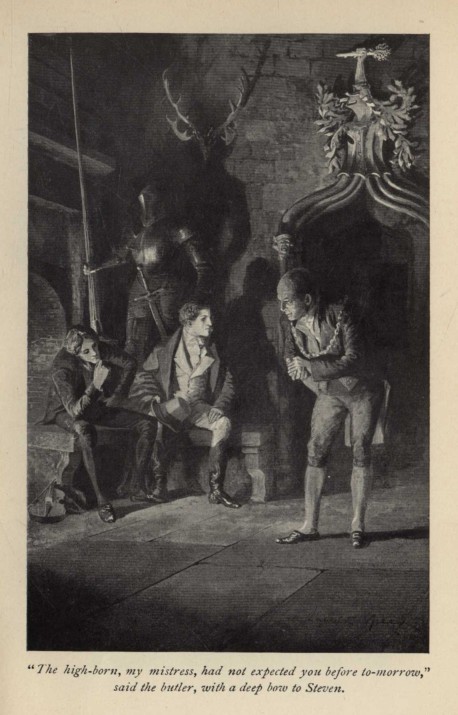
"The high-born, my mistress, had not expected you before to-morrow," said the butler, with a deep bow to Steven.
"My honour will also follow," he said blandly. "Our valise is on the donkey's back, at the door; see to it, my man."
* * * * *
If Geiger-Hans were surprised at his own success, it was only the humorous twitch of his eyebrows that betrayed the fact. He was of those, apparently, whose talent for seizing opportunities generally evoke the belief that they have created them.
"Comrades should share and share alike," said he presently, laying down Steven's brush, which he had been wielding dexterously on his own locks—"lend me a black ribbon for my queue—it is out of mode, but I am of the old stock. I have been shaved à velours to-day—'twas an inspiration! A cloud of powder would complete me, but you new-century bucks know not of these refinements. Nay, but here is a pot of the finest Parma, as I live! For the chin and cheek of milord after the razor, no doubt? Now shall you see how it became the countenance of a better-looking generation.—I think that black suit of yours so neatly folded in the corner of our valise is, perhaps, what would best grace my gravity. Yes. And a ruffle shirt.... Thank you. Ah! ... And those violet silk stockings."
Steven stood hypnotized.
"Your eyes will positively drop out," said the fiddler, "if you stare any more." He drew a snuff-box from his discarded coat, and tapped it with his finger. "A pinch is but a poor thing, if a man has not a frill to his wrist," he said. And he was apparently not ill-pleased to see how Steven marvelled at the grace with which he swung his borrowed laces, the air with which he flipped an invisible atom from his cuff. He took a step, as though his legs had never known but silk. Steven's suit, if a little large, hung on his figure with a notable fitness.
"As I live!" cried Count Waldorff-Kielmansegg, with a loud laugh of discovery, "a gentleman, after all!"
Geiger-Hans drew his black brows together with his swift frown.
"Your equal, you mean, doubtless?" said he, dryly. "You do me too great honour." Then his eyes softened again, as in his turn he surveyed his companion. "Come," said he, "I would give all my superior years for some of your youthful disabilities. I cherish no illusions as to which of us the fair Burgravine will deem the better worth her notice."
And, indeed, when the two were ushered into the long, dim, tapestry-hung saloon, the bright eyes of the lady of the castle merely swept Geiger-Hans, amazingly distinguished as he was in his borrowed plumes, to rest with complacency on the youth who followed him.
Steven held his head high, after the fashion of your shy, self-conscious fellow. But his head being one upon which Nature had set a noble stamp, this became it well. If there was pride in the arch of his eyebrow and the curl of his lip, there was, likewise, race to justify it. Betty, the Burgravine, could note as much between two flickers of her long eyelashes; note, too, that (thank goodness!) he wore none of those new, odious Cossack trousers, but kept to the fashion which made it worth while for a man to have a good line to his limb; note, furthermore, that plum-colour frac, maize waistcoat, and dove-grey kerseymeres make excellent harmony with rose taffeta. The lady had been created for courts, and even now, perched like a humming bird in the eyrie of a mountain eagle, moved in a gay, trifling atmosphere of her own. And, as he returned her gaze, Count Steven, who had also been constructed for the high places of life, felt that he was in his element once more.
"The—the gentlemen!" announced Niklaus, with a nervous giggle. He knew Geiger-Hans—as who did not that belonged to the country-side? But familiarity had not so far bred contempt, and neither he nor his compeers would have ventured to question anything the mysterious being chose to do. Had the fiddler desired himself to be announced as the Archangel Michael, or Prince Lucifer, or the Emperor Napoleon, or the Wandering Jew, Niklaus would scarcely have been surprised.
The rose-red lady advanced a sweet little sandal and made a profound curtsey. Her classic top-knot of curls was richly dark, and so was the olive velvet of her cheek; but as she looked up slowly from her inclination, Steven was quite startled to find that her eyes opened blue as forget-me-nots.
"Gentlemen!" ejaculated she, translating Niklaus' clumsy Saxon German into tripping French—it being the tone of German Courts to speak French. The blue flowers of her eyes widened in surprise upon Geiger-Hans. She had not known there were two gentlemen when she looked forth from the window; only the goodly youth and his roadside guide. But this elderly person was a gentleman, no doubt about that, and a fine one, too.... Only, so old!
And now he took the lead, as became his years.
"Madame la Comtesse," responded he; and even Steven, in spite of his Anglo-Austrian ear, could note the exquisite purity of his Gallic accent, "permit two travellers to express their gratitude for the generous alacrity with which you have granted them hospitality. We had lost our way——"
"Lost your way!" interrupted the lady; and an irrepressible smile curved her lips upwards.
"Yes, madam," pursued the other, imperturbably; "and, with the night coming on, in this wild and mountainous district, Heaven knows what might not have happened to us!"
"I know not what your destination may be, sir," answered she, drawing back with a faint air of haughtiness, "but surely yours is a strange itinerary that took an isolated crag on the road."
"Madame," said he, "we gave ourselves infinite pains to attain this height."
The glance towards herself, the touch at his heart, the bow, made of these words a delicate compliment. The line of her mouth began once more to waver.
"To have gone down again, madam, would have been impossible. Our itinerary, as you say, is perhaps difficult to explain. If I were to tell you that we took a wrong turning, my friend here would correct me, for he is convinced, madam, it was the right turning, since it brought him to your feet."
Here Steven could do nothing but bow in his turn. This he did, however, with such youthful grace and so ardent a look, that his hostess melted outright into smiles.
"Sir—!" said she, coyly; and the young man felt he had been eloquent indeed.
"Count Steven Lee zu Waldorff-Kielmansegg," introduced Geiger-Hans, with a wave of his arm.
"Lee? ... Waldorff?" quoth she, surprised.
"Steven Lee in England, Waldorff-Kielmansegg in Austria," said the fiddler, blandly.
"O du mein lieber Oesterreich!" she exclaimed, singing; and the forget-me-not eyes became suffused with the tear of sensibility.
"Waldorff-Kielmansegg of Waldeck," enumerated the master of ceremonies; while Steven stood in dignity, conscious of his honours.
"Then we are cousins!" She clapped her soft palms; the rising emotion was forgotten in laughter. "Positively we are cousins. I am Schwartzenberg—Betty von Schwartzenberg—and my mother's second cousin, Rezy Lützow, married Tony Kielmansegg. You are welcome, my cousin."
She held out her hand. He kissed it ceremoniously; and she, bending forward, sketched a butterfly salute on his forehead. It was the custom in his father's country; but he had lived long enough in England for it to have grown unfamiliar. His heart contracted with a delicious spasm, and the blood sang in his ears. Before he knew what he was doing, he found himself holding the taper fingers close, found his lips upon them again.
Perhaps the lady was displeased; but, if so, she cloaked the fact with a very pretty blush, and, as they drew apart, there could be no doubt but that the young visitor's position was established. She now looked expectantly towards the elder of her guests.
He stood watching them with quizzical gaze, tapping his snuff-box, one leg becomingly advanced. She waited to hear a no less fine-sounding introduction. But as the waiting was prolonged to almost a hint of awkwardness:
"Will you not," said she, "Cousin Kielmansegg, return Monsieur's good offices?"
It was Count Steven's turn to blush.
"My friend," said the fiddler, after enjoying the poor youth's agony with a relentless eye for a second or two, "has been content to accept my companionship as entertaining and useful to himself without inquiring into my ancestry. But such indulgence, my gracious hostess, I cannot claim of you. Through all the noble blood that flows in your veins, there mingles, of course, still a drop of Mother Eve's. Permit me to make myself known to you as Jean, Seigneur de la Viole, Marquis de Grand-Chemin.... I lay but a couple of my poor titles at your feet."
She pondered awhile, nibbling her little finger, her delicate eyebrows wrought as if in effort of memory. Then she said with gravity:
"Your name, sir, has an ancient sound."
"Madam," he responded, "I would not boast, but there is none more ancient in our world."
Over again she pondered, looking down at the tip of her sandal. The blue eyes took stock afresh, and, thereupon, sunshine chased the gathering cloud from her face. With the air of one making up her mind to be amused without questioning:
"You are welcome, too," she said, "Monsieur My Guest."
"Ah, madam," responded he, "pity that this, the fairest of my titles, must needs be the most fleeting!"
Tying a blue riband into a hasty knot as she came, entered Sidonia, almost at a run. All this time she had been striving to turn her heavy fair tresses into the fashionable top-knot, as demonstrated by Countess Betty—with what result her aunt's first glance of pity told her but too clearly. She halted in her rapid advance, and stood, blushing like a school-girl, unable to lift her eyes.
"Child," said the Burgravine, "here is my cousin, Count Kielmansegg, who could not pass by his kinswoman in exile without personally inquiring after her well-being." When Sidonia ventured a stealthy look, it was to find—oh, bitter moment!—that she was unrecognized. "And this gentleman——" pursued her aunt, with a small, sarcastic smile.
The girl, bewildered, had begun her second curtsey, when she stopped herself with a cry of utter amazement—
"Thou, Geiger-Onkel!"
"Madam," intervened the fiddler, gravely, addressing the Burgravine, "that is yet another of my honours—to young people who love my music, I am the Geiger-Onkel."
"We are decidedly en famille to-night," said the Burgravine, with a trace of acidity. "But here, child," she proceeded in a meaning tone, "your friend had better be known as Monsieur de la Viole."
"Marquis de Grand-Chemin," insistently added the vagrant, with his courtly bow.
"Marquis de Grand-Chemin," admitted the lady. Nevertheless, it was the arm of her cousin, the mere Count, that she took to conduct her to the dining apartment.
CHAPTER VIII
ROSES OF TRIANON
"As for the girl, she turned to her new being—
Loved, if you will: she never named it so:
Love comes unseen—we only see it go."
AUSTIN DOBSON.
The servants had retired: Master Geiger-Hans' promised supper-party was over. It had been to the full as succulent and as elegant as he had foretold. And now, holding the stem of a long cut-glass beaker between his second and third fingers, he was gazing abstractedly at the noble wine. Where were his thoughts, and why was he so dull all at once, with flower and silver before him, crystal and fine porcelain? With the ruby waiting in his cup, too—the ruby of that noble "Clos Vougeot" before which Bonaparte, the republican, on his way to Italy, had made his soldiers halt and present arms as to the prince of vintages! Geiger-Hans, who could sing over a hard crust by the dusty roadside and give thanks for the water of the mountain stream, had he had his violin in his hand now, its music would have been of tears.
His eye moved. It rested first on the fresh briar-rose face of the girl with a strange look of tenderness; then it fell upon the Burgravine. Her plump, olive shoulders half out of her gown, her exquisite little doll face thrust forward—the whole of her an altar to admiration—she was offering herself in eagerness, in ecstasy, to the fire that was beginning to kindle in the hitherto decorous countenance of the youth opposite to her. And as the musician noted this, he frowned and his lips curled into contempt. Then his gaze sought Steven. He saw the flush upon the boy's cheek and the light in his eye; and his frown grew deeper. This trivial flame was none of his kindling.
He turned in his chair and looked again keenly at the silent girl. There was something austere in the mantle of pride and shyness in which she had wrapped herself.
"Little Mamzell Sidonia!" said he, softly. She flashed a glance at him and her eyes filled. "Shall I make you some music?" His face relaxed into tenderness again as he spoke.
She nodded. The corners of her mouth quivered; if she had said a word, she must have burst into sobs.
"She but put a pillow under his head," thought the fiddler, "and that was enough to make the flower of love blossom! Ah, youth! Poor heart!" Once more he regarded the other pair, who were now whispering.
"After the feast, the dance. What say you?" he cried.
"Oh, the dance, the dance!" exclaimed the Burgravine, leaping to her feet.—What a woman, what a puppet!
"Then I will play to you," went on Geiger-Hans. And grinning Niklaus was despatched for his violin.
"It shall be a minuet," said the player after a pause, on the echo of a sigh.
Then the Marquis de Grand-Chemin waved his bow with a flourish. The ruffles at his wrists flew, he took a step with a grace: it was as if a fragrance from dead Trianon roses were wafted in between the barbarous Gothic tapestries of the Burg.
"It is the dance of great ladies and fine gentlemen," he said, beginning a melody of bygone days, mingled with archness and subtle melancholy. And playing, he went on, his words winding themselves with a kind of lilt of their own into the garland of sounds: "You, sir, bow with your hand on your heart. You take her hand and you look into her eyes. 'Ah!' say you, eloquent though silent, 'to hold those delicate finger-tips, madam, through life ... to have the rapture of your sweet company ... then, indeed, would every step be music!' 'Oh, sir' (says she in the same language), 'you overpower me!' And with this she sinks from you into a curtsey that is all dignity, all grace. Again you bow—'of a verity you did not deserve her!' But what is this? Her hand is in yours again. Oh, this time you draw closer to her ... you hold her little hand aloft! The satin of her gown whispers to your damask—her shoulder for one instant touches yours—you lead her from right to left—with what pride, heavens! what respect! You turn her lovely form, by the merest hint of your adoring fingers, from that side to this, that all may see, and see again, the prize that has fallen to your lot...."
"We do not dance the minuet in our days," interrupted Steven, with bashful resentment.
John of the Viol's delicate measures, that had rung half humorous, half pathetic, wholly sweet, as memories of past delights must ever be, ceased abruptly. He gave the young man a dark look as he held his bow aloft.
"No," said he, "you are right. The minuet has gone to the guillotine. France has brought new dances into fashion: Ça ira, Ça ira ... Dansons la carmagnole!" His face grew terrible as he struck the notes of the blood-stained gutter-song into his strings. "New dances for France, that she may dance to her death!..."
"Fie, the ugly tune!" said Countess Betty. No shadow of the musician's tragic passion was reflected upon her face. "Monsieur le Marquis, play us a valse!" She caught joyfully at her own suggestion as a child its ball. "A valse, a valse! Beau Cousin of Kielmansegg, they tell me 'tis the rage. A pin for your old minuets!"
"A valse be it!" said Geiger-Hans. Anger was upon him, and he made his violin chant it, setting it and the brutal irony of the "Ça ira" to the rhythm of a fantastic valse. "Twirl, vapid heart and empty head! Hold her, prance round with her, feel your goat's legs growing, you who might have lifted your head with the gods and known the matchless rapture of the heights! Is it for this that you are young?"
Faster and faster went the music, fevered, with mad, shrill skirl; and faster the whirling. Beau Cousin began to pant. He held Belle Cousine so close to him that she, too, scarce could breathe. Loose flew her hair—one little sleeve almost broke across the heaving shoulder. Sidonia could look no longer; she turned to the window and leaned her hot cheek against the pane, staring at the stars with burning eyes. Something clutched at her heart and throat with a fierce grip.
Without warning, Geiger-Hans brought his bow across his strings with a tearing sound, and, as if a sharp sword had fallen between them, the dancers fell apart, astonished and not a little confused.
Steven staggered and caught at the chair behind him. The Burgrave's lady put a hand to her dishevelled tresses, then to the laces at her bosom and grew scarlet: brow and cheek, throat and shoulder.
"You no longer dance the minuet?" said Geiger-Hans, with a little laugh, picking at his now placid strings; and Steven thought that the man had the laugh of a devil and that it was echoed by his instrument. "Oh, you have a thousand reasons, sir, and so has madame, for the valse is a fuller measure. Gracious lady, you are out of breath. May I sit beside you awhile? And you, sir, will you not expound the first principles of this—this graceful and elegant pastime to mademoiselle yonder, whose youth has yet to learn the new fashion? Is it not right, Burgravine, that these young things, after all, should foregather, while you and I look on—you, the staid, married woman; I, the old man?"
She answered him not, save by a look of wondering offence.
"Ah, madam," he went on, as he sat down beside her, "and you are angry with your lord and master because he shuts you up in this strong-house? But, good heavens, it is the proof of his loving appreciation of your value."
"Oh, ay!" she answered in high contempt, "it is a sign of strong affection, doubtless."
"Madam, he lays his treasure where thieves cannot attain it. At least, poor man, so he fondly trusts!"
"And therefore the unhappy treasure is to be consumed by moth and rust," retorted the lady.
"Madam," said the fiddler, in a low voice, "I imagine that the owner of the treasure had reason to fear a more indelible stain——"
"How dare you!" she flashed upon him.
But he was picking his violin with a pensive air. Then he suddenly looked up at her and smiled.
"Ah! most gracious one, if I were the happy possessor of a bird of such brilliant plumage as yourself, I would——" He paused.
"You would what? Pray proceed." She was waiting for her triumph.
"I would open wide all the doors and bid it fly."
And then she called to him again, "How dare you!" And so insulted was she that there came a sob into her throat.
"You see," said he, drawing an accompaniment of whispering notes to his words, "that, after all, it is monsieur your husband's point of view that you think the more complimentary."
"He should trust me," she whimpered.
"Madam, who knows?" he responded; "stranger things have come to pass. Some day, perhaps, the bird will not crave for flight; it may cling to the nest."
His fingers moved delicately; the bow swung with the gentle pliancy of some green bough of spring—it was a measure of engaging rhythm and playfulness; yet soft, soft as, under the eaves, the swallow's note at dawn.
Fascinated, she cried, under her breath: "What is it?"
He answered her, "A cradle song——" and stopped.
His own face had altered indescribably. His restless eye had grown fixed and wistful. Little Madame de Wellenshausen hung her head, and—wonderful indeed—a tear gathered and fell!
* * * * *
Whilst Geiger-Hans thus engaged his hostess, Steven Lee, with slow steps, had gone across the room to the girlish figure by the window. He had grown to believe that the wanderer had some uncanny power by which he enforced his will, after the fashion of that Mesmer of whom one had heard so much. Sidonia turned upon him, with a sudden jerk of her chin, a flash of her eye, as he halted beside her. Upon which he exclaimed in amazement:
"Why, great heavens, you are the girl of the forest house!"
"You have not, I think, sir," she answered him, "eyes that see quick or far; it is, no doubt, your town breeding."
The colour was slowly fading from her cheeks. She held herself very stiff and proud. But he was still all eager over his discovery.
"Geiger-Hans told me how you brought me your pillow," said he, "when I lay hurt in the forest."
"I would have done the same to a sick dog," said she.
"You cried over me when you thought I was dead, he said," exclaimed Steven, stung by her contempt.
"Had I known you better, sir——"
Her eyes were bright and hard, her lip was a curve of scorn and her chin a tilted defiance. But all at once he saw that, under the close-clinging fabric of her short-waisted gown, her heart was beating like a madly frightened bird in the fowler's net. The knot of blue ribands upon her bosom danced with its fluttering. And there came upon him a desire, at once tender and cruel, to feel that beating heart beneath his hand. He gave a short laugh.
"Shall I teach you the valse?" he said, leaning forward. "It is quite easy—just my arm about you, and the music does the rest."
She shrank back with a look that would have blasted him.
"Do not dare to touch me!" Though her heart palpitated into her very voice, she held her head high as the hind in the forest and went on: "I might have danced that minuet, as Geiger-Onkel put it into music. But I don't like your manner of dancing, sir—nor your English manners at all. It would be best if people stayed in their own country." And then, while he stood, as if her childish hand had struck him, she passed from him, paused for a moment before her aunt and the fiddler, who were still sitting together in silence: "I am going to sleep," she said, and went proudly out of the room.
Geiger-Hans had shaken off his musing fit. He laughed out loud.
"What, comrade, won't mademoiselle learn the valse from you, after so pretty a display?"
Madame gazed down at her feet, as they peeped side by side from the hem of her garment, looking, the little humbugs, the pink of innocent propriety. She was subdued, even frightened, and her small heart was unwontedly stirred within her.
"Our evening is finished," said the Marquis de Grand-Chemin, rising with his great air. "Madam, this gentleman and I must march out with the dawn. Permit us now to offer you our very respectful gratitude, and to retire."
She held out her hand, and he took the tips of her fingers, bowing low. She curtseyed. They might have been in his minuet now, but it was with the music left out.
"Good-bye, my cousin," she said timidly. And "Good-bye" said he. They stood stiffly before each other, like two children found at fault. She was longing to tell him that it must not be "good-bye" between her and him. But the fiddler's eye was upon them.
* * * * *
Steven felt the world very flat, even on a mountain strong-house, as he sat down in the state bedroom and began with a yawn to unwind the folds of his stock. Next door Geiger-Hans had locked himself in. He had not spoken to his companion since they had entered their apartment. Count Waldorff-Kielmansegg felt that he was in disgrace with the roadside fiddler, and the sensation was curiously uncomfortable. Suddenly the door was opened and his companion walked in. He was clad once more in his own shabby suit, and across his arms carried the borrowed garments.
One by one he laid them down neatly in the valise, rolling up the violet silk stockings at the last.
"Continue," said he, "my friend, to develop the growth of those goat legs of yours; it will save you in hosiery.—Pulchrum ornatum, turpes mores.... Need I quote further?"
"Upon my soul!" cried the young man, "I don't understand what you mean!" But his cheek crimsoned.
"You disgraced me to-night," said Geiger-Hans. "What, sir! I have the kindness to bring you up here that you may snatch a delicate, courtlike comedy from a lost century, and you turn it into a gross latter-day romp. I bring you from an alehouse into a castle, but you must needs drag up your Teniers with you and spoil my Watteau! I play you a minuet, but what appeals to you is to clutch and to gambade and——"
"You made the music, man," interrupted Steven, sulky as a schoolboy. "And it was she who asked for a valse."
"Mon Dieu!" went on the fiddler, passionately; "it may be that we were no better as to morals, in my youth, than you are nowadays, but at least we took our pleasure like gentlemen. If we plucked a rose, we did it with a grace—between two fingers; we did not tear it with the fist. We did not seize a lady round the body and prance with her like hind and milkmaid; what favours we took we bent the knee to receive. Oh, sir, how little fragrance remains in the flower you mangle thus in your grasp! Three things there are, young man, that he who understands life must touch with fingers of gossamer—a subtle pleasantry, a lady's discretion, the illusions of a maiden's heart. You have laid brute hands on all three to-night.—Fie! you have spoiled my evening."
The contrast between the man in his humble clothes and the arrogant culture of his speech suddenly struck Steven to such a degree that he forgot to be angry in his eagerness to catch further self-betrayal from the fantastic enigma. Become aware of his eye and smile, the fiddler broke off abruptly and, for the first time in their acquaintance, looked disconcerted. Then he gave a good-humoured laugh, and his brow cleared.
"Blind, blind!" he resumed. "Why, was she not worthy of one look, the child in her virginal grace? When I came across you again to-day, under the shadow of the Burg, my heart leaped like a little hare. 'Here is one now,' I told myself, 'who is learning worthily the value of his youth. He shall yet learn of a better than I: for youth must to youth—the creatures of spring to each other.' I resolved, God willing, that the fair romance that fortune had brought across your path in the forest should not, after all, close at the first page. It was but cloud-building; it was but a spring fancy in an autumn dream—fancy of an old fool! Why, you did not even recognize her! Yet she held your head on her knees, when you were hurt. You were a knight to her, all gallant—and now!"
"She seems an ill-mannered child," said Steven, sullenly.
"She is as lovely as the woods at dawn—young, reluctant, mysterious, chill. When I approach her, it is with my hat in my hand. If I were young like you, I should kneel to her. The set of her head, the line of her little throat——" His voice grew suddenly husky. "Her little throat——" he repeated.
And Steven, he knew not why, had an impression of a sadness so piercing that he dropped his eyes and dared not look at Geiger-Hans again.
After a while, with a change of voice: "I will wake you at sunrise," said the musician. "I have promised the children to play for them before school. Besides, I must see you safely to the foot of the hill, ere we part, Count Comrade, having brought you up so high, else heaven knows what fall might not be in store for you!"
And on this he left the room once more.
* * * * *
The crescent moon, very delicate and soul-satisfying, hung in a wreath of watery mist, high in the sky; far down, the plain was wrapt away in white vapour. The rugged walls of the Burg, even its rocky foundations, seemed poised between heaven and earth amid these floating wreaths of immateriality. It was a strange sight. The fiddler sat on the sill of the deep window embrasure, his knees drawn towards his chin, for it was but a narrow space, and his eyes wandered out through the open casement over the unsubstantial world. He looked forth. Downward the gleaming rock emerged into stern reality, out of a dream of vapour. He looked up: the shredded mists were scudding over a faint sky, carrying the moon along, it seemed, with incredible swiftness.
The wanderer sighed. Sorrow went with him in all his ways, though he held so mocking a front to life. It was luxury now and then in the hour of solitude to fall into that deep embrace, and give his very soul to those bitter lips.
* * * * *
Very unwilling was Steven Lee to rise after a poor night. And very ill-humoured was he as they set out at last, with their donkey, breakfastless, together. There was no joy or mystery in the morn; it granted them but white mists that wet like rain and clung close as they descended.
The fiddler was silent, absorbed in his own thought, and paid small heed to his companion's moodiness.
As they crossed the bridge, a travelling-chaise, escorted by three dragoons, came through the haze towards them, passed them at full thunder, and drew up with a clatter some hundred yards beyond. Geiger-Hans smiled sardonically.
"There goes the lord of Wellenshausen to surprise his fond little wife! He is a trifle earlier on the road than I expected. Did I not do well to hurry your toilet? Who knows, you might have been hurried in still more disagreeable fashion.... Well, the episode is over; and though you have much disappointed me, young sir——"
"But what will she tell him about our visit?" interrupted Steven, with some anxiety.
Geiger-Hans remained silent for a few paces.
"That," he answered at last, "is a matter for illimitable fancy."
CHAPTER IX
HOME-COMING
"And then he thought, 'In spite of all my care,
For all my pains, poor man, for all my pains,
She is not faithful to me....'"
(The Marriage of Geraint).
"The visitors are but just gone," said Martin, the doorward.
He stood, his hand still on the fallen bolt, with expressionless gaze fixed upon the Burgrave, not without secret dismay and misgivings. In truth he had but half believed the fiddler's announcement, had scarce expected his master at all that day—certainly not so early. But, now, one would know whether that mad fellow Geiger-Hans had spoken truth about the invitation to Wellenshausen. If he had not, why, honest Martin might well suffer for his credulity. For Martin knew his lord. It were idle to try and hide from him the blatant fact that there had been visitors at the Burg: idle indeed in a house full of silly servants; idle, above all, with a prying fellow like Kurtz, the Jäger, who had his nose into every pot and his ear at every door.
That he, the door-keeper, had admitted a beggar-man to his lord's castle was, however, an exaggeration of the offence which old Martin thought might safely be withheld. Ambrosius, the butler, Niklaus, the valet, and the rest were equally incriminated by having attended upon him, having served him at their master's very table. They would be glad enough to hold their peace on the subject for their own sakes. At the worst, they could all plead ignorance of the visitors' identity. For the rest, had not the Gracious Lady herself given her orders? If the thunderbolt of wrath was to fall on the castle of Wellenshausen, it would fall first and heaviest in the upper chambers.
So Martin had settled his treatment of the situation with a certain dogged philosophy; and his first greeting was the blurting forth of the truth.
"Your Graciousness has just missed the visitors."
The Burgrave, rolling past, still puffing from the arduousness of the mount—for though a vigorous man, he was of heavy build—turned with a grunt of astonishment as the words fell upon his ear. He flung back his military cloak—even a chancellor was military at the Court of Jerome—dashed his lace travelling cap from his head and took two steps upon old Martin. His large unshorn chin shone with myriad grey bristles, which had caught the mist in tiny points of moisture. The grizzled, bushy eyebrows, that nearly met across the large fleshy nose (jealous eyebrows), were similarly beaded. Now they were drawn together in a portentous frown.
A fine-looking man enough in an elderly, hulking way, but scarcely, even in his best moments, an amiable-looking man. Certainly not at his best now, after a night of hard travelling. And as for amiability, that thunder cloud upon his brow was enough to wilt the very conception of it from the thought of man.
Yet it was no unamiable passion that had spurred him along the interminable night-road and up the impossible crags in the wet morn. He was but a six months' husband to his Betty, and he loved her very dearly—after his own Teutonic and rather mediæval fashion.
"Visitors!" repeated the Burgrave. His voice rang out, echoing and reverberating.
Martin's little eyes blinked: that rogue of a Geiger-Hans had lied! So, then, had the noble lady Burgravine herself.
"Two gentlemen, yes. The Gracious Lady bade me admit them. She said that it was by your Excellency's orders;" here the door-keeper risked a sly glance at his master and had, perhaps, an inward chuckle at the sight of his discomposure.
"Scamp, had you not my orders?" roared the Burgrave.
"The Gracious Lady bade me admit them," reasseverated Martin; "the young gentleman being the Gracious Lady's cousin——"
"The young gentleman! The——"
The echoes called out the words again and died into silence. The Burgrave reeled, then steadied himself. Martin saw the empurpled countenance turn to an unwholesome grey.
"The young gentleman," repeated the husband to himself, in a sort of whisper. Then he wheeled round and, without another word, went, ponderous and slow, up the stone steps, his shoulders bent like those of an old man.
* * * * *
Betty was seated before her toilet table, in a very ill humour: the while her woman twisted glossy black ringlets to the tune of familiar lamentations, enlivened by spirits of a petulance unwontedly shrewish.
Betty had dragged her pretty person from the billows of quilt and feather-bed at an astonishingly early hour, in the hope of carelessly intercepting a farewell from her charming young guest. Mademoiselle Eliza, justly irritated at being aroused from those dreams which, she vowed, were now the only tolerable portion of her existence in this dungeon, had purposely withheld from her mistress, until the psychological moment when she could watch her countenance in the mirror, the news of the departure of the guest. And then she had delivered it with all the gusto of the self-respecting servant who has unpleasant information to impart.
"Madame has a very sensitive head this morning; it is doubtless the fatigue of last night. Madame is so unaccustomed now to the least excitement. It is hardly worth while to put madame to the pains of much of a coiffure this morning, since there is no one to see her—but the crows. If, indeed, the young gentleman could have remained: strange how anxious he was to leave! Up and away before the dawn! And slinking out of the castle, one might say. Ho, have I hurt madame again? Did Madame la Comtesse say that he was truly her cousin? A singular story, not even a valet with him—nothing but that old beggar tramp, who dined with madame, also, dressed up in the gentleman's clothes——"
"Hold your tongue!" cried the exasperated lady. She whisked round in her seat, blindly menacing with a brush caught up at haphazard.
At this moment the gate bell clanged; the stone hollows of the castle growled to a loud knocking; and then came the groaning of the great bar.
"Merciful heavens, more visitors!" exclaimed the mistress of Wellenshausen, a lovely geranium flushed into her cheek. Last night's guests back again, perchance. Beau Cousin was too gallant a gentleman, after all, to leave her hospitality in this abrupt fashion.... Perhaps he was wishing to see her again, as much as she was wishing to see him. The little hand with the brush dropped to her side. "Quick, Eliza, who is it?"
Even as she spoke the rich cheek faded; her bright eyes grew round in horror. To one man only in the world could belong the raucous tones that granite wall and roof now gave back in pulsating vibration, rolling up even to the turret room.
"The Burgrave!" she gasped.
Eliza's black eyes glinted joyfully: the Burgrave! Not only fresh discomfiture for the mistress; but, for the maid, unexpected comfort: Kurtz the Jäger was quite a smart young man.
"Heavens, the Burgrave!" cried Betty again; and she began to tremble. Her husband, upon the very stroke of her escapade! What to do, now, what to say?—What indeed!
"Eliza," she cried breathlessly—she snatched a gold brooch from her wrapper as she spoke, and thrust it into the girl's hand—"you knew I was expecting my cousin's visit ... by news brought by the last courier from Vienna ... you heard me mention the fact ... you heard me regret my husband's absence from Wellenshausen."
There was no time to lose. The Burgrave's step, weighty and ominous as fate itself, was already on the stairs.
"Bien, Madame la Comtesse," returned Eliza, calmly, even as the latch clicked under her master's hand.
Betty von Wellenshausen was a woman of too clever instincts to receive, in this dilemma, her elderly lord and master with exuberant expression of delight. She was not of those who fall into the vulgar error of protesting too much. She settled herself in her chair again and became deeply absorbed in the exact position of a curl. He stood glowering on the threshold. He had to call out in his great voice, before she would condescend to notice him at all. And then it was but a glance over her shoulder.
"Tiens, it is you? Eliza, decidedly this is not successful."
Eliza, deeply enjoying the situation, full of professional admiration for her mistress's handling of the same, was also all solicitude over the rebellious lock.
"Ten thousand devils, madam!" at last exploded the Burgrave. "I would point out to you that I am returned from a journey."
"So I see," said the lady, with another fugitive glance. "And so I hear, too, my friend! Heavens, you make noise enough!"
It was such a wonderfully pretty face, of which the husband was given this glimpse; his reception was so cool, so unexpected, that the Burgrave's first murderous rage began to give way to a perplexity not unmixed in some strange way with softer feelings. He closed the door behind him, and then stood, hesitating.
"It is a pity," said the Burgravine, boldly, "that you do not consider it worth your while, comte, to keep me informed of your movements. Had I but known that we were to have the rapture of your company to-day, I would have kept my cousin Kielmansegg to make your acquaintance."
The Burgrave eyed her between rage and amazement.
"Your cousin!" he echoed huskily. Then his fury, on a sudden gust of jealousy, got the upper hand. "Pray, madam," he thundered, "when did you communicate to me the interesting fact of your relative's proposed visit? And when did I authorize you to receive him?"
It was the lady's turn to be astonished; for a moment her quick wits failed to follow his drift.
"When?" she queried, raising a delicate eyebrow. "This is sheer delirium! And if you must rave, my friend, need you shout? I begin to think that my never-sufficiently-to-be-regretted predecessor must have suffered from deafness in addition to the other trials of her existence."
The pupils of the Burgrave's pale eyes contracted to pins' points. He fixed his disobedient spouse with a scarcely human glare.
"Martin is not wandering in his mind, I take it, when he tells me that you bade him admit your friends in my name! By my wish, madam—by my wish!"
The bellow with which, in spite of his Betty's protest, he had begun this indictment, died into a sort of strangled whisper. He struck his palm with his hairy fist. The Burgravine was unpleasantly enlightened.
"Oh, sir," she exclaimed with biting scorn, and shrugged her shoulders, "how well you are served; I make you my compliments!" Underneath her impertinent airs there was fluttering terror. But, like a bird, she would peck to the last. "And did Martin indeed tell you that I bade him admit my kinsman and his companion in your name?" she pursued, drawing a long breath. Then superbly, "It is true, M. de Wellenshausen. Do you mean me to understand that you would have wished me to refuse the hospitality of your house?"
The wave of wrath was again ebbing from the Burgrave's huge frame. He stared blankly at the little creature. Her words had a singular plausibility. She saw her advantage and flew to it.
"My cousin, Count Waldorff-Kielmansegg, is travelling through this country," said she. "My dear mother announced his arrival in her last letter."
"The courier came on Wednesday," interpolated Eliza, pinning the brooch in a slightly less conspicuous position amid the folds of her kerchief.
"She is most anxious to have personal news of my health ... knowing the delicacy of my chest, and how much I am likely to suffer in these harsh airs where it is your pleasure to immure me."
The Burgravine wheeled her chair round to face her lord.
"It is perhaps dull of me," she went on more boldly still, "not to have understood that I am not the mistress of these barren walls, but rather their prisoner. When I heard that my cousin was below, I had no hesitation in ordering him to be admitted. Yes, sir, I even said that it would be your wish.—Ach, Eliza, what a stupid mistress you have! You heard me actually lament, I believe, your master's absence on the occasion!"
"Madame la Comtesse, indeed, made the remark to me," quoth Eliza, "that it was of the last annoyance that Monsieur le Comte should be absent that evening. It was so trying for Madame la Comtesse to have to receive alone!"
"And indeed, my poor girl," said the lady, picking up the thread herself, "I could regret that we should thus innocently have infringed the rules of the castle of—I should say the prison of Wellenshausen—for it was to very poor results. Yes, we should have allowed M. de Wellenshausen's doorkeeper—turnkey, I mean—to send the gentlemen down the hill again. My people would have wondered. But, mon Dieu, will they wonder less when my kinsman tells them of these dismal walls, these rude surroundings, this savage solitude? Poor young man! in spite of his affection for me he could not bring himself to face another day of it.—Eliza, my shoe!"
"Indeed, madame," commented the maid, pursuing the theme from where she knelt to fit each little foot, "the gentlemen would not even tarry for breakfast, so hurried were they to be gone!"
The Burgrave listened, was half convinced, then a fresh spasm of suspicious misgiving came over him.
"Yet, doubtless," he sneered, "not without a satisfying farewell from the hostess! You are strangely early this morning, madame."
The Burgravine raised her blue eyes from the contemplation of her foot.
"You mistake," she said innocently; "our adieux took place last night, shortly after supper. You see, I am not even dressed. And, as to early rising, mon Dieu, my friend, the nights are of such lengths here, that there are times when I think it cannot soon enough be day."
"And ma foi," put in the maid pertly, "then it is the days that are so long, up here in the clouds, that it cannot soon enough be night."
The two women laughed. He stood between them, a miserable clumsy man; conscious of their subtler wits and quicker tongues, a prey to dark doubts and slowly shaping his own resolve.
Betty now jumped to her feet and shook her loose silks and laces about her as a bird shakes its plumage.
"Eliza, inform the Baroness Sidonia of the Herr Graf's return," she bade in an off-hand tone.
The Burgrave thought to catch a meaning glance between mistress and maid. No doubt Sidonia would lie with the other—all women were jades alike. Well! he knew what he had to do; meanwhile Betty was distractingly alluring with all those fal-lals of ribbons and lace, and it was three weeks since he had kissed her. The door had scarcely closed on Mademoiselle Eliza before the Burgrave caught his wife in his arms.
"Ah, mon Dieu," cried she, pettishly, "and pray, sir, when have you shaved last?"
CHAPTER X
THE BURGRAVE'S WELCOME
"I tempted his blood and his flesh,
Hid in roses my mesh,
Choicest cates and the flagon's best spilth...."
ROBERT BROWNING.
"So you have had visitors, Sidonia, my dove? Eh?" said the Burgrave.
His tone was good-humoured, but the glance he fixed upon the girl was cold. He had very pale grey eyes that could stare by the minute together without blinking, a power somewhat disconcerting (he flattered himself) to those who thought to keep secrets from him. Sidonia had just entered the room and was hastening to greet her uncle, for whom she had a certain placid affection. But instinctively she drew back, affronted, upon meeting that gaze. The words of welcome died on her lips.
"Yes, we've had visitors," she answered defiantly, tilting back her head.—Did Uncle Ludo think to frighten her?
"That was delightful," said the Burgrave, his unwinking stare upon her.
"It was delightful," said Betty. She stood behind her husband's chair, ministering to him after the right Germanic fashion he loved; and small scornful remarks on the number of rummers she was called upon to fill with the yellow wine, on the size of the slices of smoked ham he dealt himself, she did not spare him. Nevertheless she watched his appetite with satisfaction. Surely so large a meal and much jealousy could scarce find room in the same frame. "It was delightful, for me at least," said Betty, glibly. "I, who had not seen my cousin, my favourite cousin, for so long."
Her blue eyes rolled warningly at Sidonia, over the top of the Burgrave's stubble head. The girl gave her aunt a quick look, then walked up to the table.
"Good morning, uncle. I hope you are well," she said, demurely now, and laid a light kiss on his temple.
The Burgrave burst into a roar of laughter.
"Come, come, one kisses one's uncle better than that, I hope!"
He caught her by the lobe of her pretty ear, stretched out the other hand and drew his spouse forward by the waist.
"So, here I am, once more, with both my little doves. Aha, what a happy man!—This fine young cousin now, your aunt's old play-fellow ... you'd heard of him before, eh, Sidonia?"
"Yes, I had," said the child, sturdily. "I knew he was in the country. And you need not pinch my ear like that, Uncle Ludo, I don't like it."
"But it was such a little visit," said the Burgrave. "That was the pity of it. And to think of my having missed the pleasure of so agreeable an acquaintance! Your favourite cousin it was, that's understood, my Betty. And his companion, the old gentleman, who might he be?"
"His companion? Oh, he seemed to be a kind of tutor," returned Betty, with a charming sense of satisfaction to be able to say something at last approaching to the truth.
"Well, my darlings," said the Burgrave, still more jovially—he had slipped his great arm round Sidonia's waist now and held them both embraced—"it is early in the morning yet, and I am sure you will be charmed to hear that there is every chance of my letter finding the distinguished travellers still in the village." Each little figure in the Burgrave's grasp started. "Quite a surprise for you, eh? Come, this gaoler (aha, Betty!) is not such a bear after all! Not so inhospitable as to allow his wife's dear relations to leave the district without discharging his duties of politeness. Yes, I have sent Kurtz, hot foot, hot foot, with an invitation to your cousin, my love, to return, with his companion, to the hospitality of Wellenshausen.... What, not a word of joy from either of you? My little doves, one would think you were displeased. Have I not interpreted your wishes, sweetest Betty? I would fain do so, for you who are so clever in interpreting mine."
"Let me go," cried the little lady, of a sudden goaded to fury. "You are squeezing me to death. Please to remember that, if I am married to a bear, it does not follow that I enjoy his hug!"
The Burgrave released his victims and looked searchingly from one to the other. Both were pale.
"What a festive time we are going to have in the old Burg!" cried he then, with an ugly laugh, and fell to upon the ham and ryebread with fresh gusto.
* * * * *
It was a great folded sheet, and bore, on a huge seal, a spreading coat-of-arms. It was addressed as follows: "To the High-born Graf zu Waldorff-Kielmansegg, at the Silver Stork Inn, Wellenshausen," and contained a brief but courteous message:
"HONOURED SIR,
"I have just returned to my house and hear, with desolation, that I have missed the amiable visit which you have vouchsafed to it. Hoping that you and your tutor may not yet have left the neighbourhood, I send this in haste. Will you not both retrace your steps—if you think our poor hospitality still worth acceptance—and give me the exceeding gratification of calling myself your host for at least a week?
"CHARLES LUDOVIC,
"Burgrave of Wellenshausen."
The young traveller, who, warmed into better spirits by his early walk, had been looking back on his stolen visit to the castle on the peak, and his evening with the ladies sheltered behind its forbidding walls, as an adventure of some spice (though, in its integrity, harmless enough) was seized with disappointment. So much for latter-day romance; so much for the Bluebeard of Wellenshausen; for the husband so ferociously jealous, report said, that he must shut up his Fatima in a tower as tight as St. Barbara's! Why, so far from striking off Fatima's head, he sends in haste to recall the audacious visitor, and craves to be allowed to expend upon him the treasures of an amiable disposition.
"Ah, fiddler, my friend," thought Count Steven, sagely, "you and your music have discoursed much wild nonsense anent the surprises of life, anent the golden rose of youth; ... but the world is a workaday place, drab and dull of hue; and the dreams with which your words have filled my thoughts are but the children of my own fantasy and your own fiddle-bow."
He looked across the inn-yard, through a screen of vine leaves, to where the fiddler was seated on a bench, playing away with a will, eyes beaming upon a ring of dancing children. The heaviness of the morning was clearing; shafts of sunlight pierced the mists. Steven hesitated. The messenger from the castle, a smart Jäger in a green-and-mulberry uniform, stood on one side with the decorous indifference of his condition, his lips pursed for a voiceless whistle to the tune that made gay the poor inn-yard. A little further away, the young nobleman's travelling-chaise was even now being packed, under the supervision of his lordship's body-servant.... The Burgrave's invitation was banality itself, almost trivial; yet was not the programme for the day's journey more everyday still?
A phrase in the letter, that had escaped notice on his first surprised perusal, now brought an angry flush to his cheek.
"His tutor——" And he, full twenty-three and practically his own master these many years! Was it possible that he could have made no stronger impression upon the Burgravine than that of a kind of schoolboy? As for Sidonia, since she knew the musician so well, she must also have known that he was but a chance acquaintance! Yes, it was evident that he had placed himself in an awkward position by this consorting with a person of inferior degree.
This decided the matter. He owed it to his own dignity, to that of his family. Was not the pretty mistress of yon castle, by her own showing, a kinswoman? He would go back and redress the ridiculous misapprehension.
* * * * *
A bell began to jangle, ugly and persistent. The fiddler drew a long last note, whereat the children raised a shout of protest.
"Schooltime!" cried the musician. He got up and nodded across to Steven. "Has my Lord of the Burg invited you back upon his height?—Don't go."
The man's intuition was positively diabolic.
"How did you know?" gasped Steven.
"Know? Do I not know the candid countenance of my lord Burgrave's Jäger? Did I not see him accost you? Do you not hold a letter in your hand? O, I thank my Maker that, crazy as my brains are, they can still add one and two and make it three. And, had I not the simple figures before me, the Burgrave's course would still lie plain."
He came near to the young man, and dropping his voice:
"The poor Burgrave," he went on, "must be slightly befogged in the mist of his lady's diaphanous explanations. He must sorely want to see for himself what there is between you."
"Between us!" Steven stared and then blushed. "Good heavens, what can he think?" he asked.
"Certainly not the truth," answered the fiddler; "it would be too innocent."
He twanged a string, and it seemed to mock. Too innocent...! His smile, too, was mocking, Steven thought. Innocence savoured unpleasantly of that state of tutelage which no mature man of three and twenty could endure to admit. And yet, last night, had he not been rated for something approaching to an immoral tendency? Confound the fellow, there was no pleasing him! Now and again, like the peasant folk, Steven could almost think the vagrant was possessed.
"Don't go," repeated the fiddler, gravely. "Leave the Burgrave and his lady in their fog."
"You advise me not to go!" cried the young man, pettishly. This sober counsel, certes, was quite the last thing he had expected from lips that hitherto had suggested the out-of-the-way step, the fantastic resolve; urged them passionately, in the name of Youth and Opportunity.
"Write a pretty note," continued the other, unmoved. "Send it back by our friend yonder, and make your servants happy by taking the road for Cassel.—Cassel is full of Betties and you can prance there in good company."
He looked familiarly over Steven's shoulder as he spoke, and gave a mirthful ejaculation—
"Sarpejeu! I am invited also, I see."
Kurtz, the dapper Jäger, who had swaggered up for a critical inspection of the traveller's horses, here flung a quick glance at the speaker. Furtive as it was, the musician caught it, and smiled back:
"What," said he, raising his voice and addressing the count, "your tutor, my young friend? Heavens forbid! The counsellor of your youthship, for a brief occasion, I grant it; but for the rest I trust I have more grateful work in the world."
"I do not press you to accompany me. I can quite well go alone," said Steven. "You need not return with me—unless you wish it."
The other made an ironical bow, and the young man dropped his eyelid under the gaze that read his thought as in a written page. Certainly, keen as he had been but the day before for the fiddler's company, it was the last thing he now desired.
"Oh," retorted Geiger-Hans, "never fear, our ways now diverge. Yours is too lofty for me, comrade. You are for the peak, I am for leveller roads. Beware how you fall." He was shaken with laughter—laughter that somehow left Steven more uncomfortable than angry.
Then the wanderer cocked his instrument and set up a wild skirling air, to the rhythm of which he turned and marched out of the courtyard. Ill at ease, Steven watched him go, go.
* * * * *
Count Kielmansegg drove in state to the foot of the crag; and, while his box and valise were loaded upon the mule that was again to climb the rocky path to the feudal nest of granite, he paused to look down at the waters that rushed past the road, so swift and dark, so cruelly cold, from unexplored caverns on the flanks of the mount. As he stood the travelling fiddler overtook him and swung by on the highway.
"We shall meet soon again, I trust, friend," Steven cried after him as he himself turned to ascend the path.
"Who knows?" said the fiddler over his shoulder, even as on their first parting by the edge of the forest, but this time in a grave voice.
The young man glanced up at his destination, black and grim against a pale sky, and a chill came upon him like a sudden shadow.
CHAPTER XI
TANGLED TALES
"One lie needs seven to wait upon it."
(Wisdom of Nations).
Steven was scarcely observant by nature: your important, self-centred youth is rarely like to prove so. Yet the Burgrave's welcome at Wellenshausen, cordial to effusion as it was, left upon him a further impression of discomfort.
Jerome's Chancellor had very fine manners, when he chose, and was altogether a finer personality than, somehow, Steven had expected. His joviality was certainly hard to reconcile with that character of tyrant that seemed to be universally ascribed to him. Moreover, Steven had no more reasonable ground of complaint as to the quality of the hospitality proffered to him than as to that of the wines served during the heavy midday meal, for which they soon assembled. His irritable self-esteem, ruffled by the thought of having passed for a young gentleman under control, ought to have been thoroughly soothed by the attentions, the deference, the honours that the Burgrave lavished upon him. And yet——
When he was once more left alone in the great apartments that he had shared with the fiddler on the previous evening, he found himself heartily wishing again for his singular comrade—nay, wishing that he had followed the latter's advice and were still hobnobbing with him, along the wide valley roads or in some vine-hung inn arbour, in safety and independence.
He went discontentedly to the window and flung it wide; it was sunk in some eight feet of solid masonry, and, high as the castle stood, the honest airs of heaven seemed to have no free access into the chamber.
How was it that the vault-like oppression of the place had not struck him yesterday? He stood, pondering, for a while; then gathered himself into the window recess, even as Geiger-Hans had done during last night's watches.
The evening shades were rising apace. Night birds were beginning to circle round the lonely towers; distant lights to twinkle in the village below. How far off lay those comfortable glimmers yonder; how sheer the depth that separated him from them! An owl hooted, and the chill of the stone pressing about him seemed to creep into his marrow. He heard a great clang somewhere beneath and the grinding of iron-bolts. "Pah—the place is like a prison-house!" he cried to himself angrily and scrambled back into the gloomy room.
Then his valet entered with candles. The fellow's face bore a smirk; he, at least, found the Burg (with the fascination of Mademoiselle Eliza) an incomparably more agreeable spot than the Silver Stork.
After him came a rosy-cheeked, bare-footed girl, with a huge faggot in her arms—and presently the great gaping hearth was filled with a roaring blaze. And Steven, in a wadded dressing gown, stretching his limbs to the warmth, began to feel able to review the events of the day with a more settled spirit.
... No doubt there had been several instances at dinner, when he had felt himself in an outrageously false position—allowing (he thought severely) to that mist of lies with which the Burgravine had undoubtedly filled the atmosphere. Triumphantly as her beauty had stood the morning light, exquisitely as her elegance, her fashion, her youth, might have struck any impartial observer by contrast with the gloom of the mediæval castle, Steven, on the second meeting, had found himself cold to her, ashamed in the recesses of his heart of his previous surrender. He wished women would not think it necessary to deceive.... Why, in the name of common sense, could not the creature have told the simple truth? His visit had been a mere freak—an intrinsically harmless one. She must needs give it an aspect of guilt by an unnecessarily complicated farrago of explanation. It had taken him all his time indeed (and no wonder he could not look back upon that endless repast without a shudder) to parry the Burgrave's point-blank questions concerning people of whose very existence he had no knowledge, and to respond airily to the Burgravine's feverish hints, finding himself, meanwhile, further and further involved in myths and inventions. And, throughout, the Burgrave—what a deuced uncomfortable way of staring was his!—had an eye and a laugh that matched each other very ill.... And the child, Sidonia, with now that look of scorn, now that air of grave rebuke, under which his already irate feelings in regard to her almost merged into active dislike....
Cross-purposes had in truth begun on the very threshold.
"Welcome, Herr Graf," had cried the Burgrave—"welcome both as my wife's kinsman and as a distinguished traveller in my own country!" He had been clasped by two genial hands. So far so good!
"But—your companion, your worthy tutor, where is he?" (His tutor! The man meant Geiger-Hans. This was awkward.)
Steven had no answer ready, nothing but a foolish obvious statement:
"He has not come."
How lame it sounded! The Burgrave had instantly dropped the subject.
Now that he came to think of it, Steven realized that it was here his discomfort took birth. Why had his host dropped the subject? It was a procedure that harmonized neither with the relentless scrutiny of his eyes, nor the ultra-joviality of his manner. And all through the dinner it had been simply variations on the same motif. A straight question, an unsatisfactory answer, the complication of the Burgravine's embroidery and over-clever suggestion—and the subject dropped. Thereupon an access of hilarity on the part of his entertainer ... such loud laughter, such unmirthful eyes!
As Steven, staring unseeingly into the fire, repassed the little scenes in his mind, his cheeks flushed.
"Your tutor, Count—by the way, what is his name?"
"Well, he's hardly my tutor, you see."
Here cries from the Burgravine: "A French gentleman!—so charming a person! Nay, Cousin Kielmansegg, I flatter myself I have a good memory, especially for anything French. M. de la Viole, wasn't it?"
"Yes," from Steven, grunting uneasily, "something of that sort."
"Quite an elderly man," hastens to add the Burgravine, with a quick look at her husband.
"Try this Burgundy, Clos-Vougeot, the Emperor's favourite," says the Burgrave, and laughs.
He drinks a good deal of Burgundy himself, does the Chancellor; and gets a fiery countenance: but not a sparkle into the little grey eyes.
"How long may it be since you left Austria, my dear young friend?"
"Oh—years," blurts Steven.
Of course he ought to have looked to the Burgravine for his cue. But, the devil fly away with it, he does not take kindly to these deceits! The Burgrave's gaze shifts suddenly to his wife. The glass trembles in her little hand. She is obliged to lay it down; but her voice does not falter, she is quite ready: "Years? Is it possible? Nay, cousin, have we both grown so old since last we met? But no doubt, in that cold, dull England, the time hung mighty heavy with you. It seems years to you, but—then we corresponded—at least, when I say we, I mean my mother, who loves you as a son."
And, "Oh yes—yes!" says Steven, in miserable acquiescence.
... What will the Burgrave ask next? The merest insistence on his side, and the whole despicable scaffolding of taradiddles must fall to the ground. And then——? Then—no man in his senses would believe the truth. But the Burgrave presses nothing. The stone roof echoes to his huge "Ha-ha's." 'Tis as if the thought of the love of his mother-in-law for his guest was quite a remarkable jest!...
The sweat of shame and anger broke on Steven's forehead as he sat before the fire, immersed in this review of the day's doings.
Two days went by, the heaviest Steven had ever passed in his life. He would have given a year of his life to be able to invent some fitting excuse to take a decent leave. But his tongue, forced to so much petty falseness, could frame here no tale that carried conviction. He had gone so far as to send his servant down into the village, with orders to bring back an imaginary courier. But, at the first hint of intended flight, the Burgrave broke into protestations; his voice was so loud and his gimlet eye so boring, that the plea of urgency withered away from the guest's speech, and he found himself wretchedly concurring in his host's hearty announcement that Wellenshausen had him and Wellenshausen would hold him at least for the allotted week.
He had the further misery of noting that here joy flashed at him from the blue depths of the Burgravine's eyes, and anger from the brown limpidity of Sidonia's. Indeed, he, the least fatuous of youths, had begun to find something disconcerting in the persistence with which the blue eyes were given to seeking him: now in veiled languor, now with a meaning that seemed to claim complicity. Glib in speech and airily indifferent to him in the Burgrave's presence, in the moments when they were alone together—and these were rare, for Steven avoided them; though it would almost seem as if the Burgrave himself fostered the occasions—she was prodigal of sighs, of interrupted sentences capable of strange endings, of little fluttering movements towards him, all of which added supremely to his discomposure; all of which, also after the fashion of man, he felt almost as much ashamed to admit as significant as to repel.
On the morning of the third day, Steven, invited to inspect the view from the battlements in an exceptionally clear light, found himself alone with Burgravine Betty on the topmost turret of the Burg. The Burgrave had sent them forward; his laugh was echoing up to them from the inner recesses of the winding stairs.
"O heavens!" said the lady, suddenly.
Steven turned. The cry was tragic; and it answered acutely to his own sensations. The Burgravine's eyes were dry, but there was real terror on her pretty face.
"Why did you come?" she whispered. "In the name of mercy! was it not evident that it was a trap?"
"A trap!" he stammered.
"Yes, yes! Oh, do you not feel it? He is watching us like a cat, a cat going to spring; and I am the wretched mouse waiting—waiting. O, I can stand it no longer! I shall go mad. If only you had not come! What did I tell him? There was nothing to tell, say you; we had done no harm. That is just it! I told him a lie, of course, and he found out it was a lie—that is of course, too. A man who has spies all about his place! And now we are doing nothing but lie, you and I. He knows we are lying, and he is waiting to pounce on us in his own time. O, sir, you might have known! A man who shuts up his wife for jealousy is not seized with such effusive hospitality towards a handsome young stranger without reasons of his own."
The warm olive crept back to her cheek as she spoke. Her eyes beamed. She seemed to sway towards him.
"Then, madam," he cried, quickly stepping back—if there were indeed danger for him between the Burgrave and the Burgravine, he would rather choose to battle with the man—"you are right, I ought not to be here. I will go now. To-day ... this hour!"
"Go?" she echoed in scorn. "Aye, go if you can," she proceeded with a change of tone. "He has got you well in his meshes; you are clogged, sir, and bound. And if you think he will let you go before he has carried out his purpose with us, you little know the Burgrave."
Carried out his purpose with us!—The very vagueness of the suggestion added to its unpleasantness. Steven jerked his head indignantly.
"And what may that be, pray?" he asked.
She glanced at him a second, uplifting lip and eyebrow. To a lady who had graduated in the Court of Vienna, this big young man, with his English stolid simplicity, was a trifle irritating.
"Mon Dieu!" she said then, turning aside with a shrug of her shoulder, "how embarrassing you are! Do you know your poets? Well, then, he would like to find us playing at Paolo and Francesca, if you please, that he might play the Malatesta!"
"Great heavens!" cried the horrified youth. He watched the lady hang her head and droop a modest eyelid—it was Scylla and Charybdis! Beyond any doubt, he must walk out of these mad-house precincts at the very earliest opportunity.
They were perched high up in the blue; and, down below, the country lay spread like a green cloth on which a child has set its toys. Yonder white ribbon wandering so far below—there ran his road. Would he were on it! He turned to her, took her soft hand, bent and kissed it.
"Madam," said he, "it is best it should be 'good-bye'—for both of us, it is best."
He spoke very truly, poor young man, but into the touch of his lips and the pathos of his speech her vanity read another meaning.
"Cousin!" she cried suddenly, and clutched at his hands with both of hers. "O, take me with you! Take me back to my own people! If I stay here, he will kill me, or I shall kill myself!"
And, as his troubled face and involuntarily repelling fingers were far from giving her the response they craved, she rushed across and bent over the crumbling parapet.
"Refuse your help," she cried desperately, "and I throw myself down!"
(Had little Sidonia but been at hand, to tell him how well accustomed she was to such threats!)
Steven was quite pale as he caught her back against his shoulders.
"Mercy!" he shivered, thinking of those giddy deeps. She clung to him, her scented head against his shoulders.
"Surely, surely, it is not much I ask!" she murmured faintly. "See how I trust you, kinsman! Only your protection, your escort back to our own people. It is not much to ask!"
It meant his whole life, and he knew it. But what can a young man do with a woman's arms about him and a woman's whisper pleading in his ears?
"Ha-ha-ha!" came the Burgrave's laugh from below. Countess Betty slid out of "Beau Cousin's" arms. She lifted a warning finger. "I will arrange," she whispered, nodding. "Now we must be seen no more alone together."
Sidonia's voice also rang up towards them. "I will write," whispered Betty again, finger on lip.
O heavens! how could she look arch and smile at such a moment?
"My friend, I have been showing our cousin how far your estate extends," said the lady, gaily, tripping across to take the Burgrave's arm with more ease than she had yet displayed with him since his return.
"I trust our cousin has profited by your instruction, and that he realizes the boundaries of my property," said the Burgrave of Wellenshausen, with his genial smile and his icy eye.
Steven's heavy conscience read a hateful significance in the remark. As he turned, his glance fell upon the Baroness Sidonia's pure child face and he felt miserable and ashamed to the core.
* * * * *
The Burgrave's jaunty Jäger stood and saluted in military fashion. The Burgrave wheeled round in his chair and bent his brows. It was dark in the great stone room but for the single shaded lamp on the writing-table, which flung a pallid circle of light upon his intent countenance. So might some ancestor of his have looked, four hundred years before, as he planned with his henchmen the treachery that should rid him of an enemy.
"I have to report, my lord," said the fellow, "that the Count Kielmansegg's travelling carriage is ordered to be in readiness at the foot of the hill to-night."
"So!" The exclamation was almost triumph.
Kurtz pulled a slip of paper from the breast of his tunic and held it out.
"Will your lordship open it with care?" he remarked imperturbably, as the Burgrave's eye shot flames and he stretched out an eager hand. "The gracious lady has not yet seen it. And I have promised Eliza that it should not be crushed."
The Burgrave held the note to the light. It was in French, and very terse:
"All is arranged. I will wait for you at the entrance of the east tower at nine o'clock."
The Burgrave stared at the words for an appreciable time. An apoplectic wave of blood rushed to his forehead, and the veins thereon swelled like cords. Then he folded the paper again with minute precaution and handed it back.
"Return it to the wench, and bid her deliver it," he said briefly. "Well, what now?"
"I beg pardon, my lord, but this has cost me my watch-chain to-day. And I took upon myself to promise her further two gold pieces."
"Fool!" said the Burgrave, harshly. "Could you not have done as much by love-making and never cost me a kreutzer? Young men like you are scarce in these parts."
The Jäger shrugged his shoulders. "She took the kisses as well," he said cynically. "What would his lordship have? Women are like that!"
The other flung the coins across the table with an oath. Those were better days, of old, when a man could have his bidding done in his own castle without any such bargainings. But, as the servant wheeled and swung towards the door, his master recalled him.
"You have left my orders in the village? If that fiddling beggar dares present himself near my doors again, I shall have him flogged till the skin hangs in strips, and then ... and then set the dogs upon him. The miserable rapscallion; the impudent cur, to dare to play his tricks as high as my very table, to dare to break bread with my wife!"
The Burgrave struck the table so that the rummer of Burgundy at his elbow splashed red upon his hand; the Jäger glanced at the empty bottle and then at his lord's inflamed countenance, and gave his soldierly response: