Front matter (continued 5)
Reading edition
He took up, with contemptuous fingers, Burgravine Betty's easy lines of surrender to the royal Don Juan. It was clear that she was vastly flattered at the thought of becoming one of the mil e tre. But Betty had a husband...! Yes, the butterfly should be saved, if it were only for the sake of the pure child who had, as yet, no better shelter than those fragile gaudy wings.
He re-read the lines destined to the King, and smiled. Then he turned over the other sheet with his forefinger. The pregnant "Never!" sprang again at him out of the page, in Betty's flourish.
The fiddler smiled again.
* * * * *
Through the open window a shaft of sunlight struck the sleeper's forehead. Geiger-Hans rose to draw the wooden shutter. But Steven frowned and awoke.
Without, the forest was one golden lyric. It was an autumn day of sparkle and scurry. A flock of migrating birds were calling to each other over the yellowing tree-tops. Against the pale, exquisite blue of a sky such as September alone seems to give, the rooks were circling in fantastic squadrons.
From the dappled glades came an unseen stir of soft furred things; things on vibrating wings, busy or merely merry, snatching the last bright hour before the end. Into the middle of a straight forest clearing, all faint amber with fallen pine needles, a stag pricked his way with high and dainty steps; then turned his noble head, caught some scent of danger and leaped into the bracken, which closed in waves over him.... The very spirit of the woods incarnate!
It seemed shame to be sullenly sleepy on such a morning. Steven breathed the bright air, and his ill-humour vanished.
"That is well," said Geiger-Hans, as if the young man had spoken. "Nature sets us the example: what work she has to do, she does happily. Be brisk, comrade; we have also a task before us, and an immediate. The mail-bag is ready. We must now start master courier again on his interrupted duty. Heaven knows in what state we shall find the clown; we shall doubtless have to pump on him! ... Then, to Cassel!"
Melodious snores were yet intercrossing each other in the locked bedroom as they passed down the stairs. But the postilion was awake. He lay full length on the bench, with face upturned to the rafters, staring stupidly at a bunch of herbs immediately above him, his eyes totally devoid of speculation.
Early as it was, the household of that solitary house was astir. A fire was crackling in the hearth, and a fresh sound of water came from an inner room. The host of The Three Ways stood in the wide-open house-door looking into the empty road. He turned quickly at the sound of their steps and grinned in greeting as he saw Geiger-Hans.
"Good morning, Mr. Host," said the musician. "Fine doings have you had here the night!"
"Students' tricks, students' tricks," said the host, suddenly uncomfortable, and slouching back into the kitchen as he spoke. His small eyes blinked furtively away from the sight of the mail-bags which Geiger-Hans now heaved on the table. "Bah!" pursued he, "I knew nothing! I busy not my head over gentry's doings or students' pranks. I go to sleep. They concern me not." Then he burst into a chuckle. "Popped him into a wine-cask, they did, in the backyard of The Bunch of Grapes, down at Cassel, where the fellow takes his nip before going his round. And they sat on the cask, the three of them, singing and smoking their pipes—drove past the French soldiers who looked on and laughed—out of the town gates, and not a finger lifted to stop them! Upon my soul, it was a fine joke! The cart is out yonder, and the cask, too!" he added, and chucked his thumb over his shoulder in the direction of the sunlit yard, shaking the while with a laugh that might have struck the observer as a trifle forced.
"Your jokers are still enjoying the sleep of a blameless conscience," said Geiger-Hans. "They lie in your best bedroom, Mr. Landlord. I locked them in, lest your good wine should lead their innocence and lightheartedness into new jokes ... that might be less excellent." He took the key from his pocket and tossed it on the table. "Release the birds when you think fit," he added.
The landlord took up the key with alacrity. Geiger-Hans remained awhile musingly fixing the outstretched form of the postilion; then a faint laugh shook him in his turn.
"In a wine cask," commented he. "A right old German jest, not without its gross humour...! He did aver they had kidnapped him: the creature spoke truth!"
Mine host almost perpetrated a wink, but checked himself and coughed.
"Oh, these students!" he reiterated vaguely.
"No wonder the beast smells like a bottle-brush," cried Steven, curling up his nose. Here, then, was the explanation of that stench of wine which had sickened him the night before, and which even now the sweeping breeze could scarcely conquer.
"The High-Born has perfect reason," cried the innkeeper, "for the rascal is sopped, within and without. If you squeezed him, he would run vinegar.—Well, so long as I am paid!..." was the philosophic parenthesis. "But the wife has shaken him in vain. There he lies, and it were perhaps as wholesome he should jog." His glance moved uneasily towards the mail-bag. "And what is to be done with that?" it seemed to ask.
"Quite so," said Geiger-Hans, gravely. "Has he not his letters to deliver? They will be one post late; but in Westphalia, nowadays, we are not so mighty particular, are we? He must be freshened up, I think. Here, friend, I and my comrade will bring him to the trough, and you shall do the pumping. We'd better off with his jacket first. Never look so doubtful, Mr. Landlord. If his Majesty hears of it, you may be decorated. Think of that!"
"Saints forbid!" said the host, turning pale. "If Jerome heard of it, I might be shot."
"Nay," said Geiger-Hans, cheerfully, "you may take my word for it; the days are counted within which there will be either decorations or executions in the name of Jerome. But, meanwhile, to our duty! Never look so disgusted, little comrade. This is a vile beast, as you said; but in a minute we shall have him purified."
* * * * *
It was, indeed, a purified courier, a chastened and subdued mail-bearer, who trotted his way on through the forest, astride that self-same horse that had dragged him forth in his reeking prison the night before. He had the great bag on his back (undiminished save for two warrants and one private missive—one, indeed, that had already reached its proper destination), a gold piece in his pocket, and a plausible tale of violence and rescue to tell, should it ever be required of him.
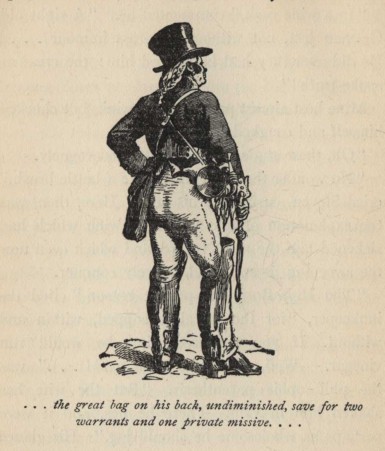
... the great bag on his back, undiminished, save for two warrants and one private missive....
CHAPTER XXIV
PORTENTS
"Hüt bich, mein Freund, vor schwarzen, alten Kasen,
Doch schlimmer sind die weissen, jungen Käschen....!"
HEINE.
There was brilliant sunshine as Steven rode in at the gate of Cassel. The fiddler walked beside him; but, once within the town, he halted, waved his hand, and called out:
"Good-bye."
"How?" cried Steven, drawing rein, his heart sinking at this unexpected parting.
"Ah, little bridegroom!" said Fiddler Hans, "it is even so. And a pretty figure," he said, "should I be, to shadow your lordship's magnificence in this fashionable city!"
He stepped across the cobbles, laid his hand on the horse's neck, and looked up at the young man; all mockery fled out of his eyes.
"You are an honest lad," he said, "and you love her—go, tell her the naked truth."
* * * * *
In her pink-hung bed at the Bellevue Palace, Betty von Wellenshausen opened a sleepy eye upon her surroundings. She yawned and stretched herself. It was good to wake up in Cassel and feel the bustle of life about her, the gay and ceaseless movement, instead of the rarefied loneliness of Wellenshausen on the crags, where the morning might find her higher than the clouds themselves, with perhaps scarce the beat of a bird's wing across the awful stillness.
Yes, it was du dernier agréable in the Residenz—Betty's thoughts ran naturally to French—to be aroused to the prospect of a day full of the most new and diverting experience.... Positively, Jerome was a charming fellow!...
... It was, perhaps, a trifle strong to ask for a secret rendezvous on the strength of one meeting; but Betty did not regret her answer. Without being at all prepared to yield—gracious powers, was one not to enjoy oneself a little? ... after three years of Wellenshausen!
In the midst of these gossamer resolves, the door creaked apart.
The Burgravine rubbed her eyes and thought she must be still dreaming, for through the aperture peered the heavy countenance, the bristling head of her husband—actually of the Burgrave of Wellenshausen himself!
She sat up, her lace cap awry upon the starting dark curls, her cherry mouth open, her eyes round, the very image of astonished indignation. With ponderous tip-toe tread, not unlike that of a wild boar stepping out of covert, the husband entered the room. He closed the door behind him and stood smiling, half timidly, half fatuously. Betty's clenched hands flew up in the air and down again on the sheets.
"How dare you!" she gasped. "Did I not forbid you——?"
"Oh, come now, Betty, my little wife, my little dove, I've frightened you. You were asleep, angel? But when I got your letter, last night, I lost not an instant. His Majesty gave me leave—urgent private affair. Post haste I came from Heiligenstadt. In Cassel with the dawn—a mouthful of breakfast to while away the time—a little toilet, and here I am. Shaved, my treasure! Your dear little letter——"
"My ... my dear little letter?" Betty shrieked, eyes rounder, curls more startled than ever. She sat rigid. "My dear little letter!" she repeated under her breath once more. Then, as she recalled the missive in question, she was shaken with an irresistible giggle. Her face dimpled. The Burgrave, gazing on her amorously, thought her the most ravishing, the most maddening being ever created for the delight or torment of man.
"Your letter, my Betty, to Heiligenstadt," he murmured, drew a pink sheet from his breast pocket, and carried it to his lips. "What wonder that, upon receipt of this, I could not delay coming to my sweet Betty a minute longer!" He held the note at arm's length. "Your wifely, your dutiful words: 'I should indeed be disloyal to persist in rebellion against my lawful lord.'"
Now, at a flash, the situation was laid clear before her:—by some inconceivable carelessness she had put her correspondence of two days ago in the wrong covers! ... A plague on this new-fangled French invention of envelopes!
She shut her lips with a snap and swallowed down the cry that rose to them. Rapidly she tried to recall that elegant reply to the royal importunities which had given her so much satisfaction; and then all other feelings were lost in a gush of gratitude to the Providence that had suggested those ambiguous terms which saved the situation—saved Betty, Burgrave of Wellenshausen, from premature discovery, irreparable disgrace.
She turned and smiled adorably on the Burgrave.
"Monster," she murmured, "do you deserve forgiveness?"
* * * * *
Steven halted at the first inn on his way, at the sign of the Aigle Impérial—a new French sign upon an old and solidly Germanic house. Here he put up his horse and engaged a room.
The best he could obtain was on the second floor. The town was full of officers—a regular military citadel now, and Cassel, that used to be a quiet Residenz.... Honourable guests could no longer be entertained as was their due, mine host informed him with a shrug of the shoulders. Steven, however, was indifferent enough; it was not his purpose to remain an hour longer in Jerome's capital than he could help. Indeed, he dropped some words concerning the equipage he would probably require—it might be that very evening—which gave the landlord an insight into a long purse and magnificent habits of travel.
This worthy, therefore, sped the stranger towards the Royal Palace with far greater urbanity than he had displayed on his arrival, and stood staring after him with some curiosity:—unattended, upon a bony old horse, and airs of a prince withal ... a sable cloak than which the King himself wore no better ... and we want, if you please, a travelling carriage and four of the best horses obtainable. We don't mind buying if they are not to be hired.... Oho, ei, ei!
"The town is turned into a citadel." The words recurred to Steven as he swung down the ill-paved street. The very air throbbed to military rhythm. In the fields, without the walls and on the new ramparts, everywhere, levies were being exercised, to judge by the tramp of feet, the calls and counter calls of bugles, the distant blare of marching bands, the beat of drums, cries of command, rattle of sham fire. The little brown town itself was filled with the most heterogeneous throng—Hanoverian and Westphalian hangers-on of the Court; French and Corsican adventurers; soldiers of as varied nationalities as were the uniforms of Jerome's fretful fancy; grenadiers, late of his brother, briefly royal of Holland, in their red coatees; wonderful blue hussars (French most of them) very gallant, with a wealth of jangle, whether ahorse or afoot—these same wonderful blue hussars, some of whom Steven had seen driven by the sheep-skin Cossacks like wrack before the storm; dragons d'Espagne, in green and orange, stern, lean and war-worn (unscrupulously intercepted, these, on their way to rejoin their imperial leader, and here disdainful of pinchbeck king and petty service); stolid Westphalian recruits lounging along the cobbles with the slouch of discontent; astounding diplomats driving about, clad in astounding embroideries; academicians, too, with the green palm on coat-tail and cuff, for "Little Brother Jerome" played at being as like big brother Napoleon as might be.
Market boors plodded by, blue-stockinged, crimson-waistcoated and wide-hatted; shapeless country wenches tramped, and fair ladies, reclining in coaches, flashed past Steven; and quite a swarm of lackeys, postilions, chasseurs, with all the insolence of the servants of dissolute masters, elbowed him aside, or appraised him with open comment. Had he not been so absorbed in his private anxiety, he might have noted, in spite of the air of gaiety, the bustle and the extravagance, certain ominous signs of impending cataclysm around him—the swift passage here and there of an urgent courier; the grave countenances of some officials; the little groups, whispering together in by-streets, dissolving at the first hint of approaching police; the singing defiance of the students; the sullenness of the poorer burghers; and, above all, the febrile, over-strained note in the very merriment of the ruling class itself. There was a tinkling of madcap-bells at the Palace of Jerome that rang into the town; no one within those walls had a mind to hearken to the reverberating echoes of Berlin and Hamburg and Dresden.
Heartily as he despised the sovereign and his army; careless as he was, in the absorption of his own vexed affairs, of the dire threat that hung upon the land, Steven could not but find something inspiriting in the martial sounds and sights. Unconsciously his step fell to the measure of some distant drums. He had a valiant sense of marching upon victory as he turned into the palace courtyard. On the strength of his splendid air, the sentries saluted him without challenging. A huge green-uniformed Swiss porter bowed before him.
The first check—and it was a slight one—was that no such person as the Gräfin Waldorff-Kielmansegg was known at the Palace. She had to be explained as the niece of Chancellor Wellenshausen, as the young Baroness Sidonia, before her identity could be established. Then, once more, all was smiles and bows. Nothing could be easier than to see the gracious Fräulein. He was passed from Swiss porter to royal French lackey; conducted by the royal French lackey through several corridors and up a flight of stairs, then delivered to no less a person than dapper Kurtz, the Burgrave's own Jäger. This latter gave him first a stare, then a sharp, meaning look, but, nevertheless, introduced him without demur to a kind of ante-room. Here Steven was left; and here he had to wait a length of time, which seemed to him first ill-omened, then positively insulting.
It was a quaint room, painted with impossible nosegays of flowers and cornucopias running over with gargantuan fruit. It gave, as did the whole apartment, on the Bellevue Gardens; and, through the yellowing trees, he could see distant gleams of the Fulda, blue under a blue sky. A merry party was playing bowls on the boulingrin; and, though it was screened from sight by sundry formal clipped hedges, Steven could hear the interchange of voices, ladies' laughter, the banter of men.
As the minutes passed and there came to him no sound from within the apartment, the tinkling, irresponsible gaiety without grew to be a personal irritation. The very sunshine that had cheered him on his way was now a mockery; the distant tunefulness of trumpets, a boding. More than once he lifted his hands impatiently towards the bell-rope, but each time refrained: so much hung in the balance, he must be patient. Patient! He ground his teeth as he paced the bright, absurd room.
* * * * *
Kurtz brought the message intended for Sidonia straight to the Burgravine. He was an astute young man, and knew the most likely quarter for promotion. Betty was at the moment engaged with the contents of a milliner's box, choosing a hat to wear with a certain new green redingote at the review to be held that afternoon. Something it must have of the military cock, without offending the feminine graces. It was matter of the deepest moment. But Betty, it has been hinted, had a capable mind—a facility for grasping several issues at the same time. She rose promptly to the new situation.
"Bid Baroness Sidonia come to me," she ordered. Then, tartly recalling her maid, who was edging towards the door: "Eliza, where are you going?" she cried.
"Mon Dieu," said Eliza, innocently, "but to inform mademoiselle that some one is waiting for her. And, indeed," she added, seeing by the flash of her lady's eye that her good-natured intention was frustrated—"indeed, madam, it is strange what a foolish habit we have all got into of calling madam's niece Mademoiselle. It is the young countess, I should say."
She clasped her hands, and was about to wax eloquent on the subject of her pleasure at M. le Comte Kielmansegg's reappearance and of her rooted conviction that they were un bien gentil couple, divinely destined for each other, when her mistress peremptorily reduced her to silence. Kurtz thereupon vanished in his brisk soldier way.
Betty selected another hat and set it on her curly head. It had an adorably impudent tilt and a bunch of orange cock-feathers.
"That, madame," said the French milliner, her thin elbows akimbo, her bright, familiar eyes fixed admiringly on her client—"that, madame, we call the Shako à la Saxonne—it is everything that is new—an inspiration after the battle of Lützen. And there is not another lady in Cassel will have anything like it."
Betty twisted her figure from side to side, and surveyed herself in the long mirror. She had donned the long narrow redingote to be sure of her effect, and the rich dark green of the velvet threw her face into charming relief. The orange note of the feather was the perfecting touch.
"I really think—I really think I will have it." She spoke lingeringly: these things do not decide themselves without reflection.
Sidonia came in slowly. Betty ran a keen eye over the girl; the fair hair was rough, and that was a dreadful little garment of Wellenshausen manufacture ... pale face, heavy eyes! Betty broke into a laugh. Life was really very amusing at times.
"You sent for me, aunt?"
"Yes, my dear. Somebody has called to see you, it seems."
"To see me?" Sidonia drew her breath quickly. Crimson rushed to her face.
"Dear child," said the Burgravine, in her most cooing voice, "do not agitate yourself; you need not see him unless you wish. Yes, my love, it is that tiresome man again—my wretched cousin Kielmansegg."
Sidonia swayed a little, but caught herself up, fiercely erect; then the blood began to ebb from her cheeks.
"I will go to him," she said under her voice. "Where is he?"
"Perhaps it would be just as well," said the Burgravine, carelessly. "You can hurry matters on about the annulment. Truly, it is fortunate," she laughed, "that we shall not now have to hunt for him God knows where, in order to free you, my poor little Sidonia, from this absurd business."
"Aunt!" cried the girl, indignantly, with a glance at the milliner.—How could Aunt Betty laugh so heartlessly, how dared she discuss these most intimate affairs, before a stranger!
"Calm yourself," said the elder lady, "she does not understand one word of our savage language—too true a Frenchwoman for that, my dear! Now, about this traitor. (There you go white and red, you silly thing.) ... Everything can be settled by Yes or No! Either he wants to carry off his heiress, or he is content with your decision. He has, of course, received your letter. Heavens, my dear, did we not discuss it all before? And, anyhow, it is not a matter for heroics. Lord knows, I don't want to interfere; it is entirely for you to decide whether you are on or off with the bargain. For I will lay forty wagers he is here to protest. Ah, I know my young Viennese gentlemen; they cannot have too much gold at their back.—Decidedly, Madame Athenaïs, I keep this hat."
It was too adorable to be taken off her head even for a moment.
Sidonia stood, clasping and unclasping her hands. Every word her aunt spoke, dropped apparently with such heedlessness, but in reality with such subtle intent, stabbed her to her sore heart.
"Approach, my dear," said Betty, maternally, "and let me, for heaven's sake, run a comb through your hair. Mercy on us, child, what a gown! Had you not better change it?"
"No," said Sidonia, sullenly. She went, on leaden foot, to her aunt's toilet table and gave an unseeing touch to her hair.
Betty looked over her shoulder; the two faces were reflected side by side. Sidonia's reflection in the glass looked positively ugly—in her own eyes. In Betty's, too, apparently, for she cried, with an air of great generosity and wisdom:
"I would offer to go with you, to support you, my angel; but after what has passed—I think it were wiser he should not see me. After all, who knows? You may patch it up. But, Sidonia, you really ought to make yourself a little tidy."
Madame Athenaïs, who, if she had that ignorance of the German language attributed to her ultra-Parisian nature, had contrived nevertheless to follow the dialogue pretty closely, here interposed with the unctuous familiarity of her kind:
"Oh, if the young lady is going to have an interview of importance, it is certain she should make some toilet. See, if mademoiselle permits, I will show her a hat that is the very thing for the occasion. Something young, young, quite virginal, yet, coquet, alluring!—something no gentleman of taste could resist on mademoiselle's head!"
Sidonia—she was but seventeen, after all—stamped her foot.
"Leave me in peace, all of you!" she cried, and made for the door.
The keenest of all Betty's stabs she carried away in her heart; that was the vision of Betty herself, so fair, so distracting in her plumed hat, beside Sidonia, plain, awkward, ill-dressed—poor Sidonia whom Steven had married ... without love! Betty's words: "It were wiser he should not see me," sang in her ears to the fierce accompaniment of her own jealous blood. She recalled the smile and the glance at her own reflection in the mirror, with which Betty had pointed her concession to wisdom. Hot-tempered by nature, Sidonia had yet never even suspected the existence of such passion as now rent her.
CHAPTER XXV
THE PERVERSENESS OF WORDS
"Berriet mein blasses Angesicht
Dir nicht mein Liebeswehe?
Und willst du, dass der stolze Mund
Das Bettelwort gestehe?"
HEINE.
Steven, stretching a determined hand at last to the bell, was arrested in the act by the sound of the opening door. He turned to see Sidonia standing in the entrance.
It seemed as if, after all, these two were as yet unripe for love's fulfilment. The pride of each, unchastened, the quick susceptibilities, the unreasonable expectations and demands of the crudely young, built frowning barriers between them.
Steven, who but last night had burned with ardour for his lost bride; who, but this morning, had set out to win her back, tender, conquering, almost joyous, felt the fretful impatience of his ten minutes of waiting leap into positive anger under the accusing glance of Sidonia's eyes. Their looks met—one might almost say, struck—like steel blades, each quick to feel and resent the other's attitude.
"Ah, no, he does not love!" cried the girl, in her heart. And—
"She never loved me," said the man in his pride. "I have been a triple fool!"
But did she think that a Waldorff-Kielmansegg was thus to be played with, made the sport of heaven knew what ignoble feminine intrigue, a marriage of convenience, quickly repented of, and then, farewell? No, he had his rights as a man, his honour to defend, and things could not end here.
"What brings you?" asked Sidonia. Being the woman, she was the first to speak.
His tone was harsh as he made answer: "Because it is time this folly should cease. Because you are my wife. Because you bear my name. Because your honour is mine, and I will not have you running about the world—under no better guard than that of Burgravine Betty."
The contempt of his accents, the doubt, stung her beyond bearing.
"By all accounts," she cried—and there was almost a sneer upon her sweet lips—"you had been willing enough, not so long ago, to trust her with your own honour."
So the fiddler had been right. Betty had made mischief! The thought danced a moment through Steven's brain; but in the confusion of anger he failed to seize its real import.
Sidonia went on, vainly endeavouring to steady her voice as it throbbed to the beating of her heart:
"You talk of honour! Is it honourable to speak of her like this—is it generous?"
"Generous?" he echoed. "Will you teach me generosity, you who drove me away, without explanation—without giving me a chance to explain? You, the bride of an hour!"
"Come, then, I am listening now. Explain." Her accent, her air, were passionately peremptory. Her fingers sought hastily in the reticule at her side—the tangible evidence of her misfortune was hidden there. She laid the note before him on the table, spreading it and smoothing it out for him, even as Betty had done for her on the wedding day, in the turret at Wellenshausen. "Explain this," she said.
Steven cast a quick glance at the incriminating document, opened his mouth upon scorn and denial, then checked himself with a bitter laugh and a shrug of the shoulders.
"Tell her the naked truth!" It was the fiddler's advice. To tell her upon what a petty rock their barque was foundering ... it ought to have been an easy thing! Yet the man stood, contemptuous, smiling, silent. Every instinct of his being revolted against the girl's haughty command. His pride alone would have kept him mute, but there was something yet stronger, more intimate, to restrain him. "Tell her the naked truth!" Naked enough was the truth, ugly enough, sordid enough, to be convincing if he could have brought himself to speak it! The truth? Why, here it would have been: "Your Aunt Betty offered herself to me, threw herself upon my protection. I did not love her, I did not want her. She gave me no choice; and this is her woman's revenge!"
Aye, it is all very well to say: "You are an honest lad." But if a gentleman has behind him long generations of gentlemen, each of whom has planned his life upon the conventional code of honour among gentlemen, he cannot easily bring his lips to form the words that will betray a woman in relation to himself—least of all, perhaps, where he has been loved and has not loved in return.
So his lips were silent upon that smile of scorn. And Sidonia's last hope—how strong it had been, how dear, she never knew till this moment—agonized within her. That he should mock her for jealousy: that was the supreme insult.
As in a flash of unbearable illumination she saw herself in his eyes, heavy-lidded, unkempt; saw the figure that had provoked just now even Betty's pity; saw beside her, Betty, rich in loveliness, velvet clad ... it was no wonder that Beau Cousin Kielmansegg should fix her with this smile, this contempt.
And Steven, in his morgue, who would have perished rather than condescend to explain—could he but have known (Ah, if youth but knew!) that no explanation was really needed of him, that no words are ever needed in the great crises of life! Words are our enemies. The inability to express the subtleties of wounded feeling, the false witness that our tongues bear against us, have divided more lovers secretly yearning for each other than ever did most adverse circumstances. One touch of his hand on hers, one kiss upon her lips, and Sidonia would have felt the truth, would have understood that he loved her, and that, to him who loves, the beloved is queen. Angry Steven, Steven the lover, had never even noticed the dishevelment of her bright hair. Her face was pale?—it was a pearl in his eyes. Her attire was shabby?—it might have been a garment of state. Had Betty broken in on them then, in all her glory, he would have drawn no comparison, save to the superlative advantage of the woman who was his choice.
Alas! if youth but knew!
From the bowling green without came a gust of laughter; then a light voice broke into a stave of popular song. They had, in happier moments, heard that lilt upon the fiddle of wandering Hans; it struck them poignantly. Wounded love flamed into intemperate resentment.
"After all, Aunt Betty but told me the truth, if a little late—you have nothing to say," said Sidonia, between teeth clenched upon a sob.
"Only this," replied Steven, arrogantly, from the height of his disdain, "that I command you, as your husband, to come with me now."
Sidonia pointed to the door.
"Herr Graf von Kielmansegg, my uncle expects to hear from the judges to-day anent the annulment of that ill-considered ceremony which made me nominally your wife. His lawyers will call upon you in due course."
"Madam," answered the count, bowing, "I intend to take up my abode in Cassel—at the Aigle Impérial. Therefore there will be no difficulty about my address. But let me remark that annulments are not easily concluded without the consent of both parties."
He closed the door between them upon these words.
"He does not love me—he never loved me!" said Sidonia to her bursting heart. "It was all pride!"
The other unworthy suspicions, which Betty had so subtly instilled, could not live in her soul after having come again under the glance of Steven's eye. But she had pride too, her woman's pride, and it showed her what she had to do, even though it killed her.
"O Geiger-Onkel," cried the poor child, "what have you brought me to! Even you have abandoned me!"
Betty's arrows, shot at spiteful random, occasionally hit a truer mark than she herself suspected. When, in her tower prison, she had petulantly averred that the Burgrave would certainly keep in his own hands the choosing of Sidonia's husband (and for very good reasons!) she had unconsciously struck the gold. The heiress's guardian did not intend, if it could be helped, to have his accounts examined. Hence, apart from the humiliating pressure put upon him, against which his elementary violence rebelled, the young Austrian was the last person the Burgrave would have desired as nephew-in-law. There was a relentlessness in the young man's eye and a clear penetration, which, whenever the Burgrave remembered them, sent uncomfortable chills through his frame. True, Count Kielmansegg had never breathed one syllable on the subject of his bride's fortune; but this very silence struck the Chancellor as the more ominous.
"I shall have his lawyers on top of me before I know where I am," he had many a time growled in those sullen days that followed Sidonia's betrothal, chiefly at those hours of conscience's activity, the dull hours before the dawn, when the night's potations had ceased to stimulate.
It was not that Wellenshausen had ever been consciously dishonest. In his fine masculine, Germanic way, when he had put large sums of his ward's money to his own uses, he had felt himself almost in the right. Was it not against nature that mere females should have advantages over the male? Indeed, he had scarcely taken the trouble to make memoranda of the expenditure: in Jerome's kingdom, especially in financial matters, it was never customary to waste time upon details, and the sense of impending catastrophe, more particularly of late, had increased the sense of the value of the fleeting moment.
Since his second marriage the Burgrave had certainly taken both hands to Sidonia's treasure. There was the loan to his Royal Master; a matter of high diplomacy! It was well to have a lien over so slippery a patron. And, besides, it would be all to the child's advantage, no doubt, later on. Practically an investment! There were Betty's pearls.... Well, in these uncertain times, might not jewels also be looked upon as an investment? none the worse for having gleamed so charmingly on Betty's shoulders!
And there was this, and there was that.... In the small hours above mentioned, memory became inconveniently active. Once or twice the Burgrave had sat up in his feather-bed to wipe a clammy forehead; in truth, he did not know how much the heiress of Wellenshausen, apart from the lands, was heiress to. But there was a certain document of his late brother's, referring, in very precise terms, to the Fideicommission, to the trust.
It was no wonder, then, that when Sidonia had come to him, on the day of the wedding, where he sat glowering over his wine-cup and the remains of the feast, and had told him how she and her new husband had parted for ever, the relief should have been so unexpected and so great as completely to sober him.
In a spasm of paternal affection he had assured her that such a ceremony could not count, and that it would be the easiest thing in the world to release her, since she wished it.
She had looked at him stonily over her bridal white. Was that indeed the case? she had asked. She had thought marriages were for ever.
And he had laughed at her joyously. "Na, na, little dove—a marriage of this kind, if one wishes it, was as good as no marriage at all!"
"Then see to it, please," she had said steadily, avoiding his embrace.
There was horror in the look she cast upon him as she turned to leave the room; but he was too completely absorbed in his joy to see anything but the deliverance before him. He never even paused to wonder, to inquire the reason of the breach—and this, doubtless, had been well for Betty.
The connubial migration to Cassel, consent to which had been wrung from him at the expense of so much mental agony, now became a project which could not be soon enough, to please him, put into execution. For would it not mean the prompt legal annulment of Sidonia's most inopportune alliance? His original jealousy of Beau Cousin would seem to have been the one thing really murdered in the oubliette; yet, perhaps, somewhere deep down in his consciousness, there faintly stirred, beneath all the other reasons for relief, a satisfaction at the thought that Cousin Kielmansegg could never again be made welcome to the house that had sheltered his divorced wife.
CHAPTER XXVI
THE WAYS OF LITTLE COURTS
"Thinkest thou there is no tyranny but that
Of blood and chains? The despotism of vice—
The weakness and the wickedness of luxury—
Of sensual sloth—produce ten thousand tyrants."
BYRON.
Betty came thoughtfully into her husband's presence. The review had not been a success. In spite of velvet redingote and yellow plumes, she could not flatter herself that Jerome had singled her out. She began to have qualms as to the results of that unexplained and inexplicable mistake in her correspondence. She had fully promised herself that the first glance between her and the King would delicately give him to understand that her rigour was not as eternal as the uncompromising "Never" might have led him to believe.
Indeed, with natural optimism, under the rosy atmosphere evolved between her mirror and the shako à la Saxonne, she had come to tell herself that the unintended rebuff was, perhaps, not a thing to be regretted after all. Kings or chancellors, or simple Viennese lieutenants, men were much the same, she took it. And, as the experienced French have it, tenir la dragée haute, was none too bad a way to make the creatures yearn for it. Was not her own Burgrave a telling proof?
But the fact remained that Jerome had not even seemed aware of her existence that afternoon. Something had gone wrong about the review. At the last moment it had been found wiser to leave a certain regiment in barracks, information having transpired about a leaven of disloyalty. Jerome's brow had been thunder black. There had been a vast amount of discussion between him and five or six generals. And finally the King had left the field in high displeasure, before the programme of evolutions had been half concluded. And it was a painful fact that none of the populace cheered him as he went.
Certainly, if he had not looked at her, he had, at least, looked at no other fair one. Still, the day had been a failure for the Burgravine; and, as she drove back to the Palace, she had actually some doubts as to the shako. In her own apartment a new trouble confronted her. Sidonia, who had locked herself up alone after that momentous interview, now came very calmly to greet her. She had a smile on her lips, and—thus do we cherish vipers in our bosom!—Eliza's fingers had obviously been busy on the yellow head. The child was positively coiffée! Yes, and she was dressed, too: a fashionable creature. And pretty—undeniably pretty, in a singular, girlish way of her own. And not a word could the most insidious question draw from her lips. Betty was forced, in the end, to apply to Eliza. The tirewoman shrugged her shoulders. She knew well enough what had passed, but it was too much to expect her to gratify her mistress.
"Cannot madame see? Ah, it will not be long before those two are together again! If she coquets a little, certes, it will not be madame who will blame her! Oh, it is not for nothing that mademoiselle is making herself beautiful! Who knows if she will not meet him to-morrow night!"
"Heavens!" exclaimed the Burgravine, disagreeably struck, "you do not mean that she intends to go to the fête!"
"But, yes, madame; she has been choosing her dress. And oh, I know some one who will look pretty."
"But the deeds are actually drawn up. The marriage is as good as annulled already," cried Betty.
Eliza clacked her tongue contemptuously. "Until people are divorced, they are still married," she remarked sagely. "And it is not the young gentleman who wants a divorce, I can tell madame. 'Oh, how he is enamoured!' says Kurtz to me. 'He came in like a lion roaring,' says Kurtz. 'That is love,' he says to me. 'Beautiful!' he says."
Betty snapped herself out of her maid's hands, flung herself into a wrapper and went to seek the Burgrave.
As matters stood, the storm-wind of injured vanity and jealousy blowing very strong, she actually would rather give up her conquest of Jerome than, she thought, the sweets of revenge. In the Burgrave she had an ally—she never paused to wonder why, so little did she heed the flight of her arrows.
Before they parted, the sagacious couple, for once warmly united, were agreed that until Sidonia were provided with another husband, they could scarcely feel themselves safe from Kielmansegg's persecution. Now, in the court of Jerome, husbands had been known to be provided for people at the shortest notice ... things had generally to be done at short notice at the court of Jerome.
Sidonia was still quite sufficiently an heiress for the Chancellor (he knew his court) to be quite sure of being able to find some excellent person who would take her thankfully from his hands without daring to request, much less to stipulate, for an exhibition of figures.
* * * * *
There was a Court-concert the next night at the Royal Palace, and it was in the music-room that Sidonia was, by command, presented to Jerome.
She dropped her curtsey. Here was a King for whose royalty, in her sturdy patriotism and her inherited race tradition, she felt neither allegiance nor respect. As she drew herself up from the perfunctory obeisance, she looked him in the face and met the well-remembered glance, with its hateful gleam and flicker. Turning aside she became conscious of the gaze of the King's Master of the Horse, General d'Albignac, as he towered over his dapper little sovereign. Steady enough this, something like the glare with which the beast of prey regards his quarry. The girl's heart sank with a double terror.
"I am charmed," said the King, "to behold at last with my own eyes the young heiress of Wellenshausen, in whose lovely person, I am told, is vested so much of my territory."
This was spoken in German, with a pronounced Italian accent. Then Jerome slid into French to say caressingly:
"Mademoiselle de Wellenshausen is welcome at my Court."
Betty von Wellenshausen, at Sidonia's side, stood twittering, awaiting her moment. Jerome was once more in high good humour; all trace of the gloom that had weighted his brow through yesterday's afternoon was gone. Betty felt sure of triumph. Her entrance had created quite a flutter in the assembly. Women had whispered together behind their fans. Men's eyes had followed her with bold, curious looks. Her Bluebeard shadowed her with a fierce anxiety which to-night Betty accepted cheerfully as a further tribute, confident that she and his sovereign could elude it when the critical time came.
What, therefore, were her feelings when she found Jerome's eyes glinting past her—ay, past Betty von Wellenshausen at her fairest—to rest with marked interest (if ever the word "rest" could be applied to Jerome's eyes) upon Sidonia, the gawky child. There could be no mistake about it, she could not soothe herself with the thought that pique was the cause of his neglect. His attention swept by her with no deliberate indifference; she simply did not exist for him, his interest was vividly enkindled elsewhere. In the blasting disillusion of the experience, the Burgravine turned livid. Through the buzzing in her ears she could scarce catch Sidonia's reply to the King's gracious words.
The child, however, was speaking in clear, deliberate tones, and what she was saying was sufficiently remarkable:
"Your Majesty mistakes. I am the Countess Waldorff-Kielmansegg."
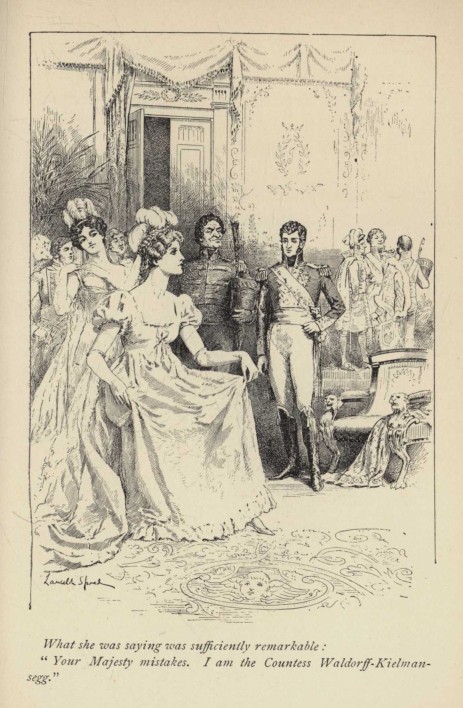
What she was saying was sufficiently remarkable: "Your Majesty mistakes. I am the Countess Waldorff-Kielmansegg."
Outward decorum is the rule even at the most amateur court, yet the sensation created by the announcement Sidonia could feel to her innermost nerve. The countenance of Jerome became as suddenly and threateningly overcast as that of a spoilt urchin thwarted. He flung a look of anger at his Chancellor. The veins swelled on the crimsoning forehead of General d'Albignac.
* * * * *
The rumour that old Wellenshausen had a rich nièce à marier had spread very quickly through the Palace. D'Albignac remembered her quite well; it was she who had struck him over the eyes with her plaits—that added something to the zest with which the King's Master of the Horse had sought an interview that morning with the young lady's guardian. It was not unsatisfactory in its results. Ere they parted, indeed, the two thoroughly understood each other. The ex-chouan was hardly a match, perhaps, for a Wellenshausen; but then there was the coming scandal of the annulment! Her fortune, on the other hand, might not be now what it had been on her father's death, but it was considerable. And, again, times were bad. The Burgrave could guarantee, at any rate, that the broad lands were intact. One must make up one's mind to give and take in this world; and every one, from King downwards, was more or less in debt at the Court of Jerome—d'Albignac distinctly more than less. Besides, a pretty wife was always a good speculation at Cassel. And when d'Albignac saw Jerome fix his future bride with a well-known look, he knew that she might prove a very profitable speculation indeed. A prolonged course of "Pompadourettes" had begun to satiate the royal palate; here was a wild, high-born thing that carried her head like a stag, and looked out upon them all with fire in her eyes. By the side of the ogling, mincing bit of plumpness that the Burgrave had provided himself with, with all her stage tricks and fireworks, even to the chouan renegade (who was no eclectic) the contrast was grateful. And now there was this nonsense about a previous marriage to spoil all! What a pity he had not been allowed quietly to finish off the impertinent interloper that night in the forest!
* * * * *
Betty's voice broke shrilly upon the brooding pause:
"Your Majesty," she cried, "has, I believe, already received information of the true position of affairs. The marriage was no marriage. A quixotic piece of nonsense, half-hearted, soon repented, at least on one side. The deeds of annulment are actually drawn up. Count Kielmansegg's signature—or I am very much mistaken—will be promptly affixed now, and it is not to be imagined, as your Majesty will well believe, that my husband's niece will then withhold hers. It would be against all feminine delicacy, all proper pride."
She shot a look of fury at her niece; then she nudged the Burgrave, who instantly reasseverated in his deep bass:
"The deed of annulment is drawn up, sire."
Jerome's good humour returned. He rubbed his hands. In spite of all his royal assumption, much of the exuberant gesture of the Corsican had stuck to him, to the distaste of his stolid subjects.
"Il faut aller vite, vite, alors. We must make haste," he averred.
To make haste and enjoy was, indeed, the rule of his existence. Now, a Lent of unexampled rigour seemed inevitably drawing near him, and all the more vertiginous was his carnival. So vertiginous indeed, that, willingly blind though she was, the Queen, true German daughter of Würtemberg, had withdrawn from the whirl, giddy and panting, to take refuge at Napoleonshöhe till such time as her spouse would come to sober sense again.
Jerome considered the girl a moment longer in silence. That she should flush and pale beneath his glance, look anger at him from her deep eyes and then avert her head with an insulted turn of the neck, all added so much fuel to his easily kindled flame. He wished to go quick, quick; but if she gave him a bit of a chase, so much the better. And now he found a smile for Betty, and a gracious word, ere he passed on, taking the Burgrave by the arm. Betty might do very well for an idle hour, by-and-by, perhaps; but, heavens, how many Betties had he not known!
The Burgravine's self-esteem was at once too profound and too sensitive not to realize the completeness of her failure. But vanity has its heroines. None could have guessed, as she paired off merrily with d'Albignac, the extent of her mortification. Yet it was something very little short of torture that she was enduring as she smiled and coquetted and fanned herself, and babbled her pretty babble.
CHAPTER XXVII
THE SONG OF THE WOODS
"Das ist ein Klingen und Dröhnen
Bon Pauken und Schalmei'n
Dazwischen schluchzen und stöhnen
Die guten Engelein."
HEINE.
Sidonia slipped away alone to a shadowed window-recess. Under the insult of her aunt's words, the insult of Jerome's gaze, pain and anger had so burned within her as to exclude all other feelings. But in the "solitude of the crowd," her brain gradually cleared; and, as she reviewed the situation, a new feeling, a dread unnamed but overwhelming, began to take possession of her. With wits naturally alert, and to-night abnormally stimulated, she began to notice strange things about her. She was in danger—in danger of what, she knew not, but something horrible, unspeakable. The looks the King and d'Albignac had cast upon her, the glance of intelligence they had then exchanged, her uncle's obsequious haste to disclaim her marriage, and her aunt's public affront to her, were as many lightning flashes that showed the precipice yawning at her feet. Not a friend had she in the world to whom she could turn, save the man who did not love her, and a poor, wandering musician, now probably far away on some Thuringian road, playing gay tunes to the rhythm of his own incurable melancholy.
Unavowed, even to her own heart, these two days the thought had haunted her that perhaps—nay, doubtless—Steven would take the opportunity of meeting her, which the royal function afforded him this night. She knew enough of the ways of Jerome's court already to be aware that there would be no difficulty in his being present at the palace concert should he wish it. The Upstart loved to parade his magnificence before strangers; and to a Waldorff-Kielmansegg the palace doors would be open à double battants.
But, search the throng as she might, there was no sign of the young disdainful head. The vision of it, pale and passionate, had lived in her memory even as she had seen it at their parting. He would have towered above these squat Westphalians, these popinjays of Frenchmen and Corsicans; his presence would have shone out among them. Nay, she would have marked his glance upon her among a thousand starers. She knew well, poor Sidonia, that she would have felt it in every leaping pulse! Her heart turned faint: had he cared, he would have come. Had he cared even only for her honour, according to those fine words of his yesterday, he must have been here to watch, to guard, his wife. She pressed her hands against her eyeballs, for the brilliancy of the lights became unbearable. And as she stood between the parted curtains in the recess, the orchestra, half hidden behind a bank of flowers, at the end of the room, struck up a gay French air which added to her sense of misery.
Her uncle's words, "the annulment deed is already drawn out," seemed to jig in her brain in time to the measure. It was almost the same phrase that she herself had flung at Steven—but now it bore a sound of cruel reality quite novel to her. And when a couple of horns took up the fiddles' theme, they seemed to be blaring to the world her unutterable shame: "A quixotic piece of nonsense, half-hearted, soon repented ... at least, on one side.... Count Kielmansegg's signature will be quickly affixed...."
How was it possible for any one to be so abandoned, so helpless? Even the small furry things of the forest at home had their holes to which they could run and hide when they were hurt.... The forest at home! With what longing did her soul yearn to the thought of the green shelter, the pine-alleys with their long shadows cutting the yellow glades; of the great, sombre thickets, where not the most practised huntsman of the Revier could have tracked a startled hind.... Dawn in the woods, with pipe of birds waking up ... violets, blinking dew in the moss, and clean, tart breezes blowing free.... Eventide in the forest: the mild sun setting at the end of the valley, through the clearings, and the thrush chanting his last anthem on the topmost bough of the stone pine.... The scent of the wood-smoke from the forest house, where Forest-Mother Friedel was preparing supper for her hungry lads, where all was so wholesome, so honest, so homelike; where at this moment—who knows?—Geiger-Hans might be seated in the ingleglow, his music, lilt of joy and sorrow mingled, of humour and tenderness, floating out through the open door into the forest-aisle.... Sidonia's thoughts began to wander from her own sorrow. She saw the sunrise in the forest, she felt the evening peace.
All at once, in her lonely corner, she started and opened her eyes; she brushed her hands across her wet lips. She was dreaming, surely! And yet she could swear that the actual thrill of the vagabond's violin was in the air, that its piercing sweetness and incomparable depth of sound were ringing in her ears.
"Allons voir danser la grande Jeanne...." The orchestra was braying the trivial French tune no more. The jigging and twiddling of fiddles, the mock laughter of hautboys, the infectious rhythm of flute and drum, had all given place to a stealing melody, infinitely apart:—yes, even that mountain song which had been known between her and the wanderer as "Sidonia's air"! Surely if she were not dreaming, then she was mad!
She stood, holding her breath. The strain went on. Above those clamours of laughter and voices, yes, it was true ... her song, Sidonia's air, was calling her, unmistakable, insistent, with all the urgency of a whispered message.
Scarcely aware of what she was doing, she left her hiding-place and went swiftly through the indifferent throng towards the call. With one exception the men of the orchestra had left their platform: behind a high group of palms, a solitary musician plied his bow softly, secretly, as if rehearsing to himself.
Sidonia pushed some branches apart. The player looked up. Their eyes met. Then she forgot to be astonished. She thought she had known it all along. He had come to save her. True friend!
"I knew it was you," she said. She laughed at him through the green palm-stems, her eyes sparkled. How could she ever have thought Geiger-Hans would fail her? She had need of him, and of course he had come!
But Geiger-Hans did not smile back. His face—so dark under powdered hair, so odd over the mulberry uniform, bechained and besilvered, of Jerome's Court Orchestra—was very grave.
"Little Madam Sidonia," he said, "what are you doing here?" He spoke sadly; and under his unconscious fingers his violin gave a sad accompaniment to the words.
Sidonia looked at him with her innocent gaze. She was hurt that he should find fault with her—the Geiger-Onkel who hitherto had always thought all she did perfect! Yet she was pleased that he should dub her "madam" instead of the whilom "mamzell."
"Do you know what sort of a place this is?" pursued the fiddler, with ever-increasing severity. "Do you know with what people you are surrounded? Have you not heard the common saying, that if it be doubtful whether an honest woman—save the unhappy Queen—ever crossed these palace doors, to a certainty no honest woman ever went forth from them? Why are you not with your husband?—with your husband," he repeated sharply.
Sidonia, who had hung her head, ashamed—for in truth she felt the evil about her in every fibre—reared it on the last words.
"Geiger-Onkel," she cried, "I have no husband, and you know it. That is past and done with." Then her heart began to beat very fast and the smarting tears gathered in her eyes. "From what motives I was married, I know not; but that it was all a cheat, I do know. He does not want me. He never cared for me. First it was pity, perhaps, I think; now it is pride with him. On such terms I will be no man's wife. I will have none of it—rather death!"
"Oh, death!" said the fiddler, and struck his strings, "death is the least of evils. Nay, the release of a clean, proud soul ... that is joy. The worst end of life is not death. Beware, little madam!" He had another change of tone: never had Sidonia been rated with such sternness. "Why, what a child you are! Yet none so childish but that you know full well this is no child's mischief, but woman's danger! With what anxiety am I here to save you from yourself; at what trouble! ... Only that the rats are flying already from the falling house; only that I happened to meet the second violin of Jerome's orchestra, an acquaintance of old—a musical rat in full scuttle!—I might still be racking my brains for means to come near you! Here am I this hour, wearing the livery of the Upstart, not knowing if I shall be given the necessary minute for speech. The prisons are stuffed full to-night, and Jerome always was afraid of me. Let but his eye, or that of his spies, turn this way and recognize me, and it is to the lock-up with Geiger-Hans! Oh, then, what of Madam Sidonia? Home to your husband! Home, I say! You know where to find him. You toss your head at me? It was through pride the angel fell—and he was Star of the Morning!"
"I don't know what you mean," said Sidonia.
"Nay," said Geiger-Hans; "you know too much already. Fie, what a dance will there be here before the house falls! Even now Jerome is plotting his last gratification. Did not his eye fall upon you? Your husband's name, his sacred Austrian nationality—that is your only safeguard. And that name you are not to keep long. You are to become Madame d'Albignac."
"D'Albignac!" cried Sidonia. "I—Madame d'Albignac? You are mad, Geiger-Onkel!"
But, even as she spoke, she felt a cold sweat upon her.
"And d'Albignac will not be for a long engagement," pursued the fiddler, relentlessly. "The puppet King has very little time left, as his lieutenant knows, and he, d'Albignac, will be but too eager to save something out of the ruins—and, besides, they are amicably agreed already."
"I don't understand," said Sidonia again. She went white, then red, trembled, and caught at the prickly stem of the palm.
"Take me away with you," she broke out of a sudden, piteously. "Save me!"
"I cannot save you," answered the wanderer. His voice was harsh, yet it faltered. "No one can save you but your husband. Go home to him."
Then he began to tune his fiddle with fury, for his fellow-players were straggling back. Some of them looked curiously at the fine lady who was speaking to their unknown comrade so familiarly. Sidonia turned. Many of the great company were looking at her, too. Right across the room she saw Jerome and his equerry talking together; and, as they talked, their eyes (or so she fancied) ever and anon sought her.
Panic seized her. But, even in panic, Sidonia was loyal. She must not speak again to Geiger-Hans, lest she bring him into deeper danger. Geiger-Hans her friend, the wild wanderer, in prison! In prison for her! That would be terrible.
She wheeled round; and then, like a hunted thing, pushed her way blindly through the throng, determined to retire to the Burgravine's apartment. People nudged each other as she passed. At the door, an old lady, with white hair and a soft, pink-and-white face, detained her by the skirt:
"Who are you, my dear, and whither so fast?"
"Oh, please," panted the girl, "let me go! I am Sidonia of Kielmansegg." Even in her agitation she did not forget the name that was her shield. "I must go back to my aunt, the Burgravine of Wellenshausen."
The old lady nodded. "That is all right," she said. "But you seem frightened, child. There is nothing to be frightened at. And if you want any advice, my dear, or help, you have only to ask for Madame la Grande Maréchale de la Cour—that is myself. I am very fond of girls."
Her voice was purring, her smile was comfortable. As Sidonia moved away, she felt vaguely reassured. If her own kindred failed her, there might yet be salvation—salvation other than the inadmissible humiliation of that return to the man she loved but who did not love her ... all that Geiger-Hans (so suddenly, unaccountably unkind!) would devise for her.
In the Chancellor's apartment she found bustle and confusion. A footman staggered past her, bringing in trunks. A couple of the new Cassel maids were running to and fro with folded packets of lace and silk.
For a second Sidonia stared amazed; then her heart leaped with sudden joy. These preparations for departure could have but one significance: the Chancellor had got wind of the infamous plot against his niece, ... by his orders Betty was already preparing to take her into safety. Ah, how could she have doubted her kinsman's sense of family honour? Had not even his desperate intention, in the matter of the oubliette, shown him a true Wellenshausen? She had ceased to blame him since she had understood: rather slay than be dishonoured! Cassel was no place for honest women; in his decision to keep his wife away from it, he had been right, a thousand times! And who, better than Sidonia, knew how his hand had been forced before he consented to bring them thither? But, in this emergency, he would be master once more—and she was safe.
She burst into the room: yes, there was her aunt, already engaged in donning a travelling garb, and ever and anon clapping jewels into their cases with fervid haste. Betty looked up and her olive face grew thunder-dark as she recognized her niece.
"Geiger-Hans has told me all!" cried the-girl from the door. "Did you look for me? How horrible it all is. But I shall be ready in a minute! Where are we going?"
The Burgravine was silent for a second, fixing her with cold eyes. Then she spoke, with an acid composure:
"I am going back to Austria. I have done with Westphalia and all that belongs to it. I do not know what your plans may be, but they concern me no longer."
She closed the case she held in her hand; the snap seemed to give final emphasis to her words. Sidonia stood, aghast.
"I have done with your Westphalia, my love," pursued the Burgravine: "done with your uncle, my Bluebeard, en premier lieu, and with Jerome, that plebeian, that upstart!"
Intense was the scorn with which she spoke the words.
Apart from this, the irredeemable wound that her vanity had received to-night from the "little Corsican," Betty had another reason for her sudden determination. Flighty she might be, but she was a woman of business instincts where her self-esteem was concerned. She had met a countryman of hers at the concert, an elderly diplomat, a man of standing. He had breathed certain information into her little ear.... He had received a courier. Napoleon had been finally vanquished at Leipzig. The news had not yet reached Jerome, but it spelt "the End" this time! Himself intended to take the high-road, sans tambour ni trompette, the very next morning. He was getting on in years, and he would prefer not to be caught in the débandade. And, as he had parted from her, he had pressed her hand, and discreetly trusted that she might soon be paying her relatives in Vienna a visit, and that they might meet again there.
The obvious hint had not been wasted. Excellent M. de Puffendorff—he would be toiling his elderly, quiet way homewards by the next sunshine. What was to keep Betty from starting that very night? The Burgrave had put it out of his own power to resent anything she did. And, whatever should betide between them, she was sure of a comfortable pension. To leave at once was certainly her best course, since this ludicrous Cassel had nothing to offer her but the discomfort of a révolution pour rire. To be involved in the stampede of the Westphalian court would for ever cover her with ridicule. She shuddered as she thought of her escape from the unpardonable absurdity, from the madness she had actually contemplated—a liaison with M. Jérome Buonaparte!
As for Wellenshausen, the horses were not foaled (she swore) that would take her back to that prison. It was hey for Vienna this time, and in earnest!
She laughed out loud now, as her eye rested upon Sidonia's bewildered face. Here, in sooth, was Fate avenging her with unexpected completeness.
"Fortunately, I have my own people to go to," she remarked airily. "You will, I think, see pretty things before long in your Cassel. But, there, you have a feeling heart, my dear. You can wipe your little monarch's tears first, and make up to M. d'Albignac for the loss of his pension afterwards. C'est un beau rôle, and you have your uncle's blessing upon it."
D'Albignac again! An odious, open threat. Yet, though it inspired horror, Sidonia scarcely felt fear of its execution. No one could force her into such a marriage. But the other allusion, because of its very mystery, brought the former anguished sense of approaching evil upon the girl; a dread of something unspeakable, and so secret that she knew not where it might lurk for her, or at what moment it might seize her.
"You are a wicked woman," she said, dropping her words slowly.
Betty laughed. In the forcing-house atmosphere of Jerome's mock Versailles, it had not required long for the flowers of Betty's nature to develop in strange luxuriance.
"Ecoutez, ma chère," said she, brazen, "the only act of virtue I ever perpetrated (and, by the way, you were my instrument in it) I have regretted ever since. Bah! the oubliette would have opened its old jaws in vain, for Kielmansegg and I would have been far away, on the wings of love, before my amiable husband had had time to set the ancient machinery in motion. Of course you stood haranguing each other, for poor Steven could not believe that I meant to fail him. Anyhow," pursued the speaker, with her inimitable logic, "there is no reason why I should have been killed any more than you. I suppose Steven could have nursed me in his arms all night as safely as he did you. (Poor boy, it might have made the time seem shorter to him.) So much for virtue.... How you stare, my love! It is one comfort that to repent of being good is so much easier than to repent of being wicked—and so much more successful, as a rule! My journey back to Vienna has only been postponed, you see."
Countess Kielmansegg stood stonily. The Burgravine, running from place to place like a mouse, halted now in the middle of the room. Their eyes met, and their thoughts flashed at each other.
"And do you go alone?" asked Sidonia.
In her own ears her voice sounded strange; her heart was gripped as by iron fingers. Oh, if Betty would only not laugh like that!
The Burgravine suddenly ceased laughing. An idea had struck her. Why should she go alone, indeed, if there was a chance of the excellent company of a well-favoured, rich, and noble youth? What a magnificent culmination to her dull career as Burgravine von Wellenshausen! And what a double vengeance! It seemed as if it must have been predestined, so perfect was it. It was worth trying for; and, at any rate, the pleasure of tormenting Sidonia was worth a fib or two. Betty laughed again.
"Who knows?" she answered. "I may perchance find an escort. Count Waldorff-Kielmansegg will have signed by now a certain precious document of yours, which I hear they bring him to-night. Then it will be 'Hop-la, postilion!' with him also, I suppose.—He is my cousin," giggled pretty Betty. "So, if I accept his protection, it will be perfectly right and proper."
Sidonia gave a quiver like a startled hind. Then she turned and fled, even as flies the hind with the hunt on her traces, and Betty's laugh pursued her like to the note of the horn.
CHAPTER XXVIII
A TREACHEROUS HAVEN
"While some, whose souls the old serpent long had drawn
Down ... hissed each at other's ear
What shall not be recorded—women they,
Women, or what had been those gracious things...."
(Geraint and Enid).
She ran headlong down the passage, and struck against the burly figure of the Burgrave himself. The omen of trunks had not yet met him. He was in high good humour. Indeed, he was of those that have no scent for omens. His kinglet, but now, had promised him, for no special reason that appeared yet, territorial honour and rich regard, and he had no doubt of the royal power.
"Whither so fast, my maid?" he inquired, holding her not unkindly.
She clung to him with passion: "O, Uncle Ludo, take me away from this place! Take me away to-night, this hour, at once! Let us go back to the dear old Burg!"
"Why, what is this?" He pushed her from him, good-humoured, bantering, fuddled with the royal Sillery. His sovereign and he had pledged a bumper to the heiress of Wellenshausen's altered prospects. "Na, na," said the Burgrave, and wagged his head jocosely. "Somebody would not be in such a hurry to run away if somebody knew what her old uncle had planned for her. Ha, my dear, that hasty marriage was never more to my liking than to yours; and now we have a new husband for you. Aye, and a place at court! Hey, little Sidonia! Such a fine husband, such a fine position!"
The girl raised her eyes and desperately scanned his empurpled countenance. Again the Burgrave archly shook his head, and laughter rumbled in his huge body.—Aye, aye, it was the way of women to feign coyness, but men knew what was good for them. One must humour them from time to time, but never yield.—She read something implacable in the stupidity of his eye. She thought of the old wild boars in the forest: as well might she try to appeal to one of those!
He clutched her hands in his hot grasp; a faintness came over her.
"Aunt Betty is packing," she cried wildly, inspired by woman's wit. "Don't you know? ... She is going back to Austria."
"What?" roared the Burgrave. He released her and cantered sidelong down the passage to Betty's room.
It was blow upon blow. Sidonia stood, trying to collect her scattered thoughts. Suddenly Eliza came upon her, tripping from the outer door upon gay sandalled foot. She flung her shawl from her head at sight of Sidonia, and her eyes danced under dishevelled curls.
"We are going to Vienna, mademoiselle," she announced breathlessly, "and no later than to-night. I have just ordered the post-chaise for madame. One cannot trust that Kurtz. It is a great secret. Will not mademoiselle come with us? One is so happy at Vienna! And mademoiselle will probably meet the young count quite easily there—or somebody else just as handsome," added Eliza. Her eyes rollicked.
Sidonia looked at the gleeful, unscrupulous, excited face and recoiled. Wine flowed as freely in the menials' hall, on fête nights, at the Palace of Bellevue as in the salons. And Eliza was one who would profit of the occasion. But now the Burgrave's voice rose from the inner room with sudden clangour. The maid, suddenly sobered, caught Sidonia's wrist.
"Ah, ciel," she cried, "what is passing within there? And we, who thought monsieur safe away, in attendance of the King! ... Why, mademoiselle, how white you are, and how you tremble!" Immoral she might be, like her mistress; but, unlike her, she was kind. "Ah, he was not there, then, to-night," she proceeded with rapid intuition. "Listen, Mademoiselle Sidonia, since he won't come, if I were you I should just go to him.... And quick, quick, before he signs. He can't turn you away ... even if he wanted it. Sapristi, but you are still his wife."
A fresh outburst of wrangling voices in Betty's rooms here drew her curiosity in another direction.
"I must go and be with poor madame," she exclaimed; the twinkle in her eye, over the delight of witnessing the marital scene, contrasted oddly with the pious devotion of her tone.
"Tu verras que cela va rater encore cette fois," she was telling herself philosophically, as she hurried away.
"If you want help," had said the soft-voiced old lady, "ask for la Grande Maréchale de la Cour." If ever a poor daughter of Eve wanted help, it was surely Sidonia, standing between the Scylla of nameless evil and the Charybdis of dire humiliation.
A refuge for the night, the loan of a small sum, to enable her to gain the Forest House—for Sidonia was still kept like a child and had no purse of her own—surely, it was small assistance that she required. She paused but to catch up a travelling cloak in her room; then, seeking the outer corridor again, bade the first valet on her way guide her to the apartment of Madame la Grande Maréchale. She would wait, she planned, for the great lady's return from festivity. There must be safety where such gentle old age presided; and good counsel; perchance even an escort, forthcoming on the morrow for her journey back to the Thuringian forest.
The Maréchale's apartments were on the ground floor, and Sidonia thought fortune favoured her when the porter informed her that "Her Excellency" herself had that instant entered. Still more at ease felt she when the pretty old lady received her with open arms and cooing words of welcome:
"Ma belle enfant, this is well! I had presentiments. I expected you. That great bear of a Chancellor, your uncle, and the little minx of a wife he has ... (linnet-head, wasp-temper, ferret-heart—I know the kind! One look at her, ma chère, it was enough): that was no place for you. Nay, you wanted a friend, and it is well you came to me, very well." She nodded; and the bird-of-paradise plume in her gauzy turban quivered over her white curls.
Sidonia had to struggle with rising tears; but they were tears of gratitude, of relief. Madame la Maréchale patted her on the shoulder, stooped to embrace her; there was about her a delicate atmosphere of Parma powder and amber-scented laces.
"It is good, my child," she murmured, "to have a friend at court—some one who knows the ways of it. Ma petite, you and I, we'll do great things together! Nay, but we will talk no more now. A little supper would not come amiss. Hey, what have you eaten to-day?"
She rang a silver bell, and a smart soubrette appeared, who stared with bold, black eyes at the visitor.
"Bettine, my good girl," said the suave lady, "take ... mademoiselle into my chamber, and arrange me her coiffure before supper.—We must be beautiful," she added, turning pleasantly again to Sidonia, "for we may have a guest."
"This way, mademoiselle," said Bettine, briefly.
As she led Sidonia across the threshold of a violet-scented, violet-hued bower, the lady's dulcet tones called after her—
"And then, Bettine, return to me here. I have to speed thee with a little note."
"It is well, madame," answered the French girl. (There was no "fashion" in Westphalia without Gallic handmaids.)
Sidonia looked around, and then at the girl's hard face as she closed the door. It seemed to her as if a bog quivered under her feet where she had thought to find firm footing. Her ears had been first disagreeably struck by the word "mademoiselle," and the emphasis that the old lady had placed on it. Mademoiselle!—to her who had so clearly introduced herself as the wife of Count Kielmansegg. The reference to an expected visitor next filled her with inchoate suspicion, which the order concerning a note intensified. She now read an insolent meaning in Bettine's eyes as they appraised her.
"Whom does your mistress expect to supper?" she asked, with sharpness.
The girl shrugged her shoulders. "Madame la Maréchale's supper-parties are very amusing," she replied familiarly in her fluent but strangely accented German. "Little suppers—very amusing, very discreet. Mademoiselle will amuse herself to-night ... oh, she may be sure she will amuse herself royally!" She paused on the word with an odious smile, then pursued familiarly: "The great thing is that mademoiselle should be beautiful. Voyons, we must off with this cloak. Will mademoiselle sit down? Oh, how lovely is mademoiselle's figure! but her hair—mademoiselle forgives?—her hair done in despite of all sense!"
Sidonia had felt it before she had the certainty into what a trap she had walked. Now she knew; and with the clearness of her conviction, she also knew what she had to do. She sat down silently, as bidden; and, while the distasteful touch of the Maréchale's maid played in her hair, made a steady inventory of the room. There was no door but the one leading back into the boudoir; great windows were curtained away behind the dressing-table.
"Oh, how much better is mademoiselle like this!" cried Bettine, falling back to admire her work.
Sidonia gave her own reflection an anxious scrutiny. One word, one look, one sign of weakness, and her hastily formed plan might be frustrated.... Beyond that possibility was the horror upon which she could not look, ... upon which she would never look! For, at the worst, there was still a refuge. The fiddler's words—"The release of a clean, proud soul—that is joy!" came to her ever and again as upon a strain of his own music, and ever with fresh strength and comfort.
"Oh, how beautiful is mademoiselle!" cried Bettine again, this time with genuine enthusiasm. "Positively, it is flames she has in her glance, and no rouge could beat me the colour of those cheeks."
"Bettine...!" rose the Maréchale's silver voice from the next room; and Sidonia, flinging herself into her part with the instinct of the defenceless, smiled gaily on the girl as she bade her go.
"Mademoiselle will not forget 'tis I who has adorned her—when she is in power?" insinuated the Maréchale's maid.
"I shall not forget," said Sidonia between her teeth. She seized the handle of the door as it closed between them: fortunately the Maréchale liked discreet hinges, and Sidonia was able, noiselessly, to draw it the necessary fraction of an inch apart that she might listen. There was not a tremor in her hands; she held her breath lest a rustle of silk should betray her. The strong spirit rises to the great situation.
There was whispering within. The ear of the heiress of Wellenshausen had been trained in forest glades, full of the small sounds of lesser lives. She caught a word here, a word there.
"... The note ... in his Majesty's own hands.... Thou hast well understood, my girl?"
"Yes, Excellence."
Bettine's whisper carried far. But now the Maréchale made a softer communication, of which the listener could gather no import, but Bettine's answer again gave the dreadful clue. It was emitted with a laugh. "Oh, no; your Excellency is wrong—we are not so scared as all that, believe me!"
A dulcet titter joined the note of the servant's mirth.
"At any rate, the little bird is in the cage," said the Maréchale, as she laughed.
It was more than enough. Sidonia closed the door. She found a bolt which moved willingly under her fingers. Then a frenzy of haste came upon her. The cloak over her pale dress—the hood over Bettine's fine coiffure! And now the window! People who shut up a little bird in a cage should make sure that the bars are close enough to keep it safe; for the bird has wings, and its heart beats towards freedom, towards the mate, towards the nest! The Maréchale's apartments were on the rez-de-chaussée; but had they been on the top-most floor, that window would yet have been the way of Sidonia's flight.
Oh, how deliriously the chill, pure air beat upon her face after that evil hothouse atmosphere! By the stillness and the fragrance, by the soft earth under her feet, she knew she had alighted into the palace garden. It was a murky night, and the rain was falling; the distant lights of the park gates glimmered fitfully.
Sidonia had no idea whither to turn; but the intention of her heart was undeviating as the flight of the homing bird. There was only one refuge for her, only one place for her—her husband's arms. Her road was clear: she was going to Steven, and, after that, nothing would ever matter again.
She set off running in the direction of the gateway lamps. In a minute her light ball-slippers were soaked with wet, clogged with mud; her narrow skirts clung against her silk stockings; now she brushed against low bushes, now nearly fell. She could run no more; she must grope her way.
But presently her eyes became more accustomed to the dimness. A double row of marble statues, mounting ghostly guard on each side of the great alley, showed white through the trees. She knew her bearings now. Yonder fantastic group of lights in front was the Orangerie, illumined in honour of the royal fête. Fortunately for her, the skies to-night were not such as to tempt guests to al fresco rambling. Further, to the left, twinkled the lamps of the town, reflected through the branches in the waters of the Kleine-Fulda, which ran parallel to the Avenue, as she knew.
From the Friedrichsthor—the great gate of the palace grounds—came distant sounds of voices, laughter and calls. Through that issue she dared hardly venture. Even as she stood, hesitating, the rumble of an approaching carriage grew out of the night. She turned and fled in the opposite direction—there must be minor exits from the park, surely, and, so long as she was within the precincts of the palace, terror would dog her steps.
Her feet once on the firm sand of the alley, she girded up her impeding skirts. The dim stone figures on each side seemed, to her excited fancy, to move their heads and bend over to stare in wonder, to bid her haste away, wise in old knowledge of the guilty secrets of such a court. Somehow, these silent figures were company to her and she missed their presence when she plunged into the first turning which, she trusted, would lead towards the town. Yet, the darkness of the trees closing about her brought a new sense of protection. She was not of those who feel the night-horror of the woods; the trees were her friends from childhood; they knew her and she them. The softness and damp smell of the autumn leaves beneath her tread were grateful to her senses. The sound of the Kleine-Fulda on her stony bed guided her way to a narrow Chinese bridge over the ribbon of water. Soon she had to advance more slowly once again and feel her way: here the ground began to ascend, the trees to give place to shrubs; the path doubled and twisted suddenly. A blank wall sprang at her out of the gloom. She drew a quick breath. An illumined window-pane blinked:—it was the hoped-for gate of her escape, could she now but elude the sentry's challenge or carry herself with such assurance as to be allowed a passage.
But in Jerome's kingdom it was the unexpected that usually happened. By the gate stood, indeed, the inevitable sentry-box; but as, with her heart beating in her throat, Sidonia approached tiptoe with endless precautions, behold, it was empty! The gate itself was open. From within the guardian's lodge, behind that blinking window, came a merry burst of song and laughter. Clearly it was "like master like man." If Jerome thought that the enjoyment of the hour was the most urgent business of existence, so did his servants, including his park sentries. There was no doubt of the wholeheartedness of the entertainment in the side lodge of the royal garden that night.
CHAPTER XXIX
THE HOMING BIRD
"Thy husband is thy lord, thy life, thy keeper,
Thy head, thy sovereign; one that cares for thee...."
(The Taming of the Shrew).
The street into which she stepped was ill-lighted, and contained but a few poor houses facing the park walls. It seemed to lead downwards to the open country and upwards to the heart of the town.
Lifting her torn and draggled skirts as neatly as she could, and pulling the folds of her hood and cloak more closely about her, she started with decision on the upward way. Here she must go sedately, though the hammering of her own pulses seemed like the footsteps of pursuers and a mad impulse, ever and anon, seized her to run. The gloom of the park had been infinitely less terrible than the town with its staring belated wayfarers, its circles of light under the hanging oil lamps, its nauseous strips of darkness where the miserable houses seemed to touch each other above her head, and where gutters mingled in noisomeness down the middle of the street. She looked back on the solitude, with its clean pine breath, as a haven of shelter. But she tramped unfalteringly the maze of dirty streets, only pausing twice to inquire the way.
The first time she was kindly answered by the poor faded woman she had stopped.... The Hôtel de l'Aigle Impérial was in the Koenig's Platz. To reach it one must take to the left, then to the right, till one crossed the Friedrich's Platz; then, keeping along the Obere Koenig's Gasse, one would find herself by the Hotel.... The woman wrapped her thin shawl closer about her shoulders, smiled vaguely in response to Sidonia's thanks and sped on—God knows to what miserable home. Trying to follow her instructions, Sidonia, chilled, fatigued and bewildered, soon began to doubt again, and requested the help of the next reputable-looking being of her sex on her path. This was a stout, red-faced dame, followed by a serving wench with a lantern; some excellent business woman on the way to fetch her man from the beerhouse, doubtless. She measured Sidonia from head to foot, caught the gleam of the muddied satin of her skirts, of the pearls at her throat, and suddenly, instead of replying to the meek question, began to rate her in round dialect for a trollop and a strumpet: "Du, mein Jott, and she so young, too!"
Most of the epithets were meaningless to Sidonia; but voice and eye were not. And when the virtuous dame proceeded to threats of night-watch and lock-up, the girl fairly took to her heels and ran blindly.
When labouring heart and panting lungs forced a halt upon her, she found herself in the very region of her seeking. By the wide space around her, the better lighting, the statue dominating in the centre of the tree-planted square, this could be no other than the Friedrich's Platz. But even as she paused to draw a quieter breath, before proceeding again, a new alarm was upon her.
Reeling as they advanced, linked together arm in arm, roaring out a chorus, the real tune of which was a matter of conjecture, three fantastic figures turned into the square from a side street, and suddenly confronted her. Students they were proclaimed in every long lock of hair, every extravagant item of attire; in the high boots and the spurs, the scarves, the clanking rapiers.
The Platz, with its staid burgherlike respectability, was filled with tipsy clamour. Judging by the colours profusely displayed and the bellowed words of the chorus, a bellicose patriotism was the night's inspiration. But, not content with wine-jug and harmony, the singers were not proof against lighter relaxation, as became evident upon their catching sight of the girl under the shadow of the trees.
"A prize, a prize!" shouted he who seemed to be the leader of the three, a red-headed Hercules. He took a lurching run in front of his companions, seized Sidonia playfully by the shoulders, and pulled her under the light of the nearest lamp.
The furious gesture with which she flung him off revealed again the ill-timed splendour of her attire. For a moment the three students stood staring open-mouthed. Then he who seemed the soberest of the party—he had a sleek impertinent face and an air of jocose solemnity—broke into cackling laughter:
"Positively, a bird from the tyrant's aviary," he cried. "A foreign, French bird! By all the laws of civilized warfare, a prize of the captor! ... Matam!" he pursued; in a vile French, bowed extravagantly, seized Sidonia's hand and tucked it against his side. "Matam, fly to the guardianship of the Law."
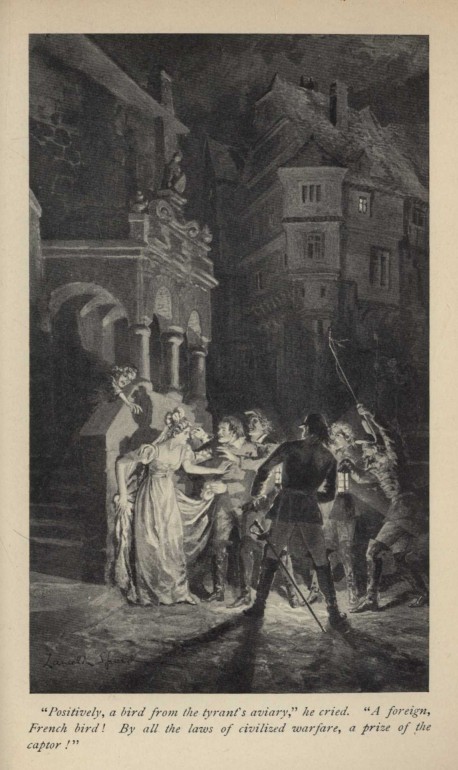
"Positively, a bird from the tyrant's aviary," he cried. "A foreign, French bird! By all the laws of civilized warfare, a prize of the captor!"
"Nay, take refuge within the bosom of the Church," interrupted the third, intoning the words: "Raise your glances heavenwards!" He shot out a black arm and lifted her chin with two dank fingers reeking of canaster.
Sidonia, who had been paralyzed with fright and the sense of her own helplessness, here once more struck herself free—this time with a wild cry for the watch. Her cry was answered by shouts and cat-calls; and now, with a mighty clatter of spurred boots, a fresh detachment of Studiosi joined the advance party. As in a nightmare, Sidonia found herself the centre of a struggling drunken laughing babel, which presently resolved itself into a circle that wheeled, stamping and jingling in time to a ribald chorus.
One of the dancers suddenly broke the ring; a flaring bearded face was thrust forward.
"A kiss, matamazell, and long live Westphalia!"
At this last insult the terror of the girl gave place to overpowering anger. She struck the coarse face so valiant a blow with her open palm, that, already none too steadily balanced, the red-haired giant staggered and would have fallen but for an officious comrade. A howl of laughter rose from the rest of the gang.
But as Sidonia, tossing back her hood, broke into vigorous German, silence succeeded to clamour. The sight of that head, so extraordinarily young, so golden in the lamp-shine, struck the group with overwhelming surprise. And upon surprise came shame, as the meaning of the words that fell indignantly from Sidonia's lips, pierced to the fuddled brains. Wild, dissipated boys they were, but not vicious at the core of their German hearts.
Here was a girl, a lady—more, a country-woman of their own; and, in their own tongue, she was telling them what she thought of them. She had always been so proud of being a German, and now she was ashamed, ashamed to think that Germans could so behave to a woman! Students, too, "nobles of learning," patriots, they called themselves, and to offer such a spectacle to the Welsch! She had fled from the palace down there because she had thought it not the right place for a good German woman: now she knew she would have been safer among the French....
Here a groan escaped a youth less tipsy or more susceptible than the rest, the quickest at any rate to catch the galling significance of this reproach. It was echoed here and there from the listening circle, by sounds of remorse and dismay. The ring melted apart; one or two caps were lifted, there was a shuffling of feet, as the most abashed slunk away. She stood, a flaming spot on each cheek, head held high, still flashing scorn and fury upon the remainder, when, with the perpetual irony of fate, the help that would have been so valuable to her a few minutes ago, and now unneeded, arrived upon the scene.
A burly watchman, bearing a lantern in one hand, and in the other a halbert with which he struck the pavement at rhythmic intervals, came striding upon them.
"Come, sirs, come, sirs, this is no manner of behaviour! No scandal in the streets, I beg. Honest folk should be in bed this hour! Disperse, disperse, meine Herren! And as for the Mädel there——"
He flung the light upon Sidonia's face and stopped, he also astounded. But she had caught in his words the music of a well-beloved and familiar accent.
"Ach, Gott, Freund!" she cried, in his own speech, flinging out both hands towards him, "do you come from my Thuringia? Then I am safe! By these Westphalians to-night, I, an unprotected woman, have been cruelly insulted."
Thuringian wits are not specially quick; but Thuringian hearts are sound, as Sidonia knew, and the appeal of the home language went straight to the watchman's. He flung himself before the girl, and turned threateningly upon her molesters, raising his halbert in a fashion which in any other circumstances would have been fiercely resented by students as against their academic privileges.
But to-night the situation was hardly one that admitted of academic haughtiness. The over-cheerful band scattered like night birds, here and there a shamefaced youth lifting his ridiculous head-gear before vanishing.
Sidonia and her countryman were alone. Then he, a stout veteran, grey-whiskered, with a comfortable fatherly presence, turned a shrewd, kind, yet grave scrutiny upon her:
"Na, child!" he exclaimed; "and what, in the name of God, brings you in the streets at this hour?"
She told him the bare truth, down to her name: how she had left the palace to seek the protection of her husband, who was at an inn in the town.