Front matter (continued 2)
Reading edition
The Russian generals Benkendorf and Diebitsch, in a conversation, of which our revolution was the subject, and which took place in an interview with colonel Wielezynski who was one of the deputies sent to the emperor, spoke of a general war as impending after Poland should be crushed.[26] Colonel Wielezynski returned from St Petersburgh in the latter part of December, bringing with him the proclamation which has already been given to the reader, and which, being published, was received by the people with the utmost indignation. It was an insult to the honor and character of the nation, which demanded vengeance. The day of the promulgation of this document was a day of terrible agitation. The cry of 'To battle! To battle!' was heard in every quarter. The nation demanded to be led against the enemy at once. The word had gone forth 'there is no hope of peace.'[27] It was with difficulty that the people could be restrained from rushing at once to the field and be persuaded to wait for a convocation of the Diet fixed on the 17th of January. This delay was another error, for the time which intervened was uselessly employed. This Diet in the opinion of the nation could decide upon nothing short of war. Upon a just interpretation of the spirit of the Emperor's proclamation, no other course could be taken consistently with the national honor. It was in consequence of this proclamation, of so criminatory, so unjust, so insulting a character, that Nicholas Romanoff and his successors were declared to have forfeited all claims to the throne of Poland, and that that throne was declared vacant. The Poles could no longer submit to a King, who, far from being willing to hear their complaints, far from guarantying the rights secured by the constitution, went the length of insulting that national honor to which all history has borne testimony. To what a future must Poland, under such a king, have looked forward. Better were it to risk the bloodiest conflict, nay, to be buried under the ruins of our country, than to remain the vile slaves of a man, who, relying on the force which he could control, was willing to take advantage of his strength to be unjust.
The Diet demanded of general Chlopicki an account of his trust, in regard to the military and civil administration generally, and in a particular manner in regard to the preparation of the forces. The result of this inquiry was to satisfy them that there had been a general negligence of his duties, especially in regard to the increase and organization of the army. On examining the military reports, it was found that only the fifth part of the amount of force ordered to be levied, was as yet enrolled. Two months had been wasted. The Dictator, as has been already stated, occupied himself principally with diplomatic affairs, and seemed to forget that the country was to be defended. The Diet saw that general Chlopicki was hoping to finish the war by conferences, and that his eagerness for peace was betraying him into a forgetfulness of what was due to the national honor. In fine, a correspondence with the Emperor Nicholas was found to have been carried on by him.[28]
The Dictator, it was seen, had been equally neglectful of the different fortifications. Except at the principal points, Praga, Zamosc, and Modlin, no works of defence had been constructed. The important places of Serock, and Zegrz, the former on the Narew, and the latter below the confluence of the Narew and the Bug, were forgotten, as were all the positions on the great road which leads from Warsaw to Brzese, upon which, or in its vicinity, our principal operations were to be executed. No point on the frontier was strengthened. The country was left entirely open. The Diet, considering all these circumstances, resolved to send a deputation to the Dictator, to demand of him, for the last time, what his intentions were, and to require of him to take the field forthwith. As the Dictator would not submit himself to this expression of the will of the Diet, and even opened to prince Adam Czartoriski, who was one of that deputation, propositions deemed inconsistent with the national honor,—the Diet deprived him of his trust.
The affairs of the civil administration were confided, as before the dictatorship, to the senate, under the presidency of prince Czartoriski, and the command in chief of the army was given to the prince Michael Radzivil. All these powers were subordinate to the Diet. In this manner ended the dictatorship of Chlopicki, who afterwards took a place in the suite of prince Radzivil, and was admitted into the counsels of the administration of military affairs.
FOOTNOTES:
CHAPTER VI.
Remarks on the policy of the late Dictator.—System of operations adopted.—The army leaves Warsaw.—Statement of the existing forces.—Of the forces proposed to be raised.—Unfortunate consequences of the delay in the preparation of the forces.—Statement of the force with which the war was actually commenced.
The dictatorship had exercised a most unpropitious influence upon our affairs.[29] Every movement had been retarded, and the most invaluable time was lost. Instead of offensive operations, the defensive was now necessarily taken. We awaited the enemy on our native soil, and exposed that soil to his insults and outrages. Even, however, at this point, the patriots called on the government to take the offensive, but it was too late. An immense Russian army was concentrated upon our frontiers, and was ready to pass them. Our forces were not strong enough to defend every point against the enemy's entrance. It was decided to keep our troops concentrated, and presenting to him always a narrow and recurvated front, to lead the enemy to the environs of Warsaw, and to give him a decisive battle there. On about the 20th of January, the prince Radzivil renewed the orders for the most rapid organization of all the different corps, and directed those corps which were already organized to hold themselves in readiness for marching. A division of lancers which was in the environs of Siedlce, augmented by some regiments of newly raised light cavalry, occupied, as a corps of observation, all the country between Wlodawa and Ciechanowiec, and were ordered to watch every movement of the enemy in that region. On about the 25th of January, the troops began to leave Warsaw and the other towns of the department, and to concentrate themselves upon a line embracing the towns of Siedlce, Ostrolenka, and Lukow.[30]
STATEMENT OF THE EXISTING ARMY, AND OF THE NEW FORCES PROPOSED TO BE LEVIED.
The whole Polish force under the Russian government, consisted, of Infantry, nine regiments of two battalions each, 19,000 men, and a battalion of sappers of 1,000 men, in all 20,000; Cavalry, nine regiments of four squadrons each; in all, 7,200; Artillery, six batteries of eight pieces each, and two batteries of light artillery, also, of eight pieces each; in all, sixty-four pieces. According to the plans of the Dictator, the infantry was to be augmented in the following manner. To each of the existing regiments was to be added a battalion of 1,000, making a total of 9,000 men. He then proposed to form fifteen new regiments, thus increasing the number of regiments of infantry to twenty-four. Each one of the new regiments was to be composed of three battalions of 1,000 men each. The total of these new regiments would then have been 45,000 men, and the grand total of the new levy would be 54,000 men. This body of recruits was to be made up from those of the exempts (their term of service[31] having expired) who were yet under the age of forty, and from all others under that age, and above that of sixteen.
Of this force, six thousand men was to be furnished by Warsaw, and an equal number by each of the eight palatinates. Besides this force, the enrollment of a national guard at Warsaw of 10,000 men was ordered; and in forming this body, no exemption was admitted except from age or bodily infirmity. Each of the eight palatinates was also to enroll a national guard of a thousand men. Thus the whole national guard was to consist of 18,000 men.
The cavalry was to be augmented as follows. From the whole gend'armerie, it was proposed to form a regiment of carabiniers, consisting of two squadrons of two hundred men each. To the nine existing regiments of cavalry it was proposed to add, as a reserve, four squadrons of two hundred each, making, in all, eight hundred. Ten new regiments were to be formed, of four squadrons each; so that the whole number of old and new cavalry would be twenty regiments. The whole augmentation of this army would amount to 9,200. The raising of this force, as in the case of the infantry, was to be equally divided between Warsaw and each of the eight palatinates.
The artillery was to be augmented by four batteries, of eight pieces each, making a total of thirty-two pieces.
RECAPITULATION.
Infantry. Cavalry.Artillery.
New forces, 54,000 9,200 32 pieces.
Existing forces, 19,000 7,200 64
Total, 73,000 16,400 96
If we should add to this number the regiments formed by the land proprietors at their own expense, detachments of volunteers, foreigners, and detachments of partizans, amounting perhaps to 6,000 2,000
The total might be increased to 79,000 18,400 96
This force, although it would seem to be disproportionate to the resources of the kingdom, it was certainly possible to have raised; for the energy and spirit of the people were at the highest point, and every one felt the importance of improving the favorable moment, which the general state of Europe, and the weakness of Russia, presented. If the reader will anticipate the course of events, and remember what a struggle, against the Russian force of more than 200,000 men, was sustained by the 40,000 only which we actually brought into the field, he may conjecture what advantages might have been expected from twice that number, which we should certainly have brought to the field, had the energy of the government followed out its plans. But from the incapacity of the Dictator for the energetic execution of his trust, these forces were never raised, and it was soon seen that Chlopicki, by assuming a duty to which he was unequal, gave the first blow to the rising fortunes of his country. The Dictator, as we have seen, had not even taken a step towards the organization of these forces, and one would have thought that he had thrown out these plans merely to blind the eyes of the nation, without having entertained the thought of taking the field. Two months passed away, the inevitable moment of the conflict arrived, and the nation was obliged to march to the fight with half the force which, under an energetic administration, it would have wielded. If we add to this unfortunate state of things, that, besides the threatening forces of our gigantic enemy, Prussia and Austria, at this late moment, and especially the former, had began to take an attitude of hostility towards us, and thus all hope of sympathy from her neighbors was lost to Poland, the perilous nature of the crisis to which the delay of the dictatorial government had brought us, thus unprepared, may be imagined. But Poland did not suffer herself to be discouraged by all these unpropitious circumstances. Trusting to the righteousness of her cause, she went forth to the contest, determined to fall or to be free.
STATEMENT OF THE FORCES WITH WHICH THE WAR WAS ACTUALLY COMMENCED.
A great exactitude in the computation of these forces would be obviously impracticable, as the precise number of the detachments of volunteers, occasionally joining the army, serving in a particular locality only, and often perhaps for a limited period, cannot be ascertained; but it will not be difficult to make a pretty near approximation to the truth.
At the beginning of the campaign, the forces were divided into four divisions of infantry, four of cavalry, and twelve batteries of artillery, of eight pieces each.
The whole infantry consisted of:
The nine existing regiments, enlarged by one battalion to each regiment, making in all, 27,000
One battalion of sappers, 1,000
A tenth regiment, of two battalions, called 'The Children of Warsaw,' 2,000
A battalion of volunteers, added to the 4th regiment, 1,000
Different detachments of volunteers, as the detachments of Michael Kuszel, and the Kurpie or Foresters, &c., 1,600
Total of infantry, 32,600
The four divisions of infantry were nearly equal, consisting of from 7 to 8,000 men each. To each of these divisions a corps of 250 sappers was attached. The divisions were commanded as follows; 1st division by general Krukowiecki; 2d division, general Zymirski; 3d division, general Skrzynecki; 4th division, general Szembek.
The cavalry consisted of the nine existing regiments, 7,200
Four squadrons, added to these as a reserve, 800
Two squadrons of carabiniers, 400
Two regiments of krakus or light cavalry, of Podlasia and Lublin, 1,600
Two regiments of Mazurs, 1,600
Six squadrons of Kaliszian cavalry, 1,200
Two squadrons of lancers of Zamoyski, 400
Total of cavalry, 13,200
This cavalry, which was composed of 66 squadrons, was divided into four nearly equal bodies. They were commanded as follows. 1st division, by general Uminski, consisting of 15 squadrons; 2d division, general Stryinski, 15 squadrons; 3d division, general Lubinski, 15 squadrons; 4th division, making the reserve, under general Pac, 17 squadrons. Besides those divisions, four squadrons were designated for the corps of general Dwernicki.
The artillery was divided into 12 batteries of eight pieces each, making in all 96 pieces.
The general statement of the forces with which the campaign was commenced is then as follows:
Infantry, 32,600. Cavalry, 13,200. Artillery, 96 pieces.
This incredibly small number marched to the combat against a Russian force of at least 200,000 men and 300 cannon. In fact, by the reports of field marshal Diebitsch, found after his retreat, and the detailed statements confidently made in the Berlin Gazette, the Russian forces amounted to 300,000; but we reject one third on the supposition that the regiments had not been entirely completed. If the very thought of commencing a war with such disproportionate means, against so overwhelming a force, should seem to the reader to be little better than madness, he will appreciate the energy and courage with which it was supported, when he learns that in twenty days, from the 10th of February to the 2d of March, thirteen sanguinary battles were fought with the enemy, besides twice that number of small skirmishes, in which, as we shall see, that enemy was uniformly defeated, and a full third part of his forces annihilated.
FOOTNOTES:
CHAPTER VII.
Entrance of the Russian forces into the Kingdom.—Proclamations of Marshal Diebitsch.—Their effect.—Disposition of the Russian and Polish forces.—Plan of operations of the Poles.
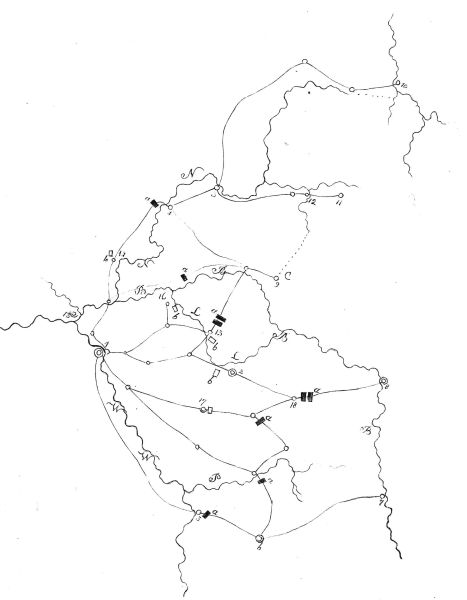
The Russian forces, simultaneously with the Polish, began to concentrate themselves on the frontiers of the kingdom, (See Plan No. 1) particularly at Bialystok (11) and Grodno (10). Four general points were designated for the entrance of this enormous force, viz. Zlotoria (12), Ciechanowiec (9), Brzesc (8), and Wlodawa (7).
Marshal Diebitsch, on entering the kingdom, published a proclamation to the Poles, a copy of which is given in the note.[32]
I
Those proclamations were published in the latter part of January. The people were disgusted with their promises and their menaces, and rejecting all idea of reconciliation on such terms as these proclamations set forth, they entreated to be led to the struggle in which they had once decided to engage, preferring every sacrifice to so degrading a submission. They demanded that an answer should be sent to Diebitsch, informing him that they were ready to meet him, and called upon the government to commence hostilities without a moment's delay.[33]
The Russian forces, [See plan No. 1, (a)] consisting, as we have already mentioned, of about 200,000 men and 300 pieces of cannon, had, on about the 5th of February, passed the Polish frontier at the four general points above named (7, 8, 9, 12). Their different commanders, besides the marshal Diebitsch, were, the Grand Duke Constantine, generals Rosen, Pablen, Geismer, Kreutz, prince Wirtemberg, and Witt. The chief d'etat major was general Toll, the most skilful of the Russian generals. The space designated for the entrance of the different detachments of the Russian corps embraced an extent of ninety-six English miles. This space was almost wholly occupied by either small or large detachments. General Diebitsch, meaning to attack our centre at Siedlce with a part of his army, intended to outflank us with the rest, and to march directly upon Warsaw, and thus, following the plan of Napoleon in the campaign of Prussia, in 1806, at Jena and Auerstacdt, to cripple our front, and to put an end to the war in a moment. The plans of this renowned commander were well understood by our general officers, and to resist them, it was determined to contract our forces (b) into a line of operations, narrow, but concentrated and strong; a course which our inferiority of force seemed to require. This line was posted as follows. Our left wing, consisting of the fourth division of general Szembek and a division of cavalry under general Uminski, was in the environs of Pultusk (14). This wing sent its reconnoissances towards Ostrolenka (4). In the environs of the town of Jadow (16) was the division of general Krukowiecki; and in the environs of Wengrow (15), the division of general Skrzynecki, with the division of cavalry commanded by general Lubinski. The centre of our position was about half way between the two latter places. Our right wing was at Siedlce (2), and was composed of the 2nd division of infantry under general Zymirski, and the 2nd division of cavalry under general Stryinski. To cover the right wing, a small corps under the command of general Dwernicki was posted at Seroczyn (17). That corps consisted of 3,000 infantry, 800 horse, and three pieces of cannon. Different patrols of cavalry were employed in observing the enemy along the whole space between Sokolow, Miendzyrzec, and Parczewo. The rivers Narew (N), Bug (B), and Liewiec (L), covered the whole line of our operations, and made it sufficiently strong. Our centre, especially, was well posted between Jadow (16), Wengrow (15), and Siedlce (2). It was protected by the great marshes formed by the river Lieviec (L). Excepting in a few points, which were well fortified, these marshes were wholly impassable. It is to be regretted that this position was not made still stronger by more ample fortifications. Besides making the passage of this point cost a more severe loss to the enemy, such fortifications would have enabled us to spare one whole division for other purposes. Fortifications of positions should always be the more freely combined with tactics, in proportion to the inferiority of a force.
In the above mentioned position we were to await the first shock of the enemy, after which the army was to retire slowly towards the environs of Praga, and in such a manner that each corps should always be on the parallel with the rest. In this retreat each corps was required to profit by every opportunity, to cause the utmost loss to the enemy, and to harass him as much as possible. By a retreat of this nature, it was intended to draw the enemy on to the walls of Warsaw, and, having weakened him during such a retreat, to give him a decisive battle there.
FOOTNOTES:
CHAPTER VIII.
The opening fire.—Affairs of the 10th and 11th February.—Combat of Stoczek.—Disposition in consequence of that battle.—Battle of Boimie.—Retrograde movement to Dobre.—Combat of Makowiec.—Passage of the Orsyca.—Combat of Dobre. Attack on the right wing at Minsk.
The tenth of February, 1831, was the first day, after an interval of fifteen years, of the encounter between the Russian and Polish arms. Mendzyrzec (18) was the place in which the first fire was given; and the little skirmish which took place there was of good presage. On the morning of that day, two regiments of Cossacks showed themselves upon the plain before the town, on which were posted two regiments of krakus, or light cavalry, and the 4th regiment of lancers, as an advanced guard. Our cavalry were impatient to engage with the enemy, and begged of their commander to be allowed to attack him. When it was seen that this body of the enemy was detached from his larger force, permission was given to one of the two new regiments of light cavalry, supported by a squadron of the old cavalry as a reserve, to throw themselves upon the enemy. In a moment our cavalry were among the ranks of the Cossacks. Both of the enemy's regiments were dispersed, and one squadron with six officers were taken prisoners. The enemy was not pursued, our troops being satisfied with this successful attack, and with having excited the first consternation in the enemy's ranks. After this skirmish, our cavalry, in obedience to previous instructions, retired to the environs of Siedlce (2). In this town was a little garrison consisting of a regiment of light infantry and a detachment of riflemen, formed and commanded by Michael Kuszel. On the 11th, at about mid-day, the whole of the advanced guard of the Russian centre, which was commanded by Diebitsch in person, reached the environs of Siedlce (2), and took position there. Before the night set in, other Russian columns began to place themselves upon the same plain. Their advanced guard then recommenced the march, throwing their tirailleurs forward, who began a warm fire, which was answered by our own light troops, who were placed in the faubourgs and the sides of the town. The brave detachment of Kuszel's riflemen, who were finely trained and equipped, caused a great loss to the enemy. The Russian artillery, to protect their tirailleurs and the columns of infantry which followed them, commenced a heavy fire upon the faubourgs occupied by our infantry. This fire of the Russian artillery was ineffectual; but our own fire, as the Russians were exposed in an open plain, was very destructive. The action continued until dark, when our infantry began to evacuate the town, and marched to rejoin the divisionary camp, which was about a mile in the rear.
II Steizel.
At 8 o'clock, general Zymirski, supposing that the enemy had taken possession of the town, determined to make an attack, with two regiments, upon the town and the Russian camp, at the point of the bayonet. The 7th regiment of the line and the 4th regiment of light infantry, which were designated for this object, fell with impetuosity upon the enemy, whom they found in an wholly unprepared state. A few hundred prisoners were the fruits of this attack, after which our forces evacuated the town. These little advantages gained in those two days, retarded the advance of the enemy. He remained inactive on the 12th and 13th. On the 14th, the Russian corps under the command of general Kreutz, composed of 15,000 men and 24 pieces of cannon, attacked the small corps of observation on our right, under the command of general Dwernicki.
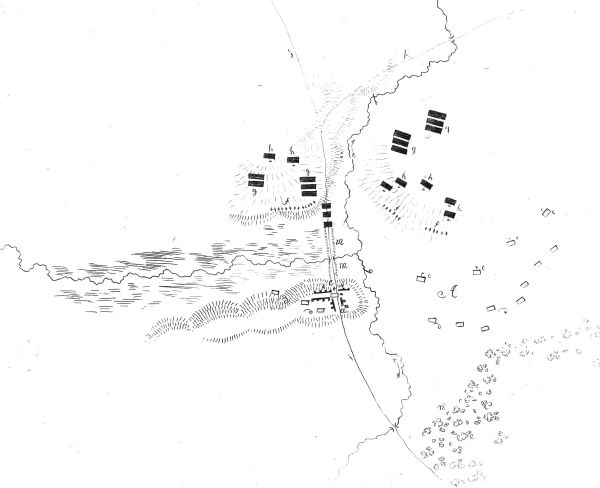
COMBAT OF STOCZEK. [See Plan II.]
General Dwernicki, although aware of the vast superiority of the enemy's force, yet, trusting in the strength of his own position, determined to meet his attack, and give him battle. The position of Stoczek (a) was strong in several respects; first, from its commanding elevation; secondly, from the circumstance that the town is protected by the river Swider (b), which forms marshes that are not passable but by a dyke (m) at a short distance from the city, in the direction in which the Russian army was approaching. That dyke was defended by the whole artillery of our corps, consisting of three pieces (e); and the declivity descending toward the dyke was occupied by two companies of light troops dispersed in favorable positions as sharp-shooters, and in such a manner as to act on the dyke. General Dwernicki divided his forces into the smallest possible bodies, to give an appearance of extent to his line, and thus mask his inferiority of force. Leaving a battalion of infantry (d) to protect the artillery and prevent the passage of the dyke,—which passage, he was sure that the enemy could not possibly execute rapidly, and that this small force was sufficient, if not to prevent at least to retard it,—he took the two battalions (d) which made the remainder of his force, and throwing them upon the right bank (A) of this river, in the forest, where an easier and safer passage was open to the enemy, he there awaited the enemy's movements. The first step of the Russians (g, h) was to place all their artillery (f) at the nearest possible point to our position, and to commence a warm fire upon the town. Under this fire they thought to effect the passage of the dyke. General Dwernicki ordered his artillery not to fire, until the Russian columns should make their appearance on the dyke, and then to open a fire of grape upon them. In this manner some hours passed, during which the Russian artillery kept up an ineffectual fire, and the Russian corps executed various manœuvres in attempting to force the passage of the dyke, and in pushing their attack in the direction of the forest. General Kreutz, seeing that his attempts to force the dyke were attended with severe loss, and thinking that in the other direction, the passage would be much more easy, decided on a general attack in that quarter. He divided his corps, leaving one part before the dyke, and with the remainder advanced to the attack of our right (A). Strong columns of Russian infantry and cavalry marched against it. As soon as this manœuvre was observed by Dwernicki, the idea was conceived by him of preventing the attack, by throwing himself with the utmost impetuosity upon the enemy before he had taken a position, and while on the march. He renewed his orders to defend with the utmost firmness the passage of the dyke; and, taking all the cavalry with him, he passed over towards the forest; and, with the united force of this cavalry and the infantry who were concealed in the forest, he threw himself upon the Russian artillery, and the cavalry which was protecting it. In a moment both artillery and cavalry were completely overthrown and dispersed, and seven pieces of cannon remained in our hands. The disorder communicated itself to the columns which were on the march, who thought no longer of following up their attack, but retreated as fast as possible, and in fact a general and disorderly retreat commenced. The ruin of their left wing caused a consternation in the forces composing their right, who, not knowing what had happened, ceased their fire, quitted their position, and joined in the general retreat. Besides the killed and wounded, more than 1,000 prisoners, with twenty officers, were taken, together with a great quantity of ammunition, baggage, &c., among which were several voitures containing the chapels of the camp.[34]
The enemy was followed a short distance only, as the inferiority of our force would not of course admit of an extended pursuit, and it was an important object also with general Dwernicki not to permit the enemy to discover that inferiority. He contented himself therefore with having destroyed nearly a third part of the enemy's corps, and with having thrown his whole force into the greatest consternation. This brilliant affair was the commencement of the remarkable career of general Dwernicki; and it was a propitious opening for our campaign.
General Dwernicki resumed his former position at Stoczek, where he awaited the orders which the commander in chief might issue on receiving the report of what had taken place. To make this position more strong, he ordered a barricade of trees to be made at the termination of the dyke and at the other points where the approach was easy, and, in order to keep a close observation upon the enemy, he sent patrols in the direction of Kock and Zelechow. While thus occupied, he received orders to leave his position immediately by a rapid march in the direction of Zelechow and Macieiowice, then to pass the Vistula and meet the Russian corps under the command of the Prince Wirtemburg, who, after having crossed that river at Pulawa, had made a demonstration on its left bank, and was approaching Warsaw.
On receiving these orders, general Dwernicki left Stoczek on the same night.
In consequence of the enemy's attack upon Dwernicki's corps, which covered our right wing, that wing was inclined and withdrawn towards Kaluszyn, in order not to be exposed to the enemy's demonstrations upon its flank or rear. The town of Minsk was also occupied by a detachment. On the 15th the Russians made a simultaneous attack on Wengrow and Kaluszyn. But the principal attack was intended to be directed against Kaluszyn, or rather the village of Boimie adjoining it. At Wengrow the attack was masked. By a strong attack upon our right wing, the enemy had the design of gaining the great road to Warsaw, a plan which it was of the utmost importance for us to defeat; for, if he should have succeeded in forcing our right wing, he would have cut off our communications with the corps of general Skrzynecki, and Krukowiecki, which were in a more advanced position. Our generals saw the necessity of the most determined defence of the position, and general Zymirski resolved to resist to the last extremity.
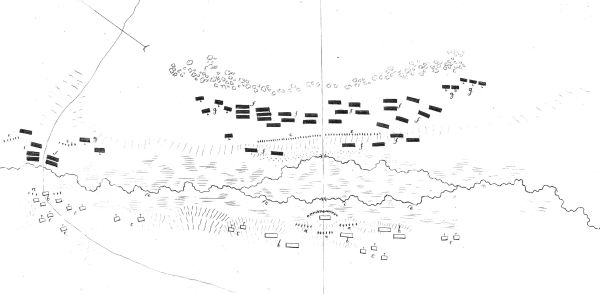
BATTLE OF BOIMIE. (See Plan III.)
The battle of Boimie consisted of a persevering effort on the part of the enemy to force the passage of a dyke (k), under the protection of the fire of a strong battery of artillery (e). On our side, every effort was directed to the making of the passage of that dyke as destructive as possible to the enemy. For this object our arrangements were made as follows. On the night of the 14th, we destroyed the bridges (m) over the small river of Kostrzyn, which traverses the dyke or main road in two places. Not far from the nearest bridge, a defence of branches of trees (n) was thrown together, which having been well placed, made a good cover for our marksmen, and for a battalion of infantry (o), which were concealed behind them. The fire of grape from the enemy's artillery was rendered ineffective to a great degree by this mass of trees. Upon the nearest elevations of ground (B), general Zymirski placed eighteen pieces of cannon (a), the fire of which was concentrated upon the dyke. By this means every attempt of the enemy to re-construct the bridge was made to cost him a severe loss, and was rendered ineffectual. The main body of our forces was placed without the reach of the enemy's artillery. On the left of our position, at the distance of about half a mile, a small road (p) led to Dobre, and that road was intersected by the small river above mentioned. The bridge which continued the road over this river was destroyed by us, and a small detachment placed there to prevent its reconstruction and its passage by the enemy.
Boimie III
Such was the distribution of the small force which, profiting by the strength of its position, was able to meet the attacks of the numerous body of the enemy commanded by marshal Diebitsch in person, and which were renewed during the whole day.
The details of the action are as follows:—At about 9 o'clock on the morning of the 15th, the Russian force commenced debouching from the forests which border the main road, between Mingosy and Boimie, and deploying to the right and left, took position. In a short time the field was covered with the enemy's masses. His force consisted of twelve regiments of infantry (f), six of cavalry (g), and sixty pieces of cannon. It was at about noon that the enemy placed his artillery upon the heights (A) above the bridge and commenced his fire. After continuing for some time this fire, which was but occasionally answered by our artillery, the enemy sent several battalions in column, upon the bridge, a part of which force engaged in the repair of the bridge, and the rest attempted to make the passage. Every approach of the enemy was met with a warm fire from behind the defence of trees above mentioned, and our artillery at the same time opened a destructive fire of grape upon the bridge. The attempts of the enemy were renewed for some hours, in vain.
Finding the impossibility of forcing this passage, he directed his efforts to that on his right (D), and sent a cloud of light infantry and cavalry to attempt to pass the marshes, and ford the stream. But this passage was equally impossible, and several Russian regiments, who were engaged in the attempt, exposed themselves to a severe fire of platoons from our troops, and several staff officers of the enemy were killed at the head of those regiments. In these renewed and bloody attempts, the day passed away, and as the night approached, our troops quietly evacuated their position, and took another a few miles in the rear.
As to the affair at Wengrow, it was only an engagement with the rear guard of the corps of general Skrzynecki. That general, knowing his position to be too far advanced, decided to retire as far as the environs of Dobre. This retreat was so orderly that it seemed rather an evolution than a retreat. All the movements were executed with perfect coolness, and the alternate retreat and fire of the different battalions, the displaying and closing of the columns, the change of front, &c., were executed with such precision that it impressed the enemy with a certain degree of respect, and though three times superior in force he did not attempt to push his attack. In this manner the corps arrived at the village of Makowiec, where it took position. On the next day, with the exception of a few light skirmishes between the outposts, nothing of importance took place. The right wing received on that day the order to fall back as far as Minsk, some miles in the rear of their former position. On the evening of that day the line of operation of our army was as follows:—Our left wing was at Zegrz, the centre in the environs of Dobre, and the right wing at Minsk.
On the 17th, the enemy attacked our centre at Dobre and our right at Minsk. It was a day of great bloodshed along our whole line, but, like the preceding, highly honorable to our arms.
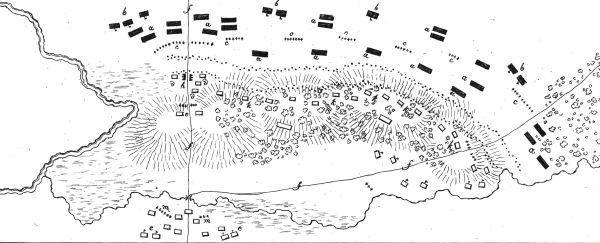
BATTLE OF MAKOWIEC AND DOBRE. (See Plan IV.)
This battle is generally known by the name of the battle of Dobre; but as it was fought in two different positions, and with two different plans of operation, I have given the name of the two general positions, in speaking of the battle. General Skrzynecki was, as we have already remarked, in a position too far in advance of our right wing; and as the enemy on that day had attacked, as we have also stated, the right wing and the centre simultaneously, and could have made, as will be seen by the plan, a demonstration on Stanislawow, and thus have acted on the rear of Skrzynecki, which was nearest to him, that general had two objects to effect. First to make the attack of the enemy as costly to him as possible, and next to arrange his retrograde movement in such a manner as to be able to reach Stanislawow by night. Both of these designs were exceedingly well executed. Upon each of his positions he was master of his own movements, and quitted them at his own time. This affair of the 17th of February was the occasion of the first development of the remarkable talents of this commander. It was then that he first awakened the high expectations and gained the confidence of the nation, which soon after committed to him the trust so honorably and faithfully executed by him. In regard to the first position at Makowiec, the reader will observe, on examining the plan, that the Polish forces were principally engaged in defending a triangular space embraced between the two roads (f) which lead from Wengrow and Kaluszyn and meet behind Makowiec (h). This space, over which small elevations covered with brush-wood were scattered, afforded good positions for artillery as well as infantry: but the principal advantage of this peculiarity of the ground was, that it concealed the inferiority of our forces. In this position, the village of Makowiec was made a point d'appui upon our left wing, and it was defended by five companies (d), under the command of colonel Dombrowski. Six pieces of artillery (e) placed in the rear of this village, reached with their fire the village and the plain in front of it. The Russian position was an open plain.
IV Makowiec
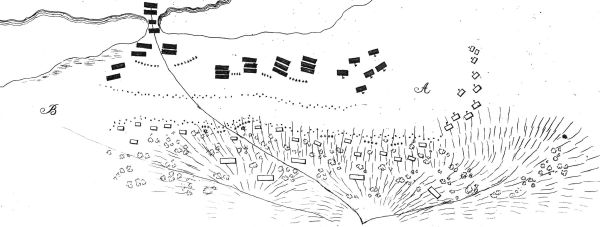
V. Dobre
The enemy commenced by an attack upon the two roads from Wengrow and Kaluszyn; and as the attack was met with a strong resistance, he began to deploy upon the plain between the two roads, and to take order of battle. Nearly 30,000 Russians, with fifty or sixty pieces of cannon (c), in a short time were seen upon that plain, and commenced a terrible fire of artillery and musquetry along their whole line, directed principally against the village and the wooded ground. Several battalions (a), in column, attempted an attack upon these points. Those attacks were witnessed by colonels Dombrowski and Boguslawski with perfect indifference. They even ordered our artillery not to fire. Our tirailleurs, and all the infantry in that position, formed themselves into detached columns (k) of half battalions, and the Russian columns approached. Our artillery then commenced a fire of grape, and this fire was a signal for our columns, with the brave colonels Boguslawski and Dombrowski at their head, to leave their cover and to throw themselves upon the enemy. The 4th regiment immortalized itself in that attack. One of its columns threw itself upon three of the enemy,—the fire ceased, and a terrible carnage at the point of the bayonet commenced. The enemy repeatedly renewed his attacking force, but he found it impossible to move our position. At about mid-day, having suffered so much from loss and exhaustion, he discontinued the attack. General Skrzynecki, profiting by the cessation of the enemy's fire, took the opportunity to pass the Liwiec, and ordered a light fire of tirailleurs to be kept up, under cover of which his columns commenced executing the passage. When the greater part of the corps had passed, the tirailleurs began to make a retrograde movement, and were undisturbed by the enemy. Six squadrons of cavalry (e), left as a rear guard, protected the passage of the river by the light troops. In this manner the position was slowly evacuated, the bridge destroyed, and by about two o'clock the whole corps were on the march for Dobre. The six squadrons abovenamed, to which were added nine pieces of light artillery (m), prevented for a long while the reconstruction of the bridge by the enemy, and did not quit their position until the corps was at a safe distance, after which they followed rapidly and overtook the corps at about four o'clock, and with it took position in order of battle near Dobre.
BATTLE OF DOBRE. [See Plan V.]
The position of Dobre was more advantageous for us than the former. It was protected in front by two ponds of considerable size, which lost themselves at their extremities in marshy ground. The only passage which led between those two ponds was easy of defence, and general Skrzynecki posted upon it twelve pieces of artillery of large calibre (a). The remaining part of this position was, like the former, covered with scattered clumps of brush-wood. The principal circumstance, however, which made this position eligible, was the declivity of the ground, inclining towards the marshy ponds above mentioned.
General Skrzynecki collected all his cavalry upon his right wing, to hinder the enemy from gaining the road that leads to Minsk (A). The left of his position (B) he laid open to the enemy. The position in that direction was surrounded by marshes, upon which, if the enemy should advance, it would be impossible for him to extricate himself without being exposed to fight on the most disadvantageous terms.
On this oblique front, general Skrzynecki awaited the approach of the Russian force. In about half an hour after our position was taken, the enemy arrived, and began to debouch between the two ponds, which he was allowed to do, under a very light fire of our artillery. Every manœuvre, however, upon our right was met with desperate charges of the bayonet, and the fire of our whole artillery. All his attempts in that quarter were ineffectual. In the repulses of these attacks, two of our bravest colonels, Boguslawski, commander of the 4th regiment of infantry, and Ziemiecki, commander of the 2d regiment of hulans, (the former fighting on foot with his carbine in his hand at the head of his regiment,) were severely wounded. At last, after these ineffectual attempts on our right, the enemy fell into the plans of general Skrzynecki, and began to act on our left, when our commander hastened to take all the advantage of the situation in which the enemy were about to expose themselves, that the lateness of the day permitted. General Skrzynecki passed down the front of our line, and addressed the soldiers in a few animating words, to prepare them to make a general attack on the enemy. Our forces were divided into two parts, the smaller of which occupied, by their attack, the main body of the enemy, while the larger threw itself upon the enemy's right wing, which was at some distance from the rest of his forces, and was apparently intending to act on our right wing and to turn it. In a moment this body of the enemy's force was completely broken up. The fury of the attack was such, that some Russian battalions were entirely destroyed. It was only the near approach of night, and the inadequacy of our force for a pursuit, which saved the whole of the enemy's corps from destruction; for his entire right wing took to flight, and a general consternation ensued. The enemy lost on that day, according to his own reports, more than 6,000 men, in killed, wounded, and prisoners. On our side the loss amounted to about 800.
Thus ended the memorable battle of Dobre. General Skrzynecki left his position, and arrived on the same night at Stanislawow. Marshal Diebitsch and the Grand Duke Constantine were with the Russian forces, in person, on that day, according to the report of the prisoners. The former, to whom this commencement of the withering of his laurels had led to a state of the greatest exasperation, often led the columns in person to the fire—but all in vain.
On the same day, as we have already remarked, our right wing was attacked at Minsk. The enemy supposed that our main force was there, and it was for that reason that he chose to attack Dobre, being more confident of piercing our line at that point. The Russian corps under general Rosen, which attacked our right wing, satisfied themselves with keeping up a fire of artillery on Minsk, and the day passed without any attempt to force the position having been made. Our troops were in the same position at night as in the morning, and nothing of importance occurred, although occasionally severe losses were sustained on both sides.
FOOTNOTES:
CHAPTER IX.
Retrograde movement of the 18th of February.—Details of this movement, and of the actions which took place.—The army reaches the field of Praga.—Its reception at Warsaw.—Position of the army.—Battle of Wavre and Bialolenka.—Operations of general Dwernicki against the corps of Prince Wirtemburg.—Defeat of that corps by general Dwernicki at Swierza.—Renewal of the enemy's attack on the main army on the 20th.—Its successful resistance.—Review of the events of the preceding days.—Examination of the plan of operations of the Polish army.
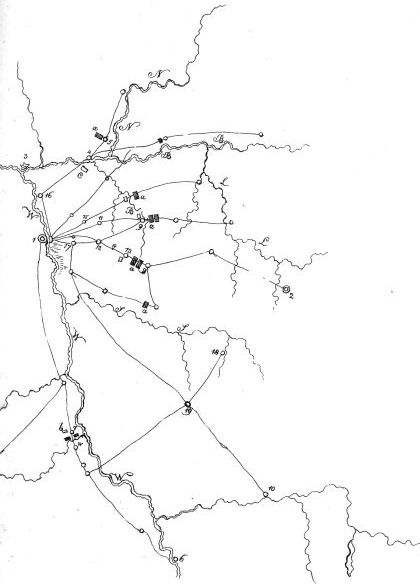
On the 18th, our whole line was ordered to make a retrograde movement. [See Plan VI.] The utmost order and tranquillity was to be observed in this movement. The several corps were required to preserve a constant communication with each other, and to keep themselves uniformly on the same parallel. General Zimirski, commanding the right wing (A), and who remained on the main road, received orders to take advantage of every good position which he should meet with between Dembe-Wielkie (13) and Milosna (12). Three points in particular were recommended to his attention, Dembe-Wielkie, (14), and Milosna. Nature presents at those points commanding positions surrounded by forests. In each of those positions, the enemy would be exposed to the fire of our artillery, on debouching from the intervening forests; and it was designed to make the attack of those positions as costly as possible to the enemy.
VI.
The centre (B), which was commanded by generals Skrzynecki and Krukowiecki, was to retire upon the road which leads from Stanislawow (9) to Okuniew (11). Upon this winding road, which traverses thick forests, the means of defence was easy.
The left wing (C), commanded by Szembek and Uminski, which was in the environs of Zegrz (4), received orders to gain Jablonna (16), and Zombke (15), on the same night. The great bridge over the Narew at Zegrz was to be destroyed, and a small detachment to be left at Zagroby, for the purpose of observing the enemy.
Conformably to the above orders, our entire line commenced the evacuation of its position, and an incessant fire was kept up throughout the line, during the whole day. In the morning, two squadrons of light cavalry, which were sent from Minsk to Stanislawow, met a regiment of cossacks, who were making a reconnoisance, after having traversed the forest of Jakubow. The cavalry threw themselves upon them, dispersed them, and took two hundred prisoners with their horses. Upon the position of Dembe, our cavalry threw themselves upon some Russian artillery which appeared upon our right, and were marching in a direction from Ruda. Six chests of ammunition were taken, and four pieces of cannon were spiked. At Stanislaus, the 2d regiment of hulans and the 4th of the line performed prodigies of valor, throwing themselves continually upon superior masses of the enemy. The division of general Zimirski repelled two successive attacks from a superior force of the enemy at Konik, upon the road between Dembe-Wielkie and Janowek. Twelve pieces of artillery, placed upon the elevated points of the road, poured an incessant fire of grape upon the masses which were advancing to the attack, and which were enclosed by forests on both sides, as well as impeded in their progress by the trees which had been placed across the road to obstruct them; and, although the enemy constantly renewed his attacking columns, he was not able to force our position, which indeed was not evacuated, until the movement of the general line required a corresponding withdrawal of this division.
Our left wing fought with equal advantages at Nasielsk. From this town, which was entirely in flames, the attacks of the enemy were repeatedly repulsed. Our artillery distinguished themselves by acts of daring valor. They drew their pieces into the midst of blazing streets, in order to pour a more effective fire upon the masses of the enemy, who had entered at the opposite extremities.
The first regiment of light infantry, having at their head the brave Szembek, threw themselves upon a part of the town occupied by a whole division of the enemy, and drove them out. Even in the midst of the burning town, our chasseurs fell upon and destroyed the different parties of the enemy. The enemy, on quitting the place, were exposed to continual attacks from our cavalry, under the command of general Uminski, who took on that day some hundred prisoners, and among them several officers.
Our right wing in its last position at Milosna (12), held the enemy in check before that town. General Zimirski placed his artillery upon the heights behind the town, from which the town and the adjoining plain was commanded. Every attempt of the enemy, every debouchment from the forest, cost him a severe loss. The enemy in vain took positions with his artillery to act upon us. He was not permitted to occupy Milosna until night approached.
At Okuniew, the road passes a marshy forest for more than half a mile. The enemy was imprudent enough to push his columns upon this road. General Skrzynecki awaited them at a point not far distant on the opposite side. The advanced guard of the enemy, imprudently composed of several regiments of cossack cavalry, had already passed the dyke, when the 4th regiment threw themselves in columns upon them.
These forces of the enemy were thrown into the utmost consternation. Their only escape was into the marshes on either side, where some hundreds of them were taken prisoners without resistance. The arrival of the night terminated the scene, and saved this advanced guard of the enemy from total destruction. Thus ended a sanguinary day, on which, in every part of our line, our troops were victorious, and the enemy was subjected to immense losses. Our generals had made the best choice of their positions, and had profited by them to the utmost.
The enemy's loss on that day, in killed, wounded, and prisoners, amounted to at least 10,000 men. On our side the loss did not exceed 1,000.[35]
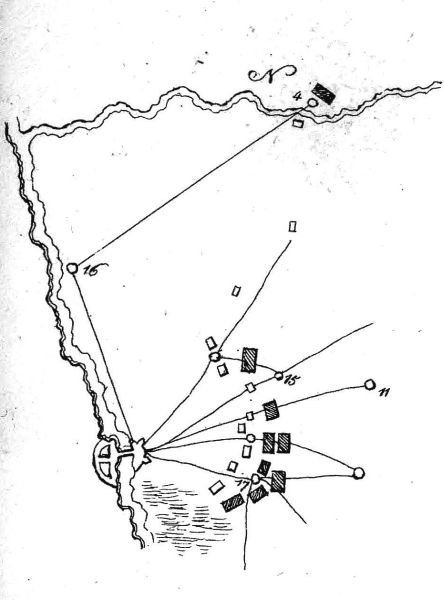
On the night of the 18th our army took the following position. [See Plan VII.] Our left wing was between Jablonna (16) and Zombki (15), and sent out its reconnoisances as far as Zagroby (4), upon the Narew (N), the bridge over which at that place they destroyed. Our centre was between Okuniew (11) and Zombki (15). Our right wing was at Wavre (17).
After two such bloody days, as the preceding had been for the Russians, we cannot sufficiently express our astonishment that marshal Diebitsch should have allowed his army no repose, but should have again pushed his attack, without any new plan, on the 19th and 20th. These operations of Diebitsch, without an assignable end, indicated a blind confidence in numbers, or the headlong fury of a man inflamed by the renown which he had acquired, and who was determined to make the event bear out as nearly as possible, whatever sacrifice it might cost, the rash boast which he is said to have made, that he would finish the war in twenty-four hours. But he sacrificed his thousands in vain.
On the 19th an action took place, not only with the grand army under the walls of Warsaw, or on the fields of Praga, but also on the left bank of the Vistula at Swierza [(7) Pl. VI], forty miles from Warsaw, where general Dwernicki beat prince Wirtemberg, who, as we have already mentioned, had passed the Vistula at Pulawa [(6) Pl. VI], and was approaching Warsaw [(1) Pl. VI].
BATTLE OF WAVRE AND BIALOLENKA. [Pl. VIII and IX.]
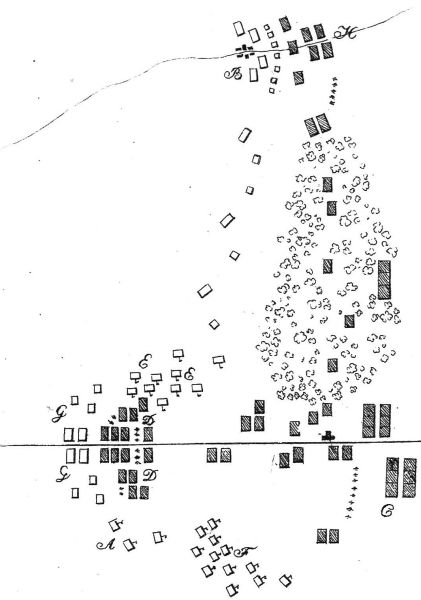
At the break of day, upon every point, the right wing, the centre, and the left wing, our line was attacked. We might remark in regard to the positions of the two armies on that day, that our right wing, (A) which was at Wavre, was unprotected, while on the other hand the left wing (C) of the enemy, opposite to it, was very advantageously placed on heights covered with wood, between Milosna and Wavre. Our centre (B) was better posted at Kawenzyn. It occupied this village, (which was in a commanding position,) and the declivity descending from it to the plain of Zombki. Our left wing at Bialolenka was also advantageously covered by little wooded hills, having two dykes in front leading toward them.
The Russians on that day directed their strongest attack upon our right wing, which occupied the weakest position. With the view of carrying this position, they sent against it some forty battalions of infantry and some thirty squadrons of cavalry, supported by seventy pieces of artillery. Our position was defended by a division of about ten battalions of infantry and fifteen squadrons of artillery, supported by twenty-four pieces of artillery. This enormous disproportion did not discourage our soldiers. Their energy supplied the place of numbers. The enemy commenced his attack by a warm fire of light troops and a fire from his artillery, which commanded the plain. The skilful man[oe]uvres of general Zimirski, in displaying his front, contracting it, dividing it into small parties, and withdrawing or advancing, as the direction of the enemy's artillery required, and thus avoiding the effect of his fire, prevented the loss which it would else have occasioned. In this way several hours were occupied, when the enemy, trusting to the impression which he supposed his fire to have made, at about ten o'clock sent forward twelve or more battalions (D) to the charge. General Zimirski, anticipating this movement, withdrew, in order to lead them on to the plain between Wavre and Grokow, sending to general Skrzynecki an aid-de-camp to inform him of this manœuvre, and to engage him to send a force of cavalry to act upon the enemy's columns in flank. General Skrzynecki, who occupied, as we have stated, the heights of Kawenzyn, was also warmly engaged with a brigade of the enemy, and had already observed this imprudent advance of the enemy in his attack, who had indeed gone beyond the line of Skrzynecki's position. In a moment the order was given for the brigade of general Kicki to throw themselves upon the enemy's flank; and as general Kicki approached with the ten squadrons (E) which composed his command, general Zimirski gave orders for a general charge both upon the enemy's cavalry (F) and infantry (D). The columns of the enemy were carried away before these charges, and their attack was wholly paralyzed. This onset, which was so successfully made, forced the enemy (H) to incline his position back from Kawenzyn to Milosna. That manœuvre was decisive of the enemy's fate, and it was well understood by our generals. General Skrzynecki, by pushing forward the left of his division, cut off the right wing of the enemy from all communication with his centre, and at about mid-day our right wing and centre occupied their former position at Wavre, including the small forest of elders which was between the enemy's left wing and centre; and, in fact, general Skrzynecki occupied a part also of the Great Forest. This state of things was to be profited by, and the right wing of the enemy, thus separated, was to be attacked before the enemy should be able to renew his attack upon Kawenzyn, and the forest of elders, and our right wing. To execute this plan, the two divisions of Krukowiecki and Szembek, composing our left wing, which was fighting at Bialolenka, [See Plan IX] received orders to push a strong attack against the enemy's front, at the same moment that a brigade (B) of Skrzynecki's division, supported by some pieces of cannon, operated upon the road (a) leading from Kawenzyn (b) to Zombki (k). By this manœuvre the enemy was menaced with being taken in the rear.
The left wing, as we have said, was warmly engaged with the superior force of the Russians; who, by placing some fifty pieces of cannon (f) behind the two dykes (e) above named, kept up a sweeping fire of grape upon our artillery (d) and infantry (c), which were defending the passage of the dykes. A considerable body of the enemy had already reached the hither side of the dykes, when general Uminski, with a brigade of cavalry (D), advanced to the charge, and at the same time communicated the orders to the two divisions to commence the general attack. Under a warm fire of grape, our cavalry threw themselves upon the enemy's infantry, which had debouched over the dykes. A general charge commenced, and our cavalry penetrated the enemy's masses. The 2nd and 3rd regiments of chasseurs distinguished themselves by their feats of bravery. The enemy was repulsed, and began to fall back and crowd upon the dykes, and at this moment their rout was effected. A brigade (B) from general Skrzynecki's division arrived, and commenced a fire of grape upon the dykes, over which the enemy was flying in the greatest disorder. Their ranks were in the utmost confusion; they crowded with precipitation upon the dykes, exposed continually to our destructive fire. By this repulse the whole of the enemy's right wing was broken, and they commenced a general retreat, leaving a great number of prisoners, who either had not reached the dykes or could not get from them, amounting to perhaps a thousand men, besides another thousand killed and wounded. The enemy also lost two standards, four pieces of cannon, several chests of ammunition, and many horses.
VII.
VIII.
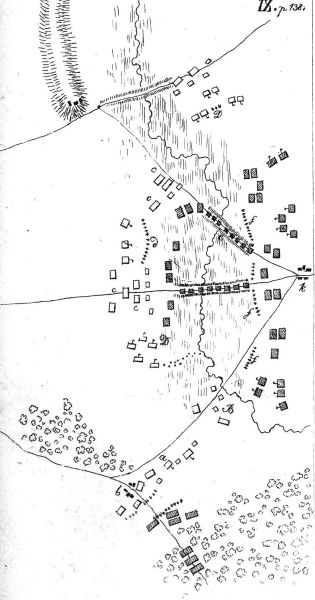
IX.
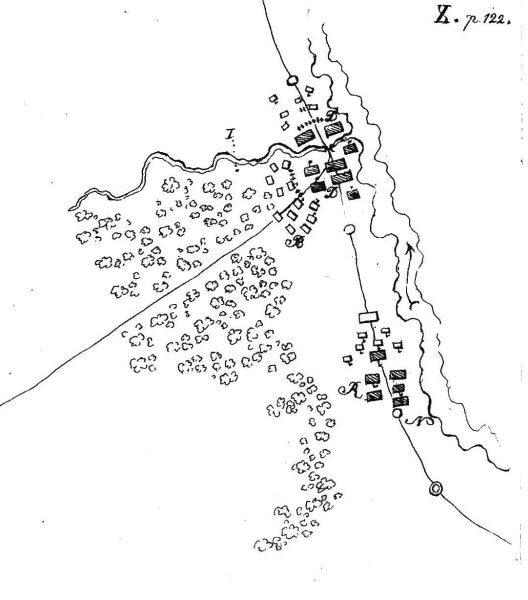
X.
In this manner ended the attack upon that wing; and indeed the general attack might be said to have ended here. Towards night the enemy renewed his attacks upon our centre and right, but they were feeble. Thus closed another day, which, like the preceding, was most propitious to our arms.
BATTLE AT SWIERZA. [See Plan X.]
On this same day, as we have mentioned, general Dwernicki, with a detached corps, fought the enemy at Swierza. The reader is already aware that this general, having gained a victory over the corps of general Kreutz at Stoczek [Plan VI, (18)], on the 14th of February, received orders to pass the Vistula, in order to defend the palatinate of Mazovie, to check the operations of the enemy there, and to obstruct his demonstrations upon Warsaw.
On receiving this order, general Dwernicki, on the night of the same day, quitted Stoczek, traversed Zelechow (19) and Macieiowice, and on the 17th passed the Vistula near Ryczywol (7). On the 18th he commenced his operations against the corps of prince Wirtemberg, which was on its way from Radom, and the advanced guard of which begun to show itself upon the plain of Ryczywol.[36]
General Dwernicki harassed the enemy on that day [See Plan X,] by continual charges of cavalry, in which the krakus of Krakowie were particularly distinguished. His only plan upon that day was to keep the enemy upon the plain of Ryczywol. During the night he intended to pass, with the chief part of his force, the river Radomierza above Ryczywol (f), and by this course to present himself to the enemy upon the road which leads from Radom to Ryczywol, the same road in fact upon which the enemy had advanced, and attack him both on his flank and rear, the Vistula being on his front. In executing this movement, general Dwernicki left two squadrons of cavalry (A), one battalion of infantry (A), and two pieces of cannon, at the side of the river, under the command of colonel Russyian. He then quietly left his position, and crossed the river in its fordable places (f) about half a league above. Colonel Russyian, who as we have said remained on the position at Ryczywol, was ordered to commence a light fire of skirmishers at break of day, but to retrograde constantly, and to allow the enemy an easy passage over the bridge. On the 19th, the enemy (D), who had no suspicions of the manœuvre, commenced in the morning his debouchment upon the bridge, having the expectation of engaging with our whole force in a decisive battle upon the field of Ryczywol. His astonishment may be imagined, when, as the day commenced, he found both upon his flank and his rear a force marching against him to the attack (B). The enemy stopped passing the bridge, and attempted to turn and meet the attack, but this was not permitted him. Our cavalry threw themselves with impetuosity upon that part of his forces which were attempting to place themselves in position; and our artillery, which was boldly brought near the enemy's columns, poured a terribly destructive fire of grape upon them. The utmost consternation ensued, and a general and disorderly flight was commenced in the direction of Nowawies (N), to which place our corps continued the pursuit of the enemy (R).
This day, which may be called one of the most brilliant in our war, cost the enemy, besides his killed and wounded, two thousand prisoners, with more than twenty officers, four standards, ten pieces of cannon, some hundred horses, and about thirty chests with ammunition, with officers' baggage, &c. The prince Wirtemberg with the remains of his corps retreated by forced marches to the small town of Granica, where he repassed the Vistula and reached Pulawa. Thus, by a single battle, the whole country on this side of the Vistula was cleared of the presence of the enemy.
General Dwernicki permitted to his corps, who were really much exhausted by fighting and marching, to repose by a slow march as far as Kozienice, where he remained stationary, sending out, however, his reconnoisances as far as Pulawa.
On the 20th of February our main army was engaged with the enemy the whole day upon the same position as on the preceding. This repetition of his attack, without a change of plan or position, was a great weakness in the enemy. On that day, feeling sensibly the loss of a part of the great forest opposite Kawenzyn, as well as that of the small forest of elders, the enemy commenced his attack upon those points. Some twenty battalions were incessantly pushed forward to the attack, against which eight battalions on our part kept an effectual stand for several hours. This day, although uninteresting and indecisive in manœuvres, was bloody. No important blow was attempted by us, but every attack of the enemy was met with a vigorous and sanguinary repulse. It was a day of glory for the 4th regiment—the day on which that celebrated regiment, though already distinguished, began to take its high place in our reports; and on which it fought with a degree of valor that could never have been surpassed. Without even waiting for orders, this brave regiment was seen constantly pushing itself towards the points of the greatest danger; and its companies were often fighting singly in the very midst of the thickest masses of the enemy.
By the unsuccessful and costly attacks of the enemy the whole day was occupied, and at its close, after the loss of thousands of men, he had not gained a foot of ground.
Thus ten days had passed in continual and bloody actions upon the same position, during which the Polish army had been uniformly successful, and at the end of which the enemy discontinued his attacks, thus giving the most convincing proof of the extent of the losses he had suffered on all points, during that period, amounting, in fact, in killed, wounded and prisoners, to full 30,000 men. In this space of ten days, the whole Russian army had been engaged, and that army amounted, as we have already said, and as will be confirmed by all the official reports, to more than 150,000 infantry, 50,000 cavalry, and 300 pieces of cannon. To this force was opposed a handful, comparatively, of Poles, consisting of 30,000 infantry, 12,000 cavalry, and 96 pieces of cannon; a sixth part, in fact, of the Russian force.
This memorable commencement of our war will show to the world what can be effected by a nation fighting in defence of its liberty and to throw off an oppressive yoke. Those bloody combats, and that enthusiasm, to which my feeble pen cannot render justice, but which some better historian will present to the world in their true colors, should convince men that the immense mercenary forces which a despot may lead on, and by which he trusts to enforce his will, may avail him little. His enormous masses are like a heap of sand, which a little stone can pierce. Without animating motives, and therefore without energy,—a machine scarcely to be trusted,—that army itself, upon the slightest change of circumstances, may become terrible to the despot, of whom and of whose creatures it was to have been made the unhappy sacrifice.
The reader will pardon me, if I fatigue him with farther reflections upon this stage of our affairs. I shall not exaggerate in saying that this enormous mass of the enemy's forces would in an equal period have been absolutely annihilated, if we had then had a commander in chief of greater talent, and a general plan of operation differently arranged,—for the different operations in detail were, generally speaking, perfectly executed. The commander in chief, prince Radzivil, was an individual of the most estimable character, but as he afterwards himself avowed, not possessed of military talent. General Chlopicki, who was always near him, and who in fact virtually commanded, if he had in the early part of his life exhibited military talent, in his present advanced age had certainly lost much of his energy, and was unfit to undertake things which demanded the most active intellect, and the most absolute devotedness of mind and body to the cause. We cannot too strongly express our astonishment that general Chlopicki, who had formed the plan, and a very judicious one it was, of drawing the enemy on to the walls of Warsaw, to give him there a decisive battle, should have neglected to fortify the natural positions upon his route, by which the enemy's loss would have been doubled or even trebled. Serock and Zagroby (4), [See Plan VI], situated upon points of the greatest importance, especially the first, were evacuated by our forces, for the want of proper defences. Not the slightest fortification was constructed at the different passages of the Narew (N), the Bug (B), the Liewiec (L), and the Swider (S), nor upon the region between those rivers, which was full of forests and impenetrable marshes, and in which proper fortifications would have presented the most important obstructions to the enemy's passage. No concealed passages or by-roads through those forests were constructed, as they should have been, by which a body of troops could be led in ambuscade and brought to act suddenly on the enemy's flanks or otherwise, in critical moments, and with decisive effect. Such works would have required but little expense, and could have been made by the Jewish inhabitants, of whom there are some millions in Poland, (twenty thousand in Warsaw alone,) and who could have no claims for exemption, for they render no service to the country, but on the contrary lead a life of profitable fraud and deception, practised upon the inhabitants. The Jews, indeed, with some very few exceptions, did not in the least aid in the war, but often frustrated our exertions by their espionage; and there are in fact instances of their having fought against us,—against those who had given them an asylum upon their soil. In the towns of Nasielsk and Makow this occurred. This part of our population, who had an equal interest with us in the protection of the country, as far as property was concerned, could have been thus employed with perfect justice and propriety. If, by such arrangements, a system of fortification had been properly united with tactics, and all the plans directed by a man of talents and energy, of which examples were certainly to be found in our ranks, with such troops to command, the reader will admit that the Russian forces could have been soon driven back to the frontiers.
The succession of victories which we have described were not the results of any general system:—they were victories of detail, executed with energy and rapidity, and for which we were indebted to the generals of divisions and brigades, the colonels of regiments, &c. These successes were isolated, but, had they been made to bear upon each other, their advantages would have been much greater. For example, the battle of Dobre, which was so brilliantly gained by Skrzynecki, would have caused the total ruin of the corps opposed to him, if the 11th division of Krukowiecki, which was in the environs of Jadow, had come to the aid of Skrzynecki during that action. And indeed this was the expectation of Skrzynecki when he remained so long upon the position of Makowiec. But this division, instead of acting upon the rear of the enemy, as it might have done, having no orders to this effect, continued its retrograde march, although within the sound of the cannon of that action.
On the 18th there was not enough of harmony in the operations of the several divisions. On that day, if those operations had been directed from one point as from a centre, the enemy, who had been guilty of extreme imprudence in the advance which he had made into the marshy and wooded region between Stanislawow (9), Okuniew (11), and the great road, could have been completely hedged in. [See Plan VI.] The manœuvres of general Zimirski, when the enemy made his rapid attack on the morning of the 19th, were executed at hazard, no general order having been given in anticipation of such an attack. These manœuvres were well executed by general Zimirski: but if the case had been thus anticipated by the commander in chief, and, at the commencement of the action, our right wing had been withdrawn to Grochow, [See (A) Plan VIII,] an obstinate defence of the commanding position of Kawenzyn (B) being kept up, and the enemy had been thus allowed to follow our right wing with his left; by the same method of operation which was in fact executed by Skrzynecki and Zimirski, in concert, but with much larger forces; the enemy could have been attacked on his flank, and instead of the annihilation of his sixteen battalions, the same fate would have attended twice or thrice that number;—for, when a force is taken by surprise in flank and rear, numbers avail comparatively little in resistance;—indeed, the greater the number, the greater is the difficulty of changing position, and the greater the disorder and consternation which follows.
The Russian army was thus early inspired with terror at the resistance which it had experienced, and the immense losses to which it had been subjected. It was of the utmost importance to profit by this consternation; but the vast advantages which might have been gained under such circumstances, by some general plan of offensive operations of bold and decisive character, were let pass.
FOOTNOTES:
CHAPTER X.
Proceedings of the National Government.—Marshal Diebitsch continues in a state of inactivity.—Negotiations are opened by him.—His propositions are declined.—Position of the army on the 24th, and battle of Bialolenka.—Position on the 25th.—Great battle of Grochow.—Details.—State of the Russian army after its defeat.—Examination of the plan of the battle of Grochow.—Remarks upon the course adopted by prince Radzivil after that victory.—The Polish army crosses the Vistula to Warsaw.—Its reception by the national government and the citizens.—Resignation of prince Radzivil.
Whilst the army was thus gloriously fighting, the national government were laboring for the happiness of the people. Among other valuable institutions, it adopted a paternal guardianship over the defenders of the country by designating an allotment of lands for each soldier. Many of the most wealthy families contributed of their landed property for that object. Another act was to free the peasantry from the Corvee, by purchasing the rights of the landholders over them. Each peasant was made a proprietor, and for the landholders an arrangement of compensation in the form of annual instalments for a period of years, was made by the government. Other institutions for the public welfare, as the establishment of schools, &c., received also the attention of the government.
When, after so many battles, the Russian commander discontinued his attacks, it may be supposed that besides the repose which his army required, he had another object, viz. to wait the arrival of new corps, consisting of 20,000 men, and 36 pieces of cannon, under prince Sczachowski. He evidently wished to concentrate all his small detachments and all his reserves, in order to strike, with his whole force, a decisive blow; and the attempt was, in fact, soon made.
Our army, which in the ten preceding days had lost about six thousand men, was reinforced by three regiments armed with pitchforks, amounting to about the number we had lost. Our whole army, infantry and cavalry, may have amounted to 40,000 men, and, with the pieces taken from the enemy, 100 cannon.—The Russian army, with the new corps of Sczachowski, amounted to 188,000 men and 316 pieces of cannon, deducting the artillery which had been lost or dismounted.
Marshal Diebitsch, before commencing hostile operations, opened negotiations, and, for this purpose, sent a general of division, Witt, with a flag of truce to our head-quarters. This general was stopped at our advanced post, whither general Krukowiecki was sent by the commander in chief, with full powers, to meet him. General Witt commenced with expressions of the greatest sensibility, and enlarged much upon the friendship which ought to exist between the Poles and the Russians as brother nations. He then spoke in very flattering terms of the heroism of the Poles, lamenting that it was not displayed in a better cause. After much complimentary language, he insensibly passed to the ideas of duty and obedience to the monarch. General Krukowiecki, who understood perfectly well all these professions, which he knew to be insidious, answered nearly in the following laconic terms: 'General, after the sad circumstances which have taken place, after the bloody combats to which we have been forced by the tyranny of fifteen years, by the refusal of justice, and in fine by the violation of our frontier, and the laying waste of our territory,—upon this territory we can make no arrangements. You know well what are the frontiers of Poland. Upon the banks of the Dnieper, four hundred miles hence, we may enter into negotiations.'
Thus all was ready for the sanguinary battle of two days, which followed, and one memorable in the annals of war. It commenced by a combat on the 24th at Bialolenka, and ended on the 25th on the plain of Grochow.
POSITION ON THE 24th, AND BATTLE OF BIALOLENKA
The position of the two armies, on the 24th, was as follows. The Polish army occupied the same ground as when they ceased firing on the 20th; but the force was disposed in a different manner.—The right wing was reinforced by the division of general Szembek; and although Bialolenka, Kawenzyn, and Wavre composed the line of combat, there was this difference, that, while before, the centre was at Kawenzyn, and the left wing at Bialolenka, at present the left wing was at Kawenzyn; the forces which were at Bialolenka were posted as a detached corps, and the centre of the army was at the forest of elders. The right wing occupied the space between the great road and the marshes of the Vistula, called the marshes of Goclaw. This arrangement made our line more concentrated. The first division under Krukowiecki, which was at Bialolenka, with the division of cavalry under Uminski, was directed to observe the great road from Jablonna, and all the roads leading from Radzimin and Zombki to Warsaw. Between Kawenzyn and Bialolenka the debouchment of the enemy was prevented by extensive marshes.
The Russian army was upon the same points as on the 20th. Their greatest force was opposed to our right wing at Wavre.
On the afternoon of the 24th, the enemy attacked with impetuosity the first division at Bialolenka. The corps of the enemy which made this attack was that of the prince Sczachowski, which had recently joined the main army, and for which marshal Diebitsch was supposed to have waited. This corps, as was afterwards ascertained, had missed their road, and became unintentionally engaged with our forces on that day. The orders of that corps were to traverse the forests between Radzimin and Zombki, and to join the army without being observed by our forces. It was the false direction which they took that brought on the engagement at Bialolenka.
This battle consisted, like the former actions at this place, of an attempt by the enemy to force the passage of the dykes, which were defended on our side by about eight battalions, protected by some twenty pieces of cannon. This small force repulsed the enemy in three successive attacks upon the dykes. At about 5, P.M. another Russian corps, under general Pahlen, came to the succor of Sczachowski, and as the first corps attempted to pass the road leading from Radzimin, the latter attempted to force the passage of the two dykes leading from Zombki, and at both points under the cover of a terrible fire of artillery. If the reader will consider that our small force, consisting of only eight battalions and fifteen squadrons, stood their ground against two Russian corps of nearly 40,000 men and 60 pieces of cannon, the efforts which were made on that day may be appreciated. Our plan of action consisted chiefly in allowing a part of the enemy's forces to pass the dykes, and then falling upon and cutting them up by successive charges of cavalry and infantry, supported by an effective fire of artillery. By such efforts this handful of brave men repulsed the attacks of the enemy until night, when his attacks ceased. At the approach of night, general Krukowiecki sent small reconnoitering parties upon the roads from Radzimin and Zombki. These patrols, pushing as far as, and even beyond Zombki, saw nothing of the enemy, and in fact learnt, to their astonishment, from the marauders whom they took, that the two Russian corps had quitted their position, and were on their march across the forest of Kawenzyn, to join the main army. This sudden withdrawal of the enemy's corps was an indication that they had received orders to join the grand army, and that a general attack was in contemplation for the next day. In expectation of this attack, a body of men was sent, during the night, to obstruct, by defences, the three roads leading from Radzimin and Zombki. Small detachments were left on those roads, and the forces which were at Bialolenka quitted their position, to reinforce the larger corps upon the plain of Wavre.
The following was the position of the two armies on the 25th, the day of the memorable battle of Grochow. [See Plans XI and XII]. The Russian army was distributed into eight divisions of combatants, and three divisions of reserves. Those eight divisions consisted of 126,000 infantry (a), 42,000 cavalry (b), and 280 pieces of cannon (c). The three divisions of reserve (E) were composed of 16,000 infantry, 4,000 cavalry, and 32 pieces of cannon. This enormous force, which occupied the space between Kawenzyn (A) and the marshes Goclaw (B), a distance of about three English miles, was arranged in two lines of combatants (C, D) and a third of reserve. Their position was as follows: Their left wing was between Wavre (r) and the above marshes of the Vistula, and was composed of four divisions of infantry, of 47,000 men, four divisions of cavalry, 15,700, and 120 pieces of cannon. The centre, opposite the forest of elders, consisted also of four divisions of infantry of 57,000 men, three of cavalry of 10,500 men, and 108 pieces of cannon. The right wing, opposite the village of Kawenzyn consisted of three and a half divisions of infantry of 31,000 men, four divisions of cavalry of 15,750 men, and 52 pieces of cannon. Upon the borders of the great forest opposite the forest of elders, was placed the reserve, commanded by the Grand Duke Constantine.
Against this force our inconsiderable army was posted in the following manner. The right wing (G), formed by the division of Szembek, consisting of about 7,000 infantry (d) and 24 pieces of cannon (f), occupied the space between the road and the marshes above mentioned. The centre (H) occupied the forest of elders, and touched upon the great road. It was composed of two divisions commanded by Skrzynecki and Zimirski, composed of about 15,000 infantry (d) and 60 pieces of cannon (f). The left wing (T) occupied Kawenzyn, consisting of the first division, commanded by Krakowiecki, composed of 6,500 men (d) and 12 pieces of cannon (f). Four divisions of cavalry (g), consisting of 9,500 men, commanded by Uminski, Lubinski, Skarzynski, and Jankowski, were not posted on any fixed point, but stood in readiness to act wherever occasions might offer. Besides these, was a small reserve (K) of four battalions and eight squadrons, in all about 5,400 men, under the command of general Pac.
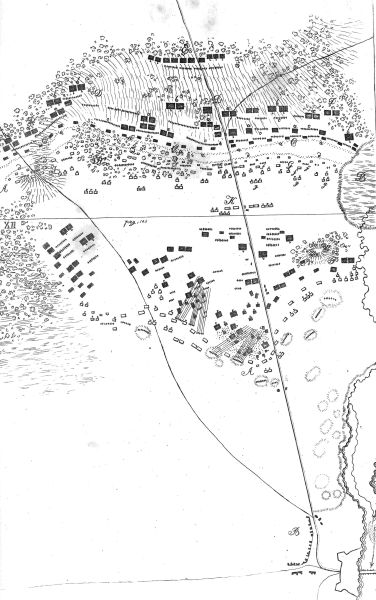
XI. Grochow
BATTLE OF GROCHOW.
On the 25th, at break of day, the fire commenced on our left wing, on the position of Kawenzyn. The enemy pushed forward all the forces which were collected on his right wing, and commenced a terrible fire of artillery and musquetry, with the apparent determination to carry our wing by a single overpowering effort. Nearly fifty pieces of artillery opened their fire upon Kawenzyn, and numerous columns of infantry, under the protection of this fire, pressed forward to carry the position. But our forces prepared to meet the attack. Small as they were, consisting only of seven battalions with twelve pieces of cannon, they had formed the determination to die or conquer upon that ground. They could hope for no succor, for the whole line was in expectation of a general attack.
The brave generals Krukowiecki and Malachowski made every effort to sustain the perseverance of their troops, and each of them, at the head of their columns and on foot, threw themselves upon the enemy's ranks. Our artillery did not answer that of the Russians, but directed its fire of grape wholly upon the columns which were approaching. By the unparalleled bravery of our wing, of which every soldier seemed to have formed the resolution to fall rather than yield a foot of ground, this tremendous attack of the enemy was sustained for several hours, till at last he was obliged to slacken it.
During the whole of this attack upon our left wing, the centre and the right remained still in their positions, awaiting the expected attack. It was near ten o'clock when the fields of Wavre became, as it were, in one moment, covered with the forces of the enemy, which issued out of the cover of the forests overhanging the plain. Looking over that plain, between the forest of elders and the Vistula, one would have thought it was an undivided mass of troops which was in motion; for in that comparatively limited space, the eye could not distinguish the different divisions from each other.
Two hundred pieces of cannon, posted upon that plain, in a single line, commenced a fire which made the earth tremble, and which was more terrible than the oldest officers had ever witnessed. After having prolonged for some time this tremendous fire of artillery, the enemy made an attempt to carry our right wing; but in a moment all our cavalry were collected there, and fell upon and overthrew his columns, and his efforts were as fruitless here, as they had been against our left.
Having been unsuccessful in these two attacks on the wings, and hoping that he had weakened our line by the terrible fire of artillery, which he constantly kept up, the Russian commander collected the greater part of his forces opposite the forest of elders, and it was there that an attack was commenced which presented a scene unheard of in the annals of war. It could with more propriety be called a massacre of nearly four hours duration. The Russians brought together at this point one hundred and twenty pieces of cannon, posted in the rear and on the sides of that forest. Some fifty battalions were incessantly pushed to the attack, with the view to get possession of that forest. Had they been able to effect this, they would have divided our army into two parts, and thus could not but have ensured its destruction. It was the consideration of this important fact which prompted the horrible attack, and the desperate resistance which it met. The brave Skrzynecki, Zimirski, Boguslawski, Czyzewski, and Rohland, defended this forest with fourteen battalions, whose admirably executed manœuvres, the change of front, the arrangement of the attack in columns and escalon, the concentration of force upon the points in which the enemy's line seemed to waver, a fire which was never lost, but was always reserved for the closest approach of the enemy—all were executed with an activity, order and coolness never surpassed. It was only by such conduct that the tremendous attack of the enemy could have been sustained for four hours, and that, after having nine times gained possession of the forest, he was as often repulsed with an immense loss.
Like the infantry, our artillery performed prodigies. All the batteries, protected by cavalry which never abandoned them, pushed themselves in advance even of the line of the skirmishers, and approached sometimes within a hundred feet of the enemy's columns, in order to give their fire with the most infallible execution. The battery of the brave colonel Pientka, which defended the border of the forest, was so far advanced that it was sometimes surrounded by the enemy, who, in his own disorder, did not become aware of the advantage. All the different operations indeed, of our artillery in this battle were truly admirable. Batteries, now concentrated upon one point, were in a moment hurried to another and distant one, where the enemy was wholly unprepared for them, and was thrown into disorder by their sudden attack. In the early part of the afternoon, when the enemy, after having been several times repulsed, renewed his attack with the greatest determination, and our 2d division began to give way, the four batteries of artillery of the brave Adamski, Maslowski, Hilderbrand, and Bielak, in concert with that of colonel Pientka, advanced like cavalry to the charge, and, approaching close to the Russian columns, opened a fire of grape, which spread destruction and disorder in their ranks. Our infantry, thus animated to the contest, rallied, and threw themselves again upon the enemy, who then yielded before them.
Like the artillery and infantry, our cavalry, besides the different charges which they executed with so much bravery, was manœuvred with the utmost skill by our generals, and was made to fill the voids occasioned by the inferiority of our forces, so as always to present to the enemy an unbroken line.
By such manœuvres of the three arms, executed with the greatest determination, in which every commander performed his duty to the utmost, the enemy's plans were continually disorganized, and his enormous force, which at first sight would have been supposed capable to have absolutely crushed the small army opposed to it, was in effect only a great mass, making a continual oscillation, and which seemed to trust to do every thing by a terrible fire of artillery, which was always kept up, whether necessary or not.
Thus it was that fifty battalions of the enemy, amounting to over 40,000 men, supported by 120 pieces of artillery, in a concentrated attack upon one point, the forest of elders, the decisive point of the position, were nine times repulsed from that forest, which was left literally covered with their dead.
From eleven o'clock until three, these attacks continued through the whole line, (the most powerful being in the centre), and the destruction of life was immense. At the last named hour, our generals, each of whom we may remark had had their horses shot under them, and several of whom were severely wounded, formed the plan of giving the enemy a decisive blow. Their plan was to withdraw from the fire the 2d and 3d divisions, which had suffered most, and to make a general retrograde movement in such a form as to have the wings considerably in advance of the centre, which was to be drawn back as far as the Obelisk of Iron (k), at which there was a position more commanding. This plan had the following objects:—The first was, to draw the enemy upon the open plain; the second was, to concentrate our force still more, and to place it in two lines, the inner one to be composed of the whole of the 2d and a part of the 3d division, which were withdrawn for repose. A third object was, to lead the enemy to believe that a retrograde movement was forced upon us by our losses, and that we felt ourselves too weak to continue the defence of the forest.
To execute this manœuvre, and to enable the 2d division to retire without being molested, the artillery was left with some twenty squadrons of cavalry to protect the retrograde movement. This artillery and cavalry were ordered afterwards to evacuate their positions gradually, and the former to take post in the centre under the protection of the whole of the cavalry, which were in escalon, and prepared for a general attack. The manœuvre was as admirably executed as it was conceived. The enemy had no suspicion of its object, but, presuming it to be a flight, undertook to profit by it. It was at this moment that marshal Diebitsch, as if sure of victory, saw himself already at Warsaw, and, on the field of battle, he allowed these words to escape him: 'Well, then, it appears that after this bloody day, I shall take tea in the Belvidere palace.'
It was about three P.M. that our 2nd division, in conformity with the plan adopted, began to retire by an escalon movement. To hasten the execution of this movement, it was ordered that the columns, retiring in succession, on reaching a considerable distance from the enemy, should quicken their pace as they proceeded, in order to form the second line as soon as possible, and to give space for the operations of the artillery and cavalry. It was at this moment that general Zimirski, who had lost several horses under him, and had just placed himself upon a fresh horse, to superintend this movement, was struck with a twelve pound ball in the left shoulder, which carried away his arm, and caused his death in a few hours. The melancholy loss of this general was most deeply felt by the whole army, and particularly by his own division, but it did not interfere with the execution of these orders. The brave general Czyzewski immediately took command of the division, and continued the orderly movement of the division towards the rear, and he received great support from generals Rohland and Zaluski. As soon as the last columns of this force quitted the forest, [See Plan XII] the Russian troops began to debouch from it, and our artillery commenced a terrible fire. The brave colonel Pientka, who was still far in advance, checked the debouchement from the forest near him. Seated with the most perfect sangfroid upon a disabled piece of artillery, this brave officer directed an unremitting fire from his battery. The artillery and cavalry, after having protected the retrograde movement of the centre, still continued to keep their ground, to enable the wings also to retire undisturbed. All our forces were then in movement, and the enemy pressed on. The Russian columns had already advanced beyond the position of colonel Pientka, but that brave officer still kept up the defence.[37] By this time, however, the 2nd division had already reached their destined position, and their battalions had commenced forming. Such was the state of things, when, between Kawenzyn and the forest, a cloud of Russian cavalry was seen advancing to the attack, having at their head five regiments of heavy cuirassiers; a force in fact of some forty squadrons, or between eight and nine thousand in all. Colonel Pientka, with his artillery, supported only by a single regiment of Mazurs, still held his post, to give yet another effective fire upon this advancing cavalry, which was already between him and Skrzynecki's division; and then, to save himself from being cut off, he quitted at full gallop a post which he had occupied for five hours under the terrible fire of the artillery of the enemy. This rapid movement of Pientka's battery and the regiment of cavalry which attended him, animated the Russian cuirassiers in their advance, and the infantry and artillery of the enemy followed their cavalry. At this moment Chlopicki was wounded by a grenade, and the army was without a head; but generals Skrzynecki and Czyzewski had already formed their divisions into squares, and awaited the attack of the enemy.
The Russian cavalry advanced upon the trot, and came in a direction perpendicular to the line of our battery of rockets, which was posted between the 2d and 3d divisions (A). Suddenly a discharge from this battery was poured into their ranks, and enveloped them with flame and noise. Their horses, galled to madness by the flakes of fire which were showered over them, became wholly ungovernable, and, breaking away from all control, spread disorder in every direction. The enemy's ranks were soon in the most utter confusion, and in a short time this enormous body of cavalry became one disordered mass, sweeping along towards the fire of our squares. In a very few minutes that cavalry was almost annihilated. So nearly complete, in fact, was their destruction, that of a regiment of cuirassiers, which was at the head of the attacking force, called the regiment of Albert, and which also bore the designation of the 'Invincible' inscribed upon their helmets, not a man escaped. The few who were not left dead upon the field were taken prisoners. In fact, some hundred horse of that regiment were whirled along through the intervals of our squares, and were left to be taken prisoners at leisure. The wrecks of this routed cavalry, closely pursued by our lancers, carried along in their flight the columns of infantry which were following them, and a general retreat of all the enemy's forces commenced. The battle was gained. The cry of 'Poland forever!' arose along our line, and reached the walls of Warsaw, to cheer the hearts of its anxious inhabitants. Nothing was wanting but a skilful commander in chief to our forces, to have insured the entire destruction of the Russian army.
Two thousand prisoners, among them twenty officers of different grades, five pieces of cannon, and upwards of a thousand horses, were the trophies of that immortal day, the memory of which will be forever terrible to tyrants.
It was nearly five P.M. when the Russian army commenced a general flight, and even evacuated its first position, which it had occupied in the early morning. It is to be regretted that the order to follow up the pursuit was wanting. Szembek alone threw himself, at times, with his division, among the Russian ranks, and took a great number prisoners, baggage and chests of ammunition. According to the declaration of general Szembek, if, during the retreat of the enemy, a charge of cavalry and artillery had been ordered between the left wing and the centre of the enemy, a great part (P) of that wing, which was considerably detached from the centre, would have been cut off. This could have been easily done, for no part of our little reserve was brought into action during the day, and they were eager to be permitted to make the charge.