Front matter (continued 4)
Reading edition
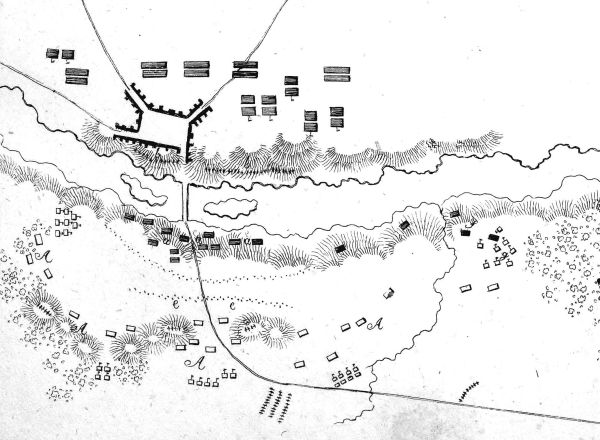
It was between four and five o'clock that Prondzynski first perceived our lancers (D) advancing upon the main road. A great part of the enemy, particularly of their cavalry, had not yet passed the dyke (a), being obstructed by their artillery. Generals Prondzynski and Romarino, dismounting from their horses, with carbines in their hands, placed themselves at the head of their columns, and commenced a fire of artillery, to apprize our advancing cavalry of their position. At the sound of this fire, the cavalry of Lubinski raised the hurrah, rushed forward, and as they approached near the brigade of Romarino, threw themselves at the charge upon that portion of the enemy's rear guard which had not yet passed the dyke. Our infantry and cavalry thus fell simultaneously upon them, the enemy were terribly cut up, and the battle was gained. Nearly five Russian battalions, amounting to 4,000 men, with their officers, amounting to near one hundred, their standards, and eight pieces of cannon of large calibre, were taken. Six regiments of cavalry were dispersed, many of them were lost in the marshes of the river into which they were driven, and several hundred men and horse were taken prisoners there. In this battle, which may be counted one of the finest in the campaign, the circumstance that our main force was retarded by the state of the bridges, alone saved the enemy from total ruin. It is to be remarked that the 2d division of cavalry of general Stryinski, did not improve its time, and effected nothing upon the right flank of the enemy, as the instructions contemplated. The negligence of that general was inexcusable, and the commander in chief deprived him of his command. We lost in this battle about five hundred men, in killed and wounded. The brave general Prondzynski was slightly wounded. Before night the two armies were not at the distance of a cannon-shot from each other, but all was tranquil. The disorder and consternation of the enemy may be imagined, when it is stated that our columns took position before their eyes, on the field of Iganie, without being in the least disturbed by them.
The reader will permit me to fix his attention upon the epoch of the battle of Iganie, which was indeed the brightest moment of our war, the moment of the highest success of the Polish arms, the moment of the most confident hopes, when every Pole in imagination saw his country already restored to her ancient glory. Let us then, from this point, cast a look backwards to the commencement of this terrible contest. Two months before, an enormous Russian force had invaded our country, defended as it was by a mere handful of her sons; and any one who had seen that immense army enter upon our soil, could not but have looked on Poland with commiseration, as about to be instantaneously annihilated. In this expectation, in fact, all Europe looked on, and at every moment the world expected to hear of the terrible catastrophe,—to see Poland again in chains, and the Russian arms reposing on the borders of the Rhine. Such, in fact, were the expectations and even the promises of marshal Diebitsch. Providence, however, willed otherwise. The first shock of the Polish arms with the Russians taught the latter what was the moral strength of patriotism,—what a nation can do for love of country and of liberty. The fields of Siedlce, Dobre, and Stoczek, the first witnesses of our triumphs, and the grave of so many of our enemies, taught them to respect the nation which they expected to subdue, made them repent the audacity of having passed our frontiers, and gave them a terrible presage of how dearly they would have to pay for this unjust invasion of our soil. Battle upon battle was given, in which the enemy were uniformly subjected to the severest losses. The two great roads leading from different directions to Warsaw, on which they had followed the Poles, were covered with their dead. Thus subjected to loss at every step, the enemy reached at last the field of Praga, and there collecting all his forces in one body, under a tremendous fire of artillery he thought to overpower our small forces. But he failed to do it. The immortal day of the 25th of February was nearly the destruction of his enormous force, and, after fifteen days of severe fighting, that great army, which was designed to destroy Poland and to make Europe tremble, was brought to a state of extremity. The autocrat and his general blushed at the menaces which they had uttered. Poland believed that the former would reflect upon those bloody struggles and the immense losses which he had suffered, and would be unwilling to continue such sacrifices. Nearly 50,000 Russians were already sacrificed. How many more lives might he not still lose? The Poles, although conquerors, held out the hand of reconciliation, as the letters that Skrzynecki addressed to Diebitsch have proved. In those letters, written with the utmost cordiality, frankness, and directness, he invited the Russian commander to present the real state of things to the monarch, and to assure him that the Poles longed to put an end to this fraternal struggle. A word of justice, of good will, indicative of a disposition to act for the happiness of the nation, and to observe the privileges which the constitution granted,—a word of this nature, from the lips of the monarch, would have disarmed the Poles, blood would have ceased to flow, and those arms outstretched for the fight, would have thrown away the sabre, and would have been extended towards him as to a father,—to him, the author of a happy reconciliation. He would have been immortalized in history, and would have taken a place by the side of Titus.
Far, however, from that true and noble course, that proud autocrat, as well as his servant, Diebitsch, thought little of the thousands of human beings he was sacrificing:—far from such magnanimous conduct, he sent for other thousands to be sacrificed, to gratify his arrogance and ambition. He contrives new plans to pass the Vistula. It was not enough to have covered four palatinates with ruin on one side of that river. He determines to spread devastation and ruin upon the other also:—in fine, to attack Warsaw, and bury in its own ruins that beautiful capital, the residence of the successors of Piast and Jagellow, and where he himself could have reigned in tranquillity, by only having been just and good. In the execution of this plan of destruction, he was arrested and justly punished upon the glorious days of the 31st of March and the 1st of April, which, in conjunction with the recent revolutions in Lithuania and Samogitia, and the recent battle of Iganie, seemed to threaten the ruin of his army.
The Russian army was now in a state of the greatest disaffection, being posted in a devastated country, and having their resources for subsistence entirely cut off by the state of Lithuania and Samogitia. In addition to their immense losses in action, fatigue, sickness, and other inconveniences had reduced them to a state of extreme distress. Besides the influence of physical evils, there was a moral influence which impaired their strength, arising from a conviction which they could not avoid feeling, of the justice of the Polish cause. The Russian soldiers began also to reflect, that by thus serving the ends of despotism, they were only securing the continuance of their own servitude. These reflections were not made by the army alone, but, as we were secretly advised by persons coming from the interior of Russia, they were made there also, and were accompanied with the same sentiments of discontent. At St Petersburgh, as well as at Moscow, various discontents were manifested, and notices of such must have met the eye of the reader in the journals of the day. The senate of St Petersburgh presented to the consideration of the monarch the continual severe losses of the preceding years, in the wars with Persia and Turkey, and those of this campaign, (though much underrated by them,) which they had reason to fear would be still increased, and which might encourage revolutions in all the provinces. For these reasons the senate took upon themselves to advise some propitiatory measures, and some attempt by concessions to satisfy the demands of the Poles. The party most zealous in favor of such a course was composed of those who had relations and friends exiled to Siberia, on account of the revolutionary movement of 1825. The Russian patriots in general, not only thought it a favorable moment to attempt to effect an amelioration of the fate of those individuals, but they hoped that the restoration of their ancient constitutional privileges and nationality to the Polish provinces attached to Russia, would authorize a claim for equal privileges to the people of the whole Russian empire.
To these circumstances, is to be added that at this time the other cabinets began to feel dissatisfied at the course of Russia, and decidedly refused the requests of aid in men and money which she made on the pretext of former treaties. Every thing, in fine, seemed to promise a near end of the present difficulties. The Polish army, to whom this state of things was well known, waited impatiently for the moment of a decisive contest. One victory more, and the Russians would not be in a state to push their attempts farther. Nothing could then stop the progress of our arms, which would rest on the borders of the Dnieper, the only frontier known to our ancestors. One struggle more, and the darkness of ages, which had hung over the Polish provinces of the North, would be dispersed. The light of civilization would then spread its rays as far as the Ural mountains, and with that civilization a new happiness would cheer those immense regions. Upon the borders of the Dnieper fraternal nations would hold out their hands towards us, and there would be made the great appeal: 'Russians! why all this misery? The Poles wish to deprive you of nothing. Nay, they have even sacrificed their children for your good. Russians! awake to a sense of your condition! You, like us, are only the unhappy victims of the relentless will of those who find their account in oppressing you and us. Let us end this struggle, caused by despotism alone. Let it be our common aim to rid ourselves of its cruel power. It is despotism alone that we have any interest in fighting against. Let us mark these frontiers, which so much fraternal blood has been shed to regain, by monuments, that shall tell posterity, that here ended forever the contest between brothers, which shall recall the disasters that despotism has caused, and be a memorial of eternal friendship between us, and of eternal warning to tyranny.'
A COMPARATIVE VIEW OF THE FORCE OF THE TWO ARMIES AFTER THE BATTLE OF IGANIE.
The Russian forces, which commenced the contest on the 10th of December, amounted, as has been before stated, to about 200,000 men and 300 pieces of cannon. That army received two reinforcements, viz. the corps of general prince Szachowski, consisting of 20,000 men, and 36 pieces of cannon; and the corps of the imperial guard, consisting also of 20,000 men and 36 pieces of cannon. The whole Russian force, then, which had fought against us, amounted to 240,000 men, and 372 pieces of cannon.
To act against this force, our army, counting the reinforcements of 6000 men which it received before the battle of Grochow, had in service about 50,000 men, and about 100 pieces of cannon. Up to the battle of Iganie, fifteen principal battles had been given, viz. those of Stoczek, Dobre, Milosna, Swierza and Nowawies, Bialolenka (on the 20th and 24th), Grochow (on the 20th and 25th), Nasielsk, Pulawy, Kurow, Wawr (on the 18th and 31st), Dembe-Wielkie and Iganie. To these are to be added a great number of small skirmishes, in not one of which could it have been said that the Russians were successful. By their own official reports,—after the battle of Grochow, more than fifty thousand Russians were hors du combat. It will not, then, be an exaggeration to say, that their whole loss, taking into the account prisoners and those who fell under the ravages of the cholera, which had begun to extend itself in their army, must have amounted to between 80,000 and 100,000 men.[54] From the enormous park of artillery which the Russians had brought against us, they lost as many as sixty pieces. It may then be presumed that the Russian army remained at between 130,000 and 150,000 men, and about 240 pieces of cannon, not estimating, however, which it would be impossible to do, the number of cannon which might have been dismounted. Our army, which was reorganized at Warsaw, after its losses, was brought to about the same state as at the commencement of the war, that is, about 40,000 strong. The artillery was now augmented to 140 pieces.
Although the enemy's force was still sufficiently imposing, the reader will permit me to say, (and in fact we did reasonably calculate thus) that as we had fought with such success against the enemy in his unimpaired strength, we might with confidence promise ourselves a certain issue of the conflict in our favor, when, with his forces thus diminished in numbers, sick, discouraged, and discontented, we could meet him with the same and even a stronger force than that with which we had already been victorious, animated too, as we now were, by the inspiriting influence of our past success, and aided by the terror with which our arms had inspired the enemy.
FOOTNOTES:
CHAPTER XVI.
Position of the two armies after the battle of Iganie.—Plan of a simultaneous attack upon the Russian forces upon opposite sides.—Instructions to the different corps.—Operations on the enemy's front.—Unfortunate operations of general Sierawski, and the first defeat.—Details of those operations.—Operations of general Dwernicki.—He defeats Rudiger; but by a false operation exposes himself to be attacked disadvantageously by two Russian corps.—In the course of the action the Austrian frontier is passed by the combatants.—An Austrian force interposes, and general Dwernicki consents to go into camp.—His arms and prisoners are taken from him, while the enemy is permitted to leave the territory freely.—Reflections on the conduct of Austria.—Consequences of the loss of Dwernicki's corps.—The cholera makes its appearance in the two armies.
The positions of the two armies, [See Plan XXII,] were now as follows:—The Russian army was divided into four principal bodies, having no communication with each other. First, their main body (a), consisting of about 60,000 men and 130 pieces of cannon, were between Lukow (1) and Cock (2). Secondly, the remains of the corps of Rosen and Giesmar (b) were at Siedlce (3). They could be counted at about 20,000 men and perhaps 50 pieces of cannon. Thirdly, at Ostrolenka (4) was the Imperial guard (c), consisting of 18,000 men and 36 cannon. Fourthly, in the palatinate of Lublin, were the combined corps of Witt and Kreutz (d), consisting of 30,000 men and 60 pieces of cannon. Their different scattered detachments might be counted at 10,000 men. This separation of their different corps invited a sudden attack on either, before it could receive succor from the others.
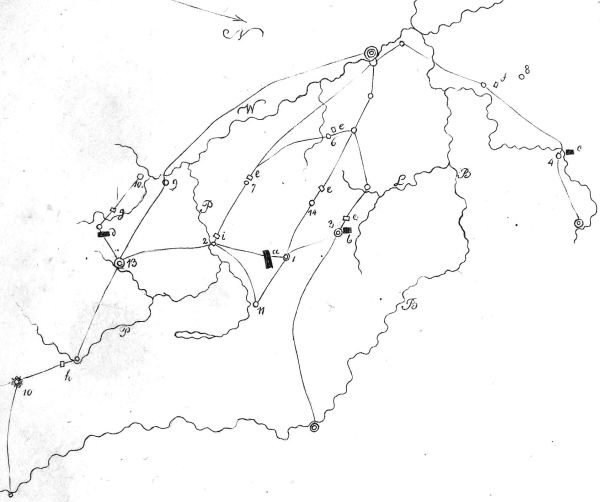
XXII.
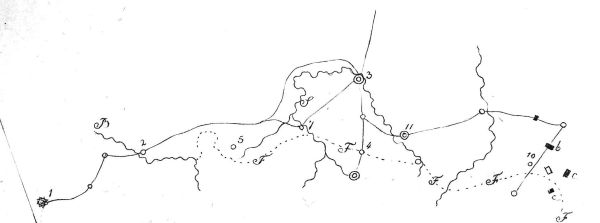
XXIII.
Our main body (e), composed of four divisions of infantry, and three of cavalry, making in all about 30,000 men and 80 pieces of cannon, was placed between Iganie (5) and Siennica (6). Our reconnoissances were pushed along the left bank of the river Liwiec (L), as far as its junction with the river Bug (B). On the right, those reconnoissances reached Zelechow (7). This was nearly the same as our first position, and it was strong. Besides this main force, was the division of cavalry of general Uminski (f) upon the right bank of the Narew, at Nasielsk (8), amounting to 3,200 horse and 24 pieces of artillery, placed there to observe the Russian guard. In the environs of Pulawy (9) was a small partizan corps, under the command of general Sierawski (g), with 3,000 men and four pieces of cannon. The corps of general Dwernicki (h) was in the environs of Zamosc, (10) and consisted of 4500 men, and 30 pieces of cannon. This corps, though at a distance from the rest of our forces, could not be cut off, having the fortress of Zamosc as a point d'appui. If the reader will examine a map of the country, or even the small plan in the preceding pages [No. VI, or XXII,] he will be satisfied that by our forces, small as they were, the Russian army was already surrounded, and that on the least advantage which Dwernicki, in conjunction with Sierawski, might gain over Witt and Kreutz, that army could have been taken in the rear, by means of a diversion upon Kock (2) and Radzyn (11). In a word, the moment approached at which our commander had determined to give the enemy a last decisive blow, by attacking him at the same time on every side; and for this object, the following instructions and orders were given.
First. The generalissimo renewed the order for strengthening the fortifications of Warsaw and Praga, as well as those on the whole plain of Grochow. From the first day of April, as many as 5000 Russian prisoners were continually employed upon those fortifications. Warsaw, which was already, as the reader is informed, defended by a girdle of lunettes and redoubts, communicating with each other, received the additional defence in some places of block-houses. To strengthen the fortifications of Praga, besides the bridge-head, there were constructed, within the distance of an English mile, a line of circumvallation, which could hold more than twelve thousand men. Still farther, at a distance of two miles beyond, or nearly upon the field of Grochow, was constructed a third line of lunettes and redoubts, which occupied the whole distance from Kawenczyn to the marshes of Goclaw, or the entire field of battle of Grochow, as seen in the plan of that battle. In fine, the approach to Praga was so defended, that the enemy, before reaching it, would have to pass three different lines of fortification. The general in chief gave instructions to the governor of Warsaw in regard to the defence of the city, in which he placed his chief trust upon the national guard. The guard counted it an honor to be entrusted with this duty, and were unwilling that a single soldier of the regular army should be detailed for the service. How admirably they executed their noble resolutions, when the occasion came, is probably well known to every reader.
After his plans for the defence of Warsaw were communicated to the authorities of the city, he gave particular attention to those points on which he intended to support all his operations, and, relying on which, he could at any time hazard the boldest attempts. Having thus made Warsaw an axis, upon which all his operations could revolve, he proceeded to arrange his attack. In the first place he sent orders to general Dwernicki (h) to attack immediately the combined corps of generals Witt and Kreutz (d). In this attack the small corps of general Sierawski (g) was to aid, and the two corps were to preserve a constant communication with each other. For that object general Sierawski was to pass the Vistula at Kazimierz (12), and, avoiding an engagement with the enemy, to endeavor to join, as soon as possible, the corps of general Dwernicki, who received orders to leave Zamosc and approach Lublin (13). These two corps were to take such a position, that they could at any time retire upon Zamosc or Kazimierz. General Dwernicki was also informed that a third small corps would be sent in the direction of Zelechow (7) and Kock (2), to act in concert with him on the enemy's rear. If they should succeed in the attack, general Dwernicki was to endeavor to force the enemy to take the direction of Pulawy (9), to drive him into the angle formed by the Vistula (V) and the Wieprz (P); in fine, so to act as to cut off those two corps from all communication whatever with their main body. Leaving the corps of general Sierawski to continue to observe them, and to push his advantages over them, Dwernicki himself was to pass the Wieprz at Kock, and from thence by forced marches to leave in the direction of Radzyn (11) for Lukow (1) or Seroczyn (14), as circumstances might direct, and according as he should ascertain the position of the enemy to be. Arrived at Lukow or Seroczyn, as the case might be, he was to await there the orders of the general in chief, to join in the attack upon the main force of the enemy under Diebitsch (e), in which attack he was to act on the enemy's left wing. The main body of the enemy, thus taken in front and in flank, simultaneously, could not but have been broken up. For all these operations the general in chief had destined fourteen days only.
On the night of the battle of Iganie, the general in chief having decided upon the above plan, sent officers in every direction with orders and instructions. The officers sent to the corps of general Dwernicki were enjoined to communicate their orders to him with the utmost haste.
The generalissimo, while making his preparations for this last blow, continued an unremitting observation upon all the movements of the enemy, even to the minutest details, and in order that the enemy might be constantly occupied, and diverted from suspecting our plans, he directed small attacks to be continually made upon his front. For this object the second division, posted at Siennica, received orders to advance to the small town of Jeruzalem. The division, in executing that order, fought the enemy for three successive days, the 12th, 13th and 14th of April, at Jedlina, Wodynie, and Plomieniece, and always with advantage. In one of those attacks, at Jedlina, a small detachment of sixteen Krakus attacked a squadron of Russian hussars, coming from Wodynie, dispersed them, and took some twenty prisoners. This division received also the order to communicate constantly with the corps of general Pac at Zelechow. This last general was to send continual reconnoissances towards Kock, to keep a constant observation upon the Russian corps of Kreutz and Witt. Of the movements of those two corps, the generalissimo was each day to receive the most accurate information, in order to be ready prepared to prevent, at any moment, a junction which might be attempted between those corps and their main body.
General Skrzynecki, seeing that the enemy had fallen into his plan, (of which, indeed, he could not have had the least suspicion,) and full of the brightest hopes, waited impatiently in his strong position, for intelligence from general Dwernicki, and the approach of the moment for his attack upon Diebitsch. Almost sure of the successful execution of his admirable arrangements, what can express his disappointment on hearing of the unfortunate operations of the corps of general Sierawski, and of the defeat of that corps at Kazimierz in the palatinate of Lublin, the first defeat in the whole war. That general, in neglecting the instructions of the commander in chief, not to engage with the enemy, on account of the inferiority of his own forces, (with which forces in fact he could not expect to act but in partizan warfare,) approached Lublin, where the two corps of Kreutz and Witt were supposed to be posted, while his orders were, by avoiding those corps, and taking the most circuitous roads, to endeavor to join as secretly and as soon as possible, the corps of Dwernicki. He was probably deceived by false information as to the direction of the enemy's corps, and led to believe that those two corps had quitted Lublin, to attack general Dwernicki at Zamosc. He therefore probably took the direction of Lublin, with the idea of acting upon the rear of the enemy at the moment of his attack upon Dwernicki. In this manner general Sierawski, quitting Kazimierz, arrived on the 16th of April at Belzyca. To his great astonishment he found there a strong advanced guard of the above mentioned corps. To avoid compromitting himself, he engaged with this advanced guard, when, observing the very superior force and the advantageous position of the enemy, he ordered a retreat, which retreat was well executed and without much loss. This general should have continued his march the whole night, with as little delay as possible, in order to repass quietly the Vistula, and thus be protected from all molestation by the enemy. But, for what cause it is almost impossible to conjecture, he awaited the enemy in order of battle the next day, at Serauow. Perhaps, finding himself in rather a strong position, he thought that the corps of general Dwernicki might arrive to his aid. The enemy approached the next day with his whole force against Sierawski, and as warm an action commenced as the nature of the ground would admit, it being covered by woods with patches of open ground intervening. Some squadrons of young Kaliszian cavalry, led by the general himself, advanced to the attack of the enemy's artillery, which being disadvantageously posted, was exposed to be captured. That cavalry, however, by a false direction of their charge, fell among the concealed masses of the enemy's infantry, and their attack failed.
This unsuccessful attack had unfortunate results. The corps of general Sierawski was obliged to evacuate its position, and along its whole retrograde march continual attacks of the enemy were pressed upon it. The peculiar nature of the ground, and the extreme brevity of general Sierawski, a veteran of between sixty and seventy, who, at the head of the detachments of his rear guard always led the charges against the enemy, and held him in check, was all that saved the corps from destruction. At length the corps reached Kazimierz, the point which it had left; and here again, instead of passing the Vistula, Sierawski awaited another attack from the overwhelming force of the enemy, and that too with only the half of his corps, for the other half was sent to pass the Vistula. This course was inexplicable, and excited much remark in the army. On the 18th, the Russians reached Kazimierz. The town was vigorously attacked by them, and their assaults were repeatedly repulsed by the new Kazimierz infantry, under colonel Malachowski, who, with a scythe in his hand, marched at their head. But the death of that brave patriot spread among the ranks of those new soldiers a degree of disorder, and the city was taken by the enemy. We must again thank general Sierawski for having saved the rest of the corps from ruin; having executed the evacuation of the town with such order that he passed the Vistula at the point of Borowa, not far from Kazimierz, without being molested in the attempt. He then took a position on the left bank.
Although the unfortunate affairs of those two days were not attended by severe losses, yet they were deeply afflictive to the general in chief. They threatened the entire disarrangement of his plans, and were followed by the more important disasters of general Dwernicki. The latter general, who, as is known to the reader, commenced his career so gloriously; whose very name, indeed, was a terror to the Russians, and who, by his successive victories over the three corps of Kreutz, Wirtemberg, and Rudiger, had established the strongest claims upon the gratitude of his country,—this general, I must repeat it with pain, finished his great career in the most unfortunate manner. His case should serve as a strong example, that it is not bravery alone which is required in a great general, for in that it would be difficult to find his equal, but that this bravery loses its value when not united with circumspection.
The following are the details of the operations of general Dwernicki. [See Plan No. XXIII.] We cannot well imagine the cause which induced that general to quit Zamosc (1), and the important operations in the palatinate of Lublin, and, neglecting all his instructions and orders, to have crossed the Bug (B) and entered the province of Volhynia, unless it were the reception of some certain news of a fresh insurrection in that province, and of the collection of insurgent forces there, who might be waiting for his approach, and who needed his protection. He might, perhaps, have thought to be able so to accelerate his movement as to avail himself of such new strength before a superior Russian force should arrive in that province to crush such insurrection, and disperse the insurgents. At the moment when Dwernicki might have conceived such a plan, there was, in fact, only a corps of about 12,000 men and some 20 pieces of cannon, under Rudiger, in the province. This corps, Dwernicki perhaps intended to attack, in his way, and crush them, and then attaching the insurgents to his corps, to return to the palatinate, or if circumstances might make it expedient, to follow up his blow into the heart of Volhynia. In fine, on the 15th of April, this general quitted the environs of Zamosc, taking the direction of Uscilog (2), where, on the evening of the 16th, he passed the river Bug. On the 17th he continued his march in the direction of Dubno (3), where the insurgents were perhaps supposed to be awaiting him. On the road to that town he received information that the corps of Rudiger had marched from Radziwilow (4) and was now in the direction of Milatyn (5). General Dwernicki turned immediately from the direction in which he was marching, to throw himself upon this corps, which he found on its march, at the village of Boromel (6), where, without giving the enemy time to take position, he attacked and overthrew him. The enemy was routed, and lost several hundred in killed and prisoners, with eight pieces of cannon. That in this fine, and the last fine battle of Dwernicki, the Russian corps was not wholly destroyed, was owing to the circumstance that a branch of the river Styr (S), over which the bridge had been destroyed, stopped our pursuit. The Russians, during the night of the 18th, evacuated their position, and took the road to Beresteczko (7), where they took a new position. In regard to tactics, the corps of general Rudiger could not have chosen a worse direction than that of the angle formed by the river Styr, and the frontier of Austria (F). General Dwernicki, by a passage to the right bank of the Styr, could have cut off all the enemy's communications with his other corps, and could have again fought him at the greatest advantage. It was here then that our brave Dwernicki committed his great fault, and in place of acting upon the right bank of the river, where he would have had an open field for the most enlarged operations, he chose to follow up the attack; and as he saw that the enemy could not be safely assailed in front, on account of his strong position between two small lakes, but found that this position was open towards the frontier of Austria,—there it was that the unhappy idea occurred to him, of marching to the environs of Kolodno (8), on the frontier of Austria, and attacking the enemy on that side, feeling sure of victory. But general Rudiger did not wait for this attack. Perceiving his exposed position between the river and the frontier, he was satisfied with being permitted to escape, and declined battle. Upon observing that general Dwernicki was manœuvring upon the frontiers of Austria, general Rudiger repassed the Styr, avoided the attack by this manœuvre, and was in a situation to join himself with all the Russian detachments which might come into the province from the heart of Russia, by the different directions of Krzemieniece, Ostrog, &c., and to act with them in surrounding Dwernicki, who was confined in this above described angle. This is what in fact took place.
Dwernicki remained, for what reason we cannot conceive, at Kolodno until the 23d of April, whence, following along the frontiers of Austria, he took the direction of Wereszczaki (9). There dispersing a Russian detachment, he arrived on the 26th at Knielce and Wielkie (10). Knowing that the Russians were observing him, he determined to remain there and take advantage of a strong natural position. He wished in this position to await the enemy and give him battle, hoping by a victory to free himself from the contracted space in which he was confined. In fact, on the next day, the corps of general Rudiger (b) made its appearance, having come in the direction of Krzemienic (11). The battle commenced, and in the midst of the action another Russian corps (c) was seen approaching in the direction of Proskirow (12) and Stary-Konstantynow (13) under the command of general Rott, acting thus upon the right wing and even the rear of general Dwernicki's corps. To avoid being turned, general Dwernicki retired in such a manner as to lean his right wing upon the Austrian frontier. The Russians, not regarding this, passed that frontier, and proceeded to push their attack upon his flank. This obliged general Dwernicki to withdraw his left wing, and indeed his whole front, upon the Austrian territory, where, in fact, the line was not distinctly marked, all the while being engaged with the enemy. The action having continued thus for some hours, a detachment of Austrian cavalry, under colonel Fac, approached and threw themselves between the combatants, calling on them to respect the neutrality of the territory. In this manner the combat ceased. General Dwernicki gave his parole to discontinue hostilities, and consented to advance farther into the interior, and, placing himself in camp, waited the result of the decision of the Austrian government upon what had occurred. The Russian corps, which had just passed the frontier, and which had in fact entered it with its whole force, was permitted to leave freely. The first duty which general Dwernicki thought imposed upon him in his present situation, was to make a full and true report of what had occurred to the National Government and the general in chief, which he was permitted to do. He also sent a letter to the commander in chief of the Austrian forces in Gallicia, explaining how it was that, in a necessary manœuvre he had passed over a point of land on the Austrian territory without the intention of occupying it. Having done this, he supposed that he would be permitted to remain in camp, retaining his own arms, those taken from the enemy, and his prisoners, until conferences between the governments should decide respecting the course to be taken. But the Austrian government, far from giving such a reasonable permission, collected a strong corps in the environs of Tarnopol, and the Austrian commander in chief demanded of general Dwernicki to surrender both his own arms and those taken from the enemy. General Dwernicki, although this Austrian corps was not formidable to him, yet being anxious to avoid the serious political consequences which might possibly follow resistance, submitted to this unjust demand, which will be an eternal reproach to the Austrian government. The Austrians returned their arms to the Russian prisoners, whom they liberated, and retained the arms of the Polish troops. The whole corps was conducted into the interior, and thus ended the career of that important body of our forces.[55]
The conduct of Austria, in regard to the corps of Dwernicki, I am sure will excite the indignation of the reader. If general Dwernicki had entered upon the Austrian territory, he was forced to do it by the Russian corps, which had already passed the frontier; and that cannot be regarded as an intentional invasion of the frontiers which was done without design, and was a mere transition over an indistinct line, made necessary by the position which the enemy had taken. Such a case certainly should have formed an exception to a general rule. To the Russian corps all the prisoners were returned, without any consent obtained from our government, to whom they, in fact, belonged, and should have been considered as belonging, until the end of the war.
It was in this manner that those intriguing cabinets repaid the debt of gratitude which they owed to Poland. They had forgotten the times of John Sobieski, who, in 1683, delivered their capital, and their whole territory, from destruction at the hands of the Turks. They had forgotten that they thus owe their very existence to Poland.
At present, regardless of all obligations of justice, they concert with our enemy for our ruin. But if by this unjust treatment of their benefactors, the Austrians may have gained some temporary advantages, the reader will acknowledge that in reference to their ultimate good, they have acted with a most short-sighted and mistaken policy. The aggrandizement of Russia can never be an advantage to Austria.
There were few more melancholy events in our war than this. The disaster of this corps grievously paralyzed all the fine plans of the general in chief. It reinforced the Russian superior force by 40,000 men;—for the different corps of Kreutz, Witt, Rudiger and Rott, could now rejoin their main army without obstruction.
To these disasters of the two corps of Dwernicki and Sierawski, which were deeply felt by the nation, was now to be added the appearance of that horrible malady, the cholera, which after the battle of Iganie commenced its devastations in our ranks. On the night of that battle several hundreds of our troops fell sick. This terrible disease caused us, on the first few days, the loss of nearly 1,000 men; but if it was terrible with us, nothing can express the suffering it produced in the Russian camp, aided by the want of comfort in the arrangements of that camp, and the acid food upon which the Russian soldiers were habitually fed. Thousands of those wretched sufferers were left exposed to the open air, and died upon the field. The Poles took even more care of them than of their own sick. They were brought together, and transported to Menie, where there was a large convent, which was turned into an hospital for their use. The total number of those sufferers may be imagined, when it is stated, that, in that hospital and village alone, two thousand Russian sick were reported.
FOOTNOTES:
CHAPTER XVII.
The Russian commander resumes offensive operations.—Object of the attack of the 25th of April.—Combat of Kuflew.—General Dembinski evacuates the position of Kuflew and awaits the enemy at Bady.—Battle of Minsk.—The enemy suddenly evacuates his position.—Reflections on this stage of the conflict.—Positions of the two armies.
The Russian main army, which, since the last of March had been on the defensive, from weakness or from indecision, on the 23d of April began to change its position, and to take the offensive. Having received intelligence, as we may suppose, of the disasters of Sierawski, and also of the passage of general Dwernicki into Volhynia, general Diebitsch gave orders to the corps of Witt and Kreutz to pass the Wieprz at Kock, and to attack our detachment at Zelechow, which was forced to retire. On the same day, (23d) the brigade of colonel Dembinski was attacked at Jeruzalem, without any decisive result. Those small attacks by the enemy served, however, as an indication of the intention of general Diebitsch to take the offensive on a larger scale. To meet this intention, all our detachments received orders to hold themselves in readiness. Firstly, these detachments were to concentrate themselves upon a line of operations, between Kaluszyn, Siennica, and Zelechow. [The reader can refer to Plan VI.] The whole line, in case of attack, on whatever quarter it might be, was to make a retrograde movement, upon the same plan as heretofore, as far as the field of Wawr. General Pac, in particular, who was the farthest removed from Zelechow, was to use the utmost vigilance, and to make this retrograde movement in the promptest manner, when occasion required.
On the 25th of April, in fact, marshal Diebitsch commenced his attack at two principal points, Boimie and Kuflew. Upon the last of these two points, he threw his greatest force, intending to pierce our line there, and by a diversion at Minsk to divide our forces. Besides the prevention of this design, the defence of Kuflew was of the greatest importance to us from the circumstance that along the whole course of the river Swider, at Latowicz, Starygrod, &c., were posted various small detachments, which would have been cut off, if we should be forced to make a sudden evacuation of that point.
COMBAT OF KUFLEW. [See Plan XXIV.]
This combat deserved to be forever held up as an example in tactics, to show how much can be done with a small force, managed with prudence and skill. Colonel Dembinski, who, in this battle, commanded the inconsiderable forces that met the attack of the masses of Diebitsch, well merited the rank of general, to which he was then advanced. Our position was covered by the river Swider (S) and its marshes, which secured it from being taken in flank. The enemy had one debouchment (a), consisting of a kind of dyke, which led from Kolacze (1). He could pass this dyke easily, for the bridge was entire. On our side, not far from this dyke, were small forests, or rather brush-wood, occupied by two battalions (b) of our infantry. Upon the plain between Kuflew and the river Swider, ten squadrons of our cavalry (c) manœuvred. Near the village (II) upon a little hill, on which was a wind-mill, our artillery (d), consisting of only four pieces, were posted, and directed their fire upon the passage over which the enemy were to debouch. The position of the enemy was commanding, for his artillery could sweep the whole plain on each side of the Swider. The details of this battle were as follow:—At sunrise, on the 25th, several regiments of cossacks (e) appeared upon the heights of Jeruzalem. They even several times attempted to pass the dyke, but were repulsed by the fire of our tirailleurs from the brush-wood. It was mid-day when strong columns of infantry (f) began to show themselves in the direction of Lukowiec and Plomieniec. In a short time all the heights of Jeruzalem were covered with columns of infantry, and they began their descent to Kolacze. The Russian light troops (g) began their debouchment, and a warm fire commenced between the Russian infantry upon the dyke, and our own tirailleurs in the brush-wood. The Russian artillery (h) which remained upon the heights on the other side, consisting of twenty and more pieces of large calibre, poured for several hours a heavy fire upon Kuflew, where they supposed a large force to be placed, but where, in fact, besides the four pieces of artillery, we had but one company of infantry. Under this terrible fire, that village was burnt to the ground. Those attacks of the Russian artillery and infantry continued for three successive hours, when colonel Dembinski, being informed that the small detachments at Latowicz, &c., above referred to, had evacuated their position and were safe from being cut off, commenced his retreat, as his instructions directed. By accelerating his retreat he had another object in view, namely, to lead the enemy in the direction of the 2d division, which was posted at Ceglow, and was prepared to receive him. Our infantry and artillery had left their position and were on the road, when colonel Dembinski, placing himself at the head of his cavalry, threw himself with great boldness upon the columns of the enemy which had debouched over the dyke, and by repeated attacks kept them off from our rear. After having passed the first forest without molestation, between Ceglow and Kuflew, colonel Dembinski took a position, between forests, in the environs of Bady, where a part of the 2d division was placed in expectation of the enemy, in a kind of ambuscade. Here our forces waited in vain until night for the enemy, who had contented himself with having taken Kuflew. Two squadrons of cossacks, whom he ventured to send towards our position, to reconnoitre, were, as soon as they were seen, fallen upon by our cavalry, and either cut down or made prisoners, to the amount of more than a hundred men and horses, with two officers. As the enemy attempted nothing more, our forces, during the night, evacuated their position, agreeably to instructions, and reached Minsk at 3, A.M. of the next day. At Kuflew, full 40,000 men, with some twenty pieces of artillery, and commanded by Diebitsch in person, were opposed to general Dembinski, who had not quite 4,000 men and four pieces of artillery, with which force he stood against the enemy for that whole day. The loss of the Russians was about a thousand men, and on our own side it was not fifty.
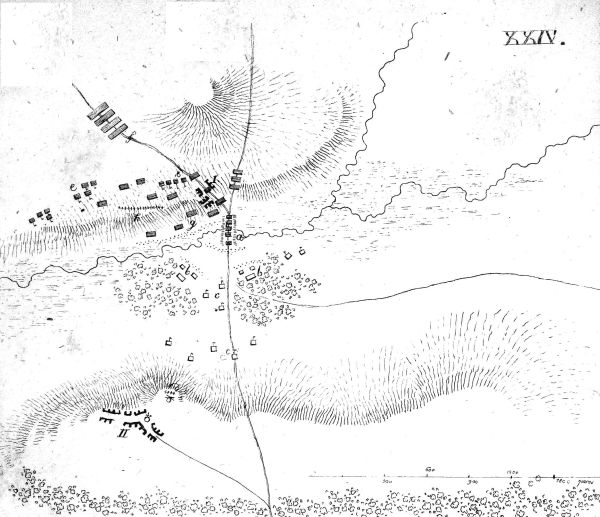
XXIV.
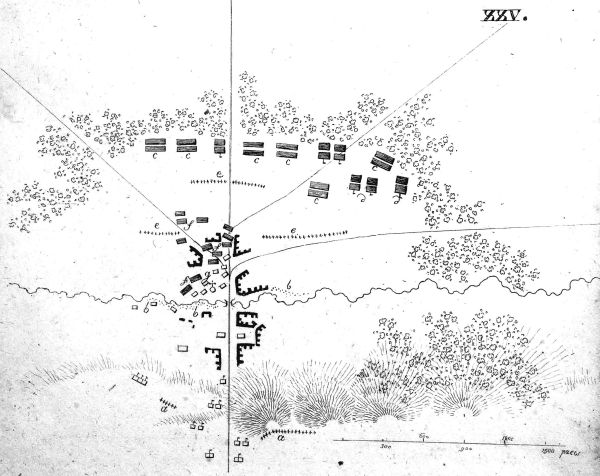
XXV.
The actions which took place on the same day at Boimie, were without any decisive result, consisting only of a continued fire of artillery. During the night of that day, our forces in every point made a retrograde movement. The general in chief arranged his preparations to receive the enemy on the 26th, dividing his forces into two parts. The second division under Gielgud, and the division of cavalry, under Skarzynski, was to await the enemy at Minsk; while the general in chief, with the main body, awaited him in person at Dembe-Wielke.
BATTLE OF MINSK. [See Plan XXV.]
The position of Minsk may be considered as one of the strongest upon the great road from Siedlce to Warsaw. That town is situated in a plain, surrounded by an impenetrable forest, and traversed by a small river, which falls into the Swider. Upon the side of Warsaw, where our forces were placed, are heights which overlook the whole town, and they were particularly commanding upon the right of the roads leading to Warsaw. The fire from those heights could sweep almost every street of the city, and they were occupied by twenty-four pieces of artillery (a). Upon the side of Siedlce and Ceglow, whence the enemy was approaching, the whole plain was exposed to the commanding fire of this artillery. The town of Minsk was occupied by two battalions of our light infantry, dispersed as sharp shooters (b).
It was mid-day when the Russians (c) (d) debouched from the forest, commenced their advance, and deployed upon the plain under the fire of our artillery, which was opened immediately. Some fifty pieces of the enemy's artillery, (e) approached the city, took position, and commenced their fire. As the town was occupied by so small a force, and so distributed as not to be affected by the enemy's fire, he was permitted to continue this fire, and our artillery reserved theirs for the moment when he should make a general advance to storm the town. This soon took place. An enormous mass of infantry (f) advanced to the assault. Our light troops evacuated the part of the town beyond the river, to enable our artillery to open upon it. That part was immediately occupied by the enemy, who, crowded together in the streets, were subjected to a fire which spread death among their ranks. The enemy hesitated whether to advance or retire, and remained in the utmost disorder, falling under the fire of our artillery and the torn and burning fragments of the wooden buildings which were rent in pieces by that fire. While the enemy remained in this horrible suspense, the brave colonel Oborski led his regiment to the charge, and bore down all before him. A most terrible massacre, at the point of the bayonet, then took place in the Square of the Church (g), where great masses of the enemy were crowded together. The Russians were driven out of the town after a most severe loss. They were left at liberty to take possession of the same part again, but they did not repeat their attacks upon the town, satisfying themselves with concentrating a heavy fire of artillery principally upon the heights occupied by our own. This state of things continued till three o'clock, when general Gielgud gave orders to evacuate the position, agreeably to the directions of the general in chief. Sixteen squadrons of cavalry were left to cover the movement, and in this way our division, reaching the village of Stoiadly, two English miles distant, took a second position there. This new position was advantageous, on account of the elevation of the ground. Our right wing, in particular, was well supported upon a thick marshy forest, and was pushed forward far enough to give a cross fire to the enemy, in case he should try to force the passage of the great road. As the enemy was so imprudent, after our evacuation, as to commence his debouchment through the town, with his cavalry in advance, he exposed himself to a severe loss; for our artillery, consisting of six pieces, poured a destructive fire upon the main street of the city, which led to the only passage over the river; and again, after deploying under this fire upon the plain, he was subjected to vigorous charges from our cavalry under Skarzynski, which cost him a severe loss, and delayed his advance for more than half an hour. As the space between Stoiadly and Minsk was a plain gently descending from our side, moist in the lower parts, and in every way favorable for attacks by our cavalry, their charges were continually repeated, and the combat on this plain deserved the name of the combat of cavalry. To give the reader an idea of these effective charges against a cavalry of much superior force, I will merely state that each squadron of the sixteen, was engaged some three or four successive times with the enemy. Their horses were continually in foam. The regiment of Zamoyski, the Krakus, and the 5th Hulans greatly distinguished themselves. The loss of the enemy's cavalry, of which the greater part consisted of regiments of heavy dragoons, was very great. Their horses hoofs sunk into the humid ground, and our Krakus, on their light animals, assaulted them in the very midst of their ranks. Many staff and other officers of the enemy were left dead upon the field. Our advanced guard having, in this way, fought with such advantages, against the whole Russian army, at Minsk and Stoiadly, from mid-day until 5, P.M.; the general in chief ordered them to evacuate their position as promptly as possible, and retire to Dembe-Wielke, where he awaited the enemy in order of battle, and where he was desirous of meeting his attack before night. This movement was executed without molestation from the Russians. Our advanced guard passed the forests between Dembe-Wielke and Stoiadly, and arrived at the position of Dembe-Wielke, where fifty pieces of our artillery were posted to receive the enemy, and our whole force took the order of battle. The enemy, however, did not debouch from the forests, but remained on the other side. This finishes the details of that day and of the battle of Minsk, in which the early cessation of the attacks of the enemy proved how much he had suffered. He had two generals mortally wounded, general Pahlen and the prince Galiczyn, and lost nearly 4,000 men. On our side the loss was four or five hundred only.
For their conduct in this battle, the National Government and the general in chief presented their thanks to the 2d division under Gielgud and the division of cavalry under Skarzynski. General Gielgud was advanced to the rank of general of division, and it was perhaps owing to his skilful dispositions and brave conduct on that day, that it was not feared to entrust him with the command of the all important expedition to Lithuania.
On the 27th and 28th, no events took place. During the night of the 28th, the enemy, to our astonishment, evacuated his position and retired as far as Kaluszyn, twenty-four English miles distant. We cannot give the true cause of this sudden and unexpected retreat. Perhaps it was on account of a failure of provisions. Another cause might have been the rumors, which had begun to take an aspect of importance, of the revolutions in Lithuania and Samogitia.
The reader will allow me to dwell for a moment upon this extraordinary movement of the enemy, which must be considered an indication, either of the extreme of physical and moral weakness to which the Russian army was reduced, or of a great want of generalship on the part of marshal Diebitsch. Such a course, voluntarily taken, in the eyes of the military critic, is enough to destroy all claim to military talent on the part of that commander. Such great objects attempted, followed up with so little perseverance, and abandoned without an adequate cause, would seem to indicate either the absence of any fixed plan, or a degree of indecision inconsistent with any sound military pretensions.
Our commander in chief felt sure that when general Diebitsch attacked, on the 25th, and 26th, it was with the view, having no longer any fear of the corps of generals Dwernicki and Sierawski, and being reinforced by the corps which had been opposed to the former, to follow up his attack and compel us to a general battle. Whatever might have been the result of that battle, it was the only course which a true general could have followed, especially when his army was in such superiority of strength. To one who considers these circumstances, two questions will arise. First, what was the object of commencing the attack? Secondly, what was, in regard to tactics, the cause of its cessation, and of that sudden retreat? It will be very difficult to find a satisfactory answer to either of those questions.[56]
Our army, after this retreat of the enemy, commenced anew its advance, and, on the 30th, it occupied again its former position at Boimie, on the river Kostrzyn. At this time, our left wing under Uminski, which, as the reader is aware, was on the right bank of the Narew, at the environs of Pultusk, received orders to join the main army, leaving a detachment at Zagroby, where the generalissimo ordered a strong bridge-head to be erected.
The position of the two armies on the 30th was as follows. [Plans VI and XXIX.] Our army was again concentrated between Wengrow and Ceglow, and indeed Wengrow was occupied by a small detachment. The centre or the greater force was on the main road at Kaluszyn. Its advanced posts were along the banks of the river Kostrzyn at Grombkowo, Strzebucza, and Boimie. Our right wing was again posted upon the river Swider, between Karczew and Ceglow. The Russian army was concentrated in the environs of Mordy and Sucha, where marshal Diebitsch entrenched himself in a fortified camp, and took again a defensive attitude. The corps of Kreutz and Witt were in the environs of Pulawy, and the Russian imperial guard advanced to the environs of Pultusk.
FOOTNOTES:
CHAPTER XVIII.
General Skrzynecki resumes the offensive.—He decides to adopt an enlarged plan of operations, and to make the revolutionized provinces supply the place of a corps d'armee.—The corps of Chrzanowski is sent to occupy the Russian corps of Witt and Kreutz.—Admirable execution of this enterprise.—Attack on Kock.—Attack of Rudiger's camp.—Plan of operations by the main army against the Russian guard.—Forced march from Kaluszyn by Praga to Serock.—Advanced post of the guard attacked and defeated.—The corps of Saken is cut off.—The 2d division under Gielgud sent into Lithuania.—The imperial guard are driven with great loss beyond the frontier.—Retrograde movement.
As several days passed away, without any thing having been attempted on the part of the enemy, our general in chief decided to re-commence hostilities by small attacks, which were designed to mask the great plan he intended to put into execution. The general view which occupied our commander, was to continue the offensive, to follow up the enemy constantly, and not to leave him unless some very important occasion should call for a different course. Let us reflect upon the difficulties of such a plan, and let us then examine how it was in fact executed by the general in chief.
General Skrzynecki, regarding all the existing circumstances, the actual position of the enemy, and his strength, found a great difference between the present state of things and that which existed after the battle of Iganie. The misfortunes of the corps of Dwernicki and Sierawski, had made a vast change in the relative strength of the two parties. The fate of those two corps gave a great advantage to the enemy, leaving him free to concentrate all his forces and to act in one mass. This advantage of the enemy was to be met, and means were to be taken to keep his forces in detached bodies, by giving occupation to each. To provide such means, it was next an object to give an important character to the revolution in Lithuania, and in fact to make that revolution supply the place of a corps d'armee, to send a body of troops to aid it, and to direct and lead the partizan forces which might be there enrolled. If then by such operation, Lithuania and Samogitia could be kept in constant communication with the main army, the line of operations would be enlarged, and would be based upon Wilno and Warsaw. This line of operations would embrace also the towns of Grodno and Lomza. To occupy the corps of Witt and Kreutz, which were still in the palatinate of Lublin, the general in chief detached a small corps under the command of general Chrzanowski, which were furnished with the same instructions as its predecessor, that of general Dwernicki, which were, in general, to act in the environs of Zamosc.
To facilitate the execution of these plans, the general in chief determined to give daily occupation to the enemy. On the 2d of May, the fire was renewed along our whole line. Each following day presented sanguinary scenes at different points. In the midst of one of these actions, on the 7th, the small corps above mentioned, consisting of 4,000 men and eight pieces of cannon, under general Chrzanowski, left the main body [See Plan XXVI], took the direction of Stoczek (1), Zelechow (2), and Kock (3), to reach the environs of Zamosc (4). The reader, on examining the plan, and looking at the space which this corps (a) was to pass over, in the midst of the enemy's detached corps (b), and in which it was exposed every moment to be surrounded and cut off, will acknowledge that this expedition, which was most successfully executed, is to be ranked among the finest operations in the campaign. It demanded a general of talent, and a soldier of determination.
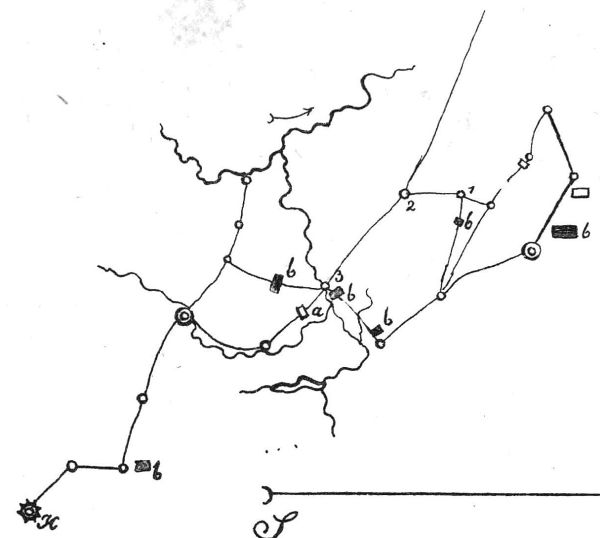
XXVI.
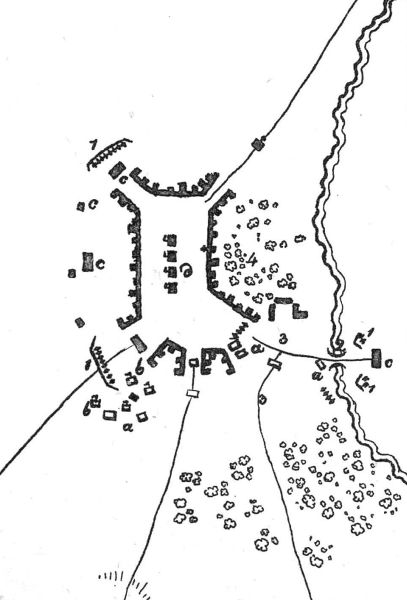
XXVII.
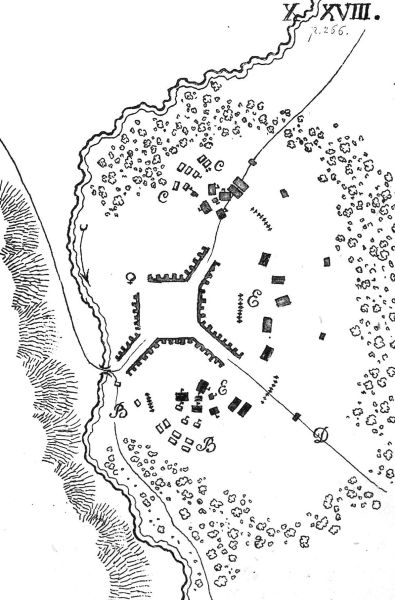
XXVIII.
When I allow myself thus to detain the attention of the reader upon the extraordinary efforts of this war, it is only with the view to convince him that nothing is difficult of execution which is prompted by a resolute determination based upon high principles, and that what would be deemed almost impossible in an ordinary war, in which despots, to gratify their ambition or their caprices, force their subjects to battle—an involuntary sacrifice, is far from being so, in a war like ours. In such a war, moral impulse becomes an element, the importance of which cannot be over-estimated.
General Chrzanowski, quitting, as we have mentioned, the main body, took the direction of Ceglow, and threw himself into the great forest of Plomieniec. Leaving that forest, he met, near Wodynie, a strong detachment of the enemy, composed of infantry, cavalry, and several pieces of artillery, belonging to their main body, and probably detached to make a reconnoissance. By a sudden attack that detachment was at once overthrown. The cavalry ordered for their pursuit were instructed to return in another direction, in order to deceive the enemy. In this manner general Chrzanowski, frequently meeting with small detachments of the enemy and deceiving them continually, traversed the woody plain between Stoczek and Zelechow, and arrived, on the night of the 9th, at the environs of Kock, where he had to pass the river Wieprz.
ATTACK OF KOCK. [See Plan XXVII.]
At the moment of the arrival of the corps of general Chrzanowski, this town was occupied by a part of the corps of general Witt, composed of 6,000 men and 20 pieces of artillery. Besides this considerable garrison, the place had been strengthened by several fortifications (1) on each side of the river, to defend the passage of the bridge (2), and without taking those fortifications it would be impossible for us to pass the bridge. In such circumstances there was no alternative, and it was necessary to attempt to take the town by storm. General Chrzanowski announced his intention to the corps, and addressed a few animating words to them. Having divided his corps into small parties (a, a), he surrounded the town. He placed especial importance upon the forcing of the avenue (3) leading to the palace, and getting possession of the garden (4) which surrounded the palace, and bordered on the river. If all this could be rapidly executed, the enemy would be taken in the rear.
The signal for the attack being given, a warm fire from our skirmishers was commenced in all points round the city, and, while the cavalry (b), divided into detachments, threw themselves continually upon the Russian infantry (c), our infantry, at the charge, forced the entrance to the palace and garden, which was immediately occupied by our tirailleurs, who opened their fire upon the fortifications (1) and on the Russian columns in the square (d). In this manner the enemy was surrounded, and forced to evacuate the city with great loss, and to take the direction of Radzyn. General Chrzanowski passed the river and took the direction of Lubartow. Leaving the town of Lublin on the right, and following the banks of the river Wieprz, he reached on the 11th the environs of Piaski. In the latter place he was apprized that a Russian corps under Rudiger was at Krasny-staw. Chrzanowski decided to attack them.
ATTACK OF RUDIGER'S CAMP. [See Plan XXVIII.]
The corps of general Rudiger, after the unfortunate disaster of general Dwernicki, having traversed Volhynia, entered the frontiers of the kingdom, and took the direction of Lublin, being destined probably to reinforce the main army under Diebitsch. This corps, which was composed of about 12,000 men, and some twenty pieces of cannon, was in camp (E) near the town of Krasny-staw, having that town and the river Wieprz in its rear.
General Chrzanowski, who halted with his corps in the forest between Piaski and Krasny-staw, having sent out patrols, was perfectly informed of the position of the enemy, and ascertained that he had not his wing supported on the river;—indeed, he was in such a state, as satisfied our general that he had no expectation of meeting a Polish force, and that he might be surprised in his camp. To effect this object, general Chrzanowski divided his corps into two parties, and giving the command of one to the brave general Romarino, he ordered him to traverse the forest longitudinally, as far as the road which leads from Tarnogora to Krasny-staw, and by this road, which is wholly through forests, to approach, as near as possible, to the left of the enemy's camp; and also, if circumstances might permit it, to push himself even against the enemy's rear. On arriving there, he was to commence his fire immediately. These instructions to general Romarino being given, general Chrzanowski (B) advanced with the other part of the corps, through the forest, keeping the left bank of the Wieprz. He approached so near the enemy, without being perceived, as even to be on a line with him. Not long before evening, Romarino having reached the enemy on the other side (C), began his attack, and his fire was a signal for Chrzanowski to quit the forest. Thus suddenly assaulted upon his two wings and his rear, the disorder of the enemy was unimaginable, and he was not in a state to offer resistance. The whole camp was taken, with all its baggage, ammunition, &c., and as many as two thousand prisoners and six pieces of artillery fell into our hands. The remains of his force fled along the great road (D), which was purposely left open to him. General Chrzanowski contented himself with occupying the town, in which he furnished himself with ammunition from the magazines, and, remaining there but a short time, left for the environs of Zamosc, in which fortress he deposited his prisoners.
Conformably to his instructions, he remained in camp, near this fortress, at Labunia.[57]
The general in chief having thus accomplished his object of supplying the place of general Dwernicki's corps, and holding in check the corps of Witt and Kreutz, in the palatinate of Lublin, it remained to him to complete his great plan by sending a corps into Lithuania. He decided to remove the only obstacle to this attempt by attacking the Russian imperial guard, which was somewhat detached from the Russian grand army. To carry this bold purpose into effect, the following instructions were given to the different commanders.
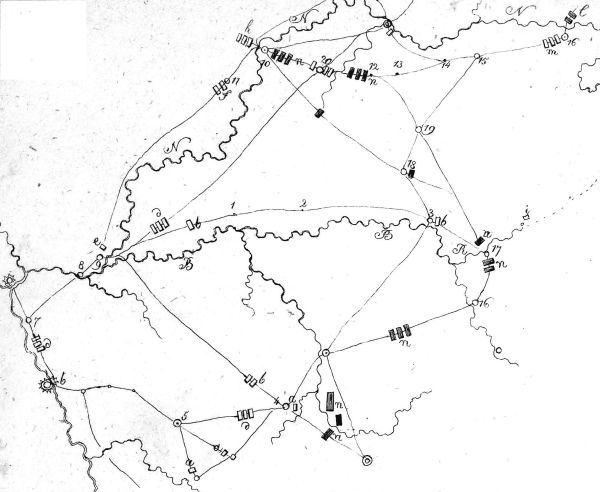
XXIX.
XXX.
OPERATIONS AGAINST THE RUSSIAN GUARD. [Plan XXIX.]
On the 12th of May, general Uminski with his division of cavalry (a) was ordered to quit the left wing and the position of Zimna-Woda, and to move to the position of Kaluszyn. This traverse of the line he was to make in full view of the enemy, and he was to give to the manœuvre the aspect of a reconnoissance. The object of this change of position was, that in the new position he might mask the movements of the main body. This important disposition general Uminski was directed to carry into effect with the utmost prudence. The enemy was to be each day harassed, but never to be engaged with in any decisive manner. Small detachments were to be sent against the enemy, along his whole line, and especially on the first days of the movement. The general in chief instructed general Uminski to watch every movement of the enemy, and give information of such at head-quarters. If the main body of the Russian force should make an attack, he was to execute his retreat upon the main road, as far as the fortifications of Praga, and there he was to act in junction with the other detachments left there for the defence of those fortifications. If, on the contrary, the Russian army should make a retrograde movement, general Uminski was to endeavor, by following them, to keep them constantly in view. If circumstances permitted, the rear guard of the Russians might be harassed during the night. Above all, general Uminski was to endeavor to keep up his communications with the neighboring corps, that of general Lubinski, and the detachments left at Siennica and Karczew. In this moderate pursuit of the enemy, the general was to ascertain whether their retrograde movement was a retreat or a manœuvre, in order to avoid every hazard.
General Lubinski (b), with his division of cavalry, was to pass the right bank of the Bug (B), and leaving small detachments at Wyszkow (1) and Brok (2), he was to advance as far as the environs of Nar (3), not quitting the right bank of the river. All his care was to be devoted to the observing of the enemy, and to the preventing of any sudden passage of the river by him. In regard to his communications, the same instructions were given to him as to general Uminski.
Having given these orders to the above mentioned corps, general Skrzynecki, with the main force (d), left suddenly the position at Kaluszyn (4), making a retrograde movement upon the great road, by Minsk (5), traversed Praga (6), and through Jablonna (7), and Zegrz (8), arrived on the 15th, at Serock (9). On the 16th, he passed the Narew (N), at this place, leaving a brigade of infantry and cavalry (e), under general Dembinski, upon the right bank, with orders to advance to Ostrolenka (10), through the towns of Pultusk, Magnuszewo and Rozany (11). This detachment was not to commence the attack on meeting the enemy, but was only to harass him and keep him in check, and detain him as near as possible to Serock. If the enemy should commence the retreat, this corps was to pursue him with the greatest activity, in order that at Ostrolenka, where the general in chief had determined to attack him, he might be exposed between two fires.
On the 17th, this corps met the first advanced post (f) of the Russian imperial guard at Modzele, which, after a slight engagement, evacuated its position, and retired. Being pursued by the brigade of cavalry under general Dembinski, they, on the 18th, commenced the passage of the Narew, at Ostrolenka. In attempting this passage, the rear-guard of the enemy was overthrown, and four regiments of the light infantry of Finland were taken prisoners. This pursuit by the brave Dembinski was executed with such rapidity, that the corps of general Saken, which made a part of the grand corps of the guard, but was a little detached, was completely cut off from the main body and forced to take refuge in the palatinate of Augustow. It is much to be regretted that our main force (d) could not reach Ostrolenka; having to pass narrow roads, through forests, in which the artillery met with much obstruction. Otherwise, the whole of that imperial guard would have been surrounded.
With the arrival of our main body, on the night of the 18th, the Russians passed the Narew, but many voitures and stragglers fell into the hands of our cavalry in the forest of Troszyn (12). The general in chief, having given the corps a short rest, and having despatched a detachment, under the command of colonel Sierawski, for the pursuit of the corps of Saken, on the same night continued his march in pursuit of the guard, in the direction of Troszyn (12). On the morning of the next day, arriving at Dlugie-Siodlo (13), this village was found occupied by two regiments of infantry and two of cavalry, the latter covering the village. Our 1st regiment of lancers, which were the leading force, leaving the forest and finding the Russian cavalry in line before that village, threw themselves upon them with the rapidity of lightning. The enemy's cavalry was borne down before them, and pursued by our lancers into the village; but his infantry, under cover of the village, opened a terrible fire upon our cavalry, which compelled them to retire and await the arrival of the artillery. At length, eight pieces of light artillery, commanded by colonel Boehm, arrived, and commenced a vigorous fire of grape upon the village, which compelled the enemy's infantry to evacuate it, and they were pursued with such spirit, that one battalion was taken, and the rest were dispersed in the forest. On the same day, the enemy was again pressed upon in his retreat, in the environs of Xienzopol (14), especially on the passage of the river and marshes of Kamionka.
The 1st lancers, and the battery of light artillery, who did not quit the enemy a moment, arrived simultaneously with him at the point of the passage. The enemy was obliged to debouch under the fire of our artillery and the charges of our cavalry, and lost again several hundred in dead, wounded and prisoners.
I cannot give the reader a satisfactory explanation, why general Skrzynecki did not pursue the enemy on the 20th. Perhaps he considered the great fatigue of the army, particularly the infantry, which the reader will, of course, presume to have been incurred by the forced march which the distance passed over supposes. Another reason, perhaps, was, that he had sent from this place the first detachment (i) for Lithuania, wishing to be sure of its safe passage to the frontiers. The detachment, in fact, left on that day, in the direction of Mniszew, and passed the frontier of the kingdom at the village of Mien, between Ciechanowiec and Suraz, opposite Brainsk.
Our army, having halted one day at Xienzopol, on the evening of the 20th, quitted this position to continue the pursuit of the guard, and overtook them in the forest of Menzynin (15). This forest, occupied by the Russian rear-guard, was so near the heights of the village, which command the whole vicinity, that it was exposed to a fire of artillery from these heights. Our generalissimo placed his artillery on the heights, and directed a fire upon the forest; the infantry was ordered to take the enemy in front, in case he should quit the forest, and the cavalry was to advance in strong columns along the road, to cut off his escape from the forest into the road. In this they were successful, and took many prisoners. Thus continually pursued, and subject to severe losses along the whole route, the guard (l) was again pressed at the passage of the Narew at Tykocin (16). The consternation and disorder of the enemy was such, that he did not take time to destroy the bridge. Our lancers, commanded by the brave colonel Langerman, commenced an attack upon the Russian cuirassiers, on the bridge itself. The regiment of cuirassiers was almost annihilated, many being thrown from the bridge, and a great number taken prisoners.
Having thus driven the Russian guard from the kingdom, (of which the Narew was the boundary,) general Skrzynecki commenced a retrograde movement, to meet the demonstration which general Diebitsch might make upon his rear. On the night of the 22d, our army (m) began this movement, having destroyed the several bridges of the Narew.
These then are the details of the operations upon the Russian guard, which will be admitted to be among the finest in the history of modern warfare. The operations of Napoleon, in the campaign of Italy—the brilliant commencement of his career, in 1796,—will be always cited as the highest examples of stratago-tactics, but I do not think that a finer and bolder plan of operations can be found even there. In both cases, success was owing, not more to the great military genius of the leaders, than to those high moral impulses which must animate armies in every contest for national existence.
Our army, evacuating on the 12th, the position at Kaluszyn, from that date to the 26th, when the battle of Ostrolenka took place, had passed over a distance of from 200 to 250 miles, which, deducting the six days occupied in action, was executed in eight days, making an average of twenty-eight English miles per day, an extraordinary and perhaps unexampled effort. The rapidity, in fact, with which this movement was performed, was such, that our forces were on their return before marshal Diebitsch commenced his march to intercept them. This object the marshal thought himself in season to effect, but the reader will see in the sequel how completely he failed of it.
FOOTNOTES:
CHAPTER XIX.
The Lithuanians compel two Russian corps to evacuate Samogitia.—Operations of general Chlapowski in the department of Bialystok.—Capture of Bielsk.—Defeat of a Russian force at Narewka and expulsion of the enemy from the department.—Recapitulation of the forces which had been sent into Lithuania.—Operations of the main army.—Attempt of marshal Diebitsch to intercept Skrzynecki on his retrograde march, by a diversion to Ostrolenka.—General Lubinski surprises the Russian advanced guard at Czyzew.—Marshal Diebitsch attacks the Polish rear-guard at Kleczkowo.—The rear-guard quits its position at night, and joins the main army at Ostrolenka.—Battle of Ostrolenka.
Quitting the main army, which had thus successfully executed the important operation of driving the Russian imperial guard from the kingdom, and sending a corps into Lithuania,—we will now turn to take a view of the state of affairs in that province.
The brave Lithuanians in a series of bloody encounters had made themselves severely felt by the enemy. In the departments of Roszyienie and Szawla, at about the middle of the month of May, a short time before the battle of Ostrolenka, the two Russian corps, under Malinowski and Szyrman, were almost annihilated by the Lithuanian insurgents, who, night and day, falling upon them from forest ambuscades, subjected them to immense losses. Those corps literally wandered about, for some time, and being unable to hold themselves in any position, were forced at last to evacuate Samogitia.
In the department of Bialystok, the little corps recently sent under the command of general Chlapowski, began its operations with great success. In the environs of Bielsk, that small detachment, composed of four squadrons of the 1st regiment of lancers, consisting of four hundred and eighty horsemen, a hundred and ninety light infantry volunteers mounted,[58] and two pieces of cannon, routed two regiments of cossacks and two battalions of infantry, the latter being taken in a body and the former dispersed; and, what was of much importance to us, in Bielsk, as well as in Brainsk, several magazines of powder were found. In the environs of Bielsk, colonel Mikotin, aid-de-camp of the grand duke Michael, and on his way with despatches from him to the Grand Duke Constantine, was taken prisoner.[59]
The corps of general Chlapowski left Bielsk in the direction of the town of Orla, and entered the forest of Bialowiek, where he received reinforcements of Lithuanian insurgents.
On the same day that our main army fought at Ostrolenka, the 26th of May, this little corps had an engagement with the enemy in the environs of Narewka. A considerable Russian detachment, under the command of general Rengardt, composed of 6,000 infantry, 3,000 cavalry, and five pieces of cannon—in all, nearly 9,000 men—was posted near Nasielsk. This considerable force was attacked by our small corps, to which were added some hundreds of insurgents, making in all, a force of not more than a thousand men. The Russians were completely beaten in this action. Full a thousand prisoners were taken, and all their artillery. An important advantage of this affair, was the taking of a great transport of some hundred vehicles with provisions, destined for the Russian grand army. By the dispersion and ruin of this corps, the department of Bialystok was entirely cleared of the Russians, and nothing interrupted the formation and organization of the insurgent forces. The taking of Bielsk, and the affair of Narewka, will be admitted by the reader to have been above the rank of ordinary achievements, and should immortalize the handful of brave men which formed this detachment. They may be pointed at, as examples, with many others, in this war, of how much can be effected by that prompt and energetic action which no ordinary motives will sustain.
While the affairs of Lithuania and Samogitia, and those in the department of Bialystok, wore this favorable aspect, a new corps was approaching to aid this propitious state of things, to protect the insurrections, and, as might be confidently hoped, to bring them to a sure and happy result. The new force destined for this object consisted of the 2d division, reinforced by a squadron of cavalry, which force quitted Lomza on the 27th for Lithuania.
Before returning to the operations of the grand army, we will give a short recapitulation of the forces which had been sent into Lithuania and Samogitia, at successive periods, to support the insurrections in those provinces.
The first corps under general Chlapowski, left, on the 20th of May, the village of Xienzopol, with this destination;—to enter the department of Bialystok, to occupy the forest of Bialowiez, in which were collected the forces of the revolted Lithuanians, with the view to organize these forces; from that position to act on the Russian communications, and, if circumstances might allow it, to make an approach upon Wilno. This little corps, as we have seen, was composed of 190 infantry volunteers mounted, the 1st regiment of lancers, consisting of 480 horsemen, and two pieces of light artillery.
The second corps, under the command of colonel Sierakowski, left, a few days before that of general Chlapowski, with the view, as we have also seen, to follow and observe the division of general Saken, who had been cut off by general Skrzynecki from the Russian guard, and compelled to remain on the right bank of the Narew. This corps consisted of two battalions of infantry of the 18th regiment, recently formed, amounting to 1,500 men, two squadrons of horse, of Plock, also recently formed, 250 in all, and two pieces of cannon. This corps, in the execution of its instructions, obtained several advantages over general Saken, near Stavisk. Colonel Sierakowski then advanced to the environs of the little town of Graiewo, where he took a strong position, and awaited the arrival of the corps of general Gielgud.
The third corps, under the command of general Gielgud, being the second division, left the town of Lomza on the 27th of May. It was composed of 9 battalions of infantry, consisting of 4,500 men, 5 squadrons of cavalry of 600 men, 160 sappers, and 24 pieces of cannon. The total force of these three corps was then as follows:
Artillery, 28 pieces. Infantry, 6,350 men. Cavalry, 1,300.
Besides these forces, which were detached from the grand army, there were formed in Lithuania, several regiments of infantry and cavalry, which we shall designate in the sequel, but which did not commence active service until the battle of Wilno.
To return to the main army. Such was the rapidity with which the operations of general Skrzynecki upon the Russian guard were executed, that, as we have said, he was on his retrograde march, after having driven that guard beyond the frontiers, before marshal Diebitsch received intelligence of his operations. It was then that the Russian commander, having no hope of saving the guard, conceived the plan of attempting, by a prompt diversion towards Ostrolenka, to cut off the communication of our army with Warsaw. [See Plan XXIX.]
With this view he evacuated his position at Sucha and Mordy (o), passed by Sokolow, crossed the river Bug at Granne (16), entered into the Russian province of Bialystok, passed through a corner of this department on the 24th of May, and crossing the little river Nurzec (R), at Ciechanowiec (17), entered again into the Polish territory, and occupied the road of Czyzew (18) and Zambrowo (19). Without any delay he pushed his advanced guard as far as Czyzew.
General Lubinski was then at Nur. This little town was at the same distance from Ostrolenka as Czyzew, but the communications with Ostrolenka were more difficult, Czyzew being on a principal road. The enemy, observing this circumstance, and taking it for granted that Lubinski was cut off from the main army, sent an aid-de-camp with a flag of truce to summon him to surrender.[60] This summons was rejected.
After the departure of the aid-de-camp, general Lubinski commenced his march, and, though it was practicable for him to reach Ostrolenka by a direct route, yet thinking it possible that Czyzew was not occupied by a very strong force, and that he might profit by the approach of night, he determined to march at once upon the latter place, and to attack the Russian advanced guard there. This bold thought was executed with perfect success. On reaching Czyzew he found two regiments of cavalry encamped, and wholly unprepared for an attack. They had not even an outer-guard upon the road to Nur. He made a charge which threw them into complete disorder, and compelled them to retreat with the loss of a great number in killed and wounded, and four to five hundred prisoners. It was to be regretted that the necessity under which general Lubinski was placed of reaching Ostrolenka as soon as possible, did not permit him to profit farther by these advantages.
On the next day, (the 25th) the rear-guard of our main army, consisting of the brigade of general Wengierski, was attacked at mid-day by the Russians, on the side of Zambrowo, near Kleczkowo (20), a village situated at the distance of three leagues from Ostrolenka, on the left bank of the Narew. General Diebitsch, being under the conviction that he had encountered the whole Polish force at Kleczkowo, consolidated his strength there, and determined to come to action, and, by so doing, give time for another corps to advance in the direction of Czyzew, and occupy Ostrolenka, by which movement he trusted that our army would be cut off from Warsaw, and forced to retire to Lomza. The Russian commander, presuming on the celerity of his movements, was so confident of meeting our whole army at this point, that nothing could exceed his surprise on learning that our army had already passed the town, and that it was only the rear-guard which was before him.[61] In order to lose no time, he commenced an immediate attack on the rear-guard thus posted at Kleczkowo. Our general in chief who was then at Troszyn, on hearing the fire of the Russians at Kleczkowo, immediately repaired thither, and profiting by the fine position of that place, which commanded the marshy plain on the side of the enemy, passable only by a dyke, the bridge over which had been demolished by our troops, ordered general Wengierski to sustain himself in that position until night. In vain the Russian cavalry and infantry attempted to pass this dyke. At each approach they were uniformly driven back by a destructive fire of grape from our artillery. In vain were sixteen pieces of their artillery employed to silence this fire; our position was too commanding to be affected by them.
The brigade of general Wengierski having held out in this position, with the greatest determination against a vastly superior force, for nine hours, left the place at night in the greatest order, and followed the main army. On the next day, the 26th of May, our army (h) evacuated Ostrolenka, passed the river Narew, and took, upon the right bank of that river, opposite to Ostrolenka, a new position,[62] leaving the bridge partly destroyed, but in such a state that the Russian infantry might pass it slowly. Not long after we had occupied our position, the enemy commenced debouching over this bridge.
BATTLE OF OSTROLENKA. [See Plan XXX.]
The battle of Ostrolenka, which cost us the lives of two brave generals, Kicki, and Henry Kaminski, was, in point of tactics, simply the passage of the river. We may presume that the intention of general Diebitsch was, by passing the Narew at this point, to send at the same time a corps to Serock, in order to cut off our army, and place it between two fires. At 11 o'clock, the Russian infantry (a) under the protection of a most terrible fire from fifty-four pieces of artillery, (b) placed in a very strong position on the left bank of the Narew, commenced, as we have said, the passage of the river. General Skrzynecki, not wishing absolutely to prevent this passage, placed but sixteen cannon in advantageous positions, on slight elevations of ground, (d) designed to prevent the repairing of the bridge, and the consequent rapid passage of the enemy's infantry. The powerful Russian artillery attempted, without success, to silence these few pieces. Their fire was equally harmless to the main army (A); for the latter was withdrawn to an advantageous position. Our artillery, on the other hand, was used with great effect, being brought to bear directly upon the bridge. During these operations, the advanced guard, with all the baggage and ammunition of the army, received the order to take up the march towards Warsaw.
At 3 o'clock, our artillery received orders to evacuate their position, and the skirmishers (e) were ordered to advance. On the cessation of the fire of the artillery, the light troops commenced a warm fire upon the columns of Russian infantry, which had already passed the bridge. The enemy, profiting by the withdrawal of our artillery, commenced repairing the bridge, to afford a passage for large masses of infantry, and artillery. A strong Russian column (f), after passing the bridge, took a direction to the left, to throw itself into the forest which borders on the Narew, at the distance of a quarter of a league from the bridge; and by occupying that forest and the communications which traverse it, they thought to commence an attack upon our right wing. To have permitted this would have much deranged our dispositions. The Polish commander, observing that a great body of the Russian infantry had already passed the bridge, and that this strong column had been sent to occupy the forest, ordered general Lubinski to send forward a brigade of cavalry (g), to charge upon this column, on its march, and at the same time ordered general Kaminski, with a division of infantry, to make a charge upon the Russian infantry near the bridge. These two attacks were executed with great promptness and spirit, and were successful. The column which the cavalry attacked on its march to the forest, was dispersed with the loss of more than a hundred men left on the field. The attack of the division of general Kaminski was equally fortunate. The Russian columns, on receiving his charge, fell back upon the bridge, or concealed themselves under the banks of the river. These two attacks cost us the lives of the two generals, Kaminski and Kicki, who threw themselves upon the enemy, at the head of their respective columns. Their loss was deeply regretted by the army and the nation.
Although the result of these attacks was favorable to us, yet, the general in chief, considering the terribly destructive fire of the Russian artillery, which commanded the whole plain near the bridge, decided that the repetition of them would cost us too severe a loss, and commanded both the cavalry and infantry to withdraw to their former position, and to cease firing.
At 6 o'clock, the firing on both sides had entirely ceased. Profiting by this interval, the Polish army pursued its route, and the Russian infantry again commenced debouching upon the bridge. At dusk, nearly the whole Polish army was on the march to Warsaw, and one division only [Plan XXXI, (d)] remained on our position. On the part of the Russian army, we may suppose that nearly two divisions had passed the bridge, when our general in chief, wishing to profit by the obscurity of the night, in order to subject the enemy to still greater losses, conceived the bold idea of advancing our artillery (a) so near the Russian columns (b), as to pour upon them a fire of grape-shot. General Skrzynecki himself approached colonel Boehm, and taking the command of the twelve pieces of light artillery under him, led them in person to the distance of within three hundred paces of the enemy, and brought forward at the same time two regiments of cavalry for the support of this artillery. Placing this little detachment in a very advantageous position behind small elevations of ground, he commanded colonel Boehm to commence firing. The Russian columns were thrown into confusion by this unexpected and terrible fire; and it may be imagined that their loss was immense, enclosed as they were within a narrow space, on the bank and on the bridge. Every discharge of the artillery was with effect, and by the testimony of the prisoners taken, their loss must have amounted to an entire brigade, without estimating those who left the field wounded, and those who fell into the river. On our side, this attack cost us only the loss of two officers of the artillery, although this detachment was exposed to the fire of the whole Russian artillery.[63] Our battery fired but three rounds, when the general gave the order to withdraw, and follow the main army (A) to Warsaw.[64]
These are the details of the battle of Ostrolenka, in which the loss on the enemy's side was from 10,000 to 15,000 men, and on our side, the two general officers above mentioned, with about 4,000 men.
On the afternoon of the day of the battle of Ostrolenka, the division of general Gielgud received orders to depart from the town of Lomza. General Dembinski, on the night of the same day was ordered to join him with two squadrons of lancers of Poznan. The latter general left the field of battle with these squadrons, and on the next day joined the division of general Gielgud.[65]
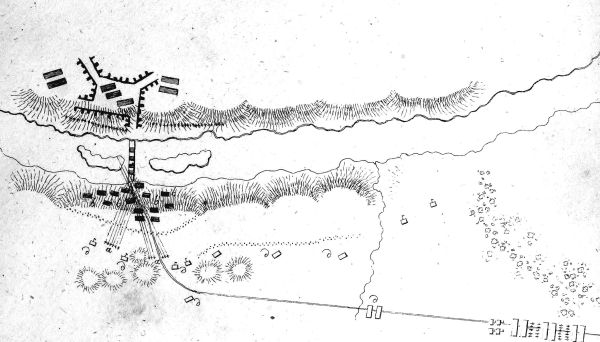
XXXI.
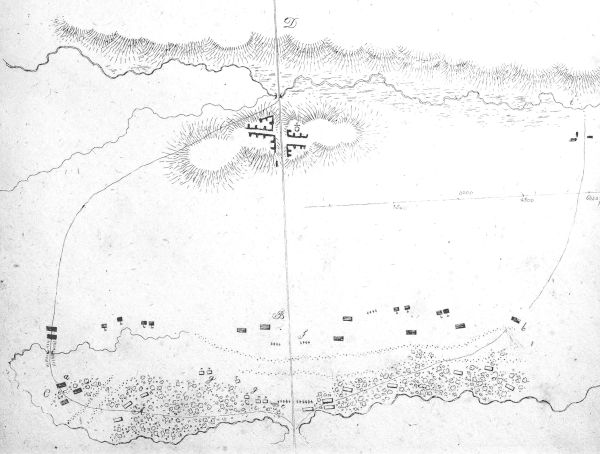
XXXII.
FOOTNOTES:
CHAPTER XX.
Operations of the Lithuanian corps.—Battle of Raygrod and defeat of the Russian corps of Saken.—Importance of this first success in Lithuania.—General Gielgud neglects to follow up his advantages.—He loses time by passing the Niemen at Gielgudyszki, and enables the enemy to concentrate his forces in Wilno.—Entrance into Lithuania and reception by the inhabitants.—Position of the two main armies.—The Russian forces remain inactive and receive supplies from Prussia.—Death of marshal Diebitsch.
On the 27th of May, the corps of general Gielgud, attached to which were generals Rohland, Szymanowski, Dembinski, and colonel Pientka, left Lomza, and commenced their march into Lithuania. On the evening of that day, they arrived at Stawisk, passing through Szczuczyn and Graiewo. In the last town they were joined by the little corps of general, then colonel, Sierakowski, which, as we have already remarked, had been employed in observing general Saken, and was here occupying an advantageous position. The force of this corps has been already stated.
BATTLE OF RAYGROD. [Plan XXXII.]
I have divided this battle into two different periods, marked by the two different positions which the enemy successively took.
On examining the plan of the first position of the Russians, it will be at once seen that they had no knowledge of the arrival of our corps. They supposed that they were acting against the corps of colonel Sierakowski alone, and they had conceived the design of out-flanking him. On the morning of the 29th, our whole corps, quitting the little town of Graiewo, met, at the distance of about a quarter of a league, the Russian flankers, against whom our own were immediately sent out. The Russian cavalry began to retire. Our columns continued their march slowly, having the forces of colonel Sierakowski in front, as an advanced guard,[66] and we thus arrived at the lake of Raygrod, the advanced guard meeting only small detachments of the Russian cavalry, which retired as we approached. On reaching the lake, our advanced guard were fired upon by the Russian skirmishers, concealed in the woods on the opposite side of the lake, which bordered upon the causeway. Colonel Sierakowski received orders to engage with them. He sent forward his own light troops, and placed two cannons upon the causeway, with which he commenced a fire upon the woods. The Russian infantry instantly evacuated the woods, and allowed our skirmishers to occupy them. By this manœuvre, the Russians intended to lead on our forces with the view to attack them on their flank, and even to surround them, by sending detachments (a, b) to the right and left, as will be seen on the plan. In a short time our larger force, under general Gielgud, commenced debouching between the two lakes. A strong column (c) of our infantry took a direction towards the forest, to the left, and another column (d) to that on the right, to dislodge the enemy, if he should be found to have occupied either. At the same time our artillery (e), to the number of fourteen pieces, taking a position at the side of the causeway, opposite to that of the enemy (f), commenced firing. The whole of our cavalry, and the greater part of our infantry remained in the centre, and constituted a formidable front.