Front matter (continued 5)
Reading edition
In a few moments after these dispositions were made, a brisk fire of tirailleurs was commenced on our left wing (A). The Russian centre (B), suffering from the fire of our artillery, and taken by surprise at the unexpected strength of our forces, began to waver. This was a signal for our advance. Colonel Pientka, who commanded the artillery, gave the order. A strong column of three battalions of infantry commenced the hurrah, and charged with the bayonet, upon the wavering columns of the enemy. At the same time, general Dembinski gave the order to our cavalry (g) to charge upon that of the enemy on the right and left. The first squadron of the lancers of Poznan received the order to throw themselves forward, and fall upon the breaking columns of the enemy. The greatest consternation and disorder began to exist in the Russian ranks. It was no longer a retreat; it was a flight. This squadron of lancers, commanded by the brave major Mycielski, performed prodigies of valor. They entered the town simultaneously with the Russian columns, cutting down immense numbers of the enemy, and taking many prisoners. This squadron courageously remained in the streets of the city, exposed to the fire of the enemy's infantry, who had occupied the houses, until the arrival of our own infantry. In this exposed situation they lost their commander.[67]
These several attacks, which did not occupy two hours, caused an immense loss to the enemy. Three entire battalions, which formed their right wing (C), consisting of 2,000 men, were taken prisoners, with three superior officers, and fourteen of a lower grade. By the entry of our forces, the enemy were driven from the town, and took another position (D) upon elevated ground, on the opposite side of a small stream, near the town. This position was strong, and commanded the town and the whole of the other side of the stream. General Saken would certainly have remained long in this position, if our right wing under colonel Koss had not, as we shall see, succeeded in passing the stream at a higher point (i), and acted on his flank. The Russian general, as soon as he had established himself in his new position, commenced a fire upon the town, which was returned by our artillery. It was during this fire that colonel Koss succeeded in passing the stream, at a quarter of a league above the city, on the right. This was effected by demolishing the buildings in the vicinity, and making a passage for the artillery from their materials. General Saken, seeing his left wing thus menaced, evacuated his position, in which, as we have said, but for this attack on his flank, he could have well supported himself for some time.
At 3 o'clock the Russians commenced their retreat upon the road to Kowno, and thus terminated a battle of the most advantageous character for us, and with which begins an important era in our affairs.
By this battle the Polish forces had made the acquisition of great advantages, both in respect to strategy and tactics, and the highest hopes might reasonably be cherished in regard to the future.
It was, as it were, a return of the state of things brought about by the victory of Iganie, and which menaced the enemy with total ruin. Our main army was then near to Warsaw, composed of a force of considerable strength, and which, under the command of Skrzynecki, had been victorious in every battle. New troops had been formed there. Neither provisions nor forage had failed, for they were constantly sent from Warsaw to the army, in whatever quarter it might be.
The Russian army was, in the mean while, suffering under all the disadvantages which we have before described. Wearied and discouraged by the disasters of the campaign, posted in regions which they had devastated, and therefore suffering from scarcity; without hospitals for their sick and their wounded,—for the towns which contained them had been destroyed,—and with the cholera ravaging their ranks, that army was in the most precarious situation. The communications between the Russian provinces and the army were entirely cut off by the Polish Lithuanian corps. They received their provisions exclusively from Prussia; and, but for this assistance of Prussia, no one can doubt that Diebitsch would have been, before this, under the necessity of withdrawing from the country. The reader will also remember that at this time, the brave and skilful general Chrzanowski, had obtained repeated advantages over Rudiger, in the environs of Zamosc, and that the little corps of general Chlapowski which had entered, on the 20th of May, the Russian department of Bialystok, was acting with great advantages. From the Baltic to the Black Sea, the provinces of Podolia, Volhynia, Ukraine, as well as Lithuania and Samogitia, containing a population of twelve millions of inhabitants, were in a state of excitement, and would soon have risen in the holy cause. They were waiting only the arrival of our victorious troops. It cannot but be assumed, therefore, that if general Gielgud, at the head of the Polish corps in Lithuania, had acted with promptness and energy, the most happy results would have been achieved. It is, therefore, with the deepest chagrin, that I have to record that from the moment of the termination of the fortunate battle of Raygrod, all the operations of general Gielgud were not only deficient in energy, but altogether wrongly planned. The first fault which he committed, was not continuing to press the attack upon general Saken, after he had retired from Raygrod. Under the pretext that the soldiers were fatigued, the corps was encamped. This pretext was groundless, for the soldiers themselves demanded to be led in pursuit of the enemy. In this camp we passed the whole night, and left it [Plan XXXIII.] at the hour of nine the following morning; having given fifteen hours to the retreating enemy. We continued our march to Kowno, through the duchy of Augustow. On the 30th of May, we arrived at Suwalki (1) its capital, and remained there a day and a night, without any conceivable reason. The enemy, profiting by the slowness of our movements, escaped the certain destruction with which he had been threatened. On the 1st of June, we arrived at Kalwaryia (2), and at that town our corps was very uselessly divided into two parts, the larger (a), under general Gielgud, took the road to Gielgudyszki (3), on the Niemen,[68] to pass the river at that point. General Dembinski, with the remainder of the corps (b), continued on the main road, and on the 3d of June arrived at Alexota (4).
This separation of our forces into two bodies, to pass the Niemen at Gielgudyszki, was not recommended by any conceivable advantage, and, indeed, operated much to our injury. This plan of operations was also in opposition to the instructions, not only of the general in chief, but of the National Government, and obstructed the rapid execution of the great designs of the campaign.
In any plan for the occupation of a foreign country, the first object should be to get possession of the principal towns, for at those points are chiefly concentrated both the moral and physical resources of the country. Of Lithuania, the town of Wilno (5) is the capital. Against it all our plans should have been directed; and, in fact, the instructions of the government to general Gielgud were all to this effect. By a prompt occupation of that city, we should have unquestionably reaped the greatest advantages. As Wilno was the residence of the principal officers of the government of the province, it would have been there that all the arrangements could best be made for a provisional administration, and for the convocation of a conventional Diet of the people. In regard also to the formation of new forces, Wilno was the place that presented the greatest facilities.
Taking all these circumstances into view, it must be conceded that after the battle of Raygrod, the first object of general Gielgud ought to have been to march upon and to occupy Wilno with the utmost promptness. With this view, his course should have been, after masking his movement at Kowno, to have passed the Niemen (N) at Rumszyski (6), a village which was about sixteen English miles above Kowno (7) and in the direction of Wilno, while Gielgudyszki, on the other hand, was thirty-two miles below Kowno, and forty-eight from Rumszyski, and out of the direction of Wilno. With the exception of that of general Saken, no other Russian force was interposed between us and Wilno. Indeed the corps of general Chlapowski (c), with which he had traversed the department of Bialystok, was at that moment between Kowno and Wilno, and had we passed at Rumszyski, we should have been within but one day's march of him. It is evident, then, that Wilno would have fallen into our hands without a blow. All these advantages were sacrificed by making the passage at Gielgudyszki. General Saken, meeting with no interruption, thus escaped a second time, and marched from Kowno to Wilno. At the same time several other Russian corps began to concentrate themselves at Wilno.
The corps of general Dembinski, having maintained a moderate fire upon Kowno for two days, in order to mask our movements from the enemy, marched for Gielgudyszki, to follow the other corps in the passage of the river, at that point, on the 7th of June. Our troops thus entered the province of Lithuania, an interesting day for us, thus engaged in the effort to re-unite this dissevered portion of our country to its ancient parent. The manner in which the inhabitants of every village received us, expressive of the warmest satisfaction, showed that they regarded us as brothers. This reception deeply affected both soldiers and officers. They hailed us as their deliverers, and it is now a mournful reflection that, owing to the misconduct of our commanders, that enthusiasm, instead of leading to happy results, proved, in the end, only an aggravation of their misfortunes.
Leaving the corps of general Gielgud upon the Niemen, we will return again to the operations of the grand army, and of the different detached corps. Our main body, which, after the battle of Ostrolenka, retired towards Warsaw, was now at Praga, where the head-quarters of the commander in chief were fixed. General Skrzynecki, during the repose of the army, occupied himself with its re-organization.
In the environs of Zamosc, the corps of general Chrzanowski, in which the brave general Romarino commanded a brigade, was sufficient to keep the different Russian corps in check.
On the 3d of June, the Russian army, which, up to the present time, continued in the environs of Ostrolenka, on the left bank of the Narew, commenced its operations upon the right bank of that river. A considerable corps, amounting to 20,000 men, passed that river in the neighborhood of Prasnysz. The principal object of this corps was not to re-ommence hostilities, but to protect the large transports of provisions which were sent daily from Prussia. In the environs of Brzesc was the corps of general Kreutz. The Russian army thus fed by Prussia, remained inactive in their position at Ostrolenka, during which interval, and while he was perhaps contriving new plans for our subjugation, occurred the sudden death of marshal Diebitsch. He died at Kleczkowo, not far from Ostrolenka, on the 9th of June.[69]
The provisional command of the Russian army was taken by general Toll.
If the reader should examine closely the operations of the two armies after the battle of Ostrolenka, he will, perhaps, be astonished at their inactivity. He will, however, acknowledge that the blame of that inactivity cannot rest upon the Polish side. The retreat which we made was necessary; first, for the sake of the re-organizing of the army; secondly, for the object of leading the enemy to the environs of Praga, which were in a state of devastation, and generally into the region between the Bug and the Liwiec, where he would not be able to support himself; and in this manner to force him either to attack the fortifications of Praga, to attempt a passage of the Vistula, or to evacuate the country. That either of the two first would be attempted, while the insurrections in Lithuania and Samogitia, &c., were in progress, and after our success at Raygrod, was hardly to have been expected; for the one would cost too great a sacrifice of men, and the other would be attended with too much hazard. If, then, the Russian forces undertook nothing, it was a consequence of their critical situation. We can, in fact, safely assume that it was their intention to evacuate the country; for to have obtained sufficient supplies by their own means was almost impracticable. When, therefore, this army remained there, it was only because it was fed by Prussia, who did not scruple openly to succor the enemy in his perilous position, by sending enormous transports by the roads of Neydenburg and Mlawa. It was those transports which saved the Russian army from the utmost extremity. I leave to the reader to judge, then, whether it was with one enemy alone that the Poles had to contend. The Prussian government, which arrested all the volunteers who were passing through its territory to augment our ranks, and which stopped all the aids of money and arms sent to us by the generous friends of liberty in other countries, took every occasion to aid and protect our enemy. If that government has satisfied its own inhuman will, by this interference to injure a cause so sacred as that of the Poles, they have unintentionally aided that cause by raising its merit in the eyes of the present and future ages, who will know with what difficulties we had to struggle. In return for these good offices of the Prussian government, the Poles will only say,—Przyidzie kryska na malyska,'—'Every one has his turn.'
If the two main armies were at rest, it was not so with the corps in the palatinate of Lublin, where general Chrzanowski beat, on the 10th of June, general Rudiger, between Zamosc and Uchania, and took from him numerous prisoners. General Rudiger was forced, by this action, to retire to Lublin, and to cease offensive operations. General Chrzanowski then prepared to surprise this corps, with the aid of the garrison of Zamosc.
It was on the 12th of June, that after being apprized of the continual victories of general Chrzanowski, the general in chief concluded to re-commence hostilities. His plan was, to act in concert with this corps, and to crush the enemy in all the southern parts of the kingdom. He would afterwards have to do only with the Russian main army, which had commenced passing the Narew and entering into the palatinate of Plock, to keep its communications open with Prussia, and where it would have been in a manner cooped up between the Narew and the Vistula, with insurrectionized Lithuania in its rear, and our army in its front or flank, according as that army should operate, at Stanislawow, at Wyskow, or at Ostrolenka.
It was here again that our commander in chief felt his hopes renewed, confiding always in the fortunate result of the operations in Lithuania, which had so happily commenced; but he was to be again mournfully disappointed, by the pusillanimity of the generals to whom the all-important expedition to Lithuania had been entrusted.
FOOTNOTES:
CHAPTER XXI.
General Gielgud advances into Lithuania.—Allows a Russian corps to pass within a league of him unperceived.—Operations on Wilno.—Enumeration of our present force.—Plan of a simultaneous attack upon Wilno on opposite sides by the corps in two divisions.—General Dembinski engages the enemy with the smaller part of the corps.—Being unsupported by Gielgud, is forced to retreat.—General Gielgud attacks Wilno.—Battle of Wilno.—A retreat is commenced.—Prodigious efforts of the Polish cavalry in protecting this retreat.—Consequences of the repulse from Wilno.—The removal of general Gielgud is called for.—General Chlapowski consents to take the virtual command of the corps, in the post of chef d'etat major.—Consideration on the state of things consequent to the battle of Wilno.—Details of the admirable plan of operations proposed by colonel Valentin.
The forces of general Gielgud having thus crossed the Niemen, passed a night at Rewdany, and the next day [Plan XXXIV.] marched on to Czaykiszki (1), in the direction of Keydany. We cannot understand why general Gielgud did not attack Malinowski (b), who passed at the distance of half a league from us, at the head of 6,000 men, on his march to Wilno. It is, we believe, a thing unheard of in the history of military affairs, that an inferior force should be suffered to pass, unmolested, so near a hostile army. It discovered the very last degree of carelessness, to enter a country in the occupation of the enemy, without sending out even the ordinary reconnoissances. General Malinowski,[70] with his corps, which ought to have fallen into our hands, escaped, and made the second Russian force which had owed its safety to our negligence, and contributed a new accession to the forces which we should have to contend with.
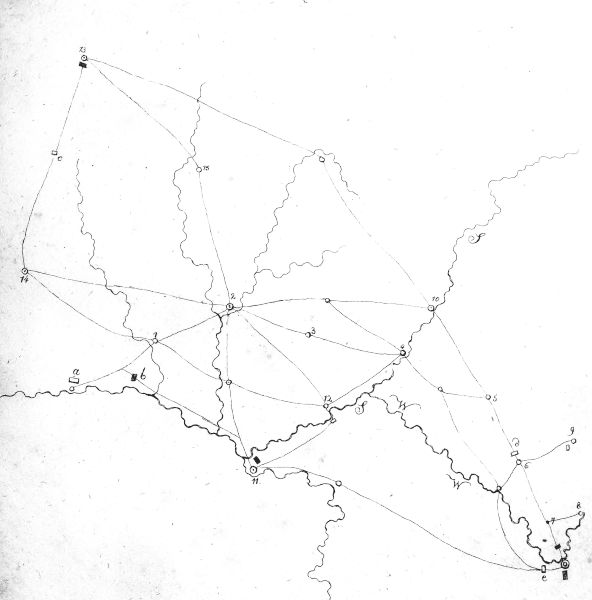
XXXIV.
On the 10th of June, the corps arrived at Keydany (2), in which place it was joined by general Chlapowski with his corps, which had so successfully traversed the departments of Bialystok and Grodno.
This force, which, on quitting Xienzopol, amounted to scarce 1,000 men, received reinforcements of cavalry and infantry, from the insurgents of the provinces, through which it had passed.[71] From the new forces, ten squadrons of cavalry, counting nearly 1,200 horse, and two battalions of infantry, amounting to nearly 1,800 men, were formed.
On the 11th of June, the united corps quitted Keydany, to march to Zeymy (3), where we arrived at night. In this little town we remained several days, we know not for what object. From this place general Chlapowski was sent with a detachment, consisting of the 1st regiment of lancers and five pieces of light artillery, to make reconnoissances in the direction of Wilno. The new forces of which we have just spoken, were attached to the main body, under general Gielgud. A few hundred of insurgent cavalry of Lithuania also arrived at Zeymy, which were joined to the lancers of Poznan and the 3d regiment of lancers.
On the day of our departure, general Szymanowski received orders to leave for Polonga with a small corps of insurgents (c) from the department of Szawla. This corps consisted of 1,500 infantry, 400 light cavalry, and two pieces of cannon.
As it was from Zeymy that we commenced our operations upon Wilno, after having organized the new forces; and as from this point begins an era in the history of the expedition, it may be well to give a new enumeration of our forces. Our infantry consisted of 13 battalions of infantry, amounting in all to nearly 8,700 men, including a body of sappers; our cavalry of 24 squadrons, amounting to about 2,750; and our artillery of 29 pieces of cannon. To these forces we might add a detachment of 500 men and 100 horse, acting independently as a corps of partizans, under colonel Zaliwski. This corps of colonel Zaliwski was formed in the duchy of Augustow, with the destination to operate there upon all the demonstrations of the enemy, on his communications, his magazines, his baggage, his transportations of provisions, ect; and when it is considered that this officer remained for four months thus successfully employed, and exposed to the enemy's forces on all sides, a particular acknowledgment is due to him for his meritorious services. In the above enumeration we have, of course, excluded the force of general Szymanowski, which, as we have stated, received another destination.
With the forces which we have enumerated, general Gielgud left Zeymy on the 14th of June. The operations on Wilno were planned for an attack on two sides, and with that view general Dembinski was detached with a small corps (d) of 1,200 infantry, 900 cavalry, and 4 pieces of cannon. This general was to attack Wilno on the road from Wilkomierz to that city, at the same time that the larger force (e) made the attack on the road from Kowno, on the left bank of the river Wiliia. This plan demanded the most exact communication between the two attacking corps. That communication was not observed, and, in fact, as it will be seen, the plan itself was not executed.
The corps of general Dembinski reached Wieprz (4), on the river Swieta, on the 14th of June. On the next day it passed that river, and arrived at Szerwinty (5). From thence, after resting for a few hours, the corps marched to Myszogola (6), where it passed the night. On the 16th, leaving this village, after a march of two leagues, the corps began to meet with small detachments of the enemy's Circassian cavalry.[72] General Dembinski gave the order to throw forward the flankers. The Circassians commenced a retreating fire, and, thus engaged with them, we approached within a league of Wilno, taking a position at Karczma-biskupia (7), or The Tavern of the Bishop, a large public house, surrounded by small dwellings, and which was in rather a commanding situation.
On the 17th, general Dembinski sent parties of cavalry to the right as far as the river Wiliia (W), and to the left as far as Kalwaria (8), to make reconnoissances, and advanced with the body of the corps in the centre, for the same object. In these reconnoissances a constant fire of flankers was kept up, with which the whole day was occupied. It was a great fault in general Dembinski, to have commenced this fire, without having any intelligence of the situation of the corps of general Gielgud, with which he was to act in concert. On the morning of the same day, in fact, on which general Dembinski was thus employed, the corps of general Gielgud was at the distance of thirty-six English miles from him. By these imprudent reconnoissances, general Dembinski laid open all his forces to the knowledge of the enemy. Of this fault the enemy took advantage on the next day.
On the 18th, at sunrise, clouds of Circassian cavalry made their appearance, and commenced attacks upon our flanks, endeavoring to turn them. Several columns of Russian infantry then approached, and manœuvred upon our centre, on which also 12 pieces of Russian artillery of large calibre commenced firing. Other columns of cavalry manœuvred upon our wings. As far as we could judge, the enemy's forces amounted to about 8,000 men. General Dembinski, seeing the strength of the enemy, and appreciating his own danger, gave orders for a retreat, which was commenced under a terrible fire from the enemy's artillery, and from his flankers, who harassed us on every side. The retreat was executed in the greatest order, as far as Myszogola, a distance of 12 miles from our position, with the loss only of some fifty cavalry. On arriving at Myszogola, general Dembinski, concerned at receiving no intelligence from general Gielgud, sent an officer with a report of what had occurred. That officer found general Gielgud with his corps, at Oyrany, occupied in making the passage of the Wiliia, at that place. The report of general Dembinski, as we can assert from personal knowledge, gave a faithful description of the occurrences of the preceding days, and contained a request, that, in case he (Dembinski) was expected to maintain the position in which he then was, general Gielgud must send him reinforcements of infantry and artillery. The report finished with the suggestion, that it would be, under all circumstances, the course most expedient, to re-unite his forces with those of general Gielgud. Upon the receipt of this report, to which general Gielgud gave little attention, orders were sent to general Dembinski to depart for Podbrzeze (9), eight miles to the left of the road which leads from Wilkomierz to Wilno. The pretext of this order was to attack Wilno on the side of Kalwaryi, and to pass the river Wiliia at that point. Thus, instead of being allowed to unite his corps with that of general Gielgud, as he had proposed, general Dembinski was ordered to remove to a still greater distance, a disposition for which we can conceive no possible motive. On the 19th of June, the day on which general Gielgud commenced his attack on Wilno, general Dembinski was thus employed on his march, without an object, to Podbrzeze.
BATTLE OF WILNO. [Plan XXXV.]
The battle of Wilno was, in point of tactics, simply a strong attack upon the Russian centre (A), with the view, by forcing it, to pass on to the occupation of the city. The adoption of such a plan supposes an ignorance of the nature of the position of the enemy, and of the strength of his forces.[73] Indeed any plan of attacking this city on its strongest side, that toward Kowno, was almost impossible of execution.
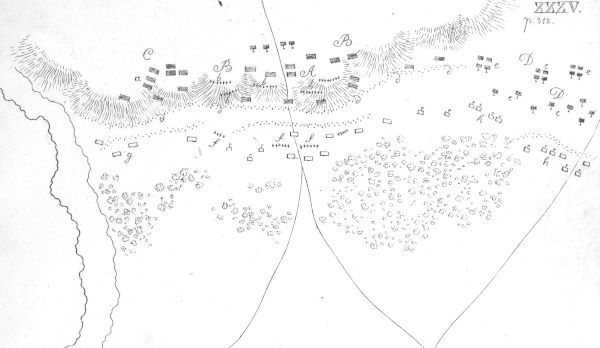
XXXV.
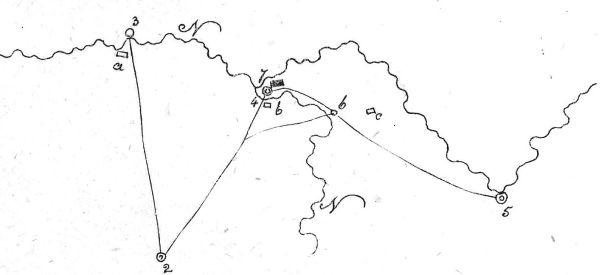
XXXIII.
The battle commenced on the morning of the 19th of June. The enemy was dislodged from his first position, which was about one mile from the city. Their retreat was caused by a spirited charge, by the 1st regiment of lancers, upon the Russian artillery, and the columns of infantry in the centre. The enemy, on quitting this position, took another of great strength on the heights called Gory-Konarskie (B). This strong position was already covered with fortifications. The right wing of the enemy (C), composed of strong columns of infantry (a), rested on the river Wiliia; the centre, (A), embracing all their artillery, which consisted of 50 pieces of cannon (b), occupied the heights above mentioned; the declivity of those heights was covered with sharp-shooters (d), concealed behind small heaps of earth, thrown up for this purpose. The left wing of the enemy (D) was entirely composed of cavalry (e).
After driving the Russians from their first position, our artillery (f) was brought forward and placed opposite the enemy's centre. This is to be regarded as a great fault. At the same time that our artillery was thus disposed, our left wing received orders to attack the right wing of the enemy. The columns of our infantry (g), composed in part from the new Lithuanian levies,[74] threw themselves with such fury upon the enemy, that they did not give them even time to fire, but fought them hand to hand: an immense slaughter ensued, and the Russians began to give way before this desperate assault; but at this very moment, our artillery, who could not sustain themselves under the overpowering fire of the enemy from his commanding position, began to fall back; and gave time to the Russians to send fresh bodies of infantry to support their right wing. Our left wing, being unable to sustain a conflict with the reinforced strength of the enemy, and apprehensive of being cut off, to which hazard they were exposed by the retreat of our artillery, began to give way also, and upon that a retreat commenced along our whole line, under the protection of the cavalry (h). The cavalry, both old and new, performed prodigies of valor, in executing this duty. Single squadrons were obliged to make charges against whole regiments of the enemy, who constantly pressed upon us, with the object of throwing our forces into disorder. All the efforts of the enemy were thwarted, by this determined bravery. The Russians themselves have borne testimony to the unparalleled efforts of our cavalry on that occasion. Our lancers seemed to feel the imminent danger of permitting the Russian cavalry to fall upon our ranks, and they fought with the energy of desperation. They repelled the attacks of a cavalry three times superior in force, and which was in part composed of regiments of the imperial guard.
The enemy having been thus foiled in his attacks, our forces repassed in safety the bridge of Oyrany, leaving it destroyed.
The battle of Wilno, so disastrous to us, was our greatest fault in the expedition to Lithuania; and it was the first of a series of disasters. The evil consequences of this battle did not rest with ourselves; they fell heavily upon the inhabitants of Wilno, whose hopes of acting in concert with us were disappointed. At the sound of our cannon, a revolt of the inhabitants was commenced, and after the repulse of our forces, arrests and imprisonments of course followed. This unfortunate battle, in fine, disorganized all the plans of the main army, and had a most discouraging effect upon the spirits both of the army and the nation. An attack upon Wilno, at a time when all the enemy's forces were concentrated there, should only have been made upon the basis of the most extensive and carefully adjusted combinations. A successful attack on Wilno would have been a difficult achievement, even by a force equal to that of the enemy, when the strong positions of the place are considered. What then shall we say of an attack, with a force amounting to but one third of that of the enemy, and made also, in broad day, upon the most defensible point of the enemy's position?
But, as if these disadvantages were not enough, general Dembinski, after having been compromitted at Myszggola, instead of being enabled to aid in this attack, was, by the orders of general Gielgud, at the very moment of the attack, marching in the direction of Podbrzeze, [(9) Plan XXXIV,] and was also by this separation exposed even to be cut off by the enemy, who could easily have done it, by sending a detachment for this object on the road from Wilno to Wilkomierz.
This succession of inconceivable faults arrested the attention of the corps, and created a universal dissatisfaction. The removal of general Gielgud, and the substitution of general Chlapowski in the chief command, who had distinguished himself so much in the departments of Bialystok and Grodno, was loudly called for. General Chlapowski was unwilling to take the chief command, but, to satisfy the wishes of the corps, he consented to take the office of chef d'etat major, a post in which he was virtually chief, having the exclusive responsibility of every operation. To this arrangement general Gielgud readily consented. It took effect on the evening of the 20th. From that day general Chlapowski was the director of all our operations.
After all these disasters, which had both morally and physically weakened us, and with a clear knowledge of the amount of the enemy's strength, our leaders should have been satisfied that it must be out of the question with us to act any longer on the offensive, and that our whole plan of operations on Samogitia ought to be abandoned. We will give the reader an exposition of the views of a great majority of the officers of the corps, upon this point, formed even during the battle of Wilno.
It was near mid-day on the 19th, and when our line was commencing their retreat, that colonel Valentin, with several other officers, addressed themselves to general Gielgud, represented to him the disastrous situation in which we were placed, and proposed to him a plan of operations adapted to our new circumstances. There was, in their opinion, but one course to pursue. This was, to abandon our whole plan of operations between the rivers Niemen, Dwina, and Wiliia. The space enclosed between these rivers, the Baltic Sea and the Prussian territory, was a dangerous position for us, as it contracted our movements, and at the same time exposed us to being surrounded by the superior forces of the enemy. Colonel Valentin designated, as the most eligible line of operations, the space between Kowno and Lida. From this oblique line we could at any moment menace Wilno. He proposed to occupy Kowno, and to fortify that town as well as Alexota and Lida in the very strongest manner. On this line we should have been in a situation to profit by any advantageous opportunities which the negligence of the enemy might leave to us, of acting upon Wilno; and if we might not be fortunate enough to surprise that city, we should, at least, compel the Russians to keep a strong force within its walls, as a garrison. The town of Lida touches upon the great forest of Bialowiez. It is situated at the meeting of three great roads, viz. those from Poland, from Volhynia, and from the province of Black Russia, a circumstance in its position which made it a place of great importance. The communications of the town with the neighboring forest were extremely easy, and this forest colonel Valentin designed a place of concentration for all the insurgent forces of Lithuania and the other provinces. He proposed to fortify, in the strongest manner, all the roads which concentrated here, and thus to make the position difficult and dangerous of access to the enemy. This forest, which is more than one hundred and twenty English miles in length, and from thirty to sixty in breadth, reaches the great road which passes by Bielsk, from Warsaw to St Petersburgh and Moscow, and extends northwards to the environs of Wilno.
By means of prompt operations, according as circumstances might direct, our forces could act upon each of these roads, and could obstruct all the communications of the enemy with St Petersburgh and Moscow. Colonel Valentin, in proposing this plan, also gave much weight to the consideration that our main army under general Skrzynecki, was victorious in the vicinity of Warsaw, and that general Chrzanowski was with a corps in the environs of Zamosc, having been victorious over Rudiger, and on the point of entering into Volhynia; with this latter corps, a junction could easily be effected, and the two corps could act in concert, for the support of the insurrections which might occur in all the provinces between the Dnieper and the Black Sea; and even if all these great advantages, which we should have been justified in counting upon, had not been attained, we should, at least, have compelled the enemy to retain a great body of forces in Lithuania, and thus have hindered him from reinforcing his main army.[75]
FOOTNOTES:
CHAPTER XXII.
Operations of the main army.—Expedition under Jankowski.—General Chrzanowski having driven Rudiger from his position, crosses the Vistula, but returns to act in concert with general Jankowski against the enemy near Kock.—Details of general Jankowski's movement.—He remains inactive within sight of the fire of the corps with which he was to co-operate.—Other evidences of treason.—Generals Jankowski and Bukowski are arrested and ordered for trial.—View of the advantages that were sacrificed by this misconduct.—Discovery of a plot to liberate and arm the Russian prisoners at Warsaw, and to deliver the city to the enemy.—State of the public mind induced by these events.
From these melancholy occurrences in Lithuania, let us turn to follow the operations of the grand army.
On the 13th and 14th of June, a division of infantry, under the command of general Muhlberg, left Praga, and took the direction of the environs of Stanislawow and Jadow. In the latter place this division surprised a strong detachment of the enemy in camp, and took many prisoners. Thence they were instructed to follow the left bank of the Liwiec as far as the environs of Kaluszyn, and even to Zelechow, clearing each bank of the presence of the enemy. This division was then to join itself with the division of cavalry of general Jankowski, which on that day left for Kock. Those two divisions combined, were to endeavor to act upon the different corps of the enemy which were pressed by the corps of general Chrzanowski.
The latter general had commenced the offensive on the 16th, and had driven the corps of general Rudiger from its position at Krasny-taw, and compelled it to retreat to Lublin, continually pursued by him. On the 23d, he took that town by storm. The enemy was obliged to evacuate it in disorder, leaving a great number killed, wounded, and prisoners, and to take the direction of Kock. The corps of Rudiger would have been inevitably destroyed, if another Russian corps of 15,000 strong had not marched to its aid.
General Chrzanowski, apprized of the arrival of this reinforcement, quitted the pursuit, for a more favorable moment; and, to avoid an engagement with this combined force of the enemy, as well as to escort the prisoners, which he had taken at Lublin, to a place of safety, he repassed the Vistula, at Pulawy. He had scarce reached the opposite side of the river, when he received the intelligence that the division of general Jankowski, reinforced by a brigade of infantry, was approaching Kock, where was already the corps of general Rudiger, and whither the corps of general Keisarow, above mentioned, was hastening to join him. In order, therefore, to take between the two fires all the forces which might be collected at Kock, general Chrzanowski promptly repassed the river, reached the environs of Kock, and waited impatiently for the attack of general Jankowski, in the opposite direction; but Jankowski delayed his movement, and allowed the corps of Kiesarow to join Rudiger.
The following are the details of this expedition, as they were related by an officer of the division of Muhlberg, and which exhibit satisfactory evidence of treason on the part of general Jankowski.
'The issue of this expedition, which could have had the most brilliant results, has filled us with grief and indignation. We were marching in the utmost haste upon Kock, with the hope of beating Rudiger. On our route, at Stoczek, for our misfortune, we were joined by the division of cavalry under general Jankowski, who then took the command. We ought to have passed the Wieprz, to meet Rudiger, and cut him off. Suddenly news was brought to us that the enemy had passed the Wieprz, at Lysobyki, with 6,000 infantry, sixteen squadrons of cavalry, and ten pieces of cannon. General Jankowski then called a council of war, at which the following plans were adopted. General Turno was to attack the enemy, in the direction of Sorokomla, and general Jankowski was to come to his support at the first sound of his cannon. The brigade of general Romarino (detached from the corps of general Chrzanowski, and destined to act as an independent corps) was to act upon the left wing, and general Bukowski, with a brigade of cavalry, upon the right wing of the enemy by Bialobrzegi. This plan, which in the conviction of all our officers would have exterminated the corps of general Rudiger, and the execution of which was reserved to general Jankowski, came to nothing.
'General Turno, trusting in the faithful execution of the plan, attacked the enemy with courage and vigor. He was sure of receiving support on three sides. He made head against the enemy for six hours, while generals Jankowski and Bukowski, at the distance of about three miles from him, hearing and even seeing the fire of the action, remained in a state of complete inaction. Nay more, a Russian detachment took possession, almost before their eyes, of the ammunition and baggage of a whole regiment, and they did not stir to prevent it. General Turno fought with bravery and sangfroid, notwithstanding that none came to his support, and did not retire till he received orders to do so. The whole corps was indignant at the conduct of Jankowski, and his brother-in-law, Bukowski, who had evidently acted the part of traitors.'
General Skrzynecki was deeply afflicted with the sad result of an expedition, which, based upon infallible calculations, had promised the very surest success. The event was of the most disastrous consequence to us. If the corps of general Rudiger had been crushed, as it certainly could have been, the combined corps of Chrzanowski, Muhlberg, and Jankowski, could have acted upon all the corps of the enemy, which might be found between the Wieprz, the Swider, and the Liwiec. As those corps were quite distant from their main army, which was now upon the right of the Narew, and as they were even without a free communication with each other, they could have each been beaten in detail, by a prompt action on our part. I leave to the reader to decide, whether, after we should have obtained such successes over these detached corps, we could not have acted with certain success against the Russian main army.
The corps of general Rudiger, which thus escaped its fate, left for the environs of Lukow, whither it was followed by general Chrzanowski. The corps of general Jankowski returned in the direction of Macieiowiec and Laskarzew, and the division of general Muhlberg returned to Minsk. The general in chief deprived generals Jankowski and Bukowski of their command, and ordered them to be tried by a court-martial.
But other and even more affecting disasters were awaiting us. Poland, which had been so often made a sacrifice of, through her own generosity and confidence, now nourished upon her bosom the monsters who were plotting her destruction.
On the 28th of June, general Skrzynecki received information of a conspiracy which had for its object the delivering up of Warsaw into the hands of the enemy, by liberating and arming the Russian prisoners. Several generals, of whom distrust had been felt, and who had been deprived of their commands when the revolution broke out, having been known as the vile instruments of the former government, were at the bottom of this plot. Of this painful intelligence, general Skrzynecki immediately apprized the National Government, who, relying on his report, caused to be arrested general Hurtig, former commander of the fortress of Zamosc, and a base instrument of Constantine, general Salacki, colonel Slupecki, the Russian chamberlain Fenshawe, a Mr Lessel, and a Russian lady, named Bazanow. Generals Jankowski and Bukowski were also implicated in the conspiracy. This band of traitors intended to get possession of the arsenal, to arm the Russian prisoners, and to destroy the bridges; (in order to cut off all communication with the army, which was then on the right bank of the Vistula;) and the Russian army, advertised of this movement, was then to pass to the left bank of the Vistula, at Plock or Dobzyn, and take possession of Warsaw. Those traitors succeeded in setting at large a great number of Russian prisoners at Czenstochowa.
What a terror must poor Poland have been to the Russian cabinet, which did not find it enough to have deluged her with their immense forces, and to have engaged all the neighboring cabinets to aid them against her, but must go farther, and, by the employment of such vile means, attempt to kindle hostilities in her interior, and to subject her at the same time to a civil and an external war! They had good cause for these desperate attempts. From the earliest stage of the conflict, they had seen that the Poles, nerved by the consciousness of the justice of their cause, were capable of crushing the force which they had sent to execute the will of the despot. Unable to meet us in the open field, they must invent some new method, no matter how base, to accomplish their end. It was through the instrumentality of their intrigues that the dictatorship was prolonged. It was by such intrigues, that the apple of discord was thrown into our national congress, and even into the ranks of that handful of brave men who had sworn to sacrifice themselves in the cause of their country. They employed their vile accomplices to betray us, and they succeeded.
The discovery of this extensive treason struck the people with consternation and dismay. It drove them to a state bordering on desperation. When Poland had sent and was sending her sons, and even her daughters, to the field of death;—when she was sacrificing every thing to achieve her deliverance, and was awaiting the fruits of such sacrifices, sure, if not to conquer, at least to fall with honor,—she sees that all is in vain—that her holy purposes are mocked at, and that all her noble efforts are thwarted! Can we be surprised, then, at the state of the popular mind which ensued?
The state of feeling which these events caused was aggravated by the reflection, that the surveillance of certain individuals, of whom distrust had been already entertained, had been more than once demanded; and that from an early period it was urged upon the government, that the Russian prisoners, particularly those of distinction, should be carefully watched, and prevented from holding free communication together, or with others. So far, however, from such care having been taken, the very Jews were permitted to communicate with them constantly, and to bring them intelligence of the events of the war. Can it be wondered then, that the neglect of these repeated warnings, and the tremendous consequences which had well nigh followed this neglect, should have weighed upon the minds of the people, and have even brought the National Government itself into suspicion? It was, in fact, from this moment, that the nation began first to look with dissatisfaction and distrust upon that government, upon prince Czartoriski its head, and even upon the general in chief himself. The melancholy news of the treason of Jankowski filled the minds of the patriots with bitter anticipations; they naturally foreboded, that if such treasons could be perpetrated in the grand army, under the very eyes of the general in chief, the danger might be still greater in the more distant corps. Their forebodings were but too well justified by the events which took place in Lithuania, the intelligence of which was soon received at Warsaw.
CHAPTER XXIII.
General Chlapowski arrives at Keydany, having ordered general Dembinski to Wilkomierz.—The position of the two forces and their line of operations.—Examination of these arrangements.—Neglect of the important position of Kowno.—General Chlapowski, at Keydany, proposes to form a provisional government, and obtain a levy of troops.—Dispositions of the Lithuanians, as effected by the mismanagement of our leaders.—Advantages offered to the enemy by the delay at Keydany.—Brave defence of Kowno, by the small force left there.—Skirmish at Wilkomierz.—The opportunity of concentrating all the forces at Keydany, and repassing the Niemen, is neglected.—The enemy presses his pursuit.—Battle of Rosseyny.—Attack on Szawla.—Loss of the ammunition and baggage of the corps.—The corps retreats in order to Kurzany, protected by a rear guard of cavalry and light artillery.—At Kurzany the corps is subdivided into three parts.—Destination and strength of each.—Examination of this plan.
General Chlapowski, whom we shall hereafter name as having the chief command of the Lithuanian force, arrived on the night of the 22d of June at Keydany, having sent orders to general Dembinski to withdraw with his corps, and to march to Wilkomierz. (10) [Plan XXXIV.] The corps of general Dembinski arrived, on the 21st, at Szerwinty, and on the 22d, at Wilkomierz. On quitting Podbrzeze, general Dembinski left a small detachment in the environs of Myszogola, to act as partizans.
The position of our corps was then as follows;—The larger force was at Keydany (2). The corps of Dembinski was at Wilkomierz, and a small corps (c) under the command of general Szymanowski was in the environs of Szawla. Our line of operations was on the river Swienta (S) and along the Wiliia (W), for a short distance below the junction of the former river with it. To defend the passage of those rivers against the enemy, the following detachments were designated. Kowno (11) was occupied by two battalions of Lithuanian infantry, recently levied, under the command of colonel Kikiernicki, and a squadron of the 11th regiment of lancers, also Lithuanian, and recently formed.
At Janow (12) was a battalion of infantry and a squadron of the 11th lancers, under the command of colonel Piwecki. At Wieprz were three squadrons of the 10th lancers.
This separation of our forces in Lithuania, and, above all, this designation of the most recently organized troops for the defence of the passage of the two rivers, with a full knowledge of the great strength of the enemy, was a gross error. To leave the defence of Kowno, a place of so much importance, to three battalions of infantry and a squadron of cavalry, all of them newly formed troops, and that, too, without ammunition, (for they had barely three rounds each,) was a course perfectly inexplicable. Besides all this, the river Swienta was so shallow as to be fordable by both infantry and cavalry, and in some places even by artillery. Why then was that river defended? It was owing, in fact, to good fortune that all these detachments were not cut off.
On the arrival of the two corps at Keydany and Wilkomierz, the organization of a provisional government for the province, was commenced. Diets were convoked at these two places, to organize an administration, and to procure levies of forces. Although these arrangements were all proper in themselves, yet it was a late hour to undertake them, and no place could have been so well adapted for them as Wilno. Had the corps of Saken been pursued and broken up, Wilno would have been ours; and all such arrangements could have been made there under the most favorable circumstances. In that event, the brave Lithuanians would have come in from all sides and crowded our ranks, without waiting for any appeal to be made to them. But at present, a new crisis had arrived. We had fought the battle of Wilno with a disastrous result. The enemy had become acquainted with the inferiority of our forces, and had begun to understand the errors of our commander, and was prepared to take advantage of them. In fine, the Lithuanians themselves, witnessing all this gross mismanagement, became disgusted, and after having once so cheerfully tendered their co-operation, began, at length, to discover that they were sacrificing themselves in vain, and that the fate of the inhabitants of Wilno would await them. This people, as we have already stated, had commenced their insurrection two months before they had hopes of any assistance from our forces, and badly armed as they were, they had maintained a partizan warfare during this period with uniform success. We can, therefore, have no reason to reproach them, if after the misconduct which was exhibited before their eyes, they began to be reluctant to join their forces to our own, and chose to reserve the sacrifice of their exertions and their lives for some other occasion, when there might be some hope of useful results.
The six or seven days which we passed thus at Keydany and Wilkomierz, seemed as if designed to invite the enemy to pursue his advantages, and to lead him to the idea of surrounding our forces. The enemy, fortunately for us, did not improve the opportunity which we presented him, but remained inactive. This inactivity, whether it arose from the imbecility of his commanders, or whatever other cause, afforded us an opportunity of changing our plans, and of extricating ourselves from the dangerous position in which we were placed. But instead of this, we awaited his attack. On the 29th, the enemy commenced an attack upon every point, at Wilkomierz, Wieprz, Janow, and Kowno, with his whole force.
A corps of 4,000 Russians, with 16 cannon, commenced the attack on Kowno, defended, as we have said, by 2,000 new troops. From morning until night, the defence was sustained with great courage. The contest was for the first half of the day in the town itself, and the rest of the day was spent in disputing the passage of the bridge over the Wiliia. The Russians occupying all the houses upon the banks of the river, and the neighboring heights, commenced a terrible fire of artillery and musquetry upon the bridge, which was defended by a body of infantry, almost without ammunition. At nightfall, colonel Kikiernicki, seeing that the Russian cavalry had found means of fording the river, ordered a retreat, but remained himself at the head of a single company, defending the bridge, until he learnt that the rest of the corps had passed the town of Sloboda, and had gained the heights which are behind the town. Upon that bridge, fell the captain of this company, Zabiello, a Lithuanian. He was shot in the act of cutting away the bridge with his own hands. This company, after having thus sustained their post at the bridge with the greatest bravery, commenced their retreat. The Russian cavalry, having succeeded in fording the river, had already commenced acting in their rear. At the same time, the Russian columns of infantry were debouching upon the bridge. Colonel Kikiernicki, perceiving his situation, animated his little corps to make the desperate effort of breaking through the Russian cavalry, and of gaining Sloboda. His spirit was seconded by his brave followers, and this company of one hundred men, raising the hurrah, forced a passage through the enemy's cavalry, gained Sloboda, and, under cover of night, succeeded in joining their comrades.[76] In this effort, colonel Kikiernicki fell wounded, and was made prisoner by the enemy.
The detachment, having lost one half of their numbers in the sanguinary attack to which the mismanagement of our general had exposed them, took the road to Janow. In this manner ended the attack on Kowno, and the Russians took possession of that important post, which might be regarded as the key to all our communications with Poland.
There can be no excuse for not having fortified Kowno. It is a town, containing ten or twelve thousand inhabitants, of which one half, perhaps, were Jews, but they could have been employed in the construction of the works. It was also most favorably situated for defence, being surrounded by heights on every side.
On the same day, sanguinary skirmishes took place at Janow, Wieprz, and Wilkomierz. The two first towns were abandoned. In the attack on Wilkomierz, which was successfully repelled, an action took place, in which the lancers of Poznan and Plock threw themselves upon the flank of Russian cavalry, and, after causing severe loss, took about eighty prisoners, consisting of Circassians. General Dembinski, on the night of the 29th, learning that our positions of Janow and Wieprz were abandoned, quitted Wilkomierz on the next day, and took the road to Szawla. [Plan XXXIV, (13)]. Although the occupation, by the enemy, of the town of Kowno, and the interruption of our whole line of operations on the Swienta and Wiliia, made our situation very perilous; yet it was still possible to avoid the disasters which followed, and to effect a return to Poland. By concentrating all our forces at Keydany, we could have effected a passage of the Niemen, in the same manner as we had already done in the direction of Gielgudyszki, which would have left the enemy in our rear; while on the other side of the Niemen, the enemy were not in force enough to prevent our passage. But, instead of doing this, as if to insure our ruin, a small detachment, consisting of four squadrons of cavalry, and the sappers, under the command of colonel Koss, were sent to make a bridge over the Niemen! This measure is perfectly inexplicable. Scarcely had this detachment arrived at the river, and commenced the erection of the bridge, when they were attacked on two sides, by the cuirassiers and the artillery of the enemy. They were saved only by the judicious conduct of colonel Koss, who threw himself into the protection of the neighboring forest, and succeeded in rejoining the corps. The loss which we incurred by this expedition, of all our implements for the construction of bridges, was irreparable.
From this time, the enemy did not for a moment lose sight of us; and throwing his superior forces upon the great road which leads from Keydany, through Rosseyny (14), to Szawla, forced us to take that direction which was the most dangerous for us, as the field of operation for our forces was continually becoming more and more contracted.
COMBAT OF ROSSEYNY.
The cause of this action, which it would have been most desirable to have avoided, was a strong attack by the enemy upon the rear-guard of general Chlapowski which was marching on the road to Szawla. To avoid exposing the rear-guard to a great loss, or even to the chance of it, the command was given, to take position, and the corps was placed in order of battle. The battle of Rosseyny, which lasted scarcely four hours, was very sanguinary, and highly honorable to the Polish arms. The object of the enemy on this occasion was to surround our left wing. As soon as he perceived that our corps had taken position and was arranged in order of battle, the enemy brought forward his artillery, consisting of 24 pieces of cannon, and commenced a heavy fire upon our centre. This fire did not cause a great loss, for, our position being elevated, the shot struck too low to be effective. A few moments after this fire of artillery was commenced, a strong column of Russian cavalry showed itself on our right wing. This column had with it a body of light artillery, which commenced fire also. On our left wing, which was supported upon a marsh, and, for that reason, in little expectation of an attack, but a small force was collected. This wing was composed of a battalion of infantry and the 1st regiment of lancers. These troops had been placed on this wing to repose from the combats and fatigues of the day and night preceding, in which they had acted as rear-guard. The brave lancers, however, at the first sight of the enemy, demanded of the general to be permitted to make a charge. This permission being given, at the first discharge of the Russian artillery, our soldiers threw themselves with impetuosity upon both the cavalry and the artillery of the enemy. The capture of sixty prisoners and the spiking of three cannon were the fruits of this brilliant attack. It was the last charge of that brave regiment.
Our centre was not less fortunate than our left wing. Our artillery being better placed than that of the enemy, several of his pieces were dismounted, and his fire began to slacken. For some hours a light fire of tirailleurs was continued on both sides, when our generals, seeing that the enemy did not renew the attack, gave orders to evacuate the position, and to resume the march for Szawla.
On the same night, the corps arrived at Cytowiany. There our forces were joined by the corps of general Rohland, which had had a bloody skirmish at Beysagola, [Plan XXXIV, (15)] on the same day on which general Dembinski was also attacked at Poniewieze. The corps of general Chlapowski left the next day for the attack of Szawla, which was occupied by a Russian garrison. The corps of general Dembinski, which as we have already stated, was marching by another route upon Szawla, arrived there at mid-day on the 7th. That general, considering the smallness of the Russian garrison in this town, consisting only of four battalions of infantry, and six pieces of cannon, after waiting a short time for the arrival of the corps of general Chlapowski, concluded to send a summons, by colonel Miroszewski, to the Russian commandant, proposing to him to surrender, and save a useless effusion of blood. The Russian colonel Kurow would not accept of these friendly propositions, and compelled general Dembinski to order an attack; a very moderate one, however, as he was in hopes that the arrival of our superior forces would soon convince the Russian commander that a defence would be useless. In fact, the corps of general Chlapowski arrived at about 5, P.M. at a village about four miles from Szawla, where he was met by an officer, sent by general Dembinski, with a report of the circumstances which had taken place. Indeed, the sound of the cannon and musquetry, ought already to have satisfied general Chlapowski that general Dembinski was engaged in the attack; but instead of hastening to his assistance he went into camp, and thus remained until two hours past midnight. At two o'clock then, of the morning of the 8th, the corps took up the march, and arrived by day-break before Szawla.
ATTACK ON SZAWLA.
On examining the plan of this battle, and considering the smallness of the Russian garrison in Szawla, we cannot but be satisfied that the town ought to have been taken at the first assault, and it will seem almost incredible that after having occupied four hours in an unsuccessful attack, we should have at last quitted our position.
On arriving on the plain before Szawla, the two corps were placed in order of battle. The force of general Dembinski changed its position, and formed our left wing. We commenced a fire of artillery from the right wing and the centre, at the same time throwing forward our skirmishers. The enemy had made an entrenchment round the whole town, behind which his infantry was concealed; and upon the right of the town he had constructed a redoubt. On the sides of the town against which the right wing and centre were posted, a general fire of musquetry and artillery was commenced, under the cover of which our light troops endeavored to take possession of the ramparts.
General Szymanowski and colonel Pientka, who were the only general officers who were actively engaged in this battle, seeing that this attack of the light troops upon the Russian infantry, thus safely entrenched, was very destructive to us, and would prolong the attack, ordered two battalions of infantry, under colonel Jeroma and Piwecki, to make an assault, protected by two pieces of cannon and a squadron of the 3d regiment of lancers. This order was executed with the greatest determination. Our artillery having fired two rounds of grape, the two battalions of infantry entered the city at the charge, and regardless of the terrible fire from the windows of the houses, they reached the market-place of the town.[77] The enemy was in consternation, and the taking of a hundred prisoners by us, showed the disorder into which he had already fallen. If but two other battalions had been sent to support those which had entered the town, the attack would have ended here. But this was neglected, and the latter were remaining in their dangerous situation, while the rest of our forces were uselessly engaged, and received no orders. The bold idea of the brave colonel Pientka, of forcing the attack, was no where seconded. The corps of general Dembinski remained wholly inactive, although officers were occasionally sent by him to general Chlapowski for orders. By this fault the battalions who had entered the city were exposed to the superior forces of the enemy, who, falling upon them from all sides, forced them to quit the city, leaving among their dead the brave colonels Jeroma and Piwecki, and nearly one half of their whole number.[78] With the retreat of these brave battalions, all our forces commenced evacuating their position,—we cannot tell for what reason. The enemy did not attack us; on the contrary, he was well satisfied with the cessation of hostilities on our part. At 9 o'clock our corps recommenced its march.
These are the details of the battle, or rather the attack, of Szawla, which town we quitted, after investing it for nearly five hours, and after having sustained a severe loss in men and officers, a sacrifice which was owing to our most defective and ill-judged arrangements.
On this same day, we were again unfortunate, in the loss of all our baggage and several wagons of ammunition, which were sent forward by a road on our right, and fell into the hands of the light Circassian cavalry of the enemy.
This battle discovered an extreme of negligence in our commander in chief. With the knowledge that the enemy was pursuing us in the rear, and on each side, we remained uselessly encamped during the night of the 7th, which we ought to have employed in the attack. The true course should have been to have set fire to the place, which would have required only the agency of a few bold men. This town, indeed, deserved no better fate; for it was inhabited almost exclusively by hostile Jews. When the general welfare is at risk, there should be no hesitation in sacrificing the convenience of individuals. If we compare the consequences of having burnt this town, and of having attacked it, we shall see that, by the former course, we should have compelled the Jews to fly with their effects, and the Russian garrison to surrender, without any effusion of blood, while, by attacking it, we lost nearly one thousand men, without any advantage whatever.
In regard to the attack, the surrounding of the town was a great fault; for neither the fire of the artillery nor of the light troops could be effective, as the Russian artillery was in a dominant position, and was concealed within the city, as their infantry was behind their entrenchments. The skirmishers, in approaching the city, fell, without having harmed the enemy. The plan of colonel Pientka, of masking the attack on one side, and forcing the attack upon the other, at a single point, was well conceived, but failed, as we have seen, by the want of support.
At about ten o'clock the flanking parties of the Russian cavalry began to show themselves on each side of us, upon the road to Wilkomierz, and on that of Cytowiany. Our corps was already on the march for Kurszany. The 1st regiment of lancers and the light artillery were designated as a rear-guard. This rear-guard, taking advantage of a small defile, which presented a favorable position, took post there, and sustained themselves for some hours against an attack from the Russian advanced guard; thus protecting the march of our main body, which was executed with the greatest order. The lancers and light artillery then evacuated their position, by a retreat at full speed, which, by taking advantage of the windings of the road, and the vicinity of the forests, they were able to effect with inconsiderable loss. On the evening of the same day, we arrived at Kurszany. On the next day we remained some hours in that place, to hold a council of war. General Chlapowski proposed to divide our forces into three corps, each to act independently. This arrangement was carried into effect, and our forces were thus distributed.
The 1st corps, under general Chlapowski, with which general Gielgud remained, consisted of five battalions of infantry, amounting to 1,500 men; four squadrons of the 1st regiment of lancers, and two squadrons of Kaliszian cavalry; in all, 450 horse, and an artillery consisting of 13 pieces of cannon.
This corps received the destination, to march for Rosseyny, leaving the enemy on the right, and from thence directly for Kowno, and, by this unsuspected march, to surprise the last important position. By that means, the communication between us and Poland would be re-opened; and to protect this communication was to be the principal employment of that corps.
The 2d corps, under the command of generals Rohland and Szymanowski, was composed of eight battalions of infantry, amounting to about 3,000 men; all the cavalry which was recently formed in Lithuania, consisting of nearly 1,000 horse; and an artillery, commanded by the brave colonel Pientka, consisting of 12 pieces of cannon.
This corps was directed to march upon Polonga, a port on the Baltic. It had been rumored that two French vessels with arms, funds, and ammunition, together with a small body of volunteers, were cruising near that port. After they should have received these expected supplies, the corps was directed to march towards the Dwina, and, by following along the banks of that river, to observe and interrupt the communications between the forces of the enemy in Lithuania, and the province of Courland.
The 3d corps, under general Dembinski, was composed of three battalions of infantry of the 18th regiment, recently formed, consisting of about 1,000 men; two squadrons of the lancers of Poznan, two squadrons of the lancers of Plock, and one squadron of the 3d regiment of Hulans, in all, about 500 cavalry; and seven pieces of artillery. This corps received orders to march for the environs of Szawla, traversing the forests, and leaving the enemy on the right; from thence to take a direction to Wilkomierz, and thence to the environs of Wilno, and to attack that city, if circumstances might allow of it; and then to manœuvre in the department of Minsk, and in the forests of Bialystok, acting there in support of the insurrection, and collecting the forces of the insurgents. An important object of this corps was to support a communication with the corps of general Chlapowski. This plan, the reader will observe, was, in many of its points, the same with that suggested by colonel Valentin.
A proper reflection upon all these arrangements would convince any one that much more loss than advantage was to be anticipated from them. This subdivision of the force was, in fact, a visionary scheme. Many officers openly declared their opinions to this effect, and urged that in our critical situation, almost surrounded as we were by a hostile force, so superior to our own, we ought not to form any new projects, but, profiting by the concentration of our forces, to redouble the rapidity of our march, and, taking advantage of the forests and covered roads, to reach Poland as soon as possible. This would, indeed, be attended with difficulties; but it would still be much easier of execution, and much more proper to be attempted, than the plan which we have detailed. Such views, however, were not regarded. The project was highly colored, and the most brilliant successes were promised to follow it. The separation of the corps was accordingly ordered, and our fate was sealed.
FOOTNOTES:
CHAPTER XXIV.
The three subdivisions of the Lithuanian corps take their respective destinations.—Details of the operations of that of general Rohland.—He meets alone the attack of the whole Russian force.—Battle of Powenduny and Worna.—General Rohland, on his way to Polonga, learns that general Chlapowski had marched towards the Prussian frontier.—He presses his march to overtake and form a junction with him.—The greater part of the corps of Gielgud and Chlapowski were found to have passed the frontier, when that of Rohland came in sight.—Indignation of the soldiery.—Death of general Gielgud.—General Rohland, joined by a portion of the corps of Gielgud which had not yet passed the frontier, continues his march to Nowe-Miasto.—He declines a proposition from general Kreutz, to surrender.—Successful skirmish with the enemy's cavalry.—General Rohland takes a position at Nowe-Miasto, and awaits the enemy.—The Russian forces, however, do not continue their pursuit, but go into camp.—Propositions to pass the frontier are sent to general Rohland by the Prussian authorities.—They are submitted to the corps, and accepted.
On the 9th of July, at about 10, A.M., each of the three subdivisions of the corps took the road designated for it. From this moment, commences a new epoch in our operations in Lithuania, and we shall give a separate detail of the proceedings of each of these corps, commencing with that of general Rohland, which was in the line of the enemy's pursuit, and was followed by his whole force. This corps, quitting Kurszany, took the road for Telze. On the night of the 10th, it arrived at Powenduny and the lake of Worna. Upon the road, it was joined by colonel Koss, who had been sent, as we have said, with his detachment, from Keydany, to construct a bridge over the Niemen, and who had extricated himself from the exposed situation in which this attempt had placed him. As the position was advantageous, and as our soldiers had need of repose after their fatiguing march, we remained there the whole night. On the next day, at sunrise, our camp was alarmed by the approach of the Circassian cavalry of the enemy. Our generals decided to wait the enemy's attack in their eligible position, and that day was one of most brilliant success. We will present to the reader full details of the events of that day, for they were of an extremely interesting character. The manœuvres of all our forces were admirable; but those of the cavalry were indeed extraordinary. The reader will be astonished to find how much was done by a cavalry, fatigued, their accoutrements in disorder, and almost without ammunition, against a cavalry like that of the enemy, well mounted, with fresh horses, and in every respect in perfect order.
COMBAT OF POWENDUNY AND WORNA.
The battle commenced at sunrise, as we have already mentioned, with an attack from two squadrons of Circassian cavalry. Those squadrons turned our outer guard, and came in contact with our tirailleurs, who received them with a warm and unexpected fire. These tirailleurs were concealed in the forest and brush-wood. The Circassians halted, and commenced a fire of carbines in return. Our fire could not but be attended with great loss to the enemy, and they were forced to retire. In this retreat, our own cavalry, which was at Powenduny, and which had debouched by a covered road, and taken position, entirely surrounded these two squadrons, and, attacking them on all sides, causing a severe loss and taking forty prisoners. An hour after, the Russians renewed the attack. Strong columns of infantry and cavalry passed through a little village which is on the road from Kurszany to Powenduny. The Russian artillery took positions upon the declivity of the heights adjoining that village, and commenced a fire upon our cavalry. At the same time, several columns of the Russian infantry threw themselves into the brush-wood on the right of our position, while a strong detachment, composed of infantry, artillery, and cavalry, was pushed forward upon our right wing, with the design to turn our flank, and, by surrounding us, to cut off our communications with Worna. This detachment, after losing several hours in attempting to act upon us, under the obstacles which were presented by the marshy nature of the ground, returned without having effected any thing. Our generals, seeing the superior force of the enemy, ordered our cavalry to retire, and to place themselves in the rear of our artillery, which occupied heights commanding the whole vicinity, and arrested by an incessant fire, for more than four hours, the advance of the enemy. After our cavalry had retired, the tirailleurs began to evacuate the wood, and concentrating themselves upon the road to Powenduny, retired also, after having destroyed the bridge which crosses a small marshy stream, intersecting the road, and burnt a faubourg which adjoins Powenduny, and was near this bridge. Such was the state of things when, at about ten o'clock, a flag was announced from the Russian commander. It was brought by an aid-de-camp of general Delinghausen. The proposition borne by this flag was, that we should surrender, on the ground that we were engaged with the whole of the Russian force, amounting to nearly 20,000 men, and that that force had already occupied the road to Worna, the only communication which remained to us. This proposition was followed by the usual considerations,—the wish to prevent the needless effusion of blood, &c. It was declined, and the aid-de-camp returned to the Russian head-quarters, but in a short time appeared again with a renewal of the proposition. General Szymanowski, who received the aid-de-camp, persisted in his refusal, adding, that 'he knew the duties of a soldier—duties which were doubly obligatory upon one who is fighting in the cause of liberty, and in the defence of the country of his ancestors.' After the departure of the aid-de-camp, the order was given to the artillery and infantry to re-commence their fire. At the same time, arrangements were made for the continuation of our march to Worna. At about mid-day, our columns of infantry, and a part of the cavalry and artillery, quitted their position, and took up the march for Worna. After a short time, there remained but one battalion of infantry, and three squadrons of cavalry. The cavalry was employed to mask the withdrawing of the remaining artillery. After our corps had, by a march, arranged in the manner we have described, reached a point sufficiently distant from our first position, the battalion of light infantry which remained in that position was ordered to withdraw as far as certain mills, keeping up a retreating fire. After passing those mills, the tirailleurs received orders to run at full speed to rejoin the corps, and to occupy the adjoining forests, while the cavalry were ordered to take post at the mills, to cover this movement, and afterwards to retire slowly, pass a small village which was on the road, and on the opposite side of that village to await the approach of the enemy. This manœuvre was well executed by both the infantry and cavalry, the latter placing themselves on rather an open space behind the village, to await the enemy. After some time, six squadrons of the light Russian cavalry, consisting of hussars and Circassians, passed through the village, and seeing the small number of our cavalry, gave the hurrah, and threw themselves upon them. Our cavalry, expecting this attack, received orders to quit their position with promptness, in order to lead the Russian cavalry upon the fire of our infantry, who were concealed in the woods. The Russian cavalry, presuming that this was a disorderly retreat, followed with impetuosity, while our cavalry threw themselves on one side, to pass a ford which had been designated for that object, and thus left the enemy exposed in a mass, to the fire of our tirailleurs. The manœuvre cost the Russians two hundred men, by the acknowledgment of officers who were made prisoners. After having caused this severe loss to the enemy, our infantry and cavalry retired slowly, to occupy their third position, and the enemy did not follow.
A short time after we quitted our second position, the Russian cavalry showed themselves again. General Szymanowski remained, with two companies of the 7th regiment of the line, to defend the passage of the third village against the enemy, and to give time to our cavalry to take a third position. This general, for nearly an hour, resisted the attack of a strong force of cavalry, but commenced evacuating the position on the approach of considerable bodies of the Russian infantry, withdrawing through the forests. The Russian cavalry, seeing that the village was abandoned by our infantry, began to debouch through it. It was an act of the greatest imprudence in the Russian cavalry, unsupported by either infantry or artillery, to advance thus upon a plain surrounded by forests, in which they might have supposed infantry, and even cavalry, to be concealed. Two squadrons of our cavalry commenced a fire in order to harass them, and draw them on to the middle of the plain. Afterwards, those two squadrons wheeling about, laid open the Russian cavalry to the fire of our artillery, which was posted on a little elevation and concealed by brush-wood. This fire of our artillery was effective. The enemy's cavalry began to waver. General Szymanowski observing this, ordered an immediate attack by our whole cavalry, consisting of twelve squadrons. This attack was made with great impetuosity. Sixteen hussars, with two officers, were taken prisoners, and forty or fifty were left, killed or wounded, on the field. After this, the corps recommenced its march to Worna, leaving two battalions of the 7th regiment of infantry, as a rear-guard, in the forests which border on that road.
The successes which we had thus obtained in our three first positions were over the advanced guard of the enemy; but in the fourth position, arranged by the brave and skilful colonel Koss, and in which our successes were even greater, we had to encounter the whole body of the Russian forces in Lithuania, which, according to some of our prisoners, were to be estimated at 18,000, and by others at 25,000 men, with 36 pieces of artillery, under the command of the several Russian generals, Kreutz, Tolstoy, Szyrman, Delinghausen, and Saken. The town of Worna is surrounded by two large lakes, in such a manner that the only communication with that town to the west, is by a neck of land, separating the extremities of those two lakes. The town is situated upon an elevated ground, which overlooks the whole vicinity. On our left wing was a forest, that reached one of the lakes. This forest was occupied by two battalions of infantry. Our right wing leaned upon the other lake. All our artillery remained in the centre, and occupied the heights near Worna.
When our arrangements were completed, we heard the fire of the two battalions composing our rear-guard, who were engaged, while withdrawing, with the Russian infantry. Strong columns of the enemy's infantry, which were following these battalions began to debouch from the forest, and to deploy upon the plains before Worna. Those columns were followed by the enemy's artillery, 12 pieces of which took post on the side of the road, and immediately opened a fire upon our centre. At the same time, a warm fire of skirmishers was commenced on each side. Our artillery, which was very advantageously placed, without replying to that of the enemy, opened a fire upon the columns of the enemy's infantry. Before night, the whole Russian forces had deployed upon the plain, and a powerful attack on their side was expected; but instead of this we were astonished to find that their fire began to slacken, perhaps owing to a heavy rain, which had just began to fall. Our commander with the view to profit by this rain and the approach of darkness, after an interval of not more than ten minutes, ordered the two battalions which remained in the forests on our left, to make a sudden charge with the bayonet upon the right wing of the enemy. These battalions, under the command of the brave colonel Michalowski, performed prodigies of valor in this charge, and bore down all before them. Colonel Koss at the same time taking the command of the cavalry, and addressing a few exciting words to them, led them upon the centre of the enemy at the charge. The consternation of the Russians was extreme. A great part of their cavalry was found dismounted, for they had not the least expectation of an attack; their artillery fled, and abandoned their cannon; the utmost disorder followed, and a vast number of the enemy fell upon the field. According to the testimony of prisoners, the consternation was at such a height that we might have put their whole corps to rout. Our forces, however, could not follow up these advantages; for the obscurity of the night and our own weakness made it impossible. We were content with having reduced the strength of the enemy by the great losses we had occasioned; and we continued our route towards the seaport of Polonga, agreeably to our orders, where we were looking for reinforcements, and where our generals believed that the corps of general Chlapowski would join, and act with us upon some new plan. On the morning of the 12th we arrived at Retow.
The battle of Powenduny and Worna, in which we had beaten the Russians in four positions, and which cost the enemy more than a thousand men, including prisoners and wounded, renewed our hopes. We were expecting, as we have said, new accessions of strength at Polonga; and we were not without hope that our other corps under Dembinski and Chlapowski, who could not have been far distant, finding that we had been thus engaged and so successfully, with the whole force of the enemy, would change their plan of operations, and attack him in his rear or his flank. To this end, in fact, on the very morning of that battle, after our first successes, we sent two officers in the direction of Dembinski and Chlapowski, to apprize them of the circumstances in which we were placed, and especially to inform them of the important fact that the whole force of the enemy were before us. With these hopes awakened in our minds, our disappointment may be imagined on learning, at Retow, that the corps of general Chlapowski had passed through that place on the day before, in a rapid march towards the Prussian frontier. During the battle of Powenduny, therefore, the corps of general Chlapowski was at the distance of only four miles from us. He heard our fire during the whole day, but instead of marching to our support, which, as we afterwards learnt, his officers and even his soldiers loudly called upon him to do, he declined doing it, answering their appeals in the following terms:—"What do you ask of me, gentlemen? I can assure you that the corps of general Rohland, on whom the whole force of the enemy has fallen, is destroyed. The baggage of his officers have passed through Retow.[79] All is lost, and, surrounded as we are on all sides by the enemy, it only remains for us to seek at once the frontiers of Prussia, and to throw ourselves upon the protection of that power."
Generals Rohland and Szymanowski, on receiving the unwelcome intelligence of the course which general Chlapowski had adopted, concluded to change their plan of operations, and instead of going to Polonga, to follow the march of general Chlapowski, to endeavor to join him as soon as possible, and by exhibiting to him the unimpaired strength of our corps, which he had believed to be annihilated, to induce him to abandon the project of crossing the Prussian frontier, and to make some farther attempts in junction with us.
With this view, after resting a few hours at Retow, we left, by a forced march, for Gorzdy, a small town near the Prussian frontier, at which we hoped to overtake the corps of general Chlapowski, and at which we arrived on the next day (13th,) at noon. But it was already too late. The greater part of the corps of Chlapowski and Gielgud had passed the frontier at the village of Czarna, about a half league from the former place, and an inconsiderable part only of the corps, which had not yet passed over, could unite with us. The other part were already advanced a considerable distance within the Prussian territory, and having been disarmed, were placed under a guard of Prussian sentinels.
Such was the end of the corps of generals Chlapowski and Gielgud, composed of our best troops, and which had performed such feats of valor in so many battles. Those brave soldiers were led, against their will, into the territory of a foreign nation, to seek a protection of which they themselves had not even dreamed.
This step, which every historian of our revolution will record with horror, when it was seen how totally without justification it was, awakened the disgust and indignation of all. The part of the corps of general Chlapowski which was already in the Prussian territory, when they saw the corps of general Rohland, which they had been made to believe was destroyed, continuing its march in an entire state, and even with nearly 200 Russian prisoners in its train, and hearing too the animating shouts which naturally burst from their comrades, as they came in view of them, and who called on them to rejoin them, fell into a state of the utmost exasperation. A great number rushed forward, and, breaking through the Prussian guard, unarmed as they were, reached our side of the frontier. The brave commander of the light artillery, who was already on the Prussian territory with his battery, profiting by the circumstance that his horses were not yet unharnessed, returned, and joined our corps, with five pieces of cannon. Both officers and soldiers surrounded general Gielgud, and loudly demanded some explanation of this state of things. That general betrayed the utmost confusion, and seemed wholly at a loss to satisfy these demands; his manner, indeed, was such as to encourage the suspicions of treason, which his previous conduct had but too well justified. At this moment, one of his officers, in a frenzy of patriotic indignation, advanced towards him, drew a pistol from his side, and exclaiming, 'This is the reward of a traitor,' shot him through the heart. After this sad event, general Chlapowski was sought after, and the same fate would have probably awaited him, had he not succeeded in concealing himself. A scene of great confusion then took place throughout the corps. General Rohland and the other officers exerted themselves to tranquillize the soldiers, reminding them that our situation was critical, and that the Russians were pressing upon us. These appeals had the effect of restoring quiet; and at about 4 o'clock the corps of general Rohland, joined by a part of that of Chlapowski, took up the march in the direction of Yurburg, in order to pass the Niemen there, and attempt to reach Poland. At night, we arrived at Wierzbna. After having marched four miles from the spot where the Prussian frontier was passed by general Chlapowski, we were met by an aid-de-camp of general Kreutz, sent with a flag of truce, and bearing a letter to general Rohland, which was read aloud, containing propositions to surrender, and setting forth the circumstances under which we were placed. In declining the proposition, general Rohland, among other expressions, used the following: 'The strength of your forces is well known to us; we have seen them at Powenduny and Worna. If Providence protected us there, it will still protect us;' and turning towards the officers of his suite, he added, 'Gentlemen, look on my grey hairs! they have become blanched in a service of thirty years under the Polish eagles, and during that whole period I have endeavored to keep the path of honor and duty. Permit me in my old age to continue in that path.' The answer having been communicated to the corps, the cry of 'Long life to Rohland,' burst forth on every side. The aid-de-camp departed, and we continued our route.
Having passed the night at Wierzbna, we arrived on the noon of the next day (the 14th,) at Nowe-Miasto, at which place we put to flight a squadron of Russian cavalry posted there. Before reaching that town, and at the distance of about a half league from it, our cavalry had a small skirmish with four squadrons of the Russian light cavalry. This cavalry fell upon a small detachment of our sappers, which had been detailed for the object of destroying a bridge upon a branch of the main road, at the distance of about a mile from it. The sappers, in withdrawing, kept up a fire, and thus drew the enemy on, till our cavalry falling upon them, dispersed them, causing a considerable loss, and taking several prisoners.[80]
On arriving at Nowe-Miasto, our commander sent a reconnoitering party in the direction of Yurburg, in order to ascertain if any of the enemy's forces were there, and considering the strong position of Nowe-Miasto, he decided to remain there, and to await the result of this reconnoissance. Our forces were placed in order of battle, to await the enemy, in case he should choose to make an attack. Remaining for two hours in this position, we were astonished that the enemy did not show himself; and a platoon of cavalry, sent in the direction of the enemy to observe him, returned with the intelligence that he was encamped at the distance of two miles from us.
Four hours had thus passed, when the arrival of a Prussian officer upon the frontier was announced, who requested an interview with our general. General Rohland, accompanied with a party of officers, went to receive him. The Prussian officer was an aid-de-camp of the commandant general of the forces on this part of the frontier, (general Kraft, we believe). The officer, after some complimentary language, presented a letter from his commander, which was filled with expressions of respect and good will, and in which it was proposed that, in consideration of our position, surrounded as we were by a force so much superior to our own, and in a state of destitution in respect to arms and ammunition, we should accept the offer which the Prussian government had authorised him to make, in order to save the useless effusion of the blood of so many brave men, and throw ourselves upon the protection of its territory, where we would be convinced of the cordial disposition of that government towards us,—adding, that our sojourn there would be short, and that we should soon be allowed to return to our firesides, as was the case with the Russian soldiers who had sought the same protection. We have already mentioned that several detachments of Russian soldiers, who had before sought the protection of Prussia, had been allowed to return with their arms and ammunition. Our generals, on being thus apprised of the liberal intentions of the Prussian government, which were confirmed by the personal representations of the officer who brought the letter,—reflecting on the deplorable state of our soldiers, fatigued and weakened by so many forced marches; the greater part of the infantry being without covering to their feet, which were lacerated with wounds; the greater part of the cavalry, almost without horses, (for their animals were so broken down, and chafed by unremitted use, as to be unfit for service;) both artillery and infantry nearly destitute of ammunition, a great quantity of which had been thrown into the river by the orders of generals Gielgud and Chlapowski, on passing the frontier;—considering also the assurance which had been made that we could return to our country, and hoping therefore to be able to renew their services to that country at some more favorable period,—presented these circumstances to the whole corps, and solicited the opinion of the soldiers upon the question of acceding to the propositions of the Prussian government. The soldiers, manifesting their entire confidence in the judgment and the honor of their officers, signified their assent to the acceptance of the propositions, influenced strongly by the assurance of being allowed to return to their country. In consequence of this assent, a protocol was prepared that night, and signed by our generals, and by several Prussian officers on the other part, who came over for that object. On the morning of the next day, we passed the frontier and marched into the Prussian territory, and by that act the operations of the Lithuanian corps were ended.
FOOTNOTES:
CHAPTER XXV.
Effect of the news of the Lithuanian disasters on the minds of the people.—Distrust of the National Government.—The Russian army resumes the offensive under general Paszkewicz.—He decides to pass the Vistula.—Examination of the merits of this plan.—Plan of general Skrzynecki to act on the different detached corps of the enemy.—Advantages of general Chrzanowski over the corps of Rudiger.—The Russian forces execute the passage of the Vistula.—General Skrzynecki crosses the Vistula at Warsaw to operate against the enemy on the left bank.—An inquiry into the conduct of general Skrzynecki, and the appointment of a Council of War is demanded by the nation.—Arrival of the corps of general Dembinski at Warsaw.