Front matter (continued 3)
Reading edition
The prince Radzivil, after the withdrawal of general Chlopicki from the army in consequence of his wound, found himself without council; and not feeling himself sufficiently capable to risk any bold manœuvre; seeing too that the army was much exhausted by the fighting of that day and the preceding; and fearing also that the Vistula might become impassable, and the bridges be endangered by the melting of the ice; in fine, being unwilling to take upon himself the great responsibility of attempting to pursue his advantages, decided to give the army an interval of repose, and to occupy the time in re-organizing it.
Some farther details, and remarks upon this important battle may not be unacceptable to the reader. 1st. In regard to position: On examining critically the position of the Polish army, we notice some great faults. The right wing was upon a plain entirely uncovered, and exposed to the commanding fire of the enemy's artillery. All the talents of the brave Szembek were required to prevent this wing from being unprofitably sacrificed. This same wing, if it had been withdrawn a thousand paces farther to the rear, in such a manner as not to have leant on the marshes of the Vistula, but have occupied the small wooded hills on the right of the main road, and on a line with the village of Grochow, would have been then in a commanding position, and safe from the tremendous fire of the enemy. The enemy would probably have then occupied the plain, and thus been disadvantageously exposed to our fire. His loss would have been doubled, and all the charges of our cavalry and infantry would have been much more effective. But what was above all unpardonable, was that, with a full knowledge of the enemy's intention to attack us, together with a consciousness of our own inferiority of force, and the nature of our position, which was wanting in strength, no fortifications whatever were erected, although four days and five nights were passed in that position, during which the national guard of Warsaw, and all the unenrolled population, who would have cheerfully volunteered for the purpose, could have been employed in the construction of works to any desired extent.
In regard to the centre, we may remark, that it was indeed covered by the forest of elders, of which it occupied a part, but the attack of this forest by the enemy was thus made necessary, and their repulse cost us too great sacrifices. But besides the sacrifices which the support of such a position required, our troops were so incessantly occupied with repulse of the successive attacks of the enemy, that it was impossible to attempt any decisive manœuvre. It was not there, in fact, as we have seen, that the battle was decided, but at the Obelisk of Iron, and by other means. The centre, like the right wing, should have been withdrawn so far as to have been on a line with the village of Grochow, and in such a manner as to profit by all the commanding positions between Targowek and Grochow, upon which our artillery (which, as the case was, were upon a low and exposed position opposite the forest), would have been very advantageously posted. In general, our whole position was too extended, reaching from Kawenzyn to the marshes of the Vistula at Goclaw. It ought to have been from the beginning more concentrated, and supported on the outermost circumvallations of Praga (B). It could thus have profited by the advantageous positions which adjoin those defences. In consequence of this too great extent of position, our forces remained in a single line for five hours in succession, in most dangerous exposure.
In regard to the evolutions, although the details were admirably executed, it is to be remarked that the left wing did not yield a sufficient support to the other bodies. The communications with that wing were not well sustained—another effect of the too great extent of the position. The line of the enemy was encumbered with artillery, and there were favorable moments for a general attack on that artillery by our cavalry. Such opportunities were perceived by our generals of cavalry, and the attack suggested by them to the commander in chief, but nothing was done. The greatest fault of all, however, and that which perhaps saved the Russian army from entire destruction, was the neglect to follow up the enemy in his retreat, and by a judicious manœuvre to cut off his right wing, as was perfectly practicable;—by such a manœuvre, as it will be seen was, in fact, afterwards successfully practised by Skrzynecki at Wavre, where a great part of that same force were taken prisoners.
The battle of Grochow cost the enemy in killed, wounded, and prisoners, according to the reports published by the Russians themselves, 20,000 men. On our side the loss amounted to 5,000. But to give the reader an idea of the terrible fire of that day, it may be remarked that there was not a single general or staff officer, who had not his horse killed or wounded under him. Full two thirds of the officers, and perhaps the same proportion of the soldiers, had their clothes pierced with balls, and more than a tenth part of the army were slightly wounded, though not unfitted for service. In this battle the 2d and 3d divisions of infantry suffered the most, and twenty of their officers were mortally wounded with grape-shot. I would not desire to present a revolting picture of the horrors of a battle-field, yet to impress upon the reader how great a scourge tyranny is to mankind, I could wish to point out to him, along the whole road from Kawenzyn to the marshes of Goclaw, hillocks of dead at every step, especially in the forest of elders, where rank upon rank was seen prostrate upon the earth. Indeed, so strewed with bodies was this forest that it received from that day the name of the forest of the dead.[38]
With the twilight, our whole army began to evacuate their position, and to cross the Vistula to Warsaw. The passage of the river occupied the whole night. On the morning of the next day, all that remained of our forces upon the right bank, were two battalions of infantry, and thirty-six pieces of cannon, which were at the bridge-head of Praga. The Russians were well satisfied with our passage of the Vistula, for they felt the need of repose. It was at first presumed that in a few days the enemy would storm Praga. This, however, was soon found not to be their intention; and, for what cause we cannot conjecture, they continued in a state of complete inaction.
Such then was the end of the grand operation of marshal Diebitsch, with his colossal forces, by which it was his purpose to put an end to the war in a few days! The boasted Crosser of the Balkan, with from 180,000 to 200,000 men, and 316 pieces of cannon, was not only unable to crush, as he proposed to do, an army of scarcely 40,000 men and 100 cannon, but was beaten by that small army, and only escaped a total ruin from the absence of a competent leader to the Polish forces. Such facts, so rare in history, cannot be too frequently impressed upon the mind of the reader, and they should be held up to the view of every despot, to teach him upon what a frail foundation his confidence in numbers may rest, and to convince him that his masses must melt away and be dispersed, before a people, who, on their own soil, are resolved to throw off the yoke of despotism, and who fight for liberty with the energy of despair.[39]
The nation and the army occupied this interval of repose in giving thanks to Providence for the successes of the preceding day. In all the churches Te Deums were sung, as well as in the chapels of the camp near Warsaw. The army was received by the people with solemnities. The senate, accompanied by the inhabitants, repaired to the camp, where patriotic addresses were delivered, and a public fete given to the army. For three successive nights, Warsaw was illuminated, and the inscription 'To the defenders of their Country,' was every where seen. Unequal to the description of these moments of exultation of a people animated with the recovery of their freedom, I can only say that they were moments which will live forever in the heart of every Pole, and will satisfy him that a nation so united will be always capable of great efforts.
On the day after the religious ceremonies, the provisional government met in the National (formerly the Royal) Palace, where all the general officers of the army were also assembled to deliberate upon the measures to be adopted both in regard to military and civil affairs. It was on that occasion that the prince Michael Radziwil, actuated by the noblest impulses, and having a single view to the good of his country, abdicated the chief command, surrendering his trust into the hands of the national government, with the avowal that he did not feel himself sufficiently capable to continue to hold so responsible a post. This step, which showed a great elevation of character, impressed the nation with feelings of gratitude, and has given to prince Radziwil a name in history.
FOOTNOTES:
CHAPTER XI.
Passage of the Vistula to Warsaw.—Disposition of the Polish forces on its left bank.—Appointment of general John Skrzynecki to the chief command.—Proclamation.—Prompt attention is given to the re-organization of the army, the arsenals and manufactories of arms, the fortifications, &c.—Deportment of the commander in chief towards the army.—General enthusiasm of the nation.—The patriotic offers of the Polish women.—New regulations established for conferring orders of merit.—Disorderly state of the Russian army.—Attempt of Diebitsch to bribe the Polish soldiery.—General view of the encouraging circumstances of this epoch.—The insurrection in Russia under Yermolow.—View of the state of the Polish forces when general Skrzynecki took the chief command.—He presses the organization of the new forces.—Their distribution and that of the general forces.—Positions of the Polish army and the detached corps.—Russian position.
After the memorable battle of Grochow, fought on the 25th of February, before the walls of Warsaw, a day on which we had defeated a force three times superior to our own, the prince Radziwil made the passage of the Vistula to Warsaw and the left bank. The objects which he had in view in that movement we have already detailed. Two battalions of infantry, with thirty-six pieces of artillery, were left to defend the fortifications of Praga, on the right bank of the Vistula opposite to and separated by a bridge from Warsaw, and which were in the form of a horn-work, supported on each wing by the river.
The army was disposed in the following manner upon the left bank. The cavalry were posted in positions a few miles above and below Warsaw. The infantry and the artillery were either concentrated in Warsaw, or were encamped near the city. Upon receiving the resignation of prince Radziwil, the national government proceeded to the choice of his successor, and on the 27th of February, 1831, elected, by an unanimous voice, to the chief command of all the national forces, the hero of Dobre, general John Skrzynecki, a man of the most devoted patriotism, of great decision of character, and uncommon military talent. He was, above all, eminently possessed of that rapidity of coup d'œil, that capacity of seizing conjunctures, which enabled him, in the midst of the most complicated movements, to perceive, and instantly to profit by, every advantage which offered itself. This general was, in the time of the Russian government, and at the commencement of our revolution, colonel of the 8th regiment of infantry of the line, a regiment by which he was regarded with an almost filial attachment. On the enrollment of new forces, after the revolution had taken place, he was made general of brigade. In the month of January, before the commencement of the campaign, he was advanced to the rank of general of a division, and the command of the 3d division of infantry was confided to him, at the head of which division, as the reader already knows, he gained laurels in several brilliant actions.
On the 27th, at mid-day, proclamation was made of the abdication of the prince Radzivil, and the appointment of general Skrzynecki, as commander in chief of the army. The nation to whom the great merit of this officer was already so well known, received this annunciation with the greatest satisfaction. No dissentient voice was heard. Even the oldest generals in the service warmly applauded the choice. General Skrzynecki, on receiving the chief command, addressed to the army, on the 28th of February, the following proclamation:—
'Soldiers and brethren! God has willed that, through your choice, I should be made the instrument of his providence in the important trust to which I have been designated. The Senate, the Chamber of Deputies, and the National Government have honored me with a difficult task, which I cannot worthily execute, but as your valor and constancy shall second me. Soldiers! we have before us an enemy, proud of his former successes, of his strength in numbers, and of the influence which he exercises in Europe. But if, in one point of view, his power appears formidable, on the other hand, the outrages with which the Russian government have oppressed us, render that enemy so guilty in the eyes of God and of man, that, full of confidence in Providence and the sacredness of our cause, we can boldly measure our strength with him. We have only to swear in our hearts that we will be faithful to that motto which we so often repeat, "To conquer or die for our country," and we shall surely serve as an example, in the annals of the world, of encouragement to the defenders of the sacred rights of the people. If we do not succeed in conquering our powerful enemy, we will not live to submit to him—to him who has violated in regard to us every obligation of good faith. There is enough of glory in the sacrifice which I call on you to make; and in this heroic career, and so full of danger, I offer you crowns of laurel. We shall be sure to gain them, if you will support me by your valor, your union, your subordination, and your promptitude in performing the orders which will be given you.'
The first object upon which the attention of the general in chief was fixed, was the state of the army. Even from the first hour of his investiture with the chief command, prompt and energetic orders and instructions were issued, to form new forces, to complete those which were already in a state of formation, and to fill up the ranks of the regiments which had suffered in the late engagements. During the dictatorship of Chlopicki, and under the command of the prince Radziwil, all the arrangements of the military administration were sluggishly attended to, as the reader is well aware. At the time of the battle of Grochow there had been only ten thousand new infantry levied, and even this infantry was neither well organized nor armed; the only armament of the greater part of them consisted of pikes or pitchforks. It was the same with the new cavalry, of which the number at the time of that battle did not amount to more than three thousand six hundred: and even these forces were not formed by the exertions of the government, but were volunteers. In the arsenals the works were not conducted with promptitude. This department of the military administration had been made great account of on paper, but was in reality neglected. As we have before remarked, the time was occupied in useless diplomatic discussions, while the subject of the greatest importance—the armament of our forces, was lost sight of. General Skrzynecki was well aware of this neglect, and soon gave a new aspect to these matters. From the 1st of March, in which he commenced the inspection of the arsenals, he was daily occupied with this duty, entering into all the details, (with which he was familiarly acquainted,) and infusing a new vigor and promptitude into this essential department of the military administration. In fact in the several manufactories of arms, six hundred musquets per day were soon made.
The soldiers, who before had but rarely seen their commander, and to the greater part of whom indeed the former commander was personally unknown, were elated to meet their chief often among them, and their enthusiasm was augmented by the frequent words of encouragement with which he took every occasion to address them. General Skrzynecki established a new regulation in respect to the conferring of orders of merit, which was, that none should be given either to the officers or the soldiers, but upon the expressed consent and approbation of the latter. By thus submitting the conferring of these honors to the judgment of the soldier, he encouraged his self-respect, destroyed the power of the personal influence of the generals, and added much to the value of those honors as a motive for exertion.[40]
The time at which Skrzynecki received the chief command, was indeed a happy period with us, and enthusiasm was then at the very greatest height. No stronger evidence of this could be given, than the fact that the women of Poland actually formed three companies of infantry, composed from their own sex.[41]
Our army was victorious and full of energy, and being then at Warsaw, it enjoyed all the conveniences which could be required by an army in a state of war. Their arms of every kind were well constructed, and in good order. The Russian army, on the other hand, was in a most disadvantageous situation. Their number had been sensibly diminished, and was diminishing every day, from the difficulty of subsistence and shelter, situated as they were in the environs of Praga which had been sacked and burnt by themselves.
Marshal Diebitsch and his army began to be convinced, by the victories which had been gained over them, and the firm resistance which they had uniformly met, that they were fighting with a nation which had resolved to sacrifice every thing for liberty and independence, and that this war, which Diebitsch expected, and even promised, to finish in a few weeks, would be long protracted, and presented to him as yet no hope of a fortunate issue. A certain degree of disorder also began to take place in the Russian army, caused by the physical wants and the severe treatment to which the soldiers were subjected. Their wounded and sick were left neglected, and were accumulated in great numbers in the ruined buildings of the half-burnt villages, exposed to the open air in the severe month of February. Desertions too began to take place. Every day, indeed, small parties of deserters, and among them even officers, arrived at Warsaw. Those men assured us that a smothered discontent pervaded the army. They stated that the soldiers had marched under the expectation that they were to act against the French and Belgians, and not against the Poles, whose revolution had been represented to them as merely the revolt of one or two regiments; and that, seeing the true state of things, great numbers of them desired even to unite with us, when a favorable moment should offer. These unfortunate men, who were in the most deplorable state, with tears in their eyes, addressed themselves to our soldiers in terms like these: 'Dear Poles, do you think that we willingly fight against you? what could we do? We were compelled to march against you by the force of blows. Many of our brethren gave out, and, falling from exhaustion on the road, have died under the blows of the knout.' These deserters stated also that such a severity was exercised in the regulations of the camp, that some officers were shot, merely for having spoken on political subjects; and that it was strictly forbidden to any persons to assemble together to the number of three or four. Such information satisfied us, that, although the Russian army was strong in numbers, morally speaking, it was weak. Our own army began soon to conceive high hopes, and to dream of victory under its brave chief.[42]
At this period, with the exception of Prussia, who had publicly manifested her hostility to our cause, none of the great powers had directly injured us. Austria was occupied with Italy. From France and England the Poles had even cherished hopes of a favorable interposition. From the former, especially, after the intelligence derived from the correspondence of the two ministers, Lubecki and Grabowski, found among the papers of Constantine, which has been presented to the reader, (giving satisfactory evidence that Russia was in preparation for a campaign against her, and showing that our cause was the cause of France,) we had certainly the right to cherish the strongest hopes. But more important still than all these circumstances, was the intelligence received of a revolution which had broken out in the Russian department of Orenburg, under the famous Yermolow, and the point of concentration of which was to have been the town of Samara, situated on the frontier of Europe and Asia. The highest expectations were entertained of the results of this movement, from our knowledge of the character of this celebrated general, and of his great influence, as one of that distinguished family of Yermolow, perhaps the most influential in the empire, (which, in fact, cherishes pretensions to the throne,) and of the distinction which he had acquired as a bold and firm leader, in a service of many years.
His proclamations to the Russians, of which a few copies were found on the persons of their officers who were killed in the battle of Grochow, were full of energy, and breathed the sentiments of a true republican—of one who calmly and dispassionately aims at the good of his country. These proclamations were published in all the gazettes of Warsaw on the first of March.[43]
This general was for a long while governor of the provinces beyond the Caucasus, Abassia, Migretia, Imiretia, and Georgia, provinces which were conquered from Persia and Turkey. Besides possessing a great degree of military knowledge, Yermolow was familiar with the duties of the civil administration. Those provinces were happy under his government. He ameliorated the state of the commerce by which they were enriched. The city of Tiflis, under him, rapidly increased to a great extent. That city became in fact a general depot of all the trade of Armenia, Persia, and Turkey in Asia. This general, who could have held a post of greater distinction, and nearer the throne, asked for this situation with the view to be removed as far as possible from that court which he despised, and the intrigues of which excited his abhorrence. Out of the reach of its influence, he could follow the impulses of his heart, and labor for the happiness of his fellow men. But this separation was not enough; those intrigues passed the barrier of the Caucasus to interrupt him in his benevolent labors. Several commissions were sent to make inquiries into his administration in various departments. Yermolow, to avoid these persecutions, sent in his resignation. General, now marshal Paszkewiczh, filled his place. Yermolow, on quitting his post, retired to his own estates in the government of Orenburg, and lived there quietly in the bosom of his family. The breaking out of the revolutions of France, Belgium, and at last that of Poland, filled his heart with joy. He hoped that the time was near at hand, when the people would have security for their rights, and would emerge from the darkness into which despotism had plunged them. He commenced the revolution in his part of the empire, and (as we learnt at Warsaw) sustained himself for a long while against the superior forces which were sent against him. He was not, however, sufficiently supported by the people, and was too isolated to continue hostilities. It is to be regretted, that he did not commence this movement in the provinces which border upon Poland.
A VIEW OF THE STATE OF THE POLISH FORCES AT THE PERIOD OF SKRZYNECKI'S APPOINTMENT TO THE CHIEF COMMAND.
After the battle of Grochow, the Polish grand army was composed, as at the commencement of the war, of nine regiments of infantry, each consisting of three battalions. They amounted, after deducting the losses sustained during the campaign, to about 25,000. The newly formed infantry, which was in the battle of Grochow, amounted to about 6,000; from which are to be deducted about 500, lost in that battle. The whole force of infantry, then, amounted to 30,500 men. The cavalry was also composed of nine regiments, each comprising four squadrons; making, after the deduction of the losses by that battle, about 6,000 in all. The newly-formed cavalry, consisting of eighteen squadrons, can also be estimated, after the losses at Grochow, at about 3,000; making, in all, 9,000 cavalry. The artillery was composed of ninety-six pieces of cannon.
Total of the grand army:—Infantry, 30,500. Cavalry, 9,000. Artillery, 96 pieces.
The detached corps of general Dwernicki consisted, at the beginning of the campaign, of one regiment of infantry, composed of three battalions, numbering, after the losses of the campaign, 2,800 men. The cavalry consisted of six squadrons, making, in all, about 1,000. The artillery, consisting at first of but three pieces, augmented by seven pieces taken from the Russians, amounted then to 10 pieces.
The small partizan corps under the command of colonel Valentin, operating in the environs of Pultusk, consisted of 600 infantry and 100 cavalry.
The garrison of Zamosc consisted of 3,000 infantry and eighty-four pieces of cannon. That of Modlin, of 3,500 infantry and seventy-two pieces of cannon; and that of Praga, of 2,000 infantry and thirty-six pieces of cannon.
The total amount then, of disposable forces, (excluding, of course, the garrisons,) on the 1st of March, the day on which Skrzynecki took the command, was,—Infantry, 33,900. Cavalry, 10,100. Artillery, 106 pieces.
General Skrzynecki renewed the arrangements of the dictator Chlopicki, in regard to the organization of new forces. These were, that each department should furnish from 6 to 8,000 infantry and 1,000 cavalry. When this arrangement was first made, four departments on the right bank of the Vistula, were occupied by the enemy; viz. Augustow, Podlasia, Lublin, and Plock. Besides the forces which these departments should furnish, general Skrzynecki proposed to the nation, that in the other departments, on the left bank of the Vistula, viz. Mazovia, Kalisz, Sandomierz, and Cracovia, a general levy should be made. These arrangements were executed with such promptitude, that six regiments of two battalions each, the formation of which had begun in December, and were but half formed on the 1st of March, were, by the 10th, in a complete state for service. Those regiments were distributed among the four divisions of the grand army. In addition to these, four regiments of cavalry, of four squadrons each, were also formed; and in this manner, the army received a reinforcement of 12,000 infantry, among which were 2,000 volunteer chasseurs, and of 3,200 cavalry. These newly levied forces, besides being well equipped and in fine condition, were full of spirit and energy. When Skrzynecki made the inspection of these new troops, they entreated of him to be led to the first fire.
In addition to the above forces, general Skrzynecki ordered the formation of eight regiments of infantry and four of cavalry, to be kept as a reserve to fill the ranks of the army as they should be wasted by the campaign. From this last body, was afterwards, (on the 1st of May,) formed a fifth division. The infantry of the grand army was distributed into four divisions. They were formed and commanded as follows:—
The 1st division, under general Rybinski, consisted of four regiments. The 2d division, under general Gielgud, three regiments. The 3d division, under general Malachowski, four regiments. The 4th division, under general Muhlberg, four regiments. The total of the four divisions was about 45,000 men.
In this number are included the different small detachments of volunteers, who acted with the army.
Besides this infantry, was the National Guard of Warsaw, amounting to 10,000 men.
The cavalry were also formed into four divisions, as follows. The 1st division, under the command of general Uminski, 16 squadrons. The 2d, under general Lubinski, 16 squadrons. The 3d, under general Stryinski, 16 squadrons. The 4th, which formed the reserve of 19 squadrons, was under general Pac. The whole force of cavalry amounted to about 14,000.
The construction and completion of the fortifications at Warsaw and Praga were not less actively pressed than the administration of the army; and, as the left bank of the Vistula, on which Warsaw is situated, commands the right, with Praga and its environs, general Skrzynecki placed on the left bank twelve pieces of cannon of 24 pound calibre, on the heights of Dynasow and Zoliborz. This battery covered with its fire the neighboring plain, to the extent of a circle of three miles in diameter, and could overpower any battery which the enemy might open against Praga. That town is divided into two parts, the first of which borders on the Vistula, and formed the bridge-head of the position; the other part, which is more distant, was not fortified. This latter part was taken possession of by the Russians, after the battle of Grochow, and was burnt by them. To the inhabitants this was a disaster; but for our defence it was a most favorable circumstance, as it left the enemy's approach unprotected, and opened a range for our fire.
General Krukowiecki, who was appointed governor of Warsaw, continued the works in the city and its suburbs with great activity. The rampart, which surrounds the city beyond the walls, had been constructed for a defence against musquetry only; but at several points, it was now made defensible against artillery. The ditch was considerably widened and deepened. Beyond the ramparts, the city was surrounded by a chain of lunettes, placed in two lines, so as to alternate with each other, and afford a mutual support. The city itself was divided into six parts; each part being susceptible of an independent defence. The barricades in the streets were constructed with openings for the fire of the artillery, above which platforms were raised for the infantry. Mines were also prepared in different parts of the city.[44]
The positions of the army, and of the different detached corps were as follows:—The infantry, the artillery, and the 4th division of cavalry of the grand army, were at Warsaw and its environs. Three divisions of cavalry were posted above and below the city, on the left bank of the Vistula, whose duty it was to patrol the river, and to guard the communications between the fortress of Modlin and Kozienice. This chain of patrols, by watching the movements of the enemy, kept the grand army continually advised of his intentions, and in constant readiness to act against him, at any point which he might choose for attempting the passage of the Vistula.
The corps of general Dwernicki was at Pulawy. The plan of operations which had been assigned to him, and which, indeed, he had already put in execution, was to transfer the seat of hostilities to the right bank of the Vistula, to hang over and harass the left wing of the enemy, to relieve the palatinate of Lublin from his presence, and, in case of danger, to fall back to the fortress of Zamosc, and from that point to act on the neighboring region, according as circumstances might indicate.
Colonel Valentin was in the environs of Pultusk, with his small corps of partizans. In concert with the garrison of Modlin, he was to act on the right wing of the enemy, and hold in check all his manœuvres upon Plock. This concave line of operations, of which the extremities were at Zamosc and Modlin, and the centre at Warsaw and Praga, was strengthened by the Vistula, which, although frozen, would not allow of a passage by the enemy in large bodies, or of the construction of a bridge, as the ice of the river was momentarily expected to break up.
The position of the Russian army was as follows. The right wing was at Nowy-dwor, opposite to Modlin. At Jablonna, which is situated half way from Praga to Nowy-dwor, was placed a strong detachment. At Praga were two divisions, one of infantry, and the other of cavalry, with twelve pieces of cannon, under the command of general Giesmar. The greater body of the Russian forces was between Wawr and Milosna; and with them was the head-quarters of Diebitsch and Constantine. Their left wing occupied Karczew, and their patrols extended themselves along the right bank of the river, as far as Macieowice.
FOOTNOTES:
CHAPTER XII.
Operations of the corps of general Dwernicki against the Russian corps under the prince of Wirtemberg, in the Palatinate of Lublin.—Battle of Pulawy, and defeat of Wirtemberg.—Atrocities of that prince at Pulawy.—Pursuit of the enemy.—Battle of Kurow, and annihilation of Wirtemberg's corps.—Operations of colonel Valentin, between Modlin and Pultusk.—A detachment of the enemy is surprised at Nasielsk.—Transports of provisions for the enemy from Prussia taken.—Successful skirmishes.—Marshal Diebitsch demands the capitulation of the fortress of Modlin. Reply of colonel Leduchowski.—A detachment from the garrison of Modlin attacks and defeats a Russian force at Serock.—General Skrzynecki makes an offer of pacification on the basis of the concessions originally demanded by the Poles.—This proposition is rejected and hostilities are recommenced.—Reconnoissance upon the right bank of the Vistula under Jankowski and Gielgud.—A Russian corps under general Witt is sent against Dwernicki.—General Uminski is sent against the Russian guard.—First encounter.—The Russian guard is compelled to leave their position for Ostrolenka.—The guard evacuates Ostrolenka to join the grand army.
On the day after the battle of Grochow, colonel Lagowski fought with success at Pulawy, at the head of a detachment from the corps of general Dwernicki. The details of that combat are as follows:
COMBAT OF PULAWA. [See Plan XIII.]
The prince of Wirtemberg, having been beaten, as the reader has seen, by general Dwernicki at Swierza and Nowawies, was forced to retreat rapidly in the direction of Pulawy, and to repass the Vistula, opposite that place. The ice of the river was, fortunately for him, still strong enough to admit of a passage upon its surface; but notwithstanding this advantage, he had been pursued by Dwernicki so closely, through the whole of his line of retreat, that he daily lost great numbers of prisoners. It was on the night of the 23d of February, that this passage was made by the Russians, and Pulawy occupied by them. As the position of that place was strong and commanding, general Dwernicki did not think it expedient to attack the enemy in front, who, although beaten, were still superior in force. He conceived the plan of passing the Vistula, at a point at some distance below Pulawy, and of making an attack upon the Russian right wing. On the evening of the 26th, the brave colonel Lagowski, with 500 infantry and two squadrons of cavalry, passed the Vistula (p). On reaching the opposite side of the river, he threw himself into the forests which surround Pulawy. The position of Lagowski would have been critical, if the Russians had obtained intelligence of this manœuvre; but they had no suspicions of it. Colonel Lagowski, expecting that general Dwernicki would soon make a demonstration in front, left the forest, and approached the town, keeping up a brisk fire of skirmishers (a). The Russians, surprised by this attack, directed against it as strong a fire of artillery (f) and infantry (d) as its suddenness would allow; but our light troops succeeded in approaching the town, and getting possession of several houses, keeping up a continued fire. The two squadrons of cavalry (b) which had been sent to attack the enemy in his rear, threw themselves upon him at the same time, with great impetuosity. The consternation of the Russians became general, the greatest disorder soon followed, and a retreat was commenced, which was attended with the loss of several hundred men and horses, and four pieces of artillery. The enemy, in evacuating the town, set it on fire, to complete the barbarities which they had been practising. Pulawy, a spot one of the most favored of nature, and perhaps presenting one of the finest scenes in Europe, was soon a mass of ruins, the sight of which filled the bosom of every Pole with regret and horror. Those ruins, such indeed as the whole country is now filled with, evidences of the horrible barbarity of the Russians, in recalling to the minds of the Poles the lost beauty and magnificence of their country, will be a pledge of their eternal hatred of the despotism which authorized those ravages.
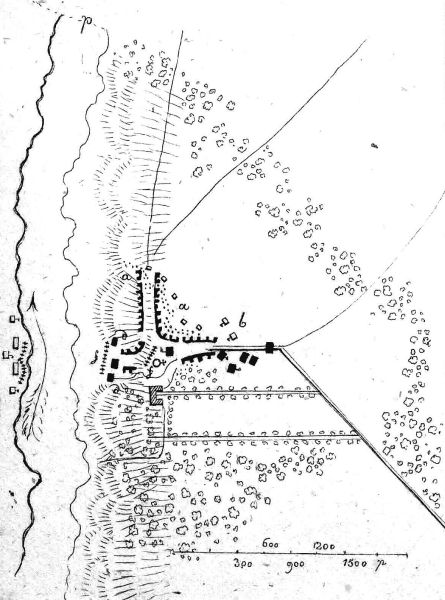
XIII. .
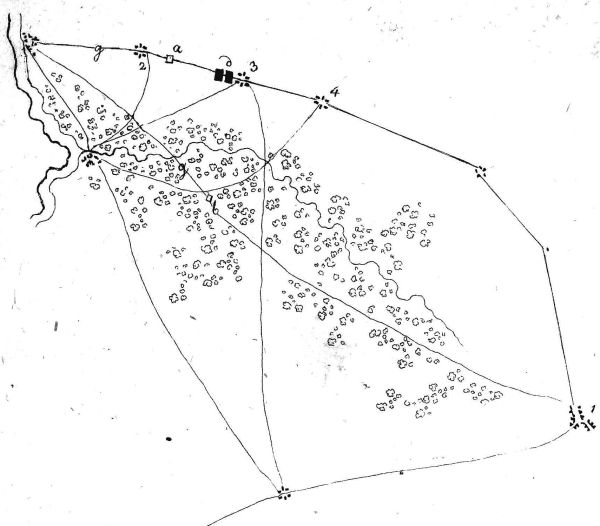
Pulawy XIV.
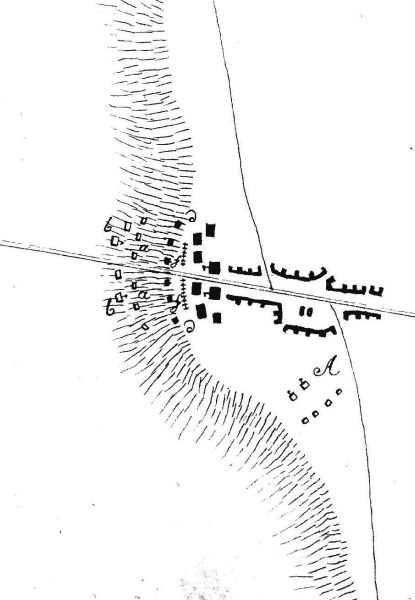
Kurow XV.
The Russians had gained already a considerable distance from Pulawy, before the corps of general Dwernicki approached it, and, of course, the whole glory of that defeat is due to colonel Lagowski.[45]
The corps of general Dwernicki, after a short repose at Pulawy, renewed the pursuit of the enemy on that night. In every part of their route the enemy's stragglers were continually falling into their hands. This corps overtook the enemy so soon, that in order to save himself from total destruction, he was forced to give battle.
BATTLE OF KUROW. (See Plans XIV and XV.)
General Dwernicki, in his pursuit of Wirtemberg, had the intention of effecting the destruction of this corps before they could reach Lublin. To accomplish this object, he took advantage of the two roads (g, g) which lead from Pulawy to Lublin (1). Remaining himself with the greater part of his forces (a) upon the causeway which leads to Lublin by Konskawola (2), Kurow (3), and Markuszew (4), he sent a small detachment (b) with two pieces of cannon by the other and smaller road, which, traversing the forest between Belzyc and Pulawy, presents a shorter and more direct route to Lublin. This road had not been occupied by the enemy. Colonel Lagowski, who commanded this detachment, had instructions to follow out this road, and to keep up a constant communication with the superior force under general Dwernicki. He was ordered to keep himself constantly abreast of the enemy (d). At the moment that he should hear the fire of our cannon, he was directed to hasten to the attack of the enemy on his left wing, or on his rear, as circumstances might direct. This manœuvre was executed with the utmost punctuality. The enemy pressed in upon the causeway by the larger body under Dwernicki, and thus forced to give battle, took a position upon the heights of the town of Kurow, in doing which, his consternation or his inconsiderateness was such, that he neglected the ordinary means of security, and did not occupy the roads which centre at that place, not even that which it was of the utmost importance for him to occupy,—the one which leads from Belzyc to Pulawy; in fact, he had even neglected to send out reconnoissances on any side, supposing that our entire force was before him on the causeway. This battle commenced on the afternoon of the 2d of March, and continued only a few hours.
General Dwernicki, after reconnoitering the enemy's position, which was commanding, and strengthened in its front by sixteen pieces of cannon [(f), Pl. XV,] thought it expedient to commence with a fire of skirmishers only (a), under cover of which he manœuvred his cavalry (b) upon the Russian wings, with the sole purpose of occupying the attention of the enemy until the detachment of colonel Lagowski should make its appearance. The enemy, on the other hand, commenced a warm fire from his artillery, and threw forward his light troops (d) in every direction. Some hours passed in this manner, the enemy attempting from time to time to force our position. But the hour of his destruction was approaching. General Dwernicki perceiving, from an elevation of ground, the detachment of Lagowski (A) advancing upon the enemy's rear, instantaneously gave orders for the cavalry to concentrate themselves. The signal for advance was then given, and the cavalry having formed on each side of the main road, pressed forward and fell upon the centre of the enemy. At the same moment, a charge was made by the cavalry of Lagowski upon the enemy's rear. The disorder and consternation of the Russian forces was indescribable. In a moment ten pieces of cannon, a thousand prisoners, some hundreds of horses, with many wagons of ammunition and baggage, fell into our hands. The route was general. The enemy fled pell-mell, and his loss was much increased by a fire of grape from the two pieces of artillery of colonel Lagowski, which he placed by the side of the road from Kurow to Lublin, over which the Russians retreated. This road was literally covered with dead. Nothing but the coming on of night saved the enemy from entire destruction. After this battle, the forces of the prince of Wirtemberg ceased to act as a corps. What remained of them, took the direction of Lublin, where the corps of general Dwernicki arrived the next day, having taken prisoners during the whole route. The prince of Wirtemberg barely escaped from our hands, for he was in quarters in that city when our advanced detachments entered it, and was just able to save himself by flight. Such was the end of this Russian corps, which, when it began to act against Dwernicki with his small force of 3,000 men, and ten pieces of cannon, consisted of 15,000 infantry and 24 pieces of cannon. In the course of eleven days, general Dwernicki gave battle to this corps four separate times, viz. at Swierza, Nowawies, Pulawy, and Kurow; and besides the loss he caused them in killed and wounded, he took 8,000 prisoners, 19 pieces of cannon, besides 1,000 horses, with a great quantity of ammunition, baggage, &c. In all these actions the corps of general Dwernicki lost but 500 men, in killed and wounded. The panic which had began to prevail in the Russian forces, in consequence of these disasters, reached such a degree that, at times, the mere sight of our troops was sufficient to put them to flight. The Russian commander in chief deprived the prince of Wirtemberg of his post, and his name was not heard of during the rest of the war.
General Dwernicki, by his victories over this corps, had completely freed the department of Lublin from the presence of the enemy. On arriving at Lublin, he restored the authority of the National Government in that place, and the region about. He made the necessary arrangements for reinforcing his corps, and left for Krasny-taw, in the environs of Zamosc.
While these successful operations of general Dwernicki, in the southern part of the kingdom, were in progress, and by this series of victories, he was approaching the frontiers of Wolhynia and Podolia, our arms were not less successful in the North.
The brave colonel Valentin, with a small detachment of partizans, fought the enemy with success between Modlin and Pultusk. This detachment was thrown into that region, (acting, however, more particularly between the rivers Wkra and Orsyca,) in order to hold in check the operations of the enemy upon Plock. This detachment was to obtain succor, in case of necessity, from the garrisons of Modlin. It was especially destined to intercept the transports which were to come from Prussia upon the road to Mlara, for the relief of the Russian army.
Colonel Valentin was occupying with his detachment the forest near the town of Nasielsk, when he was apprised that a small body of Russian troops, under the order of colonel Schindler, consisting of two regiments of cavalry, a battalion of infantry, and two pieces of cannon, had arrived on the 3d of March, at that town. This detachment had been sent to protect a transport which was to pass there. Colonel Valentin immediately formed a plan to attack it. During the night of the 3d and 4th of March, he approached the town, invested it, and ordered an attack, in which the detachment surprised the enemy, and forced him to quit the city, leaving his two pieces of artillery, and a number of prisoners. Colonel Valentin, thinking that the Russians might possibly return with a superior force, evacuated the city, and took his prisoners to Modlin, in order, by disembarrasing himself of them, to hasten his march and reach the environs of Pultusk, in time to intercept the transport. On the 5th, he took this transport, consisting of eighty vehicles loaded with various kinds of provision, together with twelve loads of equipage, &c., for the Russian generals, which he sent to Warsaw. The detachment of colonel Valentin continued to manœuvre for a long while in those environs without any support.
In the vicinity of Warsaw, along the banks of the Vistula, both above and below the city, small skirmishes almost daily occurred. On the fourth of March, the brave lieutenant Berowski, passing the Vistula opposite Jablonna with his platoon, surprised a squadron of cossacks, and took a hundred prisoners and as many horses. The battalion of volunteer chasseurs of colonel Grotus, posted in the environs of the villages Siekierki, and Wilanow, brought in, almost every day, parties of Russian prisoners, by surprising the different detachments of the enemy placed upon the island of Saxe, opposite to the above mentioned places. This same battalion burnt two batteaux, in which were a party of Russian troops, who were sent during the night with combustibles to burn the bridge between Warsaw and Praga. These boats were sunk, and the Russians who escaped drowning, were taken prisoners. In the environs of the small town of Gora, about twenty miles from Warsaw, a considerable body of workmen who were sent by the enemy to prepare the materials for building a bridge, were surprised by a battalion of the 2d regiment of light infantry. A hundred pioneers and sappers were taken prisoners, and many hundred male and female peasants set at liberty, who had been forced to work for the enemy.
At about the 8th of March, marshal Diebitsch demanded the capitulation of the fortress of Modlin, for which object he despatched colonel Kil. This officer was entrusted with a letter to the count Leduchowski, written by the marshal's own hand. His proposition was rejected.[46]
Some days after this answer, a part of the garrison of this fortress, sent as a reinforcement to colonel Valentin, surprised the Russians in the town of Serock. They had passed the river Bug, and the Narew opposite that town, to make requisitions of forage in the country around. By a prompt arrangement, the batteaux of the enemy were taken by our troops; and his forces, suddenly attacked and defeated, were compelled to evacuate their position, leaving a thousand prisoners in our hands, which were immediately carried to Modlin, and thence to Warsaw.
In this state of things, and while circumstances were continually occurring with uniform advantage to the Polish arms, general Skrzynecki, with the most sincere wish to finish a bloody struggle, and anxious to show that the Poles were always ready to hold out the hand of reconciliation, wrote, with the permission of the provisional government, a communication to marshal Diebitsch, with propositions of that purport. But as these offers of conciliation were rejected by the marshal, the contest was recommenced.[47]
On the 10th of March, the operations of the campaign were recommenced. The 2d division, the command of which, after the death of general Zimirski, was given to general Gielgud, and a division of cavalry, under the command of general Jankowski, received orders to make a strong reconnoissance upon the right bank of the Vistula. This division was ordered to pass the bridge in the night, and at break of day to commence the attack upon whatever force of the enemy they might find on the plains of Grochow or Kawenczyn, and, by this manœuvre, to harass the right wing of the enemy. But general Jankowski arrived late. It was near eight o'clock, A.M. before he approached with his division, at which time the two divisions united left Praga to commence their attack, but this operation being thus retarded, could not be made effective. The enemy, seeing our movement, had time to prepare themselves to counteract it. Our forces having advanced a mile or two upon the main road, commenced a fire of tirailleurs, and the enemy began to retire. As it was designed to act upon Kawenczyn, a battalion was sent to attempt an attack on the forest of elders, well known to the reader; but as the enemy was quite strong at that point, and particularly in artillery, a fire from which was immediately opened upon our force, the attack was not made, and our battalion was ordered to withdraw. The Russians, at about mid-day, began to show a stronger force upon the plains of Wawr. Their artillery, also, opened a fire upon the main road. This fire had continued an hour, when our generals, not perceiving that the artillery was protected by cavalry, decided to make a charge upon them with the regiment of Mazurs, and the 3d regiment of light cavalry. This brigade of cavalry, under the command of the brave colonels Blendowski and Miller, threw themselves with courage upon that artillery, when, at the moment of the charge, two regiments of Attaman Cossacks, which were posted in a wood adjoining, displayed their front, and advanced to charge our cavalry upon the flank and rear. Our attack therefore failed, and it was owing to good fortune alone that by a rapid bending of our flank, this body of cavalry was saved from total ruin. This unfortunate affair cost us a heavy loss of men, and of both of the brave colonels who commanded the attack. At about 2, P.M. as the enemy began to debouch from the great forest with increased forces, it was decided to return to Warsaw, and thus ended this reconnoissance, which had it been executed by more skilful generals, might have had the best success, for all the Russian regiments which had advanced towards Praga, at a considerable distance from their main forces, might have been taken. A reprimand was publicly given to the two generals, Gielgud and Jankowski, for their remissness in executing their instructions. The only advantage which was gained by this reconnoissance, was the taking of a great quantity of fascines and other materials prepared for a storm of Praga, and the collection from off the field of a considerable quantity of arms, which had been left there by the enemy, after the battle of the 25th.[48]
The Russian commander having, as the reader is aware, lost nearly the whole of the corps of the prince Wirtemberg, the remnants of which was dispersed and had wholly ceased active operations, sent against general Dwernicki the corps of general Witt, composed of 8,000 infantry, 2,000 cavalry, and 16 pieces of cannon. This corps arrived on the 11th at Lublin, in which town was a small detachment of Dwernicki's corps, commanded by the colonel Russyian. This small detachment, having only barricaded a few streets, defended with much firmness the passage of the small river Bystrzyca, and left the city at nightfall to rejoin its corps, which was in the environs of Zamosc.
Again the corps of the Russian guard, which had recently arrived, under the command of prince Michael, consisting of 16,000 infantry, 4,000 cavalry, and 36 pieces of cannon, a division of cavalry, with eight pieces of cannon, was sent into the environs of Pultusk, commanded by general Uminski, who was to take under his command the detachment of colonel Valentin, and acting in concert with the garrison of Modlin, he was to occupy the attention of the enemy, in order that our main body should not be disturbed in the offensive operations which general Skrzynecki had decided to adopt.
General Uminski arriving with his corps, met an advanced detachment of the Russian guard in the environs of Makow, composed of two regiments of hussars and eight pieces of cannon, who were sent forward as a party of observation in that vicinity. This was the first encounter with this celebrated guard. Our cavalry waited impatiently for the moment to try their strength with them. Two young regiments, one a regiment of Krakus of Podlasia, and the other the 5th Hulans, entreated their general to be permitted to make the charge. General Uminski observing that there was no stronger force near, ordered an immediate attack.
Our cavalry, on receiving the order, did not even give the enemy time to display his front, or to make use of his artillery; but rushed upon him with an impetuous charge, under which he was at once borne down. Of one regiment of those hussars nearly a squadron were taken prisoners. This Russian cavalry, which were in full rout, were pursued as far as the environs of Magnuszewo. The enemy was not permitted to take position, and the pursuit was pressed with such rapidity, that they had not time to destroy the bridge which crosses the river Orsyca, but were followed even to the environs of Rozany, where they reached the position of their main body. General Uminski, in order not to expose his force to the observation of the enemy, halted in an advantageous position in the forests near Rozany, and from this position he continued to hold the enemy in check. In fact, by harassing and wearying the enemy with continual attacks, he at length forced the prince Michael to quit Rozany, taking the direction of Ostrolenka. General Uminski sent in pursuit of the enemy the brigade of cavalry under the command of colonel Dembinski. This brigade, opposite Ostrolenka upon the Narew, had on the 26th of March an advantageous affair with the advanced guard of the enemy, in which forty prisoners were taken. By closely observing the enemy in this manner, it was ascertained that the Russian guard, after destroying the bridge, had completely evacuated Ostrolenka. It was evident that the design of prince Michael, in this sudden evacuation of Ostrolenka, was to join himself to the grand army. General Uminski immediately sent an officer to inform the commander in chief of this movement, continuing in the mean time in the position which he had taken before Ostrolenka.
FOOTNOTES:
CHAPTER XIII.
Plan of general Skrzynecki to act upon the isolated corps of Rosen and Giesmar.—Battle of Wawr.—Various detachments of the enemy are taken after that battle, and a great number of prisoners.—Battle of Dembe-Wielke.—Destructive pursuit of the enemy by our cavalry.—View of the Russian losses in the preceding days.—Marshal Diebitsch abandons his plan of crossing the Vistula, and marches to the rescue of the remains of the corps of Rosen and Giesmar, and the Imperial Guard.—View of the position of the two armies, after the second repulse of the enemy from before Warsaw.—Operations of general Dwernicki.—Successes of a reconnoissance under colonel Russyian at Uscilog.—Effect of Dwernicki's victories on the inhabitants of the provinces.—Acknowledgment of general Dwernicki's services by the National Government.—The instructions for his future operations.
The news of this prompt and sudden evacuation of Ostrolenka by the Russian guard, and the evident intention of the Grand Duke Michael to discontinue his operations in the palatinate of Plock, and to make a junction with the grand army, as well as other certain intelligence that marshal Diebitsch had withdrawn the main body of his forces, [See (A) Plan XVI,] and had left only a corps of observation, composed of the two corps of Rosen and Giesmar (B), in the environs of Wawr and Milosna, determined our generalissimo to hasten to the execution of the plan, for a long time decided upon, which was to throw himself with his whole force upon the nearest Russian corps, and to crush them before marshal Diebitsch could come to their succor.
On the 29th and 30th, our general in chief made a review of the greater part of the army. All the troops received him with expressions of the greatest enthusiasm. He could not but be delighted at the sight of that fine and energetic force, and be confident of the most brilliant successes. All the troops defiled before the general, carrying with them the trophies which they had taken from the enemy; and each platoon, as they passed, hailed him with some patriotic exclamation, and pledged themselves that they would never return without having satisfied his orders to the utmost. On the night of that day, the commanders of the several divisions received the order to hold themselves in readiness to march at a moment's warning.
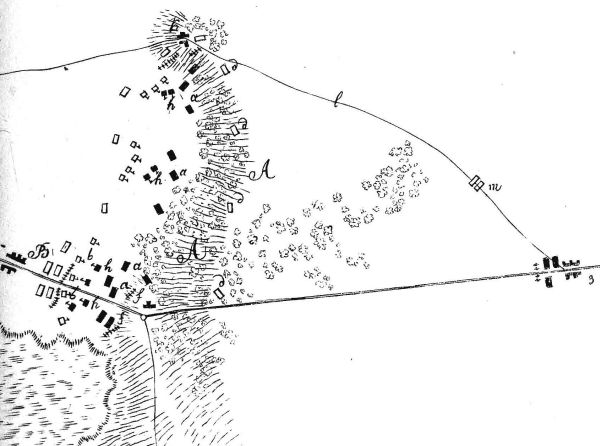
BATTLE OF WAWR. [See Plan XVII.]
On the evening of the 30th, the two divisions of infantry under Rybinski and Gielgud, and the brigade of cavalry under Kicki, received orders to pass from Warsaw to Praga. That force quitted Warsaw at ten o'clock, P.M.
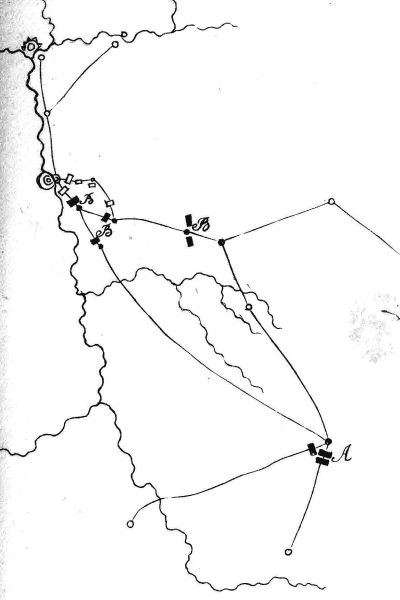
XVI.
XVII.
Whilst the division of Gielgud and the cavalry of Kicki were to occupy the great road (g) leading to Grochow, the 1st division under Rybinski was to march upon the right wing of the enemy at Kawenczyn (K). This last division was to drive the enemy from his position in as short a time as possible. If the enemy's forces at Kawenczyn were found to be greatly superior to his own, general Rybinski was directed to continue his fire, and await a reinforcement, which should be immediately sent to him. If he should be so fortunate as to take Kawenczyn, general Rybinski was to send, by a small road (l) leading from this place, through the forest, to Milosna, a few battalions (m) to that village. Other battalions (d) were to be dispersed in the forest, between that small road and the main road. Having made those arrangements, the position of Kawenczyn was to be vigorously defended, in order to baffle every effort of the enemy to retake it. The accurate and prompt execution of this plan was expected to effect the cutting off of all the enemy's forces, which were to be found upon the field of Wawr. In regard to the division of Gielgud upon the main road, the instructions given were that it should not commence its fire until apprised of general Rybinski's having gained possession of Kawenczyn. This division was till then to limit its attention to the object of retaining the enemy in his position near Praga, long enough to give time for the corps of general Rybinski to occupy the above mentioned forest, and to operate in the enemy's rear. The moment for the advance of the 2d division, was to be, when the fire of the light troops of Rybinski should be heard in the forest.
All these dispositions were executed with the greatest exactitude under the protection of a thick fog. The division of general Rybinski having quitted Praga at midnight, arrived as far as the environs of Kawenczyn, without being in the least disturbed by the enemy. This skilful general had the precaution not to attack the enemy until an hour before day-break; in the interval, while resting in the woody ground near Kawenczyn, he sent forward a patrol, with directions to approach near enough to ascertain, as far as practicable, the position, the strength, and the nature of the force of the enemy, and sent another patrol in the direction of the forest of elders to reconnoitre the enemy there. Those patrols returned with the intelligence that the enemy's force could not be great, as they could perceive no large detachments placed as advanced posts. It was between five and six in the morning, when the first fire of general Rybinski, at Kawenczyn, gave notice to the 2d division of Gielgud, at Praga, that it was the time to advance. The brigade of cavalry under Kicki, (b), with the 2d and 7th regiments of lancers, having with them three pieces of cannon, spread out their flankers, and advanced slowly, directed continually by the fire of general Rybinski, who in the mean time had pushed two battalions at the charge, supported by a few pieces of artillery, and had carried the enemy's position by storm, and taken possession of Kawenczyn. The enemy were instantly routed by this impetuous attack, and lost three pieces of cannon. The division passed through Kawenczyn, sent two battalions (m) to Milosna, occupied the forest (A) in the rear of the enemy's principal force, and commenced a fire. When this fire was heard by our forces (B) upon the main road, they pushed forward, and a general and rapid advance was commenced under cover of the thick fog. Two regiments of cossack cavalry, (h), who were posted in columns near the Obelisk of Iron, were borne down before them. A great number of prisoners were taken on the spot. Our brave lancers, under Kicki, animated by this success, did not halt in their attack. They fell upon an advanced post of Russian artillery of three pieces (f) near Grochow, and took them before they had time to fire. By seven or eight o'clock, the enemy was entirely surrounded, and his retreat by Milosna was wholly cut off. It was with the dissipation of the fog that we witnessed the confusion into which had been thrown the whole advanced guard of Giesmar, composed of four regiments or sixteen battalions of infantry (a), eight squadrons of cavalry (h), and twenty-four pieces of cannon (f). The disorder of this advanced guard was such, that the Russian battalions had actually been firing against each other, and that fire ceased only with the clearing up of the fog. The 95th and 96th Russian regiments, amounting to 5,000 men, with all their officers and colors, were taken in a body, and with them the brigadier general Lewandowski. If the fog had continued half an hour longer, so that we could have occupied the road to Karczew, the whole of this advanced guard would have been taken; for what remained of them saved themselves only by flying along that road.
This attack, which was the business of a few hours, forced the enemy to quit his advantageous position in the commanding forest, between Wawr and Milosna, which he had occupied for a month, and on which he had constructed considerable fortifications. Driven from this important position, he could only expect to be subjected to still greater losses. At Milosna (3), three battalions of the enemy, with four pieces of cannon, placed as an isolated detachment, were dispersed, and their cannon taken. Another isolated detachment of cavalry of hussars and cossacks of Czarno-morskie, posted at Janowek, met the same fate, and prisoners were taken in every direction. Our two divisions pursued the enemy with unremitted celerity, and, followed by our main forces, reached Dembe-Wielke, at which place was the corps of general Rosen, composed of about 30,000 men and 40 pieces of cannon.
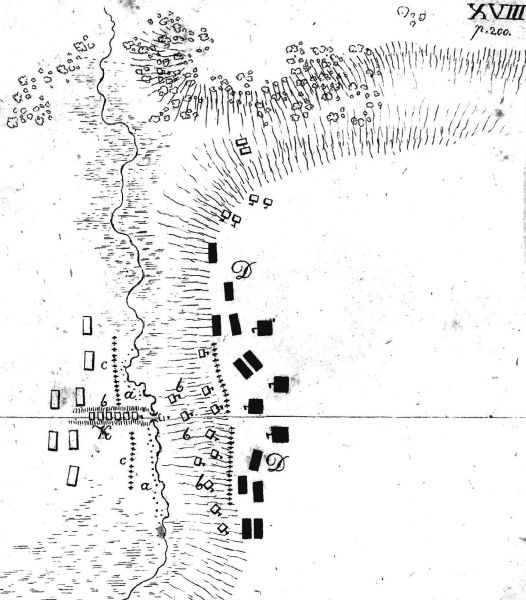
BATTLE OF DEMBE-WIELKE. [See Plate XVIII.]
As the enemy occupied the heights (D) of Dembe-Wielke, on the side of the marsh opposite to our forces, which, to attack him, would have had to traverse the dyke (k) constructed over this marsh,—the commanders of the two divisions considered it expedient to await the arrival of our whole force, which approached some hours after. General Skrzynecki, satisfied that an attack made, over the dyke, upon the commanding position of the enemy on the other side, in broad day, would cost too great a sacrifice of men, determined to amuse him by a constant fire of our skirmishers (a), who advanced as far as the marshy ground which divided the two armies would permit. A little before night, the general in chief ordered all the cavalry (b) to be brought together, and formed in columns of attack, with the two squadrons of carbiniers, under the brave colonel Sznayder, at their head. At the approach of twilight, he ordered these columns to pass the dyke on a trot, and to throw themselves upon the enemy on the right and left, attacking with the sabre.
While the cavalry was passing the dyke, the artillery (c) was to open a general fire, ceasing, however, when the passage of the dyke should be effected.
The order was given, and this mass of cavalry, under the fire of the artillery, raised the hurrah, and passed the dyke with the rapidity of lightning, followed by our infantry, having at their head the brave 4th regiment. The enemy was in such consternation that he was not in a state to make a defence, and his whole battery was overthrown. Full three thousand prisoners were taken, together with the entire battery, consisting of twelve pieces of cannon of large calibre, some fifty voitures of different kinds, as caissons of ammunition, baggage-wagons, &c., and a great number of horses.[49] In a word, the corps of general Rosen was completely broken up; the coming on of night, and the forests, alone saved them from total ruin. General Rosen himself, with his suite, was pursued and was near being taken. All his equipage, consisting of three voitures, fell into our hands. Thus ended the glorious 30th of March. The generalissimo, who was always in the advance, and who had personally arranged all the details of that day's operations, particularly at Dembe, justified well the high opinion which the general officers and the army had entertained of him. The 30th of March placed his name high on the roll of distinguished leaders. On that memorable day, two Russian corps, those of Giesmar and Rosen, were completely broken up. It cost the enemy, in dead, wounded and prisoners, full 10,000 men and 22 pieces of cannon. On our side the loss was not more than 500 killed and wounded. For the successes of that day general Skrzynecki received from the government the order of the great Cross of Military Merit. The general in chief was accompanied, during the actions, by prince Adam Czartoriski, and the members of the National Government, Berzykowski, and Malachowski.
XVIII.
XIX.
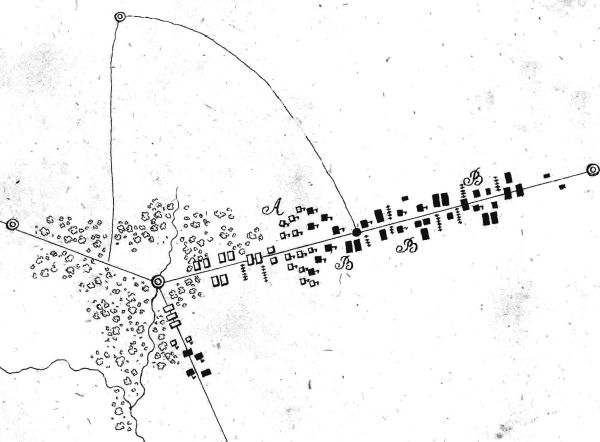
To follow up the pursuit [See Plan XIX] of the fragments of the two Russian corps, general Skrzynecki designated the division of cavalry (A) under general Lubinski, with a battery of light artillery. This detachment set out during the night, sending reconnoissances to the right and left, to see that the enemy did not prepare ambuscades. The army followed this advanced guard, which soon overtook the enemy (B), who was still in great disorder. Infantry, cavalry, artillery, and vehicles, were mingled together, pressing their retreat. At each step, our cavalry took up prisoners. Upon some positions the enemy attempted to make a stand, but every such attempt was thwarted, and he was carried along before our troops. This was the case in the position of Minsk and of Jendrzeiow, where two regiments of Russian cavalry were routed by the second regiment of chasseurs. It was the same case in the forest of Kaluszyn, where our artillery approached the Russian rear-guard, and poured upon them a fire of grape, which scattered death among their ranks. The Russians, being no longer in a state to make any stand whatever, fell into a panic, and commenced a general flight. They were pursued by general Lubinski as far as Kaluszyn, where night closed upon the scene of destruction.
This day cost the enemy nearly as much as the preceding. Besides their loss in dead and wounded, 3,000 prisoners fell into our hands, with three standards, four pieces of cannon, and a hundred vehicles of baggage, ammunition, &c.,—in fact, the whole baggage of the corps. But the most agreeable success of our army, on that day, was the taking possession of the hospitals of Minsk and Jendrzeiow, in which as many as two hundred of our comrades were lying wounded. To witness the joy of those brave sufferers was recompense enough for all our fatigues. The impetuosity of our attack was such, that the enemy had not time to burn the magazines of Milosna, Minsk, and Kaluszyn, which fell into our hands. To make a recapitulation of the loss of the enemy on those two days—it was as follows:—Two of their generals, Lewandowski and Szuszerin, taken prisoners, with as many as sixty officers, of different grades, 15,000 soldiers in killed, wounded and prisoners; 26 pieces of cannon, seven standards, 1,500 horses, a great quantity of different kinds of arms and implements, and as many as 100 vehicles of various kinds.
The disasters of these two Russian corps were the cause of the abandonment of the plan which had been adopted by marshal Diebitsch, of passing the Vistula between Pulawy and Maceiowice, opposite Kozienice, with the greater part of his army; and to execute which he had left his position on the latter days of March, and had reached the environs of Ryk. [See Plan XVI.] The fear of losing those two corps, together with the guard, had led him to return in the direction of the town of Kock, to afford them succor.
After these days, so fortunate for us, in which the Russian forces were again driven from before the walls of Warsaw, the position of their army was as follows. Their right wing, formed of the remains of the corps of Giesmar and Rosen, was at Boimie; detachments being also placed in the environs of Wengrow. The main body, under Diebitsch, was at Kock. His advanced posts extended to Wodynie, Seroczyn, and Zelechow. The Russian guard, which, as we have said, had formed the plan of joining their main body, and had left Ostrolenka by the road through Wengrow, was obliged, in consequence of the successes of our army, to abandon that plan, and to retire again to the environs of Ostrolenka, where they now were posted. In the palatinate of Lublin was the Russian corps under general Witt.
The position of our army was as follows. Our left wing was opposite Boimie. It sent out its reconnoissances along the river Kostrzyn, as far as Grombkow, Zimna-woda, and even beyond. The head-quarters of the general in chief were with the main body, at Latowicz. Our right wing was at Siennica. Its reconnoissances were sent out as far as Zelechow, at which place was a detached corps, under the command of general Pac. In this manner, the marshy rivers, Kostrzyn and Swider, covered our front. [Refer to Plan VI.] General Uminski, with his detached corps, was at Rozany, in the palatinate of Plock, opposed to the Russian guard. In the environs of the fortress of Zamosc in the palatinate of Lublin, opposed to the Russian corps of general Witt, was the corps of general Dwernicki. Besides this, a small corps was placed in the environs of the town of Granica, upon the left bank of the Vistula, under the command of general Sierawski.
While the main forces were acting with such success, the two detached corps, under generals Uminski and Dwernicki, had also fought gloriously, and gained important advantages. The corps of general Dwernicki spread terror in its vicinity, and the Russians were compelled to send a new corps against him, under the command of general Kreutz; so that the combined Russian forces opposed to him amounted to 20,000 men. Greatly superior as this force was, they did not dare to attack general Dwernicki, who, reinforced every day by volunteers coming from Galicia and Volhynia, soon found himself at the head of 4500 men, and 20 pieces of cannon. This corps, in concert with the garrison of Zamosc, was sufficient to hold in check all the operations of the enemy in that quarter.
On the 25th of March, general Dwernicki sent a reconnoissance as far as the environs of Uscilug, at which place a new Russian corps, coming from Turkey, was expected to arrive. This reconnoissance was composed of two battalions of infantry, one company of Galician volunteers, three squadrons of cavalry, and four pieces of cannon. The commander of this force was the brave colonel Russyian. The detachment arrived at the above place, and received intelligence of the approach of an advanced guard of the corps of general Rudiger, composed of two regiments or six battalions of infantry, one regiment of cossacks, and eight pieces of cannon. Colonel Russyian did not stay for the approach of this guard. He took possession of the different batteaux which were prepared for, and were waiting the arrival of the Russian force at the distance of a league from the town. Passing the river Bug, with his corps, in these boats, he suddenly attacked the Russian advanced guard with such success, that he took two thousand prisoners, and six pieces of cannon, and several hundred horses. With these trophies he returned and joined the corps, to their astonishment, for they had received but a single report from him, and had no expectation of such results. The rumor of the continual successes of this corps of general Dwernicki, spread along the borders of the Dnieper, reached the distant regions of our brethren in the Ukraine, and awakened in them an ardent desire to unite themselves to our cause.
For the continued and glorious advantages of this corps, which commenced its operations with 3,000 infantry, 800 cavalry, and three pieces of cannon, and had nearly destroyed two Russian corps, those of Kreutz and Wirtemberg, taking 10,000 prisoners, and thirty pieces of cannon, the national government promoted its brave commander to the rank of full general of cavalry, and honored him with the surname of the famous Czarnecki, the ancient polish chief.[50]
The general in chief communicated to general Dwernicki his promotion, with the sincere thanks of the national government; and at the same time sent him instructions and advice in regard to the operations which he was then to follow. The corps of general Dwernicki was to manœuvre in such a manner as to menace continually the left wing of the Russian grand army. Keeping this object in view, he was not, unless with the expectation of some very extraordinary advantages, to remove himself very far from the fortress of Zamosc. This place was to serve as a point d'appui in every case of sudden danger. About this point he was to manœuvre, and from thence he was to push himself, as circumstances might allow, into the environs of Lublin and Wlodawa, to trouble incessantly the above mentioned wing, and even the rear of the Russian grand army. In this instruction of keeping himself near the fortress of Zamosc, and in the palatinate of Lublin generally, another advantage was contemplated: viz. that he might receive daily accessions of volunteers from Volhynia and Podolia. Our brethren, in those provinces, would hasten to join themselves to his victorious eagles, (of which disposition, indeed, he received continual evidence,) and, in this manner his corps would be gradually increased by such aid from those provinces, without attracting the attention of the enemy. As the provinces of Volhynia and Podolia, from their geographical character, having no large forests, were not in a state to carry on a partizan warfare, as was quite practicable in Lithuania and Samogitia, and also as the Russians had several corps upon the frontiers of Turkey, which, by being concentrated in that open country, might be dangerous to our small forces, general Skrzynecki was of the opinion that general Dwernicki, by keeping near the frontiers of the above mentioned provinces, should rather act by a moral influence upon their inhabitants, than hazard certain advantages by entering them. The river Wieprz was to be the leaning point of his left wing, and the river Bug of his right. Between those two rivers, in a woody and marshy region, he would find many strong natural positions. Of such he would take advantage, and endeavor to strengthen them by different fortifications. General Dwernicki, in receiving these instructions, was also invested with full powers, by the national government, to institute a provisional administration over the above provinces, (in case that circumstances should lead him to establish a footing there,) similar to that of the kingdom in general, and to bring them into a state to act with effect in concert with the rest of the kingdom.
FOOTNOTES:
CHAPTER XIV.
The insurrection in Lithuania.—Dispositions of the Lithuanians at the breaking out of our revolution.—Their offers of co-operation were rejected by the dictator.—View of the condition of Lithuania under the Russian sway.—Scheme of the Russian government to destroy all Polish national feeling in that province.—The insurrection is brought about by the massacre of the patriots at Osmiany.—Capture of numerous towns by the insurgents, and dispersion of their garrisons.—Storm of Wilno, and delivery of prisoners.—Several partizan corps are formed.—Their destination and successes.
It had pleased Providence thus far to make the success of our arms, in every point, a just chastisement of our enemy, and encouraged by this success, the nation had begun to cherish the brightest hopes for the future. Their confidence and exultation were complete, when the report was received, that our brethren in Lithuania and Samogitia had risen to break the yoke of despotism, and had openly commenced a revolution. The certain confirmation of this happy intelligence was brought to the kingdom by one of the students of the University of Wilno. This brave young man belonged to the patriotic club which had been secretly formed there, and that club had sent him to Warsaw to carry the authentic intelligence of the insurrection.[51]
Then it was, at last, that the voice of liberty was heard upon the shores of the Baltic, and at the sources of the Dwina and the Niemen; and with this voice, was heard that of union with ancient Poland. The brave inhabitants of this immense region, animated with an attachment for us, the strength of which ages had proved, regarded themselves only as a part of one great family with ourselves. Almost within hearing of the bloody combats which had been fought, they could not restrain themselves from joining in the struggle, and acting side by side with us, for our common Poland.
Before I enter upon the details of this revolution in Lithuania, the reader will permit me to refer him, in the Appendix, to a short description of that country and a view of its connection with Poland, which is, in general, so imperfectly understood.
The Lithuanians of Wilno knew, four days after the 29th of November, that Warsaw had given the signal of a new Polish insurrection. A deputation was immediately sent by them to the dictator Chlopicki, announcing to him that all Lithuania, and particularly the Lithuanian corps d'armee, of 60,000 strong, was ready to pass to the side of the Poles. But that inexplicable and lamentable dictatorship rejected this offer, so great and so generous. The Lithuanians, however, not despairing, waited for a more propitious moment; and scarcely was the dictatorship abolished, when the national government,—thanks to the thoughtful care of Joachim Lelewell,—addressed itself officially to the Lithuanian committee. Every disposition was made for a rising at an appointed time, which at length arrived.
It would not be in my power to give the reader a just idea of the tyranny and persecution to which the Polish provinces united to Russia were subjected. If the kingdom was oppressed, it has always had some glimmer of constitutional right, but in the provinces the only constitution was absolute power. Those provinces, abounding in resources, and which, had they been protected by free laws, would have been, as they formerly were, the granary of Europe, presented every where traces of misery, being exposed to the abuses of the Russian administration and its agents, who wrung them to the last drop, to enrich themselves. Justice was unknown. Sometimes the governors, or sprawnaks, men of most depraved conduct, changed the laws at their own will, and not to obey that will was to be subject to be sent into Siberia. All those provinces were submerged by the Russian military, who were quartered in every village; and those soldiers, receiving only the small compensation of a groat a day, which was altogether insufficient for their subsistence, levied upon the inhabitants the means of their support. But the cause of the greatest suffering in Lithuania, was, that, in order to prevent all sympathy between the soldiers and peasantry, and all national feeling in the Lithuanian soldiers, most of the levies from that province were sent to serve on the barbarian frontiers of Asia, while Russian soldiers were substituted for them, who were without any sympathy with the inhabitants, and who would be regardless of their feelings in their deportment towards them, and merciless in their exactions. It was not so under Alexander,—the arrangement was made by Nicholas. No idea can be given of the distress which it caused. Many a family was obliged to deny themselves their necessary food, to supply the demands of the military tyrant who was quartered upon them. The peasantry in those provinces were treated like brutes. No civilization, not the least glimmer of light, not a school was permitted. That poor race were kept in a state so degraded, that the elements of civilization seemed to be lost in them, and the possibility of their being recovered seemed almost hopeless.
One of the greatest evils was the systematic endeavor to destroy all national sympathy with Poland. The Russians carried their oppression, indeed, so far, as to change the religion of the country, and to introduce the Greek schism. But through all these persecutions, Providence saved that people from losing their national sentiments as Poles. On the contrary, they have proved that neither time nor persecutions will ever destroy that attachment, but will, indeed, rather strengthen it. The late insurrections in Lithuania and Samogitia, which have been so long under the Russian government, and the inhabitants of which hastened to take up their arms, at the signal of our revolution, afford a sufficient evidence of this attachment. What deserves especially to be noticed, is, that in Lithuania, it was the peasants and the priests, joined by the youths of the academies, who first began the revolt, and who were the most zealous defenders of the common cause. That heroic people commenced the revolution without any munitions, and without any arms but the implements of husbandry. Armed in most cases with clubs alone, they abandoned all to unite in our aid, and fought with courage and success for nearly two months, against the different Russian corps, before the corps of Gielgud and Chlapowski arrived, which, instead of succoring them, by the misconduct of their generals, sacrificed the Lithuanians, as well as themselves, and gave the first downward impulse to our cause.
The insurrection of Lithuania and Samogitia, was propagated with rapidity through all the departments of those provinces. The commencement was made in the departments of Osmiany and Troki, accelerated by the following circumstance.
Many of the patriots, for the purpose of consulting upon the different arrangements for the revolt, had secretly assembled on the last of March at Osmiany, and held their secret conferences in the church of the place. While occupied in this manner, a loud shouting was heard in the town. A regiment of cossacks had entered the place, and a great part of the regiment surrounded the church. The doors were broken down, and the cossacks entered and sabred the unfortunate men within these sacred walls. Wounded as they were, those who survived the attack were thrown into wagons to be carried to Wilno. But in this the barbarians did not succeed. A few escaped from their bloody hands, ran into the suburbs of the town and collected the peasantry, and on that very night, some hundreds of the inhabitants having been got together, Osmiany was attacked with the greatest fury by the patriots. Several hundreds of cossacks were massacred. The others took flight, and the poor prisoners were delivered. From that moment the flame spread to the departments of Wilno, Wilkomierz, Rosseyny, and Szawla. In a few weeks, more than twelve towns were taken by storm, and the Russian garrisons driven out and dispersed. The principal of these towns were Jarbourg, Szawla, Keydany, Wilkomierz, Kowno, Troki, Swienciany, Rosienice, and Beysagola. In a short time, more than a thousand Russians fell under the blows of the Lithuanians, and another thousand were taken prisoners. The Lithuanians accoutred themselves with their arms. Some hundred horses, and several pieces of cannon were also taken. The most bloody affair was the storm of Wilno, on the night of the 4th of April. Two hundred Lithuanians attacked this town, and fought with 4,000 Russian infantry, (nearly two regiments,) six squadrons of cavalry, and twelve pieces of cannon. For the whole night, the Lithuanians pressed their attack with fury. They took the powder magazine and arsenal, where they found many arms. But the most consolatory success was, the rescuing of some hundred patriotic students, and proprietors, who had been confined in prison there for years. The battle of Keydany and Szerwinty was also severe, and the valor of the brave Lithuanians was equally displayed there. At Keydany, twenty of the brave youths of the academy defended the bridge over the Niewiaza, against two squadrons of cavalry, while, on the other side, some hundreds of those brave youths made a storm upon the city, and routed the garrison, which consisted of three squadrons of hussars. In a word, not quite 2,000 Lithuanians, armed in the most defective manner, commenced the struggle, and drove out garrisons to the amount of eight or ten thousand Russian regular troops, spreading consternation throughout the whole of the enormous space between the Dwina and the Niemen. Their numbers were soon augmented, and armed with weapons taken from the Russians. Their forces were afterwards divided into several small detached partizan corps, which received the following destination. 1st, the corps under the command of B***, consisting of about 1,500 infantry and 100 horse, was to observe the territory upon the Russian frontier, between Jarbourg, upon the Niemen, as far as the frontier of Courland. This corps was to interrupt the transport of provisions, from the Russian territory, and also to keep a communication between the ports of the Baltic Sea, Lipawa and Polonga, so as to secure a correspondence with foreign vessels which might arrive with ammunition and other aid for Poland. The 2d corps consisted of about 2,000 infantry, under the command of P***, and Z***, and were to act between Uceamy and Dawgeliszki. There this corps of partizans was to profit by the strong positions which the nature of the country offers, among its lakes and forests. This corps was to observe the great road which leads through that country from St Petersburgh to Warsaw, and to surprise and attack all the Russian detachments which might pass that road, on their way to Poland.
To act in communication with this corps, and against the garrison of Wilno, was designated a 3d corps, under the command of M***, composed of nearly 2,000 infantry and 100 cavalry. This corps made itself severely felt. A fourth small detachment, under the command of B***, of about 800 strong, acted in the department of Grodno, and occupied a part of the forest of Bialowiez.
Besides these, was a detachment of 400 horse, under the command of V***. This detachment was constantly in movement, and kept open the communications between the other corps, and acted as occasion required. It was especially to attempt to surprise the enemy's artillery, which was often sent in an unprotected state. This detachment of cavalry, with the first named corps under the command of B***, attacked so sudden and vigorously the Russian corps under the command of general Szyrman, that they were forced to take refuge upon the Prussian territory at Memel. The Prussians received them, and afterwards permitted them to leave with their arms and ammunition. This was not the first nor the last example of such relief afforded to our enemy by Prussia.
The insurrections of Lithuania and Samogitia, which had begun so successfully and promised to extend even to the borders of the Dnieper and the Black Sea, could not but threaten the utmost danger to the Russian forces which had entered the kingdom, and it was from this moment that the situation of the enemy became in a high degree critical, as every military judge will perceive. The danger of their position was still more to be augmented by our success in the battle of Iganie, on the 9th of April.
FOOTNOTES:
CHAPTER XV.
Plan of operation against the two corps of Rosen and Kreutz.—Battle of Iganie.—Reflections on the state of the Polish cause after the victory of Iganie.—Review of the course of the campaign.—Condition of the Russian army.—Discontents in Russia.—Representations of the Senate at St Petersburgh to the Emperor.—Comparative view of the forces of the two armies at the present stage of the conflict.
Marshal Diebitsch, as is known to the reader, was forced, by our victories of the 31st of March and the 1st of April, to abandon his plan of passing the Vistula opposite to Kozienice, and to think of nothing farther at present, than of saving the two corps of Rosen and Giesmar, and the guard. He was so far separated from them while between Kock and Ryk, where he then was, that by a prompt diversion on our part, by Lukow, he might have lost those corps, and it was in fear of this, that he hastened to arrive as soon as possible to their succor at Siedlce. Our general in chief thought to anticipate this movement, and to throw himself upon the combined corps of Giesmar and Rosen, before Diebitsch should reach them.[52]
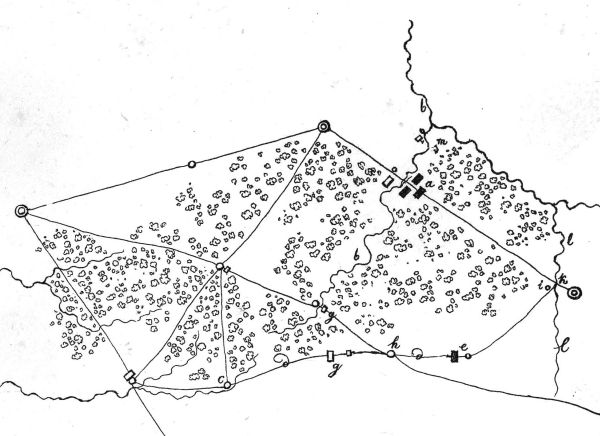
XX.
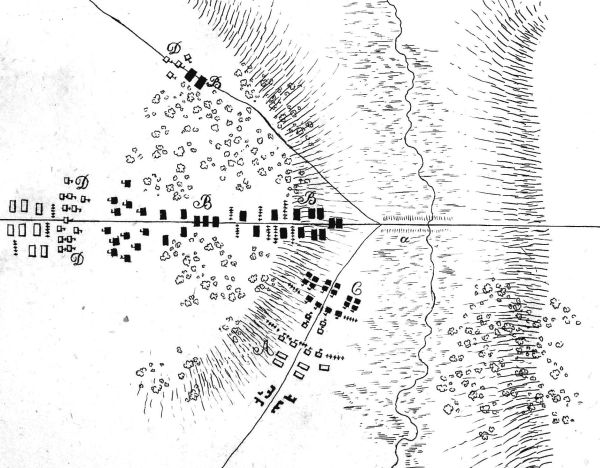
XXI.
BATTLE OF IGANIE. [See Plans XX and XXI.]
On the 9th of April, the Russian army was nearly in the same position as we have last described them. The main body, under marshal Diebitsch, were in the environs of Kock, and the combined corps of Rosen and Giesmar [Plan XX, (a)], were upon the small river Kostrzyn (b), at Boimie. Our army also had not changed its position.
The following were the dispositions for the attack. The reader, on examining the plan, will see that the two corps opposed to our forces, which were at Latowicz (c), were too far advanced, which exposed them to be turned on their left wing, and even taken in the rear, if our forces there should succeed in driving back the forces (e) of the enemy on the road (d) from Latowicz by Wodynie to Siedlce. To execute this movement the order was given that when the first division of infantry (f), supported by twenty-four pieces of cannon, should commence the attack upon the great road opposite Boimie, the third division (g), having with them the brigade of cavalry of Kicki, should leave the position at Latowicz before day-break, and take the direction of Wodynie, to attack the forces which it might find there; but if those forces should be found greatly superior, the division was to remain in a strong position at Jeruzalem (h). If it should succeed in driving back the enemy's forces, it was to take the road on the left, leading from Wodynie through Iganie (i) to Siedlce. Every effort was to be directed to the point of arriving as soon as possible upon the dyke (k) at Iganie, which leads over the marshes of the river Sucha (l). By a prompt manœuvre of this kind, the enemy could not, as we have said, escape being turned. For the better execution of this plan, the enemy was to be harassed on the main road, in order that general Prondzynski, who was to command the expedition to Wodynie, might have time to manœuvre upon the enemy's flank.
A division of cavalry (m), under the command of general Stryinski, was to leave Boimie, and take a direction on the left, towards the village of Gruszki, to pass there the fords of the river Kostrzyn, and in case of the retreat of the enemy, to fall upon his right wing.
Having issued these instructions, and confided the command of the little corps which was to act upon the enemy's left wing at Wodynie, to general Prondzynski, the general in chief left himself for Boimie, to lead the attack in person upon the main road. As was the case in the position at Boimie, [Refer to Plan II,] we were separated from the enemy by the marshes of the river Kostrzyn. The two ruined bridges upon the dyke not permitting either ourselves or the enemy to pass, general Skrzynecki contented himself with opening a fire of artillery upon the Russian position, in order to occupy the attention of the enemy, while preparations were making to repair the bridges sufficiently to admit a passage.
The moment that the work of reconstructing the bridges was to be put in execution, was to be decided by the time and the direction in which the fire of general Prondzynski should be heard. If the latter general should succeed on the enemy's flank, then, of course, the bridges were to be reconstructed, if not, they were to remain in their present state to obstruct the passage of the enemy. Several hours were occupied by this fire of artillery, and slight manœuvres of the light troops, when at last, between eight and nine o'clock, the fire of general Prondzynski was heard, who had evidently passed Wodynie, and had begun acting on the enemy's flank. This was the signal to commence repairing the bridges. General Skrzynecki, with his suite, superintended the work, and several battalions were employed in bringing together the materials. A degree of consternation was observed in the enemy's forces, in consequence of the attack on his flank, and his columns began a movement; but his artillery continued in their position, and commenced a terrible fire upon our men who were engaged in reconstructing the bridges. The presence of mind, however, of the general in chief, who exposed himself at the most dangerous points, encouraged the men to persevere in their labors under this destructive fire of artillery.[53] When the fire on his flank was at its height, the enemy began to withdraw his artillery, and commenced a retreat. By between 10 and 11 o'clock no part of the enemy's forces were remaining upon the plain of Boimie; but, although the work of repairing the bridges was pressed to the utmost, it was near two o'clock before they could be brought to such a state as to admit the passage of artillery; and although several battalions of the infantry had passed over before this, they were not able, without too much exposure, to overtake the enemy, who was in rapid retreat, leaving his cavalry as a rear guard. It was not until the last mentioned hour, that the whole division passed the bridges, and pressed forward at a rapid pace in the pursuit, the cavalry advancing upon the trot. While this was taking place upon the great road to Boimie, general Prondzynski [Plan XXI, (A),] who, according to his instructions, advanced to Wodynie, found there a division of sixteen squadrons of Russian cavalry, whom he drove from their position: he pursued them in the direction of Siedlce, and reached the environs of Iganie, where he saw the corps of Rosen and Giesmar (B) in full retreat. At this moment the position of general Prondzynski was also critical; for, as the reader is already aware, our main army was not in a condition to follow the enemy, on account of the obstruction from the broken bridges. If the enemy had thrown himself upon Prondzynski, they could have crushed him, and with their other forces could have safely passed the dyke (a) at Iganie, before our main forces, retarded as they were, could have arrived. This danger was perceived by Prondzynski, and he therefore contented himself with driving the division of Russian cavalry (C) from a position they had taken upon the heights of Iganie, (a task which was bravely executed by the cavalry of Kicki, and in which the colonel Mycielski was wounded) and occupying that position himself, placing there the brigade of Romarino to defend it.