Front matter
Reading edition
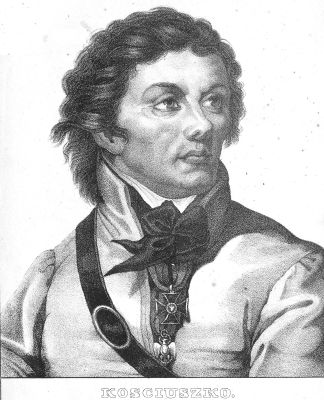
KOSCIUSZKO. Born in Poland A.D. 1756. Died the 15th. October 1817 near Solothurn in Switzerland. He and Gal. Lafayette were the only two Europeans who wore the Cross of the Order of Cincinnatus. Dedicated to the American people. Entered according to Act Congress by Paulin Miedzielsky, N.-York, 1833.
HISTORY
OF THE
LATE POLISH REVOLUTION,
AND THE
EVENTS OF THE CAMPAIGN.
BY JOSEPH HORDYNSKI,
MAJOR OF THE LATE TENTH REGIMENT OF LITHUANIAN LANCERS.
Fourth Edition.
BOSTON:
PRINTED FOR SUBSCRIBERS.
1833.
Entered according to Act of Congress, in the year 1833, By Joseph Hordynski, In the Clerk's Office of the District of Massachusetts.
TO
THE GREAT AND FREE NATION
OF THE
UNITED STATES OF AMERICA.
Liberated from prison, and from the prospect of a more gloomy future, by some of your fellow citizens, I have been so fortunate as to reach these happy shores. Providence has granted me to behold that fair country, and that nation, which every lover of freedom desires to see with his own eyes, and every freeman of Poland is wont to think of with love and esteem. Your land, long since the asylum of the persecuted, has welcomed me with hearty benevolence. From the first moment of my arrival to the present time, I have received daily proofs of your sympathy. Full of gratitude, and in the hope of doing you an acceptable service, I cannot better employ the moments allowed me during my stay among you, than by giving you a faithful account of our revolution, and of its true causes and motives, as well as of the events of the war by which it was followed. By a brief statement of the circumstances which brought about that revolution, I wish to inform you of the injustice and outrages, which my nation was compelled to endure, during fourteen years, in which both its natural rights, and the constitution solemnly guarantied to it, were trampled under foot. By a true account of the events of the ensuing war, you will be enabled to convince yourselves of the means by which small forces became victorious over a colossal power, as well as of the causes of the final catastrophe to which Poland has been doomed.
I am convinced that in many respects my narrative will be entirely opposed to the representations given in the public papers; for our land, like most countries struggling for liberty, was surrounded by enemies rather than friends. The sources from which these accounts have been drawn, are, first, my own recollections of events of which I was an eye-witness; secondly, the reports of my friends and comrades who were present; and lastly, (particularly as to the operations of the detached corps) the official reports of the army, which have not yet escaped my memory. The same course I have followed in the design of the plans, which have been traced partly from my own recollections of positions and scenes at which I was present, partly from the accurate reports of friends, and partly from public reports, assisted by my personal knowledge of localities.
Americans! I am neither an author nor a scholar by profession, but a simple republican and soldier. In such a one you will forgive faults in the form and style of writing. Do not then judge me as a writer, but see in me an unhappy Pole, who presents to your sympathies the picture of the fatal disasters of his unfortunate country, and of the manner in which it strove to regain its liberty, that first and greatest of national blessings. In this hope of your indulgence, I beg you to accept this work as a token of my gratitude and as a memorial of my short stay among you, as well as an expression of the great esteem, with which I shall always remain,
Americans, your devoted servant, JOSEPH HORDYNSKI.
To the gentlemen who have aided me, by the translation, the execution of the plates, and the publication of the work, I offer the only recompense which they will permit me to make—my heartfelt thanks; and I assure them that in the feelings which prompt this acknowledgment, all my comrades will participate.
J.H.
Pronunciation.—To the Reader. There are difficulties in the way of accurate rules for the pronunciation of Polish words arising from the circumstance that some letters have varieties of sound which are indicated by signs in the Polish alphabet, and which cannot be represented in the English. Thus, the letter Z has, in addition to that of the English Z the sounds of jet and zet; the first indicated by a short line and the second by a dot placed over the letter. It has therefore been thought more for the convenience of readers, who may wish to know the English pronunciation of the names which occur in this work, to subjoin an alphabetical list of them and their pronunciation, than to give rules which must necessarily be imperfect. This list will be found at the end of the Volume.
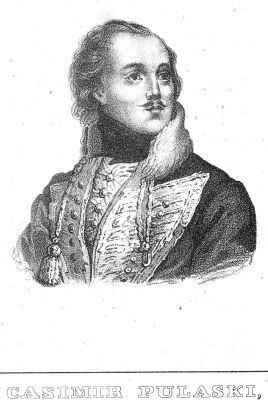
CASIMIR PULASKI, the undaunted Chief of the Poles during the Confederacy of Bar from 1768 to 1772. Born in 1746 & killed before Savannah in 1779 while fighting for the Liberty & Independence of these U.S. Dedicated to the American people. Entered according to Act of Congress by Paulin Miedzielsky, N.-York, 1833.
CONTENTS.
CHAPTER I.
Geographical extent, population, and political importance of Poland, as anciently constituted.—Conduct of Napoleon in 1812.—Congress of Vienna.—Grand-duchy of Warsaw erected into a kingdom.—Dispositions of Alexander.—Zajaczek appointed Viceroy, and Constantine commander of the army.—Constantine encroaches upon the civil administration.—Acts of tyranny.—Meeting of the Diet.—Public debates suppressed.—The Polish Conspiracy of 1821.—The Russian Conspiracy of 1824.—Union of the Patriotic Associations.—Death of Alexander.—The Revolt at St Petersburgh.—Punishment of the Patriots.—Coronation of Nicholas.—Constantine appointed Viceroy of Poland.—Oppressions of the Government.—Patriotic Club.—Influence of the French and Belgic Revolutions.—The Quartering-tax.—Excitement in Warsaw.—Arrest of the students at Praga.—Day of the Revolution fixed upon. 5
CHAPTER II.
Principles of the Revolution.—The First Night.—Attack on the Barracks of the Russian Cavalry.—Their Dispersion.—Attempt to secure the person of the Grand Duke.—Capture of Russian general officers and spies.—Actions with detached bodies of Russian cavalry.—Two companies of Polish light-infantry join the patriots.—Death of Potocki and Trembicki.—The Russian infantry attacked and dispersed.—Armament and assembling of the people.—Detachments sent to Praga. 30
CHAPTER III.
The First Day.—Expulsion of the Russians from Warsaw.—Choice of Chlopicki as Commander in Chief.—Provisional Government, under the Presidency of prince Adam Czartoryski.—Deputation sent to the Grand Duke.—Propositions and answer.—Abolition of the Bureau of Police.—Establishment of the National Guard.—Proclamations addressed to the inhabitants of the provinces and the distant troops.—Provision for the Russian prisoners.—The Academical Legions formed.—Arrival of detachments from the provinces.—The Grand Duke consents to leave the kingdom, and addresses a proclamation to the Poles. 47
CHAPTER IV.
The Patriotic Club commences its sessions.—Character of that association. —The Grand Duke departs for the frontier.—Particulars of his march.—The Polish regiments which had remained with him return to Warsaw.—Their reception.—Krasynski and Kornatowski.—Deputation to St Petersburgh.—Demands to be laid before the Emperor.—Sierawski made Governor of Warsaw, and Wasowiez chief of the staff.—Order respecting the army.—Arrival of volunteers from the interior.—Opening of the theatre.—Religious solemnities at Praga.—Chlopicki nominated and proclaimed Dictator. 59
CHAPTER V.
The Dictator enters upon his duties.—Plans for the enrollment of new forces.—System of officering them.—Want of energy in the execution of his plans.—Fortifications neglected.—The people supply the deficiencies of the administration.—Discovery of the correspondence between the ministers Grabowski and Lubecki.—The march of the army delayed.—Answer of the Emperor Nicholas to the deputies.—His proclamation.—Its effect on the nation.—The Diet demand of the Dictator an account of his trust.—The result of their investigations.—Chlopicki deprived of the Dictatorial power.—The civil administration entrusted to Prince Adam Czartoryski, and the command of the army to Prince Michael Radziwil, each subordinate to the Diet. 71
CHAPTER VI.
Remarks on the policy of the late Dictator.—System of operations adopted.—The army leaves Warsaw.—Statement of the existing forces.—Of the forces proposed to be raised.—Unfortunate consequences of the delay in the preparation of the forces.—Statement of the force with which the war was actually commenced. 87
CHAPTER VII.
Entrance of the Russian forces into the Kingdom.—Proclamations of Marshal Diebitsch.—Their effect.—Disposition of the Russian and Polish forces.—Plan of operations of the Poles. 98
CHAPTER VIII.
The opening fire.—Affairs of the 10th and 11th February.—Combat of Stoczek.—Disposition in consequence of that battle.—Battle of Boimie.—Retrograde movement to Dobre.—Combat of Makowiec.—Passage of the Orsyca.—Combat of Dobre.—Attack on the right wing at Minsk. 109
CHAPTER IX.
Retrograde movement of the 18th of February.—Details of this movement, and of the actions which took place.—The army reaches the field of Praga.—Its reception at Warsaw.—Position of the army.—Battle of Wawr and Bialolenka.—Operations of general Dwernicki against the corps of Prince Wirtemberg.—Defeat of that corps by general Dwernicki at Swierza.—Renewal of the enemy's attack on the main army on the 20th.—Its successful resistance.—Review of the events of the preceding days.—Examination of the plan of operations of the Polish army. 126
CHAPTER X.
Proceedings of the National Government.—Marshal Diebitsch continues in a state of inactivity.—Negotiations are opened by him.—His propositions are declined.—Position of the army on the 24th, and battle of Bialolenka.—Position on the 25th.—Great battle of Grochow.—Details.—State of the Russian army after its defeat.—Examination of the plan of the battle of Grochow.—Remarks upon the course adopted by prince Radziwil after that victory.—The Polish army crosses the Vistula to Warsaw.—Its reception by the national government and the citizens.—Resignation of prince Radziwil. 148
CHAPTER XI.
Passage of the Vistula to Warsaw.—Disposition of the Polish forces on its left bank.—Appointment of general John Skrzynecki to the chief command.—Proclamation.—Prompt attention is given to the re-organization of the army, the arsenals and manufactories of arms, the fortifications, &c.—Deportment of the commander in chief towards the army.—General enthusiasm of the nation.—The Patriotic offers of the Polish women.—New regulations established for conferring orders of merit.—Disorderly state of the Russian army.—Attempt of Diebitsch to bribe the Polish soldiery.—General view of the encouraging circumstances of this epoch.—The insurrection in Russia under Yermolow.—View of the state of the Polish forces when general Skrzynecki took the chief command.—He presses the organization of the new forces.—Their distribution and that of the general forces.—Positions of the Polish army and the detached corps.—Russian position. 175
CHAPTER XII.
Operations of the corps of general Dwernicki against the Russian corps under the prince of Wirtemberg, in the Palatinate of Lublin.—Battle of Pulawy, and defeat of Wirtemberg.—Atrocities of that prince at Pulawy.—Pursuit of the enemy.—Battle of Kurow, and annihilation of Wirtemberg's corps.—Operations of colonel Valentin, between Modlin and Pultusk.—A detachment of the enemy is surprised at Nasielsk.—Transports of provisions for the enemy from Prussia taken.—Successful skirmishes.—Marshal Diebitsch demands the capitulation of the fortress of Modlin. Reply of colonel Leduchowski.—A detachment from the garrison of Modlin attacks and defeats a Russian force at Serock.—General Skrzynecki makes an offer of pacification on the basis of the concessions originally demanded by the Poles.—This proposition is rejected and hostilities are recommenced.—Reconnoissance upon the right bank of the Vistula under Jankowski and Gielgud.—A Russian corps under general Witt is sent against Dwernicki.—General Uminski is sent against the Russian guard.—First encounter.—The Russian guard is compelled to leave their position for Ostrolenka.—The guard evacuates Ostrolenka to join the grand army. 195
CHAPTER XIII.
Plan of general Skrzynecki to act upon the isolated corps of Rosen and Gaismer.—Battle of Wawr.—Various detachments of the enemy are taken after that battle, and a great number of prisoners.—Battle of Dembe-Wielkie.—Destructive pursuit of the enemy by our cavalry.—View of the Russian losses in the preceding days.—Marshal Diebitsch abandons his plan of crossing the Vistula, and marches to the rescue of the remains of the corps of Rosen and Gaismer, and the Imperial Guard.—View of the position of the two armies, after the second repulse of the enemy from before Warsaw.—Operations of general Dwernicki.—Successes of a reconnoissance under colonel Russyian at Uscilog.—Effect of Dwernicki's victories on the inhabitants of the provinces.—Acknowledgment of general Dwernicki's services by the National Government.—The instructions for his future operations. 213
CHAPTER XIV.
The insurrection in Lithuania.—Dispositions of the Lithuanians at the breaking out of our revolution.—Their offers of co-operation were rejected by the dictator.—View of the condition of Lithuania under the Russian sway.—Scheme of the Russian government to destroy all Polish national feeling in that province.—The insurrection is brought about by the massacre of the patriots at Osmiany.—Capture of numerous towns by the insurgents, and dispersion of their garrisons.—Storm of Wilno, and delivery of prisoners.—Several partizan corps are formed.—Their destination and successes. 229
CHAPTER XV.
Plan of operation against the two corps of Rosen and Kreutz.—Battle of Iganie.—Reflections on the state of the Polish cause after the victory of Iganie.—Review of the course of the campaign.—Condition of the Russian army.—Discontents in Russia.—Representations of the Senate at St Petersburgh to the Emperor.—Comparative view of the forces of the two armies at the present stage of the conflict. 238
CHAPTER XVI.
Position of the two armies after the battle of Iganie.—Plan of a simultaneous attack upon the Russian forces upon opposite sides.—Instructions to the different corps.—Operations on the enemy's front.—Unfortunate operations of general Sierawski, and the first defeat.—Details of those operations.—Operations of general Dwernicki.—He defeats Rudiger; but by a false operation exposes himself to be attacked disadvantageously by two Russian corps.—In the course of the action the Austrian frontier is passed by the combatants.—An Austrian force interposes, and general Dwernicki consents to go into camp.—His arms and prisoners are taken from him, while the enemy is permitted to leave the territory freely.—Reflections on the conduct of Austria.—Consequences of the loss of Dwernicki's corps.—The cholera makes its appearance in the two armies. 254
CHAPTER XVII.
The Russian commander resumes offensive operations.—Object of the attack of the 25th of April.—Combat of Kuflew.—General Dembinski evacuates the position of Kuflew and awaits the enemy at Bady.—Battle of Minsk.—The enemy suddenly evacuates his position.—Reflections on this stage of the conflict.—Positions of the two armies. 271
CHAPTER XVIII.
General Skrzynecki resumes the offensive.—He decides to adopt an enlarged plan of operations, and to make the revolutionized provinces supply the place of a corps d'armee.—The corps of Chrzanowski is sent to occupy the Russian corps of Witt and Kreutz.—Admirable execution of this enterprise.—Attack on Kock.—Attack of Rudiger's camp.—Plan of operations by the main army against the Russian guard.—Forced march from Kaluszyn by Praga to Serock.—Advanced post of the guard attacked and defeated.—The corps of Saken is cut off.—The 2d division under Gielgud sent into Lithuania.—The imperial guard are driven with great loss beyond the frontier.—Retrograde movement. 283
CHAPTER XIX.
The Lithuanians compel two Russian corps to evacuate Samogitia.—Operations of general Chlapowski in the department of Bialystok.—Capture of Bielsk.—Defeat of a Russian force at Narewka and expulsion of the enemy from the department.—Recapitulation of the forces which had been sent into Lithuania.—Operations of the main army.—Attempt of marshal Diebitsch to intercept Skrzynecki on his retrograde march, by a diversion to Ostrolenka.—General Lubinski surprises the Russian advanced guard at Czyzew.—Marshal Diebitsch attacks the Polish rear-guard at Kleczkowo.—The rear-guard quits its position at night, and joins the main army at Ostrolenka.—Battle of Ostrolenka. 298
CHAPTER XX.
Operations of the Lithuanian corps.—Battle of Raygrod and defeat of the Russian corps of Saken.—Importance of this first success in Lithuania.—General Gielgud neglects to follow up his advantages.—He loses time by passing the Niemen at Gielgudyszki, and enables the enemy to concentrate his forces in Wilno.—Entrance into Lithuania and reception by the inhabitants.—Position of the two main armies.—The Russian forces remain inactive and receive supplies from Prussia.—Death of marshal Diebitsch.313
CHAPTER XXI.
General Gielgud advances into Lithuania.—Allows a Russian corps to pass within a league of him unperceived.—Operations on Wilno.—Enumeration of our present force.—Plan of a simultaneous attack upon Wilno on opposite sides by the corps in two divisions.—General Dembinski engages the enemy with the smaller part of the corps.—Being unsupported by Gielgud, is forced to retreat.—General Gielgud attacks Wilno.—Battle of Wilno.—A retreat is commenced.—Prodigious efforts of the Polish cavalry in protecting this retreat.—Consequences of the repulse from Wilno.—The removal of general Gielgud is called for.—General Chlapowski consents to take the virtual command of the corps, in the post of chef d'etat major.—Consideration on the state of things consequent to the battle of Wilno.—Details of the admirable plan of operations proposed by colonel Valentin. 328
CHAPTER XXII.
Operations of the main army.—Expedition under Jankowski.—General Chrzanowski having driven Rudiger from his position, crosses the Vistula, but returns to act in concert with general Jankowski against the enemy near Kock.—Details of general Jankowski's movement.—He remains inactive within sight of the fire of the corps with which he was to co-operate.—Other evidences of treason.—Generals Jankowski and Bukowski are arrested and ordered for trial.—View of the advantages that were sacrificed by this misconduct.—Discovery of a plot to liberate and arm the Russian prisoners at Warsaw, and to deliver the city to the enemy.—State of the public mind induced by these events. 342
CHAPTER XXIII.
General Chlapowski arrives at Keydany, having ordered general Dembinski to withdraw to Wilkomierz.—The position of the two forces and their line of operations.—Examination of these arrangements.—Neglect of the important position of Kowno.—General Chlapowski, at Keydany, proposes to form a provisional government, and obtain a levy of troops.—Dispositions of the Lithuanians, as effected by the mismanagement of our leaders.—Advantages offered to the enemy by the delay at Keydany.—Brave defence of Kowno, by the small force left there.—Skirmish at Wilkomierz.—The opportunity of concentrating all the forces at Keydany, and repassing the Niemen, is neglected.—The enemy presses his pursuit.—Battle of Rosseyny.—Attack on Szawla.—Loss of the ammunition and baggage of the corps.—The corps retreats in order to Kurzany, protected by a rear guard of cavalry and light artillery.—At Kurzany the corps is subdivided into three parts.—Destination and strength of each.—Examination of this plan. 350
CHAPTER XXIV.
The three subdivisions of the Lithuanian corps take their respective destinations.—Details of the operations of that of general Rohland.—He meets alone the attack of the whole Russian force.—Battle of Powenduny and Worna.—General Rohland, on his way to Polonga, learns that general Chlapowski had marched towards the Prussian frontier.—He presses his march to overtake and form a junction with him.—The greater part of the corps of Gielgud and Chlapowski were found to have passed the frontier, when that of Rohland came in sight.—Indignation of the soldiery.—Death of general Gielgud.—General Rohland, joined by a portion of the corps of Gielgud which had not yet passed the frontier, continues his march to Nowe-Miasto.—He declines a proposition from general Kreutz, to surrender.—Successful skirmish with the enemy's cavalry.—General Rohland takes a position at Nowe-Miasto, and awaits the enemy.—The Russian forces, however, do not continue their pursuit, but go into camp.—Propositions to pass the frontier are sent to general Rohland by the Prussian authorities.—They are submitted to the corps and accepted. 367
CHAPTER XXV.
Effect of the news of the Lithuanian disasters on the minds of the people.—Distrust of the National Government.—The Russian army resumes the offensive under general Paszkiewicz.—He decides to pass the Vistula.—Examination of the merits of this plan.—Plan of general Skrzynecki to act on the different detached corps of the enemy.—Advantages of general Chrzanowski over the corps of Rudiger.—The Russian forces execute the passage of the Vistula.—General Skrzynecki crosses the Vistula at Warsaw to operate against the enemy on the left bank.—An inquiry into the conduct of general Skrzynecki, and the appointment of a Council of War is demanded by the nation.—Arrival of the corps of general Dembinski at Warsaw. 384
CHAPTER XXVI.
Operation of general Dembinski's corps.—He traverses the country between Szawla and the Niemen without being observed by the enemy.—Attacks and disperses a brigade of Russian infantry.—Passes the Niemen and throws himself into the forest of Bialystok.—After leaving that forest, is joined by the corps of general Rozycki.—Reaches Warsaw.—His reception at Warsaw.—View of the exposed situation of Paszkiewicz after his passage of the Vistula.—Examination of the plan of operations of the Polish commander.—Morbid state of the public mind at Warsaw.—Skrzynecki and Czartoriski deprived of their trust.—Capture of the city.—Documents showing the influence exercised by the cabinets in discouraging active operations.—Conclusion. 394
APPENDIX. 409
POLISH REVOLUTION.
CHAPTER I.
Geographical extent, population, and political importance of Poland, as anciently constituted.—Conduct of Napoleon in 1812.—Congress of Vienna.—Grand-duchy of Warsaw erected into a Kingdom.—Dispositions of Alexander.—Zajaczek appointed Viceroy, and Constantine Commander of the Army.—Constantine encroaches upon the civil administration.—Acts of tyranny.—Meeting of the Diet.—Public debates suppressed.—The Polish Conspiracy of 1821.—The Russian Conspiracy of 1824.—Union of the Patriotic Associations.—Death of Alexander.—The Revolt at St Petersburgh.—Punishment of the Patriots.—Coronation of Nicholas.—Constantine appointed Viceroy of Poland.—Oppressions of the Government.—Patriotic Club.—Influence of the French and Belgic Revolutions.—The Quartering-tax.—Excitement in Warsaw.—Arrest of the Students at Praga.—Day of the Revolution fixed upon.
In the early part of July, 1812, when the victorious armies of Napoleon had occupied Wilna, and threatened to annihilate the throne of the Czars, the Polish nation cherished the hope of recovering its former grandeur. The destiny of Poland was then in the hands of Napoleon, and it may be said with truth that on the destiny of Poland depended the security and peace of Europe.
Poland, as is well known to the reader, viewed in regard to its geographical situation and extent, as formerly constituted, forms a strong outwork against the Russian Colossus. Its territories extend to the eastward as far as the Dneiper, and westward as far as the Oder. Toward the north, they reach the Baltic and the government of Skoff, and their southern frontiers are the Carpathian Mountains and the Black Sea. This vast region, composed of the present Kingdom of Poland, the Grand-duchy of Posen, of Samogitia, Lithuania, Livonia, White Russia and Black Russia, Volhynia, Podolia, Ukraine, and Gallicia, is inhabited by twenty-two millions of Poles of the same descent, the same manners and customs, and the same language and religion. According to its ancient limits, the kingdom of Poland is among the first in Europe with regard to population and geographical extent.
The deputies, who, at the period above named, were sent from Warsaw to the Emperor Napoleon, laid before him the most earnest solicitations for the restoration of this state, and endeavoured to direct his views to the future, in order to convince him of its necessity. They concluded with the following words;—'Dites, Sire, que le royaume de Pologne existe, et ce décret sera pour le monde l'equivalent de la réalité.' To this he answered;—'Dans ma situation, j'ai beaucoup d'interêts à concilier, beaucoup de devoirs à remplir. Si j'avais regné pendant le premier, le second, ou le troisiême partage de la Pologne, j'aurais armé mes peuples pour la defendre. J'aime votre nation, j'autorise les efforts que vous voulez faire. C'est entièrment dans l'unanimité de sa population, que vous pourez trouver l'éspoir de succes. Je dois ajouter que j'ai guaranti a l'empereur d'Autriche l'intégrité de ses domaines.'[1]
Such a reply from Napoleon, the Poles could never have expected. For, who accompanied him so faithfully in all his expeditions as the sons of Poland? Thousands of Poles lie buried in Italy, Egypt, St Domingo, Spain, and Russia, who had fought for the integrity of the French Republic and for the aggrandizement of Napoleon. His cold reception of the deputies of Poland filled all patriots with sadness. They were now convinced, that the good wishes of Napoleon for Poland were not sincere, and that, through his marriage with Maria Louisa, he had come under Austrian influence. Thus the hope of territorial enlargement and national existence vanished away, and Napoleon, by his indifference to the interests of Poland, accelerated his own fall. The burning of Moscow, which was a chance that did not enter into his calculations, became the turning point of his fate. The Poles, who had contributed to his greatness, did not desert him in his distress; they were his companions to the very last. Half a squadron of them followed him to Elba, at his own request. The disasters of France decided the fate of Poland. By the Congress of Vienna, the Grand-duchy of Warsaw was made into a kingdom, and subjected to the iron sceptre of Russia.
At the first moment of entering upon the government of the kingdom, the Emperor Alexander seemed disposed to load Poland with benefits. On his return from Paris he was received by the inhabitants of Warsaw with the most unfeigned good will, and his stay in that city was marked by acts of beneficence. The words with which he then addressed the representatives of the nation, are still in the memory of every Pole.—'Gentlemen, I respect and love your nation. To these feelings on my part, in which all Europe partakes, you are entitled by your continual and disinterested sacrifices for the prosperity of other nations. I swear to maintain your constitution with all the privileges guarantied by it; and this same constitution I promise to grant to your brethren in the provinces, which are to be united with you in one kingdom.' The nation believed in these promises the more readily as the affectionate deportment of the monarch seemed to confirm them. During his stay in Warsaw, he paid visits to several of the most popular and patriotic families and individuals, and every where expressed himself in terms of the highest esteem for the Polish nation.
This show of benevolence, and the dreams of happiness with which it inspired the people, were not, however of long duration. Before his departure from Warsaw, the Emperor named as viceroy of Poland, the old general Zajaczek,[2] raising him to the dignity of a prince, and his own brother, the Grand Duke Constantine, as commander in chief of the Polish army. The appointment of these persons to the supreme power was already in direct opposition to all the promises he had made. For Zajaczek, through the infirmities of his advanced age, was unfit for the post of viceroy, and could be but an instrument in Russian hands; while in Constantine, the commander in chief of their army, the Poles received a tyrant.
Not long after the departure of Alexander, the encroachments of the Russian cabinet began to be felt. Removals of officers took place in all the branches of government, in particular of those known as patriots, who were supplanted by minions of Russia, men full of ambition and intrigue. In the first year of the Russian government, the bureau of Police was enlarged, and filled with persons whom the nation despised. The Polish army, which had gathered laurels in so many countries of the three continents, and which was held in such high estimation by the first monarch and general in Europe, was exposed, on the very first days of the new government, to the insults of Constantine. There was not an officer, but was grossly offended by the Grand Duke, and more than all, those who wore military decorations for their merits. No past services were valued; they only exposed those who were distinguished by them to greater persecution. In the first six months, many officers, among whom was the renowned general Sokolnicki, committed suicide; and nearly one half the officers and generals asked their dismission, among whom was General, the late Dictator, Chlopicki, who preferred poverty and want to such an ignominious service. The Polish army, those soldiers animated by feelings of honor and the love of distinction, were to be transformed into the machines of despotism. They who had faced death in so many battles, who were covered with wounds, and who had been called 'brethren' by the greatest leader of his age, were now to be beaten with the Russian knout. In the first year, few days passed in which some of the soldiers did not commit suicide.
This prince, who appeared not to find victims enough for his cruelty in the army, began to meddle with all the branches of administration, and to control them. Soon the liberty of the press was prohibited, freemasonry was interdicted, and a bureau of spies was established. The chief in this bureau of spies were Rozniecki, the vice-president of the city of Warsaw, Lubowidzki, a man of the name of Macrot, and Schlee. From the documents found upon Schlee and Macrot, it was ascertained that there were in Warsaw alone 900 spies. In the provinces their number amounted to 2000. The expenses and salaries of these spies, according to accounts found among their papers, drew from the public treasury $1,000,000, or 6,000,000 Polish gilders. Thus, our poor country, instead of employing her resources for the happiness of her children, was forced to pay the mercenaries hired to distress them. Soon Warsaw and the whole kingdom became one vast prison. These spies endeavoured to steal into every company, and were present in all public places. They tried to catch every conversation, and distorted every word spoken, with however innocent an intention, in regard to the policy and administration of the country. In order to extort money, they accused some of the most respected and honest persons, who were thrown into prison, and many of whom were never again seen by their families, from the midst of whom they had been dragged in the night-time, in order to conceal the crime from the eyes of the world. Persons who did not take off their hats in the streets before the Grand Duke, were compelled to draw barrows of mud upon the public places. There passed hardly a month in which some students were not arrested, and, without any trial, at the mere denunciation of a hireling spy, thrown into prison, where they lingered for years. Thus faded away in dungeons many fair and hopeful youths, the flower of our nation. In Warsaw, besides the public gaols, there were, beneath almost all of the barracks, prisons, where the victims of tyranny were tortured. The very orangery of the Grand Duke was transformed into a prison, from which some persons were liberated during the revolution, who had been confined there for years. It was in this prison that Lukasinski had been kept for a long time, though subsequently bound to a cannon and carried into Russia. In the gaols below the barracks of the artillery many dead bodies were found.
At the first meeting of the Diet, when the Grand Duke Constantine was among the deputies from the city of Praga, and debates commenced on various subjects which concerned the welfare of the country,—such as, the liberty of the press, the abolition of the central police and the spies, and the deposition of several of the higher officers, for which petitions had been sent to the monarch,—a decision was promulgated that the Diet should act in subordination to the will of the Grand Duke, and, in order to add force to this decision, the palace and its galleries were surrounded and filled by guards. All public debates during the session were prohibited, and a ticket from the police was required for admission. These tickets were distributed among Russian generals, officers of government and their families, and creatures of the court. Before such an auditory, discussions of the most sacred interest to the nation were to take place. No patriot could behold, without tears, the senators and fathers of the nations, descendants of Tarnowski, Zamoiski, Chodkiewicz, and Kosciusko, sitting with sad and drooping countenances, exposed to the scoffing and laughter of those minions of the court. The sacred halls were transformed into a theatre for Russian spectators.
In all the different bureaus, spies held important offices, and thus those bureaus became scenes of the most detestable intrigues. Law and right were trampled under foot, and the constitution itself was derided. They used to express themselves in the following and similar terms:—'What is the constitution? It is an impediment to the administration of the government, and the course of justice. The Grand Duke is the best constitution.'
A few years had passed away in this wretched state of the nation, when, towards 1821, our noble patriots, Krzyzanowski, Jablonowski, Plichta, Debek, and Soltyk, conceived the idea of emancipating their country by a revolution. Whilst occupied with their noble scheme, they were most agreeably surprised by receiving information, in 1824, of a similar patriotic union in Russia for throwing off the yoke of despotism. Their joy was increased when they received a summons from this patriotic union in Russia, at the head of which were Pestel, Releiew, Bestuzew, Kichelbeker, Murawiew, and Kachowski, to join hands with them. This junction was effected in Kiow, on the day of the great fair, when Prince Jablonowski became acquainted with some of their members, and was initiated into their plans. The invitation was received by the Poles with delight. Accustomed to combat for liberty, they offered with their whole hearts their aid in the redemption of the Sarmatic nation from the chains by which they had been so long bound down.
Soon after this, it was agreed to meet in the town of Orla, in the province of Little Russia, where solemn oaths were sworn to sacrifice life and property in the cause. Resolutions were taken, and the means of their execution were devised. The Russians promised to the Poles, in case of success, the surrender of all the provinces as far as the frontiers which Boleslaw-Chrobry had established. This promise, as well as that of eternal friendship between the two brother-nations, was sanctioned by the solemnity of oaths. The day fixed upon for the breaking out of the revolution, was the 25th anniversary of the accession of Alexander, in the month of May, 1826; and Biala-Cerkiew in Volhynia was the place selected for the first blow. The reason for choosing this place, was, that the whole imperial family and the greater part of the army were to assemble there, on the great plain of the Dneiper, to celebrate the anniversary of the coronation. This occasion was to be improved, to gain over all the well-disposed generals, and at the same time to secure the imperial family. In the meeting at Orla, it was required of the Poles, that, at the moment of the breaking out of the revolution, they should take the life of the Grand Duke Constantine. To this proposition, however, Prince Jablonowski answered in these well known words: 'Russians, brother Sarmatians, you have summoned us to co-operate in the holy work of breaking the bonds of slavery under which our Sarmatic race has so long pined. We come to you with sincere hearts, willing to sacrifice our fortunes and lives. Rely, my dear friends, on this our promise. The many struggles in which we have already fought for the sake of liberty, may warrant our assertions. Brethren, you demand of us to murder the Grand Duke. This we can never do. The Poles have never stained their hands with the blood of their princes. We promise you to secure his person in the moment of the revolution, and, as he belongs to you, we shall deliver him into your hands.'
The patriotic associations on both sides endeavored to increase their party, by the initiation of many brave men in the army and in civil life. In Lithuania, the respectable president of the nobles, Downarowicz, and the noble Rukiewicz of the Lithuanian corps, with many other officers, were admitted into the conspiracy, and among others Jgelstrom, Wigielin, Hoffman, and Wielkaniec. All the plans for the approaching revolution were arranged with the utmost circumspection, and every circumstance seemed to promise success, when the sudden death of the Emperor Alexander, at Taganrog, in the early part of December, 1825, darkened our bright hopes.
The news of his death had, at first, a stunning effect upon the patriotic club in Petersburgh. Nevertheless, they resolved to act. They hoped to profit by the troubles between Constantine and Nicholas, about the succession. On the 18th of December of the same year, the signal for revolt was given in Petersburgh. Some regiments of the guard were on the side of the patriots, and with them assembled great numbers of the people ready to fight for liberty. Yet all this was done without sufficient energy, and without good leaders. It was unfortunate, that at the time, Colonel Pestel, acknowledged by all to be a man of great talents and energy, happened to be absent in Moscow. The people assembled in their holy cause, but, being without leaders, began to fall into disorder, and a few discharges of cannon were sufficient to disperse them.
As the Grand Duke Constantine, on account of his marriage with a noble Polish lady, Grudzinska, in 1825, was obliged to renounce the throne of Russia, the imperial power was, by a written document, given to the Grand Duke Nicholas, as the eldest in succession after him.
Some days after the proclamation of Nicholas, all the prisons of the realm were prepared to receive their new inmates. Petersburgh, Moscow, Wilna, Kiow, Bialystok, and Warsaw, were appointed for the places of trial. Over the whole of Poland and Russia the sword of cruel revenge was suspended. In Petersburgh, the martyrs of liberty, Pestel, Muraview, Releiew, Bestuzew, Kachowski, were hung on the gallows, and more than two hundred persons of the noblest families were sent to Siberia. In Wilna, Kiow, and Moscow, an immense number were thrown into prison, or transported to Siberia. In Bialystok the Russian general, Wiliaminow, was appointed an inquisitor. This infamous character treated the wretched prisoners with the utmost cruelty. Rukiewicz,[3] Jgelstrom, and Wigelin, were exiled to Siberia for life.
In Warsaw, the Grand Duke himself undertook the business of establishing an inquisition over the unhappy prisoners. This court was composed of persons in the Russian interest, a circumstance, the melancholy consequences of which soon became manifest. Senator Soltyk, an old man seventy years of age, was flogged with the knout. Krzyzanowski, unable to endure the tortures inflicted upon him, committed suicide. General Procurator Wyezechowski, that unworthy son of Poland, sentenced all who were condemned to death, to be hung on a gallows, and their bodies to be exposed upon the wheel. This horrid sentence, however, was, notwithstanding all the Grand Duke's influence, mitigated by the supreme court of the senate, which still contained many worthy men under the presidency of the venerable woyewode, Bilinski. The infamous Wyezechowski was unable to oppose this virtuous old man, whose powerful eloquence was a mirror of his noble heart. President Bilinski, fearless of the threats of the Russians, whose briberies he was accustomed to treat with disdain, guided by the articles of the criminal code, altered the sentence of death to a few years imprisonment. This mitigation of the sentence was signed by all the senators, with one exception.[4]
After Nicholas had ascended the throne over steps of blood, he was crowned, in 1826, Emperor of Russia. Two years after this, in 1828, he was again crowned in Warsaw as King of Poland. This monarch at first intended not to go through with the ceremony of the coronation in Warsaw, in order to avoid the oath of the constitution. Yet, from fear of revolutionary scenes, he suffered himself to be persuaded to do it, and took the oath, like his predecessor and brother, Alexander, to maintain the constitution and the privileges guarantied by it.
Poland may have suffered under Alexander; yet he loved the nation like a friend, as every one of my countrymen will allow. When he was mistaken in his measures, it was, that, surrounded by bad men and enemies of our nation, he was prevented from knowing the truth. He was himself too much engrossed in pleasures, to visit the hut of the poor in order to obtain information of his condition. Poland forgave him all his faults, in the grateful recollection that he had restored her to a separate existence, and respected the constitution. Far different in our eyes appeared the present emperor, Nicholas. Partaking of the errors of his predecessor, he exhibited none of his virtues. Alexander, with a benignant countenance, permitted every one to approach him freely, and his features were never distorted by passion. Nicholas, on the contrary, seemed to terrify by his very look. His lowering and overbearing eye was the true mirror of Asiatic despotism. Every movement was that of command; and his imperious air was in true harmony with the ruling passion of his mind. Such a sovereign, acting through the instrumentality of a brother like himself, the Grand Duke Constantine, must needs bring distress upon our country. Whole volumes might be filled with the relation of the atrocities of this government. The daily increasing host of spies in its employ, among whom even females were found, regarded nothing as sacred, and mocked at the most holy institutions. They lavished away millions of the public funds. Everything was permitted to them. In short, the intention of this government seemed to be to plunge our country into the deepest distress, in order to force us to the abandonment of every national feeling, and to make us slaves of the Russians. Yet in this hope they were deceived. The more the nation was oppressed,[5] the more its energy of character was steeled, and the more the love of country developed itself.
Two worthy sons of Poland, Wysocki and Schlegel, mourning over the martyrdom of Krzyzanowoski, Soltyk, Dembek, and Plichta, and meditating on the distresses of their country, resolved to attempt its deliverance. By these two young champions of Poland, the first idea of the revolution was conceived. They communicated their hopes to several other patriots, and thus was formed the Patriotic Club. This association, nourishing in their secret breasts the holy spark of liberty, increased it soon to a flaming light, by which the whole nation was led to honor and glory. These heroic men fearlessly persevered in their endeavors, during five years, exposed to the greatest dangers and amidst thousands of spies. Witnesses of the continually aggravated oppression of their country, they became more and more animated to risk every thing for their holy object.
While this tyrannical government was exulting in the success of its measures, and the honor and morals of our country were fast declining, the revolution of France occurred, and it instantly roused every mind to a comparison of our state with that of the French, who had thrown off the yoke of a Machiavelian dynasty. The three days of July were days of joy, not only to every brave son of France, but to every patriotic heart in Poland. How much were they enraptured, who hitherto in secret had been labouring for the redemption of their country! The happy result of those glorious days was a peal of terror to the Grand Duke Constantine, and to the whole swarm of agents in his tyrannical sway. It gave them a presage of their approaching retribution. Yet, instead of adopting milder measures, and endeavouring to propitiate the nation, their cruelties went on as before. The government had, indeed, advanced too far in its barbarous system to draw back. The activity of the spies was redoubled. From the first reception of the news of the French revolution, there did not pass a day on which some persons were not imprisoned in Warsaw or the provinces. On the night of the 7th of September, forty students were seized in their beds and carried to prison.
Again, the new revolutionary eruption of Belgium cheered and encouraged the heart of every patriotic Pole. The hour for throwing off the yoke of tyranny was fast approaching. The leaders of the revolution succeeded in communicating their sentiments to continually increasing numbers. Many officers of the 4th regiment of the line and of the sappers were initiated. Yet at this very time, when the revolution was every moment expected to break out, the Russian despot, in concert with Prussia and Austria, commenced his preparations for a war against France and Belgium. The Polish army was destined to serve as the vanguard of this expedition, and Modlin and Warsaw were stored with large quantities of arms and ammunition from Russia. All the regiments were completed, and the order for marching was momentarily expected.
These circumstances attracted the notice of our patriots, and they decided to accelerate the revolution, in order to anticipate the march of the army. The eruption was hastened by the following event. The citizens of Warsaw were obliged to furnish quarters for the officers of the army. To lighten this burden, and to avoid various inconveniences, as well as to accommodate the officers,—by an understanding with the inhabitants, it was determined, that instead of furnishing quarters, a quartering tax should be paid. It was intended in this regulation to proportion the tax to the size of the houses, and consequently to the profit which the proprietors would derive from letting them. The tax would in this way be equalized, because, wherever levied, it would be attended by a proportionate compensation, and it was satisfactory to the inhabitants. This regulation, however, was executed in an entirely different manner. In many cases the heavier taxes were paid by the poorer inhabitants, and indeed they had sometimes to provide quarters in addition to the payment of the tax. All the persons employed by the police as spies, and who had by vile means acquired immense fortunes and kept the finest houses in Warsaw, were exempt both from the tax and the providing of quarters. The money collected for the tax was purloined by the commissioners for quartering, who thus amassed millions of gilders.[7]
A short time before the revolution, the gross impositions of this commission were discovered. The inhabitants of Warsaw began to murmur against it, and addressed the government for the removal of the persons employed, and the substitution of others in their places, who should be deserving of the confidence of the citizens. Among others, the deposition of the president of the city, Woyda, was demanded; and when the government refused to comply with the request, he was publicly insulted and flogged in the streets. The discontent of the citizens, in particular of the poorer classes, continued to increase, and of this discontent the patriots made use in endeavouring to propagate their views of the necessity of a revolution. Public opinion was from day to day expressed more boldly. Papers were pasted up in the streets, with inscriptions such as these:—'The dwelling of the Grand Duke will be let from next new year's day.'—'Away with the tyrants! Away with the barbarians to Asia!' A great concourse of citizens assembled one evening before the city hall, and demanded the punishment of the quartering commissioner, Czarnecki, who, in his desperation, committed suicide.
The holy moment was now fast approaching, and Warsaw was in anxious expectation. Fear and terror was painted in the faces of the spies, while, on the other hand, all true patriots were in raptures of joy, and waited impatiently for the moment to strike the blow. For several nights the whole garrison of the city had been under arms, by the orders of the Grand Duke, who, tortured with the consciousness of so many crimes, had no rest, and surrounded himself with large bodies of guards. A hundred gens d'armes were on horseback for many nights, constantly bringing in their victims. Strong patroles of Russian soldiers traversed the streets. All was in vain. His mercenaries could not protect the tyrant. The word was given, the oath was sworn, to fight for our sacred rights and the freedom of our country.
An event which served to irritate all minds, and hasten the revolution, was the arrest and imprisonment of eighty students. These brave young men were assembled in a private house, in order to pray to God in secret for the souls of their murdered ancestors, on the anniversary of the storming of Praga, by the bloody Suwarrow, in 1796, when none were spared, and Praga swam with blood, and was strewed with the corpses of 30,000 of its inhabitants. Neither old men, women, children, nor pregnant mothers, were spared by the barbarous Russian soldiers. In memory of this event, the patriots had every year met for secret prayer, since public devotions on the occasion had been forbidden by the Grand Duke. The abovementioned students, with some priests, were in the act of worship, praying to the Almighty, and honoring the memory of their forefathers, when the doors were broken open with great violence, and a number of gens d'armes, under their captain, Jurgaszko, with a company of Russian soldiers behind them, entered the apartment. Our brave youths continued their prayers upon their knees about the altar, and in that position suffered themselves to be bound, and dragged away to prison. But this was the last act of cruelty the Russian government was permitted to perpetrate, for it exhausted the patience of the nation. The measure was full, and the hour of retribution was at hand. The news of this outrage was spread through Warsaw with the quickness of lightning, and it thrilled every heart. This was the occasion for fixing upon the 29th of November, as the day for commencing the revolution, on which day the 4th Polish regiment, many of the officers of which were among the initiated, were to mount guard in Warsaw.
FOOTNOTES:
CHAPTER II.
Principles of the Revolution.—The First Night.—Attack on the Barracks of the Russian Cavalry.—Their Dispersion.—Attempt to secure the person of the Grand Duke.—Capture of Russian general officers and spies.—Actions with detached bodies of Russian cavalry.—Two companies of Polish light-infantry join the patriots.—Death of Potocki and Trembicki.—The Russian infantry attacked and dispersed.—Armament and assembling of the people.—Detachments sent to Praga.
It is undeniable that the history of our nation abounds in heroic acts and glorious passages. Need we instance the times of Boleslaw, Casimir, Jagelo, Augustus of Warna, and Sobieski; or the deeds of our renowned generals Czarnecki, Chodkiewicz, Tarnowski, Sapieha, Kosciusko, and Poniatowski? Yet, in our whole history, nothing transcends this last revolution; and indeed few more memorable events have ever occurred. Its plan was based on the purest motives, and this constitutes its peculiar character. Those true sons of Poland, Wysocki and Schlegel, had no other design than to regenerate public morals and the national character, which had already begun to deteriorate under Russian influence; though, perhaps, there may have mingled with these another impulse—that of vengeance for the ignominy to which we were subjected. These feelings were shared by the whole nation—certainly a rare instance in history. Inspired by the example of the brave, even the wavering joined in upholding the good cause to support which the sword was drawn. It was this unanimity which emboldened us, small as our numbers were, to meet that colossal power dreaded by all Europe. We were not animated to this unequal struggle by any vain desire of conquest, but by a resolution to shake off a yoke so disgraceful, and by the wish to preserve our civilization, and to extend it even to Russia. In drawing the sword, every Pole had in view not only the freedom of his own country, but that of his Sarmatian brethren also. The Poles believed that Russia still remembered those martyrs of liberty, Pestel, Bestuzew, Morawiew, Kachowski, and Releiew, who suffered an ignominious death, and more than five hundred others who were sent in chains to Siberia. We believed they would bear in mind, that, in 1824, they themselves summoned us to fight, side by side, with them against despotism. Their words were still in our memory—'Poles, help us in our holy cause! Unite your hearts with ours! Are we not brethren?' Unworthy nation—soothed by the momentary blandishments of the autocrat, who scattered his decorations with a lavish hand, they forgot their own past sufferings and the future that awaits them. They suffered themselves to be led against those who were in arms for the liberty of both nations. At the very time when the funeral rites of those who had died in battle, Russians as well as Poles, were being celebrated in Warsaw and all the provinces, they burned our villages, and murdered our fathers and brothers. Russians! You have covered yourselves with eternal shame, in the eyes of the whole world. Even the nations you consider your friends and allies contemn you!
THE FIRST NIGHT.
The patriots assembled early in the morning of the 29th of November, to renew their oaths and ask the blessing of the Almighty on their great undertaking. The moment approached. Seven in the evening was the hour appointed for the commencement of the revolution. The signal agreed upon was, that a wooden house should be set on fire in Szulec street, near the Vistula. The patriots were scattered over the city, ready to stir up the people on the appearance of the signal. Most of them were young men and students. Some hundred and twenty students, who were to make the beginning, were assembled in the southern part of Warsaw. All was ready. At the stroke of seven, as soon as the flame of the house was seen reflected on the sky, many brave students, and some officers, rode through the streets of that part of the city called The Old Town, shouting, 'Poles! brethren! the hour of vengeance has struck! The time to revenge the tortures and cruelties of fifteen years is come! Down with the tyrants! To arms, brethren; to arms! Our country forever!'
The excitement spread through this part of the city with incredible rapidity. The citizens flocked together from all quarters, shouting 'Down with the tyrants! Poland forever!' At the same time a hundred and twenty students left their barrack (which is called the Hotel of the Cadets, and is situated in the royal gardens of Lazienki) under their gallant leaders, Wysocki and Schlegel, and marched to the quarters of the Russian cavalry, cuirasseurs, hulans and hussars. It was resolved to take immediate possession of all the chief gates. The issuing out of the Russian troops was thereby rendered very difficult and bloody, as the barracks were surrounded by a wide and deep moat, over which there were few bridges. On their arrival, the cadets found the soldiers in the utmost confusion. Some were saddling their horses, some were leading them out, and others were occupied in securing the magazines, &c. In short, panic and disorder pervaded officers and men; each sought his own safety only. Our young heroes took advantage of this confusion, and after firing a few rounds, rushed with the hurrah through the gates. This charge sufficed: a hundred and twenty of these young Poles, after having killed forty or fifty men with ball and bayonet, dispersed some eighteen hundred Russian cavalry. Cuirasseurs, hulans and hussars mingled together, joined in the cry of terror, and began to seek concealment in garrets, stables, cellars, &c. A great number were drowned in attempting to cross the canal in order to escape into the adjoining gardens. As the barracks were closely connected with wooden buildings filled with hay, straw, and other combustible articles, not a man would have escaped had they been fired. The young Poles refrained from this, in mercy. The Russians might all have been made prisoners; for so great was their panic that they were not ashamed to beg for quarter on their knees. But these advantages were, for the time, neglected. The cadets abandoned the attack, and hastened into the city, where their presence was more necessary.
While their comrades were attacking the barracks, some ten or twelve students traversed the gardens towards the palace of the Grand Duke (called the Belvidere) in order to secure his person.[8] Some of them guarded the passages on the side of the gardens, while others penetrated to the tyrant's apartment. But he had escaped through a secret door.
On the failure of the party of cadets sent to secure the person of the Grand Duke, they left his apartments without in the least disturbing the repose of his lady. As they reached the foot of the stairs, they met Lubowicki, the vice-president of the city, coming to the Grand Duke for instructions. As soon as he saw them, he began to cry for aid, but the next moment fell on his knees and begged for his life. They took him with them, intending to extract from him all the information he was able to give. In the court-yard they met the Russian general, Gendre,[9] aid-de-camp of the Grand Duke, with some ten or twelve armed men. They resolutely attacked him. Gendre fell under their bayonets, and his followers fled. The party meeting with no farther obstacles, returned to their friends, whom they found at the bridge of Sobieski.
The company of cadets, after having finished their attack upon the barracks of the Russian cavalry, marched along the high road which traverses the Park, over the bridge of Sobieski, towards the main avenue between the terraces of the hospital Ujasdow on one side, and those of the Botanical Garden on the other. After having arrived at this bridge, they heard the noise of horses in front, as of cavalry advancing. It was in fact a company of Russian cuirasseurs, who were on guard in this part of the park, and who were now hastening to save the barracks. Immediately a plan was formed to receive them. The cadets, forming in a line, concealed themselves in the Park near the street. The cuirasseurs came up; they were permitted to advance, and were then received with a brisk fire. The heavy cavalry, who could not turn in this narrow road, suffered severely. Sixty bodies were found on the spot. The rest fled in the greatest disorder. From this bridge, that handful of brave young men passed the street of Wieyska, and, after arriving at the barracks of Radziwil, they met a squadron of Russian hussars returning from a patrol. At the same time they heard the Russian cavalry in pursuit, who had gained time to mount at their barracks. This was a critical moment, but it was met with resolution. One half threw themselves into the ditch in order to receive the hussars; and the others formed a platoon, and with hurrahs and the shout of 'Poland forever!' discharged their pieces and attacked the cuirasseurs in their rear, at the point of the bayonet. The Russians were thrown into disorder, and fled with the greatest precipitaion, leaving many dead behind them.
The cadets, not having lost a single man in all these skirmishes, arrived at the part of the city called the Nowy-Swiat, (or the New World,) and the Trzy Zlote Krzyze, (the Three Golden Crosses.) Here they found two companies of Polish light infantry, and with them the two Polish generals, Stanislaus Potocki and Trembicki, who were giving commands for restoring order by force, and for arresting the assembled inhabitants. The company of cadets arrived, and hailed the light infantry with the following words:—'Brothers! Are you here to shed the blood of your brethren? Have you forgotten the Russian tyranny? Come to our embrace, and hand to hand let us attack the tyrants. Poland forever!' This address was enough. They disobeyed the commands of their unworthy generals, and joined the cadets and the populace. When the two generals had the madness to reproach the soldiers, some of the cadets went to them and told them in a few words the state of affairs, and on their knees and with tears intreated them not to forsake the cause of their country. To Stanislaus Potocki the command of the army was offered. At the same time they were both warned of the fatal consequences of their refusal. It was of no avail. These infatuated men could not see the justice of the cause, and began to insult the students. Upon this the cadets left them, and they fell victims to the indignation of the populace.[10] In this place some gens d'armes who undertook to disperse the citizens, were killed. After the union with the two companies of light infantry, it was decided they should both march to the street of Szulec, on the left bank of the Vistula, endeavor there to assemble the citizens, and establish a degree of order, and after that to take possession of the bridge, for the purpose of maintaining the necessary communications between Praga and Warsaw during the night, and to defend it to the last against any attack of the enemy.
The cadets marched directly into the city through the Nowy-Swiat, singing patriotic songs and shouting 'Poland forever!' Every where the citizens answered their shouts with the greatest enthusiasm, and joined the ranks of those brave youths. Both old and young men, and even women, left their dwellings in order to increase the numbers of the liberators of their country. In their passage through that street this company made prisoners of many Russian generals, officers, &c., who were on their flight. After advancing as far as the palace of the Viceroy they met the Polish general Hauke, and colonel Mieciszewski. These worthless men, accompanied by some gens d'armes, were on their way to the Grand Duke in the Belvidere. Some cadets stepped in their way, and exhorted them to dismount and surrender themselves. Instead of answering, general Hauke drew a pistol and wounded one of them, which act cost him and his companion their lives.[11]
In the same manner general Siemiontkowski, with some gens d'armes and soldiers, endeavored to disperse and arrest the citizens assembled in the Saxon-platz. He likewise was a Russian instrument, and was hated by the nation.
Whilst this company of cadets was engaged in the south part of the city, the 4th regiment, a battalion of which had mounted guard, were active in another quarter. This regiment, as soon as the signals were given, revolted. The battalion on guard beat the alarm-drum at every guard-house, and the two other battalions formed for the attack of the Russian infantry in their barracks called the barracks of Sapieha. The shouts of the soldiers and citizens advancing to the attack mingled with the noise of the drums on every side. A great number of Russian general officers and spies were taken in their flight, in the street of the Little Theatre, and the street of Napoleon.
As soon as the numbers assembled would admit of it, divisions were detached to liberate the prisoners, especially those in the Franciscan and Carmelite prisons. These prisons, always guarded by Russian troops, were stormed. The Russian soldiers were driven in, and a massacre commenced in the corridors, where a great number of them fell by the bayonet, together with many police officers and turnkeys. The doors were broken down—and an indescribable scene took place, when the victims, already sentenced, perhaps, to death, or reserved for tortures, were set at liberty. With tears in their eyes, they fell into the arms of their deliverers. Here, a father found a son—there, a son a father. Many of the emaciated captives could only creep to meet the embraces of their brethren. But what was most shocking, was the appearance of four ladies who had been incarcerated for having resisted the brutal advances of certain Russian generals. They were reduced to mere skeletons. There was not one of the spectators who did not shudder and weep at the sight, and swear to avenge them. A hundred and seventy students, and from forty to fifty older persons, Polish soldiers and citizens, all innocent victims of the system of espionage, were rescued from these two prisons.
The above mentioned battalions of the 4th and the battalion of sappers marched to attack the Russian infantry in the barracks of Alexander and Stanislaus. On their arrival there, they found some companies under arms, and summoned them to surrender. Instead of complying, they began to fire, and our soldiers fell instantly upon them, with the 'hurrah.' They were dispersed in a moment, and many officers and soldiers were made prisoners. So panic struck were many of the officers of the Russian guard that they did not hesitate to creep head-foremost into the cellars, whence they were dragged out by the legs. The Russians fled from the barracks and the city in the utmost disorder, and took refuge beyond the Powonzki barrier.
After all these successes, the northern, eastern, and western parts of the city were occupied, at about noon, by divisions of patriot soldiers and citizens.
A small part of the south side of the city only was now in possession of the enemy's cavalry, who had at last left their barracks. A few houses opposite the Lottery Buildings were set on fire, as a signal for assembling. Strong patrols were sent to the western part of the city, and by them all the public treasures and the bank were secured. One of these parties, composed of sappers, met the Russian colonel, Sass,[12] in his flight. As he did not stop at their challenge, he was shot.
When the city had been nearly freed of the Russians, great multitudes hastened to the arsenal for arms and ammunition. Here they found the Polish general Blummer, who was rash enough to resist. He ordered his soldiers to fire on the people, but they refused to obey, and joined their brethren. This general was slain,—a just punishment for his murderous intentions. All the apartments were immediately opened, and more than 80,000 muskets, pistols, sabres, and carbines were obtained. They were distributed with admirable good order.
The people, being now armed, were arrayed in divisions, under different commanders, and sent to various parts of the city. Parties were appointed to patrol the streets and arrest all spies[13] and Russian officers who might attempt to fly. They arrested upwards of three hundred. One of these patrols went to the office of the secretary of spies, Macrot, to seize his person and papers. This man had hid himself in the cellar, with some of his satellites, and fired upon the patrol. The consequence was that Macrot and his people were massacred.
Toward two in the morning, the quiet of the city was restored. Most of the patriots assembled in the Ulica Dluga, (or Long Street,) to consult on the measures to be adopted on the following day, and the manner in which the nation should be addressed by the patriotic party. They called to memory the cruelties of the Russian government, and urged the necessity of a revolution to prevent the decay of all moral and national feeling. They implored the people to aid in this holy cause, yet at the same time besought them never to violate the dictates of humanity. 'Dear brethren,' they said, 'let no one have a right to accuse us of cruelty. May the sanctity of our cause never be polluted by barbarious passions. Having a single end in view, national freedom, and justice, may we prove lions in battle, mild and indulgent to defenceless foes, and repentant apostates. Brethren, let unity, love and friendship be ours! Let us forget private rancor and selfish interest; Children of one mother, our dear Poland—let us save her from ruin!'
These addresses were received by the people with the most fervent enthusiasm, and with cries of 'Poland forever!' They swore to fight for her while a drop flowed in their hearts, and never to forsake the field of valor or the path of virtue. The assembled multitude then knelt down before the Almighty, to thank him for a deliverance accomplished with so little bloodshed, and to implore a continuation of his mercies. It was a scene which no description can equal. In the depth of the night the immense crowds of people kneeling, their figures illuminated by the glare of the fires lighted in the streets, praying to God their deliverer, presented a sight to have touched even tyrants, could they have witnessed it.
When prayers were over, plans were adopted for the defence of the city. Some of the barriers were barricaded, and fortified with cannon. Officers were sent to Praga with detachments to reinforce the garrison at the bridge. Wagons were also sent to Praga for ammunition.
As the detachments approached the bridge, they perceived that their way was obstructed by a body of Russian cavalry. This cavalry were not aware of the presence of the two companies of light infantry who had been sent thither by the patriots. As the cavalry advanced upon the bridge the light infantry gave them a volley and charged. At the same time the detachments fell on from the Border Street, and compelled them to retire with severe loss. Some companies formed by the populace, had already taken possession of Praga, and all was quiet. Many wagon loads of cartridges, balls, and barrels of powder, were taken from the magazine to Warsaw before morning.
These are the details of the first night of our revolution. The order which prevailed in all these tumults and during the fight, was truly admirable. The foreigners then in Warsaw declared that they could not enough praise the behavior of the troops and populace in the very height of a revolution. The utmost forbearance was evinced toward persons and property. No individual was slain or abused without provocation, nor was any house or store entered without the consent of the owner. From the open windows of many houses even ladies witnessed our deeds, and waved their handkerchiefs, without fear of danger or insult. They were quiet and delighted spectators of the crowds, who, after expelling the Russians, moved through the streets in perfect order, shouting songs of joy. These were moments in which the heart of every good patriot rejoiced, and traitors alone hid their heads.
FOOTNOTES:
CHAPTER III.
The First Day.—Expulsion of the Russians from Warsaw.—Choice of Chlopicki as Commander in Chief.—Provisional Government under the Presidency of Prince Adam Czartoriski.—Deputation sent to the Grand Duke.—Propositions and answer.—Abolition of the Bureau of Police.—Establishment of the National Guard.—Proclamations addressed to the inhabitants of the provinces and the distant troops.—Provision for the Russian prisoners.—The Academical Legions formed.—Arrival of detachments from the provinces.—The Grand Duke consents to leave the kingdom, and addresses a proclamation to the Poles.
The first day of freedom, after so many years of oppression, was hailed with shouts of 'Our country! Poland forever!' At about six in the morning the drums beat for the assembly of the troops in all the parts of the city in our possession. Crowds flocked from all sides to the public places. It was a scene never equalled. The whole people assembled, without distinction of rank, age, or sex. Old men who were past the use of swords, brandished their sticks and crutches, and recalled the times of Kosciusko. Clergymen, civil officers, foreigners, Jews, even women and children armed with pistols, mingled in the ranks.
The multitude, thus assembled, marched to the northern and southern parts of the city, to drive the Russians out. The fourth regiment and a body of the inhabitants marched into the northern quarter of Warsaw, to attack two regiments of infantry who occupied the Champ de Mars and the whole district thence to the barrier of Powazko. This division had with them two small pieces of cannon. As soon as they reached the point of attack they fired a few rounds, raised the 'hurrah,' and threw themselves upon the Russians, who made no resistance, but fled in disorder beyond the barrier above mentioned, where the pursuit ceased.
In the mean while, the battalion of sappers had marched through the suburb of Cracow and the street of Wirzbwa to the southern part of the city. They met the enemy's cavalry, at the Place of Saxony, a short distance from the Church of the Cross. The Russians discharged their carbines, and a brisk fire was kept up until the cry to cease firing and attack with the bayonet was heard on all sides. They gave way before the charge, and fled in the greatest confusion, as the infantry had done before them. They were pursued beyond the barriers of Mokotow. The whole city was cleared of the Russians before nine o'clock. The walls opposite the Russian troops were manned by soldiers and armed citizens.
While this expulsion was being effected, some of the patriots were employed in the city in choosing a military chief. They agreed to offer the command to Chlopicki.[14]
Towards eleven, General Chlopicki was led by the people, with acclamations, to the hotel of the Minister of Finance, where many senators and other persons were assembled to take measures respecting a provisional government, the security of public order, &c. Chlopicki was received with acclamations by the chiefs of the nation; and after all had declared their consent, he was proclaimed Commander in Chief. He was addressed on this occasion by Professor Lelewell, one of the patriots, who, after drawing the picture of our past sufferings, and comparing it with our hopes of the future, concluded with the following words, addressed directly to Chlopicki. 'Brother—take the sword of your ancestors and predecessors, Czarnecki, Dombrowski, and Kosciusko. Guide the nation that has placed its trust in you, in the way of honor. Save this unhappy country.' This ceremony concluded, Chlopicki was shown to the assembled people from the balcony. They received him with shouts of 'Our country and our liberator Chlopicki forever!' Many cried, 'Chlopicki, rely on us, and lead us to Lithuania!' The general thanked them for their confidence in him, promised never to abuse it, and swore that he would defend the liberty of Poland to the last moment.
The patriots now proceeded to choose members of the provisional government. Prince Adam Czartoriski,[15] Radzivil,[16] Niemcewicz, and Lelewell were elected, and one of the old ministers, Lubecki, was retained to assist them. This arrangement was made public about noon, in order to tranquilize the people.
The first step taken by the new government was to send deputies to the Grand Duke. They were instructed to demand whether he meant to depart peaceably, or to attack the city. Among the deputies were Lubecki and Lelewell. They found the Grand Duke encamped, with his army, in the fields of Mokotow.
The deputies represented to Constantine the consequences that would result from an attack on the city, as well in regard to himself as to the nation. They informed him that the army had already joined the people, and proposed to him that he should depart unmolested, on a prescribed route. They promised that he should find every possible accommodation provided on that route, for himself and his troops. The Grand Duke demanded some time for reflection, and finally gave the deputies the following answer in writing.
Art. I. The Grand Duke declares that it was never his intention to attack Warsaw. In case he should find himself under the necessity of so doing, he will give the authorities notice of his intention forty-eight hours before the attack.
Art. II. The Grand Duke will entreat the Emperor to grant an amnesty for the past.
Art. III. The Grand Duke declares that he has sent no orders to the Russian forces in Lithuania to pass the frontier of the kingdom.
Art. IV. Prisoners will be exchanged.
The deputies returned to Warsaw with this answer, at three o'clock. It was immediately published, but did not satisfy the people. They demanded to know the day and hour of the Grand Duke's departure. If he should refuse to obey, they declared that they would attack him. It was finally concluded to allow him two days for his necessary arrangements, and then to send a second deputation to insist on his instant departure.[17]
The provisional government immediately set about restoring order to every department of the administration. The Bureau of Police was abolished, and a council of citizens was substituted in its place, under the direction of the aged and worthy Wengrzecki. This man had been president of Warsaw in the times of the grand duchy. He was compelled to leave this office, by certain persecutions, which he brought upon himself by not being sufficiently in the spirit of the Russian government. At the same time the national guard was established, and placed under the command of Count Lubinski. The guard began their service on the very same day. They mounted guard at the bank and the public treasury, and their patrols maintained order in all parts of the city. Their duties were performed with the utmost punctuality. All the shops were opened, and the city wore as peaceful an aspect as if there had been no army before it.
At the same time the provisional government sent proclamations into all the provinces, to inform the nation of these events. They began with the following beautifully figurative expression: 'Poles! The eagle of Poland has broken his chains, and will soon have burst through the clouds into those purer regions in which nothing shall shut from him the light of the sun.' The military government issued proclamations to the troops at all the distant stations, ordering them to repair forthwith to Warsaw. The divisions of chasseurs received orders in case of an attack from the Grand Duke, to fall on his rear and cut off his retreat. The city itself was put in a better state of defence; the barriers were fortified, and guarded by strong detachments; all was prepared for an attack. The government made proper provision for the care of the Russian prisoners, of whatever rank, as well as of the ladies of the Russian civil and military officers who had left Warsaw. The royal palace was assigned for the residence of the officers and ladies; the privates were lodged in barracks. At a later period they were permitted to go about the streets and earn money by their labor, in addition to their usual allowance. The Russians were so touched by this generous treatment, that they swore, with tears, never to forget it.
These details of the first day of our revolution, for the correctness of which I pledge myself, may serve to answer the accusations of some journalists, who have stated that the commencement of the national struggle was marked with the greatest atrocities, and that more than forty field officers, many subalterns, and large parties of privates were butchered for declining to engage in the cause. These impeachments of the Polish nation are unjust and false. As has been said before, the foreigners in Warsaw could not sufficiently praise the admirable order with which our first movements were conducted. Our enemies accuse the people of having robbed the public treasuries.—I affirm that not a gilder was lost—neither public nor private property was pillaged.
As the enemy was still encamped before the city on the first and second of December, and had as yet given no decisive answer respecting the time of his departure, the people, as well as the army, were still under arms and upon the walls. At this time the twelve companies of students, called the Academical Legions, were organized. It was heart-stirring to see these noble youths assembled in arms to defend their country. Many of them had just been rescued from prison, and could not walk without difficulty. This did not damp their ardor; the hope of fighting successfully for the liberty of Poland renewed their strength. The Academical Legions requested to be sent to the posts nighest the enemy. These two days passed in entire quietness.
In the afternoon of the second of December, general Schenbek arrived from Plock with the first regiment of chasseurs. At the same time came colonel Sierawski from Serock, with his regiment. Both were received with great enthusiasm. New detachments from the provinces marched into Warsaw every day. A truly affecting sight it was to see more than a thousand peasants, and about fifty peasant girls from the country about Warsaw, marching into the city with clubs, scythes, and weapons of every description. They were escorted by the shouting populace to the Bank, and there welcomed by the national government. At the request of the people, another deputation was this day sent to the Grand Duke, to urge his departure, and to inform him that an attack would be the necessary consequence of his refusal. The Grand Duke saw the necessity of compliance, and decided to commence his march on the following day, by the prescribed route of Pulawa. He issued a proclamation to the Polish nation, wherein he promised never to fight against those, 'whom,' to use his own expression, 'he had always loved.' He adduced his marriage with a young Polish lady as a proof of his affection for the nation. At the same time he promised to entreat the emperor to grant an amnesty, and to take, in general, the mildest measures. He begged the Poles to deal gently with the Russian prisoners, their families, the ladies, and in short with all Russian subjects remaining in Warsaw.[18]
FOOTNOTES:
CHAPTER IV.
The Patriotic Club commences its sessions.—Character of that association.—The Grand Duke departs for the frontier.—Particulars of his march.—The Polish regiments which had remained with him return to Moscow.—Their reception.—Krazynski and Kornatowski.—Deputation to St Petersburgh.—Demands to be laid before the Emperor.—Sierawski made Governor of Warsaw, and Wasowiez chief of the staff.—Order respecting the army.—Arrival of volunteers from the interior.—Opening of the theatre.—Religious solemnities at Praga.—Chlopicki nominated and proclaimed Dictator.
On the third of December the Patriotic Club began its session, under the guidance of very worthy persons. The object of this society was, to watch over all the departments of the administration, to see that the measures adopted were congenial with the wishes of the people, and in the spirit of the revolution; and to promote fraternity and union throughout the nation. They desired to repress all manifestations of selfishness or ambition, to discover and bring before the people the persons best qualified for public offices, and, in short, to promote the best interests of the nation with unwearied zeal. If this club was, at times, led by the fervor of patriotic feeling to adopt measures considered rigorous by many, their acts were never inconsistent with the love of country, or their own views of the national honor. At this time, a committee was also appointed for the trial of the spies.
On the morning of the third of December, the Grand Duke commenced his march towards Pulawa, according to agreement,[19] and the Polish regiments which had remained with Constantine up to this time, now returned to Warsaw. These troops were at first regarded by the people with feelings of indignation. Such feelings were, however, soon dissipated by the explanations which were given. They had been misled by their generals, Krasynski and Kornatowski. As to general Zimyrski, who commanded the grenadiers, he was entirely blameless. He had intended to join the patriots at first, but was detained as a prisoner by the Russians. The other two generals persuaded their men that the revolutionary movements were only disturbances of the mob, excited by the students, and would quickly come to an end. They ought not, they told them, to forsake their legitimate government and the Grand Duke. It was impossible afterwards for these regiments to learn the truth, as they were closely surrounded by the Russians, and cut off from all communication with others.
Early on the third of December, when the Grand Duke had resolved to depart, he visited these troops in person, and declared before them that he left Warsaw only to avoid useless bloodshed, and that order would soon be restored. He requested them to go with him, as they were regiments of guards, in whom the emperor had peculiar confidence. 'Soldiers,' he said, 'will you go with us; or stay and unite with those who have proved faithless to their sovereign?' With one voice the whole corps exclaimed, 'We will remain—we will join our brethren and fight for the liberty of our country. We are sorry that we could not do so from the beginning, but we were deceived.'
The people who had assembled to gaze at these unfortunate men, with unfavorable and unjust feelings toward them, were disarmed of their resentment at the very sight of them, and rushed into their embraces. They were surrounded by the multitude, and taken, with joyful acclamations, to the Place of the Bank. But though the people forgave the soldiers, their indignation remained unabated against their generals, and the greatest efforts of the leading patriots were required to save Krasynski and Kornatowski from their rage. It was dreadful to behold these generals riding with downcast looks, not daring to look on those whom they had intended to betray. Death would certainly have been preferable to thus meeting the curses of a justly incensed people. Mothers held up their children, and, pointing at the two generals, exclaimed, 'See the traitors!' Arriving at the Bank, the people demanded that Krasynski and Kornatowski should give their reasons for having acted as they had done; and as the wretched men could say nothing in their own defence, a general cry arose of 'Death to the traitors!' Nothing but the love of the people for Chlopicki and Schembeck, who interceded, could have hindered them from carrying their wishes into immediate execution. Several excited individuals made their way toward the culprits with pistols in their hands, and, after aiming at them, fired their weapons into the air, crying, 'You are unworthy of a shot from a Polish hand. Live—to be everlastingly tortured by your consciences!' The unfortunate men entreated that they might be permitted to serve in the ranks, as privates. They were immediately deprived of their commissions, and from that time they lived in retirement during the war.[20]
The people were this day informed that prince Adam Czartoriski had been nominated president of the national government; that the eighteenth of December was appointed for the opening of the Diet; that till that day the rights of the Emperor Nicholas would be acknowledged; and that Lubecki, Osvowski, and Jezierski would be sent to St Petersburgh, as a deputation, to inform the emperor of all that had happened. They were also to lay before him the following demands:
1st. That all Russian troops should be withdrawn from the kingdom forever, that a perpetual conflict between the two nations might be avoided.
2d. That the privileges of the constitution should be again confirmed in their fullest extent.
3d. That all the ancient Polish provinces incorporated with Russia should partake in the privileges of the constitution, as Alexander had promised.
The deputies were also instructed to entreat the emperor to come to Warsaw and open the Diet, in order to satisfy himself respecting the actual state of affairs.
The deputies left Warsaw that very evening.
The commander in chief appointed general Sierawski governor of the city of Warsaw, and colonel count Wonsowicz chief of the staff. These officers were both beloved by the people, and proved themselves able and zealous defenders of their country through the whole campaign. The commander in chief also published an order, that the army should consist of 200,000 men. Each wayewodeship (principality) was to furnish 9,000 infantry and 11,000 horse. There are eight wayewodeships in Poland. The army already existing, the volunteer forces, and the regiments raised and equipped by some of the noblemen, were not reckoned in this estimate, nor did it include the volunteers which were to be expected from the Polish provinces under other foreign governments.
The fourth, fifth, and sixth of December were remarkable days in the history of our revolution. Soldiers and peasants flocked in from all sides—from all quarters of the country. In a short time, more than five thousand peasants, armed with scythes, axes, and other weapons, were counted. Among them were more than two hundred peasant girls, with sickles. These were days of real joy, when all united in the defence of Poland, without distinction of rank, age, or even sex—when rich and poor, nobles and peasants, met, as friends escaped from common sufferings, and embraced. Tables were spread with refreshments for those who arrived, in the streets. The fourth was remarkable for the opening of the theatre.[21] Religious solemnities took place in Praga on the fifth, and on the sixth a Dictator was nominated.[22]
When, on the sixth of December, the national government notified Chlopicki of his nomination as generalissimo, he replied, that they had no power to place him in that station; that in such critical times the civil and military power ought to be vested in one person, and that he felt himself entitled, by his long services, to nominate himself Dictator. His powers, he said, he would lay down on the assemblage of the Diet. In the afternoon of the next day he was proclaimed Dictator in the Champ de Mars, amidst the acclamations of an immense multitude. After this, he took a public oath to act in accordance with the spirit of the people, and to defend the rights and privileges of Poland.
FOOTNOTES:
CHAPTER V.
The Dictator enters upon his duties.—Plans for the enrollment of new forces.—System of officering them.—Want of energy in the execution of his plans.—Fortifications neglected.—The people supply the deficiencies of the administration.—Discovery of the correspondence between the ministers Grabowski and Lubecki.—The march of the army delayed.—Answer of the Emperor Nicholas to the deputies. His proclamation.—Its effect on the nation.—The Diet demand of the Dictator an account of his trust.—The result of their investigations.—Chlopicki deprived of the Dictatorial power.—The civil administration entrusted to Prince Adam Czartoryski, and the command of the Army to Prince Michael Radziwil, each subordinate to the Diet.
On the seventh of December, the new Dictator took possession of the residence which had been prepared for him. A guard of honor was assigned him, consisting of a company of the Academical Legion. The twelve companies of which this legion was composed mounted guard in succession.
The nation had conceived the highest hopes of Chlopicki; they expected, above all, the most energetic measures in regard to the armament and organization of the forces. These hopes were not fulfilled. At the very commencement of his administration, it began to be seen that this man, either from his advanced age or the original inadequacy of his talents to the demands of such a situation, would fail to satisfy the wants of the nation. Indeed, the union of so many different duties in the hands of one individual demanded abilities of no ordinary strength and compass. As might have been expected, the evident incapacity of Chlopicki early became the occasion of dissension in the patriotic association already referred to, accusations being preferred, as a matter of course, against those who had been active in procuring his investment with such high powers. The succeeding events will enable the reader to decide for himself of the justice of such accusations.
On assuming his post, the Dictator adopted the following arrangements in regard to the enrollments of the new forces, and other objects of military administration. He estimated the army already in existence at 25,000 men, and sixty-two pieces of cannon. This army was constituted as follows:—The infantry was composed of nine regiments, of two battalions each, and a battalion of sappers, making a total of 19,000 men. The cavalry was also composed of nine regiments, each regiment consisting of four squadrons, 7,200 men in all. The artillery was divided into nine battalions, of eight pieces each, in all seventy-two pieces, exclusive of the artillery in the fortresses of Modlin and Zamosc.
This force the Dictator proposed to augment in the following manner:—Each existing regiment was to receive a third battalion; and he intended to form fifteen new regiments, of three battalions each. This would have increased the total of infantry to 54,000 men, without taking into the account the National Guard of Warsaw and the other cities, amounting to 10,000 men. The cavalry was to be augmented by 8000, making a total of 15,200. To the artillery were to be added twenty-four pieces of cannon, making a total of ninety-six pieces.
In this estimate the Dictator did not include the aid that might be calculated upon from the provinces of Prussian, Austrian, and Russian Poland, the volunteers of every kind, and the regiments raised and equipped by the large landed proprietors.
For each of the eight palatinates into which the kingdom was divided, an officer was appointed, whose duty it was to superintend the organization of the military forces, of which from seven to eight thousand infantry, and one thousand cavalry, were to be furnished by each palatinate. These officers were subordinate to two others, who had the supervision of four palatinates each, and bore the title of Regimentarz. These last had the power of appointing all the officers of the new forces.[23]
The augmentation of the army was to have been completed by the twentieth of January, 1831. But all these arrangements were made on paper only—the government did not press their execution. In fact, such a degree of negligence existed, that in some places where the people assembled to be enrolled, they found no officers to receive them, and, after waiting some time, they returned to their homes. It was, in truth, only by the energy of the nation, which supplied the deficiencies of the administration, that our forces were ever in any degree augmented. The volunteer force was in an especial manner liberally furnished by the people. A similar state of things existed with regard to the fortifications; and here again the energy of the people atoned for the negligence of the administration. This was especially the case at Warsaw and Praga, where all the citizens labored on the works of defence, without distinction of age or sex.
The construction of barricades in the different streets of Warsaw, and of mines in several parts of the city, was commenced by the citizens. The Dictator, however, instead of occupying his attention with these warlike preparations, devoted it to diplomatic negociations, and despatched emissaries to the neighboring courts, charged with propositions made without the knowledge or the wish of the nation, and even, in some cases, incompatible with its honor, and inconsistent with the design of the revolution. All the measures, indeed, of the Dictator, however well intended they might have been, indicated much weakness and indecision.
Such was the state of affairs when an event occurred that seemed to augur well for our prospects. This was the discovery of the correspondence between the ministers Grabowski and Lubecki, the former being Secretary of State for Poland and a member of the cabinet at St Petersburgh, the latter Minister of Finance at Warsaw. This correspondence afforded the clearest evidence that Russia had intended to declare war against France, and that she was prepared to commence that war in December following.[24]
These letters were sent to Paris in the early part of December, by an express, and ought to have convinced the French government of the hostile intentions of Russia. They should have satisfied France that our revolution, and the war that was to follow, were a part of the great struggle in which her own existence was concerned.
The existing army was, through the activity of the general officers, brought into such a state, by the middle of December, that it could then have taken the field against the enemy. The soldiers were eager for the struggle, but the delay of their march gave color to the supposition that an answer from the Emperor was waited for. It was even rumored that the Emperor was coming to Warsaw in person. All this tended to damp the excitement of the moment. What, then, was the astonishment of the nation, when it was found that the monarch, far from admitting the severity of the oppression under which we had suffered fifteen years,—far from giving a paternal audience to the deputies which the nation had sent to him, and who, in its name, had presented the most moderate demands, (limited, in fact, to the ratification and observance of the constitution granted to us, and the union of the Polish provinces under one government, as had been promised by Alexander,)—far from consenting to repair to Warsaw, as the deputies had entreated him to do, as a father among his children, to hear their complaints and satisfy himself as to their justice,—far from all this,—in a word, discarding all paternal feelings, he applied the term 'infamous' to the sacred effort we had been forced to make by the oppression under which we had so long suffered.[25]