Volume 1 / Part 3 / Book 1 — BOOK I.—THE SOURCE (continued 3)
Henri Van Laun translation
All this arises from the constitution of the country and the distribution of the land. Whilst in other countries we find only a population of paupers, with here and there a few lords, England is covered and filled with owners of lands and fields; so that "therein so small a thorpe cannot bee founde, wherein dwelleth not a knight, an esquire, or suche a housholder as is there commonly called a franklayne, enryched with greate possessions. And also other freeholders, and many yeomen able for their livelodes to make a jurye in fourme afore-mentioned. For there bee in that lande divers yeomen, which are able to dispend by the yeare above a hundred poundes."[175] Harrison says:[176]
"This sort of people, have more estimation than labourers and the common sort of artificers, and these commonlie live wealthilie, keepe good houses, and travell to get riches. They are for the most part farmers to gentlemen," and keep servants of their own. "These were they that in times past made all France afraid. And albeit they be not called master, as gentlemen are, or sir, as to knights apperteineth, but onelie John and Thomas, etc., yet have they beene found to have done verie good service; and the kings of England, in foughten battels, were wont to remaine among them (who were their footmen) as the French kings did among their horssemen: the prince thereby showing where his chiefe strength did consist."
Such men, says Fortescue, might form a legal jury, and vote, resist, be associated, do everything wherein a free government consists; for they were numerous in every district; they were not down-trodden like the timid peasants of France; they had their honor and that of their family to maintain; "they be well provided with arms; they remember that they have won battles in France."[177] Such is the class, still obscure, but more rich and powerful every century, which, founded by the down-trodden Saxon aristocracy, and sustained by the surviving Saxon character, ended, under the lead of the inferior Norman nobility and under the patronage of the superior Norman nobility, in establishing and settling a free constitution, and a nation worthy of liberty.
SECTION IX.—Piers Plowman and Wyclif
When, as here, men are endowed with a serious character, have a resolute spirit, and possess independent habits, they deal with their conscience as with their daily business, and end by laying hands on church as well as state. Already for a long time the exactions of the Roman See had provoked the resistance of the people,[178] and the higher clergy became unpopular. Men complained that the best livings were given by the pope to non-resident strangers; that some Italian, unknown in England, possessed fifty or sixty benefices in England; that English money poured into Rome; and that the clergy, being judged only by clergy, gave themselves up to their vices, and abused their state of immunity. In the first years of Henry III's reign there were nearly a hundred murders committed by priests then alive. At the beginning of the fourteenth century the ecclesiastical revenue was twelve times greater than the civil; about half the soil was in the hands of the clergy. At the end of the century the commons declared that the taxes paid to the church were five times greater than the taxes paid to the crown; and some years afterwards,[179] considering that the wealth of the clergy only served to keep them in idleness and luxury, they proposed to confiscate it for the public benefit. Already the idea of the Reformation had forced itself upon them. They remembered how in the ballads Robin Hood ordered his folk to spare the yeomen, laborers, even knights, if they are good fellows, but never to let abbots or bishops escape. The prelates were grievously oppressing the people by means of their privileges, ecclesiastical courts, and tithes; when suddenly, amid the pleasant banter or the monotonous babble of the Norman versifiers, we hear the indignant voice of a Saxon, a man of the people and a victim of oppression, thundering against them.
It is the vision of Piers Plowman, written, it is supposed, by a secular priest of Oxford.[180] Doubtless the traces of French taste are perceptible. It could not be otherwise; the people from below can never quite prevent themselves from imitating the people above, and the most unshackled popular poets, Burns and Béranger, too often preserve an academic style. So here a fashionable machinery, the allegory of the Roman de la Rose, is pressed into service. We have Do-well, Covetousness, Avarice, Simony, Conscience, and a whole world of talking abstractions. But, in spite of these vain foreign phantoms, the body of the poem is national, and true to life. The old language reappears in part; the old metre altogether; no morer rhymes, but barbarous alliterations; no more jesting, but a harsh gravity, a sustained invective, a grand and sombre imagination, heavy Latin texts, hammered down as by a Protestant hand. Piers Plowman went to sleep on the Malvern hills, and there had a wonderful dream:
"Thanne gan I meten—a merveillous swevene, That I was in a wildernesse—wiste I nevere where; And as I biheeld into the eest,—an heigh to the sonne, I seigh a tour on a toft,—trieliche y-maked, A deep dale bynethe—a dongeon thereinne With depe diches and derke—and dredfulle of sighte. A fair feeld ful of folk—fond I ther bitwene, Of alle manere of men,—the meene and the riche, Werchynge and wandrynge—as the world asketh. Some putten hem to the plough,—pleiden ful selde, In settynge and sowynge—swonken ful harde, And wonnen that wastours—with glotonye dystruyeth."[181]
A gloomy picture of the world, like the frightful dreams which occur so often in Albert Durer and Luther. The first reformers were persuaded that the earth was given over to evil; that the devil had on it his empire and his officers; that Antichrist, seated on the throne of Rome, displayed ecclesiastical pomps to seduce souls and cast them into the fire of hell. So here Anti-christ, with raised banner, enters a convent; bells are rung; monks in solemn procession go to meet him, and receive with congratulations their lord and father.[182] With seven great giants, the seven deadly sins, he besieges Conscience; and the assault is led by Idleness, who brings with her an army of more than a thousand prelates: for vices reign, more hateful from being in holy places, and employed in the church of God in the devil's service.
"Ac now is Religion a rydere—a romere aboute, A ledere of love-dayes—and a lond-buggere, A prikere on a palfrey—fro manere to manere.... And but if his knave knele—that shal his coppe brynge, He loureth on hym, and asketh hym—who taughte hym curteisie."[183]
But this sacrilegious show has its day, and God puts His hand on men in order to warn them. By order of Conscience, Nature sends forth a host of plagues and diseases from the planets:
"Kynde Conscience tho herde,—and cam out of the planetes, And sente forth his forreyours—feveres and fluxes, Coughes and cardiaclescrampes and tooth-aches, Reumes and radegundes,—and roynous scabbes, Biles and bocches,—and brennynge agues, Frenesies and foule yveles,—forageres of kynde.... There was 'Harrow! and Help!—Here cometh Kynde! With Deeth that is dredful—to undo us alle!' The lord that lyved after lust—tho aloud cryde.... Deeth cam dryvynge after,—and al to duste passhed Kynges and knyghtes,—kaysers and popes,... Manye a lovely lady—and lemmans of knyghtes, Swowned and swelted for sorwe of hise dyntes."[184]
Here is a crowd of miseries, like those which Milton has described in his vision of human life; tragic pictures and emotions, such as the reformers delight to dwell upon. There is a like speech delivered by John Knox, before the fair ladies of Mary Stuart, which tears the veil from the human corpse just as coarsely, in order to exhibit its shame. The conception of the world, proper to the people of the north, all sad and moral, shows itself already. They are never comfortable in their country; they have to strive continually against cold or rain. They cannot live there carelessly, lying under a lovely sky, in a sultry and clear atmosphere, their eyes filled with the noble beauty and happy serenity of the land. They must work to live; be attentive, exact, keep their houses wind and water tight, trudge doggedly through the mud behind their plough, light their lamps in their shops during the day. Their climate imposes endless inconvenience, and exacts endless endurance. Hence arise melancholy and the idea of duty. Man naturally thinks of life as of a battle, oftener of black death which closes this deadly show, and leads so many plumed and disorderly processions to the silence and the eternity of the grave. All this visible world is vain; there is nothing true but human virtue—the courageous energy with which man attains to self-command, the generous energy with which he employs himself in the service of others. On this view, then, his eyes are fixed; they pierce through worldly gauds, neglect sensual joys, to attain this. By such inner thoughts and feelings the ideal model is displaced; a new source of action springs up—the idea of righteousness. What sets them against ecclesiastical pomp and insolence is neither the envy of the poor and low, nor the anger of the oppressed, nor a revolutionary desire to experimentalize abstract truth, but conscience. They tremble lest they should not work out their salvation if they continue in a corrupt church; they fear the menaces of God, and dare not embark on the great journey with unsafe guides. "What is righteousness?" asked Luther, anxiously, "and how shall I obtain it?" With like anxiety Piers Plowman goes to seek Dowell, and asks each one to show him where he shall find him. "With us," say the friars. "Contra quath ich, Septies in die cadit justus, and ho so syngeth certys doth nat wel;" so he betakes himself to "study and writing," like Luther; the clerks at table speak much of God and of the Trinity, "and taken Bernarde to witnesse, and putteth forth presompcions... ac the carful mai crie and quaken atte gate, bothe a fyngred and a furst, and for defaute spille ys non so hende to have hym yn. Clerkus and knyghtes carpen of God ofte, and haveth hym muche in hure mouthe, ac mene men in herte;" and heart, inner faith, living virtue, are what constitute true religion. This is what these dull Saxons had begun to discover. The Teutonic conscience, and English good-sense, too, had been aroused, as well as individual energy, the resolution to judge and decide alone, by and for one's self. "Christ is our hede that sitteth on hie, Heddis ne ought we have no mo," says a poem, attributed to Chaucer, and which, with others, claims independence for Christian consciences.[185]
"We ben his membres bothe also, Father he taught us call him all, Maisters to call forbad he tho; Al maisters ben wickid and fals."
No other mediator between man and God. In vain the doctors state that they have authority for their words; there is a word of greater authority, to wit, God's. We hear it in the fourteenth century, this grand "word of God." It quitted the learned schools, the dead languages, the dusty shelves on which the clergy suffered it to sleep, covered with a confusion of commentators and Fathers.[186] Wycliff appeared and translated it like Luther, and in a spirit similar to Luther's. "Cristen men and wymmen, olde and yonge, shulden studie fast in the Newe Testament, for it is of ful autorite, and opyn to undirstonding of simple men, as to the poyntis that be moost nedeful to salvacioun."[187] Religion must be secular, in order to escape from the hands of the clergy, who monopolize it; each must hear and read for himself the word of God; he will then be sure that it has not been corrupted; he will feel it better, and, more, he will understand it better, for
"ech place of holy writ, both opyn and derk, techit mekenes and charite; and therfore he that kepith mekenes and charite hath the trewe undirstondyng and perfectioun of al holi writ.... Therfore no simple man of wit be aferd unmesurabli to studie in the text of holy writ... and no clerk be proude of the verrey undirstondyng of holy writ, for whi undirstonding of hooly writ with outen charite that kepith Goddis heestis, makith a man depper dampned... and pride and covetise of clerkis is cause of her blindees and eresie, and priveth them fro verrey undirstondyng of holy writ."[188]
These are the memorable words that began to circulate in the markets and in the schools. They read the translated Bible, and commented on it; they judged the existing Church after it. What judgments these serious and untainted minds passed upon it, with what readiness they pushed on to the true religion of their race, we may see from their petition to Parliament.[189] One hundred and thirty years before Luther, they said that the pope was not established by Christ, that pilgrimages and image-worship were akin to idolatry, that external rites are of no importance, that priests ought not to possess temporal wealth, that the doctrine of transubstantiation made a people idolatrous, that priests have not the power of absolving from sin. In proof of all this they brought forward texts of Scripture. Fancy these brave spirits, simple and strong souls, who began to read at night in their shops, by candle-light; for they were shopkeepers—tailors, skinners, and bakers—who, with some men of letters, began to read, and then to believe, and finally got themselves burned.[190] What a sight for the fifteenth century, and what a promise! It seems as though, with liberty of action, liberty of mind begins to appear; that these common folk will think and speak; that under the conventional literature, imitated from France, a new literature is dawning; and that England, genuine England, half-mute since the Conquest, will at last find a voice.
She had not yet found it. King and peers ally themselves to the Church, pass terrible statutes, destroy books, burn heretics alive, often with refinement of torture—one in a barrel, another hung by an iron chain around his waist. The temporal wealth of the clergy had been attacked, and therewith the whole English constitution; and the great establishment above crushed out with its whole weight the revolutionists from below. Darkly, in silence, while the nobles were destroying each other in the Wars of the Roses, the commons went on working and living, separating themselves from the established Church, maintaining their liberties, amassing wealth, but not going further.[191] Like a vast rock which underlies the soil, yet crops up here and there at distant intervals, they barely show themselves. No great poetical or religious work displays them to the light. They sang; but their ballads, first ignored, then transformed, reach us only in a late edition. They prayed; but beyond one or two indifferent poems, their incomplete and repressed doctrine bore no fruit. We may well see from the verse, tone, and drift of their ballads that they are capable of the finest poetic originality,[192] but their poetry is in the hands of yeomen and harpers. We perceive, by the precocity and energy of their religious protests, that they are capable of the most severe and impassioned creeds; but their faith remains hidden in the shop-parlors of a few obscure sectaries. Neither their faith nor their poetry has been able to attain its end or issue. The Renaissance and the Reformation, those two national outbreaks, are still far off; and the literature of the period retains to the end, like the highest ranks of English society, almost the perfect stamp of its French origin and its foreign models.
CHAPTER THIRD
The New Tongue
SECTION I.—The First Great Poet
Amid so many barren endeavors, throughout the long impotence of Norman literature, which was content to copy, and of Saxon literature, which bore no fruit, a definite language was nevertheless formed, and there was room for a great writer. Geoffrey Chaucer appeared, a man of mark, inventive though a disciple, original though a translator, who by his genius, education, and life, was enabled to know and to depict a whole world, but above all to satisfy the chivalric world and the splendid courts which shone upon the heights.[193] He belonged to it, though learned and versed in all branches of scholastic knowledge; and he took such a share in it that his life from beginning to end was that of a man of the world, and a man of action. We find him by turns in King Edward's army, in the king's train, husband of a maid of honor to the queen, a pensioner, a placeholder, a member of Parliament, a knight, founder of a family which was hereafter to become allied to royalty. Moreover, he was in the king's council, brother-in-law of John of Gaunt, employed more than once in open embassies or secret missions at Florence, Genoa, Milan, Flanders, commissioner in France for the marriage of the Prince of Wales, high up and low down on the political ladder, disgraced, restored to place. This experience of business, travel, war, and the court, was not like a book-education. He was at the Court of Edward III, the most splendid in Europe, amidst tourneys, grand receptions, magnificent displays; he took part in the pomps of France and Milan; conversed with Petrarch, perhaps with Boccaccio and Froissart; was actor in, and spectator of, the finest and most tragical of dramas. In these few words, what ceremonies and cavalcades are implied! what processions in armor, what caparisoned horses, bedizened ladies! what display of gallant and lordly manners! what a varied and brilliant world, well suited to occupy the mind and eyes of a poet! Like Froissart, and better than he, Chaucer could depict the castles of the nobles, their conversations, their talk of love, and anything else that concerned them, and please them by his portraiture.
SECTION II.—The Decline of the Middle Ages
Two notions raised the Middle Ages above the chaos of barbarism: one religious, which had fashioned the gigantic cathedrals, and swept the masses from their native soil to hurl them upon the Holy Land; the other secular, which had built feudal fortresses, and set the man of courage erect and armed, within his own domain: the one had produced the adventurous hero, the other the mystical monk; the one, to wit, the belief in God, the other the belief in self. Both, running to excess, had degenerated by the violence of their own strength: the one had exalted independence into rebellion, the other had turned piety into enthusiasm: the first made man unfit for civil life, the second drew him back from natural life: the one, sanctioning disorder, dissolved society; the other, enthroning infatuation, perverted intelligence. Chivalry had need to be repressed because it issued in brigandage; devotion restrained because it induced slavery. Turbulent feudalism grew feeble, like oppressive theocracy; and the two great master passions, deprived of their sap and lopped of their stem, gave place by their weakness to the monotony of habit and the taste for worldliness, which shot forth in their stead and flourished under their name.
Gradually, the serious element declined, in books as in manners, in works of art as in books. Architecture, instead of being the handmaid of faith, became the slave of fantasy. It was exaggerated, became too ornamental, sacrificing general effect to detail, shot up its steeples to unreasonable heights, decorated its churches with canopies, pinnacles, trefoiled gables, open-work galleries. "Its whole aim was continually to climb higher, to clothe the sacred edifice with a gaudy bedizenment, as if it were a bride on her wedding morning."[194] Before this marvellous lacework, what emotion could one feel but a pleased astonishment? What becomes of Christian sentiment before such scenic ornamentations? In like manner literature sets itself to play. In the eighteenth century, the second age of absolute monarchy, we saw on one side finials and floriated cupolas, on the other pretty vers de societé, courtly and sprightly tales, taking the place of severe beauty-lines and noble writings. Even so in the fourteenth century, the second age of feudalism, they had on one side the stone fretwork and slender efflorescence of aërial forms, and on the other finical verses and diverting stories, taking the place of the old grand architecture and the old simple literature. It is no longer the overflowing of a true sentiment which produces them, but the craving for excitement. Consider Chaucer, his subjects, and how he selects them. He goes far and wide to discover them, to Italy, France, to the popular legends, the ancient classics. His readers need diversity, and his business is to "provide fine tales": it was in those days the poet's business.[195] The lords at table have finished dinner, the minstrels come and sing, the brightness of the torches falls on the velvet and ermine, on the fantastic figures, the motley, the elaborate embroidery of their long garments; then the poet arrives, presents his manuscript, "richly illuminated, bound in crimson velvet, embellished with silver clasps and bosses, roses of gold": they ask him what his subject is, and he answers "Love."
SECTION III.—The Poetry of Chaucer
In fact, it is the most agreeable subject, fittest to make the evening hours pass sweetly, amid the goblets filled with spiced wine and the burning perfumes. Chaucer translated first that great storehouse of gallantry, the "Roman de la Rose." There is no pleasanter entertainment. It is about a rose which the lover wished to pluck: the pictures of the May months, the groves, the flowery earth, the green hedgerows, abound and display their bloom. Then come portraits of the smiling ladies, Richesse, Fraunchise, Gaiety, and by way of contrast, the sad characters, Daunger and Travail, all fully and minutely described, with detail of features, clothing, attitude; they walk about, as on a piece of tapestry, amid landscapes, dances, castles, among allegorical groups, in lively sparkling colors, displayed, contrasted, ever renewed and varied so as to entertain the sight. For an evil has arisen, unknown to serious ages—ennui; novelty and brilliancy followed by novelty and brilliancy are necessary to withstand it; and Chaucer, like Boccaccio and Froissart, enters into the struggle with all his heart. He borrows from Boccaccio his history of Palamon and Arcite, from Lollius his history of Troilus and Cressida, and rearranges them. How the two young Theban knights, Arcite and Palamon, both fall in love with the beautiful Emily, and how Arcite, victorious in tourney, falls and dies, bequeathing Emily to his rival; how the fine Trojan knight Troilus wins the favor of Cressida, and how Cressida abandons him for Diomedes—these are still tales in verse, tales of love. A little tedious they may be; all the writings of this age, French, or imitated from French, are born of too prodigal minds; but how they glide along! A winding stream, which flows smoothly on level sand, and sparkles now and again in the sun, is the only image we can compare it to. The characters speak too much, but then they speak so well! Even when they dispute we like to listen, their anger and offences are so wholly based on a happy overflow of unbroken converse. Remember Froissart, how slaughters, assassinations, plagues, the butcheries of the Jacquerie, the whole chaos of human misery, disappears in his fine ceaseless humor, so that the furious and grinning figures seem but ornaments and choice embroideries to relieve the skein of shaded and colored silk which forms the groundwork of his narrative! but, in particular, a multitude of descriptions spread their gilding over all. Chaucer leads you among arms, palaces, temples, and halts before each beautiful thing. Here:
"The statue of Venus glorious for to see Was naked fleting in the large see, And fro the navel doun all covered was With wawes grene, and bright as any glas. A citole in hire right hand hadde she, And on hire hed, ful semely for to see, A rose gerlond fressh, and wel smelling, Above hire hed hire doves fleckering."[196]
Further on, the temple of Mars:
"First on the wall was peinted a forest, In which ther wonneth neyther man ne best, With knotty knarry barrein trees old Of stubbes sharpe and hidous to behold; In which ther ran a romble and a swough As though a storme shuld bresten every bough: And dounward from an hill under a bent. Ther stood the temple of Mars armipotent, Wrought all of burned stele, of which th' entree Was longe and streite, and gastly for to see. Aud therout came a rage and swiche a vise, That it made all the gates for to rise. The northern light in at the dore shone, For window on the wall ne was ther none, Thurgh which men mighten any light discerne. The dore was all of athamant eterne, Yclenched overthwart and endelong With yren tough, and for to make it strong, Every piler the temple to sustene Was tonne-gret, of yren bright and shene."[197]
Everywhere on the wall were representations of slaughter; and in the sanctuary
"The statue of Mars upon a carte stood Armed, and loked grim as he were wood,... A wolf ther stood beforne him at his fete With eyen red, and of a man he ete."[198]
Are not these contrasts well designed to rouse the imagination? You will meet in Chaucer a succession of similar pictures. Observe the train of combatants who come to joust in the tilting field for Arcite and Palamon:
"With him ther wenten knightes many on. Som wol ben armed in an habergeon And in a brestplate, and in a gipon; And som wol have a pair of plates large; And som wol have a Pruce sheld, or a targe, Som wol ben armed on his legges wele, And have an axe, and som a mace of stele.... Ther maist thou se coming with Palamon Licurge himself, the grete king of Trace: Blake was his berd, and manly was his face. The cercles of his eyen in his hed They gloweden betwixen yelwe and red, And like a griffon loked he about, With kemped heres on his browes stout; His limmes gret, his braunes hard and stronge, His shouldres brode, his armes round and longe. And as the guise was in his contree, Ful highe upon a char of gold stood he, With foure white bolles in the trais. Instede of cote-armure on his harnais, With nayles yelwe, and bright as any gold, He hadde a beres skin, cole-blake for old. His longe here was kempt behind his bak, As any ravenes fether it shone for blake. A wreth of gold arm-gret, of huge weight, Upon his hed sate ful of stones bright, Of fine rubins and of diamants. About his char ther wenten white alauns, Twenty and mo, as gret as any stere, To hunten at the leon or the dere, And folwed him, with mosel fast ybound, Colered with gold, and torettes filed round. An hundred lordes had he in his route, Armed ful wel, with hertes sterne and stoute. With Arcita, in stories as men find, The gret Emetrius the king of Inde, Upon a stede bay, trapped in stele, Covered with cloth of gold diapred wele, Came riding like the god of armes Mars. His cote-armure was of a cloth of Tars, Couched with perles, white, and round and grete. His sadel was of brent gold new ybete; A mantelet upon his shouldres hanging Bret-ful of rubies red, as fire sparkling. His crispe here like ringes was yronne, And that was yelwe, and glitered as the sonne. His nose was high, his eyen bright citrin, His lippes round, his color was sanguin.... And as a leon he his loking caste. Of five and twenty yere his age I caste. His berd was well begonnen for to spring; His vois was a trompe thondering. Upon his hed he wered of laurer grene A gerlond fresshe and lusty for to sene. Upon his hond he bare for his deduit An egle tame, as any lily whit. An hundred lordes had he with him there, All armed save hir hedes in all hir gere, Ful richely in alle manere things.... About this king ther ran on every part Ful many a tame leon and leopart."[199]
A herald would not describe them better nor more fully. The lords and ladies of the time would recognize here their tourneys and masquerades.
There is something more pleasant than a fine narrative, and that is a collection of fine narratives, especially when the narratives are all of different colorings. Froissart gives us such under the name of Chronicles; Boccaccio still better; after him the lords of the Cent Nouvelles Nouvelles; and, later still, Marguerite of Navarre. What more natural among people who meet, talk and wish to amuse themselves? The manners of the time suggest them; for the habits and tastes of society had begun, and fiction thus conceived only brings into books the conversations which are heard in the hall and by the wayside. Chaucer describes a troop of pilgrims, people of every rank, who are going to Canterbury; a knight, a sergeant of law, an Oxford clerk, a doctor, a miller, a prioress, a monk, who agree to tell a story all round:
"For trewely comfort ne mirthe is non, To riden by the way domb as the ston."
They tell their stories accordingly; and on this slender and flexible thread all the jewels of feudal imagination, real or false, contribute one after another their motley shapes to form a necklace, side by side with noble and chivalrous stories: we have the miracle of an infant whose throat was cut by Jews, the trials of patient Griselda, Canace and marvellous fictions of Oriental fancy, obscene stories of marriage and monks, allegorical or moral tales, the fable of the cock and hen, a list of great unfortunate persons: Lucifer, Adam, Samson, Nebuchadnezzar, Zenobia, Crœsus, Ugolino, Peter of Spain. I leave out some, for I must be brief. Chaucer is like a jeweller with his hands full: pearls and glass beads, sparkling diamonds and common agates, black jet and ruby roses, all that history and imagination had been able to gather and fashion during three centuries in the East, in France, in Wales, in Provence, in Italy, all that had rolled his way, clashed together, broken or polished by the stream of centuries, and by the great jumble of human memory, he holds in his hand, arranges it, composes therefrom a long sparkling ornament, with twenty pendants, a thousand facets, which by its splendor, variety, contrasts, may attract and satisfy the eyes of those most greedy for amusement and novelty.
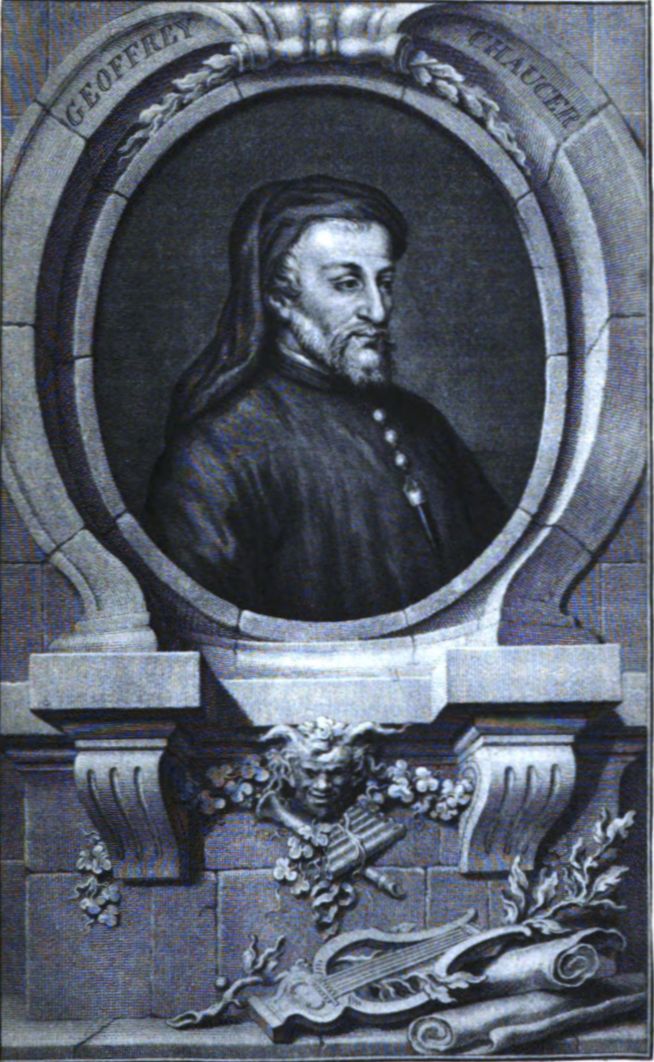
GEOFFREY CHAUCER. Photogravure from an old engraving.
He does more. The universal outburst of unchecked curiosity demands a more refined enjoyment: reverie and fantasy alone can satisfy it; not profound and thoughtful fantasy as we find it in Shakespeare, nor impassioned and meditative reverie as we find it in Dante, but the reverie and fantasy of the eyes, ears, external senses, which in poetry as in architecture call for singularity, wonders, accepted challenges, victories gained over the rational and probable, and which are satisfied only by what is crowded and dazzling. When we look at a cathedral of that time, we feel a sort of fear. Substance is wanting; the walls are hollowed out to make room for windows, the elaborate work of the porches, the wonderful growth of the slender columns, the thin curvature of arches—everything seems to menace us; support has been withdrawn to give way to ornament. Without external prop or buttress, and artificial aid of iron clamp-work, the building would have crumbled to pieces on the first day; as it is, it undoes itself; we have to maintain on the spot a colony of masons continually to ward off the continual decay. But our sight grows dim in following the wavings and twistings of the endless fretwork; the dazzling rose-window of the portal and the painted glass throw a checkered light on the carved stalls of the choir, the gold-work of the altar, the long array of damascened and glittering copes, the crowd of statues, tier above tier; and amid this violet light, this quivering purple, amid these arrows of gold which pierce the gloom, the entire building is like the tail of a mystical peacock. So most of the poems of the time are barren of foundation; at most a trite morality serves them for mainstay: in short, the poet thought of nothing else than displaying before us a glow of colors and a jumble of forms. They are dreams or visions; there are five or six in Chaucer, and you will meet more on your advance to the Renaissance. But the show is splendid. Chaucer is transported in a dream to a temple of glass,[200] on the walls of which are figured in gold all the legends of Ovid and Vergil, an infinite train of characters and dresses, like that which, on the painted glass in the churches, occupied then the gaze of the faithful. Suddenly a golden eagle, which soars near the sun, and glitters like a carbuncle, descends with the swiftness of lightning, and carries him off in his talons above the stars, dropping him at last before the House of Fame, splendidly built of beryl, with shining windows and lofty turrets, and situated on a high rock of almost inaccessible ice. All the southern side was graven with the names of famous men, but the sun was continuously melting them. On the northern side, the names, better protected, still remained. On the turrets appeared the minstrels and "gestiours," with Orpheus, Arion, and the great harpers, and behind them myriads of musicians, with horns, flutes, bagpipes, and reeds, on which they played, and which filled the air; then all the charmers, magicians, and prophets. He enters, and in a high hall, plated with gold, embossed with pearls, on a throne of carbuncle, he sees a woman seated, a "noble quene," amidst an infinite number of heralds, whose embroidered cloaks bore the arms of the most famous knights in the world, and heard the sounds of instruments, and the celestial melody of Calliope and her sisters. From her throne to the gate was a row of pillars, on which stood the great historians and poets; Josephus on a pillar of lead and iron; Statius on a pillar of iron stained with tiger's blood; Ovid, "Venus's clerk," on a pillar of copper; then, on one higher than the rest, Homer and Livy, Dares the Phrygian, Guido Colonna, Geoffrey of Monmouth, and the other historians of the war of Troy. Must I go on copying this phantasmagoria, in which confused erudition mars picturesque invention, and frequent banter shows signs that the vision is only a planned amusement? The poet and his reader have imagined for half-an-hour decorated halls and bustling crowds; a slender thread of common-sense has ingeniously crept along the transparent golden mist which they amuse themselves with following. That suffices; they are pleased with their fleeting fancies, and ask no more.
Amid this exuberancy of mind, amid these refined cravings, and this insatiate exaltation of imagination and the senses, there was one passion, that of love, which, combining all, was developed in excess, and displayed in miniature the sickly charm, the fundamental and fatal exaggeration, which are the characteristics of the age, and which, later, the Spanish civilization exhibits both in its flower and its decay. Long ago, the courts of love in Provence had established the theory. "Each one who loves," they said, "grows pale at the sight of her whom he loves; each action of the lover ends in the thought of her whom he loves. Love can refuse nothing to love."[201] This search after excessive sensation had ended in the ecstasies and transports of Guido Cavalcanti, and of Dante; and in Languedoc a company of enthusiasts had established themselves, love-penitents, who, in order to prove the violence of their passion, dressed in summer in furs and heavy garments, and in winter in light gauze, and walked thus about the country, so that several of them fell ill and died. Chaucer, in their wake, explained in his verses the craft of love,[202] the Ten Commandments, the twenty statutes of love; and praised his lady, his "daieseye," his "Margarite," his "vermeil rose"; depicted love in ballads, visions, allegories, didactic poems, in a hundred guises. This is chivalrous, lofty love, as it was conceived in the Middle Ages; above all, tender love. Troilus loves Cressida like a troubadour; without Pandarus, her uncle, he would have languished, and ended by dying in silence. He will not reveal the name of her he loves. Pandarus has to tear it from him, perform all the bold actions himself, plan every kind of stratagem. Troilus, however, brave and strong in battle, can but weep before Cressida, ask her pardon, and faint. Cressida, on her side, has every delicate feeling. When Pandarus brings her Troilus's first letter, she begins by refusing it, and is ashamed to open it: she opens it only because she is told the poor knight is about to die. At the first words "all rosy hewed tho woxe she"; and though the letter is respectful, she will not answer it. She yields at last to the importunities of her uncle, and answers Troilus that she will feel for him the affection of a sister. As to Troilus, he trembles all over, grows pale when he sees the messenger return, doubts his happiness, and will not believe the assurance which is given him:
"But right so as these holtes and these hayis That han in winter dead ben and dry, Revesten hem in grene, whan that May is.... Right in that selfe wise, sooth for to sey, Woxe suddainly his herte full of joy."[203]
Slowly, after many troubles, and thanks to the efforts of Pandarus, he obtains her confession; and in this confession what a delightful charm!
"And as the newe abashed nightingale, That stinteth first, whan she beginneth sing, Whan that she heareth any heerdes tale, Or in the hedges any wight stearing, And after siker doeth her voice outring: Right so Creseide, whan that her drede stent, Opened her herte and told him her entent."[204]
He, as soon as he perceived a hope from afar,
"In chaunged voice, right for his very drede, Which voice eke quoke, and thereto his manere, Goodly abasht, and now his hewes rede, Now pale, unto Cresseide his ladie dere, With looke doun cast, and humble iyolden chere, Lo, the alderfirst word that him astart Was twice: 'Mercy, mercy, O my sweet herte!'"[205]
This ardent love breaks out in impassioned accents, in bursts of happiness. Far from being regarded as a fault, it is the source of all virtue. Troilus becomes braver, more generous, more upright, through it; his speech runs now on love and virtue; he scorns all villany; he honors those who possess merit, succors those who are in distress; and Cressida, delighted, repeats all day, with exceeding liveliness, this song, which is like the warbling of a nightingale:
"Whom should I thanken but you, god of love, Of all this blisse, in which to bathe I ginne? And thanked be ye, lorde for that I love, This is the right life that I am inne, To flemen all maner vice and sinne: This doeth me so to vertue for to entende That daie by daie I in my will amende. And who that saieth that for to love is vice,... He either is envious, or right nice, Or is unmightie for his shreudnesse To loven.... But I with all mine herte and all my might, As I have saied, woll love unto my last, My owne dere herte, and all mine owne knight, In whiche mine herte growen is so fast, And his in me, that it shall ever last."[206]
But misfortune comes. Her father Calchas demands her back, and the Trojans decide that they will give her up in exchange for prisoners. At this news she swoons, and Troilus is about to slay himself. Their love at this time seems imperishable; it sports with death, because it constitutes the whole of life. Beyond that better and delicious life which it created, it seems there can be no other:
"But as God would, of swough she abraide, And gan to sighe, and Troilus she cride, And he answerde: 'Lady mine, Creseide, Live ye yet?' and let his swerde doun glide: 'Ye herte mine, that thanked be Cupide,' (Quod she), and therwithal she sore sight, And he began to glade her as he might. "Took her in armes two and kist her oft, And her to glad, he did al his entent, For which her gost, that flikered aie a loft, Into her wofull herte ayen it went: But at the last, as that her eye glent Aside, anon she gan his sworde aspie, As it lay bare, and gan for feare crie. "And asked him why had he it out draw, And Troilus anon the cause her told, And how himself therwith he wold have slain, For which Creseide upon him gan behold, And gan him in her armes faste fold, And said: 'O mercy God, lo which a dede! Alas, how nigh we weren bothe dede!'"[207]
At last they are separated, with what vows and what tears! and Troilus, alone in his chamber, murmurs:
"'Where is mine owne lady lefe and dere? Where is her white brest, where is it, where? Where been her armes, and her eyen clere That yesterday this time with me were?'... Nor there nas houre in al the day or night, Whan he was ther as no man might him here, That he ne sayd: 'O lovesome lady bright, How have ye faren sins that ye were there? Welcome ywis mine owne lady dere!'... Fro thence-forth he rideth up and doune, And every thing came him to remembraunce, As he rode forth by the places of the toune, In which he whilom had all his pleasaunce: 'Lo, yonder saw I mine owne lady daunce, And in that temple with her eien clere, Me caught first my right lady dere. And yonder have I herde full lustely My dere herte laugh, and yonder play Saw her ones eke ful blisfully, And yonder ones to me gan she say, "Now, good sweete, love me well I pray." And yonde so goodly gan she me behold, That to the death mine herte is to her hold, And at the corner in the yonder house Herde I mine alderlevest lady dere, So womanly, with voice melodiouse, Singen so wel, so goodly, and so clere, That in my soule yet me thinketh I here The blissful sowne, and in that yonder place, My lady first me toke unto her grace.'"[208]
None has since found more true and tender words. These are the charming "poetic branches" which flourished amid gross ignorance and pompous parades. Human intelligence in the Middle Age had blossomed on that side where it perceived the light.
But mere narrative does not suffice to express his felicity and fancy; the poet must go where "shoures sweet of rain descended soft."
"And every plaine was clothed faire With new greene, and maketh small floures To springen here and there in field and in mede, So very good and wholsome be the shoures, That it renueth that was old and dede, In winter time; and out of every sede Springeth the hearbe, so that every wight Of this season wexeth glad and light.... In which (grove) were okes great, streight as a line, Under, the which the grasse so fresh of hew Was newly sprong, and an eight foot or nine Every tree well fro his fellow grew."
He must forget himself in the vague felicity of the country, and, like Dante, lose himself in ideal light and allegory. The dreams love, to continue true, must not take too visible a form, nor enter into a too consecutive history; they must float in a misty distance; the soul in which they hover can no longer think of the laws of existence; it inhabits another world; it forgets itself in the ravishing emotion which troubles it, and sees its well-loved visions rise, mingle, come and go, as in summer we see the bees on a hill-slope flutter in a haze of light, and circle round and round the flowers.
"One morning,"[209] a lady sings, "at the dawn of day, I entered an oak-grove"
"With branches brode, laden with leves new, That sprongen out ayen the sunne-shene, Some very red, and some a glad light grenc....[210] "And I, that all this pleasaunt sight sie, Thought sodainly I felt so sweet and aire Of the eglentere, that certainely There is no hert, I deme, in such dispaire, Ne with thoughts froward and contraire, So overlaid, but it should soone have bote, If it had ones felt this savour sote. "And as I stood, and cast aside mine eie, I was ware of the fairest medler tree That ever yet in all my life I sie, As full of blossomes as it might be; Therein a goldfinch leaping pretile Fro bough to bough; and, as him list, he eet Here and there of buds and floures sweet.... "And as I sat, the birds harkening thus, Methought that I heard voices sodainly, The most sweetest and most delicious That ever any wight, I trow truly, Heard in their life, for the armony And sweet accord was in so good musike, That the voice to angels most was like."[211]
Then she sees arrive "a world of ladies... in surcotes white of velvet... set with emerauds... as of great pearles round and orient, and diamonds fine and rubies red." And all had on their head "a rich fret of gold... full of stately riche stones set," with "a chapelet of branches fresh and grene... some of laurer, some of woodbind, some of agnus castus"; and at the same time came a train of valiant knights in splendid array, with harness of red gold, shining in the sun, and noble steeds, with trappings "of cloth of gold, and furred with ermine." These knights and ladies were the servants of the Leaf, and they sate under a great oak, at the feet of their queen.
From the other side came a bevy of ladies as resplendent as the first, but crowned with fresh flowers. These were the servants of the Flower. They alighted, and began to dance in the meadow. But heavy clouds appeared in the sky, and a storm broke out. They wished to shelter themselves under the oak, but there was no more room; they ensconced themselves as they could in the hedges and among the brushwood; the rain came down and spoiled their garlands, stained their robes, and washed away their ornaments; when the sun returned, they went to ask succor from the queen of the Leaf; she, being merciful, consoled them, repaired the injury of the rain, and restored their original beauty. Then all disappears as in a dream.
The lady was astonished, when suddenly a fair dame appeared and instructed her. She learned that the servants of the Leaf had lived like brave knights, and those of the Flower had loved idleness and pleasure. She promises to serve the Leaf, and came away.
Is this an allegory? There is at least a lack of wit. There is no ingenious enigma; it is dominated by fancy, and the poet thinks only of displaying in quiet verse the fleeting and brilliant train which had amused his mind, and charmed his eyes.
Chaucer himself, on the first of May, rises and goes out into the meadows. Love enters his heart with the balmy air; the landscape is transfigured, and the birds begin to speak:
"There sate I downe among the faire flours, And saw the birds trip out of hir bours, There as they rested them all the night, They were so joyfull of the dayes light, They began of May for to done honours. "They coud that service all by rote, There was many a lovely note, Some song loud as they had plained, And some in other manner voice yfained And some all out with the ful throte. "The proyned hem and made hem right gay, And daunceden, and lepten on her spray, And evermore two and two in fere, Right so as they had chosen hem to yere, In Feverere upon saint Valentines day. "And the river that I sate upon, It made such a noise as it ron, Accordaunt with the birdes armony, Methought it was the best melody That might ben yheard of any mon."[212]
This confused harmony of vague noises troubles the sense; a secret languor enters the soul. The cuckoo throws his monotonous voice like a mournful and tender sigh between the white ash-tree boles; the nightingale makes his triumphant notes roll and ring above the leafy canopy; fancy breaks in unsought, and Chaucer hears them dispute of Love. They sing alternately an antistrophic song, and the nightingale weeps for vexation to hear the cuckoo speak in depreciation of Love. He is consoled, however, by the poet's voice, seeing that he also suffers with him:
"'For love and it hath doe me much wo.' 'Ye use' (quod she) 'this medicine Every day this May or thou dine Go looke upon the fresh daisie, And though thou be for wo in point to die, That shall full greatly lessen thee of thy pine. "'And looke alway that thou be good and trew, And I wol sing one of the songes new, For love of thee, as loud as I may crie:' And than she began this song full hie, 'I shrewe all hem that been of love untrue.'"[213]
To such exquisite delicacies love, as with Petrarch, had carried poetry; by refinement even, as with Petrarch, it is lost now and then in its wit, conceits, clinches. But a marked characteristic at once separates it from Petrarch. If over-excited, it is also graceful, polished, full of archness, banter, fine sensual gayety, somewhat gossipy, as the French always paint love. Chaucer follows his true masters, and is himself an elegant speaker, facile, ever ready to smile, loving choice pleasures, a disciple of the "Roman de la Rose," and much less Italian than French.[214] The bent of French character makes of love not a passion, but a gay banquet, tastefully arranged, in which the service is elegant, the food exquisite, the silver brilliant, the two guests in full dress, in good humor, quick to anticipate and please each other, knowing how to keep up the gayety, and when to part. In Chaucer, without doubt, this other altogether worldly vein runs side by side with the sentimental element. If Troilus is a weeping lover, Pandarus is a lively rascal, who volunteers for a singular service with amusing urgency, frank immorality, and carries it out carefully, gratuitously, thoroughly. In these pretty attempts Chaucer accompanies him as far as possible, and is not shocked. On the contrary, he makes fun out of it. At the critical moment, with transparent hypocrisy, he shelters himself behind his "author." If you find the particulars free, he says, it is not my fault; "so writen clerks in hir bokes old," and "I mote, aftir min auctour, telle...." Not only is he gay, but he jests throughout the whole tale. He sees clearly through the tricks of feminine modesty; he laughs at it archly, knowing full well what is behind; he seems to be saying, finger on lip: "Hush! let the grand words roll on, you will be edified presently." We are, in fact, edified; so is he, and in the nick of time he goes away, carrying the light: "For ought I can aspies, this light nor I ne serven here of nought. Troilus," says uncle Pandarus, "if ye be wise, sweveneth not now, lest more folke arise." Troilus takes care not to swoon; and Cressida at last, being alone with him, speaks wittily and with prudent delicacy; there is here an exceeding charm, no coarseness. Their happiness covers all, even voluptuousness, with a profusion and perfume of its heavenly roses. At most a slight spice of archness flavors it: "and gode thrift he had full oft." Troilus holds his mistress in his arms: "with worse hap God let us never mete." The poet is almost as well pleased as they: for him, as for the men of his time, the sovereign good is love, not damped, but satisfied; they ended even by thinking such love a merit. The ladies declared in their judgments, that when people love, they can refuse nothing to the beloved. Love has become law; it is inscribed in a code; they combine it with religion; and there is a sacrament of love, in which the birds in their anthems sing matins.[215] Chaucer curses with all his heart the covetous wretches, the business men, who treat is as a madness:
"As would God, tho wretches that despise Service of love had eares al so long As had Mida, ful of covetise,... To teachen hem, that they been in the vice And lovers not, although they hold hem nice, ... God yeve hem mischaunce, And every lover in his trouth avaunce."[216]
He clearly lacks severity, so rare in southern literature. The Italians in the Middle Ages made a virtue of joy; and you perceive that the world of chivalry, as conceived by the French, expanded morality so as to confound it with pleasure.
SECTION IV.—Characteristics of the Canterbury Tales
There are other characteristics still more gay. The true Gallic literature crops up; obscene tales, practical jokes on one's neighbor, not shrouded in the Ciceronian style of Boccaccio, but related lightly by a man in good humor;[217] above all, active roguery, the trick of laughing at your neighbor's expense. Chaucer displays it better than Rutebeuf, and sometimes better than La Fontaine. He does not knock his men down; he pricks them as he passes, not from deep hatred or indignation, but through sheer nimbleness of disposition, and quick sense of the ridiculous; he throws his gibes at them by handfuls. His man of law is more a man of business than of the world:
"No wher so besy a man as he ther n'as, And yet he semed besier than he was."[218]
His three burgesses:
"Everich, for the wisdom that he can Was shapelich for to ben an alderman. For catel hadden they ynough and rent, And eke hir wives wolde it wel assent."[219]
Of the mendicant Friar he says:
"His wallet lay beforne him in his lappe, Bret-ful of pardon come from Rome al hote."[220]
The mockery here comes from the heart, in the French manner, without effort, calculation, or vehemence. It is so pleasant and so natural to banter one's neighbor! Sometimes the lively vein becomes so copious that it furnishes an entire comedy, indelicate certainly, but so free and life-like! Here is the portrait of the Wife of Bath, who has buried five husbands:
"Bold was hire face, and fayre and rede of hew, She was a worthy woman all hire live; Housbondes at the chirche dore had she had five, Withouten other compagnie in youthe.... In all the parish wif ne was ther non, That to the offring before hire shulde gon, And if ther did, certain so wroth was she. That she was out of alle charitee."[221]
What a tongue she has! Impertinent, full of vanity, bold, chattering, unbridled, she silences everybody, and holds forth for an hour before coming to her tale. We hear her grating, high-pitched, loud, clear voice, wherewith she deafened her husbands. She continually harps upon the same ideas, repeats her reasons, piles them up and confounds them, like a stubborn mule who runs along shaking and ringing his bells, so that the stunned listeners remain open-mouthed, wondering that a single tongue can spin out so many words. The subject was worth the trouble. She proves that she did well to marry five husbands, and she proves it clearly, like a woman who knew it, because she had tried it:
"God bad us for to wex and multiplie; That gentil text can I wel understond; Eke wel I wot, he sayd, that min husbond Shuld leve fader and moder, and take to me; But of no noumbre mention made he, Of bigamie or of octogamie; Why shuld men than speke of it vilanie? Lo here the wise king dan Solomon, I trow he hadde wives mo than on, (As wolde God it leful were to me To be refreshed half so oft as he,) Which a gift of God had he for alle his wives?... Blessed be God that I have wedded five. Welcome the sixthe whan that ever he shall.... He (Christ) spake to hem that wold live parfitly, And lordings (by your leve), that am nat I; I wol bestow the flour of all myn age In th' actes and the fruit of mariage.... An husbond wol I have, I wol not lette, Which shal be both my dettour and my thrall, And have his tribulation withall Upon his flesh, while that I am his wif."[222]
Here Chaucer has the freedom of Molière, and we possess it no longer. His good wife justifies marriage in terms just as technical as Sganarelle. It behooves us to turn the pages quickly, and follow in the lump only this Odyssey of marriages. The experienced wife, who has journeyed through life with five husbands, knows the art of taming them, and relates how she persecuted them with jealousy, suspicion, grumbling, quarrels, blows given and received; how the husband, checkmated by the continuity of the tempest, stooped at last, accepted the halter, and turned the domestic mill like a conjugal and resigned ass:
"For as an hors, I coude bite and whine; I coude plain, and I was in the gilt.... I plained first, so was our werre ystint. They were ful glad to excusen hem ful blive Of thing, the which they never agilt hir live.... I swore that all my walking out by night Was for to espien wenches that he dight.... For though the pope had sitten hem beside, I wold not spare hem at hir owen bord.... But certainly I made folk swiche chere, That in his owen grese I made him frie For anger, and for veray jalousie. By God, in erth I was his purgatorie, For which I hope his soule be in glorie."[223]
She saw the fifth first at the burial of the fourth:
"And Jankin oure clerk was on of tho: As helpe me God, whan that I saw him go Aftir the bere, me thought he had a paire Of legges and of feet, so clene and faire, That all my herte I yave unto his hold. He was, I trow, a twenty winter old, And I was fourty, if I shal say soth.... As helpe me God, I was a lusty on, And faire, and riche, and yonge, and well begon."[224]
"Yonge," what a word! Was human delusion ever more happily painted? How life-like is all, and how easy the tone. It is the satire of marriage. You will find it twenty times in Chaucer. Nothing more is wanted to exhaust the two subjects of French mockery than to unite with the satire of marriage the satire of religion.
We find it here; and Rabelais is not more bitter. The monk whom Chaucer paints is a hypocrite, a jolly fellow, who knows good inns and jovial hosts better than the poor and the hospitals:
"A Frere there was, a wanton and a mery... Ful wel beloved, and familier was he With frankeleins over all in his contree, And eke with worthy wimmen of the toun... Full swetely herde he confession, And pleasant was his absolution. He was an esy man to give penance, Ther as he wiste to han a good pitance: For unto a poure ordre for to give Is signe that a man is wel yshrive.... And knew wel the tavernes in every toun, And every hosteler and gay tapstere, Better than a lazar and a beggere.... It is not honest, it may not avance, As for to delen with no swich pouraille, But all with riche and sellers of vitaille.... For many a man so hard is of his herte, He may not wepe, although him sore smerte. Therfore in stede of weping and praieres, Men mote give silver to the poure freres."[225]
This lively irony had an exponent before in Jean de Meung. But Chaucer pushes it further, and gives it life and motion. His monk begs from house to house, holding out his wallet:
"In every hous he gan to pore and prie, And begged mele and chese, or elles corn.... 'Yeve us a bushel whete, or malt, or reye, A Goddes kichel, or a trippe of chese, Or elles what you list, we may not chese; A Goddes halfpeny, or a masse peny; Or yeve us of your braun, if ye have any, A dagon of your blanket, leve dame, Our suster dere (lo here I write your name).'... And whan that he was out at dore, anon, He planed away the names everich on."[226]
He has kept for the end of his circuit, Thomas, one of his most liberal clients. He finds him in bed, and ill; here is excellent fruit to suck and squeeze:
"'God wot,' quod he, 'laboured have I ful sore. And specially for thy salvation, Have I sayd many a precious orison.... I have this day ben at your chirche at messe... And ther I saw our dame, a, wher is she?'"[227]
The dame enters:
"This frere ariseth up ful curtisly, And hire embraceth in his armes narwe, And kisseth hire swete and chirketh as a sparwe."[228]...
Then, in his sweetest and most caressing voice, he compliments her, and says:
"'Thanked be God that you yaf soule and lif, Yet saw I not this day so faire a wif In all the chirche, God so save me.'"[229]
Have we not here already Tartuffe and Elmire? But the monk is with a farmer, and can go to work more quickly and directly. When the compliments ended, he thinks of the substance, and asks the lady to let him talk alone with Thomas. He must inquire after the state of his soul:
"'I wol with Thomas speke a litel throw: Thise curates ben so negligent and slow To gropen tendrely a conscience.... Now, dame,' quod he, 'jeo vous die sanz doute, Have I nat of a capon but the liver, And of your white bred nat but a shiver, And after that a rosted pigges hed (But I ne wolde for me no beest were ded), Than had I with you homly suffisance. I am a man of litel sustenance, My spirit hath his fostring in the Bible. My body is ay so redy and penible To waken, that my stomak is destroied.'"[230]
Poor man, he raises his hands to heaven, and ends with a sigh.
The wife tells him her child died a fortnight before. Straightway he manufactures a miracle; how could he earn his money in any better way? He had a revelation of this death in the "dortour" of the convent; he saw the child carried to paradise; he rose with his brothers, "with many a tere trilling on our cheke," and they sang a Te Deum:
"'For, sire and dame, trusteth me right wel, Our orisons ben more effectuel, And more we seen of Cristes secree thinges Than borel folk, although that they be kinges. We live in poverte, and in abstinence, And borel folk in richesse and dispence.... Lazer and Dives liveden diversely, And divers guerdon hadden they therby.'"[231]
Presently he spurts out a whole sermon, in a loathsome style, and with an interest which is plain enough. The sick man, wearied, replies that he has already given half his fortune to all kinds of monks, and yet he continually suffers. Listen to the grieved exclamation, the true indignation of the mendicant monk, who sees himself threatened by the competition of a brother of the cloth to share his client, his revenue, his booty, his food-supplies:
"The frere answered: 'O Thomas, dost thou so? What nedeth you diverse freres to seche? What nedeth him that hath a parfit leche, To sechen other leches in the toun? Your inconstance is your confusion. Hold ye than me, or elles our covent, To pray for you ben insufficient? Thomas, that jape n' is not worth a mite, Your maladie is for we han to lite.'"[232]
Recognize the great orator; he employs even the grand style to keep the supplies from being cut off:
"'A, yeve that covent half a quarter otes; And yeve that covent four and twenty grotes; And yeve that frere a peny, and let him go: Nay, nay, Thomas, it may no thing be so. What is a ferthing worth parted on twelve? Lo, eche thing that is oned in himself Is more strong, than whan it is yscatered... Thou woldest han our labour al for nought.'"[233]
Then he begins again his sermon in a louder tone, shouting at each word, quoting examples from Seneca and the classics, a terrible fluency, a trick of his trade, which, diligently applied, must draw money from the patient. He asks for gold, "to make our cloistre,"
"... 'And yet, God wot, uneth the fundament Parfourmed is, ne of our pavement N' is not a tile yet within our wones; By God, we owen fourty pound for stones. Now help Thomas, for him that harwed helle, For elles mote we oure bokes selle, And if ye lacke oure predication, Than goth this world all to destruction. For who so fro this world wold us bereve, So God me save, Thomas, by your leve, He wold bereve out of this world the sonne.'"[234]
In the end, Thomas in a rage promises him a gift, tells him to put his hand in the bed and take it, and sends him away duped, mocked, and covered with filth.
We have descended now to popular farce; when amusement must be had at any price, it is sought, as here, in broad jokes, even in filthiness. We can see how these two coarse and vigorous plants have blossomed in the dung of the Middle Ages. Planted by the sly fellows of Champagne and Ile-de-France, watered by the trouvères, they were destined fully to expand, speckled and ruddy, in the large hands of Rabelais. Meanwhile Chaucer plucks his nosegay from it. Deceived husbands, mishaps in inns, accidents in bed, cuffs, kicks, and robberies, these suffice to raise a loud laugh. Side by side with noble pictures of chivalry, he gives us a train of Flemish grotesque figures, carpenters, joiners, friars, summoners; blows abound, fists descend on fleshy backs; many nudities are shown; they swindle one another out of their corn, their wives; they pitch one another out of a window; they brawl and quarrel. A bruise, a piece of open filthiness, passes in such society for a sign of wit. The summoner, being rallied by the friar, gives him tit for tat:
"'This Frere bosteth that he knoweth helle, And, God it wot, that is but litel wonder, Freres and fendes ben but litel asonder. For parde, ye han often time herd telle How that a Frere ravished was to helle In spirit ones by a visoun, And as an angel lad him up and doun, To shewen him the peines that ther were,... And unto Sathanas he lad him doun. (And now hath Sathanas,' saith he, 'a tayl Broder than of a Carrike is the sayl.) Hold up thy tayl, thou Sathanas, quod he, ....... and let the Frere see Wher is the nest of Freres in this place. And er than half a furlong way of space, Right so as bees out swarmen of an hive, Out of the devils... ther gonnen to drive. A twenty thousand Freres on a route, And thurghout hell they swarmed all aboute, And com agen, as fast as they may gon.'"[235]
Such were the coarse buffooneries of the popular imagination.
SECTION V.—The Art of Chaucer
It is high time to return to Chaucer himself. Beyond the two notable characteristics which settle his place in his age and school of poetry, there are others which take him out of his age and school. If he was romantic and gay like the rest, it was after a fashion of his own. He observes characters, notes their differences, studies the coherence of their parts, endeavors to describe living individualities—a thing unheard of in his time, but which the renovators in the sixteenth century, and first among them Shakespeare, will do afterwards. Is it already the English positive common-sense and aptitude for seeing the inside of things which begins to appear? A new spirit, almost manly, pierces through, in literature as in painting, with Chaucer as with Van Eyck, with both at the same time; no longer the childish imitation of chivalrous life[236] or monastic devotion, but the grave spirit of inquiry and craving for deep truths, whereby art becomes complete. For the first time, in Chaucer as in Van Eyck, the character described stands out in relief; its parts are connected; it is no longer an unsubstantial phantom. You may guess its past and foretell its future action. Its externals manifest the personal and incommunicable details of its inner nature, and the infinite complexity of its economy and motion. To this day, after four centuries, that character is individualjzed and typical; it remains distinct in our memory, like the creations of Shakespeare and Rubens. We observe this growth in the very act. Not only does Chaucer, like Boccaccio, bind his tales into a single history; but in addition—and this is wanting in Boccaccio—he begins with the portrait of all his narrators, knight, summoner, man of law, monk, bailiff or reeve, host, about thirty distinct figures, of every sex, condition, age, each painted with his disposition, face, costume, turns of speech, little significant actions, habits, antecedents, each maintained in his character by his talk and subsequent actions, so that we can discern here, sooner than in any other nation, the germ of the domestic novel as we write it to-day. Think of the portraits of the franklin, the miller, the mendicant friar, and wife of Bath. There are plenty of others which show the broad brutalities, the coarse, tricks, and the pleasantries of vulgar life, as well as the gross and plentiful feastings of sensual life. Here and there honest old swashbucklers, who double their fists, and tuck up their sleeves; or contented beadles, who, when they have drunk, will speak nothing but Latin. But by the side of these there are some choice characters; the knight, who went on a crusade to Granada and Prussia, brave and courteous:
"And though that he was worthy he was wise, And of his port as meke as is a mayde. He never yet no vilanie ne sayde In alle his lif, unto no manere wight, He was a veray parfit gentil knight."[237] "With him, ther was his sone, a yonge Squier, A lover, and a lusty bacheler, With lockes crull as they were laide in presse. Of twenty yere of age he was I gesse. Of his stature he was of even lengthe, And wonderly deliver, and grete of strengthe. And he hadde be somtime in chevachie, In Flaundres, in Artois, and in Picardie, And borne him wel, as of so litel space, In hope to stonden in his ladies grace. Embrouded was he, as it were a mede Alle ful of fresshe floures, white and rede. Singing he was, or floyting alle the day, He was as fresshe, as is the moneth of May. Short was his goune, with sieves long and wide. Wel coude he sitte on hors, and fayre ride. He coude songes make, and wel endite, Juste and eke dance, and wel pourtraie and write. So hote he loved, that by nightertale He slep no more than doth the nightingale. Curteis he was, lowly and servisable, And carf befor his fader at the table."[238]
There is also a poor and learned clerk of Oxford; and finer still, and more worthy of a modern hand, the Prioress, "Madame Eglantine," who as a nun, a maiden, a great lady, is ceremonious, and shows signs of exquisite taste. Would a better be found nowadays in a German chapter, amid the most modest and lively bevy of sentimental and literary canonesses?
"Ther was also a Nonne, a Prioresse, That of hire smiling was ful simple and coy Hire gretest othe n'as but by Seint Eloy; And she was cleped Madame Eglentine. Ful wel she sange the service devine, Entuned in hire nose ful swetely; And Frenche she spake ful fayre and fetisly After the scole of Stratford-atte-bowe, For Frenche of Paris was to hire unknowe. At mete was she wel ytaughte withalle; So lette no morsel from hire lippes falle, No wette hire fingres in hire sauce depe. Wel coude she carie a morsel, and wel kepe, Thatte no drope ne fell upon hire brest. In curtesie was sette ful moche hire lest. Hire over lippe wiped she so clene, That in hire cuppe was no ferthing sene Of grese, whan she dronken hadde hire draught, Ful semely after hire mete she raught. And sikerly she was of grete disport And ful plesant, and amiable of port, And peined hire to contrefeten chere Of court, and ben estatelich of manere, And to ben holden digne of reverence."[239]
Are you offended by these provincial affectations? Not at all; it is delightful to behold these nice and pretty ways, these little affectations, the waggery and prudery, the half-worldly, half-monastic smile. We inhale a delicate feminine perfume, preserved and grown old under the stomacher:
"But for to speken of hire conscience, She was so charitable and so pitous, She wolde wepe if that she saw a mous Caughte in a trappe, if it were ded or bledde. Of smale houndes hadde she, that she fedde With rosted flesh, and milk, and wastel brede. But sore wept she if on of hem were dede, Or if men smote it with a yerde smert: And all was conscience and tendre herte."[240]
Many elderly ladies throw themselves into such affections as these for lack of others. Elderly! what an objectionable word have I employed! She was not elderly:
"Ful semely hire wimple ypinched was, Hire nose tretis; hire eyen grey as glas; Hire mouth ful smale, and therto soft and red; But sikerly she hadde a fayre forehed. It was almost a spanne brode I trowe; For hardily she was not undergrowe. Ful fetise was hire cloke, as I was ware. Of small corall aboute hire arm she bare A pair of bedes, gauded al with grene; And thereon heng a broche of gold ful shene, On whiche was first ywritten a crouned A, And after, Amor vincit omnia."[241]
A pretty ambiguous device, suitable either for gallantry or devotion; the lady was both of the world and the cloister: of the world, you may see it in her dress; of the cloister, you gather it from "another Nonne also with hire hadde she, that was hire chapelleine, and Preestes thre"; from the Ave Maria which she sings, the long edifying stories which she relates. She is like a fresh, sweet, and ruddy cherry, made to ripen in the sun, but which, preserved in an ecclesiastical jar, has become candied and insipid in the syrup.
Such is the power of reflection which begins to dawn, such the high art. Chaucer studies here, rather than aims at amusement; he ceases to gossip, and thinks; instead of surrendering himself to the facility of flowing improvisation, he plans. Each tale is suited to the teller; the young squire relates a fantastic and Oriental history; the tipsy miller a loose and comical story; the honest clerk the touching legend of Griselda. All these tales are bound together, and that much better than by Boccaccio, by little veritable incidents, which spring from the characters of the personages, and such as we light upon in our travels. The horsemen ride on in good humor, in the sunshine, in the open country; they converse. The miller has drunk too much ale, and will speak, "and for no man forbere." The cook goes to sleep on his beast, and they play practical jokes on him. The monk and the summoner getup a dispute about their respective lines of business. The host restores peace, makes them speak or be silent, like a man who has long presided in the inn parlor, and who has often had to check brawlers. They pass judgment on the stories they listen to: declaring that there are few Griseldas in the world; laughing at the misadventures of the tricked carpenter; drawing a lesson from the moral tale. The poem is no longer, as in the contemporary literature, a mere procession, but a painting in which the contrasts are arranged, the attitudes chosen, the general effect calculated, so that it becomes life and motion; we forget ourselves at the sight, as in the case of every lifelike work; and we long to get on horseback on a fine sunny morning, and canter along green meadows with the pilgrims to the shrine of the good saint of Canterbury.
Weigh the value of the words "general effect." According as we plan it or not, we enter on our maturity or infancy! The whole future lies in these two words. Savages or half savages, warriors of the Heptarchy or knights of the Middle Ages; up to this period, no one had reached to this point. They had strong emotions, tender at times, and each expressed them according to the original gift of his race, some by short cries, others by continuous babble. But they did not command or guide their impressions; they sang or conversed by impulse, at random, according to the bent of their disposition, leaving their ideas to present themselves as they might, and when they hit upon order, it was ignorantly and involuntarily. Here for the first time appears a superiority of intellect, which at the instant of conception suddenly halts, rises above itself, passes judgment, and says to itself, "This phrase tells the same thing as the last—remove it; these two ideas are disjointed—connect them; this description is feeble—reconsider it." When a man can speak thus he has an idea, not learned in the schools, but personal and practical, of the human mind, its process and needs, and of things also, their composition and combinations; he has a style, that is, he is capable of making everything understood and seen by the human mind. He can extract from every object, landscape, situation, character, the special and significant marks, so as to group and arrange them, in order to compose an artificial work which surpasses the natural work in its purity and completeness. He is capable, as Chaucer was, of seeking out in the old common forest of the Middle Ages, stories and legends, to replant them in his own soil, and make them send out new shoots. He has the right and the power, as Chaucer had, of copying and translating, because by dint of retouching he impresses on his translations and copies his original mark; he re-creates what he imitates, because through or by the side of worn-out fancies and monotonous stories, he can display, as Chaucer did, the charming ideas of an amiable and elastic mind, the thirty master-forms of the fourteenth century, the splendid freshness of the verdurous landscape and spring-time of England. He is not far from conceiving an idea of truth and life. He is on the brink of independent thought and fertile discovery. This was Chaucer's position. At the distance of a century and a half, he has affinity with the poets of Elizabeth[242] by his gallery of pictures, and with the reformers of the sixteenth century by his portrait of the good parson.
Affinity merely. He advanced a few steps beyond the threshold of his art, but he paused at the end of the vestibule. He half opens the great door of the temple, but does not take his seat there; at most, he sat down in it only at intervals. In "Arcite and Palamon," in "Troilus and Cressida," he sketches sentiments, but does not create characters; he easily and naturally traces the winding course of events and conversations, but does not mark the precise outline of a striking figure. If occasionally, as in the description of the temple of Mars, after the "Thebaid" of Statius, feeling at his back the glowing breeze of poetry, he draws out his feet, clogged with the mud of the Middle Ages, and at a bound stands upon the poetic plain on which Statius imitated Vergil and equalled Lucan, he, at other times, again falls back into the childish gossip of the trouvères, or the dull gabble of learned clerks—to "Dan Phebus or Apollo-Delphicus." Elsewhere, a commonplace remark on art intrudes in the midst of an impassioned description. He uses three thousand verses to conduct Troilus to his first interview. He is like a precocious and poetical child, who mingles in his love-dreams quotations from his grammar and recollections of his alphabet.[243] Even in the "Canterbury Tales" he repeats himself, unfolds artless developments, forgets to concentrate his passion or his idea. He begins a jest, and scarcely ends it. He dilutes a bright coloring in a monotonous stanza. His voice is like that of a boy breaking into manhood. At first a manly and firm accent is maintained, then a shrill sweet sound shows that his growth is not finished, and that his strength is subject to weakness. Chaucer sets out as if to quit the Middle Ages; but in the end he is there still. To-day he composes the "Canterbury Tales"; yesterday he was translating the "Roman de la Rose." To-day he is studying the complicated machinery of the heart, discovering the issues of primitive education or of the ruling disposition, and creating the comedy of manners; to-morrow he will have no pleasure but in curious events, smooth allegories, amorous discussions, imitated from the French, or learned moralities from the ancients. Alternately he is an observer and a trouvère; instead of the step he ought to have advanced, he has but made a half-step.
Who has prevented him, and the others who surround him? We meet with the obstacle in the tales he has translated of Melibeus, of the Parson, in his "Testament of Love" in short, so long as he writes verse, he is at his ease; as soon as he takes to prose, a sort of chain winds around his feet and stops him. His imagination is free, and his reasoning a slave. The rigid scholastic divisions, the mechanical manner of arguing and replying, the ergo, the Latin quotations, the authority of Aristotle and the Fathers, come and weigh down his budding thought. His native invention disappears under the discipline imposed. The servitude is so heavy that even in the work of one of his contemporaries, the "Testament of Love," which, for a long time, was believed to be written by Chaucer, amid the most touching plaints and the most smarting pains, the beautiful ideal lady, the heavenly mediator who appears in a vision, Love, sets her theses, establishes that the cause of a cause is the cause of the thing caused, and reasons as pedantically as they would at Oxford. In what can talent, even feeling, end, when it is kept down by such shackles? What succession of original truths and new doctrines could be found and proved, when in a moral tale, like that of Melibeus and his wife Prudence, it was thought necessary to establish a formal controversy, to quote Seneca and Job, to forbid tears, to bring forward the weeping Christ to authorize tears, to enumerate every proof, to call in Solomon, Cassiodorus, and Cato; in short, to write a book for schools? The public cares only for pleasant and lively thoughts; not serious and general ideas; these latter are for a special class only. As soon as Chaucer gets into a reflective mood, straightway Saint Thomas, Peter Lombard, the manual of sins, the treatise on definition and syllogism, the army of the ancients and of the Fathers, descend from their glory, enter his brain, speak in his stead; and the trouvère's pleasant voice becomes the dogmatic and sleep-inspiring voice of a doctor. In love and satire he has experience, and he invents; in what regards morality and philosophy he has learning, and copies. For an instant, by a solitary leap, he entered upon the close observation, and the genuine study of man; he could not keep his ground, he did not take his seat, he took a poetic excursion; and no one followed him. The level of the century is lower; he is on it himself for the most part. He is in the company of narrators like Froissart, of elegant speakers like Charles of Orléans, of gossipy and barren verse-writers like Gower, Lydgate, and Occleve. There is no fruit, but frail and fleeting blossoms, many useless branches, still more dying or dead branches; such is this literature. And why? Because it had no longer a root; after three centuries of effort, a heavy instrument cut it underground. This instrument was the Scholastic Philosophy.
SECTION VI.—Scholastic Philosophy
Beneath every literature there is a philosophy. Beneath, every work of art is an idea of nature and of life; this idea leads the poet. Whether the author knows it or not, he writes in order to exhibit it; and the characters which he fashions, like the events which he arranges, only serve to bring to light the dim creative conception which raises and combines them. Underlying Homer appears the noble life of heroic paganism and of happy Greece. Underlying Dante, the sad and violent life of fanatical Catholicism and of the much-hating Italians. From either we might draw a theory of man and of the beautiful. It is so with others; and this is how, according to the variations, the birth, blossoms, decline, or sluggishness of the master-idea, literature varies, is born, flourishes, degenerates, comes to an end. Whoever plants the one, plants the other: whoever undermines the one, undermines the other. Place in all the minds of any age a new grand idea of nature and life, so that they feel and produce it with their whole heart and strength, and you will see them, seized with the craving to express it, invent forms of art and groups of figures. Take away from these minds every grand new idea of nature and life, and you will see them, deprived of the craving to express all-important thoughts, copy, sink into silence, or rave.
What has become of all these all-important thoughts? What labor worked them out? What studies nourished them? The laborers did not lack zeal. In the twelfth century the energy of their minds was admirable. At Oxford there were thirty thousand scholars. No building in Paris could contain the crowd of Abelard's disciples; when he retired to solitude, they accompanied him in such a multitude that the desert became a town. No difficulty repulsed them. There is a story of a young boy, who, though beaten by his master, was wholly bent on remaining with him, that he might still learn. When the terrible encyclopædia of Aristotle was introduced, though disfigured and unintelligible it was devoured. The only question presented to them, that of universals, so abstract and dry, so embarrassed by Arabic obscurities and Greek subtitles, during centuries, was seized upon eagerly. Heavy and awkward as was the instrument supplied to them, I mean syllogism, they made themselves masters of it, rendered it still more heavy, plunged it into every object and in every direction. They constructed monstrous books, in great numbers, cathedrals of syllogism, of unheard-of architecture, of prodigious finish, heightened in effect by intensity of intellectual power, which the whole sum of human labor has only twice been able to match.[244] These young and valiant minds thought they had found the temple of truth; they rushed at it headlong, in legions, breaking in the doors, clambering over the walls, leaping into the interior, and so found themselves at the bottom of a moat. Three centuries of labor at the bottom of this black moat added not one idea to the human mind.
For consider the questions which they treat of. They seem to be marching, but are merely marking time. People would say, to see them moil and toil, that they will educe from heart and brain some great original creed, and yet all belief was imposed upon them from the outset. The system was made; they could only arrange and comment upon it. The conception comes not from them, but from Constantinople. Infinitely complicated and subtle as it is, the supreme work of Oriental mysticism and Greek metaphysics, so disproportioned to their young understanding, they exhaust themselves to reproduce it, and moreover burden their unpractised hands with the weight of a logical instrument which Aristotle created for theory and not for practice, and which ought to have remained in a cabinet of philosophical curiosities, without being ever carried into the field of action. "Whether the divine essence engendered the Son, or was engendered by the Father; why the three persons together are not greater than one alone; attributes determine persons, not substance, that is, nature; how properties can exist in the nature of God, and not determine it; if created spirits are local and can be circumscribed; if God can know more things than He is aware of";[245]—these are the ideas which they moot: what truth could issue thence? From hand to hand the chimera grows, and spreads wider its gloomy wings. "Can God cause that, the place and body being retained, the body shall have no position, that is, existence in place?—Whether the impossibility of being engendered is a constituent property of the First Person of the Trinity—Whether identity, similitude, and equality are real relations in God."[246] Duns Scotus distinguishes three kinds of matter: matter which is firstly first, secondly first, thirdly first. According to him, we must clear this triple hedge of thorny abstractions in order to understand the production of a sphere of brass. Under such a regimen, imbecility soon makes its appearance. Saint Thomas himself considers, "whether the body of Christ arose with its wounds—whether this body moves with the motion of the host and the chalice in consecration—whether at the first instant of conception Christ had the use of free judgment—whether Christ was slain by himself or by another?" Do you think you are at the limits of human folly? Listen. He considers "whether the dove in which the Holy Spirit appeared was a real animal—whether a glorified body can occupy one and the same place at the same time as another glorified body—whether in the state of innocence all children were masculine?" I pass over others as to the digestion of Christ, and some still more untranslatable.[247] This is the point reached by the most esteemed doctor, the most judicious mind, the Bossuet of the Middle Ages. Even in this ring of inanities the answers are laid down. Roscellinus and Abelard were excommunicated, exiled, imprisoned, because they swerved from it. There is a complete minute dogma which closes all issues; there is no means of escaping; after a hundred wriggles and a hundred efforts you must come and tumble into a formula. If by mysticism you try to fly over their heads, if by experience you endeavor to creep beneath, powerful talons await you at your exit. The wise man passes for a magician, the enlightened man for a heretic. The Waldenses, the Catharists, the disciples of John of Parma, were burned; Roger Bacon died only just in time, otherwise he might have been burned. Under this constraint men ceased to think; for he who speaks of thought, speaks of an effort at invention, an individual creation, an energetic action. They recite a lesson, or sing a catechism; even in paradise, even in ecstasy and the divinest raptures of love, Dante thinks himself bound to show an exact memory and a scholastic orthodoxy. How then with the rest? Some, like Raymond Lully, set about inventing an instrument of reasoning to serve in place of the understanding. About the fourteenth century, under the blows of Occam, this verbal science began to totter; they saw that its entities were only words; it was discredited. In 1367, at Oxford, of thirty thousand students, there remained six thousand;[248] they still set their "Barbara and Felapton," but only in the way of routine. Each one in turn mechanically traversed the petty region of threadbare cavils, scratched himself in the briers of quibbles, and burdened himself with his bundle of texts; nothing more. The vast body of science which was to have formed and vivified the whole thought of man, was reduced to a text-book.
So, little by little, the conception which fertilized and ruled all others, dried up; the deep spring, whence flowed all poetic streams, was found empty; science furnished nothing more to the world. What further works could the world produce? As Spain, later on, renewing the Middle Ages, after having shone splendidly and foolishly by her chivalry and devotion, by Lope de Vega and Calderon, Loyola and St. Theresa, became enervated through the Inquisition and through casuistry, and ended by sinking into a brutish silence; so the Middle Ages, outstripping Spain, after displaying the senseless heroism of the Crusades, and the poetical ecstasy of the cloister, after producing chivalry and saintship, Francis of Assisi, St. Louis, and Dante, languished under the Inquisition and the scholastic learning, and became extinguished in idle raving and inanity.
Must we quote all these good people who speak without having anything to say? You may find them in Warton;[249] dozens of translators, importing the poverties of French literature, and imitating imitations; rhyming chroniclers, most commonplace of men, whom we only read because we must accept history from every quarter, even from imbeciles; spinners and spinsters of didactic poems, who pile up verses on the training of falcons, on heraldry, on chemistry; editors of moralities, who invent the same dream over again for the hundredth time, and get themselves taught universal history by the goddess Sapience. Like the writers of the Latin decadence, these folk only think of copying, compiling, abridging, constructing in text-books, in rhymed memoranda, the encyclopædia of their times.
Listen to the most illustrious, the grave Gower—"morall Gower," as he was called![250] Doubtless here and there he contains a remnant of brilliancy and grace. He is like an old secretary of a Court of Love, André le Chapelain or any other, who would pass the day in solemnly registering the sentences of ladies, and in the evening, partly asleep on his desk, would see in a half-dream their sweet smile and their beautiful eyes.[251] The ingenious but exhausted vein of Charles of Orléans still flows in his French ballads. He has the same fondling delicacy, almost a little affected. The poor little poetic spring flows yet in thin, transparent streamlets over the smooth pebbles, and murmurs with a babble, pretty, but so low that at times you cannot hear it. But dull is the rest! His great poem, "Confessio Amantis," is a dialogue between a lover and his confessor, imitated chiefly from Jean de Meung, having for object, like the "Roman de la Rose," to explain and classify the impediments of love. The superannuated theme is always reappearing, covered by a crude erudition. You will find here an exposition of hermetic science, lectures on the philosophy of Aristotle, a treatise on politics, a litany of ancient and modern legends gleaned from the compilers, marred in the passage by the pedantry of the schools and the ignorance of the age. It is a cartload of scholastic rubbish; the sewer tumbles upon this feeble spirit, which of itself was flowing clearly, but now, obstructed by tiles, bricks, plaster, ruins from all quarters of the globe, drags on darkened and sluggish. Gower, one of the most learned of his time,[252] supposed that Latin was invented by the old prophetess Carmentis; that the grammarians, Aristarchus, Donatus, and Didymus, regulated its syntax, pronunciation, and prosody; that it was adorned by Cicero with the flowers of eloquence and rhetoric; then enriched by translations from the Arabic, Chaldæan, and Greek; and that at last, after much labor of celebrated writers, it attained its final perfection in Ovid, the poet of love. Elsewhere he discovered that Ulysses learned rhetoric from Cicero, magic from Zoroaster, astronomy from Ptolemy, and philosophy from Plato. And what a style! so long, so dull,[253] so drawn out by repetitions, the most minute details, garnished with references to his text, like a man who, with his eyes glued to his Aristotle and his Ovid, a slave of his musty parchments, can do nothing but copy and string his rhymes together. Schoolboys even in old age, they seem to believe that every truth, all wit, is their great wood-bound books; that they have no need to find out and invent for themselves; that their whole business is to repeat; that this is, in fact, man's business. The scholastic system had enthroned the dead letter, and peopled the world with dead understandings.