Volume 1 / Part 3 — PART III.—Prose (continued 4)
Henri Van Laun translation
"Leontes. What, hast smutch'd thy nose? They say it is a copy out of mine. Come, captain, We must be neat; not neat, but cleanly, captain:... Come, sir page, Look on me with your welkin eye: sweet villain! Most dear'st! my collop... Looking on the lines Of my boy's face, methoughts I did recoil Twenty-three years, and saw myself unbreech'd, In my green velvet coat, my dagger muzzled, Lest it should bite its master.... How like, methought, I then was to this kernel, This squash, this gentleman!... My brother, Are you so fond of your young prince as we Do seem to be of ours? Polixenes. If at home, sir, He's all my exercise, my mirth, my matter, Now my sworn friend and then mine enemy, My parasite, my soldier, statesman, all: He makes a July's day short as December, And with his varying childness cures in me Thoughts that would thick my blood."[636]
There are a score of such passages in Shakespeare. The great passions, with him as in nature, are preceded or followed by trivial actions, small-talk, commonplace sentiments. Strong emotions are accidents in our life: to drink, to eat, to talk of indifferent things, to carry out mechanically a habitual duty, to dream of some stale pleasure or some ordinary annoyance, that is in which we employ all our time. Shakespeare paints us as we are; his heroes bow, ask people for news, speak of rain and fine weather, as often and as casually as ourselves, on the very eve of falling into the extremity of misery, or of plunging into fatal resolutions. Hamlet asks what's o'clock, finds the wind biting, talks of feasts and music heard without; and this quiet talk, so unconnected with the action, so full of slight, insignificant facts, which chance alone has raised up and guided, lasts until the moment when his father's ghost, rising in the darkness, reveals the assassination which it is his duty to avenge.
Reason tells us that our manners should be measured; this is why the manners which Shakespeare paints are not so. Pure nature is violent, passionate: it admits no excuses, suffers no middle course, takes no count of circumstances, wills blindly, breaks out into railing, has the irrationality, ardor, anger of children. Shakespeare's characters have hot blood and a ready hand. They cannot restrain themselves, they abandon themselves at once to their grief, indignation, love, and plunge desperately down the steep slope, where their passion urges them. How many need I quote? Timon, Posthumus, Cressida, all the young girls, all the chief characters in the great dramas; everywhere Shakespeare paints the unreflecting impetuosity of the impulse of the moment. Capulet tells his daughter Juliet that in three days she is to marry Earl Paris, and bids her be proud of it; she answers that she is not proud of it, and yet she thanks the earl for this proof of love. Compare Capulet's fury with the anger of Orgon,[637] and you may measure the difference of the two poets and the two civilizations:
"Capulet. How now, how now, chop-logic! What is this? 'Proud,' and 'I thank you,' and 'I thank you not;' And yet 'not proud,' mistress minion, you, Thank me no thankings, nor proud me no prouds, But fettle your fine joints 'gainst Thursday next, To go with Paris to Saint Peter's church, Or I will drag thee on a hurdle thither. Out, you green-sickness carrion! out, you baggage! You tallow-face! Juliet. Good father, I beseech you on my knees, Hear me with patience but to speak a word. C. Hang thee, young baggage! disobedient wretch I tell thee what: get thee to church o' Thursday, Or never after look me in the face: Speak not, reply not, do not answer me; My fingers itch.... Lady C. You are too hot. C. God's bread! it makes me mad: Day, night, hour, tide, time, work, play, Alone, in company, still my care hath been To have her match'd: and having now provided A gentleman of noble parentage, Of fair demesnes, youthful, and nobly train'd, Stuff'd, as they say, with honorable parts, Proportion'd as one's thoughts would wish a man; And then to have a wretched puling fool, A whining mammet, in her fortune's tender, To answer, 'I'll not wed; I cannot love, I am too young; I pray you, pardon me,'— But, an you will not wed, I'll pardon you: Graze where you will, you shall not house with me: Look to't, think on't, I do not use to jest. Thursday is near; lay hand on heart, advise: An you be mine, I'll give you to my friend; An you be not, hang, beg, starve, die in the streets, For, by my soul, I'll ne'er acknowledge thee."[638]
This method of exhorting one's child to marry is peculiar to Shakespeare and the sixteenth century. Contradiction to these men was like a red rag to a bull; it drove them mad.
We might be sure that in this age, and on this stage, decency was a thing unknown. It is wearisome, being a check; men got rid of it, because it was wearisome. It is a gift of reason and morality; as indecency is produced by nature and passion. Shakespeare's words are too indecent to be translated. His characters call things by their dirty names, and compel the thoughts to particular images of physical love. The talk of gentlemen and ladies is full of coarse allusions; we should have to find out an alehouse of the lowest description to hear like words nowadays.[639]
It would be in an alehouse too that we should have to look for the rude jests and brutal kind of wit which form the staple of these conversations. Kindly politeness is the slow fruit of advanced reflection; it is a sort of humanity and kindliness applied to small acts and everyday discourse; it bids man soften towards others, and forget himself for the sake of others; it constrains genuine nature, which is selfish and gross. This is why it is absent from the manners of the drama we are considering. You will see carmen, out of sportiveness and good humor, deal one another hard blows; so it is pretty well with the conversation of the lords and ladies of Shakespeare who are in a sportive mood; for instance, Beatrice and Benedick, very well bred folk as things go,[640] with a great reputation for wit and politeness, whose smart retorts create amusement for the bystanders. These "skirmishes of wit" consist in telling one another plainly: You are a coward, a glutton, an idiot, a buffoon, a rake, a brute! You are a parrot's tongue, a fool, a... (the word is there). Benedick says:
"I will go... to the Antipodes... rather than hold three words' conference with this harpy.... I cannot endure my Lady Tongue.... Don Pedro. You have put him down, lady, you have put him down. Beatrice. So I would not he should do me, my lord, lest I should prove the mother of fools."[641]
We can infer the tone they use when in anger. Emilia, in "Othello," says:
"He call'd her whore; a beggar in his drink Could not have laid such terms upon his callat."[642]
They have a vocabulary of foul words as complete as that of Rabelais, and they exhaust it. They catch up handfuls of mud and hurl it at their enemy, not conceiving themselves to be smirched.
Their actions correspond. They go without shame or pity to the limits of their passion. They kill, poison, violate, burn; the stage is full of abominations. Shakespeare lugs upon the stage all the atrocious deeds of the Civil Wars. These are the ways of wolves and hyenas. We must read of Jack Cade's sedition[643] to gain an idea of this madness and fury. We might imagine we were seeing infuriated beasts, the murderous recklessness of a wolf in a sheepfold, the brutality of a hog fouling and rolling himself in filth and blood. They destroy, kill, butcher each other; with their feet in the blood of their victims, they call for food and drink; they stick heads on pikes and make them kiss one another, and they laugh.
"Jack Cade. There shall be in England seven halfpenny loaves sold for a penny.... There shall be no money; all shall eat and drink on my score, and I will apparel them all in one livery.... And here sitting upon London-stone, I charge and command that, of the city's cost, the pissing-conduit run nothing but claret wine this first year of our reign.... Away, burn all the records of the realm; my mouth shall be the parliament of England.... And henceforth all things shall be in common.... What canst thou answer to my majesty for giving up of Normandy unto Mounsieur Basimecu, the dauphin of France?... The proudest peer in the realm shall not wear a head on his shoulders, unless he pay me tribute; there shall not a maid be married, but she shall pay to me her maidenhead ere they have it. (Re-enter rebels with the heads of Lord Say and his son-in-law.) But is not this braver? Let them kiss one another, for they loved well when they were alive."[644]
Man must not be let loose; we know not what lusts and rage may brood under a sober guise. Nature was never so hideous, and this hideousness is the truth.
re these cannibal manners only met with among the scum? Why, the princes are worse. The Duke of Cornwall orders the old Earl of Gloucester to be tied to a chair, because, owing to him, King Lear has escaped:
"Fellows, hold the chair. Upon these eyes of thine I'll set my foot. (Gloucester is held down in the chair, while Cornwall plucks out one of his eyes, and sets his foot on it.) Glou. He that will think to live till he be old, Give me some help! O cruel: O you gods! Regan. One side will mock another; the other too. Cornwall. If you see vengeance— Servant. Hold your hand, my lord: I have served you ever since I was a child; But better service have I never done you, Than now to bid you hold. Regan. How now, you dog! Serv. If you did wear a beard upon your chin, I'd shake it on this quarrel. What do you mean? Corn. My villain! (Draws and runs at him.) Serv. Nay, then, come on, and take the chance of anger. (Draws; they fight; Cornwall is wounded.) Regan. Give me thy sword. A peasant stands up thus. (Snatches a sword, comes behind, and stabs him.) Serv. O, I am slain! My lord, you have one eye left To see some mischief on him. O! (Dies.) Corn. Lest it see more, prevent it. Out, vile jelly! Where is thy lustre now? Glou. All dark and comfortless. Where's my son?... Regan. Go thrust him out at gates, and let him smell His way to Dover."[645]
Such are the manners of that stage. They are unbridled, like those of the age, and like the poet's imagination. To copy the common actions of every-day life, the puerilities and feeblenesses to which the greatest continually sink, the outbursts of passion which degrade them, the indecent, harsh, or foul words, the atrocious deeds in which license revels, the brutality and ferocity of primitive nature, is the work of a free and unencumbered imagination. To copy this hideousness and these excesses with a selection of such familiar, significant, precise details, that they reveal under every word of every personage a complete civilization, is the work of a concentrated and all-powerful imagination. This species of manners and this energy of description indicate the same faculty, unique and excessive, which the style had already indicated.
SECTION IV.—Dramatis Personæ
On this common background stands out in striking relief a population of distinct living figures, illuminated by an intense light. This creative power is Shakespeare's great gift, and it communicates an extraordinary significance to his words. Every phrase pronounced by one of its characters enables us to see, besides the idea which it contains and the emotion which prompted it, the aggregate of the qualities and the entire character which produced it—the mood, physical attitude, bearing, look of the man, all instantaneously, with a clearness and force approached by no one. The words which strike our ears are not the thousandth part of those we hear within; they are like sparks thrown off here and there; the eyes catch rare flashes of flame; the mind alone perceives the vast conflagration of which they are the signs and the effect. He gives us two dramas in one: the first strange, convulsive, curtailed, visible; the other consistent, immense, invisible; the one covers the other so well, that as a rule we do not realize that we are perusing words: we hear the roll of those terrible voices, we see contracted features, glowing eyes, pallid faces; we see the agitation, the furious resolutions which mount to the brain with the feverish blood, and descend to the sharp-strung nerves. This property possessed by every phrase to exhibit a world of sentiments and forms, comes from the fact that the phrase is actually caused by a world of emotions and images. Shakespeare, when he wrote, felt all that we feel, and much besides. He had the prodigious faculty of seeing in a twinkling of the eye a complete character, body, mind, past and present, in every detail and every depth of his being, with the exact attitude and the expression of face, which the situation demanded. A word here and there of Hamlet or Othello would need for its explanation three pages of commentaries; each of the half-understood thoughts, which the commentator may have discovered, has left its trace in the turn of the phrase, in the nature of the metaphor, in the order of the words; nowadays, in pursuing these traces, we divine the thoughts. These innumerable traces have been impressed in a second, within the compass of a line. In the next line there are as many, impressed just as quickly, and in the same compass. You can gauge the concentration and the velocity of the imagination which creates thus.
These characters are all of the same family. Good or bad, gross or delicate, witty or stupid, Shakespeare gives them all the same kind of spirit which is his own. He has made of them imaginative people, void of will and reason, impassioned machines, vehemently jostled one against another, who were outwardly whatever is most natural and most abandoned in human nature. Let us act the play to ourselves, and see in all its stages this clanship of figures, this prominence of portraits.
Lowest of all are the stupid folk, babbling or brutish. Imagination already exists there, where reason is not yet born; it exists also there where reason is dead. The idiot and the brute blindly follow the phantoms which exist in their benumbed or mechanical brains. No poet has understood this mechanism like Shakespeare. His Caliban, for instance, a deformed savage, fed on roots, growls like a beast under the hand of Prospero, who has subdued him. He howls continually against his master, though he knows that every curse will be paid back with "cramps and aches." He is a chained wolf, trembling and fierce, who tries to bite when approached, and who crouches when he see's the lash raised. He has a foul sensuality, a loud base laugh, the gluttony of degraded humanity. He wishes to violate Miranda in her sleep. He cries for his food, and gorges himself when he gets it. A sailor who had landed in the island, Stephano, gives him wine; he kisses his feet, and takes him for a god; he asks if he has not dropped from heaven, and adores him. We find in him rebellious and baffled passions, which are eager to rise again and to be satiated. Stephano had beaten his comrade. Caliban cries, "Beat Him enough: after a little time I'll beat him too." He prays Stephano to come with him and murder Prospero in his sleep; he thirsts to lead him there, dances through joy and sees his master already with his "weasand" cut, and his brains scattered on the earth:
"Prithee, my king, be quiet. See'st thou here, This is the mouth o' the cell: no noise, and enter. Do that good mischief which may make this island Thine own forever, and I, thy Caliban, For aye thy foot-licker."[646]
Others, like Ajax and Cloten, are more like men, and yet it is pure mood that Shakespeare depicts in them, as in Caliban. The clogging corporeal machine, the mass of muscles, the thick blood sluggishly moving along in the veins of these fighting men, oppress the intelligence, and leave no life but for animal passions. Ajax uses his fists, and devours meat; that is his existence; if he is jealous of Achilles, it is pretty much as a bull is jealous of his fellow. He permits himself to be restrained and led by Ulysses, without looking before him: the grossest flattery decoys him. The Greeks have urged him to accept Hector's challenge. Behold him puffed up with pride, scorning to answer anyone, not knowing what he says or does. Thersites cries, "Good-morrow, Ajax"; and he replies, "Thanks, Agamemnon." He has no further thought than to contemplate his enormous frame, and roll majestically his big stupid eyes. When the day of the fight has come, he strikes at Hector as on an anvil. After a good while they are separated. "I am not warm yet," says Ajax, "let us fight again."[647] Cloten is less massive than this phlegmatic ox; but he is just as idiotic, just as vainglorious, just as coarse. The beautiful Imogen, urged by his insults and his scullion manners, tells him that his whole body is not worth as much a Posthumus's meanest garment. He is stung to the quick, repeats the words several times; he cannot shake off the idea, and runs at it again and again with his head down, like an angry ram:
"Cloten. 'His garment?' Now, the devil— Imogen. To Dorothy my woman hie thee presently— C. 'His garment?'... You have abused me: 'His meanest garment!'... I'll be revenged: 'His meanest garment!' Well."[648]
He gets some of Posthumus's garments, and goes to Milford Haven, expecting to meet Imogen there. On his way he mutters thus:
"With that suit upon my back, will I ravish her: first kill him, and in her eyes; there shall she see my valor, which will then be a torment to her contempt. He on the ground, my speech of insultment ended on his dead body, and when my lust has dined—which, as I say, to vex her I will execute in the clothes that she so praised—to the court I'll knock her back, foot her home again."[649]
Others again, are but babblers: for example, Polonius, the grave brainless counsellor; a great baby, not yet out of his "swathing clouts"; a solemn booby, who rains on men a shower of counsels, compliments, and maxims; a sort of court speaking-trumpet, useful in grand ceremonies, with the air of a thinker, but fit only to spout words. But the most complete of all these characters is that of the nurse in "Romeo and Juliet," a gossip, loose in her talk, a regular kitchen oracle, smelling of the stewpan and old boots, foolish, impudent, immoral, but otherwise a good creature, and affectionate to her nurse-child. Mark this disjointed and never-ending gossip's babble:
"Nurse. 'Faith I can tell her age unto an hour. Lady Capulet. She's not fourteen.... Nurse. Come Lammas-eve at night shall she be fourteen. Susan and she—God rest all Christian souls!— Were of an age: well, Susan is with God; She was too good for me: but, as I said, On Lammas-eve at night shall she be fourteen; That shall she, marry; I remember it well. 'Tis since the earthquake now eleven years; And she was wean'd—I never shall forget it— Of all the days of the year, upon that day: For I had then laid wormwood to my dug, Sitting in the sun under the dove-house wall; My lord and you were then at Mantua:— Nay, I do bear a brain:—but, as I said, When it did taste the wormwood on the nipple Of my dug and felt it bitter, pretty fool, To see it tetchy and fall out with the dug! Shake, quoth the dove-house: 'twas no need, I trow, To bid me trudge: And since that time it is eleven years; For then she could stand alone; nay, by the rood, She could have run and waddled all about; For even the day before, she broke her brow."[650]
Then she tells an indecent anecdote, which she begins over again four times. She is silenced: what then? She has her anecdote in her head, and cannot cease repeating it and laughing to herself. Endless repetitions are the mind's first step. The vulgar do not pursue the straight line of reasoning and of the story; they repeat their steps, as it were merely marking time: struck with an image, they keep it for an hour before their eyes, and are never tired of it. If they do advance, they turn aside to a hundred subordinate ideas before they get at the phrase required. They allow themselves to be diverted by all the thoughts which come across them. This is what the nurse does; and when she brings Juliet news of her lover, she torments and wearies her, less from a wish to tease than from a habit of wandering from the point:
"Nurse. Jesu, what haste? can you not stay awhile? Do you not see that I am out of breath? Juliet. How art thou out of breath, when thou hast breath To say to me that thou art out of breath? Is thy news good, or bad? answer to that; Say either, and I'll stay the circumstance: Let me be satisfied: is't good or bad? N. Well, you have made a simple choice; you know not how to choose a man: Romeo! no, not he: though his face be better than any man's, yet his legs excels all men's; and for a hand and a foot, and a body, though they be not to be talked on, yet they are past compare: he is not the flower of courtesy, but, I'll warrant him, as gentle as a lamb. Go thy ways, wench; serve God. What, have you dined at home? J. No, no: but all this did I know before. What says he of our marriage? what of that? N. Lord, how my head aches! what a head have I! It beats as it would fall in twenty pieces. My back o' t'other side—O, my back, my back! Beshrew your heart for sending me about, To catch my death with jaunting up and down! J. I' faith, I am sorry that thou art not well. Sweet, sweet, sweet nurse, tell me, what says my love? N. Your love says, like an honest gentleman, and a courteous, and a kind, and a handsome, and, I warrant, a virtuous—Where is your mother?"[651]
It is never-ending. Her gabble is worse when she comes to announce to Juliet the death of her cousin and the banishment of Romeo. It is the shrill cry and chatter of an overgrown asthmatic magpie. She laments, confuses the names, spins roundabout sentences, ends by asking for aqua-vitœ. She curses Romeo, then brings him to Juliet's chamber. Next day Juliet is ordered to marry Earl Paris; Juliet throws herself into her nurse's arms, praying for comfort, advice, assistance. The other finds the true remedy: Marry Paris,
"O, he's a lovely gentleman! Romeo's a dishclout to him: an eagle, madam, Hath not so green, so quick, so fair an eye As Paris hath. Beshrew my very heart, I think you are happy in this second match. For it excels your first."[652]
This cool immorality, these weather-cock arguments, this fashion of estimating love like a fishwoman, completes the portrait.
SECTION V.—Men of Wit
The mechanical imagination produces Shakespeare's fool-characters: a quick, venturesome, dazzling, unquiet imagination, produces his men of wit. Of wit there are many kinds. One, altogether French, which is but reason, a foe to paradox, scorner of folly, a sort of incisive common-sense, having no occupation but to render truth amusing and evident, the most effective weapon with an intelligent and vain people: such was the wit of Voltaire and the drawing-rooms. The other, that of improvisators and artists, is a mere inventive rapture, paradoxical, unshackled, exuberant, a sort of self-entertainment, a phantasmagoria of images, flashes of wit, strange ideas, dazing and intoxicating, like the movement and illumination in a ball-room. Such is the wit of Mercutio, of the clowns, of Beatrice, Rosalind, and Benedick. They laugh, not from a sense of the ridiculous, but from the desire to laugh. You must look elsewhere for the campaigns with aggressive reason makes against human folly. Here folly is in its full bloom. Our folk think of amusement, and nothing more. They are good-humored; they let their wit prance gayly over the possible and the impossible. They play upon words, contort their sense, draw absurd and laughable inferences, send them back to one another, and without intermission, as if with shuttlecocks, and vie with each other in singularity and invention. They dress all their ideas in strange or sparkling metaphors. The taste of the time was for masquerades; their conversation is a masquerade of ideas. They say nothing in a simple style; they only seek to heap together subtle things, far-fetched, difficult to invent and to understand; all their expressions are over-refined, unexpected, extraordinary; they strain their thought, and change it into a caricature. "Alas, poor Romeo!" says Mercutio, "he is already dead; stabbed with a white wench's black eye; shot through the ear with a love-song, the very pin of his heart cleft with the blind bow-boy's butt-shaft."[653] Benedick relates a conversation he has just held with his mistress: "O, she misused me past the endurance of a block! an oak, but with one green leaf on it would have answered her; my very visor began to assume life, and scold with her."[654] These gay and perpetual extravagances show the bearing of the speakers. They do not remain quietly seated in their chairs, like the Marquesses in the "Misanthrope"; they whirl round, leap, paint their faces, gesticulate boldly their ideas; their wit-rockets end with a song. Young folk, soldiers and artists, they let off their fireworks of phrases, and gambol round about. "There was a star danced, and under that was I born."[655] This expression of Beatrice's aptly describes the kind of poetical, sparkling, unreasoning, charming wit, more akin to music than to literature, a sort of dream, which is spoken out aloud, and whilst wide awake, not unlike that described by Mercutio:
"O, then, I see Queen Mab hath been with you. She is the fairies' midwife; and she comes In shape no bigger than an agate-stone On the fore-finger of an alderman, Drawn with a team of little atomies Athwart men's noses as they lie asleep; Her wagon-spokes made of long spinners' legs, The cover of the wings of grasshoppers, The traces of the smallest spider's web, The collars of the moonshine's watery beams, Her whip of cricket's bone, the lash of film, Her wagoner a small gray-coated gnat, Not half so big as a round little worm Prick'd from the lazy finger of a maid; Her chariot is an empty hazel-nut, Made by the joiner squirrel or old grub, Time out o' mind the fairies' coachmakers. And in this state she gallops night by night Through lovers' brains, and then they dream of love; O'er courtiers' knees, that dream on court'sies straight, O'er lawyers' fingers, who straight dream on fees, O'er ladies' lips, who straight on kisses dream.... Sometime she gallops o'er a courtier's nose, And then dreams he of smelling out a suit; And sometime comes she with a tithe-pig's tail Tickling a person's nose as a' lies asleep, Then dreams he of another benefice: Sometime she driveth o'er a soldier's neck, And then dreams he of cutting foreign throats, Of breaches, ambuscadoes, Spanish blades, Of healths five-fathom deep: and then anon Drums in his ear, at which he starts and wakes, And being thus frighted swears a prayer or two And sleeps again. This is that very Mab That plats the manes of horses in the night, And bakes the elf-locks in foul sluttish hairs, Which once untangled much misfortune bodes... This is she."[656]
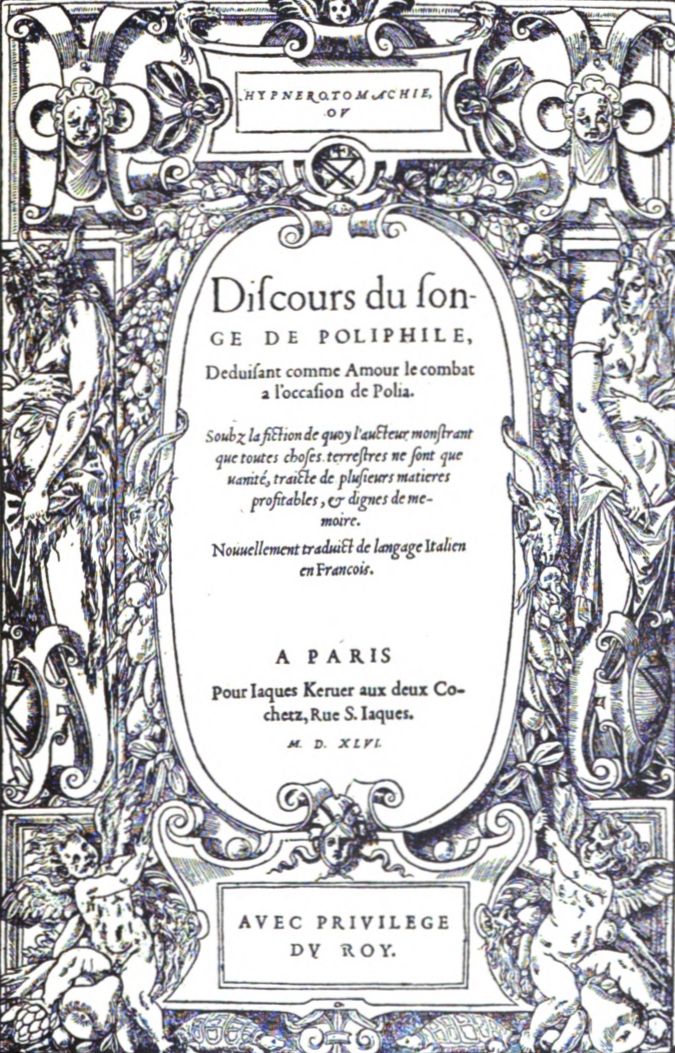
CHOICE EXAMPLES OF BOOK ILLUMINATION. Fac-similes from Illuminated Manuscripts and Illustrated Books of Early Date.
TITLE-PAGE OF THE HYPNEROTOMACHIA.
The present frontispiece belongs to a French translation of the work of Poliphilo, the only book with decorated borders and insertions ever published by the Venetian Aldi. They printed the Hypnerotomachia in 1499, and it was reproduced in a French translation, with the present title-page by the Parisian printer, Jacques Kerver, in 1546. All the profuse embellishments of the Aldine edition were retained, but the title-page here reproduced is from a design of the famous French sculptor, Jean Goujon.
Romeo interrupts him, or he would never end. Let the reader compare with the dialogue of the French theatre this little poem
"Child of an idle brain, Begot of nothing but vain fantasy,"[657]
introduced without incongruity in the midst of a conversation of the sixteenth century, and he will understand the difference between the wit which devotes itself to reasoning, or to record a subject for laughter, and that imagination which is self-amused with its own act.
Falstaff has the passions of an animal, and the imagination of a man of wit. There is no character which better exemplifies the fire and immorality of Shakespeare. Falstaff is a great supporter of disreputable places, swearer, gamester, idler, wine-bibber, as low as he well can be. He has a big belly, bloodshot eyes, bloated face, shaking legs; he spends his life with his elbows among the tavern-jugs, or asleep on the ground behind the arras; he only wakes to curse, lie, brag, and steal. He is as big a swindler as Panurge, who had sixty-three ways of making money, "of which the honestest was by sly theft." And what is worse, he is an old man, a knight, a courtier, and well educated. Must he not be odious and repulsive? By no means; we cannot help liking him. At bottom, like his brother Panurge, he is "the best fellow in the world." He has no malice in his composition; no other wish than to laugh and be amused. When insulted, he bawls out louder than his attackers, and pays them back with interest in coarse words and insults; but he owes them no grudge for it. The next minute he is sitting down with them in a low tavern, drinking their health like a brother and comrade. If he has vices, he exposes them so frankly that we are obliged to forgive him them. He seems to say to us, "Well, so I am, what then? I like drinking: isn't the wine good? I take to my heels when hard hitting begins; don't blows hurt? I get into debt, and do fools out their money; isn't it nice to have money in your pocket? I brag; isn't it natural to want to be well thought of?"—"Dost thou hear, Hal? thou knowest, in the state of innocency, Adam fell; and what should poor Jack Falstaff do in the days of villainy? Thou seest I have more flesh than another man, and therefore more frailty."[658] Falstaff is so frankly immoral, that he ceases to be so. Conscience ends at a certain point; nature assumes its place, and man rushes upon what he desires, without more thought of being just or unjust than an animal in the neighboring wood. Falstaff, engaged in recruiting, has sold exemptions to all the rich people, and only enrolled starved and half-naked wretches. There's but a shirt and a half in all his company: that does not trouble him. Bah: "they'll find linen enough on every hedge." The prince, who has seen them, says, "I did never see such pitiful rascals. Tut, tut," answers Falstaff, "good enough to toss; food for powder; they'll fill a pit as well as better; tush, man, mortal men, mortal men."[659] His second excuse is his unfailing spirit. If ever there was a man who could jabber, it is he. Insults and oaths, curses, jobations, protests, flow from him as from an open barrel. He is never at a loss; he devises a shift for every difficulty. Lies sprout out of him, fructify, increase, beget one another, like mushrooms on a rich and rotten bed of earth. He lies still more from his imagination and nature than from interest and necessity. It is evident from the manner in which he strains his fictions. He says he has fought alone against two men. The next moment it is four. Presently we have seven, then eleven, then fourteen. He is stopped in time, or he would soon be talking of a whole army. When unmasked, he does not lose his temper, and is the first to laugh at his boastings. "Gallants, lads, boys, hearts of gold.... What, shall we be merry? shall we have a play extempore?"[660] He does the scolding part of King Henry with so much truth that we might take him for a king, or an actor. This big potbellied fellow, a coward, a cynic, a brawler, a drunkard, a lewd rascal, a pothouse poet, is one of Shakespeare's favorites. The reason is, that his morals are those of pure nature, and Shakespeare's mind is congenial with his own.
SECTION VI.—Shakespeare's Women
Nature is shameless and gross amidst this mass of flesh, heavy with wine and fatness. It is delicate in the delicate body of women, but as unreasoning and impassioned in Desdemona as in Falstaff. Shakespeare's women are charming children, who feel in excess and love passionately. They have unconstrained manners, little rages, nice words of friendship, a coquettish rebelliousness, a graceful volubility, which recall the warbling and the prettiness of birds. The heroines of the French stage are almost men; these are women, and in every sense of the word. More imprudent than Desdemona a woman could not be. She is moved with pity for Cassio, and asks a favor for him passionately, recklessly, be the thing just or no, dangerous or no. She knows nothing of man's laws, and does not think of them. All that she sees is, that Cassio is unhappy:
"Be thou assured, good Cassio... My lord shall never rest; I'll watch him, tame and talk him out of patience; His bed shall seem a school, his board a shrift; I'll intermingle everything he does With Cassio's suit."[661]
She asks her favor:
"Othello. Not now, sweet Desdemona; some other time. Desdemona. But shall't be shortly? O. The sooner, sweet, for you. Des. Shall't be to-night at supper? O. No, not to-night. Des. To-morrow dinner, then? O. I shall not dine at home; I meet the captains at the citadel. Des. Why, then, to-morrow night; or Tuesday morn; On Tuesday noon, or night; on Wednesday morn; I prithee, name the time, but let it not Exceed three days: in faith, he's penitent."[662]
She is somewhat astonished to see herself refused: she scolds Othello. He yields: who would not yield seeing a reproach in those lovely sulking eyes? O, says she, with a pretty pout:
"This is not a boon; 'Tis as I should entreat you wear your gloves, Or feed on nourishing dishes, or keep you warm, Or sue to you to do peculiar profit To your own person."[663]
A moment after, when he prays her to leave him alone for a while, mark the innocent gayety, the ready observance, the playful child's tone:
"Shall I deny you? no: farewell, my lord.... Emilia, come: Be as your fancies teach you; Whate'er you be, I am obedient."[664]
This vivacity, this petulance, does not prevent shrinking modesty and silent timidity: on the contrary, they spring from a common cause, extreme sensibility. She who feels much and quickly has more reserve and more passion than others; she breaks out or is silent; she says nothing or everything. Such is this Imogen.
"So tender of rebukes that words are strokes, And strokes death to her."[665]
Such is Virgilia, the sweet wife of Coriolanus; her heart is not a Roman one; she is terrified at her husband's victories: when Volumnia describes him stamping on the field of battle, and wiping his bloody brow with his hand, she grows pale:
"His bloody brow! O Jupiter, no blood!... Heavens bless my lord from fell Aufidius!"[666]
She wishes to forget all that she knows of these dangers; she dare not think of them. When asked if Coriolanus does not generally return wounded, she cries, "O, no, no, no." She avoids this cruel picture, and yet nurses a secret pang at the bottom of her heart. She will not leave the house: "I'll not over the threshold till my lord return."[667] She does not smile, will hardly admit a visitor; she would blame herself, as for a lack of tenderness, for a moment's forgetfulness or gayety. When he does return, she can only blush and weep. This exalted sensibility must needs end in love. All Shakespeare's women love without measure, and nearly all at first sight. At the first look Juliet cast on Romeo, she says to the nurse:
"Go, ask his name: if he be married, My grave is like to be my wedding bed."[668]
It is the revelation of their destiny. As Shakespeare has made them, they cannot but love, and they must love till death. But this first look is an ecstasy: and this sudden approach of love is a transport. Miranda seeing Fernando, fancies that she sees "a thing divine." She halts motionless, in the amazement of this sudden vision, at the sound of these heavenly harmonies which rise from the depths of her heart. She weeps, on seeing him drag the heavy logs; with her slender white hands she would do the work whilst he reposed. Her compassion and tenderness carry her away; she is no longer mistress of her words, she says what she would not, what her father has forbidden her to disclose, what an instant before she would never have confessed. The too full heart overflows unwittingly, happy, and ashamed at the current of joy and new sensations with which an unknown feeling has flooded her:
"Miranda. I am a fool to weep at what I am glad of.... Fernando. Wherefore weep you? M. At mine unworthiness that dare not offer What I desire to give, and much less take What I shall die to want.... I am your wife, if you will marry me; If not, I'll die your maid."[669]
This irresistible invasion of love transforms the whole character. The shrinking and tender Desdemona, suddenly, in full Senate, before her father, renounces her father; dreams not for an instant of asking his pardon, or consoling him. She will leave for Cyprus with Othello, through the enemy's fleet and the tempest. Everything vanishes before the one and adored image which has taken entire and absolute possession of her whole heart. So, extreme evils, bloody resolves, are only the natural sequence of such love. Ophelia becomes mad, Juliet commits suicide; no one but looks upon such madness and death as necessary. You will not then discover virtue in these souls, for by virtue is implied a determinate desire to do good, and a rational observance of duty. They are only pure through delicacy or love. They recoil from vice as a gross thing, not as an immoral thing. What they feel is not respect for the marriage vow, but adoration of their husband. "O sweetest, fairest lily!" So Cymbeline speaks of one of these frail and lovely flowers which cannot be torn from the tree to which they have grown, whose least impurity would tarnish their whiteness. When Imogen learns that her husband means to kill her as being faithless, she does not revolt at the outrage; she has no pride, but only love. "False to his bed!" She faints at the thought that she is no longer loved. When Cordelia hears her father, an irritable old man, already almost insane, ask her how she loves him, she cannot make up her mind to say aloud the flattering protestations which her sisters have been lavishing. She is ashamed to display her tenderness before the world, and to buy a dowry by it. He disinherits her, and drives her away; she holds her tongue. And when she afterwards finds him abandoned and mad, she goes on her knees before him, with such a touching emotion, she weeps over that dear insulted head with so gentle a pity, that you might fancy it was the tender voice of a desolate but delighted mother, kissing the pale lips of her child:
"O yon kind gods, Cure this great breach in his abused nature! The untuned and jarring senses, O, wind up Of this child-changed father!... O my dear father! Restoration hang Thy medicine on my lips; and let this kiss Repair those violent harms that my two sisters Have in thy reverence made!... Was this a face To be opposed against the warring winds? ... Mine enemy's dog, Though he had bit me, should have stood that night Against my fire.... How does my royal lord? How fares your majesty?"[670]
If, in short, Shakespeare comes across a heroic character, worthy of Corneille, a Roman, such as the mother of Coriolanus, he will explain by passion what Corneille would have explained by heroism. He will depict it violent and thirsting for the violent feelings of glory. She will not be able to refrain herself. She will break out into accents of triumph when she sees her son crowned; into imprecations of vengeance when she sees him banished. She will descend to the vulgarities of pride and anger; she will abandon herself to mad effusions of joy, to dreams of an ambitious fancy,[671] and will prove once more that the impassioned imagination of Shakespeare has left its trace in all the creatures whom it has called forth.
SECTION VII.—Types of Villains
Nothing is easier to such a poet than to create perfect villains. Throughout he is handling the unruly passions which make their character, and he never hits upon the moral law which restrains them; but at the same time, and by the same faculty, he changes the inanimate masks, which the conventions of the stage mould on an identical pattern, into living and illusory figures. How shall a demon be made to look as real as a man? Iago is a soldier of fortune who has roved the world from Syria to England, who, nursed in the lowest ranks, having had close acquaintance with the horrors of the wars of the sixteenth century, had drawn thence the maxims of a Turk and the philosophy of a butcher; principles he has none left. "O my reputation, my reputation!" cries the dishonored Cassio. "As I am an honest man," says Iago, "I thought you had received some bodily wound; there is more sense in that than in reputation."[672] As for woman's virtue, he looks upon it like a man who has kept company with slave-dealers. He estimates Desdemona's love as he would estimate a mare's: that sort of thing lasts so long—then... And then he airs an experimental theory with precise details and nasty expressions like a stud doctor. "It cannot be that Desdemona should long continue her love to the Moor, nor he his to her.... These Moors are changeable in their wills;... the food that to him now is as luscious as locusts, shall be to him shortly as bitter as coloquintida. She must change for youth: when she is sated with his body, she will find the error of her choice."[673] Desdemona, on the shore, trying! to forget her cares, begs him to sing the praises of her sex. For every portrait he finds the most insulting insinuations. She insists, and bids him take the case of a deserving woman. "Indeed," he replies, "she was a wight, if ever such wight were,... to suckle fools and chronicle small beer."[674] He also says, when Desdemona asks him what he would write in praise of her: "O gentle lady do not put me to't, for I am nothing, if not critical."[675] This is the key to his character. He despises man; to him Desdemona is a little wanton wench, Cassio an elegant word-shaper, Othello a mad bull, Roderigo an ass to be basted, thumped, made to go. He diverts himself by setting these passions at issue; he laughs at it as at a play. When Othello, swooning, shakes in his convulsions, he rejoices at this capital result: "Work on, my medicine, work! Thus credulous fools are caught."[676] You would take him for one of the poisoners of the time, studying the effect of a new potion on a dying dog. He only speaks in sarcasms; he has them ready for everyone, even for those whom he does not know. When he wakes Brabantio to inform him of the elopement of his daughter, he tells him the matter in coarse terms, sharpening the sting of the bitter pleasantry, like a conscientious executioner, rubbing his hands when he hears the culprit groan under the knife. "Thou art a villain!" cries Brabantio. "You are—a senator!" answers Iago. But the feature which really completes him, and makes him take rank with Mephistopheles, is the atrocious truth and the cogent reasoning by which he likens his crime to virtue.[677] Cassio, under his advice, goes to see Desdemona, to obtain her intercession for him; this visit is to be the ruin of Desdemona and Cassio. Iago, left alone, hums for an instant quietly, then cries:
"And what's he then that says I play the villain? When this advice is free I give and honest, Probal to thinking and indeed the course To win the Moor again."[678]
To all these features must be added a diabolical energy,[679] an inexhaustible inventiveness in images, caricatures, obscenity, the manners of a guard-room, the brutal bearing and tastes of a trooper, habits of dissimulation, coolness, hatred, and patience, contracted amid the perils and devices of a military life, and the continuous miseries of long degradation and frustrated hope; you will understand how Shakespeare could transform abstract treachery into a concrete form, and how Iago's atrocious vengeance is only the natural consequence of his character, life, and training.
SECTION VIII.—Principal Characters
How much more visible is this impassioned and unfettered genius of Shakespeare in the great characters which sustain the whole weight of the drama! The startling imagination, the furious velocity of the manifold and exuberant ideas, passion let loose, rushing upon death and crime, hallucinations, madness, all the ravages of delirium bursting through will and reason: such are the forces and ravings which engender them. Shall I speak of dazzling Cleopatra, who holds Antony in the whirlwind of her devices and caprices, who fascinates and kills, who scatters to the winds the lives of men as a handful of desert dust, the fatal Eastern sorceress who sports with love and death, impetuous, irresistible, child of air and fire, whose life is but a tempest, whose thought, ever barbed and broken, is like the crackling of a lightning flash? Of Othello, who, beset by the graphic picture of physical adultery, cries at every word of Iago like a man on the rack; who, his nerves hardened by twenty years of war and shipwreck, grows mad and swoons for grief, and whose soul, poisoned by jealousy, is distracted and disorganized in convulsions and in stupor? Or of old King Lear, violent and weak, whose half-unseated reason is gradually toppled over under the shocks of incredible treacheries, who presents the frightful spectacle of madness, first increasing, then complete, of curses, bowlings, superhuman sorrows, into which the transport of the first access of fury carries him, and then of peaceful incoherence, chattering imbecility, into which the shattered man subsides; a marvellous creation, the supreme effort of pure imagination, a disease of reason, which reason could never have conceived?[680] Amid so many portraitures let us choose two or three to indicate the depth and nature of them all. The critic is lost in Shakespeare, as in an immense town; he will describe a couple of monuments, and entreat the reader to imagine the city.
Plutarch's Coriolanus is an austere, coldly haughty patrician, a general of the army. In Shakespeare's hands he becomes a coarse soldier, a man of the people as to his language and manners, an athlete of war, with a voice like a trumpet; whose eyes by contradiction are filled with a rush of blood and anger, proud and terrible in mood, a lion's soul in the body of a bull. The philosopher Plutarch told of him a lofty philosophic action, saying that he had been at pains to save his landlord in the sack of Corioli. Shakespeare's Coriolanus has indeed the same disposition, for he is really a good fellow; but when Lartius asks him the name of this poor Volscian, in order to secure his liberty, he yawns out:
"By Jupiter! forgot. I am weary; yea, my memory is tired. Have we no wine here?"[681]
He is hot, he has been fighting, he must drink; he leaves his Volscian in chains, and thinks no more of him. He fights like a porter, with shouts and insults, and the cries from that deep chest are heard above the din of the battle like the sounds from a brazen trumpet. He has scaled the walls of Corioli, he has butchered till he is gorged with slaughter. Instantly he turns to the army of Cominius, and arrives red with blood, "as he were flay'd. Come I too late?" Cominius begins to compliment him. "Come I too late?" he repeats. The battle is not yet finished: he embraces Cominius:
"O! let me clip ye In arms as sound as when I woo'd, in heart As merry as when our nuptial day was done."[682]
For the battle is a real holiday to him. Such senses, such a strong frame, need the outcry, the din of battle, the excitement of death and wounds. This haughty and indomitable heart needs the joy of victory and destruction. Mark the display of his patrician arrogance and his soldier's bearing, when he is offered the tenth of the spoils:
"I thank you, general; But cannot make my heart consent to take A bribe to pay my sword."[683]
The soldiers cry, Marcius! Marcius! and the trumpets sound. He gets into a passion: rates the brawlers:
"No more, I say! For that I have not wash'd My nose that bled, or foil'd some debile wretch— ... You shout me forth In acclamations hyperbolical; As if I loved my little should be dieted In praises sauced with lies."[684]
They are reduced to loading him with honors: Cominius gives him a war-horse; decrees him the cognomen of Coriolanus; the people shout Caius Marcius Coriolanus! He replies:
"I will go wash; And when my face is fair, you shall perceive Whether I blush or no: howbeit, I thank you. I mean to stride your steed."[685]
This loud voice, loud laughter, blunt acknowledgment, of a man who can act and shout better than speak, foretell the mode in which he will treat the plebeians. He loads them with insults; he cannot find abuse enough for the cobblers, tailors, envious cowards, down on their knees for a coin. "To beg of Hob and Dick! Bid them wash their faces and keep their teeth clean." But he must beg, if he would be consul; his friends constrain him. It is then that the passionate soul, incapable of self-restraint, such as Shakespeare knew how to paint, breaks forth without hinderance. He is there in his candidate's gown, gnashing his teeth, and getting up his lesson in this style:
"What must I say? 'I pray, sir'—Plague upon't! I cannot bring My tongue to such a pace:—'Look, sir, my wounds! I got them in my country's service, when Some certain of your brethren roar'd and ran From the noise of our own drums.'"[686]
The tribunes have no difficulty in stopping the election of a candidate who begs in this fashion. They taunt him in full Senate, reproach him with his speech about the corn. He repeats it, with aggravations. Once roused, neither danger nor prayer restrains him:
"His heart's his mouth: And, being angry, does forget that ever He heard the name of death."[687]
He rails against the people, the tribunes, ediles, flatterers of the plebs. "Come, enough," says his friend Menenius. "Enough, with over-measure," says Brutus the tribune. He retorts:
"No, take more: What may be sworn by, both divine and human, Seal what I end withal!... At once pluck out The multitudinous tongue; let them not lick The sweet which is their poison."[688]
The tribune cries, Treason! and bids seize him. He cries:
"Hence, old goat!... Hence, rotten thing! or I shall shake thy bones Out of thy garments!"[689]
He strikes him, drives the mob off: he fancies himself amongst Volscians. "On fair ground I could beat forty of them!" And when his friends hurry him off, he threatens still, and
"Speak(s) o' the people As if you (he) were a god to punish, not A man of their infirmity."[690]
Yet he bends before his mother, for he has recognized in her a soul as lofty and a courage as intractable as his own. He has submitted from his infancy to the ascendancy of this pride which he admires. Volumnia reminds him: "My praises made thee first a soldier." Without power over himself, continually tossed on the fire of his too hot blood, he has always been the arm, she the thought. He obeys from involuntary respect, like a soldier before his general, but with what effort!
"Coriolanus. The smiles of knaves Tent in my cheeks, and schoolboys' tears take up The glances of my sight! a beggar's tongue Make motion through my lips, and my arm'd knees Who bow'd but in my stirrup, bend like his That hath received an alms!—I will not do't.... Volumnia. ... Do as thou list. Thy valiantness was mine, thou suck'dst it from me, But owe thy pride thyself. Cor. Pray, be content: Mother, I am going to the market-place; Chide me no more. I'll mountebank their loves, Cog their hearts from them, and come home beloved Of all the trades in Rome."[691]
He goes, and his friends speak for him. Except a few bitter asides, he appears to be submissive. Then the tribunes pronounce the accusation, and summon him to answer as a traitor:
"Cor. How! traitor! Men. Nay, temperately: your promise. Cor. The fires i' the lowest hell fold-in the people! Call me their traitor! Thou injurious tribune! Within thine eyes sat twenty thousand deaths, In thy hands clutch'd as many millions, in Thy lying tongue both numbers, I would say, 'Thou liest,' unto thee with a voice as free As I do pray the gods."[692]
His friends surround him, entreat him: he will not listen; he foams at the mouth, he is like a wounded lion:
"Let them pronounce the steep Tarpeian death, Vagabond exile, flaying, pent to linger But with a grain a day, I would not buy Their mercy at the price of one fair word."[693]
The people vote exile, supporting by their shouts the sentence of the tribune:
"Cor. You common cry of curs! whose breath I hate As reek o' the rotten fens, whose love I prize As the dead carcasses of unburied men That do corrupt my air, I banish you.... Despising, For you, the city, thus I turn my back: There is a world elsewhere."[694]
Judge of his hatred by these raging words. It goes on increasing whilst waiting for vengeance. We find him next with the Volscian army before Rome. His friends kneel before him, he lets them kneel. Old Menenius, who had loved him as a son, only comes now to be driven away. "Wife, mother, child, I know not."[695] He knows not himself. For this strength of hating in a noble heart is the same as the force of loving. He has transports of tenderness as of rage, and can contain himself no more in joy than in grief. He runs, spite of his resolution, to his wife's arms; he bends his knee before his mother. He had summoned the Volscian chiefs to make them witnesses of his refusals; and before them, he grants all, and weeps. On his return to Corioli, an insulting word from Aufidius maddens him, and drives him upon the daggers of the Volscians. Vices and virtues, glory and misery, greatness and feebleness, the unbridled passion which composes his nature, endowed him with all.
If the life of Coriolanus is the history of a mood, that of Macbeth is the history of a monomania. The witches' prophecy has sunk into his mind at once, like a fixed idea. Gradually this idea corrupts the rest, and transforms the whole man. He is haunted by it; he forgets the thanes who surround him and "who stay upon his leisure"; he already sees in the future an indistinct chaos of images of blood:
"... Why do I yield to that suggestion Whose horrid image doth unfix my hair And make my seated heart knock at my ribs?... My thought, whose murder yet is but fantastical, Shakes so my single state of man that function Is smother'd in surmise, and nothing is But what is not."[696]
This is the language of hallucination. Macbeth's hallucination becomes complete when his wife has persuaded him to assassinate the king. He sees in the air a blood-stained dagger, "in form as palpable, as this which now I draw." His whole brain is filled with grand and terrible phantoms, which the mind of a common murderer could never have conceived: the poetry of which indicates a generous heart, enslaved to an idea of fate, and capable of remorse:
"... Now o'er the one half world Nature seems dead, and wicked dreams abuse The curtain'd sleep; witchcraft celebrates Pale Hecate's offerings, and wither'd murder, Alarum'd by his sentinel, the wolf, Whose howl's his watch, thus with his stealthy pace, With Tarquin's ravishing strides, towards his design Moves like a ghost.... (A bell rings.) I go, and it is done; the bell invites me. Hear it not, Duncan; for it is a knell That summons thee to heaven or to hell."[697]
He has done the deed, and returns tottering, haggard, like a drunken man. He is horrified at his bloody hands, "these hangman's hands." Nothing now can cleanse them. The whole ocean might sweep over them, but they would keep the hue of murder. "What hands are here? ha, they pluck out mine eyes!" He is disturbed by a word which the sleeping chamberlains uttered:
"One cried, 'God bless us!' and 'Amen' the other; As they had seen me with these hangman's hands. Listening their fear, I could not say 'Amen,' When they did say, 'God bless us!'... But wherefore could not I pronounce 'Amen!' I had most need of blessing, and 'Amen' Stuck in my throat."[698]
Then comes a strange dream; a frightful vision of the punishment that awaits him descends upon him.
Above the beating of his heart, the tingling of the blood which seethes in his brain, he had heard them cry:
"'Sleep no more! Macbeth does murder sleep,' the innocent sleep, Sleep that knits up the ravell'd sleave of care, The death of each day's life, sore labor's bath, Balm of hurt minds, great nature's second course, Chief nourisher in life's feast."[699]
And the voice, like an angel's trumpet, calls him by all his titles:
"'Glamis hath murder'd sleep, and therefore Cawdor Shall sleep no more; Macbeth shall sleep no more!'"[700]
This idea, incessantly repeated, beats in his brain, with monotonous and quick strokes, like the tongue of a bell. Insanity begins; all the force of his mind is occupied by keeping before him, in spite of himself, the image of the man whom he has murdered in his sleep:
"To know my deed, 'twere best not know myself. (Knock.) Wake Duncan with thy knocking! I would thou couldst!"[701]
Thenceforth, in the rare intervals in which the fever of his mind is assuaged, he is like a man worn out by a long malady. It is the sad prostration of maniacs worn out by their fits of rage:
"Had I but died an hour before this chance, I had lived a blessed time; for from this instant There's nothing serious in mortality: All is but toys: renown and grace is dead; The wine of life is drawn, and the mere lees Is left this vault to brag of."[702]
When rest has restored force to the human machine, the fixed idea shakes him again, and drives him onward, like a pitiless horseman, who has left his panting horse only for a moment, to leap again into the saddle, and spur him over precipices. The more he has done, the more he must do:
"I am in blood Stepp'd in so far that, should I wade no more, Returning were as tedious as go o'er..."[703]
He kills in order to preserve the fruit of his murders. The fatal circlet of gold attracts him like a magic jewel; and he beats down, from a sort of blind instinct, the heads, which he sees between the crown and him:
"But let the frame of things disjoint, both the worlds suffer, Ere we will eat our meal in fear and sleep In the affliction of these terrible dreams That shake us nightly: better be with the dead, Whom we to gain our peace, have sent to peace, Than on the torture of the mind to lie In restless ecstasy. Duncan is in his grave; After life's fitful fever he sleeps well; Treason has done his worst: nor steel, nor poison, Malice domestic, foreign levy, nothing, Can touch him further."[704]
Macbeth has ordered Banquo to be murdered, and in the midst of a great feast he is informed of the success of his plan. He smiles, and proposes Banquo's health. Suddenly, conscience-smitten, he sees the ghost of the murdered man; for this phantom, which Shakespeare summons, is not a mere stage-trick: we feel that here the supernatural is unnecessary, and that Macbeth would create it even if hell would not send it. With muscles twitching, dilated eyes, his mouth half open with deadly terror, he sees it shake its bloody head, and cries with that hoarse voice, which is only to be heard in maniacs' cells:
"Prithee, see there? Behold! look! lo! how say you? Why, what care I? If thou canst nod, speak too. If charnel-houses and our graves must send Those that we bury back, our monuments Shall be the maws of kites.... Blood hath been shed ere now, i' the olden time,... Ay, and since too, murders have been perform'd Too terrible for the ear: the times have been, That, when the brains were out, the man would die, And there an end; but now they rise again, With twenty mortal murders on their crowns, And push us from our stools:... Avaunt! and quit my sight! let the earth hide thee! Thy bones are marrowless, thy blood is cold; Thou hast no speculation in those eyes Which thou dost glare with!"[705]
His body trembling like that of an epileptic, his teeth clenched, foaming at the mouth, he sinks on the ground, his limbs writhe, shaken with convulsive quiverings, whilst a dull sob swells his panting breast, and dies in his swollen throat. What joy can remain for a man beset by such visions? The wide dark country, which he surveys from his towering castle, is but a field of death, haunted by ominous apparitions; Scotland, which he is depopulating, a cemetery,
"Where... the dead man's knell Is there scarce ask'd for who; and good men's lives Expire before the flowers in their caps. Dying or ere they sicken."[706]
His soul is "full of scorpions." He has "supp'd full with horrors," and the loathsome odor of blood has disgusted him with all else. He goes stumbling over the corpses which he has heaped up, with the mechanical and desperate smile of a maniac-murderer. Thenceforth death, life, all is one to him; the habit of murder has placed him out of the pale of humanity. They tell him that his wife is dead:
"Macbeth. She should have died hereafter; There would have been a time for such a word. To-morrow, and to-morrow, and to-morrow, Creeps in this petty pace from day to day To the last syllable of recorded time, And all our yesterdays have lighted fools The way to dusty death. Out, out, brief candle! Life's but a walking shadow; a poor player That struts and frets his hour upon the stage, And then is heard no more: it is a tale Told by an idiot, full of sound and fury, Signifying nothing."[707]
There remains for him the hardening of the heart in crime, the fixed belief in destiny. Hunted down by his enemies, "bearlike, tied to a stake," he fights, troubled only by the prediction of the witches, sure of being invulnerable so long as the man whom they have described does not appear. Henceforth his thoughts dwell on a supernatural world, and to the last he walks with his eyes fixed on the dream, which has possessed him, from the first.
The history of Hamlet, like that of Macbeth, is a story of moral poisoning. Hamlet has a delicate soul, an impassioned imagination, like that of Shakespeare. He has lived hitherto, occupied in noble studies, skilful in mental and bodily exercises, with a taste for art, loved by the noblest father, enamored of the purest and most charming girl, confiding, generous, not yet having perceived, from the height of the throne to which he was born, aught but the beauty, happiness, grandeur of nature and humanity.[708] On this soul, which character and training make more sensitive than others, misfortune suddenly falls, extreme, overwhelming of the very kind to destroy all faith and every motive for action: with one glance he has seen all the vileness of humanity; and this insight is given him in his mother. His mind is yet intact; but judge from the violence of his style, the crudity of his exact details, the terrible tension of the whole nervous machine, whether he has not already one foot on the verge of madness:
"O that this too, too solid flesh would melt, Thaw and resolve itself into a dew! Or that the Everlasting had not fix'd His canon 'gainst self-slaughter! O God! God! How weary, stale, flat and unprofitable, Seem to me all the uses of this world! Fie on't! ah fie! 'tis an unweeded garden, That grows to seed; things rank and gross in nature Possess it merely. That it should come to this! But two months dead: nay, not so much, not two: So excellent a king,... so loving to my mother That he might not let e'en the winds of heaven Visit her face too roughly. Heaven and earth! ... And yet, within a month— Let me not think on't—Frailty, thy name is woman!— A little month, or ere those shoes were old With which she follow'd my poor father's body,... Ere yet the salt of most unrighteous tears Had left the flushing in her galled eyes, She married. O, most wicked speed, to post With such dexterity to incestuous sheets! It is not nor it cannot come to good! But break, my heart; for I must hold my tongue!"[709]
Here already are contortions of thought, a beginning of hallucination, the symptoms of what is to come after. In the middle of conversation the image of his father rises before his mind. He thinks he sees him. How then will it be when the "canonised bones have burst their cerements," "the sepulchre hath oped his ponderous and marble jaws," and when the ghost comes in the night, upon a high "platform" of land, to tell him of the tortures of his prison of fire, and of the fratricide, who has driven him thither? Hamlet grows faint, but grief strengthens him, and he has a desire for living:
"Hold, hold, my heart; And you my sinews, grow not instant old, But bear me stiffly up! Remember thee! Ay, thou poor ghost, while memory holds a seat In this distracted globe.—Remember thee? Yea, from the table of my memory I'll wipe away all trivial fond records, All saws of books, all forms, all pressures past,... And thy commandment all alone shall live,... O villain, villain, smiling, damned villain! My tables—meet it is I set it down, That one may smile, and smile, and be a villain; At least I'm sure it may be so in Denmark: So, uncle, there you are."[710] (Writing.)
This convulsive outburst, this fevered writing hand, this frenzy of intentness, prelude the approach of a kind of monomania. When his friends come up, he treats them with the speeches of a child or an idiot. He is no longer master of his words; hollow phrases whirl in his brain, and fall from his mouth as in a dream. They call him; he answers by imitating the cry of a sportsman whistling to his falcon: "Hillo, ho, ho, boy! come, bird, come." Whilst he is in the act of swearing them to secrecy, the ghost below repeats "Swear." Hamlet cries, with a nervous excitement and a fitful gayety:
"Ah ha, boy! say'st thou so? art thou there, truepenny? Come on—you hear this fellow in the cellarage— Consent to swear.... Ghost (beneath). Swear. Hamlet. Hic et ubique? then we'll shift our ground. Come hither, gentlemen.... Swear by my sword. Ghost (beneath). Swear. Ham. Well said, old mole! canst work i' the earth so fast? A worthy pioneer!"[711]
Understand that as he says this his teeth chatter, "pale as his shirt, his knees knocking each other." Intense anguish ends with a kind of laughter, which is nothing else than a spasm. Thenceforth Hamlet speaks as though he had a continuous nervous attack. His madness is feigned, I admit; but his mind, as a door whose hinges are twisted, swings and bangs with every wind with a mad haste and with a discordant noise. He has no need to search for the strange ideas, apparent incoherencies, exaggerations, the deluge of sarcasms which he accumulates. He finds them within him; he does himself no violence, he simply gives himself up to himself. When he has the piece played which is to unmask his uncle, he raises himself, lounges on the floor, lays his head in Ophelia's lap; he addresses the actors, and comments on the piece to the spectators; his nerves are strung, his excited thought is like a surging and crackling flame, and cannot find fuel enough in the multitude of objects surrounding it, upon all of which it seizes. When the king rises unmasked and troubled, Hamlet sings, and says, "Would not this, sir, and a forest of feathers—if the rest of my fortunes turn Turk with me—with two Provincial roses on my razed shoes, get me a fellowship in a cry of players, sir!"[712] And he laughs terribly, for he is resolved on murder. It is clear that this state is a disease, and that the man will not survive it.
In a soul so ardent of thought, and so mighty of feeling, what is left but disgust and despair? We tinge all nature with the color of our thoughts; we shape the world according to our own ideas; when our soul is sick, we see nothing but sickness in the universe:
"This goodly frame, the earth, seems to me a sterile promontory, this most excellent canopy, the air, look you, this brave o'erhanging firmament, this majestical roof fretted with golden fire, why, it appears no other thing to me than a foul and pestilent congregation of vapors. What a piece of work is a man! how noble in reason! how infinite in faculty! in form and moving how express and admirable! in action how like an angel! in apprehension how like a god! the beauty of the world! the paragon of animals! And yet, to me, what is this quintessence of dust? man delights not me: no, nor woman neither."[713]
Henceforth his thought sullies whatever it touches. He rails bitterly before Ophelia against marriage and love. Beauty! Innocence! Beauty is but a means of prostituting innocence: "Get thee to a nunnery: why wouldst thou be a breeder of sinners?... What should such fellows as I do crawling between earth and heaven? We are arrant knaves, all; believe none of us."[714]
When he has killed Polonius by accident, he hardly repents it; it is one fool less. He jeers lugubriously:
"King. Now Hamlet, where's Polonius? Hamlet. At supper. K. At supper! where? H. Not where he eats, but where he is eaten: a certain convocation of politic worms are e'en at him."[715]
And he repeats in five or six fashions these gravedigger jests. His thoughts already inhabit a churchyard; to this hopeless philosophy a genuine man is a corpse. Public functions, honors, passions, pleasures, projects, science, all this is but a borrowed mask, which death removes, so that people may see what we are, an evil-smelling and grinning skull. It is this sight he goes to see by Ophelia's grave. He counts the skulls which the gravedigger turns up; this was a lawyer's, that a countier's. What bows, intrigues, pretensions, arrogance! And here now is a clown knocking it about with his spade, and playing "at loggats with 'em." Cæsar and Alexander have turned to clay and make the earth fat; the masters of the world have served to "patch a wall. Now get you to my lady's chamber, and tell her, let her paint an inch thick, to this favor she must come; make her laugh at that."[716] When a man has come to this, there is nothing left but to die.
This heated imagination, which explains Hamlet's nervous disease and his moral poisoning, explains also his conduct. If he hesitates to kill his uncle, it is not from horror of blood or from our modern scruples. He belongs to the sixteenth century. On board ship he wrote the order to behead Rosencrantz and Guildenstern, and to do so without giving them "shriving-time." He killed Polonius, he caused Ophelia's death, and has no great remorse for it. If for once he spared his uncle, it was because he found him praying, and was afraid of sending him to heaven. He thought he was killing him when he killed Polonius. What his imagination robs him of, is the coolness and strength to go quietly and with premeditation to plunge a sword into a breast. He can only do the thing on a sudden suggestion; he must have a moment of enthusiasm; he must think the king is behind the arras, or else, seeing that he himself is poisoned, he must find his victim under his foil's point. He is not master of his acts; opportunity dictates them; he cannot plan a murder, but must improvise it. A too lively imagination exhausts the will, by the strength of images which it heaps up, and by the fury of intentness which absorbs it. You recognize in him a poet's soul, made not to act, but to dream, which is lost in contemplating the phantoms of its creation, which sees the imaginary world too clearly to play a part in the real world; an artist whom evil chance has made a prince, whom worse chance has made an avenger of crime, and who, destined by nature for genius, is condemned by fortune to madness and unhappiness. Hamlet is Shakespeare, and, at the close of this gallery of portraits which have all some features of his own, Shakespeare has painted himself in the most striking of all.
If Racine or Corneille had framed a psychology, they would have said, with Descartes: Man is an incorporeal soul, served by organs, endowed with reason and will, dwelling in palaces or porticos, made for conversation and society, whose harmonious and ideal action is developed by discourse and replies, in a world constructed by logic beyond the realms of time and place.
If Shakespeare had framed a psychology, he would have said, with Esquirol:[717] Man is a nervous machine, governed by a mood, disposed to hallucinations, carried away by unbridled passions, essentially unreasoning, a mixture of animal and poet, having instead of mind rapture, instead of virtue sensibility, imagination for prompter and guide, and led at random, by the most determinate and complex circumstances, to sorrow, crime, madness, and death.
SECTION IX.—Characteristics of Shakespeare's Genius
Could such a poet always confine himself to the imitation of nature? Will this poetical world which is going on in his brain never break loose from the laws of the world of reality? Is he not powerful enough to follow his own laws? He is; and the poetry of Shakespeare naturally finds an outlet in the fantastical. This is the highest grade of unreasoning and creative imagination. Despising ordinary logic, it creates another; it unites facts and ideas in a new order, apparently absurd, in reality regular; it lays open the land of dreams, and its dreams seem to us the truth.
When we enter upon Shakespeare's comedies, and even his half-dramas,[718] it is as though we met him on the threshold, like an actor to whom the prologue is committed, to prevent misunderstanding on the part of the public, and to tell them: "Do not take too seriously what you are about to hear: I am amusing myself. My brain, being full of fancies, desired to array them, and here they are. Palaces, distant landscapes, transparent clouds which blot in the morning the horizon with their gray mists, the red and glorious flames into which the evening sun descends, white cloisters in endless vista through the ambient air, grottos, cottages, the fantastic pageant of all human passions, the irregular sport of unlooked-for adventures—this is the medley of forms, colors, sentiments, which I let become entangled and confused in my presence, a many-tinted skein of glistening silks, a slender arabesque, whose sinuous curves, crossing and mingled, bewilder the mind by the whimsical variety of their infinite complications. Don't regard it as a picture. Don't look for a precise composition, a sole and increasing interest, the skilful management of a well-ordered and congruous plot. I have tales and novels before me which I am cutting up into scenes. Never mind the finis, I am amusing myself on the road. It is not the end of the journey which pleases me, but the journey itself. Is there any need in going so straight and quick? Do you only care to know whether the poor merchant of Venice will escape Shylock's knife? Here are two happy lovers, seated under the palace walls on a calm night; wouldn't you like to listen to the peaceful reverie which arises like a perfume from the bottom of their hearts?"
"'How sweet the moonlight sleeps upon this bank! Here will we sit and let the sounds of music Creep in our ears: soft stillness and the night Become the touches of sweet harmony. Sit, Jessica. Look how the floor of heaven Is thick inlaid with patines of bright gold: There's not the smallest orb which thou behold'st, But in his motion like an angel sings, Still quiring to the young-eyed cherubims; Such harmony is in immortal souls; But whilst this muddy vesture of decay Doth grossly close it in, we cannot hear it. (Enter musicians.) Come, ho! and wake Diana with a hymn: With sweetest touches pierce your mistress' ear. And draw her home with music. Jessica. I am never merry when I hear sweet music.'"[719]
"Have I not the right, when I see the big laughing face of a clownish servant, to stop near him, see him gesticulate, frolic, gossip, go through his hundred pranks and his hundred grimaces, and treat myself to the comedy of his spirit and gayety? Two fine gentlemen pass by. I hear the rolling fire of their metaphors, and I follow their skirmish of wit. Here in a corner is the artless arch face of a young wench. Do you forbid me to linger by her, to watch her smiles, her sudden blushes, the childish pout of her rosy lips, the coquetry of her pretty motions? You are in a great hurry if the prattle of this fresh and musical voice can't stop you. Is it no pleasure to view this succession of sentiments and faces? Is your fancy so dull that you must have the mighty mechanism of a geometrical plot to shake it? My sixteenth century playgoers were easier to move. A sunbeam that had lost its way on an old wall, a foolish song thrown into the middle of a drama, occupied their mind as well as the blackest of catastrophes. After the horrible scene in which Shylock brandished his butcher's knife before Antonio's bare breast, they saw just as willingly the petty household wrangle, and the amusing bit of raillery which ends the piece. Like soft moving water, their soul rose and sank in an instant to the level of the poet's emotion, and their sentiments readily flowed in the bed he had prepared for them. They let him stray here and there on his journey, and did not forbid him to make two voyages at once. They allowed several plots in one. If but the slightest thread united them it was sufficient. Lorenzo eloped with Jessica, Shylock was frustrated in his revenge, Portia's suitors failed in the test imposed upon them; Portia, disguised as a doctor of laws, took from her husband the ring which he had promised never to part with; these three or four comedies, disunited, mingled, were shuffled and unfolded together, like an unknotted skein in which threads of a hundred colors are entwined. Together with diversity, my spectators allowed improbability. Comedy is a slight winged creature, which flutters from dream to dream, whose wings you would break if you held it captive in the narrow prison of common-sense. Do not press its fictions too hard; do not probe their contents. Let them float before your eyes like a charming swift dream. Let the fleeting apparition plunge back into the bright misty land from whence it came. For an instant it deluded you; let it suffice. It is sweet to leave the world of realities behind you; the mind rests amidst impossibilities. We are happy when delivered from the rough chains of logic, to wander amongst strange adventures, to live in sheer romance, and know that we are living there. I do not try to deceive you, and make you believe in the world where I take you. A man must disbelieve it in order to enjoy it. We must give ourselves up to illusion, and feel that we are giving ourselves up to it. We must smile as we listen. We smile in "The Winter's Tale" when Hermione descends from her pedestal, and when, Leontes discovers his wife in the statue, having believed her to be dead. We smile in "Cymbeline" when we see the lone cavern in which the young princes have lived like savage hunters. Improbability deprives emotions of their sting. The events interest or touch us without making us suffer. At the very moment when sympathy is too intense, we remind ourselves that it is all a fancy. They become like distant objects, whose distance softens their outline, and wraps them in a luminous veil of blue air. Your true comedy is an opera. We listen to sentiments without thinking too much of plot. We follow the tender or gay melodies without reflecting that they interrupt the action. We dream elsewhere on hearing music; here I bid you dream on hearing verse."
Then the speaker of the prologue retires, and the actors come on.
"As You Like It" is a caprice.[720] Action there is none; interest barely; likelihood still less. And the whole is charming. Two cousins, princes' daughters, come to a forest with a court clown, Celia disguised as a shepherdess, Rosalind as a boy. They find here the old duke, Rosalind's father, who, driven out of his duchy, lives with his friends like a philosopher and a hunter. They find amorous shepherds, who with songs and prayers pursue intractable shepherdesses. They discover or they meet with lovers who become their husbands. Suddenly it is announced that the wicked Duke Frederick, who had usurped the crown, has just retired to a cloister, and restored the throne to the old exiled duke. Everyone gets married, everyone dances, everything ends with a "rustic revelry." Where is the pleasantness of these puerilities? First, the fact of its being puerile; the absence of the serious is refreshing; There are no events, and there is no plot. We gently follow the easy current of graceful or melancholy emotions, which takes us away and moves us about without wearying. The place adds to the illusion and charm. It is an autumn forest, in which the sultry rays permeate the blushing oak leaves, or the half-stripped, ashes tremble and smile to the feeble breath of evening. The lovers wander by brooks that "brawl" under antique roots. As you listen to them you see the slim birches, whose cloak of lace grows glossy under the slant rays of the sun that gilds them, and the thoughts wander down the mossy vistas in which their footsteps are not heard. What better place could be chosen for the comedy of sentiment and the play of heart-fancies? Is not this a fit spot in which to listen to love-talk? Someone has seen Orlando, Rosalind's lover, in this glade; she hears it and blushes. "Alas the day!... What did he, when thou sawest him? What said he? How looked he? Wherein went he? What makes he here? Did he ask for me? Where remains he? How parted he with thee? and when shalt thou see him again?" Then, with a lower voice, somewhat hesitating: "Looks he as freshly as he did the day he wrestled?" She is not yet exhausted: "Do you not know I am a woman? When I think, I must speak. Sweet, say on."[721] One question follows another, she closes the mouth of her friend, who is ready to answer. At every word she jests, but agitated, blushing, with a forced gayety; her bosom heaves, and her heart beats. Nevertheless she is calmer when Orlando comes; bandies words with him; sheltered under her disguise, she makes him confess that he loves Rosalind. Then she plagues him, like the frolic, the wag, the coquette she is. "Why, how now, Orlando, where have you been all this while? You a lover?" Orlando repeats that he loves Rosalind, and she pleases herself by making him repeat it more than once. She sparkles with wit, jests, mischievous pranks; pretty fits of anger, feigned sulks, bursts of laughter, deafening babble, engaging caprices. "Come, woo me, woo me; for now I am in a holiday humor, and like enough to consent. What would you say to me now, an I were your very, very Rosalind?" And every now and then she repeats with an arch smile, "And I am your Rosalind; am I not your Rosalind?"[722] Orlando protests that he would die. Die! Who ever thought of dying for love? Leander? He took one bath too many in the Hellespont; so poets have said he died for love. Troilus? A Greek broke his head with a club; so poets have said he died for love. Come, come, Rosalind will be softer. And then she plays at marriage with him, and makes Celia pronounce the solemn words. She irritates and torments her pretended husband; tells him all the whims she means to indulge in, all the pranks she will play, all the teasing he will have to endure. The retorts come one after another like fireworks. At every phrase we follow the looks of these sparkling eyes, the curves of this laughing mouth, the quick movements of this supple figure. It is a bird's petulance and volubility. "O coz, coz, coz, my pretty little coz, that thou didst know how many fathom deep I am in love." Then she provokes her cousin Celia, sports with her hair, calls her by every woman's name. Antitheses without end, words all a-jumble, quibbles, pretty exaggerations, word-racket; as you listen, you fancy it is the warbling of a nightingale. The trill of repeated metaphors, the melodious roll of the poetical gamut, the summer-warbling rustling under the foliage, change the piece into a veritable opera. The three lovers end by chanting a sort of trio. The first throws out a fancy, the others take it up. Four times this strophe is renewed; and the symmetry of ideas, added to the jingle of the rhymes, makes of a dialogue a concerto of love:
"Phebe. Good shepherd, tell this youth what 'tis to love. Silvius. It is to be all made of sighs and tears; And so am I for Phebe. P. And I for Ganymede. Orlando. And I for Rosalind. Rosalind. And I for no woman.... S. It is to be all made of fantasy, All made of passion, and all made of wishes, All adoration, duty, and observance, All humbleness, all patience and impatience, All purity, all trial, all observance; And so I am for Phebe. P. And so am I for Ganymede. O. And so am I for Rosalind. R. And so am I for no woman."[723]
The necessity of singing is so urgent that a minute later songs break out of themselves. The prose and the conversation end in lyric poetry. We pass straight on into these odes. We do not find ourselves in a new country. We feel the emotion and foolish gayety as if it were a holiday. We see the graceful couple whom the song of the two pages brings before us, passing in the misty light "o'er the green corn-field," amid the hum of sportive insects, on the finest day of the flowering spring-time. Unlikelihood grows natural, and we are not astonished when we see Hymen leading the two brides by the hand to give them to their husbands.
Whilst the young folk sing, the old folk talk. Their life also is a novel, but a sad one. Shakespeare's delicate soul, bruised by the shocks of social life, took refuge in contemplations of solitary life. To forget the strife and annoyances of the world, he must bury himself in a wide silent forest, and
"Under the shade of melancholy boughs, Loose and neglect the creeping hours of time."[724]
We look at the bright images which the sun carves on the white beech-boles, the shade of trembling leaves flickering on the thick moss, the long waves of the summit of the trees; then the sharp sting of care is blunted; we suffer no more, simply remembering that we suffered once; we feel nothing but a gentle misanthropy, and being renewed, we are the better for it. The old duke is happy in his exile. Solitude has given him rest, delivered him from flattery, reconciled him to nature. He pities the stags which he is obliged to hunt for food:
"Come, shall we go and kill us venison? And yet it irks me the poor dappled fools, Being native burghers of this desert city, Should in their own confines with forked heads Have their round haunches gored."[725]
Nothing sweeter than this mixture of tender compassion, dreamy philosophy, delicate sadness, poetical complaints, and rustic songs. One of the lords sings:
"Blow, blow, thou winter wind, Thou art not so unkind As man's ingratitude; Thy tooth is not so keen, Because thou art not seen, Although thy breath be rude. Heigh-ho! sing, heigh-ho! unto the green holly: Most friendship is feigning, most loving mere folly: Then, heigh-ho, the holly! This life is most jolly."[726]
Amongst these lords is found a soul that suffers more, Jacques the melancholy, one of Shakespeare's best-loved characters, a transparent mask behind which we perceive the face of the poet. He is sad because he is tender; he feels the contact of things too keenly, and what leaves others indifferent, makes him weep.[727] He does not scold, he is sad; he does not reason, he is moved; he has not the combative spirit of a reforming moralist; his soul is sick and weary of life. Impassioned imagination leads quickly to disgust. Like opium, it excites and shatters. It leads man to the loftiest philosophy, then lets him down to the whims of a child. Jacques leaves other men abruptly, and goes to the quiet nooks to be alone. He loves his sadness, and would not exchange it for joy. Meeting Orlando, he says:
"Rosalind is your love's name? Orlando. Yes, just. Jacques. I do not like her name."[728]
He has the fancies of a nervous woman. He is scandalized because Orlando writes sonnets on the forest trees. He is eccentric, and finds subjects of grief and gayety where others would see nothing of the sort:
"A fool, a fool! I met a fool i' the forest, A motley fool; a miserable world! As I do live by food, I met a fool; Who laid him down and bask'd him in the sun, And rail'd on Lady Fortune in good terms, In good set terms and yet a motley fool...."
Jacques hearing him moralize in such a manner begins to laugh "sans intermission" that a fool could be so meditative:
"O noble fool; a worthy fool! Motley's the only wear.... O that I were a fool! I am ambitious for a motley coat."[729]
The next minute he returns to his melancholy dissertations, bright pictures whose vivacity explains his character, and betrays Shakespeare, hiding under his name:
"All the world's a stage, And all the men and women merely players: They have their exits and their entrances; And one man in his time plays many parts, His acts being seven ages. At first the infant, Mewling and puking in the nurse's arms. And then the whining schoolboy, with his satchel, And shining morning face, creeping like snail Unwillingly to school. And then the lover, Sighing like furnace, with a woeful ballad Made to his mistress' eyebrow. Then a soldier, Full of strange oaths and bearded like the pard, Jealous in honor, sudden and quick in quarrel, Seeking the bubble reputation Even in the cannon's mouth. And then the justice, In fair round belly with good capon lined, With eyes severe and beard of formal cut, Full of wise saws and modern instances; And so he plays his part. The sixth age shifts Into the lean and slipper'd pantaloon, With spectacles on nose and pouch on side, His youthful hose, well saved, a world too wide For his shrunk shank; and his big manly voice, Turning again toward childish treble, pipes And whistles in his sound. Last scene of all, That ends this strange eventful history, In second childishness and mere oblivion, Sans teeth, sans eyes, sans taste, sans everything."[730]
"As you Like it" is a half dream. "Midsummer Night's Dream" is a complete one.
The scene, buried in the far-off mist of fabulous antiquity, carries us back to Theseus, Duke of Athens, who is preparing his palace for his marriage with the beautiful queen of the Amazons. The style, loaded with contorted images, fills the mind with strange and splendid visions, and the airy elf-world divert the comedy into the fairy-land from whence it sprung.