Volume 1 / Part 3 — PART III.—Prose
Henri Van Laun translation
SECTION I.—The Decay of Poetry
Such an epoch can scarcely last, and the poetic vitality wears itself out by its very efflorescence, so that its expansion leads to its decline. From the beginning of the seventeenth century the subsidence of manners and genius grows apparent. Enthusiasm and respect decline. The minions and court-fops intrigue and pilfer, amid pedantry, puerility, and show. The court plunders, and the nation murmurs. The Commons begin to show a stern front, and the king, scolding them like a schoolmaster, gives way before them like a little boy. This sorry monarch (James I) suffers himself to be bullied by his favorites, writes to them like a gossip, calls himself a Solomon, airs his literary vanity, and in granting an audience to a courtier, recommends him to become a scholar, and expects to be complimented on his own scholarly attainments. The dignity of the government is weakened, and the people's loyalty is cooled. Royalty declines, and revolution is fostered. At the same time, the noble chivalric paganism degenerates into a base and coarse sensuality. The king, we are told, on one occasion, had got so drunk with his royal brother Christian of Denmark, that they both had to be carried to bed. Sir John Harrington says:
"The ladies abandon their sobriety, and are seen to roll about in intoxication.... The Lady who did play the Queen's part (in the Masque of the Queen of Sheba) did carry most precious gifts to both their Majesties; but, forgetting the steppes arising to the canopy, overset her caskets into his Danish Majesties lap, and fell at his feet, tho I rather think it was in his face. Much was the hurry and confusion; cloths and napkins were at hand, to make all clean. His Majestie then got up and would dance with the Queen of Sheba; but he fell down and humbled himself before her, and was carried to an inner chamber and laid on a bed of state; which was not a little defiled with the presents of the Queen which had been bestowed on his garments; such as wine, cream, jelly, beverage, cakes, spices, and other good matters. The entertainment and show went forward, and most of the presenters went backward, or fell down; wine did so occupy their upper chambers. Now did appear, in rich dress, Hope, Faith, and Charity: Hope did assay to speak, but wine rendered her endeavours so feeble that she withdrew, and hoped the king would excuse her brevity: Faith... left the court in a staggering condition.... They were both sick and spewing in the lower hall. Next came Victory, who... by a strange medley of versification... and after much lamentable utterance was led away like a silly captive, and laid to sleep in the outer steps of the anti-chamber. As for Peace, she most rudely made war with her olive branch, and laid on the pates of those who did oppose her coming. I ne'er did see such lack of good order, discretion, and sobriety in our Queen's days."[370]
Observe that these tipsy women were great ladies. The reason is, that the grand ideas which introduce an epoch, end, in their exhaustion, by preserving nothing but their vices; the proud sentiment of natural life becomes a vulgar appeal to the senses. An entrance, an arch of triumph under James I, often represented obscenities; and later, when the sensual instincts, exasperated by Puritan tyranny, begin to raise their heads once more, we shall find under the Restoration excess revelling in its low vices, and triumphing in its shamelessness.
Meanwhile literature undergoes a change; the powerful breeze which had wafted it on, and which, amidst singularity, refinement, exaggerations, had made it great, slackened and diminished. With Carew, Suckling, and Herrick, prettiness takes the place of the beautiful. That which strikes them is no longer the general features of things; and they no longer try to express the inner character of what they describe. They no longer possess that liberal conception, that instinctive penetration, by which we sympathize with objects, and grow capable of creating them anew. They no longer boast of that overflow of emotions, that excess of ideas and images, which compelled a man to relieve himself by words, to act externally, to represent freely and boldly the interior drama which made his whole body and heart tremble. They are rather wits of the court, cavaliers of fashion, who wish to show off their imagination and style. In their hands love becomes gallantry; they write songs, fugitive pieces, compliments to the ladies. There are no more upwellings from the heart. They write eloquent phrases in order to be applauded, and flattering exaggerations in order to please. The divine faces, the serious or profound looks, the virgin or impassioned expressions which burst forth at every step in the early poets, have disappeared; here we see nothing but agreeable countenances, painted in agreeable verses. Blackguardism is not far off; we meet with it already in Suckling, and crudity to boot, and prosaic epicurism; their sentiment is expressed before long, in such a phrase as: "Let us amuse ourselves, and a fig for the rest." The only objects they can still paint are little graceful things, a kiss, a May-day festivity, a dewy primrose, a daffodil, a marriage morning, a bee.[371] Herrick and Suckling especially produce little exquisite poems, delicate, ever pleasant or agreeable, like those attributed to Anacreon, or those which abound in the Anthology. In fact, here, as at the Grecian period alluded to, we are in the decline of paganism; energy departs, the reign of the agreeable begins. People do not relinquish the worship of beauty and pleasure, but dally with them. They deck and fit them to their taste; they cease to subdue and bend men, who enjoy them whilst they amuse them. It is the last beam of a setting sun; the genuine poetic sentiment dies out with Sedley, Waller, and the rhymesters of the Restoration; they write prose in verse; their heart is on a level with their style, and with an exact language we find the commencement of a new age and a new art.
Side by side with prettiness comes affectation; it is the second mark of their decadence. Instead of writing to express things, they write to say them well; they outbid their neighbors, and strain every mode of speech; they push art over on the one side to which it had a leaning; and as in this age it had a leaning towards vehemence and imagination, they pile up their emphasis and coloring. A jargon always springs out of a style. In all arts, the first masters, the inventors, discover the idea, steep themselves in it, and leave it to effect its outward form. Then come the second class, the imitators, who sedulously repeat this form, and alter it by exaggeration. Some nevertheless have talent, as Quarles, Herbert, Habington, Donne in particular, a pungent satirist, of terrible crudeness,[372] a powerful poet, of a precise and intense imagination, who still preserves something of the energy and thrill of the original inspiration.[373] But he deliberately spoils all these gifts, and succeeds with great difficulty in concocting a piece of nonsense. For instance, the impassioned poets had said to their mistress that if they lost her, they should hate all other women. Donne, in order to eclipse them, says:
"O do not die, for I shall hate All women so, when thou art gone, That thee I shall not celebrate When I remember thou wast one."[374]
Twenty times while reading him we rub our brow, and ask with astonishment, how a man could have so tormented and contorted himself, strained his style, refined on his refinement, hit upon such absurd comparisons? But this was the spirit of the age; they made an effort to be ingeniously absurd. A flea had bitten Donne and his mistress, and he says:
"This flea is you and I, and this Our mariage bed and mariage temple is. Though Parents grudge, and you, w' are met, And cloyster'd in these living walls of Jet. Though use make you apt to kill me, Let not to that selfe-murder added be, And sacrilege, three sins in killing three."[375]
The Marquis de Mascarille[376] never found anything to equal this. Would you have believed a writer could invent such absurdities? She and he made but one, for both are but one with the flea, and so one could not be killed without the other. Observe that the wise Malherbe wrote very similar enormities, in the "Tears of St. Peter," and that the sonneteers of Italy and Spain reach simultaneously the same height of folly, and you will agree that throughout Europe at that time they were at the close of a poetical epoch.
On this boundary line of a closing and a dawning literature a poet appeared, one of the most approved and illustrious of his time, Abraham Cowley,[377] a precocious child, a reader and a versifier like Pope, and who, like Pope, having known passions less than books, busied himself less about things than about words. Literary exhaustion has seldom been more manifest. He possesses all the capacity to say what pleases him, but he has precisely nothing to say. The substance has vanished, leaving in its place an empty form. In vain he tries the epic, the Pindaric strophe, all kinds of stanzas, odes, short lines, long lines; in vain he calls to his assistance botanical and philosophical similes, all the erudition of the university, all the recollections of antiquity, all the ideas of new science: we yawn as we read him. Except in a few descriptive verses, two or three graceful tendernesses,[378]he feels nothing, he speaks only; he is a poet of the brain. His collection of amorous pieces is but a vehicle for a scientific test, and serves to show that he has read the authors, that he knows geography, that he is well versed in anatomy, that he has a smattering of medicine and astronomy, that he has at his service comparisons and allusions enough to rack the brains of his readers. He will speak in this wise:
"Beauty, thou active—passive ill! Which dy'st thyself as fast as thou dost kill!"
Or will remark that his mistress is to blame for spending three hours every morning at her toilet, because
"They make that Beauty Tyranny, That's else a Civil-government."
After reading two hundred pages, you feel disposed to box his ears. You have to think, by way of consolation, that every grand age must draw to a close, that this one could not do so otherwise, that the old glow of enthusiasm, the sudden flood of rapture, images, whimsical and audacious fancies, which once rolled through the minds of men, arrested now and cooled down, could only exhibit dross, a curdling scum, a multitude of brilliant and offensive points. You say to yourself that, after all, Cowley had perhaps talent; you find that he had in fact one, a new talent, unknown to the old masters, the sign of a new culture, which needs other manners, and announces a new society. Cowley had these manners, and belongs to this society. He was a well-governed, reasonable, well-informed, polished, well-educated man, who, after twelve years of service and writing in France, under Queen Henrietta, retires at last wisely into the country, where he studies natural history, and prepares a treatise on religion, philosophizing on men and life, fertile in general reflections and ideas, a moralist, bidding his executor "to let nothing stand in his writings which might seem the least in the world to be an offence against religion or good manners." Such intentions and such a life produce and indicate less a poet, that is, a seer, a creator, than a literary man; I mean a man who can think and speak, and who therefore ought to have read much, learned much, written much, ought to possess a calm and clear mind, to be accustomed to polite society, sustained conversation, pleasantry. In fact, Cowley is an author by profession, the oldest of those who in England deserve the name. His prose is as easy and sensible as his poetry is contorted and unreasonable. A polished man, writing for polished men, pretty much as he would speak to them in a drawing-room—this I take to be the idea which they had of a good author in the seventeenth century. It is the idea which Cowley's essays leave of his character; it is the kind of talent which the writers of the coming age take for their model, and he is the first of that grave and amiable group which, continued in Temple, reaches so far as to include Addison.
SECTION II.—The Intellectual Level of the Renaissance
Having reached this point, the Renaissance seemed to have attained its limit, and, like a drooping and faded flower, to be ready to leave its place for a new bud which began to spring up amongst its withered leaves. At all events, a living and unexpected shoot sprang from the old declining stock. At the moment when art languished, science shot forth; the whole labor of the age ended in this. The fruits are not unlike; on the contrary, they come from the same sap, and by the diversity of the shape only manifest two distinct periods of the inner growth which has produced them. Every art ends in a science, and all poetry in a philosophy. For science and philosophy do but translate into precise formulas the original conceptions which art and poetry render sensible by imaginary figures: when once the idea of an epoch is manifested in verse by ideal creations, it naturally comes to be expressed in prose by positive arguments. That which had struck men on escaping from ecclesiastical oppression and monkish asceticism was the pagan idea of a life true to nature, and freely developed. They had found nature buried behind scholasticism, and they had expressed it in poems and paintings; in Italy by superb healthy corporeality, in England by vehement and unconventional spirituality, with such divination of its laws, instincts, and forms, that we might extract from their theatre and their pictures a complete theory of soul and body. When enthusiasm is past, curiosity begins. The sentiment of beauty gives way to the need of truth. The theory contained in works of imagination frees itself. The gaze continues fixed on nature, not to admire now, but to understand. From painting we pass to anatomy, from the drama to moral philosophy, from grand poetical divinations to great scientific views; the second continue the first, and the same mind displays itself in both; for what art had represented, and science proceeds to observe, are living things, with their complex and complete structure, set in motion by their internal forces, with no supernatural intervention. Artists and savants all set out, without knowing it themselves, from the same master conception, to wit, that nature subsists of herself, that every existence has in its own womb the source of its action, that the causes of events are the innate laws of things; an all-powerful idea, from which was to issue the modern civilization, and which, at the time I write of, produced in England and Italy, as before in Greece, genuine sciences, side by side with a complete art: after da Vinci and Michel Angelo, the school of anatomists, mathematicians, naturalists, ending with Galileo; after Spenser, Ben Jonson, and Shakespeare, the school of thinkers who surround Bacon and lead up to Harvey.
We have not far to look for this school. In the interregnum of Christianity the dominating bent of mind belongs to it. It was paganism which reigned in Elizabeth's court, not only in letters, but in doctrine—a paganism of the North, always serious, generally sombre, but which was based, like that of the South, on natural forces. In some men all Christianity had passed away; many proceeded to atheism through excess of rebellion and debauchery, like Marlowe and Greene. With others, like Shakespeare, the idea of God scarcely makes its appearance; they see in our poor short human life only a dream, and beyond it the long sad sleep: for them, death is the goal of life; at most, a dark gulf, into which man plunges, uncertain of the issue. If they carry their gaze beyond, they perceive,[379] not the spiritual soul welcomed into a purer world, but the corpse abandoned to the damp earth, or the ghost hovering about the churchyard. They speak like sceptics or superstitious men, never as true believers. Their heroes have human, not religious, virtues; against crime they rely on honor and the love of the beautiful, not on piety and the fear of God. If others, at intervals, like Sidney and Spenser, catch a glimpse of the Divine, it is as a vague ideal light, a sublime Platonic phantom, which has no resemblance to a personal God, a strict inquisitor of the slightest motions of the heart. He appears at the summit of things, like the splendid crown of the world, but He does not weigh upon human life; He leaves it intact and free, only turning it towards the beautiful. Man does not know as yet the sort of narrow prison in which official cant and respectable creeds were, later on, to confine activity and intelligence. Even the believers, sincere Christians like Bacon and Sir Thomas Browne, discard all oppressive sternness, reduce Christianity to a sort of moral poetry, and allow naturalism to subsist beneath religion. In such a broad and open channel, speculation could spread its wings. With Lord Herbert appeared a systematic deism; with Milton and Algernon Sidney, a philosophical religion; Clarendon went so far as to compare Lord Falkland's gardens to the groves of Academe. Against the rigorism of the Puritans, Chillingworth, Hales, Hooker, the greatest doctors of the English Church, give a large place to natural reason—so large, that never, even to this day, has it made such an advance.
An astonishing irruption of facts—the discovery of America, the revival of antiquity, the restoration of philology, the invention of the arts, the development of industries, the march of human curiosity over the whole of the past and the whole of the globe—came to furnish subject-matter, and prose began its reign. Sidney, Wilson, Ascham, and Puttenham explored the rules of style; Hakluyt and Purchas compiled the cyclopædia of travel and the description of every land; Holinshed, Speed, Raleigh, Stowe, Knolles, Daniel, Thomas May, Lord Herbert, founded history; Camden, Spelman, Cotton, Usher, and Selden inaugurate scholarship; a legion of patient workers, of obscure collectors, of literary pioneers, amassed, arranged, and sifted the documents which Sir Robert Cotton and Sir Thomas Bodley stored up in their libraries; whilst Utopians, moralists, painters of manners—Thomas More, Joseph Hall, John Earle, Owen Feltham, Burton—described and passed judgment on the modes of life, continued with Fuller, Sir Thomas Browne, and Izaak Walton up to the middle of the next century, and add to the number of controversialists and politicians who, with Hooker, Taylor, Chillingworth, Algernon Sidney, Harrington, study religion, society, church, and state. A copious and confused fermentation, from which abundance of thoughts rose, but few notable books. Noble prose, such as was heard at the court of Louis XIV, in the house of Pollio, in the schools at Athens, such as rhetorical and sociable nations know how to produce, was altogether lacking. These men had not the spirit of analysis, the art of following step by step the natural order of ideas, nor the spirit of conversation, the talent never to weary or shock others. Their imagination is too little regulated, and their manners too little polished. They who had mixed most in the world, even Sidney, speak roughly what they think, and as they think it. Instead of glossing they exaggerate. They blurt out all, and withhold nothing. When they do not employ excessive compliments, they take to coarse jokes. They are ignorant of measured liveliness, refined raillery, delicate flattery. They rejoice in gross puns, dirty allusions. They mistake involved charades and grotesque images for wit. Though they are great lords and ladies, they talk like ill-bred persons, lovers of buffoonery, of shows, and bear-fights. With some, as Overbury or Sir Thomas Browne, prose is so much run over by poetry, that it covers its narrative with images, and hides ideas under its pictures. They load their style with flowery comparisons, which produce one another, and mount one above another, so that sense disappears, and ornament only is visible. In short, they are generally pedants, still stiff with the rust of the school; they divide and subdivide, propound theses, definitions; they argue solidly and heavily, and quote their authors in Latin, and even in Greek; they square their massive periods, and learnedly knock their adversaries down, and their readers too, as a natural consequence. They are never on the prose-level, but always above or below—above by their poetic genius, below by the weight of their education and the barbarism of their manners. But they think seriously and for themselves; they are deliberate; they are convinced and touched by what they say. Even in the compiler we find a force and loyalty of spirit, which give confidence and cause pleasure. Their writings are like the powerful and heavy engravings of their contemporaries, the maps of Hofnagel for instance, so harsh and so instructive; their conception is sharp and clear; they have the gift of perceiving every object, not under a general aspect, like the classical writers, but specially and individually. It is not man in the abstract, the citizen as he is everywhere, the countryman as such, that they represent, but James or Thomas, Smith or Brown, of such a parish, from such an office, with such and such attitude or dress, distinct from all others; in short, they see, not the idea, but the individual. Imagine the disturbance that such a disposition produces in a man's head, how the regular order of ideas becomes deranged by it; how every object, with the infinite medley of its forms, properties, appendages, will thenceforth fasten itself by a hundred points of contact unforeseen to other objects, and bring before the mind a series and a family; what boldness language will derive from it; what familiar, picturesque, absurd words, will break forth in succession; how the dash, the unforeseen, the originality and inequality of invention, will stand out. Imagine, at the same time, what a hold this form of mind has on objects, how many facts it condenses in each conception; what a mass of personal judgments, foreign authorities, suppositions, guesses, imaginations, it spreads over every subject; with what venturesome and creative fecundity it engenders both truth and conjecture. It is an extraordinary chaos of thoughts and forms, often abortive, still more often barbarous, sometimes grand. But from this superfluity something lasting and great is produced; namely, science, and we have only to examine more closely into one or two of these works to see the new creation emerge from the blocks and the debris.
SECTION III.—Robert Burton
Two writers especially display this state of mind. The first, Robert Burton, a clergyman and university recluse, who passed his life in libraries, and dabbled in all the sciences, as learned as Rabelais, having an inexhaustible and overflowing memory; unequal, moreover, gifted with enthusiasm, and spasmodically gay, but as a rule sad and morose, to the extent of confessing in his epitaph that melancholy made up his life and his death; in the first place original, liking his own common-sense, and one of the earliest models of that singular English mood which, withdrawing man within himself, develops in him, at one time imagination, at another scrupulosity, at another oddity, and makes of him, according to circumstances, a poet, an eccentric, a humorist, a madman, or a puritan. He read on for thirty years, put an encyclopædia into his head, and now, to amuse and relieve himself, takes a folio of blank paper. Twenty lines of a poet, a dozen lines of a treatise on agriculture, a folio page of heraldry, a description of rare fishes, a paragraph of a sermon on patience, the record of the fever fits of hypochondria, the history of the particle that, a scrap of metaphysics—that is what passes through his brain in a quarter of an hour; it is a carnival of ideas and phrases, Greek, Latin, German, French, Italian, philosophical, geometrical, medical, poetical, astrological, musical, pedagogic, heaped one on the other; an enormous medley, a prodigious mass of jumbled quotations, jostling thoughts, with the vivacity and the transport of a feast of unreason.
"This roving humour (though not with like success) I have ever had, and, like a ranging spaniel that barks at every bird he sees, leaving his game, I have followed all, saving that which I should, and may justly complain, and truly, qui ubique est, nusquam est, which Gesner did in modesty, that I have read many books, but to little purpose, for want of good method, I have confusedly tumbled over divers authors in our libraries with small profit, for want of art, order, memory, judgment. I never travelled but in map or card, in which my unconfined thoughts have freely expatiated, as having ever been especially delighted with the study of cosmography. Saturn was lord of my geniture, culminating, etc., and Mars principal significator of manners, in partile conjunction with mine ascendent; both fortunate in their houses, etc. I am not poor, I am not rich; nihil est, nihil deest; I have little; I want nothing: all my treasure is in Minerva's tower. Greater preferment as I could never get, so am I not in debt for it. I have a competency (laus Deo) from my noble and munificent patrons. Though I live still a collegiat student, as Democritus in his garden, and lead a monastique life, ipse mihi theatrum, sequestred from those tumults and troubles of the world, et tanquam in speculâ positus (as he said), in some high place above you all, like Stoïcus sapiens, omnia sœcula prœterita prœsentiaque videns, uno velut intuitu, I hear and see what is done abroad, how others run, ride, turmoil, and macerate themselves in court and countrey. Far from these wrangling lawsuits, aulœ vanitatem, fori ambitionem, ridere mecum soleo: I laugh at all, only secure, lest my suit go amiss, my ships perish, corn and cattle miscarry, trade decay; I have no wife nor children, good or bad, to provide for; a mere spectator of other men's fortunes and adventures, and how they act their parts, which methinks are diversely presented unto me, as from a common theatre or scene. I hear new news every day: and those ordinary rumours of war, plagues, fires, inundations, thefts, murders, massacres, meteors, comets, spectrums, prodigies, apparitions; of towns taken, cities besieged in France, Germany, Turkey, Persia, Poland, etc., daily musters and preparations, and such like, which these tempestuous times afford, battles fought, so many men slain, monomachies, shipwracks, piracies, and sea-fights, peace, leagues, stratagems, and fresh alarms—a vast confusion of vows, wishes, actions, edicts, petitions, lawsuits, pleas, laws, proclamations, complaints, grievances—are daily brought to our ears: new books every day, pamphlets, currantoes, stories, whole catalogues of volumes of all sorts, new paradoxes, opinions, schisms, heresies, controversies in philosophy, religion, etc. Now come tidings of weddings, maskings, mummeries, entertainments, jubilies, embassies, tilts and tournaments, trophies, triumphs, revels, sports, playes: then again, as in a new shifted scene, treasons, cheating tricks, robberies, enormous villanies in all kinds, funerals, burials, death of princes, new discoveries, expeditions; now comical, then tragical matters. To-day we hear of new lords and officers created, to-morrow of some great men deposed, and then again of fresh honours conferred: one is let loose, another imprisoned: one purchaseth, another breaketh: he thrives, his neighbour turns bankrupt; now plenty, then again dearth and famine; one runs, another rides, wrangles, laughs, weeps, etc. Thus I daily hear, and such like, both private and publick news."[380]
"For what a world of books offers itself, in all subjects, arts, and sciences, to the sweet content and capacity of the reader? In arithmetick, geometry, perspective, optick, astronomy, architecture, sculptura, pictura, of which so many and such elaborate treatises are of late written: in mechanicks and their mysteries, military matters, navigation, riding of horses, fencing, swimming, gardening, planting, great tomes of husbandry, cookery, faulconry, hunting, fishing, fowling, etc., with exquisite pictures of all sports, games, and what not. In musick, metaphysicks, natural and moral philosophy, philologie, in policy, heraldry, genealogy, chronology, etc., they afford great tomes, or those studies of antiquity, etc., et quid subtilius arithmeticis inventionibus? quia jucundius musicis rationibus? quid divinius astronomicis? quid rectius geometricis demonstrationibus? What so sure, what so pleasant? He that shall but see the geometrical tower of Garezenda at Bologne in Italy, the steeple and clock at Strasborough, will admire the effects of art, or that engine of Archimedes to remove the earth itself, if he had but a place to fasten his instrument. Archimedis cochlea, and rare devises to corrivate waters, musick instruments, and trisyllable echoes again, again, and again repeated, with miriades of such. What vast tomes are extant in law, physick, and divinity, for profit, pleasure, practice, speculation, in verse or prose, etc.! Their names alone are the subject of whole volumes; we have thousands of authors of all sorts, many great libraries, full well furnished, like so many dishes of meat, served out for several palates, and he is a very block that is affected with none of them. Some take an infinite delight to study the very languages wherein these books are written—Hebrew, Greek, Syriack, Chalde, Arabick, etc. Methinks it would well please any man to look upon a geographical map (suavi animum delectatione allicere, ob incredibilem rerum varietatem et jucunditatem, et ad pleniorem sui cognitionem excitare), chorographical, topographical delineations; to behold, as it were, all the remote provinces, towns, cities of the world, and never to go forth of the limits of his study; to measure, by the scale and compasse, their extent, distance, examine their site. Charles the Great (as Platina writes) had three faire silver tables, in one of which superficies was a large map of Constantinople, in the second Rome neatly engraved, in the third an exquisite description of the whole world; and much delight he took in them. What greater pleasure can there now be, than to view those elaborate maps of Ortelius, Mercator, Hondius, etc.? to peruse those books of cities put out by Braunus and Hogenbergius? to read those exquisite descriptions of Maginus, Munster, Herrera, Laet, Merula, Boterus, Leander Albertus, Camden, Leo Afer, Adricomius, Nic. Gerbelius, etc.? those famous expeditions of Christopher Columbus, Americus Vespucius, Marcus Polus the Venetian, Lod. Vertomannus, Aloysius Cadamustus, etc.? those accurate diaries of Portugals, Hollanders, of Bartison, Oliver a Nort, etc., Hacluit's Voyages, Pet. Martyr's Decades, Benzo, Lerius, Linschoten's relations, those Hodaeporicons of Jod. a Meggen, Brocarde the Monke, Bredenbachius, Jo. Dublinius, Sands, etc., to Jerusalem, Egypt, and other remote places of the world? those pleasant itineraries of Paulus Hentzerus, Jodocus Sincerus, Dux Polonus, etc.? to read Bellonius observations, P. Gillius his survayes; those parts of America, set out, and curiously cut in pictures, by Fratres a Bry? To see a well cut herbal, hearbs, trees, flowers, plants, all vegetals, expressed in their proper colours to the life, as that of Matthiolus upon Dioscorides, Delacampius, Lobel, Bauhinus, and that last voluminous and mighty herbal of Besler of Noremberge; wherein almost every plant is to his own bignesse. To see birds, beasts, and fishes of the sea, spiders, gnats, serpents, flies, etc., all creatures set out by the same art, and truly expressed in lively colours, with an exact description of their natures, vertues, qualities, etc., as hath been accurately performed by Ælian, Gesner, Ulysses Aldrovandus, Bellonius, Rondoletius, Hippolytus Salvianus, etc."[381]
He is never-ending; words, phrases, overflow, are heaped up, overlap each other, and flow on, carrying the reader along, deafened, stunned, half drowned, unable to touch ground in the deluge. Burton is inexhaustible. There are no ideas which he does not iterate under fifty forms: when he has exhausted his own, he pours out upon us other men's—the classics, the rarest authors, known only by savants—authors rarer still, known only to the learned; he borrows from all. Underneath these deep caverns of erudition and science, there is one blacker and more unknown than all the others, filled with forgotten authors, with crackjaw names, Besler of Nuremberg, Adricomius, Linschoten, Brocarde, Bredenbachius. Amidst all these antediluvian monsters, bristling with Latin terminations, he is at his ease; he sports with them, laughs, skips from one to the other, drives them all abreast. He is like old Proteus, the sturdy rover, who in one hour, with his team of hippopotami, makes the circuit of the ocean.
What subject does he take? Melancholy, his own individual mood; and he takes it like a schoolman. None of St. Thomas Aquinas's treatises is more regularly constructed than his. This torrent of erudition flows in geometrically planned channels, turning off at right angles without deviating by a line. At the head of every part you will find a synoptical and analytical table, with hyphens, brackets, each division begetting its subdivisions, each subdivision its sections, each section its subsections: of the malady in general, of melancholy in particular, of its nature, its seat, its varieties, causes, symptoms, prognosis; of its cure by permissible means, by forbidden means, by dietetic means, by pharmaceutical means. After the scholastic process, he descends from the general to the particular, and disposes each emotion and idea in its labelled case. In this framework, supplied by the Middle Ages, he heaps up the whole, like a man of the Renaissance—the literary description of passions and the medical description of madness, details of the hospital with a satire on human follies, physiological treatises side by side with personal confidences, the recipes of the apothecary with moral counsels, remarks on love with the history of evacuations. The discrimination of ideas has not yet been effected; doctor and poet, man of letters and savant, he is all at once; for want of dams, ideas pour like different liquids into the same vat, with strange spluttering and bubbling, with an unsavory smell and odd effect. But the vat is full, and from this admixture are produced potent compounds which no preceding age has known.
SECTION IV.—Sir Thomas Browne
For in this mixture there is an effectual leaven, the poetic sentiment, which stirs up and animates the vast erudition, which will not be confined to dry catalogues; which, interpreting every fact, every object, disentangles or divines a mysterious soul within it, and agitates the whole mind of man, by representing to him the restless world within and without him as a grand enigma. Let us conceive a kindred mind to Shakespeare's, a scholar and an observer instead of an actor and a poet, who in place of creating is occupied in comprehending, but who, like Shakespeare, applies himself to living things, penetrates their internal structure, puts himself in communication with their actual laws, imprints in himself fervently and scrupulously the smallest details of their outward appearance; who at the same time extends his penetrating surmises beyond the region of observation, discerns behind visible phenomena some world obscure yet sublime, and trembles with a kind of veneration before the vast, indistinct, but peopled darkness on whose surface our little universe hangs quivering. Such a one is Sir Thomas Browne, a naturalist, a philosopher, a scholar, a physician, and a moralist, almost the last of the generation which produced Jeremy Taylor and Shakespeare. No thinker bears stronger witness to the wandering and inventive curiosity of the age. No writer has better displayed the brilliant and sombre imagination of the North. No one has spoken with a more eloquent emotion of death, the vast night of forgetfulness, of the all-devouring pit, of human vanity, which tries to create an ephemeral immortality out of glory or sculptured stones. No one has revealed, in more glowing and original expressions, the poetic sap which flows through all the minds of the age.
"But the iniquity of oblivion blindly scattereth her poppy, and deals with the memory of men without distinction to merit of perpetuity. Who can but pity the founder of the pyramids? Herostratus lives that burnt the temple of Diana, he is almost lost that built it. Time hath spared the epitaph of Adrian's horse, confounded that of himself. In vain we compute our felicities by the advantage of our good names, since bad have equal duration; and Thersites is like to live as long as Agamemnon. Who knows whether the best of men be known, or whether there be not more remarkable persons forgot than any that stand remembered in the known account of time? Without the favour of the everlasting register, the first man had been as unknown as the last, and Methuselah's long life had been his only chronicle.
"Oblivion is not to be hired. The greater part must be content to be as though they had not been, to be found in the register of God, not in the record of man. Twenty-seven names make up the first story before the flood, and the recorded names ever since contain not one living century. The number of the dead long exceedeth all that shall live. The night of time far surpasseth the day, and who knows when was the equinox? Every hour adds unto the current arithmetick which scarce stands one moment. And since death must be the Lucina of life, and even Pagans could doubt, whether thus to live were to die; since our longest sun sets at right declensions, and makes but winter arches, and therefore it cannot be long before we lie down in darkness, and have our light in ashes; since the brother of death daily haunts us with dying mementos, and time, that grows old in itself, bids us hope no long duration;—diuturnity is a dream, and folly of expectation.
"Darkness and light divide the course of time, and oblivion shares with memory a great part even of our living beings; we slightly remember our felicities, and the smartest strokes of affliction leave but short smart upon us. Sense endureth no extremities, and sorrows destroy us or themselves. To weep into stones are fables. Afflictions induce callosities; miseries are slippery, or fall like snow upon us, which notwithstanding is no unhappy stupidity. To be ignorant of evils to come, and forgetful of evils past, is a merciful provision of nature, whereby we digest the mixture of our few and evil days; and our delivered senses not relapsing into cutting remembrances, our sorrows are not kept raw by the edge of repetitions.... All was vanity, feeding the wind, and folly. The Egyptian mummies, which Cambyses or time hath spared, avarice now consumeth. Mummy is become merchandise, Mizraim cures wounds, and Pharaoh is sold for balsams.... Man is a noble animal, splendid in ashes, and pompous in the grave, solemnizing nativities and deaths with equal lustre, nor omitting ceremonies of bravery in the infancy of his nature.... Pyramids, arches, obelisks, were but the irregularities of vain glory, and wild enormities of ancient magnanimity."[382]
These are almost the words of a poet, and it is just this poet's imagination which urges him onward into science.[383] Face to face with the productions of nature he abounds in conjectures, comparisons; he gropes about, proposing explanations, making trials, extending his guesses like so many flexible and vibrating feelers into the four corners of the globe, into the most distant regions, of fancy and truth. As he looks upon the tree-like and foliaceous crusts which are formed upon the surface of freezing liquids, he asks himself if this be not a regeneration of vegetable essences, dissolved in the liquid. At the sight of curdling blood or milk, he inquires whether there be not something analogous to the formation of the bird in the egg, or to the coagulation of chaos which gave birth to our world. In presence of that impalpable force which makes liquids freeze, he asks if apoplexy and cataract are not the effects of a like power, and do not indicate also the presence of a congealing agency. He is in presence of nature as an artist, a man of letters in presence of a living countenance, marking every feature, every movement of physiognomy, so as to be able to divine the passions and the inner disposition, ceaselessly correcting and undoing his interpretations, kept in agitation by thought of the invisible forces which operate beneath the visible envelope. The whole of the Middle Ages and of antiquity, with their theories and imaginations, Platonism, Cabalism, Christian theology, Aristotle's substantial forms, the specific forms of the alchemists—all human speculations, entangled and transformed one with the other, meet simultaneously in his brain, so as to open up to him vistas of this unknown world. The accumulation, the pile, the confusion, the fermentation and the inner swarming, mingled with vapors and flashes, the tumultuous overloading of his imagination and his mind, oppress and agitate him. In this expectation and emotion his curiosity takes hold of everything; in reference to the least fact, the most special, the most obsolete, the most chimerical, he conceives a chain of complicated investigations, calculating how the ark could contain all creatures, with their provision of food; how Perpenna, at a banquet, arranged the guests so as to strike Sertorius; what trees must have grown on the banks of Acheron, supposing that there were any; whether quincunx plantations had not their origin in Eden, and whether the numbers and geometrical figures contained in the lozenge-form are not met with in all the productions of nature and art. You may recognize here the exuberance and the strange caprices of an inner development too ample and too strong. Archæology, chemistry, history, nature, there is nothing in which he is not passionately interested, which does not cause his memory and his inventive powers to overflow, which does not summon up within him the idea of some force, certainly admirable, possibly infinite. But what completes his picture, what signalizes the advance of science, is the fact that his imagination provides a counterbalance against itself. He is as fertile in doubts as he is in explanations. If he sees a thousand reasons which tend to one view, he sees also a thousand which tend to the contrary. At the two extremities of the same fact, he raises up to the clouds, but in equal piles, the scaffolding of contradictory arguments. Having made a guess, he knows that it is but a guess; he pauses, ends with a perhaps, recommends verification. His writings consist only of opinions, given as such; even his principal work is a refutation of popular errors. In the main, he proposes questions, suggests explanations, suspends his judgments, nothing more; but this is enough; when the search is so eager, when the paths in which it proceeds are so numerous, when it is so scrupulous in securing its hold, the issue of the pursuit is sure; we are but a few steps from the truth.
SECTION V.—Francis Bacon
In this band of scholars, dreamers, and inquirers, appears the most comprehensive, sensible, originative of the minds of the age, Francis Bacon, a great and luminous intellect, one of the finest of this poetic progeny, who, like his predecessors, was naturally disposed to clothe his ideas in the most splendid dress: in this age, a thought did not seem complete until it had assumed form and color. But what distinguishes him from the others is, that with him an image only serves to concentrate meditation. He reflected long, stamped on his mind all the parts and relations of his subject; he is master of it, and then, instead of exposing this complete idea in a graduated chain of reasoning, he embodies it in a comparison so expressive, exact, lucid, that behind the figure we perceive all the details of the idea, like liquor in a fine crystal vase. Judge of his style by a single example:
"For as water, whether it be the dew of Heaven or the springs of the earth, easily scatters and loses itself in the ground, except it be collected into some receptacle, where it may by union and consort comfort and sustain itself (and for that cause, the industry of man hath devised aqueducts, cisterns, and pools, and likewise beautified them with various ornaments of magnificence and state, as well as for use and necessity); so this excellent liquor of knowledge, whether it descend from divine inspiration or spring from human sense, would soon perish and vanish into oblivion, if it were not preserved in books, traditions, conferences, and especially in places appointed for such matters as universities, colleges, and schools, where it may have both a fixed habitation, and means and opportunity of increasing and collecting itself."[384]
"The greatest error of all the rest, is the mistaking or misplacing of the last or farthest end of knowledge: for men have entered into a desire of learning and knowledge, sometimes upon a natural curiosity and inquisitive appetite; sometimes to entertain their minds with variety and delight; sometimes for ornament and reputation; and sometimes to enable them to victory of wit and contradiction; and most times for lucre and profession; and seldom sincerely to give a true account of their gift of reason, to the benefit and use of men: as if there were sought in knowledge a couch whereupon to rest a searching and restless spirit; or a terrace, for a wandering and variable mind to walk up and down with a fair prospect; or a tower of state, for a proud mind to raise itself upon; or a fort or commanding ground, for strife and contention; or a shop, for profit or sale; and not a rich storehouse, for the glory of the Creator, and the relief of man's estate."[385]
This is his mode of thought, by symbols, not by analysis; instead of explaining his idea, he transposes and translates it—translates it entire, to the smallest details, enclosing all in the majesty of a grand period, or in the brevity of a striking sentence. Thence springs a style of admirable richness, gravity, and vigor, now solemn and symmetrical, now concise and piercing, always elaborate, and full of color.[386] There is nothing in English prose superior to his diction.
Thence is derived also his manner of conceiving things. He is not a dialectician, like Hobbes or Descartes, apt in arranging ideas, in educing one from another, in leading his reader from the simple to the complex by an unbroken chain. He is a producer of conceptions and of sentences. The matter being explored, he says to us: "Such it is; touch it not on that side; it must be approached from the other." Nothing more; no proof, no effort to convince: he affirms, and does nothing more; he has thought in the manner of artists and poets, and he speaks after the manner of prophets and seers. Cogitata et visa this title of one of his books might be the title of all. The most admirable, the "Novum Organum," is a string of aphorisms—a collection, as it were, of scientific decrees, as of an oracle who foresees the future and reveals the truth. And to make the resemblance complete, he expresses them by poetical figures, by enigmatic abbreviations, almost in Sibylline verses: Idola specûs, Idola tribûs, Idola fori, Idola theatri, everyone will recall these strange names, by which he signifies the four kinds of illusions to which man is subject.[387] Shakespeare and the seers do not contain more vigorous or expressive condensations of thought, more resembling inspiration, and in Bacon they are to be found everywhere. On the whole, his process is that of the creators; it is intuition, not reasoning. When he has laid up his store of facts, the greatest possible, on some vast subject, on some entire province of the mind, on the whole anterior philosophy, on the general condition of the sciences, on the power and limits of human reason, he casts over all this a comprehensive view, as it were a great net, brings up a universal idea, condenses his idea into a maxim, and hands it to us with the words, "Verify and profit by it."
There is nothing more hazardous, more like fantasy, than this mode of thought, when it is not checked by natural and good strong sense. This common-sense, which is a kind of natural divination, the stable equilibrium of an intellect always gravitating to the true, like the needle to the pole, Bacon possesses in the highest degree. He has a pre-eminently practical, even an utilitarian mind, such as we meet with later in Bentham, and such as their business habits were to impress more and more upon the English. At the age of sixteen, while at the university, he was dissatisfied with Aristotle's philosophy,[388] not that he thought meanly of the author, whom, on the contrary, he calls a great genius; but because it seemed to him of no practical utility, incapable of producing works which might promote the well-being of men. We see that from the outset he struck upon his dominant idea; all else comes to him from this; a contempt for antecedent philosophy, the conception of a different system, the entire reformation of the sciences by the indication of a new goal, the definition of a distinct method, the opening up of unsuspected anticipations.[389] It is never speculation which he relishes, but the practical application of it. His eyes are turned not to heaven, but to earth; not to things abstract and vain, but to things palpable and solid; not to curious, but to profitable truths. He seeks to better the condition of men, to labor for the welfare of mankind, to enrich human life with new discoveries and new resources, to equip mankind with new powers and new instruments of action, His philosophy itself is but an instrument, organum, a sort of machine or lever constructed to enable the intellect to raise a weight, to break through obstacles, to open up vistas, to accomplish tasks, which had hitherto surpassed its power. In his eyes, every special science, like science in general, should be an implement. He invites mathematicians to quit their pure geometry, to study numbers only with a view to natural philosophy, to seek formulas only to calculate real quantities and natural motions. He recommends moralists to study the soul, the passions, habits, temptations, not merely in a speculative way, but with a view to the cure or diminution of vice, and assigns to the science of morals as its goal the amelioration of morals. For him, the object of science is always the establishment of an art; that is, the production of something of practical utility; when he wished to describe the efficacious nature of his philosophy by a tale, he delineated in the "New Atlantis," with a poet's boldness and the precision of a seer, almost employing the very terms in use now, modern applications, and the present organization of the sciences, academies, observatories, air-balloons, submarine vessels, the improvement of land, the transmutation of species, regenerations, the discovery of remedies, the preservation of food. The end of our foundation, says his principal personage, is the knowledge of causes and secret motions of things, and the enlarging of the bounds of human empire, to the effecting of all things possible. And this "possible" is infinite.
How did this grand and just conception originate? Doubtless common-sense and genius, too, were necessary to its production; but neither common-sense nor genius was lacking to men: there had been more than one who, observing, like Bacon, the progress of particular industries, could, like him, have conceived of universal industry, and from certain limited ameliorations have advanced to unlimited amelioration. Here we see the power of connection; men think they do everything by their individual thought, and they can do nothing without the assistance of the thoughts of their neighbors; they fancy that they are following the small voice within them, but they only hear it because it is swelled by the thousand buzzing and imperious voices, which, issuing from all surrounding or distant circumstances, are confounded with it in an harmonious vibration. Generally they hear it, as Bacon did, from the first moment of reflection; but it had become inaudible among the opposing sounds which came from without to smother it. Could this confidence in the infinite enlargement of human power, this glorious idea of the universal conquest of nature, this firm hope in the continual increase of well-being and happiness, have germinated, grown, occupied an intelligence entirely, and thence have struck its roots, been propagated and spread over neighboring intelligences, in a time of discouragement and decay, when men believed the end of the world at hand, when things were falling into ruin about them, when Christian mysticism, as in the first centuries, ecclesiastical tyranny, as in the fourteenth century, were convincing them of their impotence, by perverting their intellectual efforts and curtailing their liberty. On the contrary, such hopes must then have seemed to be outbursts of pride, or suggestions of the carnal mind. They did seem so; and the last representatives of ancient science, and the first of the new, were exiled or imprisoned, assassinated or burned. In order to be developed an idea must be in harmony with surrounding civilization; before man can expect to attain the dominion over nature, or attempts to improve his condition, amelioration must have begun on all sides, industries have increased, knowledge have been accumulated, the arts expanded, a hundred thousand irrefutable witnesses must have come incessantly to give proof of his power and assurance of his progress. The "masculine birth of the time" (temporis partus masculus) is the title which Bacon applies to his work, and it is a true one. In fact, the whole age co-operated in it; by this creation it was finished. The consciousness of human power and prosperity gave to the Renaissance its first energy, its ideal, its poetic materials, its distinguishing features; and now it furnishes it with its final expression, its scientific doctrine, and its ultimate object.
We may add also, its method. For, the end of a journey once determined, the route is laid down, since the end always determines the route; when the point to be reached is changed, the path of approach is changed, and science, varying its object, varies also its method. So long as it limited its effort to the satisfying an idle curiosity, opening out speculative vistas, establishing a sort of opera in speculative minds, it could launch out any moment into metaphysical abstractions and distinctions: it was enough for it to skim over experience; it soon quitted it, and came all at once upon great words, quiddities, the principle of individuation, final causes. Half proofs sufficed science; at bottom it did not care to establish a truth, but to get an opinion; and its instrument, the syllogism, was serviceable only for refutations, not for discoveries; it took general laws for a starting-point instead of a point of arrival; instead of going to find them, it fancied them found. The syllogism was good in the schools, not in nature; it made disputants, not discoverers. From the moment that science had art for an end, and men studied in order to act, all was transformed; for we cannot act without certain and precise knowledge. Forces, before they can be employed, must be measured and verified; before we can build a house, we must know exactly the resistance of the beams, or the house will collapse; before we can cure a sick man, we must know with certainty the effect of a remedy, or the patient will die. Practice makes certainty and exactitude a necessity to science, because practice is impossible when it has nothing to lean upon but guesses and approximations. How can we eliminate guesses and approximations? How introduce into science, solidity and precision? We must imitate the cases in which science, issuing in practice, has proved to be precise and certain, and these cases are the industries. We must, as in the industries, observe, essay, grope about, verify, keep our mind fixed on sensible and particular things, advance to general rules only step by step; not anticipate experience, but follow it; not imagine nature, but interpret it. For every general effect, such as heat, whiteness, hardness, liquidity, we must seek a general condition, so that in producing the condition we may produce the effect. And for this it is necessary, by fit rejections and exclusions, to extract the condition sought from the heap of facts in which it lies buried, construct the table of cases from which the effect is absent, the table where it is present, the table where the effect is shown in various degrees, so as to isolate and bring to light the condition which produced it.[390] Then we shall have, not useless universal axioms, but efficacious mediate axioms, true laws from which we can derive works, and which are the sources of power in the same degree as the sources of light.[391] Bacon described and predicted in this modern science and industry, their correspondence, method, resources, principle; and after more than two centuries it is still to him that we go even at the present day to look for the theory of what we are attempting and doing.
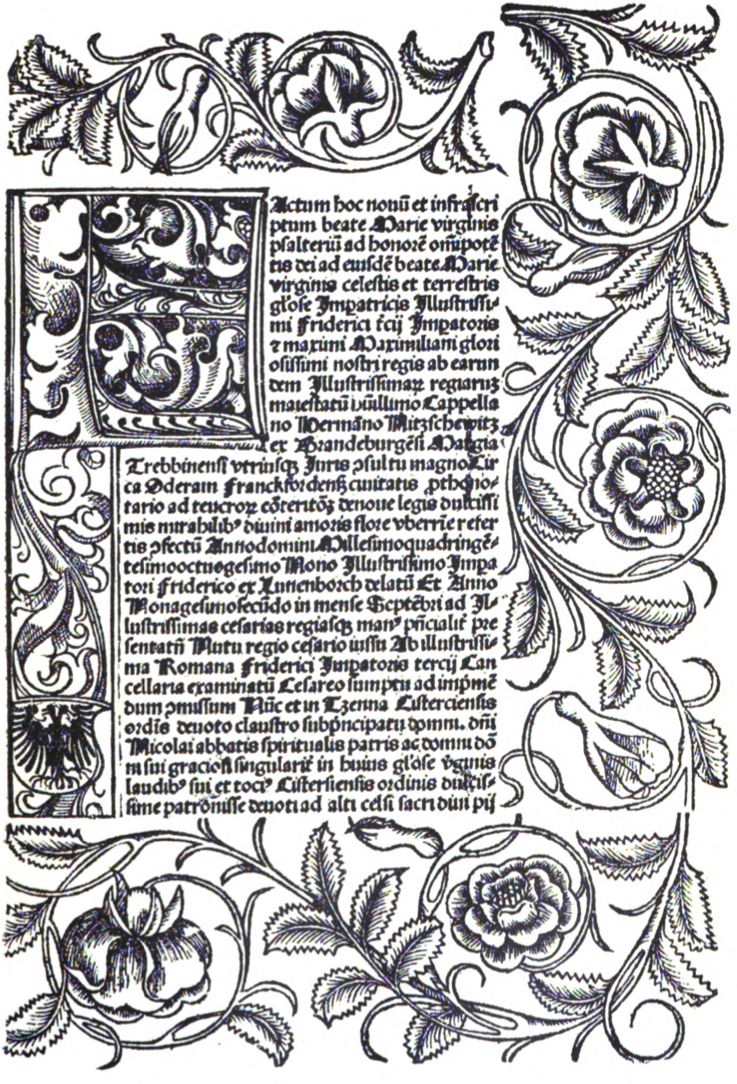
CHOICE EXAMPLES OF EARLY PRINTING AND ENGRAVING. Fac-similes from Rare and Curious Books.
THE NEW PSALTER OF THE VIRGIN MARY.
The "Novum Beatæ Mariæ Virginis Psalterium" was printed by the Cistercians monks of the monastery of Sienna, in the duchy of Magdeburg, near Wittemberg, in 1492. The present illustration shows the page of dedication, in which mention is made of the Emperor Frederick, whose arms, the double-headed eagle, appears in the border. The book was printed in the year before the emperor died. The border is an easy and flowing design of roses, which are always considered an emblem of the Virgin. The volume is a remarkable production, rare and much prized by collectors.
Beyond this great view, he has discovered nothing. Cowley, one of his admirers, rightly said that, like Moses on Mount Pisgah, he was the first to announce the promised land; but he might have added quite as justly, that, like Moses, he did not enter there. He pointed out the route, but did not travel it; he taught men how to discover natural laws, but discovered none. His definition of heat is extremely imperfect. His "Natural History" is full of fanciful explanations.[392] Like the poets, he peoples nature with instincts and desires; attributes to bodies an actual voracity, to the atmosphere a thirst for light, sounds, odors, vapors which it drinks in; to metals a sort of haste to be incorporated with acids. He explains the duration of the bubbles of air which float on the surface of liquids, by supposing that air has a very small or no appetite for height. He sees in every quality, weight, ductility, hardness, a distinct essence which has its special cause; so that when a man knows the cause of every quality of gold, he will be able to put all these causes together, and make gold. In the main, with the alchemists, Paracelsus and Gilbert, Kepler himself, with all the men of his time, men of imagination, nourished on Aristotle, he represents nature as a compound of secret and living energies, inexplicable and primordial forces, distinct and indecomposable essences, adapted each by the will of the Creator to produce a distinct effect. He almost saw souls endowed with latent repugnances and occult inclinations, which aspire to or resist certain directions, certain mixtures, and certain localities. On this account also he confounds everything in his researches in an undistinguishable mass, vegetative and medicinal properties, mechanical and curative, physical and moral, without considering the most complex as depending on the simplest, but each on the contrary in itself, and taken apart, as an irreducible and independent existence. Obstinate in this error, the thinkers of the age mark time without advancing. They see clearly with Bacon the wide field of discovery, but they cannot enter upon it. They want an idea, and for want of this idea they do not advance. The disposition of mind which but now was a lever, is become an obstacle: it must be changed, that the obstacle may be got rid of. For ideas, I mean great and efficacious ones, do not come at will nor by chance, by the effort of an individual, or by a happy accident. Methods and philosophies, as well as literatures and religions, arise from the spirit of the age; and this spirit of the age makes them potent or powerless. One state of public intelligence excludes a certain kind of literature; another, a certain scientific conception. When it happens thus, writers and thinkers labor in vain, the literature is abortive, the conception does not make its appearance. In vain they turn one way and another, trying to remove the weight which hinders them; something stronger than themselves paralyzes their hands and frustrates their endeavors. The central pivot of the vast wheel on which human affairs move must be displaced one notch, that all may move with its motion. At this moment the pivot was moved, and thus a revolution of the great wheel begins, bringing round a new conception of nature, and in consequence that part of the method which was lacking. To the diviners, the creators, the comprehensive and impassioned minds who seized objects in a lump and in masses, succeeded the discursive thinkers, the systematic thinkers, the graduated and clear logicians, who, disposing ideas in continuous series, lead the hearer gradually from the simple to the most complex by easy and unbroken paths. Descartes superseded Bacon; the classical age obliterated the Renaissance; poetry and lofty imagination gave way before rhetoric, eloquence, and analysis. In this transformation of mind, ideas were transformed. Everything was drained dry and simplified. The universe, like all else, was reduced to two or three notions; and the conception of nature, which was poetical, became mechanical. Instead of souls, living forces, repugnances, and attractions, we have pulleys, levers, impelling forces. The world, which seemed a mass of instinctive powers, is now like a mere machinery of cog-wheels. Beneath this adventurous supposition lies a large and certain truth; that there is, namely, a scale of facts, some at the summit very complex, others at the base very simple; those above having their origin in those below, so that the lower ones explain the higher; and that we must seek the primary laws of things in the laws of motion. The search was made, and Galileo found them. Thenceforth the work of the Renaissance, outstripping the extreme point to which Bacon had pushed it, and at which he had left it, was able to proceed onward by itself, and did so proceed, without limit.
CHAPTER SECOND
The Theatre
We must look at this world more closely, and beneath the ideas which are developed seek for the living men; it is the theatre especially which is the original product of the English Renaissance, and it is the theatre especially which will exhibit the men of the English Renaissance. Forty poets, amongst them ten of superior rank, as well as one, the greatest of all artists who have represented the soul in words; many hundreds of pieces, and nearly fifty masterpieces; the drama extended over all the provinces of history, imagination, and fancy—expanded so as to embrace comedy, tragedy, pastoral and fanciful literature—to represent all degrees of human condition, and all the caprices of human invention—to express all the perceptible details of actual truth, and all the philosophic grandeur of general reflection; the stage disencumbered of all precept and freed from all imitation, given up and appropriated in the minutest particulars to the reigning taste and public intelligence; all this was a vast and manifold work, capable by its flexibility, its greatness, and its form, of receiving and preserving the exact imprint of the age and of the nation.[393]
SECTION I.—The Public and the Stage
Let us try, then, to set before our eyes this public, this audience, and this stage—all connected with one another, as in every natural and living work; and if ever there was a living and natural work, it is here. There were already seven theatres in London, in Shakespeare's time, so brisk and universal was the taste for dramatic representations. Great and rude contrivances, awkward in their construction, barbarous in their appointments; but a fervid imagination readily supplied all that they lacked, and hardy bodies endured all inconveniences without difficulty. On a dirty site, on the banks of the Thames, rose the principal theatre, the Globe, a sort of hexagonal tower, surrounded by a muddy ditch, on which was hoisted a red flag. The common people could enter as well as the rich: there were sixpenny, twopenny, even penny seats; but they could not see it without money. If it rained, and it often rains in London, the people in the pit, butchers, mercers, bakers, sailors, apprentices, receive the streaming rain upon their heads. I suppose they did not trouble themselves about it; it was not so long since they began to pave the streets of London; and when men, like these, have had experience of sewers and puddles, they are not afraid of catching cold. While waiting for the piece, they amuse themselves after their fashion, drink beer, crack nuts, eat fruit, howl, and now and then resort to their lists; they have been known to fall upon the actors, and turn the theatre upside down. At other times they were dissatisfied and went to the tavern to give the poet a hiding, or toss him in a blanket; they were coarse fellows, and there was no month when the cry of "Clubs" did not call them out of their shops to exercise their brawny arms. When the beer took effect, there was a great upturned barrel in the pit, a peculiar receptacle for general use. The smell rises, and then comes the cry, "Burn the juniper!" They burn some in a plate on the stage, and the heavy smoke fills the air. Certainly the folk there assembled could scarcely get disgusted at anything, and cannot have had sensitive noses. In the time of Rabelais there was not much cleanliness to speak of. Remember that they were hardly out of the Middle Ages and that in the Middle Ages man lived on a dunghill.
Above them, on the stage, were the spectators able to pay a shilling, the elegant people, the gentlefolk. These were sheltered from the rain, and if they chose to pay an extra shilling, could have a stool. To this were reduced the prerogatives of rank and the devices of comfort: it often happened that there were not stools enough; then they lie down on the ground: this was not a time to be dainty. They play cards, smoke, insult the pit, who gave it them back without stinting, and throw apples at them into the bargain. They also gesticulate, swear in Italian, French, English;[394] crack aloud jokes in dainty, composite, high-colored words: in short, they have the energetic, original, gay manners of artists, the same humor, the same absence of constraint, and, to complete the resemblance, the same desire to make themselves singular, the same imaginative cravings, the same absurd and picturesque devices, beards cut to a point, into the shape of a fan, a spade, the letter T, gaudy and expensive dresses, copied from five or six neighboring nations, embroidered, laced with gold, motley, continually heightened in effect or changed for others: there was, as it were, a carnival in their brains as well as on their backs.
With such spectators illusions could be produced without much trouble: there were no preparations or perspectives; few or no movable scenes: their imaginations took all this upon them. A scroll in big letters announced to the public that they were in London or Constantinople; and that was enough to carry the public to the desired place. There was no trouble about probability. Sir Philip Sidney writes:
"You shall have Asia of the one side, and Africke of the other, and so many other under-kingdomes, that the Plaier when hee comes in, must ever begin with telling where hee is, or else the tale will not be conceived. Now shall you have three Ladies walke to gather flowers, and then wee must beleeve the stage to be a garden. By and by wee heare newes of shipwracke in the same place, then wee are to blame if we accept it not for a rocke;... while in the meane time two armies flie in, represented with foure swordes and bucklers, and then what hard heart will not receive it for a pitched field? Now of time they are much more liberall. For ordinary it is, that two young Princes fall in love, after many traverses, shee is got with childe, delivered of a faire boy, hee is lost, groweth a man, falleth in love, and is readie to get another childe; and all this in two hours space."[395]
Doubtless these enormities were somewhat reduced under Shakespeare; with a few hangings, crude representations of animals, towers, forests, they assisted somewhat the public imagination. But after all, in Shakespeare's plays, as in all others, the imagination from within is chiefly drawn upon for the machinery; it must lend itself to all, substitute all, accept for a queen a young man who has just been shaved, endure in one act ten changes of place, leap suddenly over twenty years or five hundred miles,[396] take half a dozen supernumeraries for forty thousand men, and to have represented by the rolling of the drums all the battles of Caesar, Henry V, Coriolanus, Richard III. And imagination, being so overflowing and so young, accepts all this. Recall your own youth; for my part, the deepest emotions I have ever felt at a theatre were given to me by a strolling bevy of four young girls, playing comedy and tragedy on a stage in a coffee-house; true, I was eleven years old. So in this theatre, at this moment, their souls were fresh, as ready to feel everything as the poet was to dare everything.
SECTION II.—Manners of the Sixteenth Century
These are but externals; let us try to advance further, to observe the passions, the bent of mind, the inner man: it is this inner state which raised and modelled the drama, as everything else; invisible inclinations are everywhere the cause of visible works, and the interior shapes the exterior. What are these townspeople, courtiers, this public, whose taste fashions the theatre? what is there peculiar in the structure and condition of their minds? The condition must needs be peculiar; for the drama flourishes all of a sudden, and for sixty years together, with marvellous luxuriance, and at the end of this time is arrested so that no effort could ever revive it. The structure must be peculiar; for of all theatres, old and new, this is distinct in form, and displays a style, action, characters, an idea of life, which are not found in any age or any country beside. This particular feature is the free and complete expansion of nature.
What we call nature in men is, man such as he was before culture and civilization had deformed and reformed him. Almost always, when a new generation arrives at manhood and consciousness, it finds a code of precepts impose on it with all the weight and authority of antiquity. A hundred kinds of chains, a hundred thousand kinds of ties, religion, morality, good breeding, every legislation which regulates sentiments, morals, manners, fetter and tame the creature of impulse and passion which breathes and frets within each of us. There is nothing like that here. It is a regeneration, and the curb of the past is wanting to the present. Catholicism, reduced to external ceremony and clerical chicanery, had just ended; Protestantism, arrested in its first gropings after truth, or straying into sects, had not yet gained the mastery; the religion of discipline was grown feeble, and the religion of morals was not yet established; men ceased to listen to the directions of the clergy, and has not yet spelled out the law of conscience. The church was turned into an assembly-room, as in Italy; the young fellows came to St. Paul's to walk, laugh, chatter, display their new cloaks; the thing had even passed into a custom. They paid for the noise they made with their spurs, and this tax was a source of income to the canons;[397] pickpockets, loose girls, came there by crowds; these latter struck their bargains while service was going on. Imagine, in short, that the scruples of conscience and the severity of the Puritans were at that time odious and ridiculed on the stage, and judge of the difference between this sensual, unbridled England, and the correct, disciplined, stiff England of our own time. Ecclesiastical or secular, we find no signs of rule. In the failure of faith, reason had not gained sway, and opinion is as void of authority as tradition. The imbecile age, which has just ended, continues buried in scorn, with its ravings, its verse-makers, and its pedantic text-books; and out of the liberal opinions derived from antiquity, from Italy, France, and Spain, everyone could pick and choose as it pleased him, without stooping to restraint or acknowledging a superiority. There was no model imposed on them, as nowadays; instead of affecting imitation, they affected originality.[398] Each strove to be himself, with his own oaths, peculiar ways, costumes, his specialties of conduct and humor, and to be unlike everyone else. They said not, "So and so is done," but "I do so and so." Instead of restraining, they gave free vent to themselves. There was no etiquette of society; save for an exaggerated jargon of chivalresque courtesy, they are masters of speech and action on the impulse of the moment. You will find them free from decorum, as of all else. In this outbreak and absence of fetters, they resemble fine strong horses let loose in the meadow. Their inborn instincts have not been tamed, nor muzzled, nor diminished.
On the contrary, they have been preserved intact by bodily and military training; and escaping as they were from barbarism, not from civilization, they had not been acted upon by the innate softening and hereditary tempering which are new transmitted with the blood, and civilize a man from the moment of his birth. This is why man, who for three centuries has been a domestic animal, was still almost a savage beast, and the force of his muscles and the strength of his nerves increased the boldness and energy of his passions. Look at these uncultivated men, men of the people, how suddenly the blood warms and rises to their face; their fists double, their lips press together, and those vigorous bodies rush at once into action. The courtiers of that age were like our men of the people. They had the same taste for the exercise of their limbs, the same indifference toward the inclemencies of the weather, the same coarseness of language, the same undisguised sensuality. They were carmen in body and gentlemen in sentiment, with the dress of actors and the tastes of artists. "At fourtene," says John Hardyng, "a lordes sonnes shalle to felde hunte the dere, and catch an hardynesse. For dere to hunte and slea, and see them blede, ane hardyment gyffith to his courage.... At sextene yere, to werray and to wage, to juste and ryde, and castels to assayle... and every day his armure to assay in fete of armes with some of his meyne."[399] When ripened to manhood, he is employed with the bow, in wrestling, leaping, vaulting. Henry VII's court, in its noisy merriment, was like a village fair. The king, says Holinshed, exercised himself "dailie in shooting, singing, dancing, wrestling, casting of the barre, plaieing at the recorders, flute, virginals, in setting of songs, and making of ballads." He leaps the moats with a pole, and was once within an ace of being killed. He is so fond of wrestling, that publicly, on the field of the Cloth of Gold, he seized Francis I in his arms to try a throw with him. This is how a common soldier or a bricklayer nowadays tries a new comrade. In fact, they regarded gross jests and brutal buffooneries as amusements, as soldiers and bricklayers do now. In every nobleman's house there was a fool, whose business it was to utter pointed jests, to make eccentric gestures, horrible faces, to sing licentious songs, as we might hear now in a beer-house. They thought insults and obscenity a joke. They were foul-mouthed, they listened to Rabelais's words undiluted, and delighted in conversation which would revolt us. They had no respect for humanity; the rules of proprieties and the habits of good breeding began only under Louis XIV, and by imitation of the French; at this time they all blurted out the word that fitted in, and that was most frequently a coarse word. You will see on the stage, in Shakespeare's "Pericles," the filth of a haunt of vice.[400] The great lords, the well-dressed ladies, speak billingsgate. When Henry V pays his court to Catherine of France, it is with the coarse bearing of a sailor who may have taken a fancy to a sutler; and like the tars who tattoo a heart on their arms to prove their love for the girls they left behind them, there were men who "devoured sulphur and drank urine"[401] to win their mistress by a proof of affection. Humanity is as much lacking as decency.[402] Blood, suffering, does not move them. The court frequents bear and bull baitings, where dogs are ripped up and chained beasts are sometimes beaten to death, and it was, says an officer of the palace, "a charming entertainment."[403] No wonder they used their arms like clodhoppers and gossips. Elizabeth used to beat her maids of honor, "so that these beautiful girls could often be heard crying and lamenting in a piteous manner." One day she spat upon Sir Mathew's fringed coat; at another time, when Essex, whom she was scolding, turned his back, she gave him a box on the ear. It was then the practice of great ladies to beat their children and their servants. Poor Jane Grey was sometimes so wretchedly "boxed, struck, pinched, and ill-treated in other manners which she dare not relate," that she used to wish herself dead. Their first idea is to come to words, to blows, to have satisfaction. As in feudal times, they appeal at once to arms, and retain the habit of taking the law in their own hands, and without delay. "On Thursday laste," writes Gilbert Talbot to the Earl and Countess of Shrewsbury, "as my Lorde Rytche was rydynge in the streates, there was one Wyndam that stode in a dore, and shotte a dagge at him, thynkynge to have slayne him. ... The same daye, also, as Sr John Conway was goynge in the streetes, Mr. Lodovyke Grevell came sodenly upon him, and stroke him on the hedd wth a sworde.... I am forced to trouble yor Honors wth thes tryflynge matters, for I know no greater."[404] No one, not even the queen, is safe among these violent dispositions.[405] Again, when one man struck another in the precincts of the court, his hand was cut off, and the arteries stopped with a red-hot iron. Only such atrocious imitations of their own crimes, and the painful image of bleeding and suffering flesh, could tame their vehemence and restrain the uprising of their instincts. Judge now what materials they furnish to the theatre, and what characters they look for at the theatre. To please the public, the stage cannot deal too much in open lust and the strongest passions; it must depict man attaining the limit of his desires, unchecked, almost mad, now trembling and rooted before the white palpitating flesh which his eyes devour, now haggard and grinding his teeth before the enemy whom he wishes to tear to pieces, now carried beyond himself and overwhelmed at the sight of the honors and wealth which he covets, always raging and enveloped in a tempest of eddying ideas, sometimes shaken by impetuous joy, more often on the verge of fury and madness, stronger, more ardent, more daringly let loose to infringe on reason and law than ever. We hear from the stage as from the history of the time, these fierce murmurs: the sixteenth century is like a den of lions.
Amid passions so strong as these there is not one lacking. Nature appears here in all its violence, but also in all its fulness. If nothing had been weakened, nothing had been mutilated. It is the entire man who is displayed, heart, mind, body, senses, with his noblest and finest aspirations, as with his most bestial and savage appetites, without the preponderance of any dominant circumstance to cast him altogether in one direction, to exalt or degrade him. He has not become rigid, as he will be under Puritanism. He is not uncrowned as in the Restoration. After the hollowness and weariness of the fifteenth century, he rose up by a second birth, as before in Greece man had risen by a first birth; and now, as then, the temptations of the outer world came combined to raise his faculties from their sloth and torpor. A sort of generous warmth spread over them to ripen and make them flourish. Peace, prosperity, comfort began; new industries and increasing activity suddenly multiplied objects of utility and luxury tenfold. America and India, by their discovery, caused the treasures and prodigies heaped up afar over distant seas to shine before their eyes; antiquity rediscovered, sciences mapped out, the Reformation begun, books multiplied by printing, ideas by books, doubled the means of enjoyment, imagination, and thought. People wanted to enjoy, to imagine, and to think; for the desire grows with the attraction, and here all attractions were combined. There were attractions for the senses, in the chambers which they began to warm, in the beds newly furnished with pillows, in the coaches which they began to use for the first time. There were attractions for the senses, in the chambers which they began to warm, in the beds newly furnished with pillows, in the coaches which they began to use for the first time. There were attractions for the imagination in the new palaces, arranged after the Italian manner; in the variegated hangings from Flanders; in the rich garments, gold-embroidered, which, being continually changed, combined the fancies and the splendors of all Europe. There were attractions for the mind, in the noble and beautiful writings which, spread abroad, translated, explained, brought in philosophy, eloquence, and poetry, from restored antiquity, and from the surrounding renaissances. Under this appeal all aptitudes and instincts at once started up; the low and the lofty, ideal and sensual love, gross cupidity and pure generosity. Recall what you yourself experienced, when from being a child you became a man: what wishes for happiness, what breadth of anticipation, what intoxication of heart wafted you towards all joys; with what impulse your hands seized involuntarily and all at once every branch of the tree, and would not let a single fruit escape. At sixteen years, like Chérubin,[406] we wish for a servant girl while we adore a Madonna; we are capable of every species of covetousness, and also of every species of self-denial; we find virtue more lovely, our meals more enjoyable; pleasure has more zest, heroism more worth: there is no allurement which is not keen; the sweetness and novelty of things are too strong; and in the hive of passions which buzzes within us, and stings us like the sting of a bee, we can do nothing but plunge, one after another, in all directions. Such were the men of this time, Raleigh, Essex, Elizabeth, Henry VIII himself, excessive and inconstant, ready for devotion and for crime, violent in good and evil, heroic with strange weaknesses, humble with sudden changes of mood, never vile with premeditation like the roisterers of the Restoration, never rigid on principle like the Puritans of the Revolution, capable of weeping like children,[407] and of dying like men, often base courtiers, more than once true knights, displaying constantly, amidst all these contradictions of bearing, only the fulness of their characters. Thus prepared, they could take in everything, sanguinary ferocity and refined generosity, the brutality of shameless debauchery, and the most divine innocence of love, accept all the characters, prostitutes and virgins, princes and mountebanks, pass quickly from trivial buffoonery to lyrical sublimities, listen alternately to the quibbles of clowns and the songs of lovers. The drama even, in order to imitate and satisfy the fertility of their nature, must talk all tongues, pompous, inflated verse, loaded with imagery, and side by side with this, vulgar prose: more, it must distort its natural style and limits; put songs, poetical devices, into the discourse of courtiers and the speeches of statesmen; bring on the stage the fairy world of the opera, as Middleton says, gnomes, nymphs of the land and sea, with their groves and their meadows; compel the gods to descend upon the stage, and hell itself to furnish its world of marvels. No other theatre is so complicated; for nowhere else do we find men so complete.
SECTION III.—Some Aspects of the English Mind
In this free and universal expansion, the passions had their special bent withal, which was an English one, inasmuch as they were English. After all, in every age, under every civilization, a people is always itself. Whatever be its dress, goat-skin blouse, gold-laced doublet, black dress-coat, the five or six great instincts which it possessed in its forests, follow it in its palaces and offices. To this day, warlike passions, a gloomy humor, subsist under the regularity and propriety of modern manners.[408] Their native energy and harshness pierce through the perfection of culture and the habits of comfort. Rich young men, on leaving Oxford, go to hunt bears on the Rocky Mountains, the elephant in South Africa, live under canvas, box, jump hedges on horseback, sail their yachts on dangerous coasts, delight in solitude and peril. The ancient Saxon, the old rover of the Scandinavian seas, has not perished. Even at school the children roughly treat one another, withstand one another, fight like men; and their character is so indomitable that they need the birch and blows to reduce them to the discipline of law. Judge what they were in the sixteenth century; the English race passed then for the most warlike of Europe, the most redoubtable in battle, the most impatient of anything like slavery.[409] "English savages" is what Cellini calls them; and the "great shins of beef" with which they fill themselves, keep up the force and ferocity of their instincts. To harden them thoroughly, institutions work in the same groove with nature. The nation is armed, every man is brought up like a soldier, bound to have arms according to his condition, to exercise himself on Sundays or holidays; from the yeoman to the lord, the old military constitution keeps them enrolled and ready for action.[410] In a state which resembles an army it is necessary that punishments, as in an army, shall inspire terror; and to make them worse, the hideous Wars of the Roses, which on every flaw of the succession to the throne are ready to break out again, are ever present in their recollection. Such instincts, such a constitution, such a history, raise before them, with tragic severity, an idea of life: death is at hand, as well as wounds, the block, tortures. The fine cloaks of purple which the renaissances of the South displayed joyfully in the sun, to wear like a holiday garment, are here stained with blood, and edged with black. Throughout,[411] a stern discipline, and the axe ready for every suspicion of treason; great men, bishops, a chancellor, princes, the king's relatives, queens, a protector, all kneeling in the straw, sprinkled the Tower with their blood; one after the other they marched past, stretched out their necks; the Duke of Buckingham, Queen Anne Boleyn, Queen Catherine Howard, the Earl of Surrey, Admiral Seymour, the Duke of Somerset, Lady Jane Grey and her husband, the Duke of Northumberland, Mary Stuart, the Earl of Essex, all on the throne, or on the steps of the throne, in the highest rank of honors, beauty, youth, and genius; of the bright procession nothing is left but senseless trunks, marred by the tender mercies of the executioner. Shall I count the funeral pyres, the hangings, living men cut down from the gibbet, disembowelled, quartered,[412] their limbs cast into the fire, their heads exposed on the walls? There is a page in Holinshed which reads like a death register:
"The five and twentith daie of Maie (1535), was in saint Paules church at London examined nineteene men and six women born in Holland, whose opinions were (heretical). Fourteene of them were condemned, a man and a woman of them were burned in Smithfield, the other twelve were sent to other townes, there to be burnt. On the nineteenth of June were three moonkes of the Charterhouse hanged, drawne, and quartered at Tiburne, and their heads and quarters set up about London, for denieng the king to be supreme head of the church. Also the one and twentith of the same moneth, and for the same cause, doctor John Fisher, bishop of Rochester, was beheaded for denieng of the supremacie, and his head set upon London bridge, but his bodie buried within Barking churchyard. The pope had elected him a cardinall, and sent his hat as far as Calais, but his head was off before his hat was on: so that they met not. On the sixt of Julie, was Sir Thomas Moore beheaded for the like crime, that is to wit, for denieng the king to be supreme head."[413]
None of these murders seem extraordinary; the chroniclers mention them without growing indignant; the condemned go quietly to the block, as if the thing were perfectly natural. Anne Boleyn said seriously, before giving up her head to the executioner: "I praie God save the king, and send him long to reigne over you, for a gentler, nor a more merciful prince was there never."[414] Society is, as it were, in a state of siege, so incited that beneath the idea of order everyone entertained the idea of the scaffold. They saw it, the terrible machine, planted on all the highways of human life; and the byways as well as the highways led to it. A sort of martial law, introduced by conquests into civil affairs, entered thence into ecclesiastical matters,[415] and social economy ended by being enslaved by it. As in a camp,[416] expenditure, dress, the food of each class, are fixed and restricted; no one might stray out of his district, be idle, live after his own devices. Every stranger was seized, interrogated; if he could not give a good account of himself, the parish-stocks bruised his limbs; as in time of war he would have passed for a spy and an enemy, if caught amidst the army. Any person, says the law,[417] found living idly or loiteringly for the space of three days, shall be marked with a hot iron on his breast, and adjudged as a slave to the man who shall inform against him. This one "shall take the same slave, and give him bread, water, or small drink, and refuse meat, and cause him to work, by beating, chaining, or otherwise, in such work and labour as he shall put him to, be it never so vile." He may sell him, bequeath him, let him out for hire, or trade upon him "after the like sort as they may do of any other their moveable goods or chattels," put a ring of iron about his neck or leg; if he runs away and absents himself for fourteen days, he is branded on the forehead with a hot iron, and remains a slave for the whole of his life; if he runs away a second time, he is put to death. Sometimes, says More, you might see a score of thieves hung on the same gibbet. In one year[418] forty persons were put to death in the county of Somerset alone, and in each county there were three or four hundred vagabonds who would sometimes gather together and rob in armed bands of sixty at a time. Follow the whole of this history closely, the fires of Mary, the pillories of Elizabeth, and it is plain that the moral tone of the land, like its physical condition, is harsh by comparison with other countries. They have no relish in their enjoyments, as in Italy; what is called Merry England is England given up to animal spirits, a coarse animation, produced by abundant feeding, continued prosperity, courage, and self-reliance; voluptuousness does not exist in this climate and this race. Mingled with the beautiful popular beliefs, the lugubrious dreams and the cruel nightmare of witchcraft make their appearance. Bishop Jewell, preaching before the queen, tells her that witches and sorcerers within these last few years are marvellously increased. Some ministers assert
"That they have had in their parish at one instant xvij or xviij witches; meaning such as could worke miracles supernaturallie; that they work spells by which men pine away even unto death, their colour fadeth, their flesh rotteth, their speech is benumbed, their senses are bereft; that instructed by the devil, they make ointments of the bowels and members of children, whereby they ride in the aire, and accomplish all their desires. When a child is not baptized, or defended by the sign of the cross, then the witches catch them from their mothers sides in the night,... kill them... or after buriall steale them out of their graves, and seeth them in a caldron, untill their flesh be made potable.... It is an infallible rule, that everie fortnight, or at the least everie moneth, each witch must kill one child at the least for hir part."
Here was something to make the teeth chatter with fright. Add to this revolting and absurd descriptions, wretched tomfooleries, details about the infernal caldron, all the nastinesses which could haunt the trite imagination of a hideous and drivelling old woman, and you have the spectacles, provided by Middleton and Shakespeare, and which suit the sentiments of the age and the national humor. The fundamental gloom pierces through the glow and rapture of poetry. Mournful legends have multiplied; every churchyard has its ghost; wherever a man has been murdered his spirit appears. Many people dare not leave their village after sunset. In the evening, before bed-time, men talk of the coach which is seen drawn by headless horses, with headless postilions and coachmen, or of unhappy spirits who, compelled to inhabit the plain, under the sharp northeast wind, pray for the shelter of a hedge or a valley. They dream terribly of death:
"To die and go we know not where; To lie in cold obstruction and to rot; This sensible warm motion to become A kneaded clod; and the delighted spirit To bathe in fiery floods, or to reside In thrilling regions of thick-ribbed ice; To be imprison'd in the viewless winds, And blown with restless violence round about The pendent world; or to be worse than worst Of those that lawless and incertain thought Imagine howling: 'tis too horrible!"[419]