Front matter (continued 7)
Reading edition
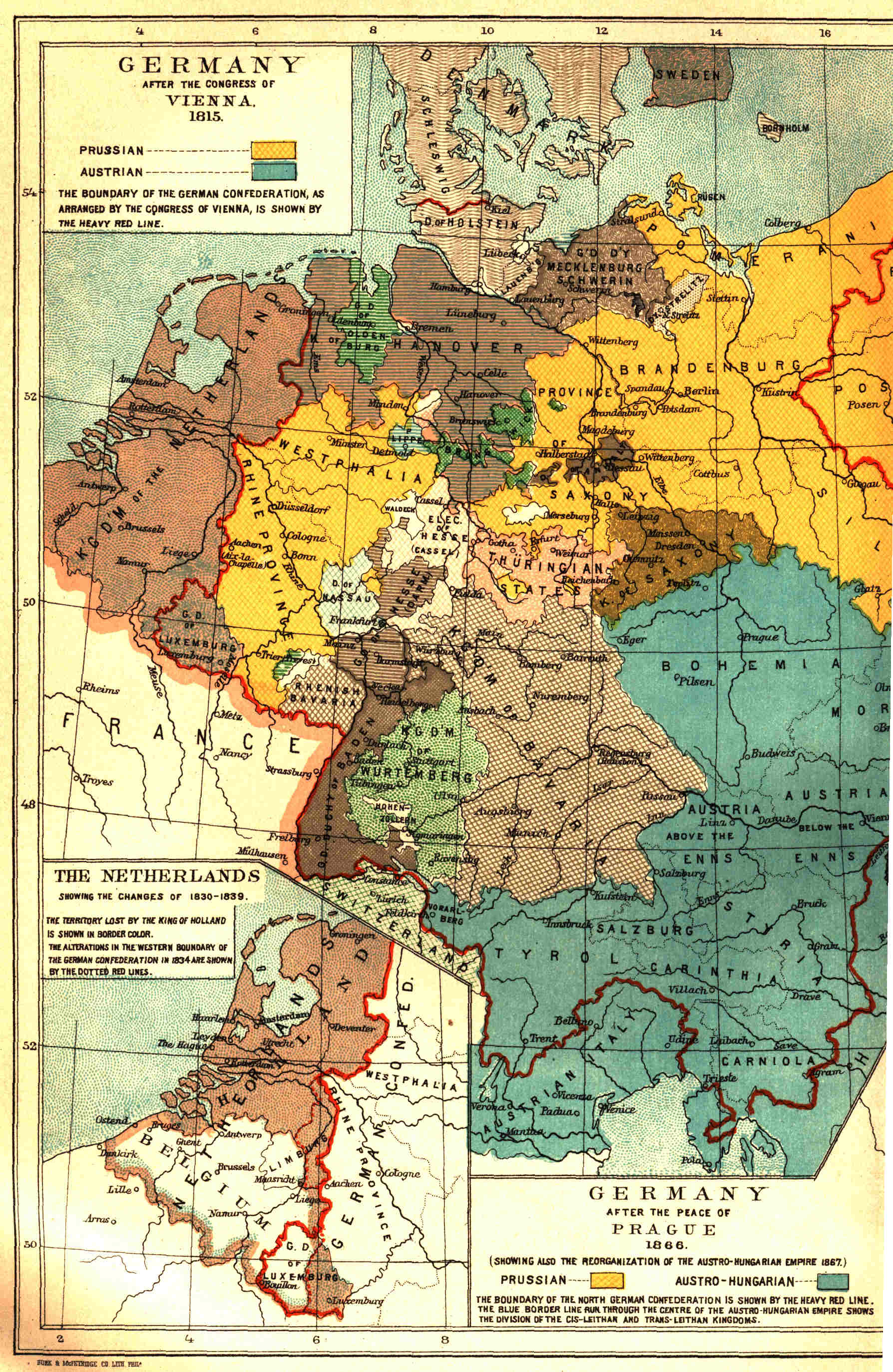
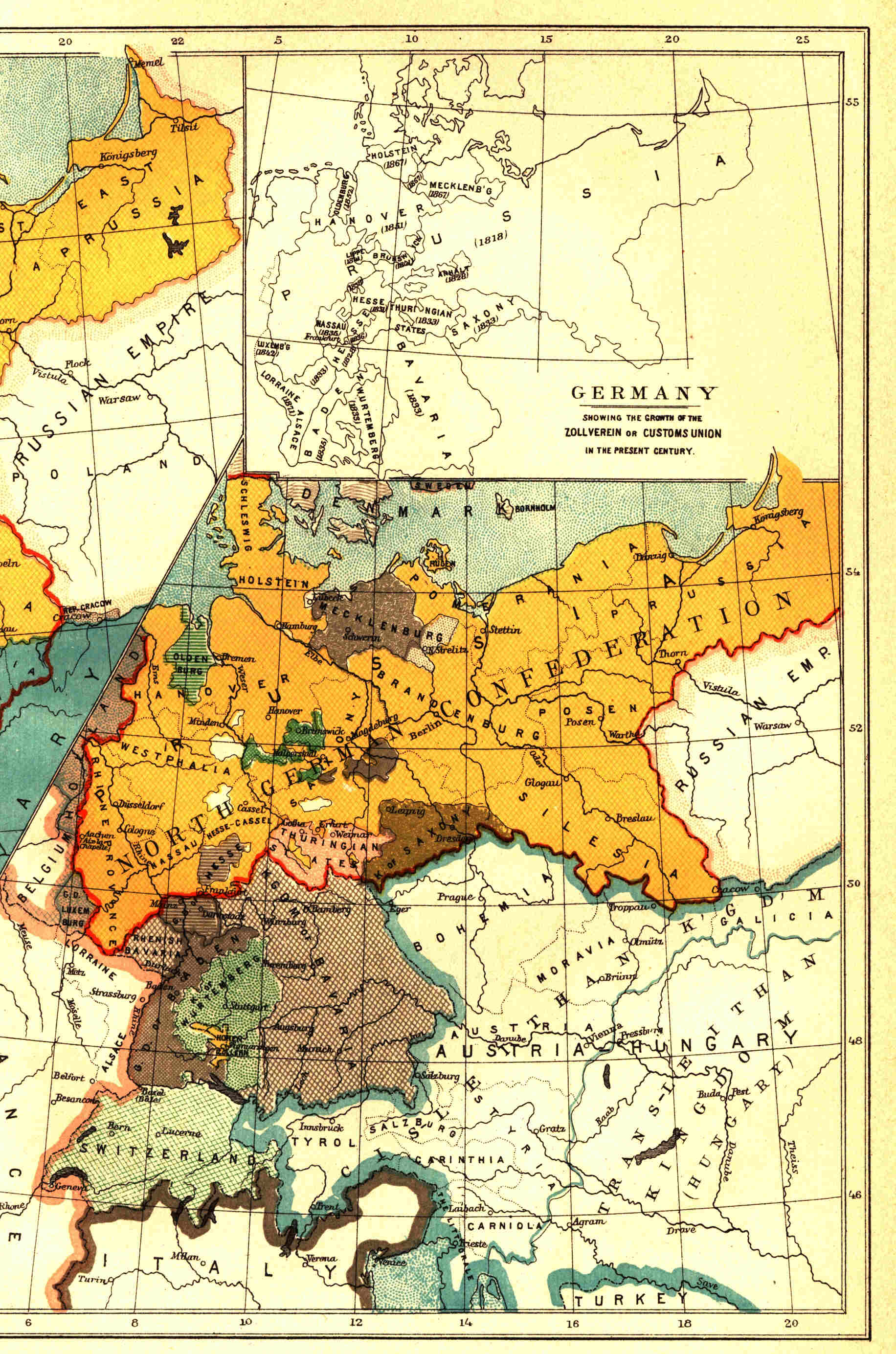
GERMANY: A. D. 1866-1867. Foreshadowings of the new Empire. "We may make the statement that in the autumn of 1866 the German Empire was founded. ... The Southern States were not yet members of the Confederation, but were already, to use an old expression, relatives of the Confederation (Bundesverwandte) in virtue of the offensive and defensive alliances with Prussia and of the new organization of the Tariff-Union. ... The natural and inevitable course of events must here irresistibly break its way, unless some circumstance not to be foreseen should throw down the barriers beforehand. How soon such a crisis might take place no one could at that time estimate. But in regard to the certainty of the final result there was in Germany no longer any doubt. ... Three-fourths of the territory of this Empire was dominated by a Government that was in the first place efficient in military organization, guided by the firm hand of King William, counselled by the representatives of the North German Sovereigns, and recognized by all the Powers of Europe. The opening of that Parliament was near at hand, that should in common with this Government determine the limitations to be placed upon the powers of the Confederation in its relation to the individual states and also the functions of the new Reichstag in the legislation and in the control of the finances of the Confederation. ... It was, in the first place, certain that the functions of the future supreme Confederate authority would be in general the same as those specified in the Imperial Constitution of 1849. ... The most radical difference between 1849 and 1866 consisted in the form of the Confederate Government. The former period aimed at the appointment of a Constitutional and hereditary emperor, with responsible ministers, to the utter exclusion of the German sovereigns: whereas now the plan included all of these sovereigns in a Confederate Council (Bundesrath) organized after the fashion of the old Confederate Diet, with committees for the various branches of the administration, and under the presidency of the King of Prussia, who should occupy a superior position in virtue of the conduct, placed in his hands once for all, of the foreign policy, the army and the navy, but who otherwise in the Confederate Council, in spite of the increase of his votes, could be outvoted like every other prince by a decree of the Majority. ... Before the time of the peace-conferences, when all definite arrangements of Germany's future seemed suspended in the balance and undecided, the Crown Prince Frederick William, who in general had in mind for the supreme head of the Confederation a higher rank and position of power than did the Ring, maintained that his father should bear the title of King of Germany. Bismarck reminded him that there were other Kings in Germany: the Kings of Hanover, of Saxony, etc. 'These,' was the reply, 'will then take the title of Dukes.' 'But they will not agree to that.' 'They will have to!' cried His Royal Highness. After the further course of events, the Crown Prince indeed gave up his project; but in the early part of 1867 he asserted that the King should assume the title of German Emperor, arguing that the people would connect no tangible idea with the title of President of the Confederation, whereas the renewal of the imperial dignity would represent to them the actual incorporation of the unity finally attained, and the remembrance of the old glory and power of the Empire would kindle all hearts. This idea, as we have experienced and continue to experience its realization, was in itself perfectly correct: But it was evidently at that time premature: a North German empire would have aroused no enthusiasm in the north, and would have seriously hindered the accomplishment of the national aim in the south. King William rejected this proposition very decidedly: in his own simple way he wished to be nothing more than Confederate Commander-in-chief and the first among his peers." H. von Sybel, The Founding of the German Empire by William I., book 20, chapter 4 (volume 5). {1542} GERMANY: A. D. 1866-1870. Territorial concessions demanded by France. Rapid progress of German unification. The Zollparlament. The Luxemburg question. French determination for war. "The conditions of peace ... left it open to the Southern States to choose what relationship they would form with the Northern Confederation. This was a compromise between Bismarck and Napoleon, the latter fearing a United Germany, the former preferring to restrict himself to what was attainable at the time, and taking care not to humiliate or seriously to injure Austria, whose friendship he foresaw that Germany would need. Meanwhile Napoleon's interference continued. Scarcely had Benedetti, who had followed Bismarck to the battle-fields, returned to Berlin, when he received orders from his Government to demand not less than the left bank of the Rhine as a compensation for Prussia's increase of territory. For this purpose he submitted the draft of a treaty by which Prussia was even to bind herself to lend an active support to the cession of the Bavarian and Hessian possessions west of the Rhine! ... Bismarck would listen to no mention of ceding German territory. 'Si vous refusez,' said the conceited Corsican, 'c'est la guerre.'--'Eh bien, la guerre,' replied Bismarck calmly. Just as little success had Benedetti with King William. 'Not a clod of German soil, not a chimney of a German village,' was William's kingly reply. Napoleon was not disposed at the time to carry out his threat. He disavowed Benedetti's action, declaring that the instructions had been obtained from him during his illness and that he wished to live in peace and friendship with Prussia. Napoleon's covetousness had at least one good effect: it furthered the work of German union. Bavaria and Würtemberg, who during the war had sided with Austria, had at first appealed to Napoleon to mediate between them and Prussia. But when the Ministers of the four South German States appeared at Berlin to negotiate with Bismarck, and Benedetti's draft-treaty was communicated to them, there was a complete change of disposition. They then wished to go much further than the Prussian Statesman was prepared to go: they asked, in order to be protected from French encroachments, to be admitted into the North German Confederation. But Bismarck would not depart from the stipulations of the Treaty of Nikolsburg. The most important result of the negotiations was that secret treaties were concluded by which the Southern States bound themselves to an alliance with the Northern Confederation for the defence of Germany, and engaged to place their troops under the supreme command of the Prussian King in the event of any attack by a foreign Power. In a military sense Klein-Deutschland was now one, though not yet politically. ... That Prussia was the truly representative German State had been obvious to the thoughtful long before: the fact now stood out in clear light to all who would open their eyes to see. Progress had meanwhile been made with the construction of the North German Confederation, which embraced all the States to the north of the river Main. Its affairs were to be regulated by a Reichstag elected by universal suffrage and by a Federal Council formed of the representatives of the North German Governments. In a military sense it was a Single State, politically a Confederate State, with the King of Prussia as President. This arrangement was not of course regarded as final: and in his speech from the throne to the North German Reichstag, King William emphasized the declaration that Germany, so long torn, so long powerless, so long the theatre of war for foreign nations, would henceforth strive to recover the greatness of her past. ... A first step towards 'bridging over the Main,' i. e., causing South and North to join hands again, was taken by the creation of a Zollparlament, or 'Customs Parliament, which was elected by the whole of Klein-Deutschland, and met at Berlin, henceforth the capital of Germany. It was also a step in advance that Baden and Hesse-Darmstadt signed conventions, by which their military system was put on the same footing as that of the North German Confederation. Baden indeed would willingly have entered into political union with the North, had the same disposition prevailed at the time in the other South German States. The National Liberals however had to contend with strong opposition from the Democrats in Würtemberg, and from the Ultramontanes in Bavaria. The latter were hostile to Prussia on account of her Protestantism, the former on account of the stern principles and severe discipline that pervaded her administration. ... In the work of German unification the Bonapartes have an important share. ... By outraging the principle of nationality, Napoleon I. had re-awakened the feeling of nationality among Germans: Napoleon III., by attempting to prevent the unification of Germany, actually hastened it on. ... When King William had replied that he would not yield up an inch of German soil, 'patriotic pangs' at Prussian successes and the thirst for 'compensation' continued to disturb the sleep of the French Emperor, and as he was unwilling to appear baffled in his purpose, he returned to the charge. On the 16th of August, 1866, through his Ambassador Benedetti, he demanded 'the cession of Landau, Saarbrücken, Saarlouis, and Luxemburg, together with Prussia's consent to the annexation of Belgium by France. If that could not be obtained, he would be satisfied with Luxemburg and Belgium; he would even exclude Antwerp from the territory claimed that it might be created a free town. Thus he hoped to spare the susceptibilities of England. As a gracious return he offered the alliance of France. After his first interview Benedetti gave up his demand for the three German towns, and submitted a new scheme, according to which Germany should induce the King of the Netherlands to a cession of Luxemburg, and should support France in the conquest of Belgium; whilst, on his part, Napoleon would permit the formation of a federal union between the Northern Confederation and the South German States, and would enter into a defensive and offensive alliance with Germany. Count Bismarck treated these propositions, as he himself has stated, 'in a dilatory manner,' that is to say, he did not reject them, but he took good care not to make any definite promises. When the Prussian Prime Minister returned from his furlough to Berlin, towards the end of 1866, Benedetti resumed his negotiations, but now only with regard to Luxemburg, still garrisoned by Prussian troops as at the time of the old Germanic Confederation. Though the Grand-Duchy of Luxemburg did not belong to the new North German Confederation, Bismarck was not willing to allow it to be annexed by France. Moltke moreover declared that the fortress could only be evacuated by the Prussian troops if the fortifications were razed. But without its fortifications Napoleon would not have it. And when, with regard to the Emperor's intentions upon Belgium, Prussia offered no active support, but only promised observance of neutrality, France renounced the idea of an alliance with Prussia, and entered into direct negotiations with the King of Holland, as Grand-Duke of Luxemburg. {1543} Great excitement was thereby caused in Germany, and, as a timely warning to France, Bismarck surprised the world with the publication of the secret treaties between Prussia and the South German States. But when it became known that the King of Holland was actually consenting to the sale of his rights in Luxemburg to Napoleon, there was so loud a cry of indignation in all parts of Germany, there was so powerful a protest in the North German Parliament against any sale of German territory by the King of Holland, that Count Bismarck, himself surprised at the vigour of the patriotic outburst, declared to the Government of the Hague that the cession of Luxemburg would be considered a casus belli. This peremptory declaration had the desired effect: the cession did not take place. This was the first success in European politics of a united Germany, united not yet politically, but in spirit. That was satisfactory. A Conference of the Great Powers then met in London [May, 1867]: by its decision, Luxemburg was separated from Germany, and,--to give some kind of satisfaction to the Emperor of the French,--was formed into a neutral State. From a national point of view, that was unsatisfactory. ... The danger of an outbreak of war between France and Germany had only been warded off for a time by the international settlement of the Luxemburg question. ... In the early part of July, 1870, Prince Leopold of Hohenzollern-Sigmaringen, at the request of the Spanish Government; became a candidate for the Spanish throne. Napoleon III. seized the occasion to carry into effect his hostile intentions against Germany." G. Krause, The Growth of German Unity, chapter 13-14. ALSO IN: E. Simon, The Emperor William and his Reign, chapter 9-10 (volume l). C. A. Fyffe, History of Modern Europe, volume 3, chapter 5-6. GERMANY: A. D. 1870 (June-July). "The Hohenzollern incident." French Declaration of War. See FRANCE: A. D. 1870 (JUNE-JULY). GERMANY: A. D. 1870 (September-December). The Germanic Confederation completed. Federative treaties with the states of South Germany. Suggestion of the Empire. "Having decided on taking Strasburg and Metz from France" Prussia "could only justify that conquest by considerations of the safety of South Germany, and she could only defend these interests by effecting the union of North and South. She found it necessary to realise this union at any price, even by some concessions in favour of the autonomy of those States, and especially of Bavaria. Such was the spirit in which negotiations were opened, in the middle of September, 1870, between Bavaria and Prussia, with the participation of Baden, Wurtemberg and Hesse-Darmstadt. ... Prussia asked at first for entire and unreserved adhesion to the Northern Confederation, a solution acceptable to Baden, Wurtemberg and Hesse-Darmstadt, but not to Bavaria, who demanded for herself the preservation of certain rights, and for her King a privileged position in the future Confederation next to the King of Prussia. The negotiations with Baden and Hesse-Darmstadt came to a conclusion on the 15th of November; and on the 25th, Wurtemberg accepted the same arrangement. These three States agreed to the constitution, slightly modified, of the Northern Confederation; the new treaties were completed by military conventions, establishing the fusion of the respective Corps d'Armée with the Federal Army of the North, under the command of the King of Prussia. The Treaty with Bavaria was signed at Versailles on the 23rd of November. The concessions obtained by the Cabinet of Munich were reduced to mere trifles. ... The King of Bavaria was allowed the command of his army in time of peace. He was granted the administration of the Post-Office and partial autonomy of indirect contributions. A committee was conceded, in the Federal Council, for Foreign Affairs, under the Presidency of Bavaria. The right of the King of Prussia, as President of this Council, to declare war, was made conditional on its consent. Such were the Treaties submitted on the 24th of November to the sanction of the Parliament of the North, assembled in an Extraordinary Session. They met with intense opposition from the National Liberal and from the Progressive Party," but "the Parliament sanctioned the treaties on the 10th of December. According to the Treaties, the new association received the title of Germanic Confederation, and the King of Prussia that of its President. These titles were soon to undergo an important alteration. The King of Bavaria, satisfied with the concessions, more apparent than real, made by the Prussian Cabinet to his rights of sovereignty, consented to defer to the wishes of King William. On the 4th of December, King Louis addressed him [King William] a letter, informing him that he had invited the Confederate sovereigns to revive the German Empire and confer the title of Emperor on the President of the Confederation. ... The sovereigns immediately gave their consent, so that the Imperial titles could be introduced into the new Constitution before the final ote of the Parliament of the North. ... To tell the truth, King William attached slight importance to the votes of the various Chambers. He was not desirous of receiving his new dignity from the hands of a Parliament; the assent of the sovereigns was in his eyes far more essential." E. Simon, The Emperor William and his Reign, chapter 13 (volume 2). ALSO IN: G. Freytag, The Crown Prince and the Imperial Crown. GERMANY: A. D. 1870-1871. Victorious war with France. Siege of Paris. Occupation of the city. Enormous indemnity exacted. Acquisition of Alsace and part of Lorraine. See FRANCE: A. D. 1870 (JULY-AUGUST) to 1871 (JANUARY-MAY). GERMANY: A. D. 1871 (January). Assumption of the Imperial dignity by King William, at Versailles. "Early in December the proposition came from King Ludwig of Bavaria to King William, that the possession of the presidential rights of the Confederacy vested in the Prussian monarch should be coupled with the imperial title. The King of Saxony spoke to the same purport; and in one day a measure providing for the amendment of the Constitution by the substitution of the words 'Emperor' and 'Empire' for 'President' and 'Confederation' was passed through the North German Parliament, which voted also an address to his Majesty, from which the following is an extract: 'The North German Parliament, in unison with the Princes of Germany, approaches with the prayer that your Majesty will deign to consecrate the work of unification by accepting the Imperial Crown of Germany. {1544} The Teutonic Crown on the head of your Majesty will inaugurate, for the re-established Empire of the German nation, an era of power, of peace, of well-being, and of liberty secured under the protection of the laws.' The address of the German Parliament was presented to the King at Versailles on Sunday, the 18th of December, by its speaker, Herr Simson, who, as speaker of the Frankfort Parliament in 1848, had made the identical proffer to William's brother and predecessor [see above: A. D. 1848-1850]. ... The formal ratification of assent to the Prussian King's assumption of the imperial dignity had yet to be received from the minor German States; but this was a foregone conclusion, and the unification of Germany really dates from that 18th of December, and from the solemn ceremonial in the prefecture of Versailles." A. Forbes, William of Germany, chapter 12. King William's formal assumption of the Imperial dignity took place on the 18th of January, 1871. "The Crown Prince was entrusted with all the preparations for the ceremony. Every regiment in the army of investment was instructed to send its colours in charge of an officer and two non-commissioned officers to Versailles, and all the higher officers who could be spared from duty were ordered to attend, for the army was to represent the German nation at this memorable scene. The Crown Prince escorted his father from the Prefecture to the palace of Versailles, where all the German Princes or their representatives were assembled in the Galerie des Glaces. A special service was read by the military chaplains, and then the Emperor, mounting on the dais, announced his assumption of Imperial authority, and instructed his Chancellor to read the Proclamation issued to the whole German nation. Then the Crown Prince, as the first subject of the Empire, came forward and performed the solemn act of homage, kneeling down before his Imperial Father. The Emperor raised him and clasped to his arms the son who had toiled and fought and borne so great a share in achieving what many generations had desired in vain." R. Rodd, Frederick, Crown Prince and Emperor, chapter 5. ALSO IN: C. Lowe, Prince Bismarck, chapter 9 (volume 1). GERMANY: A. D. 1871 (April). The Constitution of the new Empire. By a proclamation dated April 16, 1871, the German Emperor ordered, "in the name of the German Empire, by and with the consent of the Council of the Confederation and of the Imperial Diet," that "in the place of the Constitution of the German Confederation," as agreed to in November 1870, there be substituted a Constitution for the German Empire,--the text of which appeared as an appendix to this imperial decree. For a full translation of the text of the Constitution, See CONSTITUTION OF GERMANY. ALSO IN: E. Hertslet, The Map of Europe by Treaty, volume 3, Number 442. C. Lowe, Prince Bismarck, appendix F. (volume 2). GERMANY: A. D. 1871-1879. Organization of the government of Alsace-Lorraine as an imperial province. "How to garner the territorial harvest of the war--Alsace-Lorraine--was a question which greatly vexed the parliamentary mind. Several possible solutions had presented themselves. The conquered provinces might be made neutral territory, which, with Belgium on one side, and Switzerland on the other, would thus interpose a continuous barrier against French aggression from the mouth of the Rhine to its source. But one fatal objection, among several others, to the adoption of this course, was the utter lack, in the Alsace-Lorrainers, of the primary condition of the existence of all neutral States--a determination on the part of the neutralised people themselves to be and remain neutral. And none knew better than Bismarck that it would take years of the most careful nursing to reconcile the kidnapped children of France to their adoptive parent. For him, the only serious question was whether Alsace-Lorraine should be annexed to Prussia, or be made an immediate Reichsland (Imperial Province). 'From the very first,' he said, 'I was most decidedly for the latter alternative, first--because there is no reason why dynastic questions should be mixed up with political ones; and, secondly--because I think it will be easier for the Alsatians to take to the name of "German" than to that at of "Prussian," the latter being detested in France in comparison with the other.' In its first session, accordingly, the Diet was asked to pass a law incorporating Alsace-Lorraine with the Empire, and placing the annexed provinces under a provisional dictatorship till the 1st January, 1874, when they would enter into the enjoyment of constitutional rights in common with the rest of the nation. But the latter clause provoked much controversy. ... A compromise was ultimately effected by which the duration of the dictatorship, or period within which the Imperial Government alone was to have the right of making laws for Alsace-Lorraine, was shortened till 1st January, 1873; while the Diet, on the other hand, was only to have supervision of such loans or guarantees as affected the Empire. In the following year, however, the Diet came to the conclusion that, after all, the original term fixed for the dictatorship was the more advisable of the two, and prolonged it accordingly. For the next three years, therefore, the Reichsland was governed from the Wilhelmstrasse, as India is ruled from Downing Street. ... In the beginning of 1874 ... fifteen deputies from Alsace-Lorraine--now thus far admitted within the pale of the Constitution--took their seats in the second German Parliament. Of these fifteen deputies, five were out-and-out French Protesters, and the rest Clericals--seven of the latter being clergymen, including the Bishops of Metz and Strasburg. They entered the Diet in a body, with much theatrical pomp, the clergy wearing their robes; and one of the French Protesters--bearing the unfortunate name of Teutsch--immediately tabled a motion that the inhabitants of Alsace-Lorraine, having been annexed to Germany without being themselves consulted, should now be granted an opportunity of expressing their opinion on the subject by a plebiscite. ... The motion of French Mr. Teutsch, who spoke fluent German, was of course rejected; whereupon he and several of his compatriots straightway returned home, and left the Diet to deal with the interests of their constituents as it liked. Those of his colleagues who remained behind only did so to complain of the 'intolerable tyranny' under which the provinces were groaning, and to move for the repeal of the law (of December, 1871) which invested the local Government with dictatorial powers. ... {1545} Believing home-rule to be one of the best guarantees of federal cohesion, Bismarck determined to try the effect of this cementing agency on the newest part of the Imperial edifice; and, in the autumn of 1874, he advised the Emperor to grant the Alsace-Lorrainers (not by law, but by ordinance, which could easily be revoked) a previous voice on all bills to be submitted to the Reichstag on the domestic and fiscal affairs of the provinces. ... In the following summer (June, 1875), therefore, there met at Strasburg the first Landesausschuss, or Provincial Committee, composed of delegates, thirty in number, from the administrative District Councils. ... So well, indeed, on the whole, did this arrangement work, that within two years of its creation the Landesausschuss was invested with much broader powers. ... Thus it came about that, while the Reichsland continued to be governed from Berlin, the making of its laws was more and more confined to Strasburg. ... The party of the Irreconcilables had been gradually giving way to the Autonomists, or those who subordinated the question of nationality to that of home-rule. Rapidly gaining in strength, this latter party at last (in the spring of 1879) petitioned the Reichstag for an independent Government, with its seat in Strasburg, for the representation of the Reichsland in the Federal Council, and for an enlargement of the functions of the Provincial Committee. Nothing could have been more gratifying to Bismarck than this request, amounting, as it did, to a reluctant recognition of the Treaty of Frankfort on the part of the Alsace-Lorrainers. He therefore replied that he was quite willing to confer on the provinces 'the highest degree of independence compatible with the military security of the Empire.' The Diet, without distinction of party, applauded his words; and not only that, but it hastened to pass a bill embodying ideas at which the Chancellor himself had hinted in the previous year. By this bill, the government of Alsace-Lorraine was to centre in a Statthalter, or Imperial Viceroy, living at Strasburg, instead of, as heretofore, in the chancellor. ... Without being a Sovereign, this Statthalter was to exercise all but sovereign rights. ... For this high office the Emperor selected the brilliant soldier-statesman, Marshal Manteuffel. ... Certainly, His Majesty could not possibly have chosen a better man for the responsible office, which the Marshal assumed on the 1st October, 1879. Henceforth, the conquered provinces entered an entirely new phase of their existence. ... Whether the Reichsland will ever ripen into an integral part of Prussia, or into a regular Federal State with a Prussian prince for its Sovereign, the future alone can show." C. Lowe, Prince Bismarck, chapter 14 (volume 2). GERMANY: A. D. 1873-1887. The Culturkampf. The "May Laws" and their repeal. "The German Culturkampf, or civilization-fight, as its illustrious chief promoter is said to have named it, may equally well be styled the religion combat, or education strife. ... The arena of the Culturkampf in Germany is, strictly speaking, Prussia and Hesse Darmstadt--pre-eminently the former. According to the last census, taken December 1, 1880, the population of Prussia is 27,278,911. Of these, the Protestants are 17,645,462, being 64.7 per cent., and the Catholics 9,205,136, or 34.1 per cent., of the total population. The remainder are principally Jews, amounting to 363,790, or 1.334 per cent. It was on the 9th of January, 1873, that Dr. Falk, Minister of Public Worship, first introduced into the Prussian Diet the bills, which were afterwards to be known as the May Laws [so called because they were generally passed in the month of May, although in different years, but also called the Falk Laws, from the Minister who framed them]. These laws, which, for the future, were to regulate the relations of Church and State, purported to apply to the Evangelical or united Protestant State Church of Prussia ... as well as to the Catholic Church. Their professed main objects were: first, to insure greater liberty to individual lay members of those churches; secondly, to secure a German and national, rather than an 'Ultramontane' and non-national, training for the clergy; and, thirdly, to protect the inferior clergy against the tyranny of their superiors--which simply meant, as proved in the sequel, the withdrawal of priests and people, in matters spiritual, from the jurisdiction of the bishops, and the separation of Catholic Prussia from the Centre of Unity; thus substituting a local or national Church, bound hand and foot, under State regulation, for a flourishing branch of the Universal Church. To promote these objects, it was provided, that all Ecclesiastical seminaries should be placed under State control; and that all candidates for the priesthood should pass a State examination in the usual subjects of a liberal education; and it was further provided, that the State should have the right to confirm or to reject all appointments of clergy. These bills were readily passed: and all the religious orders and congregations were suppressed, with the provisional exception of those which devoted themselves to the care of the sick; and all Catholic seminaries were closed. ... The Bishops refused to obey the new laws, which in conscience they could not accept; and they subscribed a collective declaration to this effect, on the 26th of May 1873. On the 7th of August following, Pope Pius IX. addressed a strong letter of remonstrance to the Emperor William; but entirely without effect, as may be seen in the Imperial reply of the 5th of September. In punishment of their opposition, several of the Bishops and great numbers of their clergy were fined, imprisoned, exiled, and deprived of their salaries. Especially notable among the victims of persecution, were the venerable Archbishop of Cologne, Primate of Prussia, the Bishop of Munster, the Prince Bishop of Breslau, the Bishop of Paderborn, and Cardinal Ledochowski, Archbishop of Gnesen and Posen, on whom, then in prison, a Cardinal's hat was conferred by the Pope, in March 1875, as a mark of sympathy, encouragement, and approval. ... The fifteen Catholic dioceses of Prussia comprised, in January 1873, a Catholic aggregate of 8,711,535 souls. They were administered by 4,627 parish-priests, and 3,812 coadjutor-priests, or curates, being a total of 8,439 clergy. Eight years later, owing to the operation of the May Laws, there were exiled or dead, without being replaced, 1,770 of these clergy, viz., 1,125 parish-priests, and 645, coadjutor-priests; and there were 601 parishes, comprising 644,697 souls, quite destitute of clerical care, and 584 parishes, or 1,501,994 souls, partially destitute thereof. Besides these 1,770 secular priests, dead or exiled, and not replaced, there were the regular clergy (the members of religious orders), all of whom had been expelled." J. N. Murphy, The Chair of Peter, chapter 29. {1546} "Why was the Kulturkampf undertaken? This is a question often asked, and answered in different ways. That Ultramontanism is a danger to the Empire is the usual explanation; but proof is not producible. ... Ultramontanism, as it is understood in France and Belgium, has never taken root in Germany. It was represented by the Jesuits, and when they were got rid of, Catholicism remained as a religion, but not as a political factor. ... The real purpose of the Kulturkampf has been, I conceive, centralisation. It has not been waged against the Roman Church only, for the same process has been followed with the Protestant Churches. It was intolerable in a strong centralising Government to have a Calvinist and a Lutheran Church side by side, and both to call themselves Protestant. It interfered with systematic and neat account-keeping of public expenditure for religious purposes. Consequently, in 1839, the King of Prussia suppressed Calvinism and Lutheranism, and established a new Evangelical Church on their ruins, with constitution and liturgy chiefly of his own drawing up. The Protestant churches of Baden, Nassau, Hesse, and the Bavarian Palatinate have also been fused and organised on the Prussian pattern. In Schleswig-Holstein and in Hanover existed pure Lutherans, but they, for uniformity's sake, have been also recently unified and melted into the Landeskirche of Prussia. A military government cannot tolerate any sort of double allegiance in its subjects. Education and religion, medicine and jurisprudence, telegraphs and post-office, must be under the jurisdiction of the State. ... From the point of view of a military despotism, the May laws are reasonable and necessary. As Germany is a great camp, the clergy, Protestant and Catholic, must be military chaplains amenable to the general in command. ... I have no doubt whatever that this is the real explanation of the Kulturkampf, and that all other explanations are excuses and inventions. ... The Chancellor, when he began the crusade, had probably no idea of the opposition he would meet with, and when the opposition manifested itself, it irritated him, and made him more dogged in pursuing his scheme." S. Baring-Gould, Germany, Present and Past, chapter 13 (volume 2). "The passive resistance of the clergy and laity, standing on their own ground, and acting together in complete agreement, succeeded in the end. The laity had recognised their own priests, even when suspended by government, and had resolutely refused to receive others; and both priests and laity insisted upon the Church regulating its own theological education. Prussia and Baden became weary of the contest. In 1880 and 1881 the 'May Laws' were suspended, and, after negotiation with Leo XIII., they were to a large extent repealed. By this change, completed In April, 1887, the obligations of civil marriage and the vesting of Catholic property in the hands of lay trustees were retained, but the legislative interference with the administration of the Church, including the education required for the priesthood, was wholly abandoned. The Prussian Government had entirely miscalculated its power with the Church." S. Baring-Gould, The Church in Germany, chapter 21. By the Bill passed in 1887, "all religious congregations which existed before the passing of the law of May 31, 1875, were to be allowed to re-establish themselves, provided their objects were purely religious, charitable, or contemplative. ... The Society of Jesus, which is a teaching order, was not included in this permission. But Prince Bismarck's determination never to readmit the Jesuits is well known. ... The Bill left very few vestiges of the May laws remaining." Annual Register, 1887, part 1, page 245. ALSO IN: C. Lowe, Prince Bismarck, chapters 12-13 (volume 2). GERMANY: A. D. 1878-1879. Prince Bismarck's economic revolution. Adoption of the Protective policy. See TARIFF LEGISLATION (GERMANY): A. D. 1853-1892. GERMANY: A. D. 1878-1893. The Socialist Parties. See SOCIALIST PARTIES IN GERMANY. GERMANY: A. D. 1882. The Triple Alliance. See TRIPLE ALLIANCE. GERMANY: A. D. 1884-1889. Colonization in Africa. Territorial seizures. The Berlin Conference. See AFRICA: A. D. 1884-1891. GERMANY: A. D. 1888. Death of the Emperor William I. Accession and death of Frederick III. Accession of William II. The Emperor William died on the 9th of March, 1888. He was succeeded by his son, proclaimed under the title of Frederick III. The new Emperor was then at San Remo, undergoing treatment for a mortal malady of the throat. He returned at once to Berlin, where an unfavorable turn of the disease soon appeared. "Consequently an Imperial decree, dated the 21st of March, was addressed to the Crown Prince and published, expressing the wish of the Emperor that the Prince should make himself conversant with the affairs of State by immediate participation therein. His Imperial Highness was accordingly entrusted with the preparation and discharge of such State business as the Emperor should assign to him, and he was empowered in the performance of this duty to affix all necessary signatures, as the representative of the Emperor, without obtaining an especial authorisation on each occasion. ... The insidious malady from which the Emperor suffered exhibited many fluctuations," but the end came on the 15th of June, his reign having lasted only three months. He was succeeded by his eldest son, who became Emperor William II. Eminent Persons: Biographies reprinted from The Times, volume 4, pages 112-115. ALSO IN: R. Rodd, Frederick, Crown Prince and Emperor. G. Freytag, The Crown Prince. GERMANY: A. D. 1888. The end of the Free Cities. "The last two cities to uphold the name and traditions of the Hanseatic League, Hamburg and Bremen, have been incorporated into the German Zoll Verein, thus finally surrendering their old historical privileges as free ports. Lübeck took this step some twenty-two years ago [1866], Hamburg and Bremen not till October, 1888--so long had they resisted Prince Bismarck's more or less gentle suasions to enter his Protection League. ... They, and Hamburg in particular, held out nobly, jealous, and rightly jealous, of the curtailment of those privileges which distinguished them from the other cities of the German Empire. It was after the foundation of this empire that the claim of the two cities to remain free ports was conceded and ratified in the Imperial Constitution of April, 1871, though the privilege, in the case of Hamburg, was restricted to the city and port, and withdrawn from the rest of the State, which extends to the mouth of the Elbe and embraces about 160 square miles, while the free-port territory was reduced to 28 square miles. {1547} This was the first serious interference with the city's liberty, and others followed, perhaps rather of a petty, annoying, than of a seriously aggressive, character, but enough to show the direction in which the wind was blowing. It was in 1880 that the proposal to include Hamburg in the Customs Union was first politically discussed. ... In May, 1881, ... was drafted a proposal to the effect that the whole of the city and port of Hamburg should be included in the Zoll Verein." After long and earnest discussion the proposition was adopted by the Senate and the House of Burgesses. "The details for carrying into effect this conclusion have occupied seven years, and the event was finally celebrated with great pomp, the Emperor William II. coming in person to enhance the solemnity of the sacrifice brought by the burghers of the erst free city for the common weal of the German Fatherland. ... The last and only privilege the three once powerful Hanseatic cities retain is that of being entitled, like the greatest States in the empire, to send their own representatives to the Bundesrath and to the Reichstag." H. Zimmern, The Hansa Towns, period 3, chapter 8, note. GERMANY: A. D. 1888-1889. Prussian Free School laws. See EDUCATION, MODERN: EUROPEAN COUNTRIES. PRUSSIA: 1885-1889. GERMANY: A. D. 1889-1890. Rupture between Emperor William II. and Chancellor Bismarck. Retirement of the great Chancellor. Soon after the accession of William II., signs of discord between the young Emperor and the veteran statesman, Chancellor Bismarck, began to appear. "In March, 1889, the Minister of Finance had drawn up a Bill for the reform of the income tax, which had been sanctioned by the Emperor; suddenly Prince Bismarck interfered, declaring that it was against the agrarian interest, and the Landtag, summoned expressly to vote that Bill, was dismissed 're inacta.' Count Waldersee, the Chief of the General Staff, an eminent and independent man, and standing high in favour, had for years been a thorn in the Chancellor's side, who looked upon him as a possible rival; he had tried to overthrow him under Frederic III., but had not succeeded, Moltke protesting that the general was indispensable to the army. When Waldersee, in the summer of 1889, accompanied the Emperor to Norway, a letter appeared in the Hamburger Nachrichten, to the effect that in a Memoir he had directed his sovereign's attention to the threatening character of the Russian armaments, and had advised, in contradiction to the Chancellor's policy, the forcing of war upon Russia. The Count from Trondhjem addressed a telegraphic denial to the paper, stating that he had never presented such a Memoir; but the Nachrichten registered this declaration in a garbled form and in small type, and the Norddeutsche Zeitung, which at the same time had published an article, to the effect that according to General von Clausewitz, war is only the continuation of a certain policy, and that therefore the Chief of the General Staff must needs be under the order of the Foreign Minister, took no notice of the Count's protest. ... In the winter session of the Reichstag the Government presented a Bill tending to make the law against Social-Democracy a permanent one, but even the pliant National Liberals objected to the clause that the police should be entitled to expel Social-Democrats from the large towns. They would have been ready to grant that permission for two years, but the Government did not accept this, and the Bill fell to the ground. The reason, which at that time was not generally understood, was, that there existed already a hitch between the policy of the Chancellor and that of the Emperor, who had arrived at the conviction that the law against Social Democrats was not only barren, but had increased their power. This difference was accentuated by the Imperial decree of February 4 in favour of the protection of children's and women's labour, which the Chancellor had steadily resisted, and by the invitation of an international conference for that end. Prince Bismarck resigned the Ministry of Commerce, and was replaced by Herr von Berlepsch, who was to preside at the conference. The elections for the Reichstag were now at hand, a new surprise was expected for maintaining the majority obtained by the cry of 1887; but it did not come, and the result was a crushing defeat of the Chancellor. Perhaps even then the Emperor had discerned that he could not go on with Bismarck, and that it would be difficult to get rid of him, if he obtained another majority for five years. At least it seems certain that William II. already in the beginning of February had asked General von Caprivi whether he would be ready to take the Chancellor's place. Affairs were now rapidly pushing to a crisis. Bismarck asked the Emperor that, in virtue of a Cabinet order of 1852, his colleagues should be bound to submit beforehand to him any proposals of political importance before bringing it to the cognizance of the Sovereign. The Emperor refused, and insisted upon that order being cancelled. The last drop which made the cup overflow was an interview of the Chancellor with Windthorst. The Emperor, calling upon Bismarck the next morning, asked to hear what had passed in that conversation; the Chancellor declined to give any account of it, as he could not submit his intercourse with deputies to any control, and added that he was ready to resign." The Change of Government in Germany (Fortnightly Review, August, 1890), pages 301-304. "Early on the 17th of March the Emperor sent word that he was waiting for Bismarck's resignation. The Prince refused to resign, on grounds of conscience and of self-respect. ... The Emperor must dismiss him. A second messenger came, in the course of the day, with a direct order from the Emperor that the Prince should send in his resignation within a given number of hours. At the same time Bismarck was informed that the Emperor intended to make him Duke of Lauenburg. The Prince responded that he might have had that title before if he had wished it. He was then assured (referring to the grounds on which he had previously declined the title) that the Emperor would pledge himself to secure such a legislative grant as would suffice for the proper maintenance of the ducal dignity. Bismarck declined this also, declaring that he could not be expected to close such a career as his had been 'by running after a gratuity such as is given to a faithful letter-carrier at New Year's.' His resignation, of course, he would send in as soon as possible, but he owed it to himself and to history to draw up a proper memorial. This he took two days to write. ... He has since repeatedly demanded the publication of this memorial, but without success. ... On March 20, the Emperor, in a most graciously worded letter (which was immediately published), accepted Bismarck's 'resignation.' ... The immediate nomination of his successor [General von Caprivi] forced Bismarck to quit the Chancellor's official residence in such haste that ... 'Bismarck himself compared his exit to the expulsion of a German family from Paris in 1870.'" Nation, March 22, 1894 (reviewing 'Das Deutsche Reich zur Zeit Bismarcks,' von Dr. Hans Blum). {1548} GERMANY: A. D. 1890. Settlement of African claims with England. Acquisition of Heligoland. See AFRICA: A. D. 1884-1891. GERMANY: A. D. 1894. Reconciliation of Bismarck with the Emperor. In January, 1894, the complete rupture of friendly relations between Prince Bismarck and the Emperor, and the Emperor's government, which had existed since the dismissal of the former, was terminated by a dramatic reconciliation. The Emperor made a peace-offering, upon the occasion of the Prince's recovery from an illness, by sending his congratulations, with a gift of wine. Prince Bismarck responded amiably, and was then invited to Berlin, to be entertained as a guest in the royal palace. The invitation was accepted, the visit promptly made on the 26th of January, and an enthusiastic reception was accorded to the venerable ex-chancellor at the capital, by court and populace alike. ----------GERMANY: End---------- GERMINAL, The month. See FRANCE: A. D. 1793 (OCTOBER). GERONA, Siege of. See SPAIN: A. D. 1809. (FEBRUARY-JUNE). GERONTES. Spartan senators, or members of the Gerusia. See SPARTA: THE CONSTITUTION, &c. GERONTOCRACY. See HAYTI: A.D. 1804-1880. GEROUSIA. See GERUSIA. GERRY, Elbridge, and the framing of the Federal Constitution. See UNITED STATES OF AMERICA: A. D. 1787. GERRYMANDERING. "In the composition of the House of Representatives [of the Congress of the United States] the state legislatures play a very important part. For the purposes of the election a state is divided into districts corresponding to the number of representatives the state is entitled to send to Congress. These electoral districts are marked out by the legislature, and the division is apt to be made by the preponderating party with an unfairness that is at once shameful and ridiculous. The aim, of course, is so to lay out the districts 'as to secure in the greatest possible number of them a majority for the party which conducts the operation. This is done sometimes by throwing the greatest possible number of hostile voters into a district which is anyhow certain to be hostile, sometimes by adding to a district where parties are equally divided some place in which the majority of friendly voters is sufficient to turn the scale. There is a district in Mississippi (the so-called Shoe-String District) 250 miles long by 30 broad, and another in Pennsylvania resembling a dumb-bell. ... In Missouri a district has been contrived longer, if measured along its windings, than the state itself, into which as large a number as possible of the negro voters have been thrown.' This trick is called gerrymandering, from Elbridge Gerry, of Massachusetts, who was vice-president of the United States from 1813 to 1817. It seems to have been first devised in 1788 by the enemies of the Federal Constitution in Virginia, in order to prevent the election of James Madison to the first Congress, and fortunately it was unsuccessful. It was introduced some years afterward into Massachusetts. In 1812, while Gerry was governor of that state, the Republican legislature redistributed the districts in such wise that the shapes of the towns forming a single district in Essex county gave to the district a somewhat dragon-like contour. This was indicated upon a map of Massachusetts which Benjamin Russell, an ardent Federalist and editor of the 'Centinel,' hung up over the desk in his office. The celebrated painter, Gilbert Stuart, coming into the office one day and observing the uncouth figure, added with his pencil a head, wings and claws, and exclaimed, 'That will do for a salamander!' 'Better say a Gerrymander!' growled the editor; and the outlandish name, thus duly coined, soon came into general currency." J. Fiske, Civil Government in the U. S., pages 216-218. ALSO IN: J. Bryce, The American Commonwealth, volume 1, page 121. J. W. Dean, The Gerrymander (New England History and Genealogical Register, October, 1892). GERSCHHEIM, Battle of. See GERMANY: A. D. 1866. GERTRUYDENBERG: Prince Maurice's siege and capture of. See NETHERLANDS: A. D. 1588-1593. GERTRUYDENBERG: Conferences at. See FRANCE: A. D. 1710. GERUSIA, OR GEROUSIA, The. "There is the strongest reason to believe that among the Dorians, as in all the heroic states, there was, from time immemorial, a council of elders. Not only is it utterly incredible that the Spartan council (called the gerusia, or senate) was first instituted by Lycurgus, it is not even clear that he introduced any important alteration in its constitution or functions. It was composed of thirty members, corresponding to the number of the 'obes,' a division as ancient as that of the tribes, which alone would suffice to refute the legend that the first council was formed of the thirty who aided Lycurgus in his enterprise, even without the conclusive fact that two of the 'obes' were represented by the kings. ... So far as we know, the twenty-eight colleagues of the kings were always elected by the people, without regard to any qualification besides age and personal merit. The mode of election breathes a spirit of primitive simplicity: the candidates, who were required to have reached the age of sixty, presented themselves in succession to the assembly, and were received with applause proportioned to the esteem in which they were held by their fellow-citizens. These manifestations of popular feeling were noted by persons appointed for the purpose, who were shut up in an adjacent room, where they could hear the shouts, but could not see the competitors. He who in their judgment had been greeted with the loudest plaudits, won the prize--the highest dignity in the commonwealth next to the throne. The senators held their office for life." C. Thirlwall, History of Greece, chapter 8 (volume 1). {1549} ALSO IN: G. F. Schöman, Antiquity of Greece: The State, part 3, chapter 1. See, also, SPARTA: THE CONSTITUTION, &c. GES TRIBES, The. See AMERICAN ABORIGINES: TUPI. GUARANI. TUPUYAS. GESITHS.--GESITHCUND. See COMITATUS; and ENGLAND: A. D. 958. GESORIACUM. The principal Roman port and naval station on the Gallic side of the English Channel--afterwards called Bononia-modern Boulogne. "Gesoriacum was the terminus of the great highway, or military marching road, which had been constructed by Agrippa across Gaul." H. M. Scarth, Roman Britain, chapter 4. GETA, Roman Emperor, A. D. 211-212. GETÆ, The. See DACIA; THRACIANS; SARMATIA; and GOTHS, ORIGIN OF. GETTYSBURG, Battle of. See UNITED UNITED STATES OF AMERICA: A. D. 1863 (JUNE-JULY: PENNSYLVANIA). GETULIANS, The. See LIBYANS. GEWISSAS, The. This was the earlier name of the West Saxons. See ENGLAND: A. D. 477-527. GHAZNEVIDES, OR GAZNEVIDES. See TURKS: A. D. 999-1183. GHENT: A. D. 1337. Revolt under Jacques Van Arteveld. See FLANDERS: A. D. 1335-1337. GHENT: A. D. 1345. The end of Jacques Van Arteveld. See FLANDERS: A. D. 1345. GHENT: A. D. 1379-1381. The revolt of the White-Hoods. The captaincy of Philip Van Arteveld. See FLANDERS: A. D. 1379-1381. GHENT: A. D. 1382-1384. Resistance to the Duke of Burgundy. See FLANDERS: A. D. 1382. GHENT: A. D. 1451-1453. Revolt against the taxes of Philip of Burgundy. In 1450, Philip, Duke of Burgundy, having exhausted his usual revenues, rich as they were, by the unbounded extravagance of his court, laid a heavy tax on salt in Flanders. The sturdy men of Ghent were little disposed to submit to an imposition so hateful as the French "gabelle"; still less when, the next year, a new duty on grain was demanded from them. They rose in revolt, put on their white hoods, and prepared for war. It was an unfortunate contest for them. They were defeated in nearly every engagement; each encounter was a massacre, with no quarter given on either side; the surrounding country was laid waste and depopulated. A final battle, fought at Gavre, or Gaveren, July 22, 1453, went against them so murderously that they submitted and went on their knees to the duke--not metaphorically, but actually. "The citizens were deprived of the banners of their guilds; and the duke was henceforward to have an equal voice with them in the appointment of their magistrates, whose judicial authority was considerably abridged; the inhabitants likewise bound themselves to liquidate the expenses of the war, and to pay the gabelle for the future." The Hollanders and Zealanders lent their assistance to the duke against Ghent, and were rewarded by some important concessions. C. M. Davies, History of Holland, part 2, chapter 1 (volume 1). "The city lost her jurisdiction, her dominion over the surrounding country. She had no longer any subjects, was reduced to a commune, and a commune, too, in ward two gates, walled up forever, were to remind her of this grave change of state. The sovereign banner of Ghent, and the trades' banners, were handed over to Toison d'Or, who unceremoniously thrust them into a sack and carried them off." J. Michelet, History of France, book 12, chapter 1 (volume 2). GHENT: A. D. 1482-1488. In trouble with the Austrian ducal guardian. See NETHERLANDS: A. D. 1482-1493. GHENT: A. D. 1539-1540. The last peal of the great bell Roland. Once more, in 1539, Ghent became the scene of a memorable rising of the people against the oppressive exactions of their foreign masters. "The origin of the present dispute between the Ghenters and the court was the subsidy of 1,200,000 guilders, demanded by the governess [sister of the emperor Charles V.] in 1536, which ... it was found impossible to levy by a general tax throughout the provinces. It was therefore divided in proportional shares to each; that of Flanders being fixed at 400,000 guilders, or one-third of the whole. ... The citizens of Ghent ... persisted in refusing the demand, offering, instead, to serve the emperor as of old time, with their own troops assembled under the great standard of the town. ... The other cities of Flanders showed themselves unwilling to espouse the cause of the Ghenters, who, finding they had no hope of support from them, or of redress from the emperor, took up arms, possessed themselves of the forts in the vicinity of Ghent, and despatched an embassy to Paris to offer the sovereignty of their city to the king." The French king, Francis I., not only gave them no encouragement, but permitted the emperor, then in Spain, to pass through France, in order to reach the scene of disturbance more promptly. In the winter of 1540, the latter presented himself before Ghent, at the head of a German army, and the unhappy city could do nothing but yield itself to him. C. M. Davies, History of Holland, part 2, chapter 5 (volume 1). At the time of this unsuccessful revolt and the submission of the city to Charles V., "Ghent was, in all respects, one of the most important cities in Europe. Erasmus, who, as a Hollander and a courtier, was not likely to be partial to the turbulent Flemings, asserted that there was no town in all Christendom to be compared to it for size, power, political constitution, or the culture of its inhabitants. It was, said one of its inhabitants at the epoch of the insurrection, rather a country than a city. ... Its streets and squares were spacious and elegant, its churches and other public buildings numerous and splendid. The sumptuous church of Saint John or Saint Bavon, where Charles V. had been baptized, the ancient castle whither Baldwin Bras de Fer had brought the daughter of Charles the Bald [see FLANDERS: A. D. 863], the city hall with its graceful Moorish front, the well-known belfry, where for three centuries had perched the dragon sent by the Emperor Baldwin of Flanders from Constantinople, and where swung the famous Roland, whose iron tongue had called the citizens, generation after generation, to arms, whether to win battles over foreign kings at the head of their chivalry, or to plunge their swords in each others' breasts, were all conspicuous in the city and celebrated in the land. Especially the great bell was the object of the burghers' affection, and, generally, of the sovereign's hatred; while to all it seemed, as it were, a living historical personage, endowed with the human powers and passions which it had so long directed and inflamed. ... Charles allowed a month of awful suspense to intervene between his arrival and his vengeance. {1550} Despair and hope alternated during the interval. On the 17th of March, the spell was broken by the execution of 19 persons, who were beheaded as ringleaders. On the 29th of April, he pronounced sentence upon the city. ... It annulled all the charters, privileges, and laws of Ghent. It confiscated all its public property, rents, revenues, houses, artillery, munitions of war, and in general everything which the corporation, or the traders, each and all, possessed in common. In particular, the great bell Roland was condemned and sentenced to immediate removal. It was decreed that the 400,000 florins, which had caused the revolt, should forthwith be paid, together with an additional fine by Ghent of 150,000, besides 6,000 a year, forever after." J. L. Motley, The Rise of the Dutch Republic, introduction, section 11. GHENT: A. D. 1576. The Spanish Fury. The treaty of the "Pacification of Ghent." See NETHERLANDS: A. D. 1575-1577. GHENT: A. D. 1584. Disgraceful surrender to the Spaniards. Decline of the city. See NETHERLANDS: A. D. 1584-1585. GHENT: A. D. 1678. Siege and capture by the French. See NETHERLANDS (HOLLAND): A. D. 1674-1678. GHENT: A. D. 1678. Restored to Spain. See NIMEGUEN, PEACE OF. GHENT: A. D. 1706. Occupied by Marlborough. See NETHERLANDS: A. D. 1706-1707. GHENT: A. D. 1708-1709. Taken by the French and retaken by the Allies. See NETHERLANDS: A. D. 1708-1709. GHENT: A. D. 1745-1748. Surrendered to the French, and restored to Austria. See NETHERLANDS (AUSTRIAN PROVINCES): A. D.1745; and AIX-LA-CHAPELLE: A. D. 1748. GHENT: A. D. 1814. Negotiation of the Treaty of Peace between Great Britain and the United States. See UNITED STATES OF AMERICA: A.D. 1814 (DECEMBER). ----------GHENT: End---------- GHERIAH, Battle of (1763). See INDIA: A. D. 1757-1772. GHIBELINS. See GUELFS AND GHIBELLINES. GHILDE. See GUILDS. GHORKAS, OR GOORKAS, English war with the. See INDIA: A. D. 1805-1816. GIAN GALEAZZO, Lord of Milan, A. D. 1378-1396; Duke, 1396-1402. Gian Galeazzo II., Duke of Milan, 1476-1494. GIBBORIM, The. King David's chosen band of six hundred, his heroes, his "mighty men," his standing army. H. Ewald, History of Israel, book 3. GIBEON, Battle of. See BETH-HORON, BATTLES OF. GIBEONITES, The. The Gibeonites were a "remnant of the Amorites, and the children of Israel had sworn unto them" (ii Samuel xxi., 2). Saul violated the pledged faith of his nation to these people and "sought to slay them." After Saul's death there came a famine which was attributed to his crime against the Gibeonites; whereupon David sought to make atonement to them. They would accept nothing but the execution of vengeance upon seven of Saul's family, and David gave up to them two sons of Saul's concubine, Rizpah, and five sons of Michel, the daughter of Saul, whom they hanged. H. Ewald, History of Israel, book 3. GIBRALTAR, Origin of the name. See SPAIN: A. D. 711-713. GIBRALTAR: A. D. 1309-1460. Taken by the Christians, recovered by the Moors, and finally wrested from them, after several sieges. See SPAIN: A. D. 1273-1460. GIBRALTAR: A. D. 1704. Capture by the English. See SPAIN: A. D. 1703-1704. GIBRALTAR: A. D. 1713. Ceded by Spain to England. See UTRECHT: A. D. 1712-1714. GIBRALTAR: A. D. 1727. Abortive siege by the Spaniards. The lines of San Roque. See SPAIN: A. D. 1726-1731. GIBRALTAR: A. D. 1780-1782. Unsuccessful siege by the Spaniards and French. See ENGLAND: A. D. 1780-1782. ----------GIBRALTAR: End---------- GILBERT, Sir Humphrey: Expedition to Newfoundland. See AMERICA: A. D. 1583. GILBOA, Battles of. See MEGIDDO. GILDO, Revolt of. See ROME: A. D. 396-398. GILDS. See GUILDS. GILEAD. See JEWS: ISRAEL UNDER THE JUDGES. GILLMORE, General Q. A. Siege and reduction of Fort Pulaski. See UNITED STATES OF AMERICA: A. D. 1862 (FEBRUARY-APRIL: GEORGIA-FLORIDA). The siege of Charleston. See UNITED STATES OF AMERICA: A. D. 1863 (JULY: S. CAROLINA), and (AUGUST-DECEMBER: SOUTH CAROLINA). GIOVANNA. See JOANNA. GIOVANNI MARIA, Duke of Milan, A. D. 1402-1412. GIPSIES. See GYPSIES. GIRONDINS.-GIRONDISTS, The. See FRANCE: A. D. 1791 (OCTOBER); 1791-1792; 1792 (JUNE-AUGUST), (AUGUST), (SEPTEMBER-NOVEMBER); 1793 (MARCH-JUNE), (JUNE), (JULY-DECEMBER), (SEPTEMBER-DECEMBER); 1793-1794 (OCTOBER-APRIL). GIRTON COLLEGE. See EDUCATION, MODERN: REFORMS, &c.: 1865-1883. GITANOS. See GYPSIES. GIURGEVO, Battle of (1595). See BALKAN AND DANUBIAN STATES, 14TH-18TH CENTURIES (ROUMANIA, ETC.). GLADIATORS, Revolt of the. See SPARTACUS. GLADSTONE MINISTRIES. See ENGLAND: A. D. 1868-1870; 1873-1880 to 1885; 1885-1886; and 1892-1893. GLATZ, Capture of. See GERMANY: A. D. 1760. GLENCO, Massacre of. See SCOTLAND: A. D. 1692. GLENDALE, Battle of. See UNITED STATES OF AMERICA: A. D. 1862 (JUNE-JULY: VIRGINIA). GLENDOWER'S REBELLION. See WALES: A. D. 1402-1413. GLENMALURE, Battle of (1580). See IRELAND: A. D. 1559-1603. GLEVUM. Glevum was a large colonial city of the Romans in Britain, represented by the modern city of Gloucester. It "was a town of great importance, as standing not only on the Severn, near the place where it opened out into the Bristol Channel, but also as being close to the great Roman iron district of the Forest of Dean." T. Wright, Celt, Roman and Saxon, chapter 5. {1551} GLOGAU, The storming of (1642). See GERMANY: A. D. 1640-1645. GLOSSATORS, The. See BOLOGNA: 11TH CENTURY.--SCHOOL OF LAW. GLOUCESTER, Origin of. See GLEVUM. GLOUCESTER: A. D. 1643. Siege of. See ENGLAND: A. D. 1643 (AUGUST-SEPTEMBER). GLYCERIUS, Roman Emperor (Western), A. D. 473-474. GNOSTICS-GNOSTICISM. "In a word ... Gnosticism was a philosophy of religion; but in what sense was it this? The name of Gnosticism--Gnosis--does not belong exclusively to the group of phenomena with whose historical explanation we are here concerned. Gnosis is a general idea; it is only as defined in one particular manner that it signifies Christian Gnosticism in a special sense: Gnosis is higher Knowledge, Knowledge that has a clear perception of the foundations on which it rests, and the manner in which its structure has been built up; a Knowledge that is completely that which, as Knowledge, it is called to be. In this sense it forms the natural antithesis to Pistis, Faith [whence Pistics, believing Christians]: if it is desired to denote Knowledge in its specific difference from faith, no word will mark the distinction more significantly than Gnosis. But we find that, even in this general sense, the Knowledge termed Gnosis is a religious Knowledge rather than any other; for it is not speculative Knowledge in general, but only such as is concerned with religion. ... In its form and contents Christian Gnosticism is the expansion and development of Alexandrian religious philosophy; which was itself an offshoot of Greek philosophy. ... The fundamental character of Gnosticism in all its forms is dualistic. It is its sharply-defined, all-pervading dualism that, more than anything else, marks it directly for an offspring of paganism. ... In Gnosticism the two principles, spirit and matter, form the great and general antithesis, within the bounds of which the systems move with all that they contain. ... A further leading Gnostic conception is the Demiurgus. The two highest principles being spirit and matter, and the true conception of a creation of the world being thus excluded, it follows in the Gnostic systems, and is a characteristic feature of them, that they separate the creator of the world from the supreme God, and give him a position subordinate to the latter. He is therefore rather the artificer than the creator of the world. ... The oldest Gnostic sects are without doubt those whose name is not derived from a special founder, but only stand for the general notion of Gnosticism. Such a name is that of the Ophites or Naassenes. The Gnostics are called Ophites, brethren of the Serpent, not after the serpent with which the fathers compared Gnosticism, meaning to indicate the dangerous poison of its doctrine, and to suggest that it was the hydra, which as soon as it lost one head at once put forth another; but because the serpent was the accepted symbol of their lofty Knowledge. ... The first priests and supporters of the dogma were, according to the author of the Philosophoumena, the so-caned Naassenes--a name derived from the Hebrew name of the serpent. They afterwards called themselves Gnostics, because they asserted that they alone knew the things that are deepest. From this root the one heresy divided into various branches; for though these heretics all taught a like doctrine, their dogmas were various." F. C. Baur, The Church History of the First Three Centuries, volume 1, pages 187-202. "Bigotry has destroyed their [the Gnostics'] writings so thoroughly, that we know little of them except from hostile sources. They called themselves Christians, but cared little for the authority of bishops or apostles, and borrowed freely from cabalists, Parsees, astrologers, and Greek philosophers, in building up their fantastic systems. ... Much as we may fear that the Gnostic literature was more remarkable for boldness in speculation than for, clearness of reasoning or respect for facts, it is a great pity that it should have been almost entirely destroyed by ecclesiastical bigotry." F. M. Holland, The Rise of Intellectual Liberty, chapter 3, section 6. ALSO IN: J. L. von Mosheim, Historical Commentaries on the State of Christianity, century 1, sections 60-70, century 2, sections 41-65. C. W. King, The Gnostics and their Remains. A. Neander, General History of the Christian Religion and Church, volume 2. See, also, DOCETISM. GOA, Acquisition by the Portuguese (1510). See INDIA: A. D. 1498-1580. GODERICH MINISTRY, The. See ENGLAND: A. D. 1827-1828. GODFREY DE BOUILLON: His crusade and his kingdom of Jerusalem. See CRUSADES: A. D. 1096-1099; and JERUSALEM: A. D. 1099, and 1099-1144. GODOLO, Battle of (1849). See AUSTRIA: A. D. 1848-1849. GODOLPHIN AND THE ENGLISH TREASURY. See ENGLAND: A. D. 1710-1712. GODWINE, Earl: Ascendancy in England. See ENGLAND: A. D. 1042-1066. GOIDEL, The. See CELTS, THE. GOITO, Battles of(1848). See ITALY: A. D. 1848-1849. GOLD DISCOVERY IN AUSTRALIA. See AUSTRALIA: A. D. 1839-1855. GOLD DISCOVERY IN CALIFORNIA. See CALIFORNIA: A. D. 1848-1849. GOLDEN BIBLE, The. See MORMONISM: A. D. 1805-1830. GOLDEN BOOK OF VENICE. See VENICE: A. D. 1032-1319. GOLDEN BOUGH, The. See ARICIAN GROVE. GOLDEN BULL, Byzantine. A document to which the emperor attached his golden seal was called by the Byzantines, for that reason, a chrysobulum or golden bull. The term was adopted in the Western or Holy Roman Empire. G. Finlay, History of the Byzantine and Greek Empires, page 190. GOLDEN BULL OF CHARLES IV., The. See GERMANY: A. D. 1347-1493; and 13TH CENTURY. GOLDEN BULL OF HUNGARY. See HUNGARY: A. D. 1114-1301. GOLDEN CHERSONESE. See CHRYSE. {1552} GOLDEN CIRCLE, Knights of the. David Christy published his 'Cotton is King' in the year [1856] in which Buchanan was elected [President of the United States], and the Knights of the Golden Circle appear to have organized about the same time. The Golden Circle had its centre at Havana, Cuba, and with a radius of sixteen degrees (about 1,200 miles) its circumference took in Baltimore, St. Louis, about half of Mexico, all of Central America, and the best portions of the coast along the Caribbean Sea. The project was, to establish an empire with this circle for its territory, and by controlling four great staples--rice, tobacco, sugar, and cotton--practically govern the commercial world. Just how great a part this secret organization played in the scheme of secession, nobody that was not in its counsels can say; but it is certain that it boasted, probably with truth, a membership of many thousands." Rossiter Johnson, Short History of the War of Secession, page 24. During the American Civil War, the Order of the Knights of the Golden Circle was extended (1862-1864) through the Northern States, as a secret treasonable organization, in aid of the Southern Rebellion. See UNITED STATES OF AMERICA: A. D. 1864 (OCTOBER). GOLDEN FLEECE, Knights of the Order of the. "It was on the occasion of his marriage [A. D. 1430] that Philip [Philip the Good, Duke of Burgundy, Count of Flanders, etc.], desirous of instituting a national order of knighthood, chose for its insignia a 'golden fleece,' with the motto, 'Pretium non vile laborum,'--not to be condemned is the reward of labour. ... For the first time labour was given heraldic honours. The pride of the country had become laden with industrial recollections, its hope full of industrial triumphs; if feudalism would keep its hold, it must adopt or affect the national feeling. No longer despised was the recompense of toil; upon the honour of knighthood it should so be sworn; nay knighthood would henceforth wear appended to its collar of gold no other emblem than its earliest and most valued object--a golden fleece." W. T. McCullagh, Industrial History of Free Nations, volume 2, chapter 10. "This order of fraternity, of equality between nobles, in which the duke was admonished, 'chaptered,' just the same as any other, this council, to which he pretended to communicate his affairs, was at bottom a tribunal where the haughtiest found the duke their judge; he could honour or dishonour them by a sentence of the order. Their scutcheon answered for them; hung up in St. Jean's, Ghent, it could either be erased or blackened. ... The great easily consoled themselves for degradation at Paris by lawyers, when they were glorified by the duke of Burgundy in a court of chivalry in which kings took their seat." J. Michelet, History of France, book 12, chapter 4. "The number of the members was originally fixed at 31, including the sovereign, as the head and chief of the institution. They were to be: 'Gentilshommes de nom et d'armes sans reproche.' In 1516, Pope Leo X. consented to increase the number to 52, including the head. After the accession of Charles V., in 1556, the Austro-Spanish, or, rather, the Spanish-Dutch line of the house of Austria, remained in possession of the Order. In 1700, the Emperor Charles VI. and King Philip of Spain both laid claim to it. ... It now passes by the respective names of the Spanish or Austrian. 'Order of the Golden Fleece,' according to the country where it is issued." Sir B. Burke, Book of Orders of Knighthood, page 6. ALSO IN: J. F. Kirk, History of Charles the Bold, book 1, chapter 2. GOLDEN GATE, The. "The Bay of San Francisco is separated by [from] the sea by low mountain ranges. Looking from the peaks of the Sierra Nevada, the coast mountains present an apparently continuous line, with only a single gap, resembling a mountain pass. This is the entrance to the great bay. ... On the south, the bordering mountains come down in a narrow ridge of broken hills, terminating in a precipitous point, against which the sea breaks heavily. On the northern side, the mountain presents a bold promontory, rising in a few miles to a height of two or three thousand feet. Between these points is the strait--about one mile broad in the narrowest part, and five miles long from the sea to the bay. To this Gate I gave the name of Chrysopylæ, or Golden Gate; for the same reasons that the harbor of Byzantium (Constantinople afterwards), was called Chrysoceras, or Golden Horn. Passing through this gate, the bay opens to the right and left, extending in each direction about 35 miles, making a total length of more than 70, and a coast of about 275 miles." J. C. Fremont, Memoirs of my life, volume 1, page 512. GOLDEN HORDE, The. See MONGOLS: A. D. 1238-1391. GOLDEN HORN, The. See BYZANTIUM. GOLDEN HORSESHOE, Knights of the. See VIRGINIA: A. D. 1710-1716. GOLDEN HOUSE, The. The imperial palace at Rome, as restored by Nero after the great fire, was called the Golden House. It was destroyed by Vespasian. C. Merivale, History of the Romans under the Empire, chapters 53 and 90. GOLDEN, OR BORROMEAN, LEAGUE, The. See SWITZERLAND: A. D. 1579-1630. GOLDEN SPUR, Order of the. An order of knighthood instituted in 1550 by Pope Paul III. GOLDSBORO, General Sherman's march to. See UNITED STATES OF AMERICA: A. D. 1865 (FEBRUARY-MARCH: THE CAROLINAS), and (FEBRUARY-MARCH: N. CAROLINA). GOLIAD, Massacre at (1836). See TEXAS: A. D. 1824-1836. GOLOWSTSCHIN, Battle of (1708). See SCANDINAVIAN STATES (SWEDEN): A. D. 1707-1718. GOLYMIN, Battle of (1806). See GERMANY: A. D. 1806-1807. GOMER, OR OMER, The. See EPHAH. GOMERISTS. See NETHERLANDS: A. D. 1603-1619. GOMPHI. Gomphi, a city on the border of Thessaly, shut its gates against Cæsar, shortly before the battle of Pharsalia. He halted one day in his march, stormed the town and gave it up to his soldiers to be sacked. G. Long, Decline of the Roman Republic, volume 5, chapter 15. GONDS, The. See INDIA: THE ABORIGINAL INHABITANTS. GONFALONIERE. See CARROCCIO. GONZAGA, The House of. "The house of Gonzaga held sovereign power at Mantua, first as captains, then as marquesses, then as dukes, for nearly 400 years" (1328-1708). E. A. Freeman, Historical Geography of Europe, volume 1, page 243. GOOD ESTATE OF RIENZI, The. See ROME: A. D. 1347-1354. GOOD HOPE, Cape of: The Discovery and the Name. See PORTUGAL: A. D.1463-1498. GOOD HOPE, Cape of: The Colonization. See SOUTH AFRICA. {1553} GOORKAS, OR GURKHAS, OR GHORKAS, The. See INDIA: THE ABORIGINAL INHABITANTS; and A. D. 1805-1816. GOOROO, OR GURU. See SIKHS. GORDIAN I. and II., Roman Emperors, A. D. 238. Gordian III., Roman Emperor, A. D. 238-244. GORDIAN KNOT, Cutting the. "It was about February or March 333 B. C., when Alexander reached Gordium; where he appears to have halted for some time, giving to the troops which had been with him in Pisidia a repose doubtless needful. While at Gordium, he performed the memorable exploit familiarly known as the cutting of the Gordian knot. There was preserved in the citadel an ancient waggon of rude structure, said by the legend to have once belonged to the peasant Gordius and his son Midas--the primitive rustic kings of Phrygia, designated as such by the Gods and chosen by the people. The cord (composed of fibres from the bark of the cornel tree), attaching the yoke of this waggon to the pole, was so twisted and entangled as to form a knot of singular complexity, which no one had ever been able to untie. An oracle had pronounced, that to the person who should untie it the empire of Asia was destined. ... Alexander, on inspecting the knot, was as much perplexed as others had been before him, until at length, in a fit of impatience, he drew his sword and severed the cord in two. By everyone this was accepted as a solution of the problem." G. Grote, History of Greece, part 2, chapter 93. GORDON, General Charles George, In China. See CHINA: A. D.1850-1864. In the Soudan. See EGYPT: A. D. 1870-1883, and 1884-1885. GORDON RIOTS, The. See ENGLAND: A. D. 1778-1780. GORDYENE, OR CORDYENE, OR CORDUENE. The tribes of the Carduchi which anciently occupied the region of northern Mesopotamia, east of the Tigris, have given their name permanently to the country, but in variously modified forms. In the Greek and Roman period it was known as Gordyene, Cordyene, Corduene; at the present day it is Kurdistan. Under the Parthian domination in Asia, Gordyene was a tributary kingdom. In the early part of the last century B. C. it was conquered by Tigranes, king of Armenia, who chose a site within it for building his vast new capital, Tigranocerta, to populate which twelve Greek cities were stripped of inhabitants. It was included among the conquests of Trajan for the Romans, but relinquished by Hadrian. G. Rawlinson, Sixth Great Oriental Monarchy, chapter 10, and after. See, also, CARDUCHI, THE. GORGES, Sir Ferdinando, and the colonization of Maine. See NEW ENGLAND: A. D. 1621-1631, and 1635; also MAINE: A. D. 1639. GORM, King of Denmark, A. D. 883-941. GOROSZLO, Battle of (1601). See BALKAN AND DANUBIAN STATES: 14TH-18TH CENTURIES (ROUMANIA, &c.). GORTYN. See CRETE. GOSHEN, Land of. See JEWS: THE ROUTE OF THE EXODUS. GOSNOLD'S VOYAGE TO NEW ENGLAND. See AMERICA: A. D. 1602-1605. GOSPORT NAVY YARD, Abandonment and destruction of the. See UNITED STATES OF AMERICA: A. D. 1861 (APRIL). GOTHA, Origin of the Dukedom of. See SAXONY: A. D. 1180-1553. GOTHI MINORES, The. See GOTHS: A. D. 341-381. GOTHIA, in central Europe. See GOTHS (VISIGOTHS): A. D. 376. GOTHIA, in Gaul. Septimania, the strip of land along the Mediterranean between the Pyrenees and the Rhone, was the last possession of the Goths in Gaul, and the name Gothia became for a time attached to it. E. A. Freeman, Historical Geography of Europe, chapter 5, section 5. See GOTHS (VISIGOTHS): A. D. 419-451. GOTHINI, The. The Gotini or Gothini were a people of ancient Germany who "are probably to be placed in Silesia, about Breslau." "The Gotini and Osi [who held a part of modern Gallicia, under the Carpathian mountains] are proved by their respective Gallic and Pannonian tongues, as well as by the fact of their enduring tribute, not to be Germans. ... The Gotini, to complete their degradation, actually work iron mines." Tacitus, Minor Works, translated by Church and Brodribb: The Germany, with geographical notes. GOTHLAND IN SWEDEN. See GOTHS: ORIGIN OF THE. GOTHONES, The. A tribe in ancient Germany, mentioned by Tacitus. They "probably dwelt on either side of the Vistula, the Baltic being their northern boundary. Consequently, their settlements would coincide with portions of Pomerania and Prussia. Dr. Latham thinks they were identical with the Æstii." Church and Brodribb, Geographical Notes to the Germany of Tacitus. See GOTHS, ORIGIN OF THE. GOTHS, Origin of the. "The Scandinavian origin of the Goths has given rise to much discussion, and has been denied by several eminent modern scholars. The only reasons in favor of their Scandinavian origin are the testimony of Jornandes and the existence of the name of Gothland in Sweden; but the testimony of Jornandes contains at the best only the tradition of the people respecting their origin, which is never of much value; and the mere fact of the existence of the name of Gothland in Sweden is not sufficient to prove that this country was the original abode of the people. When the Romans first saw the Goths, in the reign of Caracalla, they dwelt in the land of the Getæ [on the northern side of the lower Danube]. Hence Jornandes, Procopius, and many other writers, both ancient and modern, supposed the Goths to be the same as the Getæ of the earlier historians. But the latter writers always regarded the Getæ as Thracians; and if their opinion was correct, they could have had no connection with the Goths. Still, it is a startling fact that a nation called Gothi should have emigrated from Germany, and settled accidentally in the country of a people with a name so like their own as that of Getæ. This may have happened by accident, but certainly all the probabilities are against it. Two hypotheses have been brought forward in modern times to meet this difficulty. One is that of Grimm, in his History of the German Language, who supposes that there was no migration of the Goths at all, that they were on the Lower Danube from the beginning, and that they were known to the earlier Greek and Latin writers as Getæ: but the great objection to this opinion is the general belief of the earlier writers that the Getæ were Thracians, and the latter were certainly not Germans. {1554} The other is that of Latham, who supposes, with much ingenuity, that the name of Get, or Goth, was the general name given by the Slavonic nations to the Lithuanians. According to this theory, the Goth-ones, or Guth-ones, at the mouth of the Vistula, mentioned by Tacitus and Ptolemy, are Lithuanians, and the Get-æ, on the Danube, belong to the same nation. Latham also believes that the Goths of a later period were Germans who migrated to the Danube, but that they did not bear the name of Goths till they settled in the country of the Getæ. See Latham, The Germania of Tacitus, Epil., p. xxxviii., seq." W. Smith, Note to Gibbon's Decline and Fall of the Roman Empire, chapter 10. "The first clear utterance of tradition among the Goths points to Sweden as their home. It is true that this theory of the Swedish origin of the Goths has of late been strenuously combatted, but until it is actually disproved (if that be possible) it seems better to accept it as a 'working hypothesis,' and, at the very least, a legend which influenced the thoughts and feelings of the nation itself. Condensing the narrative of Jornandes ... we get some such results as these: 'The island of Scanzia [peninsula of Norway and Sweden] lies in the Northern Ocean, opposite the mouths of the Vistula, in shape like a cedar-leaf. In this island, a warehouse of nations ("officina gentium"), dwelt the Goths, with many other tribes,' whose uncouth names are for the most part forgotten, though the Swedes, the Fins, the Heruli, are familiar to us. 'From this island the Goths, under their king Berig, set forth in search of new homes. They had but three ships, and as one of these during their passage always lagged behind, they called her "Gepanta," "the torpid one," and her crew, who ever after showed themselves more sluggish and clumsy than their companions when they became a nation, bore a name derived from this circumstance, Gepidae, the Loiterers'." Settling, first, near the mouth of the Vistula, these Gothic wanderers increased in numbers until they were forced once more to migrate southward and eastward, seeking a larger and more satisfactory home. In time, they reached the shores of the Euxine. "The date of this migration of the Goths is uncertain; but, as far as we can judge from the indications afforded by contemporary Roman events, it was somewhere between 100 and 200 A. D. At any rate, by the middle of the third century, we find them firmly planted in the South of Russia. They are now divided into three nations, the Ostrogoths on the East, the Visigoths on the West, the lazy Gepidae a little to the rear--that is, to the North of both. ... It is important for us to remember that these men are Teutons of the Teutons. ... Moreover, the evidence of language shows that among the Teutonic races they belonged to the Low German family of peoples: more nearly allied, that is to say, to the Dutch, the Frieslanders, and to our own Saxon forefathers, all of whom dwelt by the flat shores of the German Ocean or the Baltic Sea, than to the Suabians and other High German tribes who dwelt among the hills." T. Hodgkin, Italy and Her Invaders, introduction, chapter 3 (volume 1). ALSO IN: T. Mommsen, History of Rome, book 8, chapter 6. T. Smith, Arminius, part 2, chapter 2. See, also, VANDALS. GOTHS: Acquisition of Bosphorus. "The little kingdom of Bosphorus; whose capital was situated on the straits through which the Mæotis communicates itself to the Euxine, was composed of degenerate Greeks and half-civilized barbarians. It subsisted as an independent state from the time of the Peloponnesian war, was at last swallowed up by the ambition of Mithridates, and, with the rest of his dominions, sunk under the weight of the Roman arms. From the reign of Augustus the kings of Bosphorus were the humble but not useless allies of the empire. By presents, by arms, and by a slight fortification drawn across the isthmus, they effectually guarded, against the roving plunderers of Sarmatia, the access of a country which, from its peculiar situation and convenient harbours, commanded the Euxine Sea and Asia Minor. As long as the sceptre was possessed by a lineal succession of kings, they acquitted themselves of their important charge with vigilance and success. Domestic factions, and the fears or private interest of obscure usurpers who seized on the vacant throne, admitted the Goths [already, in the third century, in possession of the neighboring region about the mouth of the Dneiper] into the heart of Bosphorus. With the acquisition of a superfluous waste of fertile soil, the conquerors obtained the command of a naval force sufficient to transport their armies to the coast of Asia." E. Gibbon, Decline and Fall of the Roman Empire, chapter 10. GOTHS: A. D. 244-251. First invasions of the Roman Empire. As early as the reign of Alexander Severus (A. D. 222-235) the Goths, then inhabiting the Ukraine, had troubled Dacia with incursions; but it was not until the time of the Emperor Philip, called the Arabian (244-249), that they invaded the Empire in force, passing through Dacia and crossing the Danube into Mœsia (Bulgaria). They had been bribed by a subsidy to refrain from pillaging Roman territory, but complained that their "stipendia" had not been paid. They made their way without opposition to the city of Marcianopolis, which Trajan had founded in honor of his sister, and which was the capital of one of the two provinces into which Mœsia had been divided. The inhabitants ransomed themselves by the payment of a large sum of money, and the barbarians retired. But their expedition had been successful enough to tempt a speedy repetition of it, and the year 250 found them, again, in Mœsia, ravaging the country with little hindrance. The following year they crossed the Hæmus or Balkan mountains and laid siege to the important city of Philippopolis--capital of Thrace, founded by Philip of Macedon. Now, however, a capable and vigorous emperor, Decius, was briefly wearing the Roman purple. He met the Goths and fought them so valiantly that 30,000 are said to have been slain; yet the victory remained with the barbarians, and Philippopolis was not saved. They took it by storm, put 100,000 of its inhabitants to the sword and left nothing in the ruins of the city worth carrying away. Meantime the enterprising Roman emperor had reanimated and recruited his troops and had secured positions which cut off the retreat of the Gothic host. The peril of the barbarians seemed so great, in fact, that they offered to surrender their whole booty and their captives, if they might, on so doing, march out of the country undisturbed. Decius sternly rejected the proposition, and so provoked his dangerous enemies to a despair which was fatal to him. In a terrible battle that was fought before the close of the year 251, at a place in Mœsia called Forum Trebonii, the Roman emperor perished, with the greater part of his army. The successor of Decius, Gallus, made haste to arrange a payment of annual peace-money to the Goths, which persuaded them to retire across the Danube. E. Gibbon, Decline and Fall of the Roman Empire, chapter 10. ALSO IN: T. Hodgkin, Italy and Her Invaders, introduction, chapter 8 (volume 1). {1555} GOTHS: A. D. 258-267. Naval expeditions in the East. Having acquired command of a port and a navy by their conquest of or alliance with the little kingdom of Bosporus in the Chersonesus Taurica (modern Crimea), the Goths launched forth boldly upon a series of naval marauding expeditions, which spread terror and destruction along the coasts of the Euxine, the Ægean and the straits between. The first city to suffer was Pityus, on the Euxine, which they totally destroyed, A. D. 258. The next was Trebizond, which fell a victim to the negligence with which its strong walls were guarded. The Goths loaded their ships with the enormous booty that they took from Trebizond, and left it almost a ruined city of the dead. Another expedition reached Bithynia, where the rich and splendid cities of Chalcedon, Nicea, Nicomedia, Prusa, Apamæa, nd others were pillaged and more or less wantonly destroyed. "In the year 267, another fleet, consisting of 500 vessels, manned chiefly by the Goths and Heruls [or Heruli], passed the Bosphorus and the Hellespont. They seized Byzantium and Chrysopolis, and advanced, plundering the islands and coasts of the Ægean Sea, and laying waste many of the principal cities of the Peloponnesus. Cyzicus, Lemnos, Skyros, Corinth, Sparta, and Argos are named as having suffered by their ravages. From the time of Sylla's conquest of Athens, a period of nearly 350 years had elapsed, during which Attica had escaped the evils of war; yet when the Athenians were called upon to defend their homes against the Goths, they displayed a spirit worthy of their ancient fame. An officer, named Cleodamus, had been sent by the government from Byzantium to Athens, in order to repair the fortifications, but a division of these Goths landed at the Piræus and succeeded in carrying Athens by storm, before any means were taken for its defence. Dexippus, an Athenian of rank in the Roman service, soon contrived to reassemble the garrison of the Acropolis; and by joining to it such of the citizens as possessed some knowledge of military discipline, or some spirit for warlike enterprise, he formed a little army of 2,000 men. Choosing a strong position in the Olive Grove, he circumscribed the movements of the Goths, and so harassed them by a close blockade that they were soon compelled to abandon Athens. Cleodamus, who was not at Athens when it was surprised, had in the meantime assembled a fleet and gained a naval victory over a division of the barbarian fleet, These reverses were a prelude to the ruin of the Goths. A Roman fleet entered the Archipelago, and a Roman army, under the emperor Gaillenus, marched into Illyricum; the separate divisions of the Gothic expedition were everywhere overtaken by these forces, and destroyed in detail. During this invasion of the empire, one of the divisions of the Gothic army crossed the Hellespont into Asia, and succeeded in plundering the cities of the Troad, and in destroying the celebrated temple of Diana of Ephesus. ... The celebrity of Athens, and the presence of the historian Dexippus, have given to this incursion of the barbarians a prominent place in history; but many expeditions are casually mentioned which must have inflicted greater losses on the Greeks, and spread devastation more widely over the country." G. Finlay, Greece Under the Romans, chapter 1, section 14. ALSO IN: E. Gibbon, Decline and Fall of the Roman Empire, chapter 10. GOTHS: A. D. 268-270. Defeat by Claudius. "Claudius II. and his successor Aurelian, notwithstanding the shortness of their reigns, effectually dissipated the mosquito-swarms of barbarian invaders and provincial usurpers who were ruining the unhappy dominions of Gallienus. The two campaigns (of 268 and 269) in which the Emperor Claudius vanquished the barbarians are related with great brevity, and in such a shape that it is not easy to harmonise even the scanty details which are preserved for us. It seems clear, however, that the Goths (both Ostrogoths and Visigoths), with all their kindred tribes, poured themselves upon Thrace and Macedonia in vaster numbers than ever. The previous movements of these nations had been probably but robber-inroads: this was a national immigration. ... A few years earlier, so vast an irruption must inevitably have ruined the Roman Empire. But now, under Claudius, the army, once more subjected to strict discipline, had regained, or was rapidly regaining, its tone, and the Gothic multitudes, vainly precipitating themselves against it, by the very vastness of their unwieldy masses, hastened their own destruction. A great battle was fought at Naissus (Nisch, in Servia), a battle which was not a complete victory, which according to one authority was even a defeat for the Romans, but since the barbarians as an immediate consequence of it lost 50,000 men, their doubtful victory may fairly be counted as a defeat. In the next campaign they were shut up in the intricate passes of the Balkans by the Roman cavalry. Under the pressure of famine they killed and ate the cattle that drew their waggons, so parting with their last chance of return to their northern homes. ... At length the remnants of the huge host seem to have disbanded, some to have entered the service of their conqueror as 'foederati,' and many to have remained as hired labourers to plough the fields which they had once hoped to conquer. ... The vast number of unburied corpses bred a pestilence, to which the Emperor fell a victim. His successor Aurelian, the conqueror of Zenobia ... made peace wisely as well as war bravely, and, prudently determining on the final abandonment of the Roman province of Dacia, he conceded to the Goths the undisturbed possession of that region [A. D. 270], on condition of their not crossing the Danube to molest Moesia. Translating these terms into the language of modern geography, we may say, roughly, that the repose of Servia and Bulgaria was guaranteed by the final separation from the Roman Empire of Hungary, Transylvania, Moldavia, and Wallachia, which became from this time forward the acknowledged home of the Gothic nation. ... For about a century (from 270 to 365) the Goths appear to have been with little exception at peace with Rome." T. Hodgkin, Italy and Her Invaders, introduction, chapter 3. {1556} GOTHS: A. D. 341-381. Conversion to Christianity. The introduction of Christianity among the Goths seems to have begun while they were yet on the northern side of the Danube and the Black Sea. It first resulted, no doubt, from the influence of many Christian captives who were swept from their homes in Mœsia, Greece, and Asia Minor, and carried away to spend their lives in slavery among the barbarians. To these were probably added a considerable number of Christian refugees from Roman persecution, before the period of Constantine. But it was not until the time of Ulfilas, the great apostle and bishop of the Goths (supposed to have held the office of bishop among them from about A. D. 341 to 381), that the development and organization of Christianity in the Gothic nation assumed importance. Ulfilas is represented to have been a descendant of one of the Christian captives alluded to above. Either as an ambassador or as a hostage, he seems to have passed some years in his early manhood at Constantinople. There he acquired a familiar knowledge of the Greek and Latin languages, and became fitted for his great work--the reducing of the Gothic language to a written form, with an alphabet partly invented, partly adapted from the Greek, and the translation of the Bible into that tongue. The early labors of Ulfilas among his countrymen beyond the Danube were interrupted by an outbreak of persecution, which drove him, with a considerable body of Christian Goths, to seek shelter within the Roman empire. They were permitted to settle in Mœsia, at the foot of the Balkans, round about Nicopolis, and near the site of modern Tirnova. There they acquired the name of the Gothi Minores, or Lesser Goths. From this Gothic settlement of Ulfilas in Mœsia the alphabet and written language to which he gave form have been called Mœso-Gothic. The Bible of Ulfilas--the first missionary translation of the Scriptures--with the personal labors of the apostle and his disciples, were powerfully influential, without doubt, in the Christianizing of the whole body of the Goths, and of their German neighbors, likewise. But Ulfilas had imbibed the doctrines of Arianism, or of Semi-Arianism, at Constantinople, and he communicated that heresy (as it was branded by the Athanasian triumph) to all the barbarian world within the range of Gothic influence. It followed that, when the kingdoms of the Goths, the Vandals, and the Burgundians were established in the west, they had to contend with the hostility of the orthodox or Catholic western church, and were undermined by it. That hostility had much to do with the breaking down of those states and with the better success of the orthodox Franks. C. A. A. Scott, Ulfilas, Apostle of the Goths. See, also, FRANKS: A. D. 481-511. GOTHS: (Ostrogoths) A. D. 350-375. The empire of Ermanaric or Hermanric. "Ermanaric, who seems to have been chosen king about the year 350, was a great warrior, like many of his predecessors; but his policy, and the objects for which he fought, were markedly different from theirs. ... Ermanaric made no attempt to invade the provinces of the Roman Empire; but he resolved to make his Ostrogothic kingdom the centre of a great empire of his own. The seat of his kingdom was, as tradition tells us, on the banks of the Dnieper [and it extended to the Baltic]. ... A Roman historian compares Ermanaric to Alexander the Great; and many ages afterwards his fame survived in the poetic traditions of Germans, Norsemen and Anglo-Saxons. ... Ermanaric was the first king since Ostrogotha who belonged to the Amaling family. ... Henceforward the kingship of the Ostrogoths became hereditary among the descendants of Ermanaric. During this time the Visigoths appear to have been practically independent, divided into separate tribes ruled by their own 'judges' or chieftains; but ... it is probable that in theory they acknowledged the supremacy of the Ostrogothic king. ... Ermanaric died in the year 375, and the Ostrogoths were subdued by the Hunnish king Balamber. For a whole century they remained subject to the Huns." One section of the Ostrogothic nation escaped from the Hunnish conquest and joined the Visigoths, who found a refuge on the Roman side of the Danube. The bulk of the nation bore the yoke until the death of the great Hun king, Attila, in 453, when the strife between his sons gave them an opportunity to throw it off. H. Bradley, Story of the Goths, chapter 5. "The forecast of European history which then [during the reign of Hermanric] seemed probable would have been that a great Teutonic Empire, stretching from the Danube to the Don, would take the place which the colossal Slav Empire now holds in the map of Europe, and would be ready, as a civilised and Christianised power, to step into the place of Eastern Rome when, in the fulness of centuries, the sceptre should drop from the nerveless hands of the Cæsars of Byzantium." T. Hodgkin, Italy and Her Invaders, book 4, chapter 1. GOTHS: (Visigoths) A. D. 376. Admission into the Roman Empire. "Let us suppose that we have arrived at the year (364) when the feeble and timid Valens was placed on the Eastern throne by his brother Valentinian. At that time, Ulfilas would be in the fifty-third year of his age and the twenty-third of his episcopate. Hermanric, king of the Ostrogoths, a centenarian and more, was still the most important figure in the loosely welded Gothic confederacy. His special royalty may possibly have extended over Northern Hungary, Lithuania, and Southern Russia. The 'torpid' Gepidæ, dwelt to the north of him, to the south and west the Visigoths, whose settlements may perhaps have occupied the modern countries of Roumania, Transylvania and Southern Hungary. The two great nations, the Ostrogoths and Visigoths, were known at this time to the Romans, perhaps among themselves also, by the respective names of the Gruthungi and Thervingi, but it will be more convenient to disregard these appellations and speak of them by the names which they made conspicuous in later history." T. Hodgkin, Italy and Her Invaders, introduction, chapter 3. This was the situation of Gothia, or the Gothic Empire of Central Europe, when the Huns made their appearance on the scene. "An empire, formerly powerful, the first monarchy of the Huns, had been overthrown by the Sienpi, at a distance of 500 leagues from the Roman frontier, and near to that of China, in the first century of the Christian era. ... The entire nation of the Huns, abandoning to the Sienpi its ancient pastures bordering on China, had traversed the whole north of Asia by a march of 1,300 leagues. This immense horde, swelled by all the conquered nations whom it carried along in its passage, bore down on the plains of the Alans, and defeated them on the banks of the Tanais in a great battle. {1557} It received into its body a part of the vanquished tribe, accompanied by which it continued to advance towards the West; while other Alans, too haughty to renounce their independence, had retreated, some into Germany, whence we shall see them afterwards pass into Gaul; others into the Caucasian mountains, where they preserve their name to this day. The Goths, who bordered on the Alans, had fertilised by their labours the rich plains which lie to the north of the Danube and of the Black Sea. More civilised than any of the kindred Germanic tribes, they began to make rapid progress in the social sciences. ... This comparatively fortunate state of things was suddenly interrupted by the appearance of the Huns,--the unlooked-for arrival of that savage nation, which, from the moment it crossed the Borysthenes, or the Dnieper, began to burn their villages and their crops; to massacre, without pity, men, women, and children; to devastate and destroy whatever came within the reach of a Scythian horseman. ... The great Hermanric, whose kingdom extended from the Baltic to the Black Sea, would not have abandoned his sceptre to the Huns without a struggle; but at this very time he was murdered by a domestic enemy. The nations he had subjugated prepared on every side for rebellion. The Ostrogoths, after a vain resistance, broke their alliance with the Visigoths; while the latter, like an affrighted flock of sheep, trooping together from all parts of their vast territory to the right bank of the Danube, refused to combat those superhuman beings by whom they were pursued. They stretched out their supplicating hands to the Romans on the other bank, entreating that they might be permitted to seek a refuge from the butchery which threatened them, in those wilds of Mœsia and Thrace which were, almost valueless to the empire." Their prayer was granted by the Emperor Valens, on the condition that they surrender their arms and that the sons of their chief men be given as hostages to the Romans. The great Visigothic nation was then (A. D. 376) transported across the Danube to the Mœsian shore--200,000 warriors in number, besides children and women and slaves in proportion. But the Roman officers charged with the reception of the Goths were so busy in plundering the goods and outraging the daughters and wives of their guests that they neglected to secure the arms of the grim warriors of the migration. Whence great calamities ensued. J. C. L. de Sismondi, Fall of the Roman Empire, chapters 3 and 5 (volume 1). GOTHS: (Visigoths): A. D. 378. Defeat and destruction of Valens. When the Visigothic nation was permitted to cross the Danube, A. D. 376, to escape from the Huns, and was admitted into Lower Mœsia, nothing seems to have been left undone that would exasperate and make enemies of these unwelcome colonists. Every possible extortion and outrage was practised upon them. To buy food, they were driven to part, first, with their slaves, then with their household goods, and finally with their children, whom they sold. In despair, at last, they showed signs of revolt, and the fatuous Roman commander precipitated it by a murderous outrage at Marcianople (modern Shumla). In a battle which soon followed near that town, the Romans were disastrously beaten. The Visigoths were now joined by a large body of Ostrogoths, who passed the Danube without resistance, and received into their ranks, moreover, a considerable force of Gothic soldiers who had long been in the service of the empire. The open country of Mœsia and Thrace was now fully exposed to them (the fortified cities they could not reduce), and they devastated it for a time without restraint. But Valens, the emperor in the east, and Gratian in the west, exerted themselves in co-operation to gather forces against them, and for two years there was a doubtful struggle carried on. The most serious battle, that of The Willows (Ad Salices), fought in the region now called the Dobrudscha, was a victory to neither side. On the whole the Romans appear to have had some advantage in these campaigns, and to have narrowed the range of the Gothic depredations. But the host of the barbarians was continually increased by fresh reinforcements from beyond the Danube. Even their own ferocious enemies, Huns and Alans, were permitted to join their standard. Yet, in face of this fact, the folly and jealousy of the Emperor Valens led him to stake all on the chances of a battle which he made haste to rush into, when he learned that his nephew Gratian was marching to his assistance from the west. He coveted the sole honors of a victory; but death and infamy for himself and an overwhelming calamity to the empire were what he achieved. The battle was fought near Hadrianople, on the 9th day of August, A. D. 378. Two-thirds of the Roman army perished on the awful field, and the body of the emperor was never found. T. Hodgkin, Italy and Her Invaders, book 1, chapter 1. ALSO IN: E. Gibbon, Decline and Fall of the Roman Empire, chapters 26. H. Bradley, Story of the Goths, chapter 8. See, also, ROME: A. D, 363-379. GOTHS: A. D. 379-382. Settlement of the Goths by Theodosius, in Mœsia and Thrace. "The forces of the East were nearly annihilated at the terrible battle of Adrianople: more than 60,000 Roman soldiers perished in the fight or in the pursuit; and the time was long past when such a loss could have been easily repaired by fresh levies. Nevertheless, even after this frightful massacre, the walls of Adrianople still opposed an unconquerable resistance to the barbarians. Valour may supply the place of military science in the open field, but civilised nations recover all the advantages of the art of war in the attack or defence of fortified towns. ... The Goths, leaving Adrianople in their rear, advanced, ravaging all around them, to the foot of the walls of Constantinople; and, after some unimportant skirmishes, returned westward through Macedonia, Epirus and Dalmatia. From the Danube to the Adriatic, their passage was marked by conflagration and blood. Whilst the European provinces of the Greek empire sunk under these calamities, the Asiatic provinces took a horrible vengeance on the authors of them." The Gothic youths who had been required as hostages when the nation crossed the Danube, and those who were afterwards sold by their starving parents, were now gathered together in different cities of the Asiatic provinces and massacred in cold blood, at a given signal, on the same day and hour. By this atrocious act, all possible reconciliation with the Goths might well seem to be destroyed. The prospect was discouraging enough to the new emperor who now ascended the vacant throne of Valens (A. D. 379),--the soldier Theodosius, son of Theodosius who delivered Britain from the Scots. {1558} Chosen by the Emperor Gratian to be his colleague and Emperor of the East, Theodosius undertook a most formidable task. "The abandonment of the Danube had opened the entrance of the empire, not only to the Goths, but to all the tribes of Germany and Scythia. ... The blood of the young Goths which had been shed in Asia was daily avenged with interest over all that remained of Mœsian, Thrasian, Dalmatian, or Grecian race. It was more particularly during these four years of extermination that the Goths acquired the fatal celebrity attached to their name, which is still that of the destroyers of civilisation. Theodosius began by strengthening the fortified cities, recruiting the garrisons, and exercising his soldiers in small engagements whenever he felt assured of success; he then waited to take advantage of circumstances; he sought to divide his enemies by intrigue, and, above all, strenuously disavowed the rapacity of the ministers of Valens, or the cruelty of Julius; he took every occasion of declaring his attachment and esteem for the Gothic people, and at length succeeded in persuading them that his friendship was sincere. ... The very victories of the Goths, their pride, their intemperance, at length impaired their energy. Fritigern, who, in the most difficult moments, had led them on with so much ability, was dead; the jealousies of independent tribes were rekindled. ... It was by a series of treaties, with as many independent chieftains, that the nation was at length induced to lay down its arms: the last of these treaties was concluded on the 30th of October, 382. It restored peace to the Eastern empire, six years after the Goths crossed the Danube. This formidable nation was thus finally established within the boundary of the empire of the East. The vast regions they had ravaged were abandoned to them, if not in absolute sovereignty, at least on terms little at variance with their independence. The Goths settled in the bosom of the empire had no kings; their hereditary chiefs were consulted under the name of judges, but their power was unchanged. ... The Goths gave a vague sort of recognition to the sovereignty of the Roman emperor; but they submitted neither to his laws, his magistrates, nor his taxes. They engaged to maintain 40,000 men for the service of Theodosius; but they were to remain a distinct army. ... It was, probably, at this period that their apostle, bishop Ulphilas, who had translated the Gospels into their tongue, invented the Mœso-Gothic character, which bears the name of their new abode." J. C. L. de Sismondi, Fall of the Roman Empire, chapter 5 (volume 1). ALSO IN: E. Gibbon, Decline and Fall of the Roman Empire, chapter 26. GOTHS: A. D. 395. Alaric's invasion of Greece. "The death of Theodosius [A. D. 395] threw the administration of the Eastern Empire into the hands of Rufinus, the minister of Arcadius; and that of the Western into those of Stilicho, the guardian of Honorius. The discordant elements which composed the Roman empire began to reveal all their incongruities under these two ministers. ... The two ministers hated one another with all the violence of aspiring ambition." G. Finlay, Greece under the Romans, chapter 2, section 8. "The animosity existing between Stilicho and the successive ministers of the Eastern Emperor (an animosity which does not necessarily imply any fault on the part of the former) was one most potent cause of the downfall of the Western Empire. ... Alaric (the all-ruler) surnamed Baltha (the bold) was the Visigothic chieftain whose genius taught him the means of turning this estrangement between the two Empires to the best account. He was probably born about 360. His birth-place was the island Peuce, in the Delta of the Danube, apparently south of what is now termed the Sulina mouth of that river. We have already met with him crossing the Alps as a leader of auxiliaries in the army of Theodosius." T. Hodgkin, Italy and Her Invaders, book 1, chapter 4. "At this time [A. D. 395] Alaric, partly from disgust at not receiving all the preferment which he expected, and partly in the hope of compelling the government of the Eastern Empire to agree to his terms, quitted the imperial service and retired towards the frontiers, where he assembled a force sufficiently large to enable him to act independently of all authority. Availing himself of the disputes between the ministers of the two emperors, and perhaps instigated by Rufinus or Stilicho to aid their intrigues, he established himself in the provinces to the south of the Danube. In the year 395 he advanced to the walls of Constantinople; but the movement was evidently a feint. ... After this demonstration, Alaric marched into Thrace and Macedonia, and extended his ravages into Thessaly. ... When the Goth found the northern provinces exhausted, he resolved to invade Greece and Peloponnesus, which had long enjoyed profound tranquillity. ... Thermopylæ was left unguarded, and Alaric entered Greece without encountering any resistance. The ravages committed by Alaric's army have been described in fearful terms; villages and towns were burnt, the men were murdered, and the women and children carried away to be sold as slaves by the Goths. ... The walls of Thebes had been rebuilt, and it was in such a state of defence that Alaric could not venture to besiege it, but hurried forward to Athens. He concluded a treaty with the civil and military authorities, which enabled him to enter that city without opposition. ... Athens evidently owed its good treatment to the condition of its population, and perhaps to the strength of its walls, which imposed some respect on the Goths; for the rest of Attica did not escape the usual fate of the districts through which the barbarians marched. The town of Eleusis, and the great temple of Ceres, were plundered and then destroyed. ... Alaric marched unopposed into the Peloponnesus, and, in a short time, captured almost every city in it without meeting with any resistance. Corinth, Argos, and Sparta were all plundered by the Goths." Alaric wintered in the Peloponnesus; in the following spring he was attacked, not only by the forces of the Eastern Empire, whose subjects he had outraged, but by Stilicho, the energetic minister of the Roman West. Stilicho, in a vigorous campaign, drove the Goths into the mountains on the borders of Elis and Arcadia; but they escaped and reached Epirus, with their plunder (see ROME: A. D. 396-398). "The truth appears to be that Alaric availed himself so ably of the jealousy with which the court of Constantinople viewed the proceedings of Stilicho, as to negotiate a treaty, by which he was received into the Roman service, and that he really entered Epirus as a general of Arcadius. ... He obtained the appointment of Commander-in-chief of the imperial forces in Eastern' Illyricum, which be held for four years. During this time he prepared his troops to seek his fortune in the Western Empire." G. Finlay, Greece under the Romans, chapter 2, section 8. {1559} "The birth of Alaric, the glory of his past exploits, and the confidence in his future designs, insensibly united the body of the nation under his victorious standard; and, with the unanimous consent of the barbarian chieftains, the Master-general of Illyricum was elevated, according to ancient custom, on a shield, and solemnly proclaimed king of the Visigoths." E. Gibbon, Decline and Fall of the Roman Empire, chapter 30. GOTHS: A. D. 400. Failure of Gainas at Constantinople. His defeat and death. See ROME: A. D. 400-518. GOTHS: (Visigoths): A. D. 400-403. Alaric's first invasion of Italy. After Alaric had become a commissioned general of the Eastern Empire and had been placed in command of the great præfecture of Eastern Illyricum, he "remained quiet for three years, arming and drilling his followers, and waiting for the opportunity to make a bold stroke for a wider and more secure dominion. In the autumn of the year 400, knowing that Stilicho was absent on a campaign in Gaul, Alaric entered Italy. For about a year and a half the Goths ranged almost unresisted over the northern part of the peninsula. The emperor, whose court was then at Milan, made preparations for taking refuge in Gaul; and the walls of Rome were hurriedly repaired in expectation of an attack. On the Easter Sunday of the year 402 (March 19), the camp of Alaric, near Pollentia, was surprised by Stilicho, who rightly guessed that the Goths would be engaged in worship, and would not imagine their Roman fellow-Christians less observant of the sacred day than themselves. Though unprepared for battle, the barbarians made a desperate stand, but at last they were beaten. ... Alaric was able to retreat in good order, and he soon after crossed the Po with the intention of marching against Rome. However, his troops began to desert in large numbers, and he had to change his purpose. In the first place he thought of invading Gaul, but Stilicho overtook him and defeated him heavily at Verona [A. D. 403]. Alaric himself narrowly escaped capture by the swiftness of his horse. Stilicho, however, was not very anxious for the destruction of Alaric, as he thought he might some day find him a convenient tool in his quarrels with the ministers of Arcadius [the Emperor of the East]. So he offered Alaric a handsome bribe to go away from Italy"--[back to Illyria]. H. Bradley, Story of the Goths, chapter 10. ALSO IN: T. Hodgkin, Italy and Her Invaders, book 1, chapter 5. E. Gibbon, Decline and Fall of the Roman Empire, chapter 30. GOTHS: (Visigoths): A. D. 408-410. Alaric's three sieges and sack of Rome. His death. See ROME: A. D. 408-410. GOTHS: (Visigoths): A. D. 410-419. Founding of the kingdom of Toulouse. On the death of Alaric (A. D. 410), his brother-in-law, Ataulphus, or Atawulfs, was chosen king by the wandering Visigothic nation, and the new king succeeded in negotiating a treaty of peace with the court at Ravenna. As the result of it, the Goths moved northwards and, at the beginning of the year 412, they passed out of Italy into Gaul. A number of usurpers had risen in the western provinces, during the five years since 407, encouraged by the disorders of the time, and Ataulphus accepted a commission from Honorius to put them down and to restore the imperial authority in southern Gaul. The commission was faithfully executed in one of its parts; but the authority which the Gothic king established was, rather, his own, than that of the imperial puppet at Ravenna. Before the end of 413, he was master of most of the Gallic region on the Mediterranean (though Marseilles resisted him), and westward to the Atlantic. Then, at Narbonne, he married Galla Placidia, sister of Honorius, who had been a prisoner in the camp of the Goths for four years, but who was gallantly wooed, it would seem, and gently and truly won, by her Gothic lover. Apparently still commissioned by the Roman emperor, though half at war with him, and though his marriage with Placidia was haughtily forbidden and unrecognized, Ataulphus next carried his arms into Spain, already ravaged by Vandals, Alans and Suevic bands. But there he was cut off in the midst of his conquests, by assassination, in August, 415. The Goths, however, pursued their career under another valiant king, Wallia, who conquered the whole of Spain and meditated the invasion of Africa; but was persuaded to give up both conquests and prospects to Honorius, in exchange for a dominion which embraced the fairest portions of Gaul. "His victorious Goths, forty-three years after they had passed the Danube, were established, according to the faith of treaties, in the possession of the second Aquitaine, a maritime province between the Garonne and the Loire, under the civil and ecclesiastical jurisdiction of Bordeaux. ... The Gothic limits were enlarged by the additional gift of some neighboring dioceses; and the successors of Alaric fixed their royal residence at Toulouse, which included five populous quarters, or cities, within the spacious circuit of its walls. ... The Gothic limits contained the territories of seven cities--namely, those of Bordeaux, Périgueux, Angoulême, Agen, Saintes, Poitiers, and Toulouse. Hence the district obtained the name of Septimania." E. Gibbon, Decline and Fall of the Roman Empire, chapter 31 (with note by Dr. Wm. Smith). It was at the end of the year 418, that the Goths settled themselves in their new kingdom, of Toulouse. The next year, Wallia died, and was succeeded by Theodoric, a valorous soldier of the race of the Balthings, who played a considerable part in the history of the next thirty years. H. Bradley, Story of the Goths, chapter 11-12. ALSO IN: T. Hodgkin, Italy and Her Invaders, book 1, chapter 8 (volume 1). GOTHS: (The Visigoths): A. D.419-451. The Kingdom of Toulouse. "By the peace which their king Wallia concluded with Honorius (416) after the restoration of Placidia, they [the Visigoths] had obtained legal possession of the district called Aquitania Secunda, together with the territory round Toulouse, all of which allotment went by the name of Septimania or Gothia. For ten years (419-429) there had been firm peace between Visigoths and Romans; then, for ten years more (429-439), fierce and almost continued war, Theodoric, king of the Visigoths, endeavouring to take Arles and Narbonne; Aetius and his subordinate Litorius striving to take the Gothic capital of Toulouse, and all but succeeding. And in these wars Aetius had availed himself of his long-standing friendship with the Huns to enlist them as auxiliaries against the warriors of Theodoric, dangerous allies who plundered friends and enemies. ... For the last twelve years (439-451) there had been peace, but scarcely friendship, between the Courts of Ravenna and Toulouse." T. Hodgkin, Italy and Her Invaders, book 2, chapter 3 (volume 2). {1560} As the successor of Wallia, who died in 419, the Visigoths chose Theoderic, "who seems to have been a Balthing, though not related either to Wallia or to Atawulf. You must be careful not to confound this Visigoth Theoderic, or his son of the same name, with the great Theoderic the Amaling, who began to reign over the Ostrogoths about the year 475. Theoderic the Visigoth was not such a great man as his namesake, but he must have been both a brave soldier and an able ruler, or he could not have kept the affection and obedience of his people for thirty-two years. His great object was to extend his kingdom, which was hemmed in on the north by the Franks, ... and on the west by another people of German invaders, the Burgunds; while the Roman Empire still kept possession of some rich cities, such as Arles and Narbonne [the first named of which Theoderic besieged unsuccessfully in 425, the last named in 437], which were temptingly close to the Gothic boundary on the south. ... In the year 450 the Visigoths and the Romans were drawn more closely together by the approach of a great common danger. ... The Huns ... had, under their famous king, Attila, moved westward, and were threatening to over-run both Gaul and Italy." H. Bradley, Story of the Goths, chapter 12. See HUNS: A. D. 451. GOTHS: (Ostrogoths and Visigoths): A. D. 451. At the battle of Chalons. See HUNS: A. D. 451. GOTHS: (Ostrogoths): A. D. 453. Breaking the yoke of the Huns. See HUNS: A. D. 453. GOTHS: (Visigoths): A. D. 453-484. Extension of the kingdom of Toulouse. "The Visigoths were governed from 453 to 466 by Theodoric the Second, son of Theodoric the First, and grandson of Alaric. ... The reign of Theodoric was distinguished by conquests. On the one hand he drove the Suevians as far as the extremity of Gallicia. ... On the other hand, in 462, he rendered himself master of the town of Narbon, which was delivered up to him by its count; he also carried his arms towards the Loire; but his brother Frederic, whom he had charged with the conquest of the Armorici, and who had taken possession of Chinon, was killed in 463 near Orleans, in a battle which he gave to Count Ægidius. Theodoric finally extended the dominion of the Visigoths to the Rhone; he even attacked Arles and Marseille, but he could not subjugate them. After a glorious reign of thirteen years, he was killed in the month of August, 466, by his brother Euric, by whom he was succeeded. ... Euric ... attacked, in 473, the province of Auvergne. ... He conquered it in 475 and caused his possession of it to be confirmed by the emperor Nepos. He had at that period acquired the Loire and the Rhone as frontiers; in Spain he subjected the whole of the province of Taragon. ... He afterwards conquered Provence, and was acknowledged a sovereign in Arles and at Marseille, towards the year 480. No prince, whether civilized or barbarian, was at that period so much feared as Euric; and, had he lived longer, it would undoubtedly have been to the Visigoths, and not to the Franks, that the honor would have belonged of reconstituting the Gallic provinces; but he died at Arles towards the end of the year 484, leaving an only son of tender age, who was crowned under the name of Alaric the Second." J. C. L. S. de Sismondi, The French under the Merovingians; translated by Bellingham, chapter 4. GOTHS: (Ostrogoths): A. D. 473-474. Invasions of Italy and Gaul. "The Ostrogothic brother-kings, who served under Attila at the battle in Champagne, on the overthrow of the Hunnish Empire obtained for themselves a goodly settlement in Pannonia, on the western bank of the Danube. For near twenty years they had been engaged in desultory hostilities with their barbarian neighbours, with Sueves and Rugians on the north, with Huns and Sarmatians on the south. Now, as their countryman, Jornandes, tells us with admirable frankness, 'the spoils of these neighbouring nations were dwindling, and food and clothing began to fail the Goths.' ... They clustered round their kings, and clamoured to be led forth to war--whither they cared not, but war must be. Theodemir, the elder king, took counsel with his brother Widemir, and they resolved to commence a campaign against the Roman Empire. Theodemir, as the more powerful chieftain, was to attack the stronger Empire of the East; Widemir, with his weaker forces, was to enter Italy. He did so, but, like so many of the northern conquerors, he soon found a grave in the beautiful but deathly land. His son, the younger Widemir, succeeded to his designs of conquest, but Glycerius [Roman emperor, for the moment] approached him with presents and smooth words, and was not ashamed to suggest that he should transfer his arms to Gaul, which was still in theory, and partially in fact, a province of the Empire. The sturdy bands of Widemir's Ostrogoths descended accordingly into the valleys of the Rhone and the Loire; they speedily renewed the ancient alliance with the Visigothic members of their scattered nationality, and helped to ruin yet more utterly the already desperate cause of Gallo-Roman freedom." T. Hodgkin, Italy and Her Invaders, book 3, chapter 7 (volume 2). GOTHS: (Ostrogoths): A. D. 473-488. Rise of Theodoric. The greater mass of the Ostrogoth nation who followed Theodemir (or Theudemer) the elder of the royal brothers, into the territories of the Eastern Empire, were rapidly successful in their adventures. The Court at Constantinople made little attempt to oppose them with arms, but bribed them to peace by gifts of money and a large cession of territory in Macedonia. "Amongst the cities which were abandoned to them was Pella, famous as the birthplace of Alexander the Great. Just after the conclusion of this treaty (in the year 474) Theudemer died, and his son Theoderic, at the age of twenty years, began his long and glorious reign as king of the Ostrogoths." Theodoric had been reared in the imperial court at Constantinople, from his eighth to his eighteenth year, his father having pledged him to the emperor as a hostage for the fulfilment of a treaty of peace. He understood, therefore, the corrupt politics of the empire and its weakness, and he made the most of his knowledge. {1561} Sometimes at peace with the reigning powers and sometimes at war; sometimes ravaging the country to the very gates of the impregnable capital, and sometimes settled quietly on lands along the southern bank of the Danube which he had taken in exchange for the Maeedonian tract; sometimes in league and sometimes in furious rivalry with another Gothic chieftain and adventurer, called Theodoric Strabo, whose origin and whose power are somewhat of a mystery--the seriousness to the Eastern Empire of the position and the strength of Theodoric and his Ostrogoths went on developing until the year 488. That year, the statesmen at Constantinople were illuminated by an idea. They proposed to Theodoric to migrate with his nation into Italy and to conquer a kingdom there. The Emperor Zeno, to whom the Roman senate had surrendered the sovereignty of the Western Roman Empire, and into whose hands the barbarian who extinguished it, Odoacer, or Odovacar, had delivered the purple robes--the Emperor Zeno, in the exercise of his imperial function, authorized the conquest to be made. Theodoric did not hesitate to accept a commission so scrupulously legal. H. Bradley, Story of the Goths, chapters 14-15. GOTHS: (Ostrogoths): A. D. 488-526. The kingdom of Theodoric in Italy. See ROME: A. D. 488-526. GOTHS: (Ostrogoths): A. D. 493-525. Theodoric in German legend. See VERONA: A. D. 493-525. GOTHS: (Visigoths): A. D. 507-509. The kingdom of Toulouse overthrown by the Franks. "If the successors of Euric had been endowed with genius and energy equal to his, it is possible that the Visigoths might have made themselves masters of the whole Western world. But there was in the kingdom one fatal element of weakness, which perhaps not even a succession of rulers like Euric could have long prevented from working the destruction of the State. The Visigoth kings were Arians; the great mass of their subjects in Gaul were Catholics, and the hatred between religious parties was so great that it was almost impossible for a sovereign to win the attachment of subjects who regarded him as a heretic." After 496, when Clovis, the king of the Franks, renounced his heathenism, professed Christianity, and was baptized by a Catholic bishop, the Catholics of Southern Gaul began almost openly to invite him to the conquest of their country. In the year 507 he responded to the invitation, and declared war against the Visigoth, giving simply as his ground of war that it grieved him to see the fairest part of Gaul in the hands of the Arians. "The rapidity of Clovis's advance was something quite unexpected by the Visigoths. Alaric still clung to the hope of being able to avoid a battle until the arrival of Theodoric's Ostrogoths [from his great kinsman in Italy] and wished to retreat," but the opinion of his officers forced him to make a stand. "He drew up his army on 'the field of Voclad' (the name still survives as Vouillé or Vouglé), on the banks of the Clain, a few miles south of Poitiers, and prepared to receive the attack of the Franks. The battle which followed decided the fate of Gaul. The Visigoths were totally defeated, and their king was killed. Alaric's son, Amalaric, a child five years of age, was carried across the Pyrenees into Spain. During the next two years Clovis conquered, with very little resistance, almost all the Gaulish dominions of the Visigoths, and added them to his own. The 'Kingdom of Toulouse' was no more. ... But Clovis was not allowed to fulfil his intention of thoroughly destroying their [the Visigothic] power, for the great Theoderic of Italy took up the cause of his grandson Amalaric. The final result of many struggles between Theoderic and the Franks was that the Visigoths were allowed to remain masters of Spain, and of a strip of sea-coast bordering on the Gulf of Lyons. ... This diminished kingdom ... lasted just 200 years." H. Bradley, The Story of the Goths, chapter 12. ALSO IN: T. Hodgkin, Italy and Her Invaders, book 4, chapter 9. W. C. Perry, The Franks, chapter 2. E. Gibbon, Decline and Fall of the Roman Empire, chapter 38. See, also, ARLES: A. D. 508-510. GOTHS: (Visigoths): A. D. 507-711. The kingdom in Spain. The conquests of Clovis, king of the Franks, reduced the dominion of the Visigoths on the northern side of the Pyrenees to a small strip of Roman Narbonensis, along the gulf of Lyons; but most of Spain had come under their rule at that time and remained so. Amalaric, son of Alaric II. (and grandson, on the maternal side, of the great Ostrogothic king, Theodoric, who ruled both Gothic kingdoms during the minority of Amalaric), reigned after the death of Theodoric until 531, when he was murdered. He had made Narbonne his capital, until he was driven from it, in a war with one of the sons of Clovis. It was recovered; but the seat of government became fixed at Toledo. During the reign of his successor, the Franks invaded Spain (A.D. 543), but were beaten back from the walls of Cæsaraugusta (modern Saragossa), and retreated with difficulty and disaster. The Visigoths were now able to hold their ground against the conquerors of Gaul, and the limits of their kingdom underwent little subsequent change, until the coming of the Moors. "The Gothic kings, in spite of bloody changes and fierce opposition from their nobility, succeeded in identifying themselves with the land and the people whom they had conquered. They guided the fortunes of the country with a distinct purpose and vigorous hand. By Leovigild (572-586) the power of the rebellious nobility was broken, and the independence and name of the Sueves of Gallicia extinguished. The still more dangerous religious conflict between the Catholic population and the inherited Arianism of the Goths was put down, but at the cost of the life of his son, Herminigild, who had married a Frank and Catholic princess, and who placed himself at the head of the Catholics. But Leovigild was the last Arian king. This cause of dissension was taken away by his son Reccared (568-601), who solemnly abandoned Arianism, and embraced with zeal the popular Catholic creed. He was followed by the greater part of his Arian subjects, but the change throughout the land was not accomplished without some fierce resistance. It led among other things to the disappearance of the Gothic language, and of all that recalled the Arian days, and to the destruction in Spain of what there was of Gothic literature, such as the translation of the Bible, supposed to be tainted with Arianism. But it determined the complete fusion of the Gothic and Latin population. After Reccared, two marked features of the later Spanish character began to show themselves. One was the great prominence in the state of the ecclesiastical element. The Spanish kings sought in the clergy a counterpoise to their turbulent nobility. The great church councils of Toledo became the legislative assemblies of the nation; the bishops in them took precedence of the nobles; laws were made there as well as canons; and seventeen of these councils are recorded between the end of the fourth century and the end of the seventh. {1562} The other feature was that stern and systematic intolerance which became characteristic of Spain. Under Sisebut (612-620), took place the first expulsion of the Jews. ... The Gothic realm of Spain was the most flourishing and the most advanced of the new Teutonic kingdoms. ... But however the Goths in Spain might have worked out their political career, their course was rudely arrested. ... While the Goths had been settling their laws, while their kings had been marshalling their court after the order of Byzantium, the Saracens had been drawing nearer and nearer." R. W. Church, The Beginning of the Middle Ages, chapter 5. ALSO IN: H. Bradley, Story of the Goths, chapters 29-35. S. A. Dunham, History of Spain and Portugal, book 2. H. Coppée, Conquest of Spain by the Arab-Moors, book 2. GOTHS: (Ostrogoths): A. D. 535-553. Fall of the kingdom of Theodoric. Recovery of Italy by Justinian. See ROME: A. D. 535-553. GOTHS: (Ostrogoths): A. D. 553. Their disappearance from History. "Totila and Teia, last of the race of Ostrogoth kings, fell as became their heroic blood, sword in hand, upon the field of battle. Then occurred a singular phenomenon,--the annihilation and disappearance of a great and powerful people from the world's history. ... A great people, which had organized an enlightened government, and sent 200,000 fighting men into the field of battle, is annihilated and forgotten. A wretched remnant, transported by Narses to Constantinople, were soon absorbed in the miserable proletariat of a metropolitan city. The rest fell by the sword, or were gradually amalgamated with the mixed population of the peninsula. The Visigoth kingdom in Gaul and Spain, which had been overshadowed by the glories of the great Theodoric, emerges into independent renown, and takes up the traditions of the Gothic name. In the annals of Europe, the Ostrogoth is heard of no more." J. G. Sheppard, The Fall of Rome, lecture 6. GOTHS: (Visigoths): A. D. 711-713. Fall of the kingdom in Spain. See SPAIN: A. D. 711-713. ----------GOTHS: End---------- GOURGUES, Dominic de, The vengeance of. See FLORIDA: A. D. 1567-1568. GOWRIE PLOT, The. See SCOTLAND: A. D. 1600. GRACCHI, The. See ROME: B. C. 133-121. GRACES OF CHARLES I. TO THE IRISH. See IRELAND: A. D. 1625. GRAF.-GRAFIO. "The highest official dignitary of which the Salic law [law of the Sulian Franks] makes mention is the Grafio (Graf, Count), who was appointed by the king, and therefore protected by a triple ... leodis [weregild]. His authority and jurisdiction extended over a district answering to the gau (canton) of later times, in which he acted as the representative of the king, and was civil and military governor of the people." W. C. Perry, The Franks, chapter 10. See, also, MARGRAVE. GRAFTON-CHATHAM MINISTRY, The. See ENGLAND: A. D.1765-1768, and 1770. GRAHAM'S DIKE. See ROMAN WALLS IN BRITAIN. GRAMPIANS, OR MONS GRANPIUS. Victoriously fought by the Romans under Agricola with the tribes of Caledonia, A. D. 86. Mr. Skene fixes the battle ground at the junction of the Isla with the Tay. See BRITAIN: A. D. 78-84. GRAN CHACO, The. "This tract of flat country, lying between the tropic and 29° South, extends eastward to the Parana and Paraguay, and westward to the province of Santiago del Estero. Its area is 180,000 square miles. About one-third belongs to Paraguay, and a small part to Bolivia, but the bulk is in the Argentine Republic. ... The Gran Chaco is no desert, but a rich alluvial lowland, fitted for colonization, which is hindered by the want of knowledge of the rivers and their shiftings." The American Naturalist, volume 23, page 799. "In the Quitchoane language, which is the original language of Peru, they call 'chacu,' those great flocks of deer, goats, and such other wild animals, which the inhabitants of this part of America drive together when they hunt them; and this name was given to the country we speak of, because at the time Francis Pizarro made himself master of a great part of the Peruvian empire, a great number of its inhabitants took refuge there. Of 'Chacu', which the Spaniards pronounce 'Chacou" custom has made 'Chaco.' It appears that, at first, they comprehended nothing under this name but the country lying between the mountains of the Cordilliere, the Pilco Mayo, and the Red River; and that they extended it, in process of time, in proportion as other nations joined the Peruvians, who had taken refuge there to defend their liberties against the Spaniards." Father Charlevoix, History of Paraguay, book 3 (volume l). For an account of the tribes of the Gran Chaco, See AMERICAN ABORIGINES: PAMPAS TRIBES. GRANADA: The rise of the city. Granada "was small and unimportant until the year 1012. Before that time, it was considered a dependency of Elvira [the neighboring ancient Roman city of Illiberis]; but, little by little, the people of Elvira migrated to it, and as it grew Elvira dwindled into insignificance." H. Coppée, Conquest of Spain by the Arab-Moors, book 6, chapter 5, note (volume 2). GRANADA: A. D. 711. Taken by the Arab-Moors. See SPAIN: A. D. 711-713. GRANADA: A. D. 1238. The founding of the Moorish kingdom. Its vassalage to the King of Castile. See SPAIN: A. D. 1212-1238. GRANADA: A. D. 1238-1273. The kingdom under its founder. The building of the Alhambra. See SPAIN: A. D. 1238-1273. GRANADA: A. D. 1273-1460. Slow decay and crumbling of the Moorish kingdom. See SPAIN: A. D. 1273-1460. GRANADA: A. D. 1476-1492. The fall of the Moorish kingdom. See SPAIN: A. D. 1476-1492. ----------GRANADA: End---------- GRANADA, Treaty of. See ITALY: A. D: 1501-1504. GRANADINE CONFEDERATION, The. See COLOMBIAN STATES: A. D. 1830-1886. GRAND ALLIANCES against Louis XIV. See FRANCE: A. D. 1689-1690, to 1695-1696; SPAIN: A. D. 1701-1702; and ENGLAND: A. D. 1701-1702. {1563} GRAND ARMY OF THE REPUBLIC. "The Grand Army of the Republic was organized April 6, 1866, in Decatur, the county seat of Macon County, Illinois. Its originator was Dr. Benjamin F. Stephenson, a physician of Springfield, Illinois, who had served during the war as surgeon of the 14th Illinois Infantry. He had spent many weeks in study and plans so that the Order might be one that would meet with the general approval of the surviving comrades of the war, and thus insure their hearty co-operation. He made a draft of a ritual, and sent it by Captain John S. Phelps to Decatur, where two veterans, Messrs. Coltrin and Prior, had a printing-office. These gentlemen, with their employees, who had been in the service, were first obligated to secrecy, and the ritual was then placed in type in their office. Captain Phelps returned to Springfield with proofs of the ritual, but the comrades in Decatur were so interested in the project, that, with the active assistance of Captain M. F. Kanan and Dr. J. W. Routh, a sufficient number of names were at once secured to an application for charter, and these gentlemen went to Springfield to request Dr. Stephenson to return with them and organize a post at Decatur. The formation of a post was under way in Springfield, but not being ready for muster, Dr. Stephenson, accompanied by several comrades, proceeded to Decatur, and, as stated, on April 6, 1866, mustered post No.1, with General Isaac C. Pugh as post commander, and Captain Kanan as adjutant. The latter gave material aid to Dr. Stephenson in the work of organizing other posts, and Dr. Routh served as chairman of a committee to revise the ritual. The title, 'The Grand Army of the Republic, U. S.,' was formally adopted that night. Soon after this, post No.2 was organized at Springfield with General Jules C. Webber as commander. ... Nothing was done in the Eastern States about establishing posts until the opportunity was given for consultation on this subject at a national soldiers' and sailors' convention, held in Pittsburg in September, 1866, when prominent representatives from Eastern States were obligated and authorized to organize posts. The first posts so established were posts Nos. 1 in Philadelphia, and 3 in Pittsburg, by charters direct from the acting commander-in-chief, Dr. Stephenson; and post 2, Philadelphia, by charter received from General J. K. Proudfit, department commander of Wisconsin. A department convention was held at Springfield, Illinois, July 12, 1866, and adopted resolutions declaring the objects of the G. A. R. General John W. Palmer was elected the first Department Commander. ... The first national convention was held at Indianapolis, Ind., November 20, 1866. ... General Stephen A. Hurlbut, of Illinois, was elected Commander-in-Chief. General Thomas B. McKean, of New York, Senior Vice-Commander-in-Chief; General Nathan Kimball, of Indiana, Junior Vice-Commander-in-Chief; and Dr. Stephenson, Adjutant-General. The objects of the Order cannot be more briefly stated than from the articles and regulations. 1. To preserve and strengthen those kind and fraternal feelings which bind together the Soldiers, Sailors, and Marines who united to suppress the late Rebellion, and to perpetuate the memory and history of the dead. 2. To assist such former comrades in arms as need help and protection, and to extend needful aid to the widows and orphans of those who have fallen. 3. To maintain true allegiance to the United States of America, based upon a paramount respect for, and fidelity to, its Constitution and laws, to discountenance whatever tends to weaken loyalty, incites to insurrection, treason, or rebellion, or in any manner impairs the efficiency and permanency of our free institutions; and to encourage the spread of universal liberty, equal rights, and justice to all men. Article IV. defines the qualifications of members in the following terms: Soldiers and Sailors of the United States Army, Navy, or Marine Corps who served between April 12, 1861, and April 29, 1865, in the war for the suppression of the Rebellion, and those having been honorably discharged therefrom after such service, and of such State regiments as were called into active service and subject to the orders of United States general officers, between the dates mentioned, shall be eligible to membership in the Grand Army of the Republic. No person shall be eligible who has at any time borne arms against the United States. ... The second national encampment was held in Independence Hall, Philadelphia, Pa., January 15, 1868. ... General John A. Logan, of Illinois, was elected Commander-in-Chief. ... That which tended most to attract public attention to the organization was the issuance of the order of General Logan early in his administration, in 1868, directing the observance of May 30th as Memorial Day. ... At the national encampment, held May 11, 1870, at Washington, D. C., the following article was adopted as a part of the rules and regulations: 'The national encampment hereby establishes a Memorial Day, to be observed by the members of the Grand Army of the Republic, on the 30th day of May annually, in commemoration of the deeds of our fallen comrades. When such day occurs on Sunday, the preceding day shall be observed, except where, by legal enactment, the succeeding day is made a legal holiday, when such day shall be observed.' Memorial Day has been observed as such every year since throughout the country wherever a post of the Grand Army of the Republic has been established. In most of the States the day has been designated as a holiday." W. H. Ward, editor, Records of Members of the Grand Army of the Republic, pages 6-9. ALSO IN: G. S. Merrill, The Grand Army of the Republic (New England Magazine, August, 1890). GRAND ARMY REMONSTRANCE, The. See ENGLAND: A. D. 1648 (NOVEMBER-DECEMBER). GRAND COUNCIL, The. See VENICE: A. D. 1032-1319. GRAND MODEL, The. The "fundamental constitutions" framed by the philosopher, John Locke, for the Carolinas, were so called in their day. See NORTH CAROLINA: A. D. 1669-1693. GRAND PENSIONARY, The. See NETHERLANDS: A. D. 1651-1660. GRAND REMONSTRANCE, The. See ENGLAND: A. D. 1641 (NOVEMBER). GRAND SERJEANTY. See FEUDAL TENURES. GRAND SHUPANES. See SHUPANES. GRANDELLA, OR BENEVENTO, Battle of (1266). See ITALY (SOUTHERN): A. D. 1250-1268. GRANDI OF FLORENCE, The. See FLORENCE: A. D. 1250-1293. GRANGE, The. Grangers. See UNITED STATES OF AMERICA: A. D. 1877-1891. GRANICUS, Battle of the (B. C. 334). See MACEDONIA: B. C. 334-330. {1564} GRANSON, Battle of (1476). See BURGUNDY: A. D. 1476-1477. GRANT, General Ulysses S. First Battle at Belmont. See UNITED STATES OF AMERICA: A. D. 1861 (SEPTEMBER-NOVEMBER: ON THE MISSISSIPPI). Capture of Forts Henry and Donelson. See UNITED STATES OF AMERICA: A. D. 1862 (JANUARY-FEBRUARY: KENTUCKY-TENNESSEE). Battle of Shiloh, or Pittsburg Landing. See UNITED STATES OF AMERICA: A. D. 1862 (FEBRUARY-APRIL: TENNESSEE). Under Halleck at Corinth. See UNITED STATES OF AMERICA: A. D. 1862 (APRIL-MAY: TENNESSEE-MISSISSIPPI). Command of the Armies of the Mississippi and Tennessee. See UNITED STATES OF AMERICA: A. D. 1862 (JUNE-OCTOBER: TENNESSEE-KENTUCKY). Iuka and Corinth. See UNITED STATES OF AMERICA: A. D. 1862 (SEPTEMBER-OCTOBER: MISSISSIPPI). Campaign against Vicksburg. See UNITED STATES OF AMERICA: A. D. 1863 (JANUARY-APRIL: ON THE MISSISSIPPI), and (APRIL-JULY: ON THE MISSISSIPPI). The Chattanooga campaign. See UNITED STATES OF AMERICA: A. D. 1863 (OCTOBER-NOVEMBER: TENNESSEE). In chief command of the whole army. See UNITED STATES OF AMERICA: A. D. 1864 (MARCH-APRIL). Last campaign. See UNITED STATES OF AMERICA: A. D. 1864 (MAY: VIRGINIA) to 1865 (APRIL: VIRGINIA). Presidential election, re-election and Administration. See UNITED STATES OF AMERICA: A. D. 1868 (NOVEMBER), to 1876-1877. GRANVELLE'S MINISTRY IN THE NETHERLANDS. See NETHERLANDS: A. D. 1555-1559, to 1562-1566. GRASSHOPPER WAR, The. See AMERICAN ABORIGINES: SHAWANESE. GRATIAN, Roman Emperor (Western), A. D. 367-383. GRAUBUNDEN: Achievement of independence. See SWITZERLAND: A. D. 1396-1499. The Valtelline revolt and war. See FRANCE: A. D. 1624-1626. Dismemberment by Bonaparte. See FRANCE: A. D. 1797 (MAY-OCTOBER). GRAVE: A. D. 1586. Siege and capture by the Prince of Parma. See NETHERLANDS: A. D. 1585-1586. GRAVE: A. D. 1593. Capture by Prince Maurice. See NETHERLANDS: A. D. 1588-1593. ----------GRAVE: End---------- GRAVELINES: A. D. 1383. Capture and destruction by the English. See FLANDERS: A. D. 1383. GRAVELINES: A. D. 1652. Taken by the Spaniards. See FRANCE: A. D. 1652. GRAVELINES: A. D. 1658. Siege and capture by the French. See FRANCE: A. D. 1655-1658. GRAVELINES: A. D. 1659. Ceded to France. See FRANCE: A. D. 1659-1661. ----------GRAVELINES: End---------- GRAVELOTTE, OR ST. PRIVAT, Battle of. See FRANCE: A. D. 1870 (JULY-AUGUST). GRAYBACKS, BOYS IN GRAY. See BOYS IN BLUE. GREAT BELL ROLAND, The. See GHENT: A. D. 1539-1540. GREAT BRIDGE, Battle at (1775). See VIRGINIA: A. D. 1775-1776. GREAT BRITAIN: Adoption of the name for the United Kingdoms of England and Scotland. See SCOTLAND: A. D. 1707. GREAT CAPTAIN, The. This was the title commonly given to the Spanish general, Gonsalvo de Cordova, after his campaign against the French in Italy. See ITALY: A. D. 1501-1504. GREAT COMPANY, The. See ITALY: A. D. 1343-1393. GREAT CONDÉ, The. See CONDÉ. GREAT DAYS OF AUVERGNE, The. See FRANCE: A. D. 1665. GREAT ELECTOR, The. See BRANDENBURG: A. D. 1640-1688. GREAT INTERREGNUM, The. See GERMANY: A. D. 1250-1272. GREAT KANAWHA, Battle of the. See OHIO (VALLEY): A. D. 1774. GREAT KING, The. A title often applied to the kings of the ancient Persian monarchy. GREAT MEADOWS, Washington's first battle and capitulation at. See OHIO (VALLEY): A. D. 1754. GREAT MOGULS. The Mongol sovereigns of India. See INDIA: A. D. 1399-1605. GREAT PEACE, The. See BRETIGNY, TREATY OF. GREAT POWERS, The. The six larger and stronger nations of Europe,--England, Germany, France, Austria, Russia and Italy,--are often referred to as "the great powers." Until the rise of united Italy, the "great powers" of Europe were five in number. GREAT PRIVILEGE, or Great Charter of Holland, The. See NETHERLANDS: A. D.1477, and after. GREAT RUSSIA. See RUSSIA, GREAT. GREAT SALT LAKE CITY, The founding of. See MORMONISM: A. D. 1846-1848. GREAT SCHISM, The. See PAPACY: A. D. 1377-1417; and ITALY: A. D. 1343-1389, and 1378. GREAT TREK, The. See SOUTH AFRICA. A. D. 1806-1881. GREAT WALL OF CHINA. See CHINA: THE ORIGIN OF THE PEOPLE. GREAT WEEK, The. See FRANCE: A. D. 1830-1840. GREAT YAHNI, Battle of (1877). See TURKS: A.D. 1877-1878. GREAVES. The greaves which formed part of the armour of the ancient Greeks were "leggings formed of a pewter-like metal, which covered the lower limbs down to the instep; and they were fastened by clasps. ... Homer designates them as 'flexible'; and he frequently speaks of the Greek soldiery as being well-equipped with this important defence--not only, that is, well provided with greaves, but also having them so well formed and adjusted that they would protect the limbs of the warrior without in any degree affecting his freedom of movement and action. These greaves, as has been stated, appear to have been formed of a metal resembling the alloy that we know as pewter." C. Boutell, Arms and Armour in Antiquity and the Middle Ages, chapter 2, section 3.