Front matter (continued 5)
Reading edition
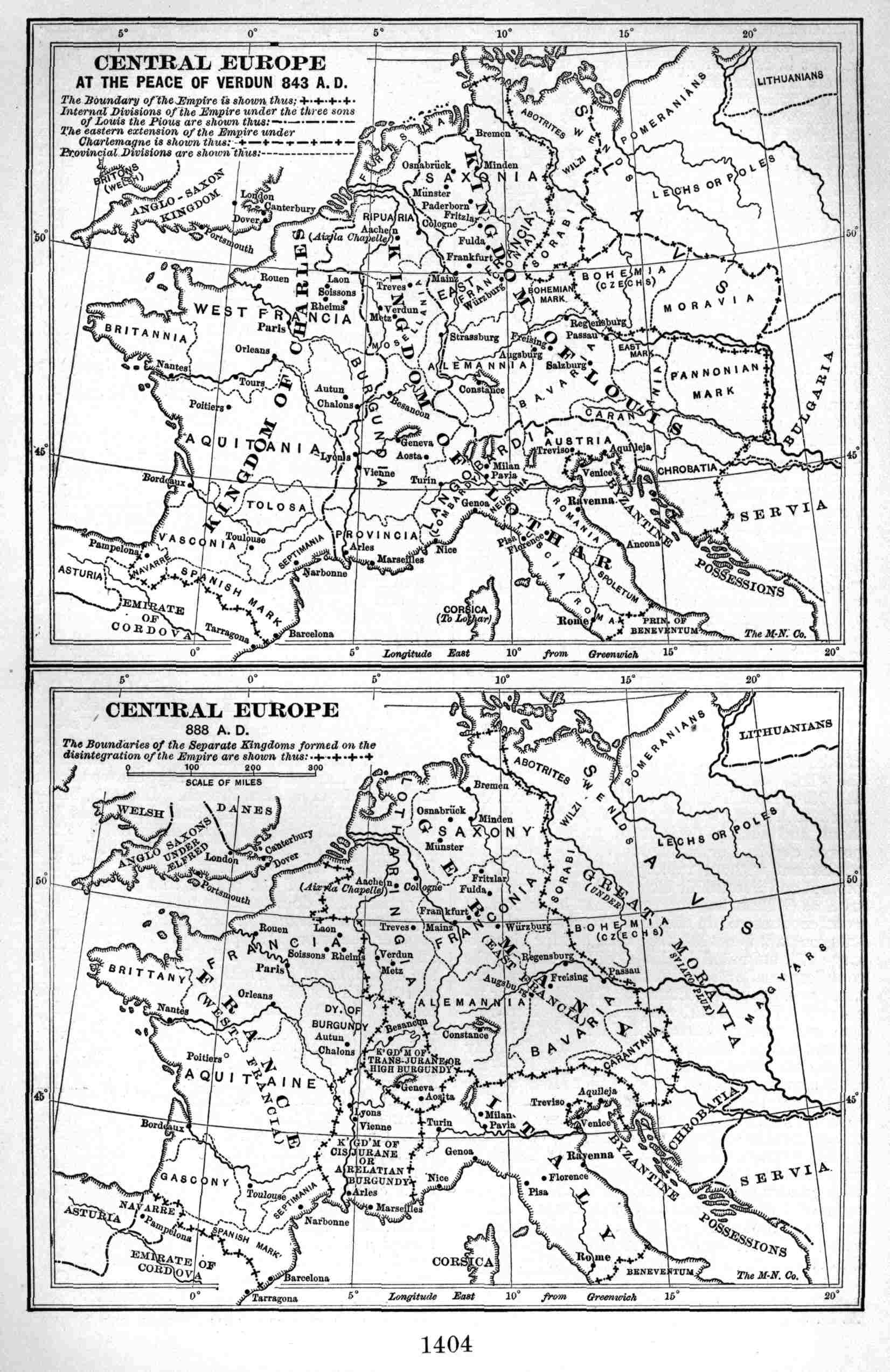
CENTRAL EUROPE AT THE PEACE OF VERDUN 843 A. D. CENTRAL EUROPE 888 A. D. ---------------------------------- FRATRES MINORES. See MENDICANT ORDERS. FRATRICELLI, The. See BEGUINES, ETC. FRAZIER'S FARM, OR GLENDALE, Battle of. See UNITED STATES OF AMERICA: A. D. 1862 (JUNE-JULY: VIRGINIA). FREDERICIA, Battle of (1849). See SCANDINAVIAN STATES (DENMARK): A. D. 1848-1862. FREDERICIA, Siege of (1864). See GERMANY: A. D. 1861-1866. FREDERICK I. (called Barbarossa), Emperor, A. D. 1155-1190; King of Germany, 1152-1190; King of Italy, 1155-1190. Frederick I., King of Denmark and Norway, 1523-1533. Frederick I., King of Prussia, 1701-1713; Frederick III., Elector of Brandenburg, 1688-1713. Frederick I., Elector of Brandenburg, 1417-1440. Frederick II., Emperor, 1220-1250; King of Germany, 1212-1250. See ITALY: A. D. 1183-1250; and GERMANY: A. D. 1138-1268. Frederick II., King of Denmark and Norway, 1558-1588. Frederick II., King of Naples, 1496-1503. Frederick II. (called The Great), King of Prussia, 1740-1786. Frederick II., King of Sicily, 1295-1337. Frederick II., Elector of Brandenburg, 1440-1470. Frederick III., Emperor, and King of Germany, 1440-1493. Frederick III., German Emperor and King of Prussia, 1888, March-June. Frederick III., King of Denmark and Norway, 1648-1670. Frederick III., King of Sicily, 1355-1377. Frederick IV., King of Denmark and Norway, 1609-1730. Frederick V., King of Denmark and Norway, 1746-1766. Frederick V., Elector of the Palatinate (and King-elect of Bohemia), and the Thirty Years' War. See GERMANY: A. D. 1618-1620, 1620, 1621-1623, 1631-1632, and 1648. Frederick VI., King of Denmark and Norway, 1808-1814; King of Denmark, 1814-1839. Frederick VII., King of Denmark, 1848-1863. Frederick Augustus I., Elector of Saxony, 1694-1733; King of Poland,1697-1704 (deposed), and 1709-1733. Frederick Augustus II., Elector of Saxony and King of Poland, 1733-1763. Frederick Henry, Stadtholder of the United Provinces, 1625-1647. Frederick William (called The Great Elector), Elector of Brandenburg, 1640-1688. Frederick William I., King of Prussia, 1713-1740. Frederick William II., King of Prussia, 1786-1797. Frederick William III., King of Prussia, 1797-1840. Frederick William IV., King of Prussia, 1840-1861. ----------FREDERICK: End---------- FREDERICKSBURG, Battle of. See UNITED STATES OF AMERICA: A. D.1862 (OCTOBER-DECEMBER: VIRGINIA). FREDERICKSBURG: Sedgwick's demonstration against. See UNITED STATES OF AMERICA: A. D. 1863 (APRIL-MAY: VIRGINIA). ----------FREDERICKSBURG: End---------- FREDERICKSHALL. Siege by the Swedes. Death of Charles XII. (1718). See SCANDINAVIAN STATES (SWEDEN): A. D. 1707-1718. FREDERICKSHAMM, Peace of (1809). See SCANDINAVIAN STATES: A. D. 1807-1810. FREDLINGEN, Battle of (1703). See NETHERLANDS: A. D. 1702-1704. FREE CHURCH OF SCOTLAND. See SCOTLAND: A. D. 1843. FREE CITIES. See CITIES, IMPERIAL AND FREE, OF GERMANY; also, ITALY: A. D. 1056-1152, and after. FREE COMPANIES, The. See ITALY: A. D. 1343-1393; and FRANCE: A. D. 1360-1380. FREE LANCES. See LANCES, FREE. FREE MASONS. "The fall of the Knights Templars has been connected with the origin of the Freemasons, and the idea has prevailed that the only secret purpose of the latter was the reestablishment of the suppressed order. Jacques de Molai, while a prisoner in Paris, is said to have created four new lodges, and the day after his execution, eight knights, disguised as masons, are said to have gone to gather up the ashes of their late Grand Master. To conceal their designs, the new Templars assumed the symbols of the trade, but took, it is said, the name of Francs 'Maçons' to distinguish themselves from ordinary craftsmen, and also in memory of the general appellation given to them in Palestine. Even the allegories of Freemasonry, and the ceremonies of its initiations, have been explained by a reference to the history of the persecutions of the Templars. The Abbé Barruel says, that 'every thing--the signs, the language, the names of grand master, of knight, of temple--all, in a word, betray the Freemasons as descendants of the proscribed knights.' Lessing, in Germany, gave some authority to this opinion, by asserting positively that 'the lodges of the Templars were in the very highest repute in the twelfth and thirteenth centuries, and that out of such a lodge, which had been constantly kept up in London, was established the society of Freemasons, in the seventeenth century, by Sir Christopher Wren.' {1406} Lessing is of opinion that the name Mason has nothing to do with the English meaning of the word, but comes from Massonney, a 'lodge' of the Knights Templars. This idea may have caused the Freemasons to amalgamate the external ritual of the Templars with their own, and to found the higher French degrees which have given colour to the very hypothesis which gave rise to their introduction. But the whole story appears to be most improbable, and only rests upon the slight foundation of fancied or accidental analogies. Attempts have also been made to show that the Freemasons are only a continuation of the fraternities of architects which are supposed to have originated at the time of the building of Solomon's Temple. The Egyptian priests are supposed to have taught those who were initiated a secret and sacred system of architecture; this is said to have been transmitted to the Dionysiac architects, of whom the first historical traces are to be found in Asia Minor, where they were organized into a secret fraternity. ... It is, however; a mere matter of speculation whether the Jewish and Dionysiac architects were closely connected, but there is some analogy between the latter and the Roman guilds, which Numa is said to have first introduced, and which were probably the prototypes of the later associations of masons which flourished until the end of the Roman Empire. The hordes of barbarians which then ruthlessly swept away whatever bore the semblance of luxury and elegance, did not spare the noblest specimens of art, and it was only when they became converted to Christianity, that the guilds were re-established. During the Lombard rule they became numerous in Italy. ... As their numbers increased, Lombardy no longer sufficed for the exercise of their art, and they travelled into all the countries where Christianity, only recently established, required religious buildings. ... These associations, however, became nearly crushed by the power of the monastic institutions, so that in the early part of the Middle Ages the words artist and priest became nearly synonymous; but in the twelfth century they emancipated themselves, and sprang into new life. The names of the authors of the great architectural creations of this period are almost all unknown; for these were not the work of individuals, but of fraternities. ... In England guilds of masons are said to have existed in the year 926, but this tradition is not supported by history; in Scotland similar associations were established towards the end of the fifteenth century. The Abbé Grandidier regards Freemasonry as nothing more than a servile imitation of the ancient and useful fraternity of true masons established during the building of the Cathedral of Strasburg, one of the masterpieces of Gothic architecture, and which caused the fame of its builders to spread throughout Europe. In many towns similar fraternities were established. ... The origin of the Freemasons of the present day is not to be attributed to these fraternities, but to the Rosicrucians [see ROSICRUCIANS] who first appeared at the beginning of the seventeenth century." A. P. Marras, Secret Fraternities of the Middle Ages, chapters 7-8. ALSO IN: J. G. Findel, History of Freemasonry. C. W. Heckethorn, Secret Societies of all Ages and Countries, book 8 (volume 1). FREE-SOIL PARTY, The. See UNITED STATES OF AMERICA: A. D. 1848. FREE SPIRIT, Brethren and Sisters of the. See BEGUINES. FREE TRADE IN ENGLAND. See TARIFF LEGISLATION (ENGLAND): A. D. 1836-1839; 1842; 1845-1846; and 1846-1879. FREEDMEN OF THE SOUTH. The emancipated slaves of the United States of America. FREEDMEN'S BUREAU, The. See UNITED STATES OF AMERICA: A. D. 1865-1866. FREEDOM OF THE PRESS: A. D. 1695. Expiration of the Censorship law in England. See PRINTING: A. D. 1695. FREEDOM OF THE PRESS: A. D. 1734. Zenger's trial at New York. Vindication of the rights of the colonial Press. See NEW YORK: A. D. 1720-1734. FREEDOM OF THE PRESS: A. D. 1755. Liberty attained in Massachusetts. See PRINTING: A. D. 1535-1709. FREEDOM OF THE PRESS: A. D. 1762-1764. Prosecution of John Wilkes. See ENGLAND: A. D. 1762-1764. FREEDOM OF THE PRESS: A. D. 1771. Last contest of the British Parliament with the Press. See ENGLAND: A. D. 1771. FREEDOM OF THE PRESS: A. D. 1817. The trials of William Hone. See ENGLAND: A. D. 1816-1820. ----------FREEDOM OF THE PRESS: End---------- FREEHOLD. See FEUDAL TENURES. FREEMAN'S FARM, Battle of. See UNITED STATES OF AMERICA: A. D. 1777 (JULY-OCTOBER). FREGELLÆ. Fregellæ, a Latin colony, founded by the Romans, B. C. 329, in the Volscian territory, on the Liris, revolted in B. C. 125. and was totally destroyed. A Roman colony, named Fabrateria, was founded near the site. G. Long, Decline of the Roman Republic, volume 1, chapter 17. FREIBURG (in the Breisgau). Freiburg became a free city in 1120, but lost its freedom a century later, and passed, in 1368, under the domination of the Hapsburgs. FREIBURG: A. D. 1638. Capture by Duke Bernhard. See GERMANY: A. D. 1634-1639. FREIBURG: A. D. 1644. Siege and capture by the Imperialists. Attempted recovery by Condé and Turenne. The three days battle. See GERMANY: A. D. 1643-1644. FREIBURG: A. D. 1677. Taken by the French. See NETHERLANDS (HOLLAND): A. D. 1674-1678. FREIBURG: A. D. 1679. Retained by France. See NIMEGUEN, THE PEACE OF. FREIBURG: A. D. 1697. Restored to Germany. See FRANCE: A. D. 1697. FREIBURG: A. D. 1713-1714. Taken and given up by the French. See UTRECHT: A. D. 1712-1714. FREIBURG: A. D. 1744-1748. Taken by the French and restored to Germany. See AUSTRIA: A. D. 1744-1745; and AIX-LA-CHAPELLE: THE CONGRESS. ----------FREIBURG: End---------- FREJUS, Origin of. See FORUM JULII. FREMONT, General John C., The conquest of California. See CALIFORNIA: A. D. 1846-1847. Defeat in Presidential election. See UNITED STATES OF AMERICA: A. D. 1856. Command in the west. Proclamation of Freedom. Removal. See UNITED STATES OF AMERICA: A. D. 1861 (JULY-SEPTEMBER: MISSOURI), and (AUGUST-OCTOBER: MISSOURI). Command in West Virginia. See UNITED STATES OF AMERICA: A. D. 1862. (MAY-JUNE: VIRGINIA). {1407} FRENCH AND INDIAN WAR. The four intercolonial wars of the 17th and 18th centuries, in America, commonly known, respectively, as "King William's War," "Queen Anne's War," "King George's War," and the French and Indian War, were all of them conflicts with the French and Indians of Canada, or New France; but the last of the series (coincident with the "Seven Years War" in Europe) became especially characterized in the colonies by that designation. Its causes and chief events are to be found related under the following headings: CANADA: A.D. 1750-1753,1755, 1756, 1756-1757, 1758, 1759,1760; NOVA SCOTIA: A. D.1749-1755, 1755; OHIO (VALLEY): A. D. 1748-1754, 1754, 1755; CAPE BRETON ISLAND: A. D. 1758-1760; also, for an account of the accompanying Cherokee War, SOUTH CAROLINA: A. D. 1759-1761. FRENCH FURY, The. See NETHERLANDS: A. D. 1581-1584. FRENCH SPOLIATION CLAIMS. See UNITED STATES OF AMERICA: A. D. 1800. FRENCHTOWN (now Monroe, Mich.), Battle at. See UNITED STATES OF AMERICA: A. D. 1812-1813. HARRISON'S NORTHWESTERN CAMPAIGN. FRENTANIANS, The. See SABINES. FRIARS. "Carmelite Friars," "White Friars." See CARMELITE FRIARS. Austin Friars; See AUSTIN CANONS. "Preaching Friars," "Begging Friars," "Minor Friars," "Black Friars," "Grey Friars." See MENDICANT ORDERS. FRIEDLAND, Battle of. See GERMANY: A. D. 1807 (FEBRUARY-JUNE). FRIEDLINGEN, Battle of. See GERMANY: A. D. 1702. FRIENDS, The Society of. See QUAKERS. FRIENDS OF THE PEOPLE; The Society of the. See FRANCE: A. D. 1830-1840. FRIESLAND. Absorbed in the dominions of the House of Burgundy (1430). See NETHERLANDS: A. D. 1417-1430. FRIGIDUS, Battle of the (A. D. 394). See ROME: A. D. 379-395. FRILING, The. See LÆTI. FRIMAIRE, The month. See FRANCE: A. D. 1793 (OCTOBER). FRISIANS, The. "Beyond the Batavians, upon the north, dwelt the great Frisian family, occupying the regions between the Rhine and Ems. The Zuyder Zee and the Dollart, both caused by the terrific inundations of the 13th century, and not existing at this period [the early Roman Empire], did not then interpose boundaries between kindred tribes." J. L. Motley, Rise of the Dutch Republic, introduction, section. 2. "The Frisians, adjoining [the Batavi] ... in the coast district that is still named after them, as far as the lower Ems, submitted to Drusus and obtained a position similar to that of the Batavi. There was imposed on them instead of tribute simply the delivery of a number of bullocks' hides for the wants of the army; on the other hand they had to furnish comparatively large numbers of men for the Roman service. They were the most faithful allies of Drusus as afterwards of Germanicus." T. Mommsen, History of Rome, book 8, chapter 4. FRISIANS: A. D. 528-729. Struggles against the Frank dominion, before Charlemagne. See GERMANY: A. D. 481-768. FRITH-GUILDS. See GUILDS, MEDIÆVAL. FROEBEL AND THE KINDERGARTEN. See EDUCATION, MODERN: REFORMS &c.: 1816-1892. FROG'S POINT, Battle At. See UNITED STATES OF AMERICA: A. D. 1776 (SEPTEMBER-NOVEMBER). FRONDE, FRONDEURS, The. See FRANCE: A. D. 1647-1648, 1649, 1650-1651, 1651-1653; and BORDEAUX: A. D. 1652-1653. FRONT ROYAL, Stonewall Jackson's capture of. See UNITED STATES OF AMERICA: A. D. 1862 (MAY-JUNE: VIRGINIA). FRONTENAC, Count, in New France. See CANADA: A. D. 1669-1687, to 1696. FRONTENAC, Fort. See KINGSTON, CANADA. FRUCTIDOR, The Month. See FRANCE: A. D. 1793 (OCTOBER). FRUCTIDOR: The Coup d'Etat of the Eighteenth of. See FRANCE: A. D. 1797 (SEPTEMBER). FRUELA I., King of Leon and the Asturias, or Oviedo, A. D. 757-768. Fruela II., King of Leon and the Asturias, or Oviedo, A. D. 923-925. FRUMENTARIAN LAW, The First. See ROME: B. C. 133-121. FUEGIANS, The. See AMERICAN ABORIGINES: PATAGONIANS. FUENTES D'ONORO, Battle of (1811). See SPAIN: A. D. 1810-1812. FUFIAN LAW, The. See ÆLIAN AND FUFIAN LAWS. FUGGERS, The. "Hans Fugger was the founder of the Fugger family, whose members still possess extensive estates and authority as princes and counts in Bavaria and Wurtemburg. He came to Augsburg in 1365 as a poor but energetic weaver's apprentice, acquired citizenship by marrying a burgher's daughter, and, after completing an excellent masterpiece, was admitted into the guild of weavers. ... Hans Fugger died in 1409, leaving behind him a fortune of 3,000 florins, which he had made by his skill and diligence. This was a considerable sum in those days, for the gold mines of the New World had not yet been opened up, and the necessaries of life sold for very low prices. The sons carried on their father's business, and with so much skill and success that they were always called the rich Fuggers. The importance and wealth of the family increased every day. By the year 1500 it was not easy to find a frequented route by sea or land where Fugger's wares were not to be seen. On one occasion the powerful Hanseatic league seized twenty of their ships, which were sailing with a cargo of Hungarian copper, down the Vistula to Cracow and Dantzic. Below ground the miner worked for Fugger, above it the artisan. In 1448 they lent 150,000 florins to the then Archdukes of Austria, the Emperor Frederick the Third (father of Maximilian) and his brother Albert. In 1509 a century had passed since the weaver Hans Fugger had died leaving his fortune of 3,000 florins, acquired by his laborious industry. His grand-children were now the richest merchants in Europe; without the aid of their money the mightiest princes of the continent could not complete any important enterprise, and their family was connected with the noblest houses by the ties of relationship. They were raised to the rank of noblemen and endowed with honourable privileges by the Emperor Maximilian the First." A. W. Grube, Heroes of History and Legend, chapter 13. {1408} FUGITIVE SLAVE LAW, AND ITS REPEAL. See UNITED STATES OF AMERICA: A. D. 1850, and 1864 (JUNE). FULAHS, The. See AFRICA: THE INHABITING RACES. FULFORD, Battle of. See ENGLAND: A. D. 1066 (SEPTEMBER). FULTON'S FIRST STEAMBOAT. See STEAM NAVIGATION: THE BEGINNINGS. FUNDAMENTAL AGREEMENT OF NEW HAVEN. See CONNECTICUT: A. D. 1639. FUNDAMENTAL ORDERS OF CONNECTICUT. See CONNECTICUT: A. D. 1636-1639. FUORUSCITI. In Italy, during the Guelf and Ghibelline contests of the 13th and 14th centuries (see ITALY: A. D. 1215-1293), "almost every city had its body of 'fuorusciti';--literally, 'those who had gone out';--proscripts and exiles, in fact, who represented the minorities ... in the different communities;--Ghibelline fuorusciti from Guelph cities, and Guelph fuorusciti from Ghibelline cities." T. A. Trollope, History of the Commonwealth of Florence, volume 1, page 380. FÜRST. Prince; the equivalent German title. See GERMANY: A. D. 1125-1152. FURY, The French. See NETHERLANDS: A. D. 1581-1584. FURY, The Spanish. See NETHERLANDS: A. D. 1575-1577. FUSILLADES. See FRANCE: A. D. 1793-1794 (OCTOBER-APRIL). FUTTEH ALI SHAH, Shah of Persia, A. D. 1798-1834. FUTTEHPORE, Battle of (1857). See INDIA: A. D. 1857-1858 (JULY-JUNE). FYLFOT-CROSS, The. See TRI-SKELION. FYRD, The. "The one national army [in Saxon England, before the Norman Conquest] was the fyrd, a force which had already received in the Karolingian legislation the name of landwehr by which the German knows it still. The fyrd was in fact composed of the whole mass of free landowners who formed the folk: and to the last it could only be summoned by the voice of the folk-moot. In theory therefore such a host represented the whole available force of the country. But in actual warfare its attendance at the king's war-call was limited by practical difficulties. Arms were costly; and the greater part of the fyrd came equipped with bludgeons and hedge-stakes, which could do little to meet the spear and battleaxe of the invader." J. R. Green, The Conquest of England, p. 133. G. GA, The. See GAU. GABELLE The. "In the spring of the year 1343, the king [Philip de Valois, king of France] published an ordinance by which no one was allowed to sell salt in France unless he bought it from the store-houses of the crown, which gave him the power of committing any degree of extortion in an article that was of the utmost necessity to his subjects. This obnoxious tax, which at a subsequent period became one of the chief sources of the revenue of the crown of France, was termed a gabelle, a word of Frankish or Teutonic origin, which had been in use from the earliest period to signify a tax in general, but which was from this time almost restricted to the extraordinary duty on salt. ... This word gabelle is the same as the Anglo-Saxon word 'gafol,' a tax." T. Wright, History of France, volume 1, page 364, and foot-note. See, also, TAILEE AND GABELLE. GABINIAN LAW, The. See ROME: B.C. 69-63. GACHUPINES AND GUADALUPES. In the last days of Spanish rule in Mexico, the Spanish official party bore the name of Gachupines, while the native party, which prepared for revolution, were called Guadalupes. E. J. Payne, History of European Colonies, p. 303. The name of the Guadalupes was adopted by the Mexicans "in honour of 'Our Lady of Guadalupe,' the tutelar protectress of Mexico;" while that of the Gachupines "was a sobriquet gratuitously bestowed upon the Spanish faction." W. H. Chynoweth, The Fall of Maximilian, page 3. GADEBUSCH, Battle of (1712). See SCANDINAVIAN STATES (SWEDEN): A. D. 1707-1718. GADENI, The. See BRITAIN, CELTIC TRIBES. GADES (Modern Cadiz); Ancient commerce of. "At this period [early in the last century before Christ] Gades was undoubtedly one of the most important emporiums of trade in the world: her citizens having absorbed a large part of the commerce that had previously belonged to Carthage. In the time of Strabo they still retained almost the whole trade with the Outer Sea, or Atlantic coasts." E. H. Bunbury, History of Ancient Geography, chapter 18, section 6 (volume 2). See, also, UTICA. GADSDEN PURCHASE, The. See ARIZONA: A. D. 1853. GAEL. See CELTS. GAETA: A. D. 1805-1806. Siege and Capture by the French. See FRANCE: A. D. 1805-1806 (DECEMBER-SEPTEMBER). GAETA: A. D. 1848. The refuge of Pope Pius IX. See ITALY: A.. D. 1848-1849. GAFOL. A payment in money, or kind, or work, rendered in the way of rent by a villein-tenant to his lord, among the Saxons and early English. The word signified tribute. F. Seebohm, English Village Community, chapters 2 and 5. GAG, The Atherton. See UNITED STATES OF AMERICA: A. D. 1836. GAGE, General Thomas, in the command and government at Boston. See UNITED STATES OF AMERICA: A. D. 1774 (MARCH-APRIL); 1775 (APRIL), (APRIL-MAY), and (JUNE). GAI SABER, El. See PROVENCE: A. D. 1179-1207. GAINAS, The. See ENGLAND: A. D. 547-633. GAINES' MILL, Battle of. See UNITED STATES OF AMERICA: A. D. 1862 (JUNE-JULY: VIRGINIA). GALATA, The Genoese colony. See GENOA: A. D. 1261-1299; also CONSTANTINOPLE: A. D. 1261-1453, and 1348-1355. {1409} GALATÆ, The. See GAULS. GALATIA.-GALATIANS. In 280 B. C. a body of Gauls, or Celts, invaded Greece, under Brennus, and in the following year three tribes of them crossed into Asia Minor. There, as in Greece, they committed terrible ravages, and were a desolating scourge to the land, sometimes employed as mercenaries by one and another of the princes who fought over the fragments of Alexander's Empire, and sometimes roaming for plunder on their own account. Antiochus, son of Seleueus, of Syria, is said to have won a great victory over them; but it was not until 239 B. C. that they were seriously checked by Attalus, King of Pergamus, who defeated them in a great battle and forced them to settle in the part of ancient Phrygia which afterwards took its name from them, being called Galatia, or Gallo-Græcia, or Eastern Gaul. When the Romans subjugated Asia Minor they found the Galatæ among their most formidable enemies. The latter were permitted for a time to retain a certain degree of independence, under tetrarchs, and afterwards under kings of their own. But finally Galatia became a Roman province. "When St. Paul preached among them, they seemed fused into the Hellenistic world, speaking Greek like the rest of Asia; yet the Celtic language long lingered among them and St. Jerome says he found the country people still using it in his day (fourth century A. D.)." J. P. Mahaffy, Story of Alexander's Empire, chapter 8. See, also, GAULS: B. C. 280-279. INVASION OF GREECE. GALBA, Roman Emperor, A. D. 68-69. GALEAZZO MARIO, Duke of Milan, A.D. 1466-1476. GALERIUS, Roman Emperor, A. D. 305-311. GALICIA (Spain), Settlement of Sueves and Vandals in. See SPAIN: A. D. 409-414. GALILEE. The Hebrew name Galil, applied originally to a little section of country, became in the Roman age, as Galilæa, the name of the whole region in Palestine north of Samaria and west of the river Jordan and the Sea of Galilee. Ewald interprets the name as meaning the "march" or frontier land; but in Smith's "Dictionary of the Bible" it is said to signify a "circle" or "circuit." It had many heathen inhabitants and was called Galilee of the Gentiles. H. Ewald, History of Israel, book 5, section 1. GALLAS, The. See AFRICA: THE INHABITING RACES; and ABYSSINIA: 15th-19th CENTURIES. GALLATIN, Albert, Negotiation of the Treaty of Ghent. See UNITED STATES OF AMERICA: A. D. 1814 (DECEMBER). GALLDACHT. See PALE, THE ENGLISH. GALLEON OR GALEON.--GALERA.--GALEAZA.--GALEASSES. See CARAVELS; also, ENGLAND: A. D. 1588; also, PERU: A. D. 1550-1816. GALLI, The. See GAULS. GALLIA. See GAUL. GALLIA BRACCATA, COMATA AND TOGATA. "The antient historians make some allusion to another division of Gaul, perhaps introduced by the soldiers, for it was founded solely upon the costume of the inhabitants. Gallia Togata, near the Rhone, comprehended the Gauls who had adopted the toga and the Roman manners. In Gallia Comata, to the north of the Loire, the inhabitants wore long plaited hair, which we find to this day among the Bas Britons. Gallia Bracata, to the south of the Loire, wore, for the national costume, trousers reaching from the hips to the ancles, called 'braccæ.'" J. C. L. S. de Sismondi, The French under the Merovingians, translated by Bellingham, chapter 2, note. GALLIA CISALPINA. See ROME: B. C. 390-347. GALLICAN CHURCH: A. D. 1268. The Pragmatic Sanction of St. Louis. See FRANCE: A. D. 1268. GALLICAN CHURCH: A. D. 1438. The Pragmatic Sanction of Charles VII., affirming some of the decrees of the reforming Council of Basel. See FRANCE: A. D. 1438. GALLICAN CHURCH: A. D. 1515-1518. Abrogation of the Pragmatic Sanction. The Concordat of Bologna. See FRANCE: A. D. 1515-1518. GALLICAN CHURCH: A. D. 1653-1713. The conflict of Jesuits and Jansenists. Persecution of the latter. The Bull Unigenitus and its tyrannical enforcement. See PORT ROYAL AND THE JANSENISTS. GALLICAN CHURCH: A. D. 1791-1792. The civil constitution of the clergy. The oath prescribed by the National Assembly. See FRANCE: A. D. 1789-1791; 1790-1791; and 1791-1792. GALLICAN CHURCH: A. D. 1793. Suppression of Christian worship in Paris and other parts of France. The worship of Reason. See FRANCE: A. D. 1793 (NOVEMBER). GALLICAN CHURCH: A. D. 1802. The Concordat of Napoleon. Its Ultramontane influence. See FRANCE: A. D. 1801-1804. GALLICAN CHURCH: A. D. 1833-1880. The Church and the Schools. See EDUCATION, MODERN: FRANCE: A. D. 1833-1889. ----------GALLICAN CHURCH: End---------- GALLICIA, The kingdom of. See SPAIN: A. D. 713-737. GALLIENUS, Roman Emperor, A. D. 253-268. GALLOGLASSES. The heavy-armed foot-soldiers of the Irish in their battles with the English during the 14th century. See, also, RAPPAREE. GALLS. See IRELAND: 9TH-10TH CENTURIES. GALLUS, Trebonianus, Roman Emperor, A. D. 251-253. GAMA, Voyage of Vasco da. See PORTUGAL: A. D. 1463-1498. GAMBETTA AND THE DEFENSE OF FRANCE. See FRANCE: A. D. 1870 (SEPTEMBER-OCTOBER), and 1870-1871. GAMMADION, The. See TRI-SKELION. GAMORI. See GEOMORI. GANAWESE OR KANAWHAS, The. See AMERICAN ABORIGINES: ALGONQUIAN FAMILY. GANDARIANS, The. See GEDROSIANS. GANDASTOGUES, OR CONESTOGAS, The. See AMERICAN ABORIGINES: SUSQUEHANNAS. GANGANI, The. See IRELAND, TRIBES OF EARLY CELTIC INHABITANTS. {1410} GANGWAY, The. On the floor of the English House of Commons, "the long lines of seats rise gradually on each side of the chair--those to the Speaker's right being occupied by the upholders of the Government, and those to the left accommodating the Opposition. One length of seating runs in an unbroken line beneath each of the side galleries, and these are known as the 'back benches.' The other lengths are divided into two nearly equal parts by an unseated gap of about a yard wide. This is 'the gangway.' Though nothing more than a convenient means of access for members, this space has come to be regarded as the barrier that separates the thick and thin supporters of the rival leaders from their less fettered colleagues--that is to say, the steady men from the Radicals, Nationalists, and free-lances generally." Popular Account of Parliamentary Procedure, page 6. GAON.-THE GAONATE. See JEWS: 7th CENTURY. GARAMANTES, The. The ancient inhabitants of the north African region now called Fezzan, were known as the Garamantes. E. H. Bunbury, History of Ancient Geography, chapter 8, section 1. GARCIA, King of Leon and the Asturias, or Oviedo, A. D. 910-914. Garcia I., King of Navarre, 885-891. Garcia II., King of Spain, 925-970. Garcia III., King of Navarre, 1035-1054. Garcia IV., King of Navarre, 1134-1150. GARFIELD, General James A. Campaign in Kentucky. See UNITED STATES OF AMERICA: A. D. 1862 (JANUARY-FEBRUARY; KENTUCKY-TENNESSEE). Presidential election. Administration. Assassination. See UNITED STATES OF AMERICA: A. D. 1880, and 1881. GARIBALD, King of the Lombards, A. D. 672-673. GARIBALDI'S ITALIAN CAMPAIGNS. See ITALY; A. D. 1848-:1849; 1856-1859; 1859-1861; 1862-1866; and 1867-1870. GARIGLIANO, Battle of the (1503). See ITALY: A. D. 1501-1504. GARITIES, The. See AQUITAINE: THE ANCIENT TRIBES. GARRISON, William Lloyd, and the American Abolitionists. See SLAVERY, NEGRO: A. D. 1828-1832. GARTER, Knights of the Order of the. "About this time [A. D. 1343] the king of England [Edward III.] resolved to rebuild and embellish the great castle of Windsor, which king Arthur had first founded in time past, and where he had erected and established that noble round table from whence so many gallant knights had issued forth, and displayed the valiant prowess of their deeds at arms over the world. King Edward, therefore, determined to establish an order of knighthood, consisting of himself, his children, and the most gallant knights in Christendom, to the number of forty. He ordered it to be denominated 'knights of the blue garter,' and that the feast should be celebrated every year at Windsor, upon St. George's day. He summoned, therefore, all the earls, barons, and knights of his realm, to inform them of his intentions; they heard it with great pleasure; for it appeared to them highly honourable, and capable of increasing love and friendship. Forty knights were then elected, according to report and estimation the bravest in Christendom, who sealed, and swore to maintain and keep the feast and the statutes which had been made. The king founded a chapel at Windsor, in honour of St. George, and established canons, there to serve God, with a handsome endowment. He then issued his proclamation for this feast by his heralds, whom he sent to France, Scotland, Burgundy, Hainault, Flanders, Brabant, and the empire of Germany, and offered to all knights and squires, that might come to this ceremony, passports to last for fifteen days after it was over. The celebration of this order was fixed for St. George's day next ensuing, to be held at Windsor, 1344." Froissart (Johnes), Chronicles, book 1, chapter 100. "The popular tradition, derived from Polydore Vergil, is that, having a festival at Court, a lady chanced to drop her garter, when it was picked up by the King. Observing that the incident made the bye-standers smile significantly, Edward exclaimed in a tone of rebuke, 'Honi soit qui mal y pense'--'Dishonoured be he who thinks evil of it': and to prevent any further innuendos, he tied the garter round his own knee. This anecdote, it is true, has been characterized by some as an improbable fable; why, we know not. ... Be the origin of the institution, however, what it may, no Order in Europe is so ancient, none so illustrious, for 'it exceeds in majesty, honour and fame all chivalrous fraternities in the world.' ... By a Statute passed on the 17th January, 1805, the Order is to consist of the Sovereign and twenty-five Knights Companions, together with such lineal descendants of George III. as may be elected, always excepting the Prince of Wales, who is a constituent part of the original institution. Special Statutes have since, at different times, been proclaimed for the admission of Sovereigns and extra Knights." Sir B. Burke, Book of Orders of Knighthood, page 98. ALSO IN: J. Buswell, Historical Account of the Knights of the Garter. C. M. Yonge, Cameos from English History, 2d series, chapter 3. GARUMNI, The Tribe of the. See AQUITAINE: THE ANCIENT TRIBES. GASCONY.--GASCONS: Origin. See AQUITAINE: A. D. 681-768. GASCONY: A. D. 778. The ambuscade at Roncesvalles. See SPAIN: A. D. 778. GASCONY: A. D. 781. Embraced in Aquitaine. See AQUITAINE: A. D. 781. GASCONY: 11th Century. The Founding of the Dukedom. See BURGUNDY: A. D. 1032. ----------GASCONY: End---------- GASIND, The. See COMITATUS. GASPE, The burning of the. See UNITED STATES OF AMERICA: A. D. 1772. GASTEIN, Convention of (1865). See GERMANY: A. D. 1861-1866. GATES, General Horatio, and the American Revolution. See UNITED STATES OF AMERICA: A. D. 1775 (MAY-AUGUST); 1777 (JULY-OCTOBER); 1777-1778; 1780 (FEBRUARY-AUGUST); 1780-1781. GATH. See PHILISTINES. GATHAS, The. See ZOROASTRIANS. {1411} GAU, OR GA, The. "Next [after the Mark, in the settlements of the Germanic peoples] in order of constitution, if not of time, is the union of two, three, or more Marks in a federal bond for purposes of a religious, judicial, or even political character. The technical name for such a union is in Germany a Gau or Bant; in England the ancient name Ga has been almost universally superseded by that of Scir or Shire. For the most part the natural divisions of the country are the divisions also of the Ga; and the size of this depends upon such accidental limits as well as upon the character and dispositions of the several collective bodies which we have called Marks. The Ga is the second and final form of unsevered possession; for every larger aggregate is but the result of a gradual reduction of such districts, under a higher political or administrative unity, different only in degree and not in kind from what prevailed individually in each. The kingdom is only a larger Ga than ordinary; indeed the Ga itself was the original kingdom. ... Some of the modern shire-divisions of England in all probability have remained unchanged from the earliest times; so that here and there a now existent Shire may be identical in territory with an ancient Ga. But it may be doubted whether this observation can be very extensively applied." J. M. Kemble, The Saxons in England. book 1, chapter 8. GAUGAMELA, OR ARBELA, Battle of (B. C. 331). See MACEDONIA: B. C. 384-380. GAUL: described by Cæsar. "Gallia, in the widest sense of the term, is divided into three parts, one part occupied by the Belgae, a second by the Aquitani, and a third by a people whom the Romans name Galli, but in their own tongue they are named Celtae. These three people differ in language and social institutions. The Garumna (Garonne) is the boundary between the Aquitani and the Celtae: the rivers Matrona (Marne, a branch of the Seine) and the Sequana (Seine) separate the Celtae from the Belgae. ... That part of Gallia which is occupied by the Celtae begins at the river Rhone: it is bounded by the Garonne, the Ocean and the territory of the Belgae; on the side of the Sequani and the Helvetii it also extends to the Rhine. It looks to the north. The territory of the Belgae begins where that of the Celtae ends: it extends to the lower part of the Rhine; it looks towards the north and the rising sun. Aquitania extends from the Garonne to the Pyrenean mountains and that part of the Ocean which borders on Spain. It looks in a direction between the setting sun and the north." Julius Cæsar, Gallic Wars, book 1, chapter 1; translated by G. Long (Decline of the Roman Republic, volume 8, chapter 22). GAUL: B. C. 125-121. First Roman conquests. See SALYES; ALLOBROGES; and ÆDUI. GAUL: B. C. 58-51. Cæsar's conquest. Cæsar was consul for the year 695 A. U. (B. C. 59). At the expiration of his consulship he secured, by vote of the people, the government of the two Gauls (see ROME: B. C. 68-58), not for one year, which was the customary term, but for five years--afterwards extended to ten. Cisalpine Gaul (northern Italy) had been fully subjugated and was tranquil; Transalpine Gaul (Gaul west and north of the Alps, or modern France, Switzerland and Belgium) was troubled and threatening. In Transalpine Gaul the Romans had made no conquests beyond the Rhone, as yet, except along the coast at the south. The country between the Alps and the Rhone, excepting certain territories of Massilia (Marseilles) which still continued to be a free city, in alliance with Rome, had been fully appropriated and organized as a province--the Provence of later times. The territory between the Rhone and the Cevennes mountains was less fully occupied and controlled. Cæsar's first proceeding as proconsul in Gaul was to arrest the migration of the Helvetii, who had determined to abandon their Swiss valleys and to seize some new territory in Gaul. He blocked their passage through Roman Gaul, then followed them in their movement eastward of the Rhone, attacked and defeated them with great slaughter, and forced the small remnant to return to their deserted mountain homes. The same year (B. C. 58) he drove out of Gaul a formidable body of Suevic Germans who had crossed the Rhine some years before under their king, Ariovistus. They were almost annihilated. The next year (B. C. 57) he reduced to submission the powerful tribes of the Belgian region, who had provoked attack by leaguing themselves against the Roman intrusion in Gaul. The most obstinate of those tribes--the Nervii--were destroyed. In the following year (B. C. 56) Cæsar attacked and nearly exterminated the Veneti, a remarkable maritime people, who occupied part of Armorica (modern Brittany); he also reduced the coast tribes northwards to submission, while one of his lieutenants, Crassus, made a conquest of Aquitania. The conquest of Gaul was now apparently complete, and next year (B. C. 55), after routing and cutting to pieces another horde of Germanic invaders--the Usipetes and Tenctheri--who had ventured across the lower Rhine, Cæsar traversed the channel and invaded Britain. This first invasion, which had been little more than a reconnoissance, was repeated the year following (B. C. 54), with a larger force. It was an expedition having small results, and Cæsar returned from it in the early autumn to find his power in Gaul undermined everywhere by rebellious conspiracies. The first outbreak occurred among the Belgæ, and found its vigorous leader in a young chief of the Eburones, Ambiorix by name. Two legions, stationed in the midst of the Eburones, were cut to pieces while attempting to retreat. But the effect of this great disaster was broken by the bold energy of Cæsar, who led two legions, numbering barely 7,000 men, to the rescue of his lieutenant Cicero (brother of the orator) whose single legion, camped in the Nervian territory, was surrounded and besieged by 60,000 of the enemy. Cæsar and his 7,000 veterans sufficed to rout the 60,000 Belgians. Proceeding with similar vigor to further operations, and raising new legions to increase his force, the proconsul had stamped the rebellion out before the close of the year 58 B. C., and the Eburones, who led in it, had ceased to exist. But the next year (B. C. 52) brought upon him a still more serious rising, of the Gallic tribes in central Gaul, leagued with the Belgians. Its leader was Vercingetorix, a gallant and able young chief of the Arverni. It was begun by the Carnutes, who massacred the Roman settlers in their town of Genabum (probably modern Orleans, but some say Gien, farther up the Loire). Cæsar was on the Italian side of the Alps when the news reached him, and the Gauls expected to be able to prevent his joining the scattered Roman forces in their country. But his energy baffled them, as it had baffled them many times before. He was across the Alps, across the Rhone, over the Cevennes--through six feet of snow in the passes--and in their midst, with such troops as he could gather in the Province, before they dreamed of lying in wait for him. Then, leaving most of these forces with Decimus Brutus, in a strong position, he stole away secretly, recrossed the Cevennes, put himself at the head of a small body of cavalry at Vienne on the Rhone, and rode straight through the country of the insurgents to join his veteran legions, first at Langres and afterwards at Sens. {1412} In a few weeks he was at the head of a strong army, had taken the guilty town of Genabum and had given it up to fire and the sword. A little later the capital of the Bituriges, Avaricum (modern Bourges), suffered the same fate. Next, attempting to reduce the Arvernian town of Gergovia, he met with a check and was placed in a serious strait. But with the able help of his lieutenant Labienus, who defeated a powerful combination of the Gauls near Lutetia (modern Paris), he broke the toils, reunited his army, which he had divided, routed Vercingetorix in a great battle fought in the valley of the Vingeanne, and shut him up, with 80,000 men, in the city of Alesia. The siege of Alesia (modern Alise-Sainte-Reine, west of Dijon) which followed, was the most extraordinary of Cæsar's military exploits in Gaul. Holding his circumvallation of the town, against 80,000 within its walls and thrice as many swarming outside of it, he scattered the latter and forced the surrender of the former. His triumph was his greatest shame. Like a very savage, he dragged the knightly Vercingetorix in his captive train, exhibited him at a subsequent "triumph" in Rome, and then sent him to be put to death in the ghastly Tullianum. The fall of Alesia practically ended the revolt; although even the next year found some fighting to be done, and one stronghold of the Cadurci, Uxellodunum (modern Puy-d'Issolu, near Vayrac), held out with great obstinacy. It was taken by tapping with a tunnel the spring which supplied the besieged with water, and Cæsar punished the obstinacy of the garrison by cutting off their hands. Gaul was then deemed to be conquered and pacified, and Cæsar was prepared for the final contest with his rivals and enemies at Rome. Cæsar, Gallic War. ALSO IN: G. Long, Decline of the Roman Republic, volume 4. Napoleon III., History of Cæsar. C. Merivale, History of the Romans under the Empire, chapters 6-7, 10, and 12 (volumes 1-2). T. A. Dodge, Cæsar, chapters 4-25. GAUL: 2d-3d Century. Introduction of Christianity. See CHRISTIANITY: A. D. 100-312 (GAUL). GAUL: A. D. 277. The invaders driven back by Probus. "The most important service which Probus [Roman Emperor, A. D. 276-282] rendered to the republic was the deliverance of Gaul, and the recovery of seventy flourishing cities oppressed by the barbarians of Germany, who, since the death of Aurelian, had ravaged that great province with impunity. Among the various multitude of those fierce invaders, we may distinguish, with some degree of clearness, three great armies, or rather nations, successively vanquished by the valour of Probus. He drove back the Franks into their morasses; a descriptive circumstance from whence we may infer that the confederacy known by the manly appellation of 'Free' already occupied the flat maritime country, intersected and almost overflown by the stagnating waters of the Rhine, and that several tribes of the Frisians and Batavians had acceded to their alliance. He vanquished the Burgundians [and the Lygians]. ... The deliverance of Gaul is reported to have cost the lives of 400,000 of the invaders--a work of labour to the Romans, and of expense to the emperor, who gave a piece of gold for the head of every barbarian." E. Gibbon, Decline and Fall of the Roman Empire, chapter 12. See, also, LYGIANS. GAUL: A. D. 287. Insurrection of the Bagauds. See BAGAUDS; also, DEDITITIUS. GAUL: A. D. 355-361. Julian's recovery of the province from the barbarians. During the civil wars and religious quarrels which followed the death of Constantine the Great--more especially in the three years of the usurpation of Magnentius, in the west (A. D. 350-353), Gaul was not only abandoned, for the most part, to the barbarians of Germany, but Franks and Alemanni were invited by Constantius to enter it. "In a little while a large part of the north and east of Gaul were in their almost undisputed possession. The Alamans seized upon the countries which are now called Alsace and Lorraine; the Franks secured for themselves Batavia and Toxandria: forty-five flourishing cities, among them Cologne, Treves, Spires, Worms, and Strasburg, were ravaged; and, in short, from the sources of the Rhine to its mouth, forty miles inland, there remained no safety for the population but in the strongly fortified towns." In this condition of the Gallic provinces, Julian, the young nephew of the emperor, was raised to the rank of Cæsar and sent thither with a trifling force of men to take the command. "During an administration of six years [A. D. 355-361] this latest Cæsar revived in Gaul the memory of the indefatigable exploits and the vigorous rule of the first Cæsar. Insufficient and ill-disciplined as his forces were, and baffled and betrayed as he was by those who should have been his aids, he drove the fierce and powerful tribes of the Alamans, who were now the hydra of the western provinces, beyond the Upper Rhine; the Chamaves, another warlike tribe, he pursued into the heart of their native forests; while the still fiercer and more warlike Franks were dislodged from their habitations on the Meuse, to accept of conditions from his hands. ... A part of these, called the Salians, and destined to figure hereafter, were allowed to settle in permanence in Toxandria, between the Meuse and the Scheld, near the modern Tongres. ... By three successful expeditions beyond the Rhine [he] restored to their friends a multitude of Roman captives, recovered the broken and down-trodden lines of the empire, humiliated many of the proud chiefs of the Germans, and impressed a salutary awe and respect upon their truculent followers. ... He spent the intervals of peace which his valor procured in recuperating the wasted energies of the inhabitants. Their dilapidated cities were repaired, the excesses of taxation retrenched, the deficient harvests compensated by large importations of corn from Britain, and the resources of suspended industry stimulated into new action. Once more, says Libanius, the Gauls ascended from the tombs to marry, to travel, to enjoy the festivals, and to celebrate the public games." P. Godwin, History of France: Ancient Gaul, book 2, chapter 7. ALSO IN: E. Gibbon, Decline and Fall of the Roman Empire, chapter 19. GAUL: A. D. 365-367. Expulsion of the Alemanni by Valentinian. See ALEMANNI: A. D. 365-367. GAUL: A. D. 378. Invasion of the Alemanni. Their destruction by Gratian. See ALEMANNI: A. D. 378. {1413} GAUL: A. D. 406-409. The breaking of the Rhine barrier. The same year (A. D. 406) in which Radagaisus, with his motley barbaric horde, invaded Italy and was destroyed by Stilicho, a more fatal assault was made upon Gaul. Two armies, in which were gathered up a vast multitude of Suevi, Vandals, Alans and Burgundians, passed the Rhine. The Franks opposed them as faithful allies of the Roman power, and defeated a Vandal army in one great battle, where 20,000 of the invaders were slain; but the Alans came opportunely to the rescue of their friends and forced the Frank defenders of Gaul to give way. "The victorious confederates pursued their march, and on the last day of the year, in a season when the waters of the Rhine were most probably frozen, they entered without opposition the defenceless provinces of Gaul. This memorable passage of the Suevi, the Vandals, the Alani, and the Burgundians, who never afterwards retreated, may be considered as the fall of the Roman empire in the countries beyond the Alps; and the barriers which had so long separated the savage and the civilized nations of the earth were, from that fatal moment, levelled with the ground. ... The flourishing city of Mentz was surprised and destroyed, and many thousand Christians were inhumanly massacred in the church. Worms perished after a long and obstinate siege; Strasburg, Spires, Rheims, Tournay, Arras, Amiens, experienced the cruel oppression of the German yoke; and the consuming flames of war spread from the banks of the Rhine over the greatest part of the seventeen provinces of Gaul. That rich and extensive country, as far as the ocean, the Alps, and the Pyrenees, was delivered to the barbarians, who drove before them in a promiscuous crowd the bishop, the senator, and the virgin, laden with the spoils of their houses and altars." E. Gibbon, Decline and Fall of the Roman Empire, chapter 30. GAUL: A. D. 407-411. Reign of the usurper Constantine. See BRITAIN: A. D. 407. GAUL: A. D. 410-419. Establishment of the Visigoths in the kingdom of Toulouse. See GOTHS (VISIGOTHS): A. D. 410-419. GAUL: A. D. 410-420. The Franks join in the attack on Gaul. See FRANKS: A. D. 410-420. GAUL: 5th-8th Centuries. Barbarities of the Frank conquest. The conquests of the Franks in Gaul, under Clovis, began in 486 and ended with his death in 511 (see FRANKS: A. D. 481-511). "In the year 532, Theoderik, one of the sons and successors of Chlodowig, said to those Frankish warriors whom he commanded: 'Follow me as far as Auvergne, and I will make you enter a country where you will take as much gold and silver as you possibly can desire; where you can carry away in abundance flocks, slaves, and garments.' The Franks took up arms and once more crossing the Loire, they advanced on the territory of the Bituriges and Arvernes. These paid with interest for the resistance they had dared to the first invasion. Everything amongst them was devastated; the churches and monasteries were razed to their foundations. The young men and women were dragged, their hands bound, after the luggage to be sold as slaves. The inhabitants of this unfortunate country perished in large numbers or were ruined by the pillage. Nothing was left them of what they had possessed, says an ancient chronicle, except the land, which the barbarians could not carry away. Such were the neighbourly relations kept up by the Franks with the Gallic populations which had remained beyond their limits. Their conduct with respect to the natives of the northern provinces was hardly less hostile. When Hilperik, the son of Chlother, wished, in the year 584, to send his daughter in marriage to the king of the West Goths, or Visigoths, settled in Spain, he came to Paris and carried away from the houses belonging to the 'fisc' a great number of men and women, who were heaped up in chariots to accompany and serve the bride elect. Those who refused to depart, and wept, were put in prison: several strangled themselves in despair. Many people of the best families enlisted by force into this procession, made their will, and gave their property to the churches. 'The son,' says a contemporary, 'was separated from his father, the mother from her daughter; they departed sobbing, and pronouncing deep curses; so many persons in Paris were in tears that it might be compared to the desolation of Egypt.' In their domestic misfortunes the kings of the Franks sometimes felt remorse, and trembled at the evil they had done. ... But this momentary repentance soon yielded to the love of riches, the most violent passion of the Franks. Their incursions into the south of Gaul recommenced as soon as that country, recovered from its terrors and defeats, no longer admitted their garrisons nor tax collectors. Karle, to whom the fear of his arms gave the surname of Marteau, made an inroad as far as Marseilles; he took possession of Lyons, Arles, and Vienne, and carried off an immense booty to the territory of the Franks. When this same Karle, to insure his frontiers, went to fight the Saracens in Aquitania, he put the whole country to fire and sword; he burnt Bérgiers, Agde, and Nûnes; the arenas of the latter city still bear traces of the fire. At death of Karle, his two sons, Karlemann and Peppin, continued the great enterprise of replacing the inhabitants of the south, to whom the name of Romans was still given, under the yoke of the Franks. ... Southern Gaul was to the sons of the Franks what entire Gaul had been to their fathers; a country, the riches and climate of which attracted them incessantly, and saw them return as enemies, as soon as it did not purchase peace of them." A. Thierry, Narratives of the Merovingian Era, Historical Essays, etc., essay 24. GAUL: 5th-10th Centuries. The conquerors and the conquered. State of society under the barbarian rule. The evolution of Feudalism. "After the conclusion of the great struggles which took place in the fourth and fifth centuries, whether between the German conquerors and the last forces of the empire, or between the nations which had occupied different portions of Gaul, until the Franks remained sole masters of the country, two races, two populations, which had nothing in common but religion, appear forcibly brought together, and, as it were, face to face with each other, in one political community. The Gallo-Roman population presents under the same law very different and very unequal conditions; the barbarian population comprises, together with its own peculiar classifications of ranks and conditions, distinct laws and nationalities. In the first we find citizens absolutely free, coloni, or husbandmen belonging to the lands of a proprietor, and domestic slaves deprived of all civil rights; in the second, we see the Frankish race divided into two tribes, each having its own peculiar law [the law of the Salic Franks or Salic law, and the law of the Ripuarian Franks or Ripuarian law]; the Burgundians, the Goths, and the rest of the Teutonic races, who became subjected, either of their own accord or by force, to, the Frankish empire, governed by other and entirely different laws; but among them all, as well as among the Franks, we find at least three social conditions--two degrees of liberty, and slavery. {1414} Among these incongruous states of existence, the criminal law of the dominant race established, by means of the scale of damages for crime or personal injury, a kind of hierarchy-- the starting-point of that movement towards an assimilation and gradual transformation, which, after the lapse of four centuries, from the fifth to the tenth, gave rise to the society of the feudal times. The first rank in the civil order belonged to the man of Frankish origin, and to the Barbarian who lived under the law of the Franks; in the second rank was placed the Barbarian, who lived under the law of his own country; next came the native freeman and proprietor, the Roman possessor, and, in the same degree, the Lidus or German colonus; after them, the Roman tributary--i. e., the native colonus; and, last of all, the slave, without distinction of origin. These various classes, separated on the one hand by distance of rank, on the other by difference of laws, manners, and language, were far from being equally distributed between the cities and the rural districts. All that was elevated in the Gallo-Roman population, of whatever character it might be, was found in the cities, where its noble, rich, and industrious families dwelt, surrounded by their domestic slaves; and, among the people of that race, the only constant residents in the country were the half-servile coloni and the agricultural slaves. On the contrary, the superior class of the German population established itself in the country, where each family, independent and proprietary, was maintained on its own domain by the labour of the Lidi whom it had brought thither, or of the old race of coloni who belonged to the soil. The only Germans who resided in the cities were a small number of officers in the service of the Crown, and of individuals without family and patrimony, who, in spite of their original habits, sought a livelihood by following some employment. The social superiority of the dominant race rooted itself firmly in the localities inhabited by them, and passed, as has been already remarked, from the cities to the rural districts. By degrees, also, it came to pass that the latter drew off from the former the upper portion of their population, who, in order to raise themselves still higher, and to mix with the conquerors, imitated, as far as they were able, their mode of life. ... While Barbarism was thus occupying or usurping all the vantage points of the social state, and civil life in the intermediate classes was arrested in its progress, and sinking gradually to the lowest condition, even to that of personal servitude, an ameliorating movement already commenced before the fall of the empire, still continued, and declared itself more and more loudly. The dogma of a common brotherhood in the eyes of God, and of one sole redemption for all mankind, preached by the Church to the faithful of every race, touched the heart and awakened the mind in favour of the slave, and, in consequence, enfranchisements became more frequent, or a treatment more humane was adopted on the part of the masters, whether Gauls or Germans by origin. The latter, moreover, had imported from their country, where the mode of life was simple and without luxury, usages favourable to a modified slavery. The rich barbarian was waited upon by free persons--by the children of his relatives, his clients and his friends; the tendency of his national manners, different from that of the Roman, induced him to send the slave out of his house, and to establish him as a labourer or artisan on some portion of land to which he then became permanently attached, and the destination of which he followed, whether it were inherited or sold. ... Domestic slavery made the man a chattel, a mere piece of moveable property. The slave, settled on a spot of land, from that time entered into the category of real property. At the same time that this last class, which properly bore the name of serfs, was increased at the expense of the first, the classes of the coloni and Lidi would naturally multiply simultaneously, by the very casualties of ruin and adverse circumstances which, at a period of incessant commotions, injured the condition of the freemen. ... In the very heart of the Barbarian society, the class of small proprietors, which had originally formed its strength and glory, decreased, and finally became extinct by sinking into vassalage, or a state of still more ignoble dependence, which partook more or less of the character of actual servitude. ... The freemen depressed towards servitude met the slave who had reached a sort of half liberty. Thus, through the whole extent of Gaul, was formed a vast body of agricultural labourers and rural artisans, whose lot, though never uniform, was brought more and more to a level of equality; and the creative wants of society produced a new sphere of industry in the country, while the cities remained stationary, or sank more and more into decay. ... On every large estate where improvement flourished, the cabins of those employed, Lidi, coloni or slaves, grouped as necessity or convenience suggested, were multiplied and peopled more numerously, till they assumed the form of a hamlet. When these hamlets were situated in a favourable position ... they continued to increase till they became villages. ... The building of a church soon raised the village to the rank of a parish; and, as a consequence, the new parish took its place among the rural circonscriptions. ... Thence sprung, altogether spontaneously, under the sanction of the intendant, joined to that of the priest, rude outlines of a municipal organization, in which the church became the depository of the acts which, in accordance with the Roman law, were inscribed on the registers of the city. It is in this way that beyond the towns, the cities, and the boroughs, where the remains of the old social condition lingered in an increasing state of degradation, elements of future improvement were formed. ... This modification, already considerably advanced in the ninth century, was completed in the course of the tenth. At that period, the last class of the Gallo-Frankish society disappeared--viz., that of persons held as chattels, bought, exchanged, transferred from one place to another, like any other kind of moveable goods. The slave now belonged to the soil rather than to the person; his service, hitherto arbitrary, was changed into customary dues and regulated employment; he had a settled abode, and, in consequence, a right of possession in the soil on which he was dependent. This is the earliest form in which we distinctly trace the first impress of the modern world upon the civil state. {1415} The word serf henceforward took its definite meaning; it became the generic name of a mixed condition of servitude and freedom, in which we find blended together the states of the colonus and Lidus--two names which occur less and less frequently in the tenth century, till they entirely disappear. This century, the point to which all the social efforts of the four preceding ones which had elapsed since the Frankish conquest had been tending, saw the intestine struggle between the Roman and German manners brought to a conclusion by an important revolution. The latter definitively prevailed, and from their triumph arose the feudal system; that is to say, a new form of the state, a new constitution of property and domestic life, a parcelling out of the sovereignty and jurisdiction, all the public powers transformed into demesnial privileges, the idea of nobility devoted to the profession of arms, and that of ignobility to industry and labour. By a remarkable coincidence, the complete establishment of this system is the epoch when the distinction of races terminates in Frankish Gaul--when all the legal consequences of diversity of origin between Barbarians and Romans, conquerors and subjects, disappear. The law ceases to be personal, and becomes local; the German codes and the Roman code itself are replaced by custom; it is the territory and not the descent which distinguishes the inhabitant of the Gallic soil; finally, instead of national distinctions, one mixed population appears, to which the historian is able henceforward to give the name of French." A. Thierry, Formation and Progress of the Tiers État in France, volume 1, chapter 1. GAUL: A. D. 412-453. The mixed administration, Roman and barbarian. "A prætorian prefect still resided at Trèves; a vicar of the seventeen Gallic provinces at Aries: each of these provinces had its Roman duke; each of the hundred and fifteen cities of Gaul had its count; each city its curia, or municipality. But, collaterally with this Roman organisation, the barbarians, assembled in their 'mallum,' of which their kings were presidents, decided on peace and war, made laws, or administered justice. Each division of the army had its Graf Jarl, or Count; each subdivision its centenary, or hundred-man; and all these fractions of the free population had the same right of deciding by suffrage in their own mallums, or peculiar courts, all their common affairs. In cases of opposition between the barbarian and the Roman jurisdiction, the overbearing arrogance of the one, and the abject baseness of the other, soon decided the question of supremacy. In some provinces the two powers were not concurrent: there were no barbarians between the Loire and the Meuse, nor between the Alps and the Rhone; but the feebleness of the Roman government was only the more conspicuous. A few great proprietors cultivated a part of the province with the aid of slaves; the rest was desert, or only inhabited by Bagaudæ, runaway slaves, who lived by robbery. Some towns still maintained a show of opulence, but not one gave the slightest sign of strength; not one enrolled its militia, nor repaired its fortifications. ... Honorius wished to confer on the cities of southern Gaul a diet, at which they might have deliberated on public affairs: he did not even find public spirit enough to accept the offered privilege." J. C. L. de Sismondi, Fall of the Roman Empire, chapter 7 (volume 1). GAUL: A. D. 451. Attila's invasion. See HUNS: A. D. 451. GAUL: A. D. 453-484. Extension of the Visigothic kingdom. See GOTHS (VISIGOTHS): A. D. 453-484. GAUL: A. D. 457-486. The last Roman sovereignty. The last definite survival of Roman sovereignty in Gaul lingered until 486 in a district north of the Seine, between the Marne and the Oise, which had Soissons for its capital. It was maintained there, in the first instance, by Ægidius, a Gallic noble whom Marjorian, one of the last of the emperors at Rome, made Master-General of Gaul. The respect commanded by Ægidius among the surrounding barbarians was so great that the Salian Franks invited him to rule over them, in place of a licentious young king, Childeric, whom they had driven into exile. He was king of these Franks, according to Gregory of Tours, for eight years (457-464), until he died. Childeric then returned, was reinstated in his kingdom and became the father of Clovis (or Chlodwig), the founder of the great Frank monarchy. But a son of Ægidius, named Syagrius, was still the inheritor of a kingdom, known as, the "Kingdom of Syagrius," embracing, as has been said, the country around Soissons, between the Seine, the Marne and the Oise, and also including, in the opinion of some writers, Troyes and Auxerre. The first exploit of Clovis--the beginning of his career of conquest--was the overthrow of this "king of the Romans," as Syagrius was called, in a decisive battle fought at Soissons, A. D. 486, and the incorporation of his kingdom into the Frank dominions. Syagrius escaped to Toulouse, but was surrendered to Clovis and put to death. P. Godwin, History of France: Ancient Gaul, book 3, chapter 11. ALSO IN: W. C. Perry, The Franks, chapter 2. GAUL: A. D. 474. Invasion of Ostrogoths. See GOTHS (OSTROGOTHS): A. D. 473-474. GAUL: A. D. 507-509. Expulsion of the Visigoths. See GOTHS (VISIGOTHS): A. D. 507-509. GAUL: A. D. 540. Formal relinquishment of the country to the Franks by Justinian. See FRANKS: A. D. 539-553. GAULS. "The Gauls, properly so called, the Galatæ of the Greeks, the Galli of the Romans, and the Gael of modern history, formed the van of the great Celtic migration which had poured westward at various intervals during many hundred years. ... Having overrun the south of Gaul and penetrated into Spain, they lost a part of the territory thus acquired, and the restoration of the Iberian fugitives to Aquitania placed a barrier between the Celts in Spain and their brethren whom they had left behind them in the north. In the time of the Romans the Galli were found established in the centre and east of the country denominated Gaul, forming for the most part a great confederation, at the head of which stood the Arverni. It was the policy of the Romans to raise the Ædui into competition with this dominant tribe. ... The Arverni, whose name is retained in the modern appellation of Auvergne, occupied a large district in the middle and south of Gaul, and were surrounded by tributary or dependent clans. The Ædui lay more to the north and east, and the centre of their possessions is marked by the position of their capital Bibracte, the modern Autun, situated in the highlands which separate the waters of the Loire, the Seine and the Saone. ... {1416} Other Gallic tribes stretched beyond the Saone: the Sequani, who afterwards made an attempt to usurp this coveted preeminence (the valley of the Doubs formed the centre of the Sequanese territory, which reached to the Jura and the Rhine); the Helvetii and other mountain races, whose scanty pastures extended to the sources of the Rhine; the Allobroges, who dwelt upon the Isere and Rhone, and who were the first of their race to meet and the first to succumb before the prowess of the Roman legions. According to the classification both of Cæsar and Strabo, the Turones, Pictones and Santones must be comprised under the same general denomination." C. Merivale, History of the Romans, chapter 5 (volume 1). See, also, CELTS. GAUL: B. C. 390-347. Invasions of Italy. Destruction of Rome. See ROME: B. C. 390-347. GAUL: B. C. 295-191. Roman conquest of the Cisalpine tribes. See ROME: B. C. 295-191. GAUL: B. C. 280-279. Invasion of Greece. In the year 280 B. C. the Gauls, who had long before passed from northern Italy around the Adriatic to its eastern coast, made their first appearance in Macedonia and northern Greece. The Macedonian throne was occupied at the time by the infamous usurper, Ptolemy Ceraunus (see MACEDONIA: B. C. 297-280), and the Celtic savages did one good service to Greece by slaying him, in the single battle that was fought. The whole open country was abandoned to them, for a time, and they swept it, as far southward as the valley of the Peneus, in Thessaly; but the walled cities were safe. After ravaging the country for some months the Gauls appear to have retired; but it was only to return again the next year in more formidable numbers and under a chief, Brennus, of more vigor and capability. On this occasion the country suffered fearfully from the barbaric swarm, but defended itself with something like the spirit of the Greece of two centuries before. The Ætolians were conspicuous in the struggle; the Peloponnesian states gave little assistance. The policy of defense was much the same as at the time of the Persian invasion, and the enemy was confronted in force at the pass of Thermopylæ. Brennus made a more desperate attempt to force the pass than Xerxes had done and was beaten back with a tremendous slaughter of his Gauls. But he found traitors, as Xerxes had done, to guide him over the mountains, and the Greeks at Thermopylæ, surrounded by the enemy, could only escape by sea. The Gauls marched on Delphi, eager for the plunder of the great temple, and there they met with some fatal disaster. Precisely what occurred is not known. According to the Greeks, the god protected his sanctuary, and the accounts they have left are full of miracles and prodigies--of earthquakes, lightnings, tempests, and disease. The only clear facts seem to be that Delphi was successfully defended; that the Gauls retreated in disorder and were destroyed in vast numbers before the remnant of them got away from the country. Brennus is said to have killed himself to escape the wrath of his people for the failure of the expedition. One large body of the great army had separated from the rest and gone eastward into Thrace, before the catastrophe occurred. These subsequently passed over to Asia and pursued there an adventurous career, leaving a historic name in the country. See GALATIA. C. Thirlwall, History of Greece, chapter 60. ----------GAUL: End---------- GAULS, Præfect of the. See PRÆTORIAN PRÆFECTS. GAUSARAPOS, OR GUUCHIES, The. See AMERICAN ABORIGINES: PAMPAS TRIBES. GAVELKIND, Irish. "The Irish law of succession in landed property, known as that of Irish gavelkind, was a logical consequence of the theory of tribal ownership. If a member of the tribe died, his piece of land did not descend by right to his eldest son, or even to all his children equally. Originally, it reverted to its sole absolute owner, the tribe, every member of which had a right to use proportionate to his tribal status. This was undoubtedly the essential principle of inheritance by gavelkind." S. Bryant, Celtic Ireland, chapter 6. ALSO IN: Sir H. Maine, Early History of Institutions, lecture 7. GAVELKIND, Kentish. See FEUDAL TENURES. GAVEREN, Battle of (1453). See GHENT: A. D. 1451-1453. GAZA: Early history. See PHILISTINES. GAZA: B. C. 332. Siege by Alexander. In his march from Phœnicia to Egypt (see MACEDONIA, &c.: B. C. 334-330), Alexander the Great was compelled to pause for several months and lay siege to the ancient Philistine city of Gaza. It was defended for the Persian king by a brave eunuch named Batis. In the course of the siege, Alexander received a severe wound in the shoulder, which irritated his savage temper. When the town was at length taken by storm, he gave no quarter. Its male inhabitants were put to the sword and the women and children sold to slavery. The eunuch Batis, being captured alive, but wounded, was dragged by the feet at the tail of a chariot, driven at full speed by Alexander himself. The "greatest of conquerors" proved himself often enough, in this way, to be the greatest of barbarians--in his age. G. Grote, History of Greece, part 2, chapter 93. GAZA: B. C. 312. Battle between Ptolemy and Demetrius. See MACEDONIA: B. C. 315-310. GAZA: B. C. 100. Destruction by Alexander Jannæus. Gaza having sided with the Egyptian king, in a war between Alexander Jannæus, one of the Asmonean kings of the Jews, and Ptolemy Lathyrus of Egypt and Cyprus, the former laid siege to the city, about 100 B. C., and acquired possession of it after several months, through treachery. He took his revenge by massacring the inhabitants and reducing the city to ruins. It was rebuilt not long afterwards by the Romans. G. Long, Decline of the Roman Republic, volume 3, chapter 9. GAZA: A. D. 1516. Defeat of the Mamelukes by the Turks. See TURKS: A. D. 1481-1520. ----------GAZA: End---------- GAZACA. See ECBATANA. GAZARI, The. See CATHARISTS. GAZNEVIDES, OR GHAZNEVIDES. See TURKS: A. D. 999-1183. GEARY ACT, The. See UNITED STATES OF AMERICA: A. D. 1892. GEDDES, Jenny, and her stool. See SCOTLAND: A. D. 1637. {1417} GEDROSIANS, The. "Close to the Indus, and beyond the bare, hot, treeless shores of the ocean, the southern part of the plain [of eastern Iran] consists of sandy flats, in which nothing grows but prickly herbs and a few palms. The springs are a day's journey from each other, and often more. This region was possessed by a people whom Herodotus calls Sattagydæ and the companions of Alexander of Macedonia, Gedrosians. ... Neighbours of the Gandarians, who, as we know, dwelt on the right bank of the Indus down to the Cabul, the Gedrosians led a wandering, predatory life; under the Persian kings, they were united into one satrapy with the Gandarians." M. Duncker, History of Antiquity, book 7, chapter 1 (volume 5). GEIZA II., King of Hungary, A. D. 1141-1160. GELA, Founding of. See SYRACUSE, FOUNDING OF. GELASIUS II., Pope, A. D. 1118-1119. GELEONTES. See PHYLÆ. GELHEIM, Battle of (1298). See GERMANY: A. D. 1273-1308. GELONI, The. An ancient colony of Greeks intermixed with natives which shared the country of the Budini, on the steppes between the Ural Mountains and the Caspian Sea. G. Grote, History of Greece, part 2, volume 3, chapter 17. GELVES, Battle of (1510). See BARBARY STATES: A. D. 1505-1510. GEMARA, The. See TALMUD. GEMBLOURS, Battle of (1578). See NETHERLANDS: A. D. 1577-1581. GEMEINDE.--GEMEINDERATH. See SWITZERLAND: A. D. 1848-1890. GEMOT. A meeting, assembly, council, moot. See WITENAGEMOT. GENABUM, OR CENABUM. The principal town of the Gallic tribe called the Carnutes; identified by most archæologists with the modern city of Orleans, France, though some think its site was at Gien. See GAUL, CÆSAR'S CONQUEST OF. GENAUNI, The. See RHÆTIANS. GENERAL PRIVILEGE OF ARAGON. See CORTES, THE EARLY SPANISH. GENERALS, Execution of the Athenian. See GREECE: B. C. 406. GENET, "Citizen," the mission of. See UNITED STATES OF AMERICA: A. D. 1793. GENEVA: Beginnings of the city. See HELVETII, THE ARRESTED MIGRATION OF THE. GENEVA: A. D. 500. Under the Burgundians. See BURGUNDIANS: A. D. 500. GENEVA: 10th Century. In the kingdom of Arles. See BURGUNDY: A. D. 843-933. GENEVA: A. D. 1401. Acquisition of the Genevois, or County, by the House of Savoy. The city surrounded. See SAVOY: 11TH-15TH CENTURIES. GENEVA: A. D. 1504-1535. The emancipation of the city from the Vidomme and the Prince-Bishop. Triumph of the Reformation. "Geneva was nominally a free city of the Empire, but had in reality been governed for some centuries by its own bishop, associated with a committee of lay-assessors, and controlled by the general body of the citizens, in whose hands the ultimate power of taxation, and of election of the magistrates and regulation of the police, rested. The prince-bishop did not exercise his temporal jurisdiction directly, but through an officer called the Vidomme (vice-dominus), whose rights had in the 15th century become hereditary in the dukes of Savoy. These rights appear to have been exercised without any considerable attempt at encroachment till the beginning of the following century, when Charles III. succeeded to the ducal crown (1504). To his ambition the bishop, John, a weak and willing tool of the Savoy family, to which he was nearly allied, ceded everything; and the result was a tyrannical attempt to destroy the liberties of the Genevese. The Assembly of the citizens rose in arms; a bitter and sanguinary contest ensued between the Eidgenossen [Confederates] or Patriot party on the one side, and the Mamelukes or monarchical party on the other side. By the help of the free Helvetian states, particularly Berne and Friburg, the Patriots triumphed, the friends of Savoy were banished, the Vidommate abolished, and its powers transferred to a board of magistrates. The conduct of the bishops in this conflict ... helped greatly, as may be imagined, to shake the old hierarchical authority in Geneva; and when, in 1532, Farel first made his appearance in the city, he found a party not indisposed to join him in his eager and zealous projects of reform. He had a hard fight for it, however, and was at first obliged to yield, and leave the city for a time; and it was not till August 1535 that he and Viret and Froment succeeded in abolishing the mass, and establishing the Protestant faith." J. Tulloch, Leaders of the Reformation, pages 161-162. ALSO IN: J. Planta, History of the Helvetic Confederacy, book 2, chapter 6 (volume 2). I. Spon, History of the City and State of Geneva, book 2. See, also, SWITZERLAND: A. D. 1531-1648. GENEVA: A. D. 1536. The coming of Calvin. See PAPACY: A. D. 1521-1535. GENEVA: A. D. 1536-1564. Calvin's Ecclesiastical State. "Humanly speaking, it was a mere accident which caused Calvin to yield to the entreaties of his friends to remain in the city where he was to begin his renowned efforts in the cause of reform. Geneva had been from ancient times one of the most flourishing imperial cities of the Burgundian territory; it was situated on the frontiers of several countries where the cross roads of various nationalities met. The city, which in itself was remarkable, belonged originally to the German empire; the language of its inhabitants was Romanic; it was bounded on one side by Burgundy, on the other by German Switzerland. ... Geneva was apparently in a state of political, ecclesiastical, and moral decay. With the puritanical strictness of Geneva, as it afterwards became, before the mind's eye, it is difficult to picture the Geneva of that day. An unbridled love of pleasure, a reckless wantonness, a licentious frivolity had taken possession of Genevan life, while the State was the plaything of intestine and foreign feuds. ... Reformers had already appeared in the city: Vinet, Farel, Theodore Beza; they were Frenchmen, Farel a near neighbour of Geneva. These French Reformers are of quite a different stamp from our Germans, who, according as Luther or Melancthon is taken as their type, have either a plebeian popular, or learned theological character. They are either popular orators of great power and little polish, or they belong to the learned circles, and keep strictly to this character. In France they were mostly men belonging not to the lower, but to the middle and higher ranks of society, refined and cultivated; and in this fact lay the weakness of Calvinism, which knew well how to rule the masses, but never to gain their affection. ... {1418} His [Calvin's] greatness ... was shown in the fanatical zeal with which he entered the city, ready to stake his life for his cause. He began to teach, to found a school, to labour on the structure which was the idea of his life, to introduce reforms in doctrine, worship, the constitution and discipline of the Church, and he preached with that powerful eloquence only possessed by those in whom character and teaching are in unison. The purified worship was to take place within bare, unadorned walls; no picture of Christ, nor pomp of any kind, was to disturb the aspirations of the soul. Life outside the temple was also to be a service of God; games, swearing, dancing, singing, worldly amusements, and pleasure were regarded by him as sins, as much as real vice and crime. He began to form little congregations, like those in the early ages of the Church, and it need scarcely be said that even in this worldly and pleasure-loving city the apparition of this man, in the full vigour of life, all conviction and determination, half prophet and half tribune, produced a powerful impression. The number of his outward followers increased, but they were outward followers only. Most of them thought it would be well to make use of the bold Reformer to oppose the bishop, and that he would find means of establishing a new and independent Church, but they seemed to regard freedom as libertinism. Calvin therefore regarded the course things were taking with profound dissatisfaction. ... So he delivered some extremely severe sermons, which half frightened and half estranged his hearers; and at Easter, 1538, when the congregation came to partake of the Lord's Supper, he took the unheard-of step of sending them all back from the altar, saying, 'You are not worthy to partake of the Lord's body; you are just what you were before; your sentiments, your morals, and your conduct are unchanged.' This was more than could be hazarded without peril to his life. The effect was indescribable; his own friends disapproved of the step. But that did not dismay him. He had barely time to flee for his life, and he had to leave Geneva in a state of transition--a chaos which justified a saying of his own, that defection from one Church is not renovation by another. He was now once more an exile. He wandered about on the frontiers of his country, in the German cities of Strasburg, Basle, &c., and we several times meet with him in the religious discussions between 1540 and 1550. ... But a time came when they wished him back at Geneva. ... In September, 1541, he returned and began his celebrated labours. Endowed with supreme power, like Lycurgus at Sparta, he set to work to make Geneva a city of the Lord--to found an ecclesiastical state in which religion, public life, government, and the worship of God were to be all of a piece, and an extraordinary task it was. Calvinistic Geneva became the school of reform for western Europe, and scattered far and wide the germs of similar institutions. In times when Protestantism elsewhere had become cool, this school carried on the conflict with the mediæval Church. Calvin was implacable in his determination to purify the worship of God of all needless adjuncts. All that was calculated to charm and affect the senses was abolished; spiritual worship should be independent of all earthly things, and should consist of edification by the word, and simple spiritual songs. All the traditional externals that Luther had retained--altars, pictures, ceremonials, and decorations of every kind--were dispensed with. ... Calvin next established a system of Church discipline which controlled the individual in every relation of life, and ruled him from the cradle to the grave. He retained all the means by which ecclesiastical authority enforced obedience on the faithful in the Middle Ages--baptism, education up to confirmation, penance, penal discipline, and excommunication. ... Calvin began his labours late in the autumn of 1541, and he acquired and maintained more power than was ever exercised by the most powerful popes. He was indeed only the 'preacher of the word,' but through his great influence he was the lawgiver, the administrator, the dictator of the State of Geneva. There was nothing in the commonwealth that had not been ordained by him, and this indicates a remarkable aspect of his character. The organization of the State of Geneva began with the ordinances of the 2nd of January, 1542. There were four orders of officials--pastors, teachers, elders, and deacons. The Consistory was formed of the pastors and elders. ... It was the special duty of the Consistory, which was composed of the clergy and twelve laymen, to see that the ordinances were duly observed, and it was the supreme tribunal of morals. The twelve laymen were elected for a year, by the council of two hundred, on the nomination by the clergy. The Consistory met every Thursday to see that everything in the church was in order. They had the power of excommunication, but this only consisted in exclusion from the community of the faithful, and the loss of the privilege of partaking of the Lord's Supper. It also decided questions relating to marriage. The deacons had the care of the poor and of almsgiving. Calvin himself was the soul of the whole organization. But he was a cold, stiff, almost gloomy being, and his character produces a very different impression from the genial warmth of Luther, who could be cheerful and merry with his family. Half Old Testament prophet, half Republican demagogue, Calvin could do anything in his State, but it was by means of his personal influence, the authority of his words, 'the majesty of his character,' as was said by a magistrate of Geneva after his death. He was to the last the simple minister, whose frugal mode of life appeared to his enemies like niggardliness. After a reign of twenty-three years, he left behind him the possessions of a mendicant monk. ... No other reformer established so rigid a church discipline. ... All noisy games, games of chance, dancing, singing of profane songs, cursing and swearing, were forbidden, and ... church-going and Sabbath-keeping were strictly enjoined. The moral police took account of everything. Every citizen had to be at home by nine o'clock, under heavy penalties. Adultery, which had previously been punished by a few days' imprisonment and a small fine, was now punished by death. ... At a time when Europe had no solid results of reform to show, this little State of Geneva stood up as a great power; year by year it sent forth apostles into the world, who preached its doctrines everywhere, and it became the most dreaded counterpoise to Rome, when Rome no longer had any bulwark to defend her. ... It formed a weighty counterpoise to the desperate efforts which the ancient Church and monarchical power were making to crush the spirit of the Reformation. {1419} It was impossible to oppose Caraffa, Philip II., and the Stuarts, with Luther's passive resistance; men were wanted who were ready to wage war to the knife, and such was the Calvinistic school. It everywhere accepted the challenge; throughout all the conflicts for political and religious liberty, up to the time of the first emigration to America, in France, the Netherlands, England, and Scotland, we recognise the Genevan school. A little bit of the world's history was enacted in Geneva, which forms the proudest portion of the sixteenth and seventeenth centuries." L. Häusser, The Period of the Reformation, chapter 18. ALSO IN: P. Henry, Life and Times of Calvin, parts 2-3. J. H. Merle D'Aubigne, History of the Reformation in the time of Calvin, books 9 and 11. F. P. Guizot, Calvin, chapters 12-22. L. von Ranke, Civil Wars and Monarchy in France, 16th-17th Centuries, chapter 8. GENEVA: A. D. 1570. Treaty with the Duke of Savoy. Agreement of non-molestation. See SAVOY: A. D. 1559-1580. GENEVA: A. D. 1602-1603. The escalade of the Savoyards and its repulse. Treaty of St. Julien. Finding a pretext in some hostile manifestations which had appeared among the Genevese during a conflict between the French king and himself, Charles Emanuel I., duke of Savoy, chose to consider himself at war with Geneva, and "determined to fight out his quarrel without further notice. The night of the 11th to the 12th of December, 1602.. is forever memorable in the annals of Geneva. 4,000 Savoyards, aided by darkness, attempted the escalade of its walls; an unforeseen accident disconcerted them; the citizens exhibited the most heroic presence of mind; the ladders by which the aggressors ascended were shot down by a random cannon-ball; the troops outside fell into confusion; those who had already entered the town were either mowed down in fight or hung on the scaffold on the morrow; thus the whole enterprise miscarried. It was in vain that the Duke came forward with his whole host, and tried to prevail by open force where stratagem had failed. He was thwarted by the intervention of the French and Swiss, and compelled by their threats to sign the Treaty of St. Julien (July 21st, 1603), which secured the independence of the Genevese. Charles nevertheless did not, to his last day, give up his designs upon that city." A. Gallenga, History of Piedmont, volume 3, chapter 2. GENEVA: A. D. 1798. Forcibly united to the French Republic. See SWITZERLAND: A. D. 1792-1798. GENEVA: A. D. 1814. United with the Swiss Confederation. See SWITZERLAND: A. D. 1803-1848. GENEVA: A. D. 1815. United as a canton to the Swiss Confederation, by the Congress of Vienna. See VIENNA, THE CONGRESS OF. ----------GENEVA: End---------- GENEVA CONVENTION, The. See RED CROSS. GENEVA TRIBUNAL OF ARBITRATION. See ALABAMA CLAIMS: A. D. 1871, and 1871-1872. GENEVOIS, The. See SAVOY AND PIEDMONT: 11TH-15TH CENTURIES. GENGHIS KHAN, The conquests of. See MONGOLS: A. D. 1153-1227. GENOA: Origin and rise of the city. "Genoa, anciently Genua, was the chief maritime city of Liguria, and afterwards a Roman municipium. Under the Lombards the constant invasions of the Saracens united the professions of trade and war, and its greatest merchants became also its greatest generals, while its naval captains were also merchants. The Crusades were of great advantage to Genoa [see CRUSADES: A. D. 1104-1111] in enabling it to establish trading settlements as far as the Black Sea; but the power of Pisa in the East, as well as its possession of Corsica and Sardinia, led to wars between it and Genoa, in which the Genoese took Corsica [see CORSICA: EARLY HISTORY] and drove the Pisans out of Sardinia. By land the Genoese territory was extended to Nice on one side and to Spezia on the other." A. J. C. Hare, Cities of Northern and Central Italy, volume 1, page 30. GENOA: A. D. 1256-1257. Battles with the Venetians at Acre. See VENICE: A. D. 1256-1257. GENOA: A. D. 1261-1299. The supplanting of Venice at Constantinople and in the Black Sea trade. Colonies in the Crimea. Wars with Venice. Victory at Curzola and favorable treaty of peace. During the Latin dynasty in Constantinople the Genoese never gained the first place in the commerce of the Black Sea. ... It was Venice who held the key of all this commerce, at Constantinople; when, after diverting the whole course of the fourth Crusade, she induced Christendom to waste its energies on subduing the Greek empire for her benefit [see BYZANTINE EMPIRE: A.D. 1203-1204]. With the exiled Greek dynasty, however, the Genoese were always on the best of terms, at Trebizond, Nicea, and in Roumania; and recognizing that as long as the Latins were all-powerful in Constantinople she would have to relinquish the cream of the Black Sea commerce to the Queen of the Adriatic, she at length determined to strike a bold stroke and replace a Greek again on the throne." This was accomplished in 1261, when Baldwin II. fled from the Byzantine capital and Michael Paleologus took possession of his throne and crown (see GREEK EMPIRE OF NICÆA: A. D. 1204-1261). For the assistance given in that revolution, the Genoese obtained the treaty of Ninfeo, "which firmly established their influence in the Black Sea. ... Thus did the brave mariner-town of Genoa turn the scale of the vast, but rotten, Eastern Empire; and her reward was manifold. The grateful emperor gave her streets and quays in Constantinople, immunity from tribute, and a free passage for her commerce. ... In addition to these excellent terms in the treaty of Ninfeo, the emperor conceded to various Genoese private families numerous islands in the Archipelago. ... But the great nucleus of this power was the streets, churches, and quays in Constantinople which were allotted to the Genoese, and formed a vast emporium of strength and commerce, which must have eventually led to entire possession of Constantinople, had not the 'podesta,' or ruler of the Genoese colony there, thought fit, from personal motives, or from large offers made him by the Venetians, to attempt a restoration of the Latin line. ... His conspiracy was discovered, and the Genoese were sent away in a body to Eraclea. However, on representation from home that it was none of their doing, and that Guercio had been acting entirely on his own account, the emperor yielded in perpetuity to the Genoese the town of Pera, on the sole condition that the governors should do him homage [see, also, CONSTANTINOPLE: A. D. 1261-1453]. ... {1420} Thus were the Genoese established in this commanding position; here they had a separate government of their own, from here they ruled the road of commerce from China to Europe; and, taking advantage of the weakness of the emperors, they were able to do much as they wished about building fortresses and palaces, with gardens to the water's edge; and thus from Pera, with its citadel of Galata behind it, they were enabled to dictate what terms they pleased to ships passing to and from the Bosphorus." In the Black Sea, "from time immemorial, the small tongue of land now known as the Crimea, then as the Tauric Chersonese, was the mart towards which all the caravan trade of Asia was directed by this northern road, and upon this tongue of land sprang up a group of noble cities which, until finally seized by the Turks, were without exception Genoese property. Of these, Caffa was the chief. When this city was built on the ruins of Theodosia, and by whom, is somewhat shrouded in mystery. Certain it is that Genoa had a colony here soon after the first Crusade. ... Second only to Caffa in importance, and better known to us by name, was the town of Crim, which gave its name eventually to the whole peninsula, which originally it had got from the Crim Tatars. ... Prior to its cession to the Genoese, it had been the residence of a Tatar emperor. ... Here, then, in this narrow tongue of land, which we now call the Crimea, was the kernel of Genoese prosperity. As long as she flourished here she flourished at home. And when at length the Turkish scourge swept over this peninsula and swallowed up her colonies, the Ligurian Republic, by a process of slow decay, withered like a sapless tree." The supplanting of the Venetians at Constantinople by the Genoese, and the great advantages gained by the latter in the commerce of the Black Sea, led necessarily to war between the rival republics. "To maintain her newly acquired influence in the East, Genoa sent forth a fleet under the joint command of Pierino Grimaldi, a noble, and Perchelto Mallone, the people's representative. They encountered the Venetian squadron at Malvasia [1263] which was greatly inferior to their own. But as the combatants were just warming to their work, Mallone, actuated by party spirit, withdrew his ships and sailed away. The Venetians could scarcely believe what they saw; they anticipated some deep laid stratagem, and withdrew for a while from the contest. When however they beheld Mallone's galleys fairly under sail, they wonderingly attacked Grimaldi and his 13 ships and obtained an easy victory. Grimaldi fell at his post. ... This fatal day of Malvasia [sometimes called the battle of Sette Pozzi] might easily have secured Venice her lost place in the Black Sea had she been able to follow up her victory, but with inexplicable want of vigour she remained inactive." Genoa, meantime, recovered from the disaster and sent out another fleet which captured a rich squadron of Venetian merchant ships in the Adriatic, taking large booty. "It surprises us immensely to find how for the next thirty years Genoa was able to keep up a desultory warfare with Venice, when she was at the height of her struggle with Pisa; and it surprises us still more that Venice raised not a hand to assist Pisa, though she was on most friendly terms with her, and when by so doing she could have ruined Genoa. ... After the fall of Pisa at Meloria, in 1296 [1284], Genoa could transfer her attention with all the greater vigour to her contest against Venice. Four years after this victory men's minds were again bent on war. Venice cared not to pay a tax to her rival on all ships which went to Caffa, Genoa resented the treatment she had received in Cyprus, and thus the rivals prepared for another and more determined contest for supremacy." The Venetians sent a fleet to operate in the Black Sea. "Fire was set to the houses of Galata, irreparable damage was done to Caffa, and in the Archipelago everything Genoese was burnt, and then off they sailed for Cyprus, whilst the Genoese were squabbling amongst themselves. With much trouble the many rulers of Genoa succeeded at length in adjusting their difference, and a goodly array of 76 galleys was entrusted to the care of Lamba D'Oria to punish the Venetians for their depredations. ... Much larger was the force Venice produced for the contest, and when the combatants met off Curzola, amongst the Dalmatian islands, the Genoese were anxious to come to terms, and sought them, but the Venetians haughtily refused. ... This battle of Curzola [September 8, 1298] was a sharp and vehement struggle, and resulted in terrible loss to the Venetians, four of whose galleys alone escaped to tell the tale. ... Had Lamba D'Oria but driven the contest home, Venice was ill-prepared to meet him; as it was, he determined to sail off to Genoa, taking with him the Venetian admiral ... Dandolo. Chained to the mast of his own vessel, and unable to sustain the effects of his humiliation, there, as he stood, Dandolo dashed his head against the mast and died. ... The natural result of such a victory was a most favourable peace for Genoa, signed under the direction of Matteo Visconti, lord of Milan, in 1299; and thus the century closed on Genoa as without doubt the most powerful state in Italy, and unquestionably the mistress of the Mediterranean. ... The next outbreak of war between the two Republics had its origin in the occupation of the island of Chios, in 1349," and Genoa in that struggle encountered not the Venetians alone, but the Greeks and Catalans in alliance with them. See CONSTANTINOPLE: A. D. 1348-1355. J. T. Bent, Genoa: How the Republic rose and fell, chapters 6 and 8. ALSO IN: W. C. Hazlitt, History of the Venetian Republic, chapter 11 (volume 2). GENOA: A. D. 1282-1290. War with Pisa. The great victory of Meloria. Capture of the chain of the Pisan harbor. See PISA: A. D. 1063-1293. GENOA: A. D. 1313. Alliance with the Emperor Henry VII. against Naples. See ITALY: A. D. 1310-1313. GENOA: A. D. 1318-1319. Feuds of the four great families. Siege of the city by the exiles and the Lombard princes, and its defense by the King of Naples. See ITALY: A. D. 1313-1330. GENOA: A. D. 1348-1355. War with the Greeks, Venetians and Aragonese. See CONSTANTINOPLE: AD. 1348-1355. GENOA: A. D. 1353. Annexed by the Visconti to their Milanese principality. See MILAN: A. D. 1277-1447. GENOA: A. D. 1378-1379. Renewed war with Venice. The victory at Pola. See VENICE: A. D. 1378-1379. {1421} GENOA: A. D. 1379-1381. The disastrous war of Chioggia. Venice triumphant. See VENICE: A. D. 1379-1381. GENOA: A. D. 1381-1422. A succession of foreign masters. The King of France, the Marquis of Monferrat and the Duke of Milan. The history of Genoa for more than a century after the disastrous War of Chioggia "is one long and melancholy tissue of internal and external troubles, coming faster and faster upon one another as the inherent vitality of the Republic grew weaker. ... During this period we have a constant and unhealthy craving for foreign masters, be they Marquises of Monferrato, Dukes of Milan, or the more formidable subverters of freedom, the kings of France. ... In 1396 ... Adorno [then doge of Genoa], finding himself unable to tyrannize as he wished, decided on handing over the government to Charles VI. of France. In this he was ably backed up by many members of the old nobility, as the signatures to the treaty testify. The king was to be entitled 'Defender of the Commune and People,' and was to respect in every way the existing order of things. So on the 27th of November, in that year, the great bell in the tower of the ducal palace was rung, the French standard was raised by the side of the red cross of Genoa, and in the great council hall, where her rulers had sat for centuries, now sat enthroned the French ambassadors, whilst Antoniotto Adorno handed over to them the sceptre and keys of the city. These symbols of government were graciously restored to him, with the admonition that he should no longer be styled 'doge,' but 'governor' in the name of France. Thus did Adorno sell his country for the love of power, preferring to be the head of many slaves, rather than to live as a subordinate in a free community. The first two governors sent by France after Adorno's death were unable to cope with the seething mass of corruption they found within the city walls, until the Marshal Boucicault was sent, whose name was far famed for cruelty in Spain against the Moors, in Bulgaria against the Turks, and in France against the rebels." The government of Boucicault was hard and cruel, and "his name is handed down by the Genoese as the most hateful of her many tyrants." In 1409 they took advantage of his absence from the city to bring in the Marquis of Monferrato, who established himself in his place. "It was but for a brief period that the Genoese submitted to the Marquis of Monferrato; they preferred to return to their doges and internal quarrels. ... Throughout the city nothing was heard but the din of arms. Brother fought against brother, father against son, and for the whole of an unusually chill December, in 1414, there was not a by-path in Genoa which was not paved with lances, battle-axes and dead bodies. ... Out of this fiery trial Genoa at length emerged with Tommaso Campofregoso as her doge, one of the few bright lights which illumined Liguria during the early part of this century. ... The Genoese arms during this time of quiescence again shone forth with something of their ancient brilliancy. Corsica was subdued, and a substantial league was formed with Henry V. of England, ... 1421, by which perpetual friendship and peace by land and sea was sworn. Short, however, was the period during which Genoa could rest contented at home. Campofregoso was driven from the dogeship, and Filippo Maria, Visconti of Milan, was appointed protector of the Republic [1422], and through this allegiance the Genoese were drawn into an unprofitable war for the succession in Naples, in which the Duke of Milan and the Pope supported the claims of Queen Joanna and her adopted son, Louis of Anjou, against Alphonso of Aragon." J. T. Bent, Genoa, chapter 9. The Universal History, chapter 73, sections 3-4 (volume 25). GENOA: A. D. 1385-1386. Residence of Pope Urban VI. See ITALY (SOUTHERN): A. D. 1343-1389. GENOA: A. D. 1407-1448. The Bank of St. George. "The Bank of St. George was founded in Genoa in the year 1407. It was an immense success and a great support to the government. It gradually became a republic within the republic, more peaceful and better regulated than its mistress." In 1448 the administration of Corsica and of the Genoese colonies in the Levant was transferred to the Bank, which thenceforward appointed governors and conducted colonial affairs. G. B. Malleson, Studies from Genoese History, page 75. ALSO IN: J. T. Bent, Genoa, chapter 11. See, also, CORSICA: EARLY HISTORY. GENOA: A. D. 1421-1435. Submission to the Duke of Milan, and recovery of the freedom of the city. See ITALY: A. D. 1412-1447. GENOA: A. D. 1458-1464. Renewed struggles of domestic faction and changes of foreign masters. Submission to the Dukes of Milan. "Genoa, wearied with internal convulsions, which followed each other incessantly, had lost all influence over the rest of Italy; continually oppressed by faction, it no longer preserved even the recollection of liberty. In 1458, it had submitted to the king of France, then Charles VII.; and John of Anjou, duke of Calabria, had come to exercise the functions of governor in the king's name. He made it, at the same time, his fortress, from whence to attack the kingdom of Naples. See ITALY: A. D. 1447-1480. But this war had worn out the patience of the Genoese; they rose against the French; and, on the 17th of July, 1461, destroyed the army sent to subdue them by René of Anjou. The Genoese had no sooner thrown off a foreign yoke than they became divided into two factions,--the Adorni and the Fregosi, [severally partisans of two families of that name which contended for the control of the republic]: both had at different times, and more than once, given them a doge. The more violent and tyrannical of these factious magistrates was Paolo Fregoso, also archbishop of Genoa, who had returned to his country, in 1462, as chief of banditti; and left it again, two years afterwards, as chief of a band of pirates. The Genoese, disgusted with their independence, which was disgraced by so many crimes and disturbances, had, on the 13th of April, 1464, yielded to Francesco Sforza, duke of Milan; and afterwards remained subject to his son Galeazzo." J. C. L. de Sismondi, History of the Italian Republics, chapter 11. ALSO IN: B. Duffy, The Tuscan Republics, chapter 23. GENOA: A. D. 1475. Loss of possessions in the Crimea. See TURKS: A. D. 1451-1481. {1422} GENOA: A. D. 1500-1507. Capitulation to Louis XII. of France, conqueror of Milan. Revolt and subjugation. By the conquest of Milan (see ITALY: A. D. 1499-1500), Louis XII. of France acquired the signoria of Genoa, which had been held by the deposed duke, Ludovico Sforza. "According to the capitulation, one half of the magistrates of Genoa should be noble, the other half plebeian. They were to be chosen by the suffrages of their fellow-citizens; they were to retain the government of the whole of Liguria, and the administration of their own finances, with the reservation of a fixed sum payable yearly to the king of France. But the French could never comprehend that nobles were on an equality with villains; that a king was bound by conditions imposed by his subjects; or that money could be refused to him who had force. All the capitulations of Genoa were successively violated; while the Genoese nobles ranged themselves on the side of a king against their country: they were known to carry insolently about them a dagger, on which was inscribed, 'Chastise villains'; so impatient were they to separate themselves from the people, even by meanness and assassination. That people could not support the double yoke of a foreign master and of nobles who betrayed their country. On the 7th of February, 1507, they revolted, drove out the French, proclaimed the republic, and named a new doge; but time failed them to organize their defence. On the 3d of April, Louis advanced from Grenoble with a powerful army. He soon arrived before Genoa: the newly-raised militia, unable to withstand veteran troops, were defeated. Louis entered Genoa on the 29th of April; and immediately sent the doge and the greater number of the generous citizens, who had signalized themselves in the defence of their country, to the scaffold." J. C. L. de Sismondi, History of the Italian Republics, chapter 14. ALSO IN: L. von Ranke, History of the Latin and Teutonic Nations from 1494 to 1514, page 260. GENOA: A. D. 1527-1528. French dominion momentarily restored and then overthrown by Andrew Doria. The republic revived. See ITALY: A. D. 1527-1529. GENOA: A. D. 1528-1559. The conspiracy of Fiesco and its failure. Revolt and recovery of Corsica. "Sustained by the ability of Doria, and protected by the arms of Charles V., the Republic, during near nineteen years subsequent to this auspicious revolution, continued in the enjoyment of dignified independence and repose. But, the memorable conspiracy of Louis Fiesco, Count of Lavagna, the Catiline of Liguria, had nearly subverted Genoa, and reduced it anew to the obedience of France, or exposed it once more to all the misfortunes of anarchy. The massacre of Doria and his family constituted one of the primary objects of the plot; while the dissimulation, intrepidity, and capacity, which marked its leader ... have rendered the attempt one of the most extraordinary related in modern history. It was accompanied with complete success till the moment of its termination. Jeannetin Doria, the heir of that house, having perished by the dagger, and Andrew, his uncle, being with difficulty saved by his servants, who transported him out of the city, the Genoese Senate was about to submit unconditionally to Fiesco, when that nobleman, by a sudden and accidental death, at once rendered abortive his own hopes and those of his followers. The government, resuming courage, expelled the surviving conspirators; and Doria, on his return to the city, sullied the lustre of his high character, by proceeding to acts of cruelty against the brothers and adherents of the Count of Lavagna. Notwithstanding this culpable and vindictive excess, he continued invariably firm to the political principles which he had inculcated, for maintaining the freedom of the Commonwealth. Philip, Prince of Spain, son of Charles V., having visited Genoa in the succeeding year, attempted to induce the senate, under specious pretences of securing their safety, to consent to the construction of a citadel, garrisoned by Spaniards. But he found in that assembly, as well as in Doria, an insurmountable opposition to the measure, which was rejected with unanimous indignation. The island of Corsica, which had been subjected for ages to Genoa, and which was oppressed by a tyrannical administration, took up arms at this period [1558-1559]; and the French having aided the insurgents, they maintained a long and successful struggle against their oppressors. But the peace concluded at Cateau between Philip, King of Spain, and Henry II., in which the Spanish court dictated terms to France, obliged that nation to evacuate their Corsican acquisitions, and to restore the island to the Genoese. See FRANCE: A. D. 1547-1559. Soon afterwards [1559], at the very advanced age of ninety, Andrew Doria expired in his own palace, surrounded by the people on whom he had conferred freedom and tranquillity; leaving the Commonwealth in domestic repose and undisturbed by foreign war." Sir N. W. Wraxall, History of France, 1574-1610, volume 2, pages 43-44. ALSO IN: G. B. Malleson, Studies from Genoese History, chapter 1-3. GENOA: A. D. 1625-1626. Unsuccessful attack by France and Savoy. See FRANCE: A. D. 1624-1626. GENOA: A. D. 1745. The republic sides with Spain and France in the War of the Austrian Succession. See ITALY: A. D. 1745. GENOA: A. D. 1746-1747. Surrendered to the Austrians. Popular rising. Expulsion of the Austrian garrison. Long siege and deliverance of the city. See ITALY: A. D. 1746-1747. GENOA: A. D. 1748. Territory secured by the Treaty of Aix-la-Chapelle. See AIX-LA-CHAPELLE: A. D. 1748. GENOA: A. D. 1768. Cession of Corsica to France. See CORSICA: A. D. 1729-1769. GENOA: A. D. 1796. Treaty of peace with France. See FRANCE: A. D. 1796 (OCTOBER). GENOA: A. D. 1797. Revolution forced by Bonaparte. Creation of the Ligurian Republic. See FRANCE: A. D. 1797 (MAY-OCTOBER). GENOA: A. D. 1800. Siege by the Austrians. Masséna's defense. Surrender of the city. See FRANCE: A. D. 1800-1801 (MAY-FEBRUARY). GENOA: A. D. 1805. Surrender of independence. Annexation to France. See FRANCE: A. D. 1804-1805. GENOA: A. D. 1814. Reduction of the forts by English troops. Surrender of the French garrison. See ITALY: A. D. 1814. GENOA: A. D. 1814-1815. Annexation to the kingdom of Sardinia. See FRANCE: A. D. 1814 (APRIL-JUNE); and VIENNA, THE CONGRESS OF. ----------GENOA: End---------- GENOLA, Battle of (1799). See FRANCE: A. D. 1799 (AUGUST-DECEMBER). {1423} GENS, GENTES, GENTILES. "When Roman history begins, there were within the city, and subordinate to the common city government, a large number of smaller bodies, each of which preserved its individuality and some semblance of governmental machinery. These were clans [gens], and in prehistoric times each of them is taken to have had an independent political existence, living apart, worshiping its own gods, and ruled over by its own chieftain. This clan organization is not supposed to have been peculiar at all to Rome, but ancient society in general was composed of an indefinite number of such bodies, which, at the outset, treated with each other in a small way as nations might treat with each other to-day. It needs to be noted, however, that, at any rate, so far as Rome is concerned, this is a matter of inference, not of historical proof. The earliest political divisions in Latium of which we have any trace consisted of such clans united into communities. If they ever existed, separately, therefore their union must have been deliberate and artificial, and the body thus formed was the canton ('civitas' or 'populus'). Each canton had a fixed common stronghold ('capitolium,' 'height,' or 'arx'--cf. 'arceo' --'citadel') situated on some central elevation. The clans dwelt around in hamlets ('vici' or 'pagi') scattered through the canton. Originally, the central stronghold was not a place of residence like the 'pagi,' but a place of refuge ... and a place of meeting. ... In all of this, therefore, the clan seems to lie at the very foundation. ... Any clan in the beginning, of course, must have been simply a family. When it grew so large as to be divided into sections, the sections were known as families ('familiæ') and their union was the clan. In this view the family, as we find it existing in the Roman state, was a subdivision of the clan. In other words, historically, families did not unite to form clans, but the clan was the primitive thing, and the families were its branches. Men thus recognized kinship of a double character. They were related to all the members of their clan as 'gentiles,' and again more closely to all the members of their branch of the clan at once as 'gentiles' and also as 'agnati.' As already stated, men belonged to the same family ('agnati') when they could trace their descent through males from a common ancestor who gave its name to the family, or, what is the same thing, was its eponym. Between the members of a clan the chief evidence of relationship in historical times was tradition. ... We have thus outlined what is known as the patriarchal theory of society, and hinted at its application to certain facts in Roman history. It should be remembered, however, that it is only a theory, and that it is open to some apparent and to some real criticism." A. Tighe, Development of the Roman Constitution, chapter 2. T. Mommsen, History of Rome, book 1, chapter 5. "The patricians were divided into certain private associations, called Gentes, which we may translate Houses or Clans. All the members of each Gens were called gentiles; and they bore the same name, which always ended in -ius; as for instance, every member of the Julian Gens was a Julius; every member of the Cornelian Gens was a Cornelius, and so on. Now in every Gens there were a number of Families which were distinguished by a name added to the name of the Gens. Thus the Scipios, Sullas, Cinnas, Cethegi, Lentuli, were all families of the Cornelian Gens. Lastly, every person of every Family was denoted by a name prefixed to the name of the Gens. The name of the person was, in Latin, prænomen; that of the Gens or House, nomen, that of the Family, cognomen. Thus Caius Julius Cæsar was a person of the Cæsar Family in the Julian Gens; Lucius Cornelius Scipio was a person of the Scipio Family in the Cornelian Gens; and so forth." H. G. Liddell, History of Rome, book 1, chapter 3. "There is no word in the English language which satisfactorily renders the Latin word 'gens.' The term 'clan' is apt to mislead; for the Scotch Highland clans were very different from the Roman 'gentes.' The word 'House' is not quite correct, for it always implies relationship, which was not essential in the 'gens'; but for want of a better word we shall use 'House' to express 'gens,' except where the spirit of the language rejects the term and requires 'family' instead. The German language has in the word 'Geschlecht' an almost equivalent term for the Latin 'gens'." W. Ihne, History of Rome, book 1, chapter 13, foot-note. ALSO IN: Fustel de Coulanges, The Ancient City, book 2, chapter 10. On the Greek gens, see PHYLÆ. GENSERIC AND THE VANDALS. See VANDALS: A. D. 429-439. GENTILES. See GENS. GENUCIAN LAW, The. A law which prohibited the taking of interest for loans is said to have been adopted at Rome, B. C. 342, on the proposal of the tribune Genucius; but modern historians are skeptical as to the actual enactment of the law. W. Ihne, History of Rome, book 3, chapter 5. GEOK TEPE, Siege and capture of (1881). See RUSSIA: A. D. 1869-1881. GEOMORI, OR GAMORI, The. "As far as our imperfect information enables us to trace, these early oligarchies of the Grecian states, against which the first usurping despots contended, contained in themselves more repulsive elements of inequality, and more mischievous barriers between the component parts of the population, than the oligarchies of later days. ... The oligarchy was not (like the government so denominated in subsequent times) the government of a rich few over the less rich and the poor, but that of a peculiar order, sometimes a Patrician order, over all the remaining society. ... The country-population, or villagers who tilled the land, seem in these early times to have been held to a painful dependence on the great proprietors who lived in the fortified town, and to have been distinguished by a dress and habits of their own, which often drew upon them an unfriendly nickname. ... The governing proprietors went by the name of the Gamori, or Geomori, according as the Doric or Ionic dialect might be used in describing them, since they were found in states belonging to one race as well as to the other. They appear to have constituted a close order, transmitting their privileges to their children, but admitting no new members to a participation. The principle called by Greek thinkers a Timocracy (the apportionment of political rights and privileges according to comparative property) seems to have been little, if at all, applied in the earlier times. We know no example of it earlier than Solon." G. Grote, History of Greece, part 2, chapter 9. GEONIM, The. See JEWS: 7TH CENTURY. GEORGE I., King of England (first of the Hanoverian or Brunswick line), A. D. 1714-1727. George II., King of England," 1727-1760. George III., King of England, 1760-1820. George IV., King of England, 1820-1830. George Podiebrad, King of Bohemia, 1458-1471. George William, Elector of Brandenburg, 1619-1640. ----------GEORGE: End---------- {1424} GEORGIA: The Aboriginal Inhabitants. See AMERICAN ABORIGINES: APALACHES, MUSKHOGEAN FAMILY, CHEROKEES. GEORGIA: A. D. 1539-1542. Traversed by Hernando de Soto. See FLORIDA: A. D. 1528-1542. GEORGIA: A. D. 1629. Embraced in the Carolina grant to Sir Robert Heath. See AMERICA: A. D. 1629. GEORGIA: A. D. 1663. Embraced in the Carolina grant to Monk, Clarendon, and others. See NORTH CAROLINA: A. D. 1663-1670. GEORGIA: A. D. 1732-1739. Oglethorpe's colony. "Among the members of Parliament during the rule of Sir Robert Walpole was one almost unknown to us now, but deserving of honour beyond most men of his time. His name was James Oglethorpe. He was a soldier, and had fought against the Turks and in the great Marlborough wars against Louis XIV. In advanced life he became the friend of Samuel Johnson. Dr. Johnson urged him to write some account of his adventures. 'I know no one,' he said, 'whose life would be more interesting: if I were furnished with materials I should be very glad to write it.' Edmund Burke considered him 'a more extraordinary person than any he had ever read of.' John Wesley 'blessed God that ever he was born.' Oglethorpe attained the great age of ninety-six, and died in the year 1785. ... In Oglethorpe's time it was in the power of a creditor to imprison, according to his pleasure, the man who owed him money and was not able to pay it. It was a common circumstance that a man should be imprisoned during a long series of years for a trifling debt. Oglethorpe had a friend upon whom this hard fate had fallen. His attention was thus painfully called to the cruelties which were inflicted upon the unfortunate and helpless. He appealed to Parliament, and after inquiry a partial remedy was obtained. The benevolent exertions of Oglethorpe procured liberty for multitudes who but for him might have ended their lives in captivity. This, however, did not content him. Liberty was an incomplete gift to men who had lost, or perhaps had scarcely ever possessed, the faculty of earning their own maintenance. Oglethorpe devised how lie might carry these unfortunates to a new world, where, under happier auspices, they might open a fresh career. He obtained [A. D. 1732] from King George II. a charter by which the country between the Savannah and the Alatamaha, and stretching westward to the Pacific, was erected into the province of Georgia. It was to be a refuge for the deserving poor, and next to them for Protestants suffering persecution. Parliament voted £10,000 in aid of the humane enterprise, and many benevolent persons were liberal with their gifts. In November the first exodus of the insolvent took place. Oglethorpe sailed with 120 emigrants, mainly selected from the prisons--penniless, but of good repute. He surveyed the coasts of Georgia, and chose a site for the capital of his new State. He pitched his tent where Savannah now stands, and at once proceeded to mark out the line of streets and squares. Next year the colony was joined by about a hundred German Protestants, who were then under persecution for their beliefs. ... The fame of Oglethorpe's enterprise spread over Europe. All struggling men, against whom the battle of life went hard, looked to Georgia as a land of promise. They were the men who most urgently required to emigrate; but they were not always the men best fitted to conquer the difficulties of the immigrant's life. The progress of the colony was slow. The poor persons of whom it was originally composed were honest but ineffective, and could not in Georgia more than in England find out the way to become self-supporting. Encouragements were given which drew from Germany, from Switzerland, and from the Highlands of Scotland men of firmer texture of mind--better fitted to subdue the wilderness and bring forth its treasures. With Oglethorpe there went out, on his second expedition to Georgia [1736], the two brothers John and Charles Wesley. Charles went as secretary to the Governor. John was even then, although a very young man, a preacher of unusual promise. ... He spent two years in Georgia, and these were unsuccessful years. His character was unformed; his zeal out of proportion to his discretion. The people felt that he preached 'personal satires' at them. He involved himself in quarrels, and at last had to leave the colony secretly, fearing arrest at the instance of some whom he had offended. He returned to begin his great career in England, with the feeling that his residence in Georgia had been of much value to himself, but of very little to the people whom he sought to benefit. Just as Wesley reached England, his fellow-labourer George Whitefield sailed for Georgia. ... He founded an Orphan-House at Savannah, and supported it by contributions--obtained easily from men under the power of his unequalled eloquence. He visited Georgia very frequently, and his love for that colony remained with him to the last. Slavery was, at the outset, forbidden in Georgia. It was opposed to the gospel, Oglethorpe said, and therefore not to be allowed. He foresaw, besides, what has been so bitterly experienced since, that slavery must degrade the poor white labourer. But soon a desire sprung up among the less scrupulous of the settlers to have the use of slaves. Within seven years from the first landing, slave-ships were discharging their cargo at Savannah." R. Mackenzie, America: A History, book 1, chapter 10. ALSO IN: T. M. Harris, Biographical Memorials of James Oglethorpe, chapters 1-10. R. Wright, Memoir of General James Oglethorpe, chapters 1-9. For text of charter, etc., see in G. White, Historical Collections of Georgia, pages. 1-20. GEORGIA: A. D. 1734. The settlement of the Salzburgers. "As early as October the 12th, 1732, the 'Society for the Propagation of Christian Knowledge' expressed to the Trustees a desire 'that the persecuted Salzburgers should have an asylum provided for them in Georgia.' ... These Germans belonged to the Archbishopric of Salzburg, then the most eastern district of Bavaria; but now forming a detached district in upper Austria, and called Salzburg from the broad valley of the Salzer, which is made by the approximating of the Norric and Rhetian Alps. Their ancestors, the Vallenges of Piedmont, had been compelled by the barbarities of the Dukes of Savoy, to find a shelter from the storms of persecution in the Alpine passes and vales of Salzburg and the Tyrol, before the Reformation; and frequently since had they been hunted out by the hirelings and soldiery of the Church of Rome. ... {1425} The quietness which they had enjoyed for nearly half a century was now rudely broken in upon by Leopold, Count of Firmian and Archbishop of Salzburg, who determined to reduce them to the Papal faith and power. He began in the year 1729, and, ere he ended in 1732, not far from 30,000 had been driven from their homes, to seek among the Protestant States of Europe that charity and peace which were denied them in the glens and fastnesses of their native Alps. More than two-thirds settled in the Prussian States; the rest spread themselves over England, Holland, and other Protestant countries. Thrilling is the story of their exile. The march of these Salzburgers constitutes an epoch in the history of Germany. ... The sympathies of Reformed Christendom were awakened on their behalf, and the most hospitable entertainment and assistance were everywhere given them." Forty-two families, numbering 78 persons, accepted an invitation to settle in Georgia, receiving allotments of land and provisions until they could gather a harvest. They arrived at Savannah in March, 1734, and were settled at a spot which they selected for themselves, about thirty miles in the interior. "Oglethorpe marked out for them a town; ordered workmen to assist in building houses; and soon the whole body of Germans went up to their new home at Ebenezer." W. B. Stevens, History of Georgia, book 2, chapter 2 (volume 1). ALSO IN: F. Shoberl, Persecutions of Popery, chapter 9 (volume 2). E. B. Speirs, The Salzburgers (English History Review, October, 1890). GEORGIA: A. D. 1735-1749. The Slavery question. Original exclusion and subsequent admission of negro slaves. Among the fundamental regulations of the Trustees was one prohibiting negro slavery in the colony. "It was policy and not philanthropy which prohibited slavery; for, though one of the Trustees, in a sermon to recommend charity, declared, 'Let avarice defend it as it will, there is an honest reluctance in humanity against buying and selling, and regarding those of our own species as our wealth and possessions'; and though Oglethorpe himself, speaking of slavery as against 'the gospel as well as the fundamental law of England', asserted, 'we refused, as Trustees, to make a law permitting such a horrid crime'; yet in the official publications of that body its inhibition is based only on political and prudential, and not on humane and liberal grounds; and even Oglethorpe owned a plantation and negroes near Parachucla in South Carolina, about forty miles above Savannah. ... Their [the Trustees'] design was to provide for poor but honest persons, to erect a barrier between South Carolina and the Spanish settlements, and to establish a wine and silk-growing colony. It was thought by the Trustees that neither of these designs could be secured if slavery was introduced. ... But while the Trustees disallowed negroes, they instituted a system of white slavery which was fraught with evil to the servants and to the colony. These were white servants, consisting of Welch, English, or German, males and females--families and individuals--who were indented to individuals or the Trustees, for a period of from four to fourteen years. ... On arriving in Georgia, their service was sold for the term of indenture, or apportioned to the inhabitants by the magistrates, as their necessities required. ... Two years had not elapsed since the landing of Oglethorpe before many complaints originated from this cause; and in the summer of 1735 a petition, signed by seventeen freeholders, setting forth the unprofitableness of white servants, and the necessity for negroes, was carried by Mr. Hugh Sterling to the Trustees, who, however, resented the appeal as an insult to their honour. ... The plan for substituting white for black labour failed through the sparseness of the supply and the refractoriness of the servants. As a consequence of the inability of the settlers to procure adequate help, the lands granted them remained uncleared, and even those which the temporary industry of the first occupants prepared remained uncultivated. ... There accumulated on the Trustees' hands a body of idle, clamourous, mischief-making men, who employed their time in declaiming against the very government whose charity both fed and clothed them. ... For nearly fifteen years from 1735, the date of the first petition for negroes, and the date of their express law against their importation, the Trustees refused to listen to any similar representations, except to condemn them," and they were supported by the Salzburgers and the Highlanders, both of whom opposed the introduction of negro slaves. But finally, in 1749, the firmness of the Trustees gave way and they yielded to the clamor of the discontented colony. The importation of black slaves was permitted, under certain regulations intended to diminish the evils of the institution. "The change in the tenure of grants, and the permission to hold slaves, had an immediate effect on the prosperity of the colony." W. B. Stevens, History of Georgia, book 2, chapter 9 (volume 1). GEORGIA: A. D. 1738-1743. War with the Spaniards of Florida. Discontents in the colony. "The assiento enjoyed under the treaty of Utrecht by the English South Sea Company, the privilege, that is, of transporting to the Spanish colonies a certain number of slaves annually, ... was made a cover for an extensive smuggling trade on the part of the English, into which private merchants also entered. ... To guard against these systematic infractions of their laws, the Spaniards maintained a numerous fleet of vessels in the preventive service, known as 'guarda costas,' by which some severities were occasionally exercised on suspected or detected smugglers. These severities, grossly exaggerated, and resounded throughout the British dominions, served to revive in England and the colonies a hatred of the Spaniards, which, since the time of Philip II., had never wholly died out. Such was the temper and position of the two nations when the colonization of Georgia was begun, of which one avowed object was to erect a barrier against the Spaniards, among whom the runaway slaves of South Carolina were accustomed to find shelter, receiving in Florida an assignment of lands, and being armed and organized into companies, as a means of strengthening that feeble colony. A message sent to St. Augustine to demand the surrender of the South Carolina runaways met with a point blank refusal, and the feeling against the Spaniards ran very high in consequence. ... Oglethorpe ... returned from his second visit to England [Sept. 1738], with a newly-enlisted regiment of soldiers, and the appointment, also, of military commander for Georgia and the Carolinas, with orders 'to give no offense, but to repel force by force.' Both in Spain and England the administrators of the government were anxious for peace. ... The ferocious clamors of the merchants and the mob ... absolutely forced Walpole into a war. See ENGLAND: A. D. 1739-1741.--THE WAR OF JENKINS' EAR. {1426} Travelling 300 miles through the forests, Oglethorpe held at Coweta, on the Chattahoochee, just below the present site of Columbus, a new treaty with the Creeks, by which they confirmed their former cessions, acknowledged themselves subject to the King of Great Britain, and promised to exclude from their territories all but English settlers. After finishing the treaty, Oglethorpe returned through the woods by way of Augusta to Savannah, where he found orders from England to make an attack on Florida. He called at once on South Carolina and the Creeks for aid, and in the mean time made an expedition, in which he captured the Fort of Picolata, over against St. Augustine, thus securing the navigation of the St. John's, and cutting off the Spaniards from their forts at St. Mark's and Pensacola. South Carolina entered very eagerly into the enterprise. Money was voted; a regiment, 500 strong, was enlisted, partly in North Carolina and Virginia. This addition raised Oglethorpe's force to 1,200 men. The Indians that joined him were as many more. Having marched into Florida, he took a small fort or two, and, assisted by several ships of war, laid siege to St. Augustine. But the garrison was 1,000 strong, besides militia. The fortifications proved more formidable than had been expected. A considerable loss was experienced by a sortie from the town, falling heavily on the Highland Rangers. Presently the Indians deserted, followed by part of the Carolina regiment, and Oglethorpe was obliged to give over the enterprise. ... From the time of this repulse, the good feeling of the Carolinians toward Oglethorpe came to an end. Many of the disappointed Georgia emigrants had removed to Charleston, and many calumnies against Oglethorpe were propagated, and embodied in a pamphlet published there. The Moravians also left Georgia, unwilling to violate their consciences by bearing arms. Most unfortunately for the new colony, the Spanish war withdrew the Highlanders and others of the best settlers from their farms to convert them into soldiers." R. Hildreth, History of the United States, chapter 25 (volume 2). "After the late incursion into Florida, the General kept possession of a southern region which the Spaniards had claimed as their own; and, as they had taken encouragement from the successful defence of St. Augustine, and the well-known dissensions on the English side, it was to be expected that they would embrace the earliest opportunity of taking their revenge. ... The storm, which had been so long anticipated, burst upon the colony in the year 1742. The Spaniards had ... fitted out, at Havana, a fleet said to consist of 56 sail and 7,000 or 8,000 men. The force was probably not quite so great; if it was, it did not all reach its destination," being dispersed by a storm, "so that only a part of the whole number succeeded in reaching St. Augustine. The force was there placed under the command of Don Manuel de Monteano, the Governor of that place. ... The fleet made its appearance on the coast of Georgia on the 21st of June"; but all its attempts, first to take possession of the Island of Amelia, and afterwards to reduce the forts at Frederica, were defeated by the vigor and skill of General Oglethorpe. After losing heavily in a fight called the Battle of the Bloody Marsh, the Spaniards retreated about the middle of July. The following year they prepared another attempt; but Oglethorpe anticipated it by a second demonstration on his own part against St. Augustine, which had no other result than to disconcert the plans of the enemy. W. B. O. Peabody, Life of Oglethorpe (Library of American Biographies, 2d series, volume 2), chapters 11-12. "While Oglethorpe was engaged in repelling the Spaniards, the trustees of Georgia had been fiercely assailed by their discontented colonists. They sent Thomas Stevens to England with a petition containing many charges of mismanagement, extravagance, and peculation, to which the trustees put in an answer. After a thorough examination of documents and witnesses in committee of the whole, and hearing counsel, the House of Commons resolved that 'the petition of Thomas Stevens contains false, scandalous, and malicious charges'; in consequence of which Stevens, the next day, was brought to the bar, and reprimanded on his knees. ... Oglethorpe himself had been a special mark of the malice and obloquy of the discontented settlers. ... Presently his lieutenant colonel, a man who owed everything to Oglethorpe's favor, re-echoing the slanders of the colonists, lodged formal charges against him. Oglethorpe proceeded to England to vindicate his character, and the accuser, convicted by a court of inquiry of falsehood, was disgraced and deprived of his commission. Appointed a major general, ordered to join the army assembled to oppose the landing of the Pretender, marrying also about this time, Oglethorpe did not again return to Georgia. The former scheme of administration having given rise to innumerable complaints, the government of that colony was intrusted to a president and four counselors." R. Hildreth, History of the United States, chapter. 25 (volume 2). ALSO IN: C. C. Jones, History of Georgia, chapters 17-22 (volume 1). GEORGIA: A. D. 1743-1764. Surrender to the Crown. Government as a royal province. "On Oglethorpe's departure [1743], William Stephens, the secretary, was made President, and continued in office until 1751, when he was succeeded by Henry Parker. The colony, when Stephens came into office, comprised about 1,500 persons. It was almost at a stand-still. The brilliant prospects of the early days were dissipated, and immigration had ceased, thanks to the narrow policy and feeble government of the Trustees. An Indian rising, in 1749, headed by Mary Musgrove, Oglethorpe's Indian interpreter, and her husband, one Bosomworth, who laid claim to the whole country, came near causing the destruction of the colony, and was only repressed by much negotiation and lavish bribes. The colony, thus feeble and threatened, struggled on, until it was relieved from danger from the Indians and from the restrictive laws, and encouraged by the appointment of Parker, and the establishment of a representative government. This produced a turn in the affairs of Georgia. Trade revived, immigration was renewed, and everything began to wear again a more hopeful look. Just at this time, however, the original trust was on the point of expiring by limitation. {1427} There was a party in the colony who desired a renewal of the charter; but the Trustees felt that their scheme had failed in every way, except perhaps as a defence to South Carolina, and when the limit of the charter was reached, they turned the colony over to the Crown. ... A form of government was established similar to those of the other royal provinces, and Captain John Reynolds was sent out as the first Governor." The administration of Reynolds produced wide discontent, and in 1757 he was recalled, being "succeeded by Henry Ellis as Lieutenant-governor. The change proved fortunate, and brought rest to the colony. Ellis ruled peaceably and with general respect for more than two years, and was then promoted to the governorship of Nova Scotia. In the same year his successor arrived at Savannah, in the person of James Wright, who continued to govern the province until it was severed from England by the Revolution. The feebleness of Georgia had prevented her taking part in the union of the colonies, and she was not represented in the Congress at Albany. Georgia also escaped the ravages of the French war, partly by her distant situation, and partly by the prudence of Governor Ellis; and the conclusion of that war gave Florida to England, and relieved the colony from the continual menace of Spanish aggression. A great Congress of southern Governors and Indian chiefs followed, in which Wright, more active than his predecessor, took a prominent part. Under his energetic and firm rule, the colony began to prosper greatly, and trade increased rapidly; but the Governor gained at the same time so much influence, and was a man of so much address, that he not only held the colony down at the time of the Stamp Act, but seriously hampered its action in the years which led to revolution." H. C. Lodge, Short History of the English Colonies in America, chapter 9. GEORGIA: A. D. 1760-1775. Opening events of the Revolution. See UNITED STATES OF AMERICA: A. D. 1760-1775, to 1775. GEORGIA: A. D. 1775-1777. The end of royal government. Constitutional organization of the state." The news of the battle of Lexington reached Savannah on the night of the 10th of May, 1775, and produced intense excitement among all classes. On the night of the 11th, Noble Wimberly Jones, Joseph Habersham, Edward Telfair, and a few others, impressed with the necessity of securing all military stores, and preserving them for colonial use, took from the King's magazine, in Savannah, about 500 pounds of powder. ... Tradition asserts that part of this powder was sent to Boston, and used by the militia at the battle of Bunker Hill. ... The activity of the Liberty party, and its rapid increase, ... gave Governor Wright just cause for alarm; and he wrote to General Gage, expressing his amazement that these southern provinces should be left in the situation they are, and the Governors and King's officers, and friends of Government, naked and exposed to the resentment of an enraged people.' ... The assistance so earnestly solicited in these letters would have been promptly rendered, but that they never reached their destination. The Committee of Safety at Charleston withdrew them from their envelopes, as they passed through the port, and substituted others, stating that Georgia was quiet, and there existed no need either of troops or vessels." The position of Governor Wright soon became one of complete powerlessness and he begged to be recalled. In January, 1776, however, he was placed under arrest, by order of the Council of Safety, and gave his parole not to leave town, nor communicate with the men-of-war which had just arrived at Tybee; notwithstanding which he made his escape to one of the King's ships on the 11th of February. "The first effective organization of the friends of liberty in the province took place among the deputies from several parishes, who met in Savannah, on the 18th January, 1775, and formed what has been called 'A Provincial Congress.' Guided by the action of the other colonies, a 'Council of Safety' was created, on the 22d June, 1775, to whom was confided the general direction of the measures proper to be pursued in carrying out resistance to the tyrannical designs of the King and Parliament. William Ewen was the first President of this Council of Safety, and Seth John Cuthbert was the Secretary. On the 4th July, the Provincial Congress (now properly called such, as every parish and district was represented) met in Savannah, and elected as its presiding officer Archibald Bulloch. This Congress conferred upon the 'Council of Safety,' 'full power upon every emergency during the recess of Congress.'" Soon finding the need of a more definite order of government, the Provincial Congress, on the 15th of April, 1776, adopted provisionally, for six months, a series of "Rules and Regulations," under which Archibald Bulloch was elected President and Commander-in-chief of Georgia, and John Glen, Chief Justice. After the Declaration of Independence, steps were taken toward the settling of the government of the state on a permanent basis. On the proclamation of President Bulloch a convention was elected which met in Savannah in October, and which framed a constitution that was ratified on the 5th of February, 1777. W. B. Stevens, History of Georgia, book 4, chapter 2, and book 5, chapter 1 (volume 2). GEORGIA: A. D. 1776-1778. The war in the North. The Articles of Confederation. The alliance with France. See UNITED STATES OF AMERICA: A.D. 1776, to 1778. GEORGIA: A. D. 1778-1779. Savannah taken and the state subjugated by the British. See UNITED STATES OF AMERICA: A. D. 1778-1779. GEORGIA: A. D. 1779. Unsuccessful attack on Savannah by the French and Americans. See UNITED STATES OF AMERICA: A. D. 1779 (SEPTEMBER-OCTOBER). GEORGIA: A. D. 1780. Successes of the British arms in South Carolina. See UNITED STATES OF AMERICA: A. D. 1780 (FEBRUARY-AUGUST). GEORGIA: A. D. 1780-1783. Greene's campaign in the South. Lafayette and Washington in Virginia. Siege of Yorktown and surrender of Cornwallis. Peace. See UNITED STATES OF AMERICA A. D. 1780, to 1783. GEORGIA: A. D. 1787-1788. The formation and adoption of the Federal Constitution. See UNITED STATES OF AMERICA: A. D. 1787, and 1787-1789. GEORGIA: A. D. 1802. Cession of Western land claims to the United States. See UNITED STATES OF AMERICA: A. D. 1781-1786 and MISSISSIPPI: A. D. 1798-1804. GEORGIA: A. D. 1813-1814. The Creek War. See UNITED STATES OF AMERICA: A. D. 1813-1814 (AUGUST-APRIL). GEORGIA: A. D. 1816-1818. The First Seminole War. See FLORIDA: A. D. 1816-1818. {1428} GEORGIA: A. D. 1861 (January). Secession from the Union. See UNITED STATES OF AMERICA: A. D. 1861 (JANUARY-FEBRUARY). GEORGIA: A. D. 1861 (October-December). Savannah threatened. The Union forces in possession of the mouth of the river. See UNITED STATES OF AMERICA: A. D. 1861 (OCTOBER-DECEMBER: SOUTH CAROLINA-GEORGIA). GEORGIA: A. D. 1862 (February-April). Reduction of Fort Pulaski and sealing up of the port of Savannah by the National Forces. See UNITED STATES OF AMERICA: A. D. 1862 (FEBRUARY-APRIL: GEORGIA-FLORIDA). GEORGIA: A. D. 1864 (May-September). Sherman's campaign against Atlanta. The capture of the city. See UNITED STATES OF AMERICA: A. D. 1864 (MAY: GEORGIA), and (MAY-SEPTEMBER: GEORGIA). GEORGIA: A. D. 1864 (September-October). Military occupation of Atlanta. Removal of the inhabitants. Hood's Raid to Sherman's rear. See UNITED STATES OF AMERICA: A. D. 1864 (SEPTEMBER-OCTOBER: GEORGIA). GEORGIA: A. D. 1864 (November-December). Destruction of Atlanta. Sherman's March to the Sea. See UNITED STATES OF AMERICA: A. D. 1864 (NOVEMBER-DECEMBER: GEORGIA). GEORGIA: A. D. 1865 (March-May). Wilson's Raid. Capture of Jefferson Davis. End of the Rebellion. See UNITED STATES OF AMERICA: A. D. 1865 (APRIL-MAY). GEORGIA: A. D. 1865-1868. Reconstruction. See UNITED STATES OF AMERICA: A. D. 1865 (MAY-JULY), and after, to 1868-1870. ----------GEORGIA: End---------- GEOUGEN, The. See TURKS: SIXTH CENTURY. GEPIDÆ, The. See GOTHS: ORIGIN OF; HUNS; LOMBARDS: EARLY HISTORY; and AVARS. GERALDINES, The. The Geraldines of Irish history were descendants of Maurice and William Fitzgerald, two of the first among the Anglo-Norman adventurers to engage in the conquest of Ireland, A. D. 1169-1170. Their mother was a Welsh princess, named Nest, or Nesta, who is said to have been the mistress of Henry I. of England, and afterwards to have married the Norman baron, Gerald Fitz Walter, who became the father of the Fitzgeralds. "Maurice Fitzgerald, the eldest of the brothers, became the ancestor both of the Earls of Kildare and Desmond; William, the younger, obtained an immense grant of land in Kerry from the McCarthys, indeed as time went on the lordship of the Desmond Fitzgeralds grew larger and larger, until it covered nearly as much ground as many a small European kingdom. Nor was this all. The White Knight, the Knight of Glyn, and the Knight of Kerry were all three Fitzgeralds, all descended from the same root, and all owned large tracts of country. The position of the Geraldines of Kildare was even more important, on account of their close proximity to Dublin. In later times their great keep at Maynooth dominated the whole Pale, while their followers swarmed everywhere, each man with a 'G' embroidered upon his breast in token of his allegiance. By the beginning of the 16th century their power had reached to, perhaps, the highest point ever attained in these islands by any subject. Whoever might be called the Viceroy in Ireland it was the Earl of Kildare who practically governed the country." Hon. E. Lawless, The Story of Ireland, chapter 14. See, also, IRELAND: A. D. 1515; and for some account of the subsequent rebellion and fall of the Geraldines, see IRELAND: A. D. 1535-1553. GERALDINES, League of the. See IRELAND: A. D. 1559-1603. GERBA, OR JERBA, The disaster at. (1560). See BARBARY STATES: A. D. 1543-1560. GEREFA. "The most general name for the fiscal, administrative and executive officer among the Anglosaxons was Gerefa, or as it is written, in very early documents geroefa: but the peculiar functions of the individuals comprehended under it were further defined by a prefix compounded with it, as scirgerefa, the reeve of the shire or sheriff: tungerefa, the reeve of the farm or bailiff. The exact meaning and etymology of this name have hitherto eluded the researches of our best scholars." J. M. Kemble, The Saxons in England, book 2, chapter 5 (volume 2). See, also, SHIRE; and EALDORMAN. GERGESENES, The. One of the tribes of the Canaanites, whose territory is believed by Lenormant to have "included all Decapolis and even Galilee," and whose capital he places at Gerasa, now Djerash, in Perea. F. Lenormant and E. Chevallier, Manual of Ancient History, book 6, chapter 1 (volume 2). GERGITHIAN SIBYL. See CUMÆ. GERGITHIANS, The. See TROJA; and, ASIA MINOR: THE GREEK COLONIES. GERGOVIA OF THE ARVERNI. "The site of Gergovia of the Arverni is supposed to be a hill on the bank of the Allier, two miles from the modern Clermont in Auvergne. The Romans seem to have neglected Gergovia, and to have founded the neighbouring city, to which they gave the name Augustonemetum. The Roman city became known afterwards as Civitas Arvernorum, in the middle ages Arverna, and then, from the situation of its castle, clarus mons, Clermont." C. Merivale, History of the Romans, chapter 12 (volume 2, page 20, foot-note). For an account of Cæsar's reverse at Gergovia of the Arverni, See GAUL: B. C. 58-51. GERGOVIA OF THE BOIANS. See BOIANS. GERIZIM. "The sacred centre of the Samaritans is Gerizim, the 'Mount of Blessings.' On. its summit a sacred rock marks the site where, according to their tradition, Joshua placed the Tabernacle and afterwards built a temple, restored later by Sanballat on the return of the Israelites from captivity. On the slope of the mountain the Feast of the Passover is still celebrated in accordance with the injunctions of the Law." C. R. Conder, Syrian Stone Lore, chapter 4. GERMAN, High and Low. The distinction, made between High German and Low German is that resulting from differences of language, etc., between the Germanic peoples which dwelt anciently in the low, flat countries along the German Ocean and the Baltic, and those which occupied the higher regions of the upper Rhine, Elbe and Danube. GERMAN EAST AFRICAN AND WEST AFRICAN ASSOCIATIONS. See AFRICA: A. D. 1884-1889. GERMAN EMPIRE, The Constitution of the new. See CONSTITUTION OF GERMANY. ---------------------------------- A Logical Outline of German History Ethnological Social and political. Intellectual, moral and religious. Foreign. IN WHICH THE DOMINANT CONDITIONS AND INFLUENCES ARE DISTINGUISHED BY COLORS. 3d-5th Centurles. The Wanderinag of the nations. Germany was slow in finding the definite place in geography and history that belongs to it at the present day. It was no more at first than a name, applied with large vagueness to the country beyond the Rhine and the Danube, where many restless tribes, of kindred language and character, were unstably distributed. In time, the tribes crowded one another into wide wandering movements, were pushed and pressed together into confederacies and nations, and went swarming over the Danube and the Rhine into Roman provinces, to take possession of them and to be the new masters of the European world; but it was the Germans, not Germany, who began then to be historic. 5th-9th Centuries--Empire of the Franks. As a fact in history, Germany emerged first with the Franks, out of the dust-clouds of the wandering time and the darker clouds of the Gallic conquest. Fast seated on the great dividing river, the Rhine, the Franks reached backward into the land which gave them birth, and forward into the land which took their name, and gathered a broad empire out of both. But always the two parts of it refused to be held together. Neither by Clovis, the first conqueror, nor by Charlemagne, after three hundred years, were the Kingdom of the East Franks and the Kingdom of the West Franks bound fast into one. Under Charlemagne's successors, the Kingdom of the East Franks began to be Germany, in the growing of the fact as well as the name. A. D. 962.--The Holy Roman Empire. But no sooner had a Kingdom of Germany been created than it was strangely deprived of the distinctness needful to the making of a nation. The adventurous Otho, its second Saxon king, who reclaimed Italy and revived the imperial sovereignty of Charlemagne, diminished the weight and dignity of his Germanic realm as much as he advanced himself and his successors in title and rank. By that elevation of its kings to a pseudo-Roman throne, Germany lost its own proper place in history, and was obscured by the shadow of an empire which soon existed as a shadow only. Its elective kings, forsaking the title of Kings of Germany, and calling themselves Kings of the Romans, even while they waited for an imperial coronation at the hands of the Pope, made the nationalizing of Germany, as France was being nationalized, by its monarchy, impossible. 10th-18th Centuries.--Contests In Italy. For three centuries, the ambitions and the interests of the imperialized monarchy were ultramontane. Its Teutonic seat was a mere resting-place between Italian expeditions. Its quarrels with the Popes cast all questions of German politics into the background. It took no root in German feeling, rallied no national sentiment, gathered no increase of authority, sent out from itself no centralizing influences, judicial or administrative, to resist the dissolving forces of feudalism. And nowhere else in Europe was the action of those forces so destructive of political unity. That great Fatherland of the German peoples, where the slow solidification of a nation should have been going on as surely as in France, was crumbled by them into petty principalities, which time only hardened in their separateness. A. D. 1273-1440--Rise of the House of Hapsburg. When, at last, the crown came to be settled in one fast-rooted and enduring House, it was not fortunately placed. Territorially the Hapsburgs were planted on the verge of the Teutonic land, where they fronted the Hungarians and the Svavs and were threatened by the approaching Turks. Speaking figuratively, they stood with their backs to Germany, facing their greater dangers and their greater opportunities, east and south. Their personal dominions were acquired for the most part outside of the Teutonic line. Their immediate subjects were of many alien races, with a few of Greman blood. Their kingship of Hungary was more substantial in its political weight than any Germanic sovereignty that they held. From the beginning of its remarkable dynastic career, the House of Austria was in all respects quite at one side of the great people whose crown had unhappily passed to its keeping. The emperor-kings, throned with less reality at Vienna than at Presburg and Prague, lost more and more their German character, receded more and more from the range of German influence. Thus Germany was robbed again of the centralizing constraints which a vigorous, rising monarchy of the true stamp, not falsified by a fictitious imperialization, would have brought to bear upon it, for the unifying of a great nation. A. D. 1477-1496.--Burgundian and Spanish marriages. The marriagcs which linked the Austrian House with the sovereign families of Burgundy and Spain only drew it still farther away, and made it more alien than before to the people of the German North. The imperial government was brought then under influences from Spain which opposed every tendency of their feeling and thought. While the strong Teutonic mind worked its slow way towards personal freedom,--towards fearless inquiry and independent belief,--a contrary movement went on in the Austrian court. Between Germany at large and the circle in which Vienna stood really a center and a capital, a widening inteliectual breach began when the Hapsburg brain was narrowed by the astringent blood of Castile. This appeared, not alone in the rupture of the religious Reformation, but in all the advances that were made, from the sixteenth century down, in science, philosophy, literature and art. Some advance was always made; but the modern impulses which woke early in the German race were wastefully spent, during many generations, for want of any national concentration. No large channel opened to them; no worthy spirit directed them. The pettiness of petty politics and courts belittled in most ways, for a lamentable time, the workings of German energy and genius. A. D. 1618.--Brandenburg—Prussia. The Thirty Years War made chaos in Germany complete. No semblance of substance in the empire remained. The Kaiser had become a sovereign less honored than the King of France, and Vienna a capital less considered than Paris. But the first nucleus of nationality took form in that chaos, when Brandenburg drew Prussia to itself, in the union which produced a new kingdom at the North. The rise of Prussia was the rise of German nationality. It brought to bear on the German people the first centralizing influence that had acted upon them since their kings took the crown of Rome. For the first time in their history they felt the pull of a force which drew them towards common lines of action. A. D. 1740-1786.--Frederick the Great. A. D. 1800-1813.--Struggle with Napoleon. The aggrandizement of Prussia by Frederick the Great, though iniquitous when considered in itself, was splendid work for Germany. It prepared, for the perils of the next generation, a power which Napoleon could humble at the moment, but which he could not crush. It gave footing for the great heroic rally of the Germanic people, whereby they conquered their place in the world and secured their future. A. D. 1866.--The Seven Weeks War A. D. 1870-1871.--The Franco-German War. A. D. 1871.--The Empire. In all that has come to pass since Leipsic and Waterloo, the logical sequence is plainer than history is wont to show it. From men of the first decade in this century, who put the school and the camp side by side in Prussian training, there came more than from Bismarck or Moltke of the power which triumphed at Sadowa and Sedan, which has constructed a new and true Empire of Germany, with its capital at Berlin, and which has dismissed Austria from German reckonings as mistress or as rival, but to make of her an ally and a friend. Within the last third of the nineteenth century, the Germans may be said to have opened a great national career, such as the English, their kinsmen, had entered upon nearly two hundred years before. The energies of their powerful race have been centered at last, and are acting with new potency, in commerce and colonization, abroad, and in all modes of human advancement, at home. ----------End: A Logical Outline of German History ------ {1429} GERMAN FLATS: A. D.1765. Treaty with the Indians. See UNITED STATES OF AMERICA: A. D. 1765-1768. GERMAN FLATS: A. D. 1778. Destruction by Brant. See UNITED STATES OF AMERICA: A. D. 1778 (JUNE-NOVEMBER). GERMAN NATIONS, The wandering of. See GOTHS; FRANKS; ALEMANNI; MARCOMANNI; QUADI; GEPIDÆ; SAXONS; ANGLES; BURGUNDIANS; VANDALS; SUEVI; LOMBARDS. GERMAN UNIVERSITIES. See EDUCATION, MEDIÆVAL: GERMANY. GERMANIA. "On the origin of the name Germania see Waitz D. V. G. i. 24; he rejects all German derivations and concludes that it is originally Gallic, the name given (as Tacitus indicates) by the Gauls first to the Tungri, and afterwards to all the kindred tribes. The meaning may be either 'good shouters' (Grimm), or, according to other writers, 'East-men,' or 'neighbours.'" W. Stubbs, Constitutional History of England, volume 1, page 17, note. GERMANIANS, The. See CARMANIANS. GERMANIC CONFEDERATION, The First. See GERMANY: A. D. 1814-1820. The Second. See GERMANY: A. D. 1870 (SEPTEMBER-DECEMBER). GERMANIC DIET, The. See DIET, GERMANIC. GERMANIC PEOPLES OF THE ALEMANNIC LEAGUE. See ALEMANNI: A.-D. 213. GERMANICUS, Campaigns of. See GERMANY: A. D. 14-16. GERMANTOWN, Battle of. See UNITED STATES OF AMERICA: A. D. 1777 (JANUARY-DECEMBER). GERMANY: The national name. "The nations of the Germania had no common name recognised by themselves, and were content, when, ages after, they had realised their unity of tongue and descent, to speak of their language simply as the Lingua Theotisca, the language of the people (theod). ... Whence the name 'Deutsch.' Zeuss derives it rather from the root of 'deuten,' to explain, so that 'theotisc' should mean 'significant.' But the root of 'theod' and 'deuten' is the same. ... The general name by which the Romans knew them [Germani] was one which they had received from their Gallic neighbours." W. Stubbs, Constitutional History of England, volume 1, chapter 3, and foot-note. "In Gothic we have 'thiuda,' people; 'thiudisks,' belonging to the people. ... The High-German, which looks upon Sanskrit 't' and Gothic 'th' as 'd,' possesses the same word, as 'diot,' people; 'diutisc,' popularis; hence Deutsch, German, and 'deuten,' to explain, literally to Germanize." F. Max Müller, Lectures on the Science of Language, 2d series, lecture. 5. The account which Tacitus gives of the origin of the name Germany is this: "The name Germany ... they [the Germans] say, is modern and newly introduced, from the fact that the tribes which first crossed the Rhine and drove out the Gauls, and are now called Tungrians, were then called Germans. Thus what was the name of a tribe, and not of a race, gradually prevailed, till all called themselves by this self-invented name of Germans, which the conquerors had first employed to inspire terror." Tacitus, Germany; translated by Church and Brodribb, chapter 2. "It is only at the mouth of the Elbe that the Germany of the really historical period begins: and this is a Germany only in the eyes of scholars, antiquarians, and generalizing ethnologists. Not one of the populations to whom the name is here extended would have attached any meaning to the word, except so far as they had been instructed by men who had studied certain Latin writers. There was no name which was, at one and the same time, native and general. There were native names, but they were limited to special populations. There was a general name, but it was one which was applied by strangers and enemies. What this name was for the northern districts, we know beforehand. It was that of Saxones and Saxonia in Latin; of Sachsen and Sachsenland in the ordinary German. Evidence, however, that any German population ever so named itself is wholly wanting, though it is not impossible that some unimportant tribe may have done so: the only one so called being the Saxons of Ptolemy, who places them, along with several others, in the small district between the Elbe and the Eyder, and on three of the islands off the coast. ... The Franks gave it its currency and generality; for, in the eyes of a Frank, Saxony and Friesland contained all those parts of Germany which, partly from their difference of dialect, partly from their rudeness, partly from their paganism, and partly from the obstinacy of their resistance, stood in contrast to the Empire of Charlemagne and his successors. A Saxon was an enemy whom the Franks had to coerce, a heathen whom they had to convert. What more the term meant is uncertain." R. G. Latham, Introduction to Kemble's "Horæ Ferales." See, also, TEUTONES. GERMANY: As known to Tacitus. "Germany is separated from the Galli, the Rhæti, and Pannonii, by the rivers Rhine and Danube; mountain ranges, or the fear which each feels for the other, divide it from the Sarmatæ and Daci. Elsewhere ocean girds it, embracing broad peninsulas and islands of unexplored extent, where certain tribes and kingdoms are newly known to us, revealed by war. The Rhine springs from a precipitous and inaccessible height of the Rhætian Alps, bends slightly westward, and mingles with the Northern Ocean. The Danube pours down from the gradual and gently rising slope of Mount Abnoba, and visits many nations, to force its way at last through six channels into the Pontus; a seventh mouth is lost in marshes. The Germans themselves I should regard as aboriginal, and not mixed at all with other races through immigration or intercourse. For, in former times, it was not by land but on shipboard that those who sought to emigrate would arrive; and the boundless and, so to speak, hostile ocean beyond us, is seldom entered by a sail from our world. And, besides the perils of rough and unknown seas, who would leave Asia, or Africa, or Italy for Germany, with its wild country, its inclement skies, its sullen manners and aspect, unless indeed it were his home? {1430} In their ancient songs, their only way of remembering or recording the past, they celebrate an earth-born god, Tuisco, and his son Mannus, as the origin of their race, as their founders. To Mannus they assign three sons, from whose names, they say, the coast tribes are called Ingævones; those of the interior, Herminones; all the rest, Istævones. Some, with the freedom of conjecture permitted by antiquity, assert that the god had several descendants, and the nation several appellations, as Marsi, Gambrivii, Suevi, Vandilii, and that these are genuine old names. The name Germany, on the other hand, they say, is modern and newly introduced." Tacitus, Germany: translated by A. J. Church and W. J. Brodribb, chapters 1-2. GERMANY: B. C. 12-9. Campaigns of Drusus. The first serious advance of the Roman arms beyond the Rhine was made in the reign of Augustus, by the emperor's step-son, Drusus. Cæsar had crossed the river, only to chastise and terrify the tribes on the right bank which threatened Gaul. Agrippa, some years later, repeated the operation, and withdrew, as Cæsar had done. But Drusus invaded Germany with intentions of conquest and occupation. His first campaign was undertaken in the spring of the year 12 B. C. He crossed the Rhine and drove the Usipetes into their strongholds; after which he embarked his legions on transport ships and moved them down the river to the ocean, thence to coast northwards to the mouth of the Ems, and so penetrate to the heart of the enemy's country. To facilitate this bold movement, he had caused a channel to be cut from the Rhine, at modern Arnheim, to the Zuyder Zee, utilizing the river Yssel. The expedition was not successful and retreated overland from the Frisian coast after considerable disaster and loss. The next year, Drusus returned to the attack, marching directly into the German country and advancing to the banks of the Weser, but retreating, again, with little to show of substantial results. He established a fortified outpost, however, on the Lippe, and named it Aliso. During the same summer, he is said to have fixed another post in the country of the Chatti. Two years then passed before Drusus was again permitted by the emperor to cross the Rhine. On his third campaign he passed the Weser and penetrated the Hercynian forest as far as the Elbe,--the Germans declining everywhere to give him battle. Erecting a trophy on the bank of the Elbe, he retraced his steps, but suffered a fall from his horse, on the homeward march, which caused his death. "If the Germans were neither reduced to subjection, nor even overthrown in any decisive engagement, as the Romans vainly pretended, yet their spirit of aggression was finally checked and from thenceforth, for many generations, they were fully occupied with the task of defending themselves." C. Merivale, History of the Romans, chapter 36. GERMANY: B. C. 8-A. D. 11. Campaigns of Tiberius. The work of Roman conquest in Germany, left unfinished by Drusus, was taken up by his brother Tiberius (afterwards emperor) under the direction of Augustus. Tiberius crossed the Rhine, for the first time, B. C. 8. The frontier tribes made no resistance, but offered submission at once. Tiberius sent their chiefs to Augustus, then holding his court at Lugdunum (Lyons), to make terms with the emperor in person, and Augustus basely treated them as captives and threw them into prison. The following year found the German tribes again under arms, and Tiberius again crossed the Rhine; but it was only to ravage the country, and not to remain. Then followed a period of ten years, during which the emperor's step-son, dissatisfied with his position and on ill terms with Augustus, retired to Rhodes. In the summer of A. D. 4, he returned to the command of the legions on the Rhine. Meantime, under other generals,--Domitius and Vinicius,--they had made several campaigns beyond the river; had momentarily crossed the Elbe; had constructed a road to the outposts on the Weser; had fought the Cherusci, with doubtful results, but had not settled the Roman power in Germany. Tiberius invaded the country once more, with a powerful force, and seems to have crushed all resistance in the region between the lower Rhine and the Weser. The following spring, he repeated, with more success, the movement of Drusus by land and sea, sending a flotilla around to the Elbe and up that stream, to a point where it met and co-operated with a column moved overland, through the wilderness. A single battle was fought and the Germans defeated; but, once more, when winter approached, the Romans retired and no permanent conquest was made. Two years later (A. D. 6), Tiberius turned his arms against the powerful nation of the Marcomanni, which had removed itself from the German mark, or border, into the country formerly occupied, by the Boii--modern Bohemia. Here, under their able chief Marbod, or Maroboduus, they developed a formidable military organization and became threatening to the Roman frontiers on the Upper Danube. Two converging expeditions, from the Danube and from the Rhine, were at the point of crushing the Marcomanni between them, when news of the alarming revolt, in Pannonia and Dalmatia, called the "Batonian War," caused the making of a hasty peace with Maroboduus. The Batonian or Pannonian war occupied Tiberius for nearly three years. He had just brought it to a close, when intelligence reached Rome of a disaster in Germany which filled the empire with horror and dismay. The tribes in northwestern Germany, between the lower Rhine and the Elbe, supposed to be cowed and submissive, had now found a leader who could unite them and excite them to disdain the Roman yoke. This leader was Arminius, or Hermann, a young chief of the Cherusci, who had been trained in the Roman military service and admitted to Roman citizenship, but who hated the oppressors of his country with implacable bitterness. The scheme of insurrection organized by Arminius was made easy of execution by the insolent carelessness and the incapacity of the Roman commander in Germany, L. Quintilius Varus. It succeeded so well that Varus and his army,--three entire legions, horse, foot and auxiliaries,--probably 20,000 men in all,--were overwhelmed in the Teutoburger Wald, north of the Lippe, and destroyed. Only a few skulking fugitives reached the Rhine and escaped to tell the fate of the rest. This was late in the summer of A. D. 9. In the following spring Tiberius was sent again to the Rhine frontier, with as powerful a levy of men and equipments as the empire could collect. He was accompanied by his nephew, Germanicus, son of Drusus, destined to be his successor in the field of German conquest. {1431} But dread and fear were in the Roman heart, and the campaign of Tiberius, delayed another twelve months, until A. D. 11, was conducted too cautiously to accomplish any important result. He traversed and ravaged a considerable region of the German country, but withdrew again across the Rhine and left it, apparently, unoccupied. This was his last campaign. Returning to Rome, he waited only two years longer for the imperial sovereignty to which he succeeded on the death of Augustus, who had made him, by adoption, his son and his heir. C. Merivale, History of the Romans, chapters 36-38. ALSO IN: T. Mommsen, History of Rome, book 8, chapter 1. Sir E. Creasy, Fifteen Decisive Battles of the World, chapter 5. T. Smith, Arminius, part 1, chapters 4-6. GERMANY: A. D. 14-16. Campaigns of Germanicus. Germanicus--the son of Drusus--was given the command on the Rhine at the beginning of the year 13 A. D. The following year, Augustus died and Tiberius became emperor; whereupon Germanicus found himself no longer restrained from crossing the river and assuming the offensive against Arminius and his tribes. His first movement, that autumn, was up the valley of the Lippe, which he laid waste, far and wide. The next spring, he led one column, from Mentz, against the Chatti, as far as the upper branches of the Weser, while he sent another farther north to chastise the Cherusci and the Marsi, surprising and massacring the latter at their feast of Tanfana. Later in the same year, he penetrated, by a double expedition,--moving by sea and by land, as his father had done before,--to the country between the Ems and the Lippe, and laid waste the territory of the Bructeri, and their neighbors. He also visited the spot where the army of Varus had perished, and erected a monument to the dead. On the return from this expedition, four legions, under Cæcina, were beset in the same manner that Varus had been, and under like difficulties; but their commander was of different stuff and brought them safely through, after punishing his pursuers severely. But the army had been given up as lost, and only the resolute opposition of Agrippina, the wife of Germanicus, had prevented the Roman commander at Vetera, on the Rhine, from destroying the bridge there, and abandoning the legions to their supposed fate. In the spring of A. D. 16, Germanicus again embarked his army, 80,000 strong, at the mouth of the Rhine, on board transports, and moved it to the mouth of the Ems, where the fleet remained. Thence he marched up the Ems and across to the Weser, and was encountered, in the country of the Cherusci, by a general levy of the German tribes, led by Arminius and Inguiomerus. Two great battles were fought, in which the Romans were victorious. But, when returning from this campaign, the fleet encountered a storm in which so much of it perished, with the troops on board, that the disaster threw a heavy cloud of gloom over the triumph of Germanicus. The young general was soon afterwards recalled, and three years later he died,--of poison, as is supposed,--at Antioch. "The central government ceased from this time to take any warm interest in the subjugation of the Germans; and the dissensions of their states and princes, which peace was not slow in developing, attracted no Roman emissaries to the barbarian camps, and rarely led the legions beyond the frontier, which was now allowed to recede finally to the Rhine." C. Merivale, History of the Romans, chapter 42. ALSO IN: T. Mommsen, History of Rome, book 8, chapter 1. T. Smith, Arminius, part 1, chapter 7. GERMANY: 3d Century. Beginning of the "Wandering of the Nations." "Towards the middle of the third century, ... a change becomes perceptible in the relations and attitude of the German peoples. Many of the nations, which have been celebrated in the annals of the classical writers, disappear silently from history; new races, new combinations and confederacies start into life, and the names which have achieved an imperishable notoriety from their connection with the long decay and the overthrow of the Roman Empire, come forward, and still survive. On the soil whereon the Sigambri, Marsi, Chauci, and Cherusci had struggled to preserve a rude independence, Franks and Saxons lived free and formidable; Alemanni were gathered along the foot of the Roman wall which connected the Danube with the Rhine, and had, hitherto, preserved inviolate the Agri decumates; while eastern Germany, allured by the hope of spoil, or impelled by external pressure, precipitated itself under the collective term of Goths upon the shrinking settlements of the Dacia and the Danube. The new appellations which appear in western Germany in the third century have not unnaturally given rise to the presumption that unknown peoples had penetrated through the land, and overpowered the ancient tribes, and national vanity has contributed to the delusion. As the Burgundians ... were flattered by being told they were descendants of Roman colonists, so the barbarian writers of a later period busied their imaginations in the solitude of monastic life to enhance the glory of their countrymen, by the invention of what their inkling of classical knowledge led them to imagine a more illustrious origin. ... Fictions like these may be referred to as an index of the time when the young barbarian spirit, eager after fame, and incapable of balancing probabilities, first gloated over the marvels of classical literature, though its refined and delicate beauties eluded their grosser taste; but they require no critical examination; there are no grounds for believing that Franks, Saxons, or Alemanni, were other than the original inhabitants of the country, though there is a natural difficulty arising from the want of written contemporary evidence in tracing the transition, and determining the tribes of which the new confederacies were formed. At the same time, though no immigration of strangers was possible, a movement of a particular tribe was not unfrequent. The constant internal dissensions of the Germans, combined with their spirit of warlike enterprise, led to frequent domestic wars; and the vanquished sometimes chose rather to seek an asylum far from their native soil, where they might live in freedom, than continue as bondmen or tributaries to the conqueror. Of such a nature were the wanderings of the Usipites and Teuchteri [Tenchteri] in Cæsar's time, the removal of the Ubii from Nassau to the neighbourhood of Cöln and Xanthen; and to this must be ascribed the appearance of the Burgundians, who had dwelt beyond the Oder, in the vicinity of the Main and the Necker. Another class of national emigrations, were those which implied a final abandonment of the native Germany with the object of seeking a new settlement among the possessions of the sinking empire. {1432} Those of the Goths, Vandals, Alans, Sueves, the second movement of the Burgundians, may be included in this category; the invasions of the Franks, Alemanni, and Saxons, on the contrary, cannot be called national emigrations, for they never abandoned, with their families, their original birthplace; their outwanderings, like the emigrations of the present day, were partial; their occupation of the enemy's territory was, in character, military and progressive; and, with the exception of the Anglo-Saxon settlement in Britain, their connection with the original stock was never interrupted. In all the migrations of German peoples spoken of from Cæsar downwards, the numbers of the emigrants appear to be enormously exaggerated. The Usipites and Teuchteri are estimated by Cæsar at 430,000 souls. How could such a multitude find nourishment during a three years' wandering? If 80,000 Burgundian Wehrmen came to the Rhine to the assistance of Valentinian, as Cassiodorius, Jerome, and other chroniclers state, the numbers of the whole nation must have approached 400,000, and it is impossible to believe that such a mass could obtain support in the narrow district lying between the Alemanni, the Hermunduri, and the Chatti. In other cases, vague expressions, and still more the wonderful achievements of the Germans in the course of their emigrations, have led to the supposition of enormous numbers; but Germany could not find nourishment for the multitudes which have been ascribed to it. Corn at that period was little cultivated; it was not the food of the people, whose chief support was flesh. ... The conquests of the barbarians may be ascribed as much to the weakness of their adversaries, to their want of energy and union, as to their own strength. There was, in fact, no enemy to meet them in the field; and their domination was, at least, as acceptable to the provincial inhabitants as that of the imbecile, but rapacious ministers of the Roman government. ... It was not the lust of wandering, but the influence of external circumstances which brought them to the vicinity of the Danube: at first the aggressions of the Romans, then the pressure of the Huns and the Sclavonic tribes. The whole intercourse of Germany with Rome must be considered as one long war, which began with the invasion of Cæsar; which, long restrained by the superior power of the enemy, warmed with his growing weakness, and only ended with the extinction of the Roman name. The wars of the third, fourth, and fifth centuries, were only a continuance of the ancient hostility. There might be partial truce, or occasional intermission; some tribes might be almost extirpated by the sword; some, for a time, bought off by money; but Rome was the universal enemy, and much of the internal restlessness of the Germans was no more than the natural movement towards the hostile borders. As the invasion of northern Germany gave rise to the first great northern union, so the conquest of Dacia brought Goths from the Vistula to the south, while the erection of the giant wall naturally gathered the Suevic tribes along its limits, only waiting for the opportunity to break through. Step by step this battle of centuries was fought; from the time of Caracalla the flood turned, wave followed wave like the encroaching tide, and the ancient landmarks receded bit by bit, till Rome itself was buried beneath the waters. ... Three great confederacies of German tribes, more or less united by birth, position, interest, or language, may be discerned, during this period, in immediate contact with the Romans---the Alemanni, the Goths, and the Franks. A fourth, the Saxons, was chiefly known from its maritime voyages off the coast of Gaul and Britain. There were also many independent peoples which cannot be enumerated among any of the political confederacies, but which acted for themselves, and pursued their individual ends: such were the Burgundians, the Alans, the Vandals, and the Lombards." T. Smith, Arminius, part 2, chapter 1. ALSO IN: R. G. Latham, Nationalities of Europe, volume 2, chapter 21. See, also, ALEMANNI; MARCOMANNI; QUADI; GOTHS; GEPIDÆ; SAXONS; ANGLES, FRANKS; BURGUNDIANS; VANDALS; SUEVI; LOMBARDS; and, also, Appendix A, volume 1. GERMANY: A. D. 277. Invasion by Probus. The vigorous emperor Probus, who, in the year 277, drove from Gaul the swarms of invaders that had ravaged the unhappy province with impunity for two years past, then crossed the Rhine and harried the country of the marauders, as far as the Elbe and the Neckar. "Germany, exhausted by the ill success of the last emigration, was astonished by his presence. Nine of the most considerable princes repaired to his camp and fell prostrate at his feet. Such a treaty was humbly received by the Germans as it pleased the conqueror to dictate." Probus then caused a stone wall, strengthened at intervals with towers, to be built from the Danube, near Neustadt and Ratisbon, to Wimpfen on the Neckar, and thence to the Rhine, for the protection of the settlers of the "Agri Decumates." But the wall was thrown down, a few years afterwards, by the Alemanni. E. Gibbon, Decline and Fall of the Roman Empire, chapter 12. GERMANY: 5th Century. Conversion of the Franks. See CHRISTIANITY: A. D. 496-800. GERMANY: A. D. 481-768. Acquisition of supremacy by the Franks. The original dominions of Clovis, or Chlodwig--with whose reign the career of the Franks as a consolidated people began--corresponded nearly to the modern kingdom of Belgium. His first conquests were from the Romans, in the neighboring parts of Gaul, and when those were finished, "the king of the Franks began to look round upon the other German nations settled upon its soil, with a view to the further extension of his power. A quarrel with the Alemanni supplied the first opportunity for the gratification of his ambition. For more than a century the Alemanni had been in undisturbed possession of Alsace, and the adjoining districts; Mainz, Worms, Speyer, Strasburg, Basel, Constanz, Bregenz, lay within their territory. ... The Vosegen range was a bulwark on the side of Gaul, waste lands separated them from the Burgundians, who were settled about the Jura and in the south-west part of Helvetia, and the Moselle divided them from the Ripuarian Franks. It is unknown whether they formed a state distinct from their brethren on the right of the Rhine; probably such was the case, for the Alemanni, at all times, were divided into separate tribes, between which, however, was generally a common union; nor is it certain whether the Alsatian Alemanni were under one or several Adelings; a single king is mentioned as having fallen in the battle with Chlodwig, who may have been merely an elected military leader. {1433 and 1434 moved forward for continuity} {1435} Equally obscure is the cause of their war with Chlodwig, though it has been assumed, perhaps too hastily, by all recent historians, that the Frank king became involved in it as an ally of the Ripuarians. The Ripuarian Franks were settled, as the name imports, upon the banks of the Rhine, from the Moselle downwards; their chief seat was the city of Cologne. It is probable that they consisted of the remains of the ancient Ubii, strengthened by the adventurers who crossed over on the first invasion, and the name implies that they were regarded by the Romans as a kind of limitanean soldiery. For, in the common parlance of the Romans of that period, the tract of land lying along the Rhine was called Ripa, in an absolute sense, and even the river itself was not unfrequently denominated by the same title. Ripuarii are Ripa-wehren, Hreop, or Hrepa-wehren, defenders of the shore. About the close of the fifth century these Ripuarii were under the government of a king, named Sigebert, usually called 'the lance.' The story told by modern writers is, that this Sigebert, having fallen into dispute with the Alemanni, called upon Chlodwig for assistance, a call which the young king willingly listened to. The Alemanni had invaded the Ripuarian territory, and advanced within a short distance of Cologne, when Chlodwig and his Franks joined the Ripuarii; a battle took place at Zülpich, about twenty-two English miles from Cologne, which, after a fierce struggle, ended in the defeat of the Alemanni. ... Chlodwig was following up his victory over the Alemanni, perhaps with unnecessary ferocity, when he was stopped in his course by a flattering embassy from the great Theodorich. Many of the Alemanni had submitted, after the death of their chief, on the field of battle. 'Spare us,' they cried, 'for we are now thy people!' but there were many who, abhorring the Frank yoke, fled towards the south, and threw themselves under the protection of the Ostrogothic king, who had possessed himself of the ancient Rhætia and Vindelicia." T. Smith, Arminius, part 2, chapter 4. The sons of Clovis pushed their conquests on the Germanic as well as on the Gallic side of the Rhine. Theodoric, or Theuderik, who reigned at Metz, with the aid of his brother Clotaire, or Chlother, of Soissons, subjugated the Thuringians, between A. D. 515 and 528. "How he [Theuderik] acquired authority over the Alemans and the Bavarians is not known. Perhaps in the subjugation of Thuringia he had taken occasion to extend his sway over other nations; but from this time forth we find not only these, but the Saxons more to the north, regarded as the associates or tributaries of the Eastern or Ripuarian Franks. From the Elbe to the Meuse, and from the Northern Ocean to the sources of the Rhine, a region comprising a great part of ancient Germany, the ascendency of the Franks was practically acknowledged, and a kingdom was formed [Austrasia--Oster-rike--the Eastern Kingdom] which was destined to overshadow all the other Mérovingian states; The various tribes which composed its Germanic accretions, remote and exempt from the influences of the Roman civilization, retained their fierce customs and their rude superstitions, and continued to be governed by their hereditary dukes; but their wild masses marched under the standards of the Franks, and conceded to those formidable conquerors a certain degree of political supremacy." When, in 558, Clotaire, by the death of his brothers, became the sole king of the Franks, his empire embraced all Roman Gaul, except Septimania, still held by the Visigoths, and Brittany, but slightly subjected; "while in ancient Germany, from the Rhine to the Weser, the powerful duchies of the Alemans, the Thuringians, the Bavarians, the Frisons, and the Saxons, were regarded not entirely as subject, and yet as tributary provinces." During the next century and a half, the feebleness of the Merovingians lost their hold upon these German tributaries. "As early as the time of Chlother II. the Langobards had recovered their freedom; under Dagobert [622-638], the Saxons; under Sighebert II. [638-656], the Thuringians; and now, during the late broils [670-687], the Alemans, the Bavarians and the Frisons." But the vigorous Mayors of the Palace, Pepin Heristal and Karl Martel, applied themselves resolutely to the restoration of the Frank supremacy, in Germany as well as in Aquitaine. Pepin "found the task nearly impossible. Time and again he assailed the Frisons, the Saxons, the Bavarians, and the Alemans, but could bind them to no truce nor peace for any length of time. No less than ten times the Frisons resumed their arms, while the revolts of the others were so incessant that he was compelled to abandon all hope of recovering the southern or Roman part of Gaul, in order to direct his attention exclusively to the Germans. The aid which he received from the Christian missionaries rendered him more successful among them. Those intrepid propagandists pierced where his armies could not. ... The Franks and the Popes of Rome had a common interest in this work of the conversion of the Germans, the Franks to restrain irruptions, and the Popes to carry their spiritual sway over Europe." Pepin left these unfinished German wars to his son Karl, the Hammer, and Karl prosecuted them with characteristic energy during his first years of power. "Almost every month he was forced into some expedition beyond the Rhine. ... The Alemans, the Bavarians, and the Frisons, he succeeded in subjecting to a formal confession at least of the Frankish supremacy; but the turbulent and implacable Saxons baffled his most strenuous efforts. Their wild tribes had become, within a few years, a powerful and numerous nation; they had appropriated the lands of the Thuringians and Hassi, or Catti, and joined to themselves other confederations and tribes; and, stretching from the Rhine to the Elbe, offered their marshes and forests a free asylum to all the persecuted sectaries of Odhinn, to all the lovers of native and savage independence. Six times in succession the armies of Karl penetrated the wilderness they called their home, ravaging their fields and burning their cabins, but the Saxon war was still renewed. He left it to the energetic labors of other conquerors, to Christian missionaries, ... to break the way of civilization into those rude and darkened realms." Karl's sons Pepin and Karloman crushed revolts of the Alemans, or Suabians, and the Bavarians in 742, and Karloman humbled the Saxons in a great campaign (744), compelling them in large numbers to submit to Christian baptism. After that, Germany waited for its first entire master--Charlemagne. P. Godwin, History of France: Ancient Gaul, chapters 12-15. ALSO IN: W. C. Perry, The Franks, chapters 2-6. See, also, FRANKS, and AUSTRASIA. {1433 moved here for continuity} FIFTH CENTURY. CONTEMPORANEOUS EVENTS. * Uncertain date. A. D. 402. Defeat of Alaric by Stilicho. Birth of Phocion* (d. 317). 404. Removal of the capital of the Western Empire from Rome to Ravenna.* Banishment of the Patriarch, John Chrysostom, from Constantinople; burning of the Church of Saint Sophia. 406. Barbarian inroad of Radagaisus into Italy. Breaking of the Rhine barrier by German tribes; overwhelming invasion of Gaul by Vandals, Alans, Suevi, and Burgundians. 407. Usurpation of Constantine in Britain and Gaul. 408. Death of the Eastern Emperor, Arcadius, and accession of Theodosius II. Execution of Stilicho at Ravenna; massacre of barbarian hostages in Italy; blockade of Rome by Alaric. 409. Invasion of Spain by the Vandals, Suevi, and Alans. 410. Siege, capture and pillage of Rome by Alaric; his death. Abandonment of Britain by the Empire. The barbarian attack upon Gaul joined by the Franks. 412. Gaul entered by the Visigoths Cyril made Patriarch of Alexandria. 414. Title of Augusta taken by Pulcheria at Constantinople. 415. Visigothic conquest of Spain begun. Persecution of Jews at Alexandria; death of Hypatia. 418. Founding of the Gothic kingdom of Toulouse in Aquitaine. 422. War between Persia and the Eastern Empire partition of Armenia. 423. Death of Honorius, Emperor in the West; usurpation of John the Notary. 425. Accession of the Western Emperor, Valentinian III., under the regency of Placidia; formal and legal separation of the Eastern and Western Empires. 428. Conquests of the Vandals in Spain. Nestorius made Patriarch of Constantinople. 429. Vandal conquests in Africa begun. 430. Siege of Hippo Regius in Africa; death of Saint Augustine, bishop of Hippo. 431. Third General Council of the Church, held at Ephesus. 433. Beginning of the reign of Attila, king of the Huns. * 435. Nestorius exiled to the Libyan desert. 439. Carthage taken by the Vandals. 440. Leo the Great elected Pope. 441. Invasion of the Eastern Empire by Attila and the Huns. 443. Conquest and settlement of Savoy by the Burgundians. 446. Thermopylæ passed by the Huns; humiliating purchase of peace with them by the Eastern Emperor. 449. Landing in Britain of the Jutes under Hengist and Horsa.* Meeting of the so-called Robber Synod at Ephesus. 450. Death of the Eastern Emperor, Theodosius II., and accession of Pulcheria. 451. Great defeat of the Huns at Chalons; retreat of Attila from Gaul. Fourth General Council of the Church, held at Chalcedon. 452. Invasion of Italy by Attila; origin of Venice. 453. Death of Attila; dissolution of his empire. Death of Pulcheria, Empress in the East. 455. Murder of Valentinian III., Emperor in the West; usurpation of Maximus. Rome pillaged by the Vandals. Birth of Theodoric the Great (d. 526). 456. Supremacy of Ricimer, commander of the barbarian mercenaries, in the Western Empire; Avitus deposed. 457. Marjorian, first of the imperial puppets of Ricimer, raised to the throne of the Western Empire. Accession of Leo I., Emperor in the East. 461. Marjorian deposed; Severus made Emperor in the West. Death of Pope Leo the Great and election of Pope Hilarius. 467. Anthemius made Emperor in the West. 472. Siege and storming of Rome by Ricimer; death of Anthemius, and of Ricimer; Olybrius and Glycerius successive emperors. 473. Ostrogothic invasion of Italy diverted to Gaul. 474. Julius Nepos Emperor in the West; accession of Zeno in the Eastern Empire. 475. Romulus Augustulus made Emperor in the West. 476. Romulus Augustulus dethroned by Odoacer: extinction for more than three centuries of the Western line of emperors. 477. Beginning of Saxon conquests in Britain. 480. Birth of Saint Benedict (d. 543). 481. Founding of the Frank kingdom by Clovis. 486. Overthrow of the kingdom of Syagrius, the last Roman sovereignty in Gaul. 488. Theodoric, king of the Ostrogoths, commissioned by the Eastern Emperor to invade Italy. 489. Defeat of Odoacer by Theodoric at Verona. 491. Accession of Anastasius, Emperor in the East. Capture of Anderida by the South Saxons. 492. Election of Pope Gelasius I. 493. Surrender of Odoacer at Ravenna; his murder; Theodoric king of Italy. 494. Landing of Cerdic and his band of Saxons in Britain. * 496. Defeat of the Alemanni at Tolbiac by Clovis, king of the Franks; baptism of Clovis. {1434 moved here for continuity} SIXTH CENTURY. CONTEMPORANEOUS EVENTS. * Uncertain date. A. D. 504. Expulsion of the Alemanni from the Middle Rhine by the Franks. 505. Peace between Persia and the Eastern Empire. 507. Overthrow of the Gothic kingdom of Toulouse by Clovis. 511. Death of Clovis; partition of the Frank kingdom among his sons. Monophysite riot at Constantinople. 512. Second Monophysite riot at Constantinople. 515. Publication of the monastic rule of Saint Benedict. 518. Death of the Eastern Emperor, Anastasius, and accession of Justin I. 519. Cerdic and Cynric become kings of the West Saxons. 525. Execution of Boethius and Symmachus by Theodoric, king of Italy. 526. Death of Theodoric and accession of Athalaric. Great earthquake at Antioch. War between Persia and the Eastern Empire. 527. Accession of Justinian in the Eastern Empire. 528. Conquest of Thuringia by the Franks. 529. Defeat of the Persians, at Dara, by the Roman general Belisarius. Closing of the schools at Athens. Publication of the Code of Justinian. 531. Accession of Chosroes, or Nushirvan, to the throne of Persia. 532. End of War between Persia and the Eastern Empire. Nika sedition at Constantinople. 533. Overthrow of the Vandal kingdom in Africa by Belisarius. Publication of the Pandects of Justinian. 534. Conquest of the Burgundians by the Franks. 535. Recovery of Sicily from the Goths by Belisarius. 536. Rome taken from the Goths by Belisarius for Justinian. 537. Unsuccessful siege of Rome by the Goths. 539. Destruction of Milan by the Goths. Invasion of Italy by the Franks. 540. Surrender of Ravenna to Belisarius; his removal from command. Invasion of Syria by Chosroes, king of Persia; storming and sacking of Antioch. Formal relinquishment of Gaul to the Franks by Justinian. Vigilius made Pope. 541. Gothic successes under Totila, in Italy. End of the succession of. Roman Consuls. Defense of the East by Belisarius. 542. Great Plague in the Roman Empire. 543. Surrender of Naples to Totila. Death of Saint Benedict. Invasion of Spain by the Franks. 544. Belisarius again in command in Italy. 546. Totila's siege, capture and pillage of Rome. 547. The city of Rome totally deserted for six weeks. Founding of the kingdom of Bernicia (afterward included in Northumberland) in England. Subjection of the Bavarians to the Franks. 548. Death of the Eastern Empress, Theodora. 549. Second siege and capture of Rome by Totila. Beginning of the Lazic War. 552. Totila defeated and killed by the imperial army under Narses. 553. End of the Ostrogothic kingdom in Italy; restoration of the imperial sovereignty. Fifth General Council of the Church, at Constantinople. Establishment of the Exarch at Ravenna, representing the Emperor at Constantinople. 555. Pelagius I. made Pope. 558. Reunion of the Frank empire under Clothaire I. 560. John III. made Pope. 563. Founding of the monastery of Iona, in Scotland, by Saint Columba. 565. Death of Belisarius and of the Eastern Emperor Justinian; accession of Justin II. 566. Conquest of the Gepidæ in Dacia by the Lombards and Avars. 567. Division of the Frank dominion into the three kingdoms of Austrasia, Neustria and Burgundy. 568. Invasion of Italy by the Lombards; siege of Pavia. 570. Birth of Mahomet. * 572. Renewed war of the Eastern Empire with Persia. 573. Murder of Alboin, king of the Lombards. Subjugation of the Suevi by the Visigoths in Spain. 574. Benedict I. made Pope. 578. Accession of the Eastern Emperor Tiberius Constantinus. Pelagius II. made Pope. 582. Accession of Maurice, Emperor in the East. 588. Kingdom of Northumberland, in England, founded by the union of Bernicia and Deira under Æthelric. 589. Abandonment of Arianism by the Goths in Spain. 590. Gregory the Great elected Pope. 591. Peace between Persia and the Eastern Empire. 597. Mission of Saint Augustine to England. Death of Saint Columba. ---------End of moved pages 1433 and 1434---------- {1436} GERMANY: A. D. 687-800. Rise of the Carolingians and the Empire of Charlemagne. "Towards the close of the Merovingian period, ... the kingdom of the Franks ... was divided into four great districts, or kingdoms as they were called: Austrasia, or the eastern kingdom, from the river Rhine to the Meuse, with Metz as its principal city; Neustria, or the western kingdom, extending from Austrasia to the ocean on the west, and to the Loire on the south; Aquitaine, south of that river to the foot of the Pyrenees; and Burgundy, from the Rhone to the Alps, including Switzerland. These four kingdoms became, before the extinction of the Merovingian race, consolidated into two,--viz., Austrasia and Neustria, Eastern and Western Francia,--modern Germany and modern France, roughly speaking,--of which the first was to gain the pre-eminence, as it was the seat of the power of that race of Charlemagne which seized upon the kingdoms of the Merovingians. But in these kingdoms, while the family of Clovis occupied them, the royal power became more and more feeble as time went on, a condition which is illustrated by the title given in history to these kings,--that of 'rois fainéants.'... The most powerful officer of a Frankish king was his steward, or, as he was called, the mayor of his palace. ... In Austrasia the office had become hereditary in the family of Pepin of Landen (a small village near Liège), and under its guidance the degenerate children of Clovis in that kingdom fought for the supremacy with those equally degenerate in Neustria, at that time also under the real control of another mayor of the palace, called Ebroin. The result of this struggle, after much bloodshed and misery, was reached in the year 687 at the battle of Testry, in which the Austrasians completely defeated the Neustrians. ... The Merovingian princes were still nominally kings, while all the real power was in the hands of the descendants of Pepin of Landen, mayors of the palace, and the policy of government was as fully settled by them as if they had been kings de jure as well as de facto. This family produced in its earlier days some persons who have become among the most conspicuous figures in history:--Pepin, the founder; Pepin le Gros, of Héristal; Charles, his son, commonly called Martel, or the Hammerer; Pepin le Bref, under whom the Carlovingian dynasty was, by aid of the Pope, recognized as the lawful successor of the Merovingians, even before the extinction of that race; and, lastly, Charles, surnamed the Great, or Charlemagne, one of the few men of the human race who, by common consent, have occupied the foremost rank in history. ... The object of Pepin of Héristal was two-fold,--to repress the disposition of the turbulent nobles to encroach upon the royal authority, and to bring again under the yoke of the Franks those tribes in Germany who had revolted against the Frankish rule owing to the weakness of the Merovingian government. He measurably accomplished both objects. ... He seems to have had what perhaps is the best test at all times of the claims of a man to be a real statesman: some consciousness of the true nature of his mission,--the establishment of order. ... His son and successor, Charles Martel, was even more conspicuous for the possession of this genius of statesmanship, but he exhibited it in a somewhat different direction. He, too, strove to hold the nobles in check, and to break the power of the Frisian and the Saxon tribes; and he fought besides, fortunately for his fame, one of the fifteen decisive battles in the history of the world, that of Poitiers, in 732, by which the Saracens, who had conquered Spain, and who had strong hopes of gaining possession of the whole of Western Europe, were driven back from Northern France, never to return. ... His son, Pepin le Bref, is equally conspicuous with the rest in history, but in a somewhat different way. He continued the never-ending wars in Germany and in Gaul with the object of securing peace by the sword, and with more or less success. But his career is noteworthy principally because he completed the actual deposition of the last of the Merovingian race, whose nominal servants but real masters he and his predecessors, mayors of the palace, had been, and because he sought and obtained the sanction of the Church for this usurpation. ... The Pope's position at this time was one of very great embarrassment. Harassed by the Lombards, who were not only robbers, but who were also Arians, and who admitted none of the Catholic clergy to their councils,--with no succor from the Emperors at Constantinople (whose subject he nominally was) against the Lombards, and, indeed, in open revolt against them because as bishop and patriarch of the West he had forbidden the execution of the decree against the placing of images in the churches,--for these and many such reasons he sorely needed succor, and naturally in his necessity he turned to the powerful King of the Franks. The coronation of Pepin le Bref, first by St. Boniface, and then by the Pope himself, was the first step in the fulfilment of the alliance on his part. Pepin was soon called upon to do his share of the work. Twice at the bidding of the Pope he descended from the Alps, and, defeating the Lombards, was rewarded by him and the people of Rome with the title of Patrician. ... On the death of Pepin, the Lombards again took up arms and harassed the Church's territory. Charlemagne, his successor, was called upon to come to the rescue, and he swept the Lombard power in Italy out of existence, annexing its territory to the Frankish kingdom, and confirming the grant of the Exarchate and of the Pentapolis which his father had made to the Popes. This was in the year 774. ... For twenty-five years Charlemagne ruled Rome nominally as Patrician, under the supremacy, equally nominal, of the Emperor at Constantinople. The true sovereign, recognized as such, was the Pope or Bishop of Rome, but the actual power was in the hands of the mob, who at one time towards the close of the century, in the absence of both Emperor and Patrician, assaulted the Pope while conducting a procession, and forced him to abandon the city. This Pope, Leo, with a fine instinct as to the quarter from which succor could alone come, hurried to seek Charlemagne, who was then in Germany engaged in one of his never-ending wars against the Saxons. The appeal for aid was not made in vain, and Charles descended once more from the Alps in the summer of 799, with his Frankish hosts. On Christmas day, A. D. 800, in the Church of St. Peter ... Pope Leo, during the mass, and after the reading of the gospel, placed upon the brow of Charlemagne, who had abandoned his northern furs for the dress of a Roman patrician, the diadem of the Cæsars, and hailed him Imperator Semper Augustus, while the multitude shouted, 'Carolo, Augusto a Deo coronato magno et pacifico Imperatori Vita et Victoria.' In that shout and from that moment one of the most fruitful epochs of history begins." C. J. Stillé, Studies in Mediæval History, chapter 3. See, also, FRANKS: A. D. 768-814. {1437} GERMANY: A. D. 800. Charlemagne's restoration of the Roman Empire. "Three hundred and twenty-four years had passed since the last Cæsar of the West resigned his power into the hands of the senate, and left to his Eastern brother the sole headship of the Roman world. To the latter Italy had from that time been nominally subject; but it was only during one brief interval, between the death of Totila the last Ostrogothic king and the descent of Alboin the first Lombard, that his power had been really effective. In the further provinces, Gaul, Spain, Britain, it was only a memory. But the idea of a Roman Empire as a necessary part of the world's order had not vanished: it had been admitted by those who seemed to be destroying it; it had been cherished by the Church; was still recalled by laws and customs; was dear to the subject populations, who fondly looked back to the days when slavery was at least mitigated by peace and order. ... Both the extinction of the Western Empire in [A.D. 476] ... and its revival in A. D. 800 have been very generally misunderstood in modern times. ... When Odoacer compelled the abdication of Romulus Augustulus, he did not abolish the Western Empire as a separate power, but caused it to be reunited with or sink into the Eastern, so that from that time there was, as there had been before Diocletian, a single undivided Roman Empire. In A. D. 800 the very memory of the separate Western Empire, as it had stood from the death of Theodosius till Odoacer, had, so far as appears, been long since lost, and neither Leo nor Charles nor anyone among their advisers dreamt of reviving it. They, too, like their predecessors, held the Roman Empire to be one and indivisible, and proposed by the coronation of the Frankish king, not to proclaim a severance of the East and West, but to reverse the act of Constantine, and make Old Rome again the civil as well as the ecclesiastical capital of the Empire that bore her name. ... Although therefore we must in practice speak during the next seven centuries (down till A. D. 1453, when Constantinople fell before the Mohammedan) of an Eastern and a Western Empire, the phrase is in strictness incorrect, and was one which either court ought to have repudiated. The Byzantines always did repudiate it; the Latins usually; although, yielding to facts, they sometimes condescended to employ it themselves. But their theory was always the same. Charles was held to be the legitimate successor, not of Romulus Augustulus, but of Basil, Heraclius, Justinian, Arcadius, and all the Eastern line. ... North Italy and Rome ceased for ever to own the supremacy of Byzantium; and while the Eastern princes paid a shameful tribute to the Mussulman, the Frankish Emperor--as the recognised head of Christendom--received from the patriarch of Jerusalem the keys of the Holy Sepulchre and the banner of Calvary; the gift of the Sepulchre itself, says Eginhard, from Aaron king of the Persians [the Caliph Haroun el Rashid]. ... Four centuries later, when Papacy and Empire had been forced into the mortal struggle by which the fate of both was decided, three distinct theories regarding the coronation of Charles will be found advocated by three different parties, all of them plausible, all of them to some extent misleading. The Swabian Emperors held the crown to have been won by their great predecessor as the prize of conquest, and drew the conclusion that the citizens and bishop of Rome had no rights as against themselves. The patriotic party among the Romans, appealing to the early history of the Empire, declared that by nothing but the voice of their senate and people could an Emperor be lawfully created, he being only their chief magistrate, the temporary depositary of their authority. The Popes pointed to the indisputable fact that Leo imposed the crown, and argued that as God's earthly vicar it was then his, and must always continue to be their right to give to whomsoever they would an office which was created to be the handmaid of their own. Of these three it was the last view that eventually prevailed." J. Bryce, The Holy Roman Empire, chapter 4-5. ALSO IN: J. I. Mombert, History of Charles the Great, chapter 14. See, also, FRANKS: A. D. 768-814. GERMANY: A. D. 805. Conquest of the Avars. Creation of the Austrian March. See AVARS, and AUSTRIA: A. D. 805-1246. GERMANY: A. D. 814-843. Division of the Empire of Charlemagne. "There was a manifest conflict, during his later years, in the court, in the councils, in the mind of Charlemagne [who died in 814], between the King of the Franks and the Emperor of the West; between the dissociating, independent Teutonic principle, and the Roman principle of one code, one dominion, one sovereign. The Church, though Teutonic in descent, was Roman in the sentiment of unity. ... That unity had been threatened by the proclaimed division of the realm between the sons of Charlemagne. The old Teutonic usage of equal distribution seemed doomed to prevail over the august unity of the Roman Empire. What may appear more extraordinary, the kingdom of Italy was the inferior appanage: it carried not with it the Empire, which was still to retain a certain supremacy; that was reserved for the Teutonic sovereign. It might seem as if this were but the continuation of the Lombard kingdom, which Charlemagne still held by the right of conquest. It was bestowed on Pepin; after his death entrusted to Bernhard, Pepin's illegitimate but only son. Wiser counsels prevailed. The two elder sons of Charlemagne died without issue; Louis the third son was summoned from his kingdom of Aquitaine, and solemnly crowned [813] at Aix-la-Chapelle, as successor to the whole Empire." H. H. Milman, History of Latin Christianity, book 5, chapter 2 (volume 2). {1438} "Instead of being preoccupied with the care of keeping the empire united, Louis divided it in the year 817 by giving kingdoms to his three sons. The eldest, Lothaire, had Italy; Louis, Bavaria; Pepin, Aquitaine. A nephew of the emperor, Bernard, imagined himself wronged by this partition, and took up arms to hold Italy. Vanquished without striking a blow, he delivered himself up to his uncle, who caused his eyes to be put out. He expired under that torture. Louis reproached himself later for that cruel death, and to expiate it, subjected himself to a public penance. In 823, there was born to him a fourth son. To make him a sharer of his inheritance, the emperor, annulling in 829 the partition of 817, gave him Germany, thus depriving his elder sons of part of the inheritance previously assigned them. This provoked the resentment of those princes; they rose in rebellion against their father, and the rest of the reign of Louis was only a succession of impious contests with his turbulent sons. In 833, he deposed Pepin, and gave his kingdom of Aquitaine to his youngest born, Charles. Twice deposed himself, and twice restored, Louis only emerged from the cloister, for which he was so well fitted, to repeat the same faults. When Louis the Good-natured died in 840, it was not his cause only which he had lost through his weakness, but that of the empire. Those intestine quarrels presaged its dismemberment, which ere long happened. The sons of Louis, to serve their own ambition, had revived the national antipathies of the different races. Lothaire placed himself at the head of the Italians; Louis rallied the Germans round him, and Charles the Bald the Franks of Gaul, who were henceforward called Frenchmen. Those three peoples aspired to break up the union whose bond Charlemagne had imposed upon them, as the three brothers aspired to form each for himself a kingdom. The question was decided at the great battle of Fontanet, near Auxerre, in 841. Lothaire, who fought therein for the preservation of the empire and of his authority, was conquered. By the treaty of Verdun [843--see VERDUN, TREATY OF] it was decided that Louis should have Germany to the east of the Rhine; Charles, France to the west of the Scheld, the Meuse, the Saone, and the Rhone; finally, Lothaire, Italy, with the long range of country comprised between the Alps and the Cevennes, the Jura, the Saone, the Rhine, and the Meuse, which from his name was called Lotharingia. This designation is still to be traced in one of the recently French provinces, Lorraine." S. Menzies, History of Europe from the Decadence of the Western Empire to the Reformation, chapter. 13. GERMANY: A. D. 843. Accession of Louis II. GERMANY: A. D. 843-962. Treaty of Verdun. Definite separation from France. The kingdom of the East Franks. The partition of the empire of Charlemagne among his three grandsons, by the Treaty of Verdun, A. D. 843, gave to Charles the Bald a kingdom which nearly coincided with France, as afterwards existing under that name, "before its Burgundian and German annexations. See VERDUN, TREATY OF; also, FRANKS: A. D. 814-962. It also founded a kingdom which roughly answered to the later Germany before its great extension to the East at the expense of the Slavonic nations. And as the Western kingdom was formed by the addition of Aquitaine to the Western Francia, so the Eastern kingdom was formed by the addition of the Eastern Francia to Bavaria. Lewis of Bavaria [surnamed 'the German'] became king of a kingdom which we are tempted to call the kingdom of Germany. Still it would as yet be premature to speak of France at all, or even to speak of Germany, except in the geographical sense. The two kingdoms are severally the kingdoms of the Eastern and of the Western Franks. ... The Kings had no special titles, and their dominions had no special names recognized in formal use. Every king who ruled over any part of the ancient Francia was a king of the Franks. ... The Eastern part of the Frankish dominions, the lot of Lewis the German and his successors, is thus called the Eastern Kingdom, the Teutonic Kingdom. Its king is the King of the East-Franks, sometimes simply the King of the Eastern men, sometimes the King of Germany. ... The title of King of Germany is often found in the ninth century as a description, but it was not a formal title. The Eastern king, like other kings, for the most part simply calls himself' Rex,' till the time came when his rank as King of Germany, or of the East-Franks, became simply a step towards the higher title of Emperor of the Romans. ... This Eastern or German kingdom, as it came out of the division of 887 [after the deposition of Charles III., called Charles the Fat,. who came to the throne in 881, and who had, momentarily reunited all the Frankish crowns, except that of Burgundy], had, from north to south,. nearly the same extent as the Germany of later times. It stretched from the Alps to the Eider. Its southern boundaries were somewhat fluctuating. Verona and Aquileia are sometimes counted as a German march, and the boundary between, Germany and Burgundy, crossing the modern Switzerland, often changed. To the north-east the kingdom hardly stretched beyond the Elbe, except in the small Saxon land between the Elbe and the Eider [called 'Saxony beyond the Elbe'--modern Holstein]. The great extension of the German power over the Slavonic lands beyond the Elbe had hardly yet begun. To the southeast lay the two border-lands or marks; the Eastern Mark, which grew into the later duchy of, Oesterreich or the modern Austria, and to the south of it the mark of Kärnthen or Carinthia. But the main part of the kingdom consisted of the great duchies of Saxony, Eastern Francia, Alemannia, and Bavaria. Of these the two names of Saxony and Bavaria must be carefully marked as having widely different meanings from those which they bear on the modern map. Ancient Saxony lies, speaking roughly, between the Eider, the Elbe, and the Rhine, though it never actually touches the last-named river. To the south of Saxony lies the Eastern Francia, the centre and kernel of the German kingdom. The Main and the Neckar both join the Rhine within its borders. To the south of Francia lie Alemannia and Bavaria. This last, it must be remembered, borders on Italy, with Bötzen for its frontier town. Alemannia is the land in which both the Rhine and the Danube take their source; it stretches on both sides of the Bodensee or Lake of Constanz, with the Rætian Alps as its southern boundary. For several ages to come, there is no distinction, national or even provincial, between the lands north and south of the Bodensee." E. A. Freeman, Historical Geography of Europe, chapter 6, section 1. ALSO IN: Sir F. Palgrave, History of Normandy and England, volumes 1-2. On the indefiniteness of the name of the Germanic kingdom in this period, See FRANCE: 9TH CENTURY. GERMANY: A. D. 881. Accession of Charles III. (called The Fat), afterwards King of all the Franks and Emperor. GERMANY: A. D. 888. Accession of Arnulf, afterwards Emperor. GERMANY: A. D. 899. Accession of Louis III. (called The Child). GERMANY: A. D. 911. Election of Conrad I. {1439} GERMANY: A. D. 911-936. Conrad the Franconian and Henry the Fowler. Beginning of the Saxon line. Hungarian invasion. The building of towns. In 911, on the death of Louis, surnamed the Child, the German or East-Frank branch of the dynasty of Charlemagne had become extinct. "There remained indeed Charles the Simple, acknowledged as king in some parts of France, but rejected in others, and possessing no personal claims to respect. The Germans therefore wisely determined to chose a sovereign from among themselves. They were at this time divided into five nations, each under its own duke, and distinguished by difference of laws, as well as of origin; the Franks, whose territory, comprising Franconia and the modern Palatinate, was considered as the cradle of the empire, and who seem to have arrogated some superiority over the rest, the Suabians, the Bavarians, the Saxons ... and the Lorrainers, who occupied the left bank of the Rhine as far as its termination. The choice of these nations in their general assembly fell upon Conrad, duke of Franconia, according to some writers, or at least a man of high rank, and descended through females from Charlemagne. Conrad dying without male issue, the crown of Germany was bestowed [A. D. 919] upon Henry the Fowler, duke of Saxony, ancestor of the three Othos, who followed him in direct succession. To Henry, and to the first Otho [A. D. 936-973], Germany was more indebted than to any sovereign since Charlemagne." H. Hallam, The Middle Ages, chapter 5. "In 924, the Hungarians, who were as much dreaded as the angel of destruction, re-appeared. They came from the grassy plains of Hungary, mounted on small and ugly, but strong horses, and swept along the Danube like a hailstorm. Wherever they came they set fire to farms, hamlets, and towns, and killed all living creatures or carried them off. And often they bound their prisoners to the tails of their horses, and dragged them along till they died from the dreadful torture. Their very figures inspired disgust and terror, for their faces were brown, and disfigured by scars to absolute hideousness; their heads were shaven, and brutal ferocity and rapacity shone out of their deep-set eyes. And though the Germans fought bravely, these enemies always overmatched them, because they appeared now here, now there, on their fleet horses, and fell upon isolated districts before they were expected or could be stopped. ... When on a sudden the terrible cry, 'The Hungarians are coming, the Hungarians are coming,' resounded through the land, all fled who could, as if the wild legions of hell were marching through Saxony and Thuringia. King Henry, however, would not fly, but encountered them in combat, like a true knight. Yet he lost the battle, either because he was ill, or because his soldiers were too few, and unaccustomed to the enemy's mode of fighting, which enabled them to conquer while they were fleeing. Henry was obliged to shut himself up in the royal palace of Werla, near Goslar, which he bravely defended. The Hungarians stormed it again and again, but they could not scale the walls; while Henry's men by a daring sally took a Hungarian chieftain prisoner, which so terrified the besiegers that they concluded a truce for nine years on condition that their chief should be released, and that Henry should engage to pay a yearly tribute. Henry submitted to the dishonourable sacrifice that he might husband his strength for better times. ... How important it was to have fortified places which could not be stormed by cavalry, and therefore afforded a safe refuge to the neighbouring peasantry, Henry recognised in 929, when the Hungarians marched through Bavaria and Suabia to Lorraine, plundered the time-honoured monastery of St. Gall, and burnt the suburbs of Constance, but could not take the fortified town itself. Henry, accordingly, published an order throughout the land, that at suitable places large fortresses should be built, in which every ninth man from the neighbouring district must take garrison duty. Certainly living in towns was contrary to the customs of the North Germans, and here and there there was much resistance; but they soon recognised the wisdom of the royal order, and worked night and day with such diligence that there soon arose throughout the land towns with stately towers and strong walls, behind whose battlements the armed burghers defiantly awaited the Hungarians. Hamburg was then fortified, Itzehoe built, the walls of Magdeburg, Halle, and Erfurt extended, for these towns had stood since the time of Charlemagne. Quedlinburg, Merseburg, Meissen, Wittenberg, Goslar, Soest, Nordhausen, Duderstadt, Gronau, Pölde, were rebuilt, and many others of which the old chroniclers say nothing. Those who dwelt in the cities were called burghers, and in order that they might not be idle they began to practise many kinds of industry, and to barter their goods with the peasants. The emperor encouraged the building of towns, and granted emancipation to every slave who repaired to a town, allowed the towns to hold fairs and markets, granted to them the right of coining money and levying taxes, and gave them many landed estates and forests. Under such encouragement town life rapidly developed, and the emperor, in his disputes with the lawless nobility, always received loyal support from his disciplined burghers. After a few centuries the towns, which had now generally become republics, under the name of 'free imperial towns,' became the seats of the perfection of European trade, science, and culture. ... These incalculable benefits are due to Henry's order to build towns." A. W. Grübe, Heroes of History and Legend, chapter 8. At the expiration of the nine years truce, the Hungarians resumed their attacks, and were defeated by Henry in two bloody battles. GERMANY: A. D. 936-973. Restoration of the Roman Empire by Otho I. called the Great. "Otho the Great, son and successor of Henry I., added the kingdom of Italy to the conquests of his father, and procured also the Imperial dignity for himself, and his successors in Germany. Italy had become a distinct kingdom since the revolution, which happened (888) at the death of the Emperor Charles the Fat. Ten princes in succession occupied the throne during the space of seventy-three years. Several of these princes, such as Guy, Lambert, Arnulf, Louis of Burgundy, and Berenger I., were invested with the Imperial dignity. Berenger I., having been assassinated (924), this latter dignity ceased entirely, and the city of Rome was even dismembered from the kingdom of Italy. The sovereignty of that city was seized by the famous Marozia, widow of a nobleman named Alberic. She raised her son to the pontificate by the title of John XI.; and the better to establish her dominion, she espoused Hugo King of Italy (932), who became, in consequence of this marriage, master of Rome. But Alberic, another son of Marozia, soon stirred up the people against this aspiring princess and her husband Hugo. {1440} Having driven Hugo from the throne, and shut up his mother in prison, he assumed to himself the sovereign authority, under the title of Patrician of the Romans. At his death (954) he transmitted the sovereignty to his son Octavian, who, though only nineteen years of age, caused himself to be elected pope, by the title of John XII. This epoch was one most disastrous for Italy. The weakness of the government excited factions among the nobility, gave birth to anarchy, and fresh opportunity for the depredations of the Hungarians and Arabs, who, at this period, were the scourge of Italy, which they ravaged with impunity. Pavia, the capital of the kingdom, was taken, and burnt by the Hungarians. These troubles increased on the accession of Berenger II. (950), grandson of Berenger I. That prince associated his son Adelbert with him in the royal dignity; and the public voice accused them of having caused the death of King Lothaire, son and successor of Hugo. Lothaire left a young widow, named Adelaide, daughter of Rodolph II., King of Burgundy and Italy. To avoid the importunities of Berenger II., who wished to compel her to marry his son Adelbert, this princess called in the King of Germany to her aid. Otho complied with the solicitations of the distressed queen; and, on this occasion, undertook his first expedition into Italy (951). The city of Pavia, and several other places, having fallen into his hands, he made himself be proclaimed King of Italy, and married the young queen, his protégée. Berenger and his son, being driven for shelter to their strongholds, had recourse to negociation. They succeeded in obtaining for themselves a confirmation of the royal title of Italy, on condition of doing homage for it to the King of Germany. ... It appears that it was not without the regret, and even contrary to the wish of Adelaide, that Otho agreed to enter into terms of accommodation with Berenger. ... Afterwards; however, he lent a favourable ear to the complaints which Pope John XII. and some Italian noblemen had addressed to him against Berenger and his son; and took occasion, on their account, to conduct a new army into Italy (961). Berenger, too feeble to oppose him, retired a second time within his fortifications. Otho marched from Pavia to Milan, and there made himself be crowned King of Italy; from thence he passed to Rome, about the commencement of the following year. Pope John XII., who had himself invited him, and again implored his protection against Berenger, gave him, at first, a very brilliant reception; and revived the Imperial dignity in his favour, which had been dormant for thirty-eight years. It was on the 2d of February, 962, that the Pope consecrated and crowned him Emperor; but he had soon cause to repent of this proceeding. Otho, immediately after his coronation at Rome, undertook the siege of St. Leon, a fortress in Umbria, where Berenger and his queen had taken refuge. While engaged in the siege, he received frequent intimations from Rome, of the misconduct and immoralities of the Pope. The remonstrances which he thought it his duty to make on this subject, offended the young pontiff, who resolved, in consequence, to break off union with the Emperor. Hurried on by the impetuosity of his character, he entered into a negociation with Adelbert; and even persuaded him to come to Rome, in order to concert with him measures of defence. On the first news of this event, Otho put himself at the head of a large detachment, with which he marched directly to Rome. The Pope, however, did not think it advisable to wait his approach, but fled with the King, his new ally. Otho, on arriving at the capital, exacted a solemn oath from the clergy and the people, that henceforth they would elect no pope without his counsel, and that of the Emperor and his successors. Having then assembled a council, he caused Pope John XII. to be deposed; and Leo VIII. was elected in his place. This latter Pontiff was maintained in the papacy, in spite of all the efforts which his adversary made to regain it. Berenger II., after having sustained a long siege at St. Leon, fell at length (964) into the hands of the conqueror, who sent him into exile at Bamberg, and compelled his son, Adelbert, to take refuge in the court of Constantinople. All Italy, to the extent of the ancient kingdom of the Lombards, fell under the dominion of the Germans; only a few maritime towns in Lower Italy, with the greater part of Apulia and Calabria, still remained in the power of the Greeks. This kingdom, together with the Imperial dignity, Otho transmitted to his successors on the throne of Germany. From this time the Germans held it to be an inviolable principle, that as the Imperial dignity was strictly united with the royalty of Italy, kings elected by the German nation should, at the same time, in virtue of that election, become Kings of Italy and Emperors. The practice of this triple coronation, viz., of Germany, Italy, and Rome, continued for many centuries; and from Otho the Great, till Maximilian I. (1508), no king of Germany took the title of Emperor, until after he had been formally crowned by the Pope." C. W. Koch, The Revolutions of Europe, period 3. "At the first glance it would seem as if the relation in which Otho now stood to the pope was the same as that occupied by Charlemagne; on a closer inspection, however; we find a wide difference. Charlemagne's connexion with the see of Rome was produced by mutual need; it was the result of long epochs of political combination embracing the development of various nations; their mutual understanding rested on an internal necessity, before which all opposing views and interests gave way. The sovereignty of Otho the Great, on the contrary, rested on a principle fundamentally opposed to the encroachment of spiritual influences. The alliance was momentary; the disruption of it inevitable. But when, soon after, the same pope who had invoked his aid, John XII., placed himself at the head of a rebellious faction, Otho was compelled to cause him to be formally deposed, and to crush the faction that supported him by repeated, exertions of force, before he could obtain perfect obedience; he was obliged to raise to the papal chair a pope on whose co-operation he could rely. The popes have often asserted that they transferred the empire to the Germans; and if they confined this assertion to the Carolingian race, they are not entirely wrong. The coronation of Charlemagne was the result of their free determination. But if they allude to the German emperors, properly so called, the contrary of their statement is just as true; not only Carlmann and Otho the Great, but their successors, constantly had to conquer the imperial throne, and to defend it, when conquered, sword in hand. {1441} It has been said that the Germans would have done more wisely if they had not meddled with the empire; or, at least, if they had first worked out their own internal political institutions, and then, with matured minds, taken part in the general affairs of Europe. But the things of this world are not wont to develop themselves so methodically. A nation is often compelled by circumstances to increase its territorial extent, before its internal growth is completed. For was it of slight importance to its inward progress that Germany thus remained in unbroken connexion with Italy?--the depository of all that remained of ancient civilisation, the source whence all the forms of Christianity had been derived. The mind of Germany has always unfolded itself by contact with the spirit of antiquity, and of the nations of Roman origin. ... The German imperial government revived the civilising and Christianising tendencies which had distinguished the reigns of Charles Martell and Charlemagne. Otho the Great, in following the course marked out by his illustrious predecessors, gave it a fresh national importance by planting German colonies in Slavonian countries simultaneously with the diffusion of Christianity. He Germanised as well as converted the population he had subdued. He confirmed his father's conquests on the Saale and the Elbe, by the establishment of the bishoprics of Meissen and Osterland. After having conquered the tribes on the other side the Elbe in those long and perilous campaigns where he commanded in person, he established there, too, three bishoprics, which for a time gave an extraordinary impulse to the progress of conversion. ... And even where the project of Germanising the population was out of the question, the supremacy of the German name was firmly and actively maintained. In Bohemia and Poland bishoprics were erected under German metropolitans; from Hamburg Christianity found its way into the north; missionaries from Passau traversed Hungary, nor is it improbable that the influence of these vast and sublime efforts extended even to Russia. The German empire was the centre of the conquering religion; as itself advanced, it extended the ecclesiastico-military State of which the Church was an integral part; it was the chief representative of the unity of western Christendom, and hence arose the necessity under which it lay of acquiring a decided ascendancy over the papacy. This secular and Germanic principle long retained the predominancy it had triumphantly acquired. ... How magnificent was the position now occupied by the German nation, represented in the persons of the mightiest princes of Europe and united under their sceptre; at the head of an advancing civilisation, and of the whole of western Christendom; in the fullness of youthful aspiring strength! We must here however remark and confess, that Germany did not wholly understand her position, nor fulfil her mission. Above all, she did not succeed in giving complete reality to the idea of a western empire, such as appeared about to be established under Otho I. Independent and often hostile, though Christian powers arose through all the borders of Germany; in Hungary and in Poland, in the northern as well as in the southern possessions of the Normans; England and France were snatched again from German influence. Spain laughed at the German claims to a universal supremacy; her kings thought themselves emperors; even the enterprises nearest home--those across the Elbe--were for a time stationary or retrograde. If we seek for the causes of these unfavourable results, we need only turn our eyes on the internal condition of the empire, where we find an incessant and tempestuous struggle of all the forces of the nation. Unfortunately the establishment of a fixed rule of succession to the imperial crown was continually prevented by events." L. Ranke, History of the Reformation in Germany, introduction. See, also, ITALY: A. D. 961-1039; and ROMAN EMPIRE, THE HOLY. GERMANY: A. D. 955. Great defeat and repulse of the Hungarians by Otho I. See HUNGARIANS: A. D. 934-955. GERMANY: A. D. 973-1122. End of the Saxon line. Election of the Franconians. Reformation of the Papacy. Contest of Henry IV. with the Head of the Church. The question of Investitures. "Otho II. had a short and troubled reign, 973-983 A. D., having to repress the Slavi, the Danes, the Greeks of Lower Italy, and to defend Lorraine against the French. He died at Rome in his twenty-eighth year. 983 A. D. Otho III. (aged three years) succeeded under the regency of his mother, Theophania (a Greek princess), who had to contend with the rebellious nobles, the Slavi, the Poles, the Bohemians, and with France, which desired to conquer Lorraine. This able lady died 991 A. D. Otho III. made three expeditions into Italy, and in 998 A. D. put down the republic of Rome, which had been created by the patrician Crescentius. The resistance of Crescentius had been pardoned the preceding year, but on this occasion he was publicly beheaded on the battlements of Rome, in view of the army and of the people. In 999 A. D. Otho placed his tutor Gerbert in the papal chair as Sylvester II. The tutor and the emperor were in advance of their age. The former had gleaned from Saracen translations from the Greek, as well as from Latin literature, and was master of the science of the day. It is supposed that they had planned to remove the seat of empire to Rome--a project which, had he lived, he would not have been able to carry out, for the centre of political power had long moved northward: he died at the early age of twenty-two, 1002 A. D. Henry II. (the Holy), Duke of Bavaria, was elected emperor, and had to battle, like his predecessors, with rebellious nobles, with the Poles, and Bohemians, and the Slavi. He was thrice in Italy, and died 1024 A. D. 'Perhaps, with the single exception of St. Louis IX., there was no other prince of the middle ages so uniformly swayed by justice.' Conrad II. (the Salic) of Franconia was elected emperor in a diet in the plains between Mentz and Worms, near Oppenheim, which was attended by princes, nobles, and 50,000 people altogether. His reign was remarkable for the justice and mercy which he always kept in view. The kingdom of Aries and Burgundy was united to the empire, 1033 A. D. He checked the Poles, the Hungarians, and the Lombards, and gave Schleswiek to Denmark as a fief. In 1037 A. D. he granted to the lower vassals of the empire the hereditary succession to their offices and estates, and so extended the privileges of the great nobles, as to make them almost independent of the crown. Henry III. succeeded, 1039 A. D., and established the imperial power with a high hand." W. B. Boyce, Introduction to the Study of History, pages 230-231. {1442} "Henry III. was, as sovereign, able, upright, and resolute; and his early death--for his reign was cut short by disasters that preyed upon his health--is one of the calamities of history. The cause of the Roman Court he judged with vigor and good sense. His strong hand, more than any man's, dragged the Church out of the slough it had fallen into [see ROME: A. D. 962-1057]. ... A few years before, in 1033, a child ten years old, son of one of the noble houses, had been put on the papal throne, under the name of Benedict IX.; and was restored to it by force of arms, five years later, when he had grown into a lewd, violent, and wilful boy of fifteen. At the age of twenty-one he was weary of the struggle, and sold out, for a large sum of money paid down, to a rich purchaser,--first plundering the papal treasury of all the funds he could lay his hands on. His successor, Gregory VI., naturally complained of his hard bargain, which was made harder by another claimant (Sylvester III.), elected by a different party; while no law that could possibly be quoted or invented would make valid the purchase and sale of the spiritual sovereignty of the world, which in theory the Papacy still was. Gregory appears to have been a respectable and even conscientious magistrate, by the standard of that evil time. But his open purchase of the dignity not only gave a shock to whatever right feeling there was left, but it made the extraordinary dilemma and scandal of three popes at once,--a knot which the German king, now Emperor, was called in to cut. ... The worthless Benedict was dismissed, as having betrayed his charge. The impotent Sylvester was not recognized at all. The respectable Gregory was duly convinced of his deep guilt of Simony,--because he had 'thought that the gift of God could be purchased with money,'--and was suffered as a penitent to end his days in peace. A fourth, a German ecclesiastic, who was clean of all these intrigues, was set in the chair of Peter, where he reigned righteously for two years under the name of Clement II." J. H. Allen, Christian History in its Three Great Periods: Second period, pages 57-58. "With the popes of Henry's appointment a new and most powerful force rose to the control of the papacy--a strong and earnest movement for reformation which had arisen outside the circle of papal influence during the darkest days of its degradation, indeed, and entirely independent of the empire. This had started from the monastery of Cluny, founded in 910, in eastern France, as a reformation of the monastic life, but it involved gradually ideas of a wider reformation throughout the whole church. Two great sins of the time, as it regarded them, were especially attacked, the marriage of priests and simony, or the purchase of ecclesiastical preferment for money, including also appointments to church offices by temporal rulers. ... The earnest spirit of Henry III. was not out of sympathy with the demand for a real reformation, and with the third pope of his appointment, Leo IX., in 1048, the ideas of Cluny obtained the direction of affairs. ... One apparently insignificant act of Leo's had important consequences. He brought back with him to Rome the monk Hildebrand. He had been brought up in a monastery in Rome in the strictest ideas of Cluny, had been a supporter of Gregory VI., one of the three rival popes deposed by Henry, who, notwithstanding his outright purchase of the papacy, represented the new reform demand, and had gone with him into exile on his deposition. It does not appear that he exercised any decisive influence during the reign of Leo IX., but so great was his ability and such the power of his personality that very soon he became the directing spirit in the papal policy, though his influence over the papacy before his own pontificate was not so great nor so constant as it has sometimes been said to have been. So long as Henry lived the balance of power was decidedly in favor of the emperor, but in 1056 happened that disastrous event, which occurred so many times at critical points of imperial history, from Arnulf to Henry VI., the premature death of the emperor. His son, Henry IV., was only six years old at his father's death, and a minority followed just in the crisis of time needed to enable the feudal princes of Germany to recover and strengthen their independence against the central government, and to give free hands to the papacy to carry out its plans for throwing off the imperial control. Never again did an emperor occupy, in respect either to Germany or the papacy, the vantage-ground on which Henry III. had stood. ... The triumph of the reform movement and of its ecclesiastical theory is especially connected with the name of Hildebrand, or Gregory VII., as he called himself when pope, and was very largely, if not entirely, due to his indomitable spirit and iron will, which would yield to no persuasion or threats or actual force. He is one of the most interesting personalities of history. ... The three chief points which the reform party attempted to gain were the independence of the church from all outside control in the election of the pope, the celibacy of the clergy, and the abolition of simony or the purchase of ecclesiastical preferment. The foundation for the first of these was laid under Nicholas II. by assigning the selection of the pope to the college of cardinals in Rome, though it was only after some considerable time that this reform was fully secured. The second point, the celibacy of the clergy, had long been demanded by the church, but the requirement had not been strictly enforced, and in many parts of Europe married clergy were the rule. ... As interpreted by the reformers, the third of their demands, the suppression of simony, was as great a step in advance and as revolutionary as the first. Technically, simony was the sin of securing an ecclesiastical office by bribery, named from the incident recorded in the eighth chapter of the Acts concerning Simon Magus. But at this time the desire for the complete independence of the church had given to it a new and wider meaning which made it include all appointment to positions in the church by laymen, including kings and the emperor. ... According to the conception of the public law the bishop was an officer of the state. He had, in the great majority of cases, political duties to perform as important as his ecclesiastical duties. The lands which formed the endowment of his office had always been considered as being, still more directly than any other feudal land, the property of the state. ... {1443} It was a matter of vital importance whether officers exercising such important functions and controlling so large a part of its area--probably everywhere as much as one-third of the territory--should be selected by the state or by some foreign power beyond its reach and having its own peculiar interests to seek. But this question of lay investiture was as vitally important for the church as for the state. ... It was as necessary to the centralization and independence of the church that it should choose these officers as that it should elect the head of all--the pope. This was not a question for Germany alone. Every northern state had to face the same difficulty. ... The struggle was so much more bitter and obstinate with the emperor than with any other sovereign because of the close relation of the two powers one to another, and because the whole question of their relative rights was bound up with it. It was an act of rebellion on the part of the papacy against the sovereign, who had controlled it with almost absolute power for a century, and it was rising into an equal, or even superior, place beside the emperor of what was practically a new power, a rival for his imperial position. ... It was absolutely impossible that a conflict with these new claims should be avoided as soon as Henry IV. arrived at an age to take the government into his own hands and attempted to exercise his imperial rights as he understood them." G. B. Adams, Civilization During the Middle Ages, chapter 10. "At Gregory's accession, he [Henry] was a young man of twenty-three. His violence had already driven a whole district into rebellion. ... The Pope sided with the insurgents. He summoned the young king to his judgment-seat at Rome; threatened at his refusal to 'cut him off as a rotten limb'; and passed on him the awful sentence of excommunication. The double terror of rebellion at home and the Church's curse at length broke down the passionate pride of Henry. Humbled and helpless, he crossed the Alps in midwinter, groping among the bleak precipices and ice-fields,--the peasants passing him in a rude sledge of hide down those dreadful slopes,--and went to beg absolution of Gregory at the mountain castle of Canossa. History has few scenes more dramatic than that which shows the proud, irascible, crest-fallen young sovereign confronted with the fiery, little, indomitable old man. To quote Gregory's own words:--'Here he came with few attendants, and for three days before the gate--his royal apparel laid aside, barefoot, clad in wool, and weeping abundantly--he never ceased to implore the aid and comfort of apostolic mercy, till all there present were moved with pity and compassion; insomuch that, interceding for him with many prayers and tears they all wondered at my strange severity, and some even cried out that it was not so much the severe dignity of an apostle as the cruel wrath of a tyrant. Overcome at length by the urgency of his appeal and the entreaties of all present, I relaxed the bond of anathema, and received him to the favor of communion and the bosom of our holy Mother the Church.' It was a truce which one party did not mean nor the other hope to keep. It was policy, not real terror or conviction, that had led Henry to humble himself before the Pope. It was policy, not contrition or compassion, that had led Gregory (against his better judgment, it is said) to accept his Sovereign's penance. In the war of policy, the man of the world prevailed. Freed of the Church's curse, he quickly won back the strength he had lost. He overthrew in battle the rival whom Gregory upheld. He swept his rebellious lands with sword and flame. He carried his victorious army to Rome, and was there crowned Emperor by a rival Pope [1084]. Gregory himself was only saved by his ferocious allies, Norman and Saracen, at cost of the devastation of half the capital,--that broad belt of ruin which still covers the half mile between the Coliseum and the Lateran gate. Then, hardly rescued from the popular wrath, he went away to die, defeated and heart-broken, at Salerno, with the almost despairing words on his lips: 'I have loved righteousness and hated iniquity, and therefore I die in exile!' But 'a spirit hath not flesh or bones,' as a body hath, and so it will not stay mangled and bruised. The victory lay, after all, with the combatant who could appeal to fanaticism as well as force." J. H. Allen, Christian History in its Three Great Periods: second period, pages 69-72. "Meanwhile, the Saxons had recognized Hermann of Luxemburg as their King, but in 1087 he resigned the crown: and another claimant, Eckbert, Margrave of Meissen, was murdered. The Saxons were now thoroughly' weary of strife, and as years and bitter experience had softened the character of Henry, they were the more willing to return to their allegiance. Peace was therefore, for a time, restored in Germany. The Papacy did not forgive Henry. He was excommunicated several times, and in 1091 his son Conrad was excited to rebel against him. In 1104 a more serious rebellion was headed by the Emperor's second son Henry, who had been crowned King, on promising not to seize the government during his father's lifetime, in 1099. The Emperor was treated very cruelly, and had to sign his own abdication at Ingelheim in 1105. A last effort was made on his behalf by the Duke of Lotharingia; but worn out by his sorrows and struggles, Henry died in August, 1106. His body lay in a stone coffin in an unconsecrated chapel at Speyer for five years. Not till 1111, when the sentence of excommunication was removed, was it properly buried. Henry V. was not so obedient to the Church as the Papal party had hoped. He stoutly maintained the very point which had brought so much trouble on his father. The right of investiture, he declared, had always belonged to his predecessors, and he was not to give up what they had handed on to him. In 1110 he went to Rome, accompanied by a large army. Next year Pope Paschal II. was forced to crown him Emperor: but as soon as the Germans had crossed the Alps again Paschal renewed all his old demands. The struggle soon spread to Germany. The Emperor was excommunicated; and the discontented princes, as eager as ever to break the royal power, sided with the Pope against him. Peace was not restored till 1122, when Calixtus II. was Pope. In that year, in a Diet held at Worms, both parties agreed to a compromise, called the Concordat of Worms." J. Sime, History of Germany, chapter 8. {1444} "The long-desired reconciliation was effected in the form of the following concordat. The emperor renounced the right of investiture with the ring and crosier, and conceded that all bishoprics of the empire should be filled by canonical election and free consecration; the election of the German bishops (not of the Italian and Burgundian) should be held in presence of the emperor; the bishops elect should receive investiture, but only of their fiefs and regalia, by the sceptre in Germany before, in Italy and in Burgundy after, their consecration; for these grants they should promise fidelity to the emperor; contested elections should be decided by the emperor in favour of him who should be considered by the provincial synod to possess the better right. Finally he should restore to the Roman Church all the possessions and regalia of St. Peter. This convention secured to the Church many things, and above all, the freedom of ecclesiastical elections. Hitherto, the different Churches had been compelled to give their consent to elections that had been made by the king; but now the king was pledged to consent to the elections made by the Churches; and although these elections took place in his presence, he could not refuse his consent and investiture without violating the treaty, in which he had promised that for the future elections should be according to the canons. This, and the great difference, that the king, when he gave the ring and crosier, invested the bishop elect with his chief dignity, namely, his bishopric, but now granted him by investiture with the sceptre, only the accessories, namely the regalia, was felt by Lothaire, the successor of Henry, when he required of pope Innocent II. the restoration of the right of investiture. Upon one important point, the homage which was to be sworn to the king, the concordat was silent. By not speaking of it, Calixtus seemed to tolerate it, and the Roman see therefore permitted it, although it had been prohibited by Urban and Paschal. It is certain that Calixtus was as fully convinced as his predecessors, that the condition of vassals, to which bishops and abbots were reduced by their oath of homage, could hardly be reconciled with the nature and dignity of the episcopacy, or with the freedom of the Church, but he perhaps foresaw, that by insisting too strongly upon its discontinuance, he might awaken again the unholy war, and without any hopes of benefit, inflict many evils upon the Church. Sometime later Adrian endeavoured to free the Italian bishops from the homage, instead of which, the emperor was to be content with an oath of fidelity: but Frederick I. would not renounce the homage unless they resigned the regalia. The greatest concession made by the papal see in this concordat, was, that by its silence it appeared to have admitted the former pretensions of the emperors to take a part in the election of the Roman pontiff. ... In the following year the concordat was ratified in the great council of three hundred bishops, the ninth general council of the Church, which was convened by Calixtus in Rome." J. J. I. Döllinger, History of the Church, volume 3, pages 345-347. See, also, PAPACY: A. D. 1056-1122; CANOSSA; ROME: A. D. 1081-1084; and SAXONY: A. D. 1073-1075. ALSO IN: A. F. Villemain, Life of Gregory VII., book 2. Comte C. F. Montalembert, The Monks of the West, book 19. H. H. Milman, History of Latin Christianity, books 6-8. W. R. W. Stephens, Hildebrand and His Times. E. F. Henderson, Select Historical Documents of the Middle Ages, book 4. GERMANY: A. D. 1101. Disastrous Crusade under Duke Welf of Bavaria. See CRUSADES: A. D. 1101-1102. GERMANY: A. D. 1125. Election of Lothaire II., King, afterwards Emperor. GERMANY: A. D. 1125-1152. The rise of the College of Electors. The election of Lothaire II., in 1125, when a great assembly of nobles and church dignitaries was convened at Mentz, and when certain of the chiefs made a selection of candidates to be voted for, has been regarded by some historians--Hallam, Comyn and Dunham, for example--as indicating the origin of the German electoral college. They have held that a right of "pretaxation," or preliminary choice, was gradually acquired by certain princes, which grew into the finally settled electoral right. But this view is now looked upon as more than questionable, and is not supported by the best authorities. "The phrase electoral princes (electores principes) first occurs in the Privilegium majus Austriacum, which dates from 1156, but it does not appear what princes were intended, and the accounts extant of the elections of the rival kings, Philip and Otho (IV.) in 1198, show beyond question that the right of election was not then limited to a few princes. The election of Frederick II. (1213) is only described by the authorities in general terms. They inform us that many princes took part in the proceedings. The following brief passage concerning the royal elections occurs in the Auctor Vetus de Beneficiis: 'When the king elected by the Germans goes to Rome to be 'consecrated (the) six princes who first cast their votes for him shall by rights accompany him that the justice of his election may be evident to the Pope.' The Sachsenspiegel Lehurecht substantially copies this sentence, but designates as the six princes: 'the Bishop of Mentz and of Treves and of Cologne, and the Palsgrave of the Rhine, the Duke of Saxony, and the Margrave of Brandenburg.' The Sachsenspiegel of Landrecht is still more explicit: 'In voting for Emperor, the first shall be the Bishop of Mentz; the second, the (Bishop) of Treves; the third, the (Bishop) of Cologne. The first of the laymen to vote is the Palsgrave of the Rhine, the steward of the Empire; the second, the Duke of Saxony, the marshal; the third, the Margrave of Brandenburg, the chamberlain. The butler of the Empire (is) the King of Bohemia. He has no vote because he is not German.' The obvious inference is that these three temporal princes voted before the rest because they were respectively the steward, marshal, and chamberlain. In the chronicle of Albert of Stade, the inference is given as fact in these words: 'The Palsgrave votes because he is steward, the Duke of Saxony because (he is) marshal, and the Margrave of Brandenburg, because (he is) chamberlain.' The mere fact that the right of casting the first six votes attached to six particular princes implies that their votes greatly outweighed those of their fellow-princes, and this is well known to have been the case in all the elections held in the thirteenth century subsequent to that of Frederick II. Only two others were associated with them in the double election of Richard of Cornwall and Alphonso of Castile (1256), namely, the King of Bohemia and the Duke of Bavaria. The whole number of participants was therefore eight, yet Urban IV., in a letter written March 31, 1263, to Richard of Cornwall, mentions the King of Bohemia alone as associated with them, and incidentally states that the 'princes having a voice' in the royal elections were 'seven in number.' It seems as if this must have been the statement of an idea rather than of a fact, although a college of seven electors was a recognized institution ten years later, as the circumstances attending the election of Rudolph of Hapsburg, demonstrate." S. E. Turner, A Sketch of the Germanic Constitution, chapter 4. {1445} The Mark of Brandenburg was raised to the rank of an Electorate in 1356--not in 1152 as erroneously stated by Carlyle. The Margraf then became Kurfürst--"one of the Seven who have a right ... to choose, to 'kieren' the Romish Kaiser; and who are therefore called Kur Princes, Kurfürste, or Electors. ... Fürst (prince) I suppose is equivalent originally to our noun of number, 'First.' The old verb 'kieren' (participle 'erkoren' still in use, not to mention 'Val-kyr' and other instances) is essentially the same word as our 'choose,' being written 'kiesen' as well as 'kieren.' Nay, say the etymologists, it is also written 'Küssen ('to kiss,'--to choose with such emphasis!), and is not likely to fall obsolete in that form.--The other Six Electoral Dignitaries, who grew to Eight by degrees, and may be worth noting once by the readers of this book, are: 1. Three Ecclesiastical, Mainz, Cöln, Trier (Mentz, Cologne, Treves), Archbishops all. ... 2. Three Secular, Sachsen, Pfalz, Böhmen (Saxony, Palatinate, Bohemia); of which the last, Böhmen, since it fell from being a kingdom in itself, to being a Province of Austria, is not very vocal in the Diets. These Six, with Brandenburg, are the Seven Kurfürsts in old time; Septemvirs of the Country, so to speak. But now Pfalz, in the Thirty-Years War (under our Prince Rupert's Father, whom the Germans call the 'Winter-King'), got abrogated, put to the ban, so far as an indignant Kaiser could; and the vote and Kur of Pfalz was given to his Cousin of Baiern (Bavaria),--so far as an indignant Kaiser could. See GERMANY: A. D. 1621-1623. However, at the Peace of Westphalia (1648) it was found incompetent to any Kaiser to abrogate Pfalz or the like of Pfalz, a Kurfürst of the Empire. So, after jargon inconceivable, it was settled, that Pfalz must be reinstated, though with territories much clipped, and at the bottom of the list, not the top as formerly; and that Baiern, who could not stand to be balked after twenty-years possession, must be made Eighth Elector. See GERMANY: A. D. 1648. The Ninth, we saw (Year 1692), was Gentleman Ernst of Hanover. See GERMANY: A. D. 1648-1705. There never was any Tenth." T. Carlyle, Frederick the Great, book 2, chapter 4. "All the rules and requisites of the election were settled by Charles the Fourth in the Golden Bull [A. D. 1356--see below: A. D. 1347-1493], thenceforward a fundamental law of the Empire." J. Bryce, The Holy Roman Empire, chapter 14. GERMANY: A. D. 1138-1268. The house of Suabia, or the Hohenstaufen. Its struggles in Germany and Italy, and its end. The Factions of the Guelfs and Ghibellines. Frederick Barbarossa and Frederick the Second. On the death of Henry V., in 1125, the male line of the house of Franconia became extinct. Frederick, duke of Suabia, and his brother Conrad, duke of the Franks, were grandchildren of Henry IV. on their mother's side, and, inheriting the patrimonial estates, were plainly the heirs of the crown, if the crown was to be recognized as hereditary and dynastic. But jealousy of their house and a desire to reassert the elective dependence of the imperial office prevailed against their claims and their ambition. At an election which was denounced as irregular, the choice fell upon Lothaire of Saxony. The old imperial family was not only set aside, but its bitterest enemies were raised over it. The consequences were a feud and a struggle which grew and widened into the long-lasting, far-reaching, historical conflict of Guelfs and Ghibellines. See GUELFS AND GHIBELLINES; also, SAXONY: DISSOLUTION OF THE OLD DUCHY. The Saxon emperor Lothaire found his strongest support in the great Wölf, Welf, or Guelf nobleman, Henry the Proud, duke of Bavaria, to whom he (Lothaire) now gave his daughter in marriage, together with the dukedom of Saxony, and whom he intended to make his successor on the imperial throne. But the scheme failed. On Lothaire's death, in 1138, the partisans of the Suabian family carried the election of Conrad (the Crusader--see CRUSADES: A. D. 1147-1149), and the dynasty most commonly called Hohenstaufen rose to power. It took the name of Hohenstaufen from its original family seat on the lofty hill of Staufen, in Suabia, overlooking the valley of the Rems. Its party, in the wars and factions of the time, received the name of the Waiblingen, from the birth-place of the Suabian duke Frederick--the little town of Waiblingen in Franconia. Under the tongue of the Italians, when these party names and war-cries were carried across the Alps, Waiblingen became Ghibelline and Welf became Guelf. During the first half century of the reign of the Hohenstaufen, the history of Germany is the history, for the most part, of the strife in which the Guelf dukes, Henry the Proud and Henry the Lion, are the central figures, and which ended in the breaking up of the old powerful duchy of Saxony. But Italy was the great historical field of the energies and the ambitions of the Hohenstaufen emperors. There, Frederick Barbarossa (Frederick Red beard, as the Italians called him), the second of the line, and Frederick II., his adventurous grandson, fought their long, losing battle with the popes and with the city-republics of Lombardy and Tuscany. U. Balzani, The Popes and the Hohenstaufen. Frederick Barbarossa, elected Emperor in 1152, passed into Italy in 1154. "He came there on the invitation of the Pope, of the Prince of Capua, and of the towns which had been subjected to the ambition of Milan. He marched at the head of his German feudatories, a splendid and imposing array. His first object was to crush the power of Milan, and to exalt that of Pavia, the head of a rival league. Nothing could stand against him. At Viterbo he was compelled to hold the stirrup of the Pope, and in return for this submission he received the crown from the Pontiff's hands in the Basilica of St. Peter. He returned northwards by the valley of the Tiber, dismissed his army at Ancona, and with difficulty escaped safely into Bavaria. His passage left little that was solid and durable behind it. He had effected nothing against the King of Naples. His friendship with the Pope was illusory and short-lived. The dissensions of the North, which had been hushed for a moment by his presence, broke out again as soon as his back was turned. He had, however, received the crown of Charles the Great from the hands of the successor of St. Peter. But Frederick was not a man to brook easily the miscarriage of his designs. In 1158 he collected another army at Ulm. Brescia was quickly subdued; Lodi, which had been destroyed by the Milanese, was rebuilt, and Milan itself was reduced to terms. {1446} This peace lasted but for a short time; Milan revolted, and was placed under the ban of the Empire. The fate of Cremona taught the Milanese what they had to expect from the clemency of the Emperor. After a desultory warfare, regular siege was laid to the town. On March 1, 1162, Milan, reduced by famine, surrendered at discretion, and a fortnight later all the inhabitants were ordered to leave the town. The circuit of the walls was partitioned out among the most pitiless enemies of its former greatness, and the inhabitants of Lodi, of Cremona, of Pavia, of Novara, and of Como were encouraged to wreak their vengeance on their defeated rival. For six days the imperial army laboured to overturn the walls and public buildings, and when the Emperor left for Pavia, on Palm Sunday 1162, not a fiftieth part of the city was standing. This terrible vengeance produced a violent reaction. The homeless fugitives were received by their ancient enemies, and local jealousies were merged in common hatred of the common foe. Frederick had already been excommunicated by Pope Alexander III. as the supporter of his rival Victor. Verona undertook to be the public vindicator of discontent. Five years after the destruction of Milan the Lombard league numbered fifteen towns amongst its members. Venice, Verona, Vicenza, Treviso, Ferrara, Brescia, Bergamo, Cremona, Milan, Lodi, Piacenza, Parma, Modena, and Bologna. The confederation solemnly engaged to expel the Emperor from Italy. The towns on the frontier of Piedmont asked and obtained admission to the league, and to mark the dawn of freedom a new town was founded on the low marshy ground which is drained by the Bormida and the Tanaro, and which afterwards witnessed the victory of Marengo. It was named by its founders Alessandria, in honour of the Pope, who had vindicated their independence of the Empire. ... The Lombard league had unfortunately a very imperfect constitution. It had no common treasure, no uniform rules for the apportionment of contributions; it existed solely for the purposes of defence against the external foe. The time was not yet come when self-sacrifice and self-abnegation could lay the foundations of a united Italy. Frederick spent six years in preparing vengeance. In 1174 he laid siege to the new Alexandria, but did not succeed in taking it. A severe struggle took place two years later. In 1176 a new army arrived from Germany, and on May 29 Frederick Barbarossa was entirely defeated at Legnano. In 1876 the seventh hundred anniversary of the battle was celebrated on the spot where it was gained, and it is still regarded as the birthday of Italian freedom." O. Browning, Guelphs and Ghibellines, chapter 1. See, also, ITALY: A. D. 1154-1162 to 1174-1183. "The end was that the Emperor had to make peace with both the Pope and the cities, and in 1183 the rights of the cities were acknowledged in a treaty or law of the Empire, passed at Constanz or Constance in Swabia. In the last years of his reign, Frederick went on the third Crusade, and died on the way. See CRUSADES: A. D. 1188-1192. Frederick was succeeded by his son Henry the Sixth, who had already been chosen King, and who in the next year, 1191, was crowned Emperor. The chief event of his reign was the conquest of the Kingdom of Sicily, which he claimed in right of his wife Constance, the daughter of the first King William. He died in 1197, leaving his son Frederick a young child, who had already been chosen King in Germany, and who succeeded as hereditary King in Sicily. The Norman Kingdom of Sicily thus came to an end, except so far as it was continued through Frederick, who was descended from the Norman Kings through his mother. On the death of the Emperor Henry, the election of young Frederick seems to have been quite forgotten, and the crown was disputed between his uncle Philip of Swabia and Otto of Saxony. He was son of Henry the Lion, who had been Duke of Saxony and Bavaria, but who had lost the more part of his dominions in the time of Frederick Barbarossa. Otto's mother was Matilda, daughter of Henry the Second of England. ... Both Kings were crowned, and, after the death of Philip, Otto was crowned Emperor in 1209. But presently young Frederick was again chosen, and in 1220 he was crowned Emperor, and reigned thirty years till his death in 1250. This Frederick the Second, who joined together so many crowns, was called the Wonder of the World. And he well deserved the name, for perhaps no King that ever reigned had greater natural gifts, and in thought and learning he was far above the age in which he lived. In his own kingdom of Sicily he could do pretty much as he pleased, and it flourished wonderfully in his time. But in Germany and Italy he had constantly to struggle against enemies of all kinds. In Germany he had to win the support of the Princes by granting them privileges which did much to undermine the royal power, and on the other hand he showed no favour to the rising power of the cities. In Italy he had endless strivings with one Pope after another, with Innocent the Third; Honorius the Third, Gregory the Ninth, and Innocent the Fourth; as well as with the Guelfic cities, which withstood him much as they had withstood his grandfather. He was more than once excommunicated by the Popes, and in 1245 Pope Innocent the Fourth held a Council at Lyons, in which he professed to depose the Emperor. More than one King was chosen in opposition to him in Germany, just as had been done in the time of Henry the Fourth, and there were civil wars all his time, both in Germany and in Italy, while a great part of the Kingdom of Burgundy was beginning to slip away from the Empire altogether." E. A. Freeman, General Sketch of European History, chapter 11. "It is probable that there never lived a human being endowed with greater natural gifts, or whose natural gifts were, according to the means afforded him by his age, more sedulously cultivated, than the last Emperor of the House of Swabia. There seems to be no aspect of human nature which was not developed to the highest degree in his person. In versatility of gifts, in what we may call manysidedness of character, he appears as a sort of mediæval Alkibiadês, while he was undoubtedly far removed from Alkibiadês' utter lack of principle or steadiness of any kind. Warrior, statesman, lawgiver, scholar, there was nothing in the compass of the political or intellectual world of his age which he failed to grasp. In an age of change, when, in every corner of Europe and civilized Asia, old kingdoms, nations, systems, were falling and new ones rising, Frederick was emphatically the man of change, the author of things new and unheard of--he was stupor mundi et immutator mirabilis. {1447} A suspected heretic, a suspected Mahometan, he was the subject of all kinds of absurd and self-contradictory charges; but the charges mark real features in the character of the man. He was something unlike any other Emperor or any other man. ... Of all men, Frederick the Second might have been expected to be the founder of something, the beginner of some new era, political or intellectual. He was a man to whom some great institution might well have looked back as its creator, to whom some large body of men, some sect or party or nation, might well have looked back as their prophet or founder or deliverer. But the most gifted of the sons of men has left behind him no such memory, while men whose gifts cannot bear a comparison with his are reverenced as founders by grateful nations, churches, political and philosophical parties. Frederick in fact founded nothing, and he sowed the seeds of the destruction of many things. His great charters to the spiritual and temporal princes of Germany dealt the death-blow to the Imperial power, while he, to say the least, looked coldly on the rising power of the cities and on those commercial Leagues which were in his time the best element of German political life. In fact, in whatever aspect we look at Frederick the Second, we find him, not the first, but the last, of every series to which he belongs. An English writer [Capgrave], two hundred years after his time, had the penetration to see that he was really the last Emperor. He was the last Prince in whose style the Imperial titles do not seem a mockery; he was the last under whose rule the three Imperial kingdoms retained any practical connexion with one another and with the ancient capital of all. ... He was not only the last Emperor of the whole Empire; he might almost be called the last King of its several Kingdoms. After his time Burgundy vanishes as a kingdom. ... Italy too, after Frederick, vanishes as a kingdom; any later exercise of the royal authority in Italy was something which came and went wholly by fits and starts. ... Germany did not utterly vanish, or utterly split in pieces, like the sister kingdoms; but after Frederick came the Great Interregnum, and after the Great Interregnum the royal power in Germany never was what it had been before. In his hereditary Kingdom of Sicily he was not absolutely the last of his dynasty, for his son Manfred ruled prosperously and gloriously for some years after his death. But it is none the less clear that from Frederick's time the Sicilian Kingdom was doomed. ... Still more conspicuously than all was Frederick the last Christian King of Jerusalem, the last baptized man who really ruled the Holy Land or wore a crown in the Holy City. ... In the world of elegant letters Frederick has some claim to be looked on as the founder of that modern Italian language and literature which first assumed a distinctive shape at his Sicilian court. But in the wider field of political history Frederick appears nowhere as a creator, but rather everywhere as an involuntary destroyer. ... Under Frederick the Empire and everything connected with it seems to crumble and decay while preserving its external splendour. As soon as its brilliant possessor is gone, it at once falls asunder. It is a significant fact that one who in mere genius, in mere accomplishments, was surely the greatest prince who ever wore a crown, a prince who held the greatest place on earth, and who was concerned during a long reign in some of the greatest transactions of one of the greatest ages, seems never, even from his own flatterers, to have received that title of Great which has been so lavishly bestowed on far smaller men. ... Many causes combined to produce this singular result, that a man of the extraordinary genius of Frederick, and possessed of every advantage of birth, office, and opportunity, should have had so little direct effect upon the world. It is not enough to attribute his failure to the many and great faults of his moral character. Doubtless they were one cause among others. But a man who influences future ages is not necessarily a good man. ... The weak side in the brilliant career of Frederick is one which seems to have been partly inherent in his character, and partly the result of the circumstances in which he found himself. Capable of every part, and in fact playing every part by turns, he had no single definite object, pursued honestly and steadfastly, throughout his whole life. With all his powers, with all his brilliancy, his course throughout life seems to have been in a manner determined for him by others. He was ever drifting into wars, into schemes of policy, which seem to be hardly ever of his own choosing. He was the mightiest and most dangerous adversary that the Papacy ever had. But he does not seem to have withstood the Papacy from any personal choice, or as the voluntary champion of any opposing principle. He became the enemy of the Papacy, he planned schemes which involved the utter overthrow of Papacy, yet he did so simply because he found that no Pope would ever let him alone. ... The most really successful feature in Frederick's career, his acquisition of Jerusalem [see CRUSADES: A. D. 1216-1229], is not only a mere episode in his life, but it is something that was absolutely forced upon him against his will. ... With other Crusaders the Holy War was, in some cases, the main business of their lives; in all cases it was something seriously undertaken as a matter either of policy or of religious duty. But the Crusade of the man who actually did recover the Holy City is simply a grotesque episode in his life. Excommunicated for not going, excommunicated again for going, excommunicated again for coming back, threatened on every side, he still went, and he succeeded. What others had failed to win by arms, he contrived to win by address, and all that came of his success was that it was made the ground of fresh accusations against him. ... For a man to influence his age, he must in some sort belong to his age. He should be above it, before it, but he should not be foreign to it. ... But Frederick belongs to no age; intellectually he is above his own age, above every age; morally it can hardly be denied that he was below his age; but in nothing was he of his age." E. A. Freeman, The Emperor Frederick the Second (Historical Essays, volume 1, Essay 10). For an account of Frederick's brilliant Sicilian court, and of some of the distinguishing features of his reign in Southern Italy, as well as of the end of his family, in the tragical deaths of his son Manfred and his grandson Conradin (1268). See ITALY: A. D. 1183-1250. ALSO IN: T. L. Kington, History of Frederick the Second. J. Bryce, The Holy Roman Empire, chapters 10-13. H. H. Milman, History of Latin Christianity, book 8, chapter 7, and book 9. {1448} GERMANY: A. D. 1142-1152. Creation of the Electorate of Brandenburg. See BRANDENBURG: A. D. 1142-1152. GERMANY: A. D. 1156. The Margravate of Austria created a Duchy. See AUSTRIA: A. D. 805-1246. GERMANY: A. D. 1180-1214. Bavaria and the Palatinate of the Rhine acquired by the house of Wittelsbach. See BAVARIA: A. D. 1180-1356. GERMANY: A. D. 1196-1197. The Fourth Crusade. See CRUSADES: A. D. 1196-1197. GERMANY: 13th Century. The rise of the Hanseatic League. See HANSA TOWNS. GERMANY: 13th Century. Cause of the multiplication of petty principalities and states. "While the duchies and counties of Germany retained their original character of offices or governments, they were of course, even though considered as hereditary, not subject to partition among children. When they acquired the nature of fiefs, it was still consonant to the principles of a feudal tenure that the eldest son should inherit according to the law of primogeniture; an inferior provision or appanage, at most, being reserved for the younger children. The law of England favoured the eldest exclusively; that of France gave him great advantages. But in Germany a different rule began to prevail about the thirteenth century. An equal partition of the inheritance, without the least regard to priority of birth, was the general law of its principalities. Sometimes this was effected by undivided possession, or tenancy in common; the brothers residing together, and reigning jointly. This tended to preserve the integrity of dominion; but as it was frequently incommodious, a more usual practice was to divide the territory. From such partitions are derived those numerous independent principalities of the same house, many of which still subsist in Germany. In 1589 there were eight reigning princes of the Palatine family; and fourteen, in 1675, of that of Saxony. Originally these partitions were in general absolute and without reversion; but, as their effect in weakening families became evident, a practice was introduced of making compacts of reciprocal succession, by which a fief was prevented from escheating to the empire, until all the male posterity of the first feudatory should be extinct. Thus, while the German empire survived, all the princes of Hesse or of Saxony had reciprocal contingencies of succession, or what our lawyers call cross-remainders, to each other's dominions. A different system was gradually adopted. By the Golden Bull of Charles IV. the electoral territory, that is, the particular district to which the electoral suffrage was inseparably attached, became incapable of partition, and was to descend to the eldest son. In the 15th century the present house of Brandenburg set the first example of establishing primogeniture by law; the principalities of Anspach and Bayreuth were dismembered from it for the benefit of younger branches; but it was declared that all the other dominions of the family should for the future belong exclusively to the reigning elector. This politic measure was adopted in several other families; but, even in the 16th century, the prejudice was not removed, and some German princes denounced curses on their posterity, if they should introduce the impious custom of primogeniture. ... Weakened by these subdivisions, the principalities of Germany in the 14th and 15th centuries shrink to a more and more diminutive size in the scale of nations." H. Hallam, The Middle Ages, chapter 5 (volume 2). See, also, CITIES, IMPERIAL AND FREE, OF GERMANY. GERMANY: A. D. 1212. The Children's Crusade. See CRUSADES: A. D. 1212. GERMANY: A. D. 1231-1315. Relations of the Swiss Forest Cantons to the Empire and to the House of Austria. See SWITZERLAND: THE THREE FOREST CANTONS. GERMANY: A. D. 1250-1272. Degradation of the Holy Roman Empire. The Great Interregnum. Anarchy and disorder universal. Election of Rudolf of Hapsburg. "With Frederick [the Second] fell the Empire. From the ruin that overwhelmed the greatest of its houses it emerged, living indeed, and destined to a long life, but so shattered, crippled, and degraded, that it could never more be to Europe and to Germany what it once had been. ... The German kingdom broke down beneath the weight of the Roman Empire. To be universal sovereign Germany had sacrificed her own political existence. The necessity which their projects in Italy and disputes with the Pope laid the Emperors under of purchasing by concessions the support of their own princes, the ease with which in their absence the magnates could usurp, the difficulty which the monarch returning found in resuming the privileges of his crown, the temptation to revolt and set up pretenders to the throne which the Holy See held out, these were the causes whose steady action laid the foundation of that territorial independence which rose into a stable fabric at the era of the Great Interregnum. Frederick II. had, by two Pragmatic Sanctions, A. D. 1220 and 1232, granted, or rather confirmed, rights already customary, such as to give the bishops and nobles legal sovereignty in their own towns and territories, except when the Emperor should be present; and thus his direct jurisdiction became restricted to his narrowed domain, and to the cities immediately dependent on the crown. With so much less to do, an Emperor became altogether a less necessary personage; and hence the seven magnates of the realm, now by law or custom sole electors, were in no haste to fill up the place of Conrad IV., whom the supporters of his father Frederick had acknowledged. William of Holland [A. D. 1254] was in the field, but rejected by the Swabian party: on his death a new election was called for, and at last set on foot. The archbishop of Cologne advised his brethren to choose some one rich enough to support the dignity, not strong enough to be feared by the electors: both requisites met in the Plantagenet Richard, earl of Cornwall, brother of the English Henry III. He received three, eventually four votes, came to Germany, and was crowned at Aachen [A. D. 1256]. But three of the electors, finding that his bribe to them was lower than to the others, seceded in disgust, and chose Alfonso X. of Castile, who, shrewder than his competitor, continued to watch the stars at Toledo, enjoying the splendours of his title while troubling himself about it no further than to issue now and then a proclamation. Meantime the condition of Germany was frightful. The new Didius Julianus, the chosen of princes baser than the prætorians whom they copied, had neither the character nor the outward power and resources to make himself respected. Every floodgate of anarchy was opened: prelates and barons extended their domains by war: robber-knights infested the highways and the rivers: the misery of the weak, the tyranny and violence of the strong, were such as had not been seen for centuries. {1449} Things were even worse than under the Saxon and Franconian Emperors; for the petty nobles who had then been in some measure controlled by their dukes were now, after the extinction of the great houses, left without any feudal superior. Only in the cities was shelter or peace to be found. Those of the Rhine had already leagued themselves for mutual defence, and maintained a struggle in the interests of commerce and order against universal brigandage. At last, when Richard had been some time dead, it was felt that such things could not go on for ever: with no public law, and no courts of justice, an Emperor, the embodiment of legal government, was the only resource. The Pope himself, having now sufficiently improved the weakness of his enemy, found the disorganization of Germany beginning to tell upon his revenues, and threatened that if the electors did not appoint an Emperor, he would. Thus urged, they chose, in 1272 [1273?], Rudolf, count of Hapsburg, founder of the house of Austria. From this point there begins a new era. We have seen the Roman Empire revived in A. D. 800, by a prince whose vast dominions gave ground to his claim of universal monarchy; again erected, in A. D. 962, on the narrower but firmer basis of the German kingdom. We have seen Otto the Great and his successors during the three following centuries, a line of monarchs of unrivalled vigour and abilities, strain every nerve to make good the pretensions of their office against the rebels in Italy and the ecclesiastical power. Those efforts had now failed signally and hopelessly. Each successive Emperor had entered the strife with resources scantier than his predecessors, each had been more decisively vanquished by the Pope, the cities, and the princes. The Roman Empire might, and, so far as its practical utility was concerned, ought now to have been suffered to expire; nor could it have ended more gloriously than with the last of the Hohenstaufen. That it did not so expire, but lived on 600 years more, till it became a piece of antiquarianism hardly more venerable than ridiculous--till, as Voltaire said, all that could be said about it was that it was neither holy, nor Roman, nor an empire--was owing partly indeed to the belief, still unshaken, that it was a necessary part of the world's order, yet chiefly to its connection, which was by this time indissoluble, with the German kingdom. The Germans had confounded the two characters of their sovereign so long, and had grown so fond of the style and pretensions of a dignity whose possession appeared to exalt them above the other peoples of Europe, that it was now too late for them to separate the local from the universal monarch. If a German king was to be maintained at all, he must be Roman Emperor; and a German king there must still be. ... That head, however, was no longer what he had been. The relative position of Germany and France was now exactly the reverse of that which they had occupied two centuries earlier. Rudolf was as conspicuously a weaker sovereign than Philip III. of France, as the Franconian Emperor Henry III. had been stronger than the Capetian Philip I. In every other state of Europe the tendency of events had been to centralize the administration and increase the power of the monarch, even in England not to diminish it: in Germany alone had political union become weaker, and the independence of the princes more confirmed." J. Bryce, The Holy Roman Empire, chapter 13. See, also, ITALY: A. D. 1250-1520. GERMANY: A. D. 1273-1308. The first Hapsburg kings of the Romans, Rodolph and Albert. The choice made (A. D. 1273) by the German Electors of Rodolph of Hapsburg for King of the Romans (see AUSTRIA: A. D. 1246-1282), was duly approved and confirmed by Pope Gregory X., who silenced, by his spiritual admonitions, the rival claims of King Alfonso of Castile. But Rodolph, to secure this papal confirmation of his title, found it necessary to promise, through his ambassadors, a renewal of the Capitulation of Otho IV., respecting the temporalities of the Pope. This he repeated in person, on meeting the Pope at Lausanne, in 1275, On that occasion, "an agreement was entered into which afterwards ratified to the Church the long disputed gift of Charlemagne, comprising Ravenna, Æmilia, Bobbio, Cesena, Forumpopoli, Forli, Faenza, Imola, Bologna, Ferrara, Comacchio, Adria, Rimini, Urbino, Monteferetro, and the territory of Bagno. Rodolph also bound himself to protect the privileges of the Church, and to maintain the freedom of Episcopal elections, and the right of appeal in all ecclesiastical causes; and having stipulated for receiving the imperial crown in Rome he promised to undertake an expedition to the holy land. If Rodolph were sincere in these last engagements, the disturbed state of his German dominions afforded him an apology for their present non-fulfilment: but there is good reason for believing that he never intended to visit either Rome or Palestine; and his indifference to Italy has even been the theme of panegyric with his admirers. The repeated and mortifying reverses of the two Frederics were before his eyes; there was little to excite his sympathy with the Italians; and though Lombardy seemed ready to acknowledge his supremacy, the Tuscan cities evinced aspirations after independence." During the early years of Rodolph's reign he was employed in establishing his authority, as against the contumacy of Ottocar, King of Bohemia, and the Duke of Bavaria. See AUSTRIA: A. D. 1246-1282. Meantime, Gregory X. and three short-lived successors in the papal office passed away, and Nicholas III. had come to it (1277). That vigorous pontiff called Rodolph to account for not having yet surrendered the states of the Church in due form, and whispered a hint of excommunication and interdict. "Rodolph was too prudent to disregard this admonition: he evaded the projected crusade and journey to Rome; but he took care to send thither an emissary, who in his name surrendered to the Pope the territory already agreed on. ... During his entire reign Rodolph maintained his indifference towards Italy." His views "were rather directed to the wilds of Hungary and Germany than to the delicious regions of the south. ... He compelled Philip, Count of Savoy, to surrender Morat, Payerne, and Guminen, which had been usurped from the Empire. By a successful expedition across the Jura, he brought back to obedience Otho IV. Count of Burgundy; and forced him to renounce the allegiance he had proffered to Philip III. King of France. ... He crushed an insurrection headed by an impostor, who had persuaded the infatuated multitude to believe that he was the Emperor Frederic II. {1450} And he freed his dominions from rapine and desolation by the destruction of several castles, whose owners infested the country with their predatory incursions." Before his death, in 1291, Rodolph "grew anxious to secure to his son Albert the succession to the throne, and his nomination by the Electors ere the grave closed upon himself. ... But all his entreaties were unavailing; he was coldly reminded that he himself was still the 'King,' and that the Empire was too poor to support two kings. Rodolph might now repent his neglect to assume the imperial crown: but the character of Albert seems to have been the real obstacle to his elevation. With many of the great qualities of his father, this prince was deficient in his milder virtues; and his personal bravery and perseverance were tainted with pride, haughtiness; and avarice." On Rodolph's death, the Electors chose for his successor Adolphus, Count of Nassau, a choice of which they soon found reason to repent. By taking pay from Edward I. of England, for an alliance with the latter against the King of France, and by attempts to enforce a purchased claim upon the Landgraviate of Thuringia, Adolphus brought himself into contempt, and in 1298 he was solemnly deposed by the Electors, who now conferred the kingship upon Albert of Austria whom they had rejected six years before. "The deposed sovereign was, however, strongly supported; and he promptly collected his adherents, and marched at the head of a vast army against Albert, who was not unprepared for his reception. A great battle took place at Gelheim, near Worms; and, after a bloody contest, the troops of Adolphus were entirely defeated," and he himself was slain. But Albert, now unopposed in Germany, found his title disputed at Rome. Boniface VIII., the most arrogant of all popes, refused to acknowledge the validity of his election, and drove him into a close alliance with the Pope's implacable and finally triumphant enemy, Philip IV. of France (see PAPACY: A. D. 1294-1348). He was soon at enmity, moreover, with a majority of the Electors who had given the crown to him, and they, stimulated by the Pope, were preparing to depose him, as they had deposed Adolphus. But Albert's energy broke up their plans. He humbled their leader, the Archbishop-Elector of Mentz, and the rest became submissive. The Pope now came to terms with him, and invited him to Rome to receive the imperial crown; also offering to him the crown of France, if he would take it from the head of the excommunicated Philip; but while these proposals were under discussion, Boniface suffered humiliations at the hands of the French king which caused his death. During most of his reign, Albert was busy with undertakings of ambition and rapacity which had no success. He attempted to seize the counties of Holland, Zealand, and Friesland, as fiefs reverting to the crown, on the death of John, Count of Holland, in 1299. He claimed the Bohemian crown in 1306, when Wenceslaus V., the young king, was assassinated, and invaded the country; but only to be beaten back. He was defeated at Lucka, in 1308, when attempting to grasp the inheritance of the Landgrave of Thuringia--under the very transaction which had chiefly caused his predecessor Adolphus to be deposed, and he himself invested with the Roman crown. Finally, he was in hostilities with the Swiss Forest Cantons, and was leading his forces against them, in May, 1308, when he was assassinated by several nobles, including his cousin John, whose enmity he had incurred. Sir R. Comyn, History of the Western Empire, chapters 14-17 (volume 1). ALSO IN; W. Coxe, History of the House of Austria, chapter 5 (volume 1). GERMANY: A. D. 1282. Acquisition of the duchy of Austria by the House of Hapsburg. See AUSTRIA: A. D. 1246-1282. GERMANY: A. D. 1308-1313. The reign of Henry of Luxemburg. The king (subsequently crowned emperor) chosen to succeed Albert was Count Henry of Luxemburg, an able and excellent prince. The new sovereign was crowned as Henry VII. "Henry did not make the extension of his private domains his object, yet favoring fortune brought it to him in the largest measure. Since the death of Wenzel III., the succession to the throne of Bohemia had been a subject of constant struggles. A very small party was in favor of Austria; but the chief power was in the hands of Henry of Carinthia, husband of Anna, Wenzel's eldest daughter. But he was hated by the people, whose hopes turned more and more to Elizabeth, a younger daughter of Wenzel; though she was kept in close confinement by Henry, who was about to marry her, it was supposed, below her rank. She escaped, fled to the emperor, and implored his aid. He gave her in marriage to his young son John, sending him to Bohemia in charge of Peter Aichspalter; to take possession of the kingdom. He did so, and it remained for more than a century in the Luxemburg family. This King John of Bohemia was a man of mark. His life was spent in the ceaseless pursuit of adventure--from tournament to tournament, from war to war, from one enterprise to another. We meet him now in Avignon, and now in Paris; then on the Rhine, in Prussia, Poland, or Hungary, and then prosecuting large plans in Italy, but hardly ever in his own kingdom. Yet his restless activity accomplished very little, apart from some important acquisitions in Silesia. Henry then gave attention to the public peace; came to an understanding with Leopold and Frederick, the proud sons of Albert, and put under the ban Everard of Wirtemberg, long a fomenter of disturbances, sending against him a strong imperial army. ... At the Diet of Spires, in September, 1309, it was cheerfully resolved to carry out Henry's cherished plan of reviving the traditional dignity of the Roman emperors by an expedition to the Eternal City. Henry expected thus to renew the authority of his title at home, as well as in Italy, where, in the traditional view, the imperial crown was as important and as necessary as in Germany. Every thing here had gone to confusion and ruin since the Hohenstaufens had succumbed to the bitter hostility of the popes. The contending parties still called themselves Guelphs and Ghibellines, though they retained little of the original characteristics attached to these names. A formal embassy, with Matteo Visconti at its head, invited Henry to Milan; and the parties every where anticipated his coming with hope. The great Florentine poet, Dante, hailed him as a saviour for distracted Italy. Thus, with the pope's approval, he crossed the Alps in the autumn of 1310, attended by a splendid escort of princes of the empire. {1451} The news of his approach excited general wonder and expectation, and his reception at Milan in December was like a triumph. He was crowned King of Lombardy without opposition. But when, in the true imperial spirit, he announced that he had come to serve the nation, and not one or another party, and proved his sincerity by treating both parties alike, all whose selfish hopes were deceived conspired against him. Brescia endured a frightful siege for four months, showing that the national hatred of German rule still survived. At length a union of all his adversaries was formed under King Robert of Naples, the grandson of Charles of Anjou, who put Conradin to death. Meanwhile Henry VII. went to Rome, May 1312, and received the crown of the Cæsars from four cardinals, plenipotentiaries of the pope, in the church of St. John Lateran, south of the Tiber, St. Peter's being occupied by the Neapolitan troops. But many of his German soldiers left him, and he retired, with a small army, to Pisa, after an unsuccessful effort to take Florence. From the faithful city of Pisa he proclaimed King Robert under the ban, and, in concert with Frederick of Sicily, prepared for war by land and sea. But the pope, now a mere tool of the King of France, commanded an armistice; and when Henry, in an independent spirit, hesitated to obey, Clement V. pronounced the ban of the Church against him. It never reached the emperor, who died suddenly in the monastery of Buon-Convento: poisoned, as the German annalists assert, by a Dominican monk, in the sacramental cup, August 24, 1313. He was buried at Pisa. Meanwhile his army in Bohemia had been completely successful in establishing King John on the throne." C. T. Lewis, A History of Germany, book 3, chapter 10. See, also, ITALY: A. D. 1310-1313. GERMANY: A. D. 1314-1347. Election of rival emperors, Lewis (Ludowic) of Bavaria and Frederic of Austria. Triumph of Lewis at the Battle of Mühldorf. Papal interference and excommunication of Lewis. Germany under interdict. Unrelenting hostility of the Church. "The death of Heinric [Henry] replunged Germany into horrors to which, since the extinction of the Swabian line of emperors, it had been a stranger. The Austrian princes, who had never forgiven the elevation of the Luxemburg family, espoused the interests of Frederic, their head; the Bohemians as naturally opposed them. From the accession of John, the two houses were of necessity hostile; and it was evident that there could be no peace in Germany until one of them was subjected to the other. The Bohemians, indeed, could not hope to place their king on the vacant throne, since their project would have found an insurmountable obstacle in the jealousy of the electors; but they were at least resolved to support the pretensions of a prince hostile to the Austrians. ... The diet being convoked at Frankfort, the electors repaired thither, but with very different views; for, as their suffrages were already engaged, while the more numerous party proclaimed the duke of Bavaria as Ludowic V., another no less eagerly proclaimed Frederic. Although Ludowic was a member of the Austro-Hapsburg family--his mother being a daughter of Rodolf I.--he had always been the enemy of the Austrian princes, and in the same degree the ally of the Luxemburg faction. The two candidates being respectively crowned kings of the Romans, Ludowic at Aix-la-Chapelle, by the archbishop of Mentz--Frederic at Bonn, by the metropolitan of Cologne, a civil war was inevitable: neither had virtue enough to sacrifice his own rights to the good of the state. ... The contest would have ended in favour of the Austrians, but for the rashness of Frederic, who, in September 1322, without waiting for the arrival of his brother Leopold, assailed Ludowic between Mahldorf and Ettingen in Bavaria. ... The battle was maintained with equal valour from the rising to the setting sun; and was evidently in favour of the Austrians, when an unexpected charge in flank by a body of cavalry under the margrave of Nuremburg decided the fortune of the day. Heinric of Austria was first taken prisoner; and Frederic himself, who disdained to flee, was soon in the same condition. To his everlasting honour, Ludowic received Frederic with the highest assurances of esteem; and though the latter was conveyed to the strong fortress of Trapnitz, in the Upper Palatinate, he was treated with every indulgence consistent with his safe custody. But the contest was not yet decided; the valiant Leopold was still at the head of a separate force; and pope John XXII., the natural enemy of the Ghibelins, incensed at some succours which Ludowic sent to that party in Lombardy, excommunicated the king of the Romans, and declared him deposed from his dignity. Among the ecclesiastics of the empire this iniquitous sentence had its weight; but had not other events been disastrous to the king, he might have safely despised it. By Leopold he was signally defeated; he had the mortification to see the inconstant king of Bohemia join the party of Austria; and the still heavier misfortune to learn that the ecclesiastical and two or three secular electors were proceeding to another choice--that of Charles de Valois, whose interests were warmly supported by the pope. In this emergency, his only chance of safety was a reconciliation with his enemies; and Frederic was released on condition of his renouncing all claim to the empire. But though Frederic sincerely resolved to fulfil his share of the compact, Leopold and the other princes of his family refused; and their refusal was approved by the pope. With the magnanimity of his character, Frederic, unable to execute the engagements which he had made, voluntarily surrendered himself to his enemy. But Ludowic, who would not be outdone in generosity, received him, not as a prisoner, but a friend. 'They ate,' says a contemporary writer, 'at the same table, slept on the same couch;' and when the King left Bavaria, the administration of that duchy was confided to Frederic. Two such men could not long remain even politically hostile; and by another treaty, it was agreed that they should exercise conjointly the government of the empire. When this arrangement was condemned both by the pope and the electors, Ludowic proposed to take Italy as his seat of government, and leave Germany to Frederic. But the death [1326] of the war-like Leopold--the great support of the Austrian cause--and the continued opposition of the states to any compromise, enabled Ludowic to retain the sceptre of the kingdom; and in 1329, that of Frederic strengthened his party. But his reign was destined to be one of troubles. ... His open warfare against the head of the church did not much improve his affairs, the vindictive pope, in addition to the former sentence, placing all Germany under an interdict. ... {1452} In 1338, the diet of Frankfort issued a declaration for ever memorable in the annals of freedom. That the imperial authority depended on God alone; that the pope had no temporal influence, direct or indirect, within the empire; ... it concluded by empowering the emperor (Ludowic while in Italy [see ITALY: A. D. 1313-1330] had received the imperial crown from the anti-pope whom he had created in opposition to John XXII.) to raise, of his own authority, the interdict which, during four years, had oppressed the country. Another diet, held the following year, ratified this bold declaration. ... But this conduct of the diet was above the comprehension of the vulgar, who still regarded Ludowic as under the curse of God and the church. ... Unfortunately for the national independence, Ludowic himself contradicted the tenor of his hitherto spirited conduct, by mean submissions, by humiliating applications for absolution. They were unsuccessful; and he had the mortification to see the king of Bohemia, who had always acted an unaccountable part, become his bitter enemy. ... From this moment the fate of Ludowic was decided. In conjunction with the pope and the French king, Charles of Bohemia, who in 1346 succeeded to his father's kingdom and antipathy, commenced a civil war; and in the midst of these troubled scenes the emperor breathed his last [October 11, 1347]. Twelve months before the decease of Ludowic, Charles of Bohemia [son of John, the blind king of Bohemia, who fell, fighting for the French, at the battle of Crecy], assisted by Clement VI., was elected king of the Romans." S. A. Dunham, History of the Germanic Empire, book 1, chapter 4 (volume 1). ALSO IN: J. I. von Döllinger, Studies in European History, chapter 5. J. C. Robertson, History of the Christian Church, book 8, chapter 2, V. 7. M. Creighton, History of the Papacy during the Period of the Reformation, introduction, chapter 2. GERMANY: A. D. 1347-1493. The Golden Bull of Charles IV. The Luxemburg line of emperors, and the reappearance of the Hapsburgs. The Holy Roman Empire as it was at the end of the Middle Ages. "John king of Bohemia did not himself wear the imperial crown; but three of his descendants possessed it, with less interruption than could have been expected. His son Charles IV. succeeded Louis of Bavaria in 1347; not indeed without opposition, for a double election and a civil war were matters of course in Germany. Charles IV. has been treated with more derision by his contemporaries, and consequently by later writers, than almost any prince in history; yet he was remarkably successful in the only objects that he seriously pursued. Deficient in personal courage, insensible of humiliation, bending without shame to the pope, to the Italians, to the electors, so poor and so little reverenced as to be arrested by a butcher at Worms for want of paying his demand, Charles IV. affords a proof that a certain dexterity and cold-blooded perseverance may occasionally supply, in a sovereign, the want of more respectable qualities. He has been reproached with neglecting the empire. But he never deigned to trouble himself about the empire, except for his private' ends. He did not neglect the kingdom of Bohemia, to which he almost seemed to render Germany a province. Bohemia had been long considered as a fief of the empire, and indeed could pretend to an electoral vote by no other title. Charles, however, gave the states by law the right of choosing a king, on the extinction of the royal family, which seems derogatory to the imperial prerogative. ... He constantly resided at Prague, where he founded a celebrated university, and embellished the city with buildings. This kingdom, augmented also during his reign by the acquisition of Silesia, he bequeathed to his son Wenceslaus, for whom, by pliancy towards the electors and the court of Rome, he had procured, against all recent example, the imperial succession. The reign of Charles IV. is distinguished in the constitutional history of the empire by his Golden Bull [1356]; an instrument which finally ascertained the prerogatives of the electoral college. See above: A. D. 1125-1152. The Golden Bull terminated the disputes which had arisen between different members of the same house as to their right of suffrage, which was declared inherent in certain definite territories. The number was absolutely restrained to seven. The place of legal imperial elections was fixed at Frankfort; of coronations, at Aix-la-Chapelle: and the latter ceremony was to be performed by the arch-bishop of Cologne. These regulations, though consonant to ancient usage, had not always been observed, and their neglect had sometimes excited questions as to the validity of elections. The dignity of elector was enhanced by the Golden Bull as highly as an imperial edict could carry it: they were declared equal to kings, and conspiracy against their persons incurred the penalty of high treason. Many other privileges are granted to render them more completely sovereign within their dominions. It seems extraordinary that Charles should have voluntarily elevated an oligarchy, from whose pretensions his predecessors had frequently suffered injury. But he had more to apprehend from the two great families of Bavaria and Austria, whom he relatively depressed by giving such a preponderance to the seven electors, than from any members of the college. By his compact with Brandenburg [see BRANDENBURG: A. D. 1168-1417] he had a fair prospect of adding a second vote to his own. ... The next reign, nevertheless, evinced the danger of investing the electors with such preponderating authority. Wenceslaus [elected in 1378], a supine and voluptuous man, less respected, and more negligent of Germany, if possible, than his father, was regularly deposed by a majority of the electoral college in 1400. ... They chose Robert count palatine instead of Wenceslaus; and though the latter did not cease to have some adherents, Robert has generally been counted among the lawful emperors. Upon his death [1410] the empire returned to the house of Luxemburg; Wenceslaus himself waiving his rights in favour of his brother Sigismund of Hungary." On the death of Sigismund, in 1437, the house of Austria regained the imperial throne, in the person of Albert, duke of Austria, who had married Sigismund's only daughter, the queen of Hungary and Bohemia. "He died in two years, leaving his wife pregnant with a son, Ladislaus Posthumus, who afterwards reigned in the two kingdoms just mentioned; and the choice of the electors fell upon Frederic duke of Styria, second-cousin of the last emperor, from whose posterity it never departed, except in a single instance, upon the extinction of his male line in 1740. {1453} Frederic III. reigned 53 years [1440-1493], a longer period than any of his predecessors; and his personal character was more insignificant. ... Frederic, always poor, and scarcely able to protect himself in Austria from the seditions of his subjects, or the inroads of the king of Hungary, was yet another founder of his family, and left their fortunes incomparably more prosperous than at his accession. The marriage of his son Maximilian with the heiress of Burgundy [see NETHERLANDS: A. D. 1477] began that aggrandizement of the house of Austria which Frederic seems to have anticipated. The electors, who had lost a good deal of their former spirit, and were grown sensible of the necessity of choosing a powerful sovereign, made no opposition to Maximilian's becoming king of the Romans in his father's lifetime." H. Hallam, The Middle Ages, chapter 5 (volume 2). "It is important to remark that, for more than a century after Charles IV. had fixed his seat in Bohemia, no emperor appeared, endowed with the vigour necessary to uphold and govern the empire. The bare fact that Charles's successor, Wenceslas, was a prisoner in the hands of the Bohemians, remained for a long time unknown in Germany: a simple decree of the electors' sufficed to dethrone him. Rupert the Palatine only escaped a similar fate by death. When Sigismund of Luxemburg, (who, after many disputed elections, kept possession of the field,) four years after his election, entered the territory of the empire of which he was to be crowned sovereign, he found so little sympathy that he was for a moment inclined to return to Hungary without accomplishing the object of his journey. The active part he took in the affairs of Bohemia, and of Europe generally, has given him a name; but in and for the empire, he did nothing worthy of note. Between the years 1422 and 1430 he never made his appearance beyond Vienna; from the autumn of 1431 to that of 1433 he was occupied with his coronation journey to Rome; and during the three years from 1434 to his death he never got beyond Bohemia and Moravia; nor did Albert II., who has been the subject of such lavish eulogy, ever visit the dominions of the empire. Frederic III., however, far outdid all his predecessors. During seven-and-twenty years, from 1444 to 1471, he was never seen within the boundaries of the empire. Hence it happened that the central action and the visible manifestation of sovereignty, in as far as any such existed in the empire, fell to the share of the princes, and more especially of the prince-electors. In the reign of Sigismund we find them convoking the diets, and leading the armies into the field against the Hussites: the operations against the Bohemians were attributed entirely to them. In this manner the empire became, like the papacy, a power which acted from a distance, and rested chiefly upon opinion. ... The emperor was regarded, in the first place, as the supreme feudal lord, who conferred on property its highest and most sacred sanction. ... Although he was regarded as the head and source of all temporal jurisdiction, yet no tribunal found more doubtful obedience than his own. The fact that royalty existed in Germany had almost been suffered to fall into oblivion; even the title had been lost. Henry VII. thought it an affront to be called King of Germany, and not, as he had a right to be called before any ceremony of coronation, King of the Romans. In the 15th century the emperor was regarded pre-eminently as the successor of the ancient Roman Cæsars, whose rights and dignities had been transferred, first to the Greeks, and then to the Germans in the persons of Charlemagne and Otho the Great; as the true secular head of Christendom. ... The opinion was confidently entertained in Germany that the other sovereigns of Christendom, especially those of England, Spain, and France, were legally subject to the crown of the empire: the only controversy was, whether their disobedience was venial, or ought to be regarded as sinful." L. von Ranke, History of the Reformation in Germany, volume 1, pages 52-56. ALSO IN: Sir R. Comyn, History of the Western Empire, chapter 24 (volume l). E. F. Henderson, Select Historical Documents of the Middle Ages, book 2, number 10. See, also, AUSTRIA: A. D. 1330-1364, to 1471-1491. GERMANY: A. D. 1363-1364. Tyrol acquired by the House of Austria, with the reversion of the crowns of Bohemia and Hungary. See AUSTRIA: A. D. 1330-1364. GERMANY: A. D. 1378. Final surrender of the Arelate to France. See BURGUNDY: A. D. 1127-1378. GERMANY: A. D. 1386-1388. Defeat of the Austrians by the Swiss at Sempach and Naefels. See SWITZERLAND: A. D. 1386-1388. GERMANY: A. D. 1405-1434. The Bohemian Reformation and the Hussite wars. See BOHEMIA: A. D. 1405-1415, and 1419-1434. GERMANY: A. D. 1414-1418. Failure of demands for Church Reform in the Council of Constance. See PAPACY: A. D. 1414-1418. GERMANY: A. D. 1417. The Electorate of Brandenburg conferred on the Hohenzollerns. "The March of Brandenburg is one of those districts which was first peopled by the advance of the German nation towards the east during the twelfth and thirteenth centuries. It was in the beginning, like Silesia, Mecklenburg, Pomerania, Prussia, and Livonia, a German colony settled upon an almost uncultivated soil: from the very first, however, it seems to have given the greatest promise of vigour. ... Possession was taken of the soil upon the ground of the rights of the princely Ascanian house--we know not whether these rights were founded upon inheritance, purchase, or cession. The process of occupation was so gradual that the institutions of the old German provinces, like those constituting the northern march, had time to take firm root in the newly-acquired territory; and owing to the constant necessity for unsheathing the sword, the colonists acquired warlike habits which tended to give them spirit and energy. ... The Ascanians were a warlike but cultivated race, incessantly acquiring new possessions, but generous and openhanded; and new life followed in their footsteps. They soon took up an important political position among the German princely houses: their possessions extended over a great part of Thuringia, Moravia, Lausitz, and Silesia; the electoral dignity which they assumed gave to them and to their country a high rank in the Empire. In the Neumark and in Pomerelllen the Poles retreated before them, and on the Pomeranian coasts they protected the towns founded by the Teutonic order from the invasion of the Danes. It has been asked whether this race might not have greatly extended its power; but they were not destined even to make the attempt. {1454} It is said that at the beginning of the fourteenth century nineteen members of this family were assembled on the Margrave's Hill near Rathenau. In the year 1320, of all these not one remained, or had even left an heir. ... In Brandenburg ... it really appeared as if the extinction of the ruling family would entail ruin upon the country. It had formed a close alliance with the imperial power--which at that moment was the subject of contention between the two great families of Wittelsbach and Luxemburg--was involved in the quarrels of those two races, injured by all their alternations of fortune, and sacrificed to their domestic and foreign policy, which was totally at variance with the interests of Brandenburg. At the very beginning of the struggle the March of Brandenburg lost its dependencies. ... At length the Emperor Sigmund, the last of the house of Luxemburg, found himself so fully occupied with the disturbances in the Empire and the dissensions in the Church, that he could no longer maintain his power in the March, and intrusted the task to his friend and relation, Frederick, Burgrave of Nürnberg, to whom he lay under very great obligations, and who had assisted him with money at his need. ... It was a great point gained, after so long a period of anarchy, to find a powerful and prudent prince ready to undertake the government of the province. He could do nothing in the open field against the revolted nobles, but he assailed and vanquished them in their hitherto impregnable strong-holds surrounded with walls fifteen feet thick, which he demolished with his clumsy but effective artillery. In a few years he had so far succeeded that he was able to proclaim a Landfriede, or public peace, according to which each and everyone who was an enemy to him, or to those comprehended in the peace, was considered and treated as the enemy of all. But the effect of all this would have been but transient, had not the Emperor, who had no son, and who was won by Frederick's numerous services and by his talents for action, made the Electorate hereditary in his family. ... The most important day in the history of the March of Brandenburg and the family of Zollern was the 18th of April, 1417, when in the market-place of Constance the Emperor Sigmund formally invested the Burgrave with the dignity of Elector, placed in his hands the flag with the arms of the March and received from him the oath of allegiance. From this moment a prospect was afforded to the territory of Brandenburg of recovering its former prosperity and increasing its importance, while to the house of Zollern a career of glory and usefulness was opened worthy of powers which were thus called into action." L. von Ranke, Memoirs of the House of Brandenburg, book 1, chapter 2. See, also, BRANDENBURG: A. D. 1168-1417; and HOHENZOLLERN, RISE OF THE HOUSE OF. GERMANY: A. D. 1467-1471. Crusade against George Podiebrad, king of Bohemia. See BOHEMIA: A. D. 1458-1471. GERMANY: A. D. 1467-1477. Relations of Charles the Bold of Burgundy to the Empire. See BURGUNDY: A. D. 1467, and 1476-1477. GERMANY: A. D. 1492-1514. The Bundschuh insurrections of the Peasantry. Several risings of the German peasantry, in the later part of the 15th and early part of the 16th century, were named from the Bundschuh, or peasants' clog, which the insurgents bore as their emblem or pictured on their banners. "While the peasants in the Rhætian Alps were gradually throwing off the yoke of the nobles and forming the 'Graubund' [see SWITZERLAND: A. D. 1396-1499], a struggle, was going on between the neighbouring peasantry of Kempten (to the east of Lake Constance) and their feudal lord, the Abbot of Kempten. It began in 1423, and came to an open rebellion in 1492. It was a rebellion against new demands not sanctioned by ancient custom, and though it was crushed, and ended in little good to the peasantry (many of whom fled into Switzerland), yet it is worthy of note because in it for the first time appears the banner of the Bundschuh. The next rising was in Elsass (Alsace), in 1493, the peasants finding allies in the burghers of the towns along the Rhine, who had their own grievances. The Bundschuh was again their banner, and it was to Switzerland that their anxious eyes were turned for help. This movement also was prematurely discovered and put down. Then, in 1501, other peasants, close neighbours to those of Kempten, caught the infection, and in 1502, again in Elsass, but this time further north, in the region about Speyer and the Neckar, lower down the Rhine, nearer Franconia, the Bundschuh was raised again. It numbered on its recruit rolls many thousands of peasants from the country round, along the Neckar and the Rhine. The wild notion was to rise in arms, to make themselves free, like the Swiss, by the sword, to acknowledge no superior but the Emperor, and all Germany was to join the League. They were to pay no taxes or dues, and commons, forests, and rivers were to be free to all. Here, again, they mixed up religion with their demands, and 'Only what is just before God' was the motto on the banner of the Bundschuh. They, too, were betrayed, and in savage triumph the Emperor Maximilian ordered their property to be confiscated, their wives and children to be banished, and themselves to be quartered alive. ... Few ... really fell victims to this cruel order of the Emperor. The ringleaders dispersed, fleeing some into Switzerland and some into the Black Forest. For ten years now there was silence. The Bundschuh banner was furled, but only for a while. In 1512 and 1513, on the east side of the Rhine, in the Black Forest and the neighbouring districts of Würtemberg, the movement was again on foot on a still larger scale. It had found a leader in Joss Fritz. A soldier, with commanding presence and great natural eloquence, ... he bided his time. ... Again the League was betrayed ... and Joss Fritz, with the banner under his clothes, had to fly for his life to Switzerland. ... He returned after a while to the Black Forest, went about his secret errands, and again bided his time. In 1514 the peasantry of the Duke Ulrich of Würtemberg rose to resist the tyranny of their lord [in a combination called 'the League of Poor Conrad']. ... The same year, in the valleys of the Austrian Alps, in Carinthia, Styria, and Crain, similar risings of the peasantry took place, all of them ending in the triumph of the nobles." F. Seebohm, The Era of the Protestant Revolution, part 1, chapter 4. See, also, below: A. D. 1524-1525. GERMANY: A. D. 1493. Maximilian I. becomes emperor. {1455} GERMANY: A. D. 1493-1519. The reign of Maximilian. His personal importance and his imperial powerlessness. Constitutional reforms in the Empire. The Imperial Chamber. The Circles. The Aulic Council. "Frederic [the Third] died in 1493, after a protracted and inglorious reign of 53 years. ... On the death of his father, Maximilian had been seven years king of the Romans; and his accession to the imperial crown encountered no opposition. ... Scarcely had he ascended the throne, when Charles VIII., king of France, passed through the Milanese into the south of Italy, and seized on Naples without opposition. See ITALY: A. D. 1494-1496. Maximilian endeavoured to rouse the German nation to a sense of its danger, but in vain. ... With difficulty he was able to despatch 3,000 men to aid the league, which Spain, the pope, the Milanese, and the Venetians had formed, to expel the ambitious intruders from Italy. To cement his alliance with Fernando the Catholic, he married his son Philip to Juana, the daughter of the Spaniard. The confederacy triumphed; not through the efforts of Maximilian, but through the hatred of the Italians to the Gallic yoke. ... Louis XII., who succeeded to Charles (1498), ... forced Philip to do homage for Flanders; surrendering, indeed, three inconsiderable towns, that he might be at liberty to renew the designs of his house on Lombardy and Naples. ... The French had little difficulty in expelling Ludovico Moro, the usurper of Milan, and in retaining possession of the country during the latter part of Maximilian's reign. See ITALY: A. D. 1499-1500. Louis, indeed, did homage for the duchy to the Germanic head; but such homage was merely nominal: it involved no tribute, no dependence. The occupation of this fine province by the French made no impression on the Germans; they regarded it as a fief of the house of Austria, not of the empire: but even if it had stood in the latter relation, they would not have moved one man, or voted one florin, to avert its fate. That the French did not obtain similar possession of Naples, and thereby become enabled to oppose Maximilian with greater effect, was owing to the valour of the Spanish troops, who retained the crown in the house of Aragon. His disputes with the Venetians were inglorious to his arms; they defeated his armies, and encroached considerably on his Italian possessions. He was equally unsuccessful with the Swiss, whom he vainly persuaded to acknowledge the supremacy of his house. ... For many of his failures ... he is not to be blamed. To carry on his vast enterprises he could command only the resources of Austria: had he been able to wield those of the empire, his name would have been more formidable to his enemies; and it is no slight praise, that with means so contracted he could preserve the Netherlands against the open violence, no less than the subtle duplicity, of France. But the internal transactions of Maximilian's reign are those only to which the attention of the reader can be directed with pleasure. In 1495 we witness the entire abolition of the right of diffidation [private warfare, see LANDFRIEDE],--a right which from time immemorial had been the curse of the empire. ... The passing of the decree which for ever secured the public peace, by placing under the ban of the empire, and fining at 2,000 marks in gold, every city, every individual that should hereafter send or accept a defiance, was nearly unanimous. In regard to the long-proposed tribunal [to take cognizance of all violations of the public tranquillity], which was to retain the name of the Imperial chamber, Maximilian relaxed much from the pretensions of his father. ... It was solemnly decreed that the new court should consist of one grand judge, and of 16 assessors, who were presented by the states, and nominated by the emperor. ... Though a new tribunal was formed, its competency, its operation, its support, its constitution, the enforcement of its decisions, were left to chance; and many successive diets--even many generations--were passed before anything like an organised system could be introduced into it. For the execution of its decrees the Swabian league was soon employed; then another new authority, the Council of Regency. ... But these authorities were insufficient to enforce the execution of the decrees emanating from the chamber; and it was found necessary to restore the proposition of the circles, which had been agitated in the reign of Albert II. ... Originally they comprised only-- 1. Bavaria, 2. Franconia, 3. Saxony, 4. the Rhine, 5. Swabia, and 6. Westphalia; thus excluding the states of Austria and the electorates. But this exclusion was the voluntary act of the electors, who were jealous of a tribunal which might encroach on their own privileges. In 1512, however, the opposition of most appears to have been removed; for four new circles were added. 7. The circle of Austria comprised the hereditary dominions of that house. 8. That of Burgundy contained the states inherited from Charles the Rash in Franche-Comté; and the Netherlands. 9. That of the Lower Rhine comprehended the three ecclesiastical electorates and the Palatinate. 10. That of Upper Saxony extended over the electorate of that name and the march of Brandenburg. ... Bohemia and Prussia ... refused to be thus partitioned. Each of these circles had its internal organisations, the elements of which were promulgated in 1512, but which was considerably improved by succeeding diets. Each had its hereditary president, or director, and its hereditary prince convoked, both offices being frequently vested in the same individual. ... Each circle had its military chief, elected by the local states, whose duty it was to execute the decrees of the imperial Chamber. Generally this office was held by the prince director. ... The establishment of the Imperial Chamber was ... disagreeable to the emperor. To rescue from its jurisdiction such causes as he considered lay more peculiarly within the range of his prerogative, and to encroach by degrees on the jurisdiction of this odious tribunal, Maximilian, in 1501, laid the foundation of the celebrated Aulic Council. But the competency of this tribunal was soon extended; from political affairs, investitures, charters, and the numerous matters which concerned the Imperial chancery, it immediately passed to judicial crimes. ... By an imperial edict of 1518, the Aulic Council was to consist of 18 members, all nominated by the emperor. Five only were to be chosen from the states of the empire, the rest from those of Austria. About half were legists, the other half nobles, but all dependent on their chief. ... When he [Maximilian] laboured to make this council as arbitrary in the empire as in Austria, he met with great opposition. ... But his purpose was that of encroachment no less than of defence; and his example was so well imitated by his successors, that in most cases the Aulic Council was at length acknowledged to have a concurrent jurisdiction with the Imperial Chamber, in many the right of prevention over its rival." S. A. Dunham, History of the Germanic Empire, book 3, chapter 1 (volume 2). {1456} "The received opinion which recognises in [Maximilian] the creative founder of the later constitution of the empire, must be abandoned. ... He had not the power of keeping the princes of the empire together; ... on the contrary, everything about him split into parties. It followed of necessity that abroad he rather lost than gained ground. ... The glory which surrounds the memory of Maximilian, the high renown which he enjoyed even among his contemporaries, were therefore not won by the success of his enterprises, but by his personal qualities. Every good gift of nature had been lavished upon him in profusion. ... He was a man ... formed to excite admiration, and to inspire enthusiastic attachment; formed to be the romantic hero, the exhaustless theme of the people." L. von Ranke, History of the Reformation in Germany, volume 1, pages 379-381. ALSO IN: L. von Ranke, History of the Latin and Teutonic Nations from 1494 to 1514, book 1, chapter 3, and book 2, chapters 2 and 4. See, also, AUSTRIA: A. D. 1477-1495. GERMANY: A. D.1496-1499. The Swabian war. Practical separation of the Swiss Confederacy from the Empire. See SWITZERLAND: A. D. 1396-1499. GERMANY: A. D. .1508-1509. The League of Cambrai against Venice. See VENICE: A. D. 1508-1509. GERMANY: A. D. 1513-1515. The emperor in the pay of England. Peace with France. See FRANCE: A. D. 1513-1515. GERMANY: A. D. 1516. Abortive invasion of Milaness by Maximilian. See FRANCE: A. D. 1516-1517. GERMANY: A. D. 1517-1523. Beginning of the movement of Religious Reformation. Papal Indulgences, and Luther's attack on them. "The Reformation, like all other great social convulsions, was long in preparation. It was one part of that general progress, complex in its character, which marked the fifteenth century and the opening of the sixteenth as the period of transition from the Middle Ages to modern civilization. ... But while the Reformation was one part of a change extending over the whole sphere of human knowledge and activity, it had its own specific origin and significance. These are still, to some extent, a subject of controversy. ... One of its causes, as well as one of the sources of its great power, was the increasing discontent with the prevailing corruption and misgovernment in the Church, and with papal interference in civil affairs. ... The misconduct of the popes in the last half of the fifteenth century was not more flagrant than that of their predecessors in the tenth century. But the fifteenth century was an age of light. What was done by the pontiffs was not done in a corner, but under the eyes of all Europe. Besides, there was now a deep-seated craving, especially in the Teutonic peoples, who had so long been under the tutelage of a legal, judaizing form of Christianity, for a more spiritual type of religion. ... The Reformation may be viewed in two aspects. On the one hand it is a religious revolution affecting the beliefs, the rites, the ecclesiastical organization of the Church, and the form of Christian life. On the other hand, it is a great movement in which sovereigns and nations are involved; the occasion of wars and treaties; the close of an old, and the introduction of a new, period in the history of culture and civilization. Germany, including the Netherlands and Switzerland, was the stronghold of the Reformation. It was natural that such a movement should spring up and rise to its highest power among a people in whom a love of independence was mingled with a yearning for a more spiritual form of religion than was encouraged by mediæval ecclesiasticism. Hegel has dwelt with eloquence upon the fact that while the rest of the world was gone out to America or to the Indies, in quest of riches and a dominion that should encircle the globe, a simple monk, turning away from empty forms and the things of sense, was finding him whom the disciples once sought in a sepulchre of stone. Unquestionably the hero of the Reformation was Martin Luther. ... As an English writer has pointed out, Luther's whole nature was identified with his great work, and while other leaders, like Melancthon and even Calvin, can be separated in thought from the Reformation, Luther, apart from the Reformation, would cease to be Luther.' ... In 1517 John Tetzel, a hawker of indulgences, the proceeds of which were to help pay for the building of St. Peter's Church, appeared in the neighborhood of Wittenberg. To persuade the people to buy his spiritual wares, he told them, as Luther himself testifies, that as soon as their money clinked in the bottom of the chest the souls of their deceased friends forthwith went up to heaven. Luther was so struck with the enormity of this traffic that he determined to stop it. He preached against it, and on October 31, 1517, he posted on the door of the Church of All Saints, at Wittenberg, his ninety-five theses. [For the full text of these, see PAPACY: A. D. 1517], relating to the doctrine and practice of selling indulgences. Indulgences ... were at first commutations of penance by the payment of money. The right to issue them had gradually become the exclusive prerogative of the popes. The eternal punishment of mortal sin being remitted or commuted by the absolution of the priest, it was open to the pope or his agents, by a grant of indulgences, to remove the temporal or terminable penalties, which might extend into purgatory. For the benefit of the needy he could draw upon the treasury of merit stored up by Christ and the saints. Although it was expressly declared by Pope Sixtus IV., that souls are delivered from purgatorial fires in a way analogous to the efficacy of prayer, and although contrition was theoretically required of the recipient of an indulgence, it often appeared to the people as a simple bargain, according to which, on payment of a stipulated sum, the individual obtained a full discharge from the penalties of sin, or procured the release of a soul from the flames. Luther's theses assailed the doctrines which made this baneful traffic possible. ... Unconsciously to their author, they struck a blow at the authority of Rome and of the priesthood. Luther had no thought of throwing off his allegiance to the Roman Church. Even his theses were only propositions, propounded for academic debate, according to the custom in mediæval universities. He concluded them with the solemn declaration that he affirmed nothing, but left all to the judgment of the Church. ... {1457} The theses stirred up a commotion all over Germany. ... A controversy arose between the new champion of reform and the defenders of indulgences. It was during this dispute that Luther began to realize that human authority was against him and to see the necessity of planting himself more distinctly on the Scriptures. His clear arguments and resolute attitude won the respect of the Elector of Saxony, who, though he often sought to restrain his vehemence, nevertheless protected him from his enemies. This the elector was able to do because of his political importance, which became still greater when, after the death of Maximilian, he was made regent of Northern Germany." G. P. Fisher, History of the Christian Church, pages 287-293. "At first neither Luther, nor others, saw to what the contest about the indulgences would lead. The Humanists believed it to be only a scholastic disputation, and Hutten laughed to see theologians engaged in a fight with each other. It was not till the Leipzig disputation (1519), where Luther stood forward to defend his views against Eck, that the matter assumed a grave aspect, took another turn, and after the appearance of Luther's appeals 'To the Christian Nobility of the German Nation,' 'On the Babylonian Captivity,' and against Church abuses, that it assumed national importance. All the combustible materials were ready, the spark was thrown among them, and the flames broke out from every quarter. Hundreds of thousands of German hearts glowed responsive to the complaints which the Wittenberg monk flung against Papal Rome, in a language whose sonorous splendour and iron strength were now first heard in all the fulness, force, and beauty of the German idiom. That was an imperishable service rendered to his country by Luther. He wrote in German, and he wrote such German. The papal ban hurled back against him in 1520 was disregarded. He burnt it outside the gate of Wittenberg by the leper hospital, in the place where the rags and plague-stained garments of the lepers were wont to be consumed. The nobility, the burghers, the peasants, all thrilled at his call. Now the moment had come for a great emperor, a second Charlemagne, to stand forward and regenerate at once religion and the empire. There was, however, at the head of the state, only Charles V., the grandson of Maximilian, a man weak where he ought to have been strong, and strong where he ought to have been weak, a Spanish Burgundian prince, of Romance stock, who despised and disliked the German tongue, the tongue of the people whose imperial crown he bore, a prince whose policy was to combat France and humble it. It was convenient for him, at the time, to have the pope on his side, so he looked with dissatisfied eyes on the agitation in Germany. The noblest hearts among the princes bounded with hope that he would take the lead in the new movement. The lesser nobility, the cities, the peasantry, all expected of the emperor a reformation of the empire politically and religiously. ... But all hopes were dashed. Charles V. as little saw his occasion as had Maximilian. He took up a hostile position to the new movement at once. He was, however, brought by the influential friends of Luther, among whom first of all was the Elector of Saxony, to hear what the reformer had to say for himself, before he placed him under the ban of the empire. Luther received the imperial safe-conduct, and was summoned to the Diet of Worms, there to defend himself. He went, notwithstanding that he was warned and reminded of the fate of Huss. 'I will go to Worms,' said he, 'even were as many devils set against me as there are tiles on the roofs.' It was probably on this journey that the thoughts entered his mind which afterwards (1530) found their expression in that famous chorale, 'Eine feste Burg ist unser Gott,' which became the battle-song of Protestants. Those were memorable days, the 17th and 18th of April, 1521, in which a poor monk stood up before the emperor and all the estates of the empire, undazzled by their threatening splendour, and conducted his own case. At that moment when he closed his defence with the stirring words, 'Let me be contradicted out of Holy Scripture--till that is done I will not recant. Here stand I. I can do no other, so help me God, amen!' then he had reached the pinnacle of his greatness. The result is well known. The emperor and his papal adviser remained unmoved, and the ban was pronounced against the heretic. Luther was carried off by his protector, the Elector of Saxony, and concealed in the Wartburg, where he worked at his translation of the Bible. ... Brandenburg, Hesse, and Saxony declared in favour of reform. In 1523 Magdeburg, Wismar, Rostock, Stettin, Danzig, Riga, expelled the monks and priests, and appointed Lutheran preachers. Nürnberg and Breslau hailed the Reformation with delight." S. Baring-Gould, The Church in Germany, chapter 18. See PAPACY: A. D. 1516-1517, to 1522-1525. ALSO IN: L. von Ranke, History of the Reformation in Germany. L. Hausser, The Period of the Reformation. J. H. Merle d'Aubigne, History of the Reformation. M. J. Spaulding, History of the Protestant Reformation. F. Seebohm, The Era of the Protestant Revolution. P. Bayne, Martin Luther. C. Beard, Martin Luther and the Reformation. J. Köstlin, Life of Luther. GERMANY: A. D. 1519, Contest for the imperial crown, Three royal candidates in the field. Election of Charles V., the Austro-Spanish monarch of many thrones. In his last years, Maximilian made great efforts to secure the Imperial Crown for his grandson Charles, who had already inherited, through his mother Joanna, of Spain, the kingdoms of Castile, Aragon, and the Two Sicilies, and through his father, Philip of Austria, the duchy of Burgundy and the many lordships of the Netherlands. "In 1518 he obtained the consent of the majority of the electors to the Roman crown being bestowed on that prince. The electors of Treves and Saxony alone opposed the project, on the ground that, as Maximilian had never received the Imperial crown [but was styled Emperor Elect] he was himself still King of the Romans, and that consequently Charles could not assume a dignity that was not vacant. To obviate this objection, Maximilian pressed Leo to send the golden crown to Vienna; but this plan was defeated by the intrigues of the French court. Francis, who intended to become a candidate for the Imperial crown, intreated the Pope not to commit himself by such an act; and while these negociations were pending, Maximilian died at Wels, in Upper Austria, January 12th 1519. ... Three candidates for the Imperial crown appeared in the field: the Kings of Spain, France, and England. {1458} Francis I. [of France] was now at the height of his reputation. His enterprises had hitherto been crowned with success, the popular test of ability, and the world accordingly gave him credit for a political wisdom which he was far from possessing. He appears to have gained three or four of the Electors by the lavish distribution of his money, which his agent, Bonnivet, was obliged to carry through Germany on the backs of horses; for the Fuggers, the rich bankers of Augsburg, were in the interest of Charles, and refused to give the French any accommodation. But the bought votes of these venal Electors could not be depended on, some of whom sold themselves more than once to different parties. The infamy of Albert, Elector of Mentz, in these transactions, was particularly notorious. The chances of Henry VIII. [of England] were throughout but slender. Henry's hopes, like those of Francis, were chiefly founded on the corruptibility of the Electors, and on the expectation that both his rivals, from the very magnitude of their power, might be deemed ineligible. Of the three candidates the claims of Charles seemed the best founded and the most deserving of success. The House of Austria had already furnished six emperors, of whom the last three had reigned eighty years, as if by an hereditary succession. Charles's Austrian possessions made him a German prince, and from their situation constituted him the natural protector of Germany against the Turks. The previous canvass of Maximilian had been of some service to his cause, and all these advantages he seconded, like his competitors, by the free use of bribery. ... Leo X., the weight of whose authority was sought both by Charles and Francis, though he seemed to favour each, desired the success of neither. He secretly advised the Electors to choose an emperor from among their own body; and as this seemed an easy solution of the difficulty, they unanimously offered the crown to Frederick the Wise, Elector of Saxony. But Frederick magnanimously refused it, and succeeded in uniting the suffrages of the Electors in favour of Charles; principally on the ground that he was the sovereign best qualified to meet the great danger impending from the Turk. ... The new Emperor, now in his 20th year, assumed the title of Charles V. ... He was proclaimed as 'Emperor Elect,' the title borne by his grandfather, which he subsequently altered to that of 'Emperor Elect of the Romans,' a designation adopted by his successors, with the omission of the word 'elect,' down to the dissolution of the empire." T. H. Dyer, History of Modern Europe, book 2, chapter 2 (volume l). On his election to the Imperial throne, Charles ceded to his younger brother, Ferdinand, all the German possessions of the family. The latter, therefore, became Archduke of Austria, and the German branch of the House of Austria was continued through him; while Charles himself became the founder of a new branch of the House--the Spanish. See AUSTRIA: A. D. 1496-1526. ALSO IN: W. Robertson, History of the Reign of Charles V., book 1. J. S. Brewer, The Reign of Henry VIII., chapter 11 (volume 1). J. Van Praet, Essays on the Political History of the 15th-17th Centuries, chapter 2, (volume 1). GERMANY: A. D. 1520-1521. The Capitulation of Charles V. His first Diet, at Worms, and its political measures. The election of Charles V. "was accompanied with a new and essential alteration in the constitution of the empire. Hitherto a general and verbal promise to confirm the Germanic privileges had been deemed a sufficient security; but as the enormous power and vast possessions of the new emperor rendered him the object of greater jealousy and alarm than his predecessors, the electors digested into a formal deed or capitulation all their laws, customs, and privileges, which the ambassadors of Charles signed before his election, and which he himself ratified before his coronation; and this example has been followed by his successors. It consisted of 36 articles, partly relating to the Germanic body in general, and partly to the electors and states in particular. Of those relating to the Germanic body in general, the most prominent were, not to confer the escheated fiefs, but to re-unite and consolidate them, for the benefit of the emperor and empire; not to intrust the charges of the empire to any but Germans; not to grant dispensations of the common law; to use the German language in the proceedings of the chancery; and to put no one arbitrarily to the ban, who had not been previously condemned by the diet or imperial chamber. He was to maintain the Germanic body in the exercise of its legislative powers, in its right of declaring war and making peace, of passing laws on commerce and coinage, of regulating the contingents, imposing and directing the perception of ordinary contributions, of establishing and superintending the superior tribunals, and of judging the personal causes of the states. Finally, he promised not to cite the members of the Germanic body before any tribunal except those of the empire, and to maintain them in their legitimate privileges of territorial sovereignty. The articles which regarded the electors were of the utmost importance, because they confirmed the rights which had been long contested with the emperors. ... Besides these concessions, be promised not to make any attempt to render the imperial crown hereditary in his family, and to re-establish the council of regency, in conformity with the advice of the electors and great princes of the empire. On the 6th of January, 1521, Charles assembled his first diet at Worms, where he presided in person. At his proposition the states passed regulations to terminate the troubles which had already arisen during the short interval of the interregnum, and to prevent the revival of similar disorders. ... The imperial chamber was re-established in all its authority, and the public peace again promulgated, and enforced by new penalties. In order to direct the affairs of the empire during the absence of Charles, a council of regency was established. ... It was to consist of a lieutenant-general, appointed by the emperor, and 22 assessors, of' whom 18 were nominated by the states, and four by Charles, as possessor of the circles of Burgundy and Austria. ... At the same time an aid of 20,000 foot and 4,000 horse was granted, to accompany the emperor in his expedition to Rome; but the diet endeavoured to prevent him from interfering, as Maximilian had done, in the affairs of Italy, by stipulating that these troops were only to be employed as an escort, and not for the purpose of aggression." W. Coxe, History of the House of Austria, chapter 26 (volume 1). ALSO IN: L. von Ranke, History of the Reformation in Germany, book 2, chapter 4 (volume 1). {1459} GERMANY: A. D. 1522-1525. Systematic organization and adoption in northern Germany of the Lutheran Reformation. The Diets at Nuremberg. The Catholic League of Ratisbon. See PAPACY: A. D. 1522-1525. GERMANY: A. D. 1524-1525. The Peasants' War. "A political ferment, very different from that produced by the Gospel, had long been troubling the empire. The people, weighed down under civil and ecclesiastical oppression, attached in many places to the lands belonging to the lords, and sold with them, threatened to rise, and furiously burst their chains. In Holland, at the end of the preceding century, the peasants had mustered around standards inscribed with the words 'bread' and 'cheese,' to them the two necessaries of life. In 1503 the 'Cobblers' League' ['Bundschuh'--see GERMANY: A. D. 1492-1514] had burst forth in the neighbourhood of Spires. In 1513 this was renewed in Brisgau, and encouraged by the priests. In 1514 Wurtemburg had witnessed 'the League of poor Conrad,' the object of which was to uphold 'the justice of God' by revolt. In 1515 terrible commotions had taken place in Carinthia and Hungary. These insurrections were stifled by torrents of blood, but no relief had been given to the peoples. A political reform was as much wanted as a religious one. The people had a right to it, but they were not ripe to enjoy it. Since the commencement of the Reformation these popular agitations had been suspended, the minds of men being absorbed with other thoughts. ... But everything showed that peace would not last long. ... The main dykes which had hitherto kept the torrent back were broken, and nothing could restrain its fury. Perhaps it must be admitted that the movement communicated to the people by the Reform gave new force to the discontent which was fermenting in the nation. ... Erasmus did not hesitate to say to Luther: 'We are now reaping the fruits of the seed you have sown.' ... The evil was augmented by the pretensions of certain fanatical men, who laid claim to celestial inspirations. ... The most distinguished of these enthusiasts was Thomas Münzer. ... His first appearance was at Zwickau. He left Wittenberg after Luther's return [from his concealment at Wartburg, 1522], dissatisfied with the inferior part he had played, and he became pastor of the little town of Alstadt in Thuringia. There he could not long be at rest, and he accused the reformers of founding a new papacy by their attachment to the letter, and of forming churches which were not pure and holy. He regarded himself as called of God to bear a remedy for so great an evil. ... He maintained that to obey princes, 'destitute of reason,' was to serve God and Belial at the same time. Then, marching at the head of his parishioners, to a chapel which was visited by pilgrims from all quarters, he pulled it to the ground. After this exploit he was obliged to quit the country, wandered over Germany, and came to Switzerland, spreading as he went, wherever people would hear him, his plan for a universal revolution. In every place he found elements ready for his purpose. He threw his powder upon the burning coals, and a violent explosion soon followed. ... The revolt commenced in those regions of the Black Forest, and the sources of the Danube, which were so often the scene of popular disturbances. On the 19th of July, 1524, the Thurgovian peasantry rose against the Abbot of Reichenau, who would not grant them an evangelical preacher. Thousands soon gathered around the little town of Tengen, to liberate an ecclesiastic who was imprisoned there. The revolt spread, with inconceivable rapidity, from Suabia to the Rhine countries, to Franconia, to Thuringia, and to Saxony. In January, 1525, the whole of these countries were in insurrection. Towards the end of that month the peasants published a declaration in twelve articles, asking the liberty to choose their own pastors, the abolition of petty tithes, serfdom, the duties on inheritance, and liberty to hunt, fish, cut wood, &c., and each demand was supported by a passage of Scripture." J. H. Merle D'Aubigné, The Story of the Reformation, part 3, chapter 8, (History of the Reformation, book 10, chapters 10-11). "Had the feudal lords granted proper and fair reforms long ago, they would never have heard of these twelve articles. But they had refused reform, and they now had to meet revolution. And they knew of but one way of meeting it, namely, by the sword. The lords of the Swabian League sent their army of foot and horsemen, under their captain, George Truchsess. The poor peasants could not hold out against trained soldiers and cavalry. Two battles on the Danube, in which thousands of peasants were slain, or drowned in the river, and a third equally bloody one in Algau, near the Boden See, crushed this rebellion in Swabia, as former rebellions had so often been crushed before. This was early in April 1525. But in the meantime the revolution had spread further north. In the valley of the Neckar a body of 6,000 peasants had come together, enraged by the news of the slaughter of their fellow peasants in the south of Swabia." They stormed the castle of the young Count von Helfenstein, who had recently cut the throats of some peasants who met him on the road, and put the Count to death, with 60 of his companions. "A yell of horror was raised through Germany at the news of the peasants' revenge. No yell had risen when the Count cut peasants' throats, or the Swabian lords slew thousands of peasant rebels. Europe had not yet learned to mete out the same measure of justice to noble and common blood. ... The revolution spread, and the reign of terror spread with it. North and east of the valley of the Neckar, among the little towns of Franconia, and in the valleys of the Maine, other bands of peasants, mustering by thousands, destroyed alike cloisters and castles. Two hundred of these lighted the night with their flames during the few weeks of their temporary triumph. And here another feature of the revolution became prominent. The little towns were already ... passing through an internal revolution. The artisans were rising against the wealthier burghers, overturning the town councils, and electing committees of artisans in their place, making sudden changes in religion, putting down the Mass, unfrocking priests and monks, and in fact, in the interests of what they thought to be the gospel, turning all things upside down. ... It was during the Franconian rebellion that the peasants chose the robber knight Goetz von Berlichingen as their leader. It did them no good. More than a robber chief was needed to cope with soldiers used to war. ... While all this was going on in the valleys of the Maine, the revolution had crossed the Rhine into Elsass and Lothringen, and the Palatinate about Spires and Worms, and in the month of May had been crushed in blood, as in Swabia and Franconia. {1460} South and east, in Bavaria, in the Tyrol, and in Carinthia also, castles and monasteries went up in flames, and then, when the tide of victory turned, the burning houses and farms of the peasants lit up the night and their blood flowed freely. Meanwhile Münzer, who had done so much to stir up the peasantry in the south to rebel, had gone north into Thuringia, and headed a revolution in the town of Mülhausen, and became a sort of Savonarola of a madder kind. ... But the end was coming. The princes, with their disciplined troops, came nearer and nearer. What could Münzer do with his 8,000 peasants? He pointed to a rainbow and expected a miracle, but no miracle came. The battle, of course, was lost; 5,000 peasants lay dead upon the field near the little town of Frankenhausen, where it was fought. Münzer fled and concealed himself in a bed, but was found and taken before the princes, thrust into a dungeon, and afterwards beheaded. So ended the wild career of this misguided, fanatical, self-deceived, but yet, as we must think, earnest and in many ways heroic spirit. ... The princes and nobles now everywhere prevailed over the insurgent peasants. Luther, writing on June 21, 1525, says:--'It is a certain fact, that in Franconia 11,000 peasants have been slain. Markgraf Casimir is cruelly severe upon his peasants, who have twice broken faith with him. In the Duchy of Wurtemberg, 6,000 have been killed; in different places in Swabia, 10,000. It is said that in Alsace the Duke of Lorraine has slain 20,000. Thus everywhere the wretched peasants are cut down.' ... Before the Peasants' War was ended at least 100,000 perished, or twenty times as many as were put to death in Paris during the Reign of Terror in 1793. ... Luther, throughout the Peasants' War, sided with the ruling powers. ... The reform he sought was by means of the civil power; and in order to clear himself and his cause from all participation in the wild doings of the peasantry, he publicly exhorted the princes to crush their rebellion." F. Seebohm, The Era of the Protestant Revolution, part 2, chapter 5. ALSO IN: L. von Ranke, History of the Reformation in Germany, book 3, chapter 6 (volume 2). P. Bayne, Martin Luther: His Life and Work, book 11 (volume 2). J. Köstlin, Life of Luther, part 4, chapter 5. C. W. C. Oman, The German Peasant War of 1525 (English History Review, volume 5). GERMANY: A. D. 1525-1529. League of Torgau. The Diets at Spires. Legal recognition of the Reformed Religion, and the withdrawal of it. The Protest which gave rise to the name "Protestants." See PAPACY: A. D.1525-1529. GERMANY: A. D. 1529. Turkish invasion of Austria. Siege of Vienna. See HUNGARY: A. D. 1526-1567. GERMANY: A. D. 1530. The Diet at Augsburg. The signing and reading of the Protestant Confession of Faith. The condemnatory decree. Breach between the Protestants and the emperor. See PAPACY: A. D. 1530-1531. GERMANY: A. D. 1530-1532. The Augsburg Decree. Alarm of the Protestants. Their League of Smalkalde and alliance with the king of France. Pacification of Nuremberg with the emperor. Expulsion of the Turks from Hungary. The decree issued by the Diet at Augsburg was condemnatory of most of the tenets peculiar to the protestants, "forbidding any person to protect or tolerate such as taught them, enjoining a strict observance of the established rites, and prohibiting any farther innovation, under severe penalties. All orders of men were required to assist with their persons and fortunes in carrying this decree into execution; and such as refused to obey it were declared incapable of acting as judges, or of appearing as parties in the imperial chamber, the supreme court of judicature in the empire. To all which was subjoined a promise, that an application should be made to the pope, requiring him to call a general council within six months, in order to terminate all controversies by its sovereign decisions. The severity of this decree, which was considered as a prelude to the most violent persecution, alarmed the protestants, and convinced them that the emperor was resolved on their destruction." Under these circumstances, the protestant princes met at Smalkalde, December 22, 1530, and there "concluded a league of mutual defence against all aggressors, by which they formed the protestant states of the empire into one regular body, and, beginning already to consider themselves as such, they resolved to apply to the kings of France and England, and to implore them to patronise and assist their new confederacy. An affair not connected with religion furnished them with a pretence for courting the aid of foreign princes.'" This was the election of the emperor's brother, Ferdinand, to be King of the Romans, against, which they had protested vigorously. "When the protestants, who were' assembled a second time at Smalkalde [February, 1531], received an account of this transaction, and heard, at the same time, that prosecutions were commenced in the imperial chamber against some of their number, on account of their religious principles, they thought it necessary, not only to renew their former confederacy, but immediately to despatch their ambassadors into France and England." The king of France "listened with the utmost eagerness to the complaints of the protestant princes; and, without seeming to countenance their religious opinions, determined secretly to cherish those sparks of political discord which might be afterwards kindled into a flame. For this purpose he sent William de Bellay, one of the ablest negotiators in France, into Germany, who, visiting the courts of the malecontent princes, and heightening their ill-humour by various arts, concluded an alliance between them, and his master, which, though concealed at that time, and productive of no immediate effects, laid the foundation of a union fatal on many occasions to Charles's ambitious projects. ... The king of England [Henry VIII.], highly incensed against Charles, in complaisance to whom, the pope had long retarded, and now openly opposed, his divorce [from Catharine of Aragon], was no less disposed than Francis to strengthen a league which might be rendered so formidable to the emperor. But his favourite project of the divorce led him into such a labyrinth of schemes and negotiations, and he was, at the same time, so intent on abolishing the papal jurisdiction in England, that he had no leisure for foreign affairs. This obliged him to rest satisfied with giving general promises, together with a small supply in money, to the confederates of Smalkalde. Meanwhile, many circumstances convinced Charles that this was not a juncture" in which he could afford to let his zeal for the church push him to extremities with the protestants. {1461} "Negotiations were, accordingly, carried on by his direction with the elector of Saxony and his associates; after many delays ... terms of pacification were agreed upon at Nuremberg [July 23], and ratified solemnly in the diet at Ratisbon [August 3]. In this treaty it was stipulated: that universal peace be established in Germany, until the meeting of a general council, the convocation of which within six months the emperor shall endeavour to procure; that no person shall be molested on account of religion; that a stop shall be put to all processes begun by the imperial chamber against protestants, and the sentences already passed to their detriment shall be declared void. On their part, the protestants engaged to assist the emperor with all their forces in resisting the invasion of the Turks. ... The protestants of Germany, who had hitherto been viewed only as a religious sect, came henceforth to be considered as a political body of no small consequence. The intelligence which Charles received of Solyman's having entered Hungary, at the head of 300,000 men, brought the deliberations of the diet at Ratisbon to a period. ... The protestants, as a testimony of their gratitude to the emperor, exerted themselves with extraordinary zeal, and brought into the field forces which exceeded in number the quota imposed on them; and the catholics imitating their example, one of the greatest and best-appointed armies that had ever been levied in Germany assembled near Vienna. ... It amounted in all to 90,000 disciplined foot, and 30,000 horse, besides a prodigious swarm of irregulars. Of this vast army ... the emperor took the command in person; and mankind waited in suspense the issue of a decisive battle between the two greatest monarchs in the world. But each of them dreading the other's power and good fortune, they both conducted their operations with such excessive caution, that a campaign for which such immense preparations had been made ended without any memorable event. Solyman, finding it impossible to gain ground upon an enemy always attentive and on his guard, marched back to Constantinople towards the end of autumn. ... About the beginning of this campaign, the elector of Saxony died, and was succeeded by his son John Frederick. ... Immediately after the retreat of the Turks, Charles, impatient to revisit Spain, set out, on his way thither, for Italy." W. Robertson, History of the Reign of Charles V., book 5. ALSO IN: L. von Ranke, History of the Reformation in Germany, book 6, chapters 1-8 (volume 3). H. Stebbing, History of the Reformation, chapters 12-13 (volume 2). GERMANY: A. D. 1532-1536. Fanaticism of the Anabaptists of Münster. Siege and capture of the city. See ANABAPTISTS OF MÜNSTER. GERMANY: A. D. 1533-1546. Mercenary aspects of the Reformation. Protestant intolerance. Union with the Swiss Reformers. The Catholic Holy League. Preparations for war. "During the next few years [after the peace concluded at Nuremberg] there was no open hostility between the two religious parties. ... But there was dissension enough. In the first place there was much disputation as to the meaning of the articles concluded at Nuremberg. The catholic princes, under the pretext that, if no man was to be disturbed for his faith, or for things depending on faith, he was still amenable for certain offences against the church, which were purely of a civil nature, were eager that the imperial chamber should take cognisance of future cases, at least, where protestants should seek to invade the temporalities of the church. ... But nothing was effected; the tribunal was too powerless to enforce its decrees. In 1534, the protestants, in a public assembly, renounced all obedience to the chamber; yet they did not cease to appropriate to themselves the property of such monasteries and churches as, by the conversion of catholics to their faith--and that faith was continually progressive--lay within their jurisdiction. We need scarcely observe, that the prospect of spoliation was often the most powerful inducement with the princes and nobles to change their religion. When they, or the magistracy of any particular city, renounced the faith hitherto established, the people were expected to follow the example: the moment Lutheranism was established in its place, the ancient faith was abolished; nobody was allowed to profess it; and, with one common accord, all who had any prospect of benefiting by the change threw themselves on the domains of the expelled clergy. That the latter should complain before the only tribunal where justice could be expected, was natural; nor can we be surprised that the plunderers should soon deny, in religious affairs, the jurisdiction of that tribunal. From the departure of the emperor to the year 1538, some hundreds of domains were thus seized, and some hundreds of complaints addressed to him by parties who resolved to interpret the articles of Nuremberg in their own way. The protestants declared, in a letter to him, that their consciences would not allow them to tolerate any papist in their states. ... By espousing the cause of the exiled duke of Wittemberg, they procured a powerful ally. ... But a greater advantage was the union of the sacramentarians [the Swiss reformers, who accepted the doctrine of Zwingli respecting the purely symbolical significance of the commemoration of the Lord's Supper--see SWITZERLAND: A. D. 1528-1531] with the Lutherans. Of such a result, at the diet of Augsburg, there was not the least hope; but Bucer, being deputed by the imperial cities to ascertain whether a union might not be effected, laboured so zealously at the task that it was effected. He consented to modify some of his former opinions; or at least to wrap them in language so equivocal that they might mean anything or nothing at the pleasure of the holder. The Swiss, indeed, especially those of Zurich, refused to sanction the articles on which Luther and Bucer had agreed. Still, by the union of all protestant Germany under the same banners, much was gained. ... In the meantime, the dissensions between the two great parties augmented from day to day. To pacify them, Charles sent fruitless embassies. Roused by the apparent danger, in 1538, the catholic princes formed, at Nuremberg, a counter league to that of Smalcald [calling it the Holy League]. ... The death of Luther's old enemy, George, duke of Saxony [1539], transferred the dominion of that prince's states into the hands of [his brother Henry] a Lutheran. Henry, duke of Brunswick, was now the only great secular prince in the north of Germany who adhered to the Roman catholic faith. ... A truce was concluded at Frankfort, in 1539; but it could not remove the existing animosity, which was daily augmented. Both parties were in the wrong. ... {1462} At the close of 1540, Worms was the scene of a conference very different from that where, 20 years before, Luther had been proscribed. There was an interminable theological disputation. ... As little good resulted, Charles, who was hastening from the Low Countries to his German dominions, evoked the affair before a diet at Ratisbon, in April, 1541. ... The diet of Ratisbon was well attended; and never did prince exert himself more zealously than Charles to make peace between his angry subjects. But ... all that could be obtained was, that things should be suffered to remain in their present state until a future diet or a general council. The reduction of Buda, however, by the Turks, rendered king Ferdinand, his brother, and the whole of Germany, eager for an immediate settlement of the dispute. ... Hence the diet of Spires in 1542. If, in regard to religion, nothing definitive was arranged, except the selection of Trent as the place most suitable for a general council, one good end was secured--supplies for the war with the Turks. The campaign, however, which passed without an action, was inglorious to the Germans, who appear to have been in a lamentable state of discipline. Nor was the public satisfaction much increased by the disputes of the Smalcald league with Henry of Brunswick. The duke was angry with his subjects of Brunswick and Breslau, who adhered to the protestant league; and though he had reason enough to be dissatisfied with both, nothing could be more vexatious than his conduct towards them. In revenge, the league of Smalcald sent 19,000 men into the field,--a formidable display of protestant power!--and Henry was expelled from his hereditary states, which were seized by the victors. He invoked the aid of the imperial chamber, which cited the chiefs of the league; but as, in 1538, the competency of that tribunal had been denied in religious, so now it was denied in civil matters. ... The following years exhibit on both sides the same jealousy, the same duplicity, often the same violence where the mask was no longer required, with as many ineffectual attempts to procure a union between them. ... The progress of events continued to favour the reformers. They had already two votes in the electoral college,--those of Saxony and Brandenburg; they were now to have the preponderance; for the elector palatine and Herman archbishop of Cologne abjured their religion, thus placing at the command of the reformed party four votes against three. But this numerical superiority did not long remain. ... The pope excommunicated the archbishop, deposed him from his dignity, and ordered the chapter to proceed to a new election; and when Herman refused to obey, Charles sent troops to expel him, and to install the archbishop elect, Count Adolf of Nassau. Herman retired to his patrimonial estates, where he died in the profession of the reformed religion. These events mortified the members of the Smalcald league; but they were soon partially consoled by the capture of Henry duke of Brunswick [1546], who had the temerity to collect troops and invade his patrimonial dominions. Their success gave umbrage to the emperor. ... He knew that the confederates had already 20,000 men under arms, and that they were actively, however secretly, augmenting their forces. His first care was to cause troops to be as secretly collected in his hereditary states; his second, to seduce, if possible, some leaders of the protestants. With Maurice duke of Saxony he was soon successful; and eventually with the two margraves of Brandenburg, who agreed to make preparations for a campaign and join him at the proper moment. ... His convocation of the diet at Ratisbon [1546], which after a vain parade ended in nothing, was only to hide his real designs. As he began to throw off the mask, the reformed theologians precipitately withdrew; and both parties took the field, but not until they had each published a manifesto to justify this extreme proceeding. In each there was much truth, and more falsehood." S. A. Dunham, History of the Germanic Empire, book 3, chapter 2 (volume 3). GERMANY: A. D. 1542-1544. War with Francis I. of France. Battle of Cerisoles. Treaty of Crespy. See FRANCE: A. D. 1532-1547. GERMANY: A. D. 1542-1563. The beginning of the Roman Catholic reaction. The Council of Trent. See PAPACY: A. D. 1537-1563. GERMANY: A. D. 1546-1552. War of Charles against the Protestants. The treachery of Maurice of Saxony. The battle of Muhlberg. The emperor's proposed "Interim" and its failure. His reverse of fortune. Protestantism triumphant. The Treaty of Passau. "Luther's death [which occurred in 1546] made no change in the resolution which Charles had at last taken to crush the Reformation in his German dominions by force of arms; on the contrary, he was more than ever stimulated to carry out his purpose by two occurrences: the adoption of the new religion by one who was not only an Elector of the Empire, but one of the chief prelates of the Church, the Prince-Archbishop of Cologne. ... The other event that influenced him was the refusal of the Protestants to accept as binding the decrees of the Council of Trent, which was composed of scarcely any members but a few Italian and Spanish prelates, and from which they appealed to either a free general Council or a national Council of the Empire; offering, at the same time, if Charles should prefer it, to submit the whole question of religion to a joint Commission, composed of divines of each party. These remonstrances, however, the Emperor treated with contempt. He had been for some time secretly raising troops in different quarters; and, early in 1546, he made a fresh treaty with the Pope, by which he bound himself instantly to commence warlike operations, and which, though it had been negotiated, as a secret treaty, Paul instantly published, to prevent any retraction or delay on his part. War therefore now began, though Charles professed to enter upon it, not for the purpose of enforcing a particular religious belief on the recusants, but for that of re-establishing the Imperial authority, which, as he affirmed, many of the confederate princes had disowned. Such a pretext he expected to sow disunion in the body, some members of which were far from desirous to weaken the great confederacy of the Empire: and, in effect, it did produce a hesitation in their early steps that had the most important consequences on the first campaign; for, in spite of the length of time during which he had secretly been preparing for war, when it came they were more ready than he. They at once took the field with an army of 90,000 men and 120 guns, while he, for the first few weeks after the declaration of war, had hardly 10,000 men with him in Ratisbon. ... {1463} But the advantage of a single over a divided command was perhaps never more clearly exemplified than in the first operations of the two armies. He, as the weaker party, took up a defensive position near Ingolstadt; but, though they advanced within sight of his lines, they could not agree on the mode of attack, or even on the prudence of attacking him at all. ... At last, the confederates actually drew off, and Charles, advancing, made himself master of many important towns, which their irresolution alone had enabled him to approach." Meanwhile the Emperor had won an important ally. This was Duke Maurice, of the Albertine line of the House of Saxony (see SAXONY: A. D. 1180-1553), to whom several opportune deaths had given the ducal seat unexpectedly, in 1541, and whose ambition now hungered for the Electorate, which was held by the other (the Ernestine) branch of the family. He conceived the idea of profiting by the troubles of the time to win possession of it. "With this view, though he also was a Protestant, he tendered his services to the Emperor, who, in spite of his youth, discerned in him a promise of very superior capacity, gladly accepted his aid, and promised to reward him with the territories which he coveted. The advantages which Protestantism eventually derived from Maurice's success has blinded some historians to the infamy of the conduct by which he achieved it. ... The Elector [John Frederick] was his [second] cousin; the Landgrave of Hesse was his father-in-law. Pleading an unwillingness while so young (he was barely 21) to engage in the war, he volunteered to undertake the protection of his cousin's dominions during his absence in the field. His offer was thankfully accepted; but he was no sooner installed in his charge than he began to negotiate with the enemy to invade the territories which he had bound himself to protect. And on receiving from Charles a copy of a decree, called the Ban of the Empire, which had just been issued against both the Elector and the Landgrave, he at once raised a force of his own, with which he overran one portion of [the Elector's] dominions, while a division of the Imperial army attacked the rest; and he would probably have succeeded at once in subduing the whole Electorate, had the main body of the Protestants been able to maintain the war on the Danube." But Charles's successes there brought about a suspension ol hostilities which enabled the Elector to return and "chastise Maurice for his treachery; to drive him not only from the towns and districts which he had seized, but to strip him also of the greater part of the territory which belonged to him by inheritance." Charles was unable, at first, to give any assistance to his ally. The Elector, however, who was the worst of generals, so scattered his forces that when, "on the 23d of April [1547], Charles reached the Elbe and prepared to attack him, he had no advantage over his assailant but that of position. That indeed was very strong. He lay at Muhlberg, on the right bank of the river, which at that point is 300 yards wide and more than four feet deep, with a stream so rapid as to render the passage, even for horsemen, a task of great difficulty and danger." Against the remonstrances of his ablest general, the Duke of Alva, Charles, favored by a heavy fog, led his army across the river and boldly attacked. The Ejector attempted to retreat, but his retreat became a rout. Many fell, but many more were taken prisoners, including the Elector and the Landgrave of Hesse. The victory was decisive for the time, and Charles used it without moderation or generosity. He declared a forfeiture of the whole Electorate of Saxony by John Frederick, and conferred it upon the treacherous Maurice; and, "though Maurice was son-in-law of the Landgrave of Hesse, he stripped that prince of his territories, and, by a device scarcely removed from the tricks of a kidnapper, threw him also into prison." Charles seemed now to be completely master of the situation in Germany, and there was little opposition to his will in a diet which he convened at Augsburg. C. D. Yonge, Three Centuries of Modern History, chapter 4. "He opened the Diet of Augsburg (September 1, 1547), in the hope of finally bringing about the union so long desired and so frequently attempted, but which he despaired of effecting through a council which the Protestants had rejected in advance. ... By the famous 'Interim' of Augsburg--the joint production of Julius von Pflug, Bishop of Naumberg; Michael Helding, coadjutor of Mentz; and the wily and subtle John Agricola, preacher to the Elector of Brandenburg--Protestants were permitted to receive the Holy Eucharist under both kinds; the Protestant clergy already married to retain their wives; and a tacit approval given to the retention of property already taken from the Church. This instrument was, from beginning to end, a masterpiece of duplicity, and as such satisfied no party. The Catholics of Germany, the Protestants, and the Court of Rome, each took exception to it. ... Maurice, the new Elector of Saxony, unwilling to give the Interim an unconditional approval, consulted with a number of Protestant theologians, headed by Melancthon, as to how far he might accept its provisions with a safe conscience. In reply they drew up what is known as the Leipsig Interim (1548), in which they stated that questions of ritual and ceremony, and others of minor importance, which they designated by the generic word adiaphora, might be wholly overlooked; and even in points of a strictly doctrinal character, they expressed themselves favourable to concession and compromise. ... Such Lutheran preachers as professed to be faithful followers of their master, made a determined opposition to the 'Interim,' and began a vigorous assault upon its adiaphoristic clauses. The Anti-adiaphorists, as they were called, were headed by Flacius Illyricus, who being an ardent disciple of Luther's, and possessing somewhat of his courage and energy, repaired to Magdeburg, whose bold citizens were as defiant of imperial power as they were contemptuous of papal authority. But in spite of this spirited opposition, the Interim was gradually accepted by several Protestant countries and cities--a fact which encouraged the emperor at the Diet of Augsburg, in 1550, to make a final effort to have the Protestants attend the sessions of the Council of Trent, again opened by Pope Julius III. ... After a short delay, deputies from Brandenburg, Würtemberg, and Saxony began to appear at Trent; and even the Wittenberg theologians, headed by Melancthon, were already on their way to the Council, when Maurice of Saxony, having secured all the advantages he hoped to obtain by an alliance with the Catholic party, and regardless of the obligations by which he was bound, proceeded to betray both the emperor and his country. {1464} Having received a commission to carry into effect the ban of the empire passed upon Magdeburg, he was in a position to assemble a large body of troops in Germany without exciting suspicion, or revealing his ulterior purposes. Besides uniting to himself, as confederates in his plot, John Albert, Duke of Mecklenburg; Albert, Margrave of Brandenburg; and William, Landgrave of Hesse, eldest son of Philip of Hesse, he entered into a secret treaty (Oct. 5, 1551) with Henry II., King of France, who, as was pretended, coming into Germany as the saviour of the country, seized the cities of Metz, Toul, and Verdun. Maurice also held out to Henry the prospect of securing the imperial crown. Everything being in readiness for action, Maurice advancing through Thuringia, seized the city of Augsburg, and suddenly made his appearance before Innspruck, whence the emperor, who lay sick of a severe attack of the gout, was hastily conveyed on a litter, through the passes of the mountains, to Villach, in Carinthia. While Maurice was thus making himself master of Innspruck, the King of the French was carrying out his part of the programme by actively prosecuting the war in Lorraine. Charles V., now destitute of the material resources necessary to carry on a successful campaign against the combined armies of the French king and the German princes, and despairing of putting an end to the obstinate conflict by his personal endeavours, resolved to re-establish, if possible, his waning power by peaceful negotiations. To this end, he commissioned his brother Ferdinand to conclude the Treaty of Passau (July 30, 1552), which provided that Philip of Hesse should be set at liberty, and gave pledges for the speedy settlement of all religious and political differences by a Diet, to be summoned at an early day. It further provided that neither the emperor nor the Protestant princes should put any restraint upon freedom of conscience, and that all questions arising in the interval between the two parties should be referred for settlement to an Imperial Commission, composed of an equal number of Catholics and Protestants. In consequence of the war then being carried on by the empire against France for the recovery of the three bishoprics of Lorraine of which the French had taken possession, the Diet did not convene until February 5, 1555." J. Alzog, Manual of Universal Church History, volume 3, pages 276-279. ALSO IN: W. Robertson, History of the Reign of Charles V., books 8-10 (volume 2-3). L. von Ranke, Civil Wars and Monarchy in France, chapter 6. E. E. Crowe, Cardinal Granvelle and Maurice of Saxony (Eminent Foreign Statesmen, volume 1). L. Häusser, The Period of the Reformation, chapters 15-17. G. P. Fisher, History of the Reformation, chapter 5. F. Kohlrausch, History of Germany, chapter 20. GERMANY: A. D. 1547. Pragmatic Sanction of Charles V., changing the relations of the Netherland provinces to the Empire. See NETHERLANDS: A. D. 1547. GERMANY: A. D. 1552-1561. Battle of Sievershausen and death of Maurice. The Religious Peace of Augsburg. Abdication of Charles V. Succession of Ferdinand I. The halting of the Reformation and the rally of Catholic resistance. By the treaty of Passau, Maurice of Saxony bound himself to defend the empire against the French and the Turks. "He accordingly took the field against the latter, but with little success, the imperial commander, Castaldo, contravening all his efforts by plundering Hungary and drawing upon himself the hatred of the people. Charles, meanwhile, marched against the French, and, without hesitation, again deposed the corporative governments reinstated by Maurice, on his way through Augsburg, Ulm, Esslingen, etc. Metz, valiantly defended by the Duke de Guise, was vainly besieged for some months, and the Emperor was at length forced to retreat. The French were, nevertheless, driven out of Italy. The aged emperor now sighed for peace. Ferdinand, averse to open warfare, placed his hopes on the imperceptible effect of a consistently pursued system of suppression and Jesuitical obscurantism. Maurice was answerable for the continuance of the peace, the terms of which he had prescribed. ... Albert the Wild [of Brandenburg] was the only one among the princes who was still desirous of war. Indifferent to aught else, he marched at the head of some thousand followers through central Germany, murdering and plundering as he passed along, with the intent of once more laying the Franconian and Saxon bishoprics waste in the name of the gospel. The princes at length formed the Heidelberg confederacy against this monster and the emperor put him under the bann of the empire, which Maurice undertook to execute, although he had been his old friend and companion in arms. Albert was engaged in plundering the archbishopric of Magdeburg, when Maurice came up with him at Sievershausen. A murderous engagement took place (A. D. 1553). Three of the princes of Brunswick were slain. Albert was severely wounded, and Maurice fell at the moment when victory declared in his favour, in the 33d year of his age, in the midst of his promising career. ... Every obstacle was now removed, and a peace, known as the religious peace of Augsburg, was concluded by the diet held in that city, A. D. 1555. This peace was naturally a mere political agreement provisionally entered into by the princes for the benefit, not of religion, but of themselves. Popular opinion was dumb, knights, burgesses, and peasants bending in lowly submission to the mandate of their sovereigns. By this treaty, branded in history as the most lawless ever concerted in Germany, the principle 'cujus regio, ejus religio,' the faith of the prince must be that of the people, was laid down, By it not only all the Reformed subjects of a Catholic prince were exposed to the utmost cruelty and tyranny, but the religion of each separate country was rendered dependent on the caprice of the reigning prince; of this the Pfalz offered a sad example, the religion of the people being thus four times arbitrarily changed. ... Freedom of belief, confined to the immediate subjects of the empire, for instance, to the reigning princes, the free nobility, and the city councillors, was monopolized by at most 20,000 privileged persons. ... The false peace concluded at Augsburg was immediately followed by Charles V. 's abdication of his numerous crowns [see NETHERLANDS: A. D. 1555]. He would willingly have resigned that of the empire to his son Philip, had not the Spanish education of that prince, his gloomy and bigoted character, inspired the Germans with an aversion as unconquerable as that with which he beheld them. {1465} Ferdinand had, moreover, gained the favour of the German princes. Charles, nevertheless, influenced by affection towards his son, bestowed upon him one of the finest of the German provinces, the Netherlands, besides Spain, Milan, Naples, and the West Indies (America). Ferdinand received the rest of the German hereditary possessions of his house, besides Bohemia and Hungary. ... Ferdinand I., opposed in his hereditary provinces by a predominating Protestant party, which he was compelled to tolerate, was politically overbalanced by his nephew, Philip II., in Spain and Italy, where Catholicism flourished. The preponderance of the Spanish over the Austrian branch of the house of Habsburg exercised the most pernicious influence on the whole of Germany, by securing to the Catholics a support which rendered reconciliation impossible. ... The religious disputes and petty egotism of the several estates of the empire had utterly stifled every sentiment of patriotism, and not a dissentient voice was raised against the will of Charles V., which bestowed the whole of the Netherlands, one of the finest of the provinces of Germany, upon Spain, the division and consequent weakening of the powerful house of Habsburg being regarded by the princes with delight. At the same time that the power of the Protestant party was shaken by the peace of Augsburg, Cardinal Caraffa mounted the pontifical throne as Paul IV., the first pope who, following the plan of the Jesuits, abandoned the system of defence for that of attack. The Reformation no sooner ceased to progress, than a preventive movement began [see PAPACY: A. D. 1537-1563]. ... Ferdinand I. was in a difficult position. Paul IV. refused to acknowledge him on account of the peace concluded between him and the Protestants, whom he was unable to oppose, and whose tenets he refused to embrace, notwithstanding the expressed wish of the majority of his subjects. Like his brother, he intrigued and diplomatized until his Jesuitical confessor, Bobadilla, and the new pope, Pius IV., again placed him on good terms with Rome, A. D. 1559. ... Augustus, elector of Saxony, the brother of Maurice, alarmed at the fresh alliance between the emperor and pope, convoked a meeting of the Protestant leaders at Naumberg. His fears were, however, allayed by the peaceful proposals of the emperor (A. D. 1561). ... A last attempt to save the unity of the German church, in the event of its separation from that of Rome, was made by Ferdinand, who convoked the spiritual electoral princes, the archbishops and bishops, for that purpose to Vienna, but the consideration with which he was compelled to treat the pope rendered his efforts weak and ineffectual. ... The Protestants, blind to the unity and strength resulting from the policy of the Catholics, weakened themselves more and more by division." W. Menzel, History of Germany, sections 197-198 (volume 2). GERMANY: A. D. 1556-1558. Abdication of the emperor, Charles V., and election of his brother, Ferdinand. See NETHERLANDS: A. D. 1555. GERMANY: A. D. 1556-1609. The degeneracy of the Reformation. Internal hostilities of Protestantism. Tolerant reigns of Ferdinand I. and Maximilian II. Renewed persecution under Rudolf II. The risings against him. His cessions and abdications. "Germany was externally at peace. When the peace was broken in Protestant states, the Protestants themselves, that is, a part of their divines, were the cause of' the disturbance. These were 'frantic' Lutherans. The theologian Flacius, at Jena, openly attacked Melancthon as a 'traitor to the church,' on account of his strivings for peace. The religious controversies in the bosom of the adherents of the Augsburg Confession had been since Luther's death inflamed to madness by a strict Lutheran party, by slaves of the letter, who raged not only against the Zwinglian and Calvinistic reformations, but against Melancthon and those who sympathized with him. The theological pugilists disgraced Protestantism, and aroused such a spirit of persecution that Melancthon died on the 19th of April, 1560, 'weary and full of anxiety of soul about the future of the Reformation and the German nation.' His followers, 'Lutheran' preachers and professors, were persecuted, banished, imprisoned, on account of suspicion of being inclined to the 'Reformed' [Calvinistic] as distinguished from 'Evangelical' views; prayers for the 'extirpation of heresy' were offered in the churches of Saxony, and a medal struck 'to commemorate the victory of Christ over the Devil and Reason,' that is, over Melancthon and his moderate party. ... Each parson and professor held himself to be a divinely inspired watchman of Zion, who had to watch over purity of doctrine. ... The universal prevalence of 'trials for witchcraft' in Protestant districts, with their chambers of torture and burnings at the stake, marked the new priestcraft of Lutheran Protestantism in its debasement into a dogmatizing church. This quickly degenerating Protestant Church comprised a mass of separate churches, because the vanity and selfishness of the court clergy at every court, and the professors of every university, would have a church of their own. ... Every misfortune to the 'Reformed' churches caused a malevolent joy in the Lutheran camp, and every common measure against the common enemy was rejected by the Lutheran clergy from hatred to the 'Reformed.' ... The emperor Ferdinand I. had long been convinced that some change was required in the Church of Rome. As he wrote to his ambassador in Trent, 'If a reform of the Church did not proceed from the Church herself, he would undertake the charge of it in Germany.' He never ceased to offer his mediation between the two religious parties. He thought, and thought justly, that a compromise was possible in Germany. ... The change which gradually took place in the head and heart of Ferdinand had not extended to those who sat in St. Peter's chair. Ferdinand I., to improve the moral state of the old Church, insisted most strongly on the abolition of the celibacy of the clergy; this the Pope declared the most indispensable prop of the Papacy. As thus his proposals came to naught, he attempted to introduce the proposed reformation into his hereditary domains; but just as he was beginning to be the Reformer of these provinces, death removed him from the world, on the 25th of July, 1564. ... His oldest son and successor, Maximilian II., ... was out and out German. Growing up in the great movement of the time, the Emperor Maximilian II. was warmly devoted to the new ideas. He hated the Jesuits and the Papacy. ... {1466} He remained in the middle between Protestants and Catholics,' but really above both. ... He favored the Reformation in his Austrian dominions; at the very time when Philip II. of Spain, the son of Charles V., had commenced the bloodiest persecution against the Reformed Church in the Netherlands ... ; at the very time when the French court, ruled and led by Jesuits, put into execution the long-prepared conspiracy of St. Bartholomew. ... He never ceased to call the kings of France and Spain to gentleness and toleration. ... 'I have no power,' said the emperor, 'over consciences, and may constrain no man's faith.' The princes unanimously elected the son of Maximilian as King of the Romans, and Max received another gratification: he was elected king by the gallant nation of the Poles. Thus the house of Austria was again powerfully strengthened. Hungary, Poland, Bohemia, and Germany, united under one ruler, formed a power which could meet Turkey and Russia. The Turks and the Russians were pressing forward. The Turkish wars, more than anything else, prevented Max from carrying out his long-cherished plan and giving a constitution to the empire and church of the Germans. He who towered high above the Papal party and the miserable controversies of Protestant divines, and whose clear mind saw what the times required, would have had every qualification for such a task. But in the midst of his great projects, Maximilian II. died, in his 49th year, on the 12th of October, 1576; as emperor, honest, mild and wise, and elevated above all religious controversies to a degree that no prince has ever reached. He had always been a rock of offence to the Catholic party. ... But Rudolf [son of Maximilian II.], when he became emperor [1576], surrounded by secret Jesuits who had been his teachers and advisers, became the humblest slave of the order and let it do what it would. Rudolf had been sent by his father for the interests of his own house to the Spanish court; a terrible punishment now followed this self-seeking. Rudolf confirmed liberty of conscience only to the nobles, not to the citizens or peasants. He forbade the two latter classes to visit the Evangelical churches, he closed their schools, ordered them to frequent Catholic churches, threatened disobedience with banishment, and even in the case of nobles he dismissed from his court charges all who were not strict papists. The people of Vienna and Austria hated him for these orders. ... Without any judicial investigation he threatened free cities with 'execution.' Aix la Chapelle expelled his troops. Gebhard, the elector of Cologne, married a Countess von Mansfeld and went over to Protestantism. ... The Protestants supported him badly; Lutherans and Calvinists were at bitter feud with each other, and weakened themselves in the struggle. ... It was a croaking of ravens, and a great field of the dead was not far off. ... The Emperor Rudolf, ... on a return journey from Rome, vowed to Our Lady of Loretto, 'his Generalissima,' to extirpate heretics at the risk of his life. In his hereditary estates he ordered all who were not papists to leave the territory. Soon afterwards he pulled down the Evangelical churches, and dispersed the citizens by arms. He intended soon to begin the same proceedings in Hungary and Bohemia; but in Hungary the nation rose in defence of its liberty and faith. The receipt of the intelligence that the Hungarian malcontents were progressing victoriously produced--what there had been symptoms of before--insanity. The members of the house of Austria assembled, and declared 'The Emperor Rudolf can be no longer head of the house, because unfortunately it is too plain that his Roman Imperial Majesty ... was not competent or fit to govern the kingdoms.' The Archduke Matthias [eldest brother of Rudolf] was elected head of the Austrian house [1606]. He collected an army of 20,000 men, and made known that he would depose the emperor from the government of his hereditary domains. Rudolf's Jesuitical flatterers had named him the 'Bohemian Solomon.' He now, in terror, without drawing sword, ceded Hungary and Austria to Matthias, and gave him also the government of Moravia. Matthias guaranteed religious liberty to the Austrians. Rudolf did the same to the Bohemians and Silesians by the 'Letters of Majesty.' Rudolf, to escape deposition by Matthias, abdicated the throne of Bohemia." W. Zimmerman, Popular History of Germany, book 5, chapter 2 (volume 4). ALSO IN: F. Kohlrausch, History of Germany, chapter 21. GERMANY: A. D. 1608-1618. The Evangelical Union and the Catholic League. The Jülich-Cleve contest. Troubles in Bohemia. The beginning of the Thirty Years War. "Many Protestants were alarmed by the attempts Rudolf had made to put them down, and especially by his allowing the Duke of Bavaria to seize the free city of Donauwörth, formerly a Bavarian town, and make it Catholic. In 1608 a number of Protestants joined together and formed, for ten years, a league called The Union. Its formation was due chiefly to the exertions of Prince Christian of Anhalt, who had busily intrigued with Henry IV. of France; but its head was the Elector Palatine. As the latter belonged to the Reformed Church, the Lutherans for the most part treated the Union coldly; and the Elector of Saxony would have nothing to do with it. It soon had an opportunity of acting. Duke William of Jülich, who held Jülich, Cleve, and other lands, died in 1609. John Sigmund, Elector of Brandenburg, and the Palsgrave of Neuberg, both members of the Union, claimed to be his heirs, and took possession of his lands. The Emperor Rudolf sent his brother, the Archduke Leopold, Bishop of Passau, to drive out these princes. The Union thereupon formed an alliance with Henry IV. of France [see FRANCE: A. D. 1599-1610], and, coming to the aid of its members, scattered the forces of the Archduke in 1610. The Catholics now took fright, and hastened to form a League which should hold the Union in check. It was formed for nine years, and the supreme command was given to Maximilian, Duke of Bavaria. The death of Henry IV. took away from the Union its chief source of strength, so that it shrank from a general war. The two princes, however, who had given rise to the quarrel, kept for a time the Jülich-Cleve territory. In 1611 [1618] the power of the Elector of Brandenburg was further increased by his succeeding to the Duchy of Prussia. From this time East Prussia was always joined to the Mark or Electorate of Brandenburg. It was now, therefore, that the house of Brandenburg laid the foundations of its future greatness. Matthias, in order to pacify the Austrian States, granted them full religious liberty. {1467} In 1609 the Bohemian States also obtained from Rudolf a Royal Charter, called 'The Letter of Majesty,' conceding to nobility, knights and towns perfect freedom in religious matters, and the right to build Protestant churches and schools on their own and on the royal lands. Bohemia showed no gratitude for this favour. Suspecting his designs, the Bohemians even shut Rudolf up in his castle at Prague in 1611, and asked Matthias to come to their aid. He did so, and seized the supreme power. Next year Rudolf died. Matthias was crowned at Frankfurt with great pomp, but he was no better fitted for the throne than his brother. He was compelled to yield much to the Protestants, yet favoured the Jesuits in their continued efforts to convert Germany. His government was so feeble that his brothers at length made him accept Ferdinand, Duke of Styria, as his coadjutor. In 1617 Ferdinand was elected as Rudolf's successor to the crowns of Bohemia and Hungary, and from this time all real power in the Habsburg possessions was wielded by him. Ferdinand was a young man, but had already given proof of great energy of character. ... The Protestants looked forward with dread to his reign if he should receive the Imperial crown. Styria had become almost wholly Lutheran. When Ferdinand succeeded his father, he had driven out the Protestant families, and made the land altogether Catholic. No Catholic prince had ever shown himself more reckless as to the means by which he served his church. The Protestants, therefore, had good reason to fear that if he became Emperor he would renew the policy of Charles V., and try to bring back the old state of things, in which there was but one Church as there was but one Empire. Events proved that these fears were well founded. The last days of Matthias were very troubled. Two Protestant churches were built in Bohemia, one in the territory of the Archbishop of Prague, the other in that of the Abbot of Braunau. These princes, with permission of the Emperor, pulled down one of the churches and shut up the other. The Protestants complained; but their appeal was met by the reply that the Letter of Majesty did not permit them to build churches on the lands of ecclesiastics. This answer excited great indignation in Bohemia; and a rumour was got up that it had not come from the Emperor, but had been written in Prague. On May 23, 1618, a number of Protestants, headed by Count Thurn, marched to the Council Hall of the Royal Castle, and demanded to be told the real facts. When the councillors hesitated, two of them, with the private secretary, were seized and thrown out of the window. See BOHEMIA: A. D. 1611-1618. The Protestants then took possession of the Royal Castle, drove the Jesuits out of Bohemia, and appointed a council of thirty nobles to carry on the government." These events formed the beginning of the "Thirty Years War." J. Sime, History of Germany, chapter 14. "The Thirty Years' War was the last struggle which marked the progress of the Reformation. This war, whose direction and object were equally undetermined, may be divided into four distinct portions, in which the Elector Palatine, Denmark, Sweden, and France played in succession the principal part. It became more and more complicated, until it spread over the whole of Europe. It was prolonged indefinitely by various causes. I. The intimate union between the two branches of the house of Austria and of the Catholic party--their opponents, on the other hand, were not homogeneous. II. The inaction of England, the tardy intervention of France, the poverty of Denmark and Sweden, &c. The armies which took part in the Thirty Years' War were no longer feudal militias, they were permanent armies, although their sovereigns were incapable of supporting them. They lived at the expense of the countries which they laid waste. The ruined peasant turned soldier and sold himself to the first comer." J. Michelet, Summary of Modern History, chapter 12. ALSO IN: A. Gindely, History of the Thirty Years' War, chapters 1-3 (volume 1). T. Carlyle, History of Frederick the Great, book 3, chapter 14 (volume 1). GERMANY: A. D. 1612. Election of the Emperor Matthias. GERMANY: A. D. 1618-1620. The Thirty Years War: Hostilities in Bohemia precipitated by Ferdinand. His election to the imperial throne and his deposition in Bohemia. Acceptance of the Bohemian crown by Frederick, the Palatine Elector. His unsupported situation. The Treaty of Ulm. "The emperor was not a little disconcerted when he received the news of what was passing [in Bohemia]. For whence could he receive the aid necessary to put down these revolutionary acts and restore order in Bohemia? Discontent, indeed, was scarcely less formidably expressed even in his Austrian territories, whilst in Hungary its demonstration was equally as serious. Conciliation appeared to be the only means of preserving to the house of Austria that important country, and even the confessor and usual counsellor of the emperor, Cardinal Klesel, the most zealous opponent of the Protestants, advised that course. But such considerations were most strenuously opposed by young Ferdinand. ... At his instigation, and that of the other archdukes, backed by the pope, the pacific Cardinal Klesel was unexpectedly arrested, and charged with a variety of crimes. The intention was to remove him from the presence of the old and weak emperor, who was now without support, and obliged to resign all to the archdukes. From this moment the impotency of the emperor was complete, and all hopes of an amicable pacification of Bohemia lost. The Bohemians, likewise, took to arms, and possessed themselves of every city in their country as far as Budweis and Pilsen, which were still occupied by the imperial troops. They obtained assistance, quite unlooked for, in the person of one who may be regarded as one of the most remarkable heroes of that day. ... Count Ernest of Mansfield, a warrior from his youth, was of a bold and enterprising spirit; he had already encountered many dangers, and had just been raising some troops for the Duke of Savoy against the Spaniards. The duke, who now no longer required them, gave him permission to serve in the cause of the Evangelical Union in Germany; and by that body he was despatched with 3,000 men to Bohemia, as having apparently received his appointment from that country. He appeared there quite unexpectedly, and immediately took from the imperial army the important city of Pilsen [November 21, 1618]. ... The Emperor Matthias died on the 10th of March, 1619 ... and the Bohemians, who acknowledged his sovereignty while living, now resolved to renounce his successor Ferdinand, whose hostile intentions were already too clearly expressed. Ferdinand attained the throne under circumstances the most perplexing. {1468} Bohemia in arms, and threatening Vienna itself with invasion; Silesia and Moravia in alliance with them; Austria much disposed to unite with them; Hungary by no means firmly attached, and externally menaced by the Turks; besides which, encountering in every direction the hatred of the Protestants, against whom his zeal was undisguised. ... Count Thurn advanced upon Vienna with a Bohemian army. ... He came before Vienna, and his men fired, even upon the imperial castle itself, where Ferdinand, surrounded by open and secret foes, had taken up his quarters. He dared not leave his capital, for by so doing Austria, and with it the preservation of the empire itself, must have been sacrificed. But his enemies looked upon him as lost; and they already spoke of confining him in a convent, and educating his children in the Protestant faith. ... Count Thurn was obliged soon to return to Bohemia, as Prague was menaced by the armies of Austria, and Ferdinand availed himself of this moment in order to undertake another hazardous and daring project. ... He ... resolved to proceed to Frankfort to attend the election of emperor. The spiritual electors had been gained over; Saxony also adhered closely to the house of Austria; Brandenburg was not unfriendly; hence the opposition of the palatinate alone against him could accomplish nothing; accordingly Ferdinand was unanimously chosen emperor on the 28th of August, 1619." Just two days previously, on the 26th of August, the Bohemians, at a general assembly of the states, had formally deposed Ferdinand from the kingship of their nation, and proceeded to elect another king in his place. "The Catholics proposed the Duke of Savoy and Maximilian of Bavaria, whilst, in the Protestant interest, the Elector John George of Saxony, and Frederick V., of the palatinate, were put forward. The latter obtained the election, being a son-in-law of King James I. of England, from whom they expected assistance, and who personally was regarded as resolute, magnanimous, and generous. The incorporated provinces of Moravia, Silesia and Lusatia supported the election, and even the Catholic states of Bohemia pledged their fidelity and obedience. Frederick was warned against accepting so dangerous a crown by Saxony, Bavaria, and even by his father-in-law; but his chaplain, Scultetus, and his own consort, Elizabeth, who as the daughter of a king aspired to a royal crown, persuaded him with all their influence to accept it. Frederick was accordingly ruled by them, received the regal dignity in Bohemia, and was crowned at Prague with great pomp on the 25th of October, 1619. ... Ferdinand in returning from Frankfort passed on to Munich, and there concluded with the Duke of Bavaria that important treaty which secured to him the possession of Bohemia. These two princes had been companions in youth, and the Evangelical Union had by several incautious proceedings irritated the duke. Maximilian undertook the chief command in the cause of the Catholic party, and stipulated with the house of Austria that he should be indemnified for every outlay and loss incurred, to the extent even, if necessary, of the surrender of the territories of Austria itself into his hands. With Spain, also, the emperor succeeded in forming an alliance, and the Spanish general, Spinola, received orders to invade the countries of the palatinate from the Netherlands. Subsequently the Elector of Mentz arranged a convention at Mülhausen with the Elector John George of Saxony, the Elector of Cologne, and the Landgrave Lewis of Darmstadt, wherein it was determined to render all possible assistance to the emperor for the maintenance of his kingdom and the imperial dignity. Frederick, the new Bohemian king, was now left with no other auxiliary but the Evangelical Union; for the Transylvanian prince, Bethlen Gabor, was, notwithstanding all his promises, a very dubious and uncertain ally, whilst the troops he sent into Moravia and Bohemia were not unlike a horde of savage banditti. Meanwhile the union commenced its preparations for war, as well as the league. The whole of Germany resembled a grand depot for recruiting. Every eye was directed to the Swabian district, where the two armies were to meet; there, however, at Ulm, on the 3rd of July, 1620, they unexpectedly entered into a compact, in which the forces of the union engaged to lay down their arms, and both parties pledged each other to preserve peace and tranquillity. The unionists felt themselves too weak to maintain the contest, since Saxony was now likewise against them, and Spinola threatened them from the Netherlands. It was, however, a great advantage for the emperor, that Bohemia was excluded from this treaty, for, now the forces of the league were at liberty to aid him in subjugating his royal adversary. Maximilian of Bavaria, therefore, immediately took his departure, and on his war reduced the states of Upper Austria to the obedience due to Ferdinand, joined the imperial army, and made a spirited attack upon Bohemia. On the other side, the Elector of Saxony took possession of Lusatia in the name of the emperor." F. Kohlrausch, History of Germany, chapter 22. ALSO IN: S. R. Gardiner, History of England, 1603-1642, chapters 29-32 (volume 3). W. Coxe, History of the House of Austria, chapters 46-48 (volume 2). Miss Benger, Memoirs of Elizabeth Stuart, Queen of Bohemia, chapters 6-9 (volumes 1-2). GERMANY: A. D. 1620. The Thirty Years War: Disappointment of the Bohemians in their elected king. Frederick's offensive Calvinism. Defeat of his army before Prague. Loss of Bohemian liberties. Prostration of Protestantism. "The defection of the Union accelerated the downfall of Frederick; but its cordial support could scarcely have hindered it. For the Bohemians had been disappointed in their king, disappointed in the strength they had expected from him through his connexions, equally disappointed in the man, and in the hopes of protection and sympathy which they had expected from him in the exercise of their religion. Within a month of his coronation the metropolitan church was spoiled of its images, the crucifix cut in pieces, the statues of the saints cast out, broken, and burnt, the ornaments used in divine service, and venerable in the eyes of Catholics and Lutherans alike, scattered here and there, and turned upside down with contempt and execration. These proceedings, which were presumed, not without reason, to have the king's authority--for during their enactment the court chaplain addressed the people in praise of this purgation of the temple--called forth loud complaints and increased the disaffection which, more than any external force brought against Frederick, produced his ruin. {1469} Early in November Maximilian appeared before Prague, and found the Bohemians, under Christian van Anhalt, skilfully and strongly posted on the Weissenberg [White Mountain] to offer battle. The cautious Bucquoi would have declined the offer, and attacked the city from another point; but an enthusiastic friar who broke in upon the conference of the leaders, and, exhibiting a mutilated image of the Virgin, reproached them with their hesitation, put to flight all timid counsels. The battle began at twelve o'clock. It was a Sunday, the octave of the festival of All Saints [November 8, 1620]. ... In the Catholic army Bucquoi was at the head of the Imperial division. Tilly commanded in chief, and led the front to the battle. He was received with a heavy fire; and for half an hour the victory trembled in the balance: then the Hungarians, who had been defeated by the Croats the day before, fled, and all the efforts of the Duke of Saxe Weimar to rally them proved fruitless. Soon the whole Bohemian army, Germans, English, horse and foot, fled in disorder. One gallant little band of Moravians only, under the Count of Thurn and the young Count of Sehlick, maintained their position, and, with the exception of their leaders, fell almost to a man. The battle lasted only an hour; but the victory was not the less complete. A hundred banners, ten guns, and a rich spoil fell into the hands of the victors. Four thousand of the Bohemian army, but scarcely as many hundreds of their opponents (if we may believe their account), lay dead upon the field. ... Frederick had returned from the army the day before, with the intelligence that the Bavarians were only eight (English) miles distant; but relying on the 28,000 men which he had to cover his capital, he felt that night no uneasiness. ... He had invited the English ambassadors to dine; and he remained to entertain them. After dinner he mounted his horse to ride to the Star Park; but before he could get out of the city gate, he was met with the news of the total overthrow of his army. His negotiations with Maximilian failing, or receiving no answer, the next morning he prepared for flight. ... Accompanied by his queen, Van Anhalt, the Prince of Hohenlohe, and the Count of Thurn, he made a precipitate retreat from Prague, leaving behind him the insignia of that monarchy which he had not the wisdom to firmly establish, nor resolution to defend to the last. It must be confessed, however, that his position, after the defeat at Prague, was not altogether so promising, and consequently his abandonment of his capital not altogether so pusillanimous, as some have represented." B. Chapman, History of Gustavus Adolphus, chapter 5. "Frederick fled for his life through North Germany, till he found a refuge at the Hague. The reign of the Bohemian aristocracy was at an end. ... The chiefs perished on the scaffold. Their lands were confiscated, and a new German and Catholic nobility arose. ... The Royal Charter was declared to have been forfeited by rebellion, and the Protestant churches in the towns and on the royal estates had nothing to depend on but the will of the conqueror. The ministers of one great body --the Bohemian Brethren--were expelled at once. The Lutherans were spared for a time." S. R. Gardiner, The Thirty Years' War, chapter 3, section 1. ALSO IN: C. A. Peschek, Reformation and Anti-Reformation in Bohemia, volume 1, chapter 9. See, also, BOHEMIA: A. D. 1621-1648; and HUNGARY: A. D. 1606-1660. GERMANY: A. D. 1621-1623. The Thirty Years War: The Elector Palatine placed under the ban. Dissolution of the Evangelical Union. Invasion and conquest of the Palatinate. Transfer of the electoral dignity to the Duke of Bavaria. "Ferdinand, though firm, patient, and resigned in adversity, was stern, vengeful, and overbearing in prosperity. He was urged by many motives of resentment, policy, and zeal to complete the ruin of the elector Palatine, and he did not possess sufficient magnanimity to resist the temptation. Having squandered away the confiscated property among his Jesuits and favourites, he had still many allies and adherents whose fidelity he was desirous to reward; he was anxious to recover Upper Austria, which he had mortgaged to the duke of Bavaria, as a pledge for the expenses of the war; he wished to regain possession of Lusatia; and he was bound in honour to satisfy the elector of Saxony for his opportune assistance. ... These motives overbearing an considerations of justice and prudence, Ferdinand published the ban of the empire [January 22, 1621], of his own authority, against the elector Palatine and his adherents the prince of Anhalt, the count of Hohenlohe, and the duke of Jaegendorf. The execution of this informal sentence he intrusted to the archduke Albert, as possessor of the circle of Burgundy, and to the duke of Bavaria, commanding the former to occupy the Lower, and the latter the Upper Palatinate. This vigorous act was instantly followed by the most decisive effects; for the Protestants were terrified by the prospect of sharing the fate of the unfortunate elector. The members of the union now felt the fatal consequences of their own indecision and want of foresight. ... Threatened at once by Spinola [commanding the Spanish auxiliaries from the Netherlands] and the duke of Bavaria, and confounded by the growing power of the emperor, they vied in abandoning a confederacy which exposed them to his vengeance. On the 12th of April, 1621, they concluded at Mentz a treaty of neutrality, by which they promised not to interfere in the affairs of the Palatinate, agreed to disband their troops within a month, and to enter into no new confederacy to the disadvantage of the emperor. This dishonourable treaty was followed by the dissolution of the union, which, on its expiration, was not renewed. During these events, Spinola, having completed the reduction of the Lower Palatinate, was occupied in the siege of Frankendahl, which was on the point of surrendering, and its capture must have been followed by the submission of Heidelberg and Manheim. The duke of Bavaria had been still more successful in the Upper Palatinate, and had rapidly subjugated the whole province, together with the district of Cham. The elector Palatine, deserted by the Protestant union, and almost abandoned by his relatives, the kings of England and Denmark, owed the first revival of his hopes of restoration to Mansfeld, an illegitimate adventurer, with no other resources than plunder and devastation. Christian of Brunswick, administrator of Halberstadt, distinguished indeed by illustrious birth, but equally an adventurer, and equally destitute of territory or resources, espoused his cause, as well from ties of affinity [he was the cousin of Elizabeth, the electress Palatine, or queen of Bohemia, as she preferred to be called] as from a chivalrous attachment to his beautiful consort; and George Frederic, margrave of Baden, even abdicated his dignity to devote himself to his support." {1470} Mansfeld, who had held his ground in Bohemia for nearly a year after the battle of the White Mountain, now became hard pressed there by Tilly, and suddenly escaped by forced marches (October, 1621,) into the Lower Palatinate. "Here he found a more favourable field of action; for Spinola being recalled with the greater part of the Spanish forces, had left the remainder to Gonzales de Cordova, who, after reducing several minor fortresses, was pressing the siege of Frankendahl. The name of the brave adventurer drew to his standard multitudes of the troops, who had been disbanded by the Protestant union, and he was joined by a party of English, who had been sent for the defence of the Palatinate. Finding himself at the head of 20,000 men, he cleared the country in his passage, relieved Frankendahl, and provided for the safety of Heidelberg and Manheim. Unable, however, to subsist in a district so recently the seat of war, he turned into Alsace, where he increased his forces; from thence he invaded the neighbouring bishoprics of Spire and Strasburgh, levying heavy contributions, and giving up the rich domains of those sees to the devastations of his troops. Encouraged by this gleam of hope, the elector Palatine quitted his asylum in Holland, passed in disguise through Loraine and Alsace, joined Mansfeld, and gave his name and countenance to this predatory army." Mansfeld, recrossing the Rhine, effected a junction with the margrave of Baden; and Christian of Brunswick, after pillaging the rich sees of Lower Saxony, was on his way with a considerable force to unite with both. "At the same time the duke of Wirtemberg, the landgrave of Hesse, and other Protestant princes, began to arm, and hopes were even entertained of the revival of the Protestant union. Tilly, who had followed Mansfeld from Bohemia, had in vain endeavoured to prevent his junction with the margrave of Baden. Defeated at Mingelsheim by Mansfeld, on the 29th of April, 1622, he had been reduced to the defensive, and in this situation saw a powerful combination rising on every side against the house of Austria. He waited therefore for an opportunity of attacking those enemies singly, whom he could not resist when united, and that opportunity was presented by the separation of the margrave of Baden from Mansfeld, and his attempt to penetrate into Bavaria. Tilly suddenly drew together the Spanish troops, and with this accession of force defeated, on the 6th of May, the margrave at Wimpfen, with the loss of half his army, and took his whole train of artillery and military chest. Leaving Mansfeld employed in the siege of Ladenburgh, he next directed his attention to Christian of Brunswick, routed him on the 20th of June, at Hoechst [Höchst], as he was crossing the Main, pursued him till his junction with Mansfeld, and drove their united forces beyond the Rhine, again to seek a refuge and subsistence in Alsace. These successes revived the cause of Ferdinand; the margrave of Baden retired from the contest; the duke of Wirtemberg and the other Protestant princes suspended their armaments; and although Mansfeld and Christian of Brunswick laid siege to Saverne, and evinced a resolution to maintain the contest to the last extremity, yet the elector Palatine again gave way to that weakness which had already lost him a crown." He was persuaded by his witless father-in-law, James I. of England, to trust his cause to negotiations in which the latter was being duped by the emperor. He consented, accordingly, "to disavow his intrepid defenders, to dismiss them from his service, to retire again into Holland, and wait the mercy of the emperor. By this disavowal, Mansfeld and Christian were left without a name to countenance their operations; and after various negotiations, feigned or real, for entering into the service of the emperor, Spain, or France, they accepted the overtures of the Prince of Orange and forced their way through the Spanish army which attempted to oppose their passage, to join at Breda the troops of the United Provinces. The places in Alsace and the bishopric of Spire which had been occupied by the enemy were recovered by the archduke Leopold; and Tilly, having completed the conquest of the Palatinate by the capture of Heidelberg and Manheim, directed his attacks against the forces which Mansfeld and Christian of Brunswick had again assembled. After a short continuance in Holland, Mansfeld, in November, had led his predatory army into the rich province of East Friesland, conquered the principal fortresses, and extorted enormous contributions from the duke, who was in alliance with Spain. On the other hand, Christian, passing into Lower Saxony, persuaded the states of the circle to collect an army of observation amounting to 12,000 men, and intrust him with the command; and he soon increased this army to almost double that number, by the usual incitements of pillage and plunder. These levies attracting the attention of the emperor, his threats, together with the advance of Tilly, compelled the Saxon states to dismiss Christian and his army. Thus left a second time without authority, he pushed towards Westphalia, with the hope of joining Mansfeld and renewing hostilities in the Palatinate; his design was however anticipated by Tilly, who overtook him at Loen [or Stadtlohn], in the district of Munster, and defeated him with the loss of 6,000 killed and 4,000 prisoners, in August, 1623. The victorious general then turned towards East Friesland; but Mansfeld, who had hitherto maintained himself in that country, avoided an unequal contest by disbanding his troops, and withdrawing into Holland, in January, 1624. ... Having despoiled the elector Palatine of all his dominions, and delivered himself from his enemies in Germany, Ferdinand had proceeded to carry his plans into execution, by transferring the electoral dignity to the duke of Bavaria, and dividing the conquered territories among his adherents. ... He gained the elector of Saxony, by promising him the revenues and perhaps the cession of Lusatia; and the landgrave of Hesse Darmstadt, by offering to favour his pretensions to the succession of Marburgh, which he was contesting with the landgrave of Hesse Cassel. ... Having thus gained those whose opposition was most likely to frustrate his design, he paid little regard to the feeble threats of James, and to the remonstrances of the king of Denmark. ... He summoned, on the 25th of February, 1623, a meeting of the electors and princes who were most devoted to his cause at Ratisbon, and, in concurrence with the majority of this irregular assembly, transferred the Palatine electorate, with all its honours, privileges, and offices, to Maximilian, duke of Bavaria. {1471} To keep up, however, the hopes of the elector Palatine and his adherents, and not to drive his family and connections to desperation, the whole extent of the plan was not developed; the partition of his territories was deferred, the transfer of the electorate was made only for the life of Maximilian, and the rights of the sons and collateral heirs of the unfortunate elector were expressly reserved." W. Coxe, History of the House of Austria, chapter 49 (volume 2). ALSO IN: A. Gindely, History of the Thirty Years' War, volume 1, chapter 7. F. Schiller, History of the Thirty Years' War, book 2. C. R. Markham, The Fighting Veres; part 2, chapter 3. GERMANY: A. D. 1624-1626. The Thirty Years War: Alliance of England, Holland, and Denmark to support the Protestant cause. Creation of the imperial army of Wallenstein, and its first campaigns. "Had the Emperor been as wise as he was resolute, it is probable that, victorious in every direction, he might have been able to conclude a permanent peace with the Protestant Party. But the bigotry which was a very part of his nature was spurred on by his easy triumphs to refuse to sheathe the sword until heresy had been rooted out from the land. In vain did the Protestant princes, who had maintained a selfish and foolish neutrality, remonstrate against the continuance of hostilities after the avowed object for which those hostilities were undertaken had been gained. In the opinion of Ferdinand II. the real object still remained to be accomplished. Under these critical circumstances the emigrants, now grown numerous [see BOHEMIA: A. D. 1621-1648], and the awakened Protestant princes, earnestly besought the aid of a foreign power. It was their representations which at length induced three nations of the reformed faith--England, Holland, and Denmark--to ally themselves to assist their oppressed brethren. See, also, FRANCE: A. D. 1624-1626. England agreed to send subsidies, Holland to supply troops. The command of the delivering army was confided to Christian IV., King of Denmark (1625). He was to be supported in Germany by the partisan Mansfeldt, by Prince Christian of Brunswick, and by the Protestants of Lower Saxony, who had armed themselves to resist the exactions of the Emperor. Ferdinand II., after vainly endeavouring to ward off hostilities by negotiations, despatched Tilly to the Weser to meet the enemy. Tilly followed the course of that river as far as Minden, causing to be occupied, as he marched, the places which commanded its passage. Pursuing his course northwards, he crossed the river at Neuburg (midway between Minden and Bremen), and occupied the principality of Kalenberg. The King of Denmark was near at hand, in the Duchy of Brunswick, anxious, for the moment, to avoid a battle. Tilly, superior to him in numbers, was as anxious to fight one. As though the position of the King of Denmark were not already sufficiently embarrassing, the Emperor proceeded at this period to make it almost unendurable by launching upon him likewise an imperial army. ... Up to the period of the complete overthrow and expulsion from the Palatinate of Frederic V., ex-King of Bohemia, Ferdinand had been indebted for all his successes to Maximilian of Bavaria. It was Maximilian who, as head of the Holy League, had reconquered Bohemia for the Emperor: it was Maximilian's general, Tilly, who had driven the Protestant armies from the Palatinate; and it was the same general who was now opposing the Protestants of the north in the lands watered by the Weser. Maximilian had been rewarded by the cession to him of the Palatinate, but it was not advisable that so near a neighbour of Austria should be made too strong. It was this feeling, this jealousy of Maximilian, which now prompted Ferdinand to raise, for the first time in this war, an imperial army, and to send it to the north. This army was raised by and at the expense of Albert Wenzel Eusebius of Waldstein, known in history as Wallenstein. A Czech by nationality, born in 1583 of noble parents, who belonged to one of the most advanced sects of the reformers but who died whilst their son was yet young, Wallenstein had, when yet a child, been committed to the care of his uncle, Albert Slavata, an adherent of the Jesuits, and by him educated at Olmütz in the strictest Catholic faith." By marrying, first, a rich widow, who soon died, and then an heiress, daughter of Count Harrach, and by purchasing with the fortune thus acquired many confiscated estates, he had become possessed of enormous wealth. He had already won distinction as a soldier. "For his faithful services, Ferdinand in 1623 nominated Wallenstein to be Prince, a title changed, the year following, into that of Duke of Friedland. At this time the yearly income he derived from his various estates, all economically managed, was calculated to be 30,000,000 florins--little short of £2,500,000." Wallenstein now, in 1625, "divining his master's wishes, and animated by the ambition born of natural ability, offered to raise and maintain, at his own cost, an army of 50,000 men, and to lead it against the enemy. Ferdinand eagerly accepted the offer. Named Generalissimo and Field Marshal in July of the same year, Wallenstein marched at the head of 30,000 men, a number which increased almost daily, first to the Weser, thence, after noticing the positions of Tilly and of King Christian, to the banks of the Elbe, where he wintered. ... In the spring ... Mansfeldt, with the view to prevent a junction between Tilly and Wallenstein, marched against the latter, and, though his troops were fewer in number, took up a position at Dessau in full view of the imperial camp, and there intrenched himself. Here Wallenstein attacked (25 April 1626) and completely defeated him. Not discouraged by this overthrow, and still bearing in mind the main object of the campaign, Mansfeldt fell back into Brandenburg, recruited there his army, called to himself the Duke of Saxe-Weimar and then suddenly dashed, by forced marches, towards Silesia and Moravia, with the intention of reaching Hungary, where Bethlen Gabor had promised to meet him." Wallenstein followed and "pressed him so hard that, though Mansfeldt did effect a junction with Bethlen Gabor, it was with but the skeleton of his army. Despairing of success against numbers vastly superior, Bethlen Gabor withdrew from his new colleague, and Mansfeldt, reduced to despair, disbanded his remaining soldiers, and sold his camp-equipage to supply himself with the means of flight (September). See HUNGARY: A. D. 1606-1660. {1472} He died soon after (30th November). ... Wallenstein then retraced his steps to the north. Meanwhile Tilly, left to deal with Christian IV., had followed that prince into Lower Saxony, had caught, attacked, and completely defeated him at Lutter (am Barenberge), the 27th July 1626. This victory gave him complete possession of that disaffected province, and, despite a vigorous attempt made by the Margrave George Frederic of Baden to wrest it from him, he held it till the return of Wallenstein from the pursuit of Mansfeldt. As two stars of so great a magnitude could not shine in the same hemisphere, it was then decided that Tilly should carry the war into Holland, whilst to Wallenstein should be left the honour of dealing with the King of Denmark and the Protestant princes of the north." G. B. Malleson, The Battle-fields of Germany, chapter 1. ALSO IN: W. Zimmermann, Popular History of Germany, book 5, chapter 2 (volume 4). GERMANY: A. D. 1627-1629. The Thirty Years War: Wallenstein's campaign against the Danes. His power and his oppression in Germany. The country devoured by his army. Unsuccessful siege of Stralsund. First succor from the king of Sweden. The Peace of Lubeck. The Edict of Restitution. "Wallenstein opened the campaign of 1627 at the head of a refreshed and well-equipped army of 40,000 men. His first effort was directed against Silesia; and the Danish troops, few in number, and ill commanded, gave way at his approach. To prevent the fugitives from infringing on the neutrality of Brandenburg, he occupied the whole electorate. Mecklenburg and Pomerania soon shared the same fate. Remonstrances and assurances of perfect neutrality were treated with absolute scorn; and Wallenstein declared, in his usual haughty style, that 'the time had arrived for dispensing altogether with electors; and that Germany ought to be governed like France and Spain, by a single and absolute sovereign.' In his rapid march towards the frontiers of Holstein, he acted fully up to the principle he had laid down, and naturally exercised despotic power, as the representative of the absolute monarch of whom he spoke. ... He ... followed up the Danes, defeated their armies in a series of actions near Heiligenhausen, overran the whole peninsula of Jutland before the end of the campaign, and forced the unhappy king to seek shelter, with the wrecks of his army, in the islands beyond the Belt. ... Brilliant as the campaign of 1627 proved in its general result, few very striking feats of arms were performed during its progress. ... Now it was that the princes and states of Lower Germany began to feel the consequences of their pusillanimous conduct; and the very provinces which had just before refused to raise troops for their own protection, were obliged to submit, without a murmur, to every species of insult and exaction. Wallenstein's army, augmented to 100,000 men, occupied the whole country; and the lordly leader following, on a far greater scale, the principle on which Mansfeld had acted, made the war maintain the war, and trampled alike on the rights of sovereigns and of subjects. And terrible was the penalty now paid for the short-sighted policy which avarice and cowardice had suggested, and which cunning had vainly tried to disguise beneath affected philanthropy, and a generous love of peace. Provided with imperial authority, and at the head of a force that could no longer be resisted, Wallenstein made the empire serve as a vast storehouse, and wealthy treasury for the benefit of the imperial army. He forbade even sovereigns and electors to raise supplies in their own countries, and was justly termed 'the princes' scourge, and soldiers' idol.' The system of living by contributions had completely demoralised the troops. Honour and discipline were entirely gone; and it was only beneath the eye of the stern and unrelenting commander, that anything like order continued to be observed. Dissipation and profligacy reigned in all ranks: bands of dissolute persons accompanied every regiment, and helped to extinguish the last sparks of morality in the breast of the soldier. The generals levied arbitrary taxes; the inferior officers followed the example of their superiors; and the privates, soon ceasing to obey those whom they ceased to respect, plundered in every direction; while blows, insults, or death awaited all who dared to resist. ... The sums extorted, in this manner, prove that Germany must have been a wealthy country in the 17th century; for the money pressed out of some districts, by the imperial troops, far exceeds anything which the same quarters could now be made to furnish. Complaints against the author of such evils were, of course, not wanting; but the man complained of had rendered the Emperor all-powerful in Germany: from the Adriatic to the Baltic, Ferdinand reigned absolute, as no monarch had reigned since the days of the Othos. This supremacy was due to Wallenstein alone; and what could the voice of the humble and oppressed effect against such an offender? Or when did the voice of suffering nations, arrest the progress of power and ambition? During the winter that followed on the campaign of 1627, Wallenstein repaired to Prague, to claim [and to receive] from the Emperor, who was residing in the Bohemian capital, additional rewards for the important services so lately rendered. The boon solicited was nothing less than the Duchy of Mecklenburg, which was to be taken from its legitimate princes, on the ground of their having joined the King of Denmark, and bestowed on the successful general. ... Hitherto the ocean had alone arrested the progress of Wallenstein: a fleet was now to be formed, which should enable him to give laws beyond the Belts, and perhaps beyond the Baltic also. Every seaport in Mecklenburg and Pomerania is ordered to be taken possession of and fortified. ... The siege of Stralsund, which was resolved upon early in 1628, constitutes one of the most memorable operations of the war. Not merely because it furnishes an additional proof of what may be effected by skill, courage and resolution, against vastly superior forces, but because its result influenced, in an eminent degree, some of the most important events that followed. When Wallenstein ordered the seaports along the coast of Pomerania to be occupied, Stralsund, claiming its privilege as an imperial and Hanseatic free town, refused to admit his troops. ... After a good deal of negotiation, which only cost the people of Stralsund some large sums of money, paid away in presents to the imperial officers, Arnheim invested the place on the 7th of May with 8,000 men. ... {1473} The town ... , unable to obtain assistance from the Duke of Pomerania, the lord superior of the province, who, however willing, had no means of furnishing relief, placed itself under the protection of Sweden; and Gustavus Adolphus, fully sensible of the importance of the place, immediately dispatched the celebrated David Leslie, at the head of 600 men, to aid in its defence. Count Brahe, with 1,000 more, soon followed; so that when Wallenstein reached the army on the 27th of June, he found himself opposed by a garrison of experienced soldiers, who had already retaken all the outworks which Arnheim had captured in the first instance. ... Rain began to fall in such torrents that the trenches were entirely filled, and the flat moor ground, on which the army was encamped, became completely inundated and untenable. The proud spirit of Friedland, unused to yield, still persevered; but sickness attacked the troops, and the Danes having landed at Jasmund, he was obliged to march against them with the best part of his forces; and in fact to raise the siege. ... The Danes having effected their object, in causing the siege of Stralsund to be raised, withdrew their troops from Jasmund, and landed them again at Wolgast. Here, however, Wallenstein surprised, and defeated them with great loss. ... There being on all sides a willingness to bring the war to an end, peace was ... concluded at Lubeck in January 1629. By this treaty the Danes recovered, without reserve or indemnity, all their former possessions; only pledging themselves not again to interfere in the affairs of the Empire. ... The peace of Lubeck left Wallenstein absolute master in Germany, and without an equal in greatness: his spirit seemed to hover like a storm-charged cloud over the land, crushing to the earth every hope of liberty and successful resistance. Mansfeld and Christian of Brunswick had disappeared from the scene; Frederick V. had retired into obscurity. Tilly and Pappenheim, his former rivals, now condescended to receive favours, and to solicit pensions and rewards through the medium of his intercession. Even Maximilian of Bavaria was second in greatness to the all-dreaded Duke of Friedland: Europe held no uncrowned head that was his equal in fame, and no crowned head that surpassed him in power. ... Ferdinand, elated with success, had neglected the opportunity, again afforded him by the peace of Lubeck, for restoring tranquillity to the empire. ... Instead of a general peace, Ferdinand signed the fatal Edict of Restitution, by which the Protestants were called upon to restore all the Catholic Church property they had sequestrated since the religious pacification of 1555: such sequestration being, according to the Emperor's interpretation, contrary to the spirit of the treaty of Passau. The right of long-established possession was here entirely overlooked; and Ferdinand forgot, in his zeal for the church, that he was actually setting himself up as a judge, in a case in which he was a party also. It was farther added, that, according to the same treaty, freedom of departure from Catholic countries, was the only privilege which Protestants had a right to claim from Catholic princes. This decree came like a thunder-burst over Protestant Germany. Two archbishopricks, 12 bishopricks, and a countless number of convents and clerical domains, which the Protestants had confiscated, and applied to their own purposes, were now to be surrendered. Imperial commissioners were appointed to carry the mandate into effect, and, to secure immediate obedience, troops were placed at the disposal of the new officials. Wherever these functionaries appeared, the Protestant service was instantly suspended; the churches deprived of their bells; altars and pulpits pulled down; all Protestant books, bibles and catechisms were seized; and gibbets were erected to terrify those who might be disposed to resist. All Protestants who refused to change their religion were expelled from Augsburg: summary proceedings of the same kind were resorted to in other places. Armed with absolute power, the commissioners soon proceeded from reclaiming the property of the church to seize that of individuals. The estates of all persons who had served under Mansfeld, Baden, Christian of Brunswick; of all who had aided Frederick V., or rendered themselves obnoxious to the Emperor, were seized and confiscated. ... The Duke of Friedland, who now ruled with dictatorial sway over Germany, had been ordered to carry the Edict of Restitution into effect, in all the countries occupied by his troops. The task, if we believe historians, was executed with unbending rigour." J. Mitchell, Life of Wallenstein, chapters 2-3. ALSO IN: L. Häusser, The Period of the Reformation, 1517 to 1648, chapter 33. GERMANY: A. D. 1627-1631. War of the Emperor and Spain with France, over the succession to the duchy of Mantua. See ITALY: A. D. 1627-1631. GERMANY: A. D. 1630. The Thirty Years War: Universal hostility to Wallenstein. His dismissal by the Emperor. The rising of a new champion of Protestantism in Sweden. "Wallenstein had ever shown great toleration in his own domains; but it is not to be denied that ... he aided to carry out the edict [of Restitution] in the most barbarous and relentless manner. It would be as tedious as painful to dwell upon all the cruelties which were committed, and the oppression that was exercised, by the imperial commissioners; but a spirit of resistance was aroused in the hearts of the German people, which only waited for opportunity to display itself. Nor was it alone against the emperor that wrath and indignation was excited. Wallenstein drew down upon his head even more dangerous enmity than that which sprung up against Ferdinand. He ruled in Germany with almost despotic sway; for the emperor himself seemed at this time little more than a tool in his hands. His manners were unpopular, stern, reserved, and gloomy. . . . Princes were kept waiting in his ante-chamber; and all petitions and remonstrances against his stern decrees were treated with the mortifying scorn which adds insult to injury. The magnificence of his train, the splendor of his household, the luxury and profusion that spread every where around him, afforded continual sources of envy and jealous hate to the ancient nobility of the empire. The Protestants throughout the land were his avowed and implacable enemies; and the Roman Catholic princes viewed him with fear and suspicion. Maximilian of Bavaria, whose star had waned under the growing luster of Wallenstein's renown, who had lost that authority in the empire which he knew to be due to his services and his genius, solely by the rise and influence of Wallenstein, and whose ambitious designs of ruling Germany through an emperor dependent upon him for power, had been frustrated entirely by the genius which placed the imperial throne upon a firm and independent basis, took no pains to conceal his hostility to the Duke of Friedland. ... {1474} Though the soldiery still generally loved him, their officers hated the hand that put a limit to the oppression by which they throve, and would fain have resisted its power. ... While these feelings were gathering strength in Germany; while Wallenstein, with no friends, though many supporters, saw himself an object of jealousy or hatred to the leaders of every party throughout the empire; and while the suppressed but cherished indignation of all Protestant Germany was preparing for the emperor a dreadful day of reckoning, events were taking place in other countries which hurried on rapidly the dangers that Wallenstein had foreseen. In France, a weak king, and a powerful, politic, and relentless minister, appeared in undissembled hostility to the house of Austria; and the famous Cardinal de Richelieu busied himself, successfully, to raise up enemies to the German branch of that family. ... In Poland, Sigismund, after vainly contending with Gustavus Adolphus, and receiving an inefficient aid from Germany, was anxious to conclude the disastrous war with Sweden. Richelieu interfered; Oxenstiern negotiated on the part of Gustavus; and a truce of six years was concluded in August, 1629, by which the veteran and victorious Swedish troops were set free to act in any other direction. A great part of Livonia was virtually ceded to Gustavus, together with the towns and territories of Memel, Braunsberg and Elbingen, and the strong fortress of Pillau. At the same time, Richelieu impressed upon the mind of Gustavus the honor, the advantage, and the necessity of reducing the immense power of the emperor, and delivering the Protestant states of Germany from the oppression under which they groaned. ... Confident in his own powers of mind and warlike skill, supported by the love and admiration of his people, relying on the valor and discipline of' his troops, and foreseeing all the mighty combinations which were certain to take place in his favor, Gustavus hesitated but little. He consulted with his ministers, indeed heard and answered every objection that could be raised; and then applied to the Senate at Stockholm to insure that his plans were approved, and that his efforts would be seconded by his people. His enterprise met with the most enthusiastic approbation; and then succeeded all the bustle of active preparation. ... While this storm was gathering in the North, while the towns of Sweden were bristling with arms, and her ports filled with ships, Ferdinand was driven or persuaded to an act the most fatal to himself, and the most favorable to the King of Sweden. A Diet was summoned to meet at Ratisbon early in the year 1630; and the chief object of the emperor in taking a step so dangerous to the power he had really acquired, and to the projects so boldly put forth in his name, seems to have been to cause his son to be elected King of the Romans. ... The name of the archduke, King of Hungary, is proposed to the Diet for election as King of the Romans, and a scene of indescribable confusion and murmuring takes place: A voice demands that, before any such election is considered, the complaints of the people of Germany against the imperial armies shall be heard; and then a perfect storm of accusations pours down. Every sort of tyranny and oppression, every sort of cruelty and exaction, every sort of licentiousness and vice is attributed to the emperor's troops; but the hatred and the charges all concentrate themselves upon the head of the great commander of the imperial forces; and there is a shout for his instant dismissal. ... Ferdinand hesitated, and affected much surprise at the charges brought against his general and his armies. He yielded in the end, however; and it is said, upon very good authority, that his ruinous decision was brought about by the arts of the same skillful politician who had conjured up the storm which now menaced the empire from the north. Richelieu had sent an embassador to Ratisbon. ... In the train of the embassador came the well-known intriguing friar, Father Joseph, the most unscrupulous and cunning of the cardinal's emissaries; and he, we are assured, found means to persuade the emperor that, by yielding to the demand of the electors and removing Wallenstein for a time, he might obtain the election of the King of Hungary, and then reinstate the Duke of Friedland in his command as soon as popular anger had subsided. However that might be, Ferdinand, as I have said, yielded, openly expressing his regret at the step he was about to take, and the apprehensions which he entertained for the consequences. Count Questenberg and another nobleman, who had been long on intimate terms with Wallenstein, were sent to the camp to notify to him his removal from command, and to soften the disgrace by assuring him of the emperor's gratitude and affection." G. P. R. James, Dark Scenes of History: Wallenstein, chapters 3-4. ALSO IN: S. R. Gardiner, The Thirty Years' War, chapter 7, section 3. A. Gindely, History of the Thirty Years' War, volume 2, chapter 1. GERMANY: A. D. 1630-1631. The Thirty Years War: The Coming of Gustavus Adolphus. His occupation of Pomerania and Brandenburg. The horrible fate of Magdeburg at the hands of Tilly's ruffians. "On June 24, 1630, one hundred years, to a day, after the Augsburg Confession was promulgated, Gustavus Adolphus landed on the coast of Pomerania, near the mouth of the river Peene, with 13,000 men, veteran troops, whose rigid discipline was sustained by their piety, and who were simple-minded, noble, and glowing with the spirit of the battle. He had reasons enough for declaring war against Ferdinand, even if 10,000 of Wallenstein's troops had not been sent to aid Sigismund against him. But the controlling motive, in his own mind, was to succor the imperiled cause of religious freedom in Germany. Coming as the protector of the evangelic Church, he expected to be joined by the Protestant princes. But he was disappointed. Only the trampled and tortured people of North Germany, who in their despair were ready for revolts and conspiracies of their own, welcomed him as their deliverer from the bandits of Wallenstein and the League. Gustavus Adolphus appeared before Stettin, and by threats compelled the old duke, Bogislaw XIV., to open to him his capital city, He then took measures to secure possession of Pomerania. His army grew rapidly, while that of the emperor was widely dispersed, so that he now advanced into Brandenburg. George William, the elector, was a weak prince, though a Protestant, and a brother of the Queen of Sweden; he was guided by his Catholic chancellor, Schwarzenberg, and had painfully striven to keep neutral throughout the war, neither side, however, respecting his neutrality. {1475} In dread of the plans of Gustavus Adolphus concerning Pomerania and Prussia, he held aloof from him. Meanwhile Tilly, general-in-chief of the troops of the emperor and the League, drew near, but suddenly turned aside to New Brandenburg, in the Mecklenburg territory, now occupied by the Swedes, captured it after three assaults, and put the garrison to the sword (1631). He then laid siege to Magdeburg. Gustavus Adolphus took Frankfort-on-the-Oder, where there was an imperial garrison, and treated it, in retaliation, with the same severity. Thence, in the spring of 1631, he set out for Berlin. ... In Potsdam he heard of the fall of Magdeburg. He then marched with flying banners into Berlin, and compelled the elector to become his ally. Magdeburg was the strong refuge of Protestantism, and the most important trading centre in North Germany. It had resisted the Augsburg Interim of 1548, and now resisted the Edict of Restitution, rejected the newly appointed prince bishop, Leopold William, son of the emperor himself, and refused to receive the emperor's garrison. The city was therefore banned by the emperor, and was besieged for many weeks by Pappenheim, a general of the League, who was then reinforced by Tilly himself with his army. Gustavus Adolphus was unable to make an advance, in view of the equivocal attitude of the two great Protestant electors, without exposing his rear to garrisoned fortresses. From Brandenburg as well as Saxony he asked in vain for help to save the Protestant city. Thus Magdeburg fell, May 10, 1631. The citizens were deceived by a pretended withdrawal of the enemy. But suddenly, at early dawn, the badly guarded fortifications were stormed." C. T. Lewis, History of Germany, chapter 18, sections 3-4. Two gates of the city having been opened by the storming party, "Tilly marched in with part of his infantry. Immediately occupying the principal streets, he drove the citizens with pointed cannon into their dwellings, there to await their destiny. They were not long held in suspense; a word from Tilly decided the fate of Magdeburg. Even a more humane general would in vain have recommended mercy to such soldiers; but Tilly never made the attempt. Left by their general's silence masters of the lives of all the citizens, the soldiery broke into the houses to satiate their most brutal appetites. The prayers of innocence excited some compassion in the hearts of the Germans, but none in the rude breasts of Pappenheim's Walloons. Scarcely had the savage cruelty commenced, when the other gates were thrown open, and the cavalry, with the fearful hordes of the Croats, poured in upon the devoted inhabitants. Here commenced a scene of horrors for which history has no language--poetry no pencil. Neither innocent childhood, nor helpless old age; neither youth, sex, rank, nor beauty, could disarm the fury of the conquerors. Wives were abused in the arms of their husbands, daughters at the feet of their parents; and the defenceless sex exposed to the double sacrifice of virtue and life. No situation, however obscure, or however sacred, escaped the rapacity of the enemy. In a single church fifty-three women were found beheaded. The Croats amused themselves with throwing children into the flames; Pappenheim's Walloons with stabbing infants at the mother's breast. Some officers of the League, horror-struck at this dreadful scene, ventured to remind Tilly that he had it in his power to stop the carnage. 'Return in an hour,' was his answer; 'I will see what I can do; the soldier must have some reward for his danger and toils.' These horrors lasted with unabated fury, till at last the smoke and flames proved a check to the plunderers. To augment the confusion and to divert the resistance of the inhabitants, the Imperialists had, in the commencement of the assault, fired the town in several places. The wind rising rapidly, spread the flames, till the blaze became universal. Fearful, indeed, was the tumult amid clouds of smoke, heaps of dead bodies, the clash of swords, the crash of falling ruins, and streams of blood. The atmosphere glowed; and the intolerable heat forced at last even the murderers to take refuge in their camp. In less than twelve hours, this strong, populous, and flourishing city, one of the finest in Germany, was reduced to ashes, with the exception of two churches and a few houses. ... The avarice of the officers had saved 400 of the richest citizens, in the hope of extorting from them an exorbitant ransom. But this humanity was confined to the officers of the League, whom the ruthless barbarity of the Imperialists caused to be regarded as guardian angels. Scarcely had the fury of the flames abated, when the Imperialists returned to renew the pillage amid the ruins and ashes of the town. Many were suffocated by the smoke; many found rich booty in the cellars, where the citizens had concealed their more valuable effects. On the 13th of May, Tilly himself appeared in the town, after the streets had been cleared of ashes and dead bodies. Horrible and revolting to humanity was the scene that presented itself. The living crawling from under the dead, children wandering about with heart-rending cries, calling for their parents; and infants still sucking the breasts of their lifeless mothers. More than 6,000 bodies were thrown into the Elbe to clear the streets; a much greater number had been consumed by the flames. The whole number of the slain was reckoned at not less than 30,000. The entrance of the general, which took place on the 14th, put a stop to the plunder, and saved the few who had hitherto contrived to escape. About a thousand people were taken out of the cathedral, where they had remained three days and two nights, without food, and in momentary fear of death." F. Schiller, History of the Thirty Years' War, book 2. ALSO IN: Sir E. Cust, Lives of the Warriors of the Thirty Years' War, part 1. GERMANY: A. D. 1631 (January). The Thirty Years War: The Treaty of Bärwalde between Gustavus Adolphus and the king of France. "On the 13th of January, 1631, the Treaty of Barwalde was concluded between France and Sweden. Hard cash had been the principal subject of the negotiation, and Louis XIII. had agreed to pay Gustavus a lump sum of $120,000 in consideration of his recent expenditure,--a further sum of $400,000 a year for six years to come. Until that time, or until a general peace, if such should supervene earlier, Sweden was to keep in the field an army of 30,000 foot and 6, 000 horse. The object of the alliance was declared to be 'the protection of their common friends, the security of the Baltic, the freedom of commerce, the restitution of the oppressed members of the Empire, the destruction of the newly erected fortresses in the Baltic, the North Sea, and in the Grisons territory, so that all should be left in the state in which it was before the German war had begun.' {1476} Sweden was not to 'violate the Imperial constitution' where she conquered; she was to leave the Catholic religion undisturbed in all districts where she found it existing. She was to observe towards Bavaria and the League--the spoilt darlings of Richelieu's anti-Austrian policy--friendship or neutrality, so far as they would observe it towards her. If, at the end of six years, the objects were not accomplished, the treaty was to be renewed." C. R. L. Fletcher, Gustavus Adolphus and the Struggle of Protestantism for Existence, chapter 9. GERMANY: A. D. 1631. The Thirty Years War: The elector of Brandenburg brought to terms by the king of Sweden. The elector of Saxony frightened into line. Defeat of Tilly at Leipsig (Breitenfeld). Effects of the great victory. "Loud were the cries against Gustavus for not having relieved Magdeburg. To answer them he felt himself bound to publish a careful apology. In this document he declared, among other things, that if he could have obtained from the Elector of Brandenburg the passage of Küstrin he might not only have raised the siege of Magdeburg but have destroyed the whole of the Imperial army. The passage, however, had been denied him; and though the preservation of Magdeburg so much concerned the Elector of Saxony, he could obtain from him a passage toward it neither by Wittemberg, nor the Bridge of Dessau, nor such assistance in provision and shipping as was necessary for the success of the enterprise. ... Something more than mere persuasion had induced the Elector of Brandenburg, after the capture of Francfort, to grant Gustavus possession of Spandau for a month. The month expired on the 8th of June; and the elector demanded back his stronghold. The king, fettered by his promise, surrendered it; but the next day, having marched to Berlin and pointed his guns against the palace, the ladies came forth as mediators, and the elector consented both to surrender Spandau again and to pay, for the maintenance of the Swedish troops, a monthly subsidy of 30,000 rix-dollars. At the end of May Tilly removed from Magdeburg and the Elbe to Ascherleben. This enabled the king to take Werben, on the confluence of the Elbe and Havel, where, after the reduction of Tangermünde and Havelberg, he established his celebrated camp." In the latter part of July, Tilly made two attacks on the king's camp at Werben, and was repulsed on both occasions with heavy loss. "In the middle of August, Gustavus broke up his camp. His force at that time, according to the muster-rolls, amounted to 13,000 foot, and 8,850 cavalry. He drew towards Leipsig, then threatened by Tilly, who, having been joined at Eisleben by 15,000 men under Fürstenburg, now possessed an army 40,000 strong to enforce the emperor's ban against the Leipsig decrees [or resolutions of a congress of Protestant princes which had assembled at Leipsig in February, 1631, moved to some organized common action by the Edict of Restitution] within the limits of the electorate. The Elector of Saxony was almost frightened out of his wits by the impending danger. ... His grief and rage at the fall of Magdeburg had been so great that, for two days after receiving the news, he would admit no one into his presence. But that dire event only added to his perplexity; he could resolve neither upon submission, nor upon vengeance. In May, indeed, terrified by the threats of Ferdinand, he discontinued his levies, and disbanded a part of his troops already enlisted: but in June he sent Arnim to Gustavus with such overtures that the king drank his health, and seemed to have grown sanguine in the hope of his alliance. In July, his courage still rising, he permitted Gustavus to recruit in his dominions. In August, his courage falling again at the approach of Fürstenburg, he gave him and his troops a free passage through Thuringia." But now, later in the same month, he sent word to Gustavus Adolphus "that not only Wittemberg but the whole electorate was open to him; that not only his son, but himself, would serve under the king; that he would advance one month's payment for the Swedish troops immediately, and give security for two monthly payments more. ... Gustavus rejoiced to find the Duke of Saxony in this temper, and, in pursuance of a league now entered into with him, and the Elector of Brandenburg, crossed the Elbe at Wittemberg on the 4th of September. The Saxons, from 16,000 to 20,000 strong, moving simultaneously from Torgau, the confederated armies met at Düben on the Mulda, three leagues from Leipsig. At a conference held there, it was debated whether it would be better to protract the war or to hazard a battle. The king took the former side, but yielded to the strong representations of the Duke of Saxony. ... On the 6th of September the allies came within six or eight miles of the enemy, where they halted for the night. ... Breitenfeld, the place at which Tilly, urged by the importunity of Pappenheim, had chosen to offer battle, was an extensive plain, in part recently ploughed, about a mile from Leipsig and near the cemetery of that city. Leipsig had surrendered to Tilly two days before. The Imperial army, estimated at 44,000 men, occupied a rising ground on the plain. ... The army was drawn up in one line of great depth, having the infantry in the centre, the cavalry on the wings, according to the Spanish order of battle, The king subdivided his army, about 20,000 strong, into centre and wings, each of which consisted of two lines and a reserve. ... To this disposition is attributed, in a great degree, the success of the day. ... The files being so comparatively shallow, artillery made less havoc among them. Then, again, the division of the army into small maniples, with considerable intervals between each, gave space for evolutions, and the power of throwing the troops with rapidity wherever their services or support might be found requisite. ... The battle began at 12 o'clock." It only ended with the setting of the sun; but long before that time the great army of Tilly was substantially destroyed. It had scattered the Saxons easily enough, and sent them flying, with their worthless elector; but Gustavus and his disciplined, brave, powerfully handled Swedes had broken and ruined the stout but clumsy imperial lines. "It is scarcely possible to exaggerate the importance of this success. On the event of that day, as Gustavus himself said, the whole (Protestant) cause, 'summa rei,' depended. The success was great in itself. The numbers engaged on either side had been nearly equal. Not so their loss. The Imperial loss in killed and wounded, according to Swedish computation, was from 8,000 to 10,000; according to the enemy's own account, between 6,000 and 7,000; while all seem to agree that the loss on the side of the allies was only 2,700, of which 2,000 were Saxon, 700 Swedes. Besides, Gustavus won the whole of the enemy's artillery, and more than 100 standards. Then the army of Tilly being annihilated left him free to choose his next point of attack, almost his next victory." B. Chapman, History of Gustavus Adolphus, chapter 8. {1477} "The battle of Breitenfeld was an epoch in war, and it was an epoch in history. It was an epoch in war, because first in it was displayed on a great scale the superiority of mobility over weight. It was an epoch in history, because it broke the force upon which the revived Catholicism had relied for the extension of its empire over Europe. ... 'Germany might tear herself and be torn to pieces for yet another half-generation, but the actual result of the Thirty-Years' War was as good as achieved.'" C. R. L. Fletcher, Gustavus Adolphus and the Struggle of Protestantism for Existence, chapter 11. ALSO IN: G. B. Malleson, The Battle-fields of Germany, chapter 1. GERMANY: A. D. 1631-1632. The Thirty Years War: Movements and plans of the Swedish king in southern Germany. Temporary recovery of the Palatinate. Occupation of Bavaria. The Saxons in Bohemia. Battle of the Lech. Death of Tilly. Wallenstein's recall. Siege and relief of Nuremberg. Battle of Lützen, and death of Gustavus Adolphus. "This battle, sometimes called Breitenwald [Breitenfeld], sometimes the First Battle of Leipsic, ... was the first victory on the Protestant side that had been achieved. It was Tilly's first defeat after thirty battles. It filled with joy those who had hitherto been depressed and hopeless. Cities which had dreaded to declare themselves for fear of the fate of Magdeburg began to lift up their heads, and vacillating princes to think that they could safely take the part which they preferred. Gustavus knew, however, that he must let the Germans do as much as possible for themselves, or he should arouse their national jealousy of him as a foreign conqueror. So he sent the Elector of Saxony to awaken the old spirit in Bohemia. As for himself, his great counsellor, Oxenstierna, wanted him to march straight on Vienna, but this was not his object. He wanted primarily to deliver the northern states, and to encourage the merchant cities, Ulm, Augsburg, Nuremberg, which had all along been Protestant, and to deliver the Palatinate from its oppressors. And, out of mortification, a strange ally offered himself, namely, Wallenstein, who wanted revenge on the Catholic League which had insisted on his dismissal, and the Emperor who had yielded to them. ... He said that if Gustavus would trust him, he would soon get his old army together again, and chase Ferdinand and the Jesuits beyond the Alps. But Gustavus did not trust him, though he sat quiet at Prague while the Saxons were in possession of the city, plundering everywhere, and the Elector sending off to Dresden fifty waggon-loads filled with the treasures of the Emperor Rudolf's museum. ... Many exiles returned, and there was a general resumption of the Hussite form of worship. Gustavus had marched to Erfurt, and then turned towards the Maine, where there was a long row of those prince bishoprics established on the frontier by the policy of Charlemagne--Wurtzburg, Bamberg, Fulda, Köln, Triers, Mentz, Wurms, Spiers. These had never been secularised and were popularly called the Priests' Lane. They had given all their forces to the Catholic League, and Gustavus meant to repay himself upon them. He permitted no cruelties, no persecutions; but he levied heavy contributions, and his troops made merry with the good Rhenish wine when he kept his Christmas at Mentz. He invited the dispossessed Elector Palatine to join him, and Frederick started for the camp, after the christening of his thirteenth child. ... The suite was numerous enough to fill forty coaches, escorted by seventy horse--pretty well for an exiled prince dependent on the bounty of Holland and England. ... There was the utmost enthusiasm for the Swede in England, and the Marquess of Hamilton obtained permission to raise a body of volunteers to join the Swedish standards, and in the August of 1631 brought 6,000 English and Scots in four small regiments; but they proved of little use ... many dying. ... So far as the King's plans can be understood, he meant to have formed a number of Protestant principalities, and united them in what he called 'Corpus Evangelicorum' around the Baltic and the Elbe, as a balance to the Austrian Roman Catholic power in southern Germany. Frederick wanted to raise an army of his own people and take the command, but to this Gustavus would not consent, having probably no great confidence in his capacity. All the Palatinate was free from the enemy except the three fortresses of Heidelberg, Frankenthal, and Kreuznach, and the last of these was immediately besieged. ... In the midst of the exultation Frederick was grieved to learn that his beautiful home at Heidelberg had been ravaged by fire, probably by the Spanish garrison in expectation of having to abandon it. But as Tilly was collecting his forces again, Gustavus would not wait to master that place or Frankenthal, and recrossed the Rhine. Sir Harry Vane had been sent as ambassador from Charles I. to arrange for the restoration of the Palatinate, the King offering £10,000 a mouth for the expense of the war, and proposing that if, as was only too probable, he should be prevented from performing this promise, some of the fortresses should be left as guarantees in the hands of the Swedes. Frederick took great and petulant offence at this stipulation, and complained, with tears in his eyes, to Vane and the Marquess of Hamilton. ... He persuaded them to suppress this article, though they warned him that if the treaty failed it would be by his own fault. It did in fact fail, for, as usual, the English money was not forthcoming, and even if it had been, Gustavus declared that he would be no man's servant for a few thousand pounds. Frederick also refused the King's own stipulation, that Lutherans should enjoy equal rights with Calvinists. Moreover, the Swedish success had been considerably more than was desired by his French allies. ... Louis XIII. was distressed, but Richelieu silenced him, only attempting to make a treaty with the Swedes by which the Elector of Bavaria and the Catholic League should be neutral on condition of the restoration of the bishops. To this, however, Gustavus could not fully consent, and imposed conditions which the Catholics could not accept. Tilly was collecting his forces and threatening Nuremberg, but the Swedes advanced, and he was forced to retreat, so that it was as a deliverer that, on the 31st March [1632], Gustavus was received in beautiful old Nuremberg with a rapture of welcome. ... {1478} Tilly had taken post on the Lech, and Maximilian was collecting an army in Bavaria. The object of Gustavus was now to beat one or other of them before they could join together: so he marched forward, took Donauwerth, and tried to take Ingoldstadt, but found it would occupy too much time, and, though all the generals were of a contrary opinion, resolved to attack Tilly and force the passage of the Lech. The Imperialists had fortified it to the utmost, but in their very teeth the Swedes succeeded in taking advantage of a bend in the river to play on them with their formidable artillery, construct a pontoon bridge, and, after a desperate struggle, effect a passage. Tilly was struck by a cannon-shot in the knee," and died soon afterwards. "On went Gustavus to Augsburg ... where the Emperor had expelled the Lutheran pastors and cleared the municipal council of Protestant burgomasters. In restoring the former state of things, Gustavus took a fresh step, making the magistrates not only swear fidelity to him as an ally till the end of the war, but as a sovereign. This made the Germans begin to wonder what were his ulterior views. Then he marched on upon Bavaria, intending to bridge the Danube and take Ratisbon, but two strong forts prevented this. ... He, however, made his way into the country between the Inn and the Lech, Maximilian retreating before him. ... At Munich the inhabitants brought him their keys. As they knelt he said, 'Rise, worship God, not man.' ... To compensate the soldiers for not plundering the city, the King gave them each a crown on the day of their entrance. ... Catholic Germany was in despair. There was only one general in whom there was any hope, and that was the discarded Wallenstein. ... He made himself be courted. He would not come to Vienna, only to Znaim in Moravia, where he made his terms like an independent prince. ... At last he undertook to collect an army, but refused to take the command for more than three months. His name was enough to bring his Friedlanders flocking to his standard. Not only Catholics, but Protestants came, viewing Gustavus as a foreign invader. ... Wallenstein received subsidies not only from the Emperor, but from the Pope and the King of Spain, towards levying and equipping them, and by the end of the three months he had the full 40,000 all in full order for the march. Then he resigned the command. ... He affected to be bent only on going back to his tower and his stars at Prague [the study of astrology being his favorite occupation], and to yield slowly to the proposals made him. He was to be Generalissimo, neither Emperor nor Archduke was ever to enter his camp; he was to name all his officers, and have absolute control. ... Moreover, he might levy contributions as he chose, and dispose as he pleased of lands and property taken from the enemy; Mecklenburg was to be secured to him, together with further rewards yet unspecified; and when Bohemia was freed from the enemy, the Emperor was to live there, no doubt under his control. ... There was no help for it, and Wallenstein thus became the chief power in the Empire, in fact a dictator. The power was conferred on him in April. The first thing he did was to turn the Saxons out of Bohemia, which was an easy matter." At Egra, Wallenstein was joined by the Elector of Bavaria, which raised the Catholic force to 60,000. "The whole army marched upon Nuremberg, and Gustavus, with only 20,000 men, dashed back to its defence. Wallenstein had intrenched himself on an eminence called Fürth." As Nuremberg was terribly distressed, his own army suffering, and being infected with the lawless habits of German warfare, Gustavus found it necessary to attempt (August 24) the storming of the Imperialists' camp. He was repulsed, after losing 3,000 of his Swedes and thrice as many Germans. He then returned to Bavaria, while Wallenstein, abandoning his hope of taking Nuremberg, moved into Saxony and began ravaging the country. The Swedish king followed him so quickly that he had, no time to establish the fortified camp he had intended, but was forced to take up an intrenched position at Lützen. There he was attacked on the 6th of November, 1632, and defeated in a desperate battle, which became one of the memorable conflicts in history because it brought to an end the great and splendid career of Gustavus Adolphus, the Swede. The king fell as he was leading a charge, and the fierce fight went on over his body until the enemy had been driven from the field. C. M. Yonge, Cameos from English History, 6th series, chapter 19. ALSO IN: G. B. Malleson, Battle-fields of Germany, chapters 2-3. R. C. Trench, Gustavus Adolphus in Germany. J. L. Stevens, History of Gustavus Adolphus, chapters 15-18. GERMANY: A. D. 1631-1641. The Thirty Years War: The war in Lorraine. Possession of the duchy taken by the French. See LORRAINE: A. D. 1624-1663. GERMANY: A. D. 1632-1634. The Thirty Years War: Retirement of Wallenstein to Bohemia. Oxenstiern in the leadership of the Protestant cause. Union of Heilbronn. Inaction and suspicious conduct of Wallenstein. The Ban pronounced against him. His assassination. "The account of the battle [of Lützen] transmitted by Wallenstein to the Imperial Court, led Ferdinand to think that he had gained the day. ... But ... the reputed conqueror was glad to shelter himself behind the mountains of the Bohemian frontier. After the battle, Wallenstein found it necessary to evacuate Saxony in all haste; and, leaving garrisons at Leipsic, Plauen, Zwickau, Chemnitz, Freiberg, Meissen, and Frauenstein, he reached Bohemia without further loss, and put his army into winter-quarters. After his arrival at Prague, he caused many of his officers to be executed for their conduct at Lützen, among whom were several who belonged to families of distinction, nor would he allow them to plead the Emperor's pardon. A few he rewarded. The harshness of his proceedings increased the hatred already felt for him by many of his officers, and especially the Italian portion: of them. ... Axel Oxenstiern, the Swedish Chancellor, succeeded, on the death of Gustavus Adolphus, to the supreme direction of the affairs of Sweden in Germany, and was invested by the Council at Stockholm with full powers both to direct the army and to negotiate with the German courts. Duke Bernhard of Saxe-Weimar retained the military command of the Swedish-German army, divisions of which were cantoned from the Baltic to the Danube. {1479} After driving the Imperialists from Saxony, Bernhard had hastened into Franconia, the bishoprics of which, according to a promise of Gustavus, were to be erected in his favour into a duchy; but, after taking Bamberg, his assistance was invoked by General Horn, on the Upper Danube. One of the first cares of Oxenstiern was to consolidate the German alliance; and, in March 1633, he summoned a meeting at Heilbronn of the States of the four Circles of the Upper and Lower Rhine, Franconia, and Suabia, as well as deputies from Nuremberg, Strasburg, Frankfort, Ulm, Augsburg, and other cities of the empire. The assembly was also attended by ambassadors from France, England, and Holland; and on April 9th was effected the Union of Heilbronn. Brandenburg and Saxony stood aloof; nor was France, though she renewed the alliance with Sweden, included in the Union. The French minister at Heilbronn assisted, however, in the formation of the Union, although he endeavoured to limit the power of Oxenstiern, to whom the conduct of the war was intrusted. At the same time, the Swedes also concluded a treaty with the Palatinate, now governed, or rather claimed to be governed, by Louis Philip, brother of the Elector Frederick V., as guardian and regent for the latter's youthful son Charles Louis. The unfortunate Frederick had expired at Mentz in his 37th year, not many days after the death of Gustavus Adolphus. ... Swedish garrisons were to be maintained in Frankenthal, Bacharach, Kaub, and other places; Mannheim was to be at the disposal of the Swedes so long as the war should last. ... After the junction of Duke Bernhard with Horn, the Swedish army,--for so we shall continue to call it, though composed in great part of Germans,--endeavoured to penetrate into Bavaria; but the Imperial General Altringer, aided by John von Werth, a commander of distinction, succeeded in covering Munich, and enabled Maximilian to return to his capital. The Swedish generals were also embarrassed by a mutiny of their mercenaries, as well as by their own misunderstandings and quarrels; and all that Duke Bernhard was able to accomplish in the campaign of 1633, besides some forays into Bavaria, was the capture of Ratisbon in November." T. H. Dyer, History of Modern Europe, book 4, chapter 6 (volume 2). Wallenstein, meantime, had been doing little. "After a long period of inaction in Bohemia, he marched during the summer of 1633, with imperial pomp and splendor, into Silesia. There he found a mixed army of Swedes, Saxons, and Brandenburgers, with Matthias Thurn, who began the war, among them. Wallenstein finally shut in this army [at Steinau] so that he might have captured it; but he let it go, and went back to Bohemia, where he began to negotiate with Saxony for peace. Meanwhile the alliance formed at Heilbronn had brought Maximilian of Bavaria into great distress. Regensburg [Ratisbon], hitherto occupied by him, and regarded as an outwork of Bavaria and Austria, had been taken by Bernard of Weimar. But Wallenstein, whom the emperor sent to the rescue, only went into the Upper Palatinate, and then returned to Bohemia. He seemed to look upon that country as a strong and commanding position from which he could dictate peace. He carried on secret negotiations with France, Sweden, and all the emperor's enemies. He had, indeed, the power to do this under his commission; but his attitude toward his master became constantly more equivocal. The emperor was anxious to be rid of him without making him an enemy, and wished to give to his own son, the young King of Hungary, the command in chief. But the danger of losing his place drove Wallenstein to bolder schemes. At his camp at Pilsen, all his principal officers were induced by him to unite in a written request that he should in no case desert them--a step which seemed much like a conspiracy. But some of the generals, as Gallas, Aldringer, and Piccolomini, soon abandoned Wallenstein, and gave warning to the emperor. He secretly signed a patent deposing Wallenstein, and placed it in the hands of Piccolomini and Gallas, January 24, 1634, but acted with the profoundest dissimulation until he had made sure of most of the commanders who served under him. Then, suddenly, on February 18, Wallenstein, his brother-in-law Tertzski, Ilow, Neumann, and Kinsky were put under the ban, and the general's possessions were confiscated. Now, at length, Wallenstein openly revolted, and began to treat with the Swedes for desertion to them; but they did not fully trust him. Attended only by five Sclavonic regiments, who remained faithful to him, he went to Eger, where he was to meet troops of Bernard of Weimar; but before he could join them, he and the friends named above were assassinated, February 25, by traitors who had remained in his intimate companionship, and whom he trusted, under the command of Colonel Butler, an Irishman, employed by Piccolomini." C. T. Lewis, History of Germany, chapter 18, section 10. ALSO IN: F. Schiller, History of the Thirty Years' War, book 4. J. Mitchell, Life of Wallenstein, chapters 8-10. Sir E. Cust, Lives of the Warriors of the Thirty Years' War, part 1. GERMANY: A, D. 1634-1639. The Thirty Years War: Successes of the Imperialists. Their victory at Nördlingen. Richelieu and France become active in the war. Duke Bernhard's conquest of Alsace. Richelieu's appropriation of the conquest for France. "Want of union among the Protestants prevented them from deriving all the benefit which they had at first anticipated from Wallenstein's death. The King of Hungary assumed the command of the army, and by the aid of money, which was plentifully distributed, the soldiers were, without difficulty, kept in obedience; not the slightest attempt was any where made to resist the Emperor's orders. On the other hand, Bernhard of Weimar and Field-Marshal Horn were masters of Bavaria. In July 1634, they gained a complete victory at Landshut, over General Altringer, who was slain in the action. ... The Swedes, who had so long been victorious, were, in their turn, destined to taste the bitterness of defeat. 15,000 Spaniards, under the Cardinal Infant, son of Philip III., entered Germany [see NETHERLANDS: A.D. 1621-1633, and 1635-1638], and in conjunction with the imperial army, under the King of Hungary, laid siege to Nördlingen. Field-Marshal Horn, and Bernhard of Weimar, hurried to the relief of the place. Owing to the superiority of the enemy, who was besides strongly intrenched, the Swedish commanders had no intention to hazard a battle, before the arrival of the Rhin-graff Count Otho, with another division of the army, which was already close at hand; but the impetuosity of the Duke of Weimar lost every thing. {1480} Horn had succeeded in carrying a hill, called the Amsberg, a strong point, which placed him in communication with the town, and almost secured the victory. Bernhard, thinking that so favourable an opening should not be neglected, hurried on to the attack of another post. It was taken and retaken; both armies were gradually, and without method, drawn into the combat, which, after eight hours' duration, ended in the complete defeat of the Swedes. Horn was made prisoner; and Bernhard escaped on a borrowed horse. ... The defeat of' Nördlingen almost ruined the Swedish cause in Germany; the spell of invincibility was gone, and the effects of the panic far surpassed those which the sword had produced. Strong fortresses were abandoned before the enemy came in sight; provinces were evacuated, and armies, that had been deemed almost inconquerable, deserted their chiefs, and broke into bands of lawless robbers, who pillaged their way in every direction. Bavaria, Suabia and Franconia were lost; and it was only behind the Rhine that the scattered fugitives could again be brought into something like order. ... The Emperor refused to grant the Swedes any other terms of peace than permission to retire from the empire. The Elector of Saxony, forgetful of what was due to his religion, and forgetful of all that Sweden had done for his country, concluded, at Prague, a separate peace with the Emperor; and soon afterwards joined the Imperialists against his former allies. The fortunes of the Protestants would have sunk beneath this additional blow, had not France come to their aid. Richelieu had before only nourished the war by means of subsidies, and had, at one time, become nearly as jealous of the Swedes as of the Austrians; but no sooner was their power broken, than the crafty priest took an active share in the contest." J. Mitchell, Life of Wallenstein, chapter 10. "Richelieu entered resolutely into the contest, and in 1635 displayed enormous diplomatic activity. He wished not only to reduce Austria, but, at the same time, Spain. Spanish soldiers, Spanish treasure, and Spanish generals made in great part the strength of the imperial armies, and Spain besides never ceased to ferment internal troubles in France. Richelieu signed the treaty of Compiegne with the Swedes against Ferdinand II. By its conditions he granted them considerable subsidies in order that they should continue the war in Germany. He made the treaty of St. Germain en Laye with Bernard of Saxe Weimar, to whom he promised an annual allowance of money as well as Alsace, provided that he should remain in arms to wrest Franche-Comté from Philip IV. He made the treaty of Paris with the Dutch, who were to help the King of France to conquer Flanders, which was to be divided between France and the United Provinces. He made the treaty of Rivoli with the dukes of Savoy, of Parma, and of Mantua, who were to undertake in concert with France the invasion of the territories of Milan and to receive a portion of the spoils of Spain. At the same time he declared war against the Spanish Government, which had arrested and imprisoned the Elector of Trèves, the ally of France, and refused to surrender him when demanded. Hostilities immediately began on five different theatres of war--in the Low Countries, on the Rhine, in Eastern Germany, in Italy, and in Spain. The army of the Rhine, commanded by Cardinal de la Valette, was to operate in conjunction with the corps of Bernard of Saxe Weimar against the Imperialists, commanded by Count Gallas. To this army Turenne was attached. It consisted of 20,000 infantry, 5,000 cavalry, and 14 guns. This was the army upon which Richelieu mainly relied. ... Valette was to annoy the enemy without exposing himself, and was not to approach the Rhine; but induced by Bernard, who had a dashing spirit and wished to reconquer all he had lost, encouraged by the terror of the Imperialists who raised the siege of Mayence, he determined to pass the river. He was not long in repenting of that step. He established his troops round Mayence and revictualled this place, which was occupied by a Swedish garrison, throwing in all the supplies of which the town had need. The Imperialists, who had calculated on this imprudence, immediately took to cutting off his supplies, so that soon everything was wanting in the French camp. ... The scourge of famine threatened the French: it was necessary to retreat, to recross the Rhine, to pass the Sarre, and seek a refuge at Metz. Few retreats have been so difficult and so sad. The army was in such a pitiable condition that round Mayence the men had to be fed with roots and green grapes, and the horses with branches of trees. ... The sick and the weary were abandoned, the guns were buried, villages were burnt to stay the pursuit of the enemy, and to prevent the wretched soldiers who would fall out of the ranks from taking refuge in them." H. M. Hozier, Turenne, chapter 2. "Meanwhile, Saxony had concluded with the Emperor at Pirna, at the close of 1634, a convention which ripened into a treaty of alliance, to which almost all the princes of Northern Germany subscribed, at Prague, in the month of May following. The Electors of Saxony and Brandenburg were thus changed into enemies of Sweden. The Swedish General, Banner [or Baner], who, at the period of the battle of Nördlingen, had been encamped side by side with the Saxon army on the White Hill near Prague, had, on the first indication of wavering on the part of its Elector, managed skilfully to withdraw his troops from the dangerous proximity. On the 22nd October 1635, he defeated the Saxon army, at Dömitz on the Elbe, then invaded Brandenburg, took Havelberg, and even threatened Berlin. Compelled by the approach of a Saxon and Imperialist army to quit his prey, he turned and beat the combined army at Wittstock (24th September 1636). After that battle, he drew the reinforced Imperialists, commanded by Gallas, after him into Pomerania; there he caused them great losses by cutting off their supplies, then forced them back into Saxony, and, following them up closely, attacked and beat them badly at Chemnitz (4th April, 1639)." In the south, Duke Bernhard had gained meantime some solid successes. After his retreat from Mayence, in 1635, he had concluded his secret treaty with Richelieu, placing himself wholly at the service of France, and receiving the promise of 4,000,000 francs yearly, for the support of his army, and the ultimate sovereignty of Alsace for himself. "Having concerted measures with La Valette [1636], ... he invaded Lorraine, drove the enemy thence, taking Saarburg and Pfalzburg, and then, entering Alsace, took Saverne. His career of conquest in Alsace was checked by the invasion of Burgundy by Gallas, with an army of 40,000 men. {1481} Duke Bernhard marched with all haste to Dijon, and forced Gallas to fall back, with great loss, beyond the Saone (November 1636). Pursuing his advantages, early the following year he forced the passage of the Saone at Gray, despite the vivid resistance of Prince Charles of Lorraine (June 1637), and pursued that commander as far as Besançon. Reinforced during the autumn, he marched towards the Upper Rhine, and, undertaking a winter campaign, captured Lauffenburg, after a skirmish with John of Werth; then Säckingen and Waldshut, and laid siege to Rheinfelden. The Imperialist army, led by John of Werth, succeeded, indeed, after a very hot encounter, in relieving that place; but three days later Duke Bernhard attacked and completely defeated it (21st February 1638), taking prisoners not only John of Werth himself, but the generals, Savelli, Enkefort, and Sperreuter. The consequences of this victory were the fall of Rheinfelden, Rötteln, Neuenberg, and Freiburg. Duke Bernhard then laid siege to Breisach (July 1638). ... The Imperial general, Götz, advanced at the head of a force considerably outnumbering that of Duke Bernhard. Leaving a portion of his army before the place, Duke Bernhard then drew to himself Turenne, who was lying in the vicinity with 3,000 men, fell upon the Imperialists at Wittenweiher (30th July), completely defeated them, and captured their whole convoy. Another Imperialist army, led by the Duke of Lorraine in person, shared a similar fate at Thann, in the Sundgau, on the 4th October following. Götz, who was hastening with a strengthened army to support the Duke of Lorraine, attacked Duke Bernhard ten days later, but was repulsed with great loss. Breisach capitulated on the 7th December. Duke Bernhard took possession of it in his own name, and foiled all the efforts of Richelieu to secure it for France, by garrisoning it with German soldiers. To compensate the French Cardinal Minister for Breisach, Duke Bernhard undertook a winter campaign to drive the Imperialists from Franche-Comté. Entering that province at the end of December, he speedily made himself master of its richest part. He then returned to Alsace with the resolution to cross the Rhine and carry the war once again into Bavaria," and then, in junction with Banner, to Vienna. "He had made all the necessary preparations for this enterprise, had actually sent his army across the Rhine, when he died very suddenly, not without suspicion of poison, at Neuberg am Rhein (8th July, 1639). The lands he had conquered he bequeathed to his brother. ... But Richelieu paid no attention to the wishes of the dead general. Before any of the family could interfere, he had secured all the fortresses in Alsace, even Breisach, which was its key, for France." G. B. Malleson, The Battle-fields of Germany, chapter 5. "During [1639] Piccolomini, at the head of the Imperialist and Spanish troops, gave battle to the French at Diedenhofen. The battle took place on the 7th of June, and the French were beaten and suffered great losses." A. Gindely, History of the Thirty Years' War, chapter 8. ALSO IN: Sir E. Cust, Lives of the Warriors of the Thirty Years' War, part 2. S. R. Gardiner, The Thirty Years' War, chapter 9, section 5. GERMANY: A. D. 1635-1638. The Thirty Years War: Campaigns in the Netherlands. The Dutch and French against the Spaniards. See NETHERLANDS: A. D. 1635-1638. GERMANY: A. D. 1636-1637. Diet at Ratisbon. Attempted negotiations of peace. Death of the Emperor Ferdinand II "An electoral diet was assembled at Ratisbon, by the emperor in person, on the 15th of September, 1636, for the ostensible purpose of restoring peace, for which some vague negotiations had been opened under the mediation of the pope and the king of Denmark, and congresses appointed at Hamburgh and Cologne; but with the real view of procuring the election of his son Ferdinand as king of the Romans. ... Ferdinand was elected with only the fruitless protest of the Palatine family, and the dissenting voice of the elector of Treves. ... The emperor did not long survive this happy event. He died on the 15th of February, 1637. ... Ferdinand ... seems to have been the first who formally established the right of primogeniture in all his hereditary territories. By his testament, dated May 10th. 1621, he ordered that all his Austrian dominions should devolve on his eldest male descendant, and fixed the majority at 18 years." W. Coxe, History of the House of Austria, chapter 56 (volume 2). GERMANY: A. D. 1637. Election of the Emperor Ferdinand III. GERMANY: A. D. 1640-1645. The Thirty Years War: Campaigns of Baner and Torstenson. The second Breitenfeld. Jankowitz. Mergentheim. Allerheim. War in Denmark. Swedish army in Austria. Saxony forced to neutrality. "The war still went on for eight years, but the only influence that it exerted upon the subsequent Peace was that it overcame the last doubts of the Imperial court as to the indispensable principles of the Peace. ... The first event of importance on the theatre of war after Bernhard's death was Baner's attempt to join the army of Weimar in central Germany. Not in a condition to pass the winter in Bohemia, and threatened in Saxony and Silesia, he ... commenced [March, 1640] a retreat amidst fearful devastations, crossed the Elbe at Leitmeritz, and arrived April 3rd at Zwickau. He succeeded in joining with the mercenaries of Weimar and the troops of Lüneburg and Hesse at Saalfeld;" but no joint action was found possible. "Until December, the war on both sides consisted of marches hither and thither, accompanied with horrible devastation; but nothing decisive occurred. In September the Diet met at Ratisbon. While wearisome attempts were being made to bend the obstinacy of Austria, Baner resolved to compel her to yield by a bold stroke, to invade the Upper Palatinate, to surprise Ratisbon, and to put an end to the Diet and Emperor together. ... Not without difficulty Guebriant [commanding the French in Alsace] was induced to follow, and to join Baner at Erfurt. ... But the surprise of Ratisbon was a failure. ... The armies now separated again. Baner exhausted his powers of persuasion in vain to induce Guebriant to go with him. The French went westward. Hard pressed himself, Baner proceeded by forced marches towards Bohemia, and by the end of March reached Zwickau, where he met Guebriant again, and they had a sharp conflict with the Imperialists on the Saal. There Baner died, on the 21st of May, 1641, leaving his army in a most critical condition, The warfare of the Swedish-French arms was come to a standstill. {1482} Both armies were near dissolution, when, in November, Torstenson, the last of the Gustavus Adolphus school of generals, and the one who most nearly equalled the master, appeared with the Swedish army, and by a few vigorous strokes, which followed each other with unexampled rapidity, restored the supremacy of its arms. ... After three months of rest, which he mainly devoted to the reorganization and payment of his army, by the middle of January [1642] he had advanced towards the Elbe and the Altmark; and as the Imperial forces were weakened by sending troops to the Rhine, he formed the great project of proceeding through Silesia to the Austrian hereditary dominions. On April 3rd he crossed the Elbe at Werben, between the Imperial troops, increased his army to 20,000 men, stormed Glogau on May 4th, stood before Schweidnitz on the 30th, and defeated Francis Albert of Lauenburg; Schweidnitz, Neisse, and Oppeln fell into his hands. Meanwhile Guebriant, after subduing the defiant and mutinous spirit of his troops by means of money and promises, had, on January 17th, defeated the Imperialists near Kempen, not far from Crefeld [at Hulst], for which he was honoured with the dignity of marshal. But this was a short-lived gleam of light, and was soon followed by dark days, occasioned by want of money and discontent in the camp. ... He had turned eastward from the Rhine to seek quarters for his murmuring troops in nether Germany, when Torstenson effected a decision in Saxony. After relieving Glogau, and having in vain tried to enter Bohemia, he had joined the detachments of Königsmark and Wrangel, and on October 30th he appeared before Leipzig. On November 2nd there was a battle near Breitenfeld, which ended in a disastrous defeat of the Imperialists and Leipzig surrendered to Torstenson three weeks afterwards. In spite of all the advantages which Torstenson gained for himself, it never came to a united action with the French; and the first victory won by the French in the Netherlands, in May, 1643, did not alter this state of things. Torstenson ... was suddenly called to a remote scene of war in the north. King Christian IV. of Denmark had been persuaded, by means of the old Danish jealousy of Sweden, to take up arms for the Emperor. He declared war just as Torstenson was proceeding to Austria. Vienna was now saved; but so much the worse for Denmark. In forced marches, which were justly admired, Torstenson set out from Silesia towards Denmark at the end of October, conducted a masterly campaign against the Danes, beat them wherever he met with them, conquered Holstein and Schleswig, pushed on to Jutland, then, while Wrangel and Horn carried on the war (till the peace of Brömsebro, August, 1645), he returned and again took up the war against the Imperialists, everywhere an unvanquished general. The Imperialists under the incompetent Gallas intended to give Denmark breathing-time by creating a diversion; but it did not save Denmark, and brought another defeat upon themselves. Gallas did not bring back more than 2,000 men from Magdeburg to Bohemia, and they were in a very disorganized state. He was pursued by Torstenson, while Ragoczy threatened Hungary. The Emperor hastily collected what forces he could command, and resolved to give battle. Torstenson had advanced as far as Glattau in February, and on March 6th, 1645, a battle was fought near Jankowitz, three miles from Tabor. It was the most brilliant victory ever gained by the Swedes. The Imperial army was cut to pieces; several of its leaders imprisoned or killed. In a few weeks Torstenson conquered Moravia and Austria as far as the Danube. Not far from the capital itself he took possession of the Wolfsbrücke. As in 1618, Vienna was in great danger." But the ill-success of the French "always counterbalanced the Swedes' advantages. Either they were beaten just as the Swedes were victorious, or could not turn a victory to account. So it was during this year [1645]. The west frontier of the empire was guarded on the imperial side by Mercy, together with John of Werth, after he was liberated from prison. On 26th March, Turenne crossed the Rhine, and advanced towards Franconia. There he encamped near Mergentheim and Rosenberg. On 5th May, a battle near Mergentheim ended with the entire defeat of the French, and Turenne escaped with the greatest difficulty by way of Hammelburg, towards Fulda. The victors pushed on to the Rhine. To avenge this defeat, Enghien was sent from Paris, and, at the beginning of July, arrived at Spires, with 12,000 men. His forces, together with Königsmark's, the remnant of Turenne's and the Hessians, amounted to 30,000 men. At first Mercy dexterously avoided a battle under unfavourable circumstances, but on August 3d the contest was inevitable. A bloody battle was fought between Nördlingen and Donauwörth, near Allerheim [called the battle of Nordlingen, by the French], which was long doubtful, but, after tremendous losses, resulted in the victory of the French. Mercy's fall, Werth's imprudent advance, and a final brave assault of the Hessians, decided the day. But the victors were so weakened that they could not fully take advantage of it. Condé was ill; and in the autumn Turenne was compelled, not without perceptible damage to the cause, to retreat with his army to the Neckar and the Rhine. Neither had Torstenson been able to maintain his position in Austria. He had been obliged to raise the siege of Brunn, and learnt at the same time that Ragoczy had just made peace with the Emperor. Obliged to retire to Bohemia, he found his forces considerably diminished. Meanwhile, Kônigsmark had won an important advantage. While Torstenson was in Austria he gained a firm footing in Saxony. Then came the news of Allerheim, and of the peace of Brömsebro. Except Dresden and Königstein, all the important points were in the hands of the Swedes; so, on the 6th of September [1645], the Elector John George concluded a treaty of neutrality for six months. Besides money and supplies, the Swedes received Leipzig, Torgau, and the right of passage through the country. Meanwhile, Torstenson had retreated into the north-east of Bohemia, and severe physical sufferings compelled him to give up the command. He was succeeded by Charles Gustavus Wrangel." L. Hausser, The Period of the Reformation, 1517 to 1648, chapter 39. ALSO IN: W. Coxe, History of the House of Austria, chapter 58 (volume 2). GERMANY: A. D. 1642-1643. The Thirty Years War: Condé's victory at Rocroi and campaign on the Moselle. See FRANCE: A.D. 1642-1648, and 1643. {1483} GERMANY: A. D. 1643-1644. The Thirty Years War: Campaigns of Turenne and Condé against Merci, on the Upper Rhine. Dütlingen. Freiburg. Philipsburg. "After the death of Bernard of Saxe Weimar, Marshal Guébriant had been placed in command of the troops of Weimar. He had besieged and taken Rottweil in Suabia, but had there been killed. Rantzau, who succeeded him in command of the Weimar army, marched (24-25 November, 1643) upon Dütlingen [or Tuttlingen], on the Upper Rhine, was there beaten by Mercy and made prisoner, with the loss of many officers and 7,000 soldiers. This was a great triumph for the Bavarians; a terrible disaster for France. The whole of the German infantry in the French service was dispersed or taken, the cavalry retreated as they best could upon the Rhine. ... Circumstances required active measures. Plenipotentiaries had just assembled at Münster to begin the negotiations which ended with the peace of Westphalia. It was desired that the French Government should support the French diplomatist by quick successes. ... Turenne was sent to the Rhine with reinforcements. ... He re-established discipline, and breathed into [the army] a new spirit. ... At the same time, by negotiations, the prisoners who had been taken at Dütlingen were restored to France, the gaps in the ranks were filled up, and in the spring of 1644 Turenne found himself at the head of 9,000 men, of whom 5,000 were cavalry, and was in a position to take the field." He "pushed through the Black Forest, and near the source of the Danube gained a success over a Bavarian detachment. For some reason which is not clear he threw a garrison into Freiburg, and retired across the Rhine. Had he remained near the town he would have prevented Mercy from investing it. So soon as Turenne was over the river, Mercy besieged Freiburg, and although Turenne advanced to relieve the place, a stupid error of some of his infantry made him fail, and Freiburg capitulated to Mercy." H. M. Hozier, Turenne, chapter 3 and 5. "Affairs being in so bad a state about the Black Forest, the Great Condé, at that time Duc d'Enghien, was brought up, with 10,000 men; thus raising the French to a number above the enemy's. He came crowned with the immortal laurels of Rocroi; and in virtue of his birth, as a prince of the blood-royal, took precedence of the highest officers in the service. Merci, a capable and daring general, aware of his inferiority, now posted himself a short distance from Freyburg, in a position almost inaccessible. He garnished it with felled trees and intrenchments, mountains, woods, and marshes, which of themselves defied attack." Turenne advocated a flank movement, instead of a direct assault upon Merci's position; but Condé, reckless of his soldiers' lives, persisted in leading them against the enemy's works. "A terrible action ensued (August 3, 1644). Turenne made a long detour through a defile; Condé, awaiting his arrival on the ground, postponed the assault till three hours before sunset, and then ascended the steep. Merci had the worse, and retreated to a fresh position on the Black Mountain, where he successfully repulsed for one day Condé's columns (August 5). In this action Gaspard Merci was killed. Condé now adopted the flank movement, which, originally recommended by Turenne, would have saved much bloodshed; and Merci, hard pressed, escaped by a rapid retreat, leaving behind him his artillery and baggage (August 9). These are the 'three days of Freyburg.' To retake the captured Freyburg after their victory ... was the natural suggestion first heard." But Turenne persuaded Condé that the reduction of Philipsburg was more important. "Philipsburg was taken after a short siege; and its fall was accompanied by the submission of the adjacent towns of Germersheim, Speier, Worms, Mentz, Oppenheim and Landau. Condé at this conjuncture left the Upper Rhine, and took away his regiments with him." T. O. Cockayne, Life of Turenne, pages 20-22. ALSO IN: G. B. Malleson, The Battle-fields of Germany, chapter 6. GERMANY: A. D. 1646-1648. The Thirty Years War: Its final campaigns. The sufferings of Bavaria. Truce and peace negotiations initiated by the Elector Maximilian. The ending of the war at Prague. "The retreat of the French [after the battle of Allerheim] enabled the enemy to turn his whole force upon the Swedes in Bohemia. Gustavus Wrangel, no unworthy successor of Banner and Torstensohn, had, in 1646, been appointed Commander-in-chief of the Swedish army. ... The Archduke, after reinforcing his army ... moved against Wrangel, in the hope of being able to overwhelm him by his superior force before Koenigsmark could join him, or the French effect a diversion in his favour. Wrangel, however, did not await him." He moved through Upper Saxony and Hesse, to Weimar, where he was joined by the flying corps of Koenigsmark. Finally, after much delay, he was joined likewise by Turenne and the French. "The junction took place at Giessen, and they now felt themselves strong enough to meet the enemy. The latter had followed the Swedes into Hesse, in order to intercept their commissariat, and to prevent their union with Turenne. In both designs they had been unsuccessful; and the Imperialists now saw themselves cut off from the Maine, and exposed to great scarcity and want from the loss of their magazines. Wrangel took advantage of their weakness to execute a plan by which he hoped to give a new turn to the war. ... He determined to follow the course of the Danube, and to break into the Austrian territories through the midst of Bavaria. ... He moved hastily, ... defeated a Bavarian corps near Donauwerth, and passed that river, as well as the Lech, unopposed. But by wasting his time in the unsuccessful siege of Augsburg, he gave opportunity to the Imperialists, not only to relieve that city, but also to repulse him as far as Lauingen. No sooner, however, had they turned towards Suabia, with a view to remove the war from Bavaria, than, seizing the opportunity, he repassed the Lech, and guarded the passage of it against the Imperialists themselves. Bavaria now lay open and defenceless before him; the French and Swedes quickly overran it; and the soldiery indemnified themselves for all dangers by frightful outrages, robberies, and extortions. The arrival of the Imperial troops, who at last succeeded in passing the Lech at Thierhaupten, only increased the misery of this country, which friend and foe indiscriminately plundered. And now, for the first time during the whole course of this war, the courage of Maximilian, which for eight-and-twenty years had stood unshaken amidst fearful dangers, began to waver. Ferdinand II., his school-companion at Ingolstadt, and the friend of his youth, was no more; and, with the death of his friend and benefactor, the strong tie was dissolved which had linked the Elector to the House of Austria. ... {1484} Accordingly, the motives which the artifices of France now put in operation, in order to detach him from the Austrian alliance, and to induce him to lay down his arms, were drawn entirely from political considerations. ... The Elector of Bavaria was unfortunately led to believe that the Spaniards alone were disinclined to peace, and that nothing but Spanish influence had induced the Emperor so long to resist a cessation of hostilities. Maximilian detested the Spaniards, and could never forgive their having opposed his application for the Palatine Electorate. ... All doubts disappeared; and, convinced of the necessity of this step, he thought he should sufficiently discharge his obligations to the Emperor if he invited him also to share in the benefit of the truce. The deputies of the three crowns, and of Bavaria, met at Ulm, to adjust the conditions. But it was soon evident, from the instructions of the Austrian ambassador, that it was not the intention of the Emperor to second the conclusion of a truce, but if possible· to prevent it. ... The good intentions of the Elector of Bavaria, to include the Emperor in the benefit of the truce, having been thus rendered unavailing, he felt himself justified in providing for his own safety. ... He agreed to the Swedes extending their quarters in Suabia and Franconia, and to his own being restricted to Bavaria and the Palatinate. The conquests which he had made in Suabia were ceded to the allies, who, on their part, restored to him what they had taken from Bavaria. Cologne and Hesse Cassel were also included in the truce. After the conclusion of this treaty, upon the 14th March, 1647, the French and Swedes left Bavaria. ... Turenne, according to agreement, marched into Wurtemburg, where he forced the Landgrave of Darmstadt and the Elector of Mentz to imitate the example of Bavaria, and to embrace the neutrality. And now, at last, France seemed to have attained the great object of its policy, that of depriving the Emperor of the support of the League, and of his Protestant allies. ... But ... after a brief crisis, the fallen power of Austria rose again to a formidable strength. The jealousy which France entertained of Sweden, prevented it from permitting the total ruin of the Emperor, or allowing the Swedes to obtain such a preponderance in Germany, which might have been destructive to France herself. Accordingly, the French minister declined to take advantage of the distresses of Austria; and the army of Turenne, separating from that of Wrangel, retired to the frontiers of the Netherlands. Wrangel, indeed, after moving from Suabia into Franconia, taking Schweinfurt, ... attempted to make his way into Bohemia, and laid siege to Egra, the key of that kingdom. To relieve this fortress, the Emperor, put his last army in motion, and placed himself at its head. But ... on his arrival Egra was already taken." Meantime the Emperor had engaged in intrigues with the Bavarian officers and had nearly seduced the whole army of the Elector. The latter discovered this conspiracy in time to thwart it; but he now suddenly, on his own behalf, struck hands with the Emperor again, and threw over his late agreements with the Swedes and French. "He had not derived from the truce the advantages he expected. Far from tending to accelerate a general peace, it had a pernicious influence upon the negociations at Munster and Osnaburg, and had made the allies bolder in their demands." Maximilian, therefore, renounced the truce and began hostilities anew. "This resolution, and the assistance which he immediately despatched to the Emperor in Bohemia, threatened materially to injure the Swedes, and Wrangel was compelled in haste to evacuate that kingdom. He retired through Thuringia into Westphalia and Lunenburg, in the hope of forming a junction with the French army under Turenne, while the Imperial and Bavarian army followed him to the Weser, under Melander and Gronsfeld. His ruin was inevitable if the enemy should overtake him before his junction with Turenne; but the same consideration which had just saved the Emperor now proved the salvation of the Swedes. ... The Elector of Bavaria could not allow the Emperor to obtain so decisive a preponderance as, by the sudden alteration of affairs, might delay the chances of a general peace. ... Now that the power of the Emperor threatened once more to attain a dangerous superiority, Maximilian at once ceased to pursue the Swedes. ... Melander, prevented by the Bavarians from further pursuing Wrangel, crossed by Jena and Erfurt into Hesse. ... In this exhausted country, his army was oppressed by want, while Wrangel was recruiting his strength, and remounting his cavalry in Lunenburg. Too weak to maintain his wretched quarters against the Swedish general, when he opened the campaign in the winter of 1648, and marched against Hesse, he was obliged to retire with disgrace, and take refuge on the banks of the Danube. ... Turenne received permission to join the Swedes; and the last campaign of this eventful war was now opened by the united armies. Driving Melander before them along the Danube, they threw supplies into Egra, which was besieged by the Imperialists, and defeated the Imperial and Bavarian armies on the Danube, which ventured to oppose them at Susmarshausen, where Melander was mortally wounded." They then forced a passage of the Lech, at the point where Gustavus Adolphus formerly overcame Tilly, and ravaged Bavaria once more; while nothing but a prolonged rain-storm, which flooded the Inn, saved Austria from a similar devastation. Koenigsmark, with his flying corps, entered Bohemia, penetrated to Prague and surprised and captured the lesser side of the city (the Kleinsite), thus acquiring the reputation of "closing the Thirty Years' War by the last brilliant achievement. This decisive stroke, which vanquished the Emperor's irresolution, cost the Swedes only the loss of a single man. But the old town, the larger half of Prague, which is divided into two parts by the Moldau, by its vigorous resistance wearied out the efforts of the Palatine, Charles Gustavus, the successor of Christina on the throne, who had arrived from Sweden with fresh troops. ... The approach of winter at last drove the besiegers into their quarters, and in the meantime the intelligence arrived that a peace had been signed at Munster, on the 24th October,"--the "solemn and ever memorable and sacred treaty which is known by the name of the Peace of Westphalia." F. Schiller, History of the Thirty Years' War, book 5. ALSO IN: G. B. Malleson, The Battle-fields of Germany, chapter 7. {1485} GERMANY: The Thirty Years War: Its horrors. Its destructiveness. The state of the country at its close. "The materials of which the armies were composed passed inevitably from bad to worse. This, which had been a civil war at the first, did not continue such for long; or rather it united presently all the dreadfulness of a civil war and a foreign. It was not long before the hosts which trampled the German soil had in large part ceased to be German; every region of Europe sending of its children, and, as it would seem, of those whom it must have been gladdest to be rid of, to swell the ranks of the destroyers. ... From all quarters they came trooping, not singly, but in whole battalions. ... All armies draw after them a train of camp-followers; they are a plague which in the very nature of things is inevitable. But never perhaps did this evil rise to so enormous a height as now. Toward the close of this War an Imperial army of 40,000 men was found to be attended by the ugly accompaniment of 140,000 of these. The conflict had in fact by this time lasted so long that the soldiery had become as a distinct nation, camping in the midst of another; and the march of an army like the migration of some wild nomade horde, moving with wives and children through the land. And not with these only. There were others too in its train, as may easily be supposed. ... It is a thought to make one shudder, the passage of one of these armies with its foul retinue through some fair and smiling and well-ordered region--what it found, and what it must have left it, and what its doings there will have been. Bear in mind that there was seldom in these armies any attempt whatever at a regular commissariat; rations being never issued except to the actual soldiers, and most irregularly to them; that the soldier's pay too was almost always enormously in arrear, so that he could not purchase even if he would. ... It was indeed the bitterest irony of all, that this War, which claimed at the outset to be waged for the highest religious objects, for the glory of God and for the highest interests of His Church, should be signalized ere long by a more shameless treading under foot of all laws human and divine, disgraced by worse and wickeder outrages against God, and against man, the image of God, than probably any war which modern Christendom has seen. The three master sins of our fallen nature, hate, lust, and covetousness, were all rampant to the full. ... Soon it became evident that there was no safety in almost any remoteness from that which might be the scene of warfare at the actual moment. When all in their immediate neighbourhood was wasted, armed bands variously disguised, as merchants, as gipsies, as travellers, or sometimes as women, would penetrate far into the land. ... Nor was the condition of the larger towns much better. ... It did not need actual siege or capture to make them acquainted with the miseries of the time. With no draught-cattle to bring firewood in, there was no help for it but that abandoned houses, by degrees whole streets, and sometimes the greater part of a town, should be pulled down to prevent those of its inhabitants who remained from perishing by cold, the city thus living upon and gradually consuming itself. ... Under conditions like these, it is not wonderful that the fields were left nearly or altogether untilled; for who would sow what he could never hope to reap? ... What wonder that famine, thus invited, should before long have arrived? ... Persons were found dead in the fields with grass in their mouths; while the tanners' and knackers' yards were beset for the putrid carcasses of beasts; the multitudes, fierce with hunger, hardly enduring to wait till the skin had been stript away. The bodies of malefactors, broken on the wheel, were secretly removed to serve for food; or men climbed up the gibbets, and tore down the bodies which were suspended there, and devoured them. This, indeed, was a supply which was not likely to fail. ... Prisoners in Alsace were killed that they might be eaten. Children were enticed from home. ... Putting all together, it is not too much to say that the crowning horrors of Samaria, of Jerusalem, of Saguntum, found their parallels, and often worse than their parallels, in Christian Germany only two centuries ago. I had thought at one time that there were isolated examples of these horrors, one here, one there, just enough to warrant the assertion that such things were done; but my conviction now is that they were very frequent indeed, and in almost every part of the land. ... Districts which had for centuries been in the occupation of civilized men were repossessed by forests. ... When Peace was at length proclaimed, and Germany had leisure to take an inventory of her losses, it was not altogether impossible to make a rude and rough estimate. ... The statistics, so far as they were got together, tell a terrible tale. ... Of the population it was found that three-fourths, in some parts a far larger proportion, had perished; or, not having perished, were not less effectually lost to their native land, having fled to Switzerland, to Holland, and to other countries, never to return from them again. Thus in one group of twenty villages which had not exceptionally suffered, 85 per cent., or more than four-fifths of the inhabitants, had disappeared. ... Of the houses, three-fourths were destroyed. ... Careful German writers assure us that there are districts which at this present day [1872] have just attained the population, the agricultural wealth, the productive powers which they had when the War commenced." R. C. Trench, Gustavus Adolphus in Germany, and other Lectures on the Thirty Years' War, lectures 3 and 5. See, also, BOHEMIA: A. D. 1621-1648. GERMANY: A. D. 1648. The Peace of Westphalia. Cession of Alsace to France. Separation of Switzerland from the Empire. Loosening of the constitutional bonds of the Empire. "The opening of the peace negotiations between the Emperor and his enemies was ... fixed for the 25th of March, 1642, and the cities of Münster and Osnabrück as the places of the sitting; but neither in this year nor in the next did it take place. It was not until the year 1644 that in the former of these cities" were assembled the following: The Papal Nuncio and the envoy of the Republic of Venice, acting as mediators, two imperial ambassadors, two representatives of France, three of Spain, and the Catholic Electors; later came also the Catholic Princes. To Osnabrück, Sweden sent two ambassadors and France three, while the Electors, the German Princes and the imperial cities were represented. Questions of etiquette, which demanded prior settlement, occupied months, and serious matters when reached were dealt with slowly and jealously, with many interruptions. It was not until the 24th of October, 1648, that the articles of peace forming the two treaties of Münster and Osnabrück, and known together as the Peace of Westphalia, were signed by all the negotiators at Münster. {1486} The more important of the provisions of the two instruments were the following "To France was secured the perpetual possession of the Bishoprics of Metz, Toul, and Verdun, as also Moyenvic and Pignerol, with the right to keep a garrison in Philipsburg, and finally Breisach, Alsace, with its ten imperial cities, and the Sundgau. The Emperor bound himself to gain the assent of the Archduke Ferdinand, of Tyrol and Spain, to this last-named cession. France made good to the Archduke this loss by the payment of 3,000,000 francs. Although it was not expressly provided that the connection with the Empire of the German provinces ceded to France should be dissolved, yet the separation became, as a matter of fact, a complete one. The Emperor did not summon the Kings of France to the Diets of the Empire, and the latter made no demand for such summons. ... In relation to Italy, the French treaty provided that the peace concluded in 1631 [see ITALY: A. D. 1627-1631] should remain in force, except the part relating to Pignerol. ['Pinerolo was definitely put under the French overlordship.'] G. W. Kitchin, History of France, volume 3, page 98. Switzerland was made independent of the German Empire; but the Circle of Burgundy [the Spanish Netherlands and Franche-Comté] was still to form a part of the Empire, and after the close of the war between France and Spain, in which the Emperor and the Empire were to take no part, was to be included in the peace. No aid was to be rendered to the Duke of Lorraine against France, although the Emperor and the Empire were left free to mediate for him a peace. Sweden received Hither Pomerania, including the Island of Rügen, from Further Pomerania the Island of Wollin and several cities, with their surroundings, among which were Stettin, as also the expectancy of Further Pomerania in case of the extinction of the house of Brandenburg. Furthermore, it received the city of Wismar, in Mecklenburg, and the Bishoprics of Bremen [secularized and made a Grand Duchy] and Verden, with reservation of the rights and immunities of the city of Bremen. Sweden was to hold all the ceded territory as feudal tenures of the Empire, and be represented for them in the Imperial Diet. ... Brandenburg received for its loss of Pomerania the Bishoprics of Halberstadt, Minden, and Camin, and the expectancy of that of Magdeburg as soon as this should become vacant by the death of its Administrator, the Saxon Prince, although the four bailiwicks separated from it were to remain with Saxony as provided in the Peace of Prague. ... The house of Brunswick-Lüneberg was to renounce its right to the coadjutorship of Magdeburg, Bremen, Halberstadt, and Ratzeburg, and, in return for this renunciation, was to alternate with a Catholic prelate in the possession of the Bishopric of Osnabrück. ... To Duke Maximilian of Bavaria was conveyed the Electorate, together with the Upper Palatinate, to be hereditary in his family of the line of William, for which he, on the other hand, was to surrender to the Emperor the account of the 13,000,000 florins which he had made for the execution of the sentence against the Palsgrave Frederic. To the Palsgrave, Charles Lewis, son of the proscribed Elector [Frederic, who had died in 1632], was given back the Lower Palatinate, while a new Electorate, the eighth, was created for him. ... There were numerous provisions relating to the restoration of the Dukes of Würtemberg, the Margraves of Baden, and the Counts of Nassau and those of Hanau to several parts of the territories which either belonged to them or were contested. A general amnesty was indeed provided, and everyone was to be restored to the possession of the lands which he had held before the war. This general article was, however, limited by various special provisions, as that in relation to the Palsgrave, and was not to be applied to Austria at all. ... Specially important are the sections which relate to the settlement of religious grievances. The treaty of Passau and the Augsburg religious peace were confirmed; the 1st of January, 1624, was fixed as the time which was to govern mutual reclamations between the Catholics and Protestants; both parties were secured the right to all ecclesiastical foundations, whether in mediate or immediate connection with the Empire, which they severally held in possession on the first day of January, 1624; if any such had been taken from them after this date, restoration was to be made, unless otherwise specially provided. The Ecclesiastical Reservation was acknowledged by the Protestants, and Protestant holders of ecclesiastical property were freely admitted to the Imperial Diets. The right of reformation was conceded to the Estates, and permission to emigrate to the subjects; while it was at the same time provided that, if in 1624 Protestant subjects of Catholic Princes, or the reverse, enjoyed freedom of religion, this right should not in the future be diminished. It was specially granted for Silesia that all the concessions which had been made before the war to the Dukes of Liegnitz, Münsterburg, and Oels, and to the city of Breslau, relating to the free exercise of the Augsburg Confession, should remain in force. ... Finally, the Reformed--that is, the adherents of Calvinism--were placed upon the same ground with those of the Augsburg Confession; and it was provided that if a Lutheran Estate of the Empire should become a Calvinist, or the reverse, his subjects should not be forced to change with their Prince." A. Gindely, History of the Thirty Years' War,' volume 2, chapter 10. "The emperor, in his own name, and in behalf of his family and the 'empire, ceded the full sovereignty of Upper and Lower Alsace, with the prefecture of Haguenau, or the ten towns [Haguenau, Schelestadt, Weissemburgh, Colmar, Landau, Oberenheim, Rosheim, Munster in the Val de St. Gregoire, Kaiserberg, and Turingheim], and their dependencies. But by one of those contradictions which are common in treaties, when both parties wish to preserve their respective claims, another article was introduced, binding the king of France to leave the ecclesiastics and immediate nobility of those provinces in the immediacy which they had hitherto possessed with regard to the Roman empire, and not to pretend to any sovereignty over them, but to remain content with such rights as belonged to the house of Austria. Yet this was again contradicted by a declaration, that this exception should not derogate from the supreme sovereignty before yielded to the king of France." W. Coxe, History of the House of Austria, chapter 59 (volume 2).